US8412697B2 - Searching apparatus and searching method - Google Patents
Searching apparatus and searching method Download PDFInfo
- Publication number
- US8412697B2 US8412697B2 US13/094,012 US201113094012A US8412697B2 US 8412697 B2 US8412697 B2 US 8412697B2 US 201113094012 A US201113094012 A US 201113094012A US 8412697 B2 US8412697 B2 US 8412697B2
- Authority
- US
- United States
- Prior art keywords
- searching
- gram
- grams
- appearing
- character string
- Prior art date
- Legal status (The legal status is an assumption and is not a legal conclusion. Google has not performed a legal analysis and makes no representation as to the accuracy of the status listed.)
- Expired - Fee Related, expires
Links
Images


Classifications
-
- G—PHYSICS
- G06—COMPUTING OR CALCULATING; COUNTING
- G06F—ELECTRIC DIGITAL DATA PROCESSING
- G06F16/00—Information retrieval; Database structures therefor; File system structures therefor
- G06F16/90—Details of database functions independent of the retrieved data types
- G06F16/903—Querying
- G06F16/90335—Query processing
- G06F16/90344—Query processing by using string matching techniques
Definitions
- This application relates generally to a searching apparatus and a searching method which search a document including a specified character string.
- a technology of searching a desired document among a large amount of computerized documents becomes more important.
- An n-gram is n number of successive character strings.
- a searching process of searched files is executed for the number of n-grams extracted from a searching character string.
- searching takes time.
- Non-patent Literature (Yasushi OGAWA, Toni MATSUDA, “An Efficient Document Retrieval Method Using n-gram Indexing”, IEICE (The Institute of Electronics, Information and Communication Engineers) Journal (D-I), Vol. J82-D-I, No. 1, pp. 121-129, January 1999) discloses a document searching technique of obtaining a sum of document frequencies of n-grams as an estimation value of a process time, and of selecting an n-gram used for an actual searching process, thereby speeding up the searching process.
- the present invention has been made in order to overcome the above-explained situation, and it is an object of the present invention to provide a searching apparatus and a searching method which are capable of searching a document including a specified character string more efficiently.
- a searching apparatus comprises: a memory unit which stores, for each of n-grams (where n is a natural number) extracted from plural pieces of document data subjected to searching, a transposed index representing an appearing position in the plural pieces of document data and an appearing frequency therein, the n-gram being a character string including n number of characters; an n-gram extracting unit that extracts all n-grams which are extractable from a searching character string; a smallest-frequency deriving unit which refers to the appearing frequency of the n-gram represented by the transposed index, and which derives an n-gram with a smallest appearing frequency among all of the n-grams extracted by the n-gram extracting unit; a searching n-gram selecting unit that selects, from all of the n-grams extracted by the n-gram extracting unit, a plurality of searching n-grams which form the searching character string and which include the n-gram with
- a searching method uses a searching apparatus which stores, for each of n-grams (where n is a natural number) extracted from plural pieces of document data subjected to searching, a transposed index representing an appearing position in the plural pieces of document data and an appearing frequency therein, the n-gram being a character string including n number of characters, and the searching method comprises: an n-gram extracting step of extracting all n-grams which are extractable from a searching character string; a smallest-frequency deriving step of referring to the appearing frequency of the n-gram represented by the transposed index, and of deriving an n-gram with a smallest appearing frequency among all of the n-grams extracted through the n-gram extracting step; a searching n-gram selecting step of selecting, from all of the n-grams extracted through the n-gram extracting step, a plurality of searching n-grams which form the searching character string and which include the n-gram with the smallest appearing
- FIG. 1 shows a general configuration of a searching apparatus
- FIG. 2A is a diagram showing an illustrative general configuration of a computer apparatus that configures the searching apparatus
- FIG. 2B is a diagram showing another illustrative general configuration of a computer apparatus that configures the searching apparatus
- FIG. 3 is a flowchart showing a flow of a searching process by the searching apparatus
- FIG. 4 is a diagram showing a specific configuration of a transposed index
- FIG. 5 is a flowchart showing a flow of a selection process for a searching n-gram according to a first embodiment
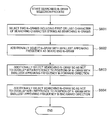
- FIG. 6 is a flowchart showing a flow of a selection process for a searching n-gram according to a second embodiment.
- a searching apparatus 10 according to a first embodiment will be explained with reference to FIG. 1 .
- the searching apparatus 10 includes a memory unit 11 , an input unit 12 , an n-gram extracting unit 13 , a smallest-frequency deriving unit 14 , a searching n-gram selecting unit 15 , a document specifying unit 16 , and an output unit 17 .
- the memory unit 11 stores transposed indexes corresponding to plural pieces of document data subjected to searching.
- the transposed index contains, for each n-gram extracted from plural pieces of document data, the appearing position and the appearing frequency thereof.
- the memory unit 11 comprises, for example, a hard disk device.
- N doc When a document represented by a piece of document data includes N doc number of character strings, N doc ⁇ N+1 number of n-grams (n character strings) are extracted.
- the memory unit 11 stores, regarding the n-grams of an identical character string pattern extracted from each of the plural pieces of document data, transposed indexes representing appearing positions and appearing frequencies.
- the input unit 12 receives a searching character string input by a user.
- the input unit 12 supplies the received searching character string to the n-gram extracting unit 13 .
- the input unit 12 comprises input devices, such as a keyboard and a touch panel.
- the n-gram extracting unit 13 extracts all n-grams from the searching character string received from the input unit 12 .
- the n-gram extracting unit 13 supplies the extracted n-grams to the smallest-frequency deriving unit 14 .
- the n-gram extracting unit 13 comprises, for example, a CPU of a computer apparatus.
- the n-gram extracting unit 13 extracts M ⁇ N+1 number of n-grams from the searching character string.
- the smallest-frequency deriving unit 14 derives an n-gram with the smallest appearing frequency for plural pieces of document data among all n-grams extracted by the n-gram extracting unit 13 based on the appearing frequency included in the transposed index stored in the memory unit 11 .
- the smallest-frequency deriving unit 14 supplies the n-gram extracted by the n-gram extracting unit 13 and the n-gram with the smallest appearing frequency to the searching n-gram selecting unit 15 .
- the smallest-frequency deriving unit 14 derives an n-gram with the smallest appearing frequency among the M ⁇ N+1 number of n-grams.
- the transposed index 29 includes three files: a file (pattern. idx) written with n-gram character string pattern and appearing position information storing addresses; a file (position.idx) written with appearing frequencies of individual n-gram character string pattern and appearing positions thereof; and a file (number.idx) written with document numbers and first character positions of respective documents.
- the appearing position is a position of a character from the beginning of texts where documents subjected to searching are arranged in the order of document number.
- the first character position of each document number is a position of the first character of each document from the beginning of the texts where documents subjected to searching are arranged in the order of document number.
- the searching n-gram selecting unit 15 selects plural searching n-grams configuring a searching character string and including an n-gram with the smallest appearing frequency derived by the smallest-frequency deriving unit 14 from all n-grams extracted by the n-gram extracting unit 13 .
- the searching n-gram selecting unit 15 supplies the selected plural searching n-grams to the document specifying unit 16 .
- N-grams having respective positions adjoining to each other among all n-grams extracted by the n-gram extracting unit 13 have an overlap of characters. Hence, in order to specify document data to be discussed later, it is not necessary to use all of the extracted n-grams, but n-grams configuring a searching character string are used.
- the searching n-gram selecting unit 15 selects searching n-grams configuring a searching character string from all n-grams extracted by the n-gram extracting unit 13 .
- the selected n-grams are always caused to include an n-gram with the smallest appearing frequency derived by the smallest-frequency deriving unit 14 .
- document data can be refined efficiently.
- the document specifying unit 16 specifies document data including a searching character string among plural pieces of document data based on the plural searching n-grams selected by the searching n-gram selecting unit 15 and the appearing position information of the transposed index stored in the memory unit 11 .
- the document specifying unit 16 supplies the specified document data to the output unit 17 .
- the document specifying unit 16 determines whether or not the plural n-grams successively appear in the order of searching character string, and specifies document data having undergone determination that the plural n-grams appear successively.
- the output unit 17 outputs document data specified by the document specifying unit 16 to the user. More specifically, information on document data is output using an output device like a display.
- a computer apparatus 20 includes a CPU (Central Processing Unit) 21 , a ROM (Read Only Memory) 22 , a RAM (Random Access Memory) 23 , an HDD (Hard Disk Drive) 24 , an input device 25 , an output device 26 , and a communication control device 27 .
- Individual structural elements are connected together through a system bus that is a transmission path for transmitting an instruction, data, and the like.
- the CPU 21 controls the operation of the whole computer apparatus 20 , and exchanges a control signal and data with individual structural elements.
- the ROM 22 stores a computer program and various data necessary for the computer apparatus 20 to operate.
- the ROM 22 stores, in particular, a computer program and various data necessary for a searching process.
- the RAM 23 temporarily stores data and the computer program.
- the RAM 23 retains the computer program and data read from the ROM 22 and data necessary for progressing other processes.
- the HDD 24 stores data, etc., necessary for the searching process.
- the HDD 24 stores, for each of plural pieces of document data 28 subjected to searching, and n-grams extracted from plural pieces of document data 28 , the transposed index 29 including an appearing position in the plural pieces of document data 28 and an appearing frequency as structural elements.
- the input device 25 comprises, for example, a keyboard and a touch panel.
- the input device 25 receives an input given by the user.
- the input device 25 supplies, in particular, a searching character string input by the user to the n-gram extracting unit 13 .
- the output device 26 comprises, for example, a display.
- the output device 26 outputs a process result by the computer apparatus 20 .
- the output device 26 outputs, in particular, the document data 28 including a searching character string and specified by the document specifying unit 16 to the user.
- the communication control device 27 connects the computer apparatus 20 to a computer communication network like the Internet.
- the communication control device 27 is used to connect the computer apparatus 20 and to exchange data over the communication network.
- the plural pieces of document data 28 may be obtained through the communication control device 27 .
- the plural pieces of document data 28 may be present outside the computer apparatus 20 . This example case will be explained with reference to FIG. 2B .
- the plural pieces of document data 28 are not present in the HDD 24 , but are present outside the computer apparatus 20 .
- the communication control device 27 is connected to the document data 28 through the computer communication network.
- document searching is enabled through an electronic apparatus with a limited capacity like a compact electronic dictionary as long as it can be connected to the Internet.
- the input unit 12 receives a searching character string from the user (step S 301 ).
- the input unit 12 supplies the received searching character string to the n-gram extracting unit 13 .
- the n-gram extracting unit 13 receives the searching character string from the input unit 12 .
- the n-gram extracting unit 13 extracts all n-grams from the received searching character string (step S 302 ).
- the n-gram extracting unit 13 extracts, from the front in the order, eight (9 ⁇ 2+1) n-grams (bigrams) that are “AB”, “BC”, “CD”, “DE”, “EF”, “FG”, “GH”, and “HI” each of which is expressed by two characters in Japanese.
- the n-gram extracting unit 13 extracts, from the front in the order, seven (9 ⁇ 3+1) n-grams (trigrams) that are “ABC”, “BCD”, “CDE”, “DEF”, “EFG”, “FGH”, and “GHI” each of which is expressed by three characters in Japanese.
- N is set beforehand by the searching apparatus 10 .
- the value of N can be 2, 3, or other natural number.
- N 2 or 3
- the smallest-frequency deriving unit 14 derives an n-gram with the smallest appearing frequency among all extracted n-grams (step S 303 ).
- the appearing frequency is included in the transposed index 29 stored in the memory unit 11 .
- the smallest-frequency deriving unit 14 refers to the appearing frequency corresponding to each of all extracted n-grams, thereby deriving the n-gram with the smallest appearing frequency.
- the smallest-frequency deriving unit 14 gives a preference, for example, to n-gram with a position in the searching character string forward and derives such an n-gram. Moreover, among the plural n-grams extracted from the searching character string, when there is no transposed index corresponding to the n-gram, the searching character string is not present in the plural pieces of document data 28 subjected to be searched. In this case, for example, the smallest-frequency deriving unit 14 outputs a message like “no searching character string found” to the user, and terminates the process (which is not illustrated).
- the searching n-gram selecting unit 15 selects searching n-grams among all of the extracted n-grams so as to contain the derived n-gram with the smallest appearing frequency (step S 304 ). The detail of the selection process will be explained with reference to the flowchart of FIG. 5 .
- the searching n-gram selecting unit 15 selects searching n-grams from the head for the searching character string so as not to overlap (step S 501 ).
- the searching n-gram selecting unit 15 selects four n-grams that are “AB”, “CD”, “EF”, and “GH” each of which are expressed by two characters in Japanese so as not to overlap one another from the head.
- the searching n-gram selecting unit 15 determines whether or not the searching character string is formed by the selected searching n-grams (step S 502 ). For example, in the case of the four n-grams (bigrams) selected as explained above, a last character of the searching character string which expresses a part “I” of the last word is not included (step S 502 : NO). In this case, the searching n-gram selecting unit 15 additionally selects an n-gram including the last character of the searching character string in Japanese as a searching n-gram (step S 503 ).
- “HI” including the last character “I” of the searching character string in Japanese is additionally selected as a searching n-gram.
- the searching n-gram selecting unit 15 selects five bigrams that are “AB”, “CD”, “EF”, “GH”, and “HI”. Accordingly, the searching character string “ABCDEFGHI” is formed by the selected n-grams.
- the searching n-gram selecting unit 15 selects three searching n-grams that are “ABC”, “DEF”, and “GHI” each of which are expressed by three characters in Japanese.
- the searching character string “ABCDEFGHI” can be formed by the selected n-grams.
- the searching n-gram selecting unit 15 determines whether or not the n-gram with the smallest appearing frequency derived in the step S 303 is included in the selected searching n-gram (step S 504 ).
- the “GH” is included in the five bigrams which are selected by the searching n-gram selecting unit 15 and which are “AB”, “CD”, “EF”, “GH”, and “HI” in the above-explained example case.
- the searching n-gram selecting unit 15 terminates the selection process of the searching n-grams. That is, five bigrams “AB”, “CD”, “EF”, “GH”, and “HI” are eventually selected.
- the searching n-gram selecting unit 15 additionally selects the n-gram with the smallest appearing frequency as a searching n-gram (step S 505 ). Thereafter, the searching n-gram selecting unit 15 terminates the selection process of the searching n-grams. That is, in this case, six bigrams “AB”, “BC”, “CD”, “EF”, “GH”, and “HI” are eventually selected.
- the document specifying unit 16 executes a process of specifying the document data 28 including the searching character string using the searching n-grams selected in the step S 304 .
- An explanation will be given of a case in which five bigrams “AB”, “CD”, “EF”, “GH”, and “HI” are selected in the step S 304 .
- the document specifying unit 16 arranges the selected searching n-grams in the order of smaller appearing frequency (step S 305 ). This process is executed based on the appearing frequency included in the transposed index 29 . Regarding respective appearing frequencies of the five bigrams, when “AB” is ten times, “CD” is eight times, “EF” is five times, “GH” is three times, and “HI” is thirteen times, such five bigrams are arranged in the order of smaller appearing frequency like “GH”, “EF”, “CD”, “AB” and “HI”.
- the document data 28 to be specified includes all searching n-grams. Searching of the document data 28 with reference to the n-gram with a smaller appearing frequency has a better searching efficiency than searching of the document data 28 with reference to the n-gram with a larger appearing frequency.
- the document specifying unit 16 determines whether or not an appearing position corresponding to the n-gram with the smallest appearing frequency is not evaluated yet (step S 306 ).
- step S 306 determines whether or not an appearing position corresponding to the n-gram with the smallest appearing frequency is not evaluated yet.
- the document specifying unit 16 focuses on the appearing position not yet evaluated (step S 307 ). Respective three appearing positions “100th character”, “300th character”, and “700th character” of the bigram “GH” with the smallest appearing frequency are all not evaluated yet. In this case, the document specifying unit 16 focuses on “100th character” that is the first appearing position.
- the document specifying unit 16 determines whether or not the focused appearing position and the following appearing position include all of the other searching n-grams (step S 308 ). More specifically, bigrams are selected in the order of the smaller appearing frequency, and following determination processes (a) to (d) are executed. Through such processes, the document specifying unit 16 determines whether or not the appearing positions of respective bigrams form the searching character string “ABCDEFGHI”.
- the searching bigram “EF” is located two characters (in Japanese) ahead of the bigram “GH” with the smallest appearing frequency.
- the searching bigram “CD” is located four characters (in Japanese) ahead of the bigram “GH” with the smallest appearing frequency.
- the searching bigram “AB” is located six characters (in Japanese) ahead of the bigram “GH” with the smallest appearing frequency.
- the searching bigram “HI” is located one character (in Japanese) behind the bigram “GH” with the smallest appearing frequency.
- step S 308 NO
- the document specifying unit 16 returns the process to the step S 306 , and in the step S 307 , a next appearing position which is not yet evaluated, i.e., the “300th character” in this case is focused.
- the document specifying unit 16 executes the determination process again at the step S 308 for the focused “300th character”.
- step S 308 when it is determined that there are all of the other searching n-grams at the appearing positions following to the focused appearing position through (a) to (d) (step S 308 : YES), the document specifying unit 16 determines that the searching character string “ABCDEFGHI” is present at that position. In this case, the document specifying unit 16 (the searching apparatus 10 ) specifies the number (the document number) of the document including the searching character string, and stores the specified number (step S 309 ).
- step S 306 the process returns to the step S 306 , and it is determined again whether or not there is an appearing position which corresponds to the n-gram with the smallest appearing frequency and which is not yet evaluated. More specifically, in the above-explained example case, when the current process is focusing on the first “100th character”, the “300th character” and the “700th character” are not evaluated yet (step S 309 : YES), so that the process returns to the step S 307 , and the document specifying unit 16 executes the process focusing on the appearing positions not yet evaluated.
- step S 306 when all of the appearing positions corresponding to the n-gram with the smallest appearing frequency are evaluated (step S 306 : NO), the output unit 17 outputs the document data 28 corresponding to all document numbers stored in the step S 309 to the user (step S 310 ).
- the document data 28 is output by the times corresponding to the number of the process at 5309 executed, i.e., by what corresponds to the number of specifying of the document including the searching character string.
- the output unit 17 When none of the document including the searching character string is specified, in the step S 310 , the output unit 17 outputs a message like “no searching character string found” to the user.
- both of high-speed searching n-gram selection process that is a simple process of selecting a searching n-gram so as not to overlap from the first character in the searching character string and efficient document specifying process of selecting a few (the minimum limit configuring the searching character string plus 1) searching n-grams including an n-gram with the smallest appearing frequency are enabled.
- a compact electronic dictionary, etc. loaded in a cellular phone or a portable electronic apparatus with a limited process speed and capacity is enabled to perform efficient searching.
- searching n-grams when searching n-grams are selected, such searching n-grams are selected so as not to overlap in the order from the head of the searching character string.
- searching n-grams are selected with reference to the position of an n-gram with the smallest appearing frequency in the searching character string.
- the second embodiment has a different selection process (see FIG. 5 ) of searching n-grams from that of the first embodiment.
- the searching n-gram selecting unit 15 selects, as the searching n-grams, two n-grams including the head or the last character of the searching character string among all n-grams extracted by the n-gram extracting unit 13 (step S 601 ).
- the searching character string is “ABCDEFGHIJKL” which contains 12 characters “A”, “B”, “C”, “D”, “E”, “F”, “G”, “H”, “I”, “J” “K” and “L”, in Japanese
- the searching n-gram selecting unit 15 selects in the step S 601 the two n-grams “AB” and “KL” which are the head and the last of the searching character string, respectively.
- the searching n-gram selecting unit 15 adds an n-gram with the smallest appearing frequency to the searching n-grams (step S 602 ).
- the searching n-gram selecting unit 15 selects and adds a searching n-gram so as not to overlap the selected searching n-grams frontward and backward of the position of the n-gram with the smallest appearing frequency (steps S 603 , S 604 ).
- this bigram “EF” is selected in the step S 602 as a searching n-gram.
- a forward n-gram i.e., “CD” is selected so as not to overlap the selected n-gram with reference to “EF”.
- backward n-grams i.e., “GH” and “IJ” are selected so as not to overlap the selected n-gram.
- the first character of the bigram with the smallest appearing frequency is located at an odd number position in the searching character string.
- Other bigrams with a first character located at an odd number position are selected.
- the selected searching n-grams include the bigram with the smallest appearing frequency and the number of such selected searching n-grams corresponds to the minimum number of bigrams for forming the searching character string.
- searching n-grams include the bigram with the smallest appearing frequency and form the searching character string.
- this bigram “FG” is selected in the step S 602 as the searching n-gram.
- frontward n-grams i.e., “DE” and “BC” are selected in the step S 603 so as not to overlap the selected searching n-gram with reference to “FG”.
- backward n-grams i.e., “HI” and “JK” are selected in the step S 604 so as not to overlap the selected searching n-gram with reference to “FG”.
- the first character of the bigram with the smallest appearing frequency is located at an even number position in the searching character string. Moreover, other bigrams with the first character located at an even number position are selected.
- the selected searching n-grams include the bigram with the smallest appearing frequency, and the number of such selected searching n-grams is larger by one than the minimum number of bigrams forming the searching character string.
- the document specifying unit 16 executes the process of specifying the document data 28 including the searching character string as explained in the first embodiment.
- n-grams forming the searching character string are selected. Accordingly, a few (the minimum number of forming the searching character string or this number plus one) searching n-grams surely including the n-gram with the smallest appearing frequency can be selected. This enables both high-speed searching n-gram selection process and efficient document specifying process.
- Respective structural elements of the searching apparatus 10 may be realized by a computer program that allows the computer apparatus 20 to function.
- the computer program can be stored in a computer-readable information memory medium, such as a compact disk, a flexible disk, a hard disk, a magneto-optical disk, digital video disk, a magnetic tape, or a semiconductor memory, and the like.
- a computer-readable information memory medium such as a compact disk, a flexible disk, a hard disk, a magneto-optical disk, digital video disk, a magnetic tape, or a semiconductor memory, and the like.
- the computer program can be distributed and sold over a computer communication network independently from the computer apparatus 20 that runs the computer program.
- the information memory medium can be distributed and sold independently from the computer apparatus 20 .
Landscapes
- Engineering & Computer Science (AREA)
- Databases & Information Systems (AREA)
- Theoretical Computer Science (AREA)
- Computational Linguistics (AREA)
- Data Mining & Analysis (AREA)
- Physics & Mathematics (AREA)
- General Engineering & Computer Science (AREA)
- General Physics & Mathematics (AREA)
- Information Retrieval, Db Structures And Fs Structures Therefor (AREA)
Abstract
Description
Claims (8)
Applications Claiming Priority (2)
| Application Number | Priority Date | Filing Date | Title |
|---|---|---|---|
| JP2010-102368 | 2010-04-27 | ||
| JP2010102368A JP5083367B2 (en) | 2010-04-27 | 2010-04-27 | SEARCH DEVICE, SEARCH METHOD, AND COMPUTER PROGRAM |
Publications (2)
| Publication Number | Publication Date |
|---|---|
| US20110264675A1 US20110264675A1 (en) | 2011-10-27 |
| US8412697B2 true US8412697B2 (en) | 2013-04-02 |
Family
ID=44816678
Family Applications (1)
| Application Number | Title | Priority Date | Filing Date |
|---|---|---|---|
| US13/094,012 Expired - Fee Related US8412697B2 (en) | 2010-04-27 | 2011-04-26 | Searching apparatus and searching method |
Country Status (3)
| Country | Link |
|---|---|
| US (1) | US8412697B2 (en) |
| JP (1) | JP5083367B2 (en) |
| CN (1) | CN102236697B (en) |
Families Citing this family (6)
| Publication number | Priority date | Publication date | Assignee | Title |
|---|---|---|---|---|
| JP5880699B2 (en) * | 2012-05-31 | 2016-03-09 | 富士通株式会社 | Index generation program and search program |
| JP5733285B2 (en) * | 2012-09-20 | 2015-06-10 | カシオ計算機株式会社 | SEARCH DEVICE, SEARCH METHOD, AND PROGRAM |
| WO2014045320A1 (en) * | 2012-09-21 | 2014-03-27 | 富士通株式会社 | Control program, control method and control device |
| JP6050165B2 (en) * | 2013-03-22 | 2016-12-21 | 株式会社日立ソリューションズ | Full-text search device |
| CN114003685B (en) * | 2022-01-04 | 2022-06-07 | 广州奥凯信息咨询有限公司 | Word segmentation position index construction method and device, and document retrieval method and device |
| CN115221266A (en) * | 2022-06-24 | 2022-10-21 | 中银金融科技有限公司 | Raw corpus retrieval method, device, electronic device and storage medium |
Citations (13)
| Publication number | Priority date | Publication date | Assignee | Title |
|---|---|---|---|---|
| US5418951A (en) * | 1992-08-20 | 1995-05-23 | The United States Of America As Represented By The Director Of National Security Agency | Method of retrieving documents that concern the same topic |
| US5706365A (en) * | 1995-04-10 | 1998-01-06 | Rebus Technology, Inc. | System and method for portable document indexing using n-gram word decomposition |
| US6131082A (en) * | 1995-06-07 | 2000-10-10 | Int'l.Com, Inc. | Machine assisted translation tools utilizing an inverted index and list of letter n-grams |
| US6292772B1 (en) * | 1998-12-01 | 2001-09-18 | Justsystem Corporation | Method for identifying the language of individual words |
| US6701318B2 (en) * | 1998-11-18 | 2004-03-02 | Harris Corporation | Multiple engine information retrieval and visualization system |
| US20050060643A1 (en) * | 2003-08-25 | 2005-03-17 | Miavia, Inc. | Document similarity detection and classification system |
| US7031910B2 (en) * | 2001-10-16 | 2006-04-18 | Xerox Corporation | Method and system for encoding and accessing linguistic frequency data |
| JP2007213158A (en) | 2006-02-07 | 2007-08-23 | Toshiba Corp | Structured document search apparatus and structured document search method |
| US20080240619A1 (en) * | 2007-03-26 | 2008-10-02 | Kabushiki Kaisha Toshiba | Apparatus, method, and computer program product for managing structured documents |
| US7720852B2 (en) * | 2000-05-03 | 2010-05-18 | Yahoo! Inc. | Information retrieval engine |
| US8073869B2 (en) * | 2008-07-03 | 2011-12-06 | The Regents Of The University Of California | Method for efficiently supporting interactive, fuzzy search on structured data |
| US20110320464A1 (en) * | 2009-04-06 | 2011-12-29 | Mitsubishi Electric Corporation | Retrieval device |
| US8175878B1 (en) * | 2007-03-29 | 2012-05-08 | Google Inc. | Representing n-gram language models for compact storage and fast retrieval |
Family Cites Families (3)
| Publication number | Priority date | Publication date | Assignee | Title |
|---|---|---|---|---|
| AU777693B2 (en) * | 1999-03-05 | 2004-10-28 | Canon Kabushiki Kaisha | Database annotation and retrieval |
| JP4314204B2 (en) * | 2005-03-11 | 2009-08-12 | 株式会社東芝 | Document management method, system and program |
| JP4851353B2 (en) * | 2007-01-31 | 2012-01-11 | 株式会社リコー | Image processing apparatus and image processing method |
-
2010
- 2010-04-27 JP JP2010102368A patent/JP5083367B2/en active Active
-
2011
- 2011-04-26 CN CN201110112548.1A patent/CN102236697B/en active Active
- 2011-04-26 US US13/094,012 patent/US8412697B2/en not_active Expired - Fee Related
Patent Citations (13)
| Publication number | Priority date | Publication date | Assignee | Title |
|---|---|---|---|---|
| US5418951A (en) * | 1992-08-20 | 1995-05-23 | The United States Of America As Represented By The Director Of National Security Agency | Method of retrieving documents that concern the same topic |
| US5706365A (en) * | 1995-04-10 | 1998-01-06 | Rebus Technology, Inc. | System and method for portable document indexing using n-gram word decomposition |
| US6131082A (en) * | 1995-06-07 | 2000-10-10 | Int'l.Com, Inc. | Machine assisted translation tools utilizing an inverted index and list of letter n-grams |
| US6701318B2 (en) * | 1998-11-18 | 2004-03-02 | Harris Corporation | Multiple engine information retrieval and visualization system |
| US6292772B1 (en) * | 1998-12-01 | 2001-09-18 | Justsystem Corporation | Method for identifying the language of individual words |
| US7720852B2 (en) * | 2000-05-03 | 2010-05-18 | Yahoo! Inc. | Information retrieval engine |
| US7031910B2 (en) * | 2001-10-16 | 2006-04-18 | Xerox Corporation | Method and system for encoding and accessing linguistic frequency data |
| US20050060643A1 (en) * | 2003-08-25 | 2005-03-17 | Miavia, Inc. | Document similarity detection and classification system |
| JP2007213158A (en) | 2006-02-07 | 2007-08-23 | Toshiba Corp | Structured document search apparatus and structured document search method |
| US20080240619A1 (en) * | 2007-03-26 | 2008-10-02 | Kabushiki Kaisha Toshiba | Apparatus, method, and computer program product for managing structured documents |
| US8175878B1 (en) * | 2007-03-29 | 2012-05-08 | Google Inc. | Representing n-gram language models for compact storage and fast retrieval |
| US8073869B2 (en) * | 2008-07-03 | 2011-12-06 | The Regents Of The University Of California | Method for efficiently supporting interactive, fuzzy search on structured data |
| US20110320464A1 (en) * | 2009-04-06 | 2011-12-29 | Mitsubishi Electric Corporation | Retrieval device |
Non-Patent Citations (3)
| Title |
|---|
| Adams et al., "Trigrams as Index Elements in Full Text Retrieval Observations and Experimental Results", 1993, ACM. * |
| Japanese Office Action dated Dec. 6, 2011 (and English translation thereof) in counterpart Japanese Application No. 2010-102368. |
| Y. Ogawa et al; "An Efficient Document Retrieval Method Using n-gram Indexing", IEICE (The Institute of Electronics, Information and Communication Engineers) Journal (D-I), vol. J82-D-I, No. 1, pp. 121-129, Jan. 1999. |
Also Published As
| Publication number | Publication date |
|---|---|
| JP5083367B2 (en) | 2012-11-28 |
| JP2011232943A (en) | 2011-11-17 |
| CN102236697A (en) | 2011-11-09 |
| CN102236697B (en) | 2014-02-19 |
| US20110264675A1 (en) | 2011-10-27 |
Similar Documents
| Publication | Publication Date | Title |
|---|---|---|
| JP5550669B2 (en) | SEARCH DEVICE, SEARCH METHOD, AND PROGRAM | |
| US8301437B2 (en) | Tokenization platform | |
| US9367605B2 (en) | Abstract generating search method and system | |
| US20110264675A1 (en) | Searching apparatus and searching method | |
| US10929603B2 (en) | Context-based text auto completion | |
| JP2019067433A (en) | Subject provision system | |
| GB2569858A (en) | Constructing content based on multi-sentence compression of source content | |
| CN105404677A (en) | Tree structure based retrieval method | |
| Oliveira et al. | A concept-based ILP approach for multi-document summarization exploring centrality and position | |
| CN116226681B (en) | Text similarity judging method and device, computer equipment and storage medium | |
| JP5601116B2 (en) | Transposed index generation method and generation apparatus for N-gram search, search method and search apparatus using the inverted index, and computer program | |
| CN105426490A (en) | Tree structure based indexing method | |
| CN104077418A (en) | Mobile terminal application program searching method and system | |
| JP2008243074A (en) | Document search apparatus, method and program | |
| JP5601123B2 (en) | Transposed index generation method and generation apparatus for N-gram search, search method and search apparatus using the inverted index, and computer program | |
| KR100349673B1 (en) | Methdo for retrieving image using representative value of multi-dimensional image feature | |
| KR101463102B1 (en) | Image data processing apparatus and method thereof | |
| JP5533197B2 (en) | Search device and computer program | |
| KR101095580B1 (en) | El-gram indexing method in mobile devices with small flash memory and RAM | |
| JP5526987B2 (en) | Management program, management apparatus, and management method | |
| JP5526986B2 (en) | Management program, management apparatus, and management method | |
| KR20250050449A (en) | Document-based question answering system, apparatus and method using language model | |
| JP5601121B2 (en) | Transposed index generation method and generation apparatus for N-gram search, search method and search apparatus using the inverted index, and computer program | |
| CN117972117A (en) | Search method, device, electronic device and storage medium | |
| JP2023162820A (en) | Content presentation device and program |
Legal Events
| Date | Code | Title | Description |
|---|---|---|---|
| AS | Assignment |
Owner name: CASIO COMPUTER CO., LTD., JAPAN Free format text: ASSIGNMENT OF ASSIGNORS INTEREST;ASSIGNOR:SATOH, KATSUHIKO;REEL/FRAME:026180/0757 Effective date: 20110419 |
|
| FEPP | Fee payment procedure |
Free format text: PAYOR NUMBER ASSIGNED (ORIGINAL EVENT CODE: ASPN); ENTITY STATUS OF PATENT OWNER: LARGE ENTITY |
|
| STCF | Information on status: patent grant |
Free format text: PATENTED CASE |
|
| FEPP | Fee payment procedure |
Free format text: PAYOR NUMBER ASSIGNED (ORIGINAL EVENT CODE: ASPN); ENTITY STATUS OF PATENT OWNER: LARGE ENTITY Free format text: PAYER NUMBER DE-ASSIGNED (ORIGINAL EVENT CODE: RMPN); ENTITY STATUS OF PATENT OWNER: LARGE ENTITY |
|
| FPAY | Fee payment |
Year of fee payment: 4 |
|
| MAFP | Maintenance fee payment |
Free format text: PAYMENT OF MAINTENANCE FEE, 8TH YEAR, LARGE ENTITY (ORIGINAL EVENT CODE: M1552); ENTITY STATUS OF PATENT OWNER: LARGE ENTITY Year of fee payment: 8 |
|
| FEPP | Fee payment procedure |
Free format text: MAINTENANCE FEE REMINDER MAILED (ORIGINAL EVENT CODE: REM.); ENTITY STATUS OF PATENT OWNER: LARGE ENTITY |
|
| LAPS | Lapse for failure to pay maintenance fees |
Free format text: PATENT EXPIRED FOR FAILURE TO PAY MAINTENANCE FEES (ORIGINAL EVENT CODE: EXP.); ENTITY STATUS OF PATENT OWNER: LARGE ENTITY |
|
| STCH | Information on status: patent discontinuation |
Free format text: PATENT EXPIRED DUE TO NONPAYMENT OF MAINTENANCE FEES UNDER 37 CFR 1.362 |
|
| FP | Lapsed due to failure to pay maintenance fee |
Effective date: 20250402 |