US8407582B2 - Browser program for performing table-layout - Google Patents
Browser program for performing table-layout Download PDFInfo
- Publication number
- US8407582B2 US8407582B2 US12/407,775 US40777509A US8407582B2 US 8407582 B2 US8407582 B2 US 8407582B2 US 40777509 A US40777509 A US 40777509A US 8407582 B2 US8407582 B2 US 8407582B2
- Authority
- US
- United States
- Prior art keywords
- cell
- screen
- width
- row
- cells
- Prior art date
- Legal status (The legal status is an assumption and is not a legal conclusion. Google has not performed a legal analysis and makes no representation as to the accuracy of the status listed.)
- Expired - Fee Related, expires
Links
Images




Classifications
-
- G—PHYSICS
- G06—COMPUTING OR CALCULATING; COUNTING
- G06F—ELECTRIC DIGITAL DATA PROCESSING
- G06F16/00—Information retrieval; Database structures therefor; File system structures therefor
- G06F16/90—Details of database functions independent of the retrieved data types
- G06F16/95—Retrieval from the web
- G06F16/957—Browsing optimisation, e.g. caching or content distillation
- G06F16/9577—Optimising the visualization of content, e.g. distillation of HTML documents
Definitions
- the present invention relates to a browser used for browsing contents on the Internet, and particularly to a layout method of laying out a table in the contents.
- HTML hypertext markup language
- PDA personal digital assistant
- the contents on the Internet are targeted for a personal computer having a relatively large screen which is larger than a screen size of the portable device. That is, the contents targeted for the personal computer include images and tables whose sizes are larger than the screen size of the portable device. For this reason, in many cases, the portable device having a relatively small screen can not suitably display the contents of the Internet on the screen thereof.
- the table which is defined in the contents by a tag ⁇ table>, is used to lay out cells of the table in a form of a two-dimensional array on a device.
- a relatively large image can be displayed on the screen of a device as a combinational image consisting of a plurality of cells of partial images.
- a method of browsing contents targeted for the personal computer using the portable device having relatively small screen includes aligning cells, which are aligned horizontally (i.e., in a direction of a row) in a table of the contents, vertically on the screen of the portable device.
- the browser running on the portable device enables a user to browse the cells on the relatively small screen of the portable device by scrolling vertically the cells by operating, for example, an up-and-down key.
- Japanese Patent Provisional Publications No. HEI 9-9160 (document 1) and No. 2001-243151 (document 2) disclose a technique to scale down an image in original contents in accordance with the screen size of the portable device.
- the browser running on the portable device can display the image of the original contents within the screen of the portable device.
- no explanation is made on how to display a table on the relatively small screen of the portable device without losing the significance that the two-dimensional array of the table has.
- Another factor that inhibits comfortable browsing of the contents targeted for the personal computer on the portable device is a “frameset” which is defined in the contents by a set of tags ⁇ frameset> and ⁇ /frameset>.
- the tag ⁇ frameset> is a declaration statement used to divide the screen into a plurality of frames to display different contents on the respective frames.
- contents can be displayed on a screen of a device in a form of a two-dimensional array.
- contents including the frameset are displayed by the browser on the relatively small screen of the portable device
- the URL content may be difficult to be read.
- a screen size per a frame becomes very small when the frameset is displayed by the browser on the relatively small screen of the portable device.
- Japanese Patent Provisional Publication No. 2000-298543 discloses a method to indicate an active frame of a plurality of frames by a heavy line, and to use a frame switching key to switch between the frames when the frameset is displayed by a browser on a computer.
- the browser enables the user to recognize the active frame visually and to switch to a desired frame relatively easily by using the frame switching key.
- no explanation is made on how to display the frameset on the relatively small screen of the portable device without losing the significance that the two-dimensional array of the frames of the frameset has.
- the present invention is advantageous in that it provides a method of laying out contents of the Internet on a relatively small screen of a portable device without losing a significance that a linear array or a two-dimensional array of data included in the contents such as a table, a frameset and the like has.
- a method of laying out contents targeted for a first device having a first screen size on a screen of a second device having a second screen size smaller than the first screen size includes: analyzing a table defined by a tag ⁇ table> in the contents to determine a table width of the table in accordance with a predetermined criterion; and performing in response to a result of the analyzing step one of layout operations of:
- the table can be displayed on the second device (e.g., a portable device) without losing significance that the linear array or the two-dimensional array of the information has.
- the layout operations may include (p3) scaling down the table configured to be a combinational image having a plurality of partial images so that the combinational image can be contained in the screen of the second device at least in a horizontal direction.
- the predetermined criterion may include a first criterion that whether or not a condition: (a minimum table width)>(a width of the screen of the second device) is satisfied, the minimum table width of the table being a width of a row in the table when cells of the row of the table is minimized.
- a condition a condition: (a minimum table width)>(a width of the screen of the second device) is satisfied, the minimum table width of the table being a width of a row in the table when cells of the row of the table is minimized.
- the operation of (p1) is performed.
- one of the operations of (p2) and (p3) is performed.
- the predetermined criterion may include a second criterion that a number of carriage returns of characters in at least one of cells of a row of the table is greater than a certain value when the cells of the row of the table are minimized. In this case, when the second criterion is satisfied, one of the operations of (p2) and (p3) is performed even if the first criterion is not satisfied.
- the predetermined criterion may include a third criterion that a ratio of a vertical size to a horizontal size of at least one of cells of a row of the table is greater than a certain ratio when the cells of the row of the table are minimized.
- the third criterion when the third criterion is satisfied, one of the processes of (p2) and (p3) is selected even if the first criterion is not satisfied.
- the predetermined criterion may include a fourth criterion that a width of at least one of cells having characters in a row of the table is less than or equal to a certain value when the cells of the row of the table are minimized. In this case, when the forth criterion is satisfied, one of the operations of (p2) and (p3) is performed even if the first criterion is not satisfied.
- the method may includes determining whether the table is configured to be the combinational image.
- the operation (p3) is performed when the table is determined to be the combinational image by the determining step.
- the table may determined to be the combinational image.
- the predetermined algorithm may include operations of:
- the minimum table width may be a sum of widths of images in cells of the row of the table, a maximum of widths of characters in each cell of the row of the table, and widths of borders between adjacent cells of the row of the table.
- the operation (p3) may include: (b1) scaling down cells of the table by the same scaling factor in accordance with the second screen size, and (b2) scaling down each of partial images of the cells of the table in accordance with a width of a corresponding scaled down cell.
- the method may include converting in advance a frameset to a table in accordance with a predetermined conversion algorithm if the frameset exists in the contents.
- the method may include obtaining in advance the contents through a network.
- the method may include obtaining in advance the contents through the Internet.
- the contents may include a document described by a markup language.
- a computer program product providing a set of instructions executed by a terminal device, the terminal device executing the instructions functioning as laying out contents targeted for a device having a first screen size on a screen of the terminal device having a second screen size smaller than the first screen size.
- the computer program product includes functions of:
- the table can be displayed on the terminal device (e.g., a portable device) without losing significance that the linear array or the two-dimensional array of the table has.
- a terminal device for laying out contents targeted for a device having a first screen size on a screen of the terminal device having a second screen size smaller than the first screen size.
- the terminal device includes an analyzing system that analyzes a table defined by a tag ⁇ table> in the contents to determined a table width of the table in accordance with a predetermined criterion, and a layout system that performs in response to a result of an analysis of the analyzing system one of layout operations of:
- the table can be displayed on the terminal device (e.g., a portable device) without losing significance that the linear array or the two-dimensional array of the information has.
- the terminal device may include an obtaining system that obtains the contents through a network.
- FIG. 1 shows a block diagram of a portable device according to a first embodiment of the invention
- FIG. 2 shows a functional block diagram of a browser that runs under a control of a CPU of the portable device
- FIG. 3 is a flowchart showing a table-layout process
- FIG. 4 is an example of a HTML document including a table
- FIG. 5 shows a screen image when the HTML document shown in FIG. 4 is displayed on a screen of a personal computer
- FIG. 6A shows an example of a structure of a table
- FIG. 6B shows an example of a screen image when cells of a top row of the table shown in FIG. 6A are aligned by the table-layout process
- FIG. 6C shows another example of a screen image when cells of a top row of the table shown in FIG. 6A are aligned by the table-layout process
- FIG. 6D shows another example of a screen image when cells of a top row of the table shown in FIG. 6A are aligned by the table-layout process
- FIG. 7 is an example of a screen image as a result of a splitting process in which the HTML document shown in FIG. 4 is treated;
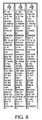
- FIG. 8 shows a comparative example of the screen image of the HTML document of FIG. 4 treated by another process for comparing with the example of FIG. 7 ;
- FIG. 9 shows another comparative example of the screen image of the HTML document of FIG. 4 treated by another process for comparing with the example of FIG. 7 ;
- FIG. 10A schematically shows an example of a row of a table to be processed
- FIG. 10B shows a screen image in a case where a target row shown in FIG. 10A is subjected to an algorithm (d1)-(d5);
- FIG. 10C shows a screen image in a case where a target row shown in FIG. 10A is subjected to an algorithm (a1)-(a4);
- FIG. 11 is an example of contents including a table as a combinational image
- FIG. 12 is a screen image of the contents shown in FIG. 10 in a case where the contents are displayed on a screen of a personal computer;
- FIG. 13 is a screen image of the contents shown in FIG. 11 in a case where the contents are subjected to the table-layout process and are displayed on the screen of the portable device;
- FIG. 14 is a comparative example of a screen image when cells of the contents of FIG. 11 are subjected to a process in which all of the cells are aligned vertically on the screen of the portable device 10 without exception;
- FIG. 15 is an example of a screen image in a case where contents targeted for the personal computer are displayed on a screen of the personal computer.
- FIG. 16 shows a screen image in a case where a frameset shown in FIG. 15 is converted to a table by a conversion algorithm and is displayed on the screen of the portable device.
- FIG. 1 shows a block diagram of a portable device 10 according to a first embodiment of the invention.
- the portable device 10 has a display 13 whose screen size is smaller than that of a personal computer.
- the personal computer is defined as a device having a horizontal screen size of 800 pixels
- the portable device 10 may be, for example, a mobile phone having a horizontal screen size of 100 through 200 pixels, a PDA having a horizontal screen size of 150 through 640 pixels, or a car navigation device having a horizontal screen size smaller than 640 pixels.
- the portable device 10 is regarded as a mobile phone having a horizontal screen size of 200 pixels by way of example.
- the portable device 10 includes a CPU (Central Processing Unit) 3 which controls various operation of the portable device. Further, the portable device 10 includes a ROM (Read-Only Memory) 5 , a RAM (Random-Access Memory) 7 , a network interface 9 , a display driver 11 and an interface 15 which are connected to the CPU 3 via a bus 19 . Further, the portable device 10 has a display 13 which has the horizontal screen size of 200 pixels and which is connected to the display driver 11 , and has a user interface device 17 such as an operation panel including an up-and-down key and numeric keys. The user interface device 17 is also connected to the CPU 3 via the interface 15 .
- ROM Read-Only Memory
- RAM Random-Access Memory
- the portable device 10 has a display 13 which has the horizontal screen size of 200 pixels and which is connected to the display driver 11 , and has a user interface device 17 such as an operation panel including an up-and-down key and numeric keys.
- the user interface device 17 is also connected to the CPU 3 via the interface 15
- the ROM 5 stores various programs including a program of a browser 20 which is initiated when a certain key operation is made by a user through the use of the user interface device 17 .
- FIG. 2 shows a functional block diagram of the browser 20 that runs under the control of the CPU 3 .
- the browser 20 has functional blocks of parser 31 , a page maker 32 and a formatter 33 .
- the parser 31 parses an HTML document 21 (i.e., contents) that is obtained from the Internet via the network interface 9 so as to make a document tree 23 in which a grammatical structure of the HTML document 21 is expressed by a tree structure. It should be noted that the document tree 23 only expresses the grammatical structure of the HTML document 23 , and does not include information of presentation of the HTML document 23 .
- the page maker 32 makes a layout tree 25 in which forms of presentation of the HTML document 21 , for example, block, inline, table, list, item and the like are included. That is, the layout tree 25 includes information about the order of the data such as block, inline, table and the like in the HTML document 21 . It should be noted that the layout tree 25 does not include information about positions and sizes of such items (block, inline, table, etc.) on the screen of the display 13 .
- the formatter 33 Based on the layout tree 25 and information concerning the screen size of the display 13 , the formatter 33 lays out the items on the screen of the display 13 . That is, the formatter 33 arranges the items in the layout tree 25 on the screen of the display 13 , and determines positions, widths and heights of the items and positions of carriage returns in characters of items.
- the HTML document 21 is displayed on the screen of the display 13 .
- the formatter 30 of the browser 20 is configured to carry out a table-layout process when contents targeted for the personal computer includes a table. That is, the table-layout process enables to lay out and to display contents targeted for the personal computer on the screen of the portable device 10 without losing significance that a two-dimensional array or a linear array of the table has.
- FIG. 3 is a flowchart showing the table-layout process.
- the table-layout process is summarized as follows.
- step S 12 If a table in the contents can be contained in the screen of the portable device 10 , the table is laid out in a typical technique and is displayed on the screen of the portable device 10 (step S 12 ).
- a scaling down layout process (step S 20 ) is performed to scaled down the table in accordance with the screen size of the portable device 10 ;
- a splitting process (step S 21 ) is performed to split and display cells in the table.
- the typical technique means a conventional technique to lay out the table in accordance with a size of an area to be used for displaying the table without changing an array of cells in the table. As described in detail later, in this embodiment, such typical technique is used only when the entire table can be contained in the screen of the portable device 10 .
- a table in the contents is analyzed to calculate a minimum table width.
- the minimum table width is a minimum number of pixels in the horizontal direction required to display data included in cells of one of the rows of the table.
- the minimum table width is defined as the sum of widths of images in cells of the row, a maximum of widths of characters in each cell of the row (i.e., a sum of maximum character widths of all cells of the row), and widths of borders between adjacent cells of the row.
- step S 11 After the minimum table width is calculated, it is determined whether the minimum table width is greater the screen size of 200 pixels (step S 11 ).
- a HTML document 40 obtained by the portable device 10 is one shown in FIG. 4 .
- the HTML document 40 is targeted for the personal computer.
- the HTML document 40 includes a table in which each cell is expressed by a mixture of image data and character data.
- FIG. 5 shows a screen image when the HTML document 40 shown in FIG. 4 is displayed on a screen of the personal computer by a conventional browser. Since the personal computer has a sufficient screen size, three cells CE 1 , CE 2 and CE 3 , each of which has images and characters, are suitably aligned and displayed horizontally on the screen of the personal computer.
- ⁇ represents widths of borders between adjacent cells. Assuming that the width of an image aaa_b.gif is 105 pixels, the minimum table width is larger than 315 (105 ⁇ 3) pixels which is greater than the screen size (200 pixels) of the portable device 10 . In this case, it is determined that the minimum table width is larger than the screen size in step S 11 , and thereafter the table is treated in the splitting process (S 21 ) or the scaling down layout process (S 20 ).
- the table is displayed on the screen of the portable using the typical technique because the table can be contained within the screen size of 200 pixels of the portable device 10 (S 12 ).
- a series of steps S 13 -S 19 is a process for determining whether or not the table is a combinational image consisting of a plurality of cells of partial images.
- the table is determined to be the combinational image (S 19 :YES), and thereafter the table is subjected to the scaling down layout process (S 20 ).
- the ratio of the number of cells having images to the number of all cells of the table is not greater than the predetermined ratio, the table is subjected to the splitting process (S 21 :YES).
- step S 13 parameters of a cell required by steps S 14 , S 15 and S 16 are obtained.
- step S 14 it is determined whether or not the cell includes characters. If the cell includes characters (S 14 :YES), the cell can be regarded as one that does not constitute the combinational image. Then, control proceeds to step S 18 to treat a next cell of the table.
- step S 15 determines whether or not the cell includes a further table. If the cell includes the further table (S 15 :YES), the cell can be regarded as one that does not constitute the combinational image. Therefore, in this case, control proceeds to step S 18 to treats a next cell.
- a predetermined size for example, a horizontal size of 10 pixels
- variable N is not counted up when a size of the image in the cell is smaller than the predetermined size.
- step S 18 it is determined whether an untreated cell remains or not.
- control returns to S 13 to treat the untreated cell.
- control proceeds to step S 19 to determine whether the ratio of the number of cells of images to the number of all cells of the table (i.e., the ratio of N to all cells of the table) is greater than or equal to 2 ⁇ 3.
- the table When the ratio is greater than or equal to 2 ⁇ 3 (S 19 :YES), the table is regarded as the combinational image having the partial images and is subjected to the scaling down layout process (S 20 ) in which the table, i.e., a relatively large image as the combinational image, is scaled down to display on the screen of the portable device.
- the ratio is smaller than 2 ⁇ 3 (S 19 :NO)
- the table is not regarded as the combinational image and is subjected to the splitting process (S 21 ) in which the table is split by a cell and is displayed on the screen of the portable device 10 .
- the value 2 ⁇ 3 is used as the predetermined ratio to determine whether the table is the combinational image or not, another value may be used as the predetermined ratio.
- a cell is regarded as a partial image that constitutes the combinational image.
- the cell does not include characters.
- the cell does not include a table.
- the table is split by a cell in the splitting process S 21 in accordance with the following algorithm.
- One of a row of the table (for example, the top row) is selected as a target row.
- the table is displayed on the screen with each cell reflecting its data of modifiers such as a border and a background color.
- a target table 60 is one which has a structure shown in FIG. 6A
- the target table 60 which is an array of 3 ⁇ 3 cells having the same size, is treated as follows. Given that only two cells of the target table 60 can be aligned horizontally in the screen width of 200 pixels.
- a top row of the target table 60 is subjected to the splitting process (S 21 )
- cells of the top row are displayed as indicated in FIG. 6B .
- a remaining cell (a box numbered 3 in FIG. 6B ) is displayed at a central position of a next row on the screen of the portable device.
- the remaining cell 3 may be positioned in the next row at another position (for example, a right portion or a left portion of the screen).
- the splitting process S 21 operates so that the top row of the target table 60 is displayed on the screen as indicated in FIG. 6B
- the splitting process may be configured to display the top row of the table as indicated in FIG. 6C or FIG. 6D .
- FIG. 6C only the cell 1 is displayed on a top row of the screen, and the cells 2 and 3 are aligned in a next row on the screen.
- FIG. 6D the cells 1 - 3 are aligned vertically on the screen.
- each cell reflects its data of modifiers such as a border and a background color.
- FIG. 7 is an example of a screen image as a result of the splitting process S 21 in which the HTML document 40 shown in FIG. 4 is treated.
- the three cells are aligned vertically on the screen with each cell reflecting its data of modifiers.
- FIGS. 8 and 9 shows a comparative example of a screen image of the HTML document 40 of FIG. 4 treated by another process for comparing with the example of the result of the splitting process S 21 according to the embodiment.
- FIG. 8 is an example in which each cell is scaled down in a horizontal direction so that all the three cells can be aligned horizontally. Since, as can be seen from FIG. 8 , the width of each cell is scaled down considerably, the number of carriage returns is considerably increased in comparison with the example of FIG. 7 . Therefore, the screen image of FIG. 8 is difficult for the user to read.
- FIG. 9 is an example in which all of the cells in a target row of the table are aligned vertically on the screen without exception.
- the screen image of the FIG. 9 is less suitable than the screen image of FIG. 4 because the cells shown in FIG. 9 have lost representation by data of modifiers.
- the cells are aligned vertically without exception even if two or more cells can be aligned horizontally on the screen of the portable device, significance of a two-dimensional array of the target table is lost.
- splitting process (S 21 ) cells of the target row capable of being aligned within the screen width of the display 13 are determined, and the remaining cells are aligned on the next row.
- cells of the target row capable of being aligned within the screen width of the display 13 are determined as in the case of the splitting process of (a1) through (a4). Then, the remaining cells are also aligned to a current row on the display 13 if the remaining cells satisfy a predetermined condition.
- One of a row of the table (for example, the top row) is selected as a target row.
- step (d4) After the step (d3-1) is finished, a sum of width of remaining cells that can not be aligned on the current row of the display 13 is calculated. Then, it is determined whether the sum is smaller than the certain width (20 pixels).
- FIG. 10A schematically shows an example of a row of a table to be processed.
- the target row includes a cell E 1 which is smaller than the certain width (20 pixels), a cell E 2 and a cell E 3 which is also smaller than the certain width (20 pixels).
- the cell E 1 can be contained within the screen width (200 pixels). However, by the steps (d3) and (d3-1), it is determined that the cell E 2 is also aligned on the current row of the display 13 because the cell E 1 is smaller than the certain width (20 pixels). Since a sum of widths of the cells E 1 and E 2 is larger than the certain width, it is determined by the steps (d1) through (d3-1) that only the cells E 1 and E 2 are aligned on the current row of the display 13 .
- the remaining cell E 3 is also targeted for aligning on the current row of the display 13 . Since the cells E 1 , E 2 and E 3 are finally targeted for aligning on the current row of the display 13 , the cells E 1 -E 3 are scaled down so as to contain the cells within the screen width of the display 13 .
- FIG. 10B shows a screen image in a case where the target row shown in FIG. 10A is subjected to the algorithm (d1)-(d5) and is displayed on the display 13 .
- a screen image in a case where the target row shown in FIG. 10A is subjected to the algorithm (a1)-(a4) and is displayed on the display 13 is shown in FIG. 10C .
- the cells E 1 -E 3 are split and displayed on the display 13 vertically.
- the table is treated for each row, and, with regard to a target row, the determination step (e.g., (a2) and (d2)) is performed with respect to each cell.
- the determination step can be performed with respect to a column in which a plurality of cells are aligned vertically.
- a width of a certain column of the table is smaller than a certain width (e.g., 20 pixels)
- a certain width e.g. 20 pixels
- splitting of cells is inhibited between the certain column and an adjacent column on the left side and between the certain column and an adjacent column on the right side.
- the value of the above mentioned certain width i.e., 20 pixels
- the scaling down layout process S 20 operates in accordance with the following algorithm.
- data of the cell is character data
- characters in the cell are folded (i.e., linefeed codes and/or carriage return codes are inserted in the characters) so that the characters can be displayed in the horizontal direction within the newly determined cell width.
- a height of each cell can be determined by the above processes up to (b2).
- a height of a certain row of the target table can be determined as a maximum of all heights of cells included in the certain row of the target table.
- a height of the table is the sum of the determined height of each row of the table.
- FIG. 11 is an example of contents 70 including a table as a combinational image.
- FIG. 12 is a screen image of the contents 70 shown in FIG. 11 in a case where the contents 70 are displayed on a screen of a personal computer by the conventional browser.
- the contents 70 include the table having an array of 5 ⁇ 3 cells of partial images.
- partial images 51 , 52 , 53 , 54 and 55 shown in FIG. 12 correspond to image data of a1.gif, a2.gif, a3.gif, a4.gif and a5.gif, respectively.
- the contents 70 shown in FIG. 11 are subjected to the table-layout process of FIG. 3 , the contents 70 are determined to be the combinational image having partial images and are processed by the scaling down layout process S 20 .
- FIG. 13 is a screen image of the contents 70 shown in FIG. 11 in a case where the contents 70 are subjected to the table-layout process of FIG. 3 and are displayed on the screen of the portable device 10 .
- the table-layout process of FIG. 3 of this embodiment if the table is configured as the combinational image, the combinational image is scaled down in accordance with the screen size of the portable device 10 . Therefore, according to the table-layout process of FIG. 3 , the contents 70 targeted for the personal computer can be displayed on the screen of the portable device 10 without losing the significance that the two-dimensional array of the contents 70 has.
- FIG. 14 is a comparative example of a screen image for comparing with the screen image shown in FIG. 13 .
- cells of the contents 70 of FIG. 11 are subjected to a process in which all of the cells are aligned vertically on the screen of the portable device 10 without exception.
- the significance of a two-dimensional array of the table is lost.
- the target table is subjected to the series of processes of S 13 -S 21 only when the minimum table width is determined to have a size larger than the screen width (200 pixels) of the portable device 10 .
- the target table may be subjected to the series of processes of S 13 -S 21 even if the minimum table width is determined to have a size less than or equal to the screen width of the portable device 10 .
- the number of carriage returns of characters in a cell becomes greater than a predetermined value when the table is subjected to the step S 12 using the typical technique or when cells of a row of the table are minimized.
- the length of a cell in a vertical direction becomes greater than a predetermined value (or a ratio of the vertical size to the horizontal size of a cell becomes greater than a predetermined ratio) when the table is subjected to the step S 12 using the typical technique or when cells of a row of the table are minimized.
- the width of a cell including characters becomes less than or equal to a certain value when the table is subjected to the step S 12 or when cells of a row of the table are minimized.
- the table may become hard to read for the user because the length of a cell in the vertical direction becomes too long. For this reason, the criterions C1 and C2 are adopted so that the table is subjected to the splitting process S 21 when the criterion C1 or C2 is satisfied.
- the width of the cell including characters may become too small to read the characters in the cell. For this reason, the criterion C3 is adopted so that the table is subjected to the splitting process S 21 when the criterion C3 is satisfied.
- a second embodiment of the invention will be described.
- a frameset is subjected to the table-layout process of FIG. 3 .
- FIGS. 1 , 2 and 3 Since a block diagram of a portable device, a functional block diagram of a browser, and a table-layout process according to the second embodiment are substantially the same as those of the first embodiment, the second embodiment is described with reference to FIGS. 1 , 2 and 3 , and explanations of FIGS. 1-3 will not be repeated.
- the frameset is converted to a table, and thereafter the table is subjected to the table-layout process of FIG. 3 . That is, according to the second embodiment, the frameset is displayed on the screen of the portable device 10 without losing the significance that a linear array or a two-dimensional array of the frameset has.
- [ ⁇ TD>] and [ ⁇ /TD>] are used when the frameset is nested.
- [ ⁇ /TR> ⁇ TR>] is used on an as needed basis to demarcate columns based on information of a “frameset cols” attribute.
- the frameset can be targeted for the splitting process S 21 . Therefore, according to the second embodiment, even if the contents targeted for the personal computer include the frameset, the contents can be displayed on the portable device 10 without losing the significance that the linear array or the two-dimensional array of the frameset has.
- FIG. 15 is an example of a screen image in a case where contents targeted for the personal computer are displayed on a screen of the personal computer by the conventional browser.
- the frameset includes a frame 101 of “topmain”, a frame 102 of “menu”, a frame 103 of “main”, a frame 104 of “weather”, and a frame 105 of “banner”.
- FIG. 16 shows a screen image in a case where the frameset shown in FIG. 15 is converted to the table in accordance with the above conversion algorithm and is laid out by the table-layout process on the screen of the portable device 10 .
- Frame portions of 201 , 202 , 203 , 204 and 205 of FIG. 16 respectively correspond to the frames of 101 , 102 , 103 , 104 and 105 of FIG. 15 .
- anchors of “topmain”, “menu”, “main”, “weather” and “banner” is obtained and displayed.
- the frameset is displayed on the screen of the portable device 10 as indicated in FIG. 16 , a frame switching can be made relatively easily by operating, for example, the up-and-down key of the portable device 10 .
- a frame switching key there is no necessity to provide a special key such as a frame switching key with the portable device 10 .
- the user can select one of anchors of “topmain”, “menu”, “main”, “weather” and “banner” by simply operating the up-and-down key.
- the significance that the two-dimensional array of the original frameset has is not lost.
- the above mentioned algorithms or rules for suitably displaying the table or frameset targeted for the personal computer on the screen of the portable device without losing the significance that the linear array or the two-dimensional array of the table or frameset has can be applied to various data in contents having a linear or a two-dimensional array.
- the table-layout process is implemented on the mobile phone to display the contents targeted for the personal computer on the screen of the mobile phone
- the table-layout process can be implemented on a terminal device having smaller screen size to display contents targeted for a device having a larger screen size on the screen of the terminal device having the smaller screen size.
- the table-layout process of the embodiment may be implemented on a mobile phone to display contents targeted for an Internet TV (television) or a TV for data broadcasting having a wide and high-resolution screen on a screen of the mobile phone.
- the device and method according to the present invention can be realized when appropriate programs are provided and executed by a computer.
- Such programs may be stored in recording medium such as a flexible disk, CD-ROM, memory cards and the like and distributed. Alternatively or optionally, such programs can be distributed through networks such as the Internet.
Landscapes
- Engineering & Computer Science (AREA)
- Databases & Information Systems (AREA)
- Theoretical Computer Science (AREA)
- Physics & Mathematics (AREA)
- General Engineering & Computer Science (AREA)
- General Physics & Mathematics (AREA)
- Data Mining & Analysis (AREA)
- User Interface Of Digital Computer (AREA)
- Controls And Circuits For Display Device (AREA)
- Document Processing Apparatus (AREA)
- Information Transfer Between Computers (AREA)
- Telephone Function (AREA)
- Digital Computer Display Output (AREA)
Abstract
Description
(a minimum table width)>(a width of the screen of the second device)
is satisfied, the minimum table width of the table being a width of a row in the table when cells of the row of the table is minimized. In this case, when the first criterion is not satisfied, the operation of (p1) is performed. Further, when the first criterion is satisfied, one of the operations of (p2) and (p3) is performed.
(minimum table width)={(a width of an image)+(a maximum of widths of characters)}×(the number of cells)+α
(a3) Remaining cells that can not be aligned in a horizontal direction on the screen of the
(a4) After the processes of (a2) and (a3) are finished with regard to the target row of the table, another row of the table is subjected to the processes of (a1) through (a3).
(b2) Since the width of the cell is determined, data in each cell is laid out as follows.
C3. The width of a cell including characters becomes less than or equal to a certain value when the table is subjected to the step S12 or when cells of a row of the table are minimized.
| R1. | <FRAMESET> → [</TD>][</TR><TR>][<TD>]<TABLE><TBODY><TR> |
| R2. | </FRAMESET> → </TR></TBODY></TABLE> |
| R3. | <FRAME src = “url” name = “name_str”> → |
| [</TD>][</TR><TR>]<TD><A href = “url” >name_str</A></TD> | |
In the above rules R1-R3, the following supplemental rules are adopted.
| (Frameset before the conversion) | ||
| <FRAMESET cols = “1*, 2*, 3*”> | ||
| <FRAME src = “1.htm” name = left> | ||
| <FRAMESET rows = “1*, 2*, 3*”> | ||
| <FRAME src = “2-1.htm”> | ||
| <FRAME src = “2-2.htm”> | ||
| <FRAME src = “2-3.htm”> | ||
| </FRAMESET> | ||
| <FRAME src = “3.htm” name = right> | ||
| </FRAMESET> | ||
| (Table after the conversion) | ||
| <TABLE><TBODY><TR> | ||
| <TD><A href = “1.htm”>left</A></TD> | ||
| <TD><TABLE><TBODY><TR> | ||
| <TD><A href = “2-1.htm”>2-1.htm</A></TD> | ||
| </TR><TR><TD><A href = “2-2.htm”>2-2.htm</A></TD> | ||
| </TR><TR><TD><A href = “2-3.htm”>2-3.htm</A></TD> | ||
| <TR></TBODY></TABLE> | ||
| </TD><TD><A href = “3.htm”>right</A></TD> | ||
| </TR></TBODY></TABLE> | ||
In the “table after the conversion”, attributes for modification are omitted for the sake of simplicity.
Claims (18)
Priority Applications (1)
| Application Number | Priority Date | Filing Date | Title |
|---|---|---|---|
| US12/407,775 US8407582B2 (en) | 2003-02-14 | 2009-03-19 | Browser program for performing table-layout |
Applications Claiming Priority (5)
| Application Number | Priority Date | Filing Date | Title |
|---|---|---|---|
| JP2003036279 | 2003-02-14 | ||
| JP2003-036279 | 2003-02-14 | ||
| US10/545,563 US7512876B2 (en) | 2003-02-14 | 2004-02-13 | Browser program for performing table-layout |
| PCT/JP2004/001606 WO2004072867A1 (en) | 2003-02-14 | 2004-02-13 | Browser program for performing table-layout |
| US12/407,775 US8407582B2 (en) | 2003-02-14 | 2009-03-19 | Browser program for performing table-layout |
Related Parent Applications (3)
| Application Number | Title | Priority Date | Filing Date |
|---|---|---|---|
| PCT/JP2004/001606 Continuation WO2004072867A1 (en) | 2003-02-14 | 2004-02-13 | Browser program for performing table-layout |
| US10/545,563 Continuation US7512876B2 (en) | 2003-02-14 | 2004-02-13 | Browser program for performing table-layout |
| US10545563 Continuation | 2004-02-13 |
Publications (2)
| Publication Number | Publication Date |
|---|---|
| US20090183065A1 US20090183065A1 (en) | 2009-07-16 |
| US8407582B2 true US8407582B2 (en) | 2013-03-26 |
Family
ID=32866321
Family Applications (2)
| Application Number | Title | Priority Date | Filing Date |
|---|---|---|---|
| US10/545,563 Expired - Fee Related US7512876B2 (en) | 2003-02-14 | 2004-02-13 | Browser program for performing table-layout |
| US12/407,775 Expired - Fee Related US8407582B2 (en) | 2003-02-14 | 2009-03-19 | Browser program for performing table-layout |
Family Applications Before (1)
| Application Number | Title | Priority Date | Filing Date |
|---|---|---|---|
| US10/545,563 Expired - Fee Related US7512876B2 (en) | 2003-02-14 | 2004-02-13 | Browser program for performing table-layout |
Country Status (6)
| Country | Link |
|---|---|
| US (2) | US7512876B2 (en) |
| EP (1) | EP1593057B1 (en) |
| JP (2) | JP4639242B2 (en) |
| CN (1) | CN100412860C (en) |
| AT (1) | ATE526637T1 (en) |
| WO (1) | WO2004072867A1 (en) |
Cited By (1)
| Publication number | Priority date | Publication date | Assignee | Title |
|---|---|---|---|---|
| US9817794B2 (en) | 2013-06-13 | 2017-11-14 | Sap Se | Responsive rendering of data sets |
Families Citing this family (27)
| Publication number | Priority date | Publication date | Assignee | Title |
|---|---|---|---|---|
| CN100412860C (en) * | 2003-02-14 | 2008-08-20 | 株式会社爱可信 | Method and terminal device for performing table layout |
| US7299406B2 (en) * | 2004-06-02 | 2007-11-20 | Research In Motion Limited | Representing spreadsheet document content |
| US20060200763A1 (en) * | 2005-03-04 | 2006-09-07 | Alexander Michaelsen | Technique for exporting document content |
| EP1785894A1 (en) * | 2005-10-26 | 2007-05-16 | Alcatel Lucent | Method to display a web page in a browser window |
| US7779348B2 (en) * | 2006-08-15 | 2010-08-17 | International Business Machines Corporation | Apparatus, system, and method for rendering multiple segment hypertext script |
| JP5176300B2 (en) | 2006-09-22 | 2013-04-03 | 富士通株式会社 | Electronic device, control method thereof, and control program thereof |
| JP4709720B2 (en) * | 2006-09-22 | 2011-06-22 | 富士通株式会社 | Electronic device, control method thereof, and control program thereof |
| JP2008129702A (en) * | 2006-11-17 | 2008-06-05 | Canon Inc | Information processing apparatus, control method, and control program |
| US8887087B2 (en) * | 2007-03-28 | 2014-11-11 | Sap Se | Column layout |
| JP2011022852A (en) * | 2009-07-16 | 2011-02-03 | Canon Inc | Form editing apparatus, form editing method, and storage medium |
| CN102073486B (en) * | 2009-11-24 | 2015-09-23 | 新奥特(北京)视频技术有限公司 | A kind of quick editor's method and apparatus of object |
| CN102082932B (en) * | 2009-11-30 | 2015-03-25 | 新奥特(北京)视频技术有限公司 | Method and device for updating subtitle in secondary software |
| US20120096340A1 (en) * | 2010-10-13 | 2012-04-19 | Sony Pictures Technologies Inc. | Reformatting web pages in bd platform |
| US8751924B2 (en) | 2011-04-27 | 2014-06-10 | Microsoft Corporation | Rule-based grid independent of content |
| US8650188B1 (en) | 2011-08-31 | 2014-02-11 | Google Inc. | Retargeting in a search environment |
| US10956485B2 (en) | 2011-08-31 | 2021-03-23 | Google Llc | Retargeting in a search environment |
| US10630751B2 (en) | 2016-12-30 | 2020-04-21 | Google Llc | Sequence dependent data message consolidation in a voice activated computer network environment |
| US8605119B1 (en) * | 2011-09-30 | 2013-12-10 | Google Inc. | Scaling image modules |
| US9280523B2 (en) * | 2013-01-23 | 2016-03-08 | Go Daddy Operating Company, LLC | System for conversion of website content |
| CN103605502B (en) * | 2013-08-08 | 2017-08-04 | 北京九恒星科技股份有限公司 | Form page display method and server |
| US9703757B2 (en) * | 2013-09-30 | 2017-07-11 | Google Inc. | Automatically determining a size for a content item for a web page |
| US10614153B2 (en) | 2013-09-30 | 2020-04-07 | Google Llc | Resource size-based content item selection |
| US10431209B2 (en) | 2016-12-30 | 2019-10-01 | Google Llc | Feedback controller for data transmissions |
| CN103605640B (en) * | 2013-12-03 | 2016-08-17 | 中国联合网络通信集团有限公司 | Form adaption method and device |
| US10860777B1 (en) * | 2019-06-17 | 2020-12-08 | Taiwan Semiconductor Manufacturing Company Ltd. | Method and system for fabricating integrated circuit with aid of programmable circuit synthesis |
| CN113238688B (en) * | 2021-05-10 | 2023-06-27 | 北京字跳网络技术有限公司 | Form display method, device, equipment and medium |
| CN116451664A (en) * | 2023-03-17 | 2023-07-18 | 北京市建筑设计研究院有限公司 | Form data generation method and device and electronic equipment |
Citations (34)
| Publication number | Priority date | Publication date | Assignee | Title |
|---|---|---|---|---|
| US5588099A (en) * | 1994-09-01 | 1996-12-24 | Microsoft Corporation | Method and system for automatically resizing tables |
| JPH099160A (en) | 1995-06-22 | 1997-01-10 | Sony Corp | Display control device and display control method |
| US5918238A (en) * | 1995-04-13 | 1999-06-29 | Fuji Xerox Co., Ltd. | Document processing apparatus which evaluates elements of a document and changes the color/format of elements that satisfy user-defined parameters |
| EP0949571A2 (en) | 1998-04-07 | 1999-10-13 | Xerox Corporation | Document re-authoring systems and methods for providing device-independent access to the world wide web |
| US6044383A (en) * | 1996-08-13 | 2000-03-28 | Fuji Xerox Co., Ltd. | Tabulation device |
| JP2000115527A (en) | 1998-10-09 | 2000-04-21 | Canon Inc | Electronic document browsing device, electronic document display method, information terminal device, data display method, and storage medium |
| US6088708A (en) * | 1997-01-31 | 2000-07-11 | Microsoft Corporation | System and method for creating an online table from a layout of objects |
| JP2000298543A (en) | 1999-04-15 | 2000-10-24 | Sharp Corp | Browser display device and recording medium for realizing functions of the device |
| US6184860B1 (en) * | 1986-08-29 | 2001-02-06 | Canon Kabushiki Kaisha | Image editing apparatus |
| US6226642B1 (en) | 1997-09-11 | 2001-05-01 | International Business Machines Corporation | Content modification of internet web pages for a television class display |
| WO2001057611A2 (en) | 2000-02-03 | 2001-08-09 | Bcl Computers, Inc. | System and method for manipulation of content for display on devices with small display areas |
| WO2001065354A1 (en) | 2000-03-01 | 2001-09-07 | Celltrex Ltd. | System and method for document division |
| JP2001243151A (en) | 2000-03-02 | 2001-09-07 | Nec Corp | Browser system and recording medium |
| US20020002565A1 (en) * | 1997-01-07 | 2002-01-03 | Akira Ohyama | Method and apparatus for displaying an operator input in an image using a palette different from the image palette |
| JP2002007269A (en) | 2000-06-27 | 2002-01-11 | Kddi Research & Development Laboratories Inc | Proxy server for reediting pages, method and recording medium recording program |
| US20020013165A1 (en) * | 2000-05-26 | 2002-01-31 | Christian Ostergaard | Displaying a table |
| US6389437B2 (en) * | 1998-01-07 | 2002-05-14 | Ion Systems, Inc. | System for converting scrolling display to non-scrolling columnar display |
| US20020107894A1 (en) | 2000-12-04 | 2002-08-08 | Kent Joseph H. | Method and apparatus for selectively inserting formatting commands into web pages |
| WO2002087135A2 (en) | 2001-04-25 | 2002-10-31 | Novarra, Inc. | System and method for adapting information content for an electronic device |
| US20030028560A1 (en) * | 2001-06-26 | 2003-02-06 | Kudrollis Software Inventions Pvt. Ltd. | Compacting an information array display to cope with two dimensional display space constraint |
| US20030030656A1 (en) * | 2001-06-12 | 2003-02-13 | Darwin Ang | Method and system for dynamic hierarchical data display |
| US6639611B1 (en) * | 1999-12-15 | 2003-10-28 | Sun Microsystems, Inc. | System and method for efficient layout of a display table |
| US6675351B1 (en) | 1999-06-15 | 2004-01-06 | Sun Microsystems, Inc. | Table layout for a small footprint device |
| US20040075673A1 (en) * | 2002-10-21 | 2004-04-22 | Microsoft Corporation | System and method for scaling data according to an optimal width for display on a mobile device |
| US20050114757A1 (en) * | 2000-04-24 | 2005-05-26 | Ranjit Sahota | Method and system for transforming content for execution on multiple platforms |
| US6981209B1 (en) * | 2000-09-26 | 2005-12-27 | Microsoft Corporation | Automatic layout of vertical flow oriented characters within a defined area |
| US20060031754A1 (en) * | 2004-08-04 | 2006-02-09 | Microsoft Corporation | Method for optimizing space allocation in table layout |
| US7337392B2 (en) * | 2003-01-27 | 2008-02-26 | Vincent Wen-Jeng Lue | Method and apparatus for adapting web contents to different display area dimensions |
| US7458017B2 (en) | 2001-06-26 | 2008-11-25 | Microsoft Corporation | Function-based object model for use in website adaptation |
| US7487444B2 (en) * | 2002-03-19 | 2009-02-03 | Aol Llc | Reformatting columns of content for display |
| US7500186B2 (en) * | 2004-08-30 | 2009-03-03 | Microsoft Corporation | Systems and methods for efficiently generating table layouts using moveable items |
| US7512876B2 (en) | 2003-02-14 | 2009-03-31 | Access Company, Ltd. | Browser program for performing table-layout |
| US20100268773A1 (en) * | 2000-04-26 | 2010-10-21 | Novarra, Inc. | System and Method for Displaying Information Content with Selective Horizontal Scrolling |
| US7900137B2 (en) * | 2003-10-22 | 2011-03-01 | Opera Software Asa | Presenting HTML content on a screen terminal display |
-
2004
- 2004-02-13 CN CNB2004800039754A patent/CN100412860C/en not_active Expired - Fee Related
- 2004-02-13 EP EP04711041A patent/EP1593057B1/en not_active Expired - Lifetime
- 2004-02-13 WO PCT/JP2004/001606 patent/WO2004072867A1/en not_active Ceased
- 2004-02-13 AT AT04711041T patent/ATE526637T1/en not_active IP Right Cessation
- 2004-02-13 US US10/545,563 patent/US7512876B2/en not_active Expired - Fee Related
-
2008
- 2008-02-18 JP JP2008035739A patent/JP4639242B2/en not_active Expired - Fee Related
- 2008-02-18 JP JP2008035740A patent/JP2008198217A/en active Pending
-
2009
- 2009-03-19 US US12/407,775 patent/US8407582B2/en not_active Expired - Fee Related
Patent Citations (35)
| Publication number | Priority date | Publication date | Assignee | Title |
|---|---|---|---|---|
| US6184860B1 (en) * | 1986-08-29 | 2001-02-06 | Canon Kabushiki Kaisha | Image editing apparatus |
| US5588099A (en) * | 1994-09-01 | 1996-12-24 | Microsoft Corporation | Method and system for automatically resizing tables |
| US5918238A (en) * | 1995-04-13 | 1999-06-29 | Fuji Xerox Co., Ltd. | Document processing apparatus which evaluates elements of a document and changes the color/format of elements that satisfy user-defined parameters |
| JPH099160A (en) | 1995-06-22 | 1997-01-10 | Sony Corp | Display control device and display control method |
| US6044383A (en) * | 1996-08-13 | 2000-03-28 | Fuji Xerox Co., Ltd. | Tabulation device |
| US20020002565A1 (en) * | 1997-01-07 | 2002-01-03 | Akira Ohyama | Method and apparatus for displaying an operator input in an image using a palette different from the image palette |
| US6088708A (en) * | 1997-01-31 | 2000-07-11 | Microsoft Corporation | System and method for creating an online table from a layout of objects |
| US6226642B1 (en) | 1997-09-11 | 2001-05-01 | International Business Machines Corporation | Content modification of internet web pages for a television class display |
| US6389437B2 (en) * | 1998-01-07 | 2002-05-14 | Ion Systems, Inc. | System for converting scrolling display to non-scrolling columnar display |
| EP0949571A2 (en) | 1998-04-07 | 1999-10-13 | Xerox Corporation | Document re-authoring systems and methods for providing device-independent access to the world wide web |
| US6857102B1 (en) | 1998-04-07 | 2005-02-15 | Fuji Xerox Co., Ltd. | Document re-authoring systems and methods for providing device-independent access to the world wide web |
| JP2000115527A (en) | 1998-10-09 | 2000-04-21 | Canon Inc | Electronic document browsing device, electronic document display method, information terminal device, data display method, and storage medium |
| JP2000298543A (en) | 1999-04-15 | 2000-10-24 | Sharp Corp | Browser display device and recording medium for realizing functions of the device |
| US6675351B1 (en) | 1999-06-15 | 2004-01-06 | Sun Microsystems, Inc. | Table layout for a small footprint device |
| US6639611B1 (en) * | 1999-12-15 | 2003-10-28 | Sun Microsystems, Inc. | System and method for efficient layout of a display table |
| WO2001057611A2 (en) | 2000-02-03 | 2001-08-09 | Bcl Computers, Inc. | System and method for manipulation of content for display on devices with small display areas |
| WO2001065354A1 (en) | 2000-03-01 | 2001-09-07 | Celltrex Ltd. | System and method for document division |
| JP2001243151A (en) | 2000-03-02 | 2001-09-07 | Nec Corp | Browser system and recording medium |
| US20050114757A1 (en) * | 2000-04-24 | 2005-05-26 | Ranjit Sahota | Method and system for transforming content for execution on multiple platforms |
| US20100268773A1 (en) * | 2000-04-26 | 2010-10-21 | Novarra, Inc. | System and Method for Displaying Information Content with Selective Horizontal Scrolling |
| US20020013165A1 (en) * | 2000-05-26 | 2002-01-31 | Christian Ostergaard | Displaying a table |
| JP2002007269A (en) | 2000-06-27 | 2002-01-11 | Kddi Research & Development Laboratories Inc | Proxy server for reediting pages, method and recording medium recording program |
| US6981209B1 (en) * | 2000-09-26 | 2005-12-27 | Microsoft Corporation | Automatic layout of vertical flow oriented characters within a defined area |
| US20020107894A1 (en) | 2000-12-04 | 2002-08-08 | Kent Joseph H. | Method and apparatus for selectively inserting formatting commands into web pages |
| WO2002087135A2 (en) | 2001-04-25 | 2002-10-31 | Novarra, Inc. | System and method for adapting information content for an electronic device |
| US20030030656A1 (en) * | 2001-06-12 | 2003-02-13 | Darwin Ang | Method and system for dynamic hierarchical data display |
| US7458017B2 (en) | 2001-06-26 | 2008-11-25 | Microsoft Corporation | Function-based object model for use in website adaptation |
| US20030028560A1 (en) * | 2001-06-26 | 2003-02-06 | Kudrollis Software Inventions Pvt. Ltd. | Compacting an information array display to cope with two dimensional display space constraint |
| US7487444B2 (en) * | 2002-03-19 | 2009-02-03 | Aol Llc | Reformatting columns of content for display |
| US20040075673A1 (en) * | 2002-10-21 | 2004-04-22 | Microsoft Corporation | System and method for scaling data according to an optimal width for display on a mobile device |
| US7337392B2 (en) * | 2003-01-27 | 2008-02-26 | Vincent Wen-Jeng Lue | Method and apparatus for adapting web contents to different display area dimensions |
| US7512876B2 (en) | 2003-02-14 | 2009-03-31 | Access Company, Ltd. | Browser program for performing table-layout |
| US7900137B2 (en) * | 2003-10-22 | 2011-03-01 | Opera Software Asa | Presenting HTML content on a screen terminal display |
| US20060031754A1 (en) * | 2004-08-04 | 2006-02-09 | Microsoft Corporation | Method for optimizing space allocation in table layout |
| US7500186B2 (en) * | 2004-08-30 | 2009-03-03 | Microsoft Corporation | Systems and methods for efficiently generating table layouts using moveable items |
Non-Patent Citations (4)
| Title |
|---|
| Honma "Improving by Learning form Basics, Web Design Manual, STEPUP for DTP Creator", DTP World vol. 6(12) Dec. 13, 2001, p. 110 (English Translation Not Provided). |
| International Search Report mailed Jun. 4, 2004, for PCT Application No. PCT/JP2004/001606 filed Feb. 13, 2004, 3 pages. |
| Japanese Office Action drafted Dec. 13, 2007, for Japanese Application No. 2004-033247 filed Feb. 10, 2004, 3 pages. |
| Notification of Reasons for Rejection issued Sep. 1, 2010 in Japanese Application No. 2008-035739, 3 pages (English Translation 3 pages). |
Cited By (1)
| Publication number | Priority date | Publication date | Assignee | Title |
|---|---|---|---|---|
| US9817794B2 (en) | 2013-06-13 | 2017-11-14 | Sap Se | Responsive rendering of data sets |
Also Published As
| Publication number | Publication date |
|---|---|
| US20060168506A1 (en) | 2006-07-27 |
| JP2008198217A (en) | 2008-08-28 |
| US7512876B2 (en) | 2009-03-31 |
| JP4639242B2 (en) | 2011-02-23 |
| EP1593057B1 (en) | 2011-09-28 |
| US20090183065A1 (en) | 2009-07-16 |
| ATE526637T1 (en) | 2011-10-15 |
| JP2008192159A (en) | 2008-08-21 |
| EP1593057A1 (en) | 2005-11-09 |
| CN100412860C (en) | 2008-08-20 |
| CN1748216A (en) | 2006-03-15 |
| WO2004072867A1 (en) | 2004-08-26 |
Similar Documents
| Publication | Publication Date | Title |
|---|---|---|
| US20090183065A1 (en) | Browser program for performing table-layout | |
| KR101472844B1 (en) | Adaptive document display device and method | |
| CN110837617B (en) | Webpage self-adaptive layout method, server and computer readable storage medium | |
| US7345688B2 (en) | Semantic thumbnails | |
| KR101072928B1 (en) | Method and device for selecting and displaying a region of interest in an electronic document | |
| US20070124669A1 (en) | Presentation of large objects on small displays | |
| US20040255244A1 (en) | Single column layout for content pages | |
| JP5056810B2 (en) | Information processing apparatus and control program thereof | |
| US20080148144A1 (en) | Document Analysis System and Document Adaptation System | |
| CA2317585C (en) | System for converting scrolling display to non-scrolling columnar display | |
| EP1815321A2 (en) | A method of displaying data in a table | |
| JP5482842B2 (en) | Information processing apparatus and control program thereof | |
| US20110154186A1 (en) | Method, program and terminal device for rendering web page | |
| US20180107758A1 (en) | Apparatus and method for changing webpage output scheme | |
| JP5290433B2 (en) | Display processing device, display processing device control method, control program, and computer-readable recording medium recording control program | |
| US6711714B1 (en) | Linearization of framesets for audibly rendering frames | |
| CN114741632A (en) | Method for displaying keywords in webpage and related product thereof | |
| US20090150759A1 (en) | Method and apparatus for browsing content-based documents | |
| JP4104562B2 (en) | Browser program, method and apparatus for performing table layout | |
| JP4543096B2 (en) | Browser program, method and apparatus for performing table layout | |
| KR20050040030A (en) | Method and apparatus for displaying web page in terminal | |
| JP5939711B2 (en) | Information processing apparatus and control program thereof | |
| Xie et al. | An adaptive web page layout structure for small devices | |
| Beszteri et al. | Vertical navigation of layout adapted web documents | |
| Funabiki et al. | A proposal of a web-page layout optimization method for multimodal browsing sizes |
Legal Events
| Date | Code | Title | Description |
|---|---|---|---|
| AS | Assignment |
Owner name: ACCESS CO., LTD., JAPAN Free format text: ASSIGNMENT OF ASSIGNORS INTEREST;ASSIGNORS:ENDO, MASAYA;UEMATSU, MICHIMASA;REEL/FRAME:022470/0020 Effective date: 20050712 |
|
| AS | Assignment |
Owner name: ACCESS CO., LTD., JAPAN Free format text: ASSIGNEE ADDRESS CHANGE;ASSIGNOR:ACCESS CO., LTD.;REEL/FRAME:030323/0506 Effective date: 20130430 |
|
| REMI | Maintenance fee reminder mailed | ||
| LAPS | Lapse for failure to pay maintenance fees | ||
| STCH | Information on status: patent discontinuation |
Free format text: PATENT EXPIRED DUE TO NONPAYMENT OF MAINTENANCE FEES UNDER 37 CFR 1.362 |
|
| STCH | Information on status: patent discontinuation |
Free format text: PATENT EXPIRED DUE TO NONPAYMENT OF MAINTENANCE FEES UNDER 37 CFR 1.362 |
|
| FP | Lapsed due to failure to pay maintenance fee |
Effective date: 20170326 |