US8399457B2 - Pharmaceutical compounds - Google Patents
Pharmaceutical compounds Download PDFInfo
- Publication number
- US8399457B2 US8399457B2 US12/512,818 US51281809A US8399457B2 US 8399457 B2 US8399457 B2 US 8399457B2 US 51281809 A US51281809 A US 51281809A US 8399457 B2 US8399457 B2 US 8399457B2
- Authority
- US
- United States
- Prior art keywords
- formula
- branched
- aryl
- linear
- heteroaryl
- Prior art date
- Legal status (The legal status is an assumption and is not a legal conclusion. Google has not performed a legal analysis and makes no representation as to the accuracy of the status listed.)
- Expired - Fee Related, expires
Links
- 0 *N1C2CCC1CN([1*])CC2 Chemical compound *N1C2CCC1CN([1*])CC2 0.000 description 28
- HHEYAKDFKGXCMB-VDKGWWIMSA-N CCC(=O)N1C2CCC1CN(C/C=C(\C)C1=C3C=CC=CC3=C(Cl)C=C1)CC2.CCC(=O)N1C2CCC1CN(CC=C(C1=CC=CC=C1)C1=CC=CC=C1)CC2.CCC(=O)N1CCC2CCCC(C1)N2C/C=C(\C)C1=CC=C(Cl)C(Cl)=C1.CCC(=O)N1CCC2CCCC(C1)N2C/C=C(\C)C1=CC=CC=C1.CCC(=O)N1CCC2CCCC(C1)N2CC=C(C1=CC=CC=C1)C1=CC=CC=C1 Chemical compound CCC(=O)N1C2CCC1CN(C/C=C(\C)C1=C3C=CC=CC3=C(Cl)C=C1)CC2.CCC(=O)N1C2CCC1CN(CC=C(C1=CC=CC=C1)C1=CC=CC=C1)CC2.CCC(=O)N1CCC2CCCC(C1)N2C/C=C(\C)C1=CC=C(Cl)C(Cl)=C1.CCC(=O)N1CCC2CCCC(C1)N2C/C=C(\C)C1=CC=CC=C1.CCC(=O)N1CCC2CCCC(C1)N2CC=C(C1=CC=CC=C1)C1=CC=CC=C1 HHEYAKDFKGXCMB-VDKGWWIMSA-N 0.000 description 2
- FERNIVZQIICJBS-VVPMQVECSA-N CCC(=O)N1C2CCC1CN(C/C=C(\C)C1=CC=C(Cl)C(Cl)=C1)CC2.CCC(=O)N1C2CCC1CN(C/C=C(\C)C1=CC=CC=C1)CC2.CCC(=O)N1CCC2CCC(C1)N2C/C=C(\C)C1=CC=C(Cl)C(Cl)=C1.CCC(=O)N1CCC2CCC(C1)N2C/C=C(\C)C1=CC=C(Cl)C2=CC=CC=C21.CCC(=O)N1CCC2CCC(C1)N2C/C=C(\C)C1=CC=CC=C1.CCC(=O)N1CCC2CCC(C1)N2CC=C(C1=CC=CC=C1)C1=CC=CC=C1 Chemical compound CCC(=O)N1C2CCC1CN(C/C=C(\C)C1=CC=C(Cl)C(Cl)=C1)CC2.CCC(=O)N1C2CCC1CN(C/C=C(\C)C1=CC=CC=C1)CC2.CCC(=O)N1CCC2CCC(C1)N2C/C=C(\C)C1=CC=C(Cl)C(Cl)=C1.CCC(=O)N1CCC2CCC(C1)N2C/C=C(\C)C1=CC=C(Cl)C2=CC=CC=C21.CCC(=O)N1CCC2CCC(C1)N2C/C=C(\C)C1=CC=CC=C1.CCC(=O)N1CCC2CCC(C1)N2CC=C(C1=CC=CC=C1)C1=CC=CC=C1 FERNIVZQIICJBS-VVPMQVECSA-N 0.000 description 2
- IMSZEHVCDMIMFT-AWLLGEBASA-N CCC(=O)N1C2CCCC1CN(C/C=C(\C)C1=CC=C(Cl)C(Cl)=C1)CC2.CCC(=O)N1C2CCCC1CN(C/C=C(\C)C1=CC=CC=C1)CC2.CCC(=O)N1C2CCCC1CN(CC=C(C1=CC=CC=C1)C1=CC=CC=C1)CC2.CCC(=O)N1C2CCCC1CN(CCC(C)C1=CC=CC=C1)CC2.CCC(=O)N1CCC2CCC(C1)N2CCC(C)C1=CC=CC=C1 Chemical compound CCC(=O)N1C2CCCC1CN(C/C=C(\C)C1=CC=C(Cl)C(Cl)=C1)CC2.CCC(=O)N1C2CCCC1CN(C/C=C(\C)C1=CC=CC=C1)CC2.CCC(=O)N1C2CCCC1CN(CC=C(C1=CC=CC=C1)C1=CC=CC=C1)CC2.CCC(=O)N1C2CCCC1CN(CCC(C)C1=CC=CC=C1)CC2.CCC(=O)N1CCC2CCC(C1)N2CCC(C)C1=CC=CC=C1 IMSZEHVCDMIMFT-AWLLGEBASA-N 0.000 description 2
- RYVVBPBHNGNMMH-UHFFFAOYSA-N CCC(=O)N1CCC2CCC(C1)N2C Chemical compound CCC(=O)N1CCC2CCC(C1)N2C RYVVBPBHNGNMMH-UHFFFAOYSA-N 0.000 description 2
- FMYKJGUVWPVGGK-UHFFFAOYSA-N CCC(=O)N1CCC2CCCC(C1)N2 Chemical compound CCC(=O)N1CCC2CCCC(C1)N2 FMYKJGUVWPVGGK-UHFFFAOYSA-N 0.000 description 2
- BVEFCNSLJKPSEA-UHFFFAOYSA-N O=C1CC2CCCC(C1)N2CC1=CC=CC=C1 Chemical compound O=C1CC2CCCC(C1)N2CC1=CC=CC=C1 BVEFCNSLJKPSEA-UHFFFAOYSA-N 0.000 description 2
- BUYHTCSHBQDZOB-CDYZYAPPSA-N BC([2H]I)CCC Chemical compound BC([2H]I)CCC BUYHTCSHBQDZOB-CDYZYAPPSA-N 0.000 description 1
- ODKYKHHVJZJZEO-YAUHJBBTSA-N C/C(=C\CCl)C1=CC=CC=C1.C/C(=C\CO)C1=CC=CC=C1.CC(=O)C1=CC=CC=C1.CC(CCCl)C1=CC=CC=C1.CC(CCO)C1=CC=CC=C1.CCOC(=O)/C=C(\C)C1=CC=CC=C1 Chemical compound C/C(=C\CCl)C1=CC=CC=C1.C/C(=C\CO)C1=CC=CC=C1.CC(=O)C1=CC=CC=C1.CC(CCCl)C1=CC=CC=C1.CC(CCO)C1=CC=CC=C1.CCOC(=O)/C=C(\C)C1=CC=CC=C1 ODKYKHHVJZJZEO-YAUHJBBTSA-N 0.000 description 1
- KWSMBQIRGSLKBY-UHFFFAOYSA-N C1=CC=C(CN2C3CCCC2CNCC3)C=C1 Chemical compound C1=CC=C(CN2C3CCCC2CNCC3)C=C1 KWSMBQIRGSLKBY-UHFFFAOYSA-N 0.000 description 1
- ILLZYBPJOKGNQW-UHFFFAOYSA-N C1=CC=C(CN2C3CCCC2C[N-]CC3)C=C1.CB=O Chemical compound C1=CC=C(CN2C3CCCC2C[N-]CC3)C=C1.CB=O ILLZYBPJOKGNQW-UHFFFAOYSA-N 0.000 description 1
- GLQASWSBTPAVMI-UHFFFAOYSA-N C1CC2CC[N-]CC(C1)N2.CB=O Chemical compound C1CC2CC[N-]CC(C1)N2.CB=O GLQASWSBTPAVMI-UHFFFAOYSA-N 0.000 description 1
- FHWDIQORNRPRQW-UHFFFAOYSA-N CB=O.CCC(=O)N=C12CCCC1C[N-]CC2 Chemical compound CB=O.CCC(=O)N=C12CCCC1C[N-]CC2 FHWDIQORNRPRQW-UHFFFAOYSA-N 0.000 description 1
- FGGMIOZDERWLBA-UHFFFAOYSA-N CCC(=O)N1C2CCC1CN(CCC(C)C1=C3C=CC=CC3=C(Cl)C=C1)CC2.CCC(=O)N1C2CCC1CN(CCC(C1=CC=CC=C1)C1=CC=CC=C1)CC2.CCC(=O)N1C2CCCC1CN(CCC(C)C1=CC=C(Cl)C(Cl)=C1)CC2.CCC(=O)N1C2CCCC1CN(CCC(C1=CC=CC=C1)C1=CC=CC=C1)CC2.CCC(=O)N1CCC2CCCC(C1)N2CCC(C)C1=CC=C(Cl)C(Cl)=C1 Chemical compound CCC(=O)N1C2CCC1CN(CCC(C)C1=C3C=CC=CC3=C(Cl)C=C1)CC2.CCC(=O)N1C2CCC1CN(CCC(C1=CC=CC=C1)C1=CC=CC=C1)CC2.CCC(=O)N1C2CCCC1CN(CCC(C)C1=CC=C(Cl)C(Cl)=C1)CC2.CCC(=O)N1C2CCCC1CN(CCC(C1=CC=CC=C1)C1=CC=CC=C1)CC2.CCC(=O)N1CCC2CCCC(C1)N2CCC(C)C1=CC=C(Cl)C(Cl)=C1 FGGMIOZDERWLBA-UHFFFAOYSA-N 0.000 description 1
- HSJOJVHAQSTOFL-UHFFFAOYSA-N CCC(=O)N1C2CCC1CN(CCC(C)C1=C3C=CC=CC3=C(Cl)C=C1)CC2.CCC(=O)N1CCC2CCC(C1)N2CCC(C)C1=CC=C(Cl)C2=CC=CC=C21.CCC(=O)N1CCC2CCC(C1)N2CCC(C1=CC=CC=C1)C1=CC=CC=C1.CCC(=O)N1CCC2CCCC(C1)N2CCC(C)C1=CC=CC=C1.CCC(=O)N1CCC2CCCC(C1)N2CCC(C1=CC=CC=C1)C1=CC=CC=C1 Chemical compound CCC(=O)N1C2CCC1CN(CCC(C)C1=C3C=CC=CC3=C(Cl)C=C1)CC2.CCC(=O)N1CCC2CCC(C1)N2CCC(C)C1=CC=C(Cl)C2=CC=CC=C21.CCC(=O)N1CCC2CCC(C1)N2CCC(C1=CC=CC=C1)C1=CC=CC=C1.CCC(=O)N1CCC2CCCC(C1)N2CCC(C)C1=CC=CC=C1.CCC(=O)N1CCC2CCCC(C1)N2CCC(C1=CC=CC=C1)C1=CC=CC=C1 HSJOJVHAQSTOFL-UHFFFAOYSA-N 0.000 description 1
- ZIBLMMCBSHKBAP-UHFFFAOYSA-N CCC(=O)N1C2CCC1CN(CCC(C)C1=CC=C(C)C(Cl)=C1)CC2.CCC(=O)N1C2CCC1CN(CCC(C)C1=CC=CC=C1)CC2 Chemical compound CCC(=O)N1C2CCC1CN(CCC(C)C1=CC=C(C)C(Cl)=C1)CC2.CCC(=O)N1C2CCC1CN(CCC(C)C1=CC=CC=C1)CC2 ZIBLMMCBSHKBAP-UHFFFAOYSA-N 0.000 description 1
- ZSXUZCANBCSVQJ-UHFFFAOYSA-N CCC(=O)N1C2CCC1CN(CCC(C)C1=CC=C(Cl)C(Cl)=C1)CC2.CCC(=O)N1C2CCC1CN(CCC(C)C1=CC=CC=C1)CC2.CCC(=O)N1CCC2CCC(C1)N2CCC(C)C1=CC=C(Cl)C(Cl)=C1 Chemical compound CCC(=O)N1C2CCC1CN(CCC(C)C1=CC=C(Cl)C(Cl)=C1)CC2.CCC(=O)N1C2CCC1CN(CCC(C)C1=CC=CC=C1)CC2.CCC(=O)N1CCC2CCC(C1)N2CCC(C)C1=CC=C(Cl)C(Cl)=C1 ZSXUZCANBCSVQJ-UHFFFAOYSA-N 0.000 description 1
- HBVKUFBATRNZEC-UHFFFAOYSA-N CCC(=O)N1C2CCC1CN(CCC(C1=CC=CC=C1)C1=CC=CC=C1)CC2.CCC(=O)N1C2CCCC1CN(CCC(C)C1=CC=C(Cl)C(Cl)=C1)CC2.CCC(=O)N1C2CCCC1CN(CCC(C1=CC=CC=C1)C1=CC=CC=C1)CC2.CCC(=O)N1CCC2CCCC(C1)N2CCC(C)C1=CC=C(Cl)C(Cl)=C1 Chemical compound CCC(=O)N1C2CCC1CN(CCC(C1=CC=CC=C1)C1=CC=CC=C1)CC2.CCC(=O)N1C2CCCC1CN(CCC(C)C1=CC=C(Cl)C(Cl)=C1)CC2.CCC(=O)N1C2CCCC1CN(CCC(C1=CC=CC=C1)C1=CC=CC=C1)CC2.CCC(=O)N1CCC2CCCC(C1)N2CCC(C)C1=CC=C(Cl)C(Cl)=C1 HBVKUFBATRNZEC-UHFFFAOYSA-N 0.000 description 1
- WMDWOVROPQPTLH-UHFFFAOYSA-N CCC(=O)N1C2CCNCC1CC2 Chemical compound CCC(=O)N1C2CCNCC1CC2 WMDWOVROPQPTLH-UHFFFAOYSA-N 0.000 description 1
- XJCKLSUHAJJCHD-UHFFFAOYSA-N CCC(=O)N1CCC2CCC(C1)N2 Chemical compound CCC(=O)N1CCC2CCC(C1)N2 XJCKLSUHAJJCHD-UHFFFAOYSA-N 0.000 description 1
- INJRSGQRGLFFCC-UHFFFAOYSA-N CCC(=O)N1CCC2CCC(C1)N2CCC(C)C1=CC=C(Cl)C(Cl)=C1.CCC(=O)N1CCC2CCC(C1)N2CCC(C)C1=CC=C(Cl)C2=CC=CC=C21.CCC(=O)N1CCC2CCC(C1)N2CCC(C1=CC=CC=C1)C1=CC=CC=C1.CCC(=O)N1CCC2CCCC(C1)N2CCC(C)C1=CC=CC=C1.CCC(=O)N1CCC2CCCC(C1)N2CCC(C1=CC=CC=C1)C1=CC=CC=C1 Chemical compound CCC(=O)N1CCC2CCC(C1)N2CCC(C)C1=CC=C(Cl)C(Cl)=C1.CCC(=O)N1CCC2CCC(C1)N2CCC(C)C1=CC=C(Cl)C2=CC=CC=C21.CCC(=O)N1CCC2CCC(C1)N2CCC(C1=CC=CC=C1)C1=CC=CC=C1.CCC(=O)N1CCC2CCCC(C1)N2CCC(C)C1=CC=CC=C1.CCC(=O)N1CCC2CCCC(C1)N2CCC(C1=CC=CC=C1)C1=CC=CC=C1 INJRSGQRGLFFCC-UHFFFAOYSA-N 0.000 description 1
- QGXRKPWNNUIAHN-UHFFFAOYSA-N CCC(=O)N1CCC2CCCC(C1)N2CC1=CC=CC=C1 Chemical compound CCC(=O)N1CCC2CCCC(C1)N2CC1=CC=CC=C1 QGXRKPWNNUIAHN-UHFFFAOYSA-N 0.000 description 1
- VXMJUYXWEJNWHN-UHFFFAOYSA-N CCC(=O)N=C12CCCC1CNCC2 Chemical compound CCC(=O)N=C12CCCC1CNCC2 VXMJUYXWEJNWHN-UHFFFAOYSA-N 0.000 description 1
- OBYVEFURLKZDAO-UHFFFAOYSA-N CN1C2CCC1C2=O Chemical compound CN1C2CCC1C2=O OBYVEFURLKZDAO-UHFFFAOYSA-N 0.000 description 1
- ZPLMTUXXQQUKDH-UHFFFAOYSA-N CN1C2CCC1CC(=O)NC2 Chemical compound CN1C2CCC1CC(=O)NC2 ZPLMTUXXQQUKDH-UHFFFAOYSA-N 0.000 description 1
- NRCDIJJTFDJACX-UHFFFAOYSA-N CN1C2CCNCC1CC2 Chemical compound CN1C2CCNCC1CC2 NRCDIJJTFDJACX-UHFFFAOYSA-N 0.000 description 1
- VPSYHPOWDKLBEA-XXGYNXAASA-N II.[2H]C(B)([2H]I)CCC Chemical compound II.[2H]C(B)([2H]I)CCC VPSYHPOWDKLBEA-XXGYNXAASA-N 0.000 description 1
- HMXDLZNHALPSST-UHFFFAOYSA-N N[Rg].O=C(O)CC(=O)CC(=O)O.O=C1CC2CCC(C1)N2[Rg].O=C1CC2CCC(CN1)N2[Rg].O=CCCC=O Chemical compound N[Rg].O=C(O)CC(=O)CC(=O)O.O=C1CC2CCC(C1)N2[Rg].O=C1CC2CCC(CN1)N2[Rg].O=CCCC=O HMXDLZNHALPSST-UHFFFAOYSA-N 0.000 description 1
- FLAQNBAVKBCRBH-UHFFFAOYSA-N O=C1CC2CCCC(CN1)N2CC1=CC=CC=C1 Chemical compound O=C1CC2CCCC(CN1)N2CC1=CC=CC=C1 FLAQNBAVKBCRBH-UHFFFAOYSA-N 0.000 description 1
- CSDURRFVMUVKLZ-RMHHRSGMSA-M [2H]C(=CCC)I([2H])[IH]I.[V]I Chemical compound [2H]C(=CCC)I([2H])[IH]I.[V]I CSDURRFVMUVKLZ-RMHHRSGMSA-M 0.000 description 1
- RSOORLXDNPGTJS-RAMDWTOOSA-N [2H]I(C=CCC)[IH]I Chemical compound [2H]I(C=CCC)[IH]I RSOORLXDNPGTJS-RAMDWTOOSA-N 0.000 description 1
Classifications
-
- C—CHEMISTRY; METALLURGY
- C07—ORGANIC CHEMISTRY
- C07D—HETEROCYCLIC COMPOUNDS
- C07D487/00—Heterocyclic compounds containing nitrogen atoms as the only ring hetero atoms in the condensed system, not provided for by groups C07D451/00 - C07D477/00
- C07D487/02—Heterocyclic compounds containing nitrogen atoms as the only ring hetero atoms in the condensed system, not provided for by groups C07D451/00 - C07D477/00 in which the condensed system contains two hetero rings
- C07D487/08—Bridged systems
-
- A—HUMAN NECESSITIES
- A61—MEDICAL OR VETERINARY SCIENCE; HYGIENE
- A61P—SPECIFIC THERAPEUTIC ACTIVITY OF CHEMICAL COMPOUNDS OR MEDICINAL PREPARATIONS
- A61P1/00—Drugs for disorders of the alimentary tract or the digestive system
-
- A—HUMAN NECESSITIES
- A61—MEDICAL OR VETERINARY SCIENCE; HYGIENE
- A61P—SPECIFIC THERAPEUTIC ACTIVITY OF CHEMICAL COMPOUNDS OR MEDICINAL PREPARATIONS
- A61P1/00—Drugs for disorders of the alimentary tract or the digestive system
- A61P1/08—Drugs for disorders of the alimentary tract or the digestive system for nausea, cinetosis or vertigo; Antiemetics
-
- A—HUMAN NECESSITIES
- A61—MEDICAL OR VETERINARY SCIENCE; HYGIENE
- A61P—SPECIFIC THERAPEUTIC ACTIVITY OF CHEMICAL COMPOUNDS OR MEDICINAL PREPARATIONS
- A61P1/00—Drugs for disorders of the alimentary tract or the digestive system
- A61P1/10—Laxatives
-
- A—HUMAN NECESSITIES
- A61—MEDICAL OR VETERINARY SCIENCE; HYGIENE
- A61P—SPECIFIC THERAPEUTIC ACTIVITY OF CHEMICAL COMPOUNDS OR MEDICINAL PREPARATIONS
- A61P1/00—Drugs for disorders of the alimentary tract or the digestive system
- A61P1/12—Antidiarrhoeals
-
- A—HUMAN NECESSITIES
- A61—MEDICAL OR VETERINARY SCIENCE; HYGIENE
- A61P—SPECIFIC THERAPEUTIC ACTIVITY OF CHEMICAL COMPOUNDS OR MEDICINAL PREPARATIONS
- A61P15/00—Drugs for genital or sexual disorders; Contraceptives
-
- A—HUMAN NECESSITIES
- A61—MEDICAL OR VETERINARY SCIENCE; HYGIENE
- A61P—SPECIFIC THERAPEUTIC ACTIVITY OF CHEMICAL COMPOUNDS OR MEDICINAL PREPARATIONS
- A61P17/00—Drugs for dermatological disorders
-
- A—HUMAN NECESSITIES
- A61—MEDICAL OR VETERINARY SCIENCE; HYGIENE
- A61P—SPECIFIC THERAPEUTIC ACTIVITY OF CHEMICAL COMPOUNDS OR MEDICINAL PREPARATIONS
- A61P17/00—Drugs for dermatological disorders
- A61P17/02—Drugs for dermatological disorders for treating wounds, ulcers, burns, scars, keloids, or the like
-
- A—HUMAN NECESSITIES
- A61—MEDICAL OR VETERINARY SCIENCE; HYGIENE
- A61P—SPECIFIC THERAPEUTIC ACTIVITY OF CHEMICAL COMPOUNDS OR MEDICINAL PREPARATIONS
- A61P21/00—Drugs for disorders of the muscular or neuromuscular system
- A61P21/02—Muscle relaxants, e.g. for tetanus or cramps
-
- A—HUMAN NECESSITIES
- A61—MEDICAL OR VETERINARY SCIENCE; HYGIENE
- A61P—SPECIFIC THERAPEUTIC ACTIVITY OF CHEMICAL COMPOUNDS OR MEDICINAL PREPARATIONS
- A61P25/00—Drugs for disorders of the nervous system
-
- A—HUMAN NECESSITIES
- A61—MEDICAL OR VETERINARY SCIENCE; HYGIENE
- A61P—SPECIFIC THERAPEUTIC ACTIVITY OF CHEMICAL COMPOUNDS OR MEDICINAL PREPARATIONS
- A61P25/00—Drugs for disorders of the nervous system
- A61P25/02—Drugs for disorders of the nervous system for peripheral neuropathies
-
- A—HUMAN NECESSITIES
- A61—MEDICAL OR VETERINARY SCIENCE; HYGIENE
- A61P—SPECIFIC THERAPEUTIC ACTIVITY OF CHEMICAL COMPOUNDS OR MEDICINAL PREPARATIONS
- A61P25/00—Drugs for disorders of the nervous system
- A61P25/04—Centrally acting analgesics, e.g. opioids
-
- A—HUMAN NECESSITIES
- A61—MEDICAL OR VETERINARY SCIENCE; HYGIENE
- A61P—SPECIFIC THERAPEUTIC ACTIVITY OF CHEMICAL COMPOUNDS OR MEDICINAL PREPARATIONS
- A61P25/00—Drugs for disorders of the nervous system
- A61P25/24—Antidepressants
-
- A—HUMAN NECESSITIES
- A61—MEDICAL OR VETERINARY SCIENCE; HYGIENE
- A61P—SPECIFIC THERAPEUTIC ACTIVITY OF CHEMICAL COMPOUNDS OR MEDICINAL PREPARATIONS
- A61P25/00—Drugs for disorders of the nervous system
- A61P25/28—Drugs for disorders of the nervous system for treating neurodegenerative disorders of the central nervous system, e.g. nootropic agents, cognition enhancers, drugs for treating Alzheimer's disease or other forms of dementia
-
- A—HUMAN NECESSITIES
- A61—MEDICAL OR VETERINARY SCIENCE; HYGIENE
- A61P—SPECIFIC THERAPEUTIC ACTIVITY OF CHEMICAL COMPOUNDS OR MEDICINAL PREPARATIONS
- A61P25/00—Drugs for disorders of the nervous system
- A61P25/30—Drugs for disorders of the nervous system for treating abuse or dependence
-
- A—HUMAN NECESSITIES
- A61—MEDICAL OR VETERINARY SCIENCE; HYGIENE
- A61P—SPECIFIC THERAPEUTIC ACTIVITY OF CHEMICAL COMPOUNDS OR MEDICINAL PREPARATIONS
- A61P25/00—Drugs for disorders of the nervous system
- A61P25/30—Drugs for disorders of the nervous system for treating abuse or dependence
- A61P25/32—Alcohol-abuse
-
- A—HUMAN NECESSITIES
- A61—MEDICAL OR VETERINARY SCIENCE; HYGIENE
- A61P—SPECIFIC THERAPEUTIC ACTIVITY OF CHEMICAL COMPOUNDS OR MEDICINAL PREPARATIONS
- A61P25/00—Drugs for disorders of the nervous system
- A61P25/30—Drugs for disorders of the nervous system for treating abuse or dependence
- A61P25/34—Tobacco-abuse
-
- A—HUMAN NECESSITIES
- A61—MEDICAL OR VETERINARY SCIENCE; HYGIENE
- A61P—SPECIFIC THERAPEUTIC ACTIVITY OF CHEMICAL COMPOUNDS OR MEDICINAL PREPARATIONS
- A61P25/00—Drugs for disorders of the nervous system
- A61P25/30—Drugs for disorders of the nervous system for treating abuse or dependence
- A61P25/36—Opioid-abuse
-
- A—HUMAN NECESSITIES
- A61—MEDICAL OR VETERINARY SCIENCE; HYGIENE
- A61P—SPECIFIC THERAPEUTIC ACTIVITY OF CHEMICAL COMPOUNDS OR MEDICINAL PREPARATIONS
- A61P27/00—Drugs for disorders of the senses
- A61P27/02—Ophthalmic agents
-
- A—HUMAN NECESSITIES
- A61—MEDICAL OR VETERINARY SCIENCE; HYGIENE
- A61P—SPECIFIC THERAPEUTIC ACTIVITY OF CHEMICAL COMPOUNDS OR MEDICINAL PREPARATIONS
- A61P27/00—Drugs for disorders of the senses
- A61P27/02—Ophthalmic agents
- A61P27/06—Antiglaucoma agents or miotics
-
- A—HUMAN NECESSITIES
- A61—MEDICAL OR VETERINARY SCIENCE; HYGIENE
- A61P—SPECIFIC THERAPEUTIC ACTIVITY OF CHEMICAL COMPOUNDS OR MEDICINAL PREPARATIONS
- A61P29/00—Non-central analgesic, antipyretic or antiinflammatory agents, e.g. antirheumatic agents; Non-steroidal antiinflammatory drugs [NSAID]
-
- A—HUMAN NECESSITIES
- A61—MEDICAL OR VETERINARY SCIENCE; HYGIENE
- A61P—SPECIFIC THERAPEUTIC ACTIVITY OF CHEMICAL COMPOUNDS OR MEDICINAL PREPARATIONS
- A61P3/00—Drugs for disorders of the metabolism
- A61P3/04—Anorexiants; Antiobesity agents
-
- A—HUMAN NECESSITIES
- A61—MEDICAL OR VETERINARY SCIENCE; HYGIENE
- A61P—SPECIFIC THERAPEUTIC ACTIVITY OF CHEMICAL COMPOUNDS OR MEDICINAL PREPARATIONS
- A61P35/00—Antineoplastic agents
Definitions
- the present invention relates to pharmaceutical compositions comprising diazabicyclic active principles having affinity for the opioidergic receptors ⁇ and/or ⁇ and/or k and/or for the receptorial subclasses thereof, the corresponding solvates and pharmaceutically acceptable salts.
- the present invention relates to pharmaceutical compositions wherein the diazabicyclic active principles are diazabicyclic nonane and decane compounds having a homopiperazine main ring and having high affinity and selectivity for one or more opioidergic receptors ⁇ , ⁇ , k or the receptorial subclasses thereof.
- the compounds of the present invention can substantially act either only on one receptor of this receptorial class or simultaneously on more opioid receptors.
- Diazabicyclic compounds having affinity for opioidergic receptors are known in the prior art.
- US patent application 2003/0195,217 3,9-diazabicyclo[3.3.1]nonane compounds having central analgesic activity mediated by the opioidergic receptors, are described.
- the analgesic activity is comparable to that induced by morphine, but with lower side effects.
- the study of these diazabicyclic compounds has also been treated in the publication in Bioorganic & Medicinal Chemistry, 10 (2002) 19, 29-1937 wherein it is pointed out the effect of various substituents of the bicyclic structure on the affinity towards the opioidergic receptors ⁇ , ⁇ and k.
- diazabicyclic compounds having affinity towards the opioidergc receptors ⁇ , ⁇ and k, and the corresponding pharmaceutical forms, is described in patent application WO 2004/011,468.
- said class of compounds is formed of diazabicyclo nonanes and decanes of general formula
- Q is —CH 2 —CH 2 — or —CH 2 —CH 2 —CH 2 — and one between R 1 and R 2 is —CH 2 —CH 2 —CH 2 —R 3 or —CH 2 —CH ⁇ CH—R 3 or —CH 2 —C ⁇ C—R 3 wherein R 3 is aryl or heteroaryl and the other between R 1 and R 2 is —C(O)R 4 wherein R 4 is alkyl, or cycloalkyl, or cycloalkylalkyl, or aryl or arylalkyl.
- U.S. Pat. No. 5,672,601 describes 3,8-diaza-bicylo[32.1]-octane compounds, and the corresponding pharmaceutical forms, having central analgesic activity mediated by the opioidergic receptors ⁇ .
- Patent application WO 2005/108,402 relates to 3,6-diaza-bicyclo[3.1.1]heptane derivatives having central analgesic activity selectively mediated by the receptors ⁇ .
- the opioidergic compounds besides the use for the treatment of different kinds of pain (post-surgery pain, chronic pain such as neuropathic pain), can be used for the therapeutical treatment of other diseases and disorders such as allergic dermatitis, sexual disfunctions, alcoholism, nausea, vomit, depression, tabagism, obesity and disorders associated to the food intake, use of abuse substances (for ex. heroin, cocaine), spinal lesion, cerebral trauma, shock, stroke, gastrointestinal disorders.
- Eur. J. Pharmacol. 296 (1996) 199-207 reports the antiproliferative activity of agonist compounds of opioidergic receptors on a human cellular line of breast tumour.
- the article therefore discloses the antitumoural activity of said agonist compounds.
- Veterinary Opthamology (2003) 6, 1, 73-76; Exp. Eye Res. 2007 January 84(1) 185-190; British Journal of Anaesthesia 1998, 81 606-607 it is pointed out the capability of agonist compounds of the opioidergic receptors of reducing the intraocular pressure and consequently the use of said compounds for eye diseases, such as glaucoma.
- Neuropeptides (1999) 33(5) 360-368 it is reported the effect of compounds modulating the opioidergic receptors on the food intake, in particular it is stated that agonists and antagonists of the opioidergic receptors can, respectively, increase and decrease the food intake.
- Patent application WO 06/113,468 describes the use of compounds modulating the opioidergic receptors for the treatment of arthritis, psoriasis, asthma, cardiac disorders, sexual disfunctions, pain, incontinence and disorders of the urogenital tract.
- Patent application US 2005/0203,123 relates to compounds antagonist of the opioidergic receptors and their use for the treatment of gastrointestinal disorders, pain, obesity, Alzheimer and Parkinson diseases.
- the use of opioidergic compounds for the treatment of diabetes and atherosclerosis is described in patent applications WO 05/092,836 and WO 05/066,164.
- Patent application WO 04/089,372 describes the use of compounds capable of modulating the opioidergic receptors for the treatment or prevention of central nervous system disorders, such as anxiety and depression.
- Patent application WO 04/060,321 relates to therapeutic compositions comprising agonists of the opioidergic receptors with cardioprotective effects.
- Patent applications WO 02/42,309, WO 01/46,198 describe the use of opioidergic compounds as immunostimulants or immunosuppressants.
- compositions solving the above described technical problem have been surprisingly and unexpertedly found by the Applicant.
- diazabicyclic nonane and decane derivatives with homopiperazine main ring having affinity for the opioidergic receptors ⁇ and/or ⁇ and/or k and/or for their receptorial subclasses, having central and/or peripheral activity, of formula (I), comprising the isomeric forms and the mixtures thereof, wherein the ring atoms can be optionally in different isotopic forms:
- B III and R 7 equal to or different from each other, have the same meaning of R 2 as defined above, with the proviso that B III and R 7 are not both hydrogen,
- substituent B in formula (II) is a group selected from OR′, C(O)OR′, C(O)R′, C(O)NR′R′′, NR′R′′ and R′ and/or R′′ have the meaning of C 3 -C 15 cycloalkyl
- said cycloalkyl can optionally contain one or more heteroatoms, preferably selected from O, S, N.
- substituent B in formula (II) is a group selected from OR′, C(O)OR′, C(O)R′, C(O)NR′R′′ NR′R′′ and R′ and/or R′′ have the meaning of C 3 -C 15 cycloalkyl, aryl and heteroaryl, said C 3 -C 15 cycloalkyl, aryl and heteroaryl can optionally be substituted with one or more groups selected from hydroxy, halogen, linear or branched when possible C 1 -C 10 alkyl.
- the alkyl can optionally be substituted with one or more groups, equal to or different from each other, selected from hydroxy, halogen, CN, C 3 -C 15 cycloalkyl, aryl, heteroaryl.
- Said cycloalkyl can optionally contain one or more heteroatoms, preferably selected from O, S, N.
- Said C 3 -C 15 cycloalkyl, aryl and heteroaryl can optionally be substituted with one or more groups selected from hydroxy, halogen, linear or branched when possible C 1 -C 10 alkyl, C 1 -C 7 alkoxy, C 1 -C 7 alkylthio, C 1 -C 7 haloalkyl, C 1 -C 7 haloalkoxy.
- D and/or R 2 in formula (II) and/or R 6 in formula (IV) have the meaning of aryl or heteroaryl
- these structures can optionally be substituted with one or more of the following groups, equal to or different from each other, selected from: linear or branched when possible C 1 -C 10 alkyl, optionally substituted with one or more groups, equal to or different from each other, selected from hydroxy, halogen, CN,
- C 3 -C 15 cycloalkyl optionally containing one or more heteroatoms, preferably selected from O, S, N.
- Said cycloalkyl can optionally be substituted with one or more groups, equal to or different from each other, selected from hydroxy, halogen, linear or branched when possible C 1 -C 10 alkyl, C 1 -C 7 alkoxy, C 1 -C 7 alkylthio, C 1 -C 7 haloalkyl, C 1 -C 7 haloalkoxy, arylalkyl or aryl or heteroaryl or heteroarylalkyl, these groups are optionally substituted with one or more groups, equal to or different from each other, selected from hydroxy, halogen, linear or branched when possible C 1 -C 10 alkyl, C 1 -C 7 alkoxy, C 1 -C 7 alkylthio, C 1 -C 7 haloalkyl, C 1 -C 7 haloalkoxy.
- cycloalkyl optionally contains one or more heteroatoms, preferably selected from O, S, N.
- cycloalkyl can optionally be substituted with one or more of the following groups, equal to or different from each other, selected from: C 1 -C 10 alkyl, linear or branched when possible, optionally substituted with one or more groups, equal to or different from each other, selected from hydroxy, halogen, CN,
- C 3 -C 15 cycloalkyl optionally containing one or more heteroatoms, preferably selected from O, S, N.
- Said cycloalkyl can optionally be substituted with one or more groups, equal to or different from each other, selected from hydroxy, halogen, linear and branched when possible C 1 -C 10 alkyl, C 1 -C 7 alkoxy, C 1 -C 7 alkylthio, C 1 -C 7 haloalkyl, C 1 -C 7 haloalkoxy, arylalkyl or aryl or heteroaryl or heteroarylalkyl, said groups optionally substituted with one or more groups, equal to or different from each other, selected from hydroxy, halogen, linear or branched when possible C 1 -C 10 alkyl, C 1 -C 7 alkoxy, C 1 -C 7 alkylthio, C 1 -C 7 haloalkyl, C 1 -C 7 haloalkoxy.
- R 4 when R 4 has the meaning of C 1 -C 10 alkyl, linear or branched when possible, said C 1 -C 10 alkyl can optionally be substituted with one or more groups equal to or different from each other selected from hydroxy, halogen, CN, aryl, heteroaryl or C 3 -C 10 cycloalkyl, optionally containing one or more heteroatoms, preferably selected from O, S, N.
- Said C 3 -C 15 cycloalkyl, aryl or heteroaryl can optionally be substituted with one or more groups equal to or different from each other selected from hydroxy, halogen, linear or branched when possible C 1 -C 10 alkyl, arylalkyl or aryl or heteroaryl or heteroarylalkyl.
- Said arylalkyl or aryl or heteroaryl or heteroarylalkyl can optionally be substituted with one or more groups, equal to or different from each other, selected from hydroxy, halogen, linear or branched when possible C 1 -C 10 alkyl, C 1 -C 7 alkoxy, C 1 -C 7 alkylthio, C 1 -C 7 haloalkyl, C 1 -C 7 haloalkoxy.
- R 4 has the meaning of C 3 -C 15 cycloalkyl, optionally containing one or more heteroatoms, preferably selected from O, S, N, said cycloalkyl can optionally be substituted with one or more of the following groups, equal to or different from each other:
- C 3 -C 15 cycloalkyl optionally containing one or more heteroatoms, equal to or different from each other, preferably selected from O, S, N, said cycloalkyl optionally substituted with one or more groups, equal to or different from each other: hydroxy, halogen, C 1 -C 10 alkyl, linear or branched when possible, arylalkyl or aryl or heteroaryl or heteroarylalkyl.
- Said arylalkyl or aryl or heteroaryl or heteroarylalkyl can optionally be substituted with one or more groups, equal to or different from each other, selected from: hydroxy, halogen, linear and branched when possible C 1 -C 10 alkyl, C 1 -C 7 alkoxy, C 1 -C 7 alkylthio, C 1 -C 7 haloalkyl, C 1 -C 7 haloalkoxy, arylalkyl or aryl or heteroaryl or heteroarylalkyl, optionally substituted with one or more groups, equal to or different from each other, selected from hydroxy, halogen, linear or branched when possible C 1 -C 10 alkyl, C 1 -C 7 alkoxy, C 1 -C 7 alkylthio, C 1 -C 7 haloalkyl, C 1 -C 7 haloalkoxy.
- each of aryl and heteroaryl can optionally be substituted with one or more of the following groups, equal to or different from each other:
- C 3 -C 15 cycloalkyl optionally containing one or more heteroatoms, equal to or different from each other, preferably selected from O, S, N.
- Said cycloalkyl can optionally be substituted with one or more of the following groups, equal to or different from each other: hydroxy, halogen, linear or branched when possible C 1 -C 10 alkyl, arylalkyl or aryl or heteroaryl or heteroarylalkyl.
- Said arylalkyl or aryl or heteroaryl or heteroarylalkyl can optionally be substituted with one or more groups, equal to or different from each other, selected from hydroxy, halogen, linear and branched when possible C 1 -C 10 alkyl, C 1 -C 7 alkoxy, C 1 -C 7 alkylthio, C 1 -C 7 haloalkyl, C 1 -C 7 haloalkoxy, arylalkyl or aryl or heteroaryl or heteroarylalkyl, optionally substituted with one or more groups, equal to or different from each other, selected from hydroxy, halogen, linear or branched when possible C 1 -C 10 alkyl, C 1 -C 7 alkoxy, C 1 -C 7 alkylthio, C 1 -C 7 haloalkyl, C 1 -C 7 haloalkoxy.
- alkyl it is meant a saturated C 1 -C 40 , preferably C 1 -C 10 , aliphatic chain, linear or branched when possible, the aliphatic chain having a free valence.
- bivalent saturated aliphatic chain it is meant a linear or branched when possible hydrocarbon chain, formed of carbon atoms saturated with hydrogen atoms, and linked to each other by single bonds, having at each end of the backbone a free valence.
- bivalent unsaturated aliphatic chain it is meant a hydrocarbon chain formed of carbon atoms linked to each other by single bonds and by at least a double or triple bond, the chain having at each end a free valence, the other valences of the carbon atoms are saturated by hydrogen atoms.
- cycloalkyl it is meant a cycloalkyl with a ring, for example from 3 to 8 carbon atoms, preferably from 5 to 6 carbon atoms, or a structure having more condensed cycloalkyl rings, preferably with 8-19 carbon atoms.
- saturated heterocycle it is meant a cycloalkyl as defined above wherein at least one carbon atom of a cycloalkyl ring is substituted by an heteroatom preferably selected from S, O, N.
- unsaturated heterocycle it is meant a saturated heterocycle as defined above but with one or more double bonds in one or more cycloalkyl rings, with the proviso that the ring structure is not aromatic.
- halogen an atom selected from fluorine, chlorine, bromine, iodine is meant.
- haloalkyl an alkyl wherein one or more hydrogen atoms are substituted with halogen atoms, for example trifluoromethyl, 1-bromo-n-butyl, pentachloroethyl.
- aryl it is meant a C 6 aromatic monocyclic radical or a C 7 -C 19 polycyclic radical wherein at least one ring is aromatic, said radicals containing carbon and hydrogen atoms.
- alkylaryl it is meant a C 1 -C 7 alkyl group, linear or branched when possible, wherein one hydrogen atom is substituted with an aryl group as defined above, wherein the free valence is on the aryl.
- arylalkyl it is meant a C 1 -C 10 alkyl linear or branched when possible, linked to an aryl as defined above, wherein the free valence is in the alkyl moiety, for example benzyl can be mentioned.
- heteroaryl an aryl as defined above, but even with 5 atom rings, wherein at least one atom of the ring is an heteroatom preferably selected from S, O, N.
- alkylheteroaryl it is meant a C 1 -C 7 alkyl group, linear or branched when possible, wherein one hydrogen atom is substituted with an heteroaryl group as defined above.
- heteroarylalkyl an arylalkyl as defined above wherein at least one atom of the ring is an heteroatom preferably selected from S, O, N, but even with 5 atom rings.
- compound having affinity towards the receptors it is meant a compound having in vivo and/or in vitro agonist activity, or antagonist, or partial agonist, or partial antagonist, or inverse agonist, or inverse antagonist, or inverse partial agonist, or inverse partial antagonist activity towards the receptors.
- the meaning of said terms is known to the skilled in the field.
- opioid receptors and opioidergic receptors are meant the receptors ⁇ and/or ⁇ and/or k and/or their receptorial subclasses.
- receptorial subclasses of the opioidergic receptors ⁇ , ⁇ and k the receptors ⁇ 1, ⁇ 2, ⁇ 2, k1, k2 and k3 are meant.
- the preferred compounds of formula (I) are those wherein one of the substituents R and R 1 of the nitrogen atoms of the diazabicyclic ring is a group —C(O)—R B , the other substituent remained between R and R 1 is selected from the structures of formula (II) to (X) wherein:
- R c is a bivalent saturated C 3 -C 7 aliphatic chain, linear or branched when possible, B is hydrogen,
- B′ is hydrogen
- R 3 is a substituent selected from alkyl, aryl, heteroaryl or cycloalkyl as defined in R 2 , wherein R 4 is as above defined, further comprising the meaning of aryl or heteroaryl as defined above,
- R D is a saturated or unsaturated bivalent C 2 -C 7 aliphatic chain, linear or branched when possible, B III and R 7 , equal to or different from each other, have the same meaning of R 2 with the proviso that B III and R 7 are not both hydrogen,
- R E is a bivalent unsaturated C 2 -C 5 aliphatic chain, linear or branched when possible, B IV is hydrogen, D II and D I have the same meaning of R 2 , with the proviso that in formula (VI) at least one substituent between D II and D I is different from hydrogen, formulae (VII) to (X) are as defined above.
- the most preferred compounds of formula (I) are those wherein one of the substituents R and R 1 is a group —C(O)—R B , wherein R B is a C 1 -C 4 alkyl group linear or branched when possible, the other substituent remained between R and R 1 is selected from the structures of formulae (II) to (X) wherein:
- R c is a bivalent saturated C 3 -C 7 aliphatic chain, linear or branched when possible, B is hydrogen,
- B′ is hydrogen
- R 3 is a substituent selected from alkyl, aryl, heteroaryl or cycloalkyl as defined for R 2
- R 4 comprises also the meaning of aryl or heteroaryl, R 3 being different from hydrogen and B being equal to hydrogen
- R D is a bivalent saturated or unsaturated C 2 -C 5 aliphatic chain, linear or branched when possible, B III and R 7 , equal to or different from each other, have the same meaning of R 2 , with the proviso that B III and R 7 are not both hydrogen,
- R E is an unsaturated bivalent C 2 -C 5 aliphatic chain, linear or branched when possible, B IV is hydrogen, D II and D I have the same meaning of R 2 , with the proviso that in formula (VI) at least one substituent between D II and D I is different from hydrogen, formulae (VII) to (X) are as defined above.
- R and R 1 is a group —C(O)—R B , wherein R B is methyl or ethyl, the other substituent remained between R and R 1 is selected from the structures of formula (II) to (X) wherein:
- R c is a bivalent saturated C 3 alkyl chain, linear or branched when possible, B is hydrogen,
- B′ is hydrogen
- R 3 is a substituent selected from alkyl, aryl, heteroaryl or cycloalkyl as defined in R 2 , wherein R 4 comprises also the meaning of aryl or heteroaryl, R 3 being different from hydrogen and B being equal to hydrogen,
- R D is a bivalent saturated or unsaturated C 2 -C 5 aliphatic chain, linear or branched when possible, B III and R 7 , equal to or different from each other, have the same meaning of R 2 , with the proviso that B III and R 7 are not both hydrogen,
- R E is an unsaturated bivalent C 3 aliphatic chain, linear or branched when possible, B IV is hydrogen, D II and D I have the same meaning of R 2 , with the proviso that in formula (VI) at least one substituent between D II and D I is different from hydrogen, formulae (VII) to (X) are as defined above.
- R and R 1 is a group —C(O)—R B , wherein R B is methyl or ethyl, the other substituent remained between R and R 1 is selected from the following formulae:
- R 3 is a substituent selected from alkyl, aryl, heteroaryl or cycloalkyl as defined in R 2 , wherein R 4 comprises also the meaning of aryl or heteroaryl:
- the hydrates, solvates and the pharmaceutically acceptable salts of the compounds of formula (I), including the various isomers (cis and trans isomers, optical isomers when one or more chiral centres are present in the compounds) and corresponding mixtures of the compounds of formula (I), are a further object of the present invention.
- the meaning of the hydrate and solvate terms is well known to the skilled in the field.
- hydrate it is meant the compound containing one or more molecules of hydration water, generally from 1 to 10 molecules of water.
- solvate it is meant that the compound contains one or more molecules of solvent different from water, preferably from 1 to 10 molecules of water.
- salts are meant all the salts obtained by treating the compounds of formula (I) with organic or inorganic acids acceptable from the pharmaceutical point of view.
- organic or inorganic acids acceptable from the pharmaceutical point of view.
- hydrochlorides, sulphates, fumarates, oxalates, citrates, hydrogensulphates, succinates, paratoluensulphonates can be mentioned. See the volume: “Remington, The Science and Practice of Pharmacy”, vol. II 1995, page 1457.
- the metabolites derived from the administration in an individual and in an animal of the compounds of formula (I) are a further object of the present invention.
- the compounds of formula (I) of the invention have both in vitro and/or in vivo one or more of the following activities towards the opioidergic receptors ⁇ and/or ⁇ and/or k and/or the receptorial subclasses thereof, such as the receptors ⁇ 1 , ⁇ 2 and ⁇ 3 : agonist, or antagonist, or partial agonist, or partial antagonist, or inverse agonist, or inverse antagonist, or inverse partial agonist, or inverse partial antagonist.
- the compounds of formula (I) show agonist activity towards one or more receptors of the opioidergic system, they can be used in the treatment of pain.
- step a) can be carried out in an aqueous solution in the presence of sodium acetate, by operating at a temperature about 0° C.
- the obtained mixture is left under stirring at room temperature for at least one hour and then heated to 50° C. for 3-7 hour.
- the pH is brought to values comprised between 4 and 5.
- Compound 4 is then extracted from the aqueous phase with an organic solvent, for example dichloromethane, and then recovered by solvent evaporation.
- Step a) can be avoided when the ketones of formula 4 are commercially available.
- the used inorganic acids are for example sulphuric acid.
- the azide can be used under the form of a derivative thereof, for example NaN 3 .
- step c) the reduction of the aminolactam 5 is preferably carried out with metal hydrides in an inert organic solvent, in an inert atmosphere.
- metal hydride LiAlH 4 can for example be used
- the inert organic solvent can be for example tetrahydrofuran (THF).
- THF tetrahydrofuran
- step d) the acylation reaction of the diazabicyclic amine is preferably carried out in the presence of an acceptor of protons, such as a tertiary amine.
- Step e) of the hydrogenation of the amide of formula 7 can be carried out by using 2,2,2-trichloro ethylchloroformate and metal zinc in acetic acid, or by catalytic hydrogenation with Pd/C.
- Step f) can be carried out for example by reaction of the amine nitrogen of the compound of formula 8 with, a compound of formula R—X wherein X is a leaving group, preferably selected from halogen, mesyl or tosyl.
- R—X an aldehyde having formula R T —C(O)H can be used.
- R T —CH 2 — which is formed in the reaction by using the aldehyde, corresponds to group R of formula (I).
- the reaction conditions are those known in the prior art.
- the reactants R—X are generally commercially available or can be prepared according to the processes of the prior art. For example they can be obtained by synthesis schemes as reported hereinunder.
- step f′) the thermal transposition can be carried out at temperatures comprised between 100° C. and 200° C. preferably from 120° C. to 150° C.
- the reaction time is generally comprised between 60 and 180 minutes.
- Step g′) is preferably carried but by using a compound of formula R 1 —X wherein X is a leaving group, preferably selected from halogen, mesyl or tosyl.
- X is a leaving group, preferably selected from halogen, mesyl or tosyl.
- R 1 —X an aldehyde of formula R w —C(O)H can be used.
- R w —CH 2 — corresponds to the group R 1 of formula (I).
- the reaction conditions of this step are those known in the prior art.
- the compounds R 1 —X are generally commercially available or can be prepared according to known synthesis schemes of the prior art. See for instance scheme 1′.
- step g) protection of the nitrogen atom is preferably carried out with di-tert-butyldicarbonate ((BOC) 2 O)) in an inert solvent.
- step h the hydrogenation reaction is carried out with Pd/C catalyst.
- step j) deprotection is carried out by treatment with trifluoroacetic acid inert solvent. This is particularly used when the amine has been protected with BOC.
- the present invention relates furthermore to the compounds of formula (I) for preparing pharmaceutical compositions for the therapy and prophylaxis in mammals and in human beings of diseases and disorders wherein the opioidergic receptors ⁇ and/or ⁇ and/or k and/or their receptorial subclasses are involved.
- An object of the present invention are the pharmaceutical compositions of the compounds of formula (I).
- the compounds (I) are contained in an amount such that the active principle is in the amount required for the specific pharmaceutical application.
- the compound of formula (I) can be present as such or in the form of salt or solvate, or also as isomer, as for example cis or trans isomer, or optical isomer when it contains one or more chiral centres.
- the additives contained in the pharmaceutical compositions are excipients, carriers, dyestuffs, preservatives, aromas, etc., the use of which in pharmaceutical field is known.
- the used amounts of these various additives and excipients are those known for the specific applications.
- compositions can be made by oral, subcutaneous, sublingual, intramuscular, intravenous, topic, transdermal, rectal, ophthalmic, intranasal, vaginal, intraperitoneal route.
- compositions of the present invention comprise for example dispersions, solutions, emulsions, powders, capsules, aerosol, suppositories, tablets, syrups, elixirs, creams, gels, ointments, plasters, etc. See for example those described in patent application WO 2004/011,468.
- the pharmaceutical compositions can be obtained according to known processes of the pharmaceutical art.
- the pharmaceutical compositions can be obtained according to processes mentioned in U.S. Pat. No. 6,028,084.
- the pharmaceutical compostions can also be prepared by using the methods and the additives mentioned in patent application US 2003/0003145. In these formulations sodium alkuylsulphate or another surfactant commonly used in the pharmaceutical field can be used.
- compositions usable for the oral administration of the compounds of formula (I), their isomers or of the corresponding hydrates or solvates or pharmaceutically acceptable salts, are formed of: 0.5-20% by weight of a compound of formula (I), comprising all the various isomers and the corresponding mixtures either of a corresponding hydrate or solvate or pharmaceutically acceptable salt; 0.05-0.5% by weight of one or more surfactants, preferably sodium alkylsulphate; 2.5-10% by weight of a disgregating agent such as cellulose, sodium carboxymethylcellulose or other cellulose derivatives.
- a compound of formula (I) comprising all the various isomers and the corresponding mixtures either of a corresponding hydrate or solvate or pharmaceutically acceptable salt
- surfactants preferably sodium alkylsulphate
- a disgregating agent such as cellulose, sodium carboxymethylcellulose or other cellulose derivatives.
- compositions usable for both oral and intraocular administration, can include the compounds of formula (I), their isomers, their salts included, hydrates, solvates and hydroxypropylmethylcellulose.
- they can include from 0.1 to 20% of the compounds of formula (I) and from 0.5 to 10% of hydroxypropylmethylcellulose (HPMC).
- Specific pharmaceutical formulations for the oral administration under the form of capsules or tablets can include other excipients, such as monohydrate lactose, magnesium stearate, microcrystalline cellulose, titanium oxide.
- HPMC can be present in the core of the capsules or tablets, and/or in the tablet shell, when present.
- compositions of the compounds of formula (I) include oil emulsions in water, wherein the active principle as such, or solubilized in an organic phase, is dispersed in an aqueous phase by using one or more amphiphilic compounds.
- the latter are for example surfactants, polymers soluble in oil or in water capable of forming organized structures such as aggregates, micelles, liquid crystals and vesicles in the liquid wherein they are solubilized.
- the emulsions can be prepared for example by means of high-pressure turboemulsifiers or homogenizers. Said emulsions generally contain (% by weight):
- compositions comprising the compounds of formula (I) are those formed of micro- and/or nano-particles of lipids or of pharmaceutically acceptable polymers wherein the compounds of formula (I), present in concentrations between 0.1 and 60% by weight with respect to the lipid or to the polymer, are incorporated inside and/or on the surface of the particles.
- lipidic particles those based on fatty acids or esters thereof having a melting point higher than 40° C., more preferably higher than 50° C.
- the triglycerides of fatty acids as tripalmitine and lanolin can for example be mentioned.
- the particles can also be made of mixtures between fatty acid or fatty acid ester having a melting point higher than 40° C. and a liquid oil at room temperature (20-25° C.), as for example medium chain triglycerides, as vegetable oils, Miglyol® 812 and Miglyol® 810 commercialized by Sasol.
- these particles can be made of a surface layer of soya lecithin enclosing a liquid lipidic core, formed for example of medium chain triglycerides, as the vegetable oils Miglyol® 812 and Miglyol® 810.
- polymeric particles there can be mentioned those formed of: natural polymers, such as proteins, as albumin, polysaccharides, as chitosan and dextran,
- synthetic polymers such as polyorganophosphazenes, polyanhydrides, polyamides, polyorthoesters and polyalkylcyano-acrylates, polyesters as polylactate (PLA) and polylactate/-polyglycolate (PLA/PLGA) copolymers, the latter group being that preferred.
- the particles containing the compounds of formula (I) can optionally be modified on the surface for making the passage easier through the physiological barriers, as for example the haematoencephalic barrier, and/or for increasing the residence time in circulation of the compounds of formula (I).
- the particle surface modification can be carried out both by chemico-physical adsorption of one or more surface modifiers, and by chemical functionalization of the polymer with one or more specific modifiers. In the latter case the modifiers are linked by covalent bond to the particles. See for example E. Garcia et Al., “Colloidal carriers and blood-brain barrier (BBB) translocation: A way to deliver drugs to the brain”, Int. J. of Pharmaceutics 298 (2005), 274-292.
- BBB blood-brain barrier
- PEG-based chains polyoxyethylenic or peghilated chains
- Tween 80 see for example J. Kreuter, “Nanoparticulate systems for brain delivery of drugs”, Advanced Drug Delivery Reviews, 47, 2001, 65-81, M. T.
- the modifiers of the particle surface can directly be linked to the main structure of the polymer, as for example in the case of PEG chains of the poly(MePEGcyanoacrylate-co-alkyl cyanoacrylates) particles described in M. T. Peracchia et al., “Synthesis of a Novel Poly(MePEG cyanoacrylate-co-alkyl cyanoacrylate) amphiphilic copolymer for nanoparticle technology”, Macromolecules, 30, 1997, 846-851.
- the modifiers of the particle surface can also be covalently linked to the polymer by linker having main structure comprising saturated or unsaturated alkyl chains, linear or branched, and/or aromatic and/or polyoxyethylene chains or PEG.
- linker is formed of polyoxyethylene chains.
- the linker-polymer and linker-surface modifier bonds can be both direct bonds (C—C) and bonds formed of functional groups such as ether, amide, ester, urethane, peptide, urea groups.
- amphiphilic compounds are selected from the following classes:
- the preferred surfactants are the non-ionic and anionic ones.
- the non-ionic surfactants are those containing polyoxyalkylene chains, preferably polyoxyethylene chains.
- the following ones can for example be mentioned:
- polyoxyl 35 castor oil known for example with the commercial name Cremophor® EL (BASF), produced by ethoxylation of castor oil,
- polyoxyl 40 hydrogenated castor oil known for example with the commercial name Cremophor® RH40 (BASF), produced by ethoxylation of hydrogenated castor oil, polyethylenglycol 15 hydroxystearate, known for example with the commercial name Solutol® HS15 (BASF), produced by reaction of 15 moles of ethylene oxide with 1 mole of 12-hydroxystearic acid, polyoxyethylene polysorbate, such as Tween® 80, Tween® 20, Tween® 60, Tween® 85, sorbitan esters of fatty acids, as sorbitan monolaurate and sorbitan monostearate, commercialized for example with the name Span® 20 and Span® 60, respectively, vitamin E/TPGS: tocopheryl propylenglycol 1000 succilnate, polioxyethylen ethers of fatty acids, as those of the series Brij®, quali Brij® 35, Brij® 76, Brij® 98, PEG-12-acyloxy
- PEG 1500 mono-12-capryloyloxy stearate PEG 1500-C 18 C 8
- PEG 1500 mono-12-caproyloxy stearate PEG 1500-C 18 C 10
- PEG 1500 mono-12-lauroyloxy stearate PEG 1500-C 18 C 12
- PEG 1500 mono-12-myristoyloxy stearate PEG 1500-C 18 C 14
- PEG 1500 mono-12-palmitoyloxy stearate (PEG 150-C 18 C 16 ).
- soya lecithin for example known with the commercial name Epikuron® 200, bis-2-ethylhexylsulphosuccinate (AOT), sodium taurocholate.
- AOT bis-2-ethylhexylsulphosuccinate
- CTAB hexadecyltrimethylammonium bromide
- DDAB didodecylammonium bromide
- the polymers which can be used as amphiphilic compounds must be soluble in the aqueous phase and/or in the oily phase.
- soluble it is meant that the polymers must reach in the phase in which they are soluble concentrations at least equal to those allowing the formation of organized structures as aggregates, micelles, liquid crystals, vesicles.
- the presence of the above mentioned organized structures may be assessed by specific techniques of the physical chemistry of the dispersed systems, as for example Laser Light Scattering (LLS), Neutron Scattering, microscopy.
- the polymers can be used also in combination with the above mentioned surfactants. Also in this case the concentration of the solubilized polymer in the used liquid phase must be such to lead to the formation of the above mentioned organized structures.
- the polymers can be for example polyvinylpyrrolidone and vinylpyrrolidone/vinyl acetate copolymers, commercialized for example with the name Kollidon®, as Kollidon® 12 PF and Kollidon® 17PF (BASF), and the block copolymers containing polyoxyalkylene chains, more preferably containing polyoxyethylene chains (PEO), as for example the block copolymers PEO with polyoxypropylene chains (PPO) characterized by PEO-PPO-PEO structures, commercially available for example with the trademark Pluronico® or Poloxamer® or Lutrol®, as: Lutrol® F68 and Lutrol® F127 commercialized by Basf.
- PEO polyoxyethylene chains
- Pluronico® or Poloxamer® or Lutrol® commercially available for example with the trademark Pluronico® or Poloxamer® or Lutrol®, as: Lutrol® F68 and Lutrol® F127 commercialized by Basf.
- oils usable for preparing emulsions or as lipids in the particles are selected from the following classes of pharmaceutically acceptable compounds:
- esters of the acids are; preferably obtained by esterification of the corresponding acid with an alcohol having an aliphatic chain, preferably C 1 -C 5 , or having a polyoxyethylene chain, or with glycerine.
- an alcohol having an aliphatic chain preferably C 1 -C 5 , or having a polyoxyethylene chain, or with glycerine.
- mono-, di- or triglycerides can be respectively obtained.
- Oleoyl macrogol 6 glyceride (unsaturated polyglycosylated glyceride), commercialized for example with the trademark Labrafil® 1944 CS, (Gattefossé), propylenglycol caprylate caprate, known for example with the trademark Labrafac® PG (Gattefossé),
- propylenglycol monoester of the caprylic acid commercialized for example with the trademark Capmul® PG-8 (Abitec),
- glycerol oleate for example Peceol® (Gattefossé)
- Peceol® Gattefossé
- medium chain mono- and diglycerides for example capric and caprylic acid glycerides (for example Capmul® MCM (Abitec), Imwitor® 308 (Sasol)),
- polyglycerol oleate for example Pluro® oleic (Gattefossé)
- capric/caprylic acid triglycerides for example Miglyoil® 812 and Miglyol® 810 (Sasol), Labrafac® CC CS (Gattefossé)
- tripalmitine commercialized for example with the trademark DYNASAN® 116 by Sasol.
- Vegetable oils of pharmaceutical purity containing one or more of the above; mentioned esters can also be used.
- Soya oil can for example be mentioned.
- stearic acid As fatty acid, stearic acid can be mentioned.
- one or more compounds selected from the following classes can be used:
- the modifiers of the water and/or oil polarity can be for example polyethylenglycols.
- Lutrol® E300 and Lutrol® E400 (BASF) can for example be mentioned.
- Aliphatic alcohols, as ethanol, can also be used.
- the modifiers of the curvature of the film of component S) are for example aliphatic alcohols, preferably C 2 -C 5 .
- co-surfactants can for example be surfactant compounds as defined above, or aliphatic alcohols, preferably having one chain with at least 6 carbon atoms. It can for example be mentioned:
- propylen glycol monolaurate known with the commercial name Capmul® PG12 (Gattefossé) or Lauroglycol® 90 (Gattefossé),
- capryloylcaproyl macrogol 8 glyceride saturated ethyldiglycosylated glyceride
- Labrasol® saturated ethyldiglycosylated glyceride
- Gelucire 44-14 Gelucire 44-14
- diethylenglycol monoethyl ether known for example with the commercial name Transcutol® (Gattefossé).
- the diseases and disorders which can be treated with the compounds of formula (I) and with the pharmaceutical compositions containing them are: pain, post surgery pain, chronic pain, neuropathic pain, treatment of cases of abuse substances (as for example heroin and cocaine abuse), alcoholism, constipation, diarrhea and other disorders of the gastrointestinal tract, nausea, vomit, dermatitis, obesity and other disorders connected with appetite, depression, smoke dependence (tabagism), sexual disfunctions, shocks, cerebral trauma, spinal damages and eye pathologies and disorders as for example glaucoma and intraocular hypertension, tumours as for example breast cancer.
- abuse substances as for example heroin and cocaine abuse
- alcoholism constipation
- diarrhea and other disorders of the gastrointestinal tract nausea, vomit, dermatitis, obesity and other disorders connected with appetite, depression, smoke dependence (tabagism), sexual disfunctions, shocks, cerebral trauma, spinal damages and eye pathologies and disorders as for example glaucoma and intraocular hypertension, tumours as for example breast cancer.
- compositions of the present invention for the treatment of the various pathologies can be made by: using the known methods employed for said treatments.
- compositions of the invention must be carried out so that the amount of active principle is effective for the specific treatment.
- the dosages, the administration routes and the posologies are set depending on the type of disease, its severity, the physical conditions and characteristics of the patient, such as age, weight, response to the active principle, the pharmacokinetics and toxicology of the active principle for the specific treatment.
- the preferred daily dosage is 0.01-1,000 mg of compound of formula (I) per Kg of weight of mammals to be treated.
- the preferred daily range is 0.1-800 mg of compound for Kg/weight, still more preferred from 1 to 600 mg.
- the compounds of formula (I), containing radioactive isotopes and the pharmaceutical formulations thereof, can be used for identifying and marking the opioidergic receptors ⁇ and/or ⁇ and/or k and/or all their receptorial subclasses in mammals or in human beings.
- the compounds of formula (I) containing one hydroxyl group can be used to obtain ligands.
- the ligands are detectable by immunochemical methods, and are used in the separation, purification and characterization of the opioidergic receptors ⁇ and/or ⁇ and/or k and/or the receptorial subclasses thereof and in the identification of the corresponding; active sites.
- the compounds of formula (I) and the pharmaceutical compositions containing them show a better tolerance with: respect to morphine.
- the pharmaceutical compositions containing the compounds of formula (i) are able to provide a high bioavailability of the active principles in the treatment of the above mentioned pathologies.
- the oil is dissolved in 25 ml of glacial acetic acid. 0.82 g of zinc in powder are added to the so obtained solution. The mixture is kept under stirring at room temperature for 16 hours and then diluted with about 25 ml of toluene, and finally evaporated under vacuum. The residue is dissolved in a minimum volume of dichloromethane and extracted three times with an aqueous solution of citric acid at 15% w. The aqueous phases are washed with dichloromethane, then made alkaline with conc. NH 4 OH and extracted again with dichloromethane. The organic phase is anhydrified on sodium sulphate and the solvent evaporated to obtain 0.28 g of the compound 3-propionyl-3,9-diazabicyclo[4.2.1]nonane (4a) as a yellow oil.
- Example 15 The same procedure described in the preparation of 3-propionyl-9-alkyl-3,9-diazabicyclo[4.2.1]nonanes (Example 15) has been used for the preparation of 3-alkyl-9-propionyl-3,9-diazabicyclo[4.2.1]nonanes by using the compound 9-propionyl-3,9-diazabicyclo[4.2.1]nonane (5a) obtained in Example 5 instead of the compound 3-propionyl-3,9-diazabicyclo[4.2.1]nonane (4a).
- the compound (5a) was reacted with the organic chlorides of general formula (II-A) (see Example 15), wherein D A and R 11 have the Values reported in Table 1.
- Example 15 The same method described in Example 15 has been used for the preparation of the compounds 3-proprionyl-10-alkyl-3,100-diaza-bicyclo[4.3.1]decanes characterized by the following general chemical structure (I-C):
- Example 10 With respect to the Example in this case in the synthesis it is used the compound 3-propionyl-3,10-diazabicyclo[4.3.1]decane (100a) obtained in Example 10 in place of 3-propionyl-3,9-diazabicyclo[4.2.1]nonane (4a).
- the compounds of general formula I-C have been synthesized by using the organic chlorides of general formula (II-A), see Example 15 wherein D A and R 1 , have the meanings reported in Table 1 for each of the compounds synthesized according to this method: I-Ca, I-Cb I-Cc.
- the technique of the receptorial binding allows to establish if and with what affinity and specificity, a specific compound binds to a particular receptor.
- the receptorial binding technique besides being used for the screening of new molecules with pharmacological activity, can give useful information on possible changes at the receptorial level, correlated for example with a prolonged exposure to drugs and/or to particular pathologies. In these situations, indeed, changes in the amount of the present receptors, or conformational changes can occur, which alter the affinity of the agonists or antagonists with consequence on the normal function of the receptors themselves.
- the experimentation has been carried out according to the guide lines of the European Community for the animal experimentation (EEC n. 86/609), by using laboratory animals (male mices CD1 Charles River Italy, Calco, LC, Italy) lodged twenty in a cage, under standard stabulation conditions (temperature 22 ⁇ 2° C. relative humidity 60%, artificial light with a light/dark cycle of 12 hours). The food and water were at disposal ad libitum.
- Receptors k CD1 male mice weighing 20-25 g were used. The animals were sacrificed by cervical dislocation and the complete brain (excluding the cerebellum) was quickly dissected and kept in ice. The tissue was homogeneized in 40 volumes (w/v) of Tris-HCl buffer (50 mM, pH 7.4) by an Ultra-Turrax, then centrifuged for 20 minutes at 48,000 ⁇ g in a centrifuge kept at 4° C. The resulting supernatant was suspended again in the same buffer and incubated at 37° C. for 30 minutes in a bath kept under oscillation. At the end of the incubation the suspension was centrifuged 48,000 ⁇ g for 15 minutes and the pellets suspended again in 10 volumes of the Tris-HCl buffer.
- Tris-HCl buffer 50 mM, pH 7.4
- the binding experiment was carried out in a volume of 1 ml at the temperature of 25° C. with about 800-1000 ⁇ g of proteins for sample.
- the incubation was carried out for 60 minutes in the presence of different concentrations of the ligand 3 H-U 69.593 (41.7 Ci/mmole).
- the non specific binding was determined in the presence of U69593 (10 ⁇ M).
- the incubation was stopped by quick filtering by means of a filtration instrument (Brandell®, Gaithersburg, Md., USA) by using GF/C filters (Whatman®).
- Receptors ⁇ and ⁇ the experiments were carried out according to the method described by Unterwald (1995) by using CD1 male mice weighing 20-25 g, lodged 20 for cage under standard stabulation conditions (temperature 22 ⁇ 2° C., relative humidity 60%, artificial light with light dark cycle of 12 hours). After the sacrifice, total brain (excluding the cerebellum) of the animals was quickly removed. The so obtained tissues were quickly homogenized, by Polytron®, in 50 volumes of Tris HCl buffer (50 mM), pH 7.4 and the homogenate then centrifuged at 48,000 ⁇ g for 20 minutes at 4° C. The resulting pellets were suspended in 50 volumes of the same buffer and the suspension incubated at 37° C.
- the suspensions were centrifuged at 48,000 ⁇ g, for 20 minutes at 4° C. and the resulting pellets suspended in 40 volumes of the Tris HCl buffer (50 mM), pH 7.4. The obtained suspension of cerebral membranes was used for the binding tests.
- the binding experiment was carried out in a 2 ml volume, at the temperature of 25° C., with 50-100 ⁇ g of proteins in each sample; the incubation was carried out for 60 minutes in the presence of 1 nM [ 3 H]-DAMGO (54.5 Ci/mmole) or 1 nM [ 3 H]-DPDPE (45 Ci/mmole), respectively for the study of the receptors ⁇ and ⁇ .
- the non specific binding was determined in the presence of naloxone (10 ⁇ M).
- naloxone 10 ⁇ M
- concentrations of each compound were used.
- morphine was used at concentrations comprised between 10 ⁇ 10 and 10 ⁇ 5 M.
- the incubation was interrupted by quick filtration by GF/B filters (Whatman®), by means of a filtration instrument (Brandel®, Gaithersburg, Md., USA).
- the filters were washed three times with 5 ml of cold Tris HCl buffer (50 mM), pH 7.4.
- the radioactivity was determined by a scintillator in liquid phase (Tricarb® 2100, Packard, Meridien, Ill., USA), by using three ml of scintillating fluid (Ultima Gold MV, Packard, Meridien, Ill., USA).
- the protein determination was carried out by the Bradford method (1976) by using the protocol and the reactants supplied by Bio-Rad (Milano, Italy).
- Example 17 0.05 g of the compound of formula I-Ca obtained in Example 17 were dissolved in 1.95 grams of Miglyol® 812S (Sasol). The oily phase was heated to 70° C., 0 and at this temperature it was added dropwise under stirring, (1 drop/second), to an aqueous solution of 1 g of nonionic surfactant Solutol® HS15 (Basf) in 7 ml of distilled water, also maintained at the temperature of 70° C. It is left under stirring of an ultraturrax Politron turboemulsifier (10,000 rpm with a 7 mm sonde) for 15 minutes. 10 g of emulsion are obtained.
- Miglyol® 812S Sasol
- the emulsion has been transferred into a 25 ml glass cylinder kept at 400. After one hour the emulsion is warmed to 25° C.
- composition (% by weight) of the emulsion is the following:
- Miglyol ® 812S (oil): 19.5%
- Solutol ® HS15 (surfactant): 10%
- Compound I-Ca 0.5%
- the emulsion does not show phase separation at least for five days from the preparation if kept at the temperature of 25° C.
- Example 17 0.05 grams of the compound of formula I-Cb (active principle) obtained in Example 17 are solubilized in a mixture of 1.46 g of Migiyol® 812S (Sasol) and 0.48 g of Imwitor® 308 (Sasol). Heating at 70° C. is performed. Then the oily phase is dropwise added under stirring, by using the same device of the preceding example, to a solution of 1 g of nonionic surfactant Solutol® HS15 (Basf) in 7 ml of physiological solution (aqueous phase), maintained at the temperature of 70° C.
- Basef nonionic surfactant
- composition (% by weight) of the emulsion is the following:
- Miglyol ® 812S (oil): 14.6% Imwitor ® 308 (oil): 4.9% Solutol ® HS15 (surfactant): 10% Aqueous phase: 70% Active principle: 0.5%
- the emulsion does not show phase separation at least for five days from the preparation if kept at the temperature of 2500.
- Example 18 0.05 grams of the compound of formula I-Da (active principle) obtained in Example 18 are solubilized in a mixture of 1.45 g of soya oil (pharmaceutical grade) and 0.48 g of Imwitor® 308 (Sasol). Heating at 60° C. is performed. Then the oily phase is dropwise added under stirring, by using the same device of the Example 20, to a solution of 2.5 g of the block copolymer comprising polyoxyethylene and polyoxypropylene chains Lutrol® FF1327 (Basf) in 6 ml of physiological solution (aqueous phase), maintained at the temperature of 60° C.
- soya oil pharmaceutical grade
- Imwitor® 308 Purwitor® 308
- composition (% by weight) of the components of the emulsion is the following:
- the emulsion does not show phase separation at least for five days from the preparation if kept at the temperature of 25° C.
- the organic solvent ethyl acetate
- the organic solvent was then removed from the emulsion by heating to 50° C. in a rotating evaporator.
- An aqueous dispersion of PLA-PLGA particles containing the compound I-Aa is formed.
- the aqueous dispersion was subjected to three washing cycles by centrifuging with centrifuge test tubes AMICON having membrane with 100,000 MWCO cut off. Each washing cycle was carried out at 4,000 rpm for 20 minutes, adding each time 15 ml of distilled water in the upper section of the test tube, wherein there are the particles.
- the particle aqueous dispersion was lyophilized under the following conditions: temperature ⁇ 40° C., pressure 5 ⁇ 10 ⁇ 2 mbar, time 24 hours.
- the obtained particles have been characterized both by transmission electronic microscopy (TEM) and by Photon Correlation Spettroscopy (PCS).
- TEM transmission electronic microscopy
- PCS Photon Correlation Spettroscopy
- the content of active principle englobed in the particles was determined by solubilizing in dichloromethane a known amount of the obtained sample, then analyzing by UV/Visible spectrophotometer the obtained organic solution.
- the amount of compound I-Aa determined in the lyophilized sample of nano particles was equal to 70% of that initially solubilized in ethyl acetate.
- Example 17 50 mg of compound I-Ca, obtained in Example 17, were mixed with 1 g of tripalmitine (DYNASAN® 116, Sasol) at the temperature of 70° C.
- the oily phase was then emulsified, at the same temperature of 70° C., with an aqueous solution of 4 g of Solutol® HS15 in 60 ml of distilled water (60 ml), under stirring by means of Ultraturrax Politron turboemulsifier at 8,000 rpm for 20 minutes.
- the obtained emulsion was brought to room temperature with formation of a lipid water-based dispersion (tripalmitine) containing compound I-Ca, stabilized by the surfactant Solutol® HS15.
- the dispersion was then subjected to 4 cycles of treatment in a apparatus Microfluidics 110S (high pressure homogenizer) at the pressure of 120 psi.
- the obtained dispersion was characterized by Photon Correlation Spectroscopy (PCS).
- PCS Photon Correlation Spectroscopy
- the aqueous dispersion was subjected to three washing cycles by centrifuging with centrifuge test tubes AMICON with membranes 100,000 MWCO cut off. Each washing cycle was carried out at 4,000 rpm for 20 minutes, by adding each time 15 ml of distilled water in the upper section of the test tube, wherein there are the particles.
- aqueous dispersion was subjected to lyophilization under the following experimental conditions: temperature ⁇ 40° C., pressure 5 ⁇ 10 ⁇ 2 mbar, time 24 hours.
- the content of active principle incorporated in the particles was determined by solubilizing in dichloromethane a known amount of the final sample and analyzing by UV/Visible spectrophotometer the obtained organic solution.
- the amount of compound I-Ca in the lyophilized sample of nano particles was found equal to 50% of that initially solubilized in tripalmitine.
- the condensation reaction of the two esters was carried out in an Argon atmosphere. 2 ml of formalin 37% weight/volume and 1 ml of dimethylamine 40% weight/volume were added to a solution of hexadecyl cyanoacetate (1.238 g) and MePEG cyanoacetate (2.067 g) in 10 ml of absolute ethanol and 20 ml of anhydrous dichloromethane. The reaction was carried out under magnetic stirring for 25 hours at room temperature. The obtained mixture was concentrated under reduced pressure until obtaining a waxy yellow solid. This was dispersed in water, extracted with dichloromethane, then anhydrified on sodium sulphate and dried under pressure. 3.4 g of poly(MePEG cyano acrylate-co-alkylcyanoacrylate) were thus obtained as a waxy light yellow solid.
- the obtained particles were characterized by both transmission electronic microscopy (TEM) and by Photon Correlation Spectroscopy (PCS).
- TEM transmission electronic microscopy
- PCS Photon Correlation Spectroscopy
- the content of active principle incorporated in the particles was determined by: solubilizing in dichloromethane a known amount of the particle sample and analyzing by UV/Visible spectrophotometry the obtained organic solution.
- the amount of compound I-Ca determined on the lyophilized sample of nano particles was found to be equal to 600% with respect to that originally solubilized in acetone.
- the following components were mixed at 70° C.: 2.65 g of aqueous solution 3% by weight NaCl, 1.1 g of Miglyol® 812S, 1.25 g of a mixture of surfactants made of Solutol® HS15 and Soya Lecithin (Epikuron 200) in a ratio by weight 5:1, 0.005 g of the compound of formula I-Ca obtained in Example 17.
- the so obtained liquid oily phase maintained at the temperature of 70° C., was dropwise added (1 drop/second) to 50 ml of distilled water kept at 4° C. and under continuous stirring by using a Ultraturrax Politron® equipment at 7,000 rpm. After the addition of the microemulsion, the dispersion with the formed particles was left under stirring at 4° C. for further 15 minutes. The sample was then sonicated for 1 hour and afterwards filtered on 0.45 micron PTFE filters to remove any residue.
- the particles were separated from the aqueous medium with the centrifuge filters “Amicon® Ultra” (cut off 100,000 MWCO), by making four washing cycles (30 minutes, 4,000 rpm, 4° C.). At the end of the washing cycles the particles were dispersed again in water and sonicated for one additional hour.
- the particle aqueous dispersion was subjected to lyophilization under the following conditions: temperature ⁇ 40° C., pressure 5 ⁇ 10 2 mbar, time 24 hours.
- the obtained particles were characterized by Photon Correlation Spectroscopy (PCS).
- PCS Photon Correlation Spectroscopy
- the content of active principle incorporated in the particles was determined by solubilizing in dichloromethane a known amount of the final sample and analyzing by UV/Visible spectrophotometer the obtained organic solution.
- the amount of compound I-Ca determined on the lyophilized sample of nano-particles was found to be equal to 52% with respect to that used in the starting sample.
- Morphine is the reference compound of this class of opioidergic derivatives and its use is recommended in cases of acute and chronic pain.
- the analgesic effect has been evaluated in accordance with the procedure indicated by Ruiu S. et al. (J. Pharmacol. Exp. Ther. 306(1) (2003) 363-370), by determining the time (latency in seconds) of response to the pain in mice (male CD1, 20-25 g) placed on a plate maintained at the constant temperature of 55 ⁇ 0.2° C.
- M ⁇ ⁇ P ⁇ ⁇ E [ Latency ⁇ ⁇ Test ⁇ ⁇ ( sec . ) - Basic ⁇ ⁇ latency ⁇ ⁇ ( sec . ) ] Cut ⁇ ⁇ off ⁇ ⁇ ( sec . ) - Basic ⁇ ⁇ Latency ⁇ ⁇ ( sec . ) ⁇ 100
- latency test is the number of seconds elapsed before the appearance of pain signs in the animal undergoing pharmacological treatment.
- basic latency it is meant the seconds elapsed before the appearance of pain signs in the same animal before drug administration.
- the carrier was an aqueous solution made of physiological solution, ethanol and Cremophor® EL in the ratios by volume: 18.5:1.0:0.5.
- the carrier and the formulations containing the compounds of formula (i) or morphine with the carrier, were administered by intraperitoneal route (i.p.) in such volumes to guarantee in the animal dosages of 10 and 20 mg/kg, respectively.
- mice weighing 20-25 g have been used.
- the test consists in evaluating the time elapsed between the exposure of a portion of the mouse tail (put at 2 cm from the tail tip) to a small heat source and the moment when the animal removes the tail from the heat source (Ruiu S. et al. in J. Pharmacol. Exp. Ther.; 306(1) (2003) 363-370).
- This time interval has been automatically calculated by a specific equipment for the Tail-Flick test (Instrument for Tail Flick, Ugo Basile, Italy), equipped with an infrared lamp as a heat source that can be regulated.
- the equipment automatically records the time during which the mouse tail has remained in contact with the heat source (latency time). To avoid lesions to the tissues, it has been fixed a maximum latency time of 12 sec, after which the mouse tail was in any case removed from the heat source.
- the analgesic potency of the compounds of formula I-Aa (obtained in Example 15), I-Cc (obtained in Example 17) and I-Ba (obtained in Example 16) were assayed as their corresponding formates.
- the carrier was the same as that used in the hot plate test.
- the carrier and the formulations containing the compounds of formula (I) or morphine and the carrier, were administered by intraperitoneal route (i.p.) at the same doses as in the hot plate test.
Landscapes
- Health & Medical Sciences (AREA)
- Organic Chemistry (AREA)
- Chemical & Material Sciences (AREA)
- General Chemical & Material Sciences (AREA)
- Medicinal Chemistry (AREA)
- Nuclear Medicine, Radiotherapy & Molecular Imaging (AREA)
- Pharmacology & Pharmacy (AREA)
- Life Sciences & Earth Sciences (AREA)
- Animal Behavior & Ethology (AREA)
- General Health & Medical Sciences (AREA)
- Public Health (AREA)
- Veterinary Medicine (AREA)
- Chemical Kinetics & Catalysis (AREA)
- Engineering & Computer Science (AREA)
- Bioinformatics & Cheminformatics (AREA)
- Neurology (AREA)
- Biomedical Technology (AREA)
- Neurosurgery (AREA)
- Addiction (AREA)
- Psychiatry (AREA)
- Pain & Pain Management (AREA)
- Ophthalmology & Optometry (AREA)
- Hospice & Palliative Care (AREA)
- Dermatology (AREA)
- Rheumatology (AREA)
- Obesity (AREA)
- Hematology (AREA)
- Diabetes (AREA)
- Child & Adolescent Psychology (AREA)
- Otolaryngology (AREA)
- Orthopedic Medicine & Surgery (AREA)
- Physical Education & Sports Medicine (AREA)
- Endocrinology (AREA)
- Reproductive Health (AREA)
- Pharmaceuticals Containing Other Organic And Inorganic Compounds (AREA)
- Nitrogen Condensed Heterocyclic Rings (AREA)
- Acyclic And Carbocyclic Compounds In Medicinal Compositions (AREA)
Abstract
Description

wherein Q is —CH2—CH2— or —CH2—CH2—CH2— and one between R1 and R2 is —CH2—CH2—CH2—R3 or —CH2—CH═CH—R3 or —CH2—C≡C—R3 wherein R3 is aryl or heteroaryl and the other between R1 and R2 is —C(O)R4 wherein R4 is alkyl, or cycloalkyl, or cycloalkylalkyl, or aryl or arylalkyl.

wherein:
-
- n is an integer equal to 1 or 2,
- one of the substituents R and R1 of the nitrogen atoms of the diazabicyclic ring is a —C(O)—RB group, wherein RB is a C1-C10 alkyl group, linear or branched when possible,
- the other substituent between R and R1 is selected from the following groups from (II) to (X):
- structure (II)

-
-
- wherein:
- Rc is a bivalent saturated C3-C10 aliphatic chain, linear or branched when possible,
- B is a group selected from hydrogen, isothiocyanate, CN, OR′, C(O)OR′, C(O)R′, C(O)NR′R″, NR′R″, R′ and R″, equal to or different from each other, being selected from hydrogen, linear or branched when possible, C1-C7 alkyl, C1-C7 alkoxy, C1-C7 alkylthio, C1-C7 haloalkyl, C1-C7 haloalkoxy, C3-C15 cycloalkyl, aryl or heteroaryl,
- D and R2, equal to or different from each other, are substituents selected from:
- hydrogen, with the proviso that in formula (II) at least one substituent among B, D and R2 is different from hydrogen,
- C1-C10 alkyl, linear or branched when possible,
- aryl or heteroaryl
- C3-C15 cycloalkyl,
- wherein:
-

-
- wherein:
- B′ is equal to B as defined above,
- R3 is hydrogen; or, respectively, an alkyl, aryl, heteroaryl or cycloalkyl substituent as defined for R2,
- R4 has the following meanings:
- C1-C10 alkyl, linear or branched when possible,
- C3-C15 cycloalkyl, optionally containing one or more heteroatoms, preferably selected from O, S, N,
- when B′ and R3 are not both hydrogen, R4 has the further meanings of aryl or heteroaryl,
- wherein:

-
- wherein:
- B″ as the same meaning of B′ as defined above,
- R5 has the same meaning of R3 as defined above,
- R6 has the same meaning of R4 as defined above, or is an aryl or heteroaryl,
- wherein:

-
- wherein:
- RD is a bivalent saturated or unsaturated C2-C8 aliphatic chain, linear or branched when possible,
- wherein:

-
- wherein:
- RE is an unsaturated bivalent C2-C8 aliphatic chain, linear or branched when possible,
- BIV has the same meaning of B as defined above,
- DI and DII have the same meaning of R2 as defined above, with the proviso that in formula (VI) at least one substituent among BIV, DII and DI is different from hydrogen,
- wherein:

-
- wherein:
- DIII and DIV, equal to or different from each other, have the same meaning of R2, as defined above, but excluding hydrogen,
formula (VIII):
—CH2—CH═CH-DV (VIII)
- DIII and DIV, equal to or different from each other, have the same meaning of R2, as defined above, but excluding hydrogen,
- wherein DV has the meanings of R4 as defined above but excluding aryl or heteroaryl,
formula (IX):
—RF—C≡C—R8 (IX) - wherein RF is a saturated or unsaturated bivalent C2-C8 aliphatic chain, linear or branched when possible and R8 has the same meaning as R2 as defined above, but excluding the meaning of R8 equal to hydrogen,
formula (X):
—CH2—C≡C—R9 (X) - wherein R9 has the meanings of R4 as defined above but excluding aryl or heteroaryl.
- wherein:
arylalkyl or aryl or heteroaryl or heteroarylalkyl, said groups optionally substituted with one or more groups, equal to or different from each other, selected from hydroxy, halogen, linear or branched when possible C1-C10 alkyl, C1-C7 alkoxy, C1-C7 alkylthio, C1-C7 haloalkyl, C1-C7 haloalkoxy.
arylalkyl or aryl or heteroaryl or heteroarylalkyl, optionally substituted with one or more groups, equal to or different from each other, selected from hydroxy, halogen, linear or branched when possible C1-C10 alkyl, C1-C7 alkoxy, C1-C7 alkylthio, C1-C7 haloalkyl, C1-C7 haloalkoxy.
formulae (VII) to (X) are as defined above.
formulae (VII) to (X) are as defined above.
formulae (VII) to (X) are as defined above.


- a) reaction of an aldehyde of formula 2 with an amine of formula 1 wherein Rg has the meaning of methyl or benzyl, and with the 1,3-acetonedicarboxylic acid of formula 3, and obtainment of a bicyclic ketone of formula 4,
- b) treatment of the ketone of formula 4 with inorganic acids in the presence of an azide, or a derivative thereof, and obtainment of the aminolactam of formula 5,
- c) reduction of the aminolactam of formula 5 to obtain the diazabicyclic amine of formula 6,
- d) acylation of the diazabicyclic amine of formula 6 with an alkyl anhydride, or an acyl chloride, wherein in the anhydride or in the acyl chloride the alkyl chain is RB as defined above in formula (I), obtaining the amide of formula 7, wherein the acyl substituent —C(O)—RB has the meaning of R1 in formula (I),
- e) hydrogenation of the amide of formula 7: by obtaining an amidic compound of formula 8,
- f) substitution of the hydrogen present on the amine nitrogen of the compound of formula 8 with the substituent R as defined in formula (I), and obtainment of the compound of formula 9.


- a′) 1.5 equivalents of triethyl-phosphonium acetate in toluene are reacted at room temperature with 1.5 equivalents of sodium hydride, for one hour. One equivalent of the ketone of formula 13 dissolved in toluene is dropwise added to the obtained mixture. The obtained mixture is reacted at room temperature under stirring for two-three days, obtaining the ester of the acrylic acid derivative of formula 14,
- b′) the ester of the acrylic acid derivative of formula 14 is reduced to the corresponding alcohol of formula 15, preferably by using metal hydrides, for example LiAlH4,
- c′) the alcohol of formula 15 is halogenated preferably by treatment with concentrated hydrochloric acid, obtaining the corresponding chloride of formula 16,
- d′) alternatively to step c′), the alcohol of formula 15 can be transformed into the corresponding alcohol of formula 17 having a saturated aliphatic chain, for example by catalytic hydrogenation with Pd/C,
- e′) the alcohol of formula 17 is treated with concentrated HCl obtaining the chloride of formula 18.
- f′) obtainment of the diazabicyclic compounds of formula 8a, wherein the acyl substituent —C(O)—RB of the amidic nitrogen has the meaning of R in formula (I), by subjecting the amidic compounds of formula 8 to thermal rearrangement,
- g′) obtainment of the compound of formula 9a by substitution of the hydrogen present on the aminic nitrogen of the compound of formula 8a with the substituent R1 as defined in formula (I).

- g) protection of the nitrogen atom at position 3 of the diazabicyclic amine of formula 6 obtaining the compound of formula 10
- h) hydrogenation of the compound of formula 10, obtaining the diazabicyclic aminocarbamate compound of formula 11
- i) acylation of the diazabicyclic amine of formula 11 with an alkyl anhydride, or an acyl chloride, wherein in both compounds the alkyl group is RB as defined in formula (I), and obtainment of the amide of formula 12, wherein the acyl substituent —C(O)—RB of the amidic nitrogen has the meaning of R in formula (I),
- j) deprotection of the amine group, obtaining the compound of formula 8a,
- k) obtainment of compound 9a by performing the reaction described in step g′).

-
- from 0.005 to 20% of compounds of formula (I)
- from 0 to 50% of one or more oils
- from 0.01 to 50% of one or more amphiphilic compounds
- from 0 to 50% of additives
- water or a saline aqueous solution, optionally buffered, the complement to 100%.
proteins, as for example plasmatic proteins, for example apolipoproteins can be mentioned, see US 2004/0131692,
antibodies,
compounds which are recognized by specific receptors expressed at the level of the physiological barriers, such as peptide compounds, proteins, synthesis or natural compounds having a structure different from the peptide one. See for example L. Costantino et al., “Peptide-derivatized biodegradable nanoparticles able to cross the blood-brain barrier”, Journal of Controlled Release, 108, 2005, 84-96, B. Stella et al., “Design of folic acid-conjugated nanoparticles for drug targeting”, J. of Pharmaceutical Sciences 89 11, November 2000 1452-1464.
-
- surfactants selected from non-ionic, anionic, cationic and amphoteric surfactants, optionally containing fluorine atoms,
- polymers forming organized structures as aggregates, micelles, liquid crystals, vesicles, in the liquid wherein they are solubilized.
polyoxyethylene polysorbate, such as Tween® 80, Tween® 20, Tween® 60, Tween® 85,
sorbitan esters of fatty acids, as sorbitan monolaurate and sorbitan monostearate, commercialized for example with the name Span® 20 and Span® 60, respectively, vitamin E/TPGS: tocopheryl propylenglycol 1000 succilnate,
polioxyethylen ethers of fatty acids, as those of the series Brij®, quali Brij® 35, Brij® 76, Brij® 98,
PEG-12-acyloxy-stearates, see for example C. E. McNamee et al. in: “Physicochemical: Characterization of PEG 1500-12-acyloxy-stearate micelles and liquid crystalline phases”, Langmuir, 2005, 21, 8146-8154, among the polyoxyethylene ethers the following can for example be mentioned:
-
- esters of C4-C32 acids, optionally containing one or more unsaturations of ethylene type,
- C4-C32 acids optionally containing one or more ethylenic unsaturations, which are used when the final composition has a pH such that it does not transform the acid into the corresponding salt.
-
- modifiers of the water and/or oil polarity,
- modifiers of the curvature of the film of component S),
- co-surfactants.

cooled at −5° C., 11.3 ml of conc. H2SO4 are dropwise added while maintaining the temperature lower than 15° C. NaN3 (4.67 g) is then slowly added in small amounts lumpwise so to avoid temperatures exceeding 35° C. Then it is heated at reflux for two hours. The obtained mixture is poured in a vessel containing about 200 ml of ice. Solid K2CO3 is added up to obtain a strongly alkaline pH. An emulsion is formed. 25 ml of 60% aqueous KOH are added to said emulsion. It is left under stirring for 10 minutes, then the formed inorganic salts are filtered and the reaction mixture is extracted with chloroform. The organic phase is anhydrified on sodium sulphate and the solvent evaporated to obtain 3.64 g of compound 9-methyl-3,9-diazabicyclo-[4.2.1]nonan-4-one (1b) as a white crystalline solid.


wherein DA and R11 have the meanings reported in Table 1, is heated at reflux for 24 hours. The mixture is then cooled to room temperature, the formed solid filtered and acetone evaporated. The residue has been purified by flash chromatography (CH2Cl2/acetone 8:2) obtaining the compounds 3-propionyl-9-alkyl-3,9-diazabicyclo[4.2.1]nonanes of formula I-Aa up to I-Ad, as oils, characterized by the following general chemical structure (I-A):


| TABLE 1 | |
| (I-A) | |
 |
|
| (I-B) | |
 |
|
| (I-C) | |
 |
|
| (I-D) | |
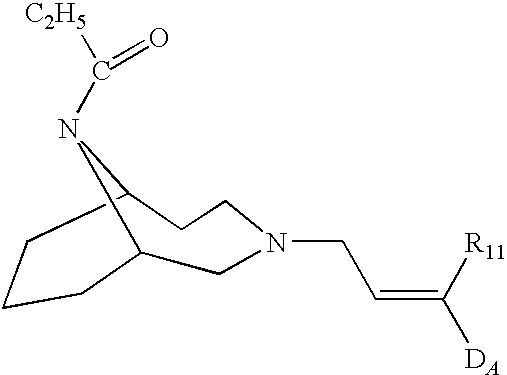 |
|
| IR | |||||||
| Ex- | Yield | m.p. | Formula | λ | 1H-NMR | ||
| ample | R11 | DA | % | (° C.) | (analysis) | (cm−1) | δ ppm |
| (I-Aa) | CH3 | Phenyl | 30 | 230-232 | C20H28N2O (C, H, N) | 1658 | 1.16 (t, 3 H, J = 7.4 Hz), 1.20-2.50 (m, 7 H), 2.04 (s, 3 H), 2.79 (dd, 1 H, J = 2.6 e 13.2 Hz), 3.18-4.03 (m, 5 H), 3.35 (d, 2 H, J = 6.2 Hz), 4.40 (bd, 1 H, J = 12.4 Hz), 5.88 (t, 1 H, J = 6.0 Hz), 7.15-7.50 (m, 5 H) |
| (I-Ab) | CH3 | 3,4-dichloro phenyl | 31 | 188-189 | C20H26Cl2N2O (C, H, N) | 1660 | 1.16 (t, 3 H, J = 7.6 Hz), 1.20-2.53 (m, 7 H), 2.00 (s, 3 H), 2.81 (bd, 1 H, J = 12.8 Hz), 3.12-4.04 (m, 7 H), 4.38 (bd, 1 H, J = 12.2 Hz), 5.88 (t, 1H, J = 6.0 Hz), 7.23 (d, 1 H, J = 9.0 Hz), 7.38 (d, 1 H, J = 8.2 Hz), 7.46 (s, 1 H) |
| (I-Ac) | CH3 | 4-Cl-Naphthyl | 76 | 97-101 | C24H29ClN2O (C, H, N) | 1650 | 1.16 (t, 3 H, J = 7.6 Hz), 1.36-1.88 (m, 8 H), 2.08 (s, 3 H), 2.71-2.87 (m, 1 H), 3.18-4.24 (m, 6 H), 4.43 (d, 1 H, 12.0 Hz), 5.44-5.78 (m, 1 H), 7.36-8.42 (m, 6 H) |
| (I-Ad) | Phenyl | Phenyl | 27 | 176-177 | C25H30N2O (C, H, N) | 1659 | 1.13 (t, 3 H, J = 7.4 Hz), 1.20-2.46 (m, 7 H), 2.77 (dd, 1 H, J = 2.6 and 12.8 Hz), 3.10-4.00 (m, 5 H), 3.22 (d, 2 H, J = 6.6 Hz), 4.34 (bd, 1 H, J = 12.2 Hz), 6.20 (dt, 1 H, J = 2.2 e 6.8 Hz), 7.00-7.46 (m, 10 H) |
| (I-Ba) | CH3 | Phenyl | 39 | 228-230 | C20H28N2O (C, H, N) | 1644 | 1.16 (t, 3 H, J = 7.4 Hz), 1.40-3.04 (m, 12 H), 2.04 (s, 3 H), 3.24 (d, 2 H, J = 6.6 Hz), 4.02-4.18 (m, 1 H), 4.55-4.75 (m, 1 H), 5.83 (t, 1 H, J = 6.6 Hz), 7.20-7.50 (m, 5 H) |
| (I-Bb) | CH3 | 3,4-dichloro- Fenile | 29 | 186-188 | C20H26Cl2N2O (C, H, N) | 1643 | 1.16 (t, 3 H, J = 7.6 Hz), 1.40-2.83 (m, 12 H), 2.00 (s, 3 H), 3.23 (d, 2 H, J = 6.6 Hz), 4.05-4.25 (m, 1 H), 4.55-4.75 (m, 1 H), 5.83 (t, 1 H, J = 6.2 Hz), 7.20 (dd, 1 H, J = 2.2 and 8.6 Hz), 7.38 (dd, 1 H, J = 1.2 and 8.4 Hz), 7.45 (d, 1 H, J = 2.0 Hz) |
| (I-Bc) | CH3 | 4-Cl-Naphthyl | 50 | 95-99 | C24H29ClN2O (C, H, N) | 1650 | 1.22 (t, 3 H, J = 7.4 Hz), 1.20-2.00 (m, 8 H), 2.19 (s, 3 H), 2.19-2.92 (m, 4 H), 3.30 (d, 2 H. J = 7.4 Hz), 4.22-4.32 (m, 1 H), 4.58-4.68 (m, 1 H), 5.79 (m, 1 H), 7.14-8.33 (m, 6 H) |
| (I-Bd) | Phenyl | Phenyl | 41 | 184-186 | C25H30N2O (C, H, N) | 1642 | 1.15 (t, 3 H, J = 7.4 Hz), 1.40-2.82 (m, 12 H), 3.10-3.22 (m, 2 H), 4.04-4.28 (m, 1 H), 4.55-4.75 (m, 1 H), 6.15 (t, 1 H, J = 6.6 Hz), 7.10-7.47 (m, 10 H) |
| (I-Ca) | CH3 | Phenyl | 64 | 106-108 | C21H30N2O (C, H, N) | 1640 | 1.18 (t, 3 H, J = 7.6 Hz), 1.20-2.55 (m, 10 H), 2.07 (s, 3 H), 2.87-4.34 (m, 8 H), 5.75-5.92 (m, 1 H), 7.10-7.43 (m, 5 H) |
| (I-Cb) | CH3 | 3,4-dichloro phenyl | 67 | 184-185 | C21H28Cl2N2O (C, H, N) | 1655 | 1.18 (t, 3 H, J = 7.6 Hz), 1.20-2.54 (m, 10 H), 2.02 (s, 3 H), 2.83-4.13 (m, 8 H), 5.69-6.01 (m, 1 H), 7.17-7.53 (m, 3 H) |
| (I-Cc) | Phenyl | Phenyl | 68 | 137-139 | C26H32N2O (C, H, N) | 1660 | 1.15 (t, 3 H, J = 7.6 Hz), 1.20-2.49 (m, 10 H), 2.87-4.06 (m, 8 H), 6.05-6.23 (m, 1 H), 7.08-7.44 (m, 10 H) |
| (I-Da) | CH3 | Phenyl | 64 | 144-146 | C21H30N2O (C, H, N) | 1650 | 1.17 (t, 3 H, J = 7.6 Hz), 1.34-3.00 (m, 14 H), 2.03 (s, 3 H), 3.15-3.23 (m, 2 H), 3.80-4.38 (m, 1 H), 4.60-5.17 (m, 1 H), 5.76-5.95 (m, 1 H), 7.02-7.53 (m, 5 H) |
| (I-Db) | CH3 | 3,4-dichloro phenyl | 58 | 175-176 | C21H28Cl2N2O (C, H, N) | 1660 | 1.17 (t, 3 H, J = 6.2 Hz), 1.18-2.95 (m, 14 H), 1.99 (s, 3 H), 3.15-3.24 (m, 2 H), 3.80-4.40 (m, 1 H), 4.62-5.11 (m, 1 H), 5.72-5.92 (m, 1 H), 7.14-7.47 (m, 3 H) |
| (I-Dc) | Phenyl | Phenyl | 52 | 169-170 | C26H32N2O (C, H, N) | 1634 | 1.14 (t, 3 H, J = 7.4 Hz), 1.25-2.57 (m, 12 H), 2.57-2.86 (m, 2 H), 3.12 (dd, 2 H, J = 1.6 and 5.8 Hz), 3.80-4.32 (m, 1 H), 4.64-5.13 (m, 1 H), 6.16 (t, 1 H, J = 6.0 Hz), 7.10-7.40 (m, 10 H) |
| TABLE 2 |
| Affinity of the compounds of the invention towards |
| the opioidergic receptors μ, δ and k |
| (affinity values expressed as Ki) |
| Compound | |||||
| (Example) | Ki μ (nM) | Ki δ (nM) | Ki k (nM) | ||
| I-Aa | 5.7 ± 1.0 | 425 ± 25 | 55 ± 25 | ||
| I-Ab | 7.0 ± 1.5 | 867 ± 44 | 100 ± 5 | ||
| I-Ac | 56.7 ± 13 | 2000 ± 250 | 2500 ± 125 | ||
| I-Ad | 10.7 ± 0.3 | 142 ± 25 | 103 ± 7 | ||
| I-Ba | 8.3 ± 1.2 | 933 ± 33 | 900 ± 100 | ||
| I-Bb | 4.1 ± 0.35 | 850 ± 58 | 393 ± 23 | ||
| I-Bc | 68.3 ± 10.9 | >5,000 | >10,000 | ||
| I-Bd | 20.7 ± 2.33 | 333 ± 5 | 1133 ± 186 | ||
| I-Ca | 17.0 ± 1.3 | 1667 ± 166 | 410 ± 10 | ||
| I-Cb | 4.25 ± 0.3 | 1117 ± 216 | 425 ± 38 | ||
| I-Cc | 3.16 ± 0.6 | 187 ± 29.7 | 40 ± 0.1 | ||
| I-Da | 40 ± 2.8 | 3875 ± 125 | 1467 ± 317 | ||
| I-Db | 17.5 ± 1.4 | 3250 ± 166 | 1167 ± 120 | ||
| I-Dc | 23.3 ± 1.6 | 1688 ± 312 | 1933 ± 233 | ||
| Miglyol ® 812S (oil): | 19.5% | ||
| Solutol ® HS15 (surfactant): | 10% | ||
| Water: | 70% | ||
| Compound I-Ca: | 0.5% | ||
| Miglyol ® 812S (oil): | 14.6% | ||
| Imwitor ® 308 (oil): | 4.9% | ||
| Solutol ® HS15 (surfactant): | 10% | ||
| Aqueous phase: | 70% | ||
| Active principle: | 0.5% | ||
| Soya oil (oil): | 14.5% | ||
| Lutrol ® F127 | 25% | ||
| Aqueous phase: | 60% | ||
| Active principle: | 0.5% | ||
-
- compound I-Da obtained in Example 18 instead of compound I-Aa,
- as organic solvent, dichloromethane in place of ethyl acetate,
- as surfactant, polyvinyl alcohol instead of Solutol® HS15.
-
- average diameter of 100±20 nm (TEM): 146±15 nm (PCS),
- the amount of active principle contained in the particles is equal to 67% of that initially solubilized in dichloromethane.
wherein latency test is the number of seconds elapsed before the appearance of pain signs in the animal undergoing pharmacological treatment. By basic latency it is meant the seconds elapsed before the appearance of pain signs in the same animal before drug administration.
| TABLE 3 |
| Results of the Hot Plate test |
| The values in the Table correspond to the ±SEM average of at least 6 |
| animals for each experimental group and observation time-point. |
| MPE % |
| 30 min | 60 min | 120 min | 240 min | 360 min | ||
| Carrier | 5 ± 1.5 | −1.7 ± 0.8 | 2.8 ± 1.0 | 1.0 ± 1.2 | −0.5 ± 0.7 |
| Morphine (10 mg/kg) | 39.2 ± 4.1 | 58.5 ± 8.0 | 33.6 ± 4.9 | 21.0 ± 3.3 | 8.5 ± 2.1 |
| Compound | 49.5 ± 10.5 | 25.1 ± 6.1 | 6.0 ± 3.0 | 3.2 ± 3.0 | 4.1 ± 1.0 |
| I-Aa (10 mg/kg) | |||||
| Compound | 55.2 ± 10.5 | 40.9 ± 7.8 | 24.1 ± 7.3 | 5.0 ± 4.0 | 0.1 ± 1.1 |
| I-Cc (20 mg/kg) | |||||
| Compound | 68.9 ± 7.2 | 50.5 ± 11.3 | 7.0 ± 2.1 | 6.0 ± 2.1 | −4.0 ± 2.0 |
| I-Ba (20 mg/kg) | |||||
| TABLE 4 |
| Results of the Tail Flick test |
| The values in the Table correspond to the ±SEM average of least 6 |
| animals for each experimental group and observation time-point. |
| MPE % |
| 30 min | 60 min | 120 min | 240 min | 360 min | ||
| Carrier | 2.0 ± 1.5 | −1.0 ± 0.3 | 3.0 ± 1.0 | 0.5 ± 1.1 | −0.8 ± 0.8 |
| Morphine (10 mg/kg) | 60.,2 ± 9.1 | 60.5 ± 6.8 | 39.6 ± 4.0 | 19.1 ± 3.0 | 6.1 ± 1.1 |
| Compound | 65.5 ± 6.5 | 20.1 ± 4.1 | 10.0 ± 1.0 | 3.1 ± 2.0 | −3.0 ± 0.5 |
| I-Aa (10 mg/kg) | |||||
| Compound | 80.2 ± 7.5 | 52.9 ± 8.1 | 42.1 ± 8.3 | 14.6 ± 3.0 | 0.0 ± 0.8 |
| I-Cc (20 mg/kg) | |||||
| Compound | 89.9 ± 7.0 | 88.5 ± 10.3 | 9.0 ± 2.5 | 2.0 ± 1.1 | −2.0 ± 1.0 |
| I-Ba (20 mg/kg) | |||||
Claims (35)


(VIII)
—CH2—CH═CH-DV (VIII)
(IX):
RF—C≡C—R8 (IX)
(X):
CH2—C≡C—R9 (X)


Applications Claiming Priority (3)
| Application Number | Priority Date | Filing Date | Title |
|---|---|---|---|
| ITMI2008A001426 | 2008-07-31 | ||
| ITMI2008A001426A IT1390848B1 (en) | 2008-07-31 | 2008-07-31 | PHARMACEUTICAL COMPOUNDS |
| ITMI2008A1426 | 2008-07-31 |
Publications (2)
| Publication Number | Publication Date |
|---|---|
| US20100028257A1 US20100028257A1 (en) | 2010-02-04 |
| US8399457B2 true US8399457B2 (en) | 2013-03-19 |
Family
ID=41168431
Family Applications (1)
| Application Number | Title | Priority Date | Filing Date |
|---|---|---|---|
| US12/512,818 Expired - Fee Related US8399457B2 (en) | 2008-07-31 | 2009-07-30 | Pharmaceutical compounds |
Country Status (6)
| Country | Link |
|---|---|
| US (1) | US8399457B2 (en) |
| EP (1) | EP2149575B1 (en) |
| JP (1) | JP2010037341A (en) |
| CA (1) | CA2674011A1 (en) |
| ES (1) | ES2397496T3 (en) |
| IT (1) | IT1390848B1 (en) |
Families Citing this family (5)
| Publication number | Priority date | Publication date | Assignee | Title |
|---|---|---|---|---|
| EP2149370A1 (en) * | 2008-07-31 | 2010-02-03 | Neuroscienze Pharmaness S.C. A R.L. | Diazabicyclic compounds and microemulsions thereof |
| KR102009969B1 (en) * | 2015-11-25 | 2019-10-21 | 주식회사 엘지화학 | Amphiphilic Polymer |
| KR102184376B1 (en) * | 2015-11-25 | 2020-11-30 | 주식회사 엘지화학 | the micelle comprising amphiphilic polymer |
| KR102009972B1 (en) | 2015-11-25 | 2019-10-21 | 주식회사 엘지화학 | the amphiphilic polymer |
| US10577183B2 (en) * | 2016-09-14 | 2020-03-03 | Cambridge International, Inc. | Edge drive mesh overlay conveyor belt |
Citations (17)
| Publication number | Priority date | Publication date | Assignee | Title |
|---|---|---|---|---|
| US5672601A (en) | 1994-02-23 | 1997-09-30 | Riace Establishment | 3-8-diazabicyclo 3.2.1! octane derivatives having analgesic activity |
| US6028084A (en) | 1995-11-23 | 2000-02-22 | Sanofi-Synthelabo | Pyrazole derivatives, method for preparing same, and pharmaceutical compositions containing said derivatives |
| WO2001046198A2 (en) | 1999-12-03 | 2001-06-28 | The Board Of Trustees Of The University Of Illinois | Nonpeptide kappa opioid receptor antagonists |
| WO2002042309A1 (en) | 2000-11-22 | 2002-05-30 | Toray Industries, Inc. | Indole derivatives and use thereof in medicines |
| US20030003145A1 (en) | 1997-03-28 | 2003-01-02 | Bernard Abramovici | Pharmaceutical composition for oral administration of a N-piperidino-3- pyrazolecarboxamide derivative, its salts and their solvates |
| US20030196217A1 (en) | 2002-01-30 | 2003-10-16 | Pradip Mukerji | Desaturase genes, enzymes encoded thereby, and uses thereof |
| US20030195217A1 (en) | 2000-02-18 | 2003-10-16 | Giorgio Cignarella | 3,9-Diazabicyclo[3.3.1]nonane derivatives with analgesic activity |
| WO2004011468A1 (en) | 2002-07-26 | 2004-02-05 | Neurosearch A/S | Diazabicyclononane and -decane derivatives and their use as opioid receptor ligands |
| WO2004060321A2 (en) | 2003-01-02 | 2004-07-22 | Ardent Pharmaceuticals, Inc. | Cardioprotective delta opioid receptor agonists and methods of using same |
| WO2004089372A1 (en) | 2003-04-11 | 2004-10-21 | Janssen Pharmaceutica N.V. | Substituted 4-phenyl-4-`1h-imidazol-2-yl !-piperidine derivatives and their use as selective non-peptide delta opioid agonists with antidepressant and anxiolytic activity |
| WO2004100468A1 (en) | 2003-05-09 | 2004-11-18 | Koninklijke Philips Electronics N.V. | Measuring medium activity patterns in wireless networks and deriving information from the activity patterns |
| WO2005066164A1 (en) | 2003-12-22 | 2005-07-21 | Eli Lilly And Company | Opioid receptor antagonists |
| US20050203123A1 (en) | 2004-03-11 | 2005-09-15 | Adolor Corporation | Substituted piperidine compounds and methods of their use |
| WO2005092836A1 (en) | 2004-03-15 | 2005-10-06 | Eli Lilly And Company | Opioid receptor antagonists |
| WO2005108402A1 (en) | 2004-05-12 | 2005-11-17 | Universita' Degli Studi Di Milano | 3,6-diazabicyclos[3.1.1]heptane derivatives with analgesic activity |
| WO2006113468A2 (en) | 2005-04-14 | 2006-10-26 | Mount Cook Biosciences, Inc. | Compositions of novel opioid compounds and method of use thereof |
| US20070027328A1 (en) * | 2002-02-19 | 2007-02-01 | Judith Aronhime | Processes for desolvating solvates of atorvastatin hemi-calcium and atorvastatin hem-calcium essentially free of organic solvent |
Family Cites Families (1)
| Publication number | Priority date | Publication date | Assignee | Title |
|---|---|---|---|---|
| DE10121982B4 (en) | 2001-05-05 | 2008-01-24 | Lts Lohmann Therapie-Systeme Ag | Nanoparticles of protein with coupled apolipoprotein E to overcome the blood-brain barrier and process for their preparation |
-
2008
- 2008-07-31 IT ITMI2008A001426A patent/IT1390848B1/en active
-
2009
- 2009-05-27 EP EP09161285A patent/EP2149575B1/en not_active Not-in-force
- 2009-05-27 ES ES09161285T patent/ES2397496T3/en active Active
- 2009-07-24 CA CA002674011A patent/CA2674011A1/en not_active Abandoned
- 2009-07-30 JP JP2009177879A patent/JP2010037341A/en active Pending
- 2009-07-30 US US12/512,818 patent/US8399457B2/en not_active Expired - Fee Related
Patent Citations (17)
| Publication number | Priority date | Publication date | Assignee | Title |
|---|---|---|---|---|
| US5672601A (en) | 1994-02-23 | 1997-09-30 | Riace Establishment | 3-8-diazabicyclo 3.2.1! octane derivatives having analgesic activity |
| US6028084A (en) | 1995-11-23 | 2000-02-22 | Sanofi-Synthelabo | Pyrazole derivatives, method for preparing same, and pharmaceutical compositions containing said derivatives |
| US20030003145A1 (en) | 1997-03-28 | 2003-01-02 | Bernard Abramovici | Pharmaceutical composition for oral administration of a N-piperidino-3- pyrazolecarboxamide derivative, its salts and their solvates |
| WO2001046198A2 (en) | 1999-12-03 | 2001-06-28 | The Board Of Trustees Of The University Of Illinois | Nonpeptide kappa opioid receptor antagonists |
| US20030195217A1 (en) | 2000-02-18 | 2003-10-16 | Giorgio Cignarella | 3,9-Diazabicyclo[3.3.1]nonane derivatives with analgesic activity |
| WO2002042309A1 (en) | 2000-11-22 | 2002-05-30 | Toray Industries, Inc. | Indole derivatives and use thereof in medicines |
| US20030196217A1 (en) | 2002-01-30 | 2003-10-16 | Pradip Mukerji | Desaturase genes, enzymes encoded thereby, and uses thereof |
| US20070027328A1 (en) * | 2002-02-19 | 2007-02-01 | Judith Aronhime | Processes for desolvating solvates of atorvastatin hemi-calcium and atorvastatin hem-calcium essentially free of organic solvent |
| WO2004011468A1 (en) | 2002-07-26 | 2004-02-05 | Neurosearch A/S | Diazabicyclononane and -decane derivatives and their use as opioid receptor ligands |
| WO2004060321A2 (en) | 2003-01-02 | 2004-07-22 | Ardent Pharmaceuticals, Inc. | Cardioprotective delta opioid receptor agonists and methods of using same |
| WO2004089372A1 (en) | 2003-04-11 | 2004-10-21 | Janssen Pharmaceutica N.V. | Substituted 4-phenyl-4-`1h-imidazol-2-yl !-piperidine derivatives and their use as selective non-peptide delta opioid agonists with antidepressant and anxiolytic activity |
| WO2004100468A1 (en) | 2003-05-09 | 2004-11-18 | Koninklijke Philips Electronics N.V. | Measuring medium activity patterns in wireless networks and deriving information from the activity patterns |
| WO2005066164A1 (en) | 2003-12-22 | 2005-07-21 | Eli Lilly And Company | Opioid receptor antagonists |
| US20050203123A1 (en) | 2004-03-11 | 2005-09-15 | Adolor Corporation | Substituted piperidine compounds and methods of their use |
| WO2005092836A1 (en) | 2004-03-15 | 2005-10-06 | Eli Lilly And Company | Opioid receptor antagonists |
| WO2005108402A1 (en) | 2004-05-12 | 2005-11-17 | Universita' Degli Studi Di Milano | 3,6-diazabicyclos[3.1.1]heptane derivatives with analgesic activity |
| WO2006113468A2 (en) | 2005-04-14 | 2006-10-26 | Mount Cook Biosciences, Inc. | Compositions of novel opioid compounds and method of use thereof |
Non-Patent Citations (17)
| Title |
|---|
| Anastassia Hatzoglou et al., "The antiproliferative effect of opioid receptor agonists on the T47D human breast cancer cell line, is partially mediated through opioid receptors" 1996, pp. 199-207, vol. 296, European Journal of Pharmacology. |
| Barbara Stella et al., "Design of Folic Acid-Conjugated Nanoparticles for Drug Targeting" Nov. 2000, pp. 1452-1464, vol. 89, No. 11, Journal of Pharmaceuticals Sciences. |
| Cathy E. McNamee et al., "Physicochemical Characterization of PEG1500-12-acyloxy-stearate Micelles and Liquid Crystalline Phases" 2005, pp. 8146-8154, vol. 21, Langmuir. |
| Deborah D. Stephan et al., "Changes in intraocular pressure and pupil size following intramuscular administration of hydromorphone hydrochloride and acepromazine in clinically normal dogs" 2003, pp. 73-76, vol. 6, Veterinary Ophthalmology. |
| E. Gracia-Garcia et al., "Colloidal carriers and blood-brain barrier (BBB) translocation: A way to deliver drugs to the brain?" 2005, 274-292, vol. 298, International Journal of Pharmaceutics. |
| Gérard A. Pinna et al., "N-3(9)-Arylpropenyl-N-9(3)-propionyl-3,9-diazabicyclo[3.3.1]nonanes as mu-Opioid Receptor Agonists. Effects on mu-Affinity of Arylalkenyl Chain Modifications" 2002, pp. 1929-1937, vol. 10, Bioorganic & Medicinal Chemistry. |
| Gérard A. Pinna et al., "N-3(9)-Arylpropenyl-N-9(3)-propionyl-3,9-diazabicyclo[3.3.1]nonanes as μ-Opioid Receptor Agonists. Effects on μ-Affinity of Arylalkenyl Chain Modifications" 2002, pp. 1929-1937, vol. 10, Bioorganic & Medicinal Chemistry. |
| Jörg Kreuter, "Nanoparticulate systems for brain delivery of drugs" 2001, pp. 65-81, vol. 47, Advance Drug Delivery Reviews. |
| Juanita Dortch-Carnes et al., "Morphine-Stimulated Nitric Oxide Release in Rabbit Aqueous Humor" Jan. 2007, pp. 185-190, vol. 84, Exp Eye Res. |
| Luca Costantino et al., "Peptide-derivatized biodegradable nanoparticles able to cross the blood-brain barrier" 2005, pp. 84-96, vol. 108, Journal of Controlled Release. |
| M.J. Glass et al., "Opioids and food intake: distributed functional neural pathways" 1999, pp. 360-368, vol. 33, No. 5, Neuropeptides. |
| Mack Publishing Company, "The Science and Pharmacy" 1995, pp. 1457, vol. II, Remington: The Science and Practice of Pharmacy. |
| Maria Teresa Peracchia et al., Synthesis of a Novel Poly(MePEG cyanoacrylate-co-alkyl cyanoacrylate) Amphiphilic Copolymer for Nanoparticle Technology, 1997, pp. 846-851, vol. 30, Macromolecules. |
| R. Alexander et al., "Remifentanil prevents an increase in intraocular pressure after succinylcholine and tracheal intubation" 1998, pp. 606-607, vol. 81, British Journal of Anaesthesia. |
| Rajib K. Mitra et al., "Physicochemical investigations of microemulsification of eucalyptus oil and water using mixed surfactants (AOT + Brij-35) and butanol" 2005, pp. 565-577, vol. 283, Journal of Colloid and Interface Science. |
| Stefania Ruiu et al., "Synthesis and Characterization of NESS 0327: A Novel Putative Antagonist of the CB1 Cannabinoid Receptor" 2003, pp. 363-370, vol. 306, No. 1, The Journal of Pharmacology and Experimental Therapeutics. |
| Trescot et al., Opioid Pharmacology, Pain Physician, vol. 11, pp. S133-S153, 2008. * |
Also Published As
| Publication number | Publication date |
|---|---|
| US20100028257A1 (en) | 2010-02-04 |
| EP2149575B1 (en) | 2012-10-24 |
| IT1390848B1 (en) | 2011-10-19 |
| EP2149575A1 (en) | 2010-02-03 |
| ITMI20081426A1 (en) | 2010-02-01 |
| JP2010037341A (en) | 2010-02-18 |
| ES2397496T3 (en) | 2013-03-07 |
| CA2674011A1 (en) | 2010-01-31 |
Similar Documents
| Publication | Publication Date | Title |
|---|---|---|
| US20130017149A1 (en) | Pharmaceutical compounds | |
| US9359376B2 (en) | Substituted methylformyl reagents and method of using same to modify physicochemical and/or pharmacokinetic properties of compounds | |
| EP2149575B1 (en) | Diazabicyclic compounds as opioid receptor agonists | |
| DE60203007T2 (en) | HETEROARYL DIAZABICYCLOALKANDERIVATES AS CNS MODULATORS | |
| JP2010510328A (en) | (R) -N-stereoisomers of 7,8-saturated-4,5-epoxy-morphinanium analogs | |
| JP2008519794A (en) | Pyrimidine compounds | |
| MX2009001282A (en) | 6-carboxy-normorphinan derivatives, synthesis and uses thereof. | |
| EP3965888B1 (en) | Substituted benzimidazolone compounds | |
| US20100029622A1 (en) | Microemulsions | |
| US20240317730A1 (en) | Heteroaryl derivative compounds, and uses thereof | |
| CN109563215B (en) | Polymer linkers and uses thereof | |
| RU2357964C2 (en) | Bicyclo-3,1,1-heptane-substituted benzimidazolone- and quinazolinone-derivatives as agonists of human orl1 receptors | |
| US8609659B2 (en) | Substituted 3,8-diazabicyclo[3.2.1]octane compounds | |
| EP0829481A1 (en) | Morphinan hydroxamic acid compounds | |
| JP2023512229A (en) | 1H-pyrazolo[4,3-d]pyrimidine compounds as Toll-like receptor 7 (TLR7) agonists | |
| US9249103B2 (en) | Compounds, compositions and associated methods comprising 3-aryl quinolines | |
| US7358243B2 (en) | Diazabicyclonane and-decane derivatives and their use as opioid receptor ligands | |
| KR20250094661A (en) | Novel N-heteroarylbenzamide derivatives as FLT3 inhibitors | |
| WO2013067379A1 (en) | Pharmaceutical compositions comprising napthamides | |
| CN116535390B (en) | pH-sensitive 4-amidopiperidine derivatives, pharmaceutical compositions, preparation methods and applications thereof | |
| CN101454322A (en) | Novel 1,4-diaza-bicyclo[3.2.2]nonyl pyrimidinyl derivatives and their medical use | |
| WO2017168448A1 (en) | Silicon incorporated quinolines with anti-malarial and anti-toxoplasmosis activity |
Legal Events
| Date | Code | Title | Description |
|---|---|---|---|
| AS | Assignment |
Owner name: NEUROSCIENZE PHARMANESS S.C. A.R.L.,ITALY Free format text: ASSIGNMENT OF ASSIGNORS INTEREST;ASSIGNORS:LAZZARI, PAOLO;LORIGA, GIOVANNI;RUIU, STEFANIA;AND OTHERS;REEL/FRAME:023062/0720 Effective date: 20090609 Owner name: NEUROSCIENZE PHARMANESS S.C. A.R.L., ITALY Free format text: ASSIGNMENT OF ASSIGNORS INTEREST;ASSIGNORS:LAZZARI, PAOLO;LORIGA, GIOVANNI;RUIU, STEFANIA;AND OTHERS;REEL/FRAME:023062/0720 Effective date: 20090609 |
|
| REMI | Maintenance fee reminder mailed | ||
| LAPS | Lapse for failure to pay maintenance fees | ||
| STCH | Information on status: patent discontinuation |
Free format text: PATENT EXPIRED DUE TO NONPAYMENT OF MAINTENANCE FEES UNDER 37 CFR 1.362 |
|
| STCH | Information on status: patent discontinuation |
Free format text: PATENT EXPIRED DUE TO NONPAYMENT OF MAINTENANCE FEES UNDER 37 CFR 1.362 |
|
| FP | Lapsed due to failure to pay maintenance fee |
Effective date: 20170319 |