US8395041B2 - Photoelectric conversion element and solor cell - Google Patents

Photoelectric conversion element and solor cell Download PDF

Info

Publication number
US8395041B2
US8395041B2 US12/758,240 US75824010A US8395041B2 US 8395041 B2 US8395041 B2 US 8395041B2 US 75824010 A US75824010 A US 75824010A US 8395041 B2 US8395041 B2 US 8395041B2
Authority
US
United States
Prior art keywords
group
substituted
unsubstituted
photoelectric conversion
conversion element
Prior art date
Legal status (The legal status is an assumption and is not a legal conclusion. Google has not performed a legal analysis and makes no representation as to the accuracy of the status listed.)
Expired - Fee Related, expires
Application number
US12/758,240
Other versions
US20100288360A1 (en
Inventor
Hidekazu KAWASAKI
Akihiko Itami
Kazuya Isobe
Hideya Miwa
Kazukuni NISHIMURA
Mayuko USHIRO
Current Assignee (The listed assignees may be inaccurate. Google has not performed a legal analysis and makes no representation or warranty as to the accuracy of the list.)
Konica Minolta Business Technologies Inc
Original Assignee
Konica Minolta Business Technologies Inc
Priority date (The priority date is an assumption and is not a legal conclusion. Google has not performed a legal analysis and makes no representation as to the accuracy of the date listed.)
Filing date
Publication date
Application filed by Konica Minolta Business Technologies Inc filed Critical Konica Minolta Business Technologies Inc
Assigned to KONICA MINOLTA BUSINESS TECHNOLOGIES, INC. reassignment KONICA MINOLTA BUSINESS TECHNOLOGIES, INC. ASSIGNMENT OF ASSIGNORS INTEREST (SEE DOCUMENT FOR DETAILS). Assignors: USHIRO, MAYUKO, KAWASAKI, HIDEKAZU, ISOBE, KAZUYA, ITAMI, AKIHIKO, NISHIMURA, KAZUKUNI, MIWA, HIDEYA
Publication of US20100288360A1 publication Critical patent/US20100288360A1/en
Application granted granted Critical
Publication of US8395041B2 publication Critical patent/US8395041B2/en
Expired - Fee Related legal-status Critical Current
Adjusted expiration legal-status Critical

Links

Images

Classifications

    • CCHEMISTRY; METALLURGY
    • C09DYES; PAINTS; POLISHES; NATURAL RESINS; ADHESIVES; COMPOSITIONS NOT OTHERWISE PROVIDED FOR; APPLICATIONS OF MATERIALS NOT OTHERWISE PROVIDED FOR
    • C09BORGANIC DYES OR CLOSELY-RELATED COMPOUNDS FOR PRODUCING DYES, e.g. PIGMENTS; MORDANTS; LAKES
    • C09B57/00Other synthetic dyes of known constitution
    • C09B57/008Triarylamine dyes containing no other chromophores
    • CCHEMISTRY; METALLURGY
    • C09DYES; PAINTS; POLISHES; NATURAL RESINS; ADHESIVES; COMPOSITIONS NOT OTHERWISE PROVIDED FOR; APPLICATIONS OF MATERIALS NOT OTHERWISE PROVIDED FOR
    • C09BORGANIC DYES OR CLOSELY-RELATED COMPOUNDS FOR PRODUCING DYES, e.g. PIGMENTS; MORDANTS; LAKES
    • C09B23/00Methine or polymethine dyes, e.g. cyanine dyes
    • C09B23/14Styryl dyes
    • C09B23/148Stilbene dyes containing the moiety -C6H5-CH=CH-C6H5
    • HELECTRICITY
    • H01ELECTRIC ELEMENTS
    • H01GCAPACITORS; CAPACITORS, RECTIFIERS, DETECTORS, SWITCHING DEVICES, LIGHT-SENSITIVE OR TEMPERATURE-SENSITIVE DEVICES OF THE ELECTROLYTIC TYPE
    • H01G9/00Electrolytic capacitors, rectifiers, detectors, switching devices, light-sensitive or temperature-sensitive devices; Processes of their manufacture
    • H01G9/20Light-sensitive devices
    • HELECTRICITY
    • H01ELECTRIC ELEMENTS
    • H01GCAPACITORS; CAPACITORS, RECTIFIERS, DETECTORS, SWITCHING DEVICES, LIGHT-SENSITIVE OR TEMPERATURE-SENSITIVE DEVICES OF THE ELECTROLYTIC TYPE
    • H01G9/00Electrolytic capacitors, rectifiers, detectors, switching devices, light-sensitive or temperature-sensitive devices; Processes of their manufacture
    • H01G9/20Light-sensitive devices
    • H01G9/2059Light-sensitive devices comprising an organic dye as the active light absorbing material, e.g. adsorbed on an electrode or dissolved in solution
    • HELECTRICITY
    • H01ELECTRIC ELEMENTS
    • H01MPROCESSES OR MEANS, e.g. BATTERIES, FOR THE DIRECT CONVERSION OF CHEMICAL ENERGY INTO ELECTRICAL ENERGY
    • H01M14/00Electrochemical current or voltage generators not provided for in groups H01M6/00 - H01M12/00; Manufacture thereof
    • H01M14/005Photoelectrochemical storage cells
    • HELECTRICITY
    • H10SEMICONDUCTOR DEVICES; ELECTRIC SOLID-STATE DEVICES NOT OTHERWISE PROVIDED FOR
    • H10KORGANIC ELECTRIC SOLID-STATE DEVICES
    • H10K85/00Organic materials used in the body or electrodes of devices covered by this subclass
    • H10K85/60Organic compounds having low molecular weight
    • H10K85/631Amine compounds having at least two aryl rest on at least one amine-nitrogen atom, e.g. triphenylamine
    • HELECTRICITY
    • H01ELECTRIC ELEMENTS
    • H01GCAPACITORS; CAPACITORS, RECTIFIERS, DETECTORS, SWITCHING DEVICES, LIGHT-SENSITIVE OR TEMPERATURE-SENSITIVE DEVICES OF THE ELECTROLYTIC TYPE
    • H01G9/00Electrolytic capacitors, rectifiers, detectors, switching devices, light-sensitive or temperature-sensitive devices; Processes of their manufacture
    • H01G9/20Light-sensitive devices
    • H01G9/2027Light-sensitive devices comprising an oxide semiconductor electrode
    • H01G9/2031Light-sensitive devices comprising an oxide semiconductor electrode comprising titanium oxide, e.g. TiO2
    • HELECTRICITY
    • H10SEMICONDUCTOR DEVICES; ELECTRIC SOLID-STATE DEVICES NOT OTHERWISE PROVIDED FOR
    • H10KORGANIC ELECTRIC SOLID-STATE DEVICES
    • H10K30/00Organic devices sensitive to infrared radiation, light, electromagnetic radiation of shorter wavelength or corpuscular radiation
    • H10K30/10Organic devices sensitive to infrared radiation, light, electromagnetic radiation of shorter wavelength or corpuscular radiation comprising heterojunctions between organic semiconductors and inorganic semiconductors
    • H10K30/15Sensitised wide-bandgap semiconductor devices, e.g. dye-sensitised TiO2
    • H10K30/151Sensitised wide-bandgap semiconductor devices, e.g. dye-sensitised TiO2 the wide bandgap semiconductor comprising titanium oxide, e.g. TiO2
    • YGENERAL TAGGING OF NEW TECHNOLOGICAL DEVELOPMENTS; GENERAL TAGGING OF CROSS-SECTIONAL TECHNOLOGIES SPANNING OVER SEVERAL SECTIONS OF THE IPC; TECHNICAL SUBJECTS COVERED BY FORMER USPC CROSS-REFERENCE ART COLLECTIONS [XRACs] AND DIGESTS
    • Y02TECHNOLOGIES OR APPLICATIONS FOR MITIGATION OR ADAPTATION AGAINST CLIMATE CHANGE
    • Y02EREDUCTION OF GREENHOUSE GAS [GHG] EMISSIONS, RELATED TO ENERGY GENERATION, TRANSMISSION OR DISTRIBUTION
    • Y02E10/00Energy generation through renewable energy sources
    • Y02E10/50Photovoltaic [PV] energy
    • Y02E10/542Dye sensitized solar cells
    • YGENERAL TAGGING OF NEW TECHNOLOGICAL DEVELOPMENTS; GENERAL TAGGING OF CROSS-SECTIONAL TECHNOLOGIES SPANNING OVER SEVERAL SECTIONS OF THE IPC; TECHNICAL SUBJECTS COVERED BY FORMER USPC CROSS-REFERENCE ART COLLECTIONS [XRACs] AND DIGESTS
    • Y02TECHNOLOGIES OR APPLICATIONS FOR MITIGATION OR ADAPTATION AGAINST CLIMATE CHANGE
    • Y02EREDUCTION OF GREENHOUSE GAS [GHG] EMISSIONS, RELATED TO ENERGY GENERATION, TRANSMISSION OR DISTRIBUTION
    • Y02E10/00Energy generation through renewable energy sources
    • Y02E10/50Photovoltaic [PV] energy
    • Y02E10/549Organic PV cells

Definitions

  • the present invention relates to a photoelectric conversion element and a solar cell employing the same, and particularly to a dye-sensitizing type photoelectric conversion element (hereinafter also referred to as simply a photoelectric conversion element) and a dye-sensitizing type solar cell employing the same.
  • a dye-sensitizing type photoelectric conversion element hereinafter also referred to as simply a photoelectric conversion element
  • a dye-sensitizing type solar cell employing the same.
  • inorganic type solar cells such as single crystalline silicon, polycrystalline silicon, amorphous silicon, and cadmium telluride and indium copper selenide for domestic use.
  • organic solar cell examples include a Schottky type photoelectric conversion element in which a p-type organic semiconductor and metal having a small work function are joined, and a hetero-junction type photoelectric conversion element in which a p-type organic semiconductor and an n-type inorganic semiconductor or a p-type organic semiconductor and an electron accepting organic compound are joined.
  • the utilized organic semiconductors are synthesized dyes or pigments such as chlorophyll, perylene and so forth, conductive polymer materials such as polyacetylene and so forth, and composite materials thereof. These materials are thin-layered by a vacuum evaporation method, a casting method, a dipping method or the like to prepare a cell material.
  • the organic materials have advantages that they are inexpensive and easy to obtain a large dimension, but there is problem that most of them exhibit a low conversion efficiency of 1% or less and poor durability.
  • this system employs the ruthenium complex which is resourceless, and when this system is practically applied to a solar cell, supply of the ruthenium complex is a concern. Further, the ruthenium complex has problem in that it is expensive, and low in aging stability, but this problem can be solved if the ruthenium complex can be replaced with an inexpensive and stable organic dye.
  • An object of the invention is to provide a photoelectric conversion element with high efficiency and high durability employing a novel sensitizing dye (hereinafter also referred to as simply a dye) with high durability to light and high conversion efficiency used in a dye-sensitization type photoelectric conversion element, and a solar cell employing the photoelectric conversion element.
  • a novel sensitizing dye hereinafter also referred to as simply a dye
  • the photoelectric conversion element of the invention comprises a conductive support and provided thereon, a semiconductor layer, a charge transporting layer and an opposed electrode, the semiconductor layer comprising a semiconductor carrying a specific dye.
  • FIG. 1 is a schematic cross-sectional view showing one example of a photoelectric conversion element used in the present invention.
  • a photoelectric conversion element comprising a conductive support, and provided thereon, a semiconductor layer, a charge transporting layer and an opposed electrode, the semiconductor layer comprising a semiconductor with a dye, wherein the dye is a compound represented by formula (1),
  • Ar represents a substituted or unsubstituted aromatic hydrocarbon ring or a substituted or unsubstituted aromatic heterocyclic ring
  • R 1 and R 2 independently represent a substituted or unsubstituted alkyl group, a substituted or unsubstituted alkenyl group, a substituted or unsubstituted aryl group or a substituted or unsubstituted heterocyclic group, provided that at least two of R 1 and R 2 and Ar may combine with each other to form a ring together with a nitrogen atom
  • R 3 and R 4 independently represent a hydrogen atom, a halogen atom, a cyano group, a substituted or unsubstituted alkyl group, a substituted or unsubstituted alkenyl group, a substituted or unsubstituted aryl group, a substituted or unsubstituted amino group or a substituted or unsubstituted heterocyclic group
  • Z represents
  • R 1 and R 2 in formula (1) independently represent a substituted or unsubstituted alkyl group or a substituted or unsubstituted aryl group.
  • R 3 and R 4 in formula (1) independently represent a hydrogen atom or a substituted or unsubstituted alkyl group.
  • Z in formula (1) represents a sulfur atom or a substituted or unsubstituted heterocyclic ring, the heterocyclic ring being a rhodanine ring or a thiohydantoin ring.
  • X in formula (1) represents a carboxylic acid group, a sulfonic acid group or a phosphoric acid group.
  • a solar cell employing a photoelectric conversion element comprising a conductive support, and provided thereon, a semiconductor layer, a charge transporting layer and an opposed electrode, the semiconductor layer comprising a semiconductor with a dye, wherein the dye is a compound represented by formula (1) above.
  • the present invention can provide a photoelectric conversion element with high efficiency and high durability employing a novel sensitizing dye with high durability to light and high conversion efficiency used in a dye-sensitization type photoelectric conversion element, and a solar cell employing the photoelectric conversion element.
  • a photoelectric conversion element having the same conversion efficiency as one employing a rhodamine dye and having high durability to light and a solar cell fitted with the photoelectric conversion element can be obtained.
  • the present invention is characterized in that in a photoelectric conversion element comprising a semiconductor layer provided on a conductive support, an opposed electrode, and a charge transporting layer provided between the semiconductor layer and the opposed electrode, the semiconductor layer containing a semiconductor with a dye, the dye includes a compound represented by formula (1) described above.
  • a photoelectrode comprising a dye-containing semiconductor on a conductive support and an opposed electrode are opposed with each other through a charge transporting layer.
  • FIG. 1 is a schematic cross-sectional view showing one example of a photoelectric conversion element of the present invention.
  • the photoelectric conversion element is constituted of a substrate 1 and a transparent conductive film 2 constituting a conductive support; an oxide semiconductor 3 and a dye 4 constituting a semiconductor layer; an electrolyte 5 which is a charge transporting layer; platinum 8 , transparent conductive film 7 and substrate 1 ′ constituting an opposed electrode; and a partition wall 9 .
  • a photoelectrode utilized is one in which a semiconductor layer having pores formed via calcination of particles of the semiconductor 3 is provided on the substrate 1 on which the transparent conductive film 2 is placed, and the dye 4 is adsorbed on the semiconductor layer surface.
  • the present invention relates to a photoelectric conversion element and a solar cell each employing a compound (a dye) represented by formula (1) above.
  • Ar represents a substituted or unsubstituted aromatic hydrocarbon ring or a substituted or unsubstituted aromatic heterocyclic ring
  • R 1 and R 2 independently represent a substituted or unsubstituted alkyl, alkenyl, aryl or heterocyclic group, provided that at least two of R 1 and R 2 and Ar may combine with each other to form a ring together with a nitrogen atom
  • R 3 and R 4 independently represent a hydrogen atom, a halogen atom, a cyano group, or a substituted or unsubstituted alkyl, alkenyl, aryl, amino or heterocyclic group
  • Z represents a sulfur atom, an oxygen atom, a selenium atom, a substituted or unsubstituted alkylidene group, a substituted or unsubstituted aromatic hydrocarbon ring or a substituted or unsubstituted heterocyclic ring
  • Y represents a substituted or unsubstit
  • Ar represents a substituted or unsubstituted aromatic hydrocarbon ring or a substituted or unsubstituted aromatic heterocyclic ring.
  • the aromatic hydrocarbon ring represented by Ar refers to as an aryl ring also.
  • the aromatic hydrocarbon ring include a benzene ring, a naphthalene ring, an anthracene ring, an azulene ring, an acenaphthylene ring, a fluorene ring, a phenanthrene ring, an indene ring, a pyrene ring, and a biphenyl ring. These rings may further have a substituent.
  • the aromatic hydrocarbon ring represented by Ar is preferably a benzene ring or a naphthalene ring.
  • Examples of the aromatic heterocyclic ring represented by Ar include a furan ring, a thiophene ring, a pyridine ring, a pyridazine ring, a pyrimidine ring, a pyrazine ring, a triazine ring, an imidazole ring, a pyrazole ring, a thiazole ring, a quinazoline ring, a carbazole ring, a carboline ring, and a diazacarboline ring (in which one of the carbon atoms of the hydrocarbon ring constituting a carboline ring is further replaced with a nitrogen atom), 1,10-phenanthroline ring, a phthalazine ring, an indole ring, and a cumarin ring. These rings may further have a substituent.
  • the aromatic heterocyclic ring represented by Ar is preferably a cumarin ring.
  • R 1 and R 2 independently represent a substituted or unsubstituted alkyl, alkenyl, aryl or heterocyclic group, provided that at least two of R 1 and R 2 and Ar may combine with each other to form a ring together with a nitrogen atom.
  • Examples of the alkyl group represented by R 1 and R 2 include a methyl group, an ethyl group, a propyl group, an isopropyl group, a butyl group, a tert-butyl group, a pentyl group, a hexyl group, an octyl group, a dodecyl group, a tridecyl group, a tetradecyl group and a pentadecyl group.
  • Examples of the alkenyl group represented by R 1 and R 2 include a vinyl group, an allyl group, a butenyl group, and an octenyl group.
  • Examples of the aryl group represented by R 1 or R 2 include a phenyl group, a naphthyl group, biphenyl group, an anthryl group, a phenanthryl group, an azulenyl group, an acenaphthylenyl group, a fluorenyl group, a phenanthrenyl group, an indenyl group, and a pyrenyl group. These groups may further have a substituent.
  • Examples of an aromatic heterocyclic ring group in the heterocyclic ring group represented by R 1 or R 2 include a furyl group, a thienyl group, a cumarinyl group, a pyridyl group, a pyridazinyl group, a pyrimidinyl group, a pyrazinyl group, a triazinyl group, an imidazolyl group, a pyrazolyl group, a thiazolyl group, a quinazolinyl group, a dibenzofuranyl group, a carbazolyl group, a carbolinyl group, a diazacarbazolyl group (in which one of the carbon atoms constituting the carboline ring of the carbolinyl group is substituted with a nitrogen atom), and a phthalazinyl group.
  • Examples of a saturated heterocyclic ring group in the heterocyclic ring group represented by R 1 or R 2 include a pyrrolidinyl group, an imidazolinyl group, a morphinyl group and an oxazolinyl group.
  • At least two of R 1 , R 2 and Ar may combine with each other to form a ring together with a nitrogen atom.
  • a ring include a carbazole ring, an indoline ring, julolidine ring or phenothiazine ring.
  • R 1 and R 2 independently represent an alkyl group or an aryl group.
  • the aryl group is preferably a phenyl group or a stilbenzyl group.
  • R 3 and R 4 independently represent a hydrogen atom, a halogen atom, a cyano group, a substituted or unsubstituted alkyl, alkenyl, aryl, amino or heterocyclic ring group.
  • Examples of the alkyl, alkenyl, aryl or heterocyclic group represented by R 3 and R 4 include the same as denoted above in the alkyl, alkenyl, aryl or heterocyclic group represented by R 1 and R 2 .
  • Examples of the amino group represented by R 3 and R 4 include an amino group, an ethylamino group, a dimethylamino group, a butylamino group, a cyclopentylamino group, a 2-ethylhexylamino group, a dodecylamino group, an anilinoamino group, a naphthylamine group, and a 2-pyridylamino group.
  • Examples of the halogen atom represented by R 3 and R 4 include a fluorine atom, a chlorine atom, and a bromine atom.
  • Z represents a sulfur atom, an oxygen atom, a selenium atom, a substituted or unsubstituted alkylidene group, a substituted or unsubstituted aromatic hydrocarbon ring or a substituted or unsubstituted heterocyclic ring.
  • Example of the alkylidene group represented by Z include a methylidene group, an ethylidene group, a propylidene group, an isopropylidene group, a pentylidene group, a hexylidene group, an octylidene group, a dodecylidene group, a tridecylidene group, a tetradecylidene group, and a pentadecylidene group. These groups may have further a substituent.
  • Examples of the aromatic hydrocarbon ring or aromatic heterocyclic ring represented by Z include the same as denoted in the aromatic hydrocarbon ring or aromatic heterocyclic ring represented by Ar above.
  • Examples of the saturated heterocyclic ring represented by Z include a rhodanine ring, a pyrrolidine ring, an imidazolidine ring, a morpholine ring, an oxazolidine ring and a thiohydantoin ring. These rings may have further a substituent.
  • Z is preferably a sulfur atom or a saturated heterocyclic ring.
  • the saturated heterocyclic ring is preferably a rhodanine ring or a thiohydantoin ring.
  • Y represents a substituted or unsubstituted alkylene group, a substituted or unsubstituted alkenylene group, a substituted or unsubstituted aromatic hydrocarbon ring or a substituted or unsubstituted heterocyclic ring.
  • Example of the alkylene group represented by Y include a methylene group, an ethylene group, a propylene group, an isopropylene group, a tert-butylene group, a pentylene group, a hexylene group, an octylene group, a dodecylene group, a tridecylene group, a tetradecylene group, and a pentadecylene group. These groups may have further a substituent.
  • Example of the alkenylene group represented by Y include a vinylene group, an alkylene group, and a butenylene group. These groups may have further a substituent.
  • Examples of the aromatic hydrocarbon ring or aromatic heterocyclic ring represented by Y include the same as denoted in the aromatic hydrocarbon ring or aromatic heterocyclic ring represented by Ar above.
  • Examples of the saturated heterocyclic ring represented by Y include a pyrrolidine ring, an imidazolidine ring, a morpholine ring, and an oxazolidine ring. These rings may have further a substituent. As the substituent of Y, an electron withdrawing group is preferred.
  • Y is preferably an alkylene group, and the alkylene group is preferably an ethylene group.
  • X represents an acid group such as a carboxylic acid group, a sulfonic acid group, a nitric acid group, or a phosphoric acid group or their salt group.
  • X is preferably a carboxylic acid group, a sulfonic acid group or a phosphoric acid group.
  • X is preferably a carboxylic acid group.
  • X of formula (1) is a carboxylic acid group, the compound exhibits high adsorption capability to an oxide semiconductor, provides a smooth flow of a charge to the oxide semiconductor.
  • the rings or groups may further have a substituent.
  • substituents examples include an alkyl group (for example, a methyl group, an ethyl group, a propyl group, an isopropyl group, a tert-butyl group, a pentyl group, a hexyl group, an octyl group, a dodecyl group, a tridecyl group, a tetradecyl group, or a pentadecyl group); an cycloalkyl group (for example, a cyclopentyl group or a cyclohexyl group); an alkenyl group (for example, a vinyl group or a allyl group); an alkynyl group (for example, an ethynyl group or a propargyl group); an aryl group (for example, a phenyl group or a naphthyl group); an aromatic heterocyclic ring group (for example, a furyl group, a thien
  • substituents may further have the substituent described above.
  • a plurality of these substituents may combine with each other to form a ring.
  • a compound (hereinafter also referred to as the dye in the invention) represented by formula (1) can be synthesized according to a conventional method.
  • the thus obtained sensitizing dye is carried on a semiconductor, preferably an oxide semiconductor (hereinafter also referred to simply as a semiconductor) to achieve sensitization, enabling to realize the advantageous effects of the invention.
  • a semiconductor preferably an oxide semiconductor (hereinafter also referred to simply as a semiconductor) to achieve sensitization, enabling to realize the advantageous effects of the invention.
  • the dye is carried on a semiconductor means various forms, such that the dye is adsorbed onto the semiconductor surface or when the semiconductor has a porous structure and has pores, the pores are filled with the dye.
  • the content of the dye in the semiconductor layer (or semiconductor) is preferably from 0.01 to 100 mmol, more preferably from 0.1 to 50 mmol, and still more preferably from 0.5 to 20 mmol, per 1 m 2 of semiconductor layer.
  • the sensitizing dyes may be used singly or in combination, or in combination with other compounds, as described in, for example, U.S. Pat. Nos. 4,684,537, 4,927,721, 5,084,365, 5,350,644, 5,463,057 and 5,525,440, and Japanese Patent O.P.I. Publication Nos. 7-249790 and 2000-150007.
  • the photoelectric conversion element of the invention When the photoelectric conversion element of the invention is applied to a solar cell described later, it is preferred that two or more dyes differing in absorption wavelength ranges are used, whereby the wavelength region for photoelectric conversion is widened as broad as possible to attain effective utilization of solar light.
  • the dye is dissolved in an appropriate solvent (e.g., ethanol) to prepare a dye solution, and a well-dried semiconductor is immersed in the solution over a long period of time.
  • an appropriate solvent e.g., ethanol
  • a mixed solution of the dyes may be prepared in which a semiconductor is immersed, or solutions of the individual dyes may be prepared, wherein a semiconductor is immersed in each of the individual solutions in order.
  • the immersion when the semiconductor is immersed in each of the individual dye solutions, the immersion may be in any order to attain the advantageous effects of the invention.
  • semiconductor particles which were in advance adsorbed with the sensitizing dyes may be mixed.
  • the semiconductor layer is subjected to dye adsorption treatment before moisture or water vapor is adsorbed onto the semiconductor layer surface or incorporated into the pores in the interior of the semiconductor.
  • the photoelectric conversion element of the invention comprises a photoelectrode and an opposed electrode which are opposed through a charge transporting layer, the photoelectrode comprising an electrically conductive support and provided thereon, a semiconductor containing a dye.
  • the semiconductor, the photoelectrode, the charge transporting layer and the opposed electrode will be explained below.
  • Examples of the semiconductor usable in the photoelectrode include simple substances such as silicon and germanium, compounds containing elements of Groups 3-5 and 13-15 of the periodical table, metal chalcogenides (e.g., an oxide, a sulfide, a selenide), and metal nitrides.
  • simple substances such as silicon and germanium, compounds containing elements of Groups 3-5 and 13-15 of the periodical table, metal chalcogenides (e.g., an oxide, a sulfide, a selenide), and metal nitrides.
  • Preferred examples of the metal chalcogenides include an oxide of titanium, tin, zinc, iron, tungsten, zirconium, hafnium, strontium, indium, cerium, yttrium, lanthanum, vanadium, niobium or tantalum; a sulfide of cadmium, zinc, lead, silver, antimony or bismuth; a selenide of cadmium or lead; and a telluride of cadmium.
  • Other compound semiconductors include a phosphide of zinc, gallium, indium or cadmium; a gallium-arsine or copper-indium selenide; a copper-indium sulfide and a titanium nitride.
  • TiO 2 , ZnO, SnO 2 , Fe 2 O 3 , WO 3 , Nb 2 O 5 , CdS and PbS are preferred, TiO 2 and Nb 2 O 5 are more preferred and TiO 2 is still more preferred.
  • Plural semiconductors may be used in combination for the photoelectrode.
  • plural kinds of the foregoing metal oxides or metal sulfides may be used in combination, or a titanium oxide semiconductor may be mixed with 20% by weight of titanium nitride (Ti 3 N 4 ).
  • Ti 3 N 4 titanium nitride
  • the added amount of the additional component is preferably not more than 30% by weight based on the metal oxide or metal sulfide.
  • the semiconductors in the invention may be subjected to surface treatment by using organic bases.
  • organic bases include a diarylamine, a triarylamine, pyridine, 4-t-butylpyridine, polyvinylpyridine, quinoline, piperidine, and amidine. Of these are preferred pyridine, 4-t-butylamidine and polyvinylpyridine.
  • a liquid organic base is used as such and a solid organic base is used as a solution in which the solid organic base is dissolved in an organic solvent is used.
  • the semiconductor in the invention is immersed in a liquid amine or an amine solution to perform surface treatment.
  • an electrically conductive material such as a metal plate or an electrically non-conductive material (e.g., glass, plastic film) provided with an electrically conductive material is used.
  • a material used for the conductive support include metals (e.g., platinum, gold, silver, copper, aluminum, rhodium, indium), conductive metal oxides (e.g., indium-tin composite oxide, fluorine-doped tin oxide), and carbon.
  • the thickness of the conductive support is not specifically limited but preferably is in the range of from 0.3 to 5 mm.
  • the conductive support is preferably substantially transparent.
  • the expression, being substantially transparent means that the light transmittance is not less than 10%, preferably not less than 50%, and more preferably not more than 80%.
  • the surface of a transparent substrate such as a glass plate or a plastic film is preferably provided with an electrically conductive layer comprised of an electrically conductive metal oxide.
  • light is preferably entered from the substrate side.
  • the surface resistance of the electrically conductive support is preferably not more than 50 ⁇ /cm 2 , and more preferably not more than 10 ⁇ /cm 2 .
  • the semiconductor When a semiconductor used in the photoelectrode in the invention is in the form of particles, the semiconductor is coated onto or sprayed onto the conductive support to prepare a photoelectrode.
  • the semiconductor When the semiconductor is in the form of film without a conductive support, the semiconductor is laminated onto the conductive support to prepare a photoelectrode.
  • sensitization treatment of the semiconductor using a sensitizing dye is carried out after the calcination. It is specifically preferred that the adsorption of the dye is carried out promptly after calcination and before moisture adsorption onto the semiconductor.
  • a coating solution containing semiconductor particles is prepared.
  • the primary particle size of the semiconductor particles is preferably small, and is preferably in the range of from 1 to 5000 nm, and more preferably from 2 to 50 nm.
  • the coating solution containing semiconductor particles can be prepared by dispersing the semiconductor particles in a solvent.
  • the semiconductor particles dispersed in a solvent are in the form of primary particles. Any solvent can be used, as long as it is capable of dispersing semiconductor particles, and is not limited.
  • the solvents include water, organic solvents and mixtures of water and an organic solvent.
  • the organic solvent include alcohols such as methanol and ethanol; ketones such as methyl ethyl ketone, acetone and acetylacetone; and hydrocarbons such as hexane and cyclohexane.
  • Surfactants or a viscosity-adjusting agent may optionally be added to a coating solution.
  • the content of semiconductor particles in a coating solution is in the range of preferably from 0.1 to 70% by weight, and more preferably from 0.1 to 30% by weight.
  • the above-obtained coating solution containing semiconductor particles is coated or sprayed onto a conductive support, dried and calcined in the air or in an inert gas to form a semiconductor layer (or semiconductor film) on the conductive support.
  • the film obtained by coating and drying a coating solution containing semiconductor particles is composed of aggregates of semiconductor particles, and the particle size of the particles corresponds to the primary particle size of the semiconductor particles used.
  • the particle layer formed on an electrically conductive layer such as an electrically conductive support
  • the particle layer is weakly bonded to the conductive support or the particles are also weakly bonded with each other, resulting in poor mechanical strength.
  • the semiconductor particle layer is subjected to calcination treatment.
  • the semiconductor layer may be of any structure but is preferably a porous layer (or a porous layer with pores).
  • the porosity of the semiconductor layer in the invention is preferably not more than 10% by volume, more preferably not more than 8% by volume, and still more preferably in the range of from 0.01 to 5% by volume.
  • the porosity of the semiconductor layer implies the volume percentage in the semiconductor layer of pores penetrating in the thickness direction of the semiconductor layer, and can be measured through a commercially available instrument such as a mercury porosimeter (PORELIZER 9220, produced by Shimazu Seisakusho Co., Ltd.).
  • the thickness of the semiconductor layer forming a porous calcination layer is preferably not less than 10 nm, (0.01 ⁇ m), and more preferably from 500 to 30000 nm (0.5 to 30 ⁇ m).
  • the calcination temperature is preferably lower than 1000° C., more preferably from 200 to 800° C., and still more preferably from 300 to 800° C.
  • the ratio of real surface area to apparent surface area can be controlled by the particle size and specific surface area of the semiconductor particles or calcination temperature.
  • the semiconductor layer after calcination treatment may be subjected to chemical plating treatment using an aqueous titanium tetrachloride solution or electrochemical plating treatment using an aqueous titanium trichloride solution.
  • the thickness of the semiconductor layer is preferably at least 10 nm, and more preferably from 500 to 30000 nm.
  • Sensitization treatment for a semiconductor is conducted in such a manner as above. That is, the sensitizing dye in the invention is dissolved in an appropriate solvent to obtain a solution, and a calcined semiconductor layer board is immersed in this solution.
  • the calcined semiconductor layer board is preferably subjected to evacuation treatment or heating treatment prior to the immersion in order to remove air bubbles in the semiconductor layer.
  • evacuation treatment or heating treatment prior to the immersion in order to remove air bubbles in the semiconductor layer.
  • a solvent used to dissolve the sensitizing dye in the invention may be any one as long as it can dissolve the dye and does not dissolve the semiconductor nor react with the semiconductor. However, it is preferred that the solvent is subjected to preliminarily degassing or distillation purification to prevent entry of moisture or gas dissolved in the solvent in the semiconductor layer from inhibiting sensitization due to adsorption of the dye onto the semiconductor.
  • Preferred solvents used for dissolution of the foregoing dyes include a nitrile solvent such as acetonitrile; an alcoholic solvent such as methanol, ethanol or propanol; a ketone solvent such as acetone or methyl ethyl ketone; an ether solvent such as diethyl ether, diisopropyl ether, tetrahydrofuran or 1,4-dioxane; and a halogenated hydrocarbon solvent such as methylene chloride or 1,1,2-trichloroethane.
  • solvents may be used as an admixture of two or more kinds thereof.
  • acetonitrile an acetonitrile/methanol mixture solvent, methanol, ethanol, acetone, methyl ethyl ketone, tetrahydrofuran and methylene chloride are especially preferred.
  • the time of immersion of the calcined semiconductor-layer board in a solution containing the sensitizing dye in the invention is preferably one during which the dye enters the semiconductor layer (or semiconductor film), and is adsorbed on the semiconductor to achieve sufficient sensitization of the semiconductor.
  • the immersion time is preferably from 3 to 48 hours at 25° C., and more preferably from 4 to 24 hours, taking into consideration that a decomposition product produced in decomposition of the sensitizing dye in the solution inhibits adsorption of the dye. This effect is remarkable in a porous semiconductor layer.
  • the immersion time described above is at 25° C. and it is not limited thereto when the temperature condition varies.
  • a solution containing the sensitizing dye in the invention may be heated to a high temperature, provide that the solution is not boiled and the dye is not decomposed.
  • the heating temperature range is preferably from 10 to 100° C., and more preferably from 25 to 80° C., as long as the solvent does not boil.
  • the charge transporting layer promptly reduces an oxidation product of a dye and transports a hole injected at an interface with the dye to an opposed electrode.
  • the charge transporting layer contains, as the main component, a redox electrolyte dispersion or a p-type compound semiconductor (charge transporting material) as a hole transporting material, and optionally a film-forming material such as a binder.
  • Examples of a redox electrolyte include an I ⁇ /I 3 ⁇ system, a Br ⁇ /Br 3 ⁇ system and a quinone/hydroquinone system.
  • a redox electrolyte can be obtained by commonly known methods.
  • an electrolyte of the I ⁇ /I 3 ⁇ system can be obtained, for example, by mixing ammonium iodide with iodine.
  • a dispersion in which an electrolyte is dispersed in a liquid is called a liquid electrolyte
  • a dispersion in which an electrolyte is dispersed in a solid polymer at ordinary temperature is called a solid polymer electrolyte
  • a dispersion in which an electrolyte is dispersed in a gelled material is called a gel electrolyte.
  • a solvent which is electrochemically inert is used, including, for example, acetonitrile, propylene carbonate and ethylene carbonate.
  • a solid electrolyte is cited, for example, an electrolyte described in Japanese Patent O.P.I. Publication No. 2001-160427 and as a gel electrolyte is cited, for example, an electrolyte described in “Hyomen Kagaku” (Surface Science) 21 [5] 288-293.
  • the charge transporting material preferably has a large band gap in so as not to prevent absorption of the dye.
  • the band gap of the charge transporting material used in the invention is preferably not less than 2 eV, and more preferably not less than 2.5 eV. It is necessary that the ionization potential of the charge transporting material be smaller than that of a dye-adsorbing electrode in order to reduce the dye hole.
  • the ionization potential of the charge transporting material used varies due to kinds of a dye used, but it is preferably from 4.5 to 5.5 eV, and more preferably from 4.7 to 5.3 eV.
  • an aromatic amine derivative is preferred which has excellent hole transporting capability. Accordingly, a charge transporting layer containing mainly a charge transporting material can improve a photoelectric conversion efficiency.
  • a triphenyldiamine derivative is especially preferred.
  • the aromatic amine derivatives the triphenyldiamine derivative has an especially superior hole transporting capability.
  • the aromatic amine derivatives may be a monomer, an oligomer, a prepolymer, a polymer, or a mixture thereof.
  • the monomer, oligomer, and prepolymer have a relatively low molecular weight and have a high solubility to an organic solvent. Accordingly, when a charge transporting layer is formed by a coating method, these are advantageous in that adjustment of a charge transporting composition is easy.
  • the oligomer a dimer or a trimer is preferably used.
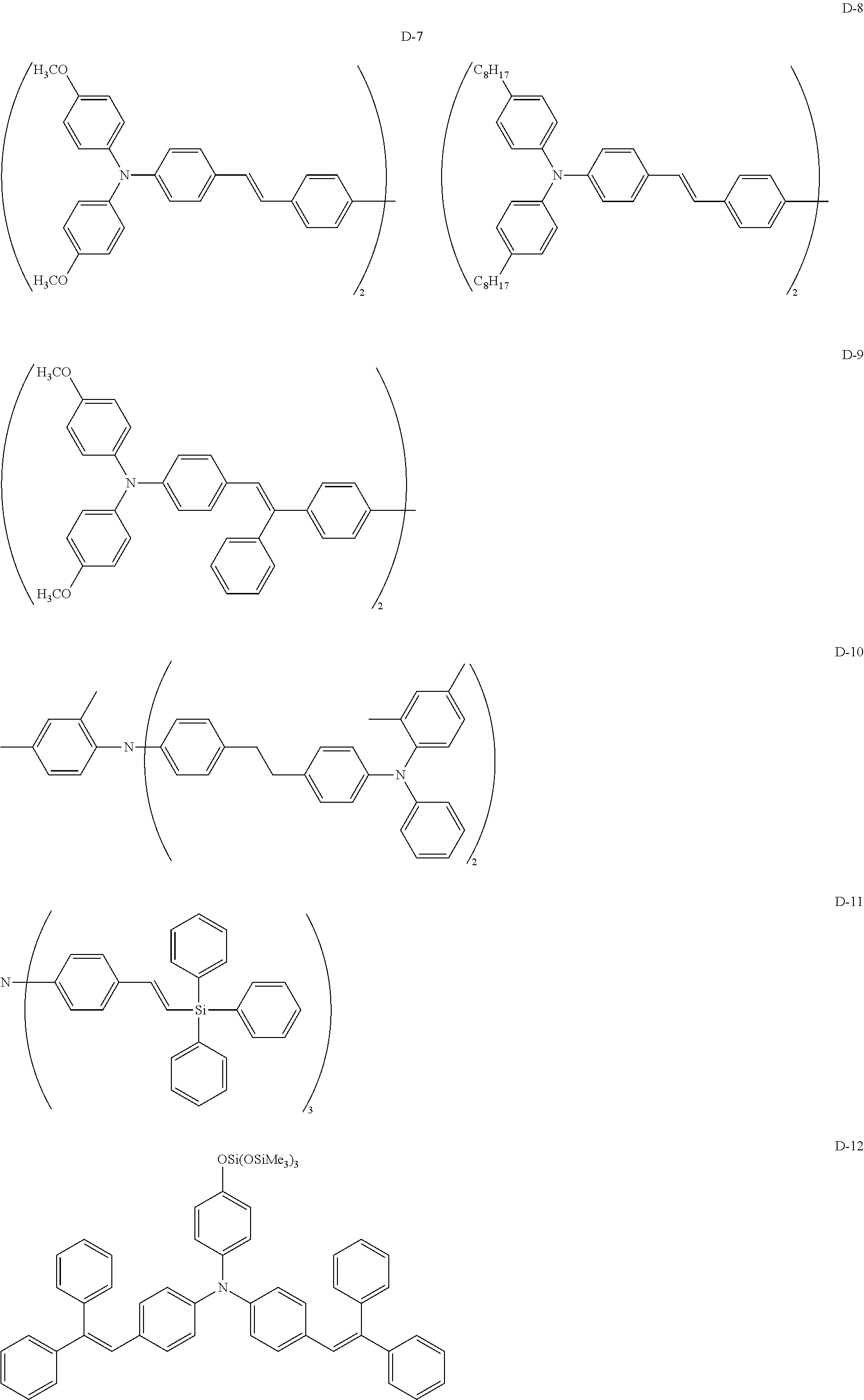
  • aromatic tertiary amine compound and styrylamine compound include N,N,N′,N′-tetraphenyl-4,4′-diaminophenyl, N,N′-diphenyl-N,N′-bis(3-methylphenyl)-[1,1′-biphenyl]-4,4′-diamine (TPD), 2,2′-bis(4-di-p-tolylaminophenyl)propane, 1,1-bis(4-di-p-tolylaminophenyl)cyclohexane, N,N,N′,N′-tetra-p-tolyl-4,4′-diaminobiphenyl, 1,1-bis(4-di-p-tolylaminophenyl)-4-phenylcyclohexane, bis(4-dimethylamino-2-methylphenyl)-phenylmethane, bis(4-di-p-
  • Pat. No. 5,061,569 which have two condensed aromatic rings in the molecule thereof such as 4,4′-bis[N-(1-naphthyl)-N-phenylamino]biphenyl (NPD), and compounds described in Japanese Patent O.P.I. Publication No. 4-308688 such as 4,4′,4′′-tris[N-(3-methylphenyl)-N-phenylamino]triphenylamine (MTDATA) in which three triphenylamine units are bonded in a starburst form.
  • NPD 4,4′-bis[N-(1-naphthyl)-N-phenylamino]biphenyl
  • MTDATA 4,4′,4′′-tris[N-(3-methylphenyl)-N-phenylamino]triphenylamine
  • a polymer in which the material mentioned above is introduced in the polymer chain or a polymer having the material as the polymer main chain can be also used.
  • Examples of a charge transporting material other than the aromatic amine derivatives include thiophene derivatives and pyrrole derivatives.
  • the charge transporting layer is formed by coating of the charge transporting material or p-type semiconductor compound as described previously, or by coating or filling the redox electrolyte dispersion described previously.
  • the electrically conductive material can be used as an opposed electrode, as long as it is electrically conductive.
  • the electrically conductive material is preferably one which has catalytic capability of carrying out oxidation reaction of an I 3 ⁇ ion and the like or reduction of other redox ions at a sufficient rate.
  • Examples of such a material include a platinum electrode, a platinum-plated or platinum-deposited conductive material, a rhodium metal, a ruthenium metal, ruthenium oxide and carbon.
  • the solar cell of the invention which is one embodiment of the photoelectric conversion element of the invention and its circuit, a design most suitable for solar light is carried out.
  • the solar cell of the invention has such a structure that when solar light is used as a light source, an optimum photoelectric conversion is carried out, that is, such a structure that a dye-sensitized semiconductor is capable of being exposed to solar light.
  • the photoelectrode, electrolyte layer and opposed electrode each described above are housed and sealed in a case or the whole of them is sealed with a resin.
  • a sensitizing dye carried on a semiconductor absorbs the exposed light or electromagnetic wave and is excited. Electrons generated upon the excitation are transferred to the semiconductor and then to the opposed electrode through the electrically conductive support to reduce the redox electrolyte in the charge transporting layer.
  • the sensitizing dye whose electrons are transferred to the semiconductor forms the oxidation product but is reduced by electrons supplied from the opposed electrode through the redox electrolyte of the electrolyte layer to return to the original state, and at the same time, the redox electrolyte in the charge transporting layer is oxidized to return to the original state which is capable of being reduced by electrons supplied from the opposed electrode.
  • electrons flow, and a solar cell can be prepared using the photoelectric conversion element of the invention.
  • a commercially available titanium oxide paste having a particle diameter of 18 nm was coated onto a fluorine-doped tin oxide (FTO) conductive glass substrate according to a screen printing method, followed by drying.
  • the coated area was 5 ⁇ 5 mm 2 .
  • the coating and drying (at 120° C. for 3 minutes) were repeated three times, followed by calcining at 200° C. for 10 minutes and further calcining at 500° C. for 15 minutes to obtain a first titanium oxide layer having a thickness of 15 ⁇ m.
  • the resulting titanium oxide layer was further coated with a commercially available titanium oxide paste having a particle diameter of 400 nm in the same manner as above to obtain a second titanium oxide layer with a thickness of 5 ⁇ m.
  • the above FTO glass substrate on which titanium oxide paste was coated and calcined was immersed in this solution at room temperature for 3 hours to conduct adsorption treatment of the dye. Thus, an oxide semiconductor electrode was obtained.
  • An acetonitrile solution containing 0.6 mole/liter of 1,2-dimethyl-3-propylimidazolium iodide, 0.1 mole/liter of lithium iodide, 0.05 mole/liter of iodine, and 0.5 mole/liter of 4-(t-butyl)pyridine was employed as an electrolyte solution for a charge transporting layer.
  • the glass plate on which platinum and chromium were vapor deposited was used as an opposed electrode.
  • the opposed electrode, the oxide semiconductor electrode and the electrolyte solution each prepared above were assembled by a clamp to prepare Photoelectric conversion element 1.
  • Photoelectric conversion elements 2 through 32 were prepared in the same manner as in Photoelectric conversion element 1 above, except that compounds (dyes) as shown in Table 1 were used in an amount equimolar with the Exemplified compound 1 instead of Exemplified compound 1.
  • the evaluation was carried out through a solar simulator (produced by EKO Instruments Co., Ltd.). Each photoelectric conversion element was exposed to a pseudo solar light of a xenon lamp at 100 mW/cm 2 through an AM filter (AM-1.5).
  • each element was short-circuited, and then exposed to the pseudo solar light of a xenon lamp at 120 mW/cm 2 for 720 hours. Thereafter, the current-voltage property was measured in the same manner as above, and short circuit current density Jsc1 (mA ⁇ cm ⁇ 2 ) and open circuit voltage Voc1 (V) were determined. Then, photoelectric conversion efficiency after light exposure ⁇ 1 (%) was determined from Jsc1 and Voc1 employing the equation (A).
  • Conversion efficiency ⁇ is synonymous with photoelectric conversion efficiency ⁇ , which means the efficiency that light energy is converted to electrical energy by a solar cell.
  • a value represented by ( ⁇ 1 / ⁇ ) was calculated and evaluated as a measure of durability of the photoelectric conversion efficiency.
  • the inventive photoelectric element No. 2 employing a dye in the invention having a thiohydantoin nucleus has the same electron doper structure as the comparative photoelectric element No. 31, employing a comparative dye having a rhodanine nucleus.
  • the inventive photoelectric element No. 2 has substantially the same initial photoelectric conversion efficiency, however, the durability of photoelectric conversion efficiency of the inventive photoelectric element No. 2 is maintained at 95%, while the durability of photoelectric conversion efficiency of the comparative photoelectric element No. 31 deteriorates to 83%. It has proved that the inventive photoelectric element has excellent durability to light. All the inventive photoelectric elements are maintained at a durability of photoelectric conversion efficiency of not less than 90%. As is apparent from the aforementioned, it has been found that the present invention provides a sensitizing dye having high durability to light and maintaining the photoelectric conversion efficiency for a long term.

Landscapes

  • Chemical & Material Sciences (AREA)
  • Engineering & Computer Science (AREA)
  • Power Engineering (AREA)
  • Materials Engineering (AREA)
  • Organic Chemistry (AREA)
  • Microelectronics & Electronic Packaging (AREA)
  • Electrochemistry (AREA)
  • General Chemical & Material Sciences (AREA)
  • Chemical Kinetics & Catalysis (AREA)
  • Physics & Mathematics (AREA)
  • Spectroscopy & Molecular Physics (AREA)
  • Hybrid Cells (AREA)
  • Photovoltaic Devices (AREA)

Abstract

Disclosed is a photoelectric conversion element comprising a conductive support and provided thereon, a semiconductor layer, a charge transporting layer and an opposed electrode, the semiconductor layer comprising a semiconductor with a dye, wherein the dye is a compound represented by the following formula (1).
Figure US08395041-20130312-C00001

Description

This application is based on Japanese Patent Application No. 2009-098758, filed on Apr. 15, 2009 in Japanese Patent Office, the entire content of which is hereby incorporated by reference.
FIELD OF THE INVENTION
The present invention relates to a photoelectric conversion element and a solar cell employing the same, and particularly to a dye-sensitizing type photoelectric conversion element (hereinafter also referred to as simply a photoelectric conversion element) and a dye-sensitizing type solar cell employing the same.
TECHNICAL BACKGROUND
In recent years, application of infinite solar light producing no harmful substances has been actively studied. As those in which a solar light is presently put into practical use as a clean energy source, there are inorganic type solar cells such as single crystalline silicon, polycrystalline silicon, amorphous silicon, and cadmium telluride and indium copper selenide for domestic use.
However, there are drawbacks in these inorganic type solar cells. Extremely high purity is required, for example in the case of the silicon type, and the purification process is complicated and includes many steps, resulting in high production cost.
On the other hand, many solar cells employing an organic material have also been proposed. Examples of the organic solar cell include a Schottky type photoelectric conversion element in which a p-type organic semiconductor and metal having a small work function are joined, and a hetero-junction type photoelectric conversion element in which a p-type organic semiconductor and an n-type inorganic semiconductor or a p-type organic semiconductor and an electron accepting organic compound are joined. The utilized organic semiconductors are synthesized dyes or pigments such as chlorophyll, perylene and so forth, conductive polymer materials such as polyacetylene and so forth, and composite materials thereof. These materials are thin-layered by a vacuum evaporation method, a casting method, a dipping method or the like to prepare a cell material. The organic materials have advantages that they are inexpensive and easy to obtain a large dimension, but there is problem that most of them exhibit a low conversion efficiency of 1% or less and poor durability.
In such a situation, a solar cell exhibiting favorable properties has been reported by Dr. Gratzel et al. in Switzerland (see B. O'Regan & M. Gratze, Nature, 353, 737 (1991), for example). The proposed cell is a dye sensitizing type solar cell, and a wet type solar cell in which a titanium oxide porous film spectrally sensitized by a ruthenium complex is provided as a functional electrode. Advantages of this system are that it is not necessary to purify an inexpensive oxide semiconductor such as titanium oxide up to high purity, and wide wavelength regions of visible light can be used, whereby a solar light containing visible light components can be effectively converted into electricity.
However, this system employs the ruthenium complex which is resourceless, and when this system is practically applied to a solar cell, supply of the ruthenium complex is a concern. Further, the ruthenium complex has problem in that it is expensive, and low in aging stability, but this problem can be solved if the ruthenium complex can be replaced with an inexpensive and stable organic dye.
There is disclosure in Japanese Patent O.P.I. Publication No. 2005-63833 that when compounds having a rhodamine nucleus-containing amine structure are employed as a dye for this solar cell, a dye-sensitizing type photoelectric conversion element (organic dye-sensitizing type solar cell) with high photoelectric conversion efficiency is obtained. However, it is supposed that these compounds having in the molecules plural sulfur atoms which contribute to light instability are lower in durability to light. Accordingly, further improvement of a sensitizing dye is required.
SUMMARY OF THE INVENTION
The present invention has been made in view of the above. An object of the invention is to provide a photoelectric conversion element with high efficiency and high durability employing a novel sensitizing dye (hereinafter also referred to as simply a dye) with high durability to light and high conversion efficiency used in a dye-sensitization type photoelectric conversion element, and a solar cell employing the photoelectric conversion element.
The photoelectric conversion element of the invention comprises a conductive support and provided thereon, a semiconductor layer, a charge transporting layer and an opposed electrode, the semiconductor layer comprising a semiconductor carrying a specific dye.
BRIEF DESCRIPTION OF THE DRAWING
FIG. 1 is a schematic cross-sectional view showing one example of a photoelectric conversion element used in the present invention.
DETAILED DESCRIPTION OF THE INVENTION
The above object of the invention can be attained by any one of the following constitutions.
1. A photoelectric conversion element comprising a conductive support, and provided thereon, a semiconductor layer, a charge transporting layer and an opposed electrode, the semiconductor layer comprising a semiconductor with a dye, wherein the dye is a compound represented by formula (1),
Figure US08395041-20130312-C00002
wherein Ar represents a substituted or unsubstituted aromatic hydrocarbon ring or a substituted or unsubstituted aromatic heterocyclic ring; R1 and R2 independently represent a substituted or unsubstituted alkyl group, a substituted or unsubstituted alkenyl group, a substituted or unsubstituted aryl group or a substituted or unsubstituted heterocyclic group, provided that at least two of R1 and R2 and Ar may combine with each other to form a ring together with a nitrogen atom; R3 and R4 independently represent a hydrogen atom, a halogen atom, a cyano group, a substituted or unsubstituted alkyl group, a substituted or unsubstituted alkenyl group, a substituted or unsubstituted aryl group, a substituted or unsubstituted amino group or a substituted or unsubstituted heterocyclic group; Z represents a sulfur atom, an oxygen atom, a selenium atom, a substituted or unsubstituted alkylidene group, a substituted or unsubstituted aromatic hydrocarbon ring or a substituted or unsubstituted heterocyclic ring; Y represents a substituted or unsubstituted alkylene group, a substituted or unsubstituted alkenylene group, a substituted or unsubstituted aromatic hydrocarbon ring or a substituted or unsubstituted heterocyclic ring; and X represents a carboxylic acid group, a sulfonic acid group, a nitric acid group or a phosphoric acid group.
2. The photoelectric conversion element of item 1 above, wherein Ar in formula (1) is a substituted or unsubstituted aromatic hydrocarbon ring.
3. The photoelectric conversion element of item 2 above, wherein the aromatic hydrocarbon ring is a benzene ring.
4. The photoelectric conversion element of item 1 above, wherein R1 and R2 in formula (1) independently represent a substituted or unsubstituted alkyl group or a substituted or unsubstituted aryl group.
5. The photoelectric conversion element of item 1 above, wherein R1 and R2 represent a substituted or unsubstituted aryl group, the aryl group being a phenyl group.
6. The photoelectric conversion element of item 4 above, wherein R1 and R2 represent a substituted or unsubstituted aryl group, the aryl group being a stilbenzyl group.
7. The photoelectric conversion element of item 1 above, wherein R3 and R4 in formula (1) independently represent a hydrogen atom or a substituted or unsubstituted alkyl group.
8. The photoelectric conversion element of item 1 above, wherein R3 and R4 represent a hydrogen atom.
9. The photoelectric conversion element of item 1 above, wherein Z in formula (1) represents a sulfur atom or a substituted or unsubstituted heterocyclic ring, the heterocyclic ring being a rhodanine ring or a thiohydantoin ring.
10. The photoelectric conversion element of item 9 above, wherein Z represents a sulfur atom.
11. The photoelectric conversion element of item 1 above, wherein Y in formula (1) represents a substituted or unsubstituted alkylene group.
12. The photoelectric conversion element of item 11 above, wherein the alkylene group is a methylene group.
13. The photoelectric conversion element of item 1 above, wherein X in formula (1) represents a carboxylic acid group, a sulfonic acid group or a phosphoric acid group.
14. The photoelectric conversion element of item 13 above, wherein X is a carboxylic acid group.
15. The photoelectric conversion element of any one of items 1 through 14 above, wherein the semiconductor layer is a porous semiconductor layer.
16. The photoelectric conversion element of item 15 above, wherein the porosity of the porous semiconductor layer is not more than 10% by volume.
17. The photoelectric conversion element of any one of items 1 through 14 above, wherein the thickness of the semiconductor layer is from 0.5 to 30 μm.
18. The photoelectric conversion element of any one of items 1 through 14 above, wherein the semiconductor is titanium oxide.
19. The photoelectric conversion element of any one of items 1 through 14 above, wherein the content of the dye in the semiconductor layer is from 0.01 to 100 mmol per 1 m2 of semiconductor layer.
20. The photoelectric conversion element of any one of items 1 through 14 above, wherein the conductive support is substantially transparent.
21. A solar cell employing a photoelectric conversion element comprising a conductive support, and provided thereon, a semiconductor layer, a charge transporting layer and an opposed electrode, the semiconductor layer comprising a semiconductor with a dye, wherein the dye is a compound represented by formula (1) above.
EFFECTS OF THE INVENTION
The present invention can provide a photoelectric conversion element with high efficiency and high durability employing a novel sensitizing dye with high durability to light and high conversion efficiency used in a dye-sensitization type photoelectric conversion element, and a solar cell employing the photoelectric conversion element.
Employing a compound represented by formula (1) as a sensitizing dye, a photoelectric conversion element having the same conversion efficiency as one employing a rhodamine dye and having high durability to light and a solar cell fitted with the photoelectric conversion element can be obtained.
Next, preferred embodiments of the invention will be explained in detail, but the invention is not limited thereto.
The present invention is characterized in that in a photoelectric conversion element comprising a semiconductor layer provided on a conductive support, an opposed electrode, and a charge transporting layer provided between the semiconductor layer and the opposed electrode, the semiconductor layer containing a semiconductor with a dye, the dye includes a compound represented by formula (1) described above.
In the invention, when a compound represented by formula (1) with high durability to light and high conversion efficiency is incorporated as a dye in a dye-containing semiconductor layer, a photoelectric conversion element with high efficiency and high durability and a solar cell employing the photoelectric conversion element can be obtained.
Next, the present invention will be explained in further detail.
In the photoelectric conversion element, a photoelectrode comprising a dye-containing semiconductor on a conductive support and an opposed electrode are opposed with each other through a charge transporting layer.
The photoelectric conversion element of the invention will be explained employing the drawing.
FIG. 1 is a schematic cross-sectional view showing one example of a photoelectric conversion element of the present invention.
As shown in FIG. 1, the photoelectric conversion element is constituted of a substrate 1 and a transparent conductive film 2 constituting a conductive support; an oxide semiconductor 3 and a dye 4 constituting a semiconductor layer; an electrolyte 5 which is a charge transporting layer; platinum 8, transparent conductive film 7 and substrate 1′ constituting an opposed electrode; and a partition wall 9.
As a photoelectrode, utilized is one in which a semiconductor layer having pores formed via calcination of particles of the semiconductor 3 is provided on the substrate 1 on which the transparent conductive film 2 is placed, and the dye 4 is adsorbed on the semiconductor layer surface.
The present invention relates to a photoelectric conversion element and a solar cell each employing a compound (a dye) represented by formula (1) above.
<<Compound Represented by Formula (1)>>
Next, the compound represented by formula (1) will be explained.
In formula (1) above, Ar represents a substituted or unsubstituted aromatic hydrocarbon ring or a substituted or unsubstituted aromatic heterocyclic ring; R1 and R2 independently represent a substituted or unsubstituted alkyl, alkenyl, aryl or heterocyclic group, provided that at least two of R1 and R2 and Ar may combine with each other to form a ring together with a nitrogen atom; R3 and R4 independently represent a hydrogen atom, a halogen atom, a cyano group, or a substituted or unsubstituted alkyl, alkenyl, aryl, amino or heterocyclic group; Z represents a sulfur atom, an oxygen atom, a selenium atom, a substituted or unsubstituted alkylidene group, a substituted or unsubstituted aromatic hydrocarbon ring or a substituted or unsubstituted heterocyclic ring; Y represents a substituted or unsubstituted alkylene group, a substituted or unsubstituted alkenylene group, a substituted or unsubstituted aromatic hydrocarbon ring or a substituted or unsubstituted heterocyclic ring; and X represents an acid group such as a carboxylic acid group, a sulfonic acid group, a nitric acid group or a phosphoric acid group.
In formula (1) above, Ar represents a substituted or unsubstituted aromatic hydrocarbon ring or a substituted or unsubstituted aromatic heterocyclic ring.
The aromatic hydrocarbon ring represented by Ar refers to as an aryl ring also. Examples of the aromatic hydrocarbon ring include a benzene ring, a naphthalene ring, an anthracene ring, an azulene ring, an acenaphthylene ring, a fluorene ring, a phenanthrene ring, an indene ring, a pyrene ring, and a biphenyl ring. These rings may further have a substituent.
The aromatic hydrocarbon ring represented by Ar is preferably a benzene ring or a naphthalene ring.
Examples of the aromatic heterocyclic ring represented by Ar include a furan ring, a thiophene ring, a pyridine ring, a pyridazine ring, a pyrimidine ring, a pyrazine ring, a triazine ring, an imidazole ring, a pyrazole ring, a thiazole ring, a quinazoline ring, a carbazole ring, a carboline ring, and a diazacarboline ring (in which one of the carbon atoms of the hydrocarbon ring constituting a carboline ring is further replaced with a nitrogen atom), 1,10-phenanthroline ring, a phthalazine ring, an indole ring, and a cumarin ring. These rings may further have a substituent.
The aromatic heterocyclic ring represented by Ar is preferably a cumarin ring.
In formula (1) above, R1 and R2 independently represent a substituted or unsubstituted alkyl, alkenyl, aryl or heterocyclic group, provided that at least two of R1 and R2 and Ar may combine with each other to form a ring together with a nitrogen atom.
Examples of the alkyl group represented by R1 and R2 include a methyl group, an ethyl group, a propyl group, an isopropyl group, a butyl group, a tert-butyl group, a pentyl group, a hexyl group, an octyl group, a dodecyl group, a tridecyl group, a tetradecyl group and a pentadecyl group.
Examples of the alkenyl group represented by R1 and R2 include a vinyl group, an allyl group, a butenyl group, and an octenyl group.
Examples of the aryl group represented by R1 or R2 include a phenyl group, a naphthyl group, biphenyl group, an anthryl group, a phenanthryl group, an azulenyl group, an acenaphthylenyl group, a fluorenyl group, a phenanthrenyl group, an indenyl group, and a pyrenyl group. These groups may further have a substituent.
Examples of an aromatic heterocyclic ring group in the heterocyclic ring group represented by R1 or R2 include a furyl group, a thienyl group, a cumarinyl group, a pyridyl group, a pyridazinyl group, a pyrimidinyl group, a pyrazinyl group, a triazinyl group, an imidazolyl group, a pyrazolyl group, a thiazolyl group, a quinazolinyl group, a dibenzofuranyl group, a carbazolyl group, a carbolinyl group, a diazacarbazolyl group (in which one of the carbon atoms constituting the carboline ring of the carbolinyl group is substituted with a nitrogen atom), and a phthalazinyl group. Examples of a saturated heterocyclic ring group in the heterocyclic ring group represented by R1 or R2 include a pyrrolidinyl group, an imidazolinyl group, a morphinyl group and an oxazolinyl group.
At least two of R1, R2 and Ar may combine with each other to form a ring together with a nitrogen atom. Examples such a ring include a carbazole ring, an indoline ring, julolidine ring or phenothiazine ring.
It is preferred that R1 and R2 independently represent an alkyl group or an aryl group. The aryl group is preferably a phenyl group or a stilbenzyl group.
In formula (1) above, R3 and R4 independently represent a hydrogen atom, a halogen atom, a cyano group, a substituted or unsubstituted alkyl, alkenyl, aryl, amino or heterocyclic ring group.
Examples of the alkyl, alkenyl, aryl or heterocyclic group represented by R3 and R4 include the same as denoted above in the alkyl, alkenyl, aryl or heterocyclic group represented by R1 and R2.
Examples of the amino group represented by R3 and R4 include an amino group, an ethylamino group, a dimethylamino group, a butylamino group, a cyclopentylamino group, a 2-ethylhexylamino group, a dodecylamino group, an anilinoamino group, a naphthylamine group, and a 2-pyridylamino group.
Examples of the halogen atom represented by R3 and R4 include a fluorine atom, a chlorine atom, and a bromine atom.
In formula (1) above, Z represents a sulfur atom, an oxygen atom, a selenium atom, a substituted or unsubstituted alkylidene group, a substituted or unsubstituted aromatic hydrocarbon ring or a substituted or unsubstituted heterocyclic ring.
Example of the alkylidene group represented by Z include a methylidene group, an ethylidene group, a propylidene group, an isopropylidene group, a pentylidene group, a hexylidene group, an octylidene group, a dodecylidene group, a tridecylidene group, a tetradecylidene group, and a pentadecylidene group. These groups may have further a substituent.
Examples of the aromatic hydrocarbon ring or aromatic heterocyclic ring represented by Z include the same as denoted in the aromatic hydrocarbon ring or aromatic heterocyclic ring represented by Ar above. Examples of the saturated heterocyclic ring represented by Z include a rhodanine ring, a pyrrolidine ring, an imidazolidine ring, a morpholine ring, an oxazolidine ring and a thiohydantoin ring. These rings may have further a substituent.
Z is preferably a sulfur atom or a saturated heterocyclic ring. The saturated heterocyclic ring is preferably a rhodanine ring or a thiohydantoin ring.
In formula (1) above, Y represents a substituted or unsubstituted alkylene group, a substituted or unsubstituted alkenylene group, a substituted or unsubstituted aromatic hydrocarbon ring or a substituted or unsubstituted heterocyclic ring.
Example of the alkylene group represented by Y include a methylene group, an ethylene group, a propylene group, an isopropylene group, a tert-butylene group, a pentylene group, a hexylene group, an octylene group, a dodecylene group, a tridecylene group, a tetradecylene group, and a pentadecylene group. These groups may have further a substituent.
Example of the alkenylene group represented by Y include a vinylene group, an alkylene group, and a butenylene group. These groups may have further a substituent.
Examples of the aromatic hydrocarbon ring or aromatic heterocyclic ring represented by Y include the same as denoted in the aromatic hydrocarbon ring or aromatic heterocyclic ring represented by Ar above. Examples of the saturated heterocyclic ring represented by Y include a pyrrolidine ring, an imidazolidine ring, a morpholine ring, and an oxazolidine ring. These rings may have further a substituent. As the substituent of Y, an electron withdrawing group is preferred.
Y is preferably an alkylene group, and the alkylene group is preferably an ethylene group.
In formula (1) above, X represents an acid group such as a carboxylic acid group, a sulfonic acid group, a nitric acid group, or a phosphoric acid group or their salt group. X is preferably a carboxylic acid group, a sulfonic acid group or a phosphoric acid group.
X is preferably a carboxylic acid group. When X of formula (1) is a carboxylic acid group, the compound exhibits high adsorption capability to an oxide semiconductor, provides a smooth flow of a charge to the oxide semiconductor.
As described above, the rings or groups may further have a substituent.
Examples of the substituent include an alkyl group (for example, a methyl group, an ethyl group, a propyl group, an isopropyl group, a tert-butyl group, a pentyl group, a hexyl group, an octyl group, a dodecyl group, a tridecyl group, a tetradecyl group, or a pentadecyl group); an cycloalkyl group (for example, a cyclopentyl group or a cyclohexyl group); an alkenyl group (for example, a vinyl group or a allyl group); an alkynyl group (for example, an ethynyl group or a propargyl group); an aryl group (for example, a phenyl group or a naphthyl group); an aromatic heterocyclic ring group (for example, a furyl group, a thienyl group, an indolyl group, coumarinyl group, a pyridyl group, a pyridazinyl group, a pyrimidinyl group, a pyrazinyl group, a triazinyl group, an imidazolyl group, a pyrazolyl group, a thiazolyl group, a quinazolinyl group, a carbazolyl, a carbolinyl group, a diazacarbazolyl group (in which one of the carbon atoms constituting the carboline ring of the carbolinyl group is substituted with a nitrogen atom) or a phthalazinyl group); a saturated heterocyclic ring group (for example, pyrrolidyl, an imidazolidyl group, a morpholyl group or an oxazolidyl group); an alkoxy group (for example, a methoxy group, an ethoxy group, a propyloxy group, a pentyloxy group, a hexyloxy group, an octyloxy group or a dodecyloxy group); a cycloalkoxy group (for example, a cyclopentyloxy group or a cyclohexyloxy group); an aryloxy group (for example, a phenoxy group or a naphthyloxy group); an alkylthio group (for example, a methylthio group, an ethylthio group, a propylthio group, a pentylthio group, a hexylthio group, an octylthio group, or a dodecylthio group); a cycloalkylthio group (for example, a cyclopentylthio group or a cyclohexylthio group), an arylthio group (for example, a phenylthio group or a naphthylthio group); an alkoxycarbonyl group (for example, a methyloxycarbonyl group, an ethyloxycarbonyl group, a butyloxycarbonyl group, an octyloxycarbonyl group or a dodecyloxycarbonyl group); an aryloxycarbonyl group (for example, a phenyloxycarbonyl group or a naphthyloxycarbonyl group), a sulfamoyl group (for example, an aminosulfonyl group, a methylaminosulfonyl group, a dimethylaminosulfonyl group, a butylaminosulfonyl group, a hexylaminosulfonyl group, a cyclohexylaminosulfonyl group, an octylaminosulfonyl group, a dodecylaminosulfonyl group, a phenylaminosulfonyl group, a naphthylaminosulfonyl group or a 2-pyridylaminosulfonyl group); an acyl group (for example, an acetyl group, an ethylcarbonyl group, a propylcarbonyl group, a pentylcarbonyl group, a cyclohexylcarbonyl group, an octylcarbonyl group, a 2-ethylhexylcarbonyl group, a dodecylcarbonyl group, a phenylcarbonyl group, a naphthylcarbonyl group or a pyridylcarbonyl group); an acyloxy group (for example, an acetyloxy group, an ethylcarbonyloxy group, a butylcarbonyloxy group, an octylcarbonyloxy group, a dodecylcarbonyloxy group or a phenylcarbonyloxy group), an amido group (for example, a methylcarbonylamino group, an ethylcarbonylamino group, a dimethylcarbonylamino group, a propylcarbonylamino group, a pentylcarbonylamino group, a cyclohexylcarbonylamino group, a 2-ethylhexylcarbonylamino group, an octylcarbonylamino group, a dodecylcarbonylamino group, a phenylcarbonylamino group or a naphthylcarbonylamino group); a carbamoyl group (for example, an aminocarbonyl group, a methylaminocarbonyl group, a dimethylaminocarbonyl group, a propylaminocarbonyl group, a pentylaminocarbonyl group, a cyclohexylaminocarbonyl group, an octylaminocarbonyl group, a 2-ethylhexylaminocarbonyl group, a dodecylaminocarbonyl group, a phenylaminocarbonyl group, a naphthylaminocarbonyl group or a 2-puridylaminocarbonyl group); a ureido group (for example, a methylureido group, an ethylureido group, a pentylureido group, a cyclohexylureido group, an octylureido group, a dodecylureido group, a phenylureido group, a naphthylureido group, or a 2-pyridylaminoureido group); a sulfinyl group (for example, a methylsulfinyl group, an ethylsulfinyl group, a butylsulfonyl group, a cyclohexylsulfinyl group, a 2-ethylhexylsulfinyl group, a dodecylsulfinyl group, a phenylsulfinyl group, a naphthylsulfinyl group or a 2-pyridylsulfinyl group); an alkylsulfonyl group (for example, a methylsulfonyl group, an ethylsulfonyl group, a butylsulfonyl group, a cyclohexylsulfonyl group, a 2-ethylhexylsulfonyl group, or a dodecyl sulfonyl group); an arylsulfonyl group or a heteroaryl sulfonyl group (for example, a phenylsulfonyl group, a naphthylsulfonyl group or a 2-pyridylsulfonyl group); an amino group (for example, an amino group, an ethylamino group, a dimethylamino group, a butylamino group, a cyclopentylamino group, a 2-ethylhexylamino group, a dodecylamino group, an anilino group, a naphthylamino group or a 2-pyridylamino group); a halogen atom (for example, a fluorine atom, a chlorine atom or a bromine atom); a fluorinated hydrocarbon group (for example, a fluoromethyl group, a trifluoromethyl group, a pentafluoroethyl group or a fluorophenyl group); a cyano group; an nitro group; a hydroxyl group, a mercapto group; and a silyl group (for example, a trimethylsilyl group, a triisopropylsilyl group, a triphenylsilyl group or a phenyldiethylsilyl group).
These substituents may further have the substituent described above. A plurality of these substituents may combine with each other to form a ring.
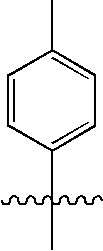
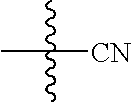
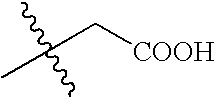
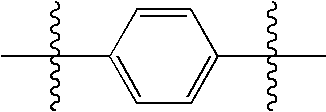
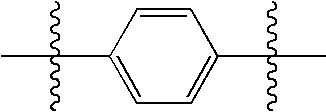
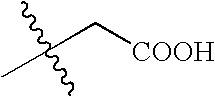
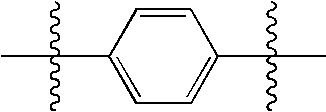
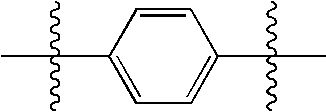
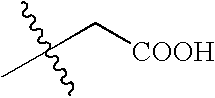
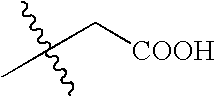
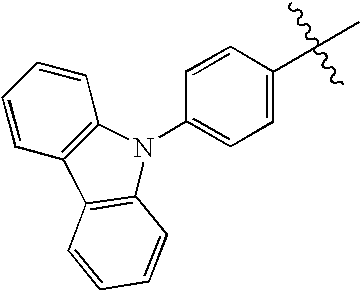
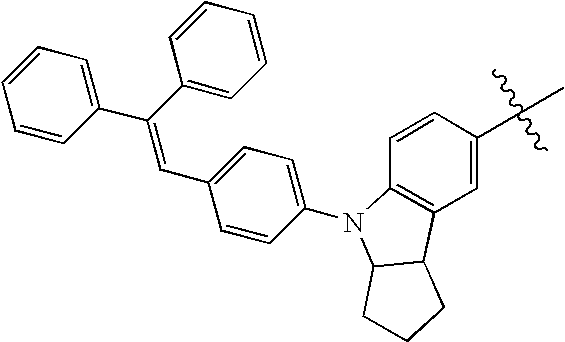
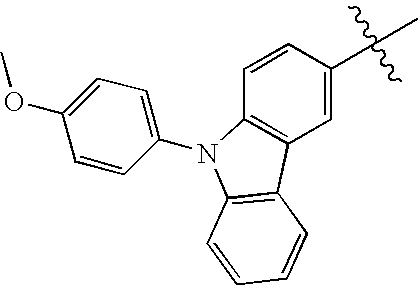
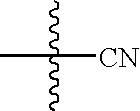
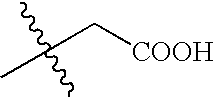
Typical examples of the compound (dye) represented by formula (1) will be listed below, but the invention is not limited thereto. In the partial chemical structures of the exemplified dyes listed below, the line with a wavy line represents a bonding site.
DYE R1 R2 R3 R4
1
Figure US08395041-20130312-C00003
Figure US08395041-20130312-C00004
H H
2
Figure US08395041-20130312-C00005
Figure US08395041-20130312-C00006
H H
3
Figure US08395041-20130312-C00007
Figure US08395041-20130312-C00008
H H
4
Figure US08395041-20130312-C00009
Figure US08395041-20130312-C00010
H H
5
Figure US08395041-20130312-C00011
Figure US08395041-20130312-C00012
H H
6
Figure US08395041-20130312-C00013
Figure US08395041-20130312-C00014
H H
7
Figure US08395041-20130312-C00015
Figure US08395041-20130312-C00016
H H
8
Figure US08395041-20130312-C00017
Figure US08395041-20130312-C00018
H H
9
Figure US08395041-20130312-C00019
Figure US08395041-20130312-C00020
H H
10
Figure US08395041-20130312-C00021
Figure US08395041-20130312-C00022
H H
11
Figure US08395041-20130312-C00023
Figure US08395041-20130312-C00024
H H
12
Figure US08395041-20130312-C00025
Figure US08395041-20130312-C00026
H H
13
Figure US08395041-20130312-C00027
Figure US08395041-20130312-C00028
H H
14
Figure US08395041-20130312-C00029
Figure US08395041-20130312-C00030
H H
15
Figure US08395041-20130312-C00031
Figure US08395041-20130312-C00032
H H
16
Figure US08395041-20130312-C00033
Figure US08395041-20130312-C00034
H H
17
Figure US08395041-20130312-C00035
Figure US08395041-20130312-C00036
H H
18
Figure US08395041-20130312-C00037
Figure US08395041-20130312-C00038
H H
19
Figure US08395041-20130312-C00039
Figure US08395041-20130312-C00040
H H
20
Figure US08395041-20130312-C00041
Figure US08395041-20130312-C00042
H H
21
Figure US08395041-20130312-C00043
Figure US08395041-20130312-C00044
H H
22
Figure US08395041-20130312-C00045
Figure US08395041-20130312-C00046
H H
23
Figure US08395041-20130312-C00047
Figure US08395041-20130312-C00048
H H
24
Figure US08395041-20130312-C00049
Figure US08395041-20130312-C00050
H H
25
Figure US08395041-20130312-C00051
Figure US08395041-20130312-C00052
H H
26
Figure US08395041-20130312-C00053
Figure US08395041-20130312-C00054
H H
27
Figure US08395041-20130312-C00055
Figure US08395041-20130312-C00056
H H
28
Figure US08395041-20130312-C00057
Figure US08395041-20130312-C00058
H H
29
Figure US08395041-20130312-C00059
Figure US08395041-20130312-C00060
H H
30
Figure US08395041-20130312-C00061
Figure US08395041-20130312-C00062
H H
31
Figure US08395041-20130312-C00063
Figure US08395041-20130312-C00064
H H
32
Figure US08395041-20130312-C00065
Figure US08395041-20130312-C00066
H H
33
Figure US08395041-20130312-C00067
Figure US08395041-20130312-C00068
H H
34
Figure US08395041-20130312-C00069
Figure US08395041-20130312-C00070
H H
`
35
Figure US08395041-20130312-C00071
Figure US08395041-20130312-C00072
H H
36
Figure US08395041-20130312-C00073
Figure US08395041-20130312-C00074
H H
37
Figure US08395041-20130312-C00075
Figure US08395041-20130312-C00076
H H
38
Figure US08395041-20130312-C00077
Figure US08395041-20130312-C00078
H H
39
Figure US08395041-20130312-C00079
Figure US08395041-20130312-C00080
H H
40
Figure US08395041-20130312-C00081
Figure US08395041-20130312-C00082
H H
41
Figure US08395041-20130312-C00083
Figure US08395041-20130312-C00084
H H
42
Figure US08395041-20130312-C00085
Figure US08395041-20130312-C00086
H H
43
Figure US08395041-20130312-C00087
Figure US08395041-20130312-C00088
H H
44
Figure US08395041-20130312-C00089
Figure US08395041-20130312-C00090
H H
45
Figure US08395041-20130312-C00091
Figure US08395041-20130312-C00092
H H
46
Figure US08395041-20130312-C00093
Figure US08395041-20130312-C00094
H H
47
Figure US08395041-20130312-C00095
Figure US08395041-20130312-C00096
H H
48
Figure US08395041-20130312-C00097
Figure US08395041-20130312-C00098
H H
49
Figure US08395041-20130312-C00099
Figure US08395041-20130312-C00100
H H
50
Figure US08395041-20130312-C00101
Figure US08395041-20130312-C00102
H H
51
Figure US08395041-20130312-C00103
Figure US08395041-20130312-C00104
H H
52
Figure US08395041-20130312-C00105
Figure US08395041-20130312-C00106
H H
53
Figure US08395041-20130312-C00107
Figure US08395041-20130312-C00108
H H
54
Figure US08395041-20130312-C00109
Figure US08395041-20130312-C00110
H H
55
Figure US08395041-20130312-C00111
Figure US08395041-20130312-C00112
H H
56
Figure US08395041-20130312-C00113
Figure US08395041-20130312-C00114
H H
57
Figure US08395041-20130312-C00115
Figure US08395041-20130312-C00116
H H
58
Figure US08395041-20130312-C00117
Figure US08395041-20130312-C00118
H H
59
Figure US08395041-20130312-C00119
Figure US08395041-20130312-C00120
H H
60
Figure US08395041-20130312-C00121
Figure US08395041-20130312-C00122
H H
61
Figure US08395041-20130312-C00123
Figure US08395041-20130312-C00124
H H
62
Figure US08395041-20130312-C00125
Figure US08395041-20130312-C00126
H H
63
Figure US08395041-20130312-C00127
Figure US08395041-20130312-C00128
H H
64
Figure US08395041-20130312-C00129
Figure US08395041-20130312-C00130
H H
65
Figure US08395041-20130312-C00131
Figure US08395041-20130312-C00132
H H
66
Figure US08395041-20130312-C00133
Figure US08395041-20130312-C00134
H H
67
Figure US08395041-20130312-C00135
Figure US08395041-20130312-C00136
H H
68
Figure US08395041-20130312-C00137
Figure US08395041-20130312-C00138
H H
69
Figure US08395041-20130312-C00139
Figure US08395041-20130312-C00140
H H
70
Figure US08395041-20130312-C00141
Figure US08395041-20130312-C00142
H H
71
Figure US08395041-20130312-C00143
Figure US08395041-20130312-C00144
H H
72
Figure US08395041-20130312-C00145
Figure US08395041-20130312-C00146
H H
73
Figure US08395041-20130312-C00147
Figure US08395041-20130312-C00148
H H
74
Figure US08395041-20130312-C00149
Figure US08395041-20130312-C00150
H H
75
Figure US08395041-20130312-C00151
Figure US08395041-20130312-C00152
H H
76
Figure US08395041-20130312-C00153
Figure US08395041-20130312-C00154
H H
77
Figure US08395041-20130312-C00155
Figure US08395041-20130312-C00156
H H
78
Figure US08395041-20130312-C00157
Figure US08395041-20130312-C00158
H H
79
Figure US08395041-20130312-C00159
Figure US08395041-20130312-C00160
H H
80
Figure US08395041-20130312-C00161
Figure US08395041-20130312-C00162
H H
81
Figure US08395041-20130312-C00163
Figure US08395041-20130312-C00164
H H
82
Figure US08395041-20130312-C00165
Figure US08395041-20130312-C00166
H H
83
Figure US08395041-20130312-C00167
Figure US08395041-20130312-C00168
H H
84
Figure US08395041-20130312-C00169
Figure US08395041-20130312-C00170
H H
85
Figure US08395041-20130312-C00171
Figure US08395041-20130312-C00172
H H
86
Figure US08395041-20130312-C00173
Figure US08395041-20130312-C00174
H H
87
Figure US08395041-20130312-C00175
Figure US08395041-20130312-C00176
H H
88
Figure US08395041-20130312-C00177
Figure US08395041-20130312-C00178
H H
89
Figure US08395041-20130312-C00179
Figure US08395041-20130312-C00180
H H
90
Figure US08395041-20130312-C00181
Figure US08395041-20130312-C00182
H H
91
Figure US08395041-20130312-C00183
Figure US08395041-20130312-C00184
H H
92
Figure US08395041-20130312-C00185
Figure US08395041-20130312-C00186
H H
93
Figure US08395041-20130312-C00187
Figure US08395041-20130312-C00188
H H
94
Figure US08395041-20130312-C00189
Figure US08395041-20130312-C00190
H H
95
Figure US08395041-20130312-C00191
Figure US08395041-20130312-C00192
H H
96
Figure US08395041-20130312-C00193
Figure US08395041-20130312-C00194
H H
97
Figure US08395041-20130312-C00195
Figure US08395041-20130312-C00196
H H
98
Figure US08395041-20130312-C00197
Figure US08395041-20130312-C00198
H H
99
Figure US08395041-20130312-C00199
Figure US08395041-20130312-C00200
H H
100
Figure US08395041-20130312-C00201
Figure US08395041-20130312-C00202
H H
101
Figure US08395041-20130312-C00203
Figure US08395041-20130312-C00204
H H
102
Figure US08395041-20130312-C00205
Figure US08395041-20130312-C00206
H H
103
Figure US08395041-20130312-C00207
Figure US08395041-20130312-C00208
H H
104
Figure US08395041-20130312-C00209
Figure US08395041-20130312-C00210
H H
105
Figure US08395041-20130312-C00211
Figure US08395041-20130312-C00212
H H
106
Figure US08395041-20130312-C00213
Figure US08395041-20130312-C00214
H H
107
Figure US08395041-20130312-C00215
Figure US08395041-20130312-C00216
H H
108
Figure US08395041-20130312-C00217
Figure US08395041-20130312-C00218
H H
109
Figure US08395041-20130312-C00219
Figure US08395041-20130312-C00220
H H
110
Figure US08395041-20130312-C00221
Figure US08395041-20130312-C00222
H H
111
Figure US08395041-20130312-C00223
Figure US08395041-20130312-C00224
H H
112
Figure US08395041-20130312-C00225
Figure US08395041-20130312-C00226
H H
113
Figure US08395041-20130312-C00227
Figure US08395041-20130312-C00228
H H
114
Figure US08395041-20130312-C00229
Figure US08395041-20130312-C00230
H H
115
Figure US08395041-20130312-C00231
Figure US08395041-20130312-C00232
H H
116
Figure US08395041-20130312-C00233
Figure US08395041-20130312-C00234
H H
117
Figure US08395041-20130312-C00235
Figure US08395041-20130312-C00236
H H
118
Figure US08395041-20130312-C00237
Figure US08395041-20130312-C00238
H H
119
Figure US08395041-20130312-C00239
Figure US08395041-20130312-C00240
H H
120
Figure US08395041-20130312-C00241
Figure US08395041-20130312-C00242
H H
121
Figure US08395041-20130312-C00243
Figure US08395041-20130312-C00244
H H
122
Figure US08395041-20130312-C00245
Figure US08395041-20130312-C00246
H H
123
Figure US08395041-20130312-C00247
Figure US08395041-20130312-C00248
H H
124
Figure US08395041-20130312-C00249
Figure US08395041-20130312-C00250
H H
125
Figure US08395041-20130312-C00251
Figure US08395041-20130312-C00252
H H
126
Figure US08395041-20130312-C00253
Figure US08395041-20130312-C00254
H H
127
Figure US08395041-20130312-C00255
Figure US08395041-20130312-C00256
H H
128
Figure US08395041-20130312-C00257
Figure US08395041-20130312-C00258
H H
129
Figure US08395041-20130312-C00259
Figure US08395041-20130312-C00260
H H
130
Figure US08395041-20130312-C00261
Figure US08395041-20130312-C00262
H H
131
Figure US08395041-20130312-C00263
Figure US08395041-20130312-C00264
H H
132
Figure US08395041-20130312-C00265
Figure US08395041-20130312-C00266
H H
133
Figure US08395041-20130312-C00267
Figure US08395041-20130312-C00268
H H
134
Figure US08395041-20130312-C00269
Figure US08395041-20130312-C00270
H H
135
Figure US08395041-20130312-C00271
Figure US08395041-20130312-C00272
H H
136
Figure US08395041-20130312-C00273
Figure US08395041-20130312-C00274
H H
137
Figure US08395041-20130312-C00275
Figure US08395041-20130312-C00276
H H
138
Figure US08395041-20130312-C00277
Figure US08395041-20130312-C00278
H H
139
Figure US08395041-20130312-C00279
Figure US08395041-20130312-C00280
H H
140
Figure US08395041-20130312-C00281
Figure US08395041-20130312-C00282
H H
141
Figure US08395041-20130312-C00283
Figure US08395041-20130312-C00284
H H
142
Figure US08395041-20130312-C00285
Figure US08395041-20130312-C00286
H H
143
Figure US08395041-20130312-C00287
Figure US08395041-20130312-C00288
H H
144
Figure US08395041-20130312-C00289
Figure US08395041-20130312-C00290
H H
145
Figure US08395041-20130312-C00291
Figure US08395041-20130312-C00292
H H
146
Figure US08395041-20130312-C00293
Figure US08395041-20130312-C00294
H H
147
Figure US08395041-20130312-C00295
Figure US08395041-20130312-C00296
H H
148
Figure US08395041-20130312-C00297
Figure US08395041-20130312-C00298
H H
149
Figure US08395041-20130312-C00299
Figure US08395041-20130312-C00300
H H
150
Figure US08395041-20130312-C00301
Figure US08395041-20130312-C00302
H H
151
Figure US08395041-20130312-C00303
Figure US08395041-20130312-C00304
H H
152
Figure US08395041-20130312-C00305
Figure US08395041-20130312-C00306
H H
153
Figure US08395041-20130312-C00307
Figure US08395041-20130312-C00308
H H
154
Figure US08395041-20130312-C00309
Figure US08395041-20130312-C00310
H H
155
Figure US08395041-20130312-C00311
Figure US08395041-20130312-C00312
H H
156
Figure US08395041-20130312-C00313
Figure US08395041-20130312-C00314
H H
157
Figure US08395041-20130312-C00315
Figure US08395041-20130312-C00316
H
Figure US08395041-20130312-C00317
158
Figure US08395041-20130312-C00318
Figure US08395041-20130312-C00319
H
Figure US08395041-20130312-C00320
159
Figure US08395041-20130312-C00321
Figure US08395041-20130312-C00322
H
Figure US08395041-20130312-C00323
160
Figure US08395041-20130312-C00324
Figure US08395041-20130312-C00325
H
Figure US08395041-20130312-C00326
161
Figure US08395041-20130312-C00327
Figure US08395041-20130312-C00328
H
Figure US08395041-20130312-C00329
162
Figure US08395041-20130312-C00330
Figure US08395041-20130312-C00331
H
Figure US08395041-20130312-C00332
163
Figure US08395041-20130312-C00333
Figure US08395041-20130312-C00334
H
Figure US08395041-20130312-C00335
164
Figure US08395041-20130312-C00336
Figure US08395041-20130312-C00337
H
Figure US08395041-20130312-C00338
165
Figure US08395041-20130312-C00339
Figure US08395041-20130312-C00340
H
Figure US08395041-20130312-C00341
166
Figure US08395041-20130312-C00342
Figure US08395041-20130312-C00343
H
Figure US08395041-20130312-C00344
167
Figure US08395041-20130312-C00345
Figure US08395041-20130312-C00346
H
Figure US08395041-20130312-C00347
168
Figure US08395041-20130312-C00348
Figure US08395041-20130312-C00349
H
Figure US08395041-20130312-C00350
169
Figure US08395041-20130312-C00351
Figure US08395041-20130312-C00352
H
Figure US08395041-20130312-C00353
170
Figure US08395041-20130312-C00354
Figure US08395041-20130312-C00355
Figure US08395041-20130312-C00356
H
171
Figure US08395041-20130312-C00357
Figure US08395041-20130312-C00358
Figure US08395041-20130312-C00359
H
172
Figure US08395041-20130312-C00360
Figure US08395041-20130312-C00361
Figure US08395041-20130312-C00362
H
173
Figure US08395041-20130312-C00363
Figure US08395041-20130312-C00364
Figure US08395041-20130312-C00365
H
174
Figure US08395041-20130312-C00366
Figure US08395041-20130312-C00367
Figure US08395041-20130312-C00368
H
175
Figure US08395041-20130312-C00369
Figure US08395041-20130312-C00370
Figure US08395041-20130312-C00371
H
176
Figure US08395041-20130312-C00372
Figure US08395041-20130312-C00373
Figure US08395041-20130312-C00374
H
177
Figure US08395041-20130312-C00375
Figure US08395041-20130312-C00376
Figure US08395041-20130312-C00377
H
178
Figure US08395041-20130312-C00378
Figure US08395041-20130312-C00379
Figure US08395041-20130312-C00380
H
179
Figure US08395041-20130312-C00381
Figure US08395041-20130312-C00382
Figure US08395041-20130312-C00383
H
180
Figure US08395041-20130312-C00384
Figure US08395041-20130312-C00385
Figure US08395041-20130312-C00386
H
181
Figure US08395041-20130312-C00387
Figure US08395041-20130312-C00388
Figure US08395041-20130312-C00389
H
182
Figure US08395041-20130312-C00390
Figure US08395041-20130312-C00391
Figure US08395041-20130312-C00392
H
183
Figure US08395041-20130312-C00393
Figure US08395041-20130312-C00394
Figure US08395041-20130312-C00395
H
184
Figure US08395041-20130312-C00396
Figure US08395041-20130312-C00397
Figure US08395041-20130312-C00398
H
185
Figure US08395041-20130312-C00399
Figure US08395041-20130312-C00400
Figure US08395041-20130312-C00401
H
186
Figure US08395041-20130312-C00402
Figure US08395041-20130312-C00403
Figure US08395041-20130312-C00404
H
187
Figure US08395041-20130312-C00405
Figure US08395041-20130312-C00406
Figure US08395041-20130312-C00407
H
188
Figure US08395041-20130312-C00408
Figure US08395041-20130312-C00409
Figure US08395041-20130312-C00410
H
189
Figure US08395041-20130312-C00411
Figure US08395041-20130312-C00412
Figure US08395041-20130312-C00413
H
190
Figure US08395041-20130312-C00414
Figure US08395041-20130312-C00415
Figure US08395041-20130312-C00416
H
191
Figure US08395041-20130312-C00417
Figure US08395041-20130312-C00418
Figure US08395041-20130312-C00419
H
192
Figure US08395041-20130312-C00420
Figure US08395041-20130312-C00421
Figure US08395041-20130312-C00422
H
193
Figure US08395041-20130312-C00423
Figure US08395041-20130312-C00424
Figure US08395041-20130312-C00425
H
194
Figure US08395041-20130312-C00426
Figure US08395041-20130312-C00427
Figure US08395041-20130312-C00428
H
195
Figure US08395041-20130312-C00429
Figure US08395041-20130312-C00430
H
Figure US08395041-20130312-C00431
196
Figure US08395041-20130312-C00432
Figure US08395041-20130312-C00433
H
Figure US08395041-20130312-C00434
197
Figure US08395041-20130312-C00435
Figure US08395041-20130312-C00436
H H
198
Figure US08395041-20130312-C00437
Figure US08395041-20130312-C00438
H H
199
Figure US08395041-20130312-C00439
Figure US08395041-20130312-C00440
H H
200
Figure US08395041-20130312-C00441
Figure US08395041-20130312-C00442
H H
201
Figure US08395041-20130312-C00443
Figure US08395041-20130312-C00444
H H
202
Figure US08395041-20130312-C00445
Figure US08395041-20130312-C00446
H H
203
Figure US08395041-20130312-C00447
Figure US08395041-20130312-C00448
H H
204
Figure US08395041-20130312-C00449
Figure US08395041-20130312-C00450
H H
205
Figure US08395041-20130312-C00451
Figure US08395041-20130312-C00452
H H
206
Figure US08395041-20130312-C00453
Figure US08395041-20130312-C00454
H H
207
Figure US08395041-20130312-C00455
Figure US08395041-20130312-C00456
H H
208
Figure US08395041-20130312-C00457
Figure US08395041-20130312-C00458
H H
209
Figure US08395041-20130312-C00459
Figure US08395041-20130312-C00460
H H
210
Figure US08395041-20130312-C00461
Figure US08395041-20130312-C00462
H H
211
Figure US08395041-20130312-C00463
Figure US08395041-20130312-C00464
H H
212
Figure US08395041-20130312-C00465
Figure US08395041-20130312-C00466
H H
213
Figure US08395041-20130312-C00467
Figure US08395041-20130312-C00468
H H
214
Figure US08395041-20130312-C00469
Figure US08395041-20130312-C00470
H H
215
Figure US08395041-20130312-C00471
Figure US08395041-20130312-C00472
H H
216
Figure US08395041-20130312-C00473
Figure US08395041-20130312-C00474
H H
217
Figure US08395041-20130312-C00475
Figure US08395041-20130312-C00476
H H
218
Figure US08395041-20130312-C00477
Figure US08395041-20130312-C00478
H H
219
Figure US08395041-20130312-C00479
Figure US08395041-20130312-C00480
H H
220
Figure US08395041-20130312-C00481
Figure US08395041-20130312-C00482
H H
221
Figure US08395041-20130312-C00483
Figure US08395041-20130312-C00484
H H
222
Figure US08395041-20130312-C00485
Figure US08395041-20130312-C00486
H H
223
Figure US08395041-20130312-C00487
Figure US08395041-20130312-C00488
H H
224
Figure US08395041-20130312-C00489
Figure US08395041-20130312-C00490
H H
225
Figure US08395041-20130312-C00491
Figure US08395041-20130312-C00492
H H
226
Figure US08395041-20130312-C00493
Figure US08395041-20130312-C00494
H H
227
Figure US08395041-20130312-C00495
Figure US08395041-20130312-C00496
H H
228
Figure US08395041-20130312-C00497
Figure US08395041-20130312-C00498
H H
229
Figure US08395041-20130312-C00499
Figure US08395041-20130312-C00500
H H
230
Figure US08395041-20130312-C00501
Figure US08395041-20130312-C00502
H H
231
Figure US08395041-20130312-C00503
Figure US08395041-20130312-C00504
H H
232
Figure US08395041-20130312-C00505
Figure US08395041-20130312-C00506
H H
233
Figure US08395041-20130312-C00507
Figure US08395041-20130312-C00508
H H
234
Figure US08395041-20130312-C00509
Figure US08395041-20130312-C00510
H H
235
Figure US08395041-20130312-C00511
Figure US08395041-20130312-C00512
H H
236
Figure US08395041-20130312-C00513
Figure US08395041-20130312-C00514
H H
237
Figure US08395041-20130312-C00515
Figure US08395041-20130312-C00516
H H
238
Figure US08395041-20130312-C00517
Figure US08395041-20130312-C00518
H H
239
Figure US08395041-20130312-C00519
Figure US08395041-20130312-C00520
H H
240
Figure US08395041-20130312-C00521
Figure US08395041-20130312-C00522
H H
241
Figure US08395041-20130312-C00523
Figure US08395041-20130312-C00524
H H
242
Figure US08395041-20130312-C00525
Figure US08395041-20130312-C00526
H H
243
Figure US08395041-20130312-C00527
Figure US08395041-20130312-C00528
H H
244
Figure US08395041-20130312-C00529
Figure US08395041-20130312-C00530
H H
245
Figure US08395041-20130312-C00531
Figure US08395041-20130312-C00532
H H
246
Figure US08395041-20130312-C00533
Figure US08395041-20130312-C00534
H H
247
Figure US08395041-20130312-C00535
Figure US08395041-20130312-C00536
H H
248
Figure US08395041-20130312-C00537
Figure US08395041-20130312-C00538
H H
249
Figure US08395041-20130312-C00539
Figure US08395041-20130312-C00540
H H
DYE Ar Z —Y—X
1
Figure US08395041-20130312-C00541
S
Figure US08395041-20130312-C00542
2
Figure US08395041-20130312-C00543
S
Figure US08395041-20130312-C00544
3
Figure US08395041-20130312-C00545
S
Figure US08395041-20130312-C00546
4
Figure US08395041-20130312-C00547
S
Figure US08395041-20130312-C00548
5
Figure US08395041-20130312-C00549
S
Figure US08395041-20130312-C00550
6
Figure US08395041-20130312-C00551
S
Figure US08395041-20130312-C00552
7
Figure US08395041-20130312-C00553
S
Figure US08395041-20130312-C00554
8
Figure US08395041-20130312-C00555
S
Figure US08395041-20130312-C00556
9
Figure US08395041-20130312-C00557
S
Figure US08395041-20130312-C00558
10
Figure US08395041-20130312-C00559
S
Figure US08395041-20130312-C00560
11
Figure US08395041-20130312-C00561
S
Figure US08395041-20130312-C00562
12
Figure US08395041-20130312-C00563
S
Figure US08395041-20130312-C00564
13
Figure US08395041-20130312-C00565
S
Figure US08395041-20130312-C00566
14
Figure US08395041-20130312-C00567
S
Figure US08395041-20130312-C00568
15
Figure US08395041-20130312-C00569
S
Figure US08395041-20130312-C00570
16
Figure US08395041-20130312-C00571
S
Figure US08395041-20130312-C00572
17
Figure US08395041-20130312-C00573
S
Figure US08395041-20130312-C00574
18
Figure US08395041-20130312-C00575
S
Figure US08395041-20130312-C00576
19
Figure US08395041-20130312-C00577
S
Figure US08395041-20130312-C00578
20
Figure US08395041-20130312-C00579
S
Figure US08395041-20130312-C00580
21
Figure US08395041-20130312-C00581
S
Figure US08395041-20130312-C00582
22
Figure US08395041-20130312-C00583
S
Figure US08395041-20130312-C00584
23
Figure US08395041-20130312-C00585
S
Figure US08395041-20130312-C00586
24
Figure US08395041-20130312-C00587
S
Figure US08395041-20130312-C00588
25
Figure US08395041-20130312-C00589
S
Figure US08395041-20130312-C00590
26
Figure US08395041-20130312-C00591
S
Figure US08395041-20130312-C00592
27
Figure US08395041-20130312-C00593
S
Figure US08395041-20130312-C00594
28
Figure US08395041-20130312-C00595
S
Figure US08395041-20130312-C00596
29
Figure US08395041-20130312-C00597
S
Figure US08395041-20130312-C00598
30
Figure US08395041-20130312-C00599
S
Figure US08395041-20130312-C00600
31
Figure US08395041-20130312-C00601
S
Figure US08395041-20130312-C00602
32
Figure US08395041-20130312-C00603
S
Figure US08395041-20130312-C00604
33
Figure US08395041-20130312-C00605
S
Figure US08395041-20130312-C00606
34
Figure US08395041-20130312-C00607
S
Figure US08395041-20130312-C00608
35
Figure US08395041-20130312-C00609
S
Figure US08395041-20130312-C00610
36
Figure US08395041-20130312-C00611
S
Figure US08395041-20130312-C00612
37
Figure US08395041-20130312-C00613
S
Figure US08395041-20130312-C00614
38
Figure US08395041-20130312-C00615
S
Figure US08395041-20130312-C00616
39
Figure US08395041-20130312-C00617
S
Figure US08395041-20130312-C00618
40
Figure US08395041-20130312-C00619
S
Figure US08395041-20130312-C00620
41
Figure US08395041-20130312-C00621
S
Figure US08395041-20130312-C00622
42
Figure US08395041-20130312-C00623
S
Figure US08395041-20130312-C00624
43
Figure US08395041-20130312-C00625
S
Figure US08395041-20130312-C00626
44
Figure US08395041-20130312-C00627
S
Figure US08395041-20130312-C00628
45
Figure US08395041-20130312-C00629
S
Figure US08395041-20130312-C00630
46
Figure US08395041-20130312-C00631
S
Figure US08395041-20130312-C00632
47
Figure US08395041-20130312-C00633
S
Figure US08395041-20130312-C00634
48
Figure US08395041-20130312-C00635
S
Figure US08395041-20130312-C00636
49
Figure US08395041-20130312-C00637
S
Figure US08395041-20130312-C00638
50
Figure US08395041-20130312-C00639
S
Figure US08395041-20130312-C00640
51
Figure US08395041-20130312-C00641
S
Figure US08395041-20130312-C00642
52
Figure US08395041-20130312-C00643
S
Figure US08395041-20130312-C00644
53
Figure US08395041-20130312-C00645
S
Figure US08395041-20130312-C00646
54
Figure US08395041-20130312-C00647
S
Figure US08395041-20130312-C00648
55
Figure US08395041-20130312-C00649
S
Figure US08395041-20130312-C00650
56
Figure US08395041-20130312-C00651
S
Figure US08395041-20130312-C00652
57
Figure US08395041-20130312-C00653
S
Figure US08395041-20130312-C00654
58
Figure US08395041-20130312-C00655
S
Figure US08395041-20130312-C00656
59
Figure US08395041-20130312-C00657
S
Figure US08395041-20130312-C00658
60
Figure US08395041-20130312-C00659
S
Figure US08395041-20130312-C00660
61
Figure US08395041-20130312-C00661
S
Figure US08395041-20130312-C00662
62
Figure US08395041-20130312-C00663
S
Figure US08395041-20130312-C00664
63
Figure US08395041-20130312-C00665
S
Figure US08395041-20130312-C00666
64
Figure US08395041-20130312-C00667
S
Figure US08395041-20130312-C00668
65
Figure US08395041-20130312-C00669
S
Figure US08395041-20130312-C00670
66
Figure US08395041-20130312-C00671
S
Figure US08395041-20130312-C00672
67
Figure US08395041-20130312-C00673
S
Figure US08395041-20130312-C00674
68
Figure US08395041-20130312-C00675
S
Figure US08395041-20130312-C00676
69
Figure US08395041-20130312-C00677
S
Figure US08395041-20130312-C00678
70
Figure US08395041-20130312-C00679
S
Figure US08395041-20130312-C00680
71
Figure US08395041-20130312-C00681
S
Figure US08395041-20130312-C00682
72
Figure US08395041-20130312-C00683
S
Figure US08395041-20130312-C00684
73
Figure US08395041-20130312-C00685
S
Figure US08395041-20130312-C00686
74
Figure US08395041-20130312-C00687
S
Figure US08395041-20130312-C00688
75
Figure US08395041-20130312-C00689
S
Figure US08395041-20130312-C00690
76
Figure US08395041-20130312-C00691
S
Figure US08395041-20130312-C00692
77
Figure US08395041-20130312-C00693
S
Figure US08395041-20130312-C00694
78
Figure US08395041-20130312-C00695
S
Figure US08395041-20130312-C00696
79
Figure US08395041-20130312-C00697
S
Figure US08395041-20130312-C00698
80
Figure US08395041-20130312-C00699
S
Figure US08395041-20130312-C00700
81
Figure US08395041-20130312-C00701
S
Figure US08395041-20130312-C00702
82
Figure US08395041-20130312-C00703
S
Figure US08395041-20130312-C00704
83
Figure US08395041-20130312-C00705
S
Figure US08395041-20130312-C00706
84
Figure US08395041-20130312-C00707
S
Figure US08395041-20130312-C00708
85
Figure US08395041-20130312-C00709
S
Figure US08395041-20130312-C00710
86
Figure US08395041-20130312-C00711
S
Figure US08395041-20130312-C00712
87
Figure US08395041-20130312-C00713
S
Figure US08395041-20130312-C00714
88
Figure US08395041-20130312-C00715
S
Figure US08395041-20130312-C00716
89
Figure US08395041-20130312-C00717
S
Figure US08395041-20130312-C00718
90
Figure US08395041-20130312-C00719
S
Figure US08395041-20130312-C00720
91
Figure US08395041-20130312-C00721
S
Figure US08395041-20130312-C00722
92
Figure US08395041-20130312-C00723
S
Figure US08395041-20130312-C00724
93
Figure US08395041-20130312-C00725
S
Figure US08395041-20130312-C00726
94
Figure US08395041-20130312-C00727
S
Figure US08395041-20130312-C00728
95
Figure US08395041-20130312-C00729
S
Figure US08395041-20130312-C00730
96
Figure US08395041-20130312-C00731
S
Figure US08395041-20130312-C00732
97
Figure US08395041-20130312-C00733
S
Figure US08395041-20130312-C00734
98
Figure US08395041-20130312-C00735
S
Figure US08395041-20130312-C00736
99
Figure US08395041-20130312-C00737
S
Figure US08395041-20130312-C00738
100
Figure US08395041-20130312-C00739
S
Figure US08395041-20130312-C00740
101
Figure US08395041-20130312-C00741
S
Figure US08395041-20130312-C00742
102
Figure US08395041-20130312-C00743
S
Figure US08395041-20130312-C00744
103
Figure US08395041-20130312-C00745
S
Figure US08395041-20130312-C00746
104
Figure US08395041-20130312-C00747
S
Figure US08395041-20130312-C00748
105
Figure US08395041-20130312-C00749
S
Figure US08395041-20130312-C00750
106
Figure US08395041-20130312-C00751
S
Figure US08395041-20130312-C00752
107
Figure US08395041-20130312-C00753
S
Figure US08395041-20130312-C00754
108
Figure US08395041-20130312-C00755
S
Figure US08395041-20130312-C00756
109
Figure US08395041-20130312-C00757
S
Figure US08395041-20130312-C00758
110
Figure US08395041-20130312-C00759
S
Figure US08395041-20130312-C00760
111
Figure US08395041-20130312-C00761
S
Figure US08395041-20130312-C00762
112
Figure US08395041-20130312-C00763
S
Figure US08395041-20130312-C00764
113
Figure US08395041-20130312-C00765
S
Figure US08395041-20130312-C00766
114
Figure US08395041-20130312-C00767
S
Figure US08395041-20130312-C00768
115
Figure US08395041-20130312-C00769
S
Figure US08395041-20130312-C00770
116
Figure US08395041-20130312-C00771
S
Figure US08395041-20130312-C00772
117
Figure US08395041-20130312-C00773
S
Figure US08395041-20130312-C00774
118
Figure US08395041-20130312-C00775
S
Figure US08395041-20130312-C00776
119
Figure US08395041-20130312-C00777
S
Figure US08395041-20130312-C00778
120
Figure US08395041-20130312-C00779
S
Figure US08395041-20130312-C00780
121
Figure US08395041-20130312-C00781
S
Figure US08395041-20130312-C00782
122
Figure US08395041-20130312-C00783
S
Figure US08395041-20130312-C00784
123
Figure US08395041-20130312-C00785
S
Figure US08395041-20130312-C00786
124
Figure US08395041-20130312-C00787
S
Figure US08395041-20130312-C00788
125
Figure US08395041-20130312-C00789
S
Figure US08395041-20130312-C00790
126
Figure US08395041-20130312-C00791
S
Figure US08395041-20130312-C00792
127
Figure US08395041-20130312-C00793
S
Figure US08395041-20130312-C00794
128
Figure US08395041-20130312-C00795
S
Figure US08395041-20130312-C00796
129
Figure US08395041-20130312-C00797
S
Figure US08395041-20130312-C00798
130
Figure US08395041-20130312-C00799
S
Figure US08395041-20130312-C00800
131
Figure US08395041-20130312-C00801
S
Figure US08395041-20130312-C00802
132
Figure US08395041-20130312-C00803
S
Figure US08395041-20130312-C00804
133
Figure US08395041-20130312-C00805
S
Figure US08395041-20130312-C00806
134
Figure US08395041-20130312-C00807
S
Figure US08395041-20130312-C00808
135
Figure US08395041-20130312-C00809
S
Figure US08395041-20130312-C00810
136
Figure US08395041-20130312-C00811
S
Figure US08395041-20130312-C00812
137
Figure US08395041-20130312-C00813
S
Figure US08395041-20130312-C00814
138
Figure US08395041-20130312-C00815
S
Figure US08395041-20130312-C00816
139
Figure US08395041-20130312-C00817
S
Figure US08395041-20130312-C00818
140
Figure US08395041-20130312-C00819
S
Figure US08395041-20130312-C00820
141
Figure US08395041-20130312-C00821
S
Figure US08395041-20130312-C00822
142
Figure US08395041-20130312-C00823
S
Figure US08395041-20130312-C00824
143
Figure US08395041-20130312-C00825
S
Figure US08395041-20130312-C00826
144
Figure US08395041-20130312-C00827
S
Figure US08395041-20130312-C00828
145
Figure US08395041-20130312-C00829
S
Figure US08395041-20130312-C00830
146
Figure US08395041-20130312-C00831
S
Figure US08395041-20130312-C00832
147
Figure US08395041-20130312-C00833
S
Figure US08395041-20130312-C00834
148
Figure US08395041-20130312-C00835
S
Figure US08395041-20130312-C00836
149
Figure US08395041-20130312-C00837
S
Figure US08395041-20130312-C00838
150
Figure US08395041-20130312-C00839
S
Figure US08395041-20130312-C00840
151
Figure US08395041-20130312-C00841
S
Figure US08395041-20130312-C00842
152
Figure US08395041-20130312-C00843
S
Figure US08395041-20130312-C00844
153
Figure US08395041-20130312-C00845
S
Figure US08395041-20130312-C00846
154
Figure US08395041-20130312-C00847
S
Figure US08395041-20130312-C00848
155
Figure US08395041-20130312-C00849
S
Figure US08395041-20130312-C00850
156
Figure US08395041-20130312-C00851
S
Figure US08395041-20130312-C00852
157
Figure US08395041-20130312-C00853
S
Figure US08395041-20130312-C00854
158
Figure US08395041-20130312-C00855
S
Figure US08395041-20130312-C00856
159
Figure US08395041-20130312-C00857
S
Figure US08395041-20130312-C00858
160
Figure US08395041-20130312-C00859
S
Figure US08395041-20130312-C00860
161
Figure US08395041-20130312-C00861
S
Figure US08395041-20130312-C00862
162
Figure US08395041-20130312-C00863
S
Figure US08395041-20130312-C00864
163
Figure US08395041-20130312-C00865
S
Figure US08395041-20130312-C00866
164
Figure US08395041-20130312-C00867
S
Figure US08395041-20130312-C00868
165
Figure US08395041-20130312-C00869
S
Figure US08395041-20130312-C00870
166
Figure US08395041-20130312-C00871
S
Figure US08395041-20130312-C00872
167
Figure US08395041-20130312-C00873
S
Figure US08395041-20130312-C00874
168
Figure US08395041-20130312-C00875
S
Figure US08395041-20130312-C00876
169
Figure US08395041-20130312-C00877
S
Figure US08395041-20130312-C00878
170
Figure US08395041-20130312-C00879
S
Figure US08395041-20130312-C00880
171
Figure US08395041-20130312-C00881
S
Figure US08395041-20130312-C00882
172
Figure US08395041-20130312-C00883
S
Figure US08395041-20130312-C00884
173
Figure US08395041-20130312-C00885
S
Figure US08395041-20130312-C00886
174
Figure US08395041-20130312-C00887
S
Figure US08395041-20130312-C00888
175
Figure US08395041-20130312-C00889
S
Figure US08395041-20130312-C00890
176
Figure US08395041-20130312-C00891
S
Figure US08395041-20130312-C00892
177
Figure US08395041-20130312-C00893
S
Figure US08395041-20130312-C00894
178
Figure US08395041-20130312-C00895
S
Figure US08395041-20130312-C00896
179
Figure US08395041-20130312-C00897
S
Figure US08395041-20130312-C00898
180
Figure US08395041-20130312-C00899
S
Figure US08395041-20130312-C00900
181
Figure US08395041-20130312-C00901
S
Figure US08395041-20130312-C00902
182
Figure US08395041-20130312-C00903
S
Figure US08395041-20130312-C00904
183
Figure US08395041-20130312-C00905
S
Figure US08395041-20130312-C00906
184
Figure US08395041-20130312-C00907
S
Figure US08395041-20130312-C00908
185
Figure US08395041-20130312-C00909
S
Figure US08395041-20130312-C00910
186
Figure US08395041-20130312-C00911
S
Figure US08395041-20130312-C00912
187
Figure US08395041-20130312-C00913
S
Figure US08395041-20130312-C00914
188
Figure US08395041-20130312-C00915
S
Figure US08395041-20130312-C00916
189
Figure US08395041-20130312-C00917
S
Figure US08395041-20130312-C00918
190
Figure US08395041-20130312-C00919
S
Figure US08395041-20130312-C00920
191
Figure US08395041-20130312-C00921
S
Figure US08395041-20130312-C00922
192
Figure US08395041-20130312-C00923
S
Figure US08395041-20130312-C00924
193
Figure US08395041-20130312-C00925
S
Figure US08395041-20130312-C00926
194
Figure US08395041-20130312-C00927
S
Figure US08395041-20130312-C00928
195
Figure US08395041-20130312-C00929
S
Figure US08395041-20130312-C00930
196
Figure US08395041-20130312-C00931
S
Figure US08395041-20130312-C00932
197
Figure US08395041-20130312-C00933
Figure US08395041-20130312-C00934
Figure US08395041-20130312-C00935
198
Figure US08395041-20130312-C00936
Figure US08395041-20130312-C00937
Figure US08395041-20130312-C00938
199
Figure US08395041-20130312-C00939
Figure US08395041-20130312-C00940
Figure US08395041-20130312-C00941
200
Figure US08395041-20130312-C00942
Figure US08395041-20130312-C00943
Figure US08395041-20130312-C00944
201
Figure US08395041-20130312-C00945
Figure US08395041-20130312-C00946
Figure US08395041-20130312-C00947
202
Figure US08395041-20130312-C00948
Figure US08395041-20130312-C00949
Figure US08395041-20130312-C00950
203
Figure US08395041-20130312-C00951
Figure US08395041-20130312-C00952
Figure US08395041-20130312-C00953
204
Figure US08395041-20130312-C00954
Figure US08395041-20130312-C00955
Figure US08395041-20130312-C00956
205
Figure US08395041-20130312-C00957
Figure US08395041-20130312-C00958
Figure US08395041-20130312-C00959
206
Figure US08395041-20130312-C00960
Figure US08395041-20130312-C00961
Figure US08395041-20130312-C00962
207
Figure US08395041-20130312-C00963
Figure US08395041-20130312-C00964
Figure US08395041-20130312-C00965
208
Figure US08395041-20130312-C00966
Figure US08395041-20130312-C00967
Figure US08395041-20130312-C00968
209
Figure US08395041-20130312-C00969
Figure US08395041-20130312-C00970
Figure US08395041-20130312-C00971
210
Figure US08395041-20130312-C00972
Figure US08395041-20130312-C00973
Figure US08395041-20130312-C00974
211
Figure US08395041-20130312-C00975
Figure US08395041-20130312-C00976
Figure US08395041-20130312-C00977
212
Figure US08395041-20130312-C00978
Figure US08395041-20130312-C00979
Figure US08395041-20130312-C00980
213
Figure US08395041-20130312-C00981
Figure US08395041-20130312-C00982
Figure US08395041-20130312-C00983
214
Figure US08395041-20130312-C00984
O
Figure US08395041-20130312-C00985
215
Figure US08395041-20130312-C00986
O
Figure US08395041-20130312-C00987
216
Figure US08395041-20130312-C00988
O
Figure US08395041-20130312-C00989
217
Figure US08395041-20130312-C00990
O
Figure US08395041-20130312-C00991
218
Figure US08395041-20130312-C00992
O
Figure US08395041-20130312-C00993
219
Figure US08395041-20130312-C00994
O
Figure US08395041-20130312-C00995
220
Figure US08395041-20130312-C00996
O
Figure US08395041-20130312-C00997
221
Figure US08395041-20130312-C00998
O
Figure US08395041-20130312-C00999
222
Figure US08395041-20130312-C01000
O
Figure US08395041-20130312-C01001
223
Figure US08395041-20130312-C01002
Se
Figure US08395041-20130312-C01003
224
Figure US08395041-20130312-C01004
Se
Figure US08395041-20130312-C01005
225
Figure US08395041-20130312-C01006
S
Figure US08395041-20130312-C01007
226
Figure US08395041-20130312-C01008
S
Figure US08395041-20130312-C01009
227
Figure US08395041-20130312-C01010
S
Figure US08395041-20130312-C01011
228
Figure US08395041-20130312-C01012
S
Figure US08395041-20130312-C01013
229
Figure US08395041-20130312-C01014
S
Figure US08395041-20130312-C01015
230
Figure US08395041-20130312-C01016
S
Figure US08395041-20130312-C01017
231
Figure US08395041-20130312-C01018
S
Figure US08395041-20130312-C01019
232
Figure US08395041-20130312-C01020
S
Figure US08395041-20130312-C01021
233
Figure US08395041-20130312-C01022
S
Figure US08395041-20130312-C01023
234
Figure US08395041-20130312-C01024
S
Figure US08395041-20130312-C01025
235
Figure US08395041-20130312-C01026
S
Figure US08395041-20130312-C01027
236
Figure US08395041-20130312-C01028
S
Figure US08395041-20130312-C01029
237
Figure US08395041-20130312-C01030
S
Figure US08395041-20130312-C01031
238
Figure US08395041-20130312-C01032
S
Figure US08395041-20130312-C01033
239
Figure US08395041-20130312-C01034
S
Figure US08395041-20130312-C01035
240
Figure US08395041-20130312-C01036
S
Figure US08395041-20130312-C01037
241
Figure US08395041-20130312-C01038
S
Figure US08395041-20130312-C01039
242
Figure US08395041-20130312-C01040
S
Figure US08395041-20130312-C01041
243
Figure US08395041-20130312-C01042
S
Figure US08395041-20130312-C01043
244
Figure US08395041-20130312-C01044
S
Figure US08395041-20130312-C01045
245
Figure US08395041-20130312-C01046
S
Figure US08395041-20130312-C01047
246
Figure US08395041-20130312-C01048
S
Figure US08395041-20130312-C01049
247
Figure US08395041-20130312-C01050
S
Figure US08395041-20130312-C01051
248
Figure US08395041-20130312-C01052
S
Figure US08395041-20130312-C01053
249
Figure US08395041-20130312-C01054
S
Figure US08395041-20130312-C01055
      DYE
Figure US08395041-20130312-C01056
      R3       R4       Z       —Y—X
250
Figure US08395041-20130312-C01057
H H S
Figure US08395041-20130312-C01058
251
Figure US08395041-20130312-C01059
H H S
Figure US08395041-20130312-C01060
252
Figure US08395041-20130312-C01061
H H S
Figure US08395041-20130312-C01062
253
Figure US08395041-20130312-C01063
H H S
Figure US08395041-20130312-C01064
254
Figure US08395041-20130312-C01065
H H S
Figure US08395041-20130312-C01066
255
Figure US08395041-20130312-C01067
H H S
Figure US08395041-20130312-C01068
256
Figure US08395041-20130312-C01069
H H S
Figure US08395041-20130312-C01070
257
Figure US08395041-20130312-C01071
H H S
Figure US08395041-20130312-C01072
258
Figure US08395041-20130312-C01073
H H S
Figure US08395041-20130312-C01074
259
Figure US08395041-20130312-C01075
H H S
Figure US08395041-20130312-C01076
260
Figure US08395041-20130312-C01077
H H S
Figure US08395041-20130312-C01078
261
Figure US08395041-20130312-C01079
H H S
Figure US08395041-20130312-C01080
262
Figure US08395041-20130312-C01081
H H
Figure US08395041-20130312-C01082
Figure US08395041-20130312-C01083
263
Figure US08395041-20130312-C01084
H H
Figure US08395041-20130312-C01085
Figure US08395041-20130312-C01086
264
Figure US08395041-20130312-C01087
H H
Figure US08395041-20130312-C01088
Figure US08395041-20130312-C01089
265
Figure US08395041-20130312-C01090
H H
Figure US08395041-20130312-C01091
Figure US08395041-20130312-C01092
266
Figure US08395041-20130312-C01093
H H
Figure US08395041-20130312-C01094
Figure US08395041-20130312-C01095
267
Figure US08395041-20130312-C01096
H H S
Figure US08395041-20130312-C01097
268
Figure US08395041-20130312-C01098
H H S
Figure US08395041-20130312-C01099
269
Figure US08395041-20130312-C01100
H H S
Figure US08395041-20130312-C01101
270
Figure US08395041-20130312-C01102
H H S
Figure US08395041-20130312-C01103
271
Figure US08395041-20130312-C01104
H H S
Figure US08395041-20130312-C01105
272
Figure US08395041-20130312-C01106
H H S
Figure US08395041-20130312-C01107
273
Figure US08395041-20130312-C01108
H
Figure US08395041-20130312-C01109
S
Figure US08395041-20130312-C01110
274
Figure US08395041-20130312-C01111
H
Figure US08395041-20130312-C01112
S
Figure US08395041-20130312-C01113
275
Figure US08395041-20130312-C01114
H
Figure US08395041-20130312-C01115
S
Figure US08395041-20130312-C01116
276
Figure US08395041-20130312-C01117
H
Figure US08395041-20130312-C01118
S
Figure US08395041-20130312-C01119
277
Figure US08395041-20130312-C01120
H
Figure US08395041-20130312-C01121
S
Figure US08395041-20130312-C01122
278
Figure US08395041-20130312-C01123
Figure US08395041-20130312-C01124
H S
Figure US08395041-20130312-C01125
279
Figure US08395041-20130312-C01126
Figure US08395041-20130312-C01127
H S
Figure US08395041-20130312-C01128
280
Figure US08395041-20130312-C01129
Figure US08395041-20130312-C01130
H S
Figure US08395041-20130312-C01131
281
Figure US08395041-20130312-C01132
Figure US08395041-20130312-C01133
H S
Figure US08395041-20130312-C01134
282
Figure US08395041-20130312-C01135
Figure US08395041-20130312-C01136
H S
Figure US08395041-20130312-C01137
283
Figure US08395041-20130312-C01138
Figure US08395041-20130312-C01139
H S
Figure US08395041-20130312-C01140
284
Figure US08395041-20130312-C01141
Figure US08395041-20130312-C01142
H S
Figure US08395041-20130312-C01143
285
Figure US08395041-20130312-C01144
Figure US08395041-20130312-C01145
H S
Figure US08395041-20130312-C01146
286
Figure US08395041-20130312-C01147
Figure US08395041-20130312-C01148
H S
Figure US08395041-20130312-C01149
287
Figure US08395041-20130312-C01150
Figure US08395041-20130312-C01151
H S
Figure US08395041-20130312-C01152
288
Figure US08395041-20130312-C01153
Figure US08395041-20130312-C01154
H S
Figure US08395041-20130312-C01155
A compound (hereinafter also referred to as the dye in the invention) represented by formula (1) can be synthesized according to a conventional method.
A synthetic method of a compound in the invention represented by formula (1) will be described below.
SYNTHETIC EXAMPLE Synthetic Example 1 Synthesis of Exemplified Compound 1
To a THF solution of ethyl isocyanatoacetate were added 1.2 equivalents of ethylguanidine hydrochloric acid salt and 12 equivalents of triethylamine and the resulting mixture was reacted at 60° C. for 2 hours. The resulting reaction solution was extracted with ethyl acetate, washed with water, dried over magnesium sulfate, and concentrated with a rotary evaporator. The resulting concentrate was subjected to silica chromatography to obtain ethyl-2-thiohydantoin-3-acetate (yield: 87%).
An acetic acid solution of 1 equivalent of aldehyde as illustrated below (hereinafter also referred to as Compound A), 1.1 equivalents of ethyl-2-thiohydantoin-3-acetate and 3 equivalents of ammonium acetate was reacted at 120° C. for 3 hours with stirring. The resulting reaction solution was extracted with ethyl acetate, washed with water, dried over magnesium sulfate, and concentrated with a rotary evaporator. The resulting concentrate was subjected to silica chromatography to obtain adduct of a substituted triphenylamine and ethyl-2-thiohydantoin-3-acetate (yield: 93%).
Figure US08395041-20130312-C01156
The adduct of a substituted triphenylamine and ethyl-2-thiohydantoin-3-acetate was mixed with a water-ethanol (=2:1) mixture solution of 5 equivalents of potassium hydroxide and stirred at 70° C. for 10 minutes. The resulting mixture was concentrated with a rotary evaporator, added with water, and then with ethyl acetate. The organic phase was removed from the mixture solution employing a separating funnel. The residual water phase was added with an excessive amount of a 1N hydrochloric acid solution, stirred for 5 minutes, extracted with ethyl acetate, washed with water, dried over magnesium sulfate, and concentrated employing a rotary evaporator. The resulting concentrate was subjected to silica chromatography to obtain Exemplified compound (dye) 1, one of compounds in the invention represented by formula (1) (yield: 86%).
Other compounds can also be similarly synthesized.
The thus obtained sensitizing dye is carried on a semiconductor, preferably an oxide semiconductor (hereinafter also referred to simply as a semiconductor) to achieve sensitization, enabling to realize the advantageous effects of the invention. Herein, that the dye is carried on a semiconductor means various forms, such that the dye is adsorbed onto the semiconductor surface or when the semiconductor has a porous structure and has pores, the pores are filled with the dye.
The content of the dye in the semiconductor layer (or semiconductor) is preferably from 0.01 to 100 mmol, more preferably from 0.1 to 50 mmol, and still more preferably from 0.5 to 20 mmol, per 1 m2 of semiconductor layer.
When sensitization is carried out employing the sensitizing dyes in the invention, the sensitizing dyes may be used singly or in combination, or in combination with other compounds, as described in, for example, U.S. Pat. Nos. 4,684,537, 4,927,721, 5,084,365, 5,350,644, 5,463,057 and 5,525,440, and Japanese Patent O.P.I. Publication Nos. 7-249790 and 2000-150007.
When the photoelectric conversion element of the invention is applied to a solar cell described later, it is preferred that two or more dyes differing in absorption wavelength ranges are used, whereby the wavelength region for photoelectric conversion is widened as broad as possible to attain effective utilization of solar light.
To carry the sensitizing dye of the invention on a semiconductor, generally, the dye is dissolved in an appropriate solvent (e.g., ethanol) to prepare a dye solution, and a well-dried semiconductor is immersed in the solution over a long period of time.
When two or more kinds of the sensitizing dye in the invention or the sensitizing dye in combination with other sensitizing dyes are employed for sensitization, a mixed solution of the dyes may be prepared in which a semiconductor is immersed, or solutions of the individual dyes may be prepared, wherein a semiconductor is immersed in each of the individual solutions in order. In the latter, when the semiconductor is immersed in each of the individual dye solutions, the immersion may be in any order to attain the advantageous effects of the invention. Further, semiconductor particles which were in advance adsorbed with the sensitizing dyes may be mixed.
Sensitization of the semiconductor in the invention will be explained in detail in a photoelectric conversion element described later.
In a semiconductor with a high porosity, it is preferred that the semiconductor layer is subjected to dye adsorption treatment before moisture or water vapor is adsorbed onto the semiconductor layer surface or incorporated into the pores in the interior of the semiconductor.
Next, the photoelectric conversion element of the invention will be explained.
The photoelectric conversion element of the invention comprises a photoelectrode and an opposed electrode which are opposed through a charge transporting layer, the photoelectrode comprising an electrically conductive support and provided thereon, a semiconductor containing a dye.
The semiconductor, the photoelectrode, the charge transporting layer and the opposed electrode will be explained below.
<<Semiconductor>>
Examples of the semiconductor usable in the photoelectrode include simple substances such as silicon and germanium, compounds containing elements of Groups 3-5 and 13-15 of the periodical table, metal chalcogenides (e.g., an oxide, a sulfide, a selenide), and metal nitrides.
Preferred examples of the metal chalcogenides include an oxide of titanium, tin, zinc, iron, tungsten, zirconium, hafnium, strontium, indium, cerium, yttrium, lanthanum, vanadium, niobium or tantalum; a sulfide of cadmium, zinc, lead, silver, antimony or bismuth; a selenide of cadmium or lead; and a telluride of cadmium. Other compound semiconductors include a phosphide of zinc, gallium, indium or cadmium; a gallium-arsine or copper-indium selenide; a copper-indium sulfide and a titanium nitride.
Specific examples thereof include TiO2, SnO2, Fe2O3, WO3, ZnO, Nb2O5, CdS, ZnS, PbS, Bi2S3, CdSe, CdTe, GaP, InP, GaAs, CuInS2, CuInSe2 and Ti3N4. Of these, TiO2, ZnO, SnO2, Fe2O3, WO3, Nb2O5, CdS and PbS are preferred, TiO2 and Nb2O5 are more preferred and TiO2 is still more preferred.
Plural semiconductors may be used in combination for the photoelectrode. For instance, plural kinds of the foregoing metal oxides or metal sulfides may be used in combination, or a titanium oxide semiconductor may be mixed with 20% by weight of titanium nitride (Ti3N4). There may also be used a zinc oxide/tin oxide composite, as described in J. Chem. Soc., Chem. Commun., 15 (1999). In the above, when an additional semiconductor component other than the metal oxide or metal sulfide is added, the added amount of the additional component is preferably not more than 30% by weight based on the metal oxide or metal sulfide.
The semiconductors in the invention may be subjected to surface treatment by using organic bases. Examples of the organic bases include a diarylamine, a triarylamine, pyridine, 4-t-butylpyridine, polyvinylpyridine, quinoline, piperidine, and amidine. Of these are preferred pyridine, 4-t-butylamidine and polyvinylpyridine.
A liquid organic base is used as such and a solid organic base is used as a solution in which the solid organic base is dissolved in an organic solvent is used. The semiconductor in the invention is immersed in a liquid amine or an amine solution to perform surface treatment.
(Conductive Support)
In the conductive support used in the photoelectric conversion element or solar cell of the invention, an electrically conductive material such as a metal plate or an electrically non-conductive material (e.g., glass, plastic film) provided with an electrically conductive material is used. Examples of a material used for the conductive support include metals (e.g., platinum, gold, silver, copper, aluminum, rhodium, indium), conductive metal oxides (e.g., indium-tin composite oxide, fluorine-doped tin oxide), and carbon. The thickness of the conductive support is not specifically limited but preferably is in the range of from 0.3 to 5 mm.
The conductive support is preferably substantially transparent. The expression, being substantially transparent means that the light transmittance is not less than 10%, preferably not less than 50%, and more preferably not more than 80%. To obtain a transparent conductive support, the surface of a transparent substrate such as a glass plate or a plastic film is preferably provided with an electrically conductive layer comprised of an electrically conductive metal oxide. When using the transparent conductive support, light is preferably entered from the substrate side.
The surface resistance of the electrically conductive support is preferably not more than 50 Ω/cm2, and more preferably not more than 10 Ω/cm2.
Preparation of Photoelectrode
Next, a preparation method of the photoelectrode in the invention will be explained.
When a semiconductor used in the photoelectrode in the invention is in the form of particles, the semiconductor is coated onto or sprayed onto the conductive support to prepare a photoelectrode. When the semiconductor is in the form of film without a conductive support, the semiconductor is laminated onto the conductive support to prepare a photoelectrode.
AS a preferred method of preparing the photoelectrode in the invention, there is a method in which the photoelectrode is formed by calcining semiconductor particles on the conductive support.
When preparing the semiconductor in the invention through calcination, it is preferred that sensitization treatment of the semiconductor using a sensitizing dye (adsorption of the sensitizing dye, incorporation of the dye in the pores of a porous layer, and the like) is carried out after the calcination. It is specifically preferred that the adsorption of the dye is carried out promptly after calcination and before moisture adsorption onto the semiconductor.
Next, a method will be explained in detail which forms a photoelectrode by calcination of semiconductor particles.
(Preparation of Coating Solution Containing Semiconductor Particles)
Firstly, a coating solution containing semiconductor particles is prepared. The primary particle size of the semiconductor particles is preferably small, and is preferably in the range of from 1 to 5000 nm, and more preferably from 2 to 50 nm. The coating solution containing semiconductor particles can be prepared by dispersing the semiconductor particles in a solvent. The semiconductor particles dispersed in a solvent are in the form of primary particles. Any solvent can be used, as long as it is capable of dispersing semiconductor particles, and is not limited.
Examples of the solvents include water, organic solvents and mixtures of water and an organic solvent. Specific examples of the organic solvent include alcohols such as methanol and ethanol; ketones such as methyl ethyl ketone, acetone and acetylacetone; and hydrocarbons such as hexane and cyclohexane. Surfactants or a viscosity-adjusting agent (a polyhydric alcohol such as polyethylene glycol) may optionally be added to a coating solution. The content of semiconductor particles in a coating solution is in the range of preferably from 0.1 to 70% by weight, and more preferably from 0.1 to 30% by weight.
(Coating of Coating Solution Containing Semiconductor Particles and Calcination of Semiconductor Layer Formed)
The above-obtained coating solution containing semiconductor particles is coated or sprayed onto a conductive support, dried and calcined in the air or in an inert gas to form a semiconductor layer (or semiconductor film) on the conductive support.
The film obtained by coating and drying a coating solution containing semiconductor particles is composed of aggregates of semiconductor particles, and the particle size of the particles corresponds to the primary particle size of the semiconductor particles used.
In the semiconductor particle layer formed on an electrically conductive layer such as an electrically conductive support, the particle layer is weakly bonded to the conductive support or the particles are also weakly bonded with each other, resulting in poor mechanical strength. In order to enhance the mechanical strength of the layer and adhesion of the layer to the conductive support, the semiconductor particle layer is subjected to calcination treatment.
In the invention, the semiconductor layer may be of any structure but is preferably a porous layer (or a porous layer with pores).
Herein, the porosity of the semiconductor layer in the invention is preferably not more than 10% by volume, more preferably not more than 8% by volume, and still more preferably in the range of from 0.01 to 5% by volume. The porosity of the semiconductor layer implies the volume percentage in the semiconductor layer of pores penetrating in the thickness direction of the semiconductor layer, and can be measured through a commercially available instrument such as a mercury porosimeter (PORELIZER 9220, produced by Shimazu Seisakusho Co., Ltd.).
The thickness of the semiconductor layer forming a porous calcination layer is preferably not less than 10 nm, (0.01 μm), and more preferably from 500 to 30000 nm (0.5 to 30 μm).
To obtain the calcination layer having the void rate as described above while controlling the real surface area of the calcination layer during calcination treatment, the calcination temperature is preferably lower than 1000° C., more preferably from 200 to 800° C., and still more preferably from 300 to 800° C.
The ratio of real surface area to apparent surface area can be controlled by the particle size and specific surface area of the semiconductor particles or calcination temperature. In order to increase the surface area of semiconductor particles, purity in the vicinity of semiconductor particles or efficiency of electron injection of from a dye to semiconductor particles, the semiconductor layer after calcination treatment may be subjected to chemical plating treatment using an aqueous titanium tetrachloride solution or electrochemical plating treatment using an aqueous titanium trichloride solution.
The thickness of the semiconductor layer is preferably at least 10 nm, and more preferably from 500 to 30000 nm.
(Sensitization Treatment of Semiconductor)
Sensitization treatment for a semiconductor is conducted in such a manner as above. That is, the sensitizing dye in the invention is dissolved in an appropriate solvent to obtain a solution, and a calcined semiconductor layer board is immersed in this solution. Herein, the calcined semiconductor layer board is preferably subjected to evacuation treatment or heating treatment prior to the immersion in order to remove air bubbles in the semiconductor layer. Such a treatment enables incorporation of the sensitizing dye in the invention into the interior of the semiconductor layer (or semiconductor film), which is especially preferred for a porous semiconductor layer.
A solvent used to dissolve the sensitizing dye in the invention may be any one as long as it can dissolve the dye and does not dissolve the semiconductor nor react with the semiconductor. However, it is preferred that the solvent is subjected to preliminarily degassing or distillation purification to prevent entry of moisture or gas dissolved in the solvent in the semiconductor layer from inhibiting sensitization due to adsorption of the dye onto the semiconductor.
Preferred solvents used for dissolution of the foregoing dyes include a nitrile solvent such as acetonitrile; an alcoholic solvent such as methanol, ethanol or propanol; a ketone solvent such as acetone or methyl ethyl ketone; an ether solvent such as diethyl ether, diisopropyl ether, tetrahydrofuran or 1,4-dioxane; and a halogenated hydrocarbon solvent such as methylene chloride or 1,1,2-trichloroethane. These solvents may be used as an admixture of two or more kinds thereof. Of these, acetonitrile, an acetonitrile/methanol mixture solvent, methanol, ethanol, acetone, methyl ethyl ketone, tetrahydrofuran and methylene chloride are especially preferred.
The time of immersion of the calcined semiconductor-layer board in a solution containing the sensitizing dye in the invention is preferably one during which the dye enters the semiconductor layer (or semiconductor film), and is adsorbed on the semiconductor to achieve sufficient sensitization of the semiconductor. The immersion time is preferably from 3 to 48 hours at 25° C., and more preferably from 4 to 24 hours, taking into consideration that a decomposition product produced in decomposition of the sensitizing dye in the solution inhibits adsorption of the dye. This effect is remarkable in a porous semiconductor layer. The immersion time described above is at 25° C. and it is not limited thereto when the temperature condition varies.
During immersion, a solution containing the sensitizing dye in the invention may be heated to a high temperature, provide that the solution is not boiled and the dye is not decomposed. The heating temperature range is preferably from 10 to 100° C., and more preferably from 25 to 80° C., as long as the solvent does not boil.
(Charge Transporting Layer)
The charge transporting layer promptly reduces an oxidation product of a dye and transports a hole injected at an interface with the dye to an opposed electrode.
The charge transporting layer contains, as the main component, a redox electrolyte dispersion or a p-type compound semiconductor (charge transporting material) as a hole transporting material, and optionally a film-forming material such as a binder.
Examples of a redox electrolyte include an I/I3 system, a Br/Br3 system and a quinone/hydroquinone system. Such a redox electrolyte can be obtained by commonly known methods. For instance, an electrolyte of the I/I3 system can be obtained, for example, by mixing ammonium iodide with iodine. A dispersion in which an electrolyte is dispersed in a liquid is called a liquid electrolyte, a dispersion in which an electrolyte is dispersed in a solid polymer at ordinary temperature is called a solid polymer electrolyte, and a dispersion in which an electrolyte is dispersed in a gelled material is called a gel electrolyte. When a liquid electrolyte is used as a charge transporting layer, a solvent which is electrochemically inert is used, including, for example, acetonitrile, propylene carbonate and ethylene carbonate. As a solid electrolyte is cited, for example, an electrolyte described in Japanese Patent O.P.I. Publication No. 2001-160427 and as a gel electrolyte is cited, for example, an electrolyte described in “Hyomen Kagaku” (Surface Science) 21 [5] 288-293.
The charge transporting material preferably has a large band gap in so as not to prevent absorption of the dye. The band gap of the charge transporting material used in the invention is preferably not less than 2 eV, and more preferably not less than 2.5 eV. It is necessary that the ionization potential of the charge transporting material be smaller than that of a dye-adsorbing electrode in order to reduce the dye hole. The ionization potential of the charge transporting material used varies due to kinds of a dye used, but it is preferably from 4.5 to 5.5 eV, and more preferably from 4.7 to 5.3 eV.
As the charge transporting material, an aromatic amine derivative is preferred which has excellent hole transporting capability. Accordingly, a charge transporting layer containing mainly a charge transporting material can improve a photoelectric conversion efficiency. As the aromatic amine derivative, a triphenyldiamine derivative is especially preferred. Among the aromatic amine derivatives, the triphenyldiamine derivative has an especially superior hole transporting capability. The aromatic amine derivatives may be a monomer, an oligomer, a prepolymer, a polymer, or a mixture thereof. The monomer, oligomer, and prepolymer have a relatively low molecular weight and have a high solubility to an organic solvent. Accordingly, when a charge transporting layer is formed by a coating method, these are advantageous in that adjustment of a charge transporting composition is easy. As the oligomer, a dimer or a trimer is preferably used.
Typical examples of the aromatic tertiary amine compound and styrylamine compound include N,N,N′,N′-tetraphenyl-4,4′-diaminophenyl, N,N′-diphenyl-N,N′-bis(3-methylphenyl)-[1,1′-biphenyl]-4,4′-diamine (TPD), 2,2′-bis(4-di-p-tolylaminophenyl)propane, 1,1-bis(4-di-p-tolylaminophenyl)cyclohexane, N,N,N′,N′-tetra-p-tolyl-4,4′-diaminobiphenyl, 1,1-bis(4-di-p-tolylaminophenyl)-4-phenylcyclohexane, bis(4-dimethylamino-2-methylphenyl)-phenylmethane, bis(4-di-p-tolylaminophenyl)phenylmethane, N,N′-diphenyl-N,N′-di(4-methoxyphenyl)-4,4′-diaminobiphenyl, N,N,N′,N′-tetraphenyl-4,4′-diaminodiphenyl ether, 4,4′-bis(diphenylamino)quardriphenyl, N,N,N-trip-tolyl)amine, 4-(di-p-tolylamino)-4′-[4-(di-p-tolylamino)styryl]stilbene, 4-N,N-diphenylamino(2-diphenylvinyl)benzene, 3-methoxy-4′-N,N-diphenylaminostylbenzene, N-phenylcarbazole, compounds described in U.S. Pat. No. 5,061,569 which have two condensed aromatic rings in the molecule thereof such as 4,4′-bis[N-(1-naphthyl)-N-phenylamino]biphenyl (NPD), and compounds described in Japanese Patent O.P.I. Publication No. 4-308688 such as 4,4′,4″-tris[N-(3-methylphenyl)-N-phenylamino]triphenylamine (MTDATA) in which three triphenylamine units are bonded in a starburst form.
A polymer in which the material mentioned above is introduced in the polymer chain or a polymer having the material as the polymer main chain can be also used.
Examples of a charge transporting material other than the aromatic amine derivatives include thiophene derivatives and pyrrole derivatives.
Next, typical examples of the charge transporting material will be listed, but the invention is not limited thereto.
Figure US08395041-20130312-C01157
Figure US08395041-20130312-C01158
Figure US08395041-20130312-C01159
The charge transporting layer is formed by coating of the charge transporting material or p-type semiconductor compound as described previously, or by coating or filling the redox electrolyte dispersion described previously.
<<Opposed Electrode>>
The opposed electrode used in the invention will be explained below.
Any electrically conductive material can be used as an opposed electrode, as long as it is electrically conductive. The electrically conductive material is preferably one which has catalytic capability of carrying out oxidation reaction of an I3 ion and the like or reduction of other redox ions at a sufficient rate. Examples of such a material include a platinum electrode, a platinum-plated or platinum-deposited conductive material, a rhodium metal, a ruthenium metal, ruthenium oxide and carbon.
[Solar Cell]
The solar cell of the invention will be explained below.
In the solar cell of the invention, which is one embodiment of the photoelectric conversion element of the invention and its circuit, a design most suitable for solar light is carried out. The solar cell of the invention has such a structure that when solar light is used as a light source, an optimum photoelectric conversion is carried out, that is, such a structure that a dye-sensitized semiconductor is capable of being exposed to solar light. In preparation of the solar light of the invention, it is preferred that the photoelectrode, electrolyte layer and opposed electrode each described above are housed and sealed in a case or the whole of them is sealed with a resin.
When the solar cell of the invention is exposed to a solar light or an electromagnetic wave equivalent to the solar light, a sensitizing dye carried on a semiconductor absorbs the exposed light or electromagnetic wave and is excited. Electrons generated upon the excitation are transferred to the semiconductor and then to the opposed electrode through the electrically conductive support to reduce the redox electrolyte in the charge transporting layer. On the other hand, the sensitizing dye whose electrons are transferred to the semiconductor forms the oxidation product but is reduced by electrons supplied from the opposed electrode through the redox electrolyte of the electrolyte layer to return to the original state, and at the same time, the redox electrolyte in the charge transporting layer is oxidized to return to the original state which is capable of being reduced by electrons supplied from the opposed electrode. Thus, electrons flow, and a solar cell can be prepared using the photoelectric conversion element of the invention.
EXAMPLES
Next, the present invention will be explained employing specific examples, but the present invention is not limited thereto.
Example 1 Preparation of Photoelectric Conversion Element 1
A commercially available titanium oxide paste having a particle diameter of 18 nm was coated onto a fluorine-doped tin oxide (FTO) conductive glass substrate according to a screen printing method, followed by drying. The coated area was 5×5 mm2. The coating and drying (at 120° C. for 3 minutes) were repeated three times, followed by calcining at 200° C. for 10 minutes and further calcining at 500° C. for 15 minutes to obtain a first titanium oxide layer having a thickness of 15 μm. Herein, prior to adsorption treatment of a dye described later, the resulting titanium oxide layer was further coated with a commercially available titanium oxide paste having a particle diameter of 400 nm in the same manner as above to obtain a second titanium oxide layer with a thickness of 5 μm.
Exemplified compound (dye) 1, one of compounds (the dyes in the invention) represented by formula (1) was dissolved in a mixture solvent of acetonitrile and t-butyl alcohol (=1:1) to prepare a 5×10⁻⁴ mole/liter dye solution. The above FTO glass substrate on which titanium oxide paste was coated and calcined was immersed in this solution at room temperature for 3 hours to conduct adsorption treatment of the dye. Thus, an oxide semiconductor electrode was obtained.
An acetonitrile solution containing 0.6 mole/liter of 1,2-dimethyl-3-propylimidazolium iodide, 0.1 mole/liter of lithium iodide, 0.05 mole/liter of iodine, and 0.5 mole/liter of 4-(t-butyl)pyridine was employed as an electrolyte solution for a charge transporting layer. The glass plate on which platinum and chromium were vapor deposited was used as an opposed electrode. The opposed electrode, the oxide semiconductor electrode and the electrolyte solution each prepared above were assembled by a clamp to prepare Photoelectric conversion element 1.
Preparation of Photoelectric Conversion Elements 2 Through 32
Photoelectric conversion elements 2 through 32 were prepared in the same manner as in Photoelectric conversion element 1 above, except that compounds (dyes) as shown in Table 1 were used in an amount equimolar with the Exemplified compound 1 instead of Exemplified compound 1.
[Evaluation of Power Generation Properties]
The evaluation was carried out through a solar simulator (produced by EKO Instruments Co., Ltd.). Each photoelectric conversion element was exposed to a pseudo solar light of a xenon lamp at 100 mW/cm2 through an AM filter (AM-1.5).
The current-voltage property of each of the photoelectric conversion elements 1 to 32 was measured at room temperature through an I-V tester, and short circuit current density Jsc (mA·cm−2) and open circuit voltage Voc (V) were determined. Then, photoelectric conversion efficiency η (%) was determined from the following equation (A).
Further, each element was short-circuited, and then exposed to the pseudo solar light of a xenon lamp at 120 mW/cm2 for 720 hours. Thereafter, the current-voltage property was measured in the same manner as above, and short circuit current density Jsc1 (mA·cm−2) and open circuit voltage Voc1 (V) were determined. Then, photoelectric conversion efficiency after light exposure η1 (%) was determined from Jsc1 and Voc1 employing the equation (A).
The photoelectric conversion efficiency η (%) was calculated according to the following equation (A).
Photoelectric conversion efficiency η(%)=100×(Voc×Jsc×F.F.)/P  Equation (A)
wherein P is intensity of incident light (mW·cm−2), Voc is the open circuit voltage (V), Jsc is the short circuit current density (mA·cm−2) and F.F. is the fill factor.
Conversion efficiency η is synonymous with photoelectric conversion efficiency η, which means the efficiency that light energy is converted to electrical energy by a solar cell.
A value represented by (η1/η) was calculated and evaluated as a measure of durability of the photoelectric conversion efficiency.
The results are shown in Table 1.
TABLE 1
Photo-electric Initial Properties Properties after exposure
conversion Sensitizing Voc Jsc η Voc1 Jsc1 η1 a)
element No. dye used (mV) (mA · cm−2) (%) (mV) (mA · cm−2) (%) η1 Remarks
1 *Ex. 1 710 9.0 4.2 680 8.7 3.8 0.9 Inv.
2 Ex. 2 700 9.0 4.1 690 8.8 3.9 0.95 Inv.
3 Ex. 3 700 8.8 4.0 680 8.6 3.9 0.98 Inv.
4 Ex. 5 700 8.5 4.1 680 8.3 3.9 0.95 Inv.
5 Ex. 6 690 9.9 4.6 680 9.6 4.2 0.91 Inv.
6 Ex. 8 740 9.2 4.5 740 9.0 4.2 0.93 Inv.
7 Ex. 12 690 9.9 4.7 690 9.8 4.5 0.91 Inv.
8 Ex. 32 710 10.0 4.7 700 9.0 4.3 0.96 Inv.
9 Ex. 35 720 8.8 3.9 720 8.5 3.6 0.92 Inv.
10 Ex. 55 690 10.3 4.5 680 9.8 4.1 0.91 Inv.
11 Ex. 81 680 10.1 4.8 680 9.9 4.7 0.98 Inv.
12 Ex. 108 670 9.8 3.8 620 9.5 3.4 0.9 Inv.
13 Ex. 114 690 8.2 3.9 680 8.1 3.8 0.97 Inv.
14 Ex. 144 630 4.1 1.8 600 3.7 1.7 0.94 Inv.
15 Ex. 151 610 3.9 1.2 610 3.8 1.1 0.97 Inv.
16 Ex. 170 660 7.2 3.3 650 7.0 3.0 0.91 Inv.
17 Ex. 179 700 10.5 4.2 700 10.4 4.0 0.95 Inv.
18 Ex. 200 720 10.1 4.9 700 9.5 4.4 0.90 Inv.
19 Ex. 215 660 6.1 2.8 650 6.0 2.6 0.93 Inv-.
20 Ex. 230 670 8.0 3.9 640 7.8 3.6 0.92 Inv.
21 Ex, 241 670 7.0 3.1 650 6.7 2.8 0.90 Inv.
22 Ex. 252 690 10.3 4.9 690 9.9 4.7 0 96 Inv.
23 Ex. 255 670 8.9 3.9 650 8.2 3.5 0.90 Inv.
24 Ex. 259 660 10.0 4.3 650 9.6 4.0 0.93 Inv.
25 Ex. 263 660 9.5 3.9 640 9.0 3.6 0.92 Inv.
26 Ex. 265 680 12.1 5.1 660 10.9 4.7 0.92 Inv.
27 Ex. 268 760 8.3 4.2 760 8.0 4.1 0.98 Inv.
28 Ex. 277 650 7.8 3.2 650 7.6 3.1 0.97 Inv.
29 Ex. 280 640 7.0 3.0 640 6.8 2.8 0.93 Inv.
30 Ex. 288 710 9.1 4.5 680 8.8 4.1 0.91 Inv.
31 b) 501 690 9.0 4.0 650 7.6 3.3 0.83 Comp.
32 c) 502 720 8.6 3.8 650 6.9 2.9 0.76 Comp.
Inv. Inventive, Comp. Comparative, *Ex.: Exemplified compound (dye),
a) Durability of photoelectric conversion efficiency,
b) Compound 501 (Comparative dye) described later,
c) Compound 502 (Comparative dye) described later
Compound 501 (Comparative dye)
Figure US08395041-20130312-C01160
Compound 502 (Comparative dye)
Figure US08395041-20130312-C01161
The inventive photoelectric element No. 2, employing a dye in the invention having a thiohydantoin nucleus has the same electron doper structure as the comparative photoelectric element No. 31, employing a comparative dye having a rhodanine nucleus. As is apparent from Table 1, the inventive photoelectric element No. 2 has substantially the same initial photoelectric conversion efficiency, however, the durability of photoelectric conversion efficiency of the inventive photoelectric element No. 2 is maintained at 95%, while the durability of photoelectric conversion efficiency of the comparative photoelectric element No. 31 deteriorates to 83%. It has proved that the inventive photoelectric element has excellent durability to light. All the inventive photoelectric elements are maintained at a durability of photoelectric conversion efficiency of not less than 90%. As is apparent from the aforementioned, it has been found that the present invention provides a sensitizing dye having high durability to light and maintaining the photoelectric conversion efficiency for a long term.

Claims (18)

1. A photoelectric conversion element comprising a conductive support, and provided thereon, a semiconductor layer, a charge transporting layer and an opposed electrode, the semiconductor layer comprising a semiconductor with a dye, wherein the dye is a compound represented by formula (1),
Figure US08395041-20130312-C01162
wherein Ar represents a substituted or unsubstituted aromatic hydrocarbon ring or substituted or unsubstituted aromatic heterocyclic ring; R1 and R2 represent a substituted or unsubstituted stilbenzyl group; R3 and R4 independently represent a hydrogen atom, a halogen atom, a cyano group, a substituted or unsubstituted alkyl group, a substituted or unsubstituted alkenyl group, a substituted or unsubstituted aryl group, a substituted or unsubstituted amino group or a substituted or unsubstituted heterocyclic group; Z represents a sulfur atom, an oxygen atom, a selenium atom, a substituted or unsubstituted alkylidene group, a substituted or unsubstituted aromatic hydrocarbon ring or a substituted or unsubstituted heterocyclic ring; Y represents a substituted or unsubstituted alkylene group, a substituted or unsubstituted alkenylene group, a substituted or unsubstituted aromatic hydrocarbon ring or a substituted or unsubstituted heterocyclic ring; and X represents a carboxylic acid group, a sulfonic acid group, a nitric acid group or a phosphoric acid group.
2. The photoelectric conversion element of claim 1, wherein Ar in formula (1) is a substituted or unsubstituted aromatic hydrocarbon ring.
3. The photoelectric conversion element of claim 2, wherein the aromatic hydrocarbon ring is a benzene ring.
4. The photoelectric conversion element of claim 1, wherein R3 and R4 in formula (1) independently represent a hydrogen atom or a substituted or unsubstituted alkyl group.
5. The photoelectric conversion element of claim 4, wherein R3 and R4 represent a hydrogen atom.
6. The photoelectric conversion element of claim 1, wherein Z in formula (1) represents a sulfur atom or a substituted or unsubstituted heterocyclic ring, the heterocyclic ring being a rhodanine ring or a thiohydantoin ring.
7. The photoelectric conversion element of claim 6, wherein Z represents a sulfur atom.
8. The photoelectric conversion element of claim 1, wherein Y in formula (1) represents a substituted or unsubstituted alkylene group.
9. The photoelectric conversion element of claim 8, wherein the alkylene group is a methylene group.
10. The photoelectric conversion element of claim 1, wherein X in formula (1) represents a carboxylic acid group, a sulfonic acid group or a phosphoric acid group.
11. The photoelectric conversion element of claim 10, wherein X is a carboxylic acid group.
12. The photoelectric conversion element of claim 1, wherein the semiconductor layer is a porous semiconductor layer.
13. The photoelectric conversion element of claim 12, wherein the porosity of the porous semiconductor layer is not more than 10% by volume.
14. The photoelectric conversion element of claim 1, wherein the thickness of the semiconductor layer is from 0.5 to 30 μm.
15. The photoelectric conversion element of claim 1, wherein the semiconductor is titanium oxide.
16. The photoelectric conversion element of claim 1, wherein the content of the dye in the semiconductor layer is from 0.01 to 100 mmol per 1 m2 of semiconductor layer.
17. The photoelectric conversion element of claim 1, wherein the conductive support is substantially transparent.
18. A solar cell employing a photoelectric conversion element comprising a conductive support, and provided thereon, a semiconductor layer, a charge transporting layer and an opposed electrode, the semiconductor layer comprising a semiconductor with a dye, wherein the dye is a compound represented by formula (1),
Figure US08395041-20130312-C01163
wherein Ar represents a substituted or unsubstituted aromatic hydrocarbon ring or a substituted or unsubstituted aromatic heterocyclic ring; R1 and R2 represent a substituted or unsubstituted stilbenyl group; R3 and R4 independently represent a hydrogen atom, a halogen atom, a cyano group, a substituted or unsubstituted alkyl group, a substituted or unsubstituted alkenyl group, a substituted or unsubstituted aryl group, a substituted or unsubstituted amino group or a substituted or unsubstituted heterocyclic group; Z represents a sulfur atom, an oxygen atom, a selenium atom, a substituted or unsubstituted alkylidene group, a substituted or unsubstituted aromatic hydrocarbon ring or a substituted or unsubstituted heterocyclic ring; Y represents a substituted or unsubstituted alkylene group, a substituted or unsubstituted alkenylene group, a substituted or unsubstituted aromatic hydrocarbon ring or a substituted or unsubstituted heterocyclic ring; and X represents a carboxylic acid group, a sulfuric acid group, a nitric acid group or a phosphoric acid group.
US12/758,240 2009-04-15 2010-04-12 Photoelectric conversion element and solor cell Expired - Fee Related US8395041B2 (en)

Applications Claiming Priority (3)

Application Number Priority Date Filing Date Title
JP2009-098758 2009-04-15
JP2009098758 2009-04-15

Publications (2)

Publication Number Publication Date
US20100288360A1 US20100288360A1 (en) 2010-11-18
US8395041B2 true US8395041B2 (en) 2013-03-12

Family

ID=42958428

Family Applications (1)

Application Number Title Priority Date Filing Date
US12/758,240 Expired - Fee Related US8395041B2 (en) 2009-04-15 2010-04-12 Photoelectric conversion element and solor cell

Country Status (3)

Country Link
US (1) US8395041B2 (en)
JP (1) JP2010267611A (en)
CN (1) CN101866757B (en)

Cited By (1)

* Cited by examiner, † Cited by third party
Publication number Priority date Publication date Assignee Title
US9196900B2 (en) 2012-03-26 2015-11-24 Kabushiki Kaisha Toshiba Substrate and secondary battery

Families Citing this family (7)

* Cited by examiner, † Cited by third party
Publication number Priority date Publication date Assignee Title
JP2010277991A (en) * 2009-04-28 2010-12-09 Konica Minolta Business Technologies Inc Photoelectric conversion element and solar cell
US8668846B2 (en) * 2009-04-28 2014-03-11 Konica Minolta Business Technologies, Inc. Photoelectric conversion element and solar cell
JP5412951B2 (en) * 2009-05-20 2014-02-12 コニカミノルタ株式会社 Photoelectric conversion element and solar cell
CN102002037B (en) * 2010-10-29 2012-09-26 华东理工大学 Triphenylamine compound and application thereof
CN102610392A (en) * 2012-03-21 2012-07-25 复旦大学 Metal selenide counter-electrode for dye-sensitized solar cell and preparation method of metal selenide counter-electrode
CN103408963B (en) * 2013-08-08 2014-08-27 陕西师范大学 Double bridged chain organic dyestuff adopting urea as donor and application of dyestuff
KR102552153B1 (en) * 2018-04-18 2023-07-05 현대자동차주식회사 A manufacturing method of a sulfide-based solid electrolyte for all solid cell

Citations (4)

* Cited by examiner, † Cited by third party
Publication number Priority date Publication date Assignee Title
US20020015881A1 (en) * 2000-06-13 2002-02-07 Yoshisada Nakamura Photoelectric conversion device and photo cell
US20040187918A1 (en) * 2001-07-06 2004-09-30 Masaaki Ikeda Photoelectric conversion element sensitized with coloring matter
JP2005063833A (en) 2003-08-13 2005-03-10 Mitsubishi Paper Mills Ltd Photoelectric conversion material, semiconductor electrode, and photoelectric conversion element using the same
JP2006244752A (en) * 2005-03-01 2006-09-14 Mitsubishi Paper Mills Ltd Photoelectric conversion material, semiconductor electrode, and photoelectric conversion element using the same

Family Cites Families (3)

* Cited by examiner, † Cited by third party
Publication number Priority date Publication date Assignee Title
KR101223558B1 (en) * 2006-04-17 2013-01-17 삼성에스디아이 주식회사 Photosensitizer for photovoltaic cell, and photovoltaic cell prepared from same
JP5135774B2 (en) * 2006-11-20 2013-02-06 コニカミノルタビジネステクノロジーズ株式会社 Photoelectric conversion element and solar cell
CN101139309B (en) * 2007-09-26 2010-04-14 华东理工大学 Asymmetric star-shaped triphenylamine compound and its application

Patent Citations (4)

* Cited by examiner, † Cited by third party
Publication number Priority date Publication date Assignee Title
US20020015881A1 (en) * 2000-06-13 2002-02-07 Yoshisada Nakamura Photoelectric conversion device and photo cell
US20040187918A1 (en) * 2001-07-06 2004-09-30 Masaaki Ikeda Photoelectric conversion element sensitized with coloring matter
JP2005063833A (en) 2003-08-13 2005-03-10 Mitsubishi Paper Mills Ltd Photoelectric conversion material, semiconductor electrode, and photoelectric conversion element using the same
JP2006244752A (en) * 2005-03-01 2006-09-14 Mitsubishi Paper Mills Ltd Photoelectric conversion material, semiconductor electrode, and photoelectric conversion element using the same

Non-Patent Citations (1)

* Cited by examiner, † Cited by third party
Title
English translation of JP 2006-244752; Takada et al; Sep. 2006. *

Cited By (1)

* Cited by examiner, † Cited by third party
Publication number Priority date Publication date Assignee Title
US9196900B2 (en) 2012-03-26 2015-11-24 Kabushiki Kaisha Toshiba Substrate and secondary battery

Also Published As

Publication number Publication date
CN101866757B (en) 2012-11-14
CN101866757A (en) 2010-10-20
JP2010267611A (en) 2010-11-25
US20100288360A1 (en) 2010-11-18

Similar Documents

Publication Publication Date Title
US8395041B2 (en) Photoelectric conversion element and solor cell
JP5135777B2 (en) Dye-sensitized photoelectric conversion element and dye-sensitized solar cell
JP5626185B2 (en) Photoelectric conversion element and solar cell including the same
JP2012023266A (en) Solar cell
JP2008186717A (en) Dye-sensitized photoelectric conversion element and dye-sensitized solar cell
JP5418172B2 (en) Photoelectric conversion element and solar cell
US9202636B2 (en) Photoelectric conversion element and dye-sensitized solar cell
JP5418245B2 (en) Photoelectric conversion element and solar cell
JP4608869B2 (en) Semiconductor for photoelectric conversion material, photoelectric conversion element and solar cell
JP5471352B2 (en) Photoelectric conversion element and solar cell
JP4599824B2 (en) Semiconductor for photoelectric conversion material, photoelectric conversion element and solar cell
US8471143B2 (en) Photoelectric conversion element and solar cell
JP5347329B2 (en) Photoelectric conversion element and solar cell
JP2004319309A (en) Semiconductor for photoelectric conversion material, photoelectric conversion element, and solar cell
JP2011258328A (en) Photoelectric transducer and solar cell
JP5412951B2 (en) Photoelectric conversion element and solar cell
JP2008226688A (en) Photoelectric conversion element and solar cell
JP2008147122A (en) Dye-sensitized photoelectric conversion element, and dye-sensitized solar cell
Cebeci et al. Synthesis and photovoltaic properties of organic photosensitizer using D-π-D type 4, 5-diazafluorene ligand and derivatives for efficient dye-sensitized solar cell
JP2014075194A (en) Photoelectric conversion element and solar cell
JP2004319202A (en) Semiconductor for photoelectric conversion material, photoelectric conversion element, and solar cell
JP2012084421A (en) Photoelectric conversion element and dye sensitized solar cell
JP2012043639A (en) Photoelectric conversion element and dye-sensitized solar cell
JP2010282779A (en) Dye-sensitized photoelectric conversion element and solar cell
JP2012084378A (en) Photoelectric conversion element and solar cell

Legal Events

Date Code Title Description
AS Assignment

Owner name: KONICA MINOLTA BUSINESS TECHNOLOGIES, INC., JAPAN

Free format text: ASSIGNMENT OF ASSIGNORS INTEREST;ASSIGNORS:KAWASAKI, HIDEKAZU;ITAMI, AKIHIKO;ISOBE, KAZUYA;AND OTHERS;SIGNING DATES FROM 20100319 TO 20100326;REEL/FRAME:024217/0022

FEPP Fee payment procedure

Free format text: PAYOR NUMBER ASSIGNED (ORIGINAL EVENT CODE: ASPN); ENTITY STATUS OF PATENT OWNER: LARGE ENTITY

STCF Information on status: patent grant

Free format text: PATENTED CASE

FPAY Fee payment

Year of fee payment: 4

FEPP Fee payment procedure

Free format text: MAINTENANCE FEE REMINDER MAILED (ORIGINAL EVENT CODE: REM.); ENTITY STATUS OF PATENT OWNER: LARGE ENTITY

LAPS Lapse for failure to pay maintenance fees

Free format text: PATENT EXPIRED FOR FAILURE TO PAY MAINTENANCE FEES (ORIGINAL EVENT CODE: EXP.); ENTITY STATUS OF PATENT OWNER: LARGE ENTITY

STCH Information on status: patent discontinuation

Free format text: PATENT EXPIRED DUE TO NONPAYMENT OF MAINTENANCE FEES UNDER 37 CFR 1.362

FP Lapsed due to failure to pay maintenance fee

Effective date: 20210312