US8394852B2 - Inotilone derivatives as coherent biological response modifier (cBMR) - Google Patents
Inotilone derivatives as coherent biological response modifier (cBMR) Download PDFInfo
- Publication number
- US8394852B2 US8394852B2 US12/872,675 US87267510A US8394852B2 US 8394852 B2 US8394852 B2 US 8394852B2 US 87267510 A US87267510 A US 87267510A US 8394852 B2 US8394852 B2 US 8394852B2
- Authority
- US
- United States
- Prior art keywords
- inotilone
- methyl
- added
- stirred
- mol
- Prior art date
- Legal status (The legal status is an assumption and is not a legal conclusion. Google has not performed a legal analysis and makes no representation as to the accuracy of the status listed.)
- Expired - Fee Related, expires
Links
- NLZQGBCUKNUDED-SDQBBNPISA-N CC1=CC(=O)/C(=C/C2=CC(O)=C(O)C=C2)O1 Chemical compound CC1=CC(=O)/C(=C/C2=CC(O)=C(O)C=C2)O1 NLZQGBCUKNUDED-SDQBBNPISA-N 0.000 description 2
- 0 CC(=O)CC(C)=O.CC(C)(C)C.CC1=CC(=O)C(C(C2=CC(C(C)(C)C)=C(O)C(C(C)(C)C)=C2)C2OC(C)=CC2=O)O1.CC1=CC(=O)CO1.CC1=CC(=O)CO1.FC[2H]CClCl.[1*]C1=C(O)C([2*])=C([3*])C(/C=C2\OC(C)=CC2=O)=C1.[1*]C1=C(O)C([2*])=C([3*])C(C=O)=C1 Chemical compound CC(=O)CC(C)=O.CC(C)(C)C.CC1=CC(=O)C(C(C2=CC(C(C)(C)C)=C(O)C(C(C)(C)C)=C2)C2OC(C)=CC2=O)O1.CC1=CC(=O)CO1.CC1=CC(=O)CO1.FC[2H]CClCl.[1*]C1=C(O)C([2*])=C([3*])C(/C=C2\OC(C)=CC2=O)=C1.[1*]C1=C(O)C([2*])=C([3*])C(C=O)=C1 0.000 description 1
- WEGUIGJLONJAOB-BOPFTXTBSA-N CC1=CC(=O)/C(=C/C2=CC(C(C)(C)C)=C(O)C(C(C)(C)C)=C2)O1 Chemical compound CC1=CC(=O)/C(=C/C2=CC(C(C)(C)C)=C(O)C(C(C)(C)C)=C2)O1 WEGUIGJLONJAOB-BOPFTXTBSA-N 0.000 description 1
- GSKBGVBZGUGAMZ-JQEYHDMTSA-N CC1=CC(=O)/C(=C/C2=CC(C(C)(C)C)=C(O)C(C(C)(C)C)=C2)O1.CC1=CC(=O)C(C(C2=CC(C(C)(C)C)=C(O)C(C(C)(C)C)=C2)C2OC(C)=CC2=O)O1 Chemical compound CC1=CC(=O)/C(=C/C2=CC(C(C)(C)C)=C(O)C(C(C)(C)C)=C2)O1.CC1=CC(=O)C(C(C2=CC(C(C)(C)C)=C(O)C(C(C)(C)C)=C2)C2OC(C)=CC2=O)O1 GSKBGVBZGUGAMZ-JQEYHDMTSA-N 0.000 description 1
- CVFCDLNYNRYVJV-XGICHPGQSA-N CC1=CC(=O)/C(=C/C2=CC=C(O)C=C2O)O1 Chemical compound CC1=CC(=O)/C(=C/C2=CC=C(O)C=C2O)O1 CVFCDLNYNRYVJV-XGICHPGQSA-N 0.000 description 1
- IJKPVUGDJJFSQF-QPEQYQDCSA-N COC1=C(O)C=CC(/C=C2\OC(C)=CC2=O)=C1 Chemical compound COC1=C(O)C=CC(/C=C2\OC(C)=CC2=O)=C1 IJKPVUGDJJFSQF-QPEQYQDCSA-N 0.000 description 1
- UCISTCXXMGAZJW-WZUFQYTHSA-N COC1=CC(/C=C2\OC(C)=CC2=O)=CC(OC)=C1O Chemical compound COC1=CC(/C=C2\OC(C)=CC2=O)=CC(OC)=C1O UCISTCXXMGAZJW-WZUFQYTHSA-N 0.000 description 1
Classifications
-
- C—CHEMISTRY; METALLURGY
- C07—ORGANIC CHEMISTRY
- C07D—HETEROCYCLIC COMPOUNDS
- C07D307/00—Heterocyclic compounds containing five-membered rings having one oxygen atom as the only ring hetero atom
- C07D307/02—Heterocyclic compounds containing five-membered rings having one oxygen atom as the only ring hetero atom not condensed with other rings
- C07D307/34—Heterocyclic compounds containing five-membered rings having one oxygen atom as the only ring hetero atom not condensed with other rings having two or three double bonds between ring members or between ring members and non-ring members
- C07D307/56—Heterocyclic compounds containing five-membered rings having one oxygen atom as the only ring hetero atom not condensed with other rings having two or three double bonds between ring members or between ring members and non-ring members with hetero atoms or with carbon atoms having three bonds to hetero atoms with at the most one bond to halogen, e.g. ester or nitrile radicals, directly attached to ring carbon atoms
- C07D307/58—One oxygen atom, e.g. butenolide
-
- A—HUMAN NECESSITIES
- A23—FOODS OR FOODSTUFFS; TREATMENT THEREOF, NOT COVERED BY OTHER CLASSES
- A23L—FOODS, FOODSTUFFS OR NON-ALCOHOLIC BEVERAGES, NOT OTHERWISE PROVIDED FOR; PREPARATION OR TREATMENT THEREOF
- A23L31/00—Edible extracts or preparations of fungi; Preparation or treatment thereof
-
- A—HUMAN NECESSITIES
- A23—FOODS OR FOODSTUFFS; TREATMENT THEREOF, NOT COVERED BY OTHER CLASSES
- A23L—FOODS, FOODSTUFFS OR NON-ALCOHOLIC BEVERAGES, NOT OTHERWISE PROVIDED FOR; PREPARATION OR TREATMENT THEREOF
- A23L33/00—Modifying nutritive qualities of foods; Dietetic products; Preparation or treatment thereof
- A23L33/10—Modifying nutritive qualities of foods; Dietetic products; Preparation or treatment thereof using additives
-
- A—HUMAN NECESSITIES
- A61—MEDICAL OR VETERINARY SCIENCE; HYGIENE
- A61K—PREPARATIONS FOR MEDICAL, DENTAL OR TOILETRY PURPOSES
- A61K31/00—Medicinal preparations containing organic active ingredients
- A61K31/33—Heterocyclic compounds
- A61K31/335—Heterocyclic compounds having oxygen as the only ring hetero atom, e.g. fungichromin
- A61K31/34—Heterocyclic compounds having oxygen as the only ring hetero atom, e.g. fungichromin having five-membered rings with one oxygen as the only ring hetero atom, e.g. isosorbide
- A61K31/341—Heterocyclic compounds having oxygen as the only ring hetero atom, e.g. fungichromin having five-membered rings with one oxygen as the only ring hetero atom, e.g. isosorbide not condensed with another ring, e.g. ranitidine, furosemide, bufetolol, muscarine
-
- A—HUMAN NECESSITIES
- A61—MEDICAL OR VETERINARY SCIENCE; HYGIENE
- A61P—SPECIFIC THERAPEUTIC ACTIVITY OF CHEMICAL COMPOUNDS OR MEDICINAL PREPARATIONS
- A61P25/00—Drugs for disorders of the nervous system
- A61P25/14—Drugs for disorders of the nervous system for treating abnormal movements, e.g. chorea, dyskinesia
- A61P25/16—Anti-Parkinson drugs
-
- A—HUMAN NECESSITIES
- A61—MEDICAL OR VETERINARY SCIENCE; HYGIENE
- A61P—SPECIFIC THERAPEUTIC ACTIVITY OF CHEMICAL COMPOUNDS OR MEDICINAL PREPARATIONS
- A61P35/00—Antineoplastic agents
-
- A—HUMAN NECESSITIES
- A61—MEDICAL OR VETERINARY SCIENCE; HYGIENE
- A61P—SPECIFIC THERAPEUTIC ACTIVITY OF CHEMICAL COMPOUNDS OR MEDICINAL PREPARATIONS
- A61P9/00—Drugs for disorders of the cardiovascular system
- A61P9/10—Drugs for disorders of the cardiovascular system for treating ischaemic or atherosclerotic diseases, e.g. antianginal drugs, coronary vasodilators, drugs for myocardial infarction, retinopathy, cerebrovascula insufficiency, renal arteriosclerosis
Definitions
- the invention discloses optimal compositions of derivatives of 5-methyl-3(2H)-furanone compounds and phenylpropanoid polyketides related to inotilone, that exert biological response modification in health and disease, and their method of preparation.
- Inotilone, 5-methyl-3(2H)-furanone derivative, and related phenylpropanoid polyketides from Inonotus sp. have been previously shown to be potent anti-inflammatory agents and inhibitors of cyclooxygenase and xanthone oxidase enzymes (Wangun H V, et al. Org Biomol Chem. 2006 Jul. 7; 4(13):2545-8); modulate immunological and inflammatory responses (Pan, M H et al, J. Agric. Food Chem 2009, 57(11):4467-4477; Lull, C et al. Mediators. Inflamm.
- the repression of iNOS but not COX-2 expression may come from the differential effect of inotilone on nuclear factor-kappaB (NFkappaB) and CCAAT/enhancer-binding protein beta
- Treatment with inotilone resulted in the reduction of LPS-induced nuclear translocation of NFkappaB subunit and the NFkappaB-dependent transcriptional activity by blocking phosphorylation of inhibitor kappaB (IkappaB) alpha and p65 and subsequent degradation of inhibitor kappaBalpha.
- Inotilone also inhibited LPS-induced activation of PI3K/Akt and extracellular signal-regulated kinase 1/2 and p38 mitogen-activated protein kinase. (Kuo, Y C et al, Mol Nutr Food Res. 53(11):1386-95, 2009).
- Inotilone an unusual 5-methyl-3(2H)-furanone derivative, extracted from the Inonotus species have been previously shown to be a potent inhibitor of inflammation.
- the invention describes analogues of inotilone, and methods and compositions thereof.
- Inotilone has the following structure.
- the analogues were created keeping in mind that the acidity of the phenolic group may play a key role in controlling the biological activity of the core structure.
- the acidity can also be modulated down by substitution of the ortho positions (either one ortho position or both the ortho positions).
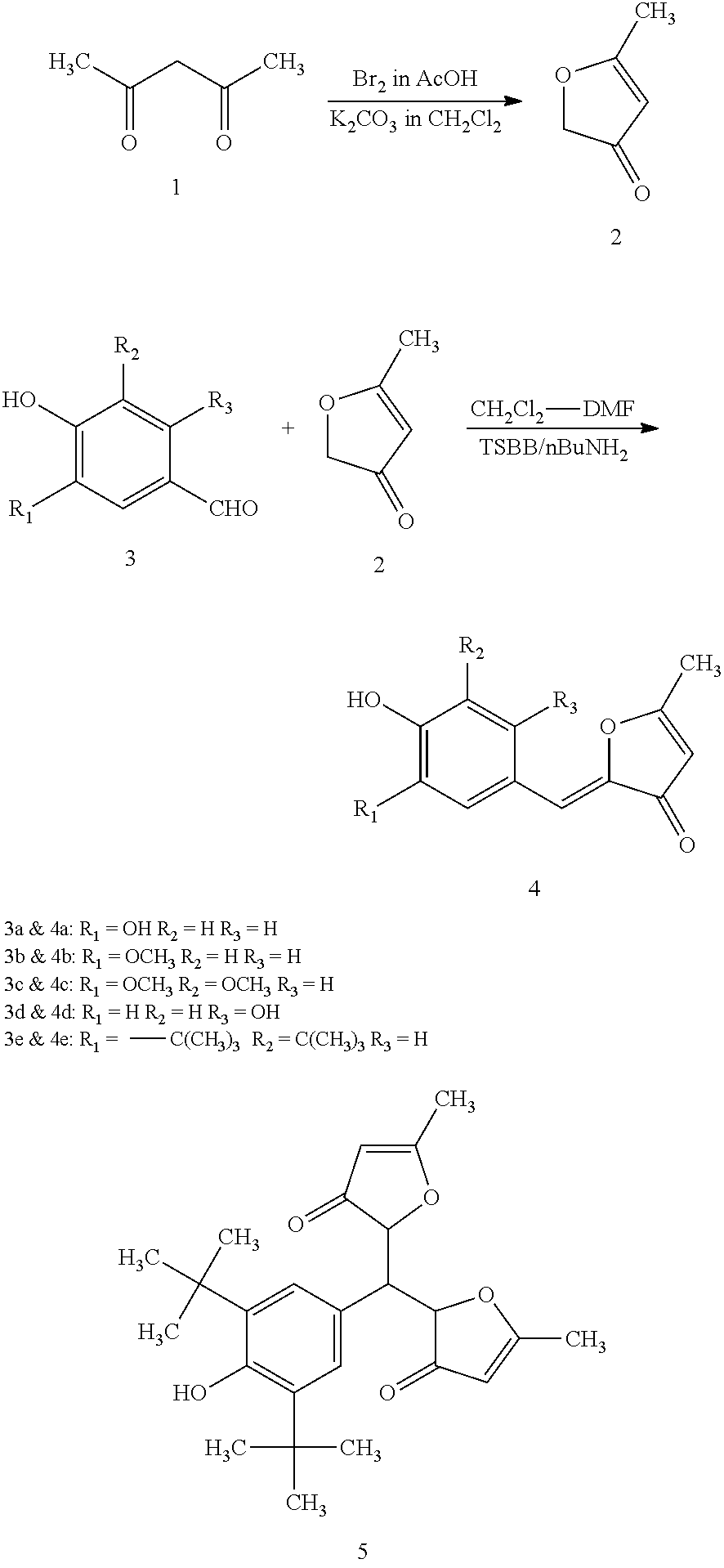
- compound 4 (e) was designed wherein the phenolic group is flanked on both sides by bulky and non-polar t-butyl groups which will lower the acidity of the phenolic group.
- the compounds synthesized are only exemplary designed to illustrate the concept of influencing the acidity of the phenolic group by proper substitution.
- Acetylacetone (1) 200 g, 2.0 mol was taken in a 2 L three necked round bottomed flask fitted with an addition funnel, a mechanical stirrer and the system protected from moisture using calcium chloride guard tube. Glacial acetic acid (600 mL) was added with stirring. Bromine (80 mL, 1.6 mol) was dropped in over a period of 45 min. at room temp. with stirring The color of the reaction mixture became pale yellow. This was stirred for 20 min. Water (500 mL) and dichloromethane (400 mL) were added and stirred for 10 min. The dichloromethane layer was separated, washed with water (3 ⁇ 500 mL), dried over anhy. sodium sulfate (200 g), filtered, and the filtrate contains about 108 g of crude bromoacetylacetone.
- Dichloromethane (1.2 L) and anhydrous potassium carbonate were taken in a 3 L three necked round bottomed flask fitted with a condenser, an addition funnel, mechanical agitator and a guard tube.
- the crude bromoacetylacetone in dichloromethane was taken in the addition funnel and added to the slurry of potassium carbonate in dichloromethane with vigorous stirring over a period of 20 min. This is exothermic and dichloromethane refluxes.
- the reaction mixture is stirred for a further period of 20 min.
- the reaction mixture is filtered, filtrate concentrated under reduced pressure in a rotary evaporator.
- the residual liquid is distilled under vacuum to get 5-methyl-furan-3-one (2) as a colorless liquid (18.0 g, 30% yield) at 43-48° C./5 mm.
- n-Butyl amine (6 drops) was added and the reaction mixture allowed to warm to room temp. on its own with stirring and stirred at room temp. overnight.
- the dark yellow color solution was poured into 5% aq. acetic acid solution (120 mL) preheated to 60° C. with stirring. This was stirred for 30 min., and then allowed to settle down.
- the dichloromethane layer was isolated and concentrated under reduced pressure to get yellow color solid. This was chromatographed on silica gel column (36 ⁇ 4 cm) using 10% ethyl acetate in hexane as eluent.
- RAW 264.7 cells derived from murine macrophage (American Type Culture Collection, MD, USA) were cultured in DMEM supplemented with 10% endotoxin-free, heat-inactivated fetal calf serum, 100 units/mL penicillin and 100 mcg/mL streptomycin, the culture media was changed to serum-free DMEM without phenol red on reaching cell density 2-3 ⁇ 10 6 cells/mL, and the cells activated by incubation in medium containing E coli LPS (100 ng/mL). Test compounds dissolved in dimethylsulfoxide were added together with the LPS. Cells treated with 0.05% DMSO acted as vehicle control.
- LPS-induced iNOS inducible nitric oxide synthase
- COX-2 protein expressions were studied by Western blotting.
- LPS treatment significantly increased iNOS and COX-2 protein levels
- co-treatment with inotilone (4a) suppressed the induction of iNOS but not of COX-2 in a concentration dependent manner.
- Methylinotilone (4b) showed slightly stimulated LPS-induced COX-2 expression, but no effect on LPS induced iNOS protein expression.
- nitric oxide While iNOS induction can protect the brain from certain infectious diseases, excessive levels of nitric oxide (NO) are toxic to neurons (Licinio, J et al., Molecular Medicine Today, 5(5): 225-232(8)). Therefore compounds of the invention are potentially useful in preventing the progression of neurodegenerative disorders such as Alzhiemer's disease, dementia and Parkinson's disease.
- iNOS a common phenomenon during chronic inflammatory conditions, generates sustainable amounts of NO, and its reactive intermediates are mutagenic, causing DNA damage or impairment of DNA repair.
- Increased expression of iNOS has been involved in tumors of the colon, lung, oropharynx, reproductive organs, breast, and CNS (Central Nervous System) besides its occurrence in chronic inflammatory diseases (Lala, P K et al. Lancet Oncol. 2001 March; 2(3):149-56).
- Compounds of the invention that are selective inhibitors of iNOS are therefore potentially useful in preventing the onset of tumorigenesis, and in inhibiting the progression of various types of cancer.
Landscapes
- Health & Medical Sciences (AREA)
- Chemical & Material Sciences (AREA)
- Life Sciences & Earth Sciences (AREA)
- Organic Chemistry (AREA)
- Engineering & Computer Science (AREA)
- General Health & Medical Sciences (AREA)
- Public Health (AREA)
- Medicinal Chemistry (AREA)
- Animal Behavior & Ethology (AREA)
- Pharmacology & Pharmacy (AREA)
- Veterinary Medicine (AREA)
- Polymers & Plastics (AREA)
- Bioinformatics & Cheminformatics (AREA)
- Food Science & Technology (AREA)
- Nutrition Science (AREA)
- Mycology (AREA)
- General Chemical & Material Sciences (AREA)
- Nuclear Medicine, Radiotherapy & Molecular Imaging (AREA)
- Chemical Kinetics & Catalysis (AREA)
- Microbiology (AREA)
- Biomedical Technology (AREA)
- Epidemiology (AREA)
- Neurosurgery (AREA)
- Neurology (AREA)
- Urology & Nephrology (AREA)
- Vascular Medicine (AREA)
- Cardiology (AREA)
- Heart & Thoracic Surgery (AREA)
- Psychology (AREA)
- Pharmaceuticals Containing Other Organic And Inorganic Compounds (AREA)
Abstract
Description



Claims (3)

Priority Applications (2)
| Application Number | Priority Date | Filing Date | Title |
|---|---|---|---|
| US12/872,675 US8394852B2 (en) | 2009-08-31 | 2010-08-31 | Inotilone derivatives as coherent biological response modifier (cBMR) |
| PCT/US2010/054899 WO2011026153A2 (en) | 2009-08-31 | 2010-10-30 | Inotilone derivatives as coherent biological response modifier (cbmr) |
Applications Claiming Priority (2)
| Application Number | Priority Date | Filing Date | Title |
|---|---|---|---|
| US23853309P | 2009-08-31 | 2009-08-31 | |
| US12/872,675 US8394852B2 (en) | 2009-08-31 | 2010-08-31 | Inotilone derivatives as coherent biological response modifier (cBMR) |
Publications (2)
| Publication Number | Publication Date |
|---|---|
| US20110054018A1 US20110054018A1 (en) | 2011-03-03 |
| US8394852B2 true US8394852B2 (en) | 2013-03-12 |
Family
ID=43625779
Family Applications (1)
| Application Number | Title | Priority Date | Filing Date |
|---|---|---|---|
| US12/872,675 Expired - Fee Related US8394852B2 (en) | 2009-08-31 | 2010-08-31 | Inotilone derivatives as coherent biological response modifier (cBMR) |
Country Status (2)
| Country | Link |
|---|---|
| US (1) | US8394852B2 (en) |
| WO (1) | WO2011026153A2 (en) |
-
2010
- 2010-08-31 US US12/872,675 patent/US8394852B2/en not_active Expired - Fee Related
- 2010-10-30 WO PCT/US2010/054899 patent/WO2011026153A2/en not_active Ceased
Non-Patent Citations (3)
| Title |
|---|
| Remington the Science and Practice of Pharmacy, 19th Edition, pp. 710-712; pp. 1614-1617; pp. 1515-1519: 1995. * |
| Shamshina et al., Tetrahedron Letters, 48, 2007, 3767-3769. * |
| Wangun et al., Org.Biomol.Chem, 2006, 2545-2548. * |
Also Published As
| Publication number | Publication date |
|---|---|
| WO2011026153A3 (en) | 2011-05-26 |
| WO2011026153A2 (en) | 2011-03-03 |
| US20110054018A1 (en) | 2011-03-03 |
Similar Documents
| Publication | Publication Date | Title |
|---|---|---|
| Cheng et al. | Synthesis and cytotoxic, anti-inflammatory, and anti-oxidant activities of 2′, 5′-dialkoxylchalcones as cancer chemopreventive agents | |
| US8138165B2 (en) | Chromones and chromone derivatives and uses thereof | |
| US9522935B2 (en) | Commands and method of treating cancer via RHO pathway | |
| Liu et al. | Synthesis of thioether andrographolide derivatives and their inhibitory effect against cancer cells | |
| WO2022138735A1 (en) | Pharmaceutical composition for ameliorating malignant diseases | |
| US8394852B2 (en) | Inotilone derivatives as coherent biological response modifier (cBMR) | |
| KR20090102145A (en) | Composition comprising pyrazole derivatives for prevention and treatment of osteoporosis | |
| CN103113335B (en) | Benzoquinone compound and use thereof for preparing anti-tumour drug | |
| Rao et al. | New efficient synthesis and bioactivity of homoisoflavonoids | |
| Hikita et al. | Induction of enantio-selective apoptosis in human leukemia HL-60 cells by (S)-erypoegin K, an isoflavone isolated from Erythrina poeppigiana | |
| KR20180077998A (en) | Novel caffeic acid compound from Stauntonia hexaphyll leaf extract and composition for anti-inflammatory, and improvement of bone tissue generation or cartilage tissue generation | |
| CN109734561B (en) | A kind of farnesyl phenolic compound and its pharmaceutical composition and its application | |
| KR20180077997A (en) | Novel flavonoid compound from Stauntonia hexaphyll leaf extract and composition for anti-inflammatory, and improvement of bone tissue generation or cartilage tissue generation | |
| KR101449575B1 (en) | Composition comprising tenuifoliside A for preventing or treating inflammatory diseases | |
| US20240115589A1 (en) | Pharmaceutical composition for preventing cytokine storm | |
| KR20110035127A (en) | Inflammatory-suppressive composition containing phlorotannin from Gompi and Ecklonia cava extract as an active ingredient | |
| JP2013014546A (en) | Dna synthase inhibitor | |
| Zheng et al. | Synthesis of Hirtellanine B, an isoflavonoid with potent antiproliferative effects in cancer cells | |
| KR101121805B1 (en) | New heterocyclic ring-substituted flavonoids having Anti-inflammatory activity | |
| KR101648400B1 (en) | Composition comprising caffeoylglycolic acid methyl ester or 1-O-caffeoylglycerol for preventing or treating inflammatory diseases | |
| US9556194B2 (en) | Furo[3,4-b]pyran compounds and pharmaceutical uses | |
| KR101697062B1 (en) | Novel geranyl flavonoid derivative having improved solubility in water, a method for preparing the same and a pharmaceutical composition comprising the same for prevention and treatment of cancer | |
| KR101396387B1 (en) | Process for preparing baicalein-6-alpha-glucoside using recombinant amylosucrase, and composition for preventing or treating of inflammatory diseases containing baicalein-6-alpha-glucoside prepared by the same | |
| JP7496123B2 (en) | Mitochondrial ferritin expression inducer | |
| KR101703827B1 (en) | Novel curcumin derivatives and uses thereof |
Legal Events
| Date | Code | Title | Description |
|---|---|---|---|
| AS | Assignment |
Owner name: SAMI LABS LTD, INDIA Free format text: ASSIGNMENT OF ASSIGNORS INTEREST;ASSIGNORS:MAJEED, MUHAMMED, DR;NAGABHUSHANAM, KALYANAM, DR;THOMAS, SAMUEL MANOHARAN, DR;AND OTHERS;REEL/FRAME:025022/0012 Effective date: 20100921 |
|
| STCF | Information on status: patent grant |
Free format text: PATENTED CASE |
|
| FPAY | Fee payment |
Year of fee payment: 4 |
|
| FEPP | Fee payment procedure |
Free format text: MAINTENANCE FEE REMINDER MAILED (ORIGINAL EVENT CODE: REM.); ENTITY STATUS OF PATENT OWNER: LARGE ENTITY |
|
| LAPS | Lapse for failure to pay maintenance fees |
Free format text: PATENT EXPIRED FOR FAILURE TO PAY MAINTENANCE FEES (ORIGINAL EVENT CODE: EXP.); ENTITY STATUS OF PATENT OWNER: LARGE ENTITY |
|
| STCH | Information on status: patent discontinuation |
Free format text: PATENT EXPIRED DUE TO NONPAYMENT OF MAINTENANCE FEES UNDER 37 CFR 1.362 |
|
| FP | Lapsed due to failure to pay maintenance fee |
Effective date: 20210312 |