US8380228B2 - Method for managing power consumption of a pager on a trunked network - Google Patents
Method for managing power consumption of a pager on a trunked network Download PDFInfo
- Publication number
- US8380228B2 US8380228B2 US12/647,942 US64794209A US8380228B2 US 8380228 B2 US8380228 B2 US 8380228B2 US 64794209 A US64794209 A US 64794209A US 8380228 B2 US8380228 B2 US 8380228B2
- Authority
- US
- United States
- Prior art keywords
- trunked
- voice
- pager
- channel
- voice traffic
- Prior art date
- Legal status (The legal status is an assumption and is not a legal conclusion. Google has not performed a legal analysis and makes no representation as to the accuracy of the status listed.)
- Active, expires
Links
- 238000000034 method Methods 0.000 title claims abstract description 44
- 238000004891 communication Methods 0.000 claims abstract description 26
- 238000001514 detection method Methods 0.000 claims description 2
- 238000012544 monitoring process Methods 0.000 claims 1
- 230000002194 synthesizing effect Effects 0.000 claims 1
- 230000008901 benefit Effects 0.000 description 10
- 230000008569 process Effects 0.000 description 5
- 238000012545 processing Methods 0.000 description 5
- 230000011664 signaling Effects 0.000 description 5
- 230000009471 action Effects 0.000 description 4
- 230000006870 function Effects 0.000 description 4
- 230000005540 biological transmission Effects 0.000 description 3
- 230000009286 beneficial effect Effects 0.000 description 2
- 239000002131 composite material Substances 0.000 description 2
- 238000012986 modification Methods 0.000 description 2
- 230000004048 modification Effects 0.000 description 2
- 230000007958 sleep Effects 0.000 description 2
- 238000013459 approach Methods 0.000 description 1
- 238000003491 array Methods 0.000 description 1
- 238000013461 design Methods 0.000 description 1
- 238000010586 diagram Methods 0.000 description 1
- 238000005516 engineering process Methods 0.000 description 1
- 230000000977 initiatory effect Effects 0.000 description 1
- 230000007774 longterm Effects 0.000 description 1
- 238000012423 maintenance Methods 0.000 description 1
- 230000003287 optical effect Effects 0.000 description 1
- 238000009877 rendering Methods 0.000 description 1
- 238000013519 translation Methods 0.000 description 1
Images




Classifications
-
- H—ELECTRICITY
- H04—ELECTRIC COMMUNICATION TECHNIQUE
- H04W—WIRELESS COMMUNICATION NETWORKS
- H04W52/00—Power management, e.g. Transmission Power Control [TPC] or power classes
- H04W52/02—Power saving arrangements
- H04W52/0209—Power saving arrangements in terminal devices
- H04W52/0225—Power saving arrangements in terminal devices using monitoring of external events, e.g. the presence of a signal
- H04W52/0229—Power saving arrangements in terminal devices using monitoring of external events, e.g. the presence of a signal where the received signal is a wanted signal
- H04W52/0232—Power saving arrangements in terminal devices using monitoring of external events, e.g. the presence of a signal where the received signal is a wanted signal according to average transmission signal activity
-
- H—ELECTRICITY
- H04—ELECTRIC COMMUNICATION TECHNIQUE
- H04W—WIRELESS COMMUNICATION NETWORKS
- H04W68/00—User notification, e.g. alerting and paging, for incoming communication, change of service or the like
-
- H—ELECTRICITY
- H04—ELECTRIC COMMUNICATION TECHNIQUE
- H04W—WIRELESS COMMUNICATION NETWORKS
- H04W88/00—Devices specially adapted for wireless communication networks, e.g. terminals, base stations or access point devices
- H04W88/02—Terminal devices
- H04W88/022—Selective call receivers
-
- Y—GENERAL TAGGING OF NEW TECHNOLOGICAL DEVELOPMENTS; GENERAL TAGGING OF CROSS-SECTIONAL TECHNOLOGIES SPANNING OVER SEVERAL SECTIONS OF THE IPC; TECHNICAL SUBJECTS COVERED BY FORMER USPC CROSS-REFERENCE ART COLLECTIONS [XRACs] AND DIGESTS
- Y02—TECHNOLOGIES OR APPLICATIONS FOR MITIGATION OR ADAPTATION AGAINST CLIMATE CHANGE
- Y02D—CLIMATE CHANGE MITIGATION TECHNOLOGIES IN INFORMATION AND COMMUNICATION TECHNOLOGIES [ICT], I.E. INFORMATION AND COMMUNICATION TECHNOLOGIES AIMING AT THE REDUCTION OF THEIR OWN ENERGY USE
- Y02D30/00—Reducing energy consumption in communication networks
- Y02D30/70—Reducing energy consumption in communication networks in wireless communication networks
Definitions
- the present disclosure relates generally to communication systems and in particular to a system and method of managing power consumption of a pager on a trunked network.
- P25 Land Mobile Radio
- a “trunked system” or “trunked network” refers to a radio system where a limited number of frequencies are shared among a large group of users. Trunked systems are particularly beneficial in specific instances where there is a limited number of available communication frequencies.
- the large group of users in a trunked system are each assigned to a virtual channel or “talkgroup” having a group identification (group ID).
- group ID group identification
- the number of talkgroups is not limited to the number of available communication frequencies, and can actually greatly exceed the number of frequencies.
- FIG. 1 illustrates a trunked network in accordance with some embodiments of the present disclosure.
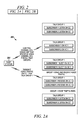
- FIG. 2 ( FIG. 2A and FIG. 2B ) illustrates a method of managing power consumption in a trunked network in accordance with some embodiments.
- FIG. 3 is a logical flowchart showing an illustrative method for managing power consumption in a trunked network in accordance with some embodiments.
- the present disclosure provides a system and method of managing power consumption for pagers on a trunked network.
- the terms “trunked network” and “trunked system” are used interchangeably.
- Illustrative embodiments of the present disclosure, as described below, are applicable to receive only pagers.
- Other embodiments are applicable to P25 trunked pagers, as discussed below.
- certain advantages of the methods as described herein, are beneficial to any type of trunked subscriber on the trunked network.
- methods for managing power consumption in a trunked pager include listening to a control channel on a trunked system with a trunked pager.
- the trunked pager receives a voice channel assignment for paging listeners. While in a standby mode, the trunked pager listens for voice traffic on the assigned voice channel.
- the standby mode is a low power mode of operation designed to extend a battery life of the trunked pager.
- the terms “listening subscribers” and “listening trunked pagers” are referred to as “paging listeners”.
- pager is used interchangeably with the terms “pager” and “trunked pager”, and the term “subscribers” is used interchangeably with the terms “pagers” and “trunked pagers”, wherein a “pager” is a simple telecommunications device that can be used for sending and/or receiving short messages including numeric and/or alphanumerical messages.
- the trunked pager detects the voice traffic and determines whether the voice traffic is for a communication group that includes the trunked pager.
- the communication group is referred to as a “talkgroup” or “group”.
- the subscribers can be members of the group or talk group that include a combination of preconfigured users or ad hoc users or members. Alternatively, subscribers may not be members of such groups. Further, each subscriber engages in a communication session by way of any combination of hardware and software and/or firmware as discussed below.
- the trunked pager unmutes and listens to (processes for a user) the voice traffic.
- the once listening trunked pager Upon termination of the voice traffic, the once listening trunked pager returns to the control channel to listen for a different voice channel assignment for the paging listeners.
- the trunked pager directly returns to the control channel to listen for a different voice channel assignment for the paging listeners.
- methods for managing power consumption are applicable to the trunked network, where the trunked network includes a trunking controller.
- methods for conserving power on the trunked network include providing a voice channel assignment to paging listeners on a control channel.
- the trunking controller transmits the voice traffic on the assigned voice channel while the paging listeners are in the standby mode. As described below, the trunking controller identifies a communication group from the paging listeners to unmute to the voice traffic by way of link control data. The trunking controller provides a different voice channel assignment to the paging listeners in addition to transmitting the voice traffic on the different voice channel while the paging listeners are in the standby mode.
- the systems and methods of managing power consumption on a trunked network are compliant with established standards and protocols for radio communications, for example, as is described in the TIA 102 series documents.
- the TIA 102 documents include a description of radio communication over a Common Air Interface (CAI) as described, for example, in TIA-102.BAAA published January 1996 by the TIA and any subsequent revisions.
- CAI defines a standard for radio-to-radio communication.
- any P25-compatible radio can communicate with any other P25-compatible radio.
- P25 uses a vocoder to convert speech into a digital format for transmission over a radio channel using a standard CAI packet structure for traffic and signaling.
- a trunked network includes a radio frequency sub-system (RFSS) having a trunking controller used for enabling aspects of the current disclosure. Additionally, the RFSS is in communication with a “fixed station” such as a base station.
- RFSS radio frequency sub-system
- the base station communicates directly to a trunked pager to relay voice traffic and control channel data from the trunking controller within the RFSS.
- the base station can communicate with the trunked pager through a repeater.
- the repeater is used to extend network coverage by providing wireless CAI communication between base stations as well as between a base station and the trunked pager.
- the base station is connected to the RFSS by either an analog fixed station interface (AFSI) or a digital fixed station interface (DFSI).
- AFSI analog fixed station interface
- DFSI digital fixed station interface
- IP protocols include user datagram protocol (UDP)/internet protocol (IP) connections as described in IETF RFC 768 dated August 1980 and any subsequent revisions, and as described in IETF RFC 791 dated September 1981 and any subsequent revisions, as well as real-time transport protocol (RTP), as described, for example, in Request for Comments (RFC) 3550 dated July 2003 by Internet Engineering Task Force (IETF) and any subsequent revisions.
- UDP user datagram protocol
- IP Internet protocol
- RTP real-time transport protocol
- FIG. 1 illustrates a trunked network 100 .
- the trunked network 100 provides a general depiction of a physical implementation of various embodiments of the present disclosure. Specifically, the illustrative trunked network 100 is designed for implementation of various methods of managing power consumption for pagers on the trunked network 100 .
- an RFSS 102 is in communication with a base station 108 , as indicated by an arrow 106 .
- the RFSS 102 includes a trunking controller 104 , which is described further below.
- the base station 108 wirelessly communicates with a plurality of subscribers 110 within a plurality of talkgroups 112 .
- Devices in the trunked network 100 including the RFSS 102 , the subscribers, and infrastructure devices (not shown) in the trunked network 100 , generally include a memory, one or more network interfaces, and a processing device or processor that are operatively coupled, and which when programmed form the means for the device to implement its functionality.
- the network interfaces are used to send information to and receive information from other devices in the network for carrying out a device's intended functionality.
- the implementation of the network interfaces in a given device depends on the particular type of network, i.e., wired and/or wireless, to which the device is connected.
- the interfaces may comprise a serial port interface (e.g., compliant to the RS-232 standard), a parallel port interface, an Ethernet interface, a USB interface, and/or a FireWire interface, and other well known interfaces.
- the interfaces comprise elements including processing, modulating, and transceiver elements that are operable in accordance with any one or more standard or proprietary wireless interfaces. Some of the functionality of the processing, modulating, and transceiver elements may be performed by means of the processor of the particular device through programmed logic such as software applications or firmware stored on the memory of the device.
- the processor of a given device is further programmed with logic or code for performing signaling and functionality to facilitate methods in accordance with the teachings herein, such as methods described by reference to FIGS. 2 and 3 ; and/or the processing device may be implemented as a state machine or ASIC.
- the memory in a device can include short-term and/or long-term storage of various data needed for the functioning of the device and its intended functionality.
- the plurality of talkgroups 112 includes a talkgroup N, a talkgroup N+1, and a talkgroup N+2.
- the talkgroup N includes a subscriber M and a subscriber M+1.
- the talkgroup N+1 includes a subscriber P and a subscriber P+1.
- the talkgroup N+2 includes a subscriber R and a subscriber R+1.
- each of the plurality of talkgroups 112 is preconfigured with specified subscribers.
- members of the plurality of talkgroups 112 can be dynamically determined by a subscriber's affiliation.
- trunking controller 104 manages system operation.
- system operation in the trunked network 100 includes, for example, granting subscriber access to traffic channels and signaling subscribers over a control channel.
- control channel includes a dedicated or “primary” control channel.
- control channel may comprise a composite control channel, where the composite control channel can act as a traffic channel when no other traffic channels are available.
- a secondary control channel is provided. The secondary control channel is used, for example, when the dedicated control channel is not available.
- Registration is a process by which the trunked network 100 ensures that only authorized subscribers 110 have access to the trunked network 100 .
- registration can be used to track a subscriber's location within the trunked network 100 .
- subscriber signaling in the trunked network 100 is facilitated by way of a control channel.
- the trunking controller 104 signals the subscribers 110 by way of an outbound signaling packet (OSP).
- OSP outbound signaling packet
- the subscribers 110 scan an available list of control channels to find an active control channel for the trunked system 100 .
- the subscribers 110 receive the active control channel from the OSP, as discussed below.
- the subscribers 110 listen on the active control channel for a voice channel assignment.
- the OSP as directed by the trunking controller 104 , periodically sends out the voice channel assignment to the paging listeners.
- the voice channel assignment corresponds to one of the plurality of talkgroups 112 .
- all of the plurality of talkgroups 112 are assigned to the same voice channel.
- each of the plurality of talkgroups 112 may be assigned to a different voice channel.
- a subset of the plurality of talkgroups 112 can share a voice channel.
- the OSP providing the voice channel assignment reserves a frequency corresponding to the voice channel assignment.
- the reserved frequency is referred to as a “low power voice channel”, which indicates a voice channel where the subscribers 110 wait for voice traffic in a low power, standby mode.
- the low power, standby mode includes initiating receiver shutdown procedures at the subscribers 110 to reduce power consumption and extend the trunked pager's battery life.
- the subscribers 110 Upon receiving their voice channel assignments, the subscribers 110 synthesize the assigned voice channel frequency and subsequently move to that channel. While on the assigned voice channel, the subscribers 110 enter the low power, standby mode and wait for voice traffic.
- “wait for voice traffic” or “waiting for voice traffic” refers to the subscribers 110 listening for voice traffic on the assigned voice channel, for instance, by attempting to detect a carrier.
- “Voice” traffic in this context is not meant to be limited to audio but is any media that has a compatible format for being received and processed by the trunked pager.
- the trunking controller 104 sends voice traffic to the subscribers 110 on the assigned voice channel.
- the subscribers 110 detect a carrier that includes the voice traffic, and the subscribers leave the standby mode and return to an active mode of operation or “wake-up” and begin receiving the voice traffic.
- the subscribers 110 can save the voice traffic in a buffer memory device.
- the voice traffic sent by the trunking controller 104 to the subscribers 110 identifies an intended recipient by way of a control command.
- the voice traffic identifies, by the control command, the intended recipient, from the paging listeners, to unmute to the voice traffic.
- the control command includes link control data.
- the link control data identifies a talkgroup.
- the link control data can identify a subscriber 110 .
- link control data can be appended to a digital voice packet for transmission over a radio channel.
- the link control data may be interleaved within the digital voice packet for transmission over the radio channel.
- the subscribers 110 compare their talkgroup ID with the link control data to determine whether the voice traffic is for a communication group that includes any of the subscribers 110 .
- the subscribers 110 return to the control channel to listen for a different voice channel assignment. However, if the link control data matches a subscriber's group, the subscribers 110 in the group corresponding to the matching link control data unmute to the voice traffic. In embodiments where the voice traffic is saved in the buffer memory device of the trunked pager, the subscribers 110 unmute from the beginning of the buffer and listen to the voice traffic. The subscribers 110 listen to the voice traffic until the carrier is no longer detected. Alternatively, the subscribers 110 can listen to the voice traffic until the link control data no longer matches the subscriber's group.
- the trunking controller 104 transmits decode tones that are used by the subscribers 110 to unmute to the voice traffic. For example, the subscribers 110 unmute upon detection of a specific sequence of decode tones, and the subscribers 110 are reset manually or automatically. Upon termination of the voice traffic, the subscribers 110 temporarily return to the control channel to listen for a different voice channel assignment.
- the subscribers 110 receive the different voice channel assignment from the trunking controller 104 by way of the OSP, which continues to periodically send out the voice channel assignment to the paging listeners.
- the subscribers 110 on their newly assigned voice channel, enter the low power, standby mode and wait for voice traffic.
- a group of subscribers 110 that did not match the link control data can directly return to the control channel, receive their new voice channel assignment, and enter the standby mode on the newly assigned voice channel while a group of subscribers 110 that did match the link control data are still listening to the voice traffic.
- the group of subscribers 110 that did not match the link control data returns to the control channel and receives their new voice channel assignment while the group of subscribers 110 that did match the link control data are still listening to the voice traffic.
- the group of subscribers 110 that did not match the link control data returns to the control channel and receives their new voice channel assignment while the group of subscribers 110 that did match the link control data are still listening to the voice traffic.
- the group of subscribers 110 that did not match the link control data can wait until the subscribers 110 that did match the link control data have finished listening to the voice traffic, and all the subscribers return, in a nearly simultaneous manner, to the control channel to receive their new voice channel assignment.
- the subscribers 110 spend only a minimal amount of time on the control channel as required to receive a voice channel assignment and dynamically move to the assigned voice channel.
- the power consumption of the trunked pagers is significantly reduced.
- battery life is significantly extended.
- FIG. 2 schematically illustrates one example of the embodiments as discussed with reference to FIG. 1 .
- a trunking controller (not shown) is in communication with a talkgroup 1 , a talkgroup 2 , and a talkgroup 3 through a base station 202 .
- the talkgroup 1 includes a subscriber 1 and a subscriber 2
- the talkgroup 2 includes a subscriber 3 and a subscriber 4
- the talkgroup 3 includes a subscriber 5 and a subscriber 6 .
- the subscribers 1 - 6 power on, not necessarily simultaneously, (at 204 ) and listen on a control channel (CC) for a voice channel (VC) assignment (at 206 ), as indicated by an arrow 205 .
- the subscribers 1 - 6 receive their assigned voice channel and subsequently move to the assigned voice channel (at 208 ).
- the trunking controller sends the OSP over a control channel through the base station 202 , where the OSP includes the voice channel assignment to the paging listeners.
- each of the subscribers 1 - 6 within each of the talkgroups 1 - 3 is assigned to a voice channel 1 .
- all subscribers 1 - 6 are assigned to the same voice channel to conserve resources on the trunked network. However, any of the subscribers 1 - 6 and talkgroups 1 - 3 can be assigned to different voice channels.
- the subscribers 1 - 6 enter a standby mode or “sleep” on their assigned voice channel, as indicated by an arrow 209 . Specifically, each of the subscribers 1 - 6 sleeps on the voice channel 1 .
- a carrier including voice traffic, is detected as received from the base station 202 .
- the voice traffic is transmitted on the voice channel 1 for talkgroup 1 .
- the voice traffic includes a link control data that identifies the talkgroup 1 as the intended recipient of the voice traffic.
- the link control data matches the talkgroup 1 , and the subscribers 1 - 2 unmute to the voice traffic and listen to the voice traffic until the carrier is no longer detected or until the link control data no longer matches the talkgroup 1 .
- the subscribers 3 - 6 did not match the link control data and returned to the control channel to listen for a different voice channel assignment.
- the subscribers 3 - 6 that did not match the link control data directly return to the control channel, for example at 212 , to receive their new voice channel assignment and enter the standby mode on the newly assigned voice channel while the subscribers 1 - 2 that did match the link control data are still listening to the voice traffic.
- the talkgroup 1 Upon termination of the voice traffic, as indicated by an arrow 213 , the talkgroup 1 returns to the control channel to listen for the different voice channel assignment (at 214 ). As illustrated at 214 , the subscribers 3 - 6 continue to listen on the control channel for a different voice channel assignment. However, the subscribers 3 - 6 that did not match the link control data can return to the control channel, for example at 214 , to receive their new voice channel assignment and enter the standby mode on the newly assigned voice channel while the subscribers 1 - 2 are still listening on the control channel for the different voice channel assignment. In other embodiments, the subscribers 1 - 2 also return to the control channel, for example at 214 , to receive their new voice channel assignment and enter the standby mode on the newly assigned voice channel.
- all of the subscribers 1 - 6 return to the control channel to listen for the different voice channel assignment.
- the subscribers 1 - 6 receive their new voice channel assignment and enter the standby mode on the newly assigned voice channel.
- the power consumption of the subscribers 1 - 6 is significantly reduced and their battery life is extended.
- FIG. 3 shows a logical flowchart showing an illustrative method 300 for managing power consumption in a trunked network in accordance with some embodiments.
- the subscribers are powered on.
- the subscribers search for an active control channel of the trunked network and, upon finding the control channel, listen on the control channel for a voice channel assignment (at 304 ).
- the subscribers also detect whether the trunked network or trunked system is in range (at 306 ). For example, in some embodiments, after initially finding the control channel, the subscribers move out of range of the trunked network. If the subscribers move out of range, as indicated by an arrow 307 and by a connector A, the subscribers return to search for the active control channel of the trunked network and, upon finding the control channel, listen on the control channel for the voice channel assignment (at 304 ).
- the subscribers receive a voice channel assignment from an OSP transmitted by a trunking controller of the trunked network (at 308 ).
- the subscribers enter the low power, standby mode and wait for voice traffic.
- a control channel timer is started. Illustratively, if the control timer reaches a predetermined threshold value, a control channel timeout is detected. Accordingly, at 312 , the control channel timer is checked for the timeout condition.
- control channel timeout is detected (at 312 ), as indicated by an arrow 313 and by the connector A, the subscribers return to search for the active control channel of the trunked network and, upon finding the control channel, listen on the control channel for the voice channel assignment (at 304 ).
- the subscribers If the control channel timer is not detected (at 312 ), as indicated by an arrow 315 , the subscribers begin to detect a carrier that includes the voice traffic (at 314 ). Upon detecting the voice traffic, the subscribers return to an active mode of operation. In some embodiments, the subscribers save the voice traffic in a subscriber buffer memory device, which for example is the buffer memory device of the trunked pager. As indicated by a connector B, the subscribers compare their talkgroup ID with the link control data sent within the voice traffic to determine whether a group identified by the link control data matches a subscriber's group (at 316 ).
- the subscribers return to search for the active control channel of the trunked network and, upon finding the control channel, listen on the control channel for the voice channel assignment (at 304 ).
- the subscribers in the group corresponding to the matching link control data unmute to the voice traffic (at 318 ).
- the subscribers receive decode tones from the trunking controller that are used by the subscribers to unmute to the voice traffic if a particular sequence of decode tones is detected.
- subscribers that are members of groups that did not match the link control data can directly return to the control channel, receive their new voice channel assignment, and enter the standby mode on the newly assigned voice channel while the subscribers in the group corresponding to the matching link control data continue to unmute to the voice traffic.
- the subscribers in the group corresponding to the matching link control data unmute to the voice traffic until the carrier is no longer detected.
- the subscribers in the group corresponding to the matching link control data unmute to the voice traffic until the link control data no longer matches a subscriber's group.
- the voice traffic ends and the subscribers return to search for the active control channel of the trunked network and, upon finding the control channel, listen on the control channel for the voice channel assignment (at 304 ).
- a includes . . . a”, “contains . . . a” does not, without more constraints, preclude the existence of additional identical elements in the process, method, article, or apparatus that comprises, has, includes, contains the element.
- the terms “a” and “an” are defined as one or more unless explicitly stated otherwise herein.
- the terms “substantially”, “essentially”, “approximately”, “about” or any other version thereof, are defined as being close to as understood by one of ordinary skill in the art, and in one non-limiting embodiment the term is defined to be within 10%, in another embodiment within 5%, in another embodiment within 1% and in another embodiment within 0.5%.
- Coupled as used herein is defined as connected, although not necessarily directly and not necessarily mechanically.
- a device or structure that is “configured” in a certain way is configured in at least that way, but may also be configured in ways that are not listed.
- sequence of steps in a flow diagram or elements in the claims, even when preceded by a letter does not imply or require that sequence.
- processors such as microprocessors, digital signal processors, customized processors and field programmable gate arrays (FPGAs) and unique stored program instructions (including both software and firmware) that control the one or more processors to implement, in conjunction with certain non-processor circuits, some, most, or all of the functions of the method and/or apparatus described herein.
- processors or “processing devices” such as microprocessors, digital signal processors, customized processors and field programmable gate arrays (FPGAs) and unique stored program instructions (including both software and firmware) that control the one or more processors to implement, in conjunction with certain non-processor circuits, some, most, or all of the functions of the method and/or apparatus described herein.
- FPGAs field programmable gate arrays
- unique stored program instructions including both software and firmware
- an embodiment can be implemented as a computer-readable storage medium having computer readable code stored thereon for programming a computer (e.g., comprising a processor) to perform a method as described and claimed herein.
- Examples of such computer-readable storage mediums include, but are not limited to, a hard disk, a CD-ROM, an optical storage device, a magnetic storage device, a ROM (Read Only Memory), a PROM (Programmable Read Only Memory), an EPROM (Erasable Programmable Read Only Memory), an EEPROM (Electrically Erasable Programmable Read Only Memory) and a Flash memory.
Landscapes
- Engineering & Computer Science (AREA)
- Computer Networks & Wireless Communication (AREA)
- Signal Processing (AREA)
- Mobile Radio Communication Systems (AREA)
Abstract
Description
Claims (12)
Priority Applications (1)
| Application Number | Priority Date | Filing Date | Title |
|---|---|---|---|
| US12/647,942 US8380228B2 (en) | 2009-12-28 | 2009-12-28 | Method for managing power consumption of a pager on a trunked network |
Applications Claiming Priority (1)
| Application Number | Priority Date | Filing Date | Title |
|---|---|---|---|
| US12/647,942 US8380228B2 (en) | 2009-12-28 | 2009-12-28 | Method for managing power consumption of a pager on a trunked network |
Publications (2)
| Publication Number | Publication Date |
|---|---|
| US20110159894A1 US20110159894A1 (en) | 2011-06-30 |
| US8380228B2 true US8380228B2 (en) | 2013-02-19 |
Family
ID=44188174
Family Applications (1)
| Application Number | Title | Priority Date | Filing Date |
|---|---|---|---|
| US12/647,942 Active 2031-02-25 US8380228B2 (en) | 2009-12-28 | 2009-12-28 | Method for managing power consumption of a pager on a trunked network |
Country Status (1)
| Country | Link |
|---|---|
| US (1) | US8380228B2 (en) |
Families Citing this family (1)
| Publication number | Priority date | Publication date | Assignee | Title |
|---|---|---|---|---|
| CN103108278B (en) * | 2011-11-15 | 2015-10-21 | 中兴通讯股份有限公司 | Method, the Apparatus and system of nearby users help is obtained based on mobile positioning information |
Citations (5)
| Publication number | Priority date | Publication date | Assignee | Title |
|---|---|---|---|---|
| US5483672A (en) * | 1992-01-30 | 1996-01-09 | Motorola, Inc. | Method for a communication unit that conserve source energy |
| US6553228B1 (en) * | 2000-06-26 | 2003-04-22 | Motorola, Inc. | Method and apparatus for distributing processing load for decoding paging messages in a radio communication system |
| US20030107475A1 (en) | 2001-12-12 | 2003-06-12 | Bautista Edwin Espanola | Receiver for and method of extending battery life |
| US7177654B2 (en) | 2002-10-24 | 2007-02-13 | Eads Secure Networks Oy | Apparatus and method for delivering paging messages |
| US20080003942A1 (en) | 2006-06-30 | 2008-01-03 | Motorola, Inc. | Method and system for communicating within a communication network |
-
2009
- 2009-12-28 US US12/647,942 patent/US8380228B2/en active Active
Patent Citations (5)
| Publication number | Priority date | Publication date | Assignee | Title |
|---|---|---|---|---|
| US5483672A (en) * | 1992-01-30 | 1996-01-09 | Motorola, Inc. | Method for a communication unit that conserve source energy |
| US6553228B1 (en) * | 2000-06-26 | 2003-04-22 | Motorola, Inc. | Method and apparatus for distributing processing load for decoding paging messages in a radio communication system |
| US20030107475A1 (en) | 2001-12-12 | 2003-06-12 | Bautista Edwin Espanola | Receiver for and method of extending battery life |
| US7177654B2 (en) | 2002-10-24 | 2007-02-13 | Eads Secure Networks Oy | Apparatus and method for delivering paging messages |
| US20080003942A1 (en) | 2006-06-30 | 2008-01-03 | Motorola, Inc. | Method and system for communicating within a communication network |
Also Published As
| Publication number | Publication date |
|---|---|
| US20110159894A1 (en) | 2011-06-30 |
Similar Documents
| Publication | Publication Date | Title |
|---|---|---|
| US10609644B2 (en) | Low power receiver for wireless communication | |
| CN116368851B (en) | Paging user equipment that is idle or inactive. | |
| US12041546B2 (en) | Wireless communication method and wireless communication terminal using wake-up radio | |
| US20200015166A1 (en) | Wireless communication method and wireless communication terminal using wake-up radio | |
| KR101903945B1 (en) | Method and apparatus for device detection in a neighbor aware network | |
| US10966150B2 (en) | Wake-up signal with frequency information | |
| KR20090127048A (en) | Method and apparatus for supporting idle mode of terminal in wireless communication system | |
| US11109348B2 (en) | Telecommunications apparatuses and methods | |
| CN113038578A (en) | Site awakening method and site | |
| US20150256991A1 (en) | Systems and methods to discover access points (ap) in wireless networks | |
| CN102026123A (en) | Method and apparatus for supporting short message service of mobile station during idle mode in wireless communication system | |
| CN101415147A (en) | Method and apparatus for paging user equipment | |
| WO2024140387A1 (en) | Paging monitoring method and apparatus, terminal, and network-side device | |
| CN101945338B (en) | Method and apparatus for transmitting paging control information in a wireless communication system | |
| US8380228B2 (en) | Method for managing power consumption of a pager on a trunked network | |
| CN107872881A (en) | Timeslot scheduling method and device for double-card mobile terminal | |
| CN110839228B (en) | NB-IoT D2D communication method, terminal and system based on signaling monitoring | |
| US9370023B2 (en) | Method and apparatus for resolving call collisions in a digital conventional direct mode | |
| WO2023024005A1 (en) | Time window determination method and apparatus and terminal device | |
| CN102415018B (en) | Method for interrupting voice transmissions within a multi site communication system | |
| US11832299B2 (en) | Extended range direct mode enhanced channel access in digital mobile radio systems | |
| US12015955B2 (en) | Device, system, and method for switching between a narrowband network and a broadband network | |
| US20210410004A1 (en) | Signaling transmission method and device, signaling receiption method and device, storage medium and terminal | |
| CN115996453A (en) | Secondary link wake-up method, device and terminal | |
| AU2019208162B1 (en) | Base station device with reduced power consumption and method thereof |
Legal Events
| Date | Code | Title | Description |
|---|---|---|---|
| AS | Assignment |
Owner name: MOTOROLA, INC., ILLINOIS Free format text: ASSIGNMENT OF ASSIGNORS INTEREST;ASSIGNORS:NAMM, JOSEPH C.;MILLS, DAVID R.;SIGNING DATES FROM 20091222 TO 20091228;REEL/FRAME:023707/0785 |
|
| AS | Assignment |
Owner name: MOTOROLA SOLUTIONS, INC., ILLINOIS Free format text: CHANGE OF NAME;ASSIGNOR:MOTOROLA, INC;REEL/FRAME:026079/0880 Effective date: 20110104 |
|
| STCF | Information on status: patent grant |
Free format text: PATENTED CASE |
|
| FPAY | Fee payment |
Year of fee payment: 4 |
|
| MAFP | Maintenance fee payment |
Free format text: PAYMENT OF MAINTENANCE FEE, 8TH YEAR, LARGE ENTITY (ORIGINAL EVENT CODE: M1552); ENTITY STATUS OF PATENT OWNER: LARGE ENTITY Year of fee payment: 8 |
|
| MAFP | Maintenance fee payment |
Free format text: PAYMENT OF MAINTENANCE FEE, 12TH YEAR, LARGE ENTITY (ORIGINAL EVENT CODE: M1553); ENTITY STATUS OF PATENT OWNER: LARGE ENTITY Year of fee payment: 12 |