US8379893B2 - Systems and methods for customizing a hearing aid casing - Google Patents
Systems and methods for customizing a hearing aid casing Download PDFInfo
- Publication number
- US8379893B2 US8379893B2 US12/126,582 US12658208A US8379893B2 US 8379893 B2 US8379893 B2 US 8379893B2 US 12658208 A US12658208 A US 12658208A US 8379893 B2 US8379893 B2 US 8379893B2
- Authority
- US
- United States
- Prior art keywords
- hearing aid
- casing
- user
- motif
- software program
- Prior art date
- Legal status (The legal status is an assumption and is not a legal conclusion. Google has not performed a legal analysis and makes no representation as to the accuracy of the status listed.)
- Active, expires
Links
Images




Classifications
-
- H—ELECTRICITY
- H04—ELECTRIC COMMUNICATION TECHNIQUE
- H04R—LOUDSPEAKERS, MICROPHONES, GRAMOPHONE PICK-UPS OR LIKE ACOUSTIC ELECTROMECHANICAL TRANSDUCERS; ELECTRIC HEARING AIDS; PUBLIC ADDRESS SYSTEMS
- H04R25/00—Electric hearing aids
- H04R25/65—Housing parts, e.g. shells, tips or moulds, or their manufacture
-
- H—ELECTRICITY
- H04—ELECTRIC COMMUNICATION TECHNIQUE
- H04R—LOUDSPEAKERS, MICROPHONES, GRAMOPHONE PICK-UPS OR LIKE ACOUSTIC ELECTROMECHANICAL TRANSDUCERS; ELECTRIC HEARING AIDS; PUBLIC ADDRESS SYSTEMS
- H04R25/00—Electric hearing aids
- H04R25/65—Housing parts, e.g. shells, tips or moulds, or their manufacture
- H04R25/658—Manufacture of housing parts
Definitions
- the present embodiments relate to systems and methods for providing a customized hearing aid casing.
- hearing aids may be disposed substantially within a user's ear canal. These “in-the-canal” hearing aids may be molded to fit inside of the ear canal and may improve mild to moderate hearing loss. While such hearing aids are advantageous because of their small, inconspicuous size, they generally do not have space for components, such as volume controls and directional microphones. Further, they may be more expensive due to their size and may have a shorter lifespan since the batteries are generally smaller.
- hearing aids may be disposed substantially within the external ear, resting primarily outside of the entrance to the ear canal. Hearing aids that are positioned within the external ear may be larger than those disposed within the ear canal itself, thereby permitting additional features and an extended battery life, but making them slightly more noticeable.
- a “behind-the-ear” hearing aid may include a component that rests behind a user's ear.
- This component which typically comprises an outer casing, may conduct sounds to an ear mold that fits inside a user's ear canal or within the outer ear.
- the “behind-the-ear” hearing aids have several advantages, as the outer casing may house components that may achieve improved sound acquisition, amplification and transmission, as well as improved battery life. “Behind-the-ear” hearing aids further may permit multiple external controls, such as volume and muting buttons, which may be relatively easy to access. However, since the casing rests behind a user's ear, it may be more visible than those that are disposed substantially within a user's ear canal or in the outer ear region.
- the casings of behind-the-ear hearing aids typically comprise a manufacturer provided uniform color. The user therefore obtains a hearing aid and wears the color and style provided by the manufacturer in a manner that may be at least partially visible behind the ear.
- the preferred embodiments described below include systems and methods for providing a customized hearing aid casing.
- a user may access a software program that allows him or her to select a type of a hearing aid.
- the software program further allows the user to select a motif to be displayed on at least a portion of a casing of the hearing aid.
- a user may customize his or her hearing aid casing using a personal computer in a relatively fast and cost-effective manner.
- a method for customized a hearing aid casing comprises allowing a user access to a software program.
- the user then may select a type of hearing aid having a casing.
- the user may select, using the software program, a motif to be displayed on at least a portion of the hearing aid casing.
- the software program may automatically size the selected motif based on the type of the hearing aid selected, for example, based on dimensions of a surface of the casing.
- the selected motif then may be printed on a film.
- the film then may be coupled to the casing, thereby displaying the motif on the selected surface of the hearing aid casing.
- a software program may facilitate customization of a hearing aid casing.
- the software program is operative to automatically resize the selected motif based on the type of the hearing aid selected. Further, the user may select a motif that is pre-loaded into the software program, or a personal motif that is uploaded for use with the software program.
- the software program also may allow a user to edit characteristics associated with a selected motif, such as whether the selected motif will be displayed on the surface of the hearing aid casing in a landscape or portrait format, and may automatically size the selected motif to be displayed accordingly.
- FIG. 1 is a side view of a behind-the-ear hearing aid.
- FIG. 2 is a perspective view illustrating additional features of the behind-the-ear hearing aid of FIG. 1 .
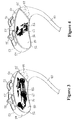
- FIG. 3 is a perspective view illustrating a customized hearing aid casing.
- FIG. 4 is a perspective view illustrating an alternative customized hearing aid casing.
- FIG. 5 is a top view illustrating a coupling member that may be coupled to a hearing aid casing.
- FIG. 6 is a perspective view illustrating the coupling member of FIG. 5 being coupled to the hearing aid casing.
- FIG. 7 is a block diagram of one embodiment of a system architecture for customizing a hearing aid casing.
- FIG. 8 is a flow chart diagram showing one exemplary method for customizing a hearing aid casing.
- the present embodiments relate generally to systems and methods for customizing a hearing aid casing.
- a hearing aid 20 is shown.
- the hearing aid 20 which has a “behind-the-ear” design, generally comprises an ear mold 30 , one or more segments of tubing 40 and a casing 50 .
- Other hearing aid designs may be used.
- the ear mold 30 may comprise any suitable shape designed to transmit sound into a user's ear canal.
- the ear mold 30 is designed to be substantially flush with a portion of a user's external ear 22 .
- the ear mold 30 may be dimensioned to be smaller, such that it may be placed substantially or entirely within a user's ear canal, thereby making it less visible.
- the tubing 40 is coupled to the ear mold 30 in a manner that permits acoustic conduction from the casing 50 to the ear mold 30 .
- the tubing 40 may comprise a first region 42 , which may be coupled to the ear mold 30 , and further may comprise an enlarged second region 44 , which may be coupled to the casing 50 , as shown in FIGS. 1-2 .
- the enlarged second region 44 may be sized to be substantially flush with an outer surface of the casing 50 , and may engage one or more protrusions 48 to removably secure the tubing 40 to the casing 50 , as shown in FIG. 2 .
- the tubing 40 may be curved or otherwise designed to form a hook member suitable for engaging a user's upper auricle 24 , thereby allowing the hearing aid 20 to rest securely about the user's ear, as shown in FIG. 1 .
- the casing 50 may house multiple components. Solely by way of example, a processor, battery, microphone, amplifier, and speaker may be disposed within the casing 50 .
- the battery provides power to the electronic parts, the microphone picks up sound, the amplifier increases the volume of the sound, and the speaker sends the sound into a user's ear. In effect, these components work together to facilitate the transmission of sound from the environment into a user's ear canal.
- the casing 50 also may comprise one or more external controls.
- a volume control 72 such as a thumbwheel, is shown in FIGS. 1-2 .
- a program button 75 may be disposed external to the casing 50 .
- the program button 75 may comprise a slidable button having any number of settings. By way of example, three settings may be provided, where an “M” setting may be used for normal microphone use, a “T” setting may be adapted for telephone use, and an “O” setting may be used to turn the hearing aid off.
- the processor interfaces with the various components disposed within the casing 50 , recognizes when user inputs are provided, and takes responsive actions.
- the casing 50 may comprise any suitable shape.
- the casing 50 of FIGS. 1-2 comprises a front surface 52 , a rear surface 53 , a first end 54 , a second end 55 , a lower surface 56 and an upper surface 57 .
- the lower surface 56 which is adapted to be positioned in close proximity to a user's ear, may comprise a concave curvature 63 to enhance comfort and/or coupling of the hearing aid 20 around the ear.
- the volume control 72 and the program button 75 may be disposed in the upper surface 57 of the hearing aid casing 50 , as shown in FIG. 2 .
- other casing shapes may be employed, and greater or fewer external controls may be provided in the same or different positions.
- a user may customize the appearance of the casing 50 .
- a user may employ the techniques described below to create and apply a motif to partially or fully cover one or more of the surfaces of the casing 50 .
- a motif 82 comprising a race car design has been selected by a user to thereby customize the appearance of the hearing aid casing 50 .
- a user may select numerous other motifs, including but not limited to an array of colors, patterns, sports team logos, college logos, seasonal designs, customized digital logos, or the like.
- the motif 82 may be selected and otherwise customized by a user using the techniques explained below with respect to FIGS. 7-8 .
- the motif 82 may be printed on the film 80 , which then may be coupled to the hearing aid casing 50 .
- the film 80 may comprise any suitable material, such as a thin flexible sheet of plastic, and further may be transparent or opaque.
- the film 80 may be coupled to the hearing aid casing 50 using an adhesive, such as a glue.
- the film 80 has an adhesive backing with a removable protective film. The adhesive backing is exposed by removing the protective film.
- the film 80 may be secured to the casing 50 mechanically, for example, using a clip or hook, or may be magnetically fastened to the casing 50 .
- the film 80 may be sized to cover a portion of any surface of the hearing aid casing 50 . More specifically, the film 80 may cover one or more of the front surface 52 , the rear surface 53 , the first end 54 , the second end 55 , the lower surface 56 and the upper surface 57 . When the film 80 is coupled to the hearing aid casing 50 , it may cover one or more of the casing fasteners 65 , which may improve the aesthetic appearance of the hearing aid casing 50 .
- the film 80 covers a substantial portion of the front surface 52 .
- the motif 82 covers a substantial portion of the film 80 .
- a user may tailor the dimensions of the film 80 and/or the motif 82 with the assistance of a computer software program. The tailoring may be based, in part, on dimensions associated with a particular manufacturer and model of the behind-the-ear hearing aid 20 .
- the software allows the user various editing and formatting options.
- a user may display the motif 82 in a landscape format, as shown in FIG. 3 , or a portrait format, as shown in FIG. 4 .
- one or more films 80 may be provided.
- two separate films 80 may be used, such that one is dimensioned to cover at least a portion of the front surface 52 while the other is dimensioned to cover at least a portion of the rear surface 53 .
- a single film 80 may be employed to cover both the front and rear surfaces 52 and 53 .
- the film 80 may extend at least partially over one or more of the first end 54 , the second end 55 , the lower surface 56 and the upper surface 57 .
- the film 80 does not cover user-operated buttons, such as the volume control 72 or the program button 75 , so as to facilitate user access to these buttons.
- the film 80 includes holes or cut-outs to go around, under, or over user-operated buttons
- a coupling member 100 may be used to customize the hearing aid casing 50 .
- the coupling member 100 may be fitted over a portion of the hearing aid casing 50 , and may comprise one or more elastic portions that are adapted to be secured to the hearing aid casing 50 .
- an exemplary coupling member 100 may comprise a first band 125 and a second band 126 , which are adapted to secure a first member 102 and a second member 112 to the hearing aid casing as shown in FIG. 6 .
- the first member 102 has outer and inner surfaces 103 and 104 , respectively, while the second member 112 has outer and inner surfaces 113 and 114 , respectively.
- the first member 102 may comprise a first film and a first motif may be printed upon the outer surface 103 of the first film in accordance with the techniques described herein.
- the second member 112 may comprise a second film and a second motif may be printed upon the outer surface 113 of the second film.
- the first and second bands 125 and 126 may be coupled between the first and second members 102 and 112 at spaced apart locations, as shown in FIGS. 5-6 .
- the coupling member 100 may be secured to the hearing aid casing 50 by advancing the second band 126 over the first end 54 and towards the second end 55 of the casing 50 .
- the second band 126 may have elastic properties that allow the band to be stretched to an inner diameter larger than an outer diameter of the hearing aid casing 50 , thereby facilitating positioning of the second band 126 . When an external stretching force is removed, the elastic properties may allow the second band 126 to return to a reduced diameter that causes the second band 126 to fit snugly about the hearing aid casing 50 .
- the first band 125 may be positioned over the hearing aid casing 50 .
- the second band 126 may be positioned near the second end 55
- the first band 125 may be positioned near the first end 54 of the hearing aid casing 50 , as shown in FIG. 6 .
- the inner surface 104 of the first member 102 may be disposed at least partially over the front surface 52 of the hearing aid casing 50 , preferably in a substantially flush manner.
- the inner surface 114 of the second member 112 may be disposed at least partially over the rear surface 53 of the hearing aid casing 50 , preferably in a substantially flush manner, as depicted in FIG. 6 .
- the elastic nature of the first and second bands 125 and 126 may secure the first and second members 102 and 103 .
- the first and second members 102 and 112 may comprise a different material, such as a foam or plastic, in lieu of the film itself.
- one or more of the outer surfaces 103 and 113 may be imprinted with a preselected motif 82 , such that a film is not employed, but rather the motif 82 is printed directly on one or more of the surfaces of the first and second members 102 and 112 .
- the first and second members 102 and 112 may comprise a solid color, such as red, blue, or a selected flesh tone, which itself is the motif if further customization is not intended by the user.
- first and second members 102 and 112 may comprise a material having an outer surface adapted to removably engage a film without the need to use an adhesive, such that a film material is designed to stick to the outer surfaces 103 and 113 for easy placement and removal of the film material. In this manner, various films may be quickly and easily interchanged with one particular coupling member 100 that is disposed over the hearing aid casing 50 .
- FIG. 7 shows a block diagram of one embodiment of a system architecture for customizing a hearing aid casing, such as the hearing aid casing 50 above.
- a software program 132 may comprise instructions that are loaded into a memory 136 of a user's computer, such that the software program 132 may be run via a processor 135 .
- the user receives the software program 132 on a removable media or by download.
- the software program 132 may operate on a server and output information to a separate client processor, such as the user's computer.
- the user accesses the functions of the software program 132 by communicating via the Internet with a server.
- a portion of the software program 132 resides on the user's computer and another portion resides on a remote computer, such as a networked server.
- a remote computer such as a networked server.
- the selection of motif information resides on a user computer, but sizing and/or other motif information is downloaded or accessed from a server with up to date information.
- the software program 132 may be capable of performing various functions.
- the software program 132 may comprise software instructions, which may be installed in the memory 136 , for helping a user design a customized hearing aid casing 50 .
- the software program 132 may comprise pre-loaded motif designs, including but not limited to colors, patterns, clip art, college logos, sport team logos, skin tones, and the like.
- the software program 132 also may include or access information, such as precise hearing aid casing dimensions for several hearing aid models.
- the software program 132 also may be configured to facilitate retrieval, processing, or indexing of data stored on a server coupled to a user's computer.
- the processor 135 is a general processor, digital signal processor, application specific integrated circuit, field programmable gate array, analog circuit, digital circuit, combinations thereof or other now known or later developed processor.
- the processor 135 may be a single device or a combination of devices, such as associated with a network or distributed processing. Any of various processing strategies may be used, such as multi-processing, multi-tasking, parallel processing or the like.
- the processor 135 is responsive to instructions stored as part of software, hardware, integrated circuits, film-ware, micro-code or the like.
- the memory 136 is a computer readable storage media.
- Computer readable storage media include various types of volatile and non-volatile storage media, including but not limited to random access memory, read-only memory, programmable read-only memory, electrically programmable read-only memory, electrically erasable read-only memory, flash memory, magnetic tape or disk, optical media and the like.
- the memory 136 may be a single device or a combination of devices.
- the memory 136 may be adjacent to, part of, networked with and/or remote from the processor 135 .
- the processor 135 operates pursuant to instructions of the software program 132 stored in the memory 136 or another memory.
- the processor 135 is programmed for user selection of hearing aid customization.
- the instructions for implementing the processes, methods and/or techniques discussed herein are provided on the computer-readable storage media or memories, such as a cache, buffer, RAM, removable media, hard drive or other computer readable storage media.
- the functions, acts or tasks illustrated in the figures or described herein are executed in response to one or more sets of instructions stored in or on computer readable storage media.
- the functions, acts or tasks are independent of the particular type of instructions set, storage media, processor or processing strategy.
- the instructions are stored on a removable media device for reading by local or remote systems.
- the instructions are stored in a remote location for transfer through a computer network or over telephone lines.
- the instructions are stored within a given computer, CPU, GPU or system.
- the user's computer may comprise a user input 137 and a display 138 .
- the user input 137 is a mouse, keyboard, switch, buttons, key, slider, knob, touch pad, touch screen, trackball, combinations thereof or other now known or later developed user input device.
- the user input 137 receives input from a user.
- signals or data are provided to the processor 135 .
- the display 138 is a CRT, monitor, flat panel, LCD, projector, or other now known or later developed display device for outputting determined information.
- the processor 135 causes the display 138 at a local or remote location to output data including a hearing aid model, and creates an interface through which the user may customize the hearing aid casing 50 .
- the software program 132 may prompt the user to input information, such as the make and model of his or her particular hearing aid, via the user input 137 .
- the display 138 may show information about one or more hearing aid types, including providing an image, model number, or size dimensions on the display 138 .
- the user input may be stored in the memory 136 .
- the instructions from the software program 132 may provide another prompt to the user on the display 138 that invites the user to select a desired motif for the hearing aid casing 50 .
- a series of menus with various options may be provided to the user to gather information on a desired motif.
- the software program 132 may execute instructions displaying a first menu having a general inquiry, such as whether the user would like to implement his or her personal motif, or a motif provided by the software program 132 . If the user prefers the first option, a second menu may be displayed inviting the user to upload his or her desired motif.
- the user may select his or her motif from a local computer, a networked server, or external media, such as a CD or flash drive.
- the user may select a digital image, such as an original image from his or her digital camera, which may be uploaded to the memory 136 .
- a customized digital logo or design also may be selected and uploaded to the memory 136 .
- the user may select a motif that is pre-loaded into the software program 132 , or accessible by the software program 132 from a server.
- the motifs that are pre-loaded into the software program 132 may include one or more images stored in any format, including bitmap, gif or jpeg format. In addition to images, clip-art, logos, patterns and solid colors, still other motifs may be provided or accessible by the software program 132 .
- the memory 136 may store the motifs and produce them on the display 138 in response to user instructions.
- the motif may be tailored to the selected hearing aid automatically and/or manually via the software program 132 .
- the software program 132 may automatically resize the motif to fit a desired region of the hearing aid casing 50 .
- the software program 132 may automatically resize the race car image to substantially fit the dimensions of the front surface 52 of the particular hearing aid casing 50 .
- the user or processor may select the particular surface of the hearing aid casing 50 for which the motif 82 may be placed.
- the user may wish to place the motif 82 on the front surface 52 , as shown in FIG. 3 , or alternatively on the first end 54 , in which case the dimensions of the motif 82 may be reduced accordingly.
- the software program 132 is operative to access dimensions associated with multiple hearing aid models. For example, with the hearing aid model shown in FIGS. 3-4 , the software program 132 is operative to access precise dimensions for each of the front surface 52 , the rear surface 53 , the first end 54 , the second end 55 , the lower surface 56 and the upper surface 57 . A table or size information may be included as part of the software program 132 for access or a remote server is accessed. After the user selects a desired motif and desired surface of the hearing aid casing 50 , the software program 132 is operative to automatically resize the motif to approximate or be slightly smaller than the dimensions of the selected surface of the hearing aid casing 50 . Warping, stretching, expansion, and/or reduction may be used along one or more dimensions for resizing.
- the software program 132 may automatically resize the motif 82
- a user may further resize the motif 82 to expand or reduce the dimensions of the motif.
- software instructions may be provided to the user for positioning the motif 82 , for example, placing the motif closer to the second end 55 of the hearing aid casing 50 , compared to the first end 54 .
- a user also may select whether he or she wishes to employ a landscape or portrait design, as shown in FIGS. 3 and 4 , respectively, in which case the software program 132 may automatically resize the motif 82 as needed.
- the computer software 132 also may comprise editing features, such as allowing the user to adjust the brightness or contrast of a selected motif.
- the user may print the motif 82 .
- a printer 162 may be locally or remotely coupled to the processor 135 .
- a home printer may be used.
- a provider or commercial entity has delivered the printed decals or selected motif on the film 80 .
- the film 80 may be loaded into the printer 162 .
- the selected motif 82 with desired dimensions, then may be printed directly on the film 80 .
- the film 80 with the printed motif 82 may then be coupled to the hearing aid 80 using any of the techniques described above, including but not limited to using an adhesive, fastener, or the coupling member 100 of FIGS. 5-6 .
- the film 80 may become tailed to the dimensions of the casing 50 manually, e.g., the user may cut the film to the approximate dimensions of the casing 50 , or in an automated manner, e.g., the motif 82 may be printed on a film 80 having the predetermined appropriate dimensions.
- FIG. 8 shows exemplary method steps for customizing the hearing aid casing 50 . Additional, different or fewer acts than shown in FIG. 8 may be provided. Moreover, the acts may be performed in the order shown or a different order. The acts may be performed automatically, manually, or combinations thereof.
- a user wishing to customize his or her hearing aid casing 50 may access computer software.
- the software program 132 may be accessed by a computer locally using a CD, flash drive or other medium, or alternatively may be accessed remotely, for example, via a server.
- the software program 132 may prompt a user to select the type of hearing aid, which may include the specific manufacturer and model.
- the software program 132 may provide the user with listings and/or images of several common models to facilitate the process.
- the software program 132 then may store information about the selected model, including dimensions associated with each of the surfaces of the casing 50 , in the memory 136 .
- the hearing aid may be selected for other purposes, such as purchase, and then the software program 132 is activated for designing the decal.
- a user may select a desired motif for the hearing aid casing 50 .
- a desired motif for the hearing aid casing 50 .
- motifs may be selected.
- an array of motifs may be pre-loaded or otherwise accessible by the software program 132 , or alternatively, a user may furnish his or her own motif, such as a personal digital image.
- the computer software 132 may automatically resize or otherwise modify the selected motif to generally be compatible with the previously selected hearing aid model.
- the selected race care motif 82 may be resized to be approximately the size, or slightly smaller than, the front surface 52 of the hearing aid casing 50 when displayed in a landscape format.
- the user may further customize the motif 82 .
- a user may select whether the motif 82 will be displayed in a landscape or portrait format, as shown in FIGS. 3-4 , respectively.
- a user also may select which surfaces of the hearing aid casing 50 will display the motif 82 , and further may adjust the sizing of the motif and/or its positioning relative to a selected surface of the hearing aid casing 50 .
- a user may edit the motif using the provided software.
- the motif 82 is printed on the film 80 by the user or another.
- the film 80 then may be coupled to the hearing aid 50 using any of the techniques described above, including but not limited to using an adhesive, fastener, or the coupling member 100 of FIGS. 5-6 .
- the user, manufacturer, or another couple the printed film 80 to the hearing aid casing.
- a user may easily customize his or her hearing aid casing 50 .
- An entity provides software, film 80 , and/or customized hearing aids for use by a user.
- the user is not restricted to displaying the hearing aid casing color and style provided by the manufacturer without customization.
- the film 80 may be applied directly to the hearing aid casing 50 , or with the use of a coupling member 100 , the user does not need to change the casing itself or remove the casing fasteners 65 to customize the hearing aid. Therefore, the design of the casing 50 may be quickly and easily changed in a personalized manner.
Landscapes
- Engineering & Computer Science (AREA)
- Manufacturing & Machinery (AREA)
- Health & Medical Sciences (AREA)
- General Health & Medical Sciences (AREA)
- Neurosurgery (AREA)
- Otolaryngology (AREA)
- Physics & Mathematics (AREA)
- Acoustics & Sound (AREA)
- Signal Processing (AREA)
- User Interface Of Digital Computer (AREA)
- Management, Administration, Business Operations System, And Electronic Commerce (AREA)
Abstract
Description
Claims (8)
Priority Applications (1)
| Application Number | Priority Date | Filing Date | Title |
|---|---|---|---|
| US12/126,582 US8379893B2 (en) | 2008-05-23 | 2008-05-23 | Systems and methods for customizing a hearing aid casing |
Applications Claiming Priority (1)
| Application Number | Priority Date | Filing Date | Title |
|---|---|---|---|
| US12/126,582 US8379893B2 (en) | 2008-05-23 | 2008-05-23 | Systems and methods for customizing a hearing aid casing |
Publications (2)
| Publication Number | Publication Date |
|---|---|
| US20090290733A1 US20090290733A1 (en) | 2009-11-26 |
| US8379893B2 true US8379893B2 (en) | 2013-02-19 |
Family
ID=41342133
Family Applications (1)
| Application Number | Title | Priority Date | Filing Date |
|---|---|---|---|
| US12/126,582 Active 2031-05-04 US8379893B2 (en) | 2008-05-23 | 2008-05-23 | Systems and methods for customizing a hearing aid casing |
Country Status (1)
| Country | Link |
|---|---|
| US (1) | US8379893B2 (en) |
Cited By (2)
| Publication number | Priority date | Publication date | Assignee | Title |
|---|---|---|---|---|
| US20120046537A1 (en) * | 2010-08-18 | 2012-02-23 | Bernd Maciejewski | Medical Imaging Device |
| US20160242607A1 (en) * | 2015-02-24 | 2016-08-25 | Pimp My Potty, Llc | Method and apparatus for customizing toilet tanks |
Families Citing this family (3)
| Publication number | Priority date | Publication date | Assignee | Title |
|---|---|---|---|---|
| US8331594B2 (en) * | 2010-01-08 | 2012-12-11 | Sonic Innovations, Inc. | Hearing aid device with interchangeable covers |
| KR101341308B1 (en) * | 2012-03-29 | 2013-12-12 | 신두식 | Soundproof Housing and Wire-Wireless Earset having the Same |
| DE102012217786A1 (en) * | 2012-09-28 | 2014-04-03 | Siemens Aktiengesellschaft | Input element e.g. selector switch, for configuring hearing device for patient, has scale rectilinearly formed for displaying off-position, and operating element linearly displaced along scale and designed as rotor with display |
Citations (4)
| Publication number | Priority date | Publication date | Assignee | Title |
|---|---|---|---|---|
| US6144750A (en) * | 1997-01-16 | 2000-11-07 | Levin; Joanne | Hearing aid device |
| US20020122206A1 (en) * | 2001-03-02 | 2002-09-05 | Currans Kevin G. | System and method for printing images on labels and forms in a printing device |
| JP2008030347A (en) * | 2006-07-31 | 2008-02-14 | Seiko Epson Corp | Printing device, content recording disk creation device, kiosk terminal, printing device control method, and program thereof |
| US20090031003A1 (en) * | 2007-07-26 | 2009-01-29 | International Business Machines Corporation | Color Coding Web Site Presentation |
-
2008
- 2008-05-23 US US12/126,582 patent/US8379893B2/en active Active
Patent Citations (5)
| Publication number | Priority date | Publication date | Assignee | Title |
|---|---|---|---|---|
| US6144750A (en) * | 1997-01-16 | 2000-11-07 | Levin; Joanne | Hearing aid device |
| US20020122206A1 (en) * | 2001-03-02 | 2002-09-05 | Currans Kevin G. | System and method for printing images on labels and forms in a printing device |
| JP2008030347A (en) * | 2006-07-31 | 2008-02-14 | Seiko Epson Corp | Printing device, content recording disk creation device, kiosk terminal, printing device control method, and program thereof |
| US20090237704A1 (en) * | 2006-07-31 | 2009-09-24 | Seiko Epson Corporation | Printing apparatus, content-recorded disk making apparatus, kiosk terminal, method of controlling printing apparatus and program therefor |
| US20090031003A1 (en) * | 2007-07-26 | 2009-01-29 | International Business Machines Corporation | Color Coding Web Site Presentation |
Cited By (3)
| Publication number | Priority date | Publication date | Assignee | Title |
|---|---|---|---|---|
| US20120046537A1 (en) * | 2010-08-18 | 2012-02-23 | Bernd Maciejewski | Medical Imaging Device |
| US8750962B2 (en) * | 2010-08-18 | 2014-06-10 | Siemens Aktiengesellschaft | Medical imaging device |
| US20160242607A1 (en) * | 2015-02-24 | 2016-08-25 | Pimp My Potty, Llc | Method and apparatus for customizing toilet tanks |
Also Published As
| Publication number | Publication date |
|---|---|
| US20090290733A1 (en) | 2009-11-26 |
Similar Documents
| Publication | Publication Date | Title |
|---|---|---|
| US11726574B2 (en) | System for modifying and providing tactile stimulation | |
| US20090290733A1 (en) | Systems and methods for customizing a hearing aid casing | |
| US11852901B2 (en) | Wireless headset supporting messages and hearing enhancement | |
| US20140267383A1 (en) | Systems and Methods for Obtaining a Digital Wallpaper | |
| US10031556B2 (en) | User experience adaptation | |
| US9990038B2 (en) | Customizing haptic effects on an end user device | |
| US10893352B2 (en) | Programmable interactive stereo headphones with tap functionality and network connectivity | |
| US9256420B2 (en) | System and method for automatically updating the software of a networked personal audiovisual device | |
| US20100313334A1 (en) | Hat with Electronic Display | |
| WO2008144397A2 (en) | Multimedia keepsakes and method and system for their manufacture | |
| CN107290989A (en) | Intelligence band and its control method | |
| JP4715964B2 (en) | Photo sticker creation apparatus, photo sticker creation method, and program | |
| JP2019515518A (en) | Housing, photographic equipment system, and accessories | |
| JP2005143113A (en) | Volume control linked with zoom control | |
| RU2703958C1 (en) | Method and an electronic device for creating an object adapted to user requirements | |
| WO2009089925A2 (en) | Image sense | |
| CN109309886A (en) | headphone system | |
| KR20150141793A (en) | Wireless receiver and method for controlling the same | |
| CN101438602A (en) | Hearing aid housing, hearing aid and method of manufacturing hearing aid | |
| CN201260161Y (en) | Mobile phone having support structure | |
| JP2010154455A (en) | Photograph seal creating apparatus, method, and program | |
| US11805356B2 (en) | System and method for customizing an appearance of earbuds | |
| US7925800B2 (en) | Method of editing multi-media playing schedule for digital photo frame, system and computer readable storage medium thereof | |
| CN107769810A (en) | Portable electric appts | |
| JP2004032564A (en) | Digital camera systems and peripherals |
Legal Events
| Date | Code | Title | Description |
|---|---|---|---|
| AS | Assignment |
Owner name: SIEMENS AKTIENGESELLSCHAFT, GERMANY Free format text: ASSIGNMENT OF ASSIGNORS INTEREST;ASSIGNORS:KLEMENZ, HARALD;REISSE, DANIEL;WILD, MARKUS;REEL/FRAME:021300/0988;SIGNING DATES FROM 20080701 TO 20080704 Owner name: SIEMENS AKTIENGESELLSCHAFT, GERMANY Free format text: ASSIGNMENT OF ASSIGNORS INTEREST;ASSIGNORS:KLEMENZ, HARALD;REISSE, DANIEL;WILD, MARKUS;SIGNING DATES FROM 20080701 TO 20080704;REEL/FRAME:021300/0988 |
|
| AS | Assignment |
Owner name: SIEMENS MEDICAL INSTRUMENTS PTE. LTD., SINGAPORE Free format text: ASSIGNMENT OF ASSIGNORS INTEREST;ASSIGNOR:SIEMENS AUDIOLOGISCHE TECHNIK GMBH;REEL/FRAME:029615/0874 Effective date: 20130109 Owner name: SIEMENS AUDIOLOGISCHE TECHNIK GMBH, GERMANY Free format text: ASSIGNMENT OF ASSIGNORS INTEREST;ASSIGNOR:SIEMENS AKTIENGESELLSCHAFT;REEL/FRAME:029615/0857 Effective date: 20130109 |
|
| STCF | Information on status: patent grant |
Free format text: PATENTED CASE |
|
| FPAY | Fee payment |
Year of fee payment: 4 |
|
| MAFP | Maintenance fee payment |
Free format text: PAYMENT OF MAINTENANCE FEE, 8TH YEAR, LARGE ENTITY (ORIGINAL EVENT CODE: M1552); ENTITY STATUS OF PATENT OWNER: LARGE ENTITY Year of fee payment: 8 |
|
| MAFP | Maintenance fee payment |
Free format text: PAYMENT OF MAINTENANCE FEE, 12TH YEAR, LARGE ENTITY (ORIGINAL EVENT CODE: M1553); ENTITY STATUS OF PATENT OWNER: LARGE ENTITY Year of fee payment: 12 |