US8364476B2 - Method and apparatus of communication - Google Patents
Method and apparatus of communication Download PDFInfo
- Publication number
- US8364476B2 US8364476B2 US12/905,852 US90585210A US8364476B2 US 8364476 B2 US8364476 B2 US 8364476B2 US 90585210 A US90585210 A US 90585210A US 8364476 B2 US8364476 B2 US 8364476B2
- Authority
- US
- United States
- Prior art keywords
- vector
- class
- sign
- lattice
- vectors
- Prior art date
- Legal status (The legal status is an assumption and is not a legal conclusion. Google has not performed a legal analysis and makes no representation as to the accuracy of the status listed.)
- Active, expires
Links
Images

Classifications
-
- H—ELECTRICITY
- H03—ELECTRONIC CIRCUITRY
- H03M—CODING; DECODING; CODE CONVERSION IN GENERAL
- H03M7/00—Conversion of a code where information is represented by a given sequence or number of digits to a code where the same, similar or subset of information is represented by a different sequence or number of digits
- H03M7/30—Compression; Expansion; Suppression of unnecessary data, e.g. redundancy reduction
- H03M7/3082—Vector coding
-
- G—PHYSICS
- G10—MUSICAL INSTRUMENTS; ACOUSTICS
- G10L—SPEECH ANALYSIS TECHNIQUES OR SPEECH SYNTHESIS; SPEECH RECOGNITION; SPEECH OR VOICE PROCESSING TECHNIQUES; SPEECH OR AUDIO CODING OR DECODING
- G10L19/00—Speech or audio signals analysis-synthesis techniques for redundancy reduction, e.g. in vocoders; Coding or decoding of speech or audio signals, using source filter models or psychoacoustic analysis
Definitions
- the technical field includes communications and signal processing. More particularly, the invention relates to a method and apparatus providing data processing of low complexity for spherical vector quantization, SVQ.
- analogue speech is distributed in electrical signals over phone wires.
- the speech is still carried in analogue electrical signals from the phone to a switch of the operator, where it is digitized so as to allow reconstruction within predefined requirements or criteria as regards distortion of the analogue signal.
- the speech signal is compressed before the digitization providing a digital signal for distribution.
- the compressors provide signals of reduced dynamics but are essentially lossless, since the analogue signal could be expanded in a receiver. This compression is known as A-law or ⁇ -law compression. At the receiving end, the signal is then expanded.
- analogue samples of time-continuous sound are quantized into a fixed number of bits (16 bits) with no compression of the quantized data.
- the limitation of sound samples to fixed levels provides some difference between the digitized samples and the analogue samples. This is known as quantization noise or distortion. Since the number of quantization levels is great (2 16 ), the distortion is negligible compared to the noise produced in analogue components of most audio CD players or amplifiers and loudspeakers.
- portable audio players and video broadcasting the requirement on reducing the number of bits required for storage or transmission while not requiring too complex equipment requiring a huge amount of storage or power for feeding extremely fast (and power consuming) computers.
- portable digital audio players and set top boxes for TV reception are available to many of those households that want them due to achievements of the technical development as regards, e.g., coding, storage media, such as flash memories, and computational capacity.
- Digital content stored on most portable digital audio players or broadcast in digital television or sound radio systems is compressed by lossy compression.
- a communications channel may include media such as electromagnetic storage, electronic memories, propagation of signals in traveling waves of electromagnetic fields from a transmitting antenna to a receiving antenna, or propagation of optical signals from an optical transmitter to a receiver for optical signals.
- Telephone systems, CDs, digital portable audio players and television broadcasting all provide examples of communications over a communications channel.
- the fixed wire provides a communications channel for the telephone system, the CD for the distribution of audio from a studio to a listener via a CD player, the flash memory or other storage medium for the portable audio player or the radio channel for television broadcasting.
- Gray and Neuhoff refer quantization to “the division of a quantity into a discrete number of small parts.” As an example, any real number can be rounded off to the nearest integer. In binary computing, integers are commonly represented by sequences of binary digits, bits, thereby providing a binary representation of the quantized real number. Other example data representations exist as well.
- Quantization and source coding have their origins in pulse code modulation, PCM, the system used for audio CD recording.
- a PCM system consists fundamentally of three components: a sampler ( 11 ), a quantizer ( 12 ) and an encoder ( 13 ) as schematically illustrated in FIG. 1 .
- Sampling converts a continuous time waveform ( 14 ) into a discrete time waveform ( 14 ).
- Quantization ( 12 ) of the samples ( 15 ) renders the quantized samples ( 16 ) to be approximations of the unquantized samples ( 15 ).
- the quantized samples, or indices thereof, are transmitted on a communications channel ( 17 ) as provided by the encoder ( 13 ).
- each (quantized) sample is independently encoded into a fixed number of bits, and correspondingly decoded into a reproduction.
- scalar quantization generally requires comparatively greater data rates than vector quantization, VQ.
- VQ Vector quantization
- SQ scalar quantization
- VQ makes use of a k-dimensional partition or a k-dimensional codebook, C, comprising k-dimensional code vectors, each code vector representing a cell of vectors with minimum distortion according to a predefined criterion, such as minimum Euclidean distance.
- a predefined criterion such as minimum Euclidean distance
- VQ as compared to SQ is that it inherently can exploit memory of source signals to be quantized, source signals such as the discrete time sequence ( 14 ) of the sampled waveform. Thereby, source signals such as speech signals or image signals commonly comprising memory or dependencies between different samples can be represented more efficiently. Also VQ comprises merits on its own and, in principle, SQ cannot perform better in terms of distortion versus rate than the best VQ. In prior art, the price for this improvement has been paid by increased complexity of, particularly, the encoder.
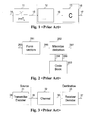
- FIG. 2 illustrates a simplified block diagram for vector quantization.
- a signal sequence ( 285 ) is represented by vectors ( 281 ) and signals ( 286 ) carrying the vectors are mapped ( 282 ) into an index ( 287 ) corresponding to a representation or codeword of the codebook, a code vector, providing a minimum distortion encoding of the vectors ( 286 ) according to a predefined criterion or measure, e.g. Euclidean distance.
- the vector to be represented ( 288 ) and the quantized vector or a representative thereof ( 289 ) are exchanged between the minimum distortion determining entity ( 282 ) and the entity comprising the code book representation ( 283 ).
- the reconstructed vector is achieved by using a similar codebook and looking up the code vector represented by the received index.
- transmission on a communications channel comprises all technical arrangements for distributing or communicating a signal from a source sender to a destination as schematically illustrated in FIG. 3 .
- a sequence representing a code index ( 34 , 35 ) is transmitted through a communications channel ( 32 ) to the destination where it is decoded in the receiver ( 33 ).
- the channel may be considered to comprise channel coding as need be to transmit or detect errors on a transmission channel.
- channel encoders and decoders separated from the source encoding and decoding are included in physical transmitters and receivers, respectively. So, from the viewpoint of the source encoding, also parts of physical transmitters and receivers are frequently included in the communications channel ( 32 ).
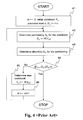
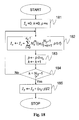
- FIG. 4 illustrates schematically a flowchart for iteratively determining a codebook Y according to a generalized Lloyd algorithm, frequently referred to as an LBG algorithm (as disclosed by Y. Linde A. Buzo and R. Gray).
- the algorithm is initiated ( 41 ) by initializing a counter m, an initial codebook Y 0 , a maximum possible (within the applicable range of the application) distortion D ⁇ 1 and a precision level ⁇ .
- a partitioning S m defining the cells surrounding the various code vectors of the code book is determined ( 42 ) for the code book Y m , and the distortion D m is determined ( 43 ).
- the algorithm is interrupted ( 44 ) when the relative distortion is smaller than the precision set initially.
- ⁇ a refined codebook is determined, the iteration counter is updated ( 46 ) and the process repeats for another iteration starting with determining a partitioning for the refined codebook ( 42 ).
- the LBG algorithm is commonly considered to be computational expensive in terms of number of instructions when there is a great number of quantization levels. It is also sensitive to the initial choice of codebook ( 41 ). Also the amount of read-only memory, ROM, required by a trained vector quantizer is usually considered to be too large. Another problem is related to the LBG algorithm being trained to provide minimum distortion for a particular training data sequence. If data from another source with substantially different statistical properties is quantized, the performance is most often suboptimal. For vectors of dimension 1, the LBG quantizer reduces to the scalar Lloyd-Max quantizer.
- VQ provides a method for creating a codebook providing the smallest distortion, e.g. in terms of Euclidean distance or squared Euclidean distance, given a certain statistic of the input signal based on the calculation of a point density function from the probability density function, PDF, of the input signal.
- Structured codebooks do not exploit linear or non-linear dependency to increase the quantization performance that vector quantizers are generally capable of. At least linear dependencies, however, can be transformed to provide a benefit in quantization performance by means of Linear Prediction or Transform Coding. Therefore, the structured vector quantizers are designed such that they have high performance for memoryless sources.
- a lattice vector quantizer is a vector quantizer of which the codebook is composed of vectors which are arranged in a regular lattice according to a mathematical rule.
- a lattice, A comprises all vectors in an L v dimensional vector space with
- the vectors v [v i,0 , v i,1 , . . . , v i,L V ⁇ 1] are the basis vectors of the lattice, and all lattice vectors are linear combinations of these basis vectors.
- the factors ⁇ j to weight each basis vector are integer numbers.
- a lattice in general is a subset of an L v -dimensional vector space but consists of a countable infinite number of points, L ⁇ eq. 2
- the number, L, of weighting factors ⁇ i determines the lattice's degree of freedom and is also called the dimension of the lattice.
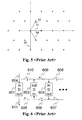
- FIG. 5 illustrates an example two dimensional hexagonal lattice and corresponding basis vectors forming the generator matrix M.
- Vectors [1, 0] ( 51 ) and [1 ⁇ 2, ⁇ square root over (3) ⁇ /2] ( 52 ) span the same set of points as do basis vectors [0, ⁇ square root over (3) ⁇ ] ( 53 ) and [1 ⁇ 2, ⁇ square root over (3) ⁇ /2] ( 54 ).
- Another example generator matrix of the lattice is
- lattices are the Gosset lattice, E 8 , the Coxeter-Todd-Lattice, K 12 , the Barnes-Wall lattice L 16 , and the Leech Lattice L 24 .
- a permutation code P defines all vectors of a codebook by means of class-leader vectors, ⁇ tilde over (x) ⁇ P , of dimension L v .
- a class-leader vector ⁇ tilde over (x) ⁇ P is composed of coordinate entries ⁇ tilde over (x) ⁇ P,j , 0 ⁇ j ⁇ L v , comprising w j components taken from a set of L P ⁇ L v real values, ⁇ l , 0 ⁇ l ⁇ L P , sorted in decreasing order, ⁇ 0 > ⁇ 1 > . . . > ⁇ L P ⁇ 1 ,
- w l is the weight related to real value ⁇ l and is the number of occurrences of real value ⁇ l , 0 ⁇ l ⁇ L P ,
- a permutation of a class-leader vector ⁇ tilde over (x) ⁇ P is a vector ⁇ tilde over (x) ⁇ * P that is composed of the same real values, ⁇ l , as ⁇ tilde over (x) ⁇ P but in a different order.
- the corresponding permutation operation can be specified by means of matrix, P, referred to as the permutation matrix.
- the permutation processing is preferably realized in a digital signal processor, DSP, adapted for the permutation of interest.
- DSP digital signal processor
- High speed applications may require the permutations to be implemented in hardware, which can be achieved by employment of e.g. shift register circuitry.
- Reversal of sequence order is e.g. achieved by storing the vector components in a shift register of the same length as the vector, in component-wise sequential order, and feeding out the shift register content in the reverse order. This is illustrated in FIG. 6 .
- the example shift register is composed of a number of D latches ( 601 - 603 ).
- the vector to be reversed is input ( 604 ) to the shift register through closed switches ( 605 - 607 ) during a sequence of clock cycles during which one component of the vector is input after another.
- the previously closed switches ( 605 - 607 ) are being opened, and switches ( 608 - 610 ), previously open while shifting the vector into the register, are being closed.
- the components are shifted out of the shift register ( 611 ) in reverse order.
- the shift register of FIG. 6 could be replaced by memory circuitry or a storage medium for storing controlled by a signal processor.
- the corresponding processing comprises storing the vector components in the memory or storage medium and reading out the memory content or stored content component wise in the reverse order.
- N P ( ⁇ l ⁇ w l ) ! ⁇ l ⁇ w l ! . , eq . ⁇ 11
- N P is known as the multinomial coefficient.
- a further issue in the quantization process relates to compaction or how to represent the various vectors with fewer class representatives, such that the errors introduced by information loss due to the compaction will be acceptably small, or at best not be noticeable, to a user.
- the ordered vector x* is represented by a class-leader vector as specified in equation 7 and that also has its components sequentially ordered according to magnitude.
- x (P x ) ⁇ 1 ⁇ x*.
- ⁇ tilde over (x) ⁇ * P ( P x ) ⁇ 1 ⁇ tilde over (x) ⁇ P . eq. 13
- a vector index, i P is determined for the vector representative ⁇ tilde over (x) ⁇ * P . This is achieved by a permutation to index mapping and which is preferably achieved by a mapping suggested by J. Pieter and M. Schalkwijk.
- the mapping consequently transforms the permuted vector ⁇ tilde over (x) ⁇ * P into an index i P .
- a decoder realizes the reverse operation and maps the index i P back into a permuted vector ⁇ tilde over (x) ⁇ * P , corresponding to the original permuted vector. Consequently, there is a one-one mapping between permuted vector ⁇ tilde over (x) ⁇ * P and index i P , the index i P providing a representation of the permuted vector ⁇ tilde over (x) ⁇ * P suitable for transmission, storage or further processing such as for channel encoding. In brief, the index is suitable for transfer on a communications channel.
- , is equal to the number of possible permutations, N P (see equation 11).
- U.S. Pat. No. 4,075,622 describes a method and apparatus for data compression which utilizes a random walk through Pascal's triangle directed by an incoming binary source sequence.
- the random walk starts at the apex of Pascal's triangle and proceeds downward according to an algorithm until it terminates at a boundary which has been constructed in such a way that the encoding of each source sequence can be accomplished in a fixed number of bits.
- U.S. Pat. No. 6,054,943 describes a variable-to-block universal multilevel digital information compression making use of a random walk in Pascal's hypervolume, a multi-dimensional generalization of Pascal's triangle.
- Codewords and decoded source sequences are either determined in the encoder and decoder, respectively, on the fly at encoding/decoding or pre-computed and stored.
- Variable length sequences of source symbols are encoded into fixed length codeword blocks.
- Encoders and decoders including dedicated hardware including registers, counters and latches are disclosed as are flowcharts.
- FIG. 26 of U.S. Pat. No. 6,054,943 illustrates graphically an example encoding (and decoding) of an example sequence of a ternary source.
- a particular candidate prefix is selected and a running sum is updated.
- j k ⁇ [0, m ⁇ 1] is the incoming symbol at stage k and where the summation is over all n incoming symbols and w i k is the number of symbols i ⁇ [0, m ⁇ 1] that have arrived after k stages.
- the outer sum is determined recursively by adding the inner summation for each incoming symbol to encode.
- the encoding is terminated at a particular element in Pascal's hyper volume. This point is added as a starting point prefix for the decoder to know where to start tracing back in Pascal's hyper volume. It is also suggested in U.S. Pat. No. 6,054,943 to add a prefix to allow uncoded transmission in order to avoid encoder expansion to happen for some sequences.
- a recursion for determining the running sum for an incoming symbol j is
- oldPos is the old position in Pascal's hyper volume.
- the position in Pascal's hyper volume is similarly updated recursively for the next iteration,
- the recursion for decoding works the path through Pascal's hyper volume for choosing a symbol j that provides a position that is not greater than a candidate for the corresponding position in the hyper volume.
- the recursion for the running sum in reverse direction, decoding position l of a codeword, in U.S. Pat. No. 6,054,943 is
- Hamkins describes wrapped spherical codes as vector quantizers for a memoryless Gaussian source and provides an algorithmic description of an encoder in table 6.1 quantizing gain and shape of a vector independently, the gain corresponding to the length or radius of the vector, and the shape corresponding to the vector normalized to 1.
- the gain codebook is optimized by the Lloyd-Max algorithm. Since the PDF is known (Gaussian source), no training is required.
- the algorithmic description is also included in Jon Hamkins and Kenneth Zeger, Gaussian Source Coding with Spherical Codes, IEEE Transactions on Information Theory , vol. 48, No. 11, pp. 2980-2989 (2002).
- class-leader vectors for representing source data tend to be large, thereby requiring substantial storage capacity of e.g. codebook representation for encoding and decoding in digital communications equipment.
- codebook representation for encoding and decoding in digital communications equipment.
- a great number of class leaders requires a great time for determining the code vector in the encoding process in order to minimize distortion.
- None of the cited documents provides a method or system of quantization or coding wherein a metric or distortion forming a criterion according to which a signal, or (using vector notation) code vector or codeword, to output for an unquantized input signal, or vector, is determined from a reduced set of code vectors of an E-lattice being linked to the (full) set of code vectors by a sign distribution.
- Speech encoding and decoding for speech communications in mobile telephone systems sound encoding for storage of songs and decoding for reproducing the sound in portable audio players or surround sound equipment reproducing movie sound, or other multi-channel sound, stored on a DVD or CD or received from public broadcasting companies by wire or over the air and image coding and decoding for digital television are some communications examples well known to the public.
- the invention provides a method and system implementing sub-dividing a set of class-leader vectors of a vector quantization encoder or decoder for encoding and decoding of communications data and mapping of corresponding data as described in detail below in relation to encoding and decoding processes.
- FIG. 1 schematically illustrates a sampler, a quantizer and a coder according to prior art.
- FIG. 2 illustrates a simplified block diagram for vector quantization according to prior art.
- FIG. 3 illustrates schematically transmission on a communications channel according to prior art.
- FIG. 4 demonstrates schematically a flowchart for iteratively determining a codebook according to a generalized Lloyd algorithm of prior art.
- FIG. 5 illustrates an example two dimensional hexagonal lattice in prior art.
- FIG. 6 depicts a block diagram of an example shift register according to prior art.
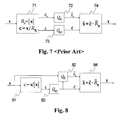
- FIG. 7 shows a basic block diagram for parallel quantization of a radius and a normalized vector according to prior art.
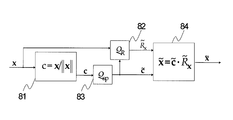
- FIG. 8 shows a basic block diagram for serial quantization of a radius and a normalized vector according to an example mode of the invention.
- FIG. 9 plots an example distribution of code vectors according to the invention.
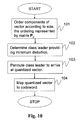
- FIG. 10 illustrates a flowchart of an efficient quantization procedure according to the invention.
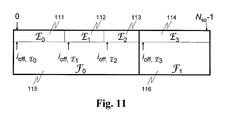
- FIG. 11 illustrates schematically sub-ranges corresponding to equivalence classes in relation to root-vector classes for a simplified example according to the invention.
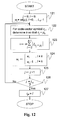
- FIG. 12 displays a flowchart illustrating example indexing in an embodiment of the invention.
- FIG. 13 depicts a basic flowchart for quantization according to an embodiment of the invention.
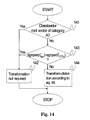
- FIG. 14 shows a simplified flowchart for determining a transformed distortion metric according to a preferred embodiment of the invention.
- FIG. 15 illustrates schematically indexing providing codewords from quantized data according to an embodiment of the invention.
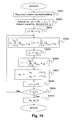
- FIG. 16 illustrates schematically a flow-chart of a preferred decoder according to the invention.
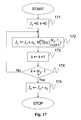
- FIG. 17 displays schematically preferred index processing of code vectors of category A according to the invention.
- FIG. 18 illustrates schematically preferred index processing of code vectors of category B according to the invention.
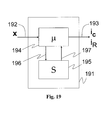
- FIG. 19 monitors a simplified block diagram of example equipment according to the invention.
- Vector quantizers based on structured codebooks generally provide a good compromise between memory requirement, computational complexity and quantization performance for practical use.
- PDF probability distribution function
- the theoretically optimal code-vector point-density-function for a given input signal PDF is well approximated by structured codebooks such as lattice codebooks and permutation codebooks. These codebooks are not stored completely in memory and are searched efficiently for codebooks according to the invention.
- Spherical vector quantization is a quantization that approximates the optimal code-vector point-density for the Gaussian distribution and at the same time can be realized efficiently. If properly designed, the achieved signal to noise ratio, SNR, related to SVQ is independent from the PDF of the input signal and from the dynamics of the input signal for a wide dynamic range.
- the radius is quantized by means of logarithmic quantization, e.g. A-law quantization well known from compression of PCM in telephone systems, the quantization signal to noise ratio, SNR, is independent of the probability density function of the input signal. This is also referred to as logarithmic SVQ.
- FIG. 7 shows a basic block diagram for parallel quantization of a radius ( 72 ) and a normalized vector ( 73 ).
- the radius and normalized vector are quantized independently.
- Both the block ( 71 ) separating the radius and the spherical vector and the quantizers ( 72 ), ( 73 ) are preferably included in an encoder entity, whereas the combining entity ( 74 ) is preferably included in a decoder entity.
- the output signal representing an output vector, ⁇ tilde over (x) ⁇ , of the combining entity ( 74 ) is the reconstructed value of the input signal represented as input vector x.
- the figure does not include processing equipment of index determining for reasons of simplicity. Signaling carrying codewords corresponding to indices are preferably transferred on a communications channel. Accordingly, the invention preferably includes processing equipment for index determining.
- FIG. 8 shows a basic block diagram for serial quantization of a radius ( 82 ) and a normalized vector ( 83 ).
- both the block ( 81 ) separating the radius and the spherical vector and the quantizers ( 82 ), ( 83 ) are preferably included in an encoding entity, whereas the combining entity ( 84 ) is preferably included in a decoder entity.
- the radius quantization is performed after the quantization of the normalized vector, c. This will allow for considering the curvature of the quantization cells, which is effective particularly for large cells. Especially for low bit rates, the sequential approach provides a slightly higher performance.
- the output signal representing an output vector, ⁇ tilde over (x) ⁇ , of the combining entity ( 84 ) is the reconstructed value of the input signal represented as input vector x.
- the figure does not include index determining for ⁇ tilde over (R) ⁇ x or ⁇ tilde over (x) ⁇ , respectively.
- an encoder preferably comprises equipment for determining one or more indices. Signaling carrying codewords corresponding to indices rather than quantized vectors are preferably transferred on a communications channel.
- the code vectors are located on the surface of spheres, which for the 2-dimensional case are circles. The radii differs for code vectors on different circles ( 92 ), ( 93 ).
- the scalar radius quantizer, Q R , ( 72 ), ( 82 ) is preferably realized by electrical circuitry implementing a lookup table, since the number of quantization and reconstruction levels is usually modest and, consequently, the number of entries required to be stored is small, particularly if logarithmic quantization is applied.
- the quantization process is, e.g., realized by processing circuitry implementing a bisection based on a table containing all interval bounds. The sequential combination of the quantizers is referred to as re-quantization of the radius.
- a quantized vector (code vector) as ⁇ tilde over (x) ⁇ i Q .
- the index i Q of the code vector ⁇ tilde over (x) ⁇ i Q denotes required and sufficient information to reconstruct the code vector in the decoder.
- i Q, R and i Q, sp there are two indices, i Q, R and i Q, sp corresponding to the selected quantization reconstruction levels of the radius and the quantized normalized vector, respectively.
- N sp is the number of code vectors for the normalized vector and N R is the number of available quantizer reconstruction values for the radius.
- a Gosset Low Complexity Vector Quantizer is based on code vectors from a lattice derived from the well known Gosset lattice, E 8 .
- the E 8 lattice is known to have the highest possible density of points in eight dimensions.
- the invention identifies advantages as regards encoding and decoding that can be achieved based on a generalized Gosset lattice, E-lattice. Thereby efficiency gains as regards computational complexity and memory/storage requirements are achieved.
- L v 8.
- Lattice vectors with a same distance to the origin define a shell, S, of the lattice.
- S the generalized Gosset lattice, or E-lattice
- E L v a shell with a squared distance to the origin equal to 2u is denoted .
- the radius of the particular shell of the E-lattice is denoted . Consequently, the shell is defined as
- Each E-lattice spherical vector codebook is composed of all vectors related to a specific shell of squared radius 2u, normalized to radius 1,
- r eff, sp shells of successively greater radii of the lattice of interest are investigated one by one, starting with a shell of smallest radius, i.e. smallest natural number u, when constructing the codebook.
- the codebook is finally based upon a shell u sp , with as many code vectors as possible provided that the effective bit rate per sample does not exceed the effective target bit rate per sample,
- u sp argmax u ⁇ N : r eff , u ( E L v ) ⁇ r eff , u ⁇ N sp , u ( E L v ) , eq . ⁇ 30
- a codebook for encoding and decoding according to the invention based on a particular E-lattice is also referred to by the particular shell or by the half of its squared radius, u sp .
- the E-lattice is invariant under an interchange of vector coordinates.
- Each equivalence class is composed of vectors generated by a permutation code P m given the class-leader vector ⁇ tilde over (c) ⁇ E, P m .
- the spherical vector codebook can be expressed as a superposition of codebooks, ⁇ tilde over (X) ⁇ P m , of a permutation code P m ,
- an efficient quantization procedure is as follows and as also illustrated in the flowchart of FIG. 10 .
- reordering corresponding to a permutation matrix P c is determined such that when applied to the normalized vector, the coordinates of the vector are rearranged in decreasing order ( 101 ).
- the spherical code vector determined to represent the normalized vector c is
- the quantized vector ⁇ tilde over (c) ⁇ is mapped ( 104 ) to a codeword, or index, i Q, sp in digital signal processing equipment. This is preferably achieved by applying the Schalkwijk algorithm, well-known in the art, to the particular code of the invention as follows.
- E 0 , E 1 , E 2 and E 3 are determined as chematically illustrated in FIG. 11 , for the example case of four equivalence classes.
- the example sub-ranges are not uniform. Index offset corresponding to the sub-ranges,
- the determining of the index i P is described in brief as follows.
- the number of indices is N P .
- L v ⁇ 1 coordinates remain to be determined, i.e. to be associated to a specific value ⁇ l .
- the number of possible permutations for the remaining sub-vector is calculated from the number of permutations in equation 11 with adjusted weights w l (adj)
- This sub-range is denoted .
- the index range I P is sub-divided into sub-ranges
- the number of indices in a sub-range associated with a particular value ⁇ l j is
- the sub-ranges are further sub-divided into smaller sub-ranges, and at last there is a single index.
- FIG. 12 displays a flowchart illustrating an example indexing as explained above for encoding of a sequence for communication over a communications channel.
- Indexing is initialized ( 121 ), where wt(•) denotes the weight or the number of occurrences of a particular symbol.
- the rank of an incoming symbol ⁇ tilde over (c) ⁇ j is determined ( 122 ) and the index is updated accordingly by the sum of number of indices in corresponding sub-range ( 123 ).
- the weights are updated ( 124 ) and the recursion continues for the next incoming symbol ( 125 ) until the last L V symbol of the code vector have been encoded ( 126 ).
- the index then finally results from the last recursion ( 127 ).
- the invention identifies that in many cases a great number of equivalence classes are involved depending on, e.g., dimensionality and sphere radius.
- a brute-force implementation of the quantization process will, for such cases, tend to require great memory and computational capacities in terms of number of bytes and number of operations per second, respectively.
- the requirements on the quantization equipment is substantially relieved by a quantizer implementing grouping of equivalence classes, E m , in root classes, F m′ .
- E m equivalence classes
- F m′ root classes
- the number of classes is reduced from 162 to 11 for the Gosset lattice, or more than by a factor of 10, providing a load reduction in a corresponding order of magnitude, while providing identically the same codewords and distortion, e.g. in terms of minimum Euclidean distance.
- ⁇ j 0 L v - 1 ⁇ ⁇ c ⁇ j ( A ) - 2 ⁇ c ⁇ j 0 ( A ) ⁇ 0 ⁇ ( modulo ⁇ ⁇ ⁇ 2 ) , eq . ⁇ 40
- a sign parity check sum for code vectors ⁇ tilde over (c) ⁇ is defined.
- class-leader vectors ⁇ tilde over (c) ⁇ E, P m can be constructed from class-leader root-vectors ⁇ tilde over (c) ⁇ F, P m′ , for 0 ⁇ m′ ⁇ , where M F , is the number of root classes, F m′ , each comprising one class-leader root-vector ⁇ tilde over (c) ⁇ F, P m′ .
- the required codebook size e.g., is substantially reduced by doing so for most codes based on E-lattices of practical interest.
- the encoding complexity is reduced, since not all class leader vectors need to be searched during the encoding. According to the invention, preferably the class-leader root-vectors are searched.
- a class-leader root-vector is composed of L F different values ⁇ l ⁇ , each occurring w l times, where w l also being referred to as the weight of ⁇ l .
- class-leader root-vector can be expressed as
- N m′ (F) the respective number of class-leader vectors of a particular category equals the number of possible sign permutations related to the weights, w l , of non-zero coordinate values, ⁇ l ⁇ 0 for the class-leader root-vector class.
- N m′ (F) the number of possible sign permutations related to the weights, w l , of non-zero coordinate values, ⁇ l ⁇ 0 for the class-leader root-vector class.
- the number of code vectors is limited and only a limited set of the vectors constructed by the lattice rule is considered.
- Lattice vector quantizers in general are very well suited for quantization also for the reason that no explicit codebook has to be stored but could be determined from, e.g., its generator matrix.
- the codebook When lattices are used for generating a codebook, the codebook will be structured, thereby facilitating fast search for code vectors.
- lattice vector quantization is an efficient example of quantization.
- FIG. 13 depicts a basic flowchart for quantization according to an embodiment of the invention.
- a vector x to be quantized it is preferably normalized to a vector c of radius 1 ( 131 ) to simplify subsequent processing.
- Each component of the (normalized) vector is separated into respective magnitude and sign to form a magnitude vector and a sign vector ( 132 ),
- c mag [
- c sgn [sgn( c 0 ) sgn( c 1 ) . . . sgn( c L v ⁇ 1 )] T .
- a metric is usually considered a quantity to be maximized. However, this specification preferably refers to a quantity to be minimized, similar to a distance. The difference merely resides in a different sign. The negative distance is maximized when the distance is minimized.
- a distortion metric D m′ preferably a Euclidean distance, is determined for, preferably, each of the class-leader root-vectors, ⁇ tilde over (c) ⁇ F, P m′ , in relation to the permuted magnitude vector c* mag ( 134 ),
- FIG. 14 shows a simplified flowchart for determining a transformed distortion metric.
- the class-leader vector which achieves the lowest distortion is determined by the sign distribution of the permuted sign vector c* sgn which is identical to the sign distribution of the class-leader vector.
- the class-leader vector ⁇ tilde over (c) ⁇ F, P m′ (B) has identically the same sign distribution as the permuted sign vector c* sgn ( 143 ), as was also the case for category A above.
- the permuted sign vector c* sgn is corrected accordingly by increasing the permuted sign-vector component in position j 0 by 1 (modulo 2), c* sgn, j 0 ⁇ c* sgn,j 0 +1(modulo 2). eq. 59
- This operation corresponds to an XOR operation ⁇ inverting a sign bit in position j 0 in a binary representation of c* sgn .
- the position j 0 is determined from the minimum of the second term in the second equality of equation 58 corresponding to additional distortion
- j 0 arg ⁇ ⁇ min 0 ⁇ m ′ ⁇ L v ⁇ c mag , j * ⁇ c ⁇ F , P m ′ , j ( B ) . eq . ⁇ 60
- one or more indices are preferred to the code vector for information transfer on a communications channel.
- an indexing machine and related processing has been developed beyond previous work of e.g. Pieter and Schalkwijk.
- the indexing is preferably performed as follows and schematically illustrated in the flowchart of FIG. 15 and implemented in processing equipment ( 191 ), ( 194 ) of FIG. 19 .
- the quantization index codeword is then determined ( 154 ) as described in relation to equation 36 on page 26 considering permutation matrix P c ,
- root class F 0 represents example equivalence classes E 0 ( 111 ), E 1 ( 112 ), E 2 ( 113 ) and example root class F 1 ( 116 ) corresponds to equivalence class E 3 ( 114 ).
- the equivalence class offsets i off, E 0 and i off, E 3 are also offsets for the root classes F 0 and F 1 , respectively.
- the equivalence class offsets i off, E 0 , i off, E 1 , i off, E 2 and i off, E 3 are preferably stored in read-only memory.
- indexing of class-leader vectors is performed on the basis of the sign vector c* sgn in equation 52.
- c* mag in equation 51 is preferably indexed similarly, though c* mag is not necessarily binary, while c* sgn is binary.
- the sign vector c* sgn with corrected position j 0 as in equation 59 is preferably indexed.
- Codeword representation by a class-leader root-vector in place of a plurality of class-leader vectors due to the suggested sign separation and parity constraint provides substantial complexity reduction according to preferred embodiments of the invention.
- preferred embodiments of the invention provide reduced vector searches, searching an equivalence root class instead of searching a plurality of equivalence classes for a codeword providing least distortion.
- the invention identifies the fact that the equivalence classes, E, related to one equivalence root class, F, are based on vector components with the same amplitudes but with different signs. For an equivalence root class, F, one of the equivalence classes need be identified at the decoder to get information on the sign distribution.
- the specific equivalence class is preferably determined by index comparison for the equivalence root class, the index range of which corresponds to the index range of one or more equivalence classes as illustrated in FIG. 11 .
- the class-leader root-vector that has been identified by the encoder and a corresponding sign distribution index identifying the equivalence class leader are determined.
- the resulting index, i P is input to a decoder, preferably operating in accordance with the suggestions of Schalkwijk and Pieter. From the class-leader root-vector and the sign distribution indicating negative vector components, the relevant information required by the decoder for determining the equivalence class-leader is available.
- the weights w l and the amplitudes ⁇ l , 0 ⁇ l ⁇ L P are preferably stored without signs.
- the decoder modifies/adjusts these values in accordance with the sign adjustments in equation 59 from the sign distribution of the decoded index as received to produce a specific class-leader vector.
- the weights w l are adjusted correspondingly.
- the resulting weights w l (adj) , omitting “(adj)” in the flow chart of FIG. 16 as described below for reasons of simplicity, and amplitudes are preferably included in the decoding according to Schalkwijk and Peter as follows.
- Weights and amplitudes appear in pairs w l , ⁇ l .
- the index i P comprises information on the sequential order in which the amplitudes are combined in a vector, referred to as the permutation of the class-leader vector.
- the sequence l c [l 0 l 1 l 2 . . . l L v ⁇ 1 ] in the flow chart in FIG. 16 describes how to arrange the sequences of w l (adj) and (1 ⁇ 2c* sgn, l ) ⁇ l , including also the adjusted signs.
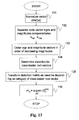
- FIG. 16 illustrates schematically a flow-chart of an example decoder according to the invention.
- Index offsets i off, m Q , are stored in the receiver for each equivalence class, c.f. FIG. 11 ( 111 , 112 , 113 ).
- some of the offsets are also index offsets of a particular root class ( 115 , 116 ).
- a particular offset for a root class ( 115 ) corresponds to an equivalence class and sign distribution ( 111 , 112 , 113 ).
- the stored offsets of root classes ( 115 , 116 ) identify a particular root class ( 115 , 116 ) from a received index.
- the stored offsets identify a particular equivalence class, which corresponds to a particular sign distribution.
- the identified equivalence class is transformed into a sign distribution.
- the weights are adapted to this sign distribution ( 1602 ) and the index offset is preferably subtracted from the received index ( 1601 ) to form a residual index, i P , ( 1602 ) for processing according to the principles of Schalkwijk and Pieter.
- a range is determined ( 1604 ), such that for some m ⁇ [0, L v ⁇ 1] there is an l m fulfilling
- I c P,m ⁇ l is an index sub-range of equation 38, omitting the ⁇ in ⁇ tilde over (c) ⁇ P,m to simplify typography.
- the quantized code vector component is allotted ( 1605 ) its magnitude corresponding to the determined range and the index is updated by subtracting ( 1606 ) the amount determined earlier ( 1604 ) and updating the weights ( 1607 ).
- the recursion proceeds similarly for the next component ( 1608 ) until all vector components are determined ( 1609 ) and the magnitudes and weights, and consequently the code vector, results ( 1610 ).
- the encoder and decoder preferably store weights, w l , amplitudes, ⁇ l , a mode or category flag, M, indicating category A or B for each of the class-leader root-vectors of the code. Also, a sign-parity flag, sgnpar( ⁇ tilde over (c) ⁇ ), indicating odd or even parity of the binary sign vector c* sgn is preferably stored at least for class-leader root-vectors of category B.
- a distribution of signs ⁇ 1 indicating number of negative signs to transform a class-leader root into a class-leader vector is transferred from the encoder to the decoder over the communications channel as need be.
- index subspace could then be subdivided in relation to, e.g., w 1 , such that an index offset of an integer multiple of three corresponds to a different sign distribution of the w 0 positions.
- the index processing preferably subdivides the index (sub-)space for each additional weight under consideration.
- a particular value on a particular position of the sign distribution e.g. ⁇ o
- all 12 sign distributions are possible for vectors of category A.
- ⁇ 0 provides a sign-parity contribution of ⁇ 0 (modulo 2).
- encoder and decoder preferably store weights, w 1 , and amplitudes, ⁇ 1 , 0 ⁇ 1 ⁇ N F for class-leader root vectors of a root equivalence class F with N F weights for non-zero component amplitudes, ⁇ 1 .
- the weights and amplitudes are stored in read-only memory, ROM.
- Other non-limiting example storage media for the weights and amplitudes are random access memory, RAM, or magnetic or electro-magnetic storage devices for reading of amplitudes and weights into RAM, e.g. at startup. Of course, they may be communicated over the communications channel at the expense of an increased load on the communications channel.
- the stored weights and amplitudes are combined with a sign distribution ⁇ l , where 0 ⁇ 1 ⁇ w 1 , 0 ⁇ 1 ⁇ N F , to provide an index I E from which the decoder is capable of reconstructing the quantized vector.
- the decoder can be made to reconstruct the class-leader vector and the equivalence class from the index and pre-stored data.
- the helping function corresponds to the number of class-leader vectors and equivalence classes that can be produced from the current class-leader root-vector, for category B preconditioned on the sign-parity constraint.
- the target index, I E , and an iteration counter, k, are initialized ( 171 ) and the weights w l preferably loaded into operational memory of a processing entity. For each iteration, the index is updated ( 172 , 175 ).
- N F is the number of weights of non-zero component amplitudes, ⁇ 1 , for the class-leader root-vector.
- the preferred index processing of code vectors of category B is illustrated schematically in FIG. 18 .
- the target index, I E , and an iteration counter, k are initialized ( 181 ) and the weights w 1 preferably loaded into operational memory of a processing entity.
- a parity flag is initialized ( 181 ) to the preferably pre-stored sign-parity ⁇ of the class-leader root-vector corresponding to the class-leader vector of the equivalence class. For each iteration the candidate for index I E is updated ( 182 , 185 ).
- N F is the number of weights for non-zero component amplitudes, ⁇ 1 .
- the adjustment is expressed in FIG. 18 as a summation modulo 2, indicated ( 182 ) by ⁇ for brevity even though t is not necessarily binary.
- the candidate parity is updated in relation to the sign distribution and the next weight and sign combinations are considered ( 183 ) until all but one non-zero weight(s) have been considered ( 184 ).
- ⁇ denotes ( 183 ) a modulo-2 sum.
- For the last update of the candidate parity it is preferably verified that ⁇ N F ⁇ 1 ⁇ p is even, and an integer representing half of this amount increments the candidate index to form the final index for category B ( 185 ).
- FIG. 19 illustrates a block diagram of example equipment ( 191 ) according to the invention.
- the equipment comprises an input ( 192 ) for inputting signals to be quantized or indexed, for which a block of data is represented by a vector x, and an output ( 193 ) providing signal codewords.
- the output signal carries codewords or indices corresponding to input vector x, or a normalized vector of radius 1 and a radius.
- a signal carrying code vectors is output ( 192 ) in one mode of operating an embodiment of the invention.
- the equivalence class offsets are preferably stored in read only memory, ROM, flash memory or other storage medium ( 195 ).
- Processing circuitry ( 194 ) of the equipment ( 191 ) implements quantization as described above.
- the processing circuitry implements indexing.
- Class-leader root-vectors are preferably stored in memory or other storage medium ( 195 ) to improve decoding speed or reduce amount of communicated data, and the processing circuitry ( 194 ) accesses ( 196 ) the storage medium ( 195 ) and reads memory or storage content ( 197 ).
- the processing circuitry also preferably accesses some random access memory, RAM, ( 194 ), ( 195 ) for its operations.
Landscapes
- Engineering & Computer Science (AREA)
- Theoretical Computer Science (AREA)
- Computational Linguistics (AREA)
- Signal Processing (AREA)
- Health & Medical Sciences (AREA)
- Audiology, Speech & Language Pathology (AREA)
- Human Computer Interaction (AREA)
- Physics & Mathematics (AREA)
- Acoustics & Sound (AREA)
- Multimedia (AREA)
- Compression, Expansion, Code Conversion, And Decoders (AREA)
Abstract
Description


L⊂
L:yε{λ·M:λ=[λ 0,λ1, . . . ,λL
{tilde over (x)}* P =P·{tilde over (x)} P =[{tilde over (x)}* P,0 {tilde over (x)}* P,1 . . . {tilde over (x)}* P,L
∥{tilde over (x)} i
{tilde over (x)}* P=(P x)−1 ·{tilde over (x)} P. eq. 13

{tilde over (x)}={tilde over (c)}·{tilde over (R)} x. eq. 22
i Q =i Q,R ·N sp +i Q,sp, and eq. 23
i Q =i Q,sp ·N R +i Q,R, eq. 24
E L


| TABLE 1 |
| Number of code vectors on different shells of the Gosset lattice. |
| u | Nsp, u (E |
reff, u (E |
| 1 | 240 | 0.9884 |
| 2 | 2160 | 1.3846 |
| 3 | 6720 | 1.5893 |
| 4 | 17520 | 1.7621 |
| 5 | 30240 | 1.8605 |
| 6 | 60480 | 1.9855 |
| 7 | 82560 | 2.0416 |
| 8 | 140400 | 2.1374 |
| 9 | 181680 | 2.1839 |
| 10 | 272160 | 2.2568 |
| 15 | 846720 | 2.4614 |
| 20 | 2207520 | 2.6342 |
| 30 | 7620480 | 2.8577 |


c*=[c* 0 c* 1 . . . c* L
included in
i Q,sp =i off,m

| TABLE 2 |
| Number of equivalence classes and root classes for different shells |
| of the Gosset lattice. |
| u | ME, u (E |
|
| 1 | 8 | 2 |
| 2 | 15 | 3 |
| 3 | 24 | 3 |
| 4 | 42 | 5 |
| 5 | 54 | 5 |
| 6 | 57 | 5 |
| 7 | 103 | 8 |
| 8 | 119 | 9 |
| 9 | 124 | 9 |
| 10 | 162 | 11 |


| TABLE 3 |
| Class-leader root-vectors and corresponding class-leader vectors, u = 2. |
| Cate- | ||
| gory | {tilde over (c)}F,P |
{tilde over (c)}E,P |
| A | [ 1 0 0 0 0 0 0 0 ]T |
|
| A | [ 1/2 1/2 1/2 1/2 0 0 0 0 ]T |
|
| B | [ 3/4 1/2 1/2 1/2 1/2 1/2 1/2 1/2 ]T |
|
c mag =[|c 0 | |c 1 | . . . |c L
c sgn=[sgn(c 0) sgn(c 1) . . . sgn(c L
c* mag =P c ·c mag, eq. 49
c* sgn =P C ·c sgn, eq. 50
c* mag =[c* mag,0 c* mag,1 . . . c* mag,L
c* sgn =[c* sgn,0 c* sgn,1 . . . c* sgn,L

D m′ (t) =D m′, if category A,m′=m′ Q. eq. 56
D m′ (t) =D m′, if category B,
c* sgn, j
-
- Determine (151) equivalence classes Em
Q (111-113), (114) corresponding to the selected root class Fm′Q (115), (116) as illustrated in exampleFIG. 11 and table 3. - Based upon the permuted sign vector c*sgn, select (152) the equivalence class Em
Q , or equivalently its class leader, from the equivalence classes corresponding to the selected root class as described above in relation to the flowchart ofFIG. 13 . - Determine (153) index offset as illustrated in

FIG. 11 . - Determine (153) a permutation index iP
c with respect to matrix Pc, preferably according to previous work of Pieter and Schalkwijk.
- Determine (151) equivalence classes Em
{tilde over (x)} i
| σ0 | +/− | ||
| 0 | + + + | ||
| 1 | + + − | ||
| 2 | + − − | ||
| 3 | − − − | ||
| σ1 | +/− | ||
| 0 | + + | ||
| 1 | + − | ||
| 2 | − − | ||
| σ0, |
||
| 0, 0 | 0, 1 | 0, 2 | 1, 0 | 1, 1 | 1, 2 | 2, 0 | 2, 1 | 2, 2 | 3, 0 | 3, 1 | 3, 2 | ||
| |
0 | 1 | 2 | 3 | 4 | 5 | 6 | 7 | 8 | 9 | 10 | 11 |

Claims (12)
E L

Applications Claiming Priority (1)
| Application Number | Priority Date | Filing Date | Title |
|---|---|---|---|
| PCT/CN2008/070719 WO2009127097A1 (en) | 2008-04-16 | 2008-04-16 | Method and apparatus of communication |
Related Parent Applications (1)
| Application Number | Title | Priority Date | Filing Date |
|---|---|---|---|
| PCT/CN2008/070719 Continuation WO2009127097A1 (en) | 2008-04-16 | 2008-04-16 | Method and apparatus of communication |
Publications (2)
| Publication Number | Publication Date |
|---|---|
| US20110137645A1 US20110137645A1 (en) | 2011-06-09 |
| US8364476B2 true US8364476B2 (en) | 2013-01-29 |
Family
ID=41198764
Family Applications (1)
| Application Number | Title | Priority Date | Filing Date |
|---|---|---|---|
| US12/905,852 Active 2028-05-03 US8364476B2 (en) | 2008-04-16 | 2010-10-15 | Method and apparatus of communication |
Country Status (4)
| Country | Link |
|---|---|
| US (1) | US8364476B2 (en) |
| EP (1) | EP2274833B1 (en) |
| CN (1) | CN102132494B (en) |
| WO (1) | WO2009127097A1 (en) |
Cited By (1)
| Publication number | Priority date | Publication date | Assignee | Title |
|---|---|---|---|---|
| US20120232684A1 (en) * | 2009-11-09 | 2012-09-13 | Kyung-Hee Lee | Apparatus and method for reproducing multi-sound channel contents using dlna in mobile terminal |
Families Citing this family (14)
| Publication number | Priority date | Publication date | Assignee | Title |
|---|---|---|---|---|
| WO2009127097A1 (en) | 2008-04-16 | 2009-10-22 | Huawei Technologies Co., Ltd. | Method and apparatus of communication |
| FR2931964A1 (en) * | 2008-06-02 | 2009-12-04 | Centre Nat Rech Scient | METHOD OF ENCRYPTING VECTORS IN REGULAR NETWORKS OF POINTS. |
| US8749408B1 (en) * | 2012-12-27 | 2014-06-10 | Mediatek Singapore Pte. Ltd. | Methods for simplified MMI VQ based HARQ buffer reduction for LTE |
| KR101868252B1 (en) * | 2013-12-17 | 2018-06-15 | 노키아 테크놀로지스 오와이 | Audio signal encoder |
| WO2018028779A1 (en) | 2016-08-10 | 2018-02-15 | Huawei Technologies Co., Ltd. | Unit-norm codebook design and quantization |
| US10531099B2 (en) * | 2016-09-30 | 2020-01-07 | The Mitre Corporation | Systems and methods for distributed quantization of multimodal images |
| IL315105A (en) * | 2017-09-20 | 2024-10-01 | Look Dynamics Inc | Photonic neural network system |
| US12307359B2 (en) | 2017-09-20 | 2025-05-20 | Look Dynamics, Inc. | Device for optically transmitting and receiving images |
| US10609421B2 (en) | 2018-07-12 | 2020-03-31 | Google Llc | Context derivation for coefficient coding |
| US10547869B2 (en) | 2017-12-08 | 2020-01-28 | Google Llc | Template-based entropy coding of quantized transform coefficients |
| RU2769429C2 (en) * | 2018-08-17 | 2022-03-31 | Нокиа Текнолоджиз Ой | Audio signal encoder |
| CN115426229B (en) * | 2022-07-21 | 2024-05-28 | 华力智芯(成都)集成电路有限公司 | A fast Gaussian filtering method based on GMSK modulation system |
| CN116388769B (en) * | 2023-06-06 | 2023-12-29 | 莱芜职业技术学院 | A computer storage optimization method for environmental detection data |
| US20250028972A1 (en) * | 2023-07-18 | 2025-01-23 | VMware LLC | Entropy-constrained uniform quantization |
Citations (15)
| Publication number | Priority date | Publication date | Assignee | Title |
|---|---|---|---|---|
| WO1998018262A1 (en) | 1996-10-23 | 1998-04-30 | University Of Strathclyde | Vector quantisation codebook generation method |
| US6148283A (en) * | 1998-09-23 | 2000-11-14 | Qualcomm Inc. | Method and apparatus using multi-path multi-stage vector quantizer |
| US6363338B1 (en) * | 1999-04-12 | 2002-03-26 | Dolby Laboratories Licensing Corporation | Quantization in perceptual audio coders with compensation for synthesis filter noise spreading |
| WO2003103151A1 (en) | 2002-05-31 | 2003-12-11 | Voiceage Corporation | Method and system for multi-rate lattice vector quantization of a signal |
| US20040176951A1 (en) * | 2003-03-05 | 2004-09-09 | Sung Ho Sang | LSF coefficient vector quantizer for wideband speech coding |
| CN1878313A (en) | 2006-05-15 | 2006-12-13 | 西安理工大学 | Image compression chip based on image block dynamic division vector quantization algorithm |
| WO2007035148A2 (en) | 2005-09-23 | 2007-03-29 | Telefonaktiebolaget Lm Ericsson (Publ) | Successively refinable lattice vector quantization |
| WO2007083264A1 (en) | 2006-01-18 | 2007-07-26 | Nokia Corporation | Audio coding |
| US7272566B2 (en) * | 2003-01-02 | 2007-09-18 | Dolby Laboratories Licensing Corporation | Reducing scale factor transmission cost for MPEG-2 advanced audio coding (AAC) using a lattice based post processing technique |
| US20080097755A1 (en) * | 2006-10-18 | 2008-04-24 | Polycom, Inc. | Fast lattice vector quantization |
| US20080097749A1 (en) * | 2006-10-18 | 2008-04-24 | Polycom, Inc. | Dual-transform coding of audio signals |
| US20090192790A1 (en) * | 2008-01-28 | 2009-07-30 | Qualcomm Incorporated | Systems, methods, and apparatus for context suppression using receivers |
| WO2009127097A1 (en) | 2008-04-16 | 2009-10-22 | Huawei Technologies Co., Ltd. | Method and apparatus of communication |
| US7680670B2 (en) * | 2004-01-30 | 2010-03-16 | France Telecom | Dimensional vector and variable resolution quantization |
| US20100174531A1 (en) * | 2009-01-06 | 2010-07-08 | Skype Limited | Speech coding |
Family Cites Families (2)
| Publication number | Priority date | Publication date | Assignee | Title |
|---|---|---|---|---|
| US4075622A (en) | 1975-01-31 | 1978-02-21 | The United States Of America As Represented By The Secretary Of The Navy | Variable-to-block-with-prefix source coding technique |
| US6054943A (en) | 1998-03-25 | 2000-04-25 | Lawrence; John Clifton | Multilevel digital information compression based on lawrence algorithm |
-
2008
- 2008-04-16 WO PCT/CN2008/070719 patent/WO2009127097A1/en not_active Ceased
- 2008-04-16 EP EP08734077.4A patent/EP2274833B1/en active Active
- 2008-04-16 CN CN2008801287020A patent/CN102132494B/en active Active
-
2010
- 2010-10-15 US US12/905,852 patent/US8364476B2/en active Active
Patent Citations (16)
| Publication number | Priority date | Publication date | Assignee | Title |
|---|---|---|---|---|
| WO1998018262A1 (en) | 1996-10-23 | 1998-04-30 | University Of Strathclyde | Vector quantisation codebook generation method |
| US6148283A (en) * | 1998-09-23 | 2000-11-14 | Qualcomm Inc. | Method and apparatus using multi-path multi-stage vector quantizer |
| US6363338B1 (en) * | 1999-04-12 | 2002-03-26 | Dolby Laboratories Licensing Corporation | Quantization in perceptual audio coders with compensation for synthesis filter noise spreading |
| WO2003103151A1 (en) | 2002-05-31 | 2003-12-11 | Voiceage Corporation | Method and system for multi-rate lattice vector quantization of a signal |
| US7272566B2 (en) * | 2003-01-02 | 2007-09-18 | Dolby Laboratories Licensing Corporation | Reducing scale factor transmission cost for MPEG-2 advanced audio coding (AAC) using a lattice based post processing technique |
| US20040176951A1 (en) * | 2003-03-05 | 2004-09-09 | Sung Ho Sang | LSF coefficient vector quantizer for wideband speech coding |
| US7680670B2 (en) * | 2004-01-30 | 2010-03-16 | France Telecom | Dimensional vector and variable resolution quantization |
| WO2007035148A2 (en) | 2005-09-23 | 2007-03-29 | Telefonaktiebolaget Lm Ericsson (Publ) | Successively refinable lattice vector quantization |
| WO2007083264A1 (en) | 2006-01-18 | 2007-07-26 | Nokia Corporation | Audio coding |
| CN1878313A (en) | 2006-05-15 | 2006-12-13 | 西安理工大学 | Image compression chip based on image block dynamic division vector quantization algorithm |
| US20080097755A1 (en) * | 2006-10-18 | 2008-04-24 | Polycom, Inc. | Fast lattice vector quantization |
| US20080097749A1 (en) * | 2006-10-18 | 2008-04-24 | Polycom, Inc. | Dual-transform coding of audio signals |
| US7966175B2 (en) * | 2006-10-18 | 2011-06-21 | Polycom, Inc. | Fast lattice vector quantization |
| US20090192790A1 (en) * | 2008-01-28 | 2009-07-30 | Qualcomm Incorporated | Systems, methods, and apparatus for context suppression using receivers |
| WO2009127097A1 (en) | 2008-04-16 | 2009-10-22 | Huawei Technologies Co., Ltd. | Method and apparatus of communication |
| US20100174531A1 (en) * | 2009-01-06 | 2010-07-08 | Skype Limited | Speech coding |
Non-Patent Citations (7)
| Title |
|---|
| Adoul et al., "Baseband Speech Coding at 2400 BPS Using Spherical Vector Quantization", International Conference on Acoustics, Speech 7 Signal Processing. ICASSP. San Diego, Mar. 19-21, 1984. |
| Adoul et al., "Nearest Neighbor Algorithm for Spherical Codes from the Leech Lattice", IEEE Transactions on Information Theory, IEEE. US. vol. 34, No. 5, Sep. 1, 1988. |
| Extended European Search Report issued in corresponding European Patent Application No. 08734077.4, mailed Mar. 7, 2011. |
| Lamblin et al., Algorithme de Quantification Vectorielle Spherique a Partir Du Reseau de Gosset D'ordre 8, Annales Des Telecommunications, Les Moulineaux, France. vol. 73, No. 3/04. Mar. 1, 1988. |
| Office Action issued in corresponding Chinese Patent Application No. 200880128702.0, mailed Nov. 14, 2012. |
| Office Action issued in corresponding European Patent Application No. 08734077.4, mailed Apr. 3, 2012. |
| Written Opinion of the International Searching Authority issued in corresponding PCT Patent Application No. PCT/CN2008/070719, mailed Jan. 22, 2009. |
Cited By (4)
| Publication number | Priority date | Publication date | Assignee | Title |
|---|---|---|---|---|
| US20120232684A1 (en) * | 2009-11-09 | 2012-09-13 | Kyung-Hee Lee | Apparatus and method for reproducing multi-sound channel contents using dlna in mobile terminal |
| US8903527B2 (en) * | 2009-11-09 | 2014-12-02 | Samsung Electronics Co., Ltd. | Apparatus and method for reproducing multi-sound channel contents using DLNA in mobile terminal |
| US9843879B2 (en) | 2009-11-09 | 2017-12-12 | Samsung Electronics Co., Ltd. | Apparatus and method for reproducing multi-sound channel contents using DLNA in mobile terminal |
| US10425758B2 (en) | 2009-11-09 | 2019-09-24 | Samsung Electronics Co., Ltd. | Apparatus and method for reproducing multi-sound channel contents using DLNA in mobile terminal |
Also Published As
| Publication number | Publication date |
|---|---|
| EP2274833A1 (en) | 2011-01-19 |
| US20110137645A1 (en) | 2011-06-09 |
| EP2274833B1 (en) | 2016-08-10 |
| CN102132494A (en) | 2011-07-20 |
| WO2009127097A1 (en) | 2009-10-22 |
| EP2274833A4 (en) | 2011-04-06 |
| CN102132494B (en) | 2013-10-02 |
Similar Documents
| Publication | Publication Date | Title |
|---|---|---|
| EP2274833B1 (en) | Vector quantisation method | |
| US7106228B2 (en) | Method and system for multi-rate lattice vector quantization of a signal | |
| US6671416B2 (en) | Method for transmitting data using an embedded bit stream produced in a hierarchical table-lookup vector quantizer | |
| US6504877B1 (en) | Successively refinable Trellis-Based Scalar Vector quantizers | |
| US9887805B2 (en) | Device, system and method for efficient coset decoder by transform | |
| US7587314B2 (en) | Single-codebook vector quantization for multiple-rate applications | |
| US8660187B2 (en) | Method for treating digital data | |
| Owens et al. | Compression of synthetic aperture radar video phase history data using trellis-coded quantization techniques | |
| WO2011097963A1 (en) | Encoding method, decoding method, encoder and decoder | |
| Goyal et al. | On optimal permutation codes | |
| EP0732854A2 (en) | Apparatus and methods for performing Huffman coding | |
| Aksu et al. | Multistage trellis coded quantisation (MS-TCQ) design and performance | |
| US8745110B2 (en) | Method for counting vectors in regular point networks | |
| Terekhov et al. | Reference Signal Compression in Intrusive Methods for Assessing the Quality of Speech Transmission Using the Unitary Numbering System | |
| Haoui et al. | Embedded coding of speech: A vector quantization approach | |
| Savkin | Quantization Methods for Matrix Multiplication and Efficient Transformers | |
| CA2482994C (en) | Method and system for multi-rate lattice vector quantization of a signal | |
| Khandelwal et al. | Implementation of Direct Indexing and 2-V Golomb Coding of Lattice Vectors for Image Compression | |
| Rault et al. | Vector Indexing and Lattice Vector Quantization with Reduced or without Look-up Table. | |
| Ouahada et al. | Permutation sequences and coded PAM signals with spectral nulls at rational submultiples of the symbol frequency | |
| Hui et al. | Reduced storage VQ via secondary quantization | |
| Kim et al. | Sample-adaptive product quantizers with affine index assignments for noisy channels | |
| Chen | A fast algorithm for uniform vector quantization | |
| Weissman | Information Theory–EE376A Course reader |
Legal Events
| Date | Code | Title | Description |
|---|---|---|---|
| AS | Assignment |
Owner name: HUAWEI TECHNOLOGIES CO., LTD., CHINA Free format text: ASSIGNMENT OF ASSIGNORS INTEREST;ASSIGNORS:VARY, PETER;KRUGER, HAUKE;GEISER, BERND;REEL/FRAME:025819/0409 Effective date: 20110214 |
|
| STCF | Information on status: patent grant |
Free format text: PATENTED CASE |
|
| FPAY | Fee payment |
Year of fee payment: 4 |
|
| MAFP | Maintenance fee payment |
Free format text: PAYMENT OF MAINTENANCE FEE, 8TH YEAR, LARGE ENTITY (ORIGINAL EVENT CODE: M1552); ENTITY STATUS OF PATENT OWNER: LARGE ENTITY Year of fee payment: 8 |
|
| MAFP | Maintenance fee payment |
Free format text: PAYMENT OF MAINTENANCE FEE, 12TH YEAR, LARGE ENTITY (ORIGINAL EVENT CODE: M1553); ENTITY STATUS OF PATENT OWNER: LARGE ENTITY Year of fee payment: 12 |