US8362047B1 - Anti-cancer agents based on 4-(hetero)Ary1-1,2,5-oxadiazol-3-yl Amino derivatives and a method of making - Google Patents

Anti-cancer agents based on 4-(hetero)Ary1-1,2,5-oxadiazol-3-yl Amino derivatives and a method of making Download PDF

Info

Publication number
US8362047B1
US8362047B1 US12/822,243 US82224310A US8362047B1 US 8362047 B1 US8362047 B1 US 8362047B1 US 82224310 A US82224310 A US 82224310A US 8362047 B1 US8362047 B1 US 8362047B1
Authority
US
United States
Prior art keywords
substituted
oxadiazol
benzamide
chloro
benzimidazol
Prior art date
Legal status (The legal status is an assumption and is not a legal conclusion. Google has not performed a legal analysis and makes no representation as to the accuracy of the status listed.)
Expired - Fee Related, expires
Application number
US12/822,243
Inventor
Andrei A. Gakh
Mikhail Krasavin
Ruben Karapetian
Konstantin A. Rufanov
Igor Konstantinov
Elena Godovykh
Olga Soldatkina
Andrey V. Sosnov
Current Assignee (The listed assignees may be inaccurate. Google has not performed a legal analysis and makes no representation or warranty as to the accuracy of the list.)
US Department of Energy
Original Assignee
US Department of Energy
Priority date (The priority date is an assumption and is not a legal conclusion. Google has not performed a legal analysis and makes no representation as to the accuracy of the date listed.)
Filing date
Publication date
Application filed by US Department of Energy filed Critical US Department of Energy
Priority to US12/822,243 priority Critical patent/US8362047B1/en
Assigned to U.S. DEPARTMENT OF ENERGY reassignment U.S. DEPARTMENT OF ENERGY ASSIGNMENT OF ASSIGNORS INTEREST (SEE DOCUMENT FOR DETAILS). Assignors: GAKH, ANDREI A., GODOVYKH, ELENA ., KARAPETIAN, RUBEN ., KONSTANTINOV, IGOR ., KRASAVIN, MIKHAIL ., RUFANOV, KONSTANTIN A., SOLDATKINA, OLGA ., SOSNSOV, ANDREY V.
Application granted granted Critical
Publication of US8362047B1 publication Critical patent/US8362047B1/en
Expired - Fee Related legal-status Critical Current
Adjusted expiration legal-status Critical

Links

Classifications

    • CCHEMISTRY; METALLURGY
    • C07ORGANIC CHEMISTRY
    • C07DHETEROCYCLIC COMPOUNDS
    • C07D413/00Heterocyclic compounds containing two or more hetero rings, at least one ring having nitrogen and oxygen atoms as the only ring hetero atoms
    • C07D413/02Heterocyclic compounds containing two or more hetero rings, at least one ring having nitrogen and oxygen atoms as the only ring hetero atoms containing two hetero rings
    • C07D413/04Heterocyclic compounds containing two or more hetero rings, at least one ring having nitrogen and oxygen atoms as the only ring hetero atoms containing two hetero rings directly linked by a ring-member-to-ring-member bond

Definitions

  • the present invention relates to novel anti-cancer agents based on N-substituted derivatives of 4-(hetero)aryl-1,2,5-oxadiazol-3-yl amines that can be used in prostate cancer therapy.
  • the present invention also relates to methods of preparing said compounds, and to pharmaceutical compositions comprising said compounds.
  • Cancer is the second leading cause of human death next to coronary disease. Worldwide, millions of people die from cancer every year. In the United States alone, as reported by the American Cancer Society, cancer causes the death of well over half-million people annually, with over 1.2 million new cases diagnosed per year. While deaths from heart disease have been declining significantly, those resulting from cancer generally are on the rise. In this century, cancer is predicted to become the leading cause of death.
  • Prostate cancer is the number one cancer diagnosed in men today. While it occurs to certain extent throughout the world (least commonly in Eastern/Southern Asia), it is viewed as the major public health threat in Western Europe and, especially, the United States. In the US alone, it has been projected that 186,320 new cases of prostate cancer (mostly—among men over fifty) will have been diagnosed in 2008, accounting for 25% of all cancers diagnosed in men that year and 10% of the total cancer-related mortality. Appropriate diet (including dietary supplements) and exercise are currently the common themes for prostate cancer prevention while classical treatments are limited to surgery, radiation therapy, and hormone therapy.
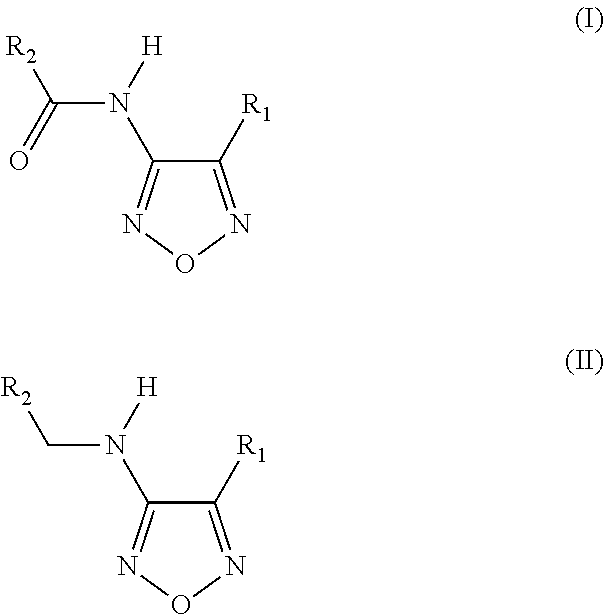
  • the present invention relates to novel compounds (N-substituted derivatives of 4-(hetero)aryl-1,2,5-oxadiazol-3-yl amines) having the structural Formula (I) and (II), stereoisomers, tautomers, racemics, prodrugs, metabolites thereof, or pharmaceutically acceptable salt and/or solvate thereof,
  • R1 is selected from substituted or non-substituted aryls, in particular to phenyl groups bearing electron-donating substituents, and heteroaryls, in particular to substituted or non-substituted imidazols fused to substituted or non-substituted aromatic ring to form bicyclic heterocycles of the general formula (III), (IV), (V), (VI), (VII) and (VIII):
  • R2 is selected from substituted or non-substituted, fused or non-fused to substituted or non-substituted aromatic ring, aryl or heteroaryl groups.
  • Acceptable salts are hydrochloride, citrate, maleate or similar salts listed, for example in the Handbook of Pharmaceutical Salts Properties, selection and use—Stahl P H, Wermuth C G, editors. 2002. Weinheim/Zurich: Wiley-VCH/VHCA. Typical solvate is hydrate (water).
  • the compounds have been prepared and, upon screening for their biological activity, exhibited inhibition of DU-145 cell proliferation in dose-response.
  • the invention also relates to methods for preparing said compounds, and to pharmaceutical compositions comprising said compounds.
  • the present invention is a result of our ongoing efforts to find novel antiproliferative agents as potential treatments for cancer. It was aimed at identifying new small heterocyclic molecules in ChemDiv, Inc. collection that would be specifically inhibitory to DU-145 human prostate carcinoma cell line (a ‘classical’ cell line of prostate cancer) while exhibiting no non-specific (general) cytotoxicity. High-throughput screening of a highly diverse set of over 7,000 compounds comprising over 200 chemical classes led to several confirmed hit classes.
  • R1 is selected from substituted or non-substituted aryls, in particular to phenyl groups bearing electron-donating substituents, and heteroaryls, in particular to substituted or non-substituted imidazols fused to substituted or non-substituted aromatic rings to form bicyclic heterocycles of the general formula (III), (IV), (V), (VI), (VII) and (VIII):
  • R2 is selected from substituted or non-substituted, fused or non-fused to substituted or non-substituted aromatic ring, aryl or heteroaryl groups.
  • the compounds exhibited inhibition of DU-145 cell proliferation in dose-response manner, attracted our attention due to their drug-likeness, structural simplicity, presence in their structure of two distinct types of peripheral appendages (thus allowing for informative SAR exploration), and syntheses reported in the literature for related structures.
  • the obtained carbonyl cyanide (50 mmol) is dissolved in 1,4-dioxane (50-150 mL) and 50 wt. % aq. hydroxylamine (NH 2 OH) (200 mmol) was added, followed by addition of catalytic (4 mmol) amount of 4M HCl (hydrochloric acid) in 1,4 dioxane (1 mL).
  • the reaction mixture was heated at 50° C. for 12 hr and allowed to cool down to ambient temperature overnight.
  • the obtained precipitate of bis-oxime was collected by filtration, washed with dioxane and dried with air. Typical yields on this step vary in the range of 50-60 wt. %.
  • the crude bis-oxime (30 mmol) was added in portions to vigorously stirred 4M aq. NaOH (sodium hydroxide) (100 mL) under inert atmosphere (nitrogen gas). The reaction completes in 5-20 hr.
  • the reaction mixture is neutralized by addition of aq. NaHSO 4 (sodium hydrogen sulfate) (400 mmol) and thus obtained oxadiazol is extracted with EtOAc (ethyl acetate).
  • the product is purified by FC (flash chromatography) on silica gel using mixtures of hexane/EtOAc as mobile phases. Yields of purified oxadiazols vary up to 70 wt. %.
  • N-substituted derivatives of 4-(hetero)aryl-1,2,5-oxadiazol-3-yl amines that can be prepared under the scope of the present invention, depending on the combinations of R1-acyl chlorides and R2-acyl chlorides, suitable N-substituted derivatives of 4-(hetero)aryl-1,2,5-oxadiazol-3-yl amines are (but not meant to be limited to): 2-Chloro-N 1 -[4-(1-butyl-1H-1,3-benzimidazol-2-yl)-1,2,5-oxadiazol-3-yl]benzamide; 2-Chloro-N 1 -[4-(1-isobutyl-1H-1,3-benzimidazol-2-yl)-1,2,5-oxadiazol-3-yl]benzamide; 2-Chloro-N 1 -[4-(1-allyl-1H-1,3-benzimidazol-2-yl)
  • R1-acyl chlorides are (but are not limited to): 1-butyl-1H-1,3-benzimidazole-2-carbonyl chloride; 1-isobutyl-1H-1,3-benzimidazole-2-carbonyl chloride; 1-allyl-1H-1,3-benzimidazole-2-carbonyl chloride; ethyl 2-[2-(chlorocarbonyl)-1H-1,3-benzimidazol-1-yl]acetate; 4-methoxy-1-benzenecarbonyl chloride; 4-ethoxy-1-benzenecarbonyl chloride; or 4-ethoxy-3-methyl-1-benzenecarbonyl chloride.
  • R2-acyl chlorides are (but are not limited to): 2-chloro-1-benzene-carbonyl chloride; 2-fluoro-1-benzenecarbonyl chloride; 2-ethoxy-1-benzenecarbonyl chloride; 2-propoxy-1-benzene-carbonyl chloride; 2-butoxy-1-benzene-carbonyl chloride; and 5-chloro-3-methyl-1-benzofuran-2-carbonyl chloride.
  • Ethyl 2-(2-4-[(2-fluorobenzoyl)amino]-1,2,5-oxadiazol-3-yl-1H-1,3-benzimidazol-1-yl)acetate was obtained from reacting ethyl 2-[2-(chlorocarbonyl)-1H-1,3-benzimidazol-1-yl]acetate and 2-fluoro-1-benzenecarbonyl chloride, in 19 wt. % overall yield.
  • 2-Ethoxy-N 1 -[4-(4-ethoxyphenyl)-1,2,5-oxadiazol-3-yl]benzamide was obtained from reacting 4-ethoxy-1-benzenecarbonyl chloride and 2-ethoxy-1-benzenecarbonyl chloride, in 20 wt. % overall yield.
  • 5-chloro-N 2 -[4-(4-ethoxyphenyl)-1,2,5-oxadiazol-3-yl]-3-methyl-1-benzofuran-2-carboxamide was obtained from reacting 4-ethoxy-1-benzenecarbonyl chloride and 5-chloro-3-methyl-1-benzofuran-2-carbonyl chloride, in 12 wt. % overall yield.
  • IC 50 represents the concentration of a drug that is required for 50% inhibition in vitro. As shown in Table 1, the compositions at the beginning of the table are more effective inhibitors than those at the end of the table.
  • the Alamar-Blue reagent utilizes the redox dye resazurin, which is not fluorescent, but upon reduction by metabolically active cells is converted into a highly fluorescent product (resorufin).
  • redox dye resazurin which is not fluorescent, but upon reduction by metabolically active cells is converted into a highly fluorescent product (resorufin).
  • a decrease in fluorescence in the presence of a test compound indicates reduced proliferation. This change in signal is proportional to the number of viable cells and used as a measure of relative cytotoxicity. Therefore, the fluorescence intensity observed in this assay is a true measure of the viable proliferative cells.

Landscapes

  • Chemical & Material Sciences (AREA)
  • Organic Chemistry (AREA)
  • Pharmaceuticals Containing Other Organic And Inorganic Compounds (AREA)

Abstract

The present disclosure relates to novel compounds that can be used as anti-cancer agents in the prostate cancer therapy.
Figure US08362047-20130129-C00001
    • In particular, the invention relates N-substituted derivatives of 4-(hetero)aryl-1,2,5-oxadiazol-3-yl amines having the structural Formula (I) and (II), stereoisomers, tautomers, racemics, prodrugs, metabolites thereof, or pharmaceutically acceptable salt and/or solvate thereof. Meaning of R1 and R2 in the Formula (I) and (II) are defined in claim 1. The invention also relates to methods for preparing said compounds, and to pharmaceutical compositions comprising said compounds.

Description
CONTRACTUAL ORIGIN OF THE INVENTION
The U.S. Government has certain rights in the present invention pursuant to Contract No. #3548 between the Department of Energy (DOE) (International Science and Technology Center) and the Chemical Diversity Research Institute, dated Jul. 1, 2007.
FIELD OF INVENTION
The present invention relates to novel anti-cancer agents based on N-substituted derivatives of 4-(hetero)aryl-1,2,5-oxadiazol-3-yl amines that can be used in prostate cancer therapy. The present invention also relates to methods of preparing said compounds, and to pharmaceutical compositions comprising said compounds.
BACKGROUND OF THE INVENTION
Cancer is the second leading cause of human death next to coronary disease. Worldwide, millions of people die from cancer every year. In the United States alone, as reported by the American Cancer Society, cancer causes the death of well over half-million people annually, with over 1.2 million new cases diagnosed per year. While deaths from heart disease have been declining significantly, those resulting from cancer generally are on the rise. In this century, cancer is predicted to become the leading cause of death.
Prostate cancer is the number one cancer diagnosed in men today. While it occurs to certain extent throughout the world (least commonly in Eastern/Southern Asia), it is viewed as the major public health threat in Western Europe and, especially, the United States. In the US alone, it has been projected that 186,320 new cases of prostate cancer (mostly—among men over fifty) will have been diagnosed in 2008, accounting for 25% of all cancers diagnosed in men that year and 10% of the total cancer-related mortality. Appropriate diet (including dietary supplements) and exercise are currently the common themes for prostate cancer prevention while classical treatments are limited to surgery, radiation therapy, and hormone therapy.
Chemotherapy of late-stage prostate cancer is still largely experimental; however, it may lead to increased survival in the future. Specifically, small molecules as well as antibodies targeted at disrupting vital signaling pathways in cancerous cells have a potential to provide new basis for innovative treatment of prostate cancer and other proliferative disorders in the years to come. As a result, there is a strong need for new compound classes that can be used for hormone-refractory prostate cancer chemotherapy. We have discovered that 4-(hetero)aryl-1,2,5-oxadiazol-3-yl amino derivatives are effective in vitro against androgen-independent prostate cancer cell lines.
SUMMARY OF THE INVENTION
The present invention relates to novel compounds (N-substituted derivatives of 4-(hetero)aryl-1,2,5-oxadiazol-3-yl amines) having the structural Formula (I) and (II), stereoisomers, tautomers, racemics, prodrugs, metabolites thereof, or pharmaceutically acceptable salt and/or solvate thereof,
Figure US08362047-20130129-C00002

Wherein:
R1 is selected from substituted or non-substituted aryls, in particular to phenyl groups bearing electron-donating substituents, and heteroaryls, in particular to substituted or non-substituted imidazols fused to substituted or non-substituted aromatic ring to form bicyclic heterocycles of the general formula (III), (IV), (V), (VI), (VII) and (VIII):
Figure US08362047-20130129-C00003
R2 is selected from substituted or non-substituted, fused or non-fused to substituted or non-substituted aromatic ring, aryl or heteroaryl groups. Acceptable salts are hydrochloride, citrate, maleate or similar salts listed, for example in the Handbook of Pharmaceutical Salts Properties, selection and use—Stahl P H, Wermuth C G, editors. 2002. Weinheim/Zurich: Wiley-VCH/VHCA. Typical solvate is hydrate (water).
The compounds have been prepared and, upon screening for their biological activity, exhibited inhibition of DU-145 cell proliferation in dose-response.
The invention also relates to methods for preparing said compounds, and to pharmaceutical compositions comprising said compounds.
DETAILED DESCRIPTION OF THE INVENTION
The present invention is a result of our ongoing efforts to find novel antiproliferative agents as potential treatments for cancer. It was aimed at identifying new small heterocyclic molecules in ChemDiv, Inc. collection that would be specifically inhibitory to DU-145 human prostate carcinoma cell line (a ‘classical’ cell line of prostate cancer) while exhibiting no non-specific (general) cytotoxicity. High-throughput screening of a highly diverse set of over 7,000 compounds comprising over 200 chemical classes led to several confirmed hit classes.
Among these, two closely related 1,2,5-oxadiazol compounds, (I) and (II),
Figure US08362047-20130129-C00004

Wherein:
R1 is selected from substituted or non-substituted aryls, in particular to phenyl groups bearing electron-donating substituents, and heteroaryls, in particular to substituted or non-substituted imidazols fused to substituted or non-substituted aromatic rings to form bicyclic heterocycles of the general formula (III), (IV), (V), (VI), (VII) and (VIII):
Figure US08362047-20130129-C00005
R2 is selected from substituted or non-substituted, fused or non-fused to substituted or non-substituted aromatic ring, aryl or heteroaryl groups.
The compounds exhibited inhibition of DU-145 cell proliferation in dose-response manner, attracted our attention due to their drug-likeness, structural simplicity, presence in their structure of two distinct types of peripheral appendages (thus allowing for informative SAR exploration), and syntheses reported in the literature for related structures.
The preferred sequence for chemical synthesis of these N-substituted derivatives of 4-(hetero)aryl-1,2,5-oxadiazol-3-yl amines compounds is shown below. The commercially available chloroanhydrides R1COCl (R1-acyl chlorides) are converted in three steps to 4-(hetero)aryl-1,2,5-oxadiazol-3-amines, that by acylation with commercially available chloroanhydrides R2COCl (R2-acyl chlorides) under mild conditions produce (I) in overall low to moderate yields. Further reduction of carbonyl group leads to amines (II).
Figure US08362047-20130129-C00006
The general protocol: to a stirred suspension of KCN (potassium cyanide) (13 g, 0.2 mol) in dry acetone (200 mL) a solution of R1COCl (R1-acyl chloride) (0.1 mol) in dry acetone (100 mL) was added drop-wise over a period of 3-4 hours, at ambient temperature. After completion, the stifling of the reaction mixture was continued overnight followed by filtration of inorganic solids and evaporation of acetone under reduced pressure, to produce R1-substituted carbonyl cyanides. Typical yields vary in a range of 85-100 wt. %. The obtained carbonyl cyanide (50 mmol) is dissolved in 1,4-dioxane (50-150 mL) and 50 wt. % aq. hydroxylamine (NH2OH) (200 mmol) was added, followed by addition of catalytic (4 mmol) amount of 4M HCl (hydrochloric acid) in 1,4 dioxane (1 mL). The reaction mixture was heated at 50° C. for 12 hr and allowed to cool down to ambient temperature overnight. The obtained precipitate of bis-oxime was collected by filtration, washed with dioxane and dried with air. Typical yields on this step vary in the range of 50-60 wt. %. The crude bis-oxime (30 mmol) was added in portions to vigorously stirred 4M aq. NaOH (sodium hydroxide) (100 mL) under inert atmosphere (nitrogen gas). The reaction completes in 5-20 hr. The reaction mixture is neutralized by addition of aq. NaHSO4 (sodium hydrogen sulfate) (400 mmol) and thus obtained oxadiazol is extracted with EtOAc (ethyl acetate). The product is purified by FC (flash chromatography) on silica gel using mixtures of hexane/EtOAc as mobile phases. Yields of purified oxadiazols vary up to 70 wt. %. Further acylation with R2COCl was carried out on 20 mmol scales by a typical procedure using dry pyridine as both solvent and base. Purification was achieved by CC (chromatography) on silica gel between 0° C. and room temperature. Overall yields of (I) vary in the range of 9-27 wt. % (see examples 1-12 listed below). Further reduction of (I) to form (II) has been achieved in typically high yields by stirring with a double molar excess of LiBH4 (2.0 M solution in tetrahydrofurane: Aldrich, Cat. Nr. 230200), followed by quenching with water, extraction of (II) with EtOAc (ethyl acetate) and purification by FC (flash chromatography) on silica gel using mixtures of hexane/EtOAc as mobile phases. Both (I) and (II) correspond off-white to yellow colored solids of >95% purity, confirmed by 1H-NMR analysis of the solutions of 5 mg of I in DMSO-d6 (0.25 mL) using Bruker DPX-400 instrument (400 MHz H1 NMR Frequency).
While there are potentially many different N-substituted derivatives of 4-(hetero)aryl-1,2,5-oxadiazol-3-yl amines that can be prepared under the scope of the present invention, depending on the combinations of R1-acyl chlorides and R2-acyl chlorides, suitable N-substituted derivatives of 4-(hetero)aryl-1,2,5-oxadiazol-3-yl amines are (but not meant to be limited to): 2-Chloro-N1-[4-(1-butyl-1H-1,3-benzimidazol-2-yl)-1,2,5-oxadiazol-3-yl]benzamide; 2-Chloro-N1-[4-(1-isobutyl-1H-1,3-benzimidazol-2-yl)-1,2,5-oxadiazol-3-yl]benzamide; 2-Chloro-N1-[4-(1-allyl-1H-1,3-benzimidazol-2-yl)-1,2,5-oxadiazol-3-yl]benzamide; Ethyl 2-(2-4-[(2-fluorobenzoyl)amino]-1,2,5-oxadiazol-3-yl-1H-1,3-benzimidazol-1-yl)acetate; 2-Ethoxy-N1-[4-(4-methoxyphenyl)-1,2,5-oxadiazol-3-yl]benzamide; 2-Propoxy-N1-[4-(4-methoxyphenyl)-1,2,5-oxadiazol-3-yl]benzamide; 2-Ethoxy-N1-[4-(4-ethoxyphenyl)-1,2,5-oxadiazol-3-yl]benzamide; 2-Propoxy-N1-[4-(4-ethoxyphenyl)-1,2,5-oxadiazol-3-yl]benzamide; 2-Butoxy-N1-[4-(4-ethoxyphenyl)-1,2,5-oxadiazol-3-yl]benzamide; 2-Ethoxy-N1-[4-(4-ethoxy-3-methylphenyl)-1,2,5-oxadiazol-3-yl]benzamide; 2-Propoxy-N1-[4-(4-ethoxy-3-methylphenyl)-1,2,5-oxadiazol-3-yl]benzamide; and 5-chloro-N2-[4-(4-ethoxyphenyl)-1,2,5-oxadiazol-3-yl]-3-methyl-1-benzofuran-2-carboxamide.
Suitable R1-acyl chlorides (R1 chloroanhydrides) are (but are not limited to): 1-butyl-1H-1,3-benzimidazole-2-carbonyl chloride; 1-isobutyl-1H-1,3-benzimidazole-2-carbonyl chloride; 1-allyl-1H-1,3-benzimidazole-2-carbonyl chloride; ethyl 2-[2-(chlorocarbonyl)-1H-1,3-benzimidazol-1-yl]acetate; 4-methoxy-1-benzenecarbonyl chloride; 4-ethoxy-1-benzenecarbonyl chloride; or 4-ethoxy-3-methyl-1-benzenecarbonyl chloride.
Suitable R2-acyl chlorides (R2 chloroanhydrides) are (but are not limited to): 2-chloro-1-benzene-carbonyl chloride; 2-fluoro-1-benzenecarbonyl chloride; 2-ethoxy-1-benzenecarbonyl chloride; 2-propoxy-1-benzene-carbonyl chloride; 2-butoxy-1-benzene-carbonyl chloride; and 5-chloro-3-methyl-1-benzofuran-2-carbonyl chloride.
EXAMPLES
In the Examples set forth below, the reaction of R2-acyl chlorides with either R1-acyl chlorides, or the same or different R2-acyl chlorides, is accomplished using the general protocol set forth above.
Example 1
2-Chloro-N1-[4-(1-butyl-1H-1,3-benzimidazol-2-yl)-1,2,5-oxadiazol-3-yl]benzamide was obtained from reacting 1-butyl-1H-1,3-benzimidazole-2-carbonyl chloride and 2-chloro-1-benzene-carbonyl chloride, in 23 wt. % overall yield. 1H-NMR (DMSO-d6) δ: 11.87 (1H, NH), 7.91-7.53 (8H, CArylH), 4.73 (2H, d, N—CH2), 1.89, 1.47 (2H, 2H, m, m, —CH2—CH2—), 0.99 (3H, d, CH3).
Example 2
2-Chloro-N1-[4-(1-isobutyl-1H-1,3-benzimidazol-2-yl)-1,2,5-oxadiazol-3-yl]benzamide was obtained from reacting 1-isobutyl-1H-1,3-benzimidazole-2-carbonyl chloride and 2-chloro-1-benzene-carbonyl chloride, in 27 wt. % overall yield. 1H-NMR (DMSO-d6) δ: 11.92 (1H, NH), 7.96-7.53 (8H, CArylH), 4.50 (2H, d, N—CH2), 2.25 (1H, qnt, CH), 0.95 (6H, d, 2×CH3).
Example 3
2-Chloro-N1-[4-(1-allyl-1H-1,3-benzimidazol-2-yl)-1,2,5-oxadiazol-3-yl]benzamide was obtained from reacting 1-allyl-1H-1,3-benzimidazole-2-carbonyl chloride and 2-chloro-1-benzene-carbonyl chloride, in 12 wt. % overall yield. 1H-NMR (DMSO-d6) δ: 11.81 (1H, NH), 7.94-7.33 (8H, CArylH), 6.11 (1H, m, H2C═CH), 5.38 (2H, d, N—CH2), 5.19, 5.07 (1H, 1H, d, d, H2C═CH).
Example 4
Ethyl 2-(2-4-[(2-fluorobenzoyl)amino]-1,2,5-oxadiazol-3-yl-1H-1,3-benzimidazol-1-yl)acetate was obtained from reacting ethyl 2-[2-(chlorocarbonyl)-1H-1,3-benzimidazol-1-yl]acetate and 2-fluoro-1-benzenecarbonyl chloride, in 19 wt. % overall yield. 1H-NMR (DMSO-d6) δ: 12.15 (1H, NH), 8.15-7.39 (8H, CArylH), 5.55 (2H, s, N—CH2), 4.22 (2H, qrt, O—CH2—), 1.28 (3H, t, CH3).
Example 5
2-Ethoxy-N1-[4-(4-methoxyphenyl)-1,2,5-oxadiazol-3-yl]benzamide was obtained from reacting 4-methoxy-1-benzenecarbonyl chloride and 2-ethoxy-1-benzenecarbonyl chloride, in 11 wt. % overall yield. 1H-NMR (DMSO-d6) δ: 10.40 (1H, NH), 7.78-7.01 (8H, CArylH), 4.20 (2H, qrt, O—CH2—CH3), 3.91 (3H, s, O—CH3), 1.29 (3H, t, O—CH2—CH3).
Example 6
2-Propoxy-N1-[4-(4-methoxyphenyl)-1,2,5-oxadiazol-3-yl]benzamide was obtained from reacting 4-methoxy-1-benzenecarbonyl chloride and 2-propoxy-1-benzene-carbonyl chloride, in 13 wt. % overall yield. 1H-NMR (DMSO-d6) δ: 10.50 (1H, NH), 7.80-7.07 (8H, CAryl H), 4.10 (2H, t, O—CH2—CH2), 3.82 (3H, s, O—CH3), 1.66 (2H, sext, O—CH2—CH2—CH3), 0.92 (3H, d, O—CH2—CH2—CH3).
Example 7
2-Ethoxy-N1-[4-(4-ethoxyphenyl)-1,2,5-oxadiazol-3-yl]benzamide was obtained from reacting 4-ethoxy-1-benzenecarbonyl chloride and 2-ethoxy-1-benzenecarbonyl chloride, in 20 wt. % overall yield. 1H-NMR (DMSO-d6) δ: 10.47 (1H, NH), 7.77-7.03 (8H, CArylH), 4.23, 4.10 (2H, 2H, qrt, qrt, O—CH2—CH3, O—CH2—CH3), 1.37, 1.29 (3H, 3H, t, t, O—CH2—CH3, O—CH2—CH3).
Example 8
2-Propoxy-N1-[4-(4-ethoxyphenyl)-1,2,5-oxadiazol-3-yl]benzamide was obtained from reacting 4-ethoxy-1-benzenecarbonyl chloride and 2-propoxy-1-benzene-carbonyl chloride in 9 wt. % overall yield. 1H-NMR (DMSO-d6) δ: 10.48 (1H, NH), 7.75-7.01 (8H, CArylH), 4.10 (4H, m, O—CH2, O—CH2), 1.69 (2H, sext, O—CH2—CH2—CH3), 1.38 (3H, t, O—CH2—CH3), 0.92 (3H, d, O—CH2—CH2—CH3).
Example 9
2-Butoxy-N1-[4-(4-ethoxyphenyl)-1,2,5-oxadiazol-3-yl]benzamide was obtained from reacting 4-ethoxy-1-benzenecarbonyl chloride and 2-butoxy-1-benzene-carbonyl chloride, in 14 wt % overall yield. 1H-NMR (DMSO-d6) δ: 10.48 (1H, NH), 7.76-7.02 (8H, CArylH), 4.08 (4H, m, O—CH2, O—CH2), 1.69 (2H, sext, O—CH2—CH2—CH2—CH3), 1.38 (3H, t, O—CH2—CH3), 1.22 (3H, d, —CH2—CH3), 0.99 (3H, d, CH3).
Example 10
2-Ethoxy-N1-[4-(4-ethoxy-3-methylphenyl)-1,2,5-oxadiazol-3-yl]benzamide was obtained from reacting 4-ethoxy-3-methyl-1-benzenecarbonyl chloride and 2-ethoxy-1-benzenecarbonyl chloride, in 18 wt. % overall yield. 1H-NMR (DMSO-d6) δ: 10.44 (1H, NH), 7.81-6.98 (8H, CArylH), 4.23, 4.10 (2H, 2H, qrt, qrt, O—CH2—CH3, O—CH2—CH3), 2.20 (3H, s, CH3), 1.40, 1.28 (3H, 3H, t, t, O—CH2—CH3, O—CH2—CH3).
Example 11
2-Propoxy-N1-[4-(4-ethoxy-3-methylphenyl)-1,2,5-oxadiazol-3-yl]benzamide was obtained from reacting 4-ethoxy-3-methyl-1-benzenecarbonyl chloride and 2-propoxy-1-benzene-carbonyl chloride, in 20 wt. % overall yield. 1H-NMR (DMSO-d6) δ: 10.47 (1H, NH), 7.82-6.99 (8H, CArylH), 4.08 (4H, m, O—CH2, O—CH2), 2.19 (3H, s, CH3), 1.63 (2H, sext, O—CH2—CH2—CH3), 1.40 (3H, t, O—CH2—CH3), 0.90 (3H, d, O—CH2—CH2—CH3).
Example 12
5-chloro-N2-[4-(4-ethoxyphenyl)-1,2,5-oxadiazol-3-yl]-3-methyl-1-benzofuran-2-carboxamide was obtained from reacting 4-ethoxy-1-benzenecarbonyl chloride and 5-chloro-3-methyl-1-benzofuran-2-carbonyl chloride, in 12 wt. % overall yield. 1H-NMR (DMSO-d6) δ: 10.48 (1H, NH), 7.75-7.01 (8H, CArylH), 4.10 (4H, m, O—CH2, O—CH2), 1.69 (2H, sext, O—CH2—CH2—CH3), 1.38 (3H, t, O—CH2—CH3), 0.92 (3H, d, O—CH2—CH2—CH3).
Among 546 compounds advanced into follow-up screen 22 compounds showed activity <10 uM and 12 compounds of the above mentioned examples—<1 uM (Table 1). IC50 represents the concentration of a drug that is required for 50% inhibition in vitro. As shown in Table 1, the compositions at the beginning of the table are more effective inhibitors than those at the end of the table.
TABLE 1
Example # IC50, μM
1 0.29
2 0.28
3 0.89
4 0.32
5 0.98
6 0.85
7 0.12
8 0.34
9 0.85
10 0.86
11 0.93
12 0.95

Protocol for Cell Proliferation Assay:
This homogeneous assay involves simply adding a single reagent, the Alamar-Blue to the cell culture and measuring the fluorescence intensity (excitation wavelength=530 nm, emission wavelength=590 nm) after an incubation step. The Alamar-Blue reagent utilizes the redox dye resazurin, which is not fluorescent, but upon reduction by metabolically active cells is converted into a highly fluorescent product (resorufin). A decrease in fluorescence in the presence of a test compound indicates reduced proliferation. This change in signal is proportional to the number of viable cells and used as a measure of relative cytotoxicity. Therefore, the fluorescence intensity observed in this assay is a true measure of the viable proliferative cells.
Reagents
    • 2 mM stock of Paclitaxel in DMSO.
    • DMSO—(dimethylsulfoxide) (Panreac, Cat. number 141954.1611)
    • Resazurin sodium salt (Sigma, R-7071). 50 mM stock in DMSO.
      Equipment
    • Biomek FX Laboratory Automated Workstation (Beckman Coulter Inc., Fullerton, Calif.)
    • CO2 incubator (VWR Science, USA)
    • Bright line Hemacytometer (Z359629, Sigma, Ill., USA)
      Materials
    • 384-deep well plates (Greiner, No 781270)
    • 384-well optical bottom tissue culture plates (Greiner, No. 82051-282)
      Propagation
      CONDITIONS: 37° C., air 95%; carbon dioxide (CO2) 5%, humidified atmosphere.
      SUBCULTURING:
    • Cells were grown in 175 cm2 flasks to 90-100% of confluency.
    • Culture media (RPMI-1640 (Paneco, C310)+10% FBS (fetal bovine serum)) was aspirated and cell layer was briefly rinsed with 0.53 mM EDTA solution to remove all traces of serum.
    • 2 ml of 0.2% trypsin/0.53 mM EDTA (ethylenediaminetetraacetic acid) solution was added to cells.
    • Flasks were returned to incubator for 5 rain to allow cells detachment
    • Add 6.0 ml of complete growth medium.
    • Single cell suspension was created by gently pipetting.
    • Cells are counted using a Hematocytometer and suspension with desirable cell concentration is prepared.
To test proliferation inhibition DU-145 cells were plated in 384-well plate at the density 4000 cells/well. Next day 4 mM solutions of compounds in DMSO were diluted 100 times in medium and added to cells to final concentration 20 uM (40 ul of cells+40 ul of compounds). Taxol at final concentration 1 uM was used as positive control. Cells were incubated with compounds for 3 days. After that Alamar-Blue was added to cells to a final concentration of 50 uM. After incubation for 4-6 hours at 37° C., fluorescence in plate was read using fluorescence plate reader Wallac 1420 (530 nm excitation filter, 590 nm emission filter). Proliferation inhibition was calculated using formula:
% INH=100*((F negative−compound signal)/(F negative −F positive)),
    • Fnegative—DMSO was added to cells (viable cells)
    • Fpositive—taxol (1 uM) was added to cells (number of cells at the first day of incubation)
Although the present invention has been illustrated and described herein with reference to preferred embodiments and specific examples thereof, it will be readily apparent to those of ordinary skill in the art that other embodiments and examples may perform similar functions and/or achieve like results. All such equivalent embodiments and examples are within the spirit and scope of the present invention, are contemplated thereby, and are intended to be covered by the following claims.

Claims (6)

1. A compound having the structural Formula (I),
Figure US08362047-20130129-C00007
tautomers or pharmaceutically acceptable salts thereof, wherein:
R1 is a substituted heteroaryl fused to a substituted or non-substituted aromatic ring to form a bicyclic heterocycle of the formula (III):
Figure US08362047-20130129-C00008
having a substitution on at least one of the nitrogen atoms, wherein at least one of the nitrogen atoms is substituted with a C3-C4 straight-chain or branched alkane or alkene; and,
R2 is selected from substituted or non-substituted aryls, fused or non-fused to substituted or non-substituted aromatic ring, aryl or heteroaryl groups.
2. The compound of claim 1, wherein the compound is selected from the group consisting of:
2-Chloro-N1-[4-(1-butyl-1H-1,3-benzimidazol-2-yl)-1,2,5-oxadiazol-3-yl]benzamide;
2-Chloro-N1-[4-(1-isobutyl-1H-1,3-benzimidazol-2-yl)-1,2,5-oxadiazol-3-yl]benzamide; and
2-Chloro-N1-[4-(1-allyl-1H-1,3-benzimidazol-2-yl)-1,2,5-oxadiazol-3-yl]benzamide.
3. The compound of claim 1, wherein R2 is a substituted aryl group.
4. A pharmaceutical composition comprising a compound having the structural Formula (I),
Figure US08362047-20130129-C00009
tautomers, or pharmaceutically acceptable salts thereof, wherein:
R1 is a substituted heteroaryl fused to a substituted or non-substituted aromatic ring to form a bicyclic heterocycle of the general formula (III):
Figure US08362047-20130129-C00010
having a substitution on at least one of the nitrogen atoms, wherein at least one of the nitrogen atoms is substituted with a C3-C4 straight-chain or branched alkane or alkene; and,
R2 is selected from substituted or non-substituted aryls, fused or non-fused to substituted or non-substituted aromatic ring, aryl or heteroaryl groups,
and a pharmaceutical carrier.
5. The compound of claim 4, wherein the compound is selected from the group consisting of:
2-Chloro-N1-[4-(1-butyl-1H-1,3-benzimidazol-2-yl)-1,2,5-oxadiazol-3-yl]benzamide;
2-Chloro-N1-[4-(1-isobutyl-1H-1,3-benzimidazol-2-yl)-1,2,5-oxadiazol-3-yl]benzamide; and
2-Chloro-N1-[4-(1-allyl-1H-1,3-benzimidazol-2-yl)-1,2,5-oxadiazol-3-yl]benzamide.
6. The compound of claim 4, wherein R2 is a substituted aryl group.
US12/822,243 2010-06-24 2010-06-24 Anti-cancer agents based on 4-(hetero)Ary1-1,2,5-oxadiazol-3-yl Amino derivatives and a method of making Expired - Fee Related US8362047B1 (en)

Priority Applications (1)

Application Number Priority Date Filing Date Title
US12/822,243 US8362047B1 (en) 2010-06-24 2010-06-24 Anti-cancer agents based on 4-(hetero)Ary1-1,2,5-oxadiazol-3-yl Amino derivatives and a method of making

Applications Claiming Priority (1)

Application Number Priority Date Filing Date Title
US12/822,243 US8362047B1 (en) 2010-06-24 2010-06-24 Anti-cancer agents based on 4-(hetero)Ary1-1,2,5-oxadiazol-3-yl Amino derivatives and a method of making

Publications (1)

Publication Number Publication Date
US8362047B1 true US8362047B1 (en) 2013-01-29

Family

ID=47562270

Family Applications (1)

Application Number Title Priority Date Filing Date
US12/822,243 Expired - Fee Related US8362047B1 (en) 2010-06-24 2010-06-24 Anti-cancer agents based on 4-(hetero)Ary1-1,2,5-oxadiazol-3-yl Amino derivatives and a method of making

Country Status (1)

Country Link
US (1) US8362047B1 (en)

Cited By (1)

* Cited by examiner, † Cited by third party
Publication number Priority date Publication date Assignee Title
CN113004207A (en) * 2021-03-05 2021-06-22 中国医科大学 Compound of PLK4 small molecule inhibitor and application thereof

Non-Patent Citations (6)

* Cited by examiner, † Cited by third party
Title
A compound with CAS RN 385383-22-2-(2002). *
A compound with CAS RN 385383-22-2—(2002). *
STN Chem Abstract database on Jun. 17, 2004, CAS RN 694485-42-2. *
Vippagunta et al., Advanced Drug Delivery Reviews, p. 3-27. *
Wu and Farrelly, Toxicology 236:1-6, 2007. *
Yoon et al., Journal of BioMolecular Screening (2008), 13(7), p. 591-608. *

Cited By (2)

* Cited by examiner, † Cited by third party
Publication number Priority date Publication date Assignee Title
CN113004207A (en) * 2021-03-05 2021-06-22 中国医科大学 Compound of PLK4 small molecule inhibitor and application thereof
CN113004207B (en) * 2021-03-05 2023-10-17 中国医科大学 PLK4 small molecule inhibitor compounds and their applications

Similar Documents

Publication Publication Date Title
CN114920759B (en) Heterocyclic-triazolothiadiazole heterocyclic series compound, synthesis method, pharmaceutical composition and application
CA2736097C (en) Carbazole compounds for inhibition of nf-kb activity
RU2663895C1 (en) Novel 4-methexipirols derivatives or salts thereof and pharmaceutical compositions thereof
CA2349227C (en) Substituted 2-phenylbenzimidazoles, the production thereof and their use
CN113354622A (en) P-phenylenediamine LSD1 inhibitor and preparation method thereof
US20100240656A1 (en) Compounds as hsp90 inhibitors
EP2150527B1 (en) Anthranilic acid derivative as anticancer agent and a process for the preparation thereof
Nava-Zuazo et al. 2-acylamino-5-nitro-1, 3-thiazoles: preparation and in vitro bioevaluation against four neglected protozoan parasites
KR20190067699A (en) Novel pyrimidine derivative showing growth inhibition of cancer cell and pharmaceutical composition comprising the same
EP3476846A1 (en) Novel heterocyclic derivative compound and use thereof
MXPA06002347A (en) Compounds and compositions as protein kinase inhibitors.
JP6063909B2 (en) Novel thiochromeno [2,3-c] quinolin-12-one derivative, preparation method and application thereof
EP3040337B1 (en) 2, 6-di-nitrogen-containing substituted purine derivative, and preparation method, pharmaceutical composition and use thereof
CN107235906A (en) One group of pyrazole amide analog derivative and its application
US8362047B1 (en) Anti-cancer agents based on 4-(hetero)Ary1-1,2,5-oxadiazol-3-yl Amino derivatives and a method of making
KR20140050802A (en) Benzimidazole derivatives as mitochondrial function modulators
AU2019260217B2 (en) Formamide compound, preparation method therefor and application thereof
CN107973788A (en) BBI608 derivatives and its preparation and purposes
CN116199636A (en) 2, 4-disubstituted pyrimidine derivative of targeted tumor immunity kinase, preparation method and application thereof
US11712434B2 (en) Compound having anti-cancer effect, and preparation method therefor and use thereof
Padmavathy et al. Novel acrylamide/acrylonitrile-tethered carbazoles: synthesis, structural, biological, and density functional theory studies
US8420815B1 (en) Anti-cancer agents based on N-acyl-2, 3-dihydro-1H-pyrrolo[2,3-b] quinoline derivatives and a method of making
US9643959B2 (en) Tubulin polymerization inhibitor and method for synthesizing same
CN115215848A (en) Protein kinase inhibitor and derivative, preparation method, pharmaceutical composition and application thereof
CN108912035B (en) Indole amide compound with anti-tumor activity

Legal Events

Date Code Title Description
AS Assignment

Owner name: U.S. DEPARTMENT OF ENERGY, DISTRICT OF COLUMBIA

Free format text: ASSIGNMENT OF ASSIGNORS INTEREST;ASSIGNORS:GAKH, ANDREI A.;KRASAVIN, MIKHAIL .;KARAPETIAN, RUBEN .;AND OTHERS;SIGNING DATES FROM 20100419 TO 20100503;REEL/FRAME:026342/0339

STCF Information on status: patent grant

Free format text: PATENTED CASE

FPAY Fee payment

Year of fee payment: 4

FEPP Fee payment procedure

Free format text: MAINTENANCE FEE REMINDER MAILED (ORIGINAL EVENT CODE: REM.); ENTITY STATUS OF PATENT OWNER: LARGE ENTITY

LAPS Lapse for failure to pay maintenance fees

Free format text: PATENT EXPIRED FOR FAILURE TO PAY MAINTENANCE FEES (ORIGINAL EVENT CODE: EXP.); ENTITY STATUS OF PATENT OWNER: LARGE ENTITY

STCH Information on status: patent discontinuation

Free format text: PATENT EXPIRED DUE TO NONPAYMENT OF MAINTENANCE FEES UNDER 37 CFR 1.362

FP Lapsed due to failure to pay maintenance fee

Effective date: 20210129