US8352822B2 - Method and arrangement relating to communications network - Google Patents
Method and arrangement relating to communications network Download PDFInfo
- Publication number
- US8352822B2 US8352822B2 US12/596,509 US59650908A US8352822B2 US 8352822 B2 US8352822 B2 US 8352822B2 US 59650908 A US59650908 A US 59650908A US 8352822 B2 US8352822 B2 US 8352822B2
- Authority
- US
- United States
- Prior art keywords
- harq
- base station
- user equipment
- harq feedback
- signaling
- Prior art date
- Legal status (The legal status is an assumption and is not a legal conclusion. Google has not performed a legal analysis and makes no representation as to the accuracy of the status listed.)
- Expired - Fee Related, expires
Links
Images


Classifications
-
- H—ELECTRICITY
- H04—ELECTRIC COMMUNICATION TECHNIQUE
- H04L—TRANSMISSION OF DIGITAL INFORMATION, e.g. TELEGRAPHIC COMMUNICATION
- H04L1/00—Arrangements for detecting or preventing errors in the information received
- H04L1/12—Arrangements for detecting or preventing errors in the information received by using return channel
- H04L1/16—Arrangements for detecting or preventing errors in the information received by using return channel in which the return channel carries supervisory signals, e.g. repetition request signals
- H04L1/18—Automatic repetition systems, e.g. Van Duuren systems
- H04L1/1867—Arrangements specially adapted for the transmitter end
- H04L1/1887—Scheduling and prioritising arrangements
-
- H—ELECTRICITY
- H04—ELECTRIC COMMUNICATION TECHNIQUE
- H04B—TRANSMISSION
- H04B7/00—Radio transmission systems, i.e. using radiation field
- H04B7/02—Diversity systems; Multi-antenna system, i.e. transmission or reception using multiple antennas
- H04B7/04—Diversity systems; Multi-antenna system, i.e. transmission or reception using multiple antennas using two or more spaced independent antennas
- H04B7/0413—MIMO systems
- H04B7/0417—Feedback systems
-
- H—ELECTRICITY
- H04—ELECTRIC COMMUNICATION TECHNIQUE
- H04B—TRANSMISSION
- H04B7/00—Radio transmission systems, i.e. using radiation field
- H04B7/02—Diversity systems; Multi-antenna system, i.e. transmission or reception using multiple antennas
- H04B7/04—Diversity systems; Multi-antenna system, i.e. transmission or reception using multiple antennas using two or more spaced independent antennas
- H04B7/0413—MIMO systems
- H04B7/0452—Multi-user MIMO systems
-
- H—ELECTRICITY
- H04—ELECTRIC COMMUNICATION TECHNIQUE
- H04B—TRANSMISSION
- H04B7/00—Radio transmission systems, i.e. using radiation field
- H04B7/02—Diversity systems; Multi-antenna system, i.e. transmission or reception using multiple antennas
- H04B7/04—Diversity systems; Multi-antenna system, i.e. transmission or reception using multiple antennas using two or more spaced independent antennas
- H04B7/06—Diversity systems; Multi-antenna system, i.e. transmission or reception using multiple antennas using two or more spaced independent antennas at the transmitting station
- H04B7/0613—Diversity systems; Multi-antenna system, i.e. transmission or reception using multiple antennas using two or more spaced independent antennas at the transmitting station using simultaneous transmission
- H04B7/0615—Diversity systems; Multi-antenna system, i.e. transmission or reception using multiple antennas using two or more spaced independent antennas at the transmitting station using simultaneous transmission of weighted versions of same signal
- H04B7/0619—Diversity systems; Multi-antenna system, i.e. transmission or reception using multiple antennas using two or more spaced independent antennas at the transmitting station using simultaneous transmission of weighted versions of same signal using feedback from receiving side
- H04B7/0621—Feedback content
- H04B7/0632—Channel quality parameters, e.g. channel quality indicator [CQI]
-
- H—ELECTRICITY
- H04—ELECTRIC COMMUNICATION TECHNIQUE
- H04B—TRANSMISSION
- H04B7/00—Radio transmission systems, i.e. using radiation field
- H04B7/02—Diversity systems; Multi-antenna system, i.e. transmission or reception using multiple antennas
- H04B7/04—Diversity systems; Multi-antenna system, i.e. transmission or reception using multiple antennas using two or more spaced independent antennas
- H04B7/06—Diversity systems; Multi-antenna system, i.e. transmission or reception using multiple antennas using two or more spaced independent antennas at the transmitting station
- H04B7/0613—Diversity systems; Multi-antenna system, i.e. transmission or reception using multiple antennas using two or more spaced independent antennas at the transmitting station using simultaneous transmission
- H04B7/0615—Diversity systems; Multi-antenna system, i.e. transmission or reception using multiple antennas using two or more spaced independent antennas at the transmitting station using simultaneous transmission of weighted versions of same signal
- H04B7/0619—Diversity systems; Multi-antenna system, i.e. transmission or reception using multiple antennas using two or more spaced independent antennas at the transmitting station using simultaneous transmission of weighted versions of same signal using feedback from receiving side
- H04B7/0636—Feedback format
- H04B7/0639—Using selective indices, e.g. of a codebook, e.g. pre-distortion matrix index [PMI] or for beam selection
-
- H—ELECTRICITY
- H04—ELECTRIC COMMUNICATION TECHNIQUE
- H04L—TRANSMISSION OF DIGITAL INFORMATION, e.g. TELEGRAPHIC COMMUNICATION
- H04L1/00—Arrangements for detecting or preventing errors in the information received
- H04L1/02—Arrangements for detecting or preventing errors in the information received by diversity reception
- H04L1/06—Arrangements for detecting or preventing errors in the information received by diversity reception using space diversity
-
- H—ELECTRICITY
- H04—ELECTRIC COMMUNICATION TECHNIQUE
- H04L—TRANSMISSION OF DIGITAL INFORMATION, e.g. TELEGRAPHIC COMMUNICATION
- H04L1/00—Arrangements for detecting or preventing errors in the information received
- H04L2001/0092—Error control systems characterised by the topology of the transmission link
- H04L2001/0093—Point-to-multipoint
Definitions
- the present invention relates to methods and arrangements in a communications network, especially in MIMO networks.
- E-UTRAN Evolved UTRAN
- E-UTRAN Evolved UTRAN
- MIMO multiple input multiple output
- MU multi-user
- MIMO schemes can be used in both uplink and downlink.
- the UTRAN system will also employ a hybrid automatic repeat request (HARQ) scheme, either asynchronous or synchronous (S-HARQ) either in the uplink or downlink or in both directions.
- HARQ hybrid automatic repeat request
- S-HARQ asynchronous or synchronous
- the HARQ operation should work in conjunction with the MU-MIMO in either direction while meeting the requirements of HARQ process and at the same time fulfilling any MU-MIMO relation conditions.
- MIMO implies that both the base station and the User Equipment (UE) have multiple antennas. MIMO then provides different spatial processing which has the potential to contribute significantly to improve spectral efficiency, diversity, coverage, interference mitigation, etc.
- MIMO modes or techniques can be categorized in a number of different ways. One type of classification is based on whether users can be served simultaneously or not. As this type of classification is more relevant to this invention, therefore the following two types of MIMO modes are described in more detail:
- a single user (SU) MIMO scheme all MIMO streams are assigned to a single user at a time. This means a user can achieve very high peak data rate. However, this approach is feasible when a single user has sufficient data traffic in its buffer at the base station and all the MIMO streams exhibit sufficiently good channel quality. Typically single user MIMO provides higher gain in less dispersive channel environment.
- MU-MIMO multi-user MIMO
- several UEs are assigned the same resource block(s) on different MIMO streams at a time.
- This scheme is more useful when there is large number of simultaneous active users in the system and they don't require very high peak data rate.
- the obvious solution is to share the downlink resources among these active users.
- MU-MIMO provides higher performance gain compared to the SU-MIMO at higher system load.
- MU-MIMO is also more flexible especially with respect to delay sensitive services since several users can be scheduled at the same time.
- simultaneous transmission requires that orthogonality conditions between the users to be scheduled are fulfilled as described further below.
- the base station has to simultaneously schedule UEs in such a way that multi-user interference is minimized. Otherwise the potential gain of MU-MIMO could be lost.
- the UEs with orthogonal pre-coding vectors (W) are scheduled simultaneously to reduce multi-user interference. There is then a performance gain for scheduled users with orthogonal beams over the users without orthogonal beams.
- some UE could not send until the orthogonality condition is satisfied, e.g. pre-coding vector orthogonal to other schedule UEs.
- a hybrid automatic repeat request (HARQ) protocol performs both backward and forward error correction of the transmitted packets.
- the backward error correction is characterized by the retransmission of the packets or HARQ protocol data unit (HARQ PDU) by the transmitter in response to the reception of negative acknowledgement (NACK) from the receiver.
- NACK negative acknowledgement
- the forward error correction is performed at the receiver by making use of the redundancy and the retransmitted packets or PDU.
- the hybrid ARQ can be either synchronous or asynchronous.
- HARQ synchronous
- HARQ synchronous
- ACK/NAK synchronous
- the difference of both schemes lies in the timing relationship of retransmissions.
- the retransmission is performed at a pre-specified time-instance while in the asynchronous case the time of the retransmission is determined by the scheduler and is in general not known by the receiver.
- the timing relationship of (re)transmission and feedback signalling, e.g. ACK/NACK for synchronous HARQ is explained as below in detail.
- FIG. 1 illustrates the synchronous HARQ (S-HARQ) operation, showing transmissions from the base station (BS) and user equipment (UE 1 ) in a mobile communication network.
- S-HARQ synchronous HARQ
- Data packets (Block 1 . 1 , Block 2 . 1 , Block 3 . 1 ) are sent in order, and the user equipment sends either an acknowledgement (ACK) of successful reception of the relevant packet, or an indication (NACK) that the packet has not successfully been received.
- ACK acknowledgement
- NACK indication
- the base station retransmits the packet (Block 1 . 2 ). This retransmission occurs at a pre-scheduled instant, e.g. at a time T 1 after the original transmission.
- the synchronous HARQ operation can be employed both in the downlink and uplink.
- the packets (Block 1 . 1 ) are transmitted by the base station (BS) and the acknowledgement (ACK) and negative acknowledgement (NACK) are sent by the UE on the uplink control channel.
- BS base station
- ACK acknowledgement
- NACK negative acknowledgement
- T 1 there is a fixed retransmission duration, indicated by T 1 in FIG. 2 .
- the time taken for UE 1 to receive an HARQ protocol data unit (PDU) from the base station BS is indicated by T 2 in FIG. 2
- T 3 indicates the duration of uplink scheduling (for ACK/NACK) for UE 1 .
- the base station has to receive the ACK/NACK message before the fixed retransmission duration expires, i.e.: T 1> T 2+ T 3.
- Any other UE feedback needed for link adaptation e.g. a channel quality indicator (CQI), code book, etc should also be available before the expiry of T 1 .
- CQI channel quality indicator
- the packets (Block 1 . 1 ) are transmitted by the user equipment UE 1 and the acknowledgement (ACK) and negative acknowledgement (NACK) messages are sent by the base station BS on the downlink control channel.
- ACK acknowledgement
- NACK negative acknowledgement
- T 1 there is a fixed retransmission duration, indicated by T 1 in FIG. 3 .
- the time taken for BS to receive an HARQ protocol data unit (PDU) from UE 1 is indicated by T 2 in FIG. 3
- T 3 indicates the duration of downlink scheduling (for ACK/NACK) to UE 1 .
- the UE has to receive the ACK/NACK message before the fixed retransmission duration expires, i.e.: T 1> T 2 +T 3.
- synchronous HARQ is used in the uplink, i.e. for enhanced uplink (EUL) transmission.
- EUL enhanced uplink
- asynchronous HARQ is used in the downlink, i.e. for high speed downlink packet access (HSDPA) transmission.
- HSDPA high speed downlink packet access
- MU-MIMO will be used at least in the downlink of E-UTRAN even in the early phase of standardization.
- DL MU-MIMO and UL S-HARQ needs to work properly while retaining their benefits.
- DRX discontinuous reception
- DTX discontinuous transmission
- the UE In order to complete the HARQ process as quickly as possible, the UE shall enter into continuous reception mode (i.e. non DRX) after the reception of the first HARQ PDU or packet. This means UE should be able to continuously monitor any control signalling and/or packet just after it has received the first packet.
- continuous reception mode i.e. non DRX
- the S-HARQ operation requires fixed timing between the first transmission and retransmission or between the retransmissions, and for the asynchronous HARQ the time of the retransmission is determined by the scheduler. But for both, asynchronous and synchronous HARQ, it is assumed that the ACK/NACK signalling is synchronous.
- MU-MIMO transmission requires the fulfillment of the orthogonality conditions between the scheduled users. Since orthogonality conditions may not be fulfilled for all the active users, i.e. users whose HARQ protocol is in operation. This will lead to a situation where the ACK/NACK or any other relevant control information is not received by the transmitter from the receiver within the due course. This will eventually delay the retransmission beyond the stipulated time, thus collapsing the HARQ operation.
- the network may not be able to send ACK/NACK to all users at a fixed (standardized) time as required by S-HARQ.
- the network may not be able to schedule all users to send ACK/NACK to the base station at a fixed (standardized) time.
- All users may not be able to feed back downlink channel state information such as channel quality indicator (CQI), code book etc to the base station at a fixed (standardized) time.
- CQI channel quality indicator
- a radio base station in a cellular radio communication network where HARQ is used for the error control, the method comprising:
- a method in a user equipment for use in a cellular radio communication network where HARQ is used for the error control comprising:
- FIG. 1 illustrates synchronous HARQ protocol operation.
- FIG. 2 illustrates downlink synchronous HARQ protocol operation.
- FIG. 3 illustrates uplink synchronous HARQ protocol operation.
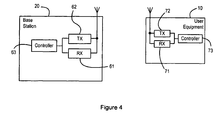
- FIG. 4 illustrates a mobile communications system in accordance with the present invention.
- FIG. 4 illustrates a part of a mobile communications network in accordance with an aspect of the present invention.
- FIG. 4 illustrates a user equipment (UE) 10 located in the coverage area of a radio base station 20 .
- the user equipment 10 is able to receive signals from the base station 20 .
- FIG. 4 shows only the parts of the user equipment 10 and the base station that are necessary for an explanation of the present invention.
- the user equipment 10 includes receiver circuitry (RX) 71 for receiving signals from the base station 20 , and transmit circuitry (TX) 72 for transmitting signals to the base station, with the receiver circuitry 71 and transmit circuitry 72 both operating under the control of a controller 73 .
- RX receiver circuitry
- TX transmit circuitry
- the base station 20 includes receiver circuitry (RX) 61 for receiving signals from the user equipment 10 , and transmit circuitry (TX) 62 for transmitting signals to the user equipment 10 , with the receiver circuitry 61 and transmit circuitry 62 both operating under the control of a controller 63 .
- RX receiver circuitry
- TX transmit circuitry
- the base station 20 is adopted for use in a network for receiving data using multiple transmit antennas in a multiple input multiple output (MIMO) transmission scenario, where more than one user can be scheduled simultaneously using the same physical resources but on different beams.
- MIMO multiple input multiple output
- the invention is not limited to MIMO, but may be employed in other systems, such as Single Input Multiple Output (SIMO), Multiple Input Single Output (MISO), etc.
- SIMO Single Input Multiple Output
- MISO Multiple Input Single Output
- the invention is applicable to any case where physical resources, especially non-orthogonal physical resources, are shared between multiple users.
- the network operates in accordance with a mobile communications standard, ensuring that the base station transmits data in a format that can be detected by the user equipment.
- the network is an E-UTRAN (Extended UMTS Terrestrial Radio Access Network) network.
- E-UTRAN Extended UMTS Terrestrial Radio Access Network
- the invention is also applicable to other communications standards such as WiMAX.
- HARQ ACK/NACK feedback signalling i.e. ACK/NACK
- T 2 the duration of receiving HARQ packet
- T 3 duration after which the receiver sends ACK/NACK to the transmitter
- the variable timing provides flexibility of achieving orthogonality conditions required by the MU-MIMO, without disrupting the HARQ operation.
- the duration limit of the HARQ should be satisfied even though T 2 and T 3 are varied, i.e. T 2 +T 3 ⁇ T 1 , where T 1 is the time after which the packet is retransmitted.
- the timing adjustment depends on whether HARQ is used in the uplink direction or in the downlink direction as described further.
- FIG. 2 shows the use of HARQ when data is being transmitted in the downlink.
- the packets (Block 1 . 1 ) are transmitted by the base station BS and the acknowledgement (ACK) and negative acknowledgement (NACK) messages are sent by the user equipment UE 1 , together with any other feedback such as CQI and code book information.
- ACK acknowledgement
- NACK negative acknowledgement
- T 1 There is a fixed retransmission duration, indicated by T 1 in FIG. 5 .
- T 2 The time taken for the UE to receive an HARQ protocol data unit (PDU) from the BS is indicated by T 2 in FIG. 3 , and T 3 indicates the duration of downlink scheduling (for ACK/NACK).
- PDU HARQ protocol data unit
- the timing of the messages is determined by the network.
- the UE sends ACK/NACK at a determined time T 3 ′ (T 3 ′ ⁇ T 3 ), where T 3 ′ is not standardized, but instead is dynamically set by the base station via scheduling of the uplink.
- the base station knows the weighting vectors (both uplink and downlink) of the UE to be scheduled, and the base station can therefore decide when the UE should send the ACK/NACK messages, to avoid a collision with other UEs.
- the UE can also send other feedback information e.g. CQI, code book with ACK/NACK at the base station determined timing, T 3 ′.
- CQI code book with ACK/NACK at the base station determined timing, T 3 ′.
- the timing T 3 ′ can be signalled by the base station to the UE separately with every data packet, or an initial timing T 3 ′ can be signalled by the base station to the UE, and that initial timing can then be used by the UE until or unless it is varied for any particular data packet.
- the timing of the messages is determined by the UE.
- the UE could send ACK/NACK at any time T 3 ′ within [ 0 , T 3 ], where the base station assigns uplink resources for ACK/NACK, which are valid over [ 0 , T 3 ].
- the base station can also tell the UE the loose time duration T 3 ′.
- UE decides when to send ACK/NACK but within the duration T 3 .
- the UE can also send other feedback information e.g. CQI, code book with together with ACK/NACK.
- FIG. 3 illustrates the operation of the invention in the case of the uplink synchronous HARQ protocol, i.e. where the packets (Block 1 . 1 ) are transmitted by the user equipment UE 1 and the acknowledgement (ACK) and negative acknowledgement (NACK) messages are sent by the base station BS on the downlink control channel.
- the packets Block 1 . 1
- the acknowledgement ACK
- NACK negative acknowledgement
- T 1 There is a fixed retransmission duration, indicated by T 1 in FIG. 3 .
- the time taken for BS to receive an HARQ protocol data unit (PDU) from UE 1 is indicated by T 2 in FIG. 3
- T 3 indicates the duration of downlink scheduling (for ACK/NACK) to UE 1 .
- the UE sends packets and the base station sends the ACK/NACK.
- ACK/NACK since ACK/NACK is sent by the base station, a loose timing solution is used.
- the base station sends ACK/NACK at any time T 3 ′ within [ 0 , T 3 ].
- This time T 3 ′ is determined by the base station based on the downlink orthogonal conditions due to MU-MIMO.
- the base station will send the ACK/NACK to the UE within [ 0 , T 3 ] as soon as the orthogonal condition is satisfied.
- this requirement could be made less onerous for the UE if the base station announced in advance a subrange of the time period [ 0 , T 3 ] within which it would send the ACK/NACK message.
- the base station could announce in advance whether it will send the ACK/NACK in the time period [ 0 , T 3 / 2 ], or in the time period [T 3 / 2 , T 3 ].
- the UE goes to continuous reception (non DRX) mode after first HARQ PDU reception irrespective of the service (i.e. also for VoIP).
- the UE can track the downlink control channel containing the ACK/NACK that could be sent at any sub-frame.
- the base station can vary a transmitted timing of HARQ feedback signalling and/or other necessary information, such that only users with orthogonal pre-coding vectors (W) are scheduled simultaneously, in order to reduce multi-user interference and to ensure that said feedback signalling is received by the transmitter before the start of the next retransmission.
- W orthogonal pre-coding vectors
Landscapes
- Engineering & Computer Science (AREA)
- Computer Networks & Wireless Communication (AREA)
- Signal Processing (AREA)
- Physics & Mathematics (AREA)
- Mathematical Physics (AREA)
- Mobile Radio Communication Systems (AREA)
Abstract
Description
-
- Single user MIMO
- Multi-user MIMO
-
- W1 is orthogonal pre-coding vector for UE1
- W2 is orthogonal pre-coding vector for UE2
- W3 is orthogonal pre-coding vector for UE3
IF
W1*W2′=0, W1*W3≠0
Then - UE1 and UE2 can be scheduled simultaneously
- UE3 cannot be scheduled with UE1 and UE2 simultaneously
T1>T2+T3.
T1>T2+T3.
-
- varying the transmitted timings of the HARQ feedback signaling and/or relevant information such that users with orthogonal pre-coding vectors (W) are scheduled simultaneously to reduce multi-user interference and said signalling is received by a transmitter before the start of the next retransmission,
- allocating or signaling a user equipment a time within which a user equipment is to transmit the HARQ feedback signaling and/or said relevant information, and
- detecting said HARQ feedback signaling and/or said relevant information sent by the user equipment within the allocated time duration.
-
- receiving a timing at which the uplink HARQ feedback signalling and/or relevant information is to be sent to the said base station,
- transmitting the uplink HARQ feedback or other relevant signaling according to the allocating, and
- detecting the reception of downlink HARQ feedback signaling and/or said relevant information that could be sent by the base station at any arbitrary time between the transmission and the retransmission or between successive retransmissions.
-
- The orthogonal conditions required by MU-MIMO are satisfied.
- Multi-user interference is reduced and MU-MIMO gain is retained.
- Base station determines the tight time for each UE to send ACK/NACK. This could be done via uplink scheduling signaling
- It is easy to satisfy orthogonal transmission conditions this would require more processing at the base station if ACK/NACK are to be received from many UE.
- This solution works well for slow pre-coding during the transmission time T1, i.e. time between transmission and retransmission. This is because the base station needs to know the pre-coding vectors of the UE in both uplink and downlink.
- Both base station and UE may contribute to satisfy the timing conditions, i.e. either transmitter timing (T2) or receiver feedback timing/(T2) could be adjusted while satisfying: T1>T2+T3.
- UE has some flexibility to determine when to send.
- It is suitable for fast pre-coding during transmission time T1
- Pre-coding vector for some UE can vary during T1
Claims (33)
Applications Claiming Priority (4)
| Application Number | Priority Date | Filing Date | Title |
|---|---|---|---|
| SE0701042 | 2007-04-30 | ||
| SE0701042 | 2007-04-30 | ||
| SE0701042-4 | 2007-04-30 | ||
| PCT/EP2008/003534 WO2008131971A1 (en) | 2007-04-30 | 2008-04-30 | Method and arrangement relating to communications network |
Publications (2)
| Publication Number | Publication Date |
|---|---|
| US20100146358A1 US20100146358A1 (en) | 2010-06-10 |
| US8352822B2 true US8352822B2 (en) | 2013-01-08 |
Family
ID=39744854
Family Applications (1)
| Application Number | Title | Priority Date | Filing Date |
|---|---|---|---|
| US12/596,509 Expired - Fee Related US8352822B2 (en) | 2007-04-30 | 2008-04-30 | Method and arrangement relating to communications network |
Country Status (4)
| Country | Link |
|---|---|
| US (1) | US8352822B2 (en) |
| EP (1) | EP2143227A1 (en) |
| JP (1) | JP5485870B2 (en) |
| WO (1) | WO2008131971A1 (en) |
Cited By (1)
| Publication number | Priority date | Publication date | Assignee | Title |
|---|---|---|---|---|
| US20140201586A1 (en) * | 2011-06-15 | 2014-07-17 | Nokia Solutions And Networks Oy | Latency |
Families Citing this family (11)
| Publication number | Priority date | Publication date | Assignee | Title |
|---|---|---|---|---|
| CN101902777B (en) * | 2009-05-26 | 2014-06-11 | 中兴通讯股份有限公司 | Hybrid automatic repeat request (HARQ) method and base station equipment |
| US8547918B2 (en) * | 2009-11-17 | 2013-10-01 | Qualcomm Incorporated | Multiple-user multiple-input and multiple-output for high-speed packet access systems |
| US8705340B2 (en) | 2009-12-23 | 2014-04-22 | Intel Corporation | Packet-loss handling for downlink multi-user multiple-input and multiple-output wireless network |
| EP2662993A2 (en) * | 2011-01-03 | 2013-11-13 | LG Electronics Inc. | Method for receiving multicast data in m2m device included in wireless communication system and m2m device therefor |
| EP2675211A4 (en) * | 2011-02-10 | 2017-06-21 | Fujitsu Limited | Response method, communication system and communication device |
| US9374845B2 (en) * | 2012-05-18 | 2016-06-21 | Qualcomm Incorporated | Method and apparatus for joint HARQ and DRX optimization for low cost MTC devices |
| JP6208325B2 (en) * | 2014-03-07 | 2017-10-04 | 株式会社東芝 | Wireless communication apparatus and wireless communication method |
| PL3353931T3 (en) * | 2015-09-21 | 2020-02-28 | Telefonaktiebolaget Lm Ericsson (Publ) | Methods and apparatuses for controlling timing of feedback transmissions |
| WO2019095296A1 (en) * | 2017-11-17 | 2019-05-23 | 北京小米移动软件有限公司 | Hybrid automatic repeat request feedback indication and feedback method, device, and base station |
| CN110677222B (en) * | 2018-07-03 | 2022-04-05 | 大唐移动通信设备有限公司 | HARQ feedback method and device for PDSCH repeated transmission |
| US11658776B2 (en) * | 2019-11-08 | 2023-05-23 | Semiconductor Components Industries, Llc | Feedback and retransmission format of HARQ protocol |
Citations (20)
| Publication number | Priority date | Publication date | Assignee | Title |
|---|---|---|---|---|
| EP1263168A2 (en) | 2001-05-29 | 2002-12-04 | Kabushiki Kaisha Toshiba | Wireless communication apparatus |
| JP2003179581A (en) | 2001-08-22 | 2003-06-27 | Matsushita Electric Ind Co Ltd | Transmitter, receiver and ARQ transmission / reception method |
| US20040136349A1 (en) | 2002-10-25 | 2004-07-15 | Walton J. Rodney | MIMO system with multiple spatial multiplexing modes |
| WO2005015848A1 (en) | 2003-08-08 | 2005-02-17 | Intel Corporation | Back-end alignment to avoid sdma ack time-out |
| US20050147023A1 (en) | 2003-12-30 | 2005-07-07 | Intel Corporation | Method and apparatus for implementing downlink SDMA in a wireless network |
| US20050251721A1 (en) * | 2004-05-04 | 2005-11-10 | Telefonaktiebolaget Lm Ericsson(Publ) | Incremental redundancy operation in a wireless communication network |
| US20050276266A1 (en) * | 2004-06-10 | 2005-12-15 | Interdigital Technology Corporation | Method and apparatus for dynamically adjusting data transmission parameters and controlling H-ARQ processes |
| EP1662712A1 (en) | 2004-11-24 | 2006-05-31 | Lucent Technologies Inc. | Wireless communication between an access point and multiple devices |
| WO2006102469A1 (en) | 2005-03-21 | 2006-09-28 | Qualcomm Incorporated | Method and apparatus for improving data transmission reliability in a wireless communications system |
| US20070223422A1 (en) * | 2006-03-20 | 2007-09-27 | Byoung-Hoon Kim | Resource allocation to support single-user and multi-user mimo transmission |
| US20070245201A1 (en) * | 2006-03-21 | 2007-10-18 | Interdigital Technology Corporation | Method and system for implementing hybrid automatic repeat request |
| US20070255993A1 (en) * | 2004-09-13 | 2007-11-01 | Matsushita Electric Industrial Co., Ltd | Automatic Retransmission Request Control System and Retransmission Method in Memo-Ofdm System |
| US20080059859A1 (en) * | 2006-08-21 | 2008-03-06 | Interdigital Technology Corporation | Method and apparatus for dynamically allocating harq processes in the uplink |
| US20080225822A1 (en) * | 2007-03-14 | 2008-09-18 | Interdigital Technology Corporation | Transmission of ack/nack and transmit power control feedback in evolved utra |
| US20080233964A1 (en) * | 2007-03-19 | 2008-09-25 | Freescale Semiconductor, Inc. | Uplink control channel allocation |
| US20080273610A1 (en) * | 2006-08-21 | 2008-11-06 | Durga Prasad Malladi | Method and apparatus for random access in an orthogonal multiple-access communication system |
| US20090022098A1 (en) * | 2005-10-21 | 2009-01-22 | Robert Novak | Multiplexing schemes for ofdma |
| US20090116434A1 (en) * | 2006-02-03 | 2009-05-07 | Matsushita Electric Industrial Co., Ltd. | Uplink resource allocation in a mobile communication system |
| US20100110878A1 (en) * | 2007-01-08 | 2010-05-06 | Nokia Corporation | Method and apparatus for providing control signaling |
| US20100238870A1 (en) * | 2006-06-20 | 2010-09-23 | Diptendu Mitra | Communication system |
Family Cites Families (2)
| Publication number | Priority date | Publication date | Assignee | Title |
|---|---|---|---|---|
| JP2002325080A (en) * | 2001-04-26 | 2002-11-08 | Sharp Corp | Communications system |
| JP2006303665A (en) * | 2005-04-18 | 2006-11-02 | Matsushita Electric Ind Co Ltd | Wireless terminal control method |
-
2008
- 2008-04-30 WO PCT/EP2008/003534 patent/WO2008131971A1/en not_active Ceased
- 2008-04-30 US US12/596,509 patent/US8352822B2/en not_active Expired - Fee Related
- 2008-04-30 JP JP2010504580A patent/JP5485870B2/en not_active Expired - Fee Related
- 2008-04-30 EP EP08749281A patent/EP2143227A1/en not_active Withdrawn
Patent Citations (21)
| Publication number | Priority date | Publication date | Assignee | Title |
|---|---|---|---|---|
| EP1263168A2 (en) | 2001-05-29 | 2002-12-04 | Kabushiki Kaisha Toshiba | Wireless communication apparatus |
| JP2003179581A (en) | 2001-08-22 | 2003-06-27 | Matsushita Electric Ind Co Ltd | Transmitter, receiver and ARQ transmission / reception method |
| US7339949B2 (en) | 2001-08-22 | 2008-03-04 | Matsushita Electric Industrial Co., Ltd. | ARQ transmission and reception methods and apparatus |
| US20040136349A1 (en) | 2002-10-25 | 2004-07-15 | Walton J. Rodney | MIMO system with multiple spatial multiplexing modes |
| WO2005015848A1 (en) | 2003-08-08 | 2005-02-17 | Intel Corporation | Back-end alignment to avoid sdma ack time-out |
| US20050147023A1 (en) | 2003-12-30 | 2005-07-07 | Intel Corporation | Method and apparatus for implementing downlink SDMA in a wireless network |
| US20050251721A1 (en) * | 2004-05-04 | 2005-11-10 | Telefonaktiebolaget Lm Ericsson(Publ) | Incremental redundancy operation in a wireless communication network |
| US20050276266A1 (en) * | 2004-06-10 | 2005-12-15 | Interdigital Technology Corporation | Method and apparatus for dynamically adjusting data transmission parameters and controlling H-ARQ processes |
| US20070255993A1 (en) * | 2004-09-13 | 2007-11-01 | Matsushita Electric Industrial Co., Ltd | Automatic Retransmission Request Control System and Retransmission Method in Memo-Ofdm System |
| EP1662712A1 (en) | 2004-11-24 | 2006-05-31 | Lucent Technologies Inc. | Wireless communication between an access point and multiple devices |
| WO2006102469A1 (en) | 2005-03-21 | 2006-09-28 | Qualcomm Incorporated | Method and apparatus for improving data transmission reliability in a wireless communications system |
| US20090022098A1 (en) * | 2005-10-21 | 2009-01-22 | Robert Novak | Multiplexing schemes for ofdma |
| US20090116434A1 (en) * | 2006-02-03 | 2009-05-07 | Matsushita Electric Industrial Co., Ltd. | Uplink resource allocation in a mobile communication system |
| US20070223422A1 (en) * | 2006-03-20 | 2007-09-27 | Byoung-Hoon Kim | Resource allocation to support single-user and multi-user mimo transmission |
| US20070245201A1 (en) * | 2006-03-21 | 2007-10-18 | Interdigital Technology Corporation | Method and system for implementing hybrid automatic repeat request |
| US20100238870A1 (en) * | 2006-06-20 | 2010-09-23 | Diptendu Mitra | Communication system |
| US20080273610A1 (en) * | 2006-08-21 | 2008-11-06 | Durga Prasad Malladi | Method and apparatus for random access in an orthogonal multiple-access communication system |
| US20080059859A1 (en) * | 2006-08-21 | 2008-03-06 | Interdigital Technology Corporation | Method and apparatus for dynamically allocating harq processes in the uplink |
| US20100110878A1 (en) * | 2007-01-08 | 2010-05-06 | Nokia Corporation | Method and apparatus for providing control signaling |
| US20080225822A1 (en) * | 2007-03-14 | 2008-09-18 | Interdigital Technology Corporation | Transmission of ack/nack and transmit power control feedback in evolved utra |
| US20080233964A1 (en) * | 2007-03-19 | 2008-09-25 | Freescale Semiconductor, Inc. | Uplink control channel allocation |
Non-Patent Citations (5)
| Title |
|---|
| IEEE Standard 802.16-2004 "IEEE Standard for Local and metropolitan area networks; Part 16: Air Interface for Fixed Broadband Wireless Access Systems", IEEE Computer Society and IEEE Microwave Theory and Techniques Society, Oct. 1, 2004, pp. 1-892. |
| International Preliminary Report on Patentability for PCT/EP2008/003534 dated Jun. 23, 2009. |
| International Search Report for PCT/EP2008/003534 dated Oct. 9, 2008. |
| LG Electronics; "Consideration on control signalling for MIMO-HARQ in E-UTRA downlink"; 3rd Generation Partnership Project (3GPP) TSG RAN WG1 Meeting #48bis; R1-071556; Mar. 26-30, 2007; pp. 2-6/E; St. Julians, Malta. |
| Wei, N., et al., "Performance of MIMO with Frequency Domain Packet Scheduling in UTRAN LTE Downlink," Vehicular Technology Conference, 2007, IEEE, Apr. 1, 2007, XP031092815, pp. 1177-1181. |
Cited By (1)
| Publication number | Priority date | Publication date | Assignee | Title |
|---|---|---|---|---|
| US20140201586A1 (en) * | 2011-06-15 | 2014-07-17 | Nokia Solutions And Networks Oy | Latency |
Also Published As
| Publication number | Publication date |
|---|---|
| EP2143227A1 (en) | 2010-01-13 |
| US20100146358A1 (en) | 2010-06-10 |
| JP2010525705A (en) | 2010-07-22 |
| WO2008131971A1 (en) | 2008-11-06 |
| JP5485870B2 (en) | 2014-05-07 |
Similar Documents
| Publication | Publication Date | Title |
|---|---|---|
| US8352822B2 (en) | Method and arrangement relating to communications network | |
| US20220116989A1 (en) | Methods and Devices for Scheduling Group Uplink Communication | |
| EP2936699B1 (en) | Mobile device assisted coordinated multipoint transmission and reception | |
| US9143282B2 (en) | Uplink hybrid-ARQ mechanism for cooperative base stations | |
| CN112118078B (en) | Terminal, communication system and feedback method | |
| EP2595442B1 (en) | Coordinated signaling of scheduling information for uplink and downlink communications | |
| US8335267B2 (en) | Mobile station and a base station | |
| JP5657006B2 (en) | HARQ protocol for relay backhaul uplink | |
| US9204429B2 (en) | Method and apparatus for adjusting HARQ timing | |
| US8817636B2 (en) | Method, system, and equipment for information processing | |
| JP4966409B2 (en) | Method and apparatus in communication system | |
| EP1871131B1 (en) | Mobile communication system, mobile station, base station, and communication control method | |
| NO336777B1 (en) | Wireless Communication Method and Device Coordinating Node-Bs and Supporting Enhanced Uplink Transfers | |
| KR20100108514A (en) | Wireless communication base station device, wireless communication relay device, wireless communication terminal device, packet retransmission method, and wireless communication system | |
| EP2467963A1 (en) | Introducing a delay in the transmission of a nack for a packet received employing coordinated multi-point transmission | |
| EP2929634B1 (en) | Method and apparatus for selectively transmitting data using spatial diversity | |
| CN104040906A (en) | Method and device for performing and controlling retransmission | |
| WO2009152673A1 (en) | A method and a system for implementing the uplink hybrid automatic retransmission request | |
| CN102916792B (en) | Data transmission method and subscriber equipment | |
| US20210021379A1 (en) | Base station and automatic retransmission scheduling method thereof | |
| WO2016183733A1 (en) | User equipment, access network device, and method for sending and receiving uplink control information |
Legal Events
| Date | Code | Title | Description |
|---|---|---|---|
| AS | Assignment |
Owner name: TELEFONAKTIEBOLAGET L M ERICSSON (PUBL),SWEDEN Free format text: ASSIGNMENT OF ASSIGNORS INTEREST;ASSIGNORS:KAZMI, MUHAMMAD;LIAO, JINGYI;SIGNING DATES FROM 20091020 TO 20091023;REEL/FRAME:023476/0968 Owner name: TELEFONAKTIEBOLAGET L M ERICSSON (PUBL), SWEDEN Free format text: ASSIGNMENT OF ASSIGNORS INTEREST;ASSIGNORS:KAZMI, MUHAMMAD;LIAO, JINGYI;SIGNING DATES FROM 20091020 TO 20091023;REEL/FRAME:023476/0968 |
|
| STCF | Information on status: patent grant |
Free format text: PATENTED CASE |
|
| FPAY | Fee payment |
Year of fee payment: 4 |
|
| MAFP | Maintenance fee payment |
Free format text: PAYMENT OF MAINTENANCE FEE, 8TH YEAR, LARGE ENTITY (ORIGINAL EVENT CODE: M1552); ENTITY STATUS OF PATENT OWNER: LARGE ENTITY Year of fee payment: 8 |
|
| FEPP | Fee payment procedure |
Free format text: MAINTENANCE FEE REMINDER MAILED (ORIGINAL EVENT CODE: REM.); ENTITY STATUS OF PATENT OWNER: LARGE ENTITY |
|
| LAPS | Lapse for failure to pay maintenance fees |
Free format text: PATENT EXPIRED FOR FAILURE TO PAY MAINTENANCE FEES (ORIGINAL EVENT CODE: EXP.); ENTITY STATUS OF PATENT OWNER: LARGE ENTITY |
|
| STCH | Information on status: patent discontinuation |
Free format text: PATENT EXPIRED DUE TO NONPAYMENT OF MAINTENANCE FEES UNDER 37 CFR 1.362 |
|
| FP | Lapsed due to failure to pay maintenance fee |
Effective date: 20250108 |