US8345633B2 - Method of identification of a femtocell base station as a handover target, and apparatus therefor - Google Patents
Method of identification of a femtocell base station as a handover target, and apparatus therefor Download PDFInfo
- Publication number
- US8345633B2 US8345633B2 US12/635,239 US63523909A US8345633B2 US 8345633 B2 US8345633 B2 US 8345633B2 US 63523909 A US63523909 A US 63523909A US 8345633 B2 US8345633 B2 US 8345633B2
- Authority
- US
- United States
- Prior art keywords
- femtocell base
- base station
- base stations
- neighbour
- timing information
- Prior art date
- Legal status (The legal status is an assumption and is not a legal conclusion. Google has not performed a legal analysis and makes no representation as to the accuracy of the status listed.)
- Expired - Fee Related, expires
Links
Images




Classifications
-
- H—ELECTRICITY
- H04—ELECTRIC COMMUNICATION TECHNIQUE
- H04W—WIRELESS COMMUNICATION NETWORKS
- H04W36/00—Hand-off or reselection arrangements
- H04W36/0005—Control or signalling for completing the hand-off
- H04W36/0083—Determination of parameters used for hand-off, e.g. generation or modification of neighbour cell lists
- H04W36/0085—Hand-off measurements
-
- H—ELECTRICITY
- H04—ELECTRIC COMMUNICATION TECHNIQUE
- H04W—WIRELESS COMMUNICATION NETWORKS
- H04W36/00—Hand-off or reselection arrangements
- H04W36/0005—Control or signalling for completing the hand-off
- H04W36/0083—Determination of parameters used for hand-off, e.g. generation or modification of neighbour cell lists
- H04W36/00837—Determination of triggering parameters for hand-off
- H04W36/008375—Determination of triggering parameters for hand-off based on historical data
-
- H—ELECTRICITY
- H04—ELECTRIC COMMUNICATION TECHNIQUE
- H04W—WIRELESS COMMUNICATION NETWORKS
- H04W16/00—Network planning, e.g. coverage or traffic planning tools; Network deployment, e.g. resource partitioning or cells structures
- H04W16/14—Spectrum sharing arrangements between different networks
- H04W16/16—Spectrum sharing arrangements between different networks for PBS [Private Base Station] arrangements
-
- H—ELECTRICITY
- H04—ELECTRIC COMMUNICATION TECHNIQUE
- H04W—WIRELESS COMMUNICATION NETWORKS
- H04W36/00—Hand-off or reselection arrangements
- H04W36/04—Reselecting a cell layer in multi-layered cells
-
- H—ELECTRICITY
- H04—ELECTRIC COMMUNICATION TECHNIQUE
- H04W—WIRELESS COMMUNICATION NETWORKS
- H04W84/00—Network topologies
- H04W84/02—Hierarchically pre-organised networks, e.g. paging networks, cellular networks, WLAN [Wireless Local Area Network] or WLL [Wireless Local Loop]
- H04W84/04—Large scale networks; Deep hierarchical networks
- H04W84/042—Public Land Mobile systems, e.g. cellular systems
- H04W84/045—Public Land Mobile systems, e.g. cellular systems using private Base Stations, e.g. femto Base Stations, home Node B
Definitions
- the present invention relates to telecommunications, in particular to wireless telecommunications.
- Wireless telecommunications systems are well-known. Many such systems are cellular, in that radio coverage is provided by a bundle of radio coverage areas known as cells. A base station that provides radio coverage is located in each cell. Traditional base stations provide coverage in relatively large geographic areas and the corresponding cells are often referred to as macrocells.
- femtocells Cells that are smaller than macrocells are sometimes referred to as microcells, picocells, or femtocells, but we use the term femtocells generically for cells that are smaller than macrocells.
- One way to establish a femtocell is to provide a femtocell base station that operates within a relatively limited range within the coverage area of a macrocell.
- One example of use of a femtocell base station is to provide wireless communication coverage within a building.
- the femtocell base station is of a relatively low transmit power and hence each femtocell is of a small coverage area compared to a macrocell.
- Femtocell base stations are intended primarily for users belonging to a particular home or office. Femtocell base stations may be private access or public access. In femtocell base stations that are private access, access is restricted only to registered users, for example family members or particular groups of employees. In femtocell base stations that are public access, other users may also use the femtocell base station, subject to certain restrictions to protect the Quality of Service received by registered users.
- One known type of Femtocell base station uses a broadband Internet Protocol connection “backhaul”, namely for connecting to the core network.
- One type of broadband Internet Protocol connection is a Digital Subscriber Line (DSL).
- the DSL connects a DSL transmitter-receiver (“transceiver”) of the femtocell base station to the core network.
- the DSL allows voice calls and other services provided via the femtocell base station to be supported.
- the femtocell base station also includes a radio frequency (RF) transceiver connected to an antenna for radio communications.
- RF radio frequency
- Femtocell base stations are sometimes referred to as femtos.
- PSCs primary scrambling codes
- a femto detects from received signals which PSCs are in use around the femto, and selects a PSC that the femto has not detected as being in use, else selects the PSC of the weakest signal received.
- user terminals currently in a cell, report measurements, to the base station of that cell, that the user terminals have made as to signals received from other nearby base stations. This is so as to determine whether it is appropriate to handover the call connection with the user terminal from that cell to another cell from which a stronger signal is received.
- a known approach is to seek to handover to all of the femtocells that are identified as having the primary scrambling code of the best received signal. This is inefficient because only one of the handover attempts is permitted to succeed. Network resources that are used in the handover attempts to the other femtocells than the one that is successful, are wasted.
- a method is provided of identifying which one of a plurality of femtocell base stations neighbouring a first base station is to be the target for handover of a call connection with a user terminal from the first base station, the femtocell base stations using code-division multiple access, CDMA, wherein the neighbour femtocell base stations use the same primary scrambling code as each other;
- each of the neighbour femtocell base stations transmitting a respective broadcast signal that include timing information such that each neighbour femtocell base station transmits a respective broadcast signal having different timing information to that of the other neighbour femtocell base stations;
- the user terminal receiving at least one of the broadcast signals
- the first base station being a first femtocell base station
- the user terminal determining the timing information of at least one of the received broadcast signals and reporting the timing information to the first femtocell base station;
- the first femtocell base station identifying the target femtocell base station for handover from the timing information.
- the inventors found a way to differentiate neighbour femtocell base stations that use the same Primary scrambling code as each other by considering differences in timing applied to signals on their broadcast channels. This enables a best neighbour handover candidate to be uniquely identified.
- a measurement report from a user terminal provides the identifying timing information.
- Preferred embodiments enable a neighbour femtocell base station to be uniquely identified for handover despite the Primary scrambling code “reuse” that occurs in femtocell base station deployments. This reduces the resources used in signalling as part of handover attempts to multiple neighbours, only one of which will be successful. Accordingly, in preferred embodiments, delays and blocked or dropped calls are reduced.
- a femtocell base station can only handle a few calls at a time, the reduced chance of calls being blocked is particularly significant.
- FIG. 1 is a diagram illustrating a wireless communications network according to an embodiment of the present invention
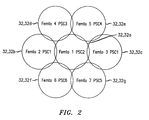
- FIG. 2 is a diagram illustrating allocation of primary scrambling codes to femtocells in the network shown in FIG. 1 ,
- FIG. 3 is a diagram illustrating one of the femtocell base stations shown in FIGS. 1 and 2 .
- FIG. 4 is a diagram illustrating an example of a handover candidate femtocell being identified amongst the femtocells shown in FIG. 2 that use the same primary scrambling code.
- BS base stations
- macrocell base stations there are two types of base stations (often denoted BS or BSs): macrocell base stations and femtocell base stations.
- BS base station
- One macrocell base station 22 for wireless telecommunications is shown for simplicity in FIG. 1 .
- the macrocell base station has a radio coverage area 24 that is often referred to as a macrocell.
- the geographic extent of the macrocell 24 depends on the capabilities of the macrocell base station 22 and the surrounding geography.
- each femtocell base station 30 provides wireless communications within a corresponding femtocell 32 .
- a femtocell is a radio coverage area. The radio coverage area of the femtocell 32 is much less than that of the macrocell 24 .
- the femtocell 32 corresponds in size to a user's home.
- FIG. 1 three femtocell base stations 30 and corresponding femtocells 32 are shown for simplicity.
- a mobile terminal 34 within the macrocell 24 it is possible for a mobile terminal 34 within the macrocell 24 to communicate with the macrocell base station 22 in known manner.
- the mobile terminal 34 enters into a femtocell 32 for which the mobile terminal is registered for communications within the femtocell base station 30 , it is desirable to handover the connection with the mobile terminal from the macrocell to the femtocell.
- the user of mobile terminal 34 is a preferred user of the nearest 32 ′ of the femtocells 32 .
- the femtocell base stations 30 are connected via broadband Internet Protocol connections (“backhaul”) 36 to a core network (not shown in FIG. 1 ) and hence the rest of the telecommunications “world” (not shown in FIG. 1 ).
- the “backhaul” connections 36 allow communications between the femtocell base stations 30 through the core network (not shown).
- the macrocell base station is also connected to the core network (not shown).
- the femtocells 32 provide contiguous coverage, for example within an office building, and have six available primary scrambling codes. As shown in FIG. 2 , in this example, these six codes, denoted PSC 1 ,PSC 2 , . . . , PSC 6 are distributed so as to avoid neighbouring cells having the same primary scrambling a first femtocell 32 a uses code PSC 2 , and has six neighbouring femtos. Of these, two femtocells 32 b , 32 c that neighbour the first femtocell 32 a use the same code PSC 1 as each other.
- femtocell 32 d uses PSC 3
- femtocell 32 e uses PSC 4
- femtocell 32 f uses PSC 6
- femtocell 32 g uses PSC 5 .
- the femtocell base station 30 consists of a radio transmitter-receiver, sometimes referred to as a radio transceiver 40 .
- the radio transceiver 40 is connected to a broadcast channel (BCH) signal generator 42 .
- the broadcast signal generator 42 includes a Cell System Frame Number (SFN) generator 44 , and Primary scrambling code (PSC) information 46 .
- the SFN generator is connected to a clock-setting stage 48 that is connected to a backhaul transceiver 50 .
- the backhaul transceiver is connected to a backhaul line 56 , for example one using Internet Protocol and connected to the Internet (not shown).
- the radio transceiver 40 is also connected to a processor 52 of measurement reports received from a user terminal 34 .
- the processor 52 is also connected to an identifier 54 of a handover target femtocell base station.
- the BCH signal generator 42 sends broadcast signals that include both Primary scrambling code and current System Frame Number (SFN).
- SFN is a clock signal that increments from 0 to 255 every 10 mS, then repeats.
- the SFN has a timing offset which is set by the clock-setting stage 48 that receives a clock adjustment control signal via the backhaul line 56 and backhaul transceiver 50 from a central control node (not shown) which is part of the core network (not shown).
- each femtocell base station is assigned a timing offset by the central control node, and also receives, from the central node, information of timing offsets of neighbouring femtocell base stations, in addition to their corresponding scrambling codes and cell identities (Cell IDs).
- Cell IDs scrambling codes and cell identities
- the central control node gives different timing offsets to femtocell base stations.
- femtocell base stations that have the same Primary scrambling code and are within a group of neighbouring, handover candidate, femtocells are assigned different timing offsets.
- the user terminal 34 is connected to the femtocell base station 30 .
- the user terminal 34 acts to monitor signals having other Primary scrambling codes than the Primary scrambling code of the femtocell base station to which it is connected.
- the user terminal 34 is instructed to send a measurement report when a signal having another Primary scrambling code is received with a sufficiently high quality as to be suitable for handover.
- the measurement report includes information on the timing difference between the “source” femtocell base station and the particular potential “target” femtocell base station.
- This timing difference is directly related to the difference between the offset applied to the Sequence Frame Number (SFN) in the source femtocell base station and the offset applied to the SFN in the potential target femtocell base station.
- SFN Sequence Frame Number
- three of the femtocells 32 a , 32 b , 32 c are such that the first femtocell base station 30 a is the controlling (“source”) femtocell base station for user terminal 34 and uses Primary scrambling code PSC 2 .
- Two femtocell base stations 30 b , 30 c are neighbours to the first femtocell base station 30 a and use the same Primary scrambling code, namely PSC 1 .
- the femtocell base stations have different timing offsets set by the central control node against a known time point.
- second femtocell 30 b has an offset of 128 frames, which is 1280 mS, because 1 frame lasts 10 milliseconds, in similar fashion, first femtocell base station 30 a has an offset of 5, which corresponds to 50 mS.
- Third femtocell base station 30 c has an offset of 30, which corresponds to 300 mS.
- the user terminal 34 Upon receiving a signal of sufficient quality that includes Primary scrambling code PSC 1 , the user terminal 34 sends a measurement report to the first femtocell base station 30 a that indicates that a received signal with PSC 1 had become the strongest of the received signals from the monitored set of neighbouring femtocells base stations, so handover is appropriate.
- the first femtocell base station 30 a then takes the timing difference recorded in the measurement report and compares that against the information that it has received from the central node and stored as to the timing offsets assigned to its neighbouring femtocell base stations.
- each femtocell upon booting-up, sets the timing offset applied to SFN by selecting the offset randomly from between 0 and 255 seconds. Due to this randomness, there is a likelihood that two neighbouring femtocell base stations that use the same Primary scrambling code have sufficiently different timings to allow a confident identification of which is the correct best handover candidate.
- One option in this scenario is that the first femtocell base station will query the neighbour as to its timing offset using so-called “layer 3 ” signalling of known type. Specifically, the first femtocell base station knows its own timing offset and queries the neighbouring femtocell base stations as to their timing offsets.
- the first femtocell base station determines timing offsets by receiving broadcast signals from neighbours. Specifically, the first femtocell base station measure the timing offset of a neighbour femtocell base station directly, for example by switching its receiver to monitor the broadcast signal of neighbour, and comparing the measured timing with its own timing so as to calculate the timing offset of the neighbour. In this situation, the first femtocell base station may also decode a Cell ID in a received broadcast signal. The Cell ID uniquely identifies the neighbour that sent the signal. Accordingly, the first femtocell base station associates the measured timing offset of the neighbour with the neighbour's Cell ID. In accordance with current UMTS standards, user terminals do not report Cell ID, but a femtocell base station may.
- femtocell base stations randomly select their own timing offsets from within the range 0 to 2.55 seconds, is learning the timing offsets of neighbour femtocell base stations from measurement reports provided by user terminals and history as to handover success.
- the first (“source”) femtocell base station having a set of neighbouring base stations using the same Primary scrambling code as each other, attempts to handover a call connection to a user terminal to each of the neighbouring base stations.
- the “source” femtocell base station Upon one of the handover attempts being successful, the “source” femtocell base station records the measurement report from the user terminal that the “source” femtocell base station received just prior to the handover.
- the “source” femtocell base station considers the value of timing offset calculated from that measurement report as the timing offset of the neighbouring base station to which the handover was successful. Importantly, upon a further measurement report from a user terminal providing a timing offset that is close to this value, the source femtocell base station then makes, as a first choice, a handover attempt to this neighbour femtocell base station; in other words, this neighbour femtocell base station is considered the handover “target”.
Landscapes
- Engineering & Computer Science (AREA)
- Computer Networks & Wireless Communication (AREA)
- Signal Processing (AREA)
- Mobile Radio Communication Systems (AREA)
Abstract
Description
Claims (12)
Applications Claiming Priority (3)
| Application Number | Priority Date | Filing Date | Title |
|---|---|---|---|
| EP08291190A EP2197228B1 (en) | 2008-12-12 | 2008-12-12 | Method of identification of a femtocell base station as a handover target, and apparatus therefore |
| EP08291190 | 2008-12-12 | ||
| EP08291190.0 | 2008-12-12 |
Publications (2)
| Publication Number | Publication Date |
|---|---|
| US20100150109A1 US20100150109A1 (en) | 2010-06-17 |
| US8345633B2 true US8345633B2 (en) | 2013-01-01 |
Family
ID=40600253
Family Applications (1)
| Application Number | Title | Priority Date | Filing Date |
|---|---|---|---|
| US12/635,239 Expired - Fee Related US8345633B2 (en) | 2008-12-12 | 2009-12-10 | Method of identification of a femtocell base station as a handover target, and apparatus therefor |
Country Status (4)
| Country | Link |
|---|---|
| US (1) | US8345633B2 (en) |
| EP (1) | EP2197228B1 (en) |
| CN (1) | CN101754303B (en) |
| AT (1) | ATE528938T1 (en) |
Cited By (6)
| Publication number | Priority date | Publication date | Assignee | Title |
|---|---|---|---|---|
| US20110125510A1 (en) * | 2009-11-20 | 2011-05-26 | Alcatel-Lucent | Femtocell base station, and a method of controlling a femtocell base station |
| US20110306324A1 (en) * | 2010-06-14 | 2011-12-15 | Samsung Electronics Co., Ltd. | Communication method of a mobile terminal and method of advertising to a mobile terminal |
| US9479978B2 (en) | 2011-10-18 | 2016-10-25 | Broadcom Corporation | Method for determining a handover between a macrocell and a femtocell |
| US9603087B2 (en) | 2011-10-18 | 2017-03-21 | Broadcom Corporation | Green femtocells and methods of implementing the same |
| US9699696B2 (en) | 2014-06-09 | 2017-07-04 | Cisco Technology, Inc. | System and method for providing handover to an ambiguous small cell access point in a network environment |
| US9807652B2 (en) | 2014-06-09 | 2017-10-31 | Cisco Technology, Inc. | System and method for providing handover to an ambiguous small cell access point in a network environment |
Families Citing this family (46)
| Publication number | Priority date | Publication date | Assignee | Title |
|---|---|---|---|---|
| US9204349B2 (en) * | 2009-02-10 | 2015-12-01 | Qualcomm Incorporated | Method and apparatus for facilitating a hand-in of user equipment to femto cells |
| US8666417B2 (en) * | 2009-03-16 | 2014-03-04 | Motorola Mobility Llc | Method and apparatus for distinguishing cells with the same physical cell identifier |
| GB2472595B (en) * | 2009-08-11 | 2012-01-11 | Ubiquisys Ltd | Creating neighbour cell lists |
| US9392562B2 (en) | 2009-11-17 | 2016-07-12 | Qualcomm Incorporated | Idle access terminal-assisted time and/or frequency tracking |
| US9642105B2 (en) | 2009-11-17 | 2017-05-02 | Qualcomm Incorporated | Access terminal-assisted time and/or frequency tracking |
| US8331929B2 (en) | 2009-11-24 | 2012-12-11 | At&T Mobility Ii Llc | Mobility-based reselection scan scheduling |
| CN102301804B (en) * | 2010-01-08 | 2014-01-08 | 联发科技股份有限公司 | Uplink synchronization method, mobile station and base station |
| US9271248B2 (en) | 2010-03-02 | 2016-02-23 | Qualcomm Incorporated | System and method for timing and frequency synchronization by a Femto access point |
| US20120309394A1 (en) * | 2010-09-16 | 2012-12-06 | Qualcomm Incorporated | Apparatus and methods for hand-in to a femto node |
| US9756553B2 (en) | 2010-09-16 | 2017-09-05 | Qualcomm Incorporated | System and method for assisted network acquisition and search updates |
| US9137713B2 (en) | 2010-09-16 | 2015-09-15 | Qualcomm Incorporated | Apparatus and methods of hand-in to a femto node |
| EP2620023B1 (en) * | 2010-09-21 | 2018-02-28 | Telefonaktiebolaget LM Ericsson (publ) | Air-interface timing synchronization sharing |
| US20120071200A1 (en) * | 2010-09-22 | 2012-03-22 | Infineon Technologies Ag | Method and device for selecting a serving base station, mobile communication network, base station, and method for determining transmission characteristics |
| US8606322B2 (en) * | 2010-10-25 | 2013-12-10 | Raytheon Applied Signal Technology, Inc. | Portable cellular base station configuration |
| US8588853B2 (en) | 2010-10-25 | 2013-11-19 | Raytheon Applied Signal Technology, Inc. | Femtocell configuration |
| US8385917B2 (en) | 2010-11-15 | 2013-02-26 | At&T Mobility Ii Llc | Radio selection employing transit data determined from kinetic energy generation |
| CN102026316B (en) * | 2010-12-29 | 2013-11-06 | 华为技术有限公司 | Cell switching method, device and system |
| EP2533571A1 (en) * | 2011-06-06 | 2012-12-12 | Alcatel Lucent | Handover control |
| US9307465B2 (en) * | 2011-06-30 | 2016-04-05 | Viavi Solutions Uk Limited | Method and apparatus for determining the identity of a femto cell |
| EP2552154B1 (en) * | 2011-07-25 | 2014-12-31 | Alcatel Lucent | A femto-gateway, a cellular telecommunications network, and a method of identifying a handover target femtocell base station |
| US20130059592A1 (en) * | 2011-09-01 | 2013-03-07 | Qualcomm Incorporated | Femtocell timing synchronization using mobile device messaging |
| US8457684B2 (en) * | 2011-10-24 | 2013-06-04 | Arieso Limited | Method and apparatus for determining the location of a femtocell |
| US8787908B2 (en) * | 2011-11-07 | 2014-07-22 | Qualcomm Incorporated | Efficient femto discovery protocol using macro synchronization |
| WO2013126509A1 (en) * | 2012-02-21 | 2013-08-29 | Ablaze Wireless Corporation | Composite cell |
| US9155057B2 (en) | 2012-05-01 | 2015-10-06 | Qualcomm Incorporated | Femtocell synchronization enhancements using access probes from cooperating mobiles |
| WO2014012589A1 (en) | 2012-07-18 | 2014-01-23 | Telefonaktiebolaget L M Ericsson (Publ) | Scrambling code resolution |
| KR20140022711A (en) * | 2012-08-14 | 2014-02-25 | 삼성전자주식회사 | Method and apparatus for performing handover in mobile communication system with multiple carrier |
| EP2720491A1 (en) | 2012-10-15 | 2014-04-16 | Alcatel-Lucent | A telecommunications network, a handover protocol analyser and a method of handover |
| US9237530B2 (en) | 2012-11-09 | 2016-01-12 | Qualcomm Incorporated | Network listen with self interference cancellation |
| US9544842B2 (en) | 2012-12-06 | 2017-01-10 | At&T Intellectual Property I, L.P. | Network-based intelligent radio access control |
| US9544841B2 (en) | 2012-12-06 | 2017-01-10 | At&T Intellectual Property I, L.P. | Hybrid network-based and device-based intelligent radio access control |
| US9549343B2 (en) | 2012-12-06 | 2017-01-17 | At&T Intellectual Property I, L.P. | Traffic steering across radio access technologies and radio frequencies utilizing cell broadcast messages |
| US9374773B2 (en) | 2012-12-06 | 2016-06-21 | At&T Intellectual Property I, L.P. | Traffic steering across cell-types |
| US9998983B2 (en) | 2012-12-06 | 2018-06-12 | At&T Intellectual Property I, L.P. | Network-assisted device-based intelligent radio access control |
| US9008063B2 (en) | 2012-12-06 | 2015-04-14 | At&T Intellectual Property I, L.P. | Location based WI-FI radio activation and deactivation for mobile devices |
| US10129822B2 (en) | 2012-12-06 | 2018-11-13 | At&T Intellectual Property I, L.P. | Device-based idle mode load balancing |
| EP2949142B1 (en) * | 2013-01-28 | 2019-05-22 | Nokia Solutions and Networks Oy | System and method for scrambling code association |
| US9338671B2 (en) * | 2013-08-09 | 2016-05-10 | Qualcomm Incorporated | Method and apparatus for handling primary scrambling codes |
| US9380646B2 (en) | 2013-09-24 | 2016-06-28 | At&T Intellectual Property I, L.P. | Network selection architecture |
| US9226197B2 (en) | 2013-10-21 | 2015-12-29 | At&T Intellectual Property I, L.P. | Network based speed dependent load balancing |
| US9241305B2 (en) | 2013-10-28 | 2016-01-19 | At&T Intellectual Property I, L.P. | Access network discovery and selection function enhancement with cell-type management object |
| US9635494B2 (en) | 2014-10-21 | 2017-04-25 | At&T Mobility Ii Llc | User equipment near-field communications gating according to kinetic speed detection and cell visitation history |
| US9398518B2 (en) | 2014-10-21 | 2016-07-19 | At&T Intellectual Property I, L.P. | Cell broadcast for signaling resource load from radio access networks |
| US9900762B2 (en) | 2015-05-28 | 2018-02-20 | At&T Mobility Ii Llc | User equipment detection of interference-sensitive devices |
| US10798726B2 (en) * | 2016-08-12 | 2020-10-06 | Lg Electronics Inc. | Method and apparatus for transmitting SPS assistance information in wireless communication system |
| CN114071690B (en) * | 2020-08-06 | 2024-04-26 | 维沃移动通信有限公司 | Information reporting method, information receiving method and related equipment |
Citations (5)
| Publication number | Priority date | Publication date | Assignee | Title |
|---|---|---|---|---|
| WO2008055251A2 (en) | 2006-10-31 | 2008-05-08 | Kineto Wireless, Inc. | Method and apparatus to enable hand-in for femtocells |
| WO2008088592A1 (en) | 2007-01-19 | 2008-07-24 | Motorola, Inc. | Relocation in a cellular communication system |
| US20080305801A1 (en) | 2007-06-05 | 2008-12-11 | Lucent Technologies, Inc. | Method and apparatus to allow hand-off from a macrocell to a femtocell |
| US20090111525A1 (en) * | 2007-10-31 | 2009-04-30 | Samsung Electronics Co.,Ltd | Mini base station connectable with internet and terminal |
| US20090156213A1 (en) * | 2007-10-25 | 2009-06-18 | Spinelli Vincent | Interworking gateway for mobile nodes |
Family Cites Families (1)
| Publication number | Priority date | Publication date | Assignee | Title |
|---|---|---|---|---|
| JPH11511600A (en) * | 1995-08-31 | 1999-10-05 | ノキア テレコミュニカシオンス オサケ ユキチュア | Method for selecting handover method and cellular radio system |
-
2008
- 2008-12-12 EP EP08291190A patent/EP2197228B1/en active Active
- 2008-12-12 AT AT08291190T patent/ATE528938T1/en not_active IP Right Cessation
-
2009
- 2009-12-09 CN CN2009102580068A patent/CN101754303B/en active Active
- 2009-12-10 US US12/635,239 patent/US8345633B2/en not_active Expired - Fee Related
Patent Citations (5)
| Publication number | Priority date | Publication date | Assignee | Title |
|---|---|---|---|---|
| WO2008055251A2 (en) | 2006-10-31 | 2008-05-08 | Kineto Wireless, Inc. | Method and apparatus to enable hand-in for femtocells |
| WO2008088592A1 (en) | 2007-01-19 | 2008-07-24 | Motorola, Inc. | Relocation in a cellular communication system |
| US20080305801A1 (en) | 2007-06-05 | 2008-12-11 | Lucent Technologies, Inc. | Method and apparatus to allow hand-off from a macrocell to a femtocell |
| US20090156213A1 (en) * | 2007-10-25 | 2009-06-18 | Spinelli Vincent | Interworking gateway for mobile nodes |
| US20090111525A1 (en) * | 2007-10-31 | 2009-04-30 | Samsung Electronics Co.,Ltd | Mini base station connectable with internet and terminal |
Non-Patent Citations (1)
| Title |
|---|
| European Search Report. |
Cited By (8)
| Publication number | Priority date | Publication date | Assignee | Title |
|---|---|---|---|---|
| US20110125510A1 (en) * | 2009-11-20 | 2011-05-26 | Alcatel-Lucent | Femtocell base station, and a method of controlling a femtocell base station |
| US8725150B2 (en) * | 2009-11-20 | 2014-05-13 | Alcatel Lucent | Femtocell base station, and a method of controlling a femtocell base station |
| US20110306324A1 (en) * | 2010-06-14 | 2011-12-15 | Samsung Electronics Co., Ltd. | Communication method of a mobile terminal and method of advertising to a mobile terminal |
| US8548504B2 (en) * | 2010-06-14 | 2013-10-01 | Samsung Electronics Co., Ltd. | Communication method of a mobile terminal and method of advertising to a mobile terminal |
| US9479978B2 (en) | 2011-10-18 | 2016-10-25 | Broadcom Corporation | Method for determining a handover between a macrocell and a femtocell |
| US9603087B2 (en) | 2011-10-18 | 2017-03-21 | Broadcom Corporation | Green femtocells and methods of implementing the same |
| US9699696B2 (en) | 2014-06-09 | 2017-07-04 | Cisco Technology, Inc. | System and method for providing handover to an ambiguous small cell access point in a network environment |
| US9807652B2 (en) | 2014-06-09 | 2017-10-31 | Cisco Technology, Inc. | System and method for providing handover to an ambiguous small cell access point in a network environment |
Also Published As
| Publication number | Publication date |
|---|---|
| US20100150109A1 (en) | 2010-06-17 |
| EP2197228A1 (en) | 2010-06-16 |
| ATE528938T1 (en) | 2011-10-15 |
| CN101754303A (en) | 2010-06-23 |
| EP2197228B1 (en) | 2011-10-12 |
| CN101754303B (en) | 2013-12-25 |
Similar Documents
| Publication | Publication Date | Title |
|---|---|---|
| US8345633B2 (en) | Method of identification of a femtocell base station as a handover target, and apparatus therefor | |
| US10694578B2 (en) | Apparatus and methods for hand-in to a femto node | |
| US10045322B2 (en) | Apparatus and methods of hand-in to a femto node | |
| US8855644B2 (en) | Creating neighbour cell lists | |
| EP2214434B1 (en) | Discovering neighbouring femto cells | |
| US9648523B2 (en) | Target access point initiated communication handover | |
| EP2441290B1 (en) | Detection of collisions of radio coverage cell identifiers | |
| EP2210439A1 (en) | Identification of target node for wireless handoff | |
| US9220040B2 (en) | Femto-gateway, a cellular telecommunications network, and a method of identifying a handover target femtocell base station | |
| EP2268079B1 (en) | Identifying a base station from a set of handover candidate base stations that use the same primary scrambling code | |
| EP2249603B1 (en) | Obtaining information of a neighbouring base station | |
| EP2395790B1 (en) | A wireless network and a method of handover of a call connection | |
| GB2484414A (en) | Distinguishing between femtocell access points |
Legal Events
| Date | Code | Title | Description |
|---|---|---|---|
| AS | Assignment |
Owner name: ALCATEL LUCENT,FRANCE Free format text: ASSIGNMENT OF ASSIGNORS INTEREST;ASSIGNORS:BRADLEY, NIGEL;CLAUSSEN, HOLGER;SAPIANO, PHILIP CHARLES;REEL/FRAME:024022/0134 Effective date: 20100112 Owner name: ALCATEL LUCENT, FRANCE Free format text: ASSIGNMENT OF ASSIGNORS INTEREST;ASSIGNORS:BRADLEY, NIGEL;CLAUSSEN, HOLGER;SAPIANO, PHILIP CHARLES;REEL/FRAME:024022/0134 Effective date: 20100112 |
|
| FEPP | Fee payment procedure |
Free format text: PAYOR NUMBER ASSIGNED (ORIGINAL EVENT CODE: ASPN); ENTITY STATUS OF PATENT OWNER: LARGE ENTITY |
|
| STCF | Information on status: patent grant |
Free format text: PATENTED CASE |
|
| AS | Assignment |
Owner name: CREDIT SUISSE AG, NEW YORK Free format text: SECURITY AGREEMENT;ASSIGNOR:LUCENT, ALCATEL;REEL/FRAME:029821/0001 Effective date: 20130130 Owner name: CREDIT SUISSE AG, NEW YORK Free format text: SECURITY AGREEMENT;ASSIGNOR:ALCATEL LUCENT;REEL/FRAME:029821/0001 Effective date: 20130130 |
|
| AS | Assignment |
Owner name: ALCATEL LUCENT, FRANCE Free format text: RELEASE BY SECURED PARTY;ASSIGNOR:CREDIT SUISSE AG;REEL/FRAME:033868/0001 Effective date: 20140819 |
|
| FPAY | Fee payment |
Year of fee payment: 4 |
|
| AS | Assignment |
Owner name: OMEGA CREDIT OPPORTUNITIES MASTER FUND, LP, NEW YORK Free format text: SECURITY INTEREST;ASSIGNOR:WSOU INVESTMENTS, LLC;REEL/FRAME:043966/0574 Effective date: 20170822 Owner name: OMEGA CREDIT OPPORTUNITIES MASTER FUND, LP, NEW YO Free format text: SECURITY INTEREST;ASSIGNOR:WSOU INVESTMENTS, LLC;REEL/FRAME:043966/0574 Effective date: 20170822 |
|
| AS | Assignment |
Owner name: WSOU INVESTMENTS, LLC, CALIFORNIA Free format text: ASSIGNMENT OF ASSIGNORS INTEREST;ASSIGNOR:ALCATEL LUCENT;REEL/FRAME:044000/0053 Effective date: 20170722 |
|
| AS | Assignment |
Owner name: BP FUNDING TRUST, SERIES SPL-VI, NEW YORK Free format text: SECURITY INTEREST;ASSIGNOR:WSOU INVESTMENTS, LLC;REEL/FRAME:049235/0068 Effective date: 20190516 |
|
| AS | Assignment |
Owner name: WSOU INVESTMENTS, LLC, CALIFORNIA Free format text: RELEASE BY SECURED PARTY;ASSIGNOR:OCO OPPORTUNITIES MASTER FUND, L.P. (F/K/A OMEGA CREDIT OPPORTUNITIES MASTER FUND LP;REEL/FRAME:049246/0405 Effective date: 20190516 |
|
| FEPP | Fee payment procedure |
Free format text: MAINTENANCE FEE REMINDER MAILED (ORIGINAL EVENT CODE: REM.); ENTITY STATUS OF PATENT OWNER: LARGE ENTITY |
|
| LAPS | Lapse for failure to pay maintenance fees |
Free format text: PATENT EXPIRED FOR FAILURE TO PAY MAINTENANCE FEES (ORIGINAL EVENT CODE: EXP.); ENTITY STATUS OF PATENT OWNER: LARGE ENTITY |
|
| STCH | Information on status: patent discontinuation |
Free format text: PATENT EXPIRED DUE TO NONPAYMENT OF MAINTENANCE FEES UNDER 37 CFR 1.362 |
|
| FP | Lapsed due to failure to pay maintenance fee |
Effective date: 20210101 |
|
| AS | Assignment |
Owner name: OT WSOU TERRIER HOLDINGS, LLC, CALIFORNIA Free format text: SECURITY INTEREST;ASSIGNOR:WSOU INVESTMENTS, LLC;REEL/FRAME:056990/0081 Effective date: 20210528 |
|
| AS | Assignment |
Owner name: WSOU INVESTMENTS, LLC, CALIFORNIA Free format text: RELEASE BY SECURED PARTY;ASSIGNOR:TERRIER SSC, LLC;REEL/FRAME:056526/0093 Effective date: 20210528 |