US8345323B2 - Image reading lens system and image reading apparatus - Google Patents

Image reading lens system and image reading apparatus Download PDF

Info

Publication number
US8345323B2
US8345323B2 US12/822,787 US82278710A US8345323B2 US 8345323 B2 US8345323 B2 US 8345323B2 US 82278710 A US82278710 A US 82278710A US 8345323 B2 US8345323 B2 US 8345323B2
Authority
US
United States
Prior art keywords
lens
image reading
lens system
image
object side
Prior art date
Legal status (The legal status is an assumption and is not a legal conclusion. Google has not performed a legal analysis and makes no representation as to the accuracy of the status listed.)
Expired - Fee Related, expires
Application number
US12/822,787
Other versions
US20100328730A1 (en
Inventor
Ryoko Otomo
Current Assignee (The listed assignees may be inaccurate. Google has not performed a legal analysis and makes no representation or warranty as to the accuracy of the list.)
Fujifilm Corp
Original Assignee
Fujifilm Corp
Priority date (The priority date is an assumption and is not a legal conclusion. Google has not performed a legal analysis and makes no representation as to the accuracy of the date listed.)
Filing date
Publication date
Application filed by Fujifilm Corp filed Critical Fujifilm Corp
Assigned to FUJINON CORPORATION reassignment FUJINON CORPORATION ASSIGNMENT OF ASSIGNORS INTEREST (SEE DOCUMENT FOR DETAILS). Assignors: OTOMO, RYOKO
Publication of US20100328730A1 publication Critical patent/US20100328730A1/en
Assigned to FUJIFILM CORPORATION reassignment FUJIFILM CORPORATION MERGER (SEE DOCUMENT FOR DETAILS). Assignors: FUJINON CORPORATION
Application granted granted Critical
Publication of US8345323B2 publication Critical patent/US8345323B2/en
Expired - Fee Related legal-status Critical Current
Adjusted expiration legal-status Critical

Links

Images

Classifications

    • GPHYSICS
    • G02OPTICS
    • G02BOPTICAL ELEMENTS, SYSTEMS OR APPARATUS
    • G02B9/00Optical objectives characterised both by the number of the components and their arrangements according to their sign, i.e. + or -
    • G02B9/60Optical objectives characterised both by the number of the components and their arrangements according to their sign, i.e. + or - having five components only
    • GPHYSICS
    • G02OPTICS
    • G02BOPTICAL ELEMENTS, SYSTEMS OR APPARATUS
    • G02B13/00Optical objectives specially designed for the purposes specified below
    • G02B13/24Optical objectives specially designed for the purposes specified below for reproducing or copying at short object distances

Definitions

  • the present invention relates to an image reading apparatus such as an image scanner and an image reading lens system mounted on the image reading apparatus.
  • image reading apparatuses such as copiers, facsimiles, and image scanners for reading an original image such as a document or an image and converting the image into digital image data have come into widespread use.
  • image reading apparatuses by using an imaging lens system (hereinafter referred to as an image reading lens system), the original image is formed on, for example, a CCD image sensor.
  • an imaging lens system hereinafter referred to as an image reading lens system
  • various aberrations are suppressed with good balance, and thus a high resolving power is demanded.
  • high aperture efficiency is demanded even in the corner of the screen.
  • the image reading lens system has been further demanded to be reduced in size and cost. Further, in accordance with an increase in the image reading speed of the image reading apparatus, a faster (smaller F number) image reading lens system is demanded.
  • JP-A-9-101452 As the compact image reading lens system, there has been known a telephoto type lens system having four groups and four elements (for example, refer to JP-A-9-101452). Further, as the faster image reading lens system, there has been known a Gauss type lens system having four groups and six elements (for example, refer to JP-A-9-113802). Furthermore, as disclosed in JP-A-2000-241701, there has been an image reading lens system capable of achieving both of an increase in speed and reduction in size by adopting a configuration having five groups and five elements.
  • the image reading lens system which has four groups and four elements in JP-A-9-101452 is not able to correct chromatic aberrations sufficiently, and is inappropriate for reading of a color original image. Further, the image reading lens system having this configuration has a problem in that it is difficult to obtain a sufficient resolving power when the lens system is formed as a faster lens system. Further, the image reading lens system which has six groups and four elements in JP-A-9-113802 is formed as a fast lens system, in which it is difficult to make the diameter of the lens small, and thus the system is disadvantageous for compactness. For this reason, configurations for reducing the height of the lens by cutting the upper and lower ends of the lens respectively have also been contrived.
  • the invention has been made in view of the above-mentioned problems, and its object is to provide a low-cost, compact, and fast image reading lens system capable of maintaining high aperture efficiency up to the corner of a screen, correcting various aberrations with excellent balance, and having a high resolving power, and to provide an image reading apparatus having the image reading lens system.
  • an image reading lens system includes, in order from an object side: a positive first lens of which a convex surface faces toward the object side; a second lens formed as a biconcave lens; a third lens formed as a biconvex lens; a positive fourth lens of which a convex surface faces toward an image side; and a negative fifth lens of which a convex surface faces toward the image side.
  • the lens system satisfies the following conditional expressions (1) and (2): 0.06 ⁇ D 8/ f ⁇ 0.16 (1), and 0.77 ⁇ f 4/ f ⁇ 1.81 (2).
  • the positive fourth lens of which a convex surface faces toward the image side may be a biconvex lens of which a convex surface faces toward the object side, or may be a lens of which the concave surface or the flat surface faces toward the object side.
  • the fourth lens is formed as a biconvex lens, it is more preferable to satisfy the following conditional expressions: “0.06 ⁇ D 8 /f ⁇ 0.14”, and “0.77 ⁇ f 4 /f ⁇ 1.59”.
  • the fourth lens is formed as a lens of a concave or flat surface and faces toward the object side, it is further more preferable to satisfy the following conditional expressions: “0.10 ⁇ D 8 /f ⁇ 0.16”, and “1.06 ⁇ f 4 /f ⁇ 1.81”.
  • the image reading lens system according to the aspect should satisfy the following conditional expression (3): 1.55 ⁇ ( N 1+ N 3+ N 4)/3 ⁇ 1.74 (3).
  • the average of refractive indices of the first, third, and fourth lenses which are positive lenses, that is, “(N 1 +N 3 +N 4 )/3” should satisfy the condition of the expression (3).
  • the image reading lens system according to the aspect should satisfy the following conditional expression (4): 13.5 ⁇ ( ⁇ 1+ ⁇ 3+ ⁇ 4)/3 ⁇ ( ⁇ 2+ ⁇ 5)/2 (4).
  • the difference between the average of the Abbe numbers of the positive lenses and the average of the Abbe numbers of the negative lenses should satisfy the condition of the expression (4).
  • conditional expressions (3) and (4) may be satisfied, but it is more preferable that both of them should be satisfied.
  • an image reading apparatus includes the above-mentioned image reading lens system.
  • the image reading lens system is able to maintain high aperture efficiency up to the corner of screen, sufficiently correct various aberrations with excellent balance, and thereby obtain a high resolving power while having a low-cost and compact configuration. Further, by using the image reading lens system, it is possible to embody an image reading apparatus capable of increasing the reading speed thereof without lowering the optical performance thereof while achieving compactness.
  • FIG. 1 is a sectional view illustrating a configuration of an image reading lens system according to Example 1;
  • FIGS. 2A to 2D are aberration diagrams illustrating spherical aberration, astigmatism, distortion, and lateral chromatic aberration of the image reading lens system according to Example 1;
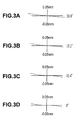
  • FIGS. 3A to 3D are aberration diagrams illustrating lateral aberrations of the image reading lens system according to Example 1;
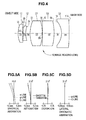
  • FIG. 4 is a sectional view illustrating a configuration of an image reading lens system according to Example 2.
  • FIGS. 5A to 5D are aberration diagrams illustrating spherical aberration, astigmatism, distortion, and lateral chromatic aberration of the image reading lens system according to Example 2;
  • FIGS. 6A to 6D are aberration diagrams illustrating lateral aberrations of the image reading lens system according to Example 2;
  • FIG. 7 is a sectional view illustrating a configuration of an image reading lens system according to Example 3.
  • FIGS. 8A to 8D are aberration diagrams illustrating spherical aberration, astigmatism, distortion, and lateral chromatic aberration of the image reading lens system according to Example 3;
  • FIGS. 9A to 9D are aberration diagrams illustrating lateral aberrations of the image reading lens system according to Example 3.
  • FIG. 10 is a sectional view illustrating a configuration of an image reading lens system according to Example 4.
  • FIGS. 11A to 11D are aberration diagrams illustrating spherical aberration, astigmatism, distortion, and lateral chromatic aberration of the image reading lens system according to Example 4;
  • FIGS. 12A to 12D are aberration diagrams illustrating lateral aberrations of the image reading lens system according to Example 4.
  • FIG. 13 is a sectional view illustrating a configuration of an image reading lens system according to Example 5.
  • FIGS. 14A to 14D are aberration diagrams illustrating spherical aberration, astigmatism, distortion, and lateral chromatic aberration of the image reading lens system according to Example 5;
  • FIGS. 15A to 15D are aberration diagrams illustrating lateral aberrations of the image reading lens system according to Example 5;
  • FIG. 16 is a sectional view illustrating a configuration of an image reading lens system according to Example 6;
  • FIGS. 17A to 17D are aberration diagrams illustrating spherical aberration, astigmatism, distortion, and lateral chromatic aberration of the image reading lens system according to Example 6;
  • FIG. 1 shows an image reading lens system 11 used in an image reading apparatuses.
  • the image reading lens system 11 forms images of original documents, which are placed at a predetermined interval so as to be close to the object side, on image sensors which are arranged at a predetermined interval so as to be close to the image side.
  • the image reading lens system 11 has a five-group five-element configuration in which first lens L 1 to fifth lens L 5 are arranged in order from the object side.
  • the first lens L 1 is a lens which has a positive refractive power and of which a convex surface faces toward the object side.
  • the second lens L 2 is formed as a biconcave lens, and the third lens L 3 is formed as a biconvex lens.
  • the fourth lens L 4 is formed as a lens which has a positive refractive power and of which a convex surface faces toward the image side.
  • the fifth lens L 5 is a lens which has a negative refractive power and of which a convex surface faces toward the image side.
  • the fourth lens L 4 When the fourth lens L 4 has a positive refractive power and of which a convex surface faces toward the image side, it may be a biconvex lens of which a convex surface faces toward the object side, may be a plano-convex lens of which the flat surface faces toward the object side, or may be a meniscus lens of which a concave surface faces toward the object side. Furthermore, in the lens configuration of FIG. 1 , the fourth lens L 4 is formed as a biconvex lens.
  • the Conditional Expression (1) defines a ratio “D 8 /f” of the space D 8 between the fourth lens L 4 and the fifth lens L 5 to the focal length f of the whole system of the image reading lens system 11 .
  • the value of “D 8 /f” is set to be large, this is advantageous for correction of image field curvature and coma aberration.
  • the value is more than the upper limit of the Conditional Expression (1), the total length of the image reading lens system 11 increases, and thus it is difficult to achieve compactness.
  • the value of “D 8 /f” is set to be small, this is advantageous for compactness of the image reading lens system 11 .
  • the value is less than the lower limit of the Conditional Expression (1), it is difficult to correct image field curvature and coma aberration satisfactorily.
  • the Conditional Expression (2) is a condition relating to distortion, and defines a ratio “f 4 /f” of the focal length f 4 of the fourth lens L 4 to the focal length f of the whole system of the image reading lens system 11 .
  • f 4 /f the value of “f 4 /f” is more than the upper limit of the Conditional Expression (2), distortion increases in the direction of “+”.
  • the value is less than the lower limit, the distortion increases in the direction of “ ⁇ ”. Thus, these are not preferable.
  • the fourth lens L 4 may be formed as a biconvex lens. In this case, it is more preferable to satisfy the following Conditional Expressions (1a) and (2a). 0.06 ⁇ D 8/ f ⁇ 0.14 (1a) 0.77 ⁇ f 4/ f ⁇ 1.59 (2a)
  • the fourth lens L 4 may be formed as a piano-convex lens or a meniscus lens of which a flat surface or a concave surface faces toward the object side. In this case, it is more preferable to satisfy the following Conditional Expressions (1b) and (2b). 0.10 ⁇ D 8/ f ⁇ 0.16 (1b) 1.06 ⁇ f 4/ f ⁇ 1.81 (2b)
  • a refractive index of a j-th lens at the e-line (a wavelength of 546.07 nm) is defined as Nj
  • an Abbe number of the j-th lens at the d-line (a wavelength of 587.56 nm) is defined as ⁇ j.
  • the system may be configured so as to satisfy any one of the Conditional Expressions (3) and (4). However, it is more preferable that the system should be configured to satisfy both of them simultaneously. 1.55 ⁇ ( N 1+ N 3+ N 4)/3 ⁇ 1.74 (3) 13.5 ⁇ ( ⁇ 1+ ⁇ 3+ ⁇ 4)/3 ⁇ ( ⁇ 2+ ⁇ 5)/2 (4)
  • the Conditional Expression (4) is a condition relating to longitudinal chromatic aberration, and defines a difference “( ⁇ 1 + ⁇ 3 + ⁇ 4 )/3 ⁇ ( ⁇ 2 + ⁇ 5 )/2” between the average value of the Abbe numbers ⁇ 1 , ⁇ 3 , and ⁇ 4 of the first lens L 1 , the third lens L 3 , and the fourth lens L 4 which are positive lenses and the average value of the Abbe numbers ⁇ 2 and ⁇ 5 of the second lens L 2 and the fifth lens L 5 which are negative lenses.
  • the value of “( ⁇ 1 + ⁇ 3 + ⁇ 4 )/3 ⁇ ( ⁇ 2 + ⁇ 5 )/2” is less than the lower limit of the Conditional Expression (4), it is difficult to correct longitudinal chromatic aberration satisfactorily.
  • the image side and the object side of the image reading lens system 11 may be reversed.
  • the first lens L 1 , the second lens L 2 , the third lens L 3 , the fourth lens L 4 , and the fifth lens L 5 may be arranged.
  • the lens system can be used as an image magnification lens.
  • the lens surfaces of the lenses L 1 to L 5 may be formed to be aspheric. In this case, by employing the aspheric surface, it is possible to perform more favorable correction.
  • Example 1 to 6 of the image reading lens system according to the embodiment of the invention will be described in detail.
  • the elements and spaces will be referenced by common reference numerals and signs.
  • each surface of the lenses is represented by Si
  • the radius of curvature of the lens surface Si is represented by Ri (mm).
  • the space between the lens surface Si and the lens surface S(i+1), which are adjacent to each other, on the optical axis, that is, the on-axis surface spacing is represented by Di (mm).
  • the refractive index of each lens at the e-line is represented by N
  • the Abbe number at the d-line is represented by ⁇ .
  • Example 1 is the image reading lens system 11 shown in FIG. 1 .
  • the lens system has a five-group five-element configuration in which the first to fifth lenses L 1 to L 5 are arranged.
  • the first lens L 1 is formed as a lens which has a positive refractive power and of which a convex surface faces toward the object side.
  • the second lens L 2 is formed as a biconcave lens, the third lens L 3 and the fourth lens L 4 are formed as biconvex lenses, and the fifth lens L 5 is formed as a negative lens of which a convex surface faces toward the image side.
  • Table 1 shows lens data in Example 1. Further, Table 2 shows the focal length f (mm) of the whole system, the F number, the angle of view 2 ⁇ (°), and the imaging magnification ⁇ of the image reading lens system 11 .
  • the focal length f 4 of the fourth lens L 4 according to Example 1 is “40.38 (mm)”.
  • the numerical values corresponding to the Conditional Expressions (1) to (4) in Example 1 are set to satisfy the Conditional Expressions (1) to (4) and the Conditional Expressions (1a) and (2a) as shown in Table 3.
  • FIGS. 2A to 2D and 3 A to 3 D show various aberrations of the image reading lens system 11 .
  • FIG. 2A shows spherical aberration
  • FIG. 2B shows astigmatism
  • FIG. 2C shows distortion (distortion aberration)
  • FIG. 2D shows lateral chromatic aberration.
  • the spherical aberration diagram of FIG. 2A the spherical aberration at the e-line is indicated by the solid line
  • the aberration at the g-line (a wavelength of 435.84 nm) is indicated by the chain line
  • the aberration at the C-line (a wavelength of 656.28 nm) is indicated by the chain double-dashed line.
  • the aberration on the sagittal image plane is indicated by the solid line
  • the aberration on the tangential image plane is indicated by the dashed line.
  • the lateral chromatic aberration diagram of FIG. 2D when the e-line is set as a reference, the aberration at the g-line is indicated by the chain line, and the aberration at the C-line is indicated by the chain double-dashed line.
  • FIGS. 3A to 3D show lateral aberrations. Specifically, FIGS. 3A to 3D show lateral aberrations at the e-line when the angle of view is 23.8°, 17.1°, 12.4°, and 0° (on the axis).
  • the image reading lens system 12 according to Example 2 shown in FIG. 4 has a five-group five-element configuration in which first lens L 1 to fifth lens L 5 are arranged in order from the object side.
  • the first lens L 1 is a lens which has a positive refractive power and of which a convex surface faces toward the object side.
  • the second lens L 2 is formed as a biconcave lens, and the third lens L 3 is formed as a biconvex lens.
  • the fourth lens L 4 is formed as a positive meniscus lens of which a concave surface faces toward the object side and of which a convex surface faces toward the image side.
  • the fifth lens L 5 is a negative lens of which a convex surface faces toward the image side.
  • Table 4 shows lens data of the image reading lens system 12 .
  • Table 5 shows the focal length f (mm) of the whole system, the F number, the angle of view 2 ⁇ (°), and the imaging magnification ⁇ of the image reading lens system 12 .
  • the focal length f 4 of the fourth lens L 4 according to Example 2 is “52.70 (mm)”.
  • the numerical values corresponding to the Conditional Expressions (1) to (4) are set to satisfy the Conditional Expressions (1) to (4) as shown in Table 6. Further, the values are also set to satisfy the Conditional Expressions (1b) and (2b).
  • FIG. 5A shows spherical aberration of the image reading lens system 12
  • FIG. 5B shows astigmatism thereof
  • FIG. 5C shows distortion (distortion aberration) thereof
  • FIG. 5D shows lateral chromatic aberration thereof
  • FIGS. 6A to 6D show lateral aberrations at the e-line when the angle of view is 21.0°, 15.0°, 10.8°, and 0° (on the axis).
  • the image reading lens system 13 according to Example 3 shown in FIG. 7 has a five-group five element configuration in which the first lens L 1 to fifth lens L 5 are arranged similarly to Example 2.
  • the lens system is different in that the fourth lens L 4 is formed as a positive piano-convex lens of which a flat surface faces toward the object side and of which a convex surface faces toward the image side.
  • Table 7 shows lens data of the image reading lens system 13 . Further, Table 8 shows the focal length f (mm) of the whole system, the F number, the angle of view 2 ⁇ (°), and the imaging magnification ⁇ of the image reading lens system 13 .
  • the focal length f 4 of the fourth lens L 4 according to Example 3 is “70.42 (mm)”.
  • the numerical values corresponding to the Conditional Expressions (1) to (4) are set to satisfy the Conditional Expressions (1) to (4) as shown in Table 9. Further, the values are also set to satisfy the Conditional Expressions (1b) and (2b).
  • FIG. 8A shows spherical aberration of the image reading lens system 13
  • FIG. 8B shows astigmatism thereof
  • FIG. 8C shows distortion (distortion aberration) thereof
  • FIG. 8D shows lateral chromatic aberration thereof
  • FIGS. 9A to 9D show lateral aberrations at the e-line when the angle of view is 18.3°, 13.0°, 9.4°, and 0° (on the axis).
  • the image reading lens system 14 according to Example 4 shown in FIG. 10 has a five-group five element configuration in which the first lens L 1 to fifth lens L 5 are arranged similarly to Example 1.
  • the fourth lens L 4 is formed as a biconvex lens.
  • Table 10 shows lens data of the image reading lens system 14 . Further, Table 11 shows the focal length f (mm) of the whole system, the F number, the angle of view 2 ⁇ (°), and the imaging magnification ⁇ of the image reading lens system 14 .
  • the focal length f 4 of the fourth lens L 4 according to Example 4 is “45.15 (mm)”.
  • the image reading lens system 15 according to Example 5 shown in FIG. 13 has a five-group five element configuration in which the first lens L 1 to fifth lens L 5 are arranged similarly to Example 1.
  • the fourth lens L 4 is formed as a biconvex lens.
  • Table 13 shows lens data of the image reading lens system 15 .
  • Table 14 shows the focal length f (mm) of the whole system, the F number, the angle of view 2 ⁇ (°), and the imaging magnification ⁇ of the image reading lens system 15 .
  • the focal length f 4 of the fourth lens L 4 according to Example 5 is “52.15 (mm)”.
  • the numerical values corresponding to the Conditional Expressions (1) to (4) are set to satisfy the Conditional Expressions (1) to (4) and the Conditional Expressions (1a) and (2a) as shown in Table 15.
  • the image reading lens system 16 according to Example 6 shown in FIG. 16 has a five-group five element configuration in which the first lens L 1 to fifth lens L 5 are arranged similarly to Example 1.
  • the fourth lens L 4 is formed as a biconvex lens.

Landscapes

  • Physics & Mathematics (AREA)
  • General Physics & Mathematics (AREA)
  • Optics & Photonics (AREA)
  • Lenses (AREA)

Abstract

Provided is a fast image reading lens system capable of achieving compactness and satisfactorily correcting various aberrations. The image reading lens system includes, in order from an object side: a positive first lens of which a convex surface faces toward the object side; a second lens formed as a biconcave lens; a third lens formed as a biconvex lens; a positive fourth lens of which a convex surface faces toward an image side; and a negative fifth lens of which a convex surface faces toward the image side. Assuming that a focal length of the whole lens system is f, a focal length of the fourth lens is f4, and a space between an image side surface of the fourth lens and an object side surface of the fifth lens on an optical axis is D8, the lens system satisfies the following conditional expressions: 0.06<D8/f<0.16, and 0.77<f4/f<1.81.

Description

CROSS-REFERENCE TO RELATED APPLICATIONS
This application is based upon and claims the benefit of priority from the Japanese Patent Application No. 2009-151148 filed on Jun. 25, 2009; the entire contents of which are incorporated herein by reference.
BACKGROUND OF THE INVENTION
1. Field of the Invention
The present invention relates to an image reading apparatus such as an image scanner and an image reading lens system mounted on the image reading apparatus.
2. Description of the Related Art
Generally, image reading apparatuses such as copiers, facsimiles, and image scanners for reading an original image such as a document or an image and converting the image into digital image data have come into widespread use. In such image reading apparatuses, by using an imaging lens system (hereinafter referred to as an image reading lens system), the original image is formed on, for example, a CCD image sensor. In order to acquire image data with high fidelity to the original image, in the image reading lens system, various aberrations are suppressed with good balance, and thus a high resolving power is demanded. Furthermore, high aperture efficiency is demanded even in the corner of the screen.
Further, recently, in accordance with reduction in the size and cost of the image reading apparatuses, the image reading lens system has been further demanded to be reduced in size and cost. Further, in accordance with an increase in the image reading speed of the image reading apparatus, a faster (smaller F number) image reading lens system is demanded.
As the compact image reading lens system, there has been known a telephoto type lens system having four groups and four elements (for example, refer to JP-A-9-101452). Further, as the faster image reading lens system, there has been known a Gauss type lens system having four groups and six elements (for example, refer to JP-A-9-113802). Furthermore, as disclosed in JP-A-2000-241701, there has been an image reading lens system capable of achieving both of an increase in speed and reduction in size by adopting a configuration having five groups and five elements.
SUMMARY OF THE INVENTION
However, the image reading lens system which has four groups and four elements in JP-A-9-101452 is not able to correct chromatic aberrations sufficiently, and is inappropriate for reading of a color original image. Further, the image reading lens system having this configuration has a problem in that it is difficult to obtain a sufficient resolving power when the lens system is formed as a faster lens system. Further, the image reading lens system which has six groups and four elements in JP-A-9-113802 is formed as a fast lens system, in which it is difficult to make the diameter of the lens small, and thus the system is disadvantageous for compactness. For this reason, configurations for reducing the height of the lens by cutting the upper and lower ends of the lens respectively have also been contrived. However, there is still a problem in that it is difficult to rotate the lens in order to adjust the eccentricity thereof. In addition, the configuration having five groups and five elements in JP-A-2000-241701 has a problem in that correction of coma aberration is insufficient.
The invention has been made in view of the above-mentioned problems, and its object is to provide a low-cost, compact, and fast image reading lens system capable of maintaining high aperture efficiency up to the corner of a screen, correcting various aberrations with excellent balance, and having a high resolving power, and to provide an image reading apparatus having the image reading lens system.
In order to achieve the object, according to an aspect of the invention, an image reading lens system includes, in order from an object side: a positive first lens of which a convex surface faces toward the object side; a second lens formed as a biconcave lens; a third lens formed as a biconvex lens; a positive fourth lens of which a convex surface faces toward an image side; and a negative fifth lens of which a convex surface faces toward the image side. Assuming that a focal length of the whole lens system is f, a focal length of the fourth lens is f4, and a space between an image side surface of the fourth lens and an object side surface of the fifth lens on an optical axis is D8, the lens system satisfies the following conditional expressions (1) and (2):
0.06<D8/f<0.16  (1), and
0.77<f4/f<1.81  (2).
The positive fourth lens of which a convex surface faces toward the image side may be a biconvex lens of which a convex surface faces toward the object side, or may be a lens of which the concave surface or the flat surface faces toward the object side. When the fourth lens is formed as a biconvex lens, it is more preferable to satisfy the following conditional expressions: “0.06<D8/f<0.14”, and “0.77<f4/f<1.59”. When the fourth lens is formed as a lens of a concave or flat surface and faces toward the object side, it is further more preferable to satisfy the following conditional expressions: “0.10<D8/f<0.16”, and “1.06<f4/f<1.81”.
Further, assuming that a refractive index of a j-th lens at the e-line is Nj, it is preferable that the image reading lens system according to the aspect should satisfy the following conditional expression (3):
1.55<(N1+N3+N4)/3<1.74  (3).
In other words, it is preferable that the average of refractive indices of the first, third, and fourth lenses which are positive lenses, that is, “(N1+N3+N4)/3” should satisfy the condition of the expression (3).
Furthermore, assuming that an Abbe number of the j-th lens at the d-line is νj, the image reading lens system according to the aspect should satisfy the following conditional expression (4):
13.5<(ν1+ν3+ν4)/3−(ν2+ν5)/2  (4).
Specifically, it is preferable that the difference between the average of the Abbe numbers of the positive lenses and the average of the Abbe numbers of the negative lenses, that is, “(ν134)/3−(ν25)/2” should satisfy the condition of the expression (4).
Any one of the conditional expressions (3) and (4) may be satisfied, but it is more preferable that both of them should be satisfied.
According to another aspect of the invention, an image reading apparatus includes the above-mentioned image reading lens system.
According to the aspects of the invention, the image reading lens system is able to maintain high aperture efficiency up to the corner of screen, sufficiently correct various aberrations with excellent balance, and thereby obtain a high resolving power while having a low-cost and compact configuration. Further, by using the image reading lens system, it is possible to embody an image reading apparatus capable of increasing the reading speed thereof without lowering the optical performance thereof while achieving compactness.
BRIEF DESCRIPTION OF THE DRAWINGS
FIG. 1 is a sectional view illustrating a configuration of an image reading lens system according to Example 1;
FIGS. 2A to 2D are aberration diagrams illustrating spherical aberration, astigmatism, distortion, and lateral chromatic aberration of the image reading lens system according to Example 1;
FIGS. 3A to 3D are aberration diagrams illustrating lateral aberrations of the image reading lens system according to Example 1;
FIG. 4 is a sectional view illustrating a configuration of an image reading lens system according to Example 2;
FIGS. 5A to 5D are aberration diagrams illustrating spherical aberration, astigmatism, distortion, and lateral chromatic aberration of the image reading lens system according to Example 2;
FIGS. 6A to 6D are aberration diagrams illustrating lateral aberrations of the image reading lens system according to Example 2;
FIG. 7 is a sectional view illustrating a configuration of an image reading lens system according to Example 3;
FIGS. 8A to 8D are aberration diagrams illustrating spherical aberration, astigmatism, distortion, and lateral chromatic aberration of the image reading lens system according to Example 3;
FIGS. 9A to 9D are aberration diagrams illustrating lateral aberrations of the image reading lens system according to Example 3;
FIG. 10 is a sectional view illustrating a configuration of an image reading lens system according to Example 4;
FIGS. 11A to 11D are aberration diagrams illustrating spherical aberration, astigmatism, distortion, and lateral chromatic aberration of the image reading lens system according to Example 4;
FIGS. 12A to 12D are aberration diagrams illustrating lateral aberrations of the image reading lens system according to Example 4;
FIG. 13 is a sectional view illustrating a configuration of an image reading lens system according to Example 5;
FIGS. 14A to 14D are aberration diagrams illustrating spherical aberration, astigmatism, distortion, and lateral chromatic aberration of the image reading lens system according to Example 5;
FIGS. 15A to 15D are aberration diagrams illustrating lateral aberrations of the image reading lens system according to Example 5;
FIG. 16 is a sectional view illustrating a configuration of an image reading lens system according to Example 6;
FIGS. 17A to 17D are aberration diagrams illustrating spherical aberration, astigmatism, distortion, and lateral chromatic aberration of the image reading lens system according to Example 6; and
FIGS. 18A to 18D are aberration diagrams illustrating lateral aberrations of the image reading lens system according to Example 6.
DESCRIPTION OF THE PREFERRED EMBODIMENTS
FIG. 1 shows an image reading lens system 11 used in an image reading apparatuses. The image reading lens system 11 forms images of original documents, which are placed at a predetermined interval so as to be close to the object side, on image sensors which are arranged at a predetermined interval so as to be close to the image side.
The image reading lens system 11 has a five-group five-element configuration in which first lens L1 to fifth lens L5 are arranged in order from the object side. The first lens L1 is a lens which has a positive refractive power and of which a convex surface faces toward the object side. The second lens L2 is formed as a biconcave lens, and the third lens L3 is formed as a biconvex lens. The fourth lens L4 is formed as a lens which has a positive refractive power and of which a convex surface faces toward the image side. The fifth lens L5 is a lens which has a negative refractive power and of which a convex surface faces toward the image side.
When the fourth lens L4 has a positive refractive power and of which a convex surface faces toward the image side, it may be a biconvex lens of which a convex surface faces toward the object side, may be a plano-convex lens of which the flat surface faces toward the object side, or may be a meniscus lens of which a concave surface faces toward the object side. Furthermore, in the lens configuration of FIG. 1, the fourth lens L4 is formed as a biconvex lens.
Assuming that a focal length of the whole lens system is f, a focal length of the fourth lens L4 is f4, and a space between the image side surface of the fourth lens L4 and the object side surface of the fifth lens L5 on an optical axis is D8, the image reading lens system 11 is configured to satisfy the following conditional expressions.
0.06<D8/f<0.16  (1)
0.77<f4/f<1.81  (2)
The Conditional Expression (1) defines a ratio “D8/f” of the space D8 between the fourth lens L4 and the fifth lens L5 to the focal length f of the whole system of the image reading lens system 11. When the value of “D8/f” is set to be large, this is advantageous for correction of image field curvature and coma aberration. However, when the value is more than the upper limit of the Conditional Expression (1), the total length of the image reading lens system 11 increases, and thus it is difficult to achieve compactness. Further, when the value of “D8/f” is set to be small, this is advantageous for compactness of the image reading lens system 11. However, when the value is less than the lower limit of the Conditional Expression (1), it is difficult to correct image field curvature and coma aberration satisfactorily.
The Conditional Expression (2) is a condition relating to distortion, and defines a ratio “f4/f” of the focal length f4 of the fourth lens L4 to the focal length f of the whole system of the image reading lens system 11. When the value of “f4/f” is more than the upper limit of the Conditional Expression (2), distortion increases in the direction of “+”. In contrast, when the value is less than the lower limit, the distortion increases in the direction of “−”. Thus, these are not preferable.
Similarly to the image reading lens system 11 shown in FIG. 1, the fourth lens L4 may be formed as a biconvex lens. In this case, it is more preferable to satisfy the following Conditional Expressions (1a) and (2a).
0.06<D8/f<0.14  (1a)
0.77<f4/f<1.59  (2a)
Further, the fourth lens L4 may be formed as a piano-convex lens or a meniscus lens of which a flat surface or a concave surface faces toward the object side. In this case, it is more preferable to satisfy the following Conditional Expressions (1b) and (2b).
0.10<D8/f<0.16  (1b)
1.06<f4/f<1.81  (2b)
Further, in the image reading lens system 11, when j=1, 2, . . . 5, a refractive index of a j-th lens at the e-line (a wavelength of 546.07 nm) is defined as Nj, and an Abbe number of the j-th lens at the d-line (a wavelength of 587.56 nm) is defined as νj. In this case, it is preferable to satisfy the following Conditional Expressions (3) and (4). The system may be configured so as to satisfy any one of the Conditional Expressions (3) and (4). However, it is more preferable that the system should be configured to satisfy both of them simultaneously.
1.55<(N1+N3+N4)/3<1.74  (3)
13.5<(ν1+ν3+ν4)/3−(ν2+ν5)/2  (4)
The Conditional Expression (3) is a condition relating to lateral chromatic aberration and aperture efficiency, and defines an average value “(N1+N3+N4)/3” of the refractive index N1, the refractive index N3, and the refractive index N4 of the first lens L1, the third lens L3, and the fourth lens L4 which are positive lenses. When the value of “(N1+N3+N4)/3” is more than the upper limit of the Conditional Expression (3), the aperture efficiency decreases, and this causes deterioration in relative illumination. In contrast, when the value is less than the lower limit thereof, it is difficult to correct lateral chromatic aberration satisfactorily.
The Conditional Expression (4) is a condition relating to longitudinal chromatic aberration, and defines a difference “(ν134)/3−(ν25)/2” between the average value of the Abbe numbers ν1, ν3, and ν4 of the first lens L1, the third lens L3, and the fourth lens L4 which are positive lenses and the average value of the Abbe numbers ν2 and ν5 of the second lens L2 and the fifth lens L5 which are negative lenses. When the value of “(ν134)/3−(ν25)/2” is less than the lower limit of the Conditional Expression (4), it is difficult to correct longitudinal chromatic aberration satisfactorily.
As described above the image reading lens system 11 is configured to have five groups and five elements, and to satisfy the conditional expressions. With such a configuration, in the image reading lens system, various aberrations, particularly, image field curvature is appropriately corrected. Thus, it is possible to obtain a high resolving power of, for example, about 600 dpi and a speed of F 5.0 or less, and maintain an aperture efficiency of nearly 100% even in the most-peripheral portion, and it is also possible to achieve compactness by adopting the configuration having five groups and five elements.
Furthermore, the image side and the object side of the image reading lens system 11 may be reversed. In other words, in order from the image side, the first lens L1, the second lens L2, the third lens L3, the fourth lens L4, and the fifth lens L5 may be arranged. In this case, the lens system can be used as an image magnification lens. Further, the lens surfaces of the lenses L1 to L5 may be formed to be aspheric. In this case, by employing the aspheric surface, it is possible to perform more favorable correction.
EXAMPLES
Examples 1 to 6 of the image reading lens system according to the embodiment of the invention will be described in detail. Hereinafter, in Example 1 to 6, the elements and spaces will be referenced by common reference numerals and signs. Further, in Examples 1 to 6, when the surface number i (i=1 to 12) is given in increasing order from the object side lens surface of the first lens L1, each surface of the lenses is represented by Si, and the radius of curvature of the lens surface Si is represented by Ri (mm). Further, the space between the lens surface Si and the lens surface S(i+1), which are adjacent to each other, on the optical axis, that is, the on-axis surface spacing is represented by Di (mm). In addition, the refractive index of each lens at the e-line is represented by N, and the Abbe number at the d-line is represented by ν.
Example 1
Example 1 is the image reading lens system 11 shown in FIG. 1. Specifically, the lens system has a five-group five-element configuration in which the first to fifth lenses L1 to L5 are arranged. The first lens L1 is formed as a lens which has a positive refractive power and of which a convex surface faces toward the object side. The second lens L2 is formed as a biconcave lens, the third lens L3 and the fourth lens L4 are formed as biconvex lenses, and the fifth lens L5 is formed as a negative lens of which a convex surface faces toward the image side. Table 1 shows lens data in Example 1. Further, Table 2 shows the focal length f (mm) of the whole system, the F number, the angle of view 2ω (°), and the imaging magnification β of the image reading lens system 11.
TABLE 1
RADIUS OF ON-AXIS REFRACTIVE ABBE
SURFACE CURVATURE SURFACE INDEX NUMBER
NUMBER (mm) SPACING (e-LINE) (d-LINE)
(Si) (Ri) (mm) (Di) (N) (ν)
1 13.371 4.22 1.71615 63.4
2 43.112 0.49
3 −44.124 1.34 1.65222 33.8
4 13.977 1.70
5 20.218 9.00 1.71615 63.4
6 −36.988 0.20
7 236.730 6.97 1.71615 63.4
8 −32.538 3.76
9 −12.377 3.98 1.61669 44.3
10 −117.370
TABLE 2
f (mm) F NUMBER 2ω (°) IMAGING MAGNIFICATION β
34.58 4.5 47.5 0.11
The focal length f4 of the fourth lens L4 according to Example 1 is “40.38 (mm)”. The numerical values corresponding to the Conditional Expressions (1) to (4) in Example 1 are set to satisfy the Conditional Expressions (1) to (4) and the Conditional Expressions (1a) and (2a) as shown in Table 3.
TABLE 3
D8/f 0.109
f4/f 1.168
(N1 + N3 + N4)/3 1.716
(ν1 + ν3 + ν4)/3 − 24.4
(ν2 + ν5)/2
FIGS. 2A to 2D and 3A to 3D show various aberrations of the image reading lens system 11. FIG. 2A shows spherical aberration, FIG. 2B shows astigmatism, FIG. 2C shows distortion (distortion aberration), and FIG. 2D shows lateral chromatic aberration. In the spherical aberration diagram of FIG. 2A, the spherical aberration at the e-line is indicated by the solid line, the aberration at the g-line (a wavelength of 435.84 nm) is indicated by the chain line, and the aberration at the C-line (a wavelength of 656.28 nm) is indicated by the chain double-dashed line. In the astigmatism diagram of FIG. 2B, the aberration on the sagittal image plane is indicated by the solid line, and the aberration on the tangential image plane is indicated by the dashed line. In the lateral chromatic aberration diagram of FIG. 2D, when the e-line is set as a reference, the aberration at the g-line is indicated by the chain line, and the aberration at the C-line is indicated by the chain double-dashed line.
Further, FIGS. 3A to 3D show lateral aberrations. Specifically, FIGS. 3A to 3D show lateral aberrations at the e-line when the angle of view is 23.8°, 17.1°, 12.4°, and 0° (on the axis).
Example 2
The image reading lens system 12 according to Example 2 shown in FIG. 4 has a five-group five-element configuration in which first lens L1 to fifth lens L5 are arranged in order from the object side. The first lens L1 is a lens which has a positive refractive power and of which a convex surface faces toward the object side. The second lens L2 is formed as a biconcave lens, and the third lens L3 is formed as a biconvex lens. The fourth lens L4 is formed as a positive meniscus lens of which a concave surface faces toward the object side and of which a convex surface faces toward the image side. The fifth lens L5 is a negative lens of which a convex surface faces toward the image side.
Table 4 shows lens data of the image reading lens system 12. Further, Table 5 shows the focal length f (mm) of the whole system, the F number, the angle of view 2ω (°), and the imaging magnification β of the image reading lens system 12. The focal length f4 of the fourth lens L4 according to Example 2 is “52.70 (mm)”. The numerical values corresponding to the Conditional Expressions (1) to (4) are set to satisfy the Conditional Expressions (1) to (4) as shown in Table 6. Further, the values are also set to satisfy the Conditional Expressions (1b) and (2b).
TABLE 4
RADIUS OF ON-AXIS REFRACTIVE ABBE
SURFACE CURVATURE SURFACE INDEX NUMBER
NUMBER (mm) SPACING (e-LINE) (d-LINE)
(Si) (Ri) (mm) (Di) (N) (ν)
1 15.179 3.00 1.71615 53.9
2 66.033 0.45
3 −42.266 1.64 1.62409 36.3
4 16.111 2.87
5 21.030 7.95 1.62287 60.3
6 −30.227 0.22
7 −260.389 7.67 1.75844 52.3
8 −35.089 4.89
9 −12.146 4.99 1.61669 44.3
10 −110.120
TABLE 5
f (mm) F NUMBER 2ω (°) IMAGING MAGNIFICATION β
39.75 5 41.9 0.11
TABLE 6
D8/f 0.123
f4/f 1.326
(N1 + N3 + N4)/3 1.699
(ν1 + ν3 + ν4)/3 − 15.2
(ν2 + ν5)/2
Further, FIG. 5A shows spherical aberration of the image reading lens system 12, FIG. 5B shows astigmatism thereof, FIG. 5C shows distortion (distortion aberration) thereof, and FIG. 5D shows lateral chromatic aberration thereof. FIGS. 6A to 6D show lateral aberrations at the e-line when the angle of view is 21.0°, 15.0°, 10.8°, and 0° (on the axis).
Example 3
The image reading lens system 13 according to Example 3 shown in FIG. 7 has a five-group five element configuration in which the first lens L1 to fifth lens L5 are arranged similarly to Example 2. However, the lens system is different in that the fourth lens L4 is formed as a positive piano-convex lens of which a flat surface faces toward the object side and of which a convex surface faces toward the image side.
Table 7 shows lens data of the image reading lens system 13. Further, Table 8 shows the focal length f (mm) of the whole system, the F number, the angle of view 2ω (°), and the imaging magnification β of the image reading lens system 13. The focal length f4 of the fourth lens L4 according to Example 3 is “70.42 (mm)”.
The numerical values corresponding to the Conditional Expressions (1) to (4) are set to satisfy the Conditional Expressions (1) to (4) as shown in Table 9. Further, the values are also set to satisfy the Conditional Expressions (1b) and (2b).
TABLE 7
RADIUS OF ON-AXIS REFRACTIVE ABBE
SURFACE CURVATURE SURFACE INDEX NUMBER
NUMBER (mm) SPACING (e-LINE) (d-LINE)
(Si) (Ri) (mm) (Di) (N) (ν)
1 18.699 4.74 1.71615 53.9
2 74.904 0.79
3 −46.239 3.19 1.65222 33.8
4 19.567 2.76
5 29.516 8.92 1.71615 53.9
6 −38.039 1.45
7 0.000 8.43 1.71615 53.9
8 −50.429 6.58
9 −16.729 4.53 1.61669 44.3
10 −126.000
TABLE 8
f (mm) F NUMBER 2ω (°) IMAGING MAGNIFICATION β
46.62 4.5 36.5 0.11
TABLE 9
D8/f 0.141
f4/f 1.511
(N1 + N3 + N4)/3 1.716
(ν1 + ν3 + ν4)/3 − 14.9
(ν2 + ν5)/2
Further, FIG. 8A shows spherical aberration of the image reading lens system 13, FIG. 8B shows astigmatism thereof, FIG. 8C shows distortion (distortion aberration) thereof, and FIG. 8D shows lateral chromatic aberration thereof. FIGS. 9A to 9D show lateral aberrations at the e-line when the angle of view is 18.3°, 13.0°, 9.4°, and 0° (on the axis).
Example 4
The image reading lens system 14 according to Example 4 shown in FIG. 10 has a five-group five element configuration in which the first lens L1 to fifth lens L5 are arranged similarly to Example 1. In the configuration, the fourth lens L4 is formed as a biconvex lens.
Table 10 shows lens data of the image reading lens system 14. Further, Table 11 shows the focal length f (mm) of the whole system, the F number, the angle of view 2ω (°), and the imaging magnification β of the image reading lens system 14. The focal length f4 of the fourth lens L4 according to Example 4 is “45.15 (mm)”.
The numerical values corresponding to the Conditional Expressions (1) to (4) are set to satisfy the Conditional Expressions (1) to (4) and the Conditional Expressions (1a) and (2a) as shown in Table 12.
TABLE 10
RADIUS OF ON-AXIS REFRACTIVE ABBE
SURFACE CURVATURE SURFACE INDEX NUMBER
NUMBER (mm) SPACING (e-LINE) (d-LINE)
(Si) (Ri) (mm) (Di) (N) (ν)
1 16.458 5.87 1.62033 63.4
2 48.007 0.88
3 −39.847 2.66 1.63003 35.7
4 18.292 1.18
5 17.869 8.28 1.71615 53.9
6 −82.942 0.38
7 96.049 7.21 1.83932 37.2
8 −60.441 5.16
9 −10.923 6.02 1.65222 33.8
10 −30.927
TABLE 11
f (mm) F NUMBER 2ω (°) IMAGING MAGNIFICATION β
43.40 4.5 39.5 0.11
TABLE 12
D8/f 0.119
f4/f 1.040
(N1 + N3 + N4)/3 1.725
(ν1 + ν3 + ν4)/3 − 16.8
(ν2 + ν5)/2
Further, FIG. 11A shows spherical aberration of the image reading lens system 14, FIG. 11B shows astigmatism thereof, FIG. 11C shows distortion (distortion aberration) thereof, and FIG. 11D shows lateral chromatic aberration thereof. FIGS. 12A to 12D show lateral aberrations at the e-line when the angle of view is 19.8°, 14.1°, 10.2°, and 0° (on the axis).
Example 5
The image reading lens system 15 according to Example 5 shown in FIG. 13 has a five-group five element configuration in which the first lens L1 to fifth lens L5 are arranged similarly to Example 1. In the configuration, the fourth lens L4 is formed as a biconvex lens.
Table 13 shows lens data of the image reading lens system 15. Further, Table 14 shows the focal length f (mm) of the whole system, the F number, the angle of view 2ω (°), and the imaging magnification β of the image reading lens system 15. The focal length f4 of the fourth lens L4 according to Example 5 is “52.15 (mm)”. The numerical values corresponding to the Conditional Expressions (1) to (4) are set to satisfy the Conditional Expressions (1) to (4) and the Conditional Expressions (1a) and (2a) as shown in Table 15.
TABLE 13
RADIUS OF ON-AXIS REFRACTIVE ABBE
SURFACE CURVATURE SURFACE INDEX NUMBER
NUMBER (mm) SPACING (e-LINE) (d-LINE)
(Si) (Ri) (mm) (Di) (N) (ν)
1 17.585 6.09 1.62033 63.4
2 51.185 0.94
3 −41.950 2.88 1.63003 35.7
4 19.498 1.29
5 19.233 8.55 1.71615 53.9
6 −71.443 0.72
7 113.978 7.80 1.83932 37.2
8 −68.847 5.38
9 −11.765 6.64 1.65222 33.8
10 −33.713
TABLE 14
f (mm) F NUMBER 2ω (°) IMAGING MAGNIFICATION β
46.87 4.5 36.3 0.11
TABLE 15
D8/f 0.115
f4/f 1.113
(N1 + N3 + N4)/3 1.725
(ν1 + ν3 + ν4)/3 − 16.8
(ν2 + ν5)/2
Further, FIG. 14A shows spherical aberration of the image reading lens system 15, FIG. 14B shows astigmatism thereof, FIG. 14C shows distortion (distortion aberration) thereof, and FIG. 14D shows lateral chromatic aberration thereof. FIGS. 15A to 15D show lateral aberrations at the e-line when the angle of view is 18.2°, 12.9°, 9.3°, and 0° (on the axis).
Example 6
The image reading lens system 16 according to Example 6 shown in FIG. 16 has a five-group five element configuration in which the first lens L1 to fifth lens L5 are arranged similarly to Example 1. In the configuration, the fourth lens L4 is formed as a biconvex lens.
Table 16 shows lens data of the image reading lens system 16. Further, Table 17 shows the focal length f (mm) of the whole system, the F number, the angle of view 2ω (°), and the imaging magnification β of the image reading lens system 16. The focal length f4 of the fourth lens L4 according to Example 6 is “36.66 (mm)”. The numerical values corresponding to the Conditional Expressions (1) to (4) are set to satisfy the Conditional Expressions (1) to (4) and the Conditional Expressions (1a) and (2a) as shown in Table 18.
TABLE 16
RADIUS OF ON-AXIS REFRACTIVE ABBE
SURFACE CURVATURE SURFACE INDEX NUMBER
NUMBER (mm) SPACING (e-LINE) (d-LINE)
(Si) (Ri) (mm) (Di) (N) (ν)
1 14.661 3.34 1.62033 63.4
2 38.051 0.80
3 −49.643 3.00 1.63003 35.7
4 19.112 1.78
5 15.517 7.96 1.73234 54.7
6 −297.498 0.97
7 112.626 6.79 1.80811 46.6
8 −39.112 2.81
9 −9.328 4.96 1.65803 39.7
10 −32.184
TABLE 17
f (mm) F NUMBER 2ω (°) IMAGING MAGNIFICATION β
39.89 5 41.8 0.11
TABLE 18
D8/f 0.070
f4/f 0.919
(N1 + N3 + N4)/3 1.720
(ν1 + ν3 + ν4)/3 − 17.2
(ν2 + ν5)/2
Further, FIG. 17A shows spherical aberration of the image reading lens system 16, FIG. 17B shows astigmatism thereof, FIG. 17C shows distortion (distortion aberration) thereof, and FIG. 17D shows lateral chromatic aberration thereof. FIGS. 18A to 18D show lateral aberrations at the e-line when the angle of view is 20.9°, 15.0°, 10.8°, and 0° (on the axis).

Claims (4)

1. An image reading lens system comprising, in order from an object side:
a positive first lens having a convex surface faces directed to the object side;
a second lens, which is a biconcave lens;
a third lens, which is a biconvex lens;
a positive fourth lens having a convex surface faces directed to an image side; and
a negative fifth lens having a convex surface faces directed to the image side,
wherein the following conditional expressions (1) and (2) are satisfied:

0.06<D8/f<0.16  (1)

0.77<f4/f<1.81  (2)
where f denotes a focal length of the whole lens system,
f4 denotes a focal length of the fourth lens, and
D8 denotes a space between an image side surface of the fourth lens and an object side surface of the fifth lens on an optical axis.
2. The image reading lens system according to claim 1, wherein the following conditional expression (3) is satisfied:

1.55<(N1+N3+N4)/3<1.74  (3)
where Nj denotes a refractive index of a j-th lens at the e-line.
3. The image reading lens system according to claim 1, wherein the following conditional expression (4) is satisfied:

13.5<(ν1+ν3+ν4)/3−(ν2+ν5)/2  (4)
where νj denotes an Abbe number of the j-th lens at the d-line.
4. An image reading apparatus comprising:
the image reading lens system according to claim 1.
US12/822,787 2009-06-25 2010-06-24 Image reading lens system and image reading apparatus Expired - Fee Related US8345323B2 (en)

Applications Claiming Priority (2)

Application Number Priority Date Filing Date Title
JPP2009-151148 2009-06-25
JP2009151148A JP5283575B2 (en) 2009-06-25 2009-06-25 Image reading lens and image reading apparatus

Publications (2)

Publication Number Publication Date
US20100328730A1 US20100328730A1 (en) 2010-12-30
US8345323B2 true US8345323B2 (en) 2013-01-01

Family

ID=43380399

Family Applications (1)

Application Number Title Priority Date Filing Date
US12/822,787 Expired - Fee Related US8345323B2 (en) 2009-06-25 2010-06-24 Image reading lens system and image reading apparatus

Country Status (4)

Country Link
US (1) US8345323B2 (en)
JP (1) JP5283575B2 (en)
CN (1) CN201754201U (en)
TW (1) TWM399412U (en)

Cited By (6)

* Cited by examiner, † Cited by third party
Publication number Priority date Publication date Assignee Title
US9164257B2 (en) 2013-10-11 2015-10-20 Genius Electronic Optical Co., Ltd. Mobile device and optical imaging lens thereof
US9229193B2 (en) 2013-09-30 2016-01-05 Genius Electronic Optical Co., Ltd. Imaging lens, and electronic apparatus including the same
US9264594B2 (en) 2013-10-11 2016-02-16 Genius Electronic Optical Co., Ltd. Mobile device and optical imaging lens thereof
US9279956B2 (en) 2013-07-10 2016-03-08 Genius Electronic Optical Co., Ltd. Optical imaging lens and electronic device comprising the same
US9316812B2 (en) 2013-07-03 2016-04-19 Genius Electronic Optical Co., Ltd. Mobile device and optical imaging lens thereof
US9703073B2 (en) 2014-01-27 2017-07-11 Genius Electronic Optical Co., Ltd. Imaging lens, and electronic apparatus including the same

Families Citing this family (11)

* Cited by examiner, † Cited by third party
Publication number Priority date Publication date Assignee Title
CN103076665A (en) 2011-10-26 2013-05-01 鸿富锦精密工业(深圳)有限公司 Lens for capturing image
JP5910191B2 (en) * 2012-03-13 2016-04-27 株式会社リコー Image reading lens, image reading apparatus, and image forming apparatus
KR101452084B1 (en) 2013-01-22 2014-10-16 삼성전기주식회사 Subminiature optical system and portable device having the same
CN103293638B (en) 2013-02-06 2016-03-23 玉晶光电(厦门)有限公司 Optical imaging lens and apply the electronic installation of this camera lens
JP2015060172A (en) * 2013-09-20 2015-03-30 富士フイルム株式会社 Imaging lens and imaging device including imaging lens
EP3605180B1 (en) * 2017-04-26 2021-11-17 Kyocera Corporation Imaging lens
CN107121755B (en) * 2017-06-19 2020-08-21 南京华捷艾米软件科技有限公司 Infrared lens for 3D measurement
KR102257745B1 (en) * 2017-09-26 2021-05-28 삼성전기주식회사 Imaging Lens System
CN111443469B (en) * 2020-05-20 2025-01-28 威海世高光电子有限公司 Ultra-short object distance imaging lens and electronic equipment
KR102238837B1 (en) * 2020-07-23 2021-04-09 엘지이노텍 주식회사 Image pickup lens
CN112485888B (en) * 2020-11-25 2022-07-05 江西联创电子有限公司 Optical imaging lens and imaging equipment

Citations (5)

* Cited by examiner, † Cited by third party
Publication number Priority date Publication date Assignee Title
US4997265A (en) * 1988-10-14 1991-03-05 Ricoh Company, Ltd. Zoom lens for variable power copying apparatus
JPH09101452A (en) 1995-10-05 1997-04-15 Fuji Photo Optical Co Ltd Read lens
JPH09113802A (en) 1995-10-16 1997-05-02 Ricoh Co Ltd Reading lens
JP2000241701A (en) 1999-02-23 2000-09-08 Canon Inc Image reading lens
US7450275B2 (en) * 2003-06-24 2008-11-11 Ricoh Company, Limited Document reading lens, document reading lens unit, document reader, and image forming apparatus

Family Cites Families (6)

* Cited by examiner, † Cited by third party
Publication number Priority date Publication date Assignee Title
JPS5695207A (en) * 1979-12-28 1981-08-01 Nippon Kogaku Kk <Nikon> Compact wide angle lens
JPS61109012A (en) * 1984-11-01 1986-05-27 Canon Inc small zoom lens
JPS61148414A (en) * 1984-12-21 1986-07-07 Canon Inc compact zoom lens
JPH03181901A (en) * 1989-12-12 1991-08-07 Minolta Camera Co Ltd Zoom optical system
JP2000305015A (en) * 1999-04-20 2000-11-02 Nikon Corp Zoom lens
JP2009086644A (en) * 2007-09-12 2009-04-23 Fujinon Corp Imaging lens and imaging apparatus

Patent Citations (6)

* Cited by examiner, † Cited by third party
Publication number Priority date Publication date Assignee Title
US4997265A (en) * 1988-10-14 1991-03-05 Ricoh Company, Ltd. Zoom lens for variable power copying apparatus
JPH09101452A (en) 1995-10-05 1997-04-15 Fuji Photo Optical Co Ltd Read lens
US5900994A (en) 1995-10-05 1999-05-04 Fuji Photo Optical Co., Ltd. Readout lens
JPH09113802A (en) 1995-10-16 1997-05-02 Ricoh Co Ltd Reading lens
JP2000241701A (en) 1999-02-23 2000-09-08 Canon Inc Image reading lens
US7450275B2 (en) * 2003-06-24 2008-11-11 Ricoh Company, Limited Document reading lens, document reading lens unit, document reader, and image forming apparatus

Cited By (6)

* Cited by examiner, † Cited by third party
Publication number Priority date Publication date Assignee Title
US9316812B2 (en) 2013-07-03 2016-04-19 Genius Electronic Optical Co., Ltd. Mobile device and optical imaging lens thereof
US9279956B2 (en) 2013-07-10 2016-03-08 Genius Electronic Optical Co., Ltd. Optical imaging lens and electronic device comprising the same
US9229193B2 (en) 2013-09-30 2016-01-05 Genius Electronic Optical Co., Ltd. Imaging lens, and electronic apparatus including the same
US9164257B2 (en) 2013-10-11 2015-10-20 Genius Electronic Optical Co., Ltd. Mobile device and optical imaging lens thereof
US9264594B2 (en) 2013-10-11 2016-02-16 Genius Electronic Optical Co., Ltd. Mobile device and optical imaging lens thereof
US9703073B2 (en) 2014-01-27 2017-07-11 Genius Electronic Optical Co., Ltd. Imaging lens, and electronic apparatus including the same

Also Published As

Publication number Publication date
JP2011008007A (en) 2011-01-13
TWM399412U (en) 2011-03-01
CN201754201U (en) 2011-03-02
US20100328730A1 (en) 2010-12-30
JP5283575B2 (en) 2013-09-04

Similar Documents

Publication Publication Date Title
US8345323B2 (en) Image reading lens system and image reading apparatus
JP5698834B2 (en) Imaging lens and imaging apparatus
US8767298B2 (en) Imaging lens
CN201903687U (en) Video camera lens and video camera
JP5680741B2 (en) Imaging lens and imaging apparatus
JP2006317916A (en) Imaging lens
JP2005284153A (en) Imaging lens
JP5571255B2 (en) Objective optical system and endoscope apparatus using the same
US6747810B2 (en) Single focus lens having short overall length
US20150160443A1 (en) Imaging lens and imaging apparatus
US7599130B2 (en) Image reading lens and image reading apparatus
US20030161050A1 (en) Sigle focus lens
JP2007218947A (en) Image reading lens and image reading apparatus
JP3720187B2 (en) lens
US6366412B1 (en) Lens system for reading images and image reader
JP4699032B2 (en) Image reading lens and image reading apparatus
JP2001100096A (en) Four image read lenses and image reader using same
US6999246B2 (en) Image scanning lens and image scanning device that uses same
JP2000249916A (en) Image forming lens and image reader using it
JP3556823B2 (en) lens
JP2005234068A (en) Image reading lens and image reader
JP2005316015A (en) Imaging lens
JP2002031753A (en) Image reading lens consisting of four lenses and image reader using the same
JP2007219133A (en) Image reading lens and image reading apparatus
JPH1078546A (en) Reading lens

Legal Events

Date Code Title Description
AS Assignment

Owner name: FUJINON CORPORATION, JAPAN

Free format text: ASSIGNMENT OF ASSIGNORS INTEREST;ASSIGNOR:OTOMO, RYOKO;REEL/FRAME:024609/0237

Effective date: 20100616

AS Assignment

Owner name: FUJIFILM CORPORATION, JAPAN

Free format text: MERGER;ASSIGNOR:FUJINON CORPORATION;REEL/FRAME:029379/0245

Effective date: 20100701

FEPP Fee payment procedure

Free format text: PAYOR NUMBER ASSIGNED (ORIGINAL EVENT CODE: ASPN); ENTITY STATUS OF PATENT OWNER: LARGE ENTITY

REMI Maintenance fee reminder mailed
LAPS Lapse for failure to pay maintenance fees
STCH Information on status: patent discontinuation

Free format text: PATENT EXPIRED DUE TO NONPAYMENT OF MAINTENANCE FEES UNDER 37 CFR 1.362

STCH Information on status: patent discontinuation

Free format text: PATENT EXPIRED DUE TO NONPAYMENT OF MAINTENANCE FEES UNDER 37 CFR 1.362

FP Lapsed due to failure to pay maintenance fee

Effective date: 20170101