US8332684B2 - Timer bounded arbitration protocol for resource control - Google Patents
Timer bounded arbitration protocol for resource control Download PDFInfo
- Publication number
- US8332684B2 US8332684B2 US12/821,251 US82125110A US8332684B2 US 8332684 B2 US8332684 B2 US 8332684B2 US 82125110 A US82125110 A US 82125110A US 8332684 B2 US8332684 B2 US 8332684B2
- Authority
- US
- United States
- Prior art keywords
- fsm
- arb
- active
- timer
- standby
- Prior art date
- Legal status (The legal status is an assumption and is not a legal conclusion. Google has not performed a legal analysis and makes no representation as to the accuracy of the status listed.)
- Expired - Fee Related, expires
Links
Images




Classifications
-
- G—PHYSICS
- G06—COMPUTING OR CALCULATING; COUNTING
- G06F—ELECTRIC DIGITAL DATA PROCESSING
- G06F11/00—Error detection; Error correction; Monitoring
- G06F11/07—Responding to the occurrence of a fault, e.g. fault tolerance
- G06F11/16—Error detection or correction of the data by redundancy in hardware
- G06F11/20—Error detection or correction of the data by redundancy in hardware using active fault-masking, e.g. by switching out faulty elements or by switching in spare elements
- G06F11/202—Error detection or correction of the data by redundancy in hardware using active fault-masking, e.g. by switching out faulty elements or by switching in spare elements where processing functionality is redundant
- G06F11/2023—Failover techniques
- G06F11/2033—Failover techniques switching over of hardware resources
-
- G—PHYSICS
- G06—COMPUTING OR CALCULATING; COUNTING
- G06F—ELECTRIC DIGITAL DATA PROCESSING
- G06F11/00—Error detection; Error correction; Monitoring
- G06F11/004—Error avoidance
-
- G—PHYSICS
- G06—COMPUTING OR CALCULATING; COUNTING
- G06F—ELECTRIC DIGITAL DATA PROCESSING
- G06F13/00—Interconnection of, or transfer of information or other signals between, memories, input/output devices or central processing units
- G06F13/14—Handling requests for interconnection or transfer
- G06F13/36—Handling requests for interconnection or transfer for access to common bus or bus system
Definitions
- High availability (HA) systems facilitate having a standby server take over in the event of undesired failures on a primary server. Goals for an HA system are to provide safety and uninterrupted operation. If a primary server fails, failover should occur automatically and operations should resume on a redundant server. However, at any point in time, only one of the two servers should have write access to certain items. For example, at any point in time there should only be one server with write access to file system metadata. In another example, at any point in time there should only be one server with write access to certain databases. When two servers both have write access, this may be referred to as a split brain scenario (SBS).
- SBS split brain scenario
- FIG. 1 illustrates an apparatus configured to participate in a timer bounded arbitration protocol for resource control that facilitates maintaining single writer access between a pair of high availability servers.
- FIG. 2 illustrates a metadata controller (MDC) used in a system for maintaining single writer access between a pair of high availability servers.
- MDC metadata controller
- FIG. 3 illustrates a pair of MDCs used in a system for maintaining single writer access between a pair of high availability servers.
- FIG. 4 illustrates an apparatus for maintaining single writer access between a pair of high availability servers.
- FIG. 5 illustrates a method for maintaining single writer access between a pair of high availability servers.
- FIG. 6 illustrates a computer that facilitates maintaining single writer access between a pair of high availability servers.
- FIG. 7 illustrates an environment in which a pair of high availability servers may operate.
- FIG. 8 illustrates additional detail about the logic of an FSM from a (re)start.
- Example apparatus and methods prevent a split brain scenario (SBS) where both servers in a high availability (HA) pair could have write access to resources (e.g., file system metadata, databases) for which there should only be single writer access.
- resources e.g., file system metadata, databases
- SBS split brain scenario
- HA high availability
- a failing server is reset at the hardware level causing the failing server to relinquish write access. If the failing server is reset, the standby server can acquire write access without risking SBS.
- Example apparatus and methods rely on a timer bounded arbitration (ARB) protocol that uses an ARB block for both co-ordination and communication.
- ARB block updates by a controlling (e.g., primary) server for a file system provide the most basic level of communication between HA servers. If the controlling server is unable to update the ARB, it will relinquish control of the ARB block within a prescribed time limit. If the controlling server does not relinquish control within the prescribed time limit, a hardware reset will be performed on the controlling server. Neither the voluntary relinquishment nor the hardware reset requires a communication from the standby server or an action by a failing file system manager (FSM).
- FSM failing file system manager
- control of and access to file system metadata is regulated through an ARB dedicated disk block.
- the timer bounded ARB protocol for resource control regulates acquiring control of the ARB block, maintaining control of the ARB block, and usurping control of the ARB block.
- a process that has control of the ARB block will periodically write the ARB block to “brand” the ARB block and thereby signal ownership and active control.
- the process that has control of the ARB block successfully brands the ARB block, the process resets a “dead man” timer. If the ARB block is not written before the dead man timer expires, then the timer bounded ARB protocol for resource control has been violated and a hardware reset may be forced.
- a standby server and/or process may be activated.
- the standby will wait as long as the dead man timer period plus a safety timer period before taking control. The wait will be measured from the time the standby last noticed a unique brand of the ARB block. If the standby determines that the primary has resumed branding the ARB during the waiting period, then the standby may stand down and allow the primary to resume control. If the standby determines that the ARB is being branded during the waiting period, then the standby may determine whether it is the most appropriate server to take control of the ARB. If so, then the standby may acquire control of the ARB, even though some other server or process is branding the ARB.
- references to “one embodiment”, “an embodiment”, “one example”, “an example”, and other similar terms indicate that the embodiment(s) or example(s) so described may include a particular feature, structure, characteristic, property, element, or limitation, but that not every embodiment or example necessarily includes that particular feature, structure, characteristic, property, element or limitation. Furthermore, repeated use of the phrase “in one embodiment” or “in one example” does not necessarily refer to the same embodiment or example.
- FIG. 1 illustrates an apparatus 100 .
- Apparatus 100 facilitates maintaining single writer access between a pair of high availability servers.
- Apparatus 100 includes a processor 110 , a memory 120 , and an interface 130 .
- Interface 130 connects the processor 110 , the memory 120 , and a set 140 of logics.
- the set 140 of logics may include a metadata controller logic 142 .
- the metadata controller logic 142 may be configured to selectively terminate an active file system manager (FSM) 150 associated with the apparatus 100 .
- the FSM 150 may also be configured to selectively activate a standby FSM 160 available on a different apparatus.
- the FSM 160 may be activated upon determining that FSM 150 has not maintained control according to a timer bounded ARB protocol.
- the timer bounded ARB protocol relies on an ARB block acting as a resource shared between the FSM 150 and the FSM 160 .
- the ARB logic 152 may be configured to maintain single writer access to file system metadata by the FSM 150 and the redundant FSM 160 . Recall that an SBS can occur if both the FSM 150 and the redundant FSM 160 have write access to a protected resource (e.g., file system metadata, database).
- the ARB logic 152 may synchronize control of the ARB block by using the ARB block.
- the ARB block can both be used by the timer bounded arbitration protocol and can control the timer bounded arbitration protocol.
- the metadata controller logic 142 is configured to control a kernel thread to terminate the active FSM 150 .
- kernel thread is used in its computer science and operating system term of art faun.
- thread is used in its computer science and operating system term of art form.
- portions of the processing performed by the metadata controller logic 142 may be performed by a kernel thread.
- Apparatus 100 is configured to prevent an SBS by controlling the FSM 150 and the FSM 160 so that only one of them will have write access to a protected resource (e.g., file system metadata, database) at any given point in time. Therefore, in one example, the metadata controller logic 142 is configured to terminate an active FSM 150 before the FSM 160 takes control of the ARB block.
- a protected resource e.g., file system metadata, database
- Apparatus 100 may run an operating system.
- the operating system may employ special device files in its file system operations.
- special device files e.g., UNIX, LINUX
- the metadata controller logic 142 may be configured to force a hardware reset of the apparatus in response to the closing of an operating system special file. For example, if the FSM 150 is interacting with an active timer, and if the active timer is associated with a special device file, then when the special device file is closed in response to the termination of an active FSM, the metadata controller logic 142 may force a hardware reset. This may be referred to as a “reset on close”.
- metadata controller logic 142 can also be configured to selectively not force a reset on close.
- the metadata controller logic 142 may determine that an operating system unmount of a file system associated with databases has completed successfully leaving no active database writers in the MDC. In this case there is no risk of an SBS and thus there is no need to force a hardware reset to prevent an SBS.
- Example apparatus and methods can therefore control the action of an MDC to do a hardware reset equivalent to power cycling a server.
- the hardware reset is forced when an FSM is unable to maintain its brand of an ARB block for a prescribed length of time.
- the hardware reset can also be forced when particular processes terminate. In both cases, the processes initiate their own monitoring with an operating system ioctl (input output control) call.
- a kernel thread may be responsible for triggering the reset. The kernel thread can use a dead man-style timer and close-on-exit processing to force the hardware reset.
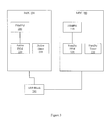
- FIG. 2 illustrates a metadata controller (MDC) 200 .
- MDC 200 contains an active FSM 220 that has control of an ARB block 240 .
- MDC 200 is used in a system for maintaining single writer access between a pair of high availability servers.
- MDC 200 may correspond to an instance of MDC 150 ( FIG. 1 ).
- MDC 200 includes a file system portmapper (FSMPM) 210 , an active file system manager (FSM) 220 , and an active timer 230 .
- the FSMPM 210 is connected to the active FSM 220 by a socket.
- One way that active FSMPM 210 can determine that active FSM 220 is not operating properly is by a close of the socket.
- the active FSM 220 is configured to maintain ownership of the ARB block 240 by periodically writing the ARB block 240 according to the timer bounded ARB protocol and to reset the active timer 230 upon successfully writing the ARB block 240 .
- the active FSMPM 210 can also be configured to selectively force an election of an MDC to replace the active MDC 200 as the single writer upon a determination that the active MDC 200 has terminated.
- the termination of an FSM is the event that leads to an election to select a replacement FSM for activation. The termination may have occurred because the timer expired and reset the MDC, or it could be because the FSM panic'd, exited voluntarily, or was directed to exit by its FSMPM (an administrative action). In a few cases, loss of communication can make it appear that the FSM has terminated.
- FIG. 3 illustrates a pair of MDCs used in a system for maintaining single writer access between a pair of high availability servers.
- the pair of MDCs includes MDC 200 and MDC 300 .
- the active MDC 200 is described in FIG. 2 .
- the MDC 300 includes an FSMPM 310 , a standby FSM 320 , and a standby timer 330 .
- the FSMPM 310 is configured to activate the standby FSM 320 to take control of the ARB block 240 after being elected to replace the active FSM 220 .
- the standby FSM 320 is configured to acquire ownership of the ARB block 240 , to maintain ownership of the ARB block 240 by periodically writing the ARB block 240 according to the timer bounded ARB protocol, and to restart the standby timer 330 upon successfully writing the ARB block 240 .
- the MDC 200 and the MDC 300 reside on separate pieces of computer hardware and communicate over a computer network.
- FIG. 3 illustrates the active timer 230 and the standby timer 330 as being internal to the MDC 200 and the MDC 300 respectively.
- the timers 230 and 330 may be part of an MDC or may be external to but used by an MDC.
- a timer may be external to a process and/or hardware implementing MDC 200 or MDC 300 .
- the active timer 230 can be, but is not limited to being, a kernel timer, an operating system timer, and a timer associated with computer hardware (e.g., peripheral component interconnect express (PCIE) card) operatively connected to an interface visible to active MDC 200 .
- PCIE peripheral component interconnect express
- the standby timer 330 can be, but is not limited to being, a kernel timer, an operating system timer, and a timer associated with computer hardware (e.g., PCIE card) operatively connected to an interface visible to MDC 300 . There is one timer per standby FSM 320 .
- the MDC 200 and the MDC 300 participate in the timer bounded arbitration protocol.
- the timer bounded arbitration protocol includes controlling the active FSM 220 to write the ARB block 240 once per FSM write period.
- the periodic writing indicates continued ownership of the ARB block 240 .
- the active FSM 220 will restart the active timer 230 to a reset threshold period. Recall that it is the expiration of the active timer 230 that resets the MDC.
- the MDC 300 may be called upon to take over the ARB block 240 and to hold single writer access that had previously been held by the MDC 200 .
- the timer bounded arbitration protocol also includes controlling the FSMPM 310 to activate the standby FSM 320 upon determining that the redundant MDC 300 has been selected to take control of the ARB block 240 .
- the protocol also includes the standby FSM 320 taking control of the ARB block 240 by writing the ARB block 240 after being activated by the FSMPM 310 .
- the timer bounded arbitration protocol may have different time delays.
- the FSM write period is 0.5 seconds
- the reset threshold period is 5 seconds
- the delay time period is the reset threshold period plus twice the FSM write period.
- FIG. 4 illustrates another embodiment of apparatus 100 .
- Apparatus 100 facilitates maintaining single writer access between a pair of high availability servers participating in a timer bounded arbitration protocol for resource control.
- the ARB logic 152 is configured to communicate with a data store 470 .
- the data store 470 stores an ARB block 472 , at least a portion of a file system 474 associated with the file system metadata 476 , and the file system metadata 476 .
- the timer bounded arbitration protocol protects the metadata 476 using the ARB block 472 that actually resides on the same data storage device as the metadata 476 that is being protected.
- Example methods may be better appreciated with reference to flow diagrams. While for purposes of simplicity of explanation, the illustrated methodologies are shown and described as a series of blocks, it is to be appreciated that the methodologies are not limited by the order of the blocks, as some blocks can occur in different orders and/or concurrently with other blocks from that shown and described. Moreover, less than all the illustrated blocks may be used to implement an example methodology. Blocks may be combined or separated into multiple components. Furthermore, additional and/or alternative methodologies can employ additional, not illustrated blocks.
- FIG. 5 illustrates a method 500 that provides a timer bounded arbitration protocol for resource control for maintaining single writer access between a pair of high availability servers.
- Method 500 includes, at 510 , monitoring control of an ARB block by an active FSM.
- the monitoring at 510 can include monitoring whether the active FSM is reading the ARB block, monitoring whether the active FSM is writing the ARB block, and monitoring whether the active FSM has restarted a bounding timer upon successfully writing the ARB block.
- Method 500 includes, at 530 , selectively causing a selection of a standby FSM when control of the ARB block does not satisfy a timer bounded ARB protocol.
- the selection can take the form of an election that identifies a most qualified FSM to take over.
- Method 500 also includes, at 540 , selectively forcing a hardware reset of an apparatus running the active FSM.
- forcing the hardware reset at 540 is performed without a communication with the redundant FSM and without an action by the active FSM.
- Method 500 also includes, at 550 , selectively establishing an FSM on a selected redundant MDC as a replacement FSM.
- selectively establishing the standby FSM as the replacement FSM at 550 includes sending an activation command to the standby FSM, controlling the standby FSM to monitor the ARB block for a safety period of time, and controlling the standby FSM to write the ARB block after determining that the active FSM has not written the ARB during the safety period of time.
- a technique is employed where the standby waits and watches the ARB block to make sure that the active FSM really has stopped branding the ARB.
- the standby FSM can determine that no-one more qualified than the standby FSM has started branding the ARB.
- selectively establishing the standby FSM as the replacement FSM at 550 can include controlling the FSM to wait to write the ARB block until after determining that the standby FSM state exceeds the state of other FSMs available to write the ARB block.
- method 800 provides more detail about the logic of an FSM from a start or restart to exit.
- an FSM reports to its FSMPM that it is waiting for activation.
- the method 800 therefore waits at 805 for an activation command.
- the FSM reads the ARB Block at 810 , waits one second at 815 to allow another FSM to update the ARB Block if it would, and then reads the ARB Block again at 820 .
- the FSM can detect at 825 the activity of another FSM without requiring any other communication or the synchronization of clocks for example.
- the activating FSM arrives at 840 from either of the tests 825 or 830 , writes its own brand, and starts its Reset Timer.
- a sleep of four write periods allows another FSM, which might still be active and writing the ARB Block without detecting the usurpation of the ARB Block, to be detected by the activating FSM at 855 following the read of the ARB Block at 850 . If the test at 855 detects the brand of another FSM, the activating FSM exits at 860 . Otherwise, the activating FSM proceeds simultaneously in multiple threads to 865 and 875 .
- the FSM completes a delay period of the HA Interval plus a safety period of two write intervals.
- the delay period began with the write at 840 . If another FSM, which might still be active and writing the ARB Block without detecting the usurpation of the ARB Block, has not rebranded the ARB Block in this delay period, then it is safe to assume that it has either voluntarily exited or its timer has expired and forced the termination of its MDC, thus preventing SBS.
- the thread at 865 demonstrates the ARB Block rebranding activity of an activated FSM.
- the FSM writes its brand in the ARB Block and restarts its timer, waits for one write period at 870 , reads the ARB Block Brand at 850 , and tests the brand at 855 . If the active FSM is delayed in this rebranding loop for more than the HA Interval, its timer will expire and force the MDC to terminate. Branding of the ARB Block, and the testing of ARB Block Brands, is the only communication and synchronization necessary between an activating FSM and any other active or activating FSM.
- a method may be implemented as computer executable instructions.
- a computer readable medium may store computer executable instructions that if executed by a computer (e.g., high availability server) cause the computer to perform the method described above. While executable instructions associated with the above method are described as being stored on a computer readable medium, it is to be appreciated that executable instructions associated with other example methods described herein may also be stored on a computer readable medium.
- Computer readable medium refers to a medium that stores signals, instructions and/or data.
- a computer readable medium may take forms, including, but not limited to, non-volatile media, and volatile media.
- Non-volatile media may include, for example, optical disks, and magnetic disks.
- Volatile media may include, for example, semiconductor memories, and dynamic memory.
- a computer readable medium may include, but are not limited to, a floppy disk, a flexible disk, a hard disk, a magnetic tape, other magnetic medium, an ASIC, a CD (compact disk), other optical medium, a RAM (random access memory), a ROM (read only memory), a memory chip or card, a memory stick, and other media from which a computer, a processor, or other electronic device can read.
- FIG. 6 illustrates a computer 600 that facilitates maintaining single writer access between a pair of high availability servers by participating in a timer bounded arbitration protocol for resource control.
- Computer 600 includes a processor 602 and a memory 604 that are operably connected by a bus 608 .
- the computer 600 may include a first component 680 that is configured to prevent a split brain scenario (SBS) in a pair of high availability servers.
- Component 680 may prevent the SBS by maintaining single writer access to a resource by controlling the resource according to a timer bounded arbitration protocol.
- the timer bounded arbitration protocol may control self-termination of a writer process.
- Computer 600 may also include a second component 690 that is configured to control a second writer process to take control of the resource upon determining that no other component is maintaining write access according to the timer bounded arbitration protocol.
- the processor 602 may be a variety of various processors including dual microprocessor and other multi-processor architectures.
- a memory 604 may include volatile memory (e.g., RAM (random access memory)) and/or non-volatile memory (e.g., ROM (read only memory)).
- the memory 604 can store a process 614 and/or a data 616 , for example.
- the process 614 may be an SBS prevention process and the data 616 may be co-ordination and control data.
- the bus 608 may be a single internal bus interconnect architecture and/or other bus or mesh architectures. While a single bus is illustrated, it is to be appreciated that the computer 600 may communicate with various devices, logics, and peripherals using other busses (e.g., PCIE (peripheral component interconnect express), 1394, USB (universal serial bus), Ethernet).
- the bus 608 can be types including, for example, a memory bus, a memory controller, a peripheral bus, an external bus, a crossbar switch, and/or a local bus.
- FIG. 7 illustrates an environment in which a pair of high availability servers may operate according to a timer bounded ARB protocol.
- An MDC 700 includes an FSMPM 702 , active FSMs 704 and 705 , and active timers 706 and 707 .
- Active FSM 704 has control of ARB block 722 and is tasked with protecting metadata 724 for file system 726 .
- Active FSM 705 has control of ARB block 732 and is tasked with protecting metadata 734 for file system 730 .
- Redundant MDC 710 includes an FSMPM 712 , standby FSMs 714 and 715 , and standby timers 716 and 717 .
- the MDC 700 and the redundant MDC 710 are arranged on a cluster of co-operating servers providing high availability for data stores 720 and 730 .
- Data store 720 stores an arbitration block 722 , a file system 726 , and metadata 724 concerning the file system 726 .
- Data store 730 stores an ARB block 732 , a file system 736 , and metadata 734 concerning file system 736 .
- a set of clients e.g., client 750 , and clients 760 through client 770 ) are connected to FSM 704 , and data store 720 , or FSM 705 and data store 730 by a computer network. In one embodiment the set of clients may be connected to data stores 720 and 730 via a storage area network (SAN).
- SAN storage area network
- a file system (e.g., file system 720 ) has a file system manager (e.g., FSM 704 ).
- the FSM protects the data 726 and the file system metadata 724 from an SBS where there could be two writers. File system 720 can become corrupted or out of synchronization if file system metadata 724 is being written by more than one writer. Control is exercised by the active FSM 704 .
- MDC 700 and FSM 704 may be the MDC and active FSM for FS 720 .
- MDC 710 and FSM 714 may be the MDC and active FSM for FS 730 .
- an MDC may house multiple FSMs.
- One of the protections offered by example apparatus and methods is a per process (e.g., per active FSM) timer (e.g., kernel timer) whose expiration resets the MDC, which avoids SBS.
- Active timer 706 is restarted by the active FSM 704 after the active FSM 704 rebrands the ARB block 722 . If the active timer 706 expires, then it is likely that the active FSM 704 is experiencing a failure condition. Therefore, FSMPM 702 may initiate an election whereby the standby FSM 714 is selected to take over control of the ARB block 722 and thus to take over controlling single writer access to the metadata 724 .
- the timer 706 is configured to produce the autonomous action of resetting the MDC 700 without requiring a communication from the redundant MDC 710 . Additionally, the timer 706 is configured to produce the autonomous action of resetting the MDC 700 without requiring an action by the active FSM 704 . This is an improvement over conventional systems that may have required a communication from a failing process (e.g., active FSM 704 ) or from the redundant MDC 710 . Requiring a communication from either of these entities produced holes in the protection against an SBS.
- the MDC 700 and the redundant MDC 710 participate in the timer bounded arbitration protocol. Part of the protocol controls acquisition of an arbitration block by a standby FSM after selection of the standby FSM as the FSM to take over control of the ARB.
- an FSM process for a single file system remains in standby mode until one FSM is activated as the result of an election protocol.
- the election determines the FSM whose network connections make it most attractive for controlling access to a file system and file system metadata.
- the criteria that make an FSM attractive include, but are not limited to, a number of available connections, connection bandwidth, connection reliability, and connection redundancy.
- an FSM After being elected and receiving an activation directive, an FSM relies on the arbitration protocol to determine whether another FSM is active in the metadata.
- An activated FSM is supposed to brand the ARB block by periodically writing the ARB block. An activating FSM therefore watches the ARB block for a period of time. If no-one else is branding the ARB block, then the activating FSM writes and brands the ARB block and assumes control. The activating FSM may wait for a period of time equal to the dead man timer plus two reset quantums. If someone else is branding the ARB block, then an activating FSM may determine whether the activating FSM is more qualified (e.g., received more votes during an election) than the entity that is branding the ARB block.
- the activating FSM will start writing the ARB to take control.
- the less qualified FSM will see the branding by the activating FSM, determine that it is less qualified, and stop branding the ARB block. If the activating FSM is less qualified, then it will not write the ARB block and will stop trying to take control of the ARB block. Before assuming that it has control of the ARB block, the activating FSM will make sure that its brand stays in the ARB block for a safety period of time.
- a standby FSM can be selected as part of an election process.
- the election process is part of a name server-coordinator system implemented in an FSMPM process.
- Clients and servers run FSMPM processes as part of a distributed system for monitoring and controlling file system functionality.
- FSMPMs provide heartbeats to the nameserver-coordinator FSMPM processes.
- Elections and activations can be based, at least in part, on the presence and absence of heartbeat signals.
- the FSMPM in an MDC for one or more activated FSMs sends heartbeat signals for its associated FSMs. An election may occur when the heartbeat signals stop.
- Example apparatus and methods protect metadata and/or databases.
- corruption from multiple writers of metadata is prevented by resetting a malfunctioning server computer when an active monitored FSM on the server fails to maintain control of an ARB block within a strict time window.
- corruption from multiple writers of a database is prevented by placing database data files on a dedicated file system and resetting the controlling server computer if the file system is still mounted when the active FSM stops.
Landscapes
- Engineering & Computer Science (AREA)
- Theoretical Computer Science (AREA)
- Physics & Mathematics (AREA)
- General Engineering & Computer Science (AREA)
- General Physics & Mathematics (AREA)
- Quality & Reliability (AREA)
- Mobile Radio Communication Systems (AREA)
- Information Retrieval, Db Structures And Fs Structures Therefor (AREA)
- Computer And Data Communications (AREA)
- Hardware Redundancy (AREA)
- Bus Control (AREA)
Abstract
Description
Claims (16)
Priority Applications (1)
| Application Number | Priority Date | Filing Date | Title |
|---|---|---|---|
| US12/821,251 US8332684B2 (en) | 2009-11-09 | 2010-06-23 | Timer bounded arbitration protocol for resource control |
Applications Claiming Priority (2)
| Application Number | Priority Date | Filing Date | Title |
|---|---|---|---|
| US25927109P | 2009-11-09 | 2009-11-09 | |
| US12/821,251 US8332684B2 (en) | 2009-11-09 | 2010-06-23 | Timer bounded arbitration protocol for resource control |
Publications (2)
| Publication Number | Publication Date |
|---|---|
| US20110107139A1 US20110107139A1 (en) | 2011-05-05 |
| US8332684B2 true US8332684B2 (en) | 2012-12-11 |
Family
ID=43974950
Family Applications (4)
| Application Number | Title | Priority Date | Filing Date |
|---|---|---|---|
| US12/821,251 Expired - Fee Related US8332684B2 (en) | 2009-11-09 | 2010-06-23 | Timer bounded arbitration protocol for resource control |
| US12/821,350 Expired - Fee Related US8260830B2 (en) | 2009-11-09 | 2010-06-23 | Adapting a timer bounded arbitration protocol |
| US12/906,220 Abandoned US20110113228A1 (en) | 2009-11-09 | 2010-10-18 | Rules-Based, Mode-Driven Manager for Timer Bounded Arbitration Protocol Based Resource Control |
| US13/564,755 Expired - Fee Related US8442948B2 (en) | 2009-11-09 | 2012-08-02 | Adapting a timer bounded arbitration protocol |
Family Applications After (3)
| Application Number | Title | Priority Date | Filing Date |
|---|---|---|---|
| US12/821,350 Expired - Fee Related US8260830B2 (en) | 2009-11-09 | 2010-06-23 | Adapting a timer bounded arbitration protocol |
| US12/906,220 Abandoned US20110113228A1 (en) | 2009-11-09 | 2010-10-18 | Rules-Based, Mode-Driven Manager for Timer Bounded Arbitration Protocol Based Resource Control |
| US13/564,755 Expired - Fee Related US8442948B2 (en) | 2009-11-09 | 2012-08-02 | Adapting a timer bounded arbitration protocol |
Country Status (1)
| Country | Link |
|---|---|
| US (4) | US8332684B2 (en) |
Families Citing this family (73)
| Publication number | Priority date | Publication date | Assignee | Title |
|---|---|---|---|---|
| US8850062B2 (en) * | 2010-08-09 | 2014-09-30 | Cisco Technology, Inc. | Distributed connectivity verification protocol redundancy |
| US9544792B2 (en) * | 2010-09-13 | 2017-01-10 | Blinq Wireless Inc. | System and method for joint scheduling in dual-carrier wireless backhaul networks |
| US9600315B2 (en) * | 2010-10-22 | 2017-03-21 | Netapp, Inc. | Seamless takeover of a stateful protocol session in a virtual machine environment |
| US9258244B1 (en) | 2013-05-01 | 2016-02-09 | Sandia Corporation | Protocol for communications in potentially noisy environments |
| US10749711B2 (en) | 2013-07-10 | 2020-08-18 | Nicira, Inc. | Network-link method useful for a last-mile connectivity in an edge-gateway multipath system |
| US10454714B2 (en) | 2013-07-10 | 2019-10-22 | Nicira, Inc. | Method and system of overlay flow control |
| US10135789B2 (en) | 2015-04-13 | 2018-11-20 | Nicira, Inc. | Method and system of establishing a virtual private network in a cloud service for branch networking |
| US10425382B2 (en) | 2015-04-13 | 2019-09-24 | Nicira, Inc. | Method and system of a cloud-based multipath routing protocol |
| US10498652B2 (en) | 2015-04-13 | 2019-12-03 | Nicira, Inc. | Method and system of application-aware routing with crowdsourcing |
| US10229017B1 (en) * | 2015-10-01 | 2019-03-12 | EMC IP Holding Company LLC | Resetting fibre channel devices for failover in high availability backup systems |
| CN107211003B (en) * | 2015-12-31 | 2020-07-14 | 华为技术有限公司 | Distributed storage system and method for managing metadata |
| US10275468B2 (en) | 2016-02-11 | 2019-04-30 | Red Hat, Inc. | Replication of data in a distributed file system using an arbiter |
| US11706127B2 (en) | 2017-01-31 | 2023-07-18 | Vmware, Inc. | High performance software-defined core network |
| US10992558B1 (en) | 2017-11-06 | 2021-04-27 | Vmware, Inc. | Method and apparatus for distributed data network traffic optimization |
| US20200036624A1 (en) | 2017-01-31 | 2020-01-30 | The Mode Group | High performance software-defined core network |
| US10992568B2 (en) | 2017-01-31 | 2021-04-27 | Vmware, Inc. | High performance software-defined core network |
| US11252079B2 (en) | 2017-01-31 | 2022-02-15 | Vmware, Inc. | High performance software-defined core network |
| US20180219765A1 (en) | 2017-01-31 | 2018-08-02 | Waltz Networks | Method and Apparatus for Network Traffic Control Optimization |
| US11121962B2 (en) | 2017-01-31 | 2021-09-14 | Vmware, Inc. | High performance software-defined core network |
| US10778528B2 (en) | 2017-02-11 | 2020-09-15 | Nicira, Inc. | Method and system of connecting to a multipath hub in a cluster |
| US10523539B2 (en) | 2017-06-22 | 2019-12-31 | Nicira, Inc. | Method and system of resiliency in cloud-delivered SD-WAN |
| US10999165B2 (en) | 2017-10-02 | 2021-05-04 | Vmware, Inc. | Three tiers of SaaS providers for deploying compute and network infrastructure in the public cloud |
| US11115480B2 (en) | 2017-10-02 | 2021-09-07 | Vmware, Inc. | Layer four optimization for a virtual network defined over public cloud |
| US10594516B2 (en) | 2017-10-02 | 2020-03-17 | Vmware, Inc. | Virtual network provider |
| US10959098B2 (en) | 2017-10-02 | 2021-03-23 | Vmware, Inc. | Dynamically specifying multiple public cloud edge nodes to connect to an external multi-computer node |
| US11089111B2 (en) | 2017-10-02 | 2021-08-10 | Vmware, Inc. | Layer four optimization for a virtual network defined over public cloud |
| US10999100B2 (en) | 2017-10-02 | 2021-05-04 | Vmware, Inc. | Identifying multiple nodes in a virtual network defined over a set of public clouds to connect to an external SAAS provider |
| US11223514B2 (en) * | 2017-11-09 | 2022-01-11 | Nicira, Inc. | Method and system of a dynamic high-availability mode based on current wide area network connectivity |
| US11310170B2 (en) | 2019-08-27 | 2022-04-19 | Vmware, Inc. | Configuring edge nodes outside of public clouds to use routes defined through the public clouds |
| US11144374B2 (en) * | 2019-09-20 | 2021-10-12 | Hewlett Packard Enterprise Development Lp | Data availability in a constrained deployment of a high-availability system in the presence of pending faults |
| US11611507B2 (en) | 2019-10-28 | 2023-03-21 | Vmware, Inc. | Managing forwarding elements at edge nodes connected to a virtual network |
| US11394640B2 (en) | 2019-12-12 | 2022-07-19 | Vmware, Inc. | Collecting and analyzing data regarding flows associated with DPI parameters |
| US11489783B2 (en) | 2019-12-12 | 2022-11-01 | Vmware, Inc. | Performing deep packet inspection in a software defined wide area network |
| US11722925B2 (en) | 2020-01-24 | 2023-08-08 | Vmware, Inc. | Performing service class aware load balancing to distribute packets of a flow among multiple network links |
| US11245641B2 (en) | 2020-07-02 | 2022-02-08 | Vmware, Inc. | Methods and apparatus for application aware hub clustering techniques for a hyper scale SD-WAN |
| US11709710B2 (en) | 2020-07-30 | 2023-07-25 | Vmware, Inc. | Memory allocator for I/O operations |
| US11575591B2 (en) | 2020-11-17 | 2023-02-07 | Vmware, Inc. | Autonomous distributed forwarding plane traceability based anomaly detection in application traffic for hyper-scale SD-WAN |
| US11575600B2 (en) | 2020-11-24 | 2023-02-07 | Vmware, Inc. | Tunnel-less SD-WAN |
| US11929903B2 (en) | 2020-12-29 | 2024-03-12 | VMware LLC | Emulating packet flows to assess network links for SD-WAN |
| CN116783874A (en) | 2021-01-18 | 2023-09-19 | Vm维尔股份有限公司 | Network-aware load balancing |
| US12218845B2 (en) | 2021-01-18 | 2025-02-04 | VMware LLC | Network-aware load balancing |
| US11979325B2 (en) | 2021-01-28 | 2024-05-07 | VMware LLC | Dynamic SD-WAN hub cluster scaling with machine learning |
| US12368676B2 (en) | 2021-04-29 | 2025-07-22 | VMware LLC | Methods for micro-segmentation in SD-WAN for virtual networks |
| US11381499B1 (en) | 2021-05-03 | 2022-07-05 | Vmware, Inc. | Routing meshes for facilitating routing through an SD-WAN |
| US12009987B2 (en) | 2021-05-03 | 2024-06-11 | VMware LLC | Methods to support dynamic transit paths through hub clustering across branches in SD-WAN |
| US11729065B2 (en) | 2021-05-06 | 2023-08-15 | Vmware, Inc. | Methods for application defined virtual network service among multiple transport in SD-WAN |
| US11489720B1 (en) | 2021-06-18 | 2022-11-01 | Vmware, Inc. | Method and apparatus to evaluate resource elements and public clouds for deploying tenant deployable elements based on harvested performance metrics |
| US12015536B2 (en) | 2021-06-18 | 2024-06-18 | VMware LLC | Method and apparatus for deploying tenant deployable elements across public clouds based on harvested performance metrics of types of resource elements in the public clouds |
| US12250114B2 (en) | 2021-06-18 | 2025-03-11 | VMware LLC | Method and apparatus for deploying tenant deployable elements across public clouds based on harvested performance metrics of sub-types of resource elements in the public clouds |
| US12047282B2 (en) | 2021-07-22 | 2024-07-23 | VMware LLC | Methods for smart bandwidth aggregation based dynamic overlay selection among preferred exits in SD-WAN |
| US11375005B1 (en) | 2021-07-24 | 2022-06-28 | Vmware, Inc. | High availability solutions for a secure access service edge application |
| US12267364B2 (en) | 2021-07-24 | 2025-04-01 | VMware LLC | Network management services in a virtual network |
| US11943146B2 (en) | 2021-10-01 | 2024-03-26 | VMware LLC | Traffic prioritization in SD-WAN |
| US12603848B2 (en) | 2022-01-04 | 2026-04-14 | VMware LLC | Efficient mechanism for the transmission of multipath duplicate packets |
| US12184557B2 (en) | 2022-01-04 | 2024-12-31 | VMware LLC | Explicit congestion notification in a virtual environment |
| US12507120B2 (en) | 2022-01-12 | 2025-12-23 | Velocloud Networks, Llc | Heterogeneous hub clustering and application policy based automatic node selection for network of clouds |
| US12425395B2 (en) | 2022-01-15 | 2025-09-23 | VMware LLC | Method and system of securely adding an edge device operating in a public network to an SD-WAN |
| US12506678B2 (en) | 2022-01-25 | 2025-12-23 | VMware LLC | Providing DNS service in an SD-WAN |
| US11909815B2 (en) | 2022-06-06 | 2024-02-20 | VMware LLC | Routing based on geolocation costs |
| US20240022626A1 (en) | 2022-07-18 | 2024-01-18 | Vmware, Inc. | Dns-based gslb-aware sd-wan for low latency saas applications |
| US20240028378A1 (en) | 2022-07-20 | 2024-01-25 | Vmware, Inc. | Method for modifying an sd-wan using metric-based heat maps |
| US20240073743A1 (en) | 2022-08-28 | 2024-02-29 | Vmware, Inc. | Dynamic use of multiple wireless network links to connect a vehicle to an sd-wan |
| US12034587B1 (en) | 2023-03-27 | 2024-07-09 | VMware LLC | Identifying and remediating anomalies in a self-healing network |
| US12057993B1 (en) | 2023-03-27 | 2024-08-06 | VMware LLC | Identifying and remediating anomalies in a self-healing network |
| US12425332B2 (en) | 2023-03-27 | 2025-09-23 | VMware LLC | Remediating anomalies in a self-healing network |
| US12603827B2 (en) | 2023-08-16 | 2026-04-14 | Velocloud Networks, Llc | Asymmetric routing resolutions in multi-regional large scale deployments with distributed gateways |
| US12507148B2 (en) | 2023-08-16 | 2025-12-23 | Velocloud Networks, Llc | Interconnecting clusters in multi-regional large scale deployments with distributed gateways |
| US12355655B2 (en) | 2023-08-16 | 2025-07-08 | VMware LLC | Forwarding packets in multi-regional large scale deployments with distributed gateways |
| US12507153B2 (en) | 2023-08-16 | 2025-12-23 | Velocloud Networks, Llc | Dynamic edge-to-edge across multiple hops in multi-regional large scale deployments with distributed gateways |
| US12587468B2 (en) | 2023-08-16 | 2026-03-24 | Velocloud Networks, Llc | Route filtering for clusters in multi-regional large scale deployments with distributed gateways |
| US12563438B2 (en) | 2023-08-16 | 2026-02-24 | Velocloud Networks, Llc | Distributed gateways for multi-regional large scale deployments |
| US12261777B2 (en) | 2023-08-16 | 2025-03-25 | VMware LLC | Forwarding packets in multi-regional large scale deployments with distributed gateways |
| US12483968B2 (en) | 2023-08-16 | 2025-11-25 | Velocloud Networks, Llc | Distributed gateways for multi-regional large scale deployments |
Citations (11)
| Publication number | Priority date | Publication date | Assignee | Title |
|---|---|---|---|---|
| US5392434A (en) * | 1993-09-03 | 1995-02-21 | Motorola, Inc. | Arbitration protocol system granting use of a shared resource to one of a plurality of resource users |
| US5649206A (en) * | 1993-09-07 | 1997-07-15 | Motorola, Inc. | Priority arbitration protocol with two resource requester classes and system therefor |
| US5805905A (en) * | 1995-09-06 | 1998-09-08 | Opti Inc. | Method and apparatus for arbitrating requests at two or more levels of priority using a single request line |
| US6263452B1 (en) * | 1989-12-22 | 2001-07-17 | Compaq Computer Corporation | Fault-tolerant computer system with online recovery and reintegration of redundant components |
| US6625750B1 (en) * | 1999-11-16 | 2003-09-23 | Emc Corporation | Hardware and software failover services for a file server |
| US20050009467A1 (en) * | 2003-07-11 | 2005-01-13 | Nuber Raymond Mark | System and method for satellite communication with a hybrid payload and DAMA support |
| US20060117212A1 (en) * | 2001-02-13 | 2006-06-01 | Network Appliance, Inc. | Failover processing in a storage system |
| US20060168192A1 (en) * | 2004-11-08 | 2006-07-27 | Cisco Technology, Inc. | High availability for intelligent applications in storage networks |
| US20070088842A1 (en) * | 2001-11-16 | 2007-04-19 | Sun Mircosystems, Inc. | Method and apparatus for managing configuration information in a distributed computer system |
| US20090132791A1 (en) * | 2005-09-13 | 2009-05-21 | International Business Machines Corporation | System and Method for Recovering From A Hang Condition In A Data Processing System |
| US7747806B2 (en) * | 2006-06-02 | 2010-06-29 | Panasonic Corporation | Resource use management device, resource use management system, and control method for a resource use management device |
Family Cites Families (4)
| Publication number | Priority date | Publication date | Assignee | Title |
|---|---|---|---|---|
| US6952766B2 (en) * | 2001-03-15 | 2005-10-04 | International Business Machines Corporation | Automated node restart in clustered computer system |
| US20040078681A1 (en) * | 2002-01-24 | 2004-04-22 | Nick Ramirez | Architecture for high availability using system management mode driven monitoring and communications |
| US20080201605A1 (en) * | 2007-02-21 | 2008-08-21 | Inventec Corporation | Dead man timer detecting method, multiprocessor switching method and processor hot plug support method |
| US8006129B2 (en) * | 2008-10-03 | 2011-08-23 | Cisco Technology, Inc. | Detecting and preventing the split-brain condition in redundant processing units |
-
2010
- 2010-06-23 US US12/821,251 patent/US8332684B2/en not_active Expired - Fee Related
- 2010-06-23 US US12/821,350 patent/US8260830B2/en not_active Expired - Fee Related
- 2010-10-18 US US12/906,220 patent/US20110113228A1/en not_active Abandoned
-
2012
- 2012-08-02 US US13/564,755 patent/US8442948B2/en not_active Expired - Fee Related
Patent Citations (12)
| Publication number | Priority date | Publication date | Assignee | Title |
|---|---|---|---|---|
| US6263452B1 (en) * | 1989-12-22 | 2001-07-17 | Compaq Computer Corporation | Fault-tolerant computer system with online recovery and reintegration of redundant components |
| US5392434A (en) * | 1993-09-03 | 1995-02-21 | Motorola, Inc. | Arbitration protocol system granting use of a shared resource to one of a plurality of resource users |
| US5649206A (en) * | 1993-09-07 | 1997-07-15 | Motorola, Inc. | Priority arbitration protocol with two resource requester classes and system therefor |
| US5805905A (en) * | 1995-09-06 | 1998-09-08 | Opti Inc. | Method and apparatus for arbitrating requests at two or more levels of priority using a single request line |
| US6625750B1 (en) * | 1999-11-16 | 2003-09-23 | Emc Corporation | Hardware and software failover services for a file server |
| US20060117212A1 (en) * | 2001-02-13 | 2006-06-01 | Network Appliance, Inc. | Failover processing in a storage system |
| US20070088842A1 (en) * | 2001-11-16 | 2007-04-19 | Sun Mircosystems, Inc. | Method and apparatus for managing configuration information in a distributed computer system |
| US20050009467A1 (en) * | 2003-07-11 | 2005-01-13 | Nuber Raymond Mark | System and method for satellite communication with a hybrid payload and DAMA support |
| US20060168192A1 (en) * | 2004-11-08 | 2006-07-27 | Cisco Technology, Inc. | High availability for intelligent applications in storage networks |
| US7711820B2 (en) * | 2004-11-08 | 2010-05-04 | Cisco Technology, Inc. | High availability for intelligent applications in storage networks |
| US20090132791A1 (en) * | 2005-09-13 | 2009-05-21 | International Business Machines Corporation | System and Method for Recovering From A Hang Condition In A Data Processing System |
| US7747806B2 (en) * | 2006-06-02 | 2010-06-29 | Panasonic Corporation | Resource use management device, resource use management system, and control method for a resource use management device |
Also Published As
| Publication number | Publication date |
|---|---|
| US20110113228A1 (en) | 2011-05-12 |
| US20110113066A1 (en) | 2011-05-12 |
| US20110107139A1 (en) | 2011-05-05 |
| US8442948B2 (en) | 2013-05-14 |
| US8260830B2 (en) | 2012-09-04 |
| US20120310999A1 (en) | 2012-12-06 |
Similar Documents
| Publication | Publication Date | Title |
|---|---|---|
| US8332684B2 (en) | Timer bounded arbitration protocol for resource control | |
| US8234521B2 (en) | Systems and methods for maintaining lock step operation | |
| US8239518B2 (en) | Method for detecting and resolving a partition condition in a cluster | |
| US7774646B2 (en) | Surviving storage system takeover by replaying operations in an operations log mirror | |
| US7904906B2 (en) | Tracking modified pages on a computer system | |
| AU2020285262B2 (en) | Error recovery method and apparatus | |
| US7721136B2 (en) | Systems and methods providing input/output fencing in shared storage environments | |
| US20060143497A1 (en) | System, method and circuit for mirroring data | |
| TWI529624B (en) | Method and system of fault tolerance for multiple servers | |
| JP2002358210A (en) | Redundant controller data storage system having system and method for handling controller reset | |
| US7669080B2 (en) | Reducing likelihood of data loss during failovers in high-availability systems | |
| US7350117B2 (en) | Management of microcode lock in a shared computing resource | |
| US7500035B2 (en) | Livelock resolution method | |
| US6480953B1 (en) | Method and apparatus for ensuring system configuration data structure coherency across multiple controllers in a data storage system | |
| US10360115B2 (en) | Monitoring device, fault-tolerant system, and control method | |
| CN106909307A (en) | A kind of method and device for managing dual-active storage array | |
| US10203890B1 (en) | Multi-tier mechanism to achieve high availability in a multi-controller system | |
| US5737515A (en) | Method and mechanism for guaranteeing timeliness of programs | |
| US11403001B2 (en) | System and method for storage system node fencing | |
| KR100928187B1 (en) | Fault-safe structure of dual processor control unit | |
| US10296469B1 (en) | Access control in a flash storage system | |
| US6957361B2 (en) | Method, system, and program for error handling in a dual adaptor system | |
| US20140229764A1 (en) | Management of a computer | |
| JPH05216855A (en) | Multi CPU control system | |
| JP3415636B2 (en) | Processor unit |
Legal Events
| Date | Code | Title | Description |
|---|---|---|---|
| AS | Assignment |
Owner name: QUANTUM CORPORATION, CALIFORNIA Free format text: ASSIGNMENT OF ASSIGNORS INTEREST;ASSIGNORS:MIDDLECAMP, WILLIAM J.;LABERGE, TIM;REINART, JOHN;SIGNING DATES FROM 20100617 TO 20100622;REEL/FRAME:024579/0115 |
|
| AS | Assignment |
Owner name: QUANTUM CORPORATION, CALIFORNIA Free format text: CORRECTIVE ASSIGNMENT TO CORRECT THE TYPOGRAPHICAL ERROR OF DOMESTIC PRIORITY APPLICATION SERIAL NO. FROM 61/256,271 TO 61/259,271 PREVIOUSLY RECORDED ON REEL 024579 FRAME 0115. ASSIGNOR(S) HEREBY CONFIRMS THE NEWLY SIGNED ASNGMT DOC WITH CORRECTION OF THE DOMESTIC PRIORITY USSN TO NOW CORRECTLY READ 61/259,271;ASSIGNORS:MIDDLECAMP, WILLIAM J.;LABERGE, TIM;REINART, JOHN;SIGNING DATES FROM 20100706 TO 20100707;REEL/FRAME:024645/0128 |
|
| AS | Assignment |
Owner name: WELLS FARGO CAPITAL FINANCE, LLC, AS AGENT, CALIFORNIA Free format text: SECURITY AGREEMENT;ASSIGNOR:QUANTUM CORPORATION;REEL/FRAME:027967/0914 Effective date: 20120329 Owner name: WELLS FARGO CAPITAL FINANCE, LLC, AS AGENT, CALIFO Free format text: SECURITY AGREEMENT;ASSIGNOR:QUANTUM CORPORATION;REEL/FRAME:027967/0914 Effective date: 20120329 |
|
| ZAAA | Notice of allowance and fees due |
Free format text: ORIGINAL CODE: NOA |
|
| ZAAB | Notice of allowance mailed |
Free format text: ORIGINAL CODE: MN/=. |
|
| STCF | Information on status: patent grant |
Free format text: PATENTED CASE |
|
| FEPP | Fee payment procedure |
Free format text: PAYOR NUMBER ASSIGNED (ORIGINAL EVENT CODE: ASPN); ENTITY STATUS OF PATENT OWNER: LARGE ENTITY |
|
| FPAY | Fee payment |
Year of fee payment: 4 |
|
| AS | Assignment |
Owner name: TCW ASSET MANAGEMENT COMPANY LLC, AS AGENT, MASSACHUSETTS Free format text: SECURITY INTEREST;ASSIGNOR:QUANTUM CORPORATION;REEL/FRAME:040451/0183 Effective date: 20161021 Owner name: TCW ASSET MANAGEMENT COMPANY LLC, AS AGENT, MASSAC Free format text: SECURITY INTEREST;ASSIGNOR:QUANTUM CORPORATION;REEL/FRAME:040451/0183 Effective date: 20161021 |
|
| AS | Assignment |
Owner name: PNC BANK, NATIONAL ASSOCIATION, PENNSYLVANIA Free format text: SECURITY INTEREST;ASSIGNOR:QUANTUM CORPORATION;REEL/FRAME:040473/0378 Effective date: 20161021 Owner name: QUANTUM CORPORATION, CALIFORNIA Free format text: RELEASE BY SECURED PARTY;ASSIGNOR:WELLS FARGO CAPITAL FINANCE, LLC, AS AGENT;REEL/FRAME:040474/0079 Effective date: 20161021 |
|
| AS | Assignment |
Owner name: U.S. BANK NATIONAL ASSOCIATION, AS AGENT, OHIO Free format text: SECURITY INTEREST;ASSIGNORS:QUANTUM CORPORATION, AS GRANTOR;QUANTUM LTO HOLDINGS, LLC, AS GRANTOR;REEL/FRAME:049153/0518 Effective date: 20181227 Owner name: QUANTUM CORPORATION, CALIFORNIA Free format text: RELEASE BY SECURED PARTY;ASSIGNOR:TCW ASSET MANAGEMENT COMPANY LLC, AS AGENT;REEL/FRAME:047988/0642 Effective date: 20181227 |
|
| AS | Assignment |
Owner name: PNC BANK, NATIONAL ASSOCIATION, PENNSYLVANIA Free format text: SECURITY INTEREST;ASSIGNOR:QUANTUM CORPORATION;REEL/FRAME:048029/0525 Effective date: 20181227 |
|
| MAFP | Maintenance fee payment |
Free format text: PAYMENT OF MAINTENANCE FEE, 8TH YEAR, LARGE ENTITY (ORIGINAL EVENT CODE: M1552); ENTITY STATUS OF PATENT OWNER: LARGE ENTITY Year of fee payment: 8 |
|
| AS | Assignment |
Owner name: BLUE TORCH FINANCE LLC, AS AGENT, NEW YORK Free format text: SECURITY INTEREST;ASSIGNORS:QUANTUM CORPORATION;QUANTUM LTO HOLDINGS, LLC;REEL/FRAME:057107/0001 Effective date: 20210805 |
|
| AS | Assignment |
Owner name: QUANTUM CORPORATION, CALIFORNIA Free format text: RELEASE BY SECURED PARTY;ASSIGNOR:U.S. BANK NATIONAL ASSOCIATION;REEL/FRAME:057142/0252 Effective date: 20210805 Owner name: QUANTUM LTO HOLDINGS, LLC, CALIFORNIA Free format text: RELEASE BY SECURED PARTY;ASSIGNOR:U.S. BANK NATIONAL ASSOCIATION;REEL/FRAME:057142/0252 Effective date: 20210805 |
|
| FEPP | Fee payment procedure |
Free format text: MAINTENANCE FEE REMINDER MAILED (ORIGINAL EVENT CODE: REM.); ENTITY STATUS OF PATENT OWNER: LARGE ENTITY |
|
| LAPS | Lapse for failure to pay maintenance fees |
Free format text: PATENT EXPIRED FOR FAILURE TO PAY MAINTENANCE FEES (ORIGINAL EVENT CODE: EXP.); ENTITY STATUS OF PATENT OWNER: LARGE ENTITY |
|
| STCH | Information on status: patent discontinuation |
Free format text: PATENT EXPIRED DUE TO NONPAYMENT OF MAINTENANCE FEES UNDER 37 CFR 1.362 |
|
| FP | Lapsed due to failure to pay maintenance fee |
Effective date: 20241211 |
|
| AS | Assignment |
Owner name: ALTER DOMUS (US) LLC, AS AGENT FOR THE SECURED PARTIES, ILLINOIS Free format text: ASSIGNMENT OF ASSIGNORS INTEREST;ASSIGNOR:BLUE TORCH FINANCE LLC, AS AGENT FOR THE SECURED PARTIES;REEL/FRAME:071019/0850 Effective date: 20250421 |
|
| AS | Assignment |
Owner name: QUANTUM CORPORATION, CALIFORNIA Free format text: TERMINATION AND RELEASE OF AMENDED AND RESTATED INTELLECTUAL PROPERTY SECURITY AGREEMENT AT REEL/FRAME NO. 48029/0525;ASSIGNOR:PNC BANK, NATIONAL ASSOCIATION, AS AGENT;REEL/FRAME:072542/0594 Effective date: 20250814 |
|
| AS | Assignment |
Owner name: QUANTUM CORPORATION, COLORADO Free format text: TERMINATION AND RELEASE OF INTELLECTUAL PROPERTY SECURITY AGREEMENT AT REEL/FRAME NO. 40473/0378;ASSIGNOR:PNC BANK, NATIONAL ASSOCIATION, AS AGENT;REEL/FRAME:073061/0454 Effective date: 20251007 |