US8329697B2 - Imidizo[1,2-A]pyrazines useful as AHCY hydrolase inhibitors - Google Patents
Imidizo[1,2-A]pyrazines useful as AHCY hydrolase inhibitors Download PDFInfo
- Publication number
- US8329697B2 US8329697B2 US12/811,911 US81191109A US8329697B2 US 8329697 B2 US8329697 B2 US 8329697B2 US 81191109 A US81191109 A US 81191109A US 8329697 B2 US8329697 B2 US 8329697B2
- Authority
- US
- United States
- Prior art keywords
- compounds
- cyclopenta
- inhibitors
- mmol
- equiv
- Prior art date
- Legal status (The legal status is an assumption and is not a legal conclusion. Google has not performed a legal analysis and makes no representation as to the accuracy of the status listed.)
- Expired - Fee Related, expires
Links
- IOVQTPGGQMHEDT-QDOHZIMISA-N NC1=NC=CN2C([C@@H]3C[Y][C@@H](O)[C@H]3O)=CN=C12 Chemical compound NC1=NC=CN2C([C@@H]3C[Y][C@@H](O)[C@H]3O)=CN=C12 IOVQTPGGQMHEDT-QDOHZIMISA-N 0.000 description 4
- JONQIDCMYVRSOB-IDJAFSAGSA-N C.NC1=NC=CN2C([C@@H]3C=C(CO)[C@@H](O)[C@H]3O)=CN=C12.NC1=NC=CN2C([C@@H]3CC[C@@H](O)[C@H]3O)=CN=C12 Chemical compound C.NC1=NC=CN2C([C@@H]3C=C(CO)[C@@H](O)[C@H]3O)=CN=C12.NC1=NC=CN2C([C@@H]3CC[C@@H](O)[C@H]3O)=CN=C12 JONQIDCMYVRSOB-IDJAFSAGSA-N 0.000 description 1
- XCSCBFGJJBJCEX-MZRHBFOASA-M C=C[C@@H]1C=C(CC)[C@H]2OC(C)(C)O[C@@H]12.C=C[Mg]Br.CCC1=C[C@@H](C(O)CN)[C@@H]2OC(C)(C)O[C@H]12.CCC1=C[C@@H](C(O)CNC2=NC=CN=C2Cl)[C@@H]2OC(C)(C)O[C@H]12.CCC1=C[C@@H](C2CO2)[C@@H]2OC(C)(C)O[C@H]12.CCC1=C[C@H](O)[C@@H]2OC(C)(C)O[C@H]12.CCC1=C[C@H](OC(=O)OC)[C@@H]2OC(C)(C)O[C@H]12.COC(=O)Cl.ClC1=C(Cl)N=CC=N1 Chemical compound C=C[C@@H]1C=C(CC)[C@H]2OC(C)(C)O[C@@H]12.C=C[Mg]Br.CCC1=C[C@@H](C(O)CN)[C@@H]2OC(C)(C)O[C@H]12.CCC1=C[C@@H](C(O)CNC2=NC=CN=C2Cl)[C@@H]2OC(C)(C)O[C@H]12.CCC1=C[C@@H](C2CO2)[C@@H]2OC(C)(C)O[C@H]12.CCC1=C[C@H](O)[C@@H]2OC(C)(C)O[C@H]12.CCC1=C[C@H](OC(=O)OC)[C@@H]2OC(C)(C)O[C@H]12.COC(=O)Cl.ClC1=C(Cl)N=CC=N1 XCSCBFGJJBJCEX-MZRHBFOASA-M 0.000 description 1
- LCFKZVPODHVDHO-XJRZIMAOSA-M C=C[C@@H]1C=C[C@H]2OC(C)(C)O[C@@H]12.C=C[Mg]Br.CC1(C)O[C@H]2[C@@H](O)C=C[C@H]2O1.CC1(C)O[C@H]2[C@H](C(O)CN)C=C[C@H]2O1.CC1(C)O[C@H]2[C@H](C(O)CN)CC[C@H]2O1.CC1(C)O[C@H]2[C@H](C3CO3)C=C[C@H]2O1.COC(=O)Cl.COC(=O)O[C@H]1C=C[C@H]2OC(C)(C)O[C@@H]12.ClC1=C(Cl)N=CC=N1 Chemical compound C=C[C@@H]1C=C[C@H]2OC(C)(C)O[C@@H]12.C=C[Mg]Br.CC1(C)O[C@H]2[C@@H](O)C=C[C@H]2O1.CC1(C)O[C@H]2[C@H](C(O)CN)C=C[C@H]2O1.CC1(C)O[C@H]2[C@H](C(O)CN)CC[C@H]2O1.CC1(C)O[C@H]2[C@H](C3CO3)C=C[C@H]2O1.COC(=O)Cl.COC(=O)O[C@H]1C=C[C@H]2OC(C)(C)O[C@@H]12.ClC1=C(Cl)N=CC=N1 LCFKZVPODHVDHO-XJRZIMAOSA-M 0.000 description 1
- XMZARTXQJJFSPQ-PPJZKEFESA-M C=C[C@@H]1[Y]C[C@H]2OC(C)(C)O[C@H]21.C=C[Mg]Br.CC1(C)O[C@@H]2C[Y][C@@H](C(O)CN)[C@@H]2O1.CC1(C)O[C@@H]2C[Y][C@@H](C(O)CNC3=NC=CN=C3Cl)[C@@H]2O1.CC1(C)O[C@@H]2C[Y][C@@H](C3CO3)[C@@H]2O1.CC1(C)O[C@@H]2C[Y][C@H](O)[C@@H]2O1.COC(=O)Cl.COC(=O)O[C@H]1[Y]C[C@H]2OC(C)(C)O[C@H]21.ClC1=C(Cl)N=CC=N1 Chemical compound C=C[C@@H]1[Y]C[C@H]2OC(C)(C)O[C@H]21.C=C[Mg]Br.CC1(C)O[C@@H]2C[Y][C@@H](C(O)CN)[C@@H]2O1.CC1(C)O[C@@H]2C[Y][C@@H](C(O)CNC3=NC=CN=C3Cl)[C@@H]2O1.CC1(C)O[C@@H]2C[Y][C@@H](C3CO3)[C@@H]2O1.CC1(C)O[C@@H]2C[Y][C@H](O)[C@@H]2O1.COC(=O)Cl.COC(=O)O[C@H]1[Y]C[C@H]2OC(C)(C)O[C@H]21.ClC1=C(Cl)N=CC=N1 XMZARTXQJJFSPQ-PPJZKEFESA-M 0.000 description 1
- UTNBTCDWAGOIKR-HPUUKZMTSA-N CC(C)(C)C(C1=CC=CC=C1)(C1=CC=CC=C1)C1=CC=CC=C1.CCC1=C[C@@H](/C2=C/N=C3/C(Cl)=NC=CN23)[C@@H]2OC(C)(C)O[C@H]12.CCC1=C[C@@H](/C2=C/N=C3/C(N)=NC=CN23)[C@@H]2OC(C)(C)O[C@H]12.CCC1=C[C@@H](C(=O)CNC2=NC=CN=C2Cl)[C@@H]2OC(C)(C)O[C@H]12.NC1=NC=CN2/C([C@@H]3C=C(CO)[C@@H](O)[C@H]3O)=C\N=C\12 Chemical compound CC(C)(C)C(C1=CC=CC=C1)(C1=CC=CC=C1)C1=CC=CC=C1.CCC1=C[C@@H](/C2=C/N=C3/C(Cl)=NC=CN23)[C@@H]2OC(C)(C)O[C@H]12.CCC1=C[C@@H](/C2=C/N=C3/C(N)=NC=CN23)[C@@H]2OC(C)(C)O[C@H]12.CCC1=C[C@@H](C(=O)CNC2=NC=CN=C2Cl)[C@@H]2OC(C)(C)O[C@H]12.NC1=NC=CN2/C([C@@H]3C=C(CO)[C@@H](O)[C@H]3O)=C\N=C\12 UTNBTCDWAGOIKR-HPUUKZMTSA-N 0.000 description 1
- VCAJUMRYOAKXRU-UMKBTCCVSA-N CC1(C)O[C@@H]2C[Y][C@@H](/C3=C/N=C4/C(Cl)=NC=CN34)[C@@H]2O1.CC1(C)O[C@@H]2C[Y][C@@H](/C3=C/N=C4/C(N)=NC=CN34)[C@@H]2O1.CC1(C)O[C@@H]2C[Y][C@@H](C(=O)CNC3=NC=CN=C3Cl)[C@@H]2O1.NC1=NC=CN2/C([C@@H]3[Y]C[C@@H](O)[C@H]3O)=C\N=C\12 Chemical compound CC1(C)O[C@@H]2C[Y][C@@H](/C3=C/N=C4/C(Cl)=NC=CN34)[C@@H]2O1.CC1(C)O[C@@H]2C[Y][C@@H](/C3=C/N=C4/C(N)=NC=CN34)[C@@H]2O1.CC1(C)O[C@@H]2C[Y][C@@H](C(=O)CNC3=NC=CN=C3Cl)[C@@H]2O1.NC1=NC=CN2/C([C@@H]3[Y]C[C@@H](O)[C@H]3O)=C\N=C\12 VCAJUMRYOAKXRU-UMKBTCCVSA-N 0.000 description 1
- BMWYQURJZALGIK-MYBRWWQOSA-N CC1(C)O[C@@H]2[C@@H](CC[C@H]2C(=O)CNC2=NC=CN=C2Cl)O1.CC1(C)O[C@H]2[C@H](/C3=C/N=C4/C(Cl)=NC=CN34)CC[C@H]2O1.CC1(C)O[C@H]2[C@H](/C3=C/N=C4/C(N)=NC=CN34)CC[C@H]2O1.CC1(C)O[C@H]2[C@H](C(O)CNC3=NC=CN=C3Cl)CC[C@H]2O1.NC1=NC=CN2/C([C@@H]3CC[C@@H](O)[C@H]3O)=C\N=C\12 Chemical compound CC1(C)O[C@@H]2[C@@H](CC[C@H]2C(=O)CNC2=NC=CN=C2Cl)O1.CC1(C)O[C@H]2[C@H](/C3=C/N=C4/C(Cl)=NC=CN34)CC[C@H]2O1.CC1(C)O[C@H]2[C@H](/C3=C/N=C4/C(N)=NC=CN34)CC[C@H]2O1.CC1(C)O[C@H]2[C@H](C(O)CNC3=NC=CN=C3Cl)CC[C@H]2O1.NC1=NC=CN2/C([C@@H]3CC[C@@H](O)[C@H]3O)=C\N=C\12 BMWYQURJZALGIK-MYBRWWQOSA-N 0.000 description 1
- RSMIYIJRSZAWDI-SFGNSQDASA-N NC1=NC=CN2C([C@@H]3C=C(CO)[C@@H](O)[C@H]3O)=CN=C12 Chemical compound NC1=NC=CN2C([C@@H]3C=C(CO)[C@@H](O)[C@H]3O)=CN=C12 RSMIYIJRSZAWDI-SFGNSQDASA-N 0.000 description 1
- BDFNQTDHTKBKRY-ZQARSLAVSA-N NC1=NC=CN2C([C@@H]3CC[C@@H](O)[C@H]3O)=CN=C12 Chemical compound NC1=NC=CN2C([C@@H]3CC[C@@H](O)[C@H]3O)=CN=C12 BDFNQTDHTKBKRY-ZQARSLAVSA-N 0.000 description 1
- 0 Nc1ncc[n]2c1ncc2[C@](**[C@@]1O)[C@@]1O Chemical compound Nc1ncc[n]2c1ncc2[C@](**[C@@]1O)[C@@]1O 0.000 description 1
Classifications
-
- C—CHEMISTRY; METALLURGY
- C07—ORGANIC CHEMISTRY
- C07D—HETEROCYCLIC COMPOUNDS
- C07D487/00—Heterocyclic compounds containing nitrogen atoms as the only ring hetero atoms in the condensed system, not provided for by groups C07D451/00 - C07D477/00
- C07D487/02—Heterocyclic compounds containing nitrogen atoms as the only ring hetero atoms in the condensed system, not provided for by groups C07D451/00 - C07D477/00 in which the condensed system contains two hetero rings
- C07D487/04—Ortho-condensed systems
-
- A—HUMAN NECESSITIES
- A61—MEDICAL OR VETERINARY SCIENCE; HYGIENE
- A61P—SPECIFIC THERAPEUTIC ACTIVITY OF CHEMICAL COMPOUNDS OR MEDICINAL PREPARATIONS
- A61P25/00—Drugs for disorders of the nervous system
-
- A—HUMAN NECESSITIES
- A61—MEDICAL OR VETERINARY SCIENCE; HYGIENE
- A61P—SPECIFIC THERAPEUTIC ACTIVITY OF CHEMICAL COMPOUNDS OR MEDICINAL PREPARATIONS
- A61P25/00—Drugs for disorders of the nervous system
- A61P25/18—Antipsychotics, i.e. neuroleptics; Drugs for mania or schizophrenia
-
- A—HUMAN NECESSITIES
- A61—MEDICAL OR VETERINARY SCIENCE; HYGIENE
- A61P—SPECIFIC THERAPEUTIC ACTIVITY OF CHEMICAL COMPOUNDS OR MEDICINAL PREPARATIONS
- A61P25/00—Drugs for disorders of the nervous system
- A61P25/28—Drugs for disorders of the nervous system for treating neurodegenerative disorders of the central nervous system, e.g. nootropic agents, cognition enhancers, drugs for treating Alzheimer's disease or other forms of dementia
-
- A—HUMAN NECESSITIES
- A61—MEDICAL OR VETERINARY SCIENCE; HYGIENE
- A61P—SPECIFIC THERAPEUTIC ACTIVITY OF CHEMICAL COMPOUNDS OR MEDICINAL PREPARATIONS
- A61P9/00—Drugs for disorders of the cardiovascular system
-
- A—HUMAN NECESSITIES
- A61—MEDICAL OR VETERINARY SCIENCE; HYGIENE
- A61P—SPECIFIC THERAPEUTIC ACTIVITY OF CHEMICAL COMPOUNDS OR MEDICINAL PREPARATIONS
- A61P9/00—Drugs for disorders of the cardiovascular system
- A61P9/12—Antihypertensives
Definitions
- the invention is directed to a class of S-adenosyl homocysteine hydrolase (AHCY) inhibitors, their salts, pharmaceutical compositions comprising them and their use in therapy of the human body.
- AHCY S-adenosyl homocysteine hydrolase
- the invention is directed to a class of AHCY inhibitors, which are useful in the treatment of diseases characterized by high homocysteine levels.
- AdoHcy S-adenosylhomocysteine
- SAM S-adenosylmethionine
- AdoHcy is then metabolized by the enzyme S-adenosylhomocysteine hydrolase, known as AHCY, SAHH or SAH hydrolase, which reversibly hydrolyses AdoHcy to adenosine and homocysteine.
- Homocysteine can be remethylated back to methionine or undergo a series of metabolic steps leading to the biosynthesis of glutathione or cysteine. Following the hydrolysis of AdoHcy, homocysteine can also be secreted from the body or converted into the anti-oxidant, glutathione, by a series of transulfuration pathway reactions. Glutathione is a major anti-oxidant in the body. The relative ratio between oxidized and reduced forms of glutathione is thought to be an important indicator of oxidative state.
- the ratio between SAM and AdoHcy is critical for many biological processes, as AdoHcy can inhibit many methyltransferases that use SAM as a methyl donor.
- the rate of conversion of AdoHcy to Hcy is a critical regulator of many biological reactions involving phospholipids, proteins, and nucleic acids. Chiang, Pharmacol Ther 1998, 77, 2, 115-134.
- Various nucleosides and nucleoside derivatives act as inhibitors of AHCY. Chiang.
- Homocysteine metabolism is also dependent on the nutrients folate, vitamin B12 and vitamin B6. Obeid et al, FEBS Letters 2006, 580:2994-3005. These nutrients are cofactors for the enzymes that remethylate Hey back to methionine (folate, B12) or convert it to glutathione (B6).
- AHCY is a 432 amino acid protein, which is a thioether hydrolase. AHCY is a cytosolic enzyme that has been found in a wide variety of cells. Walker, et al. Can. J. Biochem. 1975 53: 312-319. The sequence of AHCY is disclosed in International Patent Application Publication No. WO 2005/015221.
- AHCY catalyzes the conversion of S-adenosyl-homocysteine to homocysteine and adenosine. Because of the key role of AdoHcy in the synthesis of cysteine, and the role of S-adenosylmethionine as a universal methyl donor, misregulation of AHCY can affect methylation of phosphlipids, proteins, DNA and RNA.
- Hyperhomocysteinemia is a known risk factor for arterial vascular disease and venous thrombosis. Gellekink et al, Eur J Hum Genet. 2004 12(11):942-8; cardiovascular disease, Levine et al, Prog Neuropsych Biol Psych 2005, 29(7):1181-91; schizophrenia, Haidemenos et al, Prog Neuropsychopharmacol Biol Psychiatry. 2007 15; 31(6):1289-96; and bipolar disorder, Levine et al. Elevated homoscysteine levels have also been shown to be risk factors for stroke and Parkinson's Disease. Herrmann et al, Fortschr Neurol Psychiatr. 2007 75(9):515-27. Further, animal studies suggest that increased homocycsteine levels may be a factor in osteoporosis. Herrmann et al, Clin. Chem. 2007, 53(8):1455-61.
- One possible method for treating diseases via the AHCY pathway is to develop mechanisms for clearing homocysteine from the body.
- compounds or substances that increase the rate of vitamin B clearance of homocysteine in vivo may find utility as agents for treating disease associated with high levels of homocysteine.
- a second method of interfering with the AHCY pathway is to decrease production of homocytseine, i.e. to develop compounds that can inhibit production of homocysteine in vivo.
- compounds or substances which inhibit AHCY may decrease the extent of hydrolysis of S-adenosyl homocysteine into homocysteine and adenosine.
- the inventors have identified a novel group of compounds which act as inhibitors of S-adenosyl homocysteine hydrolase, thereby inhibiting the hydrolysis of S-adenosyl homocysteine into homocysteine and adenosine.
- the present invention is directed to novel compounds of generic formula (I)
- the invention is further directed to methods of treating a patient (preferably a human) for diseases or disorders which are characterized by high homocysteine levels, such as Alzheimer's disease, by administering to the patient a therapeutically effective amount of a compound of general formula (I), or a pharmaceutically acceptable salt thereof.
- a patient preferably a human
- the invention is also directed to pharmaceutical compositions which include an effective amount of a compound of formula (I), or a pharmaceutically acceptable salt thereof, and a pharmaceutically acceptable carrier, and the use of the compounds and pharmaceutical compositions of the invention in the treatment of such diseases.
- the invention is directed to compounds of general formula (I)
- R 1 is selected from the group consisting of
- R 1 is selected from the group consisting of
- R 1 is selected from the group consisting of
- the invention is directed to methods of treating a patient (preferably a human) for diseases characterized by high homocysteine levels, such as Alzheimer's Disease, hypertension, cardiovascular disease, stroke and schizophrenia, by administering to the patient a therapeutically effective amount of a compound of general formula (I).
- a patient preferably a human
- diseases characterized by high homocysteine levels such as Alzheimer's Disease, hypertension, cardiovascular disease, stroke and schizophrenia
- the invention is also directed to the use of a compound of formula (I) for treating diseases or disorders characterized by high homocysteine levels, such as Alzheimer's disease, hypertension, cardiovascular disease, stroke and schizophrenia.
- the invention is also directed to medicaments or pharmaceutical compositions for treating diseases or disorders characterized by high homocysteine levels, such as Alzheimer's disease, hypertension, cardiovascular disease, stroke and schizophrenia, which comprise a compound of formula (I), or a pharmaceutically acceptable salt thereof, and a pharmaceutically acceptable carrier.
- the invention is further directed to a method for the manufacture of a medicament or a composition for treating diseases or disorders characterized by high homocysteine levels, such as Alzheimer's disease, hypertension, cardiovascular disease, stroke or schizophrenia, comprising combining a compound of formula (I) with one or more pharmaceutically acceptable carriers.
- variable occurs more than once in Formula (I) or in a substituent thereof, the individual occurrences of that variable are independent of each other, unless otherwise specified.
- alkyl means a saturated straight or branched chain hydrocarbon radical having the number of carbon atoms designated (e.g., C 1-10 alkyl means an alkyl group having from one to ten carbon atoms).
- Preferred alkyl groups for use in the invention are C 1-6 alkyl groups, having from one to six atoms.
- Exemplary alkyl groups include methyl, ethyl, n-propyl, isopropyl, n-butyl, isobutyl, tent-butyl, pentyl, hexyl, and the like.
- C 0 alkyl means a bond.
- halo or halogen includes fluoro, chloro, bromo and iodo.
- the compounds of the invention may have one or more asymmetric centers.
- Compounds with asymmetric centers give rise to enantiomers (optical isomers), diastereomers (configurational isomers) or both, and it is intended that all of the possible enantiomers and diastereomers in mixtures and as pure or partially purified compounds are included within the scope of this invention.
- the present invention is meant to encompass all such isomeric forms of the compounds of formula (I).
- Formula (I) is shown above without a definite stereochemistry at certain positions.
- the present invention includes all stereoisomers of formula (I) and pharmaceutically acceptable salts thereof.
- racemic mixtures of the compounds may be separated so that the individual enantiomers or diastereomers are isolated.
- the separation can be carried out by methods well known in the art, such as the coupling of a racemic mixture of compounds to an enantiomerically pure compound to form a diastereomeric mixture, followed by separation of the individual diastereomers by standard methods, such as fractional crystallization or chromatography.
- the coupling reaction is often the formation of salts using an enantiomerically pure acid or base.
- the diastereomeric derivatives may then be converted to the pure enantiomers by cleavage of the added chiral residue.
- the racemic mixture of the compounds can also be separated directly by chromatographic methods using chiral stationary phases, which methods are well known in the art.
- any enantiomer or diastereomer of a compound may be obtained by stereoselective synthesis using optically pure starting materials or reagents of known configuration by methods well known in the art.
- any of the above synthetic sequences it may be necessary or desirable to protect sensitive or reactive groups on any of the molecules concerned. This may be achieved by means of conventional protecting groups, such as those described in Protective Groups in Organic Chemistry , ed. J. F. W. McOmie, Plenum Press, 1973, and T. W. Greene & Wuts, Protective Groups in Organic Synthesis , John Wiley & Sons, 1991.
- the protecting groups may be removed at a convenient sequent stage using methods known from the art.
- substantially pure means that the isolated material is at least 90% pure, and preferably 95% pure, and even more preferably 99% pure as assayed by analytical techniques known in the art.
- pharmaceutically acceptable salts refers to salts prepared from pharmaceutically acceptable non-toxic bases or acids including inorganic or organic bases and inorganic or organic acids.
- the compounds of the invention may be mono, di or tris salts, depending on the number of acid functionalities present in the free base form of the compound.
- Free bases and salts derived from inorganic bases include aluminum, ammonium, calcium, copper, ferric, ferrous, lithium, magnesium, manganic salts, manganous, potassium, sodium, zinc, and the like.
- Salts in the solid form may exist in more than one crystal structure, and may also be in the form of hydrates.
- Salts derived from pharmaceutically acceptable organic non-toxic bases include salts of primary, secondary, and tertiary amines, substituted amines including naturally occurring substituted amines, cyclic amines, and basic ion exchange resins, such as arginine, betaine, caffeine, choline, N,N′-dibenzylethylene-diamine, diethylamine, 2-diethylaminoethanol, 2-dimethylaminoethanol, ethanolamine, ethylenediamine, N-ethyl-morpholine, N-ethylpiperidine, glucamine, glucosamine, histidine, hydrabamine, isopropylamine, lysine, methylglucamine, morpholine, piperazine, piperidine, polyamine resins, procaine, purines, theobromine, triethylamine, tri
- salts may be prepared from pharmaceutically acceptable non-toxic acids, including inorganic and organic acids.
- acids include acetic, trifluoroacetic, benzenesulfonic, benzoic, camphorsulfonic, citric, ethanesulfonic, fumaric, gluconic, glutamic, hydrobromic, hydrochloric, isethionic, lactic, maleic, malic, mandelic, methanesulfonic, mucic, nitric, pamoic, pantothenic, phosphoric, succinic, sulfuric, tartaric, p-toluenesulfonic acid, and the like.
- the present invention is directed to the use of the compounds of formula (I) disclosed herein as AHCY hydrolase inhibitors in a patient or subject such as a mammal in need of such activity, comprising the administration of an effective amount of the compound.
- AHCY hydrolase inhibitors in a patient or subject such as a mammal in need of such activity, comprising the administration of an effective amount of the compound.
- a variety of other mammals can be treated according to the method of the present invention.
- the compounds of the present invention have utility in treating or ameliorating Alzheimer's disease.
- the compounds may also be useful in treating or ameliorating other diseases characterized by high homocysteine levels, such as Alzheimer's disease.
- Other conditions that may be treated by the compounds of the invention include Parkinson's Disease, hypertension, schizophrenia, including the positive and negative symptoms of schizophrenia and treatment of cognitive impairment due to schizophrenia, bipolar disorder, cancer, cardiovascular disease, viral infections and osteoporosis.
- the compounds of the invention are useful in treating Alzheimer's Disease.
- the compounds may be useful for the prevention of dementia of the Alzheimer's type, as well as for the treatment of early stage, intermediate stage or late stage dementia of the Alzheimer's type.
- schizophrenia or psychosis including schizophrenia (paranoid, disorganized, catatonic or undifferentiated), schizophreniform disorder, schizoaffective disorder, delusional disorder, brief psychotic disorder, shared psychotic disorder, psychotic disorder due to a general medical condition and substance-induced or drug-induced (phencyclidine, ketamine and other dissociative anaesthetics, amphetamine and other psychostimulants and cocaine), psychosispsychotic disorder, psychosis associated with affective disorders, brief reactive psychosis, schizoaffective psychosis, “schizophrenia-spectrum” disorders such as schizoid or schizotypal personality disorders, or illness associated with psychosis (such as major depression, manic depressive (bipolar) disorder, Alzheimer's disease and post-traumatic stress syndrome), including both the positive and the negative symptoms of schizophrenia and other psychoses; cognitive disorders including dementia (associated with Alzheimer's disease,
- the present invention provides a method for treating cognitive disorders, comprising: administering to a patient in need thereof an effective amount of a compound of the present invention.
- cognitive disorders are dementia, delirium, aninestic disorders and age-related cognitive decline.
- DSM-IV-TR Diagnostic and Statistical Manual of Mental Disorders
- the term “cognitive disorders” includes treatment of those mental disorders as described in DSM-IV-TR. The skilled artisan will recognize that there are alternative nomenclatures, nosologies and classification systems for mental disorders, and that these systems evolve with medical and scientific progress. Thus the term “cognitive disorders” is intended to include like disorders that are described in other diagnostic sources.
- cardiosvascular conditions or disorders for which the compounds of the invention may be useful include atherosclerosis, hypertension, hyperlipidemia, coronary heart disease, peripheral vascular disease, dyslipidemia, hyperbetalipoproteinemia, hypoalphalipoproteinemia, hypercholesterolemia, hypertriglyceridemia, familial-hypercholesterolemia, angina, ischemia, cardiac ischemia, stroke, myocardial infarction, reperfusion injury, angioplastic restenosis, vascular complications of diabetes, obesity (including abdominal obesity) and endotoxemia.
- a patient having metabolic syndrome is characterized as having three or more symptoms selected from the following group of five symptoms: (1) abdominal obesity; (2) hypertriglyceridemia; (3) low high-density lipoprotein cholesterol (HDL); (4) high blood pressure; and (5) elevated fasting glucose, which may be in the range characteristic of Type 2 diabetes if the patient is also diabetic.
- Each of these symptoms is defined clinically in the recently released Third Report of the National Cholesterol Education Program Expert Panel on Detection, Evaluation and Treatment of High Blood Cholesterol in Adults (Adult Treatment Panel III, or ATP III), National Institutes of Health, 2001, NIH Publication No. 01-3670.
- Patients with metabolic syndrome have an increased risk of developing the macrovascular and microvascular complications that are listed above, including atherosclerosis and coronary heart disease.
- the compounds of the invention may be used for treating stroke.
- One class of stroke patients to which a compound of the invention may be administered is a patient at risk for stroke.
- patient at risk for stroke means an individual who has had a previous stroke, or has a risk factor for stroke.
- risk factors for stroke include atherosclerosis, arterial hypertension, lipohyalinosis, hyperlipidemia, hypercholesterolemia, atrial fibrillation, smoking, inflammatory markers (including C-reactive protein), infection, homocysteine, sleep-disordered breathing, cerebral autosomal dominant arteriopathy with subcortial infarcts and leuko-encephalopathy (CADASIL), migraine, sickle-cell anemia, antiphospholipid antibody syndrome, arterial dissection, cocaine abuse and obesity.
- CADASIL leuko-encephalopathy
- a second class of patients to which a compound of the invention may be administered are acute stroke patients, i.e., patients who have suffered ischemic stroke within the last 7 days.
- One class of acute stroke patients are those who have suffered stroke within the last 3 days.
- Another class of acute stroke patients are those who have suffered stroke within the last 48 hours, for example within the last 24 hours.
- patients may be classified according to the period of time when stroke occurred, So, for example, one class of acute stroke patients are those who have suffered stroke within the last 18 hours.
- Another class of acute stroke patients are those who have suffered stroke within the last 12 hours.
- Another class of acute stroke patients are those who have suffered stroke within the last 8 hours.
- Another class of acute stroke patients are those who have suffered stroke within the last 6 hours.
- Another class of acute stroke patients are those who have suffered stroke within the last 4 hours.
- Another class of acute stroke patients are those who have suffered stroke within the last 3 hours.
- a third class of patients to which a compound of the present invention may be administered are patients who have suffered stroke more than 7 days previously, who are typically in need of restorative treatment.
- the subject or patient to whom the compounds of the present invention is administered is generally a human being, male or female, characterized by high homocysteine, but may also encompass other mammals, such as dogs, cats, mice, rats, cattle, horses, sheep, rabbits, monkeys, chimpanzees or other apes or primates, for which treatment of the above noted disorders is desired.
- the compounds of the present invention may be used in combination with one or more other drugs in the treatment of diseases or conditions for which the compounds of the present invention have utility, where the combination of the drugs together are safer or more effective than either drug alone. Additionally, the compounds of the present invention may be used in combination with one or more other drugs that treat, prevent, control, ameliorate, or reduce the risk of side effects or toxicity of the compounds of the present invention. Such other drugs may be administered, by a route and in an amount commonly used therefor, contemporaneously or sequentially with the compounds of the present invention. Accordingly, the pharmaceutical compositions of the present invention include those that contain one or more other active ingredients, in addition to the compounds of the present invention. The combinations may be administered as part of a unit dosage form combination product, or as a kit or treatment protocol wherein one or more additional drugs are administered in separate dosage forms as part of a treatment regimen.
- combinations of the compounds of the present invention include combinations with anti-Alzheimer's Disease agents, for example beta-secretase inhibitors; alpha 7 nicotinic agonists, such as ABT089, SSR180711 and MEM63908; ADAM 10 ligands or activators; gamma-secretase inhibitors, such as LY450139 and TAK 070; gamma secretase modulators; tau phosphorylation inhibitors; glycine transport inhibitors; LXR ⁇ agonists; ApoE4 conformational modulators; NR2B antagonists; androgen receptor modulators; blockers of A ⁇ oligomer formation; 5-HT4 agonists, such as PRX-03140; 5-HT6 antagonists, such as GSK 742467, SOS-518, FK-962, SL-65.0155, SRA-333 and xaliproden; 5-HT1a antagonists, such as lecozotan; p25/CDK5 inhibitors
- Examples of other active ingredients that may be administered in combination with a composition of the present invention, and either administered separately or in the same pharmaceutical composition, include agents for the treatment of diabetic conditions, such as
- insulin sensitizers including (i) PPAR ⁇ agonists, such as the glitazones (e.g. troglitazone, pioglitazone, englitazone, MCC-555, rosiglitazone, balaglitazone, and the like) and other PPAR ligands, including PPAR ⁇ / ⁇ dual, agonists, such as KRP-297, muraglitazar, naveglitazar, tesaglitazar, and TAK-559; PPAR ⁇ agonists, such as fenofibric acid derivatives (gemfibrozil, clofibrate, fenofibrate and bezafibrate); and selective PPAR ⁇ modulators (SPPAR ⁇ M's), such as disclosed in WO 02/060388, WO 02/08188, WO 2004/019869, WO 2004/020409, WO 2004/020408, and WO 2004/066963; (ii)
- sulfonylureas and other insulin secretagogues such as tolbutamide, glyburide, glipizide, glimepiride, and meglitinides, such as nateglinide and repaglinide;
- ⁇ -glucosidase inhibitors such as acarbose and miglitol
- glucagon receptor antagonists such as those disclosed in WO 97/16442; WO 98/04528, WO 98/21957; WO 98/22108; WO 98/22109; WO 99/01423, WO 00/39088, and WO 00/69810; WO 2004/050039; and WO 2004/069158;
- GLP-1 GLP-1, GLP-1 analogues or mimetics, and GLP-1 receptor agonists, such as exendin-4 (exenatide), liraglutide (N,N-2211), CJC-1131, LY-307161, and those disclosed in WO 00/42026 and WO 00/59887;
- GIP and GIP mimetics such as those disclosed in WO 00/58360, and GIP receptor agonists
- PACAP PACAP, PACAP mimetics, and PACAP receptor agonists such as those disclosed in WO 01/23420;
- cholesterol lowering agents such as (i) HMG-CoA reductase inhibitors (lovastatin, simvastatin, pravastatin, cerivastatin, fluvastatin, atorvastatin, itavastatin, and rosuvastatin, and other statins), (ii) sequestrants (cholestyramine, colestipol, and dialkylaminoalkyl derivatives of a cross-linked dextran), (iii) nicotinyl alcohol, nicotinic acid or a salt thereof, (iv) PPAR ⁇ agonists, such as fenofibric acid derivatives (gemfibrozil, clofibrate, fenofibrate and bezafibrate), (v) PPAR ⁇ / ⁇ dual agonists, such as naveglitazar and muraglitazar, (vi) inhibitors of cholesterol absorption, such as beta-sitosterol and ezetimibe, (vii) H
- PPAR gamma agonists and partial agonists including glitazones and non-glitazones (e.g. pioglitazone, englitazone, MCC-555, rosiglitazone, balaglitazone, netoglitazone, T-131, LY-300512, and LY-818;
- glitazones and non-glitazones e.g. pioglitazone, englitazone, MCC-555, rosiglitazone, balaglitazone, netoglitazone, T-131, LY-300512, and LY-818;
- anti-obesity compounds such as fenfluramine, dexfenfluramine, phentermine, sibutramine, orlistat, neuropeptide Y1 or Y5 antagonists, ⁇ 3 adrenergic receptor agonists, melanocortin-receptor agonists, in particular melanocortin-4 receptor agonists, ghrelin antagonists, bombesin receptor agonists (such as bombesin receptor subtype-3 agonists), a cannabinoid CB1 receptor antagonist/inverse agonist, 5-FIT (serotonin) inhibitors, and melanin-concentrating hormone (MCH) receptor antagonists;
- fenfluramine dexfenfluramine
- phentermine phentermine
- sibutramine orlistat
- neuropeptide Y1 or Y5 antagonists ⁇ 3 adrenergic receptor agonists
- melanocortin-receptor agonists in particular melanocortin-4 receptor
- agents intended for use in inflammatory conditions such as aspirin, non-steroidal anti-inflammatory drugs (NSAIDs), glucocorticoids, azulfidine, and selective cyclooxygenase-2 (COX-2) inhibitors;
- NSAIDs non-steroidal anti-inflammatory drugs
- COX-2 selective cyclooxygenase-2
- antihypertensive agents such as neutral endopeptidase inhibitors (e.g., thiorphan and phosphoramidon), aldosterone antagonists, renin inhibitors (e.g. enalkrein, RO 42-5892, A 65317, CP 80794, ES 1005, ES 8891, SQ 34017, aliskiren (2(S),4(S),5(S),7(S)—N-(2-carbamoyl-2-methylpropyl)-5-amino-4-hydroxy-2,7-diisopropyl-8-[4-methoxy-3-(3-methoxypropoxy)phenyl]-octanamid hemifumarate) SPP600, SPP630 and SPP635), endothelin receptors antagonists, vasodilators, calcium channel blockers (e.g., amlodipine, nifedipine, verastrial, diltiaze), ren
- GKAs glucokinase activators
- agents intended for use in inflammatory conditions such as aspirin, non-steroidal anti-inflammatory drugs, glucocorticoids, azulfidine, and cyclo-oxygenase 2 selective inhibitors, including etoricoxib and rofecoxib.
- anti-hypertensive agents examples include angiotensin II receptor antagonists (for example losartan, candesartan, irbesartan, valsartan, telmisartan, and eprosartan, including all stereoisomers, pharmaceutically acceptable salts, hydrates, and crystalline forms thereof), ACE inhibitors (for example, alacepril, benazepril, captopril, ceronapril, cilazapril, delapril, enalapril, enalaprilat, fosinopril, imidapril, lisinopril, moveltipril, moexipril, perindopril, quinapril, ramipril, spirapril, temocapril, and trandolapril), neutral endopeptidase inhibitors (e.g., thiorphan and phosphoramidon),
- urea derivatives of di- and tri-peptides include endothelin receptors antagonists, vasodilators, calcium channel blockers (e.g., amlodipine, nifedipine, verastrial, diltiazem, gallopamil, niludipine, nimodipins, nicardipine), potassium channel activators (e.g., nicorandil, pinacidil, cromakalim, minoxidil, aprilkalim, loprazolam), diuretics (e.g., hydrochlorothiazide), sympatholitics, beta-adrenergic blocking drugs (e.g., propranolol, atenolol, bisoprolol, carvedilol, metoprolol, or metoprolol tartate), alpha adrenergic blocking drugs (e.g., doxazocin, prazocin or alpha methyldopa
- agents for treating schizophrenia include sedatives, hypnotics, anxiolytics, antipsychotics, antianxiety agents, cyclopyrrolones, imidazopyridines, pyrazolopyrimidines, minor tranquilizers, melatonin agonists and antagonists, melatonergic agents, benzodiazepines, barbiturates, 5HT-2 antagonists, and the like, such as: adinazolam, allobarbital, alonimid, aiprazolam, amisulpride, amitriptyline, amobarbital, amoxapine, aripiprazole, bentazepam, benzoctamine, brotizolam, bupropion, busprione, butabarbital, butalbital, capuride, carbocloral, chloral betaine, chloral hydrate, clomipramine, clonazepam, cloperidone,
- the compounds of the invention may be used in combination with levodopa (with or without a selective extracerebral decarboxylase inhibitor such as carbidopa or benserazide), anticholinergics such as biperiden (optionally as its hydrochloride or lactate salt) and trihexyphenidyl(benzhexol)hydrochloride, COMT inhibitors such as entacapone, MOA-B inhibitors, antioxidants, A2a adenosine receptor antagonists, cholinergic agonists, NMDA receptor antagonists, serotonin receptor antagonists and dopamine receptor agonists such as alentemol, bromocriptine, fenoldopam, lisuride, naxagolide, pergolide and pramipexole.
- levodopa with or without a selective extracerebral decarboxylase inhibitor such as carbidopa or benserazide
- anticholinergics such as
- the dopamine agonist may be in the form of a pharmaceutically acceptable salt, for example, alentemol hydrobromide, bromocriptine mesylate, fenoldopam mesylate, naxagolide hydrochloride and pergolide mesylate.
- a pharmaceutically acceptable salt for example, alentemol hydrobromide, bromocriptine mesylate, fenoldopam mesylate, naxagolide hydrochloride and pergolide mesylate.
- the compounds of the invention may also be used in combination with phenothiazine, thioxanthene, heterocyclic dibenzazepine, butyrophenone, diphenylbutylpiperidine and indolone classes of neuroleptic agent.
- phenothiazines include chlorpromazine, mesoridazine, thioridazine, acetophenazine, fluphenazine, perphenazine and trifluoperazine.
- Suitable examples of thioxanthenes include chlorprothixene and thiothixene.
- An example of a dibenzazepine is clozapine.
- An example of a butyrophenone is haloperidol.
- An example of a diphenylbutylpiperidine is pimozide.
- An example of an indolone is molindolone.
- Other neuroleptic agents include loxapine, sulpiride and risperidone.
- the subject compound may be used in combination with acetophenazine, alentemol, aripiprazole, amisuipride, benzhexol, bromocriptine, biperiden, chiorpromazine, chlorprothixene, clozapine, diazepam, fenoldopam, fluphenazine, haloperidol, levodopa, levodopa with benserazide, levodopa with carbidopa, lisuride, loxapine, mesoridazine, molindolone, naxagolide, olanzapine, pergolide, perphenazine, pim
- the compounds of the invention may be used in combination with an anti-depressant or anti-anxiety agent, including norepinephrine reuptake inhibitors (including tertiary amine tricyclics and secondary amine tricyclics), selective serotonin reuptake inhibitors (SSRIs), monoamine oxidase inhibitors (MAOIs), reversible inhibitors of monoamine oxidase (RIMAs), serotonin and noradrenaline reuptake inhibitors (SNRTs), corticotropin releasing factor (CRF) antagonists, a-adrenoreceptor antagonists, neurokinin-1 receptor antagonists, atypical anti-depressants, benzodiazepines, 5-HT1 ⁇ agonists or antagonists, especially S-HT1A partial agonists, and corticotropin releasing factor (CRF) antagonists.
- norepinephrine reuptake inhibitors including tertiary amine tricyclics and secondary amine tricyclic
- Specific agents include: amitriptyline, clomipramine, doxepin, imipramine and trimipramine; amoxapine, desipramine, maprotiline, nortriptyline and protriptyline; fluoxetine, fluvoxamine, paroxetine and sertraline; isocarboxazid, phenelzine, tranylcypromine and selegiline; moclobemide: venlafaxine; duloxetine; aprepitant; bupropion, lithium, nefazodone, trazodone and viloxazine; alprazolam, chlordiazepoxide, clonazepam, chiorazepate, diazepam, halazepam, lorazepam, oxazepam and prazepam; buspirone, flesinoxan, gepirone and ipsapirone, and pharmaceutically acceptable salts thereof.
- composition as used herein is intended to encompass a product comprising specified ingredients in predetermined amounts or proportions, as well as any product which results, directly or indirectly, from combination of the specified ingredients in the specified amounts.
- This term in relation to pharmaceutical compositions is intended to encompass a product comprising one or more active ingredients, and an optional carrier comprising inert ingredients, as well as any product which results, directly or indirectly, from combination, complexation or aggregation of any two or more of the ingredients, or from dissociation of one or more of the ingredients, or from other types of reactions or interactions of one or more of the ingredients.
- compositions are prepared by uniformly and intimately bringing the active ingredient into association with a liquid carrier or a finely divided solid carrier or both, and then, if necessary, shaping the product into the desired formulation.
- the active compound which is a compound of formula (I)
- the pharmaceutical compositions of the present invention encompass any composition made by admixing a compound of the present invention and a pharmaceutically acceptable carrier.
- the carrier may take a wide variety of forms depending on the form of preparation desired for administration, e.g., oral or parenteral (including intravenous).
- the pharmaceutical compositions of the present invention can be presented as discrete units suitable for oral administration such as capsules, cachets or tablets each containing a predetermined amount of the active ingredient.
- the compositions can be presented as a powder, as granules, as a solution, as a suspension in an aqueous liquid, as a non-aqueous liquid, as an oil-in-water emulsion or as a water-in-oil liquid emulsion.
- the compounds of the invention, or pharmaceutically acceptable salts thereof may also be administered by controlled release means and/or delivery devices.
- compositions intended for oral use may be prepared according to any method known to the art for the manufacture of pharmaceutical compositions and such compositions may contain one or more agents selected from the group consisting of sweetening agents, flavoring agents, coloring agents and preserving agents in order to provide pharmaceutically elegant and palatable preparations.
- Tablets may contain the active ingredient in admixture with non-toxic pharmaceutically acceptable excipients which are suitable for the manufacture of tablets.
- excipients may be, for example, inert diluents, such as calcium carbonate, sodium carbonate, lactose, calcium phosphate or sodium phosphate; granulating and disintegrating agents, for example, corn starch, or alginic acid; binding agents, for example starch, gelatin or acacia, and lubricating agents, for example magnesium stearate, stearic acid or talc.
- the tablets may be uncoated or they may be coated by known techniques to delay disintegration and absorption in the gastrointestinal tract and thereby provide a sustained action over a longer period.
- a tablet containing the composition of this invention may be prepared by compression or molding, optionally with one or more accessory ingredients or adjuvants.
- Compressed tablets may be prepared by compressing, in a suitable machine, the active ingredient in a free-flowing form such as powder or granules, optionally mixed with a binder, lubricant, inert diluent, surface active or dispersing agent. Molded tablets may be made by molding in a suitable machine, a mixture of the powdered compound moistened with an inert liquid diluent.
- Each tablet preferably contains from about 0.1 mg to about 500 mg of the active ingredient and each cachet or capsule preferably containing from about 0.1 mg to about 500 mg of the active ingredient.
- compositions for oral use may also be presented as hard gelatin capsules wherein the active ingredient is mixed with an inert solid diluent, for example, calcium carbonate, calcium phosphate or kaolin, or as soft gelatin capsules wherein the active ingredient is mixed with water or an oil medium, for example peanut oil, liquid paraffin, or olive oil.
- an inert solid diluent for example, calcium carbonate, calcium phosphate or kaolin
- water or an oil medium for example peanut oil, liquid paraffin, or olive oil.
- compositions include aqueous suspensions, which contain the active materials in admixture with excipients suitable for the manufacture of aqueous suspensions.
- oily suspensions may be formulated by suspending the active ingredient in a vegetable oil, for example arachis oil, olive oil, sesame oil or coconut oil, or in a mineral oil such as liquid paraffin. Oily suspensions may also contain various excipients.
- the pharmaceutical compositions of the invention may also be in the form of oil-in-water emulsions, which may also contain excipients such as sweetening and flavoring agents.
- the pharmaceutical compositions may be in the form of a sterile injectable aqueous or oleaginous suspension, or in the form of sterile powders for the extemporaneous preparation of such sterile injectable solutions or dispersions.
- the final injectable form must be sterile and must be effectively fluid for easy syringability.
- the pharmaceutical compositions must be stable under the conditions of manufacture and storage; thus, preferably should be preserved against the contaminating action of microorganisms such as bacteria and fungi.
- compositions of the present invention can be in a form suitable for topical use such as, for example, an aerosol, cream, ointment, lotion, dusting powder, or the like. Further, the compositions can be in a form suitable for use in transdermal devices. These formulations may be prepared via conventional processing methods. As an example, a cream or ointment is prepared by mixing hydrophilic material and water, together with about 5 wt % to about 10 wt % of the compound, to produce a cream or ointment having a desired consistency.
- compositions of this invention can also be in a form suitable for rectal administration wherein the carrier is a solid. It is preferable that the mixture forms unit dose suppositories.
- suitable carriers include cocoa butter and other materials commonly used in the art.
- pharmaceutically acceptable it is meant the carrier, diluent or excipient must be compatible with the other ingredients of the formulation and not deleterious to the recipient thereof.
- administering should be understood to mean providing a compound of the invention to the individual in need of treatment in a form that can be introduced into that individual's body in a therapeutically useful form and therapeutically useful amount, including, but not limited to: oral dosage forms, such as tablets, capsules, syrups, suspensions, and the like; injectable dosage forms, such as IV, IM, or IP, and the like; transdermal dosage forms, including creams, jellies, powders, or patches; buccal dosage forms; inhalation powders, sprays, suspensions, and the like; and rectal suppositories.
- oral dosage forms such as tablets, capsules, syrups, suspensions, and the like
- injectable dosage forms such as IV, IM, or IP, and the like
- transdermal dosage forms including creams, jellies, powders, or patches
- buccal dosage forms inhalation powders, sprays, suspensions, and the like
- rectal suppositories rectal suppositories.
- an effective amount or “therapeutically effective amount” means the amount of the subject compound that will elicit the biological or medical response of a tissue, system, animal or human that is being sought by the researcher, veterinarian, medical doctor or other clinician.
- treatment means any administration of a compound of the present invention and includes (1) inhibiting the disease in an animal that is experiencing or displaying the pathology or symptomatology of the diseased (i.e., arresting further development of the pathology and/or symptomatology), or (2) ameliorating the disease in an animal that is experiencing or displaying the pathology or symptomatology of the diseased (i.e., reversing the pathology and/or symptomatology).
- compositions containing compounds of the present invention may conveniently be presented in unit dosage form and may be prepared by any of the methods well known in the art of pharmacy.
- unit dosage form is taken to mean a single dose wherein all active and inactive ingredients are combined in a suitable system, such that the patient or person administering the drug to the patient can open a single container or package with the entire dose contained therein, and does not have to mix any components together from two or more containers or packages.
- Typical examples of unit dosage forms are tablets or capsules for oral administration, single dose vials for injection, or suppositories for rectal administration. This list of unit dosage forms is not intended to be limiting in any way, but merely to represent typical examples of unit dosage forms.
- compositions containing compounds of the present invention may conveniently be presented as a kit, whereby two or more components, which may be active or inactive ingredients, carriers, diluents, and the like, are provided with instructions for preparation of the actual dosage form by the patient or person administering the drug to the patient.
- kits may be provided with all necessary materials and ingredients contained therein, or they may contain instructions for using or making materials or components that must be obtained independently by the patient or person administering the drug to the patient.
- the compounds of the present invention are administered at a daily dosage of from about 0.1 mg to about 100 mg per kg of animal body weight, preferably given as a single daily dose or in divided doses two to six times a day, or in sustained release form.
- the total daily dosage is from about 1.0 mg to about 2000 mg, preferably from about 0.1 mg to about 20 mg per kg of body weight. In the case of a 70 kg adult human, the total daily dose will generally be from about 7 mg to about 1,400 mg. This dosage regimen may be adjusted to provide the optimal therapeutic response.
- the compounds may be administered on a regimen of 1 to 4 times per day, preferably once or twice per day.
- the amount of active ingredient that may be combined with the carrier materials to produce a single dosage form will vary depending upon the host treated and the particular mode of administration.
- a formulation intended for the oral administration to humans may conveniently contain from about 0.005 mg to about 2.5 g of active agent, compounded with an appropriate and convenient amount of carrier material.
- Unit dosage forms will generally contain between from about 0.005 mg to about 1000 mg of the active ingredient, typically 0.005, 0.01 mg, 0.05 mg, 0.25 mg, 1 mg, 5 mg, 25 mg, 50 mg, 100 mg, 200 mg, 300 mg, 400 mg, 500 mg, 600 mg, 800 mg or 1000 mg, administered once, twice or three times a day.
- the compounds of the invention may be prepared according to the following reaction schemes, in which variables are as defined before or are derived, using readily available starting materials, from reagents and conventional synthetic procedures. It is also possible to use variants which are themselves known to those of ordinary skill in organic synthesis art, but are not mentioned in greater detail.
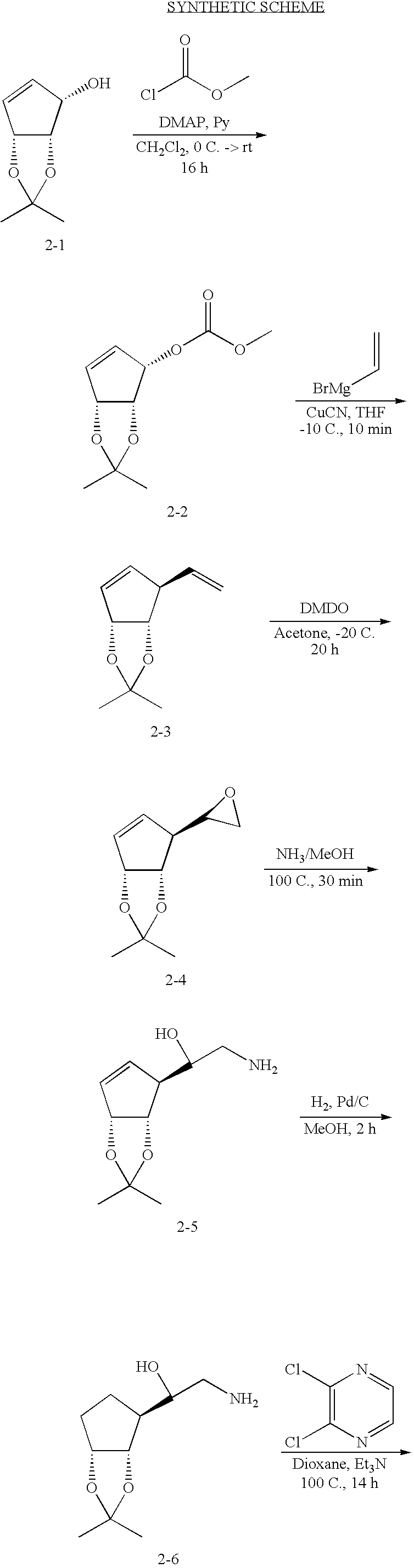
- appropriately substituted and/or protected cyclopentyl alcohols A-1 can be acylated with methyl chloroformate to produce carbonates A-2.
- X—Y can be either saturated (as in X—Y) or unsaturated (as in X ⁇ Y) and substituted according to the above generic claims.
- Carbonates A-2 are then reacted with vinyl magnesium bromide in the presence of copper (I) cyanide to provide the vinyl derivates A-3.
- Regioselective epoxidation of the terminal vinyl group (for example—over an internal X ⁇ Y double bond) is achieved using dimethyl dioxirane at low temperature to produce epoxides A-4.
- Epoxides A-4 are then regioselectively reacted with ammonia under thermal conditions to give the amino alcohols A-5.
- Amino alcohols A-5 are coupled with 2,3-dichloropyrazine to produce amino pyrazines A-6.
- Moffat-Swern oxidation of the secondary alcohol in pyrazines A-6 yields the ketone A-7 that is subsequently cyclized in the presence of trifluoroacetic acid and trfiluoroacetic anhydride buffered by the presence of pyridine. These conditions provide the heterocyclic imidazopyrazines A-8.
- Imidazopyrazines A-8 are then reacted with ammonia under thermal conditions to provide imidazopyrazines A-9. Subsequent deprotection may vary depending on the nature of the X—Y substitution, but acid hydrolysis is utilized to remove the ketal group to provide final compounds A-10.
- Liquid ammonia (10 mL) was added to 8-chloro-3-((3aS,4S,6aR)-2,2-dimethyl-6-(trityloxymethyl)-4,6a-dihydro-3aH-cyclopenta[d][1,3]dioxol-4-yl)imidazo[1,2-a]pyrazine (1-8) (180 mg, 0.32 mmol, 1 equiv) in isopropanol (10 mL). The resulting solution was placed in a high pressure vessel and heated to 100° C. (pressure did not exceed 600 psi) for 20 h.
- reaction mixture was concentrated and purified via flash chromatography on a silica gel column (ethyl acetate/hexanes) to yield desired (3aS,4S,6aR)-2,2-dimethyl-4-((S)-oxiran-2-yl)-4,6a-dihydro-3aH-cyclopenta[d][1,3]dioxole (2-4) as a colorless oil.
- Liquid ammonia 50 mL was added to 8-chloro-3-((3aS,4S,6aR)-2,2-dimethyltetrahydro-3aH-cyclopenta[d][1,3]dioxol-4-yl)imidazo[1,2-a]pyrazine (2-9) (1.5 g, 5.1 mmol, 1 equiv) in isopropanol (50 mL). The resulting solution was placed in a high pressure vessel and heated to 100° C.
- the AHCY activity of the compounds of the invention can be measured by the following in vitro assay.
- the AHCY enzyme assay is based on the principle of fluorescence emission following incubation of a reactive dye with the products of an AHCY catalyzed reaction.
- the reactive dye (Thioglo1) binds homocysteine through its thiol-containing moiety.
- the products of the AHCY catalyzed reaction, adenosine and homocysteine are produced from the hydrolysis of SAH (s-adenosylhomocysteine) through AHCY's hydrolase activity.
- the reaction is optimized in 96-, 384-, 1536- and 3456-assay plate formats with recombinant expressed human or mouse AHCY enzyme. When run under initial velocity conditions, the assay is suitable for IC50 and % inhibition calculations.
- the AHCY activity of the compounds of the invention can be measured by the following cell-based assay.
- This assay measures secreted homocysteine over a period of time from adherent HEK293 and/or SH-SY5Y cells as a measure of the ability of a compound to enter a cell in culture and effectively inhibit AHCY in the context of the cellular milieu.
- Post treatment collection of the adherent Hek293 and/or SH-SY5Y cells is also made for a viability and proliferation measure. Since the amount of secreted homocysteine is limited by the amount of SAH that is converted to homocysteine in the cells and its subsequent secretion, an EC50 measure and % inhibition relative to DMSO control cells can be made.
- an MTT 3-(4,5-Dimethylthiazol-2-yl)-2,5-diphenyltetrazolium bromide
- MTT 3-(4,5-Dimethylthiazol-2-yl)-2,5-diphenyltetrazolium bromide
- NAD nicotinamide adenine dinucleotide
- DMEM Dulbecco's modified Eagle's medium
- DIPEA diisopropylethylamine
Landscapes
- Health & Medical Sciences (AREA)
- Chemical & Material Sciences (AREA)
- Organic Chemistry (AREA)
- Engineering & Computer Science (AREA)
- Bioinformatics & Cheminformatics (AREA)
- Life Sciences & Earth Sciences (AREA)
- Public Health (AREA)
- General Chemical & Material Sciences (AREA)
- Medicinal Chemistry (AREA)
- Nuclear Medicine, Radiotherapy & Molecular Imaging (AREA)
- Chemical Kinetics & Catalysis (AREA)
- Pharmacology & Pharmacy (AREA)
- Veterinary Medicine (AREA)
- Animal Behavior & Ethology (AREA)
- General Health & Medical Sciences (AREA)
- Neurology (AREA)
- Biomedical Technology (AREA)
- Neurosurgery (AREA)
- Cardiology (AREA)
- Heart & Thoracic Surgery (AREA)
- Psychiatry (AREA)
- Hospice & Palliative Care (AREA)
- Pharmaceuticals Containing Other Organic And Inorganic Compounds (AREA)
- Acyclic And Carbocyclic Compounds In Medicinal Compositions (AREA)
- Enzymes And Modification Thereof (AREA)
Abstract

Description

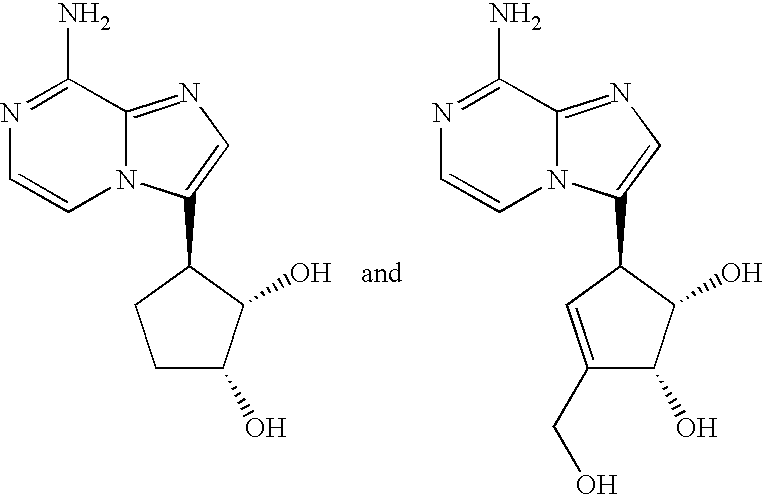
or pharmaceutically acceptable salts thereof, which are useful as AHCY inhibitors.

and pharmaceutically acceptable salts thereof, wherein
X—Y is selected from the group consisting of
-
- (a) halogen, or
- (b) hydroxyl; and
R2 is selected from the group consisting of
-
- (a) halogen, or
- (b) hydroxyl.
-
- (a) halogen, or
- (b) hydroxyl.



- 1) ThioGlo1 (catalog 595501, Calbiochem); 100 mM in DMSO
- 2) SAH (catalog A-9384, Sigma); 4.69 mM with 0.06 N HCl
- 3) Aristeromycin (catalog A-0928, Sigma); 100 mM in DMSO
- 4) NAD (catalog 43410, Sigma); 14.5 mM in water
- 5) EDTA in 500 mM pH 8 (catalog BP2482-100, Fisher)
- 6) DTT stock 200 mM in water
- 7) AHCY enzyme (diluted with 100 mM tris pH7.5)
Dilutions immediately prior to use: - 1. SAH 750 μM (10×) (dilute with 100 mM Iris pH 7.5)
- 2. Aristeromycin (10×) (dilute to 1 mM with 100 mM Tris pH7.5)
- 3. ThioGlo1 (10×) (dilute to 100 μM in Tris pH7.5)
- 4. AHCY assay buffer (3.3×): 3 μM DTT, 150 μM NAD, 3 mM EDTA
Protocol: As per 96-assay plate well - 1. Add 5 μL AHCY enzyme [30 ng/ul in 100 mM Tris pH7.5]
- 2. Add 5 μL DMSO or inhibitor
- 3. Add 15 μL AHCY assay buffer
- 4. Add 15 μL 100 mM Tris pH 7.5
- 5, Incubate 37° C. 30 min
- 6. Add 5 μL 750 uM SAH
- 7. Incubate 37° C. 10 min
- 8. Add 5 μl 100 μM ThioGlo1
- 9. Incubate 37° C. 15 mins
- 10. Read plate (Ex 380 Em 510)
- 1. The day before compound treatment, plate 20,000 cells (Hek293 or SH-SY5Y) in 96 well cell culture treated plates in 100 μl of cell culture media (DMEM and 10% fetal bovine serum).
- 2. Add fresh media plus compound (and DMSO treated controls) for 72 hrs.
- 3. Collect conditioned media for measurement of secreted homocysteine and perform viability/proliferation assay on adherent cells.
Measure of Secreted Homocysteine: - 1. Add 25 μl conditioned media, standard or control in 96-well assay plate
- 2. Add 25 μl internal standard
- 3. Add 10 μl reduction solution
- 4. Add 50 μl derivatisation reagent
- 5. Incubate for 10 min in PCR (polymerase chain reaction) machine at 60° C., stop reaction at 4° C. or on ice.
- 6. Add 50 μl precipitating solution
- 7. Mix well, incubate for 10 min at 4° C. and centrifuge for 10 min at 2,000×
- 8. Inject 20 μl of the supernatant into HPLC system.
-
- i. Column material: Imtakt Unisom C18, 3 μm
- ii. Column dimension: 50 mm×4.6 mm
- iii. Flow rate: 1.5 ml/min
- iv. Detection: Fluorescence: Excitation 385 nm, Emission 515 nm
- v. Injection volume: 20 μl
- vi. Running time: 3.5 min
(peak height patient*concentration of the calibrator/peak height internal standard patient)*F=concentration patient sample (F=IS peak of calibrator/Hcy peak of calibrator)
Measure of Cell Viability/Proliferation:
- 1. Add mixture of 10 μl 5 mg/ml MTT labeling reagent plus 90 μl fresh assay media to cells.
- 2. Incubate for 4 hrs at 37° C. in cell culture incubator
- 3. Add 100 μl of solubilization solution.
- 4. Incubate for 16 hrs at 37° C. in cell culture incubator
- 5. ReaDMEMd absorbance at 550 nM and 690 nM.
- 6. Express readout as 550 nM-690 nM.
Claims (7)

Priority Applications (1)
| Application Number | Priority Date | Filing Date | Title |
|---|---|---|---|
| US12/811,911 US8329697B2 (en) | 2008-02-26 | 2009-02-18 | Imidizo[1,2-A]pyrazines useful as AHCY hydrolase inhibitors |
Applications Claiming Priority (3)
| Application Number | Priority Date | Filing Date | Title |
|---|---|---|---|
| US6721008P | 2008-02-26 | 2008-02-26 | |
| PCT/US2009/034344 WO2009108546A1 (en) | 2008-02-26 | 2009-02-18 | Ahcy hydrolase inhibitors for treatment of hyper homocysteinemia |
| US12/811,911 US8329697B2 (en) | 2008-02-26 | 2009-02-18 | Imidizo[1,2-A]pyrazines useful as AHCY hydrolase inhibitors |
Publications (2)
| Publication Number | Publication Date |
|---|---|
| US20100305135A1 US20100305135A1 (en) | 2010-12-02 |
| US8329697B2 true US8329697B2 (en) | 2012-12-11 |
Family
ID=41016437
Family Applications (1)
| Application Number | Title | Priority Date | Filing Date |
|---|---|---|---|
| US12/811,911 Expired - Fee Related US8329697B2 (en) | 2008-02-26 | 2009-02-18 | Imidizo[1,2-A]pyrazines useful as AHCY hydrolase inhibitors |
Country Status (4)
| Country | Link |
|---|---|
| US (1) | US8329697B2 (en) |
| EP (1) | EP2257161B1 (en) |
| AT (1) | ATE555116T1 (en) |
| WO (1) | WO2009108546A1 (en) |
Cited By (3)
| Publication number | Priority date | Publication date | Assignee | Title |
|---|---|---|---|---|
| US10196396B2 (en) * | 2016-01-14 | 2019-02-05 | Handok Inc. | Compounds antagonizing A3 adenosine receptor, method for preparing them, and medical-use thereof |
| US10738057B2 (en) | 2017-10-18 | 2020-08-11 | Incyte Corporation | Tertiary alcohols as PI3K-γ inhibitors |
| US11186580B2 (en) | 2018-09-05 | 2021-11-30 | Incyte Corporation | Crystalline forms of a phosphoinositide 3-kinase (PI3K) inhibitor |
Families Citing this family (8)
| Publication number | Priority date | Publication date | Assignee | Title |
|---|---|---|---|---|
| EP2257161B1 (en) * | 2008-02-26 | 2012-04-25 | Merck Sharp & Dohme Corp. | Ahcy hydrolase inhibitors for treatment of hyper homocysteinemia |
| EP2486925A4 (en) * | 2009-10-09 | 2014-03-19 | Mitsubishi Tanabe Pharma Corp | THERAPEUTIC AGENT OF THE CEREBRAL INFARCTUS |
| CA2778949C (en) | 2009-10-30 | 2018-02-27 | Janssen Pharmaceutica Nv | Imidazo[1,2-b]pyridazine derivatives and their use as pde10 inhibitors |
| AR080754A1 (en) | 2010-03-09 | 2012-05-09 | Janssen Pharmaceutica Nv | IMIDAZO DERIVATIVES (1,2-A) PIRAZINA AND ITS USE AS PDE10 INHIBITORS |
| BR112013033375B1 (en) | 2011-06-27 | 2022-05-10 | Janssen Pharmaceutica N.V | Derivatives of 1-aryl-4-methyl-[1,2,4]triazolo[4,3-a]quinoxaline, their use, pharmaceutical composition that comprises them, process of preparation thereof, sterile solution and intermediate compound |
| RU2657540C2 (en) | 2012-06-26 | 2018-06-14 | Янссен Фармацевтика Нв | Combinations comprising pde 2 inhibitors such as 1-aryl-4-methyl- [1,2,4]triazolo[4,3-a]quinoxaline compounds and pde 10 inhibitors for use in treatment of neurological or metabolic disorders |
| EP2869822B1 (en) | 2012-07-09 | 2016-09-14 | Janssen Pharmaceutica, N.V. | Inhibitors of phosphodiesterase 10 enzyme |
| CN116840197A (en) * | 2022-03-23 | 2023-10-03 | 中国科学院苏州生物医学工程技术研究所 | 2' -O-methyltransferase activity detection method, kit and application |
Citations (5)
| Publication number | Priority date | Publication date | Assignee | Title |
|---|---|---|---|---|
| US4507294A (en) | 1982-03-08 | 1985-03-26 | Schering Corp. | Imidazo[1,2-a]pyrazines |
| US5521162A (en) | 1987-08-26 | 1996-05-28 | Merrell Pharmaceuticals Inc. | Aristeromycin analogues of 4',5'-didehydro-5'-fluoro-adenosine and methods of treating neoplastic and viral disease conditions |
| US20040204429A1 (en) | 2003-04-09 | 2004-10-14 | Chong-Sheng Yuan | Reversible inhibitors of SAH hydrolase and uses thereof |
| US7208495B2 (en) | 2001-07-05 | 2007-04-24 | Takeda Pharmaceutical Company Limited | Benzo-fused 5-membered hetrocycle compounds, process for preparation of the same, and use thereof |
| WO2009108546A1 (en) * | 2008-02-26 | 2009-09-03 | Merck & Co., Inc. | Ahcy hydrolase inhibitors for treatment of hyper homocysteinemia |
-
2009
- 2009-02-18 EP EP09714617A patent/EP2257161B1/en not_active Not-in-force
- 2009-02-18 WO PCT/US2009/034344 patent/WO2009108546A1/en not_active Ceased
- 2009-02-18 US US12/811,911 patent/US8329697B2/en not_active Expired - Fee Related
- 2009-02-18 AT AT09714617T patent/ATE555116T1/en active
Patent Citations (5)
| Publication number | Priority date | Publication date | Assignee | Title |
|---|---|---|---|---|
| US4507294A (en) | 1982-03-08 | 1985-03-26 | Schering Corp. | Imidazo[1,2-a]pyrazines |
| US5521162A (en) | 1987-08-26 | 1996-05-28 | Merrell Pharmaceuticals Inc. | Aristeromycin analogues of 4',5'-didehydro-5'-fluoro-adenosine and methods of treating neoplastic and viral disease conditions |
| US7208495B2 (en) | 2001-07-05 | 2007-04-24 | Takeda Pharmaceutical Company Limited | Benzo-fused 5-membered hetrocycle compounds, process for preparation of the same, and use thereof |
| US20040204429A1 (en) | 2003-04-09 | 2004-10-14 | Chong-Sheng Yuan | Reversible inhibitors of SAH hydrolase and uses thereof |
| WO2009108546A1 (en) * | 2008-02-26 | 2009-09-03 | Merck & Co., Inc. | Ahcy hydrolase inhibitors for treatment of hyper homocysteinemia |
Non-Patent Citations (2)
| Title |
|---|
| Hackam, et al. JAMA, 296(14), 2006, 1731-1732. * |
| Jordan, V. C. Nature Reviews: Drug Discovery, 2, 2003, 205. * |
Cited By (7)
| Publication number | Priority date | Publication date | Assignee | Title |
|---|---|---|---|---|
| US10196396B2 (en) * | 2016-01-14 | 2019-02-05 | Handok Inc. | Compounds antagonizing A3 adenosine receptor, method for preparing them, and medical-use thereof |
| US10738057B2 (en) | 2017-10-18 | 2020-08-11 | Incyte Corporation | Tertiary alcohols as PI3K-γ inhibitors |
| US11225486B2 (en) | 2017-10-18 | 2022-01-18 | Incyte Corporation | Tertiary alcohols as PI3K-γ inhibitors |
| US11926630B2 (en) | 2017-10-18 | 2024-03-12 | Incyte Corporation | Tertiary alcohols as PI3K-γ inhibitors |
| US12516065B2 (en) | 2017-10-18 | 2026-01-06 | Incyte Corporation | Tertiary alcohols as PI3K-γ inhibitors |
| US11186580B2 (en) | 2018-09-05 | 2021-11-30 | Incyte Corporation | Crystalline forms of a phosphoinositide 3-kinase (PI3K) inhibitor |
| US12173006B2 (en) | 2018-09-05 | 2024-12-24 | Incyte Corporation | Crystalline forms of a phosphoinositide 3-kinase (PI3K) inhibitor |
Also Published As
| Publication number | Publication date |
|---|---|
| EP2257161B1 (en) | 2012-04-25 |
| US20100305135A1 (en) | 2010-12-02 |
| ATE555116T1 (en) | 2012-05-15 |
| EP2257161A1 (en) | 2010-12-08 |
| WO2009108546A1 (en) | 2009-09-03 |
| EP2257161A4 (en) | 2011-03-16 |
Similar Documents
| Publication | Publication Date | Title |
|---|---|---|
| EP2257161B1 (en) | Ahcy hydrolase inhibitors for treatment of hyper homocysteinemia | |
| US8664411B2 (en) | Tetrahydropyranochromene gamma secretase inhibitors | |
| US8685967B2 (en) | Substituted triazolopyridines and analogs thereof | |
| JP5941981B2 (en) | Tricyclic sulfonamide compounds and methods for their production and use | |
| US10376504B2 (en) | Substituted quinolinones as PDE9 inhibitors | |
| US10370336B2 (en) | Phenyl-cyanoquinolinone PDE9 inhibitors | |
| KR20130126912A (en) | Drug derivatives | |
| US10287293B2 (en) | Bicyclic heterocyclic compounds as PDE2 inhibitors | |
| US10370337B2 (en) | Oxy-cyanoquinolinone PDE9 inhibitors | |
| JP2015509102A (en) | Tricyclic sulfone compounds and methods for making and using the same | |
| AU2011223888A1 (en) | Inhibitors of catechol O-methyl transferase and their use in the treatment of psychotic disorders | |
| US10160762B2 (en) | 6-alkyl dihydropyrazolopyrimidinone compounds as PDE2 inhibitors | |
| US10174037B2 (en) | Dihydropyrazolopyrimidinone compounds as PDE2 inhibitors | |
| US9284302B2 (en) | Cyclobutyl benzimidazoles as PDE 10 inhibitors | |
| JP2006525281A (en) | Pyridinyl acetonitriles | |
| EP2919782B1 (en) | Secondary alcohol subsituted triazoles as pde10 inhibitors | |
| US20110319409A1 (en) | 7-aza-quinazoline pde10 inhibitors | |
| US8629275B2 (en) | AHCY hydrolase inhibitors for treatment of hyper homocysteinemia | |
| US11919894B2 (en) | Pro drugs of PDE10 compounds | |
| US20260138978A1 (en) | Positive allosteric modulators of the muscarinic acetylcholine receptor m1 | |
| EP2919783B1 (en) | Cyclopropyl imidazopyridine pde10 inhibitors | |
| US8871929B2 (en) | Fused-imidazoyl compounds useful as antimicrobial agents |
Legal Events
| Date | Code | Title | Description |
|---|---|---|---|
| AS | Assignment |
Owner name: MERCK SHARP & DOHME CORP, NEW JERSEY Free format text: ASSIGNMENT OF ASSIGNORS INTEREST;ASSIGNORS:GARBACCIO, ROBERT M.;CONVERSO, ANTONELLA;FRALEY, MARK E.;AND OTHERS;REEL/FRAME:024645/0598 Effective date: 20100625 |
|
| AS | Assignment |
Owner name: SCHERING CORPORATION, NEW JERSEY Free format text: MERGER;ASSIGNOR:MERCK SHARP & DOHME CORP.;REEL/FRAME:028850/0515 Effective date: 20120426 |
|
| AS | Assignment |
Owner name: MERCK SHARP & DOHME CORP., NEW JERSEY Free format text: CHANGE OF NAME;ASSIGNOR:SCHERING CORPORATION;REEL/FRAME:028866/0511 Effective date: 20120502 |
|
| REMI | Maintenance fee reminder mailed | ||
| LAPS | Lapse for failure to pay maintenance fees | ||
| STCH | Information on status: patent discontinuation |
Free format text: PATENT EXPIRED DUE TO NONPAYMENT OF MAINTENANCE FEES UNDER 37 CFR 1.362 |
|
| STCH | Information on status: patent discontinuation |
Free format text: PATENT EXPIRED DUE TO NONPAYMENT OF MAINTENANCE FEES UNDER 37 CFR 1.362 |
|
| FP | Lapsed due to failure to pay maintenance fee |
Effective date: 20161211 |