US8327792B2 - Canoe with multiple hull sections - Google Patents
Canoe with multiple hull sections Download PDFInfo
- Publication number
- US8327792B2 US8327792B2 US12/821,757 US82175710A US8327792B2 US 8327792 B2 US8327792 B2 US 8327792B2 US 82175710 A US82175710 A US 82175710A US 8327792 B2 US8327792 B2 US 8327792B2
- Authority
- US
- United States
- Prior art keywords
- hull
- canoe
- hull section
- section
- sections
- Prior art date
- Legal status (The legal status is an assumption and is not a legal conclusion. Google has not performed a legal analysis and makes no representation as to the accuracy of the status listed.)
- Active
Links
- 238000004519 manufacturing process Methods 0.000 claims abstract description 7
- 238000000465 moulding Methods 0.000 claims description 12
- 238000000034 method Methods 0.000 claims description 6
- 229920000642 polymer Polymers 0.000 claims description 5
- 230000013011 mating Effects 0.000 abstract description 28
- 238000005304 joining Methods 0.000 description 9
- 239000004698 Polyethylene Substances 0.000 description 3
- -1 polyethylene Polymers 0.000 description 3
- 229920000573 polyethylene Polymers 0.000 description 3
- 238000010276 construction Methods 0.000 description 2
- 239000011152 fibreglass Substances 0.000 description 2
- 230000000452 restraining effect Effects 0.000 description 2
- 239000004793 Polystyrene Substances 0.000 description 1
- 230000001419 dependent effect Effects 0.000 description 1
- 238000005516 engineering process Methods 0.000 description 1
- 238000003780 insertion Methods 0.000 description 1
- 230000037431 insertion Effects 0.000 description 1
- 239000004033 plastic Substances 0.000 description 1
- 229920003023 plastic Polymers 0.000 description 1
- 229920002223 polystyrene Polymers 0.000 description 1
- 238000005728 strengthening Methods 0.000 description 1
Images



Classifications
-
- B—PERFORMING OPERATIONS; TRANSPORTING
- B63—SHIPS OR OTHER WATERBORNE VESSELS; RELATED EQUIPMENT
- B63B—SHIPS OR OTHER WATERBORNE VESSELS; EQUIPMENT FOR SHIPPING
- B63B34/00—Vessels specially adapted for water sports or leisure; Body-supporting devices specially adapted for water sports or leisure
- B63B34/20—Canoes, kayaks or the like
- B63B34/21—Canoes, kayaks or the like characterised by constructional features
- B63B34/23—Sectionalised, e.g. modular, collapsible or foldable
Definitions
- the present invention relates generally to canoes, such as a sit-top or sit-in kayak, and especially to a canoe comprising at least three sections.
- the present invention also relates to the manufacturing of such a canoe, and especially molding the hull sections.
- Modern kayaks are often rotation molded in polyethylene.
- the rotation molding process is rational and economic, especially in comparison to the manufacture of fiberglass boats.
- the molding technology provides strong and durable kayaks.
- a variety of versatile kayaks adapted for a wide range of specific use are available, such as long distance paddling, paddling in the archipelago or at sea.
- the canoe according to the present invention is still being versatile, strong and durable in regard of its primary use as a paddling boat.
- the present invention provides a divisible canoe, such as a kayak, comprising at least two molded hull sections.
- the present invention further relates to a method of manufacturing such a canoe.
- the canoe comprises a joint for releasable connection of the first hull section to the second hull section, wherein each hull section of the joint comprises means for mating the adjacent hull section of the joint.
- the present invention thereby provides a canoe having sections that can be connected for use as a boat and separated for transport and storing.
- Particular advantages compared to other solutions are the instant and effortless joining and separating of the parts where no tools, screws or other loose parts are needed and the strength of the canoe that in its self resists the forces involved through the weight of the paddler and gear and the forces of the elements, particularly the pressure created by waves.
- Other known solutions are dependent for their strength in the joining together of the parts by screws and other means, but the canoe according to the present invention is self supported and the buckles used are only to keep the parts from sliding apart and have no bearing on the strength.
- the canoe comprises at least three hull sections and joints for releasable connection of each hull section to the adjacent hull section.
- Each hull section comprises means for mating the adjacent hull section of the joint.
- the length of the canoe is optional by mounting only two of the sections together, providing a one-man canoe, or providing a two-man canoe by mounting all three sections together.
- the mating means at least one protruding member and at least one corresponding groove, provided in respective one of said hull sections.
- the mating means a substantially longitudinal mating direction.
- locking means comprised for locking said hull sections together when they are joined.
- the locking means a two-part clasp.
- the locking means arranged to lock reciprocal movement of said hull sections in the mating direction.
- the invention also provides a method for manufacturing such a canoe, including the step of molding the two hull sections and the mating means, wherein the mating means of each hull section is molded in the section. Molding the joints into the hull sections when molding the hull sections facilitates keeping the hull sections watertight and also keeps the manufacturing simple.
- the method includes molding the mating means into bulkheads of said respective hull sections.
- the sections are blow molded or rotation molded in a polymer, such as polyethylene, and the mating means are molded together with the sections.
- the mating means are preferably molded into a respective bulkhead of its hull section.
- the molding includes molding at least one part of locking means into at least one hull section.
- the hull sections are blow molded or, more preferably, rotation molded of a polymer, preferably polyethylene.
- FIG. 1 illustrates a canoe having two hull sections when joined together.
- FIG. 2 illustrates a canoe having two hull sections when the hull sections are apart.
- FIG. 3 illustrates locking means for securing the joint in place when locked.
- FIG. 4 illustrates the locking means in place when open.
- FIG. 5 illustrates a canoe having three hull sections when joined together.
- FIG. 6 illustrates a canoe having three hull sections when the hull sections are apart.
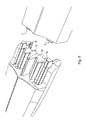
- FIG. 7 illustrates mating means for joining two adjacent hull sections.
- FIG. 8 illustrates mating means for joining two adjacent hull sections from a second perspective.
- FIG. 9 illustrates mating means for joining two adjacent hull sections from a third perspective.
- FIG. 1 illustrates a canoe 1 comprising two hull sections 2 , 3 .
- the hull sections 2 , 3 are floatable and make up a canoe when joined in the longitudinal direction, from stem to stern.
- the first hull section 2 can be connected to the second hull section 3 by means of a first joint comprising a plurality of cylindrical male projections for insertion into at least one female groove.
- FIG. 2 show the same canoe 1 as shown in FIG. 1 with the two hull sections 2 , 3 slightly apart.
- the hull sections 2 , 3 are joined together by mating means comprising protruding members and corresponding grooves arranged in respective hull section 2 , 3 .
- the hull sections are joined together by a substantially longitudinal mating direction with self-strengthening and self-locking by protruding members and corresponding grooves arranged in respective hull section.
- the protruding member and the corresponding groove are sufficiently long to withstand substantial side forces and torsional forces.
- the length of each protruding member and corresponding groove is at least one tenth of its respective hull section.
- FIG. 3 show a clasp used for locking the hull sections together.
- FIG. 3 show the clasp in its locked position when in use for locking two hull sections together.
- FIG. 4 show the clasp in place in its open position.
- FIG. 5 illustrates a canoe 1 comprising three hull sections 2 , 3 , 4 .
- FIG. 6 show the same canoe 1 as shown in FIG. 6 with the three hull sections 2 , 3 , 4 slightly apart.
- the hull sections 2 , 3 , 4 are joined together by mating means comprising protruding members and corresponding grooves arranged in respective hull section 2 , 3 , 4 .
- FIG. 7 show details of the mating means joining the hull sections 2 , 3 together.
- FIGS. 8 and 9 also show details of the mating means joining the hull sections 2 , 3 together.
- a plurality of protrusions 5 are arranged in the hull section 3 , and corresponding female grooves 6 in the first hull section 2 .
- the hull sections are connected by mating the male protrusions 5 into the female grooves 6 by moving the sections together in the longitudinal direction of the assembled kayak.
- the female groove 6 have an inner wall surrounding the male protrusions 5 in two perpendicular directions, the vertical direction Z and the transversal direction Y, restraining relative movement of the hull sections 2 , 3 in the vertical and the transversal directions.
- the hull sections can be locked together by locking arrangement 7 arranged to interlock and secure the hull sections together precluding relative longitudinal movement of the sections.
- the locking arrangement is illustrated as a clasp 7 . It is to be noted, however, that due to the length and joint strength achieved by the protrusions and grooves, the locking arrangement mainly has to with stand longitudinal movement and can be made using a relatively simple construction.
- one of the hull sections is provided with a seat arranged on top of a deck 12 of the section.
- the illustrated canoe is a so-called sit-on kayak, but a sit-in kayak having a seat arranged inside the hull section can alternatively be provided using similar joints between the hull sections.
- the hull section comprises the deck 12 and two opposing side walls 10 , 11 extending from the deck 12 .
- the hull sections are connected by mating the male protrusions 5 into the respective female groove 6 by moving the sections together in the longitudinal direction of the assembled kayak.
- the female groove 6 have an inner wall surrounding the male protrusions 5 in two perpendicular directions, the vertical direction Z and the transversal direction Y, restraining relative movement of the hull sections 2 , 3 in the vertical and the transversal directions.
- the hull sections can be locked together by locking arrangement 7 arranged to interlock and secure the hull sections together precluding relative longitudinal movement of the sections.
- the locking arrangement is illustrated as a clasp 7 .
- all embodiments of the canoe are preferably rotation molded in at least two connectable and separable hull sections having mating means molded into a respective bulkhead surface of each section, it will be appreciated that the construction can advantageously be utilized also when building canoes in fiberglass enforced plastic, like polystyrene.
Landscapes
- Chemical & Material Sciences (AREA)
- Engineering & Computer Science (AREA)
- Combustion & Propulsion (AREA)
- Mechanical Engineering (AREA)
- Ocean & Marine Engineering (AREA)
- Lining Or Joining Of Plastics Or The Like (AREA)
- Moulding By Coating Moulds (AREA)
Abstract
Description
Claims (5)
Applications Claiming Priority (3)
| Application Number | Priority Date | Filing Date | Title |
|---|---|---|---|
| SE0950486-1 | 2009-06-24 | ||
| SE0950486A SE534583C2 (en) | 2009-06-24 | 2009-06-24 | Canoe with multiple hull sections and method of manufacture of such canoe |
| SE0950486 | 2009-06-24 |
Publications (2)
| Publication Number | Publication Date |
|---|---|
| US20100326345A1 US20100326345A1 (en) | 2010-12-30 |
| US8327792B2 true US8327792B2 (en) | 2012-12-11 |
Family
ID=43379342
Family Applications (1)
| Application Number | Title | Priority Date | Filing Date |
|---|---|---|---|
| US12/821,757 Active US8327792B2 (en) | 2009-06-24 | 2010-06-23 | Canoe with multiple hull sections |
Country Status (2)
| Country | Link |
|---|---|
| US (1) | US8327792B2 (en) |
| SE (1) | SE534583C2 (en) |
Cited By (8)
| Publication number | Priority date | Publication date | Assignee | Title |
|---|---|---|---|---|
| USD701162S1 (en) * | 2011-09-06 | 2014-03-18 | Sharon Kosciusko | Vehicle debris catcher |
| US20150307158A1 (en) * | 2014-04-28 | 2015-10-29 | Robert Lee Heimerl | Modular watercraft device |
| US9776686B2 (en) | 2015-12-03 | 2017-10-03 | Formex Manufacturing, Inc. | Modular watercraft with in-line or pontoon-type flotation |
| US10946940B1 (en) * | 2020-09-15 | 2021-03-16 | Fujian Doofar Outdoor Sporting Goods Co., Ltd | Small ship |
| US11807345B2 (en) | 2020-04-14 | 2023-11-07 | Tillicum International, Inc. | Modular flotation device |
| USD1028844S1 (en) * | 2022-04-20 | 2024-05-28 | Fujian Doofar Outdoor Sporting Goods Co., Ltd | Kayak |
| USD1062576S1 (en) * | 2023-07-20 | 2025-02-18 | Fujian Doofar Outdoor Sporting Goods Co., Ltd. | Kayak |
| USD1062577S1 (en) * | 2023-07-21 | 2025-02-18 | Fujian Doofar Outdoor Sporting Goods Co., Ltd. | Kayak |
Families Citing this family (5)
| Publication number | Priority date | Publication date | Assignee | Title |
|---|---|---|---|---|
| SE536573C2 (en) | 2012-03-28 | 2014-03-04 | Cypegear Ltd | Canoe |
| CN104029788B (en) * | 2014-05-30 | 2017-02-08 | 西安交通大学青岛研究院 | Detachable ship |
| US9650114B1 (en) | 2014-12-17 | 2017-05-16 | Joseph D Maresh | Modular floatation board |
| DE202019100155U1 (en) | 2019-01-14 | 2019-05-20 | Point 65 Sweden Ab | kayak |
| US11459064B1 (en) * | 2019-09-30 | 2022-10-04 | Bombardier Recreational Products Inc. | Hull of a watercraft |
Citations (9)
| Publication number | Priority date | Publication date | Assignee | Title |
|---|---|---|---|---|
| US3150385A (en) * | 1962-09-12 | 1964-09-29 | Julian F Gerber | Collapsible boat |
| US3744071A (en) * | 1971-03-24 | 1973-07-10 | Kaman Aerospace Corp | Sectional boat construction |
| US3822427A (en) * | 1973-02-21 | 1974-07-09 | Raymond Lee Organization Inc | Telescoping rigid boat |
| US3846859A (en) * | 1973-09-28 | 1974-11-12 | Raymond Lee Organization Inc | Boating apparatus |
| US3883909A (en) * | 1973-10-05 | 1975-05-20 | Vervcraft Inc | Sectional small water craft |
| US3965513A (en) * | 1974-02-09 | 1976-06-29 | Yamaha, Hatsudoki Kabushiki Kaisha | Sectional boat structures |
| GB2432814A (en) | 2005-12-01 | 2007-06-06 | Jeffrey Colin Marten | A sectional water craft incorporating tongue and groove joints |
| WO2007107997A2 (en) | 2006-03-22 | 2007-09-27 | Yaron Yeruchin | Modular kayak |
| WO2008049158A1 (en) | 2006-10-27 | 2008-05-02 | Owen Griffin | Take apart water craft |
-
2009
- 2009-06-24 SE SE0950486A patent/SE534583C2/en unknown
-
2010
- 2010-06-23 US US12/821,757 patent/US8327792B2/en active Active
Patent Citations (9)
| Publication number | Priority date | Publication date | Assignee | Title |
|---|---|---|---|---|
| US3150385A (en) * | 1962-09-12 | 1964-09-29 | Julian F Gerber | Collapsible boat |
| US3744071A (en) * | 1971-03-24 | 1973-07-10 | Kaman Aerospace Corp | Sectional boat construction |
| US3822427A (en) * | 1973-02-21 | 1974-07-09 | Raymond Lee Organization Inc | Telescoping rigid boat |
| US3846859A (en) * | 1973-09-28 | 1974-11-12 | Raymond Lee Organization Inc | Boating apparatus |
| US3883909A (en) * | 1973-10-05 | 1975-05-20 | Vervcraft Inc | Sectional small water craft |
| US3965513A (en) * | 1974-02-09 | 1976-06-29 | Yamaha, Hatsudoki Kabushiki Kaisha | Sectional boat structures |
| GB2432814A (en) | 2005-12-01 | 2007-06-06 | Jeffrey Colin Marten | A sectional water craft incorporating tongue and groove joints |
| WO2007107997A2 (en) | 2006-03-22 | 2007-09-27 | Yaron Yeruchin | Modular kayak |
| WO2008049158A1 (en) | 2006-10-27 | 2008-05-02 | Owen Griffin | Take apart water craft |
Cited By (9)
| Publication number | Priority date | Publication date | Assignee | Title |
|---|---|---|---|---|
| USD701162S1 (en) * | 2011-09-06 | 2014-03-18 | Sharon Kosciusko | Vehicle debris catcher |
| US20150307158A1 (en) * | 2014-04-28 | 2015-10-29 | Robert Lee Heimerl | Modular watercraft device |
| US9428249B2 (en) * | 2014-04-28 | 2016-08-30 | Robert Lee Heimerl | Modular watercraft device |
| US9776686B2 (en) | 2015-12-03 | 2017-10-03 | Formex Manufacturing, Inc. | Modular watercraft with in-line or pontoon-type flotation |
| US11807345B2 (en) | 2020-04-14 | 2023-11-07 | Tillicum International, Inc. | Modular flotation device |
| US10946940B1 (en) * | 2020-09-15 | 2021-03-16 | Fujian Doofar Outdoor Sporting Goods Co., Ltd | Small ship |
| USD1028844S1 (en) * | 2022-04-20 | 2024-05-28 | Fujian Doofar Outdoor Sporting Goods Co., Ltd | Kayak |
| USD1062576S1 (en) * | 2023-07-20 | 2025-02-18 | Fujian Doofar Outdoor Sporting Goods Co., Ltd. | Kayak |
| USD1062577S1 (en) * | 2023-07-21 | 2025-02-18 | Fujian Doofar Outdoor Sporting Goods Co., Ltd. | Kayak |
Also Published As
| Publication number | Publication date |
|---|---|
| US20100326345A1 (en) | 2010-12-30 |
| SE534583C2 (en) | 2011-10-11 |
| SE0950486A1 (en) | 2010-12-25 |
Similar Documents
| Publication | Publication Date | Title |
|---|---|---|
| US20100326345A1 (en) | Canoe with multiple hull sections | |
| US9708041B2 (en) | Canoe having two disconnectable hull sections | |
| US3822427A (en) | Telescoping rigid boat | |
| US4366769A (en) | Small boats | |
| KR101561255B1 (en) | Assemblable Type Pontoon | |
| AU2014201579B2 (en) | Buoyant board | |
| US6325013B1 (en) | Portable boat having a plurality of attachable segments | |
| US20100024709A1 (en) | Take apart water craft | |
| US20110146561A1 (en) | Sectional boat | |
| KR101349966B1 (en) | Assemblable type pontoon | |
| US11738831B2 (en) | Reconfigurable watercraft | |
| US6612255B1 (en) | Severably sectioned and stackable boat | |
| US20020058448A1 (en) | Recreational breakdown oar for water craft | |
| US3150385A (en) | Collapsible boat | |
| JP2013237425A (en) | Opening and closing boat | |
| GB2432814A (en) | A sectional water craft incorporating tongue and groove joints | |
| AU2004100379B4 (en) | Breakdown Sit-on and Sit-in Plastic Paddle Boats | |
| KR101814182B1 (en) | An assembly boat for leisure | |
| TH2201003439A (en) | Bow buoys and the method described. | |
| KR102028877B1 (en) | Profile member for manufacturing water structure | |
| TH2201003440A (en) | Buoys, hull components, and the method described. | |
| CA2639566C (en) | Sectional boat | |
| US11203397B2 (en) | Dinghy made from separate floating elements | |
| DE202025103884U1 (en) | Floating body with hull segments made of thermoplastic material and computer program product and use | |
| JPS5950553B2 (en) | composite ship |
Legal Events
| Date | Code | Title | Description |
|---|---|---|---|
| AS | Assignment |
Owner name: POINT 65 SWEDEN AB, SWEDEN Free format text: ASSIGNMENT OF ASSIGNORS INTEREST;ASSIGNORS:OHMAN, RICHARD;OHMAN, TOMAS;REEL/FRAME:024925/0760 Effective date: 20100901 |
|
| STCF | Information on status: patent grant |
Free format text: PATENTED CASE |
|
| AS | Assignment |
Owner name: CYPEGEAR LTD, CYPRUS Free format text: ASSIGNMENT OF ASSIGNORS INTEREST;ASSIGNOR:POINT 65 SWEDEN AB;REEL/FRAME:030676/0101 Effective date: 20130603 |
|
| AS | Assignment |
Owner name: POINT 65 SWEDEN AB, SWEDEN Free format text: ASSIGNMENT OF ASSIGNORS INTEREST;ASSIGNOR:CYPEGEAR LTD.;REEL/FRAME:034867/0877 Effective date: 20141211 |
|
| FPAY | Fee payment |
Year of fee payment: 4 |
|
| MAFP | Maintenance fee payment |
Free format text: PAYMENT OF MAINTENANCE FEE, 8TH YR, SMALL ENTITY (ORIGINAL EVENT CODE: M2552); ENTITY STATUS OF PATENT OWNER: SMALL ENTITY Year of fee payment: 8 |
|
| MAFP | Maintenance fee payment |
Free format text: PAYMENT OF MAINTENANCE FEE, 12TH YR, SMALL ENTITY (ORIGINAL EVENT CODE: M2553); ENTITY STATUS OF PATENT OWNER: SMALL ENTITY Year of fee payment: 12 |