US8324342B1 - Porphyrin coordination polymer nanospheres and nanorods - Google Patents
Porphyrin coordination polymer nanospheres and nanorods Download PDFInfo
- Publication number
- US8324342B1 US8324342B1 US11/762,512 US76251207A US8324342B1 US 8324342 B1 US8324342 B1 US 8324342B1 US 76251207 A US76251207 A US 76251207A US 8324342 B1 US8324342 B1 US 8324342B1
- Authority
- US
- United States
- Prior art keywords
- porphyrin
- coordination polymer
- nanostructured material
- pyridyl
- nanospheres
- Prior art date
- Legal status (The legal status is an assumption and is not a legal conclusion. Google has not performed a legal analysis and makes no representation as to the accuracy of the status listed.)
- Expired - Fee Related, expires
Links
Images




Classifications
-
- C—CHEMISTRY; METALLURGY
- C07—ORGANIC CHEMISTRY
- C07D—HETEROCYCLIC COMPOUNDS
- C07D487/00—Heterocyclic compounds containing nitrogen atoms as the only ring hetero atoms in the condensed system, not provided for by groups C07D451/00 - C07D477/00
- C07D487/22—Heterocyclic compounds containing nitrogen atoms as the only ring hetero atoms in the condensed system, not provided for by groups C07D451/00 - C07D477/00 in which the condensed system contains four or more hetero rings
-
- C—CHEMISTRY; METALLURGY
- C09—DYES; PAINTS; POLISHES; NATURAL RESINS; ADHESIVES; COMPOSITIONS NOT OTHERWISE PROVIDED FOR; APPLICATIONS OF MATERIALS NOT OTHERWISE PROVIDED FOR
- C09B—ORGANIC DYES OR CLOSELY-RELATED COMPOUNDS FOR PRODUCING DYES, e.g. PIGMENTS; MORDANTS; LAKES
- C09B47/00—Porphines; Azaporphines
Definitions
- This invention relates to heteroporphyrin nanostructures comprising metalloporphyrin coordination polymers.
- TPyP coordination polymers (freebase, partially and fully metallated) were grown using a layering technique at ambient temperatures in which TPyP was dissolved in 3:1 solution mixtures of TCE and methanol and then layered with metal salts dissolved in methanol.
- Drain and coworkers report the formation of nanoscale colloidal particles of hydrophobic porphyrins such as 5,10,15,20-tetraphenylporphyrin (TPP), 2,3,7,8,12,13,17,18-octaethylporphyrin (OEP) and the metallo derivatives by adding water (guest solvent) to a solution of the hydrophobic porphyrin in THF, DMSO, DMF, or CH 3 CN (host solvent) with a few percent of a low molecular weight PEG such as HO(C 2 H 4 O) 4 CH 3 or a non-ionic surfactant.
- Stabilizers such as PEG are essential for the formation of stable colloidal systems by host-guest solvent methods.
- Diskin-Posner and co-workers have reported that metalated 5,10,15,20-tetraphenylporphyrins can be axially linked to each other with the aid of amine and diamine ligands.
- Seven crystalline materials consisting of such heterogeneous coordination oligomers and polymers of Zn(II)- or Mn(II)-tetraphenylporphyrins have been prepared and characterized by X-ray crystallography.
- Ligands of varying length have been used as bridging auxiliaries between the metal centers of the porphyrin species.
- a homogenous coordination polymer of Zn(II)-tetrapyridylporphyrin derivative was also reported.
- the polymeric arrays in this compound are composed of two crystallographically independent porphyrin units oriented perpendicularly to one another, one with a five-coordinated and the other with a six-coordinated zinc ion. They are arranged in an alternating manner along the polymer. Every building block has three connections to the neighboring molecules.
- the six-coordinated porphyrin links axially to two five-coordinated species located on opposite sides of its planar core ring, and laterally through one of its pyridyl rings to another five-coordinate moiety.
- every five-coordinate molecule associates with three six-coordinate porphyrins through two of its trans-related pyridyl rings as well as by attracting the pyridyl group of another unit to its central zinc ion.
- Drain and coworkers have reported a discrete supramolecular array of nine porphyrins (freebase or metallated with Zn 2+ ions) by titration of PdCl 2 (NCPh) 2 into a solution of monopyridyl triphenyl porphyrin, dipyridyl diphenyl porphyrin, and tetrapyridyl porphyrin (4:4:1) in toluene, mineral oil, or chloroform.
- Shelnutt et al. (“Dendritic Metal Nanostructures,” filed Jul. 8, 2004, “U.S. patent application Ser. No. 10/887,535) describes the deposition of metal dendrites on the surface of a surfactant structure template, such as a micelle, a liposome, a vesicle, or a membrane.
- Shelnutt et al. describes the formation of porphyrin nanotubes that are not coordination polymers (“Heteroporphyrin Nanotubes and Composites,” U.S. Pat. No. 7,132,163 and “Heteroporphyrin Nanotubes and Composites,” U.S. Pat. No. 7,223,474).
- FIG. 1 is a scanning electron micrograph (SEM) of Pt-SnT4PyP nanospheres formed with minimization of agitation during the nanostructure formation step.
- FIG. 2 is a transmission electron micrograph (TEM) of Pt-SnTPyP nanospheres, showing the very smooth surface of the nanospheres.
- FIG. 3 illustrates the absorption ( 3 a ) and emission ( 3 b ) spectra of SnT4PyP in solution and of nanospheres of Pt-SnT4PyP coordination polymer.
- FIG. 4 is a TEM of Pt-SnT3PyP nanospheres formed with minimization of agitation during the nanostructure formation step.
- FIG. 5 is a TEM of Pt-FeT4PyP nanospheres formed with minimization of agitation during the nanostructure formation step at either room temperature or at a temperature of 90° C.
- FIG. 6 is a TEM of Pt-CoT4PyP nanospheres formed with minimization of agitation during the nanostructure formation step in solution in an aqueous reaction solution that contained either 1.7 mM HCl or 12.3 mM HCl.
- FIG. 7 is a SEM of Pt-SnT4PyP nanorods formed with stirring during the nanostructure formation step.
- FIG. 8 is a SEM of Pt-TiOT(4Py)P nanorods
- FIG. 9 is a SEM of Pt-VOT(4Py)P nanorods.
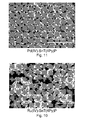
- FIG. 10 is a SEM of Ru(IV)-SnT4PyP nanospheroidal clusters formed with minimization of agitation during the nanostructure formation step.
- FIG. 11 is a SEM of Pd(IV)-SnT4PyP nanospheroidal cluster formed with minimization of agitation during the nanostructure formation step.
- FIG. 12 is an SEM of Cu-H 2 T4PyP polygonal nanostructure formed with minimization of agitation during the nanostructure formation step.
- FIG. 13 is a SEM of Pt-H 2 T4PyP nanofibers.
- FIG. 14 is a SEM of Pt-H 2 DPyDPP nanofibers.
- FIG. 15 is a dark-field scanning transmission electron micrograph (STEM) showing Pt nanodendrites grown photocatalytically on the surface of Pt-SnT4PyP nanospheres.
- FIG. 16 is a TEM of a SnT (4Py)P nanosphere with Pt nanoparticles on the surface following chemical reduction by immersion in 0.1 M NaBH 4 for 3 h.
- This invention comprises porphyrin nanostructures formed from coordination polymers comprising pyridyl-substituted porphyrins and coordinating metal ions linking the pyridyl-substituted porphyrins by binding to the nitrogen atoms of the pyridyl groups.
- a pyridylporphyrin is defined herein as a porphyrin comprising at least two substituent pyridyl groups positioned such as to be sterically available for binding as a ligand to a connecting metal ion to form a network that is the porphyrin coordination polymer.
- Examples include tetra(4-pyridyl)porphyrin (T(4Py)P), tetra(3-pyridyl)porphyrin (T(3Py)P) and dipyridyldiphenylporphyrin (DPyDPP).
- the nanostructures comprise freebase and/or metallated 5,10,15,20-tetrapyridylporphyrin (TPyP), which is either T(3Py)P or T(4Py)P, and/or freebase and/or metallated dipyridyldiphenyl porphyrin.
- TPP freebase and/or metallated 5,10,15,20-tetrapyridylporphyrin
- the 5,10,15,20 substituent site configuration is also termed a meso configuration.
- a metallopyridylporphyrin is a pyridylporphyrin with a metal ion or metal-oxygen species bound within the porphyrin ring.
- tetrapyrroles such as porphyrins and chlorophylls are often organized into nanoscale biological superstructures that perform light-harvesting and energy- and electron-transfer functions. Because of their desirable functional properties, porphyrins and other tetrapyrroles are attractive building blocks for functional nanostructures.
- this invention comprises heteroporphyrin nanostructures formed from coordination polymers comprising metallated 5,10,15,20-tetrapyridylporphyrin and metal ions that bind to the nitrogen atoms of the pyridyl rings.
- tetra(4-pyridyl)porphyrin and tetra(3-pyridyl)porphyrin have been successfully employed in embodiments of this invention.
- the abbreviation TPyP refers to both chemical species.
- the abbreviations T(4Py)P and T(3Py)P are used when appropriate to distinguish between the materials. Dipyridyldiphenyl porphyrin has been employed in some embodiments and is abbreviated DPyDPP.
- MTPyP (a metallated tetrapyridylporphyrin) is dissolved in water to form an aqueous solution of MTPyP.
- MTPyP is dissolved using dilute acid or into an aqueous solution containing a salt such as, for example, KCl.
- the MTPyP solution may be allowed to stand in air to adjust the oxidation state of the metal.
- a CoTPyP solution may be allowed to stand in air to provide for the oxidation of residual Co(II) species.
- the porphyrin solutions can be stock solutions that are prepared some time in advance of the nanostructure preparation reaction.
- Porphryin solutions may optionally be filtered through a 0.2-micrometer syringe filter to remove any particles and are typically stored in the dark until use, but dark storage is not essential. Storage in light is also possible if the time is sufficiently short or if the conditions are such that undesired photoreactions do not occur to an appreciable extent.
- the metalloporphyrin solution is combined with a solution of a connecting-ion source, is shaken to substantially homogenize the combined solution, and may be kept in the dark without agitation. Reaction in the light is also possible and agitation may be used; a different nanostructure may result with agitation than without agitation.
- FIG. 1 illustrates a scanning electron micrograph (SEM) of Pt-SnT(4Py)P.
- FIG. 2 illustrates a transmission electron micrograph (TEM) of Pt-SnT(4Py)P showing the smoothness of the surface of nanospheres like those in the SEM of FIG. 1 .
- FIG. 3 shows the absorption ( FIG. 3 a ) and emission ( FIG. 3 b ) spectra of a solution of SnT(4Py)P and of Pt-SnT(4Py)P nanospheres.
- the Pt-SnT(4Py)P coordination polymer nanospheres exhibit a broadened and red-shifted absorption profile in the UV-visible region.
- the Soret band is shifted from 416 nm to 452 nm, while the Q bands shift from 552 and 592 nm to 564 and 602 nm, respectively.
- the Pt-SnT(4Py)P spheres are fluorescent.
- 200 microliters of 1 N KCl, 100 microliters of 1 N HCl, or 200 microliters of 1 N HCl were added to the SnT(4Py)P solution before injection of the H 2 PtCl 6 solution.
- the resulting nanosphere average diameters were approximately 222 ⁇ 40 nm, 229 ⁇ 43 nm, and 273 ⁇ 55 nm, respectively.
- FIG. 4 is a TEM illustrating an embodiment where meso-tetra(3-pyridyl)porphyrin was used instead of meso-tetra(4-pyridyl)porphyrin to form Pt-SnT(3Py)P nanospheres.
- FIG. 6 presents TEMs of nanospheres made at two different solution pH values.
- hybrid nanospheres comprising CoT(4Py)P and SnT(4Py)P were made.
- 309 microliters of CoT(4Py)P solution (2913 microM in 0.05M HCl) was combined with 1.0 mL of SnT4PyP (100 microM) and 82 microliters of 1 N HCl. This was diluted with water up to a volume of 10 mL before injecting with 145 microliters of 27.5 mM H 2 PtCl 6 .
- aqueous solutions of the starting materials are combined, mixed briefly to homogenize, and then stored in the dark undisturbed for a certain length of time (from a few hours to several days).
- the suitable reaction time depends, among other things, on the type of metalloporphyrin and the reaction temperature. Brown-reddish powder-like precipitates settle out of the solution. Agitation can encourage the formation of rods, as illustrated in FIG. 7 where Pt-SnT(4Py)P nanorods were formed by stirring the solution during nanostructure growth. A small number of nanospheres may form from reaction with agitation.
- the nanospheres are quite stable.
- Pt-SnT(4Py)P spheres are resistant to change in size and shape after immersion in 0.01 M NaOH for 14 hours. They are stable in boiling water. Spheres formed with M-FeTPyP, M-CoTPyP, and Pd-MTPyP exhibit similar stability.
- Some embodiments of this invention are quite sensitive to synthesis conditions, including solution conditions such as starting material concentrations and ratios, the solution pH and ionic strength, and the degree of agitation. This sensitivity can be employed to direct the size of nanosphere that is desired from a particular synthesis.
- Monodisperse nanospheres result from suitable selection of reaction conditions. For the materials shown in FIG. 1 , the average diameter, as determined by TEM, was 161.1 ⁇ 12.8 nm. The surfaces appear smooth. Energy dispersive X-ray spectroscopy (EDX) showed the atomic ratios of Sn/Pt and Cl/Pt to be 0.42 and 1.85, respectively. Under the preferred conditions for sphere formation, very uniform spheres are obtained.
- spheres with a broad size distribution or mixtures of spheres and nanorods may be obtained.
- aqueous solutions of the starting materials are mixed, shaken to homogenize, and then stored undisturbed for a period of time, typically between several hours and two weeks. Storage may be with or without illumination.
- This time range is convenient to use and embodiments of the invention are not restricted to this time range.
- Other periods of time may be used for the synthesis provided the practitioner of this invention waits for sufficient time for the nanospheres to form. A reddish-brown powder-like precipitate settles out of the solution.
- Extensive stirring during the polymerization process may encourage the formation of nanorods.
- the product is a mixture of nanorods and nanospheres rather than monodisperse nanospheres.
- a product that is predominantly nanorods can also be produced, as illustrated in FIG. 7 .
- the nanospheres are stable in organic solvents such as ethanol and dimethylsulfoxide, in water over an extended pH range, and in the dried state.
- Immersion of the Sn-containing spheres in 0.01 M NaOH for 14 hours results in negligible change in the spherical morphology (average diameter change from 161 ⁇ 13 to 159 ⁇ 13 nm) and in the Sn/Pt ratio (change from 0.42 to 0.44).
- the Cl/Pt ratio was reduced from approximately 1.85 to 0.32, presumably due to hydrolysis of residual Pt-Cl bonds present in the nanospheres.
- 0.2 mL of a 20 mM aqueous solution of (NH 4 ) 2 RuCl 6 is added to 10 mL of a 100 microM aqueous solution of SnT(4-Py)P.
- the mixture is shaken for approximately 10 seconds to mix thoroughly (homogenize) and then left in the dark undisturbed (not agitated) until the product precipitates.
- Nanospheroidal clusters of this material are illustrated in the SEM presented in FIG. 10 .
- 0.2 mL of a 20 mM aqueous solution of (NH 4 ) 2 PdCl 6 is added to 10 mL of a 100 microM aqueous solution of SnT(4-Py)P.
- the mixture is shaken for approximately 10 seconds to mix thoroughly (homogenize) and then left in the dark undisturbed (not agitated) until the product precipitates.
- Nanospheroidal clusters of this material are illustrated in the SEM presented in FIG. 11 .
- 334 microL of 2997 microM H 2 T(4-Py)P in 0.136 M HCl was added to 10 mL of water, and the mixture was shaken for approximately 10 seconds to mix thoroughly (homogenize).
- the mixture was added with 100 microL of 0.2 M Cu(II) acetate, and shaken for approximately 10 seconds to mix thoroughly (homogenize) and then left undisturbed (not agitated) while the nanocrystals form.
- the polygonal nanocrystals illustrated in FIG. 12 are formed in about one hour.
- 167 microL of 2997 microM H 2 T(4-Py)P in 0.136 M HCl was added to 10 mL of water, and the mixture was shaken for approximately 10 seconds to mix thoroughly (homogenize).
- the mixture was added with 50 microL of 0.2 M Cu(II) acetate, and shaken for approximately 10 seconds to mix thoroughly (homogenize) and then left undisturbed (not agitated). Under these conditions, nanospheres form.
- nanofibers are formed.
- 0.2 mL of a 20 mM aqueous solution of H 2 PtCl 6 is added to 10 mL of an aqueous solution of 100 microM H 2 T(4-Py)P in 0.2 M HCl.
- the mixture is shaken for approximately 10 seconds to mix thoroughly (homogenize) and then left in the dark undisturbed (not agitated) until the product precipitates as nanofibers ( FIG. 13 ).
- 0.2 mL of a 20 mM aqueous solution of H 2 PtCl 6 is added to 10 mL of an aqueous solution of 100 microM diphenyldipyridylporphyrin (5,15-bis-(4-pyridyl)-10,20-bisphenylporphyrin) in 1 M HCl.
- the mixture is shaken for approximately 10 seconds to mix thoroughly (homogenize) and then left in the dark undisturbed (not agitated) until the product precipitates as nanofibers ( FIG. 14 ).
- metal can be photocatalytically deposited on the surface of the sphere.
- the mixture of the colloidal suspension of nanospheres, a metal ion source, and an electron donor species should be stirred while being irradiated at a suitable wavelength.
- suitable electron donor species include but are not restricted to ascorbic acid, ethylenediamine tetraacetic acid and salts thereof, triethanolamine, methanol, and ethanol.
- FIG. 15 presents a dark-field scanning transmission electron microscopy image (STEM) of the Pt-SnT(4Py)P nanospheres coated with Pt dendrites.
- the nanospheres were platinized by 7 minutes of visible-light exposure in the presence of 10 mM ascorbic acid and 0.2 mM K 2 PtCl 4 .
- 0.5 mL of a suspension of the Pt-SnT(4Py)P nanospheres in a 2-mL glass vial was combined with 0.5 mL of water, 50 ⁇ L of freshly prepared 0.2 M ascorbic acid, and 10 ⁇ L of aged 20 mM K 2 PtCl 4 solution.
- the vial was placed in a glass water bath, and irradiated with incandescent light (800 nmol cm ⁇ 2 s ⁇ 1 ) from a projector lamp for 7 min.
- Chemical reduction may also be employed in some embodiments.
- 1 mg of the Pt-SnT(4-Py)P nanospheres was immersed in 10 mL of 0.1 M NaBH 4 for 3 hours.
- the product was recovered by three cycles of centrifugation and re-dispersion in water.
- the chemically reduced nanospheres are illustrated in the TEM image of FIG. 16 , which shows nanocomposite spheres with dense and highly uniform coverage of Pt nanoparticles on the surface.
- the Pt particles are highly branched and irregular in shape, and extend from 3 to 10 nm.
- 1 mg of the Pt-SnT(4-Py)P nanospheres was immersed in 10 mL of 0.1 M N 2 H 4 for 3 hours. The product was recovered by three cycles of centrifugation and re-dispersion in water.
Landscapes
- Chemical & Material Sciences (AREA)
- Organic Chemistry (AREA)
- Nitrogen Condensed Heterocyclic Rings (AREA)
Abstract
Description
Claims (11)
Priority Applications (2)
| Application Number | Priority Date | Filing Date | Title |
|---|---|---|---|
| US11/762,512 US8324342B1 (en) | 2007-06-13 | 2007-06-13 | Porphyrin coordination polymer nanospheres and nanorods |
| US13/664,170 US8530614B1 (en) | 2007-06-13 | 2012-10-30 | Porphyrin coordination polymer nanospheres and nanorods |
Applications Claiming Priority (1)
| Application Number | Priority Date | Filing Date | Title |
|---|---|---|---|
| US11/762,512 US8324342B1 (en) | 2007-06-13 | 2007-06-13 | Porphyrin coordination polymer nanospheres and nanorods |
Related Child Applications (1)
| Application Number | Title | Priority Date | Filing Date |
|---|---|---|---|
| US13/664,170 Division US8530614B1 (en) | 2007-06-13 | 2012-10-30 | Porphyrin coordination polymer nanospheres and nanorods |
Publications (1)
| Publication Number | Publication Date |
|---|---|
| US8324342B1 true US8324342B1 (en) | 2012-12-04 |
Family
ID=47226668
Family Applications (2)
| Application Number | Title | Priority Date | Filing Date |
|---|---|---|---|
| US11/762,512 Expired - Fee Related US8324342B1 (en) | 2007-06-13 | 2007-06-13 | Porphyrin coordination polymer nanospheres and nanorods |
| US13/664,170 Expired - Fee Related US8530614B1 (en) | 2007-06-13 | 2012-10-30 | Porphyrin coordination polymer nanospheres and nanorods |
Family Applications After (1)
| Application Number | Title | Priority Date | Filing Date |
|---|---|---|---|
| US13/664,170 Expired - Fee Related US8530614B1 (en) | 2007-06-13 | 2012-10-30 | Porphyrin coordination polymer nanospheres and nanorods |
Country Status (1)
| Country | Link |
|---|---|
| US (2) | US8324342B1 (en) |
Cited By (5)
| Publication number | Priority date | Publication date | Assignee | Title |
|---|---|---|---|---|
| CN105061776A (en) * | 2015-08-10 | 2015-11-18 | 北京工业大学 | Metal organic framework material of Fe porphyrin ligand, preparation method therefor and application thereof |
| CN105268477A (en) * | 2014-07-23 | 2016-01-27 | 中国科学院大连化学物理研究所 | Preparation method of macrocyclic compound nano hollow balls |
| CN105268477B (en) * | 2014-07-23 | 2018-08-31 | 中国科学院大连化学物理研究所 | A kind of preparation method of macrocyclic compound nano-hollow ball |
| CN115160585A (en) * | 2022-07-26 | 2022-10-11 | 陕西师范大学 | A metal-organic framework immobilized multinuclear metal cluster material and its preparation method and application |
| CN115678024A (en) * | 2022-10-19 | 2023-02-03 | 浙江工业大学 | Fluorosilicate MOF material and preparation method and application thereof |
Families Citing this family (1)
| Publication number | Priority date | Publication date | Assignee | Title |
|---|---|---|---|---|
| CN106324055B (en) * | 2016-10-09 | 2018-10-26 | 南京师范大学 | A kind of application of CoTPyP metalloporphyrins coordination polymer material |
Citations (16)
| Publication number | Priority date | Publication date | Assignee | Title |
|---|---|---|---|---|
| US6324091B1 (en) * | 2000-01-14 | 2001-11-27 | The Regents Of The University Of California | Tightly coupled porphyrin macrocycles for molecular memory storage |
| US6407330B1 (en) * | 2000-07-21 | 2002-06-18 | North Carolina State University | Solar cells incorporating light harvesting arrays |
| US6420648B1 (en) * | 2000-07-21 | 2002-07-16 | North Carolina State University | Light harvesting arrays |
| US20030096978A1 (en) * | 2001-09-25 | 2003-05-22 | Lindsey Jonathan S. | Methods of making porphyrins and related compounds with Lewis acids |
| US20030111108A1 (en) * | 2000-07-21 | 2003-06-19 | Lindsey Jonathan S. | Convergent synthesis of multiporphyrin light-harvesting rods |
| US20040072988A1 (en) * | 2002-09-26 | 2004-04-15 | Yoshiaki Kobuke | Covalently fixed porphyrin polymer having porphyrin metal complex substituted with coordinating hetero aromatic ring as constituting unit thereof,and method of producing the same |
| US6949620B2 (en) * | 2000-01-26 | 2005-09-27 | Japan Science And Technology Corporation | Polymeric micellar structure |
| US20060118496A1 (en) * | 2004-10-12 | 2006-06-08 | University Of New Mexico | Water treatment using metal porphyrin |
| US7132163B1 (en) | 2004-12-01 | 2006-11-07 | Shelnutt John A | Heteroporphyrin nanotubes and composites |
| US20060258858A1 (en) * | 2003-05-22 | 2006-11-16 | Universiteit Van Amsterdam | Coordination complex system comprising building blocks |
| US7192650B2 (en) * | 2003-02-28 | 2007-03-20 | Nara Institute Of Science And Technology | Element having porphyrin polymer fixed on a substrate and method of preparing the same |
| US20070231674A1 (en) * | 2004-07-08 | 2007-10-04 | Toyota Engineering & Manufacturing North America, Inc. | Dendritic metal nanostructures for fuel cells and other applications |
| US7338590B1 (en) * | 2005-10-25 | 2008-03-04 | Sandia Corporation | Water-splitting using photocatalytic porphyrin-nanotube composite devices |
| US7691493B2 (en) * | 2001-09-04 | 2010-04-06 | Canon Kabushiki Kaisha | Polymeric compound and organic luminescence device |
| US7785391B1 (en) * | 2004-07-08 | 2010-08-31 | Sandia Corporation | Dendritic metal nanostructures |
| US7816518B2 (en) * | 2004-07-13 | 2010-10-19 | Psimei Pharmaceuticals, Plc | Porphyrin derivatives and their use in photon activation therapy |
-
2007
- 2007-06-13 US US11/762,512 patent/US8324342B1/en not_active Expired - Fee Related
-
2012
- 2012-10-30 US US13/664,170 patent/US8530614B1/en not_active Expired - Fee Related
Patent Citations (17)
| Publication number | Priority date | Publication date | Assignee | Title |
|---|---|---|---|---|
| US6324091B1 (en) * | 2000-01-14 | 2001-11-27 | The Regents Of The University Of California | Tightly coupled porphyrin macrocycles for molecular memory storage |
| US6949620B2 (en) * | 2000-01-26 | 2005-09-27 | Japan Science And Technology Corporation | Polymeric micellar structure |
| US6407330B1 (en) * | 2000-07-21 | 2002-06-18 | North Carolina State University | Solar cells incorporating light harvesting arrays |
| US6420648B1 (en) * | 2000-07-21 | 2002-07-16 | North Carolina State University | Light harvesting arrays |
| US20030111108A1 (en) * | 2000-07-21 | 2003-06-19 | Lindsey Jonathan S. | Convergent synthesis of multiporphyrin light-harvesting rods |
| US7691493B2 (en) * | 2001-09-04 | 2010-04-06 | Canon Kabushiki Kaisha | Polymeric compound and organic luminescence device |
| US20030096978A1 (en) * | 2001-09-25 | 2003-05-22 | Lindsey Jonathan S. | Methods of making porphyrins and related compounds with Lewis acids |
| US20040072988A1 (en) * | 2002-09-26 | 2004-04-15 | Yoshiaki Kobuke | Covalently fixed porphyrin polymer having porphyrin metal complex substituted with coordinating hetero aromatic ring as constituting unit thereof,and method of producing the same |
| US7192650B2 (en) * | 2003-02-28 | 2007-03-20 | Nara Institute Of Science And Technology | Element having porphyrin polymer fixed on a substrate and method of preparing the same |
| US20060258858A1 (en) * | 2003-05-22 | 2006-11-16 | Universiteit Van Amsterdam | Coordination complex system comprising building blocks |
| US20070231674A1 (en) * | 2004-07-08 | 2007-10-04 | Toyota Engineering & Manufacturing North America, Inc. | Dendritic metal nanostructures for fuel cells and other applications |
| US7785391B1 (en) * | 2004-07-08 | 2010-08-31 | Sandia Corporation | Dendritic metal nanostructures |
| US7816518B2 (en) * | 2004-07-13 | 2010-10-19 | Psimei Pharmaceuticals, Plc | Porphyrin derivatives and their use in photon activation therapy |
| US20060118496A1 (en) * | 2004-10-12 | 2006-06-08 | University Of New Mexico | Water treatment using metal porphyrin |
| US7223474B1 (en) * | 2004-12-01 | 2007-05-29 | Sandia Corporation | Heteroporphyrin nanotubes and composites |
| US7132163B1 (en) | 2004-12-01 | 2006-11-07 | Shelnutt John A | Heteroporphyrin nanotubes and composites |
| US7338590B1 (en) * | 2005-10-25 | 2008-03-04 | Sandia Corporation | Water-splitting using photocatalytic porphyrin-nanotube composite devices |
Non-Patent Citations (17)
| Title |
|---|
| B. F. Abrams et al, "A New Type of Infinite 3D Polymeric Network Containing 4-Connected, Peripherally Linked Metalloporphyrin Building Blocks", American Chemical Society, 1991, vol. 113, pp. 3606-3607. |
| C. V. Krishnamohan Sharma et al, "Design Strategies for Solid-State Supramolecular Arrays Containing Both Mixed-Metalated and Freebase Porphyrins", American Chemical Society, 1999, 121, pp. 1137-1144. |
| Drain, C. M., "Porphyrin Tessellation by Design: Metal-Mediated Self-Assembly of Large Arrays and Tapes", Angew. Chem. Int. Ed. 1998, 37, No. 17, 1998, pp. 2344-2347. |
| Drain, C. M., et al, "Porphyrin nanoparticles as supramolecular systems", New J. Chem., 2006, 30, pp. 1834-1843. |
| Drain, C. M., et al, "Self-assembly of Square Multiporphyrin Arrays by Metal Ion Coordination", J. Chem. Soc., Chem. Commun., 1994, pp. 2313-2315. |
| G. Scott Wilson, et al, "A conjugated triple strand porphyrin array",Chem. Commun., 1999, pp. 1539-1540. |
| Helena Krupitsky, et al, "Crystalline Complexes, Coordination Polymers and Aggregation Modes of Tetra(4-pyridyl)porphyrin", Journal of Inclusion Phenomena and Molecular Recognition in Chemistry, 1994, 18 pp. 177-192. |
| Hongping Yuan et al, "Synthesis and Characterization of Mono-, Bis-, and Tetrakis-Pyridyltriarylporphyrin Pd(II)and Pt(II) Supramolecular Assemblies. Molecular Structure of a Pd-Linked Bisporphyrin Complex", American Chemical Society, Inorganic Chemistry, vol. 35, No. 10, 1996, pp. 2808-2817. |
| Hu et al., J. Am. Chem. Soc. 2005, 127, 17090-17095. * |
| Israel Goldberg, "Supramolecular Networks of Porphyrins", Topics of Stereochemistry, vol. 25, 2006, pp. 49-80. |
| Long Pan, et al "Self-assembly of free-base tetrapyridylporphyrin units by metal ion coordination", Chem. Commun., 1999, pp. 157-158. |
| Lucia Carlucci et al, Open Network Architectures from the Self-Assembly of AgNO3 and 5,10,15,20-Tetra (4-pyridyl)porphyrin (H2tpyp) Building Blocks: The exceptional Self-Penetrating Topology of the 3D Network of [Ag8(ZnIItypy)7(H2O)2](NO3)8**, Agnewandte Chem. Int. Ed. 2003, 42, No. 3, 2003, pp. 317-322. |
| Tetsushi Ohmura et al, "New Porphyrin-Based Metal-Organic Framework with High Porosity: 2-D Infinite 22.2-A Square-Grid Coordination Network", American Chemical Society, Inorganic Chemistry, vol. 45, No. 20, 2006, pp. 7988-7990. |
| U.S. Appl. No. 10/887,535, filed Jul. 8, 2004. |
| U.S. Appl. No. 11/440,484, filed May 25, 2006. |
| Wang et al., J. Am. Chem. Soc. 2004, 126, 16720-16721. * |
| Xianchang Gong, et al, "Preparation and Characterization of Porphyrin Nanoparticles", J. Am. Chem. Soc. 2002, 124, pp. 14290-14291. |
Cited By (7)
| Publication number | Priority date | Publication date | Assignee | Title |
|---|---|---|---|---|
| CN105268477A (en) * | 2014-07-23 | 2016-01-27 | 中国科学院大连化学物理研究所 | Preparation method of macrocyclic compound nano hollow balls |
| CN105268477B (en) * | 2014-07-23 | 2018-08-31 | 中国科学院大连化学物理研究所 | A kind of preparation method of macrocyclic compound nano-hollow ball |
| CN105061776A (en) * | 2015-08-10 | 2015-11-18 | 北京工业大学 | Metal organic framework material of Fe porphyrin ligand, preparation method therefor and application thereof |
| CN115160585A (en) * | 2022-07-26 | 2022-10-11 | 陕西师范大学 | A metal-organic framework immobilized multinuclear metal cluster material and its preparation method and application |
| CN115160585B (en) * | 2022-07-26 | 2023-08-22 | 陕西师范大学 | Metal organic framework fixed multi-core metal cluster material and preparation method and application thereof |
| CN115678024A (en) * | 2022-10-19 | 2023-02-03 | 浙江工业大学 | Fluorosilicate MOF material and preparation method and application thereof |
| CN115678024B (en) * | 2022-10-19 | 2023-07-25 | 浙江工业大学 | Fluorosilicate MOF material and preparation method and application thereof |
Also Published As
| Publication number | Publication date |
|---|---|
| US8530614B1 (en) | 2013-09-10 |
Similar Documents
| Publication | Publication Date | Title |
|---|---|---|
| Mourdikoudis et al. | State‐of‐the‐art, insights, and perspectives for MOFs‐nanocomposites and MOF‐derived (nano) materials | |
| Ahmed et al. | Enhanced water stability and photoresponsivity in metal-organic framework (MOF): a potential tool to combat drug-resistant bacteria | |
| Prochowicz et al. | Interactions of native cyclodextrins with metal ions and inorganic nanoparticles: fertile landscape for chemistry and materials science | |
| Giri et al. | Recent advancements in metal–organic frameworks integrating quantum dots (QDs@ MOF) and their potential applications | |
| Sun et al. | Stimulus-responsive light-harvesting complexes based on the pillararene-induced co-assembly of β-carotene and chlorophyll | |
| Grancha et al. | Phase transfer of rhodium (II)-based metal–organic polyhedra bearing coordinatively bound cargo enables molecular separation | |
| US7338590B1 (en) | Water-splitting using photocatalytic porphyrin-nanotube composite devices | |
| Zhang et al. | Nanoscale Ln (III)-carboxylate coordination polymers (Ln= Gd, Eu, Yb): temperature-controlled guest encapsulation and light harvesting | |
| Lu et al. | Environmentally friendly synthesis of highly monodisperse biocompatible gold nanoparticles with urchin-like shape | |
| Bagherzadeh et al. | MIL-125-based nanocarrier decorated with Palladium complex for targeted drug delivery | |
| Zhang et al. | In situ synthesis of gold nanoclusters in covalent organic frameworks with enhanced photodynamic properties and antibacterial performance | |
| US8530614B1 (en) | Porphyrin coordination polymer nanospheres and nanorods | |
| CN108219155A (en) | A kind of MOF- manganese dioxide microballoon and its preparation method and application | |
| Yang et al. | Hierarchical hybrid metal–organic frameworks: tuning the visible/near-infrared optical properties by a combination of porphyrin and its isomer units | |
| Sahar et al. | Multi-enzyme mimics–cracking the code of subcellular cascade reactions and their potential biological applications | |
| KR20160089220A (en) | Fluorescent and magnetic core-shell nanochain structures and preparation method thereof | |
| US7132163B1 (en) | Heteroporphyrin nanotubes and composites | |
| Ozer | Fabrication and functionalization strategies of MOFs and their derived materials “MOF architecture” | |
| Jain et al. | Quantum dots and conjugated metal-organic frameworks for targeted drug delivery and bioimaging of cancer | |
| KR20180028652A (en) | A Photocatalyst comprising function of object detection | |
| Wang et al. | Photoluminescence of Tetra (benzimidazole) phenylethene Derivatives and Their Carbene Metallacycles in Aggregates and Langmuir–Blodgett Films | |
| KR101890588B1 (en) | Imaging-agents loaded nanocrystalline metal-organic frameworks for containing and method for preparing the same | |
| JP3429483B2 (en) | Nitric oxide trapping agent | |
| Denikaev et al. | Keplerate {Mo132}–Stearic acid conjugates: Supramolecular synthons for the design of dye-loaded nanovesicles, Langmuir–Schaefer films, and infochemical applications | |
| US7704489B1 (en) | Method of photocatalytic nanotagging |
Legal Events
| Date | Code | Title | Description |
|---|---|---|---|
| AS | Assignment |
Owner name: SANDIA CORPORATION, OPERATOR OF SANDIA NATIONAL LA Free format text: ASSIGNMENT OF ASSIGNORS INTEREST;ASSIGNORS:WANG, ZHONGCHUN;SHELNUTT, JOHN A.;MEDFORTH, CRAIG J.;REEL/FRAME:019581/0746 Effective date: 20070605 |
|
| AS | Assignment |
Owner name: ENERGY, U.S. DEPARTMENT OF, DISTRICT OF COLUMBIA Free format text: CONFIRMATORY LICENSE;ASSIGNOR:SANDIA CORPORATION;REEL/FRAME:019832/0012 Effective date: 20070719 |
|
| ZAAA | Notice of allowance and fees due |
Free format text: ORIGINAL CODE: NOA |
|
| ZAAB | Notice of allowance mailed |
Free format text: ORIGINAL CODE: MN/=. |
|
| STCF | Information on status: patent grant |
Free format text: PATENTED CASE |
|
| FPAY | Fee payment |
Year of fee payment: 4 |
|
| AS | Assignment |
Owner name: NATIONAL TECHNOLOGY & ENGINEERING SOLUTIONS OF SAN Free format text: CHANGE OF NAME;ASSIGNOR:SANDIA CORPORATION;REEL/FRAME:046194/0499 Effective date: 20170501 |
|
| MAFP | Maintenance fee payment |
Free format text: PAYMENT OF MAINTENANCE FEE, 8TH YEAR, LARGE ENTITY (ORIGINAL EVENT CODE: M1552); ENTITY STATUS OF PATENT OWNER: LARGE ENTITY Year of fee payment: 8 |
|
| FEPP | Fee payment procedure |
Free format text: MAINTENANCE FEE REMINDER MAILED (ORIGINAL EVENT CODE: REM.); ENTITY STATUS OF PATENT OWNER: LARGE ENTITY |
|
| LAPS | Lapse for failure to pay maintenance fees |
Free format text: PATENT EXPIRED FOR FAILURE TO PAY MAINTENANCE FEES (ORIGINAL EVENT CODE: EXP.); ENTITY STATUS OF PATENT OWNER: LARGE ENTITY |
|
| STCH | Information on status: patent discontinuation |
Free format text: PATENT EXPIRED DUE TO NONPAYMENT OF MAINTENANCE FEES UNDER 37 CFR 1.362 |
|
| FP | Lapsed due to failure to pay maintenance fee |
Effective date: 20241204 |