US8315958B1 - Computer method for designing a system of systems using context-free grammars - Google Patents
Computer method for designing a system of systems using context-free grammars Download PDFInfo
- Publication number
- US8315958B1 US8315958B1 US12/719,225 US71922510A US8315958B1 US 8315958 B1 US8315958 B1 US 8315958B1 US 71922510 A US71922510 A US 71922510A US 8315958 B1 US8315958 B1 US 8315958B1
- Authority
- US
- United States
- Prior art keywords
- components
- system design
- context
- active
- knowledge
- Prior art date
- Legal status (The legal status is an assumption and is not a legal conclusion. Google has not performed a legal analysis and makes no representation as to the accuracy of the status listed.)
- Expired - Fee Related, expires
Links
Images


Classifications
-
- G—PHYSICS
- G06—COMPUTING OR CALCULATING; COUNTING
- G06N—COMPUTING ARRANGEMENTS BASED ON SPECIFIC COMPUTATIONAL MODELS
- G06N5/00—Computing arrangements using knowledge-based models
- G06N5/04—Inference or reasoning models
- G06N5/048—Fuzzy inferencing
Definitions
- FIG. 1 shows an example of compactification of data.
- FIG. 2 shows ranking of entries of a vector z.
- FIG. 3 shows a representation of elements as information granules.
- FIG. 4 shows a computation of interval representation of numeric values.
- FIG. 5 shows a triangular fuzzy set representing individual membership grades.
- FIG. 6 shows a graph of performance index versus a parameter p.
- FIG. 7 shows a graph of performance index Q versus c.
- FIG. 8 shows a block diagram of a single-stage Carnot-cycle refrigeration system.
- FIG. 9 shows a block diagram of a two-stage Carnot-cycle refrigeration system.
- FIG. 10 shows a block diagram of an untransformed two-stage thermoelectric freezer.
- FIG. 11 shows a block diagram of a first transformation result for a two-stage thermoelectric freezer.
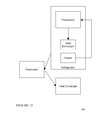
- FIG. 12 shows a block diagram of a second transformation result for a two-stage thermoelectric freezer.
- the present invention provides a method for use in a computer, a method comprising the steps of:
- the systems can include iteratively defined sub-systems, where the passive components and active components are reused in whole or in part.
- the method can further include creating a version space of possible maps from the first system design to the second related system design, the version space having rules, which are automatically constrained by other cases in the first system design memory, which may not be contradicted.
- direct human feedback provides for the collapse of the version space to a concept(s)—thereby insuring tractability.
- the method also includes automatically porting knowledge from the first system design to the second system design such that the second system design automatically learns with use and user feedback how to generalize the first system design so as to enable the creation of the version space.
- the method also includes transforming the second generalization to the design of the second system through the application of active transforms and includes adding a context-sensitive transformation rule(s) to prevent inappropriate application of the active transform(s).
- the technology of this invention is intended to be used to design or invent systems of systems (e.g., a thermoelectric refrigerator from one based on the Carnot cycle).
- a thermoelectric refrigerator from one based on the Carnot cycle.
- the future commercial potential of this invention is enormous—from the design of high-bypass jet engines to medical regimens to silent electromagnetic propulsion for submarines. This may or may not lead to viable commercial products having extended commercial life.
- the salient point to be made is that the suggested methodology can keep new products in the development pipeline, which macro economists know to be critical to associated economic development and near full employment. It is believed that that this invention will serve to create white and steel collar jobs alike.
- the underlying objective of this invention is to show how fuzzy sets (and information granules in general) and grammatical inference play an interdependent role in information granularization and knowledge-based problem characterization.
- the bottom-up organization of the material starts with a concept and selected techniques of data compactification which involves information granulation and gives rise to higher order constructs (type-2 fuzzy sets).
- type-2 fuzzy sets The detailed algorithmic investigations are provided.
- CW Words
- the present invention provides a grammatical technique for knowledge transformation and reuse in the context of transforming one system of systems into another, possibly superior one.
- the data usually come with some redundancy, which is detrimental to most of the processing in which they are involved. It could be also inconvenient to interpret them considering the size of the data set itself. Taking those factors into consideration, it could be of interest to represent the whole data set D by its selected subset of elements F, where F ⁇ D. While there is a wealth of approaches that exist today, most of them are concerned with some form of averaging meaning that at the end we come up with the elements, which have never existed in the original data meaning that they usually may not have any straightforward interpretation. In contrast, if F is a subset of D, the interpretability does not cause difficulties. It is also evident that the choice of the elements of F, as well as their number, implies the quality of representation of original data D. This set being treated as a “condensation” of D can be a result of a certain optimization. The cardinality of F, which is far lower that the cardinality of D helps alleviate the two problems we identified at the very beginning.
- FIG. 1 shows the compactification of data from original data D to its compact representation F, shown in a way in which elements of D-F are represented by the content of F.
- CBR case-based reasoning
- u i (x k ) is sought as a level of activation, closeness, proximity, or relevance of x k ⁇ D-F and the i-th element of F. The closer the two elements are, the higher the value of u i (x k ) is. In some sense, u i (x k ) can be treated as a receptive field constricted around x i capturing the influence x i has on its neighborhood. The closeness is quantified through some distance and here we may benefit from a variety of ways in which the distance could be expressed. In addition to the commonly encountered distance functions, one can also consider those based on tensor representation of the space, cf. [5]. The optimization of the receptive field comes from the following formulation of the optimization problem
- V ⁇ i ⁇ I ⁇ u i p ⁇ ( x k ) ⁇ ⁇ x k - x i ⁇ 2 ⁇ ⁇ Min ⁇ ⁇ V ⁇ ⁇ with ⁇ ⁇ respect ⁇ ⁇ to ⁇ ⁇ x i ⁇ I . ( 3 )
- the extra parameter (p), p>1 helps form the shape of the receptive field by quantifying how much influence x i exerts on its neighborhood. If p ⁇ 1 the influence is the most visible; whereas, with the higher values of “p” the impact tempers off quite quickly.
- the receptive field becomes very localized by exhibiting “spikes” positioned at x i —only with a very fast decline of the field.
- V 1 ⁇ i ⁇ I ⁇ u i p ⁇ ( x k ) ⁇ ⁇ x k - x i ⁇ 2 + ⁇ ( ⁇ i ⁇ I ⁇ u i ⁇ ( x k ) - 1 ) ( 4 )
- a particle swarm is a population of particles—possible solutions in the multidimensional search space.
- a significant number of applications of the PSO have been reported in the literature.
- Each particle independently explores the search space and during this search it follows some quite intuitively appealing guidelines for navigating the overall search process: (a) it tries to follow its previous direction, and (b) it looks back at the best performance—both at the level of the individual particle and at that of the entire population.
- the algorithm exhibits some societal facets as there is some collective search of the problem space along with some component of memory incorporated as an integral part of the search mechanism.
- a position of a swarm in the search space S ( ⁇ R n ), is described by some vector z(iter) ⁇ S, where “iter” denotes a consecutive discrete time moment (iteration).
- ⁇ 1 and ⁇ 2 are random numbers drawn from the uniform distribution U[0,2] defined over [0,2] that help build a proper mix of the components of the speed; different random numbers affect the individual coordinates of the speed.
- the second expression governing the change in the velocity of the particle is particularly interesting as it nicely captures the relationship between the particle and its history as well as the history of the overall population in terms of its performance reported so far.
- the three components contributing to the modified speed of the particle namely, the current speed v(t) scaled by the inertial weight ( ⁇ ) smaller than 1 (whose role is to quantify resistance to change in the current speed), memory of the particle (alluding to the best position achieved so far), and some societal aspect of the optimization scheme expressed by its reliance on the best performance reported across the whole population.
- the PSO scheme is of a general nature and independent from the specific optimization problem, it is critical to its effective use to represent the search space S in terms of its components.
- the vector z comprises “N” entries in [0,1]. Its entries are ranked and the first “c” locations return a set of indexes of I.
- the compactification procedure returns a collection of representatives I using which we represent all elements in K-I.
- its elements may be regarded as descriptors of all elements in the far larger set D-F.
- We could capture this representation aspect by reflecting the representation aspect of the elements of F through constructing information granules on the basis of their original numeric representation.
- information granules in the case of numeric vectors x k , we form information granules—intervals or more generally fuzzy sets.
- the corresponding y k 's which could be fuzzy sets to start with
- we end up with higher order fuzzy sets and type-2 fuzzy sets in particular.
- FIG. 3 shows the representation of elements of F as information granules of higher order—intervals, fuzzy sets, or type-2 fuzzy sets.
- the essential task pertains to a construction of the information granules in a manner in which we can arrive at the characteristic functions, or membership functions, of the elements of F.
- Each element of D-F produces a degree of membership for the i-th element in F, which is computed with the use of (4).
- the membership degrees associated with it constitute a set ⁇ u i0 (x k ) ⁇ k ⁇ N-I.
- the essential principle here is to quantify the variability existing in a set of available membership degrees in the form of some information granule such as an interval or another fuzzy set.
- FIG. 4 shows computing the interval representation of numeric values through the principle of justifiable granularity by optimizing the effect of elevation and suppression of the corresponding membership degrees
- the bounds of the interval [z ⁇ , z + ] are subject to optimization with the criterion that the total changes to membership degrees (being equal either to 1 ⁇ u i (x k ) or u i (x k )) are made as small as possible.
- the changes in the values of z ⁇ and z + are made in such a way that we minimize the following performance index.
- the information granule can be expressed as some fuzzy set.
- triangular fuzzy sets can be easily formed.
- the modal value of the membership function is z 0
- FIG. 5 shows triangular fuzzy set representing individual membership grades
- the optimized fuzzy set is spanned over [0, 1] with the slopes of the membership functions optimized individually for the data positioned below and above z 0 .
- the standard linear regression applied here returns the parameters b ⁇ and b + in the membership function.
- the population size is 20 and the PSO was run for 80 generations. The choice of these particular values has been a result of intensive experimentation; we found that the size of the population was sufficient enough to maintain diversity and explore the search space. Further increase in the population size did not contribute to any improvement in the obtained results; however, it negatively impacted the computing time.
- the method was run for several values of “c” ranging in-between 2 and 6. The values of the performance index along with the selected subsets F are shown below
- An intelligent software system interacts with the user in two principal ways. First, it requests random knowledge to be supplied where necessary. Second, it asks the user or knowledge engineer to confirm symmetric knowledge, where presented. Note that supplying a selection from a pull-down menu is partially random and partially symmetric in its component tasks. No non-trivial domain can be entirely symmetric or entirely random. If the former is sought, then its randomization would result in a mathematical point. If the latter, then the domain itself would serve as its own fixed point, which means that it would be incompressible. In one case, the domain is devoid of knowledge and in the other there is absolutely no symmetry or analogy to be found. Not only are these two extremes contradictions on reality, but they serve to bound the definition of reality.
- symmetry is defined by the existence of heuristics, its necessity is not limited to heuristic programming. Thus, in the extreme, the absence of symmetry would not allow for deductive reasoning. Otherwise, the paradigm for making one deduction would at least be similar to the paradigm for making another deduction—in stark contradiction to the total absence of symmetry.
- a knowledge engineer can supply the requested random or symmetric knowledge, then it is through the application of acquired knowledge. It follows that if that knowledge can be captured in a knowledge-based system(s), then the requested tasks can be automated. Furthermore, let our grammar-based system be used as the shell, which acquires the knowledge that the user or knowledge engineer would otherwise be requested. An interesting and inescapable conclusion follows. That is, the only thing not automated would be the acquisition of random knowledge by the auxiliary system(s). In other words, randomness can be defined along a continuum in degrees. What is being claimed is that a network of cooperating grammar-based systems requests knowledge that is random in proportion to the size of its collective randomized knowledge bases.
- the knowledge bases reach some critical finite radius, where the knowledge embodied can not be bounded (e.g., as in a finite number of rules).
- the needed knowledge is truly random.
- the system may benefit from knowing that coherent light is polarized when reflected off of a magnetized surface, or that when heated to the Fermi point iron loses all magnetic properties, etc. This exemplifies random knowledge. It follows that an example of symmetric knowledge is that coherent light is polarized in the opposite plane when reflected off of a magnetized surface of the opposite polarity.
- the degree of randomization possible is in proportion to the magnitude of the information, where there is no upper bound. Also, the processor time required to randomize such information is unbounded. Such absolute minimal entropy can of course never be achieved for it would violate the Incompleteness Theorem. However, there is nothing to preclude the construction of randomizing systems of any desired level of utility.
- Knowledge-based randomization evolved from component randomization. This means that components evolved in two simultaneous and orthogonal directions. First, they continued to evolve as domain-specific components. This is termed, horizontal randomization. Second, some components mutated into transformative software. This is termed, vertical randomization. Transformative software evolved just as enzymes evolved in the course of biological evolution. Such software can indeed be captured by the grammar. However, when active it acts like a rule or knowledge-base segment and applies domain-specific knowledge to further randomize the grammar. This means that context-sensitive transformations of components can be made as optimizations in space and/or time. Poor components may be transformed into better ones (e.g., insertion sort to quicksort in the context of n>21 elements).
- Transformative components are saved in the single grammar in the form of rules, which are even capable of randomizing each other, just as they randomize their containing grammar. That is, the grammar must randomize components, some of which become active in the form of transformation rules—again in the same grammar. These rules effect transformations on themselves. It follows that the Incompleteness Theorem applies, which implies that a countably infinite number of novel suggestions can be made by the grammar, which while ultimately true cannot be proven. Such a technique has promise from an engineering perspective.
- Transformational components need to be represented in a context-free grammar in such a manner as to be context sensitive in their use. For example, one software design may require a quicksort component because it involves a large data-set, while another may require an insertion sort because it does not. Clearly, the suggested component can never converge in the absence of context. Furthermore, it is only appropriate to substitute one component for its siblings when that component is provably better. Such is the case when, for example, one component has been run through an optimizing compiler and the other has not.
- Context-free grammars are inherently capable of randomizing, but only within the confines of a certain logical regimen. To achieve a greater degree of randomization, one must step outside of those confines. It is clear that when one ‘steps outside’ of these confines, one is dealing with randomizing the representational formalism itself—not merely what is represented in that formalism. An example will serve to clarify the metaphor.
- FR freon refrigerator
- C compressor
- F fuse
- L light
- D door
- I some insulation
- An evaporator may be assumed to be part of a compressor for purposes of illustration.
- Other components are similarly deemed to be extraneous. It may then be written that a FR is defined by:
- FAC freon air conditioner
- thermoelectric refrigerator It may be reduced to the following components: an array of thermocouples (T), a fuse (F′), a light (L), a door (D), and again some insulation (I). It may then be written that TR is defined by:
- thermoelectric air conditioner TAC
- TAC thermoelectric air conditioner
- W represents a component defined by a compressor-fuse assembly, which can be considered to be the same for freon refrigerators or air conditioners.
- X represents a component defined by a light, a door, and insulation, or a frame assembly.
- Y represents a component defined by a blower-vent assembly. The reader will be convinced that this is about the best randomization that can be obtained at this level.
- an active component Z.
- This component can be reduced to the following components: Q, which substitutes an array of thermocouples (T) for a compressor (C); R, which replaces a fuse (F) with an appropriate one (F′ or F′′) and, S, which replaces a frame assembly (X) by a blower-vent assembly (Y).
- Q which substitutes an array of thermocouples (T) for a compressor (C)
- R which replaces a fuse (F) with an appropriate one (F′ or F′′)
- S which replaces a frame assembly (X) by a blower-vent assembly (Y).
- the active component is thus defined by:
- FR Z is equivalent to (((FR Q) R) S), which of course is equivalent to ((((C, F, L, D, I) Q) R) S). It follows by definition that the following active component reductions may be taken. Active components act as identity transformations where not otherwise defined.
- thermoelectric air conditioner can be constructed by applying our Z-transform to the freon refrigerator. If the z-transform sounds familiar it is only because all of mathematics derives from the concept of transformation (e.g., the geometric-transform differs from the z-transform only in the sign of its exponent).
- the image of transformation is cached along with its transformative definition to facilitate retrieval.
- the cache is fixed in size and follows from Denning's implementation of working sets in operating systems. It is only necessary that the fundamental derivation be saved, since this can always be used to recreate any cached production.
- caching the most-frequently used productions—including the active components— is a randomization over the temporal domain, since it saves time. Randomization is a phenomenon of scale. That is, even though the grammar may appear to be larger here, it is destined for a much higher information density. For example, TAC will be suggested if the user specifies T, F′′, or FR. Further randomizations can be made as follows. The explanation can be read directly from the grammar:
- Z′ is a further reuse of Z. While it is not shown, either of these active components can result from the application of other active components to active and/or passive components. It turns out that spatial randomization is gained at the cost of temporal randomization. This is none other than the familiar space-time tradeoff.
- the use of active components implies that greater degrees of randomization can be obtained if and only if one is to allow for more time in recreating the passive components when needed—caching aside.
- This design 30 in FIG. 8 has the simple predicate representation:
- thermoelectric refrigerator FIG. 9
- This design 40 has the simple predicate representation:
- the problem is to create a version space of possible maps from A to C as a prelude to the automatic design of a multi-stage thermoelectric refrigerator.
- the idea is to automatically port knowledge from one related design to another.
- the rules in the version space will be automatically constrained by other cases in system memory, which may not be contradicted. In this manner, the system will automatically get smarter with use.
- here are two viable maps in the version space, where the second is a generalization of the first:
- thermoelectric freezer The initial equivalent depiction of this two-stage thermoelectric freezer follows, as shown in FIGS. 10 and 11 .
- thermoelectrics This design is not quite correct though due to a random variation. That is, the translation from fluid mechanics to thermoelectrics is not perfectly symmetric. We observe that while it makes sense to cool a compressed gas in stages to conserve energy, this is not practical to do using thermocouples. Thus, we need to add the domain-specific (context-sensitive) transformation rule (discovered automatically by a KASER algorithm):
- thermoelectric refrigerator first and now wanted to transform our solution to a gas refrigerator, then we would have the rule:
- thermopile and its heat exchanger must be maintained at the same ambient temperature.
- FIG. 11 evidences that this is not the case for the second-level thermopile 60 .
- the graphics package here may not embody such domain-specific knowledge, we need to add the predicates, namely, Same_Temp (Thermopile, Heat Exchanger), Colder (Refrigerator, Ambient), and possibly Colder (Freezer, Refrigerator).
- Same_Temp Thermopile, Heat Exchanger
- Colder Refrigerator, Ambient
- Colder Freezer, Refrigerator
- thermopile may not be found to be at ambient temperature with its heat exchanger in the freezer because we can deduce Colder (Freezer, Ambient), which violates Same_Temp (Thermopile, Heat Exchanger).
- FIG. 11 shows the working two-stage thermoelectric freezer model 80 .
- FIG. 12 shows the Second Transformation Result for a Two-Stage Thermoelectric Freezer 80 .
- This simple example does not include (or preclude) the use of informative connectives (e.g., a dotted line indicating that the Heat Exchanger and Freezer must not be too close to each other, and the like).
- informative connectives e.g., a dotted line indicating that the Heat Exchanger and Freezer must not be too close to each other, and the like.
- the labeled line segment here might be translated into the “Distant” predicate.
- each non-primitive box is hierarchically defined.
- decision boxes and similar constructs may augment our block diagrams for use in more complex designs.
- CW allows us to represent knowledge qualitatively, which allows for the formation of information granules on the definition of abstract relations using the grammatical formulations of Section 5.
- a mixed qualitative/quantitative formulation is permissible though we have teased them apart to facilitate description and analysis.
Landscapes
- Engineering & Computer Science (AREA)
- Software Systems (AREA)
- Theoretical Computer Science (AREA)
- Data Mining & Analysis (AREA)
- Artificial Intelligence (AREA)
- Computational Linguistics (AREA)
- Fuzzy Systems (AREA)
- Evolutionary Computation (AREA)
- Physics & Mathematics (AREA)
- Computing Systems (AREA)
- General Engineering & Computer Science (AREA)
- General Physics & Mathematics (AREA)
- Mathematical Physics (AREA)
- Automation & Control Theory (AREA)
- Management, Administration, Business Operations System, And Electronic Commerce (AREA)
Abstract
Description
-
- designing a system of systems, where the systems include a first-designed system defined by passive granulated information components using context-free grammars, the method further comprising the steps of:
randomizing all components to maximize reusability and minimize the incidence of error, including increasing the density of the passive granulated information components; applying components, as appropriate, such that the image of transformation (defining symmetry) can either create a passive component (i.e., an object) or an active component (i.e., a component capable of transforming other components—including itself, in a more compact form); caching the image of transformation along with its transformative definition, including caching at least the fundamental derivation, where the active transformation components create symmetric (creative) designs; and, where all components are represented in a context-free grammar under direct human control.
- designing a system of systems, where the systems include a first-designed system defined by passive granulated information components using context-free grammars, the method further comprising the steps of:
ŷ k=Φ(x k ; x i1 , x i2 , . . . , x ic) (1)
where k ∈ N-I and we strive for the relationship ŷk=yk, which can be achieved through some optimization of the mapping itself as well as by way in which F has been constructed.
-
- decision-making processes. For instance, in assessing terrorist threats we are provided (on the basis of some previous cases or scenarios), a collection of characterizations of a threat situation (xk) and the associated actions along with their preference (relevance) yk, say yk=[0.8 0.4 0.05] with actions such as “enhance surveillance”, “deploy patrol”, or “issue warning”.
- prediction Here xk is concerned with a vector of variables describing a certain process at a given moment in time, while yk is a vector of the same variables with the values assumed in the consecutive moment. The concept can be used in various schemes of learning—including neural networks.
- classification In this case, xk is viewed as a vector of features in the n-dimensional space, while yk is a Boolean vector of class allocation; in particular for a two-class problem, yk assumes a single Boolean value.
where ui(xk) is sought as a level of activation, closeness, proximity, or relevance of xk ∈ D-F and the i-th element of F. The closer the two elements are, the higher the value of ui(xk) is. In some sense, ui(xk) can be treated as a receptive field constricted around xi capturing the influence xi has on its neighborhood. The closeness is quantified through some distance and here we may benefit from a variety of ways in which the distance could be expressed. In addition to the commonly encountered distance functions, one can also consider those based on tensor representation of the space, cf. [5]. The optimization of the receptive field comes from the following formulation of the optimization problem
where we assume that ui(xk)∈[0,1] and as usual require that these values sum to 1. The extra parameter (p), p>1 helps form the shape of the receptive field by quantifying how much influence xi exerts on its neighborhood. If p≈1 the influence is the most visible; whereas, with the higher values of “p” the impact tempers off quite quickly. Consider the values of “p” around 3-4. Here, the receptive field becomes very localized by exhibiting “spikes” positioned at xi—only with a very fast decline of the field.
into an unconstrained optimization by making use of the Lagrange multiplier γ, where now the minimized performance indeed reads as
By solving
and
we obtain
i∈I, K∈N-I. Turning on to the first problem, the minimization of (3), with the ui(xk) computed as given by (5), depends on the choice of the representative subset of D, that is
z(iter+1)=z(iter)+v(iter+1)//update of position of the particle
v(iter+1)=ξ v(iter)+φ1(p-x(iter))+φ2(p total-x(iter))//update of speed of the particle (7)
where p denotes the best position (the lowest performance index) reported so far for this particle, ptotal is the best position overall developed so far across the whole population. φ1 and φ2 are random numbers drawn from the uniform distribution U[0,2] defined over [0,2] that help build a proper mix of the components of the speed; different random numbers affect the individual coordinates of the speed. The second expression governing the change in the velocity of the particle is particularly interesting as it nicely captures the relationship between the particle and its history as well as the history of the overall population in terms of its performance reported so far.
{z k , u i0(x k)}, k ∈ N-I, (z 0, 1)} (8)
-
- if zi ∈[z−, z+] then elevate to membership grades to 1
- if zi ∉[z−, z+] then reduce membership grades to 0
| Xk | Yk | ||
| 0.7 | 0.9 | 0.1 | 0.4 | 0.2 | 1.0 | ||
| 0.1 | 0.4 | 0.9 | 0.5 | 0.1 | 0.7 | ||
| 1.0 | 0.1 | 0.7 | 0.8 | 0.5 | 0.2 | ||
| 0.6 | 0.8 | 0.7 | 0.2 | 0.6 | 1.0 | ||
| 0.6 | 0.0 | 0.1 | 0.2 | 0.8 | 0.4 | ||
| 0.7 | 0.9 | 1.0 | 1.0 | 0.7 | 0.3 | ||
| 1.0 | 0.2 | 1.0 | 0.1 | 0.8 | 0.6 | ||
| 1.0 | 0.3 | 0.0 | 0.4 | 1.0 | 0.9 | ||
| 0.2 | 0.9 | 0.1 | 0.4 | 0.2 | 1.0 | ||
| 0.0 | 0.5 | 0.8 | 0.9 | 0.9 | 0.5 | ||
| c | Q | # of |
||
| 2 | 0.298 | 1, 3 | ||
| 3 | 0.302 | 1, 3, 8 | ||
| 4 | 0.157 | 1, 3, 4, 6 | ||
| 5 | 0.157 | 1, 3, 4, 6, 7 | ||
| 6 | 0.033 | 1, 3, 4, 5, 6, 8 | ||
-
- S→a b c D|d b c D
- D→g|h
-
- S→a b c D|d b c D|a b c e
- D→g|h
-
- S→A|d D
- A→a D
- D→b c e
-
- S→a B|d B|a A e
- B→A D
- A→b c
- D→g|h
-
- S→a b c e|d b c e
-
- FR→C, F, L, D, I
-
- FAC→C, F, B, V
-
- TR→T, F′, L, D, I
-
- TAC→T, F″, B, V
-
- FR→C, F, L, D, I
- FAC→C, F, B, V
- TR→T, F′, L, D, I
- TAC→T, F″, B, V
-
- FR→W, X
- FAC→W, Y
- TR→T, F′, X
- TAC→T, F″, Y
- W→C, F
- X→L, D, I
- Y→B, V
-
- Z→Q, R, S
where Q, R, and S are written as non-terminals to suggest that they need not necessarily be primitives. This is in keeping with traditional grammar theory. The commas serve to indicate that the transformation is a macro sequence of steps—not a composition.
- Z→Q, R, S
-
- T→C Q
- F→F R
- F→F R
- Y→X S
-
- FR→W X
- FAC→W Y
- TR→T F′ X
- TAC→T F″ Y
- W→C F
- X→L D I
- Y→B V
-
- FR→W, X
- FAC→W, Y
- TR→T, F′, X
- TAC→T, F″, Y
- TAC→FR Z
- T→C Q
- F′→F R
- F″→F R
- W→C, F
- X→L, D, I
- Y→B, V
- Y→X S
- Z→Q, R, S
-
- FR→W, X
- FAC→W, Y
- TR→W′, X
- TAC→W′, Y
- TAC→FR Z
- T→C Q
- F′→F R
- F″→F R
- W→C, F
- W′→T, F′
- W′→T, F″
- W′→W Z′
- X→L, D, I
- Y→B, V
- Y→X S
- Z→Z′, S
- Z′→Q, R
| Next (Compressor, Heat Exchanger) | |||
| Next (Heat Exchanger, Evaporator) | |||
| Next (Evaporator, Refrigerator) | |||
| Next (Refrigerator, Compressor) | |||
| C |
| Next (Thermopile, Refrigerator) | |||
| Next (Thermopile, Heat Exchanger) | |||
| A | C | |
| Next (Compressor, Heat Exchanger) | Next (Thermopile, Refrigerator) | |
| Next (Heat Exchanger, Evaporator) | → | Next (Thermopile, Heat |
| Exchanger) | ||
| Next (Evaporator, Refrigerator) | ||
| Next (Refrigerator, Compressor) | ||
| Compressor | → | Thermopile |
| Evaporator | → | NIL |
| Next (X, NIL) | → | NIL |
| Next (NIL, Y) | → | NIL |
| Equal (Refrigerator, Thermopile) | (Thermopile, Refrigerator) | |
| A | C | B′ | |
| Next (Compressor, | Next (Thermopile, | ||
| Heat Exchanger) | Heat Exchanger) | ||
| Next (Heat Exchanger, | Next (Heat Exchanger, | ||
| Evaporator) | Heat Exchanger) | ||
| Next (Evaporator, | → | NIL | |
| Refrigerator) | |||
| Next (Refrigerator, | Next (Refrigerator, | Next (Freezer, | |
| Compressor) | Thermopile) | Thermopile) | |
| Equal (Refrigerator, | |||
| Freezer) | |||
- Computes with words (i.e., veristic computing) and
Type 2 fuzzy sets - Allows for real-time analogical transformations of the design for creative computing
- Allows for constraint-based computation
- Allows for granularization of components to create new components
- Allows for input to be in the form of granularized component cases—greatly reducing the cost of system creation and maintenance
- Allows for iterative Type 0 expansion of components
- Iteratively randomizes components for their optimization
- Unlike neural networks (or evolutionary programming or genetic algorithms, et al.) it can recognize and exploit domain symmetries to again greatly reduce design time and costs
- Creates new designs open under deduction
- Performs commonsense reasoning and learns from user interaction
Claims (4)
Priority Applications (1)
| Application Number | Priority Date | Filing Date | Title |
|---|---|---|---|
| US12/719,225 US8315958B1 (en) | 2010-03-08 | 2010-03-08 | Computer method for designing a system of systems using context-free grammars |
Applications Claiming Priority (1)
| Application Number | Priority Date | Filing Date | Title |
|---|---|---|---|
| US12/719,225 US8315958B1 (en) | 2010-03-08 | 2010-03-08 | Computer method for designing a system of systems using context-free grammars |
Publications (1)
| Publication Number | Publication Date |
|---|---|
| US8315958B1 true US8315958B1 (en) | 2012-11-20 |
Family
ID=47148104
Family Applications (1)
| Application Number | Title | Priority Date | Filing Date |
|---|---|---|---|
| US12/719,225 Expired - Fee Related US8315958B1 (en) | 2010-03-08 | 2010-03-08 | Computer method for designing a system of systems using context-free grammars |
Country Status (1)
| Country | Link |
|---|---|
| US (1) | US8315958B1 (en) |
Cited By (11)
| Publication number | Priority date | Publication date | Assignee | Title |
|---|---|---|---|---|
| US9330358B1 (en) | 2013-01-04 | 2016-05-03 | The United States Of America As Represented By The Secretary Of The Navy | Case-based reasoning system using normalized weight vectors |
| US9436912B1 (en) * | 2013-01-04 | 2016-09-06 | The United States Of America As Represented By The Secretary Of The Navy | Symmetric schema instantiation method for use in a case-based reasoning system |
| US9449280B2 (en) | 2010-04-06 | 2016-09-20 | The United States Of America As Represented By Secretary Of The Navy | System and method for mining large, diverse, distributed, and heterogeneous datasets |
| US9471885B1 (en) | 2014-06-23 | 2016-10-18 | The United States Of America As Represented By The Secretary Of The Navy | Predictor-corrector method for knowledge amplification by structured expert randomization |
| US10217023B1 (en) | 2017-06-14 | 2019-02-26 | The United States Of America As Represented By Secretary Of The Navy | Image recognition system using a programmable photonic neural network |
| US10346395B2 (en) | 2015-08-06 | 2019-07-09 | The United States Of America As Represented By The Secretary Of The Navy | Randomization and informed search for cyber attack protection |
| US10984321B1 (en) | 2017-07-17 | 2021-04-20 | United States Of America As Represented By The Secretary Of The Navy | Solving NP-hard problems through heuristic acquisition and reuse |
| US11113588B2 (en) | 2019-10-02 | 2021-09-07 | United States Of America As Represented By The Secretry Of The Navy | Randomization-based hierarchical and associatively assisted vector learning for machine vision |
| US11392827B1 (en) | 2017-07-19 | 2022-07-19 | United States Of America As Represented By The Secretary Of The Navy | Deeper learning from the real-time transformative correction of and reasoning from neural network outputs |
| US11423211B2 (en) | 2019-10-28 | 2022-08-23 | United States Of America As Represented By The Secretary Of The Navy | Transformational randomization for enhanced artificial intelligence capabilities and diagnostic tutoring |
| US11488011B2 (en) | 2019-03-13 | 2022-11-01 | United States Of America As Represented By The Secretary Of The Navy | Scalable extensible neural network system and methods |
Citations (3)
| Publication number | Priority date | Publication date | Assignee | Title |
|---|---|---|---|---|
| US4754410A (en) * | 1986-02-06 | 1988-06-28 | Westinghouse Electric Corp. | Automated rule based process control method with feedback and apparatus therefor |
| US7047226B2 (en) | 2002-07-24 | 2006-05-16 | The United States Of America As Represented By The Secretary Of The Navy | System and method for knowledge amplification employing structured expert randomization |
| US7925605B1 (en) * | 2007-09-13 | 2011-04-12 | The United States Of America As Represented By The Secretary Of The Navy | Evolutionary expert systems and methods using meta-rules matching |
-
2010
- 2010-03-08 US US12/719,225 patent/US8315958B1/en not_active Expired - Fee Related
Patent Citations (3)
| Publication number | Priority date | Publication date | Assignee | Title |
|---|---|---|---|---|
| US4754410A (en) * | 1986-02-06 | 1988-06-28 | Westinghouse Electric Corp. | Automated rule based process control method with feedback and apparatus therefor |
| US7047226B2 (en) | 2002-07-24 | 2006-05-16 | The United States Of America As Represented By The Secretary Of The Navy | System and method for knowledge amplification employing structured expert randomization |
| US7925605B1 (en) * | 2007-09-13 | 2011-04-12 | The United States Of America As Represented By The Secretary Of The Navy | Evolutionary expert systems and methods using meta-rules matching |
Non-Patent Citations (3)
| Title |
|---|
| Stuart Rubin et al, "Data Compactification and Computing With Words", Engineering Applications of Artificial Intelligence, Nov. 2009. |
| Stuart Rubin et al, "Modeling Human Cognition Using a Transformational Knowledge Architecture", Proceedings of the IEEE International Conference on System of Systems Engineering (SoSE). Monterey, CA 2008. |
| Witold Pedrycz et al, "Numeric Data to Information Granules and Computing With Words", IEEE 2009 International Conference on Systems, Man and Cybernetics, San Antonio, TX, Oct. 11-14, 2009. |
Cited By (12)
| Publication number | Priority date | Publication date | Assignee | Title |
|---|---|---|---|---|
| US9449280B2 (en) | 2010-04-06 | 2016-09-20 | The United States Of America As Represented By Secretary Of The Navy | System and method for mining large, diverse, distributed, and heterogeneous datasets |
| US9330358B1 (en) | 2013-01-04 | 2016-05-03 | The United States Of America As Represented By The Secretary Of The Navy | Case-based reasoning system using normalized weight vectors |
| US9436912B1 (en) * | 2013-01-04 | 2016-09-06 | The United States Of America As Represented By The Secretary Of The Navy | Symmetric schema instantiation method for use in a case-based reasoning system |
| US9471885B1 (en) | 2014-06-23 | 2016-10-18 | The United States Of America As Represented By The Secretary Of The Navy | Predictor-corrector method for knowledge amplification by structured expert randomization |
| US10346395B2 (en) | 2015-08-06 | 2019-07-09 | The United States Of America As Represented By The Secretary Of The Navy | Randomization and informed search for cyber attack protection |
| US10628440B1 (en) | 2015-08-06 | 2020-04-21 | United States Of America As Represented By Secretary Of The Navy | Randomization via dynamic representation and informed search |
| US10217023B1 (en) | 2017-06-14 | 2019-02-26 | The United States Of America As Represented By Secretary Of The Navy | Image recognition system using a programmable photonic neural network |
| US10984321B1 (en) | 2017-07-17 | 2021-04-20 | United States Of America As Represented By The Secretary Of The Navy | Solving NP-hard problems through heuristic acquisition and reuse |
| US11392827B1 (en) | 2017-07-19 | 2022-07-19 | United States Of America As Represented By The Secretary Of The Navy | Deeper learning from the real-time transformative correction of and reasoning from neural network outputs |
| US11488011B2 (en) | 2019-03-13 | 2022-11-01 | United States Of America As Represented By The Secretary Of The Navy | Scalable extensible neural network system and methods |
| US11113588B2 (en) | 2019-10-02 | 2021-09-07 | United States Of America As Represented By The Secretry Of The Navy | Randomization-based hierarchical and associatively assisted vector learning for machine vision |
| US11423211B2 (en) | 2019-10-28 | 2022-08-23 | United States Of America As Represented By The Secretary Of The Navy | Transformational randomization for enhanced artificial intelligence capabilities and diagnostic tutoring |
Similar Documents
| Publication | Publication Date | Title |
|---|---|---|
| US8315958B1 (en) | Computer method for designing a system of systems using context-free grammars | |
| Trabucco et al. | Design-bench: Benchmarks for data-driven offline model-based optimization | |
| Ren et al. | Beta embeddings for multi-hop logical reasoning in knowledge graphs | |
| Sahoo et al. | A novel variant of moth flame optimizer for higher dimensional optimization problems | |
| Barto et al. | Behavioral hierarchy: exploration and representation | |
| Sakthivadivel | Towards a geometry and analysis for Bayesian mechanics | |
| Xiong et al. | Geometric relational embeddings: A survey | |
| TV et al. | Meta-learning for black-box optimization | |
| Bell et al. | A novel abstraction for swarm intelligence: particle field optimization | |
| Lamanna et al. | On-line learning of planning domains from sensor data in pal: Scaling up to large state spaces | |
| Wang et al. | SPRBF-ABLS: a novel attention-based broad learning systems with sparse polynomial-based radial basis function neural networks | |
| Chen et al. | Quantum computation for action selection using reinforcement learning | |
| Pedrycz et al. | Data compactification and computing with words | |
| Aslimani et al. | A new hybrid algorithm combining a new chaos optimization approach with gradient descent for high dimensional optimization problems | |
| Lee et al. | A new genetic approach for structure learning of Bayesian networks: Matrix genetic algorithm | |
| Zedadra et al. | Lévy walk-based search strategy: Application to destructive foraging | |
| Bizzarri et al. | Integration between constrained optimization and deep networks: a survey | |
| Gheisari et al. | BNC-VLA: Bayesian network structure learning using a team of variable-action set learning automata | |
| Pedrycz | Algorithmic developments of information granules of higher type and higher order and their applications | |
| Lokhande et al. | A novel explainable AI-based situation recognition for autonomous robots with partial unlabeled data | |
| Dehuri | A novel learning scheme for chebyshev functional link neural networks | |
| Yuasa et al. | On Generating Explanations for Reinforcement Learning Policies: An Empirical Study | |
| Bremer et al. | The effect of the hypersphere volume anomaly on generative support vector decoders | |
| Venugopal et al. | Metaheuristics of DR methods | |
| Nagornov | Cross-recurrence plots and straightforward hilbert representation of isolation kernel |
Legal Events
| Date | Code | Title | Description |
|---|---|---|---|
| AS | Assignment |
Owner name: UNITED STATES OF AMERICA AS REPRESENTED BY THE SEC Free format text: GOVERNMENT INTEREST AGREEMENT;ASSIGNORS:RUBIN, STUART;PEDRYCZ, WITOLD;REEL/FRAME:024043/0270 Effective date: 20100304 |
|
| STCF | Information on status: patent grant |
Free format text: PATENTED CASE |
|
| FPAY | Fee payment |
Year of fee payment: 4 |
|
| FEPP | Fee payment procedure |
Free format text: MAINTENANCE FEE REMINDER MAILED (ORIGINAL EVENT CODE: REM.); ENTITY STATUS OF PATENT OWNER: LARGE ENTITY |
|
| LAPS | Lapse for failure to pay maintenance fees |
Free format text: PATENT EXPIRED FOR FAILURE TO PAY MAINTENANCE FEES (ORIGINAL EVENT CODE: EXP.); ENTITY STATUS OF PATENT OWNER: LARGE ENTITY |
|
| STCH | Information on status: patent discontinuation |
Free format text: PATENT EXPIRED DUE TO NONPAYMENT OF MAINTENANCE FEES UNDER 37 CFR 1.362 |
|
| FP | Lapsed due to failure to pay maintenance fee |
Effective date: 20201120 |