US8314237B2 - Preparation of 10-keto morphinans by benzylic oxidation - Google Patents
Preparation of 10-keto morphinans by benzylic oxidation Download PDFInfo
- Publication number
- US8314237B2 US8314237B2 US12/876,284 US87628410A US8314237B2 US 8314237 B2 US8314237 B2 US 8314237B2 US 87628410 A US87628410 A US 87628410A US 8314237 B2 US8314237 B2 US 8314237B2
- Authority
- US
- United States
- Prior art keywords
- chosen
- cro
- hydrogen
- compound
- formula
- Prior art date
- Legal status (The legal status is an assumption and is not a legal conclusion. Google has not performed a legal analysis and makes no representation as to the accuracy of the status listed.)
- Active, expires
Links
- 0 *N1CCC23C4=C5C(=O)C1C2([14*])C([8*])C([7*])C([6*])C3OC4=C([3*])C([2*])=C5[1*] Chemical compound *N1CCC23C4=C5C(=O)C1C2([14*])C([8*])C([7*])C([6*])C3OC4=C([3*])C([2*])=C5[1*] 0.000 description 9
- UXYSURKMRWZION-ASZZKIKRSA-N C.C.COC1=C2O[C@H]3C(=O)CC[C@@]4(O)[C@H]5C(=O)C(=C2[C@@]34CCN5C)C=C1.COC1=C2O[C@H]3C(=O)CC[C@@]4(O)[C@H]5CC(=C2[C@@]34CCN5C)C=C1 Chemical compound C.C.COC1=C2O[C@H]3C(=O)CC[C@@]4(O)[C@H]5C(=O)C(=C2[C@@]34CCN5C)C=C1.COC1=C2O[C@H]3C(=O)CC[C@@]4(O)[C@H]5CC(=C2[C@@]34CCN5C)C=C1 UXYSURKMRWZION-ASZZKIKRSA-N 0.000 description 1
- JGRZQFPEBXGSCD-OUPDLQLPSA-N C.C.[H][C@@]12CCC(=O)[C@@H]3OC4=C(OC)C=CC5=C4[C@@]31CCN(C)[C@@H]2C5.[H][C@@]12CCC(=O)[C@@H]3OC4=C(OC)C=CC5=C4[C@@]31CCN(C)[C@@H]2C5=O Chemical compound C.C.[H][C@@]12CCC(=O)[C@@H]3OC4=C(OC)C=CC5=C4[C@@]31CCN(C)[C@@H]2C5.[H][C@@]12CCC(=O)[C@@H]3OC4=C(OC)C=CC5=C4[C@@]31CCN(C)[C@@H]2C5=O JGRZQFPEBXGSCD-OUPDLQLPSA-N 0.000 description 1
Classifications
-
- C—CHEMISTRY; METALLURGY
- C07—ORGANIC CHEMISTRY
- C07D—HETEROCYCLIC COMPOUNDS
- C07D489/00—Heterocyclic compounds containing 4aH-8, 9 c- Iminoethano-phenanthro [4, 5-b, c, d] furan ring systems, e.g. derivatives of [4, 5-epoxy]-morphinan of the formula:
- C07D489/02—Heterocyclic compounds containing 4aH-8, 9 c- Iminoethano-phenanthro [4, 5-b, c, d] furan ring systems, e.g. derivatives of [4, 5-epoxy]-morphinan of the formula: with oxygen atoms attached in positions 3 and 6, e.g. morphine, morphinone
-
- C—CHEMISTRY; METALLURGY
- C07—ORGANIC CHEMISTRY
- C07D—HETEROCYCLIC COMPOUNDS
- C07D489/00—Heterocyclic compounds containing 4aH-8, 9 c- Iminoethano-phenanthro [4, 5-b, c, d] furan ring systems, e.g. derivatives of [4, 5-epoxy]-morphinan of the formula:
- C07D489/06—Heterocyclic compounds containing 4aH-8, 9 c- Iminoethano-phenanthro [4, 5-b, c, d] furan ring systems, e.g. derivatives of [4, 5-epoxy]-morphinan of the formula: with a hetero atom directly attached in position 14
- C07D489/08—Oxygen atom
Definitions
- the present invention relates to the synthesis of 10-keto and/or 10-hydroxy morphinans.
- the invention relates to processes for preparing a 10-keto morphinan by chromium-catalyzed benzylic oxidation of a morphinan with a periodic acid.
- 10-Keto and 10-hydroxy morphinans are common degradants of narcotic analgesics and opioid pharmaceutical products. Sufficiently pure 10-keto and/or 10-hydroxy morphinans are frequently needed for manufacturing and quality control processes, as well as for clinical and pharmaceutical studies. It is not practical to isolate these low-level impurities by preparative HPLC, however. Accordingly, synthetic methods are needed to provide sufficient amounts of pure materials for follow-up studies.
- Currently available methods for the synthesis of 10-keto and/or 10-hydroxy morphinans have several disadvantages and limitations. For example, many methods have extremely low yields, are difficult to replicate, and/or require harsh reaction conditions, large amounts of metal oxidants, and/or protection of the basic nitrogen. There is a need, therefore, for new, convenient, and reliable methods for the synthesis of 10-keto and/or 10-hydroxy morphinans.
- the present invention provides processes for the preparation of a 10-keto morphinan by benzylic oxidation of a morphinan.
- the benzylic oxidation process comprises chromium-catalyzed oxidation with periodic acid.
- one aspect of the present invention encompasses a process for the preparation of a 10-keto morphinan.
- the process comprises contacting a morphinan comprising hydrogen substituents on C-10 with an oxidizing system.
- the oxidizing system comprises a periodic acid and a chromium catalyst, wherein contact between the oxidizing system and the morphinan leads to the formation of the 10-keto morphinan.
- Another aspect of the present invention provides a process for preparing a compound comprising Formula (II):
- the process comprises contacting a compound comprising Formula (I) with an oxidizing system to form the compound comprising Formula (II).
- the oxidizing system comprises a periodic acid and a chromium catalyst.
- the compound of Formula (I) comprises:
- the present invention provides improved processes for the synthesis of 10-keto and/or 10-hydroxy morphinans, salts, intermediates, or analogs thereof.
- the processes of the invention comprise contacting a morphinan with an oxidizing system comprising a periodic acid and a chromium catalyst, wherein the morphinan undergoes benzylic oxidation to form the 10-keto morphinan.
- the 10-keto morphinan may be reduced to form a 10-hydroxy morphinan.
- the processes of the invention therefore, provide for the efficient synthesis of 10-keto and/or 10-hydroxy morphinans in good yields under mild reaction conditions.
- One aspect of the present invention provides processes for the synthesis of 10-keto morphinans.
- the process comprises a benzylic oxidation of a morphinan comprising hydrogen substituents on C-10, wherein the 10-keto morphinan is formed.
- the morphinan substrate is contacted with an oxidation system comprising a periodic acid and a chromium catalyst under mild reaction conditions, such that the 10-keto morphinan is synthesized.
- the morphinans detailed herein comprise any compound having a morphinan structure.
- the ring atoms of the core morphinan structure are
- Preferred R groups include hydrogen, alkyl, substituted alkyl, alkenyl, substituted alkenyl, aryl, and heterocyclo. Even more preferred R groups include hydrogen, methyl, ethyl, propyl, cyclopropyl, cyclopropylmethyl, butyl, isobutyl, t-butyl, cyclobutyl, cyclobutylmethyl, pentyl, isopenyl, neopentyl, cyclopentyl, and allyl.
- Non-limiting examples of morphinans suitable for use as substrates in the process of this invention include aryl hydroxy protected buprenorphine derivatives, aryl hydroxy protected butorphanol derivatives, 6-hydroxy protected codeine derivatives, dextromethorphan, aryl hydroxy protected dextrorphan derivatives, 6-hydroxy protected dihydrocodeine derivatives, both aryl hydroxy and 6-hydroxy protected dihydromorphine derivatives, aryl hydroxy protected dihydrosinomenine derivatives, aryl hydroxy protected etorphine derivatives, 6-hydroxy protected ethylmorphine derivatives, hydrocodone, aryl hydroxy protected hydromorphone derivatives, levomethorphan, aryl hydroxy protected levorphanol derivatives, both aryl hydroxy and 6-hydroxy protected morphine derivatives, aryl hydroxy protected morphinone derivatives, both aryl hydroxy and 6-hydroxy protected nalbuphine derivatives, aryl hydroxy protected nalfurafine
- the 10-keto morphinan may be reduced to form a 10-hydroxy morphinan.
- the 10-keto morphinan is contacted with a reducing agent to prepare the 10-hydroxy morphinan.
- a 10-keto morphinan comprising Formula (II) is synthesized from a morphinan comprising Formula (I).
- the process of the invention comprises contacting the compound comprising Formula (I) with an oxidizing system comprising a periodic acid and a chromium catalyst, wherein the compound comprising Formula (I) undergoes benzylic oxidation to form the 10-keto compound comprising Formula (II).
- Reaction Scheme 1 for purposes of illustration, Reaction Scheme 1
- R 1 , R 2 , R 7 , and R 8 are hydrogen.
- R 14 is hydrogen or hydroxy.
- R is selected from the group consisting of hydrogen, alkyl, cycloalkyl, cycloalkylmethyl, alkenyl, aryl, and heterocycle.
- R is selected from the group consisting of hydrogen, methyl, alkyl, cyclopropylmethyl, cyclobutylmethyl, and allyl.
- R 3 is selected from the group consisting of alkoxy, methoxy, and protected hydroxy.
- R 6 is selected from the group consisting of hydrogen, protected hydroxy, alkoxy, keto, protected keto, ketal, amino, and amido.
- the process of the invention commences with formation of a reaction mixture by combining the compound comprising Formula (I) with an oxidizing system comprising a periodic acid and a chromium catalyst.
- an oxidizing system comprising a periodic acid and a chromium catalyst.
- a variety of compounds comprising Formula (I) are suitable for use as a substrate in the process of the invention.
- R 1 , R 2 , R 7 , and R 8 are each hydrogen;
- R is hydrogen, methyl, cyclopropylmethyl, cyclobutylmethyl, or allyl;
- R 3 is alkoxy, methoxy, or protected hydroxy;
- R 6 is hydrogen, protected hydroxy, alkoxy, keto, protected keto, ketal, amino, or amido; and
- R 14 is hydrogen or hydroxy.
- periodic acids may be used as oxidants in the process of the invention.
- suitable periodic acids include orthoperiodic acid (H 5 IO 6 ), metaperiodic acid (HIO 4 ), di-mesoperiodic acid (H 4 I 2 O 9 ), mesoperiodic acid (H 3 IO 5 ), and di-orthoperiodic acid (H 8 I 2 O 11 ).
- the periodic acid may be orthoperiodic acid (H 5 IO 6 ).
- chromium compounds may be used to catalyze the benzylic oxidation reaction.
- Suitable chromium catalysts include, without limit, chromium(II) oxide (CrO), chromium(III) oxide (Cr 2 O 3 ), chromium(IV) oxide (CrO 2 ), chromium(VI) oxide or chromium trioxide (CrO 3 ), chromium trioxide/3,5-dimethylpyrazole complex, pyridinium chlorochromate (PCC), pyridinium dichromate (PDC), pyridinium fluorochromate (PFC), oxidodiperoxideochromium (CrO 5 ), a dichromate salt (e.g., Na 2 CrO 7 , K 2 CrO 7 , etc.), a chromate salt (e.g., Na 2 CrO 4 , K 2 CrO 4 , etc.), a chromium(III) halide (e.
- the molar ratio of the compound comprising Formula (I) to the periodic acid can and will vary. In general, the molar ratio of the compound comprising Formula (I) to the periodic acid may range from about 1:1 to about 1:20. In various embodiments, the molar ratio of the compound comprising Formula (I) to the periodic acid may range from about 1:1 to about 1:3, from about 1:3 to about 1:10, or from about 1:10 to about 1:20. In preferred embodiments, the molar ratio of the compound comprising Formula (I) to the periodic acid may range from about 1:2 to about 1:10. In an exemplary embodiment, the molar ratio of the compound comprising Formula (I) to the periodic acid may be about 1:6.
- the molar ratio of the compound comprising Formula (I) to the chromium catalyst may also vary. In general, the molar ratio of the compound comprising Formula (I) to the chromium catalyst may range from about 1:0.1 to about 1:20. In certain embodiments, the molar ratio of the compound comprising Formula (I) to the chromium catalyst may range from about 1:0.1 to about 1:1, from about 1:1 to about 1:5, or from about 1:5 to about 1:20. In preferred embodiments, the molar ratio of the compound comprising Formula (I) to the chromium catalyst may range from about 1:0.3 to about 1:1.5. In an exemplary embodiment, the molar ratio of the compound comprising Formula (I) to the chromium catalyst may be about 1:0.4.
- the reaction mixture also comprises a solvent.
- the solvent can and will vary depending on the starting substrate and the oxidizing system used in the process.
- the solvent may be a protic solvent, an aprotic solvent, a non-polar solvent, or combinations thereof.
- Suitable examples of protic solvents include, but are not limited to, formic acid, acetic acid, water, t-butanol, and combinations thereof.
- Non-limiting examples of suitable aprotic solvents include acetone, acetonitrile, diethoxymethane, N,N-dimethylacetamide (DMAC), N,N-dimethylformamide (DMF), dimethyl sulfoxide (DMSO), N,N-dimethylpropionamide, 1,3-dimethyl-3,4,5,6-tetrahydro-2(1H)-pyrimidinone (DMPU), 1,3-dimethyl-2-imidazolidinone (DMI), 1,2-dimethoxyethane (DME), dimethoxymethane, bis(2-methoxyethyl)ether, 1,4-dioxane, N-methyl-2-pyrrolidinone (NMP), ethyl formate, ethyl methyl ketone, formamide, hexachloroacetone, hexamethylphosphoramide, N-methylacetamide, N-methylformamide, methylene chloride, nitrobenzene, nitro
- non-polar organic solvents include, but are not limited to, alkane and substituted alkane solvents (including cycloalkanes), aromatic hydrocarbons, esters, ethers, ketones, combinations thereof, and the like.
- Specific non-polar organic solvents that may be employed include, for example, benzene, butyl acetate, t-butyl methylether, t-butyl methylketone, chlorobenzene, chloroform, chloromethane, cyclohexane, dichloromethane, dichloroethane, diethyl ether, ethyl acetate, diethylene glycol, fluorobenzene, heptane, hexane, isobutylmethylketone, isopropyl acetate, methyl acetate, methylethylketone, methyltetrahydrofuran, pentyl acetate, n-propyl acetate, tetrahydrofuran,
- the solvent may be a mixture of acetonitrile and water, acetonitrile, t-butanol, dichloromethane, chloroform, chlorobenzene, ethyl acetate, acetone, methyl t-butyl ether, tetrahydrofuran, 2-methyltetrahydrofuran, N,N-dimethylformamide, or acetic acid.
- the solvent may be acetonitrile.
- the solvent may be a mixture of acetonitrile and water.
- the volume ratio of acetonitrile to water may range from about 0.3:1 to about 100:1.
- the volume ratio of acetonitrile to water may be about 1:1.
- the weight ratio of the solvent to the compound comprising Formula (I) will range from about 1:1 to about 100:1. In various embodiments, the weight ratio of the solvent to the compound comprising Formula (I) may range from 1:1 to about 5:1, from about 5:1 to about 25:1, or from about 25:1 to about 100:1. In preferred embodiments, the weight ratio of the solvent to the compound comprising Formula (I) may range from about 20:1 to about 40:1. In an exemplary embodiment, the weight ratio of the solvent to the compound comprising Formula (I) may range from about 30:1 to about 35:1.
- the reaction may be conducted at a temperature that ranges from about ⁇ 20° C. to about 120° C. In preferred embodiments, the reaction may be conducted at a temperature that ranges from about 10° C. to about 40° C. In various embodiments, the temperature of the reaction may be about 10° C., about 15° C., about 20° C., about room temperature ( ⁇ 23° C.), about 30° C., about 35° C., or about 40° C. In an exemplary embodiment, the reaction may be conducted at room temperature. Typically, the reaction is performed under ambient atmosphere and pressure.
- the reaction is allowed to proceed for a sufficient period of time until the reaction is complete, as determined by any method known to one skilled in the art, such as chromatography (e.g., HPLC).
- a “completed reaction” generally means that the reaction mixture contains a significantly diminished amount of the compound comprising Formula (I).
- the amount of the compound comprising Formula (I) remaining in the reaction mixture at the end of the reaction may be less than about 3%, and preferably less than about 1%.
- the duration of the reaction may range from about 1 hour to about 48 hours. In various embodiments, the reaction may be allowed to proceed for 1, 2, 3, 4, 5, 6, 8, 10, 12, 14, 16, 18, 20, 24, 30, 36, 42, or 48 hours.
- the compound comprising Formula (II) may be isolated form the reaction mixture using techniques known to those of skill in the art.
- suitable techniques include extraction, precipitation, concentration, chromatography, and crystallization.
- the yield of the compound comprising Formula (II) can and will vary. Typically, the yield of the compound comprising Formula (II) may be at least about 40%. In one embodiment, the yield of the compound comprising Formula (II) may range from about 40% to about 60%. In another embodiment, the yield of the compound comprising Formula (II) may range from about 60% to about 80%. In a further embodiment, the yield of the compound comprising Formula (II) may range from about 80% to about 90%. In still another embodiment, the yield of the compound comprising Formula (II) may be greater than about 90%.
- the compound comprising Formula (II) may be used as is or it may be converted to another compound using techniques familiar to those of skill in the art.
- the compound may undergo a demethylation reaction to form a compound comprising a hydroxyl group at that position(s).
- R is hydrocarbyl or substituted hydrocarbyl
- the compound may be converted into a normorphinan, i.e., R is hydrogen.
- the compound comprising Formula (II) may be contacted with a reducing agent to form a compound comprising Formula (III).
- Reaction Scheme 2 depicts the synthesis of the compound comprising Formula (III) in accordance with this aspect of the invention:
- R, R 1 , R 2 , R 3 , R 6 , R 7 , R 8 , and R 14 are as defined above in Reaction Scheme 1.
- reducing agents are suitable for use in reducing the 10-keto moiety to a 10-hydroxy moiety.
- suitable reducing agents include hydrides (e.g., hydrogen iodide, hydrogen sulfide, lithium aluminum hydride, sodium borohydride, sodium cyanoborohydride, and the like), or combinations of a metal (e.g., tin, zinc, or iron) or a metal compound (e.g., chromium chloride, chromium acetate, and the like) with an organic or inorganic acid (e.g., formic acid, acetic acid, propionic acid, trifluoroacetic acid, p-toluenesulfonic acid, hydrochloric acid, and the like), samarium iodide, and others.
- hydrides e.g., hydrogen iodide, hydrogen sulfide, lithium aluminum hydride, sodium borohydride, sodium cyanoborohydride, and the like
- the reducing agent may be aluminum hydride, borane-tetrahydrofuran, catecholborane, diisobutylaluminum hydride, disiamylborane, lithium aluminum hydride, lithium borohydride, lithium tri-t-butoxyaluminum hydride, lithium triethylborohydride, potassium tri-s-butylborohydride, sodium borohydride, sodium cyanoborohydride, or sodium triacetoxyborohydride.
- the reducing agent may be sodium borohydride or lithium borohydride.
- the molar ratio of the compound comprising Formula (II) to the reducing agent can and will vary. In general, the molar ratio of the compound comprising Formula (II) to the reducing agent may range from about 1:1 to about 1:10. In preferred embodiments, the molar ratio of the compound comprising Formula (II) to the reducing agent may range from about 1:2 to about 1:5. In various preferred embodiments, the molar ratio of the compound comprising Formula (II) to the reducing agent may be about 1:2, about 1:3, about 1:4, or about 1:5.
- the solvent may be methanol, tetrahydrofuran, ether, or toluene.
- the solvent may be methanol or tetrahydrofuran.
- the weight ratio of the solvent to the compound comprising Formula (II) may range from about 1:1 to about 100:1.
- the reaction may be conducted at a temperature that ranges from about ⁇ 80° C. to about 110° C. In preferred embodiments, the reaction may be conducted at a temperature that ranges from about 0′′C to about 40° C. Typically, the reaction is performed under ambient atmosphere and pressure.
- reaction is allowed to proceed for a sufficient period of time until the reaction is complete, as determined by any method known to one skilled in the art, such as chromatography (e.g., HPLC).
- a “completed reaction” generally means that the reaction mixture contains a significantly diminished amount of the compound comprising Formula (II).
- the amount of the compound comprising Formula (II) remaining in the reaction mixture at the end of the reaction may be less than about 3%, and preferably less than about 1%.
- the compound comprising Formula (III) may be isolated form the reaction mixture using techniques known to those of skill in the art. Non-limiting examples of suitable techniques include extraction, precipitation, concentration, chromatography, and crystallization.
- the compound comprising Formula (III) may be used as is or it may be converted to another compound using techniques familiar to those of skill in the art.
- the yield of the compound comprising Formula (III) can and will vary. Typically, the yield of the compound comprising Formula (III) may be at least about 60%. In one embodiment, the yield of the compound comprising Formula (III) may range from about 60% to about 70%. In another embodiment, the yield of the compound comprising Formula (III) may range from about 70% to about 80%. In a further embodiment, the yield of the compound comprising Formula (III) may range from about 80% to about 90%. In still another embodiment, the yield of the compound comprising Formula (III) may be greater than about 90%.
- each of compounds comprising Formulas (II) or (III) may be converted to a pharmaceutically acceptable salt.
- Pharmaceutically acceptable salts include, without limitation, acetate, aspartate, benzoate, bitartrate, citrate, formate, gluconate, glucuronate, glutamate, fumarate, hydrochloride, hydrobromide, hydroiodide, hypophosphite, isobutyrate, isocitrate, lactate, malate, maleate, meconate, methylbromide, methanesulfonate, monohydrate, mucate, nitrate, oxalate, phenylpropionate, phosphate, phthalate, propionate, pyruvate, salicylate, stearate, succinate, sulfate, tannate, tartrate, terephthalate, valerate, and the like.
- each chiral center of the morphinan may have an R or an S configuration.
- the compounds described herein may have at least four chiral centers, namely carbons C-5, C-9, C-13, and C-14. At each chiral center, the stereochemistry at the carbon atom is independently R or S.
- the configuration of C-5, C-9, C-13, and C-14, respectively, may be RRRR, RRRS, RRSR, RSRR, SRRR, RRSS, RSSR, SSRR, SRRS, SRSR, RSRS, RSSS, SRSS, SSRS, SSSR, or SSSS, provided that the C-15 and C-16 atoms are both on the alpha face of the molecule or both on the beta face of the molecule.
- the 10-hydroxy group may have an alpha or a beta configuration (and may be R or S).
- the reaction product of the reduction of the compound comprising Formula (II) may be 10-alpha-hydroxy, 10-beta-hydroxy, or a mixture thereof.
- acyl denotes the moiety formed by removal of the hydroxy group from the group COOH of an organic carboxylic acid, e.g., RC(O)—, wherein R is R 1 , R 1 O—, R 1 R 2 N—, or R 1 S—, R 1 is hydrocarbyl, heterosubstituted hydrocarbyl, or heterocyclo, and R 2 is hydrogen, hydrocarbyl, or substituted hydrocarbyl.
- acyloxy denotes an acyl group as described above bonded through an oxygen linkage (O), e.g., RC(O)O— wherein R is as defined in connection with the term “acyl.”
- O oxygen linkage
- allyl not only refers to compound containing the simple allyl group (CH 2 ⁇ CH—CH 2 —), but also to compounds that contain substituted allyl groups or allyl groups forming part of a ring system.
- allyl-transition metal catalyst refers to coordination compounds in which a transition metal ion is complexed with at least one allyl ligand (or substituted allyl ligand) via delocalized eta ( ⁇ 3 ) bonds.
- the superscript refers to the number of electrons shared between the metal center and the allyl ligand.
- alkyl as used herein describes groups which are preferably lower alkyl containing from one to eight carbon atoms in the principal chain and up to 20 carbon atoms. They may be straight or branched chain or cyclic and include methyl, ethyl, propyl, isopropyl, butyl, hexyl and the like.
- alkenyl as used herein describes groups which are preferably lower alkenyl containing from two to eight carbon atoms in the principal chain and up to 20 carbon atoms. They may be straight or branched chain or cyclic and include ethenyl, propenyl, isopropenyl, butenyl, isobutenyl, hexenyl, and the like.
- alkynyl as used herein describes groups which are preferably lower alkynyl containing from two to eight carbon atoms in the principal chain and up to 20 carbon atoms. They may be straight or branched chain and include ethynyl, propynyl, butynyl, isobutynyl, hexynyl, and the like.
- 6-amino encompasses primary and secondary amine moieties conjugated to C-6 of a morphinan.
- aromatic as used herein alone or as part of another group denotes optionally substituted homo- or heterocyclic conjugated planar ring or ring system comprising delocalized electrons. These aromatic groups are preferably monocyclic (e.g., furan or benzene), bicyclic, or tricyclic groups containing from 5 to 14 atoms in the ring portion.
- aromatic encompasses “aryl” groups defined below.
- aryl or “Ar” as used herein alone or as part of another group denote optionally substituted homocyclic aromatic groups, preferably monocyclic or bicyclic groups containing from 6 to 10 carbons in the ring portion, such as phenyl, biphenyl, naphthyl, substituted phenyl, substituted biphenyl, or substituted naphthyl.
- Carbocyclo or “carbocyclic” as used herein alone or as part of another group denote optionally substituted, aromatic or non-aromatic, homocyclic ring or ring system in which all of the atoms in the ring are carbon, with preferably 5 or 6 carbon atoms in each ring.
- substituents include one or more of the following groups: hydrocarbyl, substituted hydrocarbyl, alkyl, alkoxy, acyl, acyloxy, alkenyl, alkenoxy, aryl, aryloxy, amino, amido, acetal, carbamyl, carbocyclo, cyano, ester, ether, halogen, heterocyclo, hydroxy, keto, ketal, phospho, nitro, and thio.
- halogen or “halo” as used herein alone or as part of another group refer to chlorine, bromine, fluorine, and iodine.
- heteroatom refers to atoms other than carbon and hydrogen.
- heteroaromatic as used herein alone or as part of another group denotes optionally substituted aromatic groups having at least one heteroatom in at least one ring, and preferably 5 or 6 atoms in each ring.
- the heteroaromatic group preferably has 1 or 2 oxygen atoms and/or 1 to 4 nitrogen atoms in the ring, and is bonded to the remainder of the molecule through a carbon.
- Exemplary groups include furyl, benzofuryl, oxazolyl, isoxazolyl, oxadiazolyl, benzoxazolyl, benzoxadiazolyl, pyrrolyl, pyrazolyl, imidazolyl, triazolyl, tetrazolyl, pyridyl, pyrimidyl, pyrazinyl, pyridazinyl, indolyl, isoindolyl, indolizinyl, benzimidazolyl, indazolyl, benzotriazolyl, tetrazolopyridazinyl, carbazolyl, purinyl, quinolinyl, isoquinolinyl, imidazopyridyl, and the like.
- substituents include one or more of the following groups: hydrocarbyl, substituted hydrocarbyl, alkyl, alkoxy, acyl, acyloxy, alkenyl, alkenoxy, aryl, aryloxy, amino, amido, acetal, carbamyl, carbocyclo, cyano, ester, ether, halogen, heterocyclo, hydroxy, keto, ketal, phospho, nitro, and thio.
- heterocyclo or “heterocyclic” as used herein alone or as part of another group denote optionally substituted, fully saturated or unsaturated, monocyclic or bicyclic, aromatic or non-aromatic groups having at least one heteroatom in at least one ring, and preferably 5 or 6 atoms in each ring.
- the heterocyclo group preferably has 1 or 2 oxygen atoms and/or 1 to 4 nitrogen atoms in the ring, and is bonded to the remainder of the molecule through a carbon or heteroatom.
- Exemplary heterocyclo groups include heteroaromatics as described above.
- substituents include one or more of the following groups: hydrocarbyl, substituted hydrocarbyl, alkyl, alkoxy, acyl, acyloxy, alkenyl, alkenoxy, aryl, aryloxy, amino, amido, acetal, carbamyl, carbocyclo, cyano, ester, ether, halogen, heterocyclo, hydroxy, keto, ketal, phospho, nitro, and thio.
- hydrocarbon and “hydrocarbyl” as used herein describe organic compounds or radicals consisting exclusively of the elements carbon and hydrogen. These moieties include alkyl, alkenyl, alkynyl, and aryl moieties. These moieties also include alkyl, alkenyl, alkynyl, and aryl moieties substituted with other aliphatic or cyclic hydrocarbon groups, such as alkaryl, alkenaryl and alkynaryl. Unless otherwise indicated, these moieties preferably comprise 1 to 20 carbon atoms.
- protecting group denotes a group capable of protecting an oxygen atom or a nitrogen atom, wherein the protecting group may be removed, subsequent to the reaction for which protection is employed, without disturbing the remainder of the molecule.
- exemplary hydroxy protecting groups include ethers (e.g., allyl, triphenylmethyl (trityl or Tr), p-methoxybenzyl (PMB), p-methoxyphenyl(PMP)), acetals (e.g., methoxymethyl (MOM), ⁇ -methoxyethoxymethyl (MEM), tetrahydropyranyl (THP), ethoxy ethyl (EE), methylthiomethyl (MTM), 2-methoxy-2-propyl (MOP), 2-trimethylsilylethoxymethyl (SEM)), esters (e.g., benzoate (Bz), allyl carbonate, 2,2,2-trichloroethyl carbonate (Troc), 2-trimethylsily
- nitrogen protecting groups include tertiary amines (e.g., benzyl, p-methoxybenzyl, allyl, trityl), amides (e.g., acdtyl, trichloroacetamide, trifluoroacetamide, pent-4-enamide), imides (e.g., phthalimide, chlorinated phthalimides), carbamates (e.g., tert-butyloxycarbonyl (Boc), carbobenzyloxy (Cbz), allyoxycarbonyl (alloc), 9H-fluoren-9-ylmethoxycarbonyl (Fmoc), N-trichloroethoxycarbonyl (Troc), sulfonamides (e.g., tosyl), and the like.
- a variety of protecting groups and the synthesis thereof may be found in “Protective Groups in Organic Synthesis” by T. W. Greene and P. G. M. Wut
- substituted hydrocarbyl moieties described herein are hydrocarbyl moieties which are substituted with at least one atom other than carbon, including moieties in which a carbon chain atom is substituted with a heteroatom such as nitrogen, oxygen, silicon, phosphorous, boron, or a halogen atom, and moieties in which the carbon chain comprises additional substituents.
- substituents include alkyl, alkoxy, acyl, acyloxy, alkenyl, alkenoxy, aryl, aryloxy, amino, amido, acetal, carbamyl, carbocyclo, cyano, ester, ether, halogen, heterocyclo, hydroxy, keto, ketal, phospho, nitro, and thio.
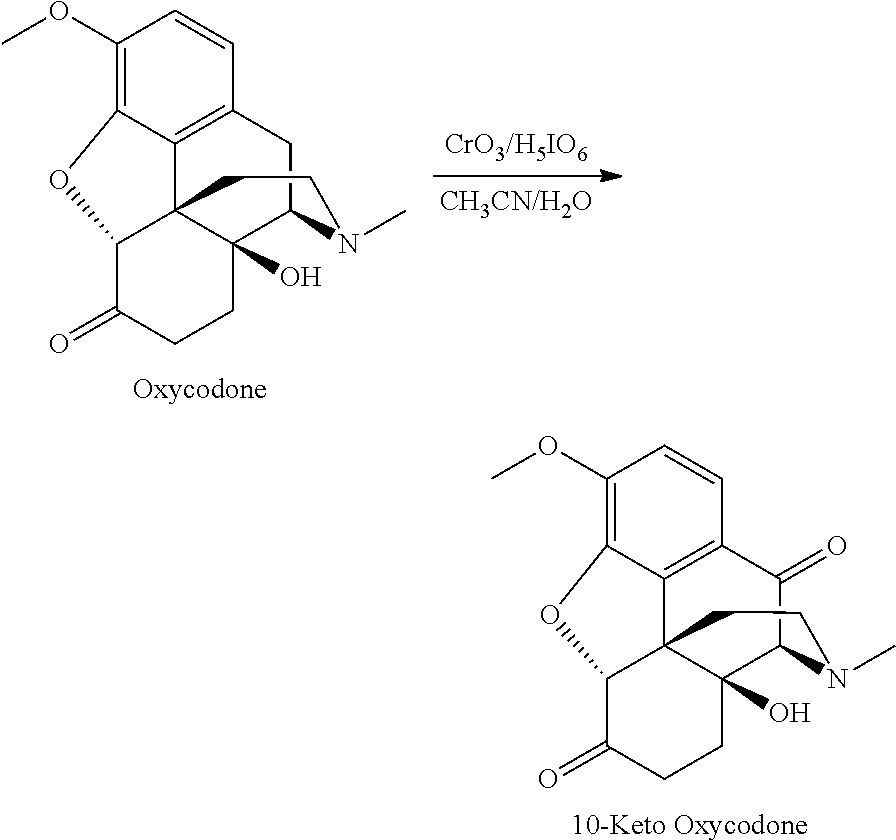
- H 5 IO 6 (1.368 g, 6 mmol) was dissolved in H 2 O (5 mL). Oxycodone (315 mg, 1 mmol) was added to this solution and was dissolved by adding CH 3 CN (5 mL). CrO 3 (40 mg, 0.4 mmol) was added to the mixture. The reaction mixture was stirred at room temperature for 4 h to complete the reaction. The reaction was neutralized with saturated NaHCO 3 , and extracted with chloroform. After workup, concentration, and column chromatographic purification (0 to 5% MeOH in CHCl 3 ), 210 mg of 10-keto oxycodone (0.64 mmol, 64% yield) was obtained.
Landscapes
- Chemical & Material Sciences (AREA)
- Organic Chemistry (AREA)
- Organic Low-Molecular-Weight Compounds And Preparation Thereof (AREA)
Abstract
Description


-
- R is selected from the group consisting of hydrogen, hydrocarbyl, and substituted hydrocarbyl,
- R1 and R2 are independently selected from the group consisting of hydrogen, hydrocarbyl, substituted hydrocarbyl, halogen, {—}OR15, and hydroxy protecting group;
- R3, R7, and R8 are independently selected from the group consisting of hydrogen, hydrocarbyl, substituted hydrocarbyl, and {—}OR15;
- R6 is selected from the group consisting of hydrogen, hydrocarbyl, substituted hydrocarbyl, {═}O, carbonyl protecting group, {—}OR15, hydroxy protecting group, and {—}NR16R17;
- R14 is selected from the group consisting of hydrogen and {—}OR16;
- R15 is selected from the group consisting of hydrocarbyl and substituted hydrocarbyl; and
- R16 and R17 are independently selected from the group consisting of hydrogen, hydrocarbyl, and substituted hydrocarbyl.

numbered as diagrammed above:
-
- wherein R is selected from the group consisting of hydrogen, hydrocarbyl, and substituted hydrocarbyl.

depicts the synthesis of the compound comprising Formula (II) in accordance with one aspect of the invention:
-
- R is selected from the group consisting of hydrogen, hydrocarbyl, and substituted hydrocarbyl;
- R1 and R2 are independently selected from the group consisting of hydrogen, hydrocarbyl, substituted hydrocarbyl, halogen, {—}OR15, and hydroxy protecting group;
- R3, R7, and R8 are independently selected from the group consisting of hydrogen, hydrocarbyl, substituted hydrocarbyl, and {—}OR15;
- R6 is selected from the group consisting of hydrogen, hydrocarbyl, substituted hydrocarbyl, {═}O, carbonyl protecting group, {—}OR15, hydroxy protecting group, and {—}NR16R17;
- R14 is selected from the group consisting of hydrogen and {—}OR16;
- R15 is selected from the group consisting of hydrocarbyl and substituted hydrocarbyl; and
- R16 and R17 are independently selected from the group consisting of hydrogen, hydrocarbyl, and substituted hydrocarbyl.


Claims (19)


Priority Applications (1)
| Application Number | Priority Date | Filing Date | Title |
|---|---|---|---|
| US12/876,284 US8314237B2 (en) | 2009-09-18 | 2010-09-07 | Preparation of 10-keto morphinans by benzylic oxidation |
Applications Claiming Priority (2)
| Application Number | Priority Date | Filing Date | Title |
|---|---|---|---|
| US24356909P | 2009-09-18 | 2009-09-18 | |
| US12/876,284 US8314237B2 (en) | 2009-09-18 | 2010-09-07 | Preparation of 10-keto morphinans by benzylic oxidation |
Publications (2)
| Publication Number | Publication Date |
|---|---|
| US20110071296A1 US20110071296A1 (en) | 2011-03-24 |
| US8314237B2 true US8314237B2 (en) | 2012-11-20 |
Family
ID=43034372
Family Applications (1)
| Application Number | Title | Priority Date | Filing Date |
|---|---|---|---|
| US12/876,284 Active 2031-04-01 US8314237B2 (en) | 2009-09-18 | 2010-09-07 | Preparation of 10-keto morphinans by benzylic oxidation |
Country Status (2)
| Country | Link |
|---|---|
| US (1) | US8314237B2 (en) |
| WO (1) | WO2011034747A1 (en) |
Families Citing this family (1)
| Publication number | Priority date | Publication date | Assignee | Title |
|---|---|---|---|---|
| CN103275005B (en) * | 2013-06-17 | 2015-05-20 | 苏州立新制药有限公司 | Preparation method for ent-3-methoxy-17-methyl dromoran-10 ketone |
-
2010
- 2010-09-07 US US12/876,284 patent/US8314237B2/en active Active
- 2010-09-07 WO PCT/US2010/047938 patent/WO2011034747A1/en not_active Ceased
Non-Patent Citations (10)
| Title |
|---|
| Archer et al., "10 Ketonaltrexone and 10 Ketooxymorphone", J. Med. Chem., 1985, 28, pp. 974-976. |
| Cain et al., "Sequentia Benzylic Oxidation of Naloxone 3-Methyl Ether", Synthetic Communications, 30(24), 2000, pp. 4513-4521. |
| Ceriliant's Website, http://www.cerliliant.com, downloaded Mar. 2009. |
| Horikiri et al., "A Convenient Oxidation Method of the Benzylic 10-Position in 4,5-Epoxymorphinan", Heterocycles, 63(4), 2004, pp. 865-870. |
| Rapoport et al., "The Stereochemistry of 10-Hydroxycodeine Derivatives", Stereochemistry of 10-Hydroxycodeine, 77, 1955, pp. 4330-4335. |
| Salerno et al., "A Simple Synthesis of Photolabile alpha-Methyl Nitrobenzyl Compounds", Synthetic Communications, 34(13), 2004, pp. 2379-2386. |
| Salerno et al., "A Simple Synthesis of Photolabile α-Methyl Nitrobenzyl Compounds", Synthetic Communications, 34(13), 2004, pp. 2379-2386. |
| Sasaki Tadashi et al., "Studies on morphine-like compounds. IV. Oxidation of N-methylmorphinan and related compounds", Chemical and Pharmaceutical Bulletin, Pharmaceutical Society of Japan, Tokyo, vol. 15, No. 9, Sep. 25, 1967, pp. 1415-1419. |
| Uyeda et al., "10-Keto Opiates", Tetrahedron Letters, 30(42), 1989, pp. 5725-5728. |
| Yamazaki, "Chromium(VI) Oxide-Catalyzed Benzylic Oxidation with Periodic Acid", Organic Letters, 1(13), 1999, pp. 2129-2132. |
Also Published As
| Publication number | Publication date |
|---|---|
| WO2011034747A1 (en) | 2011-03-24 |
| US20110071296A1 (en) | 2011-03-24 |
Similar Documents
| Publication | Publication Date | Title |
|---|---|---|
| US7671204B2 (en) | N-demethylation of N-methyl morphinans | |
| EP2222642B1 (en) | Process and compounds for the production of (+) opiates | |
| US8273888B2 (en) | Process for the preparation of 6-alpha-hydroxy-N-alkylated opiates | |
| US8519133B2 (en) | Preparation of 6-alpha-amino N-substituted morphinans by catalytic hydrogen transfer | |
| JP5778042B2 (en) | Process for reductive alkylation of normorphinan | |
| AU2002227135A1 (en) | 8- substituted-2, 6-methano-3-benzazocines and 3-substituted morphinanes as opioid receptor binding agents | |
| US20110269964A1 (en) | N-Alkylation of Opiates | |
| AU2009300384B2 (en) | Processes for increasing the yield of opiate alkaloid derivatives | |
| EP2417139B1 (en) | Preparation of saturated ketone morphinan compounds by catalytic isomerization | |
| US9193737B2 (en) | Production of 6-hydroxy morphinans without the isolation of intermediates | |
| US20110071296A1 (en) | Preparation of 10-Keto Morphinans by Benzylic Oxidation | |
| EP2601195B1 (en) | Tandem process for preparing n-alkyl morphinans | |
| EP2440561B1 (en) | Reductive amination of 6-keto normorphinans by catalytic hydrogen transfer |
Legal Events
| Date | Code | Title | Description |
|---|---|---|---|
| AS | Assignment |
Owner name: MALLINCKRODT INC., MISSOURI Free format text: ASSIGNMENT OF ASSIGNORS INTEREST;ASSIGNORS:SUN, HANG;JOHNSON, JOHN E., JR.;FENTON, RICKY L.;AND OTHERS;SIGNING DATES FROM 20090929 TO 20091007;REEL/FRAME:024941/0923 |
|
| AS | Assignment |
Owner name: MALLINCKRODT LLC, MISSOURI Free format text: CHANGE OF LEGAL ENTITY;ASSIGNOR:MALLINCKRODT INC.;REEL/FRAME:026754/0001 Effective date: 20110623 |
|
| STCF | Information on status: patent grant |
Free format text: PATENTED CASE |
|
| AS | Assignment |
Owner name: DEUTSCHE BANK AG NEW YORK BRANCH, NEW YORK Free format text: SECURITY INTEREST;ASSIGNORS:MALLINCKRODT INTERNATIONAL FINANCE S.A.;MALLINCKRODT CB LLC;MALLINCKRODT FINANCE GMBH;AND OTHERS;REEL/FRAME:032480/0001 Effective date: 20140319 |
|
| FPAY | Fee payment |
Year of fee payment: 4 |
|
| AS | Assignment |
Owner name: SPECGX LLC, MISSOURI Free format text: ASSIGNMENT OF ASSIGNORS INTEREST;ASSIGNOR:MALLINCKRODT LLC;REEL/FRAME:044891/0376 Effective date: 20171213 |
|
| AS | Assignment |
Owner name: WILMINGTON SAVINGS FUND SOCIETY, FSB, AS SECOND LI Free format text: SECURITY INTEREST;ASSIGNORS:MALLINCKRODT ARD IP LIMITED;MALLINCKRODT HOSPITAL PRODUCTS IP LIMITED;SPECGX LLC;AND OTHERS;REEL/FRAME:051256/0829 Effective date: 20191209 Owner name: WILMINGTON SAVINGS FUND SOCIETY, FSB, AS SECOND LIEN COLLATERAL AGENT, DELAWARE Free format text: SECURITY INTEREST;ASSIGNORS:MALLINCKRODT ARD IP LIMITED;MALLINCKRODT HOSPITAL PRODUCTS IP LIMITED;SPECGX LLC;AND OTHERS;REEL/FRAME:051256/0829 Effective date: 20191209 |
|
| MAFP | Maintenance fee payment |
Free format text: PAYMENT OF MAINTENANCE FEE, 8TH YEAR, LARGE ENTITY (ORIGINAL EVENT CODE: M1552); ENTITY STATUS OF PATENT OWNER: LARGE ENTITY Year of fee payment: 8 |
|
| AS | Assignment |
Owner name: VTESSE LLC (F/K/A VTESSE INC.), MISSOURI Free format text: RELEASE BY SECURED PARTY;ASSIGNOR:WILMINGTON SAVINGS FUND SOCIETY, FSB, AS SECOND LIEN COLLATERAL AGENT;REEL/FRAME:060389/0839 Effective date: 20220616 Owner name: STRATATECH CORPORATION, WISCONSIN Free format text: RELEASE BY SECURED PARTY;ASSIGNOR:WILMINGTON SAVINGS FUND SOCIETY, FSB, AS SECOND LIEN COLLATERAL AGENT;REEL/FRAME:060389/0839 Effective date: 20220616 Owner name: SPECGX LLC, MISSOURI Free format text: RELEASE BY SECURED PARTY;ASSIGNOR:WILMINGTON SAVINGS FUND SOCIETY, FSB, AS SECOND LIEN COLLATERAL AGENT;REEL/FRAME:060389/0839 Effective date: 20220616 Owner name: MALLINCKRODT PHARMA IP TRADING UNLIMITED COMPANY (F/K/A MALLINCKRODT PHARMA IP TRADING DESIGNATED ACTIVITY COMPANY), IRELAND Free format text: RELEASE BY SECURED PARTY;ASSIGNOR:WILMINGTON SAVINGS FUND SOCIETY, FSB, AS SECOND LIEN COLLATERAL AGENT;REEL/FRAME:060389/0839 Effective date: 20220616 Owner name: MALLINCKRODT HOSPITAL PRODUCTS IP UNLIMITED COMPANY (F/K/A MALLINCKRODT HOSPITAL PRODUCTS IP LIMITED), IRELAND Free format text: RELEASE BY SECURED PARTY;ASSIGNOR:WILMINGTON SAVINGS FUND SOCIETY, FSB, AS SECOND LIEN COLLATERAL AGENT;REEL/FRAME:060389/0839 Effective date: 20220616 Owner name: MALLINCKRODT ARD IP UNLIMITED COMPANY (F/K/A MALLINCKRODT ARD IP LIMITED), IRELAND Free format text: RELEASE BY SECURED PARTY;ASSIGNOR:WILMINGTON SAVINGS FUND SOCIETY, FSB, AS SECOND LIEN COLLATERAL AGENT;REEL/FRAME:060389/0839 Effective date: 20220616 Owner name: MALLINCKRODT LLC, MISSOURI Free format text: RELEASE BY SECURED PARTY;ASSIGNOR:WILMINGTON SAVINGS FUND SOCIETY, FSB, AS SECOND LIEN COLLATERAL AGENT;REEL/FRAME:060389/0839 Effective date: 20220616 Owner name: OCERA THERAPEUTICS, INC., MISSOURI Free format text: RELEASE BY SECURED PARTY;ASSIGNOR:WILMINGTON SAVINGS FUND SOCIETY, FSB, AS SECOND LIEN COLLATERAL AGENT;REEL/FRAME:060389/0839 Effective date: 20220616 Owner name: WILMINGTON SAVINGS FUND SOCIETY, FSB, AS SECOND LIEN COLLATERAL AGENT, DELAWARE Free format text: SECURITY INTEREST;ASSIGNORS:MALLINCKRODT ENTERPRISES LLC;MALLINCKRODT LLC;SPECGX LLC;AND OTHERS;REEL/FRAME:060389/0913 Effective date: 20220616 Owner name: OCERA THERAPEUTICS, INC., MISSOURI Free format text: RELEASE OF SECURITY INTEREST;ASSIGNOR:WILMINGTON SAVINGS FUND SOCIETY, FSB, AS SECOND LIEN COLLATERAL AGENT;REEL/FRAME:060389/0839 Effective date: 20220616 Owner name: MALLINCKRODT LLC, MISSOURI Free format text: RELEASE OF SECURITY INTEREST;ASSIGNOR:WILMINGTON SAVINGS FUND SOCIETY, FSB, AS SECOND LIEN COLLATERAL AGENT;REEL/FRAME:060389/0839 Effective date: 20220616 Owner name: MALLINCKRODT ARD IP UNLIMITED COMPANY (F/K/A MALLINCKRODT ARD IP LIMITED), IRELAND Free format text: RELEASE OF SECURITY INTEREST;ASSIGNOR:WILMINGTON SAVINGS FUND SOCIETY, FSB, AS SECOND LIEN COLLATERAL AGENT;REEL/FRAME:060389/0839 Effective date: 20220616 Owner name: MALLINCKRODT HOSPITAL PRODUCTS IP UNLIMITED COMPANY (F/K/A MALLINCKRODT HOSPITAL PRODUCTS IP LIMITED), IRELAND Free format text: RELEASE OF SECURITY INTEREST;ASSIGNOR:WILMINGTON SAVINGS FUND SOCIETY, FSB, AS SECOND LIEN COLLATERAL AGENT;REEL/FRAME:060389/0839 Effective date: 20220616 Owner name: MALLINCKRODT PHARMA IP TRADING UNLIMITED COMPANY (F/K/A MALLINCKRODT PHARMA IP TRADING DESIGNATED ACTIVITY COMPANY), IRELAND Free format text: RELEASE OF SECURITY INTEREST;ASSIGNOR:WILMINGTON SAVINGS FUND SOCIETY, FSB, AS SECOND LIEN COLLATERAL AGENT;REEL/FRAME:060389/0839 Effective date: 20220616 Owner name: SPECGX LLC, MISSOURI Free format text: RELEASE OF SECURITY INTEREST;ASSIGNOR:WILMINGTON SAVINGS FUND SOCIETY, FSB, AS SECOND LIEN COLLATERAL AGENT;REEL/FRAME:060389/0839 Effective date: 20220616 Owner name: STRATATECH CORPORATION, WISCONSIN Free format text: RELEASE OF SECURITY INTEREST;ASSIGNOR:WILMINGTON SAVINGS FUND SOCIETY, FSB, AS SECOND LIEN COLLATERAL AGENT;REEL/FRAME:060389/0839 Effective date: 20220616 Owner name: VTESSE LLC (F/K/A VTESSE INC.), MISSOURI Free format text: RELEASE OF SECURITY INTEREST;ASSIGNOR:WILMINGTON SAVINGS FUND SOCIETY, FSB, AS SECOND LIEN COLLATERAL AGENT;REEL/FRAME:060389/0839 Effective date: 20220616 |
|
| AS | Assignment |
Owner name: DEUTSCHE BANK AG NEW YORK BRANCH, NEW YORK Free format text: NOTICE OF GRANT OF SECURITY INTEREST IN INTELLECTUAL PROPERTY;ASSIGNORS:MALLINCKRODT ENTERPRISES LLC;MALLINCKRODT LLC;SPECGX LLC;AND OTHERS;REEL/FRAME:060434/0536 Effective date: 20220616 |
|
| AS | Assignment |
Owner name: ACQUIOM AGENCY SERVICES LLC, COLORADO Free format text: SECURITY INTEREST;ASSIGNORS:MALLINCKRODT ENTERPRISES LLC;MALLINCKRODT LLC;MALLINCKRODT PHARMA IP TRADING UNLIMITED COMPANY;AND OTHERS;REEL/FRAME:065595/0376 Effective date: 20231114 Owner name: MALLINCKRODT PHARMACEUTICALS IRELAND LIMITED, IRELAND Free format text: RELEASE OF SECURITY INTERESTS IN PATENTS AT REEL 060389/FRAME 0913;ASSIGNOR:WILMINGTON SAVINGS FUND SOCIETY, FSB, AS SECOND LIEN COLLATERAL AGENT;REEL/FRAME:065583/0465 Effective date: 20231114 Owner name: VTESSE LLC, MISSOURI Free format text: RELEASE OF SECURITY INTERESTS IN PATENTS AT REEL 060389/FRAME 0913;ASSIGNOR:WILMINGTON SAVINGS FUND SOCIETY, FSB, AS SECOND LIEN COLLATERAL AGENT;REEL/FRAME:065583/0465 Effective date: 20231114 Owner name: SUCAMPO PHARMA AMERICAS LLC, MISSOURI Free format text: RELEASE OF SECURITY INTERESTS IN PATENTS AT REEL 060389/FRAME 0913;ASSIGNOR:WILMINGTON SAVINGS FUND SOCIETY, FSB, AS SECOND LIEN COLLATERAL AGENT;REEL/FRAME:065583/0465 Effective date: 20231114 Owner name: STRATATECH CORPORATION, WISCONSIN Free format text: RELEASE OF SECURITY INTERESTS IN PATENTS AT REEL 060389/FRAME 0913;ASSIGNOR:WILMINGTON SAVINGS FUND SOCIETY, FSB, AS SECOND LIEN COLLATERAL AGENT;REEL/FRAME:065583/0465 Effective date: 20231114 Owner name: SPECGX LLC, MISSOURI Free format text: RELEASE OF SECURITY INTERESTS IN PATENTS AT REEL 060389/FRAME 0913;ASSIGNOR:WILMINGTON SAVINGS FUND SOCIETY, FSB, AS SECOND LIEN COLLATERAL AGENT;REEL/FRAME:065583/0465 Effective date: 20231114 Owner name: MALLINCKRODT PHARMA IP TRADING UNLIMITED COMPANY, IRELAND Free format text: RELEASE OF SECURITY INTERESTS IN PATENTS AT REEL 060389/FRAME 0913;ASSIGNOR:WILMINGTON SAVINGS FUND SOCIETY, FSB, AS SECOND LIEN COLLATERAL AGENT;REEL/FRAME:065583/0465 Effective date: 20231114 Owner name: MALLINCKRODT ENTERPRISES LLC, MISSOURI Free format text: RELEASE OF SECURITY INTERESTS IN PATENTS AT REEL 060389/FRAME 0913;ASSIGNOR:WILMINGTON SAVINGS FUND SOCIETY, FSB, AS SECOND LIEN COLLATERAL AGENT;REEL/FRAME:065583/0465 Effective date: 20231114 Owner name: MALLINCKRODT LLC, MISSOURI Free format text: RELEASE OF SECURITY INTERESTS IN PATENTS AT REEL 060389/FRAME 0913;ASSIGNOR:WILMINGTON SAVINGS FUND SOCIETY, FSB, AS SECOND LIEN COLLATERAL AGENT;REEL/FRAME:065583/0465 Effective date: 20231114 Owner name: OCERA THERAPEUTICS LLC (F/K/A OCERA THERAPEUTICS, INC.), MISSOURI Free format text: RELEASE OF SECURITY INTERESTS IN PATENTS AT REEL 060389/FRAME 0913;ASSIGNOR:WILMINGTON SAVINGS FUND SOCIETY, FSB, AS SECOND LIEN COLLATERAL AGENT;REEL/FRAME:065583/0465 Effective date: 20231114 |
|
| AS | Assignment |
Owner name: SUCAMPO PHARMA AMERICAS LLC, MISSOURI Free format text: RELEASE OF PATENT SECURITY INTERESTS RECORDED AT REEL 060434, FRAME 0536;ASSIGNOR:DEUTSCHE BANK AG NEW YORK BRANCH, AS COLLATERAL AGENT;REEL/FRAME:065601/0347 Effective date: 20231114 Owner name: MALLINCKRODT PHARMACEUTICALS IRELAND LIMITED, IRELAND Free format text: RELEASE OF PATENT SECURITY INTERESTS RECORDED AT REEL 060434, FRAME 0536;ASSIGNOR:DEUTSCHE BANK AG NEW YORK BRANCH, AS COLLATERAL AGENT;REEL/FRAME:065601/0347 Effective date: 20231114 Owner name: MALLINCKRODT PHARMA IP TRADING UNLIMITED COMPANY, IRELAND Free format text: RELEASE OF PATENT SECURITY INTERESTS RECORDED AT REEL 060434, FRAME 0536;ASSIGNOR:DEUTSCHE BANK AG NEW YORK BRANCH, AS COLLATERAL AGENT;REEL/FRAME:065601/0347 Effective date: 20231114 Owner name: VTESSE LLC, MISSOURI Free format text: RELEASE OF PATENT SECURITY INTERESTS RECORDED AT REEL 060434, FRAME 0536;ASSIGNOR:DEUTSCHE BANK AG NEW YORK BRANCH, AS COLLATERAL AGENT;REEL/FRAME:065601/0347 Effective date: 20231114 Owner name: STRATATECH CORPORATION, WISCONSIN Free format text: RELEASE OF PATENT SECURITY INTERESTS RECORDED AT REEL 060434, FRAME 0536;ASSIGNOR:DEUTSCHE BANK AG NEW YORK BRANCH, AS COLLATERAL AGENT;REEL/FRAME:065601/0347 Effective date: 20231114 Owner name: OCERA THERAPEUTICS, INC., MISSOURI Free format text: RELEASE OF PATENT SECURITY INTERESTS RECORDED AT REEL 060434, FRAME 0536;ASSIGNOR:DEUTSCHE BANK AG NEW YORK BRANCH, AS COLLATERAL AGENT;REEL/FRAME:065601/0347 Effective date: 20231114 Owner name: SPECGX LLC, MISSOURI Free format text: RELEASE OF PATENT SECURITY INTERESTS RECORDED AT REEL 060434, FRAME 0536;ASSIGNOR:DEUTSCHE BANK AG NEW YORK BRANCH, AS COLLATERAL AGENT;REEL/FRAME:065601/0347 Effective date: 20231114 Owner name: MALLINCKRODT LLC, MISSOURI Free format text: RELEASE OF PATENT SECURITY INTERESTS RECORDED AT REEL 060434, FRAME 0536;ASSIGNOR:DEUTSCHE BANK AG NEW YORK BRANCH, AS COLLATERAL AGENT;REEL/FRAME:065601/0347 Effective date: 20231114 Owner name: MALLINCKRODT ENTERPRISES LLC, MISSOURI Free format text: RELEASE OF PATENT SECURITY INTERESTS RECORDED AT REEL 060434, FRAME 0536;ASSIGNOR:DEUTSCHE BANK AG NEW YORK BRANCH, AS COLLATERAL AGENT;REEL/FRAME:065601/0347 Effective date: 20231114 Owner name: INO THERAPEUTICS LLC, MISSOURI Free format text: RELEASE OF PATENT SECURITY INTERESTS RECORDED AT REEL 032480, FRAME 0001;ASSIGNOR:DEUTSCHE BANK AG NEW YORK BRANCH, AS COLLATERAL AGENT;REEL/FRAME:065609/0322 Effective date: 20231114 Owner name: IKARIA THERAPEUTICS LLC, NEW JERSEY Free format text: RELEASE OF PATENT SECURITY INTERESTS RECORDED AT REEL 032480, FRAME 0001;ASSIGNOR:DEUTSCHE BANK AG NEW YORK BRANCH, AS COLLATERAL AGENT;REEL/FRAME:065609/0322 Effective date: 20231114 Owner name: THERAKOS, INC., MISSOURI Free format text: RELEASE OF PATENT SECURITY INTERESTS RECORDED AT REEL 032480, FRAME 0001;ASSIGNOR:DEUTSCHE BANK AG NEW YORK BRANCH, AS COLLATERAL AGENT;REEL/FRAME:065609/0322 Effective date: 20231114 Owner name: ST SHARED SERVICES LLC, MISSOURI Free format text: RELEASE OF PATENT SECURITY INTERESTS RECORDED AT REEL 032480, FRAME 0001;ASSIGNOR:DEUTSCHE BANK AG NEW YORK BRANCH, AS COLLATERAL AGENT;REEL/FRAME:065609/0322 Effective date: 20231114 Owner name: INFACARE PHARMACEUTICAL CORPORATION, MISSOURI Free format text: RELEASE OF PATENT SECURITY INTERESTS RECORDED AT REEL 032480, FRAME 0001;ASSIGNOR:DEUTSCHE BANK AG NEW YORK BRANCH, AS COLLATERAL AGENT;REEL/FRAME:065609/0322 Effective date: 20231114 Owner name: MALLINCKRODT PHARMA IP TRADING UNLIMITED COMPANY (F/K/A MALLINCKRODT PHARMA IP TRADING D.A.C.), IRELAND Free format text: RELEASE OF PATENT SECURITY INTERESTS RECORDED AT REEL 032480, FRAME 0001;ASSIGNOR:DEUTSCHE BANK AG NEW YORK BRANCH, AS COLLATERAL AGENT;REEL/FRAME:065609/0322 Effective date: 20231114 Owner name: MALLINCKRODT PHARMACEUTICALS IRELAND LIMITED, IRELAND Free format text: RELEASE OF PATENT SECURITY INTERESTS RECORDED AT REEL 032480, FRAME 0001;ASSIGNOR:DEUTSCHE BANK AG NEW YORK BRANCH, AS COLLATERAL AGENT;REEL/FRAME:065609/0322 Effective date: 20231114 Owner name: VTESSE LLC (F/K/A VTESSE INC.), MISSOURI Free format text: RELEASE OF PATENT SECURITY INTERESTS RECORDED AT REEL 032480, FRAME 0001;ASSIGNOR:DEUTSCHE BANK AG NEW YORK BRANCH, AS COLLATERAL AGENT;REEL/FRAME:065609/0322 Effective date: 20231114 Owner name: SUCAMPO PHARMA AMERICAS LLC, MISSOURI Free format text: RELEASE OF PATENT SECURITY INTERESTS RECORDED AT REEL 032480, FRAME 0001;ASSIGNOR:DEUTSCHE BANK AG NEW YORK BRANCH, AS COLLATERAL AGENT;REEL/FRAME:065609/0322 Effective date: 20231114 Owner name: STRATATECH CORPORATION, WISCONSIN Free format text: RELEASE OF PATENT SECURITY INTERESTS RECORDED AT REEL 032480, FRAME 0001;ASSIGNOR:DEUTSCHE BANK AG NEW YORK BRANCH, AS COLLATERAL AGENT;REEL/FRAME:065609/0322 Effective date: 20231114 Owner name: SPECGX LLC, MISSOURI Free format text: RELEASE OF PATENT SECURITY INTERESTS RECORDED AT REEL 032480, FRAME 0001;ASSIGNOR:DEUTSCHE BANK AG NEW YORK BRANCH, AS COLLATERAL AGENT;REEL/FRAME:065609/0322 Effective date: 20231114 Owner name: OCERA THERAPEUTICS LLC (F/K/A OCERA THERAPEUTICS, INC.), MISSOURI Free format text: RELEASE OF PATENT SECURITY INTERESTS RECORDED AT REEL 032480, FRAME 0001;ASSIGNOR:DEUTSCHE BANK AG NEW YORK BRANCH, AS COLLATERAL AGENT;REEL/FRAME:065609/0322 Effective date: 20231114 Owner name: MALLINCKRODT ARD IP UNLIMITED COMPANY (F/K/A MALLINCKRODT ARD IP LIMITED), IRELAND Free format text: RELEASE OF PATENT SECURITY INTERESTS RECORDED AT REEL 032480, FRAME 0001;ASSIGNOR:DEUTSCHE BANK AG NEW YORK BRANCH, AS COLLATERAL AGENT;REEL/FRAME:065609/0322 Effective date: 20231114 Owner name: MALLINCKRODT HOSPITAL PRODUCTS IP UNLIMITED COMPANY (F/K/A MALLINCKRODT HOSPITAL PRODUCTS IP LIMITED), IRELAND Free format text: RELEASE OF PATENT SECURITY INTERESTS RECORDED AT REEL 032480, FRAME 0001;ASSIGNOR:DEUTSCHE BANK AG NEW YORK BRANCH, AS COLLATERAL AGENT;REEL/FRAME:065609/0322 Effective date: 20231114 Owner name: MEH, INC., MISSOURI Free format text: RELEASE OF PATENT SECURITY INTERESTS RECORDED AT REEL 032480, FRAME 0001;ASSIGNOR:DEUTSCHE BANK AG NEW YORK BRANCH, AS COLLATERAL AGENT;REEL/FRAME:065609/0322 Effective date: 20231114 Owner name: IMC EXPLORATION COMPANY, MISSOURI Free format text: RELEASE OF PATENT SECURITY INTERESTS RECORDED AT REEL 032480, FRAME 0001;ASSIGNOR:DEUTSCHE BANK AG NEW YORK BRANCH, AS COLLATERAL AGENT;REEL/FRAME:065609/0322 Effective date: 20231114 Owner name: MALLINCKRODT US HOLDINGS LLC, MISSOURI Free format text: RELEASE OF PATENT SECURITY INTERESTS RECORDED AT REEL 032480, FRAME 0001;ASSIGNOR:DEUTSCHE BANK AG NEW YORK BRANCH, AS COLLATERAL AGENT;REEL/FRAME:065609/0322 Effective date: 20231114 Owner name: MALLINCKRODT VETERINARY, INC., MISSOURI Free format text: RELEASE OF PATENT SECURITY INTERESTS RECORDED AT REEL 032480, FRAME 0001;ASSIGNOR:DEUTSCHE BANK AG NEW YORK BRANCH, AS COLLATERAL AGENT;REEL/FRAME:065609/0322 Effective date: 20231114 Owner name: MALLINCKRODT BRAND PHARMACEUTICALS LLC (F/K/A MALLINCKRODT BRAND PHARMACEUTICALS, INC.), MISSOURI Free format text: RELEASE OF PATENT SECURITY INTERESTS RECORDED AT REEL 032480, FRAME 0001;ASSIGNOR:DEUTSCHE BANK AG NEW YORK BRANCH, AS COLLATERAL AGENT;REEL/FRAME:065609/0322 Effective date: 20231114 Owner name: LIEBEL-FLARSHEIM COMPANY LLC, MISSOURI Free format text: RELEASE OF PATENT SECURITY INTERESTS RECORDED AT REEL 032480, FRAME 0001;ASSIGNOR:DEUTSCHE BANK AG NEW YORK BRANCH, AS COLLATERAL AGENT;REEL/FRAME:065609/0322 Effective date: 20231114 Owner name: LAFAYETTE PHARMACEUTICALS LLC, MISSOURI Free format text: RELEASE OF PATENT SECURITY INTERESTS RECORDED AT REEL 032480, FRAME 0001;ASSIGNOR:DEUTSCHE BANK AG NEW YORK BRANCH, AS COLLATERAL AGENT;REEL/FRAME:065609/0322 Effective date: 20231114 Owner name: MALLINCKRODT LLC, MISSOURI Free format text: RELEASE OF PATENT SECURITY INTERESTS RECORDED AT REEL 032480, FRAME 0001;ASSIGNOR:DEUTSCHE BANK AG NEW YORK BRANCH, AS COLLATERAL AGENT;REEL/FRAME:065609/0322 Effective date: 20231114 Owner name: MALLINCKRODT ENTERPRISES LLC, MISSOURI Free format text: RELEASE OF PATENT SECURITY INTERESTS RECORDED AT REEL 032480, FRAME 0001;ASSIGNOR:DEUTSCHE BANK AG NEW YORK BRANCH, AS COLLATERAL AGENT;REEL/FRAME:065609/0322 Effective date: 20231114 Owner name: MALLINCKRODT ENTERPRISES HOLDINGS LLC (F/K/A MALLINCKRODT ENTERPRISES HOLDINGS, INC.), MISSOURI Free format text: RELEASE OF PATENT SECURITY INTERESTS RECORDED AT REEL 032480, FRAME 0001;ASSIGNOR:DEUTSCHE BANK AG NEW YORK BRANCH, AS COLLATERAL AGENT;REEL/FRAME:065609/0322 Effective date: 20231114 Owner name: CNS THERAPEUTICS, INC., MISSOURI Free format text: RELEASE OF PATENT SECURITY INTERESTS RECORDED AT REEL 032480, FRAME 0001;ASSIGNOR:DEUTSCHE BANK AG NEW YORK BRANCH, AS COLLATERAL AGENT;REEL/FRAME:065609/0322 Effective date: 20231114 Owner name: LUDLOW LLC (F/K/A LUDLOW CORPORATION), MISSOURI Free format text: RELEASE OF PATENT SECURITY INTERESTS RECORDED AT REEL 032480, FRAME 0001;ASSIGNOR:DEUTSCHE BANK AG NEW YORK BRANCH, AS COLLATERAL AGENT;REEL/FRAME:065609/0322 Effective date: 20231114 Owner name: MNK 2011 LLC (F/K/A MALLINCKRODT INC.), MISSOURI Free format text: RELEASE OF PATENT SECURITY INTERESTS RECORDED AT REEL 032480, FRAME 0001;ASSIGNOR:DEUTSCHE BANK AG NEW YORK BRANCH, AS COLLATERAL AGENT;REEL/FRAME:065609/0322 Effective date: 20231114 Owner name: MALLINCKRODT US POOL LLC, MISSOURI Free format text: RELEASE OF PATENT SECURITY INTERESTS RECORDED AT REEL 032480, FRAME 0001;ASSIGNOR:DEUTSCHE BANK AG NEW YORK BRANCH, AS COLLATERAL AGENT;REEL/FRAME:065609/0322 Effective date: 20231114 Owner name: MALLINCKRODT CARRIBEAN, INC., MISSOURI Free format text: RELEASE OF PATENT SECURITY INTERESTS RECORDED AT REEL 032480, FRAME 0001;ASSIGNOR:DEUTSCHE BANK AG NEW YORK BRANCH, AS COLLATERAL AGENT;REEL/FRAME:065609/0322 Effective date: 20231114 Owner name: MALLINCKRODT US HOLDINGS LLC (F/K/A MALLINCKRODT US HOLDINGS INC.), MISSOURI Free format text: RELEASE OF PATENT SECURITY INTERESTS RECORDED AT REEL 032480, FRAME 0001;ASSIGNOR:DEUTSCHE BANK AG NEW YORK BRANCH, AS COLLATERAL AGENT;REEL/FRAME:065609/0322 Effective date: 20231114 Owner name: MALLINCKRODT FINANCE GMBH, SWITZERLAND Free format text: RELEASE OF PATENT SECURITY INTERESTS RECORDED AT REEL 032480, FRAME 0001;ASSIGNOR:DEUTSCHE BANK AG NEW YORK BRANCH, AS COLLATERAL AGENT;REEL/FRAME:065609/0322 Effective date: 20231114 Owner name: MALLINCKRODT CB LLC, MISSOURI Free format text: RELEASE OF PATENT SECURITY INTERESTS RECORDED AT REEL 032480, FRAME 0001;ASSIGNOR:DEUTSCHE BANK AG NEW YORK BRANCH, AS COLLATERAL AGENT;REEL/FRAME:065609/0322 Effective date: 20231114 Owner name: MALLINCKRODT INTERNATIONAL FINANCE S.A., LUXEMBOURG Free format text: RELEASE OF PATENT SECURITY INTERESTS RECORDED AT REEL 032480, FRAME 0001;ASSIGNOR:DEUTSCHE BANK AG NEW YORK BRANCH, AS COLLATERAL AGENT;REEL/FRAME:065609/0322 Effective date: 20231114 |
|
| MAFP | Maintenance fee payment |
Free format text: PAYMENT OF MAINTENANCE FEE, 12TH YEAR, LARGE ENTITY (ORIGINAL EVENT CODE: M1553); ENTITY STATUS OF PATENT OWNER: LARGE ENTITY Year of fee payment: 12 |
|
| AS | Assignment |
Owner name: WILMINGTON SAVINGS FUND SOCIETY, FSB, AS COLLATERAL AGENT, DELAWARE Free format text: INTELLECTUAL PROPERTY SECURITY AGREEMENT;ASSIGNOR:SPECGX LLC;REEL/FRAME:072313/0063 Effective date: 20250731 |
|
| AS | Assignment |
Owner name: MALLINCKRODT ENTERPRISES LLC, MISSOURI Free format text: RELEASE BY SECURED PARTY;ASSIGNOR:ACQUIOM AGENCY SERVICES LLC;REEL/FRAME:072324/0740 Effective date: 20250801 Owner name: MALLINCKRODT LLC, MISSOURI Free format text: RELEASE BY SECURED PARTY;ASSIGNOR:ACQUIOM AGENCY SERVICES LLC;REEL/FRAME:072324/0740 Effective date: 20250801 Owner name: MALLINCKRODT PHARMA IP TRADING UNLIMITED COMPANY, MISSOURI Free format text: RELEASE BY SECURED PARTY;ASSIGNOR:ACQUIOM AGENCY SERVICES LLC;REEL/FRAME:072324/0740 Effective date: 20250801 Owner name: MALLINCKRODT PHARMACEUTICALS IRELAND LIMITED, IRELAND Free format text: RELEASE BY SECURED PARTY;ASSIGNOR:ACQUIOM AGENCY SERVICES LLC;REEL/FRAME:072324/0740 Effective date: 20250801 Owner name: OCERA THERAPEUTICS LLC, CALIFORNIA Free format text: RELEASE BY SECURED PARTY;ASSIGNOR:ACQUIOM AGENCY SERVICES LLC;REEL/FRAME:072324/0740 Effective date: 20250801 Owner name: SPECGX LLC, MISSOURI Free format text: RELEASE BY SECURED PARTY;ASSIGNOR:ACQUIOM AGENCY SERVICES LLC;REEL/FRAME:072324/0740 Effective date: 20250801 Owner name: STRATATECH CORPORATION, WISCONSIN Free format text: RELEASE BY SECURED PARTY;ASSIGNOR:ACQUIOM AGENCY SERVICES LLC;REEL/FRAME:072324/0740 Effective date: 20250801 Owner name: SUCAMPO PHARMA AMERICAS LLC, MISSOURI Free format text: RELEASE BY SECURED PARTY;ASSIGNOR:ACQUIOM AGENCY SERVICES LLC;REEL/FRAME:072324/0740 Effective date: 20250801 Owner name: VTESSE LLC, MISSOURI Free format text: RELEASE BY SECURED PARTY;ASSIGNOR:ACQUIOM AGENCY SERVICES LLC;REEL/FRAME:072324/0740 Effective date: 20250801 Owner name: MALLINCKRODT ENTERPRISES LLC, MISSOURI Free format text: RELEASE OF SECURITY INTEREST;ASSIGNOR:ACQUIOM AGENCY SERVICES LLC;REEL/FRAME:072324/0740 Effective date: 20250801 Owner name: MALLINCKRODT LLC, MISSOURI Free format text: RELEASE OF SECURITY INTEREST;ASSIGNOR:ACQUIOM AGENCY SERVICES LLC;REEL/FRAME:072324/0740 Effective date: 20250801 Owner name: MALLINCKRODT PHARMA IP TRADING UNLIMITED COMPANY, MISSOURI Free format text: RELEASE OF SECURITY INTEREST;ASSIGNOR:ACQUIOM AGENCY SERVICES LLC;REEL/FRAME:072324/0740 Effective date: 20250801 Owner name: MALLINCKRODT PHARMACEUTICALS IRELAND LIMITED, IRELAND Free format text: RELEASE OF SECURITY INTEREST;ASSIGNOR:ACQUIOM AGENCY SERVICES LLC;REEL/FRAME:072324/0740 Effective date: 20250801 Owner name: OCERA THERAPEUTICS LLC, CALIFORNIA Free format text: RELEASE OF SECURITY INTEREST;ASSIGNOR:ACQUIOM AGENCY SERVICES LLC;REEL/FRAME:072324/0740 Effective date: 20250801 Owner name: SPECGX LLC, MISSOURI Free format text: RELEASE OF SECURITY INTEREST;ASSIGNOR:ACQUIOM AGENCY SERVICES LLC;REEL/FRAME:072324/0740 Effective date: 20250801 Owner name: STRATATECH CORPORATION, WISCONSIN Free format text: RELEASE OF SECURITY INTEREST;ASSIGNOR:ACQUIOM AGENCY SERVICES LLC;REEL/FRAME:072324/0740 Effective date: 20250801 Owner name: SUCAMPO PHARMA AMERICAS LLC, MISSOURI Free format text: RELEASE OF SECURITY INTEREST;ASSIGNOR:ACQUIOM AGENCY SERVICES LLC;REEL/FRAME:072324/0740 Effective date: 20250801 Owner name: VTESSE LLC, MISSOURI Free format text: RELEASE OF SECURITY INTEREST;ASSIGNOR:ACQUIOM AGENCY SERVICES LLC;REEL/FRAME:072324/0740 Effective date: 20250801 |