US8314111B2 - Fused bicyclic motor inhibitors - Google Patents
Fused bicyclic motor inhibitors Download PDFInfo
- Publication number
- US8314111B2 US8314111B2 US13/106,954 US201113106954A US8314111B2 US 8314111 B2 US8314111 B2 US 8314111B2 US 201113106954 A US201113106954 A US 201113106954A US 8314111 B2 US8314111 B2 US 8314111B2
- Authority
- US
- United States
- Prior art keywords
- alkyl
- formula
- compounds
- cycloalkyl
- compound
- Prior art date
- Legal status (The legal status is an assumption and is not a legal conclusion. Google has not performed a legal analysis and makes no representation as to the accuracy of the status listed.)
- Active
Links
- 0 COCC(CC1)CCC1C1=NC(C2=Cc3ccccc3*2)=C2I1C=CN=C2N Chemical compound COCC(CC1)CCC1C1=NC(C2=Cc3ccccc3*2)=C2I1C=CN=C2N 0.000 description 59
- MHLXBNMYIIXWRR-UHFFFAOYSA-N C=C1CC(C(=O)NCC2=NC=CN=C2Cl)C1 Chemical compound C=C1CC(C(=O)NCC2=NC=CN=C2Cl)C1 MHLXBNMYIIXWRR-UHFFFAOYSA-N 0.000 description 2
- RLEXCWASAGYXPF-UHFFFAOYSA-N C=C1CC(C2=NC=C3C(Cl)=NC=CN32)C1 Chemical compound C=C1CC(C2=NC=C3C(Cl)=NC=CN32)C1 RLEXCWASAGYXPF-UHFFFAOYSA-N 0.000 description 2
- XXNCPHDQGLUFLL-UHFFFAOYSA-N CC(C)COC(=O)N1CCC(/C2=N/C(C3=CC4=C(C=CC=C4)N3)=C3/C(N)=NC=CN23)CC1 Chemical compound CC(C)COC(=O)N1CCC(/C2=N/C(C3=CC4=C(C=CC=C4)N3)=C3/C(N)=NC=CN23)CC1 XXNCPHDQGLUFLL-UHFFFAOYSA-N 0.000 description 2
- PAIPWXLGTYBUAV-HDJSIYSDSA-N CC(C)OC1=CC=CC2=C1NC(C1=C3C(N)=NC=NN3C([C@H]3CC[C@H](C(=O)O)CC3)=N1)=C2 Chemical compound CC(C)OC1=CC=CC2=C1NC(C1=C3C(N)=NC=NN3C([C@H]3CC[C@H](C(=O)O)CC3)=N1)=C2 PAIPWXLGTYBUAV-HDJSIYSDSA-N 0.000 description 2
- FKGSVWRVVRAVOJ-UHFFFAOYSA-N CC(C)S(=O)(=O)N1CCC(C2=NC(C3=CC4=C(C=CC=C4)N3)=C3C(N)=NC=CN23)CC1 Chemical compound CC(C)S(=O)(=O)N1CCC(C2=NC(C3=CC4=C(C=CC=C4)N3)=C3C(N)=NC=CN23)CC1 FKGSVWRVVRAVOJ-UHFFFAOYSA-N 0.000 description 2
- KGWJGQUTNNLURY-UHFFFAOYSA-N CC1(C)OB(C2=CC3=C(N2)C(Br)=CC=C3)OC1(C)C Chemical compound CC1(C)OB(C2=CC3=C(N2)C(Br)=CC=C3)OC1(C)C KGWJGQUTNNLURY-UHFFFAOYSA-N 0.000 description 2
- JXJXXXDZYCGCBY-IYARVYRRSA-N CC1=CC=C(CC(=O)[C@H]2CC[C@H](C3=NC(C4=CC5=C(N4)C(Cl)=CC=C5)=C4C(N)=NC=NN43)CC2)C=N1 Chemical compound CC1=CC=C(CC(=O)[C@H]2CC[C@H](C3=NC(C4=CC5=C(N4)C(Cl)=CC=C5)=C4C(N)=NC=NN43)CC2)C=N1 JXJXXXDZYCGCBY-IYARVYRRSA-N 0.000 description 2
- MBFPTQHSQOYKKV-UHFFFAOYSA-N CC1=CC=CC2=C1OC(C1=C3C(N)=NC=CN3C(C3CCC3)=N1)=C2 Chemical compound CC1=CC=CC2=C1OC(C1=C3C(N)=NC=CN3C(C3CCC3)=N1)=C2 MBFPTQHSQOYKKV-UHFFFAOYSA-N 0.000 description 2
- BNTJUTTVKMDISE-KOMQPUFPSA-N CCC1=CC=CC2=C1NC(C1=C3\C(N)=NC=CN3/C([C@H]3CC[C@H](CNC(=O)C(F)(F)F)CC3)=N\1)=C2 Chemical compound CCC1=CC=CC2=C1NC(C1=C3\C(N)=NC=CN3/C([C@H]3CC[C@H](CNC(=O)C(F)(F)F)CC3)=N\1)=C2 BNTJUTTVKMDISE-KOMQPUFPSA-N 0.000 description 2
- BUXBSAUHLVLTQC-UHFFFAOYSA-N CN(C)C(=O)N1CCC(C2=NC(C3=CC4=C(N3)C(Cl)=CC=C4)=C3C(N)=NC=NN23)CC1 Chemical compound CN(C)C(=O)N1CCC(C2=NC(C3=CC4=C(N3)C(Cl)=CC=C4)=C3C(N)=NC=NN23)CC1 BUXBSAUHLVLTQC-UHFFFAOYSA-N 0.000 description 2
- GYLYLYHMCXOHFO-UHFFFAOYSA-N CN(C)C1=CC=C(CC(=O)N2CCC(C3=NC(C4=CC5=C(C=CC=C5)N4)=C4C(N)=NC=CN34)CC2)C=C1 Chemical compound CN(C)C1=CC=C(CC(=O)N2CCC(C3=NC(C4=CC5=C(C=CC=C5)N4)=C4C(N)=NC=CN34)CC2)C=C1 GYLYLYHMCXOHFO-UHFFFAOYSA-N 0.000 description 2
- AGXBDFLBYGQPOB-UHFFFAOYSA-N CN1C2=CC=C(Br)C=C2N=C1C1=CC=CC=C1 Chemical compound CN1C2=CC=C(Br)C=C2N=C1C1=CC=CC=C1 AGXBDFLBYGQPOB-UHFFFAOYSA-N 0.000 description 2
- YSBJBTUVATUSBN-UHFFFAOYSA-N CN1C=CC2=C1/C=C(C1=C3C(N)=NC=NN3C(C3CCC(C(=O)O)CC3)=N1)\C=C/2 Chemical compound CN1C=CC2=C1/C=C(C1=C3C(N)=NC=NN3C(C3CCC(C(=O)O)CC3)=N1)\C=C/2 YSBJBTUVATUSBN-UHFFFAOYSA-N 0.000 description 2
- GGCDOLDXNOVYLQ-UHFFFAOYSA-N CN1CCN(C2CC(C3=NC(I)=C4C(N)=NC=CN34)C2)CC1 Chemical compound CN1CCN(C2CC(C3=NC(I)=C4C(N)=NC=CN34)C2)CC1 GGCDOLDXNOVYLQ-UHFFFAOYSA-N 0.000 description 2
- CEIHLVHGSYOLNN-OIRDZHBESA-N CN1CCN([C@H]2C[C@@H](C3=NC(C4=C/C5N=C(C6=CC=CC=C6)SC5/C=C\4)=C4C(N)=NC=CN43)C2)CC1 Chemical compound CN1CCN([C@H]2C[C@@H](C3=NC(C4=C/C5N=C(C6=CC=CC=C6)SC5/C=C\4)=C4C(N)=NC=CN43)C2)CC1 CEIHLVHGSYOLNN-OIRDZHBESA-N 0.000 description 2
- CMSGDCCPUJIGNT-UHFFFAOYSA-N COC(=O)C1(C)CCC(C(=O)O)CC1 Chemical compound COC(=O)C1(C)CCC(C(=O)O)CC1 CMSGDCCPUJIGNT-UHFFFAOYSA-N 0.000 description 2
- VXJFHRWRTNIUNX-UHFFFAOYSA-N COC(=O)C1=CC=CC2=C1C=C(C1=C3C(N)=NC=CN3C(C3CCN(C(=O)C4=CSC=C4)CC3)=N1)N2 Chemical compound COC(=O)C1=CC=CC2=C1C=C(C1=C3C(N)=NC=CN3C(C3CCN(C(=O)C4=CSC=C4)CC3)=N1)N2 VXJFHRWRTNIUNX-UHFFFAOYSA-N 0.000 description 2
- XDSXRHZHVFRFKM-UHFFFAOYSA-N COC(=O)C1CCC(C2=NC(C3=CC4=C(C=CC=C4)N3)=C3C(N)=NC=CN23)CC1 Chemical compound COC(=O)C1CCC(C2=NC(C3=CC4=C(C=CC=C4)N3)=C3C(N)=NC=CN23)CC1 XDSXRHZHVFRFKM-UHFFFAOYSA-N 0.000 description 2
- HJJXBUMIFQWLLI-ZKCHVHJHSA-N COC(=O)[C@H]1CC[C@H](C(=O)NCC2=NN=C(N)NC2=O)CC1 Chemical compound COC(=O)[C@H]1CC[C@H](C(=O)NCC2=NN=C(N)NC2=O)CC1 HJJXBUMIFQWLLI-ZKCHVHJHSA-N 0.000 description 2
- UTLSJGBTNAGAMG-KYZUINATSA-N COC(=O)[C@H]1CC[C@H](C(=O)ON2C(=O)CCC2=O)CC1 Chemical compound COC(=O)[C@H]1CC[C@H](C(=O)ON2C(=O)CCC2=O)CC1 UTLSJGBTNAGAMG-KYZUINATSA-N 0.000 description 2
- LAPMIUQKOMYEBO-IYARVYRRSA-N COC(=O)[C@H]1CC[C@H](C2=NC(/C3=C/C4=C(N3)C(C3=CC=CC=C3)=CC=C4)=C3C(N)=NC=NN32)CC1 Chemical compound COC(=O)[C@H]1CC[C@H](C2=NC(/C3=C/C4=C(N3)C(C3=CC=CC=C3)=CC=C4)=C3C(N)=NC=NN32)CC1 LAPMIUQKOMYEBO-IYARVYRRSA-N 0.000 description 2
- MAOZFRAWXFRWAD-HAQNSBGRSA-N COC(=O)[C@H]1CC[C@H](C2=NC(C3=CC4=C(N3)C(Cl)=CC=C4)=C3C(N)=NC=NN32)CC1 Chemical compound COC(=O)[C@H]1CC[C@H](C2=NC(C3=CC4=C(N3)C(Cl)=CC=C4)=C3C(N)=NC=NN32)CC1 MAOZFRAWXFRWAD-HAQNSBGRSA-N 0.000 description 2
- LYBXPDYGMNWJDC-ZKCHVHJHSA-N COC(=O)[C@H]1CC[C@H](C2=NC=C3C(=O)NC(N)=NN32)CC1 Chemical compound COC(=O)[C@H]1CC[C@H](C2=NC=C3C(=O)NC(N)=NN32)CC1 LYBXPDYGMNWJDC-ZKCHVHJHSA-N 0.000 description 2
- XKRLWXPETDGNDO-MGCOHNPYSA-N COC(=O)[C@H]1CC[C@H](C2=NC=C3C(Cl)=NC=CN32)CC1 Chemical compound COC(=O)[C@H]1CC[C@H](C2=NC=C3C(Cl)=NC=CN32)CC1 XKRLWXPETDGNDO-MGCOHNPYSA-N 0.000 description 2
- WAZNKNOJIZQMHC-UHFFFAOYSA-N COC1=CC=C(C2(C3=NC(C4=CC5=C(C=CC=C5)N4)=C4C(N)=NC=CN34)CC2)C=C1 Chemical compound COC1=CC=C(C2(C3=NC(C4=CC5=C(C=CC=C5)N4)=C4C(N)=NC=CN34)CC2)C=C1 WAZNKNOJIZQMHC-UHFFFAOYSA-N 0.000 description 2
- NKGKXVTVTQIZDZ-KWUMSVIQSA-N COC1=CC=CC2=C1NC(C1=C3C(N)=NC=CN3C([C@H]3C[C@@](C)(O)C3)=N1)=C2 Chemical compound COC1=CC=CC2=C1NC(C1=C3C(N)=NC=CN3C([C@H]3C[C@@](C)(O)C3)=N1)=C2 NKGKXVTVTQIZDZ-KWUMSVIQSA-N 0.000 description 2
- PWLGCEWFQKHWDH-IYBDPMFKSA-N COC1=CC=CC2=C1NC(C1=C3C(N)=NC=NN3C(C3CCN(C(=O)N4C[C@H](C)O[C@H](C)C4)CC3)=N1)=C2 Chemical compound COC1=CC=CC2=C1NC(C1=C3C(N)=NC=NN3C(C3CCN(C(=O)N4C[C@H](C)O[C@H](C)C4)CC3)=N1)=C2 PWLGCEWFQKHWDH-IYBDPMFKSA-N 0.000 description 2
- BCZHZQBEZAXRLQ-UHFFFAOYSA-N CS(=O)(=O)C1=C2NC=CC2=CC=C1 Chemical compound CS(=O)(=O)C1=C2NC=CC2=CC=C1 BCZHZQBEZAXRLQ-UHFFFAOYSA-N 0.000 description 2
- SUVQHMZGYSXLFY-IXKSNFPSSA-N C[C@]1(O)C[C@@H](C2=NC(C3=CC4=C(C=C3)N(C3=CC=CC=C3)C(C3=CC=CC=C3)=N4)=C3C(N)=NC=CN32)C1 Chemical compound C[C@]1(O)C[C@@H](C2=NC(C3=CC4=C(C=C3)N(C3=CC=CC=C3)C(C3=CC=CC=C3)=N4)=C3C(N)=NC=CN32)C1 SUVQHMZGYSXLFY-IXKSNFPSSA-N 0.000 description 2
- VRAYAPZSEPNOTI-UHFFFAOYSA-N FC(F)(F)C1=CC=CC2=C1NC=C2 Chemical compound FC(F)(F)C1=CC=CC2=C1NC=C2 VRAYAPZSEPNOTI-UHFFFAOYSA-N 0.000 description 2
- DURUMSGYQLHYBY-UHFFFAOYSA-N NC(C(CC1)CCC1c1nc(-c2cc3cccc(-c(cc4)ccc4F)c3[nH]2)c2[n]1ccnc2N)=O Chemical compound NC(C(CC1)CCC1c1nc(-c2cc3cccc(-c(cc4)ccc4F)c3[nH]2)c2[n]1ccnc2N)=O DURUMSGYQLHYBY-UHFFFAOYSA-N 0.000 description 2
- ZZAZULCRLFDEEW-UHFFFAOYSA-N NC1=NC=CN2/C(C3CCN(C(=O)NC4=CC=CC=C4)CC3)=N\C(C3=CC4=C(C=CC=C4)N3)=C\12 Chemical compound NC1=NC=CN2/C(C3CCN(C(=O)NC4=CC=CC=C4)CC3)=N\C(C3=CC4=C(C=CC=C4)N3)=C\12 ZZAZULCRLFDEEW-UHFFFAOYSA-N 0.000 description 2
- MOIOKWJWHJNKJT-UHFFFAOYSA-N NC1=NC=CN2C(C3CCC(C(=O)O)CC3)=NC(C3=CC4=C(C=CC=C4)N3)=C12 Chemical compound NC1=NC=CN2C(C3CCC(C(=O)O)CC3)=NC(C3=CC4=C(C=CC=C4)N3)=C12 MOIOKWJWHJNKJT-UHFFFAOYSA-N 0.000 description 2
- AITKPBKDPLVETG-UHFFFAOYSA-N NC1=NC=CN2C(C3CCC3)=NC(C3=C/C4=C(C=CN4)/C=C\3)=C12 Chemical compound NC1=NC=CN2C(C3CCC3)=NC(C3=C/C4=C(C=CN4)/C=C\3)=C12 AITKPBKDPLVETG-UHFFFAOYSA-N 0.000 description 2
- WMVWYOOUSCWLPK-UHFFFAOYSA-N NC1=NC=CN2C(C3CCC3)=NC(C3=CC4=C(N=CC=C4)N3)=C12 Chemical compound NC1=NC=CN2C(C3CCC3)=NC(C3=CC4=C(N=CC=C4)N3)=C12 WMVWYOOUSCWLPK-UHFFFAOYSA-N 0.000 description 2
- SJQKGGJCMOOZNF-UHFFFAOYSA-N NC1=NC=CN2C(C3CCN(C(=O)C4=CSC=C4)CC3)=NC(C3=CC4=C(C=C3)C=NN4)=C12 Chemical compound NC1=NC=CN2C(C3CCN(C(=O)C4=CSC=C4)CC3)=NC(C3=CC4=C(C=C3)C=NN4)=C12 SJQKGGJCMOOZNF-UHFFFAOYSA-N 0.000 description 2
- OYWKMVOLUZHDTG-UHFFFAOYSA-N NC1=NC=CN2C(C3CCN(C(=O)C4=CSC=C4)CC3)=NC(C3=CC4=C(N3)C(Br)=CC=C4)=C12 Chemical compound NC1=NC=CN2C(C3CCN(C(=O)C4=CSC=C4)CC3)=NC(C3=CC4=C(N3)C(Br)=CC=C4)=C12 OYWKMVOLUZHDTG-UHFFFAOYSA-N 0.000 description 2
- JMABHUKULIGRNF-UHFFFAOYSA-N NC1=NC=CN2C(C3CCN(S(=O)(=O)C4=CC=C(F)C=C4)CC3)=NC(C3=CC4=C(C=CC=C4)N3)=C12 Chemical compound NC1=NC=CN2C(C3CCN(S(=O)(=O)C4=CC=C(F)C=C4)CC3)=NC(C3=CC4=C(C=CC=C4)N3)=C12 JMABHUKULIGRNF-UHFFFAOYSA-N 0.000 description 2
- OKBNLUUZVHRMHJ-UHFFFAOYSA-N NC1=NC=NC2=C1C(C1=CC3=C(C=CC=C3)N1)=CN2CC1CC1 Chemical compound NC1=NC=NC2=C1C(C1=CC3=C(C=CC=C3)N1)=CN2CC1CC1 OKBNLUUZVHRMHJ-UHFFFAOYSA-N 0.000 description 2
- BCNMDTCYNBEWAB-UHFFFAOYSA-N NC1=NC=NN2C(C3CCC3)=NC(C3=CC4=C(C=CN4)C=C3)=C12 Chemical compound NC1=NC=NN2C(C3CCC3)=NC(C3=CC4=C(C=CN4)C=C3)=C12 BCNMDTCYNBEWAB-UHFFFAOYSA-N 0.000 description 2
- MAFCYUSZGLOIIA-UHFFFAOYSA-N NC1=NC=NN2C(C3CCC3)=NC(I)=C12 Chemical compound NC1=NC=NN2C(C3CCC3)=NC(I)=C12 MAFCYUSZGLOIIA-UHFFFAOYSA-N 0.000 description 2
- IZNVSMJBWPSPDM-XYPYZODXSA-N NC1=NC=NN2C1=C(C1=CC3=C(N1)C(C(F)(F)F)=CC=C3)N=C2[C@H]1CC[C@H](C(N)=O)CC1 Chemical compound NC1=NC=NN2C1=C(C1=CC3=C(N1)C(C(F)(F)F)=CC=C3)N=C2[C@H]1CC[C@H](C(N)=O)CC1 IZNVSMJBWPSPDM-XYPYZODXSA-N 0.000 description 2
- PJFSTBNURSXWAE-WKILWMFISA-N NC1=NC=NN2C1=C(C1=CC3=C(N1)C(C1=CC=C(O)C=C1)=CC=C3)N=C2[C@H]1CC[C@H](C(=O)O)CC1 Chemical compound NC1=NC=NN2C1=C(C1=CC3=C(N1)C(C1=CC=C(O)C=C1)=CC=C3)N=C2[C@H]1CC[C@H](C(=O)O)CC1 PJFSTBNURSXWAE-WKILWMFISA-N 0.000 description 2
- PODCTQRYFHFTPT-UHFFFAOYSA-N NCc(nccn1)c1Cl Chemical compound NCc(nccn1)c1Cl PODCTQRYFHFTPT-UHFFFAOYSA-N 0.000 description 2
- ABHDDBWJILPSHN-SHTZXODSSA-N Nc1ncc[n]2c1c(-c1cc3cccc(C4CC4)c3[nH]1)nc2[C@H](CC1)CC[C@@H]1C(O)=O Chemical compound Nc1ncc[n]2c1c(-c1cc3cccc(C4CC4)c3[nH]1)nc2[C@H](CC1)CC[C@@H]1C(O)=O ABHDDBWJILPSHN-SHTZXODSSA-N 0.000 description 2
- DGIIEPDDPMSASD-UHFFFAOYSA-N Nc1ncn[n]2c1c(-c1cc3ccccc3[nH]1)nc2C1CCC1 Chemical compound Nc1ncn[n]2c1c(-c1cc3ccccc3[nH]1)nc2C1CCC1 DGIIEPDDPMSASD-UHFFFAOYSA-N 0.000 description 2
- ZIOPHEASFNTEOQ-UHFFFAOYSA-N O=C1NC=NN=C1CNC(=O)C1CCC1 Chemical compound O=C1NC=NN=C1CNC(=O)C1CCC1 ZIOPHEASFNTEOQ-UHFFFAOYSA-N 0.000 description 2
- MCBCDJNNKDMHKL-UHFFFAOYSA-N OB(O)C1=CC2=CC=CC(Cl)=C2S1 Chemical compound OB(O)C1=CC2=CC=CC(Cl)=C2S1 MCBCDJNNKDMHKL-UHFFFAOYSA-N 0.000 description 2
- NKMZJVVUJFOTFY-UHFFFAOYSA-N OCC1(O)CC(C2=NC=C3C(Cl)=NC=CN32)C1 Chemical compound OCC1(O)CC(C2=NC=C3C(Cl)=NC=CN32)C1 NKMZJVVUJFOTFY-UHFFFAOYSA-N 0.000 description 2
- DEFXGEMZNYTXKU-YVZJVRRSSA-N BI.B[IH]I.C.C.C.C.C.CC1=NC(C)=C2C(Cl)=NC=CN12.CC1=NC(C)=C2C(Cl)=NC=CN12.CC1=NC(C)=C2C(Cl)=NC=CN12.CC1=NC(C)=C2C(N)=NC=CN12.CC1=NC(C)=C2C(N)=NC=CN12.CCC.CCCC.CCCC.CCO.CCO.CI.C[IH]I.[2H][IH]I Chemical compound BI.B[IH]I.C.C.C.C.C.CC1=NC(C)=C2C(Cl)=NC=CN12.CC1=NC(C)=C2C(Cl)=NC=CN12.CC1=NC(C)=C2C(Cl)=NC=CN12.CC1=NC(C)=C2C(N)=NC=CN12.CC1=NC(C)=C2C(N)=NC=CN12.CCC.CCCC.CCCC.CCO.CCO.CI.C[IH]I.[2H][IH]I DEFXGEMZNYTXKU-YVZJVRRSSA-N 0.000 description 1
- IBAKCIUTIXMFEV-UHFFFAOYSA-N BI.B[IH]I.C.C.C.CC1=NC(C)=C2C(Cl)=NC=CN12.CC1=NC(C)=C2C(Cl)=NC=CN12.CC1=NC(C)=C2C(N)=NC=CN12.CCO.CCO.COC(C)=O Chemical compound BI.B[IH]I.C.C.C.CC1=NC(C)=C2C(Cl)=NC=CN12.CC1=NC(C)=C2C(Cl)=NC=CN12.CC1=NC(C)=C2C(N)=NC=CN12.CCO.CCO.COC(C)=O IBAKCIUTIXMFEV-UHFFFAOYSA-N 0.000 description 1
- HASALPWGHPTQBW-UHFFFAOYSA-N BrC1=CC=C2C(=C1)N=C(C1=CC=CC=C1)N2C1=CC=CC=C1 Chemical compound BrC1=CC=C2C(=C1)N=C(C1=CC=CC=C1)N2C1=CC=CC=C1 HASALPWGHPTQBW-UHFFFAOYSA-N 0.000 description 1
- UCRSTGRDIQTGFS-UHFFFAOYSA-N BrC1=CC=C2C(=C1)N=C(C1=CC=CC=C1)N2CC1=CC=CC=C1 Chemical compound BrC1=CC=C2C(=C1)N=C(C1=CC=CC=C1)N2CC1=CC=CC=C1 UCRSTGRDIQTGFS-UHFFFAOYSA-N 0.000 description 1
- SUXVIWDSXKLASZ-GJFNAKTISA-N C#CC1=CC=C(F)C2=C1N/C(C1=C3C(N)=NC=CN3C([C@H]3CC[C@H](CCC(C)=O)CC3)=N1)=C\2.C#CC1=CC=CC2=C1N/C(C1=C3C(N)=NC=CN3C(C3CCN(C(=O)N(C)C)CC3)=N1)=C\2.CC1=CC=CC2=C1O/C(C1=C3C(N)=NC=CN3C(C3CCN(C(=O)N(C)C)CC3)=N1)=C\2 Chemical compound C#CC1=CC=C(F)C2=C1N/C(C1=C3C(N)=NC=CN3C([C@H]3CC[C@H](CCC(C)=O)CC3)=N1)=C\2.C#CC1=CC=CC2=C1N/C(C1=C3C(N)=NC=CN3C(C3CCN(C(=O)N(C)C)CC3)=N1)=C\2.CC1=CC=CC2=C1O/C(C1=C3C(N)=NC=CN3C(C3CCN(C(=O)N(C)C)CC3)=N1)=C\2 SUXVIWDSXKLASZ-GJFNAKTISA-N 0.000 description 1
- JVWWHMPMZGPXQD-BDFSSGQPSA-N C#CC1=CC=CC2=C1N/C(C1=C3C(N)=NC=CN3C([C@H]3CC[C@@H](C(=O)O)CC3)=N1)=C\2.CC1=CC=CC2=C1/C=C(/C1=C3C(N)=NC=CN3C(C3CCN(C(=O)N(C)C)CC3)=N1)O2.CC1=CC=CC2=C1S/C(C1=C3C(N)=NC=CN3C([C@H]3CC[C@H](C(N)=O)CC3)=N1)=C\2.NC1=NC=CN2C1=C(/C1=C/C3=C(N1)C(C1=NC=CS1)=CC=C3)N=C2[C@H]1CC[C@H](C(=O)O)CC1.NC1=NC=CN2C1=C(/C1=C/C3=C(N1)C(C1=NC=CS1)=CC=C3)N=C2[C@H]1CC[C@H](CO)CC1 Chemical compound C#CC1=CC=CC2=C1N/C(C1=C3C(N)=NC=CN3C([C@H]3CC[C@@H](C(=O)O)CC3)=N1)=C\2.CC1=CC=CC2=C1/C=C(/C1=C3C(N)=NC=CN3C(C3CCN(C(=O)N(C)C)CC3)=N1)O2.CC1=CC=CC2=C1S/C(C1=C3C(N)=NC=CN3C([C@H]3CC[C@H](C(N)=O)CC3)=N1)=C\2.NC1=NC=CN2C1=C(/C1=C/C3=C(N1)C(C1=NC=CS1)=CC=C3)N=C2[C@H]1CC[C@H](C(=O)O)CC1.NC1=NC=CN2C1=C(/C1=C/C3=C(N1)C(C1=NC=CS1)=CC=C3)N=C2[C@H]1CC[C@H](CO)CC1 JVWWHMPMZGPXQD-BDFSSGQPSA-N 0.000 description 1
- DMYYCYAUAVRCBF-AATBVVPASA-N C#CC1=CC=CC2=C1N/C(C1=C3C(N)=NC=CN3C([C@H]3CC[C@H](C(=O)CC4=CC=CC=C4)CC3)=N1)=C\2.CC1=CC=CC2=C1S/C(C1=C3C(N)=NC=CN3C([C@H]3CC[C@H](C(=O)CC4=CC=CN=C4)CC3)=N1)=C\2.CC1=CC=CC2=C1S/C(C1=C3C(N)=NC=CN3C([C@H]3CC[C@H](C(=O)N(C)C)CC3)=N1)=C\2.CC1=CC=CC2=C1S/C(C1=C3C(N)=NC=CN3C([C@H]3CC[C@H](C(=O)O)CC3)=N1)=C\2 Chemical compound C#CC1=CC=CC2=C1N/C(C1=C3C(N)=NC=CN3C([C@H]3CC[C@H](C(=O)CC4=CC=CC=C4)CC3)=N1)=C\2.CC1=CC=CC2=C1S/C(C1=C3C(N)=NC=CN3C([C@H]3CC[C@H](C(=O)CC4=CC=CN=C4)CC3)=N1)=C\2.CC1=CC=CC2=C1S/C(C1=C3C(N)=NC=CN3C([C@H]3CC[C@H](C(=O)N(C)C)CC3)=N1)=C\2.CC1=CC=CC2=C1S/C(C1=C3C(N)=NC=CN3C([C@H]3CC[C@H](C(=O)O)CC3)=N1)=C\2 DMYYCYAUAVRCBF-AATBVVPASA-N 0.000 description 1
- XOYZVOCWDJFJSH-UHFFFAOYSA-N C#CCCCC(=O)N1CCC(/C2=N/C(C3=CC4=C(C=CC=C4)N3)=C3/C(N)=NC=CN23)CC1 Chemical compound C#CCCCC(=O)N1CCC(/C2=N/C(C3=CC4=C(C=CC=C4)N3)=C3/C(N)=NC=CN23)CC1 XOYZVOCWDJFJSH-UHFFFAOYSA-N 0.000 description 1
- DXJFTVMGLBAMCV-UHFFFAOYSA-N C.C.C.C.C.CC(=O)O.CC1=NC(C)=C2C(Cl)=NC=CN12.CC1=NC(C)=C2C(N)=NC=CN12.CC1=NC(C)=C2C(N)=NC=CN12.COC(C)=O.COC(C)=O Chemical compound C.C.C.C.C.CC(=O)O.CC1=NC(C)=C2C(Cl)=NC=CN12.CC1=NC(C)=C2C(N)=NC=CN12.CC1=NC(C)=C2C(N)=NC=CN12.COC(C)=O.COC(C)=O DXJFTVMGLBAMCV-UHFFFAOYSA-N 0.000 description 1
- FDOOCXLARPZYPA-UHFFFAOYSA-M C.C.C.CC1=NC(C)=C2C(Cl)=NC=CN12.CC1=NC(C)=C2C(N)=NC=CN12.CCO.CCO.N[IH]I.OI.[K]I Chemical compound C.C.C.CC1=NC(C)=C2C(Cl)=NC=CN12.CC1=NC(C)=C2C(N)=NC=CN12.CCO.CCO.N[IH]I.OI.[K]I FDOOCXLARPZYPA-UHFFFAOYSA-M 0.000 description 1
- LVJREDKRHJKSPR-UHFFFAOYSA-N C.C.C=O.CC1=NC(C)=C2C(Cl)=NC=CN12.CC1=NC(C)=C2C(Cl)=NC=CN12.CC1=NC(C)=C2C(Cl)=NC=CN12.CC1=NC(C)=C2C(N)=NC=CN12.CC1=NC(C)=C2C(N)=NC=CN12.CCC.CCC.CO.CO.FI.F[IH]I.II Chemical compound C.C.C=O.CC1=NC(C)=C2C(Cl)=NC=CN12.CC1=NC(C)=C2C(Cl)=NC=CN12.CC1=NC(C)=C2C(Cl)=NC=CN12.CC1=NC(C)=C2C(N)=NC=CN12.CC1=NC(C)=C2C(N)=NC=CN12.CCC.CCC.CO.CO.FI.F[IH]I.II LVJREDKRHJKSPR-UHFFFAOYSA-N 0.000 description 1
- PIEDFMITVNDHRR-UHFFFAOYSA-N C1=CC=C(C2=CC=CC3=C2NC=C3)C=C1 Chemical compound C1=CC=C(C2=CC=CC3=C2NC=C3)C=C1 PIEDFMITVNDHRR-UHFFFAOYSA-N 0.000 description 1
- XDTMQSROBMDMFD-UHFFFAOYSA-N C1CCCCC1 Chemical compound C1CCCCC1 XDTMQSROBMDMFD-UHFFFAOYSA-N 0.000 description 1
- HKAMQTPEOSUUSQ-BETUJISGSA-N C=C(C)N1CCN([C@H]2C[C@@H](C3=NC(I)=C4C(N)=NC=CN43)C2)CC1 Chemical compound C=C(C)N1CCN([C@H]2C[C@@H](C3=NC(I)=C4C(N)=NC=CN43)C2)CC1 HKAMQTPEOSUUSQ-BETUJISGSA-N 0.000 description 1
- VRXARQAXZFHJTR-UHFFFAOYSA-N C=C1CC(C(=O)CCC2=NC=CN=C2Cl)C1 Chemical compound C=C1CC(C(=O)CCC2=NC=CN=C2Cl)C1 VRXARQAXZFHJTR-UHFFFAOYSA-N 0.000 description 1
- NNKLICLIBKMDOY-UHFFFAOYSA-N C=C1CC(C(=O)O)C1 Chemical compound C=C1CC(C(=O)O)C1 NNKLICLIBKMDOY-UHFFFAOYSA-N 0.000 description 1
- DUCWJRFQAGUNFE-UHFFFAOYSA-N C=C1CC(C(=O)OCC)C1 Chemical compound C=C1CC(C(=O)OCC)C1 DUCWJRFQAGUNFE-UHFFFAOYSA-N 0.000 description 1
- PIUILTWFNNPNGI-UHFFFAOYSA-N CC(=O)C1=CC=C(C(=O)N2CCC(C3=NC(C4=CC5=C(C=CC=C5)N4)=C4C(N)=NC=CN34)CC2)S1 Chemical compound CC(=O)C1=CC=C(C(=O)N2CCC(C3=NC(C4=CC5=C(C=CC=C5)N4)=C4C(N)=NC=CN34)CC2)S1 PIUILTWFNNPNGI-UHFFFAOYSA-N 0.000 description 1
- BMSZMZZLIGUDRB-UHFFFAOYSA-N CC(=O)C1=CC=C(C(=O)N2CCC(C3=NC(C4=CC5=C(C=CC=C5)N4)=C4C(N)=NC=CN34)CC2)S1.CC1=CC=C(C2(C(=O)N3CCC(C4=NC(C5=CC6=C(C=CC=C6)N5)=C5C(N)=NC=CN45)CC3)CC2)C=C1.COC1=CC(C(=O)N2CCC(C3=NC(C4=CC5=C(C=CC=C5)N4)=C4C(N)=NC=CN34)CC2)=CC=C1Cl Chemical compound CC(=O)C1=CC=C(C(=O)N2CCC(C3=NC(C4=CC5=C(C=CC=C5)N4)=C4C(N)=NC=CN34)CC2)S1.CC1=CC=C(C2(C(=O)N3CCC(C4=NC(C5=CC6=C(C=CC=C6)N5)=C5C(N)=NC=CN45)CC3)CC2)C=C1.COC1=CC(C(=O)N2CCC(C3=NC(C4=CC5=C(C=CC=C5)N4)=C4C(N)=NC=CN34)CC2)=CC=C1Cl BMSZMZZLIGUDRB-UHFFFAOYSA-N 0.000 description 1
- REOQEZORUHQJAF-WKILWMFISA-N CC(=O)CC[C@H]1CC[C@H](C2=NC(/C3=C/C4=C(S3)C(Cl)=CC=C4)=C3C(N)=NC=CN32)CC1 Chemical compound CC(=O)CC[C@H]1CC[C@H](C2=NC(/C3=C/C4=C(S3)C(Cl)=CC=C4)=C3C(N)=NC=CN32)CC1 REOQEZORUHQJAF-WKILWMFISA-N 0.000 description 1
- PILUBDYNAGOWAO-IYARVYRRSA-N CC(=O)CC[C@H]1CC[C@H](C2=NC(C3=C(C)C4=C(C=CC=C4)N3)=C3C(N)=NC=CN32)CC1 Chemical compound CC(=O)CC[C@H]1CC[C@H](C2=NC(C3=C(C)C4=C(C=CC=C4)N3)=C3C(N)=NC=CN32)CC1 PILUBDYNAGOWAO-IYARVYRRSA-N 0.000 description 1
- HMKDFLFKGFWOOC-SAABIXHNSA-N CC(=O)CC[C@H]1CC[C@H](C2=NC(C3=C(\F)C4=C(C=CN4C)/C=C\3)=C3C(N)=NC=CN32)CC1 Chemical compound CC(=O)CC[C@H]1CC[C@H](C2=NC(C3=C(\F)C4=C(C=CN4C)/C=C\3)=C3C(N)=NC=CN32)CC1 HMKDFLFKGFWOOC-SAABIXHNSA-N 0.000 description 1
- DFNLWCOKUQOQLX-SHTZXODSSA-N CC(=O)CC[C@H]1CC[C@H](C2=NC(C3=CC4=C(C=CC=C4)N3)=C3C(N)=NC(N)=NN32)CC1 Chemical compound CC(=O)CC[C@H]1CC[C@H](C2=NC(C3=CC4=C(C=CC=C4)N3)=C3C(N)=NC(N)=NN32)CC1 DFNLWCOKUQOQLX-SHTZXODSSA-N 0.000 description 1
- OTKYOJXJBNYIKB-WKILWMFISA-N CC(=O)CC[C@H]1CC[C@H](C2=NC(C3=CC4=C(N3)C(C)=CC=C4)=C3C(N)=NC(N)=NN32)CC1 Chemical compound CC(=O)CC[C@H]1CC[C@H](C2=NC(C3=CC4=C(N3)C(C)=CC=C4)=C3C(N)=NC(N)=NN32)CC1 OTKYOJXJBNYIKB-WKILWMFISA-N 0.000 description 1
- AWSRYSVBLXQMLE-UAPYVXQJSA-N CC(=O)CC[C@H]1CC[C@H](C2=NC(C3=CC4=C(N3)C(C3CC3)=CC=C4)=C3C(N)=NC=CN32)CC1 Chemical compound CC(=O)CC[C@H]1CC[C@H](C2=NC(C3=CC4=C(N3)C(C3CC3)=CC=C4)=C3C(N)=NC=CN32)CC1 AWSRYSVBLXQMLE-UAPYVXQJSA-N 0.000 description 1
- RETVXBXBTFRFEK-WGSAOQKQSA-N CC(=O)CC[C@H]1CC[C@H](C2=NC(C3=CC4=C(N3)C(OC(C)C)=CC=C4)=C3C(N)=NC=CN32)CC1 Chemical compound CC(=O)CC[C@H]1CC[C@H](C2=NC(C3=CC4=C(N3)C(OC(C)C)=CC=C4)=C3C(N)=NC=CN32)CC1 RETVXBXBTFRFEK-WGSAOQKQSA-N 0.000 description 1
- BTJSTPDSUBTIFF-IYARVYRRSA-N CC(=O)CC[C@H]1CC[C@H](C2=NC(C3=CC4=C(N3)C(OC(C)C)=CC=C4)=C3C(N)=NC=NN32)CC1 Chemical compound CC(=O)CC[C@H]1CC[C@H](C2=NC(C3=CC4=C(N3)C(OC(C)C)=CC=C4)=C3C(N)=NC=NN32)CC1 BTJSTPDSUBTIFF-IYARVYRRSA-N 0.000 description 1
- HSFDCNMTVPKSGM-WKILWMFISA-N CC(=O)CC[C@H]1CC[C@H](C2=NC(C3=CC4=C(S3)C(C(F)(F)F)=CC=C4)=C3C(N)=NC=CN32)CC1 Chemical compound CC(=O)CC[C@H]1CC[C@H](C2=NC(C3=CC4=C(S3)C(C(F)(F)F)=CC=C4)=C3C(N)=NC=CN32)CC1 HSFDCNMTVPKSGM-WKILWMFISA-N 0.000 description 1
- GKAONNPUOUDRLS-WKILWMFISA-N CC(=O)CC[C@H]1CC[C@H](C2=NC(C3=NC4=C(C=CC=C4)O3)=C3C(N)=NC=CN32)CC1 Chemical compound CC(=O)CC[C@H]1CC[C@H](C2=NC(C3=NC4=C(C=CC=C4)O3)=C3C(N)=NC=CN32)CC1 GKAONNPUOUDRLS-WKILWMFISA-N 0.000 description 1
- BKVKCCBWHHHYKA-WKILWMFISA-N CC(=O)CC[C@H]1CC[C@H](C2=NC(C3=NC4=C(C=CC=C4)S3)=C3C(N)=NC=CN32)CC1 Chemical compound CC(=O)CC[C@H]1CC[C@H](C2=NC(C3=NC4=C(C=CC=C4)S3)=C3C(N)=NC=CN32)CC1 BKVKCCBWHHHYKA-WKILWMFISA-N 0.000 description 1
- DXPKSDRAYXJNIA-UHFFFAOYSA-N CC(=O)N1CCC(C2=NC(C3=CC4=C(C=CC=C4)N3)=C3C(N)=NC=CN23)CC1 Chemical compound CC(=O)N1CCC(C2=NC(C3=CC4=C(C=CC=C4)N3)=C3C(N)=NC=CN23)CC1 DXPKSDRAYXJNIA-UHFFFAOYSA-N 0.000 description 1
- YHBDCHQXXJFVOX-UHFFFAOYSA-N CC(=O)N1CCC(C2=NC(C3=CC4=C(C=CC=C4)N3)=C3C(N)=NC=CN23)CC1.COC1=CC=C(C(=O)N2CCC(C3=NC(C4=CC5=C(C=CC=C5)N4)=C4C(N)=NC=CN34)CC2)C=C1.NC1=NC=CN2C(C3CCN(C(=O)C4=CC=C(Br)C=C4)CC3)=NC(C3=CC4=C(C=CC=C4)N3)=C12 Chemical compound CC(=O)N1CCC(C2=NC(C3=CC4=C(C=CC=C4)N3)=C3C(N)=NC=CN23)CC1.COC1=CC=C(C(=O)N2CCC(C3=NC(C4=CC5=C(C=CC=C5)N4)=C4C(N)=NC=CN34)CC2)C=C1.NC1=NC=CN2C(C3CCN(C(=O)C4=CC=C(Br)C=C4)CC3)=NC(C3=CC4=C(C=CC=C4)N3)=C12 YHBDCHQXXJFVOX-UHFFFAOYSA-N 0.000 description 1
- IZQGMQDZYUHBKD-UHFFFAOYSA-N CC(=O)N1CCN(C2CC(C3=NC(C4=CC5=C(C=CC=C5)N4)=C4C(N)=NC=CN34)C2)CC1 Chemical compound CC(=O)N1CCN(C2CC(C3=NC(C4=CC5=C(C=CC=C5)N4)=C4C(N)=NC=CN34)C2)CC1 IZQGMQDZYUHBKD-UHFFFAOYSA-N 0.000 description 1
- XFNHAJGXIQXCJY-UHFFFAOYSA-N CC(=O)N1CCN(C2CC(C3=NC(C4=CC5=C(C=CC=C5)N4)=C4C(N)=NC=CN34)C2)CC1.NC1=NC=CN2C(C3CC(CO)C3)=NC(C3=CC4=C(C=CC=C4)N3)=C12.NC1=NC=CN2C(C3CC(O)C3)=NC(C3=CC4=C(C=CC=C4)N3)=C12 Chemical compound CC(=O)N1CCN(C2CC(C3=NC(C4=CC5=C(C=CC=C5)N4)=C4C(N)=NC=CN34)C2)CC1.NC1=NC=CN2C(C3CC(CO)C3)=NC(C3=CC4=C(C=CC=C4)N3)=C12.NC1=NC=CN2C(C3CC(O)C3)=NC(C3=CC4=C(C=CC=C4)N3)=C12 XFNHAJGXIQXCJY-UHFFFAOYSA-N 0.000 description 1
- FESZOKNIIAUDCX-TXEJJXNPSA-N CC(=O)N1CCN([C@H]2C[C@@H](C3=NC(I)=C4C(Cl)=NC=CN43)C2)CC1 Chemical compound CC(=O)N1CCN([C@H]2C[C@@H](C3=NC(I)=C4C(Cl)=NC=CN43)C2)CC1 FESZOKNIIAUDCX-TXEJJXNPSA-N 0.000 description 1
- MKMYAVUUMSCFQQ-UHFFFAOYSA-N CC(=O)NCC1CCC(C2=NC(C3=CC4=C(C=CC=C4)N3)=C3C(N)=NC=CN23)CC1 Chemical compound CC(=O)NCC1CCC(C2=NC(C3=CC4=C(C=CC=C4)N3)=C3C(N)=NC=CN23)CC1 MKMYAVUUMSCFQQ-UHFFFAOYSA-N 0.000 description 1
- WKEGVTDUPGHQDU-UHFFFAOYSA-N CC(=O)NCC1CCC(C2=NC(C3=CC4=C(C=CC=C4)N3)=C3C(N)=NC=CN23)CC1.CS(=O)(=O)NCC1CCC(C2=NC(C3=CC4=C(C=CC=C4)N3)=C3C(N)=NC=CN23)CC1.NCC1CCC(C2=NC(C3=CC4=C(C=CC=C4)N3)=C3C(N)=NC=CN23)CC1 Chemical compound CC(=O)NCC1CCC(C2=NC(C3=CC4=C(C=CC=C4)N3)=C3C(N)=NC=CN23)CC1.CS(=O)(=O)NCC1CCC(C2=NC(C3=CC4=C(C=CC=C4)N3)=C3C(N)=NC=CN23)CC1.NCC1CCC(C2=NC(C3=CC4=C(C=CC=C4)N3)=C3C(N)=NC=CN23)CC1 WKEGVTDUPGHQDU-UHFFFAOYSA-N 0.000 description 1
- LPHOZIANQQNBAD-BKEAGUHNSA-N CC(=O)NC[C@H]1CC[C@H](C2=NC(/C3=C/C4=C(C=CC=N4)N3)=C3C(N)=NC=CN32)CC1.CC(=O)NC[C@H]1CC[C@H](C2=NC(/C3=C/C4=C(N=CC=C4)N3)=C3C(N)=NC=CN32)CC1.CC1=CN=C(N)C2=C(/C3=C/C4=C(C=CC=C4)O3)N=C([C@H]3CC[C@H](C(N)=O)CC3)N12.CCC1=CN=C(N)C2=C(/C3=C/C4=C(C=CC=C4)N3)N=C([C@H]3CC[C@H](C(=O)O)CC3)N12.NC1=NC=CN2C1=C(/C1=C/C3=C(N1)C(=O)NC=C3)N=C2[C@H]1CC[C@H](C(=O)O)CC1 Chemical compound CC(=O)NC[C@H]1CC[C@H](C2=NC(/C3=C/C4=C(C=CC=N4)N3)=C3C(N)=NC=CN32)CC1.CC(=O)NC[C@H]1CC[C@H](C2=NC(/C3=C/C4=C(N=CC=C4)N3)=C3C(N)=NC=CN32)CC1.CC1=CN=C(N)C2=C(/C3=C/C4=C(C=CC=C4)O3)N=C([C@H]3CC[C@H](C(N)=O)CC3)N12.CCC1=CN=C(N)C2=C(/C3=C/C4=C(C=CC=C4)N3)N=C([C@H]3CC[C@H](C(=O)O)CC3)N12.NC1=NC=CN2C1=C(/C1=C/C3=C(N1)C(=O)NC=C3)N=C2[C@H]1CC[C@H](C(=O)O)CC1 LPHOZIANQQNBAD-BKEAGUHNSA-N 0.000 description 1
- IPXLJOOKAXPSTC-JDDDYJEYSA-N CC(=O)NC[C@H]1CC[C@H](C2=NC(/C3=C/C4=C(N3)C(C3=CC=CS3)=CC=C4)=C3C(N)=NC=CN32)CC1.CN(C)C(=O)N1CCC(C2=NC(/C3=C/C4=C(N3)C(C3=NC=CS3)=CC=C4)=C3C(N)=NC=CN23)CC1.CN(C)C(=O)[C@H]1CC[C@H](C2=NC(/C3=C/C4=C(N3)C(C3=NC=CS3)=CC=C4)=C3C(N)=NC=CN32)CC1 Chemical compound CC(=O)NC[C@H]1CC[C@H](C2=NC(/C3=C/C4=C(N3)C(C3=CC=CS3)=CC=C4)=C3C(N)=NC=CN32)CC1.CN(C)C(=O)N1CCC(C2=NC(/C3=C/C4=C(N3)C(C3=NC=CS3)=CC=C4)=C3C(N)=NC=CN23)CC1.CN(C)C(=O)[C@H]1CC[C@H](C2=NC(/C3=C/C4=C(N3)C(C3=NC=CS3)=CC=C4)=C3C(N)=NC=CN32)CC1 IPXLJOOKAXPSTC-JDDDYJEYSA-N 0.000 description 1
- SDVIBKAZMFOPFV-SHTZXODSSA-N CC(=O)NC[C@H]1CC[C@H](C2=NC(C3=CC4=C(C=CC=C4)N3)=C3C(N)=NC=NN32)CC1 Chemical compound CC(=O)NC[C@H]1CC[C@H](C2=NC(C3=CC4=C(C=CC=C4)N3)=C3C(N)=NC=NN32)CC1 SDVIBKAZMFOPFV-SHTZXODSSA-N 0.000 description 1
- DQCNAUZGKLFVDB-HDJSIYSDSA-N CC(=O)NC[C@H]1CC[C@H](C2=NC(C3=CC4=C(N3)C(C(F)(F)F)=CC=C4)=C3C(N)=NC=NN32)CC1 Chemical compound CC(=O)NC[C@H]1CC[C@H](C2=NC(C3=CC4=C(N3)C(C(F)(F)F)=CC=C4)=C3C(N)=NC=NN32)CC1 DQCNAUZGKLFVDB-HDJSIYSDSA-N 0.000 description 1
- YDFZVMYRZIZKAC-WKILWMFISA-N CC(=O)NC[C@H]1CC[C@H](C2=NC(C3=CC4=C(N3)C(C)=CC=C4)=C3C(N)=NC=NN32)CC1 Chemical compound CC(=O)NC[C@H]1CC[C@H](C2=NC(C3=CC4=C(N3)C(C)=CC=C4)=C3C(N)=NC=NN32)CC1 YDFZVMYRZIZKAC-WKILWMFISA-N 0.000 description 1
- WLAXTZHCCZBBAN-SHTZXODSSA-N CC(=O)NC[C@H]1CC[C@H](C2=NC(C3=CC4=C(N3)C(Cl)=CC=C4)=C3C(N)=NC=CN32)CC1 Chemical compound CC(=O)NC[C@H]1CC[C@H](C2=NC(C3=CC4=C(N3)C(Cl)=CC=C4)=C3C(N)=NC=CN32)CC1 WLAXTZHCCZBBAN-SHTZXODSSA-N 0.000 description 1
- VIPBVNHUTRZZQS-HDJSIYSDSA-N CC(=O)NC[C@H]1CC[C@H](C2=NC(C3=CC4=C(N3)C(Cl)=CC=C4)=C3C(N)=NC=NN32)CC1 Chemical compound CC(=O)NC[C@H]1CC[C@H](C2=NC(C3=CC4=C(N3)C(Cl)=CC=C4)=C3C(N)=NC=NN32)CC1 VIPBVNHUTRZZQS-HDJSIYSDSA-N 0.000 description 1
- CCAUUFJDHZNZPZ-MXVIHJGJSA-N CC(=O)OC1=CC(C(=O)NC[C@H]2CC[C@H](C3=NC(C4=CC5=C(C=CC=C5)N4)=C4C(N)=NC=CN43)CC2)=CC=C1 Chemical compound CC(=O)OC1=CC(C(=O)NC[C@H]2CC[C@H](C3=NC(C4=CC5=C(C=CC=C5)N4)=C4C(N)=NC=CN43)CC2)=CC=C1 CCAUUFJDHZNZPZ-MXVIHJGJSA-N 0.000 description 1
- DWMRPMQNKMFZLY-UHFFFAOYSA-N CC(=O)OC1=CC=CC2=C1C=C(B1OC(C)(C)C(C)(C)O1)N2 Chemical compound CC(=O)OC1=CC=CC2=C1C=C(B1OC(C)(C)C(C)(C)O1)N2 DWMRPMQNKMFZLY-UHFFFAOYSA-N 0.000 description 1
- PBVXTXVSUJIOEE-UHFFFAOYSA-N CC(=O)OC1=CC=CC2=C1C=C(C1=C3C(N)=NC=CN3C(C3CCN(C(=O)C4=CSC=C4)CC3)=N1)N2 Chemical compound CC(=O)OC1=CC=CC2=C1C=C(C1=C3C(N)=NC=CN3C(C3CCN(C(=O)C4=CSC=C4)CC3)=N1)N2 PBVXTXVSUJIOEE-UHFFFAOYSA-N 0.000 description 1
- KRDYVPMIESMEIJ-UHFFFAOYSA-N CC(C)(C)COC(=O)N1CCC(/C2=N/C(C3=CC4=C(C=CC=C4)N3)=C3/C(N)=NC=CN23)CC1 Chemical compound CC(C)(C)COC(=O)N1CCC(/C2=N/C(C3=CC4=C(C=CC=C4)N3)=C3/C(N)=NC=CN23)CC1 KRDYVPMIESMEIJ-UHFFFAOYSA-N 0.000 description 1
- LXXDWYOCOJROGP-UHFFFAOYSA-N CC(C)(C)OC(=O)N1CC(/C2=N/C(C3=CC4=C(C=CC=C4)N3)=C3/C(N)=NC=CN23)C1 Chemical compound CC(C)(C)OC(=O)N1CC(/C2=N/C(C3=CC4=C(C=CC=C4)N3)=C3/C(N)=NC=CN23)C1 LXXDWYOCOJROGP-UHFFFAOYSA-N 0.000 description 1
- DUXLFMJXGPNYEO-WKILWMFISA-N CC(C)(C)OCC(=O)[C@H]1CC[C@H](C2=NC(C3=CC4=C(N3)C(Cl)=CC=C4)=C3C(N)=NC=CN32)CC1 Chemical compound CC(C)(C)OCC(=O)[C@H]1CC[C@H](C2=NC(C3=CC4=C(N3)C(Cl)=CC=C4)=C3C(N)=NC=CN32)CC1 DUXLFMJXGPNYEO-WKILWMFISA-N 0.000 description 1
- IXFYRZZZYOKHLJ-CTYIDZIISA-N CC(C)(O)[C@H]1CC[C@H](C2=NC(C3=CC4=C(N3)C(Cl)=CC=C4)=C3C(N)=NC=CN32)CC1 Chemical compound CC(C)(O)[C@H]1CC[C@H](C2=NC(C3=CC4=C(N3)C(Cl)=CC=C4)=C3C(N)=NC=CN32)CC1 IXFYRZZZYOKHLJ-CTYIDZIISA-N 0.000 description 1
- XTEHZVRZULFGDS-XYPYZODXSA-N CC(C)(O)[C@H]1CC[C@H](C2=NC=C3C(Cl)=NC=CN32)CC1 Chemical compound CC(C)(O)[C@H]1CC[C@H](C2=NC=C3C(Cl)=NC=CN32)CC1 XTEHZVRZULFGDS-XYPYZODXSA-N 0.000 description 1
- KHGYCTKOGBTWMQ-UHFFFAOYSA-N CC(C)C1=C(S(=O)(=O)N2CCC(/C3=N/C(C4=CC5=C(C=CC=C5)N4)=C4/C(N)=NC=CN34)CC2)C=CC=C1 Chemical compound CC(C)C1=C(S(=O)(=O)N2CCC(/C3=N/C(C4=CC5=C(C=CC=C5)N4)=C4/C(N)=NC=CN34)CC2)C=CC=C1 KHGYCTKOGBTWMQ-UHFFFAOYSA-N 0.000 description 1
- HUTXOKSDWMAOLR-IYARVYRRSA-N CC(C)C1=CC(C2=CC=CC3=C2NC(C2=C4C(N)=NC=NN4C([C@H]4CC[C@H](C(=O)O)CC4)=N2)=C3)=CC=C1 Chemical compound CC(C)C1=CC(C2=CC=CC3=C2NC(C2=C4C(N)=NC=NN4C([C@H]4CC[C@H](C(=O)O)CC4)=N2)=C3)=CC=C1 HUTXOKSDWMAOLR-IYARVYRRSA-N 0.000 description 1
- ULBHYIHRSHJAHK-UHFFFAOYSA-L CC(C)C1=NC=CN=C1Cl.CC(N)C1=NC=CN=C1Cl.[V]I.[V]I Chemical compound CC(C)C1=NC=CN=C1Cl.CC(N)C1=NC=CN=C1Cl.[V]I.[V]I ULBHYIHRSHJAHK-UHFFFAOYSA-L 0.000 description 1
- RTLDVKACDMYNAC-UHFFFAOYSA-K CC(C)C1=NC=CN=C1Cl.CC(O)C1=NC=CN=C1Cl.I[V]I.[V]I Chemical compound CC(C)C1=NC=CN=C1Cl.CC(O)C1=NC=CN=C1Cl.I[V]I.[V]I RTLDVKACDMYNAC-UHFFFAOYSA-K 0.000 description 1
- JQOFVPZWBOKLPB-UHFFFAOYSA-N CC(C)OC1=CC=CC2=C1NC(B1OC(C)(C)C(C)(C)O1)=C2 Chemical compound CC(C)OC1=CC=CC2=C1NC(B1OC(C)(C)C(C)(C)O1)=C2 JQOFVPZWBOKLPB-UHFFFAOYSA-N 0.000 description 1
- WMNVELKCWUUXSC-SHTZXODSSA-N CC(C)OC1=CC=CC2=C1NC(C1=C3C(N)=NC=CN3C([C@H]3CC[C@H](C(=O)O)CC3)=N1)=C2 Chemical compound CC(C)OC1=CC=CC2=C1NC(C1=C3C(N)=NC=CN3C([C@H]3CC[C@H](C(=O)O)CC3)=N1)=C2 WMNVELKCWUUXSC-SHTZXODSSA-N 0.000 description 1
- IPCZBFINAQCRKS-UHFFFAOYSA-N CC(C)OC1=CC=CC2=C1NC=C2 Chemical compound CC(C)OC1=CC=CC2=C1NC=C2 IPCZBFINAQCRKS-UHFFFAOYSA-N 0.000 description 1
- RQZQHWBHYJWRMU-IYARVYRRSA-N CC(C)Oc1c2[nH]c(-c3c(c(N)ncc4)[n]4c([C@H]4CC[C@H](CNC(C)=O)CC4)n3)cc2ccc1 Chemical compound CC(C)Oc1c2[nH]c(-c3c(c(N)ncc4)[n]4c([C@H]4CC[C@H](CNC(C)=O)CC4)n3)cc2ccc1 RQZQHWBHYJWRMU-IYARVYRRSA-N 0.000 description 1
- PWSKUYOMVLFAOP-UHFFFAOYSA-N CC(C)S(=O)(=O)N1CCC(C2=NC(C3=CC4=C(C=CC=C4)N3)=C3C(N)=NC=CN23)CC1.COC1=CC=C(OC)C(S(=O)(=O)N2CCC(C3=NC(C4=CC5=C(C=CC=C5)N4)=C4C(N)=NC=CN34)CC2)=C1.NC1=NC=CN2C(C3CCN(S(=O)(=O)C4=CC=C(F)C=C4)CC3)=NC(C3=CC4=C(C=CC=C4)N3)=C12 Chemical compound CC(C)S(=O)(=O)N1CCC(C2=NC(C3=CC4=C(C=CC=C4)N3)=C3C(N)=NC=CN23)CC1.COC1=CC=C(OC)C(S(=O)(=O)N2CCC(C3=NC(C4=CC5=C(C=CC=C5)N4)=C4C(N)=NC=CN34)CC2)=C1.NC1=NC=CN2C(C3CCN(S(=O)(=O)C4=CC=C(F)C=C4)CC3)=NC(C3=CC4=C(C=CC=C4)N3)=C12 PWSKUYOMVLFAOP-UHFFFAOYSA-N 0.000 description 1
- YRBGLICTYGMIFH-QAQDUYKDSA-N CC(NC[C@H](CC1)CC[C@@H]1c1nc(-c2c(C)c(cccc3)c3[nH]2)c2[n]1ccnc2N)=O Chemical compound CC(NC[C@H](CC1)CC[C@@H]1c1nc(-c2c(C)c(cccc3)c3[nH]2)c2[n]1ccnc2N)=O YRBGLICTYGMIFH-QAQDUYKDSA-N 0.000 description 1
- XLMFWMXIJZXSAC-UHFFFAOYSA-I CC(O)C1=NC=CN=C1Cl.CC=O.ClC1=NC=CN=C1.I[V](I)I.I[V]I Chemical compound CC(O)C1=NC=CN=C1Cl.CC=O.ClC1=NC=CN=C1.I[V](I)I.I[V]I XLMFWMXIJZXSAC-UHFFFAOYSA-I 0.000 description 1
- BFVKADLDIISIIR-UHFFFAOYSA-I CC.CC1=CN(C)C2=C1C(C)=NC=N2.CC1=CN(C)C2=C1C(C)=NC=N2.CC1=CN(C)C2=C1C(C)=NC=N2.CC1=CN(C)C2=C1C(C)=NC=N2.CCC.CCCC.CCI.CCO.COC(C)=O.C[V](I)(I)I.C[V](I)I Chemical compound CC.CC1=CN(C)C2=C1C(C)=NC=N2.CC1=CN(C)C2=C1C(C)=NC=N2.CC1=CN(C)C2=C1C(C)=NC=N2.CC1=CN(C)C2=C1C(C)=NC=N2.CCC.CCCC.CCI.CCO.COC(C)=O.C[V](I)(I)I.C[V](I)I BFVKADLDIISIIR-UHFFFAOYSA-I 0.000 description 1
- QRQIWLWMEDFJDY-UHFFFAOYSA-N CC.CC=O Chemical compound CC.CC=O QRQIWLWMEDFJDY-UHFFFAOYSA-N 0.000 description 1
- NUSZSDBIEPYCEP-UHFFFAOYSA-N CC1(C(=O)O)CCC(C2=NC(C3=CC4=C(N3)C(Cl)=CC=C4)=C3C(N)=NC=CN23)CC1 Chemical compound CC1(C(=O)O)CCC(C2=NC(C3=CC4=C(N3)C(Cl)=CC=C4)=C3C(N)=NC=CN23)CC1 NUSZSDBIEPYCEP-UHFFFAOYSA-N 0.000 description 1
- MQWVRWKSILKNEK-UHFFFAOYSA-N CC1(C)OB(C2=CC3=C(N2)C(C(F)(F)F)=CC=C3)OC1(C)C Chemical compound CC1(C)OB(C2=CC3=C(N2)C(C(F)(F)F)=CC=C3)OC1(C)C MQWVRWKSILKNEK-UHFFFAOYSA-N 0.000 description 1
- MIBWMJMDPZBFRW-UHFFFAOYSA-N CC1(C)OB(C2=CC3=C(N2)C(C2=CC=CC=C2)=CC=C3)OC1(C)C Chemical compound CC1(C)OB(C2=CC3=C(N2)C(C2=CC=CC=C2)=CC=C3)OC1(C)C MIBWMJMDPZBFRW-UHFFFAOYSA-N 0.000 description 1
- BMFCIXHUUPYCTA-UHFFFAOYSA-N CC1(C)OB(C2=CC3=C(N2)C(C2CC2)=CC=C3)OC1(C)C Chemical compound CC1(C)OB(C2=CC3=C(N2)C(C2CC2)=CC=C3)OC1(C)C BMFCIXHUUPYCTA-UHFFFAOYSA-N 0.000 description 1
- GCBQXISUKKDBPP-UHFFFAOYSA-N CC1(C)OB(C2=CC3=C(N2)C(Cl)=CC=C3)OC1(C)C Chemical compound CC1(C)OB(C2=CC3=C(N2)C(Cl)=CC=C3)OC1(C)C GCBQXISUKKDBPP-UHFFFAOYSA-N 0.000 description 1
- PVIXTWZFSHZJPM-PTQGFUNXSA-N CC1(C)OB(C2=CC3=C(N2)C(Cl)=CC=C3)OC1(C)C.COC(=O)[C@H]1CC[C@H](C(=O)NCC2=NN=C(N)NC2=O)CC1.COC(=O)[C@H]1CC[C@H](C2=NC(I)=C3C(=O)NC(N)=NN32)CC1.COC(=O)[C@H]1CC[C@H](C2=NC(I)=C3C(=O)NC=NN32)CC1.COC(=O)[C@H]1CC[C@H](C2=NC(I)=C3C(N)=NC=NN32)CC1.COC(=O)[C@H]1CC[C@H](C2=NC=C3C(=O)NC(N)=NN32)CC1.COC1=CC=CC2=C1NC(B1OC(C)(C)C(C)(C)O1)=C2.CSC1=NC(/C2=C/C3=C(C=CC=C3)N2)=C2C(N)=NC=CN12 Chemical compound CC1(C)OB(C2=CC3=C(N2)C(Cl)=CC=C3)OC1(C)C.COC(=O)[C@H]1CC[C@H](C(=O)NCC2=NN=C(N)NC2=O)CC1.COC(=O)[C@H]1CC[C@H](C2=NC(I)=C3C(=O)NC(N)=NN32)CC1.COC(=O)[C@H]1CC[C@H](C2=NC(I)=C3C(=O)NC=NN32)CC1.COC(=O)[C@H]1CC[C@H](C2=NC(I)=C3C(N)=NC=NN32)CC1.COC(=O)[C@H]1CC[C@H](C2=NC=C3C(=O)NC(N)=NN32)CC1.COC1=CC=CC2=C1NC(B1OC(C)(C)C(C)(C)O1)=C2.CSC1=NC(/C2=C/C3=C(C=CC=C3)N2)=C2C(N)=NC=CN12 PVIXTWZFSHZJPM-PTQGFUNXSA-N 0.000 description 1
- UCMJVLMXECHXQH-UHFFFAOYSA-N CC1(C)OB(C2=CC3=C(N2)C(F)=CC=C3)OC1(C)C Chemical compound CC1(C)OB(C2=CC3=C(N2)C(F)=CC=C3)OC1(C)C UCMJVLMXECHXQH-UHFFFAOYSA-N 0.000 description 1
- QYSPWVNGKNUUDF-UHFFFAOYSA-N CC1(C)OB(C2=CC3=C(N2)C(OC(F)(F)F)=CC=C3)OC1(C)C Chemical compound CC1(C)OB(C2=CC3=C(N2)C(OC(F)(F)F)=CC=C3)OC1(C)C QYSPWVNGKNUUDF-UHFFFAOYSA-N 0.000 description 1
- PLGAGTXQDPNYDY-UHFFFAOYSA-N CC1(C)OB(C2=CC=C3C(=C2)N=C(C2=CC=CC=C2)N3C2=CC=CC=C2)OC1(C)C Chemical compound CC1(C)OB(C2=CC=C3C(=C2)N=C(C2=CC=CC=C2)N3C2=CC=CC=C2)OC1(C)C PLGAGTXQDPNYDY-UHFFFAOYSA-N 0.000 description 1
- UNLITDMJERJIDM-UHFFFAOYSA-N CC1(C)OB(C2=CC=C3C(=C2)N=C(C2=CC=CC=C2)N3CC2=CC=CC=C2)OC1(C)C Chemical compound CC1(C)OB(C2=CC=C3C(=C2)N=C(C2=CC=CC=C2)N3CC2=CC=CC=C2)OC1(C)C UNLITDMJERJIDM-UHFFFAOYSA-N 0.000 description 1
- YSWGXJZMNOJOSQ-UHFFFAOYSA-N CC1(C)OB(C2=CC=C3SC(C4=CC=CC=C4)=NC3=C2)OC1(C)C Chemical compound CC1(C)OB(C2=CC=C3SC(C4=CC=CC=C4)=NC3=C2)OC1(C)C YSWGXJZMNOJOSQ-UHFFFAOYSA-N 0.000 description 1
- PLPGPYRYHXEZGN-UHFFFAOYSA-N CC1=C(B2OC(C)(C)C(C)(C)O2)NC2=C1C=CC=C2 Chemical compound CC1=C(B2OC(C)(C)C(C)(C)O2)NC2=C1C=CC=C2 PLPGPYRYHXEZGN-UHFFFAOYSA-N 0.000 description 1
- LVCBETYCGFMLNF-UHFFFAOYSA-N CC1=C(B2OC(C)(C)C(C)(C)O2)OC2=C1C=CC=C2 Chemical compound CC1=C(B2OC(C)(C)C(C)(C)O2)OC2=C1C=CC=C2 LVCBETYCGFMLNF-UHFFFAOYSA-N 0.000 description 1
- DVHBFOOMPZZQBN-UHFFFAOYSA-N CC1=C(B2OC(C)(C)C(C)(C)O2)SC2=C1C=CC=C2 Chemical compound CC1=C(B2OC(C)(C)C(C)(C)O2)SC2=C1C=CC=C2 DVHBFOOMPZZQBN-UHFFFAOYSA-N 0.000 description 1
- HXNNJFUSAYWUFT-UHFFFAOYSA-N CC1=C(Br)C=CC(O)=C1[N+](=O)[O-] Chemical compound CC1=C(Br)C=CC(O)=C1[N+](=O)[O-] HXNNJFUSAYWUFT-UHFFFAOYSA-N 0.000 description 1
- DEBYYAGKQPLIEC-UHFFFAOYSA-N CC1=C(C(=O)N2CCC(/C3=N/C(C4=CC5=C(C=CC=C5)N4)=C4/C(N)=NC=CN34)CC2)SC=C1 Chemical compound CC1=C(C(=O)N2CCC(/C3=N/C(C4=CC5=C(C=CC=C5)N4)=C4/C(N)=NC=CN34)CC2)SC=C1 DEBYYAGKQPLIEC-UHFFFAOYSA-N 0.000 description 1
- RQOHJYJOYLEVAW-UHFFFAOYSA-N CC1=C(C(=O)N2CCC(C3=NC(C4=CC5=C(C=CC=C5)N4)=C4C(N)=NC=CN34)CC2)C=CC(Cl)=C1 Chemical compound CC1=C(C(=O)N2CCC(C3=NC(C4=CC5=C(C=CC=C5)N4)=C4C(N)=NC=CN34)CC2)C=CC(Cl)=C1 RQOHJYJOYLEVAW-UHFFFAOYSA-N 0.000 description 1
- XTGFVWJKVBEWRY-UHFFFAOYSA-N CC1=C(C(=O)N2CCC(C3=NC(C4=CC5=C(C=CC=C5)N4)=C4C(N)=NC=CN34)CC2)C=CC(Cl)=C1.CN(C)C(=O)N1CCC(C2=NC(C3=CC4=C(C=CC=C4)N3)=C3C(N)=NC=CN23)CC1.COC(=O)N1CCC(C2=NC(C3=CC4=C(C=CC=C4)N3)=C3C(N)=NC=CN23)CC1 Chemical compound CC1=C(C(=O)N2CCC(C3=NC(C4=CC5=C(C=CC=C5)N4)=C4C(N)=NC=CN34)CC2)C=CC(Cl)=C1.CN(C)C(=O)N1CCC(C2=NC(C3=CC4=C(C=CC=C4)N3)=C3C(N)=NC=CN23)CC1.COC(=O)N1CCC(C2=NC(C3=CC4=C(C=CC=C4)N3)=C3C(N)=NC=CN23)CC1 XTGFVWJKVBEWRY-UHFFFAOYSA-N 0.000 description 1
- IZXHUAWPIBXERY-UHFFFAOYSA-N CC1=C(C2=C3\C(N)=NC=CN3/C(C3CCC3)=N\2)OC2=C1C=CC=C2 Chemical compound CC1=C(C2=C3\C(N)=NC=CN3/C(C3CCC3)=N\2)OC2=C1C=CC=C2 IZXHUAWPIBXERY-UHFFFAOYSA-N 0.000 description 1
- RZELIPPLYFODAA-UHFFFAOYSA-N CC1=C(C2=C3\C(N)=NC=CN3/C(C3CCC3)=N\2)SC2=C1C=CC=C2 Chemical compound CC1=C(C2=C3\C(N)=NC=CN3/C(C3CCC3)=N\2)SC2=C1C=CC=C2 RZELIPPLYFODAA-UHFFFAOYSA-N 0.000 description 1
- AQXPQSCNTSXDEF-UHFFFAOYSA-N CC1=C(C2=C3\C(N)=NC=CN3/C(C3CCN(C(=O)C4=CSC=C4)CC3)=N\2)OC2=C1C=CC=C2 Chemical compound CC1=C(C2=C3\C(N)=NC=CN3/C(C3CCN(C(=O)C4=CSC=C4)CC3)=N\2)OC2=C1C=CC=C2 AQXPQSCNTSXDEF-UHFFFAOYSA-N 0.000 description 1
- OCTDKTRBYYTGFY-UHFFFAOYSA-N CC1=C(C2=C3\C(N)=NC=CN3/C(C3CCN(C(=O)C4=CSC=C4)CC3)=N\2)SC2=C1C=CC=C2 Chemical compound CC1=C(C2=C3\C(N)=NC=CN3/C(C3CCN(C(=O)C4=CSC=C4)CC3)=N\2)SC2=C1C=CC=C2 OCTDKTRBYYTGFY-UHFFFAOYSA-N 0.000 description 1
- YNRRUAGUYMRMGT-IYARVYRRSA-N CC1=C(NC(=O)[C@H]2CC[C@H](C3=NC(C4=CC5=C(C=CC=C5)N4)=C4C(N)=NC=CN43)CC2)C=NC=C1 Chemical compound CC1=C(NC(=O)[C@H]2CC[C@H](C3=NC(C4=CC5=C(C=CC=C5)N4)=C4C(N)=NC=CN43)CC2)C=NC=C1 YNRRUAGUYMRMGT-IYARVYRRSA-N 0.000 description 1
- XFKNLLULQNTDDV-UHFFFAOYSA-N CC1=CC(C(=O)N2CCC(C3=NC(C4=CC5=C(C=CC=C5)N4)=C4C(N)=NC=CN34)CC2)=C(C)N1 Chemical compound CC1=CC(C(=O)N2CCC(C3=NC(C4=CC5=C(C=CC=C5)N4)=C4C(N)=NC=CN34)CC2)=C(C)N1 XFKNLLULQNTDDV-UHFFFAOYSA-N 0.000 description 1
- DXGZJOPGBLGJEH-UHFFFAOYSA-N CC1=CC(C(=O)N2CCC(C3=NC(C4=CC5=C(C=CC=C5)N4)=C4C(N)=NC=CN34)CC2)=C(C)N1.COCC(=O)N1CCC(C2=NC(C3=CC4=C(C=CC=C4)N3)=C3C(N)=NC=CN23)CC1.NC1=NC=CN2C(C3CCN(C(=O)C4CCCC4)CC3)=NC(C3=CC4=C(C=CC=C4)N3)=C12 Chemical compound CC1=CC(C(=O)N2CCC(C3=NC(C4=CC5=C(C=CC=C5)N4)=C4C(N)=NC=CN34)CC2)=C(C)N1.COCC(=O)N1CCC(C2=NC(C3=CC4=C(C=CC=C4)N3)=C3C(N)=NC=CN23)CC1.NC1=NC=CN2C(C3CCN(C(=O)C4CCCC4)CC3)=NC(C3=CC4=C(C=CC=C4)N3)=C12 DXGZJOPGBLGJEH-UHFFFAOYSA-N 0.000 description 1
- URYLLLIEBCZFBV-UHFFFAOYSA-N CC1=CC(S(=O)(=O)N2CCC(C3=NC(C4=CC5=C(C=CC=C5)N4)=C4C(N)=NC=CN34)CC2)=CC=C1 Chemical compound CC1=CC(S(=O)(=O)N2CCC(C3=NC(C4=CC5=C(C=CC=C5)N4)=C4C(N)=NC=CN34)CC2)=CC=C1 URYLLLIEBCZFBV-UHFFFAOYSA-N 0.000 description 1
- SPHFXZJYUDTATP-UHFFFAOYSA-N CC1=CC(S(=O)(=O)N2CCC(C3=NC(C4=CC5=C(C=CC=C5)N4)=C4C(N)=NC=CN34)CC2)=CC=C1.CN1C=NC(S(=O)(=O)N2CCC(C3=NC(C4=CC5=C(C=CC=C5)N4)=C4C(N)=NC=CN34)CC2)=C1 Chemical compound CC1=CC(S(=O)(=O)N2CCC(C3=NC(C4=CC5=C(C=CC=C5)N4)=C4C(N)=NC=CN34)CC2)=CC=C1.CN1C=NC(S(=O)(=O)N2CCC(C3=NC(C4=CC5=C(C=CC=C5)N4)=C4C(N)=NC=CN34)CC2)=C1 SPHFXZJYUDTATP-UHFFFAOYSA-N 0.000 description 1
- LOWUYUFMSCNELK-UHFFFAOYSA-N CC1=CC2=C(C=C1)C=C(C1=C3C(N)=NC=CN3C(C3CCC3)=N1)N2 Chemical compound CC1=CC2=C(C=C1)C=C(C1=C3C(N)=NC=CN3C(C3CCC3)=N1)N2 LOWUYUFMSCNELK-UHFFFAOYSA-N 0.000 description 1
- ZNHLQBBNORNOLY-UHFFFAOYSA-N CC1=CC2=C(C=C1)C=C(C1=C3C(N)=NC=CN3C(C3CCC3)=N1)N2.CC1=CC2=C(C=C1)NC(C1=C3C(N)=NC=CN3C(C3CCC3)=N1)=C2.NC1=NC=CN2C(C3CCC(CO)CC3)=NC(C3=CC4=C(C=CC=C4)N3)=C12.NC1=NC=CN2C(C3CCC3)=NC(C3=NC4=C(C=CC=C4)N3)=C12 Chemical compound CC1=CC2=C(C=C1)C=C(C1=C3C(N)=NC=CN3C(C3CCC3)=N1)N2.CC1=CC2=C(C=C1)NC(C1=C3C(N)=NC=CN3C(C3CCC3)=N1)=C2.NC1=NC=CN2C(C3CCC(CO)CC3)=NC(C3=CC4=C(C=CC=C4)N3)=C12.NC1=NC=CN2C(C3CCC3)=NC(C3=NC4=C(C=CC=C4)N3)=C12 ZNHLQBBNORNOLY-UHFFFAOYSA-N 0.000 description 1
- PJEKXBMIYGCRBL-UHFFFAOYSA-N CC1=CC2=C(C=C1)NC(C1=C3C(N)=NC=CN3C(C3CCC3)=N1)=C2 Chemical compound CC1=CC2=C(C=C1)NC(C1=C3C(N)=NC=CN3C(C3CCC3)=N1)=C2 PJEKXBMIYGCRBL-UHFFFAOYSA-N 0.000 description 1
- XSQFIZZNZPWLGL-UHFFFAOYSA-N CC1=CC=C(C)C(S(=O)(=O)N2CCC(/C3=N/C(C4=CC5=C(C=CC=C5)N4)=C4/C(N)=NC=CN34)CC2)=C1 Chemical compound CC1=CC=C(C)C(S(=O)(=O)N2CCC(/C3=N/C(C4=CC5=C(C=CC=C5)N4)=C4/C(N)=NC=CN34)CC2)=C1 XSQFIZZNZPWLGL-UHFFFAOYSA-N 0.000 description 1
- ZXLCNIWAVQPHDN-UHFFFAOYSA-N CC1=CC=C(C2(C(=O)N3CCC(C4=NC(C5=CC6=C(C=CC=C6)N5)=C5C(N)=NC=CN45)CC3)CC2)C=C1 Chemical compound CC1=CC=C(C2(C(=O)N3CCC(C4=NC(C5=CC6=C(C=CC=C6)N5)=C5C(N)=NC=CN45)CC3)CC2)C=C1 ZXLCNIWAVQPHDN-UHFFFAOYSA-N 0.000 description 1
- XBPSANZNEZBPGG-MEMLXQNLSA-N CC1=CC=C(CC(=O)[C@H]2CC[C@H](C3=NC(C4=C(C)C5=C(C=CC=C5)N4)=C4C(N)=NC=CN43)CC2)C=N1 Chemical compound CC1=CC=C(CC(=O)[C@H]2CC[C@H](C3=NC(C4=C(C)C5=C(C=CC=C5)N4)=C4C(N)=NC=CN43)CC2)C=N1 XBPSANZNEZBPGG-MEMLXQNLSA-N 0.000 description 1
- YKOQVPCNFNOSPB-MEMLXQNLSA-N CC1=CC=C(CC(=O)[C@H]2CC[C@H](C3=NC(C4=C(C)C5=C(C=CC=C5)O4)=C4C(N)=NC=CN43)CC2)C=N1 Chemical compound CC1=CC=C(CC(=O)[C@H]2CC[C@H](C3=NC(C4=C(C)C5=C(C=CC=C5)O4)=C4C(N)=NC=CN43)CC2)C=N1 YKOQVPCNFNOSPB-MEMLXQNLSA-N 0.000 description 1
- IXYYUBVQXXUPRX-XUTJKUGGSA-N CC1=CC=C(CC(=O)[C@H]2CC[C@H](C3=NC(C4=C(\F)C5=C(C=CN5C)/C=C\4)=C4C(N)=NC=CN43)CC2)C=N1 Chemical compound CC1=CC=C(CC(=O)[C@H]2CC[C@H](C3=NC(C4=C(\F)C5=C(C=CN5C)/C=C\4)=C4C(N)=NC=CN43)CC2)C=N1 IXYYUBVQXXUPRX-XUTJKUGGSA-N 0.000 description 1
- BXHWHWHLPNXLFU-WGSAOQKQSA-N CC1=CC=C(CC(=O)[C@H]2CC[C@H](C3=NC(C4=CC5=C(N4)C(Cl)=CC=C5)=C4C(N)=NC=CN43)CC2)C=N1 Chemical compound CC1=CC=C(CC(=O)[C@H]2CC[C@H](C3=NC(C4=CC5=C(N4)C(Cl)=CC=C5)=C4C(N)=NC=CN43)CC2)C=N1 BXHWHWHLPNXLFU-WGSAOQKQSA-N 0.000 description 1
- QRSOSEFGBHHDDQ-WGSAOQKQSA-N CC1=CC=C(CC(=O)[C@H]2CC[C@H](C3=NC(C4=CC5=C(N4)C(OC(F)(F)F)=CC=C5)=C4C(N)=NC=CN43)CC2)C=N1 Chemical compound CC1=CC=C(CC(=O)[C@H]2CC[C@H](C3=NC(C4=CC5=C(N4)C(OC(F)(F)F)=CC=C5)=C4C(N)=NC=CN43)CC2)C=N1 QRSOSEFGBHHDDQ-WGSAOQKQSA-N 0.000 description 1
- YJZUUDXQGJEPLD-WGSAOQKQSA-N CC1=CC=C(CC(=O)[C@H]2CC[C@H](C3=NC(C4=CC5=C(S4)C(Cl)=CC=C5)=C4C(N)=NC=CN43)CC2)C=N1 Chemical compound CC1=CC=C(CC(=O)[C@H]2CC[C@H](C3=NC(C4=CC5=C(S4)C(Cl)=CC=C5)=C4C(N)=NC=CN43)CC2)C=N1 YJZUUDXQGJEPLD-WGSAOQKQSA-N 0.000 description 1
- UPGDBYSQYFNCSS-WGSAOQKQSA-N CC1=CC=C(NC(=O)[C@H]2CC[C@H](C3=NC(C4=CC5=C(C=CC=C5)N4)=C4C(N)=NC=CN43)CC2)C(C)=N1 Chemical compound CC1=CC=C(NC(=O)[C@H]2CC[C@H](C3=NC(C4=CC5=C(C=CC=C5)N4)=C4C(N)=NC=CN43)CC2)C(C)=N1 UPGDBYSQYFNCSS-WGSAOQKQSA-N 0.000 description 1
- JTFUPHRPCOQSAN-IYARVYRRSA-N CC1=CC=C(NC(=O)[C@H]2CC[C@H](C3=NC(C4=CC5=C(C=CC=C5)N4)=C4C(N)=NC=CN43)CC2)C=N1 Chemical compound CC1=CC=C(NC(=O)[C@H]2CC[C@H](C3=NC(C4=CC5=C(C=CC=C5)N4)=C4C(N)=NC=CN43)CC2)C=N1 JTFUPHRPCOQSAN-IYARVYRRSA-N 0.000 description 1
- DISUZICSGLFIBW-UHFFFAOYSA-N CC1=CC=C(S(=O)(=O)N2CCC(C3=NC(C4=CC5=C(C=CC=C5)N4)=C4C(N)=NC=CN34)CC2)C=C1 Chemical compound CC1=CC=C(S(=O)(=O)N2CCC(C3=NC(C4=CC5=C(C=CC=C5)N4)=C4C(N)=NC=CN34)CC2)C=C1 DISUZICSGLFIBW-UHFFFAOYSA-N 0.000 description 1
- RIESZWNWJZLHMQ-UHFFFAOYSA-N CC1=CC=C(S(=O)(=O)N2CCC(C3=NC(C4=CC5=C(C=CC=C5)N4)=C4C(N)=NC=CN34)CC2)C=C1.NC1=NC=CN2C(C3CCC3)=NC(C3=CC4=C(N=CC=C4)N3)=C12.NC1=NC=CN2C(C3CCN(S(=O)(=O)C4=CC=CC(F)=C4)CC3)=NC(C3=CC4=C(C=CC=C4)N3)=C12 Chemical compound CC1=CC=C(S(=O)(=O)N2CCC(C3=NC(C4=CC5=C(C=CC=C5)N4)=C4C(N)=NC=CN34)CC2)C=C1.NC1=NC=CN2C(C3CCC3)=NC(C3=CC4=C(N=CC=C4)N3)=C12.NC1=NC=CN2C(C3CCN(S(=O)(=O)C4=CC=CC(F)=C4)CC3)=NC(C3=CC4=C(C=CC=C4)N3)=C12 RIESZWNWJZLHMQ-UHFFFAOYSA-N 0.000 description 1
- VELXJVTVYLHSHY-UHFFFAOYSA-N CC1=CC=CC2=C1C=C(B1OC(C)(C)C(C)(C)O1)N2 Chemical compound CC1=CC=CC2=C1C=C(B1OC(C)(C)C(C)(C)O1)N2 VELXJVTVYLHSHY-UHFFFAOYSA-N 0.000 description 1
- PGAHCIIZQFHVDD-UHFFFAOYSA-N CC1=CC=CC2=C1C=C(C1=C3C(N)=NC=CN3C(C3CCN(C(=O)C4=CSC=C4)CC3)=N1)N2 Chemical compound CC1=CC=CC2=C1C=C(C1=C3C(N)=NC=CN3C(C3CCN(C(=O)C4=CSC=C4)CC3)=N1)N2 PGAHCIIZQFHVDD-UHFFFAOYSA-N 0.000 description 1
- AZNAYTQOYNEGPL-UHFFFAOYSA-N CC1=CC=CC2=C1NC(B1OC(C)(C)C(C)(C)O1)=C2 Chemical compound CC1=CC=CC2=C1NC(B1OC(C)(C)C(C)(C)O1)=C2 AZNAYTQOYNEGPL-UHFFFAOYSA-N 0.000 description 1
- CTEFUIQYQPZJTA-XUTJKUGGSA-N CC1=CC=CC2=C1NC(C1=C3C(N)=NC(N)=NN3C([C@H]3CC[C@H](CCC(=O)OCC4=CC=CC=C4)CC3)=N1)=C2 Chemical compound CC1=CC=CC2=C1NC(C1=C3C(N)=NC(N)=NN3C([C@H]3CC[C@H](CCC(=O)OCC4=CC=CC=C4)CC3)=N1)=C2 CTEFUIQYQPZJTA-XUTJKUGGSA-N 0.000 description 1
- WCMSDONYLZBJPL-UHFFFAOYSA-N CC1=CC=CC2=C1NC(C1=C3C(N)=NC=CN3C(C3CCN(C(=O)C4=CSC=C4)CC3)=N1)=C2 Chemical compound CC1=CC=CC2=C1NC(C1=C3C(N)=NC=CN3C(C3CCN(C(=O)C4=CSC=C4)CC3)=N1)=C2 WCMSDONYLZBJPL-UHFFFAOYSA-N 0.000 description 1
- DXZCTRSJGPTJFO-UHFFFAOYSA-N CC1=CC=CC2=C1NC(C1=C3C(N)=NC=CN3C(C3CCN(C(=O)N(C)C)CC3)=N1)=C2 Chemical compound CC1=CC=CC2=C1NC(C1=C3C(N)=NC=CN3C(C3CCN(C(=O)N(C)C)CC3)=N1)=C2 DXZCTRSJGPTJFO-UHFFFAOYSA-N 0.000 description 1
- HHFPBMUVRBAFBW-HDJSIYSDSA-N CC1=CC=CC2=C1NC(C1=C3C(N)=NC=CN3C([C@H]3CC[C@H](C(=O)O)CC3)=N1)=C2 Chemical compound CC1=CC=CC2=C1NC(C1=C3C(N)=NC=CN3C([C@H]3CC[C@H](C(=O)O)CC3)=N1)=C2 HHFPBMUVRBAFBW-HDJSIYSDSA-N 0.000 description 1
- OELYNNDSJKHDQL-UHFFFAOYSA-N CC1=CC=CC2=C1NC(C1=C3C(N)=NC=NN3C(C3CCC(C(=O)CC4=CC=CN=C4)CC3)=N1)=C2 Chemical compound CC1=CC=CC2=C1NC(C1=C3C(N)=NC=NN3C(C3CCC(C(=O)CC4=CC=CN=C4)CC3)=N1)=C2 OELYNNDSJKHDQL-UHFFFAOYSA-N 0.000 description 1
- DWNMEUFIAMLKGM-WGSAOQKQSA-N CC1=CC=CC2=C1NC(C1=C3C(N)=NC=NN3C([C@H]3CC[C@H](C(=O)CC4=CC=CC(F)=C4)CC3)=N1)=C2 Chemical compound CC1=CC=CC2=C1NC(C1=C3C(N)=NC=NN3C([C@H]3CC[C@H](C(=O)CC4=CC=CC(F)=C4)CC3)=N1)=C2 DWNMEUFIAMLKGM-WGSAOQKQSA-N 0.000 description 1
- FCPKOBWOFSVBBG-JOCQHMNTSA-N CC1=CC=CC2=C1NC(C1=C3C(N)=NC=NN3C([C@H]3CC[C@H](C(=O)O)CC3)=N1)=C2 Chemical compound CC1=CC=CC2=C1NC(C1=C3C(N)=NC=NN3C([C@H]3CC[C@H](C(=O)O)CC3)=N1)=C2 FCPKOBWOFSVBBG-JOCQHMNTSA-N 0.000 description 1
- FDILTSIDUATNIR-UHFFFAOYSA-N CC1=CC=CC2=C1NC(C1=C3\C(N)=NC=CN3/C(C3CCC3)=N\1)=C2 Chemical compound CC1=CC=CC2=C1NC(C1=C3\C(N)=NC=CN3/C(C3CCC3)=N\1)=C2 FDILTSIDUATNIR-UHFFFAOYSA-N 0.000 description 1
- OVINLUCADNOQQL-UHFFFAOYSA-N CC1=CC=CC2=C1OC(B1OC(C)(C)C(C)(C)O1)=C2 Chemical compound CC1=CC=CC2=C1OC(B1OC(C)(C)C(C)(C)O1)=C2 OVINLUCADNOQQL-UHFFFAOYSA-N 0.000 description 1
- ILWONTRZIIJXAI-UHFFFAOYSA-N CC1=CCC=CC1C(=O)N1CCC(C2=NC(C3=CC4=C(C=CC=C4)N3)=C3C(N)=NC=CN23)CC1 Chemical compound CC1=CCC=CC1C(=O)N1CCC(C2=NC(C3=CC4=C(C=CC=C4)N3)=C3C(N)=NC=CN23)CC1 ILWONTRZIIJXAI-UHFFFAOYSA-N 0.000 description 1
- PASFJGUGSASQCI-UHFFFAOYSA-N CC1=CCC=CC1C(=O)N1CCC(C2=NC(C3=CC4=C(C=CC=C4)N3)=C3C(N)=NC=CN23)CC1.NC1=NC=CN2C(C3CCN(C(=O)C4=CC=C5N=CSC5=C4)CC3)=NC(C3=CC4=C(C=CC=C4)N3)=C12.NC1=NC=CN2C(C3CCN(C(=O)C4=CSC5=C4C=CC=C5)CC3)=NC(C3=CC4=C(C=CC=C4)N3)=C12 Chemical compound CC1=CCC=CC1C(=O)N1CCC(C2=NC(C3=CC4=C(C=CC=C4)N3)=C3C(N)=NC=CN23)CC1.NC1=NC=CN2C(C3CCN(C(=O)C4=CC=C5N=CSC5=C4)CC3)=NC(C3=CC4=C(C=CC=C4)N3)=C12.NC1=NC=CN2C(C3CCN(C(=O)C4=CSC5=C4C=CC=C5)CC3)=NC(C3=CC4=C(C=CC=C4)N3)=C12 PASFJGUGSASQCI-UHFFFAOYSA-N 0.000 description 1
- ZMGMDPRYWJHIGF-ZZYWDAQISA-N CC1=CN=C(N)C2=C(/C3=C/C4=C(N3)C(Cl)=CC=C4)N=C([C@H]3CC[C@H](C(=O)O)CC3)N12.CCC(=O)N1CCC(C2=NC(/C3=C/C4=C(N3)C(C3=CC=CC=N3)=CC=C4)=C3C(N)=NC=CN23)CC1.CN(C)C(=O)N1CCC(C2=NC(/C3=C/C4=C(C=CC=N4)O3)=C3C(N)=NC=CN23)CC1.NC1=NC=CN2C1=C(/C1=C/C3=C(C=CCC3=O)N1)N=C2[C@H]1CC[C@H](C(=O)CC2=CC=CN=C2)CC1 Chemical compound CC1=CN=C(N)C2=C(/C3=C/C4=C(N3)C(Cl)=CC=C4)N=C([C@H]3CC[C@H](C(=O)O)CC3)N12.CCC(=O)N1CCC(C2=NC(/C3=C/C4=C(N3)C(C3=CC=CC=N3)=CC=C4)=C3C(N)=NC=CN23)CC1.CN(C)C(=O)N1CCC(C2=NC(/C3=C/C4=C(C=CC=N4)O3)=C3C(N)=NC=CN23)CC1.NC1=NC=CN2C1=C(/C1=C/C3=C(C=CCC3=O)N1)N=C2[C@H]1CC[C@H](C(=O)CC2=CC=CN=C2)CC1 ZMGMDPRYWJHIGF-ZZYWDAQISA-N 0.000 description 1
- VVCKBZUCVSMRJE-UHFFFAOYSA-N CC1=CSC(C(=O)N2CCC(/C3=N/C(C4=CC5=C(C=CC=C5)N4)=C4/C(N)=NC=CN34)CC2)=C1 Chemical compound CC1=CSC(C(=O)N2CCC(/C3=N/C(C4=CC5=C(C=CC=C5)N4)=C4/C(N)=NC=CN34)CC2)=C1 VVCKBZUCVSMRJE-UHFFFAOYSA-N 0.000 description 1
- HDDZSJXLFWXGRO-UHFFFAOYSA-N CC1=NN(C)C(Cl)=C1C(=O)N1CCC(/C2=N/C(C3=CC4=C(C=CC=C4)N3)=C3/C(N)=NC=CN23)CC1 Chemical compound CC1=NN(C)C(Cl)=C1C(=O)N1CCC(/C2=N/C(C3=CC4=C(C=CC=C4)N3)=C3/C(N)=NC=CN23)CC1 HDDZSJXLFWXGRO-UHFFFAOYSA-N 0.000 description 1
- ISDURAWVACQPMQ-UHFFFAOYSA-N CC1=NN=C(CN)C(=O)N1 Chemical compound CC1=NN=C(CN)C(=O)N1 ISDURAWVACQPMQ-UHFFFAOYSA-N 0.000 description 1
- MFKRITNNQZOTJZ-UHFFFAOYSA-N CC1=NN=C(CN2C(=O)C3=C(C=CC=C3)C2=O)C(=O)N1 Chemical compound CC1=NN=C(CN2C(=O)C3=C(C=CC=C3)C2=O)C(=O)N1 MFKRITNNQZOTJZ-UHFFFAOYSA-N 0.000 description 1
- NRDSESNSHCRHKZ-UHFFFAOYSA-N CC1=NOC(C)=C1CC(=O)N1CCC(/C2=N/C(C3=CC4=C(C=CC=C4)N3)=C3/C(N)=NC=CN23)CC1 Chemical compound CC1=NOC(C)=C1CC(=O)N1CCC(/C2=N/C(C3=CC4=C(C=CC=C4)N3)=C3/C(N)=NC=CN23)CC1 NRDSESNSHCRHKZ-UHFFFAOYSA-N 0.000 description 1
- UWNFVJCHOZGILY-UHFFFAOYSA-N CCC(=O)N1CCC(C2=NC(C3=CC4=C(N3)C(OC)=CC=C4)=C3C(N)=NC=NN23)CC1 Chemical compound CCC(=O)N1CCC(C2=NC(C3=CC4=C(N3)C(OC)=CC=C4)=C3C(N)=NC=NN23)CC1 UWNFVJCHOZGILY-UHFFFAOYSA-N 0.000 description 1
- ABPRQJXADSFTAI-JOCQHMNTSA-N CCC(=O)[C@H]1CC[C@H](C2=NC(C3=CC4=C(N3)C(Cl)=CC=C4)=C3C(N)=NC=NN32)CC1 Chemical compound CCC(=O)[C@H]1CC[C@H](C2=NC(C3=CC4=C(N3)C(Cl)=CC=C4)=C3C(N)=NC=NN32)CC1 ABPRQJXADSFTAI-JOCQHMNTSA-N 0.000 description 1
- LSDOCARYQOKKKP-UHFFFAOYSA-N CCC1=CC=C(Br)C=C1N Chemical compound CCC1=CC=C(Br)C=C1N LSDOCARYQOKKKP-UHFFFAOYSA-N 0.000 description 1
- YFEUEACCUDZRPY-UHFFFAOYSA-N CCC1=CC=C(Br)C=C1[N+](=O)[O-] Chemical compound CCC1=CC=C(Br)C=C1[N+](=O)[O-] YFEUEACCUDZRPY-UHFFFAOYSA-N 0.000 description 1
- WPNJOYLAZGYTKV-UHFFFAOYSA-N CCC1=CC=CC2=C1NC(B1OC(C)(C)C(C)(C)O1)=C2 Chemical compound CCC1=CC=CC2=C1NC(B1OC(C)(C)C(C)(C)O1)=C2 WPNJOYLAZGYTKV-UHFFFAOYSA-N 0.000 description 1
- BJYCQZNAUMLFCU-UHFFFAOYSA-N CCC1=CC=CC2=C1NC(C1=C3C(N)=NC=CN3C(C3CCN(C(=O)C4=CSC=C4)CC3)=N1)=C2 Chemical compound CCC1=CC=CC2=C1NC(C1=C3C(N)=NC=CN3C(C3CCN(C(=O)C4=CSC=C4)CC3)=N1)=C2 BJYCQZNAUMLFCU-UHFFFAOYSA-N 0.000 description 1
- ORQTXZMBJYZNDG-UHFFFAOYSA-N CCC1=CC=CC2=C1NC(C1=C3C(N)=NC=CN3C(C3CCN(C(=O)N(C)C)CC3)=N1)=C2 Chemical compound CCC1=CC=CC2=C1NC(C1=C3C(N)=NC=CN3C(C3CCN(C(=O)N(C)C)CC3)=N1)=C2 ORQTXZMBJYZNDG-UHFFFAOYSA-N 0.000 description 1
- RXVODKLBMUOUKE-SHTZXODSSA-N CCC1=CC=CC2=C1NC(C1=C3C(N)=NC=CN3C([C@H]3CC[C@H](C(=O)O)CC3)=N1)=C2 Chemical compound CCC1=CC=CC2=C1NC(C1=C3C(N)=NC=CN3C([C@H]3CC[C@H](C(=O)O)CC3)=N1)=C2 RXVODKLBMUOUKE-SHTZXODSSA-N 0.000 description 1
- YTIDVMQTCUJOCL-HDJSIYSDSA-N CCC1=CC=CC2=C1NC(C1=C3C(N)=NC=NN3C([C@H]3CC[C@H](C(=O)O)CC3)=N1)=C2 Chemical compound CCC1=CC=CC2=C1NC(C1=C3C(N)=NC=NN3C([C@H]3CC[C@H](C(=O)O)CC3)=N1)=C2 YTIDVMQTCUJOCL-HDJSIYSDSA-N 0.000 description 1
- XLOWKWJEIIDMMZ-JCNLHEQBSA-N CCC1=CC=CC2=C1NC(C1=C3C(N)=NC=NN3C([C@H]3CC[C@H](CNC(C)=O)CC3)=N1)=C2 Chemical compound CCC1=CC=CC2=C1NC(C1=C3C(N)=NC=NN3C([C@H]3CC[C@H](CNC(C)=O)CC3)=N1)=C2 XLOWKWJEIIDMMZ-JCNLHEQBSA-N 0.000 description 1
- OSMMZEXNHCVOSH-JCNLHEQBSA-N CCC1=CC=CC2=C1NC(C1=C3\C(N)=NC=CN3/C([C@H]3CC[C@H](CNC=O)CC3)=N\1)=C2 Chemical compound CCC1=CC=CC2=C1NC(C1=C3\C(N)=NC=CN3/C([C@H]3CC[C@H](CNC=O)CC3)=N\1)=C2 OSMMZEXNHCVOSH-JCNLHEQBSA-N 0.000 description 1
- QKXHWGIZOFZKMA-UHFFFAOYSA-N CCC1=NC=CN=C1Cl.NCC1=NC=CN=C1Cl Chemical compound CCC1=NC=CN=C1Cl.NCC1=NC=CN=C1Cl QKXHWGIZOFZKMA-UHFFFAOYSA-N 0.000 description 1
- VDUQERVFYKJAPW-UHFFFAOYSA-N CCC1=NC=CN=C1Cl.OCC1=NC=CN=C1Cl Chemical compound CCC1=NC=CN=C1Cl.OCC1=NC=CN=C1Cl VDUQERVFYKJAPW-UHFFFAOYSA-N 0.000 description 1
- APBKFEBYEZWBHL-UHFFFAOYSA-I CCC1=NN=CN=C1OC.CCC1=NN=CN=C1OC.COC1=NC=NN=C1C.IC[W].I[V](I)(I)[W].I[V](I)[W] Chemical compound CCC1=NN=CN=C1OC.CCC1=NN=CN=C1OC.COC1=NC=NN=C1C.IC[W].I[V](I)(I)[W].I[V](I)[W] APBKFEBYEZWBHL-UHFFFAOYSA-I 0.000 description 1
- MWMBIGQICBRNAV-UHFFFAOYSA-K CCC1=NN=CN=C1OC.COC1=NC=NN=C1C.COC1=NC=NN=C1C=O.COC1=NC=NN=C1CO.C[W].IC[W].IC[W].I[V](I)(I)[W] Chemical compound CCC1=NN=CN=C1OC.COC1=NC=NN=C1C.COC1=NC=NN=C1C=O.COC1=NC=NN=C1CO.C[W].IC[W].IC[W].I[V](I)(I)[W] MWMBIGQICBRNAV-UHFFFAOYSA-K 0.000 description 1
- PEYAWQZQXAOFID-UHFFFAOYSA-K CCC1=NN=CNC1=O.C[V](I)I.C[V]I.O=C1NC=NN=C1CN1C(=O)C2=C(C=CC=C2)C1=O Chemical compound CCC1=NN=CNC1=O.C[V](I)I.C[V]I.O=C1NC=NN=C1CN1C(=O)C2=C(C=CC=C2)C1=O PEYAWQZQXAOFID-UHFFFAOYSA-K 0.000 description 1
- FJAWZBJMVMDKCZ-UHFFFAOYSA-N CCCC1=CC=C(Br)C=C1N Chemical compound CCCC1=CC=C(Br)C=C1N FJAWZBJMVMDKCZ-UHFFFAOYSA-N 0.000 description 1
- VGJCCTYTFGHTHN-UHFFFAOYSA-N CCCC1=CC=C(Br)C=C1[N+](=O)[O-] Chemical compound CCCC1=CC=C(Br)C=C1[N+](=O)[O-] VGJCCTYTFGHTHN-UHFFFAOYSA-N 0.000 description 1
- KHVOROGUKYSOAR-UHFFFAOYSA-N CCCCOC(=O)N1CCC(/C2=N/C(C3=CC4=C(C=CC=C4)N3)=C3/C(N)=NC=CN23)CC1 Chemical compound CCCCOC(=O)N1CCC(/C2=N/C(C3=CC4=C(C=CC=C4)N3)=C3/C(N)=NC=CN23)CC1 KHVOROGUKYSOAR-UHFFFAOYSA-N 0.000 description 1
- XJLAWWJTOGLHOP-UHFFFAOYSA-N CCCCS(=O)(=O)N1CCC(C2=NC(C3=CC4=C(C=CC=C4)N3)=C3C(N)=NC=CN23)CC1 Chemical compound CCCCS(=O)(=O)N1CCC(C2=NC(C3=CC4=C(C=CC=C4)N3)=C3C(N)=NC=CN23)CC1 XJLAWWJTOGLHOP-UHFFFAOYSA-N 0.000 description 1
- SXRHIPRARVFWDW-UHFFFAOYSA-N CCCCS(=O)(=O)N1CCC(C2=NC(C3=CC4=C(C=CC=C4)N3)=C3C(N)=NC=CN23)CC1.NC1=NC=CN2C(C3CCN(C(=O)C4=CC=C([NH+]([O-])O)C=C4)CC3)=NC(C3=CC4=C(C=CC=C4)N3)=C12.NC1=NC=CN2C(C3CCN(C(=O)C4=CSC=C4)CC3)=NC(C3=CC4=C(C=CC=C4)N3)=C12 Chemical compound CCCCS(=O)(=O)N1CCC(C2=NC(C3=CC4=C(C=CC=C4)N3)=C3C(N)=NC=CN23)CC1.NC1=NC=CN2C(C3CCN(C(=O)C4=CC=C([NH+]([O-])O)C=C4)CC3)=NC(C3=CC4=C(C=CC=C4)N3)=C12.NC1=NC=CN2C(C3CCN(C(=O)C4=CSC=C4)CC3)=NC(C3=CC4=C(C=CC=C4)N3)=C12 SXRHIPRARVFWDW-UHFFFAOYSA-N 0.000 description 1
- XFVOUCBHFBQNOA-UHFFFAOYSA-N CCCC[Sn](CCCC)(CCCC)C1=CC2=C(N=CC=C2)N1COCC[Si](C)(C)C Chemical compound CCCC[Sn](CCCC)(CCCC)C1=CC2=C(N=CC=C2)N1COCC[Si](C)(C)C XFVOUCBHFBQNOA-UHFFFAOYSA-N 0.000 description 1
- ULVLQUQADPFVSC-UHFFFAOYSA-N CCCS(=O)(=O)N1CCC(C2=NC(C3=CC4=C(C=CC=C4)N3)=C3C(N)=NC=CN23)CC1 Chemical compound CCCS(=O)(=O)N1CCC(C2=NC(C3=CC4=C(C=CC=C4)N3)=C3C(N)=NC=CN23)CC1 ULVLQUQADPFVSC-UHFFFAOYSA-N 0.000 description 1
- JVQPRPMYUHNZJX-UHFFFAOYSA-N CCCS(=O)(=O)N1CCC(C2=NC(C3=CC4=C(C=CC=C4)N3)=C3C(N)=NC=CN23)CC1.COC1=CC=C(C2(C3=NC(C4=CC5=C(C=CC=C5)N4)=C4C(N)=NC=CN34)CC2)C=C1.NC1=NC=CN2C(C3CCC(CNC(=O)C4=CNC5=C4C=CC=C5)CC3)=NC(C3=CC4=C(C=CC=C4)N3)=C12.NC1=NC=CN2C(C3CCC3)=NC(C3=CC4=C(C=CC=C4Cl)N3)=C12 Chemical compound CCCS(=O)(=O)N1CCC(C2=NC(C3=CC4=C(C=CC=C4)N3)=C3C(N)=NC=CN23)CC1.COC1=CC=C(C2(C3=NC(C4=CC5=C(C=CC=C5)N4)=C4C(N)=NC=CN34)CC2)C=C1.NC1=NC=CN2C(C3CCC(CNC(=O)C4=CNC5=C4C=CC=C5)CC3)=NC(C3=CC4=C(C=CC=C4)N3)=C12.NC1=NC=CN2C(C3CCC3)=NC(C3=CC4=C(C=CC=C4Cl)N3)=C12 JVQPRPMYUHNZJX-UHFFFAOYSA-N 0.000 description 1
- FBSKMXFQPNOODT-UHFFFAOYSA-K CCI.CCOC(=O)C(=O)CN1C(=O)C2=C(C=CC=C2)C1=O.C[V](I)(I)I.O=C1NC(=S)NN=C1CN1C(=O)C2=C(C=CC=C2)C1=O Chemical compound CCI.CCOC(=O)C(=O)CN1C(=O)C2=C(C=CC=C2)C1=O.C[V](I)(I)I.O=C1NC(=S)NN=C1CN1C(=O)C2=C(C=CC=C2)C1=O FBSKMXFQPNOODT-UHFFFAOYSA-K 0.000 description 1
- PEYHTPWJDBBWTQ-UHFFFAOYSA-N CCN(CC)C(=O)N1CCC(C2=NC(C3=CC4=C(N3)C(Cl)=CC=C4)=C3C(N)=NC=NN23)CC1 Chemical compound CCN(CC)C(=O)N1CCC(C2=NC(C3=CC4=C(N3)C(Cl)=CC=C4)=C3C(N)=NC=NN23)CC1 PEYHTPWJDBBWTQ-UHFFFAOYSA-N 0.000 description 1
- LLRKUSBMISZQME-UHFFFAOYSA-N CCN(CC)C(=O)N1CCC(C2=NC(C3=CC4=C(N3)C(OC)=CC=C4)=C3C(N)=NC=NN23)CC1 Chemical compound CCN(CC)C(=O)N1CCC(C2=NC(C3=CC4=C(N3)C(OC)=CC=C4)=C3C(N)=NC=NN23)CC1 LLRKUSBMISZQME-UHFFFAOYSA-N 0.000 description 1
- MXUWBXAITKSJQN-ZRZAMGCNSA-N CCN1C(C2=CC=CC=C2)=NC2=C1C=CC(C1=C3C(N)=NC=CN3C([C@H]3C[C@@H](N4CCN(C)CC4)C3)=N1)=C2 Chemical compound CCN1C(C2=CC=CC=C2)=NC2=C1C=CC(C1=C3C(N)=NC=CN3C([C@H]3C[C@@H](N4CCN(C)CC4)C3)=N1)=C2 MXUWBXAITKSJQN-ZRZAMGCNSA-N 0.000 description 1
- DMGAWOJTCLKATR-SKUGRUHMSA-N CCN1C(C2=CC=CC=C2)=NC2=C1C=CC(C1=C3C(N)=NC=CN3C([C@H]3C[C@@](C)(O)C3)=N1)=C2 Chemical compound CCN1C(C2=CC=CC=C2)=NC2=C1C=CC(C1=C3C(N)=NC=CN3C([C@H]3C[C@@](C)(O)C3)=N1)=C2 DMGAWOJTCLKATR-SKUGRUHMSA-N 0.000 description 1
- KFODIZVEEUDMHW-UHFFFAOYSA-N CCN1C2=CC=C(B3OC(C)(C)C(C)(C)O3)C=C2N=C1C1=CC=CC=C1 Chemical compound CCN1C2=CC=C(B3OC(C)(C)C(C)(C)O3)C=C2N=C1C1=CC=CC=C1 KFODIZVEEUDMHW-UHFFFAOYSA-N 0.000 description 1
- BGXZOXSWXLJWGV-UHFFFAOYSA-N CCN1C2=CC=C(Br)C=C2N=C1C1=CC=CC=C1 Chemical compound CCN1C2=CC=C(Br)C=C2N=C1C1=CC=CC=C1 BGXZOXSWXLJWGV-UHFFFAOYSA-N 0.000 description 1
- QVWSAUMMIUDXGM-UHFFFAOYSA-N CCNC(=O)C1CCC(C2=NC(C3=CC4=C(C=CC=C4)N3)=C3C(N)=NC=CN23)CC1 Chemical compound CCNC(=O)C1CCC(C2=NC(C3=CC4=C(C=CC=C4)N3)=C3C(N)=NC=CN23)CC1 QVWSAUMMIUDXGM-UHFFFAOYSA-N 0.000 description 1
- PJZBLNYXMCMMJN-UHFFFAOYSA-N CCNC(=O)C1CCC(C2=NC(C3=CC4=C(C=CC=C4)N3)=C3C(N)=NC=CN23)CC1.NC1=NC=CN2C(C3CCC(C(=O)NC4CC4)CC3)=NC(C3=CC4=C(C=CC=C4)N3)=C12.NC1=NC=CN2C(C3CCC(CNC(=O)OCC4=CC=CC=C4)CC3)=NC(C3=CC4=C(C=CC=C4)N3)=C12 Chemical compound CCNC(=O)C1CCC(C2=NC(C3=CC4=C(C=CC=C4)N3)=C3C(N)=NC=CN23)CC1.NC1=NC=CN2C(C3CCC(C(=O)NC4CC4)CC3)=NC(C3=CC4=C(C=CC=C4)N3)=C12.NC1=NC=CN2C(C3CCC(CNC(=O)OCC4=CC=CC=C4)CC3)=NC(C3=CC4=C(C=CC=C4)N3)=C12 PJZBLNYXMCMMJN-UHFFFAOYSA-N 0.000 description 1
- VRIRIGHMWUIJSH-UHFFFAOYSA-N CCNc(ccc(Br)c1)c1[N+]([O-])=O Chemical compound CCNc(ccc(Br)c1)c1[N+]([O-])=O VRIRIGHMWUIJSH-UHFFFAOYSA-N 0.000 description 1
- JRLAMFITEFEBRS-UHFFFAOYSA-N CCOC(=O)NC1=C(OC(F)(F)F)C=CC=C1 Chemical compound CCOC(=O)NC1=C(OC(F)(F)F)C=CC=C1 JRLAMFITEFEBRS-UHFFFAOYSA-N 0.000 description 1
- HAJLRPUGEPNYCB-UHFFFAOYSA-N CCOC(=O)NC1=C(OC(F)(F)F)C=CC=C1C#C[Si](C)(C)C Chemical compound CCOC(=O)NC1=C(OC(F)(F)F)C=CC=C1C#C[Si](C)(C)C HAJLRPUGEPNYCB-UHFFFAOYSA-N 0.000 description 1
- QDOASNYKHPSLNC-UHFFFAOYSA-N CCOC(=O)NC1=C(OC(F)(F)F)C=CC=C1I Chemical compound CCOC(=O)NC1=C(OC(F)(F)F)C=CC=C1I QDOASNYKHPSLNC-UHFFFAOYSA-N 0.000 description 1
- BYNCVQFGWIVRSK-UHFFFAOYSA-N CCOC(CSC1=C(Cl)C=CC=C1)OCC Chemical compound CCOC(CSC1=C(Cl)C=CC=C1)OCC BYNCVQFGWIVRSK-UHFFFAOYSA-N 0.000 description 1
- XCUAQJGYQIODMH-UHFFFAOYSA-N CCOC1=C(C(=O)N2CCC(/C3=N/C(C4=CC5=C(C=CC=C5)N4)=C4/C(N)=NC=CN34)CC2)SC=C1 Chemical compound CCOC1=C(C(=O)N2CCC(/C3=N/C(C4=CC5=C(C=CC=C5)N4)=C4/C(N)=NC=CN34)CC2)SC=C1 XCUAQJGYQIODMH-UHFFFAOYSA-N 0.000 description 1
- NYZRVTVRKJUSIL-MXVIHJGJSA-N CCOC1=CC=CC(C(=O)NC[C@H]2CC[C@H](C3=NC(C4=CC5=C(C=CC=C5)N4)=C4C(N)=NC=CN43)CC2)=C1 Chemical compound CCOC1=CC=CC(C(=O)NC[C@H]2CC[C@H](C3=NC(C4=CC5=C(C=CC=C5)N4)=C4C(N)=NC=CN43)CC2)=C1 NYZRVTVRKJUSIL-MXVIHJGJSA-N 0.000 description 1
- RIKUKWAHWCIYBG-UHFFFAOYSA-N CCOC1=CC=CC2=C1NC(B1OC(C)(C)C(C)(C)O1)=C2 Chemical compound CCOC1=CC=CC2=C1NC(B1OC(C)(C)C(C)(C)O1)=C2 RIKUKWAHWCIYBG-UHFFFAOYSA-N 0.000 description 1
- IVKAFIWVIMGIQX-UHFFFAOYSA-N CCOC1=CC=CC2=C1NC(C1=C3C(N)=NC=CN3C(C3CCC(C(=O)O)CC3)=N1)=C2 Chemical compound CCOC1=CC=CC2=C1NC(C1=C3C(N)=NC=CN3C(C3CCC(C(=O)O)CC3)=N1)=C2 IVKAFIWVIMGIQX-UHFFFAOYSA-N 0.000 description 1
- JLZKNSJWBPIPHW-QAQDUYKDSA-N CCOC1=CC=CC2=C1NC(C1=C3C(N)=NC=CN3C([C@H]3CC[C@H](CNC(C)=O)CC3)=N1)=C2 Chemical compound CCOC1=CC=CC2=C1NC(C1=C3C(N)=NC=CN3C([C@H]3CC[C@H](CNC(C)=O)CC3)=N1)=C2 JLZKNSJWBPIPHW-QAQDUYKDSA-N 0.000 description 1
- CMPPZQZZSPVGCD-JOCQHMNTSA-N CCOC1=CC=CC2=C1NC(C1=C3C(N)=NC=NN3C([C@H]3CC[C@H](C(=O)O)CC3)=N1)=C2 Chemical compound CCOC1=CC=CC2=C1NC(C1=C3C(N)=NC=NN3C([C@H]3CC[C@H](C(=O)O)CC3)=N1)=C2 CMPPZQZZSPVGCD-JOCQHMNTSA-N 0.000 description 1
- XFDFLWSVOGYYHF-WKILWMFISA-N CCOC1=CC=CC2=C1NC(C1=C3C(N)=NC=NN3C([C@H]3CC[C@H](CNC(C)=O)CC3)=N1)=C2 Chemical compound CCOC1=CC=CC2=C1NC(C1=C3C(N)=NC=NN3C([C@H]3CC[C@H](CNC(C)=O)CC3)=N1)=C2 XFDFLWSVOGYYHF-WKILWMFISA-N 0.000 description 1
- UOFKEBQFRTULGS-UHFFFAOYSA-N CCOC1=CC=CC2=C1NC=C2 Chemical compound CCOC1=CC=CC2=C1NC=C2 UOFKEBQFRTULGS-UHFFFAOYSA-N 0.000 description 1
- GGEMKZOTYUORCS-UHFFFAOYSA-N CCSC1=CC=C(C(=O)N2CCC(/C3=N/C(C4=CC5=C(C=CC=C5)N4)=C4/C(N)=NC=CN34)CC2)C=C1 Chemical compound CCSC1=CC=C(C(=O)N2CCC(/C3=N/C(C4=CC5=C(C=CC=C5)N4)=C4/C(N)=NC=CN34)CC2)C=C1 GGEMKZOTYUORCS-UHFFFAOYSA-N 0.000 description 1
- NSADCHDPPDCHPC-UHFFFAOYSA-N CN(C)C(=O)N1CC=C(C2=NC(C3=CC4=C(C=CC=C4)N3)=C3C(N)=NC=CN23)CC1 Chemical compound CN(C)C(=O)N1CC=C(C2=NC(C3=CC4=C(C=CC=C4)N3)=C3C(N)=NC=CN23)CC1 NSADCHDPPDCHPC-UHFFFAOYSA-N 0.000 description 1
- SRIPZLFUNSOFNC-UHFFFAOYSA-N CN(C)C(=O)N1CC=C(C2=NC(C3=CC4=C(N3)C(Cl)=CC=C4)=C3C(N)=NC=CN23)CC1 Chemical compound CN(C)C(=O)N1CC=C(C2=NC(C3=CC4=C(N3)C(Cl)=CC=C4)=C3C(N)=NC=CN23)CC1 SRIPZLFUNSOFNC-UHFFFAOYSA-N 0.000 description 1
- AMCOPXBOIWZWHG-UHFFFAOYSA-N CN(C)C(=O)N1CCC(C2=NC(C3=CC4=C(C=CC=C4)N3)=C3C(N)=NC=CN23)CC1 Chemical compound CN(C)C(=O)N1CCC(C2=NC(C3=CC4=C(C=CC=C4)N3)=C3C(N)=NC=CN23)CC1 AMCOPXBOIWZWHG-UHFFFAOYSA-N 0.000 description 1
- VCKCKIJMIUQEIB-UHFFFAOYSA-N CN(C)C(=O)N1CCC(C2=NC(C3=CC4=C(C=CC=C4)N3)=C3C(N)=NC=NN23)CC1 Chemical compound CN(C)C(=O)N1CCC(C2=NC(C3=CC4=C(C=CC=C4)N3)=C3C(N)=NC=NN23)CC1 VCKCKIJMIUQEIB-UHFFFAOYSA-N 0.000 description 1
- WYYXIYNCJDHROR-UHFFFAOYSA-N CN(C)C(=O)N1CCC(C2=NC(C3=CC4=C(N3)C(Br)=CC=C4)=C3C(N)=NC=CN23)CC1 Chemical compound CN(C)C(=O)N1CCC(C2=NC(C3=CC4=C(N3)C(Br)=CC=C4)=C3C(N)=NC=CN23)CC1 WYYXIYNCJDHROR-UHFFFAOYSA-N 0.000 description 1
- YPOJYEKTVBNTOV-UHFFFAOYSA-N CN(C)C(=O)N1CCC(C2=NC(C3=CC4=C(N3)C(C3=CC=CC=C3)=CC=C4)=C3C(N)=NC=CN23)CC1 Chemical compound CN(C)C(=O)N1CCC(C2=NC(C3=CC4=C(N3)C(C3=CC=CC=C3)=CC=C4)=C3C(N)=NC=CN23)CC1 YPOJYEKTVBNTOV-UHFFFAOYSA-N 0.000 description 1
- HPRJSOQPBHNSAQ-UHFFFAOYSA-N CN(C)C(=O)N1CCC(C2=NC(C3=CC4=C(N3)C(Cl)=CC=C4)=C3C(N)=NC=CN23)CC1 Chemical compound CN(C)C(=O)N1CCC(C2=NC(C3=CC4=C(N3)C(Cl)=CC=C4)=C3C(N)=NC=CN23)CC1 HPRJSOQPBHNSAQ-UHFFFAOYSA-N 0.000 description 1
- NWFVVACATXZLHV-SHTZXODSSA-N CN(C)C(=O)[C@H]1CC[C@H](C2=NC(C3=CC4=C(C=CC=C4)N3)=C3C(N)=NC=CN32)CC1 Chemical compound CN(C)C(=O)[C@H]1CC[C@H](C2=NC(C3=CC4=C(C=CC=C4)N3)=C3C(N)=NC=CN32)CC1 NWFVVACATXZLHV-SHTZXODSSA-N 0.000 description 1
- ILHIJXBZPNTNEK-UHFFFAOYSA-N CN(C)C1=CC=C(C(=O)N2CCC(C3=NC(C4=CC5=C(C=CC=C5)N4)=C4C(N)=NC=CN34)CC2)C=C1 Chemical compound CN(C)C1=CC=C(C(=O)N2CCC(C3=NC(C4=CC5=C(C=CC=C5)N4)=C4C(N)=NC=CN34)CC2)C=C1 ILHIJXBZPNTNEK-UHFFFAOYSA-N 0.000 description 1
- BJUJOKLGDRGSHW-UHFFFAOYSA-N CN(C)C1=CC=C(C(=O)N2CCC(C3=NC(C4=CC5=C(C=CC=C5)N4)=C4C(N)=NC=CN34)CC2)C=C1.CN(C)C1=CC=C(CC(=O)N2CCC(C3=NC(C4=CC5=C(C=CC=C5)N4)=C4C(N)=NC=CN34)CC2)C=C1.CN(C)CCCC(=O)N1CCC(C2=NC(C3=CC4=C(C=CC=C4)N3)=C3C(N)=NC=CN23)CC1 Chemical compound CN(C)C1=CC=C(C(=O)N2CCC(C3=NC(C4=CC5=C(C=CC=C5)N4)=C4C(N)=NC=CN34)CC2)C=C1.CN(C)C1=CC=C(CC(=O)N2CCC(C3=NC(C4=CC5=C(C=CC=C5)N4)=C4C(N)=NC=CN34)CC2)C=C1.CN(C)CCCC(=O)N1CCC(C2=NC(C3=CC4=C(C=CC=C4)N3)=C3C(N)=NC=CN23)CC1 BJUJOKLGDRGSHW-UHFFFAOYSA-N 0.000 description 1
- PGEJIHYBKWYVTI-UHFFFAOYSA-N CN(C)CCCC(=O)N1CCC(C2=NC(C3=CC4=C(C=CC=C4)N3)=C3C(N)=NC=CN23)CC1 Chemical compound CN(C)CCCC(=O)N1CCC(C2=NC(C3=CC4=C(C=CC=C4)N3)=C3C(N)=NC=CN23)CC1 PGEJIHYBKWYVTI-UHFFFAOYSA-N 0.000 description 1
- JFFMOWNQJGZEET-UHFFFAOYSA-N CN1/N=C(/C(=O)N2CCC(C3=NC(C4=CC5=C(C=CC=C5)N4)=C4C(N)=NC=CN34)CC2)C2=C1C=CC=C2 Chemical compound CN1/N=C(/C(=O)N2CCC(C3=NC(C4=CC5=C(C=CC=C5)N4)=C4C(N)=NC=CN34)CC2)C2=C1C=CC=C2 JFFMOWNQJGZEET-UHFFFAOYSA-N 0.000 description 1
- NSUWPQOBNRHSCK-CKQQTVSASA-N CN1C(C2=CC=CC=C2)=NC2=C1C=CC(C1=C3C(N)=NC=CN3C([C@H]3C[C@@](C)(O)C3)=N1)=C2 Chemical compound CN1C(C2=CC=CC=C2)=NC2=C1C=CC(C1=C3C(N)=NC=CN3C([C@H]3C[C@@](C)(O)C3)=N1)=C2 NSUWPQOBNRHSCK-CKQQTVSASA-N 0.000 description 1
- PMMFWPYLZARBHU-UHFFFAOYSA-N CN1C2=CC=C(B3OC(C)(C)C(C)(C)O3)C=C2N=C1C1=CC=CC=C1 Chemical compound CN1C2=CC=C(B3OC(C)(C)C(C)(C)O3)C=C2N=C1C1=CC=CC=C1 PMMFWPYLZARBHU-UHFFFAOYSA-N 0.000 description 1
- ALHKCNMCCHXYPM-UHFFFAOYSA-N CN1C=CC2=C1C(F)=C(C1=C3C(N)=NC=CN3C(C3CCC3)=N1)C=C2 Chemical compound CN1C=CC2=C1C(F)=C(C1=C3C(N)=NC=CN3C(C3CCC3)=N1)C=C2 ALHKCNMCCHXYPM-UHFFFAOYSA-N 0.000 description 1
- JFLPMVAGELUJLF-UHFFFAOYSA-N CN1C=CC2=CC=C(B(O)O)C=C21 Chemical compound CN1C=CC2=CC=C(B(O)O)C=C21 JFLPMVAGELUJLF-UHFFFAOYSA-N 0.000 description 1
- DPICZZRBXJLQIK-UHFFFAOYSA-N CN1C=CC2=CC=C(B3OC(C)(C)C(C)(C)O3)C(F)=C21 Chemical compound CN1C=CC2=CC=C(B3OC(C)(C)C(C)(C)O3)C(F)=C21 DPICZZRBXJLQIK-UHFFFAOYSA-N 0.000 description 1
- DHVAWYUVJATJPZ-UHFFFAOYSA-N CN1C=CC2=CC=C(Br)C(F)=C21 Chemical compound CN1C=CC2=CC=C(Br)C(F)=C21 DHVAWYUVJATJPZ-UHFFFAOYSA-N 0.000 description 1
- ROGNWKPWAVDSJM-UHFFFAOYSA-N CN1C=NC(S(=O)(=O)N2CCC(C3=NC(C4=CC5=C(C=CC=C5)N4)=C4C(N)=NC=CN34)CC2)=C1 Chemical compound CN1C=NC(S(=O)(=O)N2CCC(C3=NC(C4=CC5=C(C=CC=C5)N4)=C4C(N)=NC=CN34)CC2)=C1 ROGNWKPWAVDSJM-UHFFFAOYSA-N 0.000 description 1
- CXRYMRCHAWOIJQ-UHFFFAOYSA-N CN1CCN(C(=O)N2CCC(/C3=N/C(C4=CC5=C(C=CC=C5)N4)=C4/C(N)=NC=CN34)CC2)CC1 Chemical compound CN1CCN(C(=O)N2CCC(/C3=N/C(C4=CC5=C(C=CC=C5)N4)=C4/C(N)=NC=CN34)CC2)CC1 CXRYMRCHAWOIJQ-UHFFFAOYSA-N 0.000 description 1
- XZXKWOPCADADEH-UHFFFAOYSA-N CN1CCN(C2CC(C3=NC(C4=CC5=C(C=CC=C5)N4)=C4C(N)=NC=CN34)C2)CC1 Chemical compound CN1CCN(C2CC(C3=NC(C4=CC5=C(C=CC=C5)N4)=C4C(N)=NC=CN34)C2)CC1 XZXKWOPCADADEH-UHFFFAOYSA-N 0.000 description 1
- NERIPOKRSCPFEA-UHFFFAOYSA-N CN1CCN(C2CC(C3=NC(C4=CC5=C(C=CC=C5)N4)=C4C(N)=NC=CN34)C2)CC1.NC1=NC=CN2C(C3CCC(CN4C(=O)C5=C(C=CC=C5)C4=O)CC3)=NC(C3=CC4=C(C=CC=C4)N3)=C12.NC1=NC=NN2C(C3CCC3)=NC(C3=CC4=C(C=CC=C4)N3)=C12.NC1=NC=NN2C(C3CCCCC3)=NC(C3=CC4=C(C=CC=C4)N3)=C12 Chemical compound CN1CCN(C2CC(C3=NC(C4=CC5=C(C=CC=C5)N4)=C4C(N)=NC=CN34)C2)CC1.NC1=NC=CN2C(C3CCC(CN4C(=O)C5=C(C=CC=C5)C4=O)CC3)=NC(C3=CC4=C(C=CC=C4)N3)=C12.NC1=NC=NN2C(C3CCC3)=NC(C3=CC4=C(C=CC=C4)N3)=C12.NC1=NC=NN2C(C3CCCCC3)=NC(C3=CC4=C(C=CC=C4)N3)=C12 NERIPOKRSCPFEA-UHFFFAOYSA-N 0.000 description 1
- SKRNOIRFFZQIIT-UHFFFAOYSA-N CN1CCN(C2CC(C3=NC(I)=C4C(Cl)=NC=CN34)C2)CC1 Chemical compound CN1CCN(C2CC(C3=NC(I)=C4C(Cl)=NC=CN34)C2)CC1 SKRNOIRFFZQIIT-UHFFFAOYSA-N 0.000 description 1
- DLVJLCXQOGVNJY-SZPZYZBQSA-N CN1CCN([C@H]2C[C@@H](C3=NC(C4=CC5=C(C=C4)N(C)C(C4=CC=CC=C4)=N5)=C4C(N)=NC=CN43)C2)CC1 Chemical compound CN1CCN([C@H]2C[C@@H](C3=NC(C4=CC5=C(C=C4)N(C)C(C4=CC=CC=C4)=N5)=C4C(N)=NC=CN43)C2)CC1 DLVJLCXQOGVNJY-SZPZYZBQSA-N 0.000 description 1
- TVHBCPWLAUTRPK-LDNJAJMQSA-N CN1CCN([C@H]2C[C@@H](C3=NC(C4=CC5=C(C=C4)N(C4=CC=CC=C4)C(C4=CC=CC=C4)=N5)=C4C(N)=NC=CN43)C2)CC1 Chemical compound CN1CCN([C@H]2C[C@@H](C3=NC(C4=CC5=C(C=C4)N(C4=CC=CC=C4)C(C4=CC=CC=C4)=N5)=C4C(N)=NC=CN43)C2)CC1 TVHBCPWLAUTRPK-LDNJAJMQSA-N 0.000 description 1
- KLCUXHOBTBARPW-HNRBIFIRSA-N CN1CCN([C@H]2C[C@@H](C3=NC(C4=CC5=C(C=C4)N(CC4=CC=CC=C4)C(C4=CC=CC=C4)=N5)=C4C(N)=NC=CN43)C2)CC1 Chemical compound CN1CCN([C@H]2C[C@@H](C3=NC(C4=CC5=C(C=C4)N(CC4=CC=CC=C4)C(C4=CC=CC=C4)=N5)=C4C(N)=NC=CN43)C2)CC1 KLCUXHOBTBARPW-HNRBIFIRSA-N 0.000 description 1
- NUGAHXPYLKPVAK-UHFFFAOYSA-N CN1N=C(C(=O)N2CCC(C3=NC(C4=CC5=C(C=CC=C5)N4)=C4C(N)=NC=CN34)CC2)C2=C1C=CC=C2.COC1=CC(CC(=O)N2CCC(C3=NC(C4=CC5=C(C=CC=C5)N4)=C4C(N)=NC=CN34)CC2)=CC=C1 Chemical compound CN1N=C(C(=O)N2CCC(C3=NC(C4=CC5=C(C=CC=C5)N4)=C4C(N)=NC=CN34)CC2)C2=C1C=CC=C2.COC1=CC(CC(=O)N2CCC(C3=NC(C4=CC5=C(C=CC=C5)N4)=C4C(N)=NC=CN34)CC2)=CC=C1 NUGAHXPYLKPVAK-UHFFFAOYSA-N 0.000 description 1
- QPDMCMFNBGSKJL-UHFFFAOYSA-N COC(=O)C1(C)CCC(C2=NC(C3=CC4=C(N3)C(Cl)=CC=C4)=C3C(N)=NC=CN23)CC1 Chemical compound COC(=O)C1(C)CCC(C2=NC(C3=CC4=C(N3)C(Cl)=CC=C4)=C3C(N)=NC=CN23)CC1 QPDMCMFNBGSKJL-UHFFFAOYSA-N 0.000 description 1
- DBUOXHIKCAIAHS-UHFFFAOYSA-N COC(=O)C1=CC=CC2=C1C=C(B1OC(C)(C)C(C)(C)O1)N2 Chemical compound COC(=O)C1=CC=CC2=C1C=C(B1OC(C)(C)C(C)(C)O1)N2 DBUOXHIKCAIAHS-UHFFFAOYSA-N 0.000 description 1
- NHAAEGAXDGITCM-UHFFFAOYSA-N COC(=O)C1=CC=CC2=C1C=C(C1=C3C(N)=NC=CN3C(C3CCC3)=N1)N2 Chemical compound COC(=O)C1=CC=CC2=C1C=C(C1=C3C(N)=NC=CN3C(C3CCC3)=N1)N2 NHAAEGAXDGITCM-UHFFFAOYSA-N 0.000 description 1
- FHFSNIXHVOFWSV-UHFFFAOYSA-N COC(=O)C1CCC(/C2=N/C(C3=CC4=C(C=CC=C4)N3)=C3/C(N)=NC=NN23)CC1 Chemical compound COC(=O)C1CCC(/C2=N/C(C3=CC4=C(C=CC=C4)N3)=C3/C(N)=NC=NN23)CC1 FHFSNIXHVOFWSV-UHFFFAOYSA-N 0.000 description 1
- MVBRBDPFYVUWRQ-UHFFFAOYSA-N COC(=O)C1CCC(C2=NC(C3=CC4=C(C=C3)C=CN4C)=C3C(N)=NC=NN23)CC1 Chemical compound COC(=O)C1CCC(C2=NC(C3=CC4=C(C=C3)C=CN4C)=C3C(N)=NC=NN23)CC1 MVBRBDPFYVUWRQ-UHFFFAOYSA-N 0.000 description 1
- RAIWUTMGVJGWOU-UHFFFAOYSA-N COC(=O)C1CCC(C2=NC(C3=CC4=C(C=CC=C4)N3)=C3C(N)=NC=CN23)CC1.NC1=NC=CN2C(C3CCC(C(=O)NC4=CC=CN=C4)CC3)=NC(C3=CC4=C(C=CC=C4)N3)=C12.NC1=NC=CN2C(C3CCC(C(=O)O)CC3)=NC(C3=CC4=C(C=CC=C4)N3)=C12 Chemical compound COC(=O)C1CCC(C2=NC(C3=CC4=C(C=CC=C4)N3)=C3C(N)=NC=CN23)CC1.NC1=NC=CN2C(C3CCC(C(=O)NC4=CC=CN=C4)CC3)=NC(C3=CC4=C(C=CC=C4)N3)=C12.NC1=NC=CN2C(C3CCC(C(=O)O)CC3)=NC(C3=CC4=C(C=CC=C4)N3)=C12 RAIWUTMGVJGWOU-UHFFFAOYSA-N 0.000 description 1
- BXULVWINYFVZJP-UHFFFAOYSA-N COC(=O)C1CCC(C2=NC(C3=CC4=C(C=CN4)C=C3)=C3C(N)=NC=NN23)CC1 Chemical compound COC(=O)C1CCC(C2=NC(C3=CC4=C(C=CN4)C=C3)=C3C(N)=NC=NN23)CC1 BXULVWINYFVZJP-UHFFFAOYSA-N 0.000 description 1
- LIXXAVTUBPYVFE-UHFFFAOYSA-N COC(=O)C1CCC(C2=NC(C3=CC4=C(N3)C(C)=CC=C4)=C3C(N)=NC=NN23)CC1 Chemical compound COC(=O)C1CCC(C2=NC(C3=CC4=C(N3)C(C)=CC=C4)=C3C(N)=NC=NN23)CC1 LIXXAVTUBPYVFE-UHFFFAOYSA-N 0.000 description 1
- JRYRDRSRHMJRCH-UHFFFAOYSA-N COC(=O)N1CCC(C2=NC(C3=CC4=C(C=CC=C4)N3)=C3C(N)=NC=CN23)CC1 Chemical compound COC(=O)N1CCC(C2=NC(C3=CC4=C(C=CC=C4)N3)=C3C(N)=NC=CN23)CC1 JRYRDRSRHMJRCH-UHFFFAOYSA-N 0.000 description 1
- NWFXOBQDINYAKN-UHFFFAOYSA-N COC(=O)N1CCC(C2=NC(C3=CC4=C(N3)C(Cl)=CC=C4)=C3C(N)=NC=NN23)CC1 Chemical compound COC(=O)N1CCC(C2=NC(C3=CC4=C(N3)C(Cl)=CC=C4)=C3C(N)=NC=NN23)CC1 NWFXOBQDINYAKN-UHFFFAOYSA-N 0.000 description 1
- QCFWYNDFIXKMKR-BETUJISGSA-N COC(=O)[C@H]1CC[C@@H](C2=NC(/C3=C/C4=C(N3)C(Cl)=CC=C4)=C3C(N)=NC=CN32)CC1 Chemical compound COC(=O)[C@H]1CC[C@@H](C2=NC(/C3=C/C4=C(N3)C(Cl)=CC=C4)=C3C(N)=NC=CN32)CC1 QCFWYNDFIXKMKR-BETUJISGSA-N 0.000 description 1
- CKMQWNDVUWBSKV-ZKCHVHJHSA-N COC(=O)[C@H]1CC[C@H](C#N)CC1 Chemical compound COC(=O)[C@H]1CC[C@H](C#N)CC1 CKMQWNDVUWBSKV-ZKCHVHJHSA-N 0.000 description 1
- GYSMOCYXTUPKIT-XYPYZODXSA-N COC(=O)[C@H]1CC[C@H](C(=O)CCC2=NC=CN=C2Cl)CC1 Chemical compound COC(=O)[C@H]1CC[C@H](C(=O)CCC2=NC=CN=C2Cl)CC1 GYSMOCYXTUPKIT-XYPYZODXSA-N 0.000 description 1
- MOHMPBOWXFXBOO-SHTZXODSSA-N COC(=O)[C@H]1CC[C@H](C2=NC(C3=C(F)C4=C(C=C3)C=CN4C)=C3C(N)=NC=CN32)CC1 Chemical compound COC(=O)[C@H]1CC[C@H](C2=NC(C3=C(F)C4=C(C=C3)C=CN4C)=C3C(N)=NC=CN32)CC1 MOHMPBOWXFXBOO-SHTZXODSSA-N 0.000 description 1
- KNGZBTIJVGZTJK-HAQNSBGRSA-N COC(=O)[C@H]1CC[C@H](C2=NC(C3=CC4=C(N3)C(C(F)(F)F)=CC=C4)=C3C(N)=NC=NN32)CC1 Chemical compound COC(=O)[C@H]1CC[C@H](C2=NC(C3=CC4=C(N3)C(C(F)(F)F)=CC=C4)=C3C(N)=NC=NN32)CC1 KNGZBTIJVGZTJK-HAQNSBGRSA-N 0.000 description 1
- ZFVKJJUDNRNGRL-IYARVYRRSA-N COC(=O)[C@H]1CC[C@H](C2=NC(C3=CC4=C(N3)C(C3=CC=C(F)C=C3)=CC=C4)=C3C(N)=NC=CN32)CC1 Chemical compound COC(=O)[C@H]1CC[C@H](C2=NC(C3=CC4=C(N3)C(C3=CC=C(F)C=C3)=CC=C4)=C3C(N)=NC=CN32)CC1 ZFVKJJUDNRNGRL-IYARVYRRSA-N 0.000 description 1
- GEOZHRGFFSXTSM-WKILWMFISA-N COC(=O)[C@H]1CC[C@H](C2=NC(C3=CC4=C(N3)C(C3=CC=CC=C3F)=CC=C4)=C3C(N)=NC=NN32)CC1 Chemical compound COC(=O)[C@H]1CC[C@H](C2=NC(C3=CC4=C(N3)C(C3=CC=CC=C3F)=CC=C4)=C3C(N)=NC=NN32)CC1 GEOZHRGFFSXTSM-WKILWMFISA-N 0.000 description 1
- YWTAAJVXASQFGS-JOCQHMNTSA-N COC(=O)[C@H]1CC[C@H](C2=NC(C3=CC4=C(N3)C(Cl)=CC=C4)=C3C(N)=NC(C)=NN32)CC1 Chemical compound COC(=O)[C@H]1CC[C@H](C2=NC(C3=CC4=C(N3)C(Cl)=CC=C4)=C3C(N)=NC(C)=NN32)CC1 YWTAAJVXASQFGS-JOCQHMNTSA-N 0.000 description 1
- QCFWYNDFIXKMKR-JOCQHMNTSA-N COC(=O)[C@H]1CC[C@H](C2=NC(C3=CC4=C(N3)C(Cl)=CC=C4)=C3C(N)=NC=CN32)CC1 Chemical compound COC(=O)[C@H]1CC[C@H](C2=NC(C3=CC4=C(N3)C(Cl)=CC=C4)=C3C(N)=NC=CN32)CC1 QCFWYNDFIXKMKR-JOCQHMNTSA-N 0.000 description 1
- UAXCJYYPAHYODD-WKILWMFISA-N COC(=O)[C@H]1CC[C@H](C2=NC(C3=CC4=C(N3)C(OC(C)C)=CC=C4)=C3C(N)=NC=CN32)CC1 Chemical compound COC(=O)[C@H]1CC[C@H](C2=NC(C3=CC4=C(N3)C(OC(C)C)=CC=C4)=C3C(N)=NC=CN32)CC1 UAXCJYYPAHYODD-WKILWMFISA-N 0.000 description 1
- XJRPAPDGEUOVCG-HAQNSBGRSA-N COC(=O)[C@H]1CC[C@H](C2=NC(C3=CC4=C(N3)C(OC(F)(F)F)=CC=C4)=C3C(N)=NC=NN32)CC1 Chemical compound COC(=O)[C@H]1CC[C@H](C2=NC(C3=CC4=C(N3)C(OC(F)(F)F)=CC=C4)=C3C(N)=NC=NN32)CC1 XJRPAPDGEUOVCG-HAQNSBGRSA-N 0.000 description 1
- MWLSCDGUYILDCO-JOCQHMNTSA-N COC(=O)[C@H]1CC[C@H](C2=NC(C3=CC4=C(N3)C(S(C)(=O)=O)=CC=C4)=C3C(N)=NC=NN32)CC1 Chemical compound COC(=O)[C@H]1CC[C@H](C2=NC(C3=CC4=C(N3)C(S(C)(=O)=O)=CC=C4)=C3C(N)=NC=NN32)CC1 MWLSCDGUYILDCO-JOCQHMNTSA-N 0.000 description 1
- AWNRHIJPUCUFHF-SHTZXODSSA-N COC(=O)[C@H]1CC[C@H](C2=NC(C3=CC4=C(O3)C(C)=CC=C4)=C3C(N)=NC=CN32)CC1 Chemical compound COC(=O)[C@H]1CC[C@H](C2=NC(C3=CC4=C(O3)C(C)=CC=C4)=C3C(N)=NC=CN32)CC1 AWNRHIJPUCUFHF-SHTZXODSSA-N 0.000 description 1
- CLSOLFRGVVLSSB-HAQNSBGRSA-N COC(=O)[C@H]1CC[C@H](C2=NC(C3=CC4=C(S3)C(C(F)(F)F)=CC=C4)=C3C(N)=NC=NN32)CC1 Chemical compound COC(=O)[C@H]1CC[C@H](C2=NC(C3=CC4=C(S3)C(C(F)(F)F)=CC=C4)=C3C(N)=NC=NN32)CC1 CLSOLFRGVVLSSB-HAQNSBGRSA-N 0.000 description 1
- GSLHYOZNRDIKRQ-JOCQHMNTSA-N COC(=O)[C@H]1CC[C@H](C2=NC(C3=CC4=C(S3)C(Cl)=CC=C4)=C3C(N)=NC=CN32)CC1 Chemical compound COC(=O)[C@H]1CC[C@H](C2=NC(C3=CC4=C(S3)C(Cl)=CC=C4)=C3C(N)=NC=CN32)CC1 GSLHYOZNRDIKRQ-JOCQHMNTSA-N 0.000 description 1
- PBQCNXRFOAIRGT-LJGSYFOKSA-N COC(=O)[C@H]1CC[C@H](C2=NC(I)=C3C(=O)NC(N)=NN32)CC1 Chemical compound COC(=O)[C@H]1CC[C@H](C2=NC(I)=C3C(=O)NC(N)=NN32)CC1 PBQCNXRFOAIRGT-LJGSYFOKSA-N 0.000 description 1
- PPNHODHIXKAKDD-ZKCHVHJHSA-N COC(=O)[C@H]1CC[C@H](C2=NC(I)=C3C(=O)NC=NN32)CC1 Chemical compound COC(=O)[C@H]1CC[C@H](C2=NC(I)=C3C(=O)NC=NN32)CC1 PPNHODHIXKAKDD-ZKCHVHJHSA-N 0.000 description 1
- PZEYPKPHDPRKQG-ZKCHVHJHSA-N COC(=O)[C@H]1CC[C@H](C2=NC(I)=C3C(N)=NC=NN32)CC1 Chemical compound COC(=O)[C@H]1CC[C@H](C2=NC(I)=C3C(N)=NC=NN32)CC1 PZEYPKPHDPRKQG-ZKCHVHJHSA-N 0.000 description 1
- ZFVHSNRAAXATAK-HHGMIHKVSA-N COC(=O)[C@H]1CC[C@H](C2=NC=C3C(Cl)=NC=CN32)CC1.C[C@]1(O)C[C@@H](C2=NC(Br)=C3C(Cl)=NC=CN32)C1.C[C@]1(O)C[C@@H](C2=NC(Br)=C3C(N)=NC=CN32)C1.C[C@]1(O)C[C@@H](C2=NC(I)=C3C(Cl)=NC=CN32)C1.C[C@]1(O)C[C@@H](C2=NC(I)=C3C(N)=NC=CN32)C1.C[C@]1(O)C[C@@H](C2=NC=C3C(Cl)=NC=CN32)C1.NC1=NC=NN2C(C3CCC3)=NC(I)=C12.NC1=NC=NN2C(C3CCC3)=NC(I)=C12.O=C1CC(C2=NC(Br)=C3C(Cl)=NC=CN23)C1.O=C1CC(C2=NC(I)=C3C(Cl)=NC=CN23)C1.O=C1CC(C2=NC=C3C(Cl)=NC=CN32)C1.O=C1NC=NN2C(C3CCC3)=NC(I)=C12.O=C1NC=NN2C1=CN=C2C1CCC1.O=C1NC=NN=C1CNC(=O)C1CCC1 Chemical compound COC(=O)[C@H]1CC[C@H](C2=NC=C3C(Cl)=NC=CN32)CC1.C[C@]1(O)C[C@@H](C2=NC(Br)=C3C(Cl)=NC=CN32)C1.C[C@]1(O)C[C@@H](C2=NC(Br)=C3C(N)=NC=CN32)C1.C[C@]1(O)C[C@@H](C2=NC(I)=C3C(Cl)=NC=CN32)C1.C[C@]1(O)C[C@@H](C2=NC(I)=C3C(N)=NC=CN32)C1.C[C@]1(O)C[C@@H](C2=NC=C3C(Cl)=NC=CN32)C1.NC1=NC=NN2C(C3CCC3)=NC(I)=C12.NC1=NC=NN2C(C3CCC3)=NC(I)=C12.O=C1CC(C2=NC(Br)=C3C(Cl)=NC=CN23)C1.O=C1CC(C2=NC(I)=C3C(Cl)=NC=CN23)C1.O=C1CC(C2=NC=C3C(Cl)=NC=CN32)C1.O=C1NC=NN2C(C3CCC3)=NC(I)=C12.O=C1NC=NN2C1=CN=C2C1CCC1.O=C1NC=NN=C1CNC(=O)C1CCC1 ZFVHSNRAAXATAK-HHGMIHKVSA-N 0.000 description 1
- WOJZGIQXCFINCX-RMKNXTFCSA-N COC1=C([N+](=O)[O-])C(/C=C/N2CCCC2)=C(Br)C=C1 Chemical compound COC1=C([N+](=O)[O-])C(/C=C/N2CCCC2)=C(Br)C=C1 WOJZGIQXCFINCX-RMKNXTFCSA-N 0.000 description 1
- RZOPBDDNOSELGK-UHFFFAOYSA-N COC1=C([N+](=O)[O-])C(C)=C(Br)C=C1 Chemical compound COC1=C([N+](=O)[O-])C(C)=C(Br)C=C1 RZOPBDDNOSELGK-UHFFFAOYSA-N 0.000 description 1
- HWTLBZSPYSRFSQ-UHFFFAOYSA-N COC1=C2C=C(C3=C4C(N)=NC=CN4C(C4CCN(C(=O)C5=CSC=C5)CC4)=N3)N(C)C2=CC=C1 Chemical compound COC1=C2C=C(C3=C4C(N)=NC=CN4C(C4CCN(C(=O)C5=CSC=C5)CC4)=N3)N(C)C2=CC=C1 HWTLBZSPYSRFSQ-UHFFFAOYSA-N 0.000 description 1
- WCEJDYPAEFIBCD-UHFFFAOYSA-N COC1=C2NC=CC2=C(Br)C=C1 Chemical compound COC1=C2NC=CC2=C(Br)C=C1 WCEJDYPAEFIBCD-UHFFFAOYSA-N 0.000 description 1
- WUOKQPURUGVKQH-UHFFFAOYSA-N COC1=CC(C(=O)N2CCC(C3=NC(C4=CC5=C(C=CC=C5)N4)=C4C(N)=NC=CN34)CC2)=CC=C1Cl Chemical compound COC1=CC(C(=O)N2CCC(C3=NC(C4=CC5=C(C=CC=C5)N4)=C4C(N)=NC=CN34)CC2)=CC=C1Cl WUOKQPURUGVKQH-UHFFFAOYSA-N 0.000 description 1
- RCYMOHXYQHNFHR-WGSAOQKQSA-N COC1=CC(C2=C3NC(C4=C5/C(N)=N\C=N/N5C([C@H]5CC[C@H](CNC(C)=O)CC5)=N4)=CC3=CC=C2)=CC=C1 Chemical compound COC1=CC(C2=C3NC(C4=C5/C(N)=N\C=N/N5C([C@H]5CC[C@H](CNC(C)=O)CC5)=N4)=CC3=CC=C2)=CC=C1 RCYMOHXYQHNFHR-WGSAOQKQSA-N 0.000 description 1
- YDBVCWJRUQOIRD-UHFFFAOYSA-N COC1=CC(CC(=O)N2CCC(C3=NC(C4=CC5=C(C=CC=C5)N4)=C4C(N)=NC=CN34)CC2)=CC=C1 Chemical compound COC1=CC(CC(=O)N2CCC(C3=NC(C4=CC5=C(C=CC=C5)N4)=C4C(N)=NC=CN34)CC2)=CC=C1 YDBVCWJRUQOIRD-UHFFFAOYSA-N 0.000 description 1
- YVYPTGYQRXNSGT-UHFFFAOYSA-N COC1=CC(OC)=CC(C(=O)NCC2CCC(C3=NC(C4=CC5=C(C=CC=C5)N4)=C4C(N)=NC=CN34)CC2)=C1 Chemical compound COC1=CC(OC)=CC(C(=O)NCC2CCC(C3=NC(C4=CC5=C(C=CC=C5)N4)=C4C(N)=NC=CN34)CC2)=C1 YVYPTGYQRXNSGT-UHFFFAOYSA-N 0.000 description 1
- HQMVUPBKMAHILF-UHFFFAOYSA-N COC1=CC(OC)=CC(C(=O)NCC2CCC(C3=NC(C4=CC5=C(C=CC=C5)N4)=C4C(N)=NC=CN34)CC2)=C1.COC1=CC=C(C(=O)NCC2CCC(C3=NC(C4=CC5=C(C=CC=C5)N4)=C4C(N)=NC=CN34)CC2)C(OC)=C1.[H]C(=O)NCC1CCC(C2=NC(C3=CC4=C(C=CC=C4)N3)=C3C(N)=NC=CN23)CC1 Chemical compound COC1=CC(OC)=CC(C(=O)NCC2CCC(C3=NC(C4=CC5=C(C=CC=C5)N4)=C4C(N)=NC=CN34)CC2)=C1.COC1=CC=C(C(=O)NCC2CCC(C3=NC(C4=CC5=C(C=CC=C5)N4)=C4C(N)=NC=CN34)CC2)C(OC)=C1.[H]C(=O)NCC1CCC(C2=NC(C3=CC4=C(C=CC=C4)N3)=C3C(N)=NC=CN23)CC1 HQMVUPBKMAHILF-UHFFFAOYSA-N 0.000 description 1
- RMJZIKJRPXTHRD-UHFFFAOYSA-N COC1=CC(OCC(=O)N2CCC(C3=NC(C4=CC5=C(C=CC=C5)N4)=C4C(N)=NC=CN34)CC2)=CC=C1 Chemical compound COC1=CC(OCC(=O)N2CCC(C3=NC(C4=CC5=C(C=CC=C5)N4)=C4C(N)=NC=CN34)CC2)=CC=C1 RMJZIKJRPXTHRD-UHFFFAOYSA-N 0.000 description 1
- NSYUYBBCHWCZDR-UHFFFAOYSA-N COC1=CC(OCC(=O)N2CCC(C3=NC(C4=CC5=C(C=CC=C5)N4)=C4C(N)=NC=CN34)CC2)=CC=C1.NC1=NC=CN2C(C3CCN(C(=O)C4=CC=C5OCOC5=C4)CC3)=NC(C3=CC4=C(C=CC=C4)N3)=C12.NC1=NC=CN2C(C3CCN(C(=O)CC4=CNC5=C4C=CC=C5)CC3)=NC(C3=CC4=C(C=CC=C4)N3)=C12 Chemical compound COC1=CC(OCC(=O)N2CCC(C3=NC(C4=CC5=C(C=CC=C5)N4)=C4C(N)=NC=CN34)CC2)=CC=C1.NC1=NC=CN2C(C3CCN(C(=O)C4=CC=C5OCOC5=C4)CC3)=NC(C3=CC4=C(C=CC=C4)N3)=C12.NC1=NC=CN2C(C3CCN(C(=O)CC4=CNC5=C4C=CC=C5)CC3)=NC(C3=CC4=C(C=CC=C4)N3)=C12 NSYUYBBCHWCZDR-UHFFFAOYSA-N 0.000 description 1
- LJSIJAUACYUNDE-UHFFFAOYSA-N COC1=CC=C(Br)C2=C1C=C(B1OC(C)(C)C(C)(C)O1)N2 Chemical compound COC1=CC=C(Br)C2=C1C=C(B1OC(C)(C)C(C)(C)O1)N2 LJSIJAUACYUNDE-UHFFFAOYSA-N 0.000 description 1
- DLGKUWJWKXSRGW-UHFFFAOYSA-N COC1=CC=C(Br)C2=C1C=C(C1=C3C(N)=NC=CN3C(C3CCN(C(=O)C4=CSC=C4)CC3)=N1)N2 Chemical compound COC1=CC=C(Br)C2=C1C=C(C1=C3C(N)=NC=CN3C(C3CCN(C(=O)C4=CSC=C4)CC3)=N1)N2 DLGKUWJWKXSRGW-UHFFFAOYSA-N 0.000 description 1
- JHUVRBIGKKFOBH-HAQNSBGRSA-N COC1=CC=C(Br)C2=C1NC(C1=C3C(N)=NC=CN3C([C@H]3CC[C@H](C(=O)O)CC3)=N1)=C2 Chemical compound COC1=CC=C(Br)C2=C1NC(C1=C3C(N)=NC=CN3C([C@H]3CC[C@H](C(=O)O)CC3)=N1)=C2 JHUVRBIGKKFOBH-HAQNSBGRSA-N 0.000 description 1
- SVJKLTRTPFYJLD-UHFFFAOYSA-N COC1=CC=C(Br)C2=C1NC(C1=C3C(N)=NC=NN3C(C3CCN(C(=O)N(C)C)CC3)=N1)=C2 Chemical compound COC1=CC=C(Br)C2=C1NC(C1=C3C(N)=NC=NN3C(C3CCN(C(=O)N(C)C)CC3)=N1)=C2 SVJKLTRTPFYJLD-UHFFFAOYSA-N 0.000 description 1
- RQLKFYILHYLHOA-XYPYZODXSA-N COC1=CC=C(Br)C2=C1NC(C1=C3C(N)=NC=NN3C([C@H]3CC[C@H](C(=O)O)CC3)=N1)=C2 Chemical compound COC1=CC=C(Br)C2=C1NC(C1=C3C(N)=NC=NN3C([C@H]3CC[C@H](C(=O)O)CC3)=N1)=C2 RQLKFYILHYLHOA-XYPYZODXSA-N 0.000 description 1
- WUUBALUEMIVKLN-UHFFFAOYSA-N COC1=CC=C(C(=O)N2CCC(C3=NC(C4=CC5=C(C=CC=C5)N4)=C4C(N)=NC=CN34)CC2)C=C1 Chemical compound COC1=CC=C(C(=O)N2CCC(C3=NC(C4=CC5=C(C=CC=C5)N4)=C4C(N)=NC=CN34)CC2)C=C1 WUUBALUEMIVKLN-UHFFFAOYSA-N 0.000 description 1
- CCZBDKOLLZWKAL-UHFFFAOYSA-N COC1=CC=C(C(=O)NCC2CCC(C3=NC(C4=CC5=C(C=CC=C5)N4)=C4C(N)=NC=CN34)CC2)C(OC)=C1 Chemical compound COC1=CC=C(C(=O)NCC2CCC(C3=NC(C4=CC5=C(C=CC=C5)N4)=C4C(N)=NC=CN34)CC2)C(OC)=C1 CCZBDKOLLZWKAL-UHFFFAOYSA-N 0.000 description 1
- RSNDXVOQWSUABU-UHFFFAOYSA-N COC1=CC=C(CC(=O)N2CCC(/C3=N/C(C4=CC5=C(C=CC=C5)N4)=C4/C(N)=NC=CN34)CC2)C=C1 Chemical compound COC1=CC=C(CC(=O)N2CCC(/C3=N/C(C4=CC5=C(C=CC=C5)N4)=C4/C(N)=NC=CN34)CC2)C=C1 RSNDXVOQWSUABU-UHFFFAOYSA-N 0.000 description 1
- JFFUVYGLWYBHGE-UHFFFAOYSA-N COC1=CC=C(OC)C(S(=O)(=O)N2CCC(C3=NC(C4=CC5=C(C=CC=C5)N4)=C4C(N)=NC=CN34)CC2)=C1 Chemical compound COC1=CC=C(OC)C(S(=O)(=O)N2CCC(C3=NC(C4=CC5=C(C=CC=C5)N4)=C4C(N)=NC=CN34)CC2)=C1 JFFUVYGLWYBHGE-UHFFFAOYSA-N 0.000 description 1
- CEIQQEICWKNFDF-UHFFFAOYSA-N COC1=CC=C(OC)C2=C1C=C(B1OC(C)(C)C(C)(C)O1)N2 Chemical compound COC1=CC=C(OC)C2=C1C=C(B1OC(C)(C)C(C)(C)O1)N2 CEIQQEICWKNFDF-UHFFFAOYSA-N 0.000 description 1
- SMDYLDDFIYVEQN-UHFFFAOYSA-N COC1=CC=C(OC)C2=C1C=C(C1=C3C(N)=NC=CN3C(C3CCC3)=N1)N2 Chemical compound COC1=CC=C(OC)C2=C1C=C(C1=C3C(N)=NC=CN3C(C3CCC3)=N1)N2 SMDYLDDFIYVEQN-UHFFFAOYSA-N 0.000 description 1
- ANCIXKQOSKOVMF-WGSAOQKQSA-N COC1=CC=CC(C(=O)NC[C@H]2CC[C@H](C3=NC(C4=CC5=C(C=CC=C5)N4)=C4C(N)=NC=CN43)CC2)=C1 Chemical compound COC1=CC=CC(C(=O)NC[C@H]2CC[C@H](C3=NC(C4=CC5=C(C=CC=C5)N4)=C4C(N)=NC=CN43)CC2)=C1 ANCIXKQOSKOVMF-WGSAOQKQSA-N 0.000 description 1
- IRATVBPKOAAZGS-UHFFFAOYSA-N COC1=CC=CC2=C1C=C(B1OC(C)(C)C(C)(C)O1)N2 Chemical compound COC1=CC=CC2=C1C=C(B1OC(C)(C)C(C)(C)O1)N2 IRATVBPKOAAZGS-UHFFFAOYSA-N 0.000 description 1
- CXDWKYRSUATFFD-UHFFFAOYSA-N COC1=CC=CC2=C1C=C(B1OC(C)(C)C(C)(C)O1)N2C Chemical compound COC1=CC=CC2=C1C=C(B1OC(C)(C)C(C)(C)O1)N2C CXDWKYRSUATFFD-UHFFFAOYSA-N 0.000 description 1
- LDCFKPKEEKEUGC-UHFFFAOYSA-N COC1=CC=CC2=C1C=C(C1=C3C(N)=NC=CN3C(C3CCN(C(=O)C4=CSC=C4)CC3)=N1)N2 Chemical compound COC1=CC=CC2=C1C=C(C1=C3C(N)=NC=CN3C(C3CCN(C(=O)C4=CSC=C4)CC3)=N1)N2 LDCFKPKEEKEUGC-UHFFFAOYSA-N 0.000 description 1
- HEPLGADWALOTCY-HDJSIYSDSA-N COC1=CC=CC2=C1N/C(C1=C3C(N)=NC=CN3C([C@H]3CC[C@H](C(=O)NS(C)(=O)=O)CC3)=N1)=C\2 Chemical compound COC1=CC=CC2=C1N/C(C1=C3C(N)=NC=CN3C([C@H]3CC[C@H](C(=O)NS(C)(=O)=O)CC3)=N1)=C\2 HEPLGADWALOTCY-HDJSIYSDSA-N 0.000 description 1
- PCXADKRHBYOXRH-HDJSIYSDSA-N COC1=CC=CC2=C1N/C(C1=C3C(N)=NC=NN3C([C@H]3CC[C@H](C(=O)N(C)C)CC3)=N1)=C\2 Chemical compound COC1=CC=CC2=C1N/C(C1=C3C(N)=NC=NN3C([C@H]3CC[C@H](C(=O)N(C)C)CC3)=N1)=C\2 PCXADKRHBYOXRH-HDJSIYSDSA-N 0.000 description 1
- PUMBCQFXUXKTHQ-UHFFFAOYSA-N COC1=CC=CC2=C1NC(B1OC(C)(C)C(C)(C)O1)=C2 Chemical compound COC1=CC=CC2=C1NC(B1OC(C)(C)C(C)(C)O1)=C2 PUMBCQFXUXKTHQ-UHFFFAOYSA-N 0.000 description 1
- QUACXQZWVMWGEJ-UHFFFAOYSA-N COC1=CC=CC2=C1NC(C1=C3C(N)=NC=CN3C(C3=CCN(C(=O)N(C)C)CC3)=N1)=C2 Chemical compound COC1=CC=CC2=C1NC(C1=C3C(N)=NC=CN3C(C3=CCN(C(=O)N(C)C)CC3)=N1)=C2 QUACXQZWVMWGEJ-UHFFFAOYSA-N 0.000 description 1
- BYBDWEMCUBPKJJ-UHFFFAOYSA-N COC1=CC=CC2=C1NC(C1=C3C(N)=NC=CN3C(C3CCC3)=N1)=C2 Chemical compound COC1=CC=CC2=C1NC(C1=C3C(N)=NC=CN3C(C3CCC3)=N1)=C2 BYBDWEMCUBPKJJ-UHFFFAOYSA-N 0.000 description 1
- VQYQKYFHKFRXAT-UHFFFAOYSA-N COC1=CC=CC2=C1NC(C1=C3C(N)=NC=CN3C(C3CCN(C(=O)N(C)C)CC3)=N1)=C2 Chemical compound COC1=CC=CC2=C1NC(C1=C3C(N)=NC=CN3C(C3CCN(C(=O)N(C)C)CC3)=N1)=C2 VQYQKYFHKFRXAT-UHFFFAOYSA-N 0.000 description 1
- RDKGKZFWTXZVJR-HDJSIYSDSA-N COC1=CC=CC2=C1NC(C1=C3C(N)=NC=CN3C([C@H]3CC[C@H](C#N)CC3)=N1)=C2 Chemical compound COC1=CC=CC2=C1NC(C1=C3C(N)=NC=CN3C([C@H]3CC[C@H](C#N)CC3)=N1)=C2 RDKGKZFWTXZVJR-HDJSIYSDSA-N 0.000 description 1
- QVURLTMIGVDGQT-JOCQHMNTSA-N COC1=CC=CC2=C1NC(C1=C3C(N)=NC=CN3C([C@H]3CC[C@H](C(=O)O)CC3)=N1)=C2 Chemical compound COC1=CC=CC2=C1NC(C1=C3C(N)=NC=CN3C([C@H]3CC[C@H](C(=O)O)CC3)=N1)=C2 QVURLTMIGVDGQT-JOCQHMNTSA-N 0.000 description 1
- ZPIBYJKITYXSCY-HDJSIYSDSA-N COC1=CC=CC2=C1NC(C1=C3C(N)=NC=CN3C([C@H]3CC[C@H](C(=O)OC)CC3)=N1)=C2 Chemical compound COC1=CC=CC2=C1NC(C1=C3C(N)=NC=CN3C([C@H]3CC[C@H](C(=O)OC)CC3)=N1)=C2 ZPIBYJKITYXSCY-HDJSIYSDSA-N 0.000 description 1
- OXWZTJATZNHFON-WKILWMFISA-N COC1=CC=CC2=C1NC(C1=C3C(N)=NC=CN3C([C@H]3CC[C@H](CNC(C)=O)CC3)=N1)=C2 Chemical compound COC1=CC=CC2=C1NC(C1=C3C(N)=NC=CN3C([C@H]3CC[C@H](CNC(C)=O)CC3)=N1)=C2 OXWZTJATZNHFON-WKILWMFISA-N 0.000 description 1
- SNNWJJHAAMCTLA-UHFFFAOYSA-N COC1=CC=CC2=C1NC(C1=C3C(N)=NC=NN3C(C3CCN(C(=O)C4=CC=CC4)CC3)=N1)=C2 Chemical compound COC1=CC=CC2=C1NC(C1=C3C(N)=NC=NN3C(C3CCN(C(=O)C4=CC=CC4)CC3)=N1)=C2 SNNWJJHAAMCTLA-UHFFFAOYSA-N 0.000 description 1
- JGQSVNSNFXASLB-UHFFFAOYSA-N COC1=CC=CC2=C1NC(C1=C3C(N)=NC=NN3C(C3CCN(C(=O)C4=COC=C4)CC3)=N1)=C2 Chemical compound COC1=CC=CC2=C1NC(C1=C3C(N)=NC=NN3C(C3CCN(C(=O)C4=COC=C4)CC3)=N1)=C2 JGQSVNSNFXASLB-UHFFFAOYSA-N 0.000 description 1
- AYYDBVSKVIIKSA-UHFFFAOYSA-N COC1=CC=CC2=C1NC(C1=C3C(N)=NC=NN3C(C3CCN(C(=O)C4=CSC=N4)CC3)=N1)=C2 Chemical compound COC1=CC=CC2=C1NC(C1=C3C(N)=NC=NN3C(C3CCN(C(=O)C4=CSC=N4)CC3)=N1)=C2 AYYDBVSKVIIKSA-UHFFFAOYSA-N 0.000 description 1
- SYDQVADYZFMGGP-UHFFFAOYSA-N COC1=CC=CC2=C1NC(C1=C3C(N)=NC=NN3C(C3CCN(C(=O)N(C)C)CC3)=N1)=C2 Chemical compound COC1=CC=CC2=C1NC(C1=C3C(N)=NC=NN3C(C3CCN(C(=O)N(C)C)CC3)=N1)=C2 SYDQVADYZFMGGP-UHFFFAOYSA-N 0.000 description 1
- ZKCNABFRRPEKRE-UHFFFAOYSA-N COC1=CC=CC2=C1NC(C1=C3C(N)=NC=NN3C(C3CCN(C(=O)OCC4=CC=CC=C4)CC3)=N1)=C2 Chemical compound COC1=CC=CC2=C1NC(C1=C3C(N)=NC=NN3C(C3CCN(C(=O)OCC4=CC=CC=C4)CC3)=N1)=C2 ZKCNABFRRPEKRE-UHFFFAOYSA-N 0.000 description 1
- BQELVYKTTFWKQP-UHFFFAOYSA-N COC1=CC=CC2=C1NC(C1=C3C(N)=NC=NN3C(C3CCN(C(N)=O)CC3)=N1)=C2 Chemical compound COC1=CC=CC2=C1NC(C1=C3C(N)=NC=NN3C(C3CCN(C(N)=O)CC3)=N1)=C2 BQELVYKTTFWKQP-UHFFFAOYSA-N 0.000 description 1
- ACNYQAIYNBDOBY-UHFFFAOYSA-N COC1=CC=CC2=C1NC(C1=C3C(N)=NC=NN3C(C3CCN(S(=O)(=O)N(C)C)CC3)=N1)=C2 Chemical compound COC1=CC=CC2=C1NC(C1=C3C(N)=NC=NN3C(C3CCN(S(=O)(=O)N(C)C)CC3)=N1)=C2 ACNYQAIYNBDOBY-UHFFFAOYSA-N 0.000 description 1
- JROFGZPOBKIAEW-HAQNSBGRSA-N COC1=CC=CC2=C1NC(C1=C3C(N)=NC=NN3C([C@H]3CC[C@H](C(=O)O)CC3)=N1)=C2 Chemical compound COC1=CC=CC2=C1NC(C1=C3C(N)=NC=NN3C([C@H]3CC[C@H](C(=O)O)CC3)=N1)=C2 JROFGZPOBKIAEW-HAQNSBGRSA-N 0.000 description 1
- AMPWNTMRLYOFIP-JOCQHMNTSA-N COC1=CC=CC2=C1NC(C1=C3C(N)=NC=NN3C([C@H]3CC[C@H](C(=O)OC)CC3)=N1)=C2 Chemical compound COC1=CC=CC2=C1NC(C1=C3C(N)=NC=NN3C([C@H]3CC[C@H](C(=O)OC)CC3)=N1)=C2 AMPWNTMRLYOFIP-JOCQHMNTSA-N 0.000 description 1
- XFNAZILXUDSMOE-HAQNSBGRSA-N COC1=CC=CC2=C1NC(C1=C3C(N)=NC=NN3C([C@H]3CC[C@H](C(N)=O)CC3)=N1)=C2 Chemical compound COC1=CC=CC2=C1NC(C1=C3C(N)=NC=NN3C([C@H]3CC[C@H](C(N)=O)CC3)=N1)=C2 XFNAZILXUDSMOE-HAQNSBGRSA-N 0.000 description 1
- ULNSNHGJVHWDSP-HDJSIYSDSA-N COC1=CC=CC2=C1NC(C1=C3C(N)=NC=NN3C([C@H]3CC[C@H](C4=NC(C)=NO4)CC3)=N1)=C2 Chemical compound COC1=CC=CC2=C1NC(C1=C3C(N)=NC=NN3C([C@H]3CC[C@H](C4=NC(C)=NO4)CC3)=N1)=C2 ULNSNHGJVHWDSP-HDJSIYSDSA-N 0.000 description 1
- VEQVIVVAUDDLOJ-SHTZXODSSA-N COC1=CC=CC2=C1NC(C1=C3C(N)=NC=NN3C([C@H]3CC[C@H](CNC(C)=O)CC3)=N1)=C2 Chemical compound COC1=CC=CC2=C1NC(C1=C3C(N)=NC=NN3C([C@H]3CC[C@H](CNC(C)=O)CC3)=N1)=C2 VEQVIVVAUDDLOJ-SHTZXODSSA-N 0.000 description 1
- OPQKCEQZICQTRR-HDJSIYSDSA-N COC1=CC=CC2=C1NC(C1=C3\C(N)=NC=CN3/C([C@H]3CC[C@H](CNC(=O)C(F)(F)F)CC3)=N\1)=C2 Chemical compound COC1=CC=CC2=C1NC(C1=C3\C(N)=NC=CN3/C([C@H]3CC[C@H](CNC(=O)C(F)(F)F)CC3)=N\1)=C2 OPQKCEQZICQTRR-HDJSIYSDSA-N 0.000 description 1
- QRDKVKFLDQQDFZ-UHFFFAOYSA-N COC1=CC=CC2=C1OC(B1OC(C)(C)C(C)(C)O1)=C2 Chemical compound COC1=CC=CC2=C1OC(B1OC(C)(C)C(C)(C)O1)=C2 QRDKVKFLDQQDFZ-UHFFFAOYSA-N 0.000 description 1
- BXZUXDLMYSCNSN-UHFFFAOYSA-N COC1=CC=CC2=C1OC(C1=C3C(N)=NC=CN3C(C3CCC3)=N1)=C2 Chemical compound COC1=CC=CC2=C1OC(C1=C3C(N)=NC=CN3C(C3CCC3)=N1)=C2 BXZUXDLMYSCNSN-UHFFFAOYSA-N 0.000 description 1
- YPUBNNPSIADSFJ-UHFFFAOYSA-N COC1=CC=CC2=C1OC(C1=C3C(N)=NC=CN3C(C3CCN(C(=O)C4=CSC=C4)CC3)=N1)=C2 Chemical compound COC1=CC=CC2=C1OC(C1=C3C(N)=NC=CN3C(C3CCN(C(=O)C4=CSC=C4)CC3)=N1)=C2 YPUBNNPSIADSFJ-UHFFFAOYSA-N 0.000 description 1
- ADAZOVKIMXBDTA-UHFFFAOYSA-N COCC(=O)CCC1CCC(C2=NC(C3=CC4=C(C=CC=C4)N3)=C3C(N)=NC=CN23)CC1 Chemical compound COCC(=O)CCC1CCC(C2=NC(C3=CC4=C(C=CC=C4)N3)=C3C(N)=NC=CN23)CC1 ADAZOVKIMXBDTA-UHFFFAOYSA-N 0.000 description 1
- DEFNKHHCOZWVLC-UHFFFAOYSA-N COCC(=O)N1CCC(C2=NC(C3=CC4=C(C=CC=C4)N3)=C3C(N)=NC=CN23)CC1 Chemical compound COCC(=O)N1CCC(C2=NC(C3=CC4=C(C=CC=C4)N3)=C3C(N)=NC=CN23)CC1 DEFNKHHCOZWVLC-UHFFFAOYSA-N 0.000 description 1
- QGQIVQNIPLQPHL-UHFFFAOYSA-N COCC(NCC(CC1)CCC1c1nc(-c2cc3ccccc3[nH]2)c2[n]1ccnc2N)=O Chemical compound COCC(NCC(CC1)CCC1c1nc(-c2cc3ccccc3[nH]2)c2[n]1ccnc2N)=O QGQIVQNIPLQPHL-UHFFFAOYSA-N 0.000 description 1
- ILIMABNMELKLEK-HAQNSBGRSA-N CS(=O)(=O)C1=CC=CC2=C1N/C(C1=C3C(N)=NC=NN3C([C@H]3CC[C@H](C(=O)O)CC3)=N1)=C\2 Chemical compound CS(=O)(=O)C1=CC=CC2=C1N/C(C1=C3C(N)=NC=NN3C([C@H]3CC[C@H](C(=O)O)CC3)=N1)=C\2 ILIMABNMELKLEK-HAQNSBGRSA-N 0.000 description 1
- MIOSLMOELIOGKB-SHTZXODSSA-N CS(=O)(=O)CC(=O)[C@H]1CC[C@H](C2=NC(C3=CC4=C(C=CC=C4)N3)=C3C(N)=NC=CN32)CC1 Chemical compound CS(=O)(=O)CC(=O)[C@H]1CC[C@H](C2=NC(C3=CC4=C(C=CC=C4)N3)=C3C(N)=NC=CN32)CC1 MIOSLMOELIOGKB-SHTZXODSSA-N 0.000 description 1
- KBMBTBITALWBQM-UHFFFAOYSA-N CS(=O)(=O)NCC1CCC(C2=NC(C3=CC4=C(C=CC=C4)N3)=C3C(N)=NC=CN23)CC1 Chemical compound CS(=O)(=O)NCC1CCC(C2=NC(C3=CC4=C(C=CC=C4)N3)=C3C(N)=NC=CN23)CC1 KBMBTBITALWBQM-UHFFFAOYSA-N 0.000 description 1
- MEOFEYGEQAVLCA-UHFFFAOYSA-N CSC1=C2NC=CC2=CC=C1 Chemical compound CSC1=C2NC=CC2=CC=C1 MEOFEYGEQAVLCA-UHFFFAOYSA-N 0.000 description 1
- JXOPGBCAHXQUMP-UHFFFAOYSA-N CSCC(=O)N1CCC(/C2=N/C(C3=CC4=C(C=CC=C4)N3)=C3/C(N)=NC=CN23)CC1 Chemical compound CSCC(=O)N1CCC(/C2=N/C(C3=CC4=C(C=CC=C4)N3)=C3/C(N)=NC=CN23)CC1 JXOPGBCAHXQUMP-UHFFFAOYSA-N 0.000 description 1
- JCKLDLRAVOPWMU-PELRDEGISA-N C[C@H](NC(=O)C1CCC(C2=NC(C3=CC4=C(C=CC=C4)N3)=C3C(N)=NC=CN23)CC1)C1=CC=CC=C1 Chemical compound C[C@H](NC(=O)C1CCC(C2=NC(C3=CC4=C(C=CC=C4)N3)=C3C(N)=NC=CN23)CC1)C1=CC=CC=C1 JCKLDLRAVOPWMU-PELRDEGISA-N 0.000 description 1
- CPMLVHRNUVHULI-JGTOMOLNSA-N C[C@H](NC(=O)C1CCC(C2=NC(C3=CC4=C(C=CC=C4)N3)=C3C(N)=NC=CN23)CC1)C1=CC=CC=C1.NC1=NC=CN2C(C3CCN(S(=O)(=O)C4=CC=CC=C4)CC3)=NC(C3=CC4=C(C=CC=C4)N3)=C12.NC1=NC=CN2C(C3CCN(S(=O)(=O)CCC(F)(F)F)CC3)=NC(C3=CC4=C(C=CC=C4)N3)=C12 Chemical compound C[C@H](NC(=O)C1CCC(C2=NC(C3=CC4=C(C=CC=C4)N3)=C3C(N)=NC=CN23)CC1)C1=CC=CC=C1.NC1=NC=CN2C(C3CCN(S(=O)(=O)C4=CC=CC=C4)CC3)=NC(C3=CC4=C(C=CC=C4)N3)=C12.NC1=NC=CN2C(C3CCN(S(=O)(=O)CCC(F)(F)F)CC3)=NC(C3=CC4=C(C=CC=C4)N3)=C12 CPMLVHRNUVHULI-JGTOMOLNSA-N 0.000 description 1
- BHANQQWNLCKMCA-JCJUMFQOSA-N C[C@]1(O)C[C@@H](C2=NC(Br)=C3C(Cl)=NC=CN32)C1 Chemical compound C[C@]1(O)C[C@@H](C2=NC(Br)=C3C(Cl)=NC=CN32)C1 BHANQQWNLCKMCA-JCJUMFQOSA-N 0.000 description 1
- ADYHPYNMZMANBW-JCJUMFQOSA-N C[C@]1(O)C[C@@H](C2=NC(Br)=C3C(N)=NC=CN32)C1 Chemical compound C[C@]1(O)C[C@@H](C2=NC(Br)=C3C(N)=NC=CN32)C1 ADYHPYNMZMANBW-JCJUMFQOSA-N 0.000 description 1
- UBBPHBJZPQWXAP-WGFIJQNRSA-N C[C@]1(O)C[C@@H](C2=NC(C3=C/C4N=C(C5=CC=CC=C5)SC4/C=C\3)=C3C(N)=NC=CN32)C1 Chemical compound C[C@]1(O)C[C@@H](C2=NC(C3=C/C4N=C(C5=CC=CC=C5)SC4/C=C\3)=C3C(N)=NC=CN32)C1 UBBPHBJZPQWXAP-WGFIJQNRSA-N 0.000 description 1
- OLOMDRLORHFWDV-FESQKGCISA-N C[C@]1(O)C[C@@H](C2=NC(C3=CC4=C(C=C3)N(CC3=CC=CC=C3)C(C3=CC=CC=C3)=N4)=C3C(N)=NC=CN32)C1 Chemical compound C[C@]1(O)C[C@@H](C2=NC(C3=CC4=C(C=C3)N(CC3=CC=CC=C3)C(C3=CC=CC=C3)=N4)=C3C(N)=NC=CN32)C1 OLOMDRLORHFWDV-FESQKGCISA-N 0.000 description 1
- KWWDGDYUKWZKOM-UHFFFAOYSA-N C[Si](C)(C)CCOCN1C(C2=C3C(N)=NC=CN3C(C3CCC3)=N2)=CC2=C1N=CC=C2 Chemical compound C[Si](C)(C)CCOCN1C(C2=C3C(N)=NC=CN3C(C3CCC3)=N2)=CC2=C1N=CC=C2 KWWDGDYUKWZKOM-UHFFFAOYSA-N 0.000 description 1
- JYIGYTWAYATZEO-UHFFFAOYSA-N C[Si](C)(C)CCOCN1C=CC2=C1N=CC=C2 Chemical compound C[Si](C)(C)CCOCN1C=CC2=C1N=CC=C2 JYIGYTWAYATZEO-UHFFFAOYSA-N 0.000 description 1
- OZVLOIJDARBDEI-UHFFFAOYSA-I C[V](I)(I)I.C[V](I)I.O=C1NC(=S)NN=C1CN1C(=O)C2=C(C=CC=C2)C1=O.O=C1NC=NN=C1CN1C(=O)C2=C(C=CC=C2)C1=O Chemical compound C[V](I)(I)I.C[V](I)I.O=C1NC(=S)NN=C1CN1C(=O)C2=C(C=CC=C2)C1=O.O=C1NC=NN=C1CN1C(=O)C2=C(C=CC=C2)C1=O OZVLOIJDARBDEI-UHFFFAOYSA-I 0.000 description 1
- DMUKIMRSABAAQS-WGSAOQKQSA-N Cc1c(-c2c(c(N)ncc3)[n]3c([C@H](CC3)CC[C@@H]3C(Nc3ccc(C)nc3)=O)n2)[o]c2c1cccc2 Chemical compound Cc1c(-c2c(c(N)ncc3)[n]3c([C@H](CC3)CC[C@@H]3C(Nc3ccc(C)nc3)=O)n2)[o]c2c1cccc2 DMUKIMRSABAAQS-WGSAOQKQSA-N 0.000 description 1
- GKWIITWUDNYXMG-UHFFFAOYSA-N ClC1=C2SC=CC2=CC=C1 Chemical compound ClC1=C2SC=CC2=CC=C1 GKWIITWUDNYXMG-UHFFFAOYSA-N 0.000 description 1
- HITZGGXWMCCAIY-UHFFFAOYSA-N ClC1=NC=CN2C(C3CCC3)=NC(I)=C12 Chemical compound ClC1=NC=CN2C(C3CCC3)=NC(I)=C12 HITZGGXWMCCAIY-UHFFFAOYSA-N 0.000 description 1
- QKTHPZLWERNYEN-UHFFFAOYSA-N ClC1=NC=CN2C1=CN=C2C1CCC1 Chemical compound ClC1=NC=CN2C1=CN=C2C1CCC1 QKTHPZLWERNYEN-UHFFFAOYSA-N 0.000 description 1
- UKNGMMBGRFRZCZ-UHFFFAOYSA-K ClC1=NC=CN=C1.I[V](I)I.OCC1=NC=CN=C1Cl Chemical compound ClC1=NC=CN=C1.I[V](I)I.OCC1=NC=CN=C1Cl UKNGMMBGRFRZCZ-UHFFFAOYSA-K 0.000 description 1
- GELVZYOEQVJIRR-UHFFFAOYSA-N Clc1cnccn1 Chemical compound Clc1cnccn1 GELVZYOEQVJIRR-UHFFFAOYSA-N 0.000 description 1
- ZIMDUVYFMGCYAB-UHFFFAOYSA-N FC(F)(F)C1=CC=CC2=C1S/C=C\2 Chemical compound FC(F)(F)C1=CC=CC2=C1S/C=C\2 ZIMDUVYFMGCYAB-UHFFFAOYSA-N 0.000 description 1
- VWWNXBVHASKIKY-UHFFFAOYSA-N FC(F)(F)OC1=CC=CC2=C1NC=C2 Chemical compound FC(F)(F)OC1=CC=CC2=C1NC=C2 VWWNXBVHASKIKY-UHFFFAOYSA-N 0.000 description 1
- DRRUCEJALUGDQR-UHFFFAOYSA-N FC1=C2NC=CC2=CC=C1Br Chemical compound FC1=C2NC=CC2=CC=C1Br DRRUCEJALUGDQR-UHFFFAOYSA-N 0.000 description 1
- YCYSYMXMIHBBRE-JOCQHMNTSA-N N#CC1=CC=CC2=C1NC(C1=C3C(N)=NC=CN3C([C@H]3CC[C@H](C(=O)O)CC3)=N1)=C2 Chemical compound N#CC1=CC=CC2=C1NC(C1=C3C(N)=NC=CN3C([C@H]3CC[C@H](C(=O)O)CC3)=N1)=C2 YCYSYMXMIHBBRE-JOCQHMNTSA-N 0.000 description 1
- CDJCLRHMGUFPPL-JOCQHMNTSA-N N#CC1=CC=CC2=C1NC(C1=C3C(N)=NC=CN3C([C@H]3CC[C@H](C(N)=O)CC3)=N1)=C2 Chemical compound N#CC1=CC=CC2=C1NC(C1=C3C(N)=NC=CN3C([C@H]3CC[C@H](C(N)=O)CC3)=N1)=C2 CDJCLRHMGUFPPL-JOCQHMNTSA-N 0.000 description 1
- ZVMZHWZXCBTWJE-HAQNSBGRSA-N N#CC1=CC=CC2=C1NC(C1=C3C(N)=NC=NN3C([C@H]3CC[C@H](C(=O)O)CC3)=N1)=C2 Chemical compound N#CC1=CC=CC2=C1NC(C1=C3C(N)=NC=NN3C([C@H]3CC[C@H](C(=O)O)CC3)=N1)=C2 ZVMZHWZXCBTWJE-HAQNSBGRSA-N 0.000 description 1
- KJZWYCAIEUYAIW-LJGSYFOKSA-N N#C[C@H]1CC[C@H](C(=O)O)CC1 Chemical compound N#C[C@H]1CC[C@H](C(=O)O)CC1 KJZWYCAIEUYAIW-LJGSYFOKSA-N 0.000 description 1
- BHKKEYCOJWVXEV-UHFFFAOYSA-N NC(=O)C1CCC(C2=NC(C3=CC4=C(C=CC=C4)N3)=C3C(N)=NC=CN23)CC1 Chemical compound NC(=O)C1CCC(C2=NC(C3=CC4=C(C=CC=C4)N3)=C3C(N)=NC=CN23)CC1 BHKKEYCOJWVXEV-UHFFFAOYSA-N 0.000 description 1
- RRJGFDVSACVVLO-UHFFFAOYSA-N NC(=O)C1CCC(C2=NC(C3=CC4=C(C=CC=C4)N3)=C3C(N)=NC=CN23)CC1.NC1=NC=CN2C(C3CCC(C(=O)NC4=CC=CC=C4)CC3)=NC(C3=CC4=C(C=CC=C4)N3)=C12.NC1=NC=CN2C(C3CCC(C(=O)NC4=CC=CC=N4)CC3)=NC(C3=CC4=C(C=CC=C4)N3)=C12 Chemical compound NC(=O)C1CCC(C2=NC(C3=CC4=C(C=CC=C4)N3)=C3C(N)=NC=CN23)CC1.NC1=NC=CN2C(C3CCC(C(=O)NC4=CC=CC=C4)CC3)=NC(C3=CC4=C(C=CC=C4)N3)=C12.NC1=NC=CN2C(C3CCC(C(=O)NC4=CC=CC=N4)CC3)=NC(C3=CC4=C(C=CC=C4)N3)=C12 RRJGFDVSACVVLO-UHFFFAOYSA-N 0.000 description 1
- NUULFZGKEKTBDA-UHFFFAOYSA-N NC1=CC(Br)=CC=C1CC1=CC=CC=C1 Chemical compound NC1=CC(Br)=CC=C1CC1=CC=CC=C1 NUULFZGKEKTBDA-UHFFFAOYSA-N 0.000 description 1
- FTMJFXOKEHIYSR-UHFFFAOYSA-N NC1=CC(Br)=CC=C1CCC1=CC=CC=C1 Chemical compound NC1=CC(Br)=CC=C1CCC1=CC=CC=C1 FTMJFXOKEHIYSR-UHFFFAOYSA-N 0.000 description 1
- LWYCOHCRAKPYFY-UHFFFAOYSA-N NC1=NC=CN2/C(C3CCC(C(=O)CCCC4=CCCCC4)CC3)=N\C(C3=CC4=C(C=CC=C4)N3)=C\12 Chemical compound NC1=NC=CN2/C(C3CCC(C(=O)CCCC4=CCCCC4)CC3)=N\C(C3=CC4=C(C=CC=C4)N3)=C\12 LWYCOHCRAKPYFY-UHFFFAOYSA-N 0.000 description 1
- GGCRRIPBEKDWHQ-UHFFFAOYSA-N NC1=NC=CN2/C(C3CCC(C(=O)CCCCC4=CC=CC=C4)CC3)=N\C(C3=CC4=C(C=CC=C4)N3)=C\12 Chemical compound NC1=NC=CN2/C(C3CCC(C(=O)CCCCC4=CC=CC=C4)CC3)=N\C(C3=CC4=C(C=CC=C4)N3)=C\12 GGCRRIPBEKDWHQ-UHFFFAOYSA-N 0.000 description 1
- MFCPMKDQFKPSFO-UHFFFAOYSA-N NC1=NC=CN2/C(C3CCC(C(=O)CCCCN4C=CN=C4)CC3)=N\C(C3=CC4=C(C=CC=C4)N3)=C\12 Chemical compound NC1=NC=CN2/C(C3CCC(C(=O)CCCCN4C=CN=C4)CC3)=N\C(C3=CC4=C(C=CC=C4)N3)=C\12 MFCPMKDQFKPSFO-UHFFFAOYSA-N 0.000 description 1
- GJCWOSHYHMFACH-UHFFFAOYSA-N NC1=NC=CN2/C(C3CCC(C4=NC5=C(C=CC=C5)N4)CC3)=N\C(C3=CC4=C(C=CC=C4)N3)=C\12 Chemical compound NC1=NC=CN2/C(C3CCC(C4=NC5=C(C=CC=C5)N4)CC3)=N\C(C3=CC4=C(C=CC=C4)N3)=C\12 GJCWOSHYHMFACH-UHFFFAOYSA-N 0.000 description 1
- CWFLUNCCZKXPQH-UHFFFAOYSA-N NC1=NC=CN2/C(C3CCC3)=N\C(C3=CC4=C(C=CC=C4)O3)=C\12 Chemical compound NC1=NC=CN2/C(C3CCC3)=N\C(C3=CC4=C(C=CC=C4)O3)=C\12 CWFLUNCCZKXPQH-UHFFFAOYSA-N 0.000 description 1
- LQZZHQUOTKKDLP-UHFFFAOYSA-N NC1=NC=CN2/C(C3CCC3)=N\C(C3=CC4=C(C=CC=C4)S3)=C\12 Chemical compound NC1=NC=CN2/C(C3CCC3)=N\C(C3=CC4=C(C=CC=C4)S3)=C\12 LQZZHQUOTKKDLP-UHFFFAOYSA-N 0.000 description 1
- GNEMHMBANUANGW-UHFFFAOYSA-N NC1=NC=CN2/C(C3CCN(C(=O)C#CC4=CC=CC=C4)CC3)=N\C(C3=CC4=C(C=CC=C4)N3)=C\12 Chemical compound NC1=NC=CN2/C(C3CCN(C(=O)C#CC4=CC=CC=C4)CC3)=N\C(C3=CC4=C(C=CC=C4)N3)=C\12 GNEMHMBANUANGW-UHFFFAOYSA-N 0.000 description 1
- CZPULXYKYRFARV-UHFFFAOYSA-N NC1=NC=CN2/C(C3CCN(C(=O)C4(C(F)(F)F)CC4)CC3)=N\C(C3=CC4=C(C=CC=C4)N3)=C\12 Chemical compound NC1=NC=CN2/C(C3CCN(C(=O)C4(C(F)(F)F)CC4)CC3)=N\C(C3=CC4=C(C=CC=C4)N3)=C\12 CZPULXYKYRFARV-UHFFFAOYSA-N 0.000 description 1
- FTGFSOCQHBKJRQ-UHFFFAOYSA-N NC1=NC=CN2/C(C3CCN(C(=O)C4=C(Br)SC=C4)CC3)=N\C(C3=CC4=C(C=CC=C4)N3)=C\12 Chemical compound NC1=NC=CN2/C(C3CCN(C(=O)C4=C(Br)SC=C4)CC3)=N\C(C3=CC4=C(C=CC=C4)N3)=C\12 FTGFSOCQHBKJRQ-UHFFFAOYSA-N 0.000 description 1
- QCYWLKCNDWVGME-UHFFFAOYSA-N NC1=NC=CN2/C(C3CCN(C(=O)C4=C5\C=CN\C5=C/C=C\4)CC3)=N\C(C3=CC4=C(C=CC=C4)N3)=C\12 Chemical compound NC1=NC=CN2/C(C3CCN(C(=O)C4=C5\C=CN\C5=C/C=C\4)CC3)=N\C(C3=CC4=C(C=CC=C4)N3)=C\12 QCYWLKCNDWVGME-UHFFFAOYSA-N 0.000 description 1
- JBEBLFYJAZIXTD-UHFFFAOYSA-N NC1=NC=CN2/C(C3CCN(C(=O)C4=C5\NC=C\C5=C/C=C\4)CC3)=N\C(C3=CC4=C(C=CC=C4)N3)=C\12 Chemical compound NC1=NC=CN2/C(C3CCN(C(=O)C4=C5\NC=C\C5=C/C=C\4)CC3)=N\C(C3=CC4=C(C=CC=C4)N3)=C\12 JBEBLFYJAZIXTD-UHFFFAOYSA-N 0.000 description 1
- DXKGJQYLLCZIHL-UHFFFAOYSA-N NC1=NC=CN2/C(C3CCN(C(=O)C4=CC5=C(C=CC=C5)OC4)CC3)=N\C(C3=CC4=C(C=CC=C4)N3)=C\12 Chemical compound NC1=NC=CN2/C(C3CCN(C(=O)C4=CC5=C(C=CC=C5)OC4)CC3)=N\C(C3=CC4=C(C=CC=C4)N3)=C\12 DXKGJQYLLCZIHL-UHFFFAOYSA-N 0.000 description 1
- IVTWULKUOFFLOU-UHFFFAOYSA-N NC1=NC=CN2/C(C3CCN(C(=O)C4=CC=CC4)CC3)=N\C(C3=CC4=C(C=CC=C4)N3)=C\12 Chemical compound NC1=NC=CN2/C(C3CCN(C(=O)C4=CC=CC4)CC3)=N\C(C3=CC4=C(C=CC=C4)N3)=C\12 IVTWULKUOFFLOU-UHFFFAOYSA-N 0.000 description 1
- OQYRRFAMTKFAOW-UHFFFAOYSA-N NC1=NC=CN2/C(C3CCN(C(=O)C4=CC=CO4)CC3)=N\C(C3=CC4=C(C=CC=C4)N3)=C\12 Chemical compound NC1=NC=CN2/C(C3CCN(C(=O)C4=CC=CO4)CC3)=N\C(C3=CC4=C(C=CC=C4)N3)=C\12 OQYRRFAMTKFAOW-UHFFFAOYSA-N 0.000 description 1
- HMXYMXFKVIKLTJ-UHFFFAOYSA-N NC1=NC=CN2/C(C3CCN(C(=O)C4=CN=CS4)CC3)=N\C(C3=CC4=C(C=CC=C4)N3)=C\12 Chemical compound NC1=NC=CN2/C(C3CCN(C(=O)C4=CN=CS4)CC3)=N\C(C3=CC4=C(C=CC=C4)N3)=C\12 HMXYMXFKVIKLTJ-UHFFFAOYSA-N 0.000 description 1
- HBLUBXJPDNISPG-UHFFFAOYSA-N NC1=NC=CN2/C(C3CCN(C(=O)C4=CNC=N4)CC3)=N\C(C3=CC4=C(C=CC=C4)N3)=C\12 Chemical compound NC1=NC=CN2/C(C3CCN(C(=O)C4=CNC=N4)CC3)=N\C(C3=CC4=C(C=CC=C4)N3)=C\12 HBLUBXJPDNISPG-UHFFFAOYSA-N 0.000 description 1
- XFFCJPQPTPNIEP-UHFFFAOYSA-N NC1=NC=CN2/C(C3CCN(C(=O)C4=COC=C4)CC3)=N\C(C3=CC4=C(C=CC=C4)N3)=C\12 Chemical compound NC1=NC=CN2/C(C3CCN(C(=O)C4=COC=C4)CC3)=N\C(C3=CC4=C(C=CC=C4)N3)=C\12 XFFCJPQPTPNIEP-UHFFFAOYSA-N 0.000 description 1
- LBFWTFFGJMZHGE-UHFFFAOYSA-N NC1=NC=CN2/C(C3CCN(C(=O)C4=CSC=C4)CC3)=N\C(C3=CC4=C(C=CC=C4)S3)=C\12 Chemical compound NC1=NC=CN2/C(C3CCN(C(=O)C4=CSC=C4)CC3)=N\C(C3=CC4=C(C=CC=C4)S3)=C\12 LBFWTFFGJMZHGE-UHFFFAOYSA-N 0.000 description 1
- JUFRYAGXJIEFQA-UHFFFAOYSA-N NC1=NC=CN2/C(C3CCN(C(=O)C4=CSC=N4)CC3)=N\C(C3=CC4=C(C=CC=C4)N3)=C\12 Chemical compound NC1=NC=CN2/C(C3CCN(C(=O)C4=CSC=N4)CC3)=N\C(C3=CC4=C(C=CC=C4)N3)=C\12 JUFRYAGXJIEFQA-UHFFFAOYSA-N 0.000 description 1
- DMLBOAVBGMIDEQ-UHFFFAOYSA-N NC1=NC=CN2/C(C3CCN(C(=O)C4=C\C=C5\C=CC\C5=C\4)CC3)=N\C(C3=CC4=C(C=CC=C4)N3)=C\12 Chemical compound NC1=NC=CN2/C(C3CCN(C(=O)C4=C\C=C5\C=CC\C5=C\4)CC3)=N\C(C3=CC4=C(C=CC=C4)N3)=C\12 DMLBOAVBGMIDEQ-UHFFFAOYSA-N 0.000 description 1
- AMXYRPQEWANHQM-UHFFFAOYSA-N NC1=NC=CN2/C(C3CCN(C(=O)C4=C\C=C5\NC=C\C5=C\4)CC3)=N\C(C3=CC4=C(C=CC=C4)N3)=C\12 Chemical compound NC1=NC=CN2/C(C3CCN(C(=O)C4=C\C=C5\NC=C\C5=C\4)CC3)=N\C(C3=CC4=C(C=CC=C4)N3)=C\12 AMXYRPQEWANHQM-UHFFFAOYSA-N 0.000 description 1
- WXVMRNXXRZLRFA-UHFFFAOYSA-N NC1=NC=CN2/C(C3CCN(C(=O)C4=C\C=C5\SC=C\C5=C\4)CC3)=N\C(C3=CC4=C(C=CC=C4)N3)=C\12 Chemical compound NC1=NC=CN2/C(C3CCN(C(=O)C4=C\C=C5\SC=C\C5=C\4)CC3)=N\C(C3=CC4=C(C=CC=C4)N3)=C\12 WXVMRNXXRZLRFA-UHFFFAOYSA-N 0.000 description 1
- UYLVQQUONULVJK-UHFFFAOYSA-N NC1=NC=CN2/C(C3CCN(C(=O)C4COC5=C(C=CC=C5)C4)CC3)=N\C(C3=CC4=C(C=CC=C4)N3)=C\12 Chemical compound NC1=NC=CN2/C(C3CCN(C(=O)C4COC5=C(C=CC=C5)C4)CC3)=N\C(C3=CC4=C(C=CC=C4)N3)=C\12 UYLVQQUONULVJK-UHFFFAOYSA-N 0.000 description 1
- RAIKFOVPCCPLDX-UHFFFAOYSA-N NC1=NC=CN2/C(C3CCN(C(=O)CC4=CC=C(F)C=C4)CC3)=N\C(C3=CC4=C(C=CC=C4)N3)=C\12 Chemical compound NC1=NC=CN2/C(C3CCN(C(=O)CC4=CC=C(F)C=C4)CC3)=N\C(C3=CC4=C(C=CC=C4)N3)=C\12 RAIKFOVPCCPLDX-UHFFFAOYSA-N 0.000 description 1
- SYARHUHRIODGJI-UHFFFAOYSA-N NC1=NC=CN2/C(C3CCN(C(=O)CC4=CC=C(OC(F)(F)F)C=C4)CC3)=N\C(C3=CC4=C(C=CC=C4)N3)=C\12 Chemical compound NC1=NC=CN2/C(C3CCN(C(=O)CC4=CC=C(OC(F)(F)F)C=C4)CC3)=N\C(C3=CC4=C(C=CC=C4)N3)=C\12 SYARHUHRIODGJI-UHFFFAOYSA-N 0.000 description 1
- JSQOOMVHGWTTKZ-UHFFFAOYSA-N NC1=NC=CN2/C(C3CCN(C(=O)CC4=CC=CS4)CC3)=N\C(C3=CC4=C(C=CC=C4)N3)=C\12 Chemical compound NC1=NC=CN2/C(C3CCN(C(=O)CC4=CC=CS4)CC3)=N\C(C3=CC4=C(C=CC=C4)N3)=C\12 JSQOOMVHGWTTKZ-UHFFFAOYSA-N 0.000 description 1
- RJAJYINELGYZEA-UHFFFAOYSA-N NC1=NC=CN2/C(C3CCN(C(=O)CC4=CSC=C4)CC3)=N\C(C3=CC4=C(C=CC=C4)N3)=C\12 Chemical compound NC1=NC=CN2/C(C3CCN(C(=O)CC4=CSC=C4)CC3)=N\C(C3=CC4=C(C=CC=C4)N3)=C\12 RJAJYINELGYZEA-UHFFFAOYSA-N 0.000 description 1
- HYPBKZLSZWYINB-UHFFFAOYSA-N NC1=NC=CN2/C(C3CCN(C(=O)CCC4=CC=CC(Cl)=C4)CC3)=N\C(C3=CC4=C(C=CC=C4)N3)=C\12 Chemical compound NC1=NC=CN2/C(C3CCN(C(=O)CCC4=CC=CC(Cl)=C4)CC3)=N\C(C3=CC4=C(C=CC=C4)N3)=C\12 HYPBKZLSZWYINB-UHFFFAOYSA-N 0.000 description 1
- YIXCCXAORHQUHE-UHFFFAOYSA-N NC1=NC=CN2/C(C3CCN(C(=O)CN4CSCC4=O)CC3)=N\C(C3=CC4=C(C=CC=C4)N3)=C\12 Chemical compound NC1=NC=CN2/C(C3CCN(C(=O)CN4CSCC4=O)CC3)=N\C(C3=CC4=C(C=CC=C4)N3)=C\12 YIXCCXAORHQUHE-UHFFFAOYSA-N 0.000 description 1
- UHXYNAHEBJILMK-UHFFFAOYSA-N NC1=NC=CN2/C(C3CCN(C(=O)N4CCOCC4)CC3)=N\C(C3=CC4=C(C=CC=C4)N3)=C\12 Chemical compound NC1=NC=CN2/C(C3CCN(C(=O)N4CCOCC4)CC3)=N\C(C3=CC4=C(C=CC=C4)N3)=C\12 UHXYNAHEBJILMK-UHFFFAOYSA-N 0.000 description 1
- XFXWFBVIUPJZLD-UHFFFAOYSA-N NC1=NC=CN2/C(C3CCN(C(=O)NC4=CC=CN=C4)CC3)=N\C(C3=CC4=C(C=CC=C4)N3)=C\12 Chemical compound NC1=NC=CN2/C(C3CCN(C(=O)NC4=CC=CN=C4)CC3)=N\C(C3=CC4=C(C=CC=C4)N3)=C\12 XFXWFBVIUPJZLD-UHFFFAOYSA-N 0.000 description 1
- BFOVOIIFIYGBDL-UHFFFAOYSA-N NC1=NC=CN2/C(C3CCN(C(=O)OCC4=CC=CC=C4Cl)CC3)=N\C(C3=CC4=C(C=CC=C4)N3)=C\12 Chemical compound NC1=NC=CN2/C(C3CCN(C(=O)OCC4=CC=CC=C4Cl)CC3)=N\C(C3=CC4=C(C=CC=C4)N3)=C\12 BFOVOIIFIYGBDL-UHFFFAOYSA-N 0.000 description 1
- MBNUXJVOGGXUFV-UHFFFAOYSA-N NC1=NC=CN2/C(C3CCN(CC4=CN=C5C=CC=CC5=C4)CC3)=N\C(C3=CC4=C(C=CC=C4)N3)=C\12 Chemical compound NC1=NC=CN2/C(C3CCN(CC4=CN=C5C=CC=CC5=C4)CC3)=N\C(C3=CC4=C(C=CC=C4)N3)=C\12 MBNUXJVOGGXUFV-UHFFFAOYSA-N 0.000 description 1
- NVMXXUMRWIWYMS-JOCQHMNTSA-N NC1=NC=CN2/C1=C(C1=CC3=C(N1)C(Cl)=CC=C3)\N=C/2[C@H]1CC[C@H](CNC(=O)C(F)(F)F)CC1 Chemical compound NC1=NC=CN2/C1=C(C1=CC3=C(N1)C(Cl)=CC=C3)\N=C/2[C@H]1CC[C@H](CNC(=O)C(F)(F)F)CC1 NVMXXUMRWIWYMS-JOCQHMNTSA-N 0.000 description 1
- VJZSFOUVZNOUKJ-HDJSIYSDSA-N NC1=NC=CN2/C1=C(C1=CC3=C(N1)C(Cl)=CC=C3)\N=C/2[C@H]1CC[C@H](CNC=O)CC1 Chemical compound NC1=NC=CN2/C1=C(C1=CC3=C(N1)C(Cl)=CC=C3)\N=C/2[C@H]1CC[C@H](CNC=O)CC1 VJZSFOUVZNOUKJ-HDJSIYSDSA-N 0.000 description 1
- ISDJNWBOCMSALA-UHFFFAOYSA-N NC1=NC=CN2C(C3=CC=C(C(=O)O)C=C3)=NC(C3=CC4=C(N3)C(Cl)=CC=C4)=C12 Chemical compound NC1=NC=CN2C(C3=CC=C(C(=O)O)C=C3)=NC(C3=CC4=C(N3)C(Cl)=CC=C4)=C12 ISDJNWBOCMSALA-UHFFFAOYSA-N 0.000 description 1
- LRMAWBFPGXNZBQ-UHFFFAOYSA-N NC1=NC=CN2C(C3=CC=CC(C(=O)O)=C3)=NC(C3=CC4=C(N3)C(Cl)=CC=C4)=C12 Chemical compound NC1=NC=CN2C(C3=CC=CC(C(=O)O)=C3)=NC(C3=CC4=C(N3)C(Cl)=CC=C4)=C12 LRMAWBFPGXNZBQ-UHFFFAOYSA-N 0.000 description 1
- TYONPRZLEHJDIV-UHFFFAOYSA-N NC1=NC=CN2C(C3CC(CO)C3)=NC(C3=CC4=C(C=CC=C4)N3)=C12 Chemical compound NC1=NC=CN2C(C3CC(CO)C3)=NC(C3=CC4=C(C=CC=C4)N3)=C12 TYONPRZLEHJDIV-UHFFFAOYSA-N 0.000 description 1
- NOBGZAFREPIJIV-UHFFFAOYSA-N NC1=NC=CN2C(C3CC(CO)C3)=NC(I)=C12 Chemical compound NC1=NC=CN2C(C3CC(CO)C3)=NC(I)=C12 NOBGZAFREPIJIV-UHFFFAOYSA-N 0.000 description 1
- YUVRLLXDRZBHMM-UHFFFAOYSA-N NC1=NC=CN2C(C3CC(O)C3)=NC(C3=CC4=C(C=CC=C4)N3)=C12 Chemical compound NC1=NC=CN2C(C3CC(O)C3)=NC(C3=CC4=C(C=CC=C4)N3)=C12 YUVRLLXDRZBHMM-UHFFFAOYSA-N 0.000 description 1
- UVUPVAHVAIEADL-UHFFFAOYSA-N NC1=NC=CN2C(C3CCC(C(=O)CC4=CC=CN=C4)CC3)=NC(C3=C/C4=C(\C=C/3)CC=C4)=C12 Chemical compound NC1=NC=CN2C(C3CCC(C(=O)CC4=CC=CN=C4)CC3)=NC(C3=C/C4=C(\C=C/3)CC=C4)=C12 UVUPVAHVAIEADL-UHFFFAOYSA-N 0.000 description 1
- MFLRKHLSNIKFRR-UHFFFAOYSA-N NC1=NC=CN2C(C3CCC(C(=O)NC4=CC=CC=C4)CC3)=NC(C3=CC4=C(C=CC=C4)N3)=C12 Chemical compound NC1=NC=CN2C(C3CCC(C(=O)NC4=CC=CC=C4)CC3)=NC(C3=CC4=C(C=CC=C4)N3)=C12 MFLRKHLSNIKFRR-UHFFFAOYSA-N 0.000 description 1
- OMBITKRGSBAKJB-UHFFFAOYSA-N NC1=NC=CN2C(C3CCC(C(=O)NC4=CC=CC=N4)CC3)=NC(C3=CC4=C(C=CC=C4)N3)=C12 Chemical compound NC1=NC=CN2C(C3CCC(C(=O)NC4=CC=CC=N4)CC3)=NC(C3=CC4=C(C=CC=C4)N3)=C12 OMBITKRGSBAKJB-UHFFFAOYSA-N 0.000 description 1
- MYFHUHHKYCVVPR-UHFFFAOYSA-N NC1=NC=CN2C(C3CCC(C(=O)NC4=CC=CN=C4)CC3)=NC(C3=CC4=C(C=CC=C4)N3)=C12 Chemical compound NC1=NC=CN2C(C3CCC(C(=O)NC4=CC=CN=C4)CC3)=NC(C3=CC4=C(C=CC=C4)N3)=C12 MYFHUHHKYCVVPR-UHFFFAOYSA-N 0.000 description 1
- LTJJLRLTIDQZTP-UHFFFAOYSA-N NC1=NC=CN2C(C3CCC(C(=O)NC4=NC5=C(C=CC=C5)N4)CC3)=NC(C3=CC4=C(C=CC=C4)N3)=C12 Chemical compound NC1=NC=CN2C(C3CCC(C(=O)NC4=NC5=C(C=CC=C5)N4)CC3)=NC(C3=CC4=C(C=CC=C4)N3)=C12 LTJJLRLTIDQZTP-UHFFFAOYSA-N 0.000 description 1
- JNNBYIXELKXFPZ-UHFFFAOYSA-N NC1=NC=CN2C(C3CCC(C(=O)NC4=NC5=C(C=CC=C5)N4)CC3)=NC(C3=CC4=C(C=CC=C4)N3)=C12.NC1=NC=CN2C(C3CCN(CC4=CC=C5C=CC=CC5=N4)CC3)=NC(C3=CC4=C(C=CC=C4)N3)=C12.NC1=NC=CN2C(C3CCN(S(=O)(=O)C4=CC=CS4)CC3)=NC(C3=CC4=C(C=CC=C4)N3)=C12 Chemical compound NC1=NC=CN2C(C3CCC(C(=O)NC4=NC5=C(C=CC=C5)N4)CC3)=NC(C3=CC4=C(C=CC=C4)N3)=C12.NC1=NC=CN2C(C3CCN(CC4=CC=C5C=CC=CC5=N4)CC3)=NC(C3=CC4=C(C=CC=C4)N3)=C12.NC1=NC=CN2C(C3CCN(S(=O)(=O)C4=CC=CS4)CC3)=NC(C3=CC4=C(C=CC=C4)N3)=C12 JNNBYIXELKXFPZ-UHFFFAOYSA-N 0.000 description 1
- HTZACYHZSXMTPE-UHFFFAOYSA-N NC1=NC=CN2C(C3CCC(C(=O)NC4CC4)CC3)=NC(C3=CC4=C(C=CC=C4)N3)=C12 Chemical compound NC1=NC=CN2C(C3CCC(C(=O)NC4CC4)CC3)=NC(C3=CC4=C(C=CC=C4)N3)=C12 HTZACYHZSXMTPE-UHFFFAOYSA-N 0.000 description 1
- MNBWJAPJWOSRIX-UHFFFAOYSA-N NC1=NC=CN2C(C3CCC(CCC(=O)C4=CC=CC(C(F)(F)F)=C4)CC3)=NC(C3=CC4=C(C=CC=C4)N3)=C12 Chemical compound NC1=NC=CN2C(C3CCC(CCC(=O)C4=CC=CC(C(F)(F)F)=C4)CC3)=NC(C3=CC4=C(C=CC=C4)N3)=C12 MNBWJAPJWOSRIX-UHFFFAOYSA-N 0.000 description 1
- FINCJBYOXIXGCW-UHFFFAOYSA-N NC1=NC=CN2C(C3CCC(CN4C(=O)C5=C(C=CC=C5)C4=O)CC3)=NC(C3=CC4=C(C=CC=C4)N3)=C12 Chemical compound NC1=NC=CN2C(C3CCC(CN4C(=O)C5=C(C=CC=C5)C4=O)CC3)=NC(C3=CC4=C(C=CC=C4)N3)=C12 FINCJBYOXIXGCW-UHFFFAOYSA-N 0.000 description 1
- PUVNRDGETLEBQA-UHFFFAOYSA-N NC1=NC=CN2C(C3CCC(CNC(=O)C4=C(Cl)C5=C(C=C(F)C=C5)S4)CC3)=NC(C3=CC4=C(C=CC=C4)N3)=C12 Chemical compound NC1=NC=CN2C(C3CCC(CNC(=O)C4=C(Cl)C5=C(C=C(F)C=C5)S4)CC3)=NC(C3=CC4=C(C=CC=C4)N3)=C12 PUVNRDGETLEBQA-UHFFFAOYSA-N 0.000 description 1
- ZYNAKOZAFHQUDH-UHFFFAOYSA-N NC1=NC=CN2C(C3CCC(CNC(=O)C4=C(Cl)C5=C(C=C(F)C=C5)S4)CC3)=NC(C3=CC4=C(C=CC=C4)N3)=C12.NC1=NC=CN2C(C3CCC(CNC(=O)C4=NC5=C(C=CC=C5)C=C4)CC3)=NC(C3=CC4=C(C=CC=C4)N3)=C12.NC1=NC=CN2C(C3CCC(CNC(=O)C4CC4C4=CC=CC=C4)CC3)=NC(C3=CC4=C(C=CC=C4)N3)=C12 Chemical compound NC1=NC=CN2C(C3CCC(CNC(=O)C4=C(Cl)C5=C(C=C(F)C=C5)S4)CC3)=NC(C3=CC4=C(C=CC=C4)N3)=C12.NC1=NC=CN2C(C3CCC(CNC(=O)C4=NC5=C(C=CC=C5)C=C4)CC3)=NC(C3=CC4=C(C=CC=C4)N3)=C12.NC1=NC=CN2C(C3CCC(CNC(=O)C4CC4C4=CC=CC=C4)CC3)=NC(C3=CC4=C(C=CC=C4)N3)=C12 ZYNAKOZAFHQUDH-UHFFFAOYSA-N 0.000 description 1
- IPIRNQHIDXACNW-UHFFFAOYSA-N NC1=NC=CN2C(C3CCC(CNC(=O)C4=CC=CC=C4)CC3)=NC(C3=CC4=C(C=CC=C4)N3)=C12 Chemical compound NC1=NC=CN2C(C3CCC(CNC(=O)C4=CC=CC=C4)CC3)=NC(C3=CC4=C(C=CC=C4)N3)=C12 IPIRNQHIDXACNW-UHFFFAOYSA-N 0.000 description 1
- MLNAEKNYTZFZLY-UHFFFAOYSA-N NC1=NC=CN2C(C3CCC(CNC(=O)C4=CC=CC=C4)CC3)=NC(C3=CC4=C(C=CC=C4)N3)=C12.NC1=NC=CN2C(C3CCC(CNC(=O)C4=COC=C4)CC3)=NC(C3=CC4=C(C=CC=C4)N3)=C12.NC1=NC=CN2C(C3CCC(CNC(=O)C4CCC4)CC3)=NC(C3=CC4=C(C=CC=C4)N3)=C12 Chemical compound NC1=NC=CN2C(C3CCC(CNC(=O)C4=CC=CC=C4)CC3)=NC(C3=CC4=C(C=CC=C4)N3)=C12.NC1=NC=CN2C(C3CCC(CNC(=O)C4=COC=C4)CC3)=NC(C3=CC4=C(C=CC=C4)N3)=C12.NC1=NC=CN2C(C3CCC(CNC(=O)C4CCC4)CC3)=NC(C3=CC4=C(C=CC=C4)N3)=C12 MLNAEKNYTZFZLY-UHFFFAOYSA-N 0.000 description 1
- JTPORPZNWJNWOD-UHFFFAOYSA-N NC1=NC=CN2C(C3CCC(CNC(=O)C4=CNC5=C4C=CC=C5)CC3)=NC(C3=CC4=C(C=CC=C4)N3)=C12 Chemical compound NC1=NC=CN2C(C3CCC(CNC(=O)C4=CNC5=C4C=CC=C5)CC3)=NC(C3=CC4=C(C=CC=C4)N3)=C12 JTPORPZNWJNWOD-UHFFFAOYSA-N 0.000 description 1
- XSVPDCAXUBADNQ-UHFFFAOYSA-N NC1=NC=CN2C(C3CCC(CNC(=O)C4=COC=C4)CC3)=NC(C3=CC4=C(C=CC=C4)N3)=C12 Chemical compound NC1=NC=CN2C(C3CCC(CNC(=O)C4=COC=C4)CC3)=NC(C3=CC4=C(C=CC=C4)N3)=C12 XSVPDCAXUBADNQ-UHFFFAOYSA-N 0.000 description 1
- KTJVTPDSYJMSSO-UHFFFAOYSA-N NC1=NC=CN2C(C3CCC(CNC(=O)C4=NC5=C(C=CC=C5)C=C4)CC3)=NC(C3=CC4=C(C=CC=C4)N3)=C12 Chemical compound NC1=NC=CN2C(C3CCC(CNC(=O)C4=NC5=C(C=CC=C5)C=C4)CC3)=NC(C3=CC4=C(C=CC=C4)N3)=C12 KTJVTPDSYJMSSO-UHFFFAOYSA-N 0.000 description 1
- IALMXZDGEJEBBA-UHFFFAOYSA-N NC1=NC=CN2C(C3CCC(CNC(=O)C4CC4C4=CC=CC=C4)CC3)=NC(C3=CC4=C(C=CC=C4)N3)=C12 Chemical compound NC1=NC=CN2C(C3CCC(CNC(=O)C4CC4C4=CC=CC=C4)CC3)=NC(C3=CC4=C(C=CC=C4)N3)=C12 IALMXZDGEJEBBA-UHFFFAOYSA-N 0.000 description 1
- PTRZJRFJWSTRBX-UHFFFAOYSA-N NC1=NC=CN2C(C3CCC(CNC(=O)C4CCC4)CC3)=NC(C3=CC4=C(C=CC=C4)N3)=C12 Chemical compound NC1=NC=CN2C(C3CCC(CNC(=O)C4CCC4)CC3)=NC(C3=CC4=C(C=CC=C4)N3)=C12 PTRZJRFJWSTRBX-UHFFFAOYSA-N 0.000 description 1
- RGEODYPTAVGWHX-UHFFFAOYSA-N NC1=NC=CN2C(C3CCC(CNC(=O)CC4=CC(F)=C(Cl)N=C4Cl)CC3)=NC(C3=CC4=C(C=CC=C4)N3)=C12 Chemical compound NC1=NC=CN2C(C3CCC(CNC(=O)CC4=CC(F)=C(Cl)N=C4Cl)CC3)=NC(C3=CC4=C(C=CC=C4)N3)=C12 RGEODYPTAVGWHX-UHFFFAOYSA-N 0.000 description 1
- XDVSSBLDSGZDSR-UHFFFAOYSA-N NC1=NC=CN2C(C3CCC(CNC(=O)CC4=CC(F)=C(Cl)N=C4Cl)CC3)=NC(C3=CC4=C(C=CC=C4)N3)=C12.NC1=NC=CN2C(C3CCC(CNC(=O)CC4=CC=CC(Br)=C4)CC3)=NC(C3=CC4=C(C=CC=C4)N3)=C12.NC1=NC=CN2C(C3CCN(C(=O)OCC4=CC=CC=C4)CC3)=NC(C3=CC4=C(C=C3)CC=C4)=C12 Chemical compound NC1=NC=CN2C(C3CCC(CNC(=O)CC4=CC(F)=C(Cl)N=C4Cl)CC3)=NC(C3=CC4=C(C=CC=C4)N3)=C12.NC1=NC=CN2C(C3CCC(CNC(=O)CC4=CC=CC(Br)=C4)CC3)=NC(C3=CC4=C(C=CC=C4)N3)=C12.NC1=NC=CN2C(C3CCN(C(=O)OCC4=CC=CC=C4)CC3)=NC(C3=CC4=C(C=C3)CC=C4)=C12 XDVSSBLDSGZDSR-UHFFFAOYSA-N 0.000 description 1
- YJWDXQADSWXDEG-UHFFFAOYSA-N NC1=NC=CN2C(C3CCC(CNC(=O)CC4=CC=CC(Br)=C4)CC3)=NC(C3=CC4=C(C=CC=C4)N3)=C12 Chemical compound NC1=NC=CN2C(C3CCC(CNC(=O)CC4=CC=CC(Br)=C4)CC3)=NC(C3=CC4=C(C=CC=C4)N3)=C12 YJWDXQADSWXDEG-UHFFFAOYSA-N 0.000 description 1
- CMTSRTJUTGMSBE-UHFFFAOYSA-N NC1=NC=CN2C(C3CCC(CNC(=O)OCC4=CC=CC=C4)CC3)=NC(C3=CC4=C(C=CC=C4)N3)=C12 Chemical compound NC1=NC=CN2C(C3CCC(CNC(=O)OCC4=CC=CC=C4)CC3)=NC(C3=CC4=C(C=CC=C4)N3)=C12 CMTSRTJUTGMSBE-UHFFFAOYSA-N 0.000 description 1
- SOTSHAJHGCBBBO-UHFFFAOYSA-N NC1=NC=CN2C(C3CCC(CNC(=O)OCC4=CC=CC=C4)CC3)=NC(I)=C12 Chemical compound NC1=NC=CN2C(C3CCC(CNC(=O)OCC4=CC=CC=C4)CC3)=NC(I)=C12 SOTSHAJHGCBBBO-UHFFFAOYSA-N 0.000 description 1
- JIVQKXQRXODTRJ-UHFFFAOYSA-N NC1=NC=CN2C(C3CCC(CO)CC3)=NC(C3=CC4=C(C=C3)CC=C4)=C12 Chemical compound NC1=NC=CN2C(C3CCC(CO)CC3)=NC(C3=CC4=C(C=C3)CC=C4)=C12 JIVQKXQRXODTRJ-UHFFFAOYSA-N 0.000 description 1
- ALFXDQVYYZYWOY-UHFFFAOYSA-N NC1=NC=CN2C(C3CCC(CO)CC3)=NC(C3=CC4=C(C=C3)CC=C4)=C12.NC1=NC=CN2C(C3CCC3)=NC(C3=CC4=C(C=C3)CC=C4)=C12.NC1=NC=CN2C(C3CCC3)=NC(C3=CC4=C(C=C3)OC=N4)=C12.NC1=NC=CN2C(C3CCC3)=NC(C3=CC4=C(C=C3)SC=C4)=C12.NC1=NC=CN2C(C3CCC3)=NC(C3=CC4=C(C=CN4)C=C3)=C12 Chemical compound NC1=NC=CN2C(C3CCC(CO)CC3)=NC(C3=CC4=C(C=C3)CC=C4)=C12.NC1=NC=CN2C(C3CCC3)=NC(C3=CC4=C(C=C3)CC=C4)=C12.NC1=NC=CN2C(C3CCC3)=NC(C3=CC4=C(C=C3)OC=N4)=C12.NC1=NC=CN2C(C3CCC3)=NC(C3=CC4=C(C=C3)SC=C4)=C12.NC1=NC=CN2C(C3CCC3)=NC(C3=CC4=C(C=CN4)C=C3)=C12 ALFXDQVYYZYWOY-UHFFFAOYSA-N 0.000 description 1
- SWLHPLRGXVTIIY-UHFFFAOYSA-N NC1=NC=CN2C(C3CCC(CO)CC3)=NC(C3=CC4=C(C=CC=C4)N3)=C12 Chemical compound NC1=NC=CN2C(C3CCC(CO)CC3)=NC(C3=CC4=C(C=CC=C4)N3)=C12 SWLHPLRGXVTIIY-UHFFFAOYSA-N 0.000 description 1
- OQLYCCJMOUMRGW-UHFFFAOYSA-N NC1=NC=CN2C(C3CCC3)=NC(C3=C/C4=C(\C=C/3)CC=C4)=C12 Chemical compound NC1=NC=CN2C(C3CCC3)=NC(C3=C/C4=C(\C=C/3)CC=C4)=C12 OQLYCCJMOUMRGW-UHFFFAOYSA-N 0.000 description 1
- FOKQDKJDWGRESJ-UHFFFAOYSA-N NC1=NC=CN2C(C3CCC3)=NC(C3=C/C4=C(\C=C/3)OC=N4)=C12 Chemical compound NC1=NC=CN2C(C3CCC3)=NC(C3=C/C4=C(\C=C/3)OC=N4)=C12 FOKQDKJDWGRESJ-UHFFFAOYSA-N 0.000 description 1
- WBZPDKYVRCJFTP-UHFFFAOYSA-N NC1=NC=CN2C(C3CCC3)=NC(C3=C/C4=C(\C=C/3)SC=C4)=C12 Chemical compound NC1=NC=CN2C(C3CCC3)=NC(C3=C/C4=C(\C=C/3)SC=C4)=C12 WBZPDKYVRCJFTP-UHFFFAOYSA-N 0.000 description 1
- FVFOTYDJSOTBNJ-UHFFFAOYSA-N NC1=NC=CN2C(C3CCC3)=NC(C3=CC4=C(C=CC(F)=C4)N3)=C12 Chemical compound NC1=NC=CN2C(C3CCC3)=NC(C3=CC4=C(C=CC(F)=C4)N3)=C12 FVFOTYDJSOTBNJ-UHFFFAOYSA-N 0.000 description 1
- JWHKYFINROCRBN-UHFFFAOYSA-N NC1=NC=CN2C(C3CCC3)=NC(C3=CC4=C(C=CC(F)=C4)N3)=C12.NC1=NC=CN2C(C3CCC3)=NC(C3=CC4=C(C=CC=C4)N3)=C12.NC1=NC=NN2C(C3CCC3)=NC(C3=CC4=C(C=C3)CC=C4)=C12.NC1=NC=NN2C(C3CCC3)=NC(C3=CC4=C(C=CN4)C=C3)=C12 Chemical compound NC1=NC=CN2C(C3CCC3)=NC(C3=CC4=C(C=CC(F)=C4)N3)=C12.NC1=NC=CN2C(C3CCC3)=NC(C3=CC4=C(C=CC=C4)N3)=C12.NC1=NC=NN2C(C3CCC3)=NC(C3=CC4=C(C=C3)CC=C4)=C12.NC1=NC=NN2C(C3CCC3)=NC(C3=CC4=C(C=CN4)C=C3)=C12 JWHKYFINROCRBN-UHFFFAOYSA-N 0.000 description 1
- OGRNZGQPORCAMP-UHFFFAOYSA-N NC1=NC=CN2C(C3CCC3)=NC(C3=CC4=C(C=CC=C4)N3)=C12 Chemical compound NC1=NC=CN2C(C3CCC3)=NC(C3=CC4=C(C=CC=C4)N3)=C12 OGRNZGQPORCAMP-UHFFFAOYSA-N 0.000 description 1
- PXMRPXNYXVCVAR-UHFFFAOYSA-N NC1=NC=CN2C(C3CCC3)=NC(C3=CC4=C(C=CC=C4Br)N3)=C12 Chemical compound NC1=NC=CN2C(C3CCC3)=NC(C3=CC4=C(C=CC=C4Br)N3)=C12 PXMRPXNYXVCVAR-UHFFFAOYSA-N 0.000 description 1
- ZWSLAFUVJKIRCL-UHFFFAOYSA-N NC1=NC=CN2C(C3CCC3)=NC(C3=CC4=C(C=CC=C4C(=O)O)N3)=C12 Chemical compound NC1=NC=CN2C(C3CCC3)=NC(C3=CC4=C(C=CC=C4C(=O)O)N3)=C12 ZWSLAFUVJKIRCL-UHFFFAOYSA-N 0.000 description 1
- QQOGEIHUYOFFTL-UHFFFAOYSA-N NC1=NC=CN2C(C3CCC3)=NC(C3=CC4=C(C=CC=C4Cl)N3)=C12 Chemical compound NC1=NC=CN2C(C3CCC3)=NC(C3=CC4=C(C=CC=C4Cl)N3)=C12 QQOGEIHUYOFFTL-UHFFFAOYSA-N 0.000 description 1
- ZDLIIUXFDGGYTL-UHFFFAOYSA-N NC1=NC=CN2C(C3CCC3)=NC(C3=CC4=C(C=CC=C4F)N3)=C12 Chemical compound NC1=NC=CN2C(C3CCC3)=NC(C3=CC4=C(C=CC=C4F)N3)=C12 ZDLIIUXFDGGYTL-UHFFFAOYSA-N 0.000 description 1
- IUTUXAOXUGQNKE-UHFFFAOYSA-N NC1=NC=CN2C(C3CCC3)=NC(C3=CC4=C(N3)C(C3=CC=CC=C3)=CC=C4)=C12 Chemical compound NC1=NC=CN2C(C3CCC3)=NC(C3=CC4=C(N3)C(C3=CC=CC=C3)=CC=C4)=C12 IUTUXAOXUGQNKE-UHFFFAOYSA-N 0.000 description 1
- WNTVCVZSASUQEF-UHFFFAOYSA-N NC1=NC=CN2C(C3CCC3)=NC(C3=CC4=C(N3)C(OCC3=CC=CC=C3)=CC=C4)=C12 Chemical compound NC1=NC=CN2C(C3CCC3)=NC(C3=CC4=C(N3)C(OCC3=CC=CC=C3)=CC=C4)=C12 WNTVCVZSASUQEF-UHFFFAOYSA-N 0.000 description 1
- CGCOISKAJKYNLO-UHFFFAOYSA-N NC1=NC=CN2C(C3CCC3)=NC(C3=CC4=C(S3)C(Cl)=CC=C4)=C12 Chemical compound NC1=NC=CN2C(C3CCC3)=NC(C3=CC4=C(S3)C(Cl)=CC=C4)=C12 CGCOISKAJKYNLO-UHFFFAOYSA-N 0.000 description 1
- HWWSMXZJMACMLU-UHFFFAOYSA-N NC1=NC=CN2C(C3CCC3)=NC(C3=NC4=C(C=CC=C4)N3)=C12 Chemical compound NC1=NC=CN2C(C3CCC3)=NC(C3=NC4=C(C=CC=C4)N3)=C12 HWWSMXZJMACMLU-UHFFFAOYSA-N 0.000 description 1
- ZEXCXPJVVLIIQN-UHFFFAOYSA-N NC1=NC=CN2C(C3CCC3)=NC(I)=C12 Chemical compound NC1=NC=CN2C(C3CCC3)=NC(I)=C12 ZEXCXPJVVLIIQN-UHFFFAOYSA-N 0.000 description 1
- OMQPMNWGZDUSBX-UHFFFAOYSA-N NC1=NC=CN2C(C3CCN(C(=O)/C4=C/NC5=C4C=CC=C5)CC3)=NC(C3=CC4=C(C=CC=C4)N3)=C12 Chemical compound NC1=NC=CN2C(C3CCN(C(=O)/C4=C/NC5=C4C=CC=C5)CC3)=NC(C3=CC4=C(C=CC=C4)N3)=C12 OMQPMNWGZDUSBX-UHFFFAOYSA-N 0.000 description 1
- UJQBNWSKRVFOQG-UHFFFAOYSA-N NC1=NC=CN2C(C3CCN(C(=O)/C4=C/SC5=C4C=CC=C5)CC3)=NC(C3=CC4=C(C=CC=C4)N3)=C12 Chemical compound NC1=NC=CN2C(C3CCN(C(=O)/C4=C/SC5=C4C=CC=C5)CC3)=NC(C3=CC4=C(C=CC=C4)N3)=C12 UJQBNWSKRVFOQG-UHFFFAOYSA-N 0.000 description 1
- UPLXEQRRUWTSSX-UHFFFAOYSA-N NC1=NC=CN2C(C3CCN(C(=O)C4=CC=C(Br)C=C4)CC3)=NC(C3=CC4=C(C=CC=C4)N3)=C12 Chemical compound NC1=NC=CN2C(C3CCN(C(=O)C4=CC=C(Br)C=C4)CC3)=NC(C3=CC4=C(C=CC=C4)N3)=C12 UPLXEQRRUWTSSX-UHFFFAOYSA-N 0.000 description 1
- KUSNAVIWMGFQEG-UHFFFAOYSA-N NC1=NC=CN2C(C3CCN(C(=O)C4=CC=C([NH2+][O-])C=C4)CC3)=NC(C3=CC4=C(C=CC=C4)N3)=C12.O Chemical compound NC1=NC=CN2C(C3CCN(C(=O)C4=CC=C([NH2+][O-])C=C4)CC3)=NC(C3=CC4=C(C=CC=C4)N3)=C12.O KUSNAVIWMGFQEG-UHFFFAOYSA-N 0.000 description 1
- DZBXPYMZSXULTN-UHFFFAOYSA-N NC1=NC=CN2C(C3CCN(C(=O)C4=CC=C5NC=NC5=C4)CC3)=NC(C3=CC4=C(C=CC=C4)N3)=C12 Chemical compound NC1=NC=CN2C(C3CCN(C(=O)C4=CC=C5NC=NC5=C4)CC3)=NC(C3=CC4=C(C=CC=C4)N3)=C12 DZBXPYMZSXULTN-UHFFFAOYSA-N 0.000 description 1
- LWMAMDOLHRNFSI-UHFFFAOYSA-N NC1=NC=CN2C(C3CCN(C(=O)C4=CC=CS4)CC3)=NC(C3=CC4=C(C=CC=C4)N3)=C12 Chemical compound NC1=NC=CN2C(C3CCN(C(=O)C4=CC=CS4)CC3)=NC(C3=CC4=C(C=CC=C4)N3)=C12 LWMAMDOLHRNFSI-UHFFFAOYSA-N 0.000 description 1
- YYHWXOKHVXMVJI-UHFFFAOYSA-N NC1=NC=CN2C(C3CCN(C(=O)C4=CC=CS4)CC3)=NC(C3=CC4=C(C=CC=C4)N3)=C12.NC1=NC=CN2C(C3CCN(C(=O)C4CC4)CC3)=NC(C3=CC4=C(C=CC=C4)N3)=C12.NC1=NC=CN2C(C3CCN(C(=O)C4CCCCC4)CC3)=NC(C3=CC4=C(C=CC=C4)N3)=C12 Chemical compound NC1=NC=CN2C(C3CCN(C(=O)C4=CC=CS4)CC3)=NC(C3=CC4=C(C=CC=C4)N3)=C12.NC1=NC=CN2C(C3CCN(C(=O)C4CC4)CC3)=NC(C3=CC4=C(C=CC=C4)N3)=C12.NC1=NC=CN2C(C3CCN(C(=O)C4CCCCC4)CC3)=NC(C3=CC4=C(C=CC=C4)N3)=C12 YYHWXOKHVXMVJI-UHFFFAOYSA-N 0.000 description 1
- FCBDLBDIMOGZPZ-UHFFFAOYSA-N NC1=NC=CN2C(C3CCN(C(=O)C4=CNC5=C4C=CC=C5)CC3)=NC(C3=CC4=C(C=CC=C4)N3)=C12.NC1=NC=CN2C(C3CCN(C(=O)OCC4=CC=CC=C4)CC3)=NC(C3=CC4=C(C=CC=C4)N3)=C12.NC1=NC=CN2C(C3CCNCC3)=NC(C3=CC4=C(C=CC=C4)N3)=C12.[H]C(=O)N1CCC(C2=NC(C3=CC4=C(C=CC=C4)N3)=C3C(N)=NC=CN23)CC1 Chemical compound NC1=NC=CN2C(C3CCN(C(=O)C4=CNC5=C4C=CC=C5)CC3)=NC(C3=CC4=C(C=CC=C4)N3)=C12.NC1=NC=CN2C(C3CCN(C(=O)OCC4=CC=CC=C4)CC3)=NC(C3=CC4=C(C=CC=C4)N3)=C12.NC1=NC=CN2C(C3CCNCC3)=NC(C3=CC4=C(C=CC=C4)N3)=C12.[H]C(=O)N1CCC(C2=NC(C3=CC4=C(C=CC=C4)N3)=C3C(N)=NC=CN23)CC1 FCBDLBDIMOGZPZ-UHFFFAOYSA-N 0.000 description 1
- JXSWDWZTELKNGM-UHFFFAOYSA-N NC1=NC=CN2C(C3CCN(C(=O)C4=CSC=C4)CC3)=NC(C3=C/C4=NC=CC=C4/C=C\3)=C12 Chemical compound NC1=NC=CN2C(C3CCN(C(=O)C4=CSC=C4)CC3)=NC(C3=C/C4=NC=CC=C4/C=C\3)=C12 JXSWDWZTELKNGM-UHFFFAOYSA-N 0.000 description 1
- WJFXVDSLXXAWSZ-UHFFFAOYSA-N NC1=NC=CN2C(C3CCN(C(=O)C4=CSC=C4)CC3)=NC(C3=CC4=C(C=CC=C4)N3)=C12 Chemical compound NC1=NC=CN2C(C3CCN(C(=O)C4=CSC=C4)CC3)=NC(C3=CC4=C(C=CC=C4)N3)=C12 WJFXVDSLXXAWSZ-UHFFFAOYSA-N 0.000 description 1
- LONLHDRSJYTOOF-UHFFFAOYSA-N NC1=NC=CN2C(C3CCN(C(=O)C4=CSC=C4)CC3)=NC(C3=CC4=C(C=CC=C4C(=O)O)N3)=C12 Chemical compound NC1=NC=CN2C(C3CCN(C(=O)C4=CSC=C4)CC3)=NC(C3=CC4=C(C=CC=C4C(=O)O)N3)=C12 LONLHDRSJYTOOF-UHFFFAOYSA-N 0.000 description 1
- SASMNQOGJNGTDI-UHFFFAOYSA-N NC1=NC=CN2C(C3CCN(C(=O)C4=CSC=C4)CC3)=NC(C3=CC4=C(C=CC=C4O)N3)=C12 Chemical compound NC1=NC=CN2C(C3CCN(C(=O)C4=CSC=C4)CC3)=NC(C3=CC4=C(C=CC=C4O)N3)=C12 SASMNQOGJNGTDI-UHFFFAOYSA-N 0.000 description 1
- FMFVZVPQMIICRV-UHFFFAOYSA-N NC1=NC=CN2C(C3CCN(C(=O)C4=CSC=C4)CC3)=NC(C3=CC4=C(N3)C(C3=CC=CC=C3)=CC=C4)=C12 Chemical compound NC1=NC=CN2C(C3CCN(C(=O)C4=CSC=C4)CC3)=NC(C3=CC4=C(N3)C(C3=CC=CC=C3)=CC=C4)=C12 FMFVZVPQMIICRV-UHFFFAOYSA-N 0.000 description 1
- GIPBTSSVFGHROP-UHFFFAOYSA-N NC1=NC=CN2C(C3CCN(C(=O)C4=CSC=C4)CC3)=NC(C3=CC4=C(N3)C(C3CC3)=CC=C4)=C12 Chemical compound NC1=NC=CN2C(C3CCN(C(=O)C4=CSC=C4)CC3)=NC(C3=CC4=C(N3)C(C3CC3)=CC=C4)=C12 GIPBTSSVFGHROP-UHFFFAOYSA-N 0.000 description 1
- HUGUKIPJBLDKRY-UHFFFAOYSA-N NC1=NC=CN2C(C3CCN(C(=O)C4=CSC=C4)CC3)=NC(C3=CC4=C(N3)C(OC(F)(F)F)=CC=C4)=C12 Chemical compound NC1=NC=CN2C(C3CCN(C(=O)C4=CSC=C4)CC3)=NC(C3=CC4=C(N3)C(OC(F)(F)F)=CC=C4)=C12 HUGUKIPJBLDKRY-UHFFFAOYSA-N 0.000 description 1
- UBGSDWIVHIVODR-UHFFFAOYSA-N NC1=NC=CN2C(C3CCN(C(=O)C4=CSC=C4)CC3)=NC(C3=CC4=CC=CC(F)=C4N3)=C12 Chemical compound NC1=NC=CN2C(C3CCN(C(=O)C4=CSC=C4)CC3)=NC(C3=CC4=CC=CC(F)=C4N3)=C12 UBGSDWIVHIVODR-UHFFFAOYSA-N 0.000 description 1
- XIXWYEIEBWWQJV-UHFFFAOYSA-N NC1=NC=CN2C(C3CCN(C(=O)C4=C\C=C5\N=CS\C5=C\4)CC3)=NC(C3=CC4=C(C=CC=C4)N3)=C12 Chemical compound NC1=NC=CN2C(C3CCN(C(=O)C4=C\C=C5\N=CS\C5=C\4)CC3)=NC(C3=CC4=C(C=CC=C4)N3)=C12 XIXWYEIEBWWQJV-UHFFFAOYSA-N 0.000 description 1
- BODBQYHPFDZNIT-UHFFFAOYSA-N NC1=NC=CN2C(C3CCN(C(=O)C4=C\C=C5\OCO\C5=C\4)CC3)=NC(C3=CC4=C(C=CC=C4)N3)=C12 Chemical compound NC1=NC=CN2C(C3CCN(C(=O)C4=C\C=C5\OCO\C5=C\4)CC3)=NC(C3=CC4=C(C=CC=C4)N3)=C12 BODBQYHPFDZNIT-UHFFFAOYSA-N 0.000 description 1
- AMCNWGZSBLXEEB-UHFFFAOYSA-N NC1=NC=CN2C(C3CCN(C(=O)C4=NC=CC4)CC3)=NC(C3=CC4=C(C=CC=C4)N3)=C12 Chemical compound NC1=NC=CN2C(C3CCN(C(=O)C4=NC=CC4)CC3)=NC(C3=CC4=C(C=CC=C4)N3)=C12 AMCNWGZSBLXEEB-UHFFFAOYSA-N 0.000 description 1
- OPFLUTWHDGNUPG-UHFFFAOYSA-N NC1=NC=CN2C(C3CCN(C(=O)C4=NC=CC5=C4C=CC=C5)CC3)=NC(C3=CC4=C(C=CC=C4)N3)=C12 Chemical compound NC1=NC=CN2C(C3CCN(C(=O)C4=NC=CC5=C4C=CC=C5)CC3)=NC(C3=CC4=C(C=CC=C4)N3)=C12 OPFLUTWHDGNUPG-UHFFFAOYSA-N 0.000 description 1
- XMHOFUFZJZEVAL-UHFFFAOYSA-N NC1=NC=CN2C(C3CCN(C(=O)C4=NC=CC5=C4C=CC=C5)CC3)=NC(C3=CC4=C(C=CC=C4)N3)=C12.NC1=NC=CN2C(C3CCN(C(=O)CC4=CC=CN=C4)CC3)=NC(C3=CC4=C(C=CC=C4)N3)=C12.NC1=NC=CN2C(C3CCN(C(=O)CSC4=CC=NC=C4)CC3)=NC(C3=CC4=C(C=CC=C4)N3)=C12 Chemical compound NC1=NC=CN2C(C3CCN(C(=O)C4=NC=CC5=C4C=CC=C5)CC3)=NC(C3=CC4=C(C=CC=C4)N3)=C12.NC1=NC=CN2C(C3CCN(C(=O)CC4=CC=CN=C4)CC3)=NC(C3=CC4=C(C=CC=C4)N3)=C12.NC1=NC=CN2C(C3CCN(C(=O)CSC4=CC=NC=C4)CC3)=NC(C3=CC4=C(C=CC=C4)N3)=C12 XMHOFUFZJZEVAL-UHFFFAOYSA-N 0.000 description 1
- HIEJCXCPAVXRBL-UHFFFAOYSA-N NC1=NC=CN2C(C3CCN(C(=O)C4=NNC=N4)CC3)=NC(C3=CC4=C(C=CC=C4)N3)=C12 Chemical compound NC1=NC=CN2C(C3CCN(C(=O)C4=NNC=N4)CC3)=NC(C3=CC4=C(C=CC=C4)N3)=C12 HIEJCXCPAVXRBL-UHFFFAOYSA-N 0.000 description 1
- OJMUVXPSNCFGOZ-UHFFFAOYSA-N NC1=NC=CN2C(C3CCN(C(=O)C4=NON=C4)CC3)=NC(C3=CC4=C(C=CC=C4)N3)=C12 Chemical compound NC1=NC=CN2C(C3CCN(C(=O)C4=NON=C4)CC3)=NC(C3=CC4=C(C=CC=C4)N3)=C12 OJMUVXPSNCFGOZ-UHFFFAOYSA-N 0.000 description 1
- CLBATBRLMNMWCM-UHFFFAOYSA-N NC1=NC=CN2C(C3CCN(C(=O)C4CC4)CC3)=NC(C3=CC4=C(C=CC=C4)N3)=C12 Chemical compound NC1=NC=CN2C(C3CCN(C(=O)C4CC4)CC3)=NC(C3=CC4=C(C=CC=C4)N3)=C12 CLBATBRLMNMWCM-UHFFFAOYSA-N 0.000 description 1
- BUPQYYIJBCVYDH-UHFFFAOYSA-N NC1=NC=CN2C(C3CCN(C(=O)C4CCCC4)CC3)=NC(C3=CC4=C(C=CC=C4)N3)=C12 Chemical compound NC1=NC=CN2C(C3CCN(C(=O)C4CCCC4)CC3)=NC(C3=CC4=C(C=CC=C4)N3)=C12 BUPQYYIJBCVYDH-UHFFFAOYSA-N 0.000 description 1
- YIYZXQNAZNQLOC-UHFFFAOYSA-N NC1=NC=CN2C(C3CCN(C(=O)C4CCCCC4)CC3)=NC(C3=CC4=C(C=CC=C4)N3)=C12 Chemical compound NC1=NC=CN2C(C3CCN(C(=O)C4CCCCC4)CC3)=NC(C3=CC4=C(C=CC=C4)N3)=C12 YIYZXQNAZNQLOC-UHFFFAOYSA-N 0.000 description 1
- SCTQJNCQVAJRAW-UHFFFAOYSA-N NC1=NC=CN2C(C3CCN(C(=O)CC4=CC=CN=C4)CC3)=NC(C3=CC4=C(C=CC=C4)N3)=C12 Chemical compound NC1=NC=CN2C(C3CCN(C(=O)CC4=CC=CN=C4)CC3)=NC(C3=CC4=C(C=CC=C4)N3)=C12 SCTQJNCQVAJRAW-UHFFFAOYSA-N 0.000 description 1
- OIQPEPLMMMFTSH-UHFFFAOYSA-N NC1=NC=CN2C(C3CCN(C(=O)CC4=CNC5=C4C=CC=C5)CC3)=NC(C3=CC4=C(C=CC=C4)N3)=C12 Chemical compound NC1=NC=CN2C(C3CCN(C(=O)CC4=CNC5=C4C=CC=C5)CC3)=NC(C3=CC4=C(C=CC=C4)N3)=C12 OIQPEPLMMMFTSH-UHFFFAOYSA-N 0.000 description 1
- XLFIOLHSJHQQNF-UHFFFAOYSA-N NC1=NC=CN2C(C3CCN(C(=O)CSC4=CC=NC=C4)CC3)=NC(C3=CC4=C(C=CC=C4)N3)=C12 Chemical compound NC1=NC=CN2C(C3CCN(C(=O)CSC4=CC=NC=C4)CC3)=NC(C3=CC4=C(C=CC=C4)N3)=C12 XLFIOLHSJHQQNF-UHFFFAOYSA-N 0.000 description 1
- IOWOAZBMJPMXHW-UHFFFAOYSA-N NC1=NC=CN2C(C3CCN(C(=O)OCC4=CC=CC=C4)CC3)=NC(C3=CC4=C(C=C3)CC=C4)=C12 Chemical compound NC1=NC=CN2C(C3CCN(C(=O)OCC4=CC=CC=C4)CC3)=NC(C3=CC4=C(C=C3)CC=C4)=C12 IOWOAZBMJPMXHW-UHFFFAOYSA-N 0.000 description 1
- BBWZYEWUQPGNAM-UHFFFAOYSA-N NC1=NC=CN2C(C3CCN(C(=O)OCC4=CC=CC=C4)CC3)=NC(C3=CC4=C(C=CC=C4)N3)=C12 Chemical compound NC1=NC=CN2C(C3CCN(C(=O)OCC4=CC=CC=C4)CC3)=NC(C3=CC4=C(C=CC=C4)N3)=C12 BBWZYEWUQPGNAM-UHFFFAOYSA-N 0.000 description 1
- PSEAUZJBUSDMHI-UHFFFAOYSA-N NC1=NC=CN2C(C3CCN(C(=O)OCC4=CC=CC=C4)CC3)=NC(I)=C12 Chemical compound NC1=NC=CN2C(C3CCN(C(=O)OCC4=CC=CC=C4)CC3)=NC(I)=C12 PSEAUZJBUSDMHI-UHFFFAOYSA-N 0.000 description 1
- MNWSILNERKPTGE-UHFFFAOYSA-N NC1=NC=CN2C(C3CCN(CC4=CC=C5C=CC=CC5=N4)CC3)=NC(C3=CC4=C(C=CC=C4)N3)=C12 Chemical compound NC1=NC=CN2C(C3CCN(CC4=CC=C5C=CC=CC5=N4)CC3)=NC(C3=CC4=C(C=CC=C4)N3)=C12 MNWSILNERKPTGE-UHFFFAOYSA-N 0.000 description 1
- STQILOHLBQKSJO-UHFFFAOYSA-N NC1=NC=CN2C(C3CCN(S(=O)(=O)C4=CC=CC(F)=C4)CC3)=NC(C3=CC4=C(C=CC=C4)N3)=C12 Chemical compound NC1=NC=CN2C(C3CCN(S(=O)(=O)C4=CC=CC(F)=C4)CC3)=NC(C3=CC4=C(C=CC=C4)N3)=C12 STQILOHLBQKSJO-UHFFFAOYSA-N 0.000 description 1
- PUPLJVGIZQPSAE-UHFFFAOYSA-N NC1=NC=CN2C(C3CCN(S(=O)(=O)C4=CC=CC=C4)CC3)=NC(C3=CC4=C(C=CC=C4)N3)=C12 Chemical compound NC1=NC=CN2C(C3CCN(S(=O)(=O)C4=CC=CC=C4)CC3)=NC(C3=CC4=C(C=CC=C4)N3)=C12 PUPLJVGIZQPSAE-UHFFFAOYSA-N 0.000 description 1
- RDPJQSJCVOFSBF-UHFFFAOYSA-N NC1=NC=CN2C(C3CCN(S(=O)(=O)C4=CC=CS4)CC3)=NC(C3=CC4=C(C=CC=C4)N3)=C12 Chemical compound NC1=NC=CN2C(C3CCN(S(=O)(=O)C4=CC=CS4)CC3)=NC(C3=CC4=C(C=CC=C4)N3)=C12 RDPJQSJCVOFSBF-UHFFFAOYSA-N 0.000 description 1
- OHGUDMFDJHUVPJ-UHFFFAOYSA-N NC1=NC=CN2C(C3CCN(S(=O)(=O)CCC(F)(F)F)CC3)=NC(C3=CC4=C(C=CC=C4)N3)=C12 Chemical compound NC1=NC=CN2C(C3CCN(S(=O)(=O)CCC(F)(F)F)CC3)=NC(C3=CC4=C(C=CC=C4)N3)=C12 OHGUDMFDJHUVPJ-UHFFFAOYSA-N 0.000 description 1
- QRXPFYMSMHVAFZ-UHFFFAOYSA-N NC1=NC=CN2C(C3CCNCC3)=NC(C3=CC4=C(C=CC=C4)N3)=C12 Chemical compound NC1=NC=CN2C(C3CCNCC3)=NC(C3=CC4=C(C=CC=C4)N3)=C12 QRXPFYMSMHVAFZ-UHFFFAOYSA-N 0.000 description 1
- KWLXZJOVTBGKST-UHFFFAOYSA-N NC1=NC=CN2C(N3CCC(C(=O)O)CC3)=NC(C3=CC4=C(N3)C(Cl)=CC=C4)=C12 Chemical compound NC1=NC=CN2C(N3CCC(C(=O)O)CC3)=NC(C3=CC4=C(N3)C(Cl)=CC=C4)=C12 KWLXZJOVTBGKST-UHFFFAOYSA-N 0.000 description 1
- IESCTVJJPCFOQL-UHFFFAOYSA-N NC1=NC=CN2C(SCC(=O)O)=NC(C3=CC4=C(C=CC=C4)N3)=C12 Chemical compound NC1=NC=CN2C(SCC(=O)O)=NC(C3=CC4=C(C=CC=C4)N3)=C12 IESCTVJJPCFOQL-UHFFFAOYSA-N 0.000 description 1
- QAOAJBHIUZYHQV-QAQDUYKDSA-N NC1=NC=CN2C1=C(/C1=C/C3=C(N1)C(C1=CC=C(F)C=C1)=CC=C3)N=C2[C@H]1CC[C@H](C(=O)O)CC1 Chemical compound NC1=NC=CN2C1=C(/C1=C/C3=C(N1)C(C1=CC=C(F)C=C1)=CC=C3)N=C2[C@H]1CC[C@H](C(=O)O)CC1 QAOAJBHIUZYHQV-QAQDUYKDSA-N 0.000 description 1
- UXCAKZGNKOZXBM-TXEJJXNPSA-N NC1=NC=CN2C1=C(/C1=C/C3=C(N1)C(Cl)=CC=C3)N=C2[C@H]1CC[C@@H](C(=O)O)CC1 Chemical compound NC1=NC=CN2C1=C(/C1=C/C3=C(N1)C(Cl)=CC=C3)N=C2[C@H]1CC[C@@H](C(=O)O)CC1 UXCAKZGNKOZXBM-TXEJJXNPSA-N 0.000 description 1
- YLMCBZSHGMVKCT-QAQDUYKDSA-N NC1=NC=CN2C1=C(C1=CC3=C(C=CC=C3)N1)N=C2[C@H]1CC[C@H](C(=O)NC2=CC=CC(F)=C2)CC1 Chemical compound NC1=NC=CN2C1=C(C1=CC3=C(C=CC=C3)N1)N=C2[C@H]1CC[C@H](C(=O)NC2=CC=CC(F)=C2)CC1 YLMCBZSHGMVKCT-QAQDUYKDSA-N 0.000 description 1
- CANBAHBNDUBFBI-WKILWMFISA-N NC1=NC=CN2C1=C(C1=CC3=C(C=CC=C3)N1)N=C2[C@H]1CC[C@H](C(=O)NC2=NC=CN=C2)CC1 Chemical compound NC1=NC=CN2C1=C(C1=CC3=C(C=CC=C3)N1)N=C2[C@H]1CC[C@H](C(=O)NC2=NC=CN=C2)CC1 CANBAHBNDUBFBI-WKILWMFISA-N 0.000 description 1
- NWFWJCYAHYWGIR-WGSAOQKQSA-N NC1=NC=CN2C1=C(C1=CC3=C(C=CC=C3)N1)N=C2[C@H]1CC[C@H](CCC(=O)C2=CC(OC(F)(F)F)=CC=C2)CC1 Chemical compound NC1=NC=CN2C1=C(C1=CC3=C(C=CC=C3)N1)N=C2[C@H]1CC[C@H](CCC(=O)C2=CC(OC(F)(F)F)=CC=C2)CC1 NWFWJCYAHYWGIR-WGSAOQKQSA-N 0.000 description 1
- RPTRYZIUHIXBRA-HAQNSBGRSA-N NC1=NC=CN2C1=C(C1=CC3=C(N1)C(Br)=CC=C3)N=C2[C@H]1CC[C@H](C(=O)O)CC1 Chemical compound NC1=NC=CN2C1=C(C1=CC3=C(N1)C(Br)=CC=C3)N=C2[C@H]1CC[C@H](C(=O)O)CC1 RPTRYZIUHIXBRA-HAQNSBGRSA-N 0.000 description 1
- KVFZZDYDQZTZEJ-HAQNSBGRSA-N NC1=NC=CN2C1=C(C1=CC3=C(N1)C(C(F)(F)F)=CC=C3)N=C2[C@H]1CC[C@H](C(=O)O)CC1 Chemical compound NC1=NC=CN2C1=C(C1=CC3=C(N1)C(C(F)(F)F)=CC=C3)N=C2[C@H]1CC[C@H](C(=O)O)CC1 KVFZZDYDQZTZEJ-HAQNSBGRSA-N 0.000 description 1
- ZGGUICKRXHTJMA-IYARVYRRSA-N NC1=NC=CN2C1=C(C1=CC3=C(N1)C(C1=CC=CC=C1)=CC=C3)N=C2[C@H]1CC[C@H](C(=O)O)CC1 Chemical compound NC1=NC=CN2C1=C(C1=CC3=C(N1)C(C1=CC=CC=C1)=CC=C3)N=C2[C@H]1CC[C@H](C(=O)O)CC1 ZGGUICKRXHTJMA-IYARVYRRSA-N 0.000 description 1
- ZNWUYOIXRCZVJC-WKILWMFISA-N NC1=NC=CN2C1=C(C1=CC3=C(N1)C(C1=CC=CC=C1F)=CC=C3)N=C2[C@H]1CC[C@H](C(=O)O)CC1 Chemical compound NC1=NC=CN2C1=C(C1=CC3=C(N1)C(C1=CC=CC=C1F)=CC=C3)N=C2[C@H]1CC[C@H](C(=O)O)CC1 ZNWUYOIXRCZVJC-WKILWMFISA-N 0.000 description 1
- QHNIAKBZKPAONX-SHTZXODSSA-N NC1=NC=CN2C1=C(C1=CC3=C(N1)C(C1=CC=CS1)=CC=C3)N=C2[C@H]1CC[C@H](C(=O)O)CC1 Chemical compound NC1=NC=CN2C1=C(C1=CC3=C(N1)C(C1=CC=CS1)=CC=C3)N=C2[C@H]1CC[C@H](C(=O)O)CC1 QHNIAKBZKPAONX-SHTZXODSSA-N 0.000 description 1
- IAKVTCJZKGXGQD-SHTZXODSSA-N NC1=NC=CN2C1=C(C1=CC3=C(N1)C(C1=CSC=C1)=CC=C3)N=C2[C@H]1CC[C@H](C(=O)O)CC1 Chemical compound NC1=NC=CN2C1=C(C1=CC3=C(N1)C(C1=CSC=C1)=CC=C3)N=C2[C@H]1CC[C@H](C(=O)O)CC1 IAKVTCJZKGXGQD-SHTZXODSSA-N 0.000 description 1
- VXHKNVGCCFCCHZ-SHTZXODSSA-N NC1=NC=CN2C1=C(C1=CC3=C(N1)C(C1CC1)=CC=C3)N=C2[C@H]1CC[C@H](C(N)=O)CC1 Chemical compound NC1=NC=CN2C1=C(C1=CC3=C(N1)C(C1CC1)=CC=C3)N=C2[C@H]1CC[C@H](C(N)=O)CC1 VXHKNVGCCFCCHZ-SHTZXODSSA-N 0.000 description 1
- VRGNYYGNAZECGP-JOCQHMNTSA-N NC1=NC=CN2C1=C(C1=CC3=C(N1)C(Cl)=CC=C3)N=C2[C@H]1CC[C@H](C(=O)CO)CC1 Chemical compound NC1=NC=CN2C1=C(C1=CC3=C(N1)C(Cl)=CC=C3)N=C2[C@H]1CC[C@H](C(=O)CO)CC1 VRGNYYGNAZECGP-JOCQHMNTSA-N 0.000 description 1
- UXCAKZGNKOZXBM-HAQNSBGRSA-N NC1=NC=CN2C1=C(C1=CC3=C(N1)C(Cl)=CC=C3)N=C2[C@H]1CC[C@H](C(=O)O)CC1 Chemical compound NC1=NC=CN2C1=C(C1=CC3=C(N1)C(Cl)=CC=C3)N=C2[C@H]1CC[C@H](C(=O)O)CC1 UXCAKZGNKOZXBM-HAQNSBGRSA-N 0.000 description 1
- GRCUBOOCSRZDQR-HAQNSBGRSA-N NC1=NC=CN2C1=C(C1=CC3=C(N1)C(Cl)=CC=C3)N=C2[C@H]1CC[C@H](C(N)=O)CC1 Chemical compound NC1=NC=CN2C1=C(C1=CC3=C(N1)C(Cl)=CC=C3)N=C2[C@H]1CC[C@H](C(N)=O)CC1 GRCUBOOCSRZDQR-HAQNSBGRSA-N 0.000 description 1
- HXGLIXLGEQIRPN-JOCQHMNTSA-N NC1=NC=CN2C1=C(C1=CC3=C(N1)C(Cl)=CC=C3)N=C2[C@H]1CC[C@H](C2=NNNC2)CC1 Chemical compound NC1=NC=CN2C1=C(C1=CC3=C(N1)C(Cl)=CC=C3)N=C2[C@H]1CC[C@H](C2=NNNC2)CC1 HXGLIXLGEQIRPN-JOCQHMNTSA-N 0.000 description 1
- DOLLCIHSVJVFKS-PHIMTYICSA-N NC1=NC=CN2C1=C(C1=CC3=C(N1)C(Cl)=CC=C3)N=C2[C@H]1C[C@@H](C(=O)O)C1 Chemical compound NC1=NC=CN2C1=C(C1=CC3=C(N1)C(Cl)=CC=C3)N=C2[C@H]1C[C@@H](C(=O)O)C1 DOLLCIHSVJVFKS-PHIMTYICSA-N 0.000 description 1
- CCNNVCBVIWUQOX-HAQNSBGRSA-N NC1=NC=CN2C1=C(C1=CC3=C(N1)C(OC(F)(F)F)=CC=C3)N=C2[C@H]1CC[C@H](C(=O)O)CC1 Chemical compound NC1=NC=CN2C1=C(C1=CC3=C(N1)C(OC(F)(F)F)=CC=C3)N=C2[C@H]1CC[C@H](C(=O)O)CC1 CCNNVCBVIWUQOX-HAQNSBGRSA-N 0.000 description 1
- HLCDWFWIIFAGIZ-KYZUINATSA-N NC1=NC=CN2C1=C(I)N=C2[C@H]1CC[C@H](CO)CC1 Chemical compound NC1=NC=CN2C1=C(I)N=C2[C@H]1CC[C@H](CO)CC1 HLCDWFWIIFAGIZ-KYZUINATSA-N 0.000 description 1
- DEXMDEXSLOCZDQ-OLQVQODUSA-N NC1=NC=CN2C1=C(I)N=C2[C@H]1C[C@@H](O)C1 Chemical compound NC1=NC=CN2C1=C(I)N=C2[C@H]1C[C@@H](O)C1 DEXMDEXSLOCZDQ-OLQVQODUSA-N 0.000 description 1
- VBTKQJNTXYVLGZ-UHFFFAOYSA-N NC1=NC=NC2=C1/C(C1=CC3=C(C=CC=C3)N1)=N\N2C1CCC1 Chemical compound NC1=NC=NC2=C1/C(C1=CC3=C(C=CC=C3)N1)=N\N2C1CCC1 VBTKQJNTXYVLGZ-UHFFFAOYSA-N 0.000 description 1
- UEKXSRRCECQWEA-UHFFFAOYSA-N NC1=NC=NN2/C(C3CCC(C(=O)CC4=CC=CN=C4)CC3)=N\C(C3=CC4=C(C=CC=C4)N3)=C\12 Chemical compound NC1=NC=NN2/C(C3CCC(C(=O)CC4=CC=CN=C4)CC3)=N\C(C3=CC4=C(C=CC=C4)N3)=C\12 UEKXSRRCECQWEA-UHFFFAOYSA-N 0.000 description 1
- UGVWHKVUEHKAAB-UHFFFAOYSA-N NC1=NC=NN2/C(C3CCC(C(=O)O)CC3)=N\C(C3=CC4=C(C=CC=C4)N3)=C\12 Chemical compound NC1=NC=NN2/C(C3CCC(C(=O)O)CC3)=N\C(C3=CC4=C(C=CC=C4)N3)=C\12 UGVWHKVUEHKAAB-UHFFFAOYSA-N 0.000 description 1
- BYYPTYFLOAMQKP-UHFFFAOYSA-N NC1=NC=NN2C(C3CCC(C(=O)O)CC3)=NC(C3=CC4=C(N3)C(C3=CC=CS3)=CC=C4)=C12 Chemical compound NC1=NC=NN2C(C3CCC(C(=O)O)CC3)=NC(C3=CC4=C(N3)C(C3=CC=CS3)=CC=C4)=C12 BYYPTYFLOAMQKP-UHFFFAOYSA-N 0.000 description 1
- QZOZKPMPUINRBB-UHFFFAOYSA-N NC1=NC=NN2C(C3CCC(CCC(=O)OCC4=CC=CC=C4)CC3)=NC(C3=CC4=C(C=CC=C4)N3)=C12 Chemical compound NC1=NC=NN2C(C3CCC(CCC(=O)OCC4=CC=CC=C4)CC3)=NC(C3=CC4=C(C=CC=C4)N3)=C12 QZOZKPMPUINRBB-UHFFFAOYSA-N 0.000 description 1
- UDUBDAQUUALYNK-UHFFFAOYSA-N NC1=NC=NN2C(C3CCC3)=NC(C3=CC4=C(C=C3)CC=C4)=C12 Chemical compound NC1=NC=NN2C(C3CCC3)=NC(C3=CC4=C(C=C3)CC=C4)=C12 UDUBDAQUUALYNK-UHFFFAOYSA-N 0.000 description 1
- JZGPVHZPEAQHKN-UHFFFAOYSA-N NC1=NC=NN2C(C3CCCCC3)=NC(C3=CC4=C(C=CC=C4)N3)=C12 Chemical compound NC1=NC=NN2C(C3CCCCC3)=NC(C3=CC4=C(C=CC=C4)N3)=C12 JZGPVHZPEAQHKN-UHFFFAOYSA-N 0.000 description 1
- YSIMBBBPXZVPKH-UHFFFAOYSA-N NC1=NC=NN2C(C3CCCCC3)=NC(I)=C12 Chemical compound NC1=NC=NN2C(C3CCCCC3)=NC(I)=C12 YSIMBBBPXZVPKH-UHFFFAOYSA-N 0.000 description 1
- WNRVDHIYPOEEPX-UHFFFAOYSA-N NC1=NC=NN2C(C3CCN(C(=O)C4=CSC=C4)CC3)=NC(C3=CC4=C(N3)C(Cl)=CC=C4)=C12 Chemical compound NC1=NC=NN2C(C3CCN(C(=O)C4=CSC=C4)CC3)=NC(C3=CC4=C(N3)C(Cl)=CC=C4)=C12 WNRVDHIYPOEEPX-UHFFFAOYSA-N 0.000 description 1
- KFFMCODCJCCKSO-WKILWMFISA-N NC1=NC=NN2C1=C(C1=CC3=C(C=CC=C3)N1)N=C2[C@H]1CC[C@H](CNC(=O)C2=CSC=C2)CC1 Chemical compound NC1=NC=NN2C1=C(C1=CC3=C(C=CC=C3)N1)N=C2[C@H]1CC[C@H](CNC(=O)C2=CSC=C2)CC1 KFFMCODCJCCKSO-WKILWMFISA-N 0.000 description 1
- AUABMHOUHYPNNV-JOCQHMNTSA-N NC1=NC=NN2C1=C(C1=CC3=C(C=CN3)C=C1)N=C2[C@H]1CC[C@H](C(=O)O)CC1 Chemical compound NC1=NC=NN2C1=C(C1=CC3=C(C=CN3)C=C1)N=C2[C@H]1CC[C@H](C(=O)O)CC1 AUABMHOUHYPNNV-JOCQHMNTSA-N 0.000 description 1
- JJDZXAPYFIATOG-XYPYZODXSA-N NC1=NC=NN2C1=C(C1=CC3=C(N1)C(Br)=CC=C3)N=C2[C@H]1CC[C@H](C(=O)O)CC1 Chemical compound NC1=NC=NN2C1=C(C1=CC3=C(N1)C(Br)=CC=C3)N=C2[C@H]1CC[C@H](C(=O)O)CC1 JJDZXAPYFIATOG-XYPYZODXSA-N 0.000 description 1
- VJJPYKBLMOGROX-XYPYZODXSA-N NC1=NC=NN2C1=C(C1=CC3=C(N1)C(Br)=CC=C3)N=C2[C@H]1CC[C@H](C(N)=O)CC1 Chemical compound NC1=NC=NN2C1=C(C1=CC3=C(N1)C(Br)=CC=C3)N=C2[C@H]1CC[C@H](C(N)=O)CC1 VJJPYKBLMOGROX-XYPYZODXSA-N 0.000 description 1
- TWZPVMBLYPMCSN-XYPYZODXSA-N NC1=NC=NN2C1=C(C1=CC3=C(N1)C(C(F)(F)F)=CC=C3)N=C2[C@H]1CC[C@H](C(=O)O)CC1 Chemical compound NC1=NC=NN2C1=C(C1=CC3=C(N1)C(C(F)(F)F)=CC=C3)N=C2[C@H]1CC[C@H](C(=O)O)CC1 TWZPVMBLYPMCSN-XYPYZODXSA-N 0.000 description 1
- PTMYNJAWEYKROU-HDJSIYSDSA-N NC1=NC=NN2C1=C(C1=CC3=C(N1)C(C1=CC(Cl)=CC=C1Cl)=CC=C3)N=C2[C@H]1CC[C@H](C(=O)O)CC1 Chemical compound NC1=NC=NN2C1=C(C1=CC3=C(N1)C(C1=CC(Cl)=CC=C1Cl)=CC=C3)N=C2[C@H]1CC[C@H](C(=O)O)CC1 PTMYNJAWEYKROU-HDJSIYSDSA-N 0.000 description 1
- XQLNFDBXSPRUTA-WKILWMFISA-N NC1=NC=NN2C1=C(C1=CC3=C(N1)C(C1=CC=C(Cl)C=C1)=CC=C3)N=C2[C@H]1CC[C@H](C(=O)O)CC1 Chemical compound NC1=NC=NN2C1=C(C1=CC3=C(N1)C(C1=CC=C(Cl)C=C1)=CC=C3)N=C2[C@H]1CC[C@H](C(=O)O)CC1 XQLNFDBXSPRUTA-WKILWMFISA-N 0.000 description 1
- LFAUKMJBOJMZME-JOCQHMNTSA-N NC1=NC=NN2C1=C(C1=CC3=C(N1)C(C1=CC=C(Cl)S1)=CC=C3)N=C2[C@H]1CC[C@H](C(=O)O)CC1 Chemical compound NC1=NC=NN2C1=C(C1=CC3=C(N1)C(C1=CC=C(Cl)S1)=CC=C3)N=C2[C@H]1CC[C@H](C(=O)O)CC1 LFAUKMJBOJMZME-JOCQHMNTSA-N 0.000 description 1
- OTZPGYPYLUDSNR-WKILWMFISA-N NC1=NC=NN2C1=C(C1=CC3=C(N1)C(C1=CC=C(F)C=C1)=CC=C3)N=C2[C@H]1CC[C@H](C(=O)O)CC1 Chemical compound NC1=NC=NN2C1=C(C1=CC3=C(N1)C(C1=CC=C(F)C=C1)=CC=C3)N=C2[C@H]1CC[C@H](C(=O)O)CC1 OTZPGYPYLUDSNR-WKILWMFISA-N 0.000 description 1
- YCCVZCSZGMSBKJ-SHTZXODSSA-N NC1=NC=NN2C1=C(C1=CC3=C(N1)C(C1=CC=CC(F)=C1)=CC=C3)N=C2[C@H]1CC[C@H](C(=O)O)CC1 Chemical compound NC1=NC=NN2C1=C(C1=CC3=C(N1)C(C1=CC=CC(F)=C1)=CC=C3)N=C2[C@H]1CC[C@H](C(=O)O)CC1 YCCVZCSZGMSBKJ-SHTZXODSSA-N 0.000 description 1
- GBRPCKYFYXGPLK-QAQDUYKDSA-N NC1=NC=NN2C1=C(C1=CC3=C(N1)C(C1=CC=CC=C1)=CC=C3)N=C2[C@H]1CC[C@H](C(=O)O)CC1 Chemical compound NC1=NC=NN2C1=C(C1=CC3=C(N1)C(C1=CC=CC=C1)=CC=C3)N=C2[C@H]1CC[C@H](C(=O)O)CC1 GBRPCKYFYXGPLK-QAQDUYKDSA-N 0.000 description 1
- UECFVILOGYMYCJ-SHTZXODSSA-N NC1=NC=NN2C1=C(C1=CC3=C(N1)C(C1=CC=CC=C1Cl)=CC=C3)N=C2[C@H]1CC[C@H](C(=O)O)CC1 Chemical compound NC1=NC=NN2C1=C(C1=CC3=C(N1)C(C1=CC=CC=C1Cl)=CC=C3)N=C2[C@H]1CC[C@H](C(=O)O)CC1 UECFVILOGYMYCJ-SHTZXODSSA-N 0.000 description 1
- FEZVANNVXUKKBE-SHTZXODSSA-N NC1=NC=NN2C1=C(C1=CC3=C(N1)C(C1=CC=CC=C1F)=CC=C3)N=C2[C@H]1CC[C@H](C(=O)O)CC1 Chemical compound NC1=NC=NN2C1=C(C1=CC3=C(N1)C(C1=CC=CC=C1F)=CC=C3)N=C2[C@H]1CC[C@H](C(=O)O)CC1 FEZVANNVXUKKBE-SHTZXODSSA-N 0.000 description 1
- ADLBOEBTQVJVPZ-JOCQHMNTSA-N NC1=NC=NN2C1=C(C1=CC3=C(N1)C(C1=CNN=C1)=CC=C3)N=C2[C@H]1CC[C@H](C(=O)O)CC1 Chemical compound NC1=NC=NN2C1=C(C1=CC3=C(N1)C(C1=CNN=C1)=CC=C3)N=C2[C@H]1CC[C@H](C(=O)O)CC1 ADLBOEBTQVJVPZ-JOCQHMNTSA-N 0.000 description 1
- FWRQTXDGZUKMPW-HDJSIYSDSA-N NC1=NC=NN2C1=C(C1=CC3=C(N1)C(C1CC1)=CC=C3)N=C2[C@H]1CC[C@H](C(=O)O)CC1 Chemical compound NC1=NC=NN2C1=C(C1=CC3=C(N1)C(C1CC1)=CC=C3)N=C2[C@H]1CC[C@H](C(=O)O)CC1 FWRQTXDGZUKMPW-HDJSIYSDSA-N 0.000 description 1
- XFISPXLGBZKHGS-XYPYZODXSA-N NC1=NC=NN2C1=C(C1=CC3=C(N1)C(Cl)=CC=C3)N=C2[C@H]1CC[C@H](C(=O)O)CC1 Chemical compound NC1=NC=NN2C1=C(C1=CC3=C(N1)C(Cl)=CC=C3)N=C2[C@H]1CC[C@H](C(=O)O)CC1 XFISPXLGBZKHGS-XYPYZODXSA-N 0.000 description 1
- NDIXYCXUSNTNMC-XYPYZODXSA-N NC1=NC=NN2C1=C(C1=CC3=C(N1)C(OC(F)(F)F)=CC=C3)N=C2[C@H]1CC[C@H](C(=O)O)CC1 Chemical compound NC1=NC=NN2C1=C(C1=CC3=C(N1)C(OC(F)(F)F)=CC=C3)N=C2[C@H]1CC[C@H](C(=O)O)CC1 NDIXYCXUSNTNMC-XYPYZODXSA-N 0.000 description 1
- LAMNTRDRHFNCGG-XYPYZODXSA-N NC1=NC=NN2C1=C(C1=CC3=C(S1)C(C(F)(F)F)=CC=C3)N=C2[C@H]1CC[C@H](C(=O)O)CC1 Chemical compound NC1=NC=NN2C1=C(C1=CC3=C(S1)C(C(F)(F)F)=CC=C3)N=C2[C@H]1CC[C@H](C(=O)O)CC1 LAMNTRDRHFNCGG-XYPYZODXSA-N 0.000 description 1
- AJILEXBDIMQXQT-UHFFFAOYSA-N NCC1=NN=CNC1=O Chemical compound NCC1=NN=CNC1=O AJILEXBDIMQXQT-UHFFFAOYSA-N 0.000 description 1
- BSCFXRGIRSAPIO-UHFFFAOYSA-N NCC1CCC(C2=NC(C3=CC4=C(C=CC=C4)N3)=C3C(N)=NC=CN23)CC1 Chemical compound NCC1CCC(C2=NC(C3=CC4=C(C=CC=C4)N3)=C3C(N)=NC=CN23)CC1 BSCFXRGIRSAPIO-UHFFFAOYSA-N 0.000 description 1
- RGEMRFJXCIMJAM-UHFFFAOYSA-N Nc1ncc[n]2c1c(-c1cc3ccccc3[nH]1)nc2C(CC1)CCC1C(NCCC1=CCCCC1)=O Chemical compound Nc1ncc[n]2c1c(-c1cc3ccccc3[nH]1)nc2C(CC1)CCC1C(NCCC1=CCCCC1)=O RGEMRFJXCIMJAM-UHFFFAOYSA-N 0.000 description 1
- YYKSUGXRQFSDRH-UHFFFAOYSA-N Nc1ncc[n]2c1c(-c1cc3ccccc3[nH]1)nc2C1CCC(COCNc2cnccc2)CC1 Chemical compound Nc1ncc[n]2c1c(-c1cc3ccccc3[nH]1)nc2C1CCC(COCNc2cnccc2)CC1 YYKSUGXRQFSDRH-UHFFFAOYSA-N 0.000 description 1
- SDSQLTCYVZFYNH-UHFFFAOYSA-N Nc1ncc[n]2c1c(-c1ccc3[nH]ccc3c1)nc2C1CCC1 Chemical compound Nc1ncc[n]2c1c(-c1ccc3[nH]ccc3c1)nc2C1CCC1 SDSQLTCYVZFYNH-UHFFFAOYSA-N 0.000 description 1
- LPZXPCQSOGJBKI-UHFFFAOYSA-N Nc1ncn[n]2c1c(-c1ccc3[nH]ccc3c1)nc2C1CCC1 Chemical compound Nc1ncn[n]2c1c(-c1ccc3[nH]ccc3c1)nc2C1CCC1 LPZXPCQSOGJBKI-UHFFFAOYSA-N 0.000 description 1
- ZEONGMOFMUFXPU-UHFFFAOYSA-N O=C(NCC1=NC=CN=C1Cl)C1CCN(C(=O)OCC2=CC=CC=C2)CC1 Chemical compound O=C(NCC1=NC=CN=C1Cl)C1CCN(C(=O)OCC2=CC=CC=C2)CC1 ZEONGMOFMUFXPU-UHFFFAOYSA-N 0.000 description 1
- CBPRQPYFJXIZDT-UHFFFAOYSA-N O=C(NCC1CCC(C(=O)NCC2=NC=CN=C2Cl)CC1)OCC1=CC=CC=C1 Chemical compound O=C(NCC1CCC(C(=O)NCC2=NC=CN=C2Cl)CC1)OCC1=CC=CC=C1 CBPRQPYFJXIZDT-UHFFFAOYSA-N 0.000 description 1
- BTKCKOMQQMNUJB-UHFFFAOYSA-N O=C(NCC1CCC(C(=O)O)CC1)OCC1=CC=CC=C1 Chemical compound O=C(NCC1CCC(C(=O)O)CC1)OCC1=CC=CC=C1 BTKCKOMQQMNUJB-UHFFFAOYSA-N 0.000 description 1
- UGVSYCYYEDVNIV-UHFFFAOYSA-N O=C(NCC1CCC(C2=NC(I)=C3C(Cl)=NC=CN23)CC1)OCC1=CC=CC=C1 Chemical compound O=C(NCC1CCC(C2=NC(I)=C3C(Cl)=NC=CN23)CC1)OCC1=CC=CC=C1 UGVSYCYYEDVNIV-UHFFFAOYSA-N 0.000 description 1
- MIMMTLAQHHWIPS-UHFFFAOYSA-N O=C(NCC1CCC(C2=NC=C3C(Cl)=NC=CN32)CC1)OCC1=CC=CC=C1 Chemical compound O=C(NCC1CCC(C2=NC=C3C(Cl)=NC=CN32)CC1)OCC1=CC=CC=C1 MIMMTLAQHHWIPS-UHFFFAOYSA-N 0.000 description 1
- UXGSMDNAVREERV-XYPYZODXSA-N O=C(O)[C@H]1CC[C@H](C2=NC(C3=CC4=C(N3)C(Cl)=CC=C4)=C3C(O)=NC=NN32)CC1 Chemical compound O=C(O)[C@H]1CC[C@H](C2=NC(C3=CC4=C(N3)C(Cl)=CC=C4)=C3C(O)=NC=NN32)CC1 UXGSMDNAVREERV-XYPYZODXSA-N 0.000 description 1
- JUMOTDTUTUOSRW-UHFFFAOYSA-N O=C(OCC1=CC=CC=C1)N1CCC(C2=NC(I)=C3C(Cl)=NC=CN23)CC1 Chemical compound O=C(OCC1=CC=CC=C1)N1CCC(C2=NC(I)=C3C(Cl)=NC=CN23)CC1 JUMOTDTUTUOSRW-UHFFFAOYSA-N 0.000 description 1
- GICTYCOUGZEHPH-UHFFFAOYSA-N O=C(OCC1=CC=CC=C1)N1CCC(C2=NC=C3C(Cl)=NC=CN32)CC1 Chemical compound O=C(OCC1=CC=CC=C1)N1CCC(C2=NC=C3C(Cl)=NC=CN32)CC1 GICTYCOUGZEHPH-UHFFFAOYSA-N 0.000 description 1
- YSSHHKYKCKPLCN-UHFFFAOYSA-N O=C1CC(C(=O)ON2C(=O)CCC2=O)C1 Chemical compound O=C1CC(C(=O)ON2C(=O)CCC2=O)C1 YSSHHKYKCKPLCN-UHFFFAOYSA-N 0.000 description 1
- SPFGLRKIXCHBPT-UHFFFAOYSA-N O=C1CC(C2=NC(Br)=C3C(Cl)=NC=CN23)C1 Chemical compound O=C1CC(C2=NC(Br)=C3C(Cl)=NC=CN23)C1 SPFGLRKIXCHBPT-UHFFFAOYSA-N 0.000 description 1
- XFWUCHZFVXFZGF-UHFFFAOYSA-N O=C1CC(C2=NC(I)=C3C(Cl)=NC=CN23)C1 Chemical compound O=C1CC(C2=NC(I)=C3C(Cl)=NC=CN23)C1 XFWUCHZFVXFZGF-UHFFFAOYSA-N 0.000 description 1
- WXMBSVUDSOHVNL-UHFFFAOYSA-N O=C1CC(C2=NC=C3C(Cl)=NC=CN32)C1 Chemical compound O=C1CC(C2=NC=C3C(Cl)=NC=CN32)C1 WXMBSVUDSOHVNL-UHFFFAOYSA-N 0.000 description 1
- UJFKJPMPQBVIJZ-UHFFFAOYSA-N O=C1NC(=S)NN=C1CN1C(=O)C2=C(C=CC=C2)C1=O Chemical compound O=C1NC(=S)NN=C1CN1C(=O)C2=C(C=CC=C2)C1=O UJFKJPMPQBVIJZ-UHFFFAOYSA-N 0.000 description 1
- CSRZCUGFLVJDSE-UHFFFAOYSA-N O=C1NC=NN2C(C3CCC3)=NC(I)=C12 Chemical compound O=C1NC=NN2C(C3CCC3)=NC(I)=C12 CSRZCUGFLVJDSE-UHFFFAOYSA-N 0.000 description 1
- CKQLEZJDMZRQSM-UHFFFAOYSA-N O=C1NC=NN2C(C3CCCCC3)=NC(I)=C12 Chemical compound O=C1NC=NN2C(C3CCCCC3)=NC(I)=C12 CKQLEZJDMZRQSM-UHFFFAOYSA-N 0.000 description 1
- FAHSLWDARDDDLJ-UHFFFAOYSA-N O=C1NC=NN2C1=CN=C2C1CCC1 Chemical compound O=C1NC=NN2C1=CN=C2C1CCC1 FAHSLWDARDDDLJ-UHFFFAOYSA-N 0.000 description 1
- HXJDRMUSIZMHJE-UHFFFAOYSA-N O=C1NC=NN2C1=CN=C2C1CCCCC1 Chemical compound O=C1NC=NN2C1=CN=C2C1CCCCC1 HXJDRMUSIZMHJE-UHFFFAOYSA-N 0.000 description 1
- JPBGTQOVRIGWRA-UHFFFAOYSA-N O=C1NC=NN=C1CN1C(=O)C2=C(C=CC=C2)C1=O Chemical compound O=C1NC=NN=C1CN1C(=O)C2=C(C=CC=C2)C1=O JPBGTQOVRIGWRA-UHFFFAOYSA-N 0.000 description 1
- SRUILKRAGKGLBQ-UHFFFAOYSA-N O=[N+]([O-])C1=CC(Br)=CC=C1CC1=CC=CC=C1 Chemical compound O=[N+]([O-])C1=CC(Br)=CC=C1CC1=CC=CC=C1 SRUILKRAGKGLBQ-UHFFFAOYSA-N 0.000 description 1
- FTOZARWFBOVIIW-UHFFFAOYSA-N O=[N+]([O-])C1=CC(Br)=CC=C1CCC1=CC=CC=C1 Chemical compound O=[N+]([O-])C1=CC(Br)=CC=C1CCC1=CC=CC=C1 FTOZARWFBOVIIW-UHFFFAOYSA-N 0.000 description 1
- UMBJBSWXQQEIQK-UHFFFAOYSA-N OB(O)C1=CC2=C(S1)C(C(F)(F)F)=CC=C2 Chemical compound OB(O)C1=CC2=C(S1)C(C(F)(F)F)=CC=C2 UMBJBSWXQQEIQK-UHFFFAOYSA-N 0.000 description 1
- CPXDQTHOJLSAKN-UHFFFAOYSA-N OCC1(O)CC(C2=NC(I)=C3C(Cl)=NC=CN23)C1 Chemical compound OCC1(O)CC(C2=NC(I)=C3C(Cl)=NC=CN23)C1 CPXDQTHOJLSAKN-UHFFFAOYSA-N 0.000 description 1
- LPUAXEFKOGTWHZ-UHFFFAOYSA-N OCC1CC(C2=NC(I)=C3C(Cl)=NC=CN23)C1 Chemical compound OCC1CC(C2=NC(I)=C3C(Cl)=NC=CN23)C1 LPUAXEFKOGTWHZ-UHFFFAOYSA-N 0.000 description 1
- GZEIXMYPSADADP-UHFFFAOYSA-N OCC1CC(C2=NC=C3C(Cl)=NC=CN32)C1 Chemical compound OCC1CC(C2=NC=C3C(Cl)=NC=CN32)C1 GZEIXMYPSADADP-UHFFFAOYSA-N 0.000 description 1
- OFOPDSRCIWQORX-KYZUINATSA-N OC[C@H]1CC[C@H](C2=NC(I)=C3C(Cl)=NC=CN32)CC1 Chemical compound OC[C@H]1CC[C@H](C2=NC(I)=C3C(Cl)=NC=CN32)CC1 OFOPDSRCIWQORX-KYZUINATSA-N 0.000 description 1
- KSHYLWKJWLZXSZ-MGCOHNPYSA-N OC[C@H]1CC[C@H](C2=NC=C3C(Cl)=NC=CN32)CC1 Chemical compound OC[C@H]1CC[C@H](C2=NC=C3C(Cl)=NC=CN32)CC1 KSHYLWKJWLZXSZ-MGCOHNPYSA-N 0.000 description 1
- NYTVRJQDIXLFAT-UHFFFAOYSA-N OCc(nccn1)c1Cl Chemical compound OCc(nccn1)c1Cl NYTVRJQDIXLFAT-UHFFFAOYSA-N 0.000 description 1
- BBOFEWRUWMYSJW-OLQVQODUSA-N O[C@H]1C[C@@H](C2=NC(I)=C3C(Cl)=NC=CN32)C1 Chemical compound O[C@H]1C[C@@H](C2=NC(I)=C3C(Cl)=NC=CN32)C1 BBOFEWRUWMYSJW-OLQVQODUSA-N 0.000 description 1
- LWNBWWAYDPUFRG-UHFFFAOYSA-N [H]C(=O)N1CCC(C2=NC(C3=CC4=C(C=CC=C4)N3)=C3C(N)=NC=CN23)CC1 Chemical compound [H]C(=O)N1CCC(C2=NC(C3=CC4=C(C=CC=C4)N3)=C3C(N)=NC=CN23)CC1 LWNBWWAYDPUFRG-UHFFFAOYSA-N 0.000 description 1
- MGMVKUSXJHNOOP-OIRDZHBESA-N [H]C(=O)N1CCN([C@H]2C[C@@H](C3=NC(C4=C/C5N=C(C6=CC=CC=C6)SC5/C=C\4)=C4C(N)=NC=CN43)C2)CC1 Chemical compound [H]C(=O)N1CCN([C@H]2C[C@@H](C3=NC(C4=C/C5N=C(C6=CC=CC=C6)SC5/C=C\4)=C4C(N)=NC=CN43)C2)CC1 MGMVKUSXJHNOOP-OIRDZHBESA-N 0.000 description 1
- OUIBTTDOPKDARI-SZPZYZBQSA-N [H]C(=O)N1CCN([C@H]2C[C@@H](C3=NC(C4=CC5=C(C=C4)N(C)C(C4=CC=CC=C4)=N5)=C4C(N)=NC=CN43)C2)CC1 Chemical compound [H]C(=O)N1CCN([C@H]2C[C@@H](C3=NC(C4=CC5=C(C=C4)N(C)C(C4=CC=CC=C4)=N5)=C4C(N)=NC=CN43)C2)CC1 OUIBTTDOPKDARI-SZPZYZBQSA-N 0.000 description 1
- WMHQCMIWFNSALX-LDNJAJMQSA-N [H]C(=O)N1CCN([C@H]2C[C@@H](C3=NC(C4=CC5=C(C=C4)N(C4=CC=CC=C4)C(C4=CC=CC=C4)=N5)=C4C(N)=NC=CN43)C2)CC1 Chemical compound [H]C(=O)N1CCN([C@H]2C[C@@H](C3=NC(C4=CC5=C(C=C4)N(C4=CC=CC=C4)C(C4=CC=CC=C4)=N5)=C4C(N)=NC=CN43)C2)CC1 WMHQCMIWFNSALX-LDNJAJMQSA-N 0.000 description 1
- FGONLACKLDYPKQ-ZRZAMGCNSA-N [H]C(=O)N1CCN([C@H]2C[C@@H](C3=NC(C4=CC5=C(C=C4)N(CC)C(C4=CC=CC=C4)=N5)=C4C(N)=NC=CN43)C2)CC1 Chemical compound [H]C(=O)N1CCN([C@H]2C[C@@H](C3=NC(C4=CC5=C(C=C4)N(CC)C(C4=CC=CC=C4)=N5)=C4C(N)=NC=CN43)C2)CC1 FGONLACKLDYPKQ-ZRZAMGCNSA-N 0.000 description 1
- XYRQKSBEMUDTKA-HNRBIFIRSA-N [H]C(=O)N1CCN([C@H]2C[C@@H](C3=NC(C4=CC5=C(C=C4)N(CC4=CC=CC=C4)C(C4=CC=CC=C4)=N5)=C4C(N)=NC=CN43)C2)CC1 Chemical compound [H]C(=O)N1CCN([C@H]2C[C@@H](C3=NC(C4=CC5=C(C=C4)N(CC4=CC=CC=C4)C(C4=CC=CC=C4)=N5)=C4C(N)=NC=CN43)C2)CC1 XYRQKSBEMUDTKA-HNRBIFIRSA-N 0.000 description 1
- RDVARHXVHVSTSD-UHFFFAOYSA-N [H]C(=O)NCC1CCC(C2=NC(C3=CC4=C(C=CC=C4)N3)=C3C(N)=NC=CN23)CC1 Chemical compound [H]C(=O)NCC1CCC(C2=NC(C3=CC4=C(C=CC=C4)N3)=C3C(N)=NC=CN23)CC1 RDVARHXVHVSTSD-UHFFFAOYSA-N 0.000 description 1
- RIKPCPQNHLTPHL-UHFFFAOYSA-N [O-][N+](c(cc(cc1)Br)c1NCc1ccccc1)=O Chemical compound [O-][N+](c(cc(cc1)Br)c1NCc1ccccc1)=O RIKPCPQNHLTPHL-UHFFFAOYSA-N 0.000 description 1
Classifications
-
- C—CHEMISTRY; METALLURGY
- C07—ORGANIC CHEMISTRY
- C07D—HETEROCYCLIC COMPOUNDS
- C07D487/00—Heterocyclic compounds containing nitrogen atoms as the only ring hetero atoms in the condensed system, not provided for by groups C07D451/00 - C07D477/00
- C07D487/02—Heterocyclic compounds containing nitrogen atoms as the only ring hetero atoms in the condensed system, not provided for by groups C07D451/00 - C07D477/00 in which the condensed system contains two hetero rings
- C07D487/04—Ortho-condensed systems
-
- A—HUMAN NECESSITIES
- A61—MEDICAL OR VETERINARY SCIENCE; HYGIENE
- A61K—PREPARATIONS FOR MEDICAL, DENTAL OR TOILETRY PURPOSES
- A61K31/00—Medicinal preparations containing organic active ingredients
- A61K31/33—Heterocyclic compounds
- A61K31/395—Heterocyclic compounds having nitrogen as a ring hetero atom, e.g. guanethidine or rifamycins
- A61K31/495—Heterocyclic compounds having nitrogen as a ring hetero atom, e.g. guanethidine or rifamycins having six-membered rings with two or more nitrogen atoms as the only ring heteroatoms, e.g. piperazine or tetrazines
- A61K31/4985—Pyrazines or piperazines ortho- or peri-condensed with heterocyclic ring systems
-
- A—HUMAN NECESSITIES
- A61—MEDICAL OR VETERINARY SCIENCE; HYGIENE
- A61P—SPECIFIC THERAPEUTIC ACTIVITY OF CHEMICAL COMPOUNDS OR MEDICINAL PREPARATIONS
- A61P19/00—Drugs for skeletal disorders
- A61P19/02—Drugs for skeletal disorders for joint disorders, e.g. arthritis, arthrosis
-
- A—HUMAN NECESSITIES
- A61—MEDICAL OR VETERINARY SCIENCE; HYGIENE
- A61P—SPECIFIC THERAPEUTIC ACTIVITY OF CHEMICAL COMPOUNDS OR MEDICINAL PREPARATIONS
- A61P25/00—Drugs for disorders of the nervous system
-
- A—HUMAN NECESSITIES
- A61—MEDICAL OR VETERINARY SCIENCE; HYGIENE
- A61P—SPECIFIC THERAPEUTIC ACTIVITY OF CHEMICAL COMPOUNDS OR MEDICINAL PREPARATIONS
- A61P29/00—Non-central analgesic, antipyretic or antiinflammatory agents, e.g. antirheumatic agents; Non-steroidal antiinflammatory drugs [NSAID]
-
- A—HUMAN NECESSITIES
- A61—MEDICAL OR VETERINARY SCIENCE; HYGIENE
- A61P—SPECIFIC THERAPEUTIC ACTIVITY OF CHEMICAL COMPOUNDS OR MEDICINAL PREPARATIONS
- A61P35/00—Antineoplastic agents
-
- A—HUMAN NECESSITIES
- A61—MEDICAL OR VETERINARY SCIENCE; HYGIENE
- A61P—SPECIFIC THERAPEUTIC ACTIVITY OF CHEMICAL COMPOUNDS OR MEDICINAL PREPARATIONS
- A61P37/00—Drugs for immunological or allergic disorders
-
- A—HUMAN NECESSITIES
- A61—MEDICAL OR VETERINARY SCIENCE; HYGIENE
- A61P—SPECIFIC THERAPEUTIC ACTIVITY OF CHEMICAL COMPOUNDS OR MEDICINAL PREPARATIONS
- A61P37/00—Drugs for immunological or allergic disorders
- A61P37/02—Immunomodulators
-
- A—HUMAN NECESSITIES
- A61—MEDICAL OR VETERINARY SCIENCE; HYGIENE
- A61P—SPECIFIC THERAPEUTIC ACTIVITY OF CHEMICAL COMPOUNDS OR MEDICINAL PREPARATIONS
- A61P37/00—Drugs for immunological or allergic disorders
- A61P37/02—Immunomodulators
- A61P37/06—Immunosuppressants, e.g. drugs for graft rejection
-
- A—HUMAN NECESSITIES
- A61—MEDICAL OR VETERINARY SCIENCE; HYGIENE
- A61P—SPECIFIC THERAPEUTIC ACTIVITY OF CHEMICAL COMPOUNDS OR MEDICINAL PREPARATIONS
- A61P43/00—Drugs for specific purposes, not provided for in groups A61P1/00-A61P41/00
-
- A—HUMAN NECESSITIES
- A61—MEDICAL OR VETERINARY SCIENCE; HYGIENE
- A61P—SPECIFIC THERAPEUTIC ACTIVITY OF CHEMICAL COMPOUNDS OR MEDICINAL PREPARATIONS
- A61P9/00—Drugs for disorders of the cardiovascular system
- A61P9/10—Drugs for disorders of the cardiovascular system for treating ischaemic or atherosclerotic diseases, e.g. antianginal drugs, coronary vasodilators, drugs for myocardial infarction, retinopathy, cerebrovascula insufficiency, renal arteriosclerosis
-
- C—CHEMISTRY; METALLURGY
- C07—ORGANIC CHEMISTRY
- C07D—HETEROCYCLIC COMPOUNDS
- C07D253/00—Heterocyclic compounds containing six-membered rings having three nitrogen atoms as the only ring hetero atoms, not provided for by group C07D251/00
- C07D253/02—Heterocyclic compounds containing six-membered rings having three nitrogen atoms as the only ring hetero atoms, not provided for by group C07D251/00 not condensed with other rings
- C07D253/06—1,2,4-Triazines
- C07D253/065—1,2,4-Triazines having three double bonds between ring members or between ring members and non-ring members
- C07D253/07—1,2,4-Triazines having three double bonds between ring members or between ring members and non-ring members with hetero atoms, or with carbon atoms having three bonds to hetero atoms with at the most one bond to halogen, e.g. ester or nitrile radicals, directly attached to ring carbon atoms
-
- C—CHEMISTRY; METALLURGY
- C07—ORGANIC CHEMISTRY
- C07D—HETEROCYCLIC COMPOUNDS
- C07D519/00—Heterocyclic compounds containing more than one system of two or more relevant hetero rings condensed among themselves or condensed with a common carbocyclic ring system not provided for in groups C07D453/00 or C07D455/00
-
- A—HUMAN NECESSITIES
- A61—MEDICAL OR VETERINARY SCIENCE; HYGIENE
- A61K—PREPARATIONS FOR MEDICAL, DENTAL OR TOILETRY PURPOSES
- A61K31/00—Medicinal preparations containing organic active ingredients
- A61K31/33—Heterocyclic compounds
- A61K31/395—Heterocyclic compounds having nitrogen as a ring hetero atom, e.g. guanethidine or rifamycins
- A61K31/495—Heterocyclic compounds having nitrogen as a ring hetero atom, e.g. guanethidine or rifamycins having six-membered rings with two or more nitrogen atoms as the only ring heteroatoms, e.g. piperazine or tetrazines
- A61K31/50—Pyridazines; Hydrogenated pyridazines
- A61K31/5025—Pyridazines; Hydrogenated pyridazines ortho- or peri-condensed with heterocyclic ring systems
-
- C—CHEMISTRY; METALLURGY
- C07—ORGANIC CHEMISTRY
- C07D—HETEROCYCLIC COMPOUNDS
- C07D401/00—Heterocyclic compounds containing two or more hetero rings, having nitrogen atoms as the only ring hetero atoms, at least one ring being a six-membered ring with only one nitrogen atom
- C07D401/02—Heterocyclic compounds containing two or more hetero rings, having nitrogen atoms as the only ring hetero atoms, at least one ring being a six-membered ring with only one nitrogen atom containing two hetero rings
- C07D401/04—Heterocyclic compounds containing two or more hetero rings, having nitrogen atoms as the only ring hetero atoms, at least one ring being a six-membered ring with only one nitrogen atom containing two hetero rings directly linked by a ring-member-to-ring-member bond
-
- C—CHEMISTRY; METALLURGY
- C07—ORGANIC CHEMISTRY
- C07D—HETEROCYCLIC COMPOUNDS
- C07D401/00—Heterocyclic compounds containing two or more hetero rings, having nitrogen atoms as the only ring hetero atoms, at least one ring being a six-membered ring with only one nitrogen atom
- C07D401/14—Heterocyclic compounds containing two or more hetero rings, having nitrogen atoms as the only ring hetero atoms, at least one ring being a six-membered ring with only one nitrogen atom containing three or more hetero rings
-
- C—CHEMISTRY; METALLURGY
- C07—ORGANIC CHEMISTRY
- C07D—HETEROCYCLIC COMPOUNDS
- C07D403/00—Heterocyclic compounds containing two or more hetero rings, having nitrogen atoms as the only ring hetero atoms, not provided for by group C07D401/00
- C07D403/02—Heterocyclic compounds containing two or more hetero rings, having nitrogen atoms as the only ring hetero atoms, not provided for by group C07D401/00 containing two hetero rings
- C07D403/04—Heterocyclic compounds containing two or more hetero rings, having nitrogen atoms as the only ring hetero atoms, not provided for by group C07D401/00 containing two hetero rings directly linked by a ring-member-to-ring-member bond
-
- C—CHEMISTRY; METALLURGY
- C07—ORGANIC CHEMISTRY
- C07D—HETEROCYCLIC COMPOUNDS
- C07D403/00—Heterocyclic compounds containing two or more hetero rings, having nitrogen atoms as the only ring hetero atoms, not provided for by group C07D401/00
- C07D403/14—Heterocyclic compounds containing two or more hetero rings, having nitrogen atoms as the only ring hetero atoms, not provided for by group C07D401/00 containing three or more hetero rings
Definitions
- the present invention is directed to bicyclic compounds that are inhibitors of mammalian Target Of Rapamycin (mTOR) kinase (also known as FRAP, RAFT, RAPT, SEP).
- mTOR mammalian Target Of Rapamycin
- the present invention is directed to fused bicyclic compounds that are mTOR inhibitors useful in the treatment of cancer.
- rapamycin analogues are in clinical development for cancer as mTOR kinase inhibitor, the clinical out come with CCI-779 is just modest in breast and renal cancer patients. This is probably because rapamycin partially inhibits mTOR function through raptor-mTOR complex (mTORC1). It has been also found that 2 ⁇ 3 of the breast cancer and 1 ⁇ 2 of renal cancer patients are resistant to rapamycin therapy.
- mTORC2 rictor-mTOR complex
- AKT phosphorylation of AKT
- PKC ⁇ PKC ⁇
- inhibition of these activities of mTOR is probably important for broader antitumor activity and better efficacy. Therefore, it is desirable to develop novel compounds that are direct inhibitors of mTOR kinase, which would inhibit mTORC1 and mTORC2.
- Rapamycin a macrolide antibiotic has been shown to specifically inhibit mTOR kinase activity in vitro and in vivo in several studies. Although precise mechanism by which rapamycin inhibits mTOR function is not well understood, it is known that rapamycin first binds to FKBP12 (FK506 binding protein) and then binds to FRB domain of mTOR and thus inhibit mTOR activity by inducing conformational changes, which inhibits substrate binding. Rapamycin has been widely used as a specific mTOR inhibitor in preclinical studies to demonstrate role of mTOR in signal transduction and cancer. But rapamycin was not developed as a cancer therapy because of stability and solubility problems even though significant antitumor activity was observed in the NCI screening programme.
- FKBP12 FK506 binding protein
- rapamycin analogues with superior solubility and stability properties has led to run the clinical trails with CCI-779, RAD001 and AP23573.
- CCI-779 The most advanced rapamycin analogue, CCI-779 has shown modest anti-tumor activity in Phase II breast renal carcinoma and mantle cell lymphoma clinical trials.
- mTOR is a member of the phosphoinositide kinase-related kinase (PIKK) family, but rather than phosphorylating phosphoinositides, phosphorylates proteins on serine or threonine residues. Genetic studies have shown that mTOR is essential for cell growth and development in fruit flies, nematodes and mammals, and the disruption of the genes encoding mTOR results in lethality in all species. Several studies have demonstrated that mTOR has a central role in controlling cell growth, proliferation and metabolism.
- PIKK phosphoinositide kinase-related kinase
- mTOR regulates a wide range of cellular functions, including translation, transcription, mRNA turnover, protein stability, actin cytoskeletal organization and autophagy.
- mTOR complex I mTORC1
- mTOR complex II mTORC2
- mTORC2 mTOR complex II
- S6K Ribosomal S6 kinase
- E-BPI eukaryotic initiation factor 4E binding protein 1
- S6K is the major ribosomal protein kinase in mammalian cells. Phosphorylation of S6 protein by S6K selectively increases the translation of mRNAs containing a tract of pyrimidines motif; these mRNAs often encode ribosomal proteins and other translational regulators. Thus, S6K enhances overall translation capacity of cells.
- 4E-BP1 another well-characterized mTOR target, acts as a translational repressor by binding and inhibiting the eukaryotic translation initiation factor 4E (eIF4E), which recognizes the 5′ end cap of eukaryotic mRNAs.
- eIF4E eukaryotic translation initiation factor 4E
- Phosphorylation of 4E-BP1 by mTOR results in a dissociation of 4E-BP1 from eIF4E, thereby relieving the inhibition of 4E-BP1 on eIF4E-dependent translation initiation.
- eIF4E overexpression enhances cell growth and transforms cells by increasing the translation of a subset of key growth-promoting proteins, including cyclin D1, c-Myc and VEGF.
- mTOR-dependent regulation of both 4E-BP1 and S6K might be one mechanism by which mTOR positively regulates cell growth.
- mTOR integrates two of the most important extracellular and intracellular signals involved in the regulation of cell growth: growth factors and nutrients. Growth factor, such as insulin or IGF1 and nutrients, such as amino acids or glucose, enhance mTOR function, as evidenced by an increased phosphorylation of S6K and 4E-BP1. Rapamycin or dominant negative mTOR inhibits these effects, indicating that mTOR integrates the regulation of signals from growth factors and nutrients.
- Signalling pathways that are upstream and downstream of mTOR are often deregulated in variety of cancers, including breast, lung, kidney, prostate, blood, liver, ovarian, thyroid, GI tract and lymphoma.
- Oncogenes including overexpressed receptor tyrosine kinases and constitutively activated mutant receptors activate PI3K-mediated signaling pathways.
- Additional alterations of the PI3K-mTOR pathway in human cancers include amplification of the p110 catalytic subunit of PI3K, loss of PTEN phosphatase function, amplification of AKT2, mutations in TSC1 or TSC2, and overexpression or amplification of eIF4E or S6K1.
- TSC Tuberous Sclerosis
- PI3K PI3K
- Src PI3K
- KDR kinases
- inhibitors of mTOR are inhibitors of mTOR and useful in the treatment of cancer.
- X 1 , and X 2 are each independently N or C-(E 1 ) aa ;
- X 5 is N, C-E 1 ) aa , or N-(E 1 ) aa ;
- X 3 , X 4 , X 6 , and X 7 are each independently N or C;
- X 3 , X 4 , X 5 , X 6 , and X 7 is independently N or N-(E 1 ) aa ;
- R 3 is C 0-10 alkyl, cycloC 3-10 alkyl, aminomethylcycloC 3-10 alkyl, bicycloC 5-10 alkyl, aryl, heteroaryl, aralkyl, heteroaralkyl, heterocyclyl or heterobicycloC 5-10 alkyl any of which is optionally substituted by one or more independent G 11 substituents;
- Q 1 is -A(R 1 ) m B(W) n or —B(G 11 ) n A(Y) m ;
- a and B are respectively, 5 and 6 membered aromatic or heteroaromatic rings, fused together to form a 9-membered heteroaromatic system excluding 5-benzo[b]furyl and 3-indolyl; and excluding 2-indolyl, 2-benzoxazole, 2-benzothiazole, 2-benzimidazolyl, 4-aminopyrrolopyrimidin-5-yl, 4-aminopyrrolopyrimidin-6-yl, and 7-deaza-7-adenosinyl derivatives when X 1 and X 5 are CH, X 3 , X 6 and X 7 are C, and X 2 and X 4 are N;
- Q 1 is -A(R 1 ) m A(Y) m , wherein each A is the same or different 5-membered aromatic or heteroaromatic ring, and the two are fused together to form an 8-membered heteroaromatic system;
- R 1 is independently, hydrogen, —N(C 0-8 alkyl)(C 0-8 alkyl), hydroxyl, halogen, oxo, aryl(optionally substituted with 1 or more R 31 groups), hetaryl(optionally substituted with 1 or more R 31 groups), C 1-6 alkyl, —C 0-8 alkylC 3-8 cycloalkyl, —C 0-8 alkyl-NR 311 S(O) 0-2 NR 321 R 331 , —C 0-8 alkyl-S(O) 0-2 NR 311 R 321 , —C 0-8 alkyl-NR 311 COR 321 , —C 0-8 alkyl-NR 311 CO 2 R 321 , —C 0-8 alkyl-NR 311 CONR 321 R 331 , —C 0-8 alkyl-CONR 311 R 321 , —C 0-8 alkyl-CON(R 311 )S
- W is independently, hydrogen, —N(C 0-8 alkyl)(C 0-8 alkyl), hydroxyl, halogen, oxo, aryl (optionally substituted with 1 or more R 31 groups), hetaryl (optionally substituted with 1 or more R 31 groups), C 1-6 alkyl, —C 0-8 alkylC 3-8 cycloalkyl, —C 0-8 alkyl-NR 312 S(O) 0-2 R 322 , —C 0-8 alkyl-NR 311 S(O) 0-2 NR 321 R 331 , —C 0-8 alkyl-NR 311 CO 2 R 321 , —C 0-8 alkyl-CON(R 311 )S(O) 0-2 R 321 , —C 0-8 alkyl-S(O) 0-2 NR 312 R 322 , C 0-8 alkyl-NR 312 COR 322 , —C 0-8 alky
- Y is independently, hydrogen, —N(C 0-8 alkyl)(C 0-8 alkyl), hydroxyl, halogen, oxo, aryl(optionally substituted with 1 or more R 31 groups), hetaryl(optionally substituted with 1 or more R 31 groups), C 0-6 alkyl, —C 0-8 alkylC 3-8 cycloalkyl, —C 0-8 alkyl-NR 311 S(O) 0-2 R 321 , —C 0-8 alkyl-NR 311 S(O) 0-2 NR 321 R 331 , —C 0-8 alkyl-NR 311 CO 2 R 321 , —C 0-8 alkyl-CON(R 311 )S(O) 0-2 R 321 , —C 0-8 alkyl-S(O) 0-2 NR 311 R 321 , —C 0-8 alkyl-NR 311 COR 321 , —C
- G 11 is halo, oxo, —CF 3 , —OCF 3 , —OR 312 , —NR 312 R 322 , —C(O)R 312 , —C(O)C 3-8 cycloalkyl, —CO 2 C 3-8 cycloalkyl, —CO 2 R 312 , —C( ⁇ O)NR 312 R 322 , —NO 2 , —CN, —S(O) 0-2 R 312 , —SO 2 NR 312 R 322 , NR 312 (C ⁇ O)R 322 , NR 312 C( ⁇ O)OR 322 , NR 312 C( ⁇ O)NR 322 R 332 , NR 312 S(O) 0-2 R 322 , —C( ⁇ S)OR 312 , —C( ⁇ O)SR 312 , —NR 312 C( ⁇ NR 322 )NR 332 R 341 , —NR 3
- G 11 is aryl-C 0-10 alkyl, aryl-C 2-10 alkenyl, aryl-C 2-10 alkynyl, hetaryl-C 0-10 alkyl, hetaryl-C 2-10 alkenyl, or hetaryl-C 2-10 alkynyl, where the attachment point is from either the left or right as written, where any of which is optionally substituted with one or more independent halo, —CF 3 , —OCF 3 , —OR 313 , —NR 313 R 323 , —C(O)R 313 , —CO 2 R 313 , —C( ⁇ O)NR 313 R 323 , —NO 2 , —CN, —S(O) 0-2 R 313 , —SO 2 NR 313 R 323 , —NR 313 C( ⁇ O)R 323 , —NR 313 C( ⁇ O)OR 323 , —N 313 C
- R 31 , R 32 , R 33 , R 311 , R 321 , R 331 R 312 R 322 , R 332 , R 341 , R 313 , R 323 , R 333 , and R 342 in each instance, is independently
- E 1 in each instance is independently halo, —CF 3 , —OCF 3 , —OR 2 , —NR 31 R 32 , —C( ⁇ O)R 31 , —CO 2 R 31 , —CONR 31 R 32 , —NO 2 , —CN, —S(O) 0-2 R 31 , —S(O) 0-2 NR 31 R 32 , —NR 31 C( ⁇ O)R 32 , —NR 31 C( ⁇ O)OR 32 , —NR 31 C( ⁇ O)NR 32 R 33 , —NR 31 S(O) 0-2 R 32 , —C( ⁇ S)OR 31 , —C( ⁇ O)SR 31 , —NR 31 C( ⁇ NR 32 )NR 33 R 31 , —NR 31 C( ⁇ NR 32 )OR 33 , —NR 31 C( ⁇ NR 31 )SR 31 , —OC( ⁇ O)OR 31 , —OC( ⁇ O)NR 31 R 32 ,
- E 1 in each instance is independently aryl-C 0-10 alkyl, aryl-C 2-10 alkenyl, aryl-C 2-10 alkynyl, hetaryl-C 0-10 alkyl, hetaryl-C 2-10 alkenyl, or hetaryl-C 2-10 alkynyl, where the attachment point is from either the left or right as written, where any of which is optionally substituted with one or more independent halo, —CF 3 , —OCF 3 , —R 31 , —NR 31 R 32 , —C(O)R 31 , CO 2 R 31 , —C( ⁇ O)NR 31 R 32 , —NO 2 , —CN, —S(O) 0-2 R 31 , —S(O) 0-2 NR 31 R 32 , —NR 31 C( ⁇ O)R 32 , —NR 31 C( ⁇ O)R 32 , —NR 31 C( ⁇ O)NR 32 R 33
- the respective R 31 and R 32 , R 311 and R 321 , R 312 and R 322 , R 331 and R 341 , R 313 and R 323 , and R 323 and R 333 are optionally taken together with the nitrogen atom to which they are attached to form a 3-10 membered saturated or unsaturated ring; wherein said ring in each instance independently is optionally substituted by one or more independent —N(C 0-8 alkyl)(C 0-8 alkyl), hydroxyl, halogen, oxo, aryl, hetaryl, C 0-6 alkyl, —C 0-8 alkylC 3-8 cycloalkyl, —C 0-8 alkyl-N(C 0-8
- n 0, 1, 2, or 3;
- n 0, 1, 2, 3, or 4;
- aa is 0 or 1
- the compounds are represented by Formula I, or a pharmaceutically acceptable salt thereof, wherein X 1 and X 2 are CH; X 3 and X 5 are N; and X 4 , X 6 and X 7 are C; and the other variables are as described above for Formula I.
- the compounds are represented by Formula I, or a pharmaceutically acceptable salt thereof, wherein X 1 and X 2 are CH; X 3 and X 5 are N; and X 4 , X 6 and X 7 are C; Q 1 is -A(R 1 ) m B(W) n ; and the other variables are as described above for Formula I.
- the compounds are represented by Formula I, or a pharmaceutically acceptable salt thereof, wherein X 1 and X 2 are CH; X 3 and X 5 are N; and X 4 , X 6 and X 7 are C; Q 1 is —B(G 11 ) n A(Y) m ; and the other variables are as described above for Formula I.
- the compounds are represented by Formula I, or a pharmaceutically acceptable salt thereof, wherein X 1 and X 2 are CH; X 3 and X 5 are N; and X 4 , X 6 and X 7 are C; Q 1 is optionally substituted indolyl; and the other variables are as described above for Formula I.
- the compounds are represented by Formula I, or a pharmaceutically acceptable salt thereof, wherein X 1 and X 2 are CH; X 3 and X 5 are N; and X 4 , X 6 and X 7 are C; Q 1 is optionally substituted benzothienyl; and the other variables are as described above for Formula I.
- the compounds are represented by Formula I, or a pharmaceutically acceptable salt thereof, wherein X 1 and X 2 are CH; X 3 and X 5 are N; and X 4 , X 6 and X 7 are C; Q 1 is optionally substituted benzimidazolyl; and the other variables are as described above for Formula I.
- the compounds are represented by Formula I, or a pharmaceutically acceptable salt thereof, wherein X 1 and X 2 are CH; X 3 and X 5 are N; and X 4 , X 6 and X 7 are C; Q 1 is optionally substituted benzoxazolyl; and the other variables are as described above for Formula I.
- the compounds are represented by Formula I, or a pharmaceutically acceptable salt thereof, wherein X 1 is CH; X 2 , X 3 and X 5 are N; and X 4 , X 6 and X 7 are C; and the other variables are as described above for Formula I.
- the compounds are represented by Formula I, or a pharmaceutically acceptable salt thereof, wherein X 1 is CH; X 2 , X 3 and X 5 are N; and X 4 , X 6 and X 7 are C; Q 1 is -A(R 1 ) m B(W) n ; and the other variables are as described above for Formula I.
- the compounds are represented by Formula I, or a pharmaceutically acceptable salt thereof, wherein X 1 is CH; X 2 , X 3 and X 5 are N; and X 4 , X 6 and X 7 are C; Q 1 is —B(G 11 ) n A(Y) m ; and the other variables are as described above for Formula I.
- the compounds are represented by Formula I, or a pharmaceutically acceptable salt thereof, wherein X 1 is CH; X 2 , X 3 and X 5 are N; and X 4 , X 6 and X 7 are C; Q 1 is optionally substituted indolyl; and the other variables are as described above for Formula I.
- the compounds are represented by Formula I, or a pharmaceutically acceptable salt thereof, wherein X 1 is CH; X 2 , X 3 and X 5 are N; and X 4 , X 6 and X 7 are C; Q 1 is optionally substituted benzimidazolyl; and the other variables are as described above far Formula I.
- the compounds are represented by Formula I, or a pharmaceutically acceptable salt thereof, wherein X 1 is CH; X 2 , X 3 and X 5 are N; and X 4 , X 4 and X 7 are C; Q 1 is optionally substituted benzoxazolyl; and the other variables are as described above for Formula I.
- the compounds are represented by Formula I, or a pharmaceutically acceptable salt thereof, wherein X 1 is CH; X 2 , X 3 and X 5 are N; and X 4 , X 6 and X 7 are C; Q 1 is optionally substituted benzothienyl; and the other variables are as described above for Formula I.
- the compounds of the present invention include:
- the present invention includes a composition comprising a compound according to Formula I, or a pharmaceutically acceptable salt thereof, and a pharmaceutically acceptable carrier.
- the present invention includes a composition comprising a compound according to Formula I, or a pharmaceutically acceptable salt thereof; and an anti-neoplastic, anti-tumor, anti-angiogenic, or chemotherapeutic agent.
- the present invention includes a method of treatment of hyperproliferative disorder comprising a step of administering an effective amount of a compound according to Formula I, or a pharmaceutically acceptable salt thereof.
- the present invention includes a method of treatment of hyperproliferative disorder comprising a step of administering an effective amount of a compound according to Formula I, or a pharmaceutically acceptable salt thereof, wherein the hyperproliferative disorder is breast cancer, lung cancer, non-small cell lung cancer, kidney cancer, renal cell carcinoma, prostate cancer, cancer of the blood, liver cancer, ovarian cancer, thyroid cancer, endometrial cancer, cancer of the GI tract, lymphoma, renal cell carcinoma, mantle cell lymphoma, or endometrial cancer.
- the present invention includes a method of treatment of rheumatoid arthritis, hamartoma syndromes, transplant rejection, IBD, multiple sclerosis or immunosuppression diseases comprising a step of administering an effective amount of the compound according to Formula I, or a pharmaceutically acceptable salt thereof.
- the present invention includes intermediates useful in making the compounds of the invention.
- Such intermediates include compounds represented by
- alkyl as well as other groups having the prefix “alk” such as, for example, alkoxy, alkanyl, alkenyl, alkynyl, and the like, means carbon chains which may be linear or branched or combinations thereof. Examples of alkyl groups include methyl, ethyl, propyl, isopropyl, butyl, sec- and tert-butyl, pentyl, hexyl, heptyl and the like. “Alkenyl”, “alkynyl” and other like terms include carbon chains having at least one unsaturated carbon-carbon bond.
- C 0-4 alkyl for example is used to mean an alkyl having 0-4 carbons—that is, 0, 1, 2, 3, or 4 carbons in a straight or branched configuration.
- An alkyl having no carbon is hydrogen when the alkyl is a terminal group.
- An alkyl having no carbon is a direct bond when the alkyl is a bridging (connecting) group.
- cycloalkyl means 3-10 membered mono or polycyclic aromatic, partially aromatic or non-aromatic ring carbocycles containing no heteroatoms, and include mono-, bi-, and tricyclic saturated carbocycles, as well as fused and bridged systems.
- fused ring systems can include one ring that is partially or fully unsaturated, such as a benzene ring, to form fused ring systems, such as benzofused carbocycles.
- Cycloalkyl includes such fused ring systems as spirofused ring systems.
- cycloalkyl and carbocyclic rings include C 3-8 cycloalkyl such as cyclopropyl, cyclobutyl, cyclopentyl, cyclohexyl, and decahydronaphthalene, adamantane, indanyl, 1,2,3,4-tetrahydronaphthalene and the like.
- halogen includes fluorine, chlorine, bromine, and iodine atoms.
- aryl is well known to chemists.
- the preferred aryl groups are phenyl and naphthyl.
- heteroaryl is well known to chemists.
- the term includes 5- or 6-membered heteroaryl rings containing 14 heteroatoms chosen from oxygen, sulfur, and nitrogen in which oxygen and sulfur are not next to each other.
- heteroaryl rings are furyl, thienyl, pyrrolyl, pyrazolyl, imidazolyl, oxazolyl, isoxazolyl, thiazolyl, isothiazolyl, triazolyl, oxadiazolyl, thiadiazolyl, tetrazolyl, pyridyl, pyridazinyl, pyrimidinyl, pyrazinyl, and triazinyl.
- hetaryl includes hetaryl rings with fused carbocyclic ring systems that are partially or fully unsaturated, such as a benzene ring, to form a benzofused hetaryl.
- benzimidazole benzoxazole, benzothiazole, benzofuran, quinoline, isoquinoline, quinoxaline, and the like.
- heterocyclic ring is defined as for cyclic but also contains one or more atoms chosen independently from N, O, and S (and the N and S oxides), provided such derivatives exhibit appropriate and stable valencies.
- the terms include 448-membered saturated rings containing one or two heteroatoms chosen from oxygen, sulfur, and nitrogen.
- heterocyclic rings examples include azetidine, oxetane, tetrahydrofuran, tetrahydropyran, oxepane, oxocane, thietane, thiazolidine, oxazolidine, oxazetidine, pyrazolidine, isoxazolidine, isothiazolidine, tetrahydrothiophene, tetrahydrothiopyran, thiepane, thiocane, azetidine, pyrrolidine, piperidine, azepane, azocane, [1,3]dioxane, oxazolidine, piperazine, homopiperazine, morpholine, thiomorpholine, and the like.
- heterocyclic rings include the oxidized forms of the sulfur-containing rings.
- tetrahydrothiophene-1-oxide, tetrahydrothiophene-1,1-dioxide, thiomorpholine-1-oxide, thiomorpholine-1,1-dioxide, tetrahydrothiopyran-1-oxide, tetrahydrothiopyran-1,1-dioxide, thiazolidine-1-oxide, and thiazolidine-1,1-dioxide are also considered to be heterocyclic rings.
- heterocyclic also includes fused ring systems, including het-het fused systems, and can include a carbocyclic ring that is partially or fully unsaturated, such as a benzene ring, to form benzofused heterocycles.
- fused ring systems including het-het fused systems
- carbocyclic ring that is partially or fully unsaturated, such as a benzene ring, to form benzofused heterocycles.
- benzene ring such as a benzene ring
- Compounds described herein may contain one or more asymmetric centers and may thus give rise to diastereomers and optical isomers.
- the present invention includes all such possible diastereomers as well as their racemic mixtures, their substantially pure resolved enantiomers, all possible geometric isomers, and pharmaceutically acceptable salts thereof.
- the above Formula I is shown without a definitive stereochemistry at certain positions.
- the present invention includes all stereoisomers of Formula I and pharmaceutically acceptable salts thereof. Further, mixtures of stereoisomers as well as isolated specific stereoisomers are also included. During the course of the synthetic procedures used to prepare such compounds, or in using racemization or epimerization procedures known to those skilled in the art the products of such procedures can be a mixture of stereoisomers.
- the invention also encompasses a pharmaceutical composition that is comprised of a compound of Formula I in combination with a pharmaceutically acceptable carrier.
- composition is comprised of a pharmaceutically acceptable carrier and a therapeutically effective amount of a compound of Formula I as described above (or a pharmaceutically acceptable salt thereof.
- the invention encompasses a pharmaceutical composition for the treatment of disease by inhibition of mTor, comprising a pharmaceutically acceptable carrier and a non-toxic therapeutically effective amount of compound of formula I as described above (or a pharmaceutically acceptable salt thereof).
- salts refers to salts prepared from pharmaceutically acceptable non-toxic bases or acids.
- the compound of the present invention is acidic, its corresponding salt can be conveniently prepared from pharmaceutically acceptable non-toxic bases, including inorganic bases and organic bases.
- Salts derived from such inorganic bases include aluminum, ammonium, calcium, copper (ic and ous), ferric, ferrous, lithium, magnesium, manganese (ic and ous), potassium, sodium, zinc and the like salts. Particularly preferred are the ammonium, calcium, magnesium, potassium and sodium slats.
- Salts derived from pharmaceutically acceptable organic non-toxic bases include salts of primary, secondary, and tertiary amines, as well as cyclic amines and substituted amines such as naturally occurring and synthesized substituted amines.
- Other pharmaceutically acceptable organic non-toxic bases from which salts can be formed include ion exchange resins such as, for example, arginine, betaine, caffeine, choline, N′,N′-dibenzylethylenediamine, diethylamine, 2-diethylaminoethanol, 2-dimethylaminoethanol, ethanolamine, ethylenediamine, N-ethylmorpholine, N-ethylpiperidine, glucamine, glucosamine, histidine, hydrabamine, isopropylamine, lysine, methylglucamine, morpholine, piperazine, piperidine, polyamine resins, procaine, purines, theobromine, triethylamine, trimethylamine
- the compound of the present invention When the compound of the present invention is basic, its corresponding salt can be conveniently prepared from pharmaceutically acceptable non-toxic acids, including inorganic and organic acids.
- Such acids include, for example, acetic, benzenesulfonic, benzoic, camphorsulfonic, citric, ethanesulfonic, fumaric, gluconic, glutamic, hydrobromic, hydrochloric, isethionic, lactic, maleic, malic, mandelic, methanesulfonic, mucic, nitric, pamoic, pantothenic, phosphoric, succinic, sulfuric tartaric, p-toluenesulfonic acid and the like.
- Particularly preferred are citric, hydrobromic, hydrochloric, maleic, phosphoric, sulfuric and tartaric acids.
- compositions of the present invention comprise a compound represented by formula I (or a pharmaceutically acceptable salt thereof) as an active ingredient, a pharmaceutically acceptable carrier and optionally other therapeutic ingredients or adjuvants.
- the compositions include compositions suitable for oral, rectal, topical, and parenteral (including subcutaneous, intramuscular, and intravenous) administration, although the most suitable route in any given case will depend on the particular host and nature and severity of the conditions for which the active ingredient is being administered.
- the pharmaceutical compositions may be conveniently presented in unit dosage form and prepared by any of the methods well known in the art of pharmacy.
- the compounds represented by Formula I, or pharmaceutically acceptable salts thereof, of this invention can be combined as the active ingredient in intimate admixture with a pharmaceutical carrier according to conventional pharmaceutical compounding techniques.
- the carrier may take a wide variety of forms depending on the form of preparation desired for administration. e.g., oral or parenteral (including intravenous).
- the pharmaceutical compositions of the present invention can be presented as discrete units suitable for oral administration such as capsules, cachets or tablets each containing a predetermined amount of the active ingredient.
- compositions can be presented as a powder, as granules, as a solution, as a suspension in an aqueous liquid, as a non-aqueous liquid, as an oil-in-water emulsion, or as a water-in-oil liquid emulsion.
- the compound represented by Formula I, or a pharmaceutically acceptable salt thereof may also be administered by controlled release means and/or delivery devices.
- the compositions may be prepared by any of the methods of pharmacy. In general, such methods include a step of bringing into association the active ingredient with the carrier that constitutes one or more necessary ingredients.
- the compositions are prepared by uniformly and intimately admixing the active ingredient with liquid carriers or finely divided solid carriers or both. The product can then be conveniently shaped into the desired presentation.
- compositions of this invention may include a pharmaceutically acceptable carrier and a compound or a pharmaceutically acceptable salt of Formula I.
- the compounds of Formula I, or pharmaceutically acceptable salts thereof, can also be included in pharmaceutical compositions in combination with one or more other therapeutically active compounds.
- the pharmaceutical carrier employed can be, for example, a solid, liquid, or gas.
- solid carriers include lactose, terra alba, sucrose, talc, gelatin, agar, pectin, acacia, magnesium stearate, and stearic acid.
- liquid carriers are sugar syrup, peanut oil, olive oil, and water.
- gaseous carriers include carbon dioxide and nitrogen.
- any convenient pharmaceutical media may be employed.
- water, glycols, oils, alcohols, flavoring agents, preservatives, coloring agents, and the like may be used to form oral liquid preparations such as suspensions, elixirs and solutions; while carriers such as starches, sugars, microcrystalline cellulose, diluents, granulating agents, lubricants, binders, disintegrating agents, and the like may be used to form oral solid preparations such as powders, capsules and tablets. Because of their ease of administration, tablets and capsules are the preferred oral dosage units whereby solid pharmaceutical carriers are employed.
- tablets may be coated by standard aqueous or nonaqueous techniques.
- a tablet containing the composition of this invention may be prepared by compression or molding, optionally with one or more accessory ingredients or adjuvants.
- Compressed tablets may be prepared by compressing, in a suitable machine, the active ingredient in a free-flowing form such as powder or granules, optionally mixed with a binder, lubricant, inert diluent, surface active or dispersing agent. Molded tablets may be made by molding in a suitable machine, a mixture of the powdered compound moistened with an inert liquid diluent.
- Each tablet preferably contains from about 0.05 mg to about 5 g of the active ingredient and each cachet or capsule preferably containing from about 0.05 mg to about 5 g of the active ingredient.
- a formulation intended for the oral administration to humans may contain from about 0.5 mg to about 5 g of active agent, compounded with an appropriate and convenient amount of carrier material, which may vary from about 5 to about 95 percent of the total composition.
- Unit dosage forms will generally contain between from about 1 mg to about 2 g of the active ingredient, typically 25 mg, 50 mg, 100 mg, 200 mg, 300 mg, 400 mg, 500 mg, 600 mg, 800 mg, or 1000 mg.
- compositions of the present invention suitable for parenteral administration may be prepared as solutions or suspensions of the active compounds in water.
- a suitable surfactant can be included such as, for example, hydroxypropylcellulose.
- Dispersions can also be prepared in glycerol, liquid polyethylene glycols, and mixtures thereof in oils. Further, a preservative can be included to prevent the detrimental growth of microorganisms.
- compositions of the present invention suitable for injectable use include sterile aqueous solutions or dispersions.
- the compositions can be in the form of sterile powders for the extemporaneous preparation of such sterile injectable solutions or dispersions.
- the final injectable form must be sterile and must be effectively fluid for easy syringability.
- the pharmaceutical compositions must be stable under the conditions of manufacture and storage; thus, preferably should be preserved against the contaminating action of microorganisms such as bacteria and fingi.
- the carrier can be a solvent or dispersion medium containing, for example, water, ethanol, polyol (e.g., glycerol, propylene glycol and liquid polyethylene glycol), vegetable oils, and suitable mixtures thereof.
- compositions of the present invention can be in a form suitable for topical sue such as, for example, an aerosol, cream, ointment lotion, dusting powder, or the like. Further, the compositions can be in a form suitable for use in transdermal devices. These formulations may be prepared, utilizing a compound represented by Formula I of this invention, or a pharmaceutically acceptable salt thereof, via conventional processing methods. As an example, a cream or ointment is prepared by admixing hydrophilic material and water, together with about 5 wt % to about 10 wt % of the compound, to produce a cream or ointment having a desired consistency.
- compositions of this invention can be in a form suitable for rectal administration wherein the carrier is a solid. It is preferable that the mixture forms unit dose suppositories.
- suitable carriers include cocoa butter and other materials commonly used in the art. He suppositories may be conveniently formed by first admixing the composition with the softened or melted carrier(s) followed by chilling and shaping in molds.
- the pharmaceutical formulations described above may include, as appropriate, one or more additional carrier ingredients such as diluents, buffers, flavoring agents, binders, surface-active agents, thickeners, lubricants, preservatives (including anti-oxidants) and the like.
- additional carrier ingredients such as diluents, buffers, flavoring agents, binders, surface-active agents, thickeners, lubricants, preservatives (including anti-oxidants) and the like.
- additional carrier ingredients such as diluents, buffers, flavoring agents, binders, surface-active agents, thickeners, lubricants, preservatives (including anti-oxidants) and the like.
- additional carrier ingredients such as diluents, buffers, flavoring agents, binders, surface-active agents, thickeners, lubricants, preservatives (including anti-oxidants) and the like.
- other adjuvants can be included to render the formulation isotonic with the blood of the intended recipient
- the compounds and compositions of the present invention are useful in the treatment of cancers of the breast, lung, kidney, prostate, blood, liver, ovarian, thyroid, GI tract and lymphoma
- the compounds and compositions are useful against cancers including non-small cell lung cancer (NSCLC), renal cell carcinoma, mantle cell lymphoma, and endometrial cancers.
- NSCLC non-small cell lung cancer
- the compounds and compositions are useful in treating other indications such as rheumatoid arthritis, hamartoma syndromes, transplant rejection, irritable bowel disease (IBD), multiple sclerosis and immunosuppression.
- dosage levels on the order of from about 0.01 mg/kg to about 150 mg/kg of body weight per day are useful in the treatment of the above-indicated conditions, or alternatively about 0.5 mg to about 7 g per patient per day.
- cancers of the breast, lung, kidney, prostate, blood, liver, ovarian, thyroid, GI tract and lymphoma may be effectively treated by the administration of from about 0.01 to 50 mg of the compound per kilogram of body weight per day, or alternatively about 0.5 mg to about 3.5 g per patient per day.
- Dosage levels on the order of from about 0.01 mg/g to about 150 mg/kg of body weight per day are useful in the treatment of non-small cell lung cancer (NSCLC), renal cell carcinoma, mantle cell lymphoma, and endometrial cancers, or alternatively about 0.5 mg to about 7 g per patient per day. They may be treated by the administration of from about 0.01 to 50 mg of the compound per kilogram of body weight per day, or alternatively about 0.5 mg to about 3.5 g per patient per day.
- NSCLC non-small cell lung cancer
- Dosage levels on the order of from about 0.01 mg/kg to about 150 mg/kg of body weight per day are useful in the treatment of rheumatoid arthritis, hamartoma syndromes, transplant rejection, irritable bowel disease (IBD), multiple sclerosis and immunosuppression, or alternatively about 0.5 mg to about 7 g per patient per day. They may be treated by the administration of from about 0.01 to 50 mg of the compound per kilogram of body weight per day, or alternatively about 0.5 mg to about 3.5 g per patient per day.
- the ability of compounds to inhibit the mTOR kinase activity was determined in an in vitro immunoprecipitation (P) kinase assay using recombinant 4E-BP1 as a substrate.
- the assay determines the ability of compounds to inhibit phosphorylation of 4E-BP1 a well-known physiological substrate of mTOR.
- the immunocapture mTOR complex from HeLa cells is incubated with various concentrations of compounds and His-tag 4E-BP1 in kinase assay buffer prior to addition of ATP to start the reaction at RT. The reaction is stopped after 30 mins and the phosphorylated His-tag 4E-BP1 is captured on a Nickel-chelate plate overnight at 4° C.
- the phosphothreonine content of 4E-BP1 is then measured using phospho-4E-BP1 (T37/46) primary antibody and corresponding anti rabbit IgG IS conjugated, secondary antibody.
- the secondary antibody has a reporter enzyme (eg. horseradish peroxidase, HP) covalently attached, such that binding of primary antibody to phosphorylated 4E-BP1 can be determined quantitatively which is equal to the amount secondary antibody bound to it.
- the amount of secondary antibody can be determined by incubation with an appropriate HRP substrate.
- HeLa cell lysate was prepared in bulk by homogenizing 25 g of cell pellet in 60 mL of cell lysis buffer and then, centrifuged at 12,000 rpm for 30 min. The clear supernatant was transferred to fresh tube, aliquoted, quickly frozen and stored at ⁇ 80° C. until use.
- Protein G coated 96-well plate is washed once with lysis buffer and 50 ⁇ L of diluted mTOR antibody is added to each well, and incubated at RT for 30-60 min. Then, 50 ⁇ g of HeLa cell lysate was added to each well in 50 ⁇ L of lysis buffer and incubated at 4° C. in a cold room on a shaker for 2-3 h. Lysate was removed and the plate was washed with 100 ⁇ L of complete lysis buffer for 3 times. The plate was further washed 2 times with 100 ⁇ L of high salt wash buffer. Diluted 4E-BP1 (substrate) is added to each well in 30 ⁇ L. The compounds were added in various concentrations in 5 ⁇ L to each well.
- the drug concentrations varied from 30 ⁇ M to 0.1 ⁇ M.
- the final DMSO concentration was 1%. Only DMSO was added to positive control wells. For negative control wells, no ATP solution was added but instead 15 ⁇ L of kinase buffer was added, the reaction was started by addition of ATP in 15 ⁇ L to a final concentration of 100 ⁇ M to rest of the wells except negative control wells. The reaction was carried out for 30 min at RT. Then, 45 ⁇ L of the reaction mixture was transferred to Ni-chelate plate and incubated overnight at 4° C. The plate was washed once with antibody dilution buffer and 50 ⁇ L of diluted phospho-4E-BP1 antibody was added to each well, and incubated at RT for 1 h.
- the plate was washed 4 times with TBST and 50 uL of diluted anti-rabbit secondary antibody was added to each plate, and incubated at RT for 1 h.
- the plate was washed 4 times with 100 ⁇ L of TBST.
- 50 ⁇ L, of Pierce Femto chemiluminescent reagent was added and the chemiluminescence was measured using victor machine.
- MDA-MB-231 cells were plated in 96 well plates at 2 ⁇ 10 4 cells/well in 90 ul of complete growth medium and incubated at 37° C. O/N in a CO 2 incubator. Cells were treated with various compounds in a dose response manner for 3 h at 37° C. in a CO 2 incubator before making cell lysates to measure inhibition of phosphorylation of 4E-BP1 at T37/46. Cell lysates were transferred to a 96-well plate coated with 4E-BP1 antibodies to capture phospho-4E-BP1 (T37/46) and incubated O/N at 4° C.
- the amount of phospho-4E-BP1 in each well is further measured by incubating the wells with anti-rabbit phospho-4E-BP1 (T37146) antibodies and a corresponding goat anti-rabbit IgG conjugated to HRP.
- Amount of HRP present in each well is measured by a chemiluminescence method, which corresponds to amount of phospho-4E-BP in each well.
- IC 50 values were determined using a 6-point dose response curve.
- IGF-1R inhibition was shown in a tyrosine kinase assay using purified GST fusion protein containing the cytoplasmic kinase domain of human IGF-1R expressed in Sf9 cells.
- This assay is carried out in a final volume of 90 ⁇ L containing 1-100 nM (depending on the specific activity) in an Immulon-4 96-well plate (Thermo Labsystems) pre-coated with 1 Swell of substrate poly-glu-tyr (4:1 ratio) in kinase buffer (50 mM Hepes, pH 7.4, 125 mM NaCl, 24 mM MgCl 2 , mM MnCl 2 , 1% glycerol, 200 ⁇ M Na 3 VO 4 , and 2 mM DTT).
- kinase buffer 50 mM Hepes, pH 7.4, 125 mM NaCl, 24 mM MgCl 2 , mM MnCl 2
- the enzymatic reaction was initiated by addition of ATP at a final concentration of 100 ⁇ M. After incubation at room temperature for 30 minutes, the plates were washed with 2 mM Imidazole buffered saline with 0.02% Tween-20. Then the plate was incubated with anti-phosphotyrosine mouse monoclonal antibody pY-20 conjugated with horse radish peroxidase (HRP) (Calbiochem) at 167 ng/mL diluted in phosphate buffered saline (PBS) containing 3% bovine serum albumin (BSA), 0.5% Tween-20 and 200 ⁇ M Na 3 VO 4 for 2 hours at room temperature.
- HRP horse radish peroxidase
- PBS phosphate buffered saline
- BSA bovine serum albumin
- the bound anti-phosphotyrosine antibody was detected by incubation with 100 ⁇ l/well ABTS (Kirkegaard & Perry Labs, Inc.) for 30 minutes at room temperature. The reaction was stopped by the addition of 100 ⁇ l/well 1% SDS, and the phosphotyrosine dependent signal was measured by a plate reader at 4051490 nm.
- Suitable solvents for use in the above process included, but were not limited to, ethers such as tetrahydrofuran (THF), glyme, and the like; dimethylformamide (DMF); dimethyl sulfoxide (DMSO); acetonitrile; alcohols such as methanol, ethanol, isopropanol, trifluoroethanol, and the like; and chlorinated solvents such as methylene chloride (CH 2 Cl 2 ) or chloroform (CHCl 3 ).
- ethers such as tetrahydrofuran (THF), glyme, and the like
- DMF dimethylformamide
- DMSO dimethyl sulfoxide
- alcohols such as methanol, ethanol, isopropanol, trifluoroethanol, and the like
- chlorinated solvents such as methylene chloride (CH 2 Cl 2 ) or chloroform (CHCl 3 ).
- the preferred solvents were isopropanol and a mixture of THF and isopropanol.
- the above process was carried out at temperatures between about ⁇ 78° C. and about 120° C.
- the reaction was carried out between 80° C. and about 120° C.
- the above process to produce compounds of the present invention was preferably carried in a sealed reaction vessel such as but not limited to a thick walled glass reaction vessel or a stainless steel Parr bomb. An excess amount of the reactant ammonia, was preferably used.
- an intermediate of Formula III was treated with POCl 3 or the isolated “Vilsmeier salt” [CAS# 33842-02-3] in a suitable solvent at a suitable reaction temperature.
- suitable solvents for use in the above process included, but were not limited to, ethers such as tetrahydrofuran (THF), glyme, and the like; acetonitrile; and chlorinated solvents such as methylene chloride (CH 2 Cl 2 ) or chloroform (CHCl 3 ). If desired, mixtures of these solvents were used or no solvent was used.
- the preferred solvents included methylene chloride and acetonitrile. The above process was carried out at temperatures between about ⁇ 78° C.
- reaction was carried out between 20° C. and about 95° C.
- the above process to produce compounds of the present invention was preferably carried out at about atmospheric pressure although higher or lower pressures were used if desired. Substantially equimolar amounts of reactants were preferably used although higher or lower amounts were used if desired.
- Suitable solvents for use in the above process included, but were not limited to, ethers such as tetrahydrofuran (THF), glyme, and the like; dimethylformamide (DMF); dimethyl sulfoxide (DMSO); acetonitrile; halogenated solvents such as chloroform or methylene chloride.
- mixtures of these solvents were used, however the preferred solvents were methylene chloride and DMF.
- the above process was carried out at temperatures between about 0° C. and about 80° C. Preferably, the reaction was carried out at about rt.
- the above process to produce compounds of the present invention was preferably carried out at about atmospheric pressure although higher or lower pressures were used if desired. Substantially equimolar amounts of reactants were preferably used although higher or lower amounts were used if desired.
- Suitable solvents for use in this process included, but were not limited to, ethers such as tetrahydrofuran (THF), glyme, and the like; dimethylformamide (DMF); dimethyl sulfoxide (DMSO); acetonitrile; halogenated solvents such as chloroform or methylene chloride. If desired, mixtures of these solvents were used, however the preferred solvent was methylene chloride.
- ethers such as tetrahydrofuran (THF), glyme, and the like
- DMF dimethylformamide
- DMSO dimethyl sulfoxide
- acetonitrile halogenated solvents
- chloroform or methylene chloride halogenated solvents
- mixtures of these solvents were used, however the preferred solvent was methylene chloride.
- the above process was carried out at temperatures between about ⁇ 20° C. and about 40° C.
- the reaction was carried out between 0° C. and 25° C.
- a compound of Formula VI is reacted under suitable reaction conditions in a suitable solvent.
- suitable conditions include treatment of compound of Formula VI with hydrazine in a suitable solvent.
- suitable solvents for use in the above process included, but were not limited to, ethers such as tetrahydrofuran (THF), glyme, and the like; dimethylformamide (DMF); dimethyl sulfoxide (DMSO); acetonitrile; halogenated solvents such as chloroform or methylene chloride; alcoholic solvents such as methanol and ethanol. If desired, mixtures of these solvents may be used, however the preferred solvent was ethanol.
- the above process was carried out at temperatures between about 0° C. and about 80° C. Preferably, the reaction was carried out at about 22° C.
- the above process to produce compounds of the present invention was preferably carried out at about atmospheric pressure although higher or lower pressures were used if desired. Substantially equimolar amounts of reactants were preferably used although higher or lower amounts were used if desired.
- typical azide reduction conditions could be employed, including but not limited to PPh 3 and water or hydrogenation in the presence of a metal catalyst such as palladium.
- a compound of Formula VII was reacted with a phthalimide under typical Mitsunobu conditions in a suitable solvent in the presence of suitable reactants.
- suitable solvents for use in the above process included, but were not limited to, ethers such as tetrahydrofuran (THF), glyme, and the like; dimethylformamide (MD), dimethyl sulfoxide (DMSO); acetonitrile (CH 3 CN); chlorinated solvents such as methylene chloride (CH 2 Cl 2 ) or chloroform (CHCl 3 ). If desired, mixtures of these solvents were used, however, the preferred solvent was THF.
- ethers such as tetrahydrofuran (THF), glyme, and the like
- MD dimethylformamide
- DMSO dimethyl sulfoxide
- CH 3 CN acetonitrile
- chlorinated solvents such as methylene chloride (CH 2 Cl 2 ) or chloroform (CHCl 3 ).
- Suitable reactants for use in the above process included, but were not limited to, triphenylphosphine and the like, and an azodicarboxylate DIAD, DEAD, DBAD).
- the preferred reactants were triphenylphosphine or resin-bound triphenylphosphine (PS-PPh 3 ), and DIAD.
- the above process may be carried out at temperatures between about ⁇ 78° C. and about 10° C. Preferably, the reaction was carried out at about 22° C.
- the above process to produce compounds of the present invention was preferably carried out at about atmospheric pressure although higher or lower pressures were used if desired. Substantially equimolar amounts of reactants were preferably used although higher or lower amounts were used if desired.
- compound of Formula VII can be reacted with Ts 2 O, Ms 2 O, Tf 2 O, TsCl, MsCl, or SOCl 2 in which the hydroxy group is converted to a leaving group such as its respective tosylate, mesylate, triflate, or halogen such as chloro and subsequently reacted with an amine equivalent such as NH(Boc) 2 , phthalimide, potassium phthalimide, or sodium azide.
- a leaving group such as its respective tosylate, mesylate, triflate, or halogen such as chloro
- an amine equivalent such as NH(Boc) 2 , phthalimide, potassium phthalimide, or sodium azide.
- a compound of Formula VIII was reacted under suitable reaction conditions in a suitable solvent with a compound of Formula Q 1 -CHO.
- suitable conditions included but were not limited to treating compounds of Formula VIII with a base such as lithium tetramethylpiperidide (Li-TMP) followed by treating with compounds of Formula Q 1 -CHO.
- Li-TMP lithium tetramethylpiperidide
- Lithium tetramethylpiperidide may be prepared by reacting tetramethylpiperidine with n-butyllithium at ⁇ 78° C. and warming up to 0° C.
- Suitable solvents for use in the above process included, but were not limited to, ethers such as tetrahydrofuran (THF), glyme, and the like.
- Polar solvents such as hexamethylphosphoramide (HMPA), 1,3-dimethyl-3,4,5,6-tetrahydro-2(1H)-pyrimidinone DMPU), and the like may be added if necessary. If desired, mixtures of these solvents were used, however, the preferred solvent was THF.
- the above process may be carried out at temperatures between about ⁇ 80° C. and about 20° C. Preferably, the reaction was carried out at ⁇ 78° C. to 0° C.
- the above process to produce compounds of the present invention was preferably carried out at about atmospheric pressure although higher or lower pressures were used if desired. Substantially equimolar amounts of reactants were preferably used although higher or lower amounts were used if desired.
- a suitable boronic acid/ester Q 1 -B(OR) 2
- Suitable solvents for use in the above process included, but were not limited to, ethers such as tetrahydrofuran (THF), glyme, dioxane, dimethoxyethane, and the like; dimethylformamide (DMF); dimethyl sulfoxide DMSO); acetonitrile; alcohols such as methanol, ethanol, isopropanol, trifluoroethanol, and the like; and chlorinated solvents such as methylene chloride (CH 2 Cl 2 ) or chloroform (CHCl 3 ).
- THF tetrahydrofuran
- DMF dimethylformamide
- DMSO dimethyl sulfoxide DMSO
- alcohols such as methanol, ethanol, isopropanol, trifluoroethanol, and the like
- chlorinated solvents such as methylene chloride (CH 2 Cl 2 ) or chloroform (
- the preferred solvent was dimethoxyethane/water.
- the above process was carried out at temperatures between about ⁇ 78° C. and about 120° C.
- the reaction was carried out between 60° C. and about 100° C.
- the above process to produce compounds of the present invention was preferably carried out at about atmospheric pressure although higher or lower pressures were used if desired.
- Substantially equimolar amounts of reactants were preferably used although higher or lower amounts were used if desired.
- compound of Formula I-AAA could be reacted with a suitable organotin reagent Q 1 -SnBu 3 or the like in a suitable solvent via typical Stille coupling procedures.
- Suitable solvents for use in the above process included, but were not limited to, ethers such as tetrahydrofuran (THF), glyme, and the like; dimethylformamide (DMF); dimethyl sulfoxide (DMSO); acetonitrile; alcohols such as methanol, ethanol, isopropanol, trifluoroethanol, and the like; and chlorinated solvents such as methylene chloride (CH 2 Cl 2 ) or chloroform (CHCl 3 ).
- ethers such as tetrahydrofuran (THF), glyme, and the like
- DMF dimethylformamide
- DMSO dimethyl sulfoxide
- alcohols such as methanol, ethanol, isopropanol, trifluoroethanol, and the like
- chlorinated solvents such as methylene chloride (CH 2 Cl 2 ) or chloroform (CHCl 3 ).
- the preferred solvents were isopropanol and a mixture of THF and isopropanol.
- the above process was carried out at temperatures between about ⁇ 78° C. and about 120° C.
- the reaction was carried out between 80° C. and about 120° C.
- the above process to produce compounds of the present invention was preferably carried in a sealed reaction vessel such as but not limited to a thick walled glass reaction vessel or a stainless steel Parr bomb. An excess amount of the reactant, ammonia, was preferably used.
- intermediate III-Z was converted to compound of Formula II-Z′.
- Intermediate of Formula III-Z was treated with POCl 3 in a suitable solvent at a suitable reaction temperature.
- suitable solvents for use in the above process included, but were not limited to, ethers such as tetrahydrofuran (THY), glyme, and the like; acetonitrile; and chlorinated solvents such as methylene chloride (CH 2 Cl 2 ) or chloroform (CHCl 3 ). If desired, mixtures of these solvents were used.
- the preferred solvents included methylene chloride and acetonitrile.
- the above process was carried out at temperatures between about ⁇ 78° C. and about 120° C.
- the reaction was carried out between 20° C. and about 95° C.
- the above process to produce compounds of the present invention was preferably carried out at about atmospheric pressure although higher or lower pressures were used if desired.
- Substantially equimolar amounts of reactants were preferably used although higher or lower amounts were used if desired.
- suitable halogenating agent were used, but were not limited to, Br 2 , I 2 , Cl 2 , N-chlorosuccinimide, N-bromosuccinimide, or N-iodosuccinimide.
- the preferred halogenating agent was N-iodosuccinimide.
- Suitable solvents for use in the above process included, but were not limited to, ethers such as tetrahydrofuran (THF), glyme, and the like; dimethylformamide (DMF); dimethyl sulfoxide (DMSO); acetonitrile; alcohols such as methanol, ethanol, isopropanol, trifluoroethanol, and the like; and chlorinated solvents such as methylene chloride (CH 2 Cl 2 ) or chloroform (CHCl 3 ). If desired, mixtures of these solvents were used, however, the preferred solvent was DMF.
- the above process was carried out at temperatures between about ⁇ 78° C. and about 120° C. Preferably, the reaction was carried out between 40° C. and about 75° C.
- the above process to produce compounds of the present invention was preferably carried out at about atmospheric pressure although higher or lower pressures were used if desired. Substantially equimolar amounts of reactants were preferably used although higher or lower amounts were used if
- Suitable solvents for use in the above process included, but were not limited to, ethers such as tetrahydrofuran (THF), glyme, and the like; dimethylformamide (DMF); dimethyl sulfoxide (DMSO); acetonitrile; halogenated solvents such as chloroform or methylene chloride.
- the preferred solvent was methylene chloride.
- the above process was carried out at temperatures between about 0° C. and about 80° C. Preferably, the reaction was carried out at about 22° C.
- the above process to produce compounds of the present invention was preferably carried out at about atmospheric pressure although higher or lower pressures were used if desired. Substantially equimolar amounts of reactants were preferably used although higher or lower amounts were used if desired. Additionally, if compound of Formula IV-Z was a salt or bis-salt, a suitable base was required and included, but was not limited to, diisopropylethylamine or triethylamine.
- reaction was carried out between 0° C. and 25° C.
- the above process to produce compounds of the present invention was preferably carried out at about atmospheric pressure although higher or lower pressures were used if desired.
- other suitable reaction conditions for the conversion of an amine (compound of Formula IV-Z) to an amide (compound of Formula III-Z) can be found in Larock, R. C. Comprehensive Organic Transformations, 2nd ed.; Wiley and Sons: New York, 1999, pp 1941-1949.
- a 2 is phthalimido or N 3 .
- a compound of Formula VI-Z is reacted under suitable reaction conditions in a suitable solvent.
- suitable conditions include treatment of compound of Formula VI-Z with hydrazine in a suitable solvent.
- suitable solvents for use in the above process included, but were not limited to, ethers such as tetrahydrofuran (THF), glyme, and the like; dimethylformamide (DMF); dimethyl sulfoxide (DMSO); acetonitrile; halogenated solvents such as chloroform or methylene chloride; alcoholic solvents such as methanol and ethanol. If desired, mixtures of these solvents may be used, however the preferred solvent was ethanol.
- the above process was carried out at temperatures between about 0° C. and about 80° C. Preferably, the reaction was carried out at about 22° C.
- the above process to produce compounds of the present invention was preferably carried out at about atmospheric pressure although higher or lower pressures were used if desired. Substantially equimolar amounts of reactants were preferably used although higher or lower amounts were used if desired.
- a 2 phthalimido or N 3 .
- a compound of Formula VII-Z was reacted with a phthalimide under typical Mitsunobu conditions in a suitable solvent in the presence of suitable reactants.
- suitable solvents for use in the above process included, but were not limited to, ethers such as tetrahydrofuran (THF), glyme, and the like; dimethylformamide (DMF); dimethyl sulfoxide (DMSO); acetonitrile (CH 3 CN); chlorinated solvents such as methylene chloride (CH 2 Cl 2 ) or chloroform (CHCl 3 ). If desired, mixtures of these solvents were used, however, the preferred solvent was THF.
- ethers such as tetrahydrofuran (THF), glyme, and the like
- DMF dimethylformamide
- DMSO dimethyl sulfoxide
- CH 3 CN acetonitrile
- chlorinated solvents such as methylene chloride (CH 2 Cl 2 ) or chloroform (CHC
- Suitable reactants for use in the above process included, but were not limited to, triphenylphosphine and the like, and an azodicarboxylate (DIAD, DEAD, DBAD).
- the preferred reactants were triphenylphosphine or resin-bound triphenylphosphine (PS-PPh 3 ) and DIAD.
- the above process may be carried out at temperatures between about ⁇ 78° C. and about 100° C. Preferably, the reaction was carried out at about 22° C.
- the above process to produce compounds of the present invention was preferably carried out at about atmospheric pressure although higher or lower pressures were used if desired. Substantially equimolar amounts of reactants were preferably used although higher or lower amounts were used if desired.
- compound of Formula VII-Z can be reacted with Ts 2 O, Ms 2 O, Tf 2 O, TsCl, MsCl, or SOCl 2 in which the hydroxy group is converted to a leaving group such as its respective tosylate, mesylate, triflate, or halogen such as chloro and subsequently reacted with an amine equivalent such as NH(Boc) 2 , phthalimide, potassium phthalimide or sodium azide.
- a leaving group such as its respective tosylate, mesylate, triflate, or halogen such as chloro
- an amine equivalent such as NH(Boc) 2 , phthalimide, potassium phthalimide or sodium azide.
- a compound of Formula VIII was reacted under suitable reaction conditions in a suitable solvent.
- suitable reaction conditions included, but were not limited to, treating compounds of Formula VIII with a base such as lithium tetramethylpiperidide (Li-TMP) followed by treatment with a reagent containing a carbonyl equivalent followed by treatment with a suitable reducing agent.
- Li-TMP lithium tetramethylpiperidide
- Lithium tetramethylpiperidide may be prepared by reacting tetramethylpiperidine with n-butyllithium at ⁇ 78° C. and warming up to 0° C.
- Suitable solvents for use in the above process included, but were not limited to, ethers such as tetrahydrofuran (THF), glyme, and the like.
- Polar solvents such as hexamethylphosphoramide (HMPA), 1,3-dimethyl-3,4,5,6-tetrahydro-2(1H)-pyrimidinone (DMPU), and the like may be added if necessary. If desired, mixtures of these solvents were used, however, the preferred solvent was THF.
- Suitable carbonyl equivalent reagents include, but are not limited to, formamides such as DMF or suitable chloroformate such as methyl or ethyl chloroformate.
- the reaction After addition of the suitable carbonyl equivalent reagent, the reaction if charged with a polar protic solvent such as, but not limited to, methanol or ethanol followed by treatment with a suitable reducing agent such as sodium borohydride.
- a polar protic solvent such as, but not limited to, methanol or ethanol
- a suitable reducing agent such as sodium borohydride.
- the above process may be carried out at temperatures between about ⁇ 80° C. and about 20° C.
- the reaction was carried out at ⁇ 78° C. to 0° C.
- the above process to produce compounds of the present invention was preferably carried out at about atmospheric pressure although higher or lower pressures were used if desired.
- Substantially equimolar amounts of reactants were preferably used although higher or lower amounts were used if desired.
- a compound of Formula IX-Z (Q 1 -HO) was reacted with a suitable oxidizing agent under suitable reaction conditions.
- suitable oxidizing agents included, but were not limited to, selenium dioxide.
- Suitable reaction conditions for use in the above process included, but were not limited to, heating a mixture of selenium dioxide and compounds of Formula IX-Z (Q 1 -CH 3 ) neat or in a suitable solvent such as, but not limited to, chlorobenzene or sulpholane.
- the above process may be carried out at temperatures between about 120° C. and about 180° C.
- the reaction was carried out at 150° C. to 165° C.
- the above process to produce compounds of the present invention was preferably carried out at about atmospheric pressure although higher or lower pressures were used if desired.
- Suitable halogenating agents included, but were not limited to, bromine, N-bromosuccinimide, and chlorine.
- N-bromosuccinimide was used.
- Suitable radical initiators included, but were not limited to, 2,2′-azobisisobutyronitrile (AIBN) and UV light.
- AIBN 2,2′-azobisisobutyronitrile
- UV light Preferably, AIBN was used.
- carbon tetrachloride was used as solvent for the halogenation step, although other halogenated solvents may be added.
- the halogenation may be carried out at temperatures between about 60° C. and about 10° C.
- the reaction was carried out at about 80° C.
- Suitable bases included, but were not limited to, sodium hydrogencarbonate, sodium dihydrogenphosphate, disodium hydrogenphosphate, and collidine.
- sodium hydrogencarbonate was used.
- DMSO was preferably used as solvent although other solvents may be added.
- the second step may be carried out at temperatures between about 40° C. and about 140° C. Preferably, the reaction was carried out at about 90° C.
- other suitable reaction conditions for the conversion of Q 1 -CH 3 to Q 1 -CHO can be found in Larock, R. C. Comprehensive Organic Transformations, 2nd ed.; Wiley and Sons: New York, 1999, pp 1205-1207 and 1222-1224.
- a compound of Formula XIV-Z (Q 1 -B(OR) 2 ) was reacted with a suitable metal catalyst and a suitable boronating agent under suitable reaction conditions.
- suitable metal catalyst agents included, but were not limited to, Pd(OAc) 2 in the presence of 1,3-bis(2,6-diisopropylphenyl)imidazolium chloride.
- Suitable boronating agents included, but were not limited to, bis(pinacolato)diboron.
- Suitable reaction conditions for use in the above process included, but were not limited to, heating a mixture of Pd(OAc) 2 , 1,3-bis(2,6-diisopropylphenyl)imidazolium chloride, KOAc, and bis(pinacol)borane in a suitable solvent such as, but not limited to, THF.
- the above process may be carried out at temperatures between about 20° C. and about 100° C.
- the reaction was carried out at 60° C. to 80° C.
- the above process to produce compounds of the present invention was preferably carried out at about atmospheric pressure although higher or lower pressures were used if desired.
- compounds of Formula XIII-Z (Q 1 -A 111 ) and XIV-Z (Q 1 -B(OR) 2 ) are commercially available or synthesized according to literature procedures. In cases where neither are available, compounds of Formula XIII-Z (Q 1 -A 111 ) and XIV-Z (Q 1 -B(OR) 2 ) were synthesized via procedures described in the experimental section herein.
- Both R 3 and Q 1 in the compounds described herein in some instances contain functional groups that can be further manipulated. It would be appreciated by those skilled in the art that such manipulation of functional groups can be accomplished with key intermediates or with late stage compounds. Such functional group transformations are exemplified in the following Schemes 16-26 as well as in the experimental section but are in no way meant to limit the scope of such transformations. Additionally, the chemistry shown in Schemes 1626 can also be applied to compounds of I-AAA, II-Z, and II-Z′.
- Suitable solvents for use in the above process included, but were not limited to, ethers such as tetrahydrofuran (THF), glyme, and the like; dimethylformamide (DMF); dimethyl sulfoxide DMSO); acetonitrile; alcohols such as methanol, ethanol, isopropanol, trifluoroethanol, and the like; and chlorinated solvents such as methylene chloride (CH 2 Cl 2 ) or chloroform (CHCl 3 ). If desired, mixtures of these solvents were used, however, the preferred solvents were isopropanol and a mixture of isopropanol/THF.
- ethers such as tetrahydrofuran (THF), glyme, and the like
- DMF dimethylformamide
- DMSO dimethyl sulfoxide DMSO
- acetonitrile alcohols such as methanol, ethanol, isopropanol, trifluoroethanol, and the like
- the reaction was carried out between 80° C. and about 120° C.
- Suitable solvents for use in the above process included, but were not limited to, ethers such as tetrahydrofuran (TH-F), glyme, and the like; dimethylformamide DMF); dimethyl sulfoxide (DMSO); acetonitrile; alcohols such as methanol, ethanol, isopropanol, trifluoroethanol, and the like; and chlorinated solvents such as methylene chloride (CH 2 Cl 2 ) or chloroform (CHCl 3 ). If desired, mixtures of these solvents were used, however, the preferred solvent was isopropanol.
- ethers such as tetrahydrofuran (TH-F), glyme, and the like
- dimethylformamide DMF dimethyl sulfoxide
- acetonitrile alcohols such as methanol, ethanol, isopropanol, trifluoroethanol, and the like
- chlorinated solvents such as methylene chloride (CH 2 Cl 2 ) or
- the above process was carried out at temperatures between about ⁇ 78° C. and about 120° C.
- the reaction was carried out between 100° C. and about 120° C.
- the above process to produce compounds of the present invention was preferably carried out at about atmospheric pressure although higher or lower pressures were used if desired. In most cases, the reactions were run in a sealed tube. Substantially equimolar amounts of reactants were preferably used although higher or lower amounts were used if desired. Typically, an excess of ammonia was used and the reaction was monitored in order to ensure that additional of ammonia to the ester moiety did not occur to an appreciable extent.
- compound of Formula I-A′ was reacted under typical saponification conditions such as NaOH in THF/H 2 O/MeOH.
- Suitable solvents for use in the above process included, but were not limited to, ethers such as tetrahydrofuran (THF), glyme, and the like; dimethylformamide (DMF); dimethyl sulfoxide (DMSO); acetonitrile; alcohols such as methanol, ethanol, isopropanol, trifluoroethanol, and the like; and chlorinated solvents such as methylene chloride (CH 2 Cl 2 ) or chloroform (CHCl 3 ).
- ethers such as tetrahydrofuran (THF), glyme, and the like
- DMF dimethylformamide
- DMSO dimethyl sulfoxide
- alcohols such as methanol, ethanol, isopropanol, trifluoroethanol, and the like
- chlorinated solvents such as methylene chloride
- the preferred solvent was a mixture of THF/H 2 O/MeOH.
- the above process was carried out at temperatures between about ⁇ 78° C. and about 120° C.
- the reaction was carried out between rt and about 60° C.
- the above process to produce compounds of the present invention was preferably carried out at about atmospheric pressure although higher or lower pressures were used if desired.
- Substantially equimolar amounts of reactants were preferably used although higher or lower amounts were used if desired.
- compound of Formula II-A is treated with a suitable reducing agent such as lithium aluminum hydride in a suitable solvent, such as THF to afford compound of Formula II-B.
- suitable solvents for use in the above process included, but were not limited to, ethers such as tetrahydrofuran (THF), glyme, and the like; dimethylformamide (DMF); dimethyl sulfoxide (DMSO); acetonitrile; alcohols such as methanol, ethanol, isopropanol, trifluoroethanol, and the like; and chlorinated solvents such as methylene chloride (CH 2 Cl 2 ) or chloroform (CHCl 3 ).
- ethers such as tetrahydrofuran (THF), glyme, and the like
- DMF dimethylformamide
- DMSO dimethyl sulfoxide
- alcohols such as methanol, ethanol, isopropanol, trifluoroethanol, and the like
- chlorinated solvents
- the preferred solvent was THF.
- the above process was carried out at temperatures between about ⁇ 78° C. and about 120° C.
- the reaction was carried out between 0° C. and about 50° C.
- the above process to produce compounds of the present invention was preferably carried out at about atmospheric pressure although higher or lower pressures were used if desired.
- Substantially equimolar amounts of reactants were preferably used although higher or lower amounts were used if desired.
- Subsequent treatment of compound of Formula II-B under previously described ammonolysis conditions (ammonia in isopropanol in a sealed tube at 120° C.), afforded compound of Formula I-B.
- Suitable solvents for use in the above process included, but were not limited to, ethers such as tetrahydrofuran (IMP), glyme, and the like; and chlorinated solvents such as methylene chloride (CH 2 Cl 2 ) or chloroform (CHCl 3 ). If desired, mixtures of these solvents were used, however, the preferred solvent was chloroform.
- Suitable bases for use in the above process included, but were not limited to, trialkylamines such as diisopropylethylamine, triethylamine, or resin bound trialkylamines such as PS-DIEA. The preferred base was PS-DIEA.
- the above process was carried out at temperatures between about ⁇ 78° C. and about 120° C.
- the reaction was carried out between 0° C. and about 20° C.
- the above process to produce compounds of the present invention was preferably carried out at about atmospheric pressure although higher or lower pressures were used if desired.
- Substantially equimolar amounts of reactants were preferably used although higher or lower amounts were used if desired.
- compound of Formula II-E is treated with suitable reagents capable of converting N-G 99a to N—H and therefore afford compound of Formula I-D.
- suitable reagents capable of converting N-G 99a to N—H and therefore afford compound of Formula I-D.
- treatment of compound of Formula II-E (when G 99a is equal to CO 2 Bn) under previously described ammonolysis conditions followed by treatment with concentrated HCl and a suitable basic workup, affords compound of Formula I-D.
- Compound of Formula I-D can be subjected to various conditions including but not limited to reductive aminations, alkations and ar(hetar)ylations, and acylations to afford amides, ureas, guanidines, carbamates, thiocarbamates, sulphonamides, and variously substituted nitrogen adducts to afford the net conversion of NH to NR 2 .
- Q 1 , R 313 , and R 323 are as defined previously for compound of Formula I;
- a 4 suitable leaving group such as OTs, OMs, or OTf.
- a suitable nucleophilic reagent such as MeMgBr or MeLi
- Q 1 is as defined for a compound of Formula I;
- R 3 is C 0-10 alkyl, cycloC 3-10 alkyl, aminomethylcycloC 3-10 alkyl, bicycloC 5-10 alkyl, aryl, heteroaryl, aralkyl, heteroaralkyl, heterocyclyl, heterobicycloC 5-10 alkyl, spiroalkyl, or heterospiroalkyl, any of which is optionally substituted by one or more independent G 11 substituents; and G 11 is as defined for a compound of Formula I:
- Suitable solvents for use in the above process included, but were not limited to, ethers such as tetrahydrofuran (THF), glyme, and the like; dimethylformamide (DMF); dimethyl sulfoxide (DMSO); acetonitrile; alcohols such as methanol, ethanol, isopropanol, trifluoroethanol, and the like; and chlorinated solvents such as methylene chloride (CH 2 Cl 2 ) or chloroform (CHCl 3 ). If desired, mixtures of these solvents were used, however, the preferred solvent systems were THF/water and DMF/water.
- the above process was carried out at temperatures between about 20° C. and about 120° C. Preferably, the reaction was carried out between 80° C.
- compound of Formula I-ABA could be reacted with a suitable organotin reagent Q 1 -SnBu 3 or the like in a suitable solvent via typical Stille coupling procedures.
- R 3 is C 1-10 alkyl, cycloC 3-10 alkyl, bicycloC 5-10 alkyl, aralkyl, heteroaralkyl, heterocyclyl, heterobicycloC 5-10 alkyl, spiroalkyl, or heterospiroalkyl, any of which is optionally substituted by one or more independent G 11 substituents;
- a compound of Formula I-ABB was reacted with an alcohol R 3 —OH under typical Mitsunobu conditions in a suitable solvent in the presence of suitable reactants.
- suitable solvents for use in the above process included, but were not limited to, ethers such as tetrahydrofuran (THF), glyme, and the like; dimethylfomamide DMF); dimethyl sulfoxide (DMSO); acetonitrile (CH 3 CN); chlorinated solvents such as methylene chloride (CH 2 Cl 2 ) or chloroform (CHCl 3 ). If desired, mixtures of these solvents were used, however, the preferred solvent was THF.
- ethers such as tetrahydrofuran (THF), glyme, and the like
- dimethylfomamide DMF dimethyl sulfoxide
- DMSO dimethyl sulfoxide
- CH 3 CN acetonitrile
- chlorinated solvents such as methylene chloride (CH
- Suitable reactants for use in the above process included, but were not limited to, triphenylphosphine and the like, and an azodicarboxylate (DIAD, DEAD, DBAD).
- the preferred reactants were triphenylphosphine or resin-bound triphenylphosphine and DIAD.
- the above process may be carried out at temperatures between about ⁇ 78° C. and about 100° C. Preferably, the reaction was carried out between about 0° C. and 25° C.
- the above process to produce compounds of the present invention was preferably carried out at about atmospheric pressure although higher or lower pressures were used if desired. Substantially equimolar amounts of reactants were preferably used although higher or lower amounts were used if desired.
- one equivalent of triphenylphosphine, DL), and RASH was used per equivalent of compound of Formula I-ABB.
- the compounds of Formula I-ABA may be prepared by alkylating compounds of Formula I-ABB with an alkylating agent R 3 -LG, wherein LG is a leaving group including, but not limited to, chloride, bromide, iodide, tosylate, mesylate, trifluoromethanesulfonate, under typical alkylation conditions known to someone skilled in the art.
- Compound of Formula I-AC is equal to compound of Formula I wherein X 1 and X 5 ⁇ CH, X 2 and X 4 ⁇ N, and X 3 , X 6 and X 7 ⁇ C;
- Q 1 is as defined for a compound of Formula I;
- R 3 is C 0-10 alkyl, cycloC 3-10 alkyl, bicycloC 5-10 alkyl, aryl, heteroaryl, aralkyl, heteroaralkyl, heterocyclyl, heterobicycloC 5-10 alkyl, spiroalkyl, or heterospiroalkyl, any of which is optionally substituted by one or more independent G 11 substituents; and
- G 11 is as defined for a compound of Formula I:
- Suitable solvents for use in the above process included, but were not limited to, ethers such as tetrahydrofuran (THF), glyme, and the like; dimethylformamide (DMF); dimethyl sulfoxide (DMSO); acetonitrile; alcohols such as methanol, ethanol, isopropanol, trifluoroethanol, and the like; and chlorinated solvents such as methylene chloride (CH 2 Cl 2 ) or chloroform (CHCl 3 ).
- ethers such as tetrahydrofuran (THF), glyme, and the like
- DMF dimethylformamide
- DMSO dimethyl sulfoxide
- alcohols such as methanol, ethanol, isopropanol, trifluoroethanol, and the like
- chlorinated solvents such as methylene chloride (CH 2 Cl 2 ) or chloroform (CHCl 3 ).
- the preferred solvent systems were THF/water and DMF/water.
- the above process was carried out at temperatures between about 20° C. and about 120° C.
- the reaction was carried out between 80° C. and about 10° C.
- the above process to produce compounds of the present invention was preferably carried out at about atmospheric pressure although higher or lower pressures were used if desired.
- Substantially equimolar amounts of reactants were preferably used although higher or lower amounts were used if desired.
- compound of Formula I-ACA could be reacted with a suitable organotin reagent Q 1 -SnBu 3 or the like in a suitable solvent via typical Stille coupling procedures.
- Suitable solvents for use in the above process included, but were not limited to, ethers such as tetrahydrofuran (THF), glyme, and the like; dimethylformamide (DMF); dimethyl sulfoxide (DMSO); acetonitrile; alcohols such as methanol, ethanol, isopropanol, trifluoroethanol, and the like; and chlorinated solvents such as methylene chloride (CH 2 Cl 2 ) or chloroform (CHCl 3 ). If desired, mixtures of these solvents were used, however, the preferred solvent was isopropanol.
- ethers such as tetrahydrofuran (THF), glyme, and the like
- DMF dimethylformamide
- DMSO dimethyl sulfoxide
- chlorinated solvents such as methylene chloride (CH 2 Cl 2 ) or chloroform (CHCl 3 ). If desired, mixtures of these solvents were used, however, the preferred solvent was isoprop
- the above process was carried out at temperatures between about ⁇ 78° C. and about 120° C.
- the reaction was carried out between 80° C. and about 100° C.
- the above process to produce compounds of the present invention was preferably carried out in a glass pressure tube or a stainless steel reactor.
- an excess of ammonia was used.
- R 3 is C 1-10 alkyl, cycloC 3-10 alkyl, bicycloC 5-10 alkyl, aralkyl, heteroaralkyl, heterocyclyl, heterobicycloC 5-10 alkyl, spiroalkyl, or heterospiroalkyl, any of which is optionally substituted by one or more independent G 11 substituents;
- G 11 is as defined previously for compound of Formula I; and
- a 11 halogen such as Cl, Br, or I.
- a compound of Formula XVI was reacted with an alcohol R 3 OH under typical Mitsunobu conditions in a suitable solvent in the presence of suitable reactants.
- suitable solvents for use in the above process included, but were not limited to, ethers such as tetrahydrofuran (THF), glyme, and the like; dimethylformamide (DMF); dimethyl sulfoxide (DMSO); acetonitrile (CH 3 CN); chlorinated solvents such as methylene chloride (CH 2 Cl 2 ) or chloroform (CHCl 3 ). If desired, mixtures of these solvents were used, however, the preferred solvent was THF.
- ethers such as tetrahydrofuran (THF), glyme, and the like
- DMF dimethylformamide
- DMSO dimethyl sulfoxide
- CH 3 CN acetonitrile
- chlorinated solvents such as methylene chloride (CH 2 Cl 2 ) or chloroform (CHC
- Suitable reactants for use in the above process included, but were not limited to, triphenylphosphine and the like, and an azodicarboxylate (DIAD, DEAD, DBAD).
- the preferred reactants were triphenylphosphine or resin-bound triphenylphosphine and DIAD.
- the above process may be carried out at temperatures between about ⁇ 78° C. and about 100° C. Preferably, the reaction was carried out between about 0° C. and 25° C.
- the above process to produce compounds of the present invention was preferably carried out at about atmospheric pressure although higher or lower pressures were used if desired. Substantially equimolar amounts of reactants were preferably used although higher or lower amounts were used if desired.
- one equivalent of triphenylphosphine, DIAD, and R 3 —OH was used per equivalent of compound of Formula XVI.
- the compounds of Formula XVA may be prepared by alkylating compounds of Formula XVI with an alkylating agent R 3 -LG, wherein LG is a leaving group including, but not limited to, chloride, bromide, iodide, tosylate, mesylate, trifluoromethanesulfonate, under typical alkylation conditions known to someone skilled in the art.
- Suitable solvents for use in the above process included, but were not limited to, ethers such as tetrahydrofuran (THF), glyme, 1,4-dioxane, and the like; dimethylformamide (DMF); N-methylpyrrolidinone (NMP); chlorinated solvents such as methylene chloride (CH 2 Cl 2 ). If desired, mixtures of these solvents were used, however, the preferred solvent was methylene chloride (CH 2 Cl 2 ).
- ethers such as tetrahydrofuran (THF), glyme, 1,4-dioxane, and the like
- DMF dimethylformamide
- NMP N-methylpyrrolidinone
- chlorinated solvents such as methylene chloride (CH 2 Cl 2 ). If desired, mixtures of these solvents were used, however, the preferred solvent was methylene chloride (CH 2 Cl 2 ).
- Suitable reactants for use in the above process included, but were not limited to, copper(II) acetate (Cu(OAc) 2 , copper(II) triflate (Cu(OTf) 2 ), and the like, and a base pyridine, and the like).
- the preferred reactants were Cu(OAc) 2 and pyridine.
- the above process to produce compounds of the present invention was preferably carried out at about atmospheric pressure under air, although higher or lower pressures could be used if desired.
- the reaction was cried out at about 22C.
- 1.5 eq, of copper(II) acetate, 2 eq. of pyridine, and 2 eq. of boronic acid of Formula R 3 —B(OH) were used per equivalent of compound of Formula XVI.
- Both R 3 and Q 1 in the compounds described herein in some instances contain functional groups that can be further manipulated. It would be appreciated by those skilled in the art that such manipulation of functional groups could be accomplished with key intermediates or with late stage compounds. Such functional group transformations are exemplified in the following Schemes 3435 as well as in the experimental section but are in no way meant to limit the scope of such transformations.
- R 312 and R 322 are as defined previously for compound of Formula I;
- a 11 halogen such as Cl, Br, or I; and
- a 3 hydrogen or alkyl such as methyl or ethyl.
- Suitable solvents for use in the above process included, but were not limited to, ethers such as tetrahydrofuran (THF), glyme, and the like; dimethylformamide (DMF); dimethyl sulfoxide (DMSO); acetonitrile; alcohols such as methanol, ethanol, isopropanol, trifluoroethanol, and the like; and chlorinated solvents such as methylene chloride (CH 2 Cl 2 ) or chloroform (CHCl 3 ). If desired, mixtures of these solvents were used, however, the preferred solvent was isopropanol.
- ethers such as tetrahydrofuran (THF), glyme, and the like
- DMF dimethylformamide
- DMSO dimethyl sulfoxide
- acetonitrile alcohols such as methanol, ethanol, isopropanol, trifluoroethanol, and the like
- chlorinated solvents such as methylene chloride (CH 2 Cl
- LG suitable leaving group such as tosylate, mesylate, trifluoromethanesulfonate, or halo such as chloro, bromo, or iodo
- aa 0 or 1
- a 3 hydrogen or alkyl such as methyl or ethyl
- a 11 halogen such as Cl, Br, or I
- a 12 C or NH 2
- a 13 A 11 or Q
- a suitable reducing agent such as lithium aluminum hydride or diisobutylaluminum hydride
- a suitable solvent such as THF or methylene chloride
- the compounds of Formula XXI may be prepared from aldehydes Q 1 -CHO (see Scheme 14 for their preparation) by addition of methyllithium or a methyl Grignard reagent, followed by oxidation of the resulting alcohol to the ketone of Formula XXI.
- Other compounds are commercially available or can be prepared by methods well known to someone skilled in the art, see: Larock, R. C. Comprehensive Organic Transformations, 2 nd ed.; Wiley and Sons: New York, 1999, 1197 ff.
- Their reaction with amines of Formula H 2 N—R 3 gives the aminoketones of Formula XXIII that are converted to aminocyanopyrroles of Formula XXIV by reaction with malononitrile under basic conditions.
- reaction of compounds of Formula XXIV under typical cyclization conditions gives the compounds of Formula I-AC. Conditions for this cyclization include, but are not
- a suitable boronic acid/ester Q 1 -B(OR) 2
- Suitable solvents for use in the above process included, but were not limited to, water, ethers such as tetrahydrofuran (THF), glyme, and the like; dimethylformamide (DMF); dimethyl sulfoxide DMSO); acetonitrile; alcohols such as methanol, ethanol, isopropanol, trifluoroethanol, and the like; and chlorinated solvents such as methylene chloride (CH 2 Cl 2 ) or chloroform (CHCl 3 ).
- the preferred solvent was glyme/water.
- the above process was carried out at temperatures between about ⁇ 78° C. and about 120° C.
- the reaction was carried out between 80° C. and about 100° C.
- the above process to produce compounds of the present invention was preferably carried out at about atmospheric pressure although higher or lower pressures were used if desired.
- Substantially equimolar amounts of reactants were preferably used although higher or lower amounts were used if desired.
- compound of Formula II-Q could be reacted with a suitable organotin reagent Q 1 -SnBu 3 or the like in a suitable solvent via typical Stille coupling procedures.
- compound of Formula II-Q was reacted with phosphorus oxychloride (POCl 3 ) and triazole, and pyridine followed by ammonia (NH 3 ) in a suitable solvent.
- POCl 3 phosphorus oxychloride
- pyridine pyridine followed by ammonia (NH 3 ) in a suitable solvent.
- Suitable solvents for use in the above process included, but were not limited to, ethers such as tetrahydrofuran (THF), glyme, and the like; dimethylformamide (DMF); dimethyl sulfoxide (DMSO); acetonitrile; alcohols such as methanol, ethanol, isopropanol, trifluoroethanol, and the like; and chlorinated solvents such as methylene chloride (CH 2 Cl 2 ) or chloroform (CHCl 3 ). If desired, mixtures of these solvents were used, however, the preferred solvent was isopropanol.
- ethers such as tetrahydrofuran (THF), glyme, and the like
- DMF dimethylformamide
- DMSO dimethyl sulfoxide
- acetonitrile alcohols such as methanol, ethanol, isopropanol, trifluoroethanol, and the like
- chlorinated solvents such as methylene chloride (CH 2 Cl
- R 3 is as defined previously for compound of Formula I;
- intermediate V-Q was converted to compound of Formula IV-Q.
- Intermediate of Formula V-Q was treated with phosphorus oxychloride (POCl 3 ) in a suitable solvent at a suitable reaction temperature.
- Suitable solvents for use in the above process included, but were not limited to, ethers such as tetrahydrofuran (THF), glyme, and the like, chlorinated solvents such as methylene chloride (CH 2 Cl 2 ) or chloroform (CHCl 3 ), and acetonitrile. If desired, mixtures of these solvents were used.
- the preferred solvent was acetonitrile.
- the above process was carried out at temperatures between about ⁇ 78° C. and about 120° C.
- the reaction was carried out between 40° C. and about 95° C.
- the above process to produce compounds of the present invention was preferably carried out at about atmospheric pressure although higher or lower pressures were used if desired.
- Intermediate for Formula III-Q was prepared by reacting intermediate of Formula IV-Q with a suitable halogenating agent.
- Suitable halogenating agents included, but were not limited to, Br 2 , I 2 , Cl 2 , N-chlorosuccinimide, N-bromosuccinimide, or N-iodosuccinimide.
- the preferred halogenating agent was N-iodosuccinimide.
- Suitable solvents for use in the above process included, but were not limited to, ethers such as tetrahydrofuran (THF), glyme, and the like; dimethylformamide (DMF); dimethyl sulfoxide (DMSO); acetonitrile; alcohols such as methanol, ethanol, isopropanol, trifluoroethanol, and the like; and chlorinated solvents such as methylene chloride (CH 2 Cl 2 ) or chloroform (CHCl 3 ). If desired, mixtures of these solvents were used, however, the preferred solvent was DMF.
- the above process was carried out at temperatures between about ⁇ 78° C. and about 120° C. Preferably, the reaction was carried out between 40° C. and about 75° C.
- the above process to produce compounds of the present invention was preferably carried out at about atmospheric pressure although higher or lower pressures were used if desired. Substantially equimolar amounts of reactants were preferably used although higher or lower amounts were used if
- R 1 is as defined previously for compound of Formula I;
- a 1 OH, alkoxy, or a leaving group such as chloro or imidazole; and
- J H or NH 2 .
- a compound of Formula VI-Q and compound of Formula V were reacted under suitable amide-coupling conditions.
- Suitable solvents for use in the above process included, but were not limited to, ethers such as tetrahydrofuran (THF), glyme, and the like; dimethylformamide (DMF); dimethyl sulfoxide (DMSO); acetonitrile; halogenated solvents such as chloroform or methylene chloride. If desired, mixtures of these solvents were used, however the preferred solvent was methylene chloride.
- the above process was carried out at temperatures between about 0° C. and about 80° C. Preferably, the reaction was carried out at about 22° C.
- the above process to produce compounds of the present invention was preferably carried out at about atmospheric pressure although higher or lower pressures were used if desired.
- Substantially equimolar amounts of reactants were preferably used although higher or lower amounts were used if desired.
- bases such as triethylamine or ethyldiisopropylamine and the like in conjunction with DIP and the like.
- Suitable solvents for use in this process included, but were not limited to, ethers such as tetrahydrofuran (THF), glyme, and the like; dimethylformamide (0M); dimethyl sulfoxide DMSO); acetonitrile; pyridine; halogenated solvents such as chloroform or methylene chloride.
- mixtures of these solvents were used, however the preferred solvent was DMF.
- the above process was carried out at temperatures between about ⁇ 20° C. and about 40° C. Preferably, the reaction was carried out between 0° C. and 25° C.
- the above process to produce compounds of the present invention was preferably carried out at about atmospheric pressure although higher or lower pressures were used if desired.
- a compound of Formula VII-Q is reacted under suitable reaction conditions in a suitable solvent.
- suitable conditions include treatment of compound of Formula VII-Q with hydrazine or methyl hydrazine in a suitable solvent.
- Suitable solvents for use in the above process included, but were not limited to, ethers such as tetrahydrofuran (THF), glyme, and the like; dimethylformamide (DMF); dimethyl sulfoxide (DMSO); acetonitrile; halogenated solvents such as chloroform or methylene chloride; alcoholic solvents such as methanol and ethanol.
- mixtures of these solvents may be used, however the preferred solvents were ethanol and methylene chloride.
- the above process was carried out at temperatures between about 0° C. and about 80° C. Preferably, the reaction was carried out at about 22° C.
- the above process to produce compounds of the present invention was preferably carried out at about atmospheric pressure although higher or lower pressures were used if desired. Substantially equimolar amounts of reactants were preferably used although higher or lower amounts were used if desired.
- a compound of Formula VIII-Q was reacted with Raney Nickel in a suitable solvent
- suitable solvents for use in the above process included, but were not limited to, ethers such as tetrahydrofuran (THF), glyme, and the like; dimethylformamide (DMF); dimethyl sulfoxide (DMSO); acetonitrile (CH 3 CN); alcohols such as methanol, ethanol, isopropanol, trifluoroethanol, and the like; chlorinated solvents such as methylene chloride (CH 2 Cl 2 ) or chloroform (CHCl 3 ). If desired, mixtures of these solvents were used, however, the preferred solvent was ethanol.
- the above process may be carried out at temperatures between about rt and about 100° C. Preferably, the reaction was carried out at about 80° C.
- the above process to produce compounds of the present invention was preferably carried out at about atmospheric pressure although higher or lower pressures were used if desired. Substantially equimolar amounts of reactants were preferably used although higher or lower amounts were used if desired.
- a compound of Formula VII-Q can be prepared by reacting a compound of Formula VIII-Q with a suitable oxidizing agent in a suitable solvent.
- a suitable oxidizing agent includes, but is not limited to hydrogen peroxide (H 2 O 2 ), 3-chloro peroxybenzoic acid (mCPBA) and the like.
- Suitable solvents for use in the above process included, but were not limited to, ethers such as THF, glyme, and the like; DMF; DMSO; CH 3 CN; and dimethylacetamide (DMA); chlorinated solvents such as CH 2 Cl 2 or CHCl 3 If desired, mixtures of these solvents were used, however, the preferred solvent was DMA.
- the above process may be carried out at temperatures between about 0° C. and 100° C. Preferably, the reaction was carried out at about rt to 70° C.
- the above process to produce compounds of the present invention was preferably carried out at about atmospheric pressure although higher or lower pressures were used if desired. Substantially equimolar amounts of reactants were preferably used although higher or lower amounts were used if desired.
- a compound of Formula IX-Q was reacted with thiosemicarbazide and a suitable base in a suitable solvent.
- Suitable bases include, but were not limited to triethylamine, ethyldiisopropylamine and the like.
- Suitable solvents for use in the above process included, but were not limited to, ethers such as tetrahydrofuran (THF), glyme, and the like, dimethylformamide (DMF); dimethylacetamide (DMA); dimethyl sulfoxide (DMSO); acetonitrile (CH 3 CN); alcohols such as methanol, ethanol, isopropanol, trifluoroethanol, and the like; chlorinated solvents such as methylene chloride (CH 2 Cl 2 ) or chloroform (CHCl 3 ). If desired, mixtures of these solvents were used, however, the preferred solvent was ethanol.
- ethers such as tetrahydrofuran (THF), glyme, and the like, dimethylformamide (DMF); dimethylacetamide (DMA); dimethyl sulfoxide (DMSO); acetonitrile (CH 3 CN); alcohols such as methanol, ethanol, isopropanol, trifluoroethanol
- the reaction was carried out between about 40° C. and 80° C.
- the above process to produce compounds of the present invention was preferably carried out at about atmospheric pressure although higher or lower pressures were used if desired.
- Substantially equimolar amounts of reactants were preferably used although higher or lower amounts were used if desired.
- Compound of Formula IX-Q can be prepared according to literature procedures Knutsen, Lars J. S. et. al., J. Chem. Soc. Perkin Trans 1 : Organic and Bio - Organic Chemistry (1972-1999), 1984, 229-238.
- Suitable solvents for use in the above process included, but were not limited to, ethers such as tetrahydrofuran (THF), glyme, and the like; alcohols such as methanol, ethanol, isopropanol, trifluoroethanol, and the like; and chlorinated solvents such as methylene chloride (CH 2 Cl 2 ) or chloroform (CHCl 3 ). If desired, mixtures of these solvents were used, however, the preferred solvent was isopropanol.
- ethers such as tetrahydrofuran (THF), glyme, and the like
- alcohols such as methanol, ethanol, isopropanol, trifluoroethanol, and the like
- chlorinated solvents such as methylene chloride (CH 2 Cl 2 ) or chloroform (CHCl 3 ). If desired, mixtures of these solvents were used, however, the preferred solvent was isopropanol.
- the above process was cared out at temperatures between about
- the reaction was carried out at between 0° C. and about 22° C.
- the above process to produce compounds of the present invention was preferably carried out at about atmospheric pressure although higher or lower pressures were used if desired.
- Substantially equimolar amounts of reactants were preferably used although higher or lower amounts were used if desired.
- compound V-W was converted to compound of Formula IV-W.
- Compound of Formula V-W was treated with phosphorus oxychloride (POCl 3 ) or the isolated “Vilsmeir salt” [CAS# 33842-02-3] in a suitable solvent at a suitable reaction temperature.
- suitable solvents for use in the above process included, but were not limited to, ethers such as tetrahydrofuran (THF), glyme, and the like, chlorinated solvents such as methylene chloride (CH 2 Cl 2 ) or chloroform (CHCl 3 ), and acetonitrile (CH 3 CN). If desired, mixtures of these solvents were used.
- the preferred solvent was acetonitrile.
- the above process was cared out at temperatures between about ⁇ 78° C. and about 120° C.
- the reaction was carried out between 40° C. and about 95° C.
- the above process to produce compounds of the present invention was preferably carried out at about atmospheric pressure although higher or lower pressures were used if desired.
- Compounds of Formula III-W were prepared by reacting compound of Formula IV-W with a suitable halogenating agent Suitable halogenating agents included, but were not limited to, Br 2 , I 2 , Cl 2 , N-chlorosuccinimide, N-bromosuccinimide, or N-iodosuccinimide.
- the preferred halogenating agent was N-iodosuccinimide
- Suitable solvents for use in the above process included, but were not limited to, ethers such as tetrahydrofuran (THF), glyme, and the like; dimethylformamide (DMF); dimethyl sulfoxide (DMSO); acetonitrile; alcohols such as methanol, ethanol, isopropanol, trifluoroethanol, and the like; and chlorinated solvents such as methylene chloride (CH 2 Cl 2 ) or chloroform (CHCl 3 ). If desired, mixtures of these solvents were used, however, the preferred solvent was DMF.
- ethers such as tetrahydrofuran (THF), glyme, and the like
- DMF dimethylformamide
- DMSO dimethyl sulfoxide
- chlorinated solvents such as methylene chloride (CH 2 Cl 2 ) or chloroform (CHCl 3 ). If desired, mixture
- the reaction was carried out between 40° C. and about 75° C.
- the above process to produce compounds of the present invention was preferably carried out at about atmospheric pressure although higher or lower pressures were used if desired.
- Substantially equimolar amounts of reactants were preferably used although higher or lower amounts were used if desired.
- compound VI-W was reacted with compound V under suitable amide coupling conditions. Suitable conditions include but are not limited to those described for the conversion of compound XIII to compound XII as shown in Scheme 10.
- Compounds of Formula VI-W were prepared from compounds of Formula VII-W.
- Suitable solvents for use in the above process included, but were not limited to, ethers such as tetrahydrofuran (THF), glyme, and the like, alcoholic solvents such as methanol, ethanol and the like, esters such as ethyl acetate, methyl acetate and the like. If desired, mixtures of these solvents were used.
- the preferred solvents were ethyl acetate and methanol.
- the above process was carried out at temperatures between about ⁇ 78° C. and about 120° C. Preferably, the reaction was carried out between 40° C. and about 95° C.
- the above process to produce compounds of the present invention was preferably carried out at about atmospheric pressure although higher or lower pressures were used if desired.
- Suitable solvents for use in the above process included, but were not limited to, ethers such as tetrahydrofuran (THF), dioxane and the like, alcoholic solvents such as methanol, ethanol and the like, esters such as ethyl acetate, methyl acetate and the like, DMF, acetonitrile, and pyridine. If desired, mixtures of these solvents were used.
- the preferred solvents were THF and acetonitrile.
- the above process was carried out at temperatures between about ⁇ 78° C. and about 120° C. Preferably, the reaction was carried out between 40° C. and about 95° C.
- the above process to produce compounds of the present invention was preferably carried out at about atmospheric pressure although higher or lower pressures were used if desired.
- X 12 mono- or di-protected amino
- the deprotection could be effected by the procedures known to those skilled in the art and as disclosed in: “Protective Groups in Organic Syntheses”, T. W. Greene and P. G. M. Wuts, John Wiley and Sons, 1989.
- R 3 is as defined previously for compound of Formula I
- compound VIII-W was reacted with an azide salt, such as lithium or sodium azide in suitable solvent at a suitable reaction temperature.
- suitable solvents for use in the above process included, but were not limited to, alcoholic solvents such as ethanol, butanol and the like, esters such as ethyl acetate, methyl acetate and the like, DMF, acetonitrile, acetone DMSO. If desired, mixtures of these solvents were used.
- the preferred solvents were acetone and DMF.
- the above process was carried out at temperatures between about ⁇ 78° C. and about 120° C. Preferably, the reaction was carried out between 40° C.
- compounds of Formula XI-W are treated with halogenating reagents such as but not limited to N-iodosuccinimide, N-bromosuccinimide, N-chlorosuccinimide, trichloroisocyanuric acid, N,N′-1,3-dibromo-5,5-dimethylhydantoin, bromine and iodine, preferably in the presence of one or more radical sources such as dibenzoyl peroxide, azobisisobutyronitrile or light in suitable solvent at a suitable reaction temperature.
- halogenating reagents such as but not limited to N-iodosuccinimide, N-bromosuccinimide, N-chlorosuccinimide, trichloroisocyanuric acid, N,N′-1,3-dibromo-5,5-d
- Suitable solvents for use in the above process included, but were not limited to, chlorinated solvents such as carbon tetrachloride, dichloromethane, ⁇ , ⁇ , ⁇ -trifluorotoluene and the like, esters such as methyl formate, methyl acetate and the like, DMF, acetonitrile. If desired, mixtures of these solvents were used.
- the preferred solvents were carbon tetrachloride and ⁇ , ⁇ , ⁇ -trifluorotoluene.
- the above process was carried out at temperatures between about ⁇ 78° C. and about 120° C. Preferably, the reaction was carried out between 40° C. and about 95° C.
- the above process to produce compounds of the present invention was preferably carried out at about atmospheric pressure although higher or lower pressures were used if desired.
- a compound of Formula X-W was reacted with a sulfonylating reagent such as methanesulfonyl chloride or p-toluenesulfonyl chloride in the presence of a base such as, but not limited to DIPEA or triethylamine in a suitable solvent at a suitable reaction temperature.
- a sulfonylating reagent such as methanesulfonyl chloride or p-toluenesulfonyl chloride
- Suitable solvents for use in the above reaction included, but were not limited to, chlorinated solvents such as dichloromethane, 1,2-dichloroethane and the like, ethers such THF, diethylether and the like, DMF and acetonitrile. If desired, mixtures of these solvents were used.
- the preferred solvents were THF and dichloromethane.
- the above process was carried out at temperatures between about ⁇ 78° C. and about 120° C. Preferably, the reaction was carried out between 40° C. and about 95° C.
- the above process to produce compounds of the present invention was preferably carried out at about atmospheric pressure although higher or lower pressures were used if desired.
- a compound of Formula XI-W was reacted with a reducing reagent such as, but not limited to, sodium borohydride, lithium borohydride or lithium aluminum hydride in a suitable solvent at a suitable reaction temperature.
- a reducing reagent such as, but not limited to, sodium borohydride, lithium borohydride or lithium aluminum hydride in a suitable solvent at a suitable reaction temperature.
- Suitable solvents for use in the above reaction included, but were not limited to, ethers such THF, diethylether and the like, and alcohols such as ethanol, methanol, isopropanol and the like. If desired, mixtures of these solvents were used.
- the preferred solvents were THF and methanol.
- the above process was carried out at temperatures between about ⁇ 78° C. and about 120° C.
- the reaction was carried out between 40° C. and about 95° C.
- the above process to produce compounds of the present invention was preferably carried out at about atmospheric pressure although higher
- Compounds of Formula XI-W were prepared from compounds of Formula XI-W.
- a compound of Formula IX-W was reacted with an oxidizing reagent such as, but not limited to, selenium dioxide, manganese dioxide, potassium permanganate and the like, in a suitable solvent at a suitable reaction temperature.
- Suitable solvents for use in the above reaction included, but were not limited to, chlorinated solvents such as dichloromethane, 1,2-dichloroethane and the like, water, acetic acid and sulfolane. If desired, mixtures of these solvents were used.
- the above process was carried out at temperatures between about ⁇ 78° C. and about 120° C.
- the reaction was carried out between 40° C. and about 95° C.
- the above process to produce compounds of the present invention was preferably carried out at about atmospheric pressure although higher or lower pressures were used if desired.
- Compounds of Formula I-AQ and/or their precursors may be subjected to various functional group interconversions as a means to access some functionalities that may not be introduced directly as a result of incompatible chemistries.
- Examples of such functional group manipulations applicable to compounds of Formula I-AQ and their precursors are similar, but not limited to, those described in Schemes 16-27, 34 and 35 that related to compounds of Formula I-AA, I-P, I-P′, I-Q, I-R, I-AB and I-AC.
- This compound was prepared using procedures analogous to that described for trans-methyl 4-(8-chloroimidazo[1,5- ⁇ ]pyrazin-3-yl)cyclohexanecarboxylate and its precursor trans-methyl 4-( ⁇ [(3-chloropyrazin-2-yl)methyl]amino ⁇ carbonyl)cyclohexanecarboxylate, using cyclobutanecarboxylic acid in place of 4 ⁇ methoxycarbonyl)cyclohexanecarboxylic acid.
- trans-[4-(8-chloro-1-iodoimidazo[1,5- ⁇ ]pyrazin-3-yl)cyclohexyl]methanol (26.50 g, 67.66 mmol) was charged in a 400 ml steel bomb and was dissolved in 2M NH 3 in isopropanol (300 mL) and anhydrous THF (10 mL). The reaction mixture was cooled to ⁇ 78° C. Ammonia gas was bubbled vigorously into the solution for 8 min; then the bomb was tightly sealed and heated to 120° C. for 20 h. The crude reaction mixture was concentrated in vacuo, then the reaction residue was taken up with MeOH/CHCl 3 , loaded onto silica gel.
- trans-Methyl 4-( ⁇ [(3-chloropyrazin-2-yl)methyl]amino ⁇ carbonyl)-cyclohexanecarboxylate (29.00 g, 93.02 mmol) was dissolved in anhydrous acetonitrile (930 mL) and anhydrous DMF (9 mL) and heated at 55° C. under nitrogen for 3 h.
- the reaction mixture was concentrated in vacuo, then, the solid residue was taken up in DCM, then, basified to pH 10 with 2M ammonia in isopropanol.
- the mixture was concentrated in vacuo, re-dissolved in DCM, and then loaded onto TEA-basified silica gel.
- the final product contained 1,5-cis-octanediol derived from 9-BBN. Based on 1 H NMR estimated roughly to be 66% target material and 33% of the byproduct. The crude product was taken onto next step crude, stereoselectivity of the product was 4-5:1 as judged by 1 H NMR.
- 3-Methylene-cyclobutanecarboxylic acid (3-chloro-pyrazin-2-ylmethyl)-amide (52.1 g, 219.2 mmol) was dissolved in 1.0 L of anhydrous MeCN.
- DMF 1.0 mL
- POCl 3 100 mL, 1.09 mol
- the reaction was heated to 55° C. for 30 min. with a slow N 2 bubbling the reaction.
- the reaction was then concentrated in vacuo, basified with cold 2.0M NH 3 in IPA with CH 2 Cl 2 .
- the IPA/CH 2 Cl 2 was concentrated in vacuo and the salts were dissolved with minimal water and extracted with CH 2 Cl 2 (4 ⁇ ). The organic layers where combined and washed with sat.
- the title compound was purified by chromatography on silica gel [Jones Flashmaster, 20 g/70 mL cartridge, eluting with EtOAc:Hex 10% ⁇ 20% ⁇ 40% ⁇ 70%], affording the title compound as a pale yellow solid. Additionally, the title compound could be prepared by the following route: 1,1′—Carbonyldiimidazole (CDT) (0.824 g, 5.08 mmol, 1.1 eq.) and 3-methylenecyclobutanecarboxylic acid (0-570 g, 5.08 mmol, 1.1 eq.) were dissolved in anhydrous THF (12 mL) and allowed to stir at 60° C. for 2 h.
- CDT Carbonyldiimidazole
- 3-methylenecyclobutanecarboxylic acid (0-570 g, 5.08 mmol, 1.1 eq.
- N-iodosuccinimide (3.6 g, 0.016 mol) and 3-(8-chloroimidazo[1,5- ⁇ ]pyrazin-3-yl)-1-hydroxymethylcyclobutanol (3.16 g, 0.012 mol) were dissolved in N,N-dimethylformamide (30 mL) and heated at 60° C. for 3.0 h.
- N-[(3-Chloropyrazin-2-yl)methyl]-3-methylenecyclobutanecarboxamide (52.1 g, 219.2 mmol) in anhydrous MeCN (1.0 L) was treated with DMF (1.0 mL) and POCl 3 (100 mL, 1.09 mol) and the mixture was stirred at 55° C. for 30 min. under a gentle stream of N 2 . The reaction was then concentrated in vacuo and the residue reconstituted in CH 2 Cl 2 and treated with cold 2.0 M NH 3 in IPA. This mixture was concentrated in vacuo, water added to dissolve the salts, and then extracted with CH 2 Cl 2 (4 ⁇ 60 mL). The organic layers where combined and washed with sat.
- trans-4-(Aminomethyl)cyclohexanecarboxylic acid (10.00 g, 0.06361 mol), in a 10% aq solution of NaOH (5.60 g in 55 mL) was cooled to 0° C. and treated over 15 min with vigorous stirring, with benzyl chloroformate (11 mL, 0.076 mol). After one hour the solution was acidified (1M HCl(aq)) and the resulting the white precipitate collected by filtration, washed with water and hexane then dried in vacuo oven overnight to afford 17.23 g of the title compound.
- N-(3-chloropyrazin-2-yl)methylamine hydrochloride salt (0.100 g, 0.533 mmol) in DCM (1.35 mL) was added N-(3-dimethylaminopropyl)-N-ethylcarbodiimide hydrochloride (0.16 g, 0.83 mmol), N,N-diisopropylethylamine (0.14 mL, 0.83 mmol), 1-hydroxybenzotriazole (0.075 g, 0.56 mmol) and trans-4-( ⁇ [(benzyloxy)carbonyl]amino ⁇ methyl)cyclohexanecarboxylic acid (0.21 g, 0.70 mmol).
- reaction mixture was extracted with EtOAc (3 ⁇ 20 mL) and the extracts washed with water (2 ⁇ 30 mL) and brine (30 mL) and then dried over Na 2 SO 4 and concentrated in vacuo to afford 0.096 g of the title compound.
- N,N-Diisopropylamine (1.18 mL, 8.35 mmol) was added dropwise to a 2M solution of n butyllithium (4.18 mL, 8.4 mmol) at ⁇ 78° C. under nitrogen. After 15 min at this temperature the solution was raised to and held at 0° C. for 15 min prior to re-cooling to ⁇ 78° C. and treatment with a solution of 4-(methoxycarbonyl)cyclohexanecarboxylic acid (0.62 g, 3.34 mmol) in THF (8 mL).
- the reaction was quenched with excess 2 M of NH 3 in i-PrOH (40.00 mL) at 0° C. and allowed to stir at rt for an additional 3 h.
- the reaction was concentrated in vacuo and partitioned between EtOAc and sat. NaHCO 3 and separated.
- the aqueous was washed with EtOAc (3 ⁇ ) and the combined organic fractions were washed with brine (1 ⁇ ).
- the aqueous was re-extracted with CHCl 3 (3 ⁇ ) and the organic was added to the EtOAc fractions.
- the combined organic fractions were dried over Na 2 SO 4 , filtered and concentrated in vacuo.
- Chlorosulfonyl isocyanate (1.0 mL, 0.012 mol) was added to a solution of trans-4-(methoxycarbonyl)cyclohexanecarboxylic acid (2.00 g, 0.0107 mol) in DCM cooled to 0° C. The resulting solution was heated at reflux for 15 minutes and then cooled 0° C. and treated dropwise with DM. The mixture was stirred at room temperature overnight then poured onto ice water and the organic phase separated and washed with a saturated solution of sodium bicarbonate. The solvent was removed in vacuo and the crude material was taken up in ethyl acetate, washed with 1N aq.
- reaction mixture was diluted with water, extracted with DCM and the extracts washed with water and brine, then dried over magnesium sulphate, and concentrated in vacuo to afford an orange solid which was recrystallised from acetonitrile to afford methyl 8-amino-3-cyclobutylimidazo[1,5- ⁇ ]pyrazine-1-carboxylate.
Landscapes
- Health & Medical Sciences (AREA)
- Chemical & Material Sciences (AREA)
- Organic Chemistry (AREA)
- Life Sciences & Earth Sciences (AREA)
- General Health & Medical Sciences (AREA)
- Veterinary Medicine (AREA)
- Public Health (AREA)
- Pharmacology & Pharmacy (AREA)
- Medicinal Chemistry (AREA)
- Animal Behavior & Ethology (AREA)
- General Chemical & Material Sciences (AREA)
- Nuclear Medicine, Radiotherapy & Molecular Imaging (AREA)
- Engineering & Computer Science (AREA)
- Bioinformatics & Cheminformatics (AREA)
- Chemical Kinetics & Catalysis (AREA)
- Immunology (AREA)
- Rheumatology (AREA)
- Vascular Medicine (AREA)
- Neurology (AREA)
- Cardiology (AREA)
- Transplantation (AREA)
- Pain & Pain Management (AREA)
- Urology & Nephrology (AREA)
- Biomedical Technology (AREA)
- Heart & Thoracic Surgery (AREA)
- Neurosurgery (AREA)
- Orthopedic Medicine & Surgery (AREA)
- Physical Education & Sports Medicine (AREA)
- Epidemiology (AREA)
- Pharmaceuticals Containing Other Organic And Inorganic Compounds (AREA)
- Nitrogen Condensed Heterocyclic Rings (AREA)
- Nitrogen And Oxygen Or Sulfur-Condensed Heterocyclic Ring Systems (AREA)
- Medicines That Contain Protein Lipid Enzymes And Other Medicines (AREA)
Abstract

or a pharmaceutically acceptable salt thereof, are inhibitors of mTOR and useful in the treatment of cancer.
Description

or a pharmaceutically acceptable salt thereof, are inhibitors of mTOR and useful in the treatment of cancer.

or a pharmaceutically acceptable salt thereof, wherein:
-
- C0-8alkyl optionally substituted with an aryl, heterocyclyl or hetaryl substituent, or C0-8alkyl optionally substituted with 1-6 independent halo, —CON(C0-8alkyl)(C0-8alkyl), —CO(C0-8alkyl), —OC0-8alkyl, -Oaryl, -Ohetaryl, -Oheterocyclyl, —S(O)0-2aryl, —S(O)0-2hetaryl, —S(O)0-2heterocyclyl, —S(O)0-2C0-8alkyl, —N(C0-8alkyl)(C0-8alkyl), —N(C0-8alkyl)CON(C0-8alkyl)(C0-8alkyl), —N(C0-8alkyl)CO(C1-8alkyl), —N(C0-8alkyl)CO(C3-8cycloalkyl), —N(C0-8alkyl)CO2(C1-8alkyl), —S(O)1-2N(C0-8alkyl)(C0-8alkyl), —NR11S(O)1-2(C0-8alkyl), —CON(C3-8cycloalkyl)(C3-8cycloalkyl), —CON(C0-8alkyl)(C3-8cycloalkyl), —N(C3-8cycloalkyl)CON(C0-8alkyl)(C0-8alkyl), —N(C3-8cycloalkyl)CON(C3-8cycloalkyl)(C0-8alkyl), —N(C0-8alkyl)CON(C3-8cycloalkyl)(C0-8alkyl), —N(C0-8alkyl)CO2(C3-8cycloalkyl), —N(C3-8cycloalkyl)CO2(C3-8cycloalkyl), S(O)1-2N(C0-8alkyl)(C3-8cycloalkyl)-NR11S(O)1-2(C3-8cycloalkyl), C2-8alkenyl, C2-8alkynyl, CN, CF3, OH, or optionally substituted aryl substituents; such that each of the above aryl, heterocyclyl, hetaryl, alkyl or cycloalkyl groups may be optionally, independently substituted with —N(C0-8alkyl)(C0-8alkyl), hydroxyl, halogen, oxo, aryl, hetaryl, C0-6alkyl, C0-8alkylcyclyl, —C0-8alkyl-N(C0-8alkyl)-S(O)0-2—(C0-8alkyl), C0-8alkyl-S(O)0-2—N(C0-8alkyl)(C0-8alkyl), —C0-8alkyl-N(C0-8alkyl)CO(C0-8alkyl), —C0-8alkyl-N(C0-8alkyl)CO—N(C0-8alkyl)(C0-8alkyl), C0-8alkyl-CO—N(C0-8alkyl)(C0-8alkyl), —C1-8alkyl-CO2—C0-8alkyl), —C0-8alkylS(O)0-2—(C0-8alkyl), —C0-8alkyl-O—C1-8alkyl, —C0-8alkyl-O—C0-8alkylcyclyl, —C0-8alkyl-O—C0-8alkylheterocyclyl, —C0-8alkyl-O—C0-8alkylaryl, —C0-8alkyl-O—C0-8alkylhetaryl, —C0-8alkyl-S—C0-8alkyl, —C0-8alkyl-S—C0-8alkylcyclyl, —C0-8alkyl-S—C0-8alkylheterocyclyl, —C0-8alkyl-S—C0-8alkylaryl, —C0-8alkyl-S—C0-8alkylhetaryl, —C0-8alkyl-N(C0-8alkyl)-C0-8alkyl, —C0-8alkyl-N(C0-8alkyl)-C0-8alkylcyclyl, C0-8alkyl-N(C0-8alkyl)-C0-8alkylheterocyclyl, —C0-8alkyl-N(C0-8alkyl)-C0-8alkylaryl, —C0-8alkyl-N(C0-8alkyl)-C0-8alkylhetaryl, C2-8alkenyl, C2-8alkynyl, NO2, CN, CF3, OCF3, OCHF2,
- —C0-8alkylC3-8cycloalkyl,
- —C0-8alkyl-O—C0-8alkyl,
- —C0-8alkyl-N(C0-8alkyl)(C0-8alkyl),
- —C0-8alkyl-S(O)0-2—C0-8alkyl, or
- heterocyclyl optionally substituted with 14 independent C0-8alkyl, cyclyl, or substituted cyclyl substituents;
- C0-8alkyl optionally substituted with an aryl, heterocyclyl or hetaryl substituent, or C0-8alkyl optionally substituted with 1-6 independent halo, —CON(C0-8alkyl)(C0-8alkyl), —CO(C0-8alkyl), —OC0-8alkyl, -Oaryl, -Ohetaryl, -Oheterocyclyl, —S(O)0-2aryl, —S(O)0-2hetaryl, —S(O)0-2heterocyclyl, —S(O)0-2C0-8alkyl, —N(C0-8alkyl)(C0-8alkyl), —N(C0-8alkyl)CON(C0-8alkyl)(C0-8alkyl), —N(C0-8alkyl)CO(C1-8alkyl), —N(C0-8alkyl)CO(C3-8cycloalkyl), —N(C0-8alkyl)CO2(C1-8alkyl), —S(O)1-2N(C0-8alkyl)(C0-8alkyl), —NR11S(O)1-2(C0-8alkyl), —CON(C3-8cycloalkyl)(C3-8cycloalkyl), —CON(C0-8alkyl)(C3-8cycloalkyl), —N(C3-8cycloalkyl)CON(C0-8alkyl)(C0-8alkyl), —N(C3-8cycloalkyl)CON(C3-8cycloalkyl)(C0-8alkyl), —N(C0-8alkyl)CON(C3-8cycloalkyl)(C0-8alkyl), —N(C0-8alkyl)CO2(C3-8cycloalkyl), —N(C3-8cycloalkyl)CO2(C3-8cycloalkyl), S(O)1-2N(C0-8alkyl)(C3-8cycloalkyl)-NR11S(O)1-2(C3-8cycloalkyl), C2-8alkenyl, C2-8alkynyl, CN, CF3, OH, or optionally substituted aryl substituents; such that each of the above aryl, heterocyclyl, hetaryl, alkyl or cycloalkyl groups may be optionally, independently substituted with —N(C0-8alkyl)(C0-8alkyl), hydroxyl, halogen, oxo, aryl, hetaryl, C0-6alkyl, C0-8alkylcyclyl, —C0-8alkyl-N(C0-8alkyl)-S(O)0-2—(C0-8alkyl), C0-8alkyl-S(O)0-2—N(C0-8alkyl)(C0-8alkyl), —C0-8alkyl-N(C0-8alkyl)CO(C0-8alkyl), —C0-8alkyl-N(C0-8alkyl)CO—N(C0-8alkyl)(C0-8alkyl), C0-8alkyl-CO—N(C0-8alkyl)(C0-8alkyl), —C1-8alkyl-CO2—C0-8alkyl), —C0-8alkylS(O)0-2—(C0-8alkyl), —C0-8alkyl-O—C1-8alkyl, —C0-8alkyl-O—C0-8alkylcyclyl, —C0-8alkyl-O—C0-8alkylheterocyclyl, —C0-8alkyl-O—C0-8alkylaryl, —C0-8alkyl-O—C0-8alkylhetaryl, —C0-8alkyl-S—C0-8alkyl, —C0-8alkyl-S—C0-8alkylcyclyl, —C0-8alkyl-S—C0-8alkylheterocyclyl, —C0-8alkyl-S—C0-8alkylaryl, —C0-8alkyl-S—C0-8alkylhetaryl, —C0-8alkyl-N(C0-8alkyl)-C0-8alkyl, —C0-8alkyl-N(C0-8alkyl)-C0-8alkylcyclyl, C0-8alkyl-N(C0-8alkyl)-C0-8alkylheterocyclyl, —C0-8alkyl-N(C0-8alkyl)-C0-8alkylaryl, —C0-8alkyl-N(C0-8alkyl)-C0-8alkylhetaryl, C2-8alkenyl, C2-8alkynyl, NO2, CN, CF3, OCF3, OCHF2,
- trans-4-[8-amino-1-(7-chloro-4-hydroxy-1H-indol-2-yl)imidazo[1,5-α]pyrazin-3-yl]cyclohexanecarboxylic acid,
- cis-3-[8-amino-1-(7-chloro-1H-indol-2-yl)imidazo[1,5-α]pyrazin-3-yl]cyclobutanecarboxylic acid,
- trans-4-{8-amino-1-[7-(3-isopropylphenyl-1H-indol-2-yl]imidazo[1,5-α]pyrazin-3-yl}cyclohexanecarboxylic acid or
- trans-4-{8-amino-1-[7-(2,5-dichloro)phenyl-1H-indol-2-yl]imidazo[1,5-α]pyrazin-3-yl}cyclohexanecarboxylic acid.


or a pharmaceutically acceptable salt thereof.


or a pharmaceutically acceptable salt thereof.

as shown below in Scheme 1:


where Q1 and R3 are as defined previously for compound of Formula I.

where Q1 and R1 are as defined previously for compound of Formula I and A1=OH, alkoxy, or a leaving group such as a halogen or imidazole.

where Q1 is as defined previously for compound of Formula I and A2=phthalimido or N3.

where Q1 is as defined previously for compound of Formula I and A2=phthalimido or N3.

where Q1 is as defined previously for compound of Formula I.

where Q1 and R3 are as defined previously for compound of Formula I, A11=halogen such as Cl, Br, or I and B(OR)2=suitable boronic acid/ester.

where R3 is as defined previously for compound of Formula I and A11=halogen such as Cl, Br, or I.

where R3 is as defined previously for compound of Formula I and A11=halogen such as Cl, Br, or I.

where R3 is as defined previously for compound of Formula I and A1=OH, alkoxy, or a leaving group such as chloro or imidazole.

where A2 is phthalimido or N3.

where A2=phthalimido or N3.


where Q1 is as defined previously for compound of Formula I.

where Q1 is as defined previously for compound of Formula I, A111=OTf or halogen such as Cl, Br, or I and B(OR)2=suitable boronic acid/ester.

where Q1, R312 and R322 are as defined previously for compound of Formula I and A3=hydrogen or alkyl such as methyl or ethyl.

where Q1 is as defined previously for compounds of Formula I and A3=alkyl such as methyl or ethyl.

where Q1 is as defined previously for compound of Formula I and A3=hydrogen or alkyl such as methyl or ethyl.

where Q1, R313, and R323 are as defined previously for compound of Formula I, A4=suitable leaving group such as OTs, OMs, OTf, or halo such as chloro, bromo, or iodo; d=0 or 1; and A5=N, O or S.

where Q1, R313, and R323 are as defined previously for compound of Formula I and A2=phthalimido or N3.

where Q1 and R31 are as defined previously for compound of Formula I, G99a is C(═O)A6 or CO2A6, n=0-5, and A6=alkyl, aryl, or aralkyl.

where Q1, R313, and R323 are as defined previously for compound of Formula I; aa =0 or 1; and A5=N, O or S.

where Q1, R313, and R323 are as defined previously for compound of Formula I and A4=suitable leaving group such as Cl, OTs, OMs or OTf.


where Q1 and G11 are as defined previously for compound of Formula I.


where Q1 and R3 are as defined previously for compound of Formula I-AB, A11=halogen such as Cl, Br, or I, and Q1-B(OR)2=suitable boronic acid/ester.

where R3 is C1-10alkyl, cycloC3-10alkyl, bicycloC5-10alkyl, aralkyl, heteroaralkyl, heterocyclyl, heterobicycloC5-10alkyl, spiroalkyl, or heterospiroalkyl, any of which is optionally substituted by one or more independent G11 substituents; G11 is as defined previously for compound of Formula I, and A11=halogen such as Cl, Br, or I.


where Q1 and R3 are as defined previously for compound of Formula I-AC, A11=halogen such as Cl, Br, or I and Q1-B(OR)2=suitable boronic acid/ester.

where R3 is as defined previously for compound of Formula I-AC, and A11=halogen such as CL Br, or I.

where R3 is C1-10alkyl, cycloC3-10alkyl, bicycloC5-10alkyl, aralkyl, heteroaralkyl, heterocyclyl, heterobicycloC5-10alkyl, spiroalkyl, or heterospiroalkyl, any of which is optionally substituted by one or more independent G11 substituents; G11 is as defined previously for compound of Formula I; and A11=halogen such as Cl, Br, or I.

where R3 is aryl or heteroaryl, optionally substituted by one or more independent G11 substituents, G11 is as defined previously for compound of Formula I; and A11=halogen such as Cl, Br, or I.

where R312 and R322 are as defined previously for compound of Formula I; A11=halogen such as Cl, Br, or I; and A3=hydrogen or alkyl such as methyl or ethyl.

where Q1, R313, and R323 are as defined previously for compound of Formula I; LG=suitable leaving group such as tosylate, mesylate, trifluoromethanesulfonate, or halo such as chloro, bromo, or iodo; aa =0 or 1; A3=hydrogen or alkyl such as methyl or ethyl; A11=halogen such as Cl, Br, or I; A12=C or NH2; A13=A11 or Q1; and A5=N, O or S.
| Compound | . . . is equal | |||
| of | wherein | to | ||
| Formula . . . | A12 = | and A13 = | Formula . . . | wherein R3 = |
| XVII | Cl | A11 | XV | Z—CO2A3 |
| XVII | NH2 | A11 | I-ACA | Z—CO2A3 |
| XVII | NH2 | Q1 | I-AC | Z—CO2A3 |
| XVIII | Cl | A11 | XV | Z—CH2OH |
| XVIII | NH2 | A11 | I-ACA | Z—CH2OH |
| XVIII | NH2 | Q1 | I-AC | Z—CH2OH |
| XIX | Cl | A11 | XV | Z—CH2LG |
| XIX | NH2 | A11 | I-ACA | Z—CH2LG |
| XIX | NH2 | Q1 | I-AC | Z—CH2LG |
| XX | Cl | A11 | XV | Z—CH2A5R2(R4)d |
| XX | NH2 | A11 | I-ACA | Z—CH2A5R2(R4)d |
| XX | NH2 | Q1 | I-AC | Z—CH2A5R2(R4)d |

where Q1 and R3 are as defined previously for compound of Formula I; and A11=halogen such as Cl, Br, or I.


where Q1 and R3 are as defined previously for compound of Formula I, A11=halogen such as Cl, Br, or I; B(OR)2=suitable boronic acid/ester and J=H or NH2.

where R3 is as defined previously for compound of Formula I and A11=halogen such as Cl, Br, or I; and J=H or NH2.

where R3 is as defined previously for compound of Formula I; A11=halogen such as Cl, Br, or I; and J=H or NH2.

where R1 is as defined previously for compound of Formula I; A1=OH, alkoxy, or a leaving group such as chloro or imidazole; and J=H or NH2.


where Q1 and R3 are as defined previously for compound of Formula I, and A11=halogen such as Cl, Br, or I.

where R3 is as defined previously for compound of Formula I and A11=halogen such as Cl, Br, or I.

where R3 is as defined previously for compound of Formula I, X12=azido, or mono- or di-protected amino and A1=OH, alkoxy or a leaving group such as chloro or imidazole.

where R3 is as defined previously for compound of Formula I, X12 is as defined for a compound of Formula VII-W and A12=iodo, bromo, chloro, tosylate, mesylate or other leaving group.


To a suspension of 1H-1,2,4-triazole (1 g, 0.02 mol) in acetonitrile (23 mL) was added dropwise phosphoryl chloride (0.6 mL, 0.007 mol) and triethylamine (3 mL, 0.02 mol) at 0° C. To this mixture was added 7-cyclohexyl-5-iodoimidazo[5,1-f][1,2,4]triazin-4(3H-one (77 mg, 0.224 mmol) and the resulting mixture refluxed overnight. The cooled mixture was then quenched with excess NH3 in iPrOH (pH 8) stirred at rt for 30 min. then filtered and the isolated solid washed with DCM. The filtrate was concentrated in vacuo and purified by chromatography over silica gel eluting with 2% MeOH in DCM to afford the 7-cyclohexyl-5-iodoimidazo[5,1-f][1,2,4]triazin-4-amine. 1H NMR (400 MHz-DMSO-d6) δ 1.14-1.91 (m, 10H), 3.11-3.18 (m, 1H), 6.75 (br.s, 1H), 7.84 (s, 1H) 8.42 (bs, 1H); MS (ES+): m/z: 344.01 (100) [MH+]. HPLC: tR=3.10 min (OpenLynx: polar—5 min).


To a suspension of 6-aminomethyl-4H-[1,2,4]triazin-5-one (250 mg, 1.98 mmol) in DMF (7.5 mL) was added 2-(1H-benzotriazol-1-yl)-1,1,3,3-tetramethyluronium tetrafluoroborate (760 mg, 2.35 mmol), cyclohexanecarboxylic acid (305 mg, 2.38 mmol) and N,N-diisopropylethylamine (1.5 mL, 8.6 mmol). After 1 h acetonitrile (40 mL) was added to the mixture followed by dropwise addition of phosphoryl chloride (0.28 mL, 3.0 mmol) and the reaction mixture stirred at 55° C. for 1 h. The mixture was then concentrated in vacuo chromatographed over silica gel eluting with 3% MeOH in DCM, to afford 7-cyclohexylimidazo[5,1-f][1,2,4]triazin-4(3H)-one. 1H NMR (400 MHz-DMSO-d6) δ 1.24-1.91 (m, 10H), 3.08-3.16 (m, 1H), 7.68 (s, 1H) 7.88 (s, 1H) 11.76 (s, 1H); MS (ES+): m/z: 219.24 (100) [MH+]. HPLC: tR=2.44 min (OpenLynx: polar—5 min).


| Ex # | Structure | MH+ |
| 99 |
 |
500.93 502.91 |
| 100 |
 |
433.06 |
| 101 |
 |
433.02 |
| 102 |
 |
404.96 |
| 103 |
 |
474.23 |
| 104 |
 |
483.00 |
| 105 |
 |
483.27 |
| 106 |
 |
452.04 |
| 107 |
 |
514.92 |
| 108 |
 |
500.89 |
| 109 |
 |
492.92 |
| 110 |
 |
447.01 |
| 111 |
 |
498.93 500.90 |
| 112 |
 |
456.90 |
| 113 |
 |
420.97 |
| 114 |
 |
496.91 |
| 115 |
 |
488.91 |
| 116 |
 |
475.91 |
| 117 |
 |
468.84 |
| 118 |
 |
426.99 |
| 119 |
 |
461.00 |
| 120 |
 |
320.86 |
| 121 |
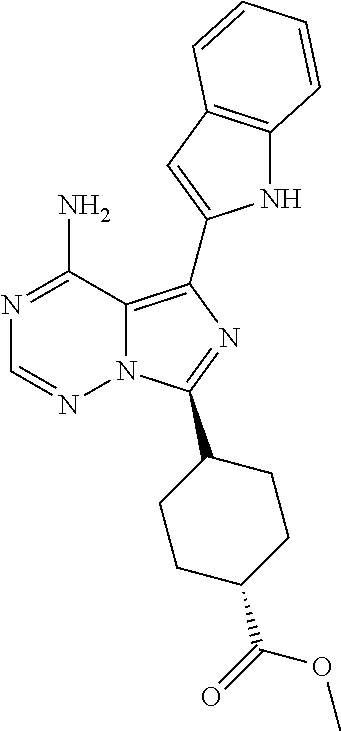 |
391.23 |
| 122 |
 |
490.97 |
| 123 |
 |
493.18 |
| 124 |
 |
487.09 |
| 125 |
 |
459.01 |
| 126 |
 |
446.15 |
| 127 |
 |
452.98 |
| 128 |
 |
451.97 |
| 129 |
 |
481.95 |
| 130 |
 |
470.00 |
| 131 |
 |
535.91 |
| 132 |
 |
454.97 |
| 133 |
 |
448.02 |
| 134 |
 |
318.03 |
| 135 |
 |
470.96 |
| 136 |
 |
475.92 |
| 137 |
 |
475.92 |
| 138 |
 |
457.08 |
| 139 |
 |
426.92 |
| 140 |
 |
521.03 523.08 |
| 141 |
 |
427.05 |
| 142 |
 |
457.02 |
| 143 |
 |
444.20 |
| 144 |
 |
425.91 |
| 145 |
 |
376.98 |
| 146 |
 |
337.97 339.92 |
| 147 |
 |
304.95 |
| 148 |
 |
452.95 |
| 149 |
 |
305.20 |
| 150 |
 |
389.83 |
| 151 |
 |
426.97 |
| 152 |
 |
456.79 |
| 153 |
 |
443.97 |
| 154 |
 |
475.94 |
| 155 |
 |
492.76 |
| 156 |
 |
475.85 |
| 157 |
 |
460.13 |
| 158 |
 |
375.98 |
| 159 |
 |
466.97 |
| 160 |
 |
451.98 |
| 161 |
 |
304.19 |
| 162 |
 |
405.02 |
| 163 |
 |
433.18 |
| 164 |
 |
532.90 |
| 165 |
 |
476.95 |
| 166 |
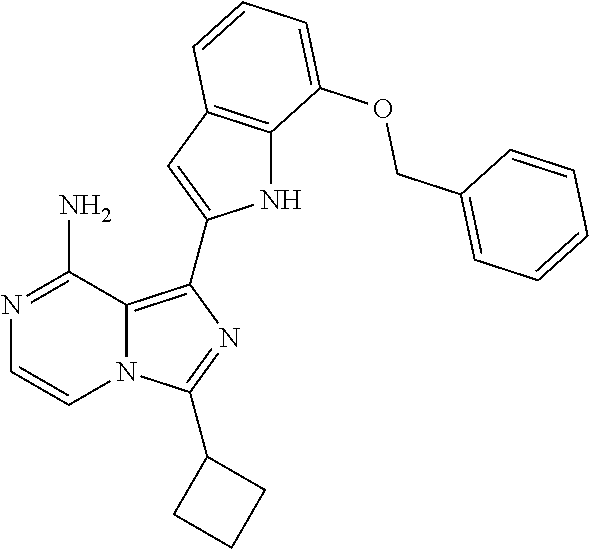 |
410.02 |
| 167 |
 |
321.92 |
| 168 |
 |
333.87 |
| 169 |
 |
381.83 383.72 |
| 170 |
 |
495.97 |
| 171 |
 |
465.96 |
| 172 |
 |
468.84 470.50 |
| 173 |
 |
480.20 |
| 174 |
 |
452.97 |
| 175 |
 |
466.20 |
| 176 |
 |
339.92 |
| 177 |
 |
426.91 |
| 178 |
 |
472.62 |
| 179 |
 |
550.68 552.50 |
| 180 |
 |
456.63 |
| 181 |
 |
471.98 |
| 182 |
 |
523.93 |
| 183 |
 |
496.05 |
| 184 |
 |
510.00 |
| 185 |
 |
483.89 |
| 186 |
 |
404.18 |
| 187 |
 |
427.93 |
| 188 |
 |
428.88 |
| 189 |
 |
460.66 |
| 191 |
 |
548.72 |
| 192 |
 |
456.86 |
| 193 |
 |
525.25 |
| 194 |
 |
467.21 |
| 195 |
 |
486.96 |
| 196 |
 |
470.97 |
| 197 |
 |
444.00 |
| 198 |
 |
363.89 |
| 199 |
 |
403.07 |
| 200 |
 |
458.97 |
| 201 |
 |
500.96 |
| 202 |
 |
500.94 |
| 203 |
 |
362.03 |
| 204 |
 |
473.95 |
| 205 |
 |
335.06 |
| 206 |
 |
433.07 |
| 207 |
 |
486.96 |
| 208 |
 |
348.02 |
| 209 |
 |
473.87 |
| 210 |
 |
334.88 |
| 211 |
 |
457.95 |
| 212 |
 |
318.92 |
| 213 |
 |
475.02 |
| 214 |
 |
425.17 427.06 |
| 215 |
 |
518.83 |
| 216 |
 |
379.87 |
| 217 |
 |
439.19 |
| 218 |
 |
526.77 |
| 219 |
 |
483.04 |
| 220 |
 |
520.89 |
| 221 |
 |
436.98 438.94 |
| 222 |
 |
425.93 |
| 223 |
 |
411.13 413.02 |
| 224 |
 |
453.99 |
| 225 |
 |
443.02 |
| 226 |
 |
479.85 |
| 227 |
 |
434.95 |
| 228 |
 |
417.21 |
| 229 |
 |
500.99 502.98 |
| 230 |
 |
516.91 518.90 |
| 231 |
 |
498.02 |
| 232 |
 |
440.89 442.86 |
| 233 |
 |
354.74 356.98 |
| 234 |
 |
335.84 |
| 235 |
 |
442.96 |
| 236 |
 |
480.98 |
| 237 |
 |
421.83 |
| 238 |
 |
549.91 |
| 239 |
 |
480.02 |
| 240 |
 |
419.89 |
| 241 |
 |
467.92 |
| 242 |
 |
420.97 |
| 243 |
 |
487.67 |
| 244 |
 |
319.00 |
| 245 |
 |
405.03 |
| 246 |
 |
499.95 501.96 |
| 247 |
 |
423.83 425.93 |
| 248 |
 |
409.95 411.90 |
| 249 |
 |
376.99 |
| 250 |
 |
412.06 414.03 |
| 251 |
 |
404.96 |
| 252 |
 |
391.01 |
| 253 |
 |
419.21 |
| 254 |
 |
434.04 |
| 255 |
 |
405.03 |
| 256 |
 |
445.01 |
| 257 |
 |
438.94 440.89 |
| 258 |
 |
406.98 406.99 |
| 259 |
 |
421.00 |
| 260 |
 |
437.93 439.95 |
| 261 |
 |
511.21 513.14 |
| 262 |
 |
447.03 |
| 263 |
 |
461.05 |
| 264 |
 |
447.99 |
| 265 |
 |
462.00 |
| 266 |
 |
387.20 |
| 267 |
 |
432.06 |
| 268 |
 |
434.02 434.06 |
| 269 |
 |
437.97 439.95 |
| 270 |
 |
468.95 |
| 271 |
 |
423.97 425.93 |
| 272 |
 |
448.05 |
| 273 |
 |
471.98 |
| 274 |
 |
418.09 |
| 275 |
 |
405.03 |
| 276 |
 |
363.98 |
| 277 |
 |
423.97 425.99 |
| 278 |
 |
391.01 |
| 279 |
 |
460.94 |
| 280 |
 |
421.00 |
| 281 |
 |
435.03 |
| 282 |
 |
485.32 |
| 283 |
 |
510.38 |
| 284 |
 |
406.29 |
| 285 |
 |
404.21 |
| 286 |
 |
420.53 |
| 287 |
 |
417.29 |
| 288 |
 |
423.29 |
| 289 |
 |
455.11 457.09 |
| 290 |
 |
497.93 |
| 291 |
 |
424.04 425.99 |
| 292 |
 |
434.08 |
| 293 |
 |
475.89 |
| 294 |
 |
461.94 |
| 295 |
 |
485.14 487.10 |
| 296 |
 |
491.18 |
| 297 |
 |
488.63 |
| 298 |
 |
434.08 |
| 299 |
 |
435.10 |
| 300 |
 |
505.10 |
| 301 |
 |
438.00 |
| 302 |
 |
432.02 |
| 303 |
 |
467.30 |
| 304 |
 |
455.23 |
| 305 |
 |
405.09 |
| 306 |
 |
424.13 426.23 |
| 307 |
 |
458.99 |
| 308 |
 |
409.97 411.96 |
| 309 |
 |
445 445.1 |
| 310 |
 |
407.05 |
| 311 |
 |
421.00 |
| 312 |
 |
512.40 |
| 313 |
 |
418.03 |
| 314 |
 |
391.06 |
| 315 |
 |
453.04 453.17 453.39 |
| 316 |
 |
474.95 |
| 317 |
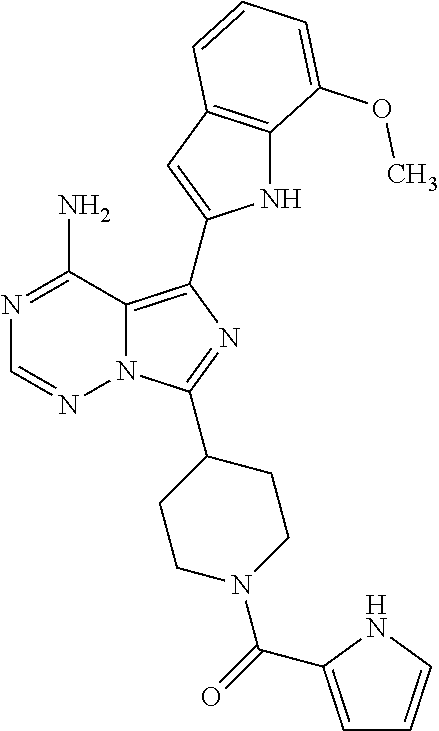 |
457.08 |
| 318 |
 |
457.95 |
| 319 |
 |
482.96 |
| 320 |
 |
483.90 |
| 321 |
 |
390.02 |
| 322 |
 |
463.08 |
| 323 |
 |
460.09 |
| 324 |
 |
480.21 |
| 325 |
 |
471.11 |
| 326 |
 |
455.94 |
| 327 |
 |
486.20 |
| 328 |
 |
436.23 438.26 |
| 329 |
 |
432.02 |
| 330 |
 |
402.06 |
| 331 |
 |
452.12 |
| 332 |
 |
434.25 |
| 333 |
 |
406.35 406.42 |
| 334 |
 |
501.31 |
| 335 |
 |
487.44 |
| 336 |
 |
420.15 420.18 |
| 337 |
 |
411.06 413.07 |
| 338 |
 |
471.35 |
| 339 |
 |
454.07 456.03 |
| 340 |
 |
484.44 |
| 341 |
 |
470.41 |
| 342 |
 |
469.46 |
| 343 |
 |
409.35 |
| 344 |
 |
416.17 |
| 345 |
 |
485.39 |
| 346 |
 |
444.10 |
| 347 |
 |
471.41 |
| 348 |
 |
404.04 406.06 |
| 349 |
 |
404.27 406.29 |
| 350 |
 |
469.39 |
| 351 |
 |
401.39 |
| 352 |
 |
444.16 |
| 353 |
 |
481.12 483.14 |
| 354 |
 |
415.17 |
| 355 |
 |
400.09 |
| 356 |
 |
425.34 427.33 |
| 357 |
 |
417.36 |
| 358 |
 |
402.33 |
| 359 |
 |
381.96 384.01 |
| 360 |
 |
487.01 489.03 |
| 361 |
 |
495.03 |
| 362 |
 |
428.02 |
| 363 |
 |
458.32 |
| 364 |
 |
487.01 488.90 |
| 365 |
 |
470.37 |
| 366 |
 |
521.27 523.27 |
| 367 |
 |
443.22 |
| 368 |
 |
459.28 |
| 369 |
 |
458.37 |
| 370 |
 |
493.22 495.18 |
| 371 |
 |
471.03 |
| 372 |
 |
510.03 |
| 373 |
 |
496.06 |
| 374 |
 |
501.45 |
| 375 |
 |
493.94 |
| 376 |
 |
507.46 |
| 377 |
 |
569.56 |
| 378 |
 |
507.46 |
| 379 |
 |
521.50 |
| 380 |
 |
583.53 |
| 381 |
 |
425.39 |
| 382 |
 |
439.42 |
| 383 |
 |
555.55 |
| 384 |
 |
569.55 |


Claims (2)

Priority Applications (1)
| Application Number | Priority Date | Filing Date | Title |
|---|---|---|---|
| US13/106,954 US8314111B2 (en) | 2005-11-17 | 2011-05-13 | Fused bicyclic motor inhibitors |
Applications Claiming Priority (6)
| Application Number | Priority Date | Filing Date | Title |
|---|---|---|---|
| US73758105P | 2005-11-17 | 2005-11-17 | |
| US85424706P | 2006-10-25 | 2006-10-25 | |
| US11/599,663 US7700594B2 (en) | 2005-11-17 | 2006-11-15 | Fused bicyclic mTOR inhibitors |
| US12/622,545 US7943767B2 (en) | 2005-11-17 | 2009-11-20 | Fused bicyclic mTOR inhibitors |
| US13/085,722 US20110190496A1 (en) | 2005-11-17 | 2011-04-13 | FUSED BICYCLIC mTOR INHIBITORS |
| US13/106,954 US8314111B2 (en) | 2005-11-17 | 2011-05-13 | Fused bicyclic motor inhibitors |
Related Parent Applications (1)
| Application Number | Title | Priority Date | Filing Date |
|---|---|---|---|
| US12/622,545 Division US7943767B2 (en) | 2005-11-17 | 2009-11-20 | Fused bicyclic mTOR inhibitors |
Publications (2)
| Publication Number | Publication Date |
|---|---|
| US20110218183A1 US20110218183A1 (en) | 2011-09-08 |
| US8314111B2 true US8314111B2 (en) | 2012-11-20 |
Family
ID=38066461
Family Applications (6)
| Application Number | Title | Priority Date | Filing Date |
|---|---|---|---|
| US11/599,663 Active 2027-10-18 US7700594B2 (en) | 2005-11-17 | 2006-11-15 | Fused bicyclic mTOR inhibitors |
| US12/326,536 Active US7923555B2 (en) | 2005-11-17 | 2008-12-02 | Fused bicyclic mTor inhibitors |
| US12/622,545 Active US7943767B2 (en) | 2005-11-17 | 2009-11-20 | Fused bicyclic mTOR inhibitors |
| US13/085,722 Abandoned US20110190496A1 (en) | 2005-11-17 | 2011-04-13 | FUSED BICYCLIC mTOR INHIBITORS |
| US13/106,954 Active US8314111B2 (en) | 2005-11-17 | 2011-05-13 | Fused bicyclic motor inhibitors |
| US13/767,947 Active US8796455B2 (en) | 2005-11-17 | 2013-02-15 | Fused bicyclic mTOR inhibitors |
Family Applications Before (4)
| Application Number | Title | Priority Date | Filing Date |
|---|---|---|---|
| US11/599,663 Active 2027-10-18 US7700594B2 (en) | 2005-11-17 | 2006-11-15 | Fused bicyclic mTOR inhibitors |
| US12/326,536 Active US7923555B2 (en) | 2005-11-17 | 2008-12-02 | Fused bicyclic mTor inhibitors |
| US12/622,545 Active US7943767B2 (en) | 2005-11-17 | 2009-11-20 | Fused bicyclic mTOR inhibitors |
| US13/085,722 Abandoned US20110190496A1 (en) | 2005-11-17 | 2011-04-13 | FUSED BICYCLIC mTOR INHIBITORS |
Family Applications After (1)
| Application Number | Title | Priority Date | Filing Date |
|---|---|---|---|
| US13/767,947 Active US8796455B2 (en) | 2005-11-17 | 2013-02-15 | Fused bicyclic mTOR inhibitors |
Country Status (25)
| Country | Link |
|---|---|
| US (6) | US7700594B2 (en) |
| EP (3) | EP2325186B1 (en) |
| JP (2) | JP5335432B2 (en) |
| KR (1) | KR20080078668A (en) |
| CN (2) | CN102936250B (en) |
| AR (1) | AR056884A1 (en) |
| AT (1) | ATE507227T1 (en) |
| AU (1) | AU2006316605B2 (en) |
| BR (1) | BRPI0618622A2 (en) |
| CA (1) | CA2630271C (en) |
| DE (1) | DE602006021608D1 (en) |
| DK (1) | DK1951724T3 (en) |
| EA (1) | EA015463B1 (en) |
| ES (2) | ES2365869T3 (en) |
| HR (1) | HRP20110553T1 (en) |
| IL (1) | IL191532A0 (en) |
| MY (1) | MY148491A (en) |
| NZ (1) | NZ569050A (en) |
| PL (2) | PL1951724T3 (en) |
| PT (2) | PT2385053E (en) |
| RS (1) | RS51843B (en) |
| SI (1) | SI1951724T1 (en) |
| TW (1) | TWI382028B (en) |
| WO (1) | WO2007061737A2 (en) |
| ZA (1) | ZA200804237B (en) |
Cited By (4)
| Publication number | Priority date | Publication date | Assignee | Title |
|---|---|---|---|---|
| US9974774B2 (en) | 2013-07-26 | 2018-05-22 | Race Oncology Ltd. | Combinatorial methods to improve the therapeutic benefit of bisantrene and analogs and derivatives thereof |
| US10844067B2 (en) | 2016-04-15 | 2020-11-24 | Cancer Research Technology Limited | Heterocyclic compounds as RET kinase inhibitors |
| US10954241B2 (en) | 2016-04-15 | 2021-03-23 | Cancer Research Technology Limited | Heterocyclic compounds as ret kinase inhibitors |
| US11352361B2 (en) | 2017-04-13 | 2022-06-07 | Cancer Research Technology Limited | Compounds useful as RET inhibitors |
Families Citing this family (160)
| Publication number | Priority date | Publication date | Assignee | Title |
|---|---|---|---|---|
| MXPA06011423A (en) | 2004-04-02 | 2007-01-23 | Osi Pharm Inc | 6,6-bicyclic ring substituted heterobicyclic protein kinase inhibitors. |
| US9512125B2 (en) | 2004-11-19 | 2016-12-06 | The Regents Of The University Of California | Substituted pyrazolo[3.4-D] pyrimidines as anti-inflammatory agents |
| US8957070B2 (en) * | 2005-04-20 | 2015-02-17 | Takeda Pharmaceutical Company Limited | Glucokinase activator compounds, methods of activating glucokinase and methods of treating diabetes and obesity |
| CA2630271C (en) | 2005-11-17 | 2014-04-08 | Osi Pharmaceuticals, Inc. | Fused bicyclic mtor inhibitors |
| AR057960A1 (en) * | 2005-12-02 | 2007-12-26 | Osi Pharm Inc | BICYCLE PROTEIN QUINASE INHIBITORS |
| US8575164B2 (en) * | 2005-12-19 | 2013-11-05 | OSI Pharmaceuticals, LLC | Combination cancer therapy |
| US7772231B2 (en) * | 2005-12-29 | 2010-08-10 | Abbott Laboratories | Substituted pyrazolo[3,4-d]pyrimidines as protein kinase inhibitors |
| EP1981890A2 (en) * | 2006-01-25 | 2008-10-22 | OSI Pharmaceuticals, Inc. | UNSATURATED mTOR INHIBITORS |
| WO2007106503A2 (en) * | 2006-03-13 | 2007-09-20 | Osi Pharmaceuticals, Inc. | Combined treatment with an egfr kinase inhibitor and an agent that sensitizes tumor cells to the effects of egfr kinase inhibitors |
| KR20150038395A (en) | 2006-04-04 | 2015-04-08 | 더 리젠트스 오브 더 유니이버시티 오브 캘리포니아 | Kinase antagonists |
| CA2685351A1 (en) * | 2007-05-09 | 2008-11-20 | Abbott Laboratories | Inhibitors of protein kinases |
| WO2008141140A1 (en) * | 2007-05-09 | 2008-11-20 | Abbott Laboratories | Condensed heterocyclic compounds as inhibitors of protein kinases |
| US8124759B2 (en) | 2007-05-09 | 2012-02-28 | Abbott Laboratories | Inhibitors of protein kinases |
| WO2008148074A2 (en) * | 2007-05-24 | 2008-12-04 | Research Foundation Of State University Of New York | Inhibitors of mtor and methods of treatment using same |
| WO2009008992A2 (en) * | 2007-07-06 | 2009-01-15 | Osi Pharmaceuticals Inc. | Combination anti-cancer therapy comprising an inhibitor of both mtorc1 and mt0rc2 |
| US20110160232A1 (en) | 2007-10-04 | 2011-06-30 | Pingda Ren | Certain chemical entities and therapeutic uses thereof |
| US8193182B2 (en) | 2008-01-04 | 2012-06-05 | Intellikine, Inc. | Substituted isoquinolin-1(2H)-ones, and methods of use thereof |
| BRPI0906473A8 (en) | 2008-01-04 | 2016-02-10 | Intellikine Inc | CERTAIN CHEMICAL ENTITIES, COMPOSITIONS AND METHODS |
| EP2250173A1 (en) * | 2008-01-18 | 2010-11-17 | OSI Pharmaceuticals, Inc. | Imidazopyrazinol derivatives for the treatment of cancers |
| UY31631A1 (en) * | 2008-02-06 | 2009-09-30 | NEW DERIVATIVES OF 7-PHENIL-7H-PIRROLO- [2,3D] -PIRIMIDIN-2-IL-AMINO, SALTS OF THE SAME, PROCESSES FOR THEIR PREPARATION, PHARMACEUTICAL COMPOSITIONS THAT UNDERSTAND AND APPLICATIONS | |
| US20090227575A1 (en) * | 2008-03-04 | 2009-09-10 | Wyeth | 7H-PYRROLO[2,3-H]QUINAZOLINE COMPOUNDS, THEIR USE AS mTOR KINASE AND PI3 KINASE INHIBITORS, AND THEIR SYNTHESIS |
| US8993580B2 (en) | 2008-03-14 | 2015-03-31 | Intellikine Llc | Benzothiazole kinase inhibitors and methods of use |
| US20100048524A1 (en) | 2008-03-14 | 2010-02-25 | Angela Brodie | Novel C-17-Heteroaryl Steroidal CYP17 Inhibitors/Antiandrogens;Synthesis In Vitro Biological Activities, Pharmacokinetics and Antitumor Activity |
| WO2009114870A2 (en) | 2008-03-14 | 2009-09-17 | Intellikine, Inc. | Kinase inhibitors and methods of use |
| MX2010010300A (en) * | 2008-03-19 | 2010-10-26 | Osi Pharm Inc | Mtor inhibitor salt forms. |
| CA2719134C (en) | 2008-03-21 | 2015-06-30 | The University Of Chicago | Treatment with opioid antagonists and mtor inhibitors |
| ES2396613T3 (en) * | 2008-05-19 | 2013-02-22 | OSI Pharmaceuticals, LLC | Imidazopyrazines and substituted imidazotriazines |
| MX2011000216A (en) | 2008-07-08 | 2011-03-29 | Intellikine Inc | Kinase inhibitors and methods of use. |
| US20110224223A1 (en) | 2008-07-08 | 2011-09-15 | The Regents Of The University Of California, A California Corporation | MTOR Modulators and Uses Thereof |
| WO2010036380A1 (en) | 2008-09-26 | 2010-04-01 | Intellikine, Inc. | Heterocyclic kinase inhibitors |
| AU2009305669A1 (en) | 2008-10-16 | 2010-04-22 | The Regents Of The University Of California | Fused ring heteroaryl kinase inhibitors |
| US8110578B2 (en) * | 2008-10-27 | 2012-02-07 | Signal Pharmaceuticals, Llc | Pyrazino[2,3-b]pyrazine mTOR kinase inhibitors for oncology indications and diseases associated with the mTOR/PI3K/Akt pathway |
| US8476431B2 (en) * | 2008-11-03 | 2013-07-02 | Itellikine LLC | Benzoxazole kinase inhibitors and methods of use |
| ES2443948T3 (en) | 2008-12-19 | 2014-02-21 | Bristol-Myers Squibb Company | Carbazole carboxamide compounds useful as kinase inhibitors |
| EP2393827B1 (en) | 2009-02-05 | 2015-10-07 | Tokai Pharmaceuticals, Inc. | Novel prodrugs of steroidal cyp17 inhibitors/antiandrogens |
| WO2010118207A1 (en) * | 2009-04-09 | 2010-10-14 | Schering Corporation | Pyrazolo [1, 5-a] pyrimidine derivatives as mtor inhibitors |
| EP2421837A1 (en) | 2009-04-20 | 2012-02-29 | OSI Pharmaceuticals, LLC | Preparation of c-pyrazine-methylamines |
| JP5789252B2 (en) | 2009-05-07 | 2015-10-07 | インテリカイン, エルエルシー | Heterocyclic compounds and uses thereof |
| WO2010129740A1 (en) * | 2009-05-07 | 2010-11-11 | Osi Pharmaceuticals, Inc. | Use of osi-906 for treating adrenocortical carcinoma |
| BR112012000494A2 (en) * | 2009-07-09 | 2015-09-15 | Osi Pharmaceuticals Llc | process for substituted 3-amino-5-oxo-4,5-dihydro [1,2,4] triazines |
| UA111579C2 (en) | 2009-08-17 | 2016-05-25 | Інтеллікіне Ллк | Heterocyclic 2-Aminobenzo [d] Oxazole Derivatives, Pharmaceutical Composition Based on Them and Their Applications for Disease Treatment |
| CA2774769A1 (en) | 2009-09-30 | 2011-04-07 | Schering Corporation | Novel compounds that are erk inhibitors |
| US8980899B2 (en) | 2009-10-16 | 2015-03-17 | The Regents Of The University Of California | Methods of inhibiting Ire1 |
| CA2787714C (en) | 2010-01-22 | 2019-04-09 | Joaquin Pastor Fernandez | Inhibitors of pi3 kinase |
| WO2011094628A1 (en) * | 2010-01-28 | 2011-08-04 | University Of Washington | Compositions and methods for treating toxoplasmosis. cryptosporidiosis and other apicomplexan protozoan related diseases |
| US9765037B2 (en) | 2010-01-28 | 2017-09-19 | University Of Washington Through Its Center For Commercialization | Compositions and methods for treating toxoplasmosis, cryptosporidiosis, and other apicomplexan protozoan related diseases |
| BR112012019459A2 (en) | 2010-02-03 | 2017-10-17 | Signal Pharm Llc | identification of lkb1 mutation as a predictive biomarker for sensitivity to tor kinase inhibitors. |
| US20130005733A1 (en) * | 2010-03-09 | 2013-01-03 | OSI Pharmaceuticals, LLC | Combination anti-cancer therapy |
| US20130005651A1 (en) | 2010-03-11 | 2013-01-03 | Yeda Research And Development Co. Ltd. | Death associated protein 1 variants and use thereof for modulating autophagy |
| US20130035336A1 (en) | 2010-04-13 | 2013-02-07 | Novartis Ag | Combination comprising a cyclin dependent kinase 4 or cyclin dependent kinase (cdk4/6) inhibitor for treating cancer |
| US20130131057A1 (en) * | 2010-05-13 | 2013-05-23 | Centro Nacional De Investigaciones Oncologicas (Cnio | New bicyclic compounds as pi3-k and mtor inhibitors |
| JP5951600B2 (en) | 2010-05-21 | 2016-07-13 | インフィニティー ファーマシューティカルズ, インコーポレイテッド | Compounds, compositions and methods for kinase regulation |
| US20120028972A1 (en) * | 2010-07-30 | 2012-02-02 | Lilly Wong | Biomarker assays for detecting or measuring inhibition of tor kinase activity |
| US9242981B2 (en) | 2010-09-16 | 2016-01-26 | Merck Sharp & Dohme Corp. | Fused pyrazole derivatives as novel ERK inhibitors |
| WO2012064973A2 (en) | 2010-11-10 | 2012-05-18 | Infinity Pharmaceuticals, Inc. | Heterocyclic compounds and uses thereof |
| EP3238722B1 (en) | 2011-01-10 | 2019-03-13 | Infinity Pharmaceuticals, Inc. | Solid forms of isoquinolinones |
| JP5543039B2 (en) | 2011-02-23 | 2014-07-09 | ファイザー・インク | Imidazo [5,1-f] [1,2,4] triazine for the treatment of neurological disorders |
| TWI592411B (en) | 2011-02-23 | 2017-07-21 | 英特爾立秦有限責任公司 | Combination of kinase inhibitors and uses thereof |
| CN103889987B (en) | 2011-07-19 | 2016-09-14 | 默沙东有限责任公司 | Imidazolopyrazines of choice as BTK inhibitors |
| WO2013010869A1 (en) * | 2011-07-19 | 2013-01-24 | Msd Oss B.V. | 4-imidazopyridazin-1-yl-benzamides and 4-imidazotriazin-1-yl-benzamides btk-inhibitors |
| US9056877B2 (en) | 2011-07-19 | 2015-06-16 | Infinity Pharmaceuticals, Inc. | Heterocyclic compounds and uses thereof |
| EP2548877A1 (en) | 2011-07-19 | 2013-01-23 | MSD Oss B.V. | 4-(5-Membered fused pyridinyl)benzamides as BTK-inhibitors |
| EP2734520B1 (en) | 2011-07-19 | 2016-09-14 | Infinity Pharmaceuticals, Inc. | Heterocyclic compounds and uses thereof |
| CA2843887A1 (en) | 2011-08-03 | 2013-02-07 | Signal Pharmaceuticals, Llc | Identification of gene expression profile as a predictive biomarker for lkb1 status |
| PE20141371A1 (en) | 2011-08-29 | 2014-10-13 | Infinity Pharmaceuticals Inc | HETEROCYCLIC COMPOUNDS AND USES OF THEM |
| WO2013077921A2 (en) | 2011-09-02 | 2013-05-30 | The Regents Of The University Of California | Substituted pyrazolo[3,4-d]pyrimidines and uses thereof |
| US9174994B2 (en) | 2011-11-23 | 2015-11-03 | Intellikine, Llc | Enhanced treatment regimens using mTor inhibitors |
| CA2862981C (en) | 2011-12-15 | 2020-02-25 | Bayer Pharma Aktiengesellschaft | Substituted benzothienyl-pyrrolotriazines and uses thereof in the treatment cancer |
| UY34484A (en) | 2011-12-15 | 2013-07-31 | Bayer Ip Gmbh | BENZOTIENILO-PIRROLOTRIAZINAS DISUSTITUIDAS AND ITS USES |
| CA2865021C (en) * | 2012-02-23 | 2020-06-30 | Bayer Intellectual Property Gmbh | Substituted benzothienyl-pyrrolotriazines and uses thereof |
| WO2013152342A1 (en) | 2012-04-06 | 2013-10-10 | OSI Pharmaceuticals, LLC | Anti-cancer mtor inhibitor and anti-androgen combination |
| US8940742B2 (en) | 2012-04-10 | 2015-01-27 | Infinity Pharmaceuticals, Inc. | Heterocyclic compounds and uses thereof |
| CN103374001B (en) * | 2012-04-19 | 2015-10-28 | 山东轩竹医药科技有限公司 | Imidazo-triazine class mTOR inhibitors |
| CN103374021B (en) * | 2012-04-21 | 2015-10-28 | 通化济达医药有限公司 | Pyridopyrimidine class HDAC containing zinc binding moiety and mTOR inhibitors |
| US8828998B2 (en) | 2012-06-25 | 2014-09-09 | Infinity Pharmaceuticals, Inc. | Treatment of lupus, fibrotic conditions, and inflammatory myopathies and other disorders using PI3 kinase inhibitors |
| CA2886240A1 (en) | 2012-09-26 | 2014-04-03 | The Regents Of The University Of California | Modulation of ire1 |
| AU2013203714B2 (en) | 2012-10-18 | 2015-12-03 | Signal Pharmaceuticals, Llc | Inhibition of phosphorylation of PRAS40, GSK3-beta or P70S6K1 as a marker for TOR kinase inhibitory activity |
| RU2702908C2 (en) | 2012-11-01 | 2019-10-14 | Инфинити Фармасьютикалз, Инк. | Treating malignant tumours using modulators of pi3-kinase isoforms |
| CA2904170A1 (en) | 2013-03-14 | 2014-09-25 | University Of Maryland, Baltimore | Androgen receptor down-regulating agents and uses thereof |
| US9481667B2 (en) | 2013-03-15 | 2016-11-01 | Infinity Pharmaceuticals, Inc. | Salts and solid forms of isoquinolinones and composition comprising and methods of using the same |
| EP2976086B1 (en) | 2013-03-22 | 2020-10-14 | Millennium Pharmaceuticals, Inc. | Combination of catalytic mtorc 1/2 inhibitors and selective inhibitors of aurora a kinase |
| EP3549940A1 (en) | 2013-04-17 | 2019-10-09 | Signal Pharmaceuticals, LLC | Pharmaceutical formulations, of 1-ethyl-7-(2-methyl-6-(1h-1,2,4-triazol-3-yl) pyridin-3-yl) -3,4-dihydropyrazino[2,3-b]pyrazin-2(1h)-one |
| CA2908742C (en) | 2013-04-17 | 2021-06-01 | Signal Pharmaceuticals, Llc | Combination therapy comprising a tor kinase inhibitor and a cytidine analog for treating cancer |
| WO2014172425A1 (en) | 2013-04-17 | 2014-10-23 | Signal Pharmaceuticals, Llc | Treatment of cancer with dihydropyrazino-pyrazines |
| WO2014172436A1 (en) | 2013-04-17 | 2014-10-23 | Signal Pharmaceuticals, Llc | Combination therapy comprising a tor kinase inhibitor and a 5-substituted quinazolinone compound for treating cancer |
| MY189663A (en) | 2013-04-17 | 2022-02-23 | Signal Pharm Llc | Combination therapy comprising a dihydropyrazino-pyrazine compound and an androgen receptor antagonist for treating prostate cancer |
| JP6382946B2 (en) | 2013-04-17 | 2018-08-29 | シグナル ファーマシューティカルズ,エルエルシー | Cancer treatment with dihydropyrazino-pyrazine |
| HK1221168A1 (en) | 2013-04-17 | 2017-05-26 | 西格诺药品有限公司 | Combination therapy comprising a tor kinase inhibitor and n-(3-(5-fluoro-2-(4-(2-methoxyethoxy)phenylamino)pyrimidin-4- ylamino)phenyl)acrylamide for treating cancer |
| WO2014189947A1 (en) | 2013-05-20 | 2014-11-27 | University Of Washington Through Its Center For Commercialization | 5-aminopyrazole-4-carboxamide inhibitors of cdpk1 from t. gondii and c. parvum |
| CN107474051B (en) | 2013-05-29 | 2020-10-30 | 西格诺药品有限公司 | Pharmaceutical compositions of dihydropyrazinopyrazine compounds, solid forms thereof and their use |
| KR20160058774A (en) | 2013-08-12 | 2016-05-25 | 토카이 파마슈티컬, 아이엔씨. | Biomarkers for treatment of neoplastic disorders using androgen-targeted therapies |
| EP3964507A1 (en) | 2013-10-04 | 2022-03-09 | Infinity Pharmaceuticals, Inc. | Heterocyclic compounds and uses thereof |
| WO2015051241A1 (en) | 2013-10-04 | 2015-04-09 | Infinity Pharmaceuticals, Inc. | Heterocyclic compounds and uses thereof |
| EP3076974A1 (en) | 2013-12-05 | 2016-10-12 | Acerta Pharma B.V. | Therapeutic combination of a pi3k inhibitor and a btk inhibitor |
| US10428331B2 (en) | 2014-01-16 | 2019-10-01 | Musc Foundation For Research Development | Targeted nanocarriers for the administration of immunosuppressive agents |
| US10272083B2 (en) | 2014-01-21 | 2019-04-30 | Acerta Pharma B.V. | Methods of treating chronic lymphocytic leukemia and small lymphocytic leukemia using a BTK inhibitor |
| AU2015209133B2 (en) | 2014-01-24 | 2019-10-03 | AI Therapeutics, Inc. | Apilimod compositions and methods for using same |
| CN106456628A (en) | 2014-03-19 | 2017-02-22 | 无限药品股份有限公司 | Heterocyclic compounds for the treatment of PI3K‑γ-mediated disorders |
| US9937171B2 (en) | 2014-04-11 | 2018-04-10 | Acerta Pharma B.V. | Methods of blocking the CXCR-4/SDF-1 signaling pathway with inhibitors of bruton's tyrosine kinase |
| WO2015160880A1 (en) | 2014-04-16 | 2015-10-22 | Signal Pharmaceuticals, Llc | SOLID FORMS COMPRISING 1-ETHYL-7-(2-METHYL-6-(1H-1,2,4-TRIAZOL-3-YL) PYRIDIN-3-YL)-3,4-DIHYDROPYRAZINO(2,3-b)PYRAZIN-2(1H)-ONE, AND A COFORMER, COMPOSITIONS AND METHODS OF USE THEREOF |
| WO2015160975A2 (en) | 2014-04-16 | 2015-10-22 | Infinity Pharmaceuticals, Inc. | Combination therapies |
| NZ714742A (en) | 2014-04-16 | 2017-04-28 | Signal Pharm Llc | Solid forms of 1-ethyl-7-(2-methyl-6-(1h-1,2,4-triazol-3-yl)pyridin-3-yl)-3,4-dihydropyrazino[2,3-b]pyrazin-2(1h)-one, compositions thereof and methods of their use |
| JP2017518307A (en) | 2014-06-02 | 2017-07-06 | チルドレンズ メディカル センター コーポレーション | Methods and compositions for immunomodulation |
| JP2017525753A (en) | 2014-06-06 | 2017-09-07 | フレクサス・バイオサイエンシーズ・インコーポレイテッドFlexus Biosciences, Inc. | Immunomodulator |
| WO2015193740A2 (en) | 2014-06-17 | 2015-12-23 | Acerta Pharma B.V. | Therapeutic combinations of a btk inhibitor, a pi3k inhibitor and/or a jak-2 inhibitor |
| SMT202100674T1 (en) | 2014-08-11 | 2022-01-10 | Acerta Pharma Bv | Therapeutic combinations of a btk inhibitor and a bcl-2 inhibitor |
| WO2016054491A1 (en) | 2014-10-03 | 2016-04-07 | Infinity Pharmaceuticals, Inc. | Heterocyclic compounds and uses thereof |
| EP3209664B1 (en) | 2014-10-22 | 2020-06-03 | Bristol-Myers Squibb Company | Bicyclic heteroaryl amine compounds as pi3k inhibitors |
| WO2016064958A1 (en) | 2014-10-22 | 2016-04-28 | Bristol-Myers Squibb Company | Heteroaryl substituted pyrrolotriazine amine compounds as pi3k inhibitors |
| UY36390A (en) | 2014-11-05 | 2016-06-01 | Flexus Biosciences Inc | MODULATING COMPOUNDS OF INDOLAMINE ENZYME 2,3-DIOXYGENASE (IDO), ITS SYNTHESIS METHODS AND PHARMACEUTICAL COMPOSITIONS CONTAINING THEM |
| EA201790806A1 (en) | 2014-11-05 | 2017-11-30 | Флексус Байосайенсиз, Инк. | IMMUNOREGULATING AGENTS |
| AR102537A1 (en) * | 2014-11-05 | 2017-03-08 | Flexus Biosciences Inc | IMMUNOMODULATING AGENTS |
| CN107249638B (en) | 2014-11-07 | 2021-05-14 | 人工智能治疗公司 | Apibimod is used to treat kidney cancer |
| ES2734081T3 (en) | 2014-11-07 | 2019-12-04 | Ai Therapeutics Inc | Apilimod for use in the treatment of melanoma |
| EP3218378B1 (en) * | 2014-11-14 | 2020-01-08 | Nerviano Medical Sciences S.r.l. | 6-amino-7-bicyclo-7-deaza-purine derivatives as protein kinase inhibitors |
| WO2016106623A1 (en) * | 2014-12-31 | 2016-07-07 | Merck Sharp & Dohme Corp. | Benzamide imidazopyrazine btk inhibitors |
| KR20170118687A (en) | 2015-02-19 | 2017-10-25 | 제이엔씨 주식회사 | Liquid crystalline compound having benzothiophene, liquid crystal composition and liquid crystal display element |
| US20180078561A1 (en) | 2015-03-31 | 2018-03-22 | Lam Therapeutics, Inc. | Active metabolites of apilimod and uses thereof |
| US9840503B2 (en) | 2015-05-11 | 2017-12-12 | Incyte Corporation | Heterocyclic compounds and uses thereof |
| IL293821A (en) | 2015-07-02 | 2022-08-01 | Acerta Pharma Bv | Solid forms and formulations of (s)-4-(8-amino-3-(1 -(but-2-ynoyl)pyrrolidin-2-yl)imidazo[1,5-a]pyrazin-1-yl)-n-(pyridin-2-yl)benzamide |
| WO2017027717A1 (en) * | 2015-08-12 | 2017-02-16 | Incyte Corporation | Bicyclic fused pyrimidine compounds as tam inhibitors |
| WO2017035366A1 (en) | 2015-08-26 | 2017-03-02 | Incyte Corporation | Pyrrolopyrimidine derivatives as tam inhibitors |
| CN114230571B (en) | 2015-09-14 | 2025-07-08 | 无限药品股份有限公司 | Solid forms of isoquinolinones, methods of making, compositions comprising, and methods of using the same |
| CN105732460A (en) * | 2016-02-03 | 2016-07-06 | 常州工程职业技术学院 | Method for synthesizing indole compound |
| US10722484B2 (en) | 2016-03-09 | 2020-07-28 | K-Gen, Inc. | Methods of cancer treatment |
| WO2017161116A1 (en) | 2016-03-17 | 2017-09-21 | Infinity Pharmaceuticals, Inc. | Isotopologues of isoquinolinone and quinazolinone compounds and uses thereof as pi3k kinase inhibitors |
| TWI828027B (en) | 2016-03-28 | 2024-01-01 | 美商英塞特公司 | Pyrrolotriazine compounds as tam inhibitors |
| US10919914B2 (en) | 2016-06-08 | 2021-02-16 | Infinity Pharmaceuticals, Inc. | Heterocyclic compounds and uses thereof |
| EP3474856B1 (en) | 2016-06-24 | 2022-09-14 | Infinity Pharmaceuticals, Inc. | Combination therapies |
| EP3529245A4 (en) * | 2016-10-24 | 2020-12-23 | Yumanity Therapeutics, Inc. | COMPOUNDS AND USES THEREOF |
| CA3061907A1 (en) * | 2017-05-02 | 2018-11-08 | Revolution Medicines, Inc. | Rapamycin analogs as mtor inhibitors |
| IL271491B2 (en) | 2017-06-22 | 2023-09-01 | Celgene Corp | Treatment of hepatocellular carcinoma characterized by hepatitis b virus infection |
| CN111247150B (en) * | 2017-08-15 | 2022-11-08 | 石药集团中奇制药技术(石家庄)有限公司 | FGFR inhibitor and medical application thereof |
| CA3076915A1 (en) | 2017-09-27 | 2019-04-04 | AI Therapeutics, Inc. | Therapeutic methods relating to hsp90 inhibitors |
| US10633387B2 (en) | 2017-09-27 | 2020-04-28 | Incyte Corporation | Salts of TAM inhibitors |
| FR3075794A1 (en) | 2017-12-21 | 2019-06-28 | Galderma Research & Development | NEW MTOR INHIBITOR COMPOUNDS |
| FR3075795A1 (en) | 2017-12-21 | 2019-06-28 | Galderma Research & Development | NEW MTOR INHIBITOR COMPOUNDS |
| US11618753B2 (en) * | 2018-01-26 | 2023-04-04 | Bristol-Myers Squibb Company | Aminopyrrolotriazines as kinase inhibitors |
| WO2019157516A1 (en) | 2018-02-12 | 2019-08-15 | resTORbio, Inc. | Combination therapies |
| AU2019227607C1 (en) | 2018-02-27 | 2023-07-20 | Incyte Corporation | Imidazopyrimidines and triazolopyrimidines as A2A / A2B inhibitors |
| EP3788050B1 (en) | 2018-05-01 | 2024-08-28 | Revolution Medicines, Inc. | C26-linked rapamycin analogs as mtor inhibitors |
| PL3788049T3 (en) | 2018-05-01 | 2023-06-19 | Revolution Medicines, Inc. | C40-, c28-, and c-32-linked rapamycin analogs as mtor inhibitors |
| EP3810610A1 (en) | 2018-05-18 | 2021-04-28 | Incyte Corporation | Fused pyrimidine derivatives as a2a / a2b inhibitors |
| EP3801069A4 (en) | 2018-06-01 | 2022-03-16 | Cornell University | MULTIPLE THERAPY FOR DISEASE OR DISORDER ASSOCIATED WITH PI3K |
| US10980784B2 (en) | 2018-06-15 | 2021-04-20 | Navitor Pharmaceuticals, Inc. | Rapamycin analogs and uses thereof |
| ES3031110T3 (en) | 2018-06-29 | 2025-07-04 | Incyte Corp | Formulations of an axl/mer inhibitor |
| CN117304191A (en) | 2018-07-05 | 2023-12-29 | 因赛特公司 | Fused pyrazine derivatives as A2A/A2B inhibitors |
| AU2019338207B2 (en) | 2018-09-10 | 2025-01-02 | Mirati Therapeutics, Inc. | Combination therapies |
| TWI829857B (en) | 2019-01-29 | 2024-01-21 | 美商英塞特公司 | Pyrazolopyridines and triazolopyridines as a2a / a2b inhibitors |
| EP3917929A1 (en) * | 2019-01-31 | 2021-12-08 | Bayer Aktiengesellschaft | The monohydrate of rogaratinib hydrochloride and solid states thereof |
| EP4069223A4 (en) | 2019-12-05 | 2023-12-20 | Janssen Pharmaceutica NV | Rapamycin analogs and uses thereof |
| PH12022552347A1 (en) | 2020-03-06 | 2024-01-29 | Incyte Corp | Combination therapy comprising axl/mer and pd-1/pd-l1 inhibitors |
| US20250127887A1 (en) | 2021-02-16 | 2025-04-24 | Barinthus Biotherapeutics North America, Inc. | Self-Assembling Nanoparticles Based On Amphiphilic Peptides |
| US20240382628A1 (en) | 2021-07-15 | 2024-11-21 | President And Fellows Of Harvard College | Compositions and methods relating to cells with adhered particles |
| EP4531859A4 (en) | 2022-05-25 | 2026-05-27 | Revolution Medicines Inc | METHOD FOR TREATING CANCER WITH AN MTOR INSHIBITOR |
| US20230381190A1 (en) * | 2022-05-27 | 2023-11-30 | Avalo Therapeutics, Inc. | Methods and Treatment for Complex Lymphatic Malformations |
| AU2023367780A1 (en) | 2022-10-25 | 2025-03-27 | Barinthus Biotherapeutics North America, Inc. | Self-assembling nanoparticles |
| CN118754873B (en) * | 2024-06-27 | 2025-03-07 | 广东医科大学 | A cyclobutane indole derivative and its preparation method and application |
| CN118994167B (en) * | 2024-08-09 | 2025-09-12 | 南京健康产业研究院 | An imidazo[1,5-a]pyrazine antitumor compound and its preparation method and application |
| GB202415232D0 (en) | 2024-10-16 | 2024-11-27 | Nacamed As | Composition |
Citations (28)
| Publication number | Priority date | Publication date | Assignee | Title |
|---|---|---|---|---|
| US5869485A (en) | 1994-09-29 | 1999-02-09 | Novartis Finance Corp. | Pyrrolo 2,3-d!pyrimidines and their use |
| US6001839A (en) | 1997-03-19 | 1999-12-14 | Basf Aktiengesellschaft | Substituted 4-amino-7H-pyrrolo [2,3,-d]-pyrimidines as PTK inhibitors |
| WO2001019829A2 (en) | 1999-09-17 | 2001-03-22 | Basf Aktiengesellschaft | Pyrazolopyrimidines as therapeutic agents |
| US20020156081A1 (en) | 1999-09-17 | 2002-10-24 | Abbott Laboratories | Pyrazolopyrimidines as therapeutic agents |
| US20030073218A1 (en) | 1999-01-11 | 2003-04-17 | Princeton University | High affinity inhibitors for target validation and uses thereof |
| US20030187001A1 (en) | 1997-03-19 | 2003-10-02 | David Calderwood | 4-aminopyrrolopyrimidines as kinase inhibitors |
| US20050004142A1 (en) | 2001-09-11 | 2005-01-06 | Adams Jerry Leroy | Chemical compounds |
| WO2005037836A2 (en) | 2003-10-15 | 2005-04-28 | Osi Pharmaceuticals, Inc. | Imidazo ‘1, 5 - a ! pyrazine tyrosine kinase inhibitors |
| WO2005044835A1 (en) | 2003-10-27 | 2005-05-19 | Genelabs Technologies, Inc. | METHODS FOR PREPARING 7-(2'-SUBSTITUTED-ß-D-RIBOFURANOSYL)-4-(NR2R3)-5-(SUBSTITUTED ETHYN-1-YL)-PYRROLO[2,3-D]PYRIMIDINE DERIVATIVES |
| WO2005047289A1 (en) | 2003-11-17 | 2005-05-26 | Pfizer Products Inc. | Pyrrolopyrimidine compounds useful in treatment of cancer |
| WO2005097800A1 (en) | 2004-04-02 | 2005-10-20 | Osi Pharmaceuticals, Inc. | 6,6-bicyclic ring substituted heterobicyclic protein kinase inhibitors |
| US20060019957A1 (en) | 2004-07-20 | 2006-01-26 | Crew Andrew P | Imidazotriazines as protein kinase inhibitors |
| WO2006068760A2 (en) | 2004-11-19 | 2006-06-29 | The Regents Of The University Of California | Anti-inflammatory pyrazolopyrimidines |
| US20070112005A1 (en) | 2005-11-17 | 2007-05-17 | Xin Chen | Fused bicyclic mTOR inhibitors |
| WO2007064993A2 (en) | 2005-12-02 | 2007-06-07 | Osi Pharmaceuticals, Inc. | Bicyclic protein kinase inhibitors |
| US20070167383A1 (en) | 2003-10-27 | 2007-07-19 | Genelabs Technologies, Inc. | Nucleoside compounds for treating viral infections |
| US20070203143A1 (en) | 2005-12-29 | 2007-08-30 | Sheppard George S | Protein kinase inhibitors |
| WO2007114926A2 (en) | 2006-04-04 | 2007-10-11 | The Regents Of The University Of California | Kinase antagonists |
| WO2007115620A2 (en) | 2006-04-07 | 2007-10-18 | Merck Patent Gmbh | Novel cyclobutyl compounds as kinase inhibitors |
| US20070254883A1 (en) | 2006-01-25 | 2007-11-01 | Crew Andrew P | Unsaturated mTOR inhibitors |
| WO2007126841A2 (en) | 2006-03-29 | 2007-11-08 | Foldrx Pharmaceuticals, Inc. | Inhibition of alpha-synuclein toxicity |
| US20070280928A1 (en) | 2006-03-13 | 2007-12-06 | Buck Elizabeth A | Combined treatment with an EGFR kinase inhibitor and an agent that sensitizes tumor cells to the effects of EGFR kinase inhibitors |
| US20090099174A1 (en) | 2007-10-15 | 2009-04-16 | Astrazeneca Ab | Combination 059 |
| US20090263397A1 (en) | 2007-07-06 | 2009-10-22 | Buck Elizabeth A | Combination anti-cancer therapy |
| US20090274698A1 (en) | 2007-07-06 | 2009-11-05 | Shripad Bhagwat | Combination anti-cancer therapy |
| WO2011005909A2 (en) | 2009-07-09 | 2011-01-13 | Osi Pharmaceuticals, Inc. | Process for substituted 3-amino-5-oxo-4,5-dihydro-[1,2,4]triazines |
| US20110015197A1 (en) | 2008-03-19 | 2011-01-20 | Osi Pharmaceuticals, Inc. | mTOR INHIBITOR SALT FORMS |
| WO2011014726A1 (en) | 2009-07-31 | 2011-02-03 | Osi Pharmaceuticals, Inc. | Mtor inhibitor and angiogenesis inhibitor combination therapy |
Family Cites Families (16)
| Publication number | Priority date | Publication date | Assignee | Title |
|---|---|---|---|---|
| BE791025A (en) * | 1971-11-19 | 1973-05-07 | Allen & Hanburys Ltd | HETEROCYCLIC COMPOUNDS |
| US6071891A (en) * | 1996-11-22 | 2000-06-06 | Regents Of The University Of Minnesota | Insulin-like growth factor 1 receptors (IGF-1R) antisense oligonucleotide cells composition |
| HK1053831A1 (en) | 1999-09-17 | 2003-11-07 | Basf Aktiengesellschaft | Kinase inhibitors as therapeutic agents |
| US6660731B2 (en) * | 2000-09-15 | 2003-12-09 | Vertex Pharmaceuticals Incorporated | Pyrazole compounds useful as protein kinase inhibitors |
| TW200306819A (en) | 2002-01-25 | 2003-12-01 | Vertex Pharma | Indazole compounds useful as protein kinase inhibitors |
| US20040209930A1 (en) * | 2002-10-02 | 2004-10-21 | Carboni Joan M. | Synergistic methods and compositions for treating cancer |
| UA80171C2 (en) * | 2002-12-19 | 2007-08-27 | Pfizer Prod Inc | Pyrrolopyrimidine derivatives |
| EP1594894A2 (en) | 2003-02-18 | 2005-11-16 | Whitehead Institute For Biomedical Research | Mtor kinase-associated proteins |
| US7572914B2 (en) * | 2003-12-19 | 2009-08-11 | Takeda Pharmaceutical Company Limited | Kinase inhibitors |
| CN101014365B (en) * | 2004-07-16 | 2011-04-13 | 辉瑞产品公司 | Combination treatment for non-hematologic malignancies using an anti-igf-1r antibody |
| WO2006081425A1 (en) | 2005-01-28 | 2006-08-03 | Whitehead Institute For Biomedical Research | Phosphorylation and regulation of akt/pkb by the rictor-mtor complex |
| CA2626456C (en) | 2005-10-18 | 2018-01-09 | George Mason Intellectual Properties, Inc. | Mtor pathway theranostic |
| EP1945222B1 (en) * | 2005-11-02 | 2012-12-26 | Bayer Pharma Aktiengesellschaft | Pyrrolo[2,1-f] [1,2,4]-triazin-4-ylamines as igf-1r kinase inhibitors for the treatment of cancer and other hyperproliferative diseases |
| US20080299113A1 (en) | 2005-12-19 | 2008-12-04 | Arnold Lee D | Combined treatment with and composition of 6,6-bicyclic ring substituted heterobicyclic protein kinase inhibitor and anti-cancer agents |
| TW200835507A (en) | 2006-12-05 | 2008-09-01 | Vioquest Pharmaceuticals Inc | Compositions including triciribine and epidermal growth factor receptor inhibitor compounds or salts thereof and methods of use thereof |
| US20130005733A1 (en) | 2010-03-09 | 2013-01-03 | OSI Pharmaceuticals, LLC | Combination anti-cancer therapy |
-
2006
- 2006-11-15 CA CA2630271A patent/CA2630271C/en not_active Expired - Fee Related
- 2006-11-15 SI SI200631064T patent/SI1951724T1/en unknown
- 2006-11-15 US US11/599,663 patent/US7700594B2/en active Active
- 2006-11-15 PL PL06837752T patent/PL1951724T3/en unknown
- 2006-11-15 NZ NZ569050A patent/NZ569050A/en not_active IP Right Cessation
- 2006-11-15 CN CN201210369830.2A patent/CN102936250B/en not_active Expired - Fee Related
- 2006-11-15 DE DE602006021608T patent/DE602006021608D1/en active Active
- 2006-11-15 EP EP11155268.3A patent/EP2325186B1/en active Active
- 2006-11-15 KR KR1020087014589A patent/KR20080078668A/en not_active Ceased
- 2006-11-15 BR BRPI0618622-0A patent/BRPI0618622A2/en not_active IP Right Cessation
- 2006-11-15 AT AT06837752T patent/ATE507227T1/en active
- 2006-11-15 DK DK06837752.2T patent/DK1951724T3/en active
- 2006-11-15 EP EP11155270.9A patent/EP2385053B1/en active Active
- 2006-11-15 EA EA200801341A patent/EA015463B1/en not_active IP Right Cessation
- 2006-11-15 EP EP06837752A patent/EP1951724B1/en active Active
- 2006-11-15 PT PT111552709T patent/PT2385053E/en unknown
- 2006-11-15 PT PT06837752T patent/PT1951724E/en unknown
- 2006-11-15 HR HR20110553T patent/HRP20110553T1/en unknown
- 2006-11-15 ES ES06837752T patent/ES2365869T3/en active Active
- 2006-11-15 ES ES11155270.9T patent/ES2436877T3/en active Active
- 2006-11-15 RS RS20110337A patent/RS51843B/en unknown
- 2006-11-15 WO PCT/US2006/044461 patent/WO2007061737A2/en not_active Ceased
- 2006-11-15 CN CNA2006800430785A patent/CN101316845A/en active Pending
- 2006-11-15 AU AU2006316605A patent/AU2006316605B2/en not_active Ceased
- 2006-11-15 JP JP2008541334A patent/JP5335432B2/en not_active Expired - Fee Related
- 2006-11-15 PL PL11155270T patent/PL2385053T3/en unknown
- 2006-11-15 MY MYPI20081660A patent/MY148491A/en unknown
- 2006-11-16 TW TW095142464A patent/TWI382028B/en not_active IP Right Cessation
- 2006-11-17 AR ARP060105058A patent/AR056884A1/en not_active Application Discontinuation
-
2008
- 2008-05-16 ZA ZA200804237A patent/ZA200804237B/en unknown
- 2008-05-18 IL IL191532A patent/IL191532A0/en unknown
- 2008-12-02 US US12/326,536 patent/US7923555B2/en active Active
-
2009
- 2009-11-09 JP JP2009255728A patent/JP4491510B2/en not_active Expired - Fee Related
- 2009-11-20 US US12/622,545 patent/US7943767B2/en active Active
-
2011
- 2011-04-13 US US13/085,722 patent/US20110190496A1/en not_active Abandoned
- 2011-05-13 US US13/106,954 patent/US8314111B2/en active Active
-
2013
- 2013-02-15 US US13/767,947 patent/US8796455B2/en active Active
Patent Citations (40)
| Publication number | Priority date | Publication date | Assignee | Title |
|---|---|---|---|---|
| US5869485A (en) | 1994-09-29 | 1999-02-09 | Novartis Finance Corp. | Pyrrolo 2,3-d!pyrimidines and their use |
| US6001839A (en) | 1997-03-19 | 1999-12-14 | Basf Aktiengesellschaft | Substituted 4-amino-7H-pyrrolo [2,3,-d]-pyrimidines as PTK inhibitors |
| US20030187001A1 (en) | 1997-03-19 | 2003-10-02 | David Calderwood | 4-aminopyrrolopyrimidines as kinase inhibitors |
| US20030073218A1 (en) | 1999-01-11 | 2003-04-17 | Princeton University | High affinity inhibitors for target validation and uses thereof |
| WO2001019829A2 (en) | 1999-09-17 | 2001-03-22 | Basf Aktiengesellschaft | Pyrazolopyrimidines as therapeutic agents |
| US20020156081A1 (en) | 1999-09-17 | 2002-10-24 | Abbott Laboratories | Pyrazolopyrimidines as therapeutic agents |
| US20050004142A1 (en) | 2001-09-11 | 2005-01-06 | Adams Jerry Leroy | Chemical compounds |
| WO2005037836A2 (en) | 2003-10-15 | 2005-04-28 | Osi Pharmaceuticals, Inc. | Imidazo ‘1, 5 - a ! pyrazine tyrosine kinase inhibitors |
| US20060084654A1 (en) | 2003-10-15 | 2006-04-20 | Beck Patricia A | Imidazopyrazine tyrosine kinase inhibitors |
| WO2005044835A1 (en) | 2003-10-27 | 2005-05-19 | Genelabs Technologies, Inc. | METHODS FOR PREPARING 7-(2'-SUBSTITUTED-ß-D-RIBOFURANOSYL)-4-(NR2R3)-5-(SUBSTITUTED ETHYN-1-YL)-PYRROLO[2,3-D]PYRIMIDINE DERIVATIVES |
| US20070167383A1 (en) | 2003-10-27 | 2007-07-19 | Genelabs Technologies, Inc. | Nucleoside compounds for treating viral infections |
| WO2005047289A1 (en) | 2003-11-17 | 2005-05-26 | Pfizer Products Inc. | Pyrrolopyrimidine compounds useful in treatment of cancer |
| US20050130994A1 (en) | 2003-11-17 | 2005-06-16 | Pfizer Inc | Pyrrolopyre compounds useful in treatment of cancer |
| WO2005097800A1 (en) | 2004-04-02 | 2005-10-20 | Osi Pharmaceuticals, Inc. | 6,6-bicyclic ring substituted heterobicyclic protein kinase inhibitors |
| US20060235031A1 (en) | 2004-04-02 | 2006-10-19 | Arnold Lee D | 6,6-Bicyclic ring substituted heterobicyclic protein kinase inhibitors |
| US20060019957A1 (en) | 2004-07-20 | 2006-01-26 | Crew Andrew P | Imidazotriazines as protein kinase inhibitors |
| WO2006012422A1 (en) | 2004-07-20 | 2006-02-02 | Osi Pharmaceuticals, Inc. | Imidazopyrazine as tyrosine kinase inhibitors |
| WO2006068760A2 (en) | 2004-11-19 | 2006-06-29 | The Regents Of The University Of California | Anti-inflammatory pyrazolopyrimidines |
| US20090124638A1 (en) | 2004-11-19 | 2009-05-14 | Regents Of The University Of California | Anti-inflammatory pyrazolopyrimidines |
| US20070112005A1 (en) | 2005-11-17 | 2007-05-17 | Xin Chen | Fused bicyclic mTOR inhibitors |
| WO2007061737A2 (en) | 2005-11-17 | 2007-05-31 | Osi Pharmaceuticals, Inc. | FUSED BICYCLIC mTOR INHIBITORS |
| US7923555B2 (en) * | 2005-11-17 | 2011-04-12 | Osi Pharmaceuticals, Inc. | Fused bicyclic mTor inhibitors |
| US20100099679A1 (en) | 2005-11-17 | 2010-04-22 | Osi Pharmaceuticals, Inc. | FUSED BICYCLIC mTOR INHIBITORS |
| US20090163468A1 (en) | 2005-11-17 | 2009-06-25 | Osi Pharmaceuticals, Inc. | Fused Bicyclic mTor Inhibitors |
| US20070149521A1 (en) | 2005-12-02 | 2007-06-28 | Crew Andrew P | Bicyclic protein kinase inhibitors |
| WO2007064993A2 (en) | 2005-12-02 | 2007-06-07 | Osi Pharmaceuticals, Inc. | Bicyclic protein kinase inhibitors |
| US20070203143A1 (en) | 2005-12-29 | 2007-08-30 | Sheppard George S | Protein kinase inhibitors |
| US20070254883A1 (en) | 2006-01-25 | 2007-11-01 | Crew Andrew P | Unsaturated mTOR inhibitors |
| US20070280928A1 (en) | 2006-03-13 | 2007-12-06 | Buck Elizabeth A | Combined treatment with an EGFR kinase inhibitor and an agent that sensitizes tumor cells to the effects of EGFR kinase inhibitors |
| WO2007126841A2 (en) | 2006-03-29 | 2007-11-08 | Foldrx Pharmaceuticals, Inc. | Inhibition of alpha-synuclein toxicity |
| US20070293516A1 (en) | 2006-04-04 | 2007-12-20 | Regents Of The University Of California | Kinase antagonists |
| US20080032960A1 (en) | 2006-04-04 | 2008-02-07 | Regents Of The University Of California | PI3 kinase antagonists |
| WO2007114926A2 (en) | 2006-04-04 | 2007-10-11 | The Regents Of The University Of California | Kinase antagonists |
| WO2007115620A2 (en) | 2006-04-07 | 2007-10-18 | Merck Patent Gmbh | Novel cyclobutyl compounds as kinase inhibitors |
| US20090274698A1 (en) | 2007-07-06 | 2009-11-05 | Shripad Bhagwat | Combination anti-cancer therapy |
| US20090263397A1 (en) | 2007-07-06 | 2009-10-22 | Buck Elizabeth A | Combination anti-cancer therapy |
| US20090099174A1 (en) | 2007-10-15 | 2009-04-16 | Astrazeneca Ab | Combination 059 |
| US20110015197A1 (en) | 2008-03-19 | 2011-01-20 | Osi Pharmaceuticals, Inc. | mTOR INHIBITOR SALT FORMS |
| WO2011005909A2 (en) | 2009-07-09 | 2011-01-13 | Osi Pharmaceuticals, Inc. | Process for substituted 3-amino-5-oxo-4,5-dihydro-[1,2,4]triazines |
| WO2011014726A1 (en) | 2009-07-31 | 2011-02-03 | Osi Pharmaceuticals, Inc. | Mtor inhibitor and angiogenesis inhibitor combination therapy |
Non-Patent Citations (26)
| Title |
|---|
| Bergstrom, D. et al. (1981) Journal of Organic Chemistry 46(7):1423-1431. |
| Bergstrom, D. et al. (1991) Journal of Organic Chemistry 56(19):5598-5602. |
| Bishop, A. et al. (1999) Journal of the American Chemical Society 121(4):627-631. |
| Buzko, O. et al. (2002) Journal of Computer-Aided Design 16(2):113-127. |
| Database Beilstein-Beilstein Institute for Organic Chemistry, Frankfurt-Main, DE XP002449941. Database accession Nos. 4560199, 4563868, 4573145, 4589920 (BRNs). Abstract (This document included in 10052 ISR attached to Bergstrom 1423. Bergstrom ref cited for OS-10052, but not Database Beilstein) 1981. |
| Database Beilstein—Beilstein Institute for Organic Chemistry, Frankfurt-Main, DE XP002449941. Database accession Nos. 4560199, 4563868, 4573145, 4589920 (BRNs). Abstract (This document included in 10052 ISR attached to Bergstrom 1423. Bergstrom ref cited for OS-10052, but not Database Beilstein) 1981. |
| Database Beilstein-Beilstein Institute for Organic Chemistry, Frankfurt-Main, DE XP002449942. Database accession Nos. 759552, 7598012,7598776, 7599702, 7601233, 7604323, 8071040, 8075363, 8077883, 8082219, 8086506, 8088093, 8572470, 8574862, 8581421, 8596325 (BRNs). abstract (This document included in 10052 ISR attached to Seela 910. Bergstrom ref cited for OS-10052, but not Database Beilstein) 1996-2000. |
| Database Beilstein—Beilstein Institute for Organic Chemistry, Frankfurt-Main, DE XP002449942. Database accession Nos. 759552, 7598012,7598776, 7599702, 7601233, 7604323, 8071040, 8075363, 8077883, 8082219, 8086506, 8088093, 8572470, 8574862, 8581421, 8596325 (BRNs). abstract (This document included in 10052 ISR attached to Seela 910. Bergstrom ref cited for OS-10052, but not Database Beilstein) 1996-2000. |
| Hubbard, R.D. et al. (2007) Bioorganic & Medicinal Chemistry Letters 17(19):5406-5409. |
| International Preliminary Report on Patentability in PCT/US2006/044461(May 20, 2008). |
| International Preliminary Report on Patentability in PCT/US2009/037505 (Sep. 21, 2010). |
| International Search Report in PCT/US2006/044461 (Nov. 9, 2007). |
| International Search Report in PCT/US2007/002027 (Sep. 9, 2007). |
| International Search Report in PCT/US2009/037505 (Aug. 6, 2009). |
| International Search Report in PCT/US2010/041278 (Mar. 24, 2011). |
| Kinkade, C.W. et al. (2008) Journal of Clinical Investigation 118(9):3051-3064. |
| Legrier, M. et al. (2007) Cancer Research 67(23):11300-11308. |
| Papadimitrakopoulou, V. and Adjei, A.A. (2006) Journal of Thoracic Oncology 1(7): 749-751. |
| Prousek, J. (1984) Collection of Czechoslovak Chemical Communications 49(8):1788-1794. |
| Raslan, M.A. et al. (2000) Heteroatom Chemistry 11(2):94-201. |
| Schram, K. et al. (1974) Journal of Carbohydrates, Nucleosides, Nucleotides 1(1):39-54. |
| Seela, F. et al. (2000) Helvetica Chimica Acta 83(5):910-927. |
| U.S. Appl. No. 13/085,722 Apr. 13, 2011 Chen. |
| U.S. Appl. No. 61/311,832 Mar. 9, 2010 Barr. |
| Written Opinion of the International Search Authority in PCT/US2006/044461(May 17, 2008). |
| Written Opinion of the International Search Authority in PCT/US2007/002027 (May 7, 2008). |
Cited By (12)
| Publication number | Priority date | Publication date | Assignee | Title |
|---|---|---|---|---|
| US9974774B2 (en) | 2013-07-26 | 2018-05-22 | Race Oncology Ltd. | Combinatorial methods to improve the therapeutic benefit of bisantrene and analogs and derivatives thereof |
| US9993460B2 (en) | 2013-07-26 | 2018-06-12 | Race Oncology Ltd. | Compositions to improve the therapeutic benefit of bisantrene and analogs and derivatives thereof |
| US10500192B2 (en) | 2013-07-26 | 2019-12-10 | Race Oncology Ltd. | Combinatorial methods to improve the therapeutic benefit of bisantrene and analogs and derivatives thereof |
| US10548876B2 (en) | 2013-07-26 | 2020-02-04 | Race Oncology Ltd. | Compositions to improve the therapeutic benefit of bisantrene and analogs and derivatives thereof |
| US11135201B2 (en) | 2013-07-26 | 2021-10-05 | Race Oncology Ltd. | Compositions to improve the therapeutic benefit of bisantrene and analogs and derivatives thereof |
| US11147800B2 (en) | 2013-07-26 | 2021-10-19 | Race Oncology Ltd. | Combinatorial methods to improve the therapeutic benefit of bisantrene and analogs and derivatives thereof |
| US10844067B2 (en) | 2016-04-15 | 2020-11-24 | Cancer Research Technology Limited | Heterocyclic compounds as RET kinase inhibitors |
| US10954241B2 (en) | 2016-04-15 | 2021-03-23 | Cancer Research Technology Limited | Heterocyclic compounds as ret kinase inhibitors |
| US11548896B2 (en) | 2016-04-15 | 2023-01-10 | Cancer Research Technology Limited | Heterocyclic compounds as RET kinase inhibitors |
| US11661423B2 (en) | 2016-04-15 | 2023-05-30 | Cancer Research Technology Limited | Heterocyclic compounds as RET kinase inhibitors |
| US11352361B2 (en) | 2017-04-13 | 2022-06-07 | Cancer Research Technology Limited | Compounds useful as RET inhibitors |
| US11680068B2 (en) | 2017-04-13 | 2023-06-20 | Cancer Research Technology Limited | Compounds useful as RET inhibitors |
Also Published As
Similar Documents
| Publication | Publication Date | Title |
|---|---|---|
| US7923555B2 (en) | Fused bicyclic mTor inhibitors | |
| US7659274B2 (en) | Unsaturated mTOR inhibitors | |
| US8481733B2 (en) | Substituted imidazopyr- and imidazotri-azines | |
| JP4629334B2 (en) | Pyrrolopyrimidine as an inhibitor of cysteine protease | |
| JP2013501785A (en) | Pyrimidine compounds as tuberculosis inhibitors | |
| HK1121158B (en) | Fused bicyclic mtor inhibitors |
Legal Events
| Date | Code | Title | Description |
|---|---|---|---|
| AS | Assignment |
Owner name: OSI PHARMACEUTICALS, LLC, NEW YORK Free format text: CHANGE OF NAME;ASSIGNOR:OSI PHARMACEUTICALS, INC.;REEL/FRAME:028053/0815 Effective date: 20110331 |
|
| STCF | Information on status: patent grant |
Free format text: PATENTED CASE |
|
| CC | Certificate of correction | ||
| FPAY | Fee payment |
Year of fee payment: 4 |
|
| MAFP | Maintenance fee payment |
Free format text: PAYMENT OF MAINTENANCE FEE, 8TH YEAR, LARGE ENTITY (ORIGINAL EVENT CODE: M1552); ENTITY STATUS OF PATENT OWNER: LARGE ENTITY Year of fee payment: 8 |
|
| MAFP | Maintenance fee payment |
Free format text: PAYMENT OF MAINTENANCE FEE, 12TH YEAR, LARGE ENTITY (ORIGINAL EVENT CODE: M1553); ENTITY STATUS OF PATENT OWNER: LARGE ENTITY Year of fee payment: 12 |