US8309716B2 - Pyrrolo[2,3-d]pyrimidine derivatives: their intermediates and synthesis - Google Patents
Pyrrolo[2,3-d]pyrimidine derivatives: their intermediates and synthesis Download PDFInfo
- Publication number
- US8309716B2 US8309716B2 US13/528,099 US201213528099A US8309716B2 US 8309716 B2 US8309716 B2 US 8309716B2 US 201213528099 A US201213528099 A US 201213528099A US 8309716 B2 US8309716 B2 US 8309716B2
- Authority
- US
- United States
- Prior art keywords
- group
- formula
- benzyl
- chloro
- amine
- Prior art date
- Legal status (The legal status is an assumption and is not a legal conclusion. Google has not performed a legal analysis and makes no representation as to the accuracy of the status listed.)
- Active
Links
- 0 CC.[2*]N(C1=C2C=CNC2=NC(C)=N1)C1CCCN(P)C1 Chemical compound CC.[2*]N(C1=C2C=CNC2=NC(C)=N1)C1CCCN(P)C1 0.000 description 31
- GYEONJBVURSPLI-UHFFFAOYSA-N CC1=NC(C)=C2C=CNC2=N1 Chemical compound CC1=NC(C)=C2C=CNC2=N1 GYEONJBVURSPLI-UHFFFAOYSA-N 0.000 description 2
- FFOQYBPOKNCIDZ-RMHGRBOHSA-N CN[C@@H]1CN(P)CC[C@@H]1C.CN[C@H]1CN(P)CC[C@H]1C Chemical compound CN[C@@H]1CN(P)CC[C@@H]1C.CN[C@H]1CN(P)CC[C@H]1C FFOQYBPOKNCIDZ-RMHGRBOHSA-N 0.000 description 2
- JUCFBDUFTVWXBJ-RQJHMYQMSA-N CN[C@H]1CN(P)CC[C@H]1C Chemical compound CN[C@H]1CN(P)CC[C@H]1C JUCFBDUFTVWXBJ-RQJHMYQMSA-N 0.000 description 2
- VHYZMAVQYFJEIS-HGJWFTLDSA-N CN[C@H]1CN(P)CC[C@H]1C.CN[C@H]1CN(P)CC[C@H]1C.O=C=O.O=C=O.[H]C(OC(=O)C1=CC=C(C)C=C1)C([H])OC(=O)C1=CC=C(C)C=C1 Chemical compound CN[C@H]1CN(P)CC[C@H]1C.CN[C@H]1CN(P)CC[C@H]1C.O=C=O.O=C=O.[H]C(OC(=O)C1=CC=C(C)C=C1)C([H])OC(=O)C1=CC=C(C)C=C1 VHYZMAVQYFJEIS-HGJWFTLDSA-N 0.000 description 2
- XRIARWQZLGCQDM-KOLCDFICSA-N C[C@@H]1CCNC[C@@H]1N(C)C1=C2C=CNC2=NC=N1 Chemical compound C[C@@H]1CCNC[C@@H]1N(C)C1=C2C=CNC2=NC=N1 XRIARWQZLGCQDM-KOLCDFICSA-N 0.000 description 2
- SAXJYRUYMYGRBK-UHFFFAOYSA-O C.CC.CC.CC(=O)NC1=C[N+](CC2=CC=CC=C2)=CC=C1 Chemical compound C.CC.CC.CC(=O)NC1=C[N+](CC2=CC=CC=C2)=CC=C1 SAXJYRUYMYGRBK-UHFFFAOYSA-O 0.000 description 1
- AVKGQXSNZOROFF-UHFFFAOYSA-N CC.COC(=O)NC1=C(C)CCN(CC2=CC=CC=C2)C1 Chemical compound CC.COC(=O)NC1=C(C)CCN(CC2=CC=CC=C2)C1 AVKGQXSNZOROFF-UHFFFAOYSA-N 0.000 description 1
- VDIMMGNVZXLKKJ-UHFFFAOYSA-O CC.COC(=O)NC1=C[N+](CC2=CC=CC=C2)=CC=C1C.[CH3-] Chemical compound CC.COC(=O)NC1=C[N+](CC2=CC=CC=C2)=CC=C1C.[CH3-] VDIMMGNVZXLKKJ-UHFFFAOYSA-O 0.000 description 1
- PGJUXHVIVZTHHQ-UHFFFAOYSA-N CC1=C2CCN(C)C2=NC=N1 Chemical compound CC1=C2CCN(C)C2=NC=N1 PGJUXHVIVZTHHQ-UHFFFAOYSA-N 0.000 description 1
- GWMBPMUFLFJILW-BWKNWUBXSA-N CC1=CC=C(S(=O)(=O)N2C=CC3=C(N(C)[C@H]4CN(CC5=CC=CC=C5)CC[C@H]4C)N=CN=C32)C=C1 Chemical compound CC1=CC=C(S(=O)(=O)N2C=CC3=C(N(C)[C@H]4CN(CC5=CC=CC=C5)CC[C@H]4C)N=CN=C32)C=C1 GWMBPMUFLFJILW-BWKNWUBXSA-N 0.000 description 1
- ODJRGFSFZHLUBL-GVHYBUMESA-N CNC1CN(C)CC[C@H]1C Chemical compound CNC1CN(C)CC[C@H]1C ODJRGFSFZHLUBL-GVHYBUMESA-N 0.000 description 1
- VHYZMAVQYFJEIS-KQOVPBEYSA-N CNC1CN(P)CC[C@H]1C.CNC1CN(P)CC[C@H]1C.O=C=O.O=C=O.[H]C(OC(=O)C1=CC=C(C)C=C1)C([H])OC(=O)C1=CC=C(C)C=C1 Chemical compound CNC1CN(P)CC[C@H]1C.CNC1CN(P)CC[C@H]1C.O=C=O.O=C=O.[H]C(OC(=O)C1=CC=C(C)C=C1)C([H])OC(=O)C1=CC=C(C)C=C1 VHYZMAVQYFJEIS-KQOVPBEYSA-N 0.000 description 1
- UJLAWZDWDVHWOW-YPMHNXCESA-N C[C@@H]1CCN(C(=O)CC#N)C[C@@H]1N(C)C1=C2C=CNC2=NC=N1 Chemical compound C[C@@H]1CCN(C(=O)CC#N)C[C@@H]1N(C)C1=C2C=CNC2=NC=N1 UJLAWZDWDVHWOW-YPMHNXCESA-N 0.000 description 1
- IPWVIQVAJUJHNX-YKWDICOMSA-N C[C@@H]1CCN(CC2=CC=CC=C2)C[C@@H]1N(C)C1=NC(Cl)=NC2NC=CC12 Chemical compound C[C@@H]1CCN(CC2=CC=CC=C2)C[C@@H]1N(C)C1=NC(Cl)=NC2NC=CC12 IPWVIQVAJUJHNX-YKWDICOMSA-N 0.000 description 1
Classifications
-
- C—CHEMISTRY; METALLURGY
- C07—ORGANIC CHEMISTRY
- C07D—HETEROCYCLIC COMPOUNDS
- C07D487/00—Heterocyclic compounds containing nitrogen atoms as the only ring hetero atoms in the condensed system, not provided for by groups C07D451/00 - C07D477/00
- C07D487/02—Heterocyclic compounds containing nitrogen atoms as the only ring hetero atoms in the condensed system, not provided for by groups C07D451/00 - C07D477/00 in which the condensed system contains two hetero rings
- C07D487/04—Ortho-condensed systems
-
- A—HUMAN NECESSITIES
- A61—MEDICAL OR VETERINARY SCIENCE; HYGIENE
- A61P—SPECIFIC THERAPEUTIC ACTIVITY OF CHEMICAL COMPOUNDS OR MEDICINAL PREPARATIONS
- A61P1/00—Drugs for disorders of the alimentary tract or the digestive system
- A61P1/04—Drugs for disorders of the alimentary tract or the digestive system for ulcers, gastritis or reflux esophagitis, e.g. antacids, inhibitors of acid secretion, mucosal protectants
-
- A—HUMAN NECESSITIES
- A61—MEDICAL OR VETERINARY SCIENCE; HYGIENE
- A61P—SPECIFIC THERAPEUTIC ACTIVITY OF CHEMICAL COMPOUNDS OR MEDICINAL PREPARATIONS
- A61P11/00—Drugs for disorders of the respiratory system
- A61P11/06—Antiasthmatics
-
- A—HUMAN NECESSITIES
- A61—MEDICAL OR VETERINARY SCIENCE; HYGIENE
- A61P—SPECIFIC THERAPEUTIC ACTIVITY OF CHEMICAL COMPOUNDS OR MEDICINAL PREPARATIONS
- A61P17/00—Drugs for dermatological disorders
-
- A—HUMAN NECESSITIES
- A61—MEDICAL OR VETERINARY SCIENCE; HYGIENE
- A61P—SPECIFIC THERAPEUTIC ACTIVITY OF CHEMICAL COMPOUNDS OR MEDICINAL PREPARATIONS
- A61P17/00—Drugs for dermatological disorders
- A61P17/06—Antipsoriatics
-
- A—HUMAN NECESSITIES
- A61—MEDICAL OR VETERINARY SCIENCE; HYGIENE
- A61P—SPECIFIC THERAPEUTIC ACTIVITY OF CHEMICAL COMPOUNDS OR MEDICINAL PREPARATIONS
- A61P19/00—Drugs for skeletal disorders
- A61P19/02—Drugs for skeletal disorders for joint disorders, e.g. arthritis, arthrosis
-
- A—HUMAN NECESSITIES
- A61—MEDICAL OR VETERINARY SCIENCE; HYGIENE
- A61P—SPECIFIC THERAPEUTIC ACTIVITY OF CHEMICAL COMPOUNDS OR MEDICINAL PREPARATIONS
- A61P25/00—Drugs for disorders of the nervous system
-
- A—HUMAN NECESSITIES
- A61—MEDICAL OR VETERINARY SCIENCE; HYGIENE
- A61P—SPECIFIC THERAPEUTIC ACTIVITY OF CHEMICAL COMPOUNDS OR MEDICINAL PREPARATIONS
- A61P25/00—Drugs for disorders of the nervous system
- A61P25/28—Drugs for disorders of the nervous system for treating neurodegenerative disorders of the central nervous system, e.g. nootropic agents, cognition enhancers, drugs for treating Alzheimer's disease or other forms of dementia
-
- A—HUMAN NECESSITIES
- A61—MEDICAL OR VETERINARY SCIENCE; HYGIENE
- A61P—SPECIFIC THERAPEUTIC ACTIVITY OF CHEMICAL COMPOUNDS OR MEDICINAL PREPARATIONS
- A61P29/00—Non-central analgesic, antipyretic or antiinflammatory agents, e.g. antirheumatic agents; Non-steroidal antiinflammatory drugs [NSAID]
-
- A—HUMAN NECESSITIES
- A61—MEDICAL OR VETERINARY SCIENCE; HYGIENE
- A61P—SPECIFIC THERAPEUTIC ACTIVITY OF CHEMICAL COMPOUNDS OR MEDICINAL PREPARATIONS
- A61P3/00—Drugs for disorders of the metabolism
- A61P3/08—Drugs for disorders of the metabolism for glucose homeostasis
- A61P3/10—Drugs for disorders of the metabolism for glucose homeostasis for hyperglycaemia, e.g. antidiabetics
-
- A—HUMAN NECESSITIES
- A61—MEDICAL OR VETERINARY SCIENCE; HYGIENE
- A61P—SPECIFIC THERAPEUTIC ACTIVITY OF CHEMICAL COMPOUNDS OR MEDICINAL PREPARATIONS
- A61P35/00—Antineoplastic agents
-
- A—HUMAN NECESSITIES
- A61—MEDICAL OR VETERINARY SCIENCE; HYGIENE
- A61P—SPECIFIC THERAPEUTIC ACTIVITY OF CHEMICAL COMPOUNDS OR MEDICINAL PREPARATIONS
- A61P35/00—Antineoplastic agents
- A61P35/02—Antineoplastic agents specific for leukemia
-
- A—HUMAN NECESSITIES
- A61—MEDICAL OR VETERINARY SCIENCE; HYGIENE
- A61P—SPECIFIC THERAPEUTIC ACTIVITY OF CHEMICAL COMPOUNDS OR MEDICINAL PREPARATIONS
- A61P37/00—Drugs for immunological or allergic disorders
- A61P37/02—Immunomodulators
-
- A—HUMAN NECESSITIES
- A61—MEDICAL OR VETERINARY SCIENCE; HYGIENE
- A61P—SPECIFIC THERAPEUTIC ACTIVITY OF CHEMICAL COMPOUNDS OR MEDICINAL PREPARATIONS
- A61P37/00—Drugs for immunological or allergic disorders
- A61P37/02—Immunomodulators
- A61P37/06—Immunosuppressants, e.g. drugs for graft rejection
-
- A—HUMAN NECESSITIES
- A61—MEDICAL OR VETERINARY SCIENCE; HYGIENE
- A61P—SPECIFIC THERAPEUTIC ACTIVITY OF CHEMICAL COMPOUNDS OR MEDICINAL PREPARATIONS
- A61P37/00—Drugs for immunological or allergic disorders
- A61P37/08—Antiallergic agents
-
- A—HUMAN NECESSITIES
- A61—MEDICAL OR VETERINARY SCIENCE; HYGIENE
- A61P—SPECIFIC THERAPEUTIC ACTIVITY OF CHEMICAL COMPOUNDS OR MEDICINAL PREPARATIONS
- A61P43/00—Drugs for specific purposes, not provided for in groups A61P1/00-A61P41/00
-
- C—CHEMISTRY; METALLURGY
- C07—ORGANIC CHEMISTRY
- C07D—HETEROCYCLIC COMPOUNDS
- C07D211/00—Heterocyclic compounds containing hydrogenated pyridine rings, not condensed with other rings
- C07D211/04—Heterocyclic compounds containing hydrogenated pyridine rings, not condensed with other rings with only hydrogen or carbon atoms directly attached to the ring nitrogen atom
- C07D211/06—Heterocyclic compounds containing hydrogenated pyridine rings, not condensed with other rings with only hydrogen or carbon atoms directly attached to the ring nitrogen atom having no double bonds between ring members or between ring members and non-ring members
- C07D211/36—Heterocyclic compounds containing hydrogenated pyridine rings, not condensed with other rings with only hydrogen or carbon atoms directly attached to the ring nitrogen atom having no double bonds between ring members or between ring members and non-ring members with hetero atoms or with carbon atoms having three bonds to hetero atoms with at the most one bond to halogen, e.g. ester or nitrile radicals, directly attached to ring carbon atoms
- C07D211/56—Nitrogen atoms
-
- Y—GENERAL TAGGING OF NEW TECHNOLOGICAL DEVELOPMENTS; GENERAL TAGGING OF CROSS-SECTIONAL TECHNOLOGIES SPANNING OVER SEVERAL SECTIONS OF THE IPC; TECHNICAL SUBJECTS COVERED BY FORMER USPC CROSS-REFERENCE ART COLLECTIONS [XRACs] AND DIGESTS
- Y02—TECHNOLOGIES OR APPLICATIONS FOR MITIGATION OR ADAPTATION AGAINST CLIMATE CHANGE
- Y02P—CLIMATE CHANGE MITIGATION TECHNOLOGIES IN THE PRODUCTION OR PROCESSING OF GOODS
- Y02P20/00—Technologies relating to chemical industry
- Y02P20/50—Improvements relating to the production of bulk chemicals
- Y02P20/55—Design of synthesis routes, e.g. reducing the use of auxiliary or protecting groups
Definitions
- the present invention relates to methods of synthesizing pyrrolo[2,3-d]pyrimidine compounds and intermediates useful in their synthesis.
- Pyrrolo[2,3-d]pyrimidine compounds are potent inhibitors of protein kinases such as the enzyme Janus Kinase 3 (JAK 3) and are therefore useful for the treatment of a wide variety of immunological disorders.
- Such disorders include but are not limited to lupus, multiple sclerosis, rheumatoid arthritis, psoriasis, Type 1 diabetes and complications from diabetes, cancer, asthma, atopic dermatitis, autoimmune thyroid disorders, ulcerative colitis, Crohn's disease, Alzheimer's disease and leukemia.
- the compounds are also useful in the treatment and prevention of chronic or acute organ transplant rejection (allografts and xenograft).
- 6,627,754 describes the compound 3- ⁇ 4-methyl-(7H-pyrrolo[2,3-d]pyrimidin-4-yl)-amino ⁇ -piperidin-1-yl)-3-oxo-propionitrile and its corresponding citrate salt as useful inhibitors of protein kinases (such as the enzyme JAK 3) and as such are useful for therapy as immunosuppressive agents for organ transplants, xeno transplantation, lupus, multiple sclerosis, rheumatoid arthritis, psoriasis, Type 1 diabetes and complication from diabetes, cancer, atopic dermatitis, autoimmune thyroid disorders, ulcerative colitis, Crohn's disease, Alzheimer's disease, leukemia and other indications where immune suppression would be desirable.
- protein kinases such as the enzyme JAK 3
- this invention in one aspect relates to methods of making a compound of the Formula IVa.
- L 1 is a leaving group, preferably chloro, bromo, iodo, or fluoro, most preferably chloro
- X 1 is an activating group, preferably chloro, bromo, iodo, fluoro, CO 2 R′, COCO 2 R′; SO 2 Ar, and COAr
- Ar is a (C 3 -C 12 ) aromatic group optionally including 1 to 6 heteroatoms chosen from O, NR′ and S optionally substituted with 1 to 3 groups selected from (C 1 -C 6 )alkyl, halogen, nitro, and cyano
- R′ is chosen from the group consisting of (C 1 -C 6 )alkyl and benzyl; most preferably X 1 is chloro; with an amine of the Formula IIIa, or a salt thereof;
- R 1 is hydrogen or (C 1 -C 6 )alkyl
- a is an integer from 0 to 4
- R 2 is hydrogen or (C 1 -C 6 ) alkyl
- P is a nitrogen protecting group, preferably benzyl; in the presence of a base, preferably an alkali or trialkyl amine base, more preferably potassium carbonate or sodium carbonate, most preferably potassium carbonate to afford a coupled product of the Formula IVa.
- step above further comprises the step of; removing the activating group, preferably chloro, and nitrogen protecting group, preferably benzyl, from a compound of the formula IVa
- the removal of the activating group when the activating group is chloro and protecting group when the protecting group is labile to hydrogenolysis, preferably benzyl or substituted benzyl, is accomplished in a single reaction vessel in the presence of hydrogen or a hydrogen source and a catalyst, preferably palladium hydroxide, palladium on carbon and platinum on carbon, most preferably palladium hydroxide.
- the amine of the Formula IIIa or a salt thereof is IIIb or IIIc racemic or enantiomerically enriched mixture thereof.
- the amine of the Formula IIIa or a salt thereof is IIId or IIIe or a racemic or enantiomerically enriched mixture thereof.
- the amine of the formula IIIa or a salt thereof has the formula IIId which has the 3R,4R configuration.
- the amine salt of the Formula IIId having the 3R,4R configuration has the Formula IIIf.
- P in Formulas IIIb-f is protecting group labile to hydrogenolysis, preferably benzyl or substituted benzyl.
- the removal of the chloro activating group and N-benzyl protecting group from a compound of the formula IVb is accomplished in a single reaction vessel in the presence of hydrogen or a hydrogen source, and a hydrogenation catalyst, preferably palladium hydroxide, palladium on carbon, or platinum on carbon, most preferably palladium hydroxide, to afford a compound of the Formula Va.
- a hydrogenation catalyst preferably palladium hydroxide, palladium on carbon, or platinum on carbon, most preferably palladium hydroxide
- L is a leaving group chosen from the group consisting of —OCOR 3 , OR 3 , halogen, hydroxyl succinimidyl, sulfonates such as tosyl and mesyl; wherein R 3 is C 1 -C 6 alkyl; preferably L is —OCOR 3 , wherein R 3 is t-butyl; optionally in the presence of a base, to afford a compound of the Formula Ia.
- a compound of the Formula Ia is reacted with citric acid to afford the corresponding citric acid salt.
- L 1 is a leaving group, preferably chloro, iodo, bromo and fluoro, most preferably chloro and X 2 is an activating group, preferably benzyl, SO 2 Ar, CO 2 R′, and COAr;
- Ar is a C 3 -C 12 aromatic group optionally including 1 to 6 heteroatoms chosen from O, NR′ and S, optionally substituted with 1 to 3 groups selected from (C 1 -C 6 )alkyl, halogen, nitro, and cyano;
- R′ is chosen from the group consisting of (C 1 -C 6 )alkyl and benzyl; preferably X 2 is a tosyl group (p-toluene sulfonyl group; —SO 2 C 6 H 4 CH 3 ); with an amine of the Formula IIIa, or a salt thereof,
- R 1 is (C 1 -C 6 ) alkyl; a is an integer from 0 to 4; R 2 is hydrogen or (C 1 -C 6 ) alkyl; and P is a nitrogen protecting group, preferably benzyl; in the presence of a base, preferably an alkali or trialkyl amine base, more preferably potassium carbonate or sodium carbonate, most preferably potassium carbonate to afford a coupled product of the Formula IVb.
- a base preferably an alkali or trialkyl amine base, more preferably potassium carbonate or sodium carbonate, most preferably potassium carbonate to afford a coupled product of the Formula IVb.
- X 2 is a tosyl group
- the tosyl group and nitrogen protecting group are removed from a compound of the Formula IVb sequentially in either order or in a single reaction vessel to afford a compound of the Formula V
- the tosyl group is removed by an aqueous alkali base, preferably aqueous sodium hydroxide.
- the amine of the Formula IIIa or a salt thereof is Formula IIIb or IIIc or a racemic or enantiomerically mixture thereof.
- the amine of the Formula IIIa or a salt thereof is IIId or IIIe or mixtures thereof.
- the amine of the formula IIIa or a salt thereof has the formula IIId which has the 3R,4R configuration.
- the amine salt of the Formula IIId which has the 3R,4R configuration has the Formula IIIf.
- P in Formulas IIIb-f is a protecting group labile to hydrogenolysis, preferably benzyl.
- the removal of the tosyl group and benzyl group of the Formula IVc is accomplished by an aqueous alkali base to remove the tosyl group and by hydrogen or a hydrogen source and a catalyst preferably palladium hydroxide, palladium on carbon, platinum on carbon, most preferably palladium hydroxide, optionally in the presence of an acid, preferably acetic acid, to remove the benzyl group, to afford a compound of the Formula Va
- R 1 is hydrogen or (C 1 -C 6 )alkyl
- a is an integer from 0 to 4
- R 2 is hydrogen or (C 1 -C 6 )alkyl
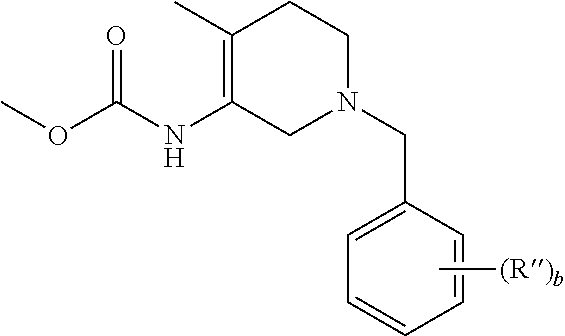
- R′′ is chosen from the group consisting of hydrogen, C 1 -C 6 alkyl and CF 3 groups
- b is an integer from 0 to 4; comprising the step of;
- X— is selected from the group consisting of chloro, bromo, fluoro, iodo, triflate, tosylate or —BF 4 , preferably bromo
- R′′′ is C 1 -C 6 alkyl
- a rhodium, iridium, or ruthenium catalyst preferably bis(1,5-cyclooctadiene)rhodium (I) trifluoromethanesulfonate and a chiral phosphine ligand preferably (R)-( ⁇ )-1- ⁇ (S)-2-(diphenylphosphino)ferrocenyl ⁇ ethyl di-t-butylphosphine; (R)-( ⁇ )-1- ⁇ (S)-2-(dicyclohexylphosphino)ferrocenyl ⁇ ethyl di-t-butylphosphine, or R)-( ⁇ )-1- ⁇ (S)-2-di-(p-tri
- benzyl pyridinium salt has the Formula Xe
- benzyl pyridinium salt has the Formula Xf
- R 1 is hydrogen or (C 1 -C 6 )alkyl
- R 2 is C 1 -C 6 alkyl
- R′′ is chosen from the group consisting of hydrogen, C 1 -C 6 alkyl and CF 3 groups
- b is an integer from 0 to 4; comprising the step of:
- R′′′ is C 1 -C 6 alkyl; with a rhodium, iridium, or ruthenium catalyst preferably bis(1,5-cyclooctadiene)rhodium (I) trifluoromethanesulfonate and a chiral phosphine ligand preferably (R)-( ⁇ )-1- ⁇ (S)-2-(diphenylphosphino)ferrocenyl ⁇ ethyl di-t-butylphosphine; (R)-( ⁇ )-1- ⁇ (S)-2-(dicyclohexylphosphino)ferrocenyl ⁇ ethyl di-t-butylphosphine, or (R)-( ⁇ )-1- ⁇ (S)-2-di-(p-trifluoromethylphenyl)phosphino)ferrocenyl ⁇ ethyl di-t-butylphosphine in the presence of hydrogen or a hydrogen source.
- alkyl includes saturated monovalent C1-C20 hydrocarbon radicals having straight branched or cyclic moieties or combinations thereof. Examples of such groups include but are not limited to methyl, ethyl, propyl, isopropyl, butyl, isobutyl, t-butyl, cyclopropyl, cyclobutyl, cyclopentyl, and cyclohexyl.
- alkoxy includes O-alkyl groups wherein alkyl is as defined above. Examples include but are not limited to methoxy, ethoxy, propoxy, isopropoxy, butoxy, isobutoxy, t-butoxy, cyclopropoxy, cyclobutoxy, and cyclopentoxy.
- halo or halogen includes fluoro, chloro, bromo, or iodo.
- alkenyl includes monovalent straight branched or cyclic hydrocarbon radicals containing one or more double bonds. Examples include but are not limited to, ethenyl, propenyl, butenyl, isobuteneyl, cyclopentenyl and cyclohexenyl.
- alkynyl includes monovalent straight or branched hydrocarbon radicals containing one or more triple bonds. Examples include but are not limited to ethynyl, propynyl, and butynyl.
- acyl refers to a —C(O)— moiety.
- nitrogen protecting group or “amino protecting group” as used herein will be understood by the skilled person to include those mentioned in “Protective Groups in Organic Synthesis” 2 nd Edition, T. W. Greene and P. G. M. Wutz, Wiley Interscience (1991) in particular those indexed at pages 218-222 of that reference, the disclosure of which document is hereby incorporated by reference in its entirety.
- suitable protecting groups include but are not limited to benzyl, carbobenzyloxy, t-butoxy carbonyl (BOC) 9-fluorenyl-methylenoxy carbonyl and allyloxycarbonyl.
- leaving group represents a group that can be displaced by nucleophiles.
- leaving groups include but are not limited to halogen, mesyloxy, tosyloxy, and anhydride residues of carbonic acids such as t-butoxy-carbonyloxy.
- activating group refers to any group on pyrrolo pyrimidine moieties of the present invention which enhances its reactivity toward addition elimination type reactions with nucleophiles.
- Activating groups are typically electron withdrawing groups such as halogens, for example chloro, sulfonates for example tosylates, mesylates and the like, esters, carbonates, carbamates, and acyl derivatives. Also included are benzyl derivatives.
- acids is taken to mean inorganic and organic acids.
- Inorganic acids include but are not limited to hydrochloric, hydrobromic, phosphoric, metaphosphoric, nitric and sulfuric.
- Organic Acids include but are not limited to tartaric, acetic, methane-sulfonic, trifluoroacetic, citric, maleic, lactic, fumaric, benzoic, succinic, methanesulfonic, oxalic and p-toluene sulfonic acids.
- bases is taken to mean inorganic and organic bases.
- Inorganic bases include but are not limited to sodium carbonate, potassium carbonate, lithium hydroxide, sodium hydroxide, potassium hydroxide, lithium carbonate, sodium carbonate, potassium carbonate, lithium hydride, potassium hydride, sodium hydride, lithium hydrogen carbonate, sodium hydrogen carbonate, and potassium hydrogen carbonate.
- Organic bases include but are not limited to metal alkoxides, metal-alkyl complexes, pyridine, alkyl amines, dialkylamines and trialkylamines.
- alkyl, dialkyl and trialkyl amines include but are not limited to methyl amine, dimethyl amine, triethyl amine and diisopropyl ethyl amine. Also included are cyclic amines such as DBU.
- metal alkoxides include but are not limited to sodium methoxide, potassium methoxide, sodium t-butoxide, potassium t-butoxide and sodium ethoxide.
- Metal alkyl complexes include but are not limited to alkyl lithium reagents such as n butyl lithium, see butyl lithium and t-butyl lithium. Also included in this definition are Grignard Reagents such as phenyl magnesium bromide and ethyl magnesium bromide.
- the acids which are used to prepare the pharmaceutically acceptable acid addition salts of the aforementioned compound of the Formula Ia which form non-toxic acid addition salts i.e., salts containing pharmacologically acceptable anions, such as the hydrochloride, hydrobromide, hydroiodide, nitrate, sulfate, bisulfate, phosphate, acid phosphate, acetate, lactate, citrate, acid citrate, tartrate, bitartrate, succinate, maleate, fumarate, gluconate, saccharate, benzoate, methanesulfonate, ethanesulfonate, benzenesulfonate, p-toluenesulfonate and pamoate, [i.e., 1,1′-methylene-bis-(2-hydroxy-3-naphthoate)]salts.
- pharmacologically acceptable anions such as the hydrochloride, hydrobromide, hydroiodide, n
- tertiary amine refers to C1-C8 trialkyl amines. Examples include but are not limited to triethyl amine, diisopropylethyl amine, and trimethylamine. Also included in this definition is pyridine.
- enantiomeric excess means the excess of one of the two enantiomers over the other, generally as a percentage. Therefore an enantiomeric excess of 90% corresponds to the presence of 95% of one enantiomer and of 5% of the other in the mixture in question.
- enantiomerically enriched means that one enantiomer is present in excess relative to the other. That is to say one enantiomer represents greater than 50% of the mixture. Also included in this definition are single enantiomers (i.e. 100% ee).
- substituted benzyl refers to a benzyl group substituted on the phenyl ring by one or more group chosen from C 1 -C 6 alkyl, —CF 3 , OMe, NO 2 and CN.
- (C3-C12) aryl optionally substituted with 1 to 6 heteroatoms includes but is not limited to phenyl, naphthyl, pyridyl, quinolinyl, benzofuranyl, benzothiofene, indole and the like.
- hydrogen source refers to any source of hydrogen that may be generated in situ.
- formic acid and salts thereof such as ammonium formiate, alkaline metal formiates, and the like may be used as hydrogen sources.
- a suitably substituted 3-aminopyridine of the formula VII can be reacted with a dialkyl carbonate or alkylchloroformate to obtain VIII.
- VIII can then reduced in the presence of hydrogen preferably under a pressurized hydrogen atmosphere, preferably between about 70 to about 80 psi, and 5% rhodium on carbon or rhodium on alumina in the presence of an acid, preferably acetic acid, at an elevated temperature of between about 50° C. and about 150° C., preferably 70-80° C., to afford the cis-piperidinyl carbamates IXa and b.
- the piperidinyl nitrogen can then be protected by reacting IXa and b with a suitable protecting reagent to afford Xa and b.
- a suitable protecting reagent for example a reagent such as P-L, where P is the protecting group and L is a leaving group can be reacted, in the presence of a base such as potassium or sodium carbonate, with the piperidinyl nitrogen of IXa and b to afford the N-protected cis piperidinyl carbamate Xa and b.
- the aldehyde PCHO where P is the protecting group can be reacted under hydrogenation conditions with the piperidinyl nitrogen. Reaction conditions can be determined by one of ordinary skill in the art depending upon the protecting group employed.
- the carbamate group of Xa and b can then be reduced using a suitable reducing agent, for example, lithium aluminum hydride, in an ethereal solvent such as THF, at a reduced temperature of between about ⁇ 78° C. to about 70° C., typically 70° C., to afford IIIb and c (where R 2 is methyl).
- a suitable reducing agent for example, lithium aluminum hydride
- the carbamate group of Xa and b can be cleaved by hydrolysis and the resulting free amine can then be reacted with various alkylating agents, for example R 2 -L where L is a leaving group, in a polar aprotic solvent such as dimethyl formamide (DMF), optionally in the presence of a base such as a trialkylamine base, to afford intermediates IIIb and c.
- a polar aprotic solvent such as dimethyl formamide (DMF)
- a base such as a trialkylamine base
- Suitable chiral phosphine ligands can be found in Chem Rev 2003, 103, 3029 herein incorporated by reference in its entirety.
- the preferred catalysts are those formed from bis(1,5-cyclooctadiene)rhodium (I) trifluoromethanesulfonate and a chiral Josiphos-type ligand. These preferred ligands can be purchased commercially from Solvias (Basel Switzerland).
- Preferred reagents and conditions to accomplish the transformation are bis(1,5-cyclooctadiene)rhodium (I) trifluoromethanesulfonate and (R)-( ⁇ )-1- ⁇ (S)-2-(diphenyl, dicyclohexyl or di-(p-trifluoromethyl phenyl)phosphino)ferrocenyl ⁇ ethyl di-t-butylphosphines in the presence of a pressurized hydrogen atmosphere, preferably between about 50 and about 200 psi, in an solvent, preferably a THF ethanol mixture, at an elevated temperature preferably between about 50 C and about 70 C; resulting in enantiomerically enriched piperidine Xa (for example 50-70% ee Xa over Xb).
- the enriched Xa so produced could be carried on and subsequently used in the chiral resolution step infra or may be used to couple directly to the activated pyrrolopyrimidine after the formation of II b and c (ie formation of enantiomerically enriched IIb).
- R 1 substituted cis and trans 3 amino piperidines (IIIa) may be synthesized from suitably substituted N-protected-piperidin-3-ones, prepared by the methods of Iorio, M. A. and Damia, G.; Tetrahedron, Vol. 26: p. 55-59 (1970) and Grieco, et al., Journal of the American Chemical Society, Vol. 107: p. 1768 (1985). Both references are incorporated by reference in their entireties modified using 5% methanol as co-solvent, by reaction with R 2 —NH 2 acetic acid, and sodium triacetoxy borohydride according to the procedure described in Example 1 of the US published application 2004/0053947 which is also incorporated by reference in its entirety.
- Piperidines of the Formula IIIa may be used in any of the subsequent couplings with activated pyrrolo pyrimidines to produce coupled products as mixtures of all possible diastereomers.
- Cis N-protected 3-amino piperidines IIIb and c can then be coupled with the activated pyrrolo pyrimidine of the formula IIa in the presence of a base such as potassium or sodium carbonate in a polar solvent or mixture of polar solvents such as water or water and acetonitrile or DMSO (dimethylsulfoxide); at an elevated temperature of between about 50° C. and about 150° C., preferably 100° C., to afford the coupled product IVa.
- a base such as potassium or sodium carbonate
- a polar solvent or mixture of polar solvents such as water or water and acetonitrile or DMSO (dimethylsulfoxide)
- IIIb and c may be first resolved with one enantiomer of di-p-toluoyl tartaric acid, preferably the L enantiomer, or by other chiral acids and the resulting single diastereomer amine salt reacted directly or by first forming the single enantiomer free amine from the amine salt by reaction with aqueous base such as aqueous sodium hydroxide, with the activated pyrrolo pyrimidine IIa in the presence of a base in a solvent or mixture of polar solvents such as water or water and acetonitrile or DMSO, at an elevated temperature of between about 50° C.
- aqueous base such as aqueous sodium hydroxide
- Compound IVa either as a single enantiomer or a mixture of enantiomers is then subjected to deprotection conditions appropriate for the particular nitrogen-protecting group employed. Typically these deprotecting conditions will also remove the activating group to form a compound of the Formula V.
- the protecting group and activating group may be removed by hydrogen or a hydrogen source in the presence of a catalyst.
- the conditions which can be employed are pressurized hydrogen, typically 50 psi, and a hydrogenation catalyst such as Pd(OH) 2 , in a polar solvent such as water optionally in the presence of an acid such as acetic acid or HCl.
- the protecting group or activating group may be removed first using one set of conditions followed by removal of the remaining group under a second set of conditions.
- the piperidinyl nitrogen of the compound of the Formula V may be acylated using an acylating agent of the Formula VII and L is a leaving group, optionally in the presence of a base such as a trialkylamine base, in a polar protic or aprotic solvent such as methylene chloride to afford a compound of the Formula VII.
- the compound of the Formula VII may be converted to a pharmaceutically acceptable salt by the action of an organic acid such as citric, hydrochloric and the like.
- the pharmaceutically acceptable salt of the compound of Formula VII may be recrystallized from an organic solvent or mixtures of organic solvents.
- an activated pyrrolo pyrimidine of the Formula IIb can be coupled to the cis N-protected 3 amino piperidine IIIb & c, produced according to the methods described in Scheme 1, in the presence of a base in a polar solvent or mixture of polar solvents such as water or water and acetonitrile at an elevated temperature of between about 50° C. and about 150° C., preferably 100° C., to afford the coupled product IVb as a mixture of enantiomers.
- IIIb & c produced according to the methods described in Scheme 1, may be first resolved with one enantiomer of di-p-toluoyl tartaric acid, preferably the L enantiomer, or by other chiral acids using standard resolution techniques i.e.
- Coupled product IVb is then subjected to deprotection conditions appropriate for the particular nitrogen protecting group and conditions to remove the tosyl activating group.
- the protecting group is a group labile to hydrogenolysis hydrogenating conditions maybe employed such as hydrogen pressurized to 10-100 psi, and a hydrogenation catalyst such as Pd(OH) 2 in a polar solvent or mixture polar solvents such as a mixture of isopropyl alcohol and water optionally in the presence of an acid such as acetic or hydrochloric acid, to remove nitrogen protecting group followed by an alkali base, for example, such as aqueous sodium hydroxide to remove the activating group when the activating group is tosyl, to afford a compound of the Formula V.
- both the activating group and the protecting group are labile to hydrogenolysis both may be removed by hydrogenation conditions in a single reaction vessel.
- either the protecting group or activating group may be removed first using one set of conditions followed by removal of the remaining group under a second set of conditions.
- the compound of the Formula V so produced may be further reacted as previously described.
- Step A Preparation of 1-benzyl-3-methoxycarbonylamino-4-methyl-pyridinium bromide to a clean, dry, nitrogen purged 500 mL flask were added (4-methyl-pyridin-3-yl)-carbamic acid methyl ester (25.0 g, 150 mmol), toluene (250 ml) and benzyl bromide (28.3 g, 165 mmol). The reaction was heated to 110° C. for at least 20 hours. After cooling to between 20-25° C. the reaction was filtered and the resulting solids washed with toluene (100 ml). After drying under vacuum for at least 12 hours between 40-50° C.
- the solids were purged with nitrogen (5 ⁇ at 90 psi) then degassed THF (2 ml) and degassed ethanol (1 ml) were added.
- the mixture was purged with nitrogen (5 ⁇ at 90 psi) followed by hydrogen (1 ⁇ at 210 psi).
- the reaction mixture was heated to 70° C. then pressurized with hydrogen to 200 psi. After 48 h, the mixture was cooled to 30° C. and purged with nitrogen (5 ⁇ at 90 psi). An aliquot was removed for GCMS analysis.
- chiral HPLC may also be used for the analysis. Analysis performed on Agilent 1100 system: HPLC conditions: Daicel Chiralcel OJ 4.6 mm ⁇ 250 mm analytical column, 5% Ethanol/hexanes, flow 1 ml/min, 210 nm, 20 minute run.
- Benzyl chloride (2.1 mL, 18.3 mmol) was added to a slurry of (4-methyl-pyridin-3-yl)-carbamic acid methyl ester (3.16 g, 19.0 mmol) in toluene (15 mL) at 80° C. A homogenous reaction mixture resulted after 10 minutes and then solids precipitated after 30 minutes. The slurry was stirred at 80° C. for 16 hours then cooled to room temp. The solids were filtered and washed with toluene. After drying, the product was isolated as a gray solid (4.17 g, 78%).
- racemic cis-(1-benzyl-4-methyl-piperidine-3-yl)-methylamine bis hydrochloride (20.0 g, 68.7 mmol), di-p-toluoyl-L-tartaric acid (L-DPTT) (15.9 g, 41.2 mmol) and methanol (100 ml).
- L-DPTT di-p-toluoyl-L-tartaric acid
- methanol 100 ml.
- a solution of sodium hydroxide 5.5 g, 137.3 mmol in water (100 ml) was added to the reaction at a rate to maintain the temperature below 30° C.
- the reaction was heated to between 70-80° C. and held at this temperature for at least 60 minutes.
- the reaction was cooled to 5-15° C.
- the hydrogen uptake was monitored until no hydrogen was consumed for a minimum of 1 hour.
- the reactor was cooled to 20-30° C. and purged three times at 50 psi with nitrogen.
- the reaction mixture was filtered through water-wet Celite and transferred to a clean, dry, nitrogen-purged 500 ml reactor for subsequent processing.
- Acetonitrile 25 ml was charged and the slurry was held at 45-55° C. for a minimum of 1 hour. The mixture was further cooled to 20-30° C. and stirred for a minimum of 5 hours. The resulting solids were isolated by filtration and washed with water (50 ml). After drying, 32.8 g (82.1%) of the title compound were isolated.
- the reactor was cooled to 20-30° C. and purged three times at 50 psi with nitrogen.
- the reaction mixture was filtered through wet Celite and the filtrate was sent to a clean, dry, nitrogen-purged vessel.
- a solution of sodium hydroxide (39.33 g) in water (290 ml) was charged and the mixture was stirred for a minimum of 1 hour then heated to 75-90° C.
- the isopropanol was removed by distillation.
- the reaction mixture was cooled to 20-30° C. and 2-methyltetrahydrofuran (1.6 L) was added.
- the aqueous layer was drained off and the 2-methyltetrahydrofuran was displaced with toluene (1.6 L). The distillation was continued until the final volume was 800 ml. The slurry was cooled to 20-30° C. and held for a minimum of 7 hours. The resulting solids were isolated by filtration and washed with toluene (480 ml). After drying under vacuum between 40-50° C. for a minimum of 24 hours with a slight nitrogen bleed 102.3 g (87.3%) of the title compound were isolated.
- a solution of citric acid (20.76 g, 0.107 mol) in water (25.0) was charged and the mixture was cooled to room temperature.
- the reactor was stirred for a minimum of 5 hours and then the resulting solids were isolated by filtration and washed with acetone (2 ⁇ 75 ml), which was sent to the filter.
- the salt was charged into a clean, dry, nitrogen-purged 1 L reactor with 2B ethanol (190 ml) and water (190 ml).
- the slurry was heated to 75-85° C. for a minimum of 4 hours.
- the mixture was cooled to 20-30° C. and stirred for an additional 4 hours.
- the solids were isolated by filtration and washed with 2B ethanol (190 ml). After drying in a vacuum oven at 50° C. with a slight nitrogen bleed, 34.6 g (67.3%) of the title compound were isolated.
- a reactor was equipped with 7H-pyrrolo[2,3-d]pyrimidine-2,4-diol (10.0 g, 66.2 mmol) and toluene (30 ml) with stirring.
- Phosphorusoxychloride (18.5 ml, 198.5 mmol) was added and the reactor was warmed to 70° C.
- Diisopropylethylamine 23.0 m, 132.3 mmol was added over 2.5 h to control the exotherm.
- the reactor was heated to 106° C. and stirred at temperature for 16 h. The mixture was cooled to 25° C.
Landscapes
- Health & Medical Sciences (AREA)
- Chemical & Material Sciences (AREA)
- Organic Chemistry (AREA)
- Chemical Kinetics & Catalysis (AREA)
- General Chemical & Material Sciences (AREA)
- Medicinal Chemistry (AREA)
- Nuclear Medicine, Radiotherapy & Molecular Imaging (AREA)
- Pharmacology & Pharmacy (AREA)
- Life Sciences & Earth Sciences (AREA)
- Animal Behavior & Ethology (AREA)
- General Health & Medical Sciences (AREA)
- Public Health (AREA)
- Veterinary Medicine (AREA)
- Engineering & Computer Science (AREA)
- Bioinformatics & Cheminformatics (AREA)
- Immunology (AREA)
- Neurosurgery (AREA)
- Biomedical Technology (AREA)
- Diabetes (AREA)
- Pulmonology (AREA)
- Neurology (AREA)
- Dermatology (AREA)
- Rheumatology (AREA)
- Hematology (AREA)
- Transplantation (AREA)
- Emergency Medicine (AREA)
- Oncology (AREA)
- Obesity (AREA)
- Psychiatry (AREA)
- Pain & Pain Management (AREA)
- Endocrinology (AREA)
- Hospice & Palliative Care (AREA)
- Orthopedic Medicine & Surgery (AREA)
- Physical Education & Sports Medicine (AREA)
- Low-Molecular Organic Synthesis Reactions Using Catalysts (AREA)
- Nitrogen Condensed Heterocyclic Rings (AREA)
- Pharmaceuticals Containing Other Organic And Inorganic Compounds (AREA)
- Hydrogenated Pyridines (AREA)
Abstract
Description

comprising the step of;
coupling an activated pyrrolo pyrimidine compound of the Formula IIa

wherein L1 is a leaving group, preferably chloro, bromo, iodo, or fluoro, most preferably chloro, and X1 is an activating group, preferably chloro, bromo, iodo, fluoro, CO2R′, COCO2R′; SO2Ar, and COAr where Ar is a (C3-C12) aromatic group optionally including 1 to 6 heteroatoms chosen from O, NR′ and S optionally substituted with 1 to 3 groups selected from (C1-C6)alkyl, halogen, nitro, and cyano; where R′ is chosen from the group consisting of (C1-C6)alkyl and benzyl; most preferably X1 is chloro; with an amine of the Formula IIIa, or a salt thereof;

wherein R1 is hydrogen or (C1-C6)alkyl; a is an integer from 0 to 4; R2 is hydrogen or (C1-C6) alkyl; and P is a nitrogen protecting group, preferably benzyl; in the presence of a base, preferably an alkali or trialkyl amine base, more preferably potassium carbonate or sodium carbonate, most preferably potassium carbonate to afford a coupled product of the Formula IVa.

sequentially, in either order, or in a single reaction vessel, to afford a compound of the Formula V


wherein L is a leaving group chosen from the group consisting of —OCOR3, OR3, halogen, hydroxyl succinimidyl, sulfonates such as tosyl and mesyl; wherein R3 is C1-C6 alkyl; preferably L is —OCOR3, wherein R3 is t-butyl; optionally in the presence of a base, to afford a compound of the Formula Ia.


comprising the step of coupling an activated pyrrolo pyrimidine compound of the Formula IIb

wherein L1 is a leaving group, preferably chloro, iodo, bromo and fluoro, most preferably chloro and X2 is an activating group, preferably benzyl, SO2Ar, CO2R′, and COAr; Ar is a C3-C12 aromatic group optionally including 1 to 6 heteroatoms chosen from O, NR′ and S, optionally substituted with 1 to 3 groups selected from (C1-C6)alkyl, halogen, nitro, and cyano; where R′ is chosen from the group consisting of (C1-C6)alkyl and benzyl; preferably X2 is a tosyl group (p-toluene sulfonyl group; —SO2C6H4CH3); with an amine of the Formula IIIa, or a salt thereof,
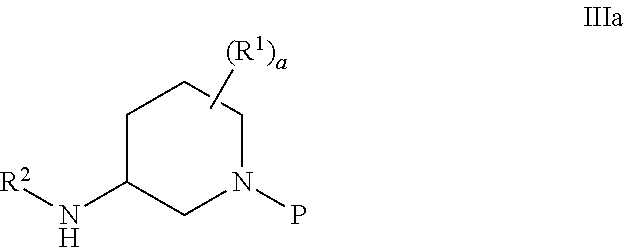
wherein R1 is (C1-C6) alkyl; a is an integer from 0 to 4; R2 is hydrogen or (C1-C6) alkyl; and P is a nitrogen protecting group, preferably benzyl; in the presence of a base, preferably an alkali or trialkyl amine base, more preferably potassium carbonate or sodium carbonate, most preferably potassium carbonate to afford a coupled product of the Formula IVb.


-
- a) reacting 7H-pyrrolo[2,3-d]pyrimidine-2,4diol with phosphorus oxychloride in an aromatic solvent, preferably toluene, to form a first solution at a first temperature, preferably from between about 0° C. to about 50° C., most preferably about 25° C.;
- b) increasing said first temperature of the first solution to a second temperature, preferably between about 40° C. to about 100° C., most preferably about 75° C.;
- c) adding to said first solution at the second temperature a tertiary amine base preferably diisopropylethylamine, to form a second solution at the second temperature and;
- d) increasing said second temperature of the second solution to a third temperature, preferably between about 75° and about 125° C., most preferably about 105° C., for a first interval of time preferably between about 1 hr and about 24 hr, most preferably about 16 hr;
wherein the phosphorous oxychloride is present in between about 1.5 and about 6 equivalents and the tertiary amine base, preferably diisopropylethylamine, is present in between about 1.0 and about 8.0 equivalents; both relative to the starting 7H-pyrrolo[2,3-d]pyrimidine-2,4diol. Preferably the phosphorous oxychloride is present in between about 2.0 and about 3 equivalents and the tertiary amine base is present in between about 1.1 and about 2 equivalents. Most preferably the phosphorous oxychloride is present in about 3.0 equivalents and the tertiary amine base is present in about 2.0 equivalents.

wherein R1 is hydrogen or (C1-C6)alkyl; a is an integer from 0 to 4; R2 is hydrogen or (C1-C6)alkyl; and R″ is chosen from the group consisting of hydrogen, C1-C6 alkyl and CF3 groups; b is an integer from 0 to 4; comprising the step of;




Claims (18)


Priority Applications (1)
| Application Number | Priority Date | Filing Date | Title |
|---|---|---|---|
| US13/528,099 US8309716B2 (en) | 2005-07-29 | 2012-06-20 | Pyrrolo[2,3-d]pyrimidine derivatives: their intermediates and synthesis |
Applications Claiming Priority (4)
| Application Number | Priority Date | Filing Date | Title |
|---|---|---|---|
| US70401105P | 2005-07-29 | 2005-07-29 | |
| PCT/IB2006/002048 WO2007012953A2 (en) | 2005-07-29 | 2006-07-17 | Pyrrolo[2,3-d]pyrimidine derivatives; their intermediates and synthesis |
| US99689911A | 2011-08-11 | 2011-08-11 | |
| US13/528,099 US8309716B2 (en) | 2005-07-29 | 2012-06-20 | Pyrrolo[2,3-d]pyrimidine derivatives: their intermediates and synthesis |
Related Parent Applications (3)
| Application Number | Title | Priority Date | Filing Date |
|---|---|---|---|
| PCT/IB2006/002048 Division WO2007012953A2 (en) | 2005-07-29 | 2006-07-17 | Pyrrolo[2,3-d]pyrimidine derivatives; their intermediates and synthesis |
| US11/996,899 Division US8232394B2 (en) | 2005-07-29 | 2006-07-17 | Pyrrolo[2,3-d]pyrimidine derivatives; their intermediates and synthesis |
| US99689911A Division | 2005-07-29 | 2011-08-11 |
Publications (2)
| Publication Number | Publication Date |
|---|---|
| US20120259115A1 US20120259115A1 (en) | 2012-10-11 |
| US8309716B2 true US8309716B2 (en) | 2012-11-13 |
Family
ID=36950230
Family Applications (2)
| Application Number | Title | Priority Date | Filing Date |
|---|---|---|---|
| US11/996,899 Active 2028-01-17 US8232394B2 (en) | 2005-07-29 | 2006-07-17 | Pyrrolo[2,3-d]pyrimidine derivatives; their intermediates and synthesis |
| US13/528,099 Active US8309716B2 (en) | 2005-07-29 | 2012-06-20 | Pyrrolo[2,3-d]pyrimidine derivatives: their intermediates and synthesis |
Family Applications Before (1)
| Application Number | Title | Priority Date | Filing Date |
|---|---|---|---|
| US11/996,899 Active 2028-01-17 US8232394B2 (en) | 2005-07-29 | 2006-07-17 | Pyrrolo[2,3-d]pyrimidine derivatives; their intermediates and synthesis |
Country Status (24)
| Country | Link |
|---|---|
| US (2) | US8232394B2 (en) |
| EP (1) | EP1913000B1 (en) |
| JP (1) | JP4052523B2 (en) |
| KR (1) | KR100987870B1 (en) |
| CN (1) | CN101233138A (en) |
| AR (1) | AR056004A1 (en) |
| AT (1) | ATE540952T1 (en) |
| AU (1) | AU2006273762A1 (en) |
| BR (1) | BRPI0613876A2 (en) |
| CA (1) | CA2614907C (en) |
| CY (1) | CY1112319T1 (en) |
| DK (1) | DK1913000T3 (en) |
| ES (1) | ES2377771T3 (en) |
| IL (1) | IL188372A0 (en) |
| MX (1) | MX2008001334A (en) |
| NZ (1) | NZ565363A (en) |
| PL (1) | PL1913000T3 (en) |
| PT (1) | PT1913000E (en) |
| RU (1) | RU2384583C2 (en) |
| SG (1) | SG170783A1 (en) |
| SI (1) | SI1913000T1 (en) |
| TW (1) | TWI319402B (en) |
| WO (1) | WO2007012953A2 (en) |
| ZA (1) | ZA200800284B (en) |
Cited By (1)
| Publication number | Priority date | Publication date | Assignee | Title |
|---|---|---|---|---|
| US20190002407A1 (en) * | 2017-06-29 | 2019-01-03 | F.I.S. - Fabbrica Italiana Sintetici S.P.A. | Process for the preparation of chiral 3-amino-piperidins, useful intermediates for the preparation of tofacitinib |
Families Citing this family (79)
| Publication number | Priority date | Publication date | Assignee | Title |
|---|---|---|---|---|
| NZ582188A (en) | 2007-07-11 | 2012-03-30 | Pfizer | Pharmaceutical compositions and methods of treating dry eye disorders |
| AU2010239396B2 (en) | 2009-04-20 | 2016-06-23 | Auspex Pharmaceuticals, Llc | Piperidine inhibitors of Janus Kinase 3 |
| JP5658756B2 (en) * | 2009-09-10 | 2015-01-28 | エフ.ホフマン−ラ ロシュ アーゲーF. Hoffmann−La Roche Aktiengesellschaft | JAK inhibitors |
| ES2426407T3 (en) | 2009-10-15 | 2013-10-23 | Pfizer Inc. | Pyrrolo [2,3-d] pyrimidine compounds |
| WO2011075334A1 (en) | 2009-12-18 | 2011-06-23 | Pfizer Inc. | Pyrrolo[2,3-d]pyrimidine compounds |
| RU2012132278A (en) | 2010-01-12 | 2014-02-20 | Ф. Хоффманн-Ля Рош Аг | TRICYCLIC HETEROCYCLIC COMPOUNDS CONTAINING THEIR COMPOSITIONS AND WAYS OF THEIR APPLICATION |
| MX2012009074A (en) * | 2010-02-05 | 2012-08-23 | Pfizer | Pyrrolo [ 2, 3 - d] pyrimidine urea compounds as jak inhibitors. |
| RU2013144975A (en) | 2011-04-08 | 2015-05-20 | Пфайзер Инк. | CRYSTALLINE AND NONCRYSTALLINE FORM OF TOFACITINIB AND PHARMACEUTICAL COMPOSITION CONTAINING TOFACITINIB, AND PENETRATION AMPLIFIER |
| EP2788000B1 (en) | 2011-12-06 | 2018-05-30 | Merck Sharp & Dohme Corp. | Pyrrolopyrimidines as janus kinase inhibitors |
| EP3170827A1 (en) * | 2011-12-15 | 2017-05-24 | ratiopharm GmbH | Tofacitinib mono-oxalate salt |
| DK2875013T3 (en) * | 2012-07-17 | 2018-01-22 | Glaxosmithkline Intellectual Property (No 2) Ltd | INDOLECAR CARBON NITRILS AS SELECTIVE ANDROGEN RECEPTOR MODULATORS |
| WO2014016338A1 (en) | 2012-07-25 | 2014-01-30 | Lek Pharmaceuticals D.D. | New synthetic route for the preparation of 3-amino-piperidine compounds |
| CN102875555A (en) * | 2012-09-27 | 2013-01-16 | 同济大学 | Synthetic method of JAK (janus kinase) inhibitor Tofacitinib |
| WO2014083150A1 (en) * | 2012-11-30 | 2014-06-05 | Lek Pharmaceuticals D.D. | Preparation of 3-amino-piperidine compounds via nitro-tetrahydropyridine precursors |
| WO2014097150A1 (en) * | 2012-12-17 | 2014-06-26 | Ranbaxy Laboratories Limited | Process for the preparation of tofacitinib and intermediates thereof |
| EP2938616A4 (en) | 2012-12-28 | 2016-06-15 | Glenmark Pharmaceuticals Ltd | PROCESS FOR THE PREPARATION OF TOFACITINIB AND INTERMEDIATES |
| CN103073552B (en) * | 2013-02-05 | 2015-08-12 | 华润赛科药业有限责任公司 | A kind of unformed Citric Acid holder method is for the preparation method of Buddhist nun |
| GEP201606600B (en) | 2013-02-22 | 2017-01-10 | Pfizer | Pyrrolo [2, 3 -d]pyrimidine derivatives as inhibitors of janus- related kinases (jak) |
| WO2014174073A1 (en) | 2013-04-26 | 2014-10-30 | Sandoz Ag | Sustained release formulations of tofacitinib |
| CN104447752A (en) * | 2013-09-16 | 2015-03-25 | 天津市汉康医药生物技术有限公司 | Tofacitinib hydrate and preparation method thereof |
| CN104447751A (en) * | 2013-09-16 | 2015-03-25 | 天津市汉康医药生物技术有限公司 | Tofacitinib compound |
| CN104292231B (en) * | 2013-09-17 | 2016-11-30 | 广东东阳光药业有限公司 | A kind of citric acid expelling pathogens by strengthening vital QI is for the preparation method of Buddhist nun |
| CN105873931B (en) * | 2013-10-08 | 2018-10-16 | 广东东阳光药业有限公司 | Tofacitinib Citrate |
| CN103819474A (en) * | 2013-11-04 | 2014-05-28 | 湖南华腾制药有限公司 | Preparation method of tofacitinib |
| SI3077395T1 (en) | 2013-12-05 | 2018-03-30 | Pfizer Inc. | Pyrrolo (2,3-d) pyrimidinyl, pyrrolo (2,3-b) pyrazinyl and pyrrolo (2,3-d) pyridinyl acrylamides |
| BR112015025543B1 (en) | 2013-12-09 | 2020-11-03 | Unichem Laboratories Limited | process for the preparation of (3r, 4r) - (1-benzyl-4-methylpiperidine-3-yl) -methylamine and intermediate compounds |
| CN104774206A (en) * | 2014-01-14 | 2015-07-15 | 江苏柯菲平医药股份有限公司 | New method for preparing tofacitinib citrate crystal-form A |
| CN103755624B (en) * | 2014-01-20 | 2018-10-09 | 上海博氏医药科技有限公司 | A kind of synthetic method of piperidine derivative |
| CN105085527A (en) * | 2014-05-20 | 2015-11-25 | 南京海纳医药科技有限公司 | High-efficiency synthesis method for tofacitinib |
| WO2016024185A1 (en) | 2014-08-12 | 2016-02-18 | Pfizer Inc. | Pyrrolo[2,3-d]pyrimidine derivatives useful for inhibiting janus kinase |
| KR101710127B1 (en) | 2014-08-29 | 2017-02-27 | 한화제약주식회사 | Substituted N-(pyrrolidin-3-yl)-7H-pyrrolo[2,3-d]pyrimidin-4-amines as Janus kinase inhibitor |
| RU2017107558A (en) * | 2014-09-15 | 2018-10-18 | Руджен Холдингс (Кайман) Лимитед | Pyrrolopyrimidine Derivatives as Antagonists of the NMR NR2B Receptor |
| CN104530053A (en) * | 2014-12-08 | 2015-04-22 | 合肥远志医药科技开发有限公司 | Preparation method of medicinal crystal form tofacitinib citrate |
| CN104530055A (en) * | 2014-12-23 | 2015-04-22 | 南京艾德凯腾生物医药有限责任公司 | Preparation method of tofacitinib citrate |
| CN105837574B (en) * | 2015-02-02 | 2018-03-02 | 四川大学 | N-(3-piperidinyl)-aromatic amine derivatives and their preparation and use |
| CN104710346B (en) * | 2015-02-15 | 2017-04-12 | 江苏苏利精细化工股份有限公司 | Method for synthesizing cis-1-benzyl-3-methylamino-4-methyl-piperidine |
| WO2016132341A1 (en) * | 2015-02-20 | 2016-08-25 | Sun Pharmaceutical Industries Limited | A process for the preparation of tofacitinib citrate |
| CN104761556B (en) * | 2015-03-21 | 2017-06-23 | 河北国龙制药有限公司 | Support method replaces cloth impurity and its synthetic method, and support method for the quality control method of cloth for cloth intermediate impurities, support method |
| CN104860872A (en) * | 2015-03-27 | 2015-08-26 | 天津药物研究院有限公司 | Bis-(3R,4R)-1-benzyl-N,4-dimethyl piperidin-3-amine L-di-p-toluyl tartrate synthesis method |
| EP3078665A1 (en) | 2015-04-10 | 2016-10-12 | OLON S.p.A. | Efficient method for the preparation of tofacitinib citrate |
| CN104788461A (en) * | 2015-04-30 | 2015-07-22 | 南京臣功制药股份有限公司 | Industrial production method applicable to citric acid tofacitinib |
| EP3288943B1 (en) | 2015-05-01 | 2022-09-28 | Pfizer Inc. | Pyrrolo[2,3-b]pyrazinyl acrylamides and epoxides thereof as inhibitors of janus kinase |
| CN104987339A (en) * | 2015-07-29 | 2015-10-21 | 张燕梅 | Synthesis method of tofacitinib citrate |
| EP3416965B1 (en) | 2016-02-16 | 2020-10-07 | Zoetis Services LLC | Process for preparing 7h-pyrrolo [2,3-d]pyrimidine compounds |
| CN105732641A (en) * | 2016-03-28 | 2016-07-06 | 南通常佑药业科技有限公司 | Preparation method of JAKs inhibitor drug tofacitinib |
| CN105884781B (en) * | 2016-04-18 | 2018-04-20 | 山东罗欣药业集团股份有限公司 | Preparation method of tofacitinib citrate |
| CN106146517B (en) * | 2016-06-20 | 2018-08-28 | 山东大学 | A kind of synthetic method of citric acid tropsch imatinib |
| CN106188064A (en) * | 2016-07-07 | 2016-12-07 | 国药集团容生制药有限公司 | A kind of preparation method of N methyl N ((3R, 4R) 4 picoline 3 base) 7H pyrrolo-[2,3 d] pyrimidine 4 amine |
| CN105949204A (en) * | 2016-07-25 | 2016-09-21 | 国药集团容生制药有限公司 | Preparation method of N-((3R, 4R)-1-benzyl-4-methyl pyridine-3-yl)-N-methyl-7H-pyrrolo-[2, 3-d] pyrimidine-4-amine |
| AU2017362350B2 (en) | 2016-11-18 | 2021-12-23 | Cystic Fibrosis Foundation | Pyrrolopyrimidines as CFTR potentiators |
| US11000526B2 (en) | 2016-11-22 | 2021-05-11 | Rugen Holdings (Cayman) Limited | Treatment of autism spectrum disorders, obsessive-compulsive disorder and anxiety disorders |
| CN109293682A (en) * | 2017-07-25 | 2019-02-01 | 重庆医药工业研究院有限责任公司 | A kind of support method is for cloth impurity and preparation method thereof |
| CN107698595A (en) * | 2017-09-23 | 2018-02-16 | 江苏正大清江制药有限公司 | Preparation method of tofacitinib citrate substance |
| CN107793418B (en) * | 2017-10-24 | 2020-08-04 | 扬子江药业集团有限公司 | Industrial production method of tofacitinib citrate |
| CN108640923A (en) * | 2018-07-09 | 2018-10-12 | 湖南天地恒制药有限公司 | A kind of support method replaces the preparation method of cloth key intermediate |
| CN108822112B (en) * | 2018-08-13 | 2019-12-20 | 山东罗欣药业集团恒欣药业有限公司 | Preparation method of tofacitinib compound |
| CN109608468B (en) * | 2018-12-29 | 2020-09-29 | 成都倍特药业股份有限公司 | Tofacitinib citrate impurity, and synthesis method and application thereof |
| KR102131107B1 (en) * | 2019-01-15 | 2020-07-07 | 주식회사 다산제약 | Novel method for preparing 3-amino-piperidine |
| CN109503462B (en) * | 2019-01-21 | 2022-03-25 | 内蒙古京东药业有限公司 | The synthetic method of tofacitinib intermediate (3R, 4R)-N, 4-dimethyl-1-benzyl-3-piperidinamine |
| CN109761884B (en) * | 2019-01-30 | 2020-03-31 | 湖北扬信医药科技有限公司 | A kind of preparation method of chiral amine B and its application |
| WO2020183295A1 (en) | 2019-03-13 | 2020-09-17 | Intas Pharmaceuticals Ltd. | Process for preparation of tofacitinib and pharmaceutically acceptable salt thereof |
| WO2020198583A1 (en) | 2019-03-27 | 2020-10-01 | Insilico Medicine Ip Limited | Bicyclic jak inhibitors and uses thereof |
| WO2020204647A1 (en) * | 2019-04-05 | 2020-10-08 | Yuhan Corporation | Processes for preparing (3r,4r)-1-benzyl-n,4-dimethylpiperidin-3-amine or a salt thereof and processes for preparing tofacitinib using the same |
| CN110724146B (en) * | 2019-11-04 | 2022-03-11 | 四川大学 | Preparation method of tofacitinib citrate |
| PE20231743A1 (en) | 2020-08-18 | 2023-10-31 | Incyte Corp | PROCESS AND INTERMEDIARIES TO PREPARE A JAK INHIBITOR |
| IL300557A (en) | 2020-08-18 | 2023-04-01 | Incyte Corp | Process and intermediates for preparing a jak1 inhibitor |
| CN112159410B (en) * | 2020-09-30 | 2025-10-17 | 天地恒一制药股份有限公司 | Preparation method of high-purity tofacitinib citrate |
| CN114685510A (en) * | 2020-12-25 | 2022-07-01 | 上海科胜药物研发有限公司 | A kind of tofacitinib intermediate and preparation method thereof |
| CN114907353A (en) * | 2021-02-09 | 2022-08-16 | 明慧医药(杭州)有限公司 | Prodrug compound and preparation method and application thereof |
| CN112679508B (en) * | 2021-03-09 | 2021-08-10 | 正大天晴药业集团南京顺欣制药有限公司 | Preparation method of tofacitinib intermediate |
| CN113248509B (en) * | 2021-05-17 | 2022-10-04 | 上海中西三维药业有限公司 | Preparation method of tofacitinib citrate intermediate |
| CN113549075B (en) * | 2021-06-23 | 2025-09-23 | 合肥华方医药科技有限公司 | A method for synthesizing diastereoisomer impurities of tofacitinib citrate |
| US12071439B2 (en) | 2021-07-12 | 2024-08-27 | Incyte Corporation | Process and intermediates for preparing a JAK inhibitor |
| CN113735860A (en) * | 2021-08-26 | 2021-12-03 | 安徽鼎旺医药有限公司 | Synthesis method of tofacitinib citrate |
| CN114685515A (en) * | 2022-03-15 | 2022-07-01 | 上海蓝乐鸟实业有限公司 | A kind of preparation method of tofacitinib |
| CN114835714A (en) * | 2022-04-01 | 2022-08-02 | 上海蓝乐鸟实业有限公司 | Preparation method of tofacitinib |
| CN117185884A (en) * | 2023-09-08 | 2023-12-08 | 四川大学 | A kind of synthetic method of (R)-4-substituted hexahydropyrimidine compound |
| CN117247388A (en) * | 2023-09-18 | 2023-12-19 | 天地恒一制药股份有限公司 | Preparation methods and systems for tofacitinib and its intermediates |
| CN118290348A (en) * | 2024-03-22 | 2024-07-05 | 诚达药业股份有限公司 | A method for synthesizing 4-chloropyrrolopyrimidine compounds or their derivatives |
Citations (8)
| Publication number | Priority date | Publication date | Assignee | Title |
|---|---|---|---|---|
| JPH0710877A (en) | 1993-06-24 | 1995-01-13 | Teijin Ltd | 4-heteroalicyclic-pyrrolo [2,3-d] pyrimidine |
| WO2002096909A1 (en) | 2001-05-31 | 2002-12-05 | Pfizer Products Inc. | Optical resolution of (1-benzyl-4-methylpiperidin-3-yl) -methylamine and the use thereof for the preparation of pyrrolo 2,3-pyrimidine derivatives as protein kinases inhibitors |
| WO2003048162A1 (en) | 2001-12-06 | 2003-06-12 | Pfizer Products Inc. | Novel crystalline compound |
| US6627754B2 (en) | 1999-12-10 | 2003-09-30 | Pfizer Inc. | Pyrrolo[2,3-d]pyrimidine compounds |
| WO2004021979A2 (en) | 2002-09-06 | 2004-03-18 | Smithkline Beecham Corporation | PYRROLO[2, 3-d]PYRIMIDINE-4-YL AND PURIN-6-YL UREA COMPOUNDS |
| US20040102627A1 (en) | 2002-11-21 | 2004-05-27 | Pfizer Inc. | 3-Amino-piperadine derivatives and methods of manufacture |
| US7259154B2 (en) | 2001-06-23 | 2007-08-21 | Aventis Pharmaceuticals Inc. | Pyrrolopyrimidines |
| US7417055B2 (en) | 2003-04-25 | 2008-08-26 | Gilead Sciences, Inc. | Kinase inhibitory phosphonate analogs |
Family Cites Families (2)
| Publication number | Priority date | Publication date | Assignee | Title |
|---|---|---|---|---|
| US5654307A (en) * | 1994-01-25 | 1997-08-05 | Warner-Lambert Company | Bicyclic compounds capable of inhibiting tyrosine kinases of the epidermal growth factor receptor family |
| US20040012627A1 (en) | 2002-07-17 | 2004-01-22 | Sany Zakharia | Configurable browser for adapting content to diverse display types |
-
2006
- 2006-07-17 EP EP06779900A patent/EP1913000B1/en active Active
- 2006-07-17 AT AT06779900T patent/ATE540952T1/en active
- 2006-07-17 SI SI200631245T patent/SI1913000T1/en unknown
- 2006-07-17 WO PCT/IB2006/002048 patent/WO2007012953A2/en not_active Ceased
- 2006-07-17 KR KR1020087002240A patent/KR100987870B1/en not_active Expired - Fee Related
- 2006-07-17 NZ NZ565363A patent/NZ565363A/en not_active IP Right Cessation
- 2006-07-17 CN CNA2006800279013A patent/CN101233138A/en active Pending
- 2006-07-17 US US11/996,899 patent/US8232394B2/en active Active
- 2006-07-17 CA CA2614907A patent/CA2614907C/en active Active
- 2006-07-17 PL PL06779900T patent/PL1913000T3/en unknown
- 2006-07-17 MX MX2008001334A patent/MX2008001334A/en active IP Right Grant
- 2006-07-17 SG SG201102177-1A patent/SG170783A1/en unknown
- 2006-07-17 RU RU2008103279/04A patent/RU2384583C2/en not_active IP Right Cessation
- 2006-07-17 PT PT06779900T patent/PT1913000E/en unknown
- 2006-07-17 AU AU2006273762A patent/AU2006273762A1/en not_active Abandoned
- 2006-07-17 ES ES06779900T patent/ES2377771T3/en active Active
- 2006-07-17 DK DK06779900.7T patent/DK1913000T3/en active
- 2006-07-17 BR BRPI0613876-4A patent/BRPI0613876A2/en not_active IP Right Cessation
- 2006-07-27 AR ARP060103254A patent/AR056004A1/en unknown
- 2006-07-28 JP JP2006206218A patent/JP4052523B2/en not_active Expired - Fee Related
- 2006-07-28 TW TW095127592A patent/TWI319402B/en not_active IP Right Cessation
-
2007
- 2007-12-24 IL IL188372A patent/IL188372A0/en unknown
-
2008
- 2008-01-09 ZA ZA200800284A patent/ZA200800284B/en unknown
-
2012
- 2012-02-06 CY CY20121100122T patent/CY1112319T1/en unknown
- 2012-06-20 US US13/528,099 patent/US8309716B2/en active Active
Patent Citations (9)
| Publication number | Priority date | Publication date | Assignee | Title |
|---|---|---|---|---|
| JPH0710877A (en) | 1993-06-24 | 1995-01-13 | Teijin Ltd | 4-heteroalicyclic-pyrrolo [2,3-d] pyrimidine |
| US6627754B2 (en) | 1999-12-10 | 2003-09-30 | Pfizer Inc. | Pyrrolo[2,3-d]pyrimidine compounds |
| WO2002096909A1 (en) | 2001-05-31 | 2002-12-05 | Pfizer Products Inc. | Optical resolution of (1-benzyl-4-methylpiperidin-3-yl) -methylamine and the use thereof for the preparation of pyrrolo 2,3-pyrimidine derivatives as protein kinases inhibitors |
| US7432370B2 (en) | 2001-05-31 | 2008-10-07 | Pfizer Inc. | Chiral salt resolution |
| US7259154B2 (en) | 2001-06-23 | 2007-08-21 | Aventis Pharmaceuticals Inc. | Pyrrolopyrimidines |
| WO2003048162A1 (en) | 2001-12-06 | 2003-06-12 | Pfizer Products Inc. | Novel crystalline compound |
| WO2004021979A2 (en) | 2002-09-06 | 2004-03-18 | Smithkline Beecham Corporation | PYRROLO[2, 3-d]PYRIMIDINE-4-YL AND PURIN-6-YL UREA COMPOUNDS |
| US20040102627A1 (en) | 2002-11-21 | 2004-05-27 | Pfizer Inc. | 3-Amino-piperadine derivatives and methods of manufacture |
| US7417055B2 (en) | 2003-04-25 | 2008-08-26 | Gilead Sciences, Inc. | Kinase inhibitory phosphonate analogs |
Non-Patent Citations (9)
Cited By (1)
| Publication number | Priority date | Publication date | Assignee | Title |
|---|---|---|---|---|
| US20190002407A1 (en) * | 2017-06-29 | 2019-01-03 | F.I.S. - Fabbrica Italiana Sintetici S.P.A. | Process for the preparation of chiral 3-amino-piperidins, useful intermediates for the preparation of tofacitinib |
Also Published As
| Publication number | Publication date |
|---|---|
| PL1913000T3 (en) | 2012-05-31 |
| KR100987870B1 (en) | 2010-10-13 |
| BRPI0613876A2 (en) | 2011-02-15 |
| US20120259115A1 (en) | 2012-10-11 |
| CN101233138A (en) | 2008-07-30 |
| ZA200800284B (en) | 2008-12-31 |
| AR056004A1 (en) | 2007-09-12 |
| US8232394B2 (en) | 2012-07-31 |
| PT1913000E (en) | 2012-02-28 |
| ES2377771T3 (en) | 2012-03-30 |
| CA2614907A1 (en) | 2007-02-01 |
| TW200745119A (en) | 2007-12-16 |
| WO2007012953A2 (en) | 2007-02-01 |
| CA2614907C (en) | 2012-02-28 |
| KR20080031338A (en) | 2008-04-08 |
| MX2008001334A (en) | 2008-03-24 |
| AU2006273762A1 (en) | 2007-02-01 |
| IL188372A0 (en) | 2008-04-13 |
| SG170783A1 (en) | 2011-05-30 |
| DK1913000T3 (en) | 2012-03-12 |
| EP1913000B1 (en) | 2012-01-11 |
| JP2007039455A (en) | 2007-02-15 |
| WO2007012953A3 (en) | 2007-05-18 |
| CY1112319T1 (en) | 2015-12-09 |
| RU2008103279A (en) | 2009-08-10 |
| JP4052523B2 (en) | 2008-02-27 |
| ATE540952T1 (en) | 2012-01-15 |
| EP1913000A2 (en) | 2008-04-23 |
| RU2384583C2 (en) | 2010-03-20 |
| SI1913000T1 (en) | 2012-02-29 |
| US20110288297A1 (en) | 2011-11-24 |
| TWI319402B (en) | 2010-01-11 |
| NZ565363A (en) | 2010-03-26 |
Similar Documents
| Publication | Publication Date | Title |
|---|---|---|
| US8309716B2 (en) | Pyrrolo[2,3-d]pyrimidine derivatives: their intermediates and synthesis | |
| US9670160B2 (en) | Process for the preparation of tofacitinib and intermediates thereof | |
| JP7795485B2 (en) | Preparation of pyrimidinyl-3,8-diazabicyclo[3.2.1]octanylmethanone derivatives and their salts | |
| EP2817289B1 (en) | Asymmetric synthetic processes for the preparation of aminosulfone compounds | |
| JP5705985B2 (en) | Method for producing intermediate compound for pharmaceutical synthesis | |
| CN104520263B (en) | The method preparing amino-acid compound | |
| TW202216723A (en) | Manufacture of compounds and compositions for inhibiting the activity of shp2 | |
| US20090258899A1 (en) | Derivatives of pyrrolizine, indolizine and quinolizine, preparation thereof and therapeutic use thereof | |
| Itoh et al. | The synthesis of isoquinoline alkaloid and its related compounds using alanine derivatives as chiral auxiliaries | |
| EP2489666A2 (en) | Chemically and chirally pure solifenacin base and its salts | |
| US6197974B1 (en) | Enantioselective synthesis of 3-aminopyrrolidines | |
| HK1119671A (en) | Pyrrolo[2,3-d]pyrimidine derivatives; their intermediates and synthesis | |
| JP5130212B2 (en) | Optically active 3-amino-2,5-dioxopyrrolidine-3-carboxylates, process for producing the same and use of the compounds | |
| EP4259626B1 (en) | Process for the preparation 4-(3,5-difluorophenyl)-n-[3-(6-methylpyrimidin-4-yl)-3- azabicyclo[3.2.1]octan-8-yl]-6,7-dihydro-5h-[1,2,4]triazolo[1,5-a]pyrimidin-2-amine | |
| EP1926709A1 (en) | Process for the preparation of chiral 3-hydroxy pyrrolidine compound and derivatives thereof having high optical purity | |
| KR100711938B1 (en) | Method for preparing stereoselective 4-hydroxy-2-pyrrolidinone | |
| JP2023522800A (en) | Process for the manufacture of Tofacitinib and its intermediates |
Legal Events
| Date | Code | Title | Description |
|---|---|---|---|
| STCF | Information on status: patent grant |
Free format text: PATENTED CASE |
|
| FPAY | Fee payment |
Year of fee payment: 4 |
|
| MAFP | Maintenance fee payment |
Free format text: PAYMENT OF MAINTENANCE FEE, 8TH YEAR, LARGE ENTITY (ORIGINAL EVENT CODE: M1552); ENTITY STATUS OF PATENT OWNER: LARGE ENTITY Year of fee payment: 8 |
|
| AS | Assignment |
Owner name: PFIZER INC., NEW YORK Free format text: ASSIGNEE ADDRESS CORRECTION;ASSIGNOR:PFIZER INC.;REEL/FRAME:063119/0087 Effective date: 20230307 |
|
| MAFP | Maintenance fee payment |
Free format text: PAYMENT OF MAINTENANCE FEE, 12TH YEAR, LARGE ENTITY (ORIGINAL EVENT CODE: M1553); ENTITY STATUS OF PATENT OWNER: LARGE ENTITY Year of fee payment: 12 |