US8255440B1 - Increasing logic efficiency for exclusive OR (XOR) expressions - Google Patents
Increasing logic efficiency for exclusive OR (XOR) expressions Download PDFInfo
- Publication number
- US8255440B1 US8255440B1 US11/567,709 US56770906A US8255440B1 US 8255440 B1 US8255440 B1 US 8255440B1 US 56770906 A US56770906 A US 56770906A US 8255440 B1 US8255440 B1 US 8255440B1
- Authority
- US
- United States
- Prior art keywords
- centroid
- equations
- main
- subset
- centroids
- Prior art date
- Legal status (The legal status is an assumption and is not a legal conclusion. Google has not performed a legal analysis and makes no representation as to the accuracy of the status listed.)
- Expired - Fee Related, expires
Links
Images


Classifications
-
- H—ELECTRICITY
- H03—ELECTRONIC CIRCUITRY
- H03K—PULSE TECHNIQUE
- H03K19/00—Logic circuits, i.e. having at least two inputs acting on one output; Inverting circuits
- H03K19/20—Logic circuits, i.e. having at least two inputs acting on one output; Inverting circuits characterised by logic function, e.g. AND, OR, NOR, NOT circuits
- H03K19/21—EXCLUSIVE-OR circuits, i.e. giving output if input signal exists at only one input; COINCIDENCE circuits, i.e. giving output only if all input signals are identical
-
- H—ELECTRICITY
- H03—ELECTRONIC CIRCUITRY
- H03M—CODING; DECODING; CODE CONVERSION IN GENERAL
- H03M13/00—Coding, decoding or code conversion, for error detection or error correction; Coding theory basic assumptions; Coding bounds; Error probability evaluation methods; Channel models; Simulation or testing of codes
- H03M13/03—Error detection or forward error correction by redundancy in data representation, i.e. code words containing more digits than the source words
- H03M13/05—Error detection or forward error correction by redundancy in data representation, i.e. code words containing more digits than the source words using block codes, i.e. a predetermined number of check bits joined to a predetermined number of information bits
- H03M13/09—Error detection only, e.g. using cyclic redundancy check [CRC] codes or single parity bit
- H03M13/091—Parallel or block-wise CRC computation
-
- H—ELECTRICITY
- H03—ELECTRONIC CIRCUITRY
- H03M—CODING; DECODING; CODE CONVERSION IN GENERAL
- H03M13/00—Coding, decoding or code conversion, for error detection or error correction; Coding theory basic assumptions; Coding bounds; Error probability evaluation methods; Channel models; Simulation or testing of codes
- H03M13/65—Purpose and implementation aspects
- H03M13/6575—Implementations based on combinatorial logic, e.g. Boolean circuits
Definitions
- the present disclosure relates to Exclusive OR (XOR) expressions.
- the present invention relates to improving logic efficiency for XOR expressions.
- CRC cyclic redundancy check
- Galois field division is often used to determine R. Galois field division is implemented using shift registers and XOR gates on a programmable chip. In a simplified example, division can be performed by performing one XOR, bit shifting, performing another XOR, bit shifting, etc. However, to perform a CRC of 8 data bits, 8 clocks cycles would be required. To increase efficiency, it is well recognized that the bits in R or in a CRC can be calculated by performing XOR computations of various data and polynomial bits simultaneously.
- performing these computations can be inefficient on programmable chips. That is, performing these computations may require many levels of logic or require a large amount of logic. Consequently, the techniques of the present invention provide efficient mechanisms for performing XOR operations on programmable chips.
- centroids are generated and associated with main equations. Both the main equations and centroids are XOR expressions.
- main equations are associated with centroids that are closest in distance. Centroids can be modified to better match an associated subset of main equations. Centroids are generated and associated until the main equations are expressed as centroids and residue.
- a technique is provided.
- a size of a programmable chip lookup table (LUT) is identified.
- Multiple main equations are identified.
- the multiple main equations are Exclusive OR (XOR) expressions.
- Multiple centroids including a first centroid are generated.
- the first centroid has a weight corresponding to the size of the programmable chip lookup table (LUT).
- the first centroid is associated with a first subset of the main equations by considering the distance between the first centroid and members of the first subset of main equations.
- an apparatus including memory, a processor, and an output interface.
- the processor is connected to memory and configured to identify multiple main equations.
- the multiple main equations are Exclusive OR (XOR) expression.
- the processor generates multiple centroids including a first centroid.
- the first centroid has a weight corresponding to the size of a logic block.
- the first centroid is associated with a first subset of main equations by considering the distance between the first centroid and members of the first subset of the plurality of main equations;
- FIG. 1 is a diagrammatic representation showing an Exclusive OR (XOR) gate implemented using lookup tables (LUTs).
- FIG. 2 is a diagrammatic representation showing main equations.
- FIG. 3 is a diagrammatic representations showing centroids.
- FIG. 4 is a diagrammatic representation showing association of centroids with main equations.
- FIG. 5 is a flow process diagram showing a technique for efficiently generating logic for XOR expressions.
- FIG. 6 is a diagrammatic representation showing a technique for implementing the programmable chip.
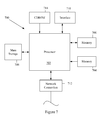
- FIG. 7 is a diagrammatic representation depicting a computer system.
- a processor is used in a variety of contexts. However, it will be appreciated that multiple processors can also be used while remaining within the scope of the present invention unless otherwise noted.
- the techniques and mechanisms of the present invention will sometimes describe two entities as being connected. It should be noted that a connection between two entities does not necessarily mean a direct, unimpeded connection, as a variety of other entities may reside between the two entities.
- a processor may be connected to memory, but it will be appreciated that a variety of bridges and controllers may reside between the processor and memory. Consequently, a connection does not necessarily mean a direct, unimpeded connection unless otherwise noted.
- XOR Exclusive OR
- P polynomial
- R Frame Check Sequence
- Galois field division is implemented using shift registers and Exclusive OR (XOR) gates in a variety of hardware devices. Division can be performed by performing an XOR, bit shifting, performing another XOR, bit shifting, etc. To increase efficiency, it is well recognized that the bits in R or in a CRC can be calculated by performing XOR computations of various data and polynomial bits simultaneously.
- XOR Exclusive OR
- a divisor is three bits (e.g. 101) and a dividend is six bits (e.g. 111001).
- a sequence of six bit XORs can be performed with bit shifting after each XOR.
- output bits can be determined by performing XOR operations on various polynomial and data bits.
- the techniques of the present invention contemplate generating centroids for a set of large XOR main expressions or main equations, where the centroids share a common set of input bits.
- the centroids are XOR subexpressions that are generated randomly. Each centroid is associated with a subset of the nearest main equations. Any subexpression that is generated and assigned as a center or near center for a subset of main equations is referred to herein as a centroid. Each centroid is adjusted until it is nearest the center of the cluster of main equations. The process is repeated with additional centroids being generated and associated with subsets of main equations until main equations are expressed entirely using centroids and a few remaining terms or residue.
- the techniques of the present invention recognize that XOR equations can be expressed using subexpressions with redundant terms, provided that a redundant term appears an even number of times over the subexpressions. It can therefore cover main equations with a smaller set of subexpressions than can conventional minimizers.
- a clustering algorithm determines the subexpressions from which the main equations are calculated.
- FIG. 1 is a diagrammatic representation showing CRC decomposition or factoring for implementation on programmable chips.
- Programmable chips use different types of resources that can be allocated to implement a programmable chip.
- the programmable chip uses logic elements for implementing each of the various components on the programmable chip.
- Some programmable chips also include preconfigured logic blocks as resources that can be allocated in different manners to run various subroutines.
- Logic elements typically can be implemented using components such as antifuses, static RAM, and EPROMS. Any mechanism on a programmable chip that performs an operation on a given number of input lines to provide one or more outputs based on information programmed is herein referred to as a logic element. Some logic elements are implemented as combinations of look up tables and switches for performing Boolean operations on input lines.
- a logic element includes a 16-bit SRAM lookup table (LUT) that can implement an arbitrary 4-input logic function, circuitry that forms a fast carry chain and a fast cascade chain, a register and preset/reset logic for the register.
- LUT 16-bit SRAM lookup table
- a logic element allows implementation of other fixed sized input logic functions.
- An XOR function 111 is implemented using multiple LUTs 101 and 103 .
- three input LUT 101 takes inputs d 1 , d 2 , d 3 and provides an output to LUT 103 .
- Four input LUT 103 takes inputs c 4 , c 5 , c 6 , and the output of LUT 101 and provides crc_out 2 .
- Large XORs often do not fit in a single LUT. For example, 32 bit data uses XORs with up to 34 inputs. A 128 bit data sequence uses an 89 input XOR.
- FIG. 2 is a diagrammatic representation showing main equations implemented using XOR gates.
- Main equation A ⁇ B ⁇ D ⁇ E ⁇ G ⁇ K ⁇ X ⁇ Z is implemented using XOR gate 201 .
- Main equation C ⁇ D ⁇ F ⁇ G ⁇ I ⁇ K ⁇ L ⁇ Z is implemented using XOR gate 203 .
- Main equation D ⁇ E ⁇ G ⁇ L ⁇ M ⁇ N ⁇ X ⁇ Z is implemented using XOR gate 205 .
- Main equation A ⁇ B ⁇ D ⁇ G ⁇ I ⁇ K ⁇ L ⁇ Z is implemented using XOR gate 207 .
- Implementing a large XOR gate with 8 inputs often require multiple lookup tables and/or multiple levels of lookup tables. For example, three lookup tables may be required to implement each main equation, resulting in a total requirement of 12 lookup tables. It is recognized that logic can be implemented more efficiently to reduce the number of lookup tables and the number of layers required.
- FIG. 3 is diagrammatic representation showing generated centroids.
- centroids are randomly generated and associated with various main equations.
- Randomly generated centroid 301 has inputs D, E, G, and K.
- Randomly generated centroid 303 has inputs E, G, L, W.
- main equations are associated with the nearest randomly generated centroids.
- the distance between a main equation and a centroid is the number of bit positions in which the main equation's vector and the centroid's vector differ.
- a main equation is matched with a centroid having the most common bit positions. If there is more than one candidate centroid (i.e. there is a tie), a centroid can be selected randomly or a main equation can be associated with the most popular centroid, or the main equation can be associated with the least popular centroids. A variety of tie-breaking criteria can be used.
- centroids in a set of generated centroids each have four bit positions.
- centroid 301 has inputs D, E, G, and K and centroids 303 has inputs E, G, L, and W.
- Each of the main equations is associated with either centroids 301 or centroids 303 .
- the results of the centroids can also be fed into flip flops to allow pipelining.
- FIG. 4 is a diagrammatic representation showing main equations associated with centroids.
- Main equation 401 has inputs A, B, D, E, G, K, X, and Z.
- Main equation 403 has inputs C, D, F, G, I, K, L, and Z.
- Main equation 405 has inputs D, E, G, L, M, N, X, and Z.
- Main equation 407 has inputs A, B, D, G, I, K, L, and Z.
- main equation 401 is compared to both centroid 301 and 303 .
- Centroid 301 includes inputs D, E, G, and K and centroid 303 includes inputs E, G, L, and W.
- main equation 401 is closer to centroid 301 , since main equation 401 and centroid 301 both have inputs D, E, G, and K. On the other hand, main equation 401 only shares inputs E and G with centroid 303 . Consequently, main equation 401 is associated with centroid 301 .
- main equation 403 is compared to both centroid 301 , where centroid 301 includes inputs D, E, G, and K and centroid 303 includes inputs E, G, L, and W. It is determined that main equation 403 is closer to centroid 301 , since main equation 403 and centroid 301 both have inputs D, G, and K. On the other hand, main equation 403 only shares inputs G and L with centroid 303 . Consequently, main equation 403 is associated with centroid 301 .
- main equation 405 is compared to both centroid 301 and centroid 303 . It is determined that main equation 405 is closer to centroid 303 , since main equation 405 and centroid 303 both have inputs E, G, and L. On the other hand, main equation 405 only shares inputs E and G with centroid 303 . Consequently, main equation 405 is associated with centroid 303 .
- main equation 407 is compared to both centroid 301 and centroid 303 . It is determined that main equation 407 is closer to centroid 301 , since main equation 407 and centroid 301 both have inputs D, G, and K. On the other hand, main equation 407 only shares inputs G and L with centroid 303 . Consequently, main equation 407 is associated with centroid 301 .
- each centroid is updated so that it is closer to the center of each associated subset of main equations.
- centroid 301 is updated into centroid 411 so that it resides closer to the middle of main equations 401 , 403 , and 407 .
- the inputs D, G, K, and Z are the most popular inputs for main equations 401 , 403 , and 407 .
- all of the main equations in the subset of main equations associated with centroid 301 have D, G, K, and Z.
- centroid 301 with inputs D, E, G, and K is modified into centroid 411 , with inputs D, G, K, and Z.
- the most popular inputs for a subset of main equations are selected as the updated values for an associated centroid.
- Main equation 405 associated with centroid 303 provides updated inputs to generated updated centroid 413 .
- Updated centroid 413 has inputs D, E, G, and L.
- another set of centroids are then generated and associated with main equations 401 , 403 , 405 , and 407 .
- the new set of centroids are then again updated based upon criteria such as the popularity of inputs in a particular subset of main equations.
- centroids are generated until all main equations are expressed as centroids and as residue or a few remaining inputs.
- centroid size is based at least partially upon the size of lookup tables. That is, it is recognized that it is efficient to be able to implement an XOR gate using a single lookup table. Consequently, a lookup table size of six may provide centroids with four inputs. In some examples, a lookup table size of eleven may provide centroids with eight inputs.
- FIG. 5 is a flow process diagram showing one technique for expressing XOR equations using centroids.
- C number of centroids are generated.
- C is a fraction of the number of main equations.
- C is one fourth of the number of main equations.
- C can also be based on the number of main equations and the number of inputs.
- main equations are associated with the nearest centroids.
- each main equation is matched with a centroid having the largest number of shared inputs.
- each centroid can be modified to be closer to the center of the associated main equations.
- centroids are modified to include the most popular input in an associated subset of main equations.
- centroid is modified to include D, G, L, and Y.
- the centroid size is limited to the size of an XOR expression that can fit in a single lookup table.
- an adjusted centroid has the shortest mean distance to all of the main equations in the subset of main equations.
- main equations in a subset of main equations that have a distance to an adjusted centroid greater than a threshold D are removed from the subset. For example, if a main equation only shares two inputs with an adjusted centroid, the main equation is not included in the subset and consequently not associated with the adjusted centroid.
- FIG. 6 is a diagrammatic representation showing implementation of a programmable chip.
- an input stage 601 receives selection information typically from a user for logic to be implemented on an electronic device.
- a generator program 605 creates a logic description and provides the logic description along with other customized logic to any of a variety of synthesis tools, place and route programs, and logic configuration tools to allow a logic description to be implemented on an electronic device.
- the input stage 601 may be a graphical user interface using wizards for allowing efficient or convenient entry of information.
- the input stage may also be a text interface or a program reading a data file such as a spreadsheet, database table, or schematic to acquire selection information.
- the input stage 601 produces an output containing information about the various modules selected.
- the generator program 605 can identify the selections and generate a logic description with information for implementing the various modules.
- the generator program 605 can be a Perl script creating HDL files such as Verilog, Abel, VHDL, and AHDL files from the module information entered by a user.
- the generator program identifies a portion of a high-level language program to accelerate. The other code is left for execution on a processor core.
- the generator program 605 identifies pointers and provides ports for each pointer.
- the generator program 605 also provides information to a synthesis tool 607 to allow HDL files to be automatically synthesized.
- a logic description is provided directly by a designer.
- Hookups between various components selected by a user are also interconnected by a generator program.
- Some of the available synthesis tools are Leonardo Spectrum, available from Mentor Graphics Corporation of Wilsonville, Oregon and Synplify available from Synplicity Corporation of Sunnyvale, Calif.
- the HDL files may contain technology specific code readable only by a synthesis tool.
- the HDL files at this point may also be passed to a simulation tool 609 .
- the input stage 601 , generator program 605 , and synthesis tool 607 can be separate programs.
- the interface between the separate programs can be a database file, a log, or simply messages transmitted between the programs.
- the input stage 601 can send messages directly to the generator program 605 to allow the generator program to create a logic description.
- the generator program can provide information directly to the synthesis tool instead of writing HDL files.
- input stage 601 , generator program 605 , and synthesis tool 607 can be integrated into a single program.
- a user may select various modules and an integrated program can then take the user selections and output a logic description in the form of a synthesized netlist without intermediate files.
- a logic description is an HDL file such as a VHDL, Abel, AHDL, or Verilog file.
- a logic description may be in various stages of processing between the user selection of components and parameters to the final configuration of the device.
- a logic description is a synthesized netlist such as an Electronic Design Interchange Format Input File (EDIF file).
- EDIF file is one example of a synthesized netlist file that can be output by the synthesis tool 607 .
- a synthesis tool 607 can take HDL files and output EDF files. Tools for synthesis allow the implementation of the logic design on an electronic device. Some of the available synthesis tools are Leonardo Spectrum, available from Mentor Graphics Corporation of Wilsonville, Oregon and Synplify available from Synplicity Corporation of Sunnyvale, Calif. Various synthesized netlist formats will be appreciated by one of skill in the art.
- a verification stage 613 typically follows the synthesis stage 607 .
- the verification stage checks the accuracy of the design to ensure that an intermediate or final design realizes the expected requirements.
- a verification stage typically includes simulation tools and timing analysis tools. Tools for simulation allow the application of inputs and the observation of outputs without having to implement a physical device. Simulation tools provide designers with cost effective and efficient mechanisms for both functional and timing verification of a design. Functional verification involves the circuit's logical operation independent of timing considerations. Parameters such as gate delays are disregarded.
- Timing verification involves the analysis of the design's operation with timing delays. Setup, hold, and other timing requirements for sequential devices such as flip-flops are confirmed.
- Some available simulation tools include Synopsys VCS, VSS, and Scirocco, available from Synopsys Corporation of Sunnyvale, Calif. and Cadence NC-Verilog and NC-VHDL available from Cadence Design Systems of San Jose, Calif.
- the synthesized netlist file can be provided to physical design tools 619 including place and route and configuration tools.
- a place and route tool typically locates logic cells on specific logic elements of a target hardware device and connects wires between the inputs and outputs of the various logic elements in accordance with logic required to implement an electronic design. The device can also be physically tested at 623 .
- a programmable logic configuration stage can take the output of the place and route tool to program the logic device with the user selected and parameterized modules.
- the place and route tool and the logic configuration stage are provided in the Quartus Development Tool, available from Altera Corporation of San Jose, Calif.
- the Quartus Development Tool available from Altera Corporation of San Jose, Calif.
- the input stage 601 , the generator program 605 , the synthesis tool 607 , the verification tools 613 , and physical design tools 619 are integrated into a single program.
- the various stages are automatically run and transparent to a user.
- the program can receive the user selected modules, generate a logic description depicting logic for implementing the various selected modules, and implement the electronic device.
- HDL files and EDIF files are mere examples of a logic description.
- Other file formats as well as internal program representations are other examples of a logic description.
- FIG. 7 illustrates a typical computer system that can be used to implement a programmable chip having shared I/O lines.
- the computer system 700 includes any number of processors 702 (also referred to as central processing units, or CPUs) that are coupled to devices including memory 706 (typically a random access memory, or “RAM”), memory 704 (typically a read only memory, or “ROM”).
- the processors 702 can be configured to generate a test sequences for any designated processor.
- memory 704 acts to transfer data and instructions uni-directionally to the CPU and memory 706 is used typically to transfer data and instructions in a bi-directional manner.
- a mass storage device 708 is also coupled bi-directionally to CPU 702 and provides additional data storage capacity and may include any of the computer-readable media described above.
- the mass storage device 708 may be used to store programs, data and the like and is typically a secondary storage medium such as a hard disk that is slower than memory.
- the mass storage device 708 can be used to hold a library or database of prepackaged logic or intellectual property functions, as well as information on generating particular configurations. It will be appreciated that the information retained within the mass storage device 708 , may, in appropriate cases, be incorporated in standard fashion as part of memory 706 as virtual memory.
- a specific mass storage device such as a CD-ROM 714 may also pass data uni-directionally to the CPU.
- CPU 702 is also coupled to an interface 710 that includes one or more input/output devices such as such as video monitors, track balls, mice, keyboards, microphones, touch-sensitive displays, transducer card readers, magnetic or paper tape readers, tablets, styluses, voice or handwriting recognizers, or other well-known input devices such as, of course, other computers.
- CPU 702 optionally may be coupled to a computer or telecommunications network using a network connection as shown generally at 712 . With such a network connection, it is contemplated that the CPU might receive information from the network, or might output information to the network in the course of performing the above-described method steps.
- the system 700 may also be associated with devices for transferring completed designs onto a programmable chip. The above-described devices and materials will be familiar to those of skill in the computer hardware and software arts.
- the hardware elements described above may be configured (usually temporarily) to act as multiple software modules for performing the operations of this invention.
- instructions for running a generator program, input stage (e.g., a wizard), and/or compiler may be stored on mass storage device 708 or 714 and executed on CPU 708 in conjunction with primary memory 706 .
Landscapes
- Engineering & Computer Science (AREA)
- Physics & Mathematics (AREA)
- Computing Systems (AREA)
- Probability & Statistics with Applications (AREA)
- Theoretical Computer Science (AREA)
- Computer Hardware Design (AREA)
- General Engineering & Computer Science (AREA)
- Mathematical Physics (AREA)
- Design And Manufacture Of Integrated Circuits (AREA)
Abstract
Description
q=d0^d1^d3^d4;
c0=d0^d1^d2; and
c1=d2^d3^d4;
(d0^d1^d2) ^(d2^d3^d4)=d0^d1^d3^d4
Claims (16)
Priority Applications (1)
| Application Number | Priority Date | Filing Date | Title |
|---|---|---|---|
| US11/567,709 US8255440B1 (en) | 2006-12-06 | 2006-12-06 | Increasing logic efficiency for exclusive OR (XOR) expressions |
Applications Claiming Priority (1)
| Application Number | Priority Date | Filing Date | Title |
|---|---|---|---|
| US11/567,709 US8255440B1 (en) | 2006-12-06 | 2006-12-06 | Increasing logic efficiency for exclusive OR (XOR) expressions |
Publications (1)
| Publication Number | Publication Date |
|---|---|
| US8255440B1 true US8255440B1 (en) | 2012-08-28 |
Family
ID=46689894
Family Applications (1)
| Application Number | Title | Priority Date | Filing Date |
|---|---|---|---|
| US11/567,709 Expired - Fee Related US8255440B1 (en) | 2006-12-06 | 2006-12-06 | Increasing logic efficiency for exclusive OR (XOR) expressions |
Country Status (1)
| Country | Link |
|---|---|
| US (1) | US8255440B1 (en) |
Cited By (1)
| Publication number | Priority date | Publication date | Assignee | Title |
|---|---|---|---|---|
| RU2546316C1 (en) * | 2013-12-03 | 2015-04-10 | Федеральное государственное бюджетное образовательное учреждение высшего профессионального образования "Ульяновский государственный технический университет" | Logic module |
Citations (2)
| Publication number | Priority date | Publication date | Assignee | Title |
|---|---|---|---|---|
| US7111273B1 (en) * | 2003-07-03 | 2006-09-19 | Xilinx, Inc. | Softpal implementation and mapping technology for FPGAs with dedicated resources |
| US20060230366A1 (en) * | 2005-03-22 | 2006-10-12 | International Business Machines Corporation | Method and system for reduction of XOR/XNOR subexpressions in structural design representations |
-
2006
- 2006-12-06 US US11/567,709 patent/US8255440B1/en not_active Expired - Fee Related
Patent Citations (2)
| Publication number | Priority date | Publication date | Assignee | Title |
|---|---|---|---|---|
| US7111273B1 (en) * | 2003-07-03 | 2006-09-19 | Xilinx, Inc. | Softpal implementation and mapping technology for FPGAs with dedicated resources |
| US20060230366A1 (en) * | 2005-03-22 | 2006-10-12 | International Business Machines Corporation | Method and system for reduction of XOR/XNOR subexpressions in structural design representations |
Non-Patent Citations (4)
| Title |
|---|
| Turner et al., Highly Efficient Limited Range Multipliers for LUT-Based FPGA Architectures, IEEE Transactions on Very Large Scale Integration (VLSI) Systems, vol. 12, No. 10, Oct. 2004, p. 1113-1117. * |
| Turner et al., Multiplier-less Realization of a Poly-phase Filter Using LUT-based FPGAs, 2002, Springer-Verlag Berlin Heidelberg, p. 192-201. * |
| U.S. Appl. No. 11/403,342, filed Apr. 12, 2006. |
| Valeri Tomashau, Efficient 4-input LUTs FPGA Implementation of Combinatorial Multiplier over Canonical Base GF(16), 2002, p. 318-321. * |
Cited By (1)
| Publication number | Priority date | Publication date | Assignee | Title |
|---|---|---|---|---|
| RU2546316C1 (en) * | 2013-12-03 | 2015-04-10 | Федеральное государственное бюджетное образовательное учреждение высшего профессионального образования "Ульяновский государственный технический университет" | Logic module |
Similar Documents
| Publication | Publication Date | Title |
|---|---|---|
| US8935645B2 (en) | Reconfigurable logic block | |
| US8024693B2 (en) | Congestion optimization during synthesis | |
| US9218444B2 (en) | Approximate circuits for increased reliability | |
| US8347192B1 (en) | Parallel finite field vector operators | |
| US7165229B1 (en) | Generating optimized and secure IP cores | |
| US7930521B1 (en) | Reducing multiplexer circuitry associated with a processor | |
| US9298865B1 (en) | Debugging an optimized design implemented in a device with a pre-optimized design simulation | |
| KR20140102290A (en) | Methods and systems for detection in a state machine | |
| US9740488B2 (en) | Processors operable to allow flexible instruction alignment | |
| US8436646B1 (en) | Reconfigurable logic block with user RAM | |
| US7840880B1 (en) | Methods and apparatus for error checking code computation | |
| US7290174B1 (en) | Methods and apparatus for generating test instruction sequences | |
| US8255440B1 (en) | Increasing logic efficiency for exclusive OR (XOR) expressions | |
| US20250181517A1 (en) | Processing of cryptographic hash instruction | |
| US8214419B2 (en) | Methods and apparatus for implementing a saturating multiplier | |
| US8429491B1 (en) | Methods and apparatus for error checking code decomposition | |
| US7472369B1 (en) | Embedding identification information on programmable devices | |
| US7574679B1 (en) | Generating cores using secure scripts | |
| US7581088B1 (en) | Conditional execution using an efficient processor flag | |
| US7475221B1 (en) | Circular buffer addressing | |
| US8977943B2 (en) | Implementation of CRC32 using carryless multiplier | |
| Bonnoit et al. | Using error correcting codes without speed penalty in embedded memories: Algorithm, implementation and case study | |
| CN114675803A (en) | Rounding circuit for floating-point mantissas | |
| US7358760B1 (en) | Efficient 4:1 multiplexer for programmable chips | |
| Gangandhar et al. | Custom Design of 16 Bit RISC Processor Using Low Power Pipelining |
Legal Events
| Date | Code | Title | Description |
|---|---|---|---|
| AS | Assignment |
Owner name: ALTERA CORPORATION, CALIFORNIA Free format text: ASSIGNMENT OF ASSIGNORS INTEREST;ASSIGNOR:BAIN, PETER;REEL/FRAME:018594/0097 Effective date: 20061204 |
|
| ZAAA | Notice of allowance and fees due |
Free format text: ORIGINAL CODE: NOA |
|
| ZAAB | Notice of allowance mailed |
Free format text: ORIGINAL CODE: MN/=. |
|
| STCF | Information on status: patent grant |
Free format text: PATENTED CASE |
|
| FPAY | Fee payment |
Year of fee payment: 4 |
|
| MAFP | Maintenance fee payment |
Free format text: PAYMENT OF MAINTENANCE FEE, 8TH YEAR, LARGE ENTITY (ORIGINAL EVENT CODE: M1552); ENTITY STATUS OF PATENT OWNER: LARGE ENTITY Year of fee payment: 8 |
|
| FEPP | Fee payment procedure |
Free format text: MAINTENANCE FEE REMINDER MAILED (ORIGINAL EVENT CODE: REM.); ENTITY STATUS OF PATENT OWNER: LARGE ENTITY |
|
| LAPS | Lapse for failure to pay maintenance fees |
Free format text: PATENT EXPIRED FOR FAILURE TO PAY MAINTENANCE FEES (ORIGINAL EVENT CODE: EXP.); ENTITY STATUS OF PATENT OWNER: LARGE ENTITY |
|
| STCH | Information on status: patent discontinuation |
Free format text: PATENT EXPIRED DUE TO NONPAYMENT OF MAINTENANCE FEES UNDER 37 CFR 1.362 |
|
| FP | Lapsed due to failure to pay maintenance fee |
Effective date: 20240828 |