US8255063B2 - Intracardial electrode line and cardiac stimulator - Google Patents
Intracardial electrode line and cardiac stimulator Download PDFInfo
- Publication number
- US8255063B2 US8255063B2 US12/268,946 US26894608A US8255063B2 US 8255063 B2 US8255063 B2 US 8255063B2 US 26894608 A US26894608 A US 26894608A US 8255063 B2 US8255063 B2 US 8255063B2
- Authority
- US
- United States
- Prior art keywords
- electrode line
- acceleration sensor
- ventricular
- implemented
- electrode
- Prior art date
- Legal status (The legal status is an assumption and is not a legal conclusion. Google has not performed a legal analysis and makes no representation as to the accuracy of the status listed.)
- Expired - Fee Related, expires
Links
- 230000000747 cardiac effect Effects 0.000 title claims abstract description 68
- 230000001133 acceleration Effects 0.000 claims abstract description 100
- 230000000638 stimulation Effects 0.000 claims abstract description 75
- 238000004458 analytical method Methods 0.000 claims description 21
- 230000000004 hemodynamic effect Effects 0.000 claims description 10
- 238000002592 echocardiography Methods 0.000 claims description 8
- 230000037081 physical activity Effects 0.000 claims description 8
- 210000003748 coronary sinus Anatomy 0.000 claims description 6
- 238000002513 implantation Methods 0.000 claims description 5
- 230000005540 biological transmission Effects 0.000 claims description 3
- 239000004020 conductor Substances 0.000 claims 4
- 230000035939 shock Effects 0.000 description 20
- 238000000034 method Methods 0.000 description 9
- 230000008602 contraction Effects 0.000 description 8
- 210000005241 right ventricle Anatomy 0.000 description 8
- 230000000875 corresponding effect Effects 0.000 description 6
- 210000005245 right atrium Anatomy 0.000 description 6
- 239000007943 implant Substances 0.000 description 5
- 210000005240 left ventricle Anatomy 0.000 description 5
- 238000002560 therapeutic procedure Methods 0.000 description 5
- 230000001746 atrial effect Effects 0.000 description 4
- 230000001419 dependent effect Effects 0.000 description 4
- 238000010586 diagram Methods 0.000 description 3
- 210000004165 myocardium Anatomy 0.000 description 3
- 230000004913 activation Effects 0.000 description 2
- 238000009530 blood pressure measurement Methods 0.000 description 2
- 229940030602 cardiac therapy drug Drugs 0.000 description 2
- 230000002596 correlated effect Effects 0.000 description 2
- 238000003384 imaging method Methods 0.000 description 2
- 230000010354 integration Effects 0.000 description 2
- 239000000523 sample Substances 0.000 description 2
- 230000004936 stimulating effect Effects 0.000 description 2
- 210000005242 cardiac chamber Anatomy 0.000 description 1
- 210000004413 cardiac myocyte Anatomy 0.000 description 1
- 238000002591 computed tomography Methods 0.000 description 1
- 230000007831 electrophysiology Effects 0.000 description 1
- 238000002001 electrophysiology Methods 0.000 description 1
- 230000005284 excitation Effects 0.000 description 1
- 210000005003 heart tissue Anatomy 0.000 description 1
- 238000002489 impedance cardiography Methods 0.000 description 1
- 210000005246 left atrium Anatomy 0.000 description 1
- 230000007774 longterm Effects 0.000 description 1
- 238000005259 measurement Methods 0.000 description 1
- 239000002184 metal Substances 0.000 description 1
- 238000012544 monitoring process Methods 0.000 description 1
- 230000002107 myocardial effect Effects 0.000 description 1
- 230000007935 neutral effect Effects 0.000 description 1
- 210000003492 pulmonary vein Anatomy 0.000 description 1
- 239000013598 vector Substances 0.000 description 1
- 210000003462 vein Anatomy 0.000 description 1
- 210000002620 vena cava superior Anatomy 0.000 description 1
Images


Classifications
-
- A—HUMAN NECESSITIES
- A61—MEDICAL OR VETERINARY SCIENCE; HYGIENE
- A61N—ELECTROTHERAPY; MAGNETOTHERAPY; RADIATION THERAPY; ULTRASOUND THERAPY
- A61N1/00—Electrotherapy; Circuits therefor
- A61N1/18—Applying electric currents by contact electrodes
- A61N1/32—Applying electric currents by contact electrodes alternating or intermittent currents
- A61N1/36—Applying electric currents by contact electrodes alternating or intermittent currents for stimulation
- A61N1/362—Heart stimulators
- A61N1/365—Heart stimulators controlled by a physiological parameter, e.g. heart potential
- A61N1/36514—Heart stimulators controlled by a physiological parameter, e.g. heart potential controlled by a physiological quantity other than heart potential, e.g. blood pressure
- A61N1/36542—Heart stimulators controlled by a physiological parameter, e.g. heart potential controlled by a physiological quantity other than heart potential, e.g. blood pressure controlled by body motion, e.g. acceleration
-
- A—HUMAN NECESSITIES
- A61—MEDICAL OR VETERINARY SCIENCE; HYGIENE
- A61N—ELECTROTHERAPY; MAGNETOTHERAPY; RADIATION THERAPY; ULTRASOUND THERAPY
- A61N1/00—Electrotherapy; Circuits therefor
- A61N1/02—Details
- A61N1/04—Electrodes
- A61N1/05—Electrodes for implantation or insertion into the body, e.g. heart electrode
- A61N1/056—Transvascular endocardial electrode systems
Definitions
- the invention relates to an electrode line for an implantable cardiac stimulator for delivering electrical stimulation pulses for therapy of a heart, e.g., cardial resynchronization therapy (CRT) of a heart, as well as such a cardiac stimulator itself.
- the cardiac stimulator may be a cardiac pacemaker or an implantable cardioverter/defibrillator (ICD) or a combination of both, which is capable of stimulating both ventricles of a heart.
- ICD implantable cardioverter/defibrillator
- a cardiac stimulator of this type typically has at least one right-ventricular sensing unit and one right-ventricular stimulation unit as well as one left-ventricular sensing unit and one left-ventricular stimulation unit. These units are each connected in operation of the cardiac stimulator via electrode lines to electrodes to be implanted at suitable points in the heart.
- the electrode line having the electrodes for detecting electrical potentials in the left ventricle of the heart and for delivering left-ventricular stimulation pulses are typically a component of a left-ventricular electrode line, which is laid through the coronary sinus of a heart and is therefore also referred to as a coronary sinus electrode line.
- the electrodes for detecting electrical potentials in the right ventricle and for delivering right-ventricular stimulation pulses are typically fastened to a right-ventricular electrode line whose distal end extends up into the apex of the right ventricle.
- the electrode lines are typically connected at their proximal end via standardized plug connections to a corresponding cardiac stimulator.
- VVI, VVD, or DDD right-ventricular cardiac stimulator
- DDD right-ventricular cardiac stimulator
- the cardiac stimulator discussed here is preferably a biventricular cardiac stimulator which is fundamentally capable of stimulating both ventricles of the heart continuously or on demand.
- the impedance-based methods have the disadvantage that the hemodynamic variables may only be derived indirectly here and thus the disadvantage of replicability exists. The question always arises as to whether the physician believes in these methods.
- Integrating an acceleration sensor (accelerometer) in intracardial electrode line which provides information about the movement of the electrode line, which correlates to a certain degree with the movement of a particular heart part, see, for example, US 2004/0172078, US 2004/0172079, and US 2005/0027320, has already been suggested. Furthermore, in “An Implantable Intracardiac Accelerometer for Monitoring Myocardial Contractility”, Pacing and Clinical Electrophysiology 19 (12), pages 2066-2071, a direction-independent application of an accelerometer integrated in the electrode has been described. In spite of the results, which were already published in 1996, up to this point there has been no successful commercial usage of the concept.
- the object of the invention is to detect information for an electronic implant about the hemodynamic status and its changes in a significantly improved way, which is more strongly correlated than already known methods.
- the invention is preferably also to solve the problem that the methods known up to this point were not able to be replicated by the user in their action and therefore were frequently rejected.
- the inventor has come to the finding that without directional information in regard to detected acceleration values, a correlation of the perceived wall movement to the accelerometer signal (output signal of the acceleration sensor/accelerometer) is only possible in a restricted way.
- the achievement of the above-mentioned object comprises an electrode line having a proximal end which is implemented to connect the electrode line to an implantable medical device, in particular a cardiac pacemaker or cardioverter/defibrillator or the like, as well as a distal end, which carries at least one electrode for delivering stimulation pulses or for recording intracardial electrical signals, as well as an acceleration sensor, the acceleration sensor being implemented to record acceleration values in at least two different directions and thus being able to detect direction-dependent acceleration values and output corresponding accelerometer output signals.
- an implantable medical device in particular a cardiac pacemaker or cardioverter/defibrillator or the like
- a distal end which carries at least one electrode for delivering stimulation pulses or for recording intracardial electrical signals
- an acceleration sensor being implemented to record acceleration values in at least two different directions and thus being able to detect direction-dependent acceleration values and output corresponding accelerometer output signals.
- the electrode line preferably has a plug contact on its proximal end and an electrical line (e.g., in the form of an electrically conductive wire), which electrically connects a contact surface of the plug contact to the electrode.
- the acceleration sensor is connected to a modulator, and the modulator is in turn connected to the electrical line, the modulator being implemented to give an output signal of the acceleration sensor to the electrical line in modulated form.
- the accelerometer output signals may be transmitted wire-bound from the acceleration sensor to a cardiac stimulator, which is possibly connected to the electrode line, without having to provide further electrical lines in the electrode line.
- the acceleration sensor may also be connected to a transmitter for the wireless transmission of the output signals of the acceleration sensor.
- a cardiac stimulation configuration having a cardiac stimulator connected to the electrode line may be provided, which information based on the actual mechanical dynamics of the heart muscle having direct correlation to the hemodynamics, which may be used directly as a diagnostic variable or as a control variable for the therapy control of the electronic implant.
- the implantation procedure is not changed by this additional sensor due to the integration of the sensor in an electrode to be implemented in any case.
- altered terminal technology for the existing implants is not necessary if the sensor is integrated in a bipolar probe (IS-1 standard).
- the electrode line is preferably implemented as a left-ventricular electrode line for implantation through the coronary sinus and is used for stimulation of the left ventricle of a heart.
- the invention presented here comprises the integration of a direction-dependent acceleration sensor in an intracardial electrode line, the left-ventricular electrode line (e.g., CS electrode line) therefore being preferred, because the left-ventricular dynamics correspond to the greatest correlation with the overall hemodynamics.
- the integrated acceleration sensor also delivers the direction of the acceleration in at least 2 vectors in addition to the acceleration information.
- the cardiac stimulator or implantable monitor connected to this electrode line operation is, in addition to the normal intracardial electrogram signals, additionally to analyze the accelerometer output signal of the direction-dependent acceleration sensor integrated in the electrode and provide it to an analysis and control unit at least as diagnostic information or also as a control signal for the therapy of the electronic implant
- the electrode line has at least one radioopaque or echogenic section in the area of its distal end, which is well recognizable using imaging methods such as computer tomography or also echocardiography.
- imaging methods such as computer tomography or also echocardiography.
- the right-ventricular electrode line also carries a right-ventricular acceleration sensor, which is implemented to record acceleration values in at least two different directions, in the area of its distal end in this case.
- the direction-related acceleration information ensures a reliable distance measurement of two implanted probes. Without the direction information, opposing movements could not be differentiated from movements in the same direction.
- the accelerometer output signals of the two acceleration sensor situated in the different electrode lines primarily allow the distance change of the distal ends of the electrode lines to be calculated from the detected acceleration values. This is sufficient to detect short-term changes of the hemodynamics.
- a calibration of this system may additionally be performed with the aid of echocardiography, for example.
- a comparison to reference curves (see also below), which were recorded at defined phases (e.g., at rest) may also be performed.
- the right-ventricular electrode line also has a plug contact on its proximal end and an electrical line which electrically connects a contact surface of the plug contact to an electrode in the area of the distal end of the right-ventricular electrode line.
- the right-ventricular acceleration sensor is preferably also connected to a modulator, which is in turn connected to the electrical lines provided in any case, so that no additional lines are necessary. This is possible because the modulator gives a particular accelerometer output signal of the acceleration sensor in modulated form to the electrical line, so that it is to be transmitted in addition to possible stimulation pulses via the same line (or the same line pair).
- a transmitter for the wireless transmission of the output signals of the acceleration sensor may also be connected to the right-ventricular acceleration sensor.
- a further acceleration sensor is preferably integrated in a housing of the cardiac stimulator.
- a compensation of the superimposed movement of the patient may then be performed via analysis of the accelerometer output signals of the acceleration sensor additionally integrated in the housing of the cardiac stimulator.
- the cardiac stimulator additionally preferably has an analysis unit which is connected or is to be connected at least indirectly to the acceleration sensor and which is implemented to analyze a particular accelerometer output signal by a comparison to reference curves stored in the cardiac stimulator, the stored reference curves having been obtained under defined conditions, e.g., at rest or by the physician in the context of an echocardiography examination.
- FIG. 1 shows a schematic illustration of a cardiac therapy system
- FIG. 2 shows an illustration of a cardiac stimulator having connected electrodes situated in the heart
- FIG. 3 shows a schematic block diagram of a cardiac stimulator
- FIG. 4 shows a schematic block diagram for more detailed explanation of the cardiac stimulator according to the invention against the background of the block diagram from FIG. 3 ;
- FIG. 5 shows a longitudinal section through the distal end of an electrode line, to be implanted by stylet, having acceleration sensor;
- FIG. 6 shows a longitudinal section through the distal end of an electrode line, to be implanted by stylet, having acceleration sensor.
- FIG. 1 A cardiac therapy system is shown for overview in FIG. 1 , which comprises, in addition to an implanted cardiac pacemaker 10 , an external device (patient device) 90 and service center 92 , symbolically shown by a server.
- the implantable cardiac stimulator 10 has a telemetry unit, for which it may exchange data wirelessly with the external device 90 .
- the external device 90 is, for example, connected wire-bound to the service center 92 , so that overall data may be exchanged between the service center 92 and the implantable cardiac stimulator 10 via the external device 90 as the relay station.
- a physician team 94 may search the data which the service center 92 has received from the implantable cardiac stimulator 10 via a data-technology access to the service center 92 .
- FIG. 2 shows the implantable cardiac stimulator 10 in the form of a three-chamber cardiac pacemaker/cardioverter/defibrillator having electrode lines 14 , 16 , and 30 connected thereto, in connection with a heart 12 .
- the external device 90 is shown once again in proximity to the implanted cardiac stimulator 10 .
- the electrode lines 14 , 16 , and 30 are electrically connected via known, standardized plug connections to contact sockets in a header (terminal housing) 11 of the cardiac stimulator 10 .
- the electrode lines 14 , 16 , and 30 are also connected to electronic components in the interior of a hermetically sealed metal housing 42 of the cardiac stimulator 10 . These components are schematically shown in greater detail hereafter and determine the mode of operation of the cardiac stimulator 10 according to the invention.
- the electrode line 14 is a right-atrial electrode line and has an atrial tip electrode RA tip 22 on its distal end and, at a short distance therefrom, an atrial ring electrode RA ring 24 , which are both placed in the right atrium 26 of the heart 12 .
- the electrode line 16 is a right-ventricular electrode line and has a right-ventricular tip electrode RV tip 18 on its distal end and, in direct proximity thereto, a right-ventricular ring electrode RV ring 20 . Both electrodes are situated in the apex of the right ventricle 28 of the heart 12 .
- the right-ventricular electrode line 16 also has a right-ventricular shock coil RV shock 38 as a large-area electrode for delivering relation shocks.
- RV shock 38 is situated in the superior vena cava and is therefore also referred to hereafter as the SVC shock electrode.
- An acceleration sensor 72 is integrated in the right-ventricular electrode line 16 in the area of the distal end of the right-ventricular electrode line 16 , which is connected via a modulator (not shown) to an electrical line, which also electrically connects one of the electrodes 18 or 20 to a contact surface of a terminal plug at the proximal end of the right-ventricular electrode line 16 .
- the electrode line 30 is a left-ventricular electrode line, on whose distal end a left-ventricular tip electrode LV tip 34 is situated, and, in proximity thereto, a left-ventricular ring electrode LV ring 32 .
- the left-ventricular electrode line 30 carries a left-ventricular shock coil (not identified in greater detail, but shown in FIG. 2 ) for delivering defibrillation shocks to the left ventricle.
- the left-ventricular electrode line 30 is led out from the right atrium 26 of the heart 12 via the coronary sinus into a lateral vein branching therefrom and is therefore also referred to as the coronary sinus electrode line or CS electrode line.
- An acceleration sensor 74 is also integrated in the left-ventricular electrode line 30 , which is also connected via a modulator (not shown) to an electrical line, which also electrically connects one of the electrodes 32 or 34 to a contact surface of a terminal plug at the proximal end of the left-ventricular electrode line 30 .
- the main components of the cardiac stimulator 10 are shown in FIG. 3 .
- the electrical terminals for the various electrodes 18 , 20 , 22 , 24 , 32 , 34 , 38 , and 40 are shown on the left side.
- the shock electrodes 38 and 40 are each connected to a right-ventricular shock pulse generator 50 or SVC shock generator 52 .
- Both shock generators 50 and 52 are connected to a stimulation control unit 54 , which activates the two shock pulse generators 50 and 52 upon demand to generate and deliver a defibrillation shock.
- the terminal for the right-ventricular tip electrode RV tip and the terminal for the right-ventricular ring electrode RV ring are each connected to both a right-ventricular stimulation unit 56 and also a right-ventricular sensing unit 58 . Both the right-ventricular stimulation unit 56 and also the right-ventricular sensing unit 58 are connected to the stimulation control unit 54 .
- the right-ventricular stimulation unit 56 is implemented to generate a right-ventricular stimulation pulse upon an activation signal of the stimulation control unit 54 and deliver it via the terminals of the right-ventricular ring electrode RV ring and the right-ventricular tip electrode RV tip.
- the housing 42 of the cardiac stimulator 10 forms a neutral electrode and the right-ventricular stimulation unit 56 is connected to the terminal for the right-ventricular tip electrode RV tip and the housing 42 as the other electrode to deliver a stimulation pulse.
- a right-ventricular stimulation pulse differs from a defibrillation shock in that the stimulation pulse has a significantly lower pulse strength, so that it does not excite all of the cardiac tissue (myocardium) of a ventricle at once like a defibrillation shock, but rather only the cardiac muscle cells in the immediate surroundings of the right-ventricular tip electrode RV tip 18 . This excitation then propagates further over the entire ventricle by natural stimulation conductance and thus ensures a stimulated contraction of the ventricle.
- the right-ventricular sensing unit 58 is implemented to first amplify and filter electrical potentials applied to the terminal for the right-ventricular ring electrode RV ring and the right-ventricular tip electrode RV tip by an input amplifier. Furthermore, the right-ventricular sensing unit 58 is implemented to analyze the curve of the electrical signals applied to its inputs in such a way that the right-ventricular sensing unit 58 independently detects a natural (intrinsic), i.e., independent contraction of the right ventricle. This may occur, for example, in that the curve of the signal applied to the inputs of the right-ventricular sensing unit 58 is compared to a threshold value.
- the greatest amplitude of the signal in the form of the so-called R wave is typically characteristic for a natural contraction of the right ventricle, which may be detected by threshold value comparison.
- the right-ventricular sensing unit 58 then outputs a corresponding output signal indicating a natural contraction of the right ventricle to the stimulation control unit 54 .
- the terminal for the right-atrial tip electrode RA tip and the terminal for the right-atrial ring electrode RA ring are connected in a similar way to a right-atrial stimulation unit 60 and also to a right-atrial sensing unit 62 , which are each in turn connected to the stimulation control unit 54 .
- the right-atrial stimulation unit 60 is implemented to generate stimulation pulses whose strength is sufficient to excite the right-atrial myocardium.
- the right-atrial stimulation pulses may have a different pulse strength than the right-ventricular stimulation pulses.
- the right-atrial sensing unit 62 is implemented to detect a so-called P wave from the curve of the differential signal applied to its inputs, which characterizes a natural (intrinsic) contraction of the right atrium. If the right-atrial sensing unit 62 detects a corresponding P wave, it generates an output signal, which characterizes a natural contraction of the right atrium, and relays it to the stimulation control unit 54 .
- the terminal for the left-ventricular tip electrode LV tip and the terminal for the left-ventricular ring electrode LV range are connected to a left-ventricular stimulation unit 64 and a left-ventricular sensing unit 66 .
- the left-ventricular stimulation unit 64 and the left-ventricular sensing unit 66 are also connected to the stimulation control unit 54 . Both function similarly to the stimulation units 56 and 60 and sensing units 58 and 62 already described.
- the terminals for the left-ventricular tip electrode LV tip and the left-ventricular ring electrode LV ring are connected to a left-ventricular accelerometer analysis unit LV-AKZ 76 .
- the left-ventricular accelerometer analysis unit 76 is implemented to amplify and modulate the modulated accelerometer output signal of the left-ventricular acceleration sensor 74 with the aid of the modulator integrated in the left-ventricular electrode line 30 and finally analyze it.
- the left-ventricular accelerometer analysis unit 76 finally generates an output signal which is fed to the control unit CTRL 54 for further analysis.
- the accelerometer output signal fed back in this way is direction-dependent, i.e., the dimension of the output signal is a function of the direction in which an acceleration force acts on the acceleration sensor 74 .
- the acceleration sensor 74 is implemented to generate two accelerometer output signals, which each represent acceleration values for two different directions.
- a right-ventricular accelerometer analysis unit may also be provided to be able to analyze output signals of the right-ventricular acceleration sensor 72 . However, this is not shown in FIG. 3 .
- a further acceleration sensor 78 is connected to the stimulation control unit 54 and integrated in the housing 42 of the cardiac stimulator 10 .
- the acceleration sensor 78 is implemented to detect a movement signal as a function of the physical activity of a patient and output a corresponding first accelerometer output signal, which indicates the physical activity of the patient, to the stimulation control unit 54 . This allows it, upon the analysis of the accelerometer output signals of the right-ventricular acceleration sensor 72 and the left-ventricular acceleration sensor 74 , to compensate for the movement of the patient superimposed on the intrinsic cardiac movement by analysis of the signals of the additional acceleration sensor 78 integrated in the housing of the electronic implant.
- the cardiac stimulator 10 comprises a storage unit 80 , which is connected to the stimulation control unit 54 and allows it to store signals generated or analyzed by the stimulation control unit 54 .
- the storage unit 80 allows it to store control programs for the stimulation control unit 54 in changeable form.
- the storage unit 80 is used in the context of the present invention in particular for the purpose of storing comparison curves (reference curves) for the analysis of the accelerometer output signals of the acceleration sensors. These comparison curves are recorded with the aid of echocardiography under predefined conditions (e.g., rest) and subsequently stored in the storage unit 80 .
- the stimulation control unit 54 is connected to a timer 84 .
- the storage unit 80 is connected to a telemetry unit 82 , which allows it to transmit data stored in the storage unit 80 wirelessly to the external device 100 or to transmit programming commands on the part of the external device 100 to the cardiac stimulator 10 and store them in the storage unit 80 .
- the cardiac stimulator 10 is capable of performing a stimulation of the right atrium, the right ventricle, and the left ventricle, or also only one or two of these heart chambers in a way known per se. This particularly includes the stimulation of a particular ventricle in the demand mode, in which stimulation pulses are only delivered to the particular ventricle if no intrinsic contraction of the particular ventricle is detected in a preceding particular escape interval on the part of the particular sensing unit.
- the cardiac stimulator is thus capable of performing the known right-ventricular stimulation modes such as VVI, VVD, or DDD.
- an interventricular delay time is significant, i.e., the time with which a right stimulation pulse and a less stimulation pulse follow one another (if they are not inhibited in the demand mode). This time may be greater than 0, so that the left stimulation pulse follows the right stimulation pulse.
- the interventricular delay time may be 0, which means that a right-ventricular stimulation pulse and a left-ventricular stimulation pulse are delivered simultaneously by simultaneous activation of the right-ventricular stimulation unit 56 and the left-ventricular stimulation unit 64 by the stimulation control unit 54 .
- the interventricular delay time may also be less than 0, which means that a left-ventricular stimulation pulse is delivered before the delivery of the associated right-ventricular stimulation pulse.
- FIG. 4 shows the components of a channel, in this case the left-ventricular channel, which is indicated in FIG. 3 by a dotted line and comprises both a left-ventricular sensing unit 66 and also the left-ventricular accelerometer analysis unit 76 , in a more detailed illustration.
- the left-ventricular sensing unit 66 it may be seen from FIG. 4 that it comprises an input amplifier 80 , an analog-digital converter 82 , and finally a digital filter 86 , whose output value is fed to a sensing function block of the control unit 54 .
- the accelerometer analysis unit 76 it may be seen from FIG. 4 that it also comprises a signal amplifier 90 , whose output signal is fed to an analog-digital converter and demodulator 92 .
- the analog-digital converter and demodulator 92 is implemented in particular to reclaim a demodulated signal from the modulated accelerometer output signal received via the electrode line and in particular to obtain two different output signals for two different acceleration directions by demodulation.
- the output signal of the analog-digital converter and demodulator unit 92 is fed to an accelerometer signal filter 94 and digitally filtered thereby.
- the output signal of a sensing filter of the sense unit 66 is also fed to the accelerometer signal filter 94 .
- the accelerometer signal filter 94 is connected to the accelerometer 72 integrated in the housing 42 of the cardiac stimulator 10 , via a second accelerometer signal amplifier 96 , an analog-digital converter 98 connected thereto, and a second accelerometer signal filter 100 .
- FIG. 5 shows a distal end of a typical electrode line to be implanted with the aid of a stylet.
- This line has a tip electrode on the far right side of the figure and a ring electrode 114 .
- a liquid-tight envelope 116 seals the electrode line 110 in relation to the surroundings.
- a wire coil 118 is situated inside the envelope 116 , which provides the electrode line 110 with mechanical stability and is simultaneously used as an electrical supply line.
- a double acceleration sensor 120 i.e., 120 . 1 and 120 . 2 as illustrated
- is integrated directly adjoining the tip electrode 112 in the electrode line 110 which has two acceleration pickups 120 . 1 and 120 . 2 , which record acceleration values in different directions. These acceleration pickups 120 . 1 and 120 .
- a modulator (not shown) to the wire coil 118 of the electrode line 110 and in this way may modulate an output signal of the acceleration sensor 120 and transmit it to a contact (not shown) of an electrode line plug via the wire coil 118 .
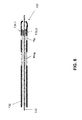
- FIG. 6 shows a longitudinal section through the distal end of an alternative electrode line. This differs from the electrode line 110 in that it is implantable with the aid of a guide wire 132 and has an open distal end 134 for this purpose.
- An acceleration sensor 136 having two acceleration pickups 136 . 1 and 136 . 2 , which each deliver acceleration values for different acceleration directions, is again situated in the area of this open distal end 134 .
- These two acceleration pickups 136 . 1 and 136 . 2 are also connected via a modulator (not shown) to a wire coil 138 in the interior of the electrode line 130 .
- cardiac stimulator 11 header (terminal housing) 12 heart 14 right-atrial electrode line 16 right-ventricular electrode line 18 right-ventricular tip electrode RV tip 20 right-ventricular ring electrode RV ring 22 atrial tip electrode RA tip 24 atrial ring electrode RA ring 26 right atrium 28 right ventricle 30 left-ventricular electrode line 32 left-ventricular ring electrode LV ring 34 left-ventricular tip electrode LV tip 38 right-ventricular shock coil RV shock 40 shock coil 42 housing 50 right-ventricular shock pulse generator 52 svc shock pulse generator 54 stimulation control unit 56 right-ventricular stimulation unit 58 right-ventricular sensing unit 60 right-atrial stimulation unit 62 right-atrial sensing unit 64 left-ventricular stimulation unit 66 left-ventricular sensing unit 72 right-ventricular acceleration sensor 74 left-ventricular acceleration sensor 76 accelerometer analysis unit 78 acceleration sensor integrated in the housing 80 storage unit 82 telemetry unit 84 timer 86 external device 88 service center 89 physician team 90 signal amplifier 92 demodulator 94 accelerometer signal filter 96 accelerometer signal amplifier 98 analog-digital
Landscapes
- Health & Medical Sciences (AREA)
- Heart & Thoracic Surgery (AREA)
- Cardiology (AREA)
- Life Sciences & Earth Sciences (AREA)
- General Health & Medical Sciences (AREA)
- Engineering & Computer Science (AREA)
- Biomedical Technology (AREA)
- Nuclear Medicine, Radiotherapy & Molecular Imaging (AREA)
- Radiology & Medical Imaging (AREA)
- Animal Behavior & Ethology (AREA)
- Public Health (AREA)
- Veterinary Medicine (AREA)
- Biophysics (AREA)
- Physiology (AREA)
- Hematology (AREA)
- Vascular Medicine (AREA)
- Electrotherapy Devices (AREA)
Abstract
Description
| Reference numeral | Meaning |
| 10 | cardiac stimulator |
| 11 | header (terminal housing) |
| 12 | heart |
| 14 | right-atrial electrode line |
| 16 | right-ventricular electrode line |
| 18 | right-ventricular tip electrode RV tip |
| 20 | right-ventricular ring electrode RV ring |
| 22 | atrial tip electrode RA tip |
| 24 | atrial ring electrode RA ring |
| 26 | right atrium |
| 28 | right ventricle |
| 30 | left-ventricular electrode line |
| 32 | left-ventricular ring electrode LV ring |
| 34 | left-ventricular tip electrode LV tip |
| 38 | right-ventricular shock coil RV shock |
| 40 | shock coil |
| 42 | housing |
| 50 | right-ventricular shock pulse generator |
| 52 | svc shock pulse generator |
| 54 | stimulation control unit |
| 56 | right-ventricular stimulation unit |
| 58 | right-ventricular sensing unit |
| 60 | right-atrial stimulation unit |
| 62 | right-atrial sensing unit |
| 64 | left-ventricular stimulation unit |
| 66 | left-ventricular sensing unit |
| 72 | right-ventricular acceleration sensor |
| 74 | left-ventricular acceleration sensor |
| 76 | accelerometer analysis unit |
| 78 | acceleration sensor integrated in the housing |
| 80 | storage unit |
| 82 | telemetry unit |
| 84 | timer |
| 86 | external device |
| 88 | service center |
| 89 | physician team |
| 90 | signal amplifier |
| 92 | demodulator |
| 94 | accelerometer signal filter |
| 96 | accelerometer signal amplifier |
| 98 | analog-digital converter |
| 100 | second accelerometer signal filter |
| 108 | stylet |
| 110 | stylet-implantable electrode line (distal end) |
| 112 | tip electrode |
| 114 | ring elektrode |
| 116 | envelope |
| 118 | wire coil |
| 120 | acceleration sensor |
| 130 | over-the-wire electrode line (distal end) |
| 132 | guide wire |
| 134 | open distal end |
| 136 | acceleration sensor |
| 138 | wire coil |
Claims (11)
Applications Claiming Priority (3)
| Application Number | Priority Date | Filing Date | Title |
|---|---|---|---|
| DE102007057227 | 2007-11-28 | ||
| DE102007057227.3A DE102007057227B4 (en) | 2007-11-28 | 2007-11-28 | Cardiac stimulation arrangement |
| DE102007057227.3 | 2007-11-28 |
Publications (2)
| Publication Number | Publication Date |
|---|---|
| US20090138060A1 US20090138060A1 (en) | 2009-05-28 |
| US8255063B2 true US8255063B2 (en) | 2012-08-28 |
Family
ID=40451025
Family Applications (1)
| Application Number | Title | Priority Date | Filing Date |
|---|---|---|---|
| US12/268,946 Expired - Fee Related US8255063B2 (en) | 2007-11-28 | 2008-11-11 | Intracardial electrode line and cardiac stimulator |
Country Status (3)
| Country | Link |
|---|---|
| US (1) | US8255063B2 (en) |
| EP (1) | EP2065071A1 (en) |
| DE (1) | DE102007057227B4 (en) |
Cited By (1)
| Publication number | Priority date | Publication date | Assignee | Title |
|---|---|---|---|---|
| US20120150060A1 (en) * | 2010-12-10 | 2012-06-14 | Pacesetter, Inc. | Method and system to estimate impedance of a pseudo sensing vector |
Families Citing this family (3)
| Publication number | Priority date | Publication date | Assignee | Title |
|---|---|---|---|---|
| EP2433565B1 (en) | 2010-09-28 | 2015-06-03 | BIOTRONIK SE & Co. KG | Implantable medical device |
| EP2510975A1 (en) | 2011-04-14 | 2012-10-17 | BIOTRONIK SE & Co. KG | Cardiac stimulator |
| DE102015109037A1 (en) * | 2015-06-09 | 2016-12-15 | Biotronik Se & Co. Kg | Rate-adaptive intra- or epicardial cardiac stimulator and activity sensor |
Citations (12)
| Publication number | Priority date | Publication date | Assignee | Title |
|---|---|---|---|---|
| EP0727242A2 (en) | 1995-02-17 | 1996-08-21 | Pacesetter, Inc. | Motion sensor for implantable medical device |
| US5628777A (en) | 1993-07-14 | 1997-05-13 | Pacesetter, Inc. | Implantable leads incorporating cardiac wall acceleration sensors and method of fabrication |
| WO1999013940A1 (en) | 1997-09-12 | 1999-03-25 | Intermedics, Inc. . | Implantable medical device with electromagnetic acceleration transducer |
| US20030105496A1 (en) | 2001-12-05 | 2003-06-05 | Cardiac Pacemakers, Inc. | Cardiac resynchronization system employing mechanical measurement of cardiac walls |
| US20040172079A1 (en) | 2003-02-28 | 2004-09-02 | Medtronic, Inc. | Method and apparatus for optimizing cardiac resynchronization therapy based on left ventricular acceleration |
| US20040172078A1 (en) | 2003-02-28 | 2004-09-02 | Medtronic, Inc. | Method and apparatus for assessing left ventricular function and optimizing cardiac pacing intervals based on left ventricular wall motion |
| US20050027320A1 (en) | 2003-07-30 | 2005-02-03 | Medtronic, Inc. | Method of optimizing cardiac resynchronization therapy using sensor signals of septal wall motion |
| US20050137671A1 (en) | 2003-12-23 | 2005-06-23 | Lili Liu | His bundle mapping, pacing, and injection method and lead |
| US7024244B2 (en) * | 2002-04-22 | 2006-04-04 | Medtronic, Inc. | Estimation of stroke volume cardiac output using an intracardiac pressure sensor |
| US20060178586A1 (en) * | 2005-02-07 | 2006-08-10 | Dobak John D Iii | Devices and methods for accelerometer-based characterization of cardiac function and identification of LV target pacing zones |
| WO2006113659A1 (en) | 2005-04-19 | 2006-10-26 | Medtronic, Inc. | Pacemaker lead with motion sensor |
| US20080039904A1 (en) * | 2006-08-08 | 2008-02-14 | Cherik Bulkes | Intravascular implant system |
Family Cites Families (2)
| Publication number | Priority date | Publication date | Assignee | Title |
|---|---|---|---|---|
| US6490486B1 (en) * | 2000-04-27 | 2002-12-03 | Pacesetter, Inc. | Implantable cardiac stimulation device and method that monitors displacement of an implanted lead |
| US7142919B2 (en) * | 2003-10-24 | 2006-11-28 | Medtronic, Inc. | Reconfigurable, fault tolerant multiple-electrode cardiac lead systems |
-
2007
- 2007-11-28 DE DE102007057227.3A patent/DE102007057227B4/en active Active
-
2008
- 2008-10-29 EP EP08167840A patent/EP2065071A1/en not_active Withdrawn
- 2008-11-11 US US12/268,946 patent/US8255063B2/en not_active Expired - Fee Related
Patent Citations (13)
| Publication number | Priority date | Publication date | Assignee | Title |
|---|---|---|---|---|
| US5628777A (en) | 1993-07-14 | 1997-05-13 | Pacesetter, Inc. | Implantable leads incorporating cardiac wall acceleration sensors and method of fabrication |
| EP0727242A2 (en) | 1995-02-17 | 1996-08-21 | Pacesetter, Inc. | Motion sensor for implantable medical device |
| WO1999013940A1 (en) | 1997-09-12 | 1999-03-25 | Intermedics, Inc. . | Implantable medical device with electromagnetic acceleration transducer |
| US20030105496A1 (en) | 2001-12-05 | 2003-06-05 | Cardiac Pacemakers, Inc. | Cardiac resynchronization system employing mechanical measurement of cardiac walls |
| US7024244B2 (en) * | 2002-04-22 | 2006-04-04 | Medtronic, Inc. | Estimation of stroke volume cardiac output using an intracardiac pressure sensor |
| US20040172079A1 (en) | 2003-02-28 | 2004-09-02 | Medtronic, Inc. | Method and apparatus for optimizing cardiac resynchronization therapy based on left ventricular acceleration |
| US20040172078A1 (en) | 2003-02-28 | 2004-09-02 | Medtronic, Inc. | Method and apparatus for assessing left ventricular function and optimizing cardiac pacing intervals based on left ventricular wall motion |
| US20050027320A1 (en) | 2003-07-30 | 2005-02-03 | Medtronic, Inc. | Method of optimizing cardiac resynchronization therapy using sensor signals of septal wall motion |
| US20050137671A1 (en) | 2003-12-23 | 2005-06-23 | Lili Liu | His bundle mapping, pacing, and injection method and lead |
| US20060178586A1 (en) * | 2005-02-07 | 2006-08-10 | Dobak John D Iii | Devices and methods for accelerometer-based characterization of cardiac function and identification of LV target pacing zones |
| WO2006086435A2 (en) | 2005-02-07 | 2006-08-17 | Cardiosync, Inc. | Devices and methods for accelerometer-based characterization of cardiac function and monitoring of frequency dynamics of the isov |
| WO2006113659A1 (en) | 2005-04-19 | 2006-10-26 | Medtronic, Inc. | Pacemaker lead with motion sensor |
| US20080039904A1 (en) * | 2006-08-08 | 2008-02-14 | Cherik Bulkes | Intravascular implant system |
Non-Patent Citations (2)
| Title |
|---|
| European Search Report, dated Apr. 1, 2009, 7 pages. |
| Richards et al., "An Implantable Intracardiac Accelerometer for Monitoring Myocardial Contractility", Pacing and Clinical Electrophysiology 19 (12), pp. 2066-2071. |
Cited By (1)
| Publication number | Priority date | Publication date | Assignee | Title |
|---|---|---|---|---|
| US20120150060A1 (en) * | 2010-12-10 | 2012-06-14 | Pacesetter, Inc. | Method and system to estimate impedance of a pseudo sensing vector |
Also Published As
| Publication number | Publication date |
|---|---|
| US20090138060A1 (en) | 2009-05-28 |
| DE102007057227A1 (en) | 2009-06-04 |
| EP2065071A1 (en) | 2009-06-03 |
| DE102007057227B4 (en) | 2018-08-02 |
Similar Documents
| Publication | Publication Date | Title |
|---|---|---|
| US8509896B2 (en) | Biventricular cardiac stimulator | |
| US6334071B1 (en) | Minute volume pacemakers that require only a single distal electrode | |
| US6278894B1 (en) | Multi-site impedance sensor using coronary sinus/vein electrodes | |
| EP2188011B1 (en) | Apparatus for optimizing ventricle-to-ventricle pacing delay intervals | |
| US8380308B2 (en) | Systems and methods for optimizing ventricular pacing based on left atrial electromechanical activation detected by an AV groove electrode | |
| US7395114B2 (en) | Intracardial impedance measuring arrangement | |
| US8784310B2 (en) | Vascular pressure sensor with electrocardiogram electrodes | |
| US20130289640A1 (en) | Heart sound-based pacing vector selection system and method | |
| US20120123496A1 (en) | Connectivity detection and type identification of an implanted lead for an implantable medical device | |
| US8126555B2 (en) | Bidirectional communications between a generator and sensors or actuators of a lead for an active implantable medical device | |
| JPH09215759A (en) | Signal processor, unit outside of body, active implant and method for analyzing at least one ecg signal | |
| US8914108B2 (en) | Method for hemodynamic optimization using plethysmography | |
| US8538518B2 (en) | Cardiac stimulator for delivery of cardiac contractility modulation therapy | |
| US20080269627A1 (en) | Method and Apparatus for Sensing Improvement Using Pressure Data | |
| US8255063B2 (en) | Intracardial electrode line and cardiac stimulator | |
| US10166398B2 (en) | Methods and apparatus for managing multiple cathode pacing | |
| US20250359824A1 (en) | Method and system for calibrating sensing circuitry of an implanted medical device | |
| US9186512B2 (en) | Method and apparatus for organ specific inflammation monitoring | |
| US7640058B2 (en) | Biventricular heart stimulator | |
| US20170120059A1 (en) | Multisite pacing capture determination based on evoked response | |
| US8019415B2 (en) | Cardiac stimulator with stimulation success monitoring | |
| US9026209B2 (en) | Ventricular cardiac stimulator | |
| US8355781B2 (en) | Biventricular heart stimulator | |
| US8260420B2 (en) | Method and device for processing cardiac signals | |
| US20120203295A1 (en) | Pacing site optimization using paced interventricular delays |
Legal Events
| Date | Code | Title | Description |
|---|---|---|---|
| AS | Assignment |
Owner name: BIOTRONIK CRM PATENT AG, SWITZERLAND Free format text: ASSIGNMENT OF ASSIGNORS INTEREST;ASSIGNOR:DOERR, THOMAS;REEL/FRAME:021875/0845 Effective date: 20081028 |
|
| ZAAA | Notice of allowance and fees due |
Free format text: ORIGINAL CODE: NOA |
|
| ZAAB | Notice of allowance mailed |
Free format text: ORIGINAL CODE: MN/=. |
|
| STCF | Information on status: patent grant |
Free format text: PATENTED CASE |
|
| FPAY | Fee payment |
Year of fee payment: 4 |
|
| AS | Assignment |
Owner name: BIOTRONIK SE & CO. KG, GERMANY Free format text: ASSIGNMENT OF ASSIGNORS INTEREST;ASSIGNOR:BIOTRONIK CRM PATENT AG;REEL/FRAME:045995/0948 Effective date: 20170926 |
|
| MAFP | Maintenance fee payment |
Free format text: PAYMENT OF MAINTENANCE FEE, 8TH YEAR, LARGE ENTITY (ORIGINAL EVENT CODE: M1552); ENTITY STATUS OF PATENT OWNER: LARGE ENTITY Year of fee payment: 8 |
|
| FEPP | Fee payment procedure |
Free format text: MAINTENANCE FEE REMINDER MAILED (ORIGINAL EVENT CODE: REM.); ENTITY STATUS OF PATENT OWNER: LARGE ENTITY |
|
| LAPS | Lapse for failure to pay maintenance fees |
Free format text: PATENT EXPIRED FOR FAILURE TO PAY MAINTENANCE FEES (ORIGINAL EVENT CODE: EXP.); ENTITY STATUS OF PATENT OWNER: LARGE ENTITY |
|
| STCH | Information on status: patent discontinuation |
Free format text: PATENT EXPIRED DUE TO NONPAYMENT OF MAINTENANCE FEES UNDER 37 CFR 1.362 |
|
| FP | Lapsed due to failure to pay maintenance fee |
Effective date: 20240828 |