US8252909B2 - Synthetic C-glycolipid and its use for treating cancer, infectious diseases, and autoimmune diseases - Google Patents
Synthetic C-glycolipid and its use for treating cancer, infectious diseases, and autoimmune diseases Download PDFInfo
- Publication number
- US8252909B2 US8252909B2 US11/193,852 US19385205A US8252909B2 US 8252909 B2 US8252909 B2 US 8252909B2 US 19385205 A US19385205 A US 19385205A US 8252909 B2 US8252909 B2 US 8252909B2
- Authority
- US
- United States
- Prior art keywords
- galcer
- mice
- mmol
- nmr
- compounds
- Prior art date
- Legal status (The legal status is an assumption and is not a legal conclusion. Google has not performed a legal analysis and makes no representation as to the accuracy of the status listed.)
- Expired - Fee Related, expires
Links
- 0 [1*][C@@H](O)[C@@H](O)[C@H](CC[C@H]1OC(CC)[C@@]([3*])([4*])[C@@H](O)C1O)NC(=O)CCCCC Chemical compound [1*][C@@H](O)[C@@H](O)[C@H](CC[C@H]1OC(CC)[C@@]([3*])([4*])[C@@H](O)C1O)NC(=O)CCCCC 0.000 description 7
- VUWMDLRKEQUSPZ-OIPUESRMSA-N C[C@H]1OC(CO)[C@@H](O)[C@@H](O)C1O Chemical compound C[C@H]1OC(CO)[C@@H](O)[C@@H](O)C1O VUWMDLRKEQUSPZ-OIPUESRMSA-N 0.000 description 2
- ARYPHVFYUULJBN-XRXYWIFTSA-N *.B.C.C.CCCCCCCCCCCCCC/C=C/[C@@H](CCC)NCC(=O)C1=CC=CC=C1.CCCCCCCCCCCCCC[C@@H](O)[C@@H](O)[C@@H](C)CCC.CCCCCCCCCCCCCC[C@@H](O)[C@@H](O)[C@@H](C)CCO.CCCCCCCCCCCCCC[C@@H](O)[C@@H](O)[C@@H](N)CO Chemical compound *.B.C.C.CCCCCCCCCCCCCC/C=C/[C@@H](CCC)NCC(=O)C1=CC=CC=C1.CCCCCCCCCCCCCC[C@@H](O)[C@@H](O)[C@@H](C)CCC.CCCCCCCCCCCCCC[C@@H](O)[C@@H](O)[C@@H](C)CCO.CCCCCCCCCCCCCC[C@@H](O)[C@@H](O)[C@@H](N)CO ARYPHVFYUULJBN-XRXYWIFTSA-N 0.000 description 1
- UBLMHWMWZPAAAN-NXMMEYFOSA-N C.CC(C)(C)[Si](C)(C)OCC[C@@H](C=O)NCC(=O)C1=CC=CC=C1.CCCCCCCCCCCCCC/C=C\[C@H](CCO[Si](C)(C)C(C)(C)C)NCC(=O)C1=CC=CC=C1.CCCCCCCCCCCCCC[C@@H](O)[C@@H](O)[C@H](CCO[Si](C)(C)C(C)(C)C)C(=N)C(=O)C1=CC=CC=C1.CCCCCCCCCCCCCC[C@H](O)[C@H](O)[C@H](CCO[Si](C)(C)C(C)(C)C)C(=N)C(=O)C1=CC=CC=C1.COC(=O)[C@H](CCO)NCC(=O)C1=CC=CC=C1.N[C@@H](CCO)C(=O)O Chemical compound C.CC(C)(C)[Si](C)(C)OCC[C@@H](C=O)NCC(=O)C1=CC=CC=C1.CCCCCCCCCCCCCC/C=C\[C@H](CCO[Si](C)(C)C(C)(C)C)NCC(=O)C1=CC=CC=C1.CCCCCCCCCCCCCC[C@@H](O)[C@@H](O)[C@H](CCO[Si](C)(C)C(C)(C)C)C(=N)C(=O)C1=CC=CC=C1.CCCCCCCCCCCCCC[C@H](O)[C@H](O)[C@H](CCO[Si](C)(C)C(C)(C)C)C(=N)C(=O)C1=CC=CC=C1.COC(=O)[C@H](CCO)NCC(=O)C1=CC=CC=C1.N[C@@H](CCO)C(=O)O UBLMHWMWZPAAAN-NXMMEYFOSA-N 0.000 description 1
- MCPLDIVCNABDPH-FPRCYKADSA-N CC#CC#CC#CC1OCC2OC(=CC[C@H](C)[C@@H]3OC(C)(C)OC3CCCCCCCCCCCCCC)C(OCC3=CC=CC=C3)[C@H](OCC3=CC=CC=C3)[C@H]2O1.CC#CC#CC#CC1OCC2O[C@@H](SO(O)CC[C@@H]([C@@H]3OC(C)(C)OC3CCCCCCCCCCCCCC)N(CC3=CC=CC=C3)C(=O)OCC3=CC=CC=C3)C(OCC3=CC=CC=C3)[C@H](OCC3=CC=CC=C3)[C@H]2O1.CC(=O)OCC1O[C@@H](SC(C)=O)C(OC(C)=O)[C@@H](OC(C)=O)[C@H]1OC(C)=O.CCCCCCCCCCCCCCC1OC(C)(C)O[C@H]1[C@@H](C)CCS[C@@H]1OC2COC(C)O[C@@H]2[C@H](O)C1O.CCCCCCCCCCCCCCC1OC(C)(C)O[C@H]1[C@H](CCS[C@@H]1OC(COC(C)=O)[C@H](OC(C)=O)[C@H](OC(C)=O)C1OC(C)=O)C(=N)C(=O)C1=CC=CC=C1.NN.O.O Chemical compound CC#CC#CC#CC1OCC2OC(=CC[C@H](C)[C@@H]3OC(C)(C)OC3CCCCCCCCCCCCCC)C(OCC3=CC=CC=C3)[C@H](OCC3=CC=CC=C3)[C@H]2O1.CC#CC#CC#CC1OCC2O[C@@H](SO(O)CC[C@@H]([C@@H]3OC(C)(C)OC3CCCCCCCCCCCCCC)N(CC3=CC=CC=C3)C(=O)OCC3=CC=CC=C3)C(OCC3=CC=CC=C3)[C@H](OCC3=CC=CC=C3)[C@H]2O1.CC(=O)OCC1O[C@@H](SC(C)=O)C(OC(C)=O)[C@@H](OC(C)=O)[C@H]1OC(C)=O.CCCCCCCCCCCCCCC1OC(C)(C)O[C@H]1[C@@H](C)CCS[C@@H]1OC2COC(C)O[C@@H]2[C@H](O)C1O.CCCCCCCCCCCCCCC1OC(C)(C)O[C@H]1[C@H](CCS[C@@H]1OC(COC(C)=O)[C@H](OC(C)=O)[C@H](OC(C)=O)C1OC(C)=O)C(=N)C(=O)C1=CC=CC=C1.NN.O.O MCPLDIVCNABDPH-FPRCYKADSA-N 0.000 description 1
- QKACDIVCUMSLMF-APQRVKKZSA-N CC(=O)OCC1OC(OC(C)=O)[C@@H](C)[C@@H](C)[C@H]1OC(C)=O.N[C@@H](CCO)C(=O)O Chemical compound CC(=O)OCC1OC(OC(C)=O)[C@@H](C)[C@@H](C)[C@H]1OC(C)=O.N[C@@H](CCO)C(=O)O QKACDIVCUMSLMF-APQRVKKZSA-N 0.000 description 1
- DMJUOFAQBWNBBR-AFNIKLFRSA-N CC1C(COCC2=CC=CC=C2)OC(C=O)C(OCC2=CC=CC=C2)C1OCC1=CC=CC=C1.CCCC(=O)N[C@@H](CCC1OC(CO)C(O)C(O)C1O)[C@H](O)[C@H](O)CC.CC[C@@H](O)[C@@H](O)[C@@H](C)C=CC1OC(COCC2=CC=CC=C2)C(C)C(OCC2=CC=CC=C2)C1OCC1=CC=CC=C1.CC[C@@H](O)[C@@H](O)[C@@H](C)CO.CC[C@@H](O)[C@@H](O)[C@@H](C)CO[Si](C)(C)C(C)(C)C.CC[C@@H](O)[C@@H](O)[C@@H](N)CO.CC[C@H]1OC(C)(C)O[C@H]1[C@@H](C)C=CC1OC(COCC2=CC=CC=C2)C(C)C(OCC2=CC=CC=C2)C1OCC1=CC=CC=C1.CC[C@H]1OC(C)(C)O[C@H]1[C@@H](C)CO.CC[C@H]1OC(C)(C)O[C@H]1[C@@H](C)CO[Si](C)(C)C(C)(C)C.COC1OC(CO)C(O)C(O)C1O.[3H]OS(=B)(=O)C[C@H](C)[C@@H]1OC(C)(C)O[C@@H]1CC.[3H]S(=B)C[C@H](C)[C@@H]1OC(C)(C)O[C@@H]1CC Chemical compound CC1C(COCC2=CC=CC=C2)OC(C=O)C(OCC2=CC=CC=C2)C1OCC1=CC=CC=C1.CCCC(=O)N[C@@H](CCC1OC(CO)C(O)C(O)C1O)[C@H](O)[C@H](O)CC.CC[C@@H](O)[C@@H](O)[C@@H](C)C=CC1OC(COCC2=CC=CC=C2)C(C)C(OCC2=CC=CC=C2)C1OCC1=CC=CC=C1.CC[C@@H](O)[C@@H](O)[C@@H](C)CO.CC[C@@H](O)[C@@H](O)[C@@H](C)CO[Si](C)(C)C(C)(C)C.CC[C@@H](O)[C@@H](O)[C@@H](N)CO.CC[C@H]1OC(C)(C)O[C@H]1[C@@H](C)C=CC1OC(COCC2=CC=CC=C2)C(C)C(OCC2=CC=CC=C2)C1OCC1=CC=CC=C1.CC[C@H]1OC(C)(C)O[C@H]1[C@@H](C)CO.CC[C@H]1OC(C)(C)O[C@H]1[C@@H](C)CO[Si](C)(C)C(C)(C)C.COC1OC(CO)C(O)C(O)C1O.[3H]OS(=B)(=O)C[C@H](C)[C@@H]1OC(C)(C)O[C@@H]1CC.[3H]S(=B)C[C@H](C)[C@@H]1OC(C)(C)O[C@@H]1CC DMJUOFAQBWNBBR-AFNIKLFRSA-N 0.000 description 1
- BBKOZLAVZSPVNV-NEQDVJISSA-N CCC(=O)N[C@@H](CO[C@H]1OC(CO)[C@H](O)[C@@H](O)C1O)[C@H](O)[C@H](O)CC Chemical compound CCC(=O)N[C@@H](CO[C@H]1OC(CO)[C@H](O)[C@@H](O)C1O)[C@H](O)[C@H](O)CC BBKOZLAVZSPVNV-NEQDVJISSA-N 0.000 description 1
- XEQDMSRZLWYHEK-UVRIGEKVSA-N CCCC(=O)N[C@@H](CCC1OC(CO)C(O)C(O)C1O)[C@H](O)[C@H](O)CC Chemical compound CCCC(=O)N[C@@H](CCC1OC(CO)C(O)C(O)C1O)[C@H](O)[C@H](O)CC XEQDMSRZLWYHEK-UVRIGEKVSA-N 0.000 description 1
- GEOGNWWRSUYPCO-DQIRNMPCSA-N CCCCCCCCCCCCCCC1OC(C)(C)O[C@H]1[C@@H](C)CCI.CCCCCCCCCCCCCCC1OC(C)(C)O[C@H]1[C@@H](C)CCO.CCCCCCCCCCCCCCC1OC(C)(C)O[C@H]1[C@@H](C)CCO[Si](C)(C)C(C)(C)C.CCCCCCCCCCCCCC[C@@H](O)[C@@H](O)[C@@H](C)CCO[Si](C)(C)C(C)(C)C Chemical compound CCCCCCCCCCCCCCC1OC(C)(C)O[C@H]1[C@@H](C)CCI.CCCCCCCCCCCCCCC1OC(C)(C)O[C@H]1[C@@H](C)CCO.CCCCCCCCCCCCCCC1OC(C)(C)O[C@H]1[C@@H](C)CCO[Si](C)(C)C(C)(C)C.CCCCCCCCCCCCCC[C@@H](O)[C@@H](O)[C@@H](C)CCO[Si](C)(C)C(C)(C)C GEOGNWWRSUYPCO-DQIRNMPCSA-N 0.000 description 1
- MIRNNMUHRHFLKI-BNBYRQMSSA-N CCONC1[C@H](O)[C@@H](O)C(CO)O[C@@H]1C.CO[C@H]1OC(CO)[C@@H](O)[C@@H](O)C1O Chemical compound CCONC1[C@H](O)[C@@H](O)C(CO)O[C@@H]1C.CO[C@H]1OC(CO)[C@@H](O)[C@@H](O)C1O MIRNNMUHRHFLKI-BNBYRQMSSA-N 0.000 description 1
- VUWMDLRKEQUSPZ-UMNDDHFMSA-N C[C@H]1OC(CO)[C@H](O)[C@@H](O)C1O Chemical compound C[C@H]1OC(CO)[C@H](O)[C@@H](O)C1O VUWMDLRKEQUSPZ-UMNDDHFMSA-N 0.000 description 1
- HIDRGLOOZINHPD-ZTIYSDHJSA-N [H]C12OC(CC[C@@H]([C@@H]3OC(=O)O[C@@H]3CCCCCCCCCCCCCC)N(CC3=CC=CC=C3)C(=O)OCC3=CC=CC=C3)(OC1CC)C(OCC1=CC=CC=C1)C2OCC1=CC=CC=C1 Chemical compound [H]C12OC(CC[C@@H]([C@@H]3OC(=O)O[C@@H]3CCCCCCCCCCCCCC)N(CC3=CC=CC=C3)C(=O)OCC3=CC=CC=C3)(OC1CC)C(OCC1=CC=CC=C1)C2OCC1=CC=CC=C1 HIDRGLOOZINHPD-ZTIYSDHJSA-N 0.000 description 1
Images


Classifications
-
- C—CHEMISTRY; METALLURGY
- C07—ORGANIC CHEMISTRY
- C07H—SUGARS; DERIVATIVES THEREOF; NUCLEOSIDES; NUCLEOTIDES; NUCLEIC ACIDS
- C07H5/00—Compounds containing saccharide radicals in which the hetero bonds to oxygen have been replaced by the same number of hetero bonds to halogen, nitrogen, sulfur, selenium, or tellurium
- C07H5/04—Compounds containing saccharide radicals in which the hetero bonds to oxygen have been replaced by the same number of hetero bonds to halogen, nitrogen, sulfur, selenium, or tellurium to nitrogen
- C07H5/06—Aminosugars
-
- A—HUMAN NECESSITIES
- A61—MEDICAL OR VETERINARY SCIENCE; HYGIENE
- A61P—SPECIFIC THERAPEUTIC ACTIVITY OF CHEMICAL COMPOUNDS OR MEDICINAL PREPARATIONS
- A61P31/00—Antiinfectives, i.e. antibiotics, antiseptics, chemotherapeutics
-
- A—HUMAN NECESSITIES
- A61—MEDICAL OR VETERINARY SCIENCE; HYGIENE
- A61P—SPECIFIC THERAPEUTIC ACTIVITY OF CHEMICAL COMPOUNDS OR MEDICINAL PREPARATIONS
- A61P31/00—Antiinfectives, i.e. antibiotics, antiseptics, chemotherapeutics
- A61P31/12—Antivirals
- A61P31/14—Antivirals for RNA viruses
-
- A—HUMAN NECESSITIES
- A61—MEDICAL OR VETERINARY SCIENCE; HYGIENE
- A61P—SPECIFIC THERAPEUTIC ACTIVITY OF CHEMICAL COMPOUNDS OR MEDICINAL PREPARATIONS
- A61P31/00—Antiinfectives, i.e. antibiotics, antiseptics, chemotherapeutics
- A61P31/12—Antivirals
- A61P31/14—Antivirals for RNA viruses
- A61P31/18—Antivirals for RNA viruses for HIV
-
- A—HUMAN NECESSITIES
- A61—MEDICAL OR VETERINARY SCIENCE; HYGIENE
- A61P—SPECIFIC THERAPEUTIC ACTIVITY OF CHEMICAL COMPOUNDS OR MEDICINAL PREPARATIONS
- A61P33/00—Antiparasitic agents
- A61P33/02—Antiprotozoals, e.g. for leishmaniasis, trichomoniasis, toxoplasmosis
- A61P33/06—Antimalarials
-
- A—HUMAN NECESSITIES
- A61—MEDICAL OR VETERINARY SCIENCE; HYGIENE
- A61P—SPECIFIC THERAPEUTIC ACTIVITY OF CHEMICAL COMPOUNDS OR MEDICINAL PREPARATIONS
- A61P35/00—Antineoplastic agents
-
- A—HUMAN NECESSITIES
- A61—MEDICAL OR VETERINARY SCIENCE; HYGIENE
- A61P—SPECIFIC THERAPEUTIC ACTIVITY OF CHEMICAL COMPOUNDS OR MEDICINAL PREPARATIONS
- A61P37/00—Drugs for immunological or allergic disorders
- A61P37/02—Immunomodulators
- A61P37/06—Immunosuppressants, e.g. drugs for graft rejection
-
- A—HUMAN NECESSITIES
- A61—MEDICAL OR VETERINARY SCIENCE; HYGIENE
- A61P—SPECIFIC THERAPEUTIC ACTIVITY OF CHEMICAL COMPOUNDS OR MEDICINAL PREPARATIONS
- A61P43/00—Drugs for specific purposes, not provided for in groups A61P1/00-A61P41/00
-
- C—CHEMISTRY; METALLURGY
- C07—ORGANIC CHEMISTRY
- C07H—SUGARS; DERIVATIVES THEREOF; NUCLEOSIDES; NUCLEOTIDES; NUCLEIC ACIDS
- C07H15/00—Compounds containing hydrocarbon or substituted hydrocarbon radicals directly attached to hetero atoms of saccharide radicals
- C07H15/02—Acyclic radicals, not substituted by cyclic structures
- C07H15/04—Acyclic radicals, not substituted by cyclic structures attached to an oxygen atom of the saccharide radical
- C07H15/10—Acyclic radicals, not substituted by cyclic structures attached to an oxygen atom of the saccharide radical containing unsaturated carbon-to-carbon bonds
-
- C—CHEMISTRY; METALLURGY
- C07—ORGANIC CHEMISTRY
- C07H—SUGARS; DERIVATIVES THEREOF; NUCLEOSIDES; NUCLEOTIDES; NUCLEIC ACIDS
- C07H7/00—Compounds containing non-saccharide radicals linked to saccharide radicals by a carbon-to-carbon bond
-
- Y—GENERAL TAGGING OF NEW TECHNOLOGICAL DEVELOPMENTS; GENERAL TAGGING OF CROSS-SECTIONAL TECHNOLOGIES SPANNING OVER SEVERAL SECTIONS OF THE IPC; TECHNICAL SUBJECTS COVERED BY FORMER USPC CROSS-REFERENCE ART COLLECTIONS [XRACs] AND DIGESTS
- Y02—TECHNOLOGIES OR APPLICATIONS FOR MITIGATION OR ADAPTATION AGAINST CLIMATE CHANGE
- Y02A—TECHNOLOGIES FOR ADAPTATION TO CLIMATE CHANGE
- Y02A50/00—TECHNOLOGIES FOR ADAPTATION TO CLIMATE CHANGE in human health protection, e.g. against extreme weather
- Y02A50/30—Against vector-borne diseases, e.g. mosquito-borne, fly-borne, tick-borne or waterborne diseases whose impact is exacerbated by climate change
Definitions
- the invention is directed to novel synthetic C-glycolipids, which are useful in treating cancer, infectious diseases and autoimmune diseases.
- the invention is directed to novel synthetic analogs of ⁇ -C-galactosylceramides, which are potent mediators of Natural killer T cells, and to methods of making the novel synthetic analogs.
- Natural killer T (NKT) cells are lymphoid cells which are distinct from mainstream T cells, B cells and NK cells (Arase et al., 1992, Proc. Nat'l Acad. Sci. USA, 89:6506; Bendelac et al., 1997, Annu. Rev. Immunol., 15:535). These cells are characterized by co-expression of NK cell receptors and semi-invariant T cell receptors (TCR) encoded by V ⁇ 14 and J ⁇ 281 gene segments in mice and V ⁇ 24 and J ⁇ Q gene segments in humans.
- TCR semi-invariant T cell receptors
- NKT cells in vivo promptly induces a series of cellular activation events leading to the activation of innate cells such as natural killer (NK) cells and dendritic cells (DC), the activation of adaptive cells such as B cells and T cells, the induction of co-stimulatory molecules and the abrupt release of cytokines such as interleukin-4 (IL-4) and interferon- ⁇ (IFN- ⁇ ) (Burdin et al., Eur. J. Immunol. 29: 2014-2025, 1999; Carnaud et al., J. Immunol., 163:4647-4650, 1999; Kitamura et al., J. Exp.
- IL-4 interleukin-4
- IFN- ⁇ interferon- ⁇
- activated NKT cells can themselves bring about killing mediated by Fas and perforin.
- the full activation cascade can be recruited by the engagement of NKT TCR.
- powerful T-helper-cell type 1 (Th1) functions can be selectively triggered by cytokines such as interleukin-12 (IL-12) released by infected macrophages or DC.
- IL-12 interleukin-12
- NKT cells are thought to contribute to antimicrobial immunity through their capacity to influence the Th1-Th2 polarization (Cui et al., J. Exp. Med., 190: 783-792, 1999; Singh et al., J. Immunol., 163: 2373-2377, 1999; Shinkai et al., J. Exp. Med., 191: 907-914, 2000). These cells are therefore implicated as key effector cells in innate immune responses. However, the potential role of NKT cells in the development of adaptive immune responses remains unclear.
- Glycolipids are molecules typically found in plasma membranes of animal and plant cells. Glycolipids contain an oligosaccharide which is bonded to a lipid component. Sphingoglycolipids are complex glycolipids which contain ceramide as the lipid component.
- Sphingoglycolipids are complex glycolipids which contain ceramide as the lipid component.
- One class of sphingoglycolipids is alpha-galactosylceramides ( ⁇ -GalCer), which contain D-galactose as the saccharide moiety, and ceramide as the lipid moiety.
- ⁇ -GalCer is a glycolipid originally extracted from Okinawan marine sponges (Natori et al., Tetrahedron, 50: 2771-2784, 1994).
- ⁇ -GalCer can activate NTK cells both in vitro and in vivo.
- ⁇ -GalCer has been shown to stimulate NK activity and cytokine production by NKT cells and exhibit potent antitumor activity in vivo (Kawano et al., 1997, Science 278: 1626-9; Kawano et al. 1998, supra; Kitamura et al. 1999, supra). Kitamura et al. (1999, supra) demonstrated that the immunostimulating effect of ⁇ -GalCer was initiated by CD40-CD40L-mediated NKT-DC interactions. As the immunoregulatory functions of ⁇ -GalCer were absent in both CD1d-1- and NKT-deficient mice, this indicates that ⁇ -GalCer has to be presented by the MHC class I-like molecule CD1d.
- CD1 is a conserved family of non-polymorphic genes related to MHC that seems to have evolved to present lipid and glycolipid antigens to T cells and in this way participates in both an innate and an adaptive pathway of antigen recognition (reviewed by Park et al., Nature, 406: 788-792, 2000; see also Calabi et al., Eur. J. Immunol., 19: 285-292, 1989; Porcelli et al., Annu. Rev. Immunol., 17: 297-329, 1999).
- the CD1 family comprises up to five distinct genes (isotypes) that can be separated into two groups on the basis of sequence homology. Group 1, which comprises CD1a, CD1b, CD1c and CD1e, is present in humans but absent from mouse and rat. Group 2, which includes CD1d, is found in all species studied so far, including humans.
- CD1 isotypes are expressed selectively by antigen-presenting cells such as dendritic cells (DCs), macrophages and subsets of B cells, but apart from CD1d expression in hepatocytes they are generally not expressed in solid tissues (Porcelli et al., supra; Bendelac et al., Annu. Rev. Immunol., 15: 535-562, 1997).
- DCs dendritic cells
- macrophages macrophages
- subsets of B cells but apart from CD1d expression in hepatocytes they are generally not expressed in solid tissues (Porcelli et al., supra; Bendelac et al., Annu. Rev. Immunol., 15: 535-562, 1997).
- ⁇ -GalCer is recognized in picomolar concentrations by mouse and human CD1d-restricted lymphocytes that express a semi-invariant TCR and exert potent effector and regulatory functions (Kawano et al., 1997, supra).
- CD1d/ ⁇ -GalCer complex is, in turn, recognized by the antigen receptors of mouse V ⁇ 14 and human V ⁇ 24 natural killer T (NKT) cells (Bendelac et al., Science, 268: 863-865, 1995; Bendelac et al., Annu. Rev. Immunol., 15: 535-562, 1997; Park et al., Eur. J. Immunol., 30: 620-625, 2000).
- ⁇ -GalCer has been demonstrated to activate murine NKT cells both in vivo and in vitro, upon binding to CD1d (Kawano et al., 1997, supra; Burdin et al., 1998, J. Immunol., 161:3271-3281), and in human NKT cells in vitro (Spada et al., 1998, J. Exp. Med., 188:1529-1534; Brossay et al., 1998, J. Exp. Med. 188:1521-1528).
- ⁇ -GalCer was shown to display NKT-mediated anti-tumor activity in vitro by activating human NKT cells (Kawano et al., 1999, Cancer Res., 59:5102-5105).
- glycosylceramides having ⁇ -anomeric conformation of sugar moiety and 3,4-hydroxyl groups of the phytosphingosine have been demonstrated to stimulate proliferation of V ⁇ 14 NKT cells in mice, although with lower efficiency (Kawano et al., Science, 278: 1626-1629, 1997, supra).
- ⁇ -GalCer not only causes the activation of NKT cells to induce a strong NK activity and cytokine production (e.g., IL-4, IL-12 and IFN- ⁇ ) by CD1d-restricted mechanisms, but also induces the activation of immunoregulatory cells involved in acquired immunity (Nishimura et al., 2000, Int. Immunol., 12: 987-994).
- NK activity and cytokine production e.g., IL-4, IL-12 and IFN- ⁇
- R 1 is H or
- R 2 is H
- R 3 and R 6 are H or OH, respectively, R 4 is H, OH or
- R 5 is H or
- R 7 is —(CH 2 ) 11 —CH 3 , —(CH 2 ) 12 —CH 3 , —(CH 2 ) 13 —CH 3 , —(CH 2 ) 9 —CH(CH 3 ) 2 , —(CH 2 ) 10 —CH(CH 3 ) 2 , —(CH 2 ) 11 —CH(CH 3 ) 2 , —(CH 2 ) 11 —CH(CH 3 )—C 2 H 5 , wherein at least one of R 1 , R 2 , R 4 and R 5 is a glycosyl moiety.
- the compounds are disclosed for use as antitumor agents, as bone marrow cell-proliferation treating agents, and as immunostimulating agents.
- ⁇ -GalCer molecules have also been shown to have activity against viral diseases.
- Kakimi J. Exp. Med. 192: 921-930 (2000) discloses that natural killer (NKT) cells in the liver of hepatitis B virus (HBV) transgenic mice were activated by a single injection of ⁇ -GalCer, thereby inhibiting HBV replication.
- ⁇ -GalCer has also been shown to be effective against microbial infections.
- Gonzalez-Asequinaloza Proc. Natl. Acad. Sci . USA 97: 8461-8466 (2000) discloses that the administration of ⁇ -GalCer inhibits the development of malaria parasites, resulting in strong antimalaria activity.
- ⁇ -GalCer has also demonstrated inhibition of the onset and recurrence of autoimmune type I diabetes.
- Sharif Nature Medicine 7: 1057-1062 (2001) demonstrates that activation of NKT cells by ⁇ -GalCer protects mice from type I diabetes and prolongs the survival of pancreatic islets transplanted into newly diabetic mice. See also Hong, Nature Medicine 9: 1052-1056 (2001).
- Sharif also demonstrated that when administered after the onset of insulitis, ⁇ -GalCer and IL-7 displayed a synergy, which is believed to be due to the ability of IL-7 to render NKT cells fully responsive to ⁇ -GalCer.
- ⁇ -GalCer has also demonstrated antifungal activity.
- Kawakami, Infection and Immunity 69: 213-220 (2001) demonstrates that upon administration to mice, ⁇ -GalCer increased the serum level of gamma interferon, resulting in inhibition of the fungal pathogen Cryptococcus neoformans.
- ⁇ -GalCer analogs have also demonstrated effectiveness against autoimmune diseases. Miyamoto, Nature 413: 531-534 (2001) describes use of ⁇ -GalCer analogs which induce TH2 bias of autoimmune T cells by causing natural killer T (NKT) cells to produce IL-4, leading to suppression of experimental autoimmune encephalomyelitis.
- NKT natural killer T
- a synthetic analog of ⁇ -GalCer, KRN 7000 (2S,3S,4R)-1-O-( ⁇ -D-galactopyranosyl)-2-(N-hexacosanoylamino)-1,3,4-octadecanetriol can be obtained from Pharmaceutical Research Laboratories, Kirin Brewery (Gumna, Japan) or synthesized as described in Morita et al., J. Med. Chem., 1995, 38: 2176-2187.
- KRN 7000 has the structure:
- KRN 7000 has been shown to display activity against tumors in mice. Kobayashi, et al., Oncol. Res. 7:529-534 (1995). In particular, KRN 7000 has been shown to be effective in preventing cancer metastasis. See, e.g., Nakagawa, Canc. Res. 58, 1202-1207 (1998) (KRN 7000 effective in treating liver metastasis of adenocarcinoma colon 26 cells in mice). KRN 7000 is also described in Kobayashi et al., 1995, Oncol. Res., 7:529-534, Kawano et al., 1997, Science, 278:1626-9, Burdin et al., 1998, J. Immunol., 161:3271, and Kitamura et al., J. Exp. Med., 1999, 189: 1121, and U.S. Pat. No. 5,936,076.
- ⁇ -GalCer is not cytotoxic in humans. See Shimosaka et al. Cell Therapy: Filling the gap between basic science and clinical trials, First Int'l Workshop 2001, abstract pp. 21-22. Other studies have demonstrated that ⁇ -GalCer, independently of its dosage, does not induce toxicity in rodents and monkeys (e.g., Nakagawa et al., 1998, Cancer Res., 58: 1202-1207), although a recent study showed the transient elevation of liver enzyme activities immediately after ⁇ -GalCer treatment in mice, suggesting a minor liver injury (Osman et al., 2000, Eur. J. Immunol., 39: 1919-1928).
- ⁇ -galactosidase an enzyme which digests ⁇ -GalCer by catalyzing the degradation of ⁇ -D-galactoside bonds.
- ⁇ -GalCer has a short half-life, and therefore its in vivo therapeutic effect may be reduced.
- ⁇ -GalCer can be modified through formation of a truncated sphingosine chain.
- the modified ⁇ -GalCer is effective in treating autoimmune encephalomyelitis in mice. Miyamato et al., Nature 413:531-534 (2001).
- ⁇ -GalCer analogs which have improved therapeutic efficacy over ⁇ -GalCer.
- This invention is directed to novel C-glycolipid compounds of formula (I)
- R 1 is selected from the group consisting of —(CH 2 ) 11 CH 3 , —(CH 2 ) 12 CH 3 , —(CH 2 ) 13 CH 3 , —(CH 2 ) 9 CH(CH 3 ) 2 , —(CH 2 ) 10 CH(CH 3 ) 2 , —(CH 2 ) 11 CH(CH 3 ) 2 and (CH 2 ) 11 CH(CH 3 )—C 2 H 5 ; R 3 is OH or a monosaccharide and R 4 is hydrogen, or R 3 is hydrogen and R 4 is OH or a monosaccharide; R 5 is hydrogen or a monosaccharide; Q 1 is optionally present and is a C 1-10 straight or branched chain alkylene, alkenylene, or alkynylene; X′ is optionally present and is O, S or NR 8 ; Q 2 is optionally present and is a C 1-10 straight or branched chain alkylene, alken
- the monosaccharide groups may be attached to the R 3 , R 4 or R 5 structure, to form a glycosyl bond.
- the monosaccharide is attached to the R 3 , R 4 or R 5 position at the oxygen attached to the C-1 carbon of the monosaccharide, forming the standard glycoside linkage.
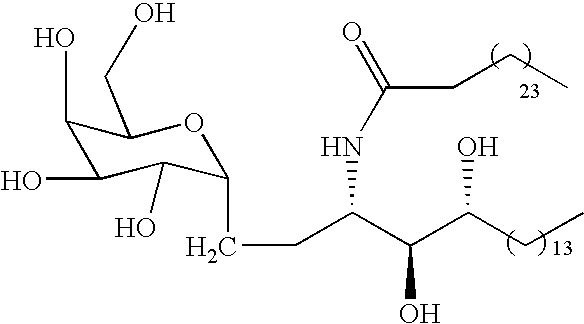
- a preferred compound of formula (I) is 3′S, 4′S, 5′R-3′-hexacosanoyl-4,5′-di-O-acetylnonadecyl-2,3,4,6-tetra-O-acetyl- ⁇ -C-D-galactopyranoside (wherein X is O, R 3 is OH, R 4 and R 5 are hydrogen, R 1 is —(CH 2 ) 13 CH 3 , Q 1 -X′-Q 2 -X′′-Q 3 is —(CH 2 ) 24 —CH 3 , which is also known as CRONY-101.
- the invention is also directed to prodrugs and pharmaceutically acceptable salts of the compounds described, and to pharmaceutical compositions suitable for different routes of drug administration comprising a therapeutically effective amount of a described compound of the invention admixed with a pharmaceutically acceptable carrier.
- the invention is also directed to methods of treating a disease selected from the group consisting of cancers, autoimmune diseases and infectious diseases (including HIV and Hepatitis C virus).
- the invention is also directed to pharmaceutical compositions comprising the compounds disclosed above, as well as methods of using these compositions to treat cancer, infectious diseases and autoimmune diseases.
- the invention is also directed to methods of inducing the production of Th1 type cytokines, such as IFN- ⁇ and IL-12, in a mammal in need thereof, by administering to the mammal a therapeutically effective amount of a compound of claim 1 .
- the mammal is a human.
- the invention is also directed to novel intermediate compounds of formula (II)
- R 3 is OH or a monosaccharide and R 4 is; hydrogen, or R 3 is hydrogen and R 4 is OH or a monosaccharide; R 5 is hydrogen or a monosaccharide; and R 1 is selected from the group consisting of —(CH 2 ) 11 CH 3 , —(CH 2 ) 12 CH 3 , —(CH 2 ) 13 CH 3 , —(CH 2 ) 9 CH(CH 3 ) 2 , —(CH 2 ) 10 CH(CH 3 ) 2 , —(CH 2 ) 11 CH(CH 3 ) 2 and (CH 2 ) 11 CH(CH 3 )—C 2 H 5 ; and salts or esters thereof.
- a preferred embodiment of formula (II) is the novel intermediate compound 3′S,4′S,5′R,3′-amino-4,5′-di-O-acetylnonadecyl-2,3,4,6-tetra-O-acetyl- ⁇ -C-D-galactopyranoside, which is used as a scaffold for the introduction of acyl chains C( ⁇ O)-Q′-X′-Q 2 -X′′-Q 3 in the synthesis of compounds of formula (I).
- the invention is also directed to a method of synthesizing a C-glycolipid compound of formula (I) by acylating a compound of formula (II) at the amino nitrogen.
- the invention is also directed to novel intermediate compounds of formula (III)
- R 1 is selected from the group consisting of —(CH 2 ) 11 CH 3 , —(CH 2 ) 12 CH 3 , —(CH 2 ) 13 CH 3 , —(CH 2 ) 9 CH(CH 3 ) 2 , —(CH 2 ) 10 CH(CH 3 ) 2 , —(CH 2 ) 11 CH(CH 3 ) 2 and (CH 2 ) 11 CH(CH 3 )—C 2 H 5 ;
- R 2 , R 3 , R 4 and R 5 are each independently selected from the group consisting of alkyl, aryl, alkylaryl and trialkylsilyl;
- R 6 is selected from the group consisting of alkyl, aryl, alkylaryl, trialkylsilyl, —(C ⁇ O)—O-alkyl, —(C ⁇ O)—O-aryl and —(C ⁇ O)—O-alkylaryl; or a salt or ester thereof.
- R 2 , R 3 , R 4 and R 5 are alkylaryl, for example benzyl or 4,6-benzylidene. Also preferred are compounds wherein R 6 is benzyloxycarbonyl.
- a preferred embodiment of formula (III) is the novel intermediate compound 1-(2′,3′,4′,6′-tetra-O-benzyl- ⁇ -D-galactopyranosyl)-3-benzyloxycarbonylamino-1-nonadecene-4,5-diol.
- the invention is also directed to a method of synthesizing a C-glycolipid compound of formula (I) wherein X is O, R 3 is OH and R 4 is hydrogen, and R 5 is hydrogen, from a compound of formula (III), which is subjected to reduction of the carbon-carbon double bond and deprotection of the amine and the sugar hydroxyl groups to form a compound of formula (II), which may be used as a scaffold for the introduction of acyl chains C( ⁇ O)-Q′-X′-Q 2 -X′′′-Q 3 at the amino nitrogen.
- the invention is also directed to a method of synthesizing a C-glycolipid compound of formula (I) wherein X is O, R 3 is OH, R 4 is hydrogen, and R 5 is hydrogen, by reacting a compound of formula (IV)
- each of R 10 , R 11 , R 12 and R 13 is independently selected from alkyl, aryl, alkylaryl or trialkylsilyl; with a compound of formula V
- R 14 is selected from alkyl, aryl, alkylaryl, trialkylsilyl, —C( ⁇ O)—O-alkyl, —C( ⁇ O)—O-aryl or —C( ⁇ O)—O-alkylaryl; and wherein R 1 is selected from the group consisting of —(CH 2 ) 11 CH 3 , —(CH 2 ) 12 CH 3 , —(CH 2 ) 13 CH 3 , —(CH 2 ) 9 CH(CH 3 ) 2 , —(CH 2 ) 10 CH(CH 3 ) 2 , —(CH 2 ) 11 CH(CH 3 ) 2 and (CH 2 ) 11 CH(CH 3 )—C 2 H 5 ; to form a compound of formula (VI)
- FIG. 1(A) is a bar graph showing malaria liver stage development in wild type BALB/c mice treated intraperitoneally with 2 ⁇ g of ⁇ -C-GalCer, ⁇ -GalCer, or nothing two days before challenge with live P. yoelii sporozoites;
- FIG. 1(B) is a bar graph showing malaria liver stage development in CD1d-deficient mice treated intraperitoneally with 2 ⁇ g of ⁇ -C-GalCer or nothing two days before challenge with sporozoites;
- FIG. 1(C) is a bar graph showing malaria liver stage development in J ⁇ 18-deficient mice treated intraperitoneally with 2 ⁇ g of ⁇ -C-GalCer or nothing two days before challenge with sporozoites;
- FIGS. 2(A) and (B) are bar graphs showing malaria liver stage development in IFN- ⁇ ( FIG. 2(A) ) and IFN- ⁇ receptor ( FIG. 2(B) ) deficient mice treated intraperitoneally with 2 ⁇ g of ⁇ -C-GalCer or nothing two days before challenge with sporozoites;
- FIG. 3(A) is a bar graph showing malaria liver stage development in wild type BALBc mice treated intraperitoneally with different doses of ( ⁇ ) ⁇ -C-GalCer or ( ) ⁇ -GalCer three days before challenge with live P. yoelii sporozoites;
- FIG. 3(B) is a bar graph showing malaria liver stage development in wild type BALBc mice treated intraperitoneally with 100 ng of ( ⁇ ) ⁇ -C-GalCer or ( ) ⁇ -GalCer at various times before challenge with sporozoites;
- FIG. 3(C) is a graph showing incidence of infection in wild type BALBc mice treated intraperitoneally with 100 ng of ( ⁇ ) ⁇ -C-GalCer, ( ) ⁇ -GalCer or ( ) nothing 3 days before challenge with live P. yoelli sporozoites. Mice were then monitored daily for the presence of blood stage parasites;
- FIG. 4 depicts the lungs of C57BL/6 mouse treated intravenously with different doses of ⁇ -C-GalCer or ⁇ -GalCer two days before intravenous challenge with 5 ⁇ 10 4 syngeneic B16 melanoma cells.
- the results in the study are expressed as the average+/ ⁇ SD of five mice;
- FIGS. 5(A) , (B) and (C) are graphs showing cytokine production in wild type BALB/c mice treated intravenously with 1 ⁇ g of ⁇ -C-GalCer ( ⁇ ) or ⁇ -GalCer ( ) or with nothing ( ). Serum samples were obtained at the indicated time points after injection for ELISA analyses of IL-4 (FIG. 5 (A)), IFN- ⁇ (FIG. 5 (B)), and IL-12 ( FIG. 5 (C)) concentrations;
- FIGS. 6(A) and (B) are bar graphs showing malaria liver stage development in wild type ( FIG. 6(A) ) or IL-12-deficient ( FIG. 6(B) ) mice treated intraperitoneally with 100 ng of ⁇ -C-GalCer or ⁇ -GalCer or with nothing four days before challenge with live P. yoelii sporozoites.
- ⁇ -Galactosylceramide is a glycolipid ligand for natural killer T (NKT) cells, which respond to the glycolipid and produce both interferon (IFN)- ⁇ and interleukin (IL)-4.
- IFN interferon
- IL interleukin
- monosaccharide means a sugar molecule having a chain of 3-10 carbon atoms in the form of an aldehyde (aldose) or ketone (ketose).
- aldehyde aldose
- ketone ketose
- Suitable monosaccharides contemplated for use in the invention include both naturally occurring and synthetic monosaccharides.
- Sample monosaccharides include trioses, such as glycerose and dihydroxyacetone; textroses such as erythrose and erythrulose; pentoses such as xylose, arabinose, ribose, xylulose ribulose; methyl pentoses (6-deoxyhexoses), such as rhamnose and fucose; hexoses, such as glucose, mannose, galactose, fructose and sorbose; and heptoses, such as glucoheptose, galamannoheptose, sedoheptulose and mannoheptulose.
- Preferred monosaccharides are hexoses.
- an “effective amount” of the compound for treating a disease is an amount that results in measurable amelioration of at least one symptom or parameter of the disease in mammals, including humans.
- prodrug refers to any compound that may have less intrinsic activity than the active compound or “drug” but when administered to a biological system generates the active compound or “drug” substance either as a result of spontaneous chemical reaction or by enzyme catalyzed or metabolic reaction.
- the term “pharmaceutically acceptable salts, esters, amides, and prodrugs” refer to those salts (e.g., carboxylate salts, amino acid addition salts), esters, amides, and prodrugs of the compounds of the present invention which are, within the scope of sound medical judgment, suitable for use in contact with the tissues of patients without undue toxicity, irritation, allergic response, and the like, commensurate with a reasonable benefit/risk ratio, and effective for their intended use, as well as the zwitterionic forms, where possible, of the compounds of the invention.
- salts e.g., carboxylate salts, amino acid addition salts
- esters, amides, and prodrugs of the compounds of the present invention which are, within the scope of sound medical judgment, suitable for use in contact with the tissues of patients without undue toxicity, irritation, allergic response, and the like, commensurate with a reasonable benefit/risk ratio, and effective for their intended use, as well as the zwitterionic forms, where possible,
- treatment include prophylactic or therapeutic administration of compounds of the invention, for the cure or amelioration of disease or symptoms associated with disease, and includes any benefits obtained or derived from the administration of the described compounds.
- terapéuticaally effective applied to dose or amount refers to that quantity of a compound or pharmaceutical composition that is sufficient to result in a desired activity upon administration to a mammal in need thereof.
- compositions of the invention refer to molecular entities and other ingredients of such compositions that are physiologically tolerable and do not typically produce untoward reactions when administered to a human.
- pharmaceutically acceptable means approved by a regulatory agency of the Federal or a state government or listed in the U.S. Pharmacopeia or other generally recognized pharmacopeia for use in mammals, and more particularly in humans.
- carrier applied to pharmaceutical compositions of the invention refers to a diluent, excipient, or vehicle with which a compound of the invention is administered.
- Such pharmaceutical carriers can be sterile liquids, such as water and oils, including those of petroleum, animal, vegetable or synthetic origin, such as peanut oil, soybean oil, mineral oil, sesame oil and the like. Water or aqueous solution, saline solutions, and aqueous dextrose and glycerol solutions are preferably used as carriers, particularly for injectable solutions. Suitable pharmaceutical carriers are described in “Remington's Pharmaceutical Sciences” by E. W. Martin, 18th Edition.
- the compounds of the invention are useful for the treatment of cancer, e.g. as anti-tumor agents for inhibiting the growth of tumors, and for treatment of cell proliferative disorders.
- the compounds of the invention may be used alone, or in combination with chemotherapy or radiotherapy.
- the compounds of the invention are useful in the treatment of a variety of cancers including, but not limited to carcinoma such as bladder, breast, colon, kidney, liver, lung, including small cell lung cancer, non-small cell lung cancer, esophagus, gall bladder, ovary, pancreas, testicular, stomach, renal, liver, cervix, thyroid, prostate, and skin, including squamous cell carcinoma; hematopoietic tumors of lymphoid lineage, including leukemia, acute lymphocitic leukemia, acute lymphoblastic leukemia, B cell lymphoma, T cell lymphoma, Hodgkin's lymphoma, non-Hodgkin's lymphoma, hairy cell lymphoma and Burkett's lymphoma; hematopoietic tumors of myeloid lineage, including acute and chronic myelogenous leukemias, myelodysplastic syndrome and promyelocytic leukemia; tumors of mesenchy
- Cell proliferative disorders for which the compounds are useful include benign prostate hyperplasia, familial adenomatosis polyposis, neuro fibromatosis, psoriasis, vascular smooth cell proliferation associated with atherosclerosis, pulmonary fibrosis, arthritis glomerulonephritis and post-surgical stenosis and restenosis.
- the compounds of the invention are also useful for treating infectious diseases, including parasitic, fungal, yeast, bacterial, mycoplasmal and viral diseases (where a particular class of cells can be identified as harboring the infective entity).
- the compounds may be useful in treating infections from a human papilloma virus, a herpes virus such as herpes simplex or herpes zoster, a retrovirus such as human immunodeficiency virus 1 or 2, a hepatitis virus (hepatitis A virus (HAV)), hepatitis B virus (HBV) non-A, blood borne (hepatitis C) and other enterically transmitted hepatitis (hepatitis E), and HBV associated delta agent (hepatitis D)), influenza virus, rhinovirus, respiratory syncytial virus, cytomegalovirus, adenovirus, Mycoplasma pneumoniae , a bacterium of the genus Salmonella, Staphylococcus, Streptococcus, Enterococcus, Clostridium, Escherichia, Klebsiella, Vibrio, Mycobacterium , amoeba, a malarial parasite, Trypanosoma cruzi ,
- the compounds of the invention are useful for treating infection with a hepatitis C virus.
- the compounds of the invention are useful for treating human immunodeficiency virus (HIV), and in the prevention of infection by HIV, the treatment of infection by HIV and the prevention and/or treatment of the resulting acquired immune deficiency syndrome (AIDS).
- HIV human immunodeficiency virus
- AIDS acquired immune deficiency syndrome
- the compounds of the invention are useful for treating malaria in a mammal (e.g., human) by administration of a compound of the invention.
- the compounds of the invention are useful for treating autoimmune diseases, such as rheumatoid arthritis, psoriatic arthritis, multiple sclerosis, systemic lupus erythematosus, myasthenia gravis, juvenile onset diabetes, glomerulonephritis, autoimmune thyroiditis, Behcet's disease, and other disorders such as Crohn's disease, ulcerative colitis, bullous pemphigoid, sarcoidosis, psoriasis, ichthyosis, Graves ophthalmopathy and asthma.
- autoimmune diseases such as rheumatoid arthritis, psoriatic arthritis, multiple sclerosis, systemic lupus erythematosus, myasthenia gravis, juvenile onset diabetes, glomerulonephritis, autoimmune thyroiditis, Behcet's disease, and other disorders such as Crohn's disease, ulcerative colitis, bullous pemphigoid, sarcoidosis
- the subjects to which the present invention is applicable may be any mammalian or vertebrate species, which include, but are not limited to, cows, horses, sheep, pigs, fowl (e.g., chickens), goats, cats, dogs, hamsters, mice, rats, monkeys, rabbits, chimpanzees, and humans.
- the subject is a human.
- Modes of administration of compounds and compositions of the invention include oral and enteral, intravenous, intramuscular, subcutaneous, transdermal, transmucosal (including rectal and buccal), and by inhalation routes.
- an oral or transdermal route is used (i.e., via solid or liquid oral formulations, or skin patches, respectively).
- the compounds can be pulsed with syngeneic dendritic cells, followed by transferring intravenously into patients.
- Solid dosage forms for oral administration of compounds and compositions of the invention include capsules, tablets, pills, powders, granules, and suppositories.
- the active compound of the invention can be admixed with at least one inert customary excipient (or carrier) such as sodium citrate or dicalcium phosphate; or (a) fillers or extenders, as for example, starches, lactose, sucrose, glucose, mannitol, and silicic acid; (b) binders, as for example, carboxymethylcellulose, alignates, gelatin, polyvinylpyrrolidone, sucrose, and acacia; (c) humectants, as for example, glycerol; (d) disintegrating agents, as for example, agar-agar, calcium carbonate, potato or tapioca starch, alginic acid, certain complex silicates, and sodium carbonate; (e) solution retarders, as for example paraffin; (f) absorption accelerators
- the dosage forms may also comprise buffering agents.
- Such solid compositions or solid compositions that are similar to those described can be employed as fillers in soft- and hard-filled gelatin capsules using excipients such as lactose or milk, sugar as well as high molecular weight polyethyleneglycols, and the like.
- Solid dosage forms such as tablets, dragées, capsules, pills, and granules can be prepared with coatings and shells, such as enteric coatings or other suitable coatings or shells.
- coatings and shells are well known in the art, and can contain opacifying agents, and can also be of such composition that they release the active compound or compounds in a certain part of the intestinal tract in a delayed manner.
- embedding compositions which can be used are polymeric substances and waxes.
- the active compounds can also be used in microencapsulated form, if appropriate, with one or more of the above-mentioned excipients.
- Liquid dosage forms for oral administration include pharmaceutically acceptable emulsions, solutions, suspensions, syrups, and elixirs.
- the liquid dosage forms can contain inert diluents commonly used in the art, such as water or other solvents, solubilizing agents and emulsifiers, as for example, ethyl alcohol, isopropyl alcohol, ethyl carbonate, ethyl acetate, benzyl alcohol, benzyl benzoate, propyleneglycol, 1,3-butyleneglycol, dimethylformamide, oils, in particular, cottonseed oil, groundnut oil, corn germ oil, olive oil, castor oil and sesame oil, glycerol, tetrahydrofurfuryl alcohol, polyethyleneglycols and fatty acid esters of sorbitan or mixtures of these substances, and the like.
- the composition can also include adjuvants, such as wetting agents, emulsifying and
- the composition may include a carrier, as defined herein.
- Suitable carriers include macromolecules which are soluble in the circulatory system and which are physiologically acceptable, as defined herein.
- the carrier preferably is relatively stable in the circulatory system with an acceptable plasma half life for clearance.
- macromolecules include but are not limited to Soya lecithin, oleic acid and sorbitan trioleate, with sorbitan trioleate preferred.
- Suspensions in addition to the active compounds, can contain suspending agents, such as, ethoxylated isostearyl alcohols, polyoxyethylene sorbitol and sorbitan esters, microcrystalline cellulose, aluminum metahydroxide, bentonite, agar-agar, tragacanth, and the like. Mixtures of suspending agents can be used if desired.
- suspending agents such as, ethoxylated isostearyl alcohols, polyoxyethylene sorbitol and sorbitan esters, microcrystalline cellulose, aluminum metahydroxide, bentonite, agar-agar, tragacanth, and the like. Mixtures of suspending agents can be used if desired.
- compositions for rectal administrations are preferably suppositories which can be prepared by mixing the compounds of the present invention with suitable nonirritating excipients or carriers such as cocoa butter, polyethyleneglycol, or a suppository wax which are solid at ordinary temperatures but liquid at body temperature and therefore, melt in the rectum or vaginal cavity and release the active component.
- suitable nonirritating excipients or carriers such as cocoa butter, polyethyleneglycol, or a suppository wax which are solid at ordinary temperatures but liquid at body temperature and therefore, melt in the rectum or vaginal cavity and release the active component.
- compositions suitable for parenteral injection can comprise physiologically acceptable sterile aqueous or nonaqueous solutions, dispersions, suspensions or emulsions, and sterile powders for reconstitution into sterile injectable solutions or dispersions.
- suitable aqueous and nonaqueous carriers, diluents, solvents or vehicles include water, ethanol, polyols (propyleneglycol, polyethyleneglycol, glycerol, and the like), suitable mixtures thereof, vegetable oils (such as olive oil) and injectable organic esters such as ethyl oleate.
- Proper fluidity can be maintained, for example, by the use of a coating such as lecithin, by the maintenance of the required particle size in the case of dispersions and by the use of surfactants.
- Dosage forms for topical administration of a compound of the invention include ointments, powders, sprays and inhalants.
- the active component can be admixed under suitable conditions (e.g., sterile conditions) with a physiologically acceptable carrier and any preservatives, buffers, or propellants as may be required.
- suitable conditions e.g., sterile conditions
- suitable conditions e.g., sterile conditions
- suitable conditions e.g., sterile conditions
- suitable conditions e.g., sterile conditions
- any preservatives, buffers, or propellants as may be required.
- Ophthalmic formulations, eye ointments, powders, and solutions are also contemplated as being within the scope of this invention.
- An effective amount for treating the diseases can easily be determined by empirical methods known to those skilled in the art, such as by establishing a matrix of dosages and frequencies of administration and comparing a group of experimental units or subjects to each point in the matrix.
- the exact amount to be administered to a patient will vary depending on the particular disease, the state and severity of the disease, and the physical condition of the patient.
- a measurable amelioration of any symptom or parameter can be determined by a physician skilled in the art or reported by the patient to the physician.
- Clinically significant attenuation or amelioration means perceptible to the patient and/or to the physician.
- the specific dosage form and dose level for any particular patient will depend on a variety of factors including the activity of the specific compound employed; the age, body weight, general health, and sex of the individual being treated; the time and route of administration; the rate of excretion; other drugs which have previously been administered; and the severity of the particular disease undergoing therapy.
- the amount of the agent to be administered can range from between about 0.01 to about 25 mg/kg/day, preferably from between about 0.1 to about 10 mg/kg/day and most preferably from between about 0.2 to about 5 mg/kg/day. It will be understood that the pharmaceutical compositions of the present invention need not in themselves contain the entire amount of the agent that is effective in treating the disorder, as such effective amounts can be reached by administration of a plurality of doses of such pharmaceutical compositions.
- the compounds of the invention can be formulated in capsules or tablets, each preferably containing 50-200 mg of the compounds of the invention, and are most preferably administered to a patient at a total daily dose of 50-400 mg, preferably 150-250 mg, and most preferably about 200 mg.
- Toxicity and therapeutic efficacy compositions containing compounds of the invention can be determined by standard pharmaceutical procedures in experimental animals, e.g., by determining the LD50 (the dose lethal to 50% of the population) and the ED50 (the dose therapeutically effective in 50% of the population).
- the dose ratio between toxic and therapeutic effects is the therapeutic index and it can be expressed as the ratio LD50/ED50.
- Compositions that exhibit large therapeutic indices are preferred.
- While therapeutics that exhibit toxic side effects can be used (e.g., when treating severe forms of cancer or life-threatening infections), care should be taken to design a delivery system that targets such immunogenic compositions to the specific site (e.g., lymphoid tissue mediating an immune response, tumor or an organ supporting replication of the infectious agent) in order to minimize potential damage to other tissues and organs and, thereby, reduce side effects.
- the specific site e.g., lymphoid tissue mediating an immune response, tumor or an organ supporting replication of the infectious agent
- the therapeutically effective dosage of compounds of the present invention in humans lies preferably within a range of circulating concentrations that include the ED50 with little or no toxicity.
- the dosage can vary within this range depending upon the dosage form employed and the route of administration utilized. Ideally, a single dose should be used.
- the compounds may be formed from commercially available starting materials galactose penta acetate (1) and L-homoserine (2), as shown below:
- the compounds of formula (I) may be formed from the compounds of formula (II) by acylating a compound of formula (II) with a reactant R x —C( ⁇ O)-Q′X′Q 2 X′′Q 3 to add the C( ⁇ O)-Q′X′Q 2 X′′Q 3 chain at the amino nitrogen position of (II).
- a reactant R x —C( ⁇ O)-Q′X′Q 2 X′′Q 3 to add the C( ⁇ O)-Q′X′Q 2 X′′Q 3 chain at the amino nitrogen position of (II).
- Suitable reactants include p-nitrophenyl carboxylates, wherein R x is p-nitrophenyl as taught in Morita et al. J. Med. Chem, 1995, 38: 2176-2187.
- Alternative R x groups include o-nitrophenyl, o-N-succinimidyl, chloride, bromide, or mixed anhydrides.
- the compounds of formula (II) can be formed from the compounds of formula (III) by reducing the carbon-carbon double bond, and then deprotecting the amine and hydroxyl groups of the sugar moiety
- Synthesis B a sugar aldehyde, e.g. ⁇ -C-galactosyl aldehyde, is coupled with the commercially available compound phytosphingosine.
- ⁇ -C galactosyl aldehyde can be formed by the Bednarski procedure from the starting material methyl galactoside.
- the coupling reaction yields a compound of formula III, which is then subjected to cleavage of an isopropylidene group, reduction of the double bond, and deprotection, to yield the compound of formula (II).
- the ⁇ -GalCer derivative CRONY-101 may be synthesized according to the following synthesis.
- L-homoserine 1 was converted into methyl ester 2 via two steps in 60% overall yield (Ozinskas, A. et al., J. Org. Chem. 1986, 51, 5047-5050; Shioiri, T. et al., Org. Synth., 1989, 68, 1). After the primary alcohol was protected, the ester was reduced to an aldehyde 3 using diisobutylaluminum hydride (DIBAL) as the reducing reagent.
- DIBAL diisobutylaluminum hydride
- Acetonide formation was used to protect the 1,2-diols in compound 5 (Scheme 3), then the primary alcohol 8 was released by desilylation of 7. Because the basic fluoride ion caused the cyclization, acetic acid was added to Bu 4 NF solution as the buffer (Niu, C. et al., J. Org Chem. 1996, 61, 1014-1022) to afford 8 as the only product, since there was no cyclic compound formed.
- the iodo compound 9 can be made by one skilled in the art using PPh 3 , iodine and imidazole reflux in THF (Spak, S. J. et al., Tetrahedron 2000, 56, 217-224).
- the intermediate 1-O-Methyl-2,3-dibenzyl ⁇ -galactoside can be made in one step by using chlorotrimethylsilane in methanol. Esterification of the primary hydroxyl group at C6 afforded the benzoate 15 in 88% yield (Scheme A5).
- ⁇ -S-galactoside 12 (1.49 g, 1.86 mmol) was dissolved in 20 ml THF and 5 ml DMF, NaH (0.6 g, 60% in mineral oil) was added, the mixture was stirred at rt for 1 ⁇ 2 h, then 0.068 g (0.186 mmol) tetra-butylammonium iodide was added followed by 0.89 ml benzyl bromide (7.44 mmol). After the mixture was stirred at room temperature overnight, the reaction was quenched with 10 ml of MeOH. The resulting solution was added to 50 ml H 2 O and extracted by EtOAc (100 ml ⁇ 3).
- Carbonate 20 (66 mg, 0.065 mmol) was dissolved in 5 ml dioxane:H 2 O (1:1) and treated with NaOH 0.46 g and heated under reflux conditions at 90° C. overnight. The sample was concentrated in vacuo and redissolved in CHCl 3 and washed with saturated NH 4 Cl solution. The aqueous layer was extracted with CHCl 3 (20 ml ⁇ 3). The organic was dried over Na 2 SO 4 , concentrated, the residue was dried in vacuo to afford 50 mg product 21 (96%). MS: m/z 774 (M + +H + ), (calcd. C 47 H 67 O 8 N, 773).
- the following convergent approach to the synthesis of the C-glycoside analog of ⁇ -Galactosylceramide uses the one-pot Julia-Kocienski olefination, to couple the very sensitive sugar aldehyde with a similarly base-sensitive complete lipid sidechain.
- the sugar component was the ⁇ -C-galactosyl aldehyde 38, which was prepared according to the Bednarski procedure starting from methyl galactoside with an overall isolated yield of 40% after five steps.
- the lipid side chain was prepared from the commercially available phytosphingosine 31.
- the protection strategy was begun with benzyl carbamate formation, followed by selective silylation of the primary alcohol.
- triol 32 (1.6 g, 3.54 mmol) in anhydrous DCM (25 ml) and DMF (5 ml) was added triethylamine (0.54 ml, 1.1 equiv.) at 0° C., followed by t-BuMe 2 SiCl (587 mg, 1.1 equiv.) and a catalytic amount of 4-DMAP (22 mg, 0.05 equiv.). After stirring for 1 h at the same temperature, the mixture was diluted with DCM and washed subsequently with water (2 ⁇ ), aqueous NH 4 Cl and brine. The organic phase was dried (sodium sulfate), concentrated and the residue purified by flash column chromatography (Petroether-EtOAc, 8:1 to 4:1) to provide diol 33 (1.92 g, 96%).
- DiPAD diisopropyl azodicarboxylate
- MCPBA meta chloroperbenzoic acid
- PPTs pyridinium p-toluenesulfonate
- ⁇ -Galactosylceramide was synthesized by Kirin Brewery (Gumma, Japan). The stock solution was dissolved in a 0.5% polysorbate-20 (Nikko Chemical, Tokyo), 0.9% NaC1 solution at a concentration of 200 ⁇ g/ml, and diluted in PBS just before injection into mice. ⁇ -C-galactosylceramide was synthesized as described herein. The stock solution was originally dissolved in 100% DMSO at a concentration of 1 mg/ml. Before injection into mice, it was diluted to a concentration of 200 ⁇ g/ml in a 0.5% polysorbate-20 (Nikko Chemical, Tokyo), 0.9% NaC1 solution, and diluted in PBS just before injection into mice.
- mice Six to eight-week-old female BALB/c mice were purchased from the National Cancer Institute (Bethesda, Md.). Six to eight-week-old female C57/BL6 mice were purchased from the Jackson Laboratory (Bar Harbor, Me.). CD1d-deficient mice and J ⁇ 18-deficient mice were obtained as gifts. IFN- ⁇ -deficient mice of BALB/c background were purchased from the Jackson laboratory (Bar Harbor, Me.). IFN- ⁇ -receptor-deficient mice were bred and maintained in an animal facility. IL-12p40-deficient mice of BALB/c and C57/BL6 background were purchased from the Jackson Laboratory (Bar Harbor, Me.). All mice were maintained under pathogen-free conditions.
- P. yoelii (17NXL strain) was maintained by alternate cyclic passages in Anopheles stephensi mosquitoes and Swiss Webster mice. Sporozoites obtained from dissected salivary glands of infected mosquitoes 2 weeks after their infective blood were used for challenge of the mice. Challenge of mice to determine the development of liver-stage malaria infection was performed by an intravenous injection of 10,000 viable sporozoites into the tail vein. The outcome of the challenge was determined 40-42 hours later by measuring the parasite burden in the livers of the mice using a quantitative real-time RT-PCR method, as taught in Bruna-Romero et al., Int. J. Parasitol. 31, 1449-1502, 2001.
- mice toe determine the development of blood stage malaria infection was performed by an intravenous injection of 75 viable sporozoites into the tail vein. Starting four days after challenge, daily peripheral blood smears were obtained from each mouse and examined microscopically for the presence of blood stage parasites until day 17 post-challenge. Mice were considered positive for parasitemia if at least one blood stage parasite was observed during the time of examination.
- the degree of liver stage development in challenged mice was determined by quantifying the amount of P. yoelii -specific 18S rRNA molecules in the livers of the mice by way of the real-time RT-PCR technique of Bruna-Romero et al.
- a 2 ⁇ g sample of total RNA prepared from the livers of challenged mice was reverse-transcribed, and an aliquot of the resulting cDNA (133 ng) was used for real-time PCR amplification of P. yoelii 18S rRNA sequences. This amplification was performed in a GeneAmp® 5700 Sequence Detection System (PE Applied Biosystems, Foster City, Calif.).
- primers 5′-GGGGATTGGTTTTGACGTTTTTGCG-3′ (SEQ. ID NO: 1) (54 nM) and 5′-AAGCATTAAATAAAGCGAATACATCCTTAT-3′ (SEQ. ID NO: 2) (60 nm) were used, together with the dsDNA-specific dye SYBR Green I incorporated into the PCR reaction buffer (PE Biosystems, Foster City, Calif.) in order to detect the PCR product generated.
- the temperature profile of the reaction was 95° C. for 10 minutes followed by 35 cycles of denaturation of 95° C. for 15 seconds and annealing/extension at 60° C. for 1 minute.
- melanoma lung metastases in C57/BL6 mice was determined by first challenging mice intravenously with 5 ⁇ 10 4 syngeneic B16 melanoma cells suspended in DMEM supplemented with 10% FCS. Two weeks after challenge the mice were sacrificed, the lungs removed, and the number of metastatic nodules counted, as described in Fujii et al., Natl. Immunol. 3, 867-874 (2002).
- the serum concentrations of IFN- ⁇ and IL-4 were measured 2, 6, 12, 24, 48, and 72 hours after treatment with ⁇ -GalCer, ⁇ -C-GalCer, or nothing by way of a sandwich ELISA (e-bioscience, San Diego).
- the serum concentrations of IL-12p70 were also measured at 2, 6, 12, 24, 48 and 72 hours after treatment by way of a sandwich ELISA (Pharmingen, San Diego).
- ⁇ -GalCer As reported in Gonzalez-Aseguinolaza, Proc. Nat'l Acad. Sci . USA 97, 8461-8466 (2000) ⁇ -GalCer, when administered to mice two days before challenge with Plasmodium sporozoites, suppressed development of malaria liver stages in a manner dependent on both CD1d-restricted V ⁇ 14+NKT cells and IFN- ⁇ /IFN- ⁇ receptor signaling. To see if ⁇ -C-GalCer exhibited a similar behavior, wild type mice were injected with either ⁇ -GalCer or ⁇ -C-GalCer two days before challenge with live P.
- mice treated with either ⁇ -GalCer or ⁇ -C-GalCer showed virtually no liver stage development as compared to untreated control mice, proving that ⁇ -C-GalCer has in vivo anti-malaria activity similar to that of ⁇ -GalCer.
- FIG. 1(A) demonstrates that ⁇ -C-GalCer displays anti-malaria activity.
- Wild type BALB/c mice were treated intraperitoneally with 2 ⁇ g of ⁇ -C-GalCer, ⁇ -GalCer or nothing two days before challenge with live P. yoelii sporozoites, and then checked for malaria liver stage development. The results are expressed as the average+/ ⁇ SD of 5 mice.
- mice deficient in CD1d, J ⁇ 18 (formerly know as J ⁇ 281), IFN- ⁇ , or IFN- ⁇ receptor were injected with ⁇ -C-GalCer, and liver stage development was measured.
- ⁇ -GalCer ⁇ -C-GalCer was unable to suppress P. yoelii liver stages in the absence of these molecules ( FIGS. 1B and C).
- FIGS. 1(B) and (C) demonstrate that ⁇ -C-GalCer's anti-malaria activity requires CD1d molecules and V ⁇ 14+NKT cells.
- CD1d- or J ⁇ 18-deficient mice were treated intraperitoneally with 2 ⁇ g of ⁇ -C-GalCer, ⁇ -GalCer or nothing two days before challenge with live P. yoelii sporozoites, and then checked for malaria liver stage development. The results are expressed as the average+/ ⁇ SD of 5 mice.
- FIGS. 2(A) and (B) demonstrate that ⁇ -C-GalCer's anti-malaria activity requires IFN- ⁇ /IFN- ⁇ receptor.
- IFN- ⁇ - or IFN- ⁇ receptor-deficient mice were treated intraperitoneally with 2 ⁇ g of either ⁇ -C-GalCer, ⁇ -GalCer or nothing two days before challenge with sporozoites, and then checked for malaria liver stage development. The results are expressed as the average+/ ⁇ SD of mice.
- FIGS. 1 and 2 the data represent one or two or more experiments with similar results.
- mice were treated with ⁇ -GalCer or ⁇ -C-GalCer three days before P. yoelii sporozoite challenge, and then liver stage development was measured.
- ⁇ -C-GalCer was found to exhibit a much more potent anti-malaria activity, with a dose of 1 ng ⁇ -C-GalCer equal to a dose of 1 ⁇ g ⁇ -GalCer.
- ⁇ -C-GalCer displayed a more potent anti-malaria response than ⁇ -GalCer.
- Wild type BaLB/c mice were treated intraperitoneally with different doses of either ⁇ -C-GalCer ( ⁇ ) or ⁇ -GalCer ( ) 3 days before challenge with live P. yoelii sporozoites, and then checked for malaria liver stage development. The results are expressed as the average+/ ⁇ SD of 5 mice.
- mice were treated with an identical dose of ⁇ -GalCer or ⁇ -C-GalCer at different time points prior to sporozoite challenge, and the liver stages were measured.
- ⁇ -C-GalCer exhibited an extended anti-malaria effect of up to three days longer than ⁇ -GalCer ( FIG. 3(B) ).
- FIG. 3(B) shows wild type BALB/c mice treated intraperitoneally with 100 ng of either ⁇ -C-GalCer ( ⁇ ) or ⁇ -GalCer ( ) at various times before challenge with sporozoites, and then checked for malaria liver stage development. The results are expressed as the average+/ ⁇ SD of five mice.
- ⁇ -C-GalCer was shown to better protect mice from sporozoite-induced blood stage malaria infection than ⁇ -GalCer.
- Wild type BALB/c mice were injected intraperitoneally with 100 ng of ⁇ -C-GalCer ( ⁇ ), ⁇ -GalCer ( ) or nothing ( ) three days before challenge with live P. yoelii sporozoites. Mice were then monitored daily for the presence of blood stage parasites.
- ⁇ -C-GalCer completely protected 9 of 10 mice from blood stage malaria, while an identical dose of ⁇ -GalCer protected 0 of 10 mice, the same outcome as untreated controls. Since blood stage infection requires prior successful development of the liver stages, the enhanced activity of ⁇ -C-GalCer against both liver and blood stage infections is consistent and demonstrates the superior effect of ⁇ -C-GalCer in vivo.
- NKT cell-mediated protection against malaria requires IFN- ⁇ /IFN- ⁇ receptor signaling
- the enhanced activity with ⁇ -C-GalCer suggests it might be superior in other disease models requiring Th1-type responses for control.
- One such model involves melanoma metastases to the lungs, in which ⁇ -C-GalCer-mediated inhibition requires an IFN- ⁇ response initiated by NKT cells (Smyth et al., Blood 99, 1254-1266 (2002)).
- mice were injected with various doses of ⁇ -GalCer and ⁇ C-GalCer two days before challenge with melanoma cells, and two weeks later we checked the lungs for the number of metastatic nodules that had developed.
- ⁇ -C-GalCer exhibited a much more potent anti-cancer response than ⁇ -GalCer, with 1 ng ⁇ -C-GalCer equal to 100 ng of ⁇ -GalCer.
- FIG. 4 wild type C57BL/6 mice were treated intravenously with different doses of either ⁇ -C-GalCer or ⁇ -GalCer two days before intravenous challenge with 5 ⁇ 10 4 syngeneic B16 melanoma cells. Two weeks later, the lungs were checked for tumor metastases. The results are expressed as the average+/ ⁇ SD of 5 mice. The pictures shown come from one representative mouse out of five per group. These results clearly show a superior anti-cancer effect for ⁇ -C-GalCer, and further support the hypothesis that ⁇ -C-GalCer stimulates a preferential Th1-type response in vivo.
- ⁇ -C-GalCer stimulates much greater IL-12 production than ⁇ -GalCer, tests were conducted to determine if IL-12 is necessary for the difference between ⁇ -C-GalCer and ⁇ -GalCer.
- Increased IL-12 would result in enhanced IFN- ⁇ and decreased IL-4 production by NKT cells (Ogarra, Trends Cell Bio. 10, 542550 (2000); Elser, Immunity 17, 703-712 (2002), as well as enhanced IFN- ⁇ production by other cell types, notably NK cells Eberl, Eur. J. Immunol. 30, 985-992 (2000).
- ⁇ -C-GalCer stimulates increased IFN- ⁇ and decreased IL-4 production is consistent with its stimulation of increased IL-12. This also helps explain the enhanced potency and kinetic effect of ⁇ -C-GalCer against malaria and melanoma. However, additional properties likes a longer in vivo half-life of the molecule cannot be ruled out as alternative explanations.
- FIG. 5 wild type BALB/c mice were treated intravenously with 1 ⁇ g of either ⁇ -C-GalCer ( ⁇ ) or ⁇ -GalCer ( ) or with nothing ( ), and serum samples were obtained at the indicated time point's after injection of ELISA analyses of IL-4 (FIG. 5 (A)), IFN- ⁇ (FIG. 5 (B)), and IL-12 ( FIG. 5(C) ) concentrations. The data are expressed as the average+/ ⁇ SD of two different dilutions of pooled sera.
- FIG. 6 ⁇ -C-GalCer's enhanced anti-malaria effect is abrogated in the absence of IL-12.
- Wild type ( FIG. 6(A) ) or IL-12-deficient ( FIG. 6(B) ) mice were treated intraperitoneally with 100 ng of ⁇ -C-GalCer, ⁇ -GalCer or nothing four days before challenge with live P. yoelii sporozoites, and then checked for malaria liver stage development. The results are expressed as the average+/ ⁇ SD of 5 mice.
- mice were injected with the same dose of either ⁇ -C-GalCer or ⁇ -GalCer, and at various time points afterwards blood samples were obtained for ELISA analyses of IFN- ⁇ , IL-4, and IL-12 concentrations in the sera.
- IL-4 both ⁇ -C-GalCer or ⁇ -GalCer stimulated peak concentrations 2 hours after treatment; however, ⁇ -GalCer stimulated concentrations roughly 3 times higher than ⁇ -C-GalCer ( FIG. 5(A) ).
- both ⁇ -C-GalCer and ⁇ -GalCer stimulated detectable levels starting at 6 hours, but ⁇ -GalCer's peak occurred 12 hours post-treatment, returning to baseline by 24 hours. In contrast, ⁇ -GalCer's peak occurred 24 hours post-treatment, returning to baseline by 48 hours ( FIG. 5(B) ). Finally, for IL-12, both ⁇ -C-GalCer and ⁇ -GalCer stimulated peak concentrations 6 hours after treatment; however, ⁇ -C-GalCer stimulated concentrations 2 times higher than ⁇ -GalCer.
- ⁇ -C-GalCer continued stimulating detectable IL-12 levels 12 hours after treatment, whereas at this time point ⁇ -GalCer stimulated IL-12 levels were undetectable ( FIG. 5(C) ).
- ⁇ -C-GalCer stimulated enhanced levels of the Th1 cytokines IL-12 and IFN- ⁇ , and diminished levels of the Th2 cytokine IL-4 as compared to ⁇ -GalCer, showing that, in vivo, it does indeed stimulate a preferential Th1-type response.
- ⁇ -C-GalCer acts as a NKT cell ligand in vivo, and that it stimulates a preferential Th1-type response compared to ⁇ -GalCer. Due to the consumed nature of NKT cell responses in mammals, it is likely that ⁇ -C-GalCer, which stimulates V ⁇ 14+NKT cells in mice, also stimulates V ⁇ 14+NKT in humans (Brossay, et al., J. Exp. Med. 188, 1521-1528 1998)). As a result ⁇ -C-GalCer's Th-1 polarizing activity means it is an excellent chemotherapeutic candidate for a number of human diseases, including cancer, allergy and various infectious diseases such as hepatitis B and C.
Landscapes
- Health & Medical Sciences (AREA)
- Chemical & Material Sciences (AREA)
- Organic Chemistry (AREA)
- Life Sciences & Earth Sciences (AREA)
- General Health & Medical Sciences (AREA)
- Engineering & Computer Science (AREA)
- Molecular Biology (AREA)
- Veterinary Medicine (AREA)
- Nuclear Medicine, Radiotherapy & Molecular Imaging (AREA)
- Pharmacology & Pharmacy (AREA)
- Medicinal Chemistry (AREA)
- Animal Behavior & Ethology (AREA)
- General Chemical & Material Sciences (AREA)
- Public Health (AREA)
- Chemical Kinetics & Catalysis (AREA)
- Biochemistry (AREA)
- Biotechnology (AREA)
- Genetics & Genomics (AREA)
- Virology (AREA)
- Bioinformatics & Cheminformatics (AREA)
- Immunology (AREA)
- Communicable Diseases (AREA)
- Oncology (AREA)
- Tropical Medicine & Parasitology (AREA)
- Crystallography & Structural Chemistry (AREA)
- Transplantation (AREA)
- AIDS & HIV (AREA)
- Pharmaceuticals Containing Other Organic And Inorganic Compounds (AREA)
- Pyrane Compounds (AREA)
- Plural Heterocyclic Compounds (AREA)
Abstract

wherein X is O or NH; R′ is a hydrocarbon chain; R3 and R4 are hydrogen, OH or a monosaccharide; R5 is hydrogen or a monosaccharide; Q′ is optionally present and may be a C1-10 hydrocarbon; X′ is optionally present and may be O, S or NR8; and Q3 may be a hydrocarbon or hydrogen. The invention is also directed to the use of the compounds for treating cancer, infectious diseases and autoimmune diseases. The invention is also directed to syntheses of the compounds of formula (I).
Description

wherein R1 is H or

R2 is H,

R3 and R6 are H or OH, respectively,
R4 is H, OH or

R5 is H or

x is an integer from 19 to 23; and
R7 is —(CH2)11—CH3, —(CH2)12—CH3, —(CH2)13—CH3, —(CH2)9—CH(CH3)2, —(CH2)10—CH(CH3)2, —(CH2)11—CH(CH3)2, —(CH2)11—CH(CH3)—C2H5,
wherein at least one of R1, R2, R4 and R5 is a glycosyl moiety.


wherein X is O or NH;
R1 is selected from the group consisting of —(CH2)11CH3, —(CH2)12CH3, —(CH2)13CH3, —(CH2)9CH(CH3)2, —(CH2)10CH(CH3)2, —(CH2)11CH(CH3)2 and (CH2)11CH(CH3)—C2H5;
R3 is OH or a monosaccharide and R4 is hydrogen, or R3 is hydrogen and R4 is OH or a monosaccharide;
R5 is hydrogen or a monosaccharide;
Q1 is optionally present and is a C1-10 straight or branched chain alkylene, alkenylene, or alkynylene;
X′ is optionally present and is O, S or NR8;
Q2 is optionally present and is a C1-10 straight or branched chain alkylene, alkenylene or alkynylene;
X″ is optionally present and is O, S or NR8;
Q3 is a straight or branched chain C1-10 alkyl, alkenyl or alkynyl, or is hydrogen,
wherein each Q1, Q2 or Q3 is optionally substituted with hydroxyl, halogen, cyano, nitro, SO2, NHR8, or C(═O)—R9; and wherein
-
- R8 is hydrogen, C1-5 alkyl, C1-5 alkoxy, halogen, cyano, nitro, SO2 or C(═O)—R9;
- R9 is hydrogen, C1-5 alkyl, C1-5 alkoxy or NHR10;
- R10 is hydrogen, C1-5 alkyl or C1-5 alkoxy;
and pharmaceutically acceptable salts or esters thereof.

wherein
X is O or NH;
R3 is OH or a monosaccharide and R4 is; hydrogen, or R3 is hydrogen and R4 is OH or a monosaccharide;
R5 is hydrogen or a monosaccharide; and
R1 is selected from the group consisting of —(CH2)11CH3, —(CH2)12CH3, —(CH2)13CH3, —(CH2)9CH(CH3)2, —(CH2)10CH(CH3)2, —(CH2)11CH(CH3)2 and (CH2)11CH(CH3)—C2H5;
and salts or esters thereof.

wherein R1 is selected from the group consisting of —(CH2)11CH3, —(CH2)12CH3, —(CH2)13CH3, —(CH2)9CH(CH3)2, —(CH2)10CH(CH3)2, —(CH2)11CH(CH3)2 and (CH2)11CH(CH3)—C2H5;
R2, R3, R4 and R5 are each independently selected from the group consisting of alkyl, aryl, alkylaryl and trialkylsilyl;
R6 is selected from the group consisting of alkyl, aryl, alkylaryl, trialkylsilyl, —(C═O)—O-alkyl, —(C═O)—O-aryl and —(C═O)—O-alkylaryl;
or a salt or ester thereof.

wherein each of R10, R11, R12 and R13 is independently selected from alkyl, aryl, alkylaryl or trialkylsilyl;
with a compound of formula V

wherein R14 is selected from alkyl, aryl, alkylaryl, trialkylsilyl, —C(═O)—O-alkyl, —C(═O)—O-aryl or —C(═O)—O-alkylaryl; and
wherein R1 is selected from the group consisting of —(CH2)11CH3, —(CH2)12CH3, —(CH2)13CH3, —(CH2)9CH(CH3)2, —(CH2)10CH(CH3)2, —(CH2)11CH(CH3)2 and (CH2)11CH(CH3)—C2H5;
to form a compound of formula (VI)

and subjecting the compound of formula (VI) to


The diastereoselective dihydroxylation of the optically active olefin A, which is readily accessible from L-homoserine, would afford the protected homophytosphingosine derivative B in a stereoselective fashion. The synthetic route from commercially available L-homoserine is shown in Scheme A2.


amide chain was then introduced using p-nitrophenyl hexadeconate as the acylating agent to afford the target 24 (Morita, M. et al., J. Med. Chem. 1995, 38, 2176-2187). Final purification was done by flash chromatography on silica gel eluting with CHCl3:MeOH (4:1). The 1H and 13C NMR and optical rotation {[α]25 D +40.8° (c=1.3, pyridine)}, mp 175-178° C. high resolution FABMS m/z 856.7601 (C51H101O8N+H+ requires 856.7605) obtained for a sample of 24. The mass spectrum and 1H NMR of fully acylated

Claims (2)
Priority Applications (1)
| Application Number | Priority Date | Filing Date | Title |
|---|---|---|---|
| US11/193,852 US8252909B2 (en) | 2002-06-13 | 2005-07-29 | Synthetic C-glycolipid and its use for treating cancer, infectious diseases, and autoimmune diseases |
Applications Claiming Priority (3)
| Application Number | Priority Date | Filing Date | Title |
|---|---|---|---|
| US38886202P | 2002-06-13 | 2002-06-13 | |
| US10/462,211 US7273852B2 (en) | 2002-06-13 | 2003-06-13 | Synthetic C-glycolipid and its use for treating cancer, infectious diseases and autoimmune diseases |
| US11/193,852 US8252909B2 (en) | 2002-06-13 | 2005-07-29 | Synthetic C-glycolipid and its use for treating cancer, infectious diseases, and autoimmune diseases |
Related Parent Applications (1)
| Application Number | Title | Priority Date | Filing Date |
|---|---|---|---|
| US10/462,211 Division US7273852B2 (en) | 2002-06-13 | 2003-06-13 | Synthetic C-glycolipid and its use for treating cancer, infectious diseases and autoimmune diseases |
Publications (2)
| Publication Number | Publication Date |
|---|---|
| US20060019246A1 US20060019246A1 (en) | 2006-01-26 |
| US8252909B2 true US8252909B2 (en) | 2012-08-28 |
Family
ID=29736555
Family Applications (2)
| Application Number | Title | Priority Date | Filing Date |
|---|---|---|---|
| US10/462,211 Expired - Lifetime US7273852B2 (en) | 2002-06-13 | 2003-06-13 | Synthetic C-glycolipid and its use for treating cancer, infectious diseases and autoimmune diseases |
| US11/193,852 Expired - Fee Related US8252909B2 (en) | 2002-06-13 | 2005-07-29 | Synthetic C-glycolipid and its use for treating cancer, infectious diseases, and autoimmune diseases |
Family Applications Before (1)
| Application Number | Title | Priority Date | Filing Date |
|---|---|---|---|
| US10/462,211 Expired - Lifetime US7273852B2 (en) | 2002-06-13 | 2003-06-13 | Synthetic C-glycolipid and its use for treating cancer, infectious diseases and autoimmune diseases |
Country Status (6)
| Country | Link |
|---|---|
| US (2) | US7273852B2 (en) |
| EP (1) | EP1551228B1 (en) |
| JP (1) | JP2005533057A (en) |
| AU (1) | AU2003251518B2 (en) |
| CA (1) | CA2493690C (en) |
| WO (1) | WO2003105769A2 (en) |
Families Citing this family (85)
| Publication number | Priority date | Publication date | Assignee | Title |
|---|---|---|---|---|
| US20010051156A1 (en) * | 2000-04-28 | 2001-12-13 | Defu Zeng | Methods for inhibition of polyclonal B cell activation and immunoglobulin class switching to pathogenic autoantibodies by blocking CD1-mediated interactions |
| CA2441893C (en) | 2001-03-26 | 2015-01-20 | Dana-Farber Cancer Institute, Inc. | Method of attenuating reactions to skin irritants |
| JP2005527467A (en) * | 2001-08-29 | 2005-09-15 | ネオーズ テクノロジーズ, インコーポレイテッド | Novel synthetic ganglioside derivatives and compositions thereof |
| US9809654B2 (en) | 2002-09-27 | 2017-11-07 | Vaccinex, Inc. | Targeted CD1d molecules |
| WO2004080960A2 (en) * | 2003-03-06 | 2004-09-23 | Neose Technologies Inc. | Methods and compositions for the enzymatic synthesis of gangliosides |
| US7645873B2 (en) | 2003-03-20 | 2010-01-12 | The Scripps Research Institute | 6″-amino-6″-deoxygalactosylceramides |
| US7771726B2 (en) * | 2003-10-08 | 2010-08-10 | New York University | Use of synthetic glycolipids as universal adjuvants for vaccines against cancer and infectious diseases |
| EP1716857A4 (en) * | 2004-02-19 | 2010-08-04 | Kibun Food Chemifa | Composition for nkt cell activation |
| WO2005102049A1 (en) * | 2004-03-31 | 2005-11-03 | New York University | Novel synthetic c-glycolipids, their synthesis and use to treat infections, cancer and autoimmune diseases |
| KR101377116B1 (en) * | 2004-08-27 | 2014-03-24 | 알버트 아인슈타인 컬리지 오브 메디신 오브 예쉬바 유니버시티 | Ceramide derivatives as modulators of immunity and autoimmunity |
| US8022043B2 (en) * | 2004-08-27 | 2011-09-20 | Albert Einstein College Of Medicine Of Yeshiva University | Ceramide derivatives as modulators of immunity and autoimmunity |
| EP1786439B1 (en) * | 2004-09-03 | 2010-04-14 | The University Of Chicago | Methods of activating nkt cells |
| GB0419846D0 (en) * | 2004-09-07 | 2004-10-13 | Chiron Srl | Vaccine adjuvants for saccharides |
| US20080145931A1 (en) | 2004-10-07 | 2008-06-19 | Argos Therapeutics, Inc. | Mature Dendritic Cell Compositions and Methods of Culturing Same |
| US8513008B2 (en) | 2004-10-07 | 2013-08-20 | Argos Therapeutics, Inc. | Mature dendritic cell compositions and methods for culturing same |
| WO2006060117A2 (en) * | 2004-11-02 | 2006-06-08 | The Board Of Trustees Of The Leland Stanford Junior University | Methods for inhibition of nkt cells |
| WO2006058243A2 (en) * | 2004-11-24 | 2006-06-01 | Yale University | Leishmania antigens and related compositions and uses |
| AU2006211485B2 (en) | 2005-01-28 | 2011-04-14 | Brigham Young University | Bacterial glycolipid activation of CD1d-restricted NKT cells |
| WO2007004705A1 (en) * | 2005-07-01 | 2007-01-11 | Japan As Represented By President Of National Center Of Neurology And Psychiatry | Glycolipid derivative and therapeutic agent comprising the same as active ingredient |
| PL2368572T3 (en) | 2005-11-04 | 2020-11-16 | Seqirus UK Limited | Adjuvanted vaccines with non-virion antigens prepared from influenza viruses grown in cell culture |
| BR122019013216B8 (en) | 2006-01-27 | 2021-07-27 | Seqirus Uk Ltd | immunological assay for analysis of an influenza vaccine |
| GB0605247D0 (en) * | 2006-03-15 | 2006-04-26 | Chiron Srl | Compositions and methods for immunisation |
| JP2009534303A (en) | 2006-03-24 | 2009-09-24 | ノバルティス ヴァクシンズ アンド ダイアグノスティクス ゲーエムベーハー アンド カンパニー カーゲー | Preserving influenza vaccines that are not refrigerated |
| PT2056842E (en) | 2006-04-07 | 2013-01-24 | Univ Chicago | Modified-galactosyl ceramide for the treatment of cancerous diseases |
| FR2899464B1 (en) * | 2006-04-07 | 2008-06-06 | Oreal | C-GLYCOSIDE COMPOUND AND USE AS AN ACTIVATOR AND REGULATOR OF CUTANEOUS IMMUNITY |
| FR2899587B1 (en) * | 2006-04-07 | 2008-11-28 | Oreal | USE OF LACTOSE-DERIVED C-GLYCOSIDE COMPOUND AS AN ACTIVATOR AND REGULATOR OF SKIN IMMUNITY |
| US8217164B2 (en) | 2006-04-07 | 2012-07-10 | L'oreal | Use of a lactose-derived C-glycoside compound as an agent for activating and regulating cutaneous immunity |
| FR2899463B1 (en) * | 2006-04-07 | 2008-05-30 | Oreal | USE OF C-GLYCOSIDE COMPOUND AS AN ACTIVATOR AND REGULATOR OF CUTANEOUS IMMUNITY |
| KR20090043475A (en) * | 2006-05-22 | 2009-05-06 | 뉴욕 유니버시티 | C-glycolipids showing enhanced TH-1 profile |
| JP5564672B2 (en) * | 2006-06-30 | 2014-07-30 | ザ スクリプス リサーチ インスティテュート | Adjuvant and method of using the same |
| GB0614460D0 (en) | 2006-07-20 | 2006-08-30 | Novartis Ag | Vaccines |
| PL2121011T3 (en) | 2006-12-06 | 2014-10-31 | Novartis Ag | Vaccines including antigen from four strains of influenza virus |
| KR100868959B1 (en) * | 2006-12-30 | 2008-11-17 | 재단법인서울대학교산학협력재단 | Alpha-galactosyl ceramide derivatives, pharmaceutically acceptable salts thereof, preparation methods thereof, and immunosuppressive pharmaceutical compositions containing the same as active ingredients |
| EP2117583B1 (en) * | 2007-02-21 | 2013-05-22 | Vib Vzw | Combination therapy using TNF and alpha-galactosyl ceramide |
| JP5357782B2 (en) | 2007-02-21 | 2013-12-04 | バクシネックス インコーポレーティッド | Regulation of NKT cell activity by antigen-loaded CD1d molecules |
| JP5504891B2 (en) | 2007-02-22 | 2014-05-28 | 独立行政法人理化学研究所 | Novel pseudoglycolipid and its use |
| WO2008124729A1 (en) | 2007-04-09 | 2008-10-16 | The Regents Of The University Of California | One-pot synthesis of alpha/beta-o-glycolipids |
| CN101784283A (en) | 2007-06-27 | 2010-07-21 | 诺华有限公司 | Low-additive influenza vaccines |
| GB0714963D0 (en) | 2007-08-01 | 2007-09-12 | Novartis Ag | Compositions comprising antigens |
| US8916164B2 (en) | 2007-08-29 | 2014-12-23 | Abivax | Methods of enhancing adjuvaticity of vaccine compositions |
| EP2058011A1 (en) * | 2007-11-07 | 2009-05-13 | Wittycell | Nkt cell activating gycolipids covalently bound antigens and/or drug |
| US8741966B2 (en) | 2007-11-09 | 2014-06-03 | Pronova Biopharma Norge As | Lipid compounds for use in cosmetic products, as food supplement or as a medicament |
| EP2060252A1 (en) | 2007-11-19 | 2009-05-20 | Wittycell | New formulation of galactosylceramide derivatives |
| GB0810305D0 (en) | 2008-06-05 | 2008-07-09 | Novartis Ag | Influenza vaccination |
| CA2708246C (en) | 2007-12-05 | 2016-05-24 | Wittycell | Compositions for and methods of enhancing the immune response to antigens |
| EP2268309B1 (en) | 2008-03-18 | 2015-01-21 | Novartis AG | Improvements in preparation of influenza virus vaccine antigens |
| JP5561700B2 (en) | 2008-03-25 | 2014-07-30 | 独立行政法人理化学研究所 | Novel glycolipids and their uses |
| EP2147910A1 (en) * | 2008-07-15 | 2010-01-27 | Pronova BioPharma Norge AS | Novel lipid compounds |
| US8580751B2 (en) | 2008-09-11 | 2013-11-12 | Riken | Esterified α-galactosylceramide |
| CN102215864A (en) | 2008-10-08 | 2011-10-12 | 威蒂赛尔公司 | Vaccine composition for use against influenza |
| AU2010203451B2 (en) * | 2009-01-08 | 2016-06-30 | Albert Einstein College Of Medicine, Inc. | Bacterial vaccines with cell wall-associated ceramide-like glycolipids and uses thereof |
| CN102438650A (en) | 2009-03-06 | 2012-05-02 | 诺华有限公司 | Chlamydia antigens |
| US20120035120A1 (en) | 2009-03-25 | 2012-02-09 | Seneb Biosciences, Inc. | Glycolipids as treatment for disease |
| NZ612315A (en) | 2009-04-14 | 2014-10-31 | Novartis Ag | Compositions for immunising against staphylococcus aureus |
| FR2949344A1 (en) | 2009-04-27 | 2011-03-04 | Novartis Ag | FLU PROTECTIVE VACCINES |
| JP5843755B2 (en) | 2009-05-08 | 2016-01-13 | プロノヴァ・バイオファーマ・ノルゲ・アーエスPronova BioPharma Norge AS | Polyunsaturated fatty acids for the treatment of diseases related to cardiovascular, metabolic and inflammatory disease areas |
| ES2662716T3 (en) | 2009-07-07 | 2018-04-09 | Glaxosmithkline Biologicals Sa | Preserved immunogens of Escherichia coli |
| TW201116294A (en) | 2009-07-15 | 2011-05-16 | Novartis Ag | RSV F protein compositions and methods for making same |
| SI2464658T1 (en) | 2009-07-16 | 2015-02-27 | Novartis Ag | Detoxified escherichia coli immunogens |
| AU2010290896B2 (en) | 2009-09-02 | 2014-07-03 | Glaxosmithkline Biologicals S.A. | Immunogenic compositions including TLR activity modulators |
| GB0918392D0 (en) | 2009-10-20 | 2009-12-02 | Novartis Ag | Diagnostic and therapeutic methods |
| FR2951377B1 (en) | 2009-10-21 | 2012-06-22 | Oreal | ASSOCIATION OF A PROBIOTIC LYSATE AND A C-GLYCOSIDE DERIVATIVE |
| GB0919690D0 (en) | 2009-11-10 | 2009-12-23 | Guy S And St Thomas S Nhs Foun | compositions for immunising against staphylococcus aureus |
| US9173954B2 (en) | 2009-12-30 | 2015-11-03 | Glaxosmithkline Biologicals Sa | Polysaccharide immunogens conjugated to E. coli carrier proteins |
| EP2532671B1 (en) * | 2010-02-05 | 2014-09-17 | Riken | Novel synthetic glycolipid and use thereof |
| GB201009861D0 (en) | 2010-06-11 | 2010-07-21 | Novartis Ag | OMV vaccines |
| MX343914B (en) | 2010-09-01 | 2016-11-18 | Glaxosmithkline Biologicals Sa | Adsorption of immunopotentiators to insoluble metal salts. |
| NZ610705A (en) | 2010-11-05 | 2014-10-31 | Pronova Biopharma Norge As | Methods of treatment using lipid compounds |
| EP4144368B1 (en) | 2011-01-26 | 2025-02-26 | GlaxoSmithKline Biologicals S.A. | Rsv immunization regimen |
| US20140112950A1 (en) | 2011-03-02 | 2014-04-24 | Manmohan Singh | Combination vaccines with lower doses of antigen and/or adjuvant |
| CN103842374A (en) | 2011-05-13 | 2014-06-04 | 诺华股份有限公司 | Pre-fusion rsv f antigens |
| WO2013068949A1 (en) | 2011-11-07 | 2013-05-16 | Novartis Ag | Carrier molecule comprising a spr0096 and a spr2021 antigen |
| JP6345603B2 (en) | 2012-03-08 | 2018-06-20 | ノバルティス アーゲー | Adjuvanted formulation of booster vaccine |
| CA2871584C (en) | 2012-04-26 | 2020-06-30 | Riken | New carbamate glycolipid and use thereof |
| CA2885625A1 (en) | 2012-10-02 | 2014-04-10 | Glaxosmithkline Biologicals S.A. | Nonlinear saccharide conjugates |
| EP2903622A1 (en) | 2012-10-03 | 2015-08-12 | INSERM - Institut National de la Santé et de la Recherche Médicale | Methods and pharmaceutical compositions for the prophylactic treatment of bacterial superinfections post-influenza with invariant nkt cell agonists |
| TR201807340T4 (en) | 2013-02-01 | 2018-06-21 | Glaxosmithkline Biologicals Sa | Intradermal administration of immunological compositions comprising bell-like receptor agonists. |
| KR102167438B1 (en) | 2013-02-08 | 2020-10-19 | 백시넥스 인코포레이티드 | Modified glycolipids and methods of making and using the same |
| US9371352B2 (en) | 2013-02-08 | 2016-06-21 | Vaccinex, Inc. | Modified glycolipids and methods of making and using the same |
| AU2014222389B2 (en) | 2013-02-28 | 2018-11-29 | Pronova Biopharma Norge As | A composition comprising a lipid compound, a triglyceride, and a surfactant, and methods of using the same |
| SG11201509265SA (en) | 2013-05-10 | 2015-12-30 | Novartis Ag | Avoiding narcolepsy risk in influenza vaccines |
| US20180104201A1 (en) | 2015-04-28 | 2018-04-19 | Pronova Biopharma Norge As | Use of structurally enhanced fatty acids containing sulphur for preventing and or treating non alcoholic steatohepatitis |
| WO2017207040A1 (en) | 2016-06-01 | 2017-12-07 | Vib Vzw | ANTI-CANCER THERAPY USING A LEPTIN ANTAGONIST AND AN iNKT-CELL ACTIVATOR |
| PT3720431T (en) | 2017-12-06 | 2024-12-05 | Basf As | Fatty acid derivatives for treating non-alcoholic steatohepatitis |
| EP4638462A1 (en) * | 2022-12-19 | 2025-10-29 | Glycosurf, Inc. | 2-hydroxy and 4-hydroxy glycolipids and their derivatives |
Citations (6)
| Publication number | Priority date | Publication date | Assignee | Title |
|---|---|---|---|---|
| WO1994009020A1 (en) | 1992-10-22 | 1994-04-28 | Kirin Beer Kabushiki Kaisha | Novel shingoglycolipid and use thereof |
| WO1994024142A1 (en) | 1993-04-15 | 1994-10-27 | Kirin Beer Kabushiki Kaisha | Novel sphingoglycolipid and use thereof |
| WO1998044928A1 (en) | 1997-04-10 | 1998-10-15 | Kirin Beer Kabushiki Kaisha | NKT CELL ACTIVATORS CONTAINING α-GLYCOSYLCERAMIDES |
| US5936076A (en) * | 1991-08-29 | 1999-08-10 | Kirin Beer Kabushiki Kaisha | αgalactosylceramide derivatives |
| WO2001042179A1 (en) | 1999-12-07 | 2001-06-14 | The Trustees Of The University Of Pennsylvania | Compounds which mimic the chemical and biological properties of discodermolide |
| JP2001354666A (en) | 2000-06-12 | 2001-12-25 | Kotobuki Seiyaku Kk | New glycolipid derivatives |
-
2003
- 2003-06-13 CA CA2493690A patent/CA2493690C/en not_active Expired - Fee Related
- 2003-06-13 JP JP2004512677A patent/JP2005533057A/en active Pending
- 2003-06-13 WO PCT/US2003/018789 patent/WO2003105769A2/en not_active Ceased
- 2003-06-13 AU AU2003251518A patent/AU2003251518B2/en not_active Ceased
- 2003-06-13 US US10/462,211 patent/US7273852B2/en not_active Expired - Lifetime
- 2003-06-13 EP EP03760354A patent/EP1551228B1/en not_active Expired - Lifetime
-
2005
- 2005-07-29 US US11/193,852 patent/US8252909B2/en not_active Expired - Fee Related
Patent Citations (11)
| Publication number | Priority date | Publication date | Assignee | Title |
|---|---|---|---|---|
| US5936076A (en) * | 1991-08-29 | 1999-08-10 | Kirin Beer Kabushiki Kaisha | αgalactosylceramide derivatives |
| WO1994009020A1 (en) | 1992-10-22 | 1994-04-28 | Kirin Beer Kabushiki Kaisha | Novel shingoglycolipid and use thereof |
| US5849716A (en) | 1992-10-22 | 1998-12-15 | Kirin Beer Kabushiki Kaisha | Sphingoglycolipids, their preparation, and therapeutic methods of use |
| WO1994024142A1 (en) | 1993-04-15 | 1994-10-27 | Kirin Beer Kabushiki Kaisha | Novel sphingoglycolipid and use thereof |
| US5780441A (en) | 1993-04-15 | 1998-07-14 | Kirin Beer Kabushiki Kaisha | Sphingoglycolipid compounds and therapeutic uses thereof |
| WO1998044928A1 (en) | 1997-04-10 | 1998-10-15 | Kirin Beer Kabushiki Kaisha | NKT CELL ACTIVATORS CONTAINING α-GLYCOSYLCERAMIDES |
| US6531453B1 (en) | 1997-04-10 | 2003-03-11 | Kirin Beera Kabushiki Kaisha | NKT cell activators containing α-glycosylceramides |
| WO2001042179A1 (en) | 1999-12-07 | 2001-06-14 | The Trustees Of The University Of Pennsylvania | Compounds which mimic the chemical and biological properties of discodermolide |
| JP2001354666A (en) | 2000-06-12 | 2001-12-25 | Kotobuki Seiyaku Kk | New glycolipid derivatives |
| US20020032158A1 (en) | 2000-06-12 | 2002-03-14 | Kotobuki Pharmaceutical Co., Ltd. | Novel glycolipid derivatives |
| US6635622B2 (en) | 2000-06-12 | 2003-10-21 | Kotobuki Pharmaceutical Co., Ltd. | Glycolipid derivative |
Non-Patent Citations (43)
| Title |
|---|
| Abstract for NIH Project No. 1R01GM060271-01A1 entitled "C-Glycosides Via the Ramberg-Backlund Reaction" awarded by the U.S. Department of Health and Human Services to Dr. Richard Franck [online], [Retrieved on Oct. 26, 2009]. Retrieved from the internet . Published on Sep. 1, 2000. * |
| Abstract for NIH Project No. 1R01GM060271-01A1 entitled "C-Glycosides Via the Ramberg-Backlund Reaction" awarded by the U.S. Department of Health and Human Services to Dr. Richard Franck [online], [Retrieved on Oct. 26, 2009]. Retrieved from the internet <http://projectreporter.nih.gov/project—info—description.cfm>. Published on Sep. 1, 2000. * |
| Akihiro Shimosaka et al., "KRN7000: A Novel Dendritic Cell Activator," Abstract Book, Instituto Superiore di Sanità, Rome (Oct. 15-17, 2001). |
| Akira Hasegawa et al., "Synthesis of cerebroside, lactosyl ceramide, and ganglioside GM, analogs containg -thioglycosidically linked ceramide," Carbohydrate Research 214: 43-53 (1991). |
| Chaulagain, Mani Raj et al., Synthesis and anti-tumor activity of beta-C-glycoside analogs of the immunostimulant KRN7000, Tetrahedron Letters (2004) 45:7791-7794. |
| Chaulagain, Mani Raj et al., Synthesis and anti-tumor activity of β-C-glycoside analogs of the immunostimulant KRN7000, Tetrahedron Letters (2004) 45:7791-7794. |
| Debenham, S.D., Debenham, J.S., Burk, M.J., Toone, E.J. (1997) Synthesis of Carbon-Linked Glycopeptides through Catalytic Asymmetric Hydrogenation. Journal of the American Chemical Society, vol. 119, p. 9897-9898. * |
| Eiichi Kobayashi et al., "KRN7000, A Novel Immunomodulator, and Its Antitumor Activities," Oncology Research 7: 529-534 (1995). |
| Gloria Gonzalez-Aseguinolaza et al., "Natural Killer T Cell Ligand -Galactosylceramide Enhances Protective Immunity Induced by Malaria Vaccines," J. Exp. Med. 195, 5: 617-624 (Mar. 4, 2002). |
| Gloria Gonzalez-Asequinolaza et al.,."-Galactosylceramide-activated V14 natural killer T cells mediate protection against murine malaria," PNAS 97, 15: 8461-8466 (Jul. 18, 2000). |
| Gurjar et al., Carb. Lett., "New Synthesis of alpha-C-Gluosphingosine Derivative," 1997, 2:293-298. |
| Gurjar et al., Carb. Lett., "New Synthesis of α-C-Gluosphingosine Derivative," 1997, 2:293-298. |
| Hidemitsu Kitamura et al., "The Natural Killer T (NKT) Cell Ligand alpha-Galactosylceramide Demonstrates Its Immunopotentiating Effect by Inducing Interleukin (IL)-12 Production by Dendritic Cells and IL-12 Receptor Expression on NKT Cells," J. Exp. Med. 189(7):1121-1127 (Apr. 5, 1999). |
| Hidemitsu Kitamura et al., "The Natural Killer T (NKT) Cell Ligand α-Galactosylceramide Demonstrates Its Immunopotentiating Effect by Inducing Interleukin (IL)-12 Production by Dendritic Cells and IL-12 Receptor Expression on NKT Cells," J. Exp. Med. 189(7):1121-1127 (Apr. 5, 1999). |
| Junqing Cui, "Inhibition of T Helper Cell Type 2 Cell Differentiation and Immunoglobulin E Response by Ligand-activated V14 Natural Killer T Cells," J. Exp. Med. 190, 6: 783-792 (Sep. 20, 1999). |
| Katsuichi Miyamoto et al., "A synthetic glycolipid prevents autoimmune encephalomyelitis by inducing TH2 bias of natural killer T cells," Nature 413: 531-534 (Oct. 2001). |
| Kazuhiro Kakimi et al., "Natural Killer T Cell Activation Inhibits Hepatitis B Virus Replication in Vivo," J. Exp. Med. 192, 7: 921-930 (Oct. 2, 2000). |
| Kazuyoshi Kawakami et al., Activation of V14+ Natural Killer T Cells by -Galactosylceramide Results in Development of Th1 Response and Local Host Resistance in Mice Infected with Cryptococcus neoformans, Infection and Immunity 69: 213-220 (Jan. 2001). |
| Lu, Xuequan et al., Synthesis and Evaluation of alpha-C-Galactosylceramide Analogue that Induces Th1-biased Responses in Human Natural Killer T Cells, ChemBioChem (2006) 7:1750-1756. |
| Lu, Xuequan et al., Synthesis and Evaluation of α-C-Galactosylceramide Analogue that Induces Th1-biased Responses in Human Natural Killer T Cells, ChemBioChem (2006) 7:1750-1756. |
| Marcaurelle et al., "New Directions in the Synthesis of Glycopeptide Mimetics," Chem. Eur. J. 5(5):1384-1390 (1999). |
| March, J. (1992) Advanced Organic Chemistry, published by John Wiley & Sons, p. 488-489. * |
| Michael T. Wilson et al., "Immunotherapy with ligands of natural killer T cells," Trends in Molecular Medicine 8, 5: 225-231 (May 2002). |
| Nagendra Singh et al., "Cutting Edge: Activation of NK T Cells by CD1d and-Galactosylceramide Directs Conventional T Cells to the Acquisition of a Th2 Phenotype," The Journal of Immunology: 2373-2377 (1999). |
| Nicotra, F. (1997) "Synthesis of C-glycosides of biological interest" in Glycoscience Synthesis of Substrate Analogs and Mimetics, vol. 187, p. 55-83. * |
| O'Neil et al., The Merck Index, 13th Edition, 2001, p. ONR-56. |
| O'Neil, M. J., Smith, A., Heckelman, P. E., and Budavari, S. (eds), The Merck Index, 13th Edition. Rahway: Merck, 2001. "Julia Olefiniation" p. ONR-56. |
| Pontén, F., Magnusson, G. (1996) C-Allylation of 1- and 6-Bromosugars with Allylic Sulfides and Sulfones. Journal of Organic Chemistry, vol. 61, p. 7463-7466. * |
| Risseeuw, M.D.P., Berkers, C.R., Ploegh, H.L., Ovaa, H. (2006) Synthesis of tritium labeled KRN7000. Tetrahedron Letters, vol. 47, p. 3677-3679. * |
| Ryusuke Nakagawa et al., "Treatment of Hepatic Metastasis of the Colon26 adenocarcinoma with an -Galactosylceramide, KRN7000," Cancer Research 58: 1202-1207 (Mar. 15, 1998). |
| Seokmann Hong et al., "The natural killer T-cell ligand -galactosylceramide prevents autoimmune diabetes in non-obese diabetic mice," Nature Medicine 7, 9: 1052-1056 (Sep. 2001). |
| Shayan Sharif, "Activation of natural killer T cells by -galactosylceramide treatment prevents the onset and recurrence of autoimmune Type 1 diabetes," Nature Medicine 7: 1057-1062 (Sep. 2001). |
| Singh et al., "Cutting Edge: Activation of NK T Cells by CD1d and alpha-Galactosylceramide Directed T Cells to the Acquisition of a Th2 Phenotype," The Journal of Immunology 163(5):2373-2377 (1999). |
| Soichiro Ishihara et al., "alpha-Glycosylceramides Enhance the Antitumor Cytotoxicity of Hepatic Lymphocytes Obtained from Cancer Patients by Activating CD3~CD56+NK Cells In Vitro," The Journal of Immunology, 165:1659-1664 (2000). |
| Soichiro Ishihara et al., "α-Glycosylceramides Enhance the Antitumor Cytotoxicity of Hepatic Lymphocytes Obtained from Cancer Patients by Activating CD3˜CD56+NK Cells In Vitro," The Journal of Immunology, 165:1659-1664 (2000). |
| Takashi Nishimura et al., "The interface between innate and acquired immunity: glycolipid antigen presentation by CD1d-expressing dendritic cells to NKT cells induces the differentiation of antigen-specific cytotoxic T lymphocytes," International Immunology 12, 7: 987-994 (2000). |
| Tetsu Kawano et al., "Antitumor Cytotoxicity Mediated by Ligand-activated Human V24 NK5 Cells," Cancer Research 59: 5102-5105 (Oct. 15, 1999). |
| Togo, H., He, W., Waki, Y., Yokoyama, M. (1998) C-Glycosidation Technology With Free Radical Reactions. Synlett, p. 700-717. * |
| Tsuji, M., "Glycolipids and phospholipids as natural CD1d-binding NKT cell ligands", Cell. Mol. Life Sci., 2006, 63:1889-1898, Birkhäuser Verlag, Basel, 2006. |
| Wade, Jr., L.G. (1987) Organic Chemistry, published by Prentice-Hall, Inc., New Jersey, p. 390. * |
| Yang et al., Convergent C-Glycolipid Synthesis via the Ramberg-Backlund Reaction: Active Antiproliferative Glycolipids, Org. Lett., 1999, 1(13), pp. 2149-2151. |
| Zhou et al., Med. Chem. Lett., "Synthesis and SAR of Benzisothiazole- and Indolizine-beta-D-glycopyranoside Inhibitors of SGLT2," 2010, 1:19-23. |
| Zhou et al., Med. Chem. Lett., "Synthesis and SAR of Benzisothiazole- and Indolizine-β-D-glycopyranoside Inhibitors of SGLT2," 2010, 1:19-23. |
Also Published As
| Publication number | Publication date |
|---|---|
| WO2003105769A2 (en) | 2003-12-24 |
| US7273852B2 (en) | 2007-09-25 |
| EP1551228A4 (en) | 2011-02-23 |
| CA2493690A1 (en) | 2003-12-24 |
| US20040127429A1 (en) | 2004-07-01 |
| AU2003251518B2 (en) | 2009-07-02 |
| CA2493690C (en) | 2011-11-08 |
| EP1551228B1 (en) | 2012-10-03 |
| JP2005533057A (en) | 2005-11-04 |
| WO2003105769A3 (en) | 2004-04-08 |
| US20060019246A1 (en) | 2006-01-26 |
| EP1551228A2 (en) | 2005-07-13 |
| AU2003251518A1 (en) | 2003-12-31 |
Similar Documents
| Publication | Publication Date | Title |
|---|---|---|
| US7273852B2 (en) | Synthetic C-glycolipid and its use for treating cancer, infectious diseases and autoimmune diseases | |
| US20050222048A1 (en) | Novel synthetic C-glycolipids, their synthesis and use to treat infections, cancer and autoimmune diseases | |
| US8551959B2 (en) | Glycolipid and use thereof | |
| JP3717512B2 (en) | Novel glycosphingolipids and uses thereof | |
| Yang et al. | The C-Glycoside Analogue of the Immunostimulantα-Galactosylceramide(KRN 7000): Synthesis and Striking Enhancement of Activity | |
| CA2223140C (en) | Substituted liposaccharides useful in the treatment and prevention of endotoxemia | |
| US7771726B2 (en) | Use of synthetic glycolipids as universal adjuvants for vaccines against cancer and infectious diseases | |
| JPH0140036B2 (en) | ||
| CN103781472B (en) | Synthesis and application of propofol side derivatives | |
| US20120028915A1 (en) | 6"-amino-6"-deoxygalactosylceramides | |
| CN104736550A (en) | Organic compounds | |
| US8883745B2 (en) | C—glycolipids with enhanced Th-1 profile | |
| US8853173B2 (en) | Synthetic glycolipid and use thereof | |
| US8580751B2 (en) | Esterified α-galactosylceramide | |
| Hung et al. | Design and synthesis of galactose-6-OH-modified α-galactosyl ceramide analogues with Th2-biased immune responses | |
| US20070219144A1 (en) | Immunomodulatory saccharide compounds | |
| Sakai et al. | Glycolipid derivatives as therapeutic agents | |
| Pauwels | Synthesis of new α-GalCer analogues as iNKT cell targeting agents |
Legal Events
| Date | Code | Title | Description |
|---|---|---|---|
| AS | Assignment |
Owner name: NEW YORK UNIVERSITY, NEW YORK Free format text: ASSIGNMENT OF ASSIGNORS INTEREST;ASSIGNOR:TSUJI, MORIYA T;REEL/FRAME:028622/0358 Effective date: 20040224 Owner name: THE RESEARCH FOUNDATION OF THE CITY UNIVERSITY OF Free format text: ASSIGNMENT OF ASSIGNORS INTEREST;ASSIGNORS:CHEN, GUANGWU;FRANCK, RICHARD W.;YANG, GUANGLI;SIGNING DATES FROM 20050328 TO 20050329;REEL/FRAME:028622/0315 |
|
| STCF | Information on status: patent grant |
Free format text: PATENTED CASE |
|
| FPAY | Fee payment |
Year of fee payment: 4 |
|
| FEPP | Fee payment procedure |
Free format text: MAINTENANCE FEE REMINDER MAILED (ORIGINAL EVENT CODE: REM.); ENTITY STATUS OF PATENT OWNER: SMALL ENTITY |
|
| LAPS | Lapse for failure to pay maintenance fees |
Free format text: PATENT EXPIRED FOR FAILURE TO PAY MAINTENANCE FEES (ORIGINAL EVENT CODE: EXP.); ENTITY STATUS OF PATENT OWNER: SMALL ENTITY |
|
| STCH | Information on status: patent discontinuation |
Free format text: PATENT EXPIRED DUE TO NONPAYMENT OF MAINTENANCE FEES UNDER 37 CFR 1.362 |
|
| FP | Lapsed due to failure to pay maintenance fee |
Effective date: 20200828 |