US8247586B2 - Methods of making layered mixed-metal phosphonates for high dielectric strength polymer nanocomposites - Google Patents
Methods of making layered mixed-metal phosphonates for high dielectric strength polymer nanocomposites Download PDFInfo
- Publication number
- US8247586B2 US8247586B2 US13/329,731 US201113329731A US8247586B2 US 8247586 B2 US8247586 B2 US 8247586B2 US 201113329731 A US201113329731 A US 201113329731A US 8247586 B2 US8247586 B2 US 8247586B2
- Authority
- US
- United States
- Prior art keywords
- ppa
- metal
- group
- phosphonate
- combinations
- Prior art date
- Legal status (The legal status is an assumption and is not a legal conclusion. Google has not performed a legal analysis and makes no representation as to the accuracy of the status listed.)
- Expired - Fee Related
Links
Images




Classifications
-
- C—CHEMISTRY; METALLURGY
- C08—ORGANIC MACROMOLECULAR COMPOUNDS; THEIR PREPARATION OR CHEMICAL WORKING-UP; COMPOSITIONS BASED THEREON
- C08K—Use of inorganic or non-macromolecular organic substances as compounding ingredients
- C08K5/00—Use of organic ingredients
- C08K5/49—Phosphorus-containing compounds
- C08K5/51—Phosphorus bound to oxygen
- C08K5/53—Phosphorus bound to oxygen bound to oxygen and to carbon only
- C08K5/5317—Phosphonic compounds, e.g. R—P(:O)(OR')2
-
- C—CHEMISTRY; METALLURGY
- C07—ORGANIC CHEMISTRY
- C07F—ACYCLIC, CARBOCYCLIC OR HETEROCYCLIC COMPOUNDS CONTAINING ELEMENTS OTHER THAN CARBON, HYDROGEN, HALOGEN, OXYGEN, NITROGEN, SULFUR, SELENIUM OR TELLURIUM
- C07F9/00—Compounds containing elements of Groups 5 or 15 of the Periodic Table
- C07F9/02—Phosphorus compounds
- C07F9/28—Phosphorus compounds with one or more P—C bonds
- C07F9/38—Phosphonic acids [RP(=O)(OH)2]; Thiophosphonic acids ; [RP(=X1)(X2H)2(X1, X2 are each independently O, S or Se)]
- C07F9/3804—Phosphonic acids [RP(=O)(OH)2]; Thiophosphonic acids ; [RP(=X1)(X2H)2(X1, X2 are each independently O, S or Se)] not used, see subgroups
- C07F9/3834—Aromatic acids (P-C aromatic linkage)
Definitions
- the present invention was developed with government support and funding from the United States Air Force, UTC under award 22040-FA21. The government has certain rights in this invention.
- Electrochemical capacitors including double layer capacitors and supercapacitors, offer high energy and power density, but their rate capability is limited by mass transfer and faradaic reaction rates. No current capacitor technology has the combination of energy density, power density, and rate capability required for new systems currently under development or envisioned for the future.
- the most obvious way to increase W′ (or W) would be to choose dielectric materials with the highest possible breakdown field strength.
- Many polymers not only have high values of E bd , but the also offer the additional advantage of processability. Unfortunately, the dielectric constants of most polymers are negligible.
- the energy density could also be increased by blending high- ⁇ r inorganic ceramic materials into polymers, leading to higher effective dielectric constant.
- Many groups have attempted to disperse commercially available, high- ⁇ r ceramic oxides, such as barium titanate (BaTiO 3 ) into polymers followed by fabrication of thin films.
- barium titanate BaTiO 3
- both experiment and theory show that the inorganic loading must be quite high to significantly increase the effective dielectric constant.
- the symmetric Bruggeman equation one of several effective medium theories, suggests that increases in ⁇ eff will not be observed until filler loadings are greater than 30% by volume.
- a major problem that develops from high inorganic loadings in polymers is poor dispersion in the polymer matrix.
- the poor dispersion of inorganic in polymer leads to poor ⁇ eff and poor ⁇ bd caused by the domination of the ⁇ bd of the defect-rich inorganic filler network.
- the recent work by Kim et al. has shown that surface modification of BaTiO 3 by various organo-phosphonic acids leads to better dispersion of BaTiO 3 particles in the polymer matrix, to a high effective dielectric constant, and to only about a 50% decrease in breakdown field strength compared to polymer alone.
- the present disclosure is directed toward mixed metal phosphonates and their methods of manufacture.
- the mixed metal phosphonate can generally have the composition: AB(RPO 3 ) 3 , where A is Mg 2+ , Ca 2+ , Sr 2+ , Ba 2+ , Pb 2+ , La 3+ , or combinations thereof; B is Ti 4+ , Zr 4 ⁇ , Al 3+ , or combinations thereof; and R is an organic group (e.g., aryl group, an alkyl group, an alkenyl group, etc.).
- the mixed metal phosphonate can be combined with a polymeric material to form a polymeric film.
- the mixed metal phosphonate can be made by combining a metal oxide and an organophosphonic acid in a sealed container then heating the metal oxide and the organophosphonic acid to a reaction temperature that is above the melting temperature of the organophosphonic acid and below the decomposition temperature of the organophosphonic acid.
- the mixed metal phosphonate can be made by combining a metal oxide and an organophosphonic acid in a solvent and boiling the solvent containing the metal oxide and the organophosphonic acid.
- the metal oxide can include ABO 3 where A is Mg 2+ , Ca 2+ , Sr 2+ , Ba 2+ , Pb 2+ , La 3+ , or combinations thereof; and B is Ti 4+ , Zr 4+ , Al 3+ , or combinations thereof.
- the organophosphonic acid can include RPO 3 H 2 , where R is the organic group.
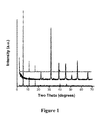
- FIG. 1 shows powder XRD patterns of BaTiO 3 (middle pattern), BaTi(PPA) 3 (bottom pattern), and Ba(PPA) (top pattern) according to the Examples.
- FIG. 2 shows powder XRD patterns of BaTi(PPA) 3 (middle pattern), SrTi(PPA) 3 (bottom pattern), and SrTiO 3 (top pattern) according to the Examples.
- FIG. 3 shows HRTEM imaging of SrTi(PPA) 3 according to the Examples.
- the area circled and labeled 3 represents the EDS spectra taken.
- FIG. 4 shows the 31 P MAS NMR spectra of a) Ti(PPA) 2 , b) Ba(PPA), and c) BaTi(PPA) 3 according to the Examples.
- FIG. 5 shows the 31 P MAS NMR spectra of a) BaTi(PPA) 3 , b) physical mix, and c) solvothermal mix according to the Examples.
- FIG. 6 shows the 31 P MAS NMR spectra of mixed-metal phosphonates a) BaTi(PPA) 3 and b) SrTi(PPA) 3 according to the Examples.
- FIG. 7 shows the thermal gravimetric curves of BaTi(PPA) 3 (labeled “A”) and SrTi(PPA) 3 (labeled “B”), according to the Examples.
- FIG. 8 shows the dielectric constant values of polystyrene composites as a function of weight loading, where A is BaTiO 3 , B is BaTi(PPA) 3 , C is SrTiO 3 , and D is SrTi(PPA) 3 , according to the Examples.
- FIG. 9 shows the IR spectra of BaTi(PPA) 3 (top plot) and SrTi(PPA) 3 (bottom plot).
- FIG. 10 shows that heating the BaTi(PPA) 3 eliminated the coordinated water as evidenced by the TGA curve.
- BaTi(PPA) 3 .H 2 O is labeled “A”
- the anhydrous BaTi(PPA) 3 is labeled “B”.
- FIG. 11 shows the IR spectra showing loss of coordinated water in the region 2000-2300 cm ⁇ 1 , according to the Examples.
- the top spectrum corresponds to BaTi(PPA) 3 heated to 400° C.
- the bottom spectrum corresponds to BaTi(PPA) 3 with no heating.
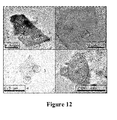
- FIG. 12 shows the HRTEM images along with the corresponding sections used for the EDS analysis of a single stack of the mixed-metal phosphonate made according to the Examples.
- FIG. 13 shows the powder X-ray diffraction data collected on Ti(PPA) 2 , made according to the Examples.
- FIG. 14 shows the powder X-ray diffraction data collected on solvothermal mix, made according to the Examples.
- FIG. 15 shows the powder X-ray diffraction pattern of the physical mixture of Ba(PPA) and Ti(PPA) 2 .
- FIG. 16 shows the EDS results for SrTi(PPA) 3 platelets imaged by HRTEM ( FIG. 3 ), and XPS results for BaTi(PPA) 3 and SrTi(PPA) 3 bulk powders, according to the Examples.
- the mixed metal phosphonates can be synthesized from a metal oxide(s) in combination with organophosphonic acids.
- the mixed metal phosphonates include the organic phosphonate within their chemical structure, as opposed to organically coated metal oxide particles.
- the mixed metal phosphonates contain an organic phosphonate group within the compound structure (e.g., covalently bonded), and can provide compatibility to the mixed metal phosphonates with other organic materials (e.g., polymeric material).
- the organic group can be selected to provide compatibility (e.g., solubility, dispersability, etc.) with particular polymeric material and/or solvents.
- the mixed metal phosphonates can still exhibit dielectric behavior similar to, but not tied to, their starting metal oxide.
- the mixed metal phosphonates are a new class of dielectric materials and, therefore, can be used to form polymeric dielectric films.
- the metal oxide(s) used to synthesize the mixed metal phosphonate can generally be represented as ABO 3 , where A is Mg 2 ⁇ , Ca 2+ , Sr 2+ , Ba 2+ , Pb 2+ , La 3+ , or combinations thereof and B is Ti 4+ , Zr 4+ , Al 3+ , or combinations thereof.
- the A and B cations can be paired such that A includes a cation having a valence of +2 and B includes a cation having a valence of +4.
- the A and B cations can be paired such that A includes a cation having a valence of +3 and B includes a cation having a valence of +3.
- suitable metal oxides include, but are not limited to, BaTiO 3 , SrTiO 3 , LaAlO 3 , BaZrO 3 , PbTiO 3 , and mixtures thereof.
- the metal oxide can be reacted with an organophosphonic acid, generally represented as RPO 3 H 2 , where R is the organic group.
- the organic group can be any suitable organic substituent.
- suitable organic group include, but are not limited to, alkyl groups (e.g., methyl, ethyl, propyl, butyl, etc.), alkenyl groups (ethylene, propylene, butylene, etc.), aryl groups (e.g., phenyl, benzyl, etc.), and combinations thereof.
- organophosphonic acids containing heteroatoms, such as sulfur, chlorine, bromine, nitrogen, etc. in the organic group can be used.
- the mixed metal phosphonate formulated from the metal oxide(s) and the organophosphonic acid(s) can be represented as AB(RPO 3 ) 3 , where A, B, and R are as discussed above.
- the organic group can be a phenyl group (where the organophosphonic acid is phenylphosphonic acid, known as “PPA”) to form a mixed metal phosphonate of the formula AB(PPA) 3 , which can readily disperse into toluene allowing easy fabrication of polystyrene-mixed-metal phosphonate nanocomposites.
- PPA phenylphosphonic acid
- the mixed metal phosphonates can be formed according to any suitable method. Suitable methods can include solution reaction methods, melt reaction methods, etc.
- the method of formulation can be selected according to the particular metal oxide(s) and organophosphonic acid(s) to be reacted.
- the solution reaction method can be used to form the mixed metal phosphonates without limitations on the type of organic group in the organophosphonic acid, as long as both the metal oxide(s) and the organophosphonic acid(s) can be combined into a common solvent.
- both the metal oxide(s) and the organophosphonic acid(s) can be combined into a common solvent.
- the metal oxide(s) and the organophosphonic acid(s) are combined into a solvent(s) and heated under solvothermal conditions (e.g., heated above the boiling point of the solvent or solvent combination).
- the solvent can, in one embodiment, be selected to deprotonate the two hydroxyls of the phosphonic acid to facilitate the formation of the mixed metal phosphonates.
- Suitable solvents can include, but are not limited to, alcohols (e.g., methanol, ethanol, propanol, butanol, etc.), toluene, dimethyl sulfoxide (DMSO), hexane, benzene, chloroform, diethyl ether, tetrahydrofuran, ethyl acetate, acetone, dimethylformamide, acetic acid, formic acid, water, etc., and mixtures and combinations thereof.
- alcohols e.g., methanol, ethanol, propanol, butanol, etc.
- DMSO dimethyl sulfoxide
- benzene chloroform
- diethyl ether tetrahydrofuran
- ethyl acetate acetone
- dimethylformamide acetic acid
- acetic acid formic acid, water, etc.
- a stoichiometric excess of the organophosphonic acid can be included in the solution when compared to the stoichiometric amount of metal oxide present.
- the reaction can be conducted until all of the metal oxide is reacted into a mixed metal phosphonate. Then, the excess organophosphonic acid can be washed from the precipitated product.
- the melt method is generally a condensation reaction that involves combining the metal oxide(s) and the organophosphonic acid(s) in a tube, sealing the tube to prevent the escape of gas (particularly water vapor, as water is a by-product of the condensation reaction, but is believed to be necessary for coordination to the metals and thus allowing the bridging phosphorus to be present) and heating the organophosphonic acid(s) above its melting point.
- the organophosphonic acid(s) can react with the metal oxide(s) to form the mixed metal phosphonates.
- the reaction When the reaction is finished, only the mixed metal phosphonate product is left, with the slight excess of acid (if used) that can be washed out. Thus, similar to the solution method, the mixed metal phosphonate will precipitate out of the solution as it is formed.
- This reaction can be allowed to continue as desired, for example about 1 hour to about 1 week. In most situations, the reaction time can be 12 hours to 60 hours, such as 24 hours to 48 hours.
- the melt method can provide more uniform reaction properties across different metal oxides.
- the melt method is limited to those organophosphonic acid(s) having a melting point lower then its decomposition point. Thus, not all R groups on the organophosphonic acid(s) can be utilized in the melt method.
- the mixed metal phosphonate can be combined with an organic polymeric material.
- the polymeric material can be solubilized in a solvent.
- the mixed metal phosphonate can be dispersed into the solubilized polymeric material to form a substantially homogeneous mixture.
- the mixture can then be formed into a film by any method (e.g., spun coated, film cast, and the like).
- the polymeric material can be selected to be compatible with the particular R group in the mixed metal phosphonate, so that the polymeric material and the mixed metal phosphonate can be more readily combined.
- R group is a phenyl group
- polystyrene can be used as the polymeric material and toluene can be used as the solvent.
- these compounds still exhibit the same dielectric behavior as their starting oxide.
- the dielectric permittivity of the PS composites increases with the better dispersion of the dielectric material. This is clearly seen in the direct comparison of the unmodified BaTiO 3 versus BaTi(PPA).
- the next step in the dielectric characterization of these mixed-metal phosphonates is to measure their effect on the breakdown voltage. Preliminary results on the breakdown voltage show no decrease in the value.
- FT-IR spectra were recorded on a Perkin Elmer Spectrum 100 using ATR diamond cell method. Powder X-ray diffraction patterns were collected using a Rigaku DMAX 2200 diffractometer. Thermogravimetric analysis was performed using a Thermal Analysis (TA) SDT-Q600 simultaneous DTA/TGA system in an oxidative environment. The samples were heated to 800° C. at a heating rate of 10° C./min. Solid-state 31P spectra were collected on a Varian Inova 500 spectrometer operating at 202.489 MHz using a Doty Scientific 4 mm/XC magic angle spinning(MAS) probe. Bloch decays of 50 msec were collected with a 200 ppm window after 45 degree excitation pulses.
- TA Thermal Analysis
- AB(RPA) were synthesized by the hydrothermal method. 1 mmol of ABO 3 was added to a 0.124 M solution of organophosphonic acid, RPO 3 H 2 , and the reaction mixture was sealed in a Teflon-lined steel bomb. The bomb was heated to 150° C. for 72 h. The powder products were filtered via vacuum filtration and washed with ethanol to remove unreacted reagents. The samples were dried in a convection oven overnight at 80° C.
- AB(RPA) 3 were synthesized by a melt reaction involving stoichiometric amounts of ABO 3 (1 mmol) and 10% molar excess of organophosphonic acid (3.1 mmol).
- the starting reagents were thoroughly mixed in a mortar and pestle for thirty minutes, before being transferred to sealed glass tubes.
- the reagents were heated to slightly above the melting point of the organophosphonic acid for 12 hours.
- the resulting product was then washed with ethanol while under sonication to remove excess organophosphonic acid. After washing with ethanol, the products were centrifuged and the supernatant was removed. The resulting product was then allowed to dry in a convection oven at 80° C. overnight.
- Polystyrene PS, average MW ⁇ 100,000 was dissolved in 20 mL of toluene in a glass beaker under rigorous magnetic stirring for 4 hours.
- Composite materials ABO 3 and AB(RPA) were added such that the weight percentage of the inorganic material was 40 and stirred for 15 hours to obtain a slurry.
- the viscosity of the slurry was adjusted by adding toluene.
- a thin aluminum foil (average thickness 15 ⁇ m) was carefully wrapped around a suitable substrate (silicon or pyrex discs), which served as the bottom electrode. Air was blown on the surface for 10 minutes and was cleaned thoroughly with ethanol.
- the PS-composite slurry was spin-coated on these substrates at 1000 rpm for 15 seconds.
- the spin-coated substrate was then placed in an oven at 80° C. under vacuum for 12 hours.
- parallel plate capacitors were formed by sputter depositing aluminum or gold as top electrodes on the film surface through a shadow mask. The results show no significant variation between Al—Al and Au—Al capacitors.
- FIGS. 1 and 2 show the diffraction patterns of the starting materials and the products.
- the diffraction patterns of BaTi(PPA) 3 and SrTi(PPA) 3 consist of several evenly spaced low-angle peaks that are characteristic of 001 reflections of layered solids.
- the diffraction lines for BaTi(PPA) 3 and SrTi (PPA) 3 overlay almost perfectly, indicating that both the compounds are structurally similar. This similarity is to be expected given that both compounds contain the same pendant phenyl group.
- the slight shift of the BaTi(PPA) 3 pattern toward lower angles is consistent with the larger size of barium relative to strontium.
- Attempts to index the powder X-ray diffraction patterns resulted in an interlayer separation of 15.754(1) ⁇ and 15.351(1) for BaTi(PPA) 3 and SrTi(PPA) 3 , respectively. Due to preferred orientation, only the first three diffraction lines could be used to index the patterns.
- the diffraction pattern for the single metal phosphonate, Ti(PPA) 2 is featureless, indicating an amorphous structure 30 .
- reaction product is a mixed metal phosphonate, BaTi(PPA) 3 , rather than a mixture of layered Ba(PPA) and amorphous Ti(PPA) 2 .
- 31 P MAS NMR experiments were carried out to investigate the phosphorous environments in BaTi(PPA) 3 , in the physical 1:1 mixture of Ba(PPA) and Ti(PPA) 2 , and in the solvothermal Ba+Ti+PPA product.
- 31 P MAS NMR spectra for the pure metal phosphonates, Ti(PPA) 2 and Ba(PPA) were also collected to compare them with the phosphorous environments in the mixed metal samples. The presence of peaks in the 31 P MAS NMR spectra provides a qualitative indication of different phosphorous environments in the various samples.
- the phosphorous environments differ in Ti(PPA) 2 vs. Ba(PPA).
- the octahedral coordination sphere around each Ti +4 cation consists of six oxygens from six different phosphonate groups; each phosphonate group bridges three Ti +4 cations.
- a consequence of this structural arrangement is that the TiO 6 octahedra are isolated from each other.
- each Ba +2 cation the coordination environment around each Ba +2 cation consists of six oxygens, two of which belong to a single phosphonate group, three of which belong to three other different phosphonate groups, and one that is part of a water molecule; each phosphonate group bridges three Ba ⁇ 2 cations.
- each BaO 6 octahedron is connected via a shared oxygen to four other BaO 6 octahedra.
- the crystal structure suggests that the phosphorous will have a single coordination environment in each of these materials. This is confirmed by the 31 P MAS NMR spectra.
- the 31 P MAS NMR experiments indicate that in BaTi(PPA) 3 ( FIG. 4 c ), three distinct phosphorous environments are present.
- the first phosphorous peak at ⁇ 3.95 ppm (s) corresponds to the M 4+ -O—P environment found in Ti(PPA) 2 as seen in the standard 31 P MAS-NMR spectrum of pure Ti(PPA) 2 .
- Another phosphorous resonance is observed at 9.25 ppm and corresponds to the M 2+ -O—P environment in Ba—O—P as seen in the standard 31 P MAS NMR spectrum of pure Ba(PPA).
- An integration of the area under the peaks indicates that the resonances correspond to 1 ⁇ 3 Ba—O—P to 2 ⁇ 3 Ti—O—P.
- FIG. 6 compares the 31 P MAS NMR spectra for SrTi(PPA) 3 and BaTi(PPA) 3 .
- the 31 P MAS NMR spectra for SrTi(PPA) 3 shows three phosphorous environments like BaTi(PPA) 3 .
- the first phosphorous environment located at 10.08 ppm relates to the Sr—O—P and the Ti—O—P environment is located at ⁇ 4.31 ppm.
- a third phosphorous environment is seen between the Sr—O—P and Ti—O—P environments at 3.15 ppm. We believe that this phosphorous environment corresponds to the Sr—O—P—O—Ti bridging motif.
- FTIR spectra ( FIG. 3 ) provided the insight into the binding of the phenyl phosphonic acid to the mixed metal oxides. Binding is evidenced through the strong C—H phenyl stretching frequency at 3053 cm ⁇ 1 .
- the C ⁇ C aromatic stretches are seen at 1590, 1484, and 1436 cm ⁇ 1 .
- Two P—O stretches are seen: M 2+ -O—P at 1213 cm ⁇ 1 and M 4+ -O—P at 1148 cm ⁇ 1 .
- the out-of-plane bending of the mono-substituted phenyl ring is seen at 746, 718, and 685 cm ⁇ 1 .
- thermal gravimetric experiments coupled with powder XRD were carried out.
- the thermal degradation process of the mixed metal phenyl phosphonates is seen in FIG. 7 .
- Powder XRD analyses of the thermal degradation products confirm the formation of MTi(P 2 O 7 ) 1.5 .
- Our observed weight loss corresponds to the loss of three phenyl groups.
- Both mixed metal phenyl phosphonates show enormous thermal stability near 600° C. as seen in the thermal gravimetric curves of the mixed metal phosphonates seen in FIG. 12 .
- HRTEM transmission electron microscopy
- EDS energy dispersive spectroscopy
- FIG. 3 shows an HRTEM image of a single platelet of SrTi(PPA) 3 .
- the metal composition of the indicated area on the platelet is 51% Sr and 49% Ti.
- the EDS data collected on several such platelets summarized in FIG. 16 (images given in Supporting Information), demonstrate that within experimental error, the ratio of Sr:Ti present in each platelet is 1:1. This is consistent with the result of XPS analysis of the bulk powder ( FIG. 16 ). Overlap of Ba and Ti peaks in EDS prevents quantitative analysis by the this method, however XPS analysis of BaTi(PPA) 3 does show a 1:1 ratio of metals.
- FIG. 9 shows the dielectric constant as a function of inorganic weight loading for polystyrene (PS) composites incorporating the two titanates (BaTiO 3 and SrTiO 3 ) and the two corresponding mixed metal phosphonates [BaTi(PPA) 3 and SrTi(PPA) 3 ].
- PS polystyrene
- Each data set also includes the value for pure PS, 2.6 ⁇ 0.1, plotted at 0 wt %.
- the dielectric constants increase by a factor of nearly four as weight loading increases to 40 wt % (to 9.4 ⁇ 0.5 for BaTiO 3 , and to 8.6 ⁇ 0.2 for SrTiO 3 ).
- the dielectric constants of the mixed metal phosphonates also increase considerably with inorganic weight loading and are significantly higher than the corresponding titanates at almost every point.
- the dielectric constant of SrTi(PPA) 3 is 66% higher (14.3 ⁇ 0.3) than that of SrTiO 3 .
- the dielectric constant of BaTi(PPA) 3 is 106% higher (19.4 ⁇ 0.2) than that of BaTiO 3 and more than six times greater than the value for pure PS.
- FTIR spectroscopy data ( FIG. 9 ) were collected to gain insight into the binding of the phenyl phosphonic acid to the mixed metal oxides. Binding is evidenced through the strong C—H phenyl stretching frequency at 3053 cm ⁇ 1 .
- the C ⁇ C aromatic stretches are seen at 1590, 1484, and 1436 cm ⁇ 1 .
- Two P—O stretches are seen: M 2+ -O—P at 1213 cm ⁇ 1 and M 4 ⁇ -O—P at 1148 cm ⁇ 1 .
- M 2+ -O—P at 1213 cm ⁇ 1
- M 4 ⁇ -O—P at 1148 cm ⁇ 1
- the out-of-plane bending of the mono-substituted phenyl ring is seen at 746, 718, and 685 cm ⁇ 1 .
- the broad absorptions in the 2000-2300 cm ⁇ 1 region is attributed to the coordinated water on the divalent metal.
- the coordinated water absorption can be
- MMP Mixed Metal Phosphonates
- PPA represents phenylphosphonic acid as the precursor to the organophosphonate group: ATi(PPA) 3 (Exemplary MMP 1) where A is Mg +2 , Ca +2 , Sr +2 , Ba +2 , Pb +2 , Co +2 , Mn +2 , or Fe +2 ; AZr(PPA) 3 (Exemplary MMP 2) where A is Ba or Pb ; LaAl(PPA) 3 ; and (Exemplary MMP 3) BaTi(RPO 3 ) 3 (Exemplary MMP 4) where R is phenyl, octyl, methyl, and carboxyethyl.
Landscapes
- Chemical & Material Sciences (AREA)
- Organic Chemistry (AREA)
- Health & Medical Sciences (AREA)
- Chemical Kinetics & Catalysis (AREA)
- Medicinal Chemistry (AREA)
- Polymers & Plastics (AREA)
- Life Sciences & Earth Sciences (AREA)
- Biochemistry (AREA)
- General Health & Medical Sciences (AREA)
- Molecular Biology (AREA)
- Inorganic Compounds Of Heavy Metals (AREA)
Abstract
Description
W=0.5∈0∈rE2 bd (1)
depends on the relative dielectric permittivity (or dielectric constant, ∈r) and dielectric breakdown field strength (Ebd in V/μm). For a parallel plate capacitor with area A, thickness d, and capacitance C=∈0∈rA/d, we have the alternate expression
W′≡AdW=0.5Cd2E2 bd=0.5CV2 bd (2)
for the maximum energy W(J) stored by a capacitor charged to the breakdown voltage Vbd. The most obvious way to increase W′ (or W) would be to choose dielectric materials with the highest possible breakdown field strength. Many polymers not only have high values of Ebd, but the also offer the additional advantage of processability. Unfortunately, the dielectric constants of most polymers are negligible.
ATi(PPA)3 (Exemplary MMP 1)
where A is Mg+2, Ca+2, Sr+2, Ba+2, Pb+2, Co+2, Mn+2, or Fe+2;
AZr(PPA)3 (Exemplary MMP 2)
where A is Ba or Pb ;
LaAl(PPA)3; and (Exemplary MMP 3)
BaTi(RPO3)3 (Exemplary MMP 4)
where R is phenyl, octyl, methyl, and carboxyethyl.
Claims (19)
AB(RPO3)3
ATi(PPA)3
AZr(PPA)3
LaAl(PPA)3;
BaTi(RPO3)3
ABO3
AB(RPO3)3
ABO3
Priority Applications (1)
| Application Number | Priority Date | Filing Date | Title |
|---|---|---|---|
| US13/329,731 US8247586B2 (en) | 2009-02-13 | 2011-12-19 | Methods of making layered mixed-metal phosphonates for high dielectric strength polymer nanocomposites |
Applications Claiming Priority (3)
| Application Number | Priority Date | Filing Date | Title |
|---|---|---|---|
| US20763109P | 2009-02-13 | 2009-02-13 | |
| US12/705,761 US8080600B2 (en) | 2009-02-13 | 2010-02-15 | Layered mixed-metal phosphonates for high dielectric strength polymer nanocomposites |
| US13/329,731 US8247586B2 (en) | 2009-02-13 | 2011-12-19 | Methods of making layered mixed-metal phosphonates for high dielectric strength polymer nanocomposites |
Related Parent Applications (1)
| Application Number | Title | Priority Date | Filing Date |
|---|---|---|---|
| US12/705,761 Division US8080600B2 (en) | 2009-02-13 | 2010-02-15 | Layered mixed-metal phosphonates for high dielectric strength polymer nanocomposites |
Publications (2)
| Publication Number | Publication Date |
|---|---|
| US20120095142A1 US20120095142A1 (en) | 2012-04-19 |
| US8247586B2 true US8247586B2 (en) | 2012-08-21 |
Family
ID=42631534
Family Applications (2)
| Application Number | Title | Priority Date | Filing Date |
|---|---|---|---|
| US12/705,761 Expired - Fee Related US8080600B2 (en) | 2009-02-13 | 2010-02-15 | Layered mixed-metal phosphonates for high dielectric strength polymer nanocomposites |
| US13/329,731 Expired - Fee Related US8247586B2 (en) | 2009-02-13 | 2011-12-19 | Methods of making layered mixed-metal phosphonates for high dielectric strength polymer nanocomposites |
Family Applications Before (1)
| Application Number | Title | Priority Date | Filing Date |
|---|---|---|---|
| US12/705,761 Expired - Fee Related US8080600B2 (en) | 2009-02-13 | 2010-02-15 | Layered mixed-metal phosphonates for high dielectric strength polymer nanocomposites |
Country Status (1)
| Country | Link |
|---|---|
| US (2) | US8080600B2 (en) |
-
2010
- 2010-02-15 US US12/705,761 patent/US8080600B2/en not_active Expired - Fee Related
-
2011
- 2011-12-19 US US13/329,731 patent/US8247586B2/en not_active Expired - Fee Related
Non-Patent Citations (1)
| Title |
|---|
| Cao et al. "Formation of quantum-size semiconductor particles in a layered metal phosphonate host lattice", Chem. Mater. 1991, 3, 149-156. * |
Also Published As
| Publication number | Publication date |
|---|---|
| US20100216924A1 (en) | 2010-08-26 |
| US8080600B2 (en) | 2011-12-20 |
| US20120095142A1 (en) | 2012-04-19 |
Similar Documents
| Publication | Publication Date | Title |
|---|---|---|
| CN100410180C (en) | Method of producing a powder, powder, and multilayered ceramic capacitor using the same | |
| Piszczek et al. | The new type of [Zr6 (μ3-O) 4 (μ3-OH) 4] cluster core: Crystal structure and spectral characterization of [Zr6O4 (OH) 4 (OOCR) 12](R= But, C (CH3) 2Et) | |
| US20080241042A1 (en) | Method for making metal titanate | |
| Lombardi et al. | Synthesis and dielectric properties of nanocrystalline oxide perovskites,[KNbO 3] 1− x [BaNi 0.5 Nb 0.5 O 3− δ] x, derived from potassium niobate KNbO 3 by gel collection | |
| Nielsen et al. | Delamination, synthesis, crystal structure and thermal properties of the layered metal-organic compound Zn (C 12 H 14 O 4) | |
| KR102028332B1 (en) | Method for preparing N-doped titanium carbide and the N-doped titanium carbide obtained thereof | |
| Ramadan et al. | New approach for synthesis of nano-sized CaCu3Ti4O12 powder by economic and innovative method | |
| Wang et al. | Synthesis and characterization of Ba1− xSrxTiO3 nanopowders by citric acid gel method | |
| US6728094B2 (en) | Titanium oxide powder, methods of manufacturing the same and barium titanate powder, dielectric ceramic, and multilayer ceramic capacitor | |
| Chae et al. | Molecular Structure of a New Lead Titanium Bimetallic Alkoxide Complex [PbTi2 (. mu. 4-O)(OOCCH3)(OCH2CH3) 7] 2: Evolution of Structure on Heat Treatment and the Formation of Thin-Layer Dielectrics | |
| Karmaoui et al. | A general nonaqueous route to crystalline alkaline earth aluminate nanostructures | |
| US8247586B2 (en) | Methods of making layered mixed-metal phosphonates for high dielectric strength polymer nanocomposites | |
| Cernea | Sol-gel synthesis and characterization of BaTiO~ 3 powder | |
| JPH0118018B2 (en) | ||
| KR100846998B1 (en) | Method for preparing high dielectric constant duty / organic hybrid membrane containing crystalline barium titanate nanoparticles | |
| KR20090095492A (en) | Method for producing perovskite-typed barium titanate powder | |
| Barber et al. | High-dielectric polymer composite materials from a series of mixed-metal phenylphosphonates, ATi (C6H5PO3) 3 for dielectric energy storage | |
| Xie et al. | Phase transition behaviour and mechanism of 2D TiO 2 (B) nanosheets through water-mediated removal of surface ligands | |
| CN116888070A (en) | Nanocarbon material dispersion composition | |
| Jalled et al. | Synthesis and dielectric properties of nanocrystalline strontium bismuth niobate | |
| Potdar et al. | Low temperature synthesis of ultrafine strontium titanate (SrTiO3) powdersa | |
| Barber et al. | New Layered Mixed Metal Phosphonates for High Dielectric− Polymer Composite Materials | |
| EP4608895A1 (en) | High temperature dielectric polymers and films | |
| CN114524671B (en) | Ceramic powder and application thereof | |
| KR102234684B1 (en) | Method for preparing N-doped titanium carbide and the N-doped titanium carbide obtained thereof |
Legal Events
| Date | Code | Title | Description |
|---|---|---|---|
| ZAAA | Notice of allowance and fees due |
Free format text: ORIGINAL CODE: NOA |
|
| ZAAB | Notice of allowance mailed |
Free format text: ORIGINAL CODE: MN/=. |
|
| STCF | Information on status: patent grant |
Free format text: PATENTED CASE |
|
| FPAY | Fee payment |
Year of fee payment: 4 |
|
| MAFP | Maintenance fee payment |
Free format text: PAYMENT OF MAINTENANCE FEE, 8TH YR, SMALL ENTITY (ORIGINAL EVENT CODE: M2552); ENTITY STATUS OF PATENT OWNER: SMALL ENTITY Year of fee payment: 8 |
|
| FEPP | Fee payment procedure |
Free format text: MAINTENANCE FEE REMINDER MAILED (ORIGINAL EVENT CODE: REM.); ENTITY STATUS OF PATENT OWNER: SMALL ENTITY |
|
| LAPS | Lapse for failure to pay maintenance fees |
Free format text: PATENT EXPIRED FOR FAILURE TO PAY MAINTENANCE FEES (ORIGINAL EVENT CODE: EXP.); ENTITY STATUS OF PATENT OWNER: SMALL ENTITY |
|
| STCH | Information on status: patent discontinuation |
Free format text: PATENT EXPIRED DUE TO NONPAYMENT OF MAINTENANCE FEES UNDER 37 CFR 1.362 |
|
| FP | Lapsed due to failure to pay maintenance fee |
Effective date: 20240821 |