US8243620B2 - Method for setting the operation of a routing node of an asynchronous wireless communication network, network node and communication network implementing the method - Google Patents
Method for setting the operation of a routing node of an asynchronous wireless communication network, network node and communication network implementing the method Download PDFInfo
- Publication number
- US8243620B2 US8243620B2 US13/125,520 US200813125520A US8243620B2 US 8243620 B2 US8243620 B2 US 8243620B2 US 200813125520 A US200813125520 A US 200813125520A US 8243620 B2 US8243620 B2 US 8243620B2
- Authority
- US
- United States
- Prior art keywords
- cluster
- probability
- node
- energy consumption
- interval
- Prior art date
- Legal status (The legal status is an assumption and is not a legal conclusion. Google has not performed a legal analysis and makes no representation as to the accuracy of the status listed.)
- Expired - Fee Related
Links
- 238000004891 communication Methods 0.000 title claims abstract description 38
- 238000000034 method Methods 0.000 title claims description 31
- 241000854291 Dianthus carthusianorum Species 0.000 claims abstract description 73
- 238000005265 energy consumption Methods 0.000 claims abstract description 54
- 238000000638 solvent extraction Methods 0.000 claims description 7
- 230000000737 periodic effect Effects 0.000 claims description 3
- 230000005540 biological transmission Effects 0.000 abstract description 31
- 230000014509 gene expression Effects 0.000 description 22
- 101000617541 Danio rerio Presenilin-2 Proteins 0.000 description 5
- 238000005070 sampling Methods 0.000 description 5
- 101150086396 PRE1 gene Proteins 0.000 description 4
- 230000004622 sleep time Effects 0.000 description 4
- 108700026140 MAC combination Proteins 0.000 description 3
- 238000010586 diagram Methods 0.000 description 3
- 238000005516 engineering process Methods 0.000 description 3
- 238000005457 optimization Methods 0.000 description 3
- 230000001360 synchronised effect Effects 0.000 description 3
- 101100172132 Mus musculus Eif3a gene Proteins 0.000 description 2
- 230000001934 delay Effects 0.000 description 2
- 230000000694 effects Effects 0.000 description 2
- 230000003044 adaptive effect Effects 0.000 description 1
- 238000004220 aggregation Methods 0.000 description 1
- 230000002776 aggregation Effects 0.000 description 1
- 230000002457 bidirectional effect Effects 0.000 description 1
- 238000004364 calculation method Methods 0.000 description 1
- 238000012512 characterization method Methods 0.000 description 1
- 239000013078 crystal Substances 0.000 description 1
- 125000004122 cyclic group Chemical group 0.000 description 1
- 230000003111 delayed effect Effects 0.000 description 1
- 238000009826 distribution Methods 0.000 description 1
- 230000007774 longterm Effects 0.000 description 1
- 239000000203 mixture Substances 0.000 description 1
- 239000010453 quartz Substances 0.000 description 1
- VYPSYNLAJGMNEJ-UHFFFAOYSA-N silicon dioxide Inorganic materials O=[Si]=O VYPSYNLAJGMNEJ-UHFFFAOYSA-N 0.000 description 1
- 238000003860 storage Methods 0.000 description 1
Images




Classifications
-
- H—ELECTRICITY
- H04—ELECTRIC COMMUNICATION TECHNIQUE
- H04W—WIRELESS COMMUNICATION NETWORKS
- H04W52/00—Power management, e.g. Transmission Power Control [TPC] or power classes
- H04W52/04—Transmission power control [TPC]
- H04W52/18—TPC being performed according to specific parameters
- H04W52/28—TPC being performed according to specific parameters using user profile, e.g. mobile speed, priority or network state, e.g. standby, idle or non-transmission
-
- H—ELECTRICITY
- H04—ELECTRIC COMMUNICATION TECHNIQUE
- H04W—WIRELESS COMMUNICATION NETWORKS
- H04W52/00—Power management, e.g. Transmission Power Control [TPC] or power classes
- H04W52/02—Power saving arrangements
- H04W52/0209—Power saving arrangements in terminal devices
- H04W52/0261—Power saving arrangements in terminal devices managing power supply demand, e.g. depending on battery level
- H04W52/0274—Power saving arrangements in terminal devices managing power supply demand, e.g. depending on battery level by switching on or off the equipment or parts thereof
-
- H—ELECTRICITY
- H04—ELECTRIC COMMUNICATION TECHNIQUE
- H04W—WIRELESS COMMUNICATION NETWORKS
- H04W40/00—Communication routing or communication path finding
-
- H—ELECTRICITY
- H04—ELECTRIC COMMUNICATION TECHNIQUE
- H04W—WIRELESS COMMUNICATION NETWORKS
- H04W80/00—Wireless network protocols or protocol adaptations to wireless operation
- H04W80/02—Data link layer protocols
-
- H—ELECTRICITY
- H04—ELECTRIC COMMUNICATION TECHNIQUE
- H04W—WIRELESS COMMUNICATION NETWORKS
- H04W84/00—Network topologies
- H04W84/18—Self-organising networks, e.g. ad-hoc networks or sensor networks
-
- Y—GENERAL TAGGING OF NEW TECHNOLOGICAL DEVELOPMENTS; GENERAL TAGGING OF CROSS-SECTIONAL TECHNOLOGIES SPANNING OVER SEVERAL SECTIONS OF THE IPC; TECHNICAL SUBJECTS COVERED BY FORMER USPC CROSS-REFERENCE ART COLLECTIONS [XRACs] AND DIGESTS
- Y02—TECHNOLOGIES OR APPLICATIONS FOR MITIGATION OR ADAPTATION AGAINST CLIMATE CHANGE
- Y02D—CLIMATE CHANGE MITIGATION TECHNOLOGIES IN INFORMATION AND COMMUNICATION TECHNOLOGIES [ICT], I.E. INFORMATION AND COMMUNICATION TECHNOLOGIES AIMING AT THE REDUCTION OF THEIR OWN ENERGY USE
- Y02D30/00—Reducing energy consumption in communication networks
- Y02D30/70—Reducing energy consumption in communication networks in wireless communication networks
Definitions
- the present invention relates to a method for setting the operation of a routing node of an asynchronous wireless communication network and to a network node and a communication network implementing it.
- WPAN Wireless Personal Area Network
- PAN Personal Area Network
- WPAN network is a PAN network using wireless short-range communication technologies.
- a communication technology which is very often used for implementing a WPAN network is ZigBee.
- WPAN Wireless Sensor Network
- a WPAN network the key components are the nodes of the network, also called devices.
- a WPAN network may comprise a mixture of mains powered devices and battery powered devices; battery powered devices are designed to limit their energy consumption so to assure a long lifetime to their batteries.
- Providing efficient use of energy in WSN networks is particularly important in order to achieve long-term deployment of applications since the sensor network nodes may not be easily recharged or replaced when the energy of their battery is over.
- the component of a node of a WPAN network which is primarily responsible for energy consumption is the radio transceiver (both when it transmits and when it receives); the typical and effective way of reducing energy consumption in an asynchronous WPAN network (a network wherein the nodes do not have a synchronized clock and therefore do not transmit and receive synchronously) is to use “duty-cycling”, i.e. to let the radio transceiver of the devices operate intermittently for short intervals of times; in this way, the operation of each node is a periodic (fixed transceiver operation period) sequence of a (short) awake interval and a (long) sleep interval. Of course, this complicates the communication protocols used in WPAN networks.
- a source node when a source node has to transmit an information packet, its transmitter transmits a series of short and fixed-length preambles, each containing the address of the destination node; small pauses between preambles permit the receiver of the destination node to awake (according to its own internal operation schedule), to detect the preamble and to send an acknowledgment that stops the sequence of preambles and signals the availability of the destination node to receive data; non-destination receivers which overhear the strobed preambles can go back to sleep immediately, rather than remaining awake for receiving data.
- This article also describes an adaptive algorithm which can be used to dynamically adjust duty-cycle parameters in order to optimize for energy consumption per packet, latency or both.
- U.S. Pat. No. 7,035,240 deals with a method and network architecture for implementing an energy efficient network.
- the network includes a plurality of nodes that collect and transmit data that are ultimately routed to a base station.
- the network nodes form a set of clusters with a single node acting as a cluster-head.
- the cluster-head advertises for nodes to join its cluster, schedules the collection of data within a cluster, and then transmits the data to the base station.
- a cluster can intelligently combine data from individual nodes. After a period of operation, the clusters are reformed with a different set of nodes acting as cluster-heads.
- the network provides an increased system lifetime by balancing the energy use of individual nodes.
- the Applicant has considered that in asynchronous wireless communication networks, especially in WPAN/WSN networks, there is a need for a much better optimization of the energy consumption of network nodes with respect to known protocols for the following reasons.
- the present invention aims at improving the solutions of the prior art.
- the present invention addresses the problem of minimizing energy consumption in a duty-cycled asynchronous wireless communication network.
- the basic idea behind the present invention is to use an energy consumption model that takes into account the effect of random access; anyway, in order to simplify the model, the network is partitioned into a plurality of clusters so that each of said clusters comprises one cluster-head node; for the purpose of this partitioning, a cluster-head node is a routing node considered only receiving data packets from the other nodes of the cluster and the other nodes of the cluster are nodes considered only transmitting data packets to the cluster-head node—this means that according to this partitioning clusters may partially overlap.
- the Applicant has considered that when transmission within a cluster is attempted by any of the nodes of the cluster a probability of busy channel is encountered, that when transmission within a cluster is carried out by any of the nodes of the cluster a probability of communication collision is encountered, and that a data packet is transferred within a cluster with a probability of successful transfer (which may be called “reliability”) and with an average delay of transfer (which may be called “latency”); additionally, the Applicant has considered the influence of the number of nodes of the clusters and of the average data packet generation rate according to which data packets are transmitted by the nodes of the clusters.
- the energy consumption of a cluster is a function primarily of the probability of busy channel, the probability of communication collision, the duration of the awake interval and the duration of the sleep interval of the cluster-head node; additionally, the energy consumption is a function of the number of nodes of the cluster and the average data packet generation rate.
- Minimization of the energy consumption is carried out under predetermined values of the probability of busy channel and of the probability of communication collision and under predetermined constraint for the probability of successful transfer and for the average delay of transfer; in this way, optimal values of the duration of the awake interval and the duration of the sleep interval of the cluster-head node are determined. Once these optimal values are determined, they are set and used as operation parameters of the cluster-head node.
- the partitioning of the network into a plurality of clusters may be fixed and predetermined; alternatively, it may be one of the steps to be carried out according to the present invention only once or repeatedly, for example periodically.
- the determination of the optimal operation parameters may be repeated, e.g. periodically, during the operation of the network. This is advantageous for example if the probability of busy channel or the probability of communication collision or both such probabilities change during the operation of the network.
- These two probabilities may be determined by each routing node of the network during its operation; in particular, the probability of busy channel may be determined by receiving estimates of the probability of busy channel made by the other nodes of the same cluster and by calculating an average or the maximum of the received estimates.
- the optimal values of the operation parameters may be determined by each routing node of the network during its operation; in order to do this quickly and by means of a simple hardware, such determination may be based on a table of pre-calculated values; such table may be stored inside each routing node; such storage into the routing nodes may be carried out e.g. by a base station; such base station may have calculated all the values of the table or tables before the network starts operating.
- the present invention relates to a network node and a communication network implementing the above method that minimizes energy consumption.
- FIG. 1 shows a duty-cycled asynchronous wireless communication network according to the present invention wherein a first cluster and a second cluster are highlighted
- FIG. 2 shows time diagrams explaining the operation of a source node and a destination node according to an asynchronous duty-cycling MAC protocol based on preamble sampling with multiple short preambles
- FIG. 3 shows a flowchart explaining a method for estimating the busy channel probability according to the present invention
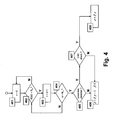
- FIG. 4 shows a flowchart explaining a method for estimating the collision probability according to the present invention
- FIG. 5 shows a table of values used by a routing node for determining the optimal operation parameters according to the present invention
- FIG. 6 shows a flowchart explaining a method of using the table of FIG. 5 by a routing node according to the present invention.
- the embodiment of the present invention that will be described in the following relates to a WPAN [Wireless Personal Area Network] network, specifically a WSN [Wireless Sensor Network] network using the ZigBee technology, even if the present invention may be applied more in general to an asynchronous wireless communication network.
- the operation of a network node is timed by means of an own clock signal which is generated by a timer (usually a local timer) though e.g. a quartz crystal; the timer is used by the network node also for measuring the duration of time intervals.
- a network is defined as “asynchronous” if its nodes do not have a synchronized clock and therefore do not transmit and receive synchronously.
- FIG. 1 shows a WSN network according to the present invention and embodying a ZigBee mesh topology.
- This network comprises seven routers, R 1 , R 2 , R 3 , R 4 , R 5 , R 6 , R 7 , and seven end devices, E 1 , E 2 , E 3 , E 4 , E 5 , E 6 , E 7 .
- FIG. 2 shows time diagrams explaining the operation of a source node SN (for example node E 4 ) and a destination node DN (for example node R 3 ) when data is to be transmitted from the source node SN to the destination node DN in the network of FIG. 1 .
- a source node SN for example node E 4
- a destination node DN for example node R 3
- the destination node DN wakes up periodically for checking whether there is data for it from e.g. the source node SN; if yes, it receives data; if not, it returns to sleep; this is repeated periodically; the time spent in sleep state is called “sleep time” and corresponds to the duration of a sleep interval R s and the time spent in awake state is called “awake time” and corresponds to the duration of an awake interval R l .
- preamble sampling MAC protocols when the source node has data to transmit to the destination node, it transmits a series of short preamble packets, each containing the identifier of the destination node, until it either receives an acknowledgement packet from the destination node or a “time-limit” TL is exceeded which corresponds to the maximum sleep time of a destination node—in the example of FIG. 2 , an acknowledgement packet ACK is received by the source node SN after the transmission of only two preamble packets PRE 1 and PRE 2 .
- a destination node wakes up and detects no radio signals in the communication channel, it returns to sleep immediately; if the destination node receives a preamble packet, but it is not the target of that preamble packet, it returns to sleep after this check; if the destination node receives a preamble packet and it is the target of that preamble packet, it transmits an acknowledgement packet to the source node after reception of the preamble packet. After reception of the acknowledgement packet, the source node transmits a data packet to the destination node.
- FIG. 2 shows further details connected to such communication; it is to be highlighted that the sequence of events in FIG. 2 is only one of the many possibilities that may occur during operation of the network of FIG. 1 .
- a request of transmission RT is sent to the MAC layer from an upper layer of the source node SN and a random amount of time RB 1 (called “random backoff”) is spent before the communication channel is sensed; channel sensing is carried out during a short time interval CS 1 ; at this moment, there are radio signals in the communication channel, i.e. the channel is busy (typically is used by another node for transmission), therefore another random amount of time RB 2 is spent and then the channel is sensed again during a time interval CS 2 ; now, the channel is available and therefore a preamble packet PRE 1 is transmitted by the source node SN.
- Random backoff a random amount of time RB 1
- the source node SN spends a time interval TO 1 waiting for a reply from the destination node DN; in this case, the time interval TO 1 lasts as a “time-out” TO; during the time interval TO 1 , the destination node DN does not reply as the destination node DN was asleep when the preamble packet PRE 1 was transmitted.
- a random amount of time RB 3 is spent before the communication channel is sensed during a time interval CS 3 (the channel is found available) and a preamble packet PRE 2 is transmitted by the source node SN; during the random amount of time RB 3 , the destination node DN wakes up (time instant t AW in FIG. 2 ).
- the source node SN spends a time interval TO 2 waiting for a reply from the destination node DN; in this case, the time interval TO 2 lasts less than the “time-out” TO as the destination node DN was awake when the preamble packet PRE 2 was transmitted and has replied to the source node SN.
- the destination node DN After the reception of the preamble packet PRE 2 , the destination node DN spends a random amount of time RB 4 before sensing the communication channel during a time interval CS 4 (the channel is found available) and transmitting an acknowledgement packet ACK to the source node SN.
- the source node SN After the reception of the acknowledgement packet ACK, the source node SN spends a random amount of time RB 5 before sensing the communication channel during a time interval CS 5 (the channel is found available) and transmitting a data packet DAT to the destination node DN.
- the destination node DN After the transmission of the acknowledgement packet ACK, the destination node DN simply waits for the data packet DAT and returns to sleep (time instant t AS in FIG. 2 ) after having received the data packet DAT.
- the amount of time spent in random access for transmitting a data packet is in general much larger than the amount of time spent in transmission (for example, according to IEEE 802.15.4 with default parameters setting, the maximum backoff time before data packet transmission is 27.4 ms whereas the transmission time of a 56 byte data packet is 1.79 ms at 250 kbps); random access depends on data traffic, MAC parameters and network topology; random access causes energy consumption; therefore, a precise energy consumption model should take into account also random access.
- nodes are organized in clusters with one node which acts as cluster-head node (it is a routing node); all the nodes of the clusters (except the cluster-head node) transmit their data directly to the cluster-head node.
- the cluster-head nodes receive data from all the other nodes of the clusters (that are end devices) and forwards them to a base station that acts as coordinator node; if the network has a “mesh” topology, the cluster-head nodes receives data from all the other nodes of the clusters and forwards them to router nodes.
- the network is partitioned into a plurality of clusters so that each of said clusters comprises one cluster-head node; for the purpose of this partitioning, a cluster-head node is a routing node considered only receiving data packets from the other nodes of the cluster and the other nodes of the cluster are nodes considered only transmitting data packets to the cluster-head node; in order to take account of the fact that a routing node may not only receive but also transmit data packets, a routing node belongs in general to at least two different clusters but it is the cluster-head node of only one cluster; this means that, according to this partitioning, clusters may partially overlap.
- a first cluster CL 1 of the network comprises routers R 2 , R 3 and R 4 and end devices E 4 and E 5 and considers router R 3 as its cluster-head node
- a second cluster CL 2 of the network comprises routers R 3 , R 4 , R 5 and R 6 and no end devices and considers router R 4 as its cluster-head node; therefore, nodes R 3 and R 4 belongs to two different clusters, i.e. CL 1 and CL 2 , but when considering the first cluster CL 1 node R 3 only receives data packets and node R 4 only transmits data packets and when considering the second cluster CL 2 node R 3 only transmits data packets and node R 4 only receives data packets. It is to be understood that the complete partitioning of the network of FIG. 1 provides for seven clusters, one for each router of the network.
- the data packet generation rate of the nodes of the network is such that during a time duration given by the duration of the sleep interval plus the duration of the awake interval, a node has at maximum one data packet to transmit. Consequently, if a node can not transmit a data packet within R l +R s , then the packet is discarded.
- TX node a transmitter node RX node a receiver node (cluster head)
- T s random sleep time of the RX as seen from the TX it is uniformly distributed over [0, R s ]
- T s random listening time of the RX as computed upon the reception of a preamble it is uniformly distributed over [0, R l ]
- T TX out maximum time that a TX node waits for an ACK after having sent a preamble.
- N P maximum number of preambles that can be sent N b maximum number of back-off to sense the channel for sending a preamble packet NB max maximum number of back-offs before declaring a channel access failure
- N number of nodes in a cluster ⁇ packet generation rate per node d TX probability that a TX node has a packet to send in the interval R s + R l c probability of busy channel b probability of preamble collision p probability of data packet collision ⁇ min minimum probability of successful packet transmission (reliability requirement) ⁇ max maximum probability of maximum delay (latency requirement)
- E max maximum energy consumption per listening-sleeping cycle (energy requirement) S p,j j-th random back-off time of a preamble ⁇ S p,
- E Ta and E Tl denote the statistical average with respect to the distribution of T a (T subscript A) and T l (T subscript L) respectively
- T a (T subscript A) is the random time to wait from the beginning of the transmissions until the start of the awake interval
- T l (T subscript L) is the time duration from the moment in which the preamble packet is received during the awake interval until the awake interval expires
- T p is the delay to wait before a data packet is successfully received
- t max is the maximum delay desired by the application
- c is the probability of communication collision.
- ⁇ T p and ⁇ T p are the mean and variance of T p respectively
- T 2 is the period of time spent by the TX node from the moment when the data packet is internally generated until a corresponding acknowledgement packet reaches the TX node
- T 3 is the period of time spent by TX node starting just after the acknowledgment packet is received and ending just before the data packet is transmitted.
- Pr[B k ] ( Pr[C k E k ] ⁇ Pr[ D k ]) Pr[T ack ⁇ T TX,out ](1 ⁇ b ) 2 +( Pr[E k ] ⁇ Pr[C k E k ]) Pr[T ack ⁇ T TX,out ] b (1 ⁇ b ) 2 +( Pr[E k ] ⁇ Pr[C k E k ])(1 ⁇ Pr[T ack ⁇ T TX,out ]) Pr[T ack ⁇ T TX,out ](1 ⁇ b ) 3 +( Pr[E k ] ⁇ Pr[C k E k ])( Pr[T ack ⁇ T TX,out ]) 2 b (1 ⁇ b ) 3 , where
- the mean and variance of T 2 are related to the mean and variance of T 1 (the period of time spent by TX node from the moment when the data packet is internally generated until the first corresponding preamble packet is actually transmitted) that are given by the following expressions
- ⁇ ⁇ T 1 2 ⁇ ⁇ ⁇ ⁇ T 1 - ⁇ T 1 2
- ⁇ ⁇ ⁇ k ⁇ ⁇ k 2 + ⁇ ⁇ k 2
- ⁇ ⁇ r ⁇ ( j ) rem ⁇ ( j , NB max + 1 )
- the mean and variance of T 2 are related also to the mean and variance of T ack (the period of time from the end of the transmission of a preamble packet until the end of the transmission of the corresponding acknowledgement packet) that are given by the following expressions
- R min ( R l ,R s ,T TX,out ,T out ,c,p ) T ⁇ Tl Pr[ ]Pr[I
- ] ( 1 ⁇ c NB max )(1 ⁇ c N a )(1 ⁇ c N d )(1 ⁇ p ).
- the first addend is the average energy consumption of the transmitting nodes and the second addend is the average energy consumption of the receiving node, i.e. the cluster-head node.
- the average energy consumption of one transmitting node is given by the following expression
- the first line in the above equation corresponds to the energy spent in the case of successful data packet transmission and the second line corresponds to the energy spent in the case of unsuccessful data packet transmission.
- the four addends in the first line of the above expression are, respectively, the energy for accessing the channel and transmitting “i” preamble packets given that the event B 1 , occurs, namely the i-th preamble packet was successfully transmitted and the corresponding acknowledgment packet was successfully received, the energy spent during “i ⁇ 1” (fixed) time out periods of the TX node for the preamble packets, the energy for receiving an acknowledgement packet, the energy for transmitting a data packet.
- the three addends in the second line of the above expression are, respectively, the energy spent when N p (the maximum number of preamble packets) preamble packets are transmitted but no data packet is transmitted since either the channel is busy or the awake interval of the receiving node has been missed due to collisions or random backoff.
- Pr[B k ] ( Pr[C k E k ] ⁇ Pr[ D k ]) Pr[T ack ⁇ T TX,out ](1 ⁇ b ) 2 +( Pr[E k ] ⁇ Pr[C k E k ]) Pr[T ack ⁇ T TX,out ] b (1 ⁇ b ) 2 +( Pr[E k ] ⁇ Pr[C k E k ])(1 ⁇ Pr[T ack ⁇ T TX,out ]) Pr[T ack ⁇ T TX,out ](1 ⁇ b ) 3 +( Pr[E k ] ⁇ Pr[C k E k ])( Pr[T ack ⁇ T TX,out ]) 2 b (1 ⁇ b ) 3 , where
- E rx The energy consumption at the cluster-head node (“E rx ”) is given by the energy spent for idle listening, sending an acknowledgement packet and receiving a data packet. It is difficult to provide a closed form expression for the probabilities of these events, because they are highly cross-correlated among them and among different nodes. As a result, an accurate characterization would require modelling the probability that the receiving node is busy with the reception of a data packet while some other node is trying to send another data packet. Hence, by considering that the energy spent at the receiving node is small if compared to the energy spent at the transmitting node, the following upper bound is used: E rx ⁇ R s P s +( R l +T out )max( P tx ,P rx ).
- T out fixed time out periods of the RX node for the data packet
- the energy consumption Before using the expressions of the energy, delay and reliability just determined, it is necessary to determine the probability of busy channel when attempting transmission and the probability of communication collision during transmission. Afterwards, optimal values of the duration of the awake interval and the duration of the sleep interval that reduce under a set threshold, for example minimize, the energy consumption may be determined.
- both the probability of busy channel and the probability of communication are variable and are repeatedly (for example periodically) determined for each cluster during operation of the network and their values is then used for repeatedly determining optimal values of the duration of the awake interval and the duration of the sleep interval for each cluster-head node.
- Busy channel probability is estimated at each non-cluster head node while attempting transmission of a packet (a preamble packet or data packet) to the cluster-head node.
- FIG. 3 shows a possible flowchart of the method for estimating the busy channel probability.
- the estimate made by a node may be transmitted to the cluster-head node in the payload of a preamble packet; preferably, every time a preamble packet is transmitted to the cluster-head node, the transmitting node inserts into the payload its last estimate of the busy channel probability.
- the cluster-head node may store the busy channel probability estimates received from its neighbouring nodes (for example one value for each neighbouring node) into a table; the busy channel probability to be used for the determination of the optimal operation parameters is preferably calculated as the average of the values stored in this table; alternatively, for example, the busy channel probability to be used for the determination of the optimal operation parameters may be calculated as the maximum of the values stored in this table.
- FIG. 3 refers to the case of unslotted IEEE 802.15.4 CSMA/CA [Carrier Sense Multiple Access with Collision Avoidance] mechanism: each node in the network has two variables: NB and BE.
- NB is the Number of Backoffs (that is a unit period of time for measuring a random period of time, which is called “random backoff time”) used while attempting the current transmission;
- NB is initialized to 0 before every new transmission.
- BE is the Backoff Exponent, which is related to how many backoffs a node must wait before it attempts to assess the channel.
- the parameters that affect the random backoff time are minBE, maxBE and maxNB, which correspond to the minimum and maximum of BE and the maximum of NB respectively.
- NB is initialized to 0 and BE is initialized to minBE (step 301 ).
- the MAC layer delays for a random number of backoffs in the range from 0 to 2 BE ⁇ 1 (step 1 302 ) and then requests the physical layer to perform a CCA [Clear Channel Assessment] (step 303 ).
- the result of the CCA is considered (step 304 ): if the channel is busy (arrow N outgoing from block 304 ), the channel is not accessed and the MAC layer increments both NB and BE by one, ensuring that BE remains less than maxBE (step 306 ), if the channel is available (arrow Y outgoing from block 304 ) the channel is accessed and the method ends successfully (step 310 ).
- a check is performed on the value of NB (step 307 ), namely whether the value of NB is more than maxNB; if the check is positive (arrow Y outgoing from block 307 ), the channel is not accessed and the method ends unsuccessfully (step 308 ); if the check is negative (arrow N outgoing from block 307 ), the MAC layer delays for a random number of backoffs using the updated values of NB and BE (step 302 ).
- a transmitting node might conclude that a collision has occurred to a transmitted preamble packet when no acknowledgement packet is received in reply thereto; anyway, the reason for the failure to get back an acknowledgement packet is, in most cases, that the destination node is sleeping during the transmission.
- the collision probability is advantageously determined at the receiver (i.e. the cluster-head node) side, which is the cluster-head node.
- FIG. 4 shows a possible flowchart of the method for determining the collision probability at any reception attempt.
- a counter “n” is initialized to 0 (step 401 ).
- the cluster-head node checks the RSSI [Received Signal Strength Indicator] (step 402 ). If the RSSI is more than the receiving threshold “R th ” (arrow Y outgoing from block 402 ), packets are being transmitted; otherwise (arrow N outgoing from block 402 ) packets are not being transmitted and the counter is reset (step 401 ). If there is transmission, the cluster-head node counts the number of symbols during which the RSSI is above the receiving threshold by incrementing counter “n” (step 403 ) and comparing its value with minimum number of symbols forming a packet “N th ” (step 404 ).
- the energy is minimized subject to reliability and delay constraints as follows:
- the solution of this minimization problem with respect to the operation parameters R s and R l can be obtained via standard numerical techniques.
- the person skilled in the art may determine, in each specific situation, values of the durations of the sleep and awake intervals of the cluster-head, number of nodes, average data packet generation rate, busy channel and collision probability that, subject to reliability and delay constraints, achieve energy levels that are below a set threshold, such threshold level being sufficiently close, from a practical point of view, to the minimum energy level.
- These values of the durations of the sleep and awake intervals of the cluster-head and of the other parameters indicated above that bring the energy level below the set threshold will be also considered as fulfilling the minimum energy condition.
- this minimization problem is solved offline, by means of e.g. a base station connected to the network, for many representative values of five variables, namely the total packet generation rate in the cluster (i.e. the number of nodes multiplied by the average data packet generation rate), collision and busy channel probabilities, delay and reliability constraints; in this way, the nodes of the network do not need a complex hardware for carrying out complicated calculations in real-time.
- the values of the five parameters as well as the corresponding pre-calculated optimal values R l opt and R s opt of the operation parameters R l and R s are stored into a table TBL like the one shown in FIG. 5 comprised in each of the cluster-head nodes of the network.
- the values of three variables are stored into the cluster-head node: the total packet generation rate N ⁇ of its cluster, the desired probability ⁇ max that the delay is less than t max , the minimum desired probability ⁇ min with which a data packet should be transferred; additionally, the operation parameters of the cluster-head node are set to e.g. default values.
- the cluster-head node receives from its neighbouring nodes the estimates of the busy channel probability and calculates their average (step 601 ); the cluster heads estimates the collision probability (step 602 ); using as entry points the values of the three variables, the calculated average busy channel probability and the estimated collision probability, two values of R l and R s are read from the table TBL corresponding to the optimal vales R l opt and R s opt that minimizes the energy consumption of the cluster (step 603 ) and are set as new operation parameters of the cluster-head node replacing the previous operation parameters (step 604 ); after that, the cluster-head node waits some time (step 605 ) before repeating the steps of the method.
Landscapes
- Engineering & Computer Science (AREA)
- Computer Networks & Wireless Communication (AREA)
- Signal Processing (AREA)
- Mobile Radio Communication Systems (AREA)
Abstract
Description
| Symbol | Meaning |
| TX node | a transmitter node |
| RX node | a receiver node (cluster head) |
| T1 | random delay spent by the TX node before actually transmitting a preamble packet |
| T2 | random delay spent by the TX node from the beginning of a transmission |
| until the reception of the acknowledgement | |
| T3 | random delay spent by the TX node from the instant of acknowledgement reception until |
| the transmission of a data packet | |
| TP | random delay to wait before a data packet is successfully received |
| Ts | random sleep time of the RX as seen from the TX (it is uniformly distributed over [0, Rs]) |
| Ts | random listening time of the RX as computed upon the reception of a preamble |
| (it is uniformly distributed over [0, Rl]) | |
| Tack | random time before the RX node can access the channel and send an acknowledgement. |
| TTX, out | maximum time that a TX node waits for an ACK after having sent a preamble. |
| Tout | maximum time that a TX node waits from the moment of the reception of |
| an ACK before giving up the data packet transmission. | |
| NP | maximum number of preambles that can be sent |
| Nb | maximum number of back-off to sense the channel for sending a preamble packet |
| NBmax | maximum number of back-offs before declaring a channel access failure |
| N | number of nodes in a cluster |
| λ | packet generation rate per node |
| dTX | probability that a TX node has a packet to send in the interval Rs + Rl |
| c | probability of busy channel |
| b | probability of preamble collision |
| p | probability of data packet collision |
| ψmin | minimum probability of successful packet transmission (reliability requirement) |
| τmax | maximum probability of maximum delay (latency requirement) |
| Emax | maximum energy consumption per listening-sleeping cycle (energy requirement) |
| Sp,j | j-th random back-off time of a preamble |
| μSp,j | average of Sp,j |
| Sc | time duration of channel sensing for clear channel assessment |
| Sp | time duration of a preamble packet |
| Sa | time duration of an acknowledgement packet |
| Sd | time duration of a data packet |
| Sb | time duration of forming the basic time period used by the CSMA/CA algorithm |
| Rs | sleep time of the receiver node (cluster head) |
| Rl | active time of the receiver node (cluster head) |
| Ak | event occurring when the channel is busy for k-1 times |
| Bk | event occurring when a preamble has to be sent k times before being received in the active time of the |
| RX node and the corresponding acknowledgement is sent by the RX node and received before | |
| the time out of the TX node | |
| G | event that occurs when a preamble is successfully received during the active state of the receiver |
| H|G | event that occurs when the ACK is successfully sent before the time out of the RX expires |
| provided that a preamble is successfully received | |
| I|G, H | event that occurs when the TX sends successfully a data packet provided that a preamble |
| is successfully received and the ACK is also successfully received | |
| Ptx | transmit power |
| Prx | receive power |
| Ps | sleep power |
Modelling of the Delay


where ETa and ETl denote the statistical average with respect to the distribution of Ta (T subscript A) and Tl (T subscript L) respectively; Ta (T subscript A) is the random time to wait from the beginning of the transmissions until the start of the awake interval, Tl (T subscript L) is the time duration from the moment in which the preamble packet is received during the awake interval until the awake interval expires, Tp is the delay to wait before a data packet is successfully received, tmax is the maximum delay desired by the application, c is the probability of communication collision.
μT
σT
where μT
where
Pr[B k]=(Pr[C k E k ]−Pr[
where
and
where
where
Modelling of the Reliability
R min(R l ,R s ,T TX,out ,T out ,c,p)=

where the probability that a preamble packet is successfully transmitted during the awake interval of the RX node and the corresponding acknowledgement packet is successfully transmitted before the timeout of the TX node expires is given by the following expression
the probability that the TX node transmits a data packet successfully, given that a preamble packet is successfully received and the acknowledgement packet is also successfully received, is given by the following expression
Pr[

Modelling of the Energy Consumption
where N is the number of transmitting nodes in the cluster (equal to the total number of the nodes of the cluster minus one, i.e. the cluster-head node) and dTX is the probability that a transmitting node has at least one data packet to transmit to the cluster-head node during the time interval of Rl+Rs, i.e. dTX=1−e−λ(R
Pr[B k]=(Pr[C k E k ]−Pr[
where
where it is assumed that the receiving node can be listening for a time-out (“Tout”=fixed time out periods of the RX node for the data packet), after the end of the awake interval if an acknowledgement packet was transmitted just before the end of the awake interval.
Minimization of the Energy Consumption
where τmax is the desired probability that the delay is less than τmax and ψmin is the minimum desired probability with which a data packet should be transferred. In this optimization, c and p are feed-forward variables whereas λ, tmax, τmax and ψmin are application requirements.
Claims (15)
Applications Claiming Priority (1)
| Application Number | Priority Date | Filing Date | Title |
|---|---|---|---|
| PCT/EP2008/008925 WO2010045954A1 (en) | 2008-10-22 | 2008-10-22 | Method for setting the operation of a routing node of an asynchronous wireless communication network, network node and communication network implementing the method |
Publications (2)
| Publication Number | Publication Date |
|---|---|
| US20110211513A1 US20110211513A1 (en) | 2011-09-01 |
| US8243620B2 true US8243620B2 (en) | 2012-08-14 |
Family
ID=40386324
Family Applications (1)
| Application Number | Title | Priority Date | Filing Date |
|---|---|---|---|
| US13/125,520 Expired - Fee Related US8243620B2 (en) | 2008-10-22 | 2008-10-22 | Method for setting the operation of a routing node of an asynchronous wireless communication network, network node and communication network implementing the method |
Country Status (7)
| Country | Link |
|---|---|
| US (1) | US8243620B2 (en) |
| EP (1) | EP2359537B1 (en) |
| JP (1) | JP5175398B2 (en) |
| KR (1) | KR101571076B1 (en) |
| CN (1) | CN102227891B (en) |
| ES (1) | ES2427598T3 (en) |
| WO (1) | WO2010045954A1 (en) |
Cited By (4)
| Publication number | Priority date | Publication date | Assignee | Title |
|---|---|---|---|---|
| US20110194552A1 (en) * | 2008-10-10 | 2011-08-11 | Universita Degli Studi Di Udine | Wireless transmission and reception method and apparatus |
| US20120036198A1 (en) * | 2010-08-06 | 2012-02-09 | Marzencki Marcin | System and method for self-calibrating, self-organizing and localizing sensors in wireless sensor networks |
| US9648612B2 (en) | 2013-12-23 | 2017-05-09 | At&T Intellectual Property I, L.P. | Method, computer-readable storage device, and apparatus for allocating timeslots on channels in a wireless network |
| US11358811B2 (en) | 2014-01-22 | 2022-06-14 | Symbotic Canada, Ulc | Vision-assisted robotized depalletizer |
Families Citing this family (44)
| Publication number | Priority date | Publication date | Assignee | Title |
|---|---|---|---|---|
| WO2010045954A1 (en) * | 2008-10-22 | 2010-04-29 | Telecom Italia S.P.A. | Method for setting the operation of a routing node of an asynchronous wireless communication network, network node and communication network implementing the method |
| JP5675772B2 (en) * | 2009-04-15 | 2015-02-25 | コーニンクレッカ フィリップス エヌ ヴェ | Energy efficient transmission in the network |
| KR101032724B1 (en) * | 2009-05-13 | 2011-05-06 | 서울대학교산학협력단 | Method for wireless multi-hop network |
| US8351892B2 (en) * | 2009-05-26 | 2013-01-08 | Qualcomm Incorporated | Network detection device power conservation |
| WO2010149216A1 (en) * | 2009-06-26 | 2010-12-29 | Nokia Siemens Networks Oy | Wake up procedure for a base station in a communications network |
| US8582561B2 (en) * | 2009-07-31 | 2013-11-12 | Htc Corporation | Method of handling P-TMSI change in a wireless communication system and related communication device |
| KR101295871B1 (en) * | 2009-11-27 | 2013-08-12 | 한국전자통신연구원 | Data transmission method in sensor network |
| KR101042600B1 (en) * | 2009-12-04 | 2011-06-20 | 한국전자통신연구원 | Low power medium access control method in semi-linear sensor network |
| WO2011080451A1 (en) * | 2009-12-14 | 2011-07-07 | France Telecom | Improved method for transmitting a communication signal |
| US9220069B2 (en) * | 2010-01-07 | 2015-12-22 | Qualcomm Incorporated | Method and apparatus for delay-constrained end-to-end energy optimization for wireless services |
| CN102256268B (en) * | 2010-05-19 | 2015-08-05 | 北京兴科迪科技有限公司 | Based on the fault-tolerance approach of random walk in wireless sense network |
| CN101909350B (en) * | 2010-08-13 | 2012-11-21 | 上海交通大学 | Method for maximizing lifetime in wireless network |
| US8774050B2 (en) * | 2010-11-09 | 2014-07-08 | Cisco Technology, Inc. | Dynamic wake-up time adjustment based on designated paths through a computer network |
| CN102045708A (en) * | 2011-01-25 | 2011-05-04 | 河海大学常州校区 | Energy prediction-based wireless sensor network intrusion detection method |
| US9001844B2 (en) * | 2012-03-28 | 2015-04-07 | Texas Instruments Incorporated | Overlapping priority contention windows for G3 power line communications networks |
| FR2988972A1 (en) * | 2012-03-29 | 2013-10-04 | France Telecom | METHOD OF PROCESSING RADIO COMMUNICATION SIGNAL RECEPTION, TRANSMISSION PROCESSING METHOD, COMPUTER DEVICES AND COMPUTER PROGRAMS THEREOF |
| CN102843672B (en) * | 2012-08-08 | 2019-03-12 | 中国电力科学研究院 | A detection method of malicious nodes in sensor network based on energy field |
| JP5307932B1 (en) * | 2012-12-31 | 2013-10-02 | 利仁 曽根 | Cluster communication system |
| US10200974B2 (en) * | 2013-01-08 | 2019-02-05 | Intel IP Corporation | Methods and arrangements to mitigate collisions in wireless networks |
| CN103269503B (en) * | 2013-05-17 | 2015-11-25 | 浙江工业大学 | The low conflict speed of a kind of wireless nano sensor network distinguishes multiple access method |
| US9148849B2 (en) * | 2013-06-03 | 2015-09-29 | King Fahd University Of Petroleum And Minerals | Coverage, connectivity and communication (C3) protocol method for wireless sensor networks |
| CN104320835A (en) * | 2014-09-18 | 2015-01-28 | 南京邮电大学 | Improvement method based on LDS node sleeping strategy |
| CN104378743A (en) * | 2014-12-05 | 2015-02-25 | 哈尔滨工业大学 | TD-LTE offline group multicast communication method |
| CN105072674A (en) * | 2015-07-17 | 2015-11-18 | 天津工业大学 | Distributed recruitment scheduling method in wireless sensor network |
| CN105050128B (en) * | 2015-07-30 | 2019-03-19 | 南京大学 | Automatic node order derivation method for bridge health monitoring sensor network using signal strength |
| CN106550318B (en) * | 2015-09-21 | 2019-11-15 | 海能达通信股份有限公司 | A kind of processing method and terminal in direct mode operation lower channel conflict |
| CN109076602B (en) * | 2016-04-07 | 2022-07-05 | 瑞典爱立信有限公司 | Radio network node, wireless device and methods performed therein |
| JP6142124B1 (en) * | 2016-11-30 | 2017-06-07 | サイレックス・テクノロジー株式会社 | Wireless communication apparatus, wireless communication method and program |
| CN107071873B (en) * | 2017-03-24 | 2019-12-20 | 浙江理工大学 | Coordinator of tree sensor network ad hoc network |
| CN107148069B (en) * | 2017-03-24 | 2020-07-10 | 浙江理工大学 | Self-networking and low-power-consumption data collection method of tree sensor network |
| CN106900042B (en) * | 2017-03-24 | 2019-12-20 | 杭州罗曼智能科技有限公司 | Sensor node of tree-type sensor network ad hoc network |
| CN108770035A (en) * | 2018-05-30 | 2018-11-06 | 中国联合网络通信集团有限公司 | A kind of leader cluster node choosing method and system |
| CN111200763B (en) * | 2018-11-20 | 2021-11-26 | 力同科技股份有限公司 | Narrow-band communication data sending method, receiving method, interphone and storage medium |
| CN109996310A (en) * | 2019-04-11 | 2019-07-09 | 中国联合网络通信集团有限公司 | A kind of cluster head selection method and device |
| CN110225567A (en) * | 2019-04-25 | 2019-09-10 | 北京邮电大学 | A kind of sensor network cluster-dividing method based on fairness and energy consumption rate |
| CN114698138A (en) * | 2020-12-29 | 2022-07-01 | 华为技术有限公司 | Channel access method and device |
| CN113777938B (en) * | 2021-08-31 | 2023-07-18 | 东风柳州汽车有限公司 | Home appliance control method, device, device and storage medium |
| CN114500613A (en) * | 2022-04-06 | 2022-05-13 | 广东电网有限责任公司佛山供电局 | Online monitoring Internet of things system for power grid |
| CN115086905B (en) * | 2022-07-20 | 2022-12-27 | 广州市第一市政工程有限公司 | Bim-based engineering management system |
| CN115835155B (en) * | 2022-11-24 | 2024-06-21 | 广西电网有限责任公司电力科学研究院 | A self-organizing network networking method for self-energy sensor |
| JP2025055867A (en) * | 2023-09-27 | 2025-04-08 | 東芝情報システム株式会社 | COMMUNICATION SYSTEM AND COMMUNICATION METHOD IN THE COMMUNICATION SYSTEM |
| CN118317399B (en) * | 2024-06-06 | 2024-09-24 | 南方电网科学研究院有限责任公司 | A clustering adaptive routing method and system for wireless terminals in a virtual power plant |
| CN120640375B (en) * | 2025-08-11 | 2025-10-17 | 国网浙江省电力有限公司科技创新中心 | Real-time communication network construction method and system based on LoRa (local area network) ad hoc network technology |
| CN120751516B (en) * | 2025-08-21 | 2025-11-18 | 大连理工大学 | Cluster wireless ad hoc network method for intelligent port operation equipment |
Citations (5)
| Publication number | Priority date | Publication date | Assignee | Title |
|---|---|---|---|---|
| US7035240B1 (en) | 2000-12-27 | 2006-04-25 | Massachusetts Institute Of Technology | Method for low-energy adaptive clustering hierarchy |
| US7522547B2 (en) * | 2004-02-27 | 2009-04-21 | Samsung Electronics Co., Ltd | Method for transmitting FATIM in mobile ad hoc network and medium access control protocol layer module therefor |
| US20100157865A1 (en) * | 2008-12-18 | 2010-06-24 | Broadcom Corporation | Power-Save for Wireless Networks |
| US20110128869A1 (en) * | 2007-09-19 | 2011-06-02 | Telecom Italia S.P.A. | Method for transmitting information packets within an asynchronous wireless communication network and network node implementing it |
| US20110211513A1 (en) * | 2008-10-22 | 2011-09-01 | Telecom Italia S.P.A. | Method for Setting the Operation of a Routing Node of an Asynchronous Wireless Communication Network, Network Node and Communication Network Implementing the Method |
Family Cites Families (6)
| Publication number | Priority date | Publication date | Assignee | Title |
|---|---|---|---|---|
| CN100438474C (en) * | 2006-01-06 | 2008-11-26 | 中国人民解放军理工大学 | Adaptive Sleeping Method for Data Link Layer of Clustered Wireless Sensor Networks |
| US7852761B2 (en) * | 2006-09-07 | 2010-12-14 | Sap Ag | Duty cycle control for networks of nodes |
| CN100547978C (en) * | 2006-12-01 | 2009-10-07 | 中国科学院沈阳自动化研究所 | A kind of energy-saving method of medium access control layer of wireless mesh network |
| CN101217548A (en) * | 2008-01-17 | 2008-07-09 | 上海交通大学 | Optimization Method of S-MAC Protocol Parameter Setting in Wireless Sensor Networks |
| CN101247342B (en) * | 2008-03-14 | 2010-09-08 | 毛宏伟 | Wireless sensor network, establishing method and communication method |
| CN101282335B (en) * | 2008-05-20 | 2012-09-05 | 浙江大学宁波理工学院 | Method for snooping and sleeping low-load wireless sensor network MAC layer |
-
2008
- 2008-10-22 WO PCT/EP2008/008925 patent/WO2010045954A1/en not_active Ceased
- 2008-10-22 CN CN200880132142.6A patent/CN102227891B/en not_active Expired - Fee Related
- 2008-10-22 ES ES08874984T patent/ES2427598T3/en active Active
- 2008-10-22 KR KR1020117011325A patent/KR101571076B1/en not_active Expired - Fee Related
- 2008-10-22 EP EP08874984.1A patent/EP2359537B1/en not_active Not-in-force
- 2008-10-22 JP JP2011532498A patent/JP5175398B2/en not_active Expired - Fee Related
- 2008-10-22 US US13/125,520 patent/US8243620B2/en not_active Expired - Fee Related
Patent Citations (5)
| Publication number | Priority date | Publication date | Assignee | Title |
|---|---|---|---|---|
| US7035240B1 (en) | 2000-12-27 | 2006-04-25 | Massachusetts Institute Of Technology | Method for low-energy adaptive clustering hierarchy |
| US7522547B2 (en) * | 2004-02-27 | 2009-04-21 | Samsung Electronics Co., Ltd | Method for transmitting FATIM in mobile ad hoc network and medium access control protocol layer module therefor |
| US20110128869A1 (en) * | 2007-09-19 | 2011-06-02 | Telecom Italia S.P.A. | Method for transmitting information packets within an asynchronous wireless communication network and network node implementing it |
| US20110211513A1 (en) * | 2008-10-22 | 2011-09-01 | Telecom Italia S.P.A. | Method for Setting the Operation of a Routing Node of an Asynchronous Wireless Communication Network, Network Node and Communication Network Implementing the Method |
| US20100157865A1 (en) * | 2008-12-18 | 2010-06-24 | Broadcom Corporation | Power-Save for Wireless Networks |
Non-Patent Citations (9)
| Title |
|---|
| B. Bougard, et al., "Energy Efficiency of the IEEE 802.15.4 Standard in Dense Wireless Microsensor Networks: Modeling and Improvement Perspectives," in Proc. DATE, vol. 1, pp. 196-201, Design, Automation and Test in Europe (DATE'05) vol. 1, 2005. |
| D. Cho, et al., "An Adaptive Energy Saving Mechanism for the IEEE 802.15.4 LR-WPAN", in Proc. WASA, 2006, pp. 38-46. |
| F. Amini, et al., "Performance of IEEE 802.15.4 Clusters with Power Management and Key Exchange", presented at J. Comput. Sci. Technol., 2008, pp. 377-388. |
| International Search Report and Written Opinion dtd Nov. 9, 2009, PCT/EP2008/008925. |
| J. Polastre et al., "Versatile Low Power Media Access for Wireless Sensor Networks", SenSys 2004, Nov. 2004, pp. 1-13. |
| M. Buettner et al., "X-MAC: A Short Preamble MAC Protocol for Duty-Cycled Wireless Sensor Networks", SenSys 2006, Nov. 2006, pp. 1-14. |
| P.G. Park, et al., "Breath: A Self-Adapting Protocol for Wireless Sensor Networks in Control and Automation", in Proc. SECON, 2008, pp. 323-331. |
| Y. Huang, et al., "An Energy-Efficient MAC Design for IEEE 802.15.4-Based Wireless Sensor Networks", in Proc. EUC Workshops, 2007, pp. 237-248. |
| Y. Zhang, et al., "Analysis of Energy Efficiency and Power Saving in IEEE 802.15.4", Wireless Comm. and Networking Conf., Mar. 2007, WCNC 2007, pp. 3332-3336. |
Cited By (5)
| Publication number | Priority date | Publication date | Assignee | Title |
|---|---|---|---|---|
| US20110194552A1 (en) * | 2008-10-10 | 2011-08-11 | Universita Degli Studi Di Udine | Wireless transmission and reception method and apparatus |
| US20120036198A1 (en) * | 2010-08-06 | 2012-02-09 | Marzencki Marcin | System and method for self-calibrating, self-organizing and localizing sensors in wireless sensor networks |
| US8849926B2 (en) * | 2010-08-06 | 2014-09-30 | Simon Fraser University | System and method for self-calibrating, self-organizing and localizing sensors in wireless sensor networks |
| US9648612B2 (en) | 2013-12-23 | 2017-05-09 | At&T Intellectual Property I, L.P. | Method, computer-readable storage device, and apparatus for allocating timeslots on channels in a wireless network |
| US11358811B2 (en) | 2014-01-22 | 2022-06-14 | Symbotic Canada, Ulc | Vision-assisted robotized depalletizer |
Also Published As
| Publication number | Publication date |
|---|---|
| CN102227891B (en) | 2014-04-16 |
| US20110211513A1 (en) | 2011-09-01 |
| EP2359537A1 (en) | 2011-08-24 |
| KR20110086078A (en) | 2011-07-27 |
| EP2359537B1 (en) | 2013-05-01 |
| ES2427598T3 (en) | 2013-10-31 |
| WO2010045954A1 (en) | 2010-04-29 |
| JP5175398B2 (en) | 2013-04-03 |
| KR101571076B1 (en) | 2015-11-23 |
| CN102227891A (en) | 2011-10-26 |
| JP2012506654A (en) | 2012-03-15 |
Similar Documents
| Publication | Publication Date | Title |
|---|---|---|
| US8243620B2 (en) | Method for setting the operation of a routing node of an asynchronous wireless communication network, network node and communication network implementing the method | |
| Kredo II et al. | Medium access control in wireless sensor networks | |
| CN109495957B (en) | An Adaptive Asynchronous Wireless Wake-Up Method Based on Secondary Collision Probability Model | |
| US9560594B2 (en) | Access point response to PS-Poll | |
| US20040105401A1 (en) | Apparatus and method for reducing power consumption in ad-hoc network | |
| US20030125087A1 (en) | Wireless base station device, wireless communication system, and communication control method | |
| US9668214B2 (en) | Method and device for acquiring and transmitting data by an STA in a wireless local area network | |
| US9301248B2 (en) | Methods and apparatuses for communication in a personal area network | |
| CN101715241B (en) | Method and device for medium access control of distributed wireless local area network | |
| Mišic et al. | Duty cycle management in sensor networks based on 802.15. 4 beacon enabled MAC | |
| WO2016087331A1 (en) | Method for operating a communication device. | |
| US20040186907A1 (en) | Technique for optimizing backoff for a shared resource | |
| Gong et al. | Traffic adaptive MAC protocol for wireless sensor network | |
| CN105814826B (en) | Data transmission method sends method, apparatus and receiver equipment | |
| JP5821668B2 (en) | Base station, radio communication system, and radio communication method | |
| Zhao et al. | Game-theoretic medium access control protocol for wireless sensor networks | |
| Vazquez‐Gallego et al. | Combining distributed queuing with energy harvesting to enable perpetual distributed data collection applications | |
| Ozugur | Optimal MAC-layer fairness in 802.11 networks | |
| Zhao et al. | An energy-efficient MAC protocol for WSNs: game-theoretic constraint optimization | |
| Predojev et al. | Energy efficiency analysis of a cooperative scheme for wireless local area networks | |
| Mehta et al. | Performance analysis of binary exponential backoff and improved backoff for WPAN | |
| Joon et al. | Modelling of IEEE 802.11 DCF in the presence of hidden nodes | |
| Sun et al. | Delay analysis of IEEE 802.11 DCF with back-off suspension | |
| Gao et al. | Research on Data Transmission Strategy for Wireless Body Area Network with Priority Transmission of Emergency Data | |
| Bouabdallah et al. | Analysis of the latency-lifetime tradeoff in wireless sensor networks |
Legal Events
| Date | Code | Title | Description |
|---|---|---|---|
| AS | Assignment |
Owner name: TELECOM ITALIA S.P.A., ITALY Free format text: ASSIGNMENT OF ASSIGNORS INTEREST;ASSIGNORS:COLERI ERGEN, SINEM;FISCHIONE, CARLO;BOREAN, CLAUDIO;REEL/FRAME:027054/0828 Effective date: 20081217 Owner name: PIRELLI & C. S.P.A., ITALY Free format text: ASSIGNMENT OF ASSIGNORS INTEREST;ASSIGNORS:COLERI ERGEN, SINEM;FISCHIONE, CARLO;BOREAN, CLAUDIO;REEL/FRAME:027054/0828 Effective date: 20081217 |
|
| FEPP | Fee payment procedure |
Free format text: PAYOR NUMBER ASSIGNED (ORIGINAL EVENT CODE: ASPN); ENTITY STATUS OF PATENT OWNER: LARGE ENTITY |
|
| ZAAA | Notice of allowance and fees due |
Free format text: ORIGINAL CODE: NOA |
|
| ZAAB | Notice of allowance mailed |
Free format text: ORIGINAL CODE: MN/=. |
|
| ZAAA | Notice of allowance and fees due |
Free format text: ORIGINAL CODE: NOA |
|
| STCF | Information on status: patent grant |
Free format text: PATENTED CASE |
|
| FPAY | Fee payment |
Year of fee payment: 4 |
|
| MAFP | Maintenance fee payment |
Free format text: PAYMENT OF MAINTENANCE FEE, 8TH YEAR, LARGE ENTITY (ORIGINAL EVENT CODE: M1552); ENTITY STATUS OF PATENT OWNER: LARGE ENTITY Year of fee payment: 8 |
|
| FEPP | Fee payment procedure |
Free format text: MAINTENANCE FEE REMINDER MAILED (ORIGINAL EVENT CODE: REM.); ENTITY STATUS OF PATENT OWNER: LARGE ENTITY |
|
| LAPS | Lapse for failure to pay maintenance fees |
Free format text: PATENT EXPIRED FOR FAILURE TO PAY MAINTENANCE FEES (ORIGINAL EVENT CODE: EXP.); ENTITY STATUS OF PATENT OWNER: LARGE ENTITY |
|
| STCH | Information on status: patent discontinuation |
Free format text: PATENT EXPIRED DUE TO NONPAYMENT OF MAINTENANCE FEES UNDER 37 CFR 1.362 |
|
| FP | Lapsed due to failure to pay maintenance fee |
Effective date: 20240814 |