US8222429B2 - Photodissociable protective group - Google Patents
Photodissociable protective group Download PDFInfo
- Publication number
- US8222429B2 US8222429B2 US12/921,597 US92159709A US8222429B2 US 8222429 B2 US8222429 B2 US 8222429B2 US 92159709 A US92159709 A US 92159709A US 8222429 B2 US8222429 B2 US 8222429B2
- Authority
- US
- United States
- Prior art keywords
- group
- ring
- formula
- reaction
- compound represented
- Prior art date
- Legal status (The legal status is an assumption and is not a legal conclusion. Google has not performed a legal analysis and makes no representation as to the accuracy of the status listed.)
- Expired - Fee Related
Links
- 0 *O.*O.*OC(=O)OCC1=CC(=O)OC2=CC(C)=CC=C12.*OCC1=CC(C)=C(C)C=C1[N+](=O)[O-].CC1=C(C)C=C([N+](=O)[O-])C(C=O)=C1.CC1=CC=C2C(CO)=CC(=O)OC2=C1 Chemical compound *O.*O.*OC(=O)OCC1=CC(=O)OC2=CC(C)=CC=C12.*OCC1=CC(C)=C(C)C=C1[N+](=O)[O-].CC1=C(C)C=C([N+](=O)[O-])C(C=O)=C1.CC1=CC=C2C(CO)=CC(=O)OC2=C1 0.000 description 13
- HJEDCEPCQNGABZ-UHFFFAOYSA-N C.C=S1CCC(=O)C(C)=C1CC(C)C Chemical compound C.C=S1CCC(=O)C(C)=C1CC(C)C HJEDCEPCQNGABZ-UHFFFAOYSA-N 0.000 description 3
- KRVRSRATURDXMM-UHFFFAOYSA-N C.C=S1CCC(=O)C(C)=C1COC(C)=O Chemical compound C.C=S1CCC(=O)C(C)=C1COC(C)=O KRVRSRATURDXMM-UHFFFAOYSA-N 0.000 description 3
- JNAGYINDNHHIMG-UHFFFAOYSA-N CC(=O)OCC1=C(C)C(=O)CCS1 Chemical compound CC(=O)OCC1=C(C)C(=O)CCS1 JNAGYINDNHHIMG-UHFFFAOYSA-N 0.000 description 3
- JXJBNPWKBFUFGB-UHFFFAOYSA-N C.C=S1CCC(=O)C(C)=C1C1COC(C)C(C)O1 Chemical compound C.C=S1CCC(=O)C(C)=C1C1COC(C)C(C)O1 JXJBNPWKBFUFGB-UHFFFAOYSA-N 0.000 description 2
- VDPNNVBVRVXVAZ-UHFFFAOYSA-N C.C=S1CCC(=O)C(C)=C1CO Chemical compound C.C=S1CCC(=O)C(C)=C1CO VDPNNVBVRVXVAZ-UHFFFAOYSA-N 0.000 description 2
- MJTLBSBDULZAPV-NWKUMPCQSA-N C=C1C2=C(OC3=C2C=CC=C3)C2=CC=CC=C2S1(=O)=O.C=C1C2=C(OC3=C2C=CC=C3)C2=CC=CC=C2S1(=O)=O.O=C(OCCCCO)OCC1=C(C2=CC=CC=C2)C(=O)C2=CC=CC=C2S1.O=C(OCCCCO)OCC1=C(C2=CC=CC=C2)C(=O)C2=CC=CC=C2S1(=O)=O.O=C(OCCCCOC(=O)OCC1=C(C2=CC=CC=C2)C(=O)C2=C(C=CC=C2)S1(=O)=O)OCC1=C(C2=CC=CC=C2)C(=O)C2=CC=CC=C2S1.O=C=O.O=C=O.OCCCCO.[2H]OC([2H])([2H])[2H].[2H]OC([2H])([2H])[2H] Chemical compound C=C1C2=C(OC3=C2C=CC=C3)C2=CC=CC=C2S1(=O)=O.C=C1C2=C(OC3=C2C=CC=C3)C2=CC=CC=C2S1(=O)=O.O=C(OCCCCO)OCC1=C(C2=CC=CC=C2)C(=O)C2=CC=CC=C2S1.O=C(OCCCCO)OCC1=C(C2=CC=CC=C2)C(=O)C2=CC=CC=C2S1(=O)=O.O=C(OCCCCOC(=O)OCC1=C(C2=CC=CC=C2)C(=O)C2=C(C=CC=C2)S1(=O)=O)OCC1=C(C2=CC=CC=C2)C(=O)C2=CC=CC=C2S1.O=C=O.O=C=O.OCCCCO.[2H]OC([2H])([2H])[2H].[2H]OC([2H])([2H])[2H] MJTLBSBDULZAPV-NWKUMPCQSA-N 0.000 description 2
- ARPACRPQQBUORL-UHFFFAOYSA-N C=S1CCC(=O)C(C)=C1COC(=O)C(C)C Chemical compound C=S1CCC(=O)C(C)=C1COC(=O)C(C)C ARPACRPQQBUORL-UHFFFAOYSA-N 0.000 description 2
- HUKJYDNWCIMTQI-VRZZBKGISA-N CC(C)[C@H](N)C(=O)N[C@@H](CC1=CC=CC=C1)C(=O)OCC1=CC=CC=C1.CC(C)[C@H](NC(=O)OCC1=C(C2=CC=CC=C2)C(=O)C2=C(C=CC=C2)S1(=O)=O)C(=O)N[C@@H](CC1=CC=CC=C1)C(=O)OCC1=CC=CC=C1.CC(C)[C@H](NC(=O)OCC1=C(C2=CC=CC=C2)C(=O)C2=C(C=CC=C2)S1(=O)=O)C(=O)O.CC(C)[C@H](NC(=O)OCC1=C(C2=CC=CC=C2)C(=O)C2=C(C=CC=C2)S1(=O)=O)C(=O)OC(C)(C)C.N[C@@H](CC1=CC=CC=C1)C(=O)OCC1=CC=CC=C1 Chemical compound CC(C)[C@H](N)C(=O)N[C@@H](CC1=CC=CC=C1)C(=O)OCC1=CC=CC=C1.CC(C)[C@H](NC(=O)OCC1=C(C2=CC=CC=C2)C(=O)C2=C(C=CC=C2)S1(=O)=O)C(=O)N[C@@H](CC1=CC=CC=C1)C(=O)OCC1=CC=CC=C1.CC(C)[C@H](NC(=O)OCC1=C(C2=CC=CC=C2)C(=O)C2=C(C=CC=C2)S1(=O)=O)C(=O)O.CC(C)[C@H](NC(=O)OCC1=C(C2=CC=CC=C2)C(=O)C2=C(C=CC=C2)S1(=O)=O)C(=O)OC(C)(C)C.N[C@@H](CC1=CC=CC=C1)C(=O)OCC1=CC=CC=C1 HUKJYDNWCIMTQI-VRZZBKGISA-N 0.000 description 2
- ZSRLDZWWKFRXIU-UHFFFAOYSA-N CC1(C)OCC(C2=C(C3=CC=CC=C3)C(=O)C3=CC=CC=C3S2(=O)=O)O1 Chemical compound CC1(C)OCC(C2=C(C3=CC=CC=C3)C(=O)C3=CC=CC=C3S2(=O)=O)O1 ZSRLDZWWKFRXIU-UHFFFAOYSA-N 0.000 description 2
- SNHCMANWUWYJEZ-UHFFFAOYSA-N CC1=C(C2=CC=CC=C2)C(=O)C2=C3/C=C\C=C/C3=CC=C2S1 Chemical compound CC1=C(C2=CC=CC=C2)C(=O)C2=C3/C=C\C=C/C3=CC=C2S1 SNHCMANWUWYJEZ-UHFFFAOYSA-N 0.000 description 2
- OYUDUXYXVPKLDS-UHFFFAOYSA-N CCC1(CC)OCC(C2=C(C3=CC=CC=C3)C(=O)C3=CC=CC=C3S2(=O)=O)O1 Chemical compound CCC1(CC)OCC(C2=C(C3=CC=CC=C3)C(=O)C3=CC=CC=C3S2(=O)=O)O1 OYUDUXYXVPKLDS-UHFFFAOYSA-N 0.000 description 2
- WKFGGFMJWIHKFW-UHFFFAOYSA-N O=C1C2=CC=CC=C2S(=O)(=O)C(C(O)CO)=C1C1=CC=CC=C1.[H]C(=O)CCCC.[H]C1(CCCC)OCC(C2=C(C3=CC=CC=C3)C(=O)C3=CC=CC=C3S2(=O)=O)O1 Chemical compound O=C1C2=CC=CC=C2S(=O)(=O)C(C(O)CO)=C1C1=CC=CC=C1.[H]C(=O)CCCC.[H]C1(CCCC)OCC(C2=C(C3=CC=CC=C3)C(=O)C3=CC=CC=C3S2(=O)=O)O1 WKFGGFMJWIHKFW-UHFFFAOYSA-N 0.000 description 2
- HGWFRWLUKHMOBV-UHFFFAOYSA-N O=C1C2=CC=CC=C2S(=O)(=O)C(C2COC3(CCCCC3)O2)=C1C1=CC=CC=C1 Chemical compound O=C1C2=CC=CC=C2S(=O)(=O)C(C2COC3(CCCCC3)O2)=C1C1=CC=CC=C1 HGWFRWLUKHMOBV-UHFFFAOYSA-N 0.000 description 2
- JZCRTEBCAOHYGU-UHFFFAOYSA-N O=C1C2=CC=CC=C2SC(CO)=C1I Chemical compound O=C1C2=CC=CC=C2SC(CO)=C1I JZCRTEBCAOHYGU-UHFFFAOYSA-N 0.000 description 2
- RONROUFKZXENRN-UHFFFAOYSA-N B.CC1=C(C=O)SC2=CC=CC=C2C1=O.CC1=C(CO)SC2=CC=CC=C2C1=O.CC1=C2OC3=C(/C=C\C=C/3)C2=CC=C1.CC1=CC=C(N(C)C)C=C1.CC1=CC=C2C=CC=CC2=C1.COC1=CC(C)=CC(OC)=C1.O=CC1=C(I)C(=O)C2=CC=CC=C2S1.[NaH] Chemical compound B.CC1=C(C=O)SC2=CC=CC=C2C1=O.CC1=C(CO)SC2=CC=CC=C2C1=O.CC1=C2OC3=C(/C=C\C=C/3)C2=CC=C1.CC1=CC=C(N(C)C)C=C1.CC1=CC=C2C=CC=CC2=C1.COC1=CC(C)=CC(OC)=C1.O=CC1=C(I)C(=O)C2=CC=CC=C2S1.[NaH] RONROUFKZXENRN-UHFFFAOYSA-N 0.000 description 1
- HWRCMCVCJZQPRJ-UHFFFAOYSA-N C.C.C.C=S1CCC(=O)C(C)=C1CO.C=S1CCC(=O)C(C)=C1COC(C)=O.CC(=O)OC(C)=O.CC(=O)OCC1=C(C)C(=O)CCS1.CC(=O)OCC1=C(I)C(=O)CCS1.CC(=O)OCC1=CC(=O)CCS1.CC(C)CBr.CC(C)CO.CC(C)CO.CC1=C(C)C(=O)CCS1.CC1=C(C=O)SCCC1=O.CC1=C(CO)SCCC1=O.CC1=C(I)C(=O)CCS1.CC1=CC(=O)CCS1.CC=O.CC=O.O=CC1=C(I)C(=O)CCS1.O=CC1=CC(=O)CCS1 Chemical compound C.C.C.C=S1CCC(=O)C(C)=C1CO.C=S1CCC(=O)C(C)=C1COC(C)=O.CC(=O)OC(C)=O.CC(=O)OCC1=C(C)C(=O)CCS1.CC(=O)OCC1=C(I)C(=O)CCS1.CC(=O)OCC1=CC(=O)CCS1.CC(C)CBr.CC(C)CO.CC(C)CO.CC1=C(C)C(=O)CCS1.CC1=C(C=O)SCCC1=O.CC1=C(CO)SCCC1=O.CC1=C(I)C(=O)CCS1.CC1=CC(=O)CCS1.CC=O.CC=O.O=CC1=C(I)C(=O)CCS1.O=CC1=CC(=O)CCS1 HWRCMCVCJZQPRJ-UHFFFAOYSA-N 0.000 description 1
- NPVZCKXYHGQOEP-UHFFFAOYSA-N C.C1=CC=C2C(=C1)C1=C/C=C\C=C\1C2CN1CCCCC1.C1CCCCC1.CCC(=O)OCC1C2=C(C=CC=C2)C2=C1C=CC=C2.CCOC(C)=O.CCOC(C)=O.CN Chemical compound C.C1=CC=C2C(=C1)C1=C/C=C\C=C\1C2CN1CCCCC1.C1CCCCC1.CCC(=O)OCC1C2=C(C=CC=C2)C2=C1C=CC=C2.CCOC(C)=O.CCOC(C)=O.CN NPVZCKXYHGQOEP-UHFFFAOYSA-N 0.000 description 1
- WYTMDWNEDXRFBA-UHFFFAOYSA-N C.C=S1CCC(=O)C(C)=C1C(O)CO Chemical compound C.C=S1CCC(=O)C(C)=C1C(O)CO WYTMDWNEDXRFBA-UHFFFAOYSA-N 0.000 description 1
- QVVYZLCQLGXRGH-UHFFFAOYSA-N C.C=S1CCC(=O)C(C)=C1COC(=O)C(C)C Chemical compound C.C=S1CCC(=O)C(C)=C1COC(=O)C(C)C QVVYZLCQLGXRGH-UHFFFAOYSA-N 0.000 description 1
- GZANAAGDGMBAQB-UHFFFAOYSA-N C.CC1=C(C2COC(C)C(C)O2)SCCC1=O Chemical compound C.CC1=C(C2COC(C)C(C)O2)SCCC1=O GZANAAGDGMBAQB-UHFFFAOYSA-N 0.000 description 1
- UHJQZDBMXXMVFS-UHFFFAOYSA-N C.CC1=C(CC(C)C)SCCC1=O Chemical compound C.CC1=C(CC(C)C)SCCC1=O UHJQZDBMXXMVFS-UHFFFAOYSA-N 0.000 description 1
- ICCMHCJRJJTSPX-UHFFFAOYSA-N C.CC1=C(COC(=O)C(C)C)SCCC1=O Chemical compound C.CC1=C(COC(=O)C(C)C)SCCC1=O ICCMHCJRJJTSPX-UHFFFAOYSA-N 0.000 description 1
- SIJLXMNDNFTHQQ-LKDXRKADSA-N C=C1C2=C(OC3=C2C=CC=C3)C2=C(C=CC=C2)S1(=O)=O.ClCCl.N[C@@H](CC1=CC=CC=C1)C(=O)OCC1=CC=CC=C1.N[C@@H](CC1=CC=CC=C1)C(=O)OCC1=CC=CC=C1.O=C(Cl)OCC1=C(C2=CC=CC=C2)C(=O)C2=C(C=CC=C2)S1(=O)=O.O=C(N[C@@H](CC1=CC=CC=C1)C(=O)OCC1=CC=CC=C1)OCC1=C(C2=CC=CC=C2)C(=O)C2=C(C=CC=C2)S1(=O)=O.O=C=O Chemical compound C=C1C2=C(OC3=C2C=CC=C3)C2=C(C=CC=C2)S1(=O)=O.ClCCl.N[C@@H](CC1=CC=CC=C1)C(=O)OCC1=CC=CC=C1.N[C@@H](CC1=CC=CC=C1)C(=O)OCC1=CC=CC=C1.O=C(Cl)OCC1=C(C2=CC=CC=C2)C(=O)C2=C(C=CC=C2)S1(=O)=O.O=C(N[C@@H](CC1=CC=CC=C1)C(=O)OCC1=CC=CC=C1)OCC1=C(C2=CC=CC=C2)C(=O)C2=C(C=CC=C2)S1(=O)=O.O=C=O SIJLXMNDNFTHQQ-LKDXRKADSA-N 0.000 description 1
- BQKHSQYRDIXGQZ-UHFFFAOYSA-N C=S1CCC(=O)C(C)=C1COC(=O)CC.CCOC(C)=O.CCOC(C)=O.CN Chemical compound C=S1CCC(=O)C(C)=C1COC(=O)CC.CCOC(C)=O.CCOC(C)=O.CN BQKHSQYRDIXGQZ-UHFFFAOYSA-N 0.000 description 1
- NVEPOSPPLCKGQG-UHFFFAOYSA-N CC(=O)C(O)C1=C(C2=CC=CC=C2)C(=O)C2=CC=CC=C2S1 Chemical compound CC(=O)C(O)C1=C(C2=CC=CC=C2)C(=O)C2=CC=CC=C2S1 NVEPOSPPLCKGQG-UHFFFAOYSA-N 0.000 description 1
- UNVTWNVUSBPMKC-UHFFFAOYSA-N CC(=O)CC1=C(C2=CC=CC=C2)C(=O)C2=CC=CC=C2S1 Chemical compound CC(=O)CC1=C(C2=CC=CC=C2)C(=O)C2=CC=CC=C2S1 UNVTWNVUSBPMKC-UHFFFAOYSA-N 0.000 description 1
- SFZSGHLYRNISQF-UHFFFAOYSA-N CC(=O)OCC1=C(I)C(=O)C2=CC=CC=C2S1 Chemical compound CC(=O)OCC1=C(I)C(=O)C2=CC=CC=C2S1 SFZSGHLYRNISQF-UHFFFAOYSA-N 0.000 description 1
- RTUDQBPZFFIRAD-JTQLQIEISA-N CC(=O)[C@@H](N)CC1=CC=CC=C1 Chemical compound CC(=O)[C@@H](N)CC1=CC=CC=C1 RTUDQBPZFFIRAD-JTQLQIEISA-N 0.000 description 1
- CSCPPACGZOOCGX-UHFFFAOYSA-N CC(C)=O Chemical compound CC(C)=O CSCPPACGZOOCGX-UHFFFAOYSA-N 0.000 description 1
- BJMCPHZUAWIOJQ-UHFFFAOYSA-N CC(C)C(CC(=O)OCC1=C(C2=CC=CC=C2)C(=O)C2=CC=CC=C2S1(=O)=O)C(=O)OC(C)(C)C Chemical compound CC(C)C(CC(=O)OCC1=C(C2=CC=CC=C2)C(=O)C2=CC=CC=C2S1(=O)=O)C(=O)OC(C)(C)C BJMCPHZUAWIOJQ-UHFFFAOYSA-N 0.000 description 1
- JRSCBYPUSIMNMF-UHFFFAOYSA-N CC(C)OC(=O)OCC1=C(C2=CC=CC=C2)C(=O)C2=CC=CC=C2S1(=O)=O Chemical compound CC(C)OC(=O)OCC1=C(C2=CC=CC=C2)C(=O)C2=CC=CC=C2S1(=O)=O JRSCBYPUSIMNMF-UHFFFAOYSA-N 0.000 description 1
- MLFCUVKIPWTKOK-KAGYGMCKSA-N CC(C)[C@@H]1CC[C@@H](C)C[C@H]1OC(=O)OCC1=C(C2=CC=CC=C2)C(=O)C2=CC=CC=C2S1(=O)=O Chemical compound CC(C)[C@@H]1CC[C@@H](C)C[C@H]1OC(=O)OCC1=C(C2=CC=CC=C2)C(=O)C2=CC=CC=C2S1(=O)=O MLFCUVKIPWTKOK-KAGYGMCKSA-N 0.000 description 1
- ZWFIJGKMMOACSP-NHZFLZHXSA-N CC(C)[C@H](NC(=O)OCC1=C(C2=CC=CC=C2)C(=O)C2=CC=CC=C2S1(=O)=O)C(=O)N[C@@H](CC1=CC=CC=C1)C(=O)OCC1=CC=CC=C1 Chemical compound CC(C)[C@H](NC(=O)OCC1=C(C2=CC=CC=C2)C(=O)C2=CC=CC=C2S1(=O)=O)C(=O)N[C@@H](CC1=CC=CC=C1)C(=O)OCC1=CC=CC=C1 ZWFIJGKMMOACSP-NHZFLZHXSA-N 0.000 description 1
- QJXHTVNUKBBDIV-UHFFFAOYSA-N CC.CC.CC Chemical compound CC.CC.CC QJXHTVNUKBBDIV-UHFFFAOYSA-N 0.000 description 1
- MBMJRWSFDYUTRL-UHFFFAOYSA-N CC1=C(C)C(=O)C2=CC=CC=C2S1 Chemical compound CC1=C(C)C(=O)C2=CC=CC=C2S1 MBMJRWSFDYUTRL-UHFFFAOYSA-N 0.000 description 1
- BGJQJVRDNFQNJG-UHFFFAOYSA-N CC1=C(C2=CC=CC=C2)C(=O)C2=CC=CC=C2S1 Chemical compound CC1=C(C2=CC=CC=C2)C(=O)C2=CC=CC=C2S1 BGJQJVRDNFQNJG-UHFFFAOYSA-N 0.000 description 1
- OHHVHGVBMSWQGY-UHFFFAOYSA-N CC1=C(CO)SCCC1=O Chemical compound CC1=C(CO)SCCC1=O OHHVHGVBMSWQGY-UHFFFAOYSA-N 0.000 description 1
- SDVQFCAEYVORAT-UHFFFAOYSA-N CC1=C(I)C(=O)C2=C3/C=C\C=C/C3=CC=C2S1 Chemical compound CC1=C(I)C(=O)C2=C3/C=C\C=C/C3=CC=C2S1 SDVQFCAEYVORAT-UHFFFAOYSA-N 0.000 description 1
- FSNQIKUZMODACL-UHFFFAOYSA-N CC1=C2OC3=C(/C=C\C=C/3)C2=CC=C1.CC1=CC=C(N(C)C)C=C1.CC1=CC=C2C=CC=CC2=C1.COC1=CC(C)=CC(OC)=C1.O=C1C2=CC=CC=C2S(=O)(=O)C(CO)=C1[Ar].O=C1C2=CC=CC=C2SC(CO)=C1[Ar].[Ar].[Ar] Chemical compound CC1=C2OC3=C(/C=C\C=C/3)C2=CC=C1.CC1=CC=C(N(C)C)C=C1.CC1=CC=C2C=CC=CC2=C1.COC1=CC(C)=CC(OC)=C1.O=C1C2=CC=CC=C2S(=O)(=O)C(CO)=C1[Ar].O=C1C2=CC=CC=C2SC(CO)=C1[Ar].[Ar].[Ar] FSNQIKUZMODACL-UHFFFAOYSA-N 0.000 description 1
- IKIWRQVFMKAVBB-UHFFFAOYSA-N CCCCCC(=O)OCC1=C(C2=CC=CC=C2)C(=O)C2=CC=CC=C2S1(=O)=O Chemical compound CCCCCC(=O)OCC1=C(C2=CC=CC=C2)C(=O)C2=CC=CC=C2S1(=O)=O IKIWRQVFMKAVBB-UHFFFAOYSA-N 0.000 description 1
- UUHPQLWUIMWRRK-UHFFFAOYSA-N CCCCCCCCCCCC(=O)OCC1=C(C2=CC=CC=C2)C(=O)C2=CC=CC=C2S1(=O)=O Chemical compound CCCCCCCCCCCC(=O)OCC1=C(C2=CC=CC=C2)C(=O)C2=CC=CC=C2S1(=O)=O UUHPQLWUIMWRRK-UHFFFAOYSA-N 0.000 description 1
- NWSKJOHAUHTVNR-UHFFFAOYSA-N CCCCCCCCCCCCCCCCCC(=O)OCC1=C(C2=CC=CC=C2)C(=O)C2=CC=CC=C2S1(=O)=O Chemical compound CCCCCCCCCCCCCCCCCC(=O)OCC1=C(C2=CC=CC=C2)C(=O)C2=CC=CC=C2S1(=O)=O NWSKJOHAUHTVNR-UHFFFAOYSA-N 0.000 description 1
- FTYGEFMRXUHIEI-UHFFFAOYSA-N CCCCCCCCOC(=O)OCC1=C(C2=CC=CC=C2)C(=O)C2=CC=CC=C2S1(=O)=O Chemical compound CCCCCCCCOC(=O)OCC1=C(C2=CC=CC=C2)C(=O)C2=CC=CC=C2S1(=O)=O FTYGEFMRXUHIEI-UHFFFAOYSA-N 0.000 description 1
- HQABUPZFAYXKJW-UHFFFAOYSA-N CCCCN Chemical compound CCCCN HQABUPZFAYXKJW-UHFFFAOYSA-N 0.000 description 1
- KOWJZDUJXNNOPO-UHFFFAOYSA-N CCN(CC)C(=O)OCC1=C(C2=CC=CC=C2)C(=O)C2=CC=CC=C2S1(=O)=O Chemical compound CCN(CC)C(=O)OCC1=C(C2=CC=CC=C2)C(=O)C2=CC=CC=C2S1(=O)=O KOWJZDUJXNNOPO-UHFFFAOYSA-N 0.000 description 1
- HPNMFZURTQLUMO-UHFFFAOYSA-N CCNCC Chemical compound CCNCC HPNMFZURTQLUMO-UHFFFAOYSA-N 0.000 description 1
- YJGXJYAUOUZGIK-UHFFFAOYSA-N CCOC(=O)OCC1=C(C2=CC=CC=C2)C(=O)C2=CC=CC=C2S1(=O)=O Chemical compound CCOC(=O)OCC1=C(C2=CC=CC=C2)C(=O)C2=CC=CC=C2S1(=O)=O YJGXJYAUOUZGIK-UHFFFAOYSA-N 0.000 description 1
- QDWBDUKIZGXMOH-UHFFFAOYSA-N CCOP(=O)(OCC)OCC1=C(C2=CC=CC=C2)C(=O)C2=C(C=CC=C2)S1(=O)=O Chemical compound CCOP(=O)(OCC)OCC1=C(C2=CC=CC=C2)C(=O)C2=C(C=CC=C2)S1(=O)=O QDWBDUKIZGXMOH-UHFFFAOYSA-N 0.000 description 1
- OHWLHBRDKNMHKP-UHFFFAOYSA-N CN(C)C1=CC=C(C2=C(CO)SC3=CC=CC=C3C2=O)C=C1 Chemical compound CN(C)C1=CC=C(C2=C(CO)SC3=CC=CC=C3C2=O)C=C1 OHWLHBRDKNMHKP-UHFFFAOYSA-N 0.000 description 1
- HZRLHZCJYBHLRY-UHFFFAOYSA-N COC1=CC(OC)=CC(C2=C(CO)S(=O)(=O)C3=CC=CC=C3C2=O)=C1 Chemical compound COC1=CC(OC)=CC(C2=C(CO)S(=O)(=O)C3=CC=CC=C3C2=O)=C1 HZRLHZCJYBHLRY-UHFFFAOYSA-N 0.000 description 1
- DRNRYNLFQKPGCR-UHFFFAOYSA-N COC1=CC(OC)=CC(C2=C(CO)SC3=CC=CC=C3C2=O)=C1 Chemical compound COC1=CC(OC)=CC(C2=C(CO)SC3=CC=CC=C3C2=O)=C1 DRNRYNLFQKPGCR-UHFFFAOYSA-N 0.000 description 1
- MAZBDLATVUOMBS-UHFFFAOYSA-N COC1=CC=C(C2=C(C)SC3=CC=CC=C3C2=O)C=C1 Chemical compound COC1=CC=C(C2=C(C)SC3=CC=CC=C3C2=O)C=C1 MAZBDLATVUOMBS-UHFFFAOYSA-N 0.000 description 1
- PFOJUELMMWXOLW-UHFFFAOYSA-N COC1=CC=C(C2=C(CO)S(=O)(=O)C3=CC=CC=C3C2=O)C=C1 Chemical compound COC1=CC=C(C2=C(CO)S(=O)(=O)C3=CC=CC=C3C2=O)C=C1 PFOJUELMMWXOLW-UHFFFAOYSA-N 0.000 description 1
- JTWAERZRNYFPBY-UHFFFAOYSA-N COC1=CC=C(C2=C(CO)SC3=CC=CC=C3C2=O)C=C1 Chemical compound COC1=CC=C(C2=C(CO)SC3=CC=CC=C3C2=O)C=C1 JTWAERZRNYFPBY-UHFFFAOYSA-N 0.000 description 1
- DNAHZPXFGIEMDS-VHYABOGJSA-N CO[C@H]1O[C@H](COC(=O)OCC2=C(C3=CC=CC=C3)C(=O)C3=CC=CC=C3S2(=O)=O)[C@@H](OC(C)=O)[C@H](OC(C)=O)[C@H]1OC(C)=O Chemical compound CO[C@H]1O[C@H](COC(=O)OCC2=C(C3=CC=CC=C3)C(=O)C3=CC=CC=C3S2(=O)=O)[C@@H](OC(C)=O)[C@H](OC(C)=O)[C@H]1OC(C)=O DNAHZPXFGIEMDS-VHYABOGJSA-N 0.000 description 1
- OTSQPUJVPIWFHV-UHFFFAOYSA-N O=C(CC(CC1=CC=CC=C1)C(=O)OCC1=CC=CC=C1)OCC1=C(C2=CC=CC=C2)C(=O)C2=CC=CC=C2S1(=O)=O Chemical compound O=C(CC(CC1=CC=CC=C1)C(=O)OCC1=CC=CC=C1)OCC1=C(C2=CC=CC=C2)C(=O)C2=CC=CC=C2S1(=O)=O OTSQPUJVPIWFHV-UHFFFAOYSA-N 0.000 description 1
- LCCOXADBWXLBAM-UHFFFAOYSA-N O=C(CC1=CC=CC=C1)OCC1=C(C2=CC=CC=C2)C(=O)C2=CC=CC=C2S1(=O)=O Chemical compound O=C(CC1=CC=CC=C1)OCC1=C(C2=CC=CC=C2)C(=O)C2=CC=CC=C2S1(=O)=O LCCOXADBWXLBAM-UHFFFAOYSA-N 0.000 description 1
- JVTOEKRJWROLLT-UHFFFAOYSA-N O=C(Cl)OCC1=C(C2=CC=CC=C2)C(=O)C2=C(C=CC=C2)S1(=O)=O Chemical compound O=C(Cl)OCC1=C(C2=CC=CC=C2)C(=O)C2=C(C=CC=C2)S1(=O)=O JVTOEKRJWROLLT-UHFFFAOYSA-N 0.000 description 1
- WPYMKLBDIGXBTP-UHFFFAOYSA-N O=C(O)C1=CC=CC=C1 Chemical compound O=C(O)C1=CC=CC=C1 WPYMKLBDIGXBTP-UHFFFAOYSA-N 0.000 description 1
- WLJVXDMOQOGPHL-UHFFFAOYSA-N O=C(O)CC1=CC=CC=C1 Chemical compound O=C(O)CC1=CC=CC=C1 WLJVXDMOQOGPHL-UHFFFAOYSA-N 0.000 description 1
- QOZWBKHDPLMOKJ-UHFFFAOYSA-N O=C(OCC1=C(C2=CC=CC=C2)C(=O)C2=CC=CC=C2S1(=O)=O)C1=CC=CC=C1 Chemical compound O=C(OCC1=C(C2=CC=CC=C2)C(=O)C2=CC=CC=C2S1(=O)=O)C1=CC=CC=C1 QOZWBKHDPLMOKJ-UHFFFAOYSA-N 0.000 description 1
- AVFWBKJNXRIJMB-UHFFFAOYSA-N O=C(OCC1=C(C2=CC=CC=C2)C(=O)C2=CC=CC=C2S1(=O)=O)OC1CCCCC1 Chemical compound O=C(OCC1=C(C2=CC=CC=C2)C(=O)C2=CC=CC=C2S1(=O)=O)OC1CCCCC1 AVFWBKJNXRIJMB-UHFFFAOYSA-N 0.000 description 1
- KQTVBTSPQOSJPF-UHFFFAOYSA-N O=C(OCC1=CC=CC=C1)OCC1=C(C2=CC=CC=C2)C(=O)C2=CC=CC=C2S1(=O)=O Chemical compound O=C(OCC1=CC=CC=C1)OCC1=C(C2=CC=CC=C2)C(=O)C2=CC=CC=C2S1(=O)=O KQTVBTSPQOSJPF-UHFFFAOYSA-N 0.000 description 1
- SMAIOHAMWRNCKN-UHFFFAOYSA-N O=C(OCCCCO)OCC1=C(C2=CC=CC=C2)C(=O)C2=CC=CC=C2S1 Chemical compound O=C(OCCCCO)OCC1=C(C2=CC=CC=C2)C(=O)C2=CC=CC=C2S1 SMAIOHAMWRNCKN-UHFFFAOYSA-N 0.000 description 1
- NZRCCVONJVTXTI-UHFFFAOYSA-N O=C(OCCCCO)OCC1=C(C2=CC=CC=C2)C(=O)C2=CC=CC=C2S1(=O)=O Chemical compound O=C(OCCCCO)OCC1=C(C2=CC=CC=C2)C(=O)C2=CC=CC=C2S1(=O)=O NZRCCVONJVTXTI-UHFFFAOYSA-N 0.000 description 1
- LGZZFNFRAGXEBG-UHFFFAOYSA-N O=C(OCCCCOC(=O)OCC1=C(C2=CC=CC=C2)C(=O)C2=C(C=CC=C2)S1(=O)=O)OCC1=C(C2=CC=CC=C2)C(=O)C2=CC=CC=C2S1 Chemical compound O=C(OCCCCOC(=O)OCC1=C(C2=CC=CC=C2)C(=O)C2=C(C=CC=C2)S1(=O)=O)OCC1=C(C2=CC=CC=C2)C(=O)C2=CC=CC=C2S1 LGZZFNFRAGXEBG-UHFFFAOYSA-N 0.000 description 1
- YBEHFVPVYIEDBN-UHFFFAOYSA-N O=C1C(C2=CC=CC=C2)=C(CO)SC2=CC=C3/C=C\C=C/C3=C12 Chemical compound O=C1C(C2=CC=CC=C2)=C(CO)SC2=CC=C3/C=C\C=C/C3=C12 YBEHFVPVYIEDBN-UHFFFAOYSA-N 0.000 description 1
- OIZWBGRIYRLIPR-UHFFFAOYSA-N O=C1C2=C(C=CC=C2)S(=O)(=O)C(COP(=O)(OC2=CC=CC=C2)OC2=CC=CC=C2)=C1C1=CC=CC=C1 Chemical compound O=C1C2=C(C=CC=C2)S(=O)(=O)C(COP(=O)(OC2=CC=CC=C2)OC2=CC=CC=C2)=C1C1=CC=CC=C1 OIZWBGRIYRLIPR-UHFFFAOYSA-N 0.000 description 1
- BDDVYTWVILEQJI-UHFFFAOYSA-N O=C1C2=C3/C=C\C=C/C3=CC=C2S(=O)(=O)C(CO)=C1C1=CC=CC=C1 Chemical compound O=C1C2=C3/C=C\C=C/C3=CC=C2S(=O)(=O)C(CO)=C1C1=CC=CC=C1 BDDVYTWVILEQJI-UHFFFAOYSA-N 0.000 description 1
- FOXQITZYNZVZKE-UHFFFAOYSA-N O=C1C2=CC=CC=C2S(=O)(=O)C(C(O)CO)=C1C1=CC=CC=C1 Chemical compound O=C1C2=CC=CC=C2S(=O)(=O)C(C(O)CO)=C1C1=CC=CC=C1 FOXQITZYNZVZKE-UHFFFAOYSA-N 0.000 description 1
- KBIBOGKLORNDBB-UHFFFAOYSA-N O=C1C2=CC=CC=C2S(=O)(=O)C(C2COC(C3=CC=CC=C3)(C3=CC=CC=C3)O2)=C1C1=CC=CC=C1 Chemical compound O=C1C2=CC=CC=C2S(=O)(=O)C(C2COC(C3=CC=CC=C3)(C3=CC=CC=C3)O2)=C1C1=CC=CC=C1 KBIBOGKLORNDBB-UHFFFAOYSA-N 0.000 description 1
- VQSOLNCYJUAIHT-UHFFFAOYSA-N O=C1C2=CC=CC=C2S(=O)(=O)C(CO)=C1C1=C2OC3=C(C=CC=C3)C2=CC=C1 Chemical compound O=C1C2=CC=CC=C2S(=O)(=O)C(CO)=C1C1=C2OC3=C(C=CC=C3)C2=CC=C1 VQSOLNCYJUAIHT-UHFFFAOYSA-N 0.000 description 1
- LNWXMIHJNKJMKV-UHFFFAOYSA-N O=C1C2=CC=CC=C2S(=O)(=O)C(CO)=C1C1=CC(C(F)(F)F)=CC(C(F)(F)F)=C1 Chemical compound O=C1C2=CC=CC=C2S(=O)(=O)C(CO)=C1C1=CC(C(F)(F)F)=CC(C(F)(F)F)=C1 LNWXMIHJNKJMKV-UHFFFAOYSA-N 0.000 description 1
- FPZDMFUWTTVODW-UHFFFAOYSA-N O=C1C2=CC=CC=C2S(=O)(=O)C(CO)=C1C1=CC2=C(C=CC=C2)C=C1 Chemical compound O=C1C2=CC=CC=C2S(=O)(=O)C(CO)=C1C1=CC2=C(C=CC=C2)C=C1 FPZDMFUWTTVODW-UHFFFAOYSA-N 0.000 description 1
- CCXAIHHTSJOYND-UHFFFAOYSA-N O=C1C2=CC=CC=C2S(=O)(=O)C(CO)=C1C1=CC=CC=C1 Chemical compound O=C1C2=CC=CC=C2S(=O)(=O)C(CO)=C1C1=CC=CC=C1 CCXAIHHTSJOYND-UHFFFAOYSA-N 0.000 description 1
- KUWYKLIQSQVICF-UHFFFAOYSA-N O=C1C2=CC=CC=C2SC(C(O)CO)=C1C1=CC=CC=C1 Chemical compound O=C1C2=CC=CC=C2SC(C(O)CO)=C1C1=CC=CC=C1 KUWYKLIQSQVICF-UHFFFAOYSA-N 0.000 description 1
- XAEFQVIWDZJRCX-UHFFFAOYSA-N O=C1C2=CC=CC=C2SC(CO)=C1C1=C2OC3=C(C=CC=C3)C2=CC=C1 Chemical compound O=C1C2=CC=CC=C2SC(CO)=C1C1=C2OC3=C(C=CC=C3)C2=CC=C1 XAEFQVIWDZJRCX-UHFFFAOYSA-N 0.000 description 1
- RMDQADFHQMXIJC-UHFFFAOYSA-N O=C1C2=CC=CC=C2SC(CO)=C1C1=CC(C(F)(F)F)=CC(C(F)(F)F)=C1 Chemical compound O=C1C2=CC=CC=C2SC(CO)=C1C1=CC(C(F)(F)F)=CC(C(F)(F)F)=C1 RMDQADFHQMXIJC-UHFFFAOYSA-N 0.000 description 1
- IGMZBJUWMSZORV-UHFFFAOYSA-N O=C1C2=CC=CC=C2SC(CO)=C1C1=CC2=C(C=CC=C2)C=C1 Chemical compound O=C1C2=CC=CC=C2SC(CO)=C1C1=CC2=C(C=CC=C2)C=C1 IGMZBJUWMSZORV-UHFFFAOYSA-N 0.000 description 1
- LLBAHEOLCUYEOY-UHFFFAOYSA-N O=C1C2=CC=CC=C2SC(CO)=C1C1=CC=CC=C1 Chemical compound O=C1C2=CC=CC=C2SC(CO)=C1C1=CC=CC=C1 LLBAHEOLCUYEOY-UHFFFAOYSA-N 0.000 description 1
- PQYHXWXGQRSSSB-UHFFFAOYSA-N O=CC1=C(I)C(=O)C2=CC=CC=C2S1 Chemical compound O=CC1=C(I)C(=O)C2=CC=CC=C2S1 PQYHXWXGQRSSSB-UHFFFAOYSA-N 0.000 description 1
- ZYMBYYLXMWDUOG-UHFFFAOYSA-N [H]C1(CCCC)OCC(C2=C(C3=CC=CC=C3)C(=O)C3=CC=CC=C3S2(=O)=O)O1 Chemical compound [H]C1(CCCC)OCC(C2=C(C3=CC=CC=C3)C(=O)C3=CC=CC=C3S2(=O)=O)O1 ZYMBYYLXMWDUOG-UHFFFAOYSA-N 0.000 description 1
- DNJIEGIFACGWOD-UHFFFAOYSA-N [H]CCS Chemical compound [H]CCS DNJIEGIFACGWOD-UHFFFAOYSA-N 0.000 description 1
- OAKKPCMDDYNODI-ORRIJYRISA-N [H][C@@]12CCC(=O)[C@@]1(C)CC[C@@]1([H])C2CC=C2C[C@@H](OC(=O)OCC3=C(C4=CC=CC=C4)C(=O)C4=CC=CC=C4S3(=O)=O)CC[C@@]21C Chemical compound [H][C@@]12CCC(=O)[C@@]1(C)CC[C@@]1([H])C2CC=C2C[C@@H](OC(=O)OCC3=C(C4=CC=CC=C4)C(=O)C4=CC=CC=C4S3(=O)=O)CC[C@@]21C OAKKPCMDDYNODI-ORRIJYRISA-N 0.000 description 1
Images


Classifications
-
- C—CHEMISTRY; METALLURGY
- C07—ORGANIC CHEMISTRY
- C07F—ACYCLIC, CARBOCYCLIC OR HETEROCYCLIC COMPOUNDS CONTAINING ELEMENTS OTHER THAN CARBON, HYDROGEN, HALOGEN, OXYGEN, NITROGEN, SULFUR, SELENIUM OR TELLURIUM
- C07F9/00—Compounds containing elements of Groups 5 or 15 of the Periodic Table
- C07F9/02—Phosphorus compounds
- C07F9/547—Heterocyclic compounds, e.g. containing phosphorus as a ring hetero atom
- C07F9/6553—Heterocyclic compounds, e.g. containing phosphorus as a ring hetero atom having sulfur atoms, with or without selenium or tellurium atoms, as the only ring hetero atoms
- C07F9/655363—Heterocyclic compounds, e.g. containing phosphorus as a ring hetero atom having sulfur atoms, with or without selenium or tellurium atoms, as the only ring hetero atoms the sulfur atom being part of a six-membered ring
- C07F9/655372—Heterocyclic compounds, e.g. containing phosphorus as a ring hetero atom having sulfur atoms, with or without selenium or tellurium atoms, as the only ring hetero atoms the sulfur atom being part of a six-membered ring condensed with carbocyclic rings or carbocyclic ring systems
-
- C—CHEMISTRY; METALLURGY
- C07—ORGANIC CHEMISTRY
- C07D—HETEROCYCLIC COMPOUNDS
- C07D335/00—Heterocyclic compounds containing six-membered rings having one sulfur atom as the only ring hetero atom
- C07D335/04—Heterocyclic compounds containing six-membered rings having one sulfur atom as the only ring hetero atom condensed with carbocyclic rings or ring systems
- C07D335/06—Benzothiopyrans; Hydrogenated benzothiopyrans
-
- C—CHEMISTRY; METALLURGY
- C07—ORGANIC CHEMISTRY
- C07D—HETEROCYCLIC COMPOUNDS
- C07D409/00—Heterocyclic compounds containing two or more hetero rings, at least one ring having sulfur atoms as the only ring hetero atoms
- C07D409/02—Heterocyclic compounds containing two or more hetero rings, at least one ring having sulfur atoms as the only ring hetero atoms containing two hetero rings
- C07D409/04—Heterocyclic compounds containing two or more hetero rings, at least one ring having sulfur atoms as the only ring hetero atoms containing two hetero rings directly linked by a ring-member-to-ring-member bond
-
- C—CHEMISTRY; METALLURGY
- C07—ORGANIC CHEMISTRY
- C07H—SUGARS; DERIVATIVES THEREOF; NUCLEOSIDES; NUCLEOTIDES; NUCLEIC ACIDS
- C07H13/00—Compounds containing saccharide radicals esterified by carbonic acid or derivatives thereof, or by organic acids, e.g. phosphonic acids
- C07H13/12—Compounds containing saccharide radicals esterified by carbonic acid or derivatives thereof, or by organic acids, e.g. phosphonic acids by acids having the group -X-C(=X)-X-, or halides thereof, in which each X means nitrogen, oxygen, sulfur, selenium or tellurium, e.g. carbonic acid, carbamic acid
-
- C—CHEMISTRY; METALLURGY
- C07—ORGANIC CHEMISTRY
- C07J—STEROIDS
- C07J33/00—Normal steroids having a sulfur-containing hetero ring spiro-condensed or not condensed with the cyclopenta(a)hydrophenanthrene skeleton
-
- Y—GENERAL TAGGING OF NEW TECHNOLOGICAL DEVELOPMENTS; GENERAL TAGGING OF CROSS-SECTIONAL TECHNOLOGIES SPANNING OVER SEVERAL SECTIONS OF THE IPC; TECHNICAL SUBJECTS COVERED BY FORMER USPC CROSS-REFERENCE ART COLLECTIONS [XRACs] AND DIGESTS
- Y02—TECHNOLOGIES OR APPLICATIONS FOR MITIGATION OR ADAPTATION AGAINST CLIMATE CHANGE
- Y02P—CLIMATE CHANGE MITIGATION TECHNOLOGIES IN THE PRODUCTION OR PROCESSING OF GOODS
- Y02P20/00—Technologies relating to chemical industry
- Y02P20/50—Improvements relating to the production of bulk chemicals
- Y02P20/55—Design of synthesis routes, e.g. reducing the use of auxiliary or protecting groups
Definitions
- the present invention relates to a photolabile protecting group, and a method of protecting and deprotecting a functional group using the protecting group.
- Non-Patent Document 1 photolabile protecting groups that allow deprotection of reactive functional groups under neutral conditions have recently attracted attention. Since photolabile protecting groups do not necessitate further addition of reagents and can be removed by light irradiation under neutral conditions, they are also applicable to acid- or base-sensitive compounds. Therefore, photolabile protecting groups have a great deal of potential as protecting groups in organic synthesis.
- Non-Patent Document 2 discloses a DNA microarray using a photolabile protecting group by merging combinatorial chemistry with technology of photolithography for semiconductor production.
- a caged compound which is a biologically active molecule protected by a photodegradable protecting group, allowing the molecule to temporarily lose its activity, is made present in a cell, and the molecule is irradiated with light to become a bioactive substance, which can induce biological reactions.
- the time and place in which signal molecules express their functions can be controlled by the time and place in which light is irradiated; additionally, the expression level can theoretically be controlled by the amount of irradiating light. Therefore, a powerful method of real-time control of the space-time kinetics of molecules involved in signal transfer can be achieved.
- Non-Patent Document 3 nitrobenzyl derivatives represented by Formula (A)
- B coumarin derivatives represented by Formula (B)
- Patent Document 1 indicates that a protecting group that has an o-aminocinnamic acid skeleton is removed from a bioactive substance by light irradiation, thereby generating a carbostyryl derivative with strong fluorescence, and that the deprotected free bioactive substance can be quantified by measuring the fluorescence intensity.
- photolabile protecting groups that facilitate the protection and deprotection of not only the hydroxyl groups and amino groups described above, but also other reactive functional groups (e.g., carboxyl groups, carbonyl groups, phosphodiester groups, etc.) are developed, such photolabile protecting groups will be very useful in the fields of organic chemistry and photochemistry, as well as biology, and have the potential of being used in a wide application.
- An object of the present invention is to provide a photolabile protecting group that can be eliminated by light irradiation under mild conditions, and more specifically to provide a method of protecting reactive functional groups (e.g., hydroxyl groups, amino groups, carboxyl groups, carbonyl groups, phosphodiester groups, etc.) by the photolabile protecting groups, and then eliminating the photolabile protecting groups only by light irradiation under neutral conditions.
- Another object of the present invention is to provide a deprotection method that allows quantitative determination of the deprotection of the photolabile protecting groups with a high sensitivity.
- the present inventors conducted extensive research in view of the above-described objects, and found that when a compound having a thiochromone skeleton is used as a protecting group of a reactive functional group (e.g., a hydroxyl group, amino group, carboxyl group, carbonyl group, phosphodiester group, etc.), the protecting group can easily be removed only by light irradiation under neutral conditions. That is, the inventors found that a compound having a predetermined thiochromone skeleton is useful as a photolabile protecting group.
- a reactive functional group e.g., a hydroxyl group, amino group, carboxyl group, carbonyl group, phosphodiester group, etc.
- the inventors also found that when the compound having a predetermined thiochromone skeleton is used as a protecting group, a polycyclic compound produced by deprotection has very high fluorescence quantum yield, and the deprotection can be quantified with a high sensitivity. For example, the quantification can be performed by measuring the fluorescence emitted by 365-nm light irradiation.
- the inventors further found that when the compound having a predetermined thiochromone skeleton is used as a protecting group, the protecting group can be collected with a high yield as a result of deprotection.
- the present invention was accomplished upon further studies based on these findings.
- the present invention provides a photolabile protecting group, a compound that can serve as the photolabile protecting group, a method of producing the compound, a method of protecting a functional group using the compound, and a method of removing the photolabile protecting group.
- an amino group is reacted with a compound represented by Formula (3):
- Ar 1 is an optionally substituted aromatic or heteroaromatic ring
- Ar 2 is an optionally substituted aryl or heteroaryl group
- X is a leaving group
- n is an integer of 1 or 2, to be protected by a protecting group represented by Formula (3a):
- amino group denotes a monovalent functional group of ammonia, primary amine, or secondary amine from which a hydrogen atom is removed.
- R 1 and R 2 are the same or different, and each represent a hydrogen atom or an organic group; and Ar 1 , Ar 2 , X, and n are as defined above.
- the “optionally substituted aromatic or heteroaromatic ring” expressed by Ar 1 may be a monocyclic or polycyclic (e.g., bicyclic or tricyclic) aromatic or heteroaromatic ring. Examples thereof include benzene rings, naphthalene rings, anthracene rings, phenanthrene rings, fluorene rings, dibenzo[b,d]furan rings, pyridine rings, pyrimidine rings, pyrazine rings, and the like.
- the substituent of the aromatic or heteroaromatic ring is not limited, as long as it has no adverse effect on the protection and deprotection reactions of reactive functional groups of the present invention.
- alkyl groups e.g., C1-3 alkyl groups
- haloalkyl groups e.g., C1-3 haloalkyl groups, particularly trifluoromethyl groups, etc.
- alkoxy groups e.g., C1-3 alkoxy groups, particularly methoxy groups, ethoxy groups, etc.
- dialkylamino groups e.g., di(C1-3 alkyl)amino groups
- halogen atoms e.g., fluorine atoms, chlorine atoms, etc.
- cyano groups nitro groups, and the like.
- the aromatic ring may have 1 to 3 substituents. Among these, benzene rings are preferred; in terms of longer absorption wavelength, polycyclic aromatic hydrocarbon rings, such as naphthalene rings and anthracene rings, are preferred.
- n is an integer of 1 or 2, and preferably 2 because the reactivity of the photodissociation reaction is high. When n is 0, the photodissociation reaction does not proceed.
- the “optionally substituted aryl or heteroaryl group” expressed by Ar 2 may be a monocyclic or polycyclic (e.g., bicyclic or tricyclic) aryl or heteroaryl group. Examples thereof include phenyl groups, naphthyl groups, anthryl groups, phenanthryl groups, fluorenyl groups, dibenzo[b,d]furanyl groups, pyridyl groups, pyrimidinyl groups, pyrazinyl groups, and the like.
- the substituent of the aryl or heteroaryl group is not limited, as long as it has no adverse effect on the protection and deprotection reactions of reactive functional groups of the present invention.
- alkyl groups e.g., C1-3 alkyl groups, particularly methyl groups, etc.
- haloalkyl groups e.g., C1-3 haloalkyl groups, particularly trifluoromethyl groups, etc.
- alkoxy groups e.g., C1-3 alkoxy groups, particularly methoxy groups, ethoxy groups, etc.
- dialkylamino groups e.g., di(C1-3 alkyl)amino groups
- halogen atoms e.g., fluorine atoms, chlorine atoms, etc.
- cyano groups nitro groups, and the like.
- the aryl group may have 1 to 3 substituents.
- phenyl groups 3,5-dimethoxyphenyl groups, 3,5-ditrifluoromethyl phenyl groups, 4-methoxyphenyl groups, 4-dimethylamino phenyl groups, 1- or 2-naphthyl groups, and the like.
- phenyl groups and 3,5-dimethoxyphenyl groups are preferred in terms of photodissociation reaction efficiency (reaction rate).
- the leaving group expressed by X is not limited, as long as it can undergo substitution reaction with amino groups. Examples thereof include halogen atoms (e.g., chlorine, bromine, etc.), imidazolyl groups, pentafluorophenyl groups, and the like. Chlorine atoms are preferred.
- the organic groups expressed by R 1 and R 2 are not limited, as long as they have no adverse effect on the protection and deprotection reactions of the present invention. Examples thereof include saturated and unsaturated, linear, branched, and cyclic aliphatic hydrocarbon groups, aromatic hydrocarbon groups, and heteroaromatic hydrocarbon groups, and groups derived therefrom. R 1 and R 2 may be bonded together to form a ring. These groups may have various substituents. That is, the compound represented by Formula (4) includes various compounds, as long as they have an amino group that can be protected. Such compounds may have not only one amino group, but also two or more amino groups.
- a wide range of compounds having an —NH— group such as amino acids, peptides, amino sugars, DNA, proteins, enzymes, and bioactive compounds having amino groups, are exemplified. When any of these compounds are used, the desired protection and deprotection reactions can be achieved.
- the following shows a typical example of the process of protecting and deprotecting amino groups.
- the compound represented by Formula (4) is reacted with the compound represented by Formula (3) in a solvent generally in the presence of a base.
- the amount of the compound represented by Formula (3) used is generally 1 mol or more, preferably 1 to 20 mol, and more preferably 1 to 5 mol, based on 1 mol of the compound represented by Formula (4).
- solvents examples include methylene chloride, chloroform, tetrachloroethane, and other halogen (particularly chlorine)-based solvents; acetonitrile, dimethyl sulfoxide, dimethyl formamide, dimethyl acetamide, acetone, and other aprotic polar solvents; benzene, toluene, xylene, and other hydrocarbon-based solvents; and diethyl ether, tetrahydrofuran, dioxane, dimethoxyethane, and other ether-based solvents.
- Chlorine-based solvents as typified by methylene chloride, are preferred.
- bases include organic bases such as pyridine, triethylamine, and diisopropylethylamine; pyridine is preferred.
- the amount of base used is generally 1 mol or more, preferably 10 to 200 mol, and more preferably 50 to 150 mol, based on 1 mol of the compound represented by Formula (4).
- the concentration of the compound represented by Formula (4) is not limited in the reaction, it may generally be about 0.05 to 0.2 mol/L.
- the reaction is preferably carried out in an inert gas (e.g., nitrogen) atmosphere.
- the reaction temperature is generally 0 to 50° C., and preferably 10 to 30° C.
- the reaction time is generally about 0.5 to 1 hour.
- the compound represented by Formula (5) can alternatively be produced by reacting a compound represented by Formula (3b) with the compound represented by Formula (4) in the presence of a base, as described above, to obtain a compound represented by Formula (5a), and oxidizing the sulfur atom of the resulting compound with an oxidizing agent, such as m-CPBA.
- an oxidizing agent such as m-CPBA.
- the urethane compound represented by Formula (5) is irradiated with light in the presence of a solvent to reproduce the compound represented by Formula (4).
- solvents include methanol, ethanol, isopropyl alcohol, and other alcohol-based solvents; dioxane, acetonitrile, dimethyl sulfoxide, water, and the like. Methanol is preferred.
- concentration of the compound represented by Formula (5) may generally be about 1 ⁇ 10 ⁇ 2 to 1 ⁇ 10 ⁇ 5 mol/L.
- the light source used for the light irradiation is not limited, as long as the absorption wavelength (250 to 400 nm) of the protecting group represented by Formula (3a) is included.
- a high-pressure mercury lamp, an ultra high-pressure mercury lamp, a xenon lamp, and the like can be used.
- the wavelength of 280 nm or less may be cut using, for example, a Pyrex® filter.
- the photoreaction is preferably carried out in an inert gas (e.g., nitrogen) atmosphere.
- the reaction temperature is generally 0 to 40° C., and preferably 10 to 30° C.
- the reaction time is generally about 0.5 to 1 hour.
- reaction mixture is concentrated, followed by purification by a conventional method (e.g., column chromatography) to collect the amine compound represented by Formula (4).
- a conventional method e.g., column chromatography
- the compound represented by Formula (5) is irradiated with light, so that the protecting group on the nitrogen is released, thereby producing a polycyclic compound (6).
- hydroxyl groups of the present invention can be performed in the same manner as that of amino groups described in Section I above. More specifically, a hydroxyl group is reacted with a compound represented by Formula (3):
- R 3 is an organic group
- Ar 1 , Ar 2 , n, and X are as defined above.
- Ar 1 , Ar 2 , n, and X are as described above.
- the organic group expressed by R 3 is not limited, as long as it has no adverse effect on the protection and deprotection reactions of the present invention.
- Examples thereof include saturated and unsaturated, linear, branched, and cyclic aliphatic hydrocarbon groups, aromatic hydrocarbon groups, and heteroaromatic hydrocarbon groups, and groups derived therefrom. These groups may have various substituents. That is, the compound represented by Formula (7) includes various compounds, as long as they have a hydroxyl group that can be protected. Such compounds may have not only one hydroxyl group, but also two or more hydroxyl groups. For example, a wide range of compounds, such as alcohols, polyols, saccharides, and bioactive compounds having a hydroxyl group, are exemplified. When any of these compounds are used, the desired protection and deprotection reactions can be achieved.
- the following shows a typical example of the process of protecting and deprotecting hydroxyl groups.
- the compound represented by Formula (7) is reacted with the compound represented by Formula (3) in a solvent generally in the presence of a base.
- the amount of the compound represented by Formula (3) used is generally 1 mol or more, preferably 1 to 20 mol, and more preferably 1.5 to 5 mol, based on 1 mol of the compound represented by Formula (7).
- solvents examples include methylene chloride, chloroform, tetrachloroethane, and other halogen (particularly chlorine)-based solvents; acetonitrile, dimethyl sulfoxide, dimethyl formamide, dimethyl acetamide, acetone, and other aprotic polar solvents; benzene, toluene, xylene, and other hydrocarbon-based solvents; diethyl ether, tetrahydrofuran, dioxane, dimethoxyethane, and other ether-based solvents; and the like.
- Chlorine-based solvents as typified by methylene chloride, are preferred.
- bases include organic bases such as pyridine, triethylamine, and diisopropylethylamine; pyridine is preferred.
- the amount of base used is generally 1 mol or more, preferably 10 to 200 mol, and more preferably 50 to 150 mol, based on 1 mol of the compound represented by Formula (7).
- the concentration of the compound represented by Formula (7) may generally be about 0.05 to 0.2 mol/L.
- the reaction is preferably carried out in an inert gas (e.g., nitrogen) atmosphere.
- the reaction temperature is generally 0 to 50° C., and preferably 10 to 30° C.
- the reaction time is generally about 0.5 to 1 hour.
- the compound represented by Formula (8) can alternatively be produced by reacting a compound represented by Formula (3b) with the compound represented by Formula (7) in the presence of a base, as described above, to obtain a compound represented by Formula (8a), and oxidizing the sulfur atom of the resulting compound with an oxidizing agent, such as m-CPBA.
- an oxidizing agent such as m-CPBA.
- the deprotection reaction can be performed in the same or a similar manner as that of amino groups described above.
- the compound represented by Formula (8) is irradiated with light, allowing the protecting group on the oxygen to be released, and thereby producing a polycyclic compound (6).
- a carboxyl group is esterified by reaction with a compound represented by Formula (1):
- R 4 is a hydrogen atom or an organic group
- Ar 1 , Ar 2 , and n are as defined above.
- Ar 1 , Ar 2 , and n are as described above.
- the organic group expressed by R 4 is not limited, as long as it has no adverse effect on the protection and deprotection reactions of the present invention.
- Examples thereof include saturated and unsaturated, linear, branched, and cyclic aliphatic hydrocarbon groups, aromatic hydrocarbon groups, and heteroaromatic hydrocarbon groups, and groups derived therefrom. These groups may have various substituents.
- the compound represented by Formula (9) includes various compounds, as long as they have a carboxyl group that can be protected, as described above. Such compounds may have not only one carboxyl group, but also two or more carboxyl groups.
- a wide range of compounds, such as monocarboxylic acids, polycarboxylic acids, and bioactive compounds having a carboxyl group are exemplified. When any of these compounds are used, the desired protection and deprotection reactions can be achieved.
- the compound represented by Formula (9) or a reactive equivalent thereof is reacted with the compound represented by Formula (1) in a solvent.
- solvents include methylene chloride, chloroform, tetrachloroethane, and other halogen (particularly chlorine)-based solvents; acetonitrile, dimethyl sulfoxide, dimethyl formamide, dimethyl acetamide, acetone, and other aprotic polar solvents; benzene, toluene, xylene, and other hydrocarbon-based solvents; diethyl ether, tetrahydrofuran, dioxane, dimethoxyethane, and other ether-based solvents; and the like.
- Chlorine-based solvents as typified by methylene chloride, are preferred.
- a dehydration condensation agent such as dicyclohexylcarbodiimide (DCC), diisopropylcarbodiimide (DIPC), and 1-ethyl-3-(3-dimethylaminopropyl)carbodiimide (EDC)
- DCC dicyclohexylcarbodiimide
- DIPC diisopropylcarbodiimide
- EDC 1-ethyl-3-(3-dimethylaminopropyl)carbodiimide
- an activator such as dimethylaminopyridine (DMAP)
- the amount of the compound represented by Formula (1) is generally 1 mol or more, preferably 1 to 10 mol, and more preferably 1 to 2 mol, based on 1 mol of the compound represented by Formula (9).
- the amount of dehydration condensation agent used is generally 1 to 1.5 mol, and preferably 1.1 to 1.2 mol, based on 1 mol of the compound represented by Formula (9).
- the amount of activator may be
- the reactive equivalent may be an acid halide (particularly an acid chloride), mixed acid anhydride, imidazolide, or the like.
- the carboxylic acid can be converted to these reactive equivalents by any known method.
- pyridine, triethylamine, diisopropylethylamine, and other bases are generally used; pyridine is preferred.
- the amount of the compound represented by Formula (1) used is generally 1 mol or more, preferably 1 to 10 mol, and more preferably 1 to 2 mol, based on 1 mol of the reactive equivalent of the compound represented by Formula (9).
- the amount of base used is generally about 1 mol or more, preferably 10 to 200 mol, and more preferably 50 to 150 mol, based on 1 mol of the reactive equivalent of the compound represented by Formula (9).
- the concentration of the compound represented by Formula (9) or a reactive equivalent thereof may generally be about 0.05 to 0.2 mol/L.
- the reaction is preferably carried out in an inert gas (e.g., nitrogen) atmosphere.
- the reaction temperature is generally 0 to 50° C., and preferably 10 to 30° C.
- the reaction time is generally 3 to 6 hours.
- the compound represented by Formula (10) can alternatively be produced by reacting a compound represented by Formula (1b) with the compound represented by Formula (9) or a reactive equivalent thereof in the same manner as described above to obtain a compound represented by Formula (10a), and oxidizing the sulfur atom of the resulting compound with an oxidizing agent, such as m-CPBA.
- an oxidizing agent such as m-CPBA.
- the deprotection reaction can be performed in the same or a similar manner as that of amino groups described above.
- the compound represented by Formula (10) is irradiated with light, allowing the protecting group on the oxygen to be released, and thereby producing a polycyclic compound (6).
- a carbonyl group is acetalized by reaction with a diol compound represented by Formula (11):
- R 5 and R 6 are hydrogen atoms or organic groups, and Ar 1 , Ar 2 , and n are as defined above. Ar 1 , Ar 2 , and n are as described above.
- the organic groups expressed by R 5 and R 6 are not limited, as long as they have no adverse effect on the protection and deprotection reactions of the present invention. Examples thereof include saturated and unsaturated, linear, branched, and cyclic aliphatic hydrocarbon groups, aromatic hydrocarbon groups, and heteroaromatic hydrocarbon groups, and groups derived therefrom. R 5 and R 6 may be bonded together to form a ring. These groups may have various substituents. That is, the compound represented by Formula (12) includes various compounds, as long as they have a carbonyl group that can be protected. Such compounds may have not only one carbonyl group, but also two or more carbonyl groups.
- ketone compounds or aldehyde compounds such as monocarbonyl compounds, polycarbonyl compounds, and bioactive compounds having a carbonyl group.
- aldehyde compounds such as monocarbonyl compounds, polycarbonyl compounds, and bioactive compounds having a carbonyl group.
- the compound represented by Formula (12) is reacted with the compound represented by Formula (11) in a solvent in the presence of an acid catalyst.
- solvents include methylene chloride, chloroform, tetrachloroethane, and other halogen (particularly chlorine)-based solvents; acetonitrile, dimethyl formamide, dimethyl acetamide, and other aprotic polar solvents; benzene, toluene, xylene, and other hydrocarbon-based solvents; diethyl ether, tetrahydrofuran, dioxane, dimethoxyethane, and other ether-based solvents; and the like.
- Methylene chloride is preferred.
- the amount of the compound represented by Formula (11) used is generally 1 mol or more, preferably 1 to 20 mol, and more preferably 1 to 5 mol, based on 1 mol of the compound represented by Formula (12). Additionally, a dehydrating agent may be added.
- the amount of dehydrating agent (e.g., copper sulfate) used is generally 0.5 to 2 mol, and preferably 0.7 to 1.5 mol, based on 1 mol of the compound represented by Formula (12).
- a preferred acid catalyst is an organic acid, and examples thereof include p-toluenesulfonic acid (PTSA), pyridinium p-toluenesulfonate (PPTS), camphorsulfonic acid (CSA), and the like.
- the amount of acid catalyst used is generally about 0.01 to 0.3 mol, based on 1 mol of the compound represented by Formula (12).
- the concentration of the compound represented by Formula (12) may generally be about 0.05 to 0.2 mol/L.
- the reaction temperature is generally 0 to 50° C., and preferably 10 to 30° C.
- the reaction time is generally 1 to 50 hours, and particularly 5 to 15 hours.
- the compound represented by Formula (13) can alternatively be produced by reacting a compound represented by Formula (11b) with the compound represented by Formula (12) in the presence of the above acid catalyst, as described above, to obtain a compound represented by Formula (13a), and oxidizing the sulfur atom of the resulting compound with an oxidizing agent, such as m-CPBA.
- an oxidizing agent such as m-CPBA.
- the deprotection reaction can be performed in the same or a similar manner as that of amino groups described above. It is preferable that the solvent further contains water.
- the protecting group is released from the compound represented by Formula (13) by light irradiation, and the compound represented by Formula (11) and the compound represented by Formula (12), which are starting materials, are nearly quantitatively collected. This photodissociation reaction does not result in a fluorogenic compound represented by Formula (6), as described above. However, the collected compound represented by Formula (12) can be reused as a protecting group, and thus is useful in terms of saving resources.
- a halophosphodiester which is an equivalent of a phosphodiester, is esterified by reaction with a compound represented by Formula (1):
- R 7 and R 8 are the same or different, and each represent an organic group.
- the organic groups expressed by R 7 and R 8 are not limited, as long as they have no adverse effect on the protection and deprotection reactions of the present invention. Examples thereof include saturated cyclic aliphatic hydrocarbon groups and aromatic hydrocarbon groups, and groups derived therefrom. These groups may further have various substituents.
- X 1 is a halogen atom. Among halogen atoms, Cl, Br, and I are preferred; Cl is most preferred.
- the compound represented by Formula (29) includes various compounds, as long as they have a halophosphodiester (i.e., an equivalent of a phosphodiester) that can be protected, as described above.
- a halophosphodiester i.e., an equivalent of a phosphodiester
- Such compounds may have one halophosphodiester, but also two or more halophosphodiesters.
- a wide range of compounds, such as monohalophosphate diester compounds, polyhalophosphate diester compounds, and bioactive compounds having a halophosphodiester are exemplified. When any of these compounds is used, the desired protection and deprotection reactions can be achieved.
- the following shows a typical example of the process of protecting and deprotecting phosphodiesters.
- the compound represented by Formula (29) is reacted with the compound represented by Formula (1) in a solvent.
- solvents include methylene chloride, chloroform, tetrachloroethane, and other halogen (particularly chlorine)-based solvents; acetonitrile, dimethyl sulfoxide, dimethyl formamide, dimethyl acetamide, acetone, N-methylimidazole, and other aprotic polar solvents; benzene, toluene, xylene, and other hydrocarbon-based solvents; diethyl ether, tetrahydrofuran, dioxane, dimethoxyethane, and other ether-based solvents; and the like.
- Chlorine-based solvent as typified by methylene chloride, are preferred. These solvents may be used singly or in combination of two or more.
- a dehydration condensation agent such as dicyclohexylcarbodiimide (DCC), diisopropylcarbodiimide (DIPC), and 1-ethyl-3-(3-dimethylaminopropyl)carbodiimide (EDC) may be used.
- an activator such as dimethylaminopyridine (DMAP), may be added.
- the amount of the compound represented by Formula (1) is generally 1 mol or more, preferably 1 to 10 mol, and more preferably 1 to 2 mol, based on 1 mol of the compound represented by Formula (29).
- the amount thereof is generally 1 to 1.5 mol, and preferably 1.1 to 1.2 mol, based on 1 mol of the compound represented by Formula (29).
- the amount of activator, if used, may be a catalytic amount.
- the concentration of the compound represented by Formula (29) may generally be about 0.05 to 0.2 mol/L.
- the reaction is preferably carried out in an inert gas (e.g., nitrogen) atmosphere.
- the reaction temperature is generally 0 to 50° C., and preferably 10 to 30° C.
- the reaction time is generally 3 to 6 hours.
- the compound represented by Formula (31) can alternatively be produced by reacting a compound represented by Formula (1b) with the compound represented by Formula (29) in the same manner as described above to obtain a compound represented by Formula (30a), and oxidizing the sulfur atom of the resulting compound with an oxidizing agent, such as m-CPBA.
- an oxidizing agent such as m-CPBA.
- the deprotection reaction can be performed in the same or a similar manner as that of amino groups described above.
- the compound represented by Formula (30) is irradiated with light, allowing the protecting group on the oxygen to be released, and thereby producing a polycyclic compound (6).
- the protection and deprotection method of reactive functional groups of the present invention can be used for the following applications.
- the photolabile protecting group of the present invention has advantages in that it exhibits excellent photodissociation ability when applied to an amino acid, and allows the photodissociation reaction to be monitored by fluorescence analysis of a tetracyclic compound produced from the reaction. Because of these advantages, the protection and deprotection method of amino groups of the present invention can be used in solid phase peptide synthesis or DNA microarray synthesis.
- the current standard method of solid phase peptide synthesis is the Fmoc synthesis method. This is a method of extending a peptide chain by repeating an operation, as shown below, in which an Fmoc-amino acid is condensed to the free N-terminus of a solid-phase peptide, the Fmoc is removed using piperidine as a base to activate the N-terminus, and an Fmoc-amino acid is further condensed thereto.
- the progress of the deprotection reaction in the solid phase can be measured by measuring absorption of N-(9-fluorenyl methyl)piperidine, which is generated from the Fmoc group and piperidine, at 301 nm.
- a deprotection reaction can be performed simply by light irradiation under neutral conditions to activate the N-terminus without using a basic reaction reagent, such as piperidine.
- a basic reaction reagent such as piperidine.
- the progress of deprotection on the solid phase can be confirmed using fluorescence of a polycyclic compound represented by Formula (6) generated by deprotection.
- the polycyclic compound can be detected with a high sensitivity because of its high fluorescence quantum yield.
- Ar 1 , Ar 2 , and n are as defined above.
- the oxidation state of the sulfur in the thiochromone skeleton has a great impact on the reactivity of the photodissociation reaction.
- a compound having two or more amino groups or hydroxyl groups in one molecule is protected by a protecting group represented by Formula (3a):
- the two hydroxyl groups can be distinguishingly deprotected (see Example II-3).
- the compound is protected by a protecting group represented by the formula:
- Ar 1 and Ar 2 are as defined above.
- the compound is irradiated with light to once remove the protecting group represented by Formula (11a).
- the remaining protecting group represented by Formula (11c) is oxidized with an oxidizing agent (e.g., m-CPBA) to convert it to a protecting group represented by Formula (11a), which is then removed by light irradiation. That is, taking advantage of the difference in reactivity of the photodissociation reaction between the groups represented by Formulae (11a) and (11c), the protecting groups can be removed according to the desired protocol.
- an oxidizing agent e.g., m-CPBA
- the protecting group of the present invention can also be used as a protecting group of a caged compound.
- Caged compounds are used to clarify when, where and how signaling-related molecules work, in order to clarify in detail the ordered exchange of information in vivo.
- a caged compound is a bioactive molecule, as shown below, that temporarily loses its activity as a result of being protected by a photodegradable protecting group, which can be removed upon light irradiation, thereby instantly reproducing the original bioactive molecule.
- a compound whose functional group, which is necessary for bioactivity, is protected by the photolabile protecting group of the present invention is introduced into a cell. Although this compound does not exhibit bioactivity in its regular state, upon irradiating the compound in the cell with light, the compound is deprotected to be a bioactive substance, expressing its activity.
- the use of this technique allows the control of the time and place of functional expression of signal molecules by the time and place of light irradiation, as well as the control of the expression level by the amount of irradiation light. Therefore, the technique serves as a powerful method of real-time control of the space-time kinetics of molecules involved in signaling.
- the compounds represented by Formulae (1), (3), and (3c) used in the present invention can be produced, for example, as follows.
- Ar 1 , Ar 2 , X, and n are as defined above.
- a compound represented by Formula (14), which is a starting material, can be produced by, for example, dehydration condensation of a compound represented by Formula (28):
- Ar 1 is as defined above, and an acetoacetic acid ester (e.g., ethyl acetoacetate) using an acid, such as polyphosphoric acid.
- an acetoacetic acid ester e.g., ethyl acetoacetate
- an acid such as polyphosphoric acid
- the compound represented by Formula (14) is iodinated by reaction with iodine and ceric ammonium nitrate (CAN) to obtain an iodine compound represented by Formula (14a).
- the iodine compound represented by Formula (14a) is reacted with an arylboronic acid represented by Formula (15) in the presence of a palladium catalyst (e.g., dichlorobis(triphenylphosphine)palladium) and a base (e.g., potassium carbonate) to obtain a compound represented by Formula (16).
- a palladium catalyst e.g., dichlorobis(triphenylphosphine)palladium
- a base e.g., potassium carbonate
- the carbon at the allylic position of the compound represented by Formula (16) is oxidized with an oxidizing agent, such as selenium dioxide, to obtain aldehyde represented by Formula (17).
- the aldehyde is then converted to an alcohol compound represented by Formula (18) by treatment with a reducing agent, such as sodium borohydride.
- the alcohol compound represented by Formula (18) can alternatively be produced by reacting the compound represented by Formula (16) with a brominating agent, such as NBS and bromine, in the presence of a radical initiator, such as azobisisobutyronitrile (AIBN), to obtain a bromine compound represented by Formula (19), which is then reacted with silver carbonate in a water-containing solvent.
- a radical initiator such as azobisisobutyronitrile (AIBN)
- an oxidizing agent such as m-CPBA
- the compound represented by Formula (1) is reacted with a compound represented by Formula (2) or an equivalent thereof to obtain a compound represented by Formula (3).
- Two Xs of the compound represented by Formula (2) are as described above, and may be the same or different.
- Examples of the compound represented by Formula (2) include phosgene (X ⁇ Cl), carbonyldiimidazole (CDI), 4-nitrophenyl chloroformate, and the like.
- triphosgene is exemplified as an equivalent of phosgene.
- phosgene is prepared from triphosgene and Aliquat, and then reacted with the compound represented by Formula (1).
- the compound represented by Formula (18) can be reacted with the compound represented by Formula (2) or an equivalent thereof to obtain a compound represented by Formula (3c).
- the reaction is as described above.
- the carbon at the allylic position of the compound represented by Formula (14) is oxidized with an oxidizing agent, such as selenium dioxide, to obtain aldehyde represented by Formula (20).
- an oxidizing agent such as selenium dioxide
- the aldehyde is then converted to an alcohol compound represented by Formula (21) by treatment with a reducing agent, such as sodium borohydride.
- the alcohol compound represented by Formula (21) is acetylated with acetic anhydride to obtain a compound represented by Formula (22). This compound is then iodinated by reaction with iodine and ceric ammonium nitrate (CAN) to obtain an iodine compound represented by Formula (23).
- the compound represented by Formula (23) is deacetylated with calcium carbonate/methanol to obtain an alcohol compound represented by Formula (24).
- the alcohol compound is then oxidized with an oxidizing agent, such as 2-iodoxybenzoic acid (IBX), to obtain a compound represented by Formula (25).
- IBX 2-iodoxybenzoic acid
- This compound is reacted with the arylboronic acid represented by Formula (15) in the presence of a palladium catalyst (e.g., dichlorobis(triphenylphosphine)palladium) and a base (e.g., potassium carbonate) to obtain a compound represented by Formula (17).
- a palladium catalyst e.g., dichlorobis(triphenylphosphine)palladium
- a base e.g., potassium carbonate
- the compounds represented by Formulae (11) and (11b) used in the present invention can be produced, for example, as follows.
- Ar 1 , Ar 2 , X, and n are as defined above.
- a compound represented by Formula (16) is reacted with a base, such as lithium diisopropylamide (LDA) and lithium hexamethyldisilazide, in a solvent, such as tetrahydrofuran (THF). Then, cyanomethyl formate is added for reaction to obtain a compound represented by Formula (26).
- a base such as lithium diisopropylamide (LDA) and lithium hexamethyldisilazide
- the compound represented by Formula (16) is reacted with a base, such as lithium diisopropylamide (LDA) and lithium hexamethyldisilazide, in a solvent, such as tetrahydrofuran (THF). Then, a Davis reagent is reacted to obtain a compound represented by Formula (27).
- a base such as lithium diisopropylamide (LDA) and lithium hexamethyldisilazide
- the compound represented by Formula (27) is reacted with lithium aluminum hydride (LiAlH 4 ) in THF to obtain an aldehyde product.
- the aldehyde product is further reacted with sodium borohydride (NaBH 4 ) in an alcohol (e.g., methanol) to obtain a compound represented by Formula (28).
- an oxidizing agent such as m-CPBA
- This compound is novel and useful as a photolabile protecting group for carbonyl compounds, such as ketones and aldehydes.
- the photolabile protecting group of the present invention can protect a reactive functional group (e.g., a hydroxyl group, amino group, carboxyl group, carbonyl group, etc.), and then can be efficiently removed only by light irradiation under neutral conditions. Therefore, the photolabile protecting group is a very effective tool in organic synthesis.
- a reactive functional group e.g., a hydroxyl group, amino group, carboxyl group, carbonyl group, etc.
- the quantitative determination of a deprotection reaction necessitates the use of a nuclear magnetic resonance spectrum or other analytical instrument.
- a predetermined protecting group when used, a compound resulting from photodissociation has high luminescence, and therefore, the deprotection reaction (photodissociation reaction) can quantitatively be confirmed by the fluorescence spectra of the luminescence.
- the frequency of a photodissociation reaction on the surface can be quantified with a high sensitivity.
- the protecting group having a thiochromone skeleton of the present invention has a sulfur atom, and the progress of the deprotection reaction (photodissociation reaction) can be controlled by the oxidation state of the sulfur atom. Accordingly, only desired reactive functional groups can be selectively deprotected.
- IR JASCO FT/IR 400, for CHCl 3 , a product for absorbance, produced by Wako Pure Chemical Industries, Ltd., was used;
- Super-high pressure mercury lamp SX-UI 500H0 light source, USHIO;
- the obtained mixture was dissolved in 2 mL of methanol, to which sodium borohydride (1.0 mmol, 38 mg) was added; and under a nitrogen atmosphere, the resulting product was stirred at 0° C. for 2 hours. Then, a saturated aqueous ammonium chloride solution was added thereto to terminate the reaction. Afterward, the organic substances were extracted with ethyl acetate, the obtained organic layer was dried over magnesium sulfate, and the solvents were evaporated under reduced pressure. The residue was purified by silica gel column chromatography, and recrystallized with hexane/ethyl acetate. Thereby, the title compound (0.38 mmol, 104 mg) was obtained in a two-step yield of 38%.
- the obtained mixture was dissolved in 2 mL of methanol, to which NaBH 4 (1.0 mmol, 38 mg) was added; and under a nitrogen atmosphere, the resulting product was stirred at 0° C. for 2 hours. A saturated ammonium chloride solution was added thereto to terminate the reaction. Then, the organic layer extracted with ethyl acetate was dried over magnesium sulfate, and the solvents were evaporated under reduced pressure. The residue was purified by silica gel column chromatography and recrystallized with hexane/ethyl acetate. Thereby, the title compound (0.41 mmol, 122 mg) was obtained in a two-step yield of 41%.
- the title compound was obtained as in Production Examples 2(1) and 2(2), except that 3,5-bis(trifluoromethyl)phenylboronic acid was used in place of the phenylboronic acid.
- the two-step yield of the obtained title compound was 43%.
- the title compound was obtained as in Production Example 2(3), by using the compound obtained in (1) above.
- the compound (0.027 mmol, 10 mg) obtained in (1) above was dissolved in methanol, to which potassium carbonate (0.015 mmol, 2.05 mg) was added at 0° C., and the resulting solution was stirred for 1 hour. After the disappearance of the starting materials was confirmed by thin-layer chromatography, a saturated aqueous ammonium chloride solution was added to the reaction solution to terminate the reaction. Then, extraction was performed with methylene chloride, the obtained organic layer was dried over sodium sulfate, and the solvents were evaporated under reduced pressure. The residue was purified by silica gel column chromatography, and the title compound (0.019 mmol, 6.2 mg) was obtained in a 72% yield.
- the residue was purified by silica gel column chromatography and then used in the subsequent reaction.
- the obtained mixture was dissolved in 2 mL of methanol, to which sodium borohydride (1.0 mmol, 38 mg) was added, and the resulting solution was stirred under a nitrogen atmosphere at 0° C. for 2 hours.
- a saturated aqueous ammonium chloride solution was added thereto to terminate the reaction, after which the organic substances were extracted with ethyl acetate.
- the obtained organic layer was dried over magnesium sulfate, and the solvents were evaporated under reduced pressure.
- the residue was purified by silica gel column chromatography, and the title compound was obtained.
- the compound obtained in (1) above (0.16 mmol, 50 mg) was dissolved in tetrahydrofuran (3.0 mL), and the solution was cooled to ⁇ 78° C. Then, 0.24 mL of lithium hexamethyldisilazide (a 1.0 M solution) was added thereto dropwise, and stirred for 10 min. A Davis reagent (0.32 mmol, 84 mg) was added to the resulting solution, and stirred for 30 min. After the disappearance of the starting materials was confirmed by thin-layer chromatography, the reaction was terminated by adding a saturated aqueous ammonium solution to the reaction solution.
- the obtained aldehyde product was dissolved in methanol (1.0 mL), and the resulting solution was stirred with sodium borohydride (0.06 mmol, 2.3 mg) at 0° C. for 1 hour.
- the reaction was terminated by the addition of a saturated aqueous ammonium chloride solution. Thereafter, the organic substances were extracted with ethyl acetate, and the obtained organic layer was dried over magnesium sulfate.
- the solvents were evaporated under reduced pressure, the residue was purified by silica gel column chromatography, and the title compound (0.02 mmol, 5.3 mg) was obtained in a 30% yield.
- Example 2 The protected amine obtained in Example 1 was irradiated with light.
- deuterated methanol was added to the solution to adjust the concentration thereof to 2 ⁇ 10 ⁇ 2 M.
- the resulting solution was freeze-deaerated, and transferred to an NMR tube.
- a super-high pressure mercury lamp was used with a Pyrex® filter to filter out wavelengths of 280 nm or less, and light irradiation was performed at room temperature.
- the table below shows the results.
- FIG. 1 shows the results.
- the 2H peak of allylic position derived from the protecting group was observed near 4.6 ppm.
- the peak near 4.6 ppm disappeared after 60-min light irradiation, and along therewith, the 2H peak of olefin derived from a tetracyclic compound was observed.
- the concentration of the solution of the protected product (0.02 mmol, 12 mg) of Entry 3 was adjusted to 2 ⁇ 10 ⁇ 2 M with methanol. Subsequently, the resulting solution was freeze-deaerated, and then transferred to a nitrogen-purged reaction tube made of Pyrex®. Using a super-high pressure mercury lamp, light irradiation was performed for 90 min. After the light irradiation, methanol was evaporated under reduced pressure. The residue was purified by silica gel column chromatography, and phenylalanine benzyl ester (0.018 mmol, 4 mg) was obtained in 94%.
- the concentration of the solution of the protected product (0.008 mmol, 5 mg) of Entry 3 was adjusted to 1 ⁇ 10 ⁇ 5 M with methanol. Subsequently, the resulting solution was freeze-deaerated, and then transferred to a nitrogen-purged quartz cell (cell length: 1 cm). Using a super-high pressure mercury lamp, only light with a wavelength of 313 nm was irradiated through a monochromator.
- the reaction was monitored by ultraviolet-visible spectrum ( FIG. 2 ) and fluorescence spectrum ( FIG. 3 ) at the light irradiation times of 0, 2, 4, 6, 10, 14, 20, 28, and 40 min.
- the ultraviolet-visible absorption spectra were measured, and the following were confirmed: the absorbance near 350 nm was 0.02 at the light irradiation time of 0 min; the absorbance was 0.04 after 2-min light irradiation; the absorbance was 0.06 after 4-min light irradiation; the absorbance was 0.08 after 6-min light irradiation; the absorbance was 0.09 after 10-min light irradiation; the absorbance was 0.10 after 14-min light irradiation; the absorbance was 0.11 after 20-min light irradiation; the absorbance was 0.115 after 28-min light irradiation; and the absorbance was 0.12 after 40-min light irradiation.
- the absorption near 350 nm is increased as the light irradiation time increases.
- This increase is derived from a tetracyclic compound, and the above spectra almost corresponded to the ultraviolet-visible spectra of a tetracyclic compound, which was separately prepared to contain the same concentration as above, i.e., 1.0 ⁇ 10 ⁇ 5 M.
- a fluorometric analysis was conducted at an excitation wavelength of 365 nm. Since no change was observed in fluorescence intensity between the light irradiation time of 40 min and 60 min, the measurement was finished after 40-min light irradiation.
- the fluorescence intensity at 444 nm was 4.4 at the light irradiation time of 0 min, and 751 after 40-min irradiation time.
- the fluorescence emitted after the photodissociation reaction was about 187 times that of the fluorescence emitted before initiation of the reaction. This proves that the release of amine induced by the photodissociation reaction of protected amine can be detected with high sensitivity.
- a compound (0.24 mmol, 121 mg) that is prepared by reacting the compound obtained in Production Example 1(5) with t-butyl ester of L-valine was dissolved in trifluoroacetic acid (7 mL) and methylene chloride (10 mL), and the resulting solution was stirred for 10 min at 0° C. The temperature of the solution was returned to room temperature, and the solution was stirred for another 2 hours. The solvents were evaporated under reduced pressure, and the disappearance of the tertiary butyl group was confirmed by 1 H-NMR.
- 1,4-butanediol (2.0 mmol, 180 mg) was dissolved in 2.0 mL of pyridine, to which the compound (0.2 mmol, 72 mg) obtained in Production Example 1(4), which had been dissolved in methylene chloride, was added dropwise at 0° C. The temperature of the solution was returned to room temperature, and the solution was stirred for 3 hours. After the disappearance of the starting materials was confirmed by thin-layer chromatography, the reaction was terminated by the addition of a saturated ammonium chloride solution. The organic substances were extracted with methylene chloride, the obtained organic layer was dried over magnesium sulfate, and the solvents were evaporated under reduced pressure. Then, the residue was purified by silica gel chromatography, and a monocarbonate compound (0.12 mmol and 46 mg) was obtained in a 58% yield.
- the monocarbonate compound (40 mg, 0.1 mmol) obtained in (1) above was dissolved in 1.0 mL of pyridine, to which the compound (0.5 mmol, 165 mg) obtained in Production Example 1(5), which had been dissolved in methylene chloride, was added dropwise at 0° C. The temperature of the solution was returned to room temperature, and the solution was stirred for 3 hours. The reaction was terminated by the addition of a saturated ammonium chloride solution, and the organic substances were extracted with methylene chloride. The obtained organic layer was dried over magnesium sulfate, and the solvents were evaporated under reduced pressure. The residue was purified by silica gel column chromatography, and the title compound (0.045 mmol, 32 mg) was obtained in a 45% yield.
- the concentration of the solution of the dicarbonate compound (0.045 mmol) shown below was adjusted to 2.0 ⁇ 10 ⁇ 2 M.
- the resulting solution was freeze-deaerated, and transferred to a reaction tube made of Pyrex®. After light irradiation was performed for one hour at room temperature using a super-high pressure mercury lamp, the reaction solution was concentrated under reduced pressure. The residue was purified by silica gel column chromatography, and the monocarbonate compound in which only sulfone was deprotected was isolated in 98%. Simultaneously, the tetracyclic compound was isolated in 88%. Further, by using the same process as employed in Example II-2(3), the sulfur atom was oxidized to sulfone.
- the obtained compound (0.037 mmol) was dissolved in deuterated methanol, and the concentration thereof was adjusted to 2.0 ⁇ 10 ⁇ 2 M.
- the resulting solution was freeze-deaerated, and transferred to an NMR tube. After light irradiation was performed for one hour at room temperature using a super-high pressure mercury lamp, 1 H-NMR confirmed that the target 1,4-butanediol was quantitatively obtained. Further, the reaction solution was concentrated under reduced pressure, and purification was performed to isolate a tetracyclic compound in 85%.
- the compound (1.0 mmol) obtained in Production Example 1(4) was dissolved in 1.0 mL of pyridine, to which various carboxylic acid chlorides (1.5 mmol), which had been dissolved in 1.0 mL of methylene chloride, were added dropwise at 0° C. After completion of the dropwise addition, the temperature of the solution was returned to room temperature, and the solution was stirred for 3 hours. After the disappearance of the starting materials was confirmed by thin-layer chromatography, water was poured thereinto to terminate the reaction. The organic substances were extracted with ethyl acetate, the obtained organic layer was dried over magnesium sulfate, and the solvents were concentrated under reduced pressure. The residue was purified by silica gel chromatography, and the ester compounds shown below were obtained.
- a carboxylic acid is used for a condensation reaction with diisopropylcarbodiimide (DIPC) and dimethylaminopyridine (DMAP) to produce an esterified product, similarly to the above.
- DIPC diisopropylcarbodiimide
- DMAP dimethylaminopyridine
- Example III-1 The protected carboxylic acid obtained in Example III-1 was irradiated with light.
- deuterated methanol was added to the solution to adjust the concentration thereof to 2 ⁇ 10 ⁇ 2 M.
- the resulting solution was freeze-deaerated, and transferred to an NMR tube.
- a super-high pressure mercury lamp was used with a Pyrex® filter to filter out wavelengths of 280 nm or less, and light irradiation was performed at room temperature.
- the table below shows the results.
- Example IV-1 The protected carbonyl group obtained in Example IV-1 was irradiated with light.
- deuterated methanol was added to the solution to adjust the concentration thereof to 2 ⁇ 10 ⁇ 2 M.
- the resulting solution was freeze-deaerated, and transferred to an NMR tube.
- a super-high pressure mercury lamp was used with a Pyrex® filter to filter out wavelengths of 280 nm or less, and light irradiation was performed at room temperature.
- the table below shows the results.
- the diol compound (0.3 mmol, 99.1 mg) obtained in Production Example 5(4), p-toluenesulfonic acid (0.03 mmol, 5.7 mg), copper sulfate (0.24 mmol, 38.3 mg) and pivalaldehyde (0.33 mmol, 28.4 mg) were dissolved in benzene (3 mL), and the resulting solution was stirred at room temperature. Three hours later, saturated sodium bicarbonate water was added to the solution to terminate the reaction. The reaction product was extracted with ethyl acetate, and dried over magnesium sulfate. The solvents were evaporated under reduced pressure, and the residue was purified by silica gel column chromatography to obtain the acetal compound shown below.
- the protected aldehyde group obtained in Example V-1 was irradiated with light.
- deuterated methanol was added to the solution to adjust the concentration thereof to 2 ⁇ 10 ⁇ 2 M, and deuterated water was further added at a concentration of 1 vol %.
- the resulting solution was freeze-deaerated, and transferred to an NMR tube.
- a super-high pressure mercury lamp was used with a Pyrex® filter to filter out wavelengths of 280 nm or less, and light irradiation was performed at room temperature.
- the table below shows the results.
- the yield of deprotection was calculated using NMR data; aldehyde was produced in a yield of 84%.
- chloro diphenyl phosphate 200 mg, 0.8 mmol was added to methylene chloride (5 mL) and dissolved therein. While cooling the resulting solution at 0° C., a methylene chloride solution (5 mL) of the alcohol compound (300 mg, 1 mmol) obtained in Production Example 1(4) and N-methylimidazole (200 ⁇ L, 2.5 mmol) was added dropwise. After completion of the dropwise addition, the solution was stirred for 30 min at room temperature. The resulting solution was then quenched with 1N hydrochloric acid, and extraction was performed with methylene chloride.
- the extracted product was washed with saturated sodium hydrogen carbonate and a saturated sodium chloride solution, and the obtained organic layer was dried over magnesium sulfate.
- chlorodiethylphosphate (17 ®L, 0.08 mmol) was dissolved in methylene chloride (500 ⁇ L). While cooling the solution at 0° C., a methylene chloride solution (250 ⁇ L) of N-methylimidazole (19 ⁇ L, 0.24 mmol) was added dropwise. After 30-min stirring, a methylene chloride solution (250 ⁇ L) of the alcohol compound (30 mg, 0.1 mmol) obtained in Production Example 1(4) was further added to the solution dropwise, and stirred at room temperature for 8 hours. The resulting solution was quenched with a saturated aqueous ammonia chloride solution, and extraction was performed with methylene chloride.
- the protected phosphodiester obtained in Example VI-1 was irradiated with light.
- deuterated methanol was added to the solution to adjust the concentration thereof to 2 ⁇ 10 ⁇ 2 M.
- the resulting solution was freeze-deaerated, and transferred to an NMR tube.
- a super-high pressure mercury lamp was used with a Pyrex® filter to filter out wavelengths of 280 nm or less, and light irradiation was performed at room temperature.
- the yield of deprotection was calculated using NMR data.
- the R above was an ethyl group, a phosphoric acid compound was produced in 99%, 1 hour afterward.
- the deprotection reaction was also confirmed to have been proceeded to obtain an isolated yield of 96%.
- FIG. 1 shows the time course of the photodissociation reaction observed by 1 H-NMR with regard to the protected amine (Entry 3) of Example I-2.
- FIG. 2 shows the progress of the reaction observed by ultraviolet visible spectrum with regard to the protected amine (Entry 3) of Example I-4.
- FIG. 3 shows the progress of the reaction observed by fluorescence spectrum with regard to the protected amine (Entry 3) of Example I-4.
- FIG. 4 shows the time course of the photodissociation reaction observed by 1 H-NMR with regard to the protected carboxylic acid (Entry 1) of Example III-2.
Landscapes
- Chemical & Material Sciences (AREA)
- Organic Chemistry (AREA)
- General Health & Medical Sciences (AREA)
- Health & Medical Sciences (AREA)
- Biochemistry (AREA)
- Molecular Biology (AREA)
- Life Sciences & Earth Sciences (AREA)
- Engineering & Computer Science (AREA)
- Biotechnology (AREA)
- Genetics & Genomics (AREA)
- Organic Low-Molecular-Weight Compounds And Preparation Thereof (AREA)
- Plural Heterocyclic Compounds (AREA)
- Steroid Compounds (AREA)
- Heterocyclic Compounds Containing Sulfur Atoms (AREA)
- Saccharide Compounds (AREA)
Abstract

wherein Ar1 is an optionally substituted aromatic or heteroaromatic ring, Ar2 is an optionally substituted aryl or heteroaryl group, X is a leaving group, and n is an integer of 1 or 2; and a method of protecting and deprotecting an amino group etc. using the compound.
Description

- Patent Document 1: Japanese Unexamined Patent Publication No. 1999-29500
- Non-Patent Document 1: G. Mayer, A. Heckel, Angew. Chem. Int. Ed., 2006, 45, 4900
- Non-Patent Document 2: Fodor, S. P. A.; Read, J. L.; Pirrung, M. C.; Stryer, L. T.; Lu, A.; Solas, D.; Science, 1991, 251, 767-773.
- Non-Patent Document 3: Patchornik, A., Amit, B., and Woodward, R. B. J. Am. Chem. Soc. 1970, 92, 6333
- Non-Patent Document 4: Givens, R. S. and Matuszewski, B. J. Am. Chem. Soc. 1984, 92, 6860.

wherein Ar1 is an optionally substituted aromatic or heteroaromatic ring, Ar2 is an optionally substituted aryl or heteroaryl group, X is a leaving group, and n is an integer of 1 or 2, to be protected by a protecting group represented by Formula (3a):

wherein Ar1, Ar2, and n are as defined above. The protected amino group is then deprotected by light irradiation, thereby reproducing the amino group. The term “amino group” as used herein denotes a monovalent functional group of ammonia, primary amine, or secondary amine from which a hydrogen atom is removed.

wherein R1 and R2 are the same or different, and each represent a hydrogen atom or an organic group; and Ar1, Ar2, X, and n are as defined above.


wherein Ar1, Ar2, X, and n are as defined above, to be protected by a protecting group represented by Formula (3a):

wherein Ar1, Ar2, and n are as defined above, to obtain a carbonate. The protected hydroxyl group is then deprotected by light irradiation, thereby reproducing the hydroxyl group.

wherein R3 is an organic group, and Ar1, Ar2, n, and X are as defined above. Ar1, Ar2, n, and X are as described above.

wherein Ar1, Ar2, and n are as defined above, to be protected by a protecting group represented by Formula (1a):

wherein Ar1, Ar2, and n are as defined above. The protected carboxyl group is then deprotected by light irradiation, thereby reproducing the carboxyl group.
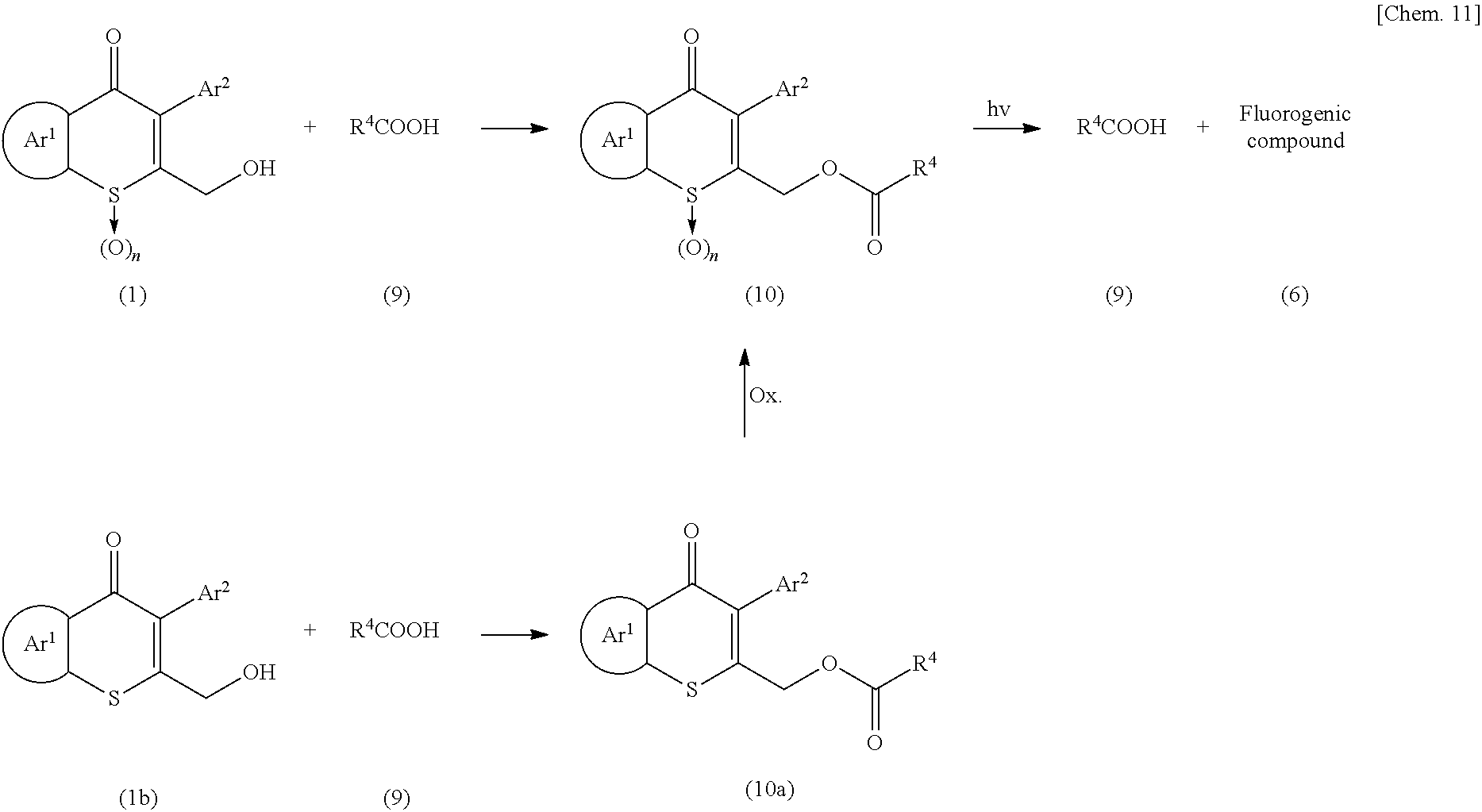
wherein R4 is a hydrogen atom or an organic group, and Ar1, Ar2, and n are as defined above. Ar1, Ar2, and n are as described above.

wherein Ar1, Ar2, and n are as defined above, to be protected by a protecting group represented by Formula (11a):

wherein Ar1, Ar2, and n are as defined above. The protected carbonyl group is then deprotected by light irradiation, thereby reproducing the carbonyl group.

wherein R5 and R6 are hydrogen atoms or organic groups, and Ar1, Ar2, and n are as defined above. Ar1, Ar2, and n are as described above.

wherein Ar1, Ar2, and n are as defined above, to protect a phosphodiester by a protecting group represented by Formula (1a):

wherein Ar1, Ar2, and n are as defined above. The protected phosphodiester is then deprotected by light irradiation, thereby reproducing the phosphodiester.

wherein Ar1, Ar2, and n are as described above.


wherein Ar1, Ar2, and n are as defined above.


wherein Ar1, Ar2, and n are as defined above, and a protecting group represented by Formula (3c):

wherein Ar1 and Ar2 are as defined above. The compound is irradiated with light to once remove the protecting group represented by Formula (3a). Subsequently, the remaining protecting group represented by Formula (3d) is oxidized with an oxidizing agent (e.g., m-CPBA) to convert it to a protecting group represented by Formula (3a), which is then removed by light irradiation. That is, by taking advantage of the difference in reactivity of the photodissociation reaction between the groups represented by Formulae (3a) and (3c), the protecting groups can be removed according to the desired protocol.


wherein Ar1, Ar2, and n are as defined above, and a protecting group represented by Formula (1c):

wherein Ar1 and Ar2 are as defined above. The compound is irradiated with light to once remove the protecting group represented by Formula (1a). Subsequently, the remaining protecting group represented by Formula (1c) is oxidized with an oxidizing agent (e.g., m-CPBA) to convert it to a protecting group represented by Formula (1a), which is then removed by light irradiation. That is, taking advantage of the difference in reactivity of the photodissociation reaction between the groups represented by Formulae (1a) and (1c), the protecting groups can be removed according to the desired protocol.

wherein Ar1, Ar2, and n are as defined above, and a protecting group represented by Formula (11c):

wherein Ar1 and Ar2 are as defined above. The compound is irradiated with light to once remove the protecting group represented by Formula (11a). Subsequently, the remaining protecting group represented by Formula (11c) is oxidized with an oxidizing agent (e.g., m-CPBA) to convert it to a protecting group represented by Formula (11a), which is then removed by light irradiation. That is, taking advantage of the difference in reactivity of the photodissociation reaction between the groups represented by Formulae (11a) and (11c), the protecting groups can be removed according to the desired protocol.


wherein Ar1, Ar2, X, and n are as defined above.

wherein Ar1 is as defined above, and an acetoacetic acid ester (e.g., ethyl acetoacetate) using an acid, such as polyphosphoric acid. This can be performed according to a known method.

wherein Ar1, Ar2, X, and n are as defined above.


White Solid

Yellow Solid

White Solid

White Solid


White Solid

White Solid

White Solid


Yield: 96%
Yellow Solid

Yield: 91%
Yellow Solid

Yield: 95%
Yellow Solid

Yield: 94%
Yellow Solid

Yield: 81%
White Solid

| TABLE 1 | ||||
| Substrate | Irradiation | |||
| Entry | —NR1R2 | Time (h) | Amine | Yield (%)a |
| 1 | —NHCH2CH2CH2CH3 | 1.0 |
 |
97 |
| 2 | —N(CH2CH3)2 | 0.5 |
 |
98 |
| 3 | —NH[(L)—CH(Bn)COOBn] | 1.0 |
 |
97 |
| adetermined by 1H-NMR | ||||


Yield: 98%
Yellow Solid

Yield: 76%
Yellow Solid

Yield: 58%
Yellow Solid

Yield: 67%
Yellow Solid

Yield: 53%
Yellow Solid

Yield: 30%
Yellow Solid

Yield: 23%
Yellow Solid

Yield: 46%
Yellow Solid


Yield: 87% (81%)
Yellow Solid

Yield: 85% (73%)
Yellow Solid

Yield: 80% (78%)
Yellow Solid

Yield: 92% (76%)
Yellow Solid

| TABLE 2 | ||||
| Entry | R4COOH | Yielda | ||
| 1 | C11H23COOH | >99% | ||
| 2 |
 |
>99% | ||
| 3 | C17H35COOH | >99% | ||
| 4 |
 |
>99% | ||
| adetermined by 1H-NMR | ||||

Yield: 95%
White Solid

Yield: 88%
White Solid

Yield: 70%
White Solid

Yield: 10%
White Solid

| TABLE 3 | ||||||
| Entry | Substrate | Solvent | Time (h) | | Ketone | a |
| 1 |
 |
CH3CN (1.0 v % H2O) | 3.0 | 91% | 90% | |
| 2 |
 |
CH3CN (1.0 v % H2O) | 3.0 | 94% | 99% | |
| 3 |
 |
CH3CN (1.0 v % H2O) | 3.0 | 93% | 69% | |
| adetermined by 1H-NMR | ||||||


White Solid


Claims (3)


Applications Claiming Priority (4)
| Application Number | Priority Date | Filing Date | Title |
|---|---|---|---|
| JP2008-061795 | 2008-03-11 | ||
| JP2008061795 | 2008-03-11 | ||
| JP2008-61795 | 2008-03-11 | ||
| PCT/JP2009/050102 WO2009113322A1 (en) | 2008-03-11 | 2009-01-08 | Photodissociable protective group |
Publications (2)
| Publication Number | Publication Date |
|---|---|
| US20110028738A1 US20110028738A1 (en) | 2011-02-03 |
| US8222429B2 true US8222429B2 (en) | 2012-07-17 |
Family
ID=41064995
Family Applications (1)
| Application Number | Title | Priority Date | Filing Date |
|---|---|---|---|
| US12/921,597 Expired - Fee Related US8222429B2 (en) | 2008-03-11 | 2009-01-08 | Photodissociable protective group |
Country Status (3)
| Country | Link |
|---|---|
| US (1) | US8222429B2 (en) |
| JP (1) | JP5212665B2 (en) |
| WO (1) | WO2009113322A1 (en) |
Families Citing this family (4)
| Publication number | Priority date | Publication date | Assignee | Title |
|---|---|---|---|---|
| JP5910245B2 (en) * | 2012-03-29 | 2016-04-27 | 大日本印刷株式会社 | Base generator, photosensitive resin composition, pattern forming material comprising the photosensitive resin composition, relief pattern manufacturing method using the photosensitive resin composition, and article |
| JP6960146B2 (en) * | 2017-05-26 | 2021-11-05 | 国立大学法人静岡大学 | Caged compound and method for producing and expressing the caged compound |
| CN110240614A (en) * | 2019-06-01 | 2019-09-17 | 菏泽帝捷化工股份有限公司 | A kind of chemical synthesis process of diphenyl phosphate chloride |
| CN112592330A (en) * | 2020-12-14 | 2021-04-02 | 陕西师范大学 | Synthesis method of 2-aldehyde thiochromone compound |
Citations (3)
| Publication number | Priority date | Publication date | Assignee | Title |
|---|---|---|---|---|
| JPH1129500A (en) | 1997-07-10 | 1999-02-02 | Bunshi Bio Photonics Kenkyusho:Kk | Fluorescent photodissociation protecting group |
| JP2004051624A (en) | 2002-05-31 | 2004-02-19 | Eiweiss Kk | Metal surface modifier and new sulfur-containing compound |
| JP2008214344A (en) | 2007-02-08 | 2008-09-18 | National Univ Corp Shizuoka Univ | Arylethynyl compound, two-photon absorption material and optical recording medium |
-
2009
- 2009-01-08 WO PCT/JP2009/050102 patent/WO2009113322A1/en not_active Ceased
- 2009-01-08 US US12/921,597 patent/US8222429B2/en not_active Expired - Fee Related
- 2009-01-08 JP JP2010502735A patent/JP5212665B2/en not_active Expired - Fee Related
Patent Citations (3)
| Publication number | Priority date | Publication date | Assignee | Title |
|---|---|---|---|---|
| JPH1129500A (en) | 1997-07-10 | 1999-02-02 | Bunshi Bio Photonics Kenkyusho:Kk | Fluorescent photodissociation protecting group |
| JP2004051624A (en) | 2002-05-31 | 2004-02-19 | Eiweiss Kk | Metal surface modifier and new sulfur-containing compound |
| JP2008214344A (en) | 2007-02-08 | 2008-09-18 | National Univ Corp Shizuoka Univ | Arylethynyl compound, two-photon absorption material and optical recording medium |
Non-Patent Citations (8)
| Title |
|---|
| G. Mayer, et al., "Biologically Active Molecules with a "Light Switch"," Angew. Chem. Int. Ed., 2006, 45, pp. 4900-4921. |
| Givens, R. S., et al., "Photochemistry of Phosphate Esters: An Efficient Method for the Generation of Electrophiles," J. Am. Chem. Soc., 106 (22), 1984, pp. 6860-6861. |
| International Search Report dated Mar. 10, 2009, issued for PCT/JP2009/050102. |
| K. Sugahara, "Peptide Gosei o Shiko shita Shinld. Hikari Kairisei Hogoki no Oyo Kenkyu (Investigation of New Photolablie protective group targeting for peptide synthesis)," Heisei 19 Nendo Shushi Ronbun Yoshishu, Nara Institute of Science and Technology Center for Industry-Government-Academia Collaboration, Feb. 15, 2008, pp. 105-106 and cover pages (4 sheets) and English translation thereof (3 pages). |
| Kitani, S., et al., "Synthesis and characterization of thiochromone S,S-dioxides as new photolabile protecting groups," Chem. Commun., (18), 2008, pp. 2103-2105. |
| Patchornik, A., et al., "Photosensitive Protecting Groups," J. Am. Chem. Soc., 92(21), 1970, pp. 6333-6335. |
| S. Kitani, "Thiochromone Kokkaku o Yusuru Shinki Hikari Kairisei Hogoki no Gosei to Kino (Synthesis and function of thiochromone skelton as New Photodissociable protective group)," Heisei 19 Nendo Hakase Ronbun Yoshishu, Nara Institute of Science and Technology Center for Industry-Government-Academia Collaboration, Jun. 9, 2008, pp. 31-32 and cover pages (4 sheets) and English translation thereof (3 pages). |
| S.P.A. Fodor et al., "Light-Directed, Spatially Addressable Parallel Chemical Synthesis," ; Science, 1991, 251, pp. 767-773. |
Also Published As
| Publication number | Publication date |
|---|---|
| JPWO2009113322A1 (en) | 2011-07-21 |
| US20110028738A1 (en) | 2011-02-03 |
| WO2009113322A1 (en) | 2009-09-17 |
| JP5212665B2 (en) | 2013-06-19 |
Similar Documents
| Publication | Publication Date | Title |
|---|---|---|
| Hasaninejad et al. | Silica bonded n-propyl-4-aza-1-azoniabicyclo [2.2. 2] octane chloride (SB-DABCO): A highly efficient, reusable and new heterogeneous catalyst for the synthesis of 4H-benzo [b] pyran derivatives | |
| US11001602B2 (en) | Diarylsulfide backbone containing photolabile protecting groups | |
| US8222429B2 (en) | Photodissociable protective group | |
| CN111057070A (en) | Synthesis method of baroxavir key intermediate | |
| CN116410218B (en) | Synthesis method of monofluoro alkenyl silicon | |
| CN109053800B (en) | Quaternary phosphonium salt supported chiral amino-thiourea and preparation method and application thereof | |
| JPS5817186B2 (en) | Method for producing novel aromatic carboxylic acid derivatives | |
| CN115745874A (en) | Preparation method of o-pyrrolidinyl benzamide compound | |
| CN103044313B (en) | Method for synthesising carbazole compounds | |
| JP6887022B2 (en) | Methods for Producing Ketolide Compounds | |
| CN117567226B (en) | Synthesis method of alpha-amino acid compound | |
| CN101948552B (en) | Linear polystyrene-supported chiral oxazolidine-2-selenium ketone and preparation method thereof | |
| JP2021127332A (en) | Method for Producing 5-Bromo-2-alkylbenzoic Acid | |
| KR101072679B1 (en) | New trifluoroacetylation method for amines | |
| CN117946039B (en) | A chiral synthesis process for an empagliflozin intermediate | |
| KR101083935B1 (en) | Trifluoroacetylation for amines | |
| JP6205530B2 (en) | Method for producing side chain precursor of paclitaxel and docetaxel | |
| CN117964583A (en) | A method for preparing an empagliflozin chiral intermediate | |
| RU2158730C1 (en) | Acrylic acid o-bromoanilide and utilization thereof in preparation of beta-diethylaminopropionic acid o-bromoanilide hydrochloride | |
| JPH0586042A (en) | Process for producing 2-mercapto-phenothiazine | |
| CN100378104C (en) | 1H-pyrano[3,4-d][1,2,3]triazol-4-one compounds, synthesis method and use | |
| JP2004238360A (en) | Esculetin derivative, method for producing the same and method for purifying esculetin | |
| JPWO2002081451A6 (en) | Method for producing 7-quinolinyl-3,5-dihydroxyhept-6-enoic acid ester | |
| CN103467641A (en) | Linear polystyrene supported (S)-5-(4-benzyloxy)-3-phenyl-1-propionyl hydantoin, and preparation method and application thereof | |
| JPWO2002081451A1 (en) | Method for producing 7-quinolinyl-3,5-dihydroxyhept-6-enoic acid ester |
Legal Events
| Date | Code | Title | Description |
|---|---|---|---|
| AS | Assignment |
Owner name: NATIONAL UNIVERSITY CORPORATION NARA INSTITUTE OF Free format text: ASSIGNMENT OF ASSIGNORS INTEREST;ASSIGNORS:KAKIUCHI, KIYOMI;TSUTSUMI, KEN;KITANI, SATORU;AND OTHERS;SIGNING DATES FROM 20100712 TO 20100807;REEL/FRAME:024959/0669 |
|
| STCF | Information on status: patent grant |
Free format text: PATENTED CASE |
|
| FEPP | Fee payment procedure |
Free format text: PAYOR NUMBER ASSIGNED (ORIGINAL EVENT CODE: ASPN); ENTITY STATUS OF PATENT OWNER: SMALL ENTITY |
|
| FPAY | Fee payment |
Year of fee payment: 4 |
|
| FEPP | Fee payment procedure |
Free format text: MAINTENANCE FEE REMINDER MAILED (ORIGINAL EVENT CODE: REM.); ENTITY STATUS OF PATENT OWNER: SMALL ENTITY |
|
| LAPS | Lapse for failure to pay maintenance fees |
Free format text: PATENT EXPIRED FOR FAILURE TO PAY MAINTENANCE FEES (ORIGINAL EVENT CODE: EXP.); ENTITY STATUS OF PATENT OWNER: SMALL ENTITY |
|
| STCH | Information on status: patent discontinuation |
Free format text: PATENT EXPIRED DUE TO NONPAYMENT OF MAINTENANCE FEES UNDER 37 CFR 1.362 |
|
| STCH | Information on status: patent discontinuation |
Free format text: PATENT EXPIRED DUE TO NONPAYMENT OF MAINTENANCE FEES UNDER 37 CFR 1.362 |