US8218910B2 - 3D ball skinning using partial differential equations for generation of smooth tubular surfaces - Google Patents
3D ball skinning using partial differential equations for generation of smooth tubular surfaces Download PDFInfo
- Publication number
- US8218910B2 US8218910B2 US12/413,913 US41391309A US8218910B2 US 8218910 B2 US8218910 B2 US 8218910B2 US 41391309 A US41391309 A US 41391309A US 8218910 B2 US8218910 B2 US 8218910B2
- Authority
- US
- United States
- Prior art keywords
- skin
- ball
- sin
- cos
- solving
- Prior art date
- Legal status (The legal status is an assumption and is not a legal conclusion. Google has not performed a legal analysis and makes no representation as to the accuracy of the status listed.)
- Expired - Fee Related, expires
Links
Images




Classifications
-
- G—PHYSICS
- G06—COMPUTING OR CALCULATING; COUNTING
- G06T—IMAGE DATA PROCESSING OR GENERATION, IN GENERAL
- G06T17/00—Three-dimensional [3D] modelling for computer graphics
- G06T17/10—Constructive solid geometry [CSG] using solid primitives, e.g. cylinders, cubes
Definitions
- the present invention relates to three-dimensional (3D) ball skinning.
- the geometric problem of ball skinning is the computation of a continuous interpolation of a discrete set of balls, for example. This problem arises in numerous applications, including character skinning, molecular surface model generation, and modeling of tubular structures, etc.
- an articulated object or character is constructed using a layered representation consisting of a skeletal structure and a corresponding geometric skin, see e.g., K. Singh, E. Kokkevis, Skinning Characters using Surface Oriented Free-Form Deformations, in: Graphics Interface, 2000, pp. 35-42.
- the skeleton has fewer degrees of freedom and is simpler to adjust by an animator.
- the skinning algorithm is responsible for deforming the geometric skin to respond to the motion of the underlying skeleton.
- the skinning problem is also a special case of the problem of computing the envelopes of families of quadrics, which have been investigated by Peternell in, M.
- Kruithov et al. derives a special subset of skins that is piece-wise quadratic.
- the skin may be computed as the envelope of the infinite union of the circles of intersection of two consecutive balls of infinitely close center. While the surfaces generated by these methods are tangent to the balls and have smoothness at the point of tangency, none of these existing methods provides an optimally smooth skin.
- a method of computing a continuous interpolation of a discrete set of three-dimensional (3D) balls comprises: generating an initial skin, wherein the initial skin is a surface comprised of splines and wherein the splines touch each ball along a circle that is tangent to the ball; solving a first differential equation to minimize the initial skin's surface area or solving a second differential equation to minimize a squared mean curvature of the initial skin's surface, wherein the result of solving the first or second differential equations is an updated skin; and repeating the steps of solving the first or second differential equations for the updated skin, and then, repeating the steps of solving the first or second differential equations for each subsequently updated skin until a desired skin is realized.
- the rotation matrix R i is
- the first differential equation is represented by
- the method further comprises combining the first and second differential equations to generate the updated skin, wherein the first and second differential equations are combined by the following equation
- the first and second differential equations are used in a gradient descent procedure to find the desired skin.
- a method of modeling a tubular structure comprises: imaging a tubular structure; placing a plurality of balls in the tubular structure; and finding a skin that smoothly interpolates the balls, wherein finding the skin comprises: generating an initial skin, wherein the initial skin is a surface comprised of splines and wherein the splines touch each ball along a circle that is tangent to the ball; solving a first differential equation to minimize the initial skin's surface area or solving a second differential equation to minimize a squared mean curvature of the initial skin's surface, wherein the result of solving the first or second differential equations is an updated skin; and repeating the steps of solving the first or second differential equations for the updated skin, and then, repeating the steps of solving the first or second differential equations for each subsequently updated skin until the skin that smoothly interpolates the balls is realized, wherein the skin that smoothly interpolates the balls is a model of the tubular structure.
- the tubular structure is an anatomical structure.
- the tubular structure is imaged by a scanner.
- the balls are ordered.
- a system of computing a continuous interpolation of a discrete set of 3D balls comprises: a memory device for storing a program; and a processor in communication with the memory device, the processor operative with the program to perform a method, the method comprising: generating an initial skin, wherein the initial skin is a surface comprised of splines and wherein the splines touch each ball along a circle that is tangent to the ball; solving a first differential equation to minimize the initial skin's surface area or solving a second differential equation to minimize a squared mean curvature of the initial skin's surface, wherein the result of solving the first or second differential equations is an updated skin; and repeating the steps of solving the first or second differential equations for the updated skin, and then, repeating the steps of solving the first or second differential equations for each subsequently updated skin until a desired skin is realized.
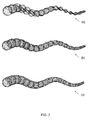
- FIG. 1 is ball skinning according to an exemplary embodiment of the present invention
- FIG. 2 is a representation of a circle of contact according to an exemplary embodiment of the present invention.
- FIG. 3 shows segments and a spline according to an exemplary embodiment of the present invention
- FIG. 4 is ball skinning according to an exemplary embodiment of the present invention.
- FIG. 5 is ball skinning according to an exemplary embodiment of the present invention.
- FIG. 6 is ball skinning according to an exemplary embodiment of the present invention.
- FIG. 7 is ball skinning according to an exemplary embodiment of the present invention.
- FIG. 8 is a convergence plot for the exemplary embodiment shown in FIG. 7 ;
- FIG. 9 is a comparison between ball skinning according to an exemplary embodiment of the present invention and J-splines
- FIGS. 10A and 10B illustrate convergence to desired and undesired minima based on poor and severely poor initializations in ball skinning according to an exemplary embodiment of the present invention
- FIG. 11 illustrates skin passing through a ball in ball skinning according to an exemplary embodiment of the present invention
- FIG. 12 is a flowchart illustrating a method of ball skinning according to an exemplary embodiment of the present invention.
- FIG. 13 is a block diagram of a system in which exemplary embodiments of the present invention may be implemented.
- the problem has a similar conceptual formulation based on differential equations; however, the geometry is notably different: instead of minimizing the arc length and curvature of a curve, we minimize the surface area and mean curvature of a surface. Furthermore, the geometry of contact between the skin and the balls, as well as the differential geometry of the skin is significantly different in the 3D case.
- a method of ball skinning we model the skin as a C 1 surface, which, by construction, must touch each ball along a circle that is tangent to the ball.
- the result of these derivations is differential equations, which we then solve to update a given surface to its optimal position.
- We can parameterize q(u) as q ( u ) ⁇ circumflex over (x) ⁇ cos u+ ⁇ sin u, (1) where u is a parameterization angle.
- p i (u) provides a way to parameterize the circle on each ball. We would like to form a parametric skin S(u,v) that satisfies several geometric criteria:
- a i (u),B i (u),C i (u), and D i (u) are coefficients
- v ⁇ [0,1] is a parameterization variable.
- Each segment S i (u,v) of the skin is defined by the Hermite interpolation of the boundary conditions, specifically,
- Each t i is fixed to be half the distance between the next and previous ball centers (for the first and last balls, it is the distance between the ball center and its neighbor ball center) for all examples in this disclosure.
- Such a stiffness encourages smoothness of the connecting segments at a circle, and is based on the central difference approximation of the first derivative computed using ball centers.
- straighter segments can be achieved by scaling the stiffness by a coefficient less than one.
- segment S i (u,v) in turn is specified by the coefficients A i (u),B i (u),C i (u),D i (u), and these coefficients are functions of the circles p i (u),p i+1 (u), and the normals N i and N i+1 .
- the circles and normals are, in turn, functions of the angles ⁇ i , ⁇ i+1 , ⁇ i , ⁇ i+1 .
- Equation 11 we take the derivative of Equation 11 with respect to the parameter w k , where w k ⁇ [ ⁇ i , ⁇ i ] ⁇ i. This will give us a gradient direction that we can use in a numerical gradient descent procedure to find the angles that minimize the surface area of the skin. Since ⁇ i and ⁇ i affect only the i th and i ⁇ 1st segments, we can replace the summation with two surface integrals,
- Equation 19 we would like to take the derivative of Equation 19 with respect to the parameter w k , where w k ⁇ [ ⁇ i , ⁇ i ] ⁇ i. This will give us a gradient direction which we can use in a numerical gradient descent procedure to find the angles that minimize the curvature of the skin. Since ⁇ i and ⁇ i affect only the i th and i ⁇ 1st segments, we can replace the summation with two surface integrals,
- Equation 21 ⁇ J c ⁇ w k is provided in Equation 21.
- k 0.9, to encourage smoother solutions.
- the computational complexity of the algorithm depends on the number of balls N and the number of points on the surface where the points and derivatives are evaluated.
- the number of points is given by LM, where L is the number of sampling points on each spline, and M is the number of splines on a segment.
- the computational complexity is O(NLM). The number of iterations required depends on the time step ⁇ t as well as how close the initial skin is to the final solution.
- FIG. 4 A simple demonstration of ball skinning according to an exemplary embodiment of the present invention is provided in FIG. 4 .
- the initial parameters for this experiment were
- FIG. 5 is a slightly more complicated demonstration of ball skinning according to an exemplary embodiment of the present invention in which some balls overlap and others do not.
- the initial skin in shown in FIG. 5( a ), an intermediate result after 25 iterations in FIG. 5( b ), and the final result upon convergence after 50 iterations in FIG. 5( c ).
- the solutions (all 50 iterations) is computed in 10.4 seconds.
- FIG. 6 is a demonstration of ball skinning according to an exemplary embodiment of the present invention for a symmetric configuration of balls, but asymmetric initial conditions.
- the initial skin is shown in FIG. 6( a ), an intermediate result after 30 iterations in FIG. 6( b ), and the final result upon convergence after 60 iterations in FIG. 6( c ).
- the solution (all 60 iterations) is computed in 8.3 seconds.
- FIGS. 7 and 1 More demonstrations of ball skinning according to an exemplary embodiment of the present invention are provided in FIGS. 7 and 1 .
- Initialization is shown in FIG. 7( a ), an intermediate result after 25 iterations in FIG. 7( b ) and a final result upon convergence after 50 iterations in FIG. 7( c ).
- the balls are arranged on a sine wave and have a variable radius. In addition, some of the balls overlap while others do not. Convergence of the skinning algorithm, starting from a set of angles far from the optimal result, takes 11.4 seconds, and reduces the energy from 9.67 ⁇ 10 5 to 11,471.
- the variable radius balls are arranged in a spiral (see FIG. 1( a )).
- the skin (see FIG. 1( b )) is generated in 15.3 seconds.
- FIG. 8 we show a plot of the energy J of the surface vs. the iteration number. Note that initially, the energy is high and successive iterations reduce the energy until convergence occurs around the 30 th iteration. Upon convergence, the energy oscillates around its minimal value. This fact can be exploited as an automatic convergence criterion.
- Table 1 presents the results of the comparison. For each skin, we computed the energy J as described in Equation 22. While the result for the spiral and sine wave was slightly lower for the J-spline method, the difference is not significant (i.e., the difference is less than 1%) in both cases and the surfaces have an identical appearance.
- the method according to an exemplary embodiment of the present invention demonstrates significant improvement however for the other surfaces. The primary reason for this is that with J-splines, a self-intersection occurs that results in high local curvatures and a fatter object in general, as demonstrated in FIG. 9 . The method according to an exemplary embodiment of the present invention will penalize such local self-intersections and deform the spline surface so that the individual splines are smooth upon convergence.
- FIG. 9 the method according to an exemplary embodiment of the present invention produces smoother results than J-splines.
- FIGS. 9( a ), ( c ) and ( e ) is the J-spline skin for the example shown in FIG. 6 .
- FIG. 9( a ) we show the wireframe model of the splines, and in FIG. 9( c ) a texture-mapped view.
- FIGS. 9( b ), ( d ) and ( f ) is the result of the method according to an exemplary embodiment of the present invention, which does not have self-intersection.
- FIG. 10( a ) and a zoom in view FIG. 10( b ) show a demonstration of ball skinning according to an exemplary embodiment of the present invention with a very poor initialization that has a strong self-intersection. Despite the undesirable initialization, the algorithm is able to untangle the self-intersection and produce a smooth interpolation of the balls, shown in FIG. 10( c ). In FIG. 10( d ) and a zoom in view FIG.
- the skin generated by a method according to an exemplary embodiment of the present invention may pass through a ball (shown in FIG. 11( b )), since it is only constrained to be tangent to the ball at the circle of intersection. For points not in the circle's plane, the skin may be larger or smaller than the ball. Thus, the skin does not provide an exact envelope of the balls, but rather, an approximating envelope. In an application of modeling blood vessels, this is an acceptable solution since the ball itself is a geometric proxy of the local vessel geometry.
- FIG. 12 is a flowchart illustrating a method of ball skinning according to an exemplary embodiment of the present invention.
- an initial skin S(u,v) is generated ( 1210 ).
- Differential Equation 13 is solved to minimize the initial skin's surface area ( 1220 ).
- Differential Equation 21 is solved to minimize a squared mean curvature of the initial skin's surface ( 1230 ).
- Steps 1220 and 1230 give an updated skin. Steps 1220 and 1230 are repeated using each newly generated updated skin until a desired skin is realized ( 1240 ).
- the updated skin can be achieved by only solving one of the differential equations.
- Equation 23 is used to combine the differential equations.
- the number of iterations can be determined based on a gradient descent procedure represented by Equation 24.
- the system includes a scanner 1305 , a computer 1315 and a display 1310 connected over a wired or wireless network 1320 .
- the scanner 1305 may be an image scanner that uses a charge-coupled device (CCD) or Contact Image Sensor (CIS), or it may be a magnetic resonance (MR) or computed tomography (CT) scanner, for example.
- the computer 1315 includes, inter alia, a central processing unit (CPU) 1325 , a memory 1330 and a ball skinning module 1335 that includes program code for executing methods in accordance with exemplary embodiments of the present invention.
- the display 1310 is a computer screen, for example.
- the present invention may be implemented in various forms of hardware, software, firmware, special purpose processors, or a combination thereof.
- the present invention may be implemented in software as an application program tangibly embodied on a program storage device (e.g., magnetic floppy disk, RAM, CD ROM, DVD, ROM, and flash memory).
- the application program may be uploaded to, and executed by, a machine comprising any suitable architecture.
Landscapes
- Physics & Mathematics (AREA)
- Geometry (AREA)
- Engineering & Computer Science (AREA)
- Computer Graphics (AREA)
- Software Systems (AREA)
- General Physics & Mathematics (AREA)
- Theoretical Computer Science (AREA)
- Prostheses (AREA)
- Apparatus For Radiation Diagnosis (AREA)
Abstract
Description
where
is the first differential equation and
is the second differential equation.
q(u)={circumflex over (x)} cos u+ŷ sin u, (1)
where u is a parameterization angle. We can then express pi(u), a point on the circle of Bi as
p i(u)=c i +r i R i q(u), (2)
where ri is the radius of the i th ball, and Ri is a rotation matrix specified by Ni as
pi(u) provides a way to parameterize the circle on each ball. We would like to form a parametric skin S(u,v) that satisfies several geometric criteria:
-
- (1) The skin should be modeled by a circle that contacts each ball.
- (2) The skin should be tangent to each ball along the circle of contact.
- (3) The skin should optimize an energy functional composed of surface area and mean curvature terms.
S i(u,v)=A i(u)v 3 +B i(u)v 2 +C i(u)v+D i(u), (4)
since the four constraints require four degrees of freedom. For the i th segment, Ai(u),Bi(u),Ci(u), and Di(u) are coefficients, and vε[0,1] is a parameterization variable.
where, for each i, ti is a stiffness coefficient that controls the influence of the normal Ni. Each ti is fixed to be half the distance between the next and previous ball centers (for the first and last balls, it is the distance between the ball center and its neighbor ball center) for all examples in this disclosure. Such a stiffness encourages smoothness of the connecting segments at a circle, and is based on the central difference approximation of the first derivative computed using ball centers. We note however that straighter segments can be achieved by scaling the stiffness by a coefficient less than one.
we obtain a system of four equations for the four coefficients: Di(u)=pi(u),Ci(u)=tiNi,Ai(u)+Bi(u)+Ci(u)+Di(u)=pi+1(u), and 3Ai(u)+2Bi(u)+Ci(u)=ti+1Ni+1, which is easily solved, yielding
A i(u)=−2p i+1(u)+2p i(u)+t i N i +t i+1 N i+1
B i(u)=3p i+1(u)−3p i(u)−2t i N i −t i+1 N i+1
C i(u)=t i N i
D i(u)=p i(u) (6)
J a=∫∫√{square root over (EG−F2)}dudv, (7)
where
E=S u ·S u (8)
F=S u ·S v (9)
G=S v ·S v (10)
are coefficients of the first fundamental form.
where E,F, and G are given in the previous section, and e,f, and g come from the fundamental form,
e=M·S uu (15)
f=M·S uv (16)
g=M·S vv (17)
where M is the surface normal (not to be confused with N, which is the normal of the plane that intersects a ball).
Jc=∫∫H2dudv. (18)
where the derivatives of the coefficients from the first fundamental form (i.e., E, F, and G) are given near the end of this disclosure and the derivatives of the coefficients from the second fundamental form (i.e., e, f and g ) are analytically derived near the end of this disclosure.
J=(1−k)J a +kJ c, (22)
where k is a constant used to weight the surface area minimization relative to the curvature minimization. Convex combinations of the two can be selected using k ε[0,1]. Therefore, the combined energy minimization is given by
where
is given in Equation 13 and
is provided in Equation 21. In all of the experiments in this disclosure, we fix k=0.9, to encourage smoother solutions.
w i(n+1)=w i(n)−Δt∇J w
where Δt is a time step.
respectively; the initial skin is shown in
| TABLE 1 | ||
| Energy (Method according | ||
| to an exemplary | ||
| Data Set | embodiment) | Energy (J-splines) |
| Spiral (FIG. 1) | 12387 | 12281 |
| Four balls (FIG. 4) | 670 | 12386 |
| Mixed overlap (FIG. 5) | 1400 | 3008 |
| M shape (FIG. 6) | 1287 | 34200 |
| Sine wave (FIG. 7) | 11447 | 11441 |
where
are given in Appendix A, and
Claims (19)
Priority Applications (1)
| Application Number | Priority Date | Filing Date | Title |
|---|---|---|---|
| US12/413,913 US8218910B2 (en) | 2008-08-25 | 2009-03-30 | 3D ball skinning using partial differential equations for generation of smooth tubular surfaces |
Applications Claiming Priority (2)
| Application Number | Priority Date | Filing Date | Title |
|---|---|---|---|
| US9149408P | 2008-08-25 | 2008-08-25 | |
| US12/413,913 US8218910B2 (en) | 2008-08-25 | 2009-03-30 | 3D ball skinning using partial differential equations for generation of smooth tubular surfaces |
Publications (2)
| Publication Number | Publication Date |
|---|---|
| US20100045671A1 US20100045671A1 (en) | 2010-02-25 |
| US8218910B2 true US8218910B2 (en) | 2012-07-10 |
Family
ID=41695933
Family Applications (1)
| Application Number | Title | Priority Date | Filing Date |
|---|---|---|---|
| US12/413,913 Expired - Fee Related US8218910B2 (en) | 2008-08-25 | 2009-03-30 | 3D ball skinning using partial differential equations for generation of smooth tubular surfaces |
Country Status (1)
| Country | Link |
|---|---|
| US (1) | US8218910B2 (en) |
Families Citing this family (6)
| Publication number | Priority date | Publication date | Assignee | Title |
|---|---|---|---|---|
| US8941661B2 (en) | 2009-04-14 | 2015-01-27 | Adobe Systems Incorporated | Automatic corner generation |
| US8674995B1 (en) * | 2009-04-14 | 2014-03-18 | Adobe Systems Incorporated | Folding avoidance in skeletal stroke application |
| US11568601B2 (en) * | 2016-08-14 | 2023-01-31 | Uvic Industry Partnerships Inc. | Real-time hand modeling and tracking using convolution models |
| US10460514B2 (en) * | 2017-08-29 | 2019-10-29 | Google Llc | Computing representative shapes for polygon sets |
| WO2022263939A1 (en) * | 2021-06-16 | 2022-12-22 | Gilat Tom | Smooth surfaces via nets of geodesics |
| CN114894110B (en) * | 2022-03-24 | 2023-03-14 | 西安电子科技大学 | A Method for Calibrating the Structure Deformation of Smart Skin Antenna |
-
2009
- 2009-03-30 US US12/413,913 patent/US8218910B2/en not_active Expired - Fee Related
Non-Patent Citations (2)
| Title |
|---|
| Cheng et al: "Guaranteed Quality Triangulation of Molecular Skin Surfaces", IEEE-2005. * |
| Kaklis et al: "Sectional-curvature preserving skinning surfaces", Elsevier Science, 1996. * |
Also Published As
| Publication number | Publication date |
|---|---|
| US20100045671A1 (en) | 2010-02-25 |
Similar Documents
| Publication | Publication Date | Title |
|---|---|---|
| Tagliasacchi et al. | 3d skeletons: A state‐of‐the‐art report | |
| Pizer et al. | Deformable m-reps for 3D medical image segmentation | |
| EP2441054B1 (en) | Method for mapping tubular surfaces to a cylinder | |
| US7200251B2 (en) | Methods and systems for modeling objects and object image data using medial atoms | |
| US6201543B1 (en) | Framework for segmentation of cylindrical structures using two dimensional hybrid models | |
| CN102184567B (en) | Method for constructing three-dimensional blood vessel model based on ball B-spline curve | |
| US20100045671A1 (en) | 3d ball skinning using partial differential equations for generation of smooth tubular surfaces | |
| WO2007083602A1 (en) | Interpolation processing method, interpolation processing device, shape evaluation method, and shape evaluation device | |
| Schneider et al. | Isogeometric high order mesh generation | |
| Peng et al. | Fast mapping and morphing for genus-zero meshes with cross spherical parameterization | |
| US9792729B2 (en) | System and method for context preserving maps of tubular structures | |
| Perriollat et al. | A quasi-minimal model for paper-like surfaces | |
| Slabaugh et al. | 3D ball skinning using PDEs for generation of smooth tubular surfaces | |
| Slabaugh et al. | Variational skinning of an ordered set of discrete 2D balls | |
| Thall | Deformable solid modeling via medial sampling and displacement subdivision | |
| Liu et al. | Constrained fairing for meshes | |
| Pellis | Alignable Lamella Gridshells. | |
| Ma et al. | Deforming generalized cylinders without self-intersection by means of a parametric center curve | |
| Kivelä | Acoustics of the vocal tract: MR image segmentation for modelling | |
| Unal et al. | 3D ball skinning using PDEs for generation of smooth tubular surfaces | |
| Alexa | Mesh Morphing. | |
| Damon | Skeleton-based generalized cylinder deformation under the relative curvature condition | |
| Han | Proper shape representation of single figure and multi-figure anatomical objects | |
| Tosun | Geometric modeling using high-order derivatives | |
| Zheng et al. | Periodic T-splines and tubular surface fitting |
Legal Events
| Date | Code | Title | Description |
|---|---|---|---|
| AS | Assignment |
Owner name: SIEMENS CORPORATE RESEARCH, INC.,NEW JERSEY Free format text: CORRECTIVE ASSIGNMENT TO CORRECT THE APPLICATION NUMBER SHOULD BE 12/413,913 PREVIOUSLY RECORDED ON REEL 022753 FRAME 0753. ASSIGNOR(S) HEREBY CONFIRMS THE APPLICATION WAS LISTED AS 12/412,913 SHOULD BE 12/413,913;ASSIGNORS:FANG, TONG;ROSSIGNAC, JAROSLAW;SLABAUGH, GREGORY G.;AND OTHERS;SIGNING DATES FROM 20090416 TO 20090527;REEL/FRAME:022853/0154 Owner name: SIEMENS CORPORATE RESEARCH, INC., NEW JERSEY Free format text: CORRECTIVE ASSIGNMENT TO CORRECT THE APPLICATION NUMBER SHOULD BE 12/413,913 PREVIOUSLY RECORDED ON REEL 022753 FRAME 0753. ASSIGNOR(S) HEREBY CONFIRMS THE APPLICATION WAS LISTED AS 12/412,913 SHOULD BE 12/413,913;ASSIGNORS:FANG, TONG;ROSSIGNAC, JAROSLAW;SLABAUGH, GREGORY G.;AND OTHERS;SIGNING DATES FROM 20090416 TO 20090527;REEL/FRAME:022853/0154 |
|
| AS | Assignment |
Owner name: SIEMENS CORPORATE RESEARCH, INC.,NEW JERSEY Free format text: ASSIGNMENT OF ASSIGNORS INTEREST;ASSIGNOR:SIEMENS CORPORATE RESEARCH, INC.;REEL/FRAME:023274/0304 Effective date: 20090923 Owner name: GEORGIA TECH RESEARCH CORPORATION,GEORGIA Free format text: ASSIGNMENT OF ASSIGNORS INTEREST;ASSIGNOR:SIEMENS CORPORATE RESEARCH, INC.;REEL/FRAME:023274/0304 Effective date: 20090923 Owner name: SIEMENS CORPORATE RESEARCH, INC., NEW JERSEY Free format text: ASSIGNMENT OF ASSIGNORS INTEREST;ASSIGNOR:SIEMENS CORPORATE RESEARCH, INC.;REEL/FRAME:023274/0304 Effective date: 20090923 Owner name: GEORGIA TECH RESEARCH CORPORATION, GEORGIA Free format text: ASSIGNMENT OF ASSIGNORS INTEREST;ASSIGNOR:SIEMENS CORPORATE RESEARCH, INC.;REEL/FRAME:023274/0304 Effective date: 20090923 |
|
| AS | Assignment |
Owner name: SIEMENS AKTIENGESELLSCHAFT,GERMANY Free format text: ASSIGNMENT OF ASSIGNORS INTEREST;ASSIGNOR:SIEMENS CORPORATE RESEARCH, INC.;REEL/FRAME:023289/0172 Effective date: 20090923 Owner name: SIEMENS AKTIENGESELLSCHAFT, GERMANY Free format text: ASSIGNMENT OF ASSIGNORS INTEREST;ASSIGNOR:SIEMENS CORPORATE RESEARCH, INC.;REEL/FRAME:023289/0172 Effective date: 20090923 |
|
| STCF | Information on status: patent grant |
Free format text: PATENTED CASE |
|
| FPAY | Fee payment |
Year of fee payment: 4 |
|
| AS | Assignment |
Owner name: SIEMENS HEALTHCARE GMBH, GERMANY Free format text: ASSIGNMENT OF ASSIGNORS INTEREST;ASSIGNOR:SIEMENS AKTIENGESELLSCHAFT;REEL/FRAME:038958/0425 Effective date: 20160513 |
|
| FEPP | Fee payment procedure |
Free format text: MAINTENANCE FEE REMINDER MAILED (ORIGINAL EVENT CODE: REM.); ENTITY STATUS OF PATENT OWNER: LARGE ENTITY |
|
| LAPS | Lapse for failure to pay maintenance fees |
Free format text: PATENT EXPIRED FOR FAILURE TO PAY MAINTENANCE FEES (ORIGINAL EVENT CODE: EXP.); ENTITY STATUS OF PATENT OWNER: LARGE ENTITY |
|
| STCH | Information on status: patent discontinuation |
Free format text: PATENT EXPIRED DUE TO NONPAYMENT OF MAINTENANCE FEES UNDER 37 CFR 1.362 |
|
| FP | Lapsed due to failure to pay maintenance fee |
Effective date: 20200710 |