US8218717B2 - Reconstruction of 3D image datasets from x-ray and cone-beam data - Google Patents
Reconstruction of 3D image datasets from x-ray and cone-beam data Download PDFInfo
- Publication number
- US8218717B2 US8218717B2 US12/902,237 US90223710A US8218717B2 US 8218717 B2 US8218717 B2 US 8218717B2 US 90223710 A US90223710 A US 90223710A US 8218717 B2 US8218717 B2 US 8218717B2
- Authority
- US
- United States
- Prior art keywords
- cone beam
- beam data
- trajectory
- ray
- source
- Prior art date
- Legal status (The legal status is an assumption and is not a legal conclusion. Google has not performed a legal analysis and makes no representation as to the accuracy of the status listed.)
- Active
Links
Images


Classifications
-
- G06T12/20—
-
- A—HUMAN NECESSITIES
- A61—MEDICAL OR VETERINARY SCIENCE; HYGIENE
- A61B—DIAGNOSIS; SURGERY; IDENTIFICATION
- A61B6/00—Apparatus or devices for radiation diagnosis; Apparatus or devices for radiation diagnosis combined with radiation therapy equipment
- A61B6/02—Arrangements for diagnosis sequentially in different planes; Stereoscopic radiation diagnosis
- A61B6/027—Arrangements for diagnosis sequentially in different planes; Stereoscopic radiation diagnosis characterised by the use of a particular data acquisition trajectory, e.g. helical or spiral
Definitions
- the invention relates generally to a method and an imaging system capable of producing a three-dimensional (3D) image dataset of an object.
- the imaging system comprises an X-ray source emitting X-rays in a cone-shaped beam (generally called cone beam) and a detector comprising a two-dimensional (2D) array of detector elements for acquiring one projection image (generally called cone-beam projection) of the object at a time.
- the invention relates to a novel method for reconstructing a three-dimensional image data set from cone-beam data acquired by such imaging system.
- an X-ray source projects a fan-shaped beam which is collimated to lie within an xy-plane of a Cartesian coordinate system termed the imaging plane.
- the X-ray beam passes through the object being imaged, such as a medical patient, and impinges upon a one-dimensional array of radiation detectors.
- Each detector produces an electrical signal that is a measurement of the attenuation of the X-ray beam by the object.
- the source and detector array in a conventional CT-system are rotated on a gantry within the imaging plane around the object through an angle of 180-360°, wherein a set of views made at different angular orientations during one revolution of the X-ray source and detector are acquired. From the acquired attenuation data, it is possible to reconstruct a 2D-image of the xy-plane through the object.
- a common way of performing the image reconstruction in fan-beam CT is for example filtered backprojection.
- Image reconstruction becomes mathematically more complex when the X-ray beam is cone-shaped and the detector accordingly is a 2D-array of detector elements.
- these geometries are generally used in interventional or angiographic X-ray systems, for example in C-arm-systems where the source and the detector are mounted on the ends of a C-shaped arm which is adapted to rotate around the patient.
- it is highly desirable to be able to obtain an three-dimensional image of a volume within the patient by rotating the C-arm once around the patient One rotation around e.g. 180-360°, during which a set of X-ray projections is acquired, is called 3D scan). Therefore, 3D-image reconstruction from circular cone-beam data has been an active research field for the last decades.
- the claimed method allows to achieve CT-like reconstruction from X-ray projections acquired along a variable-radius, planar source trajectory.
- the claimed Feldkamp-like reconstruction algorithm yields exact results in the plane of the scan, in general approximate results within the rest of the 3D field-of-view (FOV) and also accurately recovers the shape of this FOV for a given geometry.
- FOV field-of-view
- the two-dimensional array of detector elements is preferably arranged in a plane, thus resulting in a flat-panel detector.
- the X-ray source moves along a substantially planar trajectory around the object to be imaged, preferably a subject or patient.
- substantially planar means that deviations from the plane due to constructional variability in the imaging system are allowed, as long as the reconstruction method still yields acceptable results.
- the trajectory may lie within about ⁇ 15 mm, preferably within about ⁇ 10 mm or ⁇ 8 mm from the central plane of the trajectory.
- the trajectory need not be circular, or indeed need not have any specific shape within that plane.
- it is a variable-radius trajectory, merely being described by a series of points in space (source points) serially numbered by a scalar ⁇ , which is called counter parameter in the claims.
- the trajectory in particular, may be none-convex, i.e. it may curve inwardly and outwardly.
- a convex trajectory could not curve outwardly with regard to the isocenter.
- the trajectory may have a non-convex shape, wherein the trajectory can be crossed by a line more than twice.
- ⁇ can in convex trajectories be thought of as the source polar angle, but this is not a requirement.
- the distance between the source and the detector varies along the trajectory, wherein the variation is preferably significant, i.e. it is not an essentially circular trajectory with some tolerances, but the distance preferably varies by at least ⁇ 5 mm, preferably ⁇ 10 mm and most preferred by at least ⁇ 15 mm.
- the scan radius R i.e. the distance between the source and the isocentre of the scan
- the variation preferably is significant, i.e. by at least ⁇ 5 mm, preferably ⁇ 10 mm, wherein a non-circular scan radius is preferred.
- at least part of the trajectory has the shape of a polygon, i.e. it is made-up of a finite number (preferably 2-30) straight lines.
- a series of two-dimensional (2D) arrays of cone beam data are acquired by the detector.
- Each of these 2D arrays is a projection image of the object and in the following will also be called cone-beam (CB) projection.
- CB projections acquired during one scan, i.e. one sweep of the source over the trajectory are called cone beam data.
- the trajectory should preferably span at least an angular scan interval around the object of 180° plus the cone beam angle, for example about 200°-300°.
- the imaging system can be any X-ray system, but in particular can be one where X-ray source and detector are mounted on telescopic arms and/or rails and/or robotic arms or a combination thereof.
- the scalar ⁇ is the counter parameter of the points on the trajectory at which the cone beam projections are acquired and, as mentioned above, can be thought of as the source polar angle. ⁇ can be thought of as the angular scan interval and R( ⁇ ) describes the distance between the source and the origin (0, 0, 0) of the object coordinate system. This geometry is illustrated in FIG. 2 . Thus, the parameter ⁇ is used to describe locations along the source trajectory.
- the detector 10 is preferably a flat-panel detector and u and v are the detector coordinates measured in horizontal and vertical direction, respectively.
- the detector-source distance is allowed to vary smoothly during the scan and is denoted as D( ⁇ ).
- the plane of the detector is perpendicular to a line intersecting both of the origin of the object coordinate system and a ( ⁇ ), this is not a requirement for the algorithm.
- the detector can also be tilted with regard to the central ray. Of course, it is preferable that it should not be tilted too much, since the field of view can only cover such areas of the object which are projected onto the detector.
- the object 20 is represented by a circle in FIG. 2 and has an object density function f( x ).
- the cone beam projections acquired by the detector 10 are denoted by the function g( ⁇ ,u,v), such that the value g( ⁇ ,u,v) corresponds to the object density integral along the line that connects the source position at a ( ⁇ ) to the point (u,v) on the corresponding detector.
- the unit direction of this line is noted in FIG. 2 with the vector ⁇ .
- ⁇ _ ⁇ ( ⁇ , u , v ) u ⁇ ⁇ e _ u ⁇ ( ⁇ ) + v ⁇ ⁇ e _ v ⁇ ( ⁇ ) - D ⁇ ( ⁇ ) ⁇ e _ w ⁇ ( ⁇ ) u 2 + v 2 + D ⁇ ( ⁇ ) 2 ( 3 )
- a derivative of the cone beam data is calculated.
- the data is differentiated with respect to the counter parameter of the source trajectory ⁇ at fixed ray direction ⁇ , for example using a differentiation scheme described in the article “A new scheme for view-dependent data differentiation in fan-beam and cone-beam computed tomography” by F. Noo, S. Hoppe, F. Dennerlein, G. Lauritsch and J. Hornegger, Phys. Med. Biol. 52 (2007) 5393-5414.
- the cone-beam data is differentiated with regard to all three spatial directions or angles, namely the view angle ⁇ , the ray angle u in and the cone angle v (the vertical component).
- >v m , however, we set g F ( ⁇ ,u,v) ⁇ , where the symbol ⁇ is used to define data outside the detector boundaries.
- ⁇ can be set to the float value not a number (NaNq), which satisfies the requirements described above.
- Equation (4) can be developed into
- g D ⁇ ( ⁇ , u , v ) ( ⁇ ⁇ ⁇ - uv D ⁇ ( ⁇ ) 2 ⁇ ⁇ ⁇ v + D ⁇ ( ⁇ ) 2 + u 2 D ⁇ ( ⁇ ) ⁇ ⁇ ⁇ u + u ( ⁇ ⁇ ⁇ ) ⁇ D ⁇ ( ⁇ ) D ⁇ ( ⁇ ) ⁇ ⁇ ⁇ u ) ⁇ g ⁇ ( ⁇ , ⁇ _ ⁇ ( ⁇ , u , v ) ) ( 5 )
- this equation contains one additional term, namely the one in line 2 of (5), which we call NEW TERM and which will be investigated below.
- the derivative of the cone-beam data is filtered with a Hilbert-like filter to produce filtered cone-beam data in a step B.
- the filtered cone-beam data may for example be given as
- g F ⁇ ( ⁇ , u , v ) ⁇ - u m u m ⁇ d u ′ ⁇ h H ⁇ ( u - u ′ ) ⁇ D ⁇ ( ⁇ ) ⁇ g D ⁇ ( ⁇ , u ′ , v ) D ⁇ ( ⁇ ) 2 + u ′ ⁇ ⁇ 2 ( 6 ) with h H (u) being the kernel of the Hilbert transform.
- the derivative of the cone-beam data is convoluted only in row-direction (that is in u-direction) with a kernel function, resulting in a Hilbert-like transform.
- the kernel h H (u) is preferably 1/ ⁇ u, as in the classical Hilbert transform, but one may also use a modified Hilbert filter with different apodization, or with a different bandwidth limitation. Therefore, the term Hilbert-like filter is used.
- the differentiation result is multiplied by a length-correction weight, also known as the cosine weight.
- this length-correction weight is written as D( ⁇ )/ ⁇ square root over (D( ⁇ ) 2 +u′ 2 ) ⁇ .
- a next step C the data is multiplied with a redundancy weighting function. Redundancy handling is necessary in order to take account of the fact that some ray paths through the object may be included twice in the data, i.e. if this particular path has been rayed from opposite sides.
- the redundancy waiting function is adapted to the particular trajectory. This allows the use of any possible trajectory, also non-convex trajectories.
- the waiting function is preferably calculated afresh for each trajectory.
- the redundancy waiting is not trivial, and it is not possible to resort to known functions such as the Parker waiting function.
- ⁇ Only for convex trajectories, ⁇ also has the meaning of a polar angle.
- cone beam data contain few redundant data, since only rays in the plane of the trajectory can be redundant.
- the algorithm assumes that such pseudo-redundant rays actually contain the same information as an approximation.
- the weight for a certain column is computed as follows: all complementary source points on the trajectory are identified, i.e. the points where the source trajectory intersects a plane perpendicular to the plane of the trajectory and parallel to the X-ray path at two points, namely at a ( ⁇ ) and through the detector column u.
- One then uses an auxiliary function c( ⁇ ) and computes the redundancy weight as w ( ⁇ , u ) c ( ⁇ )/( c ( ⁇ )+ c c ( ⁇ , u )), (7) where c c ( ⁇ ,u) is the sum of the auxiliary function evaluated at the source points that were determined to be complementary.
- auxiliary function c( ⁇ ) can in principal be any function which is pre-determined by the user, with the only limitations that c ⁇ 0 for all relevant ⁇ .
- c( ⁇ ) can for example be a constant, or can smoothly fall of at the edges.
- a Parker-like redundancy weighting function can be achieved.
- the function w( ⁇ ,u) is preferably calculated new for each different trajectory, but one can always use the same auxiliary function.
- the redundancy handling step C can either be performed after step B. In this case, the weighting function will be applied to the filtered cone-beam data. Alternatively, redundancy handling step C can be performed before step A. In this case, the weighting function will be multiplied with the original (acquired) cone-beam data.
- step D the backprojection, will be performed after steps A-C, independent of their order.
- step D the filtered and redundancy weighted cone-beam data is backprojected into the image volume to compute a 3D image dataset ⁇ circumflex over (f) ⁇ ( x ) which gives a good approximation of the object density f( x ).
- the following formula is used for CB data that are non-truncated in u:
- This equation describes a weighted backprojection of filtered CB data g F ( ⁇ ,u,v) for all ⁇ , where w( ⁇ ,u) is a Parker-like redundancy weighting function and where u* and v* are the detector coordinates of the projection of x for a given ⁇ .
- a backprojection weight is used which is similar to that of the Feldkamp method but depends only on the distance, and not the square distance, between voxel and source point.
- the backprojected values are accumulated in a 3D image dataset to successively compute the object density function, wherein for example one processed cone-beam projection after the other is used.
- the source trajectory is non-circular. In practice, this will not only encompass such deviations from a circular path as may happen in C-arm systems (for example within ⁇ 2 mm of a circular trajectory), but will imply a truly non-circular geometry.
- the distance between the source and the detector may vary significantly, i.e. by >2 mm, preferably by >5 mm or >10 mm along the trajectory.
- the variation will be smooth.
- at least part of the source trajectory cannot be approximated by the segment of a circle.
- the method of the invention is preferably applied to a geometry in which at least part of the source trajectory can be approximated by one or several straight lines.
- Such trajectory can for example be realized with an X-ray system where source and/or detector are mounted for translational movement, for example on rails and/or on telescopic aims.
- the trajectory is such that the tip of such telescopic arm moves in a straight line, preferably in its telescopic direction.
- the trajectory can be approximated by at least a part of a polygon, for example a polygon made up of 3 to 10 straight lines spanning a polar angle ⁇ of 180° to 360°, preferably 200° to 300°.
- the detector preferably moves along a corresponding path opposite to the X-ray source, such that cone-beam projections from the object can be acquired at each point along the source trajectory, with as little truncation as possible.
- the reconstruction method can even handle truncated data, for example when data extrapolation methods are used to estimate the projection data beyond the detector boundaries.
- One possible extrapolation method is to let the data values fall off smoothly beyond the detector boundaries.
- the detector may also stay at the same position during an acquisition of a series of cone-beam projection.
- the present invention is usable for cases where the whole object is comprised inside the field of view, or where the object to be examined is part of a larger object not completely contained within the field of view. In the last case, it may be possible to extrapolate the areas outside the field of view for example by a smooth fall-off of the cone-beam projection data g( ⁇ ,u,v).
- the invention is also directed to an imaging system capable of producing a 3D image dataset of an object to be imaged, comprising an X-ray source and a detector, which preferably are adapted to move along trajectories described above.
- the imaging system further comprises an acquisition system for acquiring a series of two-dimensional arrays of cone-beam data while the source moves along the trajectory around the object.
- the acquisition may for example comprise mountings for the X-ray source and the detector, allowing them to move around the object, for example on rails or telescopic arms.
- the acquisition system may comprise a control unit controlling the movement of source and detector.
- the imaging system comprises an image reconstruction system which is adapted for reconstructing a 3D image from the cone beam data according to the method described above.
- the image reconstruction system can be implemented on a computer, for example a PC or workstation including a CPU and working memory (e.g. RAM).
- the imaging system may be a robot-based C-arm system or any other X-ray system where the distance between source and detector may vary for different projection angles.
- One application of the invention is medical imaging. However, it may also be applied in an industrial context, in particular to non destructive testing (for example of workpieces of metal or other materials) and other applications.
- the invention is finally directed to a computer program product containing computer-readable software code portions adapted to cause a computer to perform the following steps when the program is run on a computer: accessing a series of two-dimensional arrays of cone-beam data acquired by a detector comprising a two-dimensional array of detector elements, while an X-ray emitting photon rays in a cone-beam moved along a substantially planar trajectory around an object to be imaged, the trajectory being described by a series of points in space serially numbered by a counter parameter; and reconstructing a 3D image from the cone-beam data by the method described above.
- the computer program product is directly loadable into the internal memory of a digital computer.
- the invention is also directed to the computer program per se, and to a computer usable medium or digitally readable medium, on which such computer program is stored.
- FIG. 1 is a schematic representation of an imaging system on which the present invention may be implemented
- FIG. 2 is a top-view illustration of a variable-radius trajectory and object
- FIG. 3 is a flow-diagram of an embodiment of the inventive method
- FIG. 4 is a flow-diagram of a first embodiment of the reconstruction method
- FIG. 5 is a flow-diagram of a second embodiment of the reconstruction method
- FIG. 12 illustration of the exemplary trajectories of the X-ray source and the detector center during the scan in a short-scan rectangular geometry.
- FIG. 1 is a schematic illustration of an X-ray imaging system on which the present invention may be implemented.
- a patient 22 may be placed on a patient bed 6 .
- the object to be imaged may be an area 20 within the patient.
- An X-ray source 4 is mounted to be translationally movable in several directions by means of telescope arm 30 and rail 32 , along which the X-ray source may slide at slider 33 .
- the X-ray source is pivotably mounted on joint 34 , so that it may be tilted such that its emitted cone-beam of X-rays will go through the object 20 and afterwards hit the detector 10 .
- the detector 10 is preferably a flat-panel detector and is itself tiltably mounted through joint 38 .
- the joint 38 can be translationally moved on telescopic arm 36 .
- the source 4 may be mounted on rails, possibly with telescopic aims, on the ceiling of the room. Further, configurations are possible where only the source moves along telescopic arms, whereas the detector tilts around the object.
- source and/or detector are each movable in at least two directions or have at least two, preferably three or four degrees of freedom.
- the telescopic arms 30 , 36 can be moved hydraulically, or by electrical motors.
- FIG. 2 is a schematic illustration of the variable radius geometry, wherein the trajectory a ( ⁇ ) is lying in the plane of the paper, and the detector 10 is perpendicular thereto.
- the object 20 to be imaged is situated around the origin of the coordinate system.
- FIG. 3 is a flow diagram showing the main steps of an embodiment of the method.
- step 100 a series of cone-beam projections are acquired in a scan, wherein the X-ray source moves along a planar variable-radius trajectory around the object.
- the X-ray source moves along a planar variable-radius trajectory around the object.
- one scan typically from about 50-300, preferably 150-250 cone-beam projections will be acquired.
- step 102 which itself comprises steps A-D
- the cone-beam data acquired in step 100 are reconstructed to a 3D image dataset.
- a 3D image dataset can be displayed on a screen or printed on paper in step 104 , so the image dataset can be viewed and possibly further processed.
- 3D image dataset may be used to correlate 3D data with real-time 2D projections acquired on the same imaging systems during a later stage of the session, for example in order to control an intervention.
- FIG. 4 shows a first embodiment of the reconstruction method consisting of a differentiation of the cone-beam data in step A, filtering preferably with a Hilbert-filter and multiplication with a length-correction weight in step B.
- the result of step B is multiplied with a redundancy weighting function in step C.
- step D the processed cone-beam data are back-projected into the 3D volume to produce a 3D image dataset.
- step C namely the redundancy handling, may also be performed first, followed by differentiation in step A, filtering in step B and backprojection in step D.
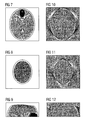
- the inventive method was tested in an approximately rectangular short-scan geometry as shown in FIG. 6 .
- the trajectory of the X-ray source during the scan is indicated at 40 , and the trajectory of the detector at 42 . Each moves along roughly a rectangular trajectory, wherein the edges are leveled.
- the scalar ⁇ in this definition was used to avoid the 90°-edges in the trajectory and was set to 0.07 in our evaluation, yielding the trajectory of FIG. 6 .
- the present invention provides for a practical Feldkamp-like reconstruction method for flat-panel cone-beam reconstruction from a planar source trajectory, in particular with smoothly varying radius. Along with the reconstruction, the method also recovers the field-of-view, which can take complex shapes in the considered geometries.
Landscapes
- Health & Medical Sciences (AREA)
- Life Sciences & Earth Sciences (AREA)
- Medical Informatics (AREA)
- Engineering & Computer Science (AREA)
- Radiology & Medical Imaging (AREA)
- Biomedical Technology (AREA)
- Biophysics (AREA)
- Nuclear Medicine, Radiotherapy & Molecular Imaging (AREA)
- Optics & Photonics (AREA)
- Pathology (AREA)
- Physics & Mathematics (AREA)
- High Energy & Nuclear Physics (AREA)
- Heart & Thoracic Surgery (AREA)
- Molecular Biology (AREA)
- Surgery (AREA)
- Animal Behavior & Ethology (AREA)
- General Health & Medical Sciences (AREA)
- Public Health (AREA)
- Veterinary Medicine (AREA)
- Apparatus For Radiation Diagnosis (AREA)
Abstract
Description
a (λ)=R(λ)(cos λ, sin λ,0) with λεΛ (1)
g(λ,u,v)=∫o ∞ dtf(α(λ)+tα (λ,u,v)) (2)
where uε[−um,um] and vε[−vm,vm] are coordinates measured along e u(λ) and e v(λ) and where
if both, |u|≦um and |v|≦vm. If |u|>um, or |v|>vm, however, we set gF(λ,u,v)=∘, where the symbol ∘ is used to define data outside the detector boundaries. We select ∘ to have the properties (i)∘+x=∘ and (ii)∘·x=∘, so that it propagates through the computations and sets any point x in the reconstruction to ∘ that projects at least for one λ ε Λ beyond the detector boundaries. Doing so, the algorithm automatically recovers the FOV, which takes in general non-trivial shapes in variable-radius geometries. In a practical implementation, ∘ can be set to the float value not a number (NaNq), which satisfies the requirements described above.
with hH(u) being the kernel of the Hilbert transform.
w(λ,u)=c(λ)/(c(λ)+c c(λ,u)), (7)
where cc(λ,u) is the sum of the auxiliary function evaluated at the source points that were determined to be complementary. The auxiliary function c(λ) can in principal be any function which is pre-determined by the user, with the only limitations that c≧0 for all relevant λ. c(λ) can for example be a constant, or can smoothly fall of at the edges. By the formula mentioned above, it is assured that all weights add up to 1. Preferably, by the above formula, a Parker-like redundancy weighting function can be achieved.
R(λ)=R m1(λ) and D(λ)=D m1(λ)
where Rm=750 mm and Dm=1200 mm were the minimum radius and the minimum source-detector distance, respectively, and where
1(λ)=min(|cos λ|−1;|sin λ|−1;√{square root over (2)}−ε) (9)
is a scaling function that modulates the geometry. The scalar ε in this definition was used to avoid the 90°-edges in the trajectory and was set to 0.07 in our evaluation, yielding the trajectory of
Claims (14)
w(λ,u)=c(λ)/(c(λ)+c c(λ,u)),
Applications Claiming Priority (3)
| Application Number | Priority Date | Filing Date | Title |
|---|---|---|---|
| EP09012880A EP2315178A1 (en) | 2009-10-12 | 2009-10-12 | Reconstruction of 3D image datasets from X-ray cone-beam data |
| EP09012880 | 2009-10-12 | ||
| EP09012880.2 | 2009-10-12 |
Publications (2)
| Publication Number | Publication Date |
|---|---|
| US20110085637A1 US20110085637A1 (en) | 2011-04-14 |
| US8218717B2 true US8218717B2 (en) | 2012-07-10 |
Family
ID=41719378
Family Applications (1)
| Application Number | Title | Priority Date | Filing Date |
|---|---|---|---|
| US12/902,237 Active US8218717B2 (en) | 2009-10-12 | 2010-10-12 | Reconstruction of 3D image datasets from x-ray and cone-beam data |
Country Status (3)
| Country | Link |
|---|---|
| US (1) | US8218717B2 (en) |
| EP (2) | EP2315178A1 (en) |
| CN (1) | CN102044081B (en) |
Families Citing this family (16)
| Publication number | Priority date | Publication date | Assignee | Title |
|---|---|---|---|---|
| EP2411965B1 (en) * | 2009-03-26 | 2016-01-13 | Koninklijke Philips N.V. | Method and apparatus for computed tomography image reconstruction |
| DE102011006991B4 (en) | 2011-04-07 | 2018-04-05 | Siemens Healthcare Gmbh | X-ray method and X-ray device for assembling X-ray images and determining three-dimensional volume data |
| EP2525385A1 (en) * | 2011-05-16 | 2012-11-21 | Fei Company | Charged-particle microscope |
| DE102011076348B4 (en) * | 2011-05-24 | 2014-02-13 | Siemens Aktiengesellschaft | Method and computer tomography system for generating tomographic image data sets |
| DE102011076547A1 (en) * | 2011-05-26 | 2012-11-29 | Siemens Aktiengesellschaft | A method for obtaining a 3D image data set to a picture object |
| US10734116B2 (en) | 2011-10-04 | 2020-08-04 | Quantant Technology, Inc. | Remote cloud based medical image sharing and rendering semi-automated or fully automated network and/or web-based, 3D and/or 4D imaging of anatomy for training, rehearsing and/or conducting medical procedures, using multiple standard X-ray and/or other imaging projections, without a need for special hardware and/or systems and/or pre-processing/analysis of a captured image data |
| US9105200B2 (en) | 2011-10-04 | 2015-08-11 | Quantant Technology, Inc. | Semi-automated or fully automated, network and/or web-based, 3D and/or 4D imaging of anatomy for training, rehearsing and/or conducting medical procedures, using multiple standard X-ray and/or other imaging projections, without a need for special hardware and/or systems and/or pre-processing/analysis of a captured image data |
| US8923475B2 (en) * | 2012-01-31 | 2014-12-30 | Siemens Aktiengesellschaft | System and method for recording cone-beam tomograms in radiation therapy |
| CN103767723A (en) * | 2012-10-25 | 2014-05-07 | 南京普爱射线影像设备有限公司 | Cone beam CT three-dimensional digital imaging method based on C-shaped arm |
| DE102013207023B4 (en) | 2013-04-18 | 2018-05-17 | Siemens Healthcare Gmbh | C-arm X-ray device |
| WO2017001210A1 (en) * | 2015-06-30 | 2017-01-05 | Koninklijke Philips N.V. | Registration apparatus for registering images |
| US9940747B2 (en) * | 2015-12-02 | 2018-04-10 | Biosense Webster (Israel) Ltd. | Mapping 3D to 2D images |
| CN109949411B (en) * | 2019-03-22 | 2022-12-27 | 电子科技大学 | Image reconstruction method based on three-dimensional weighted filtering back projection and statistical iteration |
| TWM606669U (en) * | 2019-05-02 | 2021-01-21 | 八豐盟有限公司 | Three-dimensional human body scanning device |
| EP4000527B1 (en) * | 2020-11-12 | 2025-04-09 | Ecential Robotics | Method for optimizing a trajectory of a motorized c-arm |
| CN114886444B (en) * | 2022-07-14 | 2022-11-08 | 有方(合肥)医疗科技有限公司 | CBCT imaging reconstruction method |
Citations (12)
| Publication number | Priority date | Publication date | Assignee | Title |
|---|---|---|---|---|
| US6292525B1 (en) * | 1999-09-30 | 2001-09-18 | Siemens Corporate Research, Inc. | Use of Hilbert transforms to simplify image reconstruction in a spiral scan cone beam CT imaging system |
| US20030161444A1 (en) * | 2001-08-16 | 2003-08-28 | Alexander Katsevich | Method of reconstructing images for spiral and non-spiral computer tomography |
| US20050220265A1 (en) * | 2003-06-25 | 2005-10-06 | Besson Guy M | Methods for acquiring multi spectral data of an object |
| US20060050842A1 (en) * | 2004-07-16 | 2006-03-09 | Ge Wang | Systems and methods of non-standard spiral cone-beam computed tomography (CT) |
| US20060067457A1 (en) * | 2004-09-29 | 2006-03-30 | Kabushiki Kaisha Toshiba | Image reconstruction method using hilbert transform |
| US20060109952A1 (en) * | 2004-11-24 | 2006-05-25 | Guang-Hong Chen | Fan-beam and cone-beam image reconstruction using filtered backprojection of differentiated projection data |
| US7187747B2 (en) * | 2003-02-19 | 2007-03-06 | Koninklijke Philips Electronics N.V. | Computerized tomography method with helical relative movement and conical beam |
| US7280632B2 (en) * | 2001-08-16 | 2007-10-09 | University Of Central Florida Research Foundation, Inc. | Exact filtered back projection (FBP) algorithm for spiral computer tomography with variable pitch |
| US7403587B2 (en) * | 2003-09-05 | 2008-07-22 | Koninklijke Philips Electronics N.V. | Computer tomography method using a cone-shaped bundle of rays |
| US7477720B2 (en) * | 2005-06-28 | 2009-01-13 | University Of Utah Research Foundation | Cone-beam reconstruction using backprojection of locally filtered projections and X-ray CT apparatus |
| US20090207964A1 (en) * | 2008-02-18 | 2009-08-20 | General Electric Company | Method and system for reconstructing cone-beam projection data with reduced artifacts |
| US7822171B2 (en) * | 2006-04-19 | 2010-10-26 | Koninklijke Philips Electronics N.V. | Cone beam computed tomography with multiple partial scanning trajectories |
-
2009
- 2009-10-12 EP EP09012880A patent/EP2315178A1/en not_active Withdrawn
-
2010
- 2010-10-08 EP EP10186932A patent/EP2317477B1/en active Active
- 2010-10-12 CN CN201010506354.5A patent/CN102044081B/en not_active Expired - Fee Related
- 2010-10-12 US US12/902,237 patent/US8218717B2/en active Active
Patent Citations (12)
| Publication number | Priority date | Publication date | Assignee | Title |
|---|---|---|---|---|
| US6292525B1 (en) * | 1999-09-30 | 2001-09-18 | Siemens Corporate Research, Inc. | Use of Hilbert transforms to simplify image reconstruction in a spiral scan cone beam CT imaging system |
| US20030161444A1 (en) * | 2001-08-16 | 2003-08-28 | Alexander Katsevich | Method of reconstructing images for spiral and non-spiral computer tomography |
| US7280632B2 (en) * | 2001-08-16 | 2007-10-09 | University Of Central Florida Research Foundation, Inc. | Exact filtered back projection (FBP) algorithm for spiral computer tomography with variable pitch |
| US7187747B2 (en) * | 2003-02-19 | 2007-03-06 | Koninklijke Philips Electronics N.V. | Computerized tomography method with helical relative movement and conical beam |
| US20050220265A1 (en) * | 2003-06-25 | 2005-10-06 | Besson Guy M | Methods for acquiring multi spectral data of an object |
| US7403587B2 (en) * | 2003-09-05 | 2008-07-22 | Koninklijke Philips Electronics N.V. | Computer tomography method using a cone-shaped bundle of rays |
| US20060050842A1 (en) * | 2004-07-16 | 2006-03-09 | Ge Wang | Systems and methods of non-standard spiral cone-beam computed tomography (CT) |
| US20060067457A1 (en) * | 2004-09-29 | 2006-03-30 | Kabushiki Kaisha Toshiba | Image reconstruction method using hilbert transform |
| US20060109952A1 (en) * | 2004-11-24 | 2006-05-25 | Guang-Hong Chen | Fan-beam and cone-beam image reconstruction using filtered backprojection of differentiated projection data |
| US7477720B2 (en) * | 2005-06-28 | 2009-01-13 | University Of Utah Research Foundation | Cone-beam reconstruction using backprojection of locally filtered projections and X-ray CT apparatus |
| US7822171B2 (en) * | 2006-04-19 | 2010-10-26 | Koninklijke Philips Electronics N.V. | Cone beam computed tomography with multiple partial scanning trajectories |
| US20090207964A1 (en) * | 2008-02-18 | 2009-08-20 | General Electric Company | Method and system for reconstructing cone-beam projection data with reduced artifacts |
Non-Patent Citations (8)
| Title |
|---|
| Dennerlein et al., "Cone-beam reconstruction from a variable-radius, planar source trajectory", 2009 IEEE Nuclear Science Symposium and Medical Imaging Conference (NSS/MIIC 2009), IEEE, Orlando, LL. USA, Oct. 24, 2009, pp. 2496-2499, XP031621443, ISBN: 978-1-4244-3961-4. |
| Dennerlein et al., Cone-beam reconstruction from a variable-radius, planar source trajectory, IEEE Nuclear Science Symposium Conference Record, 2990, pp. 2496-2499. * |
| Feldkamp et al., "Practical cone beam algorithm", J. Opt. Soc. Am. A1, 1984, pp. 612-619. |
| Noo et al., "A new scheme for view-dependent dta differentiation in fan-beam and cone-beam beam computed tomography", Phys. Med. Biol. 52, 2007, pp. 5393-5414. |
| Parker, "Optimal short scan convolution reconstruction for fan-beam CT", Med Phys, 9, (2), 1982, pp. 254-257. |
| Tang et al., "Analytical Image Reconstruction for Convergent-beam Non-circular Orbit Attenuation Correction", 9th International Meeting on Fully Three-Dimensional Image 2007 Reconstruction in Radiology and Nuclear Medicine, pp. 293-296, XP007912106. |
| Ye et al., Geometric studies on variable radius spiral cone-beam scanning, Med Phys, 31, Jun. 6, 2004, pp. 1473-1480. * |
| Yu et al., Katsevich-Type algorithms for variable radius spiral cone-beam, Developments in X-ray Tomography IV, Proc of SPIE, vol. 5535, 2004, pp. 550-557. * |
Also Published As
| Publication number | Publication date |
|---|---|
| EP2317477B1 (en) | 2013-03-27 |
| CN102044081A (en) | 2011-05-04 |
| EP2315178A1 (en) | 2011-04-27 |
| EP2317477A1 (en) | 2011-05-04 |
| CN102044081B (en) | 2014-03-26 |
| US20110085637A1 (en) | 2011-04-14 |
Similar Documents
| Publication | Publication Date | Title |
|---|---|---|
| US8218717B2 (en) | Reconstruction of 3D image datasets from x-ray and cone-beam data | |
| Cho et al. | Cone-beam CT for radiotherapy applications | |
| US8923589B2 (en) | Apparatus, method, and non-transitory storage medium for performing tomosynthesis from projection data obtained from different geometric arrangements | |
| US6466638B1 (en) | Image mapping method and system | |
| US6452996B1 (en) | Methods and apparatus utilizing generalized helical interpolation algorithm | |
| US6990167B2 (en) | Image reconstruction method for divergent beam scanner | |
| JP5161888B2 (en) | Method and system for tomographic reconstruction in medical imaging using circular and linear trajectories | |
| US8724889B2 (en) | Method and apparatus for CT image reconstruction | |
| JPH0919425A (en) | X-ray computed tomography apparatus | |
| US7359477B2 (en) | Method for reconstructing a CT image using an algorithm for a short-scan circle combined with various lines | |
| JPH0661327B2 (en) | Method and apparatus for creating tomographic image | |
| JP2004188163A (en) | Tomography equipment | |
| JP2007527253A (en) | Accurate image reconstruction system and method for helical cone beam computed tomography including redundant data | |
| JPH05192322A (en) | Method for reproducing tomographic image using radiation line intersecting plane | |
| JP2004237088A (en) | Three-dimensional back projection method and X-ray CT apparatus | |
| CN101036164B (en) | Image reconstruction using voxel-dependent interpolation | |
| US6542570B1 (en) | Method and system for reconstructing computed tomography images using redundant data | |
| US8494111B2 (en) | System and method for image reconstruction for helical cone beam computed tomography with factorized redundancy weighting | |
| US7187747B2 (en) | Computerized tomography method with helical relative movement and conical beam | |
| US7430270B2 (en) | Computerized tomography method with helical relative movement and conical beam | |
| CN101057260B (en) | Reconstruction method and computer tomography apparatus for computer tomography | |
| JP3950101B2 (en) | X-ray computed tomography system | |
| Gomi et al. | Development of a non-linear weighted hybrid cone-beam CT reconstruction for circular trajectories | |
| CN110974278A (en) | A DSA cone beam precise filtered back projection tomography system and imaging method | |
| EP1599837B1 (en) | System and method for exact image reconstruction for helical cone beam computed tomography including redundant data |
Legal Events
| Date | Code | Title | Description |
|---|---|---|---|
| AS | Assignment |
Owner name: SIEMENS AKTIENGESELLSCHAFT, GERMANY Free format text: ASSIGNMENT OF ASSIGNORS INTEREST;ASSIGNORS:BOESE, JAN;DENNERLEIN, FRANK;KUNZE, HOLGER;REEL/FRAME:025122/0461 Effective date: 20100824 |
|
| STCF | Information on status: patent grant |
Free format text: PATENTED CASE |
|
| FPAY | Fee payment |
Year of fee payment: 4 |
|
| AS | Assignment |
Owner name: SIEMENS HEALTHCARE GMBH, GERMANY Free format text: ASSIGNMENT OF ASSIGNORS INTEREST;ASSIGNOR:SIEMENS AKTIENGESELLSCHAFT;REEL/FRAME:039271/0561 Effective date: 20160610 |
|
| MAFP | Maintenance fee payment |
Free format text: PAYMENT OF MAINTENANCE FEE, 8TH YEAR, LARGE ENTITY (ORIGINAL EVENT CODE: M1552); ENTITY STATUS OF PATENT OWNER: LARGE ENTITY Year of fee payment: 8 |
|
| MAFP | Maintenance fee payment |
Free format text: PAYMENT OF MAINTENANCE FEE, 12TH YEAR, LARGE ENTITY (ORIGINAL EVENT CODE: M1553); ENTITY STATUS OF PATENT OWNER: LARGE ENTITY Year of fee payment: 12 |
|
| AS | Assignment |
Owner name: SIEMENS HEALTHINEERS AG, GERMANY Free format text: ASSIGNMENT OF ASSIGNORS INTEREST;ASSIGNOR:SIEMENS HEALTHCARE GMBH;REEL/FRAME:066088/0256 Effective date: 20231219 Owner name: SIEMENS HEALTHINEERS AG, GERMANY Free format text: ASSIGNMENT OF ASSIGNOR'S INTEREST;ASSIGNOR:SIEMENS HEALTHCARE GMBH;REEL/FRAME:066088/0256 Effective date: 20231219 |
|
| AS | Assignment |
Owner name: SIEMENS HEALTHINEERS AG, GERMANY Free format text: CORRECTIVE ASSIGNMENT TO CORRECT THE ASSIGNEE PREVIOUSLY RECORDED AT REEL: 066088 FRAME: 0256. ASSIGNOR(S) HEREBY CONFIRMS THE ASSIGNMENT;ASSIGNOR:SIEMENS HEALTHCARE GMBH;REEL/FRAME:071178/0246 Effective date: 20231219 |