US8217120B2 - Functionalized styrene oligomers and polymers - Google Patents
Functionalized styrene oligomers and polymers Download PDFInfo
- Publication number
- US8217120B2 US8217120B2 US12/540,892 US54089209A US8217120B2 US 8217120 B2 US8217120 B2 US 8217120B2 US 54089209 A US54089209 A US 54089209A US 8217120 B2 US8217120 B2 US 8217120B2
- Authority
- US
- United States
- Prior art keywords
- acid
- compound
- composition
- refers
- adhesive
- Prior art date
- Legal status (The legal status is an assumption and is not a legal conclusion. Google has not performed a legal analysis and makes no representation as to the accuracy of the status listed.)
- Active, expires
Links
- 0 *BC.C.CC Chemical compound *BC.C.CC 0.000 description 11
- UVTDWAVPBFKSDM-UHFFFAOYSA-N CCC.CCC(C)C1=CC=CC=C1 Chemical compound CCC.CCC(C)C1=CC=CC=C1 UVTDWAVPBFKSDM-UHFFFAOYSA-N 0.000 description 3
- WCESNHFINZXTGO-UHFFFAOYSA-N C=C(C)CC1=CC=C(C(CCC2=C(CC(=C)C)C=CC=C2)CC(CC(C)C2=CC=CC=C2CC(=C)C)C2=CC=C(CC(=C)C)C=C2)C=C1.C=CCC1=CC=C(C(CC(C)C2=CC=CC=C2CC(=C)C)CC(CCC2=C(CC=C)C=CC=C2)C2=CC=C(CC(=C)C)C=C2)C=C1.C=CCC1=CC=C(C(CC(C)C2=CC=CC=C2CC2CO2)CC(CCC2=C(CC=C)C=CC=C2)C2=CC=C(CC3CO3)C=C2)C=C1.C=CCC1=CC=C(C(CCC2=C(CC=C)C=CC=C2)CC(CC(C)C2=CC=CC=C2CC=C)C2=CC=C(CC=C)C=C2)C=C1.CC(CC(CC(CCC1=C(CC2(C)CO2)C=CC=C1)C1=CC=C(CC2(C)CO2)C=C1)C1=CC=C(CC2(C)CO2)C=C1)C1=CC=CC=C1CC1(C)CC1.CC(CC(CC(CCC1=C(CC2CO2)C=CC=C1)C1=CC=C(CC2CO2)C=C1)C1=CC=C(CC2CO2)C=C1)C1=CC=CC=C1CC1CO1 Chemical compound C=C(C)CC1=CC=C(C(CCC2=C(CC(=C)C)C=CC=C2)CC(CC(C)C2=CC=CC=C2CC(=C)C)C2=CC=C(CC(=C)C)C=C2)C=C1.C=CCC1=CC=C(C(CC(C)C2=CC=CC=C2CC(=C)C)CC(CCC2=C(CC=C)C=CC=C2)C2=CC=C(CC(=C)C)C=C2)C=C1.C=CCC1=CC=C(C(CC(C)C2=CC=CC=C2CC2CO2)CC(CCC2=C(CC=C)C=CC=C2)C2=CC=C(CC3CO3)C=C2)C=C1.C=CCC1=CC=C(C(CCC2=C(CC=C)C=CC=C2)CC(CC(C)C2=CC=CC=C2CC=C)C2=CC=C(CC=C)C=C2)C=C1.CC(CC(CC(CCC1=C(CC2(C)CO2)C=CC=C1)C1=CC=C(CC2(C)CO2)C=C1)C1=CC=C(CC2(C)CO2)C=C1)C1=CC=CC=C1CC1(C)CC1.CC(CC(CC(CCC1=C(CC2CO2)C=CC=C1)C1=CC=C(CC2CO2)C=C1)C1=CC=C(CC2CO2)C=C1)C1=CC=CC=C1CC1CO1 WCESNHFINZXTGO-UHFFFAOYSA-N 0.000 description 2
- KFDMLCMFRDSHAY-UHFFFAOYSA-N CC.CC.CCC(C)C1=CC=CC=C1.CCC(C)C1=CC=CC=C1 Chemical compound CC.CC.CCC(C)C1=CC=CC=C1.CCC(C)C1=CC=CC=C1 KFDMLCMFRDSHAY-UHFFFAOYSA-N 0.000 description 2
- PQXKWPLDPFFDJP-UHFFFAOYSA-N CC1OC1C Chemical compound CC1OC1C PQXKWPLDPFFDJP-UHFFFAOYSA-N 0.000 description 2
- OSLLYZLIDNZAIM-UHFFFAOYSA-N *.*.*.*.B.B.C1=CC=C(C(CCC(CC(CCC2=CC=CC=C2CC2CO2)C2=CC=C(CC3CO3)C=C2)C2=CC=CC=C2)CC(CCC2=CC=CC=C2CC2CO2)C2=CC=C(CC3CO3)C=C2)C=C1.C=CCC1=CC=C(C(CCC2=CC=CC=C2CC=C)CC(CCC(CC(CCC2=CC=CC=C2CC=C)C2=CC=C(CC=C)C=C2)C2=CC=CC=C2)C2=CC=CC=C2)C=C1 Chemical compound *.*.*.*.B.B.C1=CC=C(C(CCC(CC(CCC2=CC=CC=C2CC2CO2)C2=CC=C(CC3CO3)C=C2)C2=CC=CC=C2)CC(CCC2=CC=CC=C2CC2CO2)C2=CC=C(CC3CO3)C=C2)C=C1.C=CCC1=CC=C(C(CCC2=CC=CC=C2CC=C)CC(CCC(CC(CCC2=CC=CC=C2CC=C)C2=CC=C(CC=C)C=C2)C2=CC=CC=C2)C2=CC=CC=C2)C=C1 OSLLYZLIDNZAIM-UHFFFAOYSA-N 0.000 description 1
- SUGJXIBVZPDNMS-UHFFFAOYSA-N *.*.B.C=CCC1=CC=C(C(CCC2=C(CC=C)C=CC=C2)CC(CCC(CC(CCC2=C(CC=C)C=CC=C2)C2=CC=C(CC=C)C=C2)C2=CC=C(CC=C)C=C2)C2=CC=C(CC=C)C=C2)C=C1 Chemical compound *.*.B.C=CCC1=CC=C(C(CCC2=C(CC=C)C=CC=C2)CC(CCC(CC(CCC2=C(CC=C)C=CC=C2)C2=CC=C(CC=C)C=C2)C2=CC=C(CC=C)C=C2)C2=CC=C(CC=C)C=C2)C=C1 SUGJXIBVZPDNMS-UHFFFAOYSA-N 0.000 description 1
- ZMUVSVHFUGHCJX-UHFFFAOYSA-N B.C.C1=CC(CCC(CC(CCC(CC(CCC2=C(CC3CO3)C=CC=C2)C2=CC=C(CC3CO3)C=C2)C2=CC=C(CC3CO3)C=C2)C2=CC=C(CC3CO3)C=C2)C2=CC=C(CC3CO3)C=C2)=C(CC2CO2)C=C1 Chemical compound B.C.C1=CC(CCC(CC(CCC(CC(CCC2=C(CC3CO3)C=CC=C2)C2=CC=C(CC3CO3)C=C2)C2=CC=C(CC3CO3)C=C2)C2=CC=C(CC3CO3)C=C2)C2=CC=C(CC3CO3)C=C2)=C(CC2CO2)C=C1 ZMUVSVHFUGHCJX-UHFFFAOYSA-N 0.000 description 1
- OUTGSOLTEPTSDE-UHFFFAOYSA-N C.C#CCC Chemical compound C.C#CCC OUTGSOLTEPTSDE-UHFFFAOYSA-N 0.000 description 1
- VRWYLHOEFCDPTF-UHFFFAOYSA-N C.C=COC Chemical compound C.C=COC VRWYLHOEFCDPTF-UHFFFAOYSA-N 0.000 description 1
- HKRRVHCECYWIPJ-UHFFFAOYSA-N C.C=COC(C)=O Chemical compound C.C=COC(C)=O HKRRVHCECYWIPJ-UHFFFAOYSA-N 0.000 description 1
- NWDWPMDIAQIOFP-UHFFFAOYSA-N C.CN1COC2=C(C=CC=C2)C1 Chemical compound C.CN1COC2=C(C=CC=C2)C1 NWDWPMDIAQIOFP-UHFFFAOYSA-N 0.000 description 1
- YGBHNAQICIFFAC-UHFFFAOYSA-N C.COC#N Chemical compound C.COC#N YGBHNAQICIFFAC-UHFFFAOYSA-N 0.000 description 1
- KWYITFRNPKBJAD-BJILWQEISA-N C.COC(=O)/C=C/C(=O)OC Chemical compound C.COC(=O)/C=C/C(=O)OC KWYITFRNPKBJAD-BJILWQEISA-N 0.000 description 1
- NAEZLTNWPMHZBD-UHFFFAOYSA-N C1=CC=C(C2CO2)C=C1.C=CC1=CC=CC=C1.OO.[OH-] Chemical compound C1=CC=C(C2CO2)C=C1.C=CC1=CC=CC=C1.OO.[OH-] NAEZLTNWPMHZBD-UHFFFAOYSA-N 0.000 description 1
- YSDCQOIHNIWIQG-UHFFFAOYSA-N C1CC2CCC1C2.CC.CC Chemical compound C1CC2CCC1C2.CC.CC YSDCQOIHNIWIQG-UHFFFAOYSA-N 0.000 description 1
- IQKZXCQPYSFIIU-UHFFFAOYSA-N C1COC1.CC Chemical compound C1COC1.CC IQKZXCQPYSFIIU-UHFFFAOYSA-N 0.000 description 1
- WFKDPJRCBCBQNT-UHFFFAOYSA-N C=C(C)C(=O)NC Chemical compound C=C(C)C(=O)NC WFKDPJRCBCBQNT-UHFFFAOYSA-N 0.000 description 1
- VVQNEPGJFQJSBK-UHFFFAOYSA-N C=C(C)C(=O)OC Chemical compound C=C(C)C(=O)OC VVQNEPGJFQJSBK-UHFFFAOYSA-N 0.000 description 1
- RHAUCQMAQUCZIH-UHFFFAOYSA-N C=C(C)CC1=CC=C(C(CCC2=C(CC(=C)C)C=CC=C2)CC(CC(C)C2=CC=CC=C2CC(=C)C)C2=CC=C(CC(=C)C)C=C2)C=C1.C=CCC1=CC=C(C(CC(C)C2=CC=CC=C2CC(=C)C)CC(CCC2=C(CC=C)C=CC=C2)C2=CC=C(CC(=C)C)C=C2)C=C1.C=CCC1=CC=C(C(CCC2=C(CC=C)C=CC=C2)CC(CC(C)C2=CC=CC=C2CC=C)C2=CC=C(CC=C)C=C2)C=C1 Chemical compound C=C(C)CC1=CC=C(C(CCC2=C(CC(=C)C)C=CC=C2)CC(CC(C)C2=CC=CC=C2CC(=C)C)C2=CC=C(CC(=C)C)C=C2)C=C1.C=CCC1=CC=C(C(CC(C)C2=CC=CC=C2CC(=C)C)CC(CCC2=C(CC=C)C=CC=C2)C2=CC=C(CC(=C)C)C=C2)C=C1.C=CCC1=CC=C(C(CCC2=C(CC=C)C=CC=C2)CC(CC(C)C2=CC=CC=C2CC=C)C2=CC=C(CC=C)C=C2)C=C1 RHAUCQMAQUCZIH-UHFFFAOYSA-N 0.000 description 1
- ZWWQRMFIZFPUAA-UHFFFAOYSA-N C=C(CC(=O)OC)C(=O)OC Chemical compound C=C(CC(=O)OC)C(=O)OC ZWWQRMFIZFPUAA-UHFFFAOYSA-N 0.000 description 1
- MPGDCWMPLSPHLZ-UHFFFAOYSA-N C=C1C(C)=CC(=O)N1C Chemical compound C=C1C(C)=CC(=O)N1C MPGDCWMPLSPHLZ-UHFFFAOYSA-N 0.000 description 1
- YPHQUSNPXDGUHL-UHFFFAOYSA-N C=CC(=O)NC Chemical compound C=CC(=O)NC YPHQUSNPXDGUHL-UHFFFAOYSA-N 0.000 description 1
- BAPJBEWLBFYGME-UHFFFAOYSA-N C=CC(=O)OC Chemical compound C=CC(=O)OC BAPJBEWLBFYGME-UHFFFAOYSA-N 0.000 description 1
- LWGUTNJVKQDSQE-UHFFFAOYSA-N C=CC1=CC=CC=C1.CC Chemical compound C=CC1=CC=CC=C1.CC LWGUTNJVKQDSQE-UHFFFAOYSA-N 0.000 description 1
- VXNZUUAINFGPBY-UHFFFAOYSA-N C=CCC Chemical compound C=CCC VXNZUUAINFGPBY-UHFFFAOYSA-N 0.000 description 1
- XDNBBARMVOZQPZ-UHFFFAOYSA-N CC1N=CCO1 Chemical compound CC1N=CCO1 XDNBBARMVOZQPZ-UHFFFAOYSA-N 0.000 description 1
Classifications
-
- C—CHEMISTRY; METALLURGY
- C07—ORGANIC CHEMISTRY
- C07D—HETEROCYCLIC COMPOUNDS
- C07D303/00—Compounds containing three-membered rings having one oxygen atom as the only ring hetero atom
- C07D303/02—Compounds containing oxirane rings
- C07D303/04—Compounds containing oxirane rings containing only hydrogen and carbon atoms in addition to the ring oxygen atoms
-
- C—CHEMISTRY; METALLURGY
- C07—ORGANIC CHEMISTRY
- C07C—ACYCLIC OR CARBOCYCLIC COMPOUNDS
- C07C15/00—Cyclic hydrocarbons containing only six-membered aromatic rings as cyclic parts
- C07C15/40—Cyclic hydrocarbons containing only six-membered aromatic rings as cyclic parts substituted by unsaturated carbon radicals
- C07C15/50—Cyclic hydrocarbons containing only six-membered aromatic rings as cyclic parts substituted by unsaturated carbon radicals polycyclic non-condensed
-
- C—CHEMISTRY; METALLURGY
- C08—ORGANIC MACROMOLECULAR COMPOUNDS; THEIR PREPARATION OR CHEMICAL WORKING-UP; COMPOSITIONS BASED THEREON
- C08F—MACROMOLECULAR COMPOUNDS OBTAINED BY REACTIONS ONLY INVOLVING CARBON-TO-CARBON UNSATURATED BONDS
- C08F257/00—Macromolecular compounds obtained by polymerising monomers on to polymers of aromatic monomers as defined in group C08F12/00
- C08F257/02—Macromolecular compounds obtained by polymerising monomers on to polymers of aromatic monomers as defined in group C08F12/00 on to polymers of styrene or alkyl-substituted styrenes
-
- C—CHEMISTRY; METALLURGY
- C09—DYES; PAINTS; POLISHES; NATURAL RESINS; ADHESIVES; COMPOSITIONS NOT OTHERWISE PROVIDED FOR; APPLICATIONS OF MATERIALS NOT OTHERWISE PROVIDED FOR
- C09J—ADHESIVES; NON-MECHANICAL ASPECTS OF ADHESIVE PROCESSES IN GENERAL; ADHESIVE PROCESSES NOT PROVIDED FOR ELSEWHERE; USE OF MATERIALS AS ADHESIVES
- C09J151/00—Adhesives based on graft polymers in which the grafted component is obtained by reactions only involving carbon-to-carbon unsaturated bonds; Adhesives based on derivatives of such polymers
- C09J151/003—Adhesives based on graft polymers in which the grafted component is obtained by reactions only involving carbon-to-carbon unsaturated bonds; Adhesives based on derivatives of such polymers grafted on to macromolecular compounds obtained by reactions only involving unsaturated carbon-to-carbon bonds
-
- H—ELECTRICITY
- H10—SEMICONDUCTOR DEVICES; ELECTRIC SOLID-STATE DEVICES NOT OTHERWISE PROVIDED FOR
- H10W—GENERIC PACKAGES, INTERCONNECTIONS, CONNECTORS OR OTHER CONSTRUCTIONAL DETAILS OF DEVICES COVERED BY CLASS H10
- H10W74/00—Encapsulations, e.g. protective coatings
- H10W74/01—Manufacture or treatment
- H10W74/012—Manufacture or treatment of encapsulations on active surfaces of flip-chip devices, e.g. forming underfills
-
- H—ELECTRICITY
- H10—SEMICONDUCTOR DEVICES; ELECTRIC SOLID-STATE DEVICES NOT OTHERWISE PROVIDED FOR
- H10W—GENERIC PACKAGES, INTERCONNECTIONS, CONNECTORS OR OTHER CONSTRUCTIONAL DETAILS OF DEVICES COVERED BY CLASS H10
- H10W74/00—Encapsulations, e.g. protective coatings
- H10W74/10—Encapsulations, e.g. protective coatings characterised by their shape or disposition
- H10W74/15—Encapsulations, e.g. protective coatings characterised by their shape or disposition on active surfaces of flip-chip devices, e.g. underfills
Definitions
- the present invention relates to functionalized styrene-containing compounds compositions, methods of preparation and uses therefor.
- the present invention relates to functionalized styrene oligomers and polymers prepared by Friedel-Crafts chemistry and epoxidation products thereof.
- Specific compounds of the invention include functionalized styrene-containing thermoplastic elastomers
- Adhesive compositions are used for a variety of purposes in the fabrication and assembly of semiconductor packages and microelectronic devices. The more prominent uses include bonding of electronic elements such as integrated circuit (IC) chips to lead frames or other substrates, and bonding IC chips to other IC chips. Adhesives useful for electronic packaging applications typically exhibit properties such as good mechanical strength, curing properties that do not affect the component or the carrier, and rheological properties compatible with application to microelectronic and semiconductor components.
- the present invention provides functionalized styrene oligomers and polymers prepared by Friedel-Crafts chemistry as well as epoxidation products thereof.
- the compounds of the invention have the structure of formula I:
- E is a moiety selected from the group consisting of maleimido, acrylate, methacrylate, allyl, methallyl, epoxy, oxetane, a partially or fully epoxidized allyl, a partially or fully epoxidized methallyl; n is an integer having the value between 3 and about 100; m is an integer having the value between 0 and 12; and x is an integer having the value between 1 and 5.
- E is selected from allyl, methallyl, epoxy, acrylate, and methacrylate.
- E is allyl, partially or fully epoxidized allyl, methallyl and partially or fully epoxidized methallyl.
- Exemplary compounds of the invention include Compounds 1-6:
- the present invention also provides block copolymers having the structure represented by formula II or III:
- each A is a compound of according to formula I, wherein E is a moiety selected from the group consisting of maleimido, acrylate, methacrylate, allyl, methallyl, epoxy, and oxetane; each B is a hydrogenated polybutadiene polymer; and y is an integer having the value between 1 and about 100.
- block copolymers having the structure represented by formula IV or V:
- each A′ is a compound according to formula I, wherein E is a moiety selected from the group consisting of a partially or fully epoxidized allyl, and a partially or fully epoxidized methallyl; each B is a hydrogenated polybutadiene polymer; and y is an integer having the value between 1 and about 100.
- compositions containing a compound according to formula I may be, for example, adhesive compositions.
- Adhesive compositions of the invention may be cured or uncured.
- the adhesive composition is B-stageable.
- compositions may include at least one curing initiator, co-monomer, co-curing compound, coupling agent, or filler.
- Compositions including block polymers according to the invention, including adhesive compositions, are also provided.
- the present invention also provides methods for increasing the adhesiveness of a composition comprising a monomer, by replacing all or a portion of the monomer in the composition with a compound of formula I.
- the monomer can be, for example, a bismaleimide or an acrylate.
- replacing all or a portion of the monomer in the composition increases the adhesiveness of the composition by at least about 100%.
- methods for functionalizing a styrene oligomer or polymer which include the step of alkylating a styrene oligomer or polymer according to the reaction Scheme A:
- E is selected from the group consisting of maleimido, acrylate, methacrylate, allyl, methallyl, epoxy, and oxetane, thereby obtaining a functionalized styrene oligomer or polymer.
- E is allyl or methallyl and X is Cl, Br, I, —OH, or ⁇ -olefin.
- the method further includes the step of partially or fully oxidizing the allyl or methallyl functional groups to epoxy residues.
- the present invention also provides oligomers and polymers obtained by the methods of the invention.
- “About” as used herein means that a number referred to as “about” comprises the recited number plus or minus 1-10% of that recited number. For example, “about” 100 degrees can mean 95-105 degrees or as few as 99-101 degrees depending on the situation.
- a numerical range such as “1 to 20” refers to each integer in the given range; e.g., “1 to 20 carbon atoms” means that an alkyl group can contain only 1 carbon atom, 2 carbon atoms, 3 carbon atoms, etc., up to and including 20 carbon atoms (although the term “alkyl” also includes instances where no numerical range of carbon atoms is designated).
- Adhesive or “adhesive compound” as used herein, refers to any substance that can adhere or bond two items together. Implicit in the definition of an “adhesive composition” or “adhesive formulation” is the fact that the composition or formulation is a combination or mixture of more than one species, component or compound, which can include adhesive monomers, oligomers, and/or polymers along with other materials, whereas an “adhesive compound” refers to a single species, such as an adhesive polymer or oligomer.
- adhesive composition refers to un-cured mixtures in which the individual components in the mixture retain the chemical and physical characteristics of the original individual components of which the mixture is made.
- Adhesive compositions are typically malleable and may be liquids, paste, gel or another form that can be applied to an item so that it can be bonded to another item.
- Cured adhesive refers to adhesives components and mixtures obtained from reactive curable original compound(s) or mixture(s) thereof which have undergone a chemical and/or physical changes such that the original compound(s) or mixture(s) is(are) transformed into a solid, substantially non-flowing material.
- a typical curing process may involve crosslinking.
- “Curable” means that an original compound(s) or composition material(s) can be transformed into a solid, substantially non-flowing material by means of chemical reaction, crosslinking, radiation crosslinking, or the like.
- adhesive compositions of the invention are curable, but unless otherwise specified, the original compound(s) or composition material(s) is(are) not cured.
- Thermoplastic refers to the ability of a compound, composition or other material (e.g. a plastic) to dissolve in a suitable solvent or to melt to a liquid when heated and freeze to a solid, often brittle and glassy, state when cooled sufficiently.
- Thermoset refers to the ability of a compound, composition or other material to irreversibly “cure” resulting in a single tridimensional network that has greater strength and less solubility compared to the non-cured product.
- Thermoset materials are typically polymers that may be cured, for example, through heat (e.g. above 200° Celsius), via a chemical reaction (e.g. epoxy ring opening, free-radical polymerization, etc.), or through irradiation (e.g. visible light, U.V., or X-ray irradiation).
- thermoset polymers or resins are typically liquid or malleable forms prior to curing, and therefore may be molded or shaped into their final form, and/or used as adhesives. Curing transforms the thermoset resin into a rigid infusible and insoluble solid or rubber by a cross-linking process.
- energy and/or catalysts are typically added that cause the molecular chains to react at chemically active sites (unsaturated or epoxy sites, for example), linking the polymer chains into a rigid, 3-D structure.
- the cross-linking process forms molecules with a higher molecular weight and resultant higher melting point. During the reaction, when the molecular weight of the polymer has increased to a point such that the melting point is higher than the surrounding ambient temperature, the polymer becomes a solid material.
- Crosslinking refers to the attachment of two or more oligomer or longer polymer chains by bridges of an element, a molecular group, a compound, or another oligomer or polymer. Crosslinking may take place upon heating; some crosslinking processes may also occur at room temperature or a lower temperature. As cross-linking density is increased, the properties of a material can be changed from thermoplastic to thermosetting.
- B-stageable refers to the properties of an adhesive having a first solid phase followed by a tacky rubbery stage at elevated temperature, followed by yet another solid phase at an even higher temperature.
- the transition from the tacky rubbery stage to the second solid phase is thermosetting.
- the material behaves similarly to a thermoplastic material.
- such adhesives allows for low lamination temperatures while providing high thermal stability.
- a “die” or “semiconductor die” as used herein, refers to a small block of semiconducting material, on which a functional circuit is fabricated.
- a “flip-chip” semiconductor device is one in which a semiconductor die is directly mounted to a wiring substrate, such as a ceramic or an organic printed circuit board. Conductive terminals on the semiconductor die, usually in the form of solder bumps, are directly physically and electrically connected to the wiring pattern on the substrate without use of wire bonds, tape-automated bonding (TAB), or the like. Because the conductive solder bumps making connections to the substrate are on the active surface of the die or chip, the die is mounted in a face-down manner, thus the name “flip-chip.”
- Underfill “underfill,” “underfill composition” and “underfill material” are used interchangeably to refer to a material, typically polymeric compositions, used to fill gaps between a semiconductor component, such as a semiconductor die, and a substrate. “Underfilling” refers to the process of applying an underfill composition to a semiconductor component-substrate interface, thereby filling the gaps between the component and the substrate.
- the term “monomer” refers to a molecule that can undergo polymerization or copolymerization thereby contributing constitutional units to the essential structure of a macromolecule (a polymer).
- Polymer and “polymer compound” are used interchangeably herein, to refer generally to the combined the products of a single chemical polymerization reaction. Polymers are produced by combining monomer subunits into a covalently bonded chain. Polymers that contain only a single type of monomer are known as “homopolymers,” while polymers containing a mixture of monomers are known as “copolymers.”
- copolymers is inclusive of products that are obtained by copolymerization of two monomer species, those obtained from three monomers species (terpolymers), those obtained from four monomers species (quaterpolymers), etc. It is well known in the art that copolymers synthesized by chemical methods include, but are not limited to, molecules with the following types of monomer arrangements:
- block copolymers which have two or more homopolymer subunits linked by covalent bonds.
- the blocks of homopolymer within block copolymers can be of any length and can be blocks of uniform or variable length.
- Block copolymers with two or three distinct blocks are called diblock copolymers and triblock copolymers, respectively;
- star copolymers which have chains of monomer residues having different constitutional or configurational features that are linked through a central moiety.
- a copolymer product of a chemical polymerization reaction may contain individual polymeric fragments that each differ in the arrangement of monomer units.
- the skilled artisan will further be knowledgeable in methods for synthesizing each of these types of copolymers, and for varying reaction conditions to favor one type over another.
- the length of a polymer chain according to the present invention will typically vary over a range or average size produced by a particular reaction.
- the skilled artisan will be aware, for example, of methods for controlling the average length of a polymer chain produced in a given reaction and also of methods for size-selecting polymers after they have been synthesized.
- polymer is intended to encompass homopolymers, and copolymers having any arrangement of monomer subunits as well as copolymers containing individual molecules having more than one arrangement.
- length unless otherwise indicated, any length limitations recited for the polymers described herein are to be considered averages of the lengths of the individual molecules in polymer.
- thermoplastic elastomer or “TPE”, as used herein refers to a class of copolymers which consist of materials with both thermoplastic and elastomeric properties.
- Hard blocks or “hard segments” as used herein refer to a block of a copolymer (typically a thermoplastic elastomer) that is hard at room temperature by virtue of a of high melting point (T m ) or T g .
- T m high melting point
- soft blocks or “soft segments” have a T g below room temperature.
- oligomer or “oligomeric” refers to a polymer having a finite and moderate number of repeating monomers structural units. Oligomers of the invention typically have 2 to about 100 repeating monomer units; frequently 2 to about 30 repeating monomer units; and often 2 to about 10 repeating monomer units; and usually have a molecular weight up to about 3,000.
- oligomers and polymers may, depending on the availability of polymerizable groups or side chains, subsequently be incorporated as monomers in further polymerization or crosslinking reactions.
- aliphatic refers to any alkyl, alkenyl, cycloalkyl, or cycloalkenyl moiety.
- Aromatic hydrocarbon or “aromatic” as used herein, refers to compounds having one or more benzene rings.
- Alkane refers to saturated straight-chain, branched or cyclic hydrocarbons having only single bonds. Alkanes have general formula C n H 2n+2 . “Cycloalkane,” refers to an alkane having one or more rings in its structure.
- alkyl refers to straight or branched chain hydrocarbyl groups having from 1 up to about 500 carbon atoms.
- the terms “alkyl” and “substituted alkyl” include, respectively, substituted and unsubstituted C 1 -C 500 straight chain saturated aliphatic hydrocarbon groups, substituted and unsubstituted C 2 -C 200 straight chain unsaturated aliphatic hydrocarbon groups, substituted and unsubstituted C 4 -C 100 branched saturated aliphatic hydrocarbon groups, substituted and unsubstituted C 1 -C 500 branched unsaturated aliphatic hydrocarbon groups.
- alkyl includes but is not limited to: methyl (Me), ethyl (Et), propyl (Pr), butyl (Bu), pentyl, hexyl, heptyl, octyl, nonyl, decyl, undecyl, ethenyl, propenyl, butenyl, penentyl, hexenyl, heptenyl, octenyl, nonenyl, decenyl, undecenyl, isopropyl (i-Pr), isobutyl (i-Bu), tert-butyl (t-Bu), sec-butyl (s-Bu), isopentyl, neopentyl, cyclopropyl, cyclobutyl, cyclopentyl, cyclohexyl, cycloheptyl, cyclooctyl, cyclopentenyl,
- Substituted alkyl refers to alkyl moieties bearing substituents that include but are not limited to alkyl, alkenyl, alkynyl, hydroxy, oxo, alkoxy, mercapto, cycloalkyl, substituted cycloalkyl, heterocyclic, substituted heterocyclic, aryl, substituted aryl (e.g., arylC 1-10 alkyl or arylC 1-10 alkyloxy), heteroaryl, substituted heteroaryl (e.g., heteroarylC 1-10 alkyl), aryloxy, substituted aryloxy, halogen, haloalkyl (e.g.,trihalomethyl), cyano, nitro, nitrone, amino, amido, carbamoyl, ⁇ O, ⁇ CH—, —C(O)H, —C(O)O—, —C(O)—, —S—, —S(O) 2 , ——
- cycloalkyl refers to cyclic ring-containing groups containing in the range of about 3 up to about 20 carbon atoms, typically 3 to about 15 carbon atoms. In certain embodiments, cycloalkyl groups have in the range of about 4 up to about 12 carbon atoms, and in yet further embodiments, cycloalkyl groups have in the range of about 5 up to about 8 carbon atoms. and “substituted cycloalkyl” refers to cycloalkyl groups further bearing one or more substituents as set forth below.
- aryl represents an unsubstituted, mono-, di- or trisubstituted monocyclic, polycyclic, biaryl aromatic groups covalently attached at any ring position capable of forming a stable covalent bond, certain preferred points of attachment being apparent to those skilled in the art (e.g., 3-phenyl, 4-naphtyl and the like).
- the aryl substituents are independently selected from the group consisting of halo, —OH, —SH, —CN, —NO 2 , trihalomethyl, hydroxypyronyl, C 1-10 alkyl, arylC 1-10 alkyl, C 1-10 alkyloxyC 1-10 alkyl, arylC 1-10 alkyloxyC 1- 10alkyl, C 1-10 alkylthioC 1-10 alkyl, arylC 1-10 alkylthioC 1-10 alkyl, C 1-10 alkylaminoC 1-10 alkyl, arylC 1-10 alkylaminoC 1-10 alkyl, N-aryl-N—C 1-10 alkylaminoC 1-10 alkyl, C 1-10 alkylcarbonylC 1-10 alkyl, aryl C 1-10 alkylcarbonyl C 1-10 alkylcarboxyC 1-10 alkyl, arylC 1-10 alkylcarboxyC 1-10 alkyl, C 1-10 alky
- aryl examples include but are not limited to phenyl, biphenyl, naphthyl, dihydronaphthyl, tetrahydronaphthyl, indenyl, indanyl, azulenyl, anthryl, phenanthryl, fluorenyl, pyrenyl and the like. “Substituted aryl” refers to aryl groups further bearing one or more substituents as set forth below.
- arylene refers to a divalent aryl moiety. “Substituted arylene” refers to arylene moieties bearing one or more substituents as set forth above.
- alkylaryl refers to alkyl-substituted aryl groups and “substituted alkylaryl” refers to alkylaryl groups further bearing one or more substituents as set forth below.
- arylalkyl refers to aryl-substituted alkyl groups and “substituted arylalkyl” refers to arylalkyl groups further bearing one or more substituents as set forth below. Some examples of included but are not limited to (4-hydroxyphenyl)ethyl, or (2-aminonaphthyl)hexenyl.
- arylalkenyl refers to aryl-substituted alkenyl groups and “substituted arylalkenyl” refers to arylalkenyl groups further bearing one or more substituents as set forth below.
- arylalkynyl refers to aryl-substituted alkynyl groups and “substituted arylalkynyl” refers to arylalkynyl groups further bearing one or more substituents as set forth below.
- aroyl refers to aryl-carbonyl species such as benzoyl and “substituted aroyl” refers to aroyl groups further bearing one or more substituents as set forth below.
- hetero refers to groups or moieties containing one or more heteroatoms such as N, O, Si and S.
- heterocyclic refers to cyclic (i.e., ring-containing) groups having e.g. N, O, Si or S as part of the ring structure, and having in the range of 3 up to 14 carbon atoms.
- Heteroaryl and “heteroalkyl” moieties are aryl and alkyl groups, respectively, containing e.g. N, O, Si or S as part of their structure.
- heteroaryl refers to a monovalent unsaturated group having a single ring or multiple condensed rings, from 1 to 8 carbon atoms and from 1 to 4 hetero atoms selected from nitrogen, sulfur or oxygen within the ring.
- heteroaryl includes but is not limited to thienyl, benzothienyl, isobenzothienyl, 2,3-dihydrobenzothienyl, furyl, pyranyl, benzofuranyl, isobenzofuranyl, 2,3-dihydrobenzofuranyl, pyrrolyl, pyrrolyl-2,5-dione, 3-pyrrolinyl, indolyl, isoindolyl, 3H-indolyl, indolinyl, indolizinyl, indazolyl, phthalimidyl (or isoindoly-1,3-dione), imidazolyl.
- saturated heterocyclic represents an unsubstituted, mono-, di- or trisubstituted monocyclic, polycyclic saturated heterocyclic group covalently attached at any ring position capable of forming a stable covalent bond, certain preferred points of attachment being apparent to those skilled in the art (e.g., 1-piperidinyl, 4-piperazinyl and the like).
- Hetero-containing groups may also be substituted.
- substituted heterocyclic refers to a ring-containing group having in the range of 3 up to 14 carbon atoms that contains one or more heteroatoms and also bears one or more substituents, as set forth above.
- substituents include, but are not limited to halo, —OH, —SH, —CN, —NO 2 , trihalomethyl, hydroxypyronyl, C 1-10 alkyl, arylC 1-10 alkyl, C 1-10 alkyloxyC 1-10 alkyl, arylC 1-10 alkyloxy C 1-10 alkyl, C 1-10 alkylthioC 1-10 alkyl, arylC 1-10 alkylthioC 1-10 alkyl, C 1-10 alkylaminoC 1-10 alkyl, arylC 1-10 alkylamino C 1-10 alkyl, N-aryl-N-—C 1-10 alkylaminoC 1-10 alkyl, C 1-10 alkylcarbonylC 1-10 alkyl, arylC 1-10 alkylcarbonyl C 1-10 alkyl, C 1-10 alkylcarboxyC 1-10 alkyl, arylC 1-10 alkylcarboxyC 1-10 alkyl C 1-10 al
- phenol includes compounds having one or more phenolic functions per molecule.
- aliphatic, cycloaliphatic and aromatic when used to describe phenols, refers to phenols to which aliphatic, cycloaliphatic and aromatic residues or combinations of these backbones are attached by direct bonding or ring fusion.
- alkenyl refers to straight or branched chain unsaturated hydrocarbyl groups having at least one carbon-carbon double bond, and having in the range of about 2 up to 500 carbon atoms.
- alkenyl groups have in the range of about 5 up to about 250 carbon atoms, 5 up to about 100 carbon atoms, 5 up to about 50 carbon atoms or 5 up to about 25 carbon atoms.
- alkenyl groups have in the range of about 6 up to about 500 carbon atoms, 8 up to about 500 carbon atoms, 10 up to about 500 carbon atoms or 20 up to about 500 carbon atoms or 50 up to about 500 carbon atoms.
- alkenyl groups have in the range of about 6 up to about 100 carbon atoms, 10 up to about 100 carbon atoms, 20 up to about 100 carbon atoms or 50 up to about 100 carbon atoms, while in other embodiments, alkenyl groups have in the range of about 6 up to about 50 carbon atoms, 6 up to about 25 carbon atoms, 10 up to about 50 carbon atoms, or 10 up to about 25 carbon atoms.
- “Substituted alkenyl” refers to alkenyl groups further bearing one or more substituents as set forth above.
- alkylene refers to a divalent alkyl moiety
- oxyalkylene refers to an alkylene moiety containing at least one oxygen atom instead of a methylene (CH 2 ) unit.
- Substituted alkylene and “substituted oxyalkylene” refer to alkylene and oxyalkylene groups further bearing one or more substituents as set forth above.
- alkynyl refers to straight or branched chain hydrocarbyl groups having at least one carbon-carbon triple bond, and having in the range of 2 up to about 100 carbon atoms
- substituted alkynyl refers to alkynyl groups further bearing one or more substituents as set forth below.
- oxiranylene refers to divalent moieties having the structure:
- arylene refers to a divalent aryl moiety. “Substituted arylene” refers to arylene moieties bearing one or more substituents as set forth above.
- acyl refers to alkyl-carbonyl species.
- Imide refers to a functional group having two carbonyl groups bound to a primary amine or ammonia.
- the general formula of an imide of the invention is:
- Polyimides are polymers of imide-containing monomers. Polyimides are typically linear or cyclic. Non-limiting examples of linear and cyclic (e.g. an aromatic heterocyclic polyimide) polyimides are shown below for illustrative purposes.
- Maleimide refers to an N-substituted maleimide having the formula as shown below:
- R is an aromatic, herteroaromatic, aliphatic, or polymeric moiety.
- BMI Bismaleimide
- R is an aromatic, herteroaromatic, aliphatic, or polymeric moiety.
- BMIs can cure through an addition rather than a condensation reaction, thus avoiding problems resulting from the formation of volatiles.
- BMIs can be produced by a vinyl-type polymerization of a pre-polymer terminated with two maleimide groups.
- maleate refers to a compound bearing at least one moiety having the structure:
- R lower alkyl
- acyloxy benzoate or “phenyl ester” refers to a compound bearing at least one moiety having the structure:
- R H, lower alkyl, or aryl.
- acrylate refers to a compound bearing at least one moiety having the structure:
- acrylamide refers to a compound bearing at least one moiety having the structure:
- methacrylate refers to a compound bearing at least one moiety having the structure:
- methacrylamide refers to a compound bearing at least one moiety having the structure:
- citraconimide refers to a compound bearing at least one moiety having the structure:
- halogen include fluorine, chlorine, bromine, and iodine.
- siloxane refers to any compound containing a Si—O moiety.
- siloxanes of the invention include 2 or more repeating units of Si—O.
- Exemplary cyclic siloxanes include hexamethylcyclotrisiloxane, octamethylcyclotetrasiloxane, decamethylcyclopentasiloxane, dodecamethylcyclohexasiloxane and the like.
- Epoxies of the present invention include, but are not limited to aliphatic, cycloaliphatic, glycidyl ether, glycidyl ester, glycidyl amine epoxies, and the like, and combinations thereof. Epoxies of the invention include compounds bearing at least one moiety having the structure:
- oxetane refers to a compound bearing at least one moiety having the structure:
- vinyl ether refers to a compound bearing at least one moiety having the structure:
- vinyl ester refers to a compound bearing at least one moiety having the structure:
- polystyrenic refers to a compound bearing at least one moiety having the structure:
- Oxazoline refers to a compound bearing at least one moiety having the structure:
- Benzoxazine refers to a compound bearing at least one moiety having the structure:
- “Fumarate” as used herein, refers to a compound bearing at least one moiety having the structure:
- Cyclone refers to a compound bearing at least one moiety having the structure:
- bornyl refers to a compound bearing at least one moiety having the structure:
- free radical initiator refers to any chemical species which, upon exposure to sufficient energy (e.g., light, heat, or the like), decomposes into parts which are uncharged, but every one of such part possesses at least one unpaired electron.
- the term “coupling agent” refers to chemical species that are capable of bonding to a mineral surface and which also contain polymerizably reactive functional group(s) so as to enable interaction with the adhesive composition. Coupling agents thus facilitate linkage of the die-attach paste to the substrate to which it is applied.
- Diamine refers generally to a compound or mixture of compounds, where each species has 2 amine groups.
- a “diol” according to the present invention is a compound containing two hydroxyl groups (—OH groups); while “polyol” refers to alcohols containing multiple hydroxyl groups.
- solvent refers to a liquid that dissolves a solid, liquid, or gaseous solute, resulting in a solution.
- Co-solvent refers to a second, third, etc. solvent used with a primary solvent.
- alcohol catalyst refers to an alcohol or combination of alcohols that, when added to a chemical reaction, has the effect of accelerating, increasing the rate or yield of the reaction without being consumed by the overall reaction.
- an alcohol catalyst will contain a single alcohol, but mixtures comprising two or more alcohols are contemplated for use in the present invention.
- acid catalyst refers to any acidic substance or compound that, when added to a chemical reaction, has the effect of accelerating, increasing the rate or yield of the reaction without being consumed by the overall reaction.
- an acid catalyst will contain a single acid, but mixtures comprising two or more acids are contemplated for use in the present invention.
- Acid catalysts of the invention can be soluble or insoluble.
- polymer-bound acid catalysts may conveniently be used in the methods of the invention and then easily removed e.g. by gravity filtration.
- “Friedel-Crafts alkylation” is an electrophilic aromatic substitution that involves the alkylation of an aromatic ring with an alkyl halide using a strong Lewis acid catalyst.
- a typical reaction scheme for alkylation of a benzene ring is shown below:
- Primerezhaev reaction is a method for synthesizing epoxy compounds are by reacting olefins with peroxides; the later provide an oxygen atom that becomes a part of the resulting epoxy compound.
- Some peroxide reagents that may be used include hydrogen peroxide, peroxycarboxylic acids, and alkyl hydroperoxides.
- the Prilezhaev reaction may be schematically illustrated by the following reaction scheme demonstrating the formation of an epoxy compound from styrene:
- Glass transition temperature or “T g ”: is used herein to refer to the temperature at which an amorphous solid, such as a polymer, becomes brittle on cooling, or soft on heating. More specifically, it defines a pseudo second order phase transition in which a supercooled melt yields, on cooling, a glassy structure and properties similar to those of crystalline materials e.g. of an isotropic solid material.
- Modulus or “Young's modulus” as used herein, is a measure of the stiffness of a material. Within the limits of elasticity, modulus is the ratio of the linear stress to the linear strain which can be determined from the slope of a stress-strain curve created during tensile testing.
- CTE The “Coefficient of Thermal Expansion” or “CTE” is a term of art describing a thermodynamic property of a substance.
- the CTE relates a change in temperature to the change in a material's linear dimensions.
- ⁇ 1 CTE or “ ⁇ 1” refers to the CTE before the T g
- ⁇ 2 CTE refers to the CTE after the T g .
- Thixotropy refers to the property of a material which enables it to stiffen or thicken in a relatively short time upon standing, but upon agitation or manipulation to change to low-viscosity fluid; the longer the fluid undergoes shear stress, the lower its viscosity. Thixotropic materials are therefore gel-like at rest but fluid when agitated and have high static shear strength and low dynamic shear strength, at the same time.
- Thermogravimetric analysis or “TGA” refers to a method of testing and analyzing a material to determine changes in weight of a sample that is being heated in relation to change in temperature.
- Decomposition onset refers to a temperature when the loss of weight in response to the increase of the temperature indicates that the sample is beginning to degrade.
- the present invention is based on the discovery that the compounds and compositions described herein are useful as adhesives for the electronic packaging industry.
- the invention provides functionalized styrene oligomers and polymers and methods for use thereof.
- Invention oligomers and polymers are readily prepared using Friedel-Crafts post-reactions on styrenic-based macromolecules.
- the invention provides styrene oligomers or polymers functionalized via Friedel-Crafts alkylation.
- a functionalized moiety can be added to a pendant aromatic ring of styrene oligomers or polymers.
- the functional moiety is typically one that cannot itself react or participate in the alkylation reaction. In some cases, however, it is possible to graft a functional group on to styrene that is itself also capable of participating in Friedel-Crafts alkylation. In such cases, the reaction conditions are selected to give only the desired product.
- an allyl functional moiety can be grafted onto a polystyrene backbone using either allyl chloride or allyl alcohol.
- All three reactive centers produced in the reaction i.e. chloride, hydroxyl, and alkene
- Conditions that are known to those having ordinary skill in the art may be selected, however, wherein the alkene itself remains intact. Electron poor double bonds will not participate in the Friedel-Crafts alkylation, so suitably substituted acrylates, methacrylates, maleimides, and the like, may be grafted to polystyrene backbones.
- the polystyrene may itself have bear substitution prior to Friedel-Crafts alkylation.
- Poly(t-butylstyrene), polymethylstyrene, poly( ⁇ -methylstyrene), poly(4-acetoxystyrene), and the like, and co-polymers thereof, may also be used as precursors.
- a pendant aromatic ring of a styrene oligomer or polymer can be alkylated via Friedel-Crafts chemistry using the unsaturation of an olefinic function to alkylate the aromatic residues.
- olefinic functionalities can be added to the styrene oligomers and polymers, to provide useful, reactive oligomers and polymers.
- a (meth)allyl group is added to the pendant benzene ring of a styrene oligomer or polymer by using (meth)allyl halide or alcohol, through a pendant halide or hydrohyl residue. Accordingly, a styrene oligomer or polymer having unsaturated moieties (other than possible remaining double bonds of the original monomeric styrene) may be obtained.
- olefin, hydroxy, or halide functional compounds can be added to the pendant aromatic groups of styrene oligomers or polymers. These new derivatives are especially useful where the alkyl group that is introduced has additional (polymerizable) functionality, as shown in the following general Scheme A:
- E is selected from maleimido, acrylate, methacrylate, allyl, methallyl, and oxetane, and X is Cl, Br, I, —OH or ⁇ -olefin.
- reaction scheme A of the invention thus provides compounds having a structure represented by formula I:
- E is any of maleimido, acrylate, methacrylate, allyl, methallyl, oxetane, a partially or fully epoxidized allyl, a partially or fully epoxidized methallyl; n is an integer having the value between 3 and about 100; m is an integer having the value between 0 and 12; and x is an integer having the value between 1 and 5.
- Exemplary functionalized styrene oligomers according to the present include:
- Olefin-substituted styrene oligomers and polymers may further be fully or partially oxidized by methods well known in the art to form epoxy moieties.
- One typical method of introducing epoxy groups may be by using the Prilezhaev reaction described above. Those having ordinary skill in the art can selected the conditions under which the epoxidation may be carried out.
- Exemplary epoxies of the functionalized styrene oligomers according to the present invention include Compounds 4-6, below:
- Epoxy compounds of the invention have certain features advantageous for adhesives in the electronics and other industries.
- the presence of the aromatic ring of the styrene moieties in a beta position relative to the epoxy oxirane ring makes these epoxies more reactive toward polymerization than conventional aliphatic epoxies.
- the absence of a beta oxygen makes these epoxy compounds less hydrophilic than a glycidyl ether epoxy of a similar equivalent weight.
- the partially epoxidized functional oligomers are essentially hybrid monomers that can participate in the rich chemistry of epoxy compounds as well as in free radical cures, ene and Diels-Alder reactions in which allyl and methallyl functional groups can participate.
- polystyrene segments that are alkylated by the methods of the invention may be pendant from block, triblock, star or random oligomer or polymer chains.
- An example of a polymer chain suitable for alkylation according to the present invention is the well-known thermoplastic elastomer polymers (TPEs) based on polystyrene hard segments and polyolefin (preferably hydrogenated) soft segments.
- Polystyrene based TPEs include triblock, multiblock, and star polymers in which the hard segments consist of polystyrene and the soft segments consist of polybutadiene (PBD) or hydrogenated polybutadiene.
- PBD polybutadiene
- the non-hydrogenated PBD type TPEs are not suitable for Friedel-Crafts functionalization according to the present invention because the unsaturation in the PBD segments would also graft to the polystyrene blocks and thus yield gelled, unusable products.
- Hydrogenated versions of these TPEs are suitable for the functionalization of the present invention by methods of the invention set forth in Scheme A.
- A is polymer block represented by structural formula I (where E is any of maleimido, acrylate, methacrylate, allyl, methallyl, epoxy, or oxetane), B is a hydrogenated polybutadiene, and y is 1 to 100.
- Suitable olefin-substituted styrene oligomers and polymers according to formulae II and III can further be fully or partially oxidized by methods well known in the art to give epoxy functional compounds represented by formulae IV and V:
- A′ is a fully or partially expoxidized form of a polymer block represented by structural formula I (i.e., where E is any of a partially or fully epoxidized maleimido, a partially or fully epoxidized acrylate, a partially or fully epoxidized methacrylate, a partially or fully epoxidized allyl, a partially or fully epoxidized methallyl, or a partially or fully epoxidized oxetane);
- B is a hydrogenated polybutadiene, and y is 1 to 100.
- polymer products of functionalization and epoxidation thereof can be represented by formulae VI and VII:
- each q, r and s is independently 0 to about 60; and the sum of q+r+s is about 15 to about 60, with the proviso that the sum of q+r is at least 1.
- a representative functionalized triblock TPE according to the invention is shown below:
- This representative allyl functional TPE (Compound 7) can furthermore be oxidized to the corresponding polyepoxy (Compound 8) shown below:
- the compounds described herein may be used alone in adhesive compositions or added to available resins as a toughening or cross-linking agent.
- the compound of the invention will be present in curable adhesive compositions in an amount from 0.05 to 98 weight percent (wt %) based on the organic components present (excluding any fillers).
- the compound of the invention may be used as the sole thermoset monomer of an adhesive composition.
- the compound of the invention may be combined with other thermoset monomers to make a fully formulated adhesive or matrix resin.
- an adhesive composition including a compound of the invention and at least one curing initiator.
- Additional embodiments of the invention include adhesive bonded structures containing curable ester-linked compound adhesive compositions.
- Non-limiting examples of the adhesive bonded structures include electronic components bonded to a substrate, and circuit components bonded to printed wire boards.
- invention compounds are also useful in a variety of other applications.
- Invention compounds can be used in automotive, marine, and aerospace coatings, matrix resins and adhesives.
- the properties of certain invention compounds make them especially suitable for use in advanced composite matrix resins and adhesives.
- Invention compounds can therefore be used as performance additives that are formulated into composite matrix resins for sports equipment, automotive bodies, and boat construction.
- the compounds of this invention have particularly attractive properties for use in airplane structural component manufacture where high strength, temperature resistance, moisture resistance, and toughness are critical performance criteria.
- the compounds of this invention are suitable for use in adhesives or matrix resins in diverse industrial, biomedical, and civil construction applications such as bridge building materials, windmill matrix resins, thread-lock adhesives, dental bonding and filling products, and building materials.
- the present invention provides compositions containing at least one functionalized styrene compound according to formula I, above.
- the compounds of the invention may be used independently as an adhesive or may be combined with other materials and reagents to prepare adhesive compositions.
- the functionalized styrene compounds and/or epoxidized forms thereof may be combined with other adhesives and/or resins to prepare adhesive compositions.
- a compound of the invention may be used as the sole monomer of an adhesive composition of the invention.
- the compounds of the invention may be combined with other monomers to make a fully formulated adhesive composition.
- a compound according to formula I is present in a composition, such as an adhesive composition, in an amount from 0.5 weight percent (wt %) to about 98 wt %, based on the total weight of the composition.
- the composition will contain an amount of at least one compound according to formula I equal to at least about 5 wt %, often at least about 10 wt %, frequently at least about 20 wt %, and in some embodiments at least about 40 wt % based on the total weight of the composition.
- the composition containing the compound of formula I includes at least one co-monomer, which is typically present in an amount from 10 wt % to about 90 wt %, based on the total weight of the composition.
- the composition will contain an amount of the co-monomer equal to at least about 15 wt %%, often at least about 20 wt %, frequently at least about 25 wt %, and in some embodiments at least about 30 wt % based on the total weight of the composition.
- Co-monomers suitable for use in the compositions of the invention include, but are not limited to, acrylates, acrylamides, methacrylates, methacrylamides, cyanate esters, maleimides, vinyl ethers, vinyl esters, styrenic compounds, allyl functional compounds, epoxies, epoxy curatives, and olefins.
- the present invention provides compositions, such as adhesive compositions, including at least one of formula I and at least one curing initiator.
- the curing initiator is typically present in adhesive compositions of the invention at an amount from 0.1 wt % to about 5 wt %, based on total weight of the composition, and is typically a free-radical initiator.
- the curing initiator is present at least about 0.5 wt %, often at least about 1 wt %, frequently at least about 2 wt %, at in some embodiments at least about 3 wt %, based on total weight of the composition.
- Free-radical initiators contemplated for use in the practice of the present invention typically decompose (i.e., have a half life in the range of about 10 hours) at temperatures in the range of about 70° C. up to 180° C.
- Exemplary free radical initiators contemplated for use in the practice of the present invention include peroxides (e.g.
- Other free-radical initiators that will be well-known in the art may also be suitable for use in the compositions of the present invention.
- Photoinitiators Free radical initiators also include photoinitiators.
- the curing process can be initiated, for example, by UV radiation.
- the photoinitiator is present at a concentration of 0.1 wt % to 5 wt %, based on the total weight of the organic compounds in the composition (excluding any filler).
- the photoinitiator comprises 0.5 wt % to 3.0 wt %, based on the total weight of the organic compounds in the composition.
- the photoinitiator is present at least about 0.5 wt %, often at least about 1 wt %, frequently at least about 2 wt %, and in some embodiments at least about 3 wt %, based on the total weight of the organic compounds in the composition.
- Photoinitiators include benzoin derivatives, benzilketals, ⁇ , ⁇ -dialkoxyacetophenones, ⁇ -hydroxyalkylphenones, ⁇ -aminoalkylphenones, acylphosphine oxides, titanocene compounds, combinations of benzophenones and amines or Michler's ketone, and the like.
- both photoinitiation and thermal initiation may be desirable.
- curing of a photoinitiator-containing adhesive can be started by UV irradiation, and in a later processing step, curing can be completed by the application of heat to accomplish a free-radical cure.
- Both UV and thermal initiators may therefore be added to the adhesive compositions of the invention.
- the initiator is an anionic catalyst.
- anionic initiators include Lewis bases such as tertiary amines and imidazoles. Specific examples include benzyldimethlamine, triethylamine, tripropylamine, pyridine, dimethylaminopyridine, dimethylethanolamine, diethylethanolamine, tributylamine, 2-methylimidazole, 2-undecylimidazole, 1-benzyl-2-methylimidazole, 1-cyanoethyl-2-methylimidazole, 1-cyanoethyl-2-phenylimidazole, 1-cyanoethyl-2-undecylimidazole, 1-cyanoethyl-2-ethyl-4-methylimidazole, 1-cyanoethyl-2-isopropylimidazole, 1-cyanoethyl-2-methylimidazole-trimellitate, 1-cyanoethyl-2-
- the initiator is a cationic catalyst.
- Specific examples include onium compounds. Specific examples include bis[4-(diphenylsulphonio)-phenyl]sulphide bis-hexafluorophosphate, bis[4-(di(2-hydroxyethyl)phenyl)sulphonio-phenyl]sulphide bis-hexafluorophosphate, bis[4-(di(4-(2-hydroxyethyl)phenyl)sulphonio) phenyl]sulphide bis-hexafluoroantimonate, ( ⁇ 5 -2,4-(cyclopentadienyl)[(1,2,3,4,5,6- ⁇ )-(methylethyl)-benzene]-iron(II) hexafluorophosphate, triarylsulphonium hexafluorophosphate, (tolylcumyl) iodonium tetrakis (
- the invention provides adhesive compositions including 0.5 wt % to about 98 wt % of at least one compound described herein, based on total weight of the composition; optionally, 10 wt % o about 90 wt % of at least one co-monomer selected from acrylates, methacrylates, maleimides, vinyl ethers, vinyl esters, styrenic compounds, allyl functional compounds, and olefins, based on total weight of the composition; 0 to about 90 wt % of a conductive filler; 0.1 wt % to about 5 wt % of at least one curing initiator, based on total weight of the composition; and 0.1 wt % to about 4 wt %, of at least one coupling agent, based on total weight of the composition.
- the adhesive compositions of the invention include at least one additional compound that can co-cure with the compound of formula I.
- the additional compound is typically present in the adhesive compositions from about 10 wt % to about 90 wt % based on total weight of the composition.
- the composition will typically contain an amount of the co-curing compound equal to at least about 20 wt %, often at least about 30 wt %, frequently at least about 40 wt %, and in some embodiments at least about 50 wt % based on the total weight of the composition.
- Such compounds include, for example, epoxies (e.g.
- epoxies based on glydicyl ethers of alcohols, phenols, bisphenols, oligomeric phenolics, phenolic novolacs, cresolic novolacs, acrylates, methacrylates, maleimides, poly-phenol compounds (e.g.
- polyolefins e.g. amine, carboxylic acid, hydroxy, and epoxy functional
- siloxanes
- the adhesive compositions of the invention include at least one additional coupling agent.
- exemplary coupling agents contemplated for use in the practice of the present invention include silicate esters, metal acrylate salts (e.g., aluminum methacrylate), titanates (e.g., titanium methacryloxyethylacetoacetate triisopropoxide), zirconates, or compounds that contain a copolymerizable group and a chelating ligand (e.g., phosphine, mercaptan, acetoacetate, and the like).
- the coupling agent contains both a co-polymerizable function (e.g., vinyl, acrylate, methacrylate, epoxy, thiol, anhydride, isocyanate, and phenol moieties) and a silicate ester function.
- the silicate ester portion of the coupling agent is capable of condensing with metal hydroxides present on the mineral surface of substrate, while the co-polymerizable function is capable of co-polymerizing with the other reactive components of invention adhesive compositions, such as die-attach pastes.
- coupling agents contemplated for use in the practice of the invention are oligomeric silicate coupling agents such as poly(methoxyvinylsiloxane).
- the present invention provides adhesive compositions that are of various consistencies including, liquids, gels, pastes and solids.
- the adhesive composition is a paste suitable for attaching an electronics die to a substrate (i.e., die-attach pastes).
- Die attach pastes of the invention are optimized for long-term reliability, rapid inline curing, long pot-life, viscosity and thixotropic control for fast automated dispensing and manufacturing.
- the present invention provides an adhesive composition that include 0.5 wt % to about 98 wt % based on total weight of the composition, of a compound having a structure represented by formula I; 0 to about 90 wt % of a filler, based on total weight of the composition; 0.1 wt % to about 5 wt % of at least one curing initiator, based on total weight of the composition; and 0.1 wt % to about 4 wt %, of at least one coupling agent, based on total weight of the composition.
- the adhesive compositions and die attach pastes of the invention are b-stageable.
- B-stageable refers to the properties of an adhesive having a first solid phase followed by a tacky rubbery stage at elevated temperature, followed by yet another solid phase at an even higher temperature.
- the transition from the rubbery stage to the second solid phase is thermosetting.
- the thermosetting material behaves similarly to a thermoplastic material.
- such adhesives allow for low lamination temperatures while providing high thermal stability.
- the B-stageable adhesive can be dispensed onto a die or a substrate by a variety of methods well known to those skilled in the art.
- the adhesive is cast from solution using techniques such as spin coating, spray coating, stencil printing, screen printing, and the like.
- This dual stage cure is especially attractive for applications were it is desirable to apply an adhesive in liquid form, cure the material to a non-tacky thermoplastic state, and then cure this B-staged adhesive in a final heating step to bond two or more parts together.
- this dual stage cure method of the invention is particularly advantageous for silicon wafer back coatings.
- the original adhesive mixture can be spin coated onto the back of a silicon wafer.
- the coating can then be B-staged with heat or light.
- the coated wafers can then be diced to yield individual microelectronic components, which may be thermally attached directly to a substrate, and/or stacked together.
- the thermal “tacking step” re-liquifies the adhesive coating and provides a thermoplastic bond between the parts.
- the final bonding step involves a thermal (or in some cases light-based) cure to cross-link the B-staged adhesive composition. This method of assembly is highly desirable because it is easier to manufacture (especially for stacked die) than a traditional liquid adhesive assembly, and is much less expensive and wasteful compared to film-based adhesive technology.
- a solvent may be employed in the practice of the invention.
- the solvent or solvent system should have the ability to deliver the same amount of adhesive to each point on the wafer.
- the adhesive will be evenly coated throughout, i.e., there will be the same amount of material at the center of the wafer as at the edges.
- the adhesive is “Newtonian”, with a thixotropic slope of 1.0.
- the solvent or solvent systems used to dispense the B-stageable adhesive have slopes ranging from 1.0 to about 1.2.
- the B-stageable adhesive is dispensed onto the backside of a die that has been coated with a polyimide.
- the solvent or solvent system used to dispense the B-stageable adhesive should not have any deleterious effects on the polyimide coating.
- the solvent system will include a polar solvent in combination with a nonpolar solvent.
- the polar solvent is suitable for use with the alkylated and/or epoxified styrenic oligomers and polymers described herein in B-stageable adhesives
- the nonpolar solvent is a non-solvent for the compounds.
- the polar solvent typically has a lower boiling point than the non-polar solvent.
- the solvent or solvent system has a boiling point ranging from about 150° C. up to about 300° C.
- the solvent system is a combination of dimethyl phthalate (DMP), NOPAR 13, and terpineol. In other embodiments, the solvent system is a 1:1 (by volume) ratio of terpineol and NOPAR 13.
- adhesive compositions such as die-attach pastes and B-stageable adhesive compositions of the invention, will cure within a temperature range of 80-220° C., and curing will be effected within a length of time of less than 1 minute up to about 60 minutes.
- the B-stageable adhesive composition may be pre-applied onto either a semiconductor die or onto a substrate.
- the time and temperature curing profile for each adhesive composition will vary, and different compositions can be designed to provide the curing profile that will be suited to a particular industrial manufacturing process.
- the compositions of the invention may contain modifiers that lend additional flexibility and toughness to the resultant cured adhesive.
- modifiers may be any thermoset or thermoplastic material having a T g of 50° C. or less, and typically will be a polymeric material characterized by free rotation about the chemical bonds, the presence of ether groups, and the absence of ring structures.
- Suitable such modifiers include polyacrylates, poly(butadiene), polyTHF (polymerized tetrahydrofuran, also known as poly(1,4-butanediol)), CTBN (carboxy-terminated butadiene-acrylonitrile) rubber, and polypropylene glycol.
- toughening compounds may be present in an amount up to about 15 percent by weight of a compound according to formula I and any other monomer in the adhesive.
- Inhibitors for free-radical cure may also be added to the adhesive compositions and die-attach pastes described herein to extend the useful shelf life.
- free-radical inhibitors include hindered phenols such as 2,6-di-tert-butyl-4-methylphenol; 2,6-di-tert-butyl-4-methoxyphenol; tert-butyl hydroquinone; tetrakis(methylene(3,5-di-tert-butyl-4-hydroxyhydrocinnamate))benzene; 2,2′-methylenebis(6-tert-butyl-p-cresol); and 1,3,5-trimethyl-2,4,6-tris(3′,5′-di-tert-butyl-4-hydroxybenzyl)benzene.
- hydrogen-donating antioxidants such as derivatives of p-phenylenediamine and diphenylamine. It is also well know in the art that hydrogen-donating antioxidants may be synergistically combined with quinones and metal deactivators to make a very efficient inhibitor package.
- suitable quinones include benzoquinone, 2-tert butyl-1,4-benzoquinone; 2-phenyl-1,4-benzoquinone; naphthoquinone, and 2,5-dichloro-1,4-benzoquinone.
- metal deactivators examples include N,N′-bis(3,5-di-tert-butyl-4-hydroxyhydrocinnamoyl)hydrazine; oxalyl bis(benzylidenehydrazide); and N-phenyl-N′-(4-toluenesulfonyl)-p-phenylenediamine.
- Nitroxyl radical compounds such as TEMPO (2,2,6,6-tetramethyl-1-piperidnyloxy, free radical) are also effective as inhibitors at low concentrations.
- the total amount of antioxidant plus synergists typically falls in the range of 100 to 2000 ppm relative to the weight of total base resin.
- Other additives, such as adhesion promoters, in types and amounts known in the art, may also be added.
- the adhesive compositions such as die-attach paste adhesives, described herein will generally perform within the commercially acceptable ranges for die attach adhesives.
- Commercially acceptable values for die shear for the adhesives on a 80 ⁇ 80 mil 2 silicon die are in the range of greater than or equal to 1 kg at room temperature, and greater than or equal to 0.5 kg at 260° C.
- Acceptable values for warpage for a 500 ⁇ 500 mil 2 die are in the range of less than or equal to 70 Nm at room temperature.
- fillers are contemplated for use in the practice of the present invention, which can be electrically conductive and/or thermally conductive, and/or fillers which act primarily to modify the rheology of the resulting composition.
- electrically conductive fillers include silver, nickel, copper, aluminum, palladium, gold, graphite, metal-coated graphite (e.g., nickel-coated graphite, copper-coated graphite, and the like), and the like.
- thermally conductive fillers examples include graphite, aluminum nitride, silicon carbide, boron nitride, diamond dust, zinc oxide, alumina, and the like.
- Compounds which act primarily to modify rheology include polysiloxanes (such as polydimethyl siloxanes), silica, fumed silica, fumed alumina, fumed titanium dioxide, calcium carbonate and the like.
- an electronic assembly is subjected to repeated cycles of widely varying temperature. Due to the differences in the coefficient of thermal expansion between the electronic component, the solder, and the substrate, thermal cycling can stress the components of the assembly and cause it to fail. To prevent the failure, the gap between the component and the substrate is filled with an underfill material to reinforce the solder material and to absorb some of the stress of the thermal cycling.
- the underfill material is typically dispensed into the gap between and electronic component (such as a flip-chip) and the substrate by injecting the underfill along two or more sides of the component, with the underfill material flowing, usually by capillary action, to fill the gap.
- underfilling can be accomplished by backfilling the gap between the electronic component and the substrate through a hole in the substrate beneath the chip. In either method, the underfill material must be sufficiently fluid to permit filling very small gaps.
- underfills The requirements and preferences for underfills are well known in the art. Specifically, monomers for use in underfills should have high T g and low ⁇ 1 CTE, important properties.
- a high T g preferably in the range of at least about 100-135° C., and a low modulus or ⁇ 1 , preferably lower than about 60-65 ppm/° C., are optimal for underfill compositions.
- the compounds of the invention are particularly suited as monomers or co-monomers in underfill composition.
- the present invention provides underfill compositions including at least one compound according to formula I.
- the underfill will also contain a fluxing agent and/or a filler.
- the underfill encapsulation may take place after the reflow of the metallic or polymeric interconnect, or it may take place simultaneously with the reflow. If underfill encapsulation takes place after reflow of the interconnect, a measured amount of underfill encapsulant material will be dispensed along one or more peripheral sides of the electronic assembly and capillary action within the component-to-substrate gap draws the material inward.
- the substrate may be preheated if needed to achieve the desired level of encapsulant viscosity for the optimum capillary action. After the gap is filled, additional underfill encapsulant may be dispensed along the complete assembly periphery to help reduce stress concentrations and prolong the fatigue life of the assembled structure. The underfill encapsulant is subsequently cured to reach its optimized final properties.
- the underfill encapsulant which can include a fluxing agent if solder is the interconnect material, first is applied to either the substrate or the component; then terminals on the component and substrate are aligned and contacted and the assembly heated to reflow the metallic or polymeric interconnect material. During this heating process, curing of the underfill encapsulant occurs simultaneously with reflow of the metallic or polymeric interconnect material.
- the acidic fluxing agent is a carboxylic acid such as, for example, 3-cyclohexene-1-carboxylic acid, 2-hexeneoic acid, 3-hexeneoic acid, 4-hexeneoic acid, acrylic acid, methacrylic acid, crotonic acid, vinyl acetic acid, tiglic acid, 3,3-dimethylacrylic acid, trans-2-pentenoic acid, 4-pentenoic acid, trans-2-methyl-2-pentenoic acid, 2,2-dimethyl-4-pentenoic acid, trans-2-hexenoic acid, trans-3-hexenoic acid, 2-ethyl-2-hexenoic acid, 6-heptenoic acid, 2-octenoic acid, (+/ ⁇ )-citronellic acid, (R)-(+)-citronellic acid, (S)-( ⁇ )-citronellic acid, undecylic acid, 2-octenoic acid, (+/ ⁇ )-citronellic
- a particularly useful carboxylic acid for the preparation of the latent fluxing agents of the present invention is DIACID 1550®, a monocyclic C 21 dicarboxylic acid product derived from tall oil fatty acids, commercially available from Westvaco Corporation.
- a semiconductor chip or die mounted to a “package” substrate may be overmolded with a mold compound to provide a level of protection from environmental effects such as moisture and contaminants.
- mold compositions materials are generally considered important.
- the properties desirable for mold compositions are known in the art. See, for example, U.S. Pat. Nos. 7,294,915, 6,512,031, and 6,429,238. These include low CTE, low modulus, adhesion, and high fracture toughness of the cured resin.
- a high T g preferably in the range of at least about 100-135° C., and a low modulus or ⁇ 1 , preferably lower than about 60-65 ppm/° C., are optimal for mold compositions. See, for example, U.S. Pat. Nos. 6,512,031 and 5,834,848.
- a typical overmolding process places a solid or semi-solid molding compound over the chip using a mold press. The package is then transferred through a heated mold that causes the molding compound to flow and encapsulate the chip.
- Mold compositions are highly filled compositions. They are typically filled with silica. This high filler loading is critical to their performance in terms of CTE (coefficient of thermal expansion), flame retardance, and thermal conductivity.
- the compounds of the present invention were found to have properties desirable of mold compounds.
- the compounds of formula I of the invention have a high T g and low ⁇ 1 , CTE.
- a high T g preferably in the range of at least about 100-135° C.
- a low modulus or ⁇ 1 preferably lower than about 60-65 ppm/° C., are optimal for mold compositions.
- the present invention provides mold compositions containing at least one compound according to formula I.
- the present invention also provides assemblies of components adhered together by the above-described adhesive compositions (e.g., B-stageable adhesives and die-attach pastes) of the invention.
- adhesive compositions e.g., B-stageable adhesives and die-attach pastes
- assemblies comprising a first article adhered to a second article by a cured aliquot of an adhesive composition containing at least one compound of formula I are provided.
- Articles contemplated for assembly employing invention compositions include electronic components such as dies, memory devices (e.g. as flash memory devices), ASIC devices, microprocessors, and other microelectronic components.
- Assemblies also include microelectronic devices, such as copper lead frames, Alloy 42 lead frames, silicon dice, gallium arsenide dice, and germanium dice, that are adhered to a substrate by a cured aliquot of the above-described adhesive compositions
- Additional embodiments of the invention include adhesively bonded structures containing at least one functionalized styrene compound described herein.
- the adhesively bonded structures include electronic components bonded to a substrate, and circuit components bonded to printed wire boards.
- articles of manufactures can be comprised substantially of a cured amount of the composition described herein, such as an industrial, marine, automotive, airline, aerospace, sporting goods, medical or dental article. Such articles of manufacture can also include fillers, extenders, pigments and/or reinforcing materials along with the compositions disclosed herein.
- Conditions suitable to cure invention die attach paste adhesives include subjecting the above-described assembly to a temperature of less than about 200° C. for about 0.5 up to 2 minutes. This rapid, short duration heating can be accomplished in a variety of ways, e.g., with an in-line heated rail, a belt furnace, or the like. Optionally, the material can be oven cured at 150-220°C.
- methods for adhesively attaching a first article to a second article are provided. Such methods can be performed, for example, by a) applying an adhesive composition of the invention to the first article, the second article or both the first and second articles; b) contacting the first article and the second article, where the first article and the second article are separated only by the adhesive composition applied in step a); and c) curing the adhesive composition applied in step a), thereby adhesively attaching the first article to the second article.
- the first and second articles are a semiconductor die and a substrate, respectively.
- the adhesive is a die attach paste.
- the method can include the steps of applying the adhesive composition (e.g. die attach paste) to the substrate, the semiconductor die, or both the substrate and the semiconductor die; b) melting the adhesive composition applied in step a); c) contacting the semiconductor device and the substrate, where the die and substrate are separated only by the adhesive composition applied in step a); and d) curing the adhesive composition applied in step a), thereby adhesively attaching the semiconductor device to the substrate.
- Applying the adhesive composition can include spin-coating, spray coating, stencil printing, screen printing and other methods well known in the art.
- the adhesive compositions can be prepared from (or at least contain a higher percentage of) mono-functional compounds to limit the cross-link density.
- a minor amount of poly-functional compounds can be added to provide some cross-linking and strength to the composition, provided the amount of poly-functional compounds is limited to an amount that does not diminish the desired thermoplastic properties.
- the invention provides B-stageable type methods for adhesively attaching a semiconductor die to a substrate.
- Such methods can be performed, for example, by applying an invention adhesive composition to the substrate, the semiconductor device or both the substrate and the semiconductor device; melting the applied adhesive composition applied; (c) contacting the semiconductor device and the substrate, such that the die and substrate are separated only by the applied adhesive composition; and curing the applied adhesive composition, thereby attaching the semiconductor device to the substrate.
- the functionalized styrene compounds of formula I can impart many properties that are desirable in an adhesive.
- the large majority of integrated circuits have been mounted on printed circuit boards using lead-based soldering.
- the demand for lead-free materials is increasing year by year, and electrically conductive adhesives are seen as an environmentally-friendly alternative.
- Adhesiveness To fully replace lead-based solders, adhesives in the microelectronic industry, adhesives must address the need for signal and power distribution, heat dissipation (i.e., cooling) while at the same time having and maintaining high adhesiveness.
- Conductive adhesives for example, typically have conductive fillers dispersed in a polymer matrix. The polymer matrix, when cured, provides the mechanical adhesion, but can interfere with conductivity and increase electrical resistance.
- Compounds of the present invention impart increases adhesivenesss to polymer compositions.
- an allylated liquid styrene oligomer of the invention increased adhesiveness by nearly two-fold over the same composition containing only BMI, as described in EXAMPLE 5, below.
- the present invention provides methods for increasing the adhesiveness of an adhesive composition by replacing all or a portion of a monomer (such as a bismaleimide monomer) in the composition, with a functionalized styrene compound of the invention.
- a monomer such as a bismaleimide monomer
- the compound can be represented by structural formula I.
- the compound has the structure represented by formulae II-V.
- a screening test was run for the allylation of a styrene oligomer.
- a 15 ml flask was charged with 1.0 g PiccolasticTM A75 (low molecular weight pure styrene hydrocarbon resin from Eastman Chemical Co., Kingsport, Tenn.), 1.0 g allyl chloride, 5.0 g nitroethane and 0.1 g zinc chloride.
- This mixture was magnetically stirred at room temperature for five days. The volatiles were removed on a rotary evaporator and the residue was dissolved into 15 ml acetone. The acetone solution was then dripped into flask containing 150 ml of methanol which was stirred vigorously throughout the addition.
- a buff colored solid was recovered via filtration followed by methanol rinses.
- the product was dried and a TGA was run on the solid.
- This product had a decomposition onset of 390° C. (the PiccolasticTM starting material onset was 295° C.).
- the test material also had a char yield of 24 weight percent at 500° C., while the PiccolasticTM A-75 starting compound had less than 1% residual weight at 500° C.
- An FTIR was run on the product, which revealed new absorptions at 1637, 993, and 910 wavenumbers versus the PiccolasticTM starting material. All of this was consistent with the successful allylation of the styrene oligomer.
- DSC differential scanning calorimetry measurement
- One part by weight of the product from EXAMPLE 3 was mixed with two parts by weight of the bismaleimide of dimer diamine.
- a sample of this un-catalyzed mix was heated in a DSC and was found to have two exotherms.
- the first exotherm had a maxima at 188.8° C. and had a cure energy of 26.6 joules per gram.
- the second cure had a maxima at 281.5° C. It is believed that the first exotherm resulted from an ene-reaction between the allylated styrene oligomer and the maleimide functions of the BMI.
- the second cure event is believed to be from Diels-Alder type reactions of the maleimide residues and the ene addition product.
- a TGA on the un-catalyzed mix showed 88.5 residual weight at 400° C., and a decomposition onset of 420° C.
- X-BMI dimer diamine BMI
- X-BMI dimer diamine BMI
- the tensile adhesion data from Table 1 demonstrates an adhesion enhancement via the addition of the allylated styrene oligomer from EXAMPLE 3 to the X-BMI monomer.
- Addition of the non-functionalized PiccolasticTM resulted in a 75% increase in adhesion versus the X-BMI-only control after a one hour cure, while the mix containing the EXAMPLE 3 compound had a 230% increase under the same conditions.
- a shorter (half hour) cure using the EXAMPLE 3 compound gave a 137% increase in adhesion, while the X-BMI control often parts (results not shown) had an average adhesion of 19.3 pounds force under the same conditions. This latter result suggests that mixtures containing the compound from EXAMPLE 3 continued to improve in adhesion with continued heating, while the X-BMI-only control did not.
Landscapes
- Chemical & Material Sciences (AREA)
- Organic Chemistry (AREA)
- Chemical Kinetics & Catalysis (AREA)
- Health & Medical Sciences (AREA)
- Medicinal Chemistry (AREA)
- Polymers & Plastics (AREA)
- Addition Polymer Or Copolymer, Post-Treatments, Or Chemical Modifications (AREA)
- Adhesives Or Adhesive Processes (AREA)
Abstract
Description

where E is a moiety selected from the group consisting of maleimido, acrylate, methacrylate, allyl, methallyl, epoxy, oxetane, a partially or fully epoxidized allyl, a partially or fully epoxidized methallyl; n is an integer having the value between 3 and about 100; m is an integer having the value between 0 and 12; and x is an integer having the value between 1 and 5. In certain aspects of the invention, E is selected from allyl, methallyl, epoxy, acrylate, and methacrylate. In other embodiments, E is allyl, partially or fully epoxidized allyl, methallyl and partially or fully epoxidized methallyl.


where each A is a compound of according to formula I, wherein E is a moiety selected from the group consisting of maleimido, acrylate, methacrylate, allyl, methallyl, epoxy, and oxetane; each B is a hydrogenated polybutadiene polymer; and y is an integer having the value between 1 and about 100.

where each A′ is a compound according to formula I, wherein E is a moiety selected from the group consisting of a partially or fully epoxidized allyl, and a partially or fully epoxidized methallyl; each B is a hydrogenated polybutadiene polymer; and y is an integer having the value between 1 and about 100.

where E is selected from the group consisting of maleimido, acrylate, methacrylate, allyl, methallyl, epoxy, and oxetane, thereby obtaining a functionalized styrene oligomer or polymer. In certain aspects of this method, E is allyl or methallyl and X is Cl, Br, I, —OH, or α-olefin. In yet other embodiments, the method further includes the step of partially or fully oxidizing the allyl or methallyl functional groups to epoxy residues. The present invention also provides oligomers and polymers obtained by the methods of the invention.

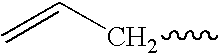


where R is an aromatic, herteroaromatic, aliphatic, or polymeric moiety.

where R is an aromatic, herteroaromatic, aliphatic, or polymeric moiety.

wherein R=lower alkyl.

wherein R=H, lower alkyl, or aryl.


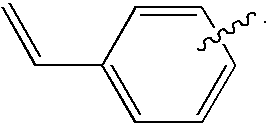


where E is selected from maleimido, acrylate, methacrylate, allyl, methallyl, and oxetane, and X is Cl, Br, I, —OH or α-olefin.

where E is any of maleimido, acrylate, methacrylate, allyl, methallyl, oxetane, a partially or fully epoxidized allyl, a partially or fully epoxidized methallyl; n is an integer having the value between 3 and about 100; m is an integer having the value between 0 and 12; and x is an integer having the value between 1 and 5.


where A is polymer block represented by structural formula I (where E is any of maleimido, acrylate, methacrylate, allyl, methallyl, epoxy, or oxetane), B is a hydrogenated polybutadiene, and y is 1 to 100.

where A′ is a fully or partially expoxidized form of a polymer block represented by structural formula I (i.e., where E is any of a partially or fully epoxidized maleimido, a partially or fully epoxidized acrylate, a partially or fully epoxidized methacrylate, a partially or fully epoxidized allyl, a partially or fully epoxidized methallyl, or a partially or fully epoxidized oxetane); B is a hydrogenated polybutadiene, and y is 1 to 100.

where each q, r and s is independently 0 to about 60; and the sum of q+r+s is about 15 to about 60, with the proviso that the sum of q+r is at least 1.


| TABLE 1 |
| Tensile Adhesion for BMI + Allylated Styrene Oligomers |
| 2:1 | 2:1 | 2:1 | |
| X-BMI:Example 3 | X-BMI:Example 3 | X-BMI:Piccolastic ™ | X-BMI Control |
| (cured 0.5 hr | (cured 1.0 hr | A5 (cured 1.0 hr | (cured 1.0 hr |
| @ 200° C.) | @ 200° C.) | @ 200° C.) | @ 200° C.) |
| Adhesion (lbs. | Adhesion (lbs. | Adhesion (lbs. | Adhesion (lbs. | ||||
| Part | force) | Part | force) | Part | force) | Part | force) |
| 1 | 54 | 1 | 51 | 1 | 42 | 1 | 23 |
| 2 | 32 | 2 | 76 | 2 | 46 | 2 | 29 |
| 3 | 50 | 3 | 99 | 3 | 22 | 3 | 7 |
| 4 | 43 | 4 | 42 | 4 | 36 | 4 | 24 |
| 5 | 35 | 5 | 86 | 5 | 37 | 5 | 21 |
| 6 | 38 | 6 | 76 | 6 | 55 | 6 | 21 |
| 7 | 52 | 7 | 63 | 7 | 57 | 7 | 25 |
| 8 | 38 | 8 | 42 | 8 | 33 | 8 | 13 |
| 9 | 54 | 9 | 66 | 9 | 9 | 9 | 18 |
| 10 | 75 | 10 | 56 | 10 | 18 | 10 | 18 |
| Average = 47.1 lbs | Average = 65.7 lbs. | Average = 34.9 lbs. | Average = 19.9 lbs. |
| Std. dev. = 12.7 lbs | Std. dev. = 18.8 lbs. | Std. dev. = 14.8 lbs. | Std. dev. = 6.3 lbs |
Claims (16)


Priority Applications (1)
| Application Number | Priority Date | Filing Date | Title |
|---|---|---|---|
| US12/540,892 US8217120B2 (en) | 2008-08-13 | 2009-08-13 | Functionalized styrene oligomers and polymers |
Applications Claiming Priority (2)
| Application Number | Priority Date | Filing Date | Title |
|---|---|---|---|
| US8861708P | 2008-08-13 | 2008-08-13 | |
| US12/540,892 US8217120B2 (en) | 2008-08-13 | 2009-08-13 | Functionalized styrene oligomers and polymers |
Publications (2)
| Publication Number | Publication Date |
|---|---|
| US20100041832A1 US20100041832A1 (en) | 2010-02-18 |
| US8217120B2 true US8217120B2 (en) | 2012-07-10 |
Family
ID=41681704
Family Applications (1)
| Application Number | Title | Priority Date | Filing Date |
|---|---|---|---|
| US12/540,892 Active 2030-03-10 US8217120B2 (en) | 2008-08-13 | 2009-08-13 | Functionalized styrene oligomers and polymers |
Country Status (1)
| Country | Link |
|---|---|
| US (1) | US8217120B2 (en) |
Cited By (3)
| Publication number | Priority date | Publication date | Assignee | Title |
|---|---|---|---|---|
| US9278909B2 (en) | 2003-05-05 | 2016-03-08 | Designer Molecules, Inc. | Amide-extended crosslinking compounds and methods for use thereof |
| WO2017176740A1 (en) | 2016-04-05 | 2017-10-12 | Albemarle Corporation | Process and hydrocarbon soluble saline hydride catalyst for hydrogen mediated saline hydride iniated anionic chain transfer polymerization and polymer distribution compositions produced therefrom |
| WO2017184350A1 (en) | 2016-04-20 | 2017-10-26 | Albemarle Corporation | Process and catalyst for hydrogen mediated saline hydride initiated aniconic chain transfer polymerization |
Families Citing this family (28)
| Publication number | Priority date | Publication date | Assignee | Title |
|---|---|---|---|---|
| US8513375B2 (en) * | 2003-05-05 | 2013-08-20 | Designer Molecules, Inc. | Imide-linked maleimide and polymaleimide compounds |
| US7875688B2 (en) * | 2004-06-04 | 2011-01-25 | Designer Molecules, Inc. | Free-radical curable polyesters and methods for use thereof |
| US8043534B2 (en) | 2005-10-21 | 2011-10-25 | Designer Molecules, Inc. | Maleimide compositions and methods for use thereof |
| US8378017B2 (en) * | 2005-12-29 | 2013-02-19 | Designer Molecules, Inc. | Thermosetting adhesive compositions |
| US8530573B2 (en) | 2006-05-10 | 2013-09-10 | Designer Molecules, Inc. | Modified calcium carbonate-filled adhesive compositions and methods for use thereof |
| US8287686B2 (en) * | 2006-07-24 | 2012-10-16 | Designer Molecules, Inc. | Derivatives of poly(styrene-co-allyl alcohol) and methods for use thereof |
| WO2008077141A1 (en) * | 2006-12-19 | 2008-06-26 | Designer Molecules, Inc. | Rubber epoxy curatives and methods for use thereof |
| US8344076B2 (en) * | 2006-12-19 | 2013-01-01 | Designer Molecules, Inc. | Hydrolytically resistant thermoset monomers |
| US20080262191A1 (en) * | 2007-01-26 | 2008-10-23 | Mizori Farhad G | Methods for the preparation of imides, maleimides and maleimide-terminated polyimide compounds |
| US8431655B2 (en) * | 2007-04-09 | 2013-04-30 | Designer Molecules, Inc. | Curatives for epoxy compositions |
| WO2008124797A1 (en) * | 2007-04-09 | 2008-10-16 | Designer Molecules, Inc. | Curatives for epoxy compositions |
| US8039663B2 (en) * | 2007-04-09 | 2011-10-18 | Designer Molecules, Inc. | Monomers derived from pentacyclopentadecane dimethanol |
| US7868113B2 (en) | 2007-04-11 | 2011-01-11 | Designer Molecules, Inc. | Low shrinkage polyester thermosetting resins |
| US20100056671A1 (en) * | 2007-04-12 | 2010-03-04 | Designer Molecules, Inc. | Polyfunctional epoxy oligomers |
| US8063161B2 (en) * | 2007-04-16 | 2011-11-22 | Designer Molecules, Inc. | Low temperature curing acrylate and maleimide based formulations and methods for use thereof |
| US7928153B2 (en) * | 2007-08-14 | 2011-04-19 | Designer Molecules, Inc. | Thermosetting polyether oligomers, compositions and methods for use thereof |
| US8398898B2 (en) * | 2008-02-23 | 2013-03-19 | Designer Molecules, Inc. | Soluble metal salts for use as conductivity promoters |
| US8541531B2 (en) * | 2008-03-21 | 2013-09-24 | Designer Molecules, Inc. | Anti-bleed compounds, compositions and methods for use thereof |
| US8308892B2 (en) | 2008-04-09 | 2012-11-13 | Designer Molecules, Inc. | Di-cinnamyl compounds and methods for use thereof |
| US8013104B2 (en) * | 2008-08-13 | 2011-09-06 | Designer Molecules, Inc. | Thermosetting hyperbranched compositions and methods for use thereof |
| US8158748B2 (en) | 2008-08-13 | 2012-04-17 | Designer Molecules, Inc. | Hetero-functional compounds and methods for use thereof |
| US8008419B2 (en) * | 2008-08-13 | 2011-08-30 | Designer Molecules, Inc. | Siloxane monomers and methods for use thereof |
| US8288591B2 (en) * | 2008-11-20 | 2012-10-16 | Designer Molecules, Inc. | Curing agents for epoxy resins |
| US8415812B2 (en) * | 2009-09-03 | 2013-04-09 | Designer Molecules, Inc. | Materials and methods for stress reduction in semiconductor wafer passivation layers |
| US8686162B2 (en) | 2010-08-25 | 2014-04-01 | Designer Molecules Inc, Inc. | Maleimide-functional monomers in amorphous form |
| US8816021B2 (en) | 2010-09-10 | 2014-08-26 | Designer Molecules, Inc. | Curable composition with rubber-like properties |
| US8070046B1 (en) * | 2010-12-02 | 2011-12-06 | Rohm And Haas Electronic Materials Llc | Amine flux composition and method of soldering |
| US8070045B1 (en) * | 2010-12-02 | 2011-12-06 | Rohm And Haas Electronic Materials Llc | Curable amine flux composition and method of soldering |
Citations (90)
| Publication number | Priority date | Publication date | Assignee | Title |
|---|---|---|---|---|
| US3905820A (en) | 1972-01-27 | 1975-09-16 | Hoechst Ag | Light sensitive copolymers, a process for their manufacture and copying compositions containing them |
| US4111879A (en) | 1976-07-10 | 1978-09-05 | Ihara Chemical Industry Co., Ltd. | Composition for inhibiting adhesion of shellfish and algae |
| US4540829A (en) | 1982-12-02 | 1985-09-10 | The Dow Chemical Company | Allylated di or polycyclopentadiene diphenols |
| US4968738A (en) | 1989-04-06 | 1990-11-06 | Quantum Materials, Inc. | Silver-glass die attach paste with reduced resin |
| US4994989A (en) | 1987-10-09 | 1991-02-19 | Hitachi, Ltd. | Displaying method and apparatus for three-dimensional computer graphics |
| US5045127A (en) | 1990-06-04 | 1991-09-03 | Quantum Materials, Inc. | Non-ionic, water washable soldering paste |
| US5064480A (en) | 1989-08-04 | 1991-11-12 | Quantum Materials, Inc. | Water washable soldering paste |
| US5155177A (en) | 1991-03-18 | 1992-10-13 | Union Camp Corporation | Three component aminoamide acrylate resin compositions |
| US5232962A (en) | 1991-10-09 | 1993-08-03 | Quantum Materials, Inc. | Adhesive bonding composition with bond line limiting spacer system |
| US5266610A (en) | 1991-03-11 | 1993-11-30 | Ici Composites Inc. | Toughened cocontinuous resin system |
| US5306333A (en) | 1988-06-08 | 1994-04-26 | Quantum Materials, Inc. | Resinless pseudoplastic bonding compositions |
| EP0393713B1 (en) | 1989-04-21 | 1994-06-29 | Tosoh Corporation | Process for the preparation of N-substituted maleimides |
| US5358992A (en) | 1993-02-26 | 1994-10-25 | Quantum Materials, Inc. | Die-attach composition comprising polycyanate ester monomer |
| US5430112A (en) | 1992-10-22 | 1995-07-04 | Ajinomoto Co., Inc. | Epoxy resin and polythiol composition |
| US5489641A (en) | 1993-02-26 | 1996-02-06 | Quantum Materials | Freeze resistant die-attach compositions |
| US5567761A (en) | 1993-05-10 | 1996-10-22 | Guertin Bros. Coatings And Sealants Ltd. | Aqueous two-part isocyanate-free curable, polyurethane resin systems |
| US5602205A (en) | 1993-01-22 | 1997-02-11 | Cytec Technology Corp. | N-(substituted) maleimides and compositions incorporating the same |
| US5646241A (en) | 1995-05-12 | 1997-07-08 | Quantum Materials, Inc. | Bleed resistant cyanate ester-containing compositions |
| US5714086A (en) | 1996-08-09 | 1998-02-03 | Quantum Materials, Inc. | Propargyl ether-containing compositions useful for underfill applications |
| US5717034A (en) | 1996-07-29 | 1998-02-10 | Quantum Materials, Inc. | Perfluorinated hydrocarbon polymer-filled adhesive formulations and uses therefor |
| US5753748A (en) | 1995-05-12 | 1998-05-19 | Quantum Materials, Inc. | Bleed resistant cyanate ester-containing compositions |
| US5760165A (en) | 1994-10-28 | 1998-06-02 | Commonwealth Scientific And Industrial Research Organization (Csiro) | Bisallyloxyimides |
| CN1187507A (en) | 1997-01-09 | 1998-07-15 | 四川联合大学 | Silicon containing dimaleimide charge transfer matrix resin and preparing process thereof |
| US5861111A (en) | 1996-07-19 | 1999-01-19 | Dexter Corporation | Method for isomerization of arylpropargyl ether monomers and uses therefor |
| US5969036A (en) | 1997-06-20 | 1999-10-19 | The Dexter Corporation | Epoxy-containing die-attach compositions |
| US5973166A (en) | 1998-03-02 | 1999-10-26 | The Dexter Corporation | Method for the preparation of maleimides |
| US6034194A (en) | 1994-09-02 | 2000-03-07 | Quantum Materials/Dexter Corporation | Bismaleimide-divinyl adhesive compositions and uses therefor |
| US6034150A (en) | 1996-08-23 | 2000-03-07 | University Of Southern Mississippi | Polymerization processes using aliphatic maleimides |
| US6048953A (en) | 1996-06-03 | 2000-04-11 | Toyo Ink Manufacturing Co., Ltd. | Curable liquid resin composition |
| US6121358A (en) | 1997-09-22 | 2000-09-19 | The Dexter Corporation | Hydrophobic vinyl monomers, formulations containing same, and uses therefor |
| US6187886B1 (en) | 1996-09-10 | 2001-02-13 | Dexter Corporation | Maleimide containing formulations and uses therefor |
| US6211320B1 (en) | 1999-07-28 | 2001-04-03 | Dexter Corporation | Low viscosity acrylate monomers formulations containing same and uses therefor |
| US6300456B1 (en) | 2000-05-18 | 2001-10-09 | National Starch And Chemical Investment Holding Corporation | Compounds with electron donor and electron acceptor functionality |
| EP1156034A2 (en) | 2000-05-18 | 2001-11-21 | National Starch and Chemical Investment Holding Corporation | Curable electron donor compounds |
| US6355750B1 (en) | 1998-07-02 | 2002-03-12 | National Starch And Chemical Investment Holding Corporation | Dye attach adhesives for use in microelectronic devices |
| US20020062923A1 (en) | 1997-01-06 | 2002-05-30 | Deborah D. Forray | Methods for reducing void formation upon curing of adhesive formulations and compositions useful therefor |
| US6423780B1 (en) | 2001-02-07 | 2002-07-23 | Loctite | Heterobifunctional monomers and uses therefor |
| US20020099168A1 (en) | 1999-07-01 | 2002-07-25 | Loctite | Hydrophobic, high TG cycloaliphatic epoxy resins |
| US20020188137A1 (en) | 2000-09-30 | 2002-12-12 | Loctite Corporation | Low shrinkage thermosetting resin compositions and methods of use thereof |
| US20020193541A1 (en) | 1994-09-02 | 2002-12-19 | Loctite | Thermosetting resin compositions containing maleimide and/or vinyl compounds |
| JP2003002919A (en) | 2001-06-20 | 2003-01-08 | Toagosei Co Ltd | Novel di(meth)acrylate and curable composition containing the same |
| US20030008992A1 (en) | 2001-02-07 | 2003-01-09 | Dershem Stephen M. | Radical polymerizable compositions containing polycyclic olefins |
| US20030055121A1 (en) | 1996-09-10 | 2003-03-20 | Dershem Stephen M. | Thermosetting resin compositions containing maleimide and/or vinyl compounds |
| US20030083436A1 (en) | 2001-07-03 | 2003-05-01 | Deitch Jeffrey Harold | Composition, method of making, and method of using adhesive composition |
| US20030125551A1 (en) | 2001-11-13 | 2003-07-03 | Loctite Corporation | Benzoxazines, thermosetting resins comprised thereof, and methods for use thereof |
| US20030199638A1 (en) | 2002-03-28 | 2003-10-23 | Puwei Liu | Film adhesives containing maleimide compounds and methods for use thereof |
| US20040006166A1 (en) | 2002-07-03 | 2004-01-08 | Henkel Loctite Corporation | Free radically polymerizable coupling agents |
| US20040019224A1 (en) | 2000-09-30 | 2004-01-29 | Henkel Loctite Corporation | Low shrinkage thermosetting resin compositions and methods of use therefor |
| US20040077798A1 (en) | 1994-09-02 | 2004-04-22 | Dershem Stephen M. | Thermosetting resin compositions containing maleimide and/or vinyl compounds |
| US20040082724A1 (en) | 2001-02-07 | 2004-04-29 | Henkel Loctite Corporation | Novel heterobifunctional monomers and uses therefor |
| US20040102566A1 (en) | 2002-11-25 | 2004-05-27 | Henkel Loctite Corporation | B-stageable die attach adhesives |
| US6750301B1 (en) | 2000-07-07 | 2004-06-15 | National Starch And Chemical Investment Holding Corporation | Die attach adhesives with epoxy compound or resin having allyl or vinyl groups |
| US20040225059A1 (en) | 2003-05-05 | 2004-11-11 | Mizori Farhad G. | Imide-extended liquid bismaleimide resin |
| US20040225045A1 (en) | 2003-05-05 | 2004-11-11 | Henkel Loctite Corporation | Highly conductive resin compositions |
| US20040225026A1 (en) | 2003-05-05 | 2004-11-11 | Mizori Farhad G. | Imide-linked maleimide and polymaleimide compounds |
| US20050027082A1 (en) | 2003-07-29 | 2005-02-03 | Ashland Inc. | Dual cure reaction products of self-photoinitiating multifunctional acrylates with thiols and synethetic methods |
| US20050137340A1 (en) | 2002-05-14 | 2005-06-23 | Nikolic Nikola A. | Thermoset adhesive films |
| US20050267254A1 (en) | 2004-05-28 | 2005-12-01 | Mizori Farhad G | Functionalized urethanes and methods for use thereof |
| US20050272888A1 (en) | 2004-06-04 | 2005-12-08 | Dershem Stephen M | Free-radical curable polyesters and methods for use thereof |
| US20060009578A1 (en) | 2004-07-07 | 2006-01-12 | Dershem Stephen M | Compositions containing maleimide-substituted silsesquioxanes and methods for use thereof |
| US20060009570A1 (en) | 2004-06-10 | 2006-01-12 | Zychowski Frank D | Free radical curable conductive primer |
| US20060063014A1 (en) | 2004-07-12 | 2006-03-23 | Debbie Forray | Polyalkylsilsesquioxane-filled adhesive compositions and methods for use thereof |
| US20060069232A1 (en) | 2004-08-20 | 2006-03-30 | Dershem Stephen M | Underfill compositions and methods for use thereof |
| US20060116476A1 (en) | 2004-12-01 | 2006-06-01 | 3M Innovative Properties Company | Hybrid thermosetting composition |
| US20060142517A1 (en) | 2004-07-16 | 2006-06-29 | Dershem Stephen M | Olefin oligomers containing pendant maleimide groups |
| US20070155869A1 (en) | 2005-12-29 | 2007-07-05 | Dershem Stephen M | Mono-functional monomers and methods for use thereof |
| US20070205399A1 (en) | 2006-03-02 | 2007-09-06 | Mizori Farhad G | Adhesive compositions containing cyclic siloxanes and methods for use thereof |
| WO2007100329A1 (en) | 2006-03-02 | 2007-09-07 | Designer Molecules, Inc. | Adhesive composition containing cyclic siloxanes |
| EP1834969A2 (en) | 2006-03-07 | 2007-09-19 | National Starch and Chemical Investment Holding Corporation | Curable materials containing siloxane |
| US20070299154A1 (en) | 2006-02-07 | 2007-12-27 | Dershem Stephen M | Mold compositions with high adhesion to metal substrates |
| US20080017308A1 (en) | 2006-07-24 | 2008-01-24 | Dershem Stephen M | Derivatives of poly(styrene-co-allyl alcohol) and methods for use thereof |
| US20080075963A1 (en) | 2006-05-10 | 2008-03-27 | Stephen Dershem | Modified calcium carbonate-filled adhesive compositions and methods for use thereof |
| US20080075965A1 (en) | 2005-10-21 | 2008-03-27 | Stephen Dershem | Maleimide compositions and methods for use thereof |
| US20080075961A1 (en) | 2003-05-05 | 2008-03-27 | Mizori Farhad G | Imide-linked maleimide and polymaleimide compounds |
| US20080103240A1 (en) | 2006-11-01 | 2008-05-01 | Dershem Stephen M | Film-forming adhesive compositions and methods for use thereof |
| US20080142158A1 (en) | 2006-12-19 | 2008-06-19 | Dershem Stephen M | Hydrolytically resistant thermoset monomers |
| US20080146738A1 (en) | 2006-12-19 | 2008-06-19 | Dershem Stephen M | Rubber epoxy curatives and methods for use thereof |
| US20080210375A1 (en) | 2004-06-04 | 2008-09-04 | Dershem Stephen M | Free-radical curable polyesters and methods for use thereof |
| US20080251935A1 (en) | 2007-04-11 | 2008-10-16 | Stephen Dersham | Low shrinkage polyester thermosetting resins |
| WO2008124797A1 (en) | 2007-04-09 | 2008-10-16 | Designer Molecules, Inc. | Curatives for epoxy compositions |
| US20080262191A1 (en) | 2007-01-26 | 2008-10-23 | Mizori Farhad G | Methods for the preparation of imides, maleimides and maleimide-terminated polyimide compounds |
| US20080257493A1 (en) | 2007-04-09 | 2008-10-23 | Dershem Stephen M | Monomers derived from pentacyclopentadecane dimethanol |
| WO2008130894A1 (en) | 2007-04-16 | 2008-10-30 | Designer Molecules, Inc. | Low temperature curing acrylate and maleimide based formulations and methods for use thereof |
| US20090061244A1 (en) | 2007-08-14 | 2009-03-05 | Dershem Stephen M | Thermosetting polyether oligomers, compostions and methods for use thereof |
| US20090215940A1 (en) | 2008-02-23 | 2009-08-27 | Dershem Stephen M | Soluble metal salts for use as conductivity promoters |
| US20090288768A1 (en) | 2008-04-09 | 2009-11-26 | Dershem Stephen M | Di-cinnamyl compounds and methods for use thereof |
| US20100041845A1 (en) | 2008-08-13 | 2010-02-18 | Designer Molecules, Inc. | Hetero-functional compounds and methods for use thereof |
| US20100041803A1 (en) | 2008-08-13 | 2010-02-18 | Designer Molecules, Inc. | Thermosetting hyperbranched compositions and methods for use thereof |
| US20100041823A1 (en) | 2008-08-13 | 2010-02-18 | Designer Molecules, Inc. | Novel siloxane monomers and methods for use thereof |
| US20100056671A1 (en) | 2007-04-12 | 2010-03-04 | Designer Molecules, Inc. | Polyfunctional epoxy oligomers |
Family Cites Families (2)
| Publication number | Priority date | Publication date | Assignee | Title |
|---|---|---|---|---|
| DE3737458A1 (en) * | 1987-11-05 | 1989-05-18 | Wacker Chemie Gmbh | EXCLUDING WATER STORAGE CROSS-LINKABLE DIMENSIONS WHEN THE WATER ACCESSES AT ROOM TEMPERATURE |
| US8311222B2 (en) * | 2008-08-26 | 2012-11-13 | GlobalFoundries, Inc. | Hardware based multi-dimensional encryption |
-
2009
- 2009-08-13 US US12/540,892 patent/US8217120B2/en active Active
Patent Citations (133)
| Publication number | Priority date | Publication date | Assignee | Title |
|---|---|---|---|---|
| US3905820A (en) | 1972-01-27 | 1975-09-16 | Hoechst Ag | Light sensitive copolymers, a process for their manufacture and copying compositions containing them |
| US4111879A (en) | 1976-07-10 | 1978-09-05 | Ihara Chemical Industry Co., Ltd. | Composition for inhibiting adhesion of shellfish and algae |
| US4540829A (en) | 1982-12-02 | 1985-09-10 | The Dow Chemical Company | Allylated di or polycyclopentadiene diphenols |
| US4994989A (en) | 1987-10-09 | 1991-02-19 | Hitachi, Ltd. | Displaying method and apparatus for three-dimensional computer graphics |
| US5403389A (en) | 1988-06-08 | 1995-04-04 | Quantum Materials, Inc. | Resinless pseudoplastic bonding compositions |
| US5306333A (en) | 1988-06-08 | 1994-04-26 | Quantum Materials, Inc. | Resinless pseudoplastic bonding compositions |
| US4968738A (en) | 1989-04-06 | 1990-11-06 | Quantum Materials, Inc. | Silver-glass die attach paste with reduced resin |
| EP0393713B1 (en) | 1989-04-21 | 1994-06-29 | Tosoh Corporation | Process for the preparation of N-substituted maleimides |
| US5064480A (en) | 1989-08-04 | 1991-11-12 | Quantum Materials, Inc. | Water washable soldering paste |
| US5045127A (en) | 1990-06-04 | 1991-09-03 | Quantum Materials, Inc. | Non-ionic, water washable soldering paste |
| US5266610A (en) | 1991-03-11 | 1993-11-30 | Ici Composites Inc. | Toughened cocontinuous resin system |
| US5155177A (en) | 1991-03-18 | 1992-10-13 | Union Camp Corporation | Three component aminoamide acrylate resin compositions |
| US5232962A (en) | 1991-10-09 | 1993-08-03 | Quantum Materials, Inc. | Adhesive bonding composition with bond line limiting spacer system |
| US5430112A (en) | 1992-10-22 | 1995-07-04 | Ajinomoto Co., Inc. | Epoxy resin and polythiol composition |
| US5602205A (en) | 1993-01-22 | 1997-02-11 | Cytec Technology Corp. | N-(substituted) maleimides and compositions incorporating the same |
| US5358992A (en) | 1993-02-26 | 1994-10-25 | Quantum Materials, Inc. | Die-attach composition comprising polycyanate ester monomer |
| US5447988A (en) | 1993-02-26 | 1995-09-05 | Quantum Materials | Solvent free die-attach compositions |
| US5489641A (en) | 1993-02-26 | 1996-02-06 | Quantum Materials | Freeze resistant die-attach compositions |
| US5567761A (en) | 1993-05-10 | 1996-10-22 | Guertin Bros. Coatings And Sealants Ltd. | Aqueous two-part isocyanate-free curable, polyurethane resin systems |
| US20030109666A1 (en) | 1994-09-02 | 2003-06-12 | Loctite Corporation | Thermosetting resin compositions containing maleimide and/or vinyl compounds |
| US20050136620A1 (en) | 1994-09-02 | 2005-06-23 | Henkel Corporation | Maleimide compounds in liquid form |
| US20020193541A1 (en) | 1994-09-02 | 2002-12-19 | Loctite | Thermosetting resin compositions containing maleimide and/or vinyl compounds |
| US20040077798A1 (en) | 1994-09-02 | 2004-04-22 | Dershem Stephen M. | Thermosetting resin compositions containing maleimide and/or vinyl compounds |
| US20030060531A1 (en) | 1994-09-02 | 2003-03-27 | Dershem Stephen M. | Thermosetting resin compositions containing maleimide and/or vinyl compounds |
| US20030087999A1 (en) | 1994-09-02 | 2003-05-08 | Loctite Corporation | Thermosetting resin compositions containing maleimide and/or vinyl compounds |
| US6825245B2 (en) | 1994-09-02 | 2004-11-30 | Henkel Corporation | Thermosetting resin compositions containing maleimide and/or vinyl compounds |
| US6852814B2 (en) | 1994-09-02 | 2005-02-08 | Henkel Corporation | Thermosetting resin compositions containing maleimide and/or vinyl compounds |
| US6960636B2 (en) | 1994-09-02 | 2005-11-01 | Henkel Corporation | Thermosetting resin compositions containing maleimide and/or vinyl compounds |
| US7102015B2 (en) | 1994-09-02 | 2006-09-05 | Henkel Corporation | Maleimide compounds in liquid form |
| US6034194A (en) | 1994-09-02 | 2000-03-07 | Quantum Materials/Dexter Corporation | Bismaleimide-divinyl adhesive compositions and uses therefor |
| US6916856B2 (en) | 1994-09-02 | 2005-07-12 | Henkel Corporation | Thermosetting resin compositions containing maleimide and/or vinyl compounds |
| US6034195A (en) | 1994-09-02 | 2000-03-07 | Dexter Corporation | Thermosetting resin compositions containing maleimide and/or vinyl compounds |
| US6790597B2 (en) | 1994-09-02 | 2004-09-14 | Henkel Corporation | Thermosetting resin compositions containing maleimide and/or vinyl compounds |
| US5760165A (en) | 1994-10-28 | 1998-06-02 | Commonwealth Scientific And Industrial Research Organization (Csiro) | Bisallyloxyimides |
| US7309724B2 (en) | 1995-01-24 | 2007-12-18 | Henkel Corporation | Thermosetting resin compositions containing maleimide and/or vinyl compounds |
| US20050137277A1 (en) | 1995-01-24 | 2005-06-23 | Henkel Corporation | Thermosetting resin compositions containing maleimide and/or vinyl compounds |
| US5646241A (en) | 1995-05-12 | 1997-07-08 | Quantum Materials, Inc. | Bleed resistant cyanate ester-containing compositions |
| US5753748A (en) | 1995-05-12 | 1998-05-19 | Quantum Materials, Inc. | Bleed resistant cyanate ester-containing compositions |
| US5718941A (en) | 1995-05-12 | 1998-02-17 | Quantum Materials, Inc. | Bleed resistant cyanate ester-containing compositions |
| US6048953A (en) | 1996-06-03 | 2000-04-11 | Toyo Ink Manufacturing Co., Ltd. | Curable liquid resin composition |
| US5861111A (en) | 1996-07-19 | 1999-01-19 | Dexter Corporation | Method for isomerization of arylpropargyl ether monomers and uses therefor |
| US5717034A (en) | 1996-07-29 | 1998-02-10 | Quantum Materials, Inc. | Perfluorinated hydrocarbon polymer-filled adhesive formulations and uses therefor |
| US5714086A (en) | 1996-08-09 | 1998-02-03 | Quantum Materials, Inc. | Propargyl ether-containing compositions useful for underfill applications |
| US6369124B1 (en) | 1996-08-23 | 2002-04-09 | First Chemical Corporation | Polymerization processes using aliphatic maleimides |
| US6855745B2 (en) | 1996-08-23 | 2005-02-15 | Albemarle Corporation | Polymerization processes using aliphatic maleimides |
| US6034150A (en) | 1996-08-23 | 2000-03-07 | University Of Southern Mississippi | Polymerization processes using aliphatic maleimides |
| US20030055121A1 (en) | 1996-09-10 | 2003-03-20 | Dershem Stephen M. | Thermosetting resin compositions containing maleimide and/or vinyl compounds |
| US6187886B1 (en) | 1996-09-10 | 2001-02-13 | Dexter Corporation | Maleimide containing formulations and uses therefor |
| US20020062923A1 (en) | 1997-01-06 | 2002-05-30 | Deborah D. Forray | Methods for reducing void formation upon curing of adhesive formulations and compositions useful therefor |
| CN1187507A (en) | 1997-01-09 | 1998-07-15 | 四川联合大学 | Silicon containing dimaleimide charge transfer matrix resin and preparing process thereof |
| US5969036A (en) | 1997-06-20 | 1999-10-19 | The Dexter Corporation | Epoxy-containing die-attach compositions |
| US6121358A (en) | 1997-09-22 | 2000-09-19 | The Dexter Corporation | Hydrophobic vinyl monomers, formulations containing same, and uses therefor |
| US5973166A (en) | 1998-03-02 | 1999-10-26 | The Dexter Corporation | Method for the preparation of maleimides |
| US6355750B1 (en) | 1998-07-02 | 2002-03-12 | National Starch And Chemical Investment Holding Corporation | Dye attach adhesives for use in microelectronic devices |
| US20020099168A1 (en) | 1999-07-01 | 2002-07-25 | Loctite | Hydrophobic, high TG cycloaliphatic epoxy resins |
| US6429281B1 (en) | 1999-07-01 | 2002-08-06 | Loctite | Hydrophobic, high Tg cycloaliphatic epoxy resins |
| US6211320B1 (en) | 1999-07-28 | 2001-04-03 | Dexter Corporation | Low viscosity acrylate monomers formulations containing same and uses therefor |
| US6300456B1 (en) | 2000-05-18 | 2001-10-09 | National Starch And Chemical Investment Holding Corporation | Compounds with electron donor and electron acceptor functionality |
| EP1156036A3 (en) | 2000-05-18 | 2003-09-10 | National Starch and Chemical Investment Holding Corporation | Compounds with electron donor and electron acceptor functionality |
| EP1156034A2 (en) | 2000-05-18 | 2001-11-21 | National Starch and Chemical Investment Holding Corporation | Curable electron donor compounds |
| US6750301B1 (en) | 2000-07-07 | 2004-06-15 | National Starch And Chemical Investment Holding Corporation | Die attach adhesives with epoxy compound or resin having allyl or vinyl groups |
| US6963001B2 (en) | 2000-09-30 | 2005-11-08 | Henkel Corporation | Low shrinkage thermosetting resin compositions and methods of use therefor |
| US20040019224A1 (en) | 2000-09-30 | 2004-01-29 | Henkel Loctite Corporation | Low shrinkage thermosetting resin compositions and methods of use therefor |
| US6620946B2 (en) | 2000-09-30 | 2003-09-16 | Loctite Corporation | Low shrinkage thermosetting resin compositions and methods of use thereof |
| US20020188137A1 (en) | 2000-09-30 | 2002-12-12 | Loctite Corporation | Low shrinkage thermosetting resin compositions and methods of use thereof |
| US20040082724A1 (en) | 2001-02-07 | 2004-04-29 | Henkel Loctite Corporation | Novel heterobifunctional monomers and uses therefor |
| US20030208016A1 (en) | 2001-02-07 | 2003-11-06 | Henkel Loctite Corporation | Radical polymerizable compositions containing polycyclic olefins |
| US6946523B2 (en) | 2001-02-07 | 2005-09-20 | Henkel Corporation | Heterobifunctional monomers and uses therefor |
| US6521731B2 (en) | 2001-02-07 | 2003-02-18 | Henkel Loctite Corporation | Radical polymerizable compositions containing polycyclic olefins |
| US20030008992A1 (en) | 2001-02-07 | 2003-01-09 | Dershem Stephen M. | Radical polymerizable compositions containing polycyclic olefins |
| US20020198356A1 (en) | 2001-02-07 | 2002-12-26 | Loctite | Novel heterobifunctional monomers and uses therefor |
| US6423780B1 (en) | 2001-02-07 | 2002-07-23 | Loctite | Heterobifunctional monomers and uses therefor |
| JP2003002919A (en) | 2001-06-20 | 2003-01-08 | Toagosei Co Ltd | Novel di(meth)acrylate and curable composition containing the same |
| US20030083436A1 (en) | 2001-07-03 | 2003-05-01 | Deitch Jeffrey Harold | Composition, method of making, and method of using adhesive composition |
| US6743852B2 (en) | 2001-11-13 | 2004-06-01 | Henkel Corporation | Benzoxazines, thermosetting resins comprised thereof, and methods for use thereof |
| US7517925B2 (en) | 2001-11-13 | 2009-04-14 | Henkel Corporation | Benzoxazines, thermosetting resins comprised thereof, and methods for use thereof |
| US20030125551A1 (en) | 2001-11-13 | 2003-07-03 | Loctite Corporation | Benzoxazines, thermosetting resins comprised thereof, and methods for use thereof |
| US20040123948A1 (en) | 2001-11-13 | 2004-07-01 | Loctite Corporation | Benzoxazines, thermosetting resins comprised thereof, and methods for use thereof |
| US6831132B2 (en) | 2002-03-28 | 2004-12-14 | Henkel Corporation | Film adhesives containing maleimide compounds and methods for use thereof |
| US20050107542A1 (en) | 2002-03-28 | 2005-05-19 | Henkel Corporation | Film adhesives containing maleimide compounds and methods for use thereof |
| US20030199638A1 (en) | 2002-03-28 | 2003-10-23 | Puwei Liu | Film adhesives containing maleimide compounds and methods for use thereof |
| US20060030672A1 (en) | 2002-05-14 | 2006-02-09 | Nikolic Nikola A | Thermoset adhesive films |
| US20050137340A1 (en) | 2002-05-14 | 2005-06-23 | Nikolic Nikola A. | Thermoset adhesive films |
| US7326754B2 (en) | 2002-05-14 | 2008-02-05 | Nikolic Nikola A | Thermoset adhesive films |
| US20040006166A1 (en) | 2002-07-03 | 2004-01-08 | Henkel Loctite Corporation | Free radically polymerizable coupling agents |
| US7199249B2 (en) | 2002-07-03 | 2007-04-03 | Henkel Corporation | Free radically polymerizable coupling agents |
| US20040102566A1 (en) | 2002-11-25 | 2004-05-27 | Henkel Loctite Corporation | B-stageable die attach adhesives |
| US7176044B2 (en) | 2002-11-25 | 2007-02-13 | Henkel Corporation | B-stageable die attach adhesives |
| US20080160315A1 (en) | 2002-11-25 | 2008-07-03 | Henkel Corporation | B-stageable die attach adhesives |
| US20080075961A1 (en) | 2003-05-05 | 2008-03-27 | Mizori Farhad G | Imide-linked maleimide and polymaleimide compounds |
| US20040225059A1 (en) | 2003-05-05 | 2004-11-11 | Mizori Farhad G. | Imide-extended liquid bismaleimide resin |
| US7208566B2 (en) | 2003-05-05 | 2007-04-24 | Designer Molecules, Inc. | Imide-linked maleimide and polymaleimide compounds |
| US20040225045A1 (en) | 2003-05-05 | 2004-11-11 | Henkel Loctite Corporation | Highly conductive resin compositions |
| US7157587B2 (en) | 2003-05-05 | 2007-01-02 | Designer Molecules, Inc. | Imide-extended liquid bismaleimide resin |
| US20040225026A1 (en) | 2003-05-05 | 2004-11-11 | Mizori Farhad G. | Imide-linked maleimide and polymaleimide compounds |
| US20050027082A1 (en) | 2003-07-29 | 2005-02-03 | Ashland Inc. | Dual cure reaction products of self-photoinitiating multifunctional acrylates with thiols and synethetic methods |
| US20050267254A1 (en) | 2004-05-28 | 2005-12-01 | Mizori Farhad G | Functionalized urethanes and methods for use thereof |
| US20080210375A1 (en) | 2004-06-04 | 2008-09-04 | Dershem Stephen M | Free-radical curable polyesters and methods for use thereof |
| US20080191173A1 (en) | 2004-06-04 | 2008-08-14 | Dershem Stephen M | Free-radical curable polyesters and methods for use thereof |
| US7285613B2 (en) | 2004-06-04 | 2007-10-23 | Designer Molecules, Inc. | Free-radical curable polyesters and methods for use thereof |
| US20050272888A1 (en) | 2004-06-04 | 2005-12-08 | Dershem Stephen M | Free-radical curable polyesters and methods for use thereof |
| US20060009570A1 (en) | 2004-06-10 | 2006-01-12 | Zychowski Frank D | Free radical curable conductive primer |
| US20060009578A1 (en) | 2004-07-07 | 2006-01-12 | Dershem Stephen M | Compositions containing maleimide-substituted silsesquioxanes and methods for use thereof |
| US20060063014A1 (en) | 2004-07-12 | 2006-03-23 | Debbie Forray | Polyalkylsilsesquioxane-filled adhesive compositions and methods for use thereof |
| US20060142517A1 (en) | 2004-07-16 | 2006-06-29 | Dershem Stephen M | Olefin oligomers containing pendant maleimide groups |
| US20060069232A1 (en) | 2004-08-20 | 2006-03-30 | Dershem Stephen M | Underfill compositions and methods for use thereof |
| US20060116476A1 (en) | 2004-12-01 | 2006-06-01 | 3M Innovative Properties Company | Hybrid thermosetting composition |
| US20080075965A1 (en) | 2005-10-21 | 2008-03-27 | Stephen Dershem | Maleimide compositions and methods for use thereof |
| US20070155869A1 (en) | 2005-12-29 | 2007-07-05 | Dershem Stephen M | Mono-functional monomers and methods for use thereof |
| US20070299154A1 (en) | 2006-02-07 | 2007-12-27 | Dershem Stephen M | Mold compositions with high adhesion to metal substrates |
| WO2007100329A1 (en) | 2006-03-02 | 2007-09-07 | Designer Molecules, Inc. | Adhesive composition containing cyclic siloxanes |
| US20070205399A1 (en) | 2006-03-02 | 2007-09-06 | Mizori Farhad G | Adhesive compositions containing cyclic siloxanes and methods for use thereof |
| EP1834969A2 (en) | 2006-03-07 | 2007-09-19 | National Starch and Chemical Investment Holding Corporation | Curable materials containing siloxane |
| US20080075963A1 (en) | 2006-05-10 | 2008-03-27 | Stephen Dershem | Modified calcium carbonate-filled adhesive compositions and methods for use thereof |
| US20080017308A1 (en) | 2006-07-24 | 2008-01-24 | Dershem Stephen M | Derivatives of poly(styrene-co-allyl alcohol) and methods for use thereof |
| US7678879B2 (en) | 2006-11-01 | 2010-03-16 | Designer Molecules, Inc. | Adhesive composition of phenol-functional polyamides |
| US20080103240A1 (en) | 2006-11-01 | 2008-05-01 | Dershem Stephen M | Film-forming adhesive compositions and methods for use thereof |
| WO2008077141A1 (en) * | 2006-12-19 | 2008-06-26 | Designer Molecules, Inc. | Rubber epoxy curatives and methods for use thereof |
| US20080146738A1 (en) | 2006-12-19 | 2008-06-19 | Dershem Stephen M | Rubber epoxy curatives and methods for use thereof |
| US20080142158A1 (en) | 2006-12-19 | 2008-06-19 | Dershem Stephen M | Hydrolytically resistant thermoset monomers |
| US20080262191A1 (en) | 2007-01-26 | 2008-10-23 | Mizori Farhad G | Methods for the preparation of imides, maleimides and maleimide-terminated polyimide compounds |
| US20080257493A1 (en) | 2007-04-09 | 2008-10-23 | Dershem Stephen M | Monomers derived from pentacyclopentadecane dimethanol |
| WO2008124797A1 (en) | 2007-04-09 | 2008-10-16 | Designer Molecules, Inc. | Curatives for epoxy compositions |
| US20080251935A1 (en) | 2007-04-11 | 2008-10-16 | Stephen Dersham | Low shrinkage polyester thermosetting resins |
| US20100056671A1 (en) | 2007-04-12 | 2010-03-04 | Designer Molecules, Inc. | Polyfunctional epoxy oligomers |
| WO2008130894A1 (en) | 2007-04-16 | 2008-10-30 | Designer Molecules, Inc. | Low temperature curing acrylate and maleimide based formulations and methods for use thereof |
| US20100063184A1 (en) | 2007-04-16 | 2010-03-11 | Designer Molecules, Inc. | Low temperature curing acrylate and maleimide based formulations and methods for use thereof |
| US20090061244A1 (en) | 2007-08-14 | 2009-03-05 | Dershem Stephen M | Thermosetting polyether oligomers, compostions and methods for use thereof |
| US20090215940A1 (en) | 2008-02-23 | 2009-08-27 | Dershem Stephen M | Soluble metal salts for use as conductivity promoters |
| US20090288768A1 (en) | 2008-04-09 | 2009-11-26 | Dershem Stephen M | Di-cinnamyl compounds and methods for use thereof |
| US20100041845A1 (en) | 2008-08-13 | 2010-02-18 | Designer Molecules, Inc. | Hetero-functional compounds and methods for use thereof |
| US20100041803A1 (en) | 2008-08-13 | 2010-02-18 | Designer Molecules, Inc. | Thermosetting hyperbranched compositions and methods for use thereof |
| US20100041823A1 (en) | 2008-08-13 | 2010-02-18 | Designer Molecules, Inc. | Novel siloxane monomers and methods for use thereof |
Non-Patent Citations (8)
Cited By (9)
| Publication number | Priority date | Publication date | Assignee | Title |
|---|---|---|---|---|
| US9278909B2 (en) | 2003-05-05 | 2016-03-08 | Designer Molecules, Inc. | Amide-extended crosslinking compounds and methods for use thereof |
| WO2017176740A1 (en) | 2016-04-05 | 2017-10-12 | Albemarle Corporation | Process and hydrocarbon soluble saline hydride catalyst for hydrogen mediated saline hydride iniated anionic chain transfer polymerization and polymer distribution compositions produced therefrom |
| US10941226B2 (en) | 2016-04-05 | 2021-03-09 | Albemarle Corporation | Process and hydrocarbon soluble saline hydride catalyst for hydrogen mediated saline hydride initiated anionic chain transfer polymerization and polymer distribution compositions produced therefrom |
| US11667736B2 (en) | 2016-04-05 | 2023-06-06 | Albemarle Corporation | Process and hydrocarbon soluble saline hydride catalyst for hydrogen mediated saline hydride initiated anionic chain transfer polymerization and polymer distribution compositions produced therefrom |
| US11739170B2 (en) | 2016-04-05 | 2023-08-29 | Albemarle Corporation | Process and hydrocarbon soluble saline hydride catalyst for hydrogen mediated saline hydride initiated anionic chain transfer polymerization and polymer distribution compositions produced therefrom |
| EP4289870A2 (en) | 2016-04-05 | 2023-12-13 | Albemarle Corporation | Process and hydrocarbon soluble saline hydride catalyst for hydrogen mediated saline hydride iniated anionic chain transfer polymerization and polymer distribution compositions produced therefrom |
| WO2017184350A1 (en) | 2016-04-20 | 2017-10-26 | Albemarle Corporation | Process and catalyst for hydrogen mediated saline hydride initiated aniconic chain transfer polymerization |
| US11591420B2 (en) | 2016-04-20 | 2023-02-28 | Albemarle Corporation | Process and catalyst for hydrogen mediated saline hydride initiated anionic chain transfer polymerization |
| US12234304B2 (en) | 2016-04-20 | 2025-02-25 | Albemarle Corporation | Process and catalyst for hydrogen mediated saline hydride initiated anionic chain transfer polymerization |
Also Published As
| Publication number | Publication date |
|---|---|
| US20100041832A1 (en) | 2010-02-18 |
Similar Documents
| Publication | Publication Date | Title |
|---|---|---|
| US20100041832A1 (en) | Functionalized styrene oligomers and polymers | |
| US8008419B2 (en) | Siloxane monomers and methods for use thereof | |
| US8013104B2 (en) | Thermosetting hyperbranched compositions and methods for use thereof | |
| US8637611B2 (en) | Amide-extended crosslinking compounds and methods for use thereof | |
| US8288591B2 (en) | Curing agents for epoxy resins | |
| US8158748B2 (en) | Hetero-functional compounds and methods for use thereof | |
| US8686162B2 (en) | Maleimide-functional monomers in amorphous form | |
| US8513375B2 (en) | Imide-linked maleimide and polymaleimide compounds | |
| US20130012620A1 (en) | Curing agents for epoxy resins | |
| US8308892B2 (en) | Di-cinnamyl compounds and methods for use thereof | |
| US8039663B2 (en) | Monomers derived from pentacyclopentadecane dimethanol | |
| US7928153B2 (en) | Thermosetting polyether oligomers, compositions and methods for use thereof | |
| US7786248B2 (en) | Underfill compositions and methods for use thereof | |
| US8287686B2 (en) | Derivatives of poly(styrene-co-allyl alcohol) and methods for use thereof | |
| US20130199724A1 (en) | Curatives for epoxy compositions | |
| US7285613B2 (en) | Free-radical curable polyesters and methods for use thereof | |
| US8043534B2 (en) | Maleimide compositions and methods for use thereof | |
| US8415812B2 (en) | Materials and methods for stress reduction in semiconductor wafer passivation layers | |
| US8816021B2 (en) | Curable composition with rubber-like properties | |
| US7875688B2 (en) | Free-radical curable polyesters and methods for use thereof | |
| US20130203895A1 (en) | Curing agents for epoxy resins | |
| US8541531B2 (en) | Anti-bleed compounds, compositions and methods for use thereof | |
| US20180237668A1 (en) | Anionic curable compositions |
Legal Events
| Date | Code | Title | Description |
|---|---|---|---|
| AS | Assignment |
Owner name: DESIGNER MOLECULES, INC.,CALIFORNIA Free format text: ASSIGNMENT OF ASSIGNORS INTEREST;ASSIGNOR:DERSHEM, STEPHEN M.;REEL/FRAME:023268/0978 Effective date: 20090827 Owner name: DESIGNER MOLECULES, INC., CALIFORNIA Free format text: ASSIGNMENT OF ASSIGNORS INTEREST;ASSIGNOR:DERSHEM, STEPHEN M.;REEL/FRAME:023268/0978 Effective date: 20090827 |
|
| STCF | Information on status: patent grant |
Free format text: PATENTED CASE |
|
| FPAY | Fee payment |
Year of fee payment: 4 |
|
| MAFP | Maintenance fee payment |
Free format text: PAYMENT OF MAINTENANCE FEE, 8TH YEAR, LARGE ENTITY (ORIGINAL EVENT CODE: M1552); ENTITY STATUS OF PATENT OWNER: LARGE ENTITY Year of fee payment: 8 |
|
| MAFP | Maintenance fee payment |
Free format text: PAYMENT OF MAINTENANCE FEE, 12TH YEAR, LARGE ENTITY (ORIGINAL EVENT CODE: M1553); ENTITY STATUS OF PATENT OWNER: LARGE ENTITY Year of fee payment: 12 |