US8212344B2 - Microelectromechanical semiconductor component with cavity structure and method for producing the same - Google Patents
Microelectromechanical semiconductor component with cavity structure and method for producing the same Download PDFInfo
- Publication number
- US8212344B2 US8212344B2 US12/891,288 US89128810A US8212344B2 US 8212344 B2 US8212344 B2 US 8212344B2 US 89128810 A US89128810 A US 89128810A US 8212344 B2 US8212344 B2 US 8212344B2
- Authority
- US
- United States
- Prior art keywords
- semiconductor
- semiconductor component
- covering
- polymer
- microelectromechanical
- Prior art date
- Legal status (The legal status is an assumption and is not a legal conclusion. Google has not performed a legal analysis and makes no representation as to the accuracy of the status listed.)
- Expired - Fee Related
Links
Images




Classifications
-
- B—PERFORMING OPERATIONS; TRANSPORTING
- B81—MICROSTRUCTURAL TECHNOLOGY
- B81C—PROCESSES OR APPARATUS SPECIALLY ADAPTED FOR THE MANUFACTURE OR TREATMENT OF MICROSTRUCTURAL DEVICES OR SYSTEMS
- B81C1/00—Manufacture or treatment of devices or systems in or on a substrate
- B81C1/00015—Manufacture or treatment of devices or systems in or on a substrate for manufacturing microsystems
- B81C1/00261—Processes for packaging MEMS devices
- B81C1/00333—Aspects relating to packaging of MEMS devices, not covered by groups B81C1/00269 - B81C1/00325
-
- H—ELECTRICITY
- H10—SEMICONDUCTOR DEVICES; ELECTRIC SOLID-STATE DEVICES NOT OTHERWISE PROVIDED FOR
- H10W—GENERIC PACKAGES, INTERCONNECTIONS, CONNECTORS OR OTHER CONSTRUCTIONAL DETAILS OF DEVICES COVERED BY CLASS H10
- H10W72/00—Interconnections or connectors in packages
- H10W72/01—Manufacture or treatment
- H10W72/0198—Manufacture or treatment batch processes
-
- H—ELECTRICITY
- H10—SEMICONDUCTOR DEVICES; ELECTRIC SOLID-STATE DEVICES NOT OTHERWISE PROVIDED FOR
- H10W—GENERIC PACKAGES, INTERCONNECTIONS, CONNECTORS OR OTHER CONSTRUCTIONAL DETAILS OF DEVICES COVERED BY CLASS H10
- H10W72/00—Interconnections or connectors in packages
- H10W72/071—Connecting or disconnecting
- H10W72/073—Connecting or disconnecting of die-attach connectors
-
- H—ELECTRICITY
- H10—SEMICONDUCTOR DEVICES; ELECTRIC SOLID-STATE DEVICES NOT OTHERWISE PROVIDED FOR
- H10W—GENERIC PACKAGES, INTERCONNECTIONS, CONNECTORS OR OTHER CONSTRUCTIONAL DETAILS OF DEVICES COVERED BY CLASS H10
- H10W72/00—Interconnections or connectors in packages
- H10W72/071—Connecting or disconnecting
- H10W72/073—Connecting or disconnecting of die-attach connectors
- H10W72/07331—Connecting techniques
- H10W72/07337—Connecting techniques using a polymer adhesive, e.g. an adhesive based on silicone or epoxy
-
- H—ELECTRICITY
- H10—SEMICONDUCTOR DEVICES; ELECTRIC SOLID-STATE DEVICES NOT OTHERWISE PROVIDED FOR
- H10W—GENERIC PACKAGES, INTERCONNECTIONS, CONNECTORS OR OTHER CONSTRUCTIONAL DETAILS OF DEVICES COVERED BY CLASS H10
- H10W72/00—Interconnections or connectors in packages
- H10W72/20—Bump connectors, e.g. solder bumps or copper pillars; Dummy bumps; Thermal bumps
- H10W72/241—Dispositions, e.g. layouts
- H10W72/242—Dispositions, e.g. layouts relative to the surface, e.g. recessed, protruding
-
- H—ELECTRICITY
- H10—SEMICONDUCTOR DEVICES; ELECTRIC SOLID-STATE DEVICES NOT OTHERWISE PROVIDED FOR
- H10W—GENERIC PACKAGES, INTERCONNECTIONS, CONNECTORS OR OTHER CONSTRUCTIONAL DETAILS OF DEVICES COVERED BY CLASS H10
- H10W72/00—Interconnections or connectors in packages
- H10W72/20—Bump connectors, e.g. solder bumps or copper pillars; Dummy bumps; Thermal bumps
- H10W72/251—Materials
- H10W72/252—Materials comprising solid metals or solid metalloids, e.g. PbSn, Ag or Cu
-
- H—ELECTRICITY
- H10—SEMICONDUCTOR DEVICES; ELECTRIC SOLID-STATE DEVICES NOT OTHERWISE PROVIDED FOR
- H10W—GENERIC PACKAGES, INTERCONNECTIONS, CONNECTORS OR OTHER CONSTRUCTIONAL DETAILS OF DEVICES COVERED BY CLASS H10
- H10W72/00—Interconnections or connectors in packages
- H10W72/20—Bump connectors, e.g. solder bumps or copper pillars; Dummy bumps; Thermal bumps
- H10W72/29—Bond pads specially adapted therefor
-
- H—ELECTRICITY
- H10—SEMICONDUCTOR DEVICES; ELECTRIC SOLID-STATE DEVICES NOT OTHERWISE PROVIDED FOR
- H10W—GENERIC PACKAGES, INTERCONNECTIONS, CONNECTORS OR OTHER CONSTRUCTIONAL DETAILS OF DEVICES COVERED BY CLASS H10
- H10W72/00—Interconnections or connectors in packages
- H10W72/90—Bond pads, in general
- H10W72/941—Dispositions of bond pads
- H10W72/9415—Dispositions of bond pads relative to the surface, e.g. recessed, protruding
-
- H—ELECTRICITY
- H10—SEMICONDUCTOR DEVICES; ELECTRIC SOLID-STATE DEVICES NOT OTHERWISE PROVIDED FOR
- H10W—GENERIC PACKAGES, INTERCONNECTIONS, CONNECTORS OR OTHER CONSTRUCTIONAL DETAILS OF DEVICES COVERED BY CLASS H10
- H10W74/00—Encapsulations, e.g. protective coatings
- H10W74/10—Encapsulations, e.g. protective coatings characterised by their shape or disposition
- H10W74/131—Encapsulations, e.g. protective coatings characterised by their shape or disposition the semiconductor body being only partially enclosed
- H10W74/137—Encapsulations, e.g. protective coatings characterised by their shape or disposition the semiconductor body being only partially enclosed the encapsulations being directly on the semiconductor body
-
- H—ELECTRICITY
- H10—SEMICONDUCTOR DEVICES; ELECTRIC SOLID-STATE DEVICES NOT OTHERWISE PROVIDED FOR
- H10W—GENERIC PACKAGES, INTERCONNECTIONS, CONNECTORS OR OTHER CONSTRUCTIONAL DETAILS OF DEVICES COVERED BY CLASS H10
- H10W74/00—Encapsulations, e.g. protective coatings
- H10W74/40—Encapsulations, e.g. protective coatings characterised by their materials
- H10W74/47—Encapsulations, e.g. protective coatings characterised by their materials comprising organic materials, e.g. plastics or resins
-
- H—ELECTRICITY
- H10—SEMICONDUCTOR DEVICES; ELECTRIC SOLID-STATE DEVICES NOT OTHERWISE PROVIDED FOR
- H10W—GENERIC PACKAGES, INTERCONNECTIONS, CONNECTORS OR OTHER CONSTRUCTIONAL DETAILS OF DEVICES COVERED BY CLASS H10
- H10W90/00—Package configurations
- H10W90/701—Package configurations characterised by the relative positions of pads or connectors relative to package parts
- H10W90/731—Package configurations characterised by the relative positions of pads or connectors relative to package parts of die-attach connectors
- H10W90/734—Package configurations characterised by the relative positions of pads or connectors relative to package parts of die-attach connectors between a chip and a stacked insulating package substrate, interposer or RDL
-
- H—ELECTRICITY
- H10—SEMICONDUCTOR DEVICES; ELECTRIC SOLID-STATE DEVICES NOT OTHERWISE PROVIDED FOR
- H10W—GENERIC PACKAGES, INTERCONNECTIONS, CONNECTORS OR OTHER CONSTRUCTIONAL DETAILS OF DEVICES COVERED BY CLASS H10
- H10W90/00—Package configurations
- H10W90/701—Package configurations characterised by the relative positions of pads or connectors relative to package parts
- H10W90/731—Package configurations characterised by the relative positions of pads or connectors relative to package parts of die-attach connectors
- H10W90/738—Package configurations characterised by the relative positions of pads or connectors relative to package parts of die-attach connectors between a chip and a stacked discrete passive device
-
- H—ELECTRICITY
- H10—SEMICONDUCTOR DEVICES; ELECTRIC SOLID-STATE DEVICES NOT OTHERWISE PROVIDED FOR
- H10W—GENERIC PACKAGES, INTERCONNECTIONS, CONNECTORS OR OTHER CONSTRUCTIONAL DETAILS OF DEVICES COVERED BY CLASS H10
- H10W99/00—Subject matter not provided for in other groups of this subclass
Definitions
- the invention relates to a microelectromechanical semiconductor component with cavity structure, wherein the semiconductor component has an active semiconductor chip with a microelectromechanical structure and a wiring structure on its top side, and wherein the microelectromechanical structure is surrounded by walls of at least one cavity, and a covering of the cavity is arranged on the walls.
- a semiconductor component of this type is known from the document DE 103 10 617 A1.
- the components of the semiconductor component including an active semiconductor chip, a cover semiconductor chip and a wall structure between the active semiconductor chip and the cover semiconductor chip are embedded into a plastic housing composition, and thus take up a large space requirement.
- the known semiconductor component the wiring structure on the top side of the active semiconductor chip that is connected via bonding connections to surface-mountable external contacts, bonding arcs of the bonding connections between the active semiconductor chip and the external contacts requiring a minimum height for the wall structure of the cavity which may not be undershot without jeopardizing the functionality of the semiconductor component. Consequently, the known semiconductor component cannot be minimized further in terms of its spatial extent.
- the document DE 102 56 116 discloses an electronic device and a method for producing it in which the microelectromechanical structure is protected by a self-supporting, electrically conductive covering layer, the self-supporting covering layer being supported by passage lines, with the result that a cavity is formed over the active area region of the micromechanical structure.
- a prerequisite for cavity formation is the provision of a metal coating, in which case, furthermore, for the patterning of the cavity, the latter is firstly filled with a sacrificial structure made from suitable material, which subsequently has to be removed via openings.
- the document DE 103 53 767 furthermore discloses a device for housing a micromechanical structure and a method for producing the same in which a photoresist that forms the cavity is provided as sacrificial material in uncrosslinked fashion in the region of the cavity.
- the uncrosslinked photoresist is surrounded by a crosslinked photoresist region with an opening via which the uncrosslinked sacrificial material can be removed by solvents.
- a semiconductor component with a cavity structure has an active semiconductor chip with the microelectromechanical structure and a wiring structure on its top side.
- the microelectromechanical structure is surrounded by walls of at least one cavity.
- a covering, which covers the cavity, is arranged on the walls.
- the walls have a photolithographically patterned polymer.
- the covering has a layer with a polymer of identical type. In one case, the molecular chains of the polymer of the walls are crosslinked with the molecular chains of the polymer layer of the covering layer to form a dimensionally stable cavity housing.
- FIG. 1 illustrates a schematic cross section through a microelectromechanical semiconductor component with cavity structure in accordance with a first embodiment of the invention.
- FIGS. 2 to 10 illustrate schematic cross sections through components during the production of the microelectromechanical semiconductor component in accordance with FIG. 1 .
- FIG. 2 illustrates a schematic cross section through an active semiconductor wafer with semiconductor chip positions.
- FIG. 3 illustrates a schematic cross section through the semiconductor wafer, in accordance with FIG. 2 , with microelectromechanical structures introduced in the semiconductor chip positions.
- FIG. 4 illustrates a schematic cross section through the semiconductor wafer, in accordance with FIG. 3 , after the application of a wiring structure.
- FIG. 5 illustrates a schematic cross section through the semiconductor wafer, in accordance with FIG. 4 , after the application of a wall structure.
- FIG. 6 illustrates a schematic cross section through a passive covering wafer.
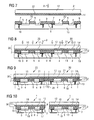
- FIG. 7 illustrates a schematic cross section through the semiconductor wafer, in accordance with FIG. 5 , and the covering wafer arranged above it, in accordance with FIG. 6 .
- FIG. 8 illustrates a schematic cross section through the semiconductor wafer, in accordance with FIG. 7 , after the placement of the covering wafer.
- FIG. 9 illustrates a schematic cross section through the wafer stack after the curing of the polymer arranged between the wafers.
- FIG. 10 illustrates a schematic cross section through two microelectromechanical semiconductor components after the separation of the wafer stack, in accordance with FIG. 9 .
- FIG. 11 illustrates a schematic cross section through a semiconductor component of a second embodiment of the invention.
- FIGS. 12 to 16 illustrate schematic cross sections through components during the production of the semiconductor component of the second embodiment of the invention.
- FIG. 12 illustrates a schematic cross section through an active semiconductor wafer with semiconductor chip positions and an auxiliary carrier with a patterned polymer layer.
- FIG. 13 illustrates a schematic cross section through the semiconductor wafer, in accordance with FIG. 12 , after the placement of the auxiliary carrier.
- FIG. 14 illustrates a schematic cross section through the semiconductor wafer, in accordance with FIG. 13 , after the removal of the auxiliary carrier.
- FIG. 15 illustrates a schematic cross section through the semiconductor wafer, in accordance with FIG. 14 , after the application of external contact areas for surface mounting.
- FIG. 16 illustrates schematic cross sections through semiconductor components of the second embodiment of the invention.
- FIG. 17 illustrates a schematic cross section through the semiconductor wafer, in accordance with FIG. 15 , after the application of solder balls as external contacts.
- FIG. 18 illustrates a schematic cross section through the semiconductor component of the second embodiment of the invention in accordance with FIG. 11 .
- FIGS. 19 to 21 illustrate schematic cross sections through components during the production of the semiconductor component, in accordance with FIG. 11 , by means of a further method variant.
- FIG. 19 illustrates a schematic cross section through an active semiconductor wafer with semiconductor chip positions and an auxiliary carrier with a non-patterned polymer layer.
- FIG. 20 illustrates a schematic cross section through the semiconductor wafer, in accordance with FIG. 19 , after the placement of the auxiliary carrier.
- FIG. 21 illustrates a schematic cross section through the semiconductor wafer, in accordance with FIG. 20 , after the removal of the auxiliary carrier and after the arrangement of an exposure mask.
- One embodiment of the invention provides a semiconductor component with microelectromechanical structure which has at least one cavity over the microelectromechanical structure and is simplified further in terms of its housing construction and can be produced cost-effectively.
- One aspect of the invention provides a microelectromechanical semiconductor component with cavity structure, wherein the semiconductor device has an active semiconductor chip with a microelectromechanical structure and with a wiring structure on its top side.
- the microelectromechanical structure is surrounded by walls of at least one cavity.
- a covering, which covers the cavity, is arranged on the walls.
- the walls include a photolithographically patterned polymer and the covering has a layer with a polymer of identical type. In this case, the molecular chains of the polymer of the walls are crosslinked together with the molecular chains of the polymer layer of the covering to form a dimensionally stable cavity housing.
- This semiconductor component is mechanically protected by the covering and, by means of the polymers of the wall structure and of the covering that are crosslinked together with one another, is provided with a housing which does not have to be reinforced by an additional plastic housing composition, as in the prior art. It is thus possible to provide a microelectromechanical semiconductor component greatly reduced in size in terms of its space requirement.
- the covering furthermore ensures that the function of the microelectromechanical structure is protected against external damage and influences in the region of the dimensionally stable cavity housing, with the result that the microelectromechanical function is not impaired.
- the covering may be provided with a corresponding opening in order to ensure said interaction with the environment.
- a hermetically closed cavity is advantageous, so that no openings whatsoever are to be provided in the covering and/or in the semiconductor chip. Rather, the cavity may be filled with an inert gas in order to improve the mode of operation of the piezoelectric elements of a BAW filter and their corrosion resistance.
- the polymer of the covering and of the walls includes a completely crosslinked benzocyclobutene (BCB).
- BCB benzocyclobutene
- Benzocyclobutenes of this type have the advantage that they can be patterned photolithographically. Furthermore, they have the advantage that they can be applied to a semiconductor wafer in different thicknesses d in micrometers between 0.3 ⁇ m ⁇ d ⁇ 80 ⁇ m, so that, depending on the oscillation amplitudes of the microelectromechanical structure, the thickness d of the wall structure can be adapted to the respective requirements.
- a cavity housing of this type is provided for semiconductor components which have a micromembrane or a vibrating reed or a microactuator, so that a sufficiently large cavity is to be provided for the movements in order not to impede the movement sequences.
- the wiring structure may have external contact areas that are free of a coating, so that external contacts can be arranged thereon. Said external contacts project beyond the cavity structure and can thus be surface-mounted on a superordinate circuit board.
- the external contact areas are electrically connected to the microelectromechanical structure via conductor tracks.
- the wiring structure arranged on the top side of the active semiconductor chip is partly covered by a polymer at the edge and partly extends into the uncovered region of the microelectromechanical structure, so that the wiring structure is electrically connected to the microelectromechanical structure on the top side of the active semiconductor chip.
- the rear side of the active semiconductor chip may simultaneously form the underside of the semiconductor component, external contacts being arranged on external contact areas on the underside of the semiconductor component.
- a self-supporting cover is provided as a covering of the cavity.
- a passive semiconductor chip, a metal chip or a plastic chip may be used for the self-supporting cover.
- a metal chip is preferably used when the dimensionally stable cover is simultaneously intended to have a shielding effect against electromagnetic interference fields.
- a passive semiconductor chip as a dimensionally stable cover has the advantage that, for the production of such a microelectromechanical semiconductor component, two semiconductor wafers for a multiplicity of microelectromechanical semiconductor components can be joined onto one another in a sandwich design.
- a plastic chip is used as a dimensionally stable cover when an electromagnetic coupling of the microelectromechanical structure to the environment is desirable, as is advantageous for microelectromechanical relays, actuators and other applications.
- the self-supporting cover includes a passive, thinned semiconductor chip. Since the dimensional stability in semiconductor materials, in particular in silicon, is afforded even for thinned semiconductor chips having a thickness of a few tens of micrometers, the device height of the microelectromechanical semiconductor component can be reduced further by means of a thinned semiconductor chip as self-supporting, passive cover.
- a thinned cover chip it is also possible not only to use a thinned cover chip, but also, in a further preferred embodiment of the invention, to use a thinned active semiconductor chip. This is because as soon as the cavity housing made from fully crosslinked polymer has been completed, it is possible to thin both chips, namely both the cover chip and the active semiconductor chip, since the cavities are hermetically closed. The thinning is preferably carried out as early as in the state of the wafers simultaneously for a multiplicity of microelectromechanical semiconductor components.
- the self-supporting cover has an areal extent corresponding to the areal extent of the active semiconductor chip.
- This congruence of the two chips that are stacked one on top of another with a cavity arranged in between is cost-effective. This is because, by applying a semiconductor wafer, a metal wafer and/or a plastic wafer to an active semiconductor wafer with microelectromechanical structures, it is possible, after complete crosslinking of the polymer layers of the passive wafer and of the active wafer, to separate both wafers jointly into individual microelectromechanical semiconductor components. A congruence between the chips arranged or stacked one on top of another arises practically automatically in this case.
- a method for producing a plurality of semiconductor components has the following method steps.
- the first step involves producing a semiconductor wafer with a multiplicity of semiconductor chip positions arranged in rows and columns.
- Microelectromechanical structures and wiring structures are arranged onto the semiconductor wafer in semiconductor chip positions on the top side.
- the order when applying microelectromechanical structures and/or wiring structures may be different, that is to say that it is perfectly possible to apply the microelectromechanical structures first and then the wiring structures, and vice versa.
- wall structures of a polymer which surround the microelectromechanical structures are applied in the semiconductor chip positions. This is followed by precuring of the polymer with precrosslinking of the chain molecules of the polymer.
- a covering wafer made from a semiconductor wafer, or a metal wafer, or a plastic wafer or a glass wafer is produced in parallel with the production and patterning of the semiconductor wafer. Said covering wafer is coated with a layer as covering for the walls made from a polymer of identical type to the wall structure. This polymer layer, too, is precured with precrosslinking of the chain molecules of the polymer and may, if necessary, also be patterned.
- This prepared covering wafer with the precured polymer layer is then applied to the semiconductor wafer with precured wall structure. Afterward, the polymers lying one on top of another are cured with crosslinking of the chain molecules of the polymers to form cavities over the microelectromechanical structures. Finally, the semiconductor wafer may be separated to form individual semiconductor components with microelectromechanical structures having at least one cavity.
- the covering wafer serves as an auxiliary carrier and is removed from the polymer layer prior to the actual separation of the active semiconductor wafer into individual semiconductor components.
- the top sides of the semiconductor chip positions of the semiconductor wafer are then freely accessible, so that the polymer layer of the covering wafer can be patterned while the cavity structure already exists. Contact areas of the wiring structure that are arranged on the top side can be uncovered during this patterning.
- the polymer layer is already patterned before the covering wafer is actually placed onto the active semiconductor wafer, in such a way that the contact areas remain free of polymer material during the placement of the covering wafer.
- This variant has the advantage that subsequent uncovering of the contact areas is obviated.
- Removal of the covering wafer, if it serves as an auxiliary carrier, is provided in both cases.
- the adhesion forces of the individual layers are coordinated with one another in such a way that a delamination of the cavity housing from the active semiconductor wafer does not occur.
- a delamination of the polymeric covering from the polymeric walls of the cavity is also prevented by intensive crosslinking of the polymer materials.
- a surface coating of the covering wafer may reduce the adhesion to the polymer layer.
- an acrylic material is preferably used as plastic.
- a further aspect of the invention provides for not removing the covering wafer, but rather using it as a self-supporting cover for a covering chip.
- a covering wafer For this purpose, after the application of microelectromechanical structures to the top side of the semiconductor wafer, through contacts through the semiconductor wafer are produced, and the wiring structure is subsequently applied, which electrically connects the through contacts to the microelectromechanical structures.
- firstly holes are etched into the semiconductor wafer at the positions of the through contacts, which holes are filled with metal during the subsequent production of the wiring structure.
- the depth of said holes may be smaller than the thickness of the semiconductor wafers if the semiconductor wafer is subsequently thinned and the through contact is thereby uncovered.
- firstly passage holes are etched, for example, anisotropically into the semiconductor wafer at the locations of the through contacts and said passage holes are subsequently filled with metal, preferably in an electrodeposition method.
- the completion of the through contacts may be adapted to the production of the microelectromechanical structures. It is also possible to combine the completion of the through contacts with the completion of the wiring structure.
- the first step involves spraying or spinning a photolithographically patternable polymer layer onto the semiconductor wafer.
- said polymer layer is constructed from a benzocyclobutene, and is applied to the top side of the semiconductor wafer with microelectromechanical structure and with completed wiring structure.
- a photolithographic patterning of the polymer layer to form wall structures which leave free and surround the microelectromechanical structures.
- precuring temperatures T v typically lie between 80 ⁇ T v ⁇ 150° C.
- a covering wafer preferably made from a passive semiconductor wafer, is provided with a polymer layer that is not patterned.
- a polymer layer corresponding to the wall polymer can also be sprayed or spun onto a metal wafer, or a plastic wafer, instead of a passive semiconductor wafer, said polymer layer subsequently being precured with precrosslinking of the chain molecules of the polymer at a precuring temperature U, as already mentioned above.
- a pressure is additionally exerted on the two wafers, thereby supporting the full crosslinking of the chain molecules of the polymer at curing temperature.
- a curing temperature T A lies between 100° C. ⁇ T A ⁇ 230° C.
- the additional pressure that was used during the application can be maintained during the curing.
- the latter have a considerable thickness in part in order to remain dimensionally stable and self-supporting during the various high-temperature processes in semiconductor technology.
- either the covering wafer and/or the active wafer and/or both may be thinned by means of a chemomechanical removal, or by means of etching removal or by means of laser removal.
- chemomechanical removal or by means of etching removal or by means of laser removal.
- a microelectromechanical semiconductor component according to one embodiment of the invention and also the method for producing it have the following features:
- FIG. 1 illustrates a schematic cross section through a microelectromechanical semiconductor component 1 with cavity structure 2 in a cavity housing 15 .
- the microelectromechanical semiconductor component 1 has two cavities 10 and 11 arranged between an active semiconductor chip 3 in the lower region of the semiconductor component and a covering chip 23 .
- the covering chip 23 serves as cover 12 of the cavities 10 and 11 , and is arranged in the upper region of the semiconductor component 1 .
- the top side 24 of the covering chip simultaneously forms the top side of the semiconductor component 1
- the rear side 18 of the active semiconductor chip 3 simultaneously forms the underside of the microelectromechanical semiconductor component 1 .
- Microelectromechanical structures 4 are arranged on the top side 6 of the active semiconductor chip 3 in the bottom region of the cavities 10 and 11 .
- Said microelectromechanical structures 4 are in one example BAW filters and/or vibrating membranes and/or vibrating spring-elastic reeds.
- the microelectromechanical structures 4 are electrically connected to external contact areas 17 on the rear side 18 of the active semiconductor chip 3 by means of a wiring structure 5 and through contacts 16 , so that signals can be conducted via the external contact areas 17 to the microelectromechanical structures 4 and/or from the microelectromechanical structures 4 .
- the cavity structure 2 with the two cavities 10 and 11 is formed from two polymer layers.
- the lower polymer layer 13 forms a wall structure 27 with the walls 7 , 8 and 9 illustrated here, which were produced photolithographically from a closed polymer layer 13 .
- a non-patterned polymer layer 14 is arranged on the underside 25 of the covering chip 23 and includes a polymer of identical type to the walls 7 , 8 and 9 .
- the chain molecules of said polymer layers 13 and 14 are crosslinked together with one another, so that the cavity structure 2 has quasi-hermetically sealed cavities 10 and 11 over the microelectromechanical structures 4 .
- the covering chip 23 may have, as cover 12 , a passive semiconductor chip, a metal chip and/or a plastic chip. This depends entirely on the application.
- a plastic chip is chosen when the microelectromechanical structure 4 is intended to react with an external electromagnetic field.
- a metal chip is used when the microelectromechanical structure 4 is intended to be shielded from electromagnetic fields from the environment. If the intention is to provide a coupling between the cavities 10 and 11 and the environment, then the covering chip 23 may also have corresponding openings which are introduced both into the covering chip 23 and into the polymer layer 15 .
- FIGS. 2 to 10 illustrate schematic cross sections through components during the production of the microelectromechanical semiconductor component 1 , in accordance with FIG. 1 .
- Components having the same functions as in FIG. 1 are identified by the same reference symbols in FIGS. 2 to 9 and are not discussed separately.
- FIG. 2 illustrates a schematic cross section through an active semiconductor wafer 19 with semiconductor chip positions 20 .
- Blind holes 26 are introduced into the top side 6 of the semiconductor wafer 19 , and are filled with electrically conductive material in a later step to form through contacts through the semiconductor wafer 19 .
- FIG. 3 illustrates a schematic cross section through the semiconductor wafer 19 , in accordance with FIG. 2 , with microelectromechanical structures 4 introduced in the semiconductor chip positions 20 .
- two microelectromechanical structures 4 are in each case provided per semiconductor chip position.
- FIG. 4 illustrates a schematic cross section through the semiconductor wafer 19 , in accordance with FIG. 3 , after the application of a wiring structure 5 .
- the blind holes 26 are also filled with conductive material, such as a metal, in preparation for through contacts.
- the wiring structure 5 connects the through contacts 16 to the microelectromechanical structures 4 in the semiconductor chip positions 20 .
- FIG. 5 illustrates a schematic cross section through the semiconductor wafer 19 , in accordance with FIG. 4 , after the application of a wall structure 27 comprising a photolithographically patternable polymer 13 , preferably a benzocyclobutene (BCB).
- a wall structure 27 comprising a photolithographically patternable polymer 13 , preferably a benzocyclobutene (BCB).
- BCB benzocyclobutene
- FIG. 6 illustrates a schematic cross section through a covering wafer 21 .
- Said covering wafer 21 serves as a cover 12 for the active semiconductor wafer 19 illustrated in FIG. 5 .
- a polymer layer 14 is deposited on the top side 22 of the covering wafer 21 , which may include semiconductor material, metal or plastic, said polymer layer comprising a polymer 13 which crosslinks with the polymer of the wall structure 27 in FIG. 5 , but said polymer layer 14 is not patterned.
- said non-patterned polymer layer may have a thickness d lying within the range of 0.3 ⁇ m ⁇ d ⁇ 80 ⁇ m.
- FIG. 7 illustrates a schematic cross section through the semiconductor wafer 19 , in accordance with FIG. 5 , and the covering wafer 21 arranged above it, which covering wafer is intended to be placed by its merely precured and hence precrosslinked polymer layer 14 onto the polymeric wall structure 27 of the active semiconductor wafer 19 in arrow direction A.
- FIG. 8 illustrates a schematic cross section through the semiconductor wafer 19 , in accordance with FIG. 7 , after the placement of the covering wafer 21 , the arrow direction B being intended to indicate a pressure direction in which the covering wafer 21 is pressed by its polymer layer 14 onto the wall structure 27 of the active semiconductor wafer 19 at elevated curing temperature.
- Said curing temperature T A typically lies between 80° C. ⁇ T A ⁇ 230° C.
- FIG. 9 illustrates a schematic cross section through the semiconductor stack after the curing of the polymer 13 and 14 arranged between the two wafers 19 and 21 and after the two wafers 19 and 21 have been thinned by grinding, with the result that the dummy contacts as illustrated in FIG. 4 now form through contacts 16 through the active semiconductor wafer 19 .
- external contact areas 17 can then be applied on said through contacts 16 on the thinned rear side 18 of the active semiconductor chip 19 . If the external contact areas 17 are to be fitted at a distance from the positions of the through contacts 16 , it is possible to arrange a further wiring structure on the rear side 18 of the thinned semiconductor wafer 19 .
- the wafer stack illustrated in FIG. 9 is separated into individual semiconductor components along the dash-dotted lines 28 .
- FIG. 10 illustrates a schematic cross section through two microelectromechanical semiconductor components 1 after the separation of the semiconductor wafer stack illustrated in FIG. 9 .
- Components in FIG. 10 having the same functions as in FIG. 1 are identified by the same reference symbols and are not discussed separately.
- FIG. 11 illustrates a schematic cross section through a semiconductor component 30 of a second embodiment of the invention.
- Said semiconductor component 30 has a semiconductor chip 3 with a rear side 18 and a top side 6 .
- the top side 6 of the semiconductor chip 3 simultaneously forms the underside of the semiconductor component 30 .
- Microelectromechanical structures 4 surrounded by a wall structure 27 made from the walls 7 , 8 and 9 are arranged on the top side 6 of the semiconductor chip 3 .
- the wall structure 27 includes a patterned polymer layer 13 and is covered by a second patterned polymer layer 34 .
- the patterned polymer layer 34 is continuous and sealed over the microelectromechanical structures 4 , while it leaves free contact areas 38 of the semiconductor chip 3 .
- a UBM metallization 40 Arranged on the contact areas 38 is a UBM metallization 40 , which provides for the compensation of thermal stresses between the semiconductor chip 3 and a superordinate circuit board (not illustrated), so that the semiconductor component 30 is surface-mountable by its external contacts 35 .
- An external contact area 17 on which solder balls 33 are fixed as external contacts 35 , is arranged on the UBM layer 40 .
- the patterned polymer layer 34 serves not only as covering 36 of the cavities 10 and 11 but also as a solder resist layer.
- the semiconductor chip 3 has on its top side 6 , alongside the microelectromechanical structures 4 and the contact areas 38 , a wiring structure 5 with conductor tracks 37 , the conductor tracks 37 electrically connecting the contact areas 38 to the microelectromechanical structures 4 .
- the semiconductor chip 3 it is also possible to use a semiconductor chip embedded into a plastic housing composition, the top side 6 of the semiconductor chip forming a coplanar area with the surrounding plastic housing composition, on which coplanar area it is possible to arrange the wiring structure 5 with the contact pads 38 .
- the semiconductor material it is possible, on the one hand, to save semiconductor material and, on the other hand, to provide larger and/or a larger number of solder balls 33 or else larger contact areas 38 . This possibility is not discussed, however, in the descriptions below regarding the production of such a semiconductor component 30 .
- the difference between the semiconductor component 1 of the first embodiment of the invention, in accordance with FIG. 1 , and the semiconductor component 30 of the second embodiment of the invention, in accordance with FIG. 11 consists, on the one hand, in the fact that the covering of the cavities 36 is not supported by a self-supporting cover 12 as in FIG. 1 and, on the other hand, in the fact that through contacts 16 such as are also provided in the first embodiment of the invention, in accordance with FIG. 1 , are dispensed with in this embodiment of the invention.
- the rear side 18 of the semiconductor chip 3 forms the underside of the semiconductor component in FIG. 1
- the underside of the semiconductor component 30 is formed by the active top side of the semiconductor chip with cavity housing.
- FIGS. 12 to 16 illustrate schematic cross sections through components during the production of the semiconductor component 30 of the second embodiment of the invention.
- FIG. 12 illustrates a schematic cross section through an active semiconductor wafer 32 with semiconductor chip positions 20 and a covering wafer 21 as auxiliary carrier 29 with a patterned polymer layer 34 .
- the arrangement in FIG. 12 corresponds to the arrangement in FIG. 7 during the production of a semiconductor component of the first embodiment of the invention, but with the difference that the covering wafer 21 in FIG. 12 serves as an auxiliary carrier 29 and the polymer layer 14 from FIG. 7 is now a patterned polymer layer 34 having the coverings 36 in the semiconductor device positions 20 of the semiconductor chip 32 .
- Said coverings 36 are aligned in such a way that they attain congruence with the walls 7 , 8 and 9 in the semiconductor device positions 20 of the semiconductor wafer 32 , while the openings 41 are provided opposite the contact areas 38 and the openings 42 are introduced into the patterned polymer layer 34 in strip-type fashion at the sawing positions in which sawing tracks will later run. This ensures that the saw blades are not fouled or contaminated by polymer material.
- FIG. 13 illustrates a schematic cross section through the semiconductor wafer 32 , in accordance with FIG. 12 , after the placement of the auxiliary carrier 29 in arrow direction A.
- the covering wafer 21 and the semiconductor wafer 32 are brought to a curing temperature of the polymer, the patterned polymer layers 34 and 13 crosslinking with one another and forming cavity housings 15 in the regions of the microelectromechanical structures 4 .
- the top side 22 of the covering wafer 21 is prepared in such a way that the covering wafer 21 can be used as a removable auxiliary carrier 29 .
- the adhesion between the auxiliary carrier 29 and the patterned polymer layer 34 is reduced in such a way that no delamination of the patterned polymer layer 34 from the patterned polymer layer 13 of the semiconductor wafer 32 occurs, nor does any delamination take place between semiconductor wafer 32 and patterned polymer layer 13 .
- the auxiliary carrier 29 may include a transparent plastic such as an acrylic material and/or a glass, in which case, in order to reduce the adhesion, it is possible to carry out an additional curing of the polymer by means of UV irradiation, as is illustrated in FIG. 21 .
- FIG. 14 illustrates a schematic cross section through the semiconductor wafer 32 in accordance with FIG. 13 after the removal of the auxiliary carrier 29 .
- the contact areas 38 and also the sawing tracks at the dash-dotted lines 28 are now freely accessible, while the microelectromechanical structures 4 are protected by the cavity housing 15 with the cavities 10 and 11 .
- FIG. 15 illustrates a schematic cross section through the semiconductor wafer 32 in accordance with FIG. 14 after the application of external contact areas 17 for surface mounting.
- external contact areas 17 instead of the external contact areas 17 , it is also possible firstly to carry out a UBM metallization on the contact areas 38 , and afterward it is possible to apply external contact areas 17 in the form of a solder deposit or by electrodeposition.
- FIG. 16 illustrates schematic cross sections through semiconductor components 30 of the second embodiment of the invention. These semiconductor components 30 differ from the semiconductor component illustrated in FIG. 11 merely by the fact that external contacts are not yet arranged on the external contact areas 17 . However, these can also be applied individually to each of the semiconductor components.
- FIG. 17 correspondingly illustrates a schematic cross section through the semiconductor wafer 32 , in accordance with FIG. 15 , after the application of solder balls 33 as external contacts 35 .
- FIG. 18 illustrates a schematic cross section through semiconductor components 30 of the second embodiment of the invention in accordance with FIG. 11 .
- Components having the same functions as in FIG. 11 are identified by the same reference symbols and are not discussed separately in FIG. 18 .
- the components 30 of FIG. 18 correspond to the component in FIG. 11 .
- FIGS. 19 to 21 illustrate schematic cross sections through components during the production of the semiconductor component 30 , in accordance with FIG. 11 , by means of a further method variant.
- Components having the same functions as in FIGS. 11 to 18 are identified by the same reference symbols and are not discussed separately.
- FIG. 19 illustrates a schematic cross section through an active semiconductor wafer 32 with semiconductor chip positions 20 and an auxiliary carrier 29 with a non-patterned polymer layer 14 .
- This arrangement in accordance with FIG. 19 , corresponds to the arrangement in FIG. 7 in so far as the covering wafer 21 is concerned, which, here as well, includes a closed, non-patterned polymer layer 14 .
- the semiconductor wafer 32 also has at its active top side 6 , in addition to the microelectromechanical structures 4 illustrated in the first exemplary embodiment, freely accessible openings in the patterned polymer layer 13 which permit access to contact areas 38 .
- FIG. 20 illustrates a schematic cross section through the semiconductor wafer 32 , in accordance with FIG. 19 , after the placement of the auxiliary carrier 29 in arrow direction A.
- a crosslinking of the patterned polymer layer 14 with the patterned polymer layer 13 is simultaneously carried out via temperature under pressure.
- the contact pads 38 and the sawing tracks 43 are also covered by the closed polymer layer 14 .
- FIG. 21 illustrates a schematic cross section through the semiconductor wafer 32 , in accordance with FIG. 20 , after the removal of the auxiliary carrier 29 and after the arrangement of an exposure mask 31 over the top side 6 of the semiconductor wafer 32 .
- the closed polymer layer 14 can then be patterned with the aid of such an exposure mask 31 .
- Further patterning possibilities for the polymer layer 14 consist in using a laser ablation, a photo patterned etching resist layer or an etching resist layer applied by a printing method.
Landscapes
- Engineering & Computer Science (AREA)
- Microelectronics & Electronic Packaging (AREA)
- Manufacturing & Machinery (AREA)
- Micromachines (AREA)
Abstract
Description
-
- 1. the provision of a cost-effective and compact cavity housing which, for example for BAW filters, has a clear height in the micron and/or submicron range. The cost-effective production is based on the fact that all processes take place at the wafer level and cost-intensive individual processes such as the production of individual covers, the equipping of individual semiconductor components with covers, the so-called die bonding or the so-called wire bonding are avoided, wherein in the case of die bonding a semiconductor chip is fixed on a substrate and in the case of wire bonding the top side of the semiconductor chip is connected to the substrate by means of bonding wires. Finally, the so-called molding process in which packaging into a plastic housing composition is effected can also be obviated.
- 2. The possibility of thinning the semiconductor devices at the wafer level with high reliability because the active microelectromechanical structure is not uncovered as in a standard wafer level package, but rather is protected by a cover.
- 3. Straightforward integrability of different MEMs (Microelectromechanical semiconductor components) by means of the housing technology according to the invention.
- 4. Reduction of the space requirement by use of the through contacts in silicon in accordance with the first embodiment of the invention, so that on the chip side only little space is necessary for the polymer walls, which, moreover, are still photo patternable. This space requirement is small in comparison with the customary area requirement during wire bonding. In addition, the area requirement for contact pads of the wire bonding is completely obviated.
Claims (19)
Priority Applications (1)
| Application Number | Priority Date | Filing Date | Title |
|---|---|---|---|
| US12/891,288 US8212344B2 (en) | 2006-02-03 | 2010-09-27 | Microelectromechanical semiconductor component with cavity structure and method for producing the same |
Applications Claiming Priority (5)
| Application Number | Priority Date | Filing Date | Title |
|---|---|---|---|
| DE102006005419.9A DE102006005419B4 (en) | 2006-02-03 | 2006-02-03 | Microelectromechanical semiconductor device with cavity structure and method for producing the same |
| DE102006005419 | 2006-02-03 | ||
| DE102006005419.9 | 2006-02-03 | ||
| US11/701,044 US7807506B2 (en) | 2006-02-03 | 2007-02-01 | Microelectromechanical semiconductor component with cavity structure and method for producing the same |
| US12/891,288 US8212344B2 (en) | 2006-02-03 | 2010-09-27 | Microelectromechanical semiconductor component with cavity structure and method for producing the same |
Related Parent Applications (1)
| Application Number | Title | Priority Date | Filing Date |
|---|---|---|---|
| US11/701,044 Division US7807506B2 (en) | 2006-02-03 | 2007-02-01 | Microelectromechanical semiconductor component with cavity structure and method for producing the same |
Publications (2)
| Publication Number | Publication Date |
|---|---|
| US20110012214A1 US20110012214A1 (en) | 2011-01-20 |
| US8212344B2 true US8212344B2 (en) | 2012-07-03 |
Family
ID=38265867
Family Applications (1)
| Application Number | Title | Priority Date | Filing Date |
|---|---|---|---|
| US12/891,288 Expired - Fee Related US8212344B2 (en) | 2006-02-03 | 2010-09-27 | Microelectromechanical semiconductor component with cavity structure and method for producing the same |
Country Status (2)
| Country | Link |
|---|---|
| US (1) | US8212344B2 (en) |
| DE (1) | DE102006005419B4 (en) |
Families Citing this family (9)
| Publication number | Priority date | Publication date | Assignee | Title |
|---|---|---|---|---|
| DE102008032319B4 (en) | 2008-07-09 | 2012-06-06 | Epcos Ag | Method for producing an MST component |
| DE102009029769B4 (en) * | 2009-06-18 | 2011-11-17 | Continental Automotive Gmbh | Method for producing an electronic component with a media-tight plastic housing |
| TWI489600B (en) * | 2011-12-28 | 2015-06-21 | 精材科技股份有限公司 | Semiconductor stack structure and its preparation method |
| US9826316B2 (en) * | 2013-05-31 | 2017-11-21 | Heptagon Micro Optics Pte. Ltd. | MEMS microphone modules and wafer-level techniques for fabricating the same |
| ITTO20130889A1 (en) * | 2013-10-31 | 2015-05-01 | St Microelectronics Srl | MANUFACTURING METHOD OF A PLATE ASSEMBLY WITH REDUCED THICKNESS AND RELATIVE PLATE ASSEMBLY |
| JP2016174102A (en) * | 2015-03-17 | 2016-09-29 | 株式会社東芝 | Semiconductor manufacturing method and laminated body |
| US10329142B2 (en) * | 2015-12-18 | 2019-06-25 | Samsung Electro-Mechanics Co., Ltd. | Wafer level package and method of manufacturing the same |
| DE102018132644B4 (en) | 2018-12-18 | 2020-08-06 | RF360 Europe GmbH | Microacoustic package at wafer level and manufacturing process |
| US12002866B2 (en) * | 2021-07-16 | 2024-06-04 | Qorvo Us, Inc. | Radio frequency devices with photo-imageable polymers and related methods |
Citations (17)
| Publication number | Priority date | Publication date | Assignee | Title |
|---|---|---|---|---|
| US5323051A (en) | 1991-12-16 | 1994-06-21 | Motorola, Inc. | Semiconductor wafer level package |
| EP0794616A2 (en) | 1996-03-08 | 1997-09-10 | Matsushita Electric Industrial Co., Ltd. | An electronic part and a method of production thereof |
| US5923958A (en) | 1998-05-28 | 1999-07-13 | Pan Pacific Semiconductor Co., Ltd. | Method for semiconductor chip packaging |
| EP0940257A2 (en) | 1998-03-02 | 1999-09-08 | Hewlett-Packard Company | Direct imaging polymer fluid jet orifice |
| US20010017675A1 (en) | 1993-12-27 | 2001-08-30 | Matsushita Electric Industrial Co,., Ltd. | Liquid-crystal panel of polymer dispersed type, method of manufacturing the same, and liquid crystal display apparatus |
| DE10206919A1 (en) | 2002-02-19 | 2003-08-28 | Infineon Technologies Ag | Production of a cover for a region of a substrate used for a SAW or BAW filter or a micromechanical element comprises forming a frame structure in the region of the substrate, and applying a lid structure on the frame structure |
| DE10256116A1 (en) | 2002-11-29 | 2004-07-08 | Infineon Technologies Ag | Semiconductor wafer manufacture for micro-electromechanical system, by applying sacrificial layer to active area, leaving openings at edges of active layer, and applying conductive material |
| DE10310617A1 (en) | 2003-03-10 | 2004-09-30 | Infineon Technologies Ag | Electronic component with cavity and a method for producing the same |
| US6809412B1 (en) * | 2002-02-06 | 2004-10-26 | Teravictu Technologies | Packaging of MEMS devices using a thermoplastic |
| US6897428B2 (en) | 2003-07-01 | 2005-05-24 | Matsushita Electric Industrial Co., Ltd. | Solid-state imaging device and method for manufacturing the same |
| DE10353767A1 (en) | 2003-11-17 | 2005-06-30 | Infineon Technologies Ag | Device for packaging a micromechanical structure and method for producing the same |
| US20050170561A1 (en) * | 2004-02-04 | 2005-08-04 | Siliconware Precision Industries Co. Ltd., Taiwan, R.O.C. | Fabrication method of semiconductor package with photosensitive chip |
| US6956283B1 (en) | 2000-05-16 | 2005-10-18 | Peterson Kenneth A | Encapsulants for protecting MEMS devices during post-packaging release etch |
| US6982470B2 (en) | 2002-11-27 | 2006-01-03 | Seiko Epson Corporation | Semiconductor device, method of manufacturing the same, cover for semiconductor device, and electronic equipment |
| US20060049527A1 (en) * | 2004-09-09 | 2006-03-09 | Nobuaki Hashimoto | Electronic device and method of manufacturing the same |
| US7049175B2 (en) | 2001-11-07 | 2006-05-23 | Board Of Trustees Of The University Of Arkansas | Method of packaging RF MEMS |
| US7273765B2 (en) | 2003-04-28 | 2007-09-25 | Matsushita Electric Industrial Co., Ltd. | Solid-state imaging device and method for producing the same |
-
2006
- 2006-02-03 DE DE102006005419.9A patent/DE102006005419B4/en not_active Expired - Fee Related
-
2010
- 2010-09-27 US US12/891,288 patent/US8212344B2/en not_active Expired - Fee Related
Patent Citations (22)
| Publication number | Priority date | Publication date | Assignee | Title |
|---|---|---|---|---|
| US5323051A (en) | 1991-12-16 | 1994-06-21 | Motorola, Inc. | Semiconductor wafer level package |
| US20010017675A1 (en) | 1993-12-27 | 2001-08-30 | Matsushita Electric Industrial Co,., Ltd. | Liquid-crystal panel of polymer dispersed type, method of manufacturing the same, and liquid crystal display apparatus |
| EP0794616A2 (en) | 1996-03-08 | 1997-09-10 | Matsushita Electric Industrial Co., Ltd. | An electronic part and a method of production thereof |
| EP0940257A2 (en) | 1998-03-02 | 1999-09-08 | Hewlett-Packard Company | Direct imaging polymer fluid jet orifice |
| DE69928978T2 (en) | 1998-03-02 | 2006-08-24 | Hewlett-Packard Development Co., L.P., Houston | Manufacture of nozzles from polymer by means of direct imaging |
| US5923958A (en) | 1998-05-28 | 1999-07-13 | Pan Pacific Semiconductor Co., Ltd. | Method for semiconductor chip packaging |
| US6956283B1 (en) | 2000-05-16 | 2005-10-18 | Peterson Kenneth A | Encapsulants for protecting MEMS devices during post-packaging release etch |
| US7049175B2 (en) | 2001-11-07 | 2006-05-23 | Board Of Trustees Of The University Of Arkansas | Method of packaging RF MEMS |
| US6809412B1 (en) * | 2002-02-06 | 2004-10-26 | Teravictu Technologies | Packaging of MEMS devices using a thermoplastic |
| DE10206919A1 (en) | 2002-02-19 | 2003-08-28 | Infineon Technologies Ag | Production of a cover for a region of a substrate used for a SAW or BAW filter or a micromechanical element comprises forming a frame structure in the region of the substrate, and applying a lid structure on the frame structure |
| US20050079686A1 (en) | 2002-02-19 | 2005-04-14 | Infineon Technologies Ag | Method for producing a cover, method for producing a packaged device |
| US6982470B2 (en) | 2002-11-27 | 2006-01-03 | Seiko Epson Corporation | Semiconductor device, method of manufacturing the same, cover for semiconductor device, and electronic equipment |
| US7061098B2 (en) | 2002-11-29 | 2006-06-13 | Infineon Technologies Ag | Electronic component and method for its production |
| DE10256116A1 (en) | 2002-11-29 | 2004-07-08 | Infineon Technologies Ag | Semiconductor wafer manufacture for micro-electromechanical system, by applying sacrificial layer to active area, leaving openings at edges of active layer, and applying conductive material |
| US20040201090A1 (en) | 2003-03-10 | 2004-10-14 | Robert Aigner | Electronic device with cavity and a method for producing the same |
| DE10310617A1 (en) | 2003-03-10 | 2004-09-30 | Infineon Technologies Ag | Electronic component with cavity and a method for producing the same |
| US7273765B2 (en) | 2003-04-28 | 2007-09-25 | Matsushita Electric Industrial Co., Ltd. | Solid-state imaging device and method for producing the same |
| US6897428B2 (en) | 2003-07-01 | 2005-05-24 | Matsushita Electric Industrial Co., Ltd. | Solid-state imaging device and method for manufacturing the same |
| DE10353767A1 (en) | 2003-11-17 | 2005-06-30 | Infineon Technologies Ag | Device for packaging a micromechanical structure and method for producing the same |
| US20050146022A1 (en) | 2003-11-17 | 2005-07-07 | Infineon Technologies Ag | Apparatus for housing a micromechanical structure and method for producing the same |
| US20050170561A1 (en) * | 2004-02-04 | 2005-08-04 | Siliconware Precision Industries Co. Ltd., Taiwan, R.O.C. | Fabrication method of semiconductor package with photosensitive chip |
| US20060049527A1 (en) * | 2004-09-09 | 2006-03-09 | Nobuaki Hashimoto | Electronic device and method of manufacturing the same |
Non-Patent Citations (2)
| Title |
|---|
| Hudson Publications, Thermoset vs. Thermoplastic Materials, Hudson Publications, www.rlhuson.com/publications/techfiles/thermo.htm, 2 pages, Nov. 20, 2008. |
| McMahon et al., Wafer Bonding of Damascene-Patterned Metal/Adhesive Redistribution Layers for Via-First Three-Dimensional (3D) Interconnect, Electronic Components and Technology Conference, 2005, pp. 331-336. |
Also Published As
| Publication number | Publication date |
|---|---|
| DE102006005419B4 (en) | 2019-05-02 |
| US20110012214A1 (en) | 2011-01-20 |
| DE102006005419A1 (en) | 2007-08-16 |
Similar Documents
| Publication | Publication Date | Title |
|---|---|---|
| US7807506B2 (en) | Microelectromechanical semiconductor component with cavity structure and method for producing the same | |
| US8212344B2 (en) | Microelectromechanical semiconductor component with cavity structure and method for producing the same | |
| US8912638B2 (en) | Semiconductor device with hollow structure | |
| US8216884B2 (en) | Production methods of electronic devices | |
| US6307260B1 (en) | Microelectronic assembly fabrication with terminal formation from a conductive layer | |
| US6521970B1 (en) | Chip scale package with compliant leads | |
| US20040232543A1 (en) | Electronic component with a plastic housing and method for production thereof | |
| JP4469181B2 (en) | Electronic device and method of manufacturing the same | |
| EP1753023A2 (en) | Method of manufacturing an electronic device in a cavity with a cover | |
| JP2009516346A (en) | Electronic device having MEMS element | |
| US6716669B2 (en) | High-density interconnection of temperature sensitive electronic devices | |
| KR100754557B1 (en) | Manufacturing method of electronic device | |
| JP4675945B2 (en) | Semiconductor device | |
| JP2006511085A (en) | Electronic device and manufacturing method thereof | |
| US20250153999A1 (en) | Semiconductor device and method of manufacturing semiconductor device | |
| US20090315169A1 (en) | Frame and method of manufacturing assembly | |
| JP3394696B2 (en) | Semiconductor device and manufacturing method thereof | |
| US20060186525A1 (en) | Electronic component with stacked semiconductor chips and method for producing the same | |
| WO1998028955A2 (en) | Microelectric assembly fabrication with terminal formation | |
| US20070275502A1 (en) | Air cavity wafer level packaging assembly and method | |
| WO2003073505A1 (en) | Integrated circuit device and method of manufacturing thereof | |
| KR100468841B1 (en) | Micro Electromechanical System Device which can be packaged in the state of wafer level and Fablication method thereof | |
| CN100521122C (en) | Manufacturing method for electronic device | |
| DE10329326B3 (en) | Manufacturing packages with electrical, electronic, micromechanical components or microelectromechanical systems involves providing protective wafer of ceramic, metal or plastic |
Legal Events
| Date | Code | Title | Description |
|---|---|---|---|
| AS | Assignment |
Owner name: INFINEON TECHNOLOGIES AG, GERMANY Free format text: ASSIGNMENT OF ASSIGNORS INTEREST;ASSIGNORS:BEER, GOTTFRIED;THEUSS, HORST;REEL/FRAME:025046/0984 Effective date: 20070411 |
|
| ZAAA | Notice of allowance and fees due |
Free format text: ORIGINAL CODE: NOA |
|
| ZAAB | Notice of allowance mailed |
Free format text: ORIGINAL CODE: MN/=. |
|
| STCF | Information on status: patent grant |
Free format text: PATENTED CASE |
|
| FEPP | Fee payment procedure |
Free format text: PAYOR NUMBER ASSIGNED (ORIGINAL EVENT CODE: ASPN); ENTITY STATUS OF PATENT OWNER: LARGE ENTITY |
|
| FPAY | Fee payment |
Year of fee payment: 4 |
|
| MAFP | Maintenance fee payment |
Free format text: PAYMENT OF MAINTENANCE FEE, 8TH YEAR, LARGE ENTITY (ORIGINAL EVENT CODE: M1552); ENTITY STATUS OF PATENT OWNER: LARGE ENTITY Year of fee payment: 8 |
|
| FEPP | Fee payment procedure |
Free format text: MAINTENANCE FEE REMINDER MAILED (ORIGINAL EVENT CODE: REM.); ENTITY STATUS OF PATENT OWNER: LARGE ENTITY |
|
| LAPS | Lapse for failure to pay maintenance fees |
Free format text: PATENT EXPIRED FOR FAILURE TO PAY MAINTENANCE FEES (ORIGINAL EVENT CODE: EXP.); ENTITY STATUS OF PATENT OWNER: LARGE ENTITY |
|
| STCH | Information on status: patent discontinuation |
Free format text: PATENT EXPIRED DUE TO NONPAYMENT OF MAINTENANCE FEES UNDER 37 CFR 1.362 |
|
| FP | Lapsed due to failure to pay maintenance fee |
Effective date: 20240703 |