US8204884B2 - Method, apparatus and system for capturing and analyzing interaction based content - Google Patents
Method, apparatus and system for capturing and analyzing interaction based content Download PDFInfo
- Publication number
- US8204884B2 US8204884B2 US13/098,504 US201113098504A US8204884B2 US 8204884 B2 US8204884 B2 US 8204884B2 US 201113098504 A US201113098504 A US 201113098504A US 8204884 B2 US8204884 B2 US 8204884B2
- Authority
- US
- United States
- Prior art keywords
- analysis
- interaction
- agent
- customer
- content data
- Prior art date
- Legal status (The legal status is an assumption and is not a legal conclusion. Google has not performed a legal analysis and makes no representation as to the accuracy of the status listed.)
- Expired - Lifetime
Links
Images


Classifications
-
- H—ELECTRICITY
- H04—ELECTRIC COMMUNICATION TECHNIQUE
- H04M—TELEPHONIC COMMUNICATION
- H04M3/00—Automatic or semi-automatic exchanges
- H04M3/42—Systems providing special services or facilities to subscribers
- H04M3/50—Centralised arrangements for answering calls; Centralised arrangements for recording messages for absent or busy subscribers ; Centralised arrangements for recording messages
- H04M3/51—Centralised call answering arrangements requiring operator intervention, e.g. call or contact centers for telemarketing
-
- G—PHYSICS
- G06—COMPUTING OR CALCULATING; COUNTING
- G06Q—INFORMATION AND COMMUNICATION TECHNOLOGY [ICT] SPECIALLY ADAPTED FOR ADMINISTRATIVE, COMMERCIAL, FINANCIAL, MANAGERIAL OR SUPERVISORY PURPOSES; SYSTEMS OR METHODS SPECIALLY ADAPTED FOR ADMINISTRATIVE, COMMERCIAL, FINANCIAL, MANAGERIAL OR SUPERVISORY PURPOSES, NOT OTHERWISE PROVIDED FOR
- G06Q30/00—Commerce
- G06Q30/06—Buying, selling or leasing transactions
-
- H—ELECTRICITY
- H04—ELECTRIC COMMUNICATION TECHNIQUE
- H04M—TELEPHONIC COMMUNICATION
- H04M3/00—Automatic or semi-automatic exchanges
- H04M3/42—Systems providing special services or facilities to subscribers
- H04M3/42221—Conversation recording systems
-
- G—PHYSICS
- G06—COMPUTING OR CALCULATING; COUNTING
- G06Q—INFORMATION AND COMMUNICATION TECHNOLOGY [ICT] SPECIALLY ADAPTED FOR ADMINISTRATIVE, COMMERCIAL, FINANCIAL, MANAGERIAL OR SUPERVISORY PURPOSES; SYSTEMS OR METHODS SPECIALLY ADAPTED FOR ADMINISTRATIVE, COMMERCIAL, FINANCIAL, MANAGERIAL OR SUPERVISORY PURPOSES, NOT OTHERWISE PROVIDED FOR
- G06Q10/00—Administration; Management
- G06Q10/06—Resources, workflows, human or project management; Enterprise or organisation planning; Enterprise or organisation modelling
- G06Q10/063—Operations research, analysis or management
- G06Q10/0639—Performance analysis of employees; Performance analysis of enterprise or organisation operations
-
- H—ELECTRICITY
- H04—ELECTRIC COMMUNICATION TECHNIQUE
- H04M—TELEPHONIC COMMUNICATION
- H04M2201/00—Electronic components, circuits, software, systems or apparatus used in telephone systems
- H04M2201/40—Electronic components, circuits, software, systems or apparatus used in telephone systems using speech recognition
-
- H—ELECTRICITY
- H04—ELECTRIC COMMUNICATION TECHNIQUE
- H04M—TELEPHONIC COMMUNICATION
- H04M3/00—Automatic or semi-automatic exchanges
- H04M3/22—Arrangements for supervision, monitoring or testing
- H04M3/2281—Call monitoring, e.g. for law enforcement purposes; Call tracing; Detection or prevention of malicious calls
-
- H—ELECTRICITY
- H04—ELECTRIC COMMUNICATION TECHNIQUE
- H04M—TELEPHONIC COMMUNICATION
- H04M3/00—Automatic or semi-automatic exchanges
- H04M3/42—Systems providing special services or facilities to subscribers
- H04M3/50—Centralised arrangements for answering calls; Centralised arrangements for recording messages for absent or busy subscribers ; Centralised arrangements for recording messages
- H04M3/51—Centralised call answering arrangements requiring operator intervention, e.g. call or contact centers for telemarketing
- H04M3/5141—Details of processing calls and other types of contacts in an unified manner
-
- H—ELECTRICITY
- H04—ELECTRIC COMMUNICATION TECHNIQUE
- H04M—TELEPHONIC COMMUNICATION
- H04M3/00—Automatic or semi-automatic exchanges
- H04M3/42—Systems providing special services or facilities to subscribers
- H04M3/50—Centralised arrangements for answering calls; Centralised arrangements for recording messages for absent or busy subscribers ; Centralised arrangements for recording messages
- H04M3/51—Centralised call answering arrangements requiring operator intervention, e.g. call or contact centers for telemarketing
- H04M3/5175—Call or contact centers supervision arrangements
Definitions
- the present invention relates and claims priority from U.S. provisional patent application Ser. No. 60/350,345 titled IDEA MANAGEMENT BASED ON CONTENT OF INTERACTION, filed 24 Jan. 2002 and from U.S. provisional patent application Ser. No. 60/306,142 titled CUSTOMER INTERACTION CONTENT BASED APPLICATIONS, filed 19 Jul. 2001.
- the present invention relates to U.S. patent application Ser. No. 60/259,158 titled CONTENT-BASED ANALYSIS AND STORAGE MANAGEMENT, filed 3 Jan. 2001, and to U.S. provisional patent application Ser. No. 60/354,209 titled ALARM SYSTEM BASED ON VIDEO ANALYSIS, filed 6 Feb. 2002 and to U.S. provisional patent application Ser. No. 60/274,658 titled A METHOD FOR CAPTURING, ANALYZING AND RECORDING THE CUSTOMER SERVICE REPRESENTATIVE ACTIVITIES filed 12 Mar.
- the present invention relates to data analysis storage, retrieval and analysis, in general and to a method, apparatus and system for capturing and analyzing customer interactions including customer and business experience, intelligence and content, in particular.
- CRM Customer Relationship Management
- CRM is Analytical CRM or Business Analytics (customer and business intelligence).
- Customer and business intelligence is the use of various data mining, databases, data warehouse and data-mart technologies on customer information and transactional data to create a better understanding of the customer. Such understanding is used to leverage a company's efforts to retain, up-sell and cross-sell a specific customer. It is also a major cornerstone for personalization of content and segmentation of customers leading to improved one-to-one marketing efforts and overall performance.
- a major portion of the interaction between a modern business and its customers are conducted via the Call Center or Contact Center. Interactions with the business' customers and prospects take the form of telephone and additional media such as e-mail, web chat, collaborative browsing, shared whiteboards, Voice over IP (VoIP) and the like.
- the additional media captured by the Call Center has transformed the Call Center into a Contact Center captured not only traditional phone calls, but also multimedia contacts.
- Known analytical CRM focuses its analysis on the transactional data created by transaction processing systems such as the CRM platform or the Enterprise Resource Planning (ERP) system. Such analysis is not performed on the content of the interaction with the customer. Simply put, such systems fail to make use of all the information exchanged during the interaction.
- One example is a direct insurance service and a phone inquiry. Through advertisement, customers contact the insurance service business. Due to legal requirements the insurance service sends the insurance forms to the customer and have the customer sign them and mail them back to close the deal. Often customers call back to clarify contract details.
- the type of call is classified and categorized in the data system, such as CRM and the like. Such call is categorized into one of a set of predefined criteria and a transactional piece of data is created.
- Such piece of data can include date and time, customer name or ID, agent name or ID, insurance policy number, other call related data such as duration, direction, and the call classification from a list of predefined categories.
- the call classification could be for example “contract clarification” or “contract inquiry”.
- the agent might add to the transactional data some free-form text that might or might not indicate the specific clause that the customer asked about.
- Current analytical solutions analyze transactional data, and as such would not yield information regarding the cause of inquiries regarding the contract. This means that while the system is recording such calls it is not using the information stored in connection with the call, which also includes the call content and the CRM record or screen event.
- Screen events are the events identified by a system in response to one or more of the following: actions performed by the agent in association with the use of a system as viewed by the agent on the screen display including but not limited to keyboard press, mouse click, etc.; data entered into all or part (Region Of Interest) of the display or non-displayed window (window might not be in focus); operating system screen related events. Such as the Esc button pressed, etc; pre-defined multi-sequence events. Such as entering the amount in window application A can generate an update in certain reduction field in Application B. Only these dependant occurrences would yield either input or trigger for the analysis process.
- an apparatus for capturing and analyzing customer interactions comprising interaction information units, interaction meta-data information associated with each of the interaction information units, a rule based analysis engine component for receiving the interaction information, and an adaptive database.
- the apparatus further comprises an interaction capture and storage component for capturing interaction information.
- the rule based analysis engine component receives interaction meta-data information.
- the apparatus further comprises a customer relationship management application.
- the adaptive database can be a knowledge base component, a telephony integration component which may be accessed via a network.
- the interaction is a communication unit through which content is passed or exchanged.
- the interaction can be a telephone conversation, audio, video, voice over IP, data packets, screen events, e-mails, chat messages, text, surveys' results, quality management forms results, collaborative browsing results or sessions, e-mail messages or any coded data.
- the meta-data information is information related to the interaction information and passed over a media; each interaction has associated meta-data.
- the interaction and the associated meta-data may originate internal or external to the content analysis system and internal or external to the organization and is the primary input to the system.
- the adaptive database can be a customer relationship management database, or a computer telephony integration information database or a knowledge database or other databases in the organization or outside the organization.
- the rule based analysis engine component may be conditionally activated based on a predetermined rule or event.
- the apparatus can further comprise an intermediate storage area having an intermediate format wherein the results of the analysis made by the rule based analysis engine are stored on and used by or exported to the applications.
- the results of the analysis made by the rule based analysis engine are provided to and update the adaptive database.
- the results of the analysis made by the rule based analysis engine provide the user with selective operations based on the results of the analysis.
- the rule based analysis engine receives from an adaptive database predetermined rules used for analysis.
- the results of the analysis made by the rule based analysis engine update or create rules used by the rule based analysis engine.
- the interaction capture and storage component is also comprised of a computing device designed to log, capture and store information.
- the interaction capture and storage component also comprises a buffer area for intermediate storage of the interaction information.
- the interaction capture and storage component also provides the rule based analysis engine at least two interactions and at least one interaction meta-data associated with each of the at least two interactions stored in the interaction capture and storage component or stored in an adaptive database.
- the interaction capture and storage component also comprise an administrative database utilized for the setting up, initialization and operational follow up of the apparatus.
- the interaction capture and storage component can trigger recording of an interaction or a portion thereof in response to a predetermined event or rule. It is also comprised of an administrative database that operates according to rules base on the content of the interaction.
- an apparatus for capturing and analyzing customer interactions comprising a multi segment interaction capture device, an initial set up and calibration device and a pre processing and content extraction device.
- the apparatus also comprises a rule based analysis engine and an interaction raw database for storing interactions captured by the multi segment interaction capture device and an interaction meta-data database wherein each interaction stored in the interaction raw database is associated with an interaction meta-data stored in the interaction meta-data database.
- Another database is the content data items database.
- the rule based analysis engine is a software device operative to perform rule check on at least two data items stored in any of the following: the content data items database, the interaction raw database, the interaction meta-data database, the knowledge base, the CRM database. The results of the rule check are made available to applications.
- the apparatus is also comprised of an interpretation device for imposing rules on the rules based analysis engine.
- a method for capturing and analyzing customer interactions comprising pre-processing of interactions previously captured; the pre-processing stage comprising: identification; filtration; and classification of interactions; extracting selected content data items from the interactions.
- the identification is accomplished by examination of at least two interactions.
- the identification is accomplished by examination of meta-data associated with the interactions.
- the identification is accomplished by examination of at least one of the following: computer telephony interaction information or CRM information or knowledge base information or information extracted from an adaptive database.
- a method for capturing and analyzing customer interactions comprising a rule based analysis engine receiving at least one predetermined rule for the identification of at least two predetermined content data item; the rule based analysis engine sampling the at least two content data items from a database or interactions and associated data.
- the step of monitoring of an interaction or portion thereof in response to a predetermined event or rule The step of activating the pre processing and content extraction device based on a predetermined rule or event.
- a system for detecting and processing idea-related data comprising: an interaction monitoring module for monitoring content of interactions; an subject-related managing module for detecting and processing subject-related data, the subject managing module comprising content analyzing tools for analyzing the interactions content.
- the system also comprises a quality management module for analyzing and evaluating the subject-related data.
- the idea managing module further comprises a module for sending a notification to an agent involved in an agent-customer interaction upon detecting an idea-related data in said interaction thereby assuring the agent inserts the subject-related data into customer service environment.
- the quality management module generates idea-related data customer surveys thereby providing further analysis to members of an organization.
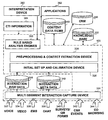
- FIG. 1 is shows a high level diagram of the content analysis system
- FIG. 2A shows an exemplary high level diagram of an apparatus employing the content analysis system, in accordance with a preferred embodiment of the present invention
- FIG. 2B shows an exemplary high-level diagram of an apparatus employing the content analysis system in accordance with a preferred embodiment of the present invention
- FIG. 2B shows a more detailed apparatus of the content analysis system
- FIG. 3 is a block diagram showing the interactions, in accordance with a preferred embodiment of the present invention.
- FIG. 4 is a block diagram of the internal modules of an exemplary content analysis system with particular emphasis on the analysis of an audio type interaction, in accordance with a preferred embodiment of the present invention
- FIGS. 5 and 6 show alternative examples of the content analysis process, in accordance with the preferred embodiment of the present invention.
- FIG. 7 is a schematic block diagram of the content analysis components of the exemplary Reporter device.
- FIG. 8 is a flowchart of the emotion detection and monitoring function, in accordance with a preferred embodiment of the present invention.
- FIG. 9 is a flowchart of the call flow function, in accordance with a preferred embodiment of the present invention.
- FIG. 10 is a flowchart of the segmentation function, in accordance with a preferred embodiment of the present invention.
- FIG. 11 is an example of the content analysis processes where each type of interaction media content is analyzed to detect new ideas within interactions in accordance with another preferred embodiment of the present invention.
- the present invention discloses a new method, apparatus and system for capturing and analyzing content derived from customer interactions. This present invention provides for a coherent, integrative analysis process for the contents of all forms of customer communications.
- Various environments use the capturing of information and data from agents. Such may include call centers, contact centers, trading floors, money foreign exchange centers or trade centers, and other institutions such as banks, back and front offices in various centers. Two distinct environments are the call centers and the trading floors.
- Call centers also known as the factory floor of the 21 st century, are centers where customer and other telephone calls are handled by an organization. Typically, a call center has the ability to handle a considerable volume of calls at the same time, to screen calls and forward them to someone qualified to handle them, and to log calls. Telemarketing companies, computer product help desks, and any large organization that uses the telephone to sell or service products and services may use call centers. Agents supervised by managers and supervisors often man such centers of floors.
- Trading floors are the call centers of the financial world. Typically, a trade floor has the same ability as a call center, with the exception that regulatory requirements mandate that calls are always logged and traders are constantly supervised by compliance officers and chief traders. Traders man trading floors. The government is increasingly regulating the operation of traders and trading floors. Various legal requirements are placed on the traders to deal fairly and to avoid irregularities in their dealings.
- agent shall also refer to traders in the reminder of the text below.
- the present invention provides a system for the analysis of at least two interactions captured as a result of the agent's interaction with the client. Analyzing more then one interaction enables system according to the present invention to effectively monitor the interactions between the agent and the client. Such interactions may take place between a business and a customer or between businesses. The interactions captured can be associated there with each other and with other information already present in the organization, such as the organization knowledge base.
- the interactions may also be associated with data received about the capturing of the interaction such as Computer Telephony Integration (CTI) information or various other data pertaining to the manner of recording and logging of the interaction.
- CTI Computer Telephony Integration
- One non-limiting example is the information provided as to the length of a call a chat session, the source of the call or the chat session (telephone number or IP address or e-mail identifier) to be associated with what was said (through voice or otherwise) by an agent or a customer.
- Analyzing the agent's voice in association with the speed at which the agent is operating his CRM application can indicate a problem and alert the management.
- Businesses operating call centers and contact centers face the same concerns and problems.
- management should control, monitor and detect cases such as “front running”, where an agent could execute a personal trade in advance of a client's or institutional order to benefit from an anticipated movement in the market.
- the agent's screen activity together with the order for execution of the trade are captured such that behavior of the agent is verified along with the sequence of execution. Any indications of irregularity will alert the management that bad practice occurred.
- businesses are constantly anxious to gain a competitive edge over their competitors by having better agents, which perform best.
- the performance of agents may be analyzed effectively through the capture and analysis of various data associated with the interaction with the client.
- the present invention provides for such a system.
- the system 1 describes a process flow, starting from interactions and ending in applications making use of the processed and analyzed information.
- the system includes at least interactions information 20 , an interaction meta-data information 14 , an interaction capture and storage component (ICS) 10 , a rule based analysis engine component 16 , a knowledge base component 18 , and CTI component 22 .
- a sub component of the knowledge base component 18 could be a customer relationship management application or any dynamic or adaptive database internal or external to the organization.
- the database may be located remotely to the organization and accessed via local or wide area networks.
- the interactions 20 are a business-to-consumer or a business-to-business interaction unit and include diverse types of communication through which content is passed or exchanged.
- Non-limiting examples of interactions are telephone conversation, audio, video, voice over IP, data packets, screen events, e-mails, chat messages, text, surveys' results, quality management forms results, collaborative browsing results or sessions, e-mail messages, any coded data and the like.
- the various types of communications supported will be described in detail in association with the following drawings.
- the meta-data information component 14 is a set of descriptive and associative information, which are related to the actual interaction information 20 passed over the media where each interaction type has associated meta-data. Examples of meta-data associated with each interaction type will be described in detail in association with the following drawings. Interactions 20 and their associated meta-data 14 originate external to the content analysis system and are the primary input to the system. Interactions 20 are captured by the ICS component 10 .
- the ICS component 10 is also referred to in the text of this document as the Multi-Segment Interaction Capture component.
- the ICS components 10 can include the NiceLog, the NiceCLS components by NICE Systems of Ra ⁇ grave over ( ) ⁇ anana, Israel.
- the ICS component 10 can comprise of a transient memory device such as a transient buffer used solely to buffer the interactions 20 into a rule based analysis engine component 16 . Persons skilled in the art will appreciate that other like systems are interchangeable. Subsequent of being captured the interactions 20 data is fed to the analysis methods component 16 .
- interactions 20 information could be first stored on the ICS component 10 having a substantially flexible buffer area for some or all of the interaction types/media types when real-time processing of the interactions data is problematic or impractical.
- the ICS component 10 feeds the analysis methods component 16 , which is responsible for the analysis process. Data from diverse additional information sources utilized to enhance the interactions information 20 are fed simultaneously to the analysis methods component 16 . For example, information concerning an enterprise, such as products, strategy, sales statistics, agent performance and the like, is fed from the Knowledge Base component 22 . Another important source comprising information about the interaction is the CTI information 22 .
- CTI is the use of computers to manage telephone calls. CTI can provide information about calls and the callers, including telephone numbers, length of calls, type of call, and the like.
- CTI can provide a multitude of information including the length of the call, the calling number, the extension number, the agent ID, the customer Id, and the like. CTI can be extensively used to obtain important information to be used in association with the present invention. CTI provides reasonably accurate information and is therefore used as a primary source of information by the present invention.
- CRM Customer Relationship Management
- the results of the analysis are stored in an intermediate or permanent storage area having a specific intermediate format on the in ICS component 10 to be used in turn by the applications 12 .
- Applications 12 can be any internal or external computer based hardware or software application that utilizes the results of the analysis or is activated or activates the analysis in response to requests.
- the intermediate storage could typically be a part of a recording and archival system.
- the storage device can include a DAT tape, a hard disk, a memory device, a magnetic media storage device, and other like storage devices that store information in a permanent, transient or intermediate form.
- the results of the analysis could feed the CRM applications 18 as well.
- the ICS component 10 further includes an administrative database utilized for the setting up, the initialization and operational follow up of the system.
- the administrative database is further utilized to facilitate authorization and verification procedures via stored user information, such as agent identification and the like.
- the apparatus 100 is generally comprised of a multi segment interaction capture device 324 , an initial set up and calibration device 326 , a pre processing and content extraction device 328 and a rule based analysis engine 300 .
- the multi segment interaction capture device 324 is operative to receive numerous interactions from various sources such as voice 332 , video 334 , e-mail services 336 , chat messages 338 (preferably in the form of TCP/IP packets), results from surveys and from quality management forms 340 , screen captures 342 , and collaborative web browsing 344 . Interactions captured by the multi segment interaction capture device 324 are stored to the interaction raw data database 346 .
- Each data item in the interaction raw database 346 is associated with an interaction meta-data stored in the interaction meta-data database 348 .
- the initial set up and calibration device 326 performs adaptive operations on the data stored in the interaction raw database 346 and the interaction meta-data database 348 . As a result a calibration of the appropriate configuration is provided to comply with the customer needs, in particular, and with the vertical market segment, in general.
- Pre processing and content extraction device 328 extracts data from various databases available, such as the interaction raw database 346 , the interaction meta-data database 348 , the organization's knowledge base 352 , the organization's CRM database 356 and CTI information 364 .
- Pre processing and content extraction device 328 performs pre processing of the information and determines whether particular interactions are suitable to be further analyzed or not.
- chat sessions may be edited to eliminate chat robots (BOTs) intervention or non-parties chat messages.
- BOTs chat robots
- the content analysis system substantially reduces the size of the content data items 350 database size and the cost on computer resources in analyzing superfluous interactions.
- the pre-processing device enables the content analysis system to reach better results in a shorter time, serving as the selective primary filter of the system.
- the pre-processing device 328 may update the knowledge base or the CRM databases 352 , 356 as a result of the pre-processing outcome.
- Data items not discarded are put in a format suitable to be used in association with the rule based analysis engine 300 and are stored in the content data items database 350 .
- the rule based analysis engine 300 is a software device operative to perform rule checks on various content data items.
- Rules are predetermined by the user or are adaptive in accordance with the system's performance and demands. Initially, rules may be entered as a set of predetermined templates.
- One such non-limiting example is the rule “filter the word BUY and CRM update of BUY_PRODUCT_X field”.
- Another non-limiting example of a rule is “filter all calls from telephone number (123)-1234567 having at least one of the words “GIFT”, “BET”, “GAMBLE” and call made to agent ID #890”.
- Rules are also imposed by the interpretation device 360 which include content classification trees and rules.
- the rule engine device 300 may obtain data from other sources such as the knowledge base database 352 and the CRM database 356 and the CTI information 364 .
- the results of the analysis performed by the rule engine are made available to various applications 362 for the purpose of alerting the management or supervisors as to the results of the analysis. Users such as agents may also initiate the analysis manually.
- the location of each of the components of the present apparatus may reside in a single location or over a distributed network of computers. Information may be passed from one device to another or from a database to a device over computer busses, local area networks, and wide area networks, the Internet and over other networks, including a cellular network.
- the apparatus comprises several components, which enable the capturing and analysis of the interactions.
- the interactions 281 includes examples of multi-media communication information (interactions).
- the initial setup and calibration device 266 is calibrated according to the interactions 281 types found on the particular site. For example, insurance call centers will be adapted to recognize words prevalent in the insurance industry and airlines call centers will be adapted to recognize words used and of interest to the supervisors of such industry.
- the configuration/setup may be accomplished on site in order to make sure that the functionality of the system corresponds to the requirements of the customer and the environment. The result would be the on site business oriented set up module 268 .
- the trader's screen activity together with the order for execution of the trade are captured such that behavior of the employee is verified along the sequence of execution.
- the system will alert the management when an indication of irregularity or bad practice is identified.
- additional interaction criteria may be set up as part of the setup procedure.
- calibration can be performed adaptively through the adaptive module 270 according to the site's profile and accumulated changes.
- Interaction meta-data device 274 represents the meta-data captured and stored by ICS device 280 .
- Device 280 can be presented as a multi segment interaction capture device since it can capture any information segments in a coded data format.
- Examples of different types of data sources include but are not limited to video data 284 , audio data 282 , including voice communications data, such as voice over IP (VoIP), streaming audio data and audio recorded in walk-in centers and any other type of audio-related data, SMS messages, MMS messages (Multimedia Service), instant messages, e-mail messages 286 with or without attachments, collaborative web browsing 294 , chat 288 and other type of messaging systems messages, documents transmitted by facsimile, customer surveys 290 , user interface data, including screen multi-sequence events 292 , and the like.
- the ICS device 280 additionally contains a content data Item 230 or a link to a database containing the content data items 230 resulting from the pre-processing and content extraction device 246 .
- the pre processing and content extraction device 246 extracts the interactions stored in the interaction raw data and meta data 272 , 274 and identifies data later to be analyzed by processing transaction information 248 , CRM information 250 , video information 252 through the use of subject/object extraction, text information 254 , noise information 256 including the reduction of noise from the surrounding area or created in the process of propagation of the media, speaker separation 262 , event pattern 260 , CTI information 258 and audio 264 which can include word and phrase spotting, emotion detection and activity detection and other measurable parameters in the voice.
- the information is either discarded or converted into a content data item 230 .
- the system may update the CRM, CTI, Knowledge Base or other database in the organization.
- the content data Item 230 may include CRM data 234 , interaction information 236 which may include various interaction raw data and associated meta-data, extracted text 238 , analysis core sub-units such as words and phrases 240 , emotion level 242 , and identified events 244 and the like. Elements from the pre processing and content extraction component 246 can also or alternatively be located in the ruled based analysis engine 218 .
- the rule based analysis engine 218 constitutes the functional kernel of the system.
- Other devices may be regarded as sub devices of the rule based analysis engine 218 .
- Such include the following sub-devices: the pre-processing and content extraction sub-device 246 , the rule-based analysis sub-device 218 and the content interpretation sub-device 200 .
- the rule based analysis engine 218 applies rule based analysis to content data items provided thereto.
- the rules device 218 include the analysis of behavioral patterns device 220 , the speaker identification and verification device 222 , the call flow analysis device 224 , the excitement (or emotion) analysis device 228 and the events association device 226 .
- the interpretation device 200 includes the content, classification, association and categorization device 204 which provides the rule based analysis engine 218 with tree like vertices and hedges which may be used by the rule engine 218 in associating data items therewith or with additional information.
- the categories and classifications may also determine the make up of rules or the behavior of rules, which are dependent on the vertices and hedges defined.
- the appearance of the word “bet” may be associated through classification with the use of the word “gambling” and while only one word will be embodied in a specific rule, the rule engine will filter both for when such rule is applied.
- the application tools 202 are utilized by the user to perform Quality Management (QM) evaluation 206 , QM, Query and visualization rules tools 214 , Query Playback and Retrieval 216 , report and statistics generation 208 , E-learning agent sessions 210 and real time monitoring 212 .
- QM Quality Management
- the proposed system and method provide advanced analysis capabilities.
- the following exemplary scenario will be assumed via which the functionality of the various devices and components of the apparatus will be described.
- a customer using the proposed system and method desires to find out the reason for the unusual success of a specific human agent.
- an audio classification module 264 of the pre-processing and content extraction sub-device 246 extracts words and sentences 240 that the agent uses, then the agent's recurrent behavioral patterns are detected.
- the agent's screen activities 292 are captured as well during the interactions and the inner conversational emotional level 242 is identified.
- All the above-identified interactions content information is first captured by the multi segment interaction capture device 280 and then saved to the interaction raw data database 272 and interaction meta-data database 274 . It is then processed by the pre processing and content extraction device 246 and saved as a content data item 230 later to be further analyzed by the content-analysis rule base engine 218 to produce a result.
- agent-specific results that were derived could include agent-specific behavioral characteristics, such as courtesy, conversational manner, cooperation, and operating methods such as collaborative web browsing and proper use of the CRM application.
- agent-specific behavioral characteristics such as courtesy, conversational manner, cooperation, and operating methods such as collaborative web browsing and proper use of the CRM application.
- the above scenario is a particular case of automatically analyzing an agent's conduct regarding behavioral characteristics while handling customers for purposes of Quality Management.
- the CRM database 278 serves as a source for supplying Transactional Information required during the analysis process. The results of the analysis could be fed back to the CRM database 278 .
- Another source of vital information used by the analysis process is the enterprise knowledge database 276 .
- the database 276 is commonly used for retrieving organization related information, such as products information, agent QM information, agent profiles, multi-media parameters, and the like.
- CTI information 258 is used during the analysis process to allow real time content analysis.
- Call information is received either from the Automatic Call Distributor (ACD) or from the ACD through the CTI.
- ACD Automatic Call Distributor
- Call information coming from the ACD can be used in monitoring agent activity while the agent is engaged in interaction with a customer.
- Call information can also arrive from a Turret system, also known as a Dealer Board or from a PBX system.
- An exemplary benefit of the above option was described in detail in the referenced co-pending U.S. provisional patent application Ser. No. 60/350,345 titled IDEA MANAGEMENT BASED ON CONTENT OF INTERACTION, filed 24 Jan. 2002, the contents of which is incorporated herein by reference and in association with the description of FIG. 11 .
- CTI information is of import because it is substantially accurate and can provide information about the length of the call, the calling number and the called is number and extension through the Dial Number Identification Service, the agent, and customer Ids, the customer classification and the like. Once the system has received CTI information it is better able to both pre process interactions and later performs rule-based analysis leading to enhanced results. CTI is utilized in association with other transactional information such as CRM data as inputs to the real-time or the off-line analysis process.
- the interactions are enabled via the implementation of a suit of existing commercial products. Interactions performed via the products are captured and stored on a software-based or hardware-based and/or firmware ICS component 10 . Each interaction type, whether digital or analog, 48 , 50 , 52 , 54 , 56 , 58 , 60 , 62 , 64 , 66 , 68 , 70 is performed through a suitable application and through a distinct type of media associated with its respective meta-data 24 , 26 , 28 , 30 , 32 , 34 , 36 , 38 , 40 , 42 , 44 , 46 .
- the interaction types performed via the commercial products include but are not limited to the following: a) E-mail 48 , carrying e-mail body and associated meta-data fields.
- the body includes text and attached electronic documents while the meta-data consist of information and attributes, such as addresses (From, To, CC, BCC, Reply To, and the like), subject, sensitivity, system in which the e-mail was created, handling procedures, date and time of creation, sending, reception, and the like.
- Interactive Web-chat sessions 50 including “transactional” sessions having text introduced and transmitted by each participant in turn.
- Voice conversations 52 also performed in actual face-to-face meetings, for example involving a service or a product offer, over a telephone or a cellular connection, or by using voice-over-IP telephony (VoIP), d) Voice messages or voice mail 54 .
- Facsimile messages 56 carrying electronic images of one or more transmitted documents.
- Traditional mail 58 written, typed and physically sent via conventional mail-delivery channels with associated attached documents.
- Collaborative Web browsing 60 generating an ordered list of URLs, of web pages loaded, filled-in texts, click streams, application documents and whiteboard contents.
- Video interaction 62 such as an telephone or Internet video-conference.
- Web browsing stream 64 which is a detailed record of a customer's interaction with the enterprise's Web site supporting self-service sessions, purchasing sessions, and the like. The record contains the exact trail of the Web pages visited, the contents of the visited pages, filled-in information, ordered click streams, and the like.
- Agent computing device screen 66 that contains information transferred by other media/sources, such as transactional information from a CRM, which is related to one or more of the above interaction types. During and subsequent to the interactions, the agent's computing device screen contains useful information not only about the interaction but also about the manner in which the agent handles the interaction. This information includes graphical display content and a detailed record of the user's input activities in the computing device operating environment.
- windowing operating system environment such as MS-Windows
- user action in a windowing operating system environment includes closing, moving and opening windows, window controls, control contents, window captions, keyboard typing, pointer device movements and pointer device activations.
- These actions are captured by the identification of specific operating system events and through the recording of the screens.
- the capturing agent action is fully described in the co-pending patent application incorporated herein by reference.
- Customer survey 68 such as a Post Call Survey, is generated either in real-time where the customer is requested to answer post call predefined questions or link to a unified resource locator containing such questions, or off-line via the transmission of e-mail messages and the like, subsequent to the termination of the call session between the participants where the customer is being asked to fill out a survey including questions related to the contents and course of the interaction.
- quality management forms are generated automatically or manually once the agent has performed an action.
- Quality management forms are evaluation forms filled by supervisors, evaluating the agent skills and the agent quality of service. Such forms will be correlated with the content data item during the analysis to deduce certain results.
- the quality management form can be automatically filled by the system in response to actions taken by the agent and/or fields filled by the agent or interactions captured.
- Other interactions 70 include any future prospective interaction types as long as an appropriate capture method and processing method is implemented. Such can be dynamic content, data received from external sources such as the customer or other businesses, and any like or additional interactions. Still referring to FIG. 3 , the interaction content is captured and further used by the interaction and storage unit 10 in order to provide the option of handling directly the original content.
- absorbed content analysis results are being used as input information to an ongoing content analysis process. For example, the behavioral pattern of an agent and/or a customer may be updated due to the previously stored content extracted recurrent behavioral pattern.
- the various types of interactions may be re-assessed in light of previous interactions and interactions associated therewith.
- the output of the analysis can be tuned by setting thresholds, or by combing results of one or more analysis methods, thus filtering selective results with greater probability of success.
- FIG. 4 is a block diagram of the internal modules of an exemplary content analysis system with particular emphasis on the analysis of an audio type interaction.
- FIG. 4 serves as an operative example to the system shown in FIGS. 1 , 2 A, 2 B.
- the person skilled in the art will appreciate that like systems can be accomplished in the context of the present invention in association with the processing and analysis of other interactions.
- the capture and storage stage 80 , pre-processing and content extraction stage 82 and the analysis and content interpretation stage 84 are displayed with suitable inter-connectivity between the constituent functional modules.
- the analysis of audio signals using content-based audio information concerns typical situations where the interactions are characterized by low signal-to-noise ratio (SNR) and in the presence of substantially powerful interference sources.
- SNR signal-to-noise ratio
- the pre-processing and content extraction stage 82 contains an audio classification module 90 that includes functions for automatic speech detection and speaker segmentation, an audio filtering gate 91 to select audio segments suitable for further analysis and optionally a noise reduction software module 92 for noise reduction.
- the audio classification module 90 utilizes a speech detection function in order to enable the system to identify and distinguish speech signal scenario from several inherently integrated speech elements, such as music and tones 96 , transient signals (the noise produced by the passing of transportation vehicles in the vicinity), keyboard clicks 98 , footsteps (not shown), noise and silence 100 and other noises 108 . While distinguishing between speech signal and silence is a straightforward task it becomes complicated in cases where unknown powerful interference sources are present at low SNR's.
- the Audio classification module 90 is required first to identify the speech scenario whether the signal is contaminated by specific background noise like music or aloof speakers and if contaminated the signals is required to be filtered in order to reduce the background noise and eliminate the interferences. Consequent to the pre-processing stage the audio is ready for the analysis and it is performed by the Audio Speech Recognition (ASR) module 116 .
- ASR Audio Speech Recognition
- the audio classification module 90 includes a speaker segmentation function to allow the system to identify and consequently to separate the speakers, such as participants in a conversation.
- the inherent elements of the conversation are captured from within the audio frame of a recorded conversation signal.
- the audio signal should preferably be segmented in order to provide for the suitable analysis.
- the separated pieces of the information hidden in the signal frames are individually processed.
- different and inherently integrated participants and conversation elements such as speaker A 102 , speaker B 104 , Speaker A+B 102 , 104 , can be considered individually.
- segments including holds 106 , noise, and silence 100 are also handled individually.
- the function is designed and developed in such a manner as to overcome situations where the recorded signal is contaminated by unknown interferences caused by for example, inferior quality of communication lines and non-ideal locations of microphone devices.
- the objective of the speaker segmentation function is to identify speech segments spoken by each speaker in an audio stream.
- the system uses speaker segmentation either to obtain more data from a particular speaker or to identify the points in time when each speaker is speaking. System speech recognition performances are improved by adapting the functions to the acoustic models using the data obtained a priori from a particular speaker.
- the input to “speaker segmentation function” is a summed audio signal. Unsummed recorded audio can be summed or compressed or processed prior to being archived or used. In addition, and optionally, signal processing can be performed prior to recording of the audio signal, thus refraining from audio signal degradation that may occur during the recording session.
- Output includes the following signals or segments marked by a time index: a) signal 1 is a sequence of segments each of which belongs to speaker 1 , b) signal N is a sequence of segments each of which belong to speaker N, c) non-voice, d) silence, and e) talk over.
- the function is both text independent and speaker independent. Integration of the speakers and an inherent acoustic model of the site significantly improve the segmentation performance.
- the same integration of the speakers could provide the use of the system for real-time applications, such as speaker-based trigger start recording, monitoring of speaker-based trigger starts, and the like.
- the system is configured to analyze specific parts of the call based on information from other applications and from other pre-processing functions, such as information from CTI events, speech detection and classification functions, and the like.
- the outputted results of the system are cross-referenced with the output of other systems in order to improve overall system performance.
- the person skilled in the art will appreciate that the above-described function is an example and that other variations to analyze and examine the audio or other types of interactions can be implemented as well in connection with the present invention.
- FIG. 10 is a simplified flowchart of the speaker segmentation function.
- the function 151 is performed across the processing steps 150 through 158 .
- several optional pre-processing functions are loaded and run. These additional functions are required to be executed prior to the performance of the segmentation analysis.
- the pre-processing functions include noise reduction, audio classification, and the like.
- spectral features vectors are extracted from the speech segments and silence and non-voice sectors are discarded.
- all the candidate transition points representing specific statistical vector features measurement changes are found. These points imply speech turnovers and thus the transition from a specific speaker to another speaker is detected. The change of speakers is found by one or more specific indicators pointing to the transition.
- the function independently and adaptively learns the number of clustering occurred in the examined voice track. Then the function applies the transition points found in the previous step to the clusters by statistical calculation.
- the clusters represent the output segmentation result, such as speaker 1 across N, and talk over. Note should be taken that the number of clustering could be received in the initialization stage.
- speaker information is stored in speaker database 156 and is retrieved when necessary by the function at the transition detection step 154 or the clustering and segmentation step 158 .
- the speech noise reduction module 92 contains a software function that completes the pre-processing stage 82 .
- the module 92 is utilized as the final reducer of the remaining noise resulting from interferences remaining after the speaker segmentation and the speech detection functions were performed.
- the noise reduction algorithm package comprises of three algorithms, each designed to cope with different noise features that might be expected.
- the three algorithms can be independently turned on and off, so that the expected noise(s) may be reduced while minimizing the damage to speech intelligibility—by disabling the algorithm(s) that may be irrelevant to the encountered noise features.
- an operator-based level of operation (either Low, Medium or High) may be set, to realistically meet the noise's severity. This way, the trade-off of SNR and quality improvement vs. degradation in intelligibility may be set to near optimum, according to the encountered input SNR.
- a tone elimination algorithm is a part of the noise reduction function.
- the tone elimination algorithm is capable of eliminating, or reducing, noises that comprise of several (up to five) nearly “pure” tones over each 500 mS intervals, almost independently.
- the elimination is based on adaptive spectral detection of the tones' frequencies, and consequent notch filtering.
- the detection algorithm is based both on spectral observation of the processed block and on the past history of occurrence of the suspected tone in preceding blocks.
- the algorithm can detect short bursts of tones, usually typical to Morse or slow FSK background signals.
- the adaptive notch-filtering is implemented in the vicinity of the detected frequency, using a single (double-sided) zero and a single (double-sided) pole, thus implementing an ARMA (2, 2) linear filter.
- the filters are cascaded to sequentially operate on all the detected tones per 500 mS data block.
- the use of such filters enables local tracking of the eliminated tone, so as to prevent artificial generation of a tone where the disturbing tone is locally absent.
- the humming sounds elimination algorithm is also a part of the noise reduction function. “Humming” sounds usually resemble time-domain impulse trains, reflected in frequency-domain impulse trains (possibly widened) that are stationary over relatively long periods (500 mS).
- Such noises are usually typical to HF environments, or to acoustic environments that are subjected to mechanical periodic sources such as low RPM engines, propellers etc.
- the detection of humming sounds is implemented using spectral detection of such trains that may be comprised of up to 400 elements in the spectrogram reflected in the FFT of the processed data block. Consequently, these trains are eliminated from the spectrogram, and the refined time-domain block is reconstructed from the modified spectrogram using an inverse FFT.
- the white noise elimination algorithm is also a part of the noise reduction function. Additive white (or slightly colored) noises are typically encountered in VHF environments, or remain as residues after the elimination of “humming” or tone-like noises.
- the well-known “spectral subtraction” technique is used with several modifications in order to reduce noises of this nature.
- the basic analysis is based on shorter (64 mS) data blocks than the previously discussed algorithms; however, considerable block overlapping and averaging efforts are made in both signal analysis and synthesis, to retain long-term continuity and consistency.
- the short-period analysis is necessary for relying on the expected short-term stationary of the desired speech signals.
- the spectral noise level is estimated using non-linear order-statistics approaches that minimize the effect of desired speech-like signals on the estimation error.
- the estimated level is then spectrally subtracted in a way that compromises the subtraction in an attempt to preserve speech information where it is apparently present.
- the detection and subtraction of the spectral noise-level is performed separately on four spectral sub-bands, thus allowing for slight variations in the noise's whiteness (at the expense of statistical accuracy), and increasing the algorithm's robustness.
- Each sub-band is processed using different processing parameters, to accommodate sub-band dependent trade-offs between quality and intelligibility.
- the main well-known drawback of the spectral subtraction method is the so-called “musical noise” artifact.
- Operator selection of operation level (Low, Medium, High) sets the processing parameters so as to meet the operators' preferred trade-offs between the original noise subtraction and the musical noise artifact.
- the audio filtering gate module 91 decides which audio segments are eligible for further analysis and which are non-eligible. So for example, white noise and “humming” will not be eligible for further analysis and will be discarded. However, lengthy “humming” segments will be eligible for analysis for quality control and management purposes. Other parts such as music on hold and radio on hold and the like can also be removed as not suited for further analysis.
- Based on the audio classification module 90 results the system automatically predicts which audio segments will be suitable for analysis. As a result only specifically selected audio segments are fed to the analysis stage 84 . At stage 84 a selective analysis is performed based on the quality of the pre-processing functions performed by the audio classification module 90 .
- the pre-processing stage 82 allows modeling speech in the presence of severe interferences, such as background noises (music, footsteps, keyboard clicks, and other non-productive sounds), simultaneous speakers, cross talk, and the like.
- the functions extract sufficient speaker information, such as fluent call conversation characterized by relatively short speaker frames and with high speaker transition rates) as to allow reliable speaker segmentation, modeling and identification from complex contaminated signals.
- the pre-processing stage 82 supports both real-time and non real-time audio analysis. Still referring to FIG. 4 , the CTI information 88 is used in the pre-processing stage 82 as a source for gathering real-time information such as hold periods, transfers, real time business interaction data, and the like. CTI information 88 may also be linked directly to audio streams captured.
- the audio information is captured by the ICS component 94 and undergoes pre-processing 82 and analysis 84 . Consequent to the pre-processing stage 82 the pre-processed and “cleaned-up” audio segments are fed to the analysis and interpretation stage 84 .
- the stage 84 receives the processed audio segments and begins analyzing the segments via the use of several parallel functions in association with the collected and cross-referenced real-time or off-line data received from the CTI information 88 , the Knowledge Base 86 and the CRM information 120 .
- the analysis process includes but not limited to a Speaker Identification and Verification function 118 , a Word Spotting function 116 , a Call Flow and Emotion function 119 , a Content Analysis Rule engine 112 , and a Content Classification module 110 .
- the Speaker Identification and Verification function 118 is utilized to identify and verify the speaker.
- the function 118 uses CTI events correlated with an administrative database (not shown).
- the administrative database stores agent records including agent information, such as agent ID, privileges, agent association with groups, human resources information, agent profiles and the like.
- the function 118 further uses an external database, such as a CRM database, integrated with the system for the provision of customer identification. For example, following a call at a Call Center a specific agent responds to the call.
- a CTI event is generated, such as a “start-call’ event that includes the agent-specific ID or a pre-defined extension number.
- the agent participating in the call is immediately identified.
- the agent ID or the extension number is then further checked against the suitable records stored in the administration database 121 for the purposes of authentication and verification.
- the system collects suitable ACD/CTI information, such as ANI, DNIS, area code, and the like, for identification and further correlates the identification with information from external sources such as CRM information that includes customer-specific, such as telephone number, e-mail address and the like and private information stored within the system, such as customer ID and customer profile.
- the speaker identification and verification function 118 is designed such as to be a part of the pre-processing stage 82 .
- the Word Spotting function 116 is utilized to notice specific words and phrases of interest to the user. Words such as bet, drug, buy, alcohol and others may be filtered or monitored. In one embodiment of the invention an off-the-shelf commercial product may be used for word identification, such as for example the Philips Speak&Find, the Dragon MediaIndexer by ScanSoft, or the like. In addition several full-transcription tools are used and the resulting transcription is searched for the specific words. Such tools that could be used include, for example, Dragon NaturallySpeaking by ScanSoft, ViaVoice by IBM, SpeechPearl by Philips, or the like.
- the system and method proposed by the present invention includes a specifically designed performance measurement tool for the word spotting function 116 .
- This automatic tool is analyzing the effects of the software updates, parameter optimization and setting different words to spot.
- the function 166 input consists of two kinds of files: a) a searched word list, and b) a manually transcribed text file for each voice file. These files contain time stamps every pre-defined number of seconds for timing information resolution.
- the output of the function 116 is the results of the word spotting in terms of detections and false alarms. The results would include details of the software version, parameters checked and file ID for comparison and analysis purposes.
- the word spotting function 116 creates an estimated “real” word location (timing) list.
- the list entries are in the following format: WORD FOUND- ⁇ LAG NUMBER (leg 0:0-x sec, leg 1:x-20), and the like.
- the list may contain more information regarding the found words.
- the word spotting function is executed. Each word supposedly detected by the word spotting function is compared to the “real location” list. If an instance of the word exists in the relevant x-second leg then a hit is indicated. If the word does not exists in the relevant x-second leg then a False Alarm (FA) is indicated.
- the HIT/FALSE ALARM statistics are essentially the output of the word spotting function.
- the output is stored into a designated database in the following format: DOCUMENT ID, such as file identification, VERSION ID, such as a software type and software version number, WORD LIST, such as a vocabulary looked for, NUMBER OF HITS, such as the number of detections, FALSE ALARMS, such as the number of false alarms, OUT OF, such as the total number of words looked for.
- DOCUMENT ID such as file identification
- VERSION ID such as a software type and software version number
- WORD LIST such as a vocabulary looked for
- NUMBER OF HITS such as the number of detections
- FALSE ALARMS such as the number of false alarms
- OUT OF such as the total number of words looked for.
- the designated database enables the analyzing of the results using a method that is similar to the manual one currently used. Consequent to the introduction of the results to the database querying and mining of the results is possible in a variety of ways.
- the call flow function 119 analyzes the dynamics of the call.
- the calculated parameters include the percentages of the call's length, complete silence; talk over, agent speaking and customer speaking.
- the function 119 counts also the number of times the agents interrupts the speech of the customer and vice versa. It also gives details about the silence, talk over, and activity sections during the call.
- the function 119 is fed with a variety of streams where each stream represents a specific participant of the call.
- the function 119 is based on calculating energy levels within the digital speech of each participant of the call.
- Each of the analyzed interactions can be analyzed independently or in association with another type of interaction captured at the same time. Such can be a video interaction, a chat interaction, a screen event captured from the screen of the agent and the like. Similarly, associations between various interactions may be analyzed as well.
- audio and video interactions or audio and CRM data associated with the same call may be analyzed to identify various predetermined combinations of events or elements relating to the handling of the call or query (or offer for goods or services), the response by the agent, the appropriate response to a client or entry of data into the CRM at any given time during a call or an interaction between the business and the customer.
- the person skilled in the art will appreciate the various types of interactions, which may be associated together and analyzed to obtain like result and enhance the ability to analyze and respond to various events.
- a digital speech segment is introduced into the function.
- the digital speech segment is sliced into frames of a few milliseconds.
- the energy of each frame is calculated and then compared to an adaptive threshold representing the maximum noise level. Frames with higher energy than the adaptive threshold are marked with an “activity on” flags while frames with energy lower than the threshold are marked with an “activity off” flag.
- Each participant of the call is represented as a vector of activity frames.
- each participant-specific vector is passed through a filter.
- the filter yields a vector of “activity sections” where each section is constructed of consecutive or semi-consecutive frames marked with “activity on” flag.
- the sections are processed such that statistics are generated concerning each participant activity and the mutual activities are calculated.
- the call flow and emotion function 119 is responsible for providing an indication of the emotional state of a customer and/or an agent during a call.
- the output of the function 119 is the emotional state and intensity of each section of the call or any other interaction as well as the emotional state and intensity that represent the call in its entirety.
- the system can be used for real time emotional monitoring and it can also be used for collecting off-line statistics on the emotional states during interactions.
- the system can be programmed to analyze specific parts of the call based upon information from other applications, such as CTI.
- the system output is cross-referenced with other system outputs in order to improve the accuracy of the system or in order to yield higher order conclusions.
- the initialization section 202 is designed to run for the proper initialization for the system. Thus, the steps 204 , 205 , 206 have to be performed prior to the routine running of the system.
- the initialization section 202 could be executed either by the system vendor prior to installation at the user's site or consequent to the installation on the user site.
- the section 202 includes specific adaptation routines and is fed with parameters in accordance with user profile and the site profile. Consequent of the performance of the initialization steps 204 , 205 , 206 the system is ready to perform the emotion analysis on any number of calls without the necessity of repeating the initialization procedure unless the site-specific parameters must be modified.
- the steps 190 across 200 are performed for each operative call. Still referring to FIG. 8 at step 204 a database containing a plurality of recorded past interactions is addressed and at step 205 each recorded session is analyzed for the emotional state of the caller. At step 206 each recorded session extracted from the database and its associated emotional analysis from step 205 are fed into a learning function, such as a neural network, The learning function adjusts itself to yield in its output the matching emotional analysis. The result of step 206 is an adjusted classification system that will be used for the emotion decision in step 198 . In the main execution sequence at step 190 a recorded speech segment is fed to the function as input data. At step 192 several pre-processing functions that are required prior to the performance of the excitement analysis are loaded and executed.
- Step 194 useful speech data is extracted from the recorded speech segment and silent or noisy sections of the segment are discarded. Then the speech is divided into sub-segments each having a length of a few milliseconds. For each sub-segment a vector of voice features, such as pitch and energy are calculated.
- step 196 the plurality of sub-segments fed from step 194 are collected into sections that represent a few seconds of speech. A vector of features characterizes each section where the sections represent statistics on the constituent voice features.
- Step 196 further includes an automatic learning mechanism concerning the characteristic voice features of a specific speaker being analyzed.
- the reference voice characteristics thereof are learned “on-the-fly” during a real time session.
- the reference voice characteristics of the unknown speaker are extracted from the database with the activation of the call.
- the database is updated after each call in accordance with results of the learning process.
- the system is adaptively learning from past experience as the history of the emotional pattern of a particular previously unknown party is suitably stored and the profile of the party is constantly being updated.
- the function analyzes the statistics of the voice features of each section using the classification function yielded by step 206 .
- the output 200 of step 198 is the emotional state and the intensity of each section of the call as well as the emotional state and the intensity representing the call in its entirety.
- the rule engine 112 holds logical deduction rules that assist the analysis processes in order to achieve intelligent conclusions. These rules could be introduced by the end-users of the system during the on-site configuration of the system or by the system vendor during the preparation of a system for installation in a designated environment. For example, rules for contact centers based on QM environment applications are different from rules pre-defined for operation in specific trading floors. The supervisors or management may manually change the rules. The system is adaptive and in response to results of analysis predetermined rules, sensitive to such results can change automatically.
- the rule engine 112 constantly examines the system information against its stored rules and when a rule's condition is met the rule engine 112 performs actions associated with the rule.
- the rule engine 112 provides the users of the system an associated tool to define rules and to identify specific behavioral patterns of agents and customers engaged in diverse types of interaction based on the interactions information captured.
- the rules can be adaptive and may change in accordance according to the results of the analysis. For example, a rule could search for an interaction that started with a call and was followed by a collaborative Web session. Such rule, when met, suggests that the agent who received the call successfully followed the call with assistance to the client through the collaborative web session. In another non-limiting example, a rule is met when two conditions are met: that a product name is mentioned by the customer and that the agent searched in the organization's knowledge base information about the same specific product as seen through the screen events captured.
- the exemplary rule could include: a) the user of the system may wish to define an “angry” conversation by defining “angry” such that the conversation should contain certain words, a relatively high percent of talk over (when two or more persons talk at the same time on the same line) and/or negative excitement detection, b). the user of the system detects an unprofessional behavior of an agent by the detection of negative excitement on the agent side followed by a negative excitement on the customer side.
- the detection of the negative excitement patterns suggests that the agent was angry during the call and as a result the customer became aggravated.
- the indication data can further be cross linked to CRM information indicating unhappiness of the customer concerning the service, c) a user desires to identify patterns behavioral misconduct of speech manner by either a customer or an agent in order to better understand the reasons for “bad interaction” and furthermore to update the profiles of the agent and the customer accordingly, such as updating the CRM inherent customer profile categorized as a “hostile” customer such as an I-rate customer, d) a user wishes to handle a VIP customer in a careful, sensitive manner.
- a VIP customer suffering from speech deficiency could be identified as such by the system following detection of certain speech deficiencies (stuttering, word repetitions, syllable repetitions). Consequently the user may chose to demonstrate high customer sensitivity by updating data in the organization's databases, such as the CRM database, leading to assigning a “sensitive” well qualified agent to handle such speech disabled VIP by selectively skill routing the call, e) a user detects impolite agent behavior by the identification of specific events during a call session, such as the agent interrupting the customer, agent is non-responsive to the needs of the customer, agent responds to the repeated requests of a customer by repeating the same sequence of words in his answer.
- the above agent behavioral pattern shows that the agent is not aware of the customer's difficulties in clarifying his/her requests, f) a combination of at least two rules such as shown above could be chosen to be a new rule. Thus, only when the two selected rules are met the combination rule is also met and a proper indication is provided, g) the use of specific words combined with screen events and/or CRM entries made at the time of use of the words. This rule will require the examination of CTI information as well as screen events captured and the voice interaction analyzed to find the word or words selected. In addition, and at the same time the organization's knowledge base may be queried to identify additional information required to perform the rule.
- the rules provide enhanced simplicity for the introduction of any additional desired rules and the “calibration” of the rules during the operation of the system would be evident.
- the user is further provided with the liberty and flexibility to decide and to select the phenomena to look for and the manner for looking.
- One or more rules embodying one or more interactions and one or more associations may be easily captured, analyzed and an according response or event generated.
- a diversity of scenarios is operative in enhancing detection of specific characteristics, such as for example a search for impolite words followed by a high tone in the conversation or a particular screen event or a particular CRM entry or operation.
- the results of the rule analysis are easily implemented in the classification component thus enabling faster and more efficient future analysis.
- a plurality of phenomena included in but not-limited to a session can be sensed, recognized, identified, organized and optionally handled: a) multiple occurrences of events in a certain time frame, b) sequenced or concurrent occurrences of events, c) logical relations between events, the timing of the events and the extracted information, such as when an agent did not open a suitable application screen for at least 10 seconds after the customer asked to purchase shares in over $10,000, or where an agent was offered $10,000 worth of options if he can secure a particular limit on a particular share, d) customer-agent interaction analysis based on a combination of different sources, such as spotted words, simultaneous talking, silence periods, excitement type, excitement level, screen events, CTI information and the like.
- the recognized phenomena could include the following non-limiting exemplary conclusions: a) total number of bursts in conversation, b) negative excitement in at least one side of the conversation, c) large percentage of talk over during the conversation, d) the average percent of the agent's talking time, e) the number of bursts the agent made into the customer's speech, f) the negative agent excitement prior to or consequent to customer excitement, g) agent tends to make a relatively high percentage of customers angry, h) long or frequent hold periods or long and frequent silence periods, which imply that the interaction of the agent with the system is inefficient, I) recurrent repetitions of the same answer by the agent.
- Additional recognized phenomena may include the association of each of the above phenomena with interactions or data or information extracted from CTI or other sources such as CRM or other interactions. Such phenomena may further be analyzed in connection with various other events such as screen events and CRM records, entries and free text.
- the actions generated by the rule engine may preferably drive high-level real-time status reports to the applications that will facilitate real-time alerts and real-time responses while simultaneously enhancing the information storage with the results. For example, long or frequent hold periods or long and frequent silence periods with out screen events or CRM activity may indicate a particular agent is ineffective.
- the average percent of the agent's talking time is more then a predetermined threshold and various CRM entries are left empty may suggest the agent at the contact center has not been attentive or failed to properly conduct the call or interaction with a customer.
- a compliance officer or chief trader observes in real time the performance of the trader and receives notifications as to various content analysis results, such as that the agent has greeted the client properly or that the agent has used the word “bet” in the conversation while making a substantial transaction with another business.
- the supervisor may immediately call up the relevant session (whether it is a call or a chat session or e-mail or otherwise) and view at the same time the agent's screen captures.
- Other indications which may be available to the supervisor are whether the agent followed a specific procedure, whether the tone of the conversation is within acceptable parameters, items of need of investigation, call evaluation, use of client's name or other pleasantries, surveys performed, abusive behavior indication and the like.
- Analysis processing may require intensive processing and can be implemented in any of the following fashions: a) as software processes running in an operating system environment of dedicated standard servers using the entire server data processing resources for the software.
- the processes could be run on one or more computing devices in the organization, such as for example the call center agent computing devices. Suitable load distributing utilities could be implemented to the handling of the large loads.
- DSP processing boards with firmware such as an array of DSP boards running the analysis function.
- the board could be used inside a voice-recording server, such as the NiceLog Voice Logger by Nice Systems of Ra ⁇ grave over ( ) ⁇ anana, Israel.
- the board could be further used in dedicated servers where each server integrates a plurality of such boards, or installed on a plurality of COMPUTING DEVICEs in the organization, such as every agent's COMPUTING DEVICE, localizing and distributing the processing load with little or no effect on the COMPUTING DEVICEs performance, c) for performance enhancement some of the processing that can be done in real time might be performed prior to the recording in such a manner as not to be affected by degradation of the voice signal associated with the recording process, d) the control and data infrastructure for this entire process can be implemented as software on one single standard server platform.
- the content analysis process as proposed by the invention possesses several additional respects: a) Configurable Processing Power—During the system setup or during a call session an authorized user using a dedicated Man-Machine Interface (MMI) can intelligently control and manage the CPU resource allocation in accordance with the priorities and the performances. Thus, for example, a user could allocate about 30% of the CPU resources for word spotting, about 15% for excitement extraction/emotion detection and about 10% for speaker identification and verification.
- MMI Man-Machine Interface
- Customized Adaptive Database c1) Vertical Market (e.g. vocabulary in trading floors)—The characteristics of a particular environment in terms of inherent vocabulary is identified and stored in the system database to be used on the analysis stage. For example, the word “shares” is used frequently in Trading Floors therefore it will be stored in a Trading Floor vocabulary.
- Various models can be created to keep track of the adaptive databases based on previous analysis so as to continuously update the databases and the rules of the system.
- Multi-Media Adaptive CA Resource Allocation The system's content analysis resources could be manually adapted in accordance with the preferences of a customer and/or in accordance with the environmental characteristics. A user manipulating a dedicated MMI could individually allocate CA resources to each multi-media type interaction. For example, about 5% of the analysis processing power could be assigned could be allocated to e-mail, about 5% to chat channels, about 40% to audio information and about 50% for video data. In the same manner about 50% of the processing power could be allocated to word spotting regarding e-mail, about 40% for emotion detection regarding video information, and the like. d) Controlled Real-Time and Off-Line Processing—The real-time processing of signals is performed via firmware utilizing powerful DSP arrays as this type of processing requires adequate processing power.
- off-line processing requires mainly substantially large amount of memory and therefore could be performed by utilizing a plurality of computing devices substantially simultaneously.
- Time Adaptive Resource Allocation a time there is a backlog of calls within specific data structure queues pending for the performance of analysis, such as for word spotting.
- the backlog is generated due to a substantially large amount of calls selected for content analysis processing and the inherent constraints of the user site, such as the amount of processing power available, and dynamically changing bandwidth limitations.
- the decision required from the system regarding “which call to analyze next?” is not a trivial task as there is a plurality of calls to choose from.
- the required solution has to serve the user's requirements in an optimal manner.
- the solution (preferable but not limiting) proposed is designed to operate as follows: Off-peak periods are typically non-random and usually fixed in time and known in advance as they typically occur at night, on weekends and on holidays.
- the system should perform in similar manner as the small backlog conditions with calls remaining each day and then at the week-end the system should select (within each priority class) randomly-dispersed across the entire previous week. If a day's calls or a week's call are completely processed then the system should proceed to the previous day or previous week respectively, b3) When the backlog is large and/or growing and can not be closed (the system can not “clean” the queue) the system should finish the calls of the current day and should continue to process backward in time.
- Activity and manner of operations on nights, on weekends and on holidays should be preferably automatically determined in accordance with the call volume and the point in time.
- a system administrator could define the activity dynamically in accordance with the site's profile and its typical business activity.
- Backlog can be further handled by choosing in advance to analyze only the “interesting” portions of a call, in a predetermined manner according to the non-limiting important criteria, such as the different vertical market characteristics, user preferences and the like. Note should be taken that the above described manner of operations, timetables, activities and call handlings may be changed and that like techniques may be used as well in the context of the present invention.
- the underlying backlog-handling-related concept of the invention is the adoption/selection of appropriate functions for the analyzing process according and with respect to the requirements, preferences and needs of the user.
- g) Surveillance/Security Related Benefits The system and method proposed by the present invention provide a capability that contributes both to the actual performance of the analysis functions and simultaneously could be used for security-related purpose, such as the identification of suspicious signs. For example the capability of detecting a foreign accent or a specific language dialect will contribute to the operators and users of in at least two useful benefits, g1)
- the technology of voice recognition today relies on examining how people pronounce phonemes. Pronunciation varies with accents and dialects. The closer the found pronunciation matches the expected one, the better the detection accuracy.
- h) Automatic Classification into Customer segments This option is used to improve the handling, the up-selling and the cross-selling.
- the technique uses a speech detection function to identify gender, age, and area of residence, demographical background, and the like. Such classification information will substantially assist an agent during a call session vis-a-vis a potential customer. For example, subsequent to the identification of the gender of the customer as a woman products suitable only for women will be offered. Selective information stored in external databases such as a CRM database is being used both in real-time and off-line to collect a priori information on the customers, i) Audio Splitting and Summing—To reduce the overhead of the system and the implied cost of ownership in terms of storage a non-limiting technique is proposed.
- the solution involves audio streams that are recorded un-summed, such as being split into two speaking sides, are consequently summed and compressed after processed and prior to being moved to long term storage.
- the solution affects a considerable reduction of storage space and network load.
- the storage space taken by split recording is about 50% more then that of a summed recording.
- Compression methods currently achieve about 12-fold reduction in the volume of information. When combined the two methods can achieve about 18-fold saving.
- Agent Auto-Coaching Using real-time content analysis combined with a set of rules that take into account specific content elements of all types, organizations could define criteria that evaluate agent performance and customer behavior “on-the-fly”. The conclusions could be presented to the agents during or after the performance of the call.
- the application will use the rule to continuously look for specific keywords, emotion levels, talk behavior and other content. When a pre-defined combination is found it will pop-up a matching coaching statement on the agent computing device screen. When working after the call the application will display a list of tips and statements as a summary for the agent to study the list and act on it for later improvement.
- FIGS. 5 and 6 show alternative examples of the content analysis processes where each type of interaction media content is analyzed respectively in a suitable manner.
- the content analysis functions 123 , 125 could be either activated in parallel as demonstrated in FIG. 5 or sequentially as demonstrated in FIG. 6 where the Audio analysis 138 is performed prior to the Automatic Speech Recognition (ASR) function 136
- ASR Automatic Speech Recognition
- a) Voice from microphones, calls and voice messages is passed through an Automatic Speech Recognition (ASR) function 136 .
- ASR Automatic Speech Recognition
- the input to the ASR function 136 undergoes an intense pre-processing stage that includes a primary audio classification process operative in classifying speech into speech segments/clusters, a noise reduction process, and an identification process operative in assigning each piece of voice to a specific speaking party.
- the Audio Analysis function 138 is operative in the identification, detection and analysis of call flaw, speech emotion pattern recognition, word spotting and speaker separation and identification.
- the audio analysis 138 can be done either as part of the analysis state 34 of FIG. 4 or as shown in FIGS. 5 and 6 as part of the pre-processing stage, c) Video, Videophone and Video Teleconferencing information is processed by the video analysis module 144 .
- the module 144 includes various video information processing functions, such as face recognition, behavior recognition and the like.
- OCR 140 Optical Character Recognition 140 is a known off-the-shelf software application product.
- the OCR 140 is a text scanning application operative in the conversion of a set of characters printed on a document, such as paper mail, facsimile pages and the like, into digital codes and the storing of the resulting codes into computer storage having a standard text format.
- Screen events are processed by the screen events analysis module 142 to collect business knowledge on the action of a user and information displayed on the screen during an interaction typically for the purposes of quality management but also for use in the analysis process as part of the interaction.
- the analysis process is supported on pre-programmed business-specific knowledge concerning the elements of interest in the agent applications. For example, in a trading floor environment the field name “number of shares sold” is pre-defined as a Region of Interest (ROI). When the agent enters a certain amount into the filed it becomes a candidate for analysis.
- the others 146 refer to diverse other multi-media interactions, such as e-mail, chat, collaborative web browsing, and the like.
- Any interaction types and associated media types may be supported by content analysis system with appropriate pre-processing and analysis tools added.
- the operations of ICS device 122 , rule engine 132 , classification device 126 , the knowledge base 130 and the organizations' CRM application 128 as well as the results to be provided to the various applications 124 is described in association with FIG. 1-4 above.
- the content classification module 110 utilizes a data analysis procedure for classifying disparate date elements into coherent classes referred to as categories.
- the performing of the procedure in association with a set of user-defined categories with the categorization logic matches each interaction against the existing categories in order to find the most suitable category for the interaction.
- the procedure can also improve existing categorization over time by fine-tuning category criteria, by merging two or more categories into a single or by splitting a single category into two or more new categories.
- the procedure could cluster interactions into new categories where they do not fit well in any of the existing ones.
- the procedure could further provide descriptive information derived from the members of a category.
- a suitable database containing the categories and the appropriate associations can be created and used by the rule engine 112 .
- the following examples describe specific data elements that are suitable candidates for classification, association and categorization: a) Voice features that result from the audio analysis process 114 and include tone and pitch of voice, speaker duration and silence detection periods, and stress and excitement analysis, b) CRM text notes that are free text comments attributed to a specific interaction written by a customer handling service representative in the CRM system 120 , c) Discrete meta-data including several contributive sources: 1c) Interaction meta-data that includes CTI information 88 details relating to the specific interaction captured by the ICS component 94 . Such details could include indications concerning a transferred call, a call on hold, a conference call and the like, 2c) CRM information 120 including, for example a customer identification number, a customer profile, customer qualifications and descriptions (e.g.
- the system utilizes all relevant information such as meta-data and customer history files in order to improve the analysis of an individual interaction.
- relevant information such as meta-data and customer history files
- the more attributes are provided for an interaction the better the resulting categorization.
- FIG. 1 the applications unit 12 , FIG. 2A applications 362 , FIG. 2B applications 202 symbolizes a set of potential applications that could receive and use the output of the content analysis as input data.
- FIG. 2A applications 362 the various exemplary applications that are fed by the output of the content analysis are going to be discussed in greater detail:
- Analytical CRM applications The entire set of original and processed information described above can be exported and used by Analytical CRM applications in conjunction with any other information in an enterprise data warehouse or in a smaller scale data-mart. These solutions use diverse data analysis functions for customer segmentation, customer behavior analysis, predictive module building, and the like.
- the information revealed in the above-discussed dimensions is directly related to customer information used in data warehouses. However, this information does not include the aspects of customer interaction content, which is a critical authentic element of the problem. For example, a telephone customer attrition predictive model is typically built against CRM databases and billing databases. But, the analysis of conversation topics may expose that the optimal predictor for customer attrition are requests for competitive rates.
- the visualization tools of the Analytical CRM tools could also display analyzed content; Content analysis output is applicable in the following major dimensions for analytical purposes:
- Propagated data that is data analyzed in bulk to create knowledge relating to the entire customer base, or extensive sub-groups of the same.
- the number of interactions matched to pre-defined categories and the new categories identified expose a large number of propensities. For example, showing the terms customers use to refer to a new campaign or a product advertised by the business or seeing patterns of certain customer behavior, such as the stages leading up to a customer discontinuing a relationship with the business.
- Segment specific data that is data analyzed and related to a specific category, such as a certain product, to produce information regarding the relation to the product in the content of interactions. For example, the distribution of emotional interactions and correlation with release of new products/versions could suggest that specific products are being marketed before being ready.
- CEM Customer Experience Management
- Enhanced Playback Typically, the playback of calls is a time consuming and highly complex task. It takes just about the duration of the entire original recording to play it back and when complex segments of the recording are needed to be replayed, the duration of the playback process could be even longer than that of the original recording. For example, when a large trade transaction is made in a busy and noisy environment, such as a trade floor, via a call session having a significant amount of cross talk regarding a customer/agent dispute, in order to faithfully restore the details of the trade the recorded passages containing the vital details will need to be played back several times, while all other parts will also need to be played back to provide the suitable context. Thus, a considerable waste of time and resources will be affected.
- the playback application uses the output of the content analysis system, utilizing the results of both the pre-processing stage 82 and the analysis stage 84 . These results were previously stored in the organization knowledge base 86 or in the ICS 94 .
- the results of the audio classification functions 90 , the analysis ASR 116 , the audio analysis 114 , the call flow and emotion 119 and speaker identification functions 118 are all obtained and further processed by the rule engine 112 .
- the playback application is actually using the a priori obtained and processed information in the following manner: Base on the quality and clarity of the voice it speeds up or slows down playback automatically. Easily understood, clear, or unimportant parts are skipped while difficult parts are slowed down or even repeated.
- the playback uses additional information related to the recording session, such as CTI information 88 or screen captures or other interactions from the ICS device 94 .
- the CTI information includes details such as when the call took place, the directionality of the call (incoming, outgoing), the phone number of the customer, the personal identification of the agent, and the like.
- the playback application works for example as follows: During playback every interval of the recoding is automatically accelerated or decelerated to a specific speed that provides comprehensible listening.
- the determining parameters are, for example, the accuracy certainty of the voice recognition. Low certainty intervals are played at lower speed with the lowest speed reached at the lowest certainty. Thus, when speech is unclear the playback slows down such that the listener can better understand what was being said.
- the playback speed is increased up to a specific maximum speed that still provides reasonable comprehension to a listener.
- the playback speed limits are pre-set by the users where the limiting values are restricted by the voice processing software or hardware.
- the listener is provided with the option of freely listening to an automatically controlled playback of a recording.
- the proposed playback solution is advantageous over existing techniques as it provides the capability of taking a full advantage of the information/results generated by the content analysis system in order to enhance performance in terms of the PB clarity and effectiveness. At the same time the quality of the recorded segments in proportion to the intelligibility thereof is substantially improved.
- the system will provide during the playback the presentation of the additional information. For example, if an e-mail arrived in association with the call and both agent and client are discussing or discussed that e-mail, the system displays for the supervisor that e-mail. At the same time, particular words filtered for in the e-mail may be highlighted.
- Scheduling of recording can be defined in association with specific conditions.
- the conditions could include diverse content classification entities such as the identification of excitement in the voice of the participants, the appearance of a word or a certain topic, the combination of more then one condition such as the appearance of a particular word in an interaction combined with a particular action by the agent, and the like.
- a recording could be initiated following the emergence of a severe debate in a call session or consequent to the mentioning of specific negotiation-related elements, such as commodity price, supply date, or when an agent has used words relating to presents and received an e-mail containing words affecting a promise in exchange for favors, and the like. Recording can also be started even after the call has began from a particular time frame after the call started or from the beginning of the call.
- the monitoring of the interaction performed in real-time is advantageous as it is substantially enhanced by the utilization of advanced content-based mechanisms described above.
- the content analysis system based upon the content of the interaction will perform specific real-time actions. For example, upon detecting specific pre-defined verbal expressions within the customer's speech stream, such as “I have a suggestion”, “I have a complaint”, or the like, the agent is alerted by the reception of a real-time notification.
- the system ensures that the agent will “stay alert” and maintain a set of suitable memory aids (notes, memos) for recording the customers comments, ideas, complaints, and requests. This feature will provide future follow up and the distribution of the customer's ideas to the appropriate organizational units.
- the real time monitoring may also examine more than one interaction at the same time.
- the speech stream monitored may be associated with collaborative web sessions performed by the client and if the client errs on how to use the web application offered by the organization and the agent fails to notify or correct the client the content analysis system may alert the agent and/or a supervisor or a manager.
- Real time alert/notification such as alerting an agent, a customer, compliance officers, supervisors, and the like is utilized for the purposes of fraud detection and other operational activities within an organization which require the taking of immediate action following specific indications detected via the analysis of the interaction data. These actions could be operative in the lowering of the operating costs of the business and the timely prevention of potential legal and liability issues.
- Reports The reports are generated using a specifically designed and developed web based software product referred to as the Reporter.
- the scalabilities, multi-site and multi-database characteristics of the product substantially contribute to the straightforward manner and ease of adding content analysis based reports.
- Content analysis reports include statistics, direct comparison results, follow-ups and the like. All the reports are addressing appearances of certain content commonly used in regard to other interaction/transactional information.
- groups of reports Word Spotting and CTI reports where CTI information is used in order to retrieve an agent user ID, the call time, and the like, Emotion/Excitement, CTI and User Information reports, Word Spotting, CTI and QA Information reports, Agent-Customer Interaction Talk Analysis reports, and the like.
- FIG. 7 is a schematic block diagram of the content analysis components of the exemplary Reporter device 410 .
- the core of the Reporter device is the business layer 416 .
- the business layer 416 is built from multiple data entities. Each data entity includes the business logic for a set of report templates. Sets of such entities are the Content Analysis data entities 420 , the Learning Data entities 422 and the QA Data entities 424 .
- Using the report administrator a user can easily prepare new report templates, such as Multi-Site Content Analysis reports 426 that are based on the data entity capabilities, Multi Site Learning reports 428 , Multi Site QA reports 430 and other reports 432 predetermined or later prepared by the user of the system.
- the data entity is responsible for preparing the requested search of information generating automatic SQL statements used by the Crystal Report Engine 418 by Crystal Decisions, Palo Alto, Calif.
- the data entity is also responsible for passing lists of parameters like user lists, word lists, group of word lists and the like that are related to the application defining the reports.
- the business layer 416 is build from several; components, such as the Report Object (not shown), Business Object (not shown), and the like, and could be used in World Wide Web (web) environments as well as in client applications.
- the Crystal Report server receives the report definitions from the business layer 416 and runs the report on the databases, such as the Content Analysis database, Evaluation (QM) database, CTI database, CRM database, Screen Events database, Customer Surveys database, e-learning database, and the like.
- the report result information is passed back to the business layer 416 then to the web server and the web application 412 and is viewed on the ActiveX Crystal Report client 414 (the user's workstation).
- the Reporter Web Application 412 is the Web GUI layer residing on the web server.
- the system After the activation of the report the system searches for specific calls in which the particular issue (cancellation) and particular products appear. If a particular product is the Satellite Internet Service, for example, then a group is created containing the words Satellite, Dish, “G eleven” (An exemplary satellite brand). Simultaneously an issue group containing the words abandon, cancellation, suspended, terminated or the like, is created. Note should be taken that although the report is not wholly accurate it still affects a considerable saving of time when searching and provides a substantially improved comparison between products.
- E-learning content based sessions Based on specific evaluation results the system is triggered to send an e-learning tutorials to specific agents in order to improve their skills in the identification and description of the customer-supplied ideas provided during the interaction. For example, an e-learning session is sent to an agent in association with a sample of a recorded interaction, such as an AVI file, that includes a customer-supplied idea. The agent is required to identify the idea and fill up a pre-defined form in order to describe the idea.
- Data Visualization presents the information and knowledge created in the entire analysis process in a visual form, which is adjustable and controllable by the user. Visualization provides an intuitive and flexible display of various dimensions of the information. Beginning at a high-level view, the user could browse the information to examine areas of interest, to enlarge and sharpen the display resolution of one segment of a more general field of view, change the dimensions displayed (category popularity versus cohesion versus growth trend) and the like. Populations of interactions can be zoomed in on allowing the pinpointing of individual interactions by placement, and the color of similar visual attributes. Further zooming in could display segments of the interaction with diverse attributes of interest.
- the visualization tool can draw the analyst attention based on a set of pre-defined rules regarding specific subject matter.
- Content based knowledge management enables access to information that is part of the interaction stored in a scattered manner across the organization's knowledge database, CTI database, CRM database, Screen Event database, Administrator database and the like.
- Customer interaction analytics Using the entire customer interaction database created as describe above, various data mining and analytical modeling techniques can be applied, enabling a deep research of the information, finding correlations, hidden patterns, trend and the like.
- FIG. 11 showing another alternative example of the content analysis processes where each type of interaction media content is analyzed to detect new ideas within interactions.
- a device for “hunting” customer's idea (given during interaction) and using it for the benefit of the organization is shown in accordance with another preferred embodiment of the present invention.
- Idea in the context of the present invention is any data of any type exchanged during an interaction, including, but not limited to, suggestion, protest, proposed idea, communication which could be interpreted as suggesting a suggestion, a protest or providing an innovation or change of any sort, or an idea to be acted upon or which may benefit the organization if acted upon, and the like.
- the idea management device is preferably divided into three main parts: Idea Management device 502 for managing ideas, Idea base Quality Management (QM) device 504 for evaluating and improving management and optionally an analysis engine 506 for an analysis on the ideas received and processed for reporting and statistics.
- Idea Management device 502 is operative to capture an idea (through capturing interactions), logging the idea, analyzing the idea, distributing the idea (vertically and horizontally across the organization) and generating feedback.
- a preferred (but not limiting) embodiment of the present invention is best demonstrated using contact centers, which features frequent, and multi media types of interactions between agents and customers. Still referring to FIG.
- the content of an interaction 508 between parties such as agent and a customer contain pieces of valuable information that are being exchanged (complains, tips to follow, requests and the like).
- One non-limiting example is an idea or suggestion for improvement.
- the interaction can be an e-mail, a voice call, a chat session, a CRM entry, a screen capture and the like.
- the idea is detected using one of the following methods (or preferably as a combination of the two): Manually identified by the agent. 510 (As an example agent enters in a designated place his/hers understanding of the idea); the idea is automatically detected by the Automatic Idea Detection module 512 (which can be through the use of devices described above such as word spotting, content extraction and other similar content analysis devices).
- the idea description can be for example the text entered by the agent in the relevant CRM field in response to the idea suggested by the client.
- the idea description with its associated interaction parameters (the actual recording of the interaction, added annotation and any other relevant information to support the follow up actions is maintained in storage database 520 tagged for further actions. Such further actions may include distribution, analysis, report, statistics, feedback, and the like.
- Recording of the Interaction by the recording device 516 can be triggered by an event generated when the agent enters the idea into a designated field.
- One example is the capturing of browser sessions which is described in co-pending U.S. Provisional No. 60/227,478 RECORDING & RETRIEVING WEB USER ACTIVITY filed on Aug.
- the Recording device 516 for quality management and analysis purposes records the actual Interaction.
- the idea is distributed by the Distribution and Follow-Up module 518 vertically and horizontally preferably inside the organization, but also to other predetermined persons.
- the idea is directed inside the organization to the appropriate key personal for evaluation. For example, the idea may be directed either to a specific department or to several departments based on the scope of the content. The moment an idea starts to propagate around the organization it can be followed and in any stage feedbacks can be generated to all parties that were previously involved (interact) with the idea.
- the feedbacks are generated and managed by the Feedback module 522 .
- an agent may be notified by e-mail that the idea was rejected, or a customer may be informed on a successful implementation of her idea.
- any handler can add a follow-up information, such as comments as meta-data.
- all including any events exerted around the idea are recorded in the database 520 for follow up and further processing.
- Other organizational databases such as the knowledge base database (not shown) can be similarly updated with the idea or idea related information or meta-data.
- Idea evaluation can yield a rejection or recommendation for further action. In the case of the later the idea can further propagate through the use of the Distribution and Follow up module 518 throughout the organization preferably until it reaches designated decision makers that effectively use and implement the proposed idea.
- an analysis module 530 can provide statistics 532 and generate reports 534 .
- the analysis module 530 may retrieve from the database 520 how many ideas caused an action that eventually contributed to the organization profit or how many ideas are still in process or are neglected or are accepted or are implemented or are rejected per topic or the length of time from idea initiation to completion, and the like.
- the analysis module may further update the Feedback module 522 with the analysis results to be shared with the generators of the ideas, (and with all or some parties involved in the ideas propagation chain) sharing the success and benefits gained by implementing the idea.
- the organization can use customer surveys generated by the customer survey device 536 in order to feed the organization's analysis process.
- the surveys contain customer's comments or opinions regarding the idea implemented.
- the organization managers can then measure the full impact in term of customer's satisfaction and further assess the success of managing the idea.
- the interaction and transactional data are accessible through the database 520 .
- the quality management device 504 evaluates the skills of the agent in identifying and understanding of the idea provided during an interaction.
- the quality management process may be accomplished manually when supervisors making evaluations using evaluation forms that contain questions regarding ideas identification with their respective weight enter such evaluations to the QM module 524 .
- supervisor may playback the interaction, checking that the idea description provided by an agent comports the actual idea provided by the customer.
- Score can be Yes, No, N/A or weighted combo box (grades 1 to 10).
- the Automatic QM module 526 can also perform quality management automatically.
- the Automatic QM module comprises pre-defined rule and action engines that fill the idea section of the evaluation forms automatically (without human intervention). Using screens events capturing, any information entered into the idea description fields generates event.
- the agent receives a scoring automatically. Furthermore, using also the content analysis process described herein key words like suggestion, idea, tip, and the like may be identified and aid in automatically deducing that content of the idea description. Based on the evaluation results the system may send tutorials 528 to agents in order to improve their skills in identifying and describing ideas given to them during the interaction.
- Example of such tutorial is an eLearning session comprised of samples of recorded interaction that contains ideas. The agent needs to identify the idea and fill up an associated description. Like sessions may be automatically provided to an agent upon the agent receiving low score at an evaluation or failing to locate an idea.
- the Automatic Idea detection is accomplished by employing the Automatic Idea Detection module 512 which is operative in like manner to analysis and interpretation stage 84 of FIG.
- Rule based analysis engine 300 and apparatus 100 of FIG. 2A also shown as rule based analysis engine 218 of FIG. 2B .
- the engine 512 may use for example pre-defined lists of words and sentences (lists preferably configured on site per business) to be identified. It may at the same time compare the entry of such words, like “idea”, “innovation” “new” with a screen capture where the agent has filled the IDEA field and in addition at the same time find that the CRM field IDEA has been updated. Moreover, the message 511 were the agent receives automatic notification if he fails to identify that customer introduced an idea during the interaction is designed to assure that an idea is not missed.
Landscapes
- Business, Economics & Management (AREA)
- Engineering & Computer Science (AREA)
- Marketing (AREA)
- Signal Processing (AREA)
- Accounting & Taxation (AREA)
- Finance (AREA)
- Development Economics (AREA)
- Economics (AREA)
- Strategic Management (AREA)
- Physics & Mathematics (AREA)
- General Business, Economics & Management (AREA)
- General Physics & Mathematics (AREA)
- Theoretical Computer Science (AREA)
- Telephonic Communication Services (AREA)
Abstract
Description
Claims (15)
Priority Applications (1)
| Application Number | Priority Date | Filing Date | Title |
|---|---|---|---|
| US13/098,504 US8204884B2 (en) | 2004-07-14 | 2011-05-02 | Method, apparatus and system for capturing and analyzing interaction based content |
Applications Claiming Priority (2)
| Application Number | Priority Date | Filing Date | Title |
|---|---|---|---|
| US48410704A | 2004-07-14 | 2004-07-14 | |
| US13/098,504 US8204884B2 (en) | 2004-07-14 | 2011-05-02 | Method, apparatus and system for capturing and analyzing interaction based content |
Related Parent Applications (1)
| Application Number | Title | Priority Date | Filing Date |
|---|---|---|---|
| US48410704A Division | 2004-07-14 | 2004-07-14 |
Publications (2)
| Publication Number | Publication Date |
|---|---|
| US20110206198A1 US20110206198A1 (en) | 2011-08-25 |
| US8204884B2 true US8204884B2 (en) | 2012-06-19 |
Family
ID=44476496
Family Applications (1)
| Application Number | Title | Priority Date | Filing Date |
|---|---|---|---|
| US13/098,504 Expired - Lifetime US8204884B2 (en) | 2004-07-14 | 2011-05-02 | Method, apparatus and system for capturing and analyzing interaction based content |
Country Status (1)
| Country | Link |
|---|---|
| US (1) | US8204884B2 (en) |
Cited By (46)
| Publication number | Priority date | Publication date | Assignee | Title |
|---|---|---|---|---|
| US20120084081A1 (en) * | 2010-09-30 | 2012-04-05 | At&T Intellectual Property I, L.P. | System and method for performing speech analytics |
| US20130026231A1 (en) * | 2009-11-10 | 2013-01-31 | Bruno Rouchouze | Method for establishing a proof element during the control of a person with an electronic personal document |
| US8417530B1 (en) * | 2010-08-20 | 2013-04-09 | Google Inc. | Accent-influenced search results |
| US8438089B1 (en) * | 2012-02-10 | 2013-05-07 | Nice Systems Ltd. | Method and apparatus for transaction verification |
| US20130194607A1 (en) * | 2012-01-30 | 2013-08-01 | Xerox Corporation | Systems and methods for implementing recent experience comment and recent activity log feedback in image forming and media handling devices |
| US20130329909A1 (en) * | 2012-06-08 | 2013-12-12 | Apple Inc. | Psychoacoustic adaptive notch filtering |
| US20140100921A1 (en) * | 2012-10-08 | 2014-04-10 | State Farm Mutual Automobile Insurance Company | Customer satisfaction dashboard |
| US20140114998A1 (en) * | 2010-11-29 | 2014-04-24 | Viralheat, Inc. | Determining demographics based on user interaction |
| US8817952B2 (en) * | 2012-12-13 | 2014-08-26 | Avaya Inc. | Method, apparatus, and system for providing real-time PSAP call analysis |
| US20140362984A1 (en) * | 2013-06-07 | 2014-12-11 | Mattersight Corporation | Systems and methods for analyzing coaching comments |
| US8938534B2 (en) | 2010-12-30 | 2015-01-20 | Ss8 Networks, Inc. | Automatic provisioning of new users of interest for capture on a communication network |
| US8972612B2 (en) | 2011-04-05 | 2015-03-03 | SSB Networks, Inc. | Collecting asymmetric data and proxy data on a communication network |
| US20150120648A1 (en) * | 2013-10-26 | 2015-04-30 | Zoom International S.R.O | Context-aware augmented media |
| US9058323B2 (en) | 2010-12-30 | 2015-06-16 | Ss8 Networks, Inc. | System for accessing a set of communication and transaction data associated with a user of interest sourced from multiple different network carriers and for enabling multiple analysts to independently and confidentially access the set of communication and transaction data |
| US20150220857A1 (en) * | 2011-10-10 | 2015-08-06 | Syntel, Inc. | Store service workbench |
| US20150242928A1 (en) * | 2014-02-27 | 2015-08-27 | Ebay Inc. | Cross selling platform |
| US9232052B1 (en) * | 2014-11-21 | 2016-01-05 | Marchex, Inc. | Analyzing voice characteristics to detect fraudulent call activity and take corrective action without using recording, transcription or caller ID |
| US9258421B2 (en) * | 2014-05-02 | 2016-02-09 | Avaya Inc. | Speech analytics: conversation timing and adjustment |
| US9350762B2 (en) | 2012-09-25 | 2016-05-24 | Ss8 Networks, Inc. | Intelligent feedback loop to iteratively reduce incoming network data for analysis |
| US9472194B2 (en) | 2014-03-21 | 2016-10-18 | Wells Fargo Bank, N.A. | Enhanced fraud detection |
| US20160379630A1 (en) * | 2015-06-25 | 2016-12-29 | Intel Corporation | Speech recognition services |
| US20170161811A1 (en) * | 2012-07-30 | 2017-06-08 | Robert D. Fish | Electronic personal companion |
| US9734819B2 (en) | 2013-02-21 | 2017-08-15 | Google Technology Holdings LLC | Recognizing accented speech |
| US9792908B1 (en) * | 2016-10-28 | 2017-10-17 | International Business Machines Corporation | Analyzing speech delivery |
| US9830593B2 (en) | 2014-04-26 | 2017-11-28 | Ss8 Networks, Inc. | Cryptographic currency user directory data and enhanced peer-verification ledger synthesis through multi-modal cryptographic key-address mapping |
| US20180040046A1 (en) * | 2015-04-07 | 2018-02-08 | Panasonic Intellectual Property Management Co., Ltd. | Sales management device, sales management system, and sales management method |
| US10067990B1 (en) * | 2016-03-03 | 2018-09-04 | Amdocs Development Limited | System, method, and computer program for identifying significant attributes of records |
| US10140345B1 (en) | 2016-03-03 | 2018-11-27 | Amdocs Development Limited | System, method, and computer program for identifying significant records |
| US10185754B2 (en) | 2010-07-31 | 2019-01-22 | Vocus Nm Llc | Discerning human intent based on user-generated metadata |
| US10304458B1 (en) | 2014-03-06 | 2019-05-28 | Board of Trustees of the University of Alabama and the University of Alabama in Huntsville | Systems and methods for transcribing videos using speaker identification |
| US10353888B1 (en) | 2016-03-03 | 2019-07-16 | Amdocs Development Limited | Event processing system, method, and computer program |
| US10453079B2 (en) | 2013-11-20 | 2019-10-22 | At&T Intellectual Property I, L.P. | Method, computer-readable storage device, and apparatus for analyzing text messages |
| US10510339B2 (en) | 2016-11-07 | 2019-12-17 | Unnanu, LLC | Selecting media using weighted key words |
| US10636047B2 (en) | 2015-09-09 | 2020-04-28 | Hartford Fire Insurance Company | System using automatically triggered analytics for feedback data |
| US10642889B2 (en) | 2017-02-20 | 2020-05-05 | Gong I.O Ltd. | Unsupervised automated topic detection, segmentation and labeling of conversations |
| US10951760B2 (en) * | 2015-01-19 | 2021-03-16 | Avaya Inc. | System and method for managing communication interrupts in an enterprise |
| US11055336B1 (en) | 2015-06-11 | 2021-07-06 | State Farm Mutual Automobile Insurance Company | Speech recognition for providing assistance during customer interaction |
| US11068912B2 (en) | 2015-11-10 | 2021-07-20 | One On One Sherpa, Llc | Management system and methods of managing sales data |
| US11076046B1 (en) | 2015-06-29 | 2021-07-27 | State Farm Mutual Automobile Insurance Company | Voice and speech recognition for call center feedback and quality assurance |
| US11212389B2 (en) * | 2019-06-03 | 2021-12-28 | Revenue, Inc. | Systems and methods for dynamically controlling conversations and workflows based on multi-modal conversation monitoring |
| US11265650B2 (en) | 2018-07-03 | 2022-03-01 | Alibaba Group Holding Limited | Method, client, and electronic device for processing audio signals |
| US11276407B2 (en) | 2018-04-17 | 2022-03-15 | Gong.Io Ltd. | Metadata-based diarization of teleconferences |
| US11314746B2 (en) | 2013-03-15 | 2022-04-26 | Cision Us Inc. | Processing unstructured data streams using continuous queries |
| US11341962B2 (en) | 2010-05-13 | 2022-05-24 | Poltorak Technologies Llc | Electronic personal interactive device |
| US20240330942A1 (en) * | 2023-03-29 | 2024-10-03 | Wells Fargo Bank, N. A. | Method and device for providing consumer sentiment analysis |
| US12131272B1 (en) | 2023-12-14 | 2024-10-29 | COLLABIP, Inc. | Systems and methods for automated conversation monitoring and control |
Families Citing this family (148)
| Publication number | Priority date | Publication date | Assignee | Title |
|---|---|---|---|---|
| US9438734B2 (en) * | 2006-08-15 | 2016-09-06 | Intellisist, Inc. | System and method for managing a dynamic call flow during automated call processing |
| US8611523B2 (en) * | 2007-09-28 | 2013-12-17 | Mattersight Corporation | Methods and systems for determining segments of a telephonic communication between a customer and a contact center to classify each segment of the communication, assess negotiations, and automate setup time calculation |
| US8566185B2 (en) * | 2008-06-26 | 2013-10-22 | Sap Ag | Managing consistent interfaces for financial instrument business objects across heterogeneous systems |
| US8572493B2 (en) * | 2009-01-29 | 2013-10-29 | Rick Qureshi | Mobile device messaging application |
| US9672478B2 (en) | 2009-02-26 | 2017-06-06 | Oracle International Corporation | Techniques for semantic business policy composition |
| US9350817B2 (en) * | 2009-07-22 | 2016-05-24 | Cisco Technology, Inc. | Recording a hyper text transfer protocol (HTTP) session for playback |
| US8949236B2 (en) * | 2010-02-26 | 2015-02-03 | Oracle International Corporation | Techniques for analyzing data from multiple sources |
| US8630399B2 (en) * | 2010-09-30 | 2014-01-14 | Paul D'Arcy | Method and system for managing a contact center configuration |
| KR101726606B1 (en) * | 2010-11-18 | 2017-04-13 | 삼성전자주식회사 | Method and apparatus for displaying information of mobile terminal |
| EP2659486B1 (en) * | 2010-12-30 | 2016-03-23 | Nokia Technologies Oy | Method, apparatus and computer program for emotion detection |
| US9472185B1 (en) | 2011-01-05 | 2016-10-18 | Interactions Llc | Automated recognition system for natural language understanding |
| US9245525B2 (en) | 2011-01-05 | 2016-01-26 | Interactions Llc | Automated speech recognition proxy system for natural language understanding |
| CA2824627C (en) | 2011-02-23 | 2014-09-30 | Bottlenose, Inc. | System and method for analyzing messages in a network or across networks |
| ES2408906B1 (en) * | 2011-05-26 | 2014-02-28 | Telefónica, S.A. | SYSTEM AND METHOD FOR ANALYZING THE CONTENT OF A VOICE CONVERSATION |
| TWI449410B (en) * | 2011-07-29 | 2014-08-11 | Nat Univ Chung Cheng | Personalized Sorting Method of Internet Audio and Video Data |
| KR20130024739A (en) * | 2011-08-31 | 2013-03-08 | 성균관대학교산학협력단 | System and method for analyzing experience in real time |
| US20130064521A1 (en) * | 2011-09-09 | 2013-03-14 | Deepak Gonsalves | Session recording with event replay in virtual mobile management |
| US10262327B1 (en) * | 2011-09-22 | 2019-04-16 | Glance Networks, Inc. | Integrating screen sharing sessions with customer relationship management |
| CN103891271B (en) * | 2011-10-18 | 2017-10-20 | 统一有限责任两合公司 | Method and apparatus for providing the data produced in a meeting |
| US20130110511A1 (en) * | 2011-10-31 | 2013-05-02 | Telcordia Technologies, Inc. | System, Method and Program for Customized Voice Communication |
| KR101912409B1 (en) * | 2012-01-06 | 2018-10-26 | 엘지전자 주식회사 | Mobile terminal and mothod for controling of the same |
| US9430738B1 (en) * | 2012-02-08 | 2016-08-30 | Mashwork, Inc. | Automated emotional clustering of social media conversations |
| US8832092B2 (en) | 2012-02-17 | 2014-09-09 | Bottlenose, Inc. | Natural language processing optimized for micro content |
| WO2013142723A1 (en) | 2012-03-23 | 2013-09-26 | Dolby Laboratories Licensing Corporation | Hierarchical active voice detection |
| US9037481B2 (en) | 2012-06-11 | 2015-05-19 | Hartford Fire Insurance Company | System and method for intelligent customer data analytics |
| CN102880630A (en) * | 2012-06-26 | 2013-01-16 | 华为技术有限公司 | Quality inspection processing method and equipment |
| US9009126B2 (en) | 2012-07-31 | 2015-04-14 | Bottlenose, Inc. | Discovering and ranking trending links about topics |
| US9652813B2 (en) * | 2012-08-08 | 2017-05-16 | The Johns Hopkins University | Risk analysis engine |
| US10346542B2 (en) * | 2012-08-31 | 2019-07-09 | Verint Americas Inc. | Human-to-human conversation analysis |
| US9311914B2 (en) * | 2012-09-03 | 2016-04-12 | Nice-Systems Ltd | Method and apparatus for enhanced phonetic indexing and search |
| US9111231B2 (en) | 2012-09-28 | 2015-08-18 | Google Inc. | Associating a web session with a household member |
| GB2521970A (en) * | 2012-09-28 | 2015-07-08 | Hirelq Solutions Inc | System and method of scoring candidate audio responses for a hiring decision |
| US9508058B2 (en) | 2012-10-15 | 2016-11-29 | Bank Of America Corporation | System providing an interactive conference |
| US9754320B2 (en) * | 2012-10-15 | 2017-09-05 | Bank Of America Corporation | Providing a record of an interactive conference |
| GB2507667A (en) * | 2012-11-06 | 2014-05-07 | Bottlenose Inc | Targeted advertising based on momentum of activities |
| US9728008B2 (en) | 2012-12-10 | 2017-08-08 | Nant Holdings Ip, Llc | Interaction analysis systems and methods |
| US9430800B2 (en) * | 2012-12-13 | 2016-08-30 | Nice-Systems Ltd | Method and apparatus for trade interaction chain reconstruction |
| US8792863B2 (en) * | 2012-12-28 | 2014-07-29 | Telefonica, S.A. | Method for collecting and storing annotations associated to a voice audio data |
| US9460455B2 (en) * | 2013-01-04 | 2016-10-04 | 24/7 Customer, Inc. | Determining product categories by mining interaction data in chat transcripts |
| US9652793B2 (en) | 2013-01-09 | 2017-05-16 | 24/7 Customer, Inc. | Stage-wise analysis of text-based interactions |
| US9116980B1 (en) * | 2013-01-28 | 2015-08-25 | Amdocs Software Systems Limited | System, method, and computer program for determining a set of categories based on textual input |
| US9953020B2 (en) * | 2013-02-21 | 2018-04-24 | Avaya Inc. | Collaborative bookmarks |
| US8762302B1 (en) | 2013-02-22 | 2014-06-24 | Bottlenose, Inc. | System and method for revealing correlations between data streams |
| US9349373B1 (en) * | 2013-03-14 | 2016-05-24 | Verint Americas Inc. | Biometrics platform provider |
| US9118751B2 (en) * | 2013-03-15 | 2015-08-25 | Marchex, Inc. | System and method for analyzing and classifying calls without transcription |
| US9189736B2 (en) * | 2013-03-22 | 2015-11-17 | Hcl Technologies Limited | Method and system for processing incompatible NUI data in a meaningful and productive way |
| US20140310000A1 (en) * | 2013-04-16 | 2014-10-16 | Nexidia Inc. | Spotting and filtering multimedia |
| US20140358520A1 (en) * | 2013-05-31 | 2014-12-04 | Thomson Licensing | Real-time online audio filtering |
| US9860378B2 (en) * | 2013-09-24 | 2018-01-02 | Verizon Patent And Licensing Inc. | Behavioral performance analysis using four-dimensional graphs |
| US9898743B2 (en) | 2013-10-09 | 2018-02-20 | Salesforce.Com, Inc. | Systems and methods for automatic generation of a relationship management system |
| US10607165B2 (en) * | 2013-11-14 | 2020-03-31 | Salesforce.Com, Inc. | Systems and methods for automatic suggestions in a relationship management system |
| US9189742B2 (en) * | 2013-11-20 | 2015-11-17 | Justin London | Adaptive virtual intelligent agent |
| JP2017508188A (en) * | 2014-01-28 | 2017-03-23 | シンプル エモーション, インコーポレイテッドSimple Emotion, Inc. | A method for adaptive spoken dialogue |
| US9805320B2 (en) * | 2014-02-27 | 2017-10-31 | Genesys Telecommunications Laboratories, Inc. | Tag-based performance framework for contact center |
| US9247051B2 (en) | 2014-02-28 | 2016-01-26 | Salesforce.Com, Inc. | Systems and methods for tracking and responding to mobile events in a relationship management system |
| US11816688B2 (en) * | 2014-04-04 | 2023-11-14 | Avaya Inc. | Personalized customer surveys |
| US10430439B1 (en) | 2014-04-11 | 2019-10-01 | United Services Automobile Association (Usaa) | Member activity across channels |
| US20150326522A1 (en) * | 2014-05-06 | 2015-11-12 | Shirong Wang | System and Methods for Event-Defined and User Controlled Interaction Channel |
| US10079937B2 (en) * | 2014-05-27 | 2018-09-18 | Avaya Inc. | System and method for providing agent assistance in contact centers |
| US10812327B2 (en) * | 2014-07-31 | 2020-10-20 | Ent. Services Development Corporation Lp | Event clusters |
| US20160034930A1 (en) * | 2014-07-31 | 2016-02-04 | Genesys Telecommunications Laboratories, Inc. | System and method for managing customer feedback |
| US10311450B2 (en) * | 2014-07-31 | 2019-06-04 | Genesys Telecommunications Laboratories, Inc. | System and method for managing customer feedback |
| CN105426365B (en) * | 2014-08-01 | 2018-11-02 | 阿里巴巴集团控股有限公司 | Distinguish the method and device of interbehavior |
| US10380687B2 (en) * | 2014-08-12 | 2019-08-13 | Software Ag | Trade surveillance and monitoring systems and/or methods |
| US10147427B1 (en) * | 2014-09-17 | 2018-12-04 | United Services Automobile Association | Systems and methods to utilize text representations of conversations |
| WO2016122294A1 (en) * | 2015-01-27 | 2016-08-04 | Velez Villa Mario Manuel | Evolutionary decision-making system and method operating according to criteria with automatic updates |
| US11231826B2 (en) * | 2015-03-08 | 2022-01-25 | Google Llc | Annotations in software applications for invoking dialog system functions |
| US9807045B2 (en) * | 2015-06-10 | 2017-10-31 | Google Inc. | Contextually driven messaging system |
| US11348141B2 (en) * | 2015-06-26 | 2022-05-31 | Groupon, Inc. | Mobile chat application integration with promotional systems |
| US11089160B1 (en) * | 2015-07-14 | 2021-08-10 | Ujet, Inc. | Peer-to-peer VoIP |
| US10140642B2 (en) * | 2015-07-27 | 2018-11-27 | Data Capable, Inc. | Automated customer engagement and issue location, prediction, and response through utilization of public and private data sources |
| US10540991B2 (en) * | 2015-08-20 | 2020-01-21 | Ebay Inc. | Determining a response of a crowd to a request using an audio having concurrent responses of two or more respondents |
| US10186276B2 (en) * | 2015-09-25 | 2019-01-22 | Qualcomm Incorporated | Adaptive noise suppression for super wideband music |
| EP3561707A1 (en) | 2015-10-14 | 2019-10-30 | Pindrop Security, Inc. | Call detail record analysis to identify fraudulent activity and fraud detection in interactive voice response systems |
| US10182149B2 (en) * | 2015-11-05 | 2019-01-15 | At&T Intellectual Property I, L.P. | Method and apparatus to promote adoption of an automated communication channel |
| US9648171B1 (en) * | 2016-05-23 | 2017-05-09 | Intuit Inc. | Emotion recognition to match support agents with customers |
| JP6496942B2 (en) * | 2016-07-26 | 2019-04-10 | ソニー株式会社 | Information processing device |
| US11715494B2 (en) * | 2016-07-28 | 2023-08-01 | Miruni Inc. | Diagnostic system and method |
| US10127216B2 (en) | 2016-12-30 | 2018-11-13 | Studio Xid Korea, Inc. | Method for adding a comment to interactive content by reproducing the interactive content in accordance with a breached comment scenario |
| KR102329888B1 (en) * | 2017-01-09 | 2021-11-23 | 현대자동차주식회사 | Speech recognition apparatus, vehicle having the same and controlling method of speech recognition apparatus |
| US10127513B1 (en) * | 2017-04-28 | 2018-11-13 | Cyara Solutions Pty Ltd | Automated multi-channel customer journey testing |
| JP2018200602A (en) * | 2017-05-29 | 2018-12-20 | パナソニックIpマネジメント株式会社 | Data transfer method and computer program |
| US10623569B2 (en) * | 2017-06-08 | 2020-04-14 | Avaya Inc. | Document detection and analysis-based routing |
| US10360733B2 (en) | 2017-06-20 | 2019-07-23 | Bank Of America Corporation | System controlled augmented resource facility |
| US10574662B2 (en) | 2017-06-20 | 2020-02-25 | Bank Of America Corporation | System for authentication of a user based on multi-factor passively acquired data |
| US10558861B2 (en) * | 2017-08-02 | 2020-02-11 | Oracle International Corporation | Supplementing a media stream with additional information |
| US10733225B1 (en) * | 2017-09-06 | 2020-08-04 | Snap Inc. | Scaled delivery of media content |
| US11475488B2 (en) | 2017-09-11 | 2022-10-18 | Accenture Global Solutions Limited | Dynamic scripts for tele-agents |
| US10902205B2 (en) | 2017-10-25 | 2021-01-26 | International Business Machines Corporation | Facilitating automatic detection of relationships between sentences in conversations |
| US10250401B1 (en) | 2017-11-29 | 2019-04-02 | Palantir Technologies Inc. | Systems and methods for providing category-sensitive chat channels |
| TWI661319B (en) * | 2017-11-30 | 2019-06-01 | 財團法人資訊工業策進會 | Apparatus, method, and computer program product thereof for generatiing control instructions based on text |
| US11853930B2 (en) | 2017-12-15 | 2023-12-26 | Accenture Global Solutions Limited | Dynamic lead generation |
| US10003688B1 (en) | 2018-02-08 | 2018-06-19 | Capital One Services, Llc | Systems and methods for cluster-based voice verification |
| US10694040B1 (en) * | 2018-02-26 | 2020-06-23 | Wells Fargo Bank, N.A. | Centralized event log generation and analysis for contact centers |
| US12664972B2 (en) | 2018-03-19 | 2026-06-23 | Verint Americas Inc. | Model-agnostic visualizations using linear programming approximation |
| US10708420B2 (en) * | 2018-03-22 | 2020-07-07 | Salesforce.Com, Inc. | Method and system for automatically transcribing a call and updating a record based on transcribed voice data |
| US11941649B2 (en) | 2018-04-20 | 2024-03-26 | Open Text Corporation | Data processing systems and methods for controlling an automated survey system |
| US11163961B2 (en) | 2018-05-02 | 2021-11-02 | Verint Americas Inc. | Detection of relational language in human-computer conversation |
| CN110444197B (en) * | 2018-05-10 | 2023-01-03 | 腾讯科技(北京)有限公司 | Data processing method, device and system based on simultaneous interpretation and storage medium |
| US11687537B2 (en) | 2018-05-18 | 2023-06-27 | Open Text Corporation | Data processing system for automatic presetting of controls in an evaluation operator interface |
| US10313511B1 (en) | 2018-06-05 | 2019-06-04 | Wells Fargo Bank, N.A. | Customer self-help control system for contact centers |
| KR102679849B1 (en) * | 2018-06-19 | 2024-06-28 | 프라이온 인코포레이티드 | Evidence recording of communication in human-machine interactions |
| US11822888B2 (en) | 2018-10-05 | 2023-11-21 | Verint Americas Inc. | Identifying relational segments |
| US11023687B2 (en) * | 2018-10-08 | 2021-06-01 | Verint Americas Inc. | System and method for sentiment analysis of chat ghost typing |
| US11468882B2 (en) | 2018-10-09 | 2022-10-11 | Accenture Global Solutions Limited | Semantic call notes |
| US10923114B2 (en) | 2018-10-10 | 2021-02-16 | N3, Llc | Semantic jargon |
| US12001972B2 (en) | 2018-10-31 | 2024-06-04 | Accenture Global Solutions Limited | Semantic inferencing in customer relationship management |
| US11132695B2 (en) | 2018-11-07 | 2021-09-28 | N3, Llc | Semantic CRM mobile communications sessions |
| US10742813B2 (en) | 2018-11-08 | 2020-08-11 | N3, Llc | Semantic artificial intelligence agent |
| US10972608B2 (en) | 2018-11-08 | 2021-04-06 | N3, Llc | Asynchronous multi-dimensional platform for customer and tele-agent communications |
| US10623572B1 (en) * | 2018-11-21 | 2020-04-14 | N3, Llc | Semantic CRM transcripts from mobile communications sessions |
| WO2020257393A1 (en) | 2019-06-20 | 2020-12-24 | Verint Americas Inc. | Systems and methods for authentication and fraud detection |
| US11039012B2 (en) * | 2019-07-30 | 2021-06-15 | Nice Ltd | Method and system for proactive fraudster exposure in a customer service channel |
| US11470194B2 (en) | 2019-08-19 | 2022-10-11 | Pindrop Security, Inc. | Caller verification via carrier metadata |
| US11868453B2 (en) | 2019-11-07 | 2024-01-09 | Verint Americas Inc. | Systems and methods for customer authentication based on audio-of-interest |
| CN111312220A (en) * | 2019-12-02 | 2020-06-19 | 西安冉科信息技术有限公司 | Learning method based on dialogue exchange of learning machine |
| US11443264B2 (en) | 2020-01-29 | 2022-09-13 | Accenture Global Solutions Limited | Agnostic augmentation of a customer relationship management application |
| US11057519B1 (en) * | 2020-02-07 | 2021-07-06 | Open Text Holdings, Inc. | Artificial intelligence based refinement of automatic control setting in an operator interface using localized transcripts |
| US11481785B2 (en) | 2020-04-24 | 2022-10-25 | Accenture Global Solutions Limited | Agnostic customer relationship management with browser overlay and campaign management portal |
| US11392960B2 (en) * | 2020-04-24 | 2022-07-19 | Accenture Global Solutions Limited | Agnostic customer relationship management with agent hub and browser overlay |
| US11508377B2 (en) | 2020-05-14 | 2022-11-22 | Nice Ltd. | System and method for detecting fraud rings |
| US11354739B2 (en) * | 2020-07-20 | 2022-06-07 | International Business Machines Corporation | Detection of market abuse patterns by artificial intelligence |
| US11507903B2 (en) | 2020-10-01 | 2022-11-22 | Accenture Global Solutions Limited | Dynamic formation of inside sales team or expert support team |
| US11694031B2 (en) | 2020-11-30 | 2023-07-04 | International Business Machines Corporation | Identifying routine communication content |
| US11797586B2 (en) | 2021-01-19 | 2023-10-24 | Accenture Global Solutions Limited | Product presentation for customer relationship management |
| US20220230116A1 (en) * | 2021-01-21 | 2022-07-21 | Mindtickle, Inc. | Automated scoring of call interactions |
| US12020711B2 (en) | 2021-02-03 | 2024-06-25 | Nice Ltd. | System and method for detecting fraudsters |
| US11816677B2 (en) | 2021-05-03 | 2023-11-14 | Accenture Global Solutions Limited | Call preparation engine for customer relationship management |
| US11451658B1 (en) | 2021-05-14 | 2022-09-20 | Nice Ltd. | Systems and methods for proactive fraudster exposure in a customer service channel |
| US12057111B2 (en) | 2021-05-20 | 2024-08-06 | Nice Ltd. | System and method for voice biometrics authentication |
| CN115438142B (en) * | 2021-06-02 | 2023-07-11 | 戎易商智(北京)科技有限公司 | Conversational interactive data analysis report system |
| US20220414578A1 (en) * | 2021-06-28 | 2022-12-29 | Nice Ltd. | System and method of identifying and utilizing agent effectiveness in handling multiple concurrent multi-channel interactions |
| US11582336B1 (en) | 2021-08-04 | 2023-02-14 | Nice Ltd. | System and method for gender based authentication of a caller |
| US12400238B2 (en) | 2021-08-09 | 2025-08-26 | Accenture Global Solutions Limited | Mobile intelligent outside sales assistant |
| US12100417B2 (en) * | 2021-09-07 | 2024-09-24 | Capital One Services, Llc | Systems and methods for detecting emotion from audio files |
| CN113886589B (en) * | 2021-10-21 | 2025-05-13 | 北京一起教育科技有限责任公司 | Online course chat record processing method, device and electronic device |
| US12026525B2 (en) | 2021-11-05 | 2024-07-02 | Accenture Global Solutions Limited | Dynamic dashboard administration |
| US11763242B2 (en) * | 2021-12-09 | 2023-09-19 | Z21 Labs, Inc. | Automatic evaluation of recorded interactions |
| US12236438B2 (en) | 2022-01-04 | 2025-02-25 | Nice Ltd. | System and method for real-time fraud detection in voice biometric systems using phonemes in fraudster voice prints |
| US12591914B2 (en) | 2022-02-25 | 2026-03-31 | Accenture Global Solutions Limited | Real-time collateral recommendation |
| US12243336B2 (en) * | 2022-03-30 | 2025-03-04 | Jumio Corporation | Authentication of age, gender, and other biometric data from live images of users |
| CN115295170A (en) * | 2022-06-16 | 2022-11-04 | 北京远盟健康科技有限公司 | Quality control method and device for pre-hospital emergency work, electronic equipment and storage medium |
| US12334113B2 (en) * | 2022-09-19 | 2025-06-17 | International Business Machines Corporation | Selective recording of meeting content |
| US12282533B2 (en) | 2023-01-04 | 2025-04-22 | Nice Ltd. | System and method for detecting agent sharing credentials |
| US12614192B2 (en) * | 2023-12-05 | 2026-04-28 | Wells Fargo Bank, N.A. | Systems and methods for tracking technical engagement of digital resources |
| US12676931B2 (en) | 2023-12-22 | 2026-07-07 | Open Text Inc. | Artificial intelligence based setting of controls in a user interface |
| KR102762728B1 (en) * | 2024-01-25 | 2025-02-06 | 주식회사 첸노 | Method, device and computer-readable recording medium for evaluating telemarketing services provided to customers |
| CN118551846B (en) * | 2024-07-24 | 2024-10-22 | 湖南快乐阳光互动娱乐传媒有限公司 | Intelligent interaction method, system, electronic equipment and storage medium applied to program |
Citations (104)
| Publication number | Priority date | Publication date | Assignee | Title |
|---|---|---|---|---|
| US4145715A (en) * | 1976-12-22 | 1979-03-20 | Electronic Management Support, Inc. | Surveillance system |
| US4527151A (en) * | 1982-05-03 | 1985-07-02 | Sri International | Method and apparatus for intrusion detection |
| US4821118A (en) * | 1986-10-09 | 1989-04-11 | Advanced Identification Systems, Inc. | Video image system for personal identification |
| US5051827A (en) * | 1990-01-29 | 1991-09-24 | The Grass Valley Group, Inc. | Television signal encoder/decoder configuration control |
| US5091780A (en) * | 1990-05-09 | 1992-02-25 | Carnegie-Mellon University | A trainable security system emthod for the same |
| US5303045A (en) * | 1991-08-27 | 1994-04-12 | Sony United Kingdom Limited | Standards conversion of digital video signals |
| US5307170A (en) * | 1990-10-29 | 1994-04-26 | Kabushiki Kaisha Toshiba | Video camera having a vibrating image-processing operation |
| US5353618A (en) * | 1989-08-24 | 1994-10-11 | Armco Steel Company, L.P. | Apparatus and method for forming a tubular frame member |
| US5404170A (en) * | 1992-06-25 | 1995-04-04 | Sony United Kingdom Ltd. | Time base converter which automatically adapts to varying video input rates |
| US5491511A (en) * | 1994-02-04 | 1996-02-13 | Odle; James A. | Multimedia capture and audit system for a video surveillance network |
| US5519446A (en) * | 1993-11-13 | 1996-05-21 | Goldstar Co., Ltd. | Apparatus and method for converting an HDTV signal to a non-HDTV signal |
| US5734441A (en) * | 1990-11-30 | 1998-03-31 | Canon Kabushiki Kaisha | Apparatus for detecting a movement vector or an image by detecting a change amount of an image density value |
| EP0833489A2 (en) * | 1996-09-26 | 1998-04-01 | Eyretel Limited | Signal monitoring apparatus |
| US5742349A (en) * | 1996-05-07 | 1998-04-21 | Chrontel, Inc. | Memory efficient video graphics subsystem with vertical filtering and scan rate conversion |
| US5751346A (en) * | 1995-02-10 | 1998-05-12 | Dozier Financial Corporation | Image retention and information security system |
| US5790096A (en) * | 1996-09-03 | 1998-08-04 | Allus Technology Corporation | Automated flat panel display control system for accomodating broad range of video types and formats |
| US5790798A (en) * | 1996-05-31 | 1998-08-04 | Witness Systems, Inc. | Method and apparatus for simultaneously monitoring computer user screen and telephone activity from a remote location |
| US5796439A (en) * | 1995-12-21 | 1998-08-18 | Siemens Medical Systems, Inc. | Video format conversion process and apparatus |
| US5847755A (en) * | 1995-01-17 | 1998-12-08 | Sarnoff Corporation | Method and apparatus for detecting object movement within an image sequence |
| US5895453A (en) * | 1996-08-27 | 1999-04-20 | Sts Systems, Ltd. | Method and system for the detection, management and prevention of losses in retail and other environments |
| US5920338A (en) * | 1994-04-25 | 1999-07-06 | Katz; Barry | Asynchronous video event and transaction data multiplexing technique for surveillance systems |
| US6014647A (en) * | 1997-07-08 | 2000-01-11 | Nizzari; Marcia M. | Customer interaction tracking |
| US6028626A (en) * | 1995-01-03 | 2000-02-22 | Arc Incorporated | Abnormality detection and surveillance system |
| US6031573A (en) * | 1996-10-31 | 2000-02-29 | Sensormatic Electronics Corporation | Intelligent video information management system performing multiple functions in parallel |
| US6037991A (en) * | 1996-11-26 | 2000-03-14 | Motorola, Inc. | Method and apparatus for communicating video information in a communication system |
| US6055540A (en) * | 1997-06-13 | 2000-04-25 | Sun Microsystems, Inc. | Method and apparatus for creating a category hierarchy for classification of documents |
| US6058163A (en) * | 1993-09-22 | 2000-05-02 | Teknekron Infoswitch Corporation | Method and system for monitoring call center service representatives |
| US6067517A (en) * | 1996-02-02 | 2000-05-23 | International Business Machines Corporation | Transcription of speech data with segments from acoustically dissimilar environments |
| US6067357A (en) * | 1998-03-04 | 2000-05-23 | Genesys Telecommunications Laboratories Inc. | Telephony call-center scripting by Petri Net principles and techniques |
| US6070142A (en) * | 1998-04-17 | 2000-05-30 | Andersen Consulting Llp | Virtual customer sales and service center and method |
| US6081606A (en) * | 1996-06-17 | 2000-06-27 | Sarnoff Corporation | Apparatus and a method for detecting motion within an image sequence |
| US6092197A (en) * | 1997-12-31 | 2000-07-18 | The Customer Logic Company, Llc | System and method for the secure discovery, exploitation and publication of information |
| US6094227A (en) * | 1997-02-03 | 2000-07-25 | U.S. Philips Corporation | Digital image rate converting method and device |
| US6097429A (en) * | 1997-08-01 | 2000-08-01 | Esco Electronics Corporation | Site control unit for video security system |
| US6098066A (en) * | 1997-06-13 | 2000-08-01 | Sun Microsystems, Inc. | Method and apparatus for searching for documents stored within a document directory hierarchy |
| US6111610A (en) * | 1997-12-11 | 2000-08-29 | Faroudja Laboratories, Inc. | Displaying film-originated video on high frame rate monitors without motions discontinuities |
| US6134530A (en) * | 1998-04-17 | 2000-10-17 | Andersen Consulting Llp | Rule based routing system and method for a virtual sales and service center |
| US6138139A (en) * | 1998-10-29 | 2000-10-24 | Genesys Telecommunications Laboraties, Inc. | Method and apparatus for supporting diverse interaction paths within a multimedia communication center |
| US6167395A (en) * | 1998-09-11 | 2000-12-26 | Genesys Telecommunications Laboratories, Inc | Method and apparatus for creating specialized multimedia threads in a multimedia communication center |
| US6170011B1 (en) * | 1998-09-11 | 2001-01-02 | Genesys Telecommunications Laboratories, Inc. | Method and apparatus for determining and initiating interaction directionality within a multimedia communication center |
| US6212178B1 (en) * | 1998-09-11 | 2001-04-03 | Genesys Telecommunication Laboratories, Inc. | Method and apparatus for selectively presenting media-options to clients of a multimedia call center |
| US6230197B1 (en) * | 1998-09-11 | 2001-05-08 | Genesys Telecommunications Laboratories, Inc. | Method and apparatus for rules-based storage and retrieval of multimedia interactions within a communication center |
| US6246752B1 (en) * | 1999-06-08 | 2001-06-12 | Valerie Bscheider | System and method for data recording |
| US6249570B1 (en) * | 1999-06-08 | 2001-06-19 | David A. Glowny | System and method for recording and storing telephone call information |
| US6252947B1 (en) * | 1999-06-08 | 2001-06-26 | David A. Diamond | System and method for data recording and playback |
| US6252946B1 (en) * | 1999-06-08 | 2001-06-26 | David A. Glowny | System and method for integrating call record information |
| US6295367B1 (en) * | 1997-06-19 | 2001-09-25 | Emtera Corporation | System and method for tracking movement of objects in a scene using correspondence graphs |
| US20010043697A1 (en) * | 1998-05-11 | 2001-11-22 | Patrick M. Cox | Monitoring of and remote access to call center activity |
| US6327343B1 (en) * | 1998-01-16 | 2001-12-04 | International Business Machines Corporation | System and methods for automatic call and data transfer processing |
| US6330025B1 (en) * | 1999-05-10 | 2001-12-11 | Nice Systems Ltd. | Digital video logging system |
| US20010052081A1 (en) * | 2000-04-07 | 2001-12-13 | Mckibben Bernard R. | Communication network with a service agent element and method for providing surveillance services |
| US20010054064A1 (en) * | 1997-07-02 | 2001-12-20 | Pallipuram V. Kannan | Method system and computer program product for providing customer service over the world-wide web |
| US20020005898A1 (en) * | 2000-06-14 | 2002-01-17 | Kddi Corporation | Detection apparatus for road obstructions |
| US20020010705A1 (en) * | 2000-06-30 | 2002-01-24 | Lg Electronics Inc. | Customer relationship management system and operation method thereof |
| US20020022977A1 (en) * | 1999-12-03 | 2002-02-21 | Schiff Martin R. | Systems and methods of maintaining client relationships |
| US6370574B1 (en) * | 1996-05-31 | 2002-04-09 | Witness Systems, Inc. | Method and apparatus for simultaneously monitoring computer user screen and telephone activity from a remote location |
| US20020059283A1 (en) * | 2000-10-20 | 2002-05-16 | Enteractllc | Method and system for managing customer relations |
| US20020087385A1 (en) * | 2000-12-28 | 2002-07-04 | Vincent Perry G. | System and method for suggesting interaction strategies to a customer service representative |
| US6427137B2 (en) * | 1999-08-31 | 2002-07-30 | Accenture Llp | System, method and article of manufacture for a voice analysis system that detects nervousness for preventing fraud |
| US6441734B1 (en) * | 2000-12-12 | 2002-08-27 | Koninklijke Philips Electronics N.V. | Intruder detection through trajectory analysis in monitoring and surveillance systems |
| US20020143609A1 (en) * | 2001-01-19 | 2002-10-03 | Brent Magouirk | Customer management system |
| US20020198775A1 (en) * | 1999-08-20 | 2002-12-26 | Ryan Patrick Nicholas | Customer relationship management system and method |
| US6526397B2 (en) * | 1998-06-19 | 2003-02-25 | Nortel Networks Limited | Resource management facilitation |
| US20030059016A1 (en) * | 2001-09-21 | 2003-03-27 | Eric Lieberman | Method and apparatus for managing communications and for creating communication routing rules |
| US6549613B1 (en) * | 1998-11-05 | 2003-04-15 | Ulysses Holding Llc | Method and apparatus for intercept of wireline communications |
| US20030078782A1 (en) * | 2000-01-13 | 2003-04-24 | Blair Christopher Douglas | System and method for recording voice and the data entered by a call center agent and retrieval of these communication streams for analysis or correction |
| US6559769B2 (en) * | 2001-10-01 | 2003-05-06 | Eric Anthony | Early warning real-time security system |
| US6563920B1 (en) * | 1999-12-15 | 2003-05-13 | Avaya Technology Corp. | Methods and apparatus for processing of communications in a call center based on variable rest period determinations |
| US6570608B1 (en) * | 1998-09-30 | 2003-05-27 | Texas Instruments Incorporated | System and method for detecting interactions of people and vehicles |
| US20030128099A1 (en) * | 2001-09-26 | 2003-07-10 | Cockerham John M. | System and method for securing a defined perimeter using multi-layered biometric electronic processing |
| US6604108B1 (en) * | 1998-06-05 | 2003-08-05 | Metasolutions, Inc. | Information mart system and information mart browser |
| US20030163360A1 (en) * | 2002-02-25 | 2003-08-28 | Galvin Brian R. | System and method for integrated resource scheduling and agent work management |
| US6614903B1 (en) * | 1999-12-15 | 2003-09-02 | Avaya Technology Corp. | Methods and apparatus for service state-based processing of communications in a call center |
| US6628835B1 (en) * | 1998-08-31 | 2003-09-30 | Texas Instruments Incorporated | Method and system for defining and recognizing complex events in a video sequence |
| US6633640B1 (en) * | 2000-02-01 | 2003-10-14 | Avaya Technology Corp. | Methods and apparatus for analysis of load-balanced multi-site call processing systems |
| US6651042B1 (en) * | 2000-06-02 | 2003-11-18 | International Business Machines Corporation | System and method for automatic voice message processing |
| US6661889B1 (en) * | 2000-01-18 | 2003-12-09 | Avaya Technology Corp. | Methods and apparatus for multi-variable work assignment in a call center |
| US20040012540A1 (en) * | 1996-08-13 | 2004-01-22 | Z-Axis Corporation | Method and apparatus for organizing and presenting information |
| US20040024739A1 (en) * | 1999-06-15 | 2004-02-05 | Kanisa Inc. | System and method for implementing a knowledge management system |
| US6704409B1 (en) * | 1997-12-31 | 2004-03-09 | Aspect Communications Corporation | Method and apparatus for processing real-time transactions and non-real-time transactions |
| US20040098295A1 (en) * | 2002-11-15 | 2004-05-20 | Iex Corporation | Method and system for scheduling workload |
| US20040141508A1 (en) * | 2002-08-16 | 2004-07-22 | Nuasis Corporation | Contact center architecture |
| US20040161133A1 (en) * | 2002-02-06 | 2004-08-19 | Avishai Elazar | System and method for video content analysis-based detection, surveillance and alarm management |
| US20040249650A1 (en) * | 2001-07-19 | 2004-12-09 | Ilan Freedman | Method apparatus and system for capturing and analyzing interaction based content |
| US20050015286A1 (en) * | 2001-09-06 | 2005-01-20 | Nice System Ltd | Advanced quality management and recording solutions for walk-in environments |
| US20050030374A1 (en) * | 2001-09-06 | 2005-02-10 | Yoel Goldenberg | Recording and quality management solutions for walk-in environments |
| US6898277B1 (en) * | 2001-03-05 | 2005-05-24 | Verizon Corporate Services Group Inc. | System and method for annotating recorded information from contacts to contact center |
| US20050125437A1 (en) * | 2003-12-08 | 2005-06-09 | Cardno Andrew J. | Data analysis system and method |
| US7015945B1 (en) * | 1996-07-10 | 2006-03-21 | Visilinx Inc. | Video surveillance system and method |
| US20060089837A1 (en) * | 2003-04-09 | 2006-04-27 | Roy Adar | Apparatus, system and method for dispute resolution, regulation compliance and quality management in financial institutions |
| US20060093135A1 (en) * | 2004-10-20 | 2006-05-04 | Trevor Fiatal | Method and apparatus for intercepting events in a communication system |
| US7076427B2 (en) * | 2002-10-18 | 2006-07-11 | Ser Solutions, Inc. | Methods and apparatus for audio data monitoring and evaluation using speech recognition |
| US7103806B1 (en) * | 1999-06-04 | 2006-09-05 | Microsoft Corporation | System for performing context-sensitive decisions about ideal communication modalities considering information about channel reliability |
| US20060262922A1 (en) * | 2005-05-17 | 2006-11-23 | Telephony@Work, Inc. | Dynamic customer satisfaction routing |
| US20070055694A1 (en) * | 2005-08-19 | 2007-03-08 | Customer Feedback Solutions, Inc. | System and method for providing a unified customer feedback solution |
| US20070217576A1 (en) * | 2000-01-13 | 2007-09-20 | Witness Systems, Inc. | System and Method for Analysing Communications Streams |
| US7336779B2 (en) * | 2002-03-15 | 2008-02-26 | Avaya Technology Corp. | Topical dynamic chat |
| US20080107255A1 (en) * | 2006-11-03 | 2008-05-08 | Omer Geva | Proactive system and method for monitoring and guidance of call center agent |
| US20080152122A1 (en) * | 2006-12-20 | 2008-06-26 | Nice Systems Ltd. | Method and system for automatic quality evaluation |
| US20080181417A1 (en) * | 2006-01-25 | 2008-07-31 | Nice Systems Ltd. | Method and Apparatus For Segmentation of Audio Interactions |
| US7415417B2 (en) * | 2002-03-15 | 2008-08-19 | Avaya Technology Corp. | Presence awareness agent |
| US20080240374A1 (en) * | 2007-03-30 | 2008-10-02 | Kelly Conway | Method and system for linking customer conversation channels |
| US20080240404A1 (en) * | 2007-03-30 | 2008-10-02 | Kelly Conway | Method and system for aggregating and analyzing data relating to an interaction between a customer and a contact center agent |
| US20080240405A1 (en) * | 2007-03-30 | 2008-10-02 | Kelly Conway | Method and system for aggregating and analyzing data relating to a plurality of interactions between a customer and a contact center and generating business process analytics |
-
2011
- 2011-05-02 US US13/098,504 patent/US8204884B2/en not_active Expired - Lifetime
Patent Citations (124)
| Publication number | Priority date | Publication date | Assignee | Title |
|---|---|---|---|---|
| US4145715A (en) * | 1976-12-22 | 1979-03-20 | Electronic Management Support, Inc. | Surveillance system |
| US4527151A (en) * | 1982-05-03 | 1985-07-02 | Sri International | Method and apparatus for intrusion detection |
| US4821118A (en) * | 1986-10-09 | 1989-04-11 | Advanced Identification Systems, Inc. | Video image system for personal identification |
| US5353618A (en) * | 1989-08-24 | 1994-10-11 | Armco Steel Company, L.P. | Apparatus and method for forming a tubular frame member |
| US5051827A (en) * | 1990-01-29 | 1991-09-24 | The Grass Valley Group, Inc. | Television signal encoder/decoder configuration control |
| US5091780A (en) * | 1990-05-09 | 1992-02-25 | Carnegie-Mellon University | A trainable security system emthod for the same |
| US5307170A (en) * | 1990-10-29 | 1994-04-26 | Kabushiki Kaisha Toshiba | Video camera having a vibrating image-processing operation |
| US5734441A (en) * | 1990-11-30 | 1998-03-31 | Canon Kabushiki Kaisha | Apparatus for detecting a movement vector or an image by detecting a change amount of an image density value |
| US5303045A (en) * | 1991-08-27 | 1994-04-12 | Sony United Kingdom Limited | Standards conversion of digital video signals |
| US5404170A (en) * | 1992-06-25 | 1995-04-04 | Sony United Kingdom Ltd. | Time base converter which automatically adapts to varying video input rates |
| US6058163A (en) * | 1993-09-22 | 2000-05-02 | Teknekron Infoswitch Corporation | Method and system for monitoring call center service representatives |
| US5519446A (en) * | 1993-11-13 | 1996-05-21 | Goldstar Co., Ltd. | Apparatus and method for converting an HDTV signal to a non-HDTV signal |
| US5491511A (en) * | 1994-02-04 | 1996-02-13 | Odle; James A. | Multimedia capture and audit system for a video surveillance network |
| US5920338A (en) * | 1994-04-25 | 1999-07-06 | Katz; Barry | Asynchronous video event and transaction data multiplexing technique for surveillance systems |
| US6028626A (en) * | 1995-01-03 | 2000-02-22 | Arc Incorporated | Abnormality detection and surveillance system |
| US5847755A (en) * | 1995-01-17 | 1998-12-08 | Sarnoff Corporation | Method and apparatus for detecting object movement within an image sequence |
| US5751346A (en) * | 1995-02-10 | 1998-05-12 | Dozier Financial Corporation | Image retention and information security system |
| US5796439A (en) * | 1995-12-21 | 1998-08-18 | Siemens Medical Systems, Inc. | Video format conversion process and apparatus |
| US6067517A (en) * | 1996-02-02 | 2000-05-23 | International Business Machines Corporation | Transcription of speech data with segments from acoustically dissimilar environments |
| US5742349A (en) * | 1996-05-07 | 1998-04-21 | Chrontel, Inc. | Memory efficient video graphics subsystem with vertical filtering and scan rate conversion |
| US6510220B1 (en) * | 1996-05-31 | 2003-01-21 | Witness Systems, Inc. | Method and apparatus for simultaneously monitoring computer user screen and telephone activity from a remote location |
| US6370574B1 (en) * | 1996-05-31 | 2002-04-09 | Witness Systems, Inc. | Method and apparatus for simultaneously monitoring computer user screen and telephone activity from a remote location |
| US5790798A (en) * | 1996-05-31 | 1998-08-04 | Witness Systems, Inc. | Method and apparatus for simultaneously monitoring computer user screen and telephone activity from a remote location |
| US6081606A (en) * | 1996-06-17 | 2000-06-27 | Sarnoff Corporation | Apparatus and a method for detecting motion within an image sequence |
| US7015945B1 (en) * | 1996-07-10 | 2006-03-21 | Visilinx Inc. | Video surveillance system and method |
| US20040012540A1 (en) * | 1996-08-13 | 2004-01-22 | Z-Axis Corporation | Method and apparatus for organizing and presenting information |
| US5895453A (en) * | 1996-08-27 | 1999-04-20 | Sts Systems, Ltd. | Method and system for the detection, management and prevention of losses in retail and other environments |
| US5790096A (en) * | 1996-09-03 | 1998-08-04 | Allus Technology Corporation | Automated flat panel display control system for accomodating broad range of video types and formats |
| EP0833489A2 (en) * | 1996-09-26 | 1998-04-01 | Eyretel Limited | Signal monitoring apparatus |
| US20030129986A1 (en) * | 1996-09-26 | 2003-07-10 | Eyretel Limited | Signal monitoring apparatus |
| US6404857B1 (en) * | 1996-09-26 | 2002-06-11 | Eyretel Limited | Signal monitoring apparatus for analyzing communications |
| US6757361B2 (en) * | 1996-09-26 | 2004-06-29 | Eyretel Limited | Signal monitoring apparatus analyzing voice communication content |
| US6031573A (en) * | 1996-10-31 | 2000-02-29 | Sensormatic Electronics Corporation | Intelligent video information management system performing multiple functions in parallel |
| US6037991A (en) * | 1996-11-26 | 2000-03-14 | Motorola, Inc. | Method and apparatus for communicating video information in a communication system |
| US6094227A (en) * | 1997-02-03 | 2000-07-25 | U.S. Philips Corporation | Digital image rate converting method and device |
| US6185550B1 (en) * | 1997-06-13 | 2001-02-06 | Sun Microsystems, Inc. | Method and apparatus for classifying documents within a class hierarchy creating term vector, term file and relevance ranking |
| US6055540A (en) * | 1997-06-13 | 2000-04-25 | Sun Microsystems, Inc. | Method and apparatus for creating a category hierarchy for classification of documents |
| US6098066A (en) * | 1997-06-13 | 2000-08-01 | Sun Microsystems, Inc. | Method and apparatus for searching for documents stored within a document directory hierarchy |
| US6295367B1 (en) * | 1997-06-19 | 2001-09-25 | Emtera Corporation | System and method for tracking movement of objects in a scene using correspondence graphs |
| US20010054064A1 (en) * | 1997-07-02 | 2001-12-20 | Pallipuram V. Kannan | Method system and computer program product for providing customer service over the world-wide web |
| US6014647A (en) * | 1997-07-08 | 2000-01-11 | Nizzari; Marcia M. | Customer interaction tracking |
| US6097429A (en) * | 1997-08-01 | 2000-08-01 | Esco Electronics Corporation | Site control unit for video security system |
| US6111610A (en) * | 1997-12-11 | 2000-08-29 | Faroudja Laboratories, Inc. | Displaying film-originated video on high frame rate monitors without motions discontinuities |
| US6092197A (en) * | 1997-12-31 | 2000-07-18 | The Customer Logic Company, Llc | System and method for the secure discovery, exploitation and publication of information |
| US6704409B1 (en) * | 1997-12-31 | 2004-03-09 | Aspect Communications Corporation | Method and apparatus for processing real-time transactions and non-real-time transactions |
| US6327343B1 (en) * | 1998-01-16 | 2001-12-04 | International Business Machines Corporation | System and methods for automatic call and data transfer processing |
| US6178239B1 (en) * | 1998-03-04 | 2001-01-23 | Genesys Telecommunications Laboratories Inc. | Telephony call-center scripting by petri net principles and techniques |
| US6067357A (en) * | 1998-03-04 | 2000-05-23 | Genesys Telecommunications Laboratories Inc. | Telephony call-center scripting by Petri Net principles and techniques |
| US6134530A (en) * | 1998-04-17 | 2000-10-17 | Andersen Consulting Llp | Rule based routing system and method for a virtual sales and service center |
| US6070142A (en) * | 1998-04-17 | 2000-05-30 | Andersen Consulting Llp | Virtual customer sales and service center and method |
| US20010043697A1 (en) * | 1998-05-11 | 2001-11-22 | Patrick M. Cox | Monitoring of and remote access to call center activity |
| US6604108B1 (en) * | 1998-06-05 | 2003-08-05 | Metasolutions, Inc. | Information mart system and information mart browser |
| US6526397B2 (en) * | 1998-06-19 | 2003-02-25 | Nortel Networks Limited | Resource management facilitation |
| US6628835B1 (en) * | 1998-08-31 | 2003-09-30 | Texas Instruments Incorporated | Method and system for defining and recognizing complex events in a video sequence |
| US6212178B1 (en) * | 1998-09-11 | 2001-04-03 | Genesys Telecommunication Laboratories, Inc. | Method and apparatus for selectively presenting media-options to clients of a multimedia call center |
| US6345305B1 (en) * | 1998-09-11 | 2002-02-05 | Genesys Telecommunications Laboratories, Inc. | Operating system having external media layer, workflow layer, internal media layer, and knowledge base for routing media events between transactions |
| US6167395A (en) * | 1998-09-11 | 2000-12-26 | Genesys Telecommunications Laboratories, Inc | Method and apparatus for creating specialized multimedia threads in a multimedia communication center |
| US6230197B1 (en) * | 1998-09-11 | 2001-05-08 | Genesys Telecommunications Laboratories, Inc. | Method and apparatus for rules-based storage and retrieval of multimedia interactions within a communication center |
| US6170011B1 (en) * | 1998-09-11 | 2001-01-02 | Genesys Telecommunications Laboratories, Inc. | Method and apparatus for determining and initiating interaction directionality within a multimedia communication center |
| US6570608B1 (en) * | 1998-09-30 | 2003-05-27 | Texas Instruments Incorporated | System and method for detecting interactions of people and vehicles |
| US6138139A (en) * | 1998-10-29 | 2000-10-24 | Genesys Telecommunications Laboraties, Inc. | Method and apparatus for supporting diverse interaction paths within a multimedia communication center |
| US6549613B1 (en) * | 1998-11-05 | 2003-04-15 | Ulysses Holding Llc | Method and apparatus for intercept of wireline communications |
| US6330025B1 (en) * | 1999-05-10 | 2001-12-11 | Nice Systems Ltd. | Digital video logging system |
| US7103806B1 (en) * | 1999-06-04 | 2006-09-05 | Microsoft Corporation | System for performing context-sensitive decisions about ideal communication modalities considering information about channel reliability |
| US20020035616A1 (en) * | 1999-06-08 | 2002-03-21 | Dictaphone Corporation. | System and method for data recording and playback |
| US6249570B1 (en) * | 1999-06-08 | 2001-06-19 | David A. Glowny | System and method for recording and storing telephone call information |
| US20010043685A1 (en) * | 1999-06-08 | 2001-11-22 | Dictaphone Corporation | System and method for data recording |
| US20010055372A1 (en) * | 1999-06-08 | 2001-12-27 | Dictaphone Corporation | System and method for integrating call record information |
| US6728345B2 (en) * | 1999-06-08 | 2004-04-27 | Dictaphone Corporation | System and method for recording and storing telephone call information |
| US6785369B2 (en) * | 1999-06-08 | 2004-08-31 | Dictaphone Corporation | System and method for data recording and playback |
| US6785370B2 (en) * | 1999-06-08 | 2004-08-31 | Dictaphone Corporation | System and method for integrating call record information |
| US6252946B1 (en) * | 1999-06-08 | 2001-06-26 | David A. Glowny | System and method for integrating call record information |
| US6252947B1 (en) * | 1999-06-08 | 2001-06-26 | David A. Diamond | System and method for data recording and playback |
| US6937706B2 (en) * | 1999-06-08 | 2005-08-30 | Dictaphone Corporation | System and method for data recording |
| US6246752B1 (en) * | 1999-06-08 | 2001-06-12 | Valerie Bscheider | System and method for data recording |
| US20010040942A1 (en) * | 1999-06-08 | 2001-11-15 | Dictaphone Corporation | System and method for recording and storing telephone call information |
| US6711585B1 (en) * | 1999-06-15 | 2004-03-23 | Kanisa Inc. | System and method for implementing a knowledge management system |
| US20040024739A1 (en) * | 1999-06-15 | 2004-02-05 | Kanisa Inc. | System and method for implementing a knowledge management system |
| US20070033221A1 (en) * | 1999-06-15 | 2007-02-08 | Knova Software Inc. | System and method for implementing a knowledge management system |
| US7401087B2 (en) * | 1999-06-15 | 2008-07-15 | Consona Crm, Inc. | System and method for implementing a knowledge management system |
| US20020198775A1 (en) * | 1999-08-20 | 2002-12-26 | Ryan Patrick Nicholas | Customer relationship management system and method |
| US6427137B2 (en) * | 1999-08-31 | 2002-07-30 | Accenture Llp | System, method and article of manufacture for a voice analysis system that detects nervousness for preventing fraud |
| US20020022977A1 (en) * | 1999-12-03 | 2002-02-21 | Schiff Martin R. | Systems and methods of maintaining client relationships |
| US6477533B2 (en) * | 1999-12-03 | 2002-11-05 | Travel Services International, Inc. | Systems and methods of maintaining client relationships |
| US6614903B1 (en) * | 1999-12-15 | 2003-09-02 | Avaya Technology Corp. | Methods and apparatus for service state-based processing of communications in a call center |
| US6563920B1 (en) * | 1999-12-15 | 2003-05-13 | Avaya Technology Corp. | Methods and apparatus for processing of communications in a call center based on variable rest period determinations |
| US20030078782A1 (en) * | 2000-01-13 | 2003-04-24 | Blair Christopher Douglas | System and method for recording voice and the data entered by a call center agent and retrieval of these communication streams for analysis or correction |
| US7203285B2 (en) * | 2000-01-13 | 2007-04-10 | Witness Systems, Inc. | System and method for recording voice and the data entered by a call center agent and retrieval of these communication streams for analysis or correction |
| US20070217576A1 (en) * | 2000-01-13 | 2007-09-20 | Witness Systems, Inc. | System and Method for Analysing Communications Streams |
| US6661889B1 (en) * | 2000-01-18 | 2003-12-09 | Avaya Technology Corp. | Methods and apparatus for multi-variable work assignment in a call center |
| US6633640B1 (en) * | 2000-02-01 | 2003-10-14 | Avaya Technology Corp. | Methods and apparatus for analysis of load-balanced multi-site call processing systems |
| US20010052081A1 (en) * | 2000-04-07 | 2001-12-13 | Mckibben Bernard R. | Communication network with a service agent element and method for providing surveillance services |
| US6651042B1 (en) * | 2000-06-02 | 2003-11-18 | International Business Machines Corporation | System and method for automatic voice message processing |
| US20020005898A1 (en) * | 2000-06-14 | 2002-01-17 | Kddi Corporation | Detection apparatus for road obstructions |
| US20020010705A1 (en) * | 2000-06-30 | 2002-01-24 | Lg Electronics Inc. | Customer relationship management system and operation method thereof |
| US20020059283A1 (en) * | 2000-10-20 | 2002-05-16 | Enteractllc | Method and system for managing customer relations |
| US6441734B1 (en) * | 2000-12-12 | 2002-08-27 | Koninklijke Philips Electronics N.V. | Intruder detection through trajectory analysis in monitoring and surveillance systems |
| US20020087385A1 (en) * | 2000-12-28 | 2002-07-04 | Vincent Perry G. | System and method for suggesting interaction strategies to a customer service representative |
| US20020143609A1 (en) * | 2001-01-19 | 2002-10-03 | Brent Magouirk | Customer management system |
| US6898277B1 (en) * | 2001-03-05 | 2005-05-24 | Verizon Corporate Services Group Inc. | System and method for annotating recorded information from contacts to contact center |
| US20040249650A1 (en) * | 2001-07-19 | 2004-12-09 | Ilan Freedman | Method apparatus and system for capturing and analyzing interaction based content |
| US20050015286A1 (en) * | 2001-09-06 | 2005-01-20 | Nice System Ltd | Advanced quality management and recording solutions for walk-in environments |
| US20050030374A1 (en) * | 2001-09-06 | 2005-02-10 | Yoel Goldenberg | Recording and quality management solutions for walk-in environments |
| US20030059016A1 (en) * | 2001-09-21 | 2003-03-27 | Eric Lieberman | Method and apparatus for managing communications and for creating communication routing rules |
| US20030128099A1 (en) * | 2001-09-26 | 2003-07-10 | Cockerham John M. | System and method for securing a defined perimeter using multi-layered biometric electronic processing |
| US6559769B2 (en) * | 2001-10-01 | 2003-05-06 | Eric Anthony | Early warning real-time security system |
| US20040161133A1 (en) * | 2002-02-06 | 2004-08-19 | Avishai Elazar | System and method for video content analysis-based detection, surveillance and alarm management |
| US20030163360A1 (en) * | 2002-02-25 | 2003-08-28 | Galvin Brian R. | System and method for integrated resource scheduling and agent work management |
| US7336779B2 (en) * | 2002-03-15 | 2008-02-26 | Avaya Technology Corp. | Topical dynamic chat |
| US7415417B2 (en) * | 2002-03-15 | 2008-08-19 | Avaya Technology Corp. | Presence awareness agent |
| US20040141508A1 (en) * | 2002-08-16 | 2004-07-22 | Nuasis Corporation | Contact center architecture |
| US7076427B2 (en) * | 2002-10-18 | 2006-07-11 | Ser Solutions, Inc. | Methods and apparatus for audio data monitoring and evaluation using speech recognition |
| US20040098295A1 (en) * | 2002-11-15 | 2004-05-20 | Iex Corporation | Method and system for scheduling workload |
| US20060089837A1 (en) * | 2003-04-09 | 2006-04-27 | Roy Adar | Apparatus, system and method for dispute resolution, regulation compliance and quality management in financial institutions |
| US20050125437A1 (en) * | 2003-12-08 | 2005-06-09 | Cardno Andrew J. | Data analysis system and method |
| US20060093135A1 (en) * | 2004-10-20 | 2006-05-04 | Trevor Fiatal | Method and apparatus for intercepting events in a communication system |
| US20060262922A1 (en) * | 2005-05-17 | 2006-11-23 | Telephony@Work, Inc. | Dynamic customer satisfaction routing |
| US20070055694A1 (en) * | 2005-08-19 | 2007-03-08 | Customer Feedback Solutions, Inc. | System and method for providing a unified customer feedback solution |
| US20080181417A1 (en) * | 2006-01-25 | 2008-07-31 | Nice Systems Ltd. | Method and Apparatus For Segmentation of Audio Interactions |
| US20080107255A1 (en) * | 2006-11-03 | 2008-05-08 | Omer Geva | Proactive system and method for monitoring and guidance of call center agent |
| US20080152122A1 (en) * | 2006-12-20 | 2008-06-26 | Nice Systems Ltd. | Method and system for automatic quality evaluation |
| US20080240374A1 (en) * | 2007-03-30 | 2008-10-02 | Kelly Conway | Method and system for linking customer conversation channels |
| US20080240404A1 (en) * | 2007-03-30 | 2008-10-02 | Kelly Conway | Method and system for aggregating and analyzing data relating to an interaction between a customer and a contact center agent |
| US20080240405A1 (en) * | 2007-03-30 | 2008-10-02 | Kelly Conway | Method and system for aggregating and analyzing data relating to a plurality of interactions between a customer and a contact center and generating business process analytics |
Cited By (79)
| Publication number | Priority date | Publication date | Assignee | Title |
|---|---|---|---|---|
| US20130026231A1 (en) * | 2009-11-10 | 2013-01-31 | Bruno Rouchouze | Method for establishing a proof element during the control of a person with an electronic personal document |
| US11341962B2 (en) | 2010-05-13 | 2022-05-24 | Poltorak Technologies Llc | Electronic personal interactive device |
| US11367435B2 (en) | 2010-05-13 | 2022-06-21 | Poltorak Technologies Llc | Electronic personal interactive device |
| US10185754B2 (en) | 2010-07-31 | 2019-01-22 | Vocus Nm Llc | Discerning human intent based on user-generated metadata |
| US9043199B1 (en) * | 2010-08-20 | 2015-05-26 | Google Inc. | Manner of pronunciation-influenced search results |
| US8417530B1 (en) * | 2010-08-20 | 2013-04-09 | Google Inc. | Accent-influenced search results |
| US20120084081A1 (en) * | 2010-09-30 | 2012-04-05 | At&T Intellectual Property I, L.P. | System and method for performing speech analytics |
| US9213978B2 (en) * | 2010-09-30 | 2015-12-15 | At&T Intellectual Property I, L.P. | System and method for speech trend analytics with objective function and feature constraints |
| US10162891B2 (en) * | 2010-11-29 | 2018-12-25 | Vocus Nm Llc | Determining demographics based on user interaction |
| US20140114998A1 (en) * | 2010-11-29 | 2014-04-24 | Viralheat, Inc. | Determining demographics based on user interaction |
| US9058323B2 (en) | 2010-12-30 | 2015-06-16 | Ss8 Networks, Inc. | System for accessing a set of communication and transaction data associated with a user of interest sourced from multiple different network carriers and for enabling multiple analysts to independently and confidentially access the set of communication and transaction data |
| US8938534B2 (en) | 2010-12-30 | 2015-01-20 | Ss8 Networks, Inc. | Automatic provisioning of new users of interest for capture on a communication network |
| US8972612B2 (en) | 2011-04-05 | 2015-03-03 | SSB Networks, Inc. | Collecting asymmetric data and proxy data on a communication network |
| US20150220857A1 (en) * | 2011-10-10 | 2015-08-06 | Syntel, Inc. | Store service workbench |
| US20130194607A1 (en) * | 2012-01-30 | 2013-08-01 | Xerox Corporation | Systems and methods for implementing recent experience comment and recent activity log feedback in image forming and media handling devices |
| US8724134B2 (en) * | 2012-01-30 | 2014-05-13 | Xerox Corporation | Systems and methods for implementing recent experience comment and recent activity log feedback in image forming and media handling devices |
| US8438089B1 (en) * | 2012-02-10 | 2013-05-07 | Nice Systems Ltd. | Method and apparatus for transaction verification |
| US20130329909A1 (en) * | 2012-06-08 | 2013-12-12 | Apple Inc. | Psychoacoustic adaptive notch filtering |
| US9386371B2 (en) * | 2012-06-08 | 2016-07-05 | Apple Inc. | Psychoacoustic adaptive notch filtering |
| US20170161811A1 (en) * | 2012-07-30 | 2017-06-08 | Robert D. Fish | Electronic personal companion |
| US10055771B2 (en) * | 2012-07-30 | 2018-08-21 | Robert D. Fish | Electronic personal companion |
| US9350762B2 (en) | 2012-09-25 | 2016-05-24 | Ss8 Networks, Inc. | Intelligent feedback loop to iteratively reduce incoming network data for analysis |
| US20140100921A1 (en) * | 2012-10-08 | 2014-04-10 | State Farm Mutual Automobile Insurance Company | Customer satisfaction dashboard |
| US8817952B2 (en) * | 2012-12-13 | 2014-08-26 | Avaya Inc. | Method, apparatus, and system for providing real-time PSAP call analysis |
| US9734819B2 (en) | 2013-02-21 | 2017-08-15 | Google Technology Holdings LLC | Recognizing accented speech |
| US12334050B2 (en) | 2013-02-21 | 2025-06-17 | Google Technology Holdings LLC | Recognizing accented speech |
| US10832654B2 (en) | 2013-02-21 | 2020-11-10 | Google Technology Holdings LLC | Recognizing accented speech |
| US12027152B2 (en) | 2013-02-21 | 2024-07-02 | Google Technology Holdings LLC | Recognizing accented speech |
| US10347239B2 (en) | 2013-02-21 | 2019-07-09 | Google Technology Holdings LLC | Recognizing accented speech |
| US10242661B2 (en) | 2013-02-21 | 2019-03-26 | Google Technology Holdings LLC | Recognizing accented speech |
| US11651765B2 (en) | 2013-02-21 | 2023-05-16 | Google Technology Holdings LLC | Recognizing accented speech |
| US11314746B2 (en) | 2013-03-15 | 2022-04-26 | Cision Us Inc. | Processing unstructured data streams using continuous queries |
| US20140362984A1 (en) * | 2013-06-07 | 2014-12-11 | Mattersight Corporation | Systems and methods for analyzing coaching comments |
| US11336770B2 (en) * | 2013-06-07 | 2022-05-17 | Mattersight Corporation | Systems and methods for analyzing coaching comments |
| US20150120648A1 (en) * | 2013-10-26 | 2015-04-30 | Zoom International S.R.O | Context-aware augmented media |
| US10453079B2 (en) | 2013-11-20 | 2019-10-22 | At&T Intellectual Property I, L.P. | Method, computer-readable storage device, and apparatus for analyzing text messages |
| US10147128B2 (en) * | 2014-02-27 | 2018-12-04 | Ebay Inc. | Cross selling platform |
| US20150242928A1 (en) * | 2014-02-27 | 2015-08-27 | Ebay Inc. | Cross selling platform |
| US10748202B2 (en) | 2014-02-27 | 2020-08-18 | Ebay Inc. | Cross selling platform |
| US11475502B2 (en) | 2014-02-27 | 2022-10-18 | Ebay Inc. | Cross selling platform |
| US10304458B1 (en) | 2014-03-06 | 2019-05-28 | Board of Trustees of the University of Alabama and the University of Alabama in Huntsville | Systems and methods for transcribing videos using speaker identification |
| US10109281B1 (en) * | 2014-03-21 | 2018-10-23 | Wells Fargo Bank, N.A. | Enhanced fraud detection |
| US10043190B1 (en) * | 2014-03-21 | 2018-08-07 | Wells Fargo Bank, N.A. | Fraud detection database |
| US9472194B2 (en) | 2014-03-21 | 2016-10-18 | Wells Fargo Bank, N.A. | Enhanced fraud detection |
| US9607620B2 (en) | 2014-03-21 | 2017-03-28 | Wells Fargo Bank, N.A. | Fraud detection |
| US9589566B2 (en) | 2014-03-21 | 2017-03-07 | Wells Fargo Bank, N.A. | Fraud detection database |
| US10043189B1 (en) * | 2014-03-21 | 2018-08-07 | Wells Fargo Bank, N.A. | Fraud detection database |
| US9830593B2 (en) | 2014-04-26 | 2017-11-28 | Ss8 Networks, Inc. | Cryptographic currency user directory data and enhanced peer-verification ledger synthesis through multi-modal cryptographic key-address mapping |
| US9258421B2 (en) * | 2014-05-02 | 2016-02-09 | Avaya Inc. | Speech analytics: conversation timing and adjustment |
| US9491293B2 (en) | 2014-05-02 | 2016-11-08 | Avaya Inc. | Speech analytics: conversation timing and adjustment |
| US9232052B1 (en) * | 2014-11-21 | 2016-01-05 | Marchex, Inc. | Analyzing voice characteristics to detect fraudulent call activity and take corrective action without using recording, transcription or caller ID |
| US10951760B2 (en) * | 2015-01-19 | 2021-03-16 | Avaya Inc. | System and method for managing communication interrupts in an enterprise |
| US20180040046A1 (en) * | 2015-04-07 | 2018-02-08 | Panasonic Intellectual Property Management Co., Ltd. | Sales management device, sales management system, and sales management method |
| US12153613B1 (en) | 2015-06-11 | 2024-11-26 | State Farm Mutual Automobile Insurance Company | Speech recognition for providing assistance during customer interaction |
| US12079261B2 (en) | 2015-06-11 | 2024-09-03 | State Farm Mutual Automobile Insurance Company | Speech recognition for providing assistance during customer interaction |
| US11055336B1 (en) | 2015-06-11 | 2021-07-06 | State Farm Mutual Automobile Insurance Company | Speech recognition for providing assistance during customer interaction |
| US11403334B1 (en) * | 2015-06-11 | 2022-08-02 | State Farm Mutual Automobile Insurance Company | Speech recognition for providing assistance during customer interaction |
| US20160379630A1 (en) * | 2015-06-25 | 2016-12-29 | Intel Corporation | Speech recognition services |
| US11811970B2 (en) | 2015-06-29 | 2023-11-07 | State Farm Mutual Automobile Insurance Company | Voice and speech recognition for call center feedback and quality assurance |
| US11140267B1 (en) | 2015-06-29 | 2021-10-05 | State Farm Mutual Automobile Insurance Company | Voice and speech recognition for call center feedback and quality assurance |
| US12088761B2 (en) | 2015-06-29 | 2024-09-10 | State Farm Mutual Automobile Insurance Company | Voice and speech recognition for call center feedback and quality assurance |
| US12132865B2 (en) | 2015-06-29 | 2024-10-29 | State Farm Mutual Automobile Insurance Company | Voice and speech recognition for call center feedback and quality assurance |
| US11706338B2 (en) | 2015-06-29 | 2023-07-18 | State Farm Mutual Automobile Insurance Company | Voice and speech recognition for call center feedback and quality assurance |
| US11076046B1 (en) | 2015-06-29 | 2021-07-27 | State Farm Mutual Automobile Insurance Company | Voice and speech recognition for call center feedback and quality assurance |
| US10636047B2 (en) | 2015-09-09 | 2020-04-28 | Hartford Fire Insurance Company | System using automatically triggered analytics for feedback data |
| US11068912B2 (en) | 2015-11-10 | 2021-07-20 | One On One Sherpa, Llc | Management system and methods of managing sales data |
| US10067990B1 (en) * | 2016-03-03 | 2018-09-04 | Amdocs Development Limited | System, method, and computer program for identifying significant attributes of records |
| US10140345B1 (en) | 2016-03-03 | 2018-11-27 | Amdocs Development Limited | System, method, and computer program for identifying significant records |
| US10353888B1 (en) | 2016-03-03 | 2019-07-16 | Amdocs Development Limited | Event processing system, method, and computer program |
| US9792908B1 (en) * | 2016-10-28 | 2017-10-17 | International Business Machines Corporation | Analyzing speech delivery |
| US10395545B2 (en) * | 2016-10-28 | 2019-08-27 | International Business Machines Corporation | Analyzing speech delivery |
| US10510339B2 (en) | 2016-11-07 | 2019-12-17 | Unnanu, LLC | Selecting media using weighted key words |
| US10642889B2 (en) | 2017-02-20 | 2020-05-05 | Gong I.O Ltd. | Unsupervised automated topic detection, segmentation and labeling of conversations |
| US11276407B2 (en) | 2018-04-17 | 2022-03-15 | Gong.Io Ltd. | Metadata-based diarization of teleconferences |
| US11265650B2 (en) | 2018-07-03 | 2022-03-01 | Alibaba Group Holding Limited | Method, client, and electronic device for processing audio signals |
| US11356558B2 (en) | 2019-06-03 | 2022-06-07 | Revenue, Inc. | Systems and methods for dynamically controlling conversations and workflows based on multi-modal conversation monitoring |
| US11212389B2 (en) * | 2019-06-03 | 2021-12-28 | Revenue, Inc. | Systems and methods for dynamically controlling conversations and workflows based on multi-modal conversation monitoring |
| US20240330942A1 (en) * | 2023-03-29 | 2024-10-03 | Wells Fargo Bank, N. A. | Method and device for providing consumer sentiment analysis |
| US12131272B1 (en) | 2023-12-14 | 2024-10-29 | COLLABIP, Inc. | Systems and methods for automated conversation monitoring and control |
Also Published As
| Publication number | Publication date |
|---|---|
| US20110206198A1 (en) | 2011-08-25 |
Similar Documents
| Publication | Publication Date | Title |
|---|---|---|
| US7953219B2 (en) | Method apparatus and system for capturing and analyzing interaction based content | |
| AU2002355066B2 (en) | Method, apparatus and system for capturing and analyzing interaction based content | |
| US20110206198A1 (en) | Method, apparatus and system for capturing and analyzing interaction based content | |
| AU2002355066A1 (en) | Method, apparatus and system for capturing and analyzing interaction based content | |
| US8396732B1 (en) | System and method for integrated workforce and analytics | |
| US12079821B2 (en) | Assistance for customer service agents | |
| US7599475B2 (en) | Method and apparatus for generic analytics | |
| US8331549B2 (en) | System and method for integrated workforce and quality management | |
| US8526597B2 (en) | Proactive system and method for monitoring and guidance of call center agent | |
| US7280651B2 (en) | Method and system for performing automated telemarketing | |
| US7191133B1 (en) | Script compliance using speech recognition | |
| US10636047B2 (en) | System using automatically triggered analytics for feedback data | |
| US20080189171A1 (en) | Method and apparatus for call categorization | |
| US20060179064A1 (en) | Upgrading performance using aggregated information shared between management systems | |
| US20090012826A1 (en) | Method and apparatus for adaptive interaction analytics | |
| US10536582B2 (en) | Systems and methods for producing build calls | |
| US11336771B2 (en) | Method and system for accurate automatic call tracking and analysis | |
| EP4016355B1 (en) | Anonymized sensitive data analysis | |
| US8762161B2 (en) | Method and apparatus for visualization of interaction categorization | |
| CN120812178A (en) | Intelligent voice interaction method, system, electronic device, storage medium and program product | |
| WO2008093315A2 (en) | Method and apparatus for call categorization |
Legal Events
| Date | Code | Title | Description |
|---|---|---|---|
| STCF | Information on status: patent grant |
Free format text: PATENTED CASE |
|
| FEPP | Fee payment procedure |
Free format text: PAYOR NUMBER ASSIGNED (ORIGINAL EVENT CODE: ASPN); ENTITY STATUS OF PATENT OWNER: LARGE ENTITY |
|
| FPAY | Fee payment |
Year of fee payment: 4 |
|
| AS | Assignment |
Owner name: JPMORGAN CHASE BANK, N.A., AS ADMINISTRATIVE AGENT, ILLINOIS Free format text: PATENT SECURITY AGREEMENT;ASSIGNORS:NICE LTD.;NICE SYSTEMS INC.;AC2 SOLUTIONS, INC.;AND OTHERS;REEL/FRAME:040821/0818 Effective date: 20161114 Owner name: JPMORGAN CHASE BANK, N.A., AS ADMINISTRATIVE AGENT Free format text: PATENT SECURITY AGREEMENT;ASSIGNORS:NICE LTD.;NICE SYSTEMS INC.;AC2 SOLUTIONS, INC.;AND OTHERS;REEL/FRAME:040821/0818 Effective date: 20161114 |
|
| MAFP | Maintenance fee payment |
Free format text: PAYMENT OF MAINTENANCE FEE, 8TH YEAR, LARGE ENTITY (ORIGINAL EVENT CODE: M1552); ENTITY STATUS OF PATENT OWNER: LARGE ENTITY Year of fee payment: 8 |
|
| MAFP | Maintenance fee payment |
Free format text: PAYMENT OF MAINTENANCE FEE, 12TH YEAR, LARGE ENTITY (ORIGINAL EVENT CODE: M1553); ENTITY STATUS OF PATENT OWNER: LARGE ENTITY Year of fee payment: 12 |
|
| AS | Assignment |
Owner name: NICE LTD., ISRAEL Free format text: RELEASE OF SECURITY INTEREST IN PATENTS PREVIOUSLY RECORDED AT REEL/FRAME (040821/0818);ASSIGNOR:JPMORGAN CHASE BANK, N.A., AS ADMINISTRATIVE AGENT;REEL/FRAME:075018/0663 Effective date: 20260220 Owner name: NICE SYSTEMS INC., NEW JERSEY Free format text: RELEASE OF SECURITY INTEREST IN PATENTS PREVIOUSLY RECORDED AT REEL/FRAME (040821/0818);ASSIGNOR:JPMORGAN CHASE BANK, N.A., AS ADMINISTRATIVE AGENT;REEL/FRAME:075018/0663 Effective date: 20260220 Owner name: AC2 SOLUTIONS, INC., UTAH Free format text: RELEASE OF SECURITY INTEREST IN PATENTS PREVIOUSLY RECORDED AT REEL/FRAME (040821/0818);ASSIGNOR:JPMORGAN CHASE BANK, N.A., AS ADMINISTRATIVE AGENT;REEL/FRAME:075018/0663 Effective date: 20260220 Owner name: ACTIMIZE LIMITED, ISRAEL Free format text: RELEASE OF SECURITY INTEREST IN PATENTS PREVIOUSLY RECORDED AT REEL/FRAME (040821/0818);ASSIGNOR:JPMORGAN CHASE BANK, N.A., AS ADMINISTRATIVE AGENT;REEL/FRAME:075018/0663 Effective date: 20260220 Owner name: INCONTACT, INC., UTAH Free format text: RELEASE OF SECURITY INTEREST IN PATENTS PREVIOUSLY RECORDED AT REEL/FRAME (040821/0818);ASSIGNOR:JPMORGAN CHASE BANK, N.A., AS ADMINISTRATIVE AGENT;REEL/FRAME:075018/0663 Effective date: 20260220 Owner name: NEXIDIA, INC., GEORGIA Free format text: RELEASE OF SECURITY INTEREST IN PATENTS PREVIOUSLY RECORDED AT REEL/FRAME (040821/0818);ASSIGNOR:JPMORGAN CHASE BANK, N.A., AS ADMINISTRATIVE AGENT;REEL/FRAME:075018/0663 Effective date: 20260220 Owner name: NICE SYSTEMS TECHNOLOGIES, INC., TEXAS Free format text: RELEASE OF SECURITY INTEREST IN PATENTS PREVIOUSLY RECORDED AT REEL/FRAME (040821/0818);ASSIGNOR:JPMORGAN CHASE BANK, N.A., AS ADMINISTRATIVE AGENT;REEL/FRAME:075018/0663 Effective date: 20260220 |