US8147988B2 - Platinum complex and organic light-emitting element using same - Google Patents
Platinum complex and organic light-emitting element using same Download PDFInfo
- Publication number
- US8147988B2 US8147988B2 US12/261,882 US26188208A US8147988B2 US 8147988 B2 US8147988 B2 US 8147988B2 US 26188208 A US26188208 A US 26188208A US 8147988 B2 US8147988 B2 US 8147988B2
- Authority
- US
- United States
- Prior art keywords
- group
- atom
- ring structure
- platinum complex
- emitting element
- Prior art date
- Legal status (The legal status is an assumption and is not a legal conclusion. Google has not performed a legal analysis and makes no representation as to the accuracy of the status listed.)
- Expired - Fee Related, expires
Links
- BASFCYQUMIYNBI-UHFFFAOYSA-N platinum Chemical compound [Pt] BASFCYQUMIYNBI-UHFFFAOYSA-N 0.000 title claims abstract description 116
- 229910052697 platinum Inorganic materials 0.000 title claims abstract description 44
- 239000003446 ligand Substances 0.000 claims abstract description 32
- 125000004432 carbon atom Chemical group C* 0.000 claims abstract description 20
- 229910052799 carbon Inorganic materials 0.000 claims abstract description 13
- 229910052757 nitrogen Inorganic materials 0.000 claims abstract description 9
- 125000004433 nitrogen atom Chemical group N* 0.000 claims abstract description 9
- 125000004437 phosphorous atom Chemical group 0.000 claims abstract description 7
- 125000001424 substituent group Chemical group 0.000 claims description 28
- 125000000217 alkyl group Chemical group 0.000 claims description 16
- 125000003118 aryl group Chemical group 0.000 claims description 15
- 150000002894 organic compounds Chemical class 0.000 claims description 14
- 125000001072 heteroaryl group Chemical group 0.000 claims description 12
- 125000005843 halogen group Chemical group 0.000 claims description 10
- 125000003277 amino group Chemical group 0.000 claims description 9
- 125000000449 nitro group Chemical group [O-][N+](*)=O 0.000 claims description 6
- 125000004430 oxygen atom Chemical group O* 0.000 claims description 5
- 239000010410 layer Substances 0.000 description 66
- 150000001875 compounds Chemical class 0.000 description 20
- -1 dibenzofuranyl group Chemical group 0.000 description 17
- 230000005525 hole transport Effects 0.000 description 16
- 229910052751 metal Inorganic materials 0.000 description 13
- 239000002184 metal Substances 0.000 description 13
- 239000000463 material Substances 0.000 description 12
- 238000000034 method Methods 0.000 description 12
- 230000015572 biosynthetic process Effects 0.000 description 10
- 125000004076 pyridyl group Chemical group 0.000 description 9
- 125000002524 organometallic group Chemical group 0.000 description 8
- 125000001997 phenyl group Chemical group [H]C1=C([H])C([H])=C(*)C([H])=C1[H] 0.000 description 8
- 239000000758 substrate Substances 0.000 description 8
- RTZKZFJDLAIYFH-UHFFFAOYSA-N Diethyl ether Chemical compound CCOCC RTZKZFJDLAIYFH-UHFFFAOYSA-N 0.000 description 7
- 125000003983 fluorenyl group Chemical group C1(=CC=CC=2C3=CC=CC=C3CC12)* 0.000 description 7
- 125000002883 imidazolyl group Chemical group 0.000 description 7
- 238000003786 synthesis reaction Methods 0.000 description 7
- 125000000335 thiazolyl group Chemical group 0.000 description 7
- YMWUJEATGCHHMB-UHFFFAOYSA-N Dichloromethane Chemical compound ClCCl YMWUJEATGCHHMB-UHFFFAOYSA-N 0.000 description 6
- 230000000903 blocking effect Effects 0.000 description 6
- 238000006243 chemical reaction Methods 0.000 description 6
- 125000001153 fluoro group Chemical group F* 0.000 description 6
- 125000002183 isoquinolinyl group Chemical group C1(=NC=CC2=CC=CC=C12)* 0.000 description 6
- 125000003373 pyrazinyl group Chemical group 0.000 description 6
- 125000000714 pyrimidinyl group Chemical group 0.000 description 6
- 125000002943 quinolinyl group Chemical group N1=C(C=CC2=CC=CC=C12)* 0.000 description 6
- 125000004429 atom Chemical group 0.000 description 5
- 125000000609 carbazolyl group Chemical group C1(=CC=CC=2C3=CC=CC=C3NC12)* 0.000 description 5
- 239000000470 constituent Substances 0.000 description 5
- 238000002347 injection Methods 0.000 description 5
- 239000007924 injection Substances 0.000 description 5
- 125000002971 oxazolyl group Chemical group 0.000 description 5
- 125000001792 phenanthrenyl group Chemical group C1(=CC=CC=2C3=CC=CC=C3C=CC12)* 0.000 description 5
- 238000000746 purification Methods 0.000 description 5
- 125000003226 pyrazolyl group Chemical group 0.000 description 5
- 125000001567 quinoxalinyl group Chemical group N1=C(C=NC2=CC=CC=C12)* 0.000 description 5
- 239000000243 solution Substances 0.000 description 5
- 239000002904 solvent Substances 0.000 description 5
- 125000003960 triphenylenyl group Chemical group C1(=CC=CC=2C3=CC=CC=C3C3=CC=CC=C3C12)* 0.000 description 5
- GHXJUYSNDGXKDC-UHFFFAOYSA-N B.[CH2+][Pt-2]1(C)(C)(C)[CH+]CCC1 Chemical compound B.[CH2+][Pt-2]1(C)(C)(C)[CH+]CCC1 GHXJUYSNDGXKDC-UHFFFAOYSA-N 0.000 description 4
- HEDRZPFGACZZDS-UHFFFAOYSA-N Chloroform Chemical compound ClC(Cl)Cl HEDRZPFGACZZDS-UHFFFAOYSA-N 0.000 description 4
- 0 [1*]C1=C([2*])C([3*])=C([4*])C2=C1[Pt-][N+]1=C([8*])C([7*])=C([6*])C([5*])=C21.[12*]C1=C([13*])C([14*])=C([15*])[N+]2=C1C(=O)O[Pt-]2.[16*]C1=S=[Pt]N([21*])C2=C1C([17*])=C([18*])C([19*])=C2[20*].[22*][P+]1([23*])[Pt-]SC2=C(C([25*])=C([26*])C([27*])=C2[28*])C1[24*].[9*]C1=C([10*])C([11*])=[O+][Pt-]O1 Chemical compound [1*]C1=C([2*])C([3*])=C([4*])C2=C1[Pt-][N+]1=C([8*])C([7*])=C([6*])C([5*])=C21.[12*]C1=C([13*])C([14*])=C([15*])[N+]2=C1C(=O)O[Pt-]2.[16*]C1=S=[Pt]N([21*])C2=C1C([17*])=C([18*])C([19*])=C2[20*].[22*][P+]1([23*])[Pt-]SC2=C(C([25*])=C([26*])C([27*])=C2[28*])C1[24*].[9*]C1=C([10*])C([11*])=[O+][Pt-]O1 0.000 description 4
- 230000000694 effects Effects 0.000 description 4
- 229910052731 fluorine Inorganic materials 0.000 description 4
- 239000012535 impurity Substances 0.000 description 4
- 125000001786 isothiazolyl group Chemical group 0.000 description 4
- 125000002496 methyl group Chemical group [H]C([H])([H])* 0.000 description 4
- 125000001624 naphthyl group Chemical group 0.000 description 4
- 229910052698 phosphorus Inorganic materials 0.000 description 4
- 125000002098 pyridazinyl group Chemical group 0.000 description 4
- 125000000999 tert-butyl group Chemical group [H]C([H])([H])C(*)(C([H])([H])[H])C([H])([H])[H] 0.000 description 4
- 125000001544 thienyl group Chemical group 0.000 description 4
- 125000004306 triazinyl group Chemical group 0.000 description 4
- 125000002023 trifluoromethyl group Chemical group FC(F)(F)* 0.000 description 4
- 238000007740 vapor deposition Methods 0.000 description 4
- OKKJLVBELUTLKV-UHFFFAOYSA-N Methanol Chemical compound OC OKKJLVBELUTLKV-UHFFFAOYSA-N 0.000 description 3
- 125000000641 acridinyl group Chemical group C1(=CC=CC2=NC3=CC=CC=C3C=C12)* 0.000 description 3
- 238000012512 characterization method Methods 0.000 description 3
- 125000002676 chrysenyl group Chemical group C1(=CC=CC=2C3=CC=C4C=CC=CC4=C3C=CC12)* 0.000 description 3
- 125000000259 cinnolinyl group Chemical group N1=NC(=CC2=CC=CC=C12)* 0.000 description 3
- 238000000576 coating method Methods 0.000 description 3
- 125000003914 fluoranthenyl group Chemical group C1(=CC=C2C=CC=C3C4=CC=CC=C4C1=C23)* 0.000 description 3
- 125000000956 methoxy group Chemical group [H]C([H])([H])O* 0.000 description 3
- 125000001570 methylene group Chemical group [H]C([H])([*:1])[*:2] 0.000 description 3
- VLKZOEOYAKHREP-UHFFFAOYSA-N n-Hexane Chemical compound CCCCCC VLKZOEOYAKHREP-UHFFFAOYSA-N 0.000 description 3
- 230000007935 neutral effect Effects 0.000 description 3
- 239000012044 organic layer Substances 0.000 description 3
- 125000004934 phenanthridinyl group Chemical group C1(=CC=CC2=NC=C3C=CC=CC3=C12)* 0.000 description 3
- 125000001725 pyrenyl group Chemical group 0.000 description 3
- 125000002294 quinazolinyl group Chemical group N1=C(N=CC2=CC=CC=C12)* 0.000 description 3
- 229910052717 sulfur Inorganic materials 0.000 description 3
- 125000004434 sulfur atom Chemical group 0.000 description 3
- XLYOFNOQVPJJNP-UHFFFAOYSA-N water Substances O XLYOFNOQVPJJNP-UHFFFAOYSA-N 0.000 description 3
- CHOQQRWZTQXMBA-UHFFFAOYSA-N B.B.C[Pt-2]12(C)([CH+]CCC1)CCC[NH2+]2 Chemical compound B.B.C[Pt-2]12(C)([CH+]CCC1)CCC[NH2+]2 CHOQQRWZTQXMBA-UHFFFAOYSA-N 0.000 description 2
- CSNNHWWHGAXBCP-UHFFFAOYSA-L Magnesium sulfate Chemical compound [Mg+2].[O-][S+2]([O-])([O-])[O-] CSNNHWWHGAXBCP-UHFFFAOYSA-L 0.000 description 2
- 229920000144 PEDOT:PSS Polymers 0.000 description 2
- HEDRZPFGACZZDS-MICDWDOJSA-N Trichloro(2H)methane Chemical compound [2H]C(Cl)(Cl)Cl HEDRZPFGACZZDS-MICDWDOJSA-N 0.000 description 2
- 125000001164 benzothiazolyl group Chemical group S1C(=NC2=C1C=CC=C2)* 0.000 description 2
- 125000004196 benzothienyl group Chemical group S1C(=CC2=C1C=CC=C2)* 0.000 description 2
- 125000004541 benzoxazolyl group Chemical group O1C(=NC2=C1C=CC=C2)* 0.000 description 2
- 229910052801 chlorine Inorganic materials 0.000 description 2
- 125000001309 chloro group Chemical group Cl* 0.000 description 2
- 239000011248 coating agent Substances 0.000 description 2
- 239000011365 complex material Substances 0.000 description 2
- 230000008878 coupling Effects 0.000 description 2
- 238000010168 coupling process Methods 0.000 description 2
- 238000005859 coupling reaction Methods 0.000 description 2
- 125000002433 cyclopentenyl group Chemical group C1(=CCCC1)* 0.000 description 2
- 125000001495 ethyl group Chemical group [H]C([H])([H])C([H])([H])* 0.000 description 2
- 238000005194 fractionation Methods 0.000 description 2
- 239000011521 glass Substances 0.000 description 2
- 125000004435 hydrogen atom Chemical group [H]* 0.000 description 2
- 125000003453 indazolyl group Chemical group N1N=C(C2=C1C=CC=C2)* 0.000 description 2
- 239000007788 liquid Substances 0.000 description 2
- 125000002816 methylsulfanyl group Chemical group [H]C([H])([H])S[*] 0.000 description 2
- 238000002156 mixing Methods 0.000 description 2
- 239000012299 nitrogen atmosphere Substances 0.000 description 2
- 239000011368 organic material Substances 0.000 description 2
- 150000003057 platinum Chemical class 0.000 description 2
- 229920000642 polymer Polymers 0.000 description 2
- 238000010791 quenching Methods 0.000 description 2
- 230000000171 quenching effect Effects 0.000 description 2
- 238000000926 separation method Methods 0.000 description 2
- 238000010898 silica gel chromatography Methods 0.000 description 2
- 238000000859 sublimation Methods 0.000 description 2
- 230000008022 sublimation Effects 0.000 description 2
- 238000005160 1H NMR spectroscopy Methods 0.000 description 1
- BHHOFEUXOQLKGV-UHFFFAOYSA-N B.C1C[NH2+][Pt-]C1 Chemical compound B.C1C[NH2+][Pt-]C1 BHHOFEUXOQLKGV-UHFFFAOYSA-N 0.000 description 1
- ROFVEXUMMXZLPA-UHFFFAOYSA-N Bipyridyl Chemical compound N1=CC=CC=C1C1=CC=CC=N1 ROFVEXUMMXZLPA-UHFFFAOYSA-N 0.000 description 1
- WKBOTKDWSSQWDR-UHFFFAOYSA-N Bromine atom Chemical group [Br] WKBOTKDWSSQWDR-UHFFFAOYSA-N 0.000 description 1
- KHXQKEMBMOXGBZ-UHFFFAOYSA-I C1=CC(N2C3=C(C=CC=C3)C3=C2C=CC=C3)=CC(N2C3=C(C=CC=C3)C3=C2C=CC=C3)=C1.C1=CC2=C(C=C1)N(C1=NC(N3C4=C(C=CC=C4)C4=C3C=CC=C4)=NC(N3C4=C(C=CC=C4)C4=C3C=CC=C4)=N1)C1=C2C=CC=C1.C1=CC=C(C2=C(C3=CC=CC=C3)C(C3=CC=C(C4C5=C(C=CC=C5)C5=C4C=CC=C5)C=C3)=C(C3=CC=CC=C3)C(C3=CC=CC=C3)=C2C2=CC=C(C3C4=C(C=CC=C4)C4=C3C=CC=C4)C=C2)C=C1.C1=CC=C([Si](C2=CC=CC=C2)(C2=CC=CC=C2)C2=CC=C([Si](C3=CC=CC=C3)(C3=CC=CC=C3)C3=CC=CC=C3)C=C2)C=C1.C1=CC=C2C(=C1)O[Zn]1(OC3=CC=CC=C3/C3=N\1C1=C(C=CC=C1)O3)N1=C2OC2=C1C=CC=C2.CC1(C)C2=C(C=CC(C3=CC4=C(C=C3)C3=C(C=C(C5=C(C6=CC=CC=C6)C=CC=C5)C=C3)C4(C)C)=C2)C2=C1C=C(C1=CC=CC=C1C1=CC=CC=C1)C=C2.CC1(C)C2=CC=CC=C2C2=CC=C(C3=CC(C4=CC5=C(C=C4)C4=C(C=CC=C4)C5(C)C)=C(C4=CC5=C(C=C4)C4=C(C=CC=C4)C5(C)C)C=C3C3=CC=C4C5=CC=CC=C5C(C)(C)C4=C3)C=C21.CC1=CC(N2C3=C(C=CC=C3)C3=C2C=CC=C3)=CC=C1C1=C(C)C=C(N2C3=C(C=CC=C3)C3=C2C=CC=C3)C=C1.CC1=N2C3=C(C=CC=C3O[AlH2-]23(OC2=C(C4=CC=CC=C4)C=CC=C2C2=CC=CC=C2)OC2=CC=CC4=C2[N+]3=C(C)C=C4)C=C1.CCC1(CC)C2=C(C=CC=C2)C2=C1C=C(C1=CC3=C(C=C1)C1=C(C=C(C4=CC5=C(C=C4)C4=C(C=CC=C4)C5(CC)CC)C=C1)C3(CC)CC)C=C2 Chemical compound C1=CC(N2C3=C(C=CC=C3)C3=C2C=CC=C3)=CC(N2C3=C(C=CC=C3)C3=C2C=CC=C3)=C1.C1=CC2=C(C=C1)N(C1=NC(N3C4=C(C=CC=C4)C4=C3C=CC=C4)=NC(N3C4=C(C=CC=C4)C4=C3C=CC=C4)=N1)C1=C2C=CC=C1.C1=CC=C(C2=C(C3=CC=CC=C3)C(C3=CC=C(C4C5=C(C=CC=C5)C5=C4C=CC=C5)C=C3)=C(C3=CC=CC=C3)C(C3=CC=CC=C3)=C2C2=CC=C(C3C4=C(C=CC=C4)C4=C3C=CC=C4)C=C2)C=C1.C1=CC=C([Si](C2=CC=CC=C2)(C2=CC=CC=C2)C2=CC=C([Si](C3=CC=CC=C3)(C3=CC=CC=C3)C3=CC=CC=C3)C=C2)C=C1.C1=CC=C2C(=C1)O[Zn]1(OC3=CC=CC=C3/C3=N\1C1=C(C=CC=C1)O3)N1=C2OC2=C1C=CC=C2.CC1(C)C2=C(C=CC(C3=CC4=C(C=C3)C3=C(C=C(C5=C(C6=CC=CC=C6)C=CC=C5)C=C3)C4(C)C)=C2)C2=C1C=C(C1=CC=CC=C1C1=CC=CC=C1)C=C2.CC1(C)C2=CC=CC=C2C2=CC=C(C3=CC(C4=CC5=C(C=C4)C4=C(C=CC=C4)C5(C)C)=C(C4=CC5=C(C=C4)C4=C(C=CC=C4)C5(C)C)C=C3C3=CC=C4C5=CC=CC=C5C(C)(C)C4=C3)C=C21.CC1=CC(N2C3=C(C=CC=C3)C3=C2C=CC=C3)=CC=C1C1=C(C)C=C(N2C3=C(C=CC=C3)C3=C2C=CC=C3)C=C1.CC1=N2C3=C(C=CC=C3O[AlH2-]23(OC2=C(C4=CC=CC=C4)C=CC=C2C2=CC=CC=C2)OC2=CC=CC4=C2[N+]3=C(C)C=C4)C=C1.CCC1(CC)C2=C(C=CC=C2)C2=C1C=C(C1=CC3=C(C=C1)C1=C(C=C(C4=CC5=C(C=C4)C4=C(C=CC=C4)C5(CC)CC)C=C1)C3(CC)CC)C=C2 KHXQKEMBMOXGBZ-UHFFFAOYSA-I 0.000 description 1
- PTSMWMZFPKGHEV-MSDJOOQESA-M C1=CC2=C(C=C1)C1=[N+](C=C2)[Ir-]C2=C1C=CC=C2.C1=CC2=C(C=C1)C1=[N+](C=CC=C1)[Ir-]2.C1=CC2=C3C(=C1)/C=C\C1=CC=C[N+](=C13)[Ir-]2.C1=CC=C(C2=NC=C[N+]3=C2C2=C(C=CC=C2)[Ir-]3)C=C1.CC1=CC(C)=[O+][Ir-2]2(O1)C1=C(C=CC=C1)C1=[N+]2C=CC2=C1C=CC=C2.FC1=CC=C(C2=NC3=C(C=CC=C3)[N+]3=C2C2=C(C=C(F)C=C2)[Ir-]3)C=C1 Chemical compound C1=CC2=C(C=C1)C1=[N+](C=C2)[Ir-]C2=C1C=CC=C2.C1=CC2=C(C=C1)C1=[N+](C=CC=C1)[Ir-]2.C1=CC2=C3C(=C1)/C=C\C1=CC=C[N+](=C13)[Ir-]2.C1=CC=C(C2=NC=C[N+]3=C2C2=C(C=CC=C2)[Ir-]3)C=C1.CC1=CC(C)=[O+][Ir-2]2(O1)C1=C(C=CC=C1)C1=[N+]2C=CC2=C1C=CC=C2.FC1=CC=C(C2=NC3=C(C=CC=C3)[N+]3=C2C2=C(C=C(F)C=C2)[Ir-]3)C=C1 PTSMWMZFPKGHEV-MSDJOOQESA-M 0.000 description 1
- DJEUQZQCFQRHRX-UHFFFAOYSA-K C1=CC2=C(C=C1)O[Pt-]1(O2)C2=C(C=CC=C2)N2C3=C(C=CC=C3)S[C+]21.C1=CC=C(N2CCN3C4=C(C=CC=C4)[Pt-]4(C5=CC=CC=C5C5=C4C=CC=C5)[C+]23)C=C1.CN1C2=CC3=C(C=C2C2=C1C=CC=C2)N1C2=C(C=CC=C2)N(C)[C+]1[Pt-]31N(C)C2=C(C=CC=C2)N1C.CN1C=CN2C3=C(C=C(C#N)C=C3)[Pt-]3(CCOC(=O)O3)[C+]12 Chemical compound C1=CC2=C(C=C1)O[Pt-]1(O2)C2=C(C=CC=C2)N2C3=C(C=CC=C3)S[C+]21.C1=CC=C(N2CCN3C4=C(C=CC=C4)[Pt-]4(C5=CC=CC=C5C5=C4C=CC=C5)[C+]23)C=C1.CN1C2=CC3=C(C=C2C2=C1C=CC=C2)N1C2=C(C=CC=C2)N(C)[C+]1[Pt-]31N(C)C2=C(C=CC=C2)N1C.CN1C=CN2C3=C(C=C(C#N)C=C3)[Pt-]3(CCOC(=O)O3)[C+]12 DJEUQZQCFQRHRX-UHFFFAOYSA-K 0.000 description 1
- PUWBETKIMXCNOD-KVLLAQRNSA-I C1=CC2=C(C=C1)O[Pt-]1(O2)C2=C(OCCC2)N2C3=C(C=CC=C3)S[C+]21.C1=CC=C2C(=C1)C1=C(C=CC=C1)C1=C2O[Pt-]2(O1)C1=C(CCCC1)C1=CC=CC=[N+]12.C1=CC=C2C(=C1)C1=C(C=CC=C1)[Pt-]21C2=C(SCC2)C2=CC=CC=[N+]21.C1=CC=[N+]2C(=C1)C1=C(CCC3=C1C=CC=C3)[Pt-]21C2=CC=CC3=C2C2=C(C=CC=C21)C=C3.CC1=CC2=C(CC1)[Pt-]1([C+]3N(C)/C=C\N23)N(C)C=CN1C.CC1C[Pt-]2(OC1=O)C1=C(CCC1)N1CCN(C)[C+]12 Chemical compound C1=CC2=C(C=C1)O[Pt-]1(O2)C2=C(OCCC2)N2C3=C(C=CC=C3)S[C+]21.C1=CC=C2C(=C1)C1=C(C=CC=C1)C1=C2O[Pt-]2(O1)C1=C(CCCC1)C1=CC=CC=[N+]12.C1=CC=C2C(=C1)C1=C(C=CC=C1)[Pt-]21C2=C(SCC2)C2=CC=CC=[N+]21.C1=CC=[N+]2C(=C1)C1=C(CCC3=C1C=CC=C3)[Pt-]21C2=CC=CC3=C2C2=C(C=CC=C21)C=C3.CC1=CC2=C(CC1)[Pt-]1([C+]3N(C)/C=C\N23)N(C)C=CN1C.CC1C[Pt-]2(OC1=O)C1=C(CCC1)N1CCN(C)[C+]12 PUWBETKIMXCNOD-KVLLAQRNSA-I 0.000 description 1
- UHYROHZABUEWBP-UHFFFAOYSA-N C1=CC2=C3C(=C1)C1=C(C=CC=C1)C1=C3[C+](=CC=C1)[Pt-]2.C1=CC2=C3C4=C(C=CC5=C4/C(=C\C=C/5)C2)[Pt-][C+]3=C1.C1=CC2=C3C4=C(C=CC=C4/C=C\2)[Pt-][C+]3=C1.C1=CC2=C3C4=C(C=CC=C4CC2)[Pt-][C+]3=C1 Chemical compound C1=CC2=C3C(=C1)C1=C(C=CC=C1)C1=C3[C+](=CC=C1)[Pt-]2.C1=CC2=C3C4=C(C=CC5=C4/C(=C\C=C/5)C2)[Pt-][C+]3=C1.C1=CC2=C3C4=C(C=CC=C4/C=C\2)[Pt-][C+]3=C1.C1=CC2=C3C4=C(C=CC=C4CC2)[Pt-][C+]3=C1 UHYROHZABUEWBP-UHFFFAOYSA-N 0.000 description 1
- BMJHOFZLQMNLNW-COUCUXSVSA-G C1=CC2=C3C(=C1)[Pt-]1(C4=CC=CC(=C43)C=C2)C2=C3C4=C(C=CC=[N+]41)CCC3CCC2.C1=CC2=CC=CC3=C2C(=C1)[Pt-]1(O3)C2=C3C4=C(C=CC=[N+]41)/C=C\N3CCC2.CC1(C)C2=C3C4=C(CCC4C1(C)C)[Pt-]1(C4=CC=CC=C4C4=C1C=CC=C4)[N+]3=CC=C2.CC1=C(C)S[Pt-]2(S1)C1=C(C3=[N+]2CCCO3)C2CCC1C2.CC1=C(C)S[Pt-]2(S1)C1=C(CCCC1)C1=[N+]2CCCO1.O=C1O[Pt-]2(OC3=C1C(C(F)(F)F)=CC=C3)C1=C(CCCC1)C1=[N+]2CCC1 Chemical compound C1=CC2=C3C(=C1)[Pt-]1(C4=CC=CC(=C43)C=C2)C2=C3C4=C(C=CC=[N+]41)CCC3CCC2.C1=CC2=CC=CC3=C2C(=C1)[Pt-]1(O3)C2=C3C4=C(C=CC=[N+]41)/C=C\N3CCC2.CC1(C)C2=C3C4=C(CCC4C1(C)C)[Pt-]1(C4=CC=CC=C4C4=C1C=CC=C4)[N+]3=CC=C2.CC1=C(C)S[Pt-]2(S1)C1=C(C3=[N+]2CCCO3)C2CCC1C2.CC1=C(C)S[Pt-]2(S1)C1=C(CCCC1)C1=[N+]2CCCO1.O=C1O[Pt-]2(OC3=C1C(C(F)(F)F)=CC=C3)C1=C(CCCC1)C1=[N+]2CCC1 BMJHOFZLQMNLNW-COUCUXSVSA-G 0.000 description 1
- GGFIWWVCTSWFPR-UHFFFAOYSA-M C1=CC2=CC=CC3=C2C(=C1)[Pt-]1(O3)C2=C3C(=CC=C2)OCC2=C3[N+]1=CC=C2.CC1(C)C(=O)C2=CC=CC3=C2C2=C1C=CC=[N+]2[Pt-]31CC2=C(C=CC=C2)C1.CC1(C)OC2=C3C4=C(C=CC=C41)[Pt-]1(C4=CC=CC5=C4C4=C(C=CC=C41)C=C5)[N+]3=CC=C2.CN1C2=C3C(=CC=C2)C=CC=C3[Pt-]12C1=C3C(=CC=C1)CCCC1=C3[N+]2=CC=C1.COC1=CC=[N+]2C3=C1CC(=O)C1=CC=CC(=C13)[Pt-]21C2=CC=CC=C2C2=C1C=CC=C2.FC1=CC=C2C(=C1)C1=C(C=CC(F)=C1)[Pt-]21C2=C3C(=CC=C2)C2=C(C=CC=C2)C2=C3[N+]1=CC=C2 Chemical compound C1=CC2=CC=CC3=C2C(=C1)[Pt-]1(O3)C2=C3C(=CC=C2)OCC2=C3[N+]1=CC=C2.CC1(C)C(=O)C2=CC=CC3=C2C2=C1C=CC=[N+]2[Pt-]31CC2=C(C=CC=C2)C1.CC1(C)OC2=C3C4=C(C=CC=C41)[Pt-]1(C4=CC=CC5=C4C4=C(C=CC=C41)C=C5)[N+]3=CC=C2.CN1C2=C3C(=CC=C2)C=CC=C3[Pt-]12C1=C3C(=CC=C1)CCCC1=C3[N+]2=CC=C1.COC1=CC=[N+]2C3=C1CC(=O)C1=CC=CC(=C13)[Pt-]21C2=CC=CC=C2C2=C1C=CC=C2.FC1=CC=C2C(=C1)C1=C(C=CC(F)=C1)[Pt-]21C2=C3C(=CC=C2)C2=C(C=CC=C2)C2=C3[N+]1=CC=C2 GGFIWWVCTSWFPR-UHFFFAOYSA-M 0.000 description 1
- SNPBCTDZHQKXRS-UHFFFAOYSA-K C1=CC2=[N+](C=C1)[Pt-]C1=C2SC=C1.C1=CC=C(C2=CC=CS2)C=C1.CCS(CC)=[Pt](Cl)(Cl)=S(CC)CC.O=C1CCO1.O=C1CC[Pt-]2(O1)C1=C(SC=C1)C1=[N+]2C=CC=C1 Chemical compound C1=CC2=[N+](C=C1)[Pt-]C1=C2SC=C1.C1=CC=C(C2=CC=CS2)C=C1.CCS(CC)=[Pt](Cl)(Cl)=S(CC)CC.O=C1CCO1.O=C1CC[Pt-]2(O1)C1=C(SC=C1)C1=[N+]2C=CC=C1 SNPBCTDZHQKXRS-UHFFFAOYSA-K 0.000 description 1
- HHAPRCDTYAPYRN-PRYLXERLSA-J C1=CC=C(C2=C(C3=CC=CC=C3)S[Pt-]3(S2)C2=C(C=C4C=CC=CC4=C2)C2=CC4=C(C=CC=C4)C=[N+]23)C=C1.C1=CC=C2C(=C1)C1=C(C=CC=C1)[Pt-]21C2=C(C=CC=C2)C2=CC=CC=[N+]21.C1=CC=C2C(=C1)O[Pt-]1(OC3=C2C=CC=C3)C2=C(C=CC=C2)C2=C3C=CC=CC3=CC=[N+]21.C1=CC=[N+]2C(=C1)C1=C(C=CC3=C1C=CC=C3)[Pt-]21C2=CC=CC3=C2C2=C(C=CC=C21)/C=C\3.CC1(C)C2=CC3=C(C=C2C2=C1C=CC=C2)C1=CC=CC=[N+]1[Pt-]31C2=CC=CC=C2C2=C1C=CC=C2 Chemical compound C1=CC=C(C2=C(C3=CC=CC=C3)S[Pt-]3(S2)C2=C(C=C4C=CC=CC4=C2)C2=CC4=C(C=CC=C4)C=[N+]23)C=C1.C1=CC=C2C(=C1)C1=C(C=CC=C1)[Pt-]21C2=C(C=CC=C2)C2=CC=CC=[N+]21.C1=CC=C2C(=C1)O[Pt-]1(OC3=C2C=CC=C3)C2=C(C=CC=C2)C2=C3C=CC=CC3=CC=[N+]21.C1=CC=[N+]2C(=C1)C1=C(C=CC3=C1C=CC=C3)[Pt-]21C2=CC=CC3=C2C2=C(C=CC=C21)/C=C\3.CC1(C)C2=CC3=C(C=C2C2=C1C=CC=C2)C1=CC=CC=[N+]1[Pt-]31C2=CC=CC=C2C2=C1C=CC=C2 HHAPRCDTYAPYRN-PRYLXERLSA-J 0.000 description 1
- GQQMGGVWRXZFJY-INYBZULFSA-J C1=CC=C(C2=C(C3=CC=CC=C3)S[Pt-]3(S2)C2=C(C=CC=C2)C2=CC=CC=[N+]23)C=C1.CN1C2=C(C=CC=C2)N(C)[Pt-]12C1=C(C=CC=C1)C1=CC=CC=[N+]12.COC1=CC2=C(C=C1)C1=CC=CC=[N+]1[Pt-]21P(C)CCP1C.CP1(=O)CCP(C)(=O)[Pt-]12C1=C(C=C(C(F)(F)F)C=C1)C1=CC(C(F)(F)F)=CC=[N+]12.O=C1O[Pt-]2(OC3=C1C=CC=C3)C1=C(C=CC=C1)C1=CC=CC=[N+]12 Chemical compound C1=CC=C(C2=C(C3=CC=CC=C3)S[Pt-]3(S2)C2=C(C=CC=C2)C2=CC=CC=[N+]23)C=C1.CN1C2=C(C=CC=C2)N(C)[Pt-]12C1=C(C=CC=C1)C1=CC=CC=[N+]12.COC1=CC2=C(C=C1)C1=CC=CC=[N+]1[Pt-]21P(C)CCP1C.CP1(=O)CCP(C)(=O)[Pt-]12C1=C(C=C(C(F)(F)F)C=C1)C1=CC(C(F)(F)F)=CC=[N+]12.O=C1O[Pt-]2(OC3=C1C=CC=C3)C1=C(C=CC=C1)C1=CC=CC=[N+]12 GQQMGGVWRXZFJY-INYBZULFSA-J 0.000 description 1
- ALHHVSGXOMTBHA-DWDKMWQPSA-H C1=CC=C(C2=C(C3=CC=CC=C3)S[Pt-]3(S2)C2=C(C=CC=C2)C2=CC=CC=[P+]23)C=C1.CCC1=CC=CC2=C1C1=CC=CC=[P+]1[Pt-]21C2=CC=CC=C2C2=C1C=CC=C2.CN1C2=C(C=CC=C2)C(=O)O[Pt-]12C1=C3C(=CC=C1)CCC1=C3[P+]2=CC=C1.O=C1CO[Pt-]2(O1)C1=C(C=CC=C1)C1=CC3=C(C=CC=C3)C=[P+]12.O=C1O[Pt-]2(OC3=C1C=CC=C3)C1=C3C(=CC=C1)/C=C\C1=C3[P+]2=CC=C1 Chemical compound C1=CC=C(C2=C(C3=CC=CC=C3)S[Pt-]3(S2)C2=C(C=CC=C2)C2=CC=CC=[P+]23)C=C1.CCC1=CC=CC2=C1C1=CC=CC=[P+]1[Pt-]21C2=CC=CC=C2C2=C1C=CC=C2.CN1C2=C(C=CC=C2)C(=O)O[Pt-]12C1=C3C(=CC=C1)CCC1=C3[P+]2=CC=C1.O=C1CO[Pt-]2(O1)C1=C(C=CC=C1)C1=CC3=C(C=CC=C3)C=[P+]12.O=C1O[Pt-]2(OC3=C1C=CC=C3)C1=C3C(=CC=C1)/C=C\C1=C3[P+]2=CC=C1 ALHHVSGXOMTBHA-DWDKMWQPSA-H 0.000 description 1
- CBFKJXOGBHMGNW-AURSKTEYSA-H C1=CC=C(C2=C(C3=CC=CC=C3)S[Pt-]3(S2)C2=C4C(=CC=C2)CCC2=C4[N+]3=CC=C2)C=C1.CC1(C)C2=C3C4=C(C=CC5=C4/C1=C\C=C/5F)[Pt-]1(OC(=O)C4=C(C=CC=C4)O1)[N+]3=CC(C(F)(F)F)=C2.CC1(C)C2=CC=CC3=C2C2=C(C=CC=[N+]2[Pt-]32CCC(=O)O2)C1(C)C.CC1(C)C2=CC=CC3=CC=[N+]4C(=C32)C2=C(C=CC=C21)[Pt-]41CCCC(=O)O1.CN1C=CN(C)[Pt-]12C1=C3C(=CC=C1)C(F)(F)C1=CC=CC4=CC=[N+]2C3=C41 Chemical compound C1=CC=C(C2=C(C3=CC=CC=C3)S[Pt-]3(S2)C2=C4C(=CC=C2)CCC2=C4[N+]3=CC=C2)C=C1.CC1(C)C2=C3C4=C(C=CC5=C4/C1=C\C=C/5F)[Pt-]1(OC(=O)C4=C(C=CC=C4)O1)[N+]3=CC(C(F)(F)F)=C2.CC1(C)C2=CC=CC3=C2C2=C(C=CC=[N+]2[Pt-]32CCC(=O)O2)C1(C)C.CC1(C)C2=CC=CC3=CC=[N+]4C(=C32)C2=C(C=CC=C21)[Pt-]41CCCC(=O)O1.CN1C=CN(C)[Pt-]12C1=C3C(=CC=C1)C(F)(F)C1=CC=CC4=CC=[N+]2C3=C41 CBFKJXOGBHMGNW-AURSKTEYSA-H 0.000 description 1
- APJCBKJIRPTAAN-GKNJMLDISA-H C1=CC=C(C2=C(C3=CC=CC=C3)S[Pt-]3(S2)C2=C4C5=C(C=C2)/C=C\C=C/5CC2=C4[N+]3=CC=C2)C=C1.C1=CC=C2C(=C1)C1=C(C=CC=C1)[Pt-]21C2=C(SC=C2)C2=CC=CC=[N+]21.CN1C2=CC3=C(C=C2C2=C1C=CC=C2)C1=CC=CC=[N+]1[Pt-]31OC2=C(O1)C1=C(C=CC=C1)C1=CC=CC=C12.CN1C=CN(C)[Pt-]12C1=C3C(=CC=C1)/C=C\C1=C3[N+]2=CC=C1.O=C1O[Pt-]2(OC3=C1C=CC=C3)C1=C3C(=CC=C1)CCC1=C3[N+]2=CC=C1 Chemical compound C1=CC=C(C2=C(C3=CC=CC=C3)S[Pt-]3(S2)C2=C4C5=C(C=C2)/C=C\C=C/5CC2=C4[N+]3=CC=C2)C=C1.C1=CC=C2C(=C1)C1=C(C=CC=C1)[Pt-]21C2=C(SC=C2)C2=CC=CC=[N+]21.CN1C2=CC3=C(C=C2C2=C1C=CC=C2)C1=CC=CC=[N+]1[Pt-]31OC2=C(O1)C1=C(C=CC=C1)C1=CC=CC=C12.CN1C=CN(C)[Pt-]12C1=C3C(=CC=C1)/C=C\C1=C3[N+]2=CC=C1.O=C1O[Pt-]2(OC3=C1C=CC=C3)C1=C3C(=CC=C1)CCC1=C3[N+]2=CC=C1 APJCBKJIRPTAAN-GKNJMLDISA-H 0.000 description 1
- OJLSIWUEUZGIJJ-VYKGNTSDSA-M C1=CC=C(C2=CC(C3=CC=CC=C3)=[O+][Pt-2]34(O2)(C2=C(C=CC=C2)C2=C3/C=C\C=C/2)C2=C(CCC2)C2=CC=CC=[N+]24)C=C1.C1=CC=C2C(=C1)CC1=[N+](C=CC=C1)[Pt-2]213(C2=C(C=CC=C2)C2=C1/C=C\C=C/2)C1=C(CCCO1)C1=CC=CC=[N+]13.CN1COC2=C1C1=CC=CC=[N+]1[Pt-2]213(C2=CC=CC=C2C[P+]1(C)C)N(C)C1=C(C=CC=C1)N3C Chemical compound C1=CC=C(C2=CC(C3=CC=CC=C3)=[O+][Pt-2]34(O2)(C2=C(C=CC=C2)C2=C3/C=C\C=C/2)C2=C(CCC2)C2=CC=CC=[N+]24)C=C1.C1=CC=C2C(=C1)CC1=[N+](C=CC=C1)[Pt-2]213(C2=C(C=CC=C2)C2=C1/C=C\C=C/2)C1=C(CCCO1)C1=CC=CC=[N+]13.CN1COC2=C1C1=CC=CC=[N+]1[Pt-2]213(C2=CC=CC=C2C[P+]1(C)C)N(C)C1=C(C=CC=C1)N3C OJLSIWUEUZGIJJ-VYKGNTSDSA-M 0.000 description 1
- YTHIVNVHWNMOHE-TYLAHDMFSA-G C1=CC=C(N(C2=CC=CC=C2)C2=CC3=C(C=C2)[Pt-]2(SC=CS2)[N+]2=CC=CC=C32)C=C1.CC1=C2C3=C(C=CO3)[Pt-]3(CCCC3)[N+]2=CC=C1.CC1=CC=[N+]2C(=C1)C1=C(OC=C1)[Pt-]21OCCO1.O=C1C=CO[Pt-]2(O1)C1=C(C3=CC=CC=[N+]32)C2=C(C=CC=C2)S1.O=C1CC(=O)O[Pt-]2(O1)C1=C(SC=C1)C1=CC=CC=[N+]12.O=C1CO[Pt-]2(O1)C1=CSC=C1C1=CC=CC=[N+]12 Chemical compound C1=CC=C(N(C2=CC=CC=C2)C2=CC3=C(C=C2)[Pt-]2(SC=CS2)[N+]2=CC=CC=C32)C=C1.CC1=C2C3=C(C=CO3)[Pt-]3(CCCC3)[N+]2=CC=C1.CC1=CC=[N+]2C(=C1)C1=C(OC=C1)[Pt-]21OCCO1.O=C1C=CO[Pt-]2(O1)C1=C(C3=CC=CC=[N+]32)C2=C(C=CC=C2)S1.O=C1CC(=O)O[Pt-]2(O1)C1=C(SC=C1)C1=CC=CC=[N+]12.O=C1CO[Pt-]2(O1)C1=CSC=C1C1=CC=CC=[N+]12 YTHIVNVHWNMOHE-TYLAHDMFSA-G 0.000 description 1
- XUSGXIMZCOHPHT-UHFFFAOYSA-G C1=CC=C2C(=C1)C1=C(C=CC=C1)[Pt-]21C2=C(C=CC=C2)C2=CC=CC=[N+]21.C1=CC=C2C(=C1)C[Pt-]21C2=C(C=CC=C2)C2=CC=CC=[N+]21.C1=CC=[N+]2C(=C1)C1=C(C=CC=C1)[Pt-]21O/C2=C/C=C\C3=C2C(CCC3)O1.C1=CC=[N+]2C(=C1)C1=C(C=CC=C1)[Pt-]21OC2=C(O1)C1=C(C=CC=C1)C=C2.C1=CC=[N+]2C(=C1)C1=C(C=CC=C1)[Pt-]21OC2=CC=CC3=C2/C(=C\C=C/3)O1.C1=CC=[N+]2C(=C1)C1=C(C=CC=C1)[Pt-]21SC2=C(C=CC=C2)S1 Chemical compound C1=CC=C2C(=C1)C1=C(C=CC=C1)[Pt-]21C2=C(C=CC=C2)C2=CC=CC=[N+]21.C1=CC=C2C(=C1)C[Pt-]21C2=C(C=CC=C2)C2=CC=CC=[N+]21.C1=CC=[N+]2C(=C1)C1=C(C=CC=C1)[Pt-]21O/C2=C/C=C\C3=C2C(CCC3)O1.C1=CC=[N+]2C(=C1)C1=C(C=CC=C1)[Pt-]21OC2=C(O1)C1=C(C=CC=C1)C=C2.C1=CC=[N+]2C(=C1)C1=C(C=CC=C1)[Pt-]21OC2=CC=CC3=C2/C(=C\C=C/3)O1.C1=CC=[N+]2C(=C1)C1=C(C=CC=C1)[Pt-]21SC2=C(C=CC=C2)S1 XUSGXIMZCOHPHT-UHFFFAOYSA-G 0.000 description 1
- YIFHFKOERNDGQA-CGHVFOMDSA-E C1=CC=C2C(=C1)C1=C(C=CN=C1)[Pt-]21C2=C(C=CC=C2)C2=CC=CC=[N+]21.C1=CC=[N+]2C(=C1)C1=C(C=CC=C1)[Pt-]21OC2=C(C=C3C=CC=CC3=C2)O1.CC(C)(C)C1=CC2=C(C=C1)O[Pt-]1(O2)C2=C(C=CC=C2)C2=CC=CC=[N+]21.CC1=CC=C2C3=C(C=CC(C)=C3)[Pt-]3(SC(C4=CC=CC=C4)=C(C4=CC=CC=C4)S3)[N+]2=C1.O=C1C2=C(C=CC=C2)O[Pt-]12C1=C(SC=C1)C1=CC=CC=[N+]12.O=C1O[Pt-]2(OC3=C1C(C(F)(F)F)=CC=C3)C1=C(C=C(F)C=C1)C1=CC(F)=CC=[N+]12 Chemical compound C1=CC=C2C(=C1)C1=C(C=CN=C1)[Pt-]21C2=C(C=CC=C2)C2=CC=CC=[N+]21.C1=CC=[N+]2C(=C1)C1=C(C=CC=C1)[Pt-]21OC2=C(C=C3C=CC=CC3=C2)O1.CC(C)(C)C1=CC2=C(C=C1)O[Pt-]1(O2)C2=C(C=CC=C2)C2=CC=CC=[N+]21.CC1=CC=C2C3=C(C=CC(C)=C3)[Pt-]3(SC(C4=CC=CC=C4)=C(C4=CC=CC=C4)S3)[N+]2=C1.O=C1C2=C(C=CC=C2)O[Pt-]12C1=C(SC=C1)C1=CC=CC=[N+]12.O=C1O[Pt-]2(OC3=C1C(C(F)(F)F)=CC=C3)C1=C(C=C(F)C=C1)C1=CC(F)=CC=[N+]12 YIFHFKOERNDGQA-CGHVFOMDSA-E 0.000 description 1
- HTYUGJGBUQZBKH-DSCPOKKUSA-M C1=CC=C2C(=C1)CC1=[N+](C=CC=C1)[Pt-2]213(C2=C(C=CC=C2)C2=CC=CC=[N+]21)C1=C(C=CC=C1)C1=C3/C=C\C=C/1.CN1C2=C(C=CC=C2)N(C)[Pt-2]123(C1=CC=CC=C1C[N+]2(C)C)C1=C(C=CC=C1)C1=CC=CC=[N+]13.CN1C2=C(C=CC=C2)N(C)[Pt-2]123(C1=CC=CC=C1C[P+]2(C)C)C1=C(SC=C1)C1=CC=CC=[N+]13.FC(F)(F)C1=CC(C(F)(F)F)=[O+][Pt-2]23(O1)(C1=C(C=CC=C1)C1=CC=CC=[N+]12)C1=C(C=CC=C1)C1=C3C=CC=C1 Chemical compound C1=CC=C2C(=C1)CC1=[N+](C=CC=C1)[Pt-2]213(C2=C(C=CC=C2)C2=CC=CC=[N+]21)C1=C(C=CC=C1)C1=C3/C=C\C=C/1.CN1C2=C(C=CC=C2)N(C)[Pt-2]123(C1=CC=CC=C1C[N+]2(C)C)C1=C(C=CC=C1)C1=CC=CC=[N+]13.CN1C2=C(C=CC=C2)N(C)[Pt-2]123(C1=CC=CC=C1C[P+]2(C)C)C1=C(SC=C1)C1=CC=CC=[N+]13.FC(F)(F)C1=CC(C(F)(F)F)=[O+][Pt-2]23(O1)(C1=C(C=CC=C1)C1=CC=CC=[N+]12)C1=C(C=CC=C1)C1=C3C=CC=C1 HTYUGJGBUQZBKH-DSCPOKKUSA-M 0.000 description 1
- GZEKCOSCMGSPTG-UHFFFAOYSA-N C1=CC=C2C(=C1)[Pt-][N+]1=CC=CN21.CN1C2=C(C=CC=C2)N2C3=CC=CC=C3[Pt-][C+]12 Chemical compound C1=CC=C2C(=C1)[Pt-][N+]1=CC=CN21.CN1C2=C(C=CC=C2)N2C3=CC=CC=C3[Pt-][C+]12 GZEKCOSCMGSPTG-UHFFFAOYSA-N 0.000 description 1
- JMNXJPVONXAAHC-TYLAHDMFSA-G C1=CC=[N+]2C(=C1)C1=C(C=CC=C1)[Pt-]21CCCC1.C1=CC=[N+]2C(=C1)C1=C(C=CC=C1)[Pt-]21OCCO1.C1=CC=[N+]2C(=C1)C1=C(C=CC=C1)[Pt-]21SC=CS1.O=C1C=CO[Pt-]2(O1)C1=C(C=CC=C1)C1=CC=CC=[N+]12.O=C1CC(=O)O[Pt-]2(O1)C1=C(C=CC=C1)C1=CC=CC=[N+]12.O=C1CO[Pt-]2(O1)C1=C(C=CC=C1)C1=CC=CC=[N+]12 Chemical compound C1=CC=[N+]2C(=C1)C1=C(C=CC=C1)[Pt-]21CCCC1.C1=CC=[N+]2C(=C1)C1=C(C=CC=C1)[Pt-]21OCCO1.C1=CC=[N+]2C(=C1)C1=C(C=CC=C1)[Pt-]21SC=CS1.O=C1C=CO[Pt-]2(O1)C1=C(C=CC=C1)C1=CC=CC=[N+]12.O=C1CC(=O)O[Pt-]2(O1)C1=C(C=CC=C1)C1=CC=CC=[N+]12.O=C1CO[Pt-]2(O1)C1=C(C=CC=C1)C1=CC=CC=[N+]12 JMNXJPVONXAAHC-TYLAHDMFSA-G 0.000 description 1
- WEPFMPNIXILBRR-IAMPVHDFSA-G C1=CC=[N+]2C(=C1)C1=C(CCC1)[Pt-]21OCCO1.C1=CC=[N+]2C(=C1)C1=C(OCCO1)[Pt-]21SC=CS1.CC1=CC=C2C3=C(CCCC3)[Pt-]3(SC=CS3)[N+]2=C1.CN1C=CC2=C1C1=CC=CC=[N+]1[Pt-2]213(OC(C2=CC=CC=C2)=CC(C2=CC=CC=C2)=[O+]1)C1=C(C=CC=C1)C1=C3C=CC=C1.O=C1C=CO[Pt-]2(O1)C1=C(C3=CC=CC=[N+]32)C(F)(F)C(F)(F)C1(F)F Chemical compound C1=CC=[N+]2C(=C1)C1=C(CCC1)[Pt-]21OCCO1.C1=CC=[N+]2C(=C1)C1=C(OCCO1)[Pt-]21SC=CS1.CC1=CC=C2C3=C(CCCC3)[Pt-]3(SC=CS3)[N+]2=C1.CN1C=CC2=C1C1=CC=CC=[N+]1[Pt-2]213(OC(C2=CC=CC=C2)=CC(C2=CC=CC=C2)=[O+]1)C1=C(C=CC=C1)C1=C3C=CC=C1.O=C1C=CO[Pt-]2(O1)C1=C(C3=CC=CC=[N+]32)C(F)(F)C(F)(F)C1(F)F WEPFMPNIXILBRR-IAMPVHDFSA-G 0.000 description 1
- HTRNDKIXCZHZBS-GMDKQEMUSA-N CC1(C)C(C)(C)C(C)(C)[Pt-]2(C3=C(C=CC=C3)C3=CC=CC=[N+]32)C1(C)C.CC1(C)CCC(C)(C)[Pt-]12C1=C(C=CC=C1)C1=CC=CC=[N+]12.CC1(C)O[Pt-]2(OC1(C)C)C1=C(C=CC=C1)C1=CC=CC=[N+]12.CC1=C(C)N(C)[Pt-]2(C3=C(C=CC=C3)C3=CC=CC=[N+]32)N1C.CP1(=O)CCP(C)(=O)[Pt-]12C1=C(C=CC=C1)C1=CC=CC=[N+]12.CP1CCP(C)[Pt-]12C1=C(C=CC=C1)C1=CC=CC=[N+]12 Chemical compound CC1(C)C(C)(C)C(C)(C)[Pt-]2(C3=C(C=CC=C3)C3=CC=CC=[N+]32)C1(C)C.CC1(C)CCC(C)(C)[Pt-]12C1=C(C=CC=C1)C1=CC=CC=[N+]12.CC1(C)O[Pt-]2(OC1(C)C)C1=C(C=CC=C1)C1=CC=CC=[N+]12.CC1=C(C)N(C)[Pt-]2(C3=C(C=CC=C3)C3=CC=CC=[N+]32)N1C.CP1(=O)CCP(C)(=O)[Pt-]12C1=C(C=CC=C1)C1=CC=CC=[N+]12.CP1CCP(C)[Pt-]12C1=C(C=CC=C1)C1=CC=CC=[N+]12 HTRNDKIXCZHZBS-GMDKQEMUSA-N 0.000 description 1
- VBMYBRDYNZFGGQ-UHFFFAOYSA-M CC1(C)C2=C(C(C)(C)C1(C)C)[Pt+]1([N-]3=CC(F)=C(F)C(F)=C23)C(C)(C)CCC1(C)C.CC1(C)O[Pt-]2(OC1(C)C)C1=C(C3=CC=CC=[N+]32)C2CCC1C2.CC1(C)O[Pt-]2(OC1(C)C)C1=C(CCCC1)C1=CC=CC=[N+]12.CN1C(=O)C2=C(C1=O)[Pt-]1([N+]3=CC=CC=C23)C(C)(C)C(C)(C)C(C)(C)C1(C)C.O=C1C2=C(C=CC=C2)O[Pt-]12C1=C(SCC1)C1=CC=CC=[N+]12 Chemical compound CC1(C)C2=C(C(C)(C)C1(C)C)[Pt+]1([N-]3=CC(F)=C(F)C(F)=C23)C(C)(C)CCC1(C)C.CC1(C)O[Pt-]2(OC1(C)C)C1=C(C3=CC=CC=[N+]32)C2CCC1C2.CC1(C)O[Pt-]2(OC1(C)C)C1=C(CCCC1)C1=CC=CC=[N+]12.CN1C(=O)C2=C(C1=O)[Pt-]1([N+]3=CC=CC=C23)C(C)(C)C(C)(C)C(C)(C)C1(C)C.O=C1C2=C(C=CC=C2)O[Pt-]12C1=C(SCC1)C1=CC=CC=[N+]12 VBMYBRDYNZFGGQ-UHFFFAOYSA-M 0.000 description 1
- RHXCYKIBVBAARV-DISSXFFRSA-E CC1(C)C2=CC3=C(C=C2C2=C1C=CC=C2)C1=CC=CC=[N+]1[Pt-]31SC(C2=CC=CC=C2)=C(C2=CC=CC=C2)S1.CC1=CC2=C(C=C1)N(C)[Pt-]1(C2=O)C2=C(SC=C2)C2=CC=CC=[N+]21.CN1C2=C(C=CC=C2)N(C)[Pt-]12C1=C(C3=CC=CC=[N+]32)C2=C(C=CC=C2)C=C1.O=C1O[Pt-]2(OC3=C1C=CC=C3)C1=C(C=CC=C1)C1=C3C=CC=CC3=CC=[N+]12.O=C1O[Pt-]2(OC3=C1N=CC=C3)C1=C(SC=N1)C1=CC=CC=[N+]12.O=[N+]([O-])C1=CC2=C(C=C1)C1=CC=CC=[N+]1[Pt-]21SC(C2=CC=C(F)C=C2)=C(C2=CC=C(F)C=C2)S1 Chemical compound CC1(C)C2=CC3=C(C=C2C2=C1C=CC=C2)C1=CC=CC=[N+]1[Pt-]31SC(C2=CC=CC=C2)=C(C2=CC=CC=C2)S1.CC1=CC2=C(C=C1)N(C)[Pt-]1(C2=O)C2=C(SC=C2)C2=CC=CC=[N+]21.CN1C2=C(C=CC=C2)N(C)[Pt-]12C1=C(C3=CC=CC=[N+]32)C2=C(C=CC=C2)C=C1.O=C1O[Pt-]2(OC3=C1C=CC=C3)C1=C(C=CC=C1)C1=C3C=CC=CC3=CC=[N+]12.O=C1O[Pt-]2(OC3=C1N=CC=C3)C1=C(SC=N1)C1=CC=CC=[N+]12.O=[N+]([O-])C1=CC2=C(C=C1)C1=CC=CC=[N+]1[Pt-]21SC(C2=CC=C(F)C=C2)=C(C2=CC=C(F)C=C2)S1 RHXCYKIBVBAARV-DISSXFFRSA-E 0.000 description 1
- INPOVXMMSLLWKJ-AEIFOVABSA-H CC1(C)C2=CC3=C(C=C2C2=C1C=CC=C2)[Pt-]1(SC(C2=CC=CC=C2)=C(C2=CC=CC=C2)S1)[N+]1=CC=CC=C31.CN1C2=C(C=CC=C2)N(C)[Pt-]12C1=C(C=CC=C1)C1=C(C3=CC=CC=C3)N=C3C=CC=CC3=[N+]12.CN1C2=C(C=CC=C2)N(C)[Pt-]12C1=C(C=CC=C1)C1=CC=C3C=CC=CC3=[N+]12.O=C1O[Pt-]2(OC3=C1C=CC=C3)C1=C(C3=C(C=CC=C3)C=C1)C1=C3C=CC=CC3=CC=[N+]12.O=C1O[Pt-]2(OC3=C1C=CC=C3)C1=C(C=CC=C1)C1=CC3=C(C=CC=C3)C=[N+]12 Chemical compound CC1(C)C2=CC3=C(C=C2C2=C1C=CC=C2)[Pt-]1(SC(C2=CC=CC=C2)=C(C2=CC=CC=C2)S1)[N+]1=CC=CC=C31.CN1C2=C(C=CC=C2)N(C)[Pt-]12C1=C(C=CC=C1)C1=C(C3=CC=CC=C3)N=C3C=CC=CC3=[N+]12.CN1C2=C(C=CC=C2)N(C)[Pt-]12C1=C(C=CC=C1)C1=CC=C3C=CC=CC3=[N+]12.O=C1O[Pt-]2(OC3=C1C=CC=C3)C1=C(C3=C(C=CC=C3)C=C1)C1=C3C=CC=CC3=CC=[N+]12.O=C1O[Pt-]2(OC3=C1C=CC=C3)C1=C(C=CC=C1)C1=CC3=C(C=CC=C3)C=[N+]12 INPOVXMMSLLWKJ-AEIFOVABSA-H 0.000 description 1
- WSKMSVZOHZVAKH-UHFFFAOYSA-H CC1(C)C2=CC=CC3=C2C2=C(C=CC=[N+]2[Pt-]32C3=CC=CC=C3C3=C2C=CC=C3)C1(C)C.CC1(C)C2=CC=CC3=C2C2=C(C=CC=[N+]2[Pt-]32OC(=O)C(=O)O2)C1(C)C.CC1=CC=[N+]2C3=C1/C=C\C1=C(C)C=CC(=C13)[Pt-]21CCCC(=O)O1.CN1C2=CC=CC3=C2C2=C(C=CC=[N+]2[Pt-]32OC(=O)C(=O)O2)C1(C)C.O=C1CC[Pt-]2(O1)C1=C(C=CC=C1)C1=CC=CC=[P+]12 Chemical compound CC1(C)C2=CC=CC3=C2C2=C(C=CC=[N+]2[Pt-]32C3=CC=CC=C3C3=C2C=CC=C3)C1(C)C.CC1(C)C2=CC=CC3=C2C2=C(C=CC=[N+]2[Pt-]32OC(=O)C(=O)O2)C1(C)C.CC1=CC=[N+]2C3=C1/C=C\C1=C(C)C=CC(=C13)[Pt-]21CCCC(=O)O1.CN1C2=CC=CC3=C2C2=C(C=CC=[N+]2[Pt-]32OC(=O)C(=O)O2)C1(C)C.O=C1CC[Pt-]2(O1)C1=C(C=CC=C1)C1=CC=CC=[P+]12 WSKMSVZOHZVAKH-UHFFFAOYSA-H 0.000 description 1
- CNNWYHZYCLVMKT-LKVJWJBOSA-M CC1(C)C2CC3=C(C=C4C5=C(C=C6CCCCC6=C5)[Pt-]5(OC(C)(C)C(C)(C)O5)[N+]4=C3)C1C2.CC1(C)CCC(C)(C)[Pt-]12C1=C(C(F)=C(F)C(F)=C1)C1=C(F)C(F)=C(F)C=[N+]12.CC1(C)O[Pt-]2(OC1=O)C1=C(C=CC(F)=C1)C1=CC=C(F)C=[N+]12.CC1=CC2=C(C=C1F)[Pt-]1([N+]3=CC=CC=C23)C(C)(C)C(C)(C)C(C)(C)C1(C)C.CC1=CC=CC2=C1C1=C(C)C=CC=[N+]1[Pt-]21N(C)C(C)=C(C)N1C Chemical compound CC1(C)C2CC3=C(C=C4C5=C(C=C6CCCCC6=C5)[Pt-]5(OC(C)(C)C(C)(C)O5)[N+]4=C3)C1C2.CC1(C)CCC(C)(C)[Pt-]12C1=C(C(F)=C(F)C(F)=C1)C1=C(F)C(F)=C(F)C=[N+]12.CC1(C)O[Pt-]2(OC1=O)C1=C(C=CC(F)=C1)C1=CC=C(F)C=[N+]12.CC1=CC2=C(C=C1F)[Pt-]1([N+]3=CC=CC=C23)C(C)(C)C(C)(C)C(C)(C)C1(C)C.CC1=CC=CC2=C1C1=C(C)C=CC=[N+]1[Pt-]21N(C)C(C)=C(C)N1C CNNWYHZYCLVMKT-LKVJWJBOSA-M 0.000 description 1
- TZVOJTSTHWIPKB-UHFFFAOYSA-I CC1(C)CC(=O)O[Pt-]12C1=C(C(F)=CC(F)=C1)C1=CC=CC=[N+]12.CC1=CC=[N+]2C(=C1)C1=C(C=CC(C)=C1)[Pt-]21N(C)CCN1C.O=C1CCC[Pt-]2(O1)C1=C(C=C(C3=CC=CC=C3)C=C1)C1=CC(C3=CC=CC=C3)=CC=[N+]12.O=C1CC[Pt-]2(O1)C1=C(SC=C1)C1=CC=CC=[N+]12.O=C1O[Pt-]2(OC1=O)C1=C(C=C(N3C4=C(C=CC=C4)C4=C3C=CC=C4)C=C1)C1=CC=CC=[N+]12 Chemical compound CC1(C)CC(=O)O[Pt-]12C1=C(C(F)=CC(F)=C1)C1=CC=CC=[N+]12.CC1=CC=[N+]2C(=C1)C1=C(C=CC(C)=C1)[Pt-]21N(C)CCN1C.O=C1CCC[Pt-]2(O1)C1=C(C=C(C3=CC=CC=C3)C=C1)C1=CC(C3=CC=CC=C3)=CC=[N+]12.O=C1CC[Pt-]2(O1)C1=C(SC=C1)C1=CC=CC=[N+]12.O=C1O[Pt-]2(OC1=O)C1=C(C=C(N3C4=C(C=CC=C4)C4=C3C=CC=C4)C=C1)C1=CC=CC=[N+]12 TZVOJTSTHWIPKB-UHFFFAOYSA-I 0.000 description 1
- FTZUQOCVOAAEIU-UHFFFAOYSA-H CC1(C)CC(=O)O[Pt-]12C1=C(C=CC=C1)C1=CC=CC=[N+]12.CC1(C)O[Pt-]2(OC1=O)C1=C(C=CC=C1)C1=CC=CC=[N+]12.CN1CCN(C)[Pt-]12C1=C(C=CC=C1)C1=CC=CC=[N+]12.O=C1CCC[Pt-]2(O1)C1=C(C=CC=C1)C1=CC=CC=[N+]12.O=C1CC[Pt-]2(O1)C1=C(C=CC=C1)C1=CC=CC=[N+]12.O=C1O[Pt-]2(OC1=O)C1=C(C=CC=C1)C1=CC=CC=[N+]12 Chemical compound CC1(C)CC(=O)O[Pt-]12C1=C(C=CC=C1)C1=CC=CC=[N+]12.CC1(C)O[Pt-]2(OC1=O)C1=C(C=CC=C1)C1=CC=CC=[N+]12.CN1CCN(C)[Pt-]12C1=C(C=CC=C1)C1=CC=CC=[N+]12.O=C1CCC[Pt-]2(O1)C1=C(C=CC=C1)C1=CC=CC=[N+]12.O=C1CC[Pt-]2(O1)C1=C(C=CC=C1)C1=CC=CC=[N+]12.O=C1O[Pt-]2(OC1=O)C1=C(C=CC=C1)C1=CC=CC=[N+]12 FTZUQOCVOAAEIU-UHFFFAOYSA-H 0.000 description 1
- FTZDODFSVCHXTH-UHFFFAOYSA-N CC1=C2OCCOC2=C(C)S1.CCC(C)C1=CC=C(S(=O)(=O)O)C=C1.S=[PH]=[S] Chemical compound CC1=C2OCCOC2=C(C)S1.CCC(C)C1=CC=C(S(=O)(=O)O)C=C1.S=[PH]=[S] FTZDODFSVCHXTH-UHFFFAOYSA-N 0.000 description 1
- GSBBAABHJLPSJD-ZMFWUHQFSA-D CC1=CC(C)=[O+][Pt-2]23(CCC(=O)O2)(O1)C1=C(C=CC=C1)C1=CC=CC=[N+]13.CC1=CC(C)=[O+][Pt-2]23(OC(=O)C(C)(C)C2(C)C)(O1)C1=C(C=CC=C1)C1=CC=CC=[N+]13.CC1=[O+][Pt-2]23(OC(=O)C(C)(C)C2(C)C)(OC(C)=C1C)C1=C(C=CC=C1)C1=CC=CC=[N+]13.CC1=[O+][Pt-2]23(OC(=O)C(C)(C)O2)(OC2=C1C=CC=C2)C1=C(C=CC=C1)C1=CC=CC=[N+]13.O=C1CC[Pt-2]23(O1)(OC(=O)C1=[N+]2C=CC=C1)C1=C(C=CC=C1)C1=CC=CC=[N+]13 Chemical compound CC1=CC(C)=[O+][Pt-2]23(CCC(=O)O2)(O1)C1=C(C=CC=C1)C1=CC=CC=[N+]13.CC1=CC(C)=[O+][Pt-2]23(OC(=O)C(C)(C)C2(C)C)(O1)C1=C(C=CC=C1)C1=CC=CC=[N+]13.CC1=[O+][Pt-2]23(OC(=O)C(C)(C)C2(C)C)(OC(C)=C1C)C1=C(C=CC=C1)C1=CC=CC=[N+]13.CC1=[O+][Pt-2]23(OC(=O)C(C)(C)O2)(OC2=C1C=CC=C2)C1=C(C=CC=C1)C1=CC=CC=[N+]13.O=C1CC[Pt-2]23(O1)(OC(=O)C1=[N+]2C=CC=C1)C1=C(C=CC=C1)C1=CC=CC=[N+]13 GSBBAABHJLPSJD-ZMFWUHQFSA-D 0.000 description 1
- YGIRUABVTIJGIF-UHFFFAOYSA-J CC1=[O+][Pt-2]23(CCCC2)(C2=CC=CC=C21)C1=C(C=CC=C1)C1=CC=CC=[N+]13.CC1=[O+][Pt-2]23(OC4=C1C=CC=C4)(C1=CC=CC4=C1C1=C(C=CC=C12)C=C4)C1=C(C=CC=C1)C1=CC=CC=[N+]13.CC1=[O+][Pt-2]23(OCCO2)(OC2=C1C=CC=C2)C1=C(C=CC=C1)C1=CC2=C(C=CC=C2)C=[N+]13.O=C1O[Pt-2]23(C4=C(C=CC=C4)C4=CC=CC=[N+]42)(C2=C(C=CC=C2)C2=C3/C=C\C=C/2)[N+]2=C1C=CC=C2.O=C1O[Pt-2]23(C4=C(C=CC=C4)C4=CC=CC=[N+]42)(C2=C(C=CC=C2)C2=C3/C=C\C=C/2)[N+]2=C1C=CC=C2 Chemical compound CC1=[O+][Pt-2]23(CCCC2)(C2=CC=CC=C21)C1=C(C=CC=C1)C1=CC=CC=[N+]13.CC1=[O+][Pt-2]23(OC4=C1C=CC=C4)(C1=CC=CC4=C1C1=C(C=CC=C12)C=C4)C1=C(C=CC=C1)C1=CC=CC=[N+]13.CC1=[O+][Pt-2]23(OCCO2)(OC2=C1C=CC=C2)C1=C(C=CC=C1)C1=CC2=C(C=CC=C2)C=[N+]13.O=C1O[Pt-2]23(C4=C(C=CC=C4)C4=CC=CC=[N+]42)(C2=C(C=CC=C2)C2=C3/C=C\C=C/2)[N+]2=C1C=CC=C2.O=C1O[Pt-2]23(C4=C(C=CC=C4)C4=CC=CC=[N+]42)(C2=C(C=CC=C2)C2=C3/C=C\C=C/2)[N+]2=C1C=CC=C2 YGIRUABVTIJGIF-UHFFFAOYSA-J 0.000 description 1
- RHXJAXIIHVKATI-XUPCHFCUSA-K CC1C[Pt-]2(OC1=O)C1=C(C3=C(C=C1)C1=C(C=CC=C1)O3)N1CCN(C)[C+]12.CN1C2=C(C=CC=C2)N2C3=C(C=CC=C3)[Pt-]3(C(=O)C4=C(C=CC=C4)N3C)[C+]12.CN1C=CN2C3=C(C=C4C=CC=CC4=C3)[Pt-]3([C+]12)N(C)C=CN3C.CN1C=CN2C3=C(C=CC=C3)[Pt-]3(OCCO3)[C+]12.COC1=CC2=C(C=C1)O[Pt-]1(C3=C(C=CC=C3)N3CCN(C)[C+]31)N2C Chemical compound CC1C[Pt-]2(OC1=O)C1=C(C3=C(C=C1)C1=C(C=CC=C1)O3)N1CCN(C)[C+]12.CN1C2=C(C=CC=C2)N2C3=C(C=CC=C3)[Pt-]3(C(=O)C4=C(C=CC=C4)N3C)[C+]12.CN1C=CN2C3=C(C=C4C=CC=CC4=C3)[Pt-]3([C+]12)N(C)C=CN3C.CN1C=CN2C3=C(C=CC=C3)[Pt-]3(OCCO3)[C+]12.COC1=CC2=C(C=C1)O[Pt-]1(C3=C(C=CC=C3)N3CCN(C)[C+]31)N2C RHXJAXIIHVKATI-XUPCHFCUSA-K 0.000 description 1
- 238000005481 NMR spectroscopy Methods 0.000 description 1
- 229920001609 Poly(3,4-ethylenedioxythiophene) Polymers 0.000 description 1
- FAPWRFPIFSIZLT-UHFFFAOYSA-M Sodium chloride Chemical class [Na+].[Cl-] FAPWRFPIFSIZLT-UHFFFAOYSA-M 0.000 description 1
- DGEZNRSVGBDHLK-UHFFFAOYSA-N [1,10]phenanthroline Chemical compound C1=CN=C2C3=NC=CC=C3C=CC2=C1 DGEZNRSVGBDHLK-UHFFFAOYSA-N 0.000 description 1
- 239000012790 adhesive layer Substances 0.000 description 1
- 229910052783 alkali metal Inorganic materials 0.000 description 1
- 229910001413 alkali metal ion Inorganic materials 0.000 description 1
- 239000012298 atmosphere Substances 0.000 description 1
- QVGXLLKOCUKJST-UHFFFAOYSA-N atomic oxygen Chemical compound [O] QVGXLLKOCUKJST-UHFFFAOYSA-N 0.000 description 1
- 230000008901 benefit Effects 0.000 description 1
- 125000000499 benzofuranyl group Chemical group O1C(=CC2=C1C=CC=C2)* 0.000 description 1
- 125000003180 beta-lactone group Chemical group 0.000 description 1
- 239000000969 carrier Substances 0.000 description 1
- 238000005266 casting Methods 0.000 description 1
- 230000015556 catabolic process Effects 0.000 description 1
- 239000013522 chelant Substances 0.000 description 1
- 239000003153 chemical reaction reagent Substances 0.000 description 1
- 238000004440 column chromatography Methods 0.000 description 1
- RKTYLMNFRDHKIL-UHFFFAOYSA-N copper;5,10,15,20-tetraphenylporphyrin-22,24-diide Chemical compound [Cu+2].C1=CC(C(=C2C=CC([N-]2)=C(C=2C=CC=CC=2)C=2C=CC(N=2)=C(C=2C=CC=CC=2)C2=CC=C3[N-]2)C=2C=CC=CC=2)=NC1=C3C1=CC=CC=C1 RKTYLMNFRDHKIL-UHFFFAOYSA-N 0.000 description 1
- 239000013078 crystal Substances 0.000 description 1
- 125000004122 cyclic group Chemical group 0.000 description 1
- 125000003678 cyclohexadienyl group Chemical group C1(=CC=CCC1)* 0.000 description 1
- 125000000596 cyclohexenyl group Chemical group C1(=CCCCC1)* 0.000 description 1
- 125000000113 cyclohexyl group Chemical group [H]C1([H])C([H])([H])C([H])([H])C([H])(*)C([H])([H])C1([H])[H] 0.000 description 1
- 238000006731 degradation reaction Methods 0.000 description 1
- 238000000151 deposition Methods 0.000 description 1
- 230000006866 deterioration Effects 0.000 description 1
- 125000004988 dibenzothienyl group Chemical group C1(=CC=CC=2SC3=C(C21)C=CC=C3)* 0.000 description 1
- 229960004132 diethyl ether Drugs 0.000 description 1
- 125000002147 dimethylamino group Chemical group [H]C([H])([H])N(*)C([H])([H])[H] 0.000 description 1
- 238000004821 distillation Methods 0.000 description 1
- 238000001035 drying Methods 0.000 description 1
- 125000001301 ethoxy group Chemical group [H]C([H])([H])C([H])([H])O* 0.000 description 1
- 125000002541 furyl group Chemical group 0.000 description 1
- 125000001041 indolyl group Chemical group 0.000 description 1
- 230000003993 interaction Effects 0.000 description 1
- 150000002503 iridium Chemical class 0.000 description 1
- 229910052741 iridium Inorganic materials 0.000 description 1
- GKOZUEZYRPOHIO-UHFFFAOYSA-N iridium atom Chemical compound [Ir] GKOZUEZYRPOHIO-UHFFFAOYSA-N 0.000 description 1
- 125000001449 isopropyl group Chemical group [H]C([H])([H])C([H])(*)C([H])([H])[H] 0.000 description 1
- 238000010983 kinetics study Methods 0.000 description 1
- UBJFKNSINUCEAL-UHFFFAOYSA-N lithium;2-methylpropane Chemical compound [Li+].C[C-](C)C UBJFKNSINUCEAL-UHFFFAOYSA-N 0.000 description 1
- 230000007774 longterm Effects 0.000 description 1
- 229910052943 magnesium sulfate Inorganic materials 0.000 description 1
- 235000019341 magnesium sulphate Nutrition 0.000 description 1
- 238000005259 measurement Methods 0.000 description 1
- HZVOZRGWRWCICA-UHFFFAOYSA-N methanediyl Chemical compound [CH2] HZVOZRGWRWCICA-UHFFFAOYSA-N 0.000 description 1
- 239000000203 mixture Substances 0.000 description 1
- 238000012986 modification Methods 0.000 description 1
- 230000004048 modification Effects 0.000 description 1
- 125000004108 n-butyl group Chemical group [H]C([H])([H])C([H])([H])C([H])([H])C([H])([H])* 0.000 description 1
- 125000004123 n-propyl group Chemical group [H]C([H])([H])C([H])([H])C([H])([H])* 0.000 description 1
- 125000003518 norbornenyl group Chemical group C12(C=CC(CC1)C2)* 0.000 description 1
- 125000002347 octyl group Chemical group [H]C([*])([H])C([H])([H])C([H])([H])C([H])([H])C([H])([H])C([H])([H])C([H])([H])C([H])([H])[H] 0.000 description 1
- 229910052760 oxygen Inorganic materials 0.000 description 1
- 239000001301 oxygen Substances 0.000 description 1
- 238000000059 patterning Methods 0.000 description 1
- 230000035515 penetration Effects 0.000 description 1
- 125000000168 pyrrolyl group Chemical group 0.000 description 1
- 238000001953 recrystallisation Methods 0.000 description 1
- 238000004904 shortening Methods 0.000 description 1
- 238000004528 spin coating Methods 0.000 description 1
- 238000003756 stirring Methods 0.000 description 1
- 238000001308 synthesis method Methods 0.000 description 1
- 238000010189 synthetic method Methods 0.000 description 1
Images


Classifications
-
- C—CHEMISTRY; METALLURGY
- C07—ORGANIC CHEMISTRY
- C07F—ACYCLIC, CARBOCYCLIC OR HETEROCYCLIC COMPOUNDS CONTAINING ELEMENTS OTHER THAN CARBON, HYDROGEN, HALOGEN, OXYGEN, NITROGEN, SULFUR, SELENIUM OR TELLURIUM
- C07F15/00—Compounds containing elements of Groups 8, 9, 10 or 18 of the Periodic Table
- C07F15/0006—Compounds containing elements of Groups 8, 9, 10 or 18 of the Periodic Table compounds of the platinum group
- C07F15/0086—Platinum compounds
-
- H—ELECTRICITY
- H10—SEMICONDUCTOR DEVICES; ELECTRIC SOLID-STATE DEVICES NOT OTHERWISE PROVIDED FOR
- H10K—ORGANIC ELECTRIC SOLID-STATE DEVICES
- H10K85/00—Organic materials used in the body or electrodes of devices covered by this subclass
- H10K85/30—Coordination compounds
- H10K85/341—Transition metal complexes, e.g. Ru(II)polypyridine complexes
- H10K85/346—Transition metal complexes, e.g. Ru(II)polypyridine complexes comprising platinum
-
- H—ELECTRICITY
- H10—SEMICONDUCTOR DEVICES; ELECTRIC SOLID-STATE DEVICES NOT OTHERWISE PROVIDED FOR
- H10K—ORGANIC ELECTRIC SOLID-STATE DEVICES
- H10K2101/00—Properties of the organic materials covered by group H10K85/00
- H10K2101/10—Triplet emission
-
- H—ELECTRICITY
- H10—SEMICONDUCTOR DEVICES; ELECTRIC SOLID-STATE DEVICES NOT OTHERWISE PROVIDED FOR
- H10K—ORGANIC ELECTRIC SOLID-STATE DEVICES
- H10K50/00—Organic light-emitting devices
- H10K50/10—OLEDs or polymer light-emitting diodes [PLED]
- H10K50/11—OLEDs or polymer light-emitting diodes [PLED] characterised by the electroluminescent [EL] layers
-
- H—ELECTRICITY
- H10—SEMICONDUCTOR DEVICES; ELECTRIC SOLID-STATE DEVICES NOT OTHERWISE PROVIDED FOR
- H10K—ORGANIC ELECTRIC SOLID-STATE DEVICES
- H10K85/00—Organic materials used in the body or electrodes of devices covered by this subclass
- H10K85/10—Organic polymers or oligomers
- H10K85/111—Organic polymers or oligomers comprising aromatic, heteroaromatic, or aryl chains, e.g. polyaniline, polyphenylene or polyphenylene vinylene
- H10K85/113—Heteroaromatic compounds comprising sulfur or selene, e.g. polythiophene
- H10K85/1135—Polyethylene dioxythiophene [PEDOT]; Derivatives thereof
-
- H—ELECTRICITY
- H10—SEMICONDUCTOR DEVICES; ELECTRIC SOLID-STATE DEVICES NOT OTHERWISE PROVIDED FOR
- H10K—ORGANIC ELECTRIC SOLID-STATE DEVICES
- H10K85/00—Organic materials used in the body or electrodes of devices covered by this subclass
- H10K85/10—Organic polymers or oligomers
- H10K85/141—Organic polymers or oligomers comprising aliphatic or olefinic chains, e.g. poly N-vinylcarbazol, PVC or PTFE
- H10K85/146—Organic polymers or oligomers comprising aliphatic or olefinic chains, e.g. poly N-vinylcarbazol, PVC or PTFE poly N-vinylcarbazol; Derivatives thereof
-
- Y—GENERAL TAGGING OF NEW TECHNOLOGICAL DEVELOPMENTS; GENERAL TAGGING OF CROSS-SECTIONAL TECHNOLOGIES SPANNING OVER SEVERAL SECTIONS OF THE IPC; TECHNICAL SUBJECTS COVERED BY FORMER USPC CROSS-REFERENCE ART COLLECTIONS [XRACs] AND DIGESTS
- Y10—TECHNICAL SUBJECTS COVERED BY FORMER USPC
- Y10S—TECHNICAL SUBJECTS COVERED BY FORMER USPC CROSS-REFERENCE ART COLLECTIONS [XRACs] AND DIGESTS
- Y10S428/00—Stock material or miscellaneous articles
- Y10S428/917—Electroluminescent
Definitions
- the present invention generally relates to a platinum complex and an organic light-emitting element using the same.
- Light-emitting elements have been actively developed with the object of providing organic LED elements having stable, highly efficient emission.
- phosphorescent light-emitting elements using phosphorescence typically have good emission efficiency of the elements themselves. Accordingly, phosphorescent light-emitting materials that are components of phosphorescent light-emitting elements have been intensively developed.
- a cyclometalated iridium complex of an Ir(C—N) 3 type or (C—N) 2 Iracac type in which a cyclometalated bidentate ligand (C—N ligand, referred to hereinbelow simply as C—N) is coordinated to a metal atom has been disclosed in “Highly Phosphorescent Bis-Cyclometalated Iridium Complexes: Synthesis, Photophysical Characterization, and Use in Organic Light Emitting Diodes”, Lamansky, S.; Djurovich, P.; Murphy, D.; Abdel-Razzaq, F.; Lee, H.-E.; Adachi, C.: Burrows, P. E.: Forrest, S. R.; Thompson, M.
- Tetravalent platinum complex compounds composed of three bidentates having bipyridine or phenanthroline as a ligand have been disclosed in “Organoplatinum (IV) tris-chelate complexes, each having a cyclic metallacarbonate ring: synthesis, characterization and kinetics studies of the formation” Rashidi, M.; Shahabadi, N.; Nabavizadeh, M. S. Dalton Trans.; 204; 619-622.
- Japanese Patent Laid-Open No. 2001-181617 and International Publication No. WO 2006/067074 disclose the application of particular platinum complexes to organic light-emitting elements. More specifically, Japanese Patent Laid-Open No. 2001-181617 discloses the application of a divalent platinum complex material to an organic light-emitting element. International Publication No. WO 2006/067074 discloses the application of a divalent platinum complex material having a carbene ligand to an organic light-emitting element.
- a platinum complex in accordance with the present invention is represented by a General Formula (1) below
- Pt represents a tetravalent platinum atom
- the ring structure A represents a cyclic substituent having a carbon atom that forms a covalent bond with Pt, and may also optionally contain at least one of a halogen atom, a nitro group, a substituted or unsubstituted aryl group, a substituted or unsubstituted heteroaryl group, a disubstituted amino group, and a linear or branched alkyl group having 1 to 20 carbon atoms
- the ring structure B represents a cyclic substituent having Q that forms a coordination bond with Pt, wherein Q is a carbon atom, a nitrogen atom, or a phosphorous atom, and the ring structure B may also optionally contain at least one of a halogen atom, a nitro group, a substituted or unsubstituted aryl group, a substituted or unsubstituted heteroaryl group, a disubsti
- FIG. 1 is a cross-sectional view illustrating a first embodiment of an organic light-emitting element in accordance with the present invention.
- FIG. 2 is a cross-sectional view illustrating a second embodiment of the organic light-emitting element in accordance with the present invention.
- FIG. 3 is a cross-sectional view illustrating a third embodiment of the organic light-emitting element in accordance with the present invention.
- FIG. 4 is a cross-sectional view illustrating a fourth embodiment of the organic light-emitting element in accordance with the present invention.
- FIG. 5 is a cross-sectional view illustrating a fifth embodiment of the organic light-emitting element in accordance with the present invention.
- FIG. 6 is a cross-sectional view illustrating a sixth embodiment of the organic light-emitting element in accordance with the present invention.
- platinum complex in accordance with the present invention will be described below.
- the platinum complex in accordance with the present invention is represented by the General Formula (1) below.
- Pt represents a tetravalent platinum atom.
- the ring structure A represents a cyclic substituent having a carbon atom (C) that forms a covalent bond with Pt.
- the ring structure A is an aromatic cyclic substituent.
- Examples of cyclic substituents represented by the ring structure A may include, but are not limited to, a phenyl group, a naphthyl group, an anthonyl group, a fluorenyl group, a pyrenyl group, a phenanthrenyl group, a chrysenyl group, a fluoranthenyl group, a triphenylenyl group, a cyclopentenyl group, a cyclohexenyl group, a cyclohexadienyl group, a norbornenyl group, a pyridyl group, a pyrazinyl group, a pyrimidyl group, a pyridazinyl group, a quinolinyl group, an isoquinolinyl group, a phenanthridinyl group, an acridinyl group, a naphthylidinyl group, a quinoxalin
- the cyclic substituent may be a phenyl group, a naphthyl group, a fluorenyl group, a phenanthrenyl group, a triphenylenyl group, a cyclopentenyl group, a pyridyl group, a pyrazinyl group, a pyrimidyl group, a pyridazinyl group, a quinolinyl group, an isoquinolinyl group, a quinoxalinyl group, a thienyl group, a benzothienyl group, a dibenzofuranyl group, or a carbazolyl group.
- the cyclic substituent may be a phenyl group, a fluorenyl group, a pyridyl group, a thienyl group, a dibenzofuranyl group, or a carbazolyl group.
- the cyclic substituent may be a phenyl group, a fluorenyl group, a thienyl group, or a carbazolyl group.
- the ring structure A may also optionally have, i.e. be substituted by, at least one of a halogen atom, a nitro group, a substituted or unsubstituted aryl group, a substituted or unsubstituted heteroaryl group, a disubstituted amino group, and a linear or branched alkyl group having 1 to 20 carbon atoms.
- the ring structure A may have any one of these substituents, or may have two or more of any of these substituents, or may have two or more kinds of these substituents.
- halogen atom substituents can include, but are not limited to, a fluorine atom, a chlorine atom, and a bromine atom.
- a suitable halogen atom may be a fluorine atom.
- aryl group substituents can include, but are not limited to, a phenyl group, a naphthyl group, an anthonyl group, a fluorenyl group, a pyrenyl group, a phenanthrenyl group, a chrysenyl group, a fluoranthenyl group, and a triphenylenyl group.
- the aryl group may be a phenyl group, a naphthyl group, an anthonyl group, a fluorenyl group, a pyrenyl group, a phenanthrenyl group, a chrysenyl group, a fluoranthenyl group, or a triphenylenyl group.
- the aryl group may be a phenyl group, a fluorenyl group, a phenanthrenyl group, or a triphenylenyl group.
- the aryl group may be a phenyl group.
- the substituent represented by the aryl group may even be substituted with a further substituent.
- substituents can include, but are not limited to, alkyl groups such as a methyl group, a tert-butyl group, and a trifluoromethyl group; halogen atoms such as a fluorine atom and a chlorine atom; and substituted amino groups such as a diphenylamino group and a di-tert-butyl amino group.
- heteroaryl group substituents can include, but are not limited to, a pyridyl group, a pyrazinyl group, a pyrimidyl group, a pyridazinyl group, a triazinyl group, a quinolinyl group, an isoquinolinyl group, phenanthridinyl group, an acridinyl group, a naphthylidinyl group, a quinoxalinyl group, a quinazolinyl group, a cinnolinyl group, a phthaladinyl group, a carbazolyl group, a phenanthrolyl group, a thiazolyl group, an isothiazolyl group, an imidazolyl group, a pyrazolyl group, an oxazolyl group, an isooxazolyl group, a benzothiazolyl group, a benzoisothiazolyl group,
- the heteroaryl group may be a pyridyl group, a pyrazinyl group, a pyrimidyl group, a triazinyl group, a quinolinyl group, an isoquinolinyl group, a thiazolyl group, an imidazolyl group, a pyrazolyl group, or an oxazolyl group.
- the heteroaryl group may be a pyridyl group or an imidazolyl group.
- the substituent represented by the heteroaryl group may even be substituted with a further substituent.
- substituents can include, but are not limited to, substituents identical to the above-described substituents that may be contained in the aryl group.
- disubstituted amino group substituents may include, but are not limited to, a dimethylamino group, a diphenylamino group and a ditolylamino group, which may be capable of providing suitable electrical conductivity levels.
- the disubstituted amino group substituent may be a diphenylamino group.
- alkyl group substituents may include, but are not limited to, a methyl group, an ethyl group, an n-propyl group, an isopropyl group, an n-butyl group, a tert-butyl group, an octyl group, and a cyclohexyl group.
- alkyl group having two or more carbon atoms one, or two or more non-adjacent methylene groups (—CH 2 —) in the alkyl group may be substituted with —O—, —S—, —CO—.
- alkyl groups in which the methylene group is substituted with —O—, —S—, —CO— include a methoxy group, an ethoxy group, and a methylsulfanyl group.
- Some or all of the hydrogen atoms in the alkyl group may also be substituted with fluorine atoms.
- a trifluoromethyl group is an example of an alkyl group substituted with a fluorine atom.
- the alkyl groups (including those in which a methylene group is substituted with —O— and the like and those in which some or all of the hydrogen atoms are substituted with fluorine atoms) can include, but are not limited to, a methyl group, an ethyl group, a tert-butyl group, a trifluoromethyl group, a methoxy group, and a methylsulfanyl group.
- the alkyl group may be a methyl group, a tert-butyl group, a trifluoromethyl group, or a methoxy group.
- the ring structure B represents a cyclic substituent having Q that forms a coordination bond with Pt.
- Q can include a carbon atom, a nitrogen atom, or a phosphorus atom.
- Q may be a nitrogen atom.
- Examples of cyclic substituents represented by the ring structure B can include, but are not limited to, a pyridyl group, a pyrazinyl group, a pyrimidyl group, a pyridazinyl group, a triazinyl group, a quinolinyl group, an isoquinolinyl group, a phenanthridinyl group, an acridinyl group, a naphthylidinyl group, a quinoxalinyl group, a quinazolinyl group, a cinnolinyl group, a phthaladinyl group, a phenanthrolyl group, a thiazolyl group, an isothiazolyl group, an imidazolyl group, a pyrazolyl group, an oxazolyl group, an isooxazolyl group, a benzothiazolyl group, a benzoisothiazolyl group
- the cyclic substituent may be a pyridyl group, a pyrazinyl group, a pyrimidyl group, a triazinyl group, a quinolinyl group, an isoquinolinyl group, a quinoxalinyl group, a phenanthrolyl group, a thiazolyl group, an isothiazolyl group, an imidazolyl group, a pyrazolyl group, an oxazolyl group, or an isooxazolyl group.
- the cyclic substituent may be a pyridyl group, a thiazolyl group, an isothiazolyl group, an imidazolyl group, or a pyrazolyl group.
- the ring structure B may also optionally contain, i.e. be substituted by, at least one of a halogen atom, a nitro group, a substituted or unsubstituted aryl group, a substituted or unsubstituted heteroaryl group, a disubstituted amino group, and a linear or branched alkyl group having 1 to 20 carbon atoms.
- halogen atom, aryl group, heteroaryl group, disubstituted amino group, and alkyl group can include, but are not limited to, those identical to the above-described specific examples of the halogen atom, aryl group, heteroaryl group, disubstituted amino group, and alkyl group that may be present in the ring structure A.
- substituents that may be further present in the aryl group and the heteroaryl group can include, but are not limited to, those identical to the above-described specific examples of substituents that may be further present in an aryl group present in the ring structure A.
- the ring structure B may have any one of these substituents, or may have two or more of any of these substituents, or may have two or more kinds of these substituents.
- a new ring structure may optionally be formed by coupling (i.e. binding) a substituent of the ring structure A to a substituent of the ring structure B.
- Partial structures that include a ligand containing a new ring structure formed by coupling a substituent of the ring structure A to a substituent of the ring structure B are shown below. However, these are intended merely as representative examples and the present invention is not limited thereto.
- X1 represents a monovalent-bidentate ligand
- X2 represents a divalent-bidentate ligand.
- An atom forming a coordination bond with the platinum atom is not particularly limited, but may be, for example a nitrogen atom, a phosphorus atom, a carbon atom, an oxygen atom, or a sulfur atom.
- an atom forming a covalent bond with the platinum atom is not particularly limited, but may be, for example, a carbon atom, a nitrogen atom, an oxygen atom, a sulfur atom, or a phosphorus atom.
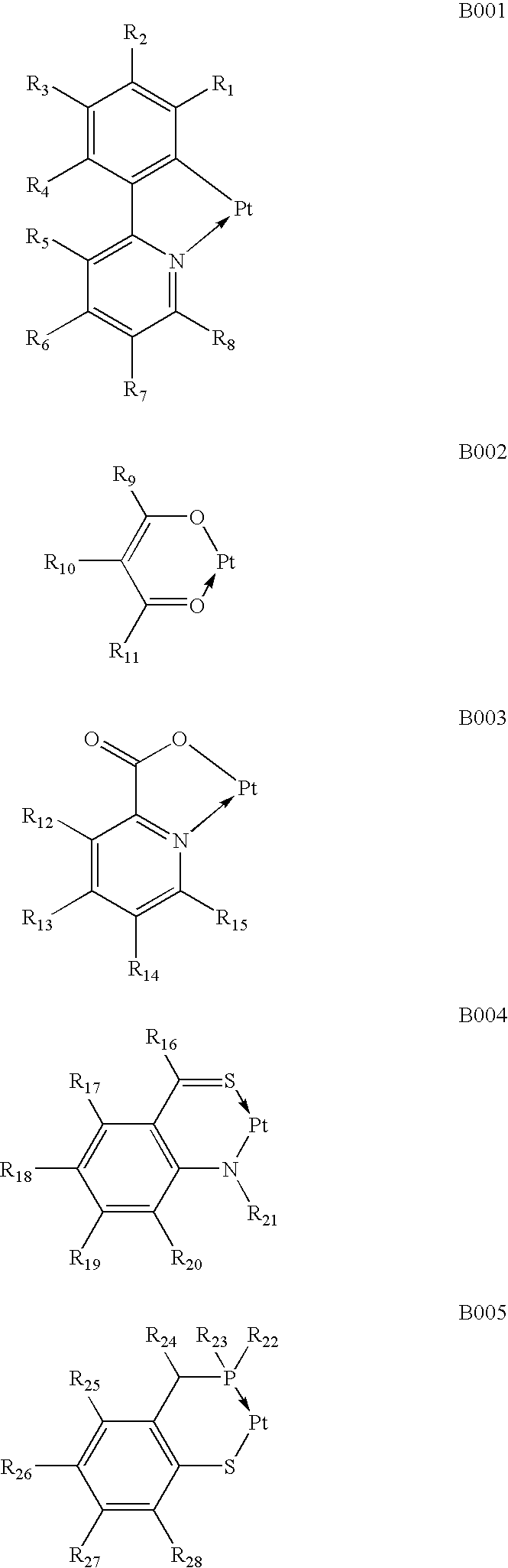
- X1 may be a ligand represented by B000 of the following formula.
- the ligand B000 represented by the following formula is shown in a state of being coupled to a platinum atom.
- ligands represented by X1 are shown below. However, these are intended merely as representative examples, and the present invention is not limited thereto.
- the ligands presented below are shown in a state of being coupled to the platinum atom.
- R 1 to R 28 are each a substituent identical to a substituent that may be present in the ring structure A in Formula (1).
- X2 represents a divalent-bidentate ligand.
- An atom forming a coordination bond with the platinum atom is not particularly limited, but may be, for example, a carbon atom, a nitrogen atom, an oxygen atom, a sulfur atom, or a phosphorus atom.
- X2 may be a bidentate ligand having a carbon atom and an oxygen atom that form covalent bonds with a platinum atom.
- ligands represented by X2 are shown below. However, these are inteneded merely as representative examples, and the present invention is not limited thereto.
- the ligands presented below are shown in a state of being coupled to the platinum atom.
- R 29 to R 56 are each a substituent identical to a substituent that may be present in the ring structure A in Formula (1).
- platinum complex in accordance with the present invention may be represented by the following General Formula (2)
- the platinum complex in accordance with the present invention can be synthesized, for example, by the following synthesis routine.
- the synthesis routine shown below is merely a representative example and a synthesis method for the platinum complex in accordance with the present invention is not limited thereto.
- the platinum complex in accordance with the present invention may be used after sufficient purification. Admixed impurities are often a reason for light emission deterioration caused by electric current. However, when polymer compounds are used as constituent materials of the element, impurities present in the polymer compounds may be difficult to remove. Therefore, the impurities may easily become admixed into the element, shortening the service life of the element.
- the platinum complex in accordance with the present invention is a monomolecular compound, by using a suitable purification method such as a recrystallization method, a column chromatography method, or a sublimation purification method, it may be possible to relatively easily remove the impurities. Therefore, durability of the organic light-emitting element can be improved.
- the platinum complex in accordance with the present invention has the following properties.
- the platinum complex in accordance with the present invention is an organometallic complex having a tetravalent platinum atom as a central metal, the complex may demonstrate the following effects.
- the coordination of the ligands constituting the complex to the central metal is of a steric octahedral form.
- the resultant effect may be that light quenching by stacking between identical molecules and variation in the emission color caused by the formation of excimers is inhibited.
- divalent platinum complex in an organometallic complex having a divalent platinum complex as a central atom (referred to hereinbelow as “divalent platinum complex”), the coordination is of a planar tetragonal ligand form. Therefore, because a divalent platinum complex has a planar shape, it is believed that light quenching caused by stacking between identical molecules and formation of excimers can more easily occur. Therefore, this can be the reason for a decrease in emission efficiency and variation of emission color when a divalent platinum complex is used as a light-emitting material.
- the platinum complex in accordance with the present invention is a neutral (non-ionic) organometallic complex, the following effects may be demonstrated.
- a neutral organometallic complex may often be more advantageous from the standpoint of sublimation ability of the material and also because there is no interaction of ionic properties between the complexes. Furthermore, from the standpoint of heat resistance that may become a problem when vacuum vapor deposition is used, an organometallic complex having multidentate ligands with a higher coordination force may provide improved heat resistance over organometallic complexes having a monodentate ligand.
- the bond force between the platinum atom, which is the central metal, and each of the ligands, is strong. Therefore, heat resistance of the complex itself may be further increased.
- the organic light-emitting element in accordance with the present invention comprises an anode, a cathode, and a layer of an organic compound sandwiched between the anode and the cathode.
- 1 a substrate
- 2 an anode
- 3 a light-emitting layer
- 4 a cathode
- 5 a hole transport layer
- 6 an electron transport layer
- 7 a hole injection layer
- 8 a hole/exciton blocking layer
- 10 , 20 , 30 , 40 , 50 , 60 refspective organic light-emitting elements.
- FIG. 1 is a cross-sectional view illustrating a first embodiment of the organic light-emitting element in accordance with the present invention.
- the organic light-emitting element 10 in FIG. 1 the anode 2 , light-emitting layer 3 , and cathode 4 are provided in the order of description on the substrate 1 .
- the organic light-emitting element 10 shown in FIG. 1 may be useful, for example, when the light-emitting layer 3 comprises an organic compound combining hole transport ability, electron transport ability, and light emission ability. Further, the organic light-emitting element 10 may also be useful when the light-emitting layer 3 is obtained by mixing organic compounds each having at least one characteristic selected from among the hole transport ability, electron transport ability, and light emission ability.
- FIG. 2 is a cross-sectional view illustrating a second embodiment of the organic light-emitting element in accordance with the present invention.
- the anode 2 , hole transport layer 5 , electron transport layer 6 , and cathode 4 are provided in the order of description on the substrate 1 .
- This organic light-emitting element 20 may be useful, for example, when a light-emitting organic compound having any of hole transport ability and electron transport ability is used in combination with an organic compound having only the electron transport ability or only the hole transport ability.
- the hole transport layer 5 or electron transport layer 6 may also serve as a light-emitting layer 3 .
- FIG. 3 is a cross-sectional view illustrating a third embodiment of the organic light-emitting element in accordance with the present invention.
- the organic light-emitting element 30 shown in FIG. 3 has a configuration similar to the organic light-emitting element 20 shown in FIG. 2 , however with the light-emitting layer 3 provided between the hole transport layer 5 and the electron transport layer 6 .
- the carrier transport function and the light emission function are separated, and compounds having respective characteristics from among the hole transport ability, electron transport ability, and light emission ability can be used in appropriate combinations.
- the degree of freedom in selecting suitable materials may be greatly increased and various compounds with different emission wavelengths can be used. Therefore, a variety of emission hues can be obtained.
- FIG. 4 is a cross-sectional view illustrating a fourth embodiment of the organic light-emitting element in accordance with the present invention.
- the organic light-emitting element 40 shown in FIG. 4 has a configuration similar to the organic light-emitting element 30 shown in FIG. 3 , however with a hole injection layer 7 being provided between the anode 2 and the hole transport layer 5 . Because the hole injection layer 7 is provided in the organic light-emitting element 40 , the adhesion of the anode 2 and hole transport layer 5 and the hole injection ability may be improved. Therefore, the voltage supplied may be effectively reduced.
- FIG. 5 is a cross-sectional view illustrating a fifth embodiment of the organic light-emitting element in accordance with the present invention.
- the organic light-emitting element 50 shown in FIG. 5 has a configuration similar to the organic light-emitting element 30 shown in FIG. 3 , however with a layer (hole/exciton blocking layer 8 ) that blocks the penetration of holes or excitons to the cathode side provided between the light-emitting layer 3 and the electron transport layer 6 .
- a layer hole/exciton blocking layer 8
- FIG. 6 is a cross-sectional view illustrating a sixth embodiment of the organic light-emitting element in accordance with the present invention.
- the organic light-emitting element 60 shown in FIG. 6 has a configuration similar to the organic light-emitting element 40 shown in FIG. 4 , however with the hole/exciton blocking layer 8 being provided between the light-emitting layer 3 and the electron transport layer 6 .
- the hole/exciton blocking layer 8 By using a compound with a very high ionization potential as a constituent material for the hole/exciton blocking layer 8 , it may be possible to increase the emission efficiency.
- FIG. 1 to FIG. 6 show examples of very basic element configurations, and the configuration of the organic light-emitting element using the platinum complex in accordance with the present invention is not intended to be limited to these particular configurations.
- an insulating layer, an adhesive layer, or an interference layer may be provided on the interfaces of electrodes and layers composed of organic compounds.
- the hole transport layer 5 may be composed of a plurality of layers with different ionization potentials.
- the electron transport layer 6 may be a multilayer laminated body composed of an organic material layer and a layer obtained by vapor co-deposition of an organic material and alkali metal ions, alkali metal salts, and the like.
- the platinum complex in accordance with the present invention can be used in any of the forms shown in FIGS. 1 to 6 .
- the organic light-emitting element in accordance with the present invention at least one kind of the platinum complex in accordance with the present invention is contained in the layer comprising an organic compound.
- the layer comprising an organic compound may be at least one of the light-emitting layer 3 , hole transport layer 5 , electron transport layer 6 , hole injection layer 7 , and hole/exciton blocking layer 8 shown in FIG. 1 to FIG. 6 .
- the complex may be included in the light-emitting layer 3 .
- the light-emitting layer 3 may be configured only with the platinum complex in accordance with the present invention. In another version, the light-emitting layer 3 may be configured with both a guest and a host.
- the platinum complex in accordance with the present invention when used as a host of the light-emitting layer 3 , one or more of the compounds represented by the following formulas can be used as the corresponding guest.
- the content ratio of the platinum complex may be equal to or higher than 50 wt. % and equal to or lower than 99.9 wt. % based on the entire constituent material of the light-emitting layer 3 .
- the platinum complex in accordance with the present invention may be used as a light-emitting material (guest) of the light-emitting layer 3 .
- guest a light-emitting material
- the compounds represented by the following formulas can be used as the corresponding host.
- the content ratio of the platinum complex may be equal to or higher than 0.1 wt. % and equal to or lower than 50 wt. %, such as equal to or higher than 0.1 wt. % and equal to or lower than 20 wt. %, based on the entire constituent material of the light-emitting layer 3 .
- the layer comprising an organic compound including the platinum complex in accordance with the present invention can be produced by, for example, at least one of a vacuum vapor deposition method, a casting method, a coating method, a spin coating method, an ink jet method, or the like. Further, other organic compound layers that do not contain the platinum complex in accordance with the present invention can be prepared by similar methods.
- a transparent electrode (anode 2 ) was formed by patterning ITO on a glass substrate (substrate 1 ).
- the thickness of the transparent electrode was 100 nm.
- the glass substrate in which the ITO was thus patterned will be referred to hereinbelow as an ITO-attached substrate.
- PEDOT: PSS H. C. Stark Co., Baytron P AI 4083
- the thickness of the hole transport layer was 30 nm.
- a coating liquid was prepared by mixing the below-described reagent and solvent.
- the coating liquid was dropped on the hole transport layer 5 and spin coated at 2000 rpm to form the electron transport layer 6 .
- the thickness of the electron transport layer 6 was 30 nm.
- the first metal electrode and second metal electrode functioned as the cathode 4 .
- the obtained organic light emitting element was confirmed to emit green light.
- the element of the present embodiment was confirmed to maintain good light emission under nitrogen atmosphere.
- the platinum complex according to the examples may be capable of realizing an organic light-emitting element of high efficiency and excellent stability.
Landscapes
- Chemical & Material Sciences (AREA)
- Organic Chemistry (AREA)
- Crystallography & Structural Chemistry (AREA)
- Inorganic Chemistry (AREA)
- Engineering & Computer Science (AREA)
- Materials Engineering (AREA)
- Electroluminescent Light Sources (AREA)
Abstract

In Formula (1), Pt represents a tetravalent platinum atom. The ring structure A represents a cyclic substituent having a carbon atom that forms a covalent bond with Pt. The ring structure B represents a cyclic substituent having Q that forms a coordination bond with Pt, where Q is a carbon atom, a nitrogen atom, or a phosphorous atom. X1 represents a monovalent-bidentate ligand, and X2 represents a divalent-bidentate ligand.
Description




- Chloroform: 99 wt. %.
- PVK (Aldrich Co.): 0.9 wt. %.

- Example Compound M025: 0.1 wt. %.
Claims (7)


Applications Claiming Priority (2)
| Application Number | Priority Date | Filing Date | Title |
|---|---|---|---|
| JP2007286104A JP5279234B2 (en) | 2007-11-02 | 2007-11-02 | Platinum complex and organic light emitting device using the same |
| JP2007-286104 | 2007-11-02 |
Publications (2)
| Publication Number | Publication Date |
|---|---|
| US20090115324A1 US20090115324A1 (en) | 2009-05-07 |
| US8147988B2 true US8147988B2 (en) | 2012-04-03 |
Family
ID=40587401
Family Applications (1)
| Application Number | Title | Priority Date | Filing Date |
|---|---|---|---|
| US12/261,882 Expired - Fee Related US8147988B2 (en) | 2007-11-02 | 2008-10-30 | Platinum complex and organic light-emitting element using same |
Country Status (2)
| Country | Link |
|---|---|
| US (1) | US8147988B2 (en) |
| JP (1) | JP5279234B2 (en) |
Families Citing this family (11)
| Publication number | Priority date | Publication date | Assignee | Title |
|---|---|---|---|---|
| WO2012132828A1 (en) * | 2011-03-29 | 2012-10-04 | 住友化学株式会社 | Process for producing organic photoelectric conversion element |
| JP5978843B2 (en) | 2012-02-02 | 2016-08-24 | コニカミノルタ株式会社 | Iridium complex compound, organic electroluminescence device material, organic electroluminescence device, lighting device and display device |
| US20150207080A1 (en) | 2012-08-24 | 2015-07-23 | Konica Minolta Inc. | Transparent electrode, electronic device, and method for manufacturing transparent electrode |
| JP6036204B2 (en) * | 2012-11-15 | 2016-11-30 | コニカミノルタ株式会社 | Organic electroluminescence element, display device and lighting device |
| US20160043334A1 (en) | 2013-03-29 | 2016-02-11 | Konica Minolta, Inc. | Material for organic electroluminescent elements, organic electroluminescent element, display device and lighting device |
| EP2980878B1 (en) | 2013-03-29 | 2019-05-01 | Konica Minolta, Inc. | Organic electroluminescent element, and lighting device and display device which are provided with same |
| US10121975B2 (en) * | 2013-07-03 | 2018-11-06 | Universal Display Corporation | Organic electroluminescent materials and devices |
| JP5831654B1 (en) | 2015-02-13 | 2015-12-09 | コニカミノルタ株式会社 | Aromatic heterocycle derivative, organic electroluminescence device using the same, illumination device and display device |
| JP6788314B2 (en) | 2016-01-06 | 2020-11-25 | コニカミノルタ株式会社 | Organic electroluminescence element, manufacturing method of organic electroluminescence element, display device and lighting device |
| US20180190915A1 (en) * | 2017-01-03 | 2018-07-05 | Universal Display Corporation | Organic electroluminescent materials and devices |
| WO2023214496A1 (en) * | 2022-05-02 | 2023-11-09 | キヤノン株式会社 | Metal complex and organic light-emitting element |
Citations (3)
| Publication number | Priority date | Publication date | Assignee | Title |
|---|---|---|---|---|
| JP2001181617A (en) | 1999-12-27 | 2001-07-03 | Fuji Photo Film Co Ltd | Light emitting element material composed of orthometalated palladium complex and light emitting element |
| WO2006067074A1 (en) | 2004-12-23 | 2006-06-29 | Ciba Specialty Chemicals Holding Inc. | Electroluminescent metal complexes with nucleophilic carbene ligands |
| JP2007099961A (en) * | 2005-10-06 | 2007-04-19 | Konica Minolta Holdings Inc | Organic electroluminescent element material, organic electroluminescent element, displaying device and lighting device |
Family Cites Families (5)
| Publication number | Priority date | Publication date | Assignee | Title |
|---|---|---|---|---|
| JP5009154B2 (en) * | 2004-07-07 | 2012-08-22 | ユニバーサル ディスプレイ コーポレイション | Stable and efficient electroluminescent material |
| KR101015882B1 (en) * | 2004-10-11 | 2011-02-23 | 삼성모바일디스플레이주식회사 | Cyclometallated Transition Metal Complexes and Organic Electroluminescent Devices Using the Same |
| JP2006213686A (en) * | 2005-02-07 | 2006-08-17 | Idemitsu Kosan Co Ltd | Metal complex compound and organic electroluminescence device using the same |
| JP5076891B2 (en) * | 2005-07-01 | 2012-11-21 | コニカミノルタホールディングス株式会社 | ORGANIC ELECTROLUMINESCENT ELEMENT MATERIAL, ORGANIC ELECTROLUMINESCENT ELEMENT, DISPLAY DEVICE AND LIGHTING DEVICE |
| JP2008143826A (en) * | 2006-12-08 | 2008-06-26 | Idemitsu Kosan Co Ltd | Luminescent platinum complex and organic electroluminescence light emitting device using the same |
-
2007
- 2007-11-02 JP JP2007286104A patent/JP5279234B2/en not_active Expired - Fee Related
-
2008
- 2008-10-30 US US12/261,882 patent/US8147988B2/en not_active Expired - Fee Related
Patent Citations (3)
| Publication number | Priority date | Publication date | Assignee | Title |
|---|---|---|---|---|
| JP2001181617A (en) | 1999-12-27 | 2001-07-03 | Fuji Photo Film Co Ltd | Light emitting element material composed of orthometalated palladium complex and light emitting element |
| WO2006067074A1 (en) | 2004-12-23 | 2006-06-29 | Ciba Specialty Chemicals Holding Inc. | Electroluminescent metal complexes with nucleophilic carbene ligands |
| JP2007099961A (en) * | 2005-10-06 | 2007-04-19 | Konica Minolta Holdings Inc | Organic electroluminescent element material, organic electroluminescent element, displaying device and lighting device |
Non-Patent Citations (4)
| Title |
|---|
| "Highly Phosphorescent Bis-Cyclometalated Iridium Complexes:Synthesis,Photophysical Characterization,and Use in Organic Light Emitting Diodes" Lamansky,S.;Djurovich,P.;Murphy,D.;Abdel-Razzaq,F.;Lee,H.-E.;Adachi,C.;Burrows,P.E.;Forrest,S.R.;Thompson,M.E. J.Am.Chem.Soc.;2001;123(18);4304-4312. |
| "Organoplatinum(IV) tris-chelate complexes,each having a cyclic metallacarbonate ring:synthesis,characterization and kineticstudies of the formation" Rashidi,M;Shahabadi,N;Nabavizadeh,M.S. DaltonTrans.;2004;619-622. |
| "Synthesis and Characterization of Phosphorescent Cyclometalated Platinum Complexes" Brooks,J.;Babayan,Y.;Lamansky,S.;Djurovich,P.I.;Tsyba,I.;Bau,R.;Thompson,M.E. Inorg.Chem.;2002;41(12);3055-3066. |
| English language machine translation of JP 2007-099961 A, 2007. * |
Also Published As
| Publication number | Publication date |
|---|---|
| JP5279234B2 (en) | 2013-09-04 |
| US20090115324A1 (en) | 2009-05-07 |
| JP2009114086A (en) | 2009-05-28 |
Similar Documents
| Publication | Publication Date | Title |
|---|---|---|
| US8147988B2 (en) | Platinum complex and organic light-emitting element using same | |
| US11482684B2 (en) | Organic electroluminescent materials and devices | |
| US11063229B2 (en) | Organic electroluminescent materials and devices | |
| US11374180B2 (en) | Organic electroluminescent materials and devices | |
| KR101233855B1 (en) | Organometallic compounds and devices made with such compounds | |
| US9130177B2 (en) | 5-substituted 2 phenylquinoline complexes materials for light emitting diode | |
| US8883322B2 (en) | Pyridyl carbene phosphorescent emitters | |
| US9190621B2 (en) | Materials for organic light emitting diode | |
| US9725476B2 (en) | Silylated metal complexes | |
| US8492006B2 (en) | Germanium-containing red emitter materials for organic light emitting diode | |
| US20180301641A1 (en) | Platinum complexes and devices | |
| US20090039776A1 (en) | Organometallic complex and organic light-emitting element using same | |
| US9435021B2 (en) | Co-deposition methods for the fabrication of organic optoelectronic devices | |
| US9217004B2 (en) | Organic light emitting materials | |
| US9118017B2 (en) | Host compounds for red phosphorescent OLEDs | |
| US20070259207A1 (en) | Metal complex, light-emitting device, and image display apparatus | |
| US9163174B2 (en) | Highly efficient phosphorescent materials | |
| CN114628600B (en) | Organic electroluminescent element | |
| KR101652325B1 (en) | Phosphoryl substituted triazine derivatives and organic electroluminescent device including the same | |
| JP2009114087A (en) | Fused polycyclic compound and organic light emitting device using the same | |
| JP2011243931A (en) | Organic light-emitting element |
Legal Events
| Date | Code | Title | Description |
|---|---|---|---|
| AS | Assignment |
Owner name: CANON KABUSHIKI KAISHA, JAPAN Free format text: ASSIGNMENT OF ASSIGNORS INTEREST;ASSIGNORS:HASHIMOTO, MASASHI;IGAWA, SATOSHI;TAKIGUCHI, TAKAO;AND OTHERS;REEL/FRAME:021898/0001;SIGNING DATES FROM 20081024 TO 20081027 Owner name: CANON KABUSHIKI KAISHA, JAPAN Free format text: ASSIGNMENT OF ASSIGNORS INTEREST;ASSIGNORS:HASHIMOTO, MASASHI;IGAWA, SATOSHI;TAKIGUCHI, TAKAO;AND OTHERS;SIGNING DATES FROM 20081024 TO 20081027;REEL/FRAME:021898/0001 |
|
| STCF | Information on status: patent grant |
Free format text: PATENTED CASE |
|
| FEPP | Fee payment procedure |
Free format text: PAYOR NUMBER ASSIGNED (ORIGINAL EVENT CODE: ASPN); ENTITY STATUS OF PATENT OWNER: LARGE ENTITY |
|
| FPAY | Fee payment |
Year of fee payment: 4 |
|
| FEPP | Fee payment procedure |
Free format text: MAINTENANCE FEE REMINDER MAILED (ORIGINAL EVENT CODE: REM.); ENTITY STATUS OF PATENT OWNER: LARGE ENTITY |
|
| LAPS | Lapse for failure to pay maintenance fees |
Free format text: PATENT EXPIRED FOR FAILURE TO PAY MAINTENANCE FEES (ORIGINAL EVENT CODE: EXP.); ENTITY STATUS OF PATENT OWNER: LARGE ENTITY |
|
| STCH | Information on status: patent discontinuation |
Free format text: PATENT EXPIRED DUE TO NONPAYMENT OF MAINTENANCE FEES UNDER 37 CFR 1.362 |
|
| FP | Lapsed due to failure to pay maintenance fee |
Effective date: 20200403 |