US8143375B2 - Aziridine aldehydes, aziridine-conjugated amino derivatives, aziridine-conjugated biomolecules and processes for their preparation - Google Patents
Aziridine aldehydes, aziridine-conjugated amino derivatives, aziridine-conjugated biomolecules and processes for their preparation Download PDFInfo
- Publication number
- US8143375B2 US8143375B2 US12/446,343 US44634307A US8143375B2 US 8143375 B2 US8143375 B2 US 8143375B2 US 44634307 A US44634307 A US 44634307A US 8143375 B2 US8143375 B2 US 8143375B2
- Authority
- US
- United States
- Prior art keywords
- aryl
- formula
- lower alkyl
- aziridine
- compound
- Prior art date
- Legal status (The legal status is an assumption and is not a legal conclusion. Google has not performed a legal analysis and makes no representation as to the accuracy of the status listed.)
- Active, expires
Links
- 0 [1*]C1([3*])[N@@]2[C@@H](C([4*])([5*])[C@]3([2*])N[C@]3([1*])[3*])OC(O)C([4*])([5*])C21[2*].[1*][C@@]1([3*])N[C@]1([2*])C([4*])([5*])C=O Chemical compound [1*]C1([3*])[N@@]2[C@@H](C([4*])([5*])[C@]3([2*])N[C@]3([1*])[3*])OC(O)C([4*])([5*])C21[2*].[1*][C@@]1([3*])N[C@]1([2*])C([4*])([5*])C=O 0.000 description 73
- ROCQNVNJGDESAQ-VEDVMXKPSA-N O=C[C@H]1NC1C1=CC=CC=C1 Chemical compound O=C[C@H]1NC1C1=CC=CC=C1 ROCQNVNJGDESAQ-VEDVMXKPSA-N 0.000 description 4
- OVQXACDDVLRVJX-JTQLQIEISA-N CC(C)[C@H](N)C(=O)NC1=CC=CC=C1 Chemical compound CC(C)[C@H](N)C(=O)NC1=CC=CC=C1 OVQXACDDVLRVJX-JTQLQIEISA-N 0.000 description 3
- NNUSVAFWBQEDHJ-CVSZPUQOSA-N C.[H][C@@]12NC3=C(C=CC=C3)[C@@]13CCN(CC1=CC=CC=C1)[C@@]3([H])[C@@]1(C3=CC=CC=C3)CN21.[H][C@@]12NC3=C(C=CC=C3)[C@@]13CCN(CC1=CC=CC=C1)[C@@]3([H])[C@@]1([H])C(C3=CC=CC=C3)[N@@]21.[H][C@@]12NC3=C(C=CC=C3)[C@@]13CCN(CC1=CC=CC=C1)[C@@]3([H])[C@@]1([H])C(CO[Si](C)(C)C(C)(C)C)[N@@]21.[H][C@@]12NC3=C(C=CC=C3)[C@@]13CCN(CC1=CC=CC=C1)[C@@]3([H])[C@@]1([H])CN21.[H][C@]12N(CC3=CC=CC=C3)CC[C@]13C1=C(C=CC=C1)N[C@]3([H])N1C[C@@]12C1=CC=CC=C1.[H][C@]12N(CC3=CC=CC=C3)CC[C@]13C1=C(C=CC=C1)N[C@]3([H])N1C[C@@]12[H].[H][C@]12N(CC3=CC=CC=C3)CC[C@]13C1=C(C=CC=C1)N[C@]3([H])[N@]1C(C3=CC=CC=C3)[C@@]12[H].[H][C@]12N(CC3=CC=CC=C3)CC[C@]13C1=C(C=CC=C1)N[C@]3([H])[N@]1C(CC)[C@@]12[H] Chemical compound C.[H][C@@]12NC3=C(C=CC=C3)[C@@]13CCN(CC1=CC=CC=C1)[C@@]3([H])[C@@]1(C3=CC=CC=C3)CN21.[H][C@@]12NC3=C(C=CC=C3)[C@@]13CCN(CC1=CC=CC=C1)[C@@]3([H])[C@@]1([H])C(C3=CC=CC=C3)[N@@]21.[H][C@@]12NC3=C(C=CC=C3)[C@@]13CCN(CC1=CC=CC=C1)[C@@]3([H])[C@@]1([H])C(CO[Si](C)(C)C(C)(C)C)[N@@]21.[H][C@@]12NC3=C(C=CC=C3)[C@@]13CCN(CC1=CC=CC=C1)[C@@]3([H])[C@@]1([H])CN21.[H][C@]12N(CC3=CC=CC=C3)CC[C@]13C1=C(C=CC=C1)N[C@]3([H])N1C[C@@]12C1=CC=CC=C1.[H][C@]12N(CC3=CC=CC=C3)CC[C@]13C1=C(C=CC=C1)N[C@]3([H])N1C[C@@]12[H].[H][C@]12N(CC3=CC=CC=C3)CC[C@]13C1=C(C=CC=C1)N[C@]3([H])[N@]1C(C3=CC=CC=C3)[C@@]12[H].[H][C@]12N(CC3=CC=CC=C3)CC[C@]13C1=C(C=CC=C1)N[C@]3([H])[N@]1C(CC)[C@@]12[H] NNUSVAFWBQEDHJ-CVSZPUQOSA-N 0.000 description 2
- OLYWGXUJESDUAC-UHFFFAOYSA-N CC(=O)C(C)N Chemical compound CC(=O)C(C)N OLYWGXUJESDUAC-UHFFFAOYSA-N 0.000 description 2
- TVJBDLSJTDKBNQ-QEBIZSHSSA-N CC(C)(C)[Si](C)(C)OCC1N[C@@H]1C1O[C@@H](O)C2C(CO[Si](C)(C)C(C)(C)C)[N@@]12 Chemical compound CC(C)(C)[Si](C)(C)OCC1N[C@@H]1C1O[C@@H](O)C2C(CO[Si](C)(C)C(C)(C)C)[N@@]12 TVJBDLSJTDKBNQ-QEBIZSHSSA-N 0.000 description 2
- GCCSVXGGNFVGLL-RKDXNWHRSA-N CC(C)(C)[Si](C)(C)OC[C@H]1N[C@@H]1C=O Chemical compound CC(C)(C)[Si](C)(C)OC[C@H]1N[C@@H]1C=O GCCSVXGGNFVGLL-RKDXNWHRSA-N 0.000 description 2
- QJNGUNZTULLAGM-DQEYMECFSA-N CC(C)[C@H](NC[C@@H](CSC(=O)C1=CC=CC=C1)NC(=O)C1=CC=CC=C1)C(=O)NC1=CC=CC=C1 Chemical compound CC(C)[C@H](NC[C@@H](CSC(=O)C1=CC=CC=C1)NC(=O)C1=CC=CC=C1)C(=O)NC1=CC=CC=C1 QJNGUNZTULLAGM-DQEYMECFSA-N 0.000 description 2
- QCZYXKIBQKUTBI-ABLWVSNPSA-N CCC(C)CNC(=O)[C@H](CC(C)C)NC(=O)OC(C)(C)C Chemical compound CCC(C)CNC(=O)[C@H](CC(C)C)NC(=O)OC(C)(C)C QCZYXKIBQKUTBI-ABLWVSNPSA-N 0.000 description 2
- JKOHCUJQDPSYNR-AXDSSHIGSA-N CCOC(=O)[C@H]1NC1C1=CC=CC=C1 Chemical compound CCOC(=O)[C@H]1NC1C1=CC=CC=C1 JKOHCUJQDPSYNR-AXDSSHIGSA-N 0.000 description 2
- AVOLZWQNUOCGGJ-UHNVWZDZSA-N CCOC([C@H]1N[C@@H]1CO)=O Chemical compound CCOC([C@H]1N[C@@H]1CO)=O AVOLZWQNUOCGGJ-UHNVWZDZSA-N 0.000 description 2
- BXCGVAOWUFKCRN-JTQLQIEISA-N CN(C)C(=O)[C@@H](N)CC1=CC=CC=C1 Chemical compound CN(C)C(=O)[C@@H](N)CC1=CC=CC=C1 BXCGVAOWUFKCRN-JTQLQIEISA-N 0.000 description 2
- WLKQLTSLRNRVSR-PINNFIIQSA-N O[C@@H]1OC([C@@H]2CN2)[N@@]2CC12 Chemical compound O[C@@H]1OC([C@@H]2CN2)[N@@]2CC12 WLKQLTSLRNRVSR-PINNFIIQSA-N 0.000 description 2
- RYUJUWWXTHBUSR-USFKKOJUSA-N O[C@@H]1OC([C@H]2NC2C2=CC=CS2)[N@]2C(C3=CC=CS3)C12 Chemical compound O[C@@H]1OC([C@H]2NC2C2=CC=CS2)[N@]2C(C3=CC=CS3)C12 RYUJUWWXTHBUSR-USFKKOJUSA-N 0.000 description 2
- XITCGNIZVPZTPG-UHUMZNAXSA-N [H]N1C[C@@H]1CN[C@H](C(=O)NC1=CC=CC=C1)C(C)C.[H]N1[C@@H](C)[C@@H]1CN[C@H](C(=O)NC1=CC=CC=C1)C(C)C Chemical compound [H]N1C[C@@H]1CN[C@H](C(=O)NC1=CC=CC=C1)C(C)C.[H]N1[C@@H](C)[C@@H]1CN[C@H](C(=O)NC1=CC=CC=C1)C(C)C XITCGNIZVPZTPG-UHUMZNAXSA-N 0.000 description 2
- CEFGREAHXDAPKS-RKOYSABSSA-N B.C.C.C.C1=CC=C(NC[C@H]2NC2C2=CC=CC=C2)C=C1.O=C[C@H]1NC1C1=CC=CC=C1.OC[C@H]1NC1C1=CC=CC=C1.O[C@@H]1O[C@H]([C@H]2NC2C2=CC=CC=C2)[N@]2C(C3=CC=CC=C3)C12.[NaH] Chemical compound B.C.C.C.C1=CC=C(NC[C@H]2NC2C2=CC=CC=C2)C=C1.O=C[C@H]1NC1C1=CC=CC=C1.OC[C@H]1NC1C1=CC=CC=C1.O[C@@H]1O[C@H]([C@H]2NC2C2=CC=CC=C2)[N@]2C(C3=CC=CC=C3)C12.[NaH] CEFGREAHXDAPKS-RKOYSABSSA-N 0.000 description 1
- UKYVAKSIWSMEMV-AAFJCEBUSA-N C(C1N=C[C@@H]1c1ccccc1)Nc1ccccc1 Chemical compound C(C1N=C[C@@H]1c1ccccc1)Nc1ccccc1 UKYVAKSIWSMEMV-AAFJCEBUSA-N 0.000 description 1
- SLINXRFJCMUFPC-UHFFFAOYSA-N C.C.C.C.C.C.C.C.C.C.CC.CC Chemical compound C.C.C.C.C.C.C.C.C.C.CC.CC SLINXRFJCMUFPC-UHFFFAOYSA-N 0.000 description 1
- YJVYUBOTATXLTJ-LAEWKUKJSA-N C.C1=CC=C(CNCCC2=CNC3=CC=CC=C23)C=C1.C1=CC=C(CNCCC2=CNC3=CC=CC=C23)C=C1.[H]C(=O)[C@@H]1C(C2=CC=CC=C2)N1[H].[H]N1C(/C=N(/CCC2=CNC3=CC=CC=C23)CC2=CC=CC=C2)[C@H]1C1=CC=CC=C1.[H]N1C(C2=CC=CC=C2)[C@]1([H])[C@@]1([H])N(CC2=CC=CC=C2)CC[C@@]12C=N([H])C1=CC=CC=C12.[H][C@]12N(CC3=CC=CC=C3)CC[C@]13C1=CC=CC=C1N[C@]3([H])[N@]1C(C3=CC=CC=C3)[C@@]12[H] Chemical compound C.C1=CC=C(CNCCC2=CNC3=CC=CC=C23)C=C1.C1=CC=C(CNCCC2=CNC3=CC=CC=C23)C=C1.[H]C(=O)[C@@H]1C(C2=CC=CC=C2)N1[H].[H]N1C(/C=N(/CCC2=CNC3=CC=CC=C23)CC2=CC=CC=C2)[C@H]1C1=CC=CC=C1.[H]N1C(C2=CC=CC=C2)[C@]1([H])[C@@]1([H])N(CC2=CC=CC=C2)CC[C@@]12C=N([H])C1=CC=CC=C12.[H][C@]12N(CC3=CC=CC=C3)CC[C@]13C1=CC=CC=C1N[C@]3([H])[N@]1C(C3=CC=CC=C3)[C@@]12[H] YJVYUBOTATXLTJ-LAEWKUKJSA-N 0.000 description 1
- HIRFHRSUBNOYHH-IRZXTZLLSA-N C.CC(=O)[C@H]1N[C@@H]1CO[Si](C)(C)C(C)(C)C.CCOC(=O)[C@H]1N[C@@H]1CO Chemical compound C.CC(=O)[C@H]1N[C@@H]1CO[Si](C)(C)C(C)(C)C.CCOC(=O)[C@H]1N[C@@H]1CO HIRFHRSUBNOYHH-IRZXTZLLSA-N 0.000 description 1
- GDCUQAFJYMJEGA-IUOGBCJWSA-N C1=CC=C(CNCCC2=CNC3=CC=CC=C23)C=C1.O=C[C@H]1NC1C1=CC=CC=C1.[2HH].[H][C@@]12NC3=C(C=CC=C3)[C@@]13CCN(CC1=CC=CC=C1)[C@@]3([H])[C@@]1([H])C(C3=CC=CC=C3)[N@@]21.[H][C@]12N(CC3=CC=CC=C3)CC[C@]13C1=C(C=CC=C1)N[C@]3([H])[N@]1C(C3=CC=CC=C3)[C@@]12[H] Chemical compound C1=CC=C(CNCCC2=CNC3=CC=CC=C23)C=C1.O=C[C@H]1NC1C1=CC=CC=C1.[2HH].[H][C@@]12NC3=C(C=CC=C3)[C@@]13CCN(CC1=CC=CC=C1)[C@@]3([H])[C@@]1([H])C(C3=CC=CC=C3)[N@@]21.[H][C@]12N(CC3=CC=CC=C3)CC[C@]13C1=C(C=CC=C1)N[C@]3([H])[N@]1C(C3=CC=CC=C3)[C@@]12[H] GDCUQAFJYMJEGA-IUOGBCJWSA-N 0.000 description 1
- PGHMWDBAEDWHAO-GICMACPYSA-N C1=CC=C(NC[C@H]2NC2C2=CC=CC=C2)C=C1 Chemical compound C1=CC=C(NC[C@H]2NC2C2=CC=CC=C2)C=C1 PGHMWDBAEDWHAO-GICMACPYSA-N 0.000 description 1
- GQTXKEVAUZYHGE-UHFFFAOYSA-N C=C(C(=O)OC)C1=CC=CC=C1 Chemical compound C=C(C(=O)OC)C1=CC=CC=C1 GQTXKEVAUZYHGE-UHFFFAOYSA-N 0.000 description 1
- KKADRFNZDWKNTB-UHFFFAOYSA-N C=CC1CN1.O=CC1CN1 Chemical compound C=CC1CN1.O=CC1CN1 KKADRFNZDWKNTB-UHFFFAOYSA-N 0.000 description 1
- FMQYLFGQPZKINK-WVGIRBSBSA-N CC(=O)[C@H]1N[C@@H]1CO[Si](C)(C)C(C)(C)C.CCOC(=O)[C@H]1N[C@@H]1CO Chemical compound CC(=O)[C@H]1N[C@@H]1CO[Si](C)(C)C(C)(C)C.CCOC(=O)[C@H]1N[C@@H]1CO FMQYLFGQPZKINK-WVGIRBSBSA-N 0.000 description 1
- LLQIKSJTBKCTPV-UHFFFAOYSA-N CC(C)C(ON)=O Chemical compound CC(C)C(ON)=O LLQIKSJTBKCTPV-UHFFFAOYSA-N 0.000 description 1
- VVAWMYRTKWZZHQ-OLZOCXBDSA-N CC(C)[C@@H](C(Nc1ccccc1)=O)NC[C@@H]1NC1 Chemical compound CC(C)[C@@H](C(Nc1ccccc1)=O)NC[C@@H]1NC1 VVAWMYRTKWZZHQ-OLZOCXBDSA-N 0.000 description 1
- OVQXACDDVLRVJX-SNVBAGLBSA-N CC(C)[C@@H](N)C(=O)NC1=CC=CC=C1 Chemical compound CC(C)[C@@H](N)C(=O)NC1=CC=CC=C1 OVQXACDDVLRVJX-SNVBAGLBSA-N 0.000 description 1
- DTRPIMDSGWLSTR-IWGXUMKNSA-N CC(C)[C@H](NC[C@@H](CSC(=O)C1=CC=CC=C1)CC(=O)C1=CC=CC=C1)C(=O)CC1=CC=CC=C1.CC(C)[C@H](NC[C@H]1CN1)C(=O)CC1=CC=CC=C1.O=C(S)C1=CC=CC=C1 Chemical compound CC(C)[C@H](NC[C@@H](CSC(=O)C1=CC=CC=C1)CC(=O)C1=CC=CC=C1)C(=O)CC1=CC=CC=C1.CC(C)[C@H](NC[C@H]1CN1)C(=O)CC1=CC=CC=C1.O=C(S)C1=CC=CC=C1 DTRPIMDSGWLSTR-IWGXUMKNSA-N 0.000 description 1
- QNIPSOHDYNXPQK-SNUAYSJOSA-N CC1N[C@H]1C1O[C@H](O)C2C(C)[N@@]21 Chemical compound CC1N[C@H]1C1O[C@H](O)C2C(C)[N@@]21 QNIPSOHDYNXPQK-SNUAYSJOSA-N 0.000 description 1
- SOWWQDYNXSVQGB-AXDSSHIGSA-N CCC(C)CNC(=O)[C@@H](N)CC(C)C Chemical compound CCC(C)CNC(=O)[C@@H](N)CC(C)C SOWWQDYNXSVQGB-AXDSSHIGSA-N 0.000 description 1
- WOCFLCLDEJKGGH-MLWJPKLSSA-N CCC(C)CNC(=O)[C@H](C)N Chemical compound CCC(C)CNC(=O)[C@H](C)N WOCFLCLDEJKGGH-MLWJPKLSSA-N 0.000 description 1
- POVCBNHUMJBDDA-WZLIPLRTSA-N CCC1C2[C@H](O)OC([C@H]3NC3CO[Si](C)(C)C(C)(C)C)[N@]12.O[C@@H]1OC([C@@H]2CN2)[N@@]2CC12.O[C@@H]1OC([C@H]2NC2C2=CC=CC=C2)[N@]2C(C3=CC=CC=C3)C12.O[C@@H]1OC([C@H]2NC2C2=CC=CS2)[N@]2C(C3=CC=CS3)C12.O[C@@H]1OC([C@]2(C3=CC=CC=C3)CN2)[N@@]2CC12C1=CC=CC=C1 Chemical compound CCC1C2[C@H](O)OC([C@H]3NC3CO[Si](C)(C)C(C)(C)C)[N@]12.O[C@@H]1OC([C@@H]2CN2)[N@@]2CC12.O[C@@H]1OC([C@H]2NC2C2=CC=CC=C2)[N@]2C(C3=CC=CC=C3)C12.O[C@@H]1OC([C@H]2NC2C2=CC=CS2)[N@]2C(C3=CC=CS3)C12.O[C@@H]1OC([C@]2(C3=CC=CC=C3)CN2)[N@@]2CC12C1=CC=CC=C1 POVCBNHUMJBDDA-WZLIPLRTSA-N 0.000 description 1
- POVCBNHUMJBDDA-XIONKOLRSA-N CCC1C2[C@H](O)OC([C@H]3N[C@@H]3CO[Si](C)(C)C(C)(C)C)[N@]12.O[C@@H]1OC([C@@H]2CN2)[N@@]2CC12.O[C@@H]1OC([C@H]2N[C@@H]2C2=CC=CC=C2)[N@]2C(C3=CC=CC=C3)C12.O[C@@H]1OC([C@H]2N[C@@H]2C2=CC=CS2)[N@]2C(C3=CC=CS3)C12.O[C@@H]1OC([C@]2(C3=CC=CC=C3)CN2)[N@@]2CC12C1=CC=CC=C1 Chemical compound CCC1C2[C@H](O)OC([C@H]3N[C@@H]3CO[Si](C)(C)C(C)(C)C)[N@]12.O[C@@H]1OC([C@@H]2CN2)[N@@]2CC12.O[C@@H]1OC([C@H]2N[C@@H]2C2=CC=CC=C2)[N@]2C(C3=CC=CC=C3)C12.O[C@@H]1OC([C@H]2N[C@@H]2C2=CC=CS2)[N@]2C(C3=CC=CS3)C12.O[C@@H]1OC([C@]2(C3=CC=CC=C3)CN2)[N@@]2CC12C1=CC=CC=C1 POVCBNHUMJBDDA-XIONKOLRSA-N 0.000 description 1
- POVCBNHUMJBDDA-MNKJQKOMSA-N CCC1C2[C@H](O)OC([C@H]3N[C@@H]3CO[Si](C)(C)C(C)(C)C)[N@]12.O[C@@H]1OC([C@@H]2CN2)[N@@]2CC12.O[C@@H]1OC([C@H]2N[C@@H]2C2=CC=CC=C2)[N@]2C(C3=CC=CC=C3)C12.O[C@@H]1OC([C@H]2N[C@@H]2C2=CC=CS2)[N@]2C(C3=CC=CS3)C12.O[C@@H]1OC([C@]2(C3=CC=CC=C3)CN2)[N@@]2C[C@@]12C1=CC=CC=C1 Chemical compound CCC1C2[C@H](O)OC([C@H]3N[C@@H]3CO[Si](C)(C)C(C)(C)C)[N@]12.O[C@@H]1OC([C@@H]2CN2)[N@@]2CC12.O[C@@H]1OC([C@H]2N[C@@H]2C2=CC=CC=C2)[N@]2C(C3=CC=CC=C3)C12.O[C@@H]1OC([C@H]2N[C@@H]2C2=CC=CS2)[N@]2C(C3=CC=CS3)C12.O[C@@H]1OC([C@]2(C3=CC=CC=C3)CN2)[N@@]2C[C@@]12C1=CC=CC=C1 POVCBNHUMJBDDA-MNKJQKOMSA-N 0.000 description 1
- YEPCVIBNQHROMW-RXMQYKEDSA-N CCCOC(=O)[C@H]1CN1 Chemical compound CCCOC(=O)[C@H]1CN1 YEPCVIBNQHROMW-RXMQYKEDSA-N 0.000 description 1
- FNGZPWHUBUFDGL-IQJVQPQPSA-N CCN(CC)C(=O)[C@]1(C)NOC(O)[C@@H]1C1=CC=CC=C1.[H]C(=O)[C@H](C1=CC=CC=C1)[C@@](C)(NOC(C)=O)C(=O)N(CC)CC.[H]C(=O)[C@]1(C2=CC=CC=C2)N[C@]1(C)C(=O)N(CC)CC Chemical compound CCN(CC)C(=O)[C@]1(C)NOC(O)[C@@H]1C1=CC=CC=C1.[H]C(=O)[C@H](C1=CC=CC=C1)[C@@](C)(NOC(C)=O)C(=O)N(CC)CC.[H]C(=O)[C@]1(C2=CC=CC=C2)N[C@]1(C)C(=O)N(CC)CC FNGZPWHUBUFDGL-IQJVQPQPSA-N 0.000 description 1
- YBHAGWCDVYYVRD-UHFFFAOYSA-N CCOC(=O)C1(C2=CC=CC=C2)CN1 Chemical compound CCOC(=O)C1(C2=CC=CC=C2)CN1 YBHAGWCDVYYVRD-UHFFFAOYSA-N 0.000 description 1
- PPYWPOYZHFXIPO-GVHYBUMESA-N CCOC(=O)C1N[C@@H]1C1=CC=CS1 Chemical compound CCOC(=O)C1N[C@@H]1C1=CC=CS1 PPYWPOYZHFXIPO-GVHYBUMESA-N 0.000 description 1
- JGYCULMWHSWTMZ-GVHYBUMESA-N CCOC(=O)C1O[C@@H]1C1=CC=CS1 Chemical compound CCOC(=O)C1O[C@@H]1C1=CC=CS1 JGYCULMWHSWTMZ-GVHYBUMESA-N 0.000 description 1
- LQCNSMGLNLPUIE-BYPYZUCNSA-N CCOC(=O)[C@@H]1CN1 Chemical compound CCOC(=O)[C@@H]1CN1 LQCNSMGLNLPUIE-BYPYZUCNSA-N 0.000 description 1
- PKALZYGQHFFGOB-CVFLQOERSA-N CCOC(=O)[C@@H]1CSC([C@@H]2N[C@H]2C2=CC=CC=C2)N1.CCOC(=O)[C@@H]1CSC([C@H]2N[C@@H]2C2=CC=CC=C2)N1 Chemical compound CCOC(=O)[C@@H]1CSC([C@@H]2N[C@H]2C2=CC=CC=C2)N1.CCOC(=O)[C@@H]1CSC([C@H]2N[C@@H]2C2=CC=CC=C2)N1 PKALZYGQHFFGOB-CVFLQOERSA-N 0.000 description 1
- PPYWPOYZHFXIPO-MQWKRIRWSA-N CCOC(=O)[C@H]1NC1C1=CC=CS1 Chemical compound CCOC(=O)[C@H]1NC1C1=CC=CS1 PPYWPOYZHFXIPO-MQWKRIRWSA-N 0.000 description 1
- DAEHKIUTEOCDAP-AXDSSHIGSA-N CCOC(=O)[C@H]1NC1CO[Si](C)(C)C(C)(C)C Chemical compound CCOC(=O)[C@H]1NC1CO[Si](C)(C)C(C)(C)C DAEHKIUTEOCDAP-AXDSSHIGSA-N 0.000 description 1
- ZDCRASVHGJDHRS-WDSKDSINSA-N CCOC(=O)[C@H]1N[C@@H]1C(=O)OCC Chemical compound CCOC(=O)[C@H]1N[C@@H]1C(=O)OCC ZDCRASVHGJDHRS-WDSKDSINSA-N 0.000 description 1
- DAEHKIUTEOCDAP-ZJUUUORDSA-N CCOC(=O)[C@H]1N[C@@H]1CO[Si](C)(C)C(C)(C)C Chemical compound CCOC(=O)[C@H]1N[C@@H]1CO[Si](C)(C)C(C)(C)C DAEHKIUTEOCDAP-ZJUUUORDSA-N 0.000 description 1
- YBHAGWCDVYYVRD-LLVKDONJSA-N CCOC(=O)[C@]1(C2=CC=CC=C2)CN1 Chemical compound CCOC(=O)[C@]1(C2=CC=CC=C2)CN1 YBHAGWCDVYYVRD-LLVKDONJSA-N 0.000 description 1
- PPYWPOYZHFXIPO-SFYZADRCSA-N CCOC([C@H]1N[C@@H]1c1ccc[s]1)=O Chemical compound CCOC([C@H]1N[C@@H]1c1ccc[s]1)=O PPYWPOYZHFXIPO-SFYZADRCSA-N 0.000 description 1
- JGYCULMWHSWTMZ-SFYZADRCSA-N CCOC([C@H]1O[C@@H]1c1ccc[s]1)=O Chemical compound CCOC([C@H]1O[C@@H]1c1ccc[s]1)=O JGYCULMWHSWTMZ-SFYZADRCSA-N 0.000 description 1
- NDBZORVZYWHUFI-PCBHIQLYSA-N CNC(=O)[C@@H](N)CC(C)C.CNC(=O)[C@H](CC(C)C)NCC1NC1C1=CC=CC=C1.O[C@@H]1OC([C@H]2NC2C2=CC=CC=C2)[N@]2C(C3=CC=CC=C3)C12 Chemical compound CNC(=O)[C@@H](N)CC(C)C.CNC(=O)[C@H](CC(C)C)NCC1NC1C1=CC=CC=C1.O[C@@H]1OC([C@H]2NC2C2=CC=CC=C2)[N@]2C(C3=CC=CC=C3)C12 NDBZORVZYWHUFI-PCBHIQLYSA-N 0.000 description 1
- AXNTYFIHENQBPC-NFOMZHRRSA-N CNC(=O)[C@H](CC(C)C)NCC1NC1C1=CC=CC=C1 Chemical compound CNC(=O)[C@H](CC(C)C)NCC1NC1C1=CC=CC=C1 AXNTYFIHENQBPC-NFOMZHRRSA-N 0.000 description 1
- FGBXQHUFLDPNGG-HYUUYMSOSA-N CNC(=O)[C@H](CC(C)C)NCC1NC1C1=CC=CC=C1.[H]N1C(CN[C@@H](CC(C)C)C(=O)NCC(C)CC)C1C1=CC=CC=C1.[H]N1C(CN[C@@H](CC2=CC=CC=C2)C(=O)N(C)C)C1C1=CC=CC=C1.[H]N1C(CN[C@@H](CCCN/C(N)=N/[N+](=O)[O-])C(=O)OC)C1C1=CC=CC=C1.[H]N1C(CN[C@H](C(=O)NC2=CC=CC=C2)C(C)C)C1C1=CC=CC=C1.[H]N1[C@H](CO[Si](C)(C)C(C)(C)C)[C@H]1CN[C@@H](C(=O)NC1=CC=CC=C1)C(C)C.[H]N1[C@H](CO[Si](C)(C)C(C)(C)C)[C@H]1CN[C@@H](CC(C)C)C(=O)NC1=CC=CC=C1.[H]N1[C@H](CO[Si](C)(C)C(C)(C)C)[C@H]1CN[C@H](C(=O)NC1=CC=CC=C1)C(C)C Chemical compound CNC(=O)[C@H](CC(C)C)NCC1NC1C1=CC=CC=C1.[H]N1C(CN[C@@H](CC(C)C)C(=O)NCC(C)CC)C1C1=CC=CC=C1.[H]N1C(CN[C@@H](CC2=CC=CC=C2)C(=O)N(C)C)C1C1=CC=CC=C1.[H]N1C(CN[C@@H](CCCN/C(N)=N/[N+](=O)[O-])C(=O)OC)C1C1=CC=CC=C1.[H]N1C(CN[C@H](C(=O)NC2=CC=CC=C2)C(C)C)C1C1=CC=CC=C1.[H]N1[C@H](CO[Si](C)(C)C(C)(C)C)[C@H]1CN[C@@H](C(=O)NC1=CC=CC=C1)C(C)C.[H]N1[C@H](CO[Si](C)(C)C(C)(C)C)[C@H]1CN[C@@H](CC(C)C)C(=O)NC1=CC=CC=C1.[H]N1[C@H](CO[Si](C)(C)C(C)(C)C)[C@H]1CN[C@H](C(=O)NC1=CC=CC=C1)C(C)C FGBXQHUFLDPNGG-HYUUYMSOSA-N 0.000 description 1
- CWQYVTPJYUNQRM-UHFFFAOYSA-N COC(=O)C1(C2=CC=CC=C2)CO1 Chemical compound COC(=O)C1(C2=CC=CC=C2)CO1 CWQYVTPJYUNQRM-UHFFFAOYSA-N 0.000 description 1
- WWZMWDUXMYNDOS-FOKULWBNSA-N COC(=O)C1CN1.O[C@@H]1O[C@H]([C@@H]2CN2)[N@@]2CC12.[H]C(=O)C1C/[N+]1=C\C1CN1.[H]C(=O)C1CN1 Chemical compound COC(=O)C1CN1.O[C@@H]1O[C@H]([C@@H]2CN2)[N@@]2CC12.[H]C(=O)C1C/[N+]1=C\C1CN1.[H]C(=O)C1CN1 WWZMWDUXMYNDOS-FOKULWBNSA-N 0.000 description 1
- NSZOCNUGJHIEDZ-VVTRGJDGSA-N COC(=O)CS.[H][C@@]1(C2=CC=CC=C2)N2[C@@]1([H])[C@@]1([H])N(CC3=CC=CC=C3)CC[C@]13C1=C(C=CC=C1)N[C@]23[H].[H][C@]12[C@@H](C3=CC=CC=C3)SCC(=O)N1[C@@]1([H])NC3=C(C=CC=C3)[C@]13CCN(CC1=CC=CC=C1)[C@]23[H] Chemical compound COC(=O)CS.[H][C@@]1(C2=CC=CC=C2)N2[C@@]1([H])[C@@]1([H])N(CC3=CC=CC=C3)CC[C@]13C1=C(C=CC=C1)N[C@]23[H].[H][C@]12[C@@H](C3=CC=CC=C3)SCC(=O)N1[C@@]1([H])NC3=C(C=CC=C3)[C@]13CCN(CC1=CC=CC=C1)[C@]23[H] NSZOCNUGJHIEDZ-VVTRGJDGSA-N 0.000 description 1
- XTDXGAIFWDIQMM-BYPYZUCNSA-N COC(=O)[C@@H](N)CCNC(=N)N[N+](=O)[O-] Chemical compound COC(=O)[C@@H](N)CCNC(=N)N[N+](=O)[O-] XTDXGAIFWDIQMM-BYPYZUCNSA-N 0.000 description 1
- KKAYBXYTAULTSV-IMJSIDKUSA-N C[C@@H]1N[C@H]1C=O Chemical compound C[C@@H]1N[C@H]1C=O KKAYBXYTAULTSV-IMJSIDKUSA-N 0.000 description 1
- MRUCXZRQUJSWMV-SRCYXDNASA-N C[C@@H]1[C@H](O)O[C@H]([C@H]2N[C@@H]2c2ccccc2)N[C@@H]1c1ccccc1 Chemical compound C[C@@H]1[C@H](O)O[C@H]([C@H]2N[C@@H]2c2ccccc2)N[C@@H]1c1ccccc1 MRUCXZRQUJSWMV-SRCYXDNASA-N 0.000 description 1
- RUBYQYMLYZMHQR-ZETCQYMHSA-N C[C@H](N)C(=O)NC1=CC=CC=C1 Chemical compound C[C@H](N)C(=O)NC1=CC=CC=C1 RUBYQYMLYZMHQR-ZETCQYMHSA-N 0.000 description 1
- CSVQZGSBCIOGML-UHFFFAOYSA-N O=CC(O)CO.O=CCS.OC1CSC(O)CS1.OCC1OC(O)C(CO)OC1O Chemical compound O=CC(O)CO.O=CCS.OC1CSC(O)CS1.OCC1OC(O)C(CO)OC1O CSVQZGSBCIOGML-UHFFFAOYSA-N 0.000 description 1
- ROCQNVNJGDESAQ-YGPZHTELSA-N O=CC1N[C@@H]1c1ccccc1 Chemical compound O=CC1N[C@@H]1c1ccccc1 ROCQNVNJGDESAQ-YGPZHTELSA-N 0.000 description 1
- XINHDFIDPBPOHI-GSVOUGTGSA-N O=C[C@H]1CN1 Chemical compound O=C[C@H]1CN1 XINHDFIDPBPOHI-GSVOUGTGSA-N 0.000 description 1
- NOBMNQSISVDOMO-YGPZHTELSA-N OCC1N[C@@H]1c1ccccc1 Chemical compound OCC1N[C@@H]1c1ccccc1 NOBMNQSISVDOMO-YGPZHTELSA-N 0.000 description 1
- NOBMNQSISVDOMO-VEDVMXKPSA-N OC[C@H]1NC1C1=CC=CC=C1 Chemical compound OC[C@H]1NC1C1=CC=CC=C1 NOBMNQSISVDOMO-VEDVMXKPSA-N 0.000 description 1
- GLGAFLIVZSLLEI-VIDSDTSJSA-N O[C@@H]1OC(C2N[C@@H]2C2=CC=CC=C2)[N@]2C1[C@H]2C1=CC=CC=C1 Chemical compound O[C@@H]1OC(C2N[C@@H]2C2=CC=CC=C2)[N@]2C1[C@H]2C1=CC=CC=C1 GLGAFLIVZSLLEI-VIDSDTSJSA-N 0.000 description 1
- GLGAFLIVZSLLEI-SSQVOMMLSA-N O[C@@H]1OC([C@H]2NC2C2=CC=CC=C2)[N@]2C(C3=CC=CC=C3)C12 Chemical compound O[C@@H]1OC([C@H]2NC2C2=CC=CC=C2)[N@]2C(C3=CC=CC=C3)C12 GLGAFLIVZSLLEI-SSQVOMMLSA-N 0.000 description 1
- FRMNOKKAYGDSPO-XDXDUGOCSA-N O[C@@H]1OC([C@]2(C3=CC=CC=C3)CN2)[N@@]2CC12C1=CC=CC=C1 Chemical compound O[C@@H]1OC([C@]2(C3=CC=CC=C3)CN2)[N@@]2CC12C1=CC=CC=C1 FRMNOKKAYGDSPO-XDXDUGOCSA-N 0.000 description 1
- FRMNOKKAYGDSPO-SCWSVTQASA-N O[C@@H]1OC([C@]2(C3=CC=CC=C3)CN2)[N@@]2C[C@@]12C1=CC=CC=C1 Chemical compound O[C@@H]1OC([C@]2(C3=CC=CC=C3)CN2)[N@@]2C[C@@]12C1=CC=CC=C1 FRMNOKKAYGDSPO-SCWSVTQASA-N 0.000 description 1
- WLKQLTSLRNRVSR-GFLYVTNNSA-N O[C@@H]1O[C@H](C2NC2)N2C1C2 Chemical compound O[C@@H]1O[C@H](C2NC2)N2C1C2 WLKQLTSLRNRVSR-GFLYVTNNSA-N 0.000 description 1
- WLKQLTSLRNRVSR-ITEQBPBYSA-N O[C@H]1OC([C@H]2CN2)[N@]2CC12 Chemical compound O[C@H]1OC([C@H]2CN2)[N@]2CC12 WLKQLTSLRNRVSR-ITEQBPBYSA-N 0.000 description 1
- IELLRDYFMQBVFT-BGDKIBOASA-N [H]N1C(CN[C@@H](CC(C)C)C(=O)NCC(C)CC)C1C1=CC=CC=C1 Chemical compound [H]N1C(CN[C@@H](CC(C)C)C(=O)NCC(C)CC)C1C1=CC=CC=C1 IELLRDYFMQBVFT-BGDKIBOASA-N 0.000 description 1
- XIALUQVJYLUVSJ-VIQWUECVSA-N [H]N1C(CN[C@@H](CC2=CC=CC=C2)C(=O)N(C)C)C1C1=CC=CC=C1 Chemical compound [H]N1C(CN[C@@H](CC2=CC=CC=C2)C(=O)N(C)C)C1C1=CC=CC=C1 XIALUQVJYLUVSJ-VIQWUECVSA-N 0.000 description 1
- BOTMZQINKKPAIF-HSBZDZAISA-N [H]N1C(CN[C@@H](CCCN/C(N)=N/[N+](=O)[O-])C(=O)OC)C1C1=CC=CC=C1 Chemical compound [H]N1C(CN[C@@H](CCCN/C(N)=N/[N+](=O)[O-])C(=O)OC)C1C1=CC=CC=C1 BOTMZQINKKPAIF-HSBZDZAISA-N 0.000 description 1
- YXVBPBPFDOOSLV-CKHPTIKVSA-N [H]N1C(CN[C@H](C(=O)CC2=CC=CC=C2)C(C)C)C1C1=CC=CC=C1 Chemical compound [H]N1C(CN[C@H](C(=O)CC2=CC=CC=C2)C(C)C)C1C1=CC=CC=C1 YXVBPBPFDOOSLV-CKHPTIKVSA-N 0.000 description 1
- HKOYXRIMGXGCKR-HIFRSBDPSA-N [H]N1C[C@@H]1CN[C@H](C(=O)CC1=CC=CC=C1)C(C)C Chemical compound [H]N1C[C@@H]1CN[C@H](C(=O)CC1=CC=CC=C1)C(C)C HKOYXRIMGXGCKR-HIFRSBDPSA-N 0.000 description 1
- KCUMXFRJAOTDPW-NTSWFWBYSA-N [H]N1[C@@H](C)[C@@H]1C(=O)OCCC Chemical compound [H]N1[C@@H](C)[C@@H]1C(=O)OCCC KCUMXFRJAOTDPW-NTSWFWBYSA-N 0.000 description 1
- IXHLBUWASQGLTJ-NOLJZWGESA-N [H]N1[C@@H](C)[C@@H]1CN[C@H](C(=O)CC1=CC=CC=C1)C(C)C Chemical compound [H]N1[C@@H](C)[C@@H]1CN[C@H](C(=O)CC1=CC=CC=C1)C(C)C IXHLBUWASQGLTJ-NOLJZWGESA-N 0.000 description 1
- WWJSYPZZIGBZIK-SFHLNBCPSA-N [H]N1[C@H](CO[Si](C)(C)C(C)(C)C)[C@H]1CN[C@@H](C(=O)CC1=CC=CC=C1)C(C)C Chemical compound [H]N1[C@H](CO[Si](C)(C)C(C)(C)C)[C@H]1CN[C@@H](C(=O)CC1=CC=CC=C1)C(C)C WWJSYPZZIGBZIK-SFHLNBCPSA-N 0.000 description 1
- KQAWNIVGSNKMNZ-PWRODBHTSA-N [H]N1[C@H](CO[Si](C)(C)C(C)(C)C)[C@H]1CN[C@@H](CC(C)C)C(=O)CC1=CC=CC=C1 Chemical compound [H]N1[C@H](CO[Si](C)(C)C(C)(C)C)[C@H]1CN[C@@H](CC(C)C)C(=O)CC1=CC=CC=C1 KQAWNIVGSNKMNZ-PWRODBHTSA-N 0.000 description 1
- WWJSYPZZIGBZIK-SBHAEUEKSA-N [H]N1[C@H](CO[Si](C)(C)C(C)(C)C)[C@H]1CN[C@H](C(=O)CC1=CC=CC=C1)C(C)C Chemical compound [H]N1[C@H](CO[Si](C)(C)C(C)(C)C)[C@H]1CN[C@H](C(=O)CC1=CC=CC=C1)C(C)C WWJSYPZZIGBZIK-SBHAEUEKSA-N 0.000 description 1
- VTKVEWQHDQGKAU-LWNLVERWSA-N [H][C@@]1(C2=CC=CC=C2)N2[C@]3([H])NC4=C(C=CC=C4)[C@@]34CCN(CC3=CC=CC=C3)[C@@]4([H])[C@]21[H] Chemical compound [H][C@@]1(C2=CC=CC=C2)N2[C@]3([H])NC4=C(C=CC=C4)[C@@]34CCN(CC3=CC=CC=C3)[C@@]4([H])[C@]21[H] VTKVEWQHDQGKAU-LWNLVERWSA-N 0.000 description 1
- ITOOKKOEZKYPMY-WYDQNUNFSA-N [H][C@@]12NC3=C(C=CC=C3)[C@@]13CCN(CC1=CC=CC=C1)[C@@]3([H])[C@@]1(C3=CC=CC=C3)CN21 Chemical compound [H][C@@]12NC3=C(C=CC=C3)[C@@]13CCN(CC1=CC=CC=C1)[C@@]3([H])[C@@]1(C3=CC=CC=C3)CN21 ITOOKKOEZKYPMY-WYDQNUNFSA-N 0.000 description 1
- ITOOKKOEZKYPMY-XGBSQYOYSA-N [H][C@@]12NC3=C(C=CC=C3)[C@@]13CCN(CC1=CC=CC=C1)[C@@]3([H])[C@@]1(C3=CC=CC=C3)C[N@@]21 Chemical compound [H][C@@]12NC3=C(C=CC=C3)[C@@]13CCN(CC1=CC=CC=C1)[C@@]3([H])[C@@]1(C3=CC=CC=C3)C[N@@]21 ITOOKKOEZKYPMY-XGBSQYOYSA-N 0.000 description 1
- VTKVEWQHDQGKAU-HBADQJMLSA-N [H][C@@]12NC3=C(C=CC=C3)[C@@]13CCN(CC1=CC=CC=C1)[C@@]3([H])[C@@]1([H])C(C3=CC=CC=C3)[N@@]21 Chemical compound [H][C@@]12NC3=C(C=CC=C3)[C@@]13CCN(CC1=CC=CC=C1)[C@@]3([H])[C@@]1([H])C(C3=CC=CC=C3)[N@@]21 VTKVEWQHDQGKAU-HBADQJMLSA-N 0.000 description 1
- FGKBCDAESDATNP-PNYXQOAYSA-N [H][C@@]12NC3=C(C=CC=C3)[C@@]13CCN(CC1=CC=CC=C1)[C@@]3([H])[C@@]1([H])C(CO[Si](C)(C)C(C)(C)C)[N@@]21 Chemical compound [H][C@@]12NC3=C(C=CC=C3)[C@@]13CCN(CC1=CC=CC=C1)[C@@]3([H])[C@@]1([H])C(CO[Si](C)(C)C(C)(C)C)[N@@]21 FGKBCDAESDATNP-PNYXQOAYSA-N 0.000 description 1
- NGYITEUEHAITEO-UTEJYTLASA-N [H][C@@]12NC3=C(C=CC=C3)[C@@]13CCN(CC1=CC=CC=C1)[C@@]3([H])[C@@]1([H])CN21 Chemical compound [H][C@@]12NC3=C(C=CC=C3)[C@@]13CCN(CC1=CC=CC=C1)[C@@]3([H])[C@@]1([H])CN21 NGYITEUEHAITEO-UTEJYTLASA-N 0.000 description 1
- FGKBCDAESDATNP-NFQKKFCGSA-N [H][C@@]12NC3=C(C=CC=C3)[C@@]13CCN(CC1=CC=CC=C1)[C@@]3([H])[C@]1([H])N2[C@@]1([H])CO[Si](C)(C)C(C)(C)C Chemical compound [H][C@@]12NC3=C(C=CC=C3)[C@@]13CCN(CC1=CC=CC=C1)[C@@]3([H])[C@]1([H])N2[C@@]1([H])CO[Si](C)(C)C(C)(C)C FGKBCDAESDATNP-NFQKKFCGSA-N 0.000 description 1
- CBYUAAAMZYZEQQ-GRNIAAPHSA-N [H][C@]12N(CC3=CC=CC=C3)CC[C@]13C1=C(C=CC=C1)N[C@]3([H])[N@]1C(C3=CC=CC=C3)[C@@]12[H].[H][C@]12NC3=C(C=CC=C3)[C@]13CCN(CC1=CC=CC=C1)[C@]3([H])C([C@@H](SC1=CC=CC=C1)C1=CC=CC=C1)N2 Chemical compound [H][C@]12N(CC3=CC=CC=C3)CC[C@]13C1=C(C=CC=C1)N[C@]3([H])[N@]1C(C3=CC=CC=C3)[C@@]12[H].[H][C@]12NC3=C(C=CC=C3)[C@]13CCN(CC1=CC=CC=C1)[C@]3([H])C([C@@H](SC1=CC=CC=C1)C1=CC=CC=C1)N2 CBYUAAAMZYZEQQ-GRNIAAPHSA-N 0.000 description 1
- NGYITEUEHAITEO-ISKJSYKVSA-N [H][C@]12N(CC3=CC=CC=C3)CC[C@]13C1=C(C=CC=C1)N[C@]3([H])[N@]1C[C@@]12[H] Chemical compound [H][C@]12N(CC3=CC=CC=C3)CC[C@]13C1=C(C=CC=C1)N[C@]3([H])[N@]1C[C@@]12[H] NGYITEUEHAITEO-ISKJSYKVSA-N 0.000 description 1
- RILJPLZHGUHZLC-MLOBAQCSSA-N [H][C@]12NC3=C(C=CC=C3)[C@]13CCN(CC1=CC=CC=C1)[C@]3([H])C([C@H](SC1=CC=CC=C1)C1=CC=CC=C1)N2 Chemical compound [H][C@]12NC3=C(C=CC=C3)[C@]13CCN(CC1=CC=CC=C1)[C@]3([H])C([C@H](SC1=CC=CC=C1)C1=CC=CC=C1)N2 RILJPLZHGUHZLC-MLOBAQCSSA-N 0.000 description 1
Images


Classifications
-
- C—CHEMISTRY; METALLURGY
- C07—ORGANIC CHEMISTRY
- C07D—HETEROCYCLIC COMPOUNDS
- C07D203/00—Heterocyclic compounds containing three-membered rings with one nitrogen atom as the only ring hetero atom
- C07D203/04—Heterocyclic compounds containing three-membered rings with one nitrogen atom as the only ring hetero atom not condensed with other rings
- C07D203/06—Heterocyclic compounds containing three-membered rings with one nitrogen atom as the only ring hetero atom not condensed with other rings having no double bonds between ring members or between ring members and non-ring members
- C07D203/08—Heterocyclic compounds containing three-membered rings with one nitrogen atom as the only ring hetero atom not condensed with other rings having no double bonds between ring members or between ring members and non-ring members with only hydrogen atoms, hydrocarbon or substituted hydrocarbon radicals, directly attached to the ring nitrogen atom
- C07D203/12—Radicals substituted by nitrogen atoms not forming part of a nitro radical
-
- C—CHEMISTRY; METALLURGY
- C07—ORGANIC CHEMISTRY
- C07C—ACYCLIC OR CARBOCYCLIC COMPOUNDS
- C07C327/00—Thiocarboxylic acids
- C07C327/20—Esters of monothiocarboxylic acids
- C07C327/30—Esters of monothiocarboxylic acids having sulfur atoms of esterified thiocarboxyl groups bound to carbon atoms of hydrocarbon radicals substituted by nitrogen atoms, not being part of nitro or nitroso groups
-
- C—CHEMISTRY; METALLURGY
- C07—ORGANIC CHEMISTRY
- C07D—HETEROCYCLIC COMPOUNDS
- C07D487/00—Heterocyclic compounds containing nitrogen atoms as the only ring hetero atoms in the condensed system, not provided for by groups C07D451/00 - C07D477/00
- C07D487/22—Heterocyclic compounds containing nitrogen atoms as the only ring hetero atoms in the condensed system, not provided for by groups C07D451/00 - C07D477/00 in which the condensed system contains four or more hetero rings
-
- C—CHEMISTRY; METALLURGY
- C07—ORGANIC CHEMISTRY
- C07D—HETEROCYCLIC COMPOUNDS
- C07D491/00—Heterocyclic compounds containing in the condensed ring system both one or more rings having oxygen atoms as the only ring hetero atoms and one or more rings having nitrogen atoms as the only ring hetero atoms, not provided for by groups C07D451/00 - C07D459/00, C07D463/00, C07D477/00 or C07D489/00
- C07D491/02—Heterocyclic compounds containing in the condensed ring system both one or more rings having oxygen atoms as the only ring hetero atoms and one or more rings having nitrogen atoms as the only ring hetero atoms, not provided for by groups C07D451/00 - C07D459/00, C07D463/00, C07D477/00 or C07D489/00 in which the condensed system contains two hetero rings
- C07D491/06—Peri-condensed systems
-
- C—CHEMISTRY; METALLURGY
- C07—ORGANIC CHEMISTRY
- C07D—HETEROCYCLIC COMPOUNDS
- C07D491/00—Heterocyclic compounds containing in the condensed ring system both one or more rings having oxygen atoms as the only ring hetero atoms and one or more rings having nitrogen atoms as the only ring hetero atoms, not provided for by groups C07D451/00 - C07D459/00, C07D463/00, C07D477/00 or C07D489/00
- C07D491/22—Heterocyclic compounds containing in the condensed ring system both one or more rings having oxygen atoms as the only ring hetero atoms and one or more rings having nitrogen atoms as the only ring hetero atoms, not provided for by groups C07D451/00 - C07D459/00, C07D463/00, C07D477/00 or C07D489/00 in which the condensed system contains four or more hetero rings
-
- C—CHEMISTRY; METALLURGY
- C07—ORGANIC CHEMISTRY
- C07K—PEPTIDES
- C07K1/00—General methods for the preparation of peptides, i.e. processes for the organic chemical preparation of peptides or proteins of any length
- C07K1/107—General methods for the preparation of peptides, i.e. processes for the organic chemical preparation of peptides or proteins of any length by chemical modification of precursor peptides
- C07K1/1072—General methods for the preparation of peptides, i.e. processes for the organic chemical preparation of peptides or proteins of any length by chemical modification of precursor peptides by covalent attachment of residues or functional groups
- C07K1/1075—General methods for the preparation of peptides, i.e. processes for the organic chemical preparation of peptides or proteins of any length by chemical modification of precursor peptides by covalent attachment of residues or functional groups by covalent attachment of amino acids or peptide residues
-
- C—CHEMISTRY; METALLURGY
- C07—ORGANIC CHEMISTRY
- C07K—PEPTIDES
- C07K1/00—General methods for the preparation of peptides, i.e. processes for the organic chemical preparation of peptides or proteins of any length
- C07K1/02—General methods for the preparation of peptides, i.e. processes for the organic chemical preparation of peptides or proteins of any length in solution
- C07K1/026—General methods for the preparation of peptides, i.e. processes for the organic chemical preparation of peptides or proteins of any length in solution by fragment condensation in solution
Definitions
- the present invention relates to a new class of bench-stable compounds that contain seemingly incompatible functional groups: an aldehyde and an unprotected secondary amine. More particularly, the invention relates to unprotected amino aldehydes, processes for preparing such compounds, and applications for these novel compounds in complex synthesis and in the synthesis of bioactive molecules.
- Chemoselectivity defined as the preferential reaction of a chemical reagent with one of two or more different functional groups, is one of the biggest challenges facing chemical synthesis (IUPAC Compendium of Chemical Terminology, 2nd ed., 1997). Avoiding the problems of chemoselectivity using protecting groups is commonplace, but comes at the expense of atom (B. M. Trost, Science 1991, 254, 1471) and step economy (P. A. Wender, M. P. Croatt, B. Witulski, Tetrahedron 2006, 62, 7505).
- amphoteric In an ideal world, one would have a capability to chemoselectively manipulate molecules equipped with mutually reactive functional groups.
- amphoteric In the realm of acid/base chemistry, the so-called amphoteric molecules have been known for some time.
- the term amphoteric is of Greek origin: amphoteros literally means “both of two” (Zell's popular encyclopedia; a universal dictionary of English language, science, literature and art by L. Colage, Philadelphia, T. E. Zell, 1871). Although the origin of the word is not related to any particular chemical property, this term has been mainly used in order to refer to a molecule that can act as both acid and base.
- amino acids are amphoteric compounds, characterized by an isoelectric point at which the molecule exists in its zwitterionic state (e.g. L-serine in FIG. 1 ).
- an isoelectric point at which the molecule exists in its zwitterionic state (e.g. L-serine in FIG. 1 ).
- the position of proton can change, affecting the chemical behaviour of the amino acid. Accordingly, amphoterism has belonged to the domain of thermodynamics since proton transfer is typically diffusion-limited.
- the thermodynamics of proton transfer can temporarily stabilize unstable molecules that contain nucleophilic and electrophilic centres.
- Fischer who in 1908 prepared glycinal from the reduction of its ester, demonstrated that protection of the amine functional group by proton at acidic pH stabilized the amino aldehyde, albeit briefly (E. Fischer, Chem. Ber. 1908, 41, 1019).
- Carbonyl groups are arguably the most synthetically useful oxidation state of carbon (Scheme 1) since condensations between amines and carbonyl groups give rise to enamines, some of the most widely used synthetic intermediates ( The Chemistry of Enamines (Ed.: Z. Rappoport), New York, 1994). Besides their utility as building blocks in target-oriented synthesis, enamines have many other important applications. For instance, many developments in an active area of current research, organocatalysis, depend on enamine generation for catalytic turnover (B. List, Chem. Commun. 2006, 819; G. Lelais, D. W. C. Macmillan, Aldrichimica Acta 2006, 39, 79).
- enamine formation can be regarded as a limitation: due to their inherent reactivity, a secondary amine and an aldehyde or a ketone cannot be carried through a synthetic sequence in their unprotected forms. Unveiling a secondary amine in the presence of an aldehyde or a ketone is done when an instant condensation resulting in an iminium/enamine system is desired (Scheme 3). It is easy to see that if the unprotected derivatives were to have a kinetic barrier against condensation, they would afford a number of strategic as well as tactical advantages.
- Reversible protease inhibitors feature prominently among modern therapeutic agents (Babine, R. E.; Bender, S. L. Chem. Rev. 1997, 97, 1359).
- the so-called reduced amide bond isosteres contain aminomethylene functional groups in place of the selected amide linkages (Scheme 5a below).
- This structural substitution is present in a wide range of aspartyl protease inhibitors (Maly, D. J., Huang, L., Ellman, J. A. ChemBioChem. 2002, 3, 17; Leung, D.; Abbenante, G.; Fairlie, D. P. J. Med. Chem. 2000, 43, 305).
- the aminomethylene fragment is isosteric with the tetrahedral transition state formed during amide hydrolysis. This ensures that the peptidomimetic inhibitor binds to the protease target tighter than the substrate.
- the reduced amide bond analog is not cleaved by the protease and often displays better binding than its peptide prototype (Szelke, M.; Leckie, B.; Hallett, A.; Jones, D. M.; Sueiras, J.; Atrash, B.; Lever, A. F. Nature 1982, 299, 555).
- Many different modes of binding between proteases and their inhibitors have been observed by X-ray crystallography (Wlodawer, A.; Erickson, J. Annu. Rev. Biochem. 1993, 62, 543).
- the diversity of recognition mechanisms underscores the importance of optimizing the peptidomimetic inhibitor/protease interactions in the vicinity of the active site.
- the present invention provides a previously unknown class of molecules, aziridine aldehydes.
- the invention provides a compound of formula (Ia) and/or (Ib):
- R 1 , R 2 , R 3 , R 4 and R 5 are independently selected from H; lower alkyl; aryl; heteroaryl; alkenyl; cycloalkyl; heterocycle; esters of the formula —C(O)OR* wherein R* is selected from alkyl and aryl; amides of the formula —C(O)NR**R***, wherein R** and R*** are independently selected from alkyl and aryl; —CH 2 C(O)R, wherein R is selected from —OH, lower alkyl, aryl, -loweralkyl-aryl, or —NR a R b , where R a and R b are independently selected from H, lower alkyl, aryl or -loweralkyl-aryl; —C(O)R c , wherein R c is selected from lower alkyl, aryl or -loweralkyl-aryl; or -lower alky
- the invention provides a compound selected from the group consisting of:
- the invention provides a process for producing a compound of formula (Ia) and/or (Ib) as defined above wherein the process is selected from any one of the following processes on the basis of compatibility of groups R 1 , R 2 , R 3 , R 4 , and R 5 with said process:
- n, R 1 , R 2 , R 3 , R 4 , and R 5 are as defined above to produce the compound of formula (Ia) and/or (Ib) as defined above.
- process (a) is selected and X is
- the invention provides a novel aziridine ester compound selected from the group consisting of:
- the invention provides a process for the preparation of an aziridine compound of formula (III):
- R 1 , R 2 , R 3 , R 4 and R 5 are independently selected from H; lower alkyl; aryl; heteroaryl; alkenyl; cycloalkyl; heterocycle; esters of the formula —C(O)OR* wherein R* is selected from alkyl and aryl; amides of the formula —C(O)NR**R***, wherein R**and R*** are independently selected from alkyl and aryl; —CH 2 C(O)R, wherein R is selected from —OH, lower alkyl, aryl, -loweralkyl-aryl, or —NR a R b , where R a and R b are independently selected from H, lower alkyl, aryl or -loweralkyl-aryl; —C(O)R c , wherein R c is selected from lower alkyl, aryl or -loweralkyl-aryl; or -lower alky
- the invention provides a compound of formula (V)
- R 1 , R 2 , and R 3 are independently selected from H; lower alkyl; aryl; heteroaryl; alkenyl; cycloalkyl; heterocycle; esters of the formula —C(O)OR* wherein R* is selected from alkyl and aryl; amides of the formula —C(O)NR**R***, wherein R** and R*** are independently selected from alkyl and aryl; —CH 2 C(O)R, wherein R is selected from —OH, lower alkyl, aryl, -loweralkyl-aryl, or —NR a R b , where R a and R b are independently selected from H, lower alkyl, aryl or -loweralkyl-aryl; —C(O)R c , wherein R c is selected from lower alkyl, aryl or -loweralkyl-aryl; or -lower alkyl-OR d wherein R d is a
- R 5 is selected from H; alkyl; hydroxyl; amino; -loweralkyl-aryl; and aryl;
- R 6 is selected from alkyl; -loweralkyl-aryl; aryl; and hydroxyl;
- R 7 is selected from H; alkyl; -loweralkyl-aryl; aryl; esters of the formula —C(O)OR* wherein R* is selected from alkyl and aryl; amides of the formula —C(O)NR**R***, wherein R** and R*** are independently selected from alkyl and aryl; and —COOH;
- R 8 , R 9 , R 10 , and R 11 are independently selected from H; alkyl; hydroxyl; tertiary amino; acyl-amino; esters of the formula —C(O)OR* wherein R* is selected from alkyl and aryl; amides of the formula —C(O)NR**R***, wherein R** and R*** are independently selected from alkyl and aryl; —COOH; thio; and aryl,
- the invention provides a compound selected from the group consisting of:
- the invention provides a process for preparing a compound of formula (V) as defined above comprising reacting a compound of formula (Ia′) and/or (Ib′):
- R 1 , R 2 , and R 3 are independently selected from H; lower alkyl; aryl; heteroaryl; alkenyl; cycloalkyl; heterocycle; esters of the formula —C(O)OR* wherein R* is selected from alkyl and aryl; amides of the formula —C(O)NR**R***, wherein R** and R*** are independently selected from alkyl and aryl; —CH 2 C(O)R, wherein R is selected from —OH, lower alkyl, aryl, -loweralkyl-aryl, or —NR a R b , where R a and R b are independently selected from H, lower alkyl, aryl or -loweralkyl-aryl; —C(O)R c , wherein R c is selected from lower alkyl, aryl or -loweralkyl-aryl; or -lower alkyl-OR d , wherein R d is
- each of the one or more R 4 substituents is independently selected from an electron neutral or electron donating group
- R 5 is selected from H; alkyl; hydroxyl; amino; -loweralkyl-aryl; and aryl;
- R 6 is selected from alkyl; -loweralkyl-aryl; aryl; and hydroxyl;
- R 7 is selected from H; alkyl; -loweralkyl-aryl; aryl; esters of the formula —C(O)OR* wherein R* is selected from alkyl and aryl; amides of the formula —C(O)NR**R***, wherein R**and R*** are independently selected from alkyl and aryl; and —COOH;
- R 8 , R 9 , R 10 , and R 11 are independently selected from H; alkyl; hydroxyl; tertiary amino; acyl-amino; esters of the formula —C(O)OR* wherein R* is selected from alkyl and aryl; amides of the formula —C(O)NR**R***, wherein R** and R*** are independently selected from alkyl and aryl; —COOH; thio; and aryl,
- the invention provides a method for preparing an aziridine-conjugated bioactive molecule selected from an amino acid and peptide comprising coupling a suitably protected amino acid or peptide having a free amino group to a compound of formula (Ia) and/or (Ib) as defined above via reductive amination to form the aziridine-conjugated amino acid or peptide.
- the invention provides an aziridine-conjugated bioactive molecule prepared by this process.
- the invention provides a process for preparing an aziridine-conjugated amino acid of formula (VII)
- R 1 , R 2 , R 3 , R 4 and R 5 are independently selected from H; lower alkyl; aryl; heteroaryl; alkenyl; cycloalkyl; heterocycle; esters of the formula —C(O)OR* wherein R* is selected from alkyl and aryl; amides of the formula —C(O)NR**R***, wherein R** and R*** are independently selected from alkyl and aryl; —CH 2 C(O)R, wherein R is selected from —OH, lower alkyl, aryl, -loweralkyl-aryl, or —NR a R b , where R a and R b are independently selected from H, lower alkyl, aryl or -loweralkyl-aryl; —C(O)R c , wherein R c is selected from lower alkyl, aryl or -loweralkyl-aryl; or -lower alky
- R′ is selected from H; lower alkyl; aryl; heteroaryl; alkenyl; cycloalkyl; heterocycle; and -loweralkyl-aryl;
- R′′ and R′′′ are selected from H; lower alkyl; aryl; heteroaryl; -lower alkyl-alkenyl; cycloalkyl; and heterocycle;
- R′, R′′, and R′′′ are as defined above with a compound of formula (Ia) and/or (Ib) as defined above via reductive amination to form the aziridine-conjugated amino acid of formula (VII).
- the invention provides an aziridine-conjugated amino acid prepared by this process.
- the invention provides an aziridine-conjugated amino acid selected from the group consisting of:
- FIG. 1 illustrates selected examples of amphoteric molecules.
- FIGS. 2 a and 2 b illustrate the X-ray structure of aziridine aldehyde dimer 2a.
- FIG. 3 illustrates the equilibrium between the dimer and monomer states of an aziridine aldehyde, and shows the aziridine aldehyde product as a white, crystalline solid.
- FIG. 4 a illustrates the 13 C NMR spectrum for of aziridine aldehyde dimer 2a.
- FIG. 4 b illustrates the DEPT spectrum of 2a
- FIG. 5 illustrates the X-ray structure of anti-Pentacycle (5b).
- FIG. 6 illustrates selected vinca alkaloids.
- FIG. 7 illustrates common features between vinblastine and pentacycle-derived hybrids.
- aziridine aldehyde and “amino aldehyde” are used interchangeably herein. These terms refer to both the dimers and monomers of these molecules, as an equilibrium exists between the dimer and monomer states (as shown in FIG. 3 ).
- suitable substituent as used in the context of the present invention is meant to include independently H; hydroxyl; cyano; alkyl, such as lower alkyl, such as methyl, ethyl, propyl, n-butyl, t-butyl, hexyl and the like; alkoxy, such as lower alkoxy such as methoxy, ethoxy, and the like; aryloxy, such as phenoxy and the like; vinyl; alkenyl, such as hexenyl and the like; alkynyl; formyl; haloalkyl, such as lower haloalkyl which includes CF 3 , CCl 3 and the like; halide; aryl, such as phenyl and napthyl; heteroaryl, such as thienyl and furanyl and the like; amide such as C(O)NR a R b , where R a and R b are independently selected from lower alkyl, aryl
- lower alkyl as used herein either alone or in combination with another substituent means acyclic, straight or branched chain alkyl substituent containing from one to six carbons and includes for example, methyl, ethyl, 1-methylethyl, 1-methylpropyl, 2-methylpropyl, and the like.
- a similar use of the term is to be understood for “lower alkoxy”, “lower thioalkyl”, “lower alkenyl” and the like in respect of the number of carbon atoms.
- “lower alkoxy” as used herein includes methoxy, ethoxy, t-butoxy.
- alkyl encompasses lower alkyl, and also includes alkyl groups having more than six carbon atoms, such as, for example, acyclic, straight or branched chain alkyl substituents having seven to ten carbon atoms.
- aryl as used herein, either alone or in combination with another substituent, means an aromatic monocyclic system or an aromatic polycyclic system.
- aryl includes a phenyl or a napthyl ring, and may also include larger aromatic polycyclic systems, such as fluorescent (e.g. anthracene) or radioactive labels and their derivatives.
- heteroaryl as used herein, either alone or in combination with another substituent means a 5, 6, or 7-membered unsaturated heterocycle containing from one to 4 heteroatoms selected from nitrogen, oxygen, and sulphur and which form an aromatic system.
- heteroaryl also includes a polycyclic aromatic system comprising a 5, 6, or 7-membered unsaturated heterocycle containing from one to 4 heteroatoms selected from nitrogen, oxygen, and sulphur.
- cycloalkyl as used herein, either alone or in combination with another substituent, means a cycloalkyl substituent that includes for example, but is not limited to, cyclopropyl, cyclobutyl, cyclopentyl, cyclohexyl and cycloheptyl.
- cycloalkyl-alkyl- as used herein means an alkyl radical to which a cycloalkyl radical is directly linked; and includes, but is not limited to, cyclopropylmethyl, cyclobutylmethyl, cyclopentylmethyl, 1-cyclopentylethyl, 2-cyclopentylethyl, cyclohexylmethyl, 1-cyclohexylethyl and 2-cyclohexylethyl.
- alkyl or “lower alkyl” terms is to be understood for aryl-alkyl-, aryl-loweralkyl- (e.g.
- aryl-alkyl- means an alkyl radical, to which an aryl is bonded.
- aryl-alkyl- include, but are not limited to, benzyl(phenylmethyl), 1-phenylethyl, 2-phenylethyl and phenylpropyl.
- heterocycle either alone or in combination with another radical, means a monovalent radical derived by removal of a hydrogen from a three- to seven-membered saturated or unsaturated (including aromatic) heterocycle containing from one to four heteroatoms selected from nitrogen, oxygen and sulfur.
- heterocycles include, but are not limited to, aziridine, epoxide, azetidine, pyrrolidine, tetrahydrofuran, thiazolidine, pyrrole, thiophene, hydantoin, diazepine, imidazole, isoxazole, thiazole, tetrazole, piperidine, piperazine, homopiperidine, homo-piperazine, 1,4-dioxane, 4-morpholine, 4-thiomorpholine, pyridine, pyridine-N-oxide or pyrimidine, and the like.
- alkenyl as used herein, either alone or in combination with another radical, is intended to mean an unsaturated, acyclic straight chain radical containing two or more carbon atoms, at least two of which are bonded to each other by a double bond.
- examples of such radicals include, but are not limited to, ethenyl (vinyl), 1-propenyl, 2-propenyl, and 1-butenyl.
- alkynyl as used herein is intended to mean an unsaturated, acyclic straight chain radical containing two or more carbon atoms, at least two of which are bonded to each other by a triple bond.
- examples of such radicals include, but are not limited to, ethynyl, 1-propynyl, 2-propynyl, and 1-butynyl.
- aryloxy as used herein alone or in combination with another radical means —O-aryl, wherein aryl is defined as noted above.
- heteroatom means O, S, P or N.
- the invention provides a compound of formula (Ia) and/or (Ib):
- R 1 , R 2 , R 3 , R 4 and R 5 are independently selected from H; lower alkyl; aryl; heteroaryl; alkenyl; cycloalkyl; heterocycle; esters of the formula —C(O)OR* wherein R* is selected from alkyl and aryl; amides of the formula —C(O)NR**R***, wherein R** and R*** are independently selected from alkyl and aryl; —CH 2 C(O)R, wherein R is selected from —OH, lower alkyl, aryl, -loweralkyl-aryl, or NR a R b , where R a and R b are independently selected from H, lower alkyl, aryl or -loweralkyl-aryl; —C(O)R c , wherein R c is selected from lower alkyl, aryl or -loweralkyl-aryl; or -lower alkyl
- R 1 and R 3 are independently selected from H; aryl; heteroaryl; and -lower alkyl-OR d , wherein R d is a suitable protecting group, and R 2 is selected from H and aryl.
- the invention provides a compound selected from the group consisting of:
- Suitable hydroxyl protecting groups (“R d ” as noted above, and throughout this text) are known to those of skill in the art. Such protecting groups are selected to be compatible with the reaction conditions, and include silyl based protecting groups such as TBDMS, ethers such as benzyl ether, hemiacetal such as THP, etc. Suitable protecting groups are set forth in Greene's Protective Groups in Organic Synthesis, Fourth Edition (Peter G. M. Wuts and Theodora W. Greene Copyright 2007 John Wiley & Sons, Inc.), the contents of which are incorporated herein by reference in this regard.
- the compounds of formula (Ia) and/or (Ib) as defined above may be prepared by a variety of processes. Those of skill in the art will readily understand that the choice of process and the choice of process conditions (temperature, reagents, etc.) are dependent on the nature of the R 1 -R 5 groups, and that certain substituents will not tolerate certain reaction conditions. Appropriate process conditions are set forth in Larock, R. C. “Comprehensive Organic Transformations: A Guide to Functional Group Preparations” 1989, VCH Publishers Inc. New York, the contents of which are incorporated herein by reference in this regard.
- the invention provides a process for producing a compound of formula (Ia) and/or (Ib) as defined above wherein the process is selected from any one of the following processes on the basis of compatibility of groups R 1 , R 2 , R 3 , R 4 , and R 5 with said process:
- DIBAL diisobutylaluminum hydride
- LiAlH 4 may be used as the hydride transfer reagent. Under these conditions, R 1 -R 5 cannot be an ester group.
- DIBAL may be used as the hydride transfer reagent. Under these conditions, R 1 -R 5 cannot be an ester group.
- R 1 -R 5 cannot be an ester group or —CH 2 C(O)R, wherein R is selected from —OH.
- DIBAL may be used as the hydride transfer reagent.
- reaction conditions are ⁇ 78° C. to ⁇ 30° C. in nonpolar solvents such as toluene for 1-10 hours, with dropwise addition of a reducing agent over one hour.
- Conditions used for the reduction of aziridine anhydrides are not compatible with ester groups, thus, R 1 -R 5 cannot be an ester group.
- o-iodoxybenzoic acid (IBX) is used to effect oxidative cleavage of the compounds of formula (IId) to produce the compounds of formula (Ia) and/or (Ib).
- n, R 1 , R 2 , R 3 , R 4 , and R 5 are as defined above to produce the compound of formula (Ia) and/or (Ib) as defined above.
- oxidative cleavage of vinyl aziridines may be effected using conditions set forth in Gang Chen, Mikio Sasaki, Xinghan Li, and Andrei K. Yudin* J. Org. Chem., 71 (16), 6067-6073, 2006 (Scheme 6):
- R 1 -R 5 cannot be alkenyl.
- the compounds of formula (Ia) and/or (Ib) are prepared using process (a), and the compounds of formula (IIa) are corresponding aziridine esters wherein X is —C(O)OR 6a , i.e.:
- R 6a is selected from lower alkyl; aryl; and -loweralkyl-aryl.
- R 1 , R 2 , R 3 , R 4 , R 5 , and R 6a are as defined above.
- R 1 to R 5 are selected from esters of the formula —C(O)OR* wherein R* is selected from alkyl and aryl or amides of the formula —C(O)NR**R***, wherein R** and R*** are independently selected from alkyl and aryl
- ester and amide groups are compatible with the reaction conditions used to produce the aziridine aldehydes of formula (Ia) and/or (Ib) from their corresponding aziridine esters.
- Such groups may be selected on the basis of their relative rates of reduction as compared to the rate of reduction of the moiety —C(O)OR a .
- Suitable solvents for use in process (a) for the preparation of aziridine aldehydes from their corresponding aziridine esters are aprotic solvents including, but not limited to, toluene, benzene, and ethers. Any solvent may be used provided that it does not interfere with the formation of the desired product.
- the hydride transfer reagent is added in small portions to a cooled solution of an aziridine ester starting material. Air can be removed from the reaction vessel during the course of the reaction and the solvent and reaction mixtures can be sparged with a non-reactive gas.
- Hydride transfer reagents for use in the processes for preparing aziridine aldehydes from their corresponding aziridine esters include but are not limited to DIBAL (diisobutylaluminum hydride), sodium diethylpiperidinohydroaluminate (SDPA), lithium diisobutylpiperidinohydroaluminate (LDBPA), sodium bis(2-methoxyethoxy)aluminum hydride (SBMEA), and sodium aluminum hydride.
- the hydride transfer reagent is DIBAL.
- the process conditions for the preparation of aziridine aldehydes from their corresponding aziridine esters can be any operable conditions which yield the desired product.
- a preferred temperature for the processes for the production of the aziridine aldehydes from their corresponding aziridine esters is about ⁇ 78° C., although it is envisioned that temperatures ranging from about ⁇ 35° C. to ⁇ 78° C. could be used. Temperatures can be higher or lower depending upon the reagents, reaction conditions and the solvent used. Typical reaction times are generally between about 1 and 7 hours, although longer or shorter times may be used if necessary.
- the aziridine aldehyde products of formula (Ia) and/or (Ib), regardless of the process by which they are made, can be recovered by conventional methods known to those skilled in the art, for example crystallization and silica gel chromatography, unless otherwise stated.
- the yield of the aziridine aldehyde product will vary depending upon the starting materials and process conditions used. Typically, the desired aziridine aldehydes are provided in a yield greater than 70%, preferably in a yield of greater than 80%. In some cases, a yield greater than 90% is obtained.
- the invention provides a novel aziridine ester compound selected from the group consisting of:
- the invention provides a process for the preparation of an aziridine compound of formula (III):
- R 1 , R 2 , R 3 , R 4 and R 5 are independently selected from H; lower alkyl; aryl; heteroaryl; alkenyl; cycloalkyl; heterocycle; esters of the formula —C(O)OR* wherein R* is selected from alkyl and aryl; amides of the formula —C(O)NR**R***, wherein R** and R*** are independently selected from alkyl and aryl; —CH 2 C(O)R, wherein R is selected from —OH, lower alkyl, aryl, -loweralkyl-aryl, or NR a R b , where R a and R b are independently selected from H, lower alkyl, aryl or -loweralkyl-aryl; —C(O)R c , wherein R c is selected from lower alkyl, aryl or -loweralkyl-aryl; or -lower alkyl
- the invention provides a compound of formula (V)
- R 1 , R 2 , and R 3 are independently selected from H; lower alkyl; aryl; heteroaryl; alkenyl; cycloalkyl; heterocycle; esters of the formula —C(O)OR* wherein R* is selected from alkyl and aryl; amides of the formula —C(O)NR**R***, wherein R** and R*** are independently selected from alkyl and aryl; —CH 2 C(O)R, wherein R is selected from —OH, lower alkyl, aryl, -loweralkyl-aryl, or —NR a R b , where R a and R b are independently selected from H, lower alkyl, aryl or -loweralkyl-aryl; —C(O)R c , wherein R c is selected from lower alkyl, aryl or -loweralkyl-aryl; or -lower alkyl-OR d , wherein R d is
- R 5 is selected from H; alkyl; hydroxyl; amino; -loweralkyl-aryl; and aryl;
- R 6 is selected from alkyl; -loweralkyl-aryl; aryl; and hydroxyl;
- R 7 is selected from H; alkyl; -loweralkyl-aryl; aryl; esters of the formula —C(O)OR* wherein R* is selected from alkyl and aryl; amides of the formula —C(O)NR**R***, wherein R** and R*** are independently selected from alkyl and aryl; and —COOH;
- R 8 , R 9 , R 10 , and R 11 are independently selected from H; alkyl; hydroxyl; tertiary amino; acyl-amino; esters of the formula —C(O)OR* wherein R* is selected from alkyl and aryl; amides of the formula —C(O)NR**R***, wherein R** and R*** are independently selected from alkyl and aryl; —COOH; thio; and aryl,
- R 4 groups for the compounds of formula (V) include but are not limited to H, alkyl, aryl, hydroxyl, amino, thio, etc. and there can be up to four R 4 groups independently selected from such electron neutral or electron donating groups.
- a compound of formula (V) may have two or more R 4 substituents that are the same or different from one another.
- the invention provides a compound of formula (V) wherein R 1 and R 3 are independently selected from H; aryl; and -lower alkyl-OR d , wherein R d is a suitable protecting group; R 2 is selected from H and aryl; R 6 is -loweralkyl-aryl; and R 4 , R 5 , R 7 , R 8 , R 9 , R 10 , and R 11 are H.
- the invention provides a compound selected from the group consisting of:
- the invention provides a process for preparing a compound of formula (V) as defined above comprising reacting a compound of formula (Ia′) and/or (Ib′):
- R 1 , R 2 , and R 3 are independently selected from H; lower alkyl; aryl; heteroaryl; alkenyl; cycloalkyl; heterocycle; esters of the formula —C(O)OR* wherein R* is selected from alkyl and aryl; amides of the formula —C(O)NR**R***, wherein R** and R*** are independently selected from alkyl and aryl; —CH 2 C(O)R, wherein R is selected from —OH, lower alkyl, aryl, -loweralkyl-aryl, or —NR a R b , where R a and R b are independently selected from H, lower alkyl, aryl or -loweralkyl-aryl; —C(O)R c , wherein R c is selected from lower alkyl, aryl or -loweralkyl-aryl; or -lower alkyl-OR d , wherein R d is
- each of the one or more R 4 substituents is independently selected from an electron neutral or electron donating group
- R 5 is selected from H; alkyl; hydroxyl; amino; -loweralkyl-aryl; and aryl;
- R 6 is selected from alkyl; -loweralkyl-aryl; aryl; and hydroxyl;
- R 7 is selected from H; alkyl; -loweralkyl-aryl; aryl; esters of the formula —C(O)OR* wherein R* is selected from alkyl and aryl; amides of the formula —C(O)NR**R***, wherein R** and R*** are independently selected from alkyl and aryl; and —COOH;
- R 8 , R 9 , R 10 , and R 11 are independently selected from H; alkyl; hydroxyl; tertiary amino; acyl-amino; esters of the formula —C(O)OR* wherein R* is selected from alkyl and aryl; amides of the formula —C(O)NR**R***, wherein R** and R*** are independently selected from alkyl and aryl; —COOH; thio; and aryl,
- Any solvent may be used in the processes of the present invention for the preparation of pentacycles of formula (V) from aziridine aldehydes of formula (Ia′) and/or (Ib′) and tryptamine derivatives of formula (VI), provided that it does not interfere with the formation of the desired product.
- a suitable solvent includes but is not limited to trifluoroethanol if reactions are carried out at room temperature. Toluene may also be used as a solvent, although elevated temperatures may be required.
- the tryptamine derivative may be added in small portions to a solution of the aziridine aldehyde or vice versa. Air can be removed from the reaction vessel during the course of the reaction and the solvent and reaction mixtures can be sparged with a non-reactive gas.
- the process conditions for the preparation of pentacycles derived from aziridine aldehydes and tryptamine derivatives can be any operable conditions which yield the desired product.
- temperatures for the processes for the production of the pentacycles of the present invention range from about ⁇ 20° C. to 40° C., although these temperatures can be higher or lower depending upon the reagents, reaction conditions and the solvent used. Typical reaction times are between 3 and 8 hours, although longer or shorter times may be used if necessary.
- the pentacycles derived from aziridine aldehydes and tryptamine derivatives can be recovered by conventional methods known to those skilled in the art, for example crystallization and silica gel chromatography, unless otherwise stated.
- the yield of the pentacycle products will vary depending upon the starting materials and process conditions used.
- the desired pentacycles are generally provided in a yield greater than 70%. In some cases, a yield greater than 90% is obtained.
- the invention provides a method for preparing an aziridine-conjugated bioactive molecule selected from an amino acid and peptide comprising coupling a suitably protected amino acid or peptide having a free amino group to a compound of formula (Ia) and/or (Ib) as defined above via reductive amination to form the aziridine-conjugated amino acid or peptide.
- the reductive amination conditions are selected from the following based on the solubility and stability of the bioactive molecule under said conditions: NaCNBH 3 , methanol, acetic acid (1% in methanol); NaCNBH 3 , methanol; NaCNBH 3 /Ce(SO 4 ) 2 , methanol/dichloromethane (1/1); NaCNBH 3 /PbBr 2 , methanol/dichloromethane (1/1); NaCNBH 3 /ZnCl 2 , methanol/dichloromethane (1/1); NaCNBH 3 /ZnCl 2 , methanol/tetrahydrofuran (1/1); NaCNBH 3 /ZnCl 2 , methanol/diethyl ether (1/1); and NaCNBH 3 /ZnCl 2 , methanol/toluene (1/1).
- the bioactive molecule is a suitably protected amino acid and the reductive amination conditions are NaCNBH 3 /ZnCl 2 , methanol/tetrahydrofuran (1/1).
- the invention provides an aziridine-conjugated amino acid or peptide prepared by the above process.
- the invention provides a process for preparing an aziridine-conjugated amino acid of formula (VII)
- R 1 , R 2 , R 3 , R 4 and R 5 are independently selected from H; lower alkyl; aryl; heteroaryl; alkenyl; cycloalkyl; heterocycle; esters of the formula —C(O)OR* wherein R* is selected from alkyl and aryl; amides of the formula —C(O)NR**R***, wherein R** and R*** are independently selected from alkyl and aryl; —CH 2 C(O)R, wherein R is selected from —OH, lower alkyl, aryl, -loweralkyl-aryl, or —NR a R b , where R a and R b are independently selected from H, lower alkyl, aryl or -loweralkyl-aryl; —C(O)R c , wherein R c is selected from lower alkyl, aryl or -loweralkyl-aryl; or -lower alky
- R′ is selected from H; lower alkyl; aryl; heteroaryl; alkenyl; cycloalkyl; heterocycle; and -loweralkyl-aryl;
- R′′ and R′′′ are selected from H; lower alkyl; aryl; heteroaryl; -lower alkyl-alkenyl; cycloalkyl; and heterocycle;
- R′, R′′, and R′′′ are as defined above with a compound of formula (Ia) and/or (Ib) as defined above via reductive amination to form the aziridine-conjugated amino acid of formula (VII).
- the reductive amination conditions are selected from the following: NaCNBH 3 , methanol, acetic acid (1% in methanol); NaCNBH 3 , methanol; NaCNBH 3 /Ce(SO 4 ) 2 , methanol/dichloromethane (1/1); NaCNBH 3 /PbBr 2 , methanol/dichloromethane (1/1); NaCNBH 3 /ZnCl 2 , methanol/dichloromethane (1/1); NaCNBH 3 /ZnCl 2 , methanol/tetrahydrofuran (1/1); NaCNBH 3 /ZnCl 2 , methanol/diethyl ether (1/1); and NaCNBH 3 /ZnCl 2 , methanol/toluene (1/1).
- the reductive amination conditions are NaCNBH 3 /ZnCl 2 , methanol/tetrahydrofuran (1/1).
- the invention provides an aziridine-conjugated amino acid prepared by the above process.
- the invention provides an aziridine-conjugated amino acid selected from the group consisting of:
- the invention provides for the use of aziridine-conjugated amino acids and peptides prepared by the above processes for peptidomimetic ligation.
- amino acid is meant to include not only the twenty amino acids commonly found in proteins but also non-standard amino acids and unnatural amino acid derivatives known to those of skill in the art.
- Peptides of the present invention may include standard, non-standard, and unnatural amino acids. Any amino acids containing a free amino group corresponding to a primary (alkyl-NH 2 ) or secondary ((alkyl) 2 NH) amino group may be used in the processes of the present invention. Any peptide may be used as well, but for optimal selectivity there should only be one free primary or secondary amino group. It will be understood by a person of skill in the art that free amino groups of side chains of amino acid such as lysine should be protected using protecting groups that are compatible with reductive amination condtions, such as Cbz, and Boc.
- Peptides of interest can be purchased from known suppliers or prepared by standard synthetic procedures. Amino acid and peptides may be modified or purchased with suitable protecting groups known to those of skill in the art, and such protecting groups may be removed according to standard chemical procedures known to those of skill in the art.
- Any solvent may be used in the processes of the present invention for the preparation of aziridine-conjugated amino acids and peptides, provided that it does not interfere with the formation of the desired product.
- Suitable solvents include, but are not limited to, THF/MeOH, MeOH, 2-methyl THF, and the like. Those skilled in the art will recognize that the choice of solvent will depend on the amino acid or peptide used in the reaction.
- the reducing agents are added to a solution of the aziridine aldehyde and amino acid or peptide starting materials.
- the reducing agent may be NaCNBH 3 in combination with Ce(SO 4 ) 2 , PbBr 2 , or ZnCl 2 , and the like. Air can be removed from the reaction vessel during the course of the reaction and the solvent and reaction mixtures can be sparged with a non-reactive gas.
- the process conditions for the preparation of aziridine-conjugated amino acids and peptides can be any operable conditions which yield the desired product.
- a preferred temperature for the processes for the production of the aziridine-conjugated amino acids and peptides of the present invention is room temperature, although this temperature can be higher or lower depending upon the reagents, reaction conditions and the solvent used. Typical reaction times are between 12-16 hours, although longer or shorter times may be used if necessary.
- the aziridine-conjugated amino acids and peptides can be recovered by conventional methods known to those skilled in the art, for example crystallization and silica gel chromatography, unless otherwise stated.
- the yield of the aziridine-conjugated products will vary depending upon the starting materials and process conditions used.
- the desired aziridine-conjugated products are generally provided in a yield greater than 50%, preferably in a yield of greater than 75%. In some cases, a yield greater than 90% is obtained.
- the invention provides a process for the preparation of an aziridine-conjugated bioactive molecule, wherein the bioactive molecule comprises a primary or secondary amino group, or a carbamoyl group, or the bioactive molecule comprises a covalent linkage to a linker containing said primary or secondary amino group or carbamoyl group, said process comprising coupling the bioactive molecule with an aziridine aldehyde of formula (Ia) and/or (Ib):
- n, R 1 , R 2 , R 3 , R 4 and R 5 are as defined above, via reductive amination to yield the aziridine-conjugated bioactive molecule.
- the bioactive molecule is selected from the group comprising natural and un-natural amino acids, peptides, proteins and enzymes; natural and non-natural nucleotide/side base, DNA, RNA and aptamers; co-factors; antibodies; sugars, wherein the sugars are unable to undergo mutarotation; steroids, terpenoids, and polyketides; and FDA-approved pharmaceuticals containing amine functionalities or functional groups capable of covalent linkage to the linker as defined above.
- the invention provides an aziridine-conjugated bioactive molecule obtained by the above processes.
- the invention provides a process for preparing an aziridine-conjugated bioactive molecule, wherein the bioactive molecule comprises an electrophile or said bioactive molecule comprises a covalent linkage to a linker containing said electrophile, said process comprising coupling the bioactive molecule with an aziridine aldehyde of formula (Ia) and/or (Ib):
- n, R 1 , R 2 , R 3 , R 4 and R 5 are as defined above, under conditions suitable to effect reaction between the aziridine ring nitrogen and the electrophile.
- the invention provides a process for preparing a bioactive molecule comprising reacting a precursor molecule containing a nucleophilic group with an aziridine aldehyde of formula (Ia) and/or (Ib):
- n, R 1 , R 2 , R 3 , R 4 and R 5 are as defined above, under conditions suitable to effect reaction between the nucleophilic group and the aziridine ring of formula (Ia) and/or (Ib) to yield the bioactive molecule.
- the aziridine aldehydes were prepared from aziridine esters (Davis, F. A in Aziridines and Epoxides in Organic Synthesis ; Yudin, A. K., Ed.; John Wiley & Sons, New York, 2006; L. Yu, A. Kokai, A. K. Yudin, J. Org. Chem. 2007, 72, 1737), which were in turn made from readily available epoxy esters by treatment with sodium azide followed by triphenylphosphine (Legters, J.; Thijs, L.; Zwanenburg, B. Tetrahedron Lett. 1989, 30, 4881; Serafin, S. V.; Zhang, K.; Aurelio, L.; Hughes, A. B.; Morton, T.
- Aziridine esters may also be prepared from serine esters via an intramolecular Mitsunobu reaction (Chervin, I. I.; Fomichev, A. A.; Moskalenko, A. S.; Zaichenko, N. L.; Aliev, A. E.; Prosyanik, A. V.; Voznesenskii, V. N.; Kostyanovskii, R. G. Inst. Khim. Fiz., Moscow, USSR. Izvestiya Akademii Nauk SSSR, Seriya Khimicheskaya 1988, 5, 1110).
- Scheme 8 generally illustrates the synthesis of aziridine aldehyde dimers from aziridine esters.
- the monomeric aldehydes were obtained in MeOH/THF and were cleanly reduced with sodium borohydride to give the aziridine alcohols (e.g. 3). Furthermore, reductive amination of 2a with aniline furnished the diamine 4 in quantitative yield. This result demonstrates that the aziridine functional group is orthogonal to the aldehyde in the course of the reaction , allowing selective reactivity with an external secondary amine at the aldehyde carbon.
- the aziridine ring of 5b can be readily opened by benzenethiol in the presence of 5 mol % Zn(OTf) 2 resulting in a stable aminal product (Scheme 12). The reaction is completed within one hour with >99% regioselectivity.
- the bis-nucleophilic N-benzyltryptamine acts as a precursor to a bis-electrophile through the action of an amphoteric aziridine aldehyde.
- amino aldehydes of the present invention possess several properties which contribute to their synthetic utility. Among these are the following:
- novel aziridine aldehydes of the present invention are expected to find utility in a broad range of synthetic applications. If one does retrosynthetic analysis of a given molecule and arrives at an amino aldehyde synthon, the synthetic equivalent will necessarily be a protected amino aldehyde.
- the novel aziridine aldehydes of the present invention provide a strategic alternative which is preferred due to superior atom economy (Trost Science 1991, 254, 1471) as well as step economy (Wender Tetrahedron 2006, 62, 7505).
- novel aziridine aldehydes can also be used for the incorporation of aziridines into both simple and complex molecules. There is no more straightforward way to incorporate this ring into a molecule having functional groups with potential chemoselectivity issues because the so-called aziridination reactions require olefin or imine starting materials and there is no one-step olefin or imine aziridination that gives NH aziridine as a product.
- amphoteric pair of functional groups Upon identification of the amphoteric pair of functional groups, one can also anticipate creating a myriad of homologous molecules in which additional functional groups separate the opposing nodes of reactivity.
- the amphoteric nature of these compounds can lead to high bond-forming efficiency indexes (L. F. Tietze, Chem. Rev. 1996, 96, 115) and rapid generation of complex molecular skeletons. Thereby, the amphoteric molecules will provide a seamless bridge to atom and step economy and may contribute to the development of useful waste-free technologies.
- Vinblastine is used in the treatment of various cancers such as Hodgkin's disease, lymphoblastic leukemia, breast, lung, and testicular cancer.
- vinblastine also affects healthy bone marrow cells, leukocytes and granulocytes. This can bring about a number of side effects including decreased white blood cells, hair loss, kidney disease, nausea, and vomiting.
- the commercial production of vinblastine is expensive, since only natural sources with low vinblastine concentration are available.
- catharanthine can be produced in cell cultures of Catharanthus roseus , the biosynthesis of vindoline in these cell systems is interrupted at the stage of tabersonine. Therefore, vinblastine cannot be obtained biosynthetically from such in vitro systems.
- Amino aldehydes can be used in order to form derivative of siderophores such as pyochelin.
- Pyochelin is a siderophore and virulence factor common to Burkholderia cepacia and several Pseudomonas strains. The broad range of utilization makes this siderophore an attractive candidate for the design of new anti-microbial drugs that would use the Pch uptake pathway.
- Cobessi et al. have described the crystal structure of the pyochelin outer membrane receptor FptA bound to the iron-pyochelin isolated from Pseudomonas aeruginosa (Cobessi, D. et al. J. Mol. Biol. (2005) 352: 893-904).
- a hydrophobic pocket has been identified within this receptor, and it is believed that the presence of additional hydrophobic substituents on the thiazolin portion of this molecule will lead to better binding activity with this receptor.
- Pyochelin itself is derived from cysteine. With the methodology set out below, one can make completely unnatural derivatives which cannot be made even by induced biosynthesis.
- Amino aldehydes can be easily transformed into a wide range of alkenyl aziridines using Wittig and Horner-Wadsworth-Emmons chemistry (Scheme 19). This transformation opens a door at a class of molecules that is difficult to synthesize by alternate means.
- the aziridine aldehydes of the present invention may also be used to prepare bioactive compounds from various precursors which may or may not be bioactive in and of themselves, but possess functionalities capable of reacting with aziridine aldehyde to form novel bioactive conjugates.
- a bioactive compound may also be a prodrug that is conjugated with aziridine aldehyde upon reductive amination.
- the drug is generated. Unopened aziridine can also be preserved in a product if desired, and such compounds may be beneficial for certain applications (e.g. mitomycin C is an anticancer drug with NH aziridine—see for example Sherman, D. H. et al. JACS, 2001, 123, 6712).
- novel aziridine aldehydes of the present invention may also be used in the preparation of irreversible inhibitors.
- an inhibitor refers to a molecule which prevents or impedes another molecule from engaging in a reaction and/or occupying a binding site.
- a bioactive compound such as a drug
- the activated conjugate may then be used to assess the binding location of the drug at an active site. Allosteric sites can be identified and/or new competitive inhibitors may be discovered on the basis of structural information.
- the aziridine aldehydes of the present invention may be conjugated to other molecules via reductive amination, as described herein.
- Reductive amination is well-tolerated by bioactive molecules, and is a well-known method for modifying such molecules (McFarland, J. M and Francis, M. B. Reductive Alkylation of Proteins Using Iridium Catalyzed Transfer Hydrogenation, 2005, 127, 13490, and Means, G. E. Reductive Alkylation of Proteins, 1984, 3(1), 121, the contents of which are herein incorporated by reference in their entireties).
- Other methods suitable for conjugating aziridine aldehydes to other molecules include reaction with other nucleophiles (for ring opening of aziridine or addition to aldehyde—with carbon-, oxygen, nitrogen nucleophiles), and reaction of the aziridines with other electrophiles at nitrogen.
- electrophiles include alpha, beta unsaturated carbonyls such as acrylic acid methyl ester and aldehyde etc; carboxylic acids; acyl chlorides; allylic halides and allylic acetates; imines and iminium ions.
- Nucleophiles which are capable of reacting with the aziridine aldehydes through nucleophilic attack include the following: hydride; deuteride; amines, including azides, ammonia, primary and secondary amines; alcohols; halides; carbanions including metal cyanides, isocyanides, organolithiates, organozincates, Gringard reagents, metal acetylides, enololates such as malonates etc., enol ethers such as metal enolates, silyl enolates etc., enamines such as indoles, aromatics capable of participating in Electrophilic aromatic substitutions, stabilized and unstabilized phosphorous and sulfur ylids, etc.; thiols including benzenethiol etc., and carboxylic acids.
- Amino aldehydes can be used in order to reductively aminate the N-terminal position of an amino acid or a peptide. No racemization of the amino acid stereocenter was observed during this process. Thereby, novel enzyme inhibitors such as cysteine protease inhibitors can be assembled in one simple operation from a wide range of peptides.
- cysteine protease inhibitors are known, some of which possess aziridine functionalities (Schirmeister et al. Current Topics in Medicinal Chemistry 2006, 6, 331), and thus appropriately functionalized aziridine compounds may have a good chance of being cysteine protease inhibitors.
- the compound 2e can undergo reductive amination followed by oxidation of the alcohol functionality by known procedures to generate aziridine acid, a well-known motif present in cysteine protease inhibitors (see Schirmeister et al., supra).
- Unprotected amino aldehydes have potential in constructing peptidomimetic conjugates.
- a general strategy that addresses three critical issues in methodology directed towards peptidomimetic protease inhibitors has been developed: (1) the reaction sequence can be used in order to selectively attach an unprotected aziridine electrophile to an amino acid-containing molecule; (2) it delivers a peptidomimetic connection without epimerization on either side of the reduced amide bond; and (3) it allows for a late-stage peptidomimetic ligation.
- the kinetic amphoterism has been coined in order to describe the co-existence of an unprotected aziridine and aldehyde groups in the aziridine aldehydes of the present invention (Hili, R.; Yudin, A. K. Chem. Eur. J. 2007, 13, 6538).
- Attachment of an unprotected aziridine unit to an amino acid residue via a non-peptide bond not only gains access to an electrophilic peptidomimetic conjugate, but also facilitates synthesis of both natural and unnatural amino acid-based peptidomimetics via aziridine ring-opening chemistry.
- a protecting group-free strategy for replacing amide bonds with versatile aziridine-containing templates for the synthesis of peptidomimetics has been developed.
- a peptide conjugated with aziridine aldehyde via reductive amination can be subjected to ring opening with thio amino acid using the procedure noted in Scheme 22 in order to produce peptidomimetics.
- Thio amino acids may be prepared by procedures outlined Goldstein et al. (Goldstein, Alex S.; Gelb, Michael H. An alternate preparation of thioester resin linkers for solid-phase synthesis of peptide C-terminal thioacids. Tetrahedron Letters (2000), 41(16), 2797-2800) and references cited therein.
- Aziridine-conjugated peptides may be prepared using the same procedures as those used to prepare aziridine-conjugated amino acids. As noted above, any peptide may be used, but for optimal selectivity there should only be one free primary or secondary amino group. It will be understood by a person of skill in the art that free amino groups of side chains of amino acid such as lysine should be protected using protecting groups that are compatible with reductive amination condtions, such as Cbz, and Boc. Peptides of interest can be purchased from known suppliers or prepared by standard synthetic procedures. Amino acid and peptides may be modified or purchased with suitable protecting groups known to those of skill in the art, and such protecting groups may be removed according to standard chemical procedures known to those of skill in the art.
- the resulting conjugates contain requisite elements for irreversible protease inhibition as well as the reduced amide bonds at defined positions.
- One can anticipate straightforward construction of structurally diverse affinity probes using this chemistry (Evans, M. J.; Cravatt, B. F. Chem. Rev. 2006, 106, 3279; Fonovi ⁇ , M., Bogyo, M. Curr. Pharm. Design 2007, 13, 253).
- selective ring opening of aziridine rings with nucleophiles can lead to reversible protease inhibitors.
- the resulting conjugates also offer a possibility for peptidomimetic ligation.
- Amino aldehydes have been conjugated with amino-functionalized nucleoside derivatives using a highly selective reductive amination protocol. This chemistry allows for a straightforward formation of bisubstrate inhibitors useful as precursors to enzyme inhibitors that employ nucleoside cofactors (Scheme 24).
- Amino aldehydes have also been conjugated with amino-functionalized nucleoside derivatives in the following manner:
- the acetal protecting group is commonly known to be removed by addition of acid. It is proposed that conditions utilizing light and a catalytic amount of carbontetrabromide may be suitable.
- Anhydrous methylene chloride (dichloromethane; DCM) was obtained using the method described by Grubbs (Pangborn, A. B.; Giardello, M. A.; Grubbs, R. H.; Rosen, R. K.; Timmers, F. J. Organometallics 1996, 15, 1518).
- Anhydrous toluene was purchased and used as received.
- Tetrahydrofuran (THF) was distilled from sodium benzophenone ketyl under argon. All other solvents were of reagent grade quality. Melting points were obtained on a MelTemp melting-point apparatus and are uncorrected.
- Flash column chromatography was carried out using Silicycle 230-400 mesh silica gel and thin-layer chromatography (TLC) was performed on Macherey Nagel pre-coated glass backed TLC plates (SIL G/UV 254 , 0.25 mm) and visualized using a UV lamp (254 nm) or by using either KMnO 4 or p-anisaldehyde stains in case of no UV activity.
- TLC Macherey Nagel pre-coated glass backed TLC plates
- Mass Spectroscopy High resolution mass spectra were obtained on a VG 70-250S (double focusing) mass spectrometer at 70 eV or on an ABI/Sciex Qstar mass spectrometer with ESI source, MS/MS and accurate mass capabilities.
- the 13 C NMR spectrum exhibits only 3 aliphatic signals rather than the 4 expected for 2a (see FIG. 4 a ).
- the signal at 40.8 ppm is in fact 2 unique carbons exhibiting 13 C NMR shifts that are indistinguishable at 100 MHz field strength. This was resolved by correlating results obtained by DEPT and hmqc NMR (see FIG. 4 b ).
- the DEPT spectrum of 2a renders the peak at 40.8 ppm as a CH-type carbon; however, hmqc clearly shows two hydrogens associated with the peak at 40.8 ppm. This structure has been verified using X-ray crystallography ( FIG. 5 ).
- Crystallization conditions In a 2 ml vial, 10 mg of purified 2a was dissolved at saturation in toluene. The vial was placed in a 15 ml scintillation vial containing a small amount of pentane, capped tight and placed in the dark. After 48 hours, crystal formation was observed, and a suitable crystal was selected for X-ray crystallographic analysis.
- Crystallization conditions In a 2 ml vial, 10 mg of purified anti-pentacycle was dissolved at saturation in toluene. The vial was placed in a 15 ml scintillation vial containing a small amount of pentane, capped tight and placed in the dark. After 48 hours, crystal formation was observed, and a suitable crystal was selected for X-ray crystallographic analysis.
- the compound was synthesized according to a literature method (Ames and Davey J. Chem. Soc. 1958, 1798). To a solution of phenylacetic acid methyl ester (13.58 ml, 100 mmol) in 35 ml of benzene was added diethyl glyoxalate (20.72 ml, 130 mmol). The solution was allowed to stir at room temperature for 1 hour at which point a solid mass was obtained. Suspending the mass in ether followed by filtration yielded a white powder. The white powder was then suspended in ether and acidified using 5% HCl.
- the aqueous layer was then removed and the ether layer was washed with saturated NaHCO 3 , H 2 O, and brine, dried over MgSO 4 and then concentrated under reduced pressure.
- the resulting yellow oil was charged with 45 ml of 37% formaldehyde solution (in water) and 100 ml of water at room temperature. 40 g K 2 CO 3 in 50 ml of water was added via addition funnel to the reaction mixture over a period of 30 minutes. The reaction was then stirred for a further 2 hours at room temperature.
- the title compound was synthesized according to a literature method (Whitman Tetrahedron 1985, 41, 1183). To a mixture of 2-phenylacrylic acid methyl ester (7.92 g, 45 mmol) in 60 ml of methylene chloride was added mCPBA (13.1 g, 58.5 mmol) and the reaction was stirred at 45° C. overnight. The reaction mixture was then filtered and the solid was washed with methylene chloride. The filtrate was washed three times with 50 ml of equal parts solution consisting of saturated Na 2 S 2 O 3 and saturated NaHCO 3 .
- the title compound was prepared using a literature method (Bruening, A.; Vicik, R.; Schirmeister, T. Tetrahedron: Asymmetry, 2003, 14, 3301).
- L-diethyl-tartrate 17.73 g, 86 mmol.
- SOCl 2 7.73 ml, 100 mmol was added dropwise through the addition funnel over a period of 15 minutes.
- 20 drops of anhydrous DMF was added to the reaction mixture and the vessel was first allowed to warm to room temperature, and then it was heated at 50° C. for 30 minutes.
- the reaction was allowed to cool back to room temperature and N 2 was bubbled through for 1 hour in order to remove excess SOCl 2 and liberated acidic components.
- the mixture was then concentrated using rotary evaporator at 50° C. to remove residual SOCl 2 , then further concentrated under high vacuum to afford the cyclic sulfite as a pale yellow oil.
- the cyclic sulfite (21.67 g, 86 mmol) was then dissolved in 50 ml of anhydrous DMF.
- NaN 3 (16.77 g, 258 mmol) was then added to the solution and the reaction was allowed to stir for 24 hours. 50 ml of CH 2 Cl 2 and 60 ml of water were then added to the reaction, and stirred for 2 hours.
- the aqueous phase was extracted three times with CH 2 Cl 2 and the collected organic phases were dried over Na 2 SO 4 and concentrated under reduced pressure to afford the azido alcohol in 95% yield (18.87 g, 81.7 mmol) over two steps as a yellow oil, which was pure by NMR and carried over to the next step.
- the azido alcohol (18.87 g, 81.7 mmol) was dissolved into 400 ml of anhydrous DMF and cooled to 0° C.
- PPh 3 (22.5 g, 85.79 mmol) was added in portions over a period of 30 minutes. The reaction vessel was then allowed to warm to room temperature and stirred at this temperature of 90 minutes. The reaction vessel was then warmed to 85° C.
- N-benzyl tryptamine 325 mg, 1.3 mmol
- 2e 2e (275 mg, 0.65 mmol) dissolved into 2 ml of trifluoroethanol was added to the reaction.
- the resulting mixture was stirred for 12 hours, at which point TLC analysis indicated consumption of amino aldehyde.
- reaction mixture was concentrated under reduced pressure and subjected to flash column chromatography (silica gel; 8:2 hexanes/EtOAc for syn-isomer, then 5% MeOH in CH 2 Cl 2 for anti-isomer) to yield the syn-diastereoisomer as a thick colourless oil and the anti-diastereoisomer as a thick pale orange oil.
- aziridine-2-carboxylic acid methyl ester 1d (1.01 g, 10 mmol) dissolved into 25 ml of anhydrous toluene.
- the reaction flask was cooled to ⁇ 78° C., at which point 13 ml of a 1.5M solution of DIBAL in toluene was added slowly via syringe to the reaction mixture over a period of 30 minutes.
- the reaction was allowed to stir for 5 hours or until completed by TLC. MeOH was added via syringe to the reaction mixture over a period of 15 minutes while maintaining a temperature of ⁇ 78° C.
- N-benzyl tryptamine 325 mg, 1.3 mmol
- 2d 92 mg, 0.65 mmol
- 2 ml of trifluoroethanol was added to the reaction.
- the resulting mixture was stirred for 3 hours, at which point TLC analysis exhibited consumption of the amino aldehyde.
- the aziridine aldehydes i-a, i-b were synthesized as described previously (see compounds 1a and 1e of Table 1).
- the amino acid derivatives ii-b, ii-c, ii-d, ii-e and ii-f were synthesized using literature methods (Hill, R. R.; Birch, D.; Jeffs, G. E.; North, M. Organic & Biomolecular Chemistry 2003, 1, 965-972; Katritzky, A. R.; Xu, Y.-J.; He, H.-Y.; Steel, P. J. J. Chem. Soc., Perkin Trans.
- racemic i-a (30 mg, 0.10 mmol) and racemic ii-a (60 mg, 0.30 mmol) in 1 ml of THF and 1 ml of MeOH.
- the solution was stirred at room temperature and ZnCl 2 (27 mg, 0.20 mmol) was added.
- the mixture was stirred for 1 minute at which point NaCNBH 3 (13 mg, 0.3 mmol) was added.
- the reaction was allowed to stir at room temperature overnight at which point ESI MS showed the reaction was complete.
- the reaction mixture was then filtered through Celite.
Landscapes
- Chemical & Material Sciences (AREA)
- Organic Chemistry (AREA)
- Biophysics (AREA)
- General Health & Medical Sciences (AREA)
- Analytical Chemistry (AREA)
- Health & Medical Sciences (AREA)
- Life Sciences & Earth Sciences (AREA)
- Biochemistry (AREA)
- Chemical Kinetics & Catalysis (AREA)
- General Chemical & Material Sciences (AREA)
- Genetics & Genomics (AREA)
- Medicinal Chemistry (AREA)
- Molecular Biology (AREA)
- Proteomics, Peptides & Aminoacids (AREA)
- Pharmaceuticals Containing Other Organic And Inorganic Compounds (AREA)
- Organic Low-Molecular-Weight Compounds And Preparation Thereof (AREA)
- Peptides Or Proteins (AREA)
Abstract

Description


wherein n=0 or 1, and R1, R2, R3, R4 and R5 are independently selected from H; lower alkyl; aryl; heteroaryl; alkenyl; cycloalkyl; heterocycle; esters of the formula —C(O)OR* wherein R* is selected from alkyl and aryl; amides of the formula —C(O)NR**R***, wherein R** and R*** are independently selected from alkyl and aryl; —CH2C(O)R, wherein R is selected from —OH, lower alkyl, aryl, -loweralkyl-aryl, or —NRaRb, where Ra and Rb are independently selected from H, lower alkyl, aryl or -loweralkyl-aryl; —C(O)Rc, wherein Rc is selected from lower alkyl, aryl or -loweralkyl-aryl; or -lower alkyl-ORd, wherein Rd is a suitable protecting group;
all of which are optionally substituted at one or more substitutable positions with one or more suitable substituents,
with the proviso that when R2 is phenyl, R3 is methyl, and n=0 then R1 cannot be —C(O)NEt2.


-
- wherein n, R1, R2, R3, R4, and R5 are as defined above and X is selected from

-
-
- wherein Y is oxygen or nitrogen, and
- when Y is oxygen, R6b is absent, and R6a is selected from lower alkyl; aryl; and -loweralkyl-aryl, and
- when Y is nitrogen, R6a and R6b are independently selected from hydrogen, lower alkyl; alkoxy; aryl; and -loweralkyl-aryl;
- wherein Y is oxygen or nitrogen, and
- with a hydride transfer reagent to form the compound of formula (Ia) and/or (Ib) as defined above;
-

-
- wherein n, R1, R2, R3, R4, and R5 are as defined above to produce the compound of formula (Ia) and/or (Ib) as defined above;

-
- wherein n, R1, R2, R3, R4, and R5 are as defined above and
- R* is selected from aryl; alkyl; heteroaryl; and heteroalkyl;
- to produce the compound of formula (Ia) and/or (Ib) as defined above;

-
- wherein n, R1, R2, R3, R4, and R5 are as defined above to produce the compound of formula (Ia) and/or (Ib) as defined above;

-
- wherein n, R1, R2, R3, R4, and R5 are as defined above to produce the compound of formula (Ia) and/or (Ib) as defined above; and

wherein n, R1, R2, R3, R4, and R5 are as defined above to produce the compound of formula (Ia) and/or (Ib) as defined above.

-
- wherein R6a is selected from lower alkyl; aryl; and -loweralkyl-aryl.


wherein n=0 or 1, and R1, R2, R3, R4 and R5 are independently selected from H; lower alkyl; aryl; heteroaryl; alkenyl; cycloalkyl; heterocycle; esters of the formula —C(O)OR* wherein R* is selected from alkyl and aryl; amides of the formula —C(O)NR**R***, wherein R**and R*** are independently selected from alkyl and aryl; —CH2C(O)R, wherein R is selected from —OH, lower alkyl, aryl, -loweralkyl-aryl, or —NRaRb, where Ra and Rb are independently selected from H, lower alkyl, aryl or -loweralkyl-aryl; —C(O)Rc, wherein Rc is selected from lower alkyl, aryl or -loweralkyl-aryl; or -lower alkyl-ORd, wherein Rd is a suitable protecting group;
and R7 and R8 are independently selected from H; lower alkyl; aryl; heteroaryl; cycloalkyl; -lower alkyl-alkenyl; and heterocycle;
all of which are optionally substituted at one or more substitutable positions with one or more suitable substituents,
the process comprising coupling an aziridine aldehyde of formula (Ia) and/or (Ib):

-
- wherein n, R1, R2, R3, R4 and R5 are as defined above,
with an amine of formula (IV):
- wherein n, R1, R2, R3, R4 and R5 are as defined above,

-
- wherein R7 and R8 are as defined above,
via reductive amination to yield the aziridine compound of formula (III).
- wherein R7 and R8 are as defined above,

wherein R1, R2, and R3 are independently selected from H; lower alkyl; aryl; heteroaryl; alkenyl; cycloalkyl; heterocycle; esters of the formula —C(O)OR* wherein R* is selected from alkyl and aryl; amides of the formula —C(O)NR**R***, wherein R** and R*** are independently selected from alkyl and aryl; —CH2C(O)R, wherein R is selected from —OH, lower alkyl, aryl, -loweralkyl-aryl, or —NRaRb, where Ra and Rb are independently selected from H, lower alkyl, aryl or -loweralkyl-aryl; —C(O)Rc, wherein Rc is selected from lower alkyl, aryl or -loweralkyl-aryl; or -lower alkyl-ORd wherein Rd is a suitable protecting group;
each of the one or more R4 substituents is independently selected from an electron neutral or electron donating group;


wherein R1, R2, and R3 are independently selected from H; lower alkyl; aryl; heteroaryl; alkenyl; cycloalkyl; heterocycle; esters of the formula —C(O)OR* wherein R* is selected from alkyl and aryl; amides of the formula —C(O)NR**R***, wherein R** and R*** are independently selected from alkyl and aryl; —CH2C(O)R, wherein R is selected from —OH, lower alkyl, aryl, -loweralkyl-aryl, or —NRaRb, where Ra and Rb are independently selected from H, lower alkyl, aryl or -loweralkyl-aryl; —C(O)Rc, wherein Rc is selected from lower alkyl, aryl or -loweralkyl-aryl; or -lower alkyl-ORd, wherein Rd is a suitable protecting group;
all of which are optionally substituted at one or more substitutable positions with one or more suitable substituents,
with a compound of formula (VI)

each of the one or more R4 substituents is independently selected from an electron neutral or electron donating group;

wherein n=0 or 1, and R1, R2, R3, R4 and R5 are independently selected from H; lower alkyl; aryl; heteroaryl; alkenyl; cycloalkyl; heterocycle; esters of the formula —C(O)OR* wherein R* is selected from alkyl and aryl; amides of the formula —C(O)NR**R***, wherein R** and R*** are independently selected from alkyl and aryl; —CH2C(O)R, wherein R is selected from —OH, lower alkyl, aryl, -loweralkyl-aryl, or —NRaRb, where Ra and Rb are independently selected from H, lower alkyl, aryl or -loweralkyl-aryl; —C(O)Rc, wherein Rc is selected from lower alkyl, aryl or -loweralkyl-aryl; or -lower alkyl-ORd, wherein Rd is a suitable protecting group;

wherein R′, R″, and R′″ are as defined above
with a compound of formula (Ia) and/or (Ib) as defined above via reductive amination to form the aziridine-conjugated amino acid of formula (VII). In another aspect, the invention provides an aziridine-conjugated amino acid prepared by this process.


wherein n=0 or 1, and R1, R2, R3, R4 and R5 are independently selected from H; lower alkyl; aryl; heteroaryl; alkenyl; cycloalkyl; heterocycle; esters of the formula —C(O)OR* wherein R* is selected from alkyl and aryl; amides of the formula —C(O)NR**R***, wherein R** and R*** are independently selected from alkyl and aryl; —CH2C(O)R, wherein R is selected from —OH, lower alkyl, aryl, -loweralkyl-aryl, or NRaRb, where Ra and Rb are independently selected from H, lower alkyl, aryl or -loweralkyl-aryl; —C(O)Rc, wherein Rc is selected from lower alkyl, aryl or -loweralkyl-aryl; or -lower alkyl-ORd, wherein Rd is a suitable protecting group;
all of which are optionally substituted at one or more substitutable positions with one or more suitable substituents,
with the proviso that when R2 is phenyl, R3 is methyl, and n=0 then R1 cannot be —C(O)NEt2. In another embodiment, n=0, R1 and R3 are independently selected from H; aryl; heteroaryl; and -lower alkyl-ORd, wherein Rd is a suitable protecting group, and R2 is selected from H and aryl.


-
- wherein n, R1, R2, R3, R4, and R5 are as defined above and X is selected from

-
-
- wherein Y is oxygen or nitrogen, and
- when Y is oxygen, R6b is absent, and R6a is selected from lower alkyl; aryl; and -loweralkyl-aryl, and
- when Y is nitrogen, R6a and R6b are independently selected from hydrogen, lower alkyl; alkoxy; aryl; and -loweralkyl-aryl;
- wherein Y is oxygen or nitrogen, and
- with a hydride transfer reagent to form the compound of formula (Ia) and/or (Ib) as defined above.
-

LiAlH4 may be used as the hydride transfer reagent. Under these conditions, R1-R5 cannot be an ester group.

DIBAL may be used as the hydride transfer reagent.

-
- wherein n, R1, R2, R3, R4, and R5 are as defined above to produce the compound of formula (Ia) and/or (Ib) as defined above;

-
- wherein n, R1, R2, R3, R4, and R5 are as defined above and
- R* is selected from aryl; alkyl; heteroaryl; and heteroalkyl;
- to produce the compound of formula (Ia) and/or (Ib) as defined above;

-
- wherein n, R1, R2, R3, R4, and R5 are as defined above to produce the compound of formula (Ia) and/or (Ib) as defined above;

-
- wherein n, R1, R2, R3, R4, and R5 are as defined above to produce the compound of formula (Ia) and/or (Ib) as defined above;

wherein n, R1, R2, R3, R4, and R5 are as defined above to produce the compound of formula (Ia) and/or (Ib) as defined above.


wherein R6a is selected from lower alkyl; aryl; and -loweralkyl-aryl.

wherein R1, R2, R3, R4, R5, and R6a are as defined above.


wherein n=0 or 1, and R1, R2, R3, R4 and R5 are independently selected from H; lower alkyl; aryl; heteroaryl; alkenyl; cycloalkyl; heterocycle; esters of the formula —C(O)OR* wherein R* is selected from alkyl and aryl; amides of the formula —C(O)NR**R***, wherein R** and R*** are independently selected from alkyl and aryl; —CH2C(O)R, wherein R is selected from —OH, lower alkyl, aryl, -loweralkyl-aryl, or NRaRb, where Ra and Rb are independently selected from H, lower alkyl, aryl or -loweralkyl-aryl; —C(O)Rc, wherein Rc is selected from lower alkyl, aryl or -loweralkyl-aryl; or -lower alkyl-ORd, wherein Rd is a suitable protecting group;
and R7 and R8 are independently selected from H; lower alkyl; aryl; heteroaryl; cycloalkyl; -lower alkyl-alkenyl; and heterocycle;
all of which are optionally substituted at one or more substitutable positions with one or more suitable substituents,
the process comprising coupling an aziridine aldehyde of formula (Ia) and/or (Ib):

-
- wherein n, R1, R2, R3, R4 and R5 are as defined above,
with an amine of formula (IV):
- wherein n, R1, R2, R3, R4 and R5 are as defined above,

-
- wherein R7 and R8 are as defined above,
via reductive amination to yield the aziridine compound of formula (III).
- wherein R7 and R8 are as defined above,

wherein R1, R2, and R3 are independently selected from H; lower alkyl; aryl; heteroaryl; alkenyl; cycloalkyl; heterocycle; esters of the formula —C(O)OR* wherein R* is selected from alkyl and aryl; amides of the formula —C(O)NR**R***, wherein R** and R*** are independently selected from alkyl and aryl; —CH2C(O)R, wherein R is selected from —OH, lower alkyl, aryl, -loweralkyl-aryl, or —NRaRb, where Ra and Rb are independently selected from H, lower alkyl, aryl or -loweralkyl-aryl; —C(O)Rc, wherein Rc is selected from lower alkyl, aryl or -loweralkyl-aryl; or -lower alkyl-ORd, wherein Rd is a suitable protecting group;
each of the one or more R4 substituents is independently selected from an electron neutral or electron donating group;
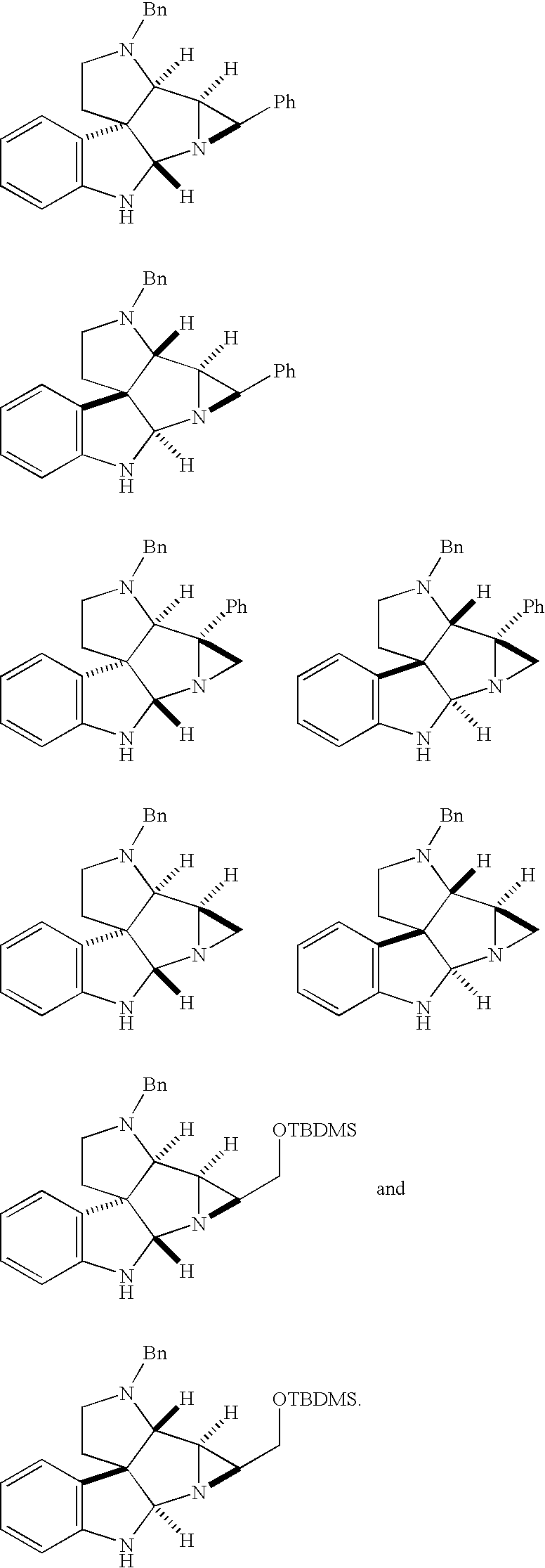

wherein R1, R2, and R3 are independently selected from H; lower alkyl; aryl; heteroaryl; alkenyl; cycloalkyl; heterocycle; esters of the formula —C(O)OR* wherein R* is selected from alkyl and aryl; amides of the formula —C(O)NR**R***, wherein R** and R*** are independently selected from alkyl and aryl; —CH2C(O)R, wherein R is selected from —OH, lower alkyl, aryl, -loweralkyl-aryl, or —NRaRb, where Ra and Rb are independently selected from H, lower alkyl, aryl or -loweralkyl-aryl; —C(O)Rc, wherein Rc is selected from lower alkyl, aryl or -loweralkyl-aryl; or -lower alkyl-ORd, wherein Rd is a suitable protecting group;
all of which are optionally substituted at one or more substitutable positions with one or more suitable substituents,
with a compound of formula (VI)

each of the one or more R4 substituents is independently selected from an electron neutral or electron donating group;
NaCNBH3, methanol, acetic acid (1% in methanol);
NaCNBH3, methanol;
NaCNBH3/Ce(SO4)2, methanol/dichloromethane (1/1);
NaCNBH3/PbBr2, methanol/dichloromethane (1/1);
NaCNBH3/ZnCl2, methanol/dichloromethane (1/1);
NaCNBH3/ZnCl2, methanol/tetrahydrofuran (1/1);
NaCNBH3/ZnCl2, methanol/diethyl ether (1/1); and
NaCNBH3/ZnCl2, methanol/toluene (1/1).
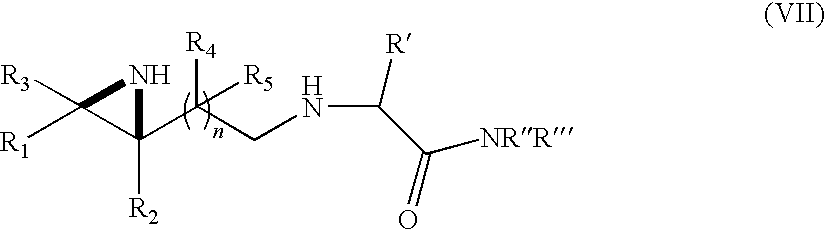
wherein n=0 or 1, and R1, R2, R3, R4 and R5 are independently selected from H; lower alkyl; aryl; heteroaryl; alkenyl; cycloalkyl; heterocycle; esters of the formula —C(O)OR* wherein R* is selected from alkyl and aryl; amides of the formula —C(O)NR**R***, wherein R** and R*** are independently selected from alkyl and aryl; —CH2C(O)R, wherein R is selected from —OH, lower alkyl, aryl, -loweralkyl-aryl, or —NRaRb, where Ra and Rb are independently selected from H, lower alkyl, aryl or -loweralkyl-aryl; —C(O)Rc, wherein Rc is selected from lower alkyl, aryl or -loweralkyl-aryl; or -lower alkyl-ORd, wherein Rd is a suitable protecting group;

wherein R′, R″, and R′″ are as defined above
with a compound of formula (Ia) and/or (Ib) as defined above via reductive amination to form the aziridine-conjugated amino acid of formula (VII).
NaCNBH3, methanol, acetic acid (1% in methanol);
NaCNBH3, methanol;
NaCNBH3/Ce(SO4)2, methanol/dichloromethane (1/1);
NaCNBH3/PbBr2, methanol/dichloromethane (1/1);
NaCNBH3/ZnCl2, methanol/dichloromethane (1/1);
NaCNBH3/ZnCl2, methanol/tetrahydrofuran (1/1);
NaCNBH3/ZnCl2, methanol/diethyl ether (1/1); and
NaCNBH3/ZnCl2, methanol/toluene (1/1).


wherein n, R1, R2, R3, R4 and R5 are as defined above, via reductive amination to yield the aziridine-conjugated bioactive molecule.

wherein n, R1, R2, R3, R4 and R5 are as defined above, under conditions suitable to effect reaction between the aziridine ring nitrogen and the electrophile.

wherein n, R1, R2, R3, R4 and R5 are as defined above, under conditions suitable to effect reaction between the nucleophilic group and the aziridine ring of formula (Ia) and/or (Ib) to yield the bioactive molecule.


| TABLE 1 |
| Aziridine aldehyde dimers obtained through DIBAL reduction of aziridine |
| esters.a |
| entry | aziridine ester | product | yieldb |
| 1 |
 |
 |
83% |
| 2 |
 |
 |
81% |
| 3 |
 |
 |
92% |
| 4 |
 |
 |
76% |
| 5 |
 |
 |
94% |
| aReactions were carried out using 1 equiv. of ester and 2 equiv. of DIBAL in toluene | |||
| at -78° C. | |||
| bIsolated yields. | |||


| TABLE 2 |
| Pentacycles derived from aziridine aldehydes and N-benzyl tryptamine.a |
| syn/ | ||||||
| entry | dimer | T (° C.) | time | pentacycleb | yieldc | antid |
| 1 | |
0 | 3 h |
 |
97% 94% | 8:1 20:1e |
| 2 | |
40f | 8 h |
 |
81% | 2:1 |
| 3 | |
0 | 3 h |
 |
74% | 1.5:1 |
| 4 | |
0 | 3 h |
 |
94% | 3:1 |
| aUnless stated otherwise, the reactions were carried out using 1 mmol of the dimer (2 | ||||||
| mmol of aldehyde) and 2 mmol of N-benzyl tryptamine in 2 ml of TFE at 0° C. for 3 | ||||||
| hours. | ||||||
| bMajor diastereoisomer shown. | ||||||
| cIsolated yield. | ||||||
| dBased on crude 1H NMR. | ||||||
| eReaction was run at -20° C. | ||||||
| fElevated temperature was required for reaction to occur. | ||||||
-
- a. The novel aziridine aldehydes contain both a secondary amine functionality and an aldehyde functionality and are stable with regard to inter- and intramolecular condensation and iminium ion formation. These molecules are stable in non-protonated form as opposed to certain rare cases of amine containing aldehydes that are known (e.g. glucosamine).
- b. There is no epimerization at the alpha carbon.
- c. Regarding the formation of pentacycles, the novel aziridine aldehydes demonstrate a unique reactivity. Based on what is known in the art, for an aldehyde with OH or SH alpha substituent, one would reasonably expect a different product (as shown below in Scheme 14):

-
- d. The novel amino aldehydes of the present invention allow for selective reductive amination employing the novel aziridine aldehydes as the aldehyde partner and external amines as the amine partner without having to protect either amine functionality.
- e. It is envisioned that utilizing the novel aziridine aldehydes in synthetic processes will decrease the number of steps leading to various nitrogen-containing target molecules in a synthetic sequence. Because aziridine ring can be regarded as a stepping stone towards a wide variety of amines via well documented ring-opening chemistry (Aziridines and Epoxides in Organic Synthesis (Ed.: A. K. Yudin), Wiley, N.Y., 2006), these unprotected building blocks provide a solution to broad challenges faced by protected amino aldehydes in complex amine transformations (J. Jurczak, A. Golebiowski, Chem. Rev. 1989, 89, 149; M. T. Reetz, Angew. Chem. 1991, 103, 1559; Angew. Chem. Int. Ed. Engl. 1991, 30, 1531; F. J. Sardina, H. Rapoport, Chem. Rev. 1996, 96, 1825).
- f. The formation of an unsymmetrical dimer by the aziridine aldehydes of the present invention is unique, and would not be expected based on what is known in the art (Scheme 15). It is thought that the formation of this dimer contributes to the stability of the compounds of the present invention. The aziridine aldehyde compound previously prepared by Rheinhoudt (compound 9 in Rheinhoudt et al., supra) was isolated in monomeric form, as evidenced by an aldehyde peak in the NMR spectrum of compound 9. As previously mentioned, this compound was found to be unstable and could not be isolated in pure form.


| TABLE 3 |
| The scope of peptidomimetic conjugation chemistry.a |
 |
| entry | aziridine aldehydeb | amino acid derivative | yieldc |
| 1 |
 |
 |
85% |
| 2 |
 |
 |
75% |
| 3 |
 |
 |
86% |
| 4 |
 |
 |
81% |
| 5 |
 |
 |
92% |
| 6 |
 |
 |
84% |
| 7 |
 |
 |
60% |
| 8 |
 |
 |
51% |
| aUnless stated otherwise, the reactions were carried out using 0.5 eq. of the dimer (1 eq. | |||
| aldehyde), 1.2 eq. amine, 1.5 eq. NaBH3CN, and 1 eq. ZnCl2 in THF and MeOH (1/1) at | |||
| room temperature; | |||
| bThe corresponding monomer; | |||
| cIsolated yield. | |||


| TABLE 4 |
| Crystal data and structure refinement for 6-Phenyl-2- |
| (3-phenylaziridin-2-yl)-3-oxa-1-azabicyclo[3.1.0]hexan-4-ol. |
| Empirical formula | C18H18N2O2 |
| Formula weight | 294.34 |
| Temperature | 150(1) K |
| Wavelength | 0.71073 Å |
| Crystal system | Monoclinic |
| Space group | C 2 |
| Unit cell dimensions | a = 15.8979(14) Å | a = 90°. |
| b = 5.7353(7) Å | b = 90.979(6)°. | |
| c = 15.8160(15) Å | g = 90°. |
| Volume | 1441.9(3) Å3 |
| Z | 4 |
| Density (calculated) | 1.356 Mg/m3 |
| Absorption coefficient | 0.089 mm−1 |
| F(000) | 624 |
| Crystal size | 0.26 × 0.18 × 0.06 mm3 |
| Theta range for data collection | 2.56 to 27.53°. |
| Index ranges | −20 <= h <= 20, −7 <= k <= 6, |
| −17 <= l <= 20 | |
| Reflections collected | 5337 |
| Independent reflections | 1809 [R(int) = 0.0755] |
| Completeness to theta = 27.53° | 99.8% |
| Absorption correction | Semi-empirical from equivalents |
| Max. and min. transmission | 1.010 and 0.796 |
| Refinement method | Full-matrix least-squares on F2 |
| Data/restraints/parameters | 1809/1/208 |
| Goodness-of-fit on F2 | 1.043 |
| Final R indices [I > 2sigma(I)] | R1 = 0.0465, wR2 = 0.0979 |
| R indices (all data) | R1 = 0.0848, wR2 = 0.1156 |
| Extinction coefficient | 0.020(3) |
| Largest diff. peak and hole | 0.201 and −0.185 e · Å−3 |
| TABLE 5 |
| Atomic coordinates (×104) and equivalent isotropic displacement |
| parameters (Å2 × 10³) for |
| 6-Phenyl-2-(3-phenylaziridin-2-yl)-3-oxa-1-azabicyclo[3.1.0]hexan-4-ol. |
| U(eq) is defined as one third of the trace of the orthogonalized Uij tensor. |
| x | y | z | U(eq) | ||
| O(1) | 8403(1) | 6659(4) | 2416(1) | 37(1) | ||
| O(2) | 9847(2) | 7505(5) | 2536(1) | 44(1) | ||
| N(1) | 8688(2) | 3502(5) | 1511(2) | 35(1) | ||
| N(2) | 9477(2) | 3334(7) | 3299(2) | 45(1) | ||
| C(1) | 8471(2) | 5035(6) | 776(2) | 33(1) | ||
| C(2) | 9241(2) | 5499(6) | 1306(2) | 36(1) | ||
| C(3) | 9146(2) | 7339(6) | 1982(2) | 36(1) | ||
| C(4) | 8274(2) | 4200(6) | 2284(2) | 36(1) | ||
| C(5) | 8622(2) | 2725(7) | 2996(2) | 37(1) | ||
| C(6) | 8751(2) | 3602(7) | 3867(2) | 35(1) | ||
| C(7) | 8664(2) | 2085(6) | 4625(2) | 34(1) | ||
| C(8) | 9003(2) | −133(6) | 4671(2) | 38(1) | ||
| C(9) | 8949(2) | −1445(7) | 5405(2) | 40(1) | ||
| C(10) | 8532(2) | −570(7) | 6094(2) | 40(1) | ||
| C(11) | 8163(2) | 1598(7) | 6054(2) | 41(1) | ||
| C(12) | 8225(2) | 2935(6) | 5321(2) | 37(1) | ||
| C(13) | 8542(2) | 3936(6) | −76(2) | 34(1) | ||
| C(14) | 8934(2) | 1794(6) | −189(2) | 37(1) | ||
| C(15) | 9054(2) | 902(6) | −991(2) | 41(1) | ||
| C(16) | 8780(2) | 2136(7) | −1693(2) | 41(1) | ||
| C(17) | 8365(2) | 4222(7) | −1587(2) | 44(1) | ||
| C(18) | 8246(2) | 5139(6) | −787(2) | 38(1) | ||
| TABLE 6 |
| Bond lengths [Å] and angles [°] for 6-Phenyl-2- |
| (3-phenylaziridin-2-yl)-3-oxa-1-azabicyclo[3.1.0]hexan-4-ol. |
| O(1)—C(3) | 1.429(4) | ||
| O(1)—C(4) | 1.440(4) | ||
| O(2)—C(3) | 1.410(4) | ||
| N(1)—C(4) | 1.455(4) | ||
| N(1)—C(2) | 1.483(4) | ||
| N(1)—C(1) | 1.493(4) | ||
| N(2)—C(5) | 1.476(4) | ||
| N(2)—C(6) | 1.483(4) | ||
| C(1)—C(13) | 1.493(4) | ||
| C(1)—C(2) | 1.496(4) | ||
| C(2)—C(3) | 1.512(5) | ||
| C(4)—C(5) | 1.507(4) | ||
| C(5)—C(6) | 1.477(4) | ||
| C(6)—C(7) | 1.490(4) | ||
| C(7)—C(8) | 1.383(5) | ||
| C(7)—C(12) | 1.401(4) | ||
| C(8)—C(9) | 1.388(4) | ||
| C(9)—C(10) | 1.378(5) | ||
| C(10)—C(11) | 1.376(5) | ||
| C(11)—C(12) | 1.395(5) | ||
| C(13)—C(14) | 1.391(5) | ||
| C(13)—C(18) | 1.394(5) | ||
| C(14)—C(15) | 1.384(4) | ||
| C(15)—C(16) | 1.381(5) | ||
| C(16)—C(17) | 1.378(5) | ||
| C(17)—C(18) | 1.386(4) | ||
| C(3)—O(1)—C(4) | 108.4(2) | ||
| C(4)—N(1)—C(2) | 104.5(3) | ||
| C(4)—N(1)—C(1) | 113.0(3) | ||
| C(2)—N(1)—C(1) | 60.3(2) | ||
| C(5)—N(2)—C(6) | 59.91(19) | ||
| C(13)—C(1)—N(1) | 115.7(3) | ||
| C(13)—C(1)—C(2) | 120.5(3) | ||
| N(1)—C(1)—C(2) | 59.5(2) | ||
| N(1)—C(2)—C(1) | 60.2(2) | ||
| N(1)—C(2)—C(3) | 108.5(2) | ||
| C(1)—C(2)—C(3) | 115.4(3) | ||
| O(2)—C(3)—O(1) | 111.8(2) | ||
| O(2)—C(3)—C(2) | 113.5(3) | ||
| O(1)—C(3)—C(2) | 104.0(3) | ||
| O(1)—C(4)—N(1) | 109.0(3) | ||
| O(1)—C(4)—C(5) | 113.0(3) | ||
| N(1)—C(4)—C(5) | 107.9(3) | ||
| N(2)—C(5)—C(6) | 60.3(2) | ||
| N(2)—C(5)—C(4) | 115.8(3) | ||
| C(6)—C(5)—C(4) | 123.3(3) | ||
| C(5)—C(6)—N(2) | 59.8(2) | ||
| C(5)—C(6)—C(7) | 122.6(3) | ||
| N(2)—C(6)—C(7) | 120.7(3) | ||
| C(8)—C(7)—C(12) | 118.5(3) | ||
| C(8)—C(7)—C(6) | 122.6(3) | ||
| C(12)—C(7)—C(6) | 118.9(3) | ||
| C(7)—C(8)—C(9) | 120.9(3) | ||
| C(10)—C(9)—C(8) | 120.1(3) | ||
| C(11)—C(10)—C(9) | 120.2(3) | ||
| C(10)—C(11)—C(12) | 119.9(3) | ||
| C(11)—C(12)—C(7) | 120.4(3) | ||
| C(14)—C(13)—C(18) | 118.6(3) | ||
| C(14)—C(13)—C(1) | 122.0(3) | ||
| C(18)—C(13)—C(1) | 119.3(3) | ||
| C(15)—C(14)—C(13) | 120.9(3) | ||
| C(16)—C(15)—C(14) | 120.1(3) | ||
| C(17)—C(16)—C(15) | 119.5(3) | ||
| C(16)—C(17)—C(18) | 120.9(4) | ||
| C(17)—C(18)—C(13) | 120.0(3) | ||
| TABLE 7 |
| Anisotropic displacement parameters (Å2 × 10³) for 6-Phenyl-2-(3- |
| phenylaziridin-2-yl)-3-oxa-1-azabicyclo[3.1.0]hexan-4-ol. The |
| anisotropic displacement factor exponent takes the form: |
| −2p2[h2 a*2U11 + . . . + 2 h k a* b* U12] |
| U11 | U22 | U33 | U23 | U13 | U12 | ||
| O(1) | 44(1) | 33(1) | 32(1) | −1(1) | 5(1) | 2(1) | ||
| O(2) | 50(1) | 44(2) | 39(1) | −1(1) | −4(1) | −8(1) | ||
| N(1) | 41(2) | 35(2) | 30(1) | 2(1) | 2(1) | −3(1) | ||
| N(2) | 39(2) | 54(2) | 43(2) | 9(2) | 6(1) | 7(2) | ||
| C(1) | 36(2) | 34(2) | 29(2) | 1(2) | 0(1) | 2(2) | ||
| C(2) | 41(2) | 35(2) | 32(2) | −3(2) | 0(1) | 1(2) | ||
| C(3) | 38(2) | 39(2) | 31(2) | −1(2) | −2(1) | 0(2) | ||
| C(4) | 45(2) | 35(2) | 28(2) | −2(2) | 1(1) | 2(2) | ||
| C(5) | 45(2) | 35(2) | 33(2) | −1(2) | 5(2) | 0(2) | ||
| C(6) | 39(2) | 34(2) | 32(2) | −2(2) | 1(1) | 1(2) | ||
| C(7) | 34(2) | 36(2) | 30(2) | 0(2) | −3(1) | −2(2) | ||
| C(8) | 40(2) | 37(2) | 36(2) | −2(2) | −1(2) | −2(2) | ||
| C(9) | 41(2) | 38(2) | 42(2) | 5(2) | −2(2) | −2(2) | ||
| C(10) | 48(2) | 42(2) | 30(2) | 3(2) | −3(2) | −7(2) | ||
| C(11) | 44(2) | 45(2) | 34(2) | −3(2) | −1(2) | −2(2) | ||
| C(12) | 33(2) | 39(2) | 38(2) | 2(2) | −4(1) | −1(2) | ||
| C(13) | 34(2) | 41(2) | 28(2) | 1(2) | 0(1) | −4(2) | ||
| C(14) | 41(2) | 34(2) | 37(2) | 1(2) | 1(2) | 3(2) | ||
| C(15) | 43(2) | 42(2) | 38(2) | −4(2) | 1(2) | −1(2) | ||
| C(16) | 43(2) | 47(2) | 32(2) | −7(2) | −1(2) | −6(2) | ||
| C(17) | 50(2) | 49(2) | 31(2) | 3(2) | −6(2) | −3(2) | ||
| C(18) | 42(2) | 36(2) | 35(2) | 1(2) | −2(1) | −1(2) | ||
| TABLE 8 |
| Hydrogen coordinates (×104) and |
| isotropic displacement parameters (Å2 × 10³) for |
| 6-Phenyl-2-(3-phenylaziridin-2-yl)-3-oxa-1-azabicyclo[3.1.0]hexan-4-ol. |
| x | y | z | U(eq) | ||
| H(2O) | 9760(30) | 5840(110) | 2780(30) | 92(17) |
| H(2N) | 9750(30) | 2000(90) | 3370(20) | 65(14) |
| H(1A) | 7988 | 6129 | 852 | 40 |
| H(2A) | 9809 | 5198 | 1066 | 43 |
| H(3A) | 9047 | 8886 | 1706 | 43 |
| H(4A) | 7657 | 3895 | 2220 | 43 |
| H(5A) | 8504 | 1017 | 2948 | 45 |
| H(6A) | 8567 | 5251 | 3952 | 42 |
| H(8A) | 9277 | −767 | 4194 | 45 |
| H(9A) | 9200 | −2947 | 5434 | 48 |
| H(10A) | 8500 | −1468 | 6597 | 48 |
| H(11A) | 7867 | 2184 | 6526 | 49 |
| H(12A) | 7969 | 4430 | 5294 | 44 |
| H(14A) | 9122 | 931 | 291 | 45 |
| H(15A) | 9325 | −560 | −1059 | 49 |
| H(16A) | 8876 | 1550 | −2245 | 49 |
| H(17A) | 8158 | 5044 | −2069 | 52 |
| H(18B) | 7963 | 6586 | −723 | 45 |
| TABLE 9 |
| Hydrogen bonds for 6-Phenyl-2-(3-phenylaziridin-2-yl)-3-oxa-1- |
| azabicyclo[3.1.0]hexan-4-ol [Å and °]. |
| D-H . . . A | d(D-H) | d(H . . . A) | d(D . . . A) | <(DHA) |
| O(2)—H(2O) . . . N(2) | 1.04(6) | 1.72(6) | 2.748(4) | 169(4) |
| TABLE 10 |
| Crystal data and structure refinement for 5b. |
| Empirical formula | C26H25N3 |
| Formula weight | 379.49 |
| Temperature | 150(2) K |
| Wavelength | 0.71073 Å |
| Crystal system | Triclinic |
| Space group | P-1 |
| Unit cell dimensions | a = 7.9853(9) Å | a = 90.291(6)°. |
| b = 10.9831(14) Å | b = 98.770(6)°. | |
| c = 12.1590(13) Å | g = | |
| 102.687(6)°. |
| Volume | 1027.4(2) Å3 |
| Z | 2 |
| Density (calculated) | 1.227 Mg/m3 |
| Absorption coefficient | 0.073 mm−1 |
| F(000) | 404 |
| Crystal size | 0.35 × 0.15 × 0.14 mm3 |
| Theta range for data collection | 2.60 to 25.14°. |
| Index ranges | −9 <= h <= 9, −13 <= k <= 13, |
| −14 <= l <= 14 | |
| Reflections collected | 7211 |
| Independent reflections | 3611 [R(int) = 0.0874] |
| Completeness to theta = 25.14° | 98.1% |
| Absorption correction | None |
| Refinement method | Full-matrix least-squares on F2 |
| Data/restraints/parameters | 3611/0/267 |
| Goodness-of-fit on F2 | 1.002 |
| Final R indices [I > 2sigma(I)] | R1 = 0.0614, wR2 = 0.1483 |
| R indices (all data) | R1 = 0.1085, wR2 = 0.1780 |
| Extinction coefficient | 0.054(8) |
| Largest diff. peak and hole | 0.243 and −0.296 e · Å−3 |
| TABLE 11 |
| Atomic coordinates (×104) and equivalent isotropic |
| displacement parameters (Å2 × 10³) for 5b. |
| U(eq) is defined as one third of the trace of the orthogonalized Uij |
| tensor. |
| x | y | z | U(eq) | |||
| N(1) | 5517(3) | 3528(2) | 4575(2) | 39(1) | ||
| N(2) | 508(3) | 2539(2) | 1985(2) | 32(1) | ||
| N(3) | 2589(3) | 3907(2) | 4478(2) | 33(1) | ||
| C(1) | 3373(3) | 2659(2) | 2997(2) | 32(1) | ||
| C(2) | 4519(3) | 1777(2) | 3414(2) | 32(1) | ||
| C(3) | 4486(3) | 578(2) | 3054(2) | 35(1) | ||
| C(4) | 5723(3) | −37(2) | 3571(2) | 36(1) | ||
| C(5) | 6968(3) | 558(2) | 4446(2) | 37(1) | ||
| C(6) | 7003(3) | 1752(2) | 4828(2) | 35(1) | ||
| C(7) | 5774(3) | 2357(2) | 4301(2) | 31(1) | ||
| C(8) | 4033(3) | 3790(2) | 3856(2) | 35(1) | ||
| C(9) | 1054(3) | 2908(2) | 4018(2) | 31(1) | ||
| C(10) | 1403(3) | 2200(2) | 3044(2) | 31(1) | ||
| C(11) | 1613(3) | 2390(3) | 1163(2) | 38(1) | ||
| C(12) | 3422(3) | 2987(3) | 1756(2) | 41(1) | ||
| C(13) | 2046(3) | 2790(2) | 5131(2) | 32(1) | ||
| C(14) | 1299(3) | 2961(2) | 6164(2) | 32(1) | ||
| C(15) | 648(3) | 4006(2) | 6343(2) | 37(1) | ||
| C(16) | −233(4) | 4078(3) | 7231(2) | 40(1) | ||
| C(17) | −457(4) | 3114(3) | 7958(2) | 44(1) | ||
| C(18) | 216(4) | 2076(3) | 7801(2) | 43(1) | ||
| C(19) | 1074(3) | 1997(2) | 6901(2) | 36(1) | ||
| C(20) | −1284(3) | 1814(2) | 1712(2) | 37(1) | ||
| C(21) | −2353(3) | 2313(2) | 770(2) | 33(1) | ||
| C(22) | −2288(4) | 3582(3) | 705(2) | 40(1) | ||
| C(23) | −3385(4) | 4031(3) | −109(2) | 43(1) | ||
| C(24) | −4570(4) | 3216(3) | −875(2) | 47(1) | ||
| C(25) | −4637(4) | 1955(3) | −826(2) | 48(1) | ||
| C(26) | −3521(4) | 1507(3) | −19(2) | 41(1) | ||
| TABLE 12 |
| Bond lengths [Å] and angles [°] for 5b. |
| N(1)—C(7) | 1.392(3) | ||
| N(1)—C(8) | 1.445(3) | ||
| N(2)—C(11) | 1.462(3) | ||
| N(2)—C(20) | 1.464(3) | ||
| N(2)—C(10) | 1.465(3) | ||
| N(3)—C(13) | 1.485(3) | ||
| N(3)—C(9) | 1.487(3) | ||
| N(3)—C(8) | 1.499(3) | ||
| C(1)—C(2) | 1.512(3) | ||
| C(1)—C(10) | 1.553(3) | ||
| C(1)—C(12) | 1.558(4) | ||
| C(1)—C(8) | 1.563(4) | ||
| C(2)—C(3) | 1.379(4) | ||
| C(2)—C(7) | 1.399(4) | ||
| C(3)—C(4) | 1.391(4) | ||
| C(4)—C(5) | 1.390(4) | ||
| C(5)—C(6) | 1.382(4) | ||
| C(6)—C(7) | 1.384(4) | ||
| C(9)—C(13) | 1.481(3) | ||
| C(9)—C(10) | 1.508(4) | ||
| C(11)—C(12) | 1.516(4) | ||
| C(13)—C(14) | 1.498(4) | ||
| C(14)—C(15) | 1.389(4) | ||
| C(14)—C(19) | 1.390(4) | ||
| C(15)—C(16) | 1.386(4) | ||
| C(16)—C(17) | 1.381(4) | ||
| C(17)—C(18) | 1.387(4) | ||
| C(18)—C(19) | 1.388(4) | ||
| C(20)—C(21) | 1.502(4) | ||
| C(21)—C(22) | 1.387(4) | ||
| C(21)—C(26) | 1.389(4) | ||
| C(22)—C(23) | 1.385(4) | ||
| C(23)—C(24) | 1.384(4) | ||
| C(24)—C(25) | 1.376(4) | ||
| C(25)—C(26) | 1.389(4) | ||
| C(7)—N(1)—C(8) | 110.6(2) | ||
| C(11)—N(2)—C(20) | 114.2(2) | ||
| C(11)—N(2)—C(10) | 105.25(19) | ||
| C(20)—N(2)—C(10) | 112.59(19) | ||
| C(13)—N(3)—C(9) | 59.81(15) | ||
| C(13)—N(3)—C(8) | 112.12(19) | ||
| C(9)—N(3)—C(8) | 107.1(2) | ||
| C(2)—C(1)—C(10) | 116.3(2) | ||
| C(2)—C(1)—C(12) | 113.6(2) | ||
| C(10)—C(1)—C(12) | 103.5(2) | ||
| C(2)—C(1)—C(8) | 102.6(2) | ||
| C(10)—C(1)—C(8) | 105.8(2) | ||
| C(12)—C(1)—C(8) | 115.2(2) | ||
| C(3)—C(2)—C(7) | 120.0(2) | ||
| C(3)—C(2)—C(1) | 130.5(2) | ||
| C(7)—C(2)—C(1) | 109.5(2) | ||
| C(2)—C(3)—C(4) | 119.4(2) | ||
| C(5)—C(4)—C(3) | 119.8(2) | ||
| C(6)—C(5)—C(4) | 121.5(2) | ||
| C(5)—C(6)—C(7) | 118.1(3) | ||
| C(6)—C(7)—N(1) | 127.9(3) | ||
| C(6)—C(7)—C(2) | 121.2(2) | ||
| N(1)—C(7)—C(2) | 110.9(2) | ||
| N(1)—C(8)—N(3) | 112.5(2) | ||
| N(1)—C(8)—C(1) | 106.1(2) | ||
| N(3)—C(8)—C(1) | 108.9(2) | ||
| C(13)—C(9)—N(3) | 60.02(16) | ||
| C(13)—C(9)—C(10) | 118.0(2) | ||
| N(3)—C(9)—C(10) | 111.6(2) | ||
| N(2)—C(10)—C(9) | 111.7(2) | ||
| N(2)—C(10)—C(1) | 105.49(19) | ||
| C(9)—C(10)—C(1) | 105.9(2) | ||
| N(2)—C(11)—C(12) | 103.0(2) | ||
| C(11)—C(12)—C(1) | 104.3(2) | ||
| C(9)—C(13)—N(3) | 60.17(16) | ||
| C(9)—C(13)—C(14) | 120.4(2) | ||
| N(3)—C(13)—C(14) | 118.0(2) | ||
| C(15)—C(14)—C(19) | 118.8(2) | ||
| C(15)—C(14)—C(13) | 121.4(2) | ||
| C(19)—C(14)—C(13) | 119.5(2) | ||
| C(16)—C(15)—C(14) | 120.6(3) | ||
| C(17)—C(16)—C(15) | 120.3(3) | ||
| C(16)—C(17)—C(18) | 119.7(3) | ||
| C(17)—C(18)—C(19) | 120.0(3) | ||
| C(18)—C(19)—C(14) | 120.6(2) | ||
| N(2)—C(20)—C(21) | 113.9(2) | ||
| C(22)—C(21)—C(26) | 118.2(3) | ||
| C(22)—C(21)—C(20) | 121.0(2) | ||
| C(26)—C(21)—C(20) | 120.7(2) | ||
| C(23)—C(22)—C(21) | 120.9(3) | ||
| C(24)—C(23)—C(22) | 120.4(3) | ||
| C(25)—C(24)—C(23) | 119.3(3) | ||
| C(24)—C(25)—C(26) | 120.3(3) | ||
| C(25)—C(26)—C(21) | 120.9(3) | ||
| TABLE 13 |
| Anisotropic displacement parameters (Å2 × 10³) for 5b. |
| The anisotropic displacement factor exponent takes the form: |
| −2p2[h2 a*2U11 + . . . + 2 h k a* b* U12] |
| U11 | U22 | U33 | U23 | U13 | U12 | ||
| N(1) | 33(1) | 29(1) | 53(2) | −4(1) | 5(1) | 2(1) |
| N(2) | 32(1) | 33(1) | 29(1) | 3(1) | 7(1) | 3(1) |
| N(3) | 31(1) | 26(1) | 40(1) | 4(1) | 11(1) | 1(1) |
| C(1) | 32(1) | 29(2) | 36(2) | 5(1) | 10(1) | 4(1) |
| C(2) | 29(1) | 29(2) | 37(2) | 2(1) | 9(1) | 3(1) |
| C(3) | 35(2) | 33(2) | 35(2) | −2(1) | 8(1) | 4(1) |
| C(4) | 38(2) | 30(2) | 43(2) | 1(1) | 12(1) | 8(1) |
| C(5) | 32(2) | 38(2) | 43(2) | 6(1) | 10(1) | 8(1) |
| C(6) | 30(1) | 35(2) | 37(2) | 3(1) | 7(1) | 3(1) |
| C(7) | 31(1) | 26(1) | 37(2) | 4(1) | 12(1) | 2(1) |
| C(8) | 34(2) | 27(2) | 44(2) | 5(1) | 11(1) | 6(1) |
| C(9) | 34(1) | 25(1) | 33(2) | 1(1) | 8(1) | 2(1) |
| C(10) | 32(1) | 29(1) | 31(2) | 5(1) | 5(1) | 2(1) |
| C(11) | 40(2) | 39(2) | 36(2) | 5(1) | 13(1) | 7(1) |
| C(12) | 35(2) | 48(2) | 41(2) | 10(1) | 13(1) | 9(1) |
| C(13) | 32(1) | 27(1) | 35(2) | 3(1) | 7(1) | 3(1) |
| C(14) | 29(1) | 28(2) | 34(2) | −4(1) | 3(1) | 1(1) |
| C(15) | 42(2) | 30(2) | 37(2) | −2(1) | 6(1) | 5(1) |
| C(16) | 43(2) | 37(2) | 41(2) | −6(1) | 6(1) | 11(1) |
| C(17) | 47(2) | 46(2) | 40(2) | −4(1) | 12(1) | 7(1) |
| C(18) | 49(2) | 46(2) | 36(2) | 6(1) | 12(1) | 11(1) |
| C(19) | 37(2) | 34(2) | 38(2) | 4(1) | 8(1) | 9(1) |
| C(20) | 34(2) | 33(2) | 39(2) | 1(1) | 5(1) | 1(1) |
| C(21) | 31(1) | 36(2) | 31(2) | 1(1) | 9(1) | 4(1) |
| C(22) | 41(2) | 35(2) | 41(2) | −1(1) | 8(1) | 3(1) |
| C(23) | 44(2) | 43(2) | 43(2) | 9(1) | 7(1) | 11(1) |
| C(24) | 45(2) | 61(2) | 36(2) | 9(2) | 6(1) | 15(2) |
| C(25) | 41(2) | 55(2) | 41(2) | −2(1) | −1(1) | 1(2) |
| C(26) | 43(2) | 35(2) | 42(2) | −1(1) | 3(1) | 2(1) |
| TABLE 14 |
| Hydrogen coordinates (×104) and isotropic |
| displacement parameters (Å2 × 10³) for 5b. |
| x | y | z | U(eq) | ||
| H(3A) | 3626 | 175 | 2459 | 42 |
| H(4A) | 5716 | −861 | 3327 | 44 |
| H(5A) | 7815 | 134 | 4789 | 45 |
| H(6A) | 7847 | 2146 | 5434 | 42 |
| H(8A) | 4399 | 4574 | 3456 | 42 |
| H(9A) | −126 | 3091 | 3983 | 37 |
| H(10A) | 1091 | 1278 | 3139 | 38 |
| H(11A) | 1312 | 2826 | 475 | 46 |
| H(11B) | 1511 | 1497 | 971 | 46 |
| H(12A) | 3683 | 3903 | 1675 | 49 |
| H(12B) | 4311 | 2638 | 1456 | 49 |
| H(13A) | 2801 | 2170 | 5170 | 38 |
| H(15A) | 808 | 4678 | 5853 | 44 |
| H(16A) | −684 | 4793 | 7341 | 48 |
| H(17A) | −1070 | 3162 | 8562 | 53 |
| H(18A) | 91 | 1420 | 8308 | 51 |
| H(19A) | 1512 | 1276 | 6788 | 43 |
| H(20A) | −1854 | 1799 | 2382 | 44 |
| H(20B) | −1264 | 942 | 1515 | 4 |
| H(22A) | −1481 | 4152 | 1226 | 48 |
| H(23A) | −3324 | 4903 | −141 | 52 |
| H(24A) | −5328 | 3523 | −1429 | 57 |
| H(25A) | −5450 | 1389 | −1346 | 57 |
| H(26A) | −3557 | 637 | −7 | 50 |
| H(1N) | 6410(40) | 4100(30) | 4860(20) | 52(9) |
| TABLE 15 |
| Hydrogen bonds for 5b [Å and °]. |
| D-H . . . A | d(D-H) | d(H . . . A) | d(D . . . A) | <(DHA) |
| N(1)—H(1N) . . . N(3)#1 | 0.87(3) | 2.25(3) | 3.020(3) | 147(3) |
| Symmetry transformations used to generate equivalent atoms: | ||||
| #1−x+1, −y+1, −z+1 | ||||


| TABLE 16 |
| Condition screening. |
 |
| Entry | Reduction conditions | Yield (%) |
| 1 | NaCNBH3, MeOH, HAOc (1% in MeOH) | 7% |
| 2 | NaCNBH3, MeOH | 3% |
| 3 | NaHB(OAc)3, MeOH | no rxn |
| 4 | NaCNBH3, TFE | —b |
| 5 | NaCNBH3/Ce(SO4)2, MeOH/DCM (1/1) | <50%a |
| 6 | NaCNBH3/PbBr2, MeOH/DCM (1/1) | <50%a |
| 7 | NaCNBH3/ZnCl2, MeOH/DCM (1/1) | 63% |
| 8 | NaCNBH3/ZnCl2, MeOH/THF (1/1) | 82% |
| 9 | NaCNBH3/ZnCl2, MeOH/Et2O (1/1) | <60%a |
| 10 | NaCNBH3/ZnCl2, MeOH/Toluene (1/1) | <10%a |
| aDetermined by NMR analysis; | ||
| bAldehyde reduction product was obtained. | ||


Claims (13)


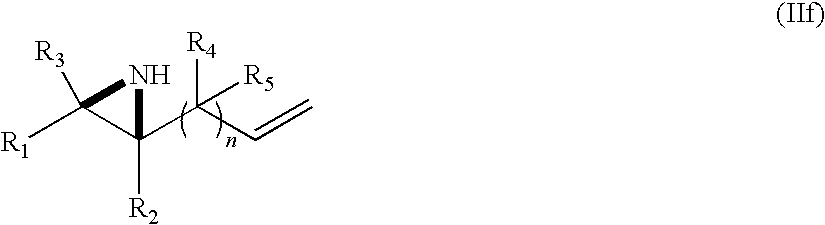

Priority Applications (1)
| Application Number | Priority Date | Filing Date | Title |
|---|---|---|---|
| US12/446,343 US8143375B2 (en) | 2006-10-20 | 2007-10-22 | Aziridine aldehydes, aziridine-conjugated amino derivatives, aziridine-conjugated biomolecules and processes for their preparation |
Applications Claiming Priority (4)
| Application Number | Priority Date | Filing Date | Title |
|---|---|---|---|
| US85298006P | 2006-10-20 | 2006-10-20 | |
| US90733907P | 2007-03-29 | 2007-03-29 | |
| US12/446,343 US8143375B2 (en) | 2006-10-20 | 2007-10-22 | Aziridine aldehydes, aziridine-conjugated amino derivatives, aziridine-conjugated biomolecules and processes for their preparation |
| PCT/CA2007/001882 WO2008046232A1 (en) | 2006-10-20 | 2007-10-22 | Aziridine aldehydes, aziridine-conjugated amino derivatives, aziridine-conjugated biomolecules and processes for their preparation |
Publications (2)
| Publication Number | Publication Date |
|---|---|
| US20100317832A1 US20100317832A1 (en) | 2010-12-16 |
| US8143375B2 true US8143375B2 (en) | 2012-03-27 |
Family
ID=39313581
Family Applications (1)
| Application Number | Title | Priority Date | Filing Date |
|---|---|---|---|
| US12/446,343 Active 2027-12-21 US8143375B2 (en) | 2006-10-20 | 2007-10-22 | Aziridine aldehydes, aziridine-conjugated amino derivatives, aziridine-conjugated biomolecules and processes for their preparation |
Country Status (3)
| Country | Link |
|---|---|
| US (1) | US8143375B2 (en) |
| CA (1) | CA2702605C (en) |
| WO (1) | WO2008046232A1 (en) |
Families Citing this family (6)
| Publication number | Priority date | Publication date | Assignee | Title |
|---|---|---|---|---|
| PT2408802T (en) * | 2009-03-16 | 2017-08-03 | Governing Council Univ Toronto | Cyclic amino acid molecules and methods of preparing the same |
| WO2012109735A1 (en) * | 2011-02-17 | 2012-08-23 | The Governing Council Of The University Of Toronto | Methods of preparing cyclic amino acid molecules using arylboronic or arylborinic acid catalysts |
| CN104804004B (en) * | 2015-05-21 | 2017-03-29 | 安徽师范大学 | A kind of preparation method of chiral hexahydropyrrolo diindyl class compound |
| US11072616B2 (en) | 2015-11-11 | 2021-07-27 | Universite De Montreal | Cyclic peptides targeting alpha-4-beta-7 integrin |
| ES2884107T3 (en) | 2016-11-11 | 2021-12-10 | Zealand Pharma As | Cyclic peptide multimers targeting alpha-4 beta-7 integrin |
| US11286281B2 (en) | 2017-05-10 | 2022-03-29 | Zealand Pharma A/S | Homodetic cyclic peptides targeting alpha-4-beta-7 integrin |
Citations (1)
| Publication number | Priority date | Publication date | Assignee | Title |
|---|---|---|---|---|
| CA2427046A1 (en) | 2002-05-03 | 2003-11-03 | Bayer Polymers Llc | A process for making polyaziridines |
-
2007
- 2007-10-22 CA CA2702605A patent/CA2702605C/en active Active
- 2007-10-22 WO PCT/CA2007/001882 patent/WO2008046232A1/en not_active Ceased
- 2007-10-22 US US12/446,343 patent/US8143375B2/en active Active
Patent Citations (1)
| Publication number | Priority date | Publication date | Assignee | Title |
|---|---|---|---|---|
| CA2427046A1 (en) | 2002-05-03 | 2003-11-03 | Bayer Polymers Llc | A process for making polyaziridines |
Non-Patent Citations (76)
Also Published As
| Publication number | Publication date |
|---|---|
| US20100317832A1 (en) | 2010-12-16 |
| CA2702605A1 (en) | 2008-04-24 |
| WO2008046232A1 (en) | 2008-04-24 |
| CA2702605C (en) | 2015-03-24 |
| WO2008046232A8 (en) | 2008-07-10 |
Similar Documents
| Publication | Publication Date | Title |
|---|---|---|
| US8143375B2 (en) | Aziridine aldehydes, aziridine-conjugated amino derivatives, aziridine-conjugated biomolecules and processes for their preparation | |
| EP1789091B1 (en) | Prodrugs containing novel bio-cleavable linkers | |
| US9809536B2 (en) | Process for making beta 3 agonists and intermediates | |
| US8889855B2 (en) | Preparation of maytansinoid esters | |
| EP0438261A2 (en) | Condensed heterocyclic glutamic acid derivatives, their production and use | |
| US10421716B2 (en) | Process for preparing alpha-carboxamide pyrrolidine derivatives | |
| US7678919B2 (en) | Method for producing pentacyclic taxans | |
| US11708320B2 (en) | Environmentally-friendly hydroazidation of olefins | |
| US20100022767A1 (en) | Development of a synthesis of syringolin a and b and derivatives thereof | |
| US9346853B2 (en) | Synthesis of telaprevir and boceprevir, or pharmaceutically acceptable salts or solvates as well as intermediate products thereof including β-amino acids prepared via Mukaiyama aldol addition | |
| US10668166B2 (en) | Antibody-drug-conjugates comprising novel anthracycline-derivatives for cancer treatment | |
| US7423152B2 (en) | Process for the manufacture of intermediates in camptothecin production | |
| WO2020022892A1 (en) | Tubulysin derivatives and methods for preparing the same | |
| US20250282818A1 (en) | Syrbactin macrolactams and unnatural analogs as proteasome inhibitors for the treatment of multiple myeloma and chemoenzymatic synthesis thereof | |
| US20250074944A1 (en) | ACYLATED tRNA, INTRODUCTION OF PHARMACOLOGICALLY ACTIVE MOTIF IN PEPTIDE USING RIBOSOME CATALYSIS AND METHOD OF PREPARING SAME | |
| Virstiuka et al. | A Convenient Synthesis of CHF2O-Containing Pyrrolidines and Related Compounds—Prospective Building Blocks for Drug Discovery | |
| Yadav | Diastereoselective Oxidopyrylium-Olefin [5+ 2]-Cycloaddition, Design and Synthesis of a Novel Class of SARS-CoV-2 3CL Protease Inhibitors, and Synthetic Approach to (-)-Rasfonin, an Antitumor Agent | |
| Powell | Novel oxetane-containing spirocycles and peptidomimetics | |
| US20210171506A1 (en) | Process for Manufacturing Pibrentasvir Active Drug Substance | |
| US20160107992A1 (en) | Intermediates useful for the preparation of saxagliptin | |
| Nalla | Synthesis of optically pure pharamaceuticals employing aziridines/epoxides as chiral synthons and development of novel biologically active compounds based on benzopyran-4-ones | |
| Dong | Total syntheses and evaluation of the biological and physical properties of exochelin MN, desferrisalmycin B and analogues | |
| Beadle | Oxetane-based peptidomimetics | |
| Durham | β-Lactams as synthons to biologically relevant molecules | |
| Polaske | Structural analysis and synthetic progress towards small molecules as modulators of angiogenesis at the cellular and transcriptional levels |
Legal Events
| Date | Code | Title | Description |
|---|---|---|---|
| FEPP | Fee payment procedure |
Free format text: PAYOR NUMBER ASSIGNED (ORIGINAL EVENT CODE: ASPN); ENTITY STATUS OF PATENT OWNER: LARGE ENTITY |
|
| AS | Assignment |
Owner name: THE GOVERNING COUNCIL OF THE UNIVERSITY OF TORONTO Free format text: ASSIGNMENT OF ASSIGNORS INTEREST;ASSIGNORS:YUDIN, ANDREI;HILI, RYAN MATTHEW;SIGNING DATES FROM 20120208 TO 20120209;REEL/FRAME:027706/0497 |
|
| STCF | Information on status: patent grant |
Free format text: PATENTED CASE |
|
| FPAY | Fee payment |
Year of fee payment: 4 |
|
| MAFP | Maintenance fee payment |
Free format text: PAYMENT OF MAINTENANCE FEE, 8TH YEAR, LARGE ENTITY (ORIGINAL EVENT CODE: M1552); ENTITY STATUS OF PATENT OWNER: LARGE ENTITY Year of fee payment: 8 |
|
| AS | Assignment |
Owner name: ZOOLANDER SA LLC, NEW YORK Free format text: PATENT SECURITY AGREEMENT;ASSIGNOR:ZEALAND PHARMA A/S;REEL/FRAME:058593/0261 Effective date: 20211213 |
|
| AS | Assignment |
Owner name: ZEALAND PHARMA A/S, DENMARK Free format text: RELEASE BY SECURED PARTY;ASSIGNOR:ZOOLANDER SA LLC;REEL/FRAME:063624/0547 Effective date: 20230509 Owner name: ZEALAND PHARMA A/S, DENMARK Free format text: RELEASE OF SECURITY INTEREST;ASSIGNOR:ZOOLANDER SA LLC;REEL/FRAME:063624/0547 Effective date: 20230509 |
|
| AS | Assignment |
Owner name: ZEALAND PHARMA A/S, DENMARK Free format text: RELEASE BY SECURED PARTY;ASSIGNOR:ZOOLANDER SA LLC;REEL/FRAME:063672/0342 Effective date: 20230509 Owner name: ZEALAND PHARMA A/S, DENMARK Free format text: RELEASE OF SECURITY INTEREST;ASSIGNOR:ZOOLANDER SA LLC;REEL/FRAME:063672/0342 Effective date: 20230509 |
|
| MAFP | Maintenance fee payment |
Free format text: PAYMENT OF MAINTENANCE FEE, 12TH YEAR, LARGE ENTITY (ORIGINAL EVENT CODE: M1553); ENTITY STATUS OF PATENT OWNER: LARGE ENTITY Year of fee payment: 12 |