US8129396B2 - 2-[1H-benzimidazol-2(3H)-ylidene]-2-(pyrimidin-2-yl)acetamides and 2-[benzothiazol-2(3H)-ylidene]-2-(pyrimidin-2-yl)acetamides as kinase inhibitors - Google Patents
2-[1H-benzimidazol-2(3H)-ylidene]-2-(pyrimidin-2-yl)acetamides and 2-[benzothiazol-2(3H)-ylidene]-2-(pyrimidin-2-yl)acetamides as kinase inhibitors Download PDFInfo
- Publication number
- US8129396B2 US8129396B2 US12/567,060 US56706009A US8129396B2 US 8129396 B2 US8129396 B2 US 8129396B2 US 56706009 A US56706009 A US 56706009A US 8129396 B2 US8129396 B2 US 8129396B2
- Authority
- US
- United States
- Prior art keywords
- ylidene
- compound
- acetamide
- trifluoromethylpyrimidin
- substituted
- Prior art date
- Legal status (The legal status is an assumption and is not a legal conclusion. Google has not performed a legal analysis and makes no representation as to the accuracy of the status listed.)
- Expired - Fee Related, expires
Links
- 0 *C1=NC=CC=N1.*C1=NC=CC=N1.CC(=O)/C(C#N)=C1\CC2=C(C=CC=C2)N1.CC(N)/C(C1=NC=CC=N1)=C1/CC2=C(C=CC=C2)N1.CC1=C(N)C=CC=C1.CSC(SC)=C(C#N)C(C)=O.N#C/C(C1=NC=CC=N1)=C1/CC2=C(C=CC=C2)N1.N#CCC1=NC2=C(C=CC=C2)C1.N#CCC1=NC2=C(C=CC=C2)C1.NC(=O)CC1=NC2=C(C=CC=C2)C1 Chemical compound *C1=NC=CC=N1.*C1=NC=CC=N1.CC(=O)/C(C#N)=C1\CC2=C(C=CC=C2)N1.CC(N)/C(C1=NC=CC=N1)=C1/CC2=C(C=CC=C2)N1.CC1=C(N)C=CC=C1.CSC(SC)=C(C#N)C(C)=O.N#C/C(C1=NC=CC=N1)=C1/CC2=C(C=CC=C2)N1.N#CCC1=NC2=C(C=CC=C2)C1.N#CCC1=NC2=C(C=CC=C2)C1.NC(=O)CC1=NC2=C(C=CC=C2)C1 0.000 description 4
- OQWASDZZMBXASA-YHPRVSEPSA-N CC.CC.NC(=O)/C(C1=NC=CC=N1)=C1/CC2=C(C=CC=C2)N1 Chemical compound CC.CC.NC(=O)/C(C1=NC=CC=N1)=C1/CC2=C(C=CC=C2)N1 OQWASDZZMBXASA-YHPRVSEPSA-N 0.000 description 2
- JWYGFJSRRLGBMM-KAMYIIQDSA-N CC1=NC(/C(C(N)=O)=C2/NC3=CC=CC=C3S2)=NC(C(=O)O)=C1 Chemical compound CC1=NC(/C(C(N)=O)=C2/NC3=CC=CC=C3S2)=NC(C(=O)O)=C1 JWYGFJSRRLGBMM-KAMYIIQDSA-N 0.000 description 2
- YTYLJPWINICJGV-QOCHGBHMSA-N CCN(CCCN1CCOCC1)C(=O)C1=CC=C2N/C(=C(\C(N)=O)C3=NC(C(F)(F)F)=CC=N3)SC2=C1 Chemical compound CCN(CCCN1CCOCC1)C(=O)C1=CC=C2N/C(=C(\C(N)=O)C3=NC(C(F)(F)F)=CC=N3)SC2=C1 YTYLJPWINICJGV-QOCHGBHMSA-N 0.000 description 2
- SZAXDEPAABYXHY-JXAWBTAJSA-N CN1CCN(C(=O)C2=CN=C(/C(C(N)=O)=C3/NC4=CC=CC=C4S3)N=C2C(F)(F)F)CC1 Chemical compound CN1CCN(C(=O)C2=CN=C(/C(C(N)=O)=C3/NC4=CC=CC=C4S3)N=C2C(F)(F)F)CC1 SZAXDEPAABYXHY-JXAWBTAJSA-N 0.000 description 2
- BGAUJTRRGNTIGC-MNDPQUGUSA-N NC(=O)/C(C1=NC(NCCN2CCOCC2)=CC(C(F)(F)F)=N1)=C1\NC2=CC=CC=C2S1 Chemical compound NC(=O)/C(C1=NC(NCCN2CCOCC2)=CC(C(F)(F)F)=N1)=C1\NC2=CC=CC=C2S1 BGAUJTRRGNTIGC-MNDPQUGUSA-N 0.000 description 2
- SJGULSINIJJHDD-PGMHBOJBSA-N NC(=O)/C(C1=NC=C(C(=O)NCCCN2CCOCC2)C(C(F)(F)F)=N1)=C1\NC2=CC=CC=C2S1 Chemical compound NC(=O)/C(C1=NC=C(C(=O)NCCCN2CCOCC2)C(C(F)(F)F)=N1)=C1\NC2=CC=CC=C2S1 SJGULSINIJJHDD-PGMHBOJBSA-N 0.000 description 2
- CCZPCUYBRHHVNK-JZJYNLBNSA-N NC(=O)/C(C1=NC=CC(C(F)(F)F)=N1)=C1\NC2=C(C=C(C(=O)NCCCN3CCOCC3)C=C2)N1 Chemical compound NC(=O)/C(C1=NC=CC(C(F)(F)F)=N1)=C1\NC2=C(C=C(C(=O)NCCCN3CCOCC3)C=C2)N1 CCZPCUYBRHHVNK-JZJYNLBNSA-N 0.000 description 2
- QNRKPRZEVIJZAP-FXBPSFAMSA-N NC(=O)/C(C1=NC=CC(C(F)(F)F)=N1)=C1\NC2=C(C=C(C(=O)NCCCN3CCOCC3)C=C2)S1 Chemical compound NC(=O)/C(C1=NC=CC(C(F)(F)F)=N1)=C1\NC2=C(C=C(C(=O)NCCCN3CCOCC3)C=C2)S1 QNRKPRZEVIJZAP-FXBPSFAMSA-N 0.000 description 2
- DMXUEOPWVGNWTG-FXBPSFAMSA-N NC(=O)/C(C1=NC=CC(C(F)(F)F)=N1)=C1\NC2=CC(F)=C(C(=O)NCCCN3CCOCC3)C=C2S1 Chemical compound NC(=O)/C(C1=NC=CC(C(F)(F)F)=N1)=C1\NC2=CC(F)=C(C(=O)NCCCN3CCOCC3)C=C2S1 DMXUEOPWVGNWTG-FXBPSFAMSA-N 0.000 description 2
- LUVMFHOELCORLJ-MNDPQUGUSA-N NC(=O)/C(C1=NC=CC(C(F)(F)F)=N1)=C1\NC2=CC=C(C(=O)NCCN3CCOCC3)C=C2N1 Chemical compound NC(=O)/C(C1=NC=CC(C(F)(F)F)=N1)=C1\NC2=CC=C(C(=O)NCCN3CCOCC3)C=C2N1 LUVMFHOELCORLJ-MNDPQUGUSA-N 0.000 description 2
- SXWPSPXMVSFLLR-MNDPQUGUSA-N NC(=O)/C(C1=NC=CC(C(F)(F)F)=N1)=C1\NC2=CC=C(S(=O)(=O)NCCN3CCOCC3)C=C2S1 Chemical compound NC(=O)/C(C1=NC=CC(C(F)(F)F)=N1)=C1\NC2=CC=C(S(=O)(=O)NCCN3CCOCC3)C=C2S1 SXWPSPXMVSFLLR-MNDPQUGUSA-N 0.000 description 2
- MAVZOBXFACFYFA-PGMHBOJBSA-N NC(=O)/C(C1=NC=CC(C(F)(F)F)=N1)=C1\NC2=CC=CC(C(=O)NCCCN3CCOCC3)=C2S1 Chemical compound NC(=O)/C(C1=NC=CC(C(F)(F)F)=N1)=C1\NC2=CC=CC(C(=O)NCCCN3CCOCC3)=C2S1 MAVZOBXFACFYFA-PGMHBOJBSA-N 0.000 description 2
- OXXDXRKLAVMMTN-SSZFMOIBSA-N CC(C)(C)C1=CC(C(F)(F)F)=NC(/C(C(N)=O)=C2/NC3=CC=CC=C3S2)=N1 Chemical compound CC(C)(C)C1=CC(C(F)(F)F)=NC(/C(C(N)=O)=C2/NC3=CC=CC=C3S2)=N1 OXXDXRKLAVMMTN-SSZFMOIBSA-N 0.000 description 1
- PELPFZHIRLDSRD-QINSGFPZSA-N CC(C)(N)C(=O)NC1=CC=C2N/C(=C(\C(N)=O)C3=NC=CC(C(F)(F)F)=N3)NC2=C1 Chemical compound CC(C)(N)C(=O)NC1=CC=C2N/C(=C(\C(N)=O)C3=NC=CC(C(F)(F)F)=N3)NC2=C1 PELPFZHIRLDSRD-QINSGFPZSA-N 0.000 description 1
- NDLRWZKLKFXBOZ-UHFFFAOYSA-N CC1=C(C)C=C2NC(=C(C(N)=O)C3=NC=C(C(=O)NCCCN4CCOCC4)C(C(F)(F)F)=N3)NC2=C1 Chemical compound CC1=C(C)C=C2NC(=C(C(N)=O)C3=NC=C(C(=O)NCCCN4CCOCC4)C(C(F)(F)F)=N3)NC2=C1 NDLRWZKLKFXBOZ-UHFFFAOYSA-N 0.000 description 1
- CMHZIWQUIVYTKX-UHFFFAOYSA-N CC1=C(C)C=C2NC(=C(C(N)=O)C3=NC=C(C(=O)NCCN4CCOCC4)C(C(F)(F)F)=N3)NC2=C1 Chemical compound CC1=C(C)C=C2NC(=C(C(N)=O)C3=NC=C(C(=O)NCCN4CCOCC4)C(C(F)(F)F)=N3)NC2=C1 CMHZIWQUIVYTKX-UHFFFAOYSA-N 0.000 description 1
- NTJVGOAYYIBSRD-DNQHLSNTSA-N CC1=CC(C(F)(F)F)=NC(/C(C(N)=O)=C2/NC3=CC=C(NC(=O)[C@@H]4CCCN4C)C=C3N2)=N1 Chemical compound CC1=CC(C(F)(F)F)=NC(/C(C(N)=O)=C2/NC3=CC=C(NC(=O)[C@@H]4CCCN4C)C=C3N2)=N1 NTJVGOAYYIBSRD-DNQHLSNTSA-N 0.000 description 1
- MYUKFHOLSRSGOA-KAMYIIQDSA-N CC1=CC(C(F)(F)F)=NC(/C(C(N)=O)=C2/NC3=CC=CC=C3S2)=N1 Chemical compound CC1=CC(C(F)(F)F)=NC(/C(C(N)=O)=C2/NC3=CC=CC=C3S2)=N1 MYUKFHOLSRSGOA-KAMYIIQDSA-N 0.000 description 1
- CVUILAAYBFIGMN-UHFFFAOYSA-N CC1=CC(C(F)(F)F)=NC(C(C(N)=O)=C2NC3=CC=CC=C3N2)=N1 Chemical compound CC1=CC(C(F)(F)F)=NC(C(C(N)=O)=C2NC3=CC=CC=C3N2)=N1 CVUILAAYBFIGMN-UHFFFAOYSA-N 0.000 description 1
- LPVOXXFTIZEUQK-QINSGFPZSA-N CC1=CC(C)=NC(/C(C(N)=O)=C2/NC3=CC=CC=C3S2)=N1 Chemical compound CC1=CC(C)=NC(/C(C(N)=O)=C2/NC3=CC=CC=C3S2)=N1 LPVOXXFTIZEUQK-QINSGFPZSA-N 0.000 description 1
- MVTSFVWQROZADV-KAMYIIQDSA-N CC1=NC(/C(C(N)=O)=C2/NC3=C(C=CC=C3)S2)=NC=C1 Chemical compound CC1=NC(/C(C(N)=O)=C2/NC3=C(C=CC=C3)S2)=NC=C1 MVTSFVWQROZADV-KAMYIIQDSA-N 0.000 description 1
- RBBYHHQIHJGFOO-UHFFFAOYSA-N CC1=NC(C(C(N)=O)=C2NC3=C(C=CC=C3)N2)=NC=C1 Chemical compound CC1=NC(C(C(N)=O)=C2NC3=C(C=CC=C3)N2)=NC=C1 RBBYHHQIHJGFOO-UHFFFAOYSA-N 0.000 description 1
- DDCTVESRAWEWJS-QINSGFPZSA-N CCC1=CN=C(/C(C(N)=O)=C2/NC3=C(C=CC=C3)S2)N=C1 Chemical compound CCC1=CN=C(/C(C(N)=O)=C2/NC3=C(C=CC=C3)S2)N=C1 DDCTVESRAWEWJS-QINSGFPZSA-N 0.000 description 1
- KANTWXJLZZTIDX-JZJYNLBNSA-N CCN(C(=O)C1=CC=C2N/C(=C(\C(N)=O)C3=NC=CC(C(F)(F)F)=N3)NC2=C1)C1=CN=CC=C1 Chemical compound CCN(C(=O)C1=CC=C2N/C(=C(\C(N)=O)C3=NC=CC(C(F)(F)F)=N3)NC2=C1)C1=CN=CC=C1 KANTWXJLZZTIDX-JZJYNLBNSA-N 0.000 description 1
- JMRVCQVGPSDGDF-UZYVYHOESA-N CCN(C(=O)C1CCN(C)CC1)C1=CC=C2N/C(=C(\C(N)=O)C3=NC=CC(C(F)(F)F)=N3)NC2=C1 Chemical compound CCN(C(=O)C1CCN(C)CC1)C1=CC=C2N/C(=C(\C(N)=O)C3=NC=CC(C(F)(F)F)=N3)NC2=C1 JMRVCQVGPSDGDF-UZYVYHOESA-N 0.000 description 1
- DQHGSUGZZVARBA-QOCHGBHMSA-N CCN(C(=O)CN1CCCCC1)C1=CC=C2N/C(=C(\C(N)=O)C3=NC=CC(C(F)(F)F)=N3)NC2=C1 Chemical compound CCN(C(=O)CN1CCCCC1)C1=CC=C2N/C(=C(\C(N)=O)C3=NC=CC(C(F)(F)F)=N3)NC2=C1 DQHGSUGZZVARBA-QOCHGBHMSA-N 0.000 description 1
- FEWRKLOBIBNKLQ-IENXAOORSA-N CCN(C(=O)[C@@H]1CCCN1C)C1=CC=C2N/C(=C(\C(N)=O)C3=NC=CC(C(F)(F)F)=N3)NC2=C1 Chemical compound CCN(C(=O)[C@@H]1CCCN1C)C1=CC=C2N/C(=C(\C(N)=O)C3=NC=CC(C(F)(F)F)=N3)NC2=C1 FEWRKLOBIBNKLQ-IENXAOORSA-N 0.000 description 1
- HGFHFAHLBNYXPI-UZYVYHOESA-N CCN(CC)CC(=O)N(CC)C1=CC=C2N/C(=C(\C(N)=O)C3=NC=CC(C(F)(F)F)=N3)NC2=C1 Chemical compound CCN(CC)CC(=O)N(CC)C1=CC=C2N/C(=C(\C(N)=O)C3=NC=CC(C(F)(F)F)=N3)NC2=C1 HGFHFAHLBNYXPI-UZYVYHOESA-N 0.000 description 1
- YCNFULUEIKVTAK-MNDPQUGUSA-N CCN(CC)CC(=O)NC1=CC=C2N/C(=C(\C(N)=O)C3=NC=CC(C(F)(F)F)=N3)NC2=C1 Chemical compound CCN(CC)CC(=O)NC1=CC=C2N/C(=C(\C(N)=O)C3=NC=CC(C(F)(F)F)=N3)NC2=C1 YCNFULUEIKVTAK-MNDPQUGUSA-N 0.000 description 1
- KNTKOPVCCPILFB-UZYVYHOESA-N CCN(CCCN1C=CN=C1)C(=O)C1=CC=C2N/C(=C(\C(N)=O)C3=NC=CC(C(F)(F)F)=N3)NC2=C1 Chemical compound CCN(CCCN1C=CN=C1)C(=O)C1=CC=C2N/C(=C(\C(N)=O)C3=NC=CC(C(F)(F)F)=N3)NC2=C1 KNTKOPVCCPILFB-UZYVYHOESA-N 0.000 description 1
- MNRNQALSLIQHRE-UZYVYHOESA-N CCN(CCCN1C=CN=C1)C(=O)C1=CC=C2N/C(=C(\C(N)=O)C3=NC=CC(C(F)(F)F)=N3)SC2=C1 Chemical compound CCN(CCCN1C=CN=C1)C(=O)C1=CC=C2N/C(=C(\C(N)=O)C3=NC=CC(C(F)(F)F)=N3)SC2=C1 MNRNQALSLIQHRE-UZYVYHOESA-N 0.000 description 1
- FPWXXCMREDOSFY-QOCHGBHMSA-N CCN(CCCN1CCOCC1)C(=O)C1=CC=C2N/C(=C(\C(N)=O)C3=NC(C(F)(F)F)=CC=N3)NC2=C1 Chemical compound CCN(CCCN1CCOCC1)C(=O)C1=CC=C2N/C(=C(\C(N)=O)C3=NC(C(F)(F)F)=CC=N3)NC2=C1 FPWXXCMREDOSFY-QOCHGBHMSA-N 0.000 description 1
- CQSCLPFEHFTABH-VKAVYKQESA-N CCN(CCO)C(=O)C1=CC=C2N/C(=C(\C(N)=O)C3=NC(C(F)(F)F)=CC=N3)SC2=C1 Chemical compound CCN(CCO)C(=O)C1=CC=C2N/C(=C(\C(N)=O)C3=NC(C(F)(F)F)=CC=N3)SC2=C1 CQSCLPFEHFTABH-VKAVYKQESA-N 0.000 description 1
- YYVDWBDJITVPPF-QOCHGBHMSA-N CCN1CCN(CCCNC(=O)C2=CC=C3N/C(=C(\C(N)=O)C4=NC=CC(C(F)(F)F)=N4)NC3=C2)CC1 Chemical compound CCN1CCN(CCCNC(=O)C2=CC=C3N/C(=C(\C(N)=O)C4=NC=CC(C(F)(F)F)=N4)NC3=C2)CC1 YYVDWBDJITVPPF-QOCHGBHMSA-N 0.000 description 1
- OXJJHIGFLFPMPE-NMWGTECJSA-N CCN1CCN(CCCNC(=O)C2=CC=C3N/C(=C(\C(N)=O)C4=NC=CC(C(F)(F)F)=N4)SC3=C2)CC1 Chemical compound CCN1CCN(CCCNC(=O)C2=CC=C3N/C(=C(\C(N)=O)C4=NC=CC(C(F)(F)F)=N4)SC3=C2)CC1 OXJJHIGFLFPMPE-NMWGTECJSA-N 0.000 description 1
- XZVRACACYAUKKS-VKAVYKQESA-N CN(C)CC(=O)NC1=CC=C2N/C(=C(\C(N)=O)C3=NC=CC(C(F)(F)F)=N3)NC2=C1 Chemical compound CN(C)CC(=O)NC1=CC=C2N/C(=C(\C(N)=O)C3=NC=CC(C(F)(F)F)=N3)NC2=C1 XZVRACACYAUKKS-VKAVYKQESA-N 0.000 description 1
- IZCCNBSSTZZFFT-VKAVYKQESA-N CN(C)CC(=O)NC1=CC=C2N/C(=C(\C(N)=O)C3=NC=CC(C(F)(F)F)=N3)SC2=C1 Chemical compound CN(C)CC(=O)NC1=CC=C2N/C(=C(\C(N)=O)C3=NC=CC(C(F)(F)F)=N3)SC2=C1 IZCCNBSSTZZFFT-VKAVYKQESA-N 0.000 description 1
- WQRLONFSJATIPB-MNDPQUGUSA-N CN(C)CCCCC(=O)C1=CC=C2C/C(=C(\C(N)=O)C3=NC(C(F)(F)F)=CC=N3)NC2=C1 Chemical compound CN(C)CCCCC(=O)C1=CC=C2C/C(=C(\C(N)=O)C3=NC(C(F)(F)F)=CC=N3)NC2=C1 WQRLONFSJATIPB-MNDPQUGUSA-N 0.000 description 1
- DMTYNFHIWKZHSC-SDXDJHTJSA-N CN(C)CCCNC(c(cc1N2)ccc1N/C2=C(\C(N)=O)/c1nc(C(F)(F)F)ccn1)=O Chemical compound CN(C)CCCNC(c(cc1N2)ccc1N/C2=C(\C(N)=O)/c1nc(C(F)(F)F)ccn1)=O DMTYNFHIWKZHSC-SDXDJHTJSA-N 0.000 description 1
- CFQLBFACRXCQAR-VKAVYKQESA-N CN(C)CCOC1=CC=C2N/C(=C(\C(N)=O)C3=NC=CC(C(F)(F)F)=N3)SC2=C1 Chemical compound CN(C)CCOC1=CC=C2N/C(=C(\C(N)=O)C3=NC=CC(C(F)(F)F)=N3)SC2=C1 CFQLBFACRXCQAR-VKAVYKQESA-N 0.000 description 1
- SPQNAFFRUQFEFY-UZYVYHOESA-N CN(CCN1CCCCC1)C1=CC=C2N/C(=C(\C(N)=O)C3=NC=CC(C(F)(F)F)=N3)SC2=C1 Chemical compound CN(CCN1CCCCC1)C1=CC=C2N/C(=C(\C(N)=O)C3=NC=CC(C(F)(F)F)=N3)SC2=C1 SPQNAFFRUQFEFY-UZYVYHOESA-N 0.000 description 1
- CDTHLPPIRUAFRK-LGMDPLHJSA-N CN1C=CN=C1C1=CC=C2N/C(=C(\C(N)=O)C3=NC=CC(C(F)(F)F)=N3)SC2=C1 Chemical compound CN1C=CN=C1C1=CC=C2N/C(=C(\C(N)=O)C3=NC=CC(C(F)(F)F)=N3)SC2=C1 CDTHLPPIRUAFRK-LGMDPLHJSA-N 0.000 description 1
- OAGCUJPGBFLQRQ-MNDPQUGUSA-N CN1C=CN=C1CCC1=CC=C2N/C(=C(\C(N)=O)C3=NC=CC(C(F)(F)F)=N3)SC2=C1 Chemical compound CN1C=CN=C1CCC1=CC=C2N/C(=C(\C(N)=O)C3=NC=CC(C(F)(F)F)=N3)SC2=C1 OAGCUJPGBFLQRQ-MNDPQUGUSA-N 0.000 description 1
- DIWRZJJFOUHCRX-MNDPQUGUSA-N CN1C=NC=C1CCC1=CC=C2N/C(=C(\C(N)=O)C3=NC=CC(C(F)(F)F)=N3)SC2=C1 Chemical compound CN1C=NC=C1CCC1=CC=C2N/C(=C(\C(N)=O)C3=NC=CC(C(F)(F)F)=N3)SC2=C1 DIWRZJJFOUHCRX-MNDPQUGUSA-N 0.000 description 1
- RQSQIACWDLHZIA-MNDPQUGUSA-N CN1CCC(C(=O)NC2=CC=C3N/C(=C(\C(N)=O)C4=NC=CC(C(F)(F)F)=N4)NC3=C2)CC1 Chemical compound CN1CCC(C(=O)NC2=CC=C3N/C(=C(\C(N)=O)C4=NC=CC(C(F)(F)F)=N4)NC3=C2)CC1 RQSQIACWDLHZIA-MNDPQUGUSA-N 0.000 description 1
- HHSHNGZDOJRILV-MNDPQUGUSA-N CN1CCCCC1C(=O)NC1=CC=C2N/C(=C(\C(N)=O)C3=NC=CC(C(F)(F)F)=N3)NC2=C1 Chemical compound CN1CCCCC1C(=O)NC1=CC=C2N/C(=C(\C(N)=O)C3=NC=CC(C(F)(F)F)=N3)NC2=C1 HHSHNGZDOJRILV-MNDPQUGUSA-N 0.000 description 1
- HHSHNGZDOJRILV-DZTQIWHNSA-N CN1CCCC[C@@H]1C(=O)NC1=CC=C2N/C(=C(\C(N)=O)C3=NC=CC(C(F)(F)F)=N3)NC2=C1 Chemical compound CN1CCCC[C@@H]1C(=O)NC1=CC=C2N/C(=C(\C(N)=O)C3=NC=CC(C(F)(F)F)=N3)NC2=C1 HHSHNGZDOJRILV-DZTQIWHNSA-N 0.000 description 1
- HHSHNGZDOJRILV-DNQHLSNTSA-N CN1CCCC[C@H]1C(=O)NC1=CC=C2N/C(=C(\C(N)=O)C3=NC=CC(C(F)(F)F)=N3)NC2=C1 Chemical compound CN1CCCC[C@H]1C(=O)NC1=CC=C2N/C(=C(\C(N)=O)C3=NC=CC(C(F)(F)F)=N3)NC2=C1 HHSHNGZDOJRILV-DNQHLSNTSA-N 0.000 description 1
- XRBJNXGVURLBJM-VLFBTDHHSA-N CN1CCC[C@H]1C(=O)NC1=CC=C2N/C(=C(\C(N)=O)C3=NC=CC(C(F)(F)F)=N3)NC2=C1 Chemical compound CN1CCC[C@H]1C(=O)NC1=CC=C2N/C(=C(\C(N)=O)C3=NC=CC(C(F)(F)F)=N3)NC2=C1 XRBJNXGVURLBJM-VLFBTDHHSA-N 0.000 description 1
- ZTTPTNBLFGFNCV-IBPDABBASA-N CN1CCC[C@H]1C(=O)NC1=CC=C2N/C(=C(\C(N)=O)C3=NC=CC(C(F)(F)F)=N3)SC2=C1 Chemical compound CN1CCC[C@H]1C(=O)NC1=CC=C2N/C(=C(\C(N)=O)C3=NC=CC(C(F)(F)F)=N3)SC2=C1 ZTTPTNBLFGFNCV-IBPDABBASA-N 0.000 description 1
- LAJYBXBKEGVBGM-SDXDJHTJSA-N CN1CCN(C(=O)C2=CC=C3N/C(=C(\C(N)=O)C4=NC(C(F)(F)F)=CC=N4)NC3=C2)CC1 Chemical compound CN1CCN(C(=O)C2=CC=C3N/C(=C(\C(N)=O)C4=NC(C(F)(F)F)=CC=N4)NC3=C2)CC1 LAJYBXBKEGVBGM-SDXDJHTJSA-N 0.000 description 1
- ZHGJJXMQASOKIE-SDXDJHTJSA-N CN1CCN(C(=O)C2=CC=C3N/C(=C(\C(N)=O)C4=NC(C(F)(F)F)=CC=N4)SC3=C2)CC1 Chemical compound CN1CCN(C(=O)C2=CC=C3N/C(=C(\C(N)=O)C4=NC(C(F)(F)F)=CC=N4)SC3=C2)CC1 ZHGJJXMQASOKIE-SDXDJHTJSA-N 0.000 description 1
- UGVSOMRMJIGLLP-SDXDJHTJSA-N CN1CCN(C2=CC=C3N/C(=C(\C(N)=O)C4=NC=CC(C(F)(F)F)=N4)NC3=C2)CC1 Chemical compound CN1CCN(C2=CC=C3N/C(=C(\C(N)=O)C4=NC=CC(C(F)(F)F)=N4)NC3=C2)CC1 UGVSOMRMJIGLLP-SDXDJHTJSA-N 0.000 description 1
- JLJCBHSSOQUBPK-SDXDJHTJSA-N CN1CCN(C2=CC=C3N/C(=C(\C(N)=O)C4=NC=CC(C(F)(F)F)=N4)SC3=C2)CC1 Chemical compound CN1CCN(C2=CC=C3N/C(=C(\C(N)=O)C4=NC=CC(C(F)(F)F)=N4)SC3=C2)CC1 JLJCBHSSOQUBPK-SDXDJHTJSA-N 0.000 description 1
- VSLCIVGLWFGJQA-MNDPQUGUSA-N CN1CCN(CC2=CC=C3N/C(=C(\C(N)=O)C4=NC=CC(C(F)(F)F)=N4)SC3=C2)CC1 Chemical compound CN1CCN(CC2=CC=C3N/C(=C(\C(N)=O)C4=NC=CC(C(F)(F)F)=N4)SC3=C2)CC1 VSLCIVGLWFGJQA-MNDPQUGUSA-N 0.000 description 1
- JSRNROSGNPYSPR-UZYVYHOESA-N CN1CCN(CCC(=O)NC2=CC=C3N/C(=C(\C(N)=O)C4=NC=CC(C(F)(F)F)=N4)NC3=C2)CC1 Chemical compound CN1CCN(CCC(=O)NC2=CC=C3N/C(=C(\C(N)=O)C4=NC=CC(C(F)(F)F)=N4)NC3=C2)CC1 JSRNROSGNPYSPR-UZYVYHOESA-N 0.000 description 1
- CCRMLJSTNLSAAG-UZYVYHOESA-N CN1CCN(CCCOC2=CC=C3N/C(=C(\C(N)=O)C4=NC=CC(C(F)(F)F)=N4)SC3=C2)CC1 Chemical compound CN1CCN(CCCOC2=CC=C3N/C(=C(\C(N)=O)C4=NC=CC(C(F)(F)F)=N4)SC3=C2)CC1 CCRMLJSTNLSAAG-UZYVYHOESA-N 0.000 description 1
- XYOQNQVUKWNLMK-FXBPSFAMSA-N CN1CCN(CCNC(=O)C2=CC=C3N/C(=C(\C(N)=O)C4=NC=CC(C(F)(F)F)=N4)SC3=C2)CC1 Chemical compound CN1CCN(CCNC(=O)C2=CC=C3N/C(=C(\C(N)=O)C4=NC=CC(C(F)(F)F)=N4)SC3=C2)CC1 XYOQNQVUKWNLMK-FXBPSFAMSA-N 0.000 description 1
- JBFYMASWLGTENN-JZJYNLBNSA-N CN1CCN(CCOC2=CC=C3N/C(=C(\C(N)=O)C4=NC=CC(C(F)(F)F)=N4)SC3=C2)CC1 Chemical compound CN1CCN(CCOC2=CC=C3N/C(=C(\C(N)=O)C4=NC=CC(C(F)(F)F)=N4)SC3=C2)CC1 JBFYMASWLGTENN-JZJYNLBNSA-N 0.000 description 1
- KYBKKRQFPYTKRK-SDXDJHTJSA-N CN1CCN(S(=O)(=O)C2=CC3=C(C=C2)N/C(=C(\C(N)=O)C2=NC=CC(C(F)(F)F)=N2)S3)CC1 Chemical compound CN1CCN(S(=O)(=O)C2=CC3=C(C=C2)N/C(=C(\C(N)=O)C2=NC=CC(C(F)(F)F)=N2)S3)CC1 KYBKKRQFPYTKRK-SDXDJHTJSA-N 0.000 description 1
- RTOVBQAEDXBAKC-QINSGFPZSA-N COC(=O)C1=CC(C)=NC(/C(C(N)=O)=C2/NC3=CC=CC=C3S2)=N1 Chemical compound COC(=O)C1=CC(C)=NC(/C(C(N)=O)=C2/NC3=CC=CC=C3S2)=N1 RTOVBQAEDXBAKC-QINSGFPZSA-N 0.000 description 1
- OWBVUOIQJZKWIO-KAMYIIQDSA-N COC(=O)C1=CC=C2N/C(=C(\C(N)=O)C3=NC=CC(C(F)(F)F)=N3)NC2=C1 Chemical compound COC(=O)C1=CC=C2N/C(=C(\C(N)=O)C3=NC=CC(C(F)(F)F)=N3)NC2=C1 OWBVUOIQJZKWIO-KAMYIIQDSA-N 0.000 description 1
- RNNXLMBYLCZQEN-UVTDQMKNSA-N COC(=O)C1=CN=C(/C(C(N)=O)=C2/NC3=CC=CC=C3S2)N=C1C(F)(F)F Chemical compound COC(=O)C1=CN=C(/C(C(N)=O)=C2/NC3=CC=CC=C3S2)N=C1C(F)(F)F RNNXLMBYLCZQEN-UVTDQMKNSA-N 0.000 description 1
- CGGLPBDDBPPIOF-UHFFFAOYSA-N COC(=O)C1=CN=C(C(C(N)=O)=C2NC3=CC=CC=C3N2)N=C1C(F)(F)F Chemical compound COC(=O)C1=CN=C(C(C(N)=O)=C2NC3=CC=CC=C3N2)N=C1C(F)(F)F CGGLPBDDBPPIOF-UHFFFAOYSA-N 0.000 description 1
- RWHVNIPBFUJPNN-KAMYIIQDSA-N COC1=CC(C(F)(F)F)=NC(/C(C(N)=O)=C2/NC3=CC=CC=C3S2)=N1 Chemical compound COC1=CC(C(F)(F)F)=NC(/C(C(N)=O)=C2/NC3=CC=CC=C3S2)=N1 RWHVNIPBFUJPNN-KAMYIIQDSA-N 0.000 description 1
- ZUBNPRMNZHMLQP-MNDPQUGUSA-N COC1=NC(/C(C(N)=O)=C2/NC3=CC=C(CN4CCOCC4)C=C3S2)=NC=C1 Chemical compound COC1=NC(/C(C(N)=O)=C2/NC3=CC=C(CN4CCOCC4)C=C3S2)=NC=C1 ZUBNPRMNZHMLQP-MNDPQUGUSA-N 0.000 description 1
- YNBZKIRZSPYLCL-KAMYIIQDSA-N COC1=NC(/C(C(N)=O)=C2/NC3=CC=CC=C3S2)=NC=C1 Chemical compound COC1=NC(/C(C(N)=O)=C2/NC3=CC=CC=C3S2)=NC=C1 YNBZKIRZSPYLCL-KAMYIIQDSA-N 0.000 description 1
- FOUCSBVZDWNIGF-UHFFFAOYSA-N COC1=NC(C(C(N)=O)=C2NC3=CC=CC=C3N2)=NC=C1 Chemical compound COC1=NC(C(C(N)=O)=C2NC3=CC=CC=C3N2)=NC=C1 FOUCSBVZDWNIGF-UHFFFAOYSA-N 0.000 description 1
- PUPVLKFTEUSYAL-AWUYALSDSA-N N#C/C(C(=S)NC1=CC=CC=C1)=C1\N=CC=CN1.N#C/C(C1=NC=CC=N1)=C1\NC2=C(C=CC=C2)S1.N#CCC1=NC=CC=N1.NC(=O)/C(C1=NC=CC=N1)=C1\NC2=C(C=CC=C2)S1.NC(=O)C(C(=S)NC1=CC=CC=C1)C1N=CC=CN1.NC(=O)CC1=NC=CC=N1.NC1=CC=CC=C1.S=C=NC1=CC=CC=C1 Chemical compound N#C/C(C(=S)NC1=CC=CC=C1)=C1\N=CC=CN1.N#C/C(C1=NC=CC=N1)=C1\NC2=C(C=CC=C2)S1.N#CCC1=NC=CC=N1.NC(=O)/C(C1=NC=CC=N1)=C1\NC2=C(C=CC=C2)S1.NC(=O)C(C(=S)NC1=CC=CC=C1)C1N=CC=CN1.NC(=O)CC1=NC=CC=N1.NC1=CC=CC=C1.S=C=NC1=CC=CC=C1 PUPVLKFTEUSYAL-AWUYALSDSA-N 0.000 description 1
- UYUUQDPMYULHJD-UKTHLTGXSA-N NC(=O)/C(C1=NC(C(F)(F)F)=CC=N1)=C1/NC2=CC(F)=CC(F)=C2N1 Chemical compound NC(=O)/C(C1=NC(C(F)(F)F)=CC=N1)=C1/NC2=CC(F)=CC(F)=C2N1 UYUUQDPMYULHJD-UKTHLTGXSA-N 0.000 description 1
- AKKUTBXSCDKNOZ-JLHYYAGUSA-N NC(=O)/C(C1=NC(C(F)(F)F)=CC=N1)=C1\NC2=CC(F)=C(Cl)C=C2N1 Chemical compound NC(=O)/C(C1=NC(C(F)(F)F)=CC=N1)=C1\NC2=CC(F)=C(Cl)C=C2N1 AKKUTBXSCDKNOZ-JLHYYAGUSA-N 0.000 description 1
- SUFTWFCVKORMQN-VKAVYKQESA-N NC(=O)/C(C1=NC(C(F)(F)F)=CC=N1)=C1\NC2=CC=C(C(=O)N(CCO)CCO)C=C2N1 Chemical compound NC(=O)/C(C1=NC(C(F)(F)F)=CC=N1)=C1\NC2=CC=C(C(=O)N(CCO)CCO)C=C2N1 SUFTWFCVKORMQN-VKAVYKQESA-N 0.000 description 1
- ILXXKHCAGMQUAR-VKAVYKQESA-N NC(=O)/C(C1=NC(C(F)(F)F)=CC=N1)=C1\NC2=CC=C(C(=O)N3CCNCC3)C=C2N1 Chemical compound NC(=O)/C(C1=NC(C(F)(F)F)=CC=N1)=C1\NC2=CC=C(C(=O)N3CCNCC3)C=C2N1 ILXXKHCAGMQUAR-VKAVYKQESA-N 0.000 description 1
- NVLJLSZZVFAIFY-VKAVYKQESA-N NC(=O)/C(C1=NC(C(F)(F)F)=CC=N1)=C1\NC2=CC=C(C(=O)N3CCNCC3)C=C2S1 Chemical compound NC(=O)/C(C1=NC(C(F)(F)F)=CC=N1)=C1\NC2=CC=C(C(=O)N3CCNCC3)C=C2S1 NVLJLSZZVFAIFY-VKAVYKQESA-N 0.000 description 1
- VLGIZRRARGJUDE-KAMYIIQDSA-N NC(=O)/C(C1=NC(C(F)(F)F)=CC=N1)=C1\NC2=CC=C(CO)C=C2N1 Chemical compound NC(=O)/C(C1=NC(C(F)(F)F)=CC=N1)=C1\NC2=CC=C(CO)C=C2N1 VLGIZRRARGJUDE-KAMYIIQDSA-N 0.000 description 1
- BREKDOSORMCZCT-SSZFMOIBSA-N NC(=O)/C(C1=NC(C(F)(F)F)=CC=N1)=C1\NC2=CC=C(NC(=O)C3CC3)C=C2N1 Chemical compound NC(=O)/C(C1=NC(C(F)(F)F)=CC=N1)=C1\NC2=CC=C(NC(=O)C3CC3)C=C2N1 BREKDOSORMCZCT-SSZFMOIBSA-N 0.000 description 1
- NZYGCZXOPFQLAX-UZYVYHOESA-N NC(=O)/C(C1=NC(C(F)(F)F)=CC=N1)=C1\NC2=CC=C(NC(=O)CCCN3CCOCC3)C=C2N1 Chemical compound NC(=O)/C(C1=NC(C(F)(F)F)=CC=N1)=C1\NC2=CC=C(NC(=O)CCCN3CCOCC3)C=C2N1 NZYGCZXOPFQLAX-UZYVYHOESA-N 0.000 description 1
- BAWVDRPZLVBYSO-SDXDJHTJSA-N NC(=O)/C(C1=NC(C2=CN=CC=C2)=CC(C(F)(F)F)=N1)=C1\NC2=CC=CC=C2S1 Chemical compound NC(=O)/C(C1=NC(C2=CN=CC=C2)=CC(C(F)(F)F)=N1)=C1\NC2=CC=CC=C2S1 BAWVDRPZLVBYSO-SDXDJHTJSA-N 0.000 description 1
- ALZVJTLUJMPGML-SDXDJHTJSA-N NC(=O)/C(C1=NC(C2=NC=CC=C2)=CC(C(F)(F)F)=N1)=C1\NC2=CC=CC=C2S1 Chemical compound NC(=O)/C(C1=NC(C2=NC=CC=C2)=CC(C(F)(F)F)=N1)=C1\NC2=CC=CC=C2S1 ALZVJTLUJMPGML-SDXDJHTJSA-N 0.000 description 1
- XENKTEKVISOXOS-RAXLEYEMSA-N NC(=O)/C(C1=NC(FC(F)F)=CC(C(F)(F)F)=N1)=C1\NC2=CC=CC=C2S1 Chemical compound NC(=O)/C(C1=NC(FC(F)F)=CC(C(F)(F)F)=N1)=C1\NC2=CC=CC=C2S1 XENKTEKVISOXOS-RAXLEYEMSA-N 0.000 description 1
- OEMZPHMLQXFACS-RAXLEYEMSA-N NC(=O)/C(C1=NC(N)=CC(C(F)(F)F)=N1)=C1\NC2=CC=CC=C2S1 Chemical compound NC(=O)/C(C1=NC(N)=CC(C(F)(F)F)=N1)=C1\NC2=CC=CC=C2S1 OEMZPHMLQXFACS-RAXLEYEMSA-N 0.000 description 1
- RXSLARLJSSNHQR-MNDPQUGUSA-N NC(=O)/C(C1=NC(OCCN2CCOCC2)=CC(C(F)(F)F)=N1)=C1\NC2=CC=CC=C2S1 Chemical compound NC(=O)/C(C1=NC(OCCN2CCOCC2)=CC(C(F)(F)F)=N1)=C1\NC2=CC=CC=C2S1 RXSLARLJSSNHQR-MNDPQUGUSA-N 0.000 description 1
- JDLKIOIUILSSPX-HKWRFOASSA-N NC(=O)/C(C1=NC=C(C(=O)NCCN2CCOCC2)C(C(F)(F)F)=N1)=C1\NC2=CC=CC=C2S1 Chemical compound NC(=O)/C(C1=NC=C(C(=O)NCCN2CCOCC2)C(C(F)(F)F)=N1)=C1\NC2=CC=CC=C2S1 JDLKIOIUILSSPX-HKWRFOASSA-N 0.000 description 1
- OEZBYEVGGRMWFS-LCYFTJDESA-N NC(=O)/C(C1=NC=C(C(=O)O)C(C(F)(F)F)=N1)=C1\NC2=CC=CC=C2S1 Chemical compound NC(=O)/C(C1=NC=C(C(=O)O)C(C(F)(F)F)=N1)=C1\NC2=CC=CC=C2S1 OEZBYEVGGRMWFS-LCYFTJDESA-N 0.000 description 1
- WEBYPUJHMWDGMG-VKAVYKQESA-N NC(=O)/C(C1=NC=CC(C(F)(F)F)=N1)=C1\NC2=C(C=C(N3CCC(N)C3)C=C2)S1 Chemical compound NC(=O)/C(C1=NC=CC(C(F)(F)F)=N1)=C1\NC2=C(C=C(N3CCC(N)C3)C=C2)S1 WEBYPUJHMWDGMG-VKAVYKQESA-N 0.000 description 1
- OYAJGBYIAFPCMF-VKAVYKQESA-N NC(=O)/C(C1=NC=CC(C(F)(F)F)=N1)=C1\NC2=C(C=C(S(=O)(=O)N3CCNCC3)C=C2)S1 Chemical compound NC(=O)/C(C1=NC=CC(C(F)(F)F)=N1)=C1\NC2=C(C=C(S(=O)(=O)N3CCNCC3)C=C2)S1 OYAJGBYIAFPCMF-VKAVYKQESA-N 0.000 description 1
- VSEBRHDGIVQKCG-SDXDJHTJSA-N NC(=O)/C(C1=NC=CC(C(F)(F)F)=N1)=C1\NC2=CC(NC(=O)CN3C=CN=C3)=CC=C2S1 Chemical compound NC(=O)/C(C1=NC=CC(C(F)(F)F)=N1)=C1\NC2=CC(NC(=O)CN3C=CN=C3)=CC=C2S1 VSEBRHDGIVQKCG-SDXDJHTJSA-N 0.000 description 1
- VDGNBVYRXVDTCK-MNDPQUGUSA-N NC(=O)/C(C1=NC=CC(C(F)(F)F)=N1)=C1\NC2=CC(OCCN3CCOCC3)=CC=C2S1 Chemical compound NC(=O)/C(C1=NC=CC(C(F)(F)F)=N1)=C1\NC2=CC(OCCN3CCOCC3)=CC=C2S1 VDGNBVYRXVDTCK-MNDPQUGUSA-N 0.000 description 1
- VDJFJKPXTQPSSQ-SDXDJHTJSA-N NC(=O)/C(C1=NC=CC(C(F)(F)F)=N1)=C1\NC2=CC=C(C(=O)N3CCC(N)CC3)C=C2N1 Chemical compound NC(=O)/C(C1=NC=CC(C(F)(F)F)=N1)=C1\NC2=CC=C(C(=O)N3CCC(N)CC3)C=C2N1 VDJFJKPXTQPSSQ-SDXDJHTJSA-N 0.000 description 1
- RMNYCOUSRWFFGP-SDXDJHTJSA-N NC(=O)/C(C1=NC=CC(C(F)(F)F)=N1)=C1\NC2=CC=C(C(=O)N3CCC(N)CC3)C=C2S1 Chemical compound NC(=O)/C(C1=NC=CC(C(F)(F)F)=N1)=C1\NC2=CC=C(C(=O)N3CCC(N)CC3)C=C2S1 RMNYCOUSRWFFGP-SDXDJHTJSA-N 0.000 description 1
- BDHAKKHYTNBSPV-BXWLNTHASA-N NC(=O)/C(C1=NC=CC(C(F)(F)F)=N1)=C1\NC2=CC=C(C(=O)N3CC[C@@H](N)C3)C=C2N1 Chemical compound NC(=O)/C(C1=NC=CC(C(F)(F)F)=N1)=C1\NC2=CC=C(C(=O)N3CC[C@@H](N)C3)C=C2N1 BDHAKKHYTNBSPV-BXWLNTHASA-N 0.000 description 1
- GHEWIQFTAXSRTC-BXWLNTHASA-N NC(=O)/C(C1=NC=CC(C(F)(F)F)=N1)=C1\NC2=CC=C(C(=O)N3CC[C@@H](N)C3)C=C2S1 Chemical compound NC(=O)/C(C1=NC=CC(C(F)(F)F)=N1)=C1\NC2=CC=C(C(=O)N3CC[C@@H](N)C3)C=C2S1 GHEWIQFTAXSRTC-BXWLNTHASA-N 0.000 description 1
- VYMXLDVGZRYBSB-FLFQWRMESA-N NC(=O)/C(C1=NC=CC(C(F)(F)F)=N1)=C1\NC2=CC=C(C(=O)NC3=CC=C(CN4CCOCC4)C=C3)C=C2N1 Chemical compound NC(=O)/C(C1=NC=CC(C(F)(F)F)=N1)=C1\NC2=CC=C(C(=O)NC3=CC=C(CN4CCOCC4)C=C3)C=C2N1 VYMXLDVGZRYBSB-FLFQWRMESA-N 0.000 description 1
- YAEKTZAQPHBSFB-SDXDJHTJSA-N NC(=O)/C(C1=NC=CC(C(F)(F)F)=N1)=C1\NC2=CC=C(C(=O)NC3=CC=NC=C3)C=C2N1 Chemical compound NC(=O)/C(C1=NC=CC(C(F)(F)F)=N1)=C1\NC2=CC=C(C(=O)NC3=CC=NC=C3)C=C2N1 YAEKTZAQPHBSFB-SDXDJHTJSA-N 0.000 description 1
- VVRLBZYVYNBXIH-SDXDJHTJSA-N NC(=O)/C(C1=NC=CC(C(F)(F)F)=N1)=C1\NC2=CC=C(C(=O)NC3CCNCC3)C=C2N1 Chemical compound NC(=O)/C(C1=NC=CC(C(F)(F)F)=N1)=C1\NC2=CC=C(C(=O)NC3CCNCC3)C=C2N1 VVRLBZYVYNBXIH-SDXDJHTJSA-N 0.000 description 1
- JFMYTYGXVMGZNY-CYVLTUHYSA-N NC(=O)/C(C1=NC=CC(C(F)(F)F)=N1)=C1\NC2=CC=C(C(=O)NC3CCNCC3)C=C2S1 Chemical compound NC(=O)/C(C1=NC=CC(C(F)(F)F)=N1)=C1\NC2=CC=C(C(=O)NC3CCNCC3)C=C2S1 JFMYTYGXVMGZNY-CYVLTUHYSA-N 0.000 description 1
- OXXLYDBQWWVWRR-MNDPQUGUSA-N NC(=O)/C(C1=NC=CC(C(F)(F)F)=N1)=C1\NC2=CC=C(C(=O)NCCCN3C=CN=C3)C=C2N1 Chemical compound NC(=O)/C(C1=NC=CC(C(F)(F)F)=N1)=C1\NC2=CC=C(C(=O)NCCCN3C=CN=C3)C=C2N1 OXXLYDBQWWVWRR-MNDPQUGUSA-N 0.000 description 1
- SXKDCDYMRAMAEE-SILNSSARSA-N NC(=O)/C(C1=NC=CC(C(F)(F)F)=N1)=C1\NC2=CC=C(C(=O)NCCCN3C=CN=C3)C=C2S1 Chemical compound NC(=O)/C(C1=NC=CC(C(F)(F)F)=N1)=C1\NC2=CC=C(C(=O)NCCCN3C=CN=C3)C=C2S1 SXKDCDYMRAMAEE-SILNSSARSA-N 0.000 description 1
- BBYZQQSWDRGSJW-CYVLTUHYSA-N NC(=O)/C(C1=NC=CC(C(F)(F)F)=N1)=C1\NC2=CC=C(C(=O)NCCN3C=CN=C3)C=C2S1 Chemical compound NC(=O)/C(C1=NC=CC(C(F)(F)F)=N1)=C1\NC2=CC=C(C(=O)NCCN3C=CN=C3)C=C2S1 BBYZQQSWDRGSJW-CYVLTUHYSA-N 0.000 description 1
- DOZNIDHEHWGSOW-MNDPQUGUSA-N NC(=O)/C(C1=NC=CC(C(F)(F)F)=N1)=C1\NC2=CC=C(C(=O)NCCN3CCC(F)(F)CC3)C=C2N1 Chemical compound NC(=O)/C(C1=NC=CC(C(F)(F)F)=N1)=C1\NC2=CC=C(C(=O)NCCN3CCC(F)(F)CC3)C=C2N1 DOZNIDHEHWGSOW-MNDPQUGUSA-N 0.000 description 1
- FMFCZWUQQHZGRW-SILNSSARSA-N NC(=O)/C(C1=NC=CC(C(F)(F)F)=N1)=C1\NC2=CC=C(C(=O)NCCN3CCOCC3)C=C2S1 Chemical compound NC(=O)/C(C1=NC=CC(C(F)(F)F)=N1)=C1\NC2=CC=C(C(=O)NCCN3CCOCC3)C=C2S1 FMFCZWUQQHZGRW-SILNSSARSA-N 0.000 description 1
- MWXYRSPXXDVALX-RAXLEYEMSA-N NC(=O)/C(C1=NC=CC(C(F)(F)F)=N1)=C1\NC2=CC=C(C(=O)O)C=C2N1 Chemical compound NC(=O)/C(C1=NC=CC(C(F)(F)F)=N1)=C1\NC2=CC=C(C(=O)O)C=C2N1 MWXYRSPXXDVALX-RAXLEYEMSA-N 0.000 description 1
- LRPTWTORISXKRQ-RAXLEYEMSA-N NC(=O)/C(C1=NC=CC(C(F)(F)F)=N1)=C1\NC2=CC=C(C(=O)O)C=C2S1 Chemical compound NC(=O)/C(C1=NC=CC(C(F)(F)F)=N1)=C1\NC2=CC=C(C(=O)O)C=C2S1 LRPTWTORISXKRQ-RAXLEYEMSA-N 0.000 description 1
- AYYYVTHKBJATCG-SDXDJHTJSA-N NC(=O)/C(C1=NC=CC(C(F)(F)F)=N1)=C1\NC2=CC=C(C3=CC=CC=N3)C=C2N1 Chemical compound NC(=O)/C(C1=NC=CC(C(F)(F)F)=N1)=C1\NC2=CC=C(C3=CC=CC=N3)C=C2N1 AYYYVTHKBJATCG-SDXDJHTJSA-N 0.000 description 1
- DTDLPTNOKHXDMH-SDXDJHTJSA-N NC(=O)/C(C1=NC=CC(C(F)(F)F)=N1)=C1\NC2=CC=C(C3=CC=CN=C3)C=C2N1 Chemical compound NC(=O)/C(C1=NC=CC(C(F)(F)F)=N1)=C1\NC2=CC=C(C3=CC=CN=C3)C=C2N1 DTDLPTNOKHXDMH-SDXDJHTJSA-N 0.000 description 1
- AEGXKTGHWSZONM-SDXDJHTJSA-N NC(=O)/C(C1=NC=CC(C(F)(F)F)=N1)=C1\NC2=CC=C(C3=CC=CN=C3)C=C2S1 Chemical compound NC(=O)/C(C1=NC=CC(C(F)(F)F)=N1)=C1\NC2=CC=C(C3=CC=CN=C3)C=C2S1 AEGXKTGHWSZONM-SDXDJHTJSA-N 0.000 description 1
- ZLKWAICFFAJKFI-QOCHGBHMSA-N NC(=O)/C(C1=NC=CC(C(F)(F)F)=N1)=C1\NC2=CC=C(CC(=O)NCCCN3CCOCC3)C=C2S1 Chemical compound NC(=O)/C(C1=NC=CC(C(F)(F)F)=N1)=C1\NC2=CC=C(CC(=O)NCCCN3CCOCC3)C=C2S1 ZLKWAICFFAJKFI-QOCHGBHMSA-N 0.000 description 1
- PVEMTICOMSCFJZ-JZJYNLBNSA-N NC(=O)/C(C1=NC=CC(C(F)(F)F)=N1)=C1\NC2=CC=C(CCC3=CC=CN=C3)C=C2S1 Chemical compound NC(=O)/C(C1=NC=CC(C(F)(F)F)=N1)=C1\NC2=CC=C(CCC3=CC=CN=C3)C=C2S1 PVEMTICOMSCFJZ-JZJYNLBNSA-N 0.000 description 1
- RJDJRFTXJKXTMR-SDXDJHTJSA-N NC(=O)/C(C1=NC=CC(C(F)(F)F)=N1)=C1\NC2=CC=C(CCN3C=CN=C3)C=C2N1 Chemical compound NC(=O)/C(C1=NC=CC(C(F)(F)F)=N1)=C1\NC2=CC=C(CCN3C=CN=C3)C=C2N1 RJDJRFTXJKXTMR-SDXDJHTJSA-N 0.000 description 1
- DDZWLWFSSOUQOX-SDXDJHTJSA-N NC(=O)/C(C1=NC=CC(C(F)(F)F)=N1)=C1\NC2=CC=C(CCN3C=CN=C3)C=C2S1 Chemical compound NC(=O)/C(C1=NC=CC(C(F)(F)F)=N1)=C1\NC2=CC=C(CCN3C=CN=C3)C=C2S1 DDZWLWFSSOUQOX-SDXDJHTJSA-N 0.000 description 1
- ZZOZXEARHIPVPN-MNDPQUGUSA-N NC(=O)/C(C1=NC=CC(C(F)(F)F)=N1)=C1\NC2=CC=C(CCN3CCC(F)(F)CC3)C=C2S1 Chemical compound NC(=O)/C(C1=NC=CC(C(F)(F)F)=N1)=C1\NC2=CC=C(CCN3CCC(F)(F)CC3)C=C2S1 ZZOZXEARHIPVPN-MNDPQUGUSA-N 0.000 description 1
- XIDVSUIYCKOWDG-MNDPQUGUSA-N NC(=O)/C(C1=NC=CC(C(F)(F)F)=N1)=C1\NC2=CC=C(CCN3CCOCC3)C=C2N1 Chemical compound NC(=O)/C(C1=NC=CC(C(F)(F)F)=N1)=C1\NC2=CC=C(CCN3CCOCC3)C=C2N1 XIDVSUIYCKOWDG-MNDPQUGUSA-N 0.000 description 1
- ADDJRGBOHKPOEO-MNDPQUGUSA-N NC(=O)/C(C1=NC=CC(C(F)(F)F)=N1)=C1\NC2=CC=C(CCN3CCOCC3)C=C2S1 Chemical compound NC(=O)/C(C1=NC=CC(C(F)(F)F)=N1)=C1\NC2=CC=C(CCN3CCOCC3)C=C2S1 ADDJRGBOHKPOEO-MNDPQUGUSA-N 0.000 description 1
- UHUDISAHNWDABU-MNDPQUGUSA-N NC(=O)/C(C1=NC=CC(C(F)(F)F)=N1)=C1\NC2=CC=C(CCN3CCS(=O)(=O)CC3)C=C2S1 Chemical compound NC(=O)/C(C1=NC=CC(C(F)(F)F)=N1)=C1\NC2=CC=C(CCN3CCS(=O)(=O)CC3)C=C2S1 UHUDISAHNWDABU-MNDPQUGUSA-N 0.000 description 1
- XJSHXRYKICJSIJ-MNDPQUGUSA-N NC(=O)/C(C1=NC=CC(C(F)(F)F)=N1)=C1\NC2=CC=C(CCN3CCSCC3)C=C2S1 Chemical compound NC(=O)/C(C1=NC=CC(C(F)(F)F)=N1)=C1\NC2=CC=C(CCN3CCSCC3)C=C2S1 XJSHXRYKICJSIJ-MNDPQUGUSA-N 0.000 description 1
- ZJDXGDBNDXYHSD-QINSGFPZSA-N NC(=O)/C(C1=NC=CC(C(F)(F)F)=N1)=C1\NC2=CC=C(CCO)C=C2N1 Chemical compound NC(=O)/C(C1=NC=CC(C(F)(F)F)=N1)=C1\NC2=CC=C(CCO)C=C2N1 ZJDXGDBNDXYHSD-QINSGFPZSA-N 0.000 description 1
- RBEACVHIAZBAMC-VKAVYKQESA-N NC(=O)/C(C1=NC=CC(C(F)(F)F)=N1)=C1\NC2=CC=C(CN3C=CN=C3)C=C2N1 Chemical compound NC(=O)/C(C1=NC=CC(C(F)(F)F)=N1)=C1\NC2=CC=C(CN3C=CN=C3)C=C2N1 RBEACVHIAZBAMC-VKAVYKQESA-N 0.000 description 1
- GNMTXUNUUVHKSR-VKAVYKQESA-N NC(=O)/C(C1=NC=CC(C(F)(F)F)=N1)=C1\NC2=CC=C(CN3C=CN=C3)C=C2S1 Chemical compound NC(=O)/C(C1=NC=CC(C(F)(F)F)=N1)=C1\NC2=CC=C(CN3C=CN=C3)C=C2S1 GNMTXUNUUVHKSR-VKAVYKQESA-N 0.000 description 1
- QBHBNNMGACMPCK-SDXDJHTJSA-N NC(=O)/C(C1=NC=CC(C(F)(F)F)=N1)=C1\NC2=CC=C(CN3CCNCC3)C=C2S1 Chemical compound NC(=O)/C(C1=NC=CC(C(F)(F)F)=N1)=C1\NC2=CC=C(CN3CCNCC3)C=C2S1 QBHBNNMGACMPCK-SDXDJHTJSA-N 0.000 description 1
- SEOWXLKHTPSGJA-SDXDJHTJSA-N NC(=O)/C(C1=NC=CC(C(F)(F)F)=N1)=C1\NC2=CC=C(CN3CCOCC3)C=C2S1 Chemical compound NC(=O)/C(C1=NC=CC(C(F)(F)F)=N1)=C1\NC2=CC=C(CN3CCOCC3)C=C2S1 SEOWXLKHTPSGJA-SDXDJHTJSA-N 0.000 description 1
- GBQOORKRGNIKIR-RAXLEYEMSA-N NC(=O)/C(C1=NC=CC(C(F)(F)F)=N1)=C1\NC2=CC=C(I)C=C2S1 Chemical compound NC(=O)/C(C1=NC=CC(C(F)(F)F)=N1)=C1\NC2=CC=C(I)C=C2S1 GBQOORKRGNIKIR-RAXLEYEMSA-N 0.000 description 1
- UVWCRSLMKAMQJL-RAXLEYEMSA-N NC(=O)/C(C1=NC=CC(C(F)(F)F)=N1)=C1\NC2=CC=C(N)C=C2S1 Chemical compound NC(=O)/C(C1=NC=CC(C(F)(F)F)=N1)=C1\NC2=CC=C(N)C=C2S1 UVWCRSLMKAMQJL-RAXLEYEMSA-N 0.000 description 1
- BORBRKQSMAFSFZ-ATJXCDBQSA-N NC(=O)/C(C1=NC=CC(C(F)(F)F)=N1)=C1\NC2=CC=C(N3CCC(N4CCCCC4)CC3)C=C2S1 Chemical compound NC(=O)/C(C1=NC=CC(C(F)(F)F)=N1)=C1\NC2=CC=C(N3CCC(N4CCCCC4)CC3)C=C2S1 BORBRKQSMAFSFZ-ATJXCDBQSA-N 0.000 description 1
- NNQQSLFQAYUOEX-QOCHGBHMSA-N NC(=O)/C(C1=NC=CC(C(F)(F)F)=N1)=C1\NC2=CC=C(N3CCC(N4CCOCC4)CC3)C=C2S1 Chemical compound NC(=O)/C(C1=NC=CC(C(F)(F)F)=N1)=C1\NC2=CC=C(N3CCC(N4CCOCC4)CC3)C=C2S1 NNQQSLFQAYUOEX-QOCHGBHMSA-N 0.000 description 1
- RSJIDWCGLTYOKL-QINSGFPZSA-N NC(=O)/C(C1=NC=CC(C(F)(F)F)=N1)=C1\NC2=CC=C(NC(=O)C3(N)CC3)C=C2N1 Chemical compound NC(=O)/C(C1=NC=CC(C(F)(F)F)=N1)=C1\NC2=CC=C(NC(=O)C3(N)CC3)C=C2N1 RSJIDWCGLTYOKL-QINSGFPZSA-N 0.000 description 1
- YXSIZWPMLHCRNT-MNDPQUGUSA-N NC(=O)/C(C1=NC=CC(C(F)(F)F)=N1)=C1\NC2=CC=C(NC(=O)CCN3C=CN=C3)C=C2N1 Chemical compound NC(=O)/C(C1=NC=CC(C(F)(F)F)=N1)=C1\NC2=CC=C(NC(=O)CCN3C=CN=C3)C=C2N1 YXSIZWPMLHCRNT-MNDPQUGUSA-N 0.000 description 1
- FYZBQIMIENEBCU-JZJYNLBNSA-N NC(=O)/C(C1=NC=CC(C(F)(F)F)=N1)=C1\NC2=CC=C(NC(=O)CCN3CCOCC3)C=C2N1 Chemical compound NC(=O)/C(C1=NC=CC(C(F)(F)F)=N1)=C1\NC2=CC=C(NC(=O)CCN3CCOCC3)C=C2N1 FYZBQIMIENEBCU-JZJYNLBNSA-N 0.000 description 1
- MYDCBGAYRZEBCZ-SDXDJHTJSA-N NC(=O)/C(C1=NC=CC(C(F)(F)F)=N1)=C1\NC2=CC=C(NC(=O)CN3C=CN=C3)C=C2N1 Chemical compound NC(=O)/C(C1=NC=CC(C(F)(F)F)=N1)=C1\NC2=CC=C(NC(=O)CN3C=CN=C3)C=C2N1 MYDCBGAYRZEBCZ-SDXDJHTJSA-N 0.000 description 1
- TYHODLVTLKBZBW-KFZGLNKMSA-N NC(=O)/C(C1=NC=CC(C(F)(F)F)=N1)=C1\NC2=CC=C(NC(=O)[C@@H]3CCCN3)C=C2N1 Chemical compound NC(=O)/C(C1=NC=CC(C(F)(F)F)=N1)=C1\NC2=CC=C(NC(=O)[C@@H]3CCCN3)C=C2N1 TYHODLVTLKBZBW-KFZGLNKMSA-N 0.000 description 1
- TYHODLVTLKBZBW-YOEHMKRZSA-N NC(=O)/C(C1=NC=CC(C(F)(F)F)=N1)=C1\NC2=CC=C(NC(=O)[C@H]3CCCN3)C=C2N1 Chemical compound NC(=O)/C(C1=NC=CC(C(F)(F)F)=N1)=C1\NC2=CC=C(NC(=O)[C@H]3CCCN3)C=C2N1 TYHODLVTLKBZBW-YOEHMKRZSA-N 0.000 description 1
- WXCWMKHFFTXALZ-MNDPQUGUSA-N NC(=O)/C(C1=NC=CC(C(F)(F)F)=N1)=C1\NC2=CC=C(NCCN3CCOCC3)C=C2S1 Chemical compound NC(=O)/C(C1=NC=CC(C(F)(F)F)=N1)=C1\NC2=CC=C(NCCN3CCOCC3)C=C2S1 WXCWMKHFFTXALZ-MNDPQUGUSA-N 0.000 description 1
- KVPNAEJBVAUNDH-SDXDJHTJSA-N NC(=O)/C(C1=NC=CC(C(F)(F)F)=N1)=C1\NC2=CC=C(OC3=CC=CN=C3)C=C2S1 Chemical compound NC(=O)/C(C1=NC=CC(C(F)(F)F)=N1)=C1\NC2=CC=C(OC3=CC=CN=C3)C=C2S1 KVPNAEJBVAUNDH-SDXDJHTJSA-N 0.000 description 1
- WLEAGZFKIINRJR-JZJYNLBNSA-N NC(=O)/C(C1=NC=CC(C(F)(F)F)=N1)=C1\NC2=CC=C(OCCCN3CCOCC3)C=C2S1 Chemical compound NC(=O)/C(C1=NC=CC(C(F)(F)F)=N1)=C1\NC2=CC=C(OCCCN3CCOCC3)C=C2S1 WLEAGZFKIINRJR-JZJYNLBNSA-N 0.000 description 1
- LAEYQNLGRZDQHY-SDXDJHTJSA-N NC(=O)/C(C1=NC=CC(C(F)(F)F)=N1)=C1\NC2=CC=C(OCCN3C=CN=C3)C=C2S1 Chemical compound NC(=O)/C(C1=NC=CC(C(F)(F)F)=N1)=C1\NC2=CC=C(OCCN3C=CN=C3)C=C2S1 LAEYQNLGRZDQHY-SDXDJHTJSA-N 0.000 description 1
- APXASIHEPKMSGV-MNDPQUGUSA-N NC(=O)/C(C1=NC=CC(C(F)(F)F)=N1)=C1\NC2=CC=C(OCCN3CCOCC3)C=C2S1 Chemical compound NC(=O)/C(C1=NC=CC(C(F)(F)F)=N1)=C1\NC2=CC=C(OCCN3CCOCC3)C=C2S1 APXASIHEPKMSGV-MNDPQUGUSA-N 0.000 description 1
- RBRUIRBLBRSFFF-JZJYNLBNSA-N NC(=O)/C(C1=NC=CC(C(F)(F)F)=N1)=C1\NC2=CC=C(S(=O)(=O)NCCCN3CCOCC3)C=C2S1 Chemical compound NC(=O)/C(C1=NC=CC(C(F)(F)F)=N1)=C1\NC2=CC=C(S(=O)(=O)NCCCN3CCOCC3)C=C2S1 RBRUIRBLBRSFFF-JZJYNLBNSA-N 0.000 description 1
- VDEVZVUSYSEECC-RAXLEYEMSA-N NC(=O)/C(C1=NC=CC(C(F)(F)F)=N1)=C1\NC2=CC=C([N+](=O)[O-])C=C2S1 Chemical compound NC(=O)/C(C1=NC=CC(C(F)(F)F)=N1)=C1\NC2=CC=C([N+](=O)[O-])C=C2S1 VDEVZVUSYSEECC-RAXLEYEMSA-N 0.000 description 1
- UTKXIMNTQSZVEW-RAXLEYEMSA-N NC(=O)/C(C1=NC=CC(C(F)(F)F)=N1)=C1\NC2=CC=CC=C2S1 Chemical compound NC(=O)/C(C1=NC=CC(C(F)(F)F)=N1)=C1\NC2=CC=CC=C2S1 UTKXIMNTQSZVEW-RAXLEYEMSA-N 0.000 description 1
- UGLUGFYXTABTGM-MNDPQUGUSA-N NC(=O)/C(C1=NC=CC(C2=CC=CC=C2)=N1)=C1\NC2=CC=CC=C2S1 Chemical compound NC(=O)/C(C1=NC=CC(C2=CC=CC=C2)=N1)=C1\NC2=CC=CC=C2S1 UGLUGFYXTABTGM-MNDPQUGUSA-N 0.000 description 1
- PEEQZHWXGCAAMI-UHFFFAOYSA-N NC(=O)C(C1=NC(C(F)(F)F)=CC=N1)=C1NC2=CC(F)=C(F)C=C2N1 Chemical compound NC(=O)C(C1=NC(C(F)(F)F)=CC=N1)=C1NC2=CC(F)=C(F)C=C2N1 PEEQZHWXGCAAMI-UHFFFAOYSA-N 0.000 description 1
- UPTXHLCSFHFMHF-UHFFFAOYSA-N NC(=O)C(C1=NC(N)=CC(C(F)(F)F)=N1)=C1NC2=CC=CC=C2N1 Chemical compound NC(=O)C(C1=NC(N)=CC(C(F)(F)F)=N1)=C1NC2=CC=CC=C2N1 UPTXHLCSFHFMHF-UHFFFAOYSA-N 0.000 description 1
- SVRZJYBURGDBOX-UHFFFAOYSA-N NC(=O)C(C1=NC=C(C(=O)NCCCN2CCOCC2)C(C(F)(F)F)=N1)=C1NC2=CC=CC=C2N1 Chemical compound NC(=O)C(C1=NC=C(C(=O)NCCCN2CCOCC2)C(C(F)(F)F)=N1)=C1NC2=CC=CC=C2N1 SVRZJYBURGDBOX-UHFFFAOYSA-N 0.000 description 1
- HHUDNJUKGZEOPF-UHFFFAOYSA-N NC(=O)C(C1=NC=C(C(=O)NCCN2CCOCC2)C(C(F)(F)F)=N1)=C1NC2=CC=CC=C2N1 Chemical compound NC(=O)C(C1=NC=C(C(=O)NCCN2CCOCC2)C(C(F)(F)F)=N1)=C1NC2=CC=CC=C2N1 HHUDNJUKGZEOPF-UHFFFAOYSA-N 0.000 description 1
- HTWZJHHAVPTTRB-UHFFFAOYSA-N NC(=O)C(C1=NC=CC(C(F)(F)F)=N1)=C1NC2=CC=CC=C2N1 Chemical compound NC(=O)C(C1=NC=CC(C(F)(F)F)=N1)=C1NC2=CC=CC=C2N1 HTWZJHHAVPTTRB-UHFFFAOYSA-N 0.000 description 1
- PNWWFJLZGGJLKW-QINSGFPZSA-N NCC(=O)NC1=CC=C2N/C(=C(\C(N)=O)C3=NC=CC(C(F)(F)F)=N3)SC2=C1 Chemical compound NCC(=O)NC1=CC=C2N/C(=C(\C(N)=O)C3=NC=CC(C(F)(F)F)=N3)SC2=C1 PNWWFJLZGGJLKW-QINSGFPZSA-N 0.000 description 1
- XTBSBUOCDGSJAR-SSZFMOIBSA-N NCCCNC(=O)C1=CC=C2N/C(=C(\C(N)=O)C3=NC=CC(C(F)(F)F)=N3)NC2=C1 Chemical compound NCCCNC(=O)C1=CC=C2N/C(=C(\C(N)=O)C3=NC=CC(C(F)(F)F)=N3)NC2=C1 XTBSBUOCDGSJAR-SSZFMOIBSA-N 0.000 description 1
- QQQZYTDUODEVOF-LGMDPLHJSA-N NCCCNC(=O)C1=CC=C2N/C(=C(\C(N)=O)C3=NC=CC(C(F)(F)F)=N3)SC2=C1 Chemical compound NCCCNC(=O)C1=CC=C2N/C(=C(\C(N)=O)C3=NC=CC(C(F)(F)F)=N3)SC2=C1 QQQZYTDUODEVOF-LGMDPLHJSA-N 0.000 description 1
- HEFWRBHAHQWQGV-VBKFSLOCSA-N NCCNC(=O)C1=CC=C2N/C(=C(\C(N)=O)C3=NC=CC(C(F)(F)F)=N3)SC2=C1 Chemical compound NCCNC(=O)C1=CC=C2N/C(=C(\C(N)=O)C3=NC=CC(C(F)(F)F)=N3)SC2=C1 HEFWRBHAHQWQGV-VBKFSLOCSA-N 0.000 description 1
Classifications
-
- C—CHEMISTRY; METALLURGY
- C07—ORGANIC CHEMISTRY
- C07D—HETEROCYCLIC COMPOUNDS
- C07D403/00—Heterocyclic compounds containing two or more hetero rings, having nitrogen atoms as the only ring hetero atoms, not provided for by group C07D401/00
- C07D403/02—Heterocyclic compounds containing two or more hetero rings, having nitrogen atoms as the only ring hetero atoms, not provided for by group C07D401/00 containing two hetero rings
- C07D403/06—Heterocyclic compounds containing two or more hetero rings, having nitrogen atoms as the only ring hetero atoms, not provided for by group C07D401/00 containing two hetero rings linked by a carbon chain containing only aliphatic carbon atoms
-
- A—HUMAN NECESSITIES
- A61—MEDICAL OR VETERINARY SCIENCE; HYGIENE
- A61K—PREPARATIONS FOR MEDICAL, DENTAL OR TOILETRY PURPOSES
- A61K31/00—Medicinal preparations containing organic active ingredients
- A61K31/33—Heterocyclic compounds
- A61K31/395—Heterocyclic compounds having nitrogen as a ring hetero atom, e.g. guanethidine or rifamycins
- A61K31/495—Heterocyclic compounds having nitrogen as a ring hetero atom, e.g. guanethidine or rifamycins having six-membered rings with two or more nitrogen atoms as the only ring heteroatoms, e.g. piperazine or tetrazines
- A61K31/505—Pyrimidines; Hydrogenated pyrimidines, e.g. trimethoprim
- A61K31/506—Pyrimidines; Hydrogenated pyrimidines, e.g. trimethoprim not condensed and containing further heterocyclic rings
-
- A—HUMAN NECESSITIES
- A61—MEDICAL OR VETERINARY SCIENCE; HYGIENE
- A61P—SPECIFIC THERAPEUTIC ACTIVITY OF CHEMICAL COMPOUNDS OR MEDICINAL PREPARATIONS
- A61P35/00—Antineoplastic agents
-
- A—HUMAN NECESSITIES
- A61—MEDICAL OR VETERINARY SCIENCE; HYGIENE
- A61P—SPECIFIC THERAPEUTIC ACTIVITY OF CHEMICAL COMPOUNDS OR MEDICINAL PREPARATIONS
- A61P35/00—Antineoplastic agents
- A61P35/02—Antineoplastic agents specific for leukemia
-
- A—HUMAN NECESSITIES
- A61—MEDICAL OR VETERINARY SCIENCE; HYGIENE
- A61P—SPECIFIC THERAPEUTIC ACTIVITY OF CHEMICAL COMPOUNDS OR MEDICINAL PREPARATIONS
- A61P35/00—Antineoplastic agents
- A61P35/04—Antineoplastic agents specific for metastasis
-
- A—HUMAN NECESSITIES
- A61—MEDICAL OR VETERINARY SCIENCE; HYGIENE
- A61P—SPECIFIC THERAPEUTIC ACTIVITY OF CHEMICAL COMPOUNDS OR MEDICINAL PREPARATIONS
- A61P43/00—Drugs for specific purposes, not provided for in groups A61P1/00-A61P41/00
-
- C—CHEMISTRY; METALLURGY
- C07—ORGANIC CHEMISTRY
- C07D—HETEROCYCLIC COMPOUNDS
- C07D401/00—Heterocyclic compounds containing two or more hetero rings, having nitrogen atoms as the only ring hetero atoms, at least one ring being a six-membered ring with only one nitrogen atom
- C07D401/14—Heterocyclic compounds containing two or more hetero rings, having nitrogen atoms as the only ring hetero atoms, at least one ring being a six-membered ring with only one nitrogen atom containing three or more hetero rings
-
- C—CHEMISTRY; METALLURGY
- C07—ORGANIC CHEMISTRY
- C07D—HETEROCYCLIC COMPOUNDS
- C07D403/00—Heterocyclic compounds containing two or more hetero rings, having nitrogen atoms as the only ring hetero atoms, not provided for by group C07D401/00
- C07D403/14—Heterocyclic compounds containing two or more hetero rings, having nitrogen atoms as the only ring hetero atoms, not provided for by group C07D401/00 containing three or more hetero rings
-
- C—CHEMISTRY; METALLURGY
- C07—ORGANIC CHEMISTRY
- C07D—HETEROCYCLIC COMPOUNDS
- C07D417/00—Heterocyclic compounds containing two or more hetero rings, at least one ring having nitrogen and sulfur atoms as the only ring hetero atoms, not provided for by group C07D415/00
- C07D417/02—Heterocyclic compounds containing two or more hetero rings, at least one ring having nitrogen and sulfur atoms as the only ring hetero atoms, not provided for by group C07D415/00 containing two hetero rings
- C07D417/06—Heterocyclic compounds containing two or more hetero rings, at least one ring having nitrogen and sulfur atoms as the only ring hetero atoms, not provided for by group C07D415/00 containing two hetero rings linked by a carbon chain containing only aliphatic carbon atoms
-
- C—CHEMISTRY; METALLURGY
- C07—ORGANIC CHEMISTRY
- C07D—HETEROCYCLIC COMPOUNDS
- C07D417/00—Heterocyclic compounds containing two or more hetero rings, at least one ring having nitrogen and sulfur atoms as the only ring hetero atoms, not provided for by group C07D415/00
- C07D417/14—Heterocyclic compounds containing two or more hetero rings, at least one ring having nitrogen and sulfur atoms as the only ring hetero atoms, not provided for by group C07D415/00 containing three or more hetero rings
Definitions
- This invention relates to 2-[1H-benzimidazol-2(3H)-ylidene]-2-(pyrimidin-2-yl)acetamides and 2-[benzothiazol-2(3H)-ylidene]-2-(pyrimidin-2-yl)acetamides, their salts, pharmaceutical compositions containing them, and their use as kinase inhibitors and in the treatment of cancer.
- inhibitors of Aurora kinases as anticancer compounds for the treatment of both solid malignancies (e.g., colorectal, lung, breast, pancreatic, and bladder cancer) and hematological malignancies (e.g., acute lymphocytic leukemia (ALL), chronic myelogenous leukemia (CML), Hodgkin's and non-Hodgkin's lymphomas, and myelodysplastic syndrome (MDS)).
- ALL acute lymphocytic leukemia
- CML chronic myelogenous leukemia
- MDS myelodysplastic syndrome
- VX-689 MK-5108
- Astex's AT9283 Astra Zeneca's AZD-1152
- Entremed's ENMD-2076 and ENMD-981693 Millennium's MLN-8054 and MLN-8237
- Nerviano's PHA-739358 A number of compounds have reached clinical trials, including Vertex and Merck's VX-680/MK-0457, which reached Phase II clinical studies but has now been discontinued and replaced in development by a later compound, VX-689 (MK-5108); Astex's AT9283; Astra Zeneca's AZD-1152; Entremed's ENMD-2076 and ENMD-981693; Millennium's MLN-8054 and MLN-8237; Nerviano's PHA-739358; Rigel's R763; Sunesis's SNS-314; and others.
- VEGFR2 kinase Two inhibitors of VEGFR2 kinase; sunitinib (Pfizer's Sutent®) and sorafenib (Bayer/Onyx's Nexavar®) are already approved in the US for the treatment of kidney cancer, while sunitinib is also approved for the treatment of gastro-intestinal cancer.
- VEGFR2 kinase-inhibiting compounds are in advanced development, among them GSK's pazopanib, Novartis's vatalinib, Pfizer's axitinib, Astra Zeneca's vandetanib, and others, for both solid (e.g. breast, ovarian, lung, and colorectal) and hematological malignancies.
- bevacizumab Genentech's Avastin
- an anti-VEGF antibody is seeing use in brain cancer, suggesting that VEGFR2 kinase inhibitors may also find use in it, as in all other solid tumors.
- this invention is compounds of formula A:
- X is NH or S; m is 0, 1, 2, or 3; n is 0, 1, 2, 3, or 4; R 1 is alkyl, substituted alkyl, heteroalkyl, substituted heteroalkyl, aryl, substituted aryl, heteroaryl, substituted heteroaryl, aralkyl, substituted aralkyl, heteroaralkyl, substituted heteroaralkyl, halo, nitro, or cyano, or is —OR, —SR, —C(O)R, —OC(O)R, —C(O)OR, —NR 2 , —SO 2 OR, —OSO 2 R, —SO 2 NR 2 , —NR 3 SO 2 R, —CONR 2 , —NR 3 COR, and —NR 3 C(O)OR, where each R independently is hydrogen, alkyl, substituted alkyl, heteroalkyl, substituted heteroalkyl, aryl, substituted aryl, heteroaryl, heteroaryl,
- this invention is compounds of the first aspect of this invention for use as kinase inhibitors, especially as inhibitors of Aurora kinase (notably Aurora kinases A and B) and optionally VEGFR2 kinase, pharmaceutical compositions containing the compounds of the first aspect of this invention, use of the compounds of the first aspect of this invention as kinase inhibitors and for the manufacture of medicaments, and methods of treatment using the compounds of the first aspect of this invention.
- Aurora kinase notably Aurora kinases A and B
- VEGFR2 kinase optionally VEGFR2 kinase
- this invention is methods of making the compounds of the first aspect of this invention.
- Alkyl means a monovalent group derived from a saturated or unsaturated (but not aromatically unsaturated) C 1 -C 10 hydrocarbon that may be linear, branched, or cyclic, by removal of one hydrogen atom from a carbon atom. Examples are methyl, ethyl, propyl, 1-propenyl, isopropyl, butyl, isobutyl, sec-butyl, tert-butyl, pentyl, hexyl, cyclopentyl, cyclopenten-1-yl, cyclopropylmethyl, cyclohexyl, and cyclohexylmethyl.
- alkyls Saturated alkyls (including cycloalkyls) and C 1 -C 6 alkyls (“lower alkyls”), especially C 1 -C 3 alkyls, are exemplary.
- alkyl in this application is broader than the conventional definition and includes groups more commonly referred to as “cycloalkyl”, “cycloalkylalkyl”, “alkenyl”, and “alkynyl”.
- a “substituted alkyl” is an alkyl substituted with up to three halogen atoms and/or up to three substituents selected from nitro, cyano, —OR, —SR, —COR, —OC(O)R, —C(O)OR, —NR 2 , —SO 2 OR, —OSO 2 R, —SO 2 NR 2 , —NRSO 2 R, —CONR 2 , —NRCOR, and —NRC(O)OR, where each R independently is hydrogen, optionally R′-substituted alkyl, optionally R′-substituted heteroalkyl, optionally R′-substituted aryl, optionally R′-substituted heteroaryl, optionally R′-substituted aralkyl, or optionally R′-substituted heteroaralkyl and each R′ independently is 1 to 3 substituents selected from halo, nitro, cyano,
- Heteroalkyl means alkyl in which 1 to 3 of the carbon atoms are replaced by O, S, SO 2 , or NR (where R is H or C 1-3 alkyl optionally substituted with halogen or hydroxy), including linear groups such as 3-oxapentyl; monocyclic rings containing 5 or 6 ring atoms such as 2-tetrahydrofuranyl, 2-pyrrolidinyl, 3-piperidinyl, 2-piperazinyl, 4-methyl-1-piperazinyl, 4-dihydropyranyl, and 3-morpholinyl; and groups such as tetrahydrofuran-2-ylmethyl and piperidin-3-ylethyl.
- Heteroalkyl groups also include those where a ring nitrogen is oxidized to form an N-oxide.
- “Substituted heteroalkyl” means heteroalkyl substituted in the manner described above for substituted alkyl.
- a “cycloamino” group is a cyclic heteroalkyl of 5 to 7 ring atoms containing a nitrogen ring atom by which the group is bonded to the remainder of the molecule of which it forms a part and optionally containing a further ring heteroatom selected from O, S, SO 2 , and NR (where R is H or C 1-3 alkyl optionally substituted with halogen, hydroxy, or 1 or 2 phenyl groups).
- 4-Methyl-1-piperazinyl, 4-(2-hydroxyethyl)-1-piperazinyl, 4-(diphenylmethyl)-1-piperazinyl, and 4-morpholinyl are examples of cycloamino groups.
- Compounds of this invention also include compounds where any —NR 2 group present is replaced by a cycloamino group.
- Aryl means a monovalent group derived from an aromatic hydrocarbon containing 6 to 14 ring carbon atoms by removal of one hydrogen atom from a carbon atom, which is monocyclic (e.g., phenyl), condensed polycyclic, for example, condensed bicyclic (e.g., naphthyl), or linked polycyclic, for example, linked bicyclic (e.g., biphenylyl).
- monocyclic e.g., phenyl
- condensed polycyclic for example, condensed bicyclic (e.g., naphthyl)
- linked polycyclic for example, linked bicyclic (e.g., biphenylyl).
- a preferred aryl is phenyl.
- “Substituted aryl” means aryl substituted with up to three substituents selected from halo, nitro, cyano, —OR, C 1-3 alkyl or C 1-3 alkyloxy (each optionally substituted with halo or —NR 2 ), —SR, —COR, —OC(O)R, —C(O)OR, —NR 2 , —SO 2 OR, —OSO 2 R, —SO 2 NR 2 , —NRSO 2 R, —CONR 2 , —NRCOR, and —NRC(O)OR, where each R independently is hydrogen, optionally R′-substituted alkyl, optionally R′-substituted heteroalkyl, optionally R′-substituted aryl, optionally R′-substituted heteroaryl, optionally R′-substituted aralkyl, or optionally R′-substituted heteroaralkyl (preferably,
- Substituted aryl groups include aryl groups substituted with up to three substituents selected from the group consisting of halo, nitro, cyano, hydroxy, mercapto, amino, optionally halo-substituted C 1-3 alkyl, and optionally halo-substituted C 1-3 alkyloxy, for example, phenyl substituted in this way.
- Preferred substituted aryls are substituted phenyls.
- Alkyl means alkyl substituted with aryl, such as benzyl and phenethyl. A preferred aralkyl is benzyl. “Substituted aralkyl” means aralkyl in which one or both of the aryl and the alkyl are substituted in the manner described above for substituted aryl and substituted alkyl. Preferred substituted aralkyls are substituted benzyls.
- Halogen or “halo” means F, Cl, Br, I; particularly F or Cl.
- Heteroaryl means an aromatic monovalent group derived from a cyclic hydrocarbon containing 5 to 14 ring atoms in which 1 to 4 (preferably 1 to 3) of the ring carbon atoms are replaced by O, S, N, or NR (where R is H or C 1-3 alkyl), preferably O, S, or NR, by removal of one hydrogen atom from a ring carbon atom; including monocyclic groups containing 5 or 6 ring atoms such as furanyl, thienyl, pyrrolyl, oxazolyl, imidazolyl, pyridinyl, pyrazinyl, pyridazinyl, pyrimidinyl, and the like, and bicyclic groups such as benzothiazolyl, purinyl, and benzimidazolyl. Monocyclic rings are preferred. Heteroaryl groups also include those where a ring nitrogen is oxidized to form an N-oxide. “Substituted heteroaryl”
- Heteroaralkyl means alkyl substituted with heteroaryl, such as 2-thienylmethyl. “Substituted heteroaralkyl” means heteroaralkyl substituted in the manner described above for substituted aralkyl.
- “Elaborated” refers to the conversion of a reactive substituent to another typically more complex substituent, such as the conversion of an amine to an amide or sulfonamide, a carboxy group to an ester or amide, a hydroxy to an ester, and conversion of an amide or sulfonamide with one or more hydrogen atoms on the nitrogen to one where one or more of those hydrogen atoms is replaced by an optionally substituted alkyl, heteroalkyl, aryl, heteroaryl, aralkyl, or heteroaralkyl group.
- “Protected” has its conventional meaning in organic synthesis, namely the temporary conversion of a reactive substituent to a substituent that is non-reactive under the conditions of the reaction(s) proposed to be carried out; such as the protection of an amine as a carbamate.
- a “solubility-enhancing group” is a group that enhances the solubility in water of the compound over a compound that is not so substituted, for example, hydroxy and salt-forming groups such as carboxy and non-amide amino groups, especially non-amide amino groups that are capable of forming acid addition salts; or is a group containing one or more of these groups as functional subgroups, such as lower alkyl substituted with hydroxy.
- Preferred solubility-enhancing groups include —NR′ 2 (where each R′ independently is hydrogen or C 1 -C 3 alkyl, or where —NR′ 2 together is cycloamino) or a nitrogen-containing heteroaryl; lower alkyl substituted with —NR′ 2 (where each R′ independently is hydrogen or C 1 -C 3 alkyl, or where —NR′ 2 together is cycloamino) or with a nitrogen-containing heteroaryl; and groups of the formula —OR, —SR, —C(O)R, —OC(O)R, —C(O)OR, —NR 2 , —SO 2 OR, —OSO 2 R, —SO 2 NR 2 , —NR 3 SO 2 R, —CONR 2 , —NR 3 COR, and —NR 3 C(O)OR, where R is lower alkyl substituted with —NR′ 2 (where each R′ independently is H or C 1 -C 3 alkyl, or where —NR
- a “therapeutically effective amount” means that amount which, when administered to a human for treating a cancer, is sufficient to effect treatment for the cancer. “Treating” or “treatment” of a cancer in a human includes one or more of:
- “Combination therapy” means the administration of a compound of the first aspect of this invention and another anticancer therapy during the course of cancer chemotherapy. Such combination therapy may involve the administration of the compound of the first aspect of this invention before, during, and/or after the administration of the another anticancer therapy.
- the administration of the compound of the first aspect of this invention may be separated in time from the administration of the another anticancer therapy by up to several weeks, and may precede it or follow it, but more commonly the administration of the compound of the first aspect of this invention will accompany at least one aspect of the another anticancer therapy (such as the administration of one dose of a chemotherapeutic agent, molecular targeted therapy agent, biologic therapy agent, or radiation therapy) within up to 48 hours, and most commonly within less than 24 hours.
- “Comprising” or “containing” and their grammatical variants are words of inclusion and not of limitation and mean to specify the presence of stated components, groups, steps, and the like but not to exclude the presence or addition of other components, groups, steps, and the like. Thus “comprising” does not mean “consisting of”, “consisting substantially of”, or “consisting only of”; and, for example, a formulation “comprising” a compound must contain that compound but also may contain other active ingredients and/or excipients.
- Salts for example, pharmaceutically acceptable salts of the compounds of formula A are included in the present invention and are useful in the compositions, methods, and uses described in this application. Such salts are preferably formed with pharmaceutically acceptable acids. See, for example, Stahl and Wermuth, eds., “Handbook of Pharmaceutically Acceptable Salts”, (2002), Verlag Helvetica Chimica Acta, Zürich, Switzerland, for an extensive discussion of pharmaceutical salts, their selection, preparation, and use. Unless the context requires otherwise, reference to any compound of this invention is a reference both to the compound and to its salts.
- salts include salts that may be formed when acidic protons present are capable of reacting with inorganic or organic bases.
- parent compound is treated with an excess of an alkaline reagent, such as hydroxide, carbonate or alkoxide, containing an appropriate cation.
- alkaline reagent such as hydroxide, carbonate or alkoxide
- Cations such as Na + , K + , Ca 2+ , Mg 2+ and NH 4 + are examples of cations present in pharmaceutically acceptable salts.
- Suitable inorganic bases therefore, include calcium hydroxide, potassium hydroxide, sodium carbonate and sodium hydroxide.
- Salts may also be prepared using organic bases, such as salts of primary, secondary and tertiary amines, substituted amines including naturally-occurring substituted amines, and cyclic amines including isopropylamine, trimethylamine, diethylamine, triethylamine, tripropylamine, ethanolamine, 2-dimethylaminoethanol, tromethamine, lysine, arginine, histidine, caffeine, procaine, hydrabamine, choline, betaine, ethylenediamine, glucosamine, N-alkylglucamines, theobromine, purines, piperazine, piperidine, N-ethylpiperidine, and the like.
- organic bases such as salts of primary, secondary and tertiary amines, substituted amines including naturally-occurring substituted amines, and cyclic amines including isopropylamine, trimethylamine, diethylamine, triethy
- a compound of the first aspect of this invention may be prepared as an acid addition salt.
- Acid addition salts of the compounds are prepared in a standard manner in a suitable solvent from the parent compound and an excess of an acid, such as hydrochloric acid, hydrobromic acid, sulfuric acid (giving the sulfate and bisulfate salts), nitric acid, phosphoric acid and the like, and organic acids such as acetic acid, propionic acid, glycolic acid, pyruvic acid, oxalic acid, malic acid, malonic acid, succinic acid, maleic acid, fumaric acid, tartaric acid, citric acid, benzoic acid, cinnamic acid, mandelic acid, methanesulfonic acid, ethanesulfonic acid, salicylic acid, 4-toluenesulfonic acid, hexanoic acid, heptanoic acid, cyclopentanepropionic acid, lactic
- an acid such as hydrochloric acid
- m is at least 1, preferably 1 or 2;
- the R 1 group (when m is 1) or an R 1 group is a group on the 4-position may be referred to as the 6-position if m is 2 or 3 and another substituent has naming priority), such as 4-methyl, 4-methoxy, or 4-trifluoromethyl (preferred); 4. when m is 2, the other R 1 group is at the 5- or 6-position, especially the 6-position (defined when the first R 1 group is at the 4-position); typically a group that is either small (e.g.
- n is at least 1, preferably 1 or 2; 6. the R 2 group (when n is 1) or an R 2 group (when n is at least 2) is a group that enhances a physicochemical property of the molecule, such as a solubility-enhancing group.
- a compound having a greater number of these features is preferred over a compound having a lesser number of these features; in particular, addition of one of these features to a compound having less than all the features will generally result in a compound that is preferred over the compound without that feature.
- the compounds of this invention are named and shown in this application as 2-[1H-benzimidazol-2(3H)-ylidene]-2-(pyrimidin-2-yl)acetamides and 2-[benzothiazol-2(3H)-ylidene]-2-(pyrimidin-2-yl)acetamides, i.e. compounds having an exocyclic double bond between the benzimidazole/benzothiazole section and the 2-(pyrimidin-2-yl)acetamide section of the molecule.
- the compounds are tautomeric and may also be named and shown as having the double bond within the imidazole/thiazole ring and the exocyclic bond to the 2-(pyrimidin-2-yl)acetamide being single. Also, because there is no inherent chiral preference at the 2-carbon of the acetamide when the exocyclic bond becomes single, and because the 2-(pyrimidin-2-yl)acetamide section of the molecule may rotate relative to the benzimidazole/benzothiazole section when the exocyclic bond is single, the E and Z isomers when the exocyclic bond is double also become tautomeric.
- each of the compounds of formula A is named in this specification and claims as a derivative of 2-[1H-benzimidazol-2(3H)-ylidene]-2-(pyrimidin-2-yl)acetamide or 2-[benzothiazol-2(3H)-ylidene]-2-(pyrimidin-2-yl)acetamide rather than by following the priority rules of IUPAC naming conventions.
- compound 39A the compound of the formula
- Compounds of this invention include each of the compounds described in the specification and claims of this application as filed, including in the Examples and the compound table below, such as any one of compounds 1A to 146A, especially any one of compounds 39A to 41A, 60A, 75A, 77A, 81A, 82A, 83A, 95A, 100A, 101A, 117A, 138A, 139A, and 142A to 146A, and their salts; particularly any one of compounds 41A, 75A, 83A, 139A, 142A, 143A, and 145A, and their salts.
- Compositions and methods, etc., of this invention include compositions and methods, etc., where the compound is one of those mentioned in the preceding sentence.
- a first general synthetic method applicable to both the benzothiazole- and benzimidazole-based compounds, involves the formation of 2-[1H-benzimidazol-2(3H)-ylidene]acetonitrile or 2-[benzothiazol-2(3H)-ylidene]acetonitrile, followed by coupling with a pyrimidine and hydrolysis of the nitrile to the amide (in either order), and is illustrated in Reaction Scheme 1 below.
- a benzene-1,2-diamine (1, X ⁇ NH) or 2-aminothiophenol (1, X ⁇ S) is coupled with a 2-(alkoxycarbonyl)-3,3-bis(methylthio)acrylonitrile 2, such as the ethyl or tert-butyl ester, to give the 2-cyano-2-[1H-benzimidazol-2(3H)-ylidene]acetate or 2-cyano-2-[benzothiazol-2(3H)-ylidene]acetate 3.
- the reaction is carried out in an alkanol, e.g.
- the alkoxycarbonyl group is removed by hydrolysis, for example basic hydrolysis to remove an ethoxycarbonyl group or acidic hydrolysis to remove the preferred tert-butoxycarbonyl group, giving the 2-[1H-benzimidazol-2-yl]acetonitrile or 2-[benzothiazol-2-yl]acetonitrile 4.
- the 2-[1H-benzimidazol-2-yl]acetonitrile or 2-[benzothiazol-2-yl]acetonitrile 4 is either coupled with a pyrimidine and then hydrolyzed to the amide, or hydrolyzed and then coupled. If compound 4 is a 2-[1H-benzimidazol-2-yl]acetonitrile, one of the benzimidazole nitrogen atoms may be protected with an amine-protecting group, such as with tert-butoxycarbonyl, preventing N-alkylation.
- compound 4 is then coupled with a pyrimidine 5 [L is a leaving group such as Cl, methylsulfonyl, or methylthio] in the presence of a strong base, such as sodium hydride or lithium hexamethyldisilazane, in an aprotic polar solvent, such as tetrahydrofuran, to give a 2-[1H-benzimidazol-2(3H)-ylidene]-2-(pyrimidin-2-yl)-acetonitrile or 2-[benzothiazol-2(3H)-ylidene]-2-(pyrimidin-2-yl)acetonitrile 6.
- a strong base such as sodium hydride or lithium hexamethyldisilazane
- an aprotic polar solvent such as tetrahydrofuran
- a second general synthetic method also applicable to both the benzothiazole- and benzimidazole-based compounds, involves the formation of a 2-[1H-benzimidazol-2(3H)-ylidene]-2-(pyrimidin-2-yl)acetonitrile or 2-[benzothiazol-2(3H)-ylidene]-2-(pyrimidin-2-yl)acetonitrile, followed by hydrolysis of the nitrile to the amide, and is illustrated in Reaction Scheme 2 below.
- a benzene-1,2-diamine (1, X ⁇ NH) or 2-aminothiophenol (1, X ⁇ S) is coupled with a 3,3-bis(methylthio)-2-(pyrimidin-2-yl)acrylonitrile 9 to give a 2-[1H-benzimidazol-2(3H)-ylidene]-2-(pyrimidin-2-yl)acetonitrile or 2-[benzothiazol-2(3H)-ylidene]-2-(pyrimidin-2-yl)acetonitrile 6.
- the reaction is carried out under generally the same conditions as are used in the first step of the first half of Reaction Scheme 1.
- the compound of formula 6 is hydrolyzed to a 2-[1H-benzimidazol-2(3H)-ylidene]-2-(pyrimidin-2-yl)acetamide or 2-[benzothiazol-2(3H)-ylidene]-2-(pyrimidin-2-yl)acetamide 8, as in Reaction Scheme 1.
- the 3,3-bis(methylthio)-2-(pyrimidin-2-yl)acrylonitrile 9 may be prepared by the coupling of a pyrimidine with a 2-cyanoacetate ester (for example the tert-butyl ester), followed by removal of the ester group to give the 2-(2-pyrimidinyl)acetonitrile 11, and reaction of that with a xanthate salt followed by methyl iodide to give the dithioketal.
- a 2-cyanoacetate ester for example the tert-butyl ester
- the preparation of 3,3-bis(methylthio)-2-(4-trifluoromethylpyrimidin-2-yl)acrylonitrile is given in Preparative Example 4.
- a third general synthetic method applicable to the benzothiazole-based compounds, involves the coupling of a 2-(pyrimidin-2-yl)acetonitrile or 2-(pyrimidin-2-yl)acetamide with a 2-chloro-benzothiazole, followed by hydrolysis of the nitrile if necessary, as shown in Reaction Scheme 3.
- the benzothiazole 10 [L is a leaving group] is coupled with a 2-(pyrimidin-2-yl)acetonitrile 11 or 2-(pyrimidin-2-yl)acetamide 12 in the presence of a strong base, such as sodium hydride, in an aprotic polar solvent, such as tetrahydrofuran, to give a 2-[benzothiazol-2(3H)-ylidene]-2-(pyrimidin-2-yl)acetonitrile 6 or 2-[benzothiazol-2(3H)-ylidene]-2-(pyrimidin-2-yl)acetamide 8. If the compound of formula 6 has been prepared, it is then hydrolyzed to a compound of formula 8, as in Reaction Scheme 1.
- a fourth general synthetic method also applicable to the benzothiazole-based compounds, also involves coupling of a 2-(pyrimidin-2-yl)acetonitrile or 2-(pyrimidin-2-yl)acetamide, here with a phenyl isothiocyanate, typically formed from an aniline, followed by ring closure and hydrolysis of the nitrile if necessary, as shown in Reaction Scheme 4.
- This method is particularly attractive for compounds with complex sidechains on the benzene ring of the benzothiazole because the preparation of substituted anilines is well known.
- the phenyl isothiocyanate 14 (which may be readily prepared by reaction of an aniline with thiophosgene) is coupled with a 2-(pyrimidin-2-yl)acetonitrile 11 or 2-(pyrimidin-2-yl)acetamide 12 in the presence of a base to give a 3-(phenylamino)-2-(pyrimidin-2(1H)-ylidene)-3-thioxo-propionitrile 15 or 3-(phenylamino)-2-(pyrimidin-2-yl)-3-thioxopropanamide 16.
- ring closure of the compound of formula 15 or 16 is achieved by reaction with an agent such as bromine/acetic acid or potassium ferricyanide, to give a 2-[benzothiazol-2(3H)-ylidene]-2-(pyrimidin-2-yl)acetonitrile 6 or 2-[benzothiazol-2(3H)-ylidene]-2-(pyrimidin-2-yl)acetamide 8. If the compound of formula 6 has been prepared, it is then hydrolyzed to a compound of formula 8, as in Reaction Scheme 1.
- a fifth general synthetic method also applicable to the benzothiazole-based compounds, involves the formation of a 2-[benzothiazol-2(3H)-ylidene]malononitrile, followed by conversion of one of the nitrile groups to an imidate and then to an amidine.
- the amidine is reacted with a ⁇ -diketone or equivalent to form the pyrimidine ring, and the other nitrile hydrolyzed to the corresponding carboxamide; or the amidine-nitrile may be hydrolyzed and then reacted with the ⁇ -diketone or equivalent, as shown in Reaction Scheme 5.
- This method is particularly attractive for forming compounds where the substituted pyrimidine is not available as a starting material.
- the benzothiazole 10 [L is a leaving group, as in Reaction Scheme 4] reacts with malononitrile in the presence of a strong base, such as sodium ethoxide in ethanol, to give the 2-[benzothiazol-2(3H)-ylidene]malononitrile 17.
- a strong base such as sodium ethoxide in ethanol
- 2-[benzothiazol-2(3H)-ylidene]malononitrile 17 Reaction of this nitrile in suspension in a polar solvent with gaseous hydrogen chloride gives the 2-[benzothiazol-2(3H)-ylidene]-2-cyanoacetimidate 18, and reaction of the imidate with ammonia gives the corresponding 2-[benzothiazol-2(3H)-ylidene]-2-cyanoacetamidine 19.
- Compound 19 is then reacted with a ⁇ -diketone or equivalent, such as 2,4-pentanedione or ethyl 3-oxo-4,4,4-trifluorobutyrate, to form the pyrimidine ring [substituents not shown] of the compound of formula 6, in the presence of a base such as sodium ethoxide in an aprotic solvent under strong (e.g. microwave) heating.
- a base such as sodium ethoxide in an aprotic solvent under strong (e.g. microwave) heating.
- the compound of formula 6 is hydrolyzed to a compound of formula 8, as in Reaction Scheme 1. If the order is reversed, so that the hydrolysis is performed before the coupling, the hydrolysis proceeds as in Reaction Scheme 1, and the coupling may take place under milder conditions.
- Compounds of formula A may be converted to salts by reaction with the appropriate acids, using techniques well known to a person of ordinary skill in the art for the formation of acid addition salts.
- the acid used, and the reaction conditions may be chosen to give salts that are pharmaceutically acceptable and that have a form convenient for isolation and formulation, such as a solid form (for example, amorphous or crystalline).
- the second aspect of this invention is the compounds of the first aspect of this invention for use as kinase inhibitors, especially as an inhibitor of Aurora kinase and optionally VEGFR2 kinase, particularly for the treatment of cancer.
- the third aspect of this invention is pharmaceutical compositions comprising a compound of the first aspect of this invention and optionally a pharmaceutically acceptable excipient.
- the fourth aspect of this invention is the use of the compounds of the first aspect of this invention as kinase inhibitors; and the fifth aspect of this invention is the use of the compounds in the manufacture of medicaments for kinase inhibition, especially for the treatment of cancer.
- the compounds of the first aspect of this invention may be administered by any route suitable to the subject being treated and the nature of the subject's condition.
- Routes of administration include administration by injection, including intravenous, intraperitoneal, intramuscular, and subcutaneous injection, by transmucosal or transdermal delivery, through topical applications, nasal spray, suppository and the like or may be administered orally.
- Formulations may optionally be liposomal formulations, emulsions, formulations designed to administer the drug across mucosal membranes or transdermal formulations. Suitable formulations for each of these methods of administration may be found, for example, in Remington: The Science and Practice of Pharmacy, 20th ed., A.
- Typical formulations will be either oral or solutions for intravenous infusion.
- Typical dosage forms will be tablets or capsules for oral administration, solutions for intravenous infusion, and lyophilized powders for reconstitution as solutions for intravenous infusion.
- the pharmaceutical compositions may be in the form of solid, semi-solid or liquid dosage forms, preferably in unit dosage form suitable for single administration of a precise dosage.
- the compositions may contain suitable pharmaceutically-acceptable excipients, including adjuvants which facilitate processing of the active compounds into preparations which can be used pharmaceutically.
- suitable pharmaceutically-acceptable excipients include adjuvants which facilitate processing of the active compounds into preparations which can be used pharmaceutically.
- “Pharmaceutically acceptable excipient” refers to an excipient or mixture of excipients which does not interfere with the effectiveness of the biological activity of the active compound(s) and which is not toxic or otherwise undesirable to the subject to which it is administered.
- conventional excipients include, for example, pharmaceutical grades of mannitol, lactose, starch, magnesium stearate, sodium saccharin, talc, cellulose, glucose, sucrose, magnesium carbonate, and the like.
- Liquid pharmacologically administrable compositions can, for example, be prepared by dissolving, dispersing, etc., an active compound as described herein and optional pharmaceutical adjuvants in water or an aqueous excipient, such as, for example, water, saline, aqueous dextrose, and the like, to form a solution or suspension.
- the pharmaceutical composition to be administered may also contain minor amounts of nontoxic auxiliary excipients such as wetting or emulsifying agents, pH buffering agents and the like, for example, sodium acetate, sorbitan monolaurate, triethanolamine sodium acetate, triethanolamine oleate, etc.
- auxiliary excipients such as wetting or emulsifying agents, pH buffering agents and the like, for example, sodium acetate, sorbitan monolaurate, triethanolamine sodium acetate, triethanolamine oleate, etc.
- the composition will generally take the form of a tablet or capsule, or it may be an aqueous or nonaqueous solution, suspension or syrup. Tablets and capsules are preferred oral administration forms. Tablets and capsules for oral use will generally include one or more commonly used excipients such as lactose and corn starch. Lubricating agents, such as magnesium stearate, are also typically added. When liquid suspensions are used, the active agent may be combined with emulsifying and suspending excipients. If desired, flavoring, coloring and/or sweetening agents may be added as well. Other optional excipients for incorporation into an oral formulation include preservatives, suspending agents, thickening agents, and the like.
- Injectable formulations can be prepared in conventional forms, either as liquid solutions or suspensions, solid forms suitable for solubilization or suspension in liquid prior to injection, or as emulsions or liposomal formulations.
- the sterile injectable formulation may also be a sterile injectable solution or a suspension in a nontoxic parenterally acceptable diluent or solvent.
- acceptable vehicles and solvents that may be employed are water, Ringer's solution and isotonic sodium chloride solution.
- sterile, fixed oils, fatty esters or polyols are conventionally employed as solvents or suspending media.
- compositions of this invention may also be formulated in lyophilized form for parenteral administration.
- Lyophilized formulations may be reconstituted by addition of water or other aqueous medium and then further diluted with a suitable diluent prior to use.
- the liquid formulation is generally a buffered, isotonic, aqueous solution.
- suitable diluents are isotonic saline solution, 5% dextrose in water, and buffered sodium or ammonium acetate solution.
- Pharmaceutically acceptable solid or liquid excipients may be added to enhance or stabilize the composition, or to facilitate preparation of the composition.
- a pharmaceutical composition of the present invention is packaged in a container with a label, or instructions, or both, indicating use of the pharmaceutical composition in the treatment of cancer.
- the pharmaceutical composition may additionally contain one or more other pharmacologically active agents in addition to a compound of this invention. These additional active agents will typically be useful in treating cancer, or for enhancing the treatment of cancer by compounds of this invention.
- the compounds of the first aspect of this invention have activity against human cancer cell lines, as demonstrated in the in vitro and in vivo Examples below, and are therefore considered to be useful as human cancer chemotherapeutic agents, for the treatment of human cancers.
- the sixth aspect of this invention includes methods of treating cancer in humans by administering a therapeutically effective amount of a compound of the first aspect of this invention, or a pharmaceutical composition of the third aspect of this invention, to the human.
- the methods further comprise treating the human with another anticancer therapy, such as a therapy already conventional for the cancer being treated.
- Cancers that are particularly treatable by the method of this invention are cancers with sensitivity to Aurora kinase inhibitors and also to inhibitors of angiogenesis (such as to VEGFR2 kinase inhibitors), and especially those cancers that overexpress one or more Aurora kinases.
- Such cancers include those mentioned in the “Background of the Invention” section above and the documents cited therein.
- Cancers particularly treatable by the method of this invention include solid malignancies such as colorectal, lung, breast, ovarian, pancreatic, bladder, brain, gastrointestinal, and kidney cancers, and hematological malignancies, such as leukemias, especially ALL and CML, lymphomas, and myelodysplastic syndrome.
- the amount of the compound of the first aspect of this invention that is administered to the human should be a therapeutically effective amount when used alone or when used in conjunction with the another anticancer therapy (if the compound of the first aspect of this invention is administered in conjunction with another anticancer therapy); and similarly the amount of the another anticancer therapy that is administered to the human (if the compound of the first aspect of this invention is administered in conjunction with another anticancer therapy) should be a therapeutically effective amount when used in conjunction with the compound of the first aspect of this invention.
- the therapeutically effective amount of either the compound of the first aspect of this invention and the amount of the another anticancer therapy when administered in combination cancer chemotherapy may each be less than the amount which would be therapeutically effective if delivered to the human alone. It is common in cancer therapy, though, to use the maximum tolerated dose of the or each therapy, with a reduction only because of common toxicity of the therapies used or potentiation of the toxicity of one therapy by another.
- the compounds of the first aspect of this invention, or pharmaceutical compositions of the third aspect of this invention, are thus used to treat cancer in humans requiring such treatment, by administering a therapeutically effective amount of the chosen compound or composition.
- Therapeutically effective amounts of compounds of the invention are in the range of 10-10,000 mg/m 2 , for example, 30-3000 mg/m 2 or 100-1000 mg/m 2 . Dosing may be at 1-35 day intervals; for example, about 500-1000 mg/m 2 at 1-5 week intervals, especially at 1, 2, 3, or 4 week intervals, or at higher frequencies including as frequently as once/day for several (e.g.
- a person of ordinary skill in the art of cancer therapy will be able to ascertain a therapeutically effective amount of the compound of the first aspect of this invention and a therapeutically effective amount of another anticancer therapy (if the compound of the first aspect of this invention is administered as a part of a chemotherapeutic combination) for a given cancer and stage of disease without undue experimentation and in reliance upon personal knowledge and the disclosure of this application.
- the compounds of this invention are prepared by conventional methods of organic chemistry. See, for example, Larock, “Comprehensive Organic Transformations”, Wiley-VCH, New York, N.Y., U.S.A. In some cases, protective groups may be introduced and later removed. Suitable protective groups are described in Greene et al. “Protective Groups in Organic Synthesis”, 2nd ed., 1991, John Wiley and Sons, New York, N.Y., U.S.A.
- the compounds of this invention can be synthesized, generally following the synthetic schemes illustrated earlier in this application, as shown in the following examples or by modifying the exemplified syntheses by means known to those of ordinary skill in the art. Preparative examples refer to the preparation of intermediates useful in the synthesis of compounds of this invention; synthesis examples refer to the synthesis of compounds of this invention. Compound numbers refer to the table immediately following these examples.
- 3-(4-Morpholinyl)propan-1-amine (35.0 g, 243 mmol) was dissolved in tetrahydrofuran (THF, 250 mL), di-tert-butyl dicarbonate (58.0 g, 266 mmol) and N,N-diisopropylethylamine (DIPEA, 84 mL, 484 mmol) were added, and the solution was stirred overnight. The solvent was removed and the residue partitioned between ethyl acetate (EA) and 1.2M hydrochloric acid (300 mL). The pH was raised to 7 with saturated aqueous sodium bicarbonate and the layers separated.
- DIPEA N,N-diisopropylethylamine
- aqueous layer was extracted twice with EA (150 mL each), and the EA layers were combined, washed with brine, and dried over magnesium sulfate. The solvent was removed, giving tert-butyl 3-(4-morpholinyl)propylcarbamate (39 g).
- Tent-butyl 3-(4-morpholinyl)propylcarbamate (3.5 g, 14.3 mmol) was dissolved in THF (30 mL), and sodium hydride (60% dispersion in mineral oil, 1.03 g, 25.8 mmol) was added in portions. After stirring for 5 min, ethyl iodide (13.4 g, 86.0 mmol) was added and the mixture was heated to 60° C.
- N-Methylpiperazine (0.11 mL, 1 mmol) was added to a solution of 2-chloro-4-trifluoromethyl-pyrimidine-5-carbonyl chloride (0.24 g, 1 mmol) in DCM (4 mL) at 0° C. The mixture was stirred at that temperature for 1 hr, and the solvent was then removed under vacuum to give (2-chloro-4-trifluoromethylpyrimidin-5-yl)(4-methylpiperazin-1-yl)methanone as a solid.
- tert-Butyl 2-cyano-2-[4-trifluoromethylpyrimidin-2 (1H)-ylidene]acetate tert-Butyl 2-cyanoacetate (97.45 g, 690 mmol) was dissolved in anhydrous THF (1 L), and cooled on an ice-bath for 90 min with stirring under nitrogen. A 1M solution of lithium hexamethyldisilazane in THF (690 mL, 690 mmol) was added dropwise. The mixture was stirred for an additional 1 hr, then 2-chloro-4-trifluoromethylpyrimidin (105 g, 590 mmol) was added dropwise. The mixture was then heated to 50° C.
- N-(4-amino-3-nitrophenyl)-2-(1H-imidazol-1-yl)acetamide (430 mg, 88% yield), 98% pure.
- a solution of N-(4-amino-3-nitrophenyl)-2-(1H-imidazol-1-yl)acetamide (430 mg, 1.65 mmol) in ethanol (20 mL) was hydrogenated at atmospheric pressure with 10% palladium on carbon (100 mg, 0.09 mmol) at room temperature overnight. The mixture was filtered, giving a blue solution. Removal of the solvent under reduced pressure gave N-(3,4-diaminophenyl)-2-(1H-imidazol-1-yl)acetamide (413 mg) as a blue semi-solid.
- tert-butyl 4-amino-3-nitrophenyl(ethyl)carbamate 0.534 g
- a solution of tert-butyl 4-amino-3-nitrophenyl(ethyl)carbamate 0.514 g; 1.83 mmol
- 4M hydrogen chloride in dioxane 10 mL
- the solvent was removed under reduced pressure and the residue dissolved in water.
- the pH was adjusted to 10 with 1M aqueous sodium hydroxide and the aqueous phase was extracted three times with EA.
- N 1 -ethyl-3-nitrobenzene-1,4-diamine 0.11 g
- N 1 -Ethyl-3-nitrobenzene-1,4-diamine (0.208 g; 1.38 mmol) was dissolved in acetonitrile (10 mL) and N,N-diethylglycine sodium salt (0.192 g; 1.25 mmol) and DEPBT (0.375 g; 1.25 mmol) were added, followed by triethylamine (577 ⁇ L; 4.14 mmol).
- N-(4-amino-3-nitrophenyl)-2-(diethylamino)-N-ethylacetamide (0.303 g) as a brown oil.
- a solution of N-(4-amino-3-nitrophenyl)-2-(diethylamino)-N-ethylacetamide (0.092 g; 0.31 mmol) in ethanol (5 mL) was hydrogenated at atmospheric pressure with 10% palladium on carbon (11 mg) at room temperature for 22 hr.
- 4-[3-(4-methylpiperazin-1-yl)propoxy]benzenamine was similarly prepared using 1-(3-hydroxypropyl)-4-methylpiperazine; 4-[2-(4-methylpiperazin-1-yl)ethoxy]benzenamine was similarly prepared using 1-(2-hydroxyethyl)-4-methylpiperazine; 4-[2-(4-morpholin-1-yl)ethoxy]benzenamine was similarly prepared using 4-(2-hydroxyethyl)morpholine; and 4-[2-(dimethylamino)ethoxy]benzenamine was similarly prepared using 2-(dimethylamino)ethanol.
- anilines with oxygen-linked sidechains may be similarly prepared; in some cases, for example, the preparation of 4-(pyridin-3-yloxy)-benzenamine from 3-hydroxypyridine and the preparation of 4-[3-(4-morpholin-1-yl)propoxy]-benzenamine from 4-(3-hydroxypropyl)morpholine, less stringent reaction conditions, such as the use of potassium carbonate as the base, were found to be sufficient.
- 3-[2-(4-Morpholin-1-yl)ethoxy]-benzenamine was prepared using 3-nitrophenol and 4-(2-chloroethyl)morpholine, with cesium carbonate as the base; and other anilines with oxygen-linked sidechains may be similarly prepared.
- 4-[4-(Morpholin-4-yl)piperidin-1-yl]benzenamine was similarly prepared from 4-(morpholin-1-yl)piperidine; 4-(4-methylpiperazin-1-yl)benzenamine was similarly prepared from 1-methylpiperazine; and N 1 -methyl-N 1 -[2-(piperidine-1-yl)ethyl]benzene-1,4-diamine was similarly prepared from N-methyl-2-(piperidine-1-yl)ethanamine.
- anilines with nitrogen-linked sidechains may be similarly prepared, generally with primary or secondary nitrogens, such as those on the sidechains of compounds 123A and 124A, protected with a group such as tert-butoxycarbonyl after the initial coupling with the 1-fluoro-4-nitrobenzene and the protecting group removed prior to the final hydrolysis step of the synthesis in which the resulting anilines are used.
- the tert-butyl 4-amino-3-nitrophenyl(ethyl)carbamate from the previous step was dissolved in dioxane (35 mL) and hydrogen chloride (35 mL of a 4M solution in dioxane) was added. The mixture was stirred at room temperature for 18 hr and then the solvent was evaporated. The residue was dissolved in water (200 mL) and the solution adjusted to pH10 with 5M sodium hydroxide solution.
- Triethylamine (1.0 mL, 7.33 mmol) was added to a stirred solution of N 1 -ethyl-3-nitrobenzene-1,4-diamine (440 mg, 2.43 mmol), N-methyl-L-proline (314 mg, 2.43 mmol) and DEPBT (727 mg, 2.43 mmol) in acetonitrile (15 mL). The mixture was stirred at room temperature and further aliquots of N-methyl-L-proline (314 mg, 2.43 mmol), DEPBT (727 mg, 2.43 mmol), and triethylamine (1.0 mL, 7.33 mmol) were added after 1, 2, and 3 days.
- Compounds 3A, 16A, 18A, 21A, 22A, and 23A were prepared by this general method, using the appropriately substituted starting materials.
- Compound 5A was prepared from the nitrile intermediate to compound 3A by hydrolysis of a methanolic solution of the intermediate with 1M aqueous lithium hydroxide for 2 d at room temperature, neutralization with 1N hydrochloric acid, collection of the precipitate by filtration, washing with water and acetonitrile, and drying to give 2-[benzothiazol-2(3H)-ylidene]-2-(5-carboxy-4-trifluoromethylpyrimidin-2-yl)acetonitrile.
- the mixture was diluted with EA (50 mL) and washed three times with 5% aqueous sodium bicarbonate (50 mL each).
- the EA fraction was decanted, dried over magnesium sulfate, filtered, and concentrated under vacuum to give a yellow solid.
- Compound 32A was prepared from compound 26A as follows. To a solution of 2-[6-nitrobenzothiazol-2(3H)-ylidene]-2-(4-trifluoromethylpyrimidin-2-yl)acetamide (280 mg, 0.73 mmol) in MeOH (25 mL) was added a slurry of 10% palladium on carbon (200 mg) in MeOH (10 mL), and the mixture was stirred under hydrogen at atmospheric pressure for 24 hr. The mixture was filtered and the filtrate concentrated to give crude 2-[6-aminobenzothiazol-2(3H)-ylidene]-2-(4-trifluoromethylpyrimidin-2-yl)acetamide as a red powder.
- Compound 76A was prepared from compound 32A as follows. To a solution of N-(tert-butoxycarbonyl)glycine hydrochloride (20 mg) in DMF (5 mL) were added O-(7-azabenzotriazol-1-yl)-N,N,N′,N′-tetramethyluronium hexafluorophosphate (190 mg), triethylamine (388 ⁇ L, 3.88 mmol), and 2-[6-aminobenzothiazol-2(3H)-ylidene]-2-(4-trifluoromethylpyrimidin-2-yl)acetamide (141 mg). The mixture was stirred at room temperature for 1 hr, then poured into EA (50 mL).
- the EA layer was washed three times with 10% aqueous sodium bicarbonate (30 mL each), and three times with water (15 mL each), then dried over magnesium sulfate, filtered, and concentrated under reduced pressure to give 2- ⁇ 6-[(tert-butyloxycarbonylamino)acetylamino]benzothiazol-2(3H)-ylidene ⁇ -2-(4-trifluoromethylpyrimidin-2-yl)acetamide as a brown foam.
- the mixture was diluted with ice-water and acetonitrile and, after coming to room temperature, was purified by reverse phase preparative HPLC using a Peeke Ultro 120, 7 ⁇ m, C18Q, 250 ⁇ 30 mm column at a flow rate of 42 mL/min and mobile phases of 95% water, 5% acetonitrile (with 0.01% hydrochloric acid) and 5% water, 95% acetonitrile (with 0.01% hydrochloric acid) to give 2- ⁇ 5-[(S)-(1-methylpyrrolidin-2-yl)carbonylamino]-1H-benzimidazol-2 (3H)-ylidene ⁇ -2-[4-methyl-6-(trifluoromethyl)pyrimidin-2-yl]acetamide hydrochloride salt (18 mg) as a yellow solid.
- the compounds of formula A as shown in the table below were prepared by one or more of the above methods, or similar methods not described in detail here. All of the compounds of formula A were analyzed to confirm identity and purity, using HPLC for purity, and one or more of mass spectrometry (using either positive or negative ionization) and NMR ( 1 H and/or 13 C) for identity, and were confirmed to be the expected product in good purity. Other compounds of formula A may be similarly prepared.
- Representative compounds of formula A include (“exact mass” is of the parent compound; mass spectra were with positive ionization and mass M+H, unless the mass was noted otherwise):
- the cell lines HL60 human promyelocytic leukemia
- HCT116 human colon carcinoma
- HUVEC-2 human umbilical vein endothelial cells
- the IMAP FP Screening Express kit was obtained from Molecular Devices, Sunnyvale, Calif., U.S.A.; the CellTiter-Glo assay kit from Promega Corporation, Madison, Wis., U.S.A.; and the Cellular DNA Cytometric Analysis Reagent Kit and BrdU labeling and detection kit from Roche Diagnostics Corporation, Indianapolis, Ind., U.S.A. All products were used in accordance with manufacturer's directions. Kinase inhibition assays and the histone phosphorylation (p-H3) assay were conducted in duplicate, and the cytotoxicity and HUVEC proliferation assays were conducted in triplicate, in each case with solvent control.
- Aurora A kinase assay the test compounds were diluted in dimethylsulfoxide (DMSO, eight concentrations with serial 3-fold dilutions) and incubated (final DMSO concentration 2.5%) with Aurora A kinase at room temperature for 5 min in kinase reaction buffer with 1 mM dithiothreitol (IMAP FP Screening Express).
- DMSO dimethylsulfoxide
- the kinase reaction was initiated by adding 100 nM fluorescein labeled PKAtide and 10 ⁇ M adenosine triphosphate (ATP), and allowed to continue for 45 min at room temperature, after which it was stopped by adding binding reagent (1:400 dilution in binding buffer A).
- Aurora B kinase assay performed as for the Aurora A kinase assay, but using Aurora B kinase instead of Aurora A kinase.
- This assay was performed as for the Aurora A kinase assay, using VEGFR2 kinase, CSKtide as the substrate with 6 ⁇ M ATP and 1 mM MnCl 2 , a kinase reaction time of 1 hr, and dilution of the binding reagent 1:1200 in binding buffer A/binding buffer B (1:1).
- Log phase HCT116 cells were seeded at 2.5 ⁇ 10 4 cells/well in a 96-well plate and allowed to attach overnight.
- the test compounds were diluted in DMSO (8 concentrations with serial 3-fold dilutions) and added to the cells (0.5% DMSO final concentration), and the cells incubated for 4 hr.
- the cells were then washed three times with cold phosphate-buffered saline (PBS), and lysis buffer was added. After 30 min shaking at 4° C. and centrifugation, the supernatants were transferred to a nitrocellulose membrane by a “dot-blot” apparatus. After washing the wells, the membrane was processed for Western blot.
- PBS cold phosphate-buffered saline
- Detection of p-H3 and ⁇ -actin was performed on the same membrane with primary rabbit anti-p-H3 and mouse anti- ⁇ -actin antibodies followed by secondary goat anti-rabbit IRDye800 and goat anti-mouse AlexaFluor 680 antibodies. The membranes were scanned on an Odyssey scanner.
- Log-phase cells were trypsinized, collected by centrifugation, and resuspended in a small volume of fresh medium, and the density of viable cells was determined following Trypan Blue staining.
- Cells were diluted in fresh media (1 ⁇ 10 4 cells/mL for HL60 and 4 ⁇ 10 4 cells/mL for HCT116 cells), the test compounds (concentrations between 0.1 ⁇ M and 200 ⁇ M, dissolved in DMSO, 50 ⁇ L) added immediately after dilution to achieve a final DMSO concentration of 0.5%, then the suspensions added at 150 ⁇ L/well to 96-well plates, and incubated overnight to allow attachment in the case of adherent cells. The cells were cultured for three days (about three doubling times). The cells were then collected by centrifugation, and 100 ⁇ L of the culture supernatant was replaced by the CellTiter-Glo reagent. After incubation for 15 minutes at room temperature, the plate was read with a luminometer.
- HUVEC-2 cells were seeded at 10 4 cells/well in a 96-well plate coated with 0.1% gelatin in complete medium. After incubation at 37° C. overnight, the cells were washed twice with PBS, Medium 199 with 0.1% fetal bovine serum was added, and the cells were incubated for one day. The compounds were serially diluted in DMSO, and added to the cells at 0.5% DMSO final concentration. After 2 hr, VEGF (25 ng/mL) was added; and after a further day, 5-bromo-2-deoxyuridine (BrdU, 10 ⁇ M) was added to label proliferating cells, and the cells incubated for another day. The plates were then processed using the Roche BrdU labeling and detection kit, and the VEGF-dependent antiproliferative activity of the compounds determined.
- Log-phase cells were seeded in a 75-mL flask overnight to allow cell attachment, with the seeding density chosen so that the cell culture would be less than 80% confluent on the day of harvest.
- the test compounds were added (dissolved in DMSO) at about IC 80 to achieve a final DMSO concentration of 0.1%, and the cells then incubated further for one, two, or three days. Following incubation, the cells were harvested, washed with cold PBS, fixed in 75% aqueous ethanol, and stored at ⁇ 20° C. until further analysis. To determine the cellular DNA content, which reflects the cell cycle status, the fixed cells were washed twice with phosphate-buffered saline and then treated with RNase for 30 minutes at 37° C.
- mice Male athymic nu/nu mice, 6-8 weeks old (about 20 g), were implanted subcutaneously in the right fore flank with about 1 ⁇ 10 7 cells of the HL60 (human promyelocytic leukemia) line that had been grown in antibiotic-free medium for at least two passages. About 6 days after tumor implantation, when the tumor weight was about 50-250 mg, the mice were assigned to treatment groups. Test compounds were solubilized at 15 mg/mL in 25 wt. % aqueous hydroxypropyl 3-cyclodextrin.
- HL60 human promyelocytic leukemia
- mice were treated with compounds 39A, 41A, 75A, 77A, 85A, 95A, and 101A at 150 mg/Kg by gavage once/day on days 1-5 and 8-10 from the start of treatment, with vehicle control. Tumor growth inhibition was measured 1-2 days after the last day of treatment. All compounds tested were active in this assay, with compound 39A causing 47% inhibition of tumor growth compared to vehicle, compound 41A causing 81% inhibition, compound 75A causing 72% inhibition, compound 77A causing 75% inhibition, compound 85A causing 45% inhibition, compound 95A causing 59% inhibition, and compound 101A causing 38% inhibition.
- mice Male athymic nu/nu mice, 6-8 weeks old (about 20 g), were implanted subcutaneously in the right fore flank with about 1 ⁇ 10 7 cells of the HCT116 (human colon carcinoma) line that had been grown in antibiotic-free medium for at least two passages. About 14-21 days after tumor transplantation, when the tumor weight was about 50-250 mg, the mice were assigned to treatment groups. Test compounds were solubilized at 15 mg/mL in 25 wt. % aqueous hydroxypropyl 3-cyclodextrin. Groups of mice were treated with compounds 39A, 40A, 60A, 75A, 95A, and 117A at 150 mg/Kg by gavage once/day on days 1-5 and 8-12 from the start of treatment, with vehicle control.
- HCT116 human colon carcinoma
- Tumor growth inhibition was measured 9 days after the last day of treatment. All compounds tested were active in this assay, with compound 39A causing 56% inhibition of tumor growth compared to vehicle, compound 40A causing 18% inhibition, compound 60A causing 37% inhibition, compound 75A causing 60% inhibition, compound 95A causing 61% inhibition, and compound 117A causing 42% inhibition.
- compound 139A dissolved at 4 mg/mL in 0.1M sodium acetate at pH5, dosing at 40 mg/mL, showed tumor inhibition of 46% relative to vehicle.
- a solid formulation for oral administration is prepared by combining the following:
- Compound of this invention 25.0% w/w Magnesium stearate 0.5% w/w Starch 2.0% w/w Hydroxypropylmethylcellulose 1.0% w/w Microcrystalline cellulose 71.5% w/w and the mixture is compressed to form tablets or filled into hard gelatin capsules containing, for example, 100 mg of the compound of this invention. Tablets may be coated, if desired, by applying a suspension of a film-forming agent (for example, hydroxypropylmethylcellulose), pigment (for example, titanium dioxide), and plasticizer (for example, diethyl phthalate), and drying the film by evaporation of the solvent.
- a film-forming agent for example, hydroxypropylmethylcellulose
- pigment for example, titanium dioxide
- plasticizer for example, diethyl phthalate
- a formulation for IV administration is prepared by dissolving a compound of this invention, for example as a pharmaceutically acceptable salt, to a concentration of 1% w/v in phosphate-buffered saline; and the solution is sterilized, for example by sterile filtration, and sealed in sterile containers containing, for example, 100 mg of a compound of this invention.
- a lyophilized formulation is prepared by dissolving a compound of this invention, again for example as a pharmaceutically acceptable salt, in a suitable buffer, for example the phosphate buffer of the phosphate-buffered saline mentioned above, sterilizing the solution and dispensing it into suitable sterile vials, lyophilizing the solution to remove the water, and sealing the vials.
- a suitable buffer for example the phosphate buffer of the phosphate-buffered saline mentioned above
- sterilizing the solution and dispensing it into suitable sterile vials lyophilizing the solution to remove the water, and sealing the vials.
- the lyophilized formulation is reconstituted by the addition of sterile water, and the reconstituted solution may be further diluted for administration with a solution such as 0.9% sodium chloride intravenous infusion or 5% dextrose intravenous infusion.
Landscapes
- Chemical & Material Sciences (AREA)
- Organic Chemistry (AREA)
- Health & Medical Sciences (AREA)
- Life Sciences & Earth Sciences (AREA)
- Veterinary Medicine (AREA)
- Public Health (AREA)
- General Health & Medical Sciences (AREA)
- Medicinal Chemistry (AREA)
- Animal Behavior & Ethology (AREA)
- Pharmacology & Pharmacy (AREA)
- General Chemical & Material Sciences (AREA)
- Nuclear Medicine, Radiotherapy & Molecular Imaging (AREA)
- Chemical Kinetics & Catalysis (AREA)
- Oncology (AREA)
- Engineering & Computer Science (AREA)
- Bioinformatics & Cheminformatics (AREA)
- Hematology (AREA)
- Epidemiology (AREA)
- Pharmaceuticals Containing Other Organic And Inorganic Compounds (AREA)
- Plural Heterocyclic Compounds (AREA)
Abstract
Description

and their salts,
where:
X is NH or S;
m is 0, 1, 2, or 3;
n is 0, 1, 2, 3, or 4;
R1 is alkyl, substituted alkyl, heteroalkyl, substituted heteroalkyl, aryl, substituted aryl, heteroaryl, substituted heteroaryl, aralkyl, substituted aralkyl, heteroaralkyl, substituted heteroaralkyl, halo, nitro, or cyano, or is —OR, —SR, —C(O)R, —OC(O)R, —C(O)OR, —NR2, —SO2OR, —OSO2R, —SO2NR2, —NR3SO2R, —CONR2, —NR3COR, and —NR3C(O)OR, where each R independently is hydrogen, alkyl, substituted alkyl, heteroalkyl, substituted heteroalkyl, aryl, substituted aryl, heteroaryl, substituted heteroaryl, aralkyl, substituted aralkyl, heteroaralkyl, or substituted heteroaralkyl, and R3 is hydrogen or C1-C3 alkyl; and R2 is alkyl, substituted alkyl, heteroalkyl, substituted heteroalkyl, aryl, substituted aryl, heteroaryl, substituted heteroaryl, aralkyl, substituted aralkyl, heteroaralkyl, substituted heteroaralkyl, halo, nitro, or cyano, or is —OR, —SR, —C(O)R, —OC(O)R, —C(O)OR, —NR2, —SO2OR, —OSO2R, —SO2NR2, —NR3SO2R, —CONR2, —NR3COR, and —NR3C(O)OR, where each R independently is hydrogen, alkyl, substituted alkyl, heteroalkyl, substituted heteroalkyl, aryl, substituted aryl, heteroaryl, substituted heteroaryl, aralkyl, substituted aralkyl, heteroaralkyl, or substituted heteroaralkyl, and R3 is hydrogen or C1-C3 alkyl.
4. when m is 2, the other R1 group is at the 5- or 6-position, especially the 6-position (defined when the first R1 group is at the 4-position); typically a group that is either small (e.g. methyl, methoxy, carboxyl, or C1-C3 alkoxycarbonyl), or a group that enhances a physicochemical property of the molecule, such as a solubility-enhancing group;
5. n is at least 1, preferably 1 or 2;
6. the R2 group (when n is 1) or an R2 group (when n is at least 2) is a group that enhances a physicochemical property of the molecule, such as a solubility-enhancing group.

is named 2-(5-{[3-(4-morpholinyl)propyl]aminocarbonyl}-1H-benzimidazol-2 (3H)-ylidene)-2-(4-trifluoromethylpyrimidin-2-yl)acetamide, and compound 40A, the compound of the formula
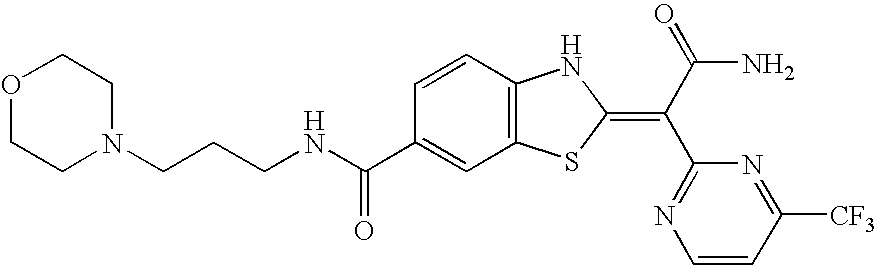
is named 2-(6-{[3-(4-morpholinyl)propyl]aminocarbonyl}-benzothiazol-2(3H)-ylidene)-2-(4-trifluoromethylpyrimidin-2-yl)acetamide.


| Compound | Structure | Exact mass, M | MS (m/z) |
| 1A |
 |
321 | 322 |
| 2A |
 |
338 | 339 |
| 3A |
 |
396 | 397 |
| 4A |
 |
379 | 380 |
| 5A |
 |
382 | 383 |
| 6A |
 |
368 | 369 |
| 7A |
 |
394 | 395 |
| 8A |
 |
352 | 353 |
| 9A |
 |
406 | 407 |
| 10A |
 |
415 | 414 (M − H) |
| 11A |
 |
415 | 414 (M − H) |
| 12A |
 |
336 | 337 |
| 13A |
 |
353 | 354 |
| 14A |
 |
467 | 468 |
| 15A |
 |
466 | 467 |
| 16A |
 |
300 | 301 |
| 17A |
 |
283 | 284 |
| 18A |
 |
284 | 285 |
| 19A |
 |
267 | 268 |
| 20A |
 |
346 | 347 |
| 21A |
 |
298 | 299 |
| 22A |
 |
298 | 299 |
| 23A |
 |
342 | 343 |
| 24A |
 |
328 | 327 (M − H) |
| 25A |
 |
464 | 463 (M − H) |
| 26A |
 |
383 | 384 |
| 27A |
 |
382 | 383 |
| 28A |
 |
365 | 366 |
| 29A |
 |
379 | 380 |
| 30A |
 |
452 | 453 |
| 31A |
 |
453 | 454 |
| 32A |
 |
353 | 354 |
| 33A |
 |
404 | 405 |
| 34A |
 |
419 | 420 |
| 35A |
 |
351 | 352 |
| 36A |
 |
357 | 358 |
| 37A |
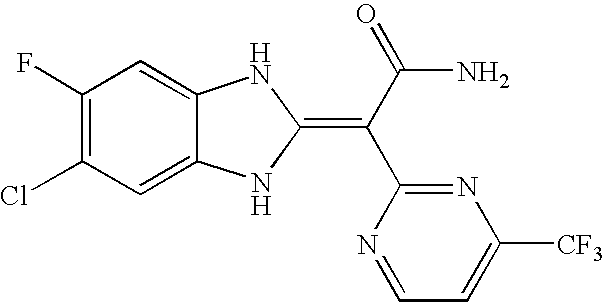 |
373 | 374 |
| 38A |
 |
357 | 358 |
| 39A |
 |
491 | 492 |
| 40A |
 |
508 | 509 |
| 41A |
 |
519 | 520 |
| 42A |
 |
536 | 537 |
| 43A |
 |
469 | 470 |
| 44A |
 |
441 | 443 (M + 2) |
| 45A |
 |
472 | 473 |
| 46A |
 |
489 | 490 |
| 47A |
 |
475 | 474 (M − H) |
| 48A |
 |
500 | 501 |
| 49A |
 |
517 | 518 |
| 50A |
 |
526 | 527 |
| 51A |
 |
511 | 512 |
| 52A |
 |
508 | 509 |
| 53A |
 |
477 | 478 |
| 54A |
 |
494 | 495 |
| 55A |
 |
518 | 519 |
| 56A |
 |
535 | 536 |
| 57A |
 |
507 | 508 |
| 58A |
 |
447 | 448 |
| 59A |
 |
464 | 465 |
| 60A |
 |
433 | 434 |
| 61A |
 |
450 | 451 |
| 62A |
 |
449 | 451 |
| 63A |
 |
424 | 425 |
| 64A |
 |
421 | 422 |
| 65A |
 |
438 | 439 |
| 66A |
 |
447 | 448 |
| 67A |
 |
464 | 465 |
| 68A |
 |
433 | 434 |
| 69A |
 |
450 | 451 |
| 70A |
 |
447 | 448 |
| 71A |
 |
464 | 465 |
| 72A |
 |
540 | 540 |
| 73A |
 |
421 | 422 |
| 74A |
 |
438 | 439 |
| 75A |
 |
449 | 450 |
| 76A |
 |
410 | 411 |
| 77A |
 |
447 | 448 |
| 78A |
 |
464 | 465 |
| 79A |
 |
433 | 434 |
| 80A |
 |
433 | 434 |
| 81A |
 |
421 | 422 |
| 82A |
 |
461 | 462 |
| 83A |
 |
490 | 491 |
| 84A |
 |
477 | 478 |
| 85A |
 |
491 | 492 |
| 86A |
 |
444 | 445 |
| 87A |
 |
458 | 459 |
| 88A |
 |
461 | 462 |
| 89A |
 |
418 | 419 |
| 90A |
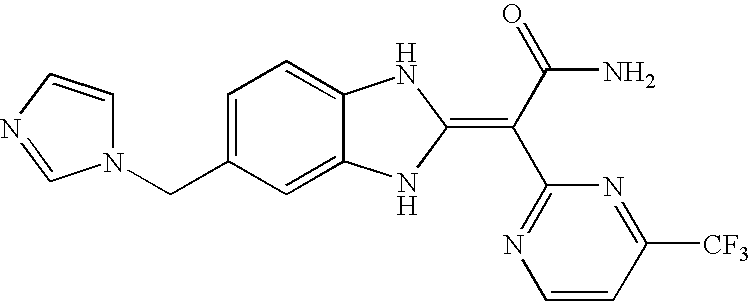 |
401 | 402 |
| 91A |
 |
437 | 438 |
| 92A |
 |
399 | 400 |
| 93A |
 |
450 | 451 |
| 94A |
 |
436 | 437 |
| 95A |
 |
432 | 433 |
| 96A |
 |
415 | 416 |
| 97A |
 |
446 | 447 |
| 98A |
 |
446 | 447 |
| 99A |
 |
443 | 444 |
| 100A |
 |
499 | 500 |
| 101A |
 |
451 | 452 |
| 102A |
 |
434 | 435 |
| 103A |
 |
467 | 468 |
| 104A |
 |
485 | 486 |
| 105A |
 |
365 | 366 |
| 106A |
 |
418 | 419 |
| 107A |
 |
398 | 399 |
| 108A |
 |
415 | 416 |
| 109A |
 |
398 | 399 |
| 110A |
 |
522 | 523 |
| 111A |
 |
467 | 468 |
| 112A |
 |
467 | 468 |
| 113A |
 |
481 | 482 |
| 114A |
 |
480 | 481 |
| 115A |
 |
494 | 495 |
| 116A |
 |
425 | 426 |
| 117A |
 |
448 | 449 |
| 118A |
 |
431 | 432 |
| 119A |
 |
419 | 420 |
| 120A |
 |
436 | 437 |
| 121A |
 |
504 | 505 |
| 122A |
 |
506 | 507 |
| 123A |
 |
422 | 423 |
| 124A |
 |
466 | 467 |
| 125A |
 |
478 | 479 |
| 126A |
 |
500 | 501 |
| 127A |
 |
544 | 545 |
| 128A |
 |
530 | 531 |
| 129A |
 |
486 | 487 |
| 130A |
 |
464 | 465 |
| 131A |
 |
508 | 509 |
| 132A |
 |
491 | 492 |
| 133A |
 |
519 | 520 |
| 134A |
 |
494 | 495 |
| 135A |
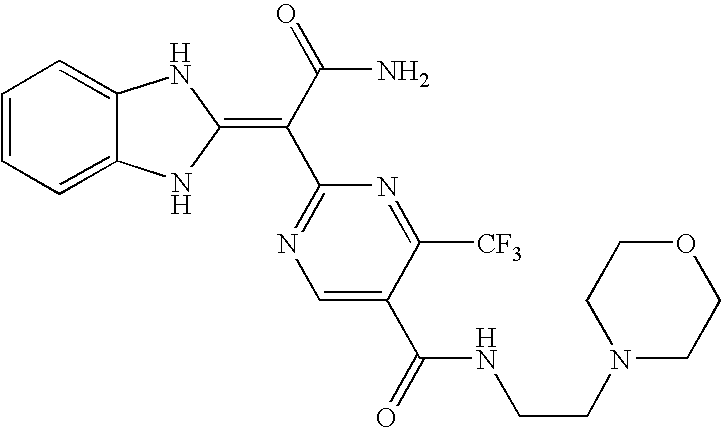 |
477 | 478 |
| 136A |
 |
505 | 506 |
| 137A |
 |
466 | 467 |
| 138A |
 |
335 | 336 |
| 139A |
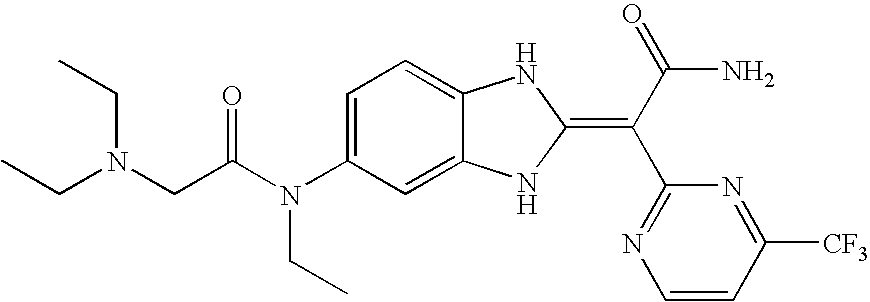 |
477 | 478 |
| 1404A |
 |
461 | 462 |
| 141A |
 |
489 | 490 |
| 142A |
 |
461 | 462 |
| 143A |
 |
461 | 462 |
| 144A |
 |
461 | 462 |
| 145A |
 |
475 | 476 |
| 146A |
 |
489 | 490 |
| Aur-A | Aur-B | VEGFR2 | p-H3 | HCT116 | HL60 | HUVEC | |
| Cpd. | IC50, nM | IC50, nM | IC50, nM | IC50, μM | IC50, μM | IC50, μM | IC50, μM |
| 1A | 10 | 5 | 10 | 0.2 | 0.3 | 1 | 0.07 |
| 2A | 30 | 6 | 90 | 2 | 2 | 3 | 0.05 |
| 3A | 20 | 10 | 90 | 20 | 3 | ||
| 4A | 4 | 10 | 30 | >40 | 2 | ||
| 5A | 20 | 8 | 20 | 3 | 10 | >10 | |
| 6A | 20 | 10 | 200 | 2 | 4 | 2 | |
| 7A | 7 | 20 | 30 | >5 | 6 | 0.08 | |
| 8A | 10 | 8 | 60 | 1 | 2 | 0.2 | |
| 9A | 10 | 7 | 60 | >5 | >20 | >20 | |
| 10A | 10 | 10 | 40 | 5 | 1 | 2 | |
| 11A | 40 | 10 | >5 | 4 | 3 | ||
| 12A | 7 | 6 | 40 | 0.1 | 0.4 | 0.2 | |
| 13A | 10 | 3 | 0.8 | 0.7 | 1 | ||
| 14A | 50 | 30 | 80 | >50 | 8 | ||
| 15A | 80 | 30 | 40 | 2 | 2 | ||
| 16A | 100 | 20 | 300 | 2 | 2 | 2 | |
| 17A | 300 | 30 | 1 | 0.6 | 5 | 5 | |
| 18A | 200 | 40 | 500 | 2 | 20 | ||
| 19A | 400 | 30 | >50 | 20 | |||
| 20A | 90 | 20 | 200 | >5 | 8 | 0.6 | |
| 21A | 200 | 100 | 1000 | 20 | |||
| 22A | 80 | 10 | 200 | 2 | 10 | ||
| 23A | 70 | 6 | 100 | 8 | 50 | ||
| 24A | 900 | 1000 | 400 | >50 | |||
| 25A | 200 | 100 | 400 | >50 | 10 | ||
| 26A | 200 | 100 | 1000 | >50 | 20 | ||
| 27A | 3 | 9 | 10 | 1 | 7 | ||
| 28A | 5 | 5 | 10 | 4 | 4 | 0.04 | |
| 29A | 30 | 10 | 100 | >5 | 0.2 | ||
| 30A | 10 | 10 | 8 | 1 | |||
| 31A | 4 | 9 | 3 | 0.1 | 0.2 | 1 | |
| 32A | 10 | 10 | 40 | 0.4 | 5 | 3 | |
| 33A | 2 | 10 | 9 | 0.5 | 0.3 | 0.3 | |
| 34A | 5 | 6 | 10 | 0.4 | 0.6 | 0.2 | |
| 35A | 9 | 5 | 20 | 0.6 | 0.2 | ||
| 36A | 30 | 40 | 200 | >5 | 4 | ||
| 37A | 30 | 20 | 400 | 0.5 | 2 | 4 | |
| 38A | 40 | 10 | 200 | 0.3 | 0.8 | 1 | 0.1 |
| 39A | 10 | 5 | 7 | 0.9 | 0.3 | 0.5 | 0.06 |
| 40A | 3 | 7 | 3 | 0.5 | 0.2 | 7 | 0.03 |
| 41A | 6 | 4 | 4 | 0.1 | 0.7 | 0.1 | 0.2 |
| 42A | 10 | 6 | 20 | 0.3 | 0.5 | 0.03 | 0.04 |
| 43A | 6 | 10 | |||||
| 44A | 10 | 10 | 10 | 0.2 | 0.2 | 0.08 | |
| 45A | 20 | 7 | 20 | 0.9 | 0.5 | 0.1 | 0.01 |
| 46A | 6 | 10 | 40 | 0.2 | 0.4 | 0.2 | |
| 47A | 4 | 6 | 20 | 0.2 | 0.3 | 0.3 | 0.004 |
| 48A | 10 | 1 | 10 | 0.3 | 0.6 | 0.1 | 0.04 |
| 49A | 3 | 5 | 0.1 | 0.4 | 1 | ||
| 50A | 20 | 10 | 20 | 0.4 | 0.3 | 0.09 | |
| 51A | 7 | 6 | 20 | 0.3 | 0.5 | 0.05 | 0.03 |
| 52A | 60 | 60 | 100 | >50 | 1 | ||
| 53A | 3 | 10 | 20 | 0.2 | 0.3 | 0.2 | 0.03 |
| 54A | 6 | 10 | 10 | 0.4 | 0.4 | 0.3 | 0.03 |
| 55A | 20 | 20 | 20 | 0.7 | 0.3 | 0.05 | |
| 56A | 20 | 20 | 20 | 0.7 | 0.04 | 0.04 | |
| 57A | 20 | 20 | 10 | 0.1 | 0.1 | 0.02 | |
| 58A | 9 | 5 | 9 | 0.5 | 0.4 | 0.06 | |
| 59A | 8 | 20 | 6 | 0.09 | 0.4 | 0.05 | |
| 60A | 10 | 7 | 5 | 0.2 | 0.2 | 0.08 | |
| 61A | 20 | 10 | 4 | 0.03 | 0.1 | 0.2 | 0.02 |
| 62A | 70 | 10 | 6 | 0.4 | 0.06 | 0.06 | |
| 63A | 30 | 30 | 5 | 0.4 | 0.2 | 0.06 | |
| 64A | 50 | 20 | 10 | 0.9 | 2 | ||
| 65A | 30 | 20 | 7 | 0.4 | 0.2 | ||
| 66A | 20 | 10 | 2 | 0.2 | 0.2 | 0.05 | |
| 67A | 10 | 40 | 4 | 0.04 | 0.2 | 0.02 | |
| 68A | 10 | 10 | 3 | 0.06 | 0.1 | 0.06 | |
| 69A | 20 | 30 | 2 | 0.1 | 0.09 | 0.02 | |
| 70A | 60 | 10 | 4 | 1 | 0.6 | ||
| 71A | 20 | 40 | 4 | 0.2 | 0.2 | 0.09 | |
| 72A | 20 | 20 | 20 | 0.3 | 0.2 | 0.08 | |
| 73A | 10 | 5 | 6 | 0.1 | 0.2 | 0.2 | 0.1 |
| 74A | 20 | 10 | 20 | 0.2 | 0.3 | 0.04 | 0.08 |
| 75A | 60 | 10 | 50 | 0.4 | 1 | 0.2 | |
| 76A | 50 | 5 | 80 | 0.2 | 0.7 | 0.1 | |
| 77A | 8 | 7 | 9 | 0.1 | 0.2 | 0.3 | 0.09 |
| 78A | 60 | 40 | 50 | 0.6 | 2 | 1 | 0.4 |
| 79A | 20 | 20 | 10 | 0.4 | 0.1 | 0.3 | 0.04 |
| 80A | 10 | 4 | 50 | 0.09 | 0.5 | 0.1 | |
| 81A | 6 | 7 | 9 | 0.09 | 0.3 | 0.2 | 0.08 |
| 82A | 8 | 7 | 10 | 0.4 | 0.08 | 0.03 | |
| 83A | 6 | 10 | 60 | 0.2 | 0.2 | 0.2 | |
| 84A | 7 | 9 | 20 | 0.1 | 0.2 | 0.1 | 0.06 |
| 85A | 5 | 4 | 20 | 0.05 | 0.3 | 0.06 | 0.02 |
| 86A | 4 | 8 | 30 | 0.2 | 0.4 | 0.8 | 0.03 |
| 87A | 8 | 9 | 10 | 0.2 | 0.2 | 0.1 | 0.09 |
| 88A | 4 | 8 | 20 | 0.06 | 0.3 | 0.1 | 0.3 |
| 89A | 5 | 5 | 6 | 0.1 | 0.5 | 0.7 | 0.08 |
| 90A | 4 | 9 | 4 | 0.07 | 0.2 | 0.1 | 0.09 |
| 91A | 2 | 20 | 10 | 0.1 | 0.3 | 0.04 | |
| 92A | 70 | 30 | 400 | 0.5 | 5 | 0.06 | |
| 93A | 20 | 20 | 10 | 0.1 | 0.3 | 0.03 | |
| 94A | 7 | 7 | 10 | 0.08 | 0.2 | 0.1 | 0.05 |
| 95A | 20 | 4 | 20 | 0.05 | 2 | 2 | 0.05 |
| 96A | 2 | 3 | 6 | 0.04 | 0.3 | 0.1 | |
| 97A | 20 | 7 | 0.1 | 0.6 | 1 | ||
| 98A | 6 | 8 | |||||
| 99A | 20 | 7 | 100 | 1 | 3 | 2 | |
| 100A | 5 | 9 | 10 | 0.3 | 0.4 | 0.09 | 0.02 |
| 101A | 7 | 9 | 20 | 1 | 1 | 2 | 0.05 |
| 102A | 4 | 7 | 0.05 | ||||
| 103A | 20 | 10 | 20 | 2 | 2 | 0.1 | 0.1 |
| 104A | 30 | 10 | 60 | 2 | 3 | 1 | |
| 105A | 5 | 7 | 0.1 | ||||
| 106A | 3 | 20 | 30 | 0.9 | 2 | 0.08 | |
| 107A | 8 | 20 | 40 | >5 | 5 | 1 | |
| 108A | 10 | 10 | 60 | 3 | 2 | 2 | |
| 109A | 20 | 9 | 50 | >5 | 3 | 0.5 | |
| 110A | 50 | 20 | 20 | 0.2 | 0.2 | 0.8 | 0.08 |
| 111A | 20 | 9 | 100 | 0.4 | 2 | 0.3 | |
| 112A | 20 | 20 | 200 | 0.9 | 2 | 0.2 | |
| 113A | 30 | 20 | 40 | 0.4 | 0.6 | 0.2 | |
| 114A | 40 | 20 | 40 | 0.05 | 0.6 | 0.04 | |
| 115A | 40 | 30 | 20 | 0.2 | 0.1 | 0.1 | |
| 116A | 40 | 8 | 9 | 0.08 | 0.4 | 0.1 | |
| 117A | 10 | 8 | 20 | 0.3 | 0.8 | 0.06 | |
| 118A | 40 | 10 | 100 | 4 | 2 | 0.3 | 0.2 |
| 119A | 9 | 6 | 6 | 0.2 | 1 | 0.2 | |
| 120A | 30 | 9 | 2 | 0.5 | 2 | 2 | |
| 121A | 30 | 8 | 20 | 0.09 | 1 | 0.9 | |
| 122A | 20 | 9 | 20 | 0.4 | 4 | 7 | |
| 123A | 100 | 40 | 90 | 2 | 4 | ||
| 124A | 30 | 30 | 100 | >20 | 3 | ||
| 125A | 30 | 10 | 20 | 0.2 | 3 | 0.6 | |
| 126A | 20 | 20 | 70 | 2 | 2 | 0.03 | |
| 127A | 20 | 6 | 20 | 0.2 | 0.6 | 0.5 | 0.04 |
| 128A | 10 | 20 | 60 | 0.6 | 0.9 | 0.06 | |
| 129A | 30 | 10 | 100 | 1 | 1 | 0.3 | |
| 130A | 100 | 9 | 20 | 0.3 | 2 | 0.4 | |
| 131A | 90 | 60 | 200 | 0.9 | 2 | 0.8 | |
| 132A | 60 | 20 | 100 | 2 | 1 | 0.6 | |
| 133A | 40 | 10 | 60 | 0.3 | 0.8 | 0.2 | |
| 134A | 50 | 10 | 80 | 0.4 | 4 | 0.6 | |
| 135A | 30 | 20 | 100 | 0.5 | 4 | 0.6 | |
| 136A | 20 | 30 | 0.2 | 0.8 | 0.2 | 0.2 | |
| 137A | 80 | 30 | 40 | 2 | 2 | ||
| 138A | 8 | 8 | 40 | 0.5 | 1 | 0.4 | |
| 139A | 20 | 2 | 30 | 0.09 | 0.03 | 0.04 | |
| 140A | 6 | 9 | 20 | 0.4 | 0.4 | 0.3 | 0.02 |
| 141A | 4 | 6 | 40 | 0.3 | 0.9 | 1 | 0.02 |
| 142A | 2 | 4 | 10 | 0.3 | 0.3 | 0.2 | 0.09 |
| 143A | 4 | 6 | 30 | 0.2 | 0.3 | 0.3 | 0.08 |
| 144A | 5 | 6 | 0.1 | 0.4 | 0.5 | ||
| 145A | 20 | 4 | 10 | 0.08 | 0.2 | 0.4 | |
| 146A | 20 | 5 | 0.2 | 0.4 | 0.8 | ||
| Compound of this invention | 25.0% | w/w | ||
| Magnesium stearate | 0.5% | w/w | ||
| Starch | 2.0% | w/w | ||
| Hydroxypropylmethylcellulose | 1.0% | w/w | ||
| Microcrystalline cellulose | 71.5% | w/w | ||
and the mixture is compressed to form tablets or filled into hard gelatin capsules containing, for example, 100 mg of the compound of this invention. Tablets may be coated, if desired, by applying a suspension of a film-forming agent (for example, hydroxypropylmethylcellulose), pigment (for example, titanium dioxide), and plasticizer (for example, diethyl phthalate), and drying the film by evaporation of the solvent.
Claims (21)

Priority Applications (1)
| Application Number | Priority Date | Filing Date | Title |
|---|---|---|---|
| US12/567,060 US8129396B2 (en) | 2008-09-29 | 2009-09-25 | 2-[1H-benzimidazol-2(3H)-ylidene]-2-(pyrimidin-2-yl)acetamides and 2-[benzothiazol-2(3H)-ylidene]-2-(pyrimidin-2-yl)acetamides as kinase inhibitors |
Applications Claiming Priority (2)
| Application Number | Priority Date | Filing Date | Title |
|---|---|---|---|
| US10086908P | 2008-09-29 | 2008-09-29 | |
| US12/567,060 US8129396B2 (en) | 2008-09-29 | 2009-09-25 | 2-[1H-benzimidazol-2(3H)-ylidene]-2-(pyrimidin-2-yl)acetamides and 2-[benzothiazol-2(3H)-ylidene]-2-(pyrimidin-2-yl)acetamides as kinase inhibitors |
Publications (2)
| Publication Number | Publication Date |
|---|---|
| US20100081653A1 US20100081653A1 (en) | 2010-04-01 |
| US8129396B2 true US8129396B2 (en) | 2012-03-06 |
Family
ID=41268298
Family Applications (1)
| Application Number | Title | Priority Date | Filing Date |
|---|---|---|---|
| US12/567,060 Expired - Fee Related US8129396B2 (en) | 2008-09-29 | 2009-09-25 | 2-[1H-benzimidazol-2(3H)-ylidene]-2-(pyrimidin-2-yl)acetamides and 2-[benzothiazol-2(3H)-ylidene]-2-(pyrimidin-2-yl)acetamides as kinase inhibitors |
Country Status (16)
| Country | Link |
|---|---|
| US (1) | US8129396B2 (en) |
| EP (1) | EP2346856A1 (en) |
| JP (1) | JP5555239B2 (en) |
| KR (1) | KR20110059740A (en) |
| CN (1) | CN102159568A (en) |
| AR (1) | AR073699A1 (en) |
| AU (1) | AU2009296482A1 (en) |
| BR (1) | BRPI0918509A2 (en) |
| CA (1) | CA2734472A1 (en) |
| CL (1) | CL2011000686A1 (en) |
| IL (1) | IL211036A0 (en) |
| MX (1) | MX2011002986A (en) |
| RU (1) | RU2011113230A (en) |
| TW (1) | TW201012811A (en) |
| WO (1) | WO2010036873A1 (en) |
| ZA (1) | ZA201101665B (en) |
Families Citing this family (1)
| Publication number | Priority date | Publication date | Assignee | Title |
|---|---|---|---|---|
| US9410017B2 (en) | 2012-05-03 | 2016-08-09 | Lg Chem, Ltd. | Poly-amic acid, photo-sensitive resin composition, dry film, and circuit board |
Citations (3)
| Publication number | Priority date | Publication date | Assignee | Title |
|---|---|---|---|---|
| EP1110957A1 (en) | 1999-12-24 | 2001-06-27 | Applied Research Systems ARS Holding N.V. | Benzazole derivatives and their use as JNK modulators |
| WO2006120557A1 (en) | 2005-05-12 | 2006-11-16 | Pfizer Inc. | Anticancer combination therapy using sunitinib malate |
| WO2007009524A1 (en) | 2005-07-15 | 2007-01-25 | 4Sc Ag | 2-arylbenzothiazoles and uses thereof |
Family Cites Families (1)
| Publication number | Priority date | Publication date | Assignee | Title |
|---|---|---|---|---|
| CN101163473A (en) * | 2005-05-12 | 2008-04-16 | 辉瑞大药厂 | Anticancer Combination Therapy Using Sunitinib Malate |
-
2009
- 2009-09-25 WO PCT/US2009/058345 patent/WO2010036873A1/en not_active Ceased
- 2009-09-25 EP EP09792996A patent/EP2346856A1/en not_active Withdrawn
- 2009-09-25 RU RU2011113230/04A patent/RU2011113230A/en unknown
- 2009-09-25 CN CN2009801366898A patent/CN102159568A/en active Pending
- 2009-09-25 JP JP2011529248A patent/JP5555239B2/en not_active Expired - Fee Related
- 2009-09-25 KR KR1020117007266A patent/KR20110059740A/en not_active Withdrawn
- 2009-09-25 BR BRPI0918509A patent/BRPI0918509A2/en not_active Application Discontinuation
- 2009-09-25 MX MX2011002986A patent/MX2011002986A/en not_active Application Discontinuation
- 2009-09-25 CA CA2734472A patent/CA2734472A1/en not_active Abandoned
- 2009-09-25 TW TW098132388A patent/TW201012811A/en unknown
- 2009-09-25 US US12/567,060 patent/US8129396B2/en not_active Expired - Fee Related
- 2009-09-25 AU AU2009296482A patent/AU2009296482A1/en not_active Abandoned
- 2009-09-28 AR ARP090103727A patent/AR073699A1/en unknown
-
2011
- 2011-02-03 IL IL211036A patent/IL211036A0/en unknown
- 2011-03-03 ZA ZA2011/01665A patent/ZA201101665B/en unknown
- 2011-03-29 CL CL2011000686A patent/CL2011000686A1/en unknown
Patent Citations (3)
| Publication number | Priority date | Publication date | Assignee | Title |
|---|---|---|---|---|
| EP1110957A1 (en) | 1999-12-24 | 2001-06-27 | Applied Research Systems ARS Holding N.V. | Benzazole derivatives and their use as JNK modulators |
| WO2006120557A1 (en) | 2005-05-12 | 2006-11-16 | Pfizer Inc. | Anticancer combination therapy using sunitinib malate |
| WO2007009524A1 (en) | 2005-07-15 | 2007-01-25 | 4Sc Ag | 2-arylbenzothiazoles and uses thereof |
Non-Patent Citations (13)
| Title |
|---|
| Barnikow, G. et al., "Zur Kentnis der Hugershoff-Reaktion. VI) Die Umsetzung von Acetyl-malonsäure-äthylesterthioaniliden und anderen Thion-Thiol-tautomerenVerbindungen mit Brom", J. Prakt. Chemie 1966, 5(5-6), 262-268. |
| Cancer and Metastasis Reviews (1998), 17(1), 91-106. * |
| Carvajal, R.D. et al., "Aurora Kinases: New Targets for Cancer Therapy", Clin. Cancer Res. 2006, 12, 6869-6875. |
| Ellis, L.M. and D.J. Hicklin., "VEGF-targeted therapy: mechanisms of anti-tumour activity", Nature Rev. Cancer 2008, 8, 579-591 [Published online Jul. 3, 2008]. |
| Ferrara, N. and R.S. Kerbel, "Angiogenesis as a therapeutic target", Nature 2005, 438, 967-974. |
| Gaillard, P. et al., Design and Synthesis of the First Generation of Novel Potent, Selective and in Vivo Active (Benzothiazol-2-yl)acetonitrile Inhibitors of the c-Jun N-Terminal Kinase, J. Med. Chem. 2005, 48, 4596-4607. |
| Mortlock, A. et al., "Progress in the Development of Selective Inhibitors of Aurora Kinases", Curr. Topics Med. Chem. 2005, 5, 199-213. |
| Myrianthopoulos, V. et al., "An Integrated Computational Approach to the Phenomenon of Potent and Selective Inhibition of Aurora Kinases B and C by a Series of 7-Substituted Indirubins", J. Med. Chem. 2007, 50(17), 4027-4037 [Published online Aug. 1, 2007]. |
| ptcl.chem.ox.ac.uk/MSDS structure activity relationship; Jaworska, 1-8, 2004. * |
| Science (1999), vol. 286, 531-537. * |
| Shaikh, A.R. et al., "Three-dimensional quantitative structure-activity relationship (3 D-QSAR) and docking studies on (benzothioazole-2-yl)acetonitrile derivatives as c-Jun N-terminal kinase-3 (JNK-3) inhibitors", Bioorg. Med. Chem. Lett. 2006, 16(22), 5917-5925. |
| Voskoglou-Nmikos et al., Clinical Cancer Research, vol. 9, 4227-4239, 2003. * |
| Voskoglou-Nomikos et al., Clinical Cancer Research, vol. 9, 4227-4239. * |
Also Published As
| Publication number | Publication date |
|---|---|
| JP5555239B2 (en) | 2014-07-23 |
| CA2734472A1 (en) | 2010-04-01 |
| JP2012504130A (en) | 2012-02-16 |
| CL2011000686A1 (en) | 2012-02-24 |
| TW201012811A (en) | 2010-04-01 |
| BRPI0918509A2 (en) | 2015-12-01 |
| RU2011113230A (en) | 2012-11-10 |
| KR20110059740A (en) | 2011-06-03 |
| IL211036A0 (en) | 2011-04-28 |
| MX2011002986A (en) | 2011-04-21 |
| CN102159568A (en) | 2011-08-17 |
| AR073699A1 (en) | 2010-11-24 |
| EP2346856A1 (en) | 2011-07-27 |
| WO2010036873A1 (en) | 2010-04-01 |
| US20100081653A1 (en) | 2010-04-01 |
| ZA201101665B (en) | 2011-10-26 |
| AU2009296482A1 (en) | 2010-04-01 |
Similar Documents
| Publication | Publication Date | Title |
|---|---|---|
| USRE49556E1 (en) | Compounds and compositions as protein kinase inhibitors | |
| US10653673B2 (en) | Substituted imidazoles as N-type calcium channel blockers | |
| CN101885722B (en) | Heterocycle alkyne and benzene compound, medicinal composition and application thereof | |
| US7253187B2 (en) | Heterocyclic inhibitors of ERK2 and uses thereof | |
| AU2008312948B2 (en) | Pyrimidyl indoline compound | |
| AU2007305399B2 (en) | JAK-2 Modulators and Methods of Use | |
| AU2026201298A1 (en) | Compounds and their uses as CD38 inhibitors | |
| US20120189623A1 (en) | Cyclized derivatives as eg-5 inhibitors | |
| CA2442428A1 (en) | Novel tyrosine kinase inhibitors | |
| US7902240B2 (en) | Substituted pyrazole and triazole compounds as KSP inhibitors | |
| EP3630752B1 (en) | Substituted nitrogen containing compounds | |
| KR20070048762A (en) | Zyrase Inhibitors and Uses thereof | |
| US7442693B2 (en) | Diazepine compounds as ligands of the melanocortin 1 and/or 4 receptors | |
| TW201319056A (en) | Specific kynurenine-3-monooxygenase inhibitor, pharmaceutical composition thereof and use method thereof | |
| US4886817A (en) | Imidazolidinones as brain activators | |
| AU2006279991B2 (en) | Substituted imidazole compounds as KSP inhibitors | |
| US20100081653A1 (en) | 2-[1H-Benzimidazol-2(3H)-ylidene]-2-(pyrimidin-2-yl)acetamides and 2-[benzothiazol-2(3H)-ylidene]-2-(pyrimidin-2-yl)acetamides as kinase inhibitors | |
| AU2013397913B2 (en) | Substituted imidazoles as N-type calcium channel blockers | |
| HU201059B (en) | Process for producing 6-oxo-pyridazine derivatives and pharmaceutical compositions containing them | |
| AU2016304331A1 (en) | Method of treating cancer with a combination of benzylideneguanidine derivatives and chemotherapeutic agent. | |
| CZ20022492A3 (en) | Substituted pyrroles | |
| EA043056B1 (en) | SUBSTITUTED NITROGEN-CONTAINING COMPOUNDS |
Legal Events
| Date | Code | Title | Description |
|---|---|---|---|
| AS | Assignment |
Owner name: TELIK, INC.,CALIFORNIA Free format text: NUNC PRO TUNC ASSIGNMENT;ASSIGNORS:AURRECOECHEA, NATALIA;BEROZA, PAUL P;DAMODARAN, KOMATH V;AND OTHERS;SIGNING DATES FROM 20090925 TO 20091012;REEL/FRAME:023369/0141 Owner name: TELIK, INC., CALIFORNIA Free format text: NUNC PRO TUNC ASSIGNMENT;ASSIGNORS:AURRECOECHEA, NATALIA;BEROZA, PAUL P;DAMODARAN, KOMATH V;AND OTHERS;SIGNING DATES FROM 20090925 TO 20091012;REEL/FRAME:023369/0141 |
|
| REMI | Maintenance fee reminder mailed | ||
| LAPS | Lapse for failure to pay maintenance fees | ||
| STCH | Information on status: patent discontinuation |
Free format text: PATENT EXPIRED DUE TO NONPAYMENT OF MAINTENANCE FEES UNDER 37 CFR 1.362 |
|
| STCH | Information on status: patent discontinuation |
Free format text: PATENT EXPIRED DUE TO NONPAYMENT OF MAINTENANCE FEES UNDER 37 CFR 1.362 |
|
| FP | Lapsed due to failure to pay maintenance fee |
Effective date: 20160306 |