US8110688B2 - Method for producing indole derivative having piperidine ring - Google Patents
Method for producing indole derivative having piperidine ring Download PDFInfo
- Publication number
- US8110688B2 US8110688B2 US11/914,115 US91411506A US8110688B2 US 8110688 B2 US8110688 B2 US 8110688B2 US 91411506 A US91411506 A US 91411506A US 8110688 B2 US8110688 B2 US 8110688B2
- Authority
- US
- United States
- Prior art keywords
- compound
- following formula
- added
- represented
- reaction
- Prior art date
- Legal status (The legal status is an assumption and is not a legal conclusion. Google has not performed a legal analysis and makes no representation as to the accuracy of the status listed.)
- Expired - Fee Related, expires
Links
- NVJRMILMUABTFK-UHFFFAOYSA-N COC1=C(CCO)C2=C(C=C1)C(=O)CC(C)(C)O2 Chemical compound COC1=C(CCO)C2=C(C=C1)C(=O)CC(C)(C)O2 NVJRMILMUABTFK-UHFFFAOYSA-N 0.000 description 16
- GANBHWWJRZOQSU-UHFFFAOYSA-N COCCC1=C(OC)C=CC2=C1OC(C)(C)CC2=O Chemical compound COCCC1=C(OC)C=CC2=C1OC(C)(C)CC2=O GANBHWWJRZOQSU-UHFFFAOYSA-N 0.000 description 13
- AMUZCVYKEWHXAQ-UHFFFAOYSA-N COCCC1=C(OC)C=CC=C1O Chemical compound COCCC1=C(OC)C=CC=C1O AMUZCVYKEWHXAQ-UHFFFAOYSA-N 0.000 description 10
- OUEJTYIAUSQGEB-UHFFFAOYSA-N CCOC(C)OC1=CC=CC(OC)=C1CCOC Chemical compound CCOC(C)OC1=CC=CC(OC)=C1CCOC OUEJTYIAUSQGEB-UHFFFAOYSA-N 0.000 description 8
- VRKCXIKRUHTNLA-UHFFFAOYSA-N CCOC(=O)CC1=C(OC)C=CC=C1OC(C)OCC Chemical compound CCOC(=O)CC1=C(OC)C=CC=C1OC(C)OCC VRKCXIKRUHTNLA-UHFFFAOYSA-N 0.000 description 6
- NTVMCMUBHKRSBU-UHFFFAOYSA-N CCOC(C)OC1=CC=CC(OC)=C1CCO Chemical compound CCOC(C)OC1=CC=CC(OC)=C1CCO NTVMCMUBHKRSBU-UHFFFAOYSA-N 0.000 description 6
- ZPHITLFRKHZKBG-UHFFFAOYSA-N CCOC(C)OC1=CC=CC(OC)=C1 Chemical compound CCOC(C)OC1=CC=CC(OC)=C1 ZPHITLFRKHZKBG-UHFFFAOYSA-N 0.000 description 4
- PCSQLSJJKKWYJA-UHFFFAOYSA-N COC1=C/C=C2/C(=O)CC(C)(C)O/C2=C\1CCN1CCC(N2C=CC3=CC=C(C(=O)O)C=C32)CC1 Chemical compound COC1=C/C=C2/C(=O)CC(C)(C)O/C2=C\1CCN1CCC(N2C=CC3=CC=C(C(=O)O)C=C32)CC1 PCSQLSJJKKWYJA-UHFFFAOYSA-N 0.000 description 4
- JQVJEXFTINEMSG-UHFFFAOYSA-N COC1=CC=C2C(=O)CC(C)(C)OC2=C1CC=O Chemical compound COC1=CC=C2C(=O)CC(C)(C)OC2=C1CC=O JQVJEXFTINEMSG-UHFFFAOYSA-N 0.000 description 4
- 0 [1*]C.[2*]C.[3*]NC(=O)C1=CC2=C(C=C1)C=CN2C1CCN(CCC2=CC=CC=C2OC)CC1.[6*]C Chemical compound [1*]C.[2*]C.[3*]NC(=O)C1=CC2=C(C=C1)C=CN2C1CCN(CCC2=CC=CC=C2OC)CC1.[6*]C 0.000 description 4
- QDKZHGPQBSLGIN-UHFFFAOYSA-N CNC(=O)C1=CC2=C(C=C1)C=CN2C1CCNCC1 Chemical compound CNC(=O)C1=CC2=C(C=C1)C=CN2C1CCNCC1 QDKZHGPQBSLGIN-UHFFFAOYSA-N 0.000 description 3
- KRKZTSDKJPIHBI-UHFFFAOYSA-N CNC(=O)C1=CC=C2C=CN(C3CCN(CCC4=C5OC(C)(C)CC(=O)C5=CC=C4OC)CC3)C2=C1 Chemical compound CNC(=O)C1=CC=C2C=CN(C3CCN(CCC4=C5OC(C)(C)CC(=O)C5=CC=C4OC)CC3)C2=C1 KRKZTSDKJPIHBI-UHFFFAOYSA-N 0.000 description 3
- NQBCRJFOROEJGO-UHFFFAOYSA-N CCOC(=O)CC1=C(OC)C=CC=C1OC(C)OCC.CCOC(C)OC1=CC=CC(OC)=C1CCO Chemical compound CCOC(=O)CC1=C(OC)C=CC=C1OC(C)OCC.CCOC(C)OC1=CC=CC(OC)=C1CCO NQBCRJFOROEJGO-UHFFFAOYSA-N 0.000 description 2
- OCOIWRZBQGTUTA-UHFFFAOYSA-N CNC(=O)C1=CC(N)=C(CC(OC)OC)C=C1.CNC(=O)C1=CC([N+](=O)[O-])=C(CC(OC)OC)C=C1 Chemical compound CNC(=O)C1=CC(N)=C(CC(OC)OC)C=C1.CNC(=O)C1=CC([N+](=O)[O-])=C(CC(OC)OC)C=C1 OCOIWRZBQGTUTA-UHFFFAOYSA-N 0.000 description 2
- TWMMHNPBBLNTOD-UHDJGPCESA-N CNC(=O)C1=CC([N+](=O)[O-])=C(/C=C/N(C)C)C=C1.CNC(=O)C1=CC([N+](=O)[O-])=C(CC(OC)OC)C=C1 Chemical compound CNC(=O)C1=CC([N+](=O)[O-])=C(/C=C/N(C)C)C=C1.CNC(=O)C1=CC([N+](=O)[O-])=C(CC(OC)OC)C=C1 TWMMHNPBBLNTOD-UHDJGPCESA-N 0.000 description 2
- XWJFJWCIZGEDNN-UHFFFAOYSA-N CNC(=O)C1=CC2=C(C=C1)C=CN2C1CCNCC1.CNC(=O)C1=CC=C2C=CN(C3CCN(CCC4=C5OC(C)(C)CC(=O)C5=CC=C4OC)CC3)C2=C1.COC1=CC=C2C(=O)CC(C)(C)OC2=C1CC=O Chemical compound CNC(=O)C1=CC2=C(C=C1)C=CN2C1CCNCC1.CNC(=O)C1=CC=C2C=CN(C3CCN(CCC4=C5OC(C)(C)CC(=O)C5=CC=C4OC)CC3)C2=C1.COC1=CC=C2C(=O)CC(C)(C)OC2=C1CC=O XWJFJWCIZGEDNN-UHFFFAOYSA-N 0.000 description 2
- AMCUFCBHNZBARB-UHFFFAOYSA-N CNC(=O)C1=C\C=C2\C=CN(C3CCN(CCC4=C5OC(C)(C)CC(=O)C5=CC=C4OC)CC3)\C2=C\1.COC1=CC=C2C(=O)CC(C)(C)OC2=C1CCN1CCC(N2C=CC3=C/C=C(C(=O)O)/C=C\32)CC1 Chemical compound CNC(=O)C1=C\C=C2\C=CN(C3CCN(CCC4=C5OC(C)(C)CC(=O)C5=CC=C4OC)CC3)\C2=C\1.COC1=CC=C2C(=O)CC(C)(C)OC2=C1CCN1CCC(N2C=CC3=C/C=C(C(=O)O)/C=C\32)CC1 AMCUFCBHNZBARB-UHFFFAOYSA-N 0.000 description 2
- GHDZMSRAGYEDIG-VOTSOKGWSA-N CNC(c1ccc(/C=C/N(C)C)c([N+]([O-])=O)c1)=O Chemical compound CNC(c1ccc(/C=C/N(C)C)c([N+]([O-])=O)c1)=O GHDZMSRAGYEDIG-VOTSOKGWSA-N 0.000 description 2
- IGFCKAVOZSCTTL-UHFFFAOYSA-N COC(=O)C1=CC=C2C=CN(C3CCN(CCC4=C5/OC(C)(C)CC(=O)/C5=C/C=C\4OC)CC3)C2=C1 Chemical compound COC(=O)C1=CC=C2C=CN(C3CCN(CCC4=C5/OC(C)(C)CC(=O)/C5=C/C=C\4OC)CC3)C2=C1 IGFCKAVOZSCTTL-UHFFFAOYSA-N 0.000 description 2
- UDRKEKXYNUBZNR-UHFFFAOYSA-N COC(=O)C1=CC=C2C=CN(C3CCN(CCC4=C5OC(C)(C)CC(=O)C5=CC=C4OC)CC3)C2=C1.COC1=CC=C2C(=O)CC(C)(C)OC2=C1CCN1CCC(N2C=CC3=CC=C(C(=O)O)C=C32)CC1 Chemical compound COC(=O)C1=CC=C2C=CN(C3CCN(CCC4=C5OC(C)(C)CC(=O)C5=CC=C4OC)CC3)C2=C1.COC1=CC=C2C(=O)CC(C)(C)OC2=C1CCN1CCC(N2C=CC3=CC=C(C(=O)O)C=C32)CC1 UDRKEKXYNUBZNR-UHFFFAOYSA-N 0.000 description 2
- BNJZXIAEYMXLDY-UHFFFAOYSA-N COC(=O)C1=CC=C2C=CN(C3CCNCC3)C2=C1 Chemical compound COC(=O)C1=CC=C2C=CN(C3CCNCC3)C2=C1 BNJZXIAEYMXLDY-UHFFFAOYSA-N 0.000 description 2
- QGWGRJLQNCNLLM-UHFFFAOYSA-N Cc(c([N+]([O-])=O)c1)ccc1C(NC)=O Chemical compound Cc(c([N+]([O-])=O)c1)ccc1C(NC)=O QGWGRJLQNCNLLM-UHFFFAOYSA-N 0.000 description 2
- BFVQKNJOQVVFCS-UHFFFAOYSA-N C.COC1=C(CC=O)C2=C(C=C1)C(=O)CC(C)(C)O2.COC1=C(CCO)C2=C(C=C1)C(=O)CC(C)(C)O2 Chemical compound C.COC1=C(CC=O)C2=C(C=C1)C(=O)CC(C)(C)O2.COC1=C(CCO)C2=C(C=C1)C(=O)CC(C)(C)O2 BFVQKNJOQVVFCS-UHFFFAOYSA-N 0.000 description 1
- TVJDCVGXEFOIKX-UHFFFAOYSA-N C=C1CC(C)(C)O/C2=C(CCN3CCC(N4C=CC5=CC=C(C(=O)OC)C=C54)CC3)\C(OC)=C/C=C\12 Chemical compound C=C1CC(C)(C)O/C2=C(CCN3CCC(N4C=CC5=CC=C(C(=O)OC)C=C54)CC3)\C(OC)=C/C=C\12 TVJDCVGXEFOIKX-UHFFFAOYSA-N 0.000 description 1
- DEVJMICDUCTGSX-UHFFFAOYSA-N CC(=O)OC1=C(C)C(O)=CC=C1.CC(=O)OC1=CC=CC(OC(C)=O)=C1C Chemical compound CC(=O)OC1=C(C)C(O)=CC=C1.CC(=O)OC1=CC=CC(OC(C)=O)=C1C DEVJMICDUCTGSX-UHFFFAOYSA-N 0.000 description 1
- HKVQFFGORSLXQZ-UHFFFAOYSA-N CC(=O)OC1=C(C)C(O)=CC=C1.COC1=CC=CC(OC(C)=O)=C1C Chemical compound CC(=O)OC1=C(C)C(O)=CC=C1.COC1=CC=CC(OC(C)=O)=C1C HKVQFFGORSLXQZ-UHFFFAOYSA-N 0.000 description 1
- HXGCKDJEIVBLBC-UHFFFAOYSA-N CC(=O)OC1=CC=CC(OC(C)=O)=C1C.CC1=C(O)C=CC=C1O Chemical compound CC(=O)OC1=CC=CC(OC(C)=O)=C1C.CC1=C(O)C=CC=C1O HXGCKDJEIVBLBC-UHFFFAOYSA-N 0.000 description 1
- UJGVQCRTUMNUGR-UHFFFAOYSA-N CC(C)=CC(=O)O.COCCC1=C(OC)C=CC2=C1OC(C)(C)CC2=O.COCCC1=C(OC)C=CC=C1O Chemical compound CC(C)=CC(=O)O.COCCC1=C(OC)C=CC2=C1OC(C)(C)CC2=O.COCCC1=C(OC)C=CC=C1O UJGVQCRTUMNUGR-UHFFFAOYSA-N 0.000 description 1
- CMOPOUNERFRWEV-UHFFFAOYSA-N CC1=C([N+](=O)[O-])C=C(C(=O)O)C=C1.CN.CNC(=O)C1=CC([N+](=O)[O-])=C(C)C=C1 Chemical compound CC1=C([N+](=O)[O-])C=C(C(=O)O)C=C1.CN.CNC(=O)C1=CC([N+](=O)[O-])=C(C)C=C1 CMOPOUNERFRWEV-UHFFFAOYSA-N 0.000 description 1
- OKYRXKBNUPLZPA-UHFFFAOYSA-N CC1=C([N+](=O)[O-])C=C(C(=O)O)C=C1.CNC(=O)C1=CC([N+](=O)[O-])=C(C)C=C1 Chemical compound CC1=C([N+](=O)[O-])C=C(C(=O)O)C=C1.CNC(=O)C1=CC([N+](=O)[O-])=C(C)C=C1 OKYRXKBNUPLZPA-UHFFFAOYSA-N 0.000 description 1
- DGZRUPGOZQPVNC-GCSABHCESA-N CC1=CC=C(C(=O)O)C=C1[N+](=O)[O-].COC(=O)C1=CC2=C(C=C1)C=CN2C1CCN([Y])CC1.COC(=O)C1=CC=C(/C=C/N(C)C)C([N+](=O)[O-])=C1.COC(=O)C1=CC=C(CC(OC)OC)C(N)=C1.COC(=O)C1=CC=C(CC(OC)OC)C([N+](=O)[O-])=C1.COC(=O)C1=CC=C(CC(OC)OC)C([N+](=O)[O-])=C1.O=C1CCN([Y])CC1 Chemical compound CC1=CC=C(C(=O)O)C=C1[N+](=O)[O-].COC(=O)C1=CC2=C(C=C1)C=CN2C1CCN([Y])CC1.COC(=O)C1=CC=C(/C=C/N(C)C)C([N+](=O)[O-])=C1.COC(=O)C1=CC=C(CC(OC)OC)C(N)=C1.COC(=O)C1=CC=C(CC(OC)OC)C([N+](=O)[O-])=C1.COC(=O)C1=CC=C(CC(OC)OC)C([N+](=O)[O-])=C1.O=C1CCN([Y])CC1 DGZRUPGOZQPVNC-GCSABHCESA-N 0.000 description 1
- XKUSAJHHPIPENA-KMXZHCNGSA-N CC1=CC=C(C(=O)O)C=C1[N+](=O)[O-].COC(=O)C1=CC=C(/C=C/N(C)C)C([N+](=O)[O-])=C1.COC(=O)C1=CC=C(C)C([N+](=O)[O-])=C1 Chemical compound CC1=CC=C(C(=O)O)C=C1[N+](=O)[O-].COC(=O)C1=CC=C(/C=C/N(C)C)C([N+](=O)[O-])=C1.COC(=O)C1=CC=C(C)C([N+](=O)[O-])=C1 XKUSAJHHPIPENA-KMXZHCNGSA-N 0.000 description 1
- ACJYIRVSHVRROX-UHFFFAOYSA-N CCN(CC)C(=O)CC1=C(O)C=CC=C1OC.CCN(CC)C(=O)OC1=C(C)C(OC)=CC=C1 Chemical compound CCN(CC)C(=O)CC1=C(O)C=CC=C1OC.CCN(CC)C(=O)OC1=C(C)C(OC)=CC=C1 ACJYIRVSHVRROX-UHFFFAOYSA-N 0.000 description 1
- OIVWUJAXOAKNGD-UHFFFAOYSA-N CCN(CC)C(=O)CC1=C(O)C=CC=C1OC.COC1=CC=CC2=C1CC(=O)O2 Chemical compound CCN(CC)C(=O)CC1=C(O)C=CC=C1OC.COC1=CC=CC2=C1CC(=O)O2 OIVWUJAXOAKNGD-UHFFFAOYSA-N 0.000 description 1
- LFXZZZPUJFNAQQ-UHFFFAOYSA-N CCN(CC)C(=O)OC1=C(C)C(OC)=CC=C1.COC1=CC=CC(O)=C1C Chemical compound CCN(CC)C(=O)OC1=C(C)C(OC)=CC=C1.COC1=CC=CC(O)=C1C LFXZZZPUJFNAQQ-UHFFFAOYSA-N 0.000 description 1
- CTQCCXLRTSLSLV-UHFFFAOYSA-N CCOC(=O)CBr.CCOC(=O)CC1=C(OC)C=CC=C1OC(C)OCC.CCOC(C)OC1=CC=CC(OC)=C1 Chemical compound CCOC(=O)CBr.CCOC(=O)CC1=C(OC)C=CC=C1OC(C)OCC.CCOC(C)OC1=CC=CC(OC)=C1 CTQCCXLRTSLSLV-UHFFFAOYSA-N 0.000 description 1
- AQWDEBWNGCSYBY-UHFFFAOYSA-N CCOC(=O)CC1=C(OC(C)OCC)C=CC=C1OC.CCOC(C)OC1=CC(OC)=CC=C1 Chemical compound CCOC(=O)CC1=C(OC(C)OCC)C=CC=C1OC.CCOC(C)OC1=CC(OC)=CC=C1 AQWDEBWNGCSYBY-UHFFFAOYSA-N 0.000 description 1
- MYCREMZCBCPQJM-UHFFFAOYSA-N CCOC(C)OC1=C(CCO)C(OC)=CC=C1.CCOC(C)OC1=C(CCOC(=O)C2=CC=CC=C2)C(OC)=CC=C1 Chemical compound CCOC(C)OC1=C(CCO)C(OC)=CC=C1.CCOC(C)OC1=C(CCOC(=O)C2=CC=CC=C2)C(OC)=CC=C1 MYCREMZCBCPQJM-UHFFFAOYSA-N 0.000 description 1
- FTZHORMETAUYJJ-UHFFFAOYSA-N CCOC(C)OC1=C(CCOC(=O)C2=CC=CC=C2)C(OC)=CC=C1.COC1=CC=CC(O)=C1CCOC(=O)C1=CC=CC=C1 Chemical compound CCOC(C)OC1=C(CCOC(=O)C2=CC=CC=C2)C(OC)=CC=C1.COC1=CC=CC(O)=C1CCOC(=O)C1=CC=CC=C1 FTZHORMETAUYJJ-UHFFFAOYSA-N 0.000 description 1
- OSWYXOASPNHZKM-UHFFFAOYSA-N CCOC(C)OC1=CC(OC)=CC=C1.COC1=CC=CC(O)=C1 Chemical compound CCOC(C)OC1=CC(OC)=CC=C1.COC1=CC=CC(O)=C1 OSWYXOASPNHZKM-UHFFFAOYSA-N 0.000 description 1
- MDURJHOEXSTTCT-UHFFFAOYSA-N CCOC(C)OC1=CC=CC(OC)=C1CCO.CCOC(C)OC1=CC=CC(OC)=C1CCOC Chemical compound CCOC(C)OC1=CC=CC(OC)=C1CCO.CCOC(C)OC1=CC=CC(OC)=C1CCOC MDURJHOEXSTTCT-UHFFFAOYSA-N 0.000 description 1
- VCWQMXZQSHUQCB-UHFFFAOYSA-N CCOC(C)OC1=CC=CC(OC)=C1CCOC.COCCC1=C(OC)C=CC=C1O Chemical compound CCOC(C)OC1=CC=CC(OC)=C1CCOC.COCCC1=C(OC)C=CC=C1O VCWQMXZQSHUQCB-UHFFFAOYSA-N 0.000 description 1
- DHEUZYZISRVNJZ-UHFFFAOYSA-N CNC(=O)C1=CC(N)=C(CC(OC)OC)C=C1.CNC(=O)C1=CC2=C(C=C1)C=CN2C1CCN(C(=O)OCC2=CC=CC=C2)CC1.O=C1CCN(C(=O)OCC2=CC=CC=C2)CC1 Chemical compound CNC(=O)C1=CC(N)=C(CC(OC)OC)C=C1.CNC(=O)C1=CC2=C(C=C1)C=CN2C1CCN(C(=O)OCC2=CC=CC=C2)CC1.O=C1CCN(C(=O)OCC2=CC=CC=C2)CC1 DHEUZYZISRVNJZ-UHFFFAOYSA-N 0.000 description 1
- IVBQZAOTXDTZMO-UHFFFAOYSA-N CNC(=O)C1=CC(N)=C(CC(OC)OC)C=C1.CNC(=O)C1=CC2=C(C=C1)C=CN2C1CCN([Y])CC1.O=C1CCN([Y])CC1 Chemical compound CNC(=O)C1=CC(N)=C(CC(OC)OC)C=C1.CNC(=O)C1=CC2=C(C=C1)C=CN2C1CCN([Y])CC1.O=C1CCN([Y])CC1 IVBQZAOTXDTZMO-UHFFFAOYSA-N 0.000 description 1
- SASUXOZVYJITHS-UHDJGPCESA-N CNC(=O)C1=CC([N+](=O)[O-])=C(/C=C/N(C)C)C=C1.CNC(=O)C1=CC([N+](=O)[O-])=C(C)C=C1 Chemical compound CNC(=O)C1=CC([N+](=O)[O-])=C(/C=C/N(C)C)C=C1.CNC(=O)C1=CC([N+](=O)[O-])=C(C)C=C1 SASUXOZVYJITHS-UHDJGPCESA-N 0.000 description 1
- BSCNKJDQYMICAZ-KMXZHCNGSA-N CNC(=O)C1=CC([N+](=O)[O-])=C(/C=C/N(C)C)C=C1.CNC(=O)C1=CC([N+](=O)[O-])=C(C)C=C1.COC(OC)N(C)C Chemical compound CNC(=O)C1=CC([N+](=O)[O-])=C(/C=C/N(C)C)C=C1.CNC(=O)C1=CC([N+](=O)[O-])=C(C)C=C1.COC(OC)N(C)C BSCNKJDQYMICAZ-KMXZHCNGSA-N 0.000 description 1
- JWLRTKSTSAGGRR-UHFFFAOYSA-N CNC(=O)C1=CC2=C(C=C1)C=CN2C1CCN([Y])CC1.CNC(=O)C1=CC2=C(C=C1)C=CN2C1CCNCC1 Chemical compound CNC(=O)C1=CC2=C(C=C1)C=CN2C1CCN([Y])CC1.CNC(=O)C1=CC2=C(C=C1)C=CN2C1CCNCC1 JWLRTKSTSAGGRR-UHFFFAOYSA-N 0.000 description 1
- VRJGHLLTEIMYIM-UHFFFAOYSA-N CNC(=O)C1=CC2=C(C=C1)C=CN2C1CCN([Y])CC1.CNC(=O)C1=CC2=C(C=C1)C=CN2C1CCNCC1.COC(=O)C1=CC2=C(C=C1)C=CN2C1CCN([Y])CC1.O=C(O)C1=CC2=C(C=C1)C=CN2C1CCN([Y])CC1 Chemical compound CNC(=O)C1=CC2=C(C=C1)C=CN2C1CCN([Y])CC1.CNC(=O)C1=CC2=C(C=C1)C=CN2C1CCNCC1.COC(=O)C1=CC2=C(C=C1)C=CN2C1CCN([Y])CC1.O=C(O)C1=CC2=C(C=C1)C=CN2C1CCN([Y])CC1 VRJGHLLTEIMYIM-UHFFFAOYSA-N 0.000 description 1
- LYPHGDLEERNQHM-UHFFFAOYSA-N CNC(=O)C1=CC2=C(C=C1)C=CN2C1CCNCC1.CNC(=O)C1=CC=C2C=CN(C3CCN(C(=O)OCC4=CC=CC=C4)CC3)C2=C1 Chemical compound CNC(=O)C1=CC2=C(C=C1)C=CN2C1CCNCC1.CNC(=O)C1=CC=C2C=CN(C3CCN(C(=O)OCC4=CC=CC=C4)CC3)C2=C1 LYPHGDLEERNQHM-UHFFFAOYSA-N 0.000 description 1
- OZQIXRGJWTXOLM-UHFFFAOYSA-N CNC(=O)C1=CC2=C(C=C1)CCN2C1CCCCC1 Chemical compound CNC(=O)C1=CC2=C(C=C1)CCN2C1CCCCC1 OZQIXRGJWTXOLM-UHFFFAOYSA-N 0.000 description 1
- NGMMBYDQWJOKSU-UHFFFAOYSA-N CNC(=O)C1=CC=C2C=CN(C3CCN(C(=O)OCC4=CC=CC=C4)CC3)C2=C1.O=C(O)C1=CC=C2C=CN(C3CCN(C(=O)OCC4=CC=CC=C4)CC3)C2=C1 Chemical compound CNC(=O)C1=CC=C2C=CN(C3CCN(C(=O)OCC4=CC=CC=C4)CC3)C2=C1.O=C(O)C1=CC=C2C=CN(C3CCN(C(=O)OCC4=CC=CC=C4)CC3)C2=C1 NGMMBYDQWJOKSU-UHFFFAOYSA-N 0.000 description 1
- WLTHFUJGTNBXIZ-UHFFFAOYSA-N CNC(c1cc([N+]([O-])=O)c(CC(OC)OC)cc1)=O Chemical compound CNC(c1cc([N+]([O-])=O)c(CC(OC)OC)cc1)=O WLTHFUJGTNBXIZ-UHFFFAOYSA-N 0.000 description 1
- TYUXAATUZXSYGJ-UHDJGPCESA-N COC(=O)C1=CC=C(/C=C/N(C)C)C([N+](=O)[O-])=C1.COC(=O)C1=CC=C(CC(OC)OC)C([N+](=O)[O-])=C1 Chemical compound COC(=O)C1=CC=C(/C=C/N(C)C)C([N+](=O)[O-])=C1.COC(=O)C1=CC=C(CC(OC)OC)C([N+](=O)[O-])=C1 TYUXAATUZXSYGJ-UHDJGPCESA-N 0.000 description 1
- VSSVSFXONAORNC-UHFFFAOYSA-N COC(=O)C1=CC=C(CC(OC)OC)C(N)=C1.COC(=O)C1=CC=C(CC(OC)OC)C([N+](=O)[O-])=C1 Chemical compound COC(=O)C1=CC=C(CC(OC)OC)C(N)=C1.COC(=O)C1=CC=C(CC(OC)OC)C([N+](=O)[O-])=C1 VSSVSFXONAORNC-UHFFFAOYSA-N 0.000 description 1
- NMRQWBCKHAHJDK-UHFFFAOYSA-N COC(=O)C1=CC=C(CC(OC)OC)C(N)=C1.COC(=O)C1=CC=C2/C=C\N(C3CCN(C(=O)OCC4=CC=CC=C4)CC3)C2=C1.O=C1CCN(C(=O)OCC2=CC=CC=C2)CC1 Chemical compound COC(=O)C1=CC=C(CC(OC)OC)C(N)=C1.COC(=O)C1=CC=C2/C=C\N(C3CCN(C(=O)OCC4=CC=CC=C4)CC3)C2=C1.O=C1CCN(C(=O)OCC2=CC=CC=C2)CC1 NMRQWBCKHAHJDK-UHFFFAOYSA-N 0.000 description 1
- XIXQKYUHRPEJIG-UHFFFAOYSA-N COC(=O)C1=CC=C2C=CN(C3CCN(C(=O)OCC4=CC=CC=C4)CC3)C2=C1.COC(=O)C1=CC=C2C=CN(C3CCNCC3)C2=C1.Cl.[HH].[HH] Chemical compound COC(=O)C1=CC=C2C=CN(C3CCN(C(=O)OCC4=CC=CC=C4)CC3)C2=C1.COC(=O)C1=CC=C2C=CN(C3CCNCC3)C2=C1.Cl.[HH].[HH] XIXQKYUHRPEJIG-UHFFFAOYSA-N 0.000 description 1
- VTOXIMOISVUCPU-UHFFFAOYSA-N COC(=O)C1=CC=C2C=CN(C3CCN(C(=O)OCC4=CC=CC=C4)CC3)C2=C1.O=C(O)C1=CC=C2C=CN(C3CCN(C(=O)OCC4=CC=CC=C4)CC3)C2=C1 Chemical compound COC(=O)C1=CC=C2C=CN(C3CCN(C(=O)OCC4=CC=CC=C4)CC3)C2=C1.O=C(O)C1=CC=C2C=CN(C3CCN(C(=O)OCC4=CC=CC=C4)CC3)C2=C1 VTOXIMOISVUCPU-UHFFFAOYSA-N 0.000 description 1
- XQGMKVBVMLKHJW-UHFFFAOYSA-N COC(=O)C1=CC=C2C=CN(C3CCN(CCC4=C5OC(C)(C)CC(=O)C5=CC=C4OC)CC3)C2=C1.COC(=O)C1=CC=C2C=CN(C3CCNCC3)C2=C1.COC1=CC=C2C(=O)CC(C)(C)OC2=C1CC=O Chemical compound COC(=O)C1=CC=C2C=CN(C3CCN(CCC4=C5OC(C)(C)CC(=O)C5=CC=C4OC)CC3)C2=C1.COC(=O)C1=CC=C2C=CN(C3CCNCC3)C2=C1.COC1=CC=C2C(=O)CC(C)(C)OC2=C1CC=O XQGMKVBVMLKHJW-UHFFFAOYSA-N 0.000 description 1
- ZUCFXWPJVUJGPL-UHFFFAOYSA-N COC(=O)C1=CC=C2C=CN(C3CCN(CCC4=C5OC(C)(C)CC(=O)C5=CC=C4OC)CC3)C2=C1.COC(=O)C1=CC=C2CCN(C3CCNCC3)C2=C1.COC1=CC=C2C(=O)CC(C)(C)OC2=C1CC=O.Cl Chemical compound COC(=O)C1=CC=C2C=CN(C3CCN(CCC4=C5OC(C)(C)CC(=O)C5=CC=C4OC)CC3)C2=C1.COC(=O)C1=CC=C2CCN(C3CCNCC3)C2=C1.COC1=CC=C2C(=O)CC(C)(C)OC2=C1CC=O.Cl ZUCFXWPJVUJGPL-UHFFFAOYSA-N 0.000 description 1
- QCEQQEZSZYBZHV-UHFFFAOYSA-N COC(=O)C1=CC=C2C=CN(C3CCN([Y])CC3)C2=C1 Chemical compound COC(=O)C1=CC=C2C=CN(C3CCN([Y])CC3)C2=C1 QCEQQEZSZYBZHV-UHFFFAOYSA-N 0.000 description 1
- ITEUONOBRRUUPF-UHFFFAOYSA-N COC(=O)C1=C\C=C2\C=CN(C3CCN(CCC4=C5OC(C)(C)CC(=O)C5=CC=C4OC)CC3)\C2=C\1.COC(=O)C1=C\C=C2\C=CN(C3CCN(CCC4=C5OC(C)(C)CC(=O)C5=CC=C4OC)CC3)\C2=C\1.COC(=O)C1=C\C=C2\C=CN(C3CCN([Y])CC3)\C2=C\1.COC(=O)C1=C\C=C2\C=CN(C3CCNCC3)\C2=C\1.COC1=CC=C2C(=O)CC(C)(C)OC2=C1CC=O Chemical compound COC(=O)C1=C\C=C2\C=CN(C3CCN(CCC4=C5OC(C)(C)CC(=O)C5=CC=C4OC)CC3)\C2=C\1.COC(=O)C1=C\C=C2\C=CN(C3CCN(CCC4=C5OC(C)(C)CC(=O)C5=CC=C4OC)CC3)\C2=C\1.COC(=O)C1=C\C=C2\C=CN(C3CCN([Y])CC3)\C2=C\1.COC(=O)C1=C\C=C2\C=CN(C3CCNCC3)\C2=C\1.COC1=CC=C2C(=O)CC(C)(C)OC2=C1CC=O ITEUONOBRRUUPF-UHFFFAOYSA-N 0.000 description 1
- FWZSWIXOPWURKN-UHFFFAOYSA-N COC(Cc(c(N)c1)ccc1C(OC)=O)OC Chemical compound COC(Cc(c(N)c1)ccc1C(OC)=O)OC FWZSWIXOPWURKN-UHFFFAOYSA-N 0.000 description 1
- BRJMOXMTHWAZQV-UHFFFAOYSA-N COC(c1ccc(cc[n]2C(CC3)CCN3C(OCc3ccccc3)=O)c2c1)=O Chemical compound COC(c1ccc(cc[n]2C(CC3)CCN3C(OCc3ccccc3)=O)c2c1)=O BRJMOXMTHWAZQV-UHFFFAOYSA-N 0.000 description 1
- OQCUFNBOBZGZOT-UHFFFAOYSA-N COC1=C(CCO)C2=C(C=C1)C(=O)CC(C)(C)O2.COCCC1=C(OC)C=CC2=C1OC(C)(C)CC2=O Chemical compound COC1=C(CCO)C2=C(C=C1)C(=O)CC(C)(C)O2.COCCC1=C(OC)C=CC2=C1OC(C)(C)CC2=O OQCUFNBOBZGZOT-UHFFFAOYSA-N 0.000 description 1
- KPVGUDGCFGTCRT-UHFFFAOYSA-M COC1=CC=C2C(=O)CC(C)(C)OC2=C1CC(O)S(=O)(=O)O[Na].COC1=CC=C2C(=O)CC(C)(C)OC2=C1CC=O.COC1=CC=C2C(=O)CC(C)(C)OC2=C1CC=O Chemical compound COC1=CC=C2C(=O)CC(C)(C)OC2=C1CC(O)S(=O)(=O)O[Na].COC1=CC=C2C(=O)CC(C)(C)OC2=C1CC=O.COC1=CC=C2C(=O)CC(C)(C)OC2=C1CC=O KPVGUDGCFGTCRT-UHFFFAOYSA-M 0.000 description 1
- WMSAETNJBJPXPR-UHFFFAOYSA-N COC1=CC=C2C(=O)CC(C)(C)OC2=C1CC=O.COC1=CC=C2C(=O)CC(C)(C)OC2=C1CCO Chemical compound COC1=CC=C2C(=O)CC(C)(C)OC2=C1CC=O.COC1=CC=C2C(=O)CC(C)(C)OC2=C1CCO WMSAETNJBJPXPR-UHFFFAOYSA-N 0.000 description 1
- COVPJRTWIUBQTO-UHFFFAOYSA-N COC1=CC=C2C(=O)CC(C)(C)OC2=C1CCN1CCC(N2C=CC3=CC=C(C(=O)CN)C=C32)CC1 Chemical compound COC1=CC=C2C(=O)CC(C)(C)OC2=C1CCN1CCC(N2C=CC3=CC=C(C(=O)CN)C=C32)CC1 COVPJRTWIUBQTO-UHFFFAOYSA-N 0.000 description 1
- NCWQSBGNZKVRJR-UHFFFAOYSA-N COC1=CC=C2C(=O)CC(C)(C)OC2=C1CCO.COC1=CC=C2C(=O)CC(C)(C)OC2=C1CCOC(=O)C1=CC=CC=C1 Chemical compound COC1=CC=C2C(=O)CC(C)(C)OC2=C1CCO.COC1=CC=C2C(=O)CC(C)(C)OC2=C1CCOC(=O)C1=CC=CC=C1 NCWQSBGNZKVRJR-UHFFFAOYSA-N 0.000 description 1
- ORXPFKNPMZGAIC-UHFFFAOYSA-N COC1=CC=C2C(=O)CC(C)(C)OC2=C1CCO.COC1=CC=C2C(=O)CC(C)(C)OC2=C1CCOC(C)=O Chemical compound COC1=CC=C2C(=O)CC(C)(C)OC2=C1CCO.COC1=CC=C2C(=O)CC(C)(C)OC2=C1CCOC(C)=O ORXPFKNPMZGAIC-UHFFFAOYSA-N 0.000 description 1
- PXLKXHKIZLOGKI-UHFFFAOYSA-N COC1=CC=C2C(=O)CC(C)(C)OC2=C1CCOC(=O)C1=CC=CC=C1.COC1=CC=CC(O)=C1CCOC(=O)C1=CC=CC=C1 Chemical compound COC1=CC=C2C(=O)CC(C)(C)OC2=C1CCOC(=O)C1=CC=CC=C1.COC1=CC=CC(O)=C1CCOC(=O)C1=CC=CC=C1 PXLKXHKIZLOGKI-UHFFFAOYSA-N 0.000 description 1
- QYKHVEWFGBOTHC-UHFFFAOYSA-N COC1=CC=C2C(=O)CC(C)(C)OC2=C1CCOC(C)=O.COC1=CC=CC(O)=C1CCOC(C)=O Chemical compound COC1=CC=C2C(=O)CC(C)(C)OC2=C1CCOC(C)=O.COC1=CC=CC(O)=C1CCOC(C)=O QYKHVEWFGBOTHC-UHFFFAOYSA-N 0.000 description 1
- JQUBMCHSBORWNM-UHFFFAOYSA-N COC1=CC=CC(O)=C1C.COC1=CC=CC(OC(C)=O)=C1C Chemical compound COC1=CC=CC(O)=C1C.COC1=CC=CC(OC(C)=O)=C1C JQUBMCHSBORWNM-UHFFFAOYSA-N 0.000 description 1
- OXNUFQNEKOCQBT-UHFFFAOYSA-N COC1=CC=CC(O)=C1CCO.COC1=CC=CC(O)=C1CCOC(C)=O Chemical compound COC1=CC=CC(O)=C1CCO.COC1=CC=CC(O)=C1CCOC(C)=O OXNUFQNEKOCQBT-UHFFFAOYSA-N 0.000 description 1
- RXMZVGFQGXTNQI-UHFFFAOYSA-N COC1=CC=CC(O)=C1CCO.COC1=CC=CC2=C1CC(=O)O2 Chemical compound COC1=CC=CC(O)=C1CCO.COC1=CC=CC2=C1CC(=O)O2 RXMZVGFQGXTNQI-UHFFFAOYSA-N 0.000 description 1
- BBEWSMNRCUXQRF-UHFFFAOYSA-N Cc(c([N+]([O-])=O)c1)ccc1C(O)=O Chemical compound Cc(c([N+]([O-])=O)c1)ccc1C(O)=O BBEWSMNRCUXQRF-UHFFFAOYSA-N 0.000 description 1
Classifications
-
- C—CHEMISTRY; METALLURGY
- C07—ORGANIC CHEMISTRY
- C07D—HETEROCYCLIC COMPOUNDS
- C07D405/00—Heterocyclic compounds containing both one or more hetero rings having oxygen atoms as the only ring hetero atoms, and one or more rings having nitrogen as the only ring hetero atom
- C07D405/14—Heterocyclic compounds containing both one or more hetero rings having oxygen atoms as the only ring hetero atoms, and one or more rings having nitrogen as the only ring hetero atom containing three or more hetero rings
-
- A—HUMAN NECESSITIES
- A61—MEDICAL OR VETERINARY SCIENCE; HYGIENE
- A61P—SPECIFIC THERAPEUTIC ACTIVITY OF CHEMICAL COMPOUNDS OR MEDICINAL PREPARATIONS
- A61P13/00—Drugs for disorders of the urinary system
- A61P13/02—Drugs for disorders of the urinary system of urine or of the urinary tract, e.g. urine acidifiers
-
- A—HUMAN NECESSITIES
- A61—MEDICAL OR VETERINARY SCIENCE; HYGIENE
- A61P—SPECIFIC THERAPEUTIC ACTIVITY OF CHEMICAL COMPOUNDS OR MEDICINAL PREPARATIONS
- A61P13/00—Drugs for disorders of the urinary system
- A61P13/10—Drugs for disorders of the urinary system of the bladder
-
- A—HUMAN NECESSITIES
- A61—MEDICAL OR VETERINARY SCIENCE; HYGIENE
- A61P—SPECIFIC THERAPEUTIC ACTIVITY OF CHEMICAL COMPOUNDS OR MEDICINAL PREPARATIONS
- A61P43/00—Drugs for specific purposes, not provided for in groups A61P1/00-A61P41/00
-
- C—CHEMISTRY; METALLURGY
- C07—ORGANIC CHEMISTRY
- C07D—HETEROCYCLIC COMPOUNDS
- C07D311/00—Heterocyclic compounds containing six-membered rings having one oxygen atom as the only hetero atom, condensed with other rings
- C07D311/02—Heterocyclic compounds containing six-membered rings having one oxygen atom as the only hetero atom, condensed with other rings ortho- or peri-condensed with carbocyclic rings or ring systems
- C07D311/04—Benzo[b]pyrans, not hydrogenated in the carbocyclic ring
- C07D311/22—Benzo[b]pyrans, not hydrogenated in the carbocyclic ring with oxygen or sulfur atoms directly attached in position 4
-
- C—CHEMISTRY; METALLURGY
- C07—ORGANIC CHEMISTRY
- C07D—HETEROCYCLIC COMPOUNDS
- C07D401/00—Heterocyclic compounds containing two or more hetero rings, having nitrogen atoms as the only ring hetero atoms, at least one ring being a six-membered ring with only one nitrogen atom
- C07D401/02—Heterocyclic compounds containing two or more hetero rings, having nitrogen atoms as the only ring hetero atoms, at least one ring being a six-membered ring with only one nitrogen atom containing two hetero rings
- C07D401/04—Heterocyclic compounds containing two or more hetero rings, having nitrogen atoms as the only ring hetero atoms, at least one ring being a six-membered ring with only one nitrogen atom containing two hetero rings directly linked by a ring-member-to-ring-member bond
-
- C—CHEMISTRY; METALLURGY
- C07—ORGANIC CHEMISTRY
- C07D—HETEROCYCLIC COMPOUNDS
- C07D401/00—Heterocyclic compounds containing two or more hetero rings, having nitrogen atoms as the only ring hetero atoms, at least one ring being a six-membered ring with only one nitrogen atom
- C07D401/14—Heterocyclic compounds containing two or more hetero rings, having nitrogen atoms as the only ring hetero atoms, at least one ring being a six-membered ring with only one nitrogen atom containing three or more hetero rings
-
- C—CHEMISTRY; METALLURGY
- C07—ORGANIC CHEMISTRY
- C07D—HETEROCYCLIC COMPOUNDS
- C07D413/00—Heterocyclic compounds containing two or more hetero rings, at least one ring having nitrogen and oxygen atoms as the only ring hetero atoms
- C07D413/14—Heterocyclic compounds containing two or more hetero rings, at least one ring having nitrogen and oxygen atoms as the only ring hetero atoms containing three or more hetero rings
-
- C—CHEMISTRY; METALLURGY
- C07—ORGANIC CHEMISTRY
- C07D—HETEROCYCLIC COMPOUNDS
- C07D417/00—Heterocyclic compounds containing two or more hetero rings, at least one ring having nitrogen and sulfur atoms as the only ring hetero atoms, not provided for by group C07D415/00
- C07D417/14—Heterocyclic compounds containing two or more hetero rings, at least one ring having nitrogen and sulfur atoms as the only ring hetero atoms, not provided for by group C07D415/00 containing three or more hetero rings
-
- C—CHEMISTRY; METALLURGY
- C07—ORGANIC CHEMISTRY
- C07D—HETEROCYCLIC COMPOUNDS
- C07D491/00—Heterocyclic compounds containing in the condensed ring system both one or more rings having oxygen atoms as the only ring hetero atoms and one or more rings having nitrogen atoms as the only ring hetero atoms, not provided for by groups C07D451/00 - C07D459/00, C07D463/00, C07D477/00 or C07D489/00
- C07D491/02—Heterocyclic compounds containing in the condensed ring system both one or more rings having oxygen atoms as the only ring hetero atoms and one or more rings having nitrogen atoms as the only ring hetero atoms, not provided for by groups C07D451/00 - C07D459/00, C07D463/00, C07D477/00 or C07D489/00 in which the condensed system contains two hetero rings
- C07D491/08—Bridged systems
Definitions
- the present invention relates to a method for producing 1- ⁇ 1-[2-(7-methoxy-2,2-dimethyl-4-oxochroman-8-yl)ethyl]piperidin-4-yl ⁇ -N-methyl-1H-indole-6-carboxamide which has antagonistic activity and binding activity to 5HT 1A and is useful as a preventive agent or a therapeutic agent for lower urinary tract symptom, in particular urine storage symptom.
- 5HT 1A receptor As one of serotonin receptors, and compounds having antagonistic activity and binding affinity to 5HT 1A are expected as preventive or therapeutic agents for depression, anxiety disorder, cognitive impairment, urinary disturbance, etc.
- Various compounds having a piperidine ring have been already reported as such compounds (see Patent Document 1, Patent Document 2 and Patent Document 3).
- Patent Document 1 WO99/06384
- Patent Document 3 WO98/43956
- R 1 and R 2 are substituents adjacent to each other, and together with two carbon atoms to which they are respectively attached, form:
- an object of the present invention is to provide a method for producing the compound (I) and intermediate compounds therefor.
- the present inventors have conducted intensive studies and consequently have found a method for producing the compound (I) and completed the present invention.
- the present invention relates to the following.
- X represents a protecting group of the hydroxyl group
- X 1 represents a hydrogen atom or a protecting group of the hydroxyl group
- Y represents a protecting group of a secondary amine, or a salt thereof to obtain a compound represented by the following formula (c-2):
- 1- ⁇ 1-[2-(7-methoxy-2,2-dimethyl-4-oxochroman-8-yl)ethyl]piperidin-4-yl ⁇ -N-methyl-1H-indole-6-carboxamide can be prepared industrially advantageously.
- production intermediates which can be used advantageously for such production is provided by the present invention.
- Step (1) is a step of subjecting a compound represented by the following formula (a) and a compound represented by the following formula (b) to a coupling reaction and thereby obtaining a compound represented by the following formula (i).
- the coupling reaction in Step (1) can be preferably performed under reductive amination reaction conditions, that is, similar conditions as ordinarily used for reductive amination reaction of a carbonyl compound and an amine compound.
- the reduction reaction of this step is not particularly limited and includes, for example, reductive amination reaction with a reducing agent such as borane and borohydride complex compounds and catalytic reduction reaction under a hydrogen atmosphere using a metal catalyst.
- Examples of the reductive amination reaction using a borohydride complex compound include, for example, methods described in W. S. Emerson, Organic Reactions, 4. 174 (1948), C. F. Lane, Synthesis, 135 (1975); J. C. Ctowell and S. J. Pedegimas, Synthesis, 127 (1974) and A. F. Abdel-Magid, K. G. Carson, B. D. Harris, C. A. Marryanoff and R. D. Shah, Journal of Organic Chemistry, 61, 3849 (1996), etc.
- a borohydride complex compound for example, sodium borohydride, sodium cyanoborohydride, sodium triacetoxyborohydride can be used.
- the solvent is not particularly limited as long as it does not inhibit the reaction and dissolves the starting substances to some extent, but specific examples thereof include methanol, ethanol, tetrahydrofuran, N,N-dimethylformamide, methylene chloride, 1,2-dichloroethane.
- the compound (b) is used at a ratio of 0.8 to 2.5 equivalents, preferably 1 to 1.5 equivalents, with respect to compound (a).
- the borohydride complex compound is used at a ratio of 1 to 3 equivalents, preferably 1 to 1.5 equivalents, with respect to compound (a).
- the reaction time is not particularly limited but it is ordinarily between 0.5 and 48 hours, preferably between 0.5 and 12 hours.
- the reaction temperature is not particularly limited but it is ordinarily between ⁇ 78° C. and a reflux temperature of the solvent, and preferably between a temperature on ice and room temperature.
- the solvent used is not particularly limited, as long as it does not inhibit the reaction and examples of the solvent include methanol, ethanol, tetrahydrofuran and 1,4-dioxane.
- examples of the metal catalyst used for the reaction include palladium, platinum oxide and Raney nickel.
- the reaction time is not particularly limited but it is ordinarily between 1 and 48 hours, preferably between 1 and 24 hours.
- the reaction conditions are not particularly limited and the reaction can be carried out at a temperature between room temperature and a reflux temperature of the solvent at a pressure between an ordinary pressure and 15 MPa, preferably between room temperature and 60° C. at a pressure between an ordinary pressure and 0.5 MPa.
- the compound (a) can be obtained through the following Steps (A-1) to (A-6) and Step (A).
- Step (A-1) is a step of obtaining a compound represented by formula (a-1) by reacting 1-(1-ethoxyethoxy)-3-methoxybenzene and ethyl bromoacetate.
- This step can be performed in the presence of a strong base such as n-butyllithium, if necessary.
- the reaction solvent is not particularly limited as long as it does not inhibit the reaction and dissolves the starting substances to some extent and specific examples include tetrahydrofuran, heptane, hexane, toluene, 1,2-dimethoxyethane, diethyl ether, 1,2-dichloroethane.
- the reaction temperature is not particularly limited but it is ordinarily between ⁇ 78° C. and a reflux temperature of the solvent, and preferably between ⁇ 78° C. and 0° C.
- the reaction time is not limited in particular, but it is ordinarily between 1 and 48 hours, preferably between 1 and 24 hours.
- Step (A-2) is a step of obtaining a compound represented by the above formula (a-2) by reducing a compound represented by the above formula (a-1).
- the reduction reaction of the ester in Step (A-2) can be carried out under the same conditions as, or according to commonly used conditions in reduction reaction described in, for example, Jikken Kagaku Koza (fourth edition), Vol. 26, pp. 159-266.
- Examples of the reducing agent used in the reaction include lithium aluminum hydride, lithium borohydride, diisobutyl aluminum hydride, and sodium bis(2-methoxyethoxy)aluminum hydride.
- the solvent used in the reaction is not particularly limited, as long as it does not inhibit the reaction and dissolves a starting substance to some extent.
- a solvent examples include ether type solvents such as tetrahydrofuran, diethyl ether, dimethoxyethane, cyclopentyl methyl ether, aromatic hydrocarbon solvents such as toluene and xylene, and methylene chloride.
- the reaction temperature is not particularly limited. It is ordinarily between ⁇ 78° C. and a reflux temperature of the solvent, and preferably between ⁇ 78° C. and room temperature.
- the reducing agent is used at a ratio between 1 and 3 equivalents, preferably between 1 and 1.5 equivalents, with respect to compound (a-1).
- X represents a protecting group of a hydroxyl group.
- Step (A-3) is a step of obtaining a compound represented by the above formula (a-3) by protecting the hydroxyl group of a compound represented by the above formula (a-2).
- protecting group of a hydroxyl group represented by X examples include protecting groups commonly known protecting groups of a hydroxyl group such as an acetyl group or a benzoyl group but preferably it is a benzoyl group.
- benzoyl chloride is allowed to react in the presence of a base such as triethylamine in an aromatic hydrocarbon solvent such as toluene and xylene, an ester solvent such as ethyl acetate or an ether solvent such as dimethoxyethane and cyclopentyl methyl ether, so as to obtain a target product.
- Benzoyl chloride can be used at a ratio between one equivalent and a large excess amount with respect to compound (a-2). There may be cases where preferred results such as the improvement of yield or the reduction of the reaction time are obtained by the coexistence of N,N,N′,N′-tetramethylethylenediamine, diisopropylethylamine, N,N-dimethylaniline, or the like, in this reaction.
- the reaction temperature is between 0 and 100° C., and preferably it is between 0° C. and room temperature.
- the reaction time is not limited in particular but ordinarily between 0.5 and 48 hours, and preferably it is between 0.5 and four hours.
- Step (A-4) is a step of obtaining a compound represented by the above formula (a-4) by reacting a compound represented by the above formula (a-3) with an acid.
- the acid used in this step may be any acid ordinarily used but preferably it is hydrochloric acid.
- the acid is used in an amount between one equivalent and a large excess amount with respect to compound (a-3).
- the reaction solvent is not limited in particular as long as it does not inhibit the reaction and dissolves the starting substances to some extent but specific examples thereof include toluene, dimethoxyethane, tetrahydrofuran, water and mixed solvents of these.
- the reaction temperature is between 0 and 100° C., preferably between 0° C. and room temperature.
- the reaction time is ordinarily between 0.5 and 48 hours, preferably between 1 and 4 hours.
- Step (A-5) is a step of obtaining a compound represented by the above formula (a-5) by reacting a compound represented by the above formula (a-4) and methylcrotonic acid.
- This step can be carried out under the similar conditions as those described in publications such as T. Timar et al., “Synthesis of 2,2-Dimethyl-4-Chromanones”, J. Heterocyclic Chem., 37, 1389 (2000), J. C. Jaszberenyi et al., “On the Synthesis of Substituted 2,2-Dimethyl-4-Chromanones and Related Compounds” Tetrahedron Letters, 33 (20), 2791-2794, (1992), J. C. Jaszberenyi et al., Heterocycles, 38 (9), 2099, (1994).
- compound (a-5) can also be obtained by allowing compound (a-4) to react with methylcrotonic acid in the presence of methanesulfonic acid.
- Methylcrotonic acid is used at a ratio between one equivalent and a large excess amount with respect to compound (a-4).
- a dehydrating agent such as phosphorus pentoxide may be added in this reaction.
- the reaction solvent is not limited in particular as long as it does not inhibit the reaction and dissolves the starting substances to some extent but specific examples thereof include methanesulfonic acid.
- the reaction temperature is between room temperature and 100° C., preferably between 40° C. and 60° C.
- the reaction time is not limited in particular, but is ordinarily between 0.5 and 48 hours, preferably between 1 and 4 hours.
- Step (A-6) is a step of obtaining a compound represented by the above formula (a-6) by deprotection the protecting group of the hydroxyl group of a compound represented by the above formula (a-5).
- the reaction can be carried out under similar conditions as those commonly used for deprotection of a protecting group for an alcoholic hydroxyl group described in publications such as T. W. Greene and P. G. M. Wuts, “Protective groups in Organic Synthesis, Second Edition”, John Wiley & Sons, Inc.
- an alcoholic hydroxyl group protected by a benzoyl group or the like is allowed to react with aqueous sodium hydroxide or the like in an organic solvent such as tetrahydrofuran, methanol and ethanol, or in a mixed solvent thereof so as to obtain a product of interest.
- Sodium hydroxide is used at a ratio between one equivalent and a large excess amount with respect to compound (a-5).
- the reaction temperature is between 0 and 100° C., preferably between room temperature and 50° C.
- the reaction time is not limited in particular, but is ordinarily between 0.5 and 48 hours, preferably between 1 and 5 hours.
- Step (A) is a step of obtaining a compound represented by the above formula (a) by oxidizing a compound represented by the above formula (a-6).
- An aldehyde compound can be obtained from an alcohol compound according to a method known to those skilled in the art.
- Examples of the conventionally known oxidation methods include Swern oxidation, Corey-Kim oxidation, Moffatt oxidation, PCC oxidation, PDC oxidation, Dess-Martin oxidation, SO 3 -pyridine oxidation and TEMPO oxidation.
- the reaction solvent is not particularly limited, as long as it does not inhibit the reaction and dissolves a starting substances to some extent and examples thereof include dimethyl sulfoxide, tetrahydrofuran, toluene, methylene chloride, chloroform, ethyl acetate, water, and a mixed solvent thereof.
- the oxidizing agent is used at a ratio between a catalytic amount and a large excess amount with respect to compound (a-6).
- the reaction temperature is not limited in particular but it is ordinarily between ⁇ 78° C. and the reflux temperature of the solvent, preferably between ⁇ 5° C. and room temperature.
- the reaction time is not limited in particular, but is ordinarily between 1 and 10 hours, preferably between 1 and 5 hours.
- TEMPO oxidation for example, it can be carried out according to the method described in Jikken Kagaku Koza (fourth edition) Vol. 23, Yuki Gosei V, Sanka Hanno, Maruzen Co., Ltd., pp. 369-403.
- the reaction solvent is not limited in particular as long as it does not inhibit the reaction and dissolves the starting substances to some extent and examples thereof include dimethyl sulfoxide, tetrahydrofuran, toluene, methylene chloride, chloroform, ethyl acetate, water and a mixed solvent thereof.
- An oxidizing agent for example, sodium hypochlorite mixed in an aqueous sodium bicarbonate solution, is used at a ratio not less than one equivalent with respect to compound (a-6) in the presence of 2,2,6,6-tetramethylpiperidine oxide-sodium bromide.
- the reaction temperature is not limited in particular but it is ordinarily between ⁇ 20° C. and room temperature, preferably between ⁇ 5° C. and room temperature.
- the reaction time is not limited in particular but it is ordinarily between 1 and 10 hours, preferably between 1 and 5 hours.
- the reaction solvent is not limited in particular as long as it does not inhibit the reaction and dissolves the starting substances to some extent and examples thereof include dimethyl sulfoxide, tetrahydrofuran, toluene, methylene chloride, chloroform, ethyl acetate, water and a mixed solvent thereof.
- oxidizing agent acting as an activator of dimethyl sulfoxide oxalyl chloride, trifluoroacetic anhydride, acetic anhydride, cyclohexylimide, phosphorus pentoxide or the like is used at a ratio between a two-times molar amount and a large excess amount with respect to compound (a-6).
- the reaction temperature is not limited in particular but it is ordinarily between ⁇ 70° C. and room temperature.
- the reaction time is not limited in particular but it is ordinarily between 3 and 10 hours, preferably between 3 and 5 hours.
- the aldehyde compound can be simply purified by converting it into a sodium bisulfite adduct and also can be easily regenerated according to the method described in D. P. Kjell et al., “A Novel, Nonaqueous Method for Regeneration of Aldehydes from Bisulfite Adducts” J. Organic. Chemistry. 64, 5722-5724 (1999).
- the sodium bisulfite adduct can be obtained by allowing an aldehyde compound to react with an aqueous sodium bisulfite solution for example, in an organic solvent such as ethanol, ethyl acetate or methanol or in a mixed solvent thereof.
- Sodium bisulfite is used at a ratio between one equivalent and a large excess amount with respect to the aldehyde compound.
- the reaction temperature is not limited in particular but it is ordinarily between 10 and 40° C., and preferably it is room temperature.
- the reaction time is not limited in particular but it is ordinarily between 1 and 48 hours, preferably between 12 and 24 hours.
- the thus obtained sodium bisulfite adduct is treated with a base (aqueous solution) such as potassium carbonate, sodium carbonate, sodium hydroxide and potassium hydroxide in an organic solvent such as ethanol, ethyl acetate and methanol, or in a mixed solvent thereof, so as to obtain an aldehyde compound.
- a base aqueous solution
- a base is used at a ratio between one equivalent and a large excess amount with respect to the sodium bisulfite adduct.
- the reaction temperature is not limited in particular, but it is ordinarily between 10 and 40° C., and preferably it is room temperature.
- reaction time is not limited in particular, but it is ordinarily between 1 and 48 hours, preferably between 12 and 24 hours.
- Compound (a) can be used after purified or without being purified to prepare compounds (i).
- Step (1) the compound (b) used in Step (1) can be obtained, for example, by the following Steps (B-1) to (B-6).
- Step (B-1) is a step of obtaining a compound represented by the above formula (b-1) by subjecting 3-nitro-4-methylbenzoic acid and methylamine to condensation reaction.
- the condensing agent may include CDI (N,N′-carbonyldiimidazole), Bop (1H-1,2,3-benzotriazol-1-yloxy(tri(dimethylamino))phosphonium hexafluorophosphate), WSC (1-ethyl-3-(3-dimethylaminopropyl)carbodiimide hydrochloride), DCC (N,N-dicyclohexylcarbodiimide) and diethylphosphoryl cyanide.
- An organic base for example, triethylamine between one equivalent and a large excess amount for 3-nitro-4-methyl benzoic acid may be also added if necessary.
- the reaction solvent is not limited in particular as long as it does not inhibit the reaction and dissolves the starting substances to some extent and specific examples thereof include tetrahydrofuran, 1,4-dioxane, ethyl acetate, methyl acetate, dichloromethane, chloroform, N,N-dimethylformamide, toluene and xylene.
- the reaction temperature varies depending on starting materials and a solvent used and it is not particularly limited but it is preferably between a temperature on ice and a reflux temperature of the solvent.
- the reaction time is not particularly limited but it is ordinarily between 0.5 and 48 hours, preferably between 0.5 and 24 hours.
- the obtained compound (b-1) can be used in the next step after purified by an ordinary method or without being purified.
- Step (B-2) is a step of obtaining a compound (b-2) by reacting a compound represented by the above formula (b-1) and dimethyl formamide dimethyl acetal.
- This step can be performed by a synthetic process well-known for those skilled in the art, for example, in similar conditions as described in Coe, J. W.; Vetelino, M. G.; Bradlee, M. J.; Tetrahedron Lett. 37 (34), 6045-6048 (1996).
- the reaction solvent is not limited in particular as long as it does not inhibit the reaction and dissolves the starting substances to some extent and, for example, methanol, ethanol, tetrahydrofuran, N,N-dimethylformamide, methylene chloride, 1,2-dichloroethane can be used.
- the reaction temperature is ordinarily between room temperature and a reflux temperature of the solvent, and preferably between room temperature and 100° C.
- the reaction time is not limited in particular but it is ordinarily between 1 and 72 hours, preferably between 1 and 48 hours.
- the obtained compound (b-2) can be used in the next step after purified by an ordinary method or without being purified.
- Step (B-3) is a step of obtaining a compound represented by the above formula (b-3) by acetalizing a compound represented by the above formula (b-2).
- the acetalization of this step can be performed by a process well-known for those skilled in the art, for example, in similar conditions as described in Coe, J. W.; Vetelino, M. G.; Bradlee, M. J.; Tetrahedron Lett. 37 (34), 6045-6048 (1996).
- the reaction temperature is ordinarily between room temperature and a reflux temperature of the solvent, and preferably between room temperature and 100° C.
- the reaction time is not limited in particular but it is ordinarily between 1 and 72 hours, preferably between 1 and 48 hours.
- the obtained compound (b-3) can be used in the next step after purified by an ordinary method or without being purified.
- Step (B-4) is a step of obtaining a compound represented by the above formula (b-4) by reducing a compound represented by the above formula (b-3).
- the reduction reaction in this step may include conventionally known methods and examples thereof include reduction by the catalytic hydrogenation using Raney nickel or precious metal catalysts such as palladium, ruthenium, rhodium and platinum. Preferred examples in this case include methods using palladium or palladium hydroxide. Alternatively, reduction reaction by iron under neutral conditions with ammonium chloride may be exemplified.
- the solvent is not limited in particular as long as it does not inhibit the reaction and dissolves the starting substances to some extent and for example, methanol, ethanol, tetrahydrofuran, N,N-dimethylformamide, methylene chloride, 1,2-dichloroethane can be used.
- the reaction conditions are not particularly limited and the reaction can be carried out at a temperature between room temperature and a reflux temperature of the solvent at a pressure between an atmospheric pressure and 15 MPa, preferably between room temperature and 60° C. at a pressure between an atmospheric pressure and 0.5 MPa.
- the reaction time is not limited in particular but it is ordinarily between 1 and 48 hours, preferably between 1 and 24 hours.
- the obtained compound (b-4) can be used in the next step after purified by an ordinary method or without being purified.
- Step (B-5) is a step of obtaining a compound represented by the above formula (b-5) by subjecting the compound represented by the above formula (b-4) and the compound represented by the above formula (b-4′) to reductive amination reaction and then performing a ring closure reaction.
- the protecting group of a secondary amine represented by Y may include conventionally known groups and examples thereof include a benzyloxycarbonyl group, a tert-butoxy carbonyl group.
- the reductive amination reaction can be performed in similar conditions as ordinarily used and includes, for example, reductive amination reaction with a reducing agent such as borane and borohydride complex compounds and catalytic reduction reaction under a hydrogen atmosphere using a metal catalyst.
- a reductive amination reaction using a borohydride complex compound includes methods described in publications such as Emerson, W. S.; Organic Reactions, 4, 174 (1948), Lane, C. F.; Synthesis, 127 (1974), Abdel-Magid, A. F.; Carson, K. G.; Harris, B. D.; Maryanoff, C. A. and Shah, R. D.; Journal of Organic Chemistry, 61, 3849 (1996).
- borohydride complex compound for example, sodium borohydride, sodium cyanoborohydride, sodium triacetoxyborohydride can be used.
- the solvent is not particularly limited as long as it does not inhibit the reaction and dissolves the starting substances to some extent but examples thereof include methanol, ethanol, tetrahydrofuran, N,N-dimethylformamide, methylene chloride, 1,2-dichloroethane. This reaction can provide preferable results such as improvement in the yield by performing the reaction in the presence of an acid.
- the acid is not particularly limited and preferred examples thereof include mineral acids such as hydrochloric acid, organic acids such as acetic acid, and Lewis acids such as zinc chloride, a boron trifluoride diethyl ether complex and titanium (IV) isopropoxide.
- the acid can be also used as a solvent.
- Compound (b-4′) is used at a ratio of 0.8 to 2.5 equivalents, and preferably 1 to 1.5 equivalents, with respect to compound (b-4).
- the borohydride complex compound is used at a ratio of 1 to 3 equivalents, preferably 1 to 1.5 equivalents, with respect to compound (b-4).
- the reaction temperature varies depending on starting materials and a solvent used and it is not particularly limited but it is ordinarily between ⁇ 78° C. and a reflux temperature of the solvent, and preferably between a temperature on ice and room temperature.
- the reaction time is not particularly limited but it is ordinarily between 0.5 and 48 hours, preferably between 0.5 and 12 hours.
- the solvent used is not particularly limited, as long as it does not inhibit the reaction and examples of the solvent include methanol, ethanol, tetrahydrofuran and 1,4-dioxane.
- examples of the metal catalyst used for the reaction include palladium, platinum oxide and Raney nickel.
- the reaction conditions are not particularly limited and the reaction can be carried out at a temperature between room temperature and a reflux temperature of the solvent at a pressure between an ordinary pressure and 15 MPa, preferably between room temperature and 60° C. at a pressure between an ordinary pressure and 0.5 MPa.
- the reaction time is not limited in particular, but it is ordinarily between 1 and 48 hours, preferably between 1 and 24 hours.
- the ring closure reaction can be carried out, for example, in similar conditions as described in Coe, J. W.; Vetelino, M. G.; Bradlee, M. J.; Tetrahedron Lett., 37 (34), 6045-6048 (1996), Arai, E.; Tokuyama, H.; Linsell, M. S.; Fukuyama, T.; Tetrahedron Lett., 39 (1), 71-74 (1998), Tishler, A. N., Lanza, T. J.; Tetrahedron Lett., 27 (15), 1653 (1986), and Sakamoto, T.; Kondo, Y.; Yamanaka, H.; Chem. Pharm. Bull., Vol. 34, P. 2362 (1986).
- the reaction solvent is not limited in particular as long as it does not inhibit the reaction and dissolves the starting substances to some extent, but specifically it can be performed, for example, using a suitable acid between one equivalent and a large excess amount in water or in water with an organic solvent such as methanol, ethanol, tetrahydrofuran, 1,4-dioxane, benzene, toluene.
- the acid include acetic acid, hydrogen chloride, hydrochloric acid, hydrobromic acid, sulfuric acid, nitric acid, trifluoroacetic acid, p-toluenesulfonic acid, p-toluenesulfonic acid-pyridinium salt and camphorsulfonic acid.
- the reaction time is not limited in particular but it is ordinarily between 1 and 24 hours, preferably between 1 and 24 hours.
- the obtained compound (b-5) can be used in the next step after purified by an ordinary method or without being purified.
- Step (B-6) is a step of obtaining a compound represented by the above formula (b) by deprotecting the protecting group of the secondary amine of the compound represented by the above formula (b-5).
- the deprotection reaction can be carried out under the similar conditions as those commonly used for eliminating a protecting group for an amino compound, for example, in similar conditions as described in publications such as T. W. Green and P. G. M. Wuts, “Protective groups in Organic Chemistry, Second Edition”, John Wiley & Sons (1991), pp. 309-405.
- Y is a benzyloxycarbonyl group
- the protecting group is deprotected by hydrogenolysis using palladium on carbon as a catalyst in a solvent such as an alcohol and tetrahydrofuran to obtain compound (b).
- the obtained compound (b) can be used in the next step after purified by an ordinary method or without being purified.
- Compound (b) can be also obtained by the following steps (B′-1) to (B′-6) and the above step (B-6) in addition to the above process.
- Step (B′-1) is a step of obtaining a compound (b′-1) by reacting 3-nitro-4-methylbenzoic acid and dimethyl formamide dimethyl acetal. This step can be performed in similar conditions as in the above Step (B-2).
- Step (B′-2) is a step of obtaining a compound (b′-2) by acetalizing compound (b′-1). This step can be performed in similar conditions as in the above Step (B-3).
- Step (B′-3) is a step of obtaining a compound (b′-3) by reducing compound (b′-2). This step can be performed in similar conditions as in the above Step (B-4).
- Step (B′-4) is a step of obtaining compound (b′-4) by reacting compound (b′-3) and compound (b-4′). This step can be performed in similar conditions as in the above Step (B-5).
- Step (B′-5) is a step of obtaining compound (b′-5) by hydrolysing compound (b′-4).
- This step can be carried out in similar conditions as those described in, for example, Matassa, V. G.; Brown, F. J.; Bernstein, P. R.; Shapiro, H. S.; Maduskuie, T. P. J.; Cronk, L. A.; Vacek, E. P.; Yee, Y. K.; Snyder, D. W.; Krell, R. D.; Lerman, C. L.; Maloney, J. J.; J. Med. Chem., 33 (9), 2621-2629 (1990).
- a base such as sodium hydroxide is added to a solution containing compound (b′-4) and the mixture is then stirred for several hours to 1 day and thereafter, the resultant mixture is treated with an acid such as citric acid, so as to obtain compound (b′-5).
- the reaction solvent is not limited in particular as long as it does not inhibit the reaction and dissolves the starting substances to some extent and examples thereof include methanol, ethanol, 2-propanol, tetrahydrofuran, 1,4-dioxane and water.
- the base is not particularly limited and examples thereof include sodium hydroxide, potassium hydroxide, and lithium hydroxide.
- the amount of the base used is between one equivalent and a large excess amount and preferably between one equivalent and 20 equivalents, with respect to compound (b′-4).
- the reaction time is not limited in particular, but it is ordinarily between 1 and 24 hours, preferably between 1 and 6 hours.
- the reaction temperature varies depending on starting materials and a solvent used and it is not particularly limited but it is ordinarily between ⁇ 78° C. and a reflux temperature of the solvent, and preferably between a temperature on ice and room temperature.
- the obtained compound (b′-5) can be used in the next step after purified by an ordinary method or without being purified.
- Step (B′-6) is a step of obtaining compound (b-5) by subjecting compound (b′-5) and methylamine to condensation reaction. This step can be performed in similar conditions as in the above Step (B-1).
- compound (i) can be also obtained by the following steps (C-1) to (C-4).
- Step (C-1) is a step of obtaining a compound represented by the above formula (c-1) or a salt thereof by deprotecting a protecting group of the secondary amine of a compound represented by the above formula (b′-4) wherein Y represents a protecting group of the secondary amine.
- the salt may be any conventionally known salt which is pharmacologically acceptable, but preferably it is hydrochloride.
- This step can be performed in similar conditions as in the above Step (B-6).
- Step (C-2) is a step of obtaining a compound represented by the above formula (c-2) by coupling a compound represented by the above formula (c-1) and a compound represented by the above formula (a).
- This step can be performed in similar conditions as in the above (1).
- Step (C-3) is a step of obtaining a compound represented by the above formula (c-3) by hydrolysing a compound represented by the above formula (c-2).
- This step can be performed in similar conditions as in the above Step (B′-5).
- Step (C-4) is a step of obtaining a compound represented by the above formula (i) by subjecting a compound represented by the above formula (c-3) and methylamine to condensation reaction.
- This step can be performed in similar conditions as in the above Step (B-1).
- room temperature means a range of 20 to 30° C. and preferably it means 25° C.
- the catalyst was removed by filtration with Hyflo Super-Cel and the catalyst was washed with 1080 mL of methanol. When the filtrate was concentrated (bath temperature: 40° C.), crystallized title compound crystallized. These crystals were added with 265 mL of 1,2-dimethoxyethane (hereinbelow referred to as “DME”) and warmed at 40° C. for dissolution, and then the solution was concentrated again to obtain a brown oil containing the title compound.
- DME 1,2-dimethoxyethane
- reaction mixture was transferred to a 20 L separating funnel and to this was added 5938 mL of toluene and 2969 mL of water and, after stirring and settling, the aqueous layer was discarded.
- the organic layer was washed sequentially with 4453 mL and 2969 mL of 0.5 N aqueous sodium hydroxide, 2969 mL of 5% sodium chloride solution twice and 2969 mL of water.
- the ice bath was changed to an ice-water bath (24.5° C. to 22.3° C.) and the reaction mixture was stirred for 4 hours and 10 minutes while keeping the temperature of the mixture in a range of 20° C. to 22° C.
- the reaction mixture was divided into two portions equally (3.62 L ⁇ 2) and each of them was subjected to work up in the same way. 3.62 L of the reaction mixture was cooled with an ice-water bath and to this was added 2314 mL of water over 17 minutes and subsequently was added 1543 mL of ethyl acetate. When the mixture's temperature reached 10° C., 420 mL of 2 N hydrochloric acid was added to the reaction mixture to adjust the pH of the aqueous layer to 7. This solution was transferred to a 20 L separating funnel and added with 2314 mL of water and 1543 mL of ethyl acetate and after stirring and settling the aqueous layer was discarded.
- This organic layer was combined with the organic layer resulted from work-up of another reaction mixture and washed with 3085 g of 5% sodium chloride solution and 3085 mL of water sequentially. Since crystals precipitated when the vacuum concentration of the organic layer was started, the concentration was stopped and 200 mL of tetrahydrofuran was added to form a solution and the yield was determined by assaying this solution by HPLC.
- the organic layer was concentrated in vacuo and azeotropic operation was carried out with 2468 mL of toluene (total amount used for twice azeotropic operation) twice under reduced pressure and 1333.6 g of a mixture of yellowish white solid and liquid was obtained.
- 540 mL of 2 N hydrochloric acid was added to the organic layer and the mixture was stirred and after the pH of the aqueous layer was adjusted to 3 and allowed to be separated.
- the organic layer was washed with 2975 g of 10% sodium chloride solution, 2975 g of 5% sodium chloride solution and 1488 mL of water sequentially.
- the reaction mixture was poured into a 5% NaHCO 3 aqueous solution and extracted with ethyl acetate.
- the organic layer was washed with 0.1 N hydrochloric acid, 5% sodium hydrogen carbonate aqueous solution, 5% sodium chloride aqueous solution and water sequentially, and then dried with anhydrous magnesium sulfate. After separated by filtration, the filtrate was concentrated in vacuo and 1.75 g of the title compound was obtained as a white crystal.
- reaction mixture was cooled with an ice-water bath and 243 mg (2.40 mmol) of triethylamine was added thereto and then concentrated in vacuo.
- Water and toluene were added to the residue and extracted with toluene.
- the organic layer was dried with anhydrous sodium sulfate, separated by filtration, and then concentrated in vacuo to obtain 93.5 mg of the title compound as an orange-red oil.
- the temperature of the temperature-controlled bath was set to 8° C., and at a time point when the inner temperature reached almost 10° C., 715.2 g of 8% sodium hydrogen carbonate aqueous solution [prepared by dissolving 57.2 g of sodium hydrogen carbonate in 658 mL of water] was added dropwise to the reaction mixture over 10 minutes.
- the reaction mixture was transferred to a 20 L separatory funnel and added with 1040 mL of water and added and extracted with 4550 mL of toluene and the organic layer was washed with 1300 mL and 650 mL of water twice. The obtained organic layer was concentrated in vacuo at a bath temperature of 40° C. and a pale yellow oil containing the title compound was obtained.
- the coolant temperature was set to ⁇ 20° C., and after it was confirmed that the mixture's temperature lowered below ⁇ 10° C., 417.8 g (2.19 mol) of copper (I) iodide was added portionwise divided into three to the reaction mixture and the reaction mixture was stirred at the same temperature for about 14 hours.
- the coolant temperature was changed to ⁇ 90° C. and 702.1 g (4.20 mol) of ethyl bromoacetate was added dropwise to the reaction mixture over 26 minutes and rinsed in with 10 mL of tetrahydrofuran. After the dropwise addition was completed, the reaction mixture was stirred for 44 minutes, and the liquid cooling temperature was changed to ⁇ 35° C.
- the ice-water bath was changed to a water bath and the reaction mixture was stirred for 2.5 hours.
- the water bath was changed to an ice-water bath and 8% (W/W) aqueous sodium hydroxide [prepared by adding 4570 mL of water to 430 g of sodium hydroxide (93.0%)] was added dropwise to the reaction mixture.
- About 1.5 L was added dropwise for 47 minutes.
- the reaction mixture was transferred to a 20 L reparatory funnel, and the total amount of the remaining aqueous sodium hydroxide prepared was added thereto, and the aqueous layer was discarded.
- the organic layer was washed with water (1417 mL ⁇ 2, 709 mL ⁇ 1) three times, and then concentrated in vacuo at 40° C. and the title compound contained in the concentrated residue was assayed.
- Example 3 The organic layer obtained in Example 3 was transferred to a 15 L four-necked round bottom flask, added with 2126 mL of tetrahydrofuran, cooled with an ice-water bath and stirred. 1417 mL of 5 N hydrochloric acid was added dropwise to the reaction mixture over 23 minutes, and the reaction mixture was stirred at the same temperature for about one hour. Then the chilled water in the bath was removed and the reaction mixture was stirred for 2.5 hours. The reaction mixture was transferred to a 20 L reparatory funnel and the aqueous layer was discarded.
- the organic layer was washed with 8% sodium hydrogen carbonate aqueous solution [prepared by adding 1956 mL of water to 170 g of sodium hydrogen carbonate] and washed with water (709 mL ⁇ 2) twice.
- the obtained organic layer was concentrated in vacuo at bath temperature of 40° C. to obtain 1463.0 g of a slurry.
- the obtained slurry was washed in with 709 mL of tetrahydrofuran into a 10 L four-necked round bottom flask. While being stirred, 5670 mL of a mixed solution of toluene—heptane (1:8) was added dropwise to the reaction mixture over 2.5 hours, and the reaction mixture was further stirred at room temperature for about 14 hours. Precipitated crystals were collected by filtration and washed with 708 mL of a mixed solution of toluene—heptane (1:8). The crystals were dried in vacuo at a bath temperature of 40° C. for about 4.5 hours and the title compound was obtained as white crystals.
- the reaction vessel was ice cooled and the reaction mixture was stirred for about 1 hour while the inner temperature was kept below 10° C.
- Precipitated crystals were collected by filtration and washed with 2 L of water and a methanol-water mixture (1:4, 400 mL/1600 mL) sequentially.
- the obtained crystals were dried under reduced pressure at 40° C. till the weight became constant and 374.7 g of the crude title compound was obtained as a yellowish white solid.
- the temperature of the water bath was further lowered, and when the temperature of the mixture lowered below 30° C., 6.116 L of heptane was added to the suspension over about 1 hour and stirred at the same temperature for about 13 hours.
- the suspension was ice cooled, and crystals were collected by filtration with a Buchner funnel, after 4 hours, and the crystals were washed with 918 mL of ethyl acetate-heptane mixture (1:2).
- the obtained crystals were dried in vacuo on a 40° C. water bath for about 3 hours and dried in vacuo at room temperature for about 14 hours and the title compound was obtained as a grayish white solid.
- the ice-water bath was changed to a water bath (21.9° C.) and the mixture was stirred under temperature control.
- the reaction mixture was sampled about 1 hour later and analyzed by HPLC and the end of the reaction was confirmed.
- the reaction vessel was cooled with an ice-water bath and 4500 mL of ethyl acetate was added to the reaction mixture at about 10° C. Then 5200 mL of 1 N aqueous sodium hydroxide was cast into the reaction mixture for 36 minutes.
- the reaction mixture was transferred to a 20 L separatory funnel and rinsed with 2156 mL of ethyl acetate, and the organic layer was separated.
- the organic layer was sequentially washed with 1000 g of 7% sodium hydrogen carbonate aqueous solution, 5% sodium chloride solution (3328 g, 1000 g, twice) and 3328 mL of water.
- the concentrate was added with 1664 mL of ethanol and dissolved and stirred for about 1 hour after addition of 57.0 g of activated carbon.
- the activated carbon was removed by filtration through Hyflo Super-Cel and washed with 400 mL of ethanol.
- the filtrate was concentrated in vacuo (bath temperature: 40° C.) and 1461.8 g of the title compound was obtained as a brown oil.
- the reaction mixture was cooled with an ice-water bath again and 87 mL of toluene and 29 mL of water were added thereto and the aqueous layer was discarded.
- the organic layer was washed with 49 mL, 69 mL, 30 mL of 1 N aqueous sodium hydroxide sequentially and then with 29 mL, 14 mL of 5% sodium chloride solution and 14 mL of water.
- the solvent was evaporated and 4.80 g of the crude title compound was obtained.
- the reaction mixture was warmed to room temperature and added with 3 mL of tetrahydrofuran and about 1.5 hours later, progress of the reaction was confirmed.
- the reaction mixture cooled with an ice-water bath again and added with 68 mL of toluene and 29 mL of water and, after clarification and filtration, added with 30 mL of toluene and the aqueous layer was discarded.
- the organic layer was washed with 29 mL of 1 N aqueous sodium hydroxide, 29 mL ⁇ 2 of 5% sodium chloride solution and 29 mL of water.
- the solvent was evaporated and 5.62 g of the crude title compound was obtained.
- the organic layer was washed with 20 mL of 10% sodium chloride solution and added with 8.5 mL of 1 N hydrochloric acid to adjust the pH to 7.
- the aqueous layer was discarded and the organic layer was washed with 10 mL of water.
- the organic layer was concentrated in vacuo, added with 3 mL of 1-propanol and concentrated again and the title compound was obtained.
- the compound of Example 6 can be prepared by the following Referential Examples.
- the aqueous layer was separated and discarded and after the organic layer was washed with 10 mL of 2 N aqueous sodium hydroxide and 10 mL of water twice, and the solvent was evaporated to obtain 5.58 g of the crude title compound. Since the mixture solidified, a part thereof was obtained as seed crystals.
- the aqueous layer was separated and collected and combined with aqueous layers extracted from the organic layer with 2 N potassium hydroxide aqueous solution twice (5.0 mL for each time). After this aqueous layer was washed with 10 mL of toluene, 10 mL of toluene was added therein and 20 mL of 2 N hydrochloric acid aqueous solution was added thereto while being stirred and the mixture was transferred into a separatory funnel and settled. The organic layer was separated and collected and combined with the organic layer extracted from the aqueous layer with 5 mL of toluene. This organic layer was washed with 5 mL of water twice and then concentrated in vacuo, and thereby 0.81 g of the title compound was obtained.
- the filtrate obtained here were transferred into a reparatory funnel and settled.
- the aqueous layer was separated and discarded and after the organic layer was washed with 40 mL of 1 N potassium hydroxide aqueous solution and 20 mL of water twice, the solvent was evaporated, and 2 mL of DME and 5 mL of water were added to the thus obtained concentrate and precipitated crystals (crystal 3) were obtained by filtration.
- the crystals 1 to 3 were combined and washed with 10 mL of water, and dried in vacuo at 40° C. for one hour to obtain 2.44 g of the title compound.
- the present invention enables to prepare 1- ⁇ 1-[2-(7-methoxy-2,2-dimethyl-4-oxochroman-8-yl)ethyl]piperidin-4-yl ⁇ -N-methyl-1H-indole-6-carboxamide industrially.
Landscapes
- Chemical & Material Sciences (AREA)
- Organic Chemistry (AREA)
- Health & Medical Sciences (AREA)
- Chemical Kinetics & Catalysis (AREA)
- Life Sciences & Earth Sciences (AREA)
- General Chemical & Material Sciences (AREA)
- Medicinal Chemistry (AREA)
- Nuclear Medicine, Radiotherapy & Molecular Imaging (AREA)
- Bioinformatics & Cheminformatics (AREA)
- Pharmacology & Pharmacy (AREA)
- Engineering & Computer Science (AREA)
- Animal Behavior & Ethology (AREA)
- General Health & Medical Sciences (AREA)
- Public Health (AREA)
- Veterinary Medicine (AREA)
- Urology & Nephrology (AREA)
- Pharmaceuticals Containing Other Organic And Inorganic Compounds (AREA)
- Plural Heterocyclic Compounds (AREA)
- Pyrane Compounds (AREA)
Abstract
Description

wherein R1 and R2 are substituents adjacent to each other, and together with two carbon atoms to which they are respectively attached, form:
- (1) a 5- to 7-membered non-aromatic carbocyclic group,
- (2) a 5- to 7-membered non-aromatic heterocyclic group,
- (3) a 6-membered aromatic carbocyclic group, or
- (4) a 5- or 6-membered aromatic heterocyclic group,
- which may be substituted by 1 to 4 substituents selected from the following substituent group B1;
- R3 represents a hydrogen atom or a methyl group; and
- R6 represents a substituent selected from the following substituent group A1,
- Substituent group A1: (1) a hydrogen atom, (2) a halogen atom, (3) a cyano group, (4) a hydroxyl group, (5) a nitro group, (6) a carboxyl group, (7) a C3-C8 cycloalkyl group, (8) a C2-C6 alkenyl group, (9) a C2-C6 alkynyl group, (10) a C1-C6 alkylthio group, (11) a C1-C6 alkoxycarbonyl group, (12) a C1-C6 alkylsulfonyl group, (13) a C1-C6 alkyl group, which may be substituted by 1 to 3 substituents selected from the group consisting of a halogen atom, a hydroxyl group, and a C1-C6 alkoxy group, (14) a C1-C6 alkoxy group, which may be substituted by 1 to 3 halogen atoms, (15) an amino group, which may be substituted by a substituent selected from the group consisting of a C1-C6 alkyl group, a formyl group, a C1-C6 alkanoyl group, and a C1-C6 alkylsulfonyl group, and (16) a carbamoyl group, which may be substituted by one or two C1-C6 alkyl groups;
- Substituent group B1: (1) a hydrogen atom, (2) a halogen atom, (3) a cyano group, (4) a hydroxyl group, (5) a nitro group, (6) an oxo group, (7) a carboxyl group, (8) a C3-C8 cycloalkyl group, (9) a C2-C6 alkenyl group, (10) a C2-C6 alkynyl group, (11) a C1-C6 alkylthio group, (12) a C1-C6 alkoxycarbonyl group, (13) a C1-C6 alkylsulfonyl group, (14) a C1-C6 alkyl group, which may be substituted by a halogen atom, a hydroxyl group, and a C1-C6 alkoxy group, (15) a C1-C6 alkoxy group, which may be substituted by 1 to 3 halogen atoms, (16) an amino group, which may be substituted by a substituent selected from the group consisting of a C1-C6 alkyl group, a formyl group, a C1-C6 alkanoyl group, and a C1-C6 alkylsulfonyl group, (17) a carbamoyl group, may be substituted by one or two C1-C6 alkyl groups, (18) a C1-C6 alkoxyimino group, (19) a C5-C6 cycloalkyl group formed by two C1-C3 alkyl groups attaching to the same carbon atom, and (20) a tetrahydropyranyl group formed by two C1-C3 alkyl groups attaching to the same carbon atom, together with an oxygen atom and the carbon atom, and already filed patent applications (International Patent Application No. PCT/JP2005/008632 and U.S. patent application Ser. No. 11/126,209). These compounds exhibit antagonistic activity and binding affinity to 5HT1A and are useful as a preventive agent or a therapeutic agent for lower urinary tract symptom, in particular urine storage symptom.

is expected to have an excellent effect.
- (1) A production method of 1-{1-[2-(7-methoxy-2,2-dimethyl-4-oxochroman-8-yl)ethyl]piperidin-4-yl}-N-methyl-1H-indole-6-carboxamide represented by the following formula (i):

comprising coupling (7-methoxy-2,2-dimethyl-4-oxochroman-8-yl)acetaldehyde represented by the following formula (a):

which is obtained by oxidizing 8-(2-hydroxyethyl)-7-methoxy-2,2-dimethylchroman-4-one represented by the following formula (a-6):

with N-methyl-1-(piperidin-4-yl)-1H-indole-6-carboxamide represented by the following formula (b):

- (2) The production method according to the above (1) wherein 8-(2-hydroxyethyl)-7-methoxy-2,2-dimethylchroman-4-one represented by the following formula (a-6):

is obtained by removing a protecting group of the compound represented by the following formula (a-5):

wherein X represents a protecting group of the hydroxyl group;
- (3) The production method according to the above (1) or (2) wherein 8-(2-hydroxyethyl)-7-methoxy-2,2-dimethylchroman-4-one represented by the following formula (a-6):

is obtained by reacting the compound represented by the following formula (a-4):

wherein X represents a protecting group of the hydroxyl group, with methylcrotonic acid to obtain a compound represented by the following formula (a-5):

wherein X means the same as defined above, and removing the protecting group of the compound (a-5);
- (4) The production method according to any of the above (1) to (3) wherein 8-(2-hydroxyethyl)-7-methoxy-2,2-dimethylchroman-4-one represented by the following formula (a-6):

is obtained by reacting the compound represented by the following formula (a-3):

wherein X represents a protecting group of the hydroxyl group, with an acid to obtain a compound represented by the following formula (a-4):

wherein X means the same as defined above, and reacting the compound (a-4) with methylcrotonic acid to obtain a compound represented by the following formula (a-5):

wherein X means the same as defined above, and removing the protecting group of the compound (a-5);
- (5) The production method according to any of the above (1) to (4) wherein 8-(2-hydroxyethyl)-7-methoxy-2,2-dimethylchroman-4-one represented by the following formula (a-6):

is obtained by protecting a hydroxyl group of 2-[2-(1-ethoxyethoxy)-6-methoxyphenyl]ethanol represented by the following formula (a-2):

to obtain a compound represented by the following formula (a-3):

wherein X represents a protecting group of the hydroxyl group, reacting the compound (a-3) with an acid to obtain a compound represented by the following formula (a-4):

wherein X means the same as defined above, and reacting the compound (a-4) with methylcrotonic acid to obtain a compound represented by the following formula (a-5):

wherein X means the same as defined above, and removing the protecting group of the compound (a-5);
- (6) The production method according to any of the above (1) to (5) wherein 8-(2-hydroxyethyl)-7-methoxy-2,2-dimethylchroman-4-one represented by the following formula (a-6):

is obtained by reducing ethyl [2-(1-ethoxyethoxy)-6-methoxyphenyl]acetate represented by the following formula (a-1):

to obtain 2-[2-(1-ethoxyethoxy)-6-methoxyphenyl]ethanol represented by the following formula (a-2):

protecting a hydroxyl group of the compound to obtain a compound represented by the following formula (a-3):

wherein X represents a protecting group of the hydroxyl group, reacting the compound (a-3) with an acid to obtain a compound represented by the following formula (a-4):

wherein X means the same as defined above, and reacting the compound (a-4) with methylcrotonic acid to obtain a compound represented by the following formula (a-5):

wherein X means the same as defined above, and removing the protecting group of the compound (a-5);
- (7) The production method according to any of the above (1) to (6) wherein 8-(2-hydroxyethyl)-7-methoxy-2,2-dimethylchroman-4-one represented by the following formula (a-6):

is obtained by reacting 1-(1-ethoxyethoxy)-3-methoxybenzene represented by the following formula:

with ethyl bromoacetate to obtain ethyl [2-(1-ethoxyethoxy)-6-methoxyphenyl]acetate represented by the following formula (a-1):

and reducing the compound (a-1) to obtain 2-[2-(1-ethoxyethoxy)-6-methoxyphenyl]ethanol represented by the following formula (a-2):

protecting a hydroxyl group of the compound (a-2) to obtain a compound represented by the following formula (a-3):

wherein X represents a protecting group of the hydroxyl group, reacting the compound (a-3) with an acid to obtain a compound represented by the following formula (a-4):

wherein X means the same as defined above, and reacting the compound (a-4) with methylcrotonic acid to obtain a compound represented by the following formula (a-5):

wherein X means the same as defined above, and removing the protecting group of the compound (a-5);
- (8) The production method according to any of the above (2) to (7) wherein X is a benzoyl group;
- (9) A compound represented by the following formula (II)

wherein X1 represents a hydrogen atom or a protecting group of the hydroxyl group;
- (10) The compound according to the above (9) wherein the protecting group of the hydroxyl group is a benzoyl group;
- (11) 2-(7-methoxy-2,2-dimethyl-4-oxochroman-8-yl)ethyl benzoate or 8-(2-hydroxyethyl)-7-methoxy-2,2-dimethylchroman-4-one;
- (12) A production method of 1-{1-[2-(7-methoxy-2,2-dimethyl-4-oxochroman-8-yl)ethyl]piperidin-4-yl}-N-methyl-1H-indole-6-carboxamide represented by the following formula (i):

comprising reacting a compound represented by the following formula (c-3):

and methylamine;
- (13) The production method according to the above (12) wherein the compound represented by the following formula (c-3):

is obtained by hydrolyzing a compound represented by the following formula (c-2):

- (14) The production method according to the above (12) wherein the compound represented by the following formula (c-3):
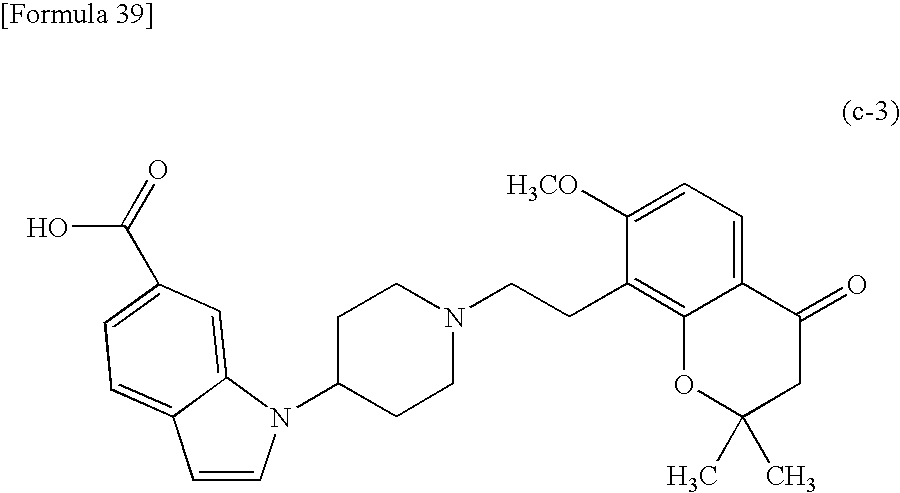
is obtained by reacting a compound represented by the following formula (a):

and a compound represented by the following formula (c-1):

or a salt thereof to obtain a compound represented by the following formula (c-2):

and hydrolyzing the compound;
- (15) The production method according to the above (12) wherein the compound represented by the following formula (c-3):

is obtained by reacting a compound represented by the following formula (a):

and a compound represented by the following formula (c-1):

which is obtained by removing protecting group of a compound represented by the following formula (b′-4):

wherein Y represents a protecting group of a secondary amine, or a salt thereof to obtain a compound represented by the following formula (c-2):

and hydrolyzing the compound (c-2); and
- (16) The production method according to the above (15) wherein Y is benzyloxycarbonyl.


wherein X represents a protecting group of a hydroxyl group.

wherein X means the same as defined above.

wherein X means the same as defined above.

wherein X means the same as defined above.


wherein Y represents a protecting group of the secondary amine.

wherein Y means the same as defined above.


Step (B′-1)


Step (C-1)


Claims (8)


Priority Applications (1)
| Application Number | Priority Date | Filing Date | Title |
|---|---|---|---|
| US11/914,115 US8110688B2 (en) | 2005-05-11 | 2006-11-05 | Method for producing indole derivative having piperidine ring |
Applications Claiming Priority (9)
| Application Number | Priority Date | Filing Date | Title |
|---|---|---|---|
| WOPCT/JP2005/008632 | 2005-05-11 | ||
| JPPCT/JP05/08632 | 2005-05-11 | ||
| US11/126209 | 2005-05-11 | ||
| PCT/JP2005/008632 WO2005108389A1 (en) | 2004-05-12 | 2005-05-11 | Indole derivatives having piperidine rings |
| US11/126,209 US20050256103A1 (en) | 2004-05-12 | 2005-05-11 | Indole derivative having piperidine ring |
| JP2005325713 | 2005-11-10 | ||
| JP2005-325713 | 2005-11-10 | ||
| PCT/JP2006/309461 WO2006121106A1 (en) | 2005-05-11 | 2006-05-11 | Method for producing indole derivative having piperidine ring |
| US11/914,115 US8110688B2 (en) | 2005-05-11 | 2006-11-05 | Method for producing indole derivative having piperidine ring |
Publications (2)
| Publication Number | Publication Date |
|---|---|
| US20100197926A1 US20100197926A1 (en) | 2010-08-05 |
| US8110688B2 true US8110688B2 (en) | 2012-02-07 |
Family
ID=42334469
Family Applications (1)
| Application Number | Title | Priority Date | Filing Date |
|---|---|---|---|
| US11/914,115 Expired - Fee Related US8110688B2 (en) | 2005-05-11 | 2006-11-05 | Method for producing indole derivative having piperidine ring |
Country Status (6)
| Country | Link |
|---|---|
| US (1) | US8110688B2 (en) |
| EP (1) | EP1880995B1 (en) |
| JP (1) | JP4932717B2 (en) |
| AU (1) | AU2006244916B2 (en) |
| CA (1) | CA2607907C (en) |
| IL (1) | IL187282A0 (en) |
Citations (23)
| Publication number | Priority date | Publication date | Assignee | Title |
|---|---|---|---|---|
| WO1996005817A1 (en) | 1994-08-23 | 1996-02-29 | Medinnova Sf | Medicament for treatment or prophylaxis of incontinence |
| EP0714894A1 (en) | 1994-12-01 | 1996-06-05 | Eli Lilly And Company | 3-(1,2,3,6-tetrahydro-(1-alkylenearyl)-4-pyridinyl)- and 3-(1-alkylenearyl)-4-piperidinyl-1h-indoles: new 5-HT1f agonists |
| US5545644A (en) | 1990-10-15 | 1996-08-13 | Pfizer Inc. | Indole derivatives |
| WO1997031637A1 (en) | 1996-02-28 | 1997-09-04 | Recordati S.A., Chemical And Pharmaceutical Company | Use of 5-ht1a receptor antagonists for the treatment of urinary incontinence |
| WO1998043956A1 (en) | 1997-03-31 | 1998-10-08 | Eisai Co., Ltd. | 1,4-substituted cyclic amine derivatives |
| WO1999006384A1 (en) | 1997-08-01 | 1999-02-11 | Recordati S.A., Chemical And Pharmaceutical Company | 1-(n-phenylaminoalkyl)-piperazine derivatives substituted at position 2 of the phenyl ring |
| US5990114A (en) | 1996-02-28 | 1999-11-23 | Recordati, S.A., Chemical And Pharmaceutical Company | Use of 5-HT1A receptor antagonists for the treatment of urinary incontinence |
| US6329366B1 (en) | 1998-11-19 | 2001-12-11 | Eli Lilly And Company Limited | Pharmaceutical compounds |
| JP2002114684A (en) | 2000-10-03 | 2002-04-16 | Eisai Co Ltd | Therapeutic agent for uropathy |
| US20020193383A1 (en) | 1997-08-01 | 2002-12-19 | Recordati S.A., Chemical And Pharmaceutical Comoany | 1-(N-phenylalkylaminoalkyl)piperazine derivatives substituted at position 2 of the phenyl ring |
| US20030130287A1 (en) | 2000-01-11 | 2003-07-10 | Karl-August Ackermann | Piperidine and piperazine derivatives which function as 5-ht2a receptor antagonists |
| WO2003059351A1 (en) | 2001-12-21 | 2003-07-24 | Eisai Co., Ltd. | Hydroxylated indole derivatives and uses thereof |
| JP2003533523A (en) | 2000-05-18 | 2003-11-11 | イーライ・リリー・アンド・カンパニー | Piperidyl indoles as serotonin receptor ligands |
| US20030225068A1 (en) | 2000-05-18 | 2003-12-04 | John Fairhurst | Piperidyindoles as serotonin receptor ligands |
| WO2004009548A1 (en) | 2002-07-18 | 2004-01-29 | Wyeth | 1-heterocyclylalkyl-3-sulfonylindole or -indazole derivatives as 5-hydroxytryptamine-6 ligands |
| WO2004045509A2 (en) | 2002-11-18 | 2004-06-03 | Pharmacia Corporation | Method of using a cox-2 inhibitor and a 5-ht1a receptor modulator as a combination therapy |
| WO2004082584A2 (en) | 2003-03-21 | 2004-09-30 | Curidium Limited | 5ht2c receptor antagonists in the treatment of schizophrenia |
| US20050256103A1 (en) | 2004-05-12 | 2005-11-17 | Eisai Co., Ltd. | Indole derivative having piperidine ring |
| WO2006082872A1 (en) | 2005-02-04 | 2006-08-10 | Eisai R & D Management Co., Ltd. | 1-(piperidin-4-yl)-1h-indole derivative |
| WO2006108389A1 (en) | 2005-04-11 | 2006-10-19 | Igus Gmbh | Bearing bush |
| WO2006121104A1 (en) | 2005-05-11 | 2006-11-16 | Eisai R & D Management Co., Ltd. | Crystal of indole derivative having piperidine ring and process for production thereof |
| WO2006121106A1 (en) | 2005-05-11 | 2006-11-16 | Eisai R & D Management Co., Ltd. | Method for producing indole derivative having piperidine ring |
| US20080027039A1 (en) | 2006-02-20 | 2008-01-31 | Yoshihiro Arakawa | Method for treating a motor neuron disease |
Family Cites Families (3)
| Publication number | Priority date | Publication date | Assignee | Title |
|---|---|---|---|---|
| US6801947B1 (en) * | 2000-08-01 | 2004-10-05 | Nortel Networks Ltd | Method and apparatus for broadcasting media objects with guaranteed quality of service |
| JP2004005269A (en) * | 2002-05-31 | 2004-01-08 | Toshiba Corp | Data acquisition method, electronic device, and data acquisition program |
| US20040024823A1 (en) * | 2002-08-01 | 2004-02-05 | Del Monte Michael George | Email authentication system |
-
2006
- 2006-05-11 EP EP06746270A patent/EP1880995B1/en not_active Expired - Lifetime
- 2006-05-11 JP JP2007528313A patent/JP4932717B2/en not_active Expired - Fee Related
- 2006-05-11 AU AU2006244916A patent/AU2006244916B2/en not_active Ceased
- 2006-05-11 CA CA2607907A patent/CA2607907C/en not_active Expired - Fee Related
- 2006-11-05 US US11/914,115 patent/US8110688B2/en not_active Expired - Fee Related
-
2007
- 2007-11-08 IL IL187282A patent/IL187282A0/en not_active IP Right Cessation
Patent Citations (36)
| Publication number | Priority date | Publication date | Assignee | Title |
|---|---|---|---|---|
| US5545644A (en) | 1990-10-15 | 1996-08-13 | Pfizer Inc. | Indole derivatives |
| WO1996005817A1 (en) | 1994-08-23 | 1996-02-29 | Medinnova Sf | Medicament for treatment or prophylaxis of incontinence |
| EP0714894A1 (en) | 1994-12-01 | 1996-06-05 | Eli Lilly And Company | 3-(1,2,3,6-tetrahydro-(1-alkylenearyl)-4-pyridinyl)- and 3-(1-alkylenearyl)-4-piperidinyl-1h-indoles: new 5-HT1f agonists |
| JPH08225568A (en) | 1994-12-01 | 1996-09-03 | Eli Lilly & Co | 3- <1,2,3,6-tetrahydro- <1-alkylenearyl> -4-pyridinyl>-and 3- <1-alkylenearyl> -4-piperidinyl-1H-indoles: novel 5-HT1F agonists |
| WO1997031637A1 (en) | 1996-02-28 | 1997-09-04 | Recordati S.A., Chemical And Pharmaceutical Company | Use of 5-ht1a receptor antagonists for the treatment of urinary incontinence |
| US5990114A (en) | 1996-02-28 | 1999-11-23 | Recordati, S.A., Chemical And Pharmaceutical Company | Use of 5-HT1A receptor antagonists for the treatment of urinary incontinence |
| US20020019531A1 (en) | 1997-03-31 | 2002-02-14 | Eisai Co., Ltd. | Indoles |
| WO1998043956A1 (en) | 1997-03-31 | 1998-10-08 | Eisai Co., Ltd. | 1,4-substituted cyclic amine derivatives |
| US6448243B1 (en) | 1997-03-31 | 2002-09-10 | Eisai Co., Ltd. | 1,4-substituted cyclic amine derivatives |
| EP0976732A1 (en) | 1997-03-31 | 2000-02-02 | Eisai Co., Ltd. | 1,4-substituted cyclic amine derivatives |
| US20020086999A1 (en) | 1997-03-31 | 2002-07-04 | Eisai Co., Ltd. | Certain quinoline derivatives |
| WO1999006384A1 (en) | 1997-08-01 | 1999-02-11 | Recordati S.A., Chemical And Pharmaceutical Company | 1-(n-phenylaminoalkyl)-piperazine derivatives substituted at position 2 of the phenyl ring |
| US20020193383A1 (en) | 1997-08-01 | 2002-12-19 | Recordati S.A., Chemical And Pharmaceutical Comoany | 1-(N-phenylalkylaminoalkyl)piperazine derivatives substituted at position 2 of the phenyl ring |
| US6071920A (en) | 1997-08-01 | 2000-06-06 | Recordati S.A. Chemical And Pharmaceutical Company | 1-(N-phenylaminoalkyl)piperazine derivatives substituted at position 2 of the phenyl ring |
| US6329366B1 (en) | 1998-11-19 | 2001-12-11 | Eli Lilly And Company Limited | Pharmaceutical compounds |
| JP2002530405A (en) | 1998-11-19 | 2002-09-17 | イーライ・リリー・アンド・カンパニー・リミテッド | Indole derivatives and their use as serotonin receptor ligands |
| US20030130287A1 (en) | 2000-01-11 | 2003-07-10 | Karl-August Ackermann | Piperidine and piperazine derivatives which function as 5-ht2a receptor antagonists |
| US6844338B2 (en) | 2000-05-18 | 2005-01-18 | Eli Lilly And Company | Piperidyindoles as serotonin receptor ligands |
| JP2003533523A (en) | 2000-05-18 | 2003-11-11 | イーライ・リリー・アンド・カンパニー | Piperidyl indoles as serotonin receptor ligands |
| US20030225068A1 (en) | 2000-05-18 | 2003-12-04 | John Fairhurst | Piperidyindoles as serotonin receptor ligands |
| JP2002114684A (en) | 2000-10-03 | 2002-04-16 | Eisai Co Ltd | Therapeutic agent for uropathy |
| WO2003059351A1 (en) | 2001-12-21 | 2003-07-24 | Eisai Co., Ltd. | Hydroxylated indole derivatives and uses thereof |
| US20050033056A1 (en) | 2001-12-21 | 2005-02-10 | Nancy Wong | Hydroxylated indole derivatives and uses thereof |
| US20040024023A1 (en) | 2002-07-18 | 2004-02-05 | Wyeth | 1-Heterocyclylalkyl-3-sulfonyl-indole or -indazole derivatives as 5-hydroxytryptamine-6 ligands |
| WO2004009548A1 (en) | 2002-07-18 | 2004-01-29 | Wyeth | 1-heterocyclylalkyl-3-sulfonylindole or -indazole derivatives as 5-hydroxytryptamine-6 ligands |
| WO2004045509A2 (en) | 2002-11-18 | 2004-06-03 | Pharmacia Corporation | Method of using a cox-2 inhibitor and a 5-ht1a receptor modulator as a combination therapy |
| US20040147581A1 (en) | 2002-11-18 | 2004-07-29 | Pharmacia Corporation | Method of using a Cox-2 inhibitor and a 5-HT1A receptor modulator as a combination therapy |
| WO2004082584A2 (en) | 2003-03-21 | 2004-09-30 | Curidium Limited | 5ht2c receptor antagonists in the treatment of schizophrenia |
| US20050256103A1 (en) | 2004-05-12 | 2005-11-17 | Eisai Co., Ltd. | Indole derivative having piperidine ring |
| US20070219179A1 (en) | 2004-05-12 | 2007-09-20 | Yuichi Suzuki | Indole Derivative Having Piperidine Ring |
| US7538123B2 (en) | 2004-05-12 | 2009-05-26 | Eisai R & D Management Co., Ltd. | Indole derivative having piperidine ring |
| WO2006082872A1 (en) | 2005-02-04 | 2006-08-10 | Eisai R & D Management Co., Ltd. | 1-(piperidin-4-yl)-1h-indole derivative |
| WO2006108389A1 (en) | 2005-04-11 | 2006-10-19 | Igus Gmbh | Bearing bush |
| WO2006121104A1 (en) | 2005-05-11 | 2006-11-16 | Eisai R & D Management Co., Ltd. | Crystal of indole derivative having piperidine ring and process for production thereof |
| WO2006121106A1 (en) | 2005-05-11 | 2006-11-16 | Eisai R & D Management Co., Ltd. | Method for producing indole derivative having piperidine ring |
| US20080027039A1 (en) | 2006-02-20 | 2008-01-31 | Yoshihiro Arakawa | Method for treating a motor neuron disease |
Non-Patent Citations (72)
| Title |
|---|
| Abdel-Magid et al., J. Org. Chem., vol. 61, No. 11, pp. 3849-3862 (1996). |
| Andersson et al., Drugs, vol. 63, No. 23, pp. 2595-2611 (2003). |
| Andersson et al., Drugs, vol. 63, No. 23, pp. 2595-2611, (2003). |
| Anthony R. West, "Solid state chemistry and its applications," Wiley, New York, 1986, pp. 358 and 365. |
| Arai et al., Tetrahedron Letters, vol. 39, No. 1, pp. 71-74 (1998). |
| Balducci et al., Psychopharmacology, vol. 167, pp. 28-36, (2003). |
| Banfield et al., Org. Lett. vol. 3, No. 21, pp. 3325-3327 (2001). |
| Barros et al., European J. of Pharmacology, vol. 482, pp. 197-203, (2003). |
| Bauvois et al. "Synthesis and . . . " J. Med. Chem. 46 p. 3900-3913 (2003). * |
| Bibbiani et al., Neurology, vol. 57, pp. 1829-1834, (2001). |
| Boers et al., Cephalalgia, vol. 24, pp. 99-109, (2004). |
| Bourin et al., Biomed & Pharmacother, vol. 50, pp. 7-12, (1996). |
| Brown et al., Aldrichchimica Acta, vol. 12, No. 1, pp. 3-11 (1979). |
| Brown et al., Tetrahedron, vol. 35, pp. 567-607 (1979). |
| Brzostowska et al., Heterocycles, vol. 32, No. 10, pp. 1969-1972 (1991). |
| Cannon et al., Chem., vol. 27, No. 7, pp. 2093-2095 (1990). |
| Carey et al., Behavioural Brain Research, vol. 132, pp. 37-46, (2002). |
| Chandler et al. "Structural revision . . . " J. Chem. Soc. Perkin Trans. p. 2271-2284 (1992). * |
| Chilin et al., J. Org. Chem., vol. 56, No. 3, pp. 980-983 (1991). |
| Coe et al., Tetrahedron Letters, vol. 37, No. 34, pp. 6045-6048 (1996). |
| Dabire, H., Therapie, vol. 46, pp. 421-429, (1991). |
| Dike et al., Tetrahedron, vol. 47, No. 26, pp. 4775-4786 (1991). |
| Dodd et al., Synthetic Communications, vol. 23, No. 7, pp. 1003-1008 (1993). |
| Emerson et al., Organic Reactions, vol. 4, pp. 174-255, (1948). |
| Farde et al., Neuropsychopharmacology, vol. 22, No. 4, pp. 422-429, (2000). |
| Fletcher et al., TiPS, vol. 14, pp. 441-448, (1993). |
| Gibson et al., J. Chem. Soc., vol. 4, pp. 447-455 (1997). |
| Green et al., Protecting Groups in Organic Chemistry, Second Edition, pp. 118-142 (1991). |
| Green et al., Protective Groups in Organic Chemistry, Second Edition, pp. 248-251 (1991). |
| Green et al., Protective Groups in Organic Chemistry, Second Edition, pp. 309-405 (1991). |
| Gu et al., J. of Pharmacology and Exp. Therapeutics, vol. 310, No. 3, pp. 1266-1272, (2004). |
| Gupta et al., Indian J. Physiol. Pharmacol., vol. 46, No. 4, pp. 463-467, (2002). |
| Hansenne et al., Psych. Medicine, vol. 32, pp. 935-941, (2002). |
| Harder et al., Neuropharmacology, vol. 39, pp. 547-552, (2000). |
| Harder et al., Psychopharmacology, vol. 127, pp. 245-254, (1996). |
| Hirai et al., Tetrahedron Letters, vol. 31, No. 33, pp. 4755-4756 (1990). |
| Hudlicky et al., Org. React., vol. 35, pp. 513-637 (1988). |
| J. Dean, Analytical Chemistry Handbook, Section 10, pp. 10.24-10.26, McGraw-Hill, Inc. 1995. |
| Jagadeesh et al., Synthetic Communications, vol. 31, No. 10, pp. 1547-1557 (2001). |
| Japanese Office Action for Japanese Application No. 2007-528313, dated Dec. 9, 2011. |
| Kirk-Othmer, "Crystallization," Encyclopedia of Chemical Technology, vol. 8, p. 95-147, John Wiley & Sons, Inc. 2002. |
| Kruger et al., vol. 10, No. 12, pp. 2651-2656, (1999). |
| Lai et al., Tetrahedron Letters, vol. 34, No. 43, pp. 6849-6852 (1993). |
| Lane, Clinton F., Synthesis, pp. 135-146 (1975). |
| Lecci et al., J. of Pharm. and Exp. Therapeutics, vol. 262, No. 1, pp. 181-189, (1992). |
| Lecci et al., J. of Pharmacology and Experimental Therapeutics, vol. 262, No. 1, pp. 181-189 (1992). |
| Masquelin et al., Synthesis, pp. 780-786 (1995). |
| Matassa et al., J. Med. Chem., vol. 33, No. 9, pp. 2621-2629 (1990). |
| Neurotransmitter Today, vol. 19, No. 2, pp. 131-146, (1997). |
| Nichols et al., J. Med. Chem., vol. 34, pp. 276-281 (1991). |
| Office Action issued on Apr. 7, 2011 in copending U.S. Appl. No. 11/913,931. |
| Office Action issued on Jun. 24, 2009 in copending U.S. Appl. No. 11/795,923. |
| Peroutka, S., Ann. Rev. Neurosci., vol. 11, pp. 45-60, (1988). |
| Rasmussen et al., J. of Pharmacology and Exp. Therapeutics, vol. 294, No. 2, pp. 688-700, (2000). |
| Romero et al., J. Med. Chem., vol. 37, No. 7, pp. 999-1014 (1994). |
| Rosowsky et al., J. Med. Chem., vol. 34, No. 1, pp. 227-234 (1991). |
| S. Byrn et al., Solid-State Chemistry of Drugs, 2nd Edition. p. 63, SSCI, Inc. 1999. |
| S.M. Berge et al., "Pharmaceutical Salts," Journal of Pharmaceutical Sciences, vol. 66, No. 1, p. 1-19, 1977. |
| Sakaguchi et al. "Preparation of 5-HT1A . . . " CA145:505336 (2006). * |
| Sakamoto et al., Chem. Pharm. Bull., vol. 34, pp. 2362-2368 (1986). |
| Sato et al., Chem. Pharm. Bull., vol. 39, No. 7, pp. 1760-1772 (1991). |
| Shimomura et al. "method of producing . . . " CA145:489136 (2006). * |
| Sim et al., Synlett, vol. 10, pp. 827-828 (1994). |
| Stowell et al., Synthesis, p. 127-128 (1974). |
| Suchanek et al., Euro. J. of Pharmacology, vol. 355, pp. 95-101, (1998). |
| Testa et al., J. of Pharm. and Exp. Therapeutics, vol. 290, No. 3, pp. 1258-1269 (1999). |
| Testa et al., J. of Pharmacology and Experimental Therapeutics, vol. 290, No. 3, pp. 1258-1269 (1999). |
| Thor et al., Brain Research, vol. 946, pp. 290-297, (2002). |
| Tischler et al., Tetrahedron Letters, vol. 27, No. 15, pp. 1653-1656 (1986). |
| Wilson et al., Am. J. Phys. Med. Rehabil., vol. 81, No. 5, pp. 364-372, (2002). |
| Yasuno et al., Am. J. Psychiatry, vol. 160, No. 2, pp. 1-7, (2003). |
| Zhou et al., Alcohol. Clin. and Exp. Research, vol. 22, No. 1, pp. 266-269, (1998). |
Also Published As
| Publication number | Publication date |
|---|---|
| EP1880995B1 (en) | 2011-12-21 |
| CA2607907A1 (en) | 2006-11-16 |
| CA2607907C (en) | 2012-09-18 |
| AU2006244916B2 (en) | 2011-04-07 |
| JP4932717B2 (en) | 2012-05-16 |
| US20100197926A1 (en) | 2010-08-05 |
| IL187282A0 (en) | 2008-02-09 |
| AU2006244916A1 (en) | 2006-11-16 |
| JPWO2006121106A1 (en) | 2008-12-18 |
| EP1880995A4 (en) | 2010-04-14 |
| EP1880995A1 (en) | 2008-01-23 |
Similar Documents
| Publication | Publication Date | Title |
|---|---|---|
| JP3902221B2 (en) | Indole derivatives with piperidine ring | |
| US10435410B2 (en) | Process for making beta 3 agonists and intermediates | |
| US20060084657A1 (en) | Piperazine derivative | |
| JP2011184451A (en) | Method for preparing tetrazole derivative from organo boron and organo aluminium azide | |
| EP1208095A1 (en) | Dibenzopyrans as glucocorticoid receptor antagonists for treatment of diabetes | |
| WO2007049798A1 (en) | Novel benzoxathiin derivative | |
| US8071765B2 (en) | Process for the preparation of sildenafil and intermediates thereof | |
| EP1926705B3 (en) | Process for preparing valsartan | |
| CN113493449A (en) | NO donor coumarin furazan conjugate and pharmaceutical application thereof | |
| US20100197926A1 (en) | Method for producing indole derivative having piperidine ring | |
| CN112521395B (en) | Preparation method of galanthamine | |
| EP0269355B1 (en) | Imidazolidinedione derivatives | |
| WO2006018955A1 (en) | Process for the production of isoindole derivatives | |
| CN101171249B (en) | Process for preparing indole derivatives having piperidine ring | |
| CN121175309A (en) | Amorphous forms, crystals, preparation methods and uses of dioxopiperidine compounds or pharmaceutically acceptable salts thereof | |
| US20060009640A1 (en) | Preparation of (-)-galantamine hydrobromide | |
| US20080306257A1 (en) | Syntheses and Preparations of Narwedine and Related Novel Compounds | |
| AU2003269331A1 (en) | Acyl derivatives of 5-(2-(4-(1,2 benzisothiazole-3-yl)-1-piperazinyl)ethyl)-6-chloro-1,3-dihydro-2h-indol-2-one having neuroleptic activity | |
| KR20080006001A (en) | Method for producing indole derivative having a piperidine ring | |
| EA051100B1 (en) | METHOD FOR PRODUCING A CYP11A1 INHIBITOR AND ITS INTERMEDIATE PRODUCTS | |
| CN119080744A (en) | A preparation method of SHP2 inhibitor ARRY-558 | |
| HUT52052A (en) | Process for producing 4-ethinyl-4-/2-amino-phenoxy/-piperidine derivatives and acid additional salts |
Legal Events
| Date | Code | Title | Description |
|---|---|---|---|
| AS | Assignment |
Owner name: EISAI R&D MANAGEMENT CO., LTD., JAPAN Free format text: ASSIGNMENT OF ASSIGNORS INTEREST;ASSIGNORS:SHIMOMURA, NAOYUKI;KAMADA, ATSUSHI;MIYAZAWA, MAMORU;AND OTHERS;SIGNING DATES FROM 20070917 TO 20070925;REEL/FRAME:020368/0166 |
|
| CC | Certificate of correction | ||
| FEPP | Fee payment procedure |
Free format text: PAYOR NUMBER ASSIGNED (ORIGINAL EVENT CODE: ASPN); ENTITY STATUS OF PATENT OWNER: LARGE ENTITY |
|
| REMI | Maintenance fee reminder mailed | ||
| LAPS | Lapse for failure to pay maintenance fees | ||
| STCH | Information on status: patent discontinuation |
Free format text: PATENT EXPIRED DUE TO NONPAYMENT OF MAINTENANCE FEES UNDER 37 CFR 1.362 |
|
| STCH | Information on status: patent discontinuation |
Free format text: PATENT EXPIRED DUE TO NONPAYMENT OF MAINTENANCE FEES UNDER 37 CFR 1.362 |
|
| FP | Lapsed due to failure to pay maintenance fee |
Effective date: 20160207 |