US8106089B2 - Anti-tubulin acting arylpyrrol, arylfuran and arylthiophene derivatives, method for the preparation thereof and for the use thereof as an antimitotic - Google Patents
Anti-tubulin acting arylpyrrol, arylfuran and arylthiophene derivatives, method for the preparation thereof and for the use thereof as an antimitotic Download PDFInfo
- Publication number
- US8106089B2 US8106089B2 US11/596,224 US59622405A US8106089B2 US 8106089 B2 US8106089 B2 US 8106089B2 US 59622405 A US59622405 A US 59622405A US 8106089 B2 US8106089 B2 US 8106089B2
- Authority
- US
- United States
- Prior art keywords
- group
- linear
- branched
- atom
- alkyl
- Prior art date
- Legal status (The legal status is an assumption and is not a legal conclusion. Google has not performed a legal analysis and makes no representation as to the accuracy of the status listed.)
- Expired - Fee Related, expires
Links
- 0 C[Y].[1*]C1=C([4*])C(C)=C(CO)C1[2*].[3*]C1=*C=CC([6*])=C1[5*] Chemical compound C[Y].[1*]C1=C([4*])C(C)=C(CO)C1[2*].[3*]C1=*C=CC([6*])=C1[5*] 0.000 description 25
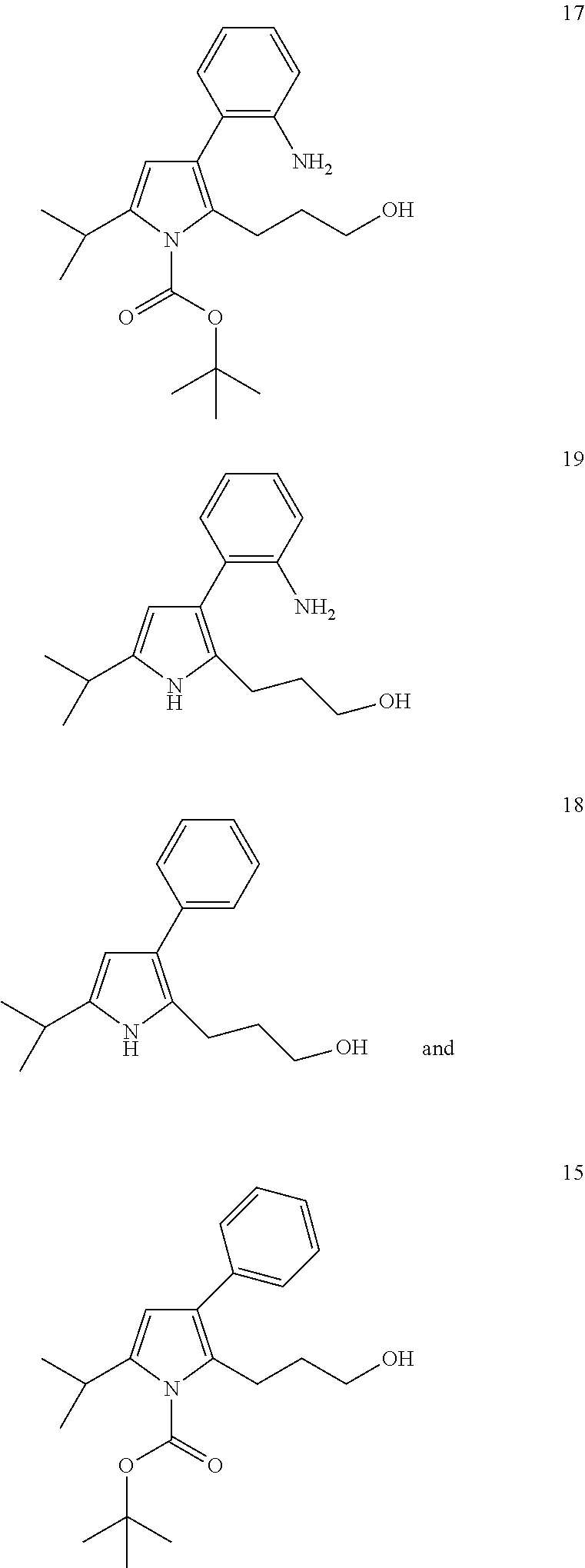
- DSHOVRBCTYMNKU-UHFFFAOYSA-N CC(C)C1=CC(C2=C(N)C=CC=C2)=C(CCCO)N1 Chemical compound CC(C)C1=CC(C2=C(N)C=CC=C2)=C(CCCO)N1 DSHOVRBCTYMNKU-UHFFFAOYSA-N 0.000 description 3
- QSBRCWVLZRCFHL-UHFFFAOYSA-N C=CCC1=C(Br)C=C(C(C)C)N1C(=O)OC(C)(C)C Chemical compound C=CCC1=C(Br)C=C(C(C)C)N1C(=O)OC(C)(C)C QSBRCWVLZRCFHL-UHFFFAOYSA-N 0.000 description 2
- BORRWDODGZAGNL-UHFFFAOYSA-N CC(C)C1=CC(C2=C(N)C=CC=C2)=C(CCCO)N1C(=O)OC(C)(C)C Chemical compound CC(C)C1=CC(C2=C(N)C=CC=C2)=C(CCCO)N1C(=O)OC(C)(C)C BORRWDODGZAGNL-UHFFFAOYSA-N 0.000 description 2
- VEJCARVYOPGFCM-UHFFFAOYSA-N CC(C)C1=CC(C2=CC=CC=C2)=C(CCCO)N1 Chemical compound CC(C)C1=CC(C2=CC=CC=C2)=C(CCCO)N1 VEJCARVYOPGFCM-UHFFFAOYSA-N 0.000 description 2
- BNHKFMSCXFHMGU-UHFFFAOYSA-N CC(C)C1=CC=C(CCCO)N1 Chemical compound CC(C)C1=CC=C(CCCO)N1 BNHKFMSCXFHMGU-UHFFFAOYSA-N 0.000 description 2
- LNYZCEYEQKSMMG-HMRHRTRZSA-N C.CC(C)C1=CC(Br)=C(CCCO)N1C(=O)OC(C)(C)C.CC(C)C1=CC(C2=CC=CC=C2/N=N/N2CCCC2)=C(CCCO)N1C(=O)OC(C)(C)C.OB(O)C1=C(/N=N/N2CCCC2)C=CC=C1 Chemical compound C.CC(C)C1=CC(Br)=C(CCCO)N1C(=O)OC(C)(C)C.CC(C)C1=CC(C2=CC=CC=C2/N=N/N2CCCC2)=C(CCCO)N1C(=O)OC(C)(C)C.OB(O)C1=C(/N=N/N2CCCC2)C=CC=C1 LNYZCEYEQKSMMG-HMRHRTRZSA-N 0.000 description 1
- VNCRSALXRLZKAV-UHFFFAOYSA-N C.CC(C)C1=CC(C2=C(N)C=CC=C2)=C(CCCO)N1.CC(C)C1=CC(C2=C(N)C=CC=C2)=C(CCCO)N1C(=O)OC(C)(C)C.CC(C)C1=CC(C2=CC=CC=C2)=C(CCCO)N1.CC(C)C1=CC(C2=CC=CC=C2)=C(CCCO)N1C(=O)OC(C)(C)C Chemical compound C.CC(C)C1=CC(C2=C(N)C=CC=C2)=C(CCCO)N1.CC(C)C1=CC(C2=C(N)C=CC=C2)=C(CCCO)N1C(=O)OC(C)(C)C.CC(C)C1=CC(C2=CC=CC=C2)=C(CCCO)N1.CC(C)C1=CC(C2=CC=CC=C2)=C(CCCO)N1C(=O)OC(C)(C)C VNCRSALXRLZKAV-UHFFFAOYSA-N 0.000 description 1
- BKKCFGGVSDUIQT-DBKIPNFWSA-N C/C(Br)=C\C(NC(=O)OC(C)(C)C)C(C)C.COC(=O)/C(Br)=C/C(NC(=O)OC(C)(C)C)C(C)C Chemical compound C/C(Br)=C\C(NC(=O)OC(C)(C)C)C(C)C.COC(=O)/C(Br)=C/C(NC(=O)OC(C)(C)C)C(C)C BKKCFGGVSDUIQT-DBKIPNFWSA-N 0.000 description 1
- QHCNOFDZAUFREL-SAPNQHFASA-N C=CCC(=O)/C(=C/C(NC(=O)OC(C)(C)C)C(C)C)C1=CC=CC=C1 Chemical compound C=CCC(=O)/C(=C/C(NC(=O)OC(C)(C)C)C(C)C)C1=CC=CC=C1 QHCNOFDZAUFREL-SAPNQHFASA-N 0.000 description 1
- WOJVAVPAIFEIMJ-LUAWRHEFSA-N C=CCC(=O)/C(Br)=C/C(NC(=O)OC(C)(C)C)C(C)C Chemical compound C=CCC(=O)/C(Br)=C/C(NC(=O)OC(C)(C)C)C(C)C WOJVAVPAIFEIMJ-LUAWRHEFSA-N 0.000 description 1
- ZDFCNEBDHPIXRW-SAPNQHFASA-N C=CCC(O)/C(=C/C(NC(=O)OC(C)(C)C)C(C)C)C1=CC=CC=C1 Chemical compound C=CCC(O)/C(=C/C(NC(=O)OC(C)(C)C)C(C)C)C1=CC=CC=C1 ZDFCNEBDHPIXRW-SAPNQHFASA-N 0.000 description 1
- AYCNNBYMUHOOLS-LUAWRHEFSA-N C=CCC(O)/C(Br)=C/C(NC(=O)OC(C)(C)C)C(C)C Chemical compound C=CCC(O)/C(Br)=C/C(NC(=O)OC(C)(C)C)C(C)C AYCNNBYMUHOOLS-LUAWRHEFSA-N 0.000 description 1
- ARPCFSWULBUBHI-UHFFFAOYSA-N C=CCC1=C(C2=CC=CC=C2)C=C(C(C)C)N1C(=O)OC(C)(C)C Chemical compound C=CCC1=C(C2=CC=CC=C2)C=C(C(C)C)N1C(=O)OC(C)(C)C ARPCFSWULBUBHI-UHFFFAOYSA-N 0.000 description 1
- SXQTZRUYFTUOHN-PTNGSMBKSA-N CC(C)C(/C=C(/C=O)C1=CC=CC=C1)NC(=O)OC(C)(C)C Chemical compound CC(C)C(/C=C(/C=O)C1=CC=CC=C1)NC(=O)OC(C)(C)C SXQTZRUYFTUOHN-PTNGSMBKSA-N 0.000 description 1
- NBZLWIVZCJEQAY-PTNGSMBKSA-N CC(C)C(/C=C(/CO)C1=CC=CC=C1)NC(=O)OC(C)(C)C Chemical compound CC(C)C(/C=C(/CO)C1=CC=CC=C1)NC(=O)OC(C)(C)C NBZLWIVZCJEQAY-PTNGSMBKSA-N 0.000 description 1
- TUVNZKJHXIULBJ-TWGQIWQCSA-N CC(C)C(/C=C(\Br)C=O)NC(=O)OC(C)(C)C Chemical compound CC(C)C(/C=C(\Br)C=O)NC(=O)OC(C)(C)C TUVNZKJHXIULBJ-TWGQIWQCSA-N 0.000 description 1
- SVYMOYLSVKSEME-TWGQIWQCSA-N CC(C)C(/C=C(\Br)CO)NC(=O)OC(C)(C)C Chemical compound CC(C)C(/C=C(\Br)CO)NC(=O)OC(C)(C)C SVYMOYLSVKSEME-TWGQIWQCSA-N 0.000 description 1
- HJZGBHPQYFWAQH-UHFFFAOYSA-N CC(C)C1=CC(Br)=C(CCCO)N1C(=O)OC(C)(C)C Chemical compound CC(C)C1=CC(Br)=C(CCCO)N1C(=O)OC(C)(C)C HJZGBHPQYFWAQH-UHFFFAOYSA-N 0.000 description 1
- OENQZMJVSBJABI-UHFFFAOYSA-N CC(C)C1=CC(C2=C(N)C=CC=C2)=C(CCCO)N1.CC(C)C1=CC(C2=C(N)C=CC=C2)=C(CCCO)N1C(=O)OC(C)(C)C.CC(C)C1=CC(C2=CC=CC=C2)=C(CCCO)N1.CCCCC1=C(C2=CC=CC=C2)C=C(C(C)C)N1C(=O)OC(C)(C)C Chemical compound CC(C)C1=CC(C2=C(N)C=CC=C2)=C(CCCO)N1.CC(C)C1=CC(C2=C(N)C=CC=C2)=C(CCCO)N1C(=O)OC(C)(C)C.CC(C)C1=CC(C2=CC=CC=C2)=C(CCCO)N1.CCCCC1=C(C2=CC=CC=C2)C=C(C(C)C)N1C(=O)OC(C)(C)C OENQZMJVSBJABI-UHFFFAOYSA-N 0.000 description 1
- VUYIWWINFUGXCD-UHFFFAOYSA-N CC(C)C1=CC(C2=CC=CC=C2)=C(CCCO)N1C(=O)OC(C)(C)C Chemical compound CC(C)C1=CC(C2=CC=CC=C2)=C(CCCO)N1C(=O)OC(C)(C)C VUYIWWINFUGXCD-UHFFFAOYSA-N 0.000 description 1
- KPZUZTFXFKCHMP-RQZHXJHFSA-N CC(C)C1=CC(C2=CC=CC=C2/N=N\N2CCCC2)=C(CCCO)N1C(=O)OC(C)(C)C Chemical compound CC(C)C1=CC(C2=CC=CC=C2/N=N\N2CCCC2)=C(CCCO)N1C(=O)OC(C)(C)C KPZUZTFXFKCHMP-RQZHXJHFSA-N 0.000 description 1
- IIECVAQGCXBXEA-UHFFFAOYSA-N CC(C)C1=CC(N)=C(CCCO)N1 Chemical compound CC(C)C1=CC(N)=C(CCCO)N1 IIECVAQGCXBXEA-UHFFFAOYSA-N 0.000 description 1
- GAHUYARIJLRXNX-UHFFFAOYSA-N CC(C)C1=CC=C(CCCO)N1C(=O)OC(C)(C)C Chemical compound CC(C)C1=CC=C(CCCO)N1C(=O)OC(C)(C)C GAHUYARIJLRXNX-UHFFFAOYSA-N 0.000 description 1
- YMNBXYLOSIKZGL-MRVPVSSYSA-N CC(C)[C@@H](C=O)NC(=O)OC(C)(C)C Chemical compound CC(C)[C@@H](C=O)NC(=O)OC(C)(C)C YMNBXYLOSIKZGL-MRVPVSSYSA-N 0.000 description 1
Classifications
-
- C—CHEMISTRY; METALLURGY
- C07—ORGANIC CHEMISTRY
- C07D—HETEROCYCLIC COMPOUNDS
- C07D207/00—Heterocyclic compounds containing five-membered rings not condensed with other rings, with one nitrogen atom as the only ring hetero atom
- C07D207/02—Heterocyclic compounds containing five-membered rings not condensed with other rings, with one nitrogen atom as the only ring hetero atom with only hydrogen or carbon atoms directly attached to the ring nitrogen atom
- C07D207/30—Heterocyclic compounds containing five-membered rings not condensed with other rings, with one nitrogen atom as the only ring hetero atom with only hydrogen or carbon atoms directly attached to the ring nitrogen atom having two double bonds between ring members or between ring members and non-ring members
- C07D207/32—Heterocyclic compounds containing five-membered rings not condensed with other rings, with one nitrogen atom as the only ring hetero atom with only hydrogen or carbon atoms directly attached to the ring nitrogen atom having two double bonds between ring members or between ring members and non-ring members with only hydrogen atoms, hydrocarbon or substituted hydrocarbon radicals, directly attached to ring carbon atoms
- C07D207/325—Heterocyclic compounds containing five-membered rings not condensed with other rings, with one nitrogen atom as the only ring hetero atom with only hydrogen or carbon atoms directly attached to the ring nitrogen atom having two double bonds between ring members or between ring members and non-ring members with only hydrogen atoms, hydrocarbon or substituted hydrocarbon radicals, directly attached to ring carbon atoms with substituted hydrocarbon radicals directly attached to the ring nitrogen atom
-
- A—HUMAN NECESSITIES
- A61—MEDICAL OR VETERINARY SCIENCE; HYGIENE
- A61P—SPECIFIC THERAPEUTIC ACTIVITY OF CHEMICAL COMPOUNDS OR MEDICINAL PREPARATIONS
- A61P35/00—Antineoplastic agents
-
- C—CHEMISTRY; METALLURGY
- C07—ORGANIC CHEMISTRY
- C07D—HETEROCYCLIC COMPOUNDS
- C07D207/00—Heterocyclic compounds containing five-membered rings not condensed with other rings, with one nitrogen atom as the only ring hetero atom
- C07D207/02—Heterocyclic compounds containing five-membered rings not condensed with other rings, with one nitrogen atom as the only ring hetero atom with only hydrogen or carbon atoms directly attached to the ring nitrogen atom
- C07D207/30—Heterocyclic compounds containing five-membered rings not condensed with other rings, with one nitrogen atom as the only ring hetero atom with only hydrogen or carbon atoms directly attached to the ring nitrogen atom having two double bonds between ring members or between ring members and non-ring members
- C07D207/32—Heterocyclic compounds containing five-membered rings not condensed with other rings, with one nitrogen atom as the only ring hetero atom with only hydrogen or carbon atoms directly attached to the ring nitrogen atom having two double bonds between ring members or between ring members and non-ring members with only hydrogen atoms, hydrocarbon or substituted hydrocarbon radicals, directly attached to ring carbon atoms
- C07D207/33—Heterocyclic compounds containing five-membered rings not condensed with other rings, with one nitrogen atom as the only ring hetero atom with only hydrogen or carbon atoms directly attached to the ring nitrogen atom having two double bonds between ring members or between ring members and non-ring members with only hydrogen atoms, hydrocarbon or substituted hydrocarbon radicals, directly attached to ring carbon atoms with substituted hydrocarbon radicals, directly attached to ring carbon atoms
- C07D207/333—Radicals substituted by oxygen or sulfur atoms
-
- C—CHEMISTRY; METALLURGY
- C07—ORGANIC CHEMISTRY
- C07D—HETEROCYCLIC COMPOUNDS
- C07D207/00—Heterocyclic compounds containing five-membered rings not condensed with other rings, with one nitrogen atom as the only ring hetero atom
- C07D207/02—Heterocyclic compounds containing five-membered rings not condensed with other rings, with one nitrogen atom as the only ring hetero atom with only hydrogen or carbon atoms directly attached to the ring nitrogen atom
- C07D207/30—Heterocyclic compounds containing five-membered rings not condensed with other rings, with one nitrogen atom as the only ring hetero atom with only hydrogen or carbon atoms directly attached to the ring nitrogen atom having two double bonds between ring members or between ring members and non-ring members
- C07D207/32—Heterocyclic compounds containing five-membered rings not condensed with other rings, with one nitrogen atom as the only ring hetero atom with only hydrogen or carbon atoms directly attached to the ring nitrogen atom having two double bonds between ring members or between ring members and non-ring members with only hydrogen atoms, hydrocarbon or substituted hydrocarbon radicals, directly attached to ring carbon atoms
- C07D207/33—Heterocyclic compounds containing five-membered rings not condensed with other rings, with one nitrogen atom as the only ring hetero atom with only hydrogen or carbon atoms directly attached to the ring nitrogen atom having two double bonds between ring members or between ring members and non-ring members with only hydrogen atoms, hydrocarbon or substituted hydrocarbon radicals, directly attached to ring carbon atoms with substituted hydrocarbon radicals, directly attached to ring carbon atoms
- C07D207/335—Radicals substituted by nitrogen atoms not forming part of a nitro radical
Definitions
- the present invention relates to novel arylpyrrol arylfuran and arylthiophene derivatives having an anti-tubulin action, advantageously an antimitotic action.
- cytoskeleton which is primarily composed of actin microfilaments, microtubules and intermediate filaments, all of which are associated with protein complexes.
- microtubules plays an essential role in morphology, endocytosis, exocytosis and the cell cycle.
- the dynamics of microtubules in relation to guanosine triphosphate (GTP) is essential for the formation of the mitotic spindle. Consequently, microtubules are key elements in the segregation of chromosomes during meiosis and mitosis and thus they take part in the maintenance of genetic stability.
- microtubules are cylindrical structures which result from the longitudinal, helical assembly of 13 protofilaments which are formed by the association of tubulin molecules from one or more nucleation centers (microtubule organizing center, or MTOC) present in the cell. These organizing centers are the centrioles located in the cytoplasm.
- the majority of microtubules are the location of a rapid cycle of polymerization and depolymerization according to a dynamic instability model.
- the tubulin constituting the microtubules is a heterodimer globular protein made up of two polypeptide chains, ⁇ -tubulin and ⁇ -tubulin. These ⁇ and ⁇ heterodimers align in ⁇ alternation to form protofilaments.
- Heterodimers are polarized and consequently protofilaments and microtubules have an intrinsic polarity.
- Certain networks of microtubules have very different properties with regard to their stability, their geometry as well as their resistance with respect to certain antimitotic drugs.
- Cell division spindles are also labile structures that can be assembled and disassembled rapidly.
- a broad heterogeneity of microfilaments is concentrated in the C-terminal domain of the various tubulin isoforms, a domain which is involved in the association of MAPs (microtubule associated proteins).
- MAPs act as a mediator between cell components and microtubules. They influence the dynamic structure of microtubules and co-purify with tubulin.
- Two types of MAPs are distinguished: structural MAPs (MAP2, tau protein, stable-tubule-only-polypeptide (STOP)) and motor MAPs with enzymatic activity (the kinesins and dynein). Double functionality can be provided by the same family of MAPs.
- the microtubules forming the mitotic spindle function to segregate the duplicated chromosomes in order to orient them along the cleavage plane.
- the dynamics of the mitotic spindle thus allows the attachment of centromeres on the spindle microtubules and, after separation of the sister chromatids, the migration of the chromosomes to each pole of the mitotic spindle.
- This step is one of the events responsible for the transmission of genetic information from the mother cell to the daughter cell.
- Chromosomal abnormalities are one of the principal characteristics of cancer cells, thus highlighting the importance of maintaining perfectly stable genetic information.
- spindle formation or destruction abnormalities may have a role in cell transformation by the loss of a negative growth regulator gene, the loss of a gene responsible for the integrity of the genome, or by the amplification, the overexpression or the activation of an oncogene by mutation.
- a tumor develops within an organ when some of its cells lose their contact inhibition property and divide indefinitely.
- One of the strategies used in the treatment of cancer consists of blocking cell division by targeting the machinery necessary for segregating chromosomes during mitosis.
- tubulin and microtubules are the targets of choice for the treatment of cancer or of other diseases related to structural or organizational changes in this molecule such as autoimmune, hyperproliferative and neurodegenerative diseases.
- antimitotic agents acting on tubulin (tubulin binding agents) or on its associated proteins induce vascular damage and inhibit mitosis in tumors.
- Molecules such as Taxol, vinblastine and colchicine are antimitotic compounds used in cancer therapy.
- Colchicine decreases the polymerization of microtubules.
- Taxol stabilizes microtubules by interacting on two specific sites on ⁇ -tubulin. It is a preferred antimitotic compound due to its microtubule stabilizing action.
- the inventors have discovered in a surprising way that novel compounds called paulusines belonging to the family of arylpyrrol, arylfuran and arylthiophene compounds are capable of acting on the formation of the mitotic spindle and of controlling its functional integrity.
- Paulusines are original compounds synthesized to respond to the problems of genetic instability related to spindle formation abnormalities.
- the present invention thus relates to compounds of following general formula I:
- the compound according to the present invention is such that Z represents N.
- A represents the CH group.
- Y represents a NH 2 group or an atom of hydrogen.
- X represents a C 1 -C 12 linear or branched alkyl group, advantageously a propyl group.
- the present invention also relates to a method for preparing the compounds comprising the steps of:
- Z, X, R1 and R4 are as defined above in general formula I and GP represents a nitrogen protective group when Z represents N, or is absent when Z represents O or S,
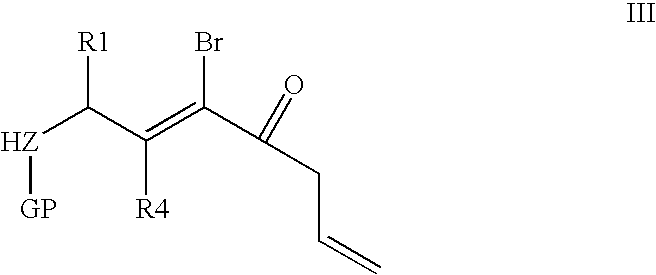
- step a) consists of the cyclodehydration of unsaturated ⁇ - ⁇ aminoketones of following formula III:
- step b) consists of:
- R2, R3, R4, R5 and R6 represent an atom of hydrogen
- Y represents a NH 2 group
- A represents a CH group
- X represents (CH 2 ) 3
- Z represents N and R1 is as defined above in general formula I.
- the synthesis route is thus comprised of two stages.
- the first stage consists of the synthesis of a functionalizable pyrrolylalkylcarbinole unit in the form of a N-protected 3-bromopyrrole with an alcohol side chain carried by the carbon in the a position of the ring's nitrogen.
- the polyfunctionalized pyrrole nucleus is obtained by cyclodehydration of unsaturated ⁇ - ⁇ aminoketones (step v) with yields of 60% to 90%. These unsaturated ⁇ - ⁇ aminoketones are most often obtained in several steps (i-iv, i) from commercial N-protected ⁇ -amino alcohols. In this manner, a N-protected 3-bromopyrrole with an unsaturated side chain is first obtained.
- the alcohol function is then introduced in this case via a standard hydroboration-oxidation sequence (step vi) in a basic medium.
- the second stage consists of functionalizing the pyrrolylalkylcarbinole unit by introducing the aryl or heteroaryl unit at position 3 of the pyrrole ring.
- an aniline unit is introduced by a palladium-catalyzed Suzuki-Miyaura cross-coupling reaction.
- the aniline is introduced in an original protected form, that of a phenyltriazene, starting from 2-triazene boronic acid (step vii) which is also an original chemical.
- a triazene function deprotection step makes it possible in the end to regenerate the amino function of the aniline nucleus (step viii).
- a specific deprotection step for the protective group (GP) used can then be implemented if necessary to obtain the corresponding N-deprotected anilinopyrrolyl alcohol.
- the present invention also relates to a pharmaceutical composition
- a pharmaceutical composition comprising a compound according to the present invention and a pharmaceutically acceptable excipient, a compound for the use thereof as a medicine, advantageously antimitotic, in an advantageous way antitumoral.
- This medicine can also be intended for the treatment of autoimmune diseases, hyperproliferative diseases and neurodegenerative diseases.
- the present invention also relates to a compound according to the present invention for the use thereof as a medicine intended for the treatment or prevention of cancer.
- the present invention thus relates to pharmaceutical compositions comprising one of the compounds defined above as an active ingredient and a suitable excipient.
- These compositions can be formulated for administration to mammals, including man. Dosage varies according to the treatment and to the affection in question.
- These compositions are prepared in such a way that they can be administered by the digestive or the parenteral route.
- the active ingredient can be administered in single-dose forms, in a mixture with traditional pharmaceutical vehicles, to animals or to humans.
- Suitable single-dose forms of administration include oral-route forms such as tablets, gelatin capsules, powders and granules, oral solutions or suspensions, sublingual and buccal administration forms, as well as subcutaneous, intramuscular, intravenous, intranasal, intraocular and rectal forms of administration.
- the principal active ingredient is mixed with a pharmaceutical vehicle such as gelatin, starch, lactose, magnesium stearate, talc, gum arabic or analogs.
- a pharmaceutical vehicle such as gelatin, starch, lactose, magnesium stearate, talc, gum arabic or analogs.
- the tablets can be coated with sucrose or with other suitable substances or they can be treated in such a way that they have an extended or delayed activity and that they continuously release a predetermined quantity of the active ingredient.
- a gelatin capsule preparation is obtained by mixing the active ingredient with a diluent and by pouring the mixture obtained into soft or hard gelatin capsules.
- a preparation in syrup or elixir form can contain the active ingredient in conjunction with a sweetener, an antiseptic, as well as an agent providing flavor and a suitable colorant.
- Water-dispersible powders or granules can contain the active ingredient in a mixture with dispersion, wetting or suspending agents, as well as with taste correctors or sweeteners.
- Suppositories prepared with excipients that melt at rectal temperature such as cocoa butter or polyethylene glycols, can be used for rectal administration.
- aqueous suspensions for parenteral, intranasal or intraocular administration, aqueous suspensions, isotonic saline solutions or sterile injectable solutions which contain pharmacologically compatible dispersion and/or wetting agents are used.
- the active ingredient can also be formulated in the form of microcapsules, possibly with one or more additional vehicles.
- the present invention further relates to compounds of following general formula V:
- GP represents a nitrogen protective group and R1 represents an atom of hydrogen, an atom of fluorine, a C 1 -C 12 linear or branched alkyl group, a C 3 -C 12 cycloalkyl group, a C 2 -C 12 linear or branched alkenyl group, a CH 2 —B or CH 2 —CH 2 —B group in which B represents a phenyl group possibly substituted by one or more groups chosen among a C 1 -C 6 linear or branched alkyl group, a C 1 -C 6 linear or branched alkoxy group, a NH 2 group, a NO 2 group, a CN group, a COOH group, a C 1 -C 6 linear or branched CO 2 (alkyl) group, a CONH 2 group, a C 1 -C 6 linear or branched CONH(alkyl) group, a C 1 -C 6 linear or branched CON(alkyl) 2 group, a
- the present invention further relates to a compound of following general formula VI:
- GP represents a nitrogen protective group and R1 represents an atom of hydrogen, an atom of fluorine, a C 1 -C 12 linear or branched alkyl group, a C 3 -C 12 cycloalkyl group, a C 2 -C 12 linear or branched alkenyl group, a CH 2 —B or CH 2 —CH 2 —B group in which B represents a phenyl group possibly substituted by one or more groups chosen among a C 1 -C 6 linear or branched alkyl group, a C 1 -C 6 linear or branched alkoxy group, a NH 2 group, a NO 2 group, a CN group, a COOH group, a C 1 -C 6 linear or branched CO 2 (alkyl) group, a CONH 2 group, a C 1 -C 6 linear or branched CONH(alkyl) group, a C 1 -C 6 linear or branched CON(alkyl) 2 group, a
- N-Bromosuccinimide (4.60 g, 25.9 mmol) and anhydrous potassium carbonate (8.10 g, 58.8 mmol) are successively added, over a period of 20 minutes, to a solution of (methoxycarbonylmethylene)triphenylphosphorane (PH 3 P ⁇ CH—CO 2 Me, 7.90 g, 23.5 mmol) in dichloromethane (60 ml) cooled to ⁇ 20.0° C.
- the mixture yellow-brown, is left under stirring for 20 min and freshly prepared N-(Boc)Valinal 2 (4.74 g, 23.5 mmol) dissolved in CH 2 Cl 2 (20 ml) is instilled.
- the mixture is left for 30 min at ⁇ 20.0° C. and for 1 h at ambient temperature.
- a TLC check indicates the total disappearance of the aldehyde.
- the mixture is filtered on a fritted disc coated with celite, and the fritted disc is rinsed with ether. After evaporation of the filtrate under a vacuum, the yellow oil obtained is chromatographed on a silica gel (elution gradient Heptane/AcOEt 90/10 ⁇ 75/25).
- Compound Z-3 is a colorless oil.
- Compound E-3 is a colorless oil.
- ester Z-3 (2.60 g, 7.7 mmol) in dichloromethane (50 ml), cooled to ⁇ 78° C., 990 ⁇ l (1.0 eq) of freshly distilled BF 3 .OEt is instilled over a period of 15 minutes and then 23.4 ml (3.0 eq) of DIBAL (1 M solution/toluene) is instilled over a period of one hour.
- the reaction mixture is maintained at ⁇ 78° C. for 3 h then is neutralized at ⁇ 50° C. by the slow addition of 5 ml of acetic acid. At 0° C., 30 ml of an aqueous solution saturated with NH 4 Cl are added.
- the gel formed is broken by the addition of an aqueous solution saturated with citric acid while taking care not to go below pH 3-4.
- the aqueous phase is extracted with AcOEt.
- the recombined organic phases are washed with brine and dried on MgSO 4 .
- the yellow oil obtained is purified on a silica gel (AcOEt/Hept 1/2), leading to a colorless oil which, after trituration with pentane and prolonged drying with a vane pump, crystallizes in the form of a white solid (1.73 g, 5.6 mmol).
- Dess-Martin periodinane (630 mg, 1.3 eq) is added all at once to a solution of allyl alcohol 4 (347 mg, 1.1 mmol) in CH 2 Cl 2 (15 ml).
- the reaction mixture is stirred for 1 h at ambient temperature before dilution with ether and neutralization with an aqueous solution saturated with Na 2 S 2 O 3 (15 ml) and an aqueous solution saturated with NaHCO 3 (15 ml).
- the aqueous phase is extracted with ether then the recombined organic phases are washed with brine and dried on MgSO 4 .
- the residual oil obtained is purified by filtration on an alum tube coated with 2-3 cm of silica (eluant: Et 2 O) leading to the enal 5 (324 mg, 1.06 mmol, clean in 1H NMR) in the form of a colorless oil.
- the triallylborane (460 ⁇ l, 2.42 mmol) is slowly added to a solution of enal 5 (370 mg, 1.21 mmol) in tetrahydrofuran (THF) (10 ml) cooled to ⁇ 70° C. After 1 h of stirring, the mixture is allowed to rise in temperature and is neutralized at 0° C. with an aqueous solution saturated with NH 4 Cl (10 ml). After separation of the phases and extraction in AcOEt, the recombined organic phases are washed with brine, dried on MgSO 4 and filtered. The residual oil obtained after evaporation of the solvent is purified on a silica gel (AcOEt/Hept 1/2) leading to the alcohol 6 (385 mg, 1.11 mmol) which is obtained in the form of a colorless oil.
- THF tetrahydrofuran
- Dess-Martin periodinane (640 mg, 1.51 mmol) is added to a solution of alcohol 6 (350 mg, 1.00 mmol) in dichloromethane (10 ml) and it mixture is left until the alcohol completely disappears as shown by TLC (1 h). The mixture is then diluted with ether and evaporated under a vacuum. The crude product is taken up in a mixture of AcOEt/Hept (3 ml, 1/3 v/v) then filtered on a silica gel (4-5 cm in an alum tube, eluent AcOEt/Hept 1/3) leading after collection of the fractions and evaporation of the solvent to the enone 7 (325 mg, 0.94 mmol) in the form of a colorless oil.
- the mixture is extracted in AcOEt.
- the organic phases are dried on MgSO 4 then concentrated under a vacuum.
- the yellow oil obtained is purified on a silica gel (AcOEt/Hept 1/3) leading to the alcohol 9 (98 mg, 0.28 mmol) in the form of a colorless oil.
- a dioxane/H 2 O mixture (degassed) (10 ml, 4/1 v/v) containing the bromated alcohol 4 (770 mg, 2.5 mmol), phenylboronic acid (335 mg, 1.1 eq), potassium carbonate (690 mg, 2.0 eq) and Pd(Ph 3 ) 4 (90 mg, 0.03 eq) is brought to reflux for 8 h under argon.
- the mixture Upon return to ambient temperature the mixture is filtered on an alum tube filled with a bed of several centimeters of celite. An aqueous solution saturated with NaCl (10 ml) is added to the filtrate.
- Dess-Martin periodinane (1.44 g, 1.5 eq) is added to a solution of allyl alcohol 10 (690 mg, 2.26 mmol) in CH 2 Cl 2 (30 ml). After 30 minutes of stirring at ambient temperature, ether (50 ml) and a solution saturated with NaHCO 3 (30 ml) containing Na 2 S 2 O 3 (3.0 g) are added. The reaction mixture is stirred until the precipitate is dissolved. After separation of the phases and extraction with ether, the organic phases are washed with brine, dried on MgSO 4 and filtered. The residual oil obtained after evaporation of the solvent is purified by passing through an alum tube coated with 3-5 cm of silica (AcOEt/Hept 1/2). The enal 11 (615 mg, 2.03 mmol, clean in 1H NMR) is obtained in the form of a colorless foam.
- the mixture is composed of 2 diastereoisomer alcohols in a 50/50 proportion according to 1 H NMR.
- Compound 13 is prepared in the same manner as compound 5. It is obtained with an yield of 68.8% after purification by chromatography on a silica gel column (AcOEt/heptane: 1/2 in volume, RF 0.66).
- Compound 14 is prepared in the same manner as compound 8. It is isolated with a yield of 82.5% after purification by chromatography on a silica gel column (AcOEt/heptane 1/8 in volume, Rf 0.66).
- Compound 15 is prepared in the same manner as compound 9. It is isolated with a yield of 68.8% after purification by chromatography on a silica gel column (AcOEt/heptane 1/3 in volume, Rf 0.15).
- compound 16 (0.340 g, 0.772 mmol) is placed in the presence of an equivalent mass of Raney nickel (washed successively beforehand with water degassed to neutral pH, with absolute ethanol then with methanol) in a methanol/ethyl acetate mixture. The mixture is maintained at 25° C. under 20 bar of dihydrogen overnight. The suspension is then filtered on celite. The celite is rinsed with ether. The filtrate obtained is then evaporated. The residue obtained is purified by chromatography on a silica gel column (AcOEt/heptane 1/2 in volume, Rf 0.1). Compound 17 is isolated with a yield of 80.2% (0.222 g) in the form of a slightly red oil.
- Compound 19 is prepared from compound 17 in the same way as compound 18. It is obtained with a yield of 51.7% after purification by chromatography on a silica gel column (AcOEt/heptane 1/1 in volume, Rf 0.21).
- Compound 20 is a sub-product obtained in low quantity during the synthesis of compound 16 from compound 9. It is isolated from the reaction mixture after the hydrogenation step enabling the passage of compound 16 into compound 17 by purification by chromatography on a silica gel column (AcOEt/heptane 1/3 in volume, Rf 0.17).
- Compound 21 is prepared from compound 20 in the same way as compound 18. Compound 21 is isolated with a yield of 97.8% after purification by chromatography on a silica gel column (AcOEt/heptane 1/1 in volume, Rf 0.37).
- Aim Given the role of tubulin in the formation of the mitotic spindle, we analyzed the effect of the compounds according to the present invention on the cell cycle of the following murine cells using various methods: the murine melanoma tumor cell line, the B16 F1 cell line and the mel a cell line (melanocytes), and the L1210 mouse leukemia cell line.
- MTT mitochondrial succinate dehydrogenase
- the cytotoxic effect of a sample is evaluated by the percentage of living cells in the presence of this sample, compared to the cells treated with the solvent alone. This method makes it possible to measure the proportion of living cells in a given cell population. By comparison with untreated cells, we thus determined the concentration of each compound that induces a 50% inhibition of cell growth. The results obtained are presented in table 1.
- the IC 50 ranges from 50 ⁇ M to 100 ⁇ M.
- the antiproliferative character of the compounds varies according to the cell line studied and to the compound analyzed. A better IC 50 is observed in the presence of compound 19 on the L1210 (mouse leukemia) cells.
- Compound 21 is not functionalized at position 3 of the pyrrole nucleus. It serves as a reference and demonstrates that position 3 of the pyrrole nucleus is a strategic position for obtaining biological activity.
- mice melanoma (B16) cells and mouse leukemia (L1210) cells we then studied their effect on the progression of the cell cycle in mouse melanoma (B16) cells and mouse leukemia (L1210) cells.
- B16 mouse melanoma
- L1210 mouse leukemia
- the cells were treated for 24 hours at concentrations near the IC 50 of each compound. They then were fixed and made permeable with ethanol. After incubation with propidium iodide, which labels cellular DNA, the DNA content of the cells is then analyzed by flow cytometry. The results obtained are presented in table 2.
- phase G1 For concentrations below the IC 50 , we observe an accumulation of cells in phase G1 (gap 1), as well as a reduction in the quantity of cells in phase S (DNA synthesis).
- the proportion of cells in phase G1 seem to be “normalized,” that is to say, the proportion of cells in G1 is not changed.
- the quantity of cells in phase S also appears to approach the values of the control cells.
- the method of labeling with propidium iodide does not make it possible to distinguish the cells which replicate their DNA actively. Thus we cannot affirm that the cells observed in phase S in the treated cells (that is to say, having a 4n quantity of DNA) are actually the cells which replicate their DNA actively or if they are simply locked in phase S.
- BrdU bromodeoxyuridine
Landscapes
- Chemical & Material Sciences (AREA)
- Organic Chemistry (AREA)
- Health & Medical Sciences (AREA)
- Chemical Kinetics & Catalysis (AREA)
- General Chemical & Material Sciences (AREA)
- Medicinal Chemistry (AREA)
- Nuclear Medicine, Radiotherapy & Molecular Imaging (AREA)
- Pharmacology & Pharmacy (AREA)
- Life Sciences & Earth Sciences (AREA)
- Animal Behavior & Ethology (AREA)
- General Health & Medical Sciences (AREA)
- Public Health (AREA)
- Veterinary Medicine (AREA)
- Pharmaceuticals Containing Other Organic And Inorganic Compounds (AREA)
- Acyclic And Carbocyclic Compounds In Medicinal Compositions (AREA)
- Organic Low-Molecular-Weight Compounds And Preparation Thereof (AREA)
- Heterocyclic Carbon Compounds Containing A Hetero Ring Having Oxygen Or Sulfur (AREA)
Abstract
Description

in which:
- Z represents N, O or S,
- R1, R3, R4, R5 and R6 represent independently of one another an atom of hydrogen, an atom of fluorine, a C1-C12 linear or branched alkyl group, a C3-C12 cycloalkyl group, a C2-C12 linear or branched alkenyl group, a CH2—B or CH2—CH2—B group in which B represents a phenyl group possibly substituted by one or more groups chosen among a C1-C6 linear or branched alkyl group, a C1-C6 linear or branched alkoxy group, a NH2 group, a NO2 group, a CN group, a COOH group, a C1-C6 linear or branched CO2(alkyl) group, a CONH2 group, a C1-C6 linear or branched CONH(alkyl) group, a C1-C6 linear or branched CON(alkyl)2 group, a Cl atom, a Br atom, an I atom, an OH group, a COCF3 group, an OSO2CF3 group; a naphthyl group; an anthracenyl group; a 9H-fluorenyl group possibly substituted at position 9 by one or two C1-C12 linear or branched alkyl groups; an anisyl group or a pyridinyl group,
- R2 represents H, a C1-C12 linear or branched alkyl group, a phenyl group, a benzyl group, a C1-C6 linear or branched CO2(alkyl) group, a CO2(benzyl) group, a C2-C6 linear or branched CO2(alkenyl) group, a tosyl group, a mesyl group, a 9-fluorenylmethoxycarbonyl (Fmoc) group, a NH2 group or a C1-C6 linear or branched NH(alkyl) group, a C1-C6 linear or branched N(alkyl)2 group, NH tertiobutyloxycarbonyl, NHCO2CH2 phenyl or R2 is absent when Z represents O.
- x represents a C1-C12 linear or branched alkyl group, a C1-C12 linear or branched hydroxyalkyl group or a C1-C12 linear or branched aminoalkyl group.
- A represents a CH group, a nitrogen atom or a NL+ group in which L represents a C1-C12 linear or branched alkyl group.
- Y represents an atom of hydrogen, a C1-C12 linear or branched alkyl group, a C3-C12 cycloalkyl group, an OH group, a CN group, a N3 group, a C1-C12 linear or branched alkoxy group, a C1-C12 linear or branched hydroxyalkyl group, a C1-C12 linear or branched aminoalkyl group, N2 +, a NZ1-NHZ2, NH—NZ1Z2 or NZ1Z2 group in which
- Z1 and Z2 represent independently of one another an atom of hydrogen, a C1-C12 linear or branched alkyl group, a C3-C12 cycloalkyl group, a phenyl group possibly substituted by one or more groups chosen among a C1-C6 linear or branched alkyl group, a C1-C6 linear or branched alkoxy group, a NH2 group, a CN group, a COOH group, a C1-C6 linear or branched CO2(alkyl) group, a CONH2 group, a C1-C6 linear or branched CONH(alkyl) group, a C1-C6 linear or branched CON(alkyl)2 group, a Cl atom, a Br atom, an I atom, an OH group, a COCF3 group, an OSO2CF3 group, a benzyl group, an anisyl group, a pyridinyl group, C(O)—W, C(S)—W or C(NH)—W in which
- W represents a C1-C12 linear or branched alkyl group, a C3-C12 cycloalkyl group, a C1-C12 linear or branched alkoxy group, a C1-C12 linear or branched alkylthio group or NQQ1 in which
- Q and Q1 represent independently of one another an atom of hydrogen, a C1-C12 linear or branched alkyl group, a C3-C12 cycloalkyl group or CH(M)CO2M1 in which
- M and M1 represent independently of one another a hydrogen atom, a C1-C12 linear or branched alkyl group, a C3-C12 cycloalkyl group, a C2-C12 linear or branched alkenyl group, a phenyl group, a benzyl group, a CH2—B or CH2—CH2—B group in which B is as defined above.
- Q and Q1 represent independently of one another an atom of hydrogen, a C1-C12 linear or branched alkyl group, a C3-C12 cycloalkyl group or CH(M)CO2M1 in which

in which Z, X, R1 and R4 are as defined above in general formula I and GP represents a nitrogen protective group when Z represents N, or is absent when Z represents O or S,

in which Z, R1, R4 and GP are as defined above in general formula II in order to obtain the product of following formula IV:

in which Z, R1, R4 and GP are as defined above in general formula II, followed by the introduction of the alcohol function by hydroboration-oxidation of the product of formula IV in order to obtain the product of formula II.

in which GP represents a nitrogen protective group and R1 is as defined above in general formula I,

in which GP represents a nitrogen protective group and R1 is as defined above in general formula I,

in which:
- GP represents a nitrogen atom protective group, and
- R1 is as defined in general formula I.


in which GP represents a nitrogen protective group and R1 represents an atom of hydrogen, an atom of fluorine, a C1-C12 linear or branched alkyl group, a C3-C12 cycloalkyl group, a C2-C12 linear or branched alkenyl group, a CH2—B or CH2—CH2—B group in which B represents a phenyl group possibly substituted by one or more groups chosen among a C1-C6 linear or branched alkyl group, a C1-C6 linear or branched alkoxy group, a NH2 group, a NO2 group, a CN group, a COOH group, a C1-C6 linear or branched CO2(alkyl) group, a CONH2 group, a C1-C6 linear or branched CONH(alkyl) group, a C1-C6 linear or branched CON(alkyl)2 group, a Cl atom, a Br atom, an I atom, an OH group, a COCF3 group, an OSO2CF3 group, a naphthyl group; an anthracenyl group; a 9H-fluorenyl group possibly substituted at position 9 by one or two C1-C12 linear or branched alkyl groups; an anisyl group or a pyridinyl group.

in which GP represents a nitrogen protective group and R1 represents an atom of hydrogen, an atom of fluorine, a C1-C12 linear or branched alkyl group, a C3-C12 cycloalkyl group, a C2-C12 linear or branched alkenyl group, a CH2—B or CH2—CH2—B group in which B represents a phenyl group possibly substituted by one or more groups chosen among a C1-C6 linear or branched alkyl group, a C1-C6 linear or branched alkoxy group, a NH2 group, a NO2 group, a CN group, a COOH group, a C1-C6 linear or branched CO2(alkyl) group, a CONH2 group, a C1-C6 linear or branched CONH(alkyl) group, a C1-C6 linear or branched CON(alkyl)2 group, a Cl atom, a Br atom, an I atom, an OH group, a COCF3 group, an OSO2CF3 group; a naphthyl group; an anthracenyl group; a 9H-fluorenyl group possibly substituted at position 9 by one or two C1-C12 linear or branched alkyl groups; an anisyl group or a pyridinyl group.


For compounds 1 and 2, the method used is that described in the Paulus et al. article (Eur. J. Org. Chem. 2002, 2565-2572).


| TABLE 1 |
| Comparison of the effect of compounds on the growth of |
| B16 F1 cells, mel a melanocytes and L1210 mouse leukemias. |
| IC50* (μM) ± sd |
| Compounds | B16 F1 | Mel a | L1210 |
| 17 |
 |
88.7 ± 7.6 | 69.7 ± 0.9 | 53.7 ± 0.7 |
| 19 |
 |
106.7 ± 1.8 | 116.1 ± 3.2 | 17.7 ± 4.5 |
| 18 |
 |
171.0 ± 10.8 | n.d. | 33.2 ± 1.3 |
| 21 |
 |
>400 | n.d. | >400 |
| *The IC50 is the concentration that inhibits 50% of cell growth. The values given represent the mean ± standard deviation of 3 different experiments carried out in triplicate. | ||||
| TABLE 2 |
| Effect of the compounds on the progression of the |
| cell cycle. Analysis by flow cytometry after labeling with |
| propidium iodide. |
| % of B16 cellsa | % of L1210 cells |
| In | In | In | In | ||||
| phase | In phase | phase | phase | phase | |||
| G1 | In phase S | G2/M | G1 | S | G2/M | ||
| Control | 47.8 ± 6.2 | 43.7 ± 2.9 | 8.5 ± 4.3 | 29.4 | 60.7 | 10.0 |
| Compound 17 | ||||||
| 40 μM | — | — | — | 54.9 | 21.9 | 23.2 |
| 50 μM | 58.0 | 16.6 | 25.4 | 39.2 | 17.2 | 43.6 |
| 70 μM | 40.8 | 37 | 22.3 | — | — | — |
| 100 μM | 43.3 | 40.3 | 16.5 | — | — | — |
| Compound 19 | ||||||
| 50 μM | 78.7 | 14.1 | 5.2 | 49.5 | 26.5 | 24 |
| 75 μM | 56.1 | 2.8 | 31.9 | 39.8 | 21.4 | 38.8 |
| Compound 18 | ||||||
| 40 μM | — | — | — | 32.7 | 54.7 | 12.6 |
| 55 μM | — | — | — | 30.9 | 47.2 | 21.9 |
| 75 μM | 65.0 | 11.3 | 12.1 | — | — | — |
| 125 μM | 50.0 | 5.2 | 32.0 | — | — | — |
| 150 μM | 42.1 | 21.8 | 36.0 | — | — | — |
| aFor compounds 19 and 18, except at 150 μM, the values indicated represent the mean ± sd of at least 2 experiments. For compound 17, the value indicated is that of a single experiment. | ||||||
Claims (12)




Applications Claiming Priority (3)
| Application Number | Priority Date | Filing Date | Title |
|---|---|---|---|
| FR0405278 | 2004-05-14 | ||
| FR0405278A FR2870237B1 (en) | 2004-05-14 | 2004-05-14 | ARYL-FRYLIC, ARYLFULRANIC AND ARYLTHIOPHENIC DERIVATIVES WITH ANTITUBULIN ACTION, PREPARATION METHOD AND USE AS ANTIMITOTIC |
| PCT/FR2005/001207 WO2005115979A1 (en) | 2004-05-14 | 2005-05-13 | Anti-tubulin acting arylpyrrol, arylfulran and arylthiopene derivatives, method for the preparation and use thereof as an antimitotic |
Publications (2)
| Publication Number | Publication Date |
|---|---|
| US20080275103A1 US20080275103A1 (en) | 2008-11-06 |
| US8106089B2 true US8106089B2 (en) | 2012-01-31 |
Family
ID=34946451
Family Applications (1)
| Application Number | Title | Priority Date | Filing Date |
|---|---|---|---|
| US11/596,224 Expired - Fee Related US8106089B2 (en) | 2004-05-14 | 2005-05-13 | Anti-tubulin acting arylpyrrol, arylfuran and arylthiophene derivatives, method for the preparation thereof and for the use thereof as an antimitotic |
Country Status (7)
| Country | Link |
|---|---|
| US (1) | US8106089B2 (en) |
| EP (1) | EP1751100B1 (en) |
| AT (1) | ATE383336T1 (en) |
| CA (1) | CA2566038A1 (en) |
| DE (1) | DE602005004278T2 (en) |
| FR (1) | FR2870237B1 (en) |
| WO (1) | WO2005115979A1 (en) |
Families Citing this family (1)
| Publication number | Priority date | Publication date | Assignee | Title |
|---|---|---|---|---|
| US9944597B2 (en) | 2013-09-16 | 2018-04-17 | The Board Of Regents Of The University Of Texas System | Polysubstituted pyrroles having microtubule-disrupting, cytotoxic and antitumor activities and methods of use thereof |
Citations (5)
| Publication number | Priority date | Publication date | Assignee | Title |
|---|---|---|---|---|
| FR1472992A (en) | 1964-03-25 | 1967-03-17 | Fujisawa Pharmaceutical Co | (Substituted phenyl) -3-pyrrole derivatives and processes for their preparation |
| WO1990002733A1 (en) | 1988-09-05 | 1990-03-22 | Centre National De La Recherche Scientifique (Cnrs) | Phenylpyrrolic compounds used as drugs, their preparation and application |
| US6258841B1 (en) | 1998-06-29 | 2001-07-10 | Parker Hughes Institute | Tubulin binding compounds (COBRA) |
| US6559374B2 (en) * | 2000-07-21 | 2003-05-06 | North Carolina State University | Trans beta substituted chlorins and methods of making and using the same |
| WO2004029040A1 (en) | 2002-09-27 | 2004-04-08 | Janssen Pharmaceutica N.V. | 3,4-disubstituted pyrroles and their for use in treating inflammatory diseases |
-
2004
- 2004-05-14 FR FR0405278A patent/FR2870237B1/en not_active Expired - Fee Related
-
2005
- 2005-05-13 US US11/596,224 patent/US8106089B2/en not_active Expired - Fee Related
- 2005-05-13 AT AT05770861T patent/ATE383336T1/en not_active IP Right Cessation
- 2005-05-13 EP EP05770861A patent/EP1751100B1/en not_active Expired - Lifetime
- 2005-05-13 WO PCT/FR2005/001207 patent/WO2005115979A1/en not_active Ceased
- 2005-05-13 CA CA002566038A patent/CA2566038A1/en not_active Abandoned
- 2005-05-13 DE DE602005004278T patent/DE602005004278T2/en not_active Expired - Lifetime
Patent Citations (6)
| Publication number | Priority date | Publication date | Assignee | Title |
|---|---|---|---|---|
| FR1472992A (en) | 1964-03-25 | 1967-03-17 | Fujisawa Pharmaceutical Co | (Substituted phenyl) -3-pyrrole derivatives and processes for their preparation |
| WO1990002733A1 (en) | 1988-09-05 | 1990-03-22 | Centre National De La Recherche Scientifique (Cnrs) | Phenylpyrrolic compounds used as drugs, their preparation and application |
| US5189055A (en) * | 1988-09-05 | 1993-02-23 | Centre National De La Recherche Scientifique (Cnrs) | Phenylpyrrolic compounds used as drugs, their preparation and application |
| US6258841B1 (en) | 1998-06-29 | 2001-07-10 | Parker Hughes Institute | Tubulin binding compounds (COBRA) |
| US6559374B2 (en) * | 2000-07-21 | 2003-05-06 | North Carolina State University | Trans beta substituted chlorins and methods of making and using the same |
| WO2004029040A1 (en) | 2002-09-27 | 2004-04-08 | Janssen Pharmaceutica N.V. | 3,4-disubstituted pyrroles and their for use in treating inflammatory diseases |
Non-Patent Citations (12)
Also Published As
| Publication number | Publication date |
|---|---|
| FR2870237B1 (en) | 2008-09-26 |
| EP1751100A1 (en) | 2007-02-14 |
| DE602005004278T2 (en) | 2008-12-24 |
| ATE383336T1 (en) | 2008-01-15 |
| US20080275103A1 (en) | 2008-11-06 |
| EP1751100B1 (en) | 2008-01-09 |
| FR2870237A1 (en) | 2005-11-18 |
| WO2005115979A1 (en) | 2005-12-08 |
| DE602005004278D1 (en) | 2008-02-21 |
| CA2566038A1 (en) | 2005-12-08 |
Similar Documents
| Publication | Publication Date | Title |
|---|---|---|
| Bharti et al. | Synthesis, anti-bacterial and anti-fungal activities of some novel Schiff bases containing 2, 4-disubstituted thiazole ring | |
| US4720587A (en) | Fluoranthene derivatives | |
| US7674813B2 (en) | Heterocyclic sulfonamide inhibitors of beta amyloid production containing an azole | |
| KR20010042868A (en) | 5-Aminoindeno[1,2-c]Pyrazol-4-Ones as Anti-Cancer and Anti-Proliferative Agents | |
| JP2012111777A (en) | Pharmaceutically active sulfonyl amino acid derivative | |
| LU85245A1 (en) | NOVEL AZOLIC COMPOUNDS, THEIR PREPARATION AND THEIR USE AS ANTIFUNGALS AND FUNGICIDES | |
| CA2337258A1 (en) | 2-aminopyridine derivatives, their use as medicines and pharmaceutical compositions containing them | |
| US4719046A (en) | Crysene derivatives | |
| US5721240A (en) | 9-substituted-8-unsubstituted-9-deazaguanines | |
| US4719048A (en) | Crysene compound | |
| US5110831A (en) | Vinylogous hydroxamic acids and derivatives thereof as 5-lipoxygenase inhibitors | |
| CA2512243A1 (en) | N-aryl heteroaromatic products, compositions containing same and use thereof | |
| DE69403084T2 (en) | BENZOPYRANS AND PHARMACEUTICAL COMPOSITIONS CONTAINING THEM | |
| US20080275103A1 (en) | Anti-Tubulin Acting Arylpyrrol, Arylfuran And Arylthiophene Derivatives, Method For The Preparation Thereof And For The Use Thereof As An Antimitotic | |
| EP0432209B1 (en) | Phenylpyrrolic compounds used as drugs, their preparation and application | |
| US20190330142A1 (en) | Inhibitors of mtor-deptor interactions and methods of use thereof | |
| US12128016B2 (en) | Vanin-1 inhibitor | |
| EP0847999A1 (en) | N-benzylpiperazine derivatives, process for their preparation and pharmaceutical compositions containing them | |
| US5387599A (en) | Triazoles, their production and use | |
| FR2569696A1 (en) | NOVEL MITOMYCIN ANALOGS, PROCESS FOR PREPARING THEM AND THEIR PHARMACEUTICAL APPLICATION | |
| CZ15995A3 (en) | Indolinyl substituted derivatives of n-hydroxyurea and n-hydroxamic acid as well as pharmaceutical preparations based thereon | |
| US4829090A (en) | Chrysene derivatives | |
| EP0246077B1 (en) | Heteropolycyclic aromatic compounds | |
| US20220267289A1 (en) | Selective bcrp/abcg2 transporter inhibitors as agents to abolish resistance to anti-cancer agents | |
| EP0376819A1 (en) | Acrylated polyamines, process for their preparation and their use as fungicides |
Legal Events
| Date | Code | Title | Description |
|---|---|---|---|
| AS | Assignment |
Owner name: CENTRE NATIONAL DE LA RECHERCHE SCIENTIFIQUE (CNRS Free format text: ASSIGNMENT OF ASSIGNORS INTEREST;ASSIGNORS:ARLOT, YANNICK;MARTIN, BENEDICTE;DELCROS, JEAN-GUY;AND OTHERS;REEL/FRAME:021550/0334;SIGNING DATES FROM 20061109 TO 20061110 Owner name: UNIVERSITE DE RENNES 1, FRANCE Free format text: ASSIGNMENT OF ASSIGNORS INTEREST;ASSIGNORS:ARLOT, YANNICK;MARTIN, BENEDICTE;DELCROS, JEAN-GUY;AND OTHERS;REEL/FRAME:021550/0334;SIGNING DATES FROM 20061109 TO 20061110 Owner name: CENTRE NATIONAL DE LA RECHERCHE SCIENTIFIQUE (CNRS Free format text: ASSIGNMENT OF ASSIGNORS INTEREST;ASSIGNORS:ARLOT, YANNICK;MARTIN, BENEDICTE;DELCROS, JEAN-GUY;AND OTHERS;SIGNING DATES FROM 20061109 TO 20061110;REEL/FRAME:021550/0334 Owner name: UNIVERSITE DE RENNES 1, FRANCE Free format text: ASSIGNMENT OF ASSIGNORS INTEREST;ASSIGNORS:ARLOT, YANNICK;MARTIN, BENEDICTE;DELCROS, JEAN-GUY;AND OTHERS;SIGNING DATES FROM 20061109 TO 20061110;REEL/FRAME:021550/0334 |
|
| REMI | Maintenance fee reminder mailed | ||
| LAPS | Lapse for failure to pay maintenance fees | ||
| STCH | Information on status: patent discontinuation |
Free format text: PATENT EXPIRED DUE TO NONPAYMENT OF MAINTENANCE FEES UNDER 37 CFR 1.362 |
|
| STCH | Information on status: patent discontinuation |
Free format text: PATENT EXPIRED DUE TO NONPAYMENT OF MAINTENANCE FEES UNDER 37 CFR 1.362 |
|
| FP | Lapsed due to failure to pay maintenance fee |
Effective date: 20160131 |
|
| AS | Assignment |
Owner name: UNIVERSITE DE RENNES, FRANCE Free format text: MERGER;ASSIGNOR:UNIVERSITE DE RENNES I;REEL/FRAME:065490/0667 Effective date: 20220324 |