US8101764B2 - MCH receptor antagonists - Google Patents
MCH receptor antagonists Download PDFInfo
- Publication number
- US8101764B2 US8101764B2 US12/296,557 US29655707A US8101764B2 US 8101764 B2 US8101764 B2 US 8101764B2 US 29655707 A US29655707 A US 29655707A US 8101764 B2 US8101764 B2 US 8101764B2
- Authority
- US
- United States
- Prior art keywords
- pyridin
- thieno
- phenyl
- pyrrolidin
- fluoro
- Prior art date
- Legal status (The legal status is an assumption and is not a legal conclusion. Google has not performed a legal analysis and makes no representation as to the accuracy of the status listed.)
- Expired - Fee Related, expires
Links
- 0 CC.[1*]C1=C(C)C=C(C2=C([2*])C3=C(S2)C(=O)N(C2=CN=C(CN([3*])[4*])C([5*])=C2)cc3)C=C1 Chemical compound CC.[1*]C1=C(C)C=C(C2=C([2*])C3=C(S2)C(=O)N(C2=CN=C(CN([3*])[4*])C([5*])=C2)cc3)C=C1 0.000 description 9
- GZUNEHJXYAYHRT-HXUWFJFHSA-N CN(C)[C@@H]1CCN(C2=NC=C(N3C=CC4=C(SC(C5=CC=C(Cl)C=C5)=C4)C3=O)C=C2)C1.Cl Chemical compound CN(C)[C@@H]1CCN(C2=NC=C(N3C=CC4=C(SC(C5=CC=C(Cl)C=C5)=C4)C3=O)C=C2)C1.Cl GZUNEHJXYAYHRT-HXUWFJFHSA-N 0.000 description 3
- WCHRPSHIMRQFRS-UHFFFAOYSA-N O=C1NCCC2=C1SC(Br)=C2 Chemical compound O=C1NCCC2=C1SC(Br)=C2 WCHRPSHIMRQFRS-UHFFFAOYSA-N 0.000 description 3
- XQIUCBRCQFPZBB-UHFFFAOYSA-N CN(C)C1CCN(C2=CC=C(Br)C=N2)CC1 Chemical compound CN(C)C1CCN(C2=CC=C(Br)C=N2)CC1 XQIUCBRCQFPZBB-UHFFFAOYSA-N 0.000 description 1
- XTPJCCKHBQLBST-JTQLQIEISA-N CN(C)[C@H]1CCN(C2=NC=C(Br)C=C2)C1 Chemical compound CN(C)[C@H]1CCN(C2=NC=C(Br)C=C2)C1 XTPJCCKHBQLBST-JTQLQIEISA-N 0.000 description 1
- GZUNEHJXYAYHRT-FQEVSTJZSA-N CN(C)[C@H]1CCN(C2=NC=C(N3C=CC4=C(SC(C5=CC=C(Cl)C=C5)=C4)C3=O)C=C2)C1.Cl Chemical compound CN(C)[C@H]1CCN(C2=NC=C(N3C=CC4=C(SC(C5=CC=C(Cl)C=C5)=C4)C3=O)C=C2)C1.Cl GZUNEHJXYAYHRT-FQEVSTJZSA-N 0.000 description 1
- GIVCVCOCSLRNDV-UHFFFAOYSA-N CN1CCC(OC2=CC=C(N3C=CC4=C(SC(C5=CC=C(Cl)C=C5)=C4)C3=O)C=N2)CC1.Cl Chemical compound CN1CCC(OC2=CC=C(N3C=CC4=C(SC(C5=CC=C(Cl)C=C5)=C4)C3=O)C=N2)CC1.Cl GIVCVCOCSLRNDV-UHFFFAOYSA-N 0.000 description 1
- HPHZIECUWRMAOQ-UHFFFAOYSA-N COC1=CC=C(C2=CC3=C(S2)C(=O)NCC3)C=C1 Chemical compound COC1=CC=C(C2=CC3=C(S2)C(=O)NCC3)C=C1 HPHZIECUWRMAOQ-UHFFFAOYSA-N 0.000 description 1
- LAAAMOQBIKIHLV-UHFFFAOYSA-N CON(C)C(=O)C1CCN(C(=O)OC(C)(C)C)C1 Chemical compound CON(C)C(=O)C1CCN(C(=O)OC(C)(C)C)C1 LAAAMOQBIKIHLV-UHFFFAOYSA-N 0.000 description 1
- ULEVXYNKPDAPIG-QGZVFWFLSA-N Cl.N[C@@H]1CCN(C2=NC=C(N3C=CC4=C(SC(C5=CC=C(Cl)C=C5)=C4)C3=O)C=C2)C1 Chemical compound Cl.N[C@@H]1CCN(C2=NC=C(N3C=CC4=C(SC(C5=CC=C(Cl)C=C5)=C4)C3=O)C=C2)C1 ULEVXYNKPDAPIG-QGZVFWFLSA-N 0.000 description 1
- IHCHLFGUOPXBAA-UHFFFAOYSA-N Cl.O=C1C2=C(C=CN1C1=CC=C(OC3CCNCC3)N=C1)C=C(C1=CC=C(Cl)C=C1)S2 Chemical compound Cl.O=C1C2=C(C=CN1C1=CC=C(OC3CCNCC3)N=C1)C=C(C1=CC=C(Cl)C=C1)S2 IHCHLFGUOPXBAA-UHFFFAOYSA-N 0.000 description 1
- QFQARKJDBBAPJI-MRVPVSSYSA-N O=C(N[C@@H]1CCN(C2=NC=C(Br)C=C2)C1)C(F)F Chemical compound O=C(N[C@@H]1CCN(C2=NC=C(Br)C=C2)C1)C(F)F QFQARKJDBBAPJI-MRVPVSSYSA-N 0.000 description 1
- ORPWXKFFXAOFCU-UHFFFAOYSA-N O=C1NCCC2=C1SC=C2 Chemical compound O=C1NCCC2=C1SC=C2 ORPWXKFFXAOFCU-UHFFFAOYSA-N 0.000 description 1
- XHUVOUKJZRZCIB-VXGBXAGGSA-N O[C@@H]1CN(C2=CC=C(Br)C=N2)C[C@H]1N1CCCC1 Chemical compound O[C@@H]1CN(C2=CC=C(Br)C=N2)C[C@H]1N1CCCC1 XHUVOUKJZRZCIB-VXGBXAGGSA-N 0.000 description 1
- XNAZVRGJPIDDOQ-HTQZYQBOSA-N O[C@@H]1CNC[C@H]1N1CCCC1 Chemical compound O[C@@H]1CNC[C@H]1N1CCCC1 XNAZVRGJPIDDOQ-HTQZYQBOSA-N 0.000 description 1
Classifications
-
- C—CHEMISTRY; METALLURGY
- C07—ORGANIC CHEMISTRY
- C07D—HETEROCYCLIC COMPOUNDS
- C07D495/00—Heterocyclic compounds containing in the condensed system at least one hetero ring having sulfur atoms as the only ring hetero atoms
- C07D495/02—Heterocyclic compounds containing in the condensed system at least one hetero ring having sulfur atoms as the only ring hetero atoms in which the condensed system contains two hetero rings
- C07D495/04—Ortho-condensed systems
-
- A—HUMAN NECESSITIES
- A61—MEDICAL OR VETERINARY SCIENCE; HYGIENE
- A61P—SPECIFIC THERAPEUTIC ACTIVITY OF CHEMICAL COMPOUNDS OR MEDICINAL PREPARATIONS
- A61P1/00—Drugs for disorders of the alimentary tract or the digestive system
- A61P1/14—Prodigestives, e.g. acids, enzymes, appetite stimulants, antidyspeptics, tonics, antiflatulents
-
- A—HUMAN NECESSITIES
- A61—MEDICAL OR VETERINARY SCIENCE; HYGIENE
- A61P—SPECIFIC THERAPEUTIC ACTIVITY OF CHEMICAL COMPOUNDS OR MEDICINAL PREPARATIONS
- A61P19/00—Drugs for skeletal disorders
- A61P19/02—Drugs for skeletal disorders for joint disorders, e.g. arthritis, arthrosis
-
- A—HUMAN NECESSITIES
- A61—MEDICAL OR VETERINARY SCIENCE; HYGIENE
- A61P—SPECIFIC THERAPEUTIC ACTIVITY OF CHEMICAL COMPOUNDS OR MEDICINAL PREPARATIONS
- A61P25/00—Drugs for disorders of the nervous system
- A61P25/22—Anxiolytics
-
- A—HUMAN NECESSITIES
- A61—MEDICAL OR VETERINARY SCIENCE; HYGIENE
- A61P—SPECIFIC THERAPEUTIC ACTIVITY OF CHEMICAL COMPOUNDS OR MEDICINAL PREPARATIONS
- A61P25/00—Drugs for disorders of the nervous system
- A61P25/24—Antidepressants
-
- A—HUMAN NECESSITIES
- A61—MEDICAL OR VETERINARY SCIENCE; HYGIENE
- A61P—SPECIFIC THERAPEUTIC ACTIVITY OF CHEMICAL COMPOUNDS OR MEDICINAL PREPARATIONS
- A61P27/00—Drugs for disorders of the senses
- A61P27/02—Ophthalmic agents
-
- A—HUMAN NECESSITIES
- A61—MEDICAL OR VETERINARY SCIENCE; HYGIENE
- A61P—SPECIFIC THERAPEUTIC ACTIVITY OF CHEMICAL COMPOUNDS OR MEDICINAL PREPARATIONS
- A61P29/00—Non-central analgesic, antipyretic or antiinflammatory agents, e.g. antirheumatic agents; Non-steroidal antiinflammatory drugs [NSAID]
-
- A—HUMAN NECESSITIES
- A61—MEDICAL OR VETERINARY SCIENCE; HYGIENE
- A61P—SPECIFIC THERAPEUTIC ACTIVITY OF CHEMICAL COMPOUNDS OR MEDICINAL PREPARATIONS
- A61P3/00—Drugs for disorders of the metabolism
- A61P3/04—Anorexiants; Antiobesity agents
-
- A—HUMAN NECESSITIES
- A61—MEDICAL OR VETERINARY SCIENCE; HYGIENE
- A61P—SPECIFIC THERAPEUTIC ACTIVITY OF CHEMICAL COMPOUNDS OR MEDICINAL PREPARATIONS
- A61P3/00—Drugs for disorders of the metabolism
- A61P3/06—Antihyperlipidemics
-
- A—HUMAN NECESSITIES
- A61—MEDICAL OR VETERINARY SCIENCE; HYGIENE
- A61P—SPECIFIC THERAPEUTIC ACTIVITY OF CHEMICAL COMPOUNDS OR MEDICINAL PREPARATIONS
- A61P3/00—Drugs for disorders of the metabolism
- A61P3/08—Drugs for disorders of the metabolism for glucose homeostasis
- A61P3/10—Drugs for disorders of the metabolism for glucose homeostasis for hyperglycaemia, e.g. antidiabetics
-
- A—HUMAN NECESSITIES
- A61—MEDICAL OR VETERINARY SCIENCE; HYGIENE
- A61P—SPECIFIC THERAPEUTIC ACTIVITY OF CHEMICAL COMPOUNDS OR MEDICINAL PREPARATIONS
- A61P43/00—Drugs for specific purposes, not provided for in groups A61P1/00-A61P41/00
-
- A—HUMAN NECESSITIES
- A61—MEDICAL OR VETERINARY SCIENCE; HYGIENE
- A61P—SPECIFIC THERAPEUTIC ACTIVITY OF CHEMICAL COMPOUNDS OR MEDICINAL PREPARATIONS
- A61P9/00—Drugs for disorders of the cardiovascular system
-
- A—HUMAN NECESSITIES
- A61—MEDICAL OR VETERINARY SCIENCE; HYGIENE
- A61P—SPECIFIC THERAPEUTIC ACTIVITY OF CHEMICAL COMPOUNDS OR MEDICINAL PREPARATIONS
- A61P9/00—Drugs for disorders of the cardiovascular system
- A61P9/04—Inotropic agents, i.e. stimulants of cardiac contraction; Drugs for heart failure
-
- A—HUMAN NECESSITIES
- A61—MEDICAL OR VETERINARY SCIENCE; HYGIENE
- A61P—SPECIFIC THERAPEUTIC ACTIVITY OF CHEMICAL COMPOUNDS OR MEDICINAL PREPARATIONS
- A61P9/00—Drugs for disorders of the cardiovascular system
- A61P9/10—Drugs for disorders of the cardiovascular system for treating ischaemic or atherosclerotic diseases, e.g. antianginal drugs, coronary vasodilators, drugs for myocardial infarction, retinopathy, cerebrovascula insufficiency, renal arteriosclerosis
-
- A—HUMAN NECESSITIES
- A61—MEDICAL OR VETERINARY SCIENCE; HYGIENE
- A61P—SPECIFIC THERAPEUTIC ACTIVITY OF CHEMICAL COMPOUNDS OR MEDICINAL PREPARATIONS
- A61P9/00—Drugs for disorders of the cardiovascular system
- A61P9/12—Antihypertensives
Definitions
- the present invention is in the field of medicine, particularly in the field of treating obesity and related diseases.
- MCH Melanin concentrating hormone
- PCT International publication WO 03/033476 A1 discloses pyrimidinones as melanin concentrating hormone receptor antagonists.
- PCT international publications WO2005/047293 A1 discloses compounds said to be useful as MCH antagonists.
- Dyck, B et al Journal of Medicinal Chemistry (2006) 49(13) 3753-3756) entitled “ A Thienopyridazinone - Based Melanin - Concentrating Hormone Receptor 1 Antagonist with Potent In Vivo Anorectic Properties ” discloses thienopyridazinone compounds said to be useful as MCH antagonists.
- the present invention provides particularly preferred compounds having high potency, selectivity and/or in-vivo efficacy as MCH antagonists useful for the treatment of obesity and related diseases.
- the present invention relates to a compound of formula I:
- R 1 is independently selected from the group consisting of hydrogen, C 1 -C 4 alkyl, halo, C 1 -C 4 haloalkyl, C 1 -C 4 alkoxy, C 1 -C 4 haloalkoxy, and —O—C 3 -C 4 cycloalkyl;
- R a and R b are independently hydrogen, fluoro, chloro, or methoxy;
- R 2 is hydrogen or methyl;
- L 1 is selected from the group consisting of a bond, —OCH 2 CH 2 —, —OCH 2 CH 2 CH 2 —, —C(O)NCH 2 CH 2 —, —C(O)CH 2 CH 2 —, NHCO)CH 2 —, and —NHC(O)CH 2 CH 2 —; —NHC(O)CH 2 CH 2 CH 2 —, and —C(O)NHCH 2 CH 2 CH 2 — R 3 and
- the present invention also relates to a compound of formula
- R 1 is independently selected from the group consisting of hydrogen, C 1 -C 4 alkyl, halo, hydroxy, C 1 -C 4 haloalkyl, C 1 -C 4 alkoxy, C 1 -C 4 haloalkoxy, —O—C 3 -C 8 cycloalkyl, amino, —SO 2 C 1 -C 4 alkyl, and C 1 -C 4 alkylNR 6 R 6′ ;
- R 2 is hydrogen or C 1 -C 4 alkyl;
- Ar 1 is thienyl or pyridyl each optionally substituted with one or two groups independently selected from the group consisting of C 1 -C 4 alkyl, —OC 1 -C 4 alkyl, halo, C 1 -C 4 haloalkyl, and —OC 1 -C 4 haloalkyl;
- L 1 is selected from the group consisting
- the present invention also relates to a pharmaceutical composition
- a pharmaceutical composition comprising a compound of formula I.
- the pharmaceutical composition of the present invention may be adapted for use in treating obesity and related diseases.
- the present invention also relates to a method for treating obesity and related diseases comprising administering a therapeutically effective amount of a compound of formula I to a patient in need thereof.
- the present invention also relates to use of a compound according to formula I for treating obesity and related diseases.
- the present invention is also relates to the use of a compound of formula I for therapy.
- the present invention is related to the use of a compound of formula I for the manufacture of a medicament for treating obesity and related diseases.
- C 1 -C 4 alkyl refers to a straight or branched aliphatic chain of 1 to 4 carbon atoms (or as indicated) and isomers thereof including but not limited to methyl, ethyl, propyl, iso-propyl, n-butyl, and the like as indicated.
- C 3 -C 6 cycloalkyl refers to a saturated carbocyclic ring having from 3 to 6 carbon atoms including cyclopropyl, cyclobutyl, cyclopentyl and cyclohexyl.
- C 3 -C 4 cycloalkyl refers to the group consisting of cyclopropyl, and cyclobutyl.
- C 3 -C 6 haloalkyl encompasses the term C 3 -C 5 haloalkyl, etc.
- halo refers to a halogen, i.e., chloro, bromo, iodo and fluoro.
- C 1 -C 4 haloalkyl refers to a C 1 -C 4 alkyl group substituted with one, two, three or more halogen atoms as indicated or chemically appropriate.
- Examples of C 1 -C 4 haloalkyl include but are not limited to trifluoromethyl, chloroethyl, and 2-chloropropyl.
- a “C 2 -C 3 haloalkyl” is a methyl or ethyl group substituted with from one to the maximum applicable number of halogen atoms, preferably chloro or fluoro.
- a C 1 -C 4 haloalkyl encompasses a C 1 -C 3 haloalkyl, and a C 2 -C 3 haloalkyl.
- a “C 1 -C 4 alkoxy” group is a C 1 -C 4 alkyl (or as indicated) moiety connected through an oxy linkage.
- alkoxy groups include but are not limited to methoxy(-OMe), ethoxy(-OEt), propoxy(-OPr), isopropoxy(-OiPr), butoxy(-OBu), etc.
- the term “C 1 -C 3 alkoxy” includes methoxy(-OMe), ethoxy(-OEt), propoxy(-OPr), isopropoxy(-OiPr).
- C 1 -C 2 alkoxy includes OMe and OEt groups.
- C 1 -C 4 haloalkoxy encompasses C 1 -C 4 alkoxy wherein one or more of the hydrogen atoms on the alkyl portion have been replaced with halogens.
- haloalkoxy groups include difluoromethoxy, trifluoromethoxy, 2-haloethoxy, 2,2,2-trifluoroethoxy, 4,4,4-trifluorobutoxy, up to and including like groups having the indicated number of carbon atoms.
- C 1 -C 2 haloalkoxy includes OCF 3 and OCH 2 CH 2 F groups and others having one or two carbon atoms and appropriate number of halogens.
- C 1 -C 3 alkylalcohol encompasses a monovalent radical alcohol including methanol, ethanol, propanol and isopropanol used as a terminal appendage to the group to which it is attached. Similar terms encompass alcohols having the indicated number of carbon atoms.
- C 1 -C 2 alkylalcohol includes methanol and ethanol.
- C 1 -C 4 alkyl encompasses the specified alkyl which may result in chirality as appended. Such resulting chiral compounds are also objects of the present invention.
- ⁇ refer respectively to a position 1, 2, 3, or 4 atom-positions from the nitrogen of NR 3 R 4 counting backward on formula I.
- the terms “ ⁇ ”, “ ⁇ ”, “ ⁇ ”, or “ ⁇ ” designate the position on a compound of formula I where one of R 3 and R 4 forms a heterocyclic ring with an atom on the L 1 chain (linker L 1 ).
- linker L 1 linker L 1 .
- R 3 and R 4 when one of R 3 and R 4 combines with L 1 to form a (4 to 7 member) nitrogen containing heterocyclic ring the other of R 3 and R 4 is either a hydrogen atom or an optional substituent on said ring wherein optional substituents are as defined below or as indicated for the particular group of compounds of formula I.
- nitrogen containing heterocyclic means a saturated, partially unsaturated, fully unsaturated, or aromatic 4, 5, 6 or 7 membered (or as otherwise specified) optionally having additional heteroatoms selected from nitrogen and oxygen.
- Representative heterocyclic groups include azetidinyl, morpholinyl, piperidinyl, piperazinyl, diazepanyl, and pyrrolidinyl.
- 4 to 7 member nitrogen containing heterocyclic group encompasses separately and/or collectively 4 to 6, 5-6, 5-7, and 4 to 7 member nitrogen containing heterocyclic groups.
- oxo as used herein implies an oxygen atom attached to a carbon atom which is part of a ring or a chain to form a carbonyl group.
- the present invention provides chemically stable compounds and one of skill in the art is aware of the particular combination of substituents within the scope defined herein that leads to chemical stability including implied addition or subtraction of hydrogen atom(s) to achieve the described and/or intended chemically stable compound.
- treatment include ameliorating, halting, restraining, slowing, and reversing the progression of, or reducing the severity of pathological symptoms of obesity and related diseases.
- Certain compounds of the invention are particularly interesting and preferred.
- the following listing sets out several groups of preferred compounds. It will be understood that each of the listings may be combined with other listings or groupings described herein to create additional groups of preferred compounds.
- R 1 groups are independently selected from the group consisting of chloro, fluoro, methyl, trifluoromethyl, methoxy, trifluoromethoxy, propoxy, isopropoxy, and cyclopropoxy. More preferably, R 1 is selected from the group consisting of fluoro, chloro, cyclopropoxy, trifluoromethoxy, and methoxy.
- L 1 is selected from the group consisting of a bond, —OCH 2 CH 2 —, —OCH 2 CH 2 CH 2 —, —C(O)CH 2 CH 2 —, —NHC(O)CH 2 CH 2 —, —NHC(O)CH 2 CH 2 CH 2 —, —C(O)NHCH 2 CH 2 —, and —C(O)NHCH 2 CH 2 CH 2 —.
- R 5 is hydrogen, methyl, methoxy or cyano. More preferably, R 5 is hydrogen or methyl. Most preferably, R 5 is hydrogen.
- a preferred R 6 or R 6′ is independently selected from hydrogen, C 1 -C 4 alkyl, C 1 -C 2 haloalkyl, C 1 -C 2 alkylalcohol, and C 3 -C 4 cycloalkyl. Also preferred are R 6 and R 6′ groups which combine with each other and the nitrogen atom to which they are attached to form 4 to 6 member nitrogen containing heterocyclic ring optionally substituted with methyl, fluoro or hydroxy.
- R 1 is chloro, methoxy, fluoro, trifluoromethyl, or cyclopropoxy
- R a and R b are independently hydrogen, fluoro, or methoxy
- R 2 is hydrogen
- L 1 is selected from the group consisting of a bond, —C(O)CH 2 CH 2 —, —NHC(O)CH 2 CH 2 —, —NHC(O)CH 2 CH 2 CH 2 —, —C(O)NHCH 2 CH 2 —, and —C(O)NHCH 2 CH 2 CH 2 —;
- R 3 and R 4 combine together and with the nitrogen atom to which they are attached form an optionally substituted 4 to 7 member nitrogen containing heterocyclic ring; or one of R 3 and R 4 combine with L 1 at a position ⁇ , ⁇ , or ⁇ to the nitrogen of NR 3 R 4 to form a 4 to 7 member nitrogen containing heterocyclic ring with L 1 ; wherein each 4 to 7-member nitrogen containing heterocyclic ring formed by R 3 and R 4 or L 1 and either of R 3 and R 4 is selected from azetidinyl, pyrrolidinyl, morpholino, piperidinyl, piperazinyl, and diazepanyl, and wherein each 4 to 7 member nitrogen containing heterocyclic ring is optionally substituted with one or two groups independently selected from the group consisting of OH, OC 1 -C 3 alkyl, OC 1 -C 2 haloalkyl, NHC 1 -C 2 alkylalcohol, NH 2 , NH
- R 1 is chloro, methoxy, fluoro, trifluoromethyl, or cyclopropoxy
- R a and R b are independently hydrogen, fluoro, or methoxy
- R 2 is hydrogen
- L 1 is a bond
- R 3 and R 4 combine together and with the nitrogen atom to which they are attached to form a 4 to 7 member nitrogen containing heterocyclic ring selected from the group consisting of pyrrolidinyl, morpholino, piperidinyl, and piperazinyl, each optionally substituted with one or two groups independently selected from the group consisting of OH, fluoro, OC 1 -C 3 alkyl, OC 1 -C 2 haloalkyl, NHC 1 -C 2 alkylalcohol, NH 2 , NHCH 3 , N(CH 3 ) 2 , NHcyclopropyl, N(cyclopropyl) 2 , fluoro-substituted pyrrolidinyl, C(O)CH 3 , and NHC 2 -C 3 haloalkyl; R 5 is hydrogen or methyl.
- R 1 is chloro, methoxy, fluoro, trifluoromethyl, or cyclopropoxy
- R a and R b are independently hydrogen fluoro or methoxy
- R 2 is hydrogen
- L 1 is selected from the group consisting of a bond, —C(O)CH 2 CH 2 —, —NHC(O)CH 2 CH 2 —, —NHC(O)CH 2 CH 2 CH 2 —, —C(O)NHCH 2 CH 2 —, and —C(O)NHCH 2 CH 2 CH 2 —.
- R 3 and R 4 combine together and with the nitrogen atom to which they are attached form an optionally substituted 4 to 7 member nitrogen containing heterocyclic ring; or one of R 3 and R 4 combine with L 1 at a position ⁇ , ⁇ , or ⁇ to the nitrogen of NR 3 R 4 to form a 4 to 6 member nitrogen containing heterocyclic ring with L 1 ; wherein each 4 to 7-member nitrogen containing heterocyclic ring formed by R 3 and R 4 or L 1 and either of R 3 and R 4 is selected from azetidinyl, pyrrolidinyl, morpholino, piperidinyl, piperazinyl, and diazepanyl, each 4 to 7 member nitrogen containing heterocyclic ring is optionally substituted with one or two groups independently selected from the group consisting of OH, fluoro, OC 1 -C 3 alkyl, OC 1 -C 2 haloalkyl, NHC 1 -C 2 alkylalcohol, NH 2 ,
- R 1 is chloro, methoxy, fluoro, trifluoromethyl, or cyclopropoxy
- R a and R b are independently hydrogen, fluoro, or methoxy
- R 2 is hydrogen
- L 1 is a bond
- R 3 and R 4 combine with each other and with the nitrogen atom to which they are attached to form a 4 to 7 member heterocyclic ring selected from pyrrolidinyl, morpholino, piperidinyl, and piperazinyl, each optionally substituted with one or two groups independently selected from OH, fluoro, OC 1 -C 3 alkyl, OC 1 -C 2 haloalkyl, NHC 1 -C 2 alkylalcohol, NH 2 , NHCH 3 , N(CH 3 ) 2 , NHcyclopropyl, N(cyclopropyl) 2 , amino-substituted pyrrolidinyl, fluoro-substituted pyrrolidinyl, C(O)CH 3 , NR 6 R 6′ , NHCH 2 CHF 2 , and NHCH 2 CH 2 F; R 6 and R 6′ are independently hydrogen, methyl, ethyl, 2-fluoroethyl, 2,
- R 1 is chloro, methoxy, fluoro, trifluoromethyl, or cyclopropoxy
- R 2 is hydrogen
- L 1 is OCH 2 CH 2 —, —NHC(O)CH 2 —, —NHC(O)CH 2 CH 2 —, or
- R 3 and R 4 combine with each other to form a 4 or 7 member heterocyclic ring selected from pyrrolidinyl, morpholino, piperidinyl, and piperazinyl wherein each 4 to 7 member nitrogen containing heterocyclic ring is optionally substituted with one or two groups independently selected from OH, NR 6 R 6′ , halo, C 1 -C 3 alkyl and C 1 -C 3 haloalkyl;
- R 5 is hydrogen;
- R 6 and R 6′ are independently hydrogen, methyl, ethyl, 2-fluoroethyl, 2,2-difluoroethyl, cyclopropyl, cyclobutyl, or R 6 and R 6′ combine to form a 4 to 6 member heterocyclic ring optionally substituted with a group selected from hydroxy, fluoro, and methyl.
- R 1 chloro, methoxy, fluoro, trifluoromethyl, or cyclopropoxy
- R a and R b are independently hydrogen, fluoro, or methoxy
- R 2 is hydrogen
- L 1 is a bond
- R 3 and R 4 combine with each other to form a 4 to 7 member nitrogen containing heterocyclic ring selected from pyrrolidinyl, morpholino, piperidinyl, and piperazinyl wherein each nitrogen containing heterocyclic ring is optionally substituted with one or two groups independently selected from OH, NR 6 R 6′ , halo, C 1 -C 3 alkyl and C 1 -C 3 haloalkyl; R 5 is hydrogen or methyl; R 6 and R 6′ are independently hydrogen, CH 2 CHF 2 , methyl, cyclopropyl or cyclobutyl.
- R 1 is chloro, methoxy, fluoro, trifluoromethyl, or cyclopropoxy
- R a and R b are independently hydrogen, fluoro, or methoxy
- R 2 is hydrogen
- L 1 is OCH 2 CH 2 —, or —OCH 2 CH 2 CH 2 —;
- R 3 and R 4 combine with each other to form a 4 or 7 member heterocyclic ring selected from pyrrolidinyl, morpholino, piperidinyl, diazepanyl, and piperazinyl wherein each 4 to 7 member nitrogen containing heterocyclic ring is optionally substituted with one or two groups independently selected from OH, NR 6 R 6′ , halo, C 1 -C 3 alkyl and C 1 -C 3 haloalkyl;
- R 5 is hydrogen;
- R 6 and R 6′ are independently hydrogen, methyl, ethyl, 2-fluoroethyl, 2,2-difluoroethyl, cyclopropyl, cyclobutyl, or R 6 and R 6′ combine to form a 4 to 6 member heterocyclic ring optionally substituted with a group selected from hydroxy, fluoro, and methyl.
- R 1 is chloro, methoxy, fluoro, trifluoromethyl, or cyclopropoxy
- R a and R b are independently hydrogen, fluoro, or methoxy
- R 2 is hydrogen
- L 1 is —NHC(O)CH 2 —, —NHC(O)CH 2 CH 2 —, or —C(O)NHCH 2 CH 2 —;
- R 3 and R 4 combine with each other to form a 4 or 7 member heterocyclic ring selected from pyrrolidinyl, morpholino, piperidinyl, and piperazinyl wherein each 4 to 7 member nitrogen containing heterocyclic ring is optionally substituted with one or two groups independently selected from OH, NR 6 R 6′ , halo, C 1 -C 3 alkyl and C 1 -C 3 haloalkyl;
- R 5 is hydrogen;
- R 6 and R 6′ are independently hydrogen, methyl, ethyl, 2-fluoroethyl, 2,2-difluoroethyl, cyclopropyl, cyclobutyl, or R 6 and R 6′ combine to form a 4 to 6 member heterocyclic ring optionally substituted with a group selected from hydroxy, fluoro, and methyl.
- R 1 is chloro, fluoro, trifluoromethyl, or cyclopropoxy
- R a and R b are independently hydrogen, fluoro, or methoxy
- R 2 is hydrogen
- L 1 is selected from the group consisting of a bond, —OCH 2 CH 2 —, —NHC(O)CH 2 —, —NHC(O)CH 2 CH 2 —, and —C(O)NHCH 2 CH 2 —;
- R 3 and R 4 combine with each other and with the nitrogen atom to which they are attached to form a 4 to 7 member nitrogen containing heterocyclic ring; or one of R 3 and R 4 combine with L 1 at a position ⁇ , ⁇ , or ⁇ from the nitrogen of NR 3 R 4 to form a heterocyclic ring; wherein each 4 to 7-member nitrogen containing heterocyclic ring formed by the combination of R 3 and R 4 or L 1 and either of R 3 and R 4 is selected from azetidinyl, pyrrolidinyl, morpholino, piperidinyl, and piperazinyl, and wherein each 4 to 7 member nitrogen containing heterocyclic ring is optionally substituted with one or two groups independently selected from the group consisting of methyl, fluoro, OH, OCH 3 , NHCH 2 CH 2 F, NH 2 , NHCH 3 , N(CH 3 ) 2 , NHcyclopropyl, and N(cyclopropyl) 2 ; and
- the compounds of formula I can be prepared by a variety of procedures known in the art and those described below.
- the products of each step in the Scheme below can be recovered by conventional methods including extraction, evaporation, precipitation, chromatography, filtration, trituration, crystallization, and the like.
- all substituents, unless otherwise indicated, are as previously defined and suitable reagents are well known and appreciated in the art.
- Step 1 a carbamate of formula (I) is converted to a lactam of formula (3) using a Friedel-Crafts acylation.
- carbamate (1) is dissolved in excess phosphorous oxychloride and treated with phosphorous pentoxide at about 100-130° C.
- the lactam of formula (3) can be obtained by ring expansion of a ketone of formula (2) by treating with hydroxylamine and excess sodium acetate in an alcohol solvent such as MeOH or EtOH.
- the intermediate imine is isolated by filtration and treated with a strong acid, such as polyphosphoric acid at about 100-150° C. to provide the lactam (3).
- the bromination of the thiophene ring to provide bromo-thiophene (4) is achieved by treatment with bromine, in a suitable solvent such as acetic acid, water, or carbon tetrachloride.
- the bromo-thiophene of formula (4) is functionalized in Step 4 to an aryl thiophene of formula (5) by using a suitable metal-catalyzed cross-coupling reaction well known to those skilled in the art.
- the bromo-thiophene (4) is treated with an aryl boronic acid in a solvent such as acetonitrile, DMF, toluene, water, etc.
- a base such as potassium carbonate and a palladium catalyst such as Pd(OAc) 2 , Pd(PPh 3 ) 4 , or Pd(PPh 3 ) 2 Cl 2 , etc., typically with the addition of a phosphine ligand, such as PPh 3 .
- Formation of compounds of formula (8) can be carried out in accordance with methods depicted in Scheme 2.
- An appropriate compound of formula (9) is one in which X ⁇ Cl or Br and R 2 is as defined for formula (I).
- An appropriate compound of formula (8) is one in which R 1 , R a , R b , and R 2 are as defined for formula (I).
- an acyl azide of formula (6) is cyclized under thermal conditions to a thienopyridinone of formula (7).
- the acyl azide (6) is dissolved in dioxane and added dropwise to a preheated flask (230° C.) containing Dowtherm A®.
- the bromo-thienopyridinone of formula (7) is functionalized to an aryl-thienopyridinone using a metal-catalyzed cross-coupling reaction as described for Scheme 1, Step 4, above.
- Step 3 a 5-halothiophene of formula (9) is converted to an aryl-thiophene of formula (10) using a metal catalyzed cross coupling reaction with an arylboronic acid.
- a 5-halothiophene of formula (9), wherein X ⁇ Cl is dissolved in a solvent such as ethanol and treated with an arylboronic acid in the presence of a base such as sodium, potassium, or cesium carbonate.
- a palladium catalyst is added such as [1,3-bis(2,6-diisopropylphenyl)imidazol-2-ylidene)(3-chloropyridyl)]palladium (II) dichloride and the reaction carried out at a temperature range of about room temperature to about the reflux temperature of the chosen solvent.
- Step 4 an acetal of formula (10) is converted to an aldehyde of formula (11) using acidic conditions commonly known in the art.
- the preferred conditions use trifluoroacetic acid.
- compounds of formula (6) and (9) can be prepared by methods and procedures that are described herein or that are known in the art.
- compounds of formula (6) are prepared by conversion of the corresponding acid (Gronowitz, S.; Ander, I. Chemica Scripta 1980, 15, 145) to the acid chloride and subsequent reaction with sodium azide to obtain the acyl azide of formula (6).
- Compounds of formula (9) are prepared by acylation of a 5-halothiophene-2-carboxylic acid with 2,2-diethoxyethylamine
- a compound of formula (8a) is reacted with a compound of formula (12) using catalytic cross-coupling conditions, such as Buchwald arylation of an amide (Yin, J.; Buchwald, S. J. J. Am. Chem. Soc. 2002, 124(21), 6043-6048).
- the coupling reaction uses a base, for example Cs 2 CO 3 , a palladium reagent, for example Pd 2 dba 3 , and a phosphine ligand, for example Xantphos, in a non-protic solvent such as dioxane, toluene, or benzene.
- the reaction is generally carried out at a temperature range of about RT to about the reflux temperature of the chosen solvent.
- reaction is performed using copper-mediated conditions.
- a compound of formula (8a) is dissolved in toluene or dioxane and treated with a compound of formula (12), using K 2 CO 3 or preferably Cs 2 CO 3 (1.5 to 2.0 eq), N,N′-dimethyl-ethane-1,2-diamine (0.2 to 0.5 eq), and CuI (0.1 to 0.5 eq).
- the reaction is stirred at a temperature between about 80 to 110° C.
- a compound of formula (12) can be carried out in any order, including after reaction of a partial compound of formula (12) with a compound of formula (8a), such that the later carried out displacements, acylations, arylations, alkylation, reductive aminations, etc., provide a compound of formula (I).
- R 3 and R 4 can be further functionalized after coupling using standard methods known in the art.
- Step 1 a thiophene lactone of formula (13) is converted to an amide of formula (15) using a typical Weinreb protocol (Basha, Anwer; Lipton, M.; Weinreb, Steven M. Tetrahedron Letters, 1977, 48, 4171).
- an aminopyridine of formula (14) is dissolved in an aprotic solvent, such as CH 2 Cl 2 or toluene, and treated with a 2-2.5M solution of Me 3 Al in hexanes.
- the resulting solution is stirred at a temperature from about 0° C. to room temperature and then treated with a lactone of formula (13).
- the resulting solution is stirred at a range of between about room temperature and 110° C. for about 3 to 24 hours to give the amide.
- Step 2 the cyclization reaction to form the lactam of formula (16) can be carried out by at least two variants as discussed below.
- the alcohol of formula (15) is converted to a leaving group, preferably mesylate, by reaction with methanesulfonyl chloride in the presence of a suitable base, like triethylamine.
- a suitable base like triethylamine.
- the intermediate mesylate is isolated by aqueous work-up and immediately dissolved in a polar anhydrous solvent such as DMF and treated with a base such as sodium hydride (1.5 eq) at about 0-25° C.
- Mitsunobu conditions (Maligres, P. E.; et. al. J. Het. Chem. 2003, 40(2), 229-241) can also be employed.
- the amide of formula (12) is dissolved in a suitable anhydrous solvent like THF, CH 2 Cl 2 , toluene, etc., and treated with a trialkyl- or triarylphosphine such as Me 3 P, Bu 3 P, or Ph 3 P and a dialkylazo-dicarboxylate, such as DEAD or DIAD, at a temperature of about 0° C. to RT.
- a suitable anhydrous solvent like THF, CH 2 Cl 2 , toluene, etc.
- a trialkyl- or triarylphosphine such as Me 3 P, Bu 3 P, or Ph 3 P
- a dialkylazo-dicarboxylate such as DEAD or DIAD
- Step 3 the lactam of formula (16) is further functionalized using a metal-catalyzed cross-coupling reaction as described for Scheme 1, Step 4 to obtain an aryl thiophene of formula (17).
- compounds of formula (13) and (14) can be readily prepared by methods similar to those described herein or by using procedures that are well-known and established in the art.
- a 2-thiophen-3-yl-ethanol can be converted to the chloroformate using triphosgene, followed by cyclization to the lactone (thiophene lactone) using a Lewis acid, such as AlCl 3 .
- the thiophene lactone is then halogenated, for example, by treatment with iodine and bis(trifluoroacetoxy)iodobenzene to give a compound of formula (13). Halogenation of the thiophene lactone to afford compound (13) results in a mixture of 2- and 3-halogeno-thiophene latones.
- the desired 2-halogeno thiophene lactone fraction (13, R 2 ⁇ H) may be isolated by chromatography (confirmable by H 1 NMR).
- Compounds of formula (13) wherein R 2 is C 1 -C 4 alkyl may be prepared by use of the 3-halogeno thiophene lactone fraction from above.
- the 3-halogenothiophene lactone is alkylated with an appropriately substituted alkyl substrate using a coupling method such as for example, the Suzuki coupling (with alkyl boronic acid) to afford the 3-alkylthiophene lactone.
- the 3-alkylthiophene lactone is then halogenated to afford the desired compound of formula (13) wherein R 2 is C 1 -C 4 alkyl.
- Compounds of formula (14) are prepared by nucleophilic aromatic displacement of a p-halo-nitro-pyridine with an alcohol or amine. Subsequent reduction of the nitro group provides an aminopyridine of formula (14).
- Formation of compounds of formula (21) can be carried out in accordance with methods depicted in Scheme 5.
- An appropriate compound of formula (18), (14), and (21) is one in which all variables are as defined for formula (I).
- Step 1 an aminothiophene of formula (18) is converted to a bromothiophene of formula (19) using a Sandmeyer-like reaction.
- Preferred conditions use CuBr 2 and tert-butyl nitrite in the presence of an inert solvent, such as acetonitrile, from about room temperature to the reflux temperature of the solvent.
- a bromothiophene of formula (19) is reacted with (trimethylsilyl)acetylene in a palladium mediated cross-coupling reaction to afford an ethynylthiophene of formula (20).
- the bromo-thiophene (19) is treated with (trimethylsilyl)acetylene in an inert solvent, such as acetonitrile, DMF, or toluene with addition of a base, such as diisopropyamine and a palladium catalyst such as Pd(OAc) 2 , Pd(PPh 3 ) 4 , or Pd(PPh 3 ) 2 Cl 2 , etc., typically with the addition of a phosphine ligand, such as PPh 3 .
- Preferred conditions use DMF and Pd(PPh 3 ) 2 Cl 2 with the addition of CuI at a temperature of about 50 to 150° C. Most preferred is to run the reaction in a microwave reactor for about 30 min.
- Step 3 an ethynylthiophene of formula (20) is reacted with an aminopyridine of formula (14) to afford an amide and subsequently cyclized in situ to afford a thienopyridinone of formula (21).
- Typical conditions use the Weinreb protocol as described for Scheme 4, Step 1, using Me 3 Al in an inert solvent such as toluene.
- cDNA for human MCHR1 is cloned from a human adult brain cDNA library (Edge Biosystems, Cat. 38356) by standard polymerase chain reaction (PCR) methodology employing the following primers: sense, 5′-GCCACCATGGACCT GGAAGCCTCGCTGC-3′ (SEQ ID NO:1); anti-sense, 5′-TGGTGCCCTGACTTGGAGGTGTGC-3′ (SEQ ID NO:2).
- the PCR reaction is performed in a final volume of 50 ⁇ L containing 5 ⁇ L of a 10 ⁇ stock solution of PCR buffer, 1 ⁇ L of 10 mM dNTP mixture (200 ⁇ M final), 2 ⁇ L of 50 mM Mg(SO 4 ) (2 mM final), 0.5 ⁇ L of 20 ⁇ M solutions of each primer (0.2 ⁇ M final), 5 ⁇ L of template cDNA containing 0.5 ng DNA, 0.5 ⁇ L of Platinum Taq High Fidelity DNA polymerase (Gibco Life Technologies) and 36 ⁇ L of H 2 O.
- PCR amplification is performed on a Perkin Elmer 9600 thermocycler.
- individual clones are plated out in 96-well plates at 60,000 cells per well in 100 ⁇ L of growth medium (Dulbecco's modified Eagle's medium (DMEM), 5% fetal bovine serum, 2 mM L-glutamine, 10 mM HEPES, 1 mM sodium pyruvate, 0.5 mg/ml Zeocin, and 0.5 mg/mL Geneticin).
- DMEM Dulbecco's modified Eagle's medium
- HEPES 5% fetal bovine serum
- 1 mM sodium pyruvate 0.5 mg/ml Zeocin
- HBSS Hordet's balanced salt solution
- Both the 125 I-MCH binding and functional GTP ⁇ 35 S binding assays employ membranes isolated from a clone designated as clone 43.
- clone 43 Typically, cells from 20 confluent T225 flasks are processed by washing the monolayers in cold phosphate-buffered saline (PBS), scraping the cells into same and re-suspending the cell pellet in (10 ml/gram of paste) in membrane prep buffer, pH 7.4 (250 mM Sucrose, 50 mM HEPES, pH 7.5, 1 mM MgCl 2 , and protease inhibitors (1 Complete® tablet-EDTA (Roche Diagnostics), per 100 ml of membrane prep buffer).
- PBS cold phosphate-buffered saline
- the cells were homogenized with a motor-driven Teflon-glass Potter-Elvehjem homogenizer using 5-10 strokes, followed by centrifugation at 260 ⁇ g for 15 min at 4° C.
- the supernatant is collected and the pellets are resuspended in the membrane prep buffer and rehomogenized and centrifuged again at 260 ⁇ g for 15 min at 4° C. for a total of 3 times. The pellets may then be discarded.
- the combined supernates are centrifuged at 30,000 ⁇ g for 60 mins at 4° C.
- the membrane pellet is resuspended in membrane prep buffer, to achieve a protein concentration of ⁇ 3-5 mg/mL (Pierce BCA assay with Bovine serum albumin as standard). Store aliquots at ⁇ 80° C.
- Binding of compounds to MCHR1 is assessed in a competitive binding assay employing 125 I-MCH, compound and clone 43 membranes.
- DMSO dimethyl sulfoxide
- Non-specific binding is assessed in the presence of 0.1 ⁇ M unlabeled MCH.
- Bound 125 I-MCH is determined by placing sealed plates in a Microbeta Trilux (Perkin Elmer Life and Analytical Sciences Inc.) and counting after a 12 h delay.
- IC 50 values (defined as the concentration of test compound required to reduce specific binding of 125 I-MCH by 50%) are determined by fitting the concentration-response data to a 4-parameter model (max response, min response, Hill coefficient, IC 50 ) using Excel® (Microsoft Corp.). K i values are calculated from IC 50 values using the Cheng-Prusoff approximation as described by Cheng et al. (Relationship between the inhibition constant (K i ) and the concentration of inhibitor which causes 50% inhibition (IC 50 ) of an enzymatic reaction, Biochem. Pharmacol., 22: 3099-3108 (1973)). Exemplified compounds show a Ki of ⁇ 1 ⁇ M under the binding assay conditions. Specifically, the compound of Example 55 exhibits an average MCHR1 Ki of about 9 nM.
- Functional antagonism of MCH activity is assessed by measuring the ability of test compound to inhibit MCH-stimulated binding of GTP ⁇ 35 S to clone 43 membranes.
- WGA-SPA beads wheat germ agglutinin scintillation proximity assay beads
- IC 50 values defined as the concentration of test compound required to reduce MCH-stimulated GTP ⁇ 35 S binding by 50%
- concentration-response data is fitted to a 4-parameter model (max response, min response, Hill coefficient, IC 50 ) using Excel (Microsoft).
- K b values from the IC 50 values for each antagonist and the EC 50 for MCH (determined independently) using a modification of the Cheng-Prusoff approximation as described by Leff and Dougal ( Trends Pharmacol. Sci. (1993) 14: 110-112).
- Exemplified compounds show K b values of ⁇ 1 ⁇ M under the functional assay conditions disclosed herein. Specifically, the compound of Example 5 shows a MCHR1 Kb value of about 7 nM.
- Example 5 House animals individually in a temperature regulated room (24° C.) with a reverse 12 hour light/dark cycle (dark 10:00/22:00). Make water and food (Teklad 95217, Harlan, WI) available ad libitum. Dose compounds orally once a day before onset of dark for 3 days. Measure daily food intake and body weight change for the 3 day period. The compound of Example 5 produced an average body weight reduction of about 11 grams @ 10 mg/Kg versus vehicle control.
- a compound of the present invention is useful in treating conditions in human and non-human (especially companion) animals in which the MCHR1 receptor has been demonstrated to play a role.
- the compounds of the present invention provide anorexic effects. That is, the compounds of the invention are useful as appetite suppressants and/or weight loss agents for the treatment of obesity. The compounds are thus useful for treating conditions caused, exacerbated, resulting from, or adjunct to obesity.
- the compounds of the present invention are useful for reducing weight gain and/or improving the feed utilization efficiency and/or increasing lean body mass.
- the compounds of the present invention may be administered by a variety of routes including oral, rectal, transdermal, subcutaneous, intravenous, intramuscular, and intranasal. These compounds preferably are formulated prior to administration, the selection of which formulation to use for a particular patient will be decided by the attending physician.
- another aspect of the present invention is a pharmaceutical composition comprising an effective amount of a compound of formula I, or a pharmaceutically acceptable salt thereof, and a pharmaceutically acceptable carrier, diluent, or excipient.
- the specific dose administered is determined by the particular circumstances surrounding each situation. These circumstances include, the route of administration, the prior medical history of the patient, the pathological condition or symptom being treated, the severity of the condition/symptom being treated, and the age and sex of the recipient. However, it will be understood that the therapeutic dosage administered will be determined by the physician in the light of the relevant circumstances, or by the veterinarian for non-human recipients.
- an effective minimum daily dose of a compound of formula I is about 10 to 200 mg per day.
- an effective maximum dose is about 200 to 1000 mg per day.
- the exact dose may be determined, in accordance with the standard practice in the medical arts of “dose titrating” the recipient; that is, initially administering a low dose of the compound, and gradually increasing the dose until the desired therapeutic effect is observed.
Landscapes
- Health & Medical Sciences (AREA)
- Chemical & Material Sciences (AREA)
- Organic Chemistry (AREA)
- Engineering & Computer Science (AREA)
- Bioinformatics & Cheminformatics (AREA)
- General Chemical & Material Sciences (AREA)
- Chemical Kinetics & Catalysis (AREA)
- Veterinary Medicine (AREA)
- Medicinal Chemistry (AREA)
- Nuclear Medicine, Radiotherapy & Molecular Imaging (AREA)
- Pharmacology & Pharmacy (AREA)
- Life Sciences & Earth Sciences (AREA)
- Animal Behavior & Ethology (AREA)
- General Health & Medical Sciences (AREA)
- Public Health (AREA)
- Cardiology (AREA)
- Diabetes (AREA)
- Heart & Thoracic Surgery (AREA)
- Hematology (AREA)
- Obesity (AREA)
- Pain & Pain Management (AREA)
- Rheumatology (AREA)
- Neurosurgery (AREA)
- Neurology (AREA)
- Biomedical Technology (AREA)
- Vascular Medicine (AREA)
- Immunology (AREA)
- Urology & Nephrology (AREA)
- Endocrinology (AREA)
- Emergency Medicine (AREA)
- Hospice & Palliative Care (AREA)
- Child & Adolescent Psychology (AREA)
- Ophthalmology & Optometry (AREA)
- Nutrition Science (AREA)
- Psychiatry (AREA)
- Orthopedic Medicine & Surgery (AREA)
- Physical Education & Sports Medicine (AREA)
- Pharmaceuticals Containing Other Organic And Inorganic Compounds (AREA)
- Heterocyclic Carbon Compounds Containing A Hetero Ring Having Oxygen Or Sulfur (AREA)
- Medicines That Contain Protein Lipid Enzymes And Other Medicines (AREA)
Abstract

Description

wherein:
“-----” is optionally a bond to form a double bond;
R1 is independently selected from the group consisting of hydrogen, C1-C4 alkyl, halo, C1-C4 haloalkyl, C1-C4 alkoxy, C1-C4 haloalkoxy, and —O—C3-C4 cycloalkyl;
Ra and Rb are independently hydrogen, fluoro, chloro, or methoxy;
R2 is hydrogen or methyl;
L1 is selected from the group consisting of a bond, —OCH2CH2—, —OCH2CH2CH2—, —C(O)NCH2CH2—, —C(O)CH2CH2—, NHCO)CH2—, and —NHC(O)CH2CH2—; —NHC(O)CH2CH2CH2—, and —C(O)NHCH2CH2CH2—
R3 and R4 combine together with the nitrogen atom to which they are attached to form an optionally substituted 4 to 7-member heterocyclic ring; or one of R3 and R4 combines with L1 at a position α, β, γ, or, δ to the nitrogen of NR3R4 to form a nitrogen containing 4 to 7-member heterocyclic ring with L1; wherein each 4 to 7 member nitrogen containing heterocyclic ring formed by R3 and R4 or L1 and either of R3 and R4 is optionally substituted with one or two groups independently selected from the group consisting of oxo, hydroxy, —OR6, C1-C4 alkyl, halo, C1-C4 haloalkyl, —C1-C3 alkylalcohol, —C(O)C1-C3 alkyl, C3-C6 cycloalkyl, NR6R6′, and C1-C4 alkylNR6R6′;
R5 is hydrogen, halo, cyano, methyl, and methoxy;
R6 and R6′ are independently selected from the group consisting of hydrogen,
C1-C4 alkyl, —C1-C3 alkylalcohol, —C1-C3 haloalkyl, and C3-C4 cycloalkyl, or R6 and R6′ combine together with the nitrogen atom to which they are attached to form a 4 to 6 member nitrogen containing heterocyclic ring optionally substituted with a group selected from halo, C1-C2 alkyl, and hydroxy;
or a pharmaceutically acceptable salt, or enantiomer, diastereomer or mixture of diastereomers thereof.

wherein:
“-----” is optionally a bond to form a double bond
q is 1 or 2;
R1 is independently selected from the group consisting of hydrogen, C1-C4 alkyl, halo, hydroxy, C1-C4 haloalkyl, C1-C4 alkoxy, C1-C4 haloalkoxy, —O—C3-C8 cycloalkyl, amino, —SO2C1-C4 alkyl, and C1-C4 alkylNR6R6′;
R2 is hydrogen or C1-C4 alkyl;
Ar1 is thienyl or pyridyl each optionally substituted with one or two groups independently selected from the group consisting of C1-C4 alkyl, —OC1-C4 alkyl, halo, C1-C4 haloalkyl, and —OC1-C4 haloalkyl;
L1 is selected from the group consisting of a bond, —OCH2—, —OCHR7CH2—, —OCH2CHR7—, —OCHR7CH2CH2—, —OCH2CHR7CH2—, NR7CH2CH2, —NR7CH2CH2CH2, —C(O)NR7CHR8—, —C(O)NR7CH2CHR8—, and —C(O)NR7CHR8CH2;
R3 and R4 are independently selected from the group consisting of hydrogen, C1-C4 alkyl, or R3 and R4 combine together with the nitrogen atom to which they are attached to form an optionally substituted 5 to 7-member heterocyclic ring; or one of R3 and R4 combine with L1 at a position α, β, γ, or δ to the nitrogen of NR3R4 to form a nitrogen containing 5 to 7-member heterocyclic group with L1 said heterocyclic group being optionally substituted with one to three substituents independently selected from the group consisting of oxo, hydroxy, —OR6, C1-C4 alkyl, —C(O)OC1-C4 alkyl C1-C4 alkylNR6R6′; and NR6R6′;
each R6 and R6′ is independently selected from the group consisting of hydrogen, C1-C4 alkyl, benzyl, C3-C8 cycloalkyl, and C4-C8 alkylcycloalkyl;
each R7 is independently selected from the group consisting of hydrogen and C1-C4 alkyl or each R7 or combines with one or both of R3 and R4 to form a 5-7 member nitrogen containing heterocycle;
each R8 is independently selected from the group consisting of hydrogen and
C1-C4 alkyl or each R8 combines with one or both of R3 and R4 to form a 5-7 member nitrogen containing heterocycle; or a pharmaceutically acceptable salt, or enantiomer, diastereomer or mixture of diastereomers thereof.
R5 is hydrogen or methyl.
R5 is hydrogen or methyl.
R5 is hydrogen or methyl.
R6 and R6′ are independently hydrogen, methyl, ethyl, 2-fluoroethyl, 2,2-difluoroethyl, cyclopropyl, cyclobutyl, or R6 and R6′ combine to form a 4 to 6 member nitrogen containing heterocyclic ring optionally substituted with a group selected from hydroxy, fluoro, and methyl.
R5 is hydrogen;
R6 and R6′ are independently hydrogen, methyl, ethyl, 2-fluoroethyl, 2,2-difluoroethyl, cyclopropyl, cyclobutyl, or R6 and R6′ combine to form a 4 to 6 member heterocyclic ring optionally substituted with a group selected from hydroxy, fluoro, and methyl.
R5 is hydrogen or methyl;
R6 and R6′ are independently hydrogen, CH2CHF2, methyl, cyclopropyl or cyclobutyl.
R5 is hydrogen;
R6 and R6′ are independently hydrogen, methyl, ethyl, 2-fluoroethyl, 2,2-difluoroethyl, cyclopropyl, cyclobutyl, or R6 and R6′ combine to form a 4 to 6 member heterocyclic ring optionally substituted with a group selected from hydroxy, fluoro, and methyl.
R5 is hydrogen;
R6 and R6′ are independently hydrogen, methyl, ethyl, 2-fluoroethyl, 2,2-difluoroethyl, cyclopropyl, cyclobutyl, or R6 and R6′ combine to form a 4 to 6 member heterocyclic ring optionally substituted with a group selected from hydroxy, fluoro, and methyl.
R5 is hydrogen.


| MS | ||
| Prep | Chemical Name | (m/z) |
| 11 | 2-(4-Chloro-phenyl)-5,6-dihydro-4H-thieno[2,3-c]pyridin-7-one | (35Cl) |
| 264.8 [M + H]+ | ||
| 12 | 2-(4-Trifluoromethoxy-phenyl)-5,6-dihydro-4H-thieno[2,3- | 314.0 [M + H]+ |
| c]pyridine-7-one | ||
| 13 | 2-(2-Fluoro-4-methoxy-phenyl)-5,6-dihydro-4H-thieno[2,3- | 278.0 [M + H]+ |
| c]pyridin-7-one | ||
| 14 | 2-(4-Methoxy-phenyl)-5,6-dihydro-4H-thieno[2,3-c]pyridin-7- | 260.0 [M + H]+ |
| one | ||
| 15 | 2-(3-Fluoro-4-methoxy-phenyl)-5,6-dihydro-4H-thieno[2,3- | 278.0 [M + H]+ |
| c]pyridin-7-one | ||
| 16 | 2-(4-Cyclopropoxy-phenyl)-5,6-dihydro-4H-thieno[2,3- | 286.0 [M + H]+ |
| c]pyridin-7-one | ||
| 17 | 2-(3,4-Difluoro-phenyl)-5,6-dihydro-4H-thieno[2,3-c]pyridin- | 266.0 [M + H]+ |
| 7-one | ||
| 18 | 2-(2,4-Difluoro-phenyl)-5,6-dihydro-4H-thieno[2,3-c]pyridin- | 266.0 [M + H]+ |
| 7-one | ||
| 19 | 2-(3,5-Difluoro-phenyl)-5,6-dihydro-4H-thieno[2,3-c]pyridin- | 266.0 [M + H]+ |
| 7-one | ||
| 20 | 2-(4-Trifluoromethyl-phenyl)-5,6-dihydro-4H-thieno[2,3- | 298.0 [M + H]+ |
| c]pyridin-7-one | ||
| 21 | 2-(4-Trifluoromethoxy-phenyl)-6H-thieno[2,3-c]pyridin-7-one | 312 [M + H]+ |
| 22 | 2-(3-Fluoro-4-methoxy-phenyl)-6H-thieno[2,3-c]pyridin-7-one | 276.0 [M + H]+ |
| 23 | 2-(2-Fluoro-4-methoxy-phenyl)-6H-thieno[2,3-c]pyridin-7-one | 276 [M + H]+ |
| 24 | 2-(4-Fluoro-phenyl)-6H-thieno[2,3-c]pyridin-7-one | 246 [M + H]+ |
| 25 | 2-(3,4-Difluoro-phenyl)-6H-thieno[2,3-c]pyridin-7-one | 264.2 [M + H]+ |
| 26 | 2-(3,4-Dimethoxy-phenyl)-6H-thieno[2,3-c]pyridin-7-one | 288.2 [M + H]+ |
| 27 | 2-(4-Cyclopropoxy-phenyl)-6H-thieno[2,3-c]pyridin-7-one | 284.0 [M + H]+ |
| 28 | 2-(2,4-Difluoro-phenyl)-6H-thieno[2,3-c]pyridin-7-one | 264.0 [M + H]+ |
| 29 | 2-(4-Chloro-phenyl)-6H-thieno[2,3-c]pyridin-7-one | (35Cl) |
| 262.0 [M + H]+ | ||

| NMR or | ||
| Prep | Chemical Name | MS/ES m/z |
| 31 | 5′-Bromo-3,4,5,6-tetrahydro-2H- | 1H NMR (CDCl3) δ 1.54 (m, 1H), |
| [1,2′]bipyridinyl-4-ol | 1.57 (m, 2H), 1.94 (m, 2H), | |
| 3.15 (dt, 2H, J = 2.9, 9.4 Hz), 3.91 (m, | ||
| 1H), 3.98 (m, 2H), 6.56 (d, 1H, J = 8.8 Hz), | ||
| 7.46 (dd, 1H, J = 2.8, 9.3 Hz), | ||
| 8.16 (d, 1H, J = 2.4 Hz) | ||
| 32 | (R)-3-(5-Bromo-pyridin-2-yloxy)- | (81Br) |
| pyrrolidine-1-carboxylic acid tert- | 289.0 [M − tBu + H]+ | |
| butyl ester | ||
| 33 | (S)-3-(5-Bromo-pyridin-2-yloxy)- | (81Br) 289.0 [M − tBu + H]+ |
| pyrrolidine-1-carboxylic acid tert- | ||
| butyl ester | ||
| 34 | (S)-3-(5-Bromo-pyridin-2-yloxy)- | (79Br) 357.0 [M + H]+ |
| piperidine-1-carboxylic acid tert- | ||
| butyl ester | ||
| 35 | (R)-3-(5-Bromo-pyridin-2-yloxy)- | (79Br) 357.0 [M + H]+ |
| piperidine-1-carboxylic acid tert- | ||
| butyl ester | ||
| 36 | 4-(5-Bromo-pyridin-2-yloxy)- | (79Br) |
| piperidine-1-carboxylic acid tert- | 301.0 [M − tBu + H]+ | |
| butyl ester | ||
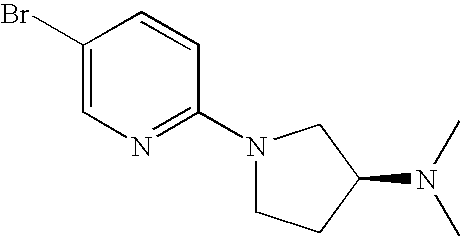
| LC-MS/ES | ||
| Prep | Chemical Name | m/z |
| 38 | [(R)-1-(5-Bromo-pyridin-2-yl)-pyrrolidin-3-yl]- | (81Br) |
| dimethyl-amine | 272.3 [M + H]+ | |
| 39 | 1-(5-Bromo-pyridin-2-yl)-4-methyl- | (81Br) |
| [1,4]diazepane | 272.0 [M + H]+ | |

| Prep | Chemical Name | 1H-NMR (CDCl3) |
| 57 | (3S,3′R)-1′-(5-Bromo- | δ 1.87-2.00 (m, 1H), |
| pyridin-2-yl)-3-fluoro- | 2.00-2.09 (m, 1H), 2.18-2.30 (m, 2H), | |
| [1,3′]bipyrrolidinyl | 3.40-3.80 (m, 9H), 5.10-5.28 (m, 1H), | |
| 5.34-5.40 (m, 1H), 6.28 (d, | ||
| J = 9.0 Hz, 1H), 7.51 (dd, J = 9.0, 2.4 Hz, | ||
| 1H), 8.18 (d, J = 2.4 Hz, 1H). | ||

| Prep | Chemical Name | MS/ES m/z |
| 60 | N-[(S)-1-(5-Bromo-pyridin-2-yl)- | (79Br) |
| pyrrolidin-3-yl]-2,2-difluoro-acetamide | 320.0 [M + H]+ | |
| 61 | N-[(R)-1-(5-Bromo-pyridin-2-yl)- | (79Br) |
| pyrrolidin-3-yl]-2,2,2-trifluoro-acetamide | 339.8 [M + H]+ | |

| Prep | Chemical Name | 1H NMR(DMSO-d6) |
| 74 | (±)-cis-4′-Fluoro- | δ 1.75-1.81 (m, 4H), |
| [1,3′]bipyrrolidinyl | 1.87 (bs, 1H), 2.57 (m, 4H), | |
| 2.7-283 (m, 2H), | ||
| 2.99-3.30 (m, 3H), | ||
| 4.96-5.13 (m, 1H) | ||
| 75 | (±)-trans-4- | δ 2.47 (s, 6H), 2.84 (d, J = 12.1 Hz, |
| Dimethylamino- | 1H), 2.97 (dd, | |
| pyrrolidin-3-ol | J = 12.1, 4.5 Hz, 1H), | |
| 3.06-3.08 (m, 4H), | ||
| 4.18 (bs, 1H). | ||
| 76 | (±)-cis-(4-Fluoro- | δ 2.13 (s, 6H), |
| pyrrolidin-3-yl)- | 2.38-2.43 (m, 1H), 2.45-2.58 (m, | |
| dimethyl-amine | 1H), 2.75-2.98 (m, 2H), | |
| 3.02-3.08 (m, 1H), | ||
| 4.87-5.04 (m, 1H) | ||

| Prep | Chemical Name | MS/ES m/z |
| 78 | (±)-trans-1′-(5-Bromo-pyridin-2-yl)-4′-fluoro- | (81Br) |
| [1,3′]bipyrrolidinyl | 315.0 [M+] | |
| 79 | (±)-trans-1-(5-Bromo-pyridin-2-yl)-4- | (81Br) |
| dimethylamino-pyrrolidin-3-ol | 288.0 [M + H]+ | |
| 80 | (±)-cis-[1-(5-Bromo-pyridin-2-yl)- | (79Br) |
| 4-fluoro-pyrrolidin-3-yl]-dimethyl-amine | 288.0 [M + H]+ | |

Alternate Workup (Examples 63 to 67, Prep 93): Cool the crude reaction mixture to room temperature and filter, washing the solids with ethyl acetate. Evaporate the solution and purify by silica gel chromatography, eluting with 0-6% methanol (2N NEt3)/CH2Cl2 to give a white solid. Dissolve the solid in methanol and add ammonium chloride. Evaporate the mixture to give the title compound.
| LC-MS/ES or | ||
| Ex or | MS/ES (m/z) or | |
| Prep | Chemical Name | 1H NMR (CDCl3) |
| 3 | 2-(4-Chloro-phenyl)-6-[6-((R)-3-dimethylamino- | (35Cl) |
| pyrrolidin-1-yl)-5-methyl-pyridin-3-yl]-6H- | 465.3 [M + H]+ | |
| thieno[2,3-c]pyridin-7-one, hydrochloride | ||
| 4* | 2-(4-Chloro-phenyl)-6-[6-((R)-3-hydroxy-pyrrolidin- | (37Cl) 427.2 [M+] |
| 1-yl)-pyridin-3-yl]-5,6-dihydro-4H-thieno[2,3- | ||
| c]pyridin-7-one, hydrochloride | ||
| 5 | 2-(4-Chloro-phenyl)-6-[6-((R)-3-dimethylamino- | (37Cl) 454.3 [M+] |
| pyrrolidin-1-yl)-pyridin-3-yl]-5,6-dihydro-4H- | ||
| thieno[2,3-c]pyridin-7-one, hydrochloride | ||
| 6 | 2-(4-Chloro-phenyl)-6-[6-((S)-3-dimethylamino- | (37Cl) 454.3 [M+] |
| pyrrolidin-1-yl)-pyridin-3-yl]-5,6-dihydro-4H- | ||
| thieno[2,3-c]pyridin-7-one, hydrochloride | ||
| 7 | 2-(4-Chloro-phenyl)-6-[6-((R)-3-dimethylamino- | (37Cl) |
| pyrrolidin-1-yl)-5-methyl-pyridin-3-yl]-5,6-dihydro- | 468.3 [M + H]+ | |
| 4H-thieno[2,3-c]pyridin-7-one, hydrochloride | ||
| 8** | 2-(4-Chloro-phenyl)-6-(4-dimethylamino-3,4,5,6- | (35Cl) |
| tetrahydro-2H-[1,2′]bipyridinyl-5′-yl)-6H-thieno[2,3- | 465.0 [M + H]+ | |
| c]pyridin-7-one, dihydrochloride | ||
| 9** | 2-(4-Chloro-phenyl)-6-(4-hydroxy-3,4,5,6- | (35Cl) 438.0 [M + 1]+ |
| tetrahydro-2H-[1,2′]bipyridinyl-5′-yl)-6H-thieno[2,3- | ||
| c]pyridin-7-one, hydrochloride | ||
| Prep | 4-{5-[2-(4-Chloro-phenyl)-7-oxo-7H-thieno[2,3- | (37Cl) |
| 85 | c]pyridin-6-yl]-pyridin-2-yloxy}-piperidine-1- | 438.0 [M − CO2tBu]+ |
| carboxylic acid tert-butyl ester | ||
| Prep | (R)-3-{5-[2-(4-Chloro-phenyl)-7-oxo-7H-thieno[2,3- | (37Cl) |
| 86 | c]pyridin-6-yl]-pyridin-2-yloxy}-piperidine-1- | 438.0 [M − CO2tBu]+ |
| carboxylic acid tert-butyl ester | ||
| Prep | (S)-3-{5-[2-(4-Chloro-phenyl)-7-oxo-7H-thieno[2,3- | (37Cl) |
| 87 | c]pyridin-6-yl]-pyridin-2-yloxy}-piperidine-1- | 438.0 [M − CO2tBu]+ |
| carboxylic acid tert-butyl ester | ||
| Prep | ((R)-1-{5-[2-(4-Chloro-phenyl)-7-oxo-4,7-dihydro- | (37Cl) |
| 88 | 5H-thieno[2,3-c]pyridin-6-yl]-pyridin-2-yl}- | 525.2 [M + H]+ |
| pyrrolidin-3-yl)-carbamic acid tert-butyl ester | ||
| Prep | (R)-3-{5-[2-(4-Chloro-phenyl)-7-oxo-7H-thieno[2,3- | (37Cl) 468.0 [M − tBu]+ |
| 89 | c]pyridin-6-yl]-pyridin-2-yloxy}-pyrrolidine-1- | |
| carboxylic acid tert-butyl ester | ||
| Prep | (S)-3-{5-[2-(4-Chloro-phenyl)-7-oxo-7H-thieno[2,3- | (37Cl) |
| 90 | c]pyridin-6-yl]-pyridin-2-yloxy}-pyrrolidine-1- | 468.0 [M − tBu]+ |
| carboxylic acid tert-butyl ester | ||
| Prep | 4-{5-[2-(4-Chloro-phenyl)-7-oxo-4,7-dihydro-5H- | (35Cl) 540.0 [M + 1]+ |
| 91 | thieno[2,3-c]pyridin-6-yl]-pyridin-2-yloxy}- | |
| piperidine-1-carboxylic acid tert-butyl ester | ||
| Prep | 2-(4-Chloro-phenyl)-6-[6-((S)-3-hydroxy-pyrrolidin- | (35Cl) |
| 92 | 1-yl)-pyridin-3-yl]-6H-thieno[2,3-c]pyridin-7-one | 424.0 [M + H]+ |
| 10 | 2-(4-Chloro-phenyl)-6-{6-[(R)-3-(2-hydroxy- | MS/ES m/z |
| ethylamino)-pyrrolidin-1-yl]-pyridin-3-yl}-6H- | 467.0 [M + H]+. | |
| thieno[2,3-c]pyridin-7-one | ||
| 11 | 2-(4-Cyclopropoxy-phenyl)-6-{6-[(R)-3-(2,2- | (35Cl) |
| difluoro-ethylamino)-pyrrolidin-1-yl]-pyridin-3-yl}- | 509.0 [M + H]+ | |
| 6H-thieno[2,3-c]pyridin-7-one, hydrochloride | ||
| 12 | 2-(4-Chloro-phenyl)-6-{6-[(S)-3-(2,2-difluoro- | (35Cl) |
| ethylamino)-pyrrolidin-1-yl]-pyridin-3-yl}-6H- | 487.2 [M + H]+ | |
| thieno[2,3-c]pyridin-7-one hydrochloride | ||
| 13 | 6-{6-[(S)-3-(2,2-Difluoro-ethylamino)-pyrrolidin-1- | (35Cl) 471.0 |
| yl]-pyridin-3-yl}-2-(4-fluoro-phenyl)-6H-thieno[2,3- | [M + H]+ | |
| c]pyridin-7-one hydrochloride | ||
| 14 | 6-{6-[3-(2,2-Difluoro-ethylamino)-pyrrolidin-1-yl]- | 489.0 [M + H]+ |
| pyridin-3-yl}-2-(3,4-difluoro-phenyl)-6H-thieno[2,3- | ||
| c]pyridin-7-one, hydrochloride | ||
| 15 | 2-(4-Chloro-phenyl)-6-[6-((S)-3-hydroxy-pyrrolidin- | (37Cl) 427.2 [M+] |
| 1-yl)-pyridin-3-yl]-5,6-dihydro-4H-thieno[2,3- | ||
| c]pyridin-7-one | ||
| 16 | 2-(4-Chloro-phenyl)-6-[6-((3R,3'S)-3-fluoro- | δ 1.80-2.00 (m, |
| [1,3']bipyrrolidinyl-1'-yl)-pyridin-3-yl]-6H- | 1H), 2.00-2.13 (m, | |
| thieno[2,3-c]pyridin-7-one, hydrochloride | 1H), 2.14-2.54 (m, | |
| 2H), 3.19-4.50 (m, | ||
| 9H), 5.15-5.33 (m, | ||
| 1H), 5.49 (bs, 1H), | ||
| 6.75 (d, J = 6.9 Hz, | ||
| 1H), 6.86 (d, J = 9.2 Hz, | ||
| 1H), 7.24 (d, J = 9.2 hz, | ||
| 1H), | ||
| 7.41 (s, 1H), 7.43 (d, J = 8.7 Hz, | ||
| 2H), | ||
| 7.64 (d, J = 8.7 Hz, 2H), | ||
| 8.15 (bs, 1H), | ||
| 8.28 (bs, 1H). | ||
| 17 | 2-(4-Chloro-phenyl)-6-[6-((3S,3'R)-3-fluoro- | δ 1.80-2.00 (m, |
| [1,3']bipyrrolidinyl-1'-yl)-pyridin-3-yl]-6H- | 1H), 2.00-2.13 (m, | |
| thieno[2,3-c]pyridin-7-one, hydrochloride | 1H), 2.14-2.54 (m, | |
| 2H), 3.19-4.50 (m, | ||
| 9H), 5.15-5.33 (m, | ||
| 1H), 5.49 (bs, 1H), | ||
| 6.75 (d, J = 6.9 Hz, | ||
| 1H), 6.86 (d, J = 9.2 Hz, | ||
| 1H), 7.24 (d, J = 9.2 hz, | ||
| 1H), | ||
| 7.41 (s, 1H), 7.43 (d, J = 8.7 Hz, | ||
| 2H), | ||
| 7.64 (d, J = 8.7 Hz, 2H), | ||
| 8.15 (bs, 1H), | ||
| 8.28 (bs, 1H). | ||
| 18 | 2-(4-Chloro-phenyl)-6-{6-[(R)-3-(2,2-difluoro- | (35Cl) 487.0 |
| ethylamino)-pyrrolidin-1-yl]-pyridin-3-yl}-6H- | [M + H]+ | |
| thieno[2,3-c]pyridin-7-one, hydrochloride | ||
| 19 | 2-(4-Chloro-phenyl)-6-{6-[(R)-3-(2,2-difluoro- | (35Cl) 489.0 |
| ethylamino)-pyrrolidin-1-yl]-pyridin-3-yl}-5,6- | [M + H]+ | |
| dihydro-4H-thieno[2,3-c]pyridin-7-one, | ||
| hydrochloride | ||
| 20 | 6-{6-[(R)-3-(2,2-Difluoro-ethylamino)-pyrrolidin-1- | (35Cl) 471.0 |
| yl]-pyridin-3-yl}-2-(4-fluoro-phenyl)-6H-thieno[2,3- | [M + H]+ | |
| c]pyridin-7-one, hydrochloride | ||
| 21 | 2-(4-Chloro-phenyl)-6-{6-[(R)-3-(2,2,2-trifluoro- | (35Cl) 504.8 |
| ethylamino)-pyrrolidin-1-yl]-pyridin-3-yl}-6H- | [M + H]+ | |
| thieno[2,3-c]pyridin-7-one, hydrochloride | ||
| 22 | 2-(4-Chloro-phenyl)-6-[6-((R)-3- | (35Cl) 503.0 |
| dicyclopropylamino-pyrrolidin-1-yl)-pyridin-3-yl]- | [M + H]+ | |
| 6H-thieno[2,3-c]pyridin-7-one, hydrochloride | ||
| 23 | 2-(4-Chloro-phenyl)-6-[6-(4-methyl-piperazin-1-yl)- | (35Cl) 436.8 |
| pyridin-3-yl]-6H-thieno[2,3-c]pyridin-7-one, | [M + H]+ | |
| hydrochloride | ||
| 24 | 2-(4-Chloro-phenyl)-6-[6-(4-methyl-piperazin-1-yl)- | (35Cl) 439.2 |
| pyridin-3-yl]-5,6-dihydro-4H-thieno[2,3-c]pyridin-7- | [M + H]+ | |
| one, hydrochloride | ||
| 25 | 6-{6-(R)-[3-(2,2-Difluoro-ethylamino)-pyrrolidin-1- | 537.2 [M + H]+ |
| yl]-pyridin-3-yl}-2-(4-trifluoromethoxy-phenyl)-6H- | ||
| thieno[2,3-c]pyridin-7-one, hydrochloride | ||
| 26 | 6-[6-(R)-(3-Dimethylamino-pyrrolidin-1-yl)-2-(4- | 501.2 [M + H]+ |
| trifluoromethoxy-phenyl)-6H-thieno[2,3-c]pyridin-7- | ||
| one, hydrochloride | ||
| 27 | 6-[6-(R)-(3-Dimethylamino-pyrrolidin-1-yl)-pyridin- | 485.2 [M + H]+ |
| 3-yl]-2-(4-trifluoromethyl-phenyl)-6H-thieno[2,3- | ||
| c]pyridin-7-one, hydrochloride | ||
| 28 | 6-{6-(R)-[3-(2,2-Difluoro-ethylamino)-pyrrolidin-1- | 521.2 [M + H]+ |
| yl]-pyridin-3-yl}-2-(4-trifluoromethyl-phenyl)-6H- | ||
| thieno[2,3-c]pyridin-7-one, hydrochloride | ||
| 29 | 6-[6-(R)-(3-Dimethylamino-pyrrolidin-1-yl)-pyridin- | 465 [M + H]+ |
| 3-yl]-2-(3-fluoro-4-methoxy-phenyl)-6H-thieno[2,3- | ||
| c]pyridin-7-one, hydrochloride | ||
| 30 | 6-{6-(R)-[3-(2,2-Difluoro-ethylamino)-pyrrolidin-1- | 501 [M + H]+ |
| yl]-pyridin-3-yl}-2-(3-fluoro-4-methoxy-phenyl)-6H- | ||
| thieno[2,3-c]pyridin-7-one, hydrochloride | ||
| 31 | 6-{6-(R)-[3-(2,2-Difluoro-ethylamino)-pyrrolidin-1- | 501.2 [M + H]+ |
| yl]-pyridin-3-yl}-2-(2-fluoro-4-methoxy-phenyl)-6H- | ||
| thieno[2,3-c]pyridin-7-one, hydrochloride | ||
| 32 | 6-[6-(R)-(3-Dimethylamino-pyrrolidin-1-yl)-pyridin- | 465 [M + H]+ |
| 3-yl]-2-(2-fluoro-4-methoxy-phenyl)-6H-thieno[2,3- | ||
| c]pyridin-7-one, hydrochloride | ||
| 33 | 6-[6-(R)-(3-Dimethylamino-pyrrolidin-1-yl)-pyridin- | 435.2 [M + H]+ |
| 3-yl]-2-(4-fluoro-phenyl)-6H-thieno[2,3-c]pyridin-7- | ||
| one, hydrochloride | ||
| 34 | 6-[6-(3-(S)-Dimethylamino-pyrrolidin-1-yl)-pyridin- | 467.2 [M + H]+ |
| 3-yl]-2-(2-fluoro-4-methoxy-phenyl)-5,6-dihydro- | ||
| 4H-thieno[2,3-c]pyridin-7-one, hydrochloride | ||
| 35 | 6-[6-(R)-(3-Dimethylamino-pyrrolidin-1-yl)-pyridin- | 467.2 [M + H]+ |
| 3-yl]-2-(2-fluoro-4-methoxy-phenyl)-5,6-dihydro- | ||
| 4H-thieno[2,3-c]pyridin-7-one, hydrochloride | ||
| 36 | 6-[6-(S)-(3-Dimethylamino-pyrrolidin-1-yl)-pyridin- | 503.0 [M + H]+ |
| 3-yl]-2-(4-trifluoromethoxy-phenyl)-5,6-dihydro-4H- | ||
| thieno[2,3-c]pyridin-7-one, hydrochloride | ||
| 37 | 6-[6-(R)-(3-Dimethylamino-pyrrolidin-1-yl)-pyridin- | 503.0 [M + H]+ |
| 3-yl]-2-(4-trifluoromethoxy-phenyl)-5,6-dihydro-4H- | ||
| thieno[2,3-c]pyridin-7-one, hydrochloride | ||
| 38 | 6-[6-(S)-(3-Dimethylamino-pyrrolidin-1-yl)-pyridin- | 449.2 [M + H]+ |
| 3-yl]-2-(4-methoxy-phenyl)-5,6-dihydro-4H- | ||
| thieno[2,3-c]pyridin-7-one, hydrochloride | ||
| 39 | 6-[6-(R)-(3-Dimethylamino-pyrrolidin-1-yl)-pyridin- | 449.2 [M + H]+ |
| 3-yl]-2-(4-methoxy-phenyl)-5,6-dihydro-4H- | ||
| thieno[2,3-c]pyridin-7-one, hydrochloride | ||
| 40 | 6-[6-(S)-(3-Dimethylamino-pyrrolidin-1-yl)-pyridin- | 487.0 [M + H]+ |
| 3-yl]-2-(4-trifluoromethyl-phenyl)-5,6-dihydro-4H- | ||
| thieno[2,3-c]pyridin-7-one, hydrochloride | ||
| 41 | 6-[6-(R)-(3-Dimethylamino-pyrrolidin-1-yl)-pyridin- | 487.0 [M + H]+ |
| 3-yl]-2-(4-trifluoromethyl-phenyl)-5,6-dihydro-4H- | ||
| thieno[2,3-c]pyridin-7-one, hydrochloride | ||
| 42 | 6-[6-(S)-(3-Dimethylamino-pyrrolidin-1-yl)-pyridin- | 467.2 [M + H]+ |
| 3-yl]-2-(3-fluoro-4-methoxy-phenyl)-5,6-dihydro- | ||
| 4H-thieno[2,3-c]pyridin-7-one, hydrochloride | ||
| 43 | 6-[6-(R)-(3-Dimethylamino-pyrrolidin-1-yl)-pyridin- | 467.2 [M + H]+ |
| 3-yl]-2-(3-fluoro-4-methoxy-phenyl)-5,6-dihydro- | ||
| 4H-thieno[2,3-c]pyridin-7-one, hydrochloride | ||
| 44 | 2-(4-Cyclopropoxy-phenyl)-6-[6-(S)-(3- | 475.2 [M + H]+ |
| dimethylamino-pyrrolidin-1-yl)-pyridin-3-yl]-5,6- | ||
| dihydro-4H-thieno[2,3-c]pyridin-7-one, | ||
| hydrochloride | ||
| 45 | 2-(3,4-Difluoro-phenyl)-6-[6-(S)-(3-dimethylamino- | 455.2 [M + H]+ |
| pyrrolidin-1-yl)-pyridin-3-yl]-5,6-dihydro-4H- | ||
| thieno[2,3-c]pyridin-7-one, hydrochloride | ||
| 46 | 2-(3,4-Difluoro-phenyl)-6-[6-(R)-(3-dimethylamino- | 455.2 [M + H]+ |
| pyrrolidin-1-yl)-pyridin-3-yl]-5,6-dihydro-4H- | ||
| thieno[2,3-c]pyridin-7-one, hydrochloride | ||
| 47 | 2-(2,4-Difluoro-phenyl)-6-[6-(S)-(3-dimethylamino- | 455.2 [M + H]+ |
| pyrrolidin-1-yl)-pyridin-3-yl]-5,6-dihydro-4H- | ||
| thieno[2,3-c]pyridin-7-one, hydrochloride | ||
| 48 | 2-(2,4-Difluoro-phenyl)-6-[6-(R)-(3-dimethylamino- | 455.2 [M + H]+ |
| pyrrolidin-1-yl)-pyridin-3-yl]-5,6-dihydro-4H- | ||
| thieno[2,3-c]pyridin-7-one, hydrochloride | ||
| 49 | 6-[6-(S)-(3-Dimethylamino-pyrrolidin-1-yl)-pyridin- | 437.2 [M + H]+ |
| 3-yl]-2-(4-fluoro-phenyl)-5,6-dihydro-4H-thieno[2,3- | ||
| c]pyridin-7-one, hydrochloride | ||
| 50 | 6-[6-(R)-(3-Dimethylamino-pyrrolidin-1-yl)-pyridin- | 437.2 [M + H]+ |
| 3-yl]-2-(4-fluoro-phenyl)-5,6-dihydro-4H-thieno[2,3- | ||
| c]pyridin-7-one, hydrochloride | ||
| 51 | 2-(3,5-Difluoro-phenyl)-6-[6-(R)-(3-dimethylamino- | 455.2 [M + H]+ |
| pyrrolidin-1-yl)-pyridin-3-yl]-5,6-dihydro-4H- | ||
| thieno[2,3-c]pyridin-7-one, hydrochloride | ||
| 52 | 2-(3,4-Difluoro-phenyl)-6-[6-(R)-(3-dimethylamino- | 453.2 [M + H]+ |
| pyrrolidin-1-yl)-pyridin-3-yl]-6H-thieno[2,3- | ||
| c]pyridin-7-one, hydrochloride | ||
| 53 | 2-(3,4-Dimethoxy-phenyl)-6-[6-(R)-(3- | 477.2 [M + H]+ |
| dimethylamino-pyrrolidin-1-yl)-pyridin-3-yl]-6H- | ||
| thieno[2,3-c]pyridin-7-one, hydrochloride | ||
| 54 | 2-(4-Cyclopropoxy-phenyl)-6-[6-(S)-(3- | 473.2 [M + H]+ |
| dimethylamino-pyrrolidin-1-yl)-pyridin-3-yl]-6H- | ||
| thieno[2,3-c]pyridin-7-one, hydrochloride | ||
| 55 | 2-(4-Cyclopropoxy-phenyl)-6-[6-(R)-(3- | 473.2 [M + H]+ |
| dimethylamino-pyrrolidin-1-yl)-pyridin-3-yl]-6H- | ||
| thieno[2,3-c]pyridin-7-one, hydrochloride | ||
| 56 | 2-(2,4-Difluoro-phenyl)-6-[6-(S)-(3-dimethylamino- | 453.0 [M + H]+ |
| pyrrolidin-1-yl)-pyridin-3-yl]-6H-thieno[2,3- | ||
| c]pyridin-7-one, dihydrochloride | ||
| 57 | 2-(2,4-Difluoro-phenyl)-6-[6-(R)-(3-dimethylamino- | 453.2 [M + H]+ |
| pyrrolidin-1-yl)-pyridin-3-yl]-6H-thieno[2,3- | ||
| c]pyridin-7-one, dihydrochloride | ||
| 58 | (±)-2-(4-Chloro-phenyl)-6-[6-(4-methyl-morpholine- | (35Cl) 466.0 |
| 2-carbonyl)-pyridin-3-yl]-6H-thieno[2,3-c]pyridin-7- | [M + H]+ | |
| one, hydrochloride | ||
| 59 | (±)-2-(4-Chloro-phenyl)-6-[6-(1-methyl-pyrrolidine- | (35Cl) 450.0 |
| 3-carbonyl)-pyridin-3-yl]-6H-thieno[2,3-c]pyridin-7- | [M + H]+ | |
| one, hydrochloride | ||
| 60 | (±)-2-(4-Chloro-phenyl)-6-[6-(1-methyl-pyrrolidine- | (35Cl) 452.0 |
| 3-carbonyl)-pyridin-3-yl]-5,6-dihydro-4H-thieno[2,3- | [M + H]+ | |
| c]pyridin-7-one, hydrochloride | ||
| 61 | 2-(4-Chloro-phenyl)-6-[6-(4-methyl-[1,4]diazepan-1- | (35Cl) 451 [M + H]+ |
| yl)-pyridin-3-yl]-6H-thieno[2,3-c]pyridin-7-one, | ||
| hydrochloride | ||
| 62 | 2-(4-Chloro-phenyl)-6-[6-(4-methyl-[1,4]diazepan-1- | (35Cl) 453.2 |
| yl)-pyridin-3-yl]-5,6-dihydro-4H-thieno[2,3- | [M + H]+ | |
| c]pyridin-7-one, hydrochloride | ||
| 63 | (±)-trans-2-(4-Chloro-phenyl)-6-[6-(4′-hydroxy- | (35Cl) |
| [1,3′]bipyrrolidinyl-1′-yl)-pyridin-3-yl]-5,6-dihydro- | 495.0 [M + H]+. | |
| 4H-thieno[2,3-c]pyridin-7-one, hydrochloride | ||
| 64 | (±)-cis-2-(4-Chloro-phenyl)-6-[6-(4′-fluoro- | (35Cl) 497 [M + H]+ |
| [1,3′]bipyrrolidinyl-1′-yl)-pyridin-3-yl]-5,6-dihydro- | ||
| 4H-thieno[2,3-c]pyridin-7-one, hydrochloride | ||
| 65 | (±)-trans-2-(4-Chloro-phenyl)-6-[6-(3- | (35Cl) 469 [M + H]+ |
| dimethylamino-4-hydroxy-pyrrolidin-1-yl)-pyridin-3- | ||
| yl]-5,6-dihydro-4H-thieno[2,3-c]pyridin-7-one, | ||
| hydrochloride | ||
| 66 | (±)-cis-2-(4-Chloro-phenyl)-6-[6-(3-dimethylamino- | (35Cl) 471 [M + H]+ |
| 4-fluoro-pyrrolidin-1-yl)-pyridin-3-yl]-5,6-dihydro- | ||
| 4H-thieno[2,3-c]pyridin-7-one, hydrochloride | ||
| 67 | (±)-trans-2-(4-Chloro-phenyl)-6-[6-(3- | (35Cl) |
| dimethylamino-4-hydroxy-pyrrolidin-1-yl)-pyridin-3- | 467.0 [M + H]+ | |
| yl]-6H-thieno[2,3-c]pyridin-7-one, hydrochloride | ||
| Prep | 2-(4-Chloro-phenyl)-6-(6-{3-[(3,4-dimethoxy- | (35Cl) |
| 93 | benzyl)-methyl-amino]-4-fluoro-pyrrolidin-1-yl}- | 607.0 [M + H]+ |
| pyridin-3-yl)-5,6-dihydro-4H-thieno[2,3-c]pyridin-7- | ||
| one | ||
| *Obtain HCl salt by dissolving free base in CH3OH and treating with 1.0 M HCl in EtOAc. | ||
| **Obtain HCl salt by treating free base with 1.0 M HCl in diethyl ether. | ||


| Ex | Chemical Name | MS/ES m/z |
| 70 | 2-(4-Chloro-phenyl)-6-[6-((R)-piperidin-3-yloxy)- | (35Cl) |
| pyridin-3-yl]-6H-thieno[2,3-c]pyridin-7-one, | 438.0 [M + H]+ | |
| hydrochloride | ||
| 71 | 2-(4-Chloro-phenyl)-6-[6-((S)-piperidin-3-yloxy)- | (35Cl) |
| pyridin-3-yl]-6H-thieno[2,3-c]pyridin-7-one, | 438.0 [M + H]+ | |
| hydrochloride | ||
| 72 | 2-(4-Chloro-phenyl)-6-[6-((R)-pyrrolidin-3-yloxy)- | (35Cl) |
| pyridin-3-yl]-6H-thieno[2,3-c]pyridin-7-one, | 424.0 [M + H]+ | |
| hydrochloride | ||
| 73 | 2-(4-Chloro-phenyl)-6-[6-((S)-pyrrolidin-3-yloxy)- | (35Cl) |
| pyridin-3-yl]-6H-thieno[2,3-c]pyridin-7-one, | 424.0 [M + H]+ | |
| hydrochloride | ||

| MS/ES | ||
| Ex | Chemical Name | m/z |
| 76 | 2-(4-Chloro-phenyl)-6-[6-((R)-1-methyl-piperidin-3- | (35Cl) |
| yloxy)-pyridin-3-yl]-6H-thieno[2,3-c]pyridin-7-one, | 452.0 | |
| hydrochloride | [M + H]+ | |
| 77 | 2-(4-Chloro-phenyl)-6-[6-((S)-1-methyl-piperidin-3- | (35Cl) |
| yloxy)-pyridin-3-yl]-6H-thieno[2,3-c]pyridin-7- | 452 | |
| one,hydrochloride | [M + H]+ | |
| 78 | 2-(4-Chloro-phenyl)-6-[6-((R)-1-methyl-pyrrolidin-3- | (35Cl) |
| yloxy)-pyridin-3-yl]-6H-thieno[2,3-c]pyridin-7-one, | 438.0 | |
| hydrochloride | [M + H]+ | |
| 79 | 2-(4-Chloro-phenyl)-6-[6-((S)-1-methyl-pyrrolidin-3- | (35Cl) |
| yloxy)-pyridin-3-yl]-6H-thieno[2,3-c]pyridin-7-one, | 438.0 | |
| hydrochloride | [M + H]+ | |
| 80 | 2-(4-Chloro-phenyl)-6-[6-(1-methyl-piperidin-4-yloxy)- | (35Cl) |
| pyridin-3-yl]-5,6-dihydro-4H-thieno[2,3-c]pyridin-7-one, | 454.3 | |
| hydrochloride | [M + H]+ | |
| MS/ES | ||
| Ex | Chemical Name | m/z |
| 82 | (R)-6-[6-(1-Acetyl-pyrrolidin-3-yloxy)-pyridin-3-yl]-2- | (35Cl) |
| (4-chloro-phenyl)-6H-thieno[2,3-c]pyridin-7-one | 466 | |
| [M + H]+ | ||
| 83 | (S)-6-[4-(1-Acetyl-piperidin-3-yloxy)-phenyl]-2-(4- | (35Cl) |
| chloro-phenyl)-6H-thieno[2,3-c]pyridin-7-one | 480 | |
| [M + H]+ | ||

Claims (14)


Priority Applications (1)
| Application Number | Priority Date | Filing Date | Title |
|---|---|---|---|
| US12/296,557 US8101764B2 (en) | 2006-06-08 | 2007-06-08 | MCH receptor antagonists |
Applications Claiming Priority (3)
| Application Number | Priority Date | Filing Date | Title |
|---|---|---|---|
| US81183806P | 2006-06-08 | 2006-06-08 | |
| US12/296,557 US8101764B2 (en) | 2006-06-08 | 2007-06-08 | MCH receptor antagonists |
| PCT/US2007/070668 WO2007146759A2 (en) | 2006-06-08 | 2007-06-08 | Novel mch receptor antagonists |
Publications (2)
| Publication Number | Publication Date |
|---|---|
| US20100016350A1 US20100016350A1 (en) | 2010-01-21 |
| US8101764B2 true US8101764B2 (en) | 2012-01-24 |
Family
ID=38654496
Family Applications (1)
| Application Number | Title | Priority Date | Filing Date |
|---|---|---|---|
| US12/296,557 Expired - Fee Related US8101764B2 (en) | 2006-06-08 | 2007-06-08 | MCH receptor antagonists |
Country Status (10)
| Country | Link |
|---|---|
| US (1) | US8101764B2 (en) |
| EP (1) | EP2029610A2 (en) |
| JP (1) | JP5225269B2 (en) |
| CN (1) | CN101460503A (en) |
| AU (1) | AU2007257845A1 (en) |
| BR (1) | BRPI0712684A2 (en) |
| CA (1) | CA2652524A1 (en) |
| EA (1) | EA015500B9 (en) |
| MX (1) | MX2008015486A (en) |
| WO (1) | WO2007146759A2 (en) |
Families Citing this family (2)
| Publication number | Priority date | Publication date | Assignee | Title |
|---|---|---|---|---|
| US9758505B2 (en) | 2014-02-12 | 2017-09-12 | Iteos Therapeutics | 3-(indol-3-yl)-pyridine derivatives, pharmaceutical compositions and methods for use |
| KR20240036709A (en) * | 2016-03-11 | 2024-03-20 | 에이씨 이뮨 에스에이 | Bicyclic compounds for diagnosis and therapy |
Citations (3)
| Publication number | Priority date | Publication date | Assignee | Title |
|---|---|---|---|---|
| WO2003033476A1 (en) | 2001-10-15 | 2003-04-24 | Smithkline Beecham Plc | Pyrimidinones as melanin concentrating hormone receptor 1 |
| WO2005047293A1 (en) | 2003-11-07 | 2005-05-26 | Neurocrine Biosciences, Inc. | Melanin-concentrating hormone receptor antagonists and compositions and methods related thereto |
| WO2007093364A1 (en) | 2006-02-15 | 2007-08-23 | Sanofi-Aventis | Azacyclyl-substituted aryldihydroisoquinolinones, process for their preparation and their use as medicaments |
Family Cites Families (4)
| Publication number | Priority date | Publication date | Assignee | Title |
|---|---|---|---|---|
| JP2002003370A (en) * | 1999-09-20 | 2002-01-09 | Takeda Chem Ind Ltd | Melanin coagulating hormone antagonistic agent |
| JP2006522812A (en) * | 2003-04-11 | 2006-10-05 | スミスクライン ビーチャム コーポレーション | Heterocyclic MCHR1 antagonist |
| UA83416C2 (en) * | 2004-02-13 | 2008-07-10 | Баниу Фармасьютикал Ко., Лтд. | Fused ring 4-oxopyrimidine derivative |
| WO2005103039A1 (en) * | 2004-04-15 | 2005-11-03 | Neurocrine Biosciences, Inc. | 2- (3-aminopyrrolidin-1-yl) pyridines as melanin-concentrating hormone receptor an tagonists |
-
2007
- 2007-06-08 WO PCT/US2007/070668 patent/WO2007146759A2/en not_active Ceased
- 2007-06-08 BR BRPI0712684-0A patent/BRPI0712684A2/en not_active IP Right Cessation
- 2007-06-08 US US12/296,557 patent/US8101764B2/en not_active Expired - Fee Related
- 2007-06-08 AU AU2007257845A patent/AU2007257845A1/en not_active Abandoned
- 2007-06-08 EP EP07798263A patent/EP2029610A2/en not_active Withdrawn
- 2007-06-08 CN CNA2007800206619A patent/CN101460503A/en active Pending
- 2007-06-08 CA CA002652524A patent/CA2652524A1/en not_active Abandoned
- 2007-06-08 MX MX2008015486A patent/MX2008015486A/en active IP Right Grant
- 2007-06-08 JP JP2009514545A patent/JP5225269B2/en not_active Expired - Fee Related
- 2007-06-08 EA EA200870578A patent/EA015500B9/en not_active IP Right Cessation
Patent Citations (3)
| Publication number | Priority date | Publication date | Assignee | Title |
|---|---|---|---|---|
| WO2003033476A1 (en) | 2001-10-15 | 2003-04-24 | Smithkline Beecham Plc | Pyrimidinones as melanin concentrating hormone receptor 1 |
| WO2005047293A1 (en) | 2003-11-07 | 2005-05-26 | Neurocrine Biosciences, Inc. | Melanin-concentrating hormone receptor antagonists and compositions and methods related thereto |
| WO2007093364A1 (en) | 2006-02-15 | 2007-08-23 | Sanofi-Aventis | Azacyclyl-substituted aryldihydroisoquinolinones, process for their preparation and their use as medicaments |
Non-Patent Citations (2)
| Title |
|---|
| Dyck et al., Journal of Medicinal Chemistry, 2005, 49,(13), 3753-3756. * |
| Dyck, et al., "A Thienopyridazinone-Based Melanin-Concentrating Hormone Receptor 1 Antagonist with Potent in Vivo Anorectic Properties," Journal of Medicinal Chemistry, American Chemical Society, vol. 49, No. 13, pp. 3753-3756 (2006). |
Also Published As
| Publication number | Publication date |
|---|---|
| AU2007257845A1 (en) | 2007-12-21 |
| WO2007146759A2 (en) | 2007-12-21 |
| EA015500B1 (en) | 2011-08-30 |
| MX2008015486A (en) | 2009-01-12 |
| US20100016350A1 (en) | 2010-01-21 |
| BRPI0712684A2 (en) | 2012-06-19 |
| EA200870578A1 (en) | 2009-04-28 |
| CA2652524A1 (en) | 2007-12-21 |
| JP2009539876A (en) | 2009-11-19 |
| CN101460503A (en) | 2009-06-17 |
| WO2007146759A3 (en) | 2008-02-21 |
| EP2029610A2 (en) | 2009-03-04 |
| EA015500B9 (en) | 2012-03-30 |
| JP5225269B2 (en) | 2013-07-03 |
Similar Documents
| Publication | Publication Date | Title |
|---|---|---|
| US8263772B2 (en) | MCH receptor antagonists | |
| US6852732B2 (en) | Tetrahydropyridino or piperidino heterocylic derivatives | |
| AU2001269437A1 (en) | Tetrahydropyridino or piperidino heterocyclic derivatives | |
| KR20110082189A (en) | Modulators of Amyloid Beta | |
| US7700630B2 (en) | Heterocyclic compounds, methods for the preparation thereof, and uses thereof | |
| US20080221107A1 (en) | Therapeutic Agents | |
| JP6559699B2 (en) | Substituted nitrogen-containing heterocyclic derivatives, pharmaceutical compositions containing them, and their antitumor applications | |
| CA2657651A1 (en) | Antiviral agents | |
| US20100093702A1 (en) | METHYLENE AMINES OF THIENO[2,3-d]PYRIMIDINE AND THEIR USE AS ADENOSINE A2a RECEPTOR ANTAGONISTS | |
| US20100298306A1 (en) | (1,4-Diaza-bicyclo[3.2.2]non-6-en-4-yl)-heterocyclyl-methanone Ligands for Nicotinic Acetylcholine Receptors, Useful for the Treatment of Disease | |
| US20100016350A1 (en) | Novel mch receptor antagonists | |
| US20070265264A1 (en) | Thia-tetraazaacenaphthylene kinase inhibitors | |
| EP4731216A1 (en) | Heteroaryl-amine compounds and use thereof as hdac6 inhibitors |
Legal Events
| Date | Code | Title | Description |
|---|---|---|---|
| AS | Assignment |
Owner name: ELI LILLY AND COMPANY,INDIANA Free format text: ASSIGNMENT OF ASSIGNORS INTEREST;ASSIGNORS:AMEGADZIE, ALBERT KUDZOVI;DAO, YEN;GARDINIER, KEVIN MATTHEW;AND OTHERS;SIGNING DATES FROM 20070612 TO 20070618;REEL/FRAME:021655/0559 Owner name: ELI LILLY AND COMPANY, INDIANA Free format text: ASSIGNMENT OF ASSIGNORS INTEREST;ASSIGNORS:AMEGADZIE, ALBERT KUDZOVI;DAO, YEN;GARDINIER, KEVIN MATTHEW;AND OTHERS;SIGNING DATES FROM 20070612 TO 20070618;REEL/FRAME:021655/0559 |
|
| CC | Certificate of correction | ||
| REMI | Maintenance fee reminder mailed | ||
| LAPS | Lapse for failure to pay maintenance fees | ||
| STCH | Information on status: patent discontinuation |
Free format text: PATENT EXPIRED DUE TO NONPAYMENT OF MAINTENANCE FEES UNDER 37 CFR 1.362 |
|
| STCH | Information on status: patent discontinuation |
Free format text: PATENT EXPIRED DUE TO NONPAYMENT OF MAINTENANCE FEES UNDER 37 CFR 1.362 |
|
| FP | Lapsed due to failure to pay maintenance fee |
Effective date: 20160124 |