US8101290B2 - Organic compound having electron-transporting and/or hole-blocking performance and its use and OLEDs comprising the compound - Google Patents
Organic compound having electron-transporting and/or hole-blocking performance and its use and OLEDs comprising the compound Download PDFInfo
- Publication number
- US8101290B2 US8101290B2 US12/252,153 US25215308A US8101290B2 US 8101290 B2 US8101290 B2 US 8101290B2 US 25215308 A US25215308 A US 25215308A US 8101290 B2 US8101290 B2 US 8101290B2
- Authority
- US
- United States
- Prior art keywords
- phenanthroline
- tert
- butyl
- indolyl
- methyl
- Prior art date
- Legal status (The legal status is an assumption and is not a legal conclusion. Google has not performed a legal analysis and makes no representation as to the accuracy of the status listed.)
- Expired - Fee Related, expires
Links
- 0 *C1=C(C)N=C(C)C(*)=C1C1=CC=C(C2=C([5*]C)C([Ar])=NC([Ar])=C2[2*])C=C1.*C1=C(C)N=C(C)C(*)=C1C1=CC=CC(C2=C([5*])C(C)=NC([Ar])=C2[2*])=C1.*C1=C(C)N=C(C)C(*)=C1C1=CC=CC=C1C1=C([5*])C(C)=NC([Ar])=C1[2*].*C1=C(C)N=C(C2=C(C3=C([5*])C(C)=C([2*])C([Ar])=N3)C=CC=C2)C(*)=C1C.*C1=C(C)N=C(C2=CC(C3=C([5*])C(C)=C([2*])C([Ar])=N3)=CC=C2)C(*)=C1C.*C1=C(C)N=C(C2=CC=C(C3=C([5*])C(C)=C([2*])C([Ar])=N3)C=C2)C(*)=C1C.[1*]C.[1*]C.[1*]C.[1*]C.[1*]C.[1*]C.[Ar] Chemical compound *C1=C(C)N=C(C)C(*)=C1C1=CC=C(C2=C([5*]C)C([Ar])=NC([Ar])=C2[2*])C=C1.*C1=C(C)N=C(C)C(*)=C1C1=CC=CC(C2=C([5*])C(C)=NC([Ar])=C2[2*])=C1.*C1=C(C)N=C(C)C(*)=C1C1=CC=CC=C1C1=C([5*])C(C)=NC([Ar])=C1[2*].*C1=C(C)N=C(C2=C(C3=C([5*])C(C)=C([2*])C([Ar])=N3)C=CC=C2)C(*)=C1C.*C1=C(C)N=C(C2=CC(C3=C([5*])C(C)=C([2*])C([Ar])=N3)=CC=C2)C(*)=C1C.*C1=C(C)N=C(C2=CC=C(C3=C([5*])C(C)=C([2*])C([Ar])=N3)C=C2)C(*)=C1C.[1*]C.[1*]C.[1*]C.[1*]C.[1*]C.[1*]C.[Ar] 0.000 description 12
- IZTYKFVIGFZQGS-UHFFFAOYSA-N CCOC(=O)C1=C(C2=C(C3=CC(C4=CC=C(OC)C=C4)=NC(C4=CC=CC=C4)=C3C(=O)OCC)C=CC=C2)C=C(C2=CC=C(OC)C=C2)N=C1C1=CC=CC=C1 Chemical compound CCOC(=O)C1=C(C2=C(C3=CC(C4=CC=C(OC)C=C4)=NC(C4=CC=CC=C4)=C3C(=O)OCC)C=CC=C2)C=C(C2=CC=C(OC)C=C2)N=C1C1=CC=CC=C1 IZTYKFVIGFZQGS-UHFFFAOYSA-N 0.000 description 2
- REBHHHQDGWMHGE-UHFFFAOYSA-N FC(F)(F)C1=C(C2=CC=CC(C3=CC(C4=CC=CO4)=NC(C4=CC=CC=C4)=C3C(F)(F)F)=C2)C=C(C2=CC=CO2)N=C1C1=CC=CC=C1 Chemical compound FC(F)(F)C1=C(C2=CC=CC(C3=CC(C4=CC=CO4)=NC(C4=CC=CC=C4)=C3C(F)(F)F)=C2)C=C(C2=CC=CO2)N=C1C1=CC=CC=C1 REBHHHQDGWMHGE-UHFFFAOYSA-N 0.000 description 2
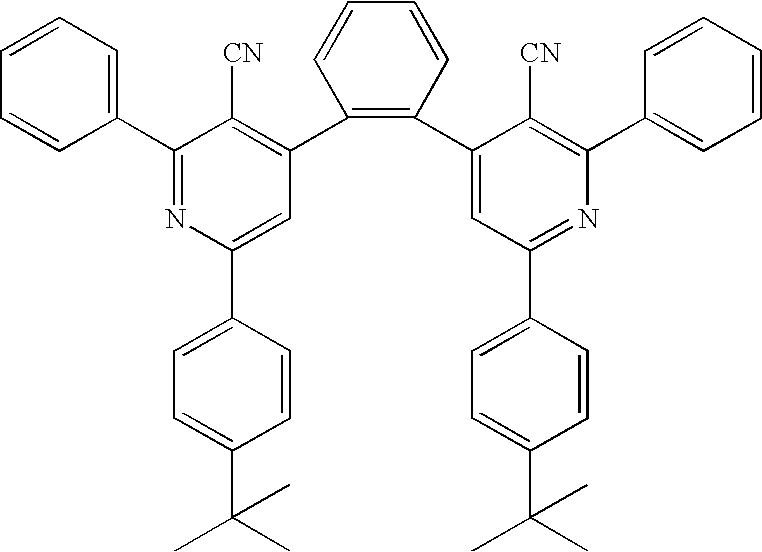
- ZNFIWMHNHMPNGN-UHFFFAOYSA-N CC(C)(C)C1=CC=C(C2=CC(C3=C(C4=CC(C5=CC=C(C(C)(C)C)C=C5)=NC(C5=CC=CC=C5)=C4C#N)C=CC=C3)=C(C#N)C(C3=CC=CC=C3)=N2)C=C1 Chemical compound CC(C)(C)C1=CC=C(C2=CC(C3=C(C4=CC(C5=CC=C(C(C)(C)C)C=C5)=NC(C5=CC=CC=C5)=C4C#N)C=CC=C3)=C(C#N)C(C3=CC=CC=C3)=N2)C=C1 ZNFIWMHNHMPNGN-UHFFFAOYSA-N 0.000 description 1
- KCHKOAPLUQFHSK-UHFFFAOYSA-N CC(C)(C)C1=CC=C(C2=CC(C3=CC=CC(C4=CC(C5=CC=C(C(C)(C)C)C=C5)=NC(C5=CC=CC=C5)=C4C#N)=C3)=C(C#N)C(C3=CC=CC=C3)=N2)C=C1 Chemical compound CC(C)(C)C1=CC=C(C2=CC(C3=CC=CC(C4=CC(C5=CC=C(C(C)(C)C)C=C5)=NC(C5=CC=CC=C5)=C4C#N)=C3)=C(C#N)C(C3=CC=CC=C3)=N2)C=C1 KCHKOAPLUQFHSK-UHFFFAOYSA-N 0.000 description 1
- LBXHVRPDMMORGK-UHFFFAOYSA-N CC(C)(C)c(cc1)ccc1-c(c(C#N)c1-c2cc(-c(c(C#N)c(-c3ccc(C(C)(C)C)cc3)nc3-c4ccccc4)c3C#N)ccc2)nc(-c2ccccc2)c1C#N Chemical compound CC(C)(C)c(cc1)ccc1-c(c(C#N)c1-c2cc(-c(c(C#N)c(-c3ccc(C(C)(C)C)cc3)nc3-c4ccccc4)c3C#N)ccc2)nc(-c2ccccc2)c1C#N LBXHVRPDMMORGK-UHFFFAOYSA-N 0.000 description 1
- OJOODVDEYKSCIW-UHFFFAOYSA-N CC(C)(C)c(cc1)ccc1-c(nc1-c2ccccc2)cc(-c(cc2)ccc2-c2cc(-c3ccc(C(C)(C)C)cc3)nc(-c3ccccc3)c2C#N)c1C#N Chemical compound CC(C)(C)c(cc1)ccc1-c(nc1-c2ccccc2)cc(-c(cc2)ccc2-c2cc(-c3ccc(C(C)(C)C)cc3)nc(-c3ccccc3)c2C#N)c1C#N OJOODVDEYKSCIW-UHFFFAOYSA-N 0.000 description 1
- KGQOGXWNNNXEOF-UHFFFAOYSA-N CC1=CC=C(C2=C(C(F)(F)F)C(C3=CC=CC(C4=C(C(F)(F)F)C(C5=CC=C(C)C=C5)=C(C(F)(F)F)C(C5=CC=CC=C5)=N4)=C3)=NC(C3=CC=CC=C3)=C2C(F)(F)F)C=C1 Chemical compound CC1=CC=C(C2=C(C(F)(F)F)C(C3=CC=CC(C4=C(C(F)(F)F)C(C5=CC=C(C)C=C5)=C(C(F)(F)F)C(C5=CC=CC=C5)=N4)=C3)=NC(C3=CC=CC=C3)=C2C(F)(F)F)C=C1 KGQOGXWNNNXEOF-UHFFFAOYSA-N 0.000 description 1
- QLOHPTXZACQENM-UHFFFAOYSA-N CC1=CC=C(C2=CC(C3=CC=C(C4=CC(C5=CC=C(C)C=C5)=C(C(F)(F)F)C(C5=CC=CC=C5)=N4)C=C3)=NC(C3=CC=CC=C3)=C2C(F)(F)F)C=C1 Chemical compound CC1=CC=C(C2=CC(C3=CC=C(C4=CC(C5=CC=C(C)C=C5)=C(C(F)(F)F)C(C5=CC=CC=C5)=N4)C=C3)=NC(C3=CC=CC=C3)=C2C(F)(F)F)C=C1 QLOHPTXZACQENM-UHFFFAOYSA-N 0.000 description 1
- GPSNIZZHDGVQSU-UHFFFAOYSA-N CC1=CC=C(C2=CC(C3=CC=C(C4=CC(C5=CC=C(C)C=C5)=NC(C5=CC=CC=C5)=C4C(F)(F)F)C=C3)=C(C(F)(F)F)C(C3=CC=CC=C3)=N2)C=C1 Chemical compound CC1=CC=C(C2=CC(C3=CC=C(C4=CC(C5=CC=C(C)C=C5)=NC(C5=CC=CC=C5)=C4C(F)(F)F)C=C3)=C(C(F)(F)F)C(C3=CC=CC=C3)=N2)C=C1 GPSNIZZHDGVQSU-UHFFFAOYSA-N 0.000 description 1
- QCUQMQNAGDAQKB-UHFFFAOYSA-N CC1=CC=C(C2=CC(C3=CC=CC(C4=CC(C5=CC=C(C)C=C5)=C(C(F)(F)F)C(C5=CC=CC=C5)=N4)=C3)=NC(C3=CC=CC=C3)=C2C(F)(F)F)C=C1 Chemical compound CC1=CC=C(C2=CC(C3=CC=CC(C4=CC(C5=CC=C(C)C=C5)=C(C(F)(F)F)C(C5=CC=CC=C5)=N4)=C3)=NC(C3=CC=CC=C3)=C2C(F)(F)F)C=C1 QCUQMQNAGDAQKB-UHFFFAOYSA-N 0.000 description 1
- XHECRDMGIUEIKQ-UHFFFAOYSA-N CC1=CC=C(C2=CC(C3=CC=CC(C4=CC(C5=CC=C(C)C=C5)=NC(C5=CC=CC=C5)=C4C#N)=C3)=C(C#N)C(C3=CC=CC=C3)=N2)C=C1 Chemical compound CC1=CC=C(C2=CC(C3=CC=CC(C4=CC(C5=CC=C(C)C=C5)=NC(C5=CC=CC=C5)=C4C#N)=C3)=C(C#N)C(C3=CC=CC=C3)=N2)C=C1 XHECRDMGIUEIKQ-UHFFFAOYSA-N 0.000 description 1
- SXUNXNJZAOZWIW-UHFFFAOYSA-N CC1=CC=C(C2=CC(C3=CC=CC(C4=CC(C5=CC=C(C)C=C5)=NC(C5=CC=CC=C5)=C4C(F)(F)F)=C3)=C(C(F)(F)F)C(C3=CC=CC=C3)=N2)C=C1 Chemical compound CC1=CC=C(C2=CC(C3=CC=CC(C4=CC(C5=CC=C(C)C=C5)=NC(C5=CC=CC=C5)=C4C(F)(F)F)=C3)=C(C(F)(F)F)C(C3=CC=CC=C3)=N2)C=C1 SXUNXNJZAOZWIW-UHFFFAOYSA-N 0.000 description 1
- ZNSRFUQEXZHOBV-UHFFFAOYSA-N CCOC(=O)C1=C(C2=CC=C(C)C=C2)C=C(C2=CC=C(C3=NC(C4=CC=CC=C4)=C(C(=O)OCC)C(C4=CC=C(C)C=C4)=C3)C=C2)N=C1C1=CC=CC=C1 Chemical compound CCOC(=O)C1=C(C2=CC=C(C)C=C2)C=C(C2=CC=C(C3=NC(C4=CC=CC=C4)=C(C(=O)OCC)C(C4=CC=C(C)C=C4)=C3)C=C2)N=C1C1=CC=CC=C1 ZNSRFUQEXZHOBV-UHFFFAOYSA-N 0.000 description 1
- SOECXFPLEJVDST-UHFFFAOYSA-N CCOC(=O)C1=C(C2=CC=C(C3=CC(C4=CC=C(C5=CC=CC=C5)C=C4)=NC(C4=CC=CC=C4)=C3C(=O)OCC)C=C2)C=C(C2=CC=C(C3=CC=CC=C3)C=C2)N=C1C1=CC=CC=C1 Chemical compound CCOC(=O)C1=C(C2=CC=C(C3=CC(C4=CC=C(C5=CC=CC=C5)C=C4)=NC(C4=CC=CC=C4)=C3C(=O)OCC)C=C2)C=C(C2=CC=C(C3=CC=CC=C3)C=C2)N=C1C1=CC=CC=C1 SOECXFPLEJVDST-UHFFFAOYSA-N 0.000 description 1
- SZYXYYAHQAPUAD-UHFFFAOYSA-N CCOC(=O)C1=C(C2=CC=C(OC)C=C2)C=C(C2=CC(C3=NC(C4=CC=CC=C4)=C(C(=O)OCC)C(C4=CC=C(OC)C=C4)=C3)=CC=C2)N=C1C1=CC=CC=C1 Chemical compound CCOC(=O)C1=C(C2=CC=C(OC)C=C2)C=C(C2=CC(C3=NC(C4=CC=CC=C4)=C(C(=O)OCC)C(C4=CC=C(OC)C=C4)=C3)=CC=C2)N=C1C1=CC=CC=C1 SZYXYYAHQAPUAD-UHFFFAOYSA-N 0.000 description 1
- LTSDENCNJZCNJW-UHFFFAOYSA-N CCOC(=O)C1=C(C2=CC=CC(C3=CC(C4=CC=C(OC)C=C4)=NC(C4=CC=CC=C4)=C3C(=O)OCC)=C2)C=C(C2=CC=C(OC)C=C2)N=C1C1=CC=CC=C1 Chemical compound CCOC(=O)C1=C(C2=CC=CC(C3=CC(C4=CC=C(OC)C=C4)=NC(C4=CC=CC=C4)=C3C(=O)OCC)=C2)C=C(C2=CC=C(OC)C=C2)N=C1C1=CC=CC=C1 LTSDENCNJZCNJW-UHFFFAOYSA-N 0.000 description 1
- MJMFKKYOCZOQIR-UHFFFAOYSA-N CCOC(=O)C1=C(C2=CC=CC=C2)C=C(C2=C(C3=NC(C4=CC=CC=C4)=C(C(=O)OCC)C(C4=CC=CC=C4)=C3)C=CC=C2)N=C1C1=CC=CC=C1 Chemical compound CCOC(=O)C1=C(C2=CC=CC=C2)C=C(C2=C(C3=NC(C4=CC=CC=C4)=C(C(=O)OCC)C(C4=CC=CC=C4)=C3)C=CC=C2)N=C1C1=CC=CC=C1 MJMFKKYOCZOQIR-UHFFFAOYSA-N 0.000 description 1
- WIFMYHKGRNMQSF-UHFFFAOYSA-N COC1=CC=C(C2=CC(C3=C(C4=CC(C5=CC=C(OC)C=C5)=C(C(F)(F)F)C(C5=CC=CC=C5)=N4)C=CC=C3)=NC(C3=CC=CC=C3)=C2C(F)(F)F)C=C1 Chemical compound COC1=CC=C(C2=CC(C3=C(C4=CC(C5=CC=C(OC)C=C5)=C(C(F)(F)F)C(C5=CC=CC=C5)=N4)C=CC=C3)=NC(C3=CC=CC=C3)=C2C(F)(F)F)C=C1 WIFMYHKGRNMQSF-UHFFFAOYSA-N 0.000 description 1
- JLFKFQJRDVPDDF-UHFFFAOYSA-N COC1=CC=C(C2=CC(C3=C(C4=CC(C5=CC=C(OC)C=C5)=NC(C5=CC=CC=C5)=C4C(F)(F)F)C=CC=C3)=C(C(F)(F)F)C(C3=CC=CC=C3)=N2)C=C1 Chemical compound COC1=CC=C(C2=CC(C3=C(C4=CC(C5=CC=C(OC)C=C5)=NC(C5=CC=CC=C5)=C4C(F)(F)F)C=CC=C3)=C(C(F)(F)F)C(C3=CC=CC=C3)=N2)C=C1 JLFKFQJRDVPDDF-UHFFFAOYSA-N 0.000 description 1
- LUWOOSYRVADVMI-UHFFFAOYSA-N COC1=CC=C(C2=CC(C3=CC=CC(C4=CC(C5=CC=C(OC)C=C5)=C(C(F)(F)F)C(C5=CC=CC=C5)=N4)=C3)=NC(C3=CC=CC=C3)=C2C(F)(F)F)C=C1 Chemical compound COC1=CC=C(C2=CC(C3=CC=CC(C4=CC(C5=CC=C(OC)C=C5)=C(C(F)(F)F)C(C5=CC=CC=C5)=N4)=C3)=NC(C3=CC=CC=C3)=C2C(F)(F)F)C=C1 LUWOOSYRVADVMI-UHFFFAOYSA-N 0.000 description 1
- QVMXBCXKDAUEOZ-UHFFFAOYSA-N COC1=CC=C(C2=CC(C3=CC=CC(C4=CC(C5=CC=C(OC)C=C5)=NC(C5=CC=CC=C5)=C4C(F)(F)F)=C3)=C(C(F)(F)F)C(C3=CC=CC=C3)=N2)C=C1 Chemical compound COC1=CC=C(C2=CC(C3=CC=CC(C4=CC(C5=CC=C(OC)C=C5)=NC(C5=CC=CC=C5)=C4C(F)(F)F)=C3)=C(C(F)(F)F)C(C3=CC=CC=C3)=N2)C=C1 QVMXBCXKDAUEOZ-UHFFFAOYSA-N 0.000 description 1
- SCLUZANZJCDEGD-UHFFFAOYSA-N Cc(cc1)ccc1-c(nc(-c1ccccc1)c(C#N)c1-c(cc2)ccc2-c(c(C#N)c(-c2ccccc2)nc2-c3ccc(C)cc3)c2C#N)c1C#N Chemical compound Cc(cc1)ccc1-c(nc(-c1ccccc1)c(C#N)c1-c(cc2)ccc2-c(c(C#N)c(-c2ccccc2)nc2-c3ccc(C)cc3)c2C#N)c1C#N SCLUZANZJCDEGD-UHFFFAOYSA-N 0.000 description 1
- WGEJCYUHARYACD-UHFFFAOYSA-N FC(F)(F)C1=C(C2=C(C3=CC(C4=CC=C(C5=CC=CC=C5)C=C4)=NC(C4=CC=CC=C4)=C3C(F)(F)F)C=CC=C2)C=C(C2=CC=C(C3=CC=CC=C3)C=C2)N=C1C1=CC=CC=C1 Chemical compound FC(F)(F)C1=C(C2=C(C3=CC(C4=CC=C(C5=CC=CC=C5)C=C4)=NC(C4=CC=CC=C4)=C3C(F)(F)F)C=CC=C2)C=C(C2=CC=C(C3=CC=CC=C3)C=C2)N=C1C1=CC=CC=C1 WGEJCYUHARYACD-UHFFFAOYSA-N 0.000 description 1
- NPSBLOXQMKAURS-UHFFFAOYSA-N FC(F)(F)C1=C(C2=CC=C(C3=CC(C4=CC=C(C5=CC=CC=C5)C=C4)=NC(C4=CC=CC=C4)=C3C(F)(F)F)C=C2)C=C(C2=CC=C(C3=CC=CC=C3)C=C2)N=C1C1=CC=CC=C1 Chemical compound FC(F)(F)C1=C(C2=CC=C(C3=CC(C4=CC=C(C5=CC=CC=C5)C=C4)=NC(C4=CC=CC=C4)=C3C(F)(F)F)C=C2)C=C(C2=CC=C(C3=CC=CC=C3)C=C2)N=C1C1=CC=CC=C1 NPSBLOXQMKAURS-UHFFFAOYSA-N 0.000 description 1
- YHNUWOIFMGWLRI-UHFFFAOYSA-N FC(F)(F)C1=C(C2=CC=C(C3=CC(C4=CC=CO4)=NC(C4=CC=CC=C4)=C3C(F)(F)F)C=C2)C=C(C2=CC=CO2)N=C1C1=CC=CC=C1 Chemical compound FC(F)(F)C1=C(C2=CC=C(C3=CC(C4=CC=CO4)=NC(C4=CC=CC=C4)=C3C(F)(F)F)C=C2)C=C(C2=CC=CO2)N=C1C1=CC=CC=C1 YHNUWOIFMGWLRI-UHFFFAOYSA-N 0.000 description 1
- XOCPLSYSNOKIAV-UHFFFAOYSA-N FC(F)(F)C1=C(C2=CC=CC=C2)C=C(C2=CC=C(C3=NC(C4=CC=CC=C4)=C(C(F)(F)F)C(C4=CC=CC=C4)=C3)C=C2)N=C1C1=CC=CC=C1 Chemical compound FC(F)(F)C1=C(C2=CC=CC=C2)C=C(C2=CC=C(C3=NC(C4=CC=CC=C4)=C(C(F)(F)F)C(C4=CC=CC=C4)=C3)C=C2)N=C1C1=CC=CC=C1 XOCPLSYSNOKIAV-UHFFFAOYSA-N 0.000 description 1
- FNLZUCDDVAGIKV-UHFFFAOYSA-N FC(F)(F)C1=C(C2=CC=CC=C2C2=CC(C3=CC=CO3)=NC(C3=CC=CC=C3)=C2C(F)(F)F)C=C(C2=CC=CO2)N=C1C1=CC=CC=C1 Chemical compound FC(F)(F)C1=C(C2=CC=CC=C2C2=CC(C3=CC=CO3)=NC(C3=CC=CC=C3)=C2C(F)(F)F)C=C(C2=CC=CO2)N=C1C1=CC=CC=C1 FNLZUCDDVAGIKV-UHFFFAOYSA-N 0.000 description 1
- CDHTUOFPLRXILR-UHFFFAOYSA-N FC(F)(F)C1=C(C2=CC=CO2)C=C(C2=CC=C(C3=NC(C4=CC=CC=C4)=C(C(F)(F)F)C(C4=CC=CO4)=C3)C=C2)N=C1C1=CC=CC=C1 Chemical compound FC(F)(F)C1=C(C2=CC=CO2)C=C(C2=CC=C(C3=NC(C4=CC=CC=C4)=C(C(F)(F)F)C(C4=CC=CO4)=C3)C=C2)N=C1C1=CC=CC=C1 CDHTUOFPLRXILR-UHFFFAOYSA-N 0.000 description 1
- ARVGIFMASGVQGU-UHFFFAOYSA-N FC(F)(F)C1=C(C2=COC=C2)C=C(C2=C(C3=NC(C4=CC=CC=C4)=C(C(F)(F)F)C(C4=COC=C4)=C3)C=CC=C2)N=C1C1=CC=CC=C1 Chemical compound FC(F)(F)C1=C(C2=COC=C2)C=C(C2=C(C3=NC(C4=CC=CC=C4)=C(C(F)(F)F)C(C4=COC=C4)=C3)C=CC=C2)N=C1C1=CC=CC=C1 ARVGIFMASGVQGU-UHFFFAOYSA-N 0.000 description 1
- AYNVZXAPISJJPN-UHFFFAOYSA-N FC(F)(F)C1=C(C2=COC=C2)C=C(C2=CC=CC(C3=NC(C4=CC=CC=C4)=C(C(F)(F)F)C(C4=COC=C4)=C3)=C2)N=C1C1=CC=CC=C1 Chemical compound FC(F)(F)C1=C(C2=COC=C2)C=C(C2=CC=CC(C3=NC(C4=CC=CC=C4)=C(C(F)(F)F)C(C4=COC=C4)=C3)=C2)N=C1C1=CC=CC=C1 AYNVZXAPISJJPN-UHFFFAOYSA-N 0.000 description 1
- NVOFCCAGWJVIJI-UHFFFAOYSA-N N#CC1=C(C2=C(C3=CC(C4=CC=C(C5=CC=CC=C5)C=C4)=NC(C4=CC=CC=C4)=C3C#N)C=CC=C2)C=C(C2=CC=C(C3=CC=CC=C3)C=C2)N=C1C1=CC=CC=C1 Chemical compound N#CC1=C(C2=C(C3=CC(C4=CC=C(C5=CC=CC=C5)C=C4)=NC(C4=CC=CC=C4)=C3C#N)C=CC=C2)C=C(C2=CC=C(C3=CC=CC=C3)C=C2)N=C1C1=CC=CC=C1 NVOFCCAGWJVIJI-UHFFFAOYSA-N 0.000 description 1
- CIDLCPYGGAKFPA-UHFFFAOYSA-N N#CC1=C(C2=CC=CC=C2)N=C(C2=CC=CC=C2)C(C(F)(F)F)=C1C1=CC(C2=C(C#N)C(C3=CC=CC=C3)=NC(C3=CC=CC=C3)=C2C(F)(F)F)=CC=C1 Chemical compound N#CC1=C(C2=CC=CC=C2)N=C(C2=CC=CC=C2)C(C(F)(F)F)=C1C1=CC(C2=C(C#N)C(C3=CC=CC=C3)=NC(C3=CC=CC=C3)=C2C(F)(F)F)=CC=C1 CIDLCPYGGAKFPA-UHFFFAOYSA-N 0.000 description 1
- IPTPXKWKEHWPLM-UHFFFAOYSA-N [C-]#[N+]C1=C(C2=C(C3=C(C#N)C(C4=CC=CC=C4)=NC(C4=CC=C(C(C)(C)C)C=C4)=C3C#N)C=CC=C2)C(C#N)=C(C2=CC=CC=C2)N=C1C1=CC=C(C(C)(C)C)C=C1 Chemical compound [C-]#[N+]C1=C(C2=C(C3=C(C#N)C(C4=CC=CC=C4)=NC(C4=CC=C(C(C)(C)C)C=C4)=C3C#N)C=CC=C2)C(C#N)=C(C2=CC=CC=C2)N=C1C1=CC=C(C(C)(C)C)C=C1 IPTPXKWKEHWPLM-UHFFFAOYSA-N 0.000 description 1
- GWEAHIARWAVYTB-UHFFFAOYSA-N [C-]#[N+]C1=C(C2=C(C3=C(C#N)C(C4=CC=CC=C4)=NC(C4=CC=C(C)C=C4)=C3C#N)C=CC=C2)C(C#N)=C(C2=CC=CC=C2)N=C1C1=CC=C(C)C=C1 Chemical compound [C-]#[N+]C1=C(C2=C(C3=C(C#N)C(C4=CC=CC=C4)=NC(C4=CC=C(C)C=C4)=C3C#N)C=CC=C2)C(C#N)=C(C2=CC=CC=C2)N=C1C1=CC=C(C)C=C1 GWEAHIARWAVYTB-UHFFFAOYSA-N 0.000 description 1
- XPRDLJXWUGPFKV-UHFFFAOYSA-N [C-]#[N+]C1=C(C2=C(C3=NC(C4=CC=CC=C4)=C(C#N)C(C4=CC=C(C(C)(C)C)C=C4)=C3C#N)C=CC=C2)N=C(C2=CC=CC=C2)C([N+]#[C-])=C1C1=CC=C(C(C)(C)C)C=C1 Chemical compound [C-]#[N+]C1=C(C2=C(C3=NC(C4=CC=CC=C4)=C(C#N)C(C4=CC=C(C(C)(C)C)C=C4)=C3C#N)C=CC=C2)N=C(C2=CC=CC=C2)C([N+]#[C-])=C1C1=CC=C(C(C)(C)C)C=C1 XPRDLJXWUGPFKV-UHFFFAOYSA-N 0.000 description 1
- YXZRAPCHMJKURN-UHFFFAOYSA-N [C-]#[N+]C1=C(C2=C(C3=NC(C4=CC=CC=C4)=C(C#N)C(C4=CC=CC=C4)=C3C#N)C=CC=C2)N=C(C2=CC=CC=C2)C([N+]#[C-])=C1C1=CC=CC=C1 Chemical compound [C-]#[N+]C1=C(C2=C(C3=NC(C4=CC=CC=C4)=C(C#N)C(C4=CC=CC=C4)=C3C#N)C=CC=C2)N=C(C2=CC=CC=C2)C([N+]#[C-])=C1C1=CC=CC=C1 YXZRAPCHMJKURN-UHFFFAOYSA-N 0.000 description 1
- PELKECUPIHHHSI-UHFFFAOYSA-N [C-]#[N+]C1=C(C2=CC(C3=C(C#N)C(C4=CC=CC=C4)=NC(C4=CC=C(C(C)(C)C)C=C4)=C3C#N)=CC=C2)C(C#N)=C(C2=CC=CC=C2)N=C1C1=CC=C(C(C)(C)C)C=C1 Chemical compound [C-]#[N+]C1=C(C2=CC(C3=C(C#N)C(C4=CC=CC=C4)=NC(C4=CC=C(C(C)(C)C)C=C4)=C3C#N)=CC=C2)C(C#N)=C(C2=CC=CC=C2)N=C1C1=CC=C(C(C)(C)C)C=C1 PELKECUPIHHHSI-UHFFFAOYSA-N 0.000 description 1
- HKSRXZLDQJBAGH-UHFFFAOYSA-N [C-]#[N+]C1=C(C2=CC=C(C(C)(C)C)C=C2)C(C#N)=C(C2=CC(C3=NC(C4=CC=CC=C4)=C(C#N)C(C4=CC=C(C(C)(C)C)C=C4)=C3C#N)=CC=C2)N=C1C1=CC=CC=C1 Chemical compound [C-]#[N+]C1=C(C2=CC=C(C(C)(C)C)C=C2)C(C#N)=C(C2=CC(C3=NC(C4=CC=CC=C4)=C(C#N)C(C4=CC=C(C(C)(C)C)C=C4)=C3C#N)=CC=C2)N=C1C1=CC=CC=C1 HKSRXZLDQJBAGH-UHFFFAOYSA-N 0.000 description 1
- HVDPRMRYOVHRLS-UHFFFAOYSA-N [C-]#[N+]C1=C(C2=CC=C(C(C)(C)C)C=C2)C(C#N)=C(C2=CC=CC=C2)N=C1C1=CC=C(C2=C(C#N)C(C3=CC=C(C(C)(C)C)C=C3)=C([N+]#[C-])C(C3=CC=CC=C3)=N2)C=C1 Chemical compound [C-]#[N+]C1=C(C2=CC=C(C(C)(C)C)C=C2)C(C#N)=C(C2=CC=CC=C2)N=C1C1=CC=C(C2=C(C#N)C(C3=CC=C(C(C)(C)C)C=C3)=C([N+]#[C-])C(C3=CC=CC=C3)=N2)C=C1 HVDPRMRYOVHRLS-UHFFFAOYSA-N 0.000 description 1
- JAWGZIKSCAKXMA-UHFFFAOYSA-N [C-]#[N+]C1=C(C2=CC=C(C(C)(C)C)C=C2)C=C(C2=CC(C3=NC(C4=CC=CC=C4)=C(C#N)C(C4=CC=C(C(C)(C)C)C=C4)=C3)=CC=C2)N=C1C1=CC=CC=C1 Chemical compound [C-]#[N+]C1=C(C2=CC=C(C(C)(C)C)C=C2)C=C(C2=CC(C3=NC(C4=CC=CC=C4)=C(C#N)C(C4=CC=C(C(C)(C)C)C=C4)=C3)=CC=C2)N=C1C1=CC=CC=C1 JAWGZIKSCAKXMA-UHFFFAOYSA-N 0.000 description 1
- BSOCNFLQWIEDCZ-UHFFFAOYSA-N [C-]#[N+]C1=C(C2=CC=C(C(C)(C)C)C=C2)C=C(C2=CC=C(C3=NC(C4=CC=CC=C4)=C(C#N)C(C4=CC=C(C(C)(C)C)C=C4)=C3)C=C2)N=C1C1=CC=CC=C1 Chemical compound [C-]#[N+]C1=C(C2=CC=C(C(C)(C)C)C=C2)C=C(C2=CC=C(C3=NC(C4=CC=CC=C4)=C(C#N)C(C4=CC=C(C(C)(C)C)C=C4)=C3)C=C2)N=C1C1=CC=CC=C1 BSOCNFLQWIEDCZ-UHFFFAOYSA-N 0.000 description 1
- RMBPIQCVIOFSID-UHFFFAOYSA-N [C-]#[N+]C1=C(C2=CC=C(C)C=C2)C=C(C2=CC(C3=NC(C4=CC=CC=C4)=C(C#N)C(C4=CC=C(C)C=C4)=C3)=CC=C2)N=C1C1=CC=CC=C1 Chemical compound [C-]#[N+]C1=C(C2=CC=C(C)C=C2)C=C(C2=CC(C3=NC(C4=CC=CC=C4)=C(C#N)C(C4=CC=C(C)C=C4)=C3)=CC=C2)N=C1C1=CC=CC=C1 RMBPIQCVIOFSID-UHFFFAOYSA-N 0.000 description 1
- MERNEPUSNYYPFB-UHFFFAOYSA-N [C-]#[N+]C1=C(C2=CC=CC=C2)C(C#N)=C(C2=CC=CC=C2)N=C1C1=CC=C(C2=C(C#N)C(C3=CC=CC=C3)=C([N+]#[C-])C(C3=CC=CC=C3)=N2)C=C1 Chemical compound [C-]#[N+]C1=C(C2=CC=CC=C2)C(C#N)=C(C2=CC=CC=C2)N=C1C1=CC=C(C2=C(C#N)C(C3=CC=CC=C3)=C([N+]#[C-])C(C3=CC=CC=C3)=N2)C=C1 MERNEPUSNYYPFB-UHFFFAOYSA-N 0.000 description 1
- CTPJXUKBYOBZFS-UHFFFAOYSA-N [C-]#[N+]C1=C(C2=CC=CC=C2)C=C(C2=C(C3=NC(C4=CC=CC=C4)=C(C#N)C(C4=CC=CC=C4)=C3)C=CC=C2)N=C1C1=CC=CC=C1 Chemical compound [C-]#[N+]C1=C(C2=CC=CC=C2)C=C(C2=C(C3=NC(C4=CC=CC=C4)=C(C#N)C(C4=CC=CC=C4)=C3)C=CC=C2)N=C1C1=CC=CC=C1 CTPJXUKBYOBZFS-UHFFFAOYSA-N 0.000 description 1
- JQFPCNDCSJMQQG-UHFFFAOYSA-N [C-]#[N+]C1=C(C2=CC=CC=C2)C=C(C2=CC=C(C3=NC(C4=CC=CC=C4)=C(C#N)C(C4=CC=CC=C4)=C3)C=C2)N=C1C1=CC=CC=C1 Chemical compound [C-]#[N+]C1=C(C2=CC=CC=C2)C=C(C2=CC=C(C3=NC(C4=CC=CC=C4)=C(C#N)C(C4=CC=CC=C4)=C3)C=C2)N=C1C1=CC=CC=C1 JQFPCNDCSJMQQG-UHFFFAOYSA-N 0.000 description 1
- QFJMDRQUAQWJKN-UHFFFAOYSA-N [C-]#[N+]C1=C(C2=CC=CC=C2)N=C(C2=CC=C(C(C)(C)C)C=C2)C([N+]#[C-])=C1C1=CC=C(C2=C(C#N)C(C3=CC=CC=C3)=NC(C3=CC=C(C(C)(C)C)C=C3)=C2C#N)C=C1 Chemical compound [C-]#[N+]C1=C(C2=CC=CC=C2)N=C(C2=CC=C(C(C)(C)C)C=C2)C([N+]#[C-])=C1C1=CC=C(C2=C(C#N)C(C3=CC=CC=C3)=NC(C3=CC=C(C(C)(C)C)C=C3)=C2C#N)C=C1 QFJMDRQUAQWJKN-UHFFFAOYSA-N 0.000 description 1
- AJCDBLZGAAPIIN-UHFFFAOYSA-N [C-]#[N+]C1=C(C2=CC=CC=C2)N=C(C2=CC=C(C(C)(C)C)C=C2)C=C1C1=CC=C(C2=C(C#N)C(C3=CC=CC=C3)=NC(C3=CC=C(C(C)(C)C)C=C3)=C2)C=C1 Chemical compound [C-]#[N+]C1=C(C2=CC=CC=C2)N=C(C2=CC=C(C(C)(C)C)C=C2)C=C1C1=CC=C(C2=C(C#N)C(C3=CC=CC=C3)=NC(C3=CC=C(C(C)(C)C)C=C3)=C2)C=C1 AJCDBLZGAAPIIN-UHFFFAOYSA-N 0.000 description 1
- USPRUDBPNULRSW-UHFFFAOYSA-N [C-]#[N+]C1=C(C2=CC=CC=C2)N=C(C2=CC=C(C)C=C2)C([N+]#[C-])=C1C1=CC=C(C2=C(C#N)C(C3=CC=CC=C3)=NC(C3=CC=C(C)C=C3)=C2C#N)C=C1 Chemical compound [C-]#[N+]C1=C(C2=CC=CC=C2)N=C(C2=CC=C(C)C=C2)C([N+]#[C-])=C1C1=CC=C(C2=C(C#N)C(C3=CC=CC=C3)=NC(C3=CC=C(C)C=C3)=C2C#N)C=C1 USPRUDBPNULRSW-UHFFFAOYSA-N 0.000 description 1
- BCSPCWNMEDBWEM-UHFFFAOYSA-N [C-]#[N+]C1=C(C2=CC=CC=C2)N=C(C2=CC=C(C)C=C2)C=C1C1=CC=C(C2=C(C#N)C(C3=CC=CC=C3)=NC(C3=CC=C(C)C=C3)=C2)C=C1 Chemical compound [C-]#[N+]C1=C(C2=CC=CC=C2)N=C(C2=CC=C(C)C=C2)C=C1C1=CC=C(C2=C(C#N)C(C3=CC=CC=C3)=NC(C3=CC=C(C)C=C3)=C2)C=C1 BCSPCWNMEDBWEM-UHFFFAOYSA-N 0.000 description 1
- UWPUAVLBFRZYPM-UHFFFAOYSA-N [C-]#[N+]C1=CC=C(C2=C(C(F)(F)F)C(C3=CC=CC=C3)=NC(C3=C(C4=NC(C5=CC=CC=C5)=C(C(F)(F)F)C(C5=CC=C(C#N)C=C5)=C4)C=CC=C3)=C2)C=C1 Chemical compound [C-]#[N+]C1=CC=C(C2=C(C(F)(F)F)C(C3=CC=CC=C3)=NC(C3=C(C4=NC(C5=CC=CC=C5)=C(C(F)(F)F)C(C5=CC=C(C#N)C=C5)=C4)C=CC=C3)=C2)C=C1 UWPUAVLBFRZYPM-UHFFFAOYSA-N 0.000 description 1
- FVOAJMOKGPAXBA-UHFFFAOYSA-N [C-]#[N+]C1=CC=C(C2=C([N+]#[C-])C(C3=CC=CC=C3)=NC(C3=C(C4=NC(C5=CC=CC=C5)=C(C#N)C(C5=CC=C(C#N)C=C5)=C4)C=CC=C3)=C2)C=C1 Chemical compound [C-]#[N+]C1=CC=C(C2=C([N+]#[C-])C(C3=CC=CC=C3)=NC(C3=C(C4=NC(C5=CC=CC=C5)=C(C#N)C(C5=CC=C(C#N)C=C5)=C4)C=CC=C3)=C2)C=C1 FVOAJMOKGPAXBA-UHFFFAOYSA-N 0.000 description 1
Images


Classifications
-
- C—CHEMISTRY; METALLURGY
- C07—ORGANIC CHEMISTRY
- C07D—HETEROCYCLIC COMPOUNDS
- C07D405/00—Heterocyclic compounds containing both one or more hetero rings having oxygen atoms as the only ring hetero atoms, and one or more rings having nitrogen as the only ring hetero atom
- C07D405/14—Heterocyclic compounds containing both one or more hetero rings having oxygen atoms as the only ring hetero atoms, and one or more rings having nitrogen as the only ring hetero atom containing three or more hetero rings
-
- C—CHEMISTRY; METALLURGY
- C07—ORGANIC CHEMISTRY
- C07D—HETEROCYCLIC COMPOUNDS
- C07D213/00—Heterocyclic compounds containing six-membered rings, not condensed with other rings, with one nitrogen atom as the only ring hetero atom and three or more double bonds between ring members or between ring members and non-ring members
- C07D213/02—Heterocyclic compounds containing six-membered rings, not condensed with other rings, with one nitrogen atom as the only ring hetero atom and three or more double bonds between ring members or between ring members and non-ring members having three double bonds between ring members or between ring members and non-ring members
- C07D213/04—Heterocyclic compounds containing six-membered rings, not condensed with other rings, with one nitrogen atom as the only ring hetero atom and three or more double bonds between ring members or between ring members and non-ring members having three double bonds between ring members or between ring members and non-ring members having no bond between the ring nitrogen atom and a non-ring member or having only hydrogen or carbon atoms directly attached to the ring nitrogen atom
- C07D213/24—Heterocyclic compounds containing six-membered rings, not condensed with other rings, with one nitrogen atom as the only ring hetero atom and three or more double bonds between ring members or between ring members and non-ring members having three double bonds between ring members or between ring members and non-ring members having no bond between the ring nitrogen atom and a non-ring member or having only hydrogen or carbon atoms directly attached to the ring nitrogen atom with substituted hydrocarbon radicals attached to ring carbon atoms
- C07D213/44—Radicals substituted by doubly-bound oxygen, sulfur, or nitrogen atoms, or by two such atoms singly-bound to the same carbon atom
- C07D213/53—Nitrogen atoms
-
- C—CHEMISTRY; METALLURGY
- C07—ORGANIC CHEMISTRY
- C07D—HETEROCYCLIC COMPOUNDS
- C07D213/00—Heterocyclic compounds containing six-membered rings, not condensed with other rings, with one nitrogen atom as the only ring hetero atom and three or more double bonds between ring members or between ring members and non-ring members
- C07D213/02—Heterocyclic compounds containing six-membered rings, not condensed with other rings, with one nitrogen atom as the only ring hetero atom and three or more double bonds between ring members or between ring members and non-ring members having three double bonds between ring members or between ring members and non-ring members
- C07D213/04—Heterocyclic compounds containing six-membered rings, not condensed with other rings, with one nitrogen atom as the only ring hetero atom and three or more double bonds between ring members or between ring members and non-ring members having three double bonds between ring members or between ring members and non-ring members having no bond between the ring nitrogen atom and a non-ring member or having only hydrogen or carbon atoms directly attached to the ring nitrogen atom
- C07D213/24—Heterocyclic compounds containing six-membered rings, not condensed with other rings, with one nitrogen atom as the only ring hetero atom and three or more double bonds between ring members or between ring members and non-ring members having three double bonds between ring members or between ring members and non-ring members having no bond between the ring nitrogen atom and a non-ring member or having only hydrogen or carbon atoms directly attached to the ring nitrogen atom with substituted hydrocarbon radicals attached to ring carbon atoms
- C07D213/54—Radicals substituted by carbon atoms having three bonds to hetero atoms with at the most one bond to halogen, e.g. ester or nitrile radicals
- C07D213/57—Nitriles
-
- C—CHEMISTRY; METALLURGY
- C07—ORGANIC CHEMISTRY
- C07D—HETEROCYCLIC COMPOUNDS
- C07D213/00—Heterocyclic compounds containing six-membered rings, not condensed with other rings, with one nitrogen atom as the only ring hetero atom and three or more double bonds between ring members or between ring members and non-ring members
- C07D213/02—Heterocyclic compounds containing six-membered rings, not condensed with other rings, with one nitrogen atom as the only ring hetero atom and three or more double bonds between ring members or between ring members and non-ring members having three double bonds between ring members or between ring members and non-ring members
- C07D213/04—Heterocyclic compounds containing six-membered rings, not condensed with other rings, with one nitrogen atom as the only ring hetero atom and three or more double bonds between ring members or between ring members and non-ring members having three double bonds between ring members or between ring members and non-ring members having no bond between the ring nitrogen atom and a non-ring member or having only hydrogen or carbon atoms directly attached to the ring nitrogen atom
- C07D213/60—Heterocyclic compounds containing six-membered rings, not condensed with other rings, with one nitrogen atom as the only ring hetero atom and three or more double bonds between ring members or between ring members and non-ring members having three double bonds between ring members or between ring members and non-ring members having no bond between the ring nitrogen atom and a non-ring member or having only hydrogen or carbon atoms directly attached to the ring nitrogen atom with hetero atoms or with carbon atoms having three bonds to hetero atoms with at the most one bond to halogen, e.g. ester or nitrile radicals, directly attached to ring carbon atoms
- C07D213/78—Carbon atoms having three bonds to hetero atoms, with at the most one bond to halogen, e.g. ester or nitrile radicals
- C07D213/79—Acids; Esters
- C07D213/80—Acids; Esters in position 3
-
- C—CHEMISTRY; METALLURGY
- C07—ORGANIC CHEMISTRY
- C07D—HETEROCYCLIC COMPOUNDS
- C07D213/00—Heterocyclic compounds containing six-membered rings, not condensed with other rings, with one nitrogen atom as the only ring hetero atom and three or more double bonds between ring members or between ring members and non-ring members
- C07D213/02—Heterocyclic compounds containing six-membered rings, not condensed with other rings, with one nitrogen atom as the only ring hetero atom and three or more double bonds between ring members or between ring members and non-ring members having three double bonds between ring members or between ring members and non-ring members
- C07D213/04—Heterocyclic compounds containing six-membered rings, not condensed with other rings, with one nitrogen atom as the only ring hetero atom and three or more double bonds between ring members or between ring members and non-ring members having three double bonds between ring members or between ring members and non-ring members having no bond between the ring nitrogen atom and a non-ring member or having only hydrogen or carbon atoms directly attached to the ring nitrogen atom
- C07D213/60—Heterocyclic compounds containing six-membered rings, not condensed with other rings, with one nitrogen atom as the only ring hetero atom and three or more double bonds between ring members or between ring members and non-ring members having three double bonds between ring members or between ring members and non-ring members having no bond between the ring nitrogen atom and a non-ring member or having only hydrogen or carbon atoms directly attached to the ring nitrogen atom with hetero atoms or with carbon atoms having three bonds to hetero atoms with at the most one bond to halogen, e.g. ester or nitrile radicals, directly attached to ring carbon atoms
- C07D213/78—Carbon atoms having three bonds to hetero atoms, with at the most one bond to halogen, e.g. ester or nitrile radicals
- C07D213/84—Nitriles
- C07D213/85—Nitriles in position 3
-
- H—ELECTRICITY
- H10—SEMICONDUCTOR DEVICES; ELECTRIC SOLID-STATE DEVICES NOT OTHERWISE PROVIDED FOR
- H10K—ORGANIC ELECTRIC SOLID-STATE DEVICES
- H10K85/00—Organic materials used in the body or electrodes of devices covered by this subclass
- H10K85/60—Organic compounds having low molecular weight
- H10K85/649—Aromatic compounds comprising a hetero atom
- H10K85/654—Aromatic compounds comprising a hetero atom comprising only nitrogen as heteroatom
-
- H—ELECTRICITY
- H10—SEMICONDUCTOR DEVICES; ELECTRIC SOLID-STATE DEVICES NOT OTHERWISE PROVIDED FOR
- H10K—ORGANIC ELECTRIC SOLID-STATE DEVICES
- H10K2102/00—Constructional details relating to the organic devices covered by this subclass
- H10K2102/10—Transparent electrodes, e.g. using graphene
- H10K2102/101—Transparent electrodes, e.g. using graphene comprising transparent conductive oxides [TCO]
- H10K2102/103—Transparent electrodes, e.g. using graphene comprising transparent conductive oxides [TCO] comprising indium oxides, e.g. ITO
-
- H—ELECTRICITY
- H10—SEMICONDUCTOR DEVICES; ELECTRIC SOLID-STATE DEVICES NOT OTHERWISE PROVIDED FOR
- H10K—ORGANIC ELECTRIC SOLID-STATE DEVICES
- H10K50/00—Organic light-emitting devices
- H10K50/10—OLEDs or polymer light-emitting diodes [PLED]
- H10K50/14—Carrier transporting layers
-
- Y—GENERAL TAGGING OF NEW TECHNOLOGICAL DEVELOPMENTS; GENERAL TAGGING OF CROSS-SECTIONAL TECHNOLOGIES SPANNING OVER SEVERAL SECTIONS OF THE IPC; TECHNICAL SUBJECTS COVERED BY FORMER USPC CROSS-REFERENCE ART COLLECTIONS [XRACs] AND DIGESTS
- Y10—TECHNICAL SUBJECTS COVERED BY FORMER USPC
- Y10S—TECHNICAL SUBJECTS COVERED BY FORMER USPC CROSS-REFERENCE ART COLLECTIONS [XRACs] AND DIGESTS
- Y10S428/00—Stock material or miscellaneous articles
- Y10S428/917—Electroluminescent
Definitions
- This invention relates to a novel organic compound having electron-transporting and/or hole-blocking performance and its use as hole-blocking material and OLEDs comprising the compound.
- an organic light-emitting device is comprised of an anode for hole injection, a cathode for electron injection, and an organic medium sandwiched between these electrodes to support charge recombination that yields emission of light.
- OLEDs These devices are also commonly referred to as OLEDs. Representative of earlier OLEDs are disclosed in Gurnee et al. U.S. Pat. No. 3,172,862 issued on Mar. 9, 1965; Gurnee U.S. Pat. No. 3,173,050 issued on Mar. 9, 1965; Dresner, “Double Injection Electroluminescence in Anthracene”, RCA Review, Vol. 30. pp. 322-334, 1969; and Dresner U.S. Pat. No. 3,710,167 issued on Jan. 9, 1973.
- the organic layers in these OLEDs usually composed of a polycyclic aromatic hydrocarbon, were very thick (much greater than 1 ⁇ m). Consequently, operating voltages were very high, often >100V.
- RGB red, green, blue
- OLEDs organic electroluminescent compounds
- Simple organic molecules such as anthracene, thiadiazole derivatives, and coumarin derivatives are known to show electroluminescence.
- Semiconductive conjugated polymers have also been used as electroluminescent components, as has been disclosed in, for example, Friend et al, U.S. Pat. No.
- High-efficiency OLEDs depends heavily on charge injection, transport and recombination. Therefore, hole-blocking materials (HBM) and electron-transporting materials (ETM) are also important in devices. Compared with so many HBMs developed, only few good ETMs were reported so far. Now tris(8-hydroxyquinoline)aluminum (Alq3) is a common ETMs for its good stability in devices, however, due to its smaller electron mobility, large number of holes will come into ETM, and then combination with electron in Alq3 layer. As a result, a small mount of light emission from Alq3 is often observed. Thus, it unavoidably leads to bad color purity.
- HBM hole-blocking materials
- ETM electron-transporting materials
- 1,3,5-tris(phenyl-2-benzimidazolyl)benzene is another efficient ETM.
- TPBI 1,3,5-tris(phenyl-2-benzimidazolyl)benzene
- BCP 2,9-dimethyl-4,7-diphenylphenathroline
- IP hole-blocking material
- BCP can not be used as ETM solely.
- One object of the present invention is to provide a novel organic compound having electron-transporting and/or hole-blocking performance and its use as hole-blocking material of the same.
- the other object is to provide OLEDs which address some of the problems discussed above.
- the OLEDs which use the novel organic compound provided by the present invention as electron-transporting layer (ETL) and/or hole-blocking layer (HBL) provide good color purity and improved efficiency.
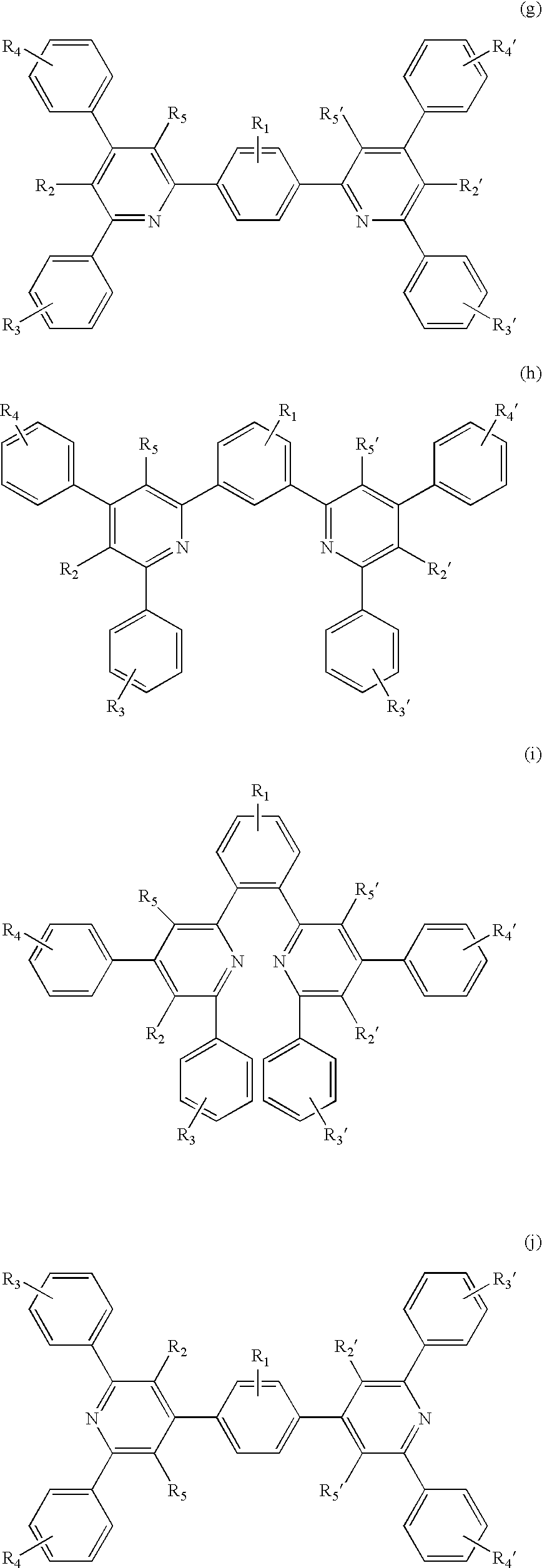
- the present invention provides a novel organic compound having electron-transporting and/or hole-blocking performance, wherein said compound is one of multi-aryl substituted pyridine derivatives represented by the following formulas (a)-(f):
- R 1 in each formula is independently selected from the group consisting of hydrogen, substituted or unsubstituted C 1 -C 20 alkyl, substituted or unsubstituted C 3 -C 20 cyclic alkyl, substituted or unsubstituted C 1 -C 20 alkoxy, C 7 -C 50 aralkyl, C 6 -C 50 aryl, C 6 -C 50 aryloxy and heterocyclic aryl;
- R 2 , R 2 ′, R 5 , R 5 ′ in each formula are independently selected from the group consisting of hydrogen, carboxyl, fluorinated methyl, cyano, nitro and C 2 -C 20 ester group, and at least contain one of carboxyl, fluorinated and cyano group, and R 2 , R 2 ′, R 5 , R 5 ′ in each formula may be same or different;
- Ar 1 , Ar 1 ′, Ar 2 Ar 2 ′ in each formula are independently selected from the group consisting of C 6 -C 50 aryl or C 5 -C 50 heterocyclic aryl, and Ar 1 , Ar 1 ′, Ar 2 , Ar 2 ′ in each formula may be same or different.
- the present invention further provides the use of the organic compound having electron-transporting and/or hole-blocking performance provided by the present invention as hole-blocking material, emitting material and electron material.
- the present invention also provides the use of the organic compound having electron-transporting and/or hole-blocking performance of any one of claims 1 - 3 in organic semiconductor devices such as organic transistor, organic integrated circuit, organic solar cell, organic laser or organic sensor.
- the present invention also provides an OLED comprising an anode, a cathode, a luminescent layer, at least one hole-transporting layer disposed between said anode and said luminescent layer, at least one electron-transporting layer disposed between said cathode and said luminescent layer, and a substrate present on either the anode or cathode, wherein at least one of said electron-transporting layer comprises the organic material having electron-transporting and/or hole-blocking performance provided by the present invention.
- the present invention also provides an OLED comprising an anode, a cathode, an electron-emitting layer disposed between said anode and said cathode, at least one hole-transporting layer disposed between said anode and said electron-emitting layer, at least one electron-transporting layer disposed between said cathode and said electron-emitting layer, a hole-blocking layer between the electron-emitting layer and the electron-transporting layer, and a substrate present on either the anode or cathode, wherein at least one of said electron-transporting layer comprises the organic compound having electron-transporting and/or hole-blocking performance provided by the present invention.
- the OLEDs provided by the present invention possesses an unexpectedly improved efficiency and narrow emission band.
- This surprising feature of the present invention provides an improved blue emitting organic light-emitting device with exceptionally high color purity and efficiency.
- the organic compound having electron-transporting and/or hole-blocking performance can be used in other devices, for example, doping fluorescent device, phosphorescent device, white OLEDs and so on.
- the compound and materials provided by the present invention are easy to be prepared, and thus are economically attractive.
- FIG. 1 illustrates a diagram of the structure of the conventional OLEDs.
- FIG. 2 illustrates a diagram of the structure of OLEDs provided by the present invention.
- Reference numeral 1 indicates a substrate; numeral 2 indicates an anode; numeral 3 indicates an organic hole-transporting layer (HTL); numeral 4 indicates an organic emitting layer (EML); numeral 5 indicates an organic electron-transporting layer (ETL); numeral 6 indicates a cathode, numeral 7 indicates an organic hole-blocking layer (HBL) and numeral 10 indicates the OLEDs.
- HTL organic hole-transporting layer
- EML organic emitting layer
- ETL organic electron-transporting layer
- numeral 6 indicates a cathode
- numeral 7 indicates an organic hole-blocking layer (HBL)
- numeral 10 indicates the OLEDs.
- the present invention relates to an organic compound having electron-transporting and/or hole-blocking performance, the preparation method and use thereof and the OLEDs comprising the organic compound having electron-transporting and/or hole-blocking performance provided by the present invention.
- the new organic compound having electron-transporting and/or hole-blocking performance is one of multi-aryl substituted pyridine derivatives represented by formulas (a)-(f) as mentioned above.
- the new organic compound having electron-transporting and/or hole-blocking performance is one or more multi-aryl substituted pyridine derivatives represented by formulas (g)-(1):
- R 1 , R 3 , R 3 ′, R 4 , R 4 ′ in each formula is independently selected from the group consisting of hydrogen, substituted or unsubstituted C 1 -C 20 alkyl, substituted or unsubstituted C 3 -C 20 cyclic alkyl, substituted or unsubstituted C 1 -C 20 alkoxy, C 7 -C 50 aralkyl, C 6 -C 50 aryl, C 6 -C 50 aryloxy and C 5 -C 50 heterocyclic aryl;
- R 2 , R 2 ′, R 5 , R 5 ′ in each formula are independently selected from the group consisting of hydrogen, carboxyl, fluorinated methyl, cyano, nitro and C 2 -C 20 ester group, and at least contain one of carboxyl, fluorinated and cyano group;
- Ar 1 , Ar 1 ′, Ar 2 , Ar 2 ′ in each formula are independently selected from the group consisting of C 6 -C 50 aryl and heterocyclic aryl.
- R 1 , R 3 , R 3 ′, R 4 , R 4 ′ in each formula is independently selected from the group consisting of hydrogen, substituted or unsubstituted C 1 -C 10 alkyl, substituted or unsubstituted C 3 -C 10 cyclic alkyl, substituted or unsubstituted C 1 -C 10 alkoxy, C 7 -C 30 aralkyl, C 6 -C 30 aryl, C 6 -C 30 aryloxy and C 5 -C 50 heterocyclic aryl;
- R 2 , R 2 ′, R 5 , R 5 ′ in each formula are independently selected from the group consisting of hydrogen, carboxyl, fluorinated methyl, cyano, nitro and C 2 -C 10 ester group, and at least contain one of carboxyl, fluorinated methyl and cyano group;
- Ar 1 , Ar 1 ′, Ar 2 , Ar 2 ′ in each formula are independently selected from the group consisting of C 6 -C 30 aryl and C 5 -C 30 heterocyclic aryl.
- unsubstituted C 1 -C 20 alkyl may be methyl, ethyl, propyl, isopropyl, n-butyl, sec-butyl, isobutyl, tert-butyl, n-pentyl, n-hexyl, n-heptyl or n-octyl.
- substituted C 1 -C 20 alkyl may be hydroxymethyl, 1-hydroxyethyl, 2-hydroxyethyl, 2-hydroxy-isobutyl, 1,2-dihydroxy-ethyl, 1,3-dihydroxy-isopropyl, 2,3-dihydroxy-tert-butyl, 1,2,3-trihydroxy-propyl, chloromethyl, 1-chloroethyl, 2-chloroethyl, 1-chloropropyl, 2-chloropropyl, 3-chloropropyl, 2-chloroisobutyl, 1,2-dichloroethyl, 1,3-dichloro-isopropyl, 2,3-dichloro-tert-butyl, 1,2,3-trichloropropyl, bromomethyl, 1-bromoethyl, 2-bromoethyl, 1-bromopropyl, 2-bromopropyl, 3-bromopropyl, 2-bromo-isobutyl
- unsubstituted C 3 -C 20 cyclic alkyl may be cyclopropyl, cyclobutyl, cyclopentyl or cyclohexyl.
- substituted C 3 -C 20 cyclic alkyl may be 4-methyl-cyclohexyl, adamantyl or norbornyl.
- C 1 -C 20 alkoxy from which R 1 , R 3 , R 3 ′, R 4 , R 4 ′ are selected may be represented by —OR, wherein R represents alkyl group which includes methyl, ethyl, propyl, isopropyl, n-butyl, sec-butyl, isobutyl, tert-butyl, n-pentyl, n-hexyl, n-heptyl, n-octyl, hydroxymethyl, 1-hydroxyethyl, 2-hydroxyethyl, 2-hydroxy-isobutyl, 1,2-dihydroxy-ethyl, 1,3-dihydroxy-isopropyl, 2,3-dihydroxy-tert-butyl, 1,2,3-trihydroxy-propyl, chloromethyl, 1-chloroethyl, 2-chloroethyl, 2-chloroisobutyl, 1,2-dichloroethyl, 1,3-
- C 7 -C 50 aralkyl may be benzyl, 1-phenylethyl, 2-phenylethyl, 1-phenyl-isopropyl, 2-phenyl-isopropyl, phenyl-tert-butyl, ⁇ -naphthyl-methyl, 1- ⁇ -naphthylethyl, 2- ⁇ -naphthylethyl, 1- ⁇ -naphthyl-isopropyl, 2- ⁇ -naphthyl-isopropyl, ⁇ -naphthylmethyl, 1- ⁇ -naphthylethyl, 2- ⁇ -naphthylethyl, 1- ⁇ -naphthyl-isopropyl, 2- ⁇ -naphthyl-isopropyl, 1-pyrrylmethyl, 2-(1-pyrryl)ethyl, p-methylbenzyl, m-methylbenzyl, o-
- C 6 -C 50 aryl may be phenyl, 1-naphthyl, 2-naphthyl, 1-anthracenyl, 2-anthracenyl, 9-anthracenyl, 1-phenanthryl, 2-phenanthryl, 3-phenanthryl, 4-phenanthryl, 9-phenanthryl, 1-tetraphenyl, 2-tetraphenyl, 9-tetraphenyl, 1-pyrenyl, 2-pyrenyl, 4-pyrenyl, 2-biphenyl, 3-biphenyl, 4-biphenyl, p-terphenyl-4-yl, p-terphenyl-3-yl, p-terphenyl-2-yl, m-terphenyl-4-yl, m-terphenyl-3-yl, m-terphenyl-2-yl, o-tolyl, m-tolyl, p-tolyl, p-tert-
- C 6 -C 50 aryloxyl may be represented by —OAr, wherein Ar represents the aryl group which includes phenyl, 1-naphthyl, 2-naphthyl, 1-anthracenyl, 2-anthracenyl, 9-anthracenyl, 1-phenanthryl, 2-phenanthryl, 3-phenanthryl, 4-phenanthryl, 9-phenanthryl, 1-tetraphenyl, 2-tetraphenyl, 9-tetraphenyl, 1-pyrenyl, 2-pyrenyl, 4-pyrenyl, 2-biphenyl, 3-biphenyl, 4-biphenyl, p-terphenyl-4-yl, p-terphenyl-3-yl, p-terphenyl-2-yl, m-terphenyl-4-yl, m-terphenyl-3-yl, m-terphenyl-2-yl, o-tolyl,
- C 5 -C 50 heterocyclic aryl may be 2-pyrrolyl, 3-pyrrolyl, 1-pyridyl, 2-pyridyl, 3-pyridyl, 4-pyridyl, 2-indolyl, 3-indolyl, 4-indolyl, 5-indolyl, 6-indolyl, 7-indolyl, 8-indolyl, 1-isoindolyl, 3-isoindolyl, 4-isoindolyl, 5-isoindolyl, 6-isoindolyl, 7-isoindolyl, 2-furanyl, 3-furanyl, 2-benzofuranyl, 3-benzofuranyl, 4-benzofuranyl, 5-benzofuranyl, 6-benzofuranyl, 7-benzofuranyl, 1-isobenzofuranyl, 3-isobenzofuranyl, 4-isobenzofuranyl, 5-isobenzofuranyl, 6-benzofurany
- fluorinated methyl may be fluoromethy, difluoromethy or trifluoromethy.
- C 2 -C 20 ester group may be methyl ester group, ethyl ester group, propyl ester group, isopropyl ester group, n-butyl ester group, sec-butyl ester group, isobutyl ester group, n-hexyl ester group, n-heptyl ester group or n-octyl ester group.
- C 6 -C 50 aryl may be phenyl, 1-naphthyl, 2-naphthyl, 1-anthracenyl, 2-anthracenyl, 9-anthracenyl, 1-phenanthryl, 2-phenanthryl, 3-phenanthryl, 4-phenanthryl, 9-phenanthryl, 1-tetraphenyl, 2-tetraphenyl, 9-tetraphenyl, 1-pyrenyl, 2-pyrenyl, 4-pyrenyl, 2-biphenyl, 3-biphenyl, 4-biphenyl, p-terphenyl-4-yl, p-terphenyl-3-yl, p-terphenyl-2-yl, m-terphenyl-4-yl, m-terphenyl-3-yl, m-terphenyl-2-yl, o-tolyl, m-tolyl, p-tolyl, p-tert-
- C 5 -C 50 heterocyclic aryl may be 2-pyrrolyl, 3-pyrrolyl, 1-pyridyl, 2-pyridyl, 3-pyridyl, 4-pyridyl, 2-indolyl, 3-indolyl, 4-indolyl, 5-indolyl, 6-indolyl, 7-indolyl, 8-indolyl, 1-isoindolyl, 3-isoindolyl, 4-isoindolyl, 5-isoindolyl, 6-isoindolyl, 7-isoindolyl, 2-furanyl, 3-furanyl, 2-benzofuranyl, 3-benzofuranyl, 4-benzofuranyl, 5-benzofuranyl, 6-benzofuranyl, 7-benzofuranyl, 1-isobenzofuranyl, 3-isobenzofuranyl, 4-isobenzofuranyl, 5-isobenzofuranyl, 6-benzofurany
- R 1 , R 3 ′ and R 4 ′ can be linked with the aromatic ring at any unoccupied aromatic ring forming atoms including the o-, m- and p-positions.
- the organic compound having electron-transporting and/or hole-blocking performance provided by the present invention represented by one of formulas (a)-(c) can be prepared by the method comprises the following steps:
- step (2) in the atmosphere of inert gases, adding the bromopyridinium obtained in step (1), the aromatic diketone represented by formula (C1), one or more of aromatic aldehyde represented by formulas (D1) and (E1), and catalysis amount ammonium salt, into a second solvent, then refluxing for 20-30 hours, the resulted crude product is purified by silicon gel chromatography column or recrystallization, wherein the molar ratio of the bromopyridinium, the aromatic diketone and the aromatic aldehyde is (2-3): 1:(2-3).
- the organic compound having electron-transporting and/or hole-blocking performance provided by the present invention represented by one of formulas (d)-(f) can be prepared by the method comprises the following steps:
- said catalyst can be any ammonium carboxylate with 1-5 carbon atoms, such as ammonium formate, ammonium acetate.
- the usage of the catalyst is not specially limited, for example, the amount of the catalyst can be 1-30 molar % of that of the corresponding pyridinium bromide.
- Said first solvent, second solvent, third solvent and fourth solvent can be same or different and independently be acetic acid, methanol, ethanol, tetrahydrofuran, dichloromethane or dioxane.
- the amount of said first organic solvent can be 1-50 times (weight) of the total amount of the bromo ketone and pyridine; the amount of said second organic solvent can be 1-50 times (weight) of the total amount of the bromopyridinium, the aromatic diketone and the aromatic aldehyde, the amount of said third organic solvent can be 1-50 times (weight) of the total amount of the bromopyridinium, the bromo ketone to pyridine, and the amount of said second organic solvent can be 1-50 times (weight) of the total amount of the bromopyridinium, the aromatic dialdehyde and the aromatic ketone.
- the OLED can be any OLEDs or other organic semiconductor devices comprising ETL or requiring the performance of hole-blocking and/or electron-transporting, and said OLEDs can be such as organic semiconductor devices, doping fluorescent device, phosphorescent device, white OLEDs and so on.
- the OLED have the structure as shown in FIG. 1 and FIG. 2 .
- Said other organic semiconductor devices can be such as organic transistor, organic integrated circuit, organic solar cell, organic laser or organic sensor.
- the OLED have the structure as shown in FIG. 1 (see Adv. Mater. 2002 14 1317) comprising from the bottom to top, anode 2 is located on the substrate 1 , HTL 3 is located on the anode 2 , EML 4 is located on the HTL 3 , HBL 7 is located on the EML 4 , ETL is located on the HBL 7 and cathode 6 is located on the ETL 5 . And an electric field is applied (external power source not shown) between the anode 2 and the cathode 6 . Because the conventional electron-transporting layer comprised in the conventional OLED does not show the hole-blocking performance, the HBL 7 is necessary to the OLED.
- anode 2 is located on the substrate 1
- HTL 3 is located on anode 2
- EML 4 is located on the HTL 3
- ETL 5 is located on EML 4
- cathode 6 is located on ETL 5 .
- an electric field is applied (external power source not shown) between anode 2 and cathode 6 .
- HBL 7 is necessary to the conventional OLED and be inserted into between the ETL 5 and EML 4 because the conventional electron-transporting layer 5 without the organic material having hole-blocking and/or electron-transporting performance provided by the present invention can not have high ionization potential (IP) to block the holes into EML 4 which can affect the efficiency and color purity of devices. While in the OLED provided by the present invention, the separate HBL 7 is not necessary because ETL 5 comprising the organic compound having hole-blocking and/or electron-transporting performance provided by the present invention can simultaneously function as ETL and HBL.
- IP ionization potential
- the substrate 1 is used as a support for the OLED of the present invention.
- a suitable substrate is, for example, a quartz or glass sheet, a metal sheet or foil, or a plastic film or sheet.
- the preferred material for using in the device is a glass sheet, or a transparent synthetic resin, such as a polyester, polycarbonate, or polysulfone.
- An anode 2 is located on the substrate 1 . It is usually made of a metal such as silver, gold, aluminum, nickel, palladium, a metal oxide such as an oxide of indium and/or tin, e.g., indium tin oxide (ITO), carbon black, or a conductive resin such as poly(3-methylthiophene).
- a metal such as silver, gold, aluminum, nickel, palladium
- a metal oxide such as an oxide of indium and/or tin, e.g., indium tin oxide (ITO), carbon black
- a conductive resin such as poly(3-methylthiophene).
- the materials mentioned above for preparing anode 2 may also be employed in preparing cathode 6 .
- the preferred material for cathode 6 is a metal with low work function, which is conducive to the efficient injection of electrons.
- a suitable metal such as magnesium, aluminum, silver, indium, or their alloys may be used.
- Methods for preparing anode 2 and cathode 6 generally include vacuum deposition and sputtering.
- the material comprises fine particles of metal, carbon black, metal oxide, or conductive resin powder
- it can be dispersed into a suitable binder resin in solution and coated on a substrate to form the electrodes.
- a conductive resin a thin film may be formed directly on a substrate by electrolytic polymerization.
- Anode 2 and/or cathode 6 can be made to have a multi-layered structure by depositing to form layers of the different materials mentioned above.
- at least one of the electrodes should be able to transmit visible light to a required degree which is usually at least 60%, but preferably at least 80%.
- the layer should not be too thick, generally from 5-1,000 nm, and preferably from 10-500 nm.
- An organic hole-transporting layer 3 is located on anode 2 . It generally comprises a compound that is able to transport holes (i.e. positive charge carriers) efficiently from anode 2 to the organic emitting layer 4 between the electrodes to which an electric field is applied (external power source not shown). Such a compound must be highly efficient at injecting holes from the anode. In addition, the compound must be capable of efficiently transporting the injected holes to an emitting material found in emitting layer 4 , thereby preventing the migration of excitons generated in emitting layer 4 from an electron injecting zone or an electron-transporting material. The material should also be highly capable of forming a thin film.
- a suitable hole-transporting compound usually has a low ionization potential, large hole mobility and stability. Moreover, the impurities likely to form traps should not be produced during preparation or use.
- NPB N,N′-bis-(1-naphthyl)-N,N′-diphenylbenzidine
- the hole transporting material can be laminated on anode 2 by a vacuum deposition method or a coating/casting method to form organic hole transporting layer (HTL) 3 in the present invention.
- This hole transporting layer usually has a thickness of 5-400 nm, preferably 30-100 nm. In order to obtain a thin film uniformly, the vacuum deposition method is preferred.
- the organic electron-transporting layer (ETL) 5 should comprise a material into which electrons from cathode 6 can be injected easily, which has excellent electron transport mobility, and which blocks the migration of excitons generated in the EML 4 into the hole injection zone. Moreover, a material which has a good ability to form a thin film is desirable. Useful electron transport materials generally have a large electron affinity. According to the present invention, the ETL 5 is wholly or mainly composed of the compound having electron-transporting and/or hole-blocking performance provided by the present invention.
- ETL 5 can be formed by a vacuum deposition method or a coating/casting method.
- This electron-transporting layer 5 usually has a thickness of 5-400 nm, preferably 30-100 nm. In order to obtain a thin film uniformly, vacuum deposition is preferred.
- the light emitting material forming the EML 4 of OLEDs is generally required to have a high emission quantum yield, a suitable energy gap, as well as a good ability to form a thin film uniformly and electroluminescence is the result of electron-hole recombination in this region.
- This electron-hole recombination produces excitons, which may decay to the ground state in a radiation way, resulting in an emission-fluorescence or phosphorescence.
- the conventionally used light emitting material is one or more of fused aromatic compounds, benzidine type triphenylamine, styrylamine type triphenylamine, diamine type triphenylamine, 8-hydroxyquinolinato metal complexes, such as A1Q3, as well as other fluorescence or phosphorescence dyes.
- the EML 4 of the OLED provided by the present invention preferably further comprises a multi-component material containing one or more of the novel organic compound having hole-blocking and/or electron-transporting performance provided by the present invention as a dopant (guest).
- the concentration of the dopant can be 1-10 wt % of that of the host material.
- the organic electroluminescence device (OLED) provided by the invention can be fabricated by the following methods.
- a glass substrate 1 coated with indium-tin-dioxide (ITO) as anode 2 was sequentially ultrasonicated in a detergent to remove the dust on the surface of the glass substrate 1 , rinsed in deionized water to remove the rudimental detergent and exposed to UV light for 20 minutes, and dried.
- a hole transporting layer 3 of N,N′-bis-(1-naphthyl)-N,N′-diphenylbenzidine (NPB) was deposited on ITO anode 2 at the vacuum deposition rate of about 15 nm/min by using a tantalum boat to form a thickness of 60 nm.
- a emitting layer 4 was then deposited onto the hole-transporting layer 3 with a thickness of about 30 nm.
- the emitting layer 4 comprises green material tris(8-hydroxyquinoline)aluminum(Alq3), blue material 9,10-di(2-naphthyl)anthracene (ADN), or red material rubrene and so on as dopants, and one or more the novel organic material having hole-blocking and/or electron-transporting performance provided by the present invention as a host emitting material.
- the concentration of dopants can be controlled by deposition rate as required.
- an electron-transporting layer 5 of the new material selected from one or more of the formulas (a)-(l) was deposited onto the emitting layer 4 with a thickness of about 30 nm at the vacuum deposition rate of about 0.1 nm/sec.
- a cathode 6 consisting of a 10/1 atomic ratio of Mg/Ag was deposited onto the ETL 5 with a thickness of about 100 nm. Finally, the device was obtained as shown in FIG. 1 and hermetically packaged in a dry glove box.
- FIG. 1 In order to demonstrate the hole-blocking ability of the novel materials provided by the present invention, we design another device structured with: Anode 2 /HTL 3 /EML 4 /HBL 7 /ETL 5 /Cathode 6 as shown in FIG. 1 , which differs from the conventional OLED in that HBL 7 is made of the compound provided by the present invention, other electron-transporting materials, for example tris(8-hydroxyquinoline)aluminum(Alq3), 4,7-diphenyl-1,10-phenanthroline(BPhen) and so on as ETL. The efficiency and color purity of devices are also improved heavily. The method of depositing ETL and device fabricating are as same as that of the conventional OLED.
- the reactants and reagents used in the reactions described below are readily available materials.
- the reagents which comprises atom bromine can be conveniently prepared in accordance with conventional preparatory procedures (for example see Synthesis Krohnke F 1976(01) P1 The specific synthesis of pyridines and oligopridines). The others were all obtained from commercial sources (Acros Organics).
- the characteristics of the devices were measured using a Spectrascan PR650 photometer and a computer-controlled Keithley 2400 SourceMeter under ambient atmosphere.
- 1 wt % TBP:ADN means 1 weight part of TBP(2,5,8,11-tetra-tertbutylperylene) as dopant is mixed with 99 weight parts of ADN (9,10-di(2-naphthyl)anthracene), 6 wt % FIrpic:CBP means 6 weight part of FIrpic (Bis(4,6-difluorophenylpyridinato-N,C2)picolinatoiridium) as dopant is mixed with 99 weight parts of CBP (4,4′-Bis-(carbazol-9-yl)biphenyl), 5 wt % DSA-Ph:MADNmeans 5 weight part of DSA-Ph (bis[4-(di-p-N,N-diphenylamino)styryl]stilbene) as dopant is mixed with 99 weight parts of MADN (2-methyl-9,10-di(2-naphthyl)
- the resulted pyridinium bromide, 1,4-diacetylbenzene and benzaldehyde (2:1:2 in molar ratio) were added into a three-necked flask and then acetic acid (5 times (weight) of the total amount of the resulted pyridinium bromide, 1,4-diacetylbenzene and benzaldehyde) and catalysis amount ammonium acetate (10 molar % of the resulted pyridinium bromide) (10 molar % of the resulted pyridinium bromide) were added therein. The mixtures were refluxed for 24 hours, then crude product was obtained. Finally the multi-aryl substituted pyridine derivative was obtained via silicon gel chromatography column with CH 2 Cl 2 /Petroleum ether(3:1 v/v) as the eluent. The yield was about 50%.
- ITO/NPB(75 nm)/ADN TCP(30 nm)/BDTPB(5 nm)/BPhen(30 nm)/LiF(0.5 n m)/MgAg(100 nm)
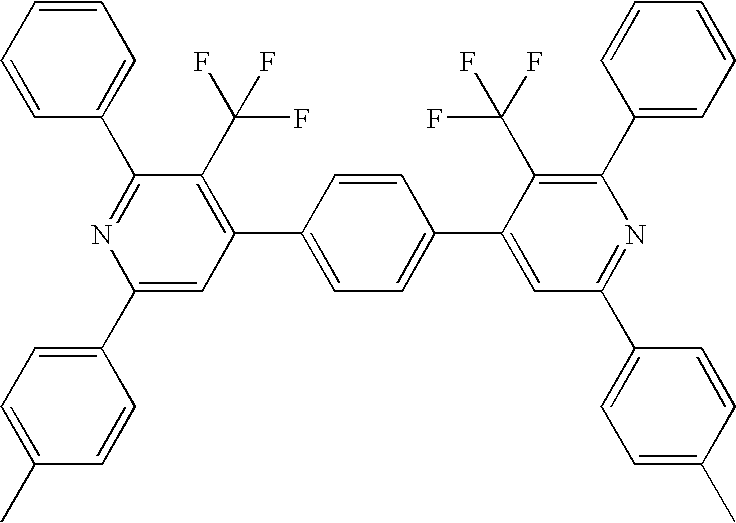
- 2-bromo-3,3,3-trifluoro-1-phenylpropan-1-one and pyridine (1:1 in molar ratio)were stirred at 25° C. for 15 hours in dichloromethane (20 times (weight) of the total amount of 2-bromo-3,3,3-trifluoro-1-phenylpropan-1-one and pyridine), then filtrated, and the resulted solids were washed with water, thereby pyridinium bromide was obtained.
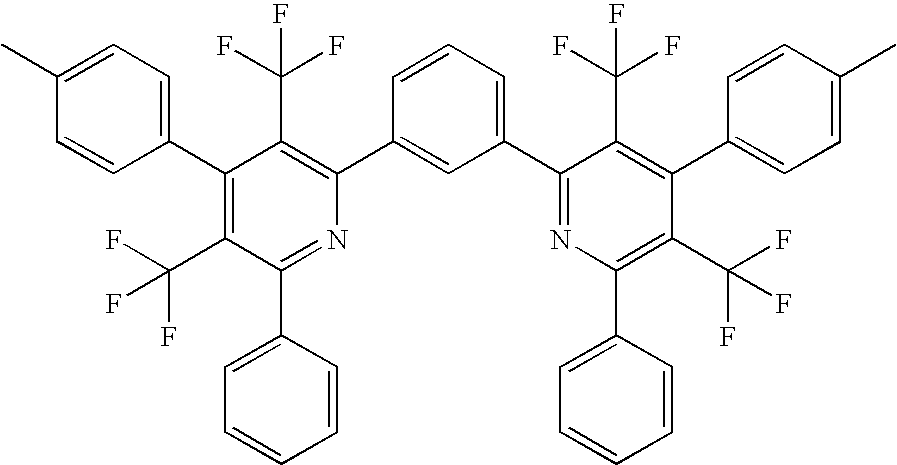
- ITO/NPB (30 nm)/6 wt % FIrpic: CBP (30 nm)/BFPTPB (30 nm)/LiF(0.5)/Al(100 nm)
- the pyridinium bromide, 1,2-diacetylbenzene and benzaldehyde (2:1:2 in molar ratio) were added into a three-necked flask. And then tetrahydrofuran (20 times (weight) of the total amount of the resulted pyridinium bromide, 1,2-diacetylbenzene and benzaldehyde) and catalysis amount ammonium formate (10 molar % of the resulted pyridinium bromide) were added therein. The mixtures were refluxed for 27 hours, then crude product was obtained. Finally the multi-aryl substituted pyridine derivative was obtained via silicon gel chromatography column with CH 2 Cl 2 /Petroleum ether(3:1 v/v) as the eluent. The yield was about 60%.
- the resulted pyridinium bromide, terephthalaldehyde and p-methylacetophenone (2:1:2 in molar ratio) were added into a three-necked flask. And then acetic acid (20 times (weight) of the total amount of the resulted pyridinium bromide, terephthalaldehyde and p-methylacetophenone) and catalysis amount ammonium acetate (10 molar % of the resulted pyridinium bromide) were added therein. The mixtures were refluxed for 24 hours, then crude product was obtained. Finally the multi-aryl substituted pyridine derivative was obtained via silicon gel chromatography column with CH 2 Cl 2 /Petroleum ether(3:1 v/v) as the eluent. The yield was about 50%.
- the resulted pyridinium bromide, terephthalaldehyde and 4-acetylbiphenyl (2:1:2 in molar ratio) were added into a three-necked flask. And then dioxane (20 times (weight) of the total amount of the resulted pyridinium bromide, terephthalaldehyde and 4-acetylbiphenyl) and catalysis amount ammonium formate (10 molar % of the resulted pyridinium bromide) were added therein. The mixtures were refluxed for 22 hours, then crude product was obtained. Finally the multi-aryl substituted pyridine derivative was obtained via silicon gel chromatography column with CH 2 Cl 2 /Petroleum ether(3:1) as the eluent. The yield was about 55%.
- ITO/NPB(75 nm)/ADN TBP(30 nm)/BBPTPB(35 nm)/BPhen(30 nm)/LiF(0.5 nm)/MgAg(100 nm)
- Ethyl 2-bromo-3-oxo-3-phenylpropanoate and pyridine (1:1 in molar ratio) were stirred at 25° C. for 13 hours in methanol (20 times (weight) of the total amount of Ethyl 2-bromo-3-oxo-3-phenylpropanoate and pyridine), then filtrated, and the resulted solids were washed with water, thereby pyridinium bromide was obtained.
- the resulted pyridinium bromide, terephthalaldehyde and 4-acetylbiphenyl (2:1:2 in molar ratio) were added into a three-necked flask. And then acetic acid (20 times (weight) of the total amount of the resulted pyridinium bromide, terephthalaldehyde and 4-acetylbiphenyl) and catalysis amount ammonium acetate (10 molar % of the resulted pyridinium bromide) were added therein. The mixtures were refluxed for 25 hours, then crude product was obtained. Finally the multi-aryl substituted pyridine derivative was obtained via silicon gel chromatography column with CH 2 Cl 2 /Petroleum ether(3:1) as the eluent. The yield was about 55%.
- the resulted pyridinium bromide, m-phthalaldehyde and p-methoxyacetophenone (2:1:2 in molar ratio) were added into a three-necked flask. And then dioxane (20 times (weight) of the total amount of the resulted pyridinium bromide, m-phthalaldehyde and p-methoxyacetophenone) and catalysis amount ammonium acetate (10 molar % of the resulted pyridinium bromide) were added therein. The mixtures were refluxed for 22 hours, then crude product was obtained. Finally the multi-aryl substituted pyridine derivative was obtained via recrystallization with o-dichlorobenzene. The yield was about 55%.
- the resulted pyridinium bromide, m-phthalaldehyde and p-methoxyacetophenone (3:1:1 in molar ratio) were added into a three-necked flask. And then acetic acid (20 times (weight) of the total amount of the resulted pyridinium bromide, m-phthalaldehyde and p-methoxyacetophenone) and catalysis amount ammonium acetate (10 molar % of the resulted pyridinium bromide) were added therein. The mixtures were refluxed for 20 hours, then crude product was obtained. Finally the multi-aryl substituted pyridine derivative was obtained via recrystallization with o-dichlorobenzene. The yield was about 60%.
- ITO/NPB (30 nm)/6 wt % FIrpic:CBP (30 nm)/BFTPB II (30 nm)/LiF(0.5)/Al(100 nm)
Landscapes
- Chemical & Material Sciences (AREA)
- Organic Chemistry (AREA)
- Physics & Mathematics (AREA)
- Spectroscopy & Molecular Physics (AREA)
- Engineering & Computer Science (AREA)
- Materials Engineering (AREA)
- Electroluminescent Light Sources (AREA)
- Plural Heterocyclic Compounds (AREA)
Abstract
Description


wherein:


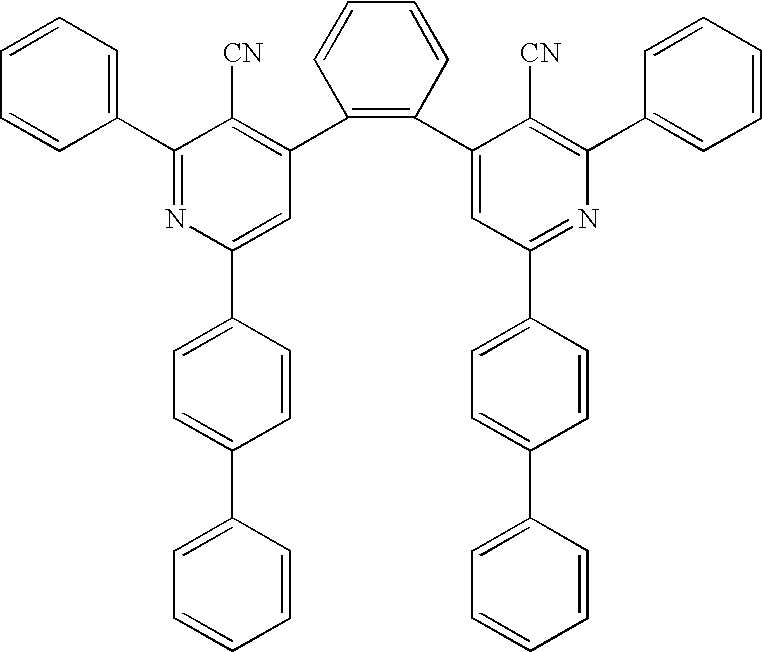
- 3,3′-(1,4-phenylene)bis(3-oxopropanenitrile) and p-butylbenzaldehyde (2:1:2 in molar ratio) were added into a three-necked flask. And then acetic acid (20 times (weight) of the total amount of the resulted pyridinium bromide, 3,3′-(1,4-phenylene)bis(3-oxopropanenitrile) and p-butylbenzaldehyde) and catalysis amount ammonium acetate (10 molar % of the resulted pyridinium bromide) (10 molar % of the resulted pyridinium bromide) were added therein. The mixtures were refluxed for 26 hours, then crude product was obtained. Finally the multi-aryl substituted pyridine derivative was obtained via recrystallization with o-dichlorobenzene. The yield was about 50%.

OLED device using compound PBBPD I as HBL








Claims (8)


Applications Claiming Priority (6)
| Application Number | Priority Date | Filing Date | Title |
|---|---|---|---|
| CN200710176008.3 | 2007-10-17 | ||
| CN200710176009.8A CN101414662B (en) | 2007-10-17 | 2007-10-17 | Organic electron transport and/or hole blocking material and its synthesis method and use |
| CN200710176009.8 | 2007-10-17 | ||
| CN200710176008 | 2007-10-17 | ||
| CN200710176008.3A CN101414661B (en) | 2007-10-17 | 2007-10-17 | Organic electron transport and/or hole blocking material and its synthesis method and use |
| CN200710176009 | 2007-10-17 |
Publications (2)
| Publication Number | Publication Date |
|---|---|
| US20090102356A1 US20090102356A1 (en) | 2009-04-23 |
| US8101290B2 true US8101290B2 (en) | 2012-01-24 |
Family
ID=40562795
Family Applications (1)
| Application Number | Title | Priority Date | Filing Date |
|---|---|---|---|
| US12/252,153 Expired - Fee Related US8101290B2 (en) | 2007-10-17 | 2008-10-15 | Organic compound having electron-transporting and/or hole-blocking performance and its use and OLEDs comprising the compound |
Country Status (1)
| Country | Link |
|---|---|
| US (1) | US8101290B2 (en) |
Cited By (1)
| Publication number | Priority date | Publication date | Assignee | Title |
|---|---|---|---|---|
| US11972733B2 (en) | 2020-12-15 | 2024-04-30 | Yungu (Gu'an) Technology Co., Ltd. | Light-emitting device and display panel |
Families Citing this family (9)
| Publication number | Priority date | Publication date | Assignee | Title |
|---|---|---|---|---|
| CN101684093A (en) * | 2008-09-26 | 2010-03-31 | 通用电气公司 | Electronic transmission material |
| US8691399B2 (en) * | 2009-01-08 | 2014-04-08 | General Electric Company | Electron-transporting materials and processes for making the same |
| US9324950B2 (en) | 2010-11-22 | 2016-04-26 | Idemitsu Kosan Co., Ltd. | Organic electroluminescence device |
| US8883323B2 (en) | 2010-11-22 | 2014-11-11 | Idemitsu Kosan Co., Ltd. | Organic electroluminescence device |
| CN103261171B (en) | 2010-12-13 | 2016-03-30 | 巴斯夫欧洲公司 | Bipyrimidines for Electronic Applications |
| US8362246B2 (en) | 2010-12-13 | 2013-01-29 | Basf Se | Bispyrimidines for electronic applications |
| JP6428762B2 (en) * | 2014-03-17 | 2018-11-28 | Jnc株式会社 | Electron transport material and organic electroluminescent device using the same |
| EP3316328A4 (en) * | 2015-06-23 | 2019-02-27 | Kaneka Corporation | ORGANIC ELECTROLUMINESCENT MATERIAL AND ORGANIC ELECTROLUMINESCENT ELEMENT USING THE SAME |
| KR20240102124A (en) * | 2022-12-23 | 2024-07-03 | 솔루스첨단소재 주식회사 | Organic light-emitting compound and organic electroluminescent device using the same |
Citations (8)
| Publication number | Priority date | Publication date | Assignee | Title |
|---|---|---|---|---|
| CA443861A (en) | 1947-08-26 | S. Hutchinson Willis | Generation of chlorine dioxide | |
| US3173050A (en) | 1962-09-19 | 1965-03-09 | Dow Chemical Co | Electroluminescent cell |
| US3172862A (en) | 1960-09-29 | 1965-03-09 | Dow Chemical Co | Organic electroluminescent phosphors |
| US3710167A (en) | 1970-07-02 | 1973-01-09 | Rca Corp | Organic electroluminescent cells having a tunnel injection cathode |
| US5247190A (en) | 1989-04-20 | 1993-09-21 | Cambridge Research And Innovation Limited | Electroluminescent devices |
| US5408109A (en) | 1991-02-27 | 1995-04-18 | The Regents Of The University Of California | Visible light emitting diodes fabricated from soluble semiconducting polymers |
| US5552678A (en) | 1994-09-23 | 1996-09-03 | Eastman Kodak Company | AC drive scheme for organic led |
| JP2005276801A (en) | 2003-10-06 | 2005-10-06 | Mitsubishi Chemicals Corp | Compound, electron transport material and organic electroluminescence device |
-
2008
- 2008-10-15 US US12/252,153 patent/US8101290B2/en not_active Expired - Fee Related
Patent Citations (8)
| Publication number | Priority date | Publication date | Assignee | Title |
|---|---|---|---|---|
| CA443861A (en) | 1947-08-26 | S. Hutchinson Willis | Generation of chlorine dioxide | |
| US3172862A (en) | 1960-09-29 | 1965-03-09 | Dow Chemical Co | Organic electroluminescent phosphors |
| US3173050A (en) | 1962-09-19 | 1965-03-09 | Dow Chemical Co | Electroluminescent cell |
| US3710167A (en) | 1970-07-02 | 1973-01-09 | Rca Corp | Organic electroluminescent cells having a tunnel injection cathode |
| US5247190A (en) | 1989-04-20 | 1993-09-21 | Cambridge Research And Innovation Limited | Electroluminescent devices |
| US5408109A (en) | 1991-02-27 | 1995-04-18 | The Regents Of The University Of California | Visible light emitting diodes fabricated from soluble semiconducting polymers |
| US5552678A (en) | 1994-09-23 | 1996-09-03 | Eastman Kodak Company | AC drive scheme for organic led |
| JP2005276801A (en) | 2003-10-06 | 2005-10-06 | Mitsubishi Chemicals Corp | Compound, electron transport material and organic electroluminescence device |
Non-Patent Citations (6)
| Title |
|---|
| Baldo et al. "Very High-Efficiency Green Organic Light-Emitting Devices Based on Electrophosphorescence" Applied Physics Letters, vol. 75, No. 1, Jul. 5, 1999, 4-6. |
| Djurovich et al. "IR(III) Cyclometalated Complexes as Efficient Phosphorescent Emitters in Polymer Blend and Organic LEDs" Polymer Preprints 2000, 41(1), 770-771. |
| Dresner, J. "Double Injection Electroluminescence in Anthracene" RCA Review, Jun. 1969, 322-334. |
| Ghozlan et al., Tetrahedron, vol. 58, (2002), pp. 9423-9429. * |
| Krohnke, Fritz "The Specific Synthesis of Pyridines and Oligopyridines" Synthesis, Jan. 1976, 1-24. |
| Kurfurst, Antonin et al. "Oligophenylene 2,4,6-Triarylpyridines and Analogous Diaza-p-Terphenyls, Diaza-p-Quaterphenyls and Diaza-p-Quinquephenyls with Luminiscent Activity" Collect. Czech. Chem. Commun. (vol. 54) 1989 (pp. 462-472). |
Cited By (1)
| Publication number | Priority date | Publication date | Assignee | Title |
|---|---|---|---|---|
| US11972733B2 (en) | 2020-12-15 | 2024-04-30 | Yungu (Gu'an) Technology Co., Ltd. | Light-emitting device and display panel |
Also Published As
| Publication number | Publication date |
|---|---|
| US20090102356A1 (en) | 2009-04-23 |
Similar Documents
| Publication | Publication Date | Title |
|---|---|---|
| US9112171B2 (en) | Organic light emitting device and materials for use in same | |
| US20090102356A1 (en) | NOVEL ORGANIC COMPOUND HAVING ELECTRON-TRANSPORTING AND/OR HOLE-BLOCKING PERFORMANCE AND ITS USE AND OLEDs COMPRISING THE COMPOUND | |
| US8779655B2 (en) | Organic electroluminescence device and material for organic electroluminescence device | |
| EP2713415B1 (en) | Material for organic electroluminescent element, and organic electroluminescent element | |
| US8154195B2 (en) | Organic electroluminescence device and material for organic electroluminescence device | |
| US8471008B2 (en) | Material for organic electroluminescent element and organic electroluminescent element employing the same | |
| US8211552B2 (en) | Organic electroluminescence device | |
| US9893293B2 (en) | Organic electroluminescent device | |
| US7829204B2 (en) | Material for organic electroluminescent device and organic electroluminescent device using same | |
| US20090045731A1 (en) | Organic electroluminescence device and material for organic electroluminescence device | |
| EP2166587A1 (en) | Organic electroluminescent device and material for organic electroluminescent device | |
| US20080233410A1 (en) | Transition metal complex compound | |
| US8945724B2 (en) | Nitrogen-containing heterocyclic derivative and organic electroluminescent device using the same | |
| US9126887B2 (en) | Organic electroluminescent element material and organic electroluminescent element comprising same | |
| TW200903877A (en) | Material for organic electroluminescence device and organic electroluminescence device utilizing the same | |
| US20070141397A1 (en) | Transition metal complex compound and organic electroluminescence device using the compound | |
| TW200808937A (en) | Material for organic electroluminescence device and organic electroluminescence device using the same | |
| US20020022151A1 (en) | Organic electroluminescent device | |
| KR100365889B1 (en) | An organic electroluminescence device | |
| EP2372804B1 (en) | Organic electroluminescence element and compound | |
| US20100258767A1 (en) | Composite organic electroluminescent material and production method thereof | |
| EP1880990A1 (en) | Novel organic electroluminescent material, organic electroluminescent element employing the same, and thin-film-forming solution for organic electroluminescence | |
| US6821644B2 (en) | Organic electroluminescent device | |
| JP2006213686A (en) | Metal complex compound and organic electroluminescence device using the same |
Legal Events
| Date | Code | Title | Description |
|---|---|---|---|
| AS | Assignment |
Owner name: TECHNICAL INSTITUTE OF PHYSICS AND CHEMISTRY OF CH Free format text: ASSIGNMENT OF ASSIGNORS INTEREST;ASSIGNORS:WANG, PENGFEI;LI, NA;LIU, WEIMIN;AND OTHERS;REEL/FRAME:022022/0677;SIGNING DATES FROM 20081110 TO 20081120 Owner name: TECHNICAL INSTITUTE OF PHYSICS AND CHEMISTRY OF CH Free format text: ASSIGNMENT OF ASSIGNORS INTEREST;ASSIGNORS:WANG, PENGFEI;LI, NA;LIU, WEIMIN;AND OTHERS;SIGNING DATES FROM 20081110 TO 20081120;REEL/FRAME:022022/0677 |
|
| ZAAA | Notice of allowance and fees due |
Free format text: ORIGINAL CODE: NOA |
|
| ZAAB | Notice of allowance mailed |
Free format text: ORIGINAL CODE: MN/=. |
|
| STCF | Information on status: patent grant |
Free format text: PATENTED CASE |
|
| FPAY | Fee payment |
Year of fee payment: 4 |
|
| MAFP | Maintenance fee payment |
Free format text: PAYMENT OF MAINTENANCE FEE, 8TH YR, SMALL ENTITY (ORIGINAL EVENT CODE: M2552); ENTITY STATUS OF PATENT OWNER: SMALL ENTITY Year of fee payment: 8 |
|
| FEPP | Fee payment procedure |
Free format text: MAINTENANCE FEE REMINDER MAILED (ORIGINAL EVENT CODE: REM.); ENTITY STATUS OF PATENT OWNER: SMALL ENTITY |
|
| LAPS | Lapse for failure to pay maintenance fees |
Free format text: PATENT EXPIRED FOR FAILURE TO PAY MAINTENANCE FEES (ORIGINAL EVENT CODE: EXP.); ENTITY STATUS OF PATENT OWNER: SMALL ENTITY |
|
| STCH | Information on status: patent discontinuation |
Free format text: PATENT EXPIRED DUE TO NONPAYMENT OF MAINTENANCE FEES UNDER 37 CFR 1.362 |
|
| FP | Lapsed due to failure to pay maintenance fee |
Effective date: 20240124 |