US8093249B2 - Pyrazolo[1,5-A]pyrimidine-carbonyl-piperazine derivatives - Google Patents
Pyrazolo[1,5-A]pyrimidine-carbonyl-piperazine derivatives Download PDFInfo
- Publication number
- US8093249B2 US8093249B2 US12/503,135 US50313509A US8093249B2 US 8093249 B2 US8093249 B2 US 8093249B2 US 50313509 A US50313509 A US 50313509A US 8093249 B2 US8093249 B2 US 8093249B2
- Authority
- US
- United States
- Prior art keywords
- compound
- mmol
- methyl
- trifluoromethyl
- sulfonyl
- Prior art date
- Legal status (The legal status is an assumption and is not a legal conclusion. Google has not performed a legal analysis and makes no representation as to the accuracy of the status listed.)
- Expired - Fee Related, expires
Links
- 0 CC.CC.[3*]C1=C([6*])C=C(S(=O)(=O)N2CCN(C(=O)C3=C4N=CC=CN4N=C3[7*])CC2)C([4*])=C1[5*] Chemical compound CC.CC.[3*]C1=C([6*])C=C(S(=O)(=O)N2CCN(C(=O)C3=C4N=CC=CN4N=C3[7*])CC2)C([4*])=C1[5*] 0.000 description 14
- ZSRGUTYTYFMITH-JTQLQIEISA-N CC1=C(S(=O)(=O)N2CCN[C@@H](C)C2)C=CC(C(F)(F)F)=C1 Chemical compound CC1=C(S(=O)(=O)N2CCN[C@@H](C)C2)C=CC(C(F)(F)F)=C1 ZSRGUTYTYFMITH-JTQLQIEISA-N 0.000 description 2
- GVLVUGVELCMWJR-ZDUSSCGKSA-N C[C@H]1CN(S(=O)(=O)C2=CC=C(C(F)(F)F)C=C2)CCN1C(=O)C1=C2N=CC=CN2N=C1 Chemical compound C[C@H]1CN(S(=O)(=O)C2=CC=C(C(F)(F)F)C=C2)CCN1C(=O)C1=C2N=CC=CN2N=C1 GVLVUGVELCMWJR-ZDUSSCGKSA-N 0.000 description 2
- JGBWIWNUXZAGAQ-UHFFFAOYSA-M C.CCOC(=O)C1=C2N=CC(F)=CN2N=C1.CI.O=C([O-])C1=C2N=CC(F)=CN2N=C1.[Li+] Chemical compound C.CCOC(=O)C1=C2N=CC(F)=CN2N=C1.CI.O=C([O-])C1=C2N=CC(F)=CN2N=C1.[Li+] JGBWIWNUXZAGAQ-UHFFFAOYSA-M 0.000 description 1
- SGLIEJAUHFYNMT-UHFFFAOYSA-I CC.CC.CC.CC.CC.CC.CC(=O)C1=C2/N=C\C=C/N2N=C1.CN1CCN(C(=O)C2=C3/N=C\C=C/N3N=C2)CC1.CN1CCNCC1.I[IH]I.I[V](I)I.O=C(C1=C2/N=C\C=C/N2N=C1)N1CCNCC1.[V]I.[V]I Chemical compound CC.CC.CC.CC.CC.CC.CC(=O)C1=C2/N=C\C=C/N2N=C1.CN1CCN(C(=O)C2=C3/N=C\C=C/N3N=C2)CC1.CN1CCNCC1.I[IH]I.I[V](I)I.O=C(C1=C2/N=C\C=C/N2N=C1)N1CCNCC1.[V]I.[V]I SGLIEJAUHFYNMT-UHFFFAOYSA-I 0.000 description 1
- MLOAKBGQNQOFQS-AWEZNQCLSA-N CC1=C(S(=O)(=O)N2CCN(C(=O)C3=C4N=CC(F)=CN4N=C3)[C@@H](C)C2)C=CC(C#N)=C1 Chemical compound CC1=C(S(=O)(=O)N2CCN(C(=O)C3=C4N=CC(F)=CN4N=C3)[C@@H](C)C2)C=CC(C#N)=C1 MLOAKBGQNQOFQS-AWEZNQCLSA-N 0.000 description 1
- FCWOSAAPUAHAEY-UHFFFAOYSA-N CC1=C(S(=O)(=O)N2CCN(C(=O)C3=C4N=CC=CN4N=C3)CC2)C=C(C(F)(F)F)C=C1 Chemical compound CC1=C(S(=O)(=O)N2CCN(C(=O)C3=C4N=CC=CN4N=C3)CC2)C=C(C(F)(F)F)C=C1 FCWOSAAPUAHAEY-UHFFFAOYSA-N 0.000 description 1
- LHNFDNSYRFRMTC-AWEZNQCLSA-N CC1=C(S(=O)(=O)N2CCN(C(=O)C3=C4N=CC=CN4N=C3)[C@@H](C)C2)C=C(C(F)(F)F)C=C1 Chemical compound CC1=C(S(=O)(=O)N2CCN(C(=O)C3=C4N=CC=CN4N=C3)[C@@H](C)C2)C=C(C(F)(F)F)C=C1 LHNFDNSYRFRMTC-AWEZNQCLSA-N 0.000 description 1
- DAZNRHSJDHMQFO-HNNXBMFYSA-N CC1=C(S(=O)(=O)N2CCN(C(=O)C3=C4N=CC=CN4N=C3)[C@@H](C)C2)C=CC(C#N)=C1 Chemical compound CC1=C(S(=O)(=O)N2CCN(C(=O)C3=C4N=CC=CN4N=C3)[C@@H](C)C2)C=CC(C#N)=C1 DAZNRHSJDHMQFO-HNNXBMFYSA-N 0.000 description 1
- HWQURQBNERNECG-AWEZNQCLSA-N CC1=C(S(=O)(=O)N2CCN(C(=O)C3=C4N=CC=CN4N=C3)[C@@H](C)C2)C=CC(C(F)(F)F)=C1 Chemical compound CC1=C(S(=O)(=O)N2CCN(C(=O)C3=C4N=CC=CN4N=C3)[C@@H](C)C2)C=CC(C(F)(F)F)=C1 HWQURQBNERNECG-AWEZNQCLSA-N 0.000 description 1
- HVOYVOMTCINKDU-ZDUSSCGKSA-N CC1=C(S(=O)(=O)N2CCN(C(=O)OC(C)(C)C)[C@@H](C)C2)C=CC(Br)=C1 Chemical compound CC1=C(S(=O)(=O)N2CCN(C(=O)OC(C)(C)C)[C@@H](C)C2)C=CC(Br)=C1 HVOYVOMTCINKDU-ZDUSSCGKSA-N 0.000 description 1
- YMZJXOJANOOFKR-AWEZNQCLSA-N CC1=C(S(=O)(=O)N2CCN(C(=O)OC(C)(C)C)[C@@H](C)C2)C=CC(C#N)=C1 Chemical compound CC1=C(S(=O)(=O)N2CCN(C(=O)OC(C)(C)C)[C@@H](C)C2)C=CC(C#N)=C1 YMZJXOJANOOFKR-AWEZNQCLSA-N 0.000 description 1
- HGUPEJQGYFZLBS-NSHDSACASA-N CC1=C(S(=O)(=O)N2CCN[C@@H](C)C2)C=CC(C#N)=C1 Chemical compound CC1=C(S(=O)(=O)N2CCN[C@@H](C)C2)C=CC(C#N)=C1 HGUPEJQGYFZLBS-NSHDSACASA-N 0.000 description 1
- YBYUXFZJZWRDGL-UHFFFAOYSA-N CC1=CC(C)=N/C2=C(C(=O)N3CCN(S(=O)(=O)C4=CC=C(C(F)(F)F)C=C4)CC3)/C=N\N12 Chemical compound CC1=CC(C)=N/C2=C(C(=O)N3CCN(S(=O)(=O)C4=CC=C(C(F)(F)F)C=C4)CC3)/C=N\N12 YBYUXFZJZWRDGL-UHFFFAOYSA-N 0.000 description 1
- TVUIQLHBFYRWBC-UHFFFAOYSA-N CC1=CC=C(Br)C(S(=O)(=O)N2CCN(C(=O)OC(C)(C)C)CC2)=C1 Chemical compound CC1=CC=C(Br)C(S(=O)(=O)N2CCN(C(=O)OC(C)(C)C)CC2)=C1 TVUIQLHBFYRWBC-UHFFFAOYSA-N 0.000 description 1
- OAROUIZOQJZXIK-ZDUSSCGKSA-N CC1=CC=C(Br)C(S(=O)(=O)N2CCN(C(=O)OC(C)(C)C)[C@@H](C)C2)=C1 Chemical compound CC1=CC=C(Br)C(S(=O)(=O)N2CCN(C(=O)OC(C)(C)C)[C@@H](C)C2)=C1 OAROUIZOQJZXIK-ZDUSSCGKSA-N 0.000 description 1
- LWZUTCMNVZXFLK-UHFFFAOYSA-N CC1=CC=C(C)C(S(=O)(=O)N2CCN(C(=O)OC(C)(C)C)CC2)=C1 Chemical compound CC1=CC=C(C)C(S(=O)(=O)N2CCN(C(=O)OC(C)(C)C)CC2)=C1 LWZUTCMNVZXFLK-UHFFFAOYSA-N 0.000 description 1
- ATNHWTNUNLTDRC-HNNXBMFYSA-N CC1=CC=C(C)C(S(=O)(=O)N2CCN(C(=O)OC(C)(C)C)[C@@H](C)C2)=C1 Chemical compound CC1=CC=C(C)C(S(=O)(=O)N2CCN(C(=O)OC(C)(C)C)[C@@H](C)C2)=C1 ATNHWTNUNLTDRC-HNNXBMFYSA-N 0.000 description 1
- UNCDXZPJNCWORR-UHFFFAOYSA-N CC1=CC=C(C)C(S(=O)(=O)N2CCNCC2)=C1 Chemical compound CC1=CC=C(C)C(S(=O)(=O)N2CCNCC2)=C1 UNCDXZPJNCWORR-UHFFFAOYSA-N 0.000 description 1
- YNQIRGFGROETRO-LBPRGKRZSA-N CC1=CC=C(C)C(S(=O)(=O)N2CCN[C@@H](C)C2)=C1 Chemical compound CC1=CC=C(C)C(S(=O)(=O)N2CCN[C@@H](C)C2)=C1 YNQIRGFGROETRO-LBPRGKRZSA-N 0.000 description 1
- MGQCKAYLNUXQCY-AWEZNQCLSA-N CC1=CC=C(S(=O)(=O)N2CCN(C(=O)C3=C4N=CC(F)=CN4N=C3)[C@@H](C)C2)C=C1 Chemical compound CC1=CC=C(S(=O)(=O)N2CCN(C(=O)C3=C4N=CC(F)=CN4N=C3)[C@@H](C)C2)C=C1 MGQCKAYLNUXQCY-AWEZNQCLSA-N 0.000 description 1
- RZEMRPZGSINFHY-AWEZNQCLSA-N CC1=CC=C(S(=O)(=O)N2CCN(C(=O)C3=C4\N=CC(Br)=CN4/N=C\3)[C@@H](C)C2)C=C1 Chemical compound CC1=CC=C(S(=O)(=O)N2CCN(C(=O)C3=C4\N=CC(Br)=CN4/N=C\3)[C@@H](C)C2)C=C1 RZEMRPZGSINFHY-AWEZNQCLSA-N 0.000 description 1
- SBLHPYUBYNZWIL-HNNXBMFYSA-N CC1=CC=C(S(=O)(=O)N2CCN(C(=O)C3=C4\N=CC(C#N)=CN4/N=C\3)[C@@H](C)C2)C=C1 Chemical compound CC1=CC=C(S(=O)(=O)N2CCN(C(=O)C3=C4\N=CC(C#N)=CN4/N=C\3)[C@@H](C)C2)C=C1 SBLHPYUBYNZWIL-HNNXBMFYSA-N 0.000 description 1
- RNCOIXZSORFTAZ-INIZCTEOSA-N CC1=CN2N=CC(C(=O)N3CCN(S(=O)(=O)C4=C(C)C=C(C#N)C=C4)C[C@@H]3C)=C2N=C1 Chemical compound CC1=CN2N=CC(C(=O)N3CCN(S(=O)(=O)C4=C(C)C=C(C#N)C=C4)C[C@@H]3C)=C2N=C1 RNCOIXZSORFTAZ-INIZCTEOSA-N 0.000 description 1
- ZUROTYWXHMNTOL-UHFFFAOYSA-N CC1=CN2N=CC(C(=O)N3CCN(S(=O)(=O)C4=CC=C(C(F)(F)F)C=C4)CC3)=C2N=C1 Chemical compound CC1=CN2N=CC(C(=O)N3CCN(S(=O)(=O)C4=CC=C(C(F)(F)F)C=C4)CC3)=C2N=C1 ZUROTYWXHMNTOL-UHFFFAOYSA-N 0.000 description 1
- DSEIDMACNRZPJW-HNNXBMFYSA-N CC1=NN2C=CC=NC2=C1C(=O)N1CCN(S(=O)(=O)C2=C(C)C=C(C#N)C=C2)C[C@@H]1C Chemical compound CC1=NN2C=CC=NC2=C1C(=O)N1CCN(S(=O)(=O)C2=C(C)C=C(C#N)C=C2)C[C@@H]1C DSEIDMACNRZPJW-HNNXBMFYSA-N 0.000 description 1
- XGKOAKPPELPPSH-ZDUSSCGKSA-N CC1=NN2C=CC=NC2=C1C(=O)N1CCN(S(=O)(=O)C2=CC=C(C(F)(F)F)C=C2)C[C@@H]1C Chemical compound CC1=NN2C=CC=NC2=C1C(=O)N1CCN(S(=O)(=O)C2=CC=C(C(F)(F)F)C=C2)C[C@@H]1C XGKOAKPPELPPSH-ZDUSSCGKSA-N 0.000 description 1
- MIWAQWDSRLXHSR-UHFFFAOYSA-N CCOC(=O)C1=C2N=CC(F)=CN2N=C1 Chemical compound CCOC(=O)C1=C2N=CC(F)=CN2N=C1 MIWAQWDSRLXHSR-UHFFFAOYSA-N 0.000 description 1
- JQPFZNDWGWFXLE-JTQLQIEISA-N COC1=CC=C(S(=O)(=O)N2CCNC[C@@H]2C)C=C1.Cl Chemical compound COC1=CC=C(S(=O)(=O)N2CCNC[C@@H]2C)C=C1.Cl JQPFZNDWGWFXLE-JTQLQIEISA-N 0.000 description 1
- UONGQHAPBXCEJX-CYBMUJFWSA-N C[C@@H]1CN(C(=O)C2=C3N=CC=CN3N=C2)CCN1S(=O)(=O)C1=CC=C(C(F)(F)F)C=C1 Chemical compound C[C@@H]1CN(C(=O)C2=C3N=CC=CN3N=C2)CCN1S(=O)(=O)C1=CC=C(C(F)(F)F)C=C1 UONGQHAPBXCEJX-CYBMUJFWSA-N 0.000 description 1
- YUVDKIBFPIDVPG-CYBMUJFWSA-N C[C@@H]1CN(C(=O)C2=C3N=CC=CN3N=C2)CCN1S(=O)(=O)C1=CC=C(OC(F)(F)F)C=C1 Chemical compound C[C@@H]1CN(C(=O)C2=C3N=CC=CN3N=C2)CCN1S(=O)(=O)C1=CC=C(OC(F)(F)F)C=C1 YUVDKIBFPIDVPG-CYBMUJFWSA-N 0.000 description 1
- HYEXCWNJUAODJU-GFCCVEGCSA-N C[C@@H]1CN(C(=O)OC(C)(C)C)CCN1S(=O)(=O)C1=CC=C(C(F)(F)F)C=C1 Chemical compound C[C@@H]1CN(C(=O)OC(C)(C)C)CCN1S(=O)(=O)C1=CC=C(C(F)(F)F)C=C1 HYEXCWNJUAODJU-GFCCVEGCSA-N 0.000 description 1
- YXRANDHKVRJEIY-SECBINFHSA-N C[C@@H]1CN(S(=O)(=O)C2=CC=C(C(F)(F)F)C=C2)CCN1 Chemical compound C[C@@H]1CN(S(=O)(=O)C2=CC=C(C(F)(F)F)C=C2)CCN1 YXRANDHKVRJEIY-SECBINFHSA-N 0.000 description 1
- GVLVUGVELCMWJR-CYBMUJFWSA-N C[C@@H]1CN(S(=O)(=O)C2=CC=C(C(F)(F)F)C=C2)CCN1C(=O)C1=C2N=CC=CN2N=C1 Chemical compound C[C@@H]1CN(S(=O)(=O)C2=CC=C(C(F)(F)F)C=C2)CCN1C(=O)C1=C2N=CC=CN2N=C1 GVLVUGVELCMWJR-CYBMUJFWSA-N 0.000 description 1
- TUGSZZIXMPAASB-SECBINFHSA-N C[C@@H]1CN(S(=O)(=O)C2=CC=C(OC(F)(F)F)C=C2)CCN1 Chemical compound C[C@@H]1CN(S(=O)(=O)C2=CC=C(OC(F)(F)F)C=C2)CCN1 TUGSZZIXMPAASB-SECBINFHSA-N 0.000 description 1
- WWFVFOANNRGVCK-CYBMUJFWSA-N C[C@@H]1CN(S(=O)(=O)C2=CC=C(OC(F)(F)F)C=C2)CCN1C(=O)C1=C2N=CC=CN2N=C1 Chemical compound C[C@@H]1CN(S(=O)(=O)C2=CC=C(OC(F)(F)F)C=C2)CCN1C(=O)C1=C2N=CC=CN2N=C1 WWFVFOANNRGVCK-CYBMUJFWSA-N 0.000 description 1
- JZPYAUVAAIYIMM-SECBINFHSA-N C[C@@H]1CNCCN1S(=O)(=O)C1=CC=C(C(F)(F)F)C=C1.Cl Chemical compound C[C@@H]1CNCCN1S(=O)(=O)C1=CC=C(C(F)(F)F)C=C1.Cl JZPYAUVAAIYIMM-SECBINFHSA-N 0.000 description 1
- OVRZKYWZUBHJIJ-SECBINFHSA-N C[C@@H]1CNCCN1S(=O)(=O)C1=CC=C(OC(F)(F)F)C=C1.Cl Chemical compound C[C@@H]1CNCCN1S(=O)(=O)C1=CC=C(OC(F)(F)F)C=C1.Cl OVRZKYWZUBHJIJ-SECBINFHSA-N 0.000 description 1
- UONGQHAPBXCEJX-ZDUSSCGKSA-N C[C@H]1CN(C(=O)C2=C3N=CC=CN3N=C2)CCN1S(=O)(=O)C1=CC=C(C(F)(F)F)C=C1 Chemical compound C[C@H]1CN(C(=O)C2=C3N=CC=CN3N=C2)CCN1S(=O)(=O)C1=CC=C(C(F)(F)F)C=C1 UONGQHAPBXCEJX-ZDUSSCGKSA-N 0.000 description 1
- YUVDKIBFPIDVPG-ZDUSSCGKSA-N C[C@H]1CN(C(=O)C2=C3\N=CC=CN3/N=C\2)CCN1S(=O)(=O)C1=CC=C(OC(F)(F)F)C=C1 Chemical compound C[C@H]1CN(C(=O)C2=C3\N=CC=CN3/N=C\2)CCN1S(=O)(=O)C1=CC=C(OC(F)(F)F)C=C1 YUVDKIBFPIDVPG-ZDUSSCGKSA-N 0.000 description 1
- HYEXCWNJUAODJU-LBPRGKRZSA-N C[C@H]1CN(C(=O)OC(C)(C)C)CCN1S(=O)(=O)C1=CC=C(C(F)(F)F)C=C1 Chemical compound C[C@H]1CN(C(=O)OC(C)(C)C)CCN1S(=O)(=O)C1=CC=C(C(F)(F)F)C=C1 HYEXCWNJUAODJU-LBPRGKRZSA-N 0.000 description 1
- OQMMDFGDVUDJIV-NSHDSACASA-N C[C@H]1CN(S(=O)(=O)C2=C(Br)C=C(C(F)(F)F)C=C2)CCN1C(=O)OC(C)(C)C Chemical compound C[C@H]1CN(S(=O)(=O)C2=C(Br)C=C(C(F)(F)F)C=C2)CCN1C(=O)OC(C)(C)C OQMMDFGDVUDJIV-NSHDSACASA-N 0.000 description 1
- YXRANDHKVRJEIY-VIFPVBQESA-N C[C@H]1CN(S(=O)(=O)C2=CC=C(C(F)(F)F)C=C2)CCN1 Chemical compound C[C@H]1CN(S(=O)(=O)C2=CC=C(C(F)(F)F)C=C2)CCN1 YXRANDHKVRJEIY-VIFPVBQESA-N 0.000 description 1
- ZWWGOKSXMZZZNP-LBPRGKRZSA-N C[C@H]1CN(S(=O)(=O)C2=CC=C(C(F)(F)F)C=C2)CCN1C(=O)C1=C2N=CC(Cl)=CN2N=C1 Chemical compound C[C@H]1CN(S(=O)(=O)C2=CC=C(C(F)(F)F)C=C2)CCN1C(=O)C1=C2N=CC(Cl)=CN2N=C1 ZWWGOKSXMZZZNP-LBPRGKRZSA-N 0.000 description 1
- TUGSZZIXMPAASB-VIFPVBQESA-N C[C@H]1CN(S(=O)(=O)C2=CC=C(OC(F)(F)F)C=C2)CCN1 Chemical compound C[C@H]1CN(S(=O)(=O)C2=CC=C(OC(F)(F)F)C=C2)CCN1 TUGSZZIXMPAASB-VIFPVBQESA-N 0.000 description 1
- WWFVFOANNRGVCK-ZDUSSCGKSA-N C[C@H]1CN(S(=O)(=O)C2=CC=C(OC(F)(F)F)C=C2)CCN1C(=O)C1=C2N=CC=CN2N=C1 Chemical compound C[C@H]1CN(S(=O)(=O)C2=CC=C(OC(F)(F)F)C=C2)CCN1C(=O)C1=C2N=CC=CN2N=C1 WWFVFOANNRGVCK-ZDUSSCGKSA-N 0.000 description 1
- JZPYAUVAAIYIMM-VIFPVBQESA-N C[C@H]1CNCCN1S(=O)(=O)C1=CC=C(C(F)(F)F)C=C1.Cl Chemical compound C[C@H]1CNCCN1S(=O)(=O)C1=CC=C(C(F)(F)F)C=C1.Cl JZPYAUVAAIYIMM-VIFPVBQESA-N 0.000 description 1
- ZIZJYTFTAKMQAI-UHFFFAOYSA-N O=C(C1=C2N=CC=CN2N=C1)N1CCN(S(=O)(=O)C2=CC=C(C(F)(F)F)C=C2)CC1 Chemical compound O=C(C1=C2N=CC=CN2N=C1)N1CCN(S(=O)(=O)C2=CC=C(C(F)(F)F)C=C2)CC1 ZIZJYTFTAKMQAI-UHFFFAOYSA-N 0.000 description 1
- XNDAQUGDQCCELH-UHFFFAOYSA-N O=C(C1=C2N=CC=CN2N=C1)N1CCN(S(=O)(=O)C2=CC=C(OC(F)(F)F)C=C2)CC1 Chemical compound O=C(C1=C2N=CC=CN2N=C1)N1CCN(S(=O)(=O)C2=CC=C(OC(F)(F)F)C=C2)CC1 XNDAQUGDQCCELH-UHFFFAOYSA-N 0.000 description 1
- OKAAFIKHHROVHN-UHFFFAOYSA-N O=C(O)C1=C2N=CC(Br)=CN2N=C1 Chemical compound O=C(O)C1=C2N=CC(Br)=CN2N=C1 OKAAFIKHHROVHN-UHFFFAOYSA-N 0.000 description 1
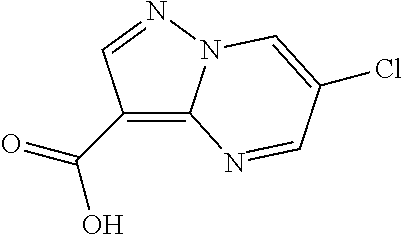
- HMZCJEAFCHYUSU-UHFFFAOYSA-N O=C(O)C1=C2N=CC(Cl)=CN2N=C1 Chemical compound O=C(O)C1=C2N=CC(Cl)=CN2N=C1 HMZCJEAFCHYUSU-UHFFFAOYSA-N 0.000 description 1
- JMJYLAGSNGCHNP-UHFFFAOYSA-M O=C([O-])C1=C2/N=C\C(F)=C/N2N=C1.[Li+] Chemical compound O=C([O-])C1=C2/N=C\C(F)=C/N2N=C1.[Li+] JMJYLAGSNGCHNP-UHFFFAOYSA-M 0.000 description 1
- SQXBFRFABWYXTK-UHFFFAOYSA-N O=S(=O)(C1=CC=C(C(F)(F)F)C=C1)N1CCNCC1 Chemical compound O=S(=O)(C1=CC=C(C(F)(F)F)C=C1)N1CCNCC1 SQXBFRFABWYXTK-UHFFFAOYSA-N 0.000 description 1
- YNZSAWALMDCRMX-UHFFFAOYSA-N O=S(=O)(C1=CC=C(OC(F)(F)F)C=C1)N1CCNCC1 Chemical compound O=S(=O)(C1=CC=C(OC(F)(F)F)C=C1)N1CCNCC1 YNZSAWALMDCRMX-UHFFFAOYSA-N 0.000 description 1
- XPNYRBQOANKKHF-AWEZNQCLSA-N [C-]#[N+]C1=CC(C)=C(S(=O)(=O)N2CCN(C(=O)C3=C4N=CC(Cl)=CN4N=C3)[C@@H](C)C2)C=C1 Chemical compound [C-]#[N+]C1=CC(C)=C(S(=O)(=O)N2CCN(C(=O)C3=C4N=CC(Cl)=CN4N=C3)[C@@H](C)C2)C=C1 XPNYRBQOANKKHF-AWEZNQCLSA-N 0.000 description 1
Classifications
-
- C—CHEMISTRY; METALLURGY
- C07—ORGANIC CHEMISTRY
- C07D—HETEROCYCLIC COMPOUNDS
- C07D487/00—Heterocyclic compounds containing nitrogen atoms as the only ring hetero atoms in the condensed system, not provided for by groups C07D451/00 - C07D477/00
- C07D487/02—Heterocyclic compounds containing nitrogen atoms as the only ring hetero atoms in the condensed system, not provided for by groups C07D451/00 - C07D477/00 in which the condensed system contains two hetero rings
- C07D487/04—Ortho-condensed systems
-
- A—HUMAN NECESSITIES
- A61—MEDICAL OR VETERINARY SCIENCE; HYGIENE
- A61P—SPECIFIC THERAPEUTIC ACTIVITY OF CHEMICAL COMPOUNDS OR MEDICINAL PREPARATIONS
- A61P25/00—Drugs for disorders of the nervous system
-
- A—HUMAN NECESSITIES
- A61—MEDICAL OR VETERINARY SCIENCE; HYGIENE
- A61P—SPECIFIC THERAPEUTIC ACTIVITY OF CHEMICAL COMPOUNDS OR MEDICINAL PREPARATIONS
- A61P25/00—Drugs for disorders of the nervous system
- A61P25/04—Centrally acting analgesics, e.g. opioids
-
- A—HUMAN NECESSITIES
- A61—MEDICAL OR VETERINARY SCIENCE; HYGIENE
- A61P—SPECIFIC THERAPEUTIC ACTIVITY OF CHEMICAL COMPOUNDS OR MEDICINAL PREPARATIONS
- A61P25/00—Drugs for disorders of the nervous system
- A61P25/06—Antimigraine agents
-
- A—HUMAN NECESSITIES
- A61—MEDICAL OR VETERINARY SCIENCE; HYGIENE
- A61P—SPECIFIC THERAPEUTIC ACTIVITY OF CHEMICAL COMPOUNDS OR MEDICINAL PREPARATIONS
- A61P25/00—Drugs for disorders of the nervous system
- A61P25/28—Drugs for disorders of the nervous system for treating neurodegenerative disorders of the central nervous system, e.g. nootropic agents, cognition enhancers, drugs for treating Alzheimer's disease or other forms of dementia
-
- A—HUMAN NECESSITIES
- A61—MEDICAL OR VETERINARY SCIENCE; HYGIENE
- A61P—SPECIFIC THERAPEUTIC ACTIVITY OF CHEMICAL COMPOUNDS OR MEDICINAL PREPARATIONS
- A61P29/00—Non-central analgesic, antipyretic or antiinflammatory agents, e.g. antirheumatic agents; Non-steroidal antiinflammatory drugs [NSAID]
-
- A—HUMAN NECESSITIES
- A61—MEDICAL OR VETERINARY SCIENCE; HYGIENE
- A61P—SPECIFIC THERAPEUTIC ACTIVITY OF CHEMICAL COMPOUNDS OR MEDICINAL PREPARATIONS
- A61P43/00—Drugs for specific purposes, not provided for in groups A61P1/00-A61P41/00
Definitions
- the present invention relates to novel piperazine derivatives; to processes for their preparation; to pharmaceutical compositions containing the derivatives; and to the use of the derivatives in therapy to treat diseases for which blocking the Ca v 2.2 calcium channels is beneficial.
- Pre-synaptic Ca v 2.2 (N-type) voltage-gated calcium channels in the dorsal horn of the spinal cord modulate the release of key pro-nociceptive neurotransmitters such as glutamate, substance P (SP) and calcitonin-gene-related peptide (CGRP), indicating the potential therapeutic use of Ca v 2.2 calcium channel blockers as analgesics.
- pro-nociceptive neurotransmitters such as glutamate, substance P (SP) and calcitonin-gene-related peptide (CGRP)
- Peptidic ⁇ -conotoxins isolated from the venom of cone snails, have been shown to be selective for Ca v 2.2 calcium channels and can block SP release in the spinal cord (Smith et al. (2002) Pain, 96: 119-127). Moreover, they have been shown to be antinociceptive in animal models of chronic pain following intrathecal administration (Bowersox et al. (1996) Journal of Pharmacology and Experimental Therapeutics, 279: 1243-1249; Smith et al. (2002) supra), and have been shown to be effective analgesics in clinical use, particularly in the treatment of neuropathic pain (Brose et al. (1997) Clinical Journal of Pain, 13: 256-259).
- Ca v 2.2 calcium channels have been shown to be important for normal neuronal function (Winquist et al. (2005) Biochemical Pharmacology, 70: 489-499). Therefore, the aim is to identify novel molecules that preferentially block Ca v 2.2 under conditions of increased neuronal excitability, so-called use-dependent blockers, as is the case in chronic pain syndromes.
- WO 2007/111921 (Amgen Inc) describes a series of diazaheterocyclic amide derivatives which are claimed to be useful in the treatment of diabetes, obesity and related conditions and disorders.
- WO 2008/024284 (Merck & Co) describes a series of sulfonylated piperazines as cannabinoid-1 (CB1) receptor modulators which are claimed to be useful in the treatment for example of psychosis, cognitive disorders and Alzheimer's disease.
- the present invention provides compounds which are capable of blocking these Ca v 2.2 calcium channels.
- R 1 is C 1-4 alkyl, halogen or cyano
- n and n are selected from 0, 1 and 2;
- R 2 is C 1-4 alkyl
- R 3 is hydrogen, cyano, C 1-4 haloalkyl, C 1-4 haloalkoxy or halogen;
- R 4 is hydrogen or C 1-4 alkyl
- R 5 is hydrogen, cyano, C 1-4 haloalkyl, C 1-4 haloalkoxy or halogen;
- R 6 is hydrogen, cyano, C 1-4 haloalkyl, C 1-4 haloalkoxy or halogen;
- R 3 , R 4 , R 5 and R 6 is a group other than hydrogen
- R 7 is hydrogen or C 1-4 alkyl; such that when R 7 is C 1-4 alkyl, n is 0.
- R 1 when present, R 1 may be attached to any one of the three possible carbon atoms in the 6 membered ring.
- alkyl refers to a straight or branched hydrocarbon chain containing the specified number of carbon atoms.
- C 1-4 alkyl means a straight or branched hydrocarbon chain containing at least 1 and at most 4 carbon atoms.
- Compounds of alkyl include, but are not limited to; methyl (Me), ethyl (Et), n-propyl, i-propyl, t-butyl, n-butyl and i-butyl.
- alkoxy when used as a group or as part of a group refers to an —O-alkyl group wherein alkyl is as defined hereinbefore.
- halogen is used herein to describe, unless otherwise stated, a group selected from fluoro (fluorine), chloro (chlorine), bromo (bromine) or iodo (iodine).
- C 1-4 haloalkyl refers to a C 1-4 alkyl group as defined herein substituted with one or more halogen groups, e.g. CF 3 , CF 2 H or CF 3 CH 2 .
- C 1-4 haloalkoxy refers to an C 1-4 alkoxy group as defined herein substituted with one or more halogen groups, e.g. —O—CF 3 .
- n is 0 or 1. In a particular embodiment of the first aspect, n is 0.
- R 1 when present, R 1 is selected from methyl, fluoro, chloro and cyano. In a particular embodiment of the first aspect, R 1 is selected from methyl and fluoro. In a more particular embodiment of the first aspect, R 1 is selected from methyl.
- R 7 is selected from hydrogen and methyl. In a particular embodiment of the first aspect, R 7 is hydrogen.
- R 2 when present, R 2 is methyl. In a particular embodiment of the first aspect, R 2 is methyl and m is 1. In a more particular embodiment of the first aspect, the compound of formula (I) is a compound of formula (Ia)
- the compound of formula (I) is a compound of formula (Ib)
- R 3 is selected from trifluoromethyl, cyano, trifluoromethoxy and hydrogen. In a particular embodiment of the first aspect, R 3 is selected from trifluoromethyl and trifluoromethoxy. In a more particular embodiment of the first aspect, R 3 is trifluoromethyl.
- R 4 is hydrogen or methyl. In a more particular embodiment of the first aspect, R 4 is hydrogen.
- R 5 and R 6 are independently selected from hydrogen and C 1-4 haloalkyl. In a particular embodiment of the first aspect, R 5 and R 6 are independently selected from hydrogen and trifluoromethyl. In a more particular embodiment of the first aspect, R 5 and R 6 are hydrogen.
- n is 0 or 1; when present, R 1 is selected from methyl, fluoro, chloro and cyano; R 7 is selected from hydrogen and methyl; when present, R 2 is methyl; R 3 is selected from trifluoromethyl, cyano, trifluoromethoxy and hydrogen; R 4 is hydrogen or methyl; and R 5 and R 6 are independently selected from hydrogen and C 1-4 haloalkyl.
- the compound of formula (I) is a compound of formula (Ic), or a salt thereof, wherein:
- R 1 represents C 1-4 alkyl
- n an integer from 0 or 1;
- n an integer from 0 to 1;
- R 2 represents C 1-4 alkyl
- R 3 represents cyano, trifluoromethyl or trifluoromethoxy
- R 4 represents hydrogen or methyl
- R 4 represents a group other than hydrogen
- n 0 or 1. In a further embodiment, n represents 0. When present, in one embodiment of the second aspect, R 1 represents C 1-4 alkyl (e.g. methyl).
- n 0 or 1. In a further embodiment of the second aspect, m represents 1.
- R 2 represents C 1-3 alkyl. In a further embodiment of the second aspect, R 2 represents methyl or ethyl. In a yet further embodiment of the second aspect, R 2 represents methyl.
- R 3 represents trifluoromethyl
- the compound is selected from a compound of Examples 1 to 24, or a salt thereof.
- a compound is selected from:
- the compound is:
- Certain compounds as defined in the first or second aspect may in some circumstances form acid addition salts thereof. It will be appreciated that for use in medicine compounds as defined in the first or second aspect may be used as salts, in which case the salts should be pharmaceutically acceptable.
- Pharmaceutically acceptable salts include those described by Berge, Bighley and Monkhouse, J. Pharm. Sci., 1977, 66, 1-19.
- pharmaceutically acceptable salts includes salts prepared from pharmaceutically acceptable acids, including inorganic and organic acids.
- Such acids include acetic, benzenesulfonic, benzoic, camphorsulfonic, citric, ethanesulfonic, fumaric, gluconic, glutamic, hydrobromic, hydrochloric, isethionic, lactic, maleic, malic, mandelic, methanesulfonic, mucic, nitric, pamoic, pantothenic, phosphoric, succinic, sulfuric, tartaric, p-toluenesulfonic acid, and the like.
- Compounds of pharmaceutically acceptable salts include those formed from maleic, fumaric, benzoic, ascorbic, pamoic, succinic, hydrochloric, sulfuric, bismethylenesalicylic, methanesulfonic, ethanedisulfonic, propionic, tartaric, salicylic, citric, gluconic, aspartic, stearic, palmitic, itaconic, glycolic, p-aminobenzoic, glutamic, benzenesulfonic, cyclohexylsulfamic, phosphoric and nitric acids.
- pro-drugs for the compounds of the present invention are described in Drugs of Today, Volume 19, Number 9, 1983, pp 499-538 and in Topics in Chemistry, Chapter 31, pp 306-316 and in “Design of Prodrugs” by H. Bundgaard, Elsevier, 1985, Chapter 1 (the disclosures in which documents are incorporated herein by reference). It will further be appreciated by those skilled in the art, that certain moieties, known to those skilled in the art as “pro-moieties”, for example as described by H. Bundgaard in “Design of Prodrugs” (the disclosure in which document is incorporated herein by reference) may be placed on appropriate functionalities when such functionalities are present within the compounds as defined in the first and second aspects. Therefore, in a further aspect, the invention provides a prodrug of a compound as defined in the first and second aspect.
- Certain compounds as defined in the first or second aspect are capable of existing in stereoisomeric forms (e.g. diastereomers and enantiomers) and the invention extends to each of these stereoisomeric forms and to mixtures thereof including racemates.
- the different stereoisomeric forms may be separated one from the other by the usual methods, or any given isomer may be obtained by stereospecific or asymmetric synthesis.
- the invention also extends to any tautomeric forms and mixtures thereof.
- the subject invention also includes isotopically-labelled compounds, which are identical to the compounds as defined in the first or second aspect, but for the fact that one or more atoms are replaced by an atom having an atomic mass or mass number different from the atomic mass or mass number most commonly found in nature.
- Compounds of isotopes that can be incorporated into compounds of the invention include isotopes of hydrogen, carbon, nitrogen, fluorine, such as 3 H, 11 C, 14 C and 18 F.
- Isotopically-labelled compounds of the present invention for example those into which radioactive isotopes such as 3 H, 14 C are incorporated, are useful in drug and/or substrate tissue distribution assays. Tritiated, i.e., 3 H, and carbon-14, i.e., 14 C, isotopes are particularly preferred for their ease of preparation and detectability. 11 C and 18 F isotopes are particularly useful in PET (positron emission tomography). PET is useful in brain imaging.
- Isotopically labelled compounds as defined in the first or second aspect and following of this invention can generally be prepared by carrying out the procedures disclosed in the Schemes and/or in the Compounds below, by substituting a readily available isotopically labelled reagent for a non-isotopically labelled reagent.
- compounds as defined in the first or second aspect, or salts thereof are not isotopically labelled.
- a compound of formula (I) as defined in the first or second aspect may be prepared as set forth in the following Schemes and in the experimental write-ups. The following processes form another aspect of the present invention.
- the present invention also provides a process for the preparation of a compound as defined in the first or second aspect, or a salt thereof, which process comprises:
- R 1 , R 2 , R 3 , R 4 , R 5 , R 6 , R 7 , m and n are as defined above and L 1 represents a suitable leaving group such as a halogen atom (e.g. chlorine or bromine) or hydroxyl group activated by commercially available amide coupling reagents (for example HOBT, HBTU and HATU);
- a halogen atom e.g. chlorine or bromine
- hydroxyl group activated by commercially available amide coupling reagents (for example HOBT, HBTU and HATU);
- R 1 , R 2 , R 3 , R 4 , R 5 , R 6 , R 7 , m and n are as defined above and L 2 represents a suitable leaving group such as a halogen atom (e.g. chlorine or bromine);
- Process (a) typically comprises reaction of a compound of formula (II) with a compound of formula (III) in a suitable solvent such as acetonitrile, tetrahydrofuran, N,N-dimethylformamide or dichloromethane, in the presence of a suitable base, (for example, triethylamine, di-isopropylethylamine or PS-DIPEA) at 0° C. to ambient temperature (for example, room temperature).
- a suitable solvent such as acetonitrile, tetrahydrofuran, N,N-dimethylformamide or dichloromethane
- a suitable base for example, triethylamine, di-isopropylethylamine or PS-DIPEA
- Process (b) typically comprises reaction of a compound of formula (IV) and (V) in the presence of a suitable solvent (such as dichloromethane or acetonitrile) in the presence of a suitable base, (for example triethylamine, di-isopropylethylamine or PS-DIPEA) at 0° C. to ambient temperature (for example, room temperature).
- a suitable solvent such as dichloromethane or acetonitrile
- a suitable base for example triethylamine, di-isopropylethylamine or PS-DIPEA
- process (b) may typically comprise reaction of the Descriptions in the presence of a suitable base as a solvent (for example pyridine).
- Process (c) may be performed using conventional interconversion procedures such as epimerization, oxidation, reduction, alkylation, nucleophilic or electrophilic aromatic substitution.
- a compound as defined in the first or second aspect, where R 1 is bromo may be converted to a compound as defined in the first or second aspect where R 1 is a nitrile (cyano) group.
- This step typically comprises reacting the bromo compound with zinc cyanide in the presence of a palladium catalyst (for example tris(dibenzildeneacetone)dipalladium(0)) and ligand (for example 1,1′-bis(diphenylphosphino)ferrocene) in a suitable solvent (such as N,N-dimethylformamide) at elevated temperatures (such as 95° C.).
- a palladium catalyst for example tris(dibenzildeneacetone)dipalladium(0)
- ligand for example 1,1′-bis(diphenylphosphino)ferrocene
- Another example of an interconversion is from a compound of formula (VII) where R 3 is bromo to a compound of formula (VII) where R 3 is a nitrile (cyano) group.
- This step typically comprises reacting the bromo compound with zinc cyanide in the presence of a palladium catalyst (for example tris(dibenzildeneacetone)dipalladium(0)) and ligand (for example 1,1′-bis(diphenylphosphino)ferrocene) in a suitable solvent (such as N,N-dimethylformamide) at elevated temperatures (such as 120° C.).
- a palladium catalyst for example tris(dibenzildeneacetone)dipalladium(0)
- ligand for example 1,1′-bis(diphenylphosphino)ferrocene
- suitable solvent such as N,N-dimethylformamide
- R 2 , R 3 , R 4 , m and L 2 are as defined above and P 1 represents a suitable protecting group such as t-butoxycarbonyl.
- Step (i) typically comprises reacting a compound of formula (V) and (VI) in a suitable solvent, such as dichloromethane or acetonitrile in the presence of a base, (for example triethylamine, di-isopropylethylamine or PS-DIPEA) at 0° C. to ambient temperature (for example room temperature).
- a suitable solvent for example triethylamine, di-isopropylethylamine or PS-DIPEA
- step (i) may typically be carried out using a suitable base as a solvent (for example pyridine).
- Step (ii) typically comprises a deprotection reaction.
- step (ii) will typically comprise treatment with an acid, for example hydrochloric acid or trifluoroacetic acid, in a solvent (such as 1,4-dioxane, dichloromethane or a mixture of methanol and 1,4-dioxane).
- an acid for example hydrochloric acid or trifluoroacetic acid
- a solvent such as 1,4-dioxane, dichloromethane or a mixture of methanol and 1,4-dioxane.
- R 2 , m, R 1 , n and P 1 are as defined above.
- Step (i) typically comprises reacting a compound of formula (VI) with a compound of formula (III) in a suitable solvent (such as acetonitrile, tetrahydrofuran, N,N-dimethylformamide or dichloromethane) in the presence of a suitable base (for example, triethylamine, di-isopropylethylamine or PS-DIPEA) at 0° C. to ambient temperature (for example room temperature).
- a suitable solvent such as acetonitrile, tetrahydrofuran, N,N-dimethylformamide or dichloromethane
- a suitable base for example, triethylamine, di-isopropylethylamine or PS-DIPEA
- Step (ii) typically comprises a deprotection reaction which may be carried out in an analogous manner to Step (ii) above.
- R 1 is chloro or bromo.
- Step (i) typically comprises reacting a compound of formula (IX) with sodium hydroxide in the presence of solvents such as ethanol and water.
- Step (ii) involves heating a compound of formula (X) with bromo- or chloromalonaldehyde in a suitable solvent (such as a mixture of ethanol and acetic acid) at an elevated temperature (such as 70° C.).
- a suitable solvent such as a mixture of ethanol and acetic acid
- Synthesis of a lithium salt of a compound of formula (III) containing fluorine was achieved by initial formation of compound (XI) following the method of K. Funabiki, T. Ohtsuki, T. Ishihara and H. Yamanaka, Chem. Lett., 1994, 1075-78. Formation of compound (IIIb) was then achieved by hydrolysis of (XI) with lithium hydroxide in the microwave using a mixture of water, methanol and THF.
- Compounds with affinity for Ca v 2.2 calcium channels may be useful in the treatment or prophylaxis of pain, including acute pain, chronic pain, chronic articular pain, musculoskeletal pain, neuropathic pain, inflammatory pain, visceral pain, pain associated with cancer, pain associated with migraine, tension headache and cluster headaches, pain associated with functional bowel disorders, lower back and neck pain, pain associated with sprains and strains, sympathetically maintained pain; myositis, pain associated with influenza or other viral infections such as the common cold, pain associated with rheumatic fever, pain associated with myocardial ischemia, post operative pain, cancer chemotherapy, headache, toothache and dysmenorrhea.
- Chronic articular pain conditions include rheumatoid arthritis, osteoarthritis, rheumatoid spondylitis, gouty arthritis and juvenile arthritis.
- Pant associated with functional bowel disorders includes non-ulcer dyspepsia, non-cardiac chest pain and irritable bowel syndrome.
- Neuroopathic pain syndromes include: diabetic neuropathy, sciatica, non-specific lower back pain, trigeminal neuralgia, multiple sclerosis pain, fibromyalgia, HIV-related neuropathy, post-herpetic neuralgia, trigeminal neuralgia, and pain resulting from physical trauma, amputation, phantom limb syndrome, spinal surgery, cancer, toxins or chronic inflammatory conditions.
- neuropathic pain conditions include pain associated with normally non-painful sensations such as “pins and needles” (paraesthesias and dysesthesias), increased sensitivity to touch (hyperesthesia), painful sensation following innocuous stimulation (dynamic, static, thermal or cold allodynia), increased sensitivity to noxious stimuli (thermal, cold, mechanical hyperalgesia), continuing pain sensation after removal of the stimulation (hyperpathia) or an absence of or deficit in selective sensory pathways (hypoalgesia).
- normally non-painful sensations such as “pins and needles” (paraesthesias and dysesthesias), increased sensitivity to touch (hyperesthesia), painful sensation following innocuous stimulation (dynamic, static, thermal or cold allodynia), increased sensitivity to noxious stimuli (thermal, cold, mechanical hyperalgesia), continuing pain sensation after removal of the stimulation (hyperpathia) or an absence of or deficit in selective sensory pathways (hypoalgesia).
- neurodegenerative diseases and neurodegeneration include neurodegenerative diseases and neurodegeneration, neurodegeneration following trauma, tinnitus, dependence on a dependence-inducing agent such as opiods (e.g. morphine), CNS depressants (e.g. ethanol), psychostimulants (e.g. cocaine) and nicotine.
- opiods e.g. morphine
- CNS depressants e.g. ethanol
- psychostimulants e.g. cocaine
- Neurodegenerative diseases include dementia, particularly degenerative dementia (including senile dementia, dementia with Lewy bodies, Alzheimer's disease, Pick's disease, Huntingdon's chorea, Parkinson's disease and Creutzfeldt-Jakob disease, ALS, motor neuron disease); vascular dementia (including multi-infarct dementia); as well as dementia associated with intracranial space occupying lesions; trauma; infections and related conditions (including HIV infection, meningitis and shingles); metabolism; toxins; anoxia and vitamin deficiency; and mild cognitive impairment associated with aging, particularly Age Associated Memory Impairment.
- degenerative dementia including senile dementia, dementia with Lewy bodies, Alzheimer's disease, Pick's disease, Huntingdon's chorea, Parkinson's disease and Creutzfeldt-Jakob disease, ALS, motor neuron disease
- vascular dementia including multi-infarct dementia
- dementia associated with intracranial space occupying lesions trauma
- infections and related conditions including HIV infection, meningitis and shingles
- the compounds as defined in the first and second aspect may also be useful for neuroprotection and in the treatment or prophylaxis of neurodegeneration following trauma such as stroke, cardiac arrest, pulmonary bypass, traumatic brain injury, spinal cord injury or the like.
- Another condition which could potentially be treated by compounds as defined in the first and second aspect is spasticity or muscular hypertonicity.
- compounds as defined in the first or second aspect, or a pharmaceutically salt thereof, are for use in therapy.
- the therapy is to the treatment or prophylaxis of any of the disorders described herein, in particular pain. In one particular embodiment, the therapy is to the treatment of any of the disorders described herein, in particular pain.
- a method of treatment or prophylaxis of any of the disorders herein, in particular pain in humans comprises the administration to the human in need of such treatment or prophylaxis, an effective amount of a compound as defined in the first or second aspect, or a pharmaceutically acceptable salt thereof.
- treatment refers to symptomatic treatment and the term “prophylaxis” is used to mean preventing symptoms in an already afflicted subject or preventing recurrence of symptoms in an afflicted subject and is not limited to complete prevention of an affliction.
- a pharmaceutical composition comprising a compound of formula (I) as defined in the first and second aspect, or a pharmaceutically acceptable salt thereof, adapted for use in human or veterinary medicine.
- the present invention also provides a pharmaceutical composition, which comprises a compound of formula (I) as defined in the first and second aspect, or a pharmaceutically acceptable salt thereof, and optionally a pharmaceutically acceptable excipient.
- the compound of formula (I) as defined in the first and second aspect or a pharmaceutically acceptable salt thereof may be used in combination with other medicaments indicated to be useful in the treatment or prophylaxis of pain of neuropathic origin including neuralgias, neuritis and back pain, and inflammatory pain including osteoarthritis, rheumatoid arthritis, acute inflammatory pain, back pain and migraine.
- Such therapeutic agents include for example COX-2 (cyclooxygenase-2) inhibitors, such as celecoxib, deracoxib, rofecoxib, valdecoxib, parecoxib, COX-189 or 2-(4-ethoxy-phenyl)-3-(4-methanesulfonyl-phenyl)-pyrazolo[1,5-b]pyridazine (WO99/012930); 5-lipoxygenase inhibitors; NSAIDs (non-steroidal anti-inflammatory drugs) such as diclofenac, indomethacin, nabumetone or ibuprofen; bisphosphonates, leukotriene receptor antagonists; DMARDs (disease modifying anti-rheumatic drugs) such as methotrexate; adenosine A1 receptor agonists; sodium channel blockers, such as lamotrigine; NMDA (N-methyl-D-aspartate) receptor modulators, such
- the compound of formula (I) as defined in the first and second aspect or a pharmaceutically acceptable salt thereof may be used in combination with other medicaments indicated to be useful as either disease modifying or symptomatic treatments of Alzheimer's disease.
- Suitable Compounds of such other therapeutic agents may be agents known to modify cholinergic transmission such as 5-HT 1A antagonists, (e.g. lecozotan), 5-HT6 antagonists, M1 muscarinic agonists, M2 muscarinic antagonist, acetylcholinesterase inhibitors (e.g tetrahydroaminoacridine, donepezil or rivastigmine), or allosteric modulators, nicotinic receptor agonists or allosteric modulators, symptomatic agents such as 5-HT6 receptor antagonists, e.g. SB742457, H3 receptor antagonists e.g.
- GSK189254 and GSK239512 5-HT4 receptor agonist, PPAR agonists, also NMDA receptor antagonists or modulators, also disease modifying agents such as ⁇ ⁇ or ⁇ -secretase inhibitors (e.g. R-flurbiprofen), also AMPA positive modulators and Glycine Transporter Reuptake inhibitors.
- the compounds may be administered either sequentially or simultaneously by any convenient route.
- the invention thus provides, in a further aspect, a combination comprising a compound of formula (I) as defined in the first and second aspect or a pharmaceutically acceptable salt thereof together with a further therapeutic agent or agents.
- a pharmaceutical composition of the invention which may be prepared by admixture, suitably at ambient temperature and atmospheric pressure, is usually adapted for oral, parenteral or rectal administration and, as such, may be in the form of tablets, capsules, oral liquid preparations, powders, granules, lozenges, reconstitutable powders, injectable or infusable solutions or suspensions or suppositories. Orally administrable compositions are generally preferred.
- Tablets and capsules for oral administration may be in unit dose form, and may contain conventional excipients, such as binding agents, fillers, tabletting lubricants, disintegrants and acceptable wetting agents.
- the tablets may be coated according to methods well known in normal pharmaceutical practice.
- Oral liquid preparations may be in the form of, for example, aqueous or oily suspension, solutions, emulsions, syrups or elixirs, or may be in the form of a dry product for reconstitution with water or other suitable vehicle before use.
- Such liquid preparations may contain conventional additives such as suspending agents, emulsifying agents, non-aqueous vehicles (which may include edible oils), preservatives, and, if desired, conventional flavourings or colourants.
- fluid unit dosage forms are prepared utilizing a compound of the invention or pharmaceutically acceptable salt thereof and a sterile vehicle.
- the compound depending on the vehicle and concentration used, can be either suspended or dissolved in the vehicle.
- the compound can be dissolved for injection and filter sterilized before filling into a suitable vial or ampoule and sealing.
- adjuvants such as a local anaesthetic, preservatives and buffering agents are dissolved in the vehicle.
- the composition can be frozen after filling into the vial and the water removed under vacuum.
- Parenteral suspensions are prepared in substantially the same manner, except that the compound is suspended in the vehicle instead of being dissolved, and sterilization cannot be accomplished by filtration.
- the compound can be sterilized by exposure to ethylene oxide before suspension in a sterile vehicle.
- a surfactant or wetting agent is included in the composition to facilitate uniform distribution of the compound.
- the composition may contain from 0.1% to 99% by weight, preferably from 10% to 60% by weight, of the active material, depending on the method of administration.
- the dose of the compound of formula (I) as defined in the first and second aspect or a pharmaceutically acceptable salt thereof used in the treatment or prophylaxis of the aforementioned disorders will vary in the usual way with the seriousness of the disorders, the weight of the sufferer, and other similar factors.
- suitable unit doses may be 0.05 to 1000 mg, more suitably 1.0 to 200 mg, and such unit doses may be administered more than once a day, for example two or three a day. Such therapy may extend for a number of weeks, months, years or even life.
- a further aspect to the invention is a pharmaceutical composition
- a pharmaceutical composition comprising 0.05 to 1000 mg of a compound of formula (I) or a pharmaceutically acceptable salt thereof, and 0 to 3 g more suitably 0 to 2 g of at least one pharmaceutically acceptable carrier.
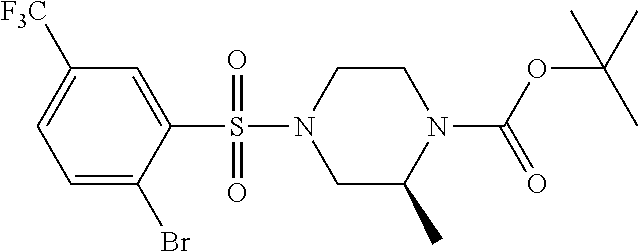
- 1,1-dimethylethyl(2S)-4- ⁇ [2-bromo-5-(trifluoromethyl)phenyl]sulfonyl ⁇ -2-methyl-1-piperazinecarboxylate may be prepared as described in Description 19
- potassium carbonate (1.134 g, 8.21 mmol) in 1,4-dioxane (80 ml) were stirred for 5 min then trimethylboroxin (1.142 ml, 8.21 mmol) and Pd(PPh 3 ) 4 (0.593 g, 0.513 mmol) were added and the reaction mixture heated at 100° C. for 1.5 h. Further trimethylboroxin (0.5 mL) was added and the reaction heated for 30 min before it was allowed to cool overnight.
- 1,1-dimethylethyl(2S)-2-methyl-4- ⁇ [2-methyl-5-(trifluoromethyl)phenyl]sulfonyl ⁇ -1-piperazinecarboxylate (may be prepared as described in Description 20) (2.1 g, 4.97 mmol) in 1,4-Dioxane (50 mL) was treated by HCl 4M in dioxane (6.21 mL, 24.85 mmol). The reaction mixture was stirred overnight at room temperature. LCMS showed a 1:1 ratio between starting material and expected product. HCl 4M in dioxane (6.21 mL, 24.85 mmol) is added and the reaction mixture stirred for 4 h. LCMS showed about 10% of remaining starting material. HCl 4M in dioxane (6.21 mL, 24.85 mmol) is added and the reaction mixture stirred for 1 h.
- 1,1-dimethylethyl 4- ⁇ [2-bromo-5-(trifluoromethyl)phenyl]sulfonyl ⁇ -1-piperazinecarboxylate may be prepared as described in Description 22) (2.59 g, 5.47 mmol), potassium carbonate (1.513 g, 10.94 mmol) in 1,4-dioxane (80 ml) were stirred for 5 min then trimethylboroxin (1.523 ml, 10.94 mmol) and Pd(PPh 3 ) 4 (0.632 g, 0.547 mmol) were added and the reaction mixture heated at 100° C. for 1.5 h. Further trimethylboroxin (0.5 mL) was added and the mixture heated at 100° C.
- 1,1-dimethylethyl 4- ⁇ [2-methyl-5-(trifluoromethyl)phenyl]sulfonyl ⁇ -1-piperazinecarboxylate (may be prepared as described in Description 23) (2.1 g, 5.14 mmol) in 1,4-dioxane (50 mL) was treated by HCl 4M in dioxane (6.43 mL, 25.7 mmol). The reaction mixture was stirred overnight at room temperature. LCMS showed a mixture of starting material and product so 8 ml of HCl 4M in dioxane were added. LCMS after 2 h showed still some starting material so 5 ml of HCl 4M in dioxane were added. LCMS after 2 h showed traces of starting material.
- Pyrazolo[1,5-a]pyrimidine-3-carboxylic acid (11.73 g, 71.9 mmol) was suspended in thionyl chloride (36 mL, 493 mmol) and heated at 60° C. for 2 h. Formation of the acyl chloride was monitored as follows: a sample of the reaction mixture was evaporated and added to MeOH and formation of the corresponding methyl ester was detected by UPLC. Then thionyl chloride was removed under reduced pressure to obtain pyrazolo[1,5-a]pyrimidine-3-carbonyl chloride (14 g) as a yellow solid.
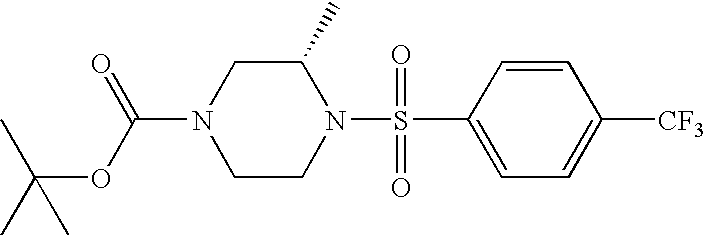
- (2S)-2-methylpiperazine (6 g, 59.9 mmol) was dissolved in tetrahydrofuran (50 mL) and cooled down to 0° C., aqueous sodium hydroxide (3M, 39.9 mL, 120 mmol) was added and stirred for 10 min. Then 4-(trifluoromethyl)benzenesulfonyl chloride (16.12 g, 65.9 mmol) (dissolved in 50 ml of THF) was added drop-wise, stirring the reaction mixture for 1 h. THF was removed under reduced pressure, the aqueous phase was diluted with water (200 ml) and extracted with DCM (2 ⁇ 300 ml).
- the pyrazolo[1,5-a]pyrimidine-3-carbonyl chloride (14 g) was suspended in THF ( ⁇ 80 ml) and added portion-wise to the above mixture, maintaining the pH>9 by adding NaOH 3M, and then the mixture was stirred overnight. THF was removed from the mixture under reduced pressure and the resulting suspension was extracted with DCM (2 ⁇ 300 ml). The organic layer was washed with HCl 0.1 M, dried over Na 2 SO 4 and concentrated to dryness to obtain the crude material (21.7 g) as foam. The crude material was re-dissolved in DCM (100 ml) and evaporated to minimum volume to obtain an oily residue, ethyl ether was added (80 ml) with stirring. A solid crashed out from the solution and was recovered by filtration, washing with ethyl ether before drying to give the title compound (20.06 g).
- the reaction mixture was transferred to a 100 ml round bottom flask and was reduced to dryness in vacuo.
- the residue was dissolved in DCM (50 ml) and was transferred to a separating funnel then washed with saturated aq. NaHCO 3 solution (5 ml), twice.
- the organic layer was collected and dried with dried magnesium sulfate.
- the solid was removed by filtration and the filtrate collected in a 250 ml round bottom flask and reduced to dryness in vacuo.
- the residue was then dissolved in 1.8 ml (1:1) MeCN/DMSO and purified by MDAP in 2 batches.
- the fractions containing desired product were combined in a 250 ml round bottom flask and reduced in vacuo to yield the title compound (79 mg).
- the lithium salt of 6-fluoropyrazolo[1,5-a]pyrimidine-3-carboxylate (117 mg, 0.63 mmol) (may be prepared as described in Description 16) was weighed into a vial with HATU (247 mg, 0.65 mmol), suspended in DMF (2 ml) and treated with DIPEA (0.170 ml, 0.97 mmol). This mixture was stirred about 15 min at ambient temperature.
- (3S)-3-Methyl-1- ⁇ [4-(trifluoromethyl)phenyl]sulfonyl ⁇ piperazine (may be prepared as described in Description 2) (100 mg, 0.32 mmol) was added and stirring was continued for 3 h at ambient temperature.
- reaction mixture was partitioned between DCM and sat. aq. NaHCO 3 solution (10 ml each). The layers were separated (hydrophobic frit) and the aqueous layer was washed with further DCM (2 ⁇ 5 ml). The combined organic layers were concentrated to leave an orange gum. Purification by MDAP gave the title compound (112 mg, 0.24 mmol, 73% yield) as an orange solid.
- the columns used are Waters Atlantis, the dimensions of which are 19 mm ⁇ 100 mm (small scale) and 30 mm ⁇ 100 mm (large scale).
- the stationary phase particle size is 5 ⁇ m.
- Aqueous solvent Water+0.1% Formic Acid
- the column used is a Waters Acquity BEH UPLC C18, the dimensions of which are 2.1 mm ⁇ 50 mm.
- the stationary phase particle size is 1.7 ⁇ m.
- Aqueous solvent Water+0.05% Formic Acid
- the generic method used has a 2 minute runtime.
- the above method has a flow rate of 1 ml/min.
- the injection volume for the generic method is 0.5 ul
- the column temperature is 40° C.
- the UV detection range is from 220 to 330 nm
- Biotage-SP4® is an automated purification system. It uses preloaded silica gel columns. The user applies their material to the top of the column and chooses solvents, gradients, flow rates, column size, collection method and eluting volumes.
- Phase separators are a range of ISOLUTE® columns fitted with an optimized frit material that easily separates aqueous phase from chlorinated solvents under gravity.
- an SCX cartridge was used as part of the compound purification process.
- an ISOLUTE SCX-2 cartridge was used.
- ISOLUTE SCX-2 is a silica-based sorbent with a chemically bonded propylsulfonic acid functional group.
- Base Material Silica, 50 ⁇ m
- HEK293 cells were cultured in Dulbecco's modified Eagles media/F12 media (Invitrogen, Cat #041-95750V) containing 10% fetal bovine serum, with added L-glutamine (2 mM; Invitrogen, Cat #25030-024) and non-essential amino acids (5%; Invitrogen, Cat #11140-035).
- HEK293 cells were transfected with two plasmid vectors for expression of the hCa V 2.2 ⁇ subunit (pCIN5-hCa V 2.2 which carries a neomycin resistance marker) and the hCa V ⁇ 3 subunit (pCIH-hCa V ⁇ 3 which carries a hygromycin resistance marker).
- Clonal cell lines were isolated following selection in media supplemented with 0.4 mg ml ⁇ 1 Geneticin G418 (Invitrogen, Cat #10131-027) and 0.1 mg ml ⁇ 1 hygromycin (Invitrogen, Cat #10687-010).
- clonal cell lines were assessed for Ca v 2.2 ⁇ / ⁇ 3-mediated current expression using the IonWorks planar array electrophysiology technology (described below). A clonal line was identified that gave a reasonable level of functional Ca v 2.2 ⁇ / ⁇ 3 current expression.
- This cell line was transfected with a plasmid vector for expression of the human ⁇ 2 ⁇ 1 subunit (pCIP- ⁇ 2 ⁇ 1 which carries a puromycin resistance marker) and clonal cell lines isolated following selection in media containing 0.62 ⁇ g ml ⁇ 1 puromycin (Sigma, Cat #P-7255), in addition to 0.4 mg ml ⁇ 1 Geneticin G418 and 0.1 mg ml ⁇ 1 hygromycin.
- Cells were grown to 30-60% confluence in T175 flasks and maintained at 30° C. for 24 hours prior to recording. Cells were lifted by removing the growth media, washing with Ca 2+ free PBS (Invitrogen, Cat #14190-094) and incubating with 3 ml of warmed (37° C.) TrpLE (Invitrogen, Cat #12604-013) for 6 minutes. Lifted cells were suspended in 10 ml of extracellular buffer. Cell suspension was then placed into a 15 ml tube and centrifuged for 2 minutes at 700 rpm. After centrifugation, the supernatant was removed and the cell pellet was resuspended in 4.5 ml of extracellular solution.
- Ca 2+ free PBS Invitrogen, Cat #14190-094
- TrpLE Invitrogen, Cat #12604-013
- Test pulses stepping from the holding potential (V H ) of ⁇ 90 mV to +10 mV were applied for 20 ms and repeated 10 times at a frequency of 10 Hz.
- the test pulse protocol was performed in the absence (pre-read) and presence (post-read) of a compound. Pre- and post-reads were separated by a compound addition followed by a 3-3.5 min incubation.
- the intracellular solution contained the following (in mM): K-gluconate 120, KCl 20 mM, MgCl 2 5, EGTA 5, HEPES 10, adjusted to pH 7.3.
- Amphotericin was prepared as 30 mg/ml stock solution and diluted to a final working concentration of 0.2 mg ml ⁇ 1 in intracellular buffer solution.
- the extracellular solution contained the following (in mM): Na-gluconate 120, NaCl 20, MgCl 2 1, HEPES 10, BaCl 2 5, adjusted to pH 7.4.
- the recordings were analyzed and filtered using seal resistance (>40 M ⁇ ), resistance reduction (>35%) and peak current amplitude (>200 pA) in the absence of compound to eliminate unsuitable cells from further analysis. Paired comparisons between pre-compound and post-compound additions were used to determine the inhibitory effect of each compound.
- concentrations of compounds required to inhibit current elicited by the 1 st depolarizing pulse by 50% (tonic pIC50) were determined by fitting of the Hill equation to the concentration response data.
- the use-dependent inhibitory properties of the compounds were determined by assessing the effect of compounds on the 10 th versus 1 st depolarizing pulse.
- the ratio of the 10 th over 1 st pulse was determined in the absence and presence of drug and the % use-dependent inhibition calculated.
- the data was fitted using the same equation as for the tonic pIC 50 and the concentration producing 30% inhibition (use-dependent pUD 30 ) determined.
- Examples 1 to 11, 13 to 24 were tested in the hCa V 2.2 assay and demonstrated the following pUD 30 and pIC 50 values. Compounds were tested in the form as described in the Examples. All compounds tested have been tested one or more times (up to 12 times). Variations in pUD 30 and pIC 50 values may arise between tests.
- the compounds 1 to 11, 13, 15 to 24 exhibited a pUD 30 value of 4.5 or more than 4.5.
- the compounds 1 to 11, 13, 15 to 23 exhibited a pUD 30 value of 5.0 or more than 5.0.
- the compounds 3, 4, 9, 11, 13, 16, 17 and 18 exhibited a pUD 30 value of 5.5 or more than 5.5.
- the compounds 1 to 11, 14 to 16, and 18 to 24 exhibited a mean pIC 50 value of 5.0 or less than 5.0.
- the compounds 1, 3 to 8, 10, 11, 14, 15, 18, 19, and 21 to 24 exhibited a mean pIC 50 value of 4.5 or less than 4.5.
Landscapes
- Health & Medical Sciences (AREA)
- Chemical & Material Sciences (AREA)
- Organic Chemistry (AREA)
- General Health & Medical Sciences (AREA)
- Veterinary Medicine (AREA)
- General Chemical & Material Sciences (AREA)
- Medicinal Chemistry (AREA)
- Nuclear Medicine, Radiotherapy & Molecular Imaging (AREA)
- Bioinformatics & Cheminformatics (AREA)
- Pharmacology & Pharmacy (AREA)
- Life Sciences & Earth Sciences (AREA)
- Animal Behavior & Ethology (AREA)
- Engineering & Computer Science (AREA)
- Public Health (AREA)
- Chemical Kinetics & Catalysis (AREA)
- Biomedical Technology (AREA)
- Neurology (AREA)
- Neurosurgery (AREA)
- Pain & Pain Management (AREA)
- Hospice & Palliative Care (AREA)
- Psychiatry (AREA)
- Rheumatology (AREA)
- Pharmaceuticals Containing Other Organic And Inorganic Compounds (AREA)
- Nitrogen Condensed Heterocyclic Rings (AREA)
Abstract
Description


- 3-[(4-{[4-(Trifluoromethyl)phenyl]sulfonyl}-1-piperazinyl)carbonyl]pyrazolo[1,5-a]pyrimidine;
- 3-[((2S)-2-Methyl-4-{[4-(trifluoromethyl)phenyl]sulfonyl}-1-piperazinyl)carbonyl]pyrazolo[1,5-a]pyrimidine;
- 3-[((3R)-3-Methyl-4-{[4-(trifluoromethyl)phenyl]sulfonyl}-1-piperazinyl)carbonyl]pyrazolo[1,5-a]pyrimidine;
- 3-[((3S)-3-Methyl-4-{[4-(trifluoromethyl)phenyl]sulfonyl}-1-piperazinyl)carbonyl]pyrazolo[1,5-a]pyrimidine;
- 3-Methyl-4-{[(3S)-3-methyl-4-(pyrazolo[1,5-a]pyrimidin-3-ylcarbonyl)-1-piperazinyl]sulfonyl}benzonitrile;
- 6-Methyl-3-[(4-{[4-(trifluoromethyl)phenyl]sulfonyl}-1-piperazinyl)carbonyl]pyrazolo[1,5-a]pyrimidine; and
- 3-[((2R)-2-Methyl-4-{[4-(trifluoromethyl)phenyl]sulfonyl}-1-piperazinyl)carbonyl]pyrazolo[1,5-a]pyrimidine; or a salt thereof;
or a salt thereof.
- 3-[((2S)-2-Methyl-4-{[4-(trifluoromethyl)phenyl]sulfonyl}-1-piperazinyl)carbonyl]pyrazolo[1,5-a]pyrimidine; or
- 3-[((2R)-2-Methyl-4-{[4-(trifluoromethyl)phenyl]sulfonyl}-1-piperazinyl)carbonyl]pyrazolo[1,5-a]pyrimidine;
or a salt thereof.

or a derivative thereof, with a compound of formula (III)

wherein R1, R2, R3, R4, R5, R6, R7, m and n are as defined above and L1 represents a suitable leaving group such as a halogen atom (e.g. chlorine or bromine) or hydroxyl group activated by commercially available amide coupling reagents (for example HOBT, HBTU and HATU);

with a compound of formula (V)

wherein R1, R2, R3, R4, R5, R6, R7, m and n are as defined above and L2 represents a suitable leaving group such as a halogen atom (e.g. chlorine or bromine);

wherein R2, R3, R4, m and L2 are as defined above and P1 represents a suitable protecting group such as t-butoxycarbonyl.

wherein R2, m, R1, n and P1 are as defined above.

wherein R1 is chloro or bromo.

- Ar—argon
- API—atmospheric pressure ionization
- aq.—aqueous
- eq.—equivalent
- dba—dibenzylideneacetone
- DCM—dichloromethane
- DIPEA—diisopropylethylamine
- DMF—N,N-dimethylformamide
- DMSO—dimethylsulfoxide
- DPPF—1,1′-Bis(diphenylphosphino)ferrocene
- EtOAc—ethyl acetate
- ES—Electrospray
- HATU—o-(7-Azabenzotriazol-1-yl)-N,N,N′,N′-tetramethyluronium hexafluorophosphate
- HBTU—O-benzotriazole-N,N,N′,N′-tetramethyl-uronium-hexafluoro-phosphate
- HOBT—Hydroxybenzotriazole
- HPLC—high performance liquid chromatography
- LCMS—Liquid Chromatography Mass Spectrometry
- MS—mass spectrometry
- MeCN—acetonitrile
- MDAP—mass directed automated preparative liquid chromatography.
- MeOH—methanol
- NMR—nuclear magnetic resonance
- PS-DIPEA—polymer supported diisopropylethylamine
- rt—room temperature
- sat.—saturated
- SCX—strong cation exchange chromatography
- THF—tetrahydrofuran
- TFA—trifluoroacetic acid
- Pd2(dba)3—tris(dibenzylideneacetone)dipalladium(0)
- Pd(PPh3)4—tetrakis(triphenylphosphine)palladium
- UPLC—Ultra Performance Liquid Chromatography
- h—hour(s)
- min—minutes






| TABLE 1 | |||
| Example | m/z (API- | ||
| no. | Name | Structure | ES) [M + H]+ |
| 14 | 5,7-dimethyl-3-[(4-{[4- (trifluoromethyl)phenyl]sulfonyl}-1- piperazinyl)carbonyl]pyrazolo[1,5-a] pyrimidine |
 |
468 |
| 15 | 3-{[(3S)-3-methyl-4-({4- [(trifluoromethyl)oxy]phenyl} sulfonyl)-1- piperazinyl]carbonyl}pyrazolo[1,5-a] pyrimidine |
 |
470 |
| 16 | 4-({(3S)-4-[(6- chloropyrazolo[1,5- a]pyrimidin-3-yl)carbonyl]-3- methyl-1- piperazinyl}sulfonyl)-3- methylbenzonitrile |
 |
459 + 461 (3:1) |
| 17 | 6-chloro-3-[((2S)-2-methyl-4- {[4- (trifluoromethyl)phenyl]sulfonyl}-1- piperazinyl)carbonyl]pyrazolo[1,5-a] pyrimidine |
 |
488 + 490 (3:1) |
| 18 | 3-[((2S)-2-methyl-4-{[2- methyl-5- (trifluoromethyl)phenyl]sulfonyl}-1- piperazinyl)carbonyl]pyrazolo[1,5-a] pyrimidine |
 |
468 |
| 19 | 3-[(4-{[2-methyl-5- (trifluoromethyl)phenyl]sulfonyl}-1- piperazinyl)carbonyl]pyrazolo[1,5-a] pyrimidine |
 |
454 |
| 20 | 2-methyl-3-[((2S)-2-methyl- 4-{[4- (trifluoromethyl)phenyl]sulfonyl}-1- piperazinyl)carbonyl]pyrazolo[1,5-a] pyrimidine |
 |
468 |
| 21 | 3-{[(3R)-3-methyl-4-({4- [(trifluoromethyl)oxy]phenyl} sulfonyl)-1- piperazinyl]carbonyl}pyrazolo[1,5-a] pyrimidine |
 |
470 |
| 22 | 3-{[(2R)-2-methyl-4-({4- [(trifluoromethyl)oxy]phenyl} sulfonyl)-1- piperazinyl]carbonyl}pyrazolo[1,5-a] pyrimidine |
 |
470 |
| 23 | 3-methyl-4-({(3S)-3-methyl- 4-[(6-methylpyrazolo[1,5- a]pyrimidin-3-yl)carbonyl]-1- piperazinyl}sulfonyl)benzonitrile |
 |
439 |
| 24 | 3-methyl-4-({(3S)-3-methyl- 4-[(2-methylpyrazolo[1,5- a]pyrimidin-3-yl)carbonyl]-1- piperazinyl}sulfonyl)benzonitrile |
 |
439 |

| Time/min | % B | ||
| 0 | 3 | ||
| 0.1 | 3 | ||
| 1.5 | 97 | ||
| 1.9 | 97 | ||
| 2.0 | 3 | ||
Claims (23)


Applications Claiming Priority (2)
| Application Number | Priority Date | Filing Date | Title |
|---|---|---|---|
| GB0813144.3 | 2008-07-17 | ||
| GBGB0813144.3A GB0813144D0 (en) | 2008-07-17 | 2008-07-17 | Novel compounds |
Publications (2)
| Publication Number | Publication Date |
|---|---|
| US20100016330A1 US20100016330A1 (en) | 2010-01-21 |
| US8093249B2 true US8093249B2 (en) | 2012-01-10 |
Family
ID=39737241
Family Applications (1)
| Application Number | Title | Priority Date | Filing Date |
|---|---|---|---|
| US12/503,135 Expired - Fee Related US8093249B2 (en) | 2008-07-17 | 2009-07-15 | Pyrazolo[1,5-A]pyrimidine-carbonyl-piperazine derivatives |
Country Status (9)
| Country | Link |
|---|---|
| US (1) | US8093249B2 (en) |
| EP (1) | EP2313413B1 (en) |
| JP (1) | JP5611201B2 (en) |
| AR (1) | AR072810A1 (en) |
| ES (1) | ES2387733T3 (en) |
| GB (1) | GB0813144D0 (en) |
| TW (1) | TW201016699A (en) |
| UY (1) | UY31989A (en) |
| WO (1) | WO2010007074A1 (en) |
Families Citing this family (3)
| Publication number | Priority date | Publication date | Assignee | Title |
|---|---|---|---|---|
| GB201000685D0 (en) * | 2010-01-15 | 2010-03-03 | Glaxo Group Ltd | Novel compounds |
| EP3156405A1 (en) | 2015-10-13 | 2017-04-19 | Boehringer Ingelheim International GmbH | Spirocyclic ether derivatives of pyrazolo[1,5-a]pyrimidine-3-carboxamide |
| WO2021239558A1 (en) | 2020-05-27 | 2021-12-02 | Esteve Pharmaceuticals, S.A. | Pyrazolo[1,5-a]pyrimidine derivatives having multimodal activity against pain |
Citations (50)
| Publication number | Priority date | Publication date | Assignee | Title |
|---|---|---|---|---|
| US5112824A (en) | 1989-12-08 | 1992-05-12 | Merck & Co., Inc. | Benzofuran compounds as class III antiarrhythmic agents |
| WO1995004062A1 (en) | 1993-08-02 | 1995-02-09 | Thiokol Corporation | Synthesis of 4,10-dinitro-2,6,8,12-tetraoxa-4,10-diazatetracyclo[5.5.0.0?5,903,11¿]dodecane |
| WO1996030343A1 (en) | 1995-03-29 | 1996-10-03 | Merck & Co., Inc. | Inhibitors of farnesyl-protein transferase |
| WO1996031501A1 (en) | 1995-04-07 | 1996-10-10 | Schering Corporation | Carbonyl-piperazinyl and piperidinil compounds which inhibit farnesyl protein transferase |
| WO1997028139A1 (en) | 1996-02-02 | 1997-08-07 | Pierre Fabre Medicament | Novel naphthylpiperazines derived from substituted cycloazanes, method for preparing same, pharmaceutical compositions and use thereof as drugs |
| WO1998017625A1 (en) | 1996-10-22 | 1998-04-30 | Daiichi Pharmaceutical Co., Ltd. | Novel remedies for infectious diseases |
| ZA9710062B (en) | 1996-11-08 | 1998-05-08 | Zeneca Ltd | Heterocyclic derivatives. |
| WO1999006371A1 (en) | 1997-07-29 | 1999-02-11 | Zeneca Limited | Heterocyclic derivatives which inhibit factor xa |
| WO1999037304A1 (en) | 1998-01-27 | 1999-07-29 | Aventis Pharmaceuticals Products Inc. | SUBSTITUTED OXOAZAHETEROCYCLYL FACTOR Xa INHIBITORS |
| WO2000012074A2 (en) | 1998-08-28 | 2000-03-09 | Scios Inc. | Use of piperidines and/or piperazines as inhibitors of p38-alpha kinase |
| WO2000042011A1 (en) | 1999-01-14 | 2000-07-20 | Fujisawa Pharmaceutical Co., Ltd. | Amide compounds |
| WO2001064676A2 (en) | 2000-02-28 | 2001-09-07 | Scios, Inc. | INHIBITORS OF p38-α KINASE |
| WO2001066534A2 (en) | 2000-03-09 | 2001-09-13 | Abbott Laboratories | Cyclic and bicyclic diamino histamine-3 receptor antagonists |
| WO2001076693A1 (en) | 2000-04-10 | 2001-10-18 | Merck & Co., Inc. | Inhibitors of prenyl-protein transferase |
| US20020115854A1 (en) | 1998-12-23 | 2002-08-22 | Lam Patrick Y.S. | Thrombin or factor Xa inhibitors |
| WO2002088115A1 (en) | 2001-04-26 | 2002-11-07 | Kolon Ind. Inc. | Novel sulfonamide derivatives, intermediate thereof, its preparation methods, and pharmaceutical composition comprising the same |
| EP1314733A1 (en) | 2001-11-22 | 2003-05-28 | Aventis Pharma Deutschland GmbH | Indole-2-carboxamides as factor Xa inhibitors |
| WO2003048139A1 (en) | 2001-12-06 | 2003-06-12 | Yang Ji Chemical Company Ltd. | Novel inhibitor compounds specific of secreted non-pancreatic human a2 phospholipase of group ii |
| WO2003062212A1 (en) | 2002-01-24 | 2003-07-31 | Panagene, Inc. | Peptide nucleic acid oligomers from 1-benzenesulfonyl-3-amino acid side chain-4-(2-nucleobase(acetyl))-piperazin-2-ones |
| WO2003076422A1 (en) | 2002-03-13 | 2003-09-18 | Janssen Pharmaceutica N.V. | Sulfonyl-derivatives as novel inhibitors of histone deacetylase |
| WO2003087086A2 (en) | 2002-04-16 | 2003-10-23 | Merck Patent Gmbh | Substituted indoles |
| WO2003088967A1 (en) | 2002-04-18 | 2003-10-30 | Schering Corporation | (1-4-piperidinyl) benzimidazole derivatives useful as histamine h3 antagonists |
| WO2005044797A1 (en) | 2003-11-06 | 2005-05-19 | Addex Pharmaceuticals Sa | Allosteric modulators of metabotropic glutamate receptors |
| US20050153981A1 (en) | 2002-05-08 | 2005-07-14 | Jianqi Li | Aralkyl formly-alkyl piperazine derivatives and their uses as a cerebral nerve protective agent |
| WO2005089502A2 (en) | 2004-03-18 | 2005-09-29 | The Brigham And Women's Hospital, Inc. | Methods for the treatment of synucleinopathies |
| WO2005095362A1 (en) | 2004-03-30 | 2005-10-13 | Astrazeneca Ab | Triazolone derivatives as mmp inhibitors for the treatment of asthma and copd |
| WO2005113542A2 (en) | 2004-05-20 | 2005-12-01 | Elan Pharmaceuticals, Inc. | N-cyclic sulfonamido inhibitors of gamma secretase |
| WO2006034341A2 (en) | 2004-09-20 | 2006-03-30 | Xenon Pharmaceuticals Inc. | Pyridazine derivatives for inhibiting human stearoyl-coa-desaturase |
| WO2006040181A2 (en) | 2004-10-14 | 2006-04-20 | Euro-Celtique S.A. | 4-phenylsulfonamidopiperidines as calcium channel blockers |
| WO2006048209A1 (en) | 2004-11-05 | 2006-05-11 | Boehringer Ingelheim International Gmbh | Novel bradykinin b1 antagonists, method for producing the same and the use thereof as drugs |
| DE102004054053A1 (en) | 2004-11-05 | 2006-05-11 | Boehringer Ingelheim Pharma Gmbh & Co. Kg | New 2-(hetero)aryl-imidazoline or tetrahydropyrimidine derivatives, are bradykinin B1 receptor antagonists used e.g. for treating neuropathic or inflammatory pain or migraine |
| WO2006129122A1 (en) | 2005-06-03 | 2006-12-07 | Halliburton Energy Services, Inc. | Cement compositions comprising environmentally compatible defoaming agents and methods of use |
| WO2007070760A2 (en) | 2005-12-15 | 2007-06-21 | Boehringer Ingelheim International Gmbh | Compounds which modulate the cb2 receptor |
| US20070142394A1 (en) | 2005-12-21 | 2007-06-21 | Schering Corporation | Substituted aniline derivatives useful as histamine H3 antagonists |
| WO2007075524A2 (en) | 2005-12-22 | 2007-07-05 | Merck & Co., Inc. | Substituted piperidines as calcium channel blockers |
| WO2007087068A2 (en) | 2006-01-13 | 2007-08-02 | Pharmacyclics, Inc. | Inhibitors of tyrosine kinases and uses thereof |
| WO2007110449A1 (en) | 2006-03-29 | 2007-10-04 | Euro-Celtique S.A. | Benzenesulfonamide compounds and their use |
| WO2007118853A1 (en) | 2006-04-13 | 2007-10-25 | Euro-Celtique S.A. | Benzenesulfonamide compounds and their use as blockers of calcium channels |
| WO2008008398A2 (en) | 2006-07-14 | 2008-01-17 | Shionogi & Co., Ltd. | Oxime compounds and the use thereof |
| WO2008024284A2 (en) | 2006-08-21 | 2008-02-28 | Merck & Co., Inc. | Sulfonylated piperazines as cannabinoid-1 receptor modulators |
| WO2008023720A1 (en) | 2006-08-23 | 2008-02-28 | Astellas Pharma Inc. | Urea compound or salt thereof |
| WO2008048914A1 (en) | 2006-10-17 | 2008-04-24 | Boehringer Ingelheim International Gmbh | Polycyclic compounds which modulate the cb2 receptor |
| WO2008075019A1 (en) | 2006-12-18 | 2008-06-26 | 7Tm Pharma A/S | Modulators of cb1 receptors |
| US20080188484A1 (en) | 2007-02-07 | 2008-08-07 | Matthias Nettekoven | Indol-2-yl-piperazin-1-yl-methanone derivatives |
| US20080188487A1 (en) | 2007-02-07 | 2008-08-07 | Matthias Nettekoven | 5-amido-(1h-indol-2-yl)-piperazin-1-yl-methanone derivatives |
| WO2008124118A1 (en) | 2007-04-09 | 2008-10-16 | Purdue Pharma L.P. | Benzenesulfonyl compounds and the use therof |
| WO2008150470A1 (en) | 2007-05-31 | 2008-12-11 | Shionogi & Co., Ltd. | Oxyimino compounds and the use thereof |
| WO2008150477A2 (en) | 2007-05-31 | 2008-12-11 | Government Of The United States Of America As Represented By The Secretary Of The Department Of Health And Human Services National Institutes Of Health | N-acetyl mannosamine as a therapeutic agent |
| WO2009040659A2 (en) | 2007-09-28 | 2009-04-02 | Purdue Pharma L.P. | Benzenesulfonamide compounds and the use thereof |
| WO2009045382A1 (en) | 2007-10-04 | 2009-04-09 | Merck & Co., Inc. | Substituted aryl sulfone derivatives as calcium channel blockers |
Family Cites Families (18)
| Publication number | Priority date | Publication date | Assignee | Title |
|---|---|---|---|---|
| US5474995A (en) | 1993-06-24 | 1995-12-12 | Merck Frosst Canada, Inc. | Phenyl heterocycles as cox-2 inhibitors |
| US5466823A (en) | 1993-11-30 | 1995-11-14 | G.D. Searle & Co. | Substituted pyrazolyl benzenesulfonamides |
| US5633272A (en) | 1995-02-13 | 1997-05-27 | Talley; John J. | Substituted isoxazoles for the treatment of inflammation |
| JP3267300B2 (en) | 1995-02-13 | 2002-03-18 | ジー.ディー.サール アンド カンパニー | Substituted isoxazoles for the treatment of inflammation |
| UA57002C2 (en) | 1995-10-13 | 2003-06-16 | Мерк Фросст Кенада Енд Ко./Мерк Фросст Кенада Енд Сі. | (methylsulfonyl)phenyl-2-(5n)-furanon derivative, a pharmaceutical composition and a method for treatment |
| GEP20032998B (en) | 1996-04-12 | 2003-06-25 | Searle & Co | Substituted Benzenesulfonamide Derivatives as Prodrugs of Cox-2 Inhibitors |
| SI0912518T1 (en) | 1996-07-18 | 2003-12-31 | Merck Frosst Canada & Co. | Substituted pyridines as selective cyclooxygenase-2 inhibitors |
| CO4960662A1 (en) | 1997-08-28 | 2000-09-25 | Novartis Ag | CERTAIN 5-ALKYL-2-ARYLAMINOPHENYLACETIC ACIDS AND THEIR DERIVATIVES |
| ATE281458T1 (en) | 1997-09-05 | 2004-11-15 | Glaxo Group Ltd | PHARMACEUTICAL COMPOSITION CONTAINING 2,3-DIARYL-PYRAZOLO(1,5-B)PYRIDAZINE DERIVATIVES |
| ATE275148T1 (en) | 1998-11-03 | 2004-09-15 | Glaxo Group Ltd | PYRAZOLOPYRIDINE DERIVATIVES AS SELECTIVE COX-2 INHIBITORS |
| US6025683A (en) | 1998-12-23 | 2000-02-15 | Stryker Corporation | Motor control circuit for regulating a D.C. motor |
| WO2000052008A1 (en) | 1999-02-27 | 2000-09-08 | Glaxo Group Limited | Pyrazolopyridines |
| GB0003224D0 (en) | 2000-02-11 | 2000-04-05 | Glaxo Group Ltd | Chemical compounds |
| GB0021494D0 (en) | 2000-09-01 | 2000-10-18 | Glaxo Group Ltd | Chemical comkpounds |
| JP2005536507A (en) | 2002-07-11 | 2005-12-02 | メルク エンド カムパニー インコーポレーテッド | Treatment of neuropathic pain with 6H-pyrrolo [3,4-d] pyridazine compounds |
| EP1663994B1 (en) | 2003-08-05 | 2012-03-07 | Vertex Pharmaceuticals Incorporated | Tetrahydroquinazoline compounds as inhibitors of voltage-gated ion channels |
| CN101218235A (en) | 2005-05-10 | 2008-07-09 | 沃泰克斯药物股份有限公司 | Bicyclic derivatives as ion channel modulators |
| AU2007231594A1 (en) | 2006-03-23 | 2007-10-04 | Amgen Inc. | 1-phenylsulfonyl-diaza heterocyclic amide compounds and their uses as modulators of hydroxsteroid dehydrogenases |
-
2008
- 2008-07-17 GB GBGB0813144.3A patent/GB0813144D0/en not_active Ceased
-
2009
- 2009-07-15 JP JP2011517912A patent/JP5611201B2/en not_active Expired - Fee Related
- 2009-07-15 ES ES09780588T patent/ES2387733T3/en active Active
- 2009-07-15 US US12/503,135 patent/US8093249B2/en not_active Expired - Fee Related
- 2009-07-15 UY UY0001031989A patent/UY31989A/en unknown
- 2009-07-15 EP EP09780588A patent/EP2313413B1/en not_active Not-in-force
- 2009-07-15 AR ARP090102693A patent/AR072810A1/en not_active Application Discontinuation
- 2009-07-15 WO PCT/EP2009/059013 patent/WO2010007074A1/en not_active Ceased
- 2009-07-15 TW TW098123841A patent/TW201016699A/en unknown
Patent Citations (59)
| Publication number | Priority date | Publication date | Assignee | Title |
|---|---|---|---|---|
| US5112824A (en) | 1989-12-08 | 1992-05-12 | Merck & Co., Inc. | Benzofuran compounds as class III antiarrhythmic agents |
| WO1995004062A1 (en) | 1993-08-02 | 1995-02-09 | Thiokol Corporation | Synthesis of 4,10-dinitro-2,6,8,12-tetraoxa-4,10-diazatetracyclo[5.5.0.0?5,903,11¿]dodecane |
| WO1996030343A1 (en) | 1995-03-29 | 1996-10-03 | Merck & Co., Inc. | Inhibitors of farnesyl-protein transferase |
| WO1996031501A1 (en) | 1995-04-07 | 1996-10-10 | Schering Corporation | Carbonyl-piperazinyl and piperidinil compounds which inhibit farnesyl protein transferase |
| WO1997028139A1 (en) | 1996-02-02 | 1997-08-07 | Pierre Fabre Medicament | Novel naphthylpiperazines derived from substituted cycloazanes, method for preparing same, pharmaceutical compositions and use thereof as drugs |
| WO1998017625A1 (en) | 1996-10-22 | 1998-04-30 | Daiichi Pharmaceutical Co., Ltd. | Novel remedies for infectious diseases |
| ZA9710062B (en) | 1996-11-08 | 1998-05-08 | Zeneca Ltd | Heterocyclic derivatives. |
| WO1999006371A1 (en) | 1997-07-29 | 1999-02-11 | Zeneca Limited | Heterocyclic derivatives which inhibit factor xa |
| WO1999037304A1 (en) | 1998-01-27 | 1999-07-29 | Aventis Pharmaceuticals Products Inc. | SUBSTITUTED OXOAZAHETEROCYCLYL FACTOR Xa INHIBITORS |
| WO2000012074A2 (en) | 1998-08-28 | 2000-03-09 | Scios Inc. | Use of piperidines and/or piperazines as inhibitors of p38-alpha kinase |
| WO2000012074A3 (en) | 1998-08-28 | 2000-08-31 | Scios Inc | Use of piperidines and/or piperazines as inhibitors of p38-alpha kinase |
| US20020115854A1 (en) | 1998-12-23 | 2002-08-22 | Lam Patrick Y.S. | Thrombin or factor Xa inhibitors |
| WO2000042011A1 (en) | 1999-01-14 | 2000-07-20 | Fujisawa Pharmaceutical Co., Ltd. | Amide compounds |
| WO2001064676A2 (en) | 2000-02-28 | 2001-09-07 | Scios, Inc. | INHIBITORS OF p38-α KINASE |
| WO2001064676A3 (en) | 2000-02-28 | 2002-03-28 | Scios Inc | INHIBITORS OF p38-α KINASE |
| WO2001066534A2 (en) | 2000-03-09 | 2001-09-13 | Abbott Laboratories | Cyclic and bicyclic diamino histamine-3 receptor antagonists |
| WO2001076693A1 (en) | 2000-04-10 | 2001-10-18 | Merck & Co., Inc. | Inhibitors of prenyl-protein transferase |
| WO2002088115A1 (en) | 2001-04-26 | 2002-11-07 | Kolon Ind. Inc. | Novel sulfonamide derivatives, intermediate thereof, its preparation methods, and pharmaceutical composition comprising the same |
| EP1314733A1 (en) | 2001-11-22 | 2003-05-28 | Aventis Pharma Deutschland GmbH | Indole-2-carboxamides as factor Xa inhibitors |
| WO2003048139A1 (en) | 2001-12-06 | 2003-06-12 | Yang Ji Chemical Company Ltd. | Novel inhibitor compounds specific of secreted non-pancreatic human a2 phospholipase of group ii |
| WO2003062212A1 (en) | 2002-01-24 | 2003-07-31 | Panagene, Inc. | Peptide nucleic acid oligomers from 1-benzenesulfonyl-3-amino acid side chain-4-(2-nucleobase(acetyl))-piperazin-2-ones |
| WO2003076422A1 (en) | 2002-03-13 | 2003-09-18 | Janssen Pharmaceutica N.V. | Sulfonyl-derivatives as novel inhibitors of histone deacetylase |
| WO2003087086A2 (en) | 2002-04-16 | 2003-10-23 | Merck Patent Gmbh | Substituted indoles |
| WO2003087086A3 (en) | 2002-04-16 | 2004-07-22 | Merck Patent Gmbh | Substituted indoles |
| WO2003088967A1 (en) | 2002-04-18 | 2003-10-30 | Schering Corporation | (1-4-piperidinyl) benzimidazole derivatives useful as histamine h3 antagonists |
| US20050153981A1 (en) | 2002-05-08 | 2005-07-14 | Jianqi Li | Aralkyl formly-alkyl piperazine derivatives and their uses as a cerebral nerve protective agent |
| WO2005044797A1 (en) | 2003-11-06 | 2005-05-19 | Addex Pharmaceuticals Sa | Allosteric modulators of metabotropic glutamate receptors |
| WO2005089502A3 (en) | 2004-03-18 | 2005-11-24 | Brigham & Womens Hospital | Methods for the treatment of synucleinopathies |
| WO2005089502A2 (en) | 2004-03-18 | 2005-09-29 | The Brigham And Women's Hospital, Inc. | Methods for the treatment of synucleinopathies |
| WO2005095362A1 (en) | 2004-03-30 | 2005-10-13 | Astrazeneca Ab | Triazolone derivatives as mmp inhibitors for the treatment of asthma and copd |
| WO2005113542A2 (en) | 2004-05-20 | 2005-12-01 | Elan Pharmaceuticals, Inc. | N-cyclic sulfonamido inhibitors of gamma secretase |
| WO2005113542A3 (en) | 2004-05-20 | 2006-03-02 | Elan Pharm Inc | N-cyclic sulfonamido inhibitors of gamma secretase |
| WO2006034341A2 (en) | 2004-09-20 | 2006-03-30 | Xenon Pharmaceuticals Inc. | Pyridazine derivatives for inhibiting human stearoyl-coa-desaturase |
| WO2006034341A3 (en) | 2004-09-20 | 2006-05-18 | Xenon Pharmaceuticals Inc | Pyridazine derivatives for inhibiting human stearoyl-coa-desaturase |
| WO2006040181A2 (en) | 2004-10-14 | 2006-04-20 | Euro-Celtique S.A. | 4-phenylsulfonamidopiperidines as calcium channel blockers |
| WO2006048209A1 (en) | 2004-11-05 | 2006-05-11 | Boehringer Ingelheim International Gmbh | Novel bradykinin b1 antagonists, method for producing the same and the use thereof as drugs |
| DE102004054053A1 (en) | 2004-11-05 | 2006-05-11 | Boehringer Ingelheim Pharma Gmbh & Co. Kg | New 2-(hetero)aryl-imidazoline or tetrahydropyrimidine derivatives, are bradykinin B1 receptor antagonists used e.g. for treating neuropathic or inflammatory pain or migraine |
| WO2006129122A1 (en) | 2005-06-03 | 2006-12-07 | Halliburton Energy Services, Inc. | Cement compositions comprising environmentally compatible defoaming agents and methods of use |
| WO2007070760A3 (en) | 2005-12-15 | 2007-08-02 | Boehringer Ingelheim Int | Compounds which modulate the cb2 receptor |
| WO2007070760A2 (en) | 2005-12-15 | 2007-06-21 | Boehringer Ingelheim International Gmbh | Compounds which modulate the cb2 receptor |
| US20070142394A1 (en) | 2005-12-21 | 2007-06-21 | Schering Corporation | Substituted aniline derivatives useful as histamine H3 antagonists |
| WO2007075524A2 (en) | 2005-12-22 | 2007-07-05 | Merck & Co., Inc. | Substituted piperidines as calcium channel blockers |
| WO2007087068A2 (en) | 2006-01-13 | 2007-08-02 | Pharmacyclics, Inc. | Inhibitors of tyrosine kinases and uses thereof |
| WO2007087068A3 (en) | 2006-01-13 | 2008-02-21 | Pharmacyclics Inc | Inhibitors of tyrosine kinases and uses thereof |
| WO2007110449A1 (en) | 2006-03-29 | 2007-10-04 | Euro-Celtique S.A. | Benzenesulfonamide compounds and their use |
| WO2007118853A1 (en) | 2006-04-13 | 2007-10-25 | Euro-Celtique S.A. | Benzenesulfonamide compounds and their use as blockers of calcium channels |
| WO2008008398A2 (en) | 2006-07-14 | 2008-01-17 | Shionogi & Co., Ltd. | Oxime compounds and the use thereof |
| WO2008024284A3 (en) | 2006-08-21 | 2008-11-20 | Merck & Co Inc | Sulfonylated piperazines as cannabinoid-1 receptor modulators |
| WO2008024284A2 (en) | 2006-08-21 | 2008-02-28 | Merck & Co., Inc. | Sulfonylated piperazines as cannabinoid-1 receptor modulators |
| WO2008023720A1 (en) | 2006-08-23 | 2008-02-28 | Astellas Pharma Inc. | Urea compound or salt thereof |
| WO2008048914A1 (en) | 2006-10-17 | 2008-04-24 | Boehringer Ingelheim International Gmbh | Polycyclic compounds which modulate the cb2 receptor |
| WO2008075019A1 (en) | 2006-12-18 | 2008-06-26 | 7Tm Pharma A/S | Modulators of cb1 receptors |
| US20080188484A1 (en) | 2007-02-07 | 2008-08-07 | Matthias Nettekoven | Indol-2-yl-piperazin-1-yl-methanone derivatives |
| US20080188487A1 (en) | 2007-02-07 | 2008-08-07 | Matthias Nettekoven | 5-amido-(1h-indol-2-yl)-piperazin-1-yl-methanone derivatives |
| WO2008124118A1 (en) | 2007-04-09 | 2008-10-16 | Purdue Pharma L.P. | Benzenesulfonyl compounds and the use therof |
| WO2008150470A1 (en) | 2007-05-31 | 2008-12-11 | Shionogi & Co., Ltd. | Oxyimino compounds and the use thereof |
| WO2008150477A2 (en) | 2007-05-31 | 2008-12-11 | Government Of The United States Of America As Represented By The Secretary Of The Department Of Health And Human Services National Institutes Of Health | N-acetyl mannosamine as a therapeutic agent |
| WO2009040659A2 (en) | 2007-09-28 | 2009-04-02 | Purdue Pharma L.P. | Benzenesulfonamide compounds and the use thereof |
| WO2009045382A1 (en) | 2007-10-04 | 2009-04-09 | Merck & Co., Inc. | Substituted aryl sulfone derivatives as calcium channel blockers |
Non-Patent Citations (3)
| Title |
|---|
| Heinke et al., Pre- and Postsynaptic Contributions of Voltage-Dependant Ca2+ Channels to Nociceptive Transmission in Rat Spinal Lamina L Neurons, 2004, European Journal of Neuroscience, vol. 19, pp. 103-111. |
| Matthews et al., Effects of Spinally Delivered N-and P-Type Voltage-Dependent Calcium Channel Antagonists on Dorsal Horn Neuronal Responses in a Rat Model of Neuropathy, Department of Pharmacology, University College London, 2001 International Association for the Study of Pain, Pain 92 (2001), pp. 235-246. |
| Zamponi et al., Role of Voltage-Gated Calcium Channels in Ascending Pain Pathways, Brain Res Rev. Apr. 2009; 60(1), pp. 84-89. |
Also Published As
| Publication number | Publication date |
|---|---|
| TW201016699A (en) | 2010-05-01 |
| JP2011528021A (en) | 2011-11-10 |
| US20100016330A1 (en) | 2010-01-21 |
| GB0813144D0 (en) | 2008-08-27 |
| AR072810A1 (en) | 2010-09-22 |
| JP5611201B2 (en) | 2014-10-22 |
| WO2010007074A1 (en) | 2010-01-21 |
| EP2313413A1 (en) | 2011-04-27 |
| ES2387733T3 (en) | 2012-10-01 |
| EP2313413B1 (en) | 2012-05-16 |
| UY31989A (en) | 2010-01-05 |
Similar Documents
| Publication | Publication Date | Title |
|---|---|---|
| US8530478B2 (en) | Piperazine derivatives used as CAV2.2 calcium channel modulators | |
| CN113631557A (en) | JAK kinase inhibitor, preparation method thereof and application thereof in medical field | |
| KR20200101389A (en) | Exo-Aza spiro inhibitor of menin-MLL interaction | |
| WO2022272133A2 (en) | Protein stabilizing compounds containing usp7 ligands | |
| US20100016330A1 (en) | Novel Derivatives | |
| US20130109711A1 (en) | Novel compounds | |
| JP7537002B2 (en) | Cdk9 inhibitors and uses thereof | |
| EP4277893A1 (en) | Indole derivatives as kinase inhibitors | |
| AU2021398704A1 (en) | Heterocyclic jak inhibitor | |
| US20130116270A1 (en) | Novel compounds | |
| US8933132B2 (en) | Tricyclic substituted benzenesulfonamide piperazine derivatives as CAV2.2 calcium channel blockers | |
| US8697703B2 (en) | Piperazine derivatives for blocking Cav2.2 calcium channels | |
| AU2013242858B2 (en) | Piperazine derivatives used as cav2.2 calcium channel modulators |
Legal Events
| Date | Code | Title | Description |
|---|---|---|---|
| AS | Assignment |
Owner name: GLAXO GROUP LIMITED,UNITED KINGDOM Free format text: ASSIGNMENT OF ASSIGNORS INTEREST;ASSIGNORS:HEER, JAG PAUL;HORTON, DAVID;WARD, SIMON E;SIGNING DATES FROM 20090826 TO 20090904;REEL/FRAME:023513/0689 Owner name: GLAXO GROUP LIMITED, UNITED KINGDOM Free format text: ASSIGNMENT OF ASSIGNORS INTEREST;ASSIGNORS:HEER, JAG PAUL;HORTON, DAVID;WARD, SIMON E;SIGNING DATES FROM 20090826 TO 20090904;REEL/FRAME:023513/0689 |
|
| AS | Assignment |
Owner name: GLAXO GROUP LIMITED,UNITED KINGDOM Free format text: CORRECTIVE ASSIGNMENT TO CORRECT THE ASSIGNOR: DAVID HORTON PREVIOUSLY RECORDED ON REEL 023513 FRAME 0689. ASSIGNOR(S) HEREBY CONFIRMS THE DAVID NORTON;ASSIGNORS:HEER, JAG PAUL;NORTON, DAVID;WARD, SIMON E;SIGNING DATES FROM 20090826 TO 20090904;REEL/FRAME:023540/0887 Owner name: GLAXO GROUP LIMITED, UNITED KINGDOM Free format text: CORRECTIVE ASSIGNMENT TO CORRECT THE ASSIGNOR: DAVID HORTON PREVIOUSLY RECORDED ON REEL 023513 FRAME 0689. ASSIGNOR(S) HEREBY CONFIRMS THE DAVID NORTON;ASSIGNORS:HEER, JAG PAUL;NORTON, DAVID;WARD, SIMON E;SIGNING DATES FROM 20090826 TO 20090904;REEL/FRAME:023540/0887 |
|
| AS | Assignment |
Owner name: CONVERGENCE PHARMACEUTICALS LIMITED, UNITED KINGDO Free format text: ASSIGNMENT OF ASSIGNORS INTEREST;ASSIGNOR:GLAXO GROUP LIMITED;REEL/FRAME:025776/0344 Effective date: 20101004 |
|
| STCF | Information on status: patent grant |
Free format text: PATENTED CASE |
|
| FEPP | Fee payment procedure |
Free format text: PAT HOLDER CLAIMS SMALL ENTITY STATUS, ENTITY STATUS SET TO SMALL (ORIGINAL EVENT CODE: LTOS); ENTITY STATUS OF PATENT OWNER: SMALL ENTITY |
|
| FPAY | Fee payment |
Year of fee payment: 4 |
|
| SULP | Surcharge for late payment | ||
| FEPP | Fee payment procedure |
Free format text: MAINTENANCE FEE REMINDER MAILED (ORIGINAL EVENT CODE: REM.); ENTITY STATUS OF PATENT OWNER: SMALL ENTITY |
|
| LAPS | Lapse for failure to pay maintenance fees |
Free format text: PATENT EXPIRED FOR FAILURE TO PAY MAINTENANCE FEES (ORIGINAL EVENT CODE: EXP.); ENTITY STATUS OF PATENT OWNER: SMALL ENTITY |
|
| STCH | Information on status: patent discontinuation |
Free format text: PATENT EXPIRED DUE TO NONPAYMENT OF MAINTENANCE FEES UNDER 37 CFR 1.362 |
|
| FP | Lapsed due to failure to pay maintenance fee |
Effective date: 20200110 |