US8088925B2 - Heteroaryl-carboxylic acid (sulfamoyl alkyl) amide-derivatives as factor Xa inhibitors - Google Patents
Heteroaryl-carboxylic acid (sulfamoyl alkyl) amide-derivatives as factor Xa inhibitors Download PDFInfo
- Publication number
- US8088925B2 US8088925B2 US11/940,654 US94065407A US8088925B2 US 8088925 B2 US8088925 B2 US 8088925B2 US 94065407 A US94065407 A US 94065407A US 8088925 B2 US8088925 B2 US 8088925B2
- Authority
- US
- United States
- Prior art keywords
- amide
- chloro
- piperidin
- isopropyl
- ethyl
- Prior art date
- Legal status (The legal status is an assumption and is not a legal conclusion. Google has not performed a legal analysis and makes no representation as to the accuracy of the status listed.)
- Expired - Fee Related, expires
Links
- 0 C[V].[1*]C.[2*]N(CS(=O)(=O)N([3*])C)C(=O)C1=CC=CC1 Chemical compound C[V].[1*]C.[2*]N(CS(=O)(=O)N([3*])C)C(=O)C1=CC=CC1 0.000 description 17
- JHLVEBNWCCKSGY-UHFFFAOYSA-N CC(C)(C)OC(NC)=O Chemical compound CC(C)(C)OC(NC)=O JHLVEBNWCCKSGY-UHFFFAOYSA-N 0.000 description 1
- ZXLYYQUMYFHCLQ-UHFFFAOYSA-N CN(C(c1c2cccc1)=O)C2=O Chemical compound CN(C(c1c2cccc1)=O)C2=O ZXLYYQUMYFHCLQ-UHFFFAOYSA-N 0.000 description 1
- KMBALEFWVWJARU-UHFFFAOYSA-N CN1C(=O)C2=C(C=CC=C2)C1=O.[H]N(C)C(=O)OC(C)(C)C.[H]N(C)C(=O)OCC1=CC=CC=C1.[H]N(C)C(=O)OCC1C2=C(C=CC=C2)C2=C1C=CC=C2.[H]N(C)CC1=CC=CC=C1 Chemical compound CN1C(=O)C2=C(C=CC=C2)C1=O.[H]N(C)C(=O)OC(C)(C)C.[H]N(C)C(=O)OCC1=CC=CC=C1.[H]N(C)C(=O)OCC1C2=C(C=CC=C2)C2=C1C=CC=C2.[H]N(C)CC1=CC=CC=C1 KMBALEFWVWJARU-UHFFFAOYSA-N 0.000 description 1
- QDNVWQFQXQRDJG-UHFFFAOYSA-N CNC(OCC1c2ccccc2-c2c1cccc2)=O Chemical compound CNC(OCC1c2ccccc2-c2c1cccc2)=O QDNVWQFQXQRDJG-UHFFFAOYSA-N 0.000 description 1
- QMDPEBMTDBSGAE-UHFFFAOYSA-N CNC(OCc1ccccc1)=O Chemical compound CNC(OCc1ccccc1)=O QMDPEBMTDBSGAE-UHFFFAOYSA-N 0.000 description 1
- HMECZVIYARINEW-UHFFFAOYSA-N [H]N(CC1CC(=O)N(C2CCN(C(C)C)CC2)S1(=O)=O)C(=O)C1=CC=C(Cl)S1 Chemical compound [H]N(CC1CC(=O)N(C2CCN(C(C)C)CC2)S1(=O)=O)C(=O)C1=CC=C(Cl)S1 HMECZVIYARINEW-UHFFFAOYSA-N 0.000 description 1
- MUVBEISUFQMYJC-UHFFFAOYSA-N [H]N(CC1CCC(=O)N(C2CCN(C(C)C)CC2)S1(=O)=O)C(=O)C1=CC=C(Cl)S1 Chemical compound [H]N(CC1CCC(=O)N(C2CCN(C(C)C)CC2)S1(=O)=O)C(=O)C1=CC=C(Cl)S1 MUVBEISUFQMYJC-UHFFFAOYSA-N 0.000 description 1
- SQIXJJCYZWAPLT-UHFFFAOYSA-N [H]N(CC1CCCN(C2CCN(C(C)C)CC2)S1(=O)=O)C(=O)C1=CC=C(Cl)S1 Chemical compound [H]N(CC1CCCN(C2CCN(C(C)C)CC2)S1(=O)=O)C(=O)C1=CC=C(Cl)S1 SQIXJJCYZWAPLT-UHFFFAOYSA-N 0.000 description 1
- HPLUARWAZSFSEN-UHFFFAOYSA-N [H]N(CC1CCN(C2CCN(C(C)C)CC2)S1(=O)=O)C(=O)C1=CC=C(Cl)S1 Chemical compound [H]N(CC1CCN(C2CCN(C(C)C)CC2)S1(=O)=O)C(=O)C1=CC=C(Cl)S1 HPLUARWAZSFSEN-UHFFFAOYSA-N 0.000 description 1
- CJQXSBXKMBMYHA-UHFFFAOYSA-N [H]N(CC1COC(=O)N(C2CCN(C(C)C)CC2)S1(=O)=O)C(=O)C1=CC=C(Cl)S1 Chemical compound [H]N(CC1COC(=O)N(C2CCN(C(C)C)CC2)S1(=O)=O)C(=O)C1=CC=C(Cl)S1 CJQXSBXKMBMYHA-UHFFFAOYSA-N 0.000 description 1
- CQFBLHAMMDTWLR-UHFFFAOYSA-N [H]N(CCS(=O)(=O)N(C(=O)NCCC)C1CCN(C(C)C)CC1)C(=O)C1=CC=C(Cl)S1 Chemical compound [H]N(CCS(=O)(=O)N(C(=O)NCCC)C1CCN(C(C)C)CC1)C(=O)C1=CC=C(Cl)S1 CQFBLHAMMDTWLR-UHFFFAOYSA-N 0.000 description 1
Classifications
-
- C—CHEMISTRY; METALLURGY
- C07—ORGANIC CHEMISTRY
- C07D—HETEROCYCLIC COMPOUNDS
- C07D211/00—Heterocyclic compounds containing hydrogenated pyridine rings, not condensed with other rings
- C07D211/04—Heterocyclic compounds containing hydrogenated pyridine rings, not condensed with other rings with only hydrogen or carbon atoms directly attached to the ring nitrogen atom
- C07D211/06—Heterocyclic compounds containing hydrogenated pyridine rings, not condensed with other rings with only hydrogen or carbon atoms directly attached to the ring nitrogen atom having no double bonds between ring members or between ring members and non-ring members
- C07D211/36—Heterocyclic compounds containing hydrogenated pyridine rings, not condensed with other rings with only hydrogen or carbon atoms directly attached to the ring nitrogen atom having no double bonds between ring members or between ring members and non-ring members with hetero atoms or with carbon atoms having three bonds to hetero atoms with at the most one bond to halogen, e.g. ester or nitrile radicals, directly attached to ring carbon atoms
- C07D211/56—Nitrogen atoms
- C07D211/58—Nitrogen atoms attached in position 4
-
- A—HUMAN NECESSITIES
- A61—MEDICAL OR VETERINARY SCIENCE; HYGIENE
- A61K—PREPARATIONS FOR MEDICAL, DENTAL OR TOILETRY PURPOSES
- A61K31/00—Medicinal preparations containing organic active ingredients
- A61K31/33—Heterocyclic compounds
- A61K31/395—Heterocyclic compounds having nitrogen as a ring hetero atom, e.g. guanethidine or rifamycins
- A61K31/435—Heterocyclic compounds having nitrogen as a ring hetero atom, e.g. guanethidine or rifamycins having six-membered rings with one nitrogen as the only ring hetero atom
- A61K31/44—Non condensed pyridines; Hydrogenated derivatives thereof
- A61K31/445—Non condensed piperidines, e.g. piperocaine
- A61K31/4523—Non condensed piperidines, e.g. piperocaine containing further heterocyclic ring systems
- A61K31/4535—Non condensed piperidines, e.g. piperocaine containing further heterocyclic ring systems containing a heterocyclic ring having sulfur as a ring hetero atom, e.g. pizotifen
-
- A—HUMAN NECESSITIES
- A61—MEDICAL OR VETERINARY SCIENCE; HYGIENE
- A61P—SPECIFIC THERAPEUTIC ACTIVITY OF CHEMICAL COMPOUNDS OR MEDICINAL PREPARATIONS
- A61P11/00—Drugs for disorders of the respiratory system
-
- A—HUMAN NECESSITIES
- A61—MEDICAL OR VETERINARY SCIENCE; HYGIENE
- A61P—SPECIFIC THERAPEUTIC ACTIVITY OF CHEMICAL COMPOUNDS OR MEDICINAL PREPARATIONS
- A61P29/00—Non-central analgesic, antipyretic or antiinflammatory agents, e.g. antirheumatic agents; Non-steroidal antiinflammatory drugs [NSAID]
-
- A—HUMAN NECESSITIES
- A61—MEDICAL OR VETERINARY SCIENCE; HYGIENE
- A61P—SPECIFIC THERAPEUTIC ACTIVITY OF CHEMICAL COMPOUNDS OR MEDICINAL PREPARATIONS
- A61P31/00—Antiinfectives, i.e. antibiotics, antiseptics, chemotherapeutics
- A61P31/12—Antivirals
-
- A—HUMAN NECESSITIES
- A61—MEDICAL OR VETERINARY SCIENCE; HYGIENE
- A61P—SPECIFIC THERAPEUTIC ACTIVITY OF CHEMICAL COMPOUNDS OR MEDICINAL PREPARATIONS
- A61P35/00—Antineoplastic agents
-
- A—HUMAN NECESSITIES
- A61—MEDICAL OR VETERINARY SCIENCE; HYGIENE
- A61P—SPECIFIC THERAPEUTIC ACTIVITY OF CHEMICAL COMPOUNDS OR MEDICINAL PREPARATIONS
- A61P7/00—Drugs for disorders of the blood or the extracellular fluid
- A61P7/02—Antithrombotic agents; Anticoagulants; Platelet aggregation inhibitors
-
- A—HUMAN NECESSITIES
- A61—MEDICAL OR VETERINARY SCIENCE; HYGIENE
- A61P—SPECIFIC THERAPEUTIC ACTIVITY OF CHEMICAL COMPOUNDS OR MEDICINAL PREPARATIONS
- A61P9/00—Drugs for disorders of the cardiovascular system
-
- A—HUMAN NECESSITIES
- A61—MEDICAL OR VETERINARY SCIENCE; HYGIENE
- A61P—SPECIFIC THERAPEUTIC ACTIVITY OF CHEMICAL COMPOUNDS OR MEDICINAL PREPARATIONS
- A61P9/00—Drugs for disorders of the cardiovascular system
- A61P9/10—Drugs for disorders of the cardiovascular system for treating ischaemic or atherosclerotic diseases, e.g. antianginal drugs, coronary vasodilators, drugs for myocardial infarction, retinopathy, cerebrovascula insufficiency, renal arteriosclerosis
-
- A—HUMAN NECESSITIES
- A61—MEDICAL OR VETERINARY SCIENCE; HYGIENE
- A61P—SPECIFIC THERAPEUTIC ACTIVITY OF CHEMICAL COMPOUNDS OR MEDICINAL PREPARATIONS
- A61P9/00—Drugs for disorders of the cardiovascular system
- A61P9/14—Vasoprotectives; Antihaemorrhoidals; Drugs for varicose therapy; Capillary stabilisers
-
- C—CHEMISTRY; METALLURGY
- C07—ORGANIC CHEMISTRY
- C07D—HETEROCYCLIC COMPOUNDS
- C07D333/00—Heterocyclic compounds containing five-membered rings having one sulfur atom as the only ring hetero atom
- C07D333/02—Heterocyclic compounds containing five-membered rings having one sulfur atom as the only ring hetero atom not condensed with other rings
- C07D333/04—Heterocyclic compounds containing five-membered rings having one sulfur atom as the only ring hetero atom not condensed with other rings not substituted on the ring sulphur atom
- C07D333/26—Heterocyclic compounds containing five-membered rings having one sulfur atom as the only ring hetero atom not condensed with other rings not substituted on the ring sulphur atom with hetero atoms or with carbon atoms having three bonds to hetero atoms with at the most one bond to halogen, e.g. ester or nitrile radicals, directly attached to ring carbon atoms
- C07D333/38—Carbon atoms having three bonds to hetero atoms with at the most one bond to halogen, e.g. ester or nitrile radicals
-
- C—CHEMISTRY; METALLURGY
- C07—ORGANIC CHEMISTRY
- C07D—HETEROCYCLIC COMPOUNDS
- C07D401/00—Heterocyclic compounds containing two or more hetero rings, having nitrogen atoms as the only ring hetero atoms, at least one ring being a six-membered ring with only one nitrogen atom
- C07D401/02—Heterocyclic compounds containing two or more hetero rings, having nitrogen atoms as the only ring hetero atoms, at least one ring being a six-membered ring with only one nitrogen atom containing two hetero rings
- C07D401/12—Heterocyclic compounds containing two or more hetero rings, having nitrogen atoms as the only ring hetero atoms, at least one ring being a six-membered ring with only one nitrogen atom containing two hetero rings linked by a chain containing hetero atoms as chain links
-
- C—CHEMISTRY; METALLURGY
- C07—ORGANIC CHEMISTRY
- C07D—HETEROCYCLIC COMPOUNDS
- C07D405/00—Heterocyclic compounds containing both one or more hetero rings having oxygen atoms as the only ring hetero atoms, and one or more rings having nitrogen as the only ring hetero atom
- C07D405/02—Heterocyclic compounds containing both one or more hetero rings having oxygen atoms as the only ring hetero atoms, and one or more rings having nitrogen as the only ring hetero atom containing two hetero rings
- C07D405/12—Heterocyclic compounds containing both one or more hetero rings having oxygen atoms as the only ring hetero atoms, and one or more rings having nitrogen as the only ring hetero atom containing two hetero rings linked by a chain containing hetero atoms as chain links
-
- C—CHEMISTRY; METALLURGY
- C07—ORGANIC CHEMISTRY
- C07D—HETEROCYCLIC COMPOUNDS
- C07D409/00—Heterocyclic compounds containing two or more hetero rings, at least one ring having sulfur atoms as the only ring hetero atoms
- C07D409/02—Heterocyclic compounds containing two or more hetero rings, at least one ring having sulfur atoms as the only ring hetero atoms containing two hetero rings
- C07D409/12—Heterocyclic compounds containing two or more hetero rings, at least one ring having sulfur atoms as the only ring hetero atoms containing two hetero rings linked by a chain containing hetero atoms as chain links
-
- C—CHEMISTRY; METALLURGY
- C07—ORGANIC CHEMISTRY
- C07D—HETEROCYCLIC COMPOUNDS
- C07D409/00—Heterocyclic compounds containing two or more hetero rings, at least one ring having sulfur atoms as the only ring hetero atoms
- C07D409/14—Heterocyclic compounds containing two or more hetero rings, at least one ring having sulfur atoms as the only ring hetero atoms containing three or more hetero rings
-
- C—CHEMISTRY; METALLURGY
- C07—ORGANIC CHEMISTRY
- C07D—HETEROCYCLIC COMPOUNDS
- C07D413/00—Heterocyclic compounds containing two or more hetero rings, at least one ring having nitrogen and oxygen atoms as the only ring hetero atoms
- C07D413/14—Heterocyclic compounds containing two or more hetero rings, at least one ring having nitrogen and oxygen atoms as the only ring hetero atoms containing three or more hetero rings
-
- C—CHEMISTRY; METALLURGY
- C07—ORGANIC CHEMISTRY
- C07D—HETEROCYCLIC COMPOUNDS
- C07D417/00—Heterocyclic compounds containing two or more hetero rings, at least one ring having nitrogen and sulfur atoms as the only ring hetero atoms, not provided for by group C07D415/00
- C07D417/14—Heterocyclic compounds containing two or more hetero rings, at least one ring having nitrogen and sulfur atoms as the only ring hetero atoms, not provided for by group C07D415/00 containing three or more hetero rings
-
- C—CHEMISTRY; METALLURGY
- C07—ORGANIC CHEMISTRY
- C07D—HETEROCYCLIC COMPOUNDS
- C07D419/00—Heterocyclic compounds containing two or more hetero rings, at least one ring having nitrogen, oxygen, and sulfur atoms as the only ring hetero atoms
- C07D419/14—Heterocyclic compounds containing two or more hetero rings, at least one ring having nitrogen, oxygen, and sulfur atoms as the only ring hetero atoms containing three or more hetero rings
Definitions
- the present invention relates to compounds of the formula I,
- the compounds of the formula I are valuable pharmacologically active compounds. They exhibit a strong anti-thrombotic effect and are suitable, for example, for the therapy and prophylaxis of cardiovascular disorders like thromboembolic diseases or restenoses. They are reversible inhibitors of the blood clotting enzymes factor Xa (FXa) and can in general be applied in conditions in which an undesired activity of factor Xa is present or for the cure or prevention of which an inhibition of factor Xa is intended.
- the invention furthermore relates to processes for the preparation of compounds of the formula I, their use, in particular as active ingredients in pharmaceuticals, and pharmaceutical preparations comprising them.
- Normal haemeostasis is the result of a complex balance between the processes of clot initiation, formation and clot dissolution.
- the complex interactions between blood cells, specific plasma proteins and the vascular surface maintain the fluidity of blood unless injury and blood loss occurs (EP-A-987274).
- Many significant disease states are related to abnormal haemeostasis. For example, local thrombus formation due to rupture of atheroslerotic plaque is a major cause of acute myocardial infarction and unstable angina. Treatment of an occlusive coronary thrombus by either thrombolytic therapy or percutaneous angioplasty may be accompanied by acute thrombolytic reclosure of the affected vessel.
- factor Xa-specific blood clotting inhibitors that are effective but do not cause unwanted side effects have been described, for example, in WO-A-95/29189.
- the present invention satisfies the above needs by providing novel compounds of the formula I, which exhibit better factor Xa inhibitory activity and are favorable agents with high bioavailability.
- Me is methyl
- Me is methyl
- alkyl is to be understood in the broadest sense to mean hydrocarbon residues which can be linear, i.e. straight-chain or branched. Further, the term alkyl as used herein expressly includes saturated groups as well as unsaturated groups which latter groups contain one or more, for example one, two or three, double bonds and/or triple bonds. All these statements also apply if an alkyl group occurs as a substituent on another residue, for example in an alkyloxy residue, an alkyloxycarbonyl residue or an arylalkyl residue.
- Examples of “—(C 1 -C 8 )-alkyl” or “—(C 1 -C 8 )-alkylene” are alkyl residues containing 1, 2, 3, 4, 5, 6, 7 or 8 carbon atoms are methyl, methylene, ethyl, ethylene, propyl, propylene, butyl, butylene, pentyl, pentylene, hexyl, heptyl or octyl, the n-isomers of all these residues, isopropyl, isobutyl, 1-methylbutyl, isopentyl, neopentyl, 2,2-dimethylbutyl, 2-methylpentyl, 3-methylpentyl, isohexyl, sec-butyl, tBu, tert-pentyl, sec-butyl, tert-butyl or tert-pentyl.
- —(C 0 -C 6 )-alkyl or “—(C 0 -C 8 )-alkylene” is an alkyl residue containing 1, 2, 3, 4, 5, 6, 7 or 8 carbon atoms.
- —C 0 -alkyl or “—C 0 -alkylene” is a covalent bond.
- Examples of —(C 3 -C 8 )-cycloalkyl cyclic alkyl residues are cycloalkyl residues containing 3, 4, 5, 6, 7 or 8 ring carbon atoms like cyclopropyl, cyclobutyl, cyclopentyl, cyclohexyl, cycloheptyl or cyclooctyl, which can also be substituted and/or unsaturated.
- Unsaturated cyclic alkyl groups and unsaturated cycloalkyl groups like, for example, cyclopentenyl or cyclohexenyl can be bonded via any carbon atom.
- a monocyclic or bicyclic 6- to 14-membered aryl or “—(C 6 -C 14 )-aryl” are understood as meaning aromatic hydrocarbon radicals containing from 6 to 14 carbon atoms in the ring.
- —(C 6 -C 14 )-aryl radicals are phenyl, naphthyl, for example 1-naphthyl and 2-naphthyl, biphenylyl, for example 2-biphenylyl, 3-biphenylyl and 4-biphenylyl, anthryl or fluorenyl.
- Biphenylyl radicals, naphthyl radicals and, in particular, phenyl radicals are preferred aryl radicals.
- the term “-heterocyclyl” refers to a heterocycle in which one or more of the 4 to 15 ring carbon atoms are replaced by heteroatoms such as nitrogen, oxygen or sulfur.
- Examples are acridinyl, azaindole (1H-pyrrolopyridinyl), azabenzimidazolyl, azaspirodecanyl, azepinyl, azetidinyl, aziridinyl, benzimidazolyl, benzofuranyl, benzothiofuranyl, benzothiophenyl, benzoxazolyl, benzthiazolyl, benztriazolyl, benztetrazolyl, benzisoxazolyl, benzisothiazolyl, carbazolyl, 4aH-carbazolyl, carbolinyl, chromanyl, chromenyl, cinnolinyl, decahydrochinolinyl, 4,5-dihydrooxazolinyl, dioxazolyl, dioxazinyl, 1,3-dioxolanyl, 1,3-dioxolenyl, 3,3-dio
- R9 and R11 together with the carbon atom to which they are bonded can form a 3- to 6 membered carbocyclic ring” refer to structures, which can be derived from compounds such as cyclopropyl, cyclobutyl, cyclopentyl or cyclohexyl.
- R13 and R3 together with the atoms to which they are bonded form a 5- to 7-membered cyclic group, wherein one of the carbon atoms within said cyclic group can be replaced by nitrogen, oxygen or sulphur refer to structures, which can be derived from compounds such as isothiazolidine 1,1-dioxide; 2,5-dihydro-isothiazole 1,1-dioxide; 2,3-dihydro-isothiazole 1,1-dioxide; [1,2]thiazinane 1,1-dioxide; 2H-[1,2]thiazine 1,1-dioxide; 5,6-dihydro-2H-[1,2]thiazine 1,1-dioxide; 3,4-dihydro-2H-[1,2]thiazine 1,1-dioxide; 3,6-dihydro-2H-[1,2]thiazine 1,1-dioxide; [1,2]thiazepane
- R21 and R22 together with the nitrogen atom to which they are bonded can form a 4- to 8-membered monocyclic heterocyclic ring which in addition to the nitrogen atom can contain one or two identical or different ring heteroatoms chosen from oxygen, sulfur and nitrogen” refers to structures, which can be derived from compounds such as azepine, azetidine, dioxazole, dioxazine, 1,4-diazepane, 1,2-diazepine, 1,3-diazepine, 1,4-diazepine, imidazole, imidazoline, imidazolidine, isothiazole, isothiazolidine, isothiazoline, isoxazole, isoxazoline, isoxazolidine, 2-isoxazoline, ketomorpholine, ketopiperazine, ketothiomorpholine, morpholine, [1,4]oxazepane, 1,4-oxazepine, oxazole
- oxo-residue or “ ⁇ O” refers to residues such as carbonyl (—C(O)—), sulfinyl (—S(O)—) or nitroso (—N ⁇ O).
- Ring systems wherein “X is sulfur, nitrogen, oxygen or the residues —CH ⁇ CH— or —CH ⁇ N—” refer to residues such as furanyl, phenyl, pyridyl, pyrrolyl or thiophenyl.
- —(C 1 -C 3 )-perfluoroalkyl is a partial or totally fluorinated alkyl-residue, which can be derived from residues such as —CF 3 , —CHF 2 , —CH 2 F, —CHF—CF 3 , —CHF—CHF 2 , —CHF—CH 2 F, —CH 2 —CF 3 ,
- —(C 1 -C 3 )-perfluoroalkylene is a partial or totally fluorinated alkylene-residue, which can be derived from residues such as —CF 2 —, —CHF—, —CHF—CHF 2 —, —CHF—CHF—, —CH 2 —CF 2 —,
- Halogen is fluorine, chlorine, bromine or iodine, preferably fluorine, chlorine or bromine, particularly preferably chlorine or bromine.
- Optically active carbon atoms present in the compounds of the formulae I or la can independently of each other have R configuration or S configuration.
- the compounds of the formula I can be present in the form of pure enantiomers or pure diastereomers or in the form of mixtures of enantiomers and/or diastereomers, for example in the form of racemates.
- the present invention relates to pure enantiomers and mixtures of enantiomers as well as to pure diastereomers and mixtures of diastereomers.
- the invention comprises mixtures of two or of more than two stereoisomers of the formulae I or la and it comprises all ratios of the stereoisomers in the mixtures.
- the invention relates both to pure E isomers and pure Z isomers and to E/Z mixtures in all ratios.
- the invention also comprises all tautomeric forms of the compounds of the formulae I or la.
- Diastereomers including E/Z isomers, can be separated into the individual isomers, for example, by chromatography. Racemates can be separated into the two enantiomers by customary methods, for example by chromatography on chiral phases or by resolution, for example by crystallization of diastereomeric salts obtained with optically active acids or bases. Stereochemically uniform compounds of the formula I or Ia can also be obtained by employing stereochemically uniform starting materials or by using stereoselective reactions.
- Physiologically tolerable salts of the compounds of formulae I or Ia are nontoxic salts that are physiologically acceptable, in particular pharmaceutically utilizable salts.
- Such salts of compounds of the formula I or Ia containing acidic groups, for example a carboxyl group COOH are for example alkali metal salts or alkaline earth metal salts such as sodium salts, potassium salts, magnesium salts and calcium salts, and also salts with physiologically tolerable quaternary ammonium ions such as tetramethylammonium or tetraethylammonium, and acid addition salts with ammonia and physiologically tolerable organic amines, such as methylamine, dimethylamine, trimethylamine, ethylamine, triethylamine, ethanolamine or tris-(2-hydroxyethyl)amine.
- Basic groups contained in the compounds of the formulae I or Ia form acid addition salts, for example with inorganic acids such as hydrochloric acid, hydrobromic acid, sulfuric acid, nitric acid or phosphoric acid, or with organic carboxylic acids and sulfonic acids such as formic acid, acetic acid, oxalic acid, citric acid, lactic acid, malic acid, succinic acid, malonic acid, benzoic acid, maleic acid, fumaric acid, tartaric acid, methanesulfonic acid or p-toluenesulfonic acid.
- inorganic acids such as hydrochloric acid, hydrobromic acid, sulfuric acid, nitric acid or phosphoric acid
- organic carboxylic acids and sulfonic acids such as formic acid, acetic acid, oxalic acid, citric acid, lactic acid, malic acid, succinic acid, malonic acid, benzoic acid, maleic acid, fumaric acid, tartaric acid
- Salts of compounds of the formulae I or Ia can be obtained by customary methods known to those skilled in the art, for example by combining a compound of the formulae I or Ia with an inorganic or organic acid or base in a solvent or dispersant, or from other salts by cation exchange or anion exchange.
- the present invention also includes all salts of the compounds of the formulae I or Ia which, because of low physiologically tolerability, are not directly suitable for use in pharmaceuticals but are suitable, for example, as intermediates for carrying out further chemical modifications of the compounds of the formula I or as starting materials for the preparation of physiologically tolerable salts.
- the present invention furthermore includes all solvates of compounds of the formulae I or Ia for example hydrates or adducts with alcohols.
- the invention also includes derivatives and modifications of the compounds of the formula I, for example prodrugs, protected forms and other physiologically tolerable derivatives, as well as active metabolites of the compounds of the formulae I or Ia.
- the invention relates in particular to prodrugs and protected forms of the compounds of the formulae I or Ia, which can be converted into compounds of the formula I under physiological conditions.
- Suitable prodrugs for the compounds of the formulae I or Ia i.e. chemically modified derivatives of the compounds of the formula I having properties which are improved in a desired manner, for example with respect to solubility, bioavailability or duration of action, are known to those skilled in the art. More detailed information relating to prodrugs is found in standard literature like, for example, Design of Prodrugs, H.
- Suitable prodrugs for the compounds of the formulae I or Ia are especially acyl prodrugs and carbamate prodrugs of acrylatable nitrogen-containing groups such as amino groups and the guanidino group and also ester prodrugs and amide prodrugs of carboxylic acid groups which may be present in compounds of the formulae I or Ia.
- acyl prodrugs and carbamate prodrugs one or more, for example one or two, hydrogen atoms on nitrogen atoms in such groups are replaced with an acyl group or a carbamate, preferably a —(C 1 -C 6 )-alkyloxycarbonyl group.
- Suitable acyl groups and carbamate groups for acyl prodrugs and carbamate prodrugs are, for example, the groups R p1 —CO— and R p2 O—CO—, in which R p1 is hydrogen, (C 1 -C 18 )-alkyl, (C 3 -C 8 )-cycloalkyl, (C 3 -C 8 )-cycloalkyl-(C 1 -C 4 )-alkyl-, (C 6 -C 14 )-aryl, Heterocyclyl-, (C 6 -C 14 )-aryl-(C 1 -C 4 )-alkyl- or Heterocyclyl-(C 1 -C 4 )-alkyl- and in which R p2 has the meanings indicated for R p1 with the exception of hydrogen.
- the compounds of the formulae I or Ia can be prepared by utilising procedures and techniques, which per se are well known and appreciated by one of ordinary skill in the art. Starting materials or building blocks for use in the general synthetic procedures that can be applied in the preparation of the compounds of formulae I or Ia are readily available to one of ordinary skill in the art. In many cases they are commercially available or have been described in the literature. Otherwise they can be prepared from readily available precursor compounds analogously to procedures described in the literature, or by procedures or analogously to procedures described in this application.
- compounds of the formulae I or Ia can be prepared, for example in the course of a convergent synthesis, by linking two or more fragments which can be derived retrosynthetically from the formula I. More specifically, suitably substituted starting aminoalkylsulfonyl derivatives are employed as building blocks in the preparation of the compounds of formula I. If not commercially available, such aminoalkylsulfonyl derivatives can be prepared according to the well-known standard procedures for the formation of the aminoalkylsulfonyl system.
- these aminoalkylsulfonamide syntheses allow the introduction of a variety of substituents into the various positions of the aminoalkylsulfonamide system, which can be chemically modified in order to finally arrive at the molecule of the formula I having the desired substituent pattern.
- aminoalkylsulfonamides are prepared by the reaction of N-protected aminoalkyl-sulfonyl chlorides with various amines in the presence of a base.
- R23 and R24 are protecting groups, these groups can be subsequently removed and the resulting amine can be coupled with a thiophene-2-carboxylic acid under standard peptide coupling conditions.
- a phthaloyl protected ⁇ -aminoethylsulfonylchloride which is commercially available, can be transformed to the corresponding sulfonamides.
- primary sulfonamides can be selectively substituted at the nitrogen atom by the reaction with typical electrophiles R33-X (, in which X is a leaving group, such as chloride, bromide, iodide, mesylate or tosylate) in the presence of a base, for example K 2 CO 3 .
- R33-X a leaving group, such as chloride, bromide, iodide, mesylate or tosylate
- a base for example K 2 CO 3 .
- ⁇ -substituted ⁇ -aminoethylsulfonamides can be prepared, for example, by deprotonation of N-protected (for example phthaloyl protected) ⁇ -aminoethylsulfonamides with a base such as LDA or NaH and subsequent reaction with electrophiles.
- N-protected for example phthaloyl protected
- ⁇ -aminoethylsulfonamides with a base such as LDA or NaH and subsequent reaction with electrophiles.
- ⁇ -substituted ⁇ -aminoethylsulfonamides can be obtained starting from the commercially available N-protected ⁇ -amino acids.
- a condensing agent for example isobutyl chloroformate
- a suitable base for example isobutyl chloroformate
- a suitable reducing agent for example NaBH 4
- the 2-N-protected aminoethanol intermediate can be reacted with an alkylsulfonyl halide (for example methanesulfonylchloride) in the presence of a base to provide the corresponding alkylsulfonyloxy derivative.
- an alkylsulfonyl halide for example methanesulfonylchloride
- cesium thiolacetate leads to a thioester which upon treatment with chlorine gas provides a N-protected ⁇ -substituted ⁇ -aminoethylsulfonylchloride.
- Reaction with appropriate amines provide the N-protected- ⁇ -substituted ⁇ -aminoethylsulfonamides, which can be further modified to structures of the formula I.
- the functional groups introduced during the aminoalkylsulfonamide synthesis can be chemically modified.
- the groups present in the aminoalkylsulfonamide system can be modified by a variety of reactions and thus the desired residues R13 in G 1 of formula I can be obtained.
- Hydroxymethyl groups as well as formyl groups attached to the aminoalkylsulfonamide system can be transformed to a variety of functional groups, for example, to the corresponding carboxylic acid or carboxylic ester by many oxidative reactions well known to those skilled in the art.
- a nitrile group attached to the aminoalkylsulfonamide can, for example, easily be converted into the desired acid under acidic, basic or reductive conditions.
- carboxylic acid groups and acetic acid groups can be converted into their homologues by usual reactions for chain elongation of carboxylic acids.
- Halogen atoms can be introduced into aromatic side chains, for example according to procedures like the following described in the literature.
- N-fluoro-2,4,6-trimethylpyridinium triflate is the reagent of choice (T. Umemoto, S. Fukami, G. Tomizawa, K. Harasawa, K. Kawada, K. Tomita, J. Am. Chem. Soc.
- halogen is introduced in the different positions of an aromatic side chain of the ⁇ -aminoalkylsulfonamide.
- halogen/metal exchange or metalation by selective hydrogen/metal exchange and subsequent reaction with a wide range of electrophiles various substituents can be introduced at the aromatic nucleus.
- Halogens or hydroxy groups via their triflates or nonaflates—or primary amines (via their diazonium salts) present in the side chain of the aminoalkylsulfonamide—can be converted directly, or after interconversion to the corresponding stannane, or boronic acid, into a variety of other functional groups like for example —CN, —CF 3 , —C 2 F 5 , ethers, acids, amides, amines, alkyl- or aryl-groups mediated by means of transition metals, namely palladium or nickel catalysts or copper salts and reagents for example referred to below (F. Diederich, P.
- nitro groups can be reduced to amino groups by means of various reducing agents, such as sulfides, dithionites, complex hydrides or by catalytic hydrogenation.
- a reduction of a nitro group may also be carried out at a later stage of the synthesis of a compound of the formula I, and a reduction of a nitro group to an amino group may also occur simultaneously with a reaction performed on another functional group, for example when reacting a group like a cyano group with hydrogen sulfide or when hydrogenating a group.
- amino groups can then be modified according to standard procedures for alkylation, for example by reaction with (substituted) alkyl halogenides or by reductive amination of carbonyl compounds, according to standard procedures for acylation, for example by reaction with activated carboxylic acid derivatives such as acid chlorides, anhydrides, activated esters or others or by reaction with carboxylic acids in the presence of an activating agent, or according to standard procedures for sulfonylation, for example by reaction with sulfonyl chlorides.
- Ester groups present in the aminoalkylsulfonamide can be hydrolyzed to the corresponding carboxylic acids, which after activation can then be reacted with amines or alcohols under standard conditions to give amides or esters, respectively. Ester groups present in the aminoalkyl-sulfonamide can be converted to other esters by transesterification. Carboxylic acids attached to a suitable aminoalkylsulfonamide can also be alkylated to give esters.
- Ether groups present at the aminoalkylsulfonamide derivative for example benzyloxy groups or other easily cleavable ether groups, can be cleaved to give hydroxy groups which then can be reacted with a variety of agents, for example etherification agents or activating agents allowing replacement of the hydroxy group by other groups. Sulfur-containing groups can be reacted analogously.
- the invention also refers to a process for the preparation of a compound of formula I, which comprises condensing a compound of formula 2 with a compound of formula HN(R 43 )R 44 to give a compound of the formula 3 and optionally converting the compound of the formula 3 into a compound of the formulae I or Ia,
- residue HN(R 43 )R 44 has the donation of —N(R 3 )G 2 as defined in the formula I, wherein —N(R 41 )R 42 has either the donation of —N(R 2 )C(O)-heterocycle, wherein heterocycle is a residue out of the group selected from furanyl, phenyl, pyridyl, pyrrolyl or thiophenyl, and is substituted by R 1 and V, and wherein R 2 is defined as in formula I, or optionally the residue —N(R 41 )R 42 has the meaning of a precursor group, which can be subsequently converted into the residues —N(R 2 )C(O)-heterocycle of the formulae I or Ia.
- R 41 or R 42 can have the meaning of a protecting group suitable for nitrogen atom protection (see, for example, Greene and Wuts, Protective Groups in Organic Synthesis, Wiley, 1991, or P. Kocienski, Protecting Groups, Thieme 1994), for example the residue —N(R 41 )R 42 can have the meaning of
- the residue —N(R 43 )R 44 can have the denotations of —N(R 3 )G 2 , respectively, given above or in addition in the residues R 43 and R 44 functional groups can also be present in the form of groups that can subsequently be transformed into the final groups R 3 and G 2 , i.e. functional groups can be present in the form of precursor groups or of derivatives, for example in protected form.
- functional groups can be present in the form of precursor groups or of derivatives, for example in protected form.
- —N(R 2 )C(O)-heterocycle as defined above which finally is to be present in the desired target molecule of the formula I, or it can denote a group which can subsequently be transformed into the group —N(R 2 )C(O) heterocycle, for example a precursor group or a derivative of the group —N(R 2 )C(O) heterocycle in which functional groups are present in protected form, or R 41 and R 42 can independently from each other denote a hydrogen atom or a protective group for the nitrogen atom of the aminalkylsulfonyl derivative.
- residues R 13′ which are attached to the alkyl chain in G 1 ′ in formulae 2 and 3, have the corresponding definitions of R 13 in formula I as defined above, however, for the synthesis of the compounds of the formula I these residues, too, can in principle be present at the stage of the condensation of a compound of the formula 2 with a compound of the formula HN(R 43 )R 44 giving a compound of the formula 3 in the form of precursor groups or in protected form.
- the compounds of the formula 2 can usually be prepared by standard procedures from the corresponding sulfonic acids by treatment with phosgene, thionylchloride or phosphorus pentachloride (in the presence of catalytic DMF) or other standard reagents for the chlorination of sulfonic acids.
- N-Acylation of a nitrogen atom for example with substituted thiophene carboxylic acid derivatives to produce finally compounds of the formulae I or Ia, can, for example, be performed under standard conditions by means of common coupling reagents used in peptide synthesis.
- Such coupling reagents are, for example, carbodiimides like dicyclohexylcarbodiimide (DCC) or diisopropylcarbodiimide, carbonyldiazoles like carbonyldiimidazole (CDI) and similar reagents, propylphosphonic anhydride, O-((cyano-(ethoxycarbonyl)-methylene)amino)-N,N,N′,N′-tetramethyluronium tetrafluoroborate (TOTU), O-(7-aza-benzotriazole-1-yl)-N,N,N′,N′-tetramethyluronium-hexafluorophosphate (HATU), diethylphosphoryl cyanide (DEPC) or bis-(2-oxo-3-oxazolidinyl)-phosphoryl chloride (BOP-Cl) and many others.
- N-Acylation can also be performed by the reaction with a corresponding acid-
- residues R 13 in G 1 can be present at the stage of the aminoalkylsulfonyl derivative of the formula 2, for example, by de novo synthesis of the aminoalkylsulfonyl system as indicated above. Otherwise, the residues R 13 ′ can be introduced in the sulfonamide derivatives of the formula 3 by deprotonation with strong bases such as LDA or NaH and subsequent reaction with electrophiles. These residues R 13 ′, which are attached to G 1 ′ in formula 3, have the corresponding definitions of R 13 in formula I as defined above, or they can have the meaning of precursor groups, which can finally be transformed to the residues R 13 of the formula I.
- Preferred methods include, but are not limited to those described in the examples.
- the compounds of the present invention are serine protease inhibitors, which inhibit the activity of the blood coagulation enzyme factor Xa. They are specific serine protease inhibitors inasmuch as they do not substantially inhibit the activity of other proteases whose inhibition is not desired.
- the activity of the compounds of the formulae I or Ia can be determined, for example, in the assays described below or in other assays known to those skilled in the art.
- a preferred embodiment of the invention comprises compounds which have a Ki ⁇ 1 mM for factor Xa inhibition as determined in the assay described below, with or without concomitant factor VIIa inhibition, and which preferably do not substantially inhibit the activity of other proteases involved in coagulation and fibrinolysis whose inhibition is not desired (using the same concentration of the inhibitor).
- the compounds of the invention inhibit factor Xa catalytic activity either directly, within the prothrombinase complex or as a soluble subunit, or indirectly, by inhibiting the assembly of factor Xa into the prothrombinase complex.
- the compounds of the formulae I or Ia and their physiologically tolerable salts and their prodrugs are generally suitable for the therapy and prophylaxis of conditions in which the activity of factor Xa plays a role or has an undesired extent, or which can favorably be influenced by inhibiting factor Xa or decreasing their activities, or for the prevention, alleviation or cure of which an inhibition of factor Xa or a decrease in their activity is desired by the physician.
- the compounds of the formulae I or Ia and their physiologically tolerable salts and their prodrugs are generally suitable for reducing blood clotting, or for the therapy and prophylaxis of conditions in which the activity of the blood coagulation system plays a role or has an undesired extent, or which can favorably be influenced by reducing blood clotting, or for the prevention, alleviation or cure of which a decreased activity of the blood coagulation system is desired by the physician.
- a specific subject of the present invention thus are the reduction or inhibition of unwanted blood clotting, in particular in an individual, by administering an effective amount of a compound of the formula I or a physiologically tolerable salt or a prodrug thereof, as well as pharmaceutical preparations therefore.
- the present invention also relates to the use of the compounds of the formulae I or Ia and/or their physiologically tolerable salts and/or their prodrugs for the production of pharmaceuticals for inhibition of factor Xa or for influencing blood coagulation, inflammatory response or fibrinolysis or for the therapy or prophylaxis of the diseases mentioned above or below, for example for the production of pharmaceuticals for the therapy and prophylaxis of cardiovascular disorders, thromboembolic diseases or restenoses.
- the invention also relates to the use of the compounds of the formulae I or Ia and/or their physiologically tolerable salts and/or their prodrugs for the inhibition of factor Xa or for influencing blood coagulation or fibrinolysis or for the therapy or prophylaxis of the diseases mentioned above or below, for example for use in the therapy and prophylaxis of cardiovascular disorders, thromboembolic diseases or restenoses, and to methods of treatment aiming at such purposes including methods for said therapies and prophylaxis.
- the present invention also relates to pharmaceutical preparations (or pharmaceutical compositions) which contain an effective amount of at least one compound of the formulae I or Ia and/or its physiologically tolerable salts and/or its prodrugs in addition to a customary pharmaceutically acceptable carrier, i.e. one or more pharmaceutically acceptable carrier substances or excipients and/or auxiliary substances or additives.
- a customary pharmaceutically acceptable carrier i.e. one or more pharmaceutically acceptable carrier substances or excipients and/or auxiliary substances or additives.
- the invention also relates to the treatment of disease states such as abnormal thrombus formation, acute myocardial infarction, unstable angina, thromboembolism, acute vessel closure associated with thrombolytic therapy or percutaneous transluminal coronary angioplasty (PTCA), transient ischemic attacks, stroke, intermittent claudication or bypass grafting of the coronary or peripheral arteries, vessel luminal narrowing, restenosis post coronary or venous angioplasty, maintenance of vascular access patency in long-term hemodialysis patients, pathologic thrombus formation occurring in the veins of the lower extremities following abdominal, knee or hip surgery, pathologic thrombus formation occurring in the veins of the lower extremities following abdominal, knee and hip surgery, a risk of pulmonary thromboembolism, or disseminated systemic intravascular coagulatopathy occurring in vascular systems during septic shock, certain viral infections or cancer.
- disease states such as abnormal thrombus formation, acute myocardial infarction, unstable angina, thro
- the compounds of the present invention can also be used to reduce an inflammatory response.
- specific disorders for the treatment or prophylaxis of which the compounds of the formulae I or Ia can be used are coronary heart disease, myocardial infarction, angina pectoris, vascular restenosis, for example restenosis following angioplasty like PTCA, adult respiratory distress syndrome, multi-organ failure and disseminated intravascular clotting disorder.
- thromboses like deep vein and proximal vein thrombosis, which can occur following surgery.
- the compounds of the formulae I or Ia and their physiologically tolerable salts and their prodrugs can be administered to animals, preferably to mammals, and in particular to humans as pharmaceuticals for therapy or prophylaxis. They can be administered on their own, or in mixtures with one another or in the form of pharmaceutical preparations, which permit enteral or parenteral administration.
- the pharmaceuticals can be administered orally, for example in the form of pills, tablets, lacquered tablets, coated tablets, granules, hard and soft gelatin capsules, solutions, syrups, emulsions, suspensions or aerosol mixtures.
- Administration can also be carried out rectally, for example in the form of suppositories, or parenterally, for example intravenously, intramuscularly or subcutaneously, in the form of injection solutions or infusion solutions, microcapsules, implants or rods, or percutaneously or topically, for example in the form of ointments, solutions or tinctures, or in other ways, for example in the form of aerosols or nasal sprays.
- compositions according to the invention are prepared in a manner known per se and familiar to one skilled in the art, pharmaceutically acceptable inert inorganic and/or organic carriers being used in addition to the compound(s) of the formulae I or Ia and/or its (their) physiologically tolerable salts and/or its (their) prodrugs.
- pharmaceutically acceptable inert inorganic and/or organic carriers being used in addition to the compound(s) of the formulae I or Ia and/or its (their) physiologically tolerable salts and/or its (their) prodrugs.
- Carriers for soft gelatin capsules and suppositories are, for example, fats, waxes, semisolid and liquid polyols, natural or hardened oils, etc.
- Suitable carriers for the production of solutions for example injection solutions, or of emulsions or syrups are, for example, water, saline, alcohols, glycerol, polyols, sucrose, invert sugar, glucose, vegetable oils, etc.
- Suitable carriers for microcapsules, implants or rods are, for example, copolymers of glycolic acid and lactic acid.
- the pharmaceutical preparations normally contain about 0.5% to 90% by weight of the compounds of the formulae I or Ia and/or their physiologically tolerable salts and/or their prodrugs.
- the amount of the active ingredient of the formulae I or Ia and/or its physiologically tolerable salts and/or its prodrugs in the pharmaceutical preparations normally is from about 0.5 mg to about 1000 mg, preferably from about 1 mg to about 500 mg.
- the pharmaceutical preparations can contain additives such as, for example, fillers, disintegrants, binders, lubricants, wetting agents, stabilizers, emulsifiers, preservatives, sweeteners, colorants, flavorings, aromatizers, thickeners, diluents, buffer substances, solvents, solubilizers, agents for achieving a depot effect, salts for altering the osmotic pressure, coating agents or antioxidants. They can also contain two or more compounds of the formulae I or Ia, and/or their physiologically tolerable salts and/or their prodrugs.
- a pharmaceutical preparation contains two or more compounds of the formulae I or Ia
- the selection of the individual compounds can aim at a specific overall pharmacological profile of the pharmaceutical preparation.
- a highly potent compound with a shorter duration of action may be combined with a long-acting compound of lower potency.
- the flexibility permitted with respect to the choice of substituents in the compounds of the formulae I or Ia allows a great deal of control over the biological and physico-chemical properties of the compounds and thus allows the selection of such desired compounds.
- the pharmaceutical preparations can also contain one or more other therapeutically or prophylactically active ingredients.
- the dose can vary within wide limits and, as is customary and is known to the physician, is to be suited to the individual conditions in each individual case. It depends, for example, on the specific compound employed, on the nature and severity of the disease to be treated, on the mode and the schedule of administration, or on whether an acute or chronic condition is treated or whether prophylaxis is carried out.
- An appropriate dosage can be established using clinical approaches well known in the medical art.
- the daily dose for achieving the desired results in an adult weighing about 75 kg is from 0.01 mg/kg to 100 mg/kg, preferably from 0.1 mg/kg to 50 mg/kg, in particular from 0.1 mg/kg to 10 mg/kg, (in each case in mg per kg of body weight).
- the daily dose can be divided, in particular in the case of the administration of relatively large amounts, into several, for example 2, 3 or 4, part administrations. As usual, depending on individual behavior it may be necessary to deviate upwards or downwards from the daily dose indicated.
- a compound of the formulae I or Ia can also advantageously be used as an anticoagulant outside an individual.
- an effective amount of a compound of the invention can be contacted with a freshly drawn blood sample to prevent coagulation of the blood sample.
- a compound of the formulae I or Ia or its salts can be used for diagnostic purposes, for example in in vitro diagnoses, and as an auxiliary in biochemical investigations.
- a compound of the formulae I or Ia can be used in an assay to identify the presence of factor Xa or to isolate factor Xa in a substantially purified form.
- a compound of the invention can be labeled with, for example, a radioisotope, and the labeled compound bound to factor Xa is then detected using a routine method useful for detecting the particular label.
- a compound of the formulae I or Ia or a salt thereof can be used as a probe to detect the location or amount of factor Xa activity in vivo, in vitro or ex vivo.
- the compounds of the formulae I or Ia can be used as synthesis intermediates for the preparation of other compounds, in particular of other pharmaceutical active ingredients, which are obtainable from the compounds of the formulae I or Ia, for example by introduction of substituents or modification of functional groups.
- an acid such as trifluoroacetic acid, formic acid or acetic acid was used, for example when trifluoroacetic acid was employed to remove a tBu group or when a compound was purified by chromatography using an eluent which contained such an acid, in some cases, depending on the work-up procedure, for example the details of a freeze-drying process, the compound was obtained partially or completely in the form of a salt of the acid used, for example in the form of the acetic acid salt, formic acid salt or trifluoroacetic acid salt or hydrochloric acid salt.
- an acid such as trifluoroacetic acid, formic acid or acetic acid was used, for example when trifluoroacetic acid was employed to remove a tBu group or when a compound was purified by chromatography using an eluent which contained such an acid, in some cases, depending on the work-up procedure, for example the details of a freeze-drying process, the compound was obtained partially or completely in the form of a
- DIPEA Diisopropylethylamine DIPEA
- 5-Chloro-thiophene-2-carboxylic acid [2-(1-isopropyl-piperidin-4-ylsulfamoyl)-ethyl]-amide can also be prepared by reacting 5-chloro-thiophene-2-carbonyl chloride with 2-amino-ethanesulfonic acid (1-isopropyl-piperidin-4-yl)-amide:
- the crystalline fumarate was prepared as following:
- 2-Amino-ethanesulfonic acid (1-cyclopropyl-piperidin-4-yl)-amide was prepared by an analogous procedure as described for example 1 ii) starting from 395 mg (1.05 mmol) crude 2-(1,3-dioxo-1,3-dihydro-isoindol-2-yl)-ethanesulfonic acid (1-cyclopropyl-piperidin-4-yl)-amide. The product was obtained as a colorless oil.
- 5-Chloro-thiophene-2-carboxylic acid [2-(1-cyclopropyl-piperidin-4-ylsulfamoyl)-ethyl]-amide was prepared by an analogous procedure as described in example 1 iii) starting from 339 mg (2 equiv.) 5-chloro-thiophene-2-carboxylic acid and 258 mg (1.04 mmol) 2-amino-ethanesulfonic acid (1-cyclopropyl-piperidin-4-yl)-amide.
- the reaction mixture was cooled and, carefully, 14 ml water were added dropwise over a 20-minute period.
- the mixture was diluted with 40 ml water and 50 ml diethyl ether.
- the phases were separated.
- the aqueous phase (suspension) was treated with a 10% NaOH-solution and washed twice with 100 ml diethyl ether.
- the organic phases were combined, dried over anhydrous Na 2 SO 4 and concentrated under reduced pressure.
- 5-Chloro-thiophene-2-carboxylic acid ⁇ 2-[(1-isopropyl-piperidin-4-yl)-methyl-sulfamoyl]-ethyl ⁇ -amide was prepared by an analogous procedure as described for example 1 iii) starting from 318 mg (2 equiv.) 5-chloro-thiophene-2-carboxylic acid and 258 mg (0.98 mmol) crude 2-amino-ethanesulfonic acid (1-isopropyl-piperidin-4-yl)-methyl-amide.
- Final purification was achieved by preparative RP-HPLC (CH 3 CN/H 2 O gradient+0.1% TFA). After lyophilisation and transformation into its hydrochloride the title compound was obtained as a colorless, amorphous solid.
- 2-Amino-ethanesulfonic acid (3,4,5,6-tetrahydro-2H-[1,4′]bipyridinyl-4-yl)-amide was prepared by an analogous procedure as described for example 1 ii) starting from 860 mg (2.08 mmol) crude 2-(1,3-dioxo-1,3-dihydro-isoindol-2-yl)-ethanesulfonic acid (3,4,5,6-tetrahydro-2H-[1,4′]bipyridinyl-4-yl)-amide. The product was obtained as a colorless oil.
- 3-(2-Amino-ethanesulfonylamino)-azetidine-1-carboxylic acid tert-butyl ester was prepared by an analogous procedure as described for example 1 ii) starting from 448 mg (1.1 mmol) crude 3-[2-(1,3-dioxo-1,3-dihydro-isoindol-2-yl)-ethanesulfonylamino]-azetidine-1-carboxylic acid tert-butyl ester. The product was obtained as a colorless oil.
- 3- ⁇ 2-[(5-Chloro-thiophene-2-carbonyl)-amino]-ethanesulfonylamino ⁇ -azetidine-1-carboxylic acid tert-butyl ester was prepared by an analogous procedure as described in example 5 iii) starting from 240 mg (1.3 equiv.) 5-chloro-thiophene-2-carboxylic acid and 308 mg (1.1 mmol) 3-(2-amino-ethanesulfonylamino)-azetidine-1-carboxylic acid tert-butyl ester.
- 2-(1,3-Dioxo-1,3-dihydro-isoindol-2-yl)-ethanesulfonic acid (4-benzyl-piperazin-1-yl)-amide was prepared by an analogous procedure as described for example 1 i) starting from 140 mg (0.73 mmol) 4-benzyl-piperazin-1-ylamine and 200 mg (1 equiv.) 2-(1,3-dioxo-1,3-dihydro-isoindol-2-yl)-ethanesulfonyl chloride. The product was obtained in crude form as a light yellow foam.
- 2-Amino-ethanesulfonic acid (4-benzyl-piperazin-1-yl)-amide was prepared by an analogous procedure as described for example 1 ii) starting from 313 mg (0.73 mmol) crude 2-(1,3-dioxo-1,3-dihydro-isoindol-2-yl)-ethanesulfonic acid (4-benzyl-piperazin-1-yl)-amide. The product was obtained as colorless oil.
- 5-Chloro-thiophene-2-carboxylic acid [2-(4-benzyl-piperazin-1-ylsulfamoyl)-ethyl]-amide was prepared by an analogous procedure as described in example 5 iii) starting from 100 mg (1 equiv.) 5-chloro-thiophene-2-carboxylic acid and 183 mg (0.61 mmol) 2-amino-ethanesulfonic acid (4-benzyl-piperazin-1-yl)-amide.
- 5-Methyl-thiophene-2-carboxylic acid [2-(1-isopropyl-piperidin-4-ylsulfamoyl)-ethyl]-amide was prepared by an analogous procedure as described in example 9 starting from 94 mg (1.1 equiv.) 5-methyl-thiophene-2-carboxylic acid and 150 mg (0.60 mmol) 2-amino-ethanesulfonic acid (1-isopropyl-piperidin-4-yl)-amide.
- 5-Bromo-furan-2-carboxylic acid [2-(1-isopropyl-piperidin-4-ylsulfamoyl)-ethyl]-amide was prepared by an analogous procedure as described in example 9 starting from 126 mg (1.1 equiv.) 5-bromo-furan-2-carboxylic acid and 150 mg (0.60 mmol) 2-amino-ethanesulfonic acid (1-isopropyl-piperidin-4-yl)-amide.
- 5-Chloro-pyridine-2-carboxylic acid[2-(1-isopropyl-piperidin-4-ylsulfamoyl)-ethyl]-amide was prepared by an analogous procedure as described in example 9 starting from 104 mg (1.1 equiv.) 5-chloro-pyridine-2-carboxylic acid and 150 mg (0.60 mmol) 2-amino-ethanesulfonic acid (1-isopropyl-piperidin-4-yl)-amide.
- 3-Chloro-N-[2-(1-isopropyl-piperidin-4-ylsulfamoyl)-ethyl]-benzamide was prepared by an analogous procedure as described in example 9 starting from 104 mg (1.1 equiv.) 3-chloro-benzoic acid and 150 mg (0.60 mmol) 2-amino-ethanesulfonic acid (1-isopropyl-piperidin-4-yl)-amide.
- Final purification by preparative RP-HPLC CH 3 CN/H 2 O gradient+0.1% TFA) gave pure 3-chloro-N-[2-(1-isopropyl-piperidin-4-ylsulfamoyl)-ethyl]-benzamide.
- the title compound was obtained as its trifluoroacetate in form of a colorless amorphous material.
- 5-Chloro-thiophene-2-carboxylic acid ⁇ 2-[[2-(tert-butyl-dimethyl-silanyloxy)-ethyl]-(1-isopropyl-piperidin-4-yl)-sulfamoyl]-ethyl ⁇ -amide was prepared by an analogous procedure as described in example 15 starting from 2.3 ml (3.5 equiv.) (2-bromo-ethoxy)-tert-butyl-dimethyl-silane and 1.2 g (3.05 mmol) 5-chloro-thiophene-2-carboxylic acid [2-(1-isopropyl-piperidin-4-ylsulfamoyl)-ethyl]-amide.
- 5-Chloro-thiophene-2-carboxylic acid (2- ⁇ (1-isopropyl-piperidin-4-yl)-[3-(tetrahydro-pyran-2-yloxy)-propyl]-sulfamoyl ⁇ -ethyl)-amide was prepared by an analogous procedure as described in example 15 starting from 245 mg (1.5 equiv.) 2-(3-chloro-propoxy)-tetrahydro-pyran and 360 mg (0.91 mmol) 5-chloro-thiophene-2-carboxylic acid [2-(1-isopropyl-piperidin-4-ylsulfamoyl)-ethyl]-amide.
- 5-Chloro-thiophene-2-carboxylic acid ⁇ 2-[dimethylcarbamoylmethyl-(1-isopropyl-piperidin-4-yl)-sulfamoyl]-ethyl ⁇ -amide was prepared by an analogous procedure as described in example 15 starting from 0.8 ml (2 equiv.) 2-chloro-N,N-dimethyl-acetamide and 1.5 g (3.81 mmol) 5-chloro-thiophene-2-carboxylic acid [2-(1-isopropyl-piperidin-4-ylsulfamoyl)-ethyl]-amide.
- 5-Chloro-thiophene-2-carboxylic acid ⁇ 2-[(1-isopropyl-piperidin-4-yl)-(2-morpholin-4-yl-2-oxo-ethyl)-sulfamoyl]-ethyl ⁇ -amide was prepared by an analogous procedure as described in example 15 starting from 83 mg (2 equiv.) 2-chloro-1-morpholin-4-yl-ethanone and 100 mg (0.25 mmol) 5-chloro-thiophene-2-carboxylic acid [2-(1-isopropyl-piperidin-4-ylsulfamoyl)-ethyl]-amide.
- 5-Chloro-thiophene-2-carboxylic acid ⁇ 2-[carbamoylmethyl-(1-isopropyl-piperidin-4-yl)-sulfamoyl]-ethyl ⁇ -amide was prepared by an analogous procedure as described in example 15 starting from 48 mg (2 equiv.) 2-chloro-acetamide and 100 mg (0.25 mmol) 5-chloro-thiophene-2-carboxylic acid [2-(1-isopropyl-piperidin-4-ylsulfamoyl)-ethyl]-amide.
- 5-Chloro-thiophene-2-carboxylic acid ⁇ 2-[(1-isopropyl-piperidin-4-yl)-(5-methyl-isoxazol-3-ylmethyl)-sulfamoyl]-ethyl ⁇ -amide was prepared by an analogous procedure as described in example 15 starting from 67 mg (1 equiv.) 3-chloromethyl-5-methyl-isoxazole and 200 mg (0.50 mmol) 5-chloro-thiophene-2-carboxylic acid [2-(1-isopropyl-piperidin-4-ylsulfamoyl)-ethyl]-amide (reaction temperature: 60° C.).
- 5-Chloro-thiophene-2-carboxylic acid ⁇ 2-[(1-isopropyl-piperidin-4-yl)-pyridin-3-ylmethyl-sulfamoyl]-ethyl ⁇ -amide was prepared by an analogous procedure as described in example 15 starting from 83 mg (1 equiv.) 3-chloromethyl-pyridine hydrochloride and 200 mg (0.50 mmol) 5-chloro-thiophene-2-carboxylic acid [2-(1-isopropyl-piperidin-4-ylsulfamoyl)-ethyl]-amide (reaction temperature: 60° C.).
- 5-Chloro-thiophene-2-carboxylic acid ⁇ 2-[(1-isopropyl-piperidin-4-yl)-thiazol-2-ylmethyl-sulfamoyl]-ethyl ⁇ -amide was prepared by an analogous procedure as described in example 5 iii) starting from 61 mg (1 equiv.) 5-chloro-thiophene-2-carboxylic acid and 129 mg (0.37 mmol) 2-amino-ethanesulfonic acid (1-isopropyl-piperidin-4-yl)-thiazol-2-ylmethyl-amide.
- the filter residue was taken up in ethyl acetate and purified by flash chromatography on silica gel (eluent: ethyl acetate/MeOH) to give pure 1-benzyloxy-carbonylamino-propane-2-sulfonic acid as a colorless oil.
- 5-Chloro-thiophene-2-carboxylic acid [(S)-1-hydroxymethyl-2-(1-isopropyl-piperidin-4-ylsulfamoyl)-ethyl]-amide was prepared by an analogous procedure as described in example 26 viii) starting from 28 mg (1.1 equiv.) 5-chloro-thiophene-2-carboxylic acid and 44 mg (0.16 mmol) (S)-2-amino-3-hydroxy-propane-1-sulfonic acid (1-isopropyl-piperidin-4-yl)-amide.
- Methanesulfonic acid 2-(9H-fluoren-9-ylmethoxycarbonylamino)-2-methyl-propyl ester was prepared by an analogous procedure as described in example 26i) starting from 4.95 g (15.9 mmol) (2-hydroxy-1,1-dimethyl-ethyl)-carbamic acid 9H-fluoren-9-ylmethyl ester and 1.5 ml (1.2 equiv.) methanesulfonyl chloride.
- Methanesulfonic acid 2-(9H-fluoren-ylmethoxycarbonylamino)-2-methyl-propyl ester was obtained in crude form as yellow oil. Yield: 7.0 g.
- 2-(9H-Fluoren-9-ylmethoxycarbonylamino)-2-methyl-propane-1-sulfonic acid was prepared by an analogous procedure as described in example 26 iii) starting from 1.87 g (5.1 mmol) thioacetic acid S-[2-(9H-fluoren-9-ylmethoxycarbonylamino)-2-methyl-propyl]ester and 4.3 ml H 2 O 2 (35% in water) in 20 ml acetic acid.
- 5-Chloro-thiophene-2-carboxylic acid [2-(1-isopropyl-piperidin-4-ylsulfamoyl)-1,1-dimethyl-ethyl]-amide was prepared by an analogous procedure as described in example 26 viii) starting from 195 mg (1 equiv.) 5-chloro-thiophene-2-carboxylic acid and 332 mg (1.2 mmol) 2-amino-2-methyl-propane-1-sulfonicacid (1-isopropyl-piperidin-4-yl)-amide.
- 5-Chloro-thiophene-2-carboxylic acid [3-(1-isopropyl-piperidin-4-ylsulfamoyl)-propyl]-amide was prepared by an analogous procedure as described in example 5 iii) starting from 120 mg (1 equiv.) 5-chloro-thiophene-2-carboxylic acid and 195 mg (0.74 mmol) 3-amino-propane-1-sulfonic acid (1-isopropyl-piperidin-4-yl)-amide.
- 4-Benzyloxycarbonylamino-3-methanesulfonyloxy-butyric acid benzyl ester was prepared by an analogous procedure as described in example 26i) starting from 6.7 g (19.6 mmol) 4-benzyloxycarbonylamino-3-hydroxy-butyric acid benzyl ester and 1.84 ml (1.2 equiv.) methanesulfonyl chloride. 4-Benzyloxycarbonylamino-3-methanesulfonyloxy-butyric acid benzyl ester was obtained in crude form as yellow oil. Yield: 8.5 g.
- 4-Benzyloxycarbonylamino-3-sulfo-butyric acid benzyl ester was prepared by an analogous procedure as described in example 26 iii) starting from 180 mg (0.45 mmol) 3-acetylsulfanyl-4-benzyloxycarbonylamino-butyric acid benzyl ester and 0.4 ml H 2 O 2 (35% in water) in 5 ml acetic acid. The product was obtained in crude form as colorless oil.
- 4-Benzyloxycarbonylamino-3-(1-isopropyl-piperidin-4-ylsulfamoyl)-butyric acid benzyl ester was prepared by an analogous procedure as described in example 26 vi) starting from 170 mg (0.40 mmol) 4-benzyl-oxycarbonylamino-3-chlorosulfonyl-butyric acid benzyl ester and 57 mg (1.0 equiv.) 1-isopropyl-piperidin-4-ylamine.
- 5-Chloro-thiophene-2-carboxylic acid ⁇ 2-[[5-(5-chloro-thiophen-2-yl)-isoxazol-3-ylmethyl]-(1-isopropyl-piperidin-4-yl)-sulfamoyl]-ethyl ⁇ -amide was prepared by an analogous procedure as described in example 15 starting from 141 mg (2 equiv.) 3-bromomethyl-5-(5-chloro-thiophen-2-yl)-isoxazole and 100 mg (0.25 mmol) 5-chloro-thiophene-2-carboxylic acid [2-(1-isopropyl-piperidin-4-ylsulfamoyl)-ethyl]-amide.
- 5-Chloro-thiophene-2-carboxylic acid ⁇ 2-[(5-cyclopropyl-[1,3,4]thiadiazol-2-ylmethyl)-(1-isopropyl-piperidin-4-yl)-sulfamoyl]-ethyl ⁇ -amide was prepared by an analogous procedure as described in example 15 starting from 89 mg (2 equiv.) 2-chloromethyl-5-cyclopropyl-[1,3,4]thiadiazole and 100 mg (0.25 mmol) 5-chloro-thiophene-2-carboxylic acid [2-(1-isopropyl-piperidin-4-ylsulfamoyl)-ethyl]-amide.
- 5-Chloro-thiophene-2-carboxylic acid ⁇ 2-[[(5-chloro-pyridin-2-ylcarbamoyl)-methyl]-(1-isopropyl-piperidin-4-yl)-sulfamoyl]-ethyl ⁇ -amide was prepared by an analogous procedure as described in example 15 starting from 168 mg (2 equiv.) 2-bromo-N-(5-chloro-pyridin-2-yl)-acetamide and 133 mg (0.34 mmol) 5-chloro-thiophene-2-carboxylic acid [2-(1-isopropyl-piperidin-4-ylsulfamoyl)-ethyl]-amide.
- the ability of the compounds of the formula I to inhibit factor Xa or factor VIIa or other enzymes like thrombin, plasmin, or trypsin can be assessed by determining the concentration of the compound of the formula I that inhibits enzyme activity by 50%, i.e. the IC 50 value, which was related to the inhibition constant Ki. Purified enzymes were used in chromogenic assays. The concentration of inhibitor that causes a 50% decrease in the rate of substrate hydrolysis was determined by linear regression after plotting the relative rates of hydrolysis (compared to the uninhibited control) versus the log of the concentration of the compound of formula I.
- Ki IC 50 / ⁇ 1+(substrate concentration/ Km ) ⁇ wherein Km is the Michaelis-Menten constant (Chen and Prusoff, Biochem. Pharmacol. 22 (1973) 3099-3108; I. H. Segal, Enzyme Kinetics, 1975, John Wiley & Sons, New York, 100-125).
- Km the Michaelis-Menten constant
- TBS-PEG buffer 50 mM Tris-HCl, pH 7.8, 200 mM NaCl, 0.05% (w/v) PEG-8000, 0.02% (w/v) NaN 3 ) was used.
- the IC 50 was determined by combining in appropriate wells of a Costar half-area microtiter plate 25 ⁇ l human factor Xa (Enzyme Research Laboratories, Inc.; South Bend, Ind.) in TBS-PEG; 40 ⁇ l 10% (v/v) DMSO in TBS-PEG (uninhibited control) or various concentrations of the compound to be tested diluted in 10% (v/v) DMSO in TBS-PEG; and substrate S-2765 (N( ⁇ )-benzyloxycarbonyl-D-Arg-Gly-L-Arg-p-nitroanilide; Kabi Pharmacia, Inc.; Franklin, Ohio) in TBS-PEG.
- the assay was performed by pre-incubating the compound of formula I or Ia plus enzyme for 10 min. Then the assay was initiated by adding substrate to obtain a final volume of 100 ⁇ l. The initial velocity of chromogenic substrate hydrolysis was measured by the change in absorbance at 405 nm using a Bio-tek Instruments kinetic plate reader (Ceres UV900HDi) at 25° C. during the linear portion of the time course (usually 1.5 min after addition of substrate). The enzyme concentration was 0.5 nM and substrate concentration was 140 ⁇ M.
- the inhibitory activity towards factor VIIa/tissue factor activity was determined using a chromogenic assay essentially as described previously (J. A. Ostrem et al., Biochemistry 37 (1998) 1053-1059). Kinetic assays were conducted at 25° C. in half-area microtiter plates (Costar Corp., Cambridge, Mass.) using a kinetic plate reader (Molecular Devices Spectramax 250).
- a typical assay consisted of 25 ⁇ l human factor VIIa and TF (5 nM and 10 nM, respective final concentration) combined with 40 ⁇ l of inhibitor dilutions in 10% DMSO/TBS-PEG buffer (50 mM Tris, 15 mM NaCl, 5 mM CaCl 2 , 0.05% PEG 8000, pH 8.15). Following a 15 minutes preincubation period, the assay was initiated by the addition of 35 ⁇ l of the chromogenic substrate S-2288 (D-Ile-Pro-Arg-p-nitroanilide, Pharmacia Hepar Inc., 500 ⁇ M final concentration).
Landscapes
- Chemical & Material Sciences (AREA)
- Organic Chemistry (AREA)
- Health & Medical Sciences (AREA)
- Life Sciences & Earth Sciences (AREA)
- Veterinary Medicine (AREA)
- Medicinal Chemistry (AREA)
- Pharmacology & Pharmacy (AREA)
- Animal Behavior & Ethology (AREA)
- General Health & Medical Sciences (AREA)
- Public Health (AREA)
- Chemical Kinetics & Catalysis (AREA)
- General Chemical & Material Sciences (AREA)
- Nuclear Medicine, Radiotherapy & Molecular Imaging (AREA)
- Bioinformatics & Cheminformatics (AREA)
- Engineering & Computer Science (AREA)
- Heart & Thoracic Surgery (AREA)
- Cardiology (AREA)
- Vascular Medicine (AREA)
- Pain & Pain Management (AREA)
- Rheumatology (AREA)
- Urology & Nephrology (AREA)
- Virology (AREA)
- Communicable Diseases (AREA)
- Oncology (AREA)
- Diabetes (AREA)
- Pulmonology (AREA)
- Hematology (AREA)
- Epidemiology (AREA)
- Pharmaceuticals Containing Other Organic And Inorganic Compounds (AREA)
- Plural Heterocyclic Compounds (AREA)
- Heterocyclic Compounds Containing Sulfur Atoms (AREA)
- Hydrogenated Pyridines (AREA)
- Nitrogen Condensed Heterocyclic Rings (AREA)
Abstract

which exhibit a strong antithrombotic effect and are suitable, for example, for the therapy and prophylaxis of cardiovascular disorders like thromboembolic diseases or restenoses.
Description

in which R1; R2; R3; V; G1 and G2 have the meanings indicated below. The compounds of the formula I are valuable pharmacologically active compounds. They exhibit a strong anti-thrombotic effect and are suitable, for example, for the therapy and prophylaxis of cardiovascular disorders like thromboembolic diseases or restenoses. They are reversible inhibitors of the blood clotting enzymes factor Xa (FXa) and can in general be applied in conditions in which an undesired activity of factor Xa is present or for the cure or prevention of which an inhibition of factor Xa is intended. The invention furthermore relates to processes for the preparation of compounds of the formula I, their use, in particular as active ingredients in pharmaceuticals, and pharmaceutical preparations comprising them.

wherein
- R1 is halogen, methyl or ethynyl,
- X is sulfur, nitrogen, oxygen or the residues —CH═CH— or —CH═N—,
- V is hydrogen atom or one or two times halogen or —(C1-C4)-alkyl, wherein alkyl is unsubstituted or substituted one, two or three times by R8,
- R2 and R3 are independent of one another are identical or different and are a hydrogen atom,
- —(C0-C3)-alkylene-C(O)—NH—R6, —(C0-C3)-alkylene-C(O)—N(R21)-R22, —(C0-C3)-alkylene-C(O)—R10,
- —(C0-C3)-alkylene-C(O)—O—R10, —(C1-C3)-alkylene-S(O)—R10, —(C1-C3)-alkylene-S(O)2—R10,
- —(C1-C5)-alkylene-S(O)2—N(R4)-R5, —(C1-C3)-alkylene-O—(C1-C4)-alkyl,
- —(C0-C5)-alkylene-(C1-C3)-perfluoroalkyl, —(C0-C5)-alkylene-(C3-C8)-cycloalkyl-R23,
- —(C1-C4)-alkyl, wherein alkyl is unsubstituted or substituted one, two or three times by R8,
- —(C0-C4)-alkylene-aryl, wherein aryl is selected out of the group phenyl, naphthyl, biphenylyl, 2-biphenylyl, 3-biphenylyl, 4-biphenylyl, anthryl or fluorenyl, wherein aryl is mono-, di- or trisubstituted independently of one another by R7, or
- —(C0-C4)-alkylene-heterocyclyl, wherein heterocyclyl is as defined below and is unsubstituted or mono-, di- or trisubstituted independently of one another by R8,
- R4 and R5 are independent of one another are identical or different and are hydrogen atom or —(C1-C4)-alkyl,
- R6 is 1) a heterocyclyl selected out of the group acridinyl, azabenzimidazolyl, azaspirodecanyl, azepinyl, azetidinyl, aziridinyl, benzimidazolyl, 1,3-benzodioxolyl, benzofuranyl, benzothienyl, benzothiofuranyl, benzothiophenyl, benzoxazolyl, benzthiazolyl, benztriazolyl, benztetrazolyl, benzisoxazolyl, benzisothiazolyl, carbazolyl, 4aH-carbazolyl, carbolinyl, chromanyl, chromenyl, cinnolinyl, decahydrochinolinyl, 4,5-dihydrooxa-zolinyl, dioxazolyl, dioxazinyl, 1,3-dioxolanyl, 1,3-dioxolenyl, 6H-1,5,2-dithiazinyl, dihydrofuro[2,3-b]-tetrahydrofuranyl, furanyl, furazanyl, imidazolidinyl, imidazolinyl, imidazolyl, indanyl, 1H-indazolyl, indolinyl, indolizinyl, indolyl, 3H-indolyl, isobenzofuranyl, isochromanyl, isoindazolyl, isoindolinyl, isoindolyl, isoquinolinyl, isothiazolyl, isothiazolidinyl, isothiazolinyl, isoxazolyl, isoxazolinyl, isoxazolidinyl, 2-isoxazolinyl, ketopiperazinyl, morpholinyl, naphthyridinyl, octahydroisoquinolinyl, oxadiazolyl, 1,2,3-oxadiazolyl, 1,2,4-oxadiazolyl, 1,2,5-oxadiazolyl, 1,3,4-oxadiazolyl, 1,2-oxa-thiepanyl, 1,2-oxathiolanyl, 1,4-oxazepanyl, 1,4-oxazepinyl, 1,2-oxazinyl, 1,3-oxazinyl, 1,4-oxazinyl, oxazolidinyl, oxazolinyl, oxazolyl, phenanthridinyl, phenanthrolinyl, phenazinyl, phenothiazinyl, phenoxathiinyl, phenoxazinyl, phenylpyridyl, phthalazinyl, piperazinyl, piperidinyl, pteridinyl, purinyl, pyranyl, pyrazinyl, pyrazolidinyl, pyrazolinyl, pyrazolyl, pyridazinyl, pyridoimidazolyl, pyridooxazolyl, pyridopyrimidinyl, pyridothiazolyl, pyridothienyl, pyridyl, pyrimidinyl, pyrrolidinyl, pyrrolidinonyl, pyrrolinyl, 2H-pyrrolyl, pyrrolyl, quinazolinyl, quinolinyl, 4H-quinolizinyl, quinolyl, quinoxalinyl, quinuclidinyl, tetrahydrofuranyl, tetrahydroisoquinolinyl, tetrahydroquinolinyl, 1,4,5,6-tetrahydro-pyridazinyl, tetrahydropyranyl, tetrahydropyridinyl, tetrahydrothiophenyl, tetrazinyl, tetrazolyl, 6H-1,2,5-thiadiazinyl, 1,2,3-thiadiazolyl, 1,2,4-thiadiazolyl, 1,2,5-thiadiazolyl, 1,3,4-thiadiazolyl, thianthrenyl, 1,2-thiazinyl, 1,3-thiazinyl, 1,4-thiazinyl, 1,3-thiazolyl, thiazolyl, thiazolidinyl, thiazolinyl, thienyl, thietanyl, thienothiazolyl, thienooxazolyl, thienoimidazolyl, thietanyl, thiomorpholinyl, thiophenolyl, thiophenyl, thiopyranyl, 1,2,3-triazinyl, 1,2,4-triazinyl, 1,3,5-triazinyl, 1,2,3-triazolyl, 1,2,4-triazolyl, 1,2,5-triazolyl, 1,3,4-triazolyl and xanthenyl, wherein said heterocyclyl is unsubstituted or mono-, di- or trisubstituted independently of one another by R7 or
- 2) a 6- to 14-membered aryl selected out of the group phenyl, naphthyl, biphenylyl,
- 2-biphenylyl, 3-biphenylyl, 4-biphenylyl, anthryl or fluorenyl, wherein aryl is mono-, di- or trisubstituted independently of one another by R7,
- R7 is halogen, carbamimidoyl, —NO2, ═O, —CF3, —C(O)—O—R10, —CN, —C(O)—NH2, —OH, —NH2, —O—CF3,
- —C(O)—N(R10)-R20, —N(R10)-R20, —(C3-C8)-cycloalkyl, —O—(C1-C8)-alkyl, wherein alkyl is unsubstituted or mono-, di- or trisubstituted independently of one another by halogen, NH2, —OH or a methoxy residue, or —(C1-C8)-alkyl, wherein alkyl is unsubstituted or mono-, di- or trisubstituted independently of one another by halogen, NH2, —OH or a methoxy residue, or —SO2—CH3 or —SO2—CF3,
- R8 is halogen, —NO2, —CN, ═O, —OH, —CF3, —C(O)—O—R10, —C(O)—N(R21)-R22, —N(R21)-R22,
- —(C3-C8)-cycloalkyl, —(C0-C3)-alkylene-O—R10, —Si—(CH3)3, —N(R10)-S(O)u—R10, wherein u is 1 or 2, —S—R10, —SOr—R10, wherein r is 1 or 2, —S(O)v—N(R10)-R20, wherein v is 1 or 2, —C(O)—R10,
- —(C1-C8)-alkyl, —(C1-C8)-alkoxy, phenyl, phenyloxy-, —(C1-C3)-perfluoroalkyl,
- —(C0-C4)-alkyl-C(O)—O—C(R9, R1)-O—C(O)—R12, —O—R9, —NH—C(O)—NH—R10, —NH—C(O)—NH—R6,
- —N(R21)-C(O)—R22, —O—CF3, —(C0-C4)-alkyl-C(O)—O—C(R9,R11)-O—C(O)—O—R12, —NH—C(O)—O—R10, heterocyclyl, wherein heterocyclyl is defined above and is unsubstituted mono-, di- or trisubstituted independently of one another by R7, or a residue from the following list

wherein Me is methyl,
- R10 and R20 are the same or different and are independently of one another hydrogen, halogen, —(C1-C6)-alkyl, —(C0-C4)-alkyl-OH, —(C0-C4)-alkyl-O—(C1-C4)-alkyl, —(C1-C3)-perfluoroalkyl, —(C0-C5)-alkyl-(C3-C8)-cycloalkyl, —(C0-C2)-alkylene-aryl, wherein aryl is as defined above and aryl is unsubstituted or substituted one, two or three times independent of each other by —(C1-C6)-alkyl, halogen or —(C3-C8)-cycloalkyl, or —(C0-C2)-alkylene-heterocyclyl, wherein heterocyclyl is as defined above and heterocyclyl is unsubstituted or substituted one, two or three times independent of each other by
- —(C1-C6)-alkyl, halogen or —(C3-C8)-cycloalkyl,
- R9 and R11 are the same or different and are independently of one another hydrogen,
- —(C1-C6)-alkyl, or together with the carbon atom to which they are bonded they can form a 3- to 6 membered carbocyclic ring, which is unsubstituted or substituted one, two or three times by R10, and
- R12 is —(C1-C6)-alkyl, —(C1-C6)-alkyl-OH, —(C1-C6)-alkyl-O—(C1-C6)-alkyl, —(C3-C8)-cycloalkyl,
- —(C1-C6)-alkyl-O—(C1-C8)-alkyl-(C3-C8)-cycloalkyl, —(C1-C6)-alkyl-(C3-C8)-cycloalkyl, wherein said cycloalkyl ring is unsubstituted or substituted one, two or three times by —OH,
- —O—(C1-C4)-alkyl or R10,
- G1 is —(C1-C5)-alkylene or —(C3-C8)-cycloalkyl, wherein methylene is unsubstituted or mono- or disubstituted independently of one another by R13, or —(C2-C5)-alkylene or
- —(C3-C8)-cycloalkyl are unsubstituted or mono- di-, tri- or tetrasubstituted independently of one another by R13,
- R13 is 1) hydrogen atom,
- 2) halogen,
- 3) —(C1-C4)-alkyl, wherein alkyl is unsubstituted or mono-, di- or trisubstituted independently of one another by R8,
- 4) —(C1-C3)-perfluoroalkyl,
- 5) phenyl, wherein phenyl is unsubstituted or mono-, di- or trisubstituted independently of one another by R8,
- 6) —(C0-C4)-alkylene-O—R19, wherein R19 is
- a) hydrogen atom,
- b) —(C1-C4)-alkyl, wherein alkyl is unsubstituted or mono-, di- or trisubstituted independently of one another by R8, or
- c) phenyl, wherein phenyl is unsubstituted or mono-, di- or trisubstituted independently of one another by R8,
- d) —CF3, or
- e) —CHF2,
- f) heterocyclyl, wherein heterocyclyl is as defined above and is unsubstituted or mono-, di- or trisubstituted independently of one another by R8,
- 7) —NO2,
- 8) —CN,
- 9) —SOS—R21, wherein s is 1 or 2,
- 10) —SOt—N(R21)-R22, wherein t is 1 or 2,
- 11) —(C0-C4)-alkylene-C(O)—O—R21,
- 12) —(C0-C4)-alkylene-C(O)—N(R21)-R22,
- 13) —(C0-C4)-alkylene-N(R21)-R22,
- 14) —NR21-SO2—R22,
- 15) —S—R10,
- 16) —(C0-C2)alkylene-C(O)—O—(C2-C4)-alkylene-O—C(O)—(C1-C4)-alkyl,
- 17) —C(O)—O—C(R9,R11)-O—C(O)—R12,
- 18) —(C0-C2)alkylene-C(O)—O—(C2-C4)-alkylene-O—C(O)—O—(C1-C6)-alkyl,
- 19) —C(O)—O—C(R9,R11)-O—C(O)—O—R12,
- 20) —(C0-C4)-alkylene-(C6-C14)-aryl, wherein aryl is as defined above and alkylene and aryl are independently of one another unsubstituted or mono-, di- or trisubstituted by R8,
- 21) —(C0-C4)-alkylene-heterocyclyl, wherein heterocyclyl is as defined above and alkylene and heterocyclyl are independently of one another unsubstituted or mono-, di- or trisubstituted by R8,
- 22) —(C0-C4)-alkylene-(C3-C8)-cycloalkyl, wherein alkylene and cycloalkyl are independently of one another unsubstituted or mono-, di- or trisubstituted by R8,
- 23) —(C1-C4)-alkylene-heterocyclyl, wherein heterocyclyl is as defined above and is unsubstituted or mono-, di- or trisubstituted independently of one another by R8,
- 24) —(C0-C4)-alkylene-O—CH2—(C1-C3)-perfluoroalkylene-CH2—O—(C0-C4)-alkyl,
- 25) —SOw—N(R21)-R8, wherein w is 1 or 2,
- 26) —(C0-C4)-alkylene-N(R21)-C(O)—R22,
- 27) —(C0-C4)-alkylene-N(R21)-C(O)—O—R22 or
- 28) a residue from the following list

wherein Me is methyl, or
- if two —OR19 residues are attached to adjacent atoms they can form together with the atoms which they are attached to a 5- or 6-membered ring, which is unsubstituted or substituted one, two, three or four times by R8, or
- if two R13 are attached to the same carbon atom they can form together a 3- to 8-membered carbocyclic ring, which is unsubstituted or substituted one, two or three times by R10, or
- if two R13 are attached to the same carbon atom they can form together a 3- to 8-membered heterocyclic ring, which is unsubstituted or substituted one, two or three times by R10, or
- R13 and R3 together with the atoms to which they are bonded form a 5- to 7-membered cyclic group, wherein one of the carbon atoms within said cyclic group can be replaced by nitrogen, oxygen or sulphur and wherein said cyclic group is unsubstituted or substituted one, two or three times by R7,
- R21 and R22 are the same or different and are independently of one another
- 1) hydrogen atom,
- 2) —(C1-C6)-alkyl, wherein alkyl is unsubstituted or mono-, di- or trisubstituted independently of one another by R7,
- 3) —(C0-C6)-alkylene-(C3-C8)-cycloalkyl,
- 4) —SOt—R10, wherein t is 1 or 2,
- 5) —(C0-C6)-alkylene-(C6-C14)-aryl, wherein aryl is as defined above and alkylene and aryl independently from one another are unsubstituted or mono-, di- or trisubstituted by R7,
- 6) —(C1-C3)-perfluoroalkyl,
- 7) —O—R12 or
- 8) —(C0-C6)-alkylene-heterocyclyl, wherein heterocyclyl is as defined above and alkylene and heterocyclyl independently from one another are unsubstituted or mono-, di- or trisubstituted by R7, or
- R21 and R22 together with the nitrogen atom to which they are bonded can form a 4- to 8-membered monocyclic heterocyclic ring which in addition to the nitrogen atom can contain one or two identical or different ring heteroatoms chosen from oxygen, sulfur and nitrogen, wherein said heterocyclic ring is unsubstituted or mono-, di- or trisubstituted independently of one another by R7,
- R23 is hydrogen atom, —OH or —O—(C1-C4)-alkyl,
- G2 is azetidine, pyrrolidine, piperidine, azepane, hexahydro-pyridazine, hexahydro-pyrimidine, piperazine, [1,2]diazepane, [1,3]diazepane or [1,4]diazepane, wherein G2 is unsubstituted or mono-, di-, tri or tetrasubstituted independently of one another by M or Y,
- M is —(C1-C6)-alkyl, —(C2-C6)-alkenyl, —(C2-C6)-alkinyl, —(C3-C6)-cycloalkyl, —(C0-C2)-alkylene-aryl, wherein aryl is as defined above, —(C1-C4)-alkyl-(C3-C6)-cycloalkyl, pyridyl or piperidinyl, wherein piperidinyl is unsubstituted or substituted by —(C1-C6)-alkyl,
- Y is hydrogen atom, halogen, ═O, —OH, —CF3, —C(O)—O—R10, —C(O)—N(R10)-R20, —N(R10)-R20,
- —(C3-C8)-cycloalkyl, —(C0-C3)-alkylene-O—R10, phenyl, —(C1-C8)-alkyl, —(C1-C8)-alkoxy,
- —(C0-C4)-alkyl-C(O)—O—C(R9,R11)-O—C(O)—R12, —O—R9, —O—CF3, —(C1-C3)-perfluoroalkyl, or
- —(C0-C4)-alkyl-C(O)—O—C(R9,R11)-O—C(O)—O—R12,
- in all its stereoisomeric forms and mixtures thereof in any ratio, and its physiologically tolerable salts.
- 2) The present invention also relates to compounds of the formula I, wherein
- X is sulfur, nitrogen, oxygen or the residues —CH═CH— or —CH═N—,
- V is hydrogen atom, R1 is chlorine, bromine or methyl,
- R2 and R3 are independent of one another are identical or different and are a hydrogen atom,
- —(C0-C3)-alkylene-C(O)—NH—R6, —(C0-C3)-alkylene-C(O)—N(R21)-R22, —(C0-C3)-alkylene-C(O)—R10,
- —(C0-C3)-alkylene-C(O)—O—R10, —(C1-C3)-alkylene-S(O)—R10, —(C1-C3)-alkylene-S(O)2—R10,
- —(C1-C5)-alkylene-S(O)2—N(R4)-R5, —(C1-C3)-alkylene-O—(C1-C4)-alkyl,
- —(C0-C5)-alkylene-(C1-C3)-perfluoroalkyl, —(C0-C5)-alkylene-(C3-C8)-cycloalkyl-R23,
- —(C1-C4)-alkyl, wherein alkyl is unsubstituted or substituted one, two or three times by R8,
- —(C0-C4)-alkylene-aryl, wherein aryl is selected out of the group phenyl, naphthyl, biphenylyl, anthryl or fluorenyl, wherein aryl is mono-, di- or trisubstituted independently of one another by R7, or
- —(C0-C4)-alkylene-heterocyclyl, wherein heterocyclyl is as defined below and is unsubstituted or mono-, di- or trisubstituted independently of one another by R8,
- R4 and R5 are independent of one another are identical or different and are hydrogen atom or —(C1-C4)-alkyl,
- R6 is 1) a heterocyclyl selected out of the group azabenzimidazolyl, azepinyl, azetidinyl, benzimidazolyl, benzisoxazolyl, benzisothiazolyl, 1,3-benzodioxolyl, benzofuranyl, benzoxazolyl, benzothiazolyl, benzothiophenyl, cinnolinyl, chromanyl, furanyl, imidazolyl, indanyl, 1H-indazolyl, indolyl, isochromanyl, isoindolyl, isoquinolinyl, isothiazolyl, isoxazolyl, ketopiperazinyl, morholinyl, naphthyridinyl, oxadiazolyl, oxazolyl, phenylpyridyl, phthalazinyl, piperazinyl, piperidinyl, pteridinyl, purinyl, pyrazinyl, pyrazolyl, pyridazinyl, pyridyl, pyridoimidazolyl, pyridooxazolyl, pyridopyrimidinyl, pyridothienyl, pyrimidinyl, pyrrolidinyl, pyrrolidinonyl, pyrrolyl, quinazolinyl, quinolinyl, quinolyl, quinoxalinyl, tetrahydroisoquinolinyl, tetrahydropyranyl, 1,4,5,6-tetrahydro-pyridazinyl, tetrazolyl, thiazolyl, thiadiazolyl, thienyl, thiomorpholinyl or triazolyl, wherein said heterocyclyl is unsubstituted or mono-, di- or trisubstituted independently of one another by R7 or
- 2) a 6- to 14-membered aryl selected out of the group phenyl, naphthyl, biphenylyl,
- anthryl or fluorenyl, wherein aryl is mono-, di- or trisubstituted independently of one another by R7,
- R7 is halogen, carbamimidoyl, —NO2, ═O, —CF3, —C(O)—O—R10, —CN, —C(O)—NH2, —OH, —NH2, —O—CF3,
- —C(O)—N(R10)-R20, —N(R10)-R20, —(C3-C8)-cycloalkyl, —O—(C1-C8)-alkyl, wherein alkyl is unsubstituted or mono-, di- or trisubstituted independently of one another by halogen, NH2, —OH or a methoxy residue, or —(C1-C8)-alkyl, wherein alkyl is unsubstituted or mono-, di- or trisubstituted independently of one another by halogen, NH2, —OH or a methoxy residue, or —SO2—CH3 or —SO2—CF3,
- R8 is halogen, —NO2, —CN, ═O, —OH, —CF3, —C(O)—O—R10, —C(O)—N(R21)-R22, —N(R21)-R22, —O—CF3,
- —(C3-C8)-cycloalkyl, —(C0-C3)-alkylene-O—R10, —Si—(CH3)3, —N(R10)-S(O)u—R10, wherein u is 1 or 2, —S—R10, —SOr—R10, wherein r is 1 or 2, —S(O)v—N(R10)-R20, wherein v is 1 or 2, —C(O)—R10,
- —(C1-C8)-alkyl, —(C1-C8)-alkoxy, phenyl, phenyloxy-, —(C1-C3)-perfluoroalkyl, —O—R9,
- —NH—C(O)—NH—R10, —NH—C(O)—NH—R6, —N(R21)-C(O)—R22, —(C0-C4)-alkyl-C(O)—O—C(R9,R11)-O—C(O)—R12, —(C0-C4)-alkyl-C(O)—O—C(R9,R11)-O—C(O)—O—R12, —NH—C(O)—O—R10, heterocyclyl, wherein heterocyclyl is defined above and is unsubstituted mono-, di- or trisubstituted independently of one another by R7, or a residue from the following list

wherein Me is methyl,
- R10 and R20 are the same or different and are independently of one another hydrogen, halogen, —(C1-C6)-alkyl, —(C0-C4)-alkyl-OH, —(C0-C4)-alkyl-O—(C1-C4)-alkyl, —(C1-C3)-perfluoroalkyl, —(C0-C5)-alkyl-(C3-C8)-cycloalkyl, —(C0-C2)-alkylene-aryl, wherein aryl is as defined above and aryl is unsubstituted or substituted one, two or three times independent of each other by —(C1-C6)-alkyl, halogen or —(C3-C8)-cycloalkyl, or —(C0-C2)-alkylene-heterocyclyl, wherein heterocyclyl is as defined above and heterocyclyl is unsubstituted or substituted one, two or three times independent of each other by
- —(C1-C6)-alkyl, halogen or —(C3-C8)-cycloalkyl,
- R9 and R11 are the same or different and are independently of one another hydrogen,
- —(C1-C6)-alkyl, or together with the carbon atom to which they are bonded they form a cyclopropyl, cyclobutyl, cyclopentyl or cyclohexyl ring, which is unsubstituted or substituted one, two or three times by R10, and
- R12 is —(C1-C6)-alkyl, —(C1-C6)-alkyl-OH, —(C1-C6)-alkyl-O—(C1-C6)-alkyl, —(C3-C8)-cycloalkyl,
- —(C1-C6)-alkyl-O—(C1-C8)-alkyl-(C3-C8)-cycloalkyl, —(C1-C6)-alkyl-(C3-C8)-cycloalkyl, wherein said cycloalkyl ring is unsubstituted or substituted one, two or three times by —OH,
- —O—(C1-C4)-alkyl or R10,
- G1 is —(C2-C4)-alkylene or —(C3-C6)-cycloalkyl, wherein —(C2-C4)-alkylene or —(C3-C6)-cycloalkyl are unsubstituted or mono- di-, tri- or tetrasubstituted independently of one another by R13,
- R13 is 1) hydrogen atom,
- 2) halogen,
- 3) —(C1-C4)-alkyl, wherein alkyl is unsubstituted or mono-, di- or trisubstituted independently of one another by R8,
- 4) —(C1-C3)-perfluoroalkyl,
- 5) phenyl, wherein phenyl is unsubstituted or mono-, di- or trisubstituted independently of one another by R8,
- 6) —(C0-C4)-alkylene-O—R19, wherein R19 is
- a) hydrogen atom,
- b) —(C1-C4)-alkyl, wherein alkyl is unsubstituted or mono-, di- or trisubstituted independently of one another by R8, or
- c) phenyl, wherein phenyl is unsubstituted or mono-, di- or trisubstituted independently of one another by R8,
- d) —CF3, or
- e) —CHF2,
- f) heterocyclyl, wherein heterocyclyl is as defined above and is unsubstituted or mono-, di- or trisubstituted independently of one another by R8,
- 7) —NO2,
- 8) —CN,
- 9)-SOS—R21, wherein s is 1 or 2,
- 10) —SOt—N(R21)-R22, wherein t is 1 or 2,
- 11) —(C0-C4)-alkylene-C(O)—O—R21,
- 12) —(C0-C4)-alkylene-C(O)—N(R21)-R22,
- 13) —(C0-C4)-alkylene-N(R21)-R22,
- 14) —NR21-SO2—R22,
- 15) —S—R10,
- 16) —(C0-C2)alkylene-C(O)—O—(C2-C4)-alkylene-O—C(O)—(C1-C4)-alkyl,
- 17) —C(O)—O—C(R9,R11)-O—C(O)—R12,
- 18) —(C0-C2)alkylene-C(O)—O—(C2-C4)-alkylene-O—C(O)—O—(C1-C6)-alkyl,
- 19) —C(O)—O—C(R9,R11)-O—C(O)—O—R12,
- 20) —(C0-C4)-alkylene-(C6-C14)-aryl, wherein aryl is as defined above and alkylene and aryl are independently of one another unsubstituted or mono-, di- or trisubstituted by R8,
- 21) —(C0-C4)-alkylene-heterocyclyl, wherein heterocyclyl is as defined above and alkylene and heterocyclyl are independently of one another unsubstituted or mono-, di- or trisubstituted by R8,
- 22) —(C0-C4)-alkylene-(C3-C6)-cycloalkyl, wherein alkylene and cycloalkyl are independently of one another unsubstituted or mono-, di- or trisubstituted by R8,
- 23) —(C1-C4)-alkylene-heterocyclyl, wherein heterocyclyl is as defined above and is unsubstituted or mono-, di- or trisubstituted independently of one another by R8,
- 24) —(C0-C4)-alkylene-O—CH2—(C1-C3)-perfluoroalkylene-CH2—O—(C0-C4)-alkyl,
- 25) —SOw—N(R21)-R8, wherein w is 1 or 2,
- 26) —(C0-C4)-alkylene-N(R21)-C(O)—R22,
- 27) —(C0-C4)-alkylene-N(R21)-C(O)—O—R22 or
- 28) a residue from the following list
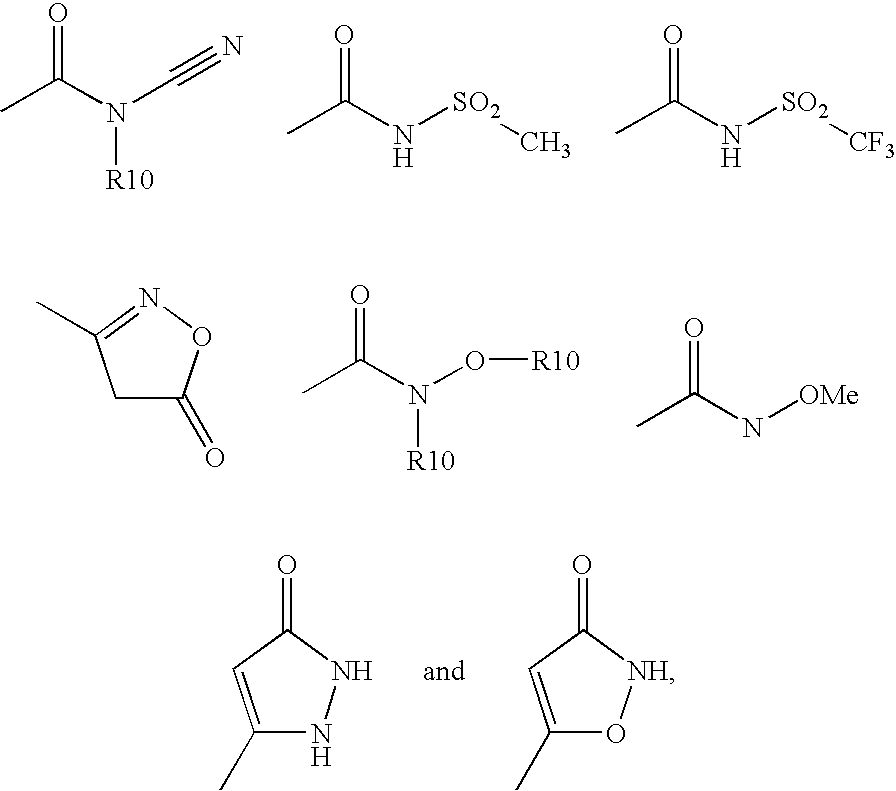
wherein Me is methyl, or
- if two —OR19 residues are attached to adjacent atoms they can form together with the atoms which they are attached to a 1,3-dioxolane ring or a 2,3-dihydro-[1,4]dioxine ring, which is substituted one, two, three or four times by R8, or
- if two R13 are attached to the same carbon atom they can form together a 3- to 8-membered carbocyclic ring, which is unsubstituted or substituted one, two or three times by R10, or
- if two R13 are attached to the same carbon atom they can form together a 3- to 8-membered heterocyclic ring, which is unsubstituted or substituted one, two or three times by R10, or
- R13 and R3 together with the atoms to which they are bonded form a 5- to 7-membered cyclic group, wherein one of the carbon atoms within said cyclic group can be selected from nitrogen, oxygen or sulphur selected out of the group isothiazolidine 1,1-dioxide; 2,5-dihydro-isothiazole 1,1-dioxide; 2,3-dihydro-isothiazole 1,1-dioxide; [1,2]thiazinane 1,1-dioxide; 2H-[1,2]thiazine 1,1-dioxide; 5,6-dihydro-2H-[1,2]thiazine 1,1-dioxide; 3,4-dihydro-2H-[1,2]thiazine 1,1-dioxide; 3,6-dihydro-2H-[1,2]thiazine 1,1-dioxide; [1,2]thiazepane 1,1-dioxide; 2,5,6,7-tetrahydro-[1,2]thiazepine 1,1-dioxide; 2,7-dihydro-[1,2]thiazepine 1,1-dioxide; 2,5-dihydro-[1,2]thiazepine 1,1-dioxide; [1,2,4]thiadiazolidine 1,1-dioxide; [1,2,3]thiadiazolidine 1,1-dioxide; 2,5-dihydro-[1,2,4]thiadiazole 1,1-dioxide; [1,3,4]oxathiazolidine 3,3-dioxide; [1,3,2]oxathiazo-lidine 3,3-dioxide; [1,4,2]dithiazolidine 1,1-dioxide; [1,3,2]dithiazolidine 1,1-dioxide; [1,2,5]thiadiazinane 1,1-dioxide; [1,3,4]oxathiazinane 3,3-dioxide; [1,4,3]oxathiazinane 4,4-dioxide; [1,5,2]dithiazinane 1,1-dioxide; [1,2,6]thiadiazepane 1,1-dioxide; [1,3,4]oxathiazepane 3,3-dioxide or [1,6,2]dithiazepane 1,1-dioxide and wherein said cyclic group is unsubstituted or substituted one, two or three times by R7,
- R21 and R22 are the same or different and are independently of one another
- 1) hydrogen atom,
- 2) —(C1-C6)-alkyl, wherein alkyl is unsubstituted or mono-, di- or trisubstituted independently of one another by R7,
- 3) —(C0-C6)-alkylene-(C3-C6)-cycloalkyl,
- 4) —SOt—R10, wherein t is 1 or 2,
- 5) —(C0-C6)-alkylene-(C6-C14)-aryl, wherein aryl is as defined above and alkylene and aryl independently from one another are unsubstituted or mono-, di- or trisubstituted by R7,
- 6) —(C1-C3)-perfluoroalkyl,
- 7) —O—R12 or
- 8) —(C0-C6)-alkylene-heterocyclyl, wherein heterocyclyl is as defined above and alkylene and heterocyclyl independently from one another are unsubstituted or mono-, di- or trisubstituted by R7, or
- R21 and R22 together with the nitrogen atom to which they are bonded can form a heterocyclic ring from the group azepine, azetidine, dioxazole, dioxazine, 1,4-diazepane, 1,2-diazepine, 1,3-diazepine, 1,4-diazepine, imidazole, imidazoline, imidazolidine, isothiazolidine, isothiazoline, isoxazoline, isoxazolidine, 2-isoxazoline, ketomorpholine, ketopiperazine, N-methyl-[1,4]diazepane, N-methyl-piperazine, morpholine, [1,4]oxazepane, 1,4-oxazepine, piperazine, piperidine, pyrazine, pyrazole, pyrazoline, pyrazolidine, pyridazine, pyridine, pyrimidine, pyrrole, pyrrolidine, pyrrolidinone, pyrroline, tetrahydropyridine, tetrazine, tetrazole, thiazolidine, thiazoline, thiomorpholine, 1,2,3-triazine, 1,2,4-triazine, 1,3,5-triazine, 1,2,3-triazole or 1,2,4-triazole, wherein the heterocyclic ring is unsubstituted or mono-, di- or trisubstituted by R7,
- R23 is hydrogen atom, —OH or —O—(C1-C4)-alkyl,
- G2 is azetidine, pyrrolidine, piperidine, azepane, piperazine, [1,3]diazepane or [1,4]diazepane,
- wherein G2 is unsubstituted or mono-, di-, tri- or tetrasubstituted independently of one another by M or Y,
- M is —(C1-C6)-alkyl, —(C2-C6)-alkenyl, —(C2-C6)-alkinyl, —(C3-C6)-cycloalkyl, —(C0-C2)-alkylene-aryl, wherein aryl is as defined above, —(C1-C4)-alkyl-(C3-C6)-cycloalkyl, pyridyl or piperidinyl, wherein piperidinyl is unsubstituted or substituted by —(C1-C6)-alkyl,
- Y is hydrogen atom, halogen, ═O, —OH, —CF3, —C(O)—O—R10, —C(O)—N(R10)-R20, —N(R10)-R20,
- —(C3-C9)-cycloalkyl, —(C0-C3)-alkylene-O—R10, —(C1-C8)-alkyl, —(C1-C8)-alkoxy, phenyl, —O—R9,
- —(C1-C3)-perfluoroalkyl, —O—CF3, —(C0-C4)-alkylene-C(O)—O—C(R9,R11)-O—C(O)—R12 or
- —(C0-C4)-alkylene-C(O)—O—C(R9,R11)-O—C(O)—O—R12,
- in all its stereoisomeric forms and mixtures thereof in any ratio, and its physiologically tolerable salts.
- 3) The present invention also relates to the compounds of the formula I, wherein
- X is sulfur, oxygen or the residues —CH═CH— or —CH═N—,
- V is hydrogen atom, R1 is chlorine, bromine or methyl,
- R2 is hydrogen atom,
- R3 is a hydrogen atom, —(C0-C3)-alkylene-C(O)—NH—R6, —(C0-C3)-alkylene-C(O)—N(R21)-R22,
- (C0-C3)-alkylene-C(O)—R10, —(C0-C3)-alkylene-C(O)—O—R10, —(C1-C3)-alkylene-S(O)2—(C1-C4)-alkyl, —(C1-C3)-alkylene-S(O)2-phenyl, —(C0-C5)-alkylene-(C1-C3)-perfluoroalkyl,
- —(C0-C5)-alkylene-(C3-C6)-cycloalkyl-R23, —(C1-C4)-alkyl, wherein alkyl is unsubstituted or mono-, di- or trisubstituted independently of one another by R8, —(C0-C4)-alkylene-phenyl, wherein phenyl is unsubstituted or mono-, di- or trisubstituted independently of one another by R8 or —(C0-C4)-alkylene-heterocyclyl, wherein heterocyclyl is as defined below and is unsubstituted or mono-, di- or trisubstituted independently of one another by R8,
- R6 is heterocyclyl, wherein heterocyclyl is selected out of the group azabenzimidazolyl, azepinyl, azetidinyl, benzimidazolyl, benzisoxazolyl, benzisothiazolyl, 1,3-benzodioxolyl, benzofuranyl, benzoxazolyl, benzothiazolyl, benzothiophenyl, cinnolinyl, chromanyl, furanyl, imidazolyl, indanyl, 1H-indazolyl, indolyl, isochromanyl, isoindolyl, isoquinolinyl, isothiazolyl, isoxazolyl, ketopiperazinyl, morholinyl, naphthyridinyl, oxadiazolyl, oxazolyl, phenylpyridyl, phthalazinyl, piperazinyl, piperidinyl, pteridinyl, purinyl, pyrazinyl, pyrazolyl, pyridazinyl, pyridyl, pyridoimidazolyl, pyridooxazolyl, pyridopyrimidinyl, pyridothienyl, pyrimidinyl, pyrrolidinyl, pyrrolidinonyl, pyrrolyl, quinazolinyl, quinolinyl, quinolyl, quinoxalinyl, tetrahydroisoquinolinyl, tetrahydropyranyl, 1,4,5,6-tetrahydro-pyridazinyl, tetrazolyl, thiazolyl, thiadiazolyl, thienyl, thiomorpholinyl or triazolyl, and wherein heterocyclyl is independently of one another unsubstituted or mono-, di- or trisubstituted by R7,
- R7 is halogen, carbamimidoyl, —NO2, ═O, —CF3, —C(O)—O—R10, —CN, —C(O)—NH2, —OH, —NH2, —O—CF3, —C(O)—N(R10)-R20, —N(R10)-R20, —(C3-C9)-cycloalkyl, —O—(C1-C8)-alkyl, wherein alkyl is unsubstituted or mono-, di- or trisubstituted independently of one another by halogen, NH2, —OH or a methoxy residue, or —(C1-C8)-alkyl, wherein alkyl is unsubstituted or mono-, di- or trisubstituted independently of one another by halogen, NH2, —OH or a methoxy residue, or —SO2—CH3 or —SO2—CF3,
- R8 is halogen, ═O, —OH, —CF3, —C(O)—O—R10, —C(O)—N(R21)-R22, —N(R21)-R22, —(C3-C6)-cycloalkyl,
- —(C0-C3)-alkylene-O—R10, —N(R10)-S(O)u—R10, wherein u is 1 or 2, —S—R10, —SOr—R10, wherein r is 1 or 2, —S(O)v—N(R10)-R20, wherein v is 1 or 2,
- —C(O)—R10, —(C1-C8)-alkyl, —(C1-C8)-alkoxy, phenyl, phenyloxy-, —(C1-C3)-perfluoroalkyl, —(C0-C4)-alkyl-C(O)—O—C(R9,R11)-O—C(O)—R12,
- —O—R9, —NH—C(O)—NH—R10, —N(R21)-C(O)—R22, —(C0-C4)-alkyl-C(O)—O—C(R9, R11)-O—C(O)—O—R12,
- —O—CF3, —NH—C(O)—O—R10, or heterocyclyl, wherein heterocyclyl is as defined above and wherein heterocyclyl is independently of one another unsubstituted or mono- or disubstituted by R7,
- R10 and R20 are the same or different and are independently of one another hydrogen atom, halogen, —(C1-C6)-alkyl, —(C0-C4)-alkyl-OH, —(C0-C4)-alkylene-O—(C1-C4)-alkyl or
- —(C1-C3)-perfluoroalkyl or —(C0-C5)-alkylene-(C3-C8)-cycloalkyl,
- R9 and R11 are the same or different and are independently of one another hydrogen,
- —(C1-C6)-alkyl, or together with the carbon atom to which they are bonded they form a cyclopropyl, cyclobutyl, cyclopentyl or cyclohexyl ring, which is unsubstituted or substituted one, two or three times by R10, and
- R12 is —(C1-C6)-alkyl, —(C1-C6)-alkyl-OH, —(C1-C6)-alkylene-O—(C1-C6)-alkyl, —(C3-C6)-cycloalkyl,
- —(C1-C6)-alkylene-O—(C1-C8)-alkylene-(C3-C6)-cycloalkyl, —(C1-C6)-alkylene-(C3-C6)-cycloalkyl, wherein said cycloalkyl ring is unsubstituted or substituted one, two or three times by —OH,
- —O—(C1-C4)-alkyl or R10,
- G1 is —(C2-C4)-alkylene or —(C3-C6)-cycloalkyl, wherein —(C2-C4)-alkylene or —(C3-C6)-cycloalkyl are unsubstituted or mono- di-, tri- or tetrasubstituted independently of one another by R13,
- R13 is a hydrogen atom, fluorine, —(C0-C4)-alkylene-N(R21)-R22, —(C0-C4)-alkylene-C(O)—N(R21)-R22, —(C0-C4)-alkylene-O—R22, —(C0-C4)-alkylene-OH, —(C0-C4)-alkylene-C(O)—O—R21,
- —(C0-C4)-alkylene-N(R21)-C(O)—R22, —(C0-C4)-alkylene-N(R21)-C(O)—O—R22, —(C1-C4)-alkyl, wherein alkyl is unsubstituted or mono-, di- or trisubstituted independently of one another by R8,
- —(C0-C4)-alkylene-(C6-C14)-aryl, wherein —(C6-C14)-aryl is selected out of the group phenyl, naphthyl, biphenylyl, anthryl or fluorenyl and alkylene and aryl are independently of one another unsubstituted or mono-, di- or trisubstituted by R8, or
- —(C0-C4)-alkylene-heterocyclyl, wherein heterocyclyl is as defined above and alkylene and wherein heterocyclyl are independently of one another unsubstituted or mono-, di- or trisubstituted by R8,
- if two R13 are attached to the same carbon atom they can form together a 3- to 8-membered carbocyclic ring, which is unsubstituted or substituted one, two or three times by R10, or
- R13 and R3 together with the atoms to which they are bonded form a isothiazolidine 1,1-dioxide, [1,2]thiazinane 1,1-dioxide or [1,4,3]oxathiazinane 4,4-dioxide group and wherein said group is unsubstituted or substituted one or two times by R7,
- R21 and R22 are independently of one another identical or different and are
- 1) hydrogen atom,
- 2) —(C1-C6)-alkyl, wherein alkyl is unsubstituted or mono-, di- or trisubstituted independently of one another by R7,
- 3) —(C0-C3)-alkylene-heterocyclyl, wherein heterocyclyl is unsubstituted or mono-, di- or trisubstituted by R7,
- 4) —(C0-C3)-alkylene-(C3-C6)-cycloalkyl,
- 5) —(C1-C3)-perfluoroalkyl, or
- 6) —(C0-C6)-alkylene-phenyl, wherein phenyl is as defined above and wherein alkyl and phenyl are independently from one another unsubstituted or mono-, di- or trisubstituted by R7,
- R21 and R22 together with the nitrogen atom to which they are bonded can form a heterocyclic ring from the group azepine, azetidine, 1,4-diazepane, 1,3-diazepine, 1,4-diazepine, imidazole, isothiazoline, isoxazoline, isoxazolidine, 2-isoxazoline, ketomorpholine, ketopiperazine, N-methyl-[1,4]diazepane, N-methyl-piperazine, morpholine, [1,4]oxazepane, 1,4-oxazepine, piperazine, piperidine, pyrazole, pyrazoline, pyrazolidine, pyrrole, pyrrolidine, pyrrolidinone, pyrroline, tetrahydropyridine, tetrazole, thiazolidine, thiazoline, thiomorpholine, 1,2,3-triazole or 1,2,4-triazole,
- R23 is hydrogen atom, —OH or —O—(C1-C4)-alkyl,
- G2 is azetidine, piperazine or piperidine,
- wherein G2 is unsubstituted or mono-, di- or trisubstituted independently of one another by M, and
- M is —(C1-C6)-alkyl, cyclopropyl, benzyl or pyridyl,
- in all its stereoisomeric forms and mixtures thereof in any ratio, and its physiologically tolerable salts.
- 4) The present invention also relates to the compounds of the formula Ia, wherein
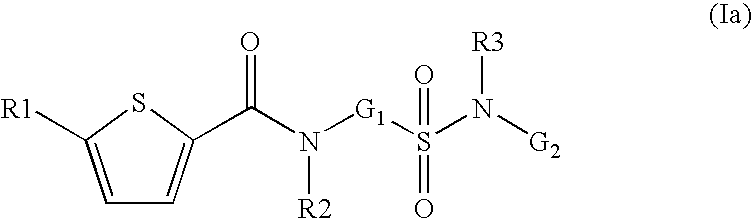
- R1 is chlorine, bromine or methyl,
- R2 is hydrogen atom,
- R3 is a hydrogen atom, —(C0-C3)-alkylene-C(O)—NH—R6, —(C0-C3)-alkylene-C(O)—N(R21)-R22,
- —(C0-C3)-alkylene-C(O)—R10, —(C0-C3)-alkylene-C(O)—O—R10, —(C1-C3)-alkylene-S(O)2-phenyl,
- —(C0-C5)-alkylene-(C1-C3)-perfluoroalkyl, —(C0-C5)-alkylene-(C3-C6)-cycloalkyl,
- —(C1-C4)-alkyl, wherein alkyl is unsubstituted or mono-, di- or trisubstituted independently of one another by R8, —(C0-C4)-alkylene-phenyl, wherein phenyl is unsubstituted or mono-, di- or trisubstituted independently of one another by R8, or —(C0-C4)-alkylene-heterocyclyl, wherein heterocyclyl is as defined below and is unsubstituted or mono-, di or trisubstituted independently of one another by R8,
- R6 is heterocyclyl, wherein heterocyclyl is selected out of the group azabenzimidazolyl, azepinyl, azetidinyl, benzimidazolyl, benzisoxazolyl, benzisothiazolyl, 1,3-benzodioxolyl, benzofuranyl, benzoxazolyl, benzothiazolyl, benzothiophenyl, cinnolinyl, chromanyl, furanyl, imidazolyl, indanyl, 1H-indazolyl, indolyl, isochromanyl, isoindolyl, isoquinolinyl, isothiazolyl, isoxazolyl, ketopiperazinyl, morholinyl, naphthyridinyl, oxadiazolyl, oxazolyl, phenylpyridyl, phthalazinyl, piperazinyl, piperidinyl, pteridinyl, purinyl, pyrazinyl, pyrazolyl, pyridazinyl, pyridyl, pyridoimidazolyl, pyridooxazolyl, pyridopyrimidinyl, pyridothienyl, pyrimidinyl, pyrrolidinyl, pyrrolidinonyl, pyrrolyl, quinazolinyl, quinolinyl, quinolyl, quinoxalinyl, tetrahydroisoquinolinyl, tetrahydropyranyl, 1,4,5,6-tetrahydro-pyridazinyl, tetrazolyl, thiazolyl, thiadiazolyl, thienyl, thiomorpholinyl or triazolyl, and wherein heterocyclyl is independently of one another unsubstituted or mono-, di- or trisubstituted by R7,
- R7 is halogen, ═O, —CF3, —C(O)—O—R10, —CN, —C(O)—NH2, —OH, —NH2, —O—CF3, —C(O)—N(R10)-R20, —N(R10)-R20, —(C3-C8)-cycloalkyl, —O—(C1-C8)-alkyl, wherein alkyl is unsubstituted or mono-, di- or trisubstituted independently of one another by halogen, NH2, —OH or a methoxy residue, or —(C1-C8)-alkyl, wherein alkyl is unsubstituted or mono-, di- or trisubstituted independently of one another by halogen, NH2, —OH or a methoxy residue,
- R8 is halogen, ═O, —OH, —CF3, —C(O)—O—R10, —C(O)—N(R21)-R22, —N(R21)-R22, —(C3-C6)-cycloalkyl,
- —(C0-C3)-alkylene-O—R10, —(C1-C6)-alkyl, —(C1-C8)-alkoxy, phenyl, phenyloxy-, —(C1-C3)-perfluoroalkyl, or heterocyclyl, wherein heterocyclyl is as defined above and wherein heterocyclyl is independently of one another unsubstituted or mono- or disubstituted by R7,
- G1 is —(C2-C4)-alkylene, wherein —(C2-C4)-alkylene is unsubstituted or mono- or disubstituted independently of one another by R13,
- R13 is a hydrogen atom, fluorine, —(C0-C4)-alkylene-N(R21)-R22, —(C0-C4)-alkylene-C(O)—N(R21)-R22, —(C0-C2)-alkylene-O—R22, —(C0-C4)-alkylene-OH, —(C0-C4)-alkylene-C(O)—O—R21, or
- —(C1-C4)-alkyl,
- R13 and R3 together with the atoms to which they are bonded form a isothiazolidine 1,1-dioxide, [1,2]thiazinane 1,1-dioxide or [1,4,3]oxathiazinane 4,4-dioxide group and wherein said group is unsubstituted or substituted one time by R7,
- R21 and R22 are independently of one another identical or different and are
- 1) hydrogen atom,
- 2) —(C1-C6)-alkyl, wherein alkyl is unsubstituted or mono-, di- or trisubstituted independently of one another by R7,
- 3) —(C0-C3)-alkylene-(C3-C6)-cycloalkyl,
- 4) —(C1-C3)-perfluoroalkyl, or
- 5) —(C0-C6)-alkylene-phenyl, wherein phenyl is as defined above and wherein alkylene and phenyl are independently from one another unsubstituted or mono-, di- or trisubstituted by R7, or
- R21 and R22 together with the nitrogen atom to which they are bonded can form a heterocyclic ring from the group N-methyl-piperazine or morpholine,
- R10 and R20 are the same or different and are independently of one another hydrogen atom, halogen, —(C1-C6)-alkyl, —(C0-C4)-alkyl-OH, —(C0-C4)-alkylene-O—(C1-C4)-alkyl,
- —(C1-C3)-perfluoroalkyl or —(C0-C3)-alkylene-(C3-C8)-cycloalkyl,
- R9 and R11 are the same or different and are independently of one another hydrogen,
- —(C1-C6)-alkyl, or together with the carbon atom to which they are bonded they form a cyclopropyl, cyclobutyl, cyclopentyl or cyclohexyl ring, which is unsubstituted or substituted one, two or three times by R10, and
- R12 is —(C1-C6)-alkyl, —(C1-C6)-alkyl-OH, —(C1-C6)-alkyl-O—(C1-C6)-alkyl, —(C3-C6)-cycloalkyl,
- —(C1-C6)-alkylene-O—(C1-C8)-alkyl-(C3-C6)-cycloalkyl, —(C1-C6)-alkylene-(C3-C6)-cycloalkyl, wherein said cycloalkyl ring is unsubstituted or substituted one, two or three times by —OH,
- —O—(C1-C4)-alkyl or R10,
- G2 is azetidine, piperazine or piperidine,
- wherein G2 is unsubstituted or monosubstituted by isopropyl, cyclopropyl, benzyl or pyridyl,
- in all its stereoisomeric forms and mixtures thereof in any ratio, and its physiologically tolerable salts.
- 5) The present invention also relates to the compounds of the formula Ia, wherein
- R1 is bromine, methyl or chlorine,
- R2 is hydrogen atom,
- R3 is a hydrogen atom, —(C0-C1)-alkylene-C(O)—NH—R6, —(C0-C1)-alkylene-C(O)—N(R21)-R22,
- —(C0-C2)-alkylene-C(O)—R10, —(C0-C1)-alkylene-(C1-C2)-perfluoroalkyl, —(C1-C3)-alkyl,
- —(C1-C2)-alkylene-S(O)2-phenyl, —(C1-C3)-alkylene-O—R10 or —(C0-C4)-alkylene-heterocyclyl, wherein heterocyclyl is as defined below and is unsubstituted or mono- or disubstituted independently of one another by R8,
- R6 is heterocyclyl, wherein heterocyclyl is selected out of the group benzisoxazolyl, isoxazolyl, morpholinyl, pyridyl, thiazolyl, thiadiazolyl or thienyl, and wherein heterocyclyl is independently of one another unsubstituted or mono-, di- or trisubstituted by R7,
- R7 is chlorine or ═O,
- R8 is —(C3-C6)-cycloalkyl, —NH2, —(C1-C4)-alkyl, or heterocyclyl, wherein heterocyclyl is as defined above and wherein heterocyclyl is independently of one another unsubstituted or mono- or disubstituted by R7,
- R10 is hydrogen atom, —(C0-C2)-alkylene-(C3-C6)-cycloalkyl or —(C1-C4)-alkyl,
- R21 and R22 are independently of one another identical or different and are hydrogen atom or
- —(C1-C4)-alkyl,
- R21 and R22 together with the nitrogen atom to which they are bonded can form a heterocyclic ring from the group N-methyl-piperazine or morpholine,
- G1 is —(C2-C4)-alkylene, wherein —(C2-C4)-alkylene is unsubstituted or mono- or disubstituted independently of one another by R13,
- R13 is a hydrogen atom, —(C1-C2)-alkylene-O—R22, —(C1-C2)-alkylene-OH, —(C0-C2)-alkylene-C(O)—OH,
- —(C0-C1)-alkylene-C(O)—N(R21)-R22, or —(C1-C4)-alkyl, or
- R13 and R3 together with the atoms to which they are bonded form a isothiazolidine 1,1-dioxide, [1,2]thiazinane 1,1-dioxide or [1,4,3]oxathiazinane 4,4-dioxide group and wherein said group is unsubstituted or substituted one time by ═O,
- G2 is azetidine, piperazine or piperidine,
- wherein G2 is unsubstituted or monosubstituted by isopropyl, cyclopropyl, benzyl or pyridyl,
- in all its stereoisomeric forms and mixtures thereof in any ratio, and its physiologically tolerable salts.
- 6) The present invention also relates to the compounds of the formula I, which are
- 5-Chloro-thiophene-2-carboxylic acid [2-(1-isopropyl-piperidin-4-ylsulfamoyl)-ethyl]-amide,
- 5-Chloro-thiophene-2-carboxylic acid [2-(1-cyclopropyl-piperidin-4-ylsulfamoyl)-ethyl]-amide,
- 5-Chloro-thiophene-2-carboxylic acid {2-[(1-isopropyl-piperidin-4-yl)-methyl-sulfamoyl]-ethyl}-amide,
- 5-Chloro-thiophene-2-carboxylic acid {2-[(1-isopropyl-piperidin-4-yl)-(2,2,2-trifluoro-ethyl)-sulfamoyl]-ethyl}-amide,
- 5-Chloro-thiophene-2-carboxylic acid [2-(3,4,5,6-tetrahydro-2H-[1,4′]bipyridinyl-4-ylsulfamoyl)-ethyl]-amide,
- 5-Chloro-thiophene-2-carboxylic acid[2-(azetidin-3-ylsulfamoyl)-ethyl]-amide,
- 5-Chloro-thiophene-2-carboxylic acid [2-(1-isopropyl-azetidin-3-ylsulfamoyl)-ethyl]-amide,
- 5-Chloro-thiophene-2-carboxylic acid [2-(4-benzyl-piperazin-1-ylsulfamoyl)-ethyl]-amide,
- 5-Bromo-thiophene-2-carboxylic acid [2-(1-isopropyl-piperidin-4-ylsulfamoyl)-ethyl]-amide,
- 5-Methyl-thiophene-2-carboxylic acid [2-(1-isopropyl-piperidin-4-ylsulfamoyl)-ethyl]-amide,
- 5-Bromo-furan-2-carboxylic acid [2-(1-isopropyl-piperidin-4-ylsulfamoyl)-ethyl]-amide,
- 4-Chloro-N-[2-(1-isopropyl-piperidin-4-ylsulfamoyl)-ethyl]-benzamide,
- 5-Chloro-pyridine-2-carboxylic acid[2-(1-isopropyl-piperidin-4-ylsulfamoyl)-ethyl]-amide,
- 3-Chloro-N-[2-(1-isopropyl-piperidin-4-ylsulfamoyl)-ethyl]-benzamide,
- 5-Chloro-thiophene-2-carboxylic acid {2-[(1-isopropyl-piperidin-4-yl)-(2-methoxy-ethyl)-sulfamoyl]-ethyl}-amide,
- 5-Chloro-thiophene-2-carboxylic acid {2-[(2-hydroxy-ethyl)-(1-isopropyl-piperidin-4-yl)-sulfamoyl]-ethyl}-amide,
- 5-Chloro-thiophene-2-carboxylic acid {2-[(3-hydroxy-propyl)-(1-isopropyl-piperidin-4-yl)-sulfamoyl]-ethyl}-amide,
- 5-Chloro-thiophene-2-carboxylic acid {2-[dimethylcarbamoylmethyl-(1-isopropyl-piperidin-4-yl)-sulfamoyl]-ethyl}-amide,
- 5-Chloro-thiophene-2-carboxylic acid {2-[(1-isopropyl-piperidin-4-yl)-(2-morpholin-4-yl-2-oxo-ethyl)-sulfamoyl]-ethyl}-amide,
- 5-Chloro-thiophene-2-carboxylic acid {2-[carbamoylmethyl-(1-isopropyl-piperidin-4-yl)-sulfamoyl]-ethyl}-amide,
- 5-Chloro-thiophene-2-carboxylic acid {2-[(1-isopropyl-piperidin-4-yl)-(5-methyl-isoxazol-3-ylmethyl)-sulfamoyl]-ethyl}-amide,
- 5-Chloro-thiophene-2-carboxylic acid {2-[(1-isopropyl-piperidin-4-yl)-pyridin-3-ylmethyl-sulfamoyl]-ethyl}-amide,
- 5-Chloro-thiophene-2-carboxylic acid {2-[(1-isopropyl-piperidin-4-yl)-thiazol-2-ylmethyl-sulfamoyl]-ethyl}-amide,
- 5-Chloro-thiophene-2-carboxylic acid {2-[(1-isopropyl-piperidin-4-yl)-propylaminocarbonyl-sulfamoyl]-ethyl}-amide,
- 5-Chloro-thiophene-2-carboxylic acid {2-[acetyl-(1-isopropyl-piperidin-4-yl)-sulfamoyl]-ethyl}-amide,
- 5-Chloro-thiophene-2-carboxylic acid [2-(1-isopropyl-piperidin-4-ylsulfamoyl)-propyl]-amide,
- 5-Chloro-thiophene-2-carboxylic acid [(S)-1-hydroxymethyl-2-(1-isopropyl-piperidin-4-ylsulfamoyl)-ethyl]-amide,
- 5-Chloro-thiophene-2-carboxylic acid [2-(1-isopropyl-piperidin-4-ylsulfamoyl)-1,1-dimethyl-ethyl]-amide,
- 5-Chloro-thiophene-2-carboxylic acid [3-(1-isopropyl-piperidin-4-ylsulfamoyl)-propyl]-amide,
- 4-[(5-Chloro-thiophene-2-carbonyl)-amino]-3-(1-isopropyl-piperidin-4-ylsulfamoyl)-butyric acid,
- 5-Chloro-thiophene-2-carboxylic acid [2-(1-isopropyl-piperidin-4-yl)-1,1,3-trioxo-1λ6-isothiazolidin-5-ylmethyl]-amide,
- 5-Chloro-thiophene-2-carboxylic acid {2-[[5-(5-chloro-thiophen-2-yl)-isoxazol-3-ylmethyl]-(1-isopropyl-piperidin-4-yl)-sulfamoyl]-ethyl}-amide,
- 5-Chloro-thiophene-2-carboxylic acid {2-[(5-cyclopropyl-[1,3,4]thiadiazol-2-ylmethyl)-(1-isopropyl-piperidin-4-yl)-sulfamoyl]-ethyl}-amide or
- 5-Chloro-thiophene-2-carboxylic acid {2-[[(5-chloro-pyridin-2-ylcarbamoyl)-methyl]-(1-isopropyl-piperidin-4-yl)-sulfamoyl]-ethyl}-amide.
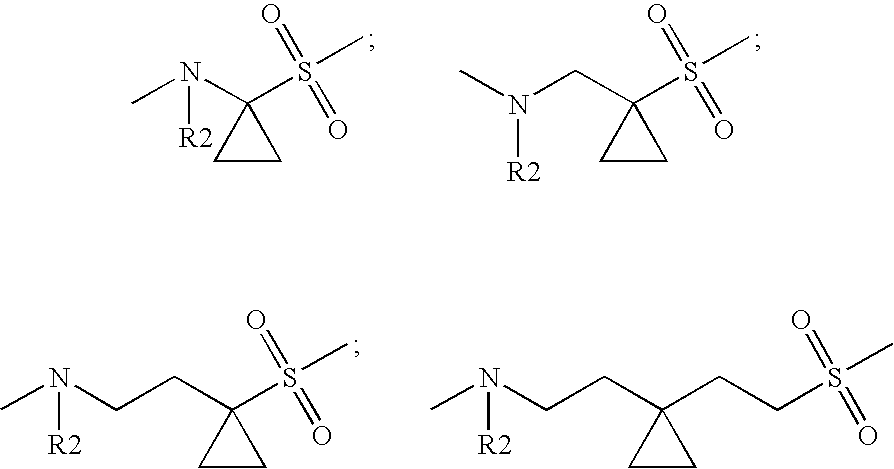


wherein the residue HN(R43)R44 has the donation of —N(R3)G2 as defined in the formula I, wherein
—N(R41)R42 has either the donation of —N(R2)C(O)-heterocycle, wherein heterocycle is a residue out of the group selected from furanyl, phenyl, pyridyl, pyrrolyl or thiophenyl, and is substituted by R1 and V, and wherein R2 is defined as in formula I, or optionally the residue —N(R41)R42 has the meaning of a precursor group, which can be subsequently converted into the residues —N(R2)C(O)-heterocycle of the formulae I or Ia. If —N(R41)R42 is a precursor group of —N(R2)C(O)-heterocycle, R41 or R42 can have the meaning of a protecting group suitable for nitrogen atom protection (see, for example, Greene and Wuts, Protective Groups in Organic Synthesis, Wiley, 1991, or P. Kocienski, Protecting Groups, Thieme 1994), for example the residue —N(R41)R42 can have the meaning of


- 5-Chloro-thiophene-2-carboxylic acid [3-hydroxy-2-(1-isopropyl-piperidin-4-ylsulfamoyl)-propyl]-amide,
- 5-Chloro-thiophene-2-carboxylic acid [2-(1-isopropyl-piperidin-4-ylsulfamoyl)-3-methoxy-propyl]-amide,
- 5-Chloro-thiophene-2-carboxylic acid [4-hydroxy-2-(1-isopropyl-piperidin-4-ylsulfamoyl)-butyl]-amide,
- 5-Chloro-thiophene-2-carboxylic acid [2-(1-isopropyl-piperidin-4-ylsulfamoyl)-4-methoxy-butyl]-amide,
- 5-Chloro-thiophene-2-carboxylic acid [3-carbamoyl-2-(1-isopropyl-piperidin-4-ylsulfamoyl)-propyl]-amide,
- 5-Chloro-thiophene-2-carboxylic acid [3-dimethylcarbamoyl-2-(1-isopropyl-piperidin-4-ylsulfamoyl)-propyl]-amide,
- 5-Chloro-thiophene-2-carboxylic acid [2-(1-isopropyl-piperidin-4-ylsulfamoyl)-4-morpholin-4-yl-4-oxo-butyl]-amide,
- 5-Chloro-thiophene-2-carboxylic acid [2-(1-isopropyl-piperidin-4-ylsulfamoyl)-4-(4-methyl-piperazin-1-yl)-4-oxo-butyl]-amide,
- 5-Chloro-thiophene-2-carboxylic acid (2-{(1-isopropyl-piperidin-4-yl)-[2-(4-methyl-piperazin-1-yl)-2-oxo-ethyl]-sulfamoyl}-ethyl)-amide,
- 5-Chloro-thiophene-2-carboxylic acid {2-[benzenesulfonylmethyl-(1-isopropyl-piperidin-4-yl)-sulfamoyl]-ethyl}-amide,
- 5-Chloro-thiophene-2-carboxylic acid {2-[(3-amino-benzo[d]isoxazol-5-ylmethyl)-(1-isopropyl-piperidin-4-yl)-sulfamoyl]-ethyl}-amide,
- 5-Chloro-thiophene-2-carboxylic acid {2-[(1-isopropyl-piperidin-4-yl)-(5-methyl-isoxazol-3-yl)-sulfamoyl]-ethyl}-amide,
- 5-Chloro-thiophene-2-carboxylic acid {2-[(1-isopropyl-piperidin-4-yl)-(5-methyl-thiazol-2-yl)-sulfamoyl]-ethyl}-amide,
- 5-Chloro-thiophene-2-carboxylic acid {2-[(1-isopropyl-piperidin-4-yl)-pyridin-2-yl-sulfamoyl]-ethyl}-amide,
- 5-Chloro-thiophene-2-carboxylic acid {2-[cyclopropanecarbonyl-(1-isopropyl-piperidin-4-yl)-sulfamoyl]-ethyl}-amide,
- 5-Chloro-thiophene-2-carboxylic acid [2-(1-isopropyl-piperidin-4-yl)-1,1-dioxo-1λ6-isothiazolidin-5-ylmethyl]-amide,

- 5-Chloro-thiophene-2-carboxylic acid [2-(1-isopropyl-piperidin-4-yl)-1,1-dioxo-1λ6-[1,2]thiazinan-6-ylmethyl]-amide,

- 5-Chloro-thiophene-2-carboxylic acid [2-(1-isopropyl-piperidin-4-yl)-1,1,3-trioxo-1λ6-[1,2]thiazinan-6-ylmethyl]-amide,

- 5-Chloro-thiophene-2-carboxylic acid [3-(1-isopropyl-piperidin-4-yl)-2,4,4-trioxo-4λ6-[1,4,3]oxathiazinan-5-ylmethyl]-amide.

Pharmacological Testing
Ki=IC50/{1+(substrate concentration/Km)}
wherein Km is the Michaelis-Menten constant (Chen and Prusoff, Biochem. Pharmacol. 22 (1973) 3099-3108; I. H. Segal, Enzyme Kinetics, 1975, John Wiley & Sons, New York, 100-125).
a) Factor Xa Assay
| TABLE 1 | |||
| Example | Ki (FXa) [μM] | ||
| 1 | 0.010 | ||
| 2 | 0.167 | ||
| 3 | 0.007 | ||
| 4 | 0.015 | ||
| 5 | 0.066 | ||
| 6 | 20.477 | ||
| 7 | 7.254 | ||
| 8 | 1.103 | ||
| 9 | 0.006 | ||
| 10 | 0.259 | ||
| 11 | 3.153 | ||
| 12 | 0.572 | ||
| 13 | 4.467 | ||
| 14 | 19.592 | ||
| 15 | 0.005 | ||
| 16 | 0.004 | ||
| 17 | 0.004 | ||
| 18 | 0.005 | ||
| 19 | 0.005 | ||
| 20 | 0.003 | ||
| 21 | 0.004 | ||
| 22 | 0.008 | ||
| 23 | 0.006 | ||
| 24 | 0.004 | ||
| 25 | 0.003 | ||
| 26 | 0.013 | ||
| 27 | 1.254 | ||
| 28 | 3.387 | ||
| 29 | 0.399 | ||
| 31 | 0.032 | ||
| 32 | 0.006 | ||
| 33 | 0.006 | ||
Claims (3)
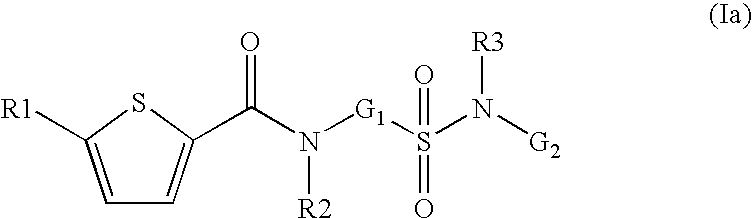
Applications Claiming Priority (4)
| Application Number | Priority Date | Filing Date | Title |
|---|---|---|---|
| EP05010929A EP1724269A1 (en) | 2005-05-20 | 2005-05-20 | Heteroaryl-carboxylic acid (sulfamoyl alkyl) amide - derivatives as factor Xa inhibitors |
| EP05010929.7 | 2005-05-20 | ||
| EP05010929 | 2005-05-20 | ||
| PCT/EP2006/004255 WO2006122661A1 (en) | 2005-05-20 | 2006-05-06 | Heteroaryl-carboxylic acid (sulfamoyl alkyl) amide - derivatives as factor xa inhibitors |
Related Parent Applications (1)
| Application Number | Title | Priority Date | Filing Date |
|---|---|---|---|
| PCT/EP2006/004255 Continuation WO2006122661A1 (en) | 2005-05-20 | 2006-05-06 | Heteroaryl-carboxylic acid (sulfamoyl alkyl) amide - derivatives as factor xa inhibitors |
Publications (2)
| Publication Number | Publication Date |
|---|---|
| US20080167346A1 US20080167346A1 (en) | 2008-07-10 |
| US8088925B2 true US8088925B2 (en) | 2012-01-03 |
Family
ID=35116052
Family Applications (1)
| Application Number | Title | Priority Date | Filing Date |
|---|---|---|---|
| US11/940,654 Expired - Fee Related US8088925B2 (en) | 2005-05-20 | 2007-11-15 | Heteroaryl-carboxylic acid (sulfamoyl alkyl) amide-derivatives as factor Xa inhibitors |
Country Status (25)
| Country | Link |
|---|---|
| US (1) | US8088925B2 (en) |
| EP (2) | EP1724269A1 (en) |
| JP (1) | JP5027802B2 (en) |
| KR (1) | KR101373533B1 (en) |
| CN (1) | CN101180296B (en) |
| AR (1) | AR053730A1 (en) |
| AT (1) | ATE452133T1 (en) |
| AU (1) | AU2006246669B2 (en) |
| BR (1) | BRPI0610320A2 (en) |
| CA (1) | CA2609288C (en) |
| DE (1) | DE602006011156D1 (en) |
| DK (1) | DK1888567T3 (en) |
| DO (1) | DOP2006000119A (en) |
| ES (1) | ES2338151T3 (en) |
| GT (1) | GT200600211A (en) |
| IL (1) | IL187430A (en) |
| MX (1) | MX2007014274A (en) |
| MY (1) | MY150693A (en) |
| PA (1) | PA8675301A1 (en) |
| PE (1) | PE20061452A1 (en) |
| PT (1) | PT1888567E (en) |
| SV (1) | SV2007002534A (en) |
| TW (1) | TWI376377B (en) |
| UY (1) | UY29550A1 (en) |
| WO (1) | WO2006122661A1 (en) |
Families Citing this family (2)
| Publication number | Priority date | Publication date | Assignee | Title |
|---|---|---|---|---|
| WO2012149102A1 (en) * | 2011-04-29 | 2012-11-01 | Glaxosmithkline Llc | Novel compounds as wip1 inhibitors |
| EP3078378B1 (en) | 2015-04-08 | 2020-06-24 | Vaiomer | Use of factor xa inhibitors for regulating glycemia |
Citations (8)
| Publication number | Priority date | Publication date | Assignee | Title |
|---|---|---|---|---|
| WO2001096303A1 (en) | 2000-06-13 | 2001-12-20 | Eli Lilly And Company | Serine protease inhibitors |
| WO2004058709A1 (en) | 2002-12-23 | 2004-07-15 | Millennium Pharmaceuticals, Inc. | Ccr8 inhibitors |
| US20040224978A1 (en) | 2002-12-23 | 2004-11-11 | Millennium Pharmaceuticals, Inc. | CCR8 inhibitors |
| EP1479678A1 (en) | 2003-05-19 | 2004-11-24 | Aventis Pharma Deutschland GmbH | Pyrazole-derivatives as factor xa inhibitors |
| US20050085518A1 (en) | 2002-12-23 | 2005-04-21 | Millennium Pharmaceuticals, Inc. | Aryl sulfonamides useful as inhibitors of chemokine receptor activity |
| US20050096309A1 (en) | 2003-09-30 | 2005-05-05 | Wei Han | Sulfonylaminovalerolactams and derivatives thereof as factor Xa inhibitors |
| US20060052376A1 (en) | 2002-11-21 | 2006-03-09 | Merck Patent Gmbh | Carboxamides |
| US20070066615A1 (en) | 2003-05-19 | 2007-03-22 | Bayer Heathcare Ag | Heterocyclic compounds |
Family Cites Families (4)
| Publication number | Priority date | Publication date | Assignee | Title |
|---|---|---|---|---|
| HUT76346A (en) | 1994-04-26 | 1997-08-28 | Selectide Corp | Factor xa inhibitors |
| EP1217000A1 (en) * | 2000-12-23 | 2002-06-26 | Aventis Pharma Deutschland GmbH | Inhibitors of factor Xa and factor VIIa |
| HUP0304058A2 (en) * | 2001-01-30 | 2004-04-28 | Bristol-Myers Squibb Company | Sulfonamide lactam inhibitors of fxa and their use and pharmaceutical compositions containing them |
| BR0317659A (en) * | 2002-12-23 | 2005-12-06 | Aventis Pharma Gmbh | Pyrazole derivatives as factor xa inhibitors |
-
2005
- 2005-05-20 EP EP05010929A patent/EP1724269A1/en not_active Withdrawn
-
2006
- 2006-05-06 DE DE602006011156T patent/DE602006011156D1/en not_active Expired - Lifetime
- 2006-05-06 KR KR1020077027048A patent/KR101373533B1/en not_active Expired - Fee Related
- 2006-05-06 MX MX2007014274A patent/MX2007014274A/en active IP Right Grant
- 2006-05-06 CA CA2609288A patent/CA2609288C/en not_active Expired - Fee Related
- 2006-05-06 PT PT06753510T patent/PT1888567E/en unknown
- 2006-05-06 AU AU2006246669A patent/AU2006246669B2/en not_active Ceased
- 2006-05-06 AT AT06753510T patent/ATE452133T1/en active
- 2006-05-06 DK DK06753510.4T patent/DK1888567T3/en active
- 2006-05-06 EP EP06753510A patent/EP1888567B1/en not_active Expired - Lifetime
- 2006-05-06 ES ES06753510T patent/ES2338151T3/en not_active Expired - Lifetime
- 2006-05-06 BR BRPI0610320-0A patent/BRPI0610320A2/en not_active IP Right Cessation
- 2006-05-06 WO PCT/EP2006/004255 patent/WO2006122661A1/en not_active Ceased
- 2006-05-06 CN CN2006800172463A patent/CN101180296B/en not_active Expired - Fee Related
- 2006-05-06 JP JP2008511587A patent/JP5027802B2/en not_active Expired - Fee Related
- 2006-05-16 PE PE2006000516A patent/PE20061452A1/en not_active Application Discontinuation
- 2006-05-18 SV SV2006002534A patent/SV2007002534A/en unknown
- 2006-05-18 TW TW095117566A patent/TWI376377B/en not_active IP Right Cessation
- 2006-05-18 GT GT200600211A patent/GT200600211A/en unknown
- 2006-05-18 AR ARP060102004A patent/AR053730A1/en not_active Application Discontinuation
- 2006-05-18 PA PA20068675301A patent/PA8675301A1/en unknown
- 2006-05-18 MY MYPI20062281 patent/MY150693A/en unknown
- 2006-05-19 DO DO2006000119A patent/DOP2006000119A/en unknown
- 2006-05-19 UY UY29550A patent/UY29550A1/en unknown
-
2007
- 2007-11-15 IL IL187430A patent/IL187430A/en not_active IP Right Cessation
- 2007-11-15 US US11/940,654 patent/US8088925B2/en not_active Expired - Fee Related
Patent Citations (8)
| Publication number | Priority date | Publication date | Assignee | Title |
|---|---|---|---|---|
| WO2001096303A1 (en) | 2000-06-13 | 2001-12-20 | Eli Lilly And Company | Serine protease inhibitors |
| US20060052376A1 (en) | 2002-11-21 | 2006-03-09 | Merck Patent Gmbh | Carboxamides |
| WO2004058709A1 (en) | 2002-12-23 | 2004-07-15 | Millennium Pharmaceuticals, Inc. | Ccr8 inhibitors |
| US20040224978A1 (en) | 2002-12-23 | 2004-11-11 | Millennium Pharmaceuticals, Inc. | CCR8 inhibitors |
| US20050085518A1 (en) | 2002-12-23 | 2005-04-21 | Millennium Pharmaceuticals, Inc. | Aryl sulfonamides useful as inhibitors of chemokine receptor activity |
| EP1479678A1 (en) | 2003-05-19 | 2004-11-24 | Aventis Pharma Deutschland GmbH | Pyrazole-derivatives as factor xa inhibitors |
| US20070066615A1 (en) | 2003-05-19 | 2007-03-22 | Bayer Heathcare Ag | Heterocyclic compounds |
| US20050096309A1 (en) | 2003-09-30 | 2005-05-05 | Wei Han | Sulfonylaminovalerolactams and derivatives thereof as factor Xa inhibitors |
Also Published As
Similar Documents
| Publication | Publication Date | Title |
|---|---|---|
| US7910606B2 (en) | Pyrazole-derivatives as factor Xa inhibitors | |
| US7223780B2 (en) | Triazole-derivatives as blood clotting enzyme factor Xa inhibitors | |
| US7365088B2 (en) | Indazole-derivatives as factor Xa inhibitors | |
| US7465806B2 (en) | Pyrrole-derivatives as factor Xa inhibitors | |
| US20080280946A1 (en) | Azaindole-Derivatives As Factor Xa Inhibitors | |
| US20070179122A1 (en) | Beta-Aminoacid-Derivatives As Factor Xa Inhibitors | |
| US7741341B2 (en) | Benzimidazole-derivatives as factor Xa inhibitors | |
| CA2526082C (en) | Triazole-derivatives as factor xa inhibitors | |
| US20080167346A1 (en) | Heteroaryl-carboxylic acid (sulfamoyl alkyl) amide - derivatives as factor xa inhibitors | |
| US8835653B2 (en) | Chlorothiophene-isoxazoles as inhibitors of coagulation factors Xa and thrombin | |
| EP1636216B1 (en) | BENZIMIDAZOLE-DERIVATIVES AS FACTOR Xa INHIBITORS | |
| EP1479678A1 (en) | Pyrazole-derivatives as factor xa inhibitors | |
| MXPA06009847A (en) | BETA-AMINOACID-DERIVATIVES AS FACTOR Xa INHIBITORS | |
| HK1117157B (en) | Heteroaryl-carboxylic acid (sulfamoyl alkyl) amide - derivatives as factor xa inhibitors |
Legal Events
| Date | Code | Title | Description |
|---|---|---|---|
| AS | Assignment |
Owner name: SANOFI-AVENTIS, FRANCE Free format text: ASSIGNMENT OF ASSIGNORS INTEREST;ASSIGNORS:WAGNER, MICHAEL;URMANN, MATTHIAS;WEHNER, VOLKMAR;AND OTHERS;REEL/FRAME:020736/0498;SIGNING DATES FROM 20080130 TO 20080214 Owner name: SANOFI-AVENTIS, FRANCE Free format text: ASSIGNMENT OF ASSIGNORS INTEREST;ASSIGNORS:WAGNER, MICHAEL;URMANN, MATTHIAS;WEHNER, VOLKMAR;AND OTHERS;SIGNING DATES FROM 20080130 TO 20080214;REEL/FRAME:020736/0498 |
|
| ZAAA | Notice of allowance and fees due |
Free format text: ORIGINAL CODE: NOA |
|
| ZAAB | Notice of allowance mailed |
Free format text: ORIGINAL CODE: MN/=. |
|
| ZAAA | Notice of allowance and fees due |
Free format text: ORIGINAL CODE: NOA |
|
| ZAAB | Notice of allowance mailed |
Free format text: ORIGINAL CODE: MN/=. |
|
| STCF | Information on status: patent grant |
Free format text: PATENTED CASE |
|
| AS | Assignment |
Owner name: SANOFI, FRANCE Free format text: CHANGE OF NAME;ASSIGNOR:SANOFI-AVENTIS;REEL/FRAME:028413/0927 Effective date: 20110511 |
|
| FPAY | Fee payment |
Year of fee payment: 4 |
|
| AS | Assignment |
Owner name: DEUTSCHE BANK TRUST COMPANY AMERICAS, NEW YORK Free format text: GRANT OF FIRST PRIORITY AND JUNIOR PRIORITY SECURITY INTEREST IN PATENT RIGHTS;ASSIGNOR:SPRINT SPECTRUM L.P.;REEL/FRAME:041937/0632 Effective date: 20170203 |
|
| MAFP | Maintenance fee payment |
Free format text: PAYMENT OF MAINTENANCE FEE, 8TH YEAR, LARGE ENTITY (ORIGINAL EVENT CODE: M1552); ENTITY STATUS OF PATENT OWNER: LARGE ENTITY Year of fee payment: 8 |
|
| AS | Assignment |
Owner name: SPRINT SPECTRUM L.P., KANSAS Free format text: TERMINATION AND RELEASE OF FIRST PRIORITY AND JUNIOR PRIORITY SECURITY INTEREST IN PATENT RIGHTS;ASSIGNOR:DEUTSCHE BANK TRUST COMPANY AMERICAS;REEL/FRAME:052313/0299 Effective date: 20200401 |
|
| FEPP | Fee payment procedure |
Free format text: MAINTENANCE FEE REMINDER MAILED (ORIGINAL EVENT CODE: REM.); ENTITY STATUS OF PATENT OWNER: LARGE ENTITY |
|
| LAPS | Lapse for failure to pay maintenance fees |
Free format text: PATENT EXPIRED FOR FAILURE TO PAY MAINTENANCE FEES (ORIGINAL EVENT CODE: EXP.); ENTITY STATUS OF PATENT OWNER: LARGE ENTITY |
|
| STCH | Information on status: patent discontinuation |
Free format text: PATENT EXPIRED DUE TO NONPAYMENT OF MAINTENANCE FEES UNDER 37 CFR 1.362 |
|
| FP | Lapsed due to failure to pay maintenance fee |
Effective date: 20240103 |