US8088922B2 - Dibenzorylenetetracarboximides as infrared absorbers - Google Patents
Dibenzorylenetetracarboximides as infrared absorbers Download PDFInfo
- Publication number
- US8088922B2 US8088922B2 US12/302,836 US30283607A US8088922B2 US 8088922 B2 US8088922 B2 US 8088922B2 US 30283607 A US30283607 A US 30283607A US 8088922 B2 US8088922 B2 US 8088922B2
- Authority
- US
- United States
- Prior art keywords
- alkyl
- mono
- polysubstituted
- radicals
- interrupted
- Prior art date
- Legal status (The legal status is an assumption and is not a legal conclusion. Google has not performed a legal analysis and makes no representation as to the accuracy of the status listed.)
- Expired - Fee Related, expires
Links
- 0 *N1C(=O)C2=C3C4=C(C(C)=C2)C2=C5C(=CC=C(C)C5=C(C)C=C2)/C4=C(C)/C=C\3C1=O.*N1C(=O)C2=CC(C)=C3C4=CC=C5C6=C(C=CC(=C46)C4=C\3C2=C(\C=C/4C)C1=O)/C1=C2\C=CC=C\C2=C(/C)C2=C(C)C3=CC=CC=C3C5=C21 Chemical compound *N1C(=O)C2=C3C4=C(C(C)=C2)C2=C5C(=CC=C(C)C5=C(C)C=C2)/C4=C(C)/C=C\3C1=O.*N1C(=O)C2=CC(C)=C3C4=CC=C5C6=C(C=CC(=C46)C4=C\3C2=C(\C=C/4C)C1=O)/C1=C2\C=CC=C\C2=C(/C)C2=C(C)C3=CC=CC=C3C5=C21 0.000 description 38
- IYRYCRGIGDBJRE-UHFFFAOYSA-N C.C.C.C.C.CC.CC.CC.CC.CCC.CCC1=CC=CC=C1.CCC1=CC=NC=C1.CCC1=NC=CC=N1.CCC1=NC=NC=N1 Chemical compound C.C.C.C.C.CC.CC.CC.CC.CCC.CCC1=CC=CC=C1.CCC1=CC=NC=C1.CCC1=NC=CC=N1.CCC1=NC=NC=N1 IYRYCRGIGDBJRE-UHFFFAOYSA-N 0.000 description 3
- ZOBAXQBJPQPABQ-UHFFFAOYSA-N CCCCCCCC(CCCCCCC)N1C(=O)C2=CC=C3C4=CC=C5C6=C(C=CC(=C46)C4=C\3C2=C(\C=C/4)C1=O)/C1=C2\C=CC=C\C2=C2/C3=C4C(=CC=C6C4=C(C=C3)C3=C4C7=C(C=C3)C(=O)N(C(CCCCCCC)CCCCCCC)C(=O)/C7=C/C=C/64)C3=C2C1=C5C1=CC=CC=C13 Chemical compound CCCCCCCC(CCCCCCC)N1C(=O)C2=CC=C3C4=CC=C5C6=C(C=CC(=C46)C4=C\3C2=C(\C=C/4)C1=O)/C1=C2\C=CC=C\C2=C2/C3=C4C(=CC=C6C4=C(C=C3)C3=C4C7=C(C=C3)C(=O)N(C(CCCCCCC)CCCCCCC)C(=O)/C7=C/C=C/64)C3=C2C1=C5C1=CC=CC=C13 ZOBAXQBJPQPABQ-UHFFFAOYSA-N 0.000 description 2
- YNMYEFJVWRRQQI-UHFFFAOYSA-N C.CC(C)C.CC(C)CC(C)(C)C Chemical compound C.CC(C)C.CC(C)CC(C)(C)C YNMYEFJVWRRQQI-UHFFFAOYSA-N 0.000 description 1
- HCTANXMLMHVLQN-UHFFFAOYSA-N C=C1CC(=C)/C2=C(C)/C(C)=C3/C(=C)CC(=C)C4=C(C)C(C)=C1C2=C43 Chemical compound C=C1CC(=C)/C2=C(C)/C(C)=C3/C(=C)CC(=C)C4=C(C)C(C)=C1C2=C43 HCTANXMLMHVLQN-UHFFFAOYSA-N 0.000 description 1
- NNPPMTNAJDCUHE-UHFFFAOYSA-N CC(C)C Chemical compound CC(C)C NNPPMTNAJDCUHE-UHFFFAOYSA-N 0.000 description 1
- SXXSGJANWQDVDA-UHFFFAOYSA-N CC(C)C1=CC=CC(C(C)C)=C1N1C(=O)C2=CC(OC3=CC=C(C(C)(C)CC(C)(C)C)C=C3)=C3C4=CC=C5C6=C(C=CC(=C46)C4=C\3C2=C(\C=C/4OC2=CC=C(C(C)(C)CC(C)(C)C)C=C2)C1=O)/C1=C2\C=CC=C\C2=C2/C3=C4C(=CC=C6C4=C(C=C3)C3=C4C7=C(C=C3OC3=CC=C(C(C)(C)CC(C)(C)C)C=C3)C(=O)N(C3=C(C(C)C)C=CC=C3C(C)C)C(=O)/C7=C/C(OC3=CC=C(C(C)(C)CC(C)(C)C)C=C3)=C/64)C3=C2C1=C5C1=CC=CC=C13 Chemical compound CC(C)C1=CC=CC(C(C)C)=C1N1C(=O)C2=CC(OC3=CC=C(C(C)(C)CC(C)(C)C)C=C3)=C3C4=CC=C5C6=C(C=CC(=C46)C4=C\3C2=C(\C=C/4OC2=CC=C(C(C)(C)CC(C)(C)C)C=C2)C1=O)/C1=C2\C=CC=C\C2=C2/C3=C4C(=CC=C6C4=C(C=C3)C3=C4C7=C(C=C3OC3=CC=C(C(C)(C)CC(C)(C)C)C=C3)C(=O)N(C3=C(C(C)C)C=CC=C3C(C)C)C(=O)/C7=C/C(OC3=CC=C(C(C)(C)CC(C)(C)C)C=C3)=C/64)C3=C2C1=C5C1=CC=CC=C13 SXXSGJANWQDVDA-UHFFFAOYSA-N 0.000 description 1
- QEXLVQGXDPWKTN-UHFFFAOYSA-N CC(C)C1=CC=CC(C(C)C)=C1N1C(=O)C2=CC=C3C4=CC=C5C6=C(C=CC(=C46)C4=C\3C2=C(\C=C/4)C1=O)/C1=C2\C=CC=C\C2=C2/C3=C4C(=CC=C6C4=C(C=C3)C3=C4C7=C(C=C3)C(=O)N(C3=C(C(C)C)C=CC=C3C(C)C)C(=O)/C7=C/C=C/64)C3=C2C1=C5C1=CC=CC=C13 Chemical compound CC(C)C1=CC=CC(C(C)C)=C1N1C(=O)C2=CC=C3C4=CC=C5C6=C(C=CC(=C46)C4=C\3C2=C(\C=C/4)C1=O)/C1=C2\C=CC=C\C2=C2/C3=C4C(=CC=C6C4=C(C=C3)C3=C4C7=C(C=C3)C(=O)N(C3=C(C(C)C)C=CC=C3C(C)C)C(=O)/C7=C/C=C/64)C3=C2C1=C5C1=CC=CC=C13 QEXLVQGXDPWKTN-UHFFFAOYSA-N 0.000 description 1
- HLLNZNDBLDMSIK-UHFFFAOYSA-N CC([Rb])([Rb])O[Rb].CC([Rb])([Rb])S[Rb].CC([Rb])([Rb])[Rb].CCC([Rb])([Rb])O[Rb].CCC([Rb])([Rb])S[Rb].CCC([Rb])([Rb])[Rb].CCCC([Rb])([Rb])O[Rb].CCCC([Rb])([Rb])S[Rb].CCCC([Rb])([Rb])[Rb].CCCCC([Rb])([Rb])O[Rb].CCCCC([Rb])([Rb])S[Rb].CCCCC([Rb])([Rb])[Rb] Chemical compound CC([Rb])([Rb])O[Rb].CC([Rb])([Rb])S[Rb].CC([Rb])([Rb])[Rb].CCC([Rb])([Rb])O[Rb].CCC([Rb])([Rb])S[Rb].CCC([Rb])([Rb])[Rb].CCCC([Rb])([Rb])O[Rb].CCCC([Rb])([Rb])S[Rb].CCCC([Rb])([Rb])[Rb].CCCCC([Rb])([Rb])O[Rb].CCCCC([Rb])([Rb])S[Rb].CCCCC([Rb])([Rb])[Rb] HLLNZNDBLDMSIK-UHFFFAOYSA-N 0.000 description 1
- MHASSFRTMRTVGH-UHFFFAOYSA-N CC1=C2C(=O)N(C)C(=O)/C3=C(C)/C(C)=C4/C(=O)N(C)C(=O)C(=C1C)C4=C23.CN1C(=O)C2=CC3=C4C5=C6C7=C(C=C5/C=C\3[Rb])C(=O)N(C)C(=O)/C7=C/C3=C6/C5=C4/C2=C(/C=C5\C=C3\[RaH])C1=O Chemical compound CC1=C2C(=O)N(C)C(=O)/C3=C(C)/C(C)=C4/C(=O)N(C)C(=O)C(=C1C)C4=C23.CN1C(=O)C2=CC3=C4C5=C6C7=C(C=C5/C=C\3[Rb])C(=O)N(C)C(=O)/C7=C/C3=C6/C5=C4/C2=C(/C=C5\C=C3\[RaH])C1=O MHASSFRTMRTVGH-UHFFFAOYSA-N 0.000 description 1
- PIOVGSBSKHQCIJ-UHFFFAOYSA-N CCC1=C(C)C(C)=C(C)C(C)=C1C Chemical compound CCC1=C(C)C(C)=C(C)C(C)=C1C PIOVGSBSKHQCIJ-UHFFFAOYSA-N 0.000 description 1
- ZXKWZLODWMVWIU-UHFFFAOYSA-N CCCCCC([Rb])([Rb])O[Rb].CCCCCC([Rb])([Rb])S[Rb].CCCCCC([Rb])([Rb])[Rb].CCCCCCC([Rb])([Rb])O[Rb].CCCCCCC([Rb])([Rb])S[Rb].CCCCCCC([Rb])([Rb])[Rb].CCCCCCCC([Rb])([Rb])O[Rb].CCCCCCCC([Rb])([Rb])S[Rb].CCCCCCCC([Rb])([Rb])[Rb] Chemical compound CCCCCC([Rb])([Rb])O[Rb].CCCCCC([Rb])([Rb])S[Rb].CCCCCC([Rb])([Rb])[Rb].CCCCCCC([Rb])([Rb])O[Rb].CCCCCCC([Rb])([Rb])S[Rb].CCCCCCC([Rb])([Rb])[Rb].CCCCCCCC([Rb])([Rb])O[Rb].CCCCCCCC([Rb])([Rb])S[Rb].CCCCCCCC([Rb])([Rb])[Rb] ZXKWZLODWMVWIU-UHFFFAOYSA-N 0.000 description 1
- QWTDNUCVQCZILF-UHFFFAOYSA-N [H]C([H])(C)C([H])(C)C Chemical compound [H]C([H])(C)C([H])(C)C QWTDNUCVQCZILF-UHFFFAOYSA-N 0.000 description 1
- NTLSSWLUBZNZNA-UHFFFAOYSA-N [H]C([H])(C)C([Rb])([Rb])[Rb] Chemical compound [H]C([H])(C)C([Rb])([Rb])[Rb] NTLSSWLUBZNZNA-UHFFFAOYSA-N 0.000 description 1
- OMKKEERCFLLWQW-UHFFFAOYSA-N [H]C([H])(C)C1=C([RaH])C=CC=C1[RaH] Chemical compound [H]C([H])(C)C1=C([RaH])C=CC=C1[RaH] OMKKEERCFLLWQW-UHFFFAOYSA-N 0.000 description 1
Images

Classifications
-
- C—CHEMISTRY; METALLURGY
- C07—ORGANIC CHEMISTRY
- C07D—HETEROCYCLIC COMPOUNDS
- C07D401/00—Heterocyclic compounds containing two or more hetero rings, having nitrogen atoms as the only ring hetero atoms, at least one ring being a six-membered ring with only one nitrogen atom
- C07D401/02—Heterocyclic compounds containing two or more hetero rings, having nitrogen atoms as the only ring hetero atoms, at least one ring being a six-membered ring with only one nitrogen atom containing two hetero rings
- C07D401/10—Heterocyclic compounds containing two or more hetero rings, having nitrogen atoms as the only ring hetero atoms, at least one ring being a six-membered ring with only one nitrogen atom containing two hetero rings linked by a carbon chain containing aromatic rings
-
- C—CHEMISTRY; METALLURGY
- C07—ORGANIC CHEMISTRY
- C07D—HETEROCYCLIC COMPOUNDS
- C07D471/00—Heterocyclic compounds containing nitrogen atoms as the only ring hetero atoms in the condensed system, at least one ring being a six-membered ring with one nitrogen atom, not provided for by groups C07D451/00 - C07D463/00
- C07D471/02—Heterocyclic compounds containing nitrogen atoms as the only ring hetero atoms in the condensed system, at least one ring being a six-membered ring with one nitrogen atom, not provided for by groups C07D451/00 - C07D463/00 in which the condensed system contains two hetero rings
- C07D471/06—Peri-condensed systems
-
- C—CHEMISTRY; METALLURGY
- C09—DYES; PAINTS; POLISHES; NATURAL RESINS; ADHESIVES; COMPOSITIONS NOT OTHERWISE PROVIDED FOR; APPLICATIONS OF MATERIALS NOT OTHERWISE PROVIDED FOR
- C09B—ORGANIC DYES OR CLOSELY-RELATED COMPOUNDS FOR PRODUCING DYES, e.g. PIGMENTS; MORDANTS; LAKES
- C09B5/00—Dyes with an anthracene nucleus condensed with one or more heterocyclic rings with or without carbocyclic rings
- C09B5/62—Cyclic imides or amidines of peri-dicarboxylic acids of the anthracene, benzanthrene, or perylene series
-
- H—ELECTRICITY
- H10—SEMICONDUCTOR DEVICES; ELECTRIC SOLID-STATE DEVICES NOT OTHERWISE PROVIDED FOR
- H10K—ORGANIC ELECTRIC SOLID-STATE DEVICES
- H10K85/00—Organic materials used in the body or electrodes of devices covered by this subclass
- H10K85/60—Organic compounds having low molecular weight
- H10K85/615—Polycyclic condensed aromatic hydrocarbons, e.g. anthracene
- H10K85/621—Aromatic anhydride or imide compounds, e.g. perylene tetra-carboxylic dianhydride or perylene tetracarboxylic di-imide
-
- B—PERFORMING OPERATIONS; TRANSPORTING
- B29—WORKING OF PLASTICS; WORKING OF SUBSTANCES IN A PLASTIC STATE IN GENERAL
- B29C—SHAPING OR JOINING OF PLASTICS; SHAPING OF MATERIAL IN A PLASTIC STATE, NOT OTHERWISE PROVIDED FOR; AFTER-TREATMENT OF THE SHAPED PRODUCTS, e.g. REPAIRING
- B29C35/00—Heating, cooling or curing, e.g. crosslinking or vulcanising; Apparatus therefor
- B29C35/02—Heating or curing, e.g. crosslinking or vulcanizing during moulding, e.g. in a mould
- B29C35/08—Heating or curing, e.g. crosslinking or vulcanizing during moulding, e.g. in a mould by wave energy or particle radiation
- B29C35/0805—Heating or curing, e.g. crosslinking or vulcanizing during moulding, e.g. in a mould by wave energy or particle radiation using electromagnetic radiation
- B29C2035/0822—Heating or curing, e.g. crosslinking or vulcanizing during moulding, e.g. in a mould by wave energy or particle radiation using electromagnetic radiation using IR radiation
-
- B—PERFORMING OPERATIONS; TRANSPORTING
- B29—WORKING OF PLASTICS; WORKING OF SUBSTANCES IN A PLASTIC STATE IN GENERAL
- B29C—SHAPING OR JOINING OF PLASTICS; SHAPING OF MATERIAL IN A PLASTIC STATE, NOT OTHERWISE PROVIDED FOR; AFTER-TREATMENT OF THE SHAPED PRODUCTS, e.g. REPAIRING
- B29C65/00—Joining or sealing of preformed parts, e.g. welding of plastics materials; Apparatus therefor
- B29C65/02—Joining or sealing of preformed parts, e.g. welding of plastics materials; Apparatus therefor by heating, with or without pressure
- B29C65/14—Joining or sealing of preformed parts, e.g. welding of plastics materials; Apparatus therefor by heating, with or without pressure using wave energy, i.e. electromagnetic radiation, or particle radiation
- B29C65/1403—Joining or sealing of preformed parts, e.g. welding of plastics materials; Apparatus therefor by heating, with or without pressure using wave energy, i.e. electromagnetic radiation, or particle radiation characterised by the type of electromagnetic or particle radiation
- B29C65/1412—Infrared [IR] radiation
-
- B—PERFORMING OPERATIONS; TRANSPORTING
- B29—WORKING OF PLASTICS; WORKING OF SUBSTANCES IN A PLASTIC STATE IN GENERAL
- B29C—SHAPING OR JOINING OF PLASTICS; SHAPING OF MATERIAL IN A PLASTIC STATE, NOT OTHERWISE PROVIDED FOR; AFTER-TREATMENT OF THE SHAPED PRODUCTS, e.g. REPAIRING
- B29C65/00—Joining or sealing of preformed parts, e.g. welding of plastics materials; Apparatus therefor
- B29C65/02—Joining or sealing of preformed parts, e.g. welding of plastics materials; Apparatus therefor by heating, with or without pressure
- B29C65/14—Joining or sealing of preformed parts, e.g. welding of plastics materials; Apparatus therefor by heating, with or without pressure using wave energy, i.e. electromagnetic radiation, or particle radiation
- B29C65/1403—Joining or sealing of preformed parts, e.g. welding of plastics materials; Apparatus therefor by heating, with or without pressure using wave energy, i.e. electromagnetic radiation, or particle radiation characterised by the type of electromagnetic or particle radiation
- B29C65/1412—Infrared [IR] radiation
- B29C65/1416—Near-infrared radiation [NIR]
-
- B—PERFORMING OPERATIONS; TRANSPORTING
- B29—WORKING OF PLASTICS; WORKING OF SUBSTANCES IN A PLASTIC STATE IN GENERAL
- B29C—SHAPING OR JOINING OF PLASTICS; SHAPING OF MATERIAL IN A PLASTIC STATE, NOT OTHERWISE PROVIDED FOR; AFTER-TREATMENT OF THE SHAPED PRODUCTS, e.g. REPAIRING
- B29C65/00—Joining or sealing of preformed parts, e.g. welding of plastics materials; Apparatus therefor
- B29C65/02—Joining or sealing of preformed parts, e.g. welding of plastics materials; Apparatus therefor by heating, with or without pressure
- B29C65/14—Joining or sealing of preformed parts, e.g. welding of plastics materials; Apparatus therefor by heating, with or without pressure using wave energy, i.e. electromagnetic radiation, or particle radiation
- B29C65/1477—Joining or sealing of preformed parts, e.g. welding of plastics materials; Apparatus therefor by heating, with or without pressure using wave energy, i.e. electromagnetic radiation, or particle radiation making use of an absorber or impact modifier
-
- B—PERFORMING OPERATIONS; TRANSPORTING
- B29—WORKING OF PLASTICS; WORKING OF SUBSTANCES IN A PLASTIC STATE IN GENERAL
- B29C—SHAPING OR JOINING OF PLASTICS; SHAPING OF MATERIAL IN A PLASTIC STATE, NOT OTHERWISE PROVIDED FOR; AFTER-TREATMENT OF THE SHAPED PRODUCTS, e.g. REPAIRING
- B29C65/00—Joining or sealing of preformed parts, e.g. welding of plastics materials; Apparatus therefor
- B29C65/02—Joining or sealing of preformed parts, e.g. welding of plastics materials; Apparatus therefor by heating, with or without pressure
- B29C65/14—Joining or sealing of preformed parts, e.g. welding of plastics materials; Apparatus therefor by heating, with or without pressure using wave energy, i.e. electromagnetic radiation, or particle radiation
- B29C65/16—Laser beams
-
- B—PERFORMING OPERATIONS; TRANSPORTING
- B29—WORKING OF PLASTICS; WORKING OF SUBSTANCES IN A PLASTIC STATE IN GENERAL
- B29C—SHAPING OR JOINING OF PLASTICS; SHAPING OF MATERIAL IN A PLASTIC STATE, NOT OTHERWISE PROVIDED FOR; AFTER-TREATMENT OF THE SHAPED PRODUCTS, e.g. REPAIRING
- B29C65/00—Joining or sealing of preformed parts, e.g. welding of plastics materials; Apparatus therefor
- B29C65/02—Joining or sealing of preformed parts, e.g. welding of plastics materials; Apparatus therefor by heating, with or without pressure
- B29C65/14—Joining or sealing of preformed parts, e.g. welding of plastics materials; Apparatus therefor by heating, with or without pressure using wave energy, i.e. electromagnetic radiation, or particle radiation
- B29C65/16—Laser beams
- B29C65/1603—Laser beams characterised by the type of electromagnetic radiation
- B29C65/1612—Infrared [IR] radiation, e.g. by infrared lasers
- B29C65/1616—Near infrared radiation [NIR], e.g. by YAG lasers
-
- B—PERFORMING OPERATIONS; TRANSPORTING
- B29—WORKING OF PLASTICS; WORKING OF SUBSTANCES IN A PLASTIC STATE IN GENERAL
- B29K—INDEXING SCHEME ASSOCIATED WITH SUBCLASSES B29B, B29C OR B29D, RELATING TO MOULDING MATERIALS OR TO MATERIALS FOR MOULDS, REINFORCEMENTS, FILLERS OR PREFORMED PARTS, e.g. INSERTS
- B29K2995/00—Properties of moulding materials, reinforcements, fillers, preformed parts or moulds
- B29K2995/0018—Properties of moulding materials, reinforcements, fillers, preformed parts or moulds having particular optical properties, e.g. fluorescent or phosphorescent
-
- B—PERFORMING OPERATIONS; TRANSPORTING
- B29—WORKING OF PLASTICS; WORKING OF SUBSTANCES IN A PLASTIC STATE IN GENERAL
- B29K—INDEXING SCHEME ASSOCIATED WITH SUBCLASSES B29B, B29C OR B29D, RELATING TO MOULDING MATERIALS OR TO MATERIALS FOR MOULDS, REINFORCEMENTS, FILLERS OR PREFORMED PARTS, e.g. INSERTS
- B29K2995/00—Properties of moulding materials, reinforcements, fillers, preformed parts or moulds
- B29K2995/0018—Properties of moulding materials, reinforcements, fillers, preformed parts or moulds having particular optical properties, e.g. fluorescent or phosphorescent
- B29K2995/002—Coloured
-
- B—PERFORMING OPERATIONS; TRANSPORTING
- B29—WORKING OF PLASTICS; WORKING OF SUBSTANCES IN A PLASTIC STATE IN GENERAL
- B29K—INDEXING SCHEME ASSOCIATED WITH SUBCLASSES B29B, B29C OR B29D, RELATING TO MOULDING MATERIALS OR TO MATERIALS FOR MOULDS, REINFORCEMENTS, FILLERS OR PREFORMED PARTS, e.g. INSERTS
- B29K2995/00—Properties of moulding materials, reinforcements, fillers, preformed parts or moulds
- B29K2995/0018—Properties of moulding materials, reinforcements, fillers, preformed parts or moulds having particular optical properties, e.g. fluorescent or phosphorescent
- B29K2995/0026—Transparent
-
- Y—GENERAL TAGGING OF NEW TECHNOLOGICAL DEVELOPMENTS; GENERAL TAGGING OF CROSS-SECTIONAL TECHNOLOGIES SPANNING OVER SEVERAL SECTIONS OF THE IPC; TECHNICAL SUBJECTS COVERED BY FORMER USPC CROSS-REFERENCE ART COLLECTIONS [XRACs] AND DIGESTS
- Y02—TECHNOLOGIES OR APPLICATIONS FOR MITIGATION OR ADAPTATION AGAINST CLIMATE CHANGE
- Y02E—REDUCTION OF GREENHOUSE GAS [GHG] EMISSIONS, RELATED TO ENERGY GENERATION, TRANSMISSION OR DISTRIBUTION
- Y02E10/00—Energy generation through renewable energy sources
- Y02E10/50—Photovoltaic [PV] energy
- Y02E10/549—Organic PV cells
-
- Y—GENERAL TAGGING OF NEW TECHNOLOGICAL DEVELOPMENTS; GENERAL TAGGING OF CROSS-SECTIONAL TECHNOLOGIES SPANNING OVER SEVERAL SECTIONS OF THE IPC; TECHNICAL SUBJECTS COVERED BY FORMER USPC CROSS-REFERENCE ART COLLECTIONS [XRACs] AND DIGESTS
- Y02—TECHNOLOGIES OR APPLICATIONS FOR MITIGATION OR ADAPTATION AGAINST CLIMATE CHANGE
- Y02P—CLIMATE CHANGE MITIGATION TECHNOLOGIES IN THE PRODUCTION OR PROCESSING OF GOODS
- Y02P70/00—Climate change mitigation technologies in the production process for final industrial or consumer products
- Y02P70/50—Manufacturing or production processes characterised by the final manufactured product
Definitions
- the present invention relates to novel dibenzorylenetetracarboximides of the general formula I
- the present invention also relates to the preparation of the compounds of the formula I.
- the present invention further relates to the use of the compounds of the formula I for coloring high molecular weight organic and inorganic materials, as materials which absorb IR laser beams in the fusion treatment of plastics parts, for preparing aqueous polymer dispersions which absorb in the near infrared region of the electromagnetic spectrum, for obtaining markings and inscriptions which absorb infrared light but are invisible to the human eye, as infrared absorbers for heat management, and as active components in photovoltaics.
- the invention further relates to the novel tetracene-5,11-bis(rylenedicarboximides) of the general formula IV
- R and R′ are each as defined above, as intermediates for the dibenzorylenetetracarboximides I.
- the fusion or cutting of plastics with laser beams is an advantageous method of manufacturing plastics articles with complex geometry.
- a prerequisite therefor is that the plastic to be treated absorbs the laser beam which, in the case of the commercial lasers, is at 808 nm, 940 to 980 nm and 1064 nm. It therefore has to be additized or coated with substances which absorb at these wavelengths.
- WO-A-2005/102 672 describes IR absorbers based on rylene compounds including quaterrylenetetracarboximides, and also doped tin oxides such as ATO and ITO (antimony tin oxide and indium tin oxide respectively), and metal hexaborides such as lanthanum hexaboride.
- the quaterrylenetetracarboximides can be used advantageously in combination with the lasers which emit at 808 nm; the longer wavelengths are obtainable with the inorganic absorbers.
- the inorganic absorbers do not have the required stabilities.
- WO 2007/014902 describes polychromophores based on rylene.
- organic compounds which are suitable as organic semiconductors, in particular n-type semiconductors, and especially for use in organic field-effect transistors and solar cells.
- R 1 , R 2 , R 3 and R 4 radicals is Br, F or CN
- Y 1 and Y 2 are each O or NR i where R i is hydrogen or an organyl radical
- Z 1 , Z 2 , Z 3 and Z 4 are each independently O or NR ii where R ii is an organyl radical
- R i together with an R ii radical may also be a bridging group having 2 to 5 atoms between the flanking bonds, and their use as n-semiconductors in organic field-effect transistors.
- n 2, 3 or 4
- At least one of the R n1 , R n2 , R n3 and R n4 radicals is fluorine
- At least one further R n1 , R n2 , R n3 and R n4 radical is a substituent which is selected independently from Cl and Br, and the remaining radicals are each hydrogen,
- Y 1 and Y 2 are each O or NR i where R i is hydrogen or an organyl radical
- Z 1 , Z 2 , Z 3 and Z 4 are each O
- one of the Z 1 to Z 4 radicals may also be NR ii , where the R i and R ii radicals together are a bridging group having from 2 to 5 atoms between the flanking bonds,
- semiconductors especially n-semiconductors, in organic electronics, especially for organic field-effect transistors, solar cells and organic light-emitting diodes.
- n 1, 2, 3 or 4
- the R a and R b radicals are each independently selected from hydrogen and alkyl
- the R c and R d radicals are each independently selected from groups of the formulae II.1 to II.5:
- K. Müllen et al. describe, in an article in Chem. Mater. 2006, 18, 3715-3725, the use of rylenetetracarboximides and coronenetetracarboximides with branched alkyl radicals on the imide nitrogens as n-semiconductors for organic field-effect transistors and in photovoltaic cells.
- K. Müllen and Y. Avlasevich describe, in an article in Chem. Commun., 2006, 4440-4442 which had not been published at the priority date of the present application, dibenzopentarylenetetracarboximides as ring-extended rylene chromophores and their use as NIR-absorbing dyes.
- the present invention therefore firstly provides compounds of the formula I
- R, R 1 and m are each as defined at the outset, which comprises
- R and R′ are each as defined at the outset, m1 and n1 are different from one another and are each 0 or 1, which comprises
- FIG. 1 depicts a novel dibenzorylenetetracarboximide of formula (I).
- alkyl comprises straight-chain or branched alkyl having from 1 to 30 carbon atoms (C 1 -C 30 -alkyl), especially C 1 -C 20 -alkyl.
- alkyl groups are especially methyl, ethyl, propyl, isopropyl, n-butyl, isobutyl, sec-butyl, tert-butyl, n-pentyl, 2-methylbutyl, 3-methylbutyl, 1,2-dimethylpropyl, 1,1-dimethylpropyl, 2,2-dimethylpropyl, 1-ethylpropyl, n-hexyl, 2-methylpentyl, 3-methylpentyl, 4-methylpentyl, 1,2-dimethylbutyl, 1,3-dimethylbutyl, 2,3-dimethylbutyl, 1,1-dimethylbutyl, 2,2-dimethylbutyl, 3,3-dimethyl
- alkyl also comprises alkyl radicals whose carbon chain may be interrupted by one or more moieties, for example 1, 2, 3, 4 or more than 4 nonadjacent —O—, —S—, —NR 1 —, —N ⁇ CR 1 —, —C ⁇ C—, —CR 1 ⁇ CR 1 —, —C( ⁇ O)—, —SO— and/or —SO 2 — moieties, i.e. the termini of the alkyl group are formed by carbon atoms.
- R 1 is hydrogen or C 1 -C 18 -alkyl.
- Suitable alkyl radicals which are interrupted by one or more —C ⁇ C— moieties are also referred to hereinafter as alkynyl.
- Suitable alkyl radicals which are interrupted by one or more —CR 1 ⁇ CR 1 — moieties are also referred to hereinafter as alkenyl.
- Alkyl radicals whose carbon skeleton is interrupted by one or more —O— moieties have, in a formal sense, an alkyl moiety with one or more C 1 -C 12 -alkoxy substituents.
- alkyl whose carbon chain is interrupted by one or more —O— moieties for example one, two, three, four or more than four nonadjacent —O— moieties, are as follows:
- Alkyl radicals whose carbon skeleton is interrupted by one or more —S— moieties have, in a formal sense, an alkyl moiety with one or more C 1 -C 6 -alkylthio substituents.
- alkyl whose carbon chain is interrupted by one or more —S— moieties are as follows: butylthiomethyl, 2-methylthioethyl, 2-ethylthioethyl, 2-propylthioethyl, 2-butylthioethyl, 2-dodecylthioethyl, 3-methylthiopropyl, 3-ethylthiopropyl, 3-propylthiopropyl, 3-butyl-thiopropyl, 4-methylthiobutyl, 4-ethylthiobutyl, 4-propylthiobutyl, 3,6-dithiaheptyl, 3,6-dithiaoctyl, 4,8-dithianonyl, 3,7-dithiaoctyl, 3,7-dithianonyl, 2- and 4-butylthiobutyl, 4,8
- alkyl whose carbon chain is interrupted by one or more —NR 1 — moieties for example one, two, three, four or more than four nonadjacent —NR 1 — moieties, where R 1 is as defined above, are as follows:
- alkyl whose carbon chain is interrupted by one or more —N ⁇ CR 1 -moieties for example one, two, three, four or more than four nonadjacent —N ⁇ CR 1 — moieties, where R 1 is as defined above, are as follows: (1-ethylethylidene)aminoethylene, (1-ethylethylidene)aminopropylene, (1-ethylethylidene)aminobutylene, (1-ethylethylidene)aminodecylene and (1-ethylethylidene)aminododecylene.
- alkyl whose carbon chain is interrupted by —C( ⁇ O)— are as follows:
- alkyl whose carbon chain is interrupted by —S( ⁇ O)— examples include 2-methylsulfinylethyl, 2-ethylsulfinylethyl, 2-propylsulfinylethyl, 2-isopropylsulf-oxidoethyl, 2-butylsulfinylethyl, 2- and 3-methylsulfinylpropyl, 2- and 3-ethylsulfoxidopropyl, 2- and 3-propylsulfinylpropyl, 2- and 3-butylsulfinylpropyl, 2- and 4-methylsulfinylbutyl, 2- and 4-ethylsulfinylbutyl, 2- and 4-propylsulfinylbutyl and 4-butylsulfinylbutyl.
- alkyl whose carbon chain is interrupted by —SO 2 — (sulfonyl group) are as follows:
- alkyl also comprises substituted alkyl radicals.
- Substituted alkyl groups may, depending on the length of the alkyl chain, be mono- or polysubstituted, for example mono-, di-, tri-, tetra-, penta- or more than pentasubstituted, as defined above.
- substituted alkyl radicals are as follows:
- alkyl which is substituted by hydroxyl for example 2-hydroxyethyl, 2-hydroxypropyl, 3-hydroxypropyl, 3-hydroxybutyl, 4-hydroxybutyl, 2-hydroxy-2-methylpropyl, 5-hydroxy-3-oxapentyl, 6-hydroxyhexyl, 7-hydroxy-4-oxaheptyl, 8-hydroxy-4-oxaoctyl, 8-hydroxy-3,6-dioxaoctyl, 9-hydroxy-5-oxanonyl, 11-hydroxy-4,8-dioxaundecyl, 11-hydroxy-3,6,9-trioxaundecyl, 14-hydroxy-5,10-dioxatetradecyl, 15-hydroxy-4,8,12-trioxapentadecyl and the like.
- hydroxyl for example 2-hydroxyethyl, 2-hydroxypropyl, 3-hydroxypropyl, 3-hydroxybutyl, 4-hydroxybutyl, 2-hydroxy-2-methylpropyl, 5-hydroxy
- Alkyl which is substituted by mercapto for example 2-mercaptoethyl, 2-mercaptopropyl, 3-mercaptopropyl, 3-mercaptobutyl, 4-mercaptobutyl, 2-hydroxy-2-methylpropyl.
- chloromethyl dichloromethyl, trichloromethyl, 2-chloroethyl, 2- and 3-chloropropyl, 2-, 3- and 4-chlorobutyl, 1,1-dimethyl-2-chloroethyl and the like, C 1 -C 30 -bromoalkyl, e.g. bromoethyl, 2-bromoethyl, 2- and 3-bromopropyl and 2-, 3- and 4-bromobutyl and the like.
- Alkyl which is substituted by cyano for example 2-cyanoethyl, 3-cyanopropyl, 3-cyanobutyl and 4-cyanobutyl and the like.
- Alkyl which is substituted by nitro for example 2-nitroethyl, 2- and 3-nitropropyl and 2-, 3- and 4-nitrobutyl and the like.
- Alkyl which is substituted by amino for example 2-aminoethyl, 2-aminopropyl, 3-aminopropyl, 4-aminobutyl, 6-aminohexyl and the like.
- Alkyl which is substituted by carboxyl for example carboxymethyl, 2-carboxyethyl, 3-carboxypropyl, 4-carboxybutyl, 5-carboxypentyl, 6-carboxyhexyl, 7-carboxyheptyl, 8-carboxyoctyl, 9-carboxynonyl, 10-carboxydecyl, 12-carboxydodecyl and 14-carboxytetradecyl.
- Alkyl which is substituted by alkoxycarbonyl for example methoxycarbonylmethyl, ethoxycarbonylmethyl, n-butoxycarbonylmethyl, 2-methoxycarbonylethyl, 2-ethoxycarbonylethyl, 2-methoxycarbonylpropyl, 2-ethoxycarbonylpropyl, 2-(n-butoxycarbonyl)propyl, 2-(4-n-butoxycarbonyl)propyl, 3-methoxycarbonylpropyl, 3-ethoxycarbonylpropyl, 3-(n-butoxycarbonyl)propyl, 3-(4-n-butoxycarbonyl)propyl and the like.
- alkoxycarbonyl for example methoxycarbonylmethyl, ethoxycarbonylmethyl, n-butoxycarbonylmethyl, 2-methoxycarbonylethyl, 2-ethoxycarbonylethyl, 2-methoxycarbonylpropyl, 2-ethoxycarbonylpropyl, 2-
- Alkyl which is substituted by aminocarbonyl for example aminocarbonylmethyl, aminocarbonylethyl, aminocarbonylpropyl and the like.
- Alkyl which is substituted by alkylaminocarbonyl such as methylaminocarbonylmethyl, methylaminocarbonylethyl, ethylcarbonylmethyl, ethylcarbonylethyl and the like.
- Alkyl which is substituted by dialkylaminocarbonyl for example dimethylamino-carbonylmethyl, dimethylaminocarbonylethyl, dimethylcarbonylpropyl, diethylaminocarbonylmethyl, diethylaminocarbonylethyl, diethylcarbonylpropyl and the like.
- Alkyl which is substituted by C 4 -C 7 -cycloalkyl for example cyclobutylmethyl, cyclo-butylethyl, cyclopentylmethyl, 2-cyclopentylethyl, 3-cyclopentylpropyl, cyclohexyl-methyl, 2-cyclohexylethyl, 3-cyclohexylpropyl, 2-cyclopentyl-1,1-dimethylethyl, 2-cyclohexyl-1,1-dimethylethyl, 2-cycloheptyl-1,1-dimethylethyl, and the like.
- Alkyl which is substituted by aryl for example phenyl-C 1 -C 10 -alkyl, for example benzyl, 1-phenethyl, 2-phenethyl, 1-phenprop-1-yl, 2-phenprop-1-yl, 3-phenprop-1-yl, 1-phenbut-1-yl, 2-phenbut-1-yl, 3-phenbut-1-yl, 4-phenbut-1-yl, 1-phenbut-2-yl, 2-phenbut-2-yl, 3-phenbut-2-yl, 4-phenbut-2-yl, 1-(phenmeth)eth-1-yl, 1-(phenmethyl)-1-(methyl)eth-1-yl or 1-(phenmethyl)-1-(methyl)prop-1-yl, 2-(naphthalen-1-yl)ethyl, 2-(naphthalen-2-yl)ethyl and the like.
- aryl for example phenyl-C 1 -C 10 -alkyl, for example benzyl, 1-phene
- alkenyl comprises C 1 -C 30 -alkyl radicals whose carbon chain may be interrupted by one or more —CR 1 ⁇ CR 1 — moieties. Depending on the chain length, the carbon chain may then be interrupted by 1, 2, 3, 4 or more than 4-CR 1 ⁇ CR 1 — moieties.
- the expression “alkenyl” also comprises C 1 -C 30 -alkyl radicals whose carbon chain is interrupted by one or more —CR 1 ⁇ CR 1 — moieties and may be mono- or polysubstituted, for example mono-, di-, tri-, tetra- or more than tetrasubstituted. Suitable substituents are those mentioned above for alkyl.
- alkenyl further comprises radicals of the formula —CR 1 ⁇ CR 1 2 in which R 1 is as defined above.
- Suitable alkenyl radicals are ethenyl (vinyl), 1-propenyl, 2-propenyl, 1-methylethenyl, 1-butenyl, 2-butenyl, 3-butenyl, 1-pentenyl, 2-pentenyl, 3-pentenyl, 4-pentenyl, 1-hexenyl, 2-hexenyl, 3-hexenyl, 4-hexenyl, 5-hexenyl, penta-1,3-dien-1-yl, hexa-1,4-dien-1-yl, hexa-1,4-dien-3-yl, hexa-1,4-dien-6-yl, hexa-1,5-dien-1-yl, hexa-1,5-dien-3-yl, hexa-1,5-dien-4-yl, hepta-1,4-dien-1-yl, hepta-1,4-dien-3-yl, hept
- alkynyl comprises C 1 -C 30 -alkyl radicals whose carbon chain may be interrupted by one or more —C ⁇ C— moieties. Depending on the chain length, the carbon chain may then be interrupted by 1, 2, 3, 4 or more than 4-C ⁇ C— moieties.
- the expression “alkynyl” also comprises C 1 -C 30 -alkyl radicals whose carbon chain is interrupted by one or more —CR 1 ⁇ CR 1 — moieties and may be mono- or polysubstituted, for example mono-, di-, tri- or tetra- or more than tetrasubstituted. Suitable substituents are those mentioned above for alkyl.
- alkynyl further comprises radicals of the formula —C ⁇ CR 1 in which R 1 is as defined above.
- Suitable alkynyl radicals are ethynyl, 1- and 2-propynyl, 1-, 2- and 3-butynyl, 1-, 2-, 3- and 4-pentynyl, 1-, 2-, 3-, 4- and 5-hexynyl, 1-, 2-, 3-, 4-, 5-, 6-, 7-, 8- and 9-decynyl, 1-, 2-, 3-, 4-, 5-, 6-, 7-, 8-, 9-, 10- and 11-dodecynyl and 1-, 2-, 3-, 4-, 5-, 6-, 7-, 8-, 9-, 10-, 11-, 12-, 13-, 14-, 15-, 16- and 17-octadecynyl.
- cycloalkyl comprises unsubstituted and also substituted cycloalkyl groups having generally from 3 to 8 carbon ring members.
- the carbon ring skeleton may be interrupted by one or more, for example one or two, —C( ⁇ O)— moieties.
- Examples of C 3 -C 8 -cycloalkyl are cyclopropyl, cyclobutyl, cyclopentyl, cyclohexyl, cycloheptyl or cyclooctyl.
- Suitable substituents are generally selected from C 1 -C 18 -alkyl, C 1 -C 12 -alkoxy, C 1 -C 6 -alkylthio, —C ⁇ CR 1 , —CR 1 ⁇ CR 1 2 , hydroxyl, mercapto, halogen, cyano, nitro, —NR 2 R 3 , —NR 2 COR 3 , —CONR 2 R 3 , —SO 2 NR 2 R 3 , —COOR 2 and/or —SO 3 R 2 , in which R 1 , R 2 and R 3 are each as defined above.
- Substituted cycloalkyl groups may have one or more (e.g.
- substituents where, in the case of halogen, the cycloalkyl radical is substituted partly or fully by halogen.
- one or more, for example one or two, further saturated or unsaturated 5- to 7-membered rings whose carbon skeleton may be interrupted by one or more —O—, —S—, —NR 1 —, —N ⁇ CR 1 —, —CR 1 ⁇ CR 1 —, —CO—, —SO— and/or —SO 2 — moieties may be fused to cycloalkyl, so as to form a bicyclic or tricyclic ring system.
- fused rings are cyclopentane, cyclohexane, cycloheptane, piperidine, piperazine, morpholine, thiomorpholine, 1,3-dioxolane, 1,3-dioxolan-2-one or 4H-1,3-oxazine.
- cycloalkyl examples include cyclopentyl, 2- and 3-methylcyclopentyl, 2- and 3-ethylcyclopentyl, chloropentyl, dichloropentyl, dimethylcyclopentyl, cyclohexyl, 2-, 3- and 4-methylcyclohexyl, 2-, 3- and 4-ethylcyclohexyl, 3- and 4-propylcyclohexyl, 3- and 4-isopropylcyclohexyl, 3- and 4-butylcyclohexyl, 3- and 4-sec-butylcyclohexyl, 3- and 4-tert-butylcyclohexyl, chlorohexyl, dimethylcyclohexyl, diethylcyclohexyl, methoxy-cyclohexyl, dimethoxycyclohexyl, diethoxycyclohexyl, butoxycyclohexyl, methylthiocyclohexyl, chlorocyclohexy
- cycloalkenyl comprises substituted and unsubstituted C 3 -C 8 -cycloalkyl radicals whose carbon ring skeleton is interrupted by one or more, e.g. 1, 2, 3 or 4, —CR 1 ⁇ CR 1 — moieties.
- Suitable examples comprise cyclopent-1-en-1-yl, cyclopent-2-en-1-yl, cyclopent-3-en-1-yl, cyclohex-1-en-1-yl, cyclohex-2-en-1-yl, cyclohex-3-en-1-yl, cyclohexa-2,5-dien-1-yl, 1-, 2- and 3-cycloheptenyl and 1-, 2-, 3- and 4-cyclooctenyl and the like.
- Suitable substituents are those mentioned above for cycloalkyl.
- heterocyclyl (heterocycloalkyl)” comprises saturated, partly saturated or unsaturated C 3 -C 8 -cycloalkyl whose carbon skeleton is interrupted by one or more moieties, for example 1, 2, 3 or 4 identical or different —O—, —S—, —NR 1 —, —N ⁇ CR 1 —, —SO— and/or —SO 2 — moieties and optionally has one or more, for example 1 or 2, —C( ⁇ O)— moiety/moieties.
- Nitrogen-containing heterocyclo-alkyl may in principle be bonded either via a carbon atom or via a nitrogen atom.
- R 1 in the —NR 1 — moiety is a bond.
- heterocyclic groups are pyrrolidinyl, piperidinyl, imidazolidinyl, pyrazolidinyl, oxazolidinyl, morpholidinyl, thiazolidinyl, isothiazolidinyl, isoxazolidinyl, piperazinyl, tetrahydrothiophenyl, dihydrothien-2-yl, tetrahydrofuranyl, dihydrofuran-2-yl, tetrahydropyranyl, 1,2-oxazolin-5-yl, 1,3-oxazolin-2-yl, dioxanyl, 1,2-dihydropyrazin-1-yl, 1,4-dihydropyrimidin-1-yl and 3,4-dihydropyrimidin-3-yl.
- aryl comprises mono- or polycyclic aromatic hydrocarbon radicals which may be unsubstituted or substituted.
- Aryl generally represents hydrocarbon radicals having from 6 to 10, to 14 or to 18 carbon ring members, preferably from 6 to 10 carbon ring members.
- Aryl is preferably unsubstituted or substituted phenyl, naphthyl, anthracenyl, phenanthrenyl, naphthacenyl, chrysenyl, pyrenyl, etc., and is more preferably phenyl or naphthyl.
- substituted aryls may have one or more (e.g.
- one, two or three saturated or unsaturated 5- to 7-membered rings whose carbon skeleton may be interrupted by one or more —O—, —S—, —NR 1 —, —N ⁇ CR 1 —, —CR 1 ⁇ CR 1 —, —CO—, —SO— and/or —SO 2 — moieties may be fused to aryl.
- fused rings are cyclopentane, cyclohexane, cycloheptane, piperidine, piperazine, morpholine, thiomorpholine, 1,3-dioxolane, 1,3-dioxolan-2-one or 4H-1,3-oxazine.
- Aryl which bears one or more radicals is, for example, 2-, 3- and 4-methylphenyl, 2,4-, 2,5-, 3,5- and 2,6-dimethylphenyl, 2,4,6-trimethylphenyl, 2-, 3- and 4-ethylphenyl, 2,4-, 2,5-, 3,5- and 2,6-diethylphenyl, 2,4,6-triethylphenyl, 2-, 3- and 4-propylphenyl, 2,4-, 2,5-, 3,5- and 2,6-dipropylphenyl, 2,4,6-tripropylphenyl, 2-, 3- and 4-isopropylphenyl, 2,4-, 2,5-, 3,5- and 2,6-diisopropylphenyl, 2,4,6-triisopropylphenyl, 2-, 3- and 4-butylphenyl, 2,4-, 2,5-, 3,5- and 2,6-dibutylphenyl, 2,4,6-tributylphenyl, 2-, 3-
- aryloxy represents aryl as defined above bonded via an oxygen atom.
- heteroaryl comprises unsubstituted or substituted, heteroaromatic, mono- or polycyclic groups having generally from 5 to 14 ring atoms, preferably 5 or 6 ring atoms, in which 1, 2, 3 or 4 of the ring carbon atoms are replaced by one, two, three or four heteroatoms selected from O, N and S, such as furyl, thienyl, oxazolyl, isoxazolyl, thiazolyl, isothiazolyl, benzofuranyl, benzthiazolyl, benzimidazolyl, pyridyl, quinolinyl, acridinyl, pyridazinyl, pyrimidinyl, pyrazinyl, pyrrolyl, imidazolyl, pyrazolyl, indolyl, purinyl, indazolyl, benzotriazolyl, 1,2,3-triazolyl
- Halogen is fluorine, chlorine, bromine or iodine.
- C 1 -C 12 -alkoxy is a C 1 -C 12 -alkyl group bonded via an oxygen atom.
- alkoxy are: methoxy, ethoxy, n-propoxy, 1-methylethoxy, butoxy, 1-methylpropoxy, 2-methylpropoxy, 1,1-dimethylethoxy, n-pentoxy, 1-methylbutoxy, 2-methylbutoxy, 3-methylbutoxy, 1,1-dimethylpropoxy, 1,2-dimethylpropoxy, 2,2-dimethylpropoxy, 1-ethylpropoxy, hexoxy, 1-methylpentoxy, 2-methylpentoxy, 3-methylpentoxy, 4-methylpentoxy, 1,1-dimethylbutoxy, 1,2-dimethylbutoxy, 1,3-dimethylbutoxy, 2,2-dimethylbutoxy, 2,3-dimethylbutoxy, 3,3-dimethylbutoxy, 1-ethylbutoxy, 2-ethylbutoxy, 1,1,2-trimethylpropoxy, 1,2,2-trimethylpropoxy, 1-
- C 1 -C 6 -alkylthio is a C 1 -C 6 -alkyl group bonded via a sulfur atom.
- alkylthio are methylthio, ethylthio, propylthio, butylthio, pentylthio and hexylthio.
- the dibenzorylenetetracarboximides I may also have an asymmetrical ring system which corresponds to a quaterrylene skeleton extended by two fused benzene rings (m ⁇ n) (dibenzorylenetetracarboximides Ib).
- the substituents R on the imide nitrogen atoms of the dibenzorylenetetracarboximides I may be the same or different.
- Dibenzorylenetetracarboximides Ia with two different substituents R may be obtained analogously to the dibenzorylenetetracarboximides Ib by stepwise Suzuki coupling of 5,11-dibromotetracene with two peri-(dioxaborolan-2-yl)rylenedicarboximides II having the particular R radical.
- the substituents R are preferably the same.
- the two R radicals are preferably each independently selected from groups of the formulae II.1 to II.5:
- x in the compounds of the formulae II.1 to II.4 is 2 or 3, especially 2, and, in the compounds of the formula II.5, is 2.
- a further embodiment of the invention is that of compounds of the formula (I) where the R i radicals are each independently selected from C 3 -C 30 -alkyl which may be interrupted by one or more nonadjacent oxygen atom(s), where at least one of the R i radicals in the compounds of the formula II.1 may also be C 3 -C 30 -alkyloxy or C 3 -C 30 -alkylthio.
- the R groups may have identical or different definitions.
- the R groups in a compound of the formula I preferably have the same definition.
- R groups are groups of the formula (II.1) (so-called swallowtail radicals).
- the R i radicals are preferably selected from C 1 -C 12 -alkyl, more preferably C 4 -C 8 -alkyl.
- the R groups are then preferably each a group of the formula
- R i radicals are selected from C 1 -C 12 -alkyl, preferably C 4 -C 8 -alkyl, more preferably C 5 -C 7 -alkyl.
- the R i radicals are then especially linear alkyl radicals which are not interrupted by oxygen atoms.
- a further embodiment of the invention is that of compounds of the formula (I) where the R groups are each independently selected from groups of the formulae II.2 to II.5.
- a preferred embodiment is that of the use of compounds of the formula (I) where the R groups are each independently selected from groups of the formula II.2 and x in the groups of the formula II.2 is 2.
- the different R i radicals may each have identical or different definitions.
- all R i radicals in one compound of the formula I have the same definition.
- the R i radicals are each independently selected from linear or branched C 1 -C 30 -alkyl which may be interrupted by one or more nonadjacent oxygen atom(s). Preference is given to linear alkyl radicals. Preference is further given to C 3 -C 18 -alkyl, such as C 4 -C 12 -alkyl.
- the aforementioned R groups have no alkylene group A. In a further preferred embodiment, the aforementioned R groups have a C 1 -C 4 -alkylene group A which may be interrupted by 1, 2 or 3 nonadjacent groups selected from —O— and —S—.
- R groups include:
- # is the site of attachment to the imide nitrogen atom of the rylenetetracarboximide
- q is an integer of 0, 1, 2, 3 or 4
- R a is C 1 -C 30 -alkyl.
- Radicals of the formula A comprise those in which q is 0, for example
- # is the site of attachment to the imide nitrogen atom of the rylenetetracarboximide
- q is an integer of 0, 1, 2, 3, 4, 5 or 6
- R b is C 4 -C 30 -alkyl.
- Examples of suitable radicals of the formula B comprise the formulae B-0.a, B-0.b, B-0.c, B-1.a, B-1.b, B-1.c, B-2.a, B-2.b, B-2.c, B-3.a, B-3.b, B-3.c, B-4.a, B-4.b, B-4.c, B-5.a, B-5.b, B-5.c, B-6.a, B-6.b, B-6.c
- R b is independently n-butyl, n-pentyl, n-hexyl, n-heptyl, n-octyl, n-nonyl, n-decyl, n-undecyl, n-dodecyl, n-tridecyl, n-tetradecyl, n-pentadecyl, n-hexadecyl, n-heptadecyl, n-octadecyl, n-nonadecyl, n-eicosyl, n-docosanyl, n-tricosanyl, n-tetracosanyl, n-octacosanyl, and additionally compounds of the formula C:
- # is the site of attachment to the imide nitrogen atom of the rylenetetracarboximide
- q is an integer of 0, 1, 2, 3, 4, 5 or 6
- R c is C 4 -C 30 -alkyl, C 4 -C 30 -alkylthio or C 4 -C 30 -alkoxy.
- Radicals of the formula H comprise those in which q is 0, for example
- inventive dibenzorylenetetracarboximides I may be unsubstituted or substituted, at the positions in the rylene skeleton specified in formula I, by R′ radicals selected from aryloxy, arylthio, hetaryloxy or hetarylthio.
- the dibenzopentarylenetetracarboxamides Ia may accordingly bear up to 4 substituents and the dibenzoquaterrylenetetracarboximides Ib up to 2 R′ substituents in the rylene skeleton.
- Dibenzopentarylenetetracarboximides Ia with two different R′ radical pairs are obtainable analogously by the use of two differently substituted peri-(dioxaboralan-2-yl)perylenedicarboximides II.
- the preferred (het)aryloxy and -thio radicals R′ are in particular phenoxy, thiophenoxy, 2-naphthoxy, 2-naphthylthio, 2-, 3- and 4-pyridyloxy, 2-, 3- and 4-pyridylthio, 2-, 4- and 5-pyrimidyloxy and 2-, 4- and 5-pyrimidylthio radicals, particular preference being given to the phenoxy and thiophenoxy radicals and very particular preference to the phenoxy radicals.
- the (het)aryloxy and -thio radicals R′ may themselves each be substituted by the radicals specified in claim 1 , 2 and 3 .
- the particularly preferred (thio)phenoxy radicals R′ may be mono-ortho-, -meta- or preferably -para-substituted. They may also be di-, tri-, tetra- or pentasubstituted, all conceivable substitution patterns being possible.
- R′ radicals are (thio)phenoxy radicals which are substituted in the para position by a tert-alkyl radical such as tert-butyl or in particular a tert-alkyl radical of the formula
- R ii is defined as follows: hydrogen; C 1 -C 8 -alkyl whose carbon chain may be interrupted by one or more —O—, —S—, —NR 1 —, —CO— and/or —SO 2 — moieties and which may be mono- or polysubstituted by C 1 -C 6 -alkoxy and/or a 5- to 7-membered heterocyclic radical which is bonded via a nitrogen atom and may contain further heteroatoms and be aromatic; C 5 -C 8 -cycloalkyl whose carbon skeleton may be interrupted by one or more —O—, —S—, —NR 1 —, —CO— and/or —SO 2 — moieties and which may be mono- or poly-C 1 -C 6 -alkyl-substituted, where R 1 is hydrogen or C 1 -C 6 -alkyl.
- R II is hydrogen. In a further preferred embodiment, R II is C 1 -C 6 -alkyl which has 1 or 2 nonadjacent tertiary or quaternary carbon atoms. Particularly preferred R′ radicals are then phenoxy radicals and thiophenoxy radicals which are para-substituted by
- R′ radicals are also ortho,ortho′-disubstituted (thio)phenoxy radicals of the formula
- the R III radicals in the two ortho-positions may be the same or different, but they are preferably the same.
- the (thio)phenoxy radicals R′ may also be substituted in one, two or all three further ring positions by identical or nonidentical R IV radicals other than hydrogen.
- the (thio)phenoxy radicals R′ are preferably substituted only in the ortho- and ortho′-position or additionally in the para-position.
- R III radicals are alkyl, cycloalkyl and phenyl radicals, in particular alkyl radicals having a secondary or primary carbon atom in the 1-position, and also methyl and cycloalkyl radicals having a secondary carbon atom in the 1-position, and particular emphasis should be given to the alkyl and cycloalkyl radicals having a secondary carbon atom in the 1-position.
- R, R′, R II , R III , R IV , R 1 to R 4 radicals mentioned in the formulae and their substituents include:
- sulfomethyl 2-sulfoethyl, 3-sulfopropyl, 4-sulfobutyl, 5-sulfopentyl, 6-sulfohexyl, 8-sulfooctyl, 10-sulfodecyl, 12-sulfododecyl and 14-sulfotetradecyl;
- 2-dioxanyl 1-morpholinyl, 1-thiomorpholinyl, 2- and 3-tetrahydrofuryl, 1-, 2- and 3-pyrrolidinyl, 1-piperazyl, 1-diketopiperazyl and 1-, 2-, 3- and 4-piperidyl;
- dibenzorylenetetracarboximides I can advantageously be prepared by the process according to the invention by Suzuki coupling of the corresponding peri-(dioxaborolan-2-yl)rylenedicarboximides II
- step a) first cyclodehydrogenation of the tetracene-5,11-bis(rylenedicarboximide) IV formed (step b)) and further cyclodehydrogenation of the bisrylene derivative V formed (step c)).
- the preparation of the dibenzorylenetetracarboximides Ib with asymmetrical ring skeleton differs from the preparation of the symmetric benzorylenetetracarboximides Ia merely in that the Suzuki coupling in step a) is effected in two stages by successive reaction of 5,11-dibromotetracene III with the two peri-(dioxaborolan-2-yl)rylenedi-carboximides IIb1 and IIb2.
- step a) should of course also be employed analogously for dibenzorylenetetracarboximides Ia with symmetric ring skeleton which comprise different R and/or R′ radicals.
- the Suzuki coupling in step a) is performed in the presence of an organic solvent, if desired in a mixture with water, and of a transition metal catalyst and of a base.
- peri-(dioxaborolan-2-yl)rylenedicarboximides II used here as the rylene reactant are, like 5,11-dibromotetracene (III), known and are described, for example, in WO-A-05/70894 and the prior German patent application 102005018241.0.
- the molar ratio of II to III is generally from 1.7:1 to 2.3:1, preferably from 1.9:1 to 2.1:1.
- the molar ratio of II to III is in each case typically from 0.7:1 to 1.3:1, preferably from 0.9:1 to 1.1:1.
- Suitable solvents for step a) are all solvents in which the dioxaborolanylrylene derivatives II and dibromotetracene III dissolve fully at reaction temperature and the catalysts and bases used at least partially, so that largely homogeneous reaction conditions are present. It is possible to use either nonpolar aprotic or polar aprotic solvents, preference being given to the nonpolar aprotic solvents.
- nonpolar aprotic solvents are solvents having a boiling point of >100° C. from the following groups: aliphatics (especially C 8 -C 18 -alkanes), unsubstituted, alkyl-substituted and fused cycloaliphatics (especially unsubstituted C 7 -C 10 -cycloalkanes, C 6 -C 8 -cycloalkanes which are substituted by from one to three C 1 -C 6 -alkyl groups, polycyclic saturated hydrocarbons having form 10 to 18 carbon atoms), alkyl- and cycloalkyl-substituted aromatics (especially benzene which is substituted by from one to three C 1 -C 6 -alkyl groups or one C 5 -C 8 -cycloalkyl radical) and fused aromatics which may be alkyl-substituted and/or part-hydrogenated (especially naphthalene which is substituted by from one to four groups:
- particularly preferred solvents include: octane, isooctane, nonane, isononane, decane, isodecane, undecane, dodecane, hexadecane and octadecane; cycloheptane, cyclooctane, methylcyclohexane, dimethylcyclohexane, trimethylcyclo-hexane, ethylcyclohexane, diethylcyclohexane, propylcyclohexane, isopropylcyclo-hexane, dipropylcyclohexane, butylcyclohexane, tert-butylcyclohexane, methylcyclo-heptane and methylcyclooctane; toluene, o-, m- and p-xylene, 1,3,5-trimethylbenzene (mesitylene), 1,2,4-
- Very particularly preferred solvents are xylene (all isomers), mesitylene and in particular toluene.
- Suitable polar aprotic solvents are N,N-disubstituted aliphatic carboxamides (especially N,N-di-C 1 -C 4 -alkyl-C 1 -C 4 -carboxamides), nitrogen heterocycles and aprotic ethers (especially cyclic ethers and di-C 1 -C 5 -alkyl ethers of monomeric and oligomeric C 2 -C 3 -alkylene glycols which may comprise up to 6 alkylene oxide units, in particular diethylene glycol di-C 1 -C 4 -alkyl ethers).
- solvents from this group include: N,N-dimethylformamide, N,N-diethylformamide, N,N-dimethylacetamide and N,N-dimethylbutyramide; N-methyl-2-pyrrolidone, quinoline, isoquinoline, quinaldine, pyrimidine, N-methylpiperidine and pyridine; tetrahydrofuran, dioxane, diethylene glycol dimethyl ether and diethylene glycol diethyl ether.
- the amount of solvent is typically from 10 to 1000 ml, preferably from 50 to 500 ml and more preferably from 75 to 250 ml per g of II.
- a protic organic solvent especially an aliphatic alcohol, especially a C 1 -C 5 -alcohol such as ethanol
- a protic organic solvent especially an aliphatic alcohol, especially a C 1 -C 5 -alcohol such as ethanol.
- Suitable transition metal catalysts are in particular palladium complexes, such as tetrakis(triphenylphosphine)palladium(0), tetrakis(tris-o-tolylphosphine)palladium(0), [1,2-bis(diphenylphosphino)ethane]palladium(II) chloride, [1,1′-bis(diphenyl-phosphino)ferrocene]palladium(II) chloride, bis(triethylphosphine)palladium(II) chloride, bis(tricyclohexylphosphine)palladium(II) acetate, (2,2′-bipyridyl)palladium(II) chloride, bis(triphenylphosphine)palladium(II) chloride, tris(dibenzylideneacetone)-dipalladium(0), 1,5-cyclooctadienepalladium(II) chloride
- the transition metal catalyst is used in an amount of from 1 to 20 mol %, in particular from 1.5 to 5 mol %, based on II.
- Suitable amounts are from 80 to 500 mol %, preferably from 100 to 300 mol %, based on the transition metal catalyst.
- the bases used are preferably the alkali metal salts, preferably the sodium salts and in particular the potassium salts, of weak organic and in particular weak inorganic acids, such as formates, acetates, propionates, hydrogencarbonates and preferably carbonates, such as sodium acetate, potassium acetate, sodium hydrogencarbonate, sodium carbonate, potassium hydrogencarbonate and potassium carbonate.
- Particular preferred bases are the carbonates, very particular preference being given to sodium carbonate and in particular to potassium carbonate.
- the amount of bases is from 1 to 100 mol, especially from 5 to 50 mol and in particular from 10 to 30 mol per mole of II.
- the reaction temperature is generally from 20 to 180° C., preferably from 40 to 150° C. and more preferably from 60 to 120° C.
- water is used in step a) it is advisable not to undertake the reaction at temperatures above 100° C., since it would otherwise be necessary to work under pressure.
- the reaction has ended typically within from 0.5 to 48 h, especially within from 3 to 24 h and in particular within from 5 to 20 h.
- step a) the procedure in step a) is appropriately as follows: dioxaborolanylrylene derivative II and dibromotetracene III and solvent are initially charged, transition metal catalyst and the base, preferably dissolved in water, are added, and the mixture is heated to the desired reaction temperature under protective gas for from 0.5 to 48 h. After cooling to room temperature, the organic phase is removed from the reaction mixture and the solvent is distilled off under reduced pressure.
- the purity of the tetracene-5,11-bis(rylenedicarboximide) IV thus prepared is generally sufficient for further processing.
- the crude product may be purified further by washing with water and, if desired, a suitable organic solvent, especially a chlorinated aliphatic or aromatic hydrocarbon, or by column chromatography on silica gel with dichloromethane as the eluent.
- Step b) of the preparation process according to the invention the cyclo-dehydrogenation of the tetracene-5,11-bis(rylenedicarboximide) IV to the bisrylene derivative V, is undertaken under anhydrous conditions in the presence of an inert organic solvent and of a Lewis acid.
- Suitable solvents are in principle all organic solvents which are inert under the reaction conditions, polar aprotic solvents being particularly suitable.
- Preferred solvents are halogenated and nitrated aliphatic or aromatic hydrocarbons.
- aromatic hydrocarbons such as chlorobenzene, di- and trichlorobenzene and nitrobenzene, in particular the corresponding aliphatic hydrocarbons, in particular the methanes and ethanes, should be emphasized.
- particularly preferred solvents include: dichloro-, trichloro-, tribromo-, tetrachloro- and tetrabromomethane, nitromethane, 1,2-dichloro-, 1,1-dibromo- and 1,2-dibromoethane, 1,1,1-trichloro-, 1,1,2-trichloro-, 1,1,1-tribromo- and 1,1,2-tribromoethane and 1,1,1,2-tetrachloro-, 1,1,2,2-tetrachloro-, 1,1,1,2-tetrabromo- and 1,1,2,2-tetrabromoethane, very particular preference being given to dichloromethane (methylene chloride), trichloromethane (chloroform) and nitromethane.
- the amount of solvent is generally from 10 to 100 ml, in particular from 20 to 40 ml per g of IV.
- Suitable Lewis acids are in particular iron(III) halides such as iron(III) chloride and iron(III) bromide, and aluminum trihalides such as aluminum trichloride.
- the cyclodehydrogenation in step b) is generally performed at temperatures around room temperature, i.e. heating of the reaction mixture is generally not required.
- reaction times are typically from about 0.5 to 5 h, in particular from 1 to 2 h.
- step b) the procedure in step b) is appropriately as follows:
- tetracene derivative IV and solvent are initially charged, the Lewis acid, preferably dissolved in further solvent, is added, and the mixture is stirred and light exclusion at room temperature for from 1 to 10 h. Subsequently, the reaction mixture is added to a lower aliphatic alcohol such as methanol, and the precipitated product is isolated by filtering and drying.
- a lower aliphatic alcohol such as methanol
- the purity of the bisrylene derivative V thus prepared is generally sufficient for the second cyclodehydrogenation step c). If appropriate, the crude product can be purified further by column chromatography on silica gel with dichloromethane as the eluent.
- the second cyclodehydrogenation to give the dibenzorylenetetracarboximide I is performed in an organic reaction medium which has hydroxyl and amino functions and comprises an essentially undissolved base.
- Suitable organic reaction media are in particular amino alcohols which have from 2 to 20, preferably from 2 to 10 carbon atoms.
- the carbon chain of these alcohols may be interrupted by oxygen atoms in ether function.
- particularly suitable solvents are ethanolamine, triethanolamine and diethanolamine, preference being given to ethanolamine. It is also possible to use mixtures of alcohols and amines, each of which have a boiling point of at least 70° C. and are liquid at the reaction temperature.
- reaction medium typically from 1.5 to 150 ml, preferably from 5 to 50 ml of reaction medium are used per g of bisrylene derivative V.
- a polar aprotic solvent especially of an N,N-disubstituted aliphatic carboxamide such as dimethylformamide.
- Suitable amounts of this additional solvent are appropriately from about 1 to 10 ml, in particular from 3 to 5 ml of solvent per g of bisrylene derivative V.
- Suitable bases essentially undissolved in the reaction medium are the alkali metal bases used in step a), preference being given here too to the alkali metal carbonates, especially sodium carbonate and in particular potassium carbonate.
- the amount of bases is from 1 to 10 mol, preferably from 2 to 5 mol per mole of bisrylene derivative V.
- the reaction temperature is generally from 40 to 200° C., in particular from 80 to 160° C.
- the reaction has ended typically within from 0.5 to 24 h, preferably within from 1 to 12 h.
- step c) the procedure in step c) is appropriately as follows:
- a mixture of bisrylene derivative V, solvent and base is stirred at the desired reaction temperature for from 0.5 to 24 h and the product, after cooling to room temperature, is precipitated out of the reaction mixture by adding water or an alcohol such as ethanol, filtered off and washed with water, alcohols such as methanol, and/or dichloromethane.
- the resulting dibenzorylenetetracarboximides I can be purified as follows:
- catalyst residues can be removed by rapid filtration through silica gel with washing with a halogenated aliphatic hydrocarbon such as dichloromethane. Residues of unconverted perylene- or naphthalene-based reactants can be removed by column chromatography on silica gel with dichloromethane or mixtures of dichloromethane and nonpolar solvents such as petroleum ether as the eluent, or by extraction with chlorobenzene.
- a halogenated aliphatic hydrocarbon such as dichloromethane.
- the inventive dibenzorylenetetracarboximides I exhibit strong absorption in the near infrared region at wavelengths of from 800 to 1100 nm and hence complement the spectral region accessible with the aid of the rylene compounds known to date in an advantageous manner.
- the absorption maximum of the different dibenzorylenetetracarboximides I is approximately within the following ranges: dibenzopentarylene derivatives Ia: 1000 to 1100 nm; dibenzoquaterrylene derivatives Ib: 900 to 950 nm; dibenzoterrylene derivatives Ia: 800 to 850 nm.
- the dibenzorylenetetracarboximides I can therefore be used particularly advantageously in combination with the commercial lasers which emit at from 940 to 980 and 1064 nm for the fusion treatment of plastics parts.
- the inventive dibenzorylenetetracarboximides I are suitable for a series of further uses, such as the general coloring of organic and inorganic materials, for example of coatings, printing inks and plastics, for preparing aqueous polymer dispersions which absorb in the near infrared region of the electromagnetic spectrum, for obtaining markings and inscriptions which absorb infrared light but are invisible to the human eye, as infrared absorbers for heat management and as active components in photovoltaics.
- the compounds of the formula (I) are particularly advantageously suitable for use in organic photovoltaics (OPVs).
- OOVs organic photovoltaics
- these compounds are suitable for use in dye-sensitized solar cells.
- preference is given to their use in solar cells which are characterized by diffusion of excited states (exciton diffusion).
- one or both of the semiconductor materials utilized is notable for a diffusion of excited states.
- solar cells are referred to as excitonic solar cells.
- the direct conversion of solar energy to electrical energy in solar cells is based on the internal photo effect of a semiconductor material, i.e.
- An exciton can form, for example, when a photon penetrates into a semiconductor and excites an electron to transfer from the valence band into the conduction band.
- the excited state generated by the absorbed photons must, however, reach a p-n transition in order to generate a hole and an electron which then flow to the anode and cathode.
- the photovoltage thus generated can bring about a photocurrent in an external circuit, through which the solar cell delivers its power.
- the semiconductor can absorb only those photons which have an energy which is greater than its band gap.
- the size of the semiconductor band gap thus determines the proportion of sunlight which can be converted to electrical energy.
- the excitonic solar cells described consist normally of two absorbing materials with different band gaps in order to very effectively utilize the solar energy.
- Most organic semiconductors have exciton diffusion lengths of up to 10 nm.
- Suitable organic solar cells generally have a layer structure and generally comprise at least the following layers: anode, photoactive layer and cathode. These layers generally consist of a substrate customary therefor.
- the structure of organic solar cells is described, for example, in US 2005/0098726 A1 and US 2005/0224905 A1, which are fully incorporated here by reference.
- Suitable substrates are, for example, oxidic materials (such as glass, quartz, ceramic, SiO 2 , etc.), polymers (e.g. polyvinyl chloride, polyolefins such as polyethylene and polypropylene, polyesters, fluoropolymers, polyamides, polyurethanes, polyalkyl (meth)acrylates, polystyrene and mixtures and composites thereof) and combinations thereof.
- oxidic materials such as glass, quartz, ceramic, SiO 2 , etc.
- polymers e.g. polyvinyl chloride, polyolefins such as polyethylene and polypropylene, polyesters, fluoropolymers, polyamides, polyurethanes, polyalkyl (meth)acrylates, polystyrene and mixtures and composites thereof.
- Suitable electrodes are in principle metals (preferably of groups 8, 9, 10 or 11 of the Periodic Table, e.g. Pt, Au, Ag, Cu, Al, In, Mg, Ca), semiconductors (e.g. doped Si, doped Ge, indium tin oxide (ITO), gallium indium tin oxide (GITO), zinc indium tin oxide (ZITO), etc.), metal alloys (e.g. based on Pt, Au, Ag, Cu, etc., especially Mg/Ag alloys), semiconductor alloys, etc.
- the anode used is preferably a material essentially transparent to incident light.
- the cathode used is preferably a material which essentially reflects the incident light. This includes, for example, metal films, for example of Al, Ag, Au, In, Mg, Mg/Al, Ca, etc.
- the photoactive layer comprises at least one or consists of at least one layer which comprises, as an organic semiconductor material, at least one compound which is selected from compounds of the formulae I and II as defined above.
- the photoactive layer comprises at least one organic acceptor material.
- there may be one or more further layers for example a layer with electron-conducting properties (ETL, electron transport layer) and a layer which comprises a hole-conducting material (hole transport layer, HTL) which need not absorb, exciton- and hole-blocking layers (e.g. EBLs) which should not absorb, multiplication layers.
- ETL electron-conducting properties
- HTL hole transport layer
- Suitable exciton- and hole-blocking layers are described, for example, in U.S. Pat. No. 6,451,415.
- Suitable exciton blocker layers are, for example, bathocuproins (BCPs), 4,4′,4′′-tris(N-(3-methylphenyl)-N-phenylamino)triphenylamine (m-MTDATA) or polyethylenedioxythiophene (PEDOT), as described in U.S. Pat. No. 7,026,041.
- BCPs bathocuproins
- m-MTDATA 4,4′,4′′-tris(N-(3-methylphenyl)-N-phenylamino)triphenylamine
- PEDOT polyethylenedioxythiophene
- the inventive excitonic solar cells are based on photoactive donor-acceptor heterojunctions.
- the corresponding ETM must be selected such that, after excitation of the compounds, a rapid electron transfer to the ETM takes place.
- Suitable ETMs are, for example, C60 and other fullerenes, perylene-3,4:9,10-bis(dicarboximides), PTCDIs, etc.
- the complementary HTM must be selected such that, after excitation of the compound, a rapid hole transfer to the HTM takes place.
- the heterojunction may have a flat configuration (cf. Two layer organic photovoltaic cell, C. W.
- Thin layers of the compounds and of all other layers can be produced by vapor deposition under reduced pressure or in inert gas atmosphere, by laser ablation or by solution- or dispersion-processible methods such as spin-coating, knife-coating, casting methods, spraying, dip-coating or printing (e.g. inkjet, flexographic, offset, gravure; intaglio, nanoimprinting).
- the layer thicknesses of the M, n, i and p layers are typically from 10 to 1000 nm, preferably from 10 to 400 nm.
- the substrates used are, for example, glass, metal foils or polymer films which are generally coated with a transparent conductive layer (for example SnO 2 :F, SnO 2 :In, ZnO:Al, carbon nanotubes, thin metal layers).
- a transparent conductive layer for example SnO 2 :F, SnO 2 :In, ZnO:Al, carbon nanotubes, thin metal layers.
- Acenes such as anthracene, tetracene, pentacene, each of which may be substituted or unsubstituted.
- Substituted acenes preferably comprise at least one substituent selected from electron-donating substituents (e.g. alkyl, alkoxy, ester, carboxylate or thioalkoxy), electron-withdrawing substituents (e.g. halogen, nitro or cyano) and combinations thereof.
- Phthalocyanines for example phthalocyanines which bear at least one halogen substituent, such as hexadecachlorophthalocyanines and hexadecafluorophthalocyanines, metal-free phthalocyanines or phthalocyanines comprising divalent metals or metal atom-containing groups, especially those of titanyloxy, vanadyloxy, iron, copper, zinc, etc.
- Suitable phthalocyanines are especially copper phthalocyanine, zinc phthalocyanine, metal-free phthalocyanine, copper hexadecachlorophthalocyanine, zinc hexadecachlorophthalocyanine, metal-free hexadecachlorophthalocyanine, copper hexadecafluorophthalocyanine, hexadecafluorophthalocyanine or metal-free hexadecafluorophthalocyanine.
- Porphyrins for example 5, 10,15,20-tetra(3-pyridyl)porphyrin (TpyP).
- Liquid-crystalline (LC) materials for example coronenes such as hexabenzocoronene (HBC-PhC12), coronenediimides, or triphenylenes such as 2,3,6,7,10,11-hexahexylthiotriphenylene (HTT6), 2,3,6,7,10,11-hexakis(4-n-nonylphenyl)-triphenylene (PTP9) or 2,3,6,7,10,11-hexakis(undecyloxy)triphenylene (HAT11). Particular preference is given to liquid-crystalline materials which are discotic.
- coronenes such as hexabenzocoronene (HBC-PhC12), coronenediimides, or triphenylenes
- HCT6 2,3,6,7,10,11-hexahexylthiotriphenylene
- PTP9 2,3,6,7,10,11-hexakis(undecyloxy)triphenylene
- oligothiophenes are quaterthiophenes, quinquethiophenes, sexithiophenes, ⁇ , ⁇ -di(C 1 -C 8 )alkyloligothiophenes such as ⁇ , ⁇ -dihexylquaterthiophenes, ⁇ , ⁇ -dihexylquinquethiophenes and ⁇ , ⁇ -dihexylsexithiophenes, poly(alkylthiophenes) such as poly(3-hexylthiophene), bis(dithienothiophenes), anthradithiophenes and dialkylanthradithiophenes such as dihexylanthradithiophene, phenylene-thiophene (P-T) oligomers and derivatives thereof, especially ⁇ , ⁇ -alkyl-substit
- DCV5T 3-(4-octylphenyl)-2,2′-bithiophene)
- POPT poly(3-(4′-(1,4,7-trioxaoctyl)phenyl)thiophene)
- POMeOPT poly(3-(2′-methoxy-5′-octylphenyl)thiophene)
- P30T poly(pyridopyrazinevinylene)-polythiophene blends, such as EHH-PpyPz, PTPTB copolymers, BBL, F8BT, PFMO; see Brabec C., Adv.
- PCPDTBT PCPDTBT poly[2,6-(4,4-bis(2-ethylhexyl)-4H-cyclopenta[2,1-b; 3,4-b′]dithiophene)-4,7-(2,1,3-benzothiadiazole)].
- Paraphenylenevinylene and paraphenylenevinylene-comprising oligomers and polymers for example polyparaphenylenevinylene, MEH-PPV (poly(2-methoxy-5-(2′-ethylhexyloxy)-1,4-phenylenevinylene)), M DMO-PPV (poly(2-methoxy-5-(3′,7′-dimethyloctyloxy)-1,4-phenylenevinylene)), PPV, CN-PPV (with various alkoxy derivatives).
- MEH-PPV poly(2-methoxy-5-(2′-ethylhexyloxy)-1,4-phenylenevinylene)
- M DMO-PPV poly(2-methoxy-5-(3′,7′-dimethyloctyloxy)-1,4-phenylenevinylene)
- PPV CN-PPV (with various alkoxy derivatives).
- Phenyleneethynylene/phenylenevinylene (PPE-PPV) hybrid polymers PPE-PPV
- Polyfluorenes and alternating polyfluorene copolymers for example with 4,7-dithien-2′-yl-2,1,3-benzothiadiazole; also suitable are poly(9,9′-dioctylfluorene-co-benzothiadiazole) (F 8 BT), poly(9,9′-dioctylfluorene-co-bis-N,N′-(4-butylphenyl)-bis-N,N′-phenyl-1,4-phenylenediamine) (PFB).
- F 8 BT poly(9,9′-dioctylfluorene-co-bis-N,N′-(4-butylphenyl)-bis-N,N′-phenyl-1,4-phenylenediamine)
- Polycarbazoles i.e. carbazole-comprising oligomers and polymers, such as (2,7) and (3,6).
- Polyanilines i.e. aniline-comprising oligomers and polymers, such as (2,7) and (3,6).
- Triarylamines polytriarylamines, polycyclopentadienes, polypyrroles, polyfurans, polysiloles, polyphospholes, TPD, CBP, spiro-MeOTAD.
- the fullerene derivative is a hole conductor.
- p-n-Mixed materials i.e. donor and acceptor in one material, polymer, block polymer, polymers with C60s, C60 azo dyes, triad carotenoid-porphyrin-quinoid LC donor/acceptor systems, as described by S. Kelly in Adv. Mater. 2006, 18, 1754.
- All aforementioned semiconductor materials may also be doped.
- Examples of dopants for p-semiconductors 2,3,5,6-tetrafluoro-7,7,8,8-tetracyanoquinodimethane (F 4 -TCNQ), etc.
- inventive (novel) compounds (I) are also suitable particularly advantageously as organic semiconductors. They function generally as n-semiconductors. When the compounds of the formula (I) used in accordance with the invention are combined with other semiconductors and the position of the energy levels causes the other semiconductors to function as n-semiconductors, the compounds (I) can also function as p-semiconductors in exceptional cases. This is the case, for example, for the combination with cyano-substituted perylenetetracarboximides.
- the compounds of the formula (I) are notable for their air stability. They also possess a high charge transport mobility and have a high on/off ratio. They are suitable in a particularly advantageous manner for organic field-effect transistors.
- the inventive compounds are advantageously suitable for preparing integrated circuits (ICs) for which the n-channel MOSFETs (metal oxide semiconductor field-effect transistors) customary to date are used.
- ICs integrated circuits
- MOSFETs metal oxide semiconductor field-effect transistors
- CMOS-like semiconductor units for example for microprocessors, microcontrollers, static RAM and other digital logic units.
- the processes according to the invention can be processed further by one of the following processes: printing (offset, flexographic, gravure, screen, inkjet, electrophotography), evaporation, laser transfer, photolithography, dropcasting. They are suitable in particular for use in displays (especially large-area and/or flexible displays) and RFID tags.
- inventive compounds are also suitable particularly advantageously for data storage, in diodes, especially in OLEDs, in photovoltaics, as UV absorbers, as optical brighteners, as invisible labels and as fluorescent labels for biomolecules such as proteins, DNA, sugars and combinations thereof.
- inventive compounds are also suitable particularly advantageously as a fluorescent dye in a display based on fluorescence conversion; in a light-collecting plastics part which, if appropriate, is combined with a solar cell; as a pigment dye in electrophoretic displays; as a fluorescent dye in an application based on chemoluminescence (for example in glow sticks).
- inventive compounds are also particularly advantageously suitable as a fluorescent dye in a display based on fluorescence conversion.
- Such displays generally comprise a transparent substrate, a fluorescent dye disposed on the substrate and a radiation source.
- Customary radiation sources transmit blue (color-by-blue) or UV light (color-by-uv).
- the dyes absorb either the blue or the UV light and are used as green emitters.
- the red light is generated by virtue of the red emitter being excited by a blue or UV light-absorbing green emitter.
- Suitable color-by-blue displays are described, for example, in WO 98/28946.
- Suitable color-by-uv displays are described, for example, by W. A. Crossland, I. D. Sprigle and A. B. Davey in Photoluminescent LCDs (PL-LCD) using phosphors Cambridge University and Screen Technology Ltd., Cambridge, UK.
- inventive compounds are also particularly suitable as fluorescence emitters in OLEDs, in which they are excited either by electroluminescence or by an appropriate phosphorescence emitter via Förster energy transfer (FRET).
- FRET Förster energy transfer
- inventive compounds are also particularly suitable in displays which switch colors on and off based on an electrophoretic effect via charged pigment dyes.
- electrophoretic displays are described, for example, in US 2004/0130776.
- inventive compounds are also particularly suitable for use in a light-collecting plastics part which absorbs light over a large surface and at whose edges the light is emitted after multiple refraction (so-called LISAs).
- LISAs may have, at the edges, solar cells, for example silicon solar cells or organic solar cells, which convert the concentrated light to electrical energy.
- solar cells for example silicon solar cells or organic solar cells, which convert the concentrated light to electrical energy.
- a combination of light-collecting plastics with solar cells is described, for example, in U.S. Pat. No. 4,110,123.
- the inventive compounds are also particularly suitable in chemoluminescence applications. These include so-called “glow sticks”. They can be produced by dissolving at least one compound of the formula (I), for example in an alkyl phthalate. The chemoluminescence can be induced by mixing an oxalic ester with hydrogen peroxide, for example after these two initially separate components have been mixed by breaking a piece of glass. The resulting reaction energy leads to the excitation and fluorescence of the dyes. Such glow sticks can be used as emergency light, for example for angling, in lifejackets for emergency sea rescue or other safety applications.
- the invention further provides organic field-effect transistors comprising a substrate comprising at least one gate structure, a source electrode and a drain electrode and at least one compound of the formula I as defined above as an n-semiconductor.
- the invention further provides substrates comprising a multitude of organic field-effect transistors, wherein at least some of the field-effect transistors comprise at least one compound of the formula I as defined above as an n-semiconductor.
- the invention also provides semiconductor units which comprise at least one such substrate.
- a specific embodiment is a substrate with a pattern (topography) of organic field-effect transistors, each transistor comprising
- a further specific embodiment is a substrate having a pattern of organic field-effect transistors, each transistor forming an integrated circuit or being part of an integrated circuit and at least some of the transistors comprising at least one compound of the formula (I).
- Suitable substrates are in principle the materials known for this purpose.
- Suitable substrates comprise, for example, metals (preferably metals of groups 8, 9, 10 or 11 of the Periodic Table, such as Au, Ag, Cu), oxidic materials (such as glass, quartz, ceramics, SiO 2 ), semiconductors (e.g. doped Si, doped Ge), metal alloys (for example based on Au, Ag, Cu, etc.), semiconductor alloys, polymers (e.g.
- the substrates may be flexible or inflexible, and have a curved or planar geometry, depending on the desired use.
- a typical substrate for semiconductor units comprises a matrix (for example a quartz or polymer matrix) and, optionally, a dielectric top layer.
- Suitable dielectrics are SiO 2 , polystyrene, poly- ⁇ -methylstyrene, polyolefins (such as polypropylene, polyethylene, polyisobutene), polyvinylcarbazole, fluorinated polymers (e.g. Cytop, CYMM), cyanopullulans, polyvinylphenol, poly-p-xylene, polyvinyl chloride, or polymers crosslinkable thermally or by atmospheric moisture.
- Specific dielectrics are “self-assembled nanodielectrics”, i.e.
- polymers which are obtained from monomers comprising SiCl functionalities, for example Cl 3 SiOSiCl 3 , Cl 3 Si—(CH 2 )— 6 —SiCl 3 , Cl 3 Si—(CH 2 ) 12 —SiCl 3 , and/or which are crosslinked by atmospheric moisture or by addition of water diluted with solvents (see, for example, Faccietti Adv. Mat. 2005, 17, 1705-1725).
- hydroxyl-containing polymers such as polyvinylphenol or polyvinyl alcohol or copolymers of vinylphenol and styrene to serve as crosslinking components.
- at least one further polymer to be present during the crosslinking operation, for example polystyrene, which is then also crosslinked (see Facietti, US patent application 2006/0202195).
- the substrate may additionally have electrodes, such as gate, drain and source electrodes of OFETs, which are normally localized on the substrate (for example deposited onto or embedded into a nonconductive layer on the dielectric).
- the substrate may additionally comprise conductive gate electrodes of the OFETs, which are typically arranged below the dielectric top layer (i.e. the gate dielectric).
- an insulator layer (gate insulating layer) is present on at least part of the substrate surface.
- the insulator layer comprises at least one insulator which is preferably selected from inorganic insulators such as SiO 2 , SiN, etc., ferroelectric insulators such as Al 2 O 3 , Ta 2 O 5 , La 2 O 5 , TiO 2 , Y 2 O 3 , etc., organic insulators such as polyimides, benzocyclobutene (BCB), polyvinyl alcohols, polyacrylates, etc., and combinations thereof.
- inorganic insulators such as SiO 2 , SiN, etc.
- ferroelectric insulators such as Al 2 O 3 , Ta 2 O 5 , La 2 O 5 , TiO 2 , Y 2 O 3 , etc.
- organic insulators such as polyimides, benzocyclobutene (BCB), polyvinyl alcohols, polyacrylates, etc., and combinations thereof.
- Preferred electrically conductive materials have a specific resistance of less than 10 ⁇ 3 ohm x meter, preferably less than 10 ⁇ 4 ohm x meter, especially less than 10 ⁇ 6 or 10 ⁇ 7 ohm x meter.
- drain and source electrodes are present at least partly on the organic semiconductor material.
- the substrate may comprise further components as used customarily in semiconductor materials or ICs, such as insulators, resistors, capacitors, conductor tracks, etc.
- the electrodes may be applied by customary processes, such as evaporation, lithographic processes or another structuring process.
- the semiconductor materials may also be processed with suitable auxiliaries (polymers, surfactants) in disperse phase by printing.
- auxiliaries polymers, surfactants
- the deposition of at least one compound of the general formula I is carried out by a gas phase deposition process (physical vapor deposition, PVD).
- PVD processes are performed under high-vacuum conditions and comprise the following steps: evaporation, transport, deposition.
- the compounds of the general formula I are suitable particularly advantageously for use in a PVD process, since they essentially do not decompose and/or form undesired by-products.
- the material deposited is obtained in high purity. In a specific embodiment, the deposited material is obtained in the form of crystals or comprises a high crystalline content.
- At least one compound of the general formula I is heated to a temperature above its evaporation temperature and deposited on a substrate by cooling below the crystallization temperature.
- the temperature of the substrate in the deposition is preferably within a range from about 20 to 250° C., more preferably from 50 to 200° C. It has been found that, surprisingly, elevated substrate temperatures in the deposition of the compounds of the formula I can have advantageous effects on the properties of the semiconductor elements achieved.
- the resulting semiconductor layers generally have a thickness which is sufficient for ohmic contact between source and drain electrodes.
- the deposition can be effected under an inert atmosphere, for example under nitrogen, argon or helium.
- the deposition is effected typically at ambient pressure or under reduced pressure.
- a suitable pressure range is from about 10 ⁇ 7 to 1.5 bar.
- the compound of the formula (I) is preferably deposited on the substrate in a thickness of from 10 to 1000 nm, more preferably from 15 to 250 nm.
- the compound of the formula I is deposited at least partly in crystalline form.
- the above-described PVD process is suitable.
- it is possible to use previously prepared organic semiconductor crystals. Suitable processes for obtaining such crystals are described by R. A. Laudise et al.
- the compounds of the general formula (I) can also particularly advantageously be processed from solution.
- the deposition of at least one compound of the general formula (I) (and if appropriate further semiconductor materials) is therefore effected by spin-coating.
- the compounds of the formula (I) should also be suitable for producing semiconductor elements, especially OFETs or based on OFETs, by a printing process. It is possible for this purpose to use customary printing processes (inkjet, flexographic, offset, gravure; intaglio printing, nanoprinting).
- Preferred solvents for the use of the compounds of the formula (I) in a printing process are aromatic solvents such as toluene, xylene, etc. It is also possible to add thickening substances such as polymers, for example polystyrene, etc., to these “semiconductor inks”. In this case, the dielectrics used are the aforementioned compounds.
- the inventive field-effect transistor is a thin-film transistor (TFT).
- TFT thin-film transistor
- a thin-film transistor has a gate electrode disposed on the substrate, a gate insulator layer disposed thereon and on the substrate, a semiconductor layer disposed on the gate insulator layer, an ohmic contact layer on the semiconductor layer, and a source electrode and a drain electrode on the ohmic contact layer.
- the surface of the substrate before the deposition of at least one compound of the general formula (I) (and if appropriate of at least one further semiconductor material), is subjected to a modification.
- This modification serves to form regions which bind the semiconductor materials and/or regions on which no semiconductor materials can be deposited.
- the surface of the substrate is preferably modified with at least one compound (C1) which is suitable for binding to the surface of the substrate and to the compounds of the formula (I).
- a portion of the surface or the complete surface of the substrate is coated with at least one compound (C1) in order to enable improved deposition of at least one compound of the general formula (I) (and if appropriate further semiconductive compounds).
- a further embodiment comprises the deposition of a pattern of compounds of the general formula (C1) on the substrate by a corresponding production process.
- These include the mask processes known for this purpose and so-called “patterning” processes, as described, for example, in U.S. Ser. No. 11/353,934, which is incorporated here fully by reference.
- Suitable compounds of the formula (C1) are capable of a binding interaction both with the substrate and with at least one semiconductor compound of the general formula I.
- binding interaction comprises the formation of a chemical bond (covalent bond), ionic bond, coordinative interaction, van der Waals interactions, e.g. dipole-dipole interactions etc., and combinations thereof.
- Suitable compounds of the general formula (C1) are:
- the compound (C1) is preferably selected from alkyltrialkoxysilanes, especially n-octadecyltrimethoxysilane, n-octadecyltriethoxysilane; hexaalkyldisilazanes, and especially hexamethyldisilazane (HMDS); C 8 -C 30 -alkylthiols, especially hexadecanethiol; mercaptocarboxylic acids and mercaptosulfonic acids, especially mercaptoacetic acid, 3-mercaptopropionic acid, mercaptosuccinic acid, 3-mercapto-1-propanesulfonic acid and the alkali metal and ammonium salts thereof.
- alkyltrialkoxysilanes especially n-octadecyltrimethoxysilane, n-octadecyltriethoxysilane
- top contact for example top contact, top gate, bottom contact, bottom gate, or else a vertical construction, for example a VOFET (vertical organic field-effect transistor), as described, for example, in US 2004/0046182.
- VOFET vertical organic field-effect transistor
- the layer thicknesses are, for example, from 10 nm to 5 ⁇ m in semiconductors, from 50 nm to 10 ⁇ m in the dielectric; the electrodes may, for example, be from 20 nm to 1 ⁇ m thick.
- the OFETs may also be combined to form other components such as ring oscillators or inverters.
- a further aspect of the invention is the provision of electronic components which comprise a plurality of semiconductor components, which may be n- and/or p-semiconductors.
- semiconductor components which may be n- and/or p-semiconductors.
- FETs field-effect transistors
- BJTs bipolar junction transistors
- tunnel diodes converters
- light-emitting components biological and chemical detectors or sensors
- temperature-dependent detectors temperature-dependent detectors
- photodetectors such as polarization-sensitive photodetectors, gates, AND, NAND, NOT, OR, TOR and NOR gates
- inverters registers, switches, timer units, static or dynamic stores and other dynamic or sequential, logical or other digital components including programmable circuits.
- the 5,11-dibromotetracene used as reactant III in the examples was prepared as follows:
- IVa1 424 mg of IVa1 were obtained in the form of a deep red solid, which corresponds to a yield of 71%.
- the precipitate formed after precipitating the reaction mixture in 50 ml of methanol was filtered off, dried under reduced pressure and then heated in 3 ml of ethanolamine in the presence of 2 g of potassium carbonate to 120° C. for 2 h.
- the precipitate formed after precipitation of the reaction mixture in 50 ml of methanol was filtered off, dried under reduced pressure, then dissolved in 1 ml of dimethyl-formamide and heated together with 3 ml of ethanolamine and 2 g of potassium carbonate to 120° C. for 2 h.
- IR (KBr) v 2924, 2853, 2365, 1697, 1653, 1594, 1572, 1450, 1460, 1408, 1355, 1292, 1244, 1172, 1136, 1109, 840, 810, 754 cm ⁇ 1 ;
- IR (KBr) v : 2925, 2854, 2362, 2337, 1691, 1653, 1592, 1507, 1461, 1416, 1376, 1332, 1272, 1246, 1209, 1142, 1113, 1068, 966, 858, 811, 754, 674 cm ⁇ 1 ;
- the reaction mixture was stirred at 85° C. under a protective gas atmosphere for 15 h. After cooling to room temperature, the organic phase was washed repeatedly with water and extracted with toluene. The crude product obtained after removing the organic solvents under reduced pressure was subjected to column chromatography on silica gel with dichloromethane as the eluent. 260 mg (81%) of the title compound were obtained in the form of a deep red solid.
- the dry precipitate was dissolved in 1 ml of dry dimethylformamide, and 2 g of anhydrous potassium carbonate and 3 ml of ethanolamine were added. The reaction mixture was stirred at 120° C. for 4 h. After cooling to room temperature, 25 ml of water were added to the reaction mixture. The precipitate formed was filtered off, washed with water, methanol and dichloromethane and dried under reduced pressure. The purification of the crude product by column chromatography on silica gel with dichloromethane as the eluent gave 51 mg (51%) of the title compound.
Landscapes
- Chemical & Material Sciences (AREA)
- Organic Chemistry (AREA)
- Physics & Mathematics (AREA)
- Spectroscopy & Molecular Physics (AREA)
- Engineering & Computer Science (AREA)
- Materials Engineering (AREA)
- Nitrogen Condensed Heterocyclic Rings (AREA)
- Pharmaceuticals Containing Other Organic And Inorganic Compounds (AREA)
Abstract

in which the variables are each defined as follows:
- R′ are identical or different radicals:
- hydrogen; optionally substituted aryloxy, arylthio, hetaryloxy or hetarylthio;
- R are identical or different radicals:
- hydrogen; optionally substituted C1-C30-alkyl, C3-C8-cycloalkyl, aryl or hetaryl;
- m, n are each independently 0 or 1.
Description

in which the variables are each defined as follows:
- R′ are identical or different radicals:
- hydrogen;
- aryloxy, arylthio, hetaryloxy or hetarylthio, to each of which may be fused further saturated or unsaturated 5- to 7-membered rings whose carbon skeleton may be interrupted by one or more —O—, —S—, —NR1—, —N═CR1—, —CO—, —SO— and/or —SO2— moieties, where the entire ring system may be mono- or polysubstituted by the radicals (i), (ii), (iii), (iv) and/or (v):
- (i) C1-C30-alkyl whose carbon chain may be interrupted by one or more —O—, —S—, —NR1—, —N═CR1—, —C≡C—, —CR1═CR1—, —CO—, —SO— and/or —SO2— moieties and which may be mono- or polysubstituted by: C1-C12-alkoxy, C1-C6-alkylthio, —C≡CR1, —CR1═CR1 2, hydroxyl, mercapto, halogen, cyano, nitro, —NR2R3, —NR2COR3, —CONR2R3, —SO2NR2R3, —COOR2, —SO3R2, aryl and/or saturated or unsaturated C4-C7-cycloalkyl whose carbon skeleton may be interrupted by one or more —O—, —S—, —NR1—, —N═CR1—, —CR1═CR1—, —CO—, —SO— and/or —SO2— moieties, where the aryl and cycloalkyl radicals may each be mono- or polysubstituted by C1-C18-alkyl and/or the above radicals specified as substituents for alkyl;
- (ii) C3-C8-cycloalkyl whose carbon skeleton may be interrupted by one or more —O—, —S—, —NR1—, —N═CR1—, —CR1═CR1—, —CO—, —SO— and/or —SO2— moieties and to which may be fused further saturated or unsaturated 5- to 7-membered rings whose carbon skeleton may be interrupted by one or more —O—, —S—, —NR1—, —N═CR1—, —CR1═CR1—, —CO—, —SO— and/or —SO2— moieties, where the entire ring system may be mono- or polysubstituted by: C1-C18-alkyl, C1-C12-alkoxy, C1-C6-alkylthio, —C≡CR1, —CR1═CR1 2, hydroxyl, mercapto, halogen, cyano, nitro, —NR2R3, —NR2COR3, —CONR2R3, —SO2NR2R3, —COOR2 and/or —SO3R2;
- (iii) aryl or hetaryl, to which may be fused further saturated or unsaturated 5- to 7-membered rings whose carbon skeleton may be interrupted by one or more —O—, —S—, —NR1—, —N═CR1—, —CR1═CR1—, —CO—, —SO— and/or —SO2— moieties, where the entire ring system may be mono- or polysubstituted by: C1-C18-alkyl, C1-C12-alkoxy, C1-C6-alkylthio, —C≡CR1, —CR1═CR1 2, hydroxyl, mercapto, halogen, cyano, nitro, —NR2R3, —NR2COR3, —CONR2R3, —SO2NR2R3, —COOR2, —SO3R2, aryl and/or hetaryl, each of which may be mono- or polysubstituted by C1-C18-alkyl, C1-C12-alkoxy, hydroxyl, mercapto, halogen, cyano, nitro, —NR2R3, —NR2COR3, —CONR2R3, —SO2NR2R3, —COOR2 and/or —SO3R2;
- (iv) a —U-aryl radical which may be mono- or polysubstituted by the above radicals specified as substituents for the aryl radicals (iii), where U is an —O—, —S—, —NR1—, —CO—, —SO— or —SO2— moiety;
- (v) C1-C12-alkoxy, C1-C6-alkylthio, —C≡CR1, —CR1═CR1 2, hydroxyl, mercapto, halogen, cyano, nitro, —NR2R3, —NR2COR3, —CONR2R3, —SO2NR2R3, —COOR2 or —SO3R2,
- R are identical or different radicals:
- hydrogen;
- C1-C30-alkyl whose carbon chain may be interrupted by one or more —O—, —S—, —NR1—, —N═CR1—, —C≡C—, —CR1═CR1—, —CO—, —SO— and/or —SO2— moieties and which may be mono- or polysubstituted by the (ii), (iii), (iv) and/or (v) radicals specified as substituents for the R′ radicals;
- C3-C8-cycloalkyl, to each of which may be fused further saturated or unsaturated 5- to 7-membered rings whose carbon skeleton may be interrupted by one or more —O—, —S—, —NR1—, —N═CR1—, —CR1═CR1—, —CO—, —SO— and/or —SO2— moieties, where the entire ring system may be mono- or polysubstituted by the (i), (ii), (iii), (iv) and/or (v) radicals specified as substituents for the R′ radicals; aryl or hetaryl, to each of which may be fused further saturated or unsaturated 5- to 7-membered rings whose carbon skeleton may be interrupted by one or more —O—, —S—, —NR1—, —N═CR1—, —CR1═CR1—, —CO—, —SO— and/or —SO2— moieties, where the entire ring system may be mono- or polysubstituted by the (i), (ii), (iii), (iv), (v) radicals specified as substituents for the R′ radicals, and/or aryl- and/or hetarylazo, each of which may be mono- or polysubstituted by C1-C10-alkyl, C1-C6-alkoxy and/or cyano;
- R1 is hydrogen or C1-C18-alkyl, where the R1 radicals may be the same or different when they occur more than once;
- R2, R3 are each independently:
- hydrogen;
- C1-C18-alkyl whose carbon chain may be interrupted by one or more —O—, —S—, —CO—, —SO— and/or —SO2— moieties and which may be mono- or polysubstituted by C1-C12-alkoxy, C1-C6-alkylthio, hydroxyl, mercapto, halogen, cyano, nitro and/or —COOR1;
- aryl or hetaryl, to each of which may be fused further saturated or unsaturated 5- to 7-membered rings whose carbon skeleton may be interrupted by one or more —O—, —S—, —CO— and/or —SO2— moieties, where the entire ring system may be mono- or polysubstituted by C1-C12-alkyl and/or the above radicals specified as substituents for alkyl;
- m, n are each independently 0 or 1.
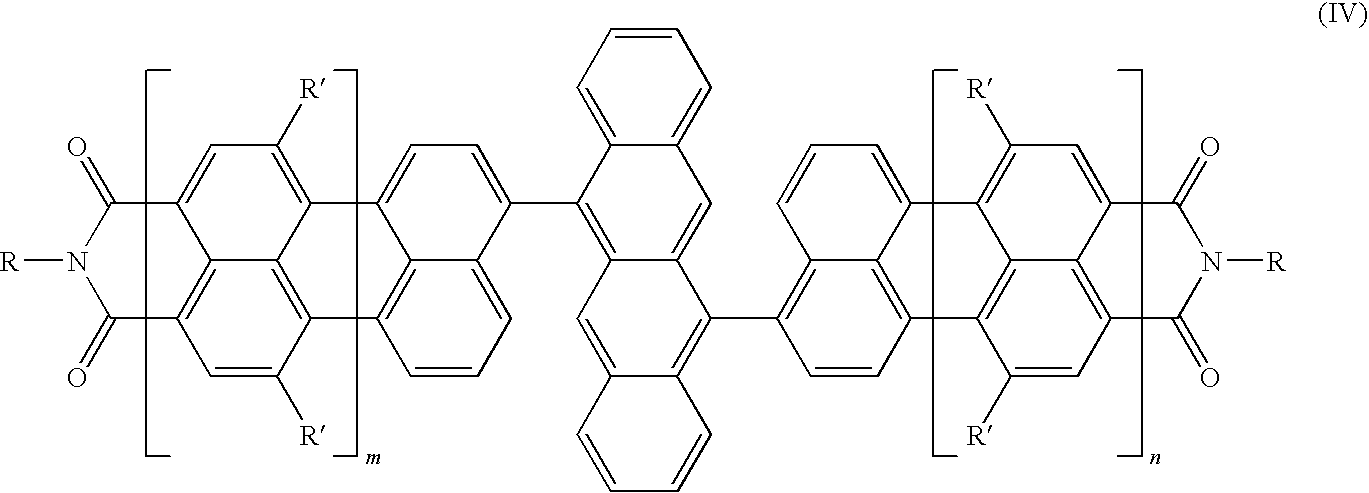
and to novel bisrylene derivatives of the general formula V

in which R and R′ are each as defined above, as intermediates for the dibenzorylenetetracarboximides I.

where
at least one of the R1, R2, R3 and R4 radicals is Br, F or CN,
Y1 and Y2 are each O or NRi where Ri is hydrogen or an organyl radical,
Z1, Z2, Z3 and Z4 are each independently O or NRii where Rii is an organyl radical, where, in the case that Y1 and/or Y2 is NRi and at least one of the Z1 to Z4 radicals is NRii, Ri together with an Rii radical may also be a bridging group having 2 to 5 atoms between the flanking bonds,
and their use as n-semiconductors in organic field-effect transistors.

where

where
n is 1, 2, 3 or 4,
the Rn1, Rn2, Rn3 and Rn4 radicals, when n=1 or 2, are each independently selected from hydrogen, F, Cl, Br and CN, and, when n=3 or 4, are each independently selected from hydrogen, F, Cl and Br,
the Ra and Rb radicals are each independently selected from hydrogen and alkyl,
the Rc and Rd radicals are each independently selected from groups of the formulae II.1 to II.5:

in which
- # is the site of attachment to the imide nitrogen atom,
- p is 0 or 1,
- x is 2 or 3,
- A, where present, is a C1-C10-alkylene group which may be interrupted by one or more nonadjacent groups selected from —O— and —S—,
the Ri radicals are each independently selected from C4-C30-alkyl which may be interrupted by one or more nonadjacent oxygen atom(s), where at least one of the Ri radicals in the compounds of the formula II.1 may also be C4-C30-alkyloxy or C4-C30-alkylthio,
as n-semiconductors for organic field-effect transistors or solar cells.

-
- in which the variables are each defined as follows:
- R′ are identical or different radicals:
- hydrogen;
- aryloxy, arylthio, hetaryloxy or hetarylthio, to each of which may be fused further saturated or unsaturated 5- to 7-membered rings whose carbon skeleton may be interrupted by one or more —O—, —S—, —NR1—, —N═CR1—, —CO—, —SO— and/or —SO2— moieties, where the entire ring system may be mono- or polysubstituted by the radicals (i), (ii), (iii), (iv) and/or (v):
- (i) C1-C30-alkyl whose carbon chain may be interrupted by one or more —O—, —S—, —NR1—, —N═CR1—, —C═C—, —CR1═CR1—, —CO—, —SO— and/or —SO2— moieties and which may be mono- or polysubstituted by: C1-C12-alkoxy, C1-C6-alkylthio, —C≡CR1, —CR1═CR1 2, hydroxyl, mercapto, halogen, cyano, nitro, —NR2R3, —NR2COR3, —CONR2R3, —SO2NR2R3, —COOR2, —SO3R2, aryl and/or saturated or unsaturated C4-C7-cycloalkyl whose carbon skeleton may be interrupted by one or more —O—, —S—, —NR1—, —N═CR1—, —CR1═CR1—, —CO—, —SO— and/or —SO2— moieties, where the aryl and cycloalkyl radicals may each be mono- or polysubstituted by C1-C18-alkyl, C1-C12-alkoxy, C1-C6-alkylthio, —C≡CR1, —CR1═CR1 2, and/or the above radicals specified as substituents for alkyl;
- (ii) C3-C8-cycloalkyl whose carbon skeleton may be interrupted by one or more —O—, —S—, —NR1—, —N═CR1—, —CR1═CR1—, —CO—, —SO— and/or —SO2— moieties and to which may be fused further saturated or unsaturated 5- to 7-membered rings whose carbon skeleton may be interrupted by one or more —O—, —S—, —NR1—, —N═CR1—, —CR1═CR1—, —CO—, —SO— and/or —SO2— moieties, where the entire ring system may be mono- or polysubstituted by: C1-C18-alkyl, C1-C12-alkoxy, C1-C6-alkylthio, —C≡CR1, —CR1═CR1 2, hydroxyl, mercapto, halogen, cyano, nitro, —NR2R3, —NR2COR3, —CONR2R3, —SO2NR2R3, —COOR2 and/or —SO3R2;
- (iii) aryl or hetaryl, to which may be fused further saturated or unsaturated 5- to 7-membered rings whose carbon skeleton may be interrupted by one or more —O—, —S—, —NR1—, —N═CR1—, —CR1═CR1—, —CO—, —SO— and/or —SO2— moieties, where the entire ring system may be mono- or polysubstituted by: C1-C18-alkyl, C1-C12-alkoxy, C1-C6-alkylthio, —C≡CR1, —CR1═CR1 2, hydroxyl, mercapto, halogen, cyano, nitro, —NR2R3, —NR2COR3, —CONR2R3, —SO2NR2R3, —COOR2, —SO3R2, aryl and/or hetaryl, each of which may be mono- or polysubstituted by C1-C18-alkyl, C1-C12-alkoxy, hydroxyl, mercapto, halogen, cyano, nitro, —NR2R3, —NR2COR3, —CONR2R3, —SO2NR2R3—COOR2 and/or —SO3R2;
- (iv) a —U-aryl radical which may be mono- or polysubstituted by the above radicals specified as substituents for the aryl radicals (iii), where U is an —O—, —S—, —NR1—, —CO—, —SO— or —SO2— moiety;
- (v) C1-C12-alkoxy, C1-C6-alkylthio, —C≡CR1, —CR1═CR1 2, hydroxyl, mercapto, halogen, cyano, nitro, —NR2R3, —NR2COR3, —CONR2R3, —SO2NR2R3, —COOR2 or —SO3R2;
- R are identical or different radicals:
- hydrogen;
- C1-C30-alkyl whose carbon chain may be interrupted by one or more —O—, —S—, —NR1—, —N═CR1—, —C≡C—, —CR1═CR1—, —CO—, —SO— and/or —SO2— moieties and which may be mono- or polysubstituted by the (ii), (iii), (iv) and/or (v) radicals specified as substituents for the R′ radicals—hydroxyl, mercapto, halogen, cyano, nitro, —NR2R3, —NR2COR3, —CONR2R3, —SO2NR2R3, —COOR2 and/or —SO3R2;
- C3-C8-cycloalkyl, to which may be fused further saturated or unsaturated 5- to 7-membered rings whose carbon skeleton may be interrupted by one or more —O—, —S—, —NR1—, —N═CR1—, —CR1═CR1—, —CO—, —SO— and/or —SO2— moieties, where the entire ring system may be mono- or polysubstituted by the (i), (ii), (iii), (iv) and/or (v) radicals specified as substituents for the R′ radicals;
- aryl or hetaryl, to each of which may be fused further saturated or unsaturated 5- to 7-membered rings whose carbon skeleton may be interrupted by one or more —O—, —S—, —NR1—, —N═CR1—, —CR1═CR1—, —CO—, —SO— and/or —SO2— moieties, where the entire ring system may be mono- or polysubstituted by the (i), (ii), (iii), (iv), (v) radicals specified as substituents for the R′ radicals, and/or aryl- and/or hetarylazo, each of which may be mono- or polysubstituted by C1-C10-alkyl, C1-C6-alkoxy and/or cyano;
- R1 is hydrogen or C1-C18-alkyl, where the R1 radicals may be the same or different when they occur more than once;
- R2, R3 are each independently:
- hydrogen;
- C1-C18-alkyl whose carbon chain may be interrupted by one or more —O—, —S—, —CO—, —SO— and/or —SO2— moieties and which may be mono- or polysubstituted by C1-C12-alkoxy, C1-C6-alkylthio, hydroxyl, mercapto, halogen, cyano, nitro, aryl and/or —COOR1;
- aryl or hetaryl, to each of which may be fused further saturated or unsaturated 5- to 7-membered rings whose carbon skeleton may be interrupted by one or more —O—, —S—, —CO— and/or —SO2— moieties, where the entire ring system may be mono- or polysubstituted by C1-C12-alkyl and/or the above radicals specified as substituents for alkyl;
- C3-C8-cycloalkyl to which may be fused further saturated or unsaturated 5- to 7-membered rings whose carbon skeleton may be interrupted by one or more —O—, —S—, —NR1—, —N═CR1—, —CR1═CR1—, —CO—, —SO— and/or —SO2— moieties, where the entire ring system may be mono- or polysubstituted by C1-C12-alkyl and/or the above radicals specified as substituents for alkyl;
- m, n are each independently 0 or 1.

in which R, R1 and m are each as defined at the outset, which comprises
- a) subjecting a peri-(dioxaborolan-2-yl)rylenedicarboximide of the general formula IIa

-
- in which R4 are the same or different and are each independently hydrogen, C1-C30-alkyl, C5-C8-cycloalkyl, aryl or heteroaryl, and where two OR4 radicals bonded to the same boron atom together may also be —OCH2CH2O—, in which 1, 2, 3 or 4 hydrogen atoms may also be replaced by C1-C30-alkyl, C5-C8-cycloalkyl, aryl or heteroaryl groups,
- in the presence of an organic solvent, if desired in a mixture with water, and of a transition metal catalyst and of a base, to a Suzuki coupling reaction with 5,11-dibromotetracene of the formula III
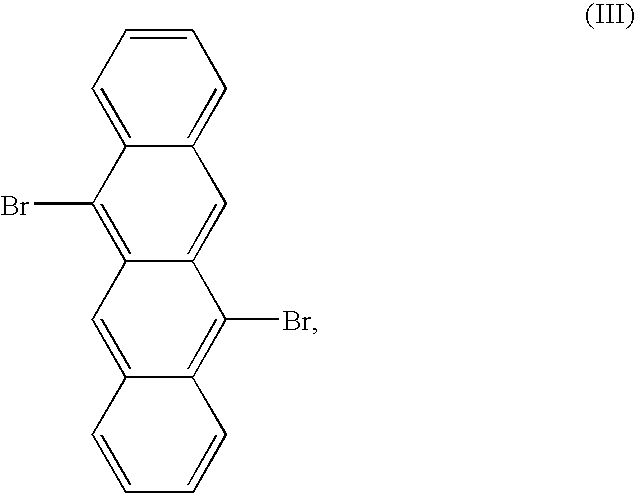
- b) subjecting the tetracene-5,11-bis(rylenedicarboximide) of the general formula IVa formed in step a)

-
- to a first cyclodehydrogenation in the presence of an inert organic solvent and of a Lewis acid and
- c) cyclodehydrogenating the bisrylene derivative of the general formula Va formed in step b)

-
- in an organic reaction medium which has hydroxyl and amino functions and comprises an essentially undissolved base further to give the dibenzorylenetetracarboximide Ia.

in which R and R′ are each as defined at the outset, m1 and n1 are different from one another and are each 0 or 1, which comprises
- a1) subjecting a peri-(dioxaborolan-2-yl)rylenedicarboximide of the general formula IIb1
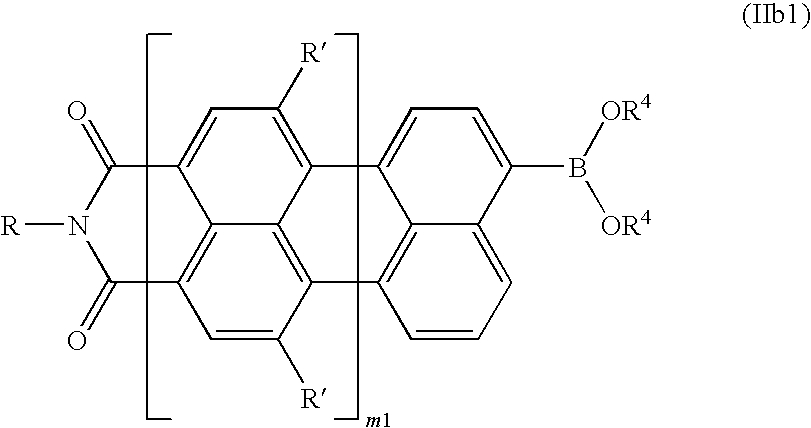
-
- in which R4 are the same or different and are each independently hydrogen, C1-C30-alkyl, C5-C8-cycloalkyl, aryl or heteroaryl, and where two OR4 radicals bonded to the same boron atom together may also be —OCH2CH2O—, in which 1, 2, 3 or 4 hydrogen atoms may also be replaced by C1-C30-alkyl, C5-C8-cycloalkyl, aryl or heteroaryl groups,
- to a first Suzuki coupling reaction with 5,11-dibromotetracene (III) and
- a2) subjecting the 5-bromotetracene-11-rylenedicarboximide of the general formula III′ formed in step a1)

-
- to a second Suzuki coupling reaction with a peri-(dioxaborolan-2-yl)rylene-dicarboximide of the general formula Ilb2

-
- in the presence of an organic solvent, if desired in a mixture with water, and of a transition metal catalyst and of a base,
- b) subjecting the tetracene-5,11-bis(rylenedicarboximide) of the general formula IVb formed in step a2)
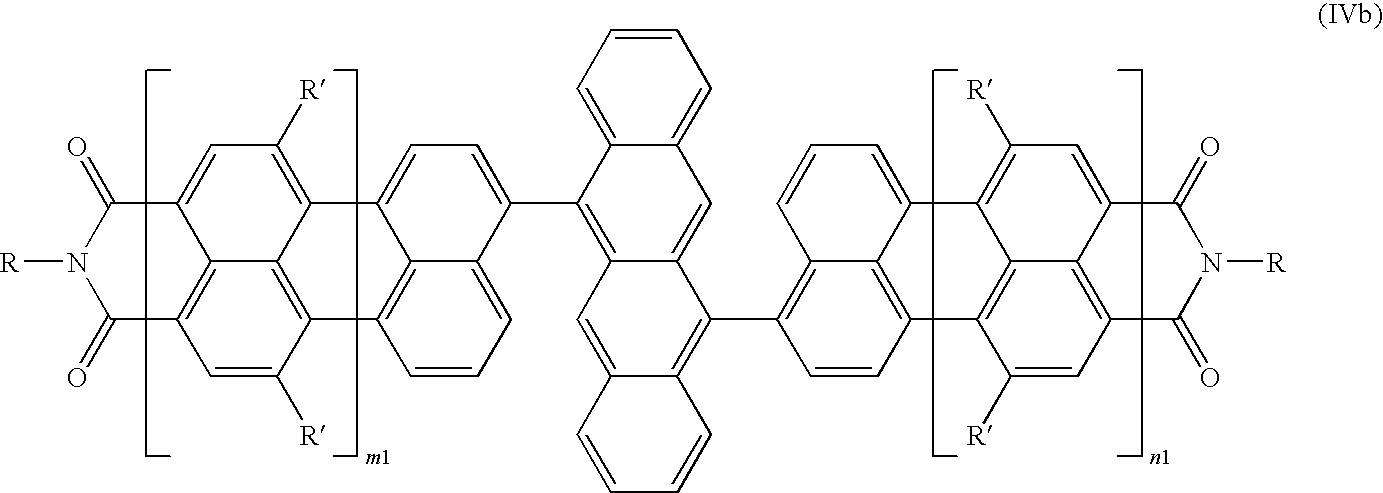
-
- to a first cyclodehydrogenation in the presence of an inert organic solvent and of a Lewis acid and
- c) cyclodehydrogenating the bisrylene derivative of the general formula Vb formed in step b)
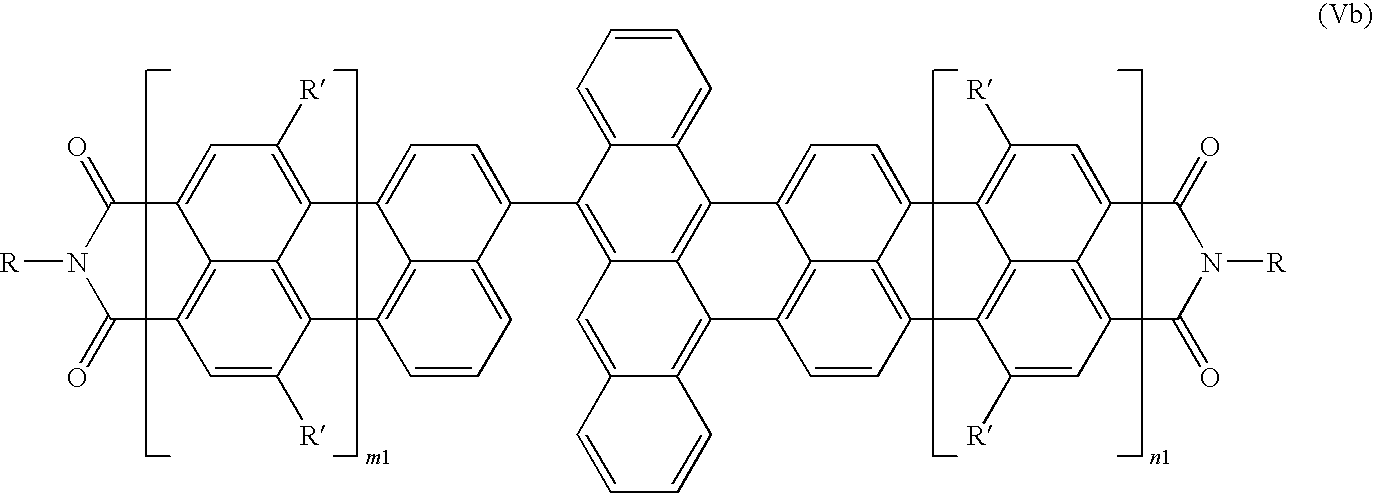
-
- in an organic reaction medium which has hydroxyl and amino functions and comprises an essentially undissolved base further to give the dibenzorylenetetracarboximide Ib.

and bisrylene derivatives of the general formula V

which occur as intermediates in these processes.

in which
- # is the site of attachment to the imide nitrogen atom,
- p is 0 or 1,
- x is 2 or 3 in the compounds of the formula II.1, is 1, 2 or 3 in the compounds of the formulae II.2, II.3 and II.4, and is 1 or 2 in the compounds of the formula II.5,
- A, where present, is a C1-C10-alkylene group which may be interrupted by one or more nonadjacent groups selected from —O— and —S—,
- where, in the case that x is 2 in the compounds of the formula II.1, the carbon atom which bears the Ri radicals additionally bears a hydrogen atom,
- the Ri radicals are each independently selected from C1-C30-alkyl which may be interrupted by one or more nonadjacent oxygen atom(s), where at least one of the Ri radicals in the compounds of the formula II.1 may also be C1-C30-alkyloxy or C1-C30-alkylthio.

in which
# represents the site of attachment to the imide nitrogen atom, and
the Ri radicals are selected from C1-C12-alkyl, preferably C4-C8-alkyl, more preferably C5-C7-alkyl. The Ri radicals are then especially linear alkyl radicals which are not interrupted by oxygen atoms.

in which # is the site of attachment to the imide nitrogen atom of the rylenetetracarboximide, q is an integer of 0, 1, 2, 3 or 4, and Ra is C1-C30-alkyl.
in which q is 1, for example
2,6-di(methyl)benzyl, 2,6-di(ethyl)benzyl, 2,6-di(n-propyl)benzyl, 2,6-di(isopropyl)benzyl, 2,6-di(n-butyl)benzyl, 2,6-di(n-pentyl)benzyl, 2,6-di(n-hexyl)benzyl, 2,6-di(n-heptyl)benzyl, 2,6-di(n-octyl)benzyl, 2,6-di(n-nonyl)benzyl, 2,6-di(n-decyl)benzyl, 2,6-di(n-undecyl)benzyl, 2,6-di(n-dodecyl)benzyl, 2,6-di(n-tridecyl)benzyl, 2,6-di(n-tetradecyl)benzyl, 2,6-di(n-pentadecyl)benzyl, 2,6-di(n-hexadecyl)benzyl, 2,6-di(n-heptadecyl)benzyl, 2,6-di(n-octadecyl)benzyl, 2,6-di(nonadecyl)benzyl, 2,6-di(eicosyl)benzyl, 2,6-di(docosanyl)benzyl, 2,6-di(tricosanyl)benzyl, 2,6-di(tetracosanyl)benzyl, 2,6-di(octacosanyl)benzyl;
in which q is 2, for example
2,6-di(methyl)phenethyl, 2,6-di(ethyl)phenethyl, 2,6-di(n-propyl)phenethyl, 2,6-di(isopropyl)phenethyl, 2,6-di(n-butyl)phenethyl, 2,6-di(n-pentyl)phenethyl, 2,6-di(n-hexyl)phenethyl, 2,6-di(n-heptyl)phenethyl, 2,6-di(n-octyl)phenethyl, 2,6-di(n-nonyl)phenethyl, 2,6-di(n-decyl)phenethyl, 2,6-di(n-undecyl)phenethyl, 2,6-di(n-dodecyl)phenethyl, 2,6-di(n-tridecyl)phenethyl, 2,6-di(n-tetradecyl)phenethyl, 2,6-di(n-pentadecyl)phenethyl, 2,6-di(n-hexadecyl)phenethyl, 2,6-di(n-heptadecyl)phenethyl, 2,6-di(n-octadecyl)phenethyl, 2,6-di(nonadecyl)phenethyl, 2,6-di(eicosyl)phenethyl, 2,6-di(docosanyl)phenethyl, 2,6-di(tricosanyl)phenethyl, 2,6-di(tetracosanyl)phenethyl, 2,6-di(octacosanyl)phenethyl;
in which q is 3, for example
3-(2,6-di(methyl)phenyl)propyl, 3-(2,6-di(ethyl)phenyl)propyl, 3-(2,6-di(n-propyl)phenyl)propyl, 3-(2,6-di(isopropyl)phenyl)propyl, 3-(2,6-di(n-butyl)phenyl)propyl, 3-(2,6-di(n-pentyl)phenyl)propyl, 3-(2,6-di(n-hexyl)phenyl)propyl, 3-(2,6-di(n-heptyl)phenyl)propyl, 3-(2,6-di(n-octyl)phenyl)propyl, 3-(2,6-di(n-nonyl)phenyl)propyl, 3-(2,6-di(n-decyl)phenyl)propyl, 3-(2,6-di(n-undecyl)phenyl)propyl, 3-(2,6-di(n-dodecyl)phenyl)propyl, 3-(2,6-di(n-tridecyl)phenyl)propyl, 3-(2,6-di(n-tetradecyl)phenyl)propyl, 3-(2,6-di(n-pentadecyl)phenyl)propyl, 3-(2,6-di(n-hexadecyl)phenyl)propyl, 3-(2,6-di(n-heptadecyl)phenyl)propyl, 3-(2,6-di(n-octadecyl)phenyl)propyl, 3-(2,6-di(nonadecyl)phenyl)propyl, 3-(2,6-di(eicosyl)phenyl)propyl, 3-(2,6-di(docosanyl)phenyl)propyl, 3-(2,6-di(tricosanyl)phenyl)propyl, 3-(2,6-di(tetracosanyl)phenyl)propyl, 3-(2,6-di(octacosanyl)phenyl)propyl;
in which q is 4, for example
4-(2,6-di(methyl)phenyl)butyl, 4-(2,6-di(ethyl)phenyl)butyl, 4-(2,6-di(n-propyl)phenyl)butyl, 4-(2,6-di(isopropyl)phenyl)butyl, 4-(2,6-di(n-butyl)phenyl)butyl, 4-(2,6-di(n-pentyl)phenyl)butyl, 4-(2,6-di(n-hexyl)phenyl)butyl, 4-(2,6-di(n-heptyl)phenyl)butyl, 4-(2,6-di(n-octyl)phenyl)butyl, 4-(2,6-di(n-nonyl)phenyl)butyl, 4-(2,6-di(n-decyl)phenyl)butyl, 4-(2,6-di(n-undecyl)phenyl)butyl, 4-(2,6-di(n-dodecyl)phenyl)butyl, 4-(2,6-di(n-tridecyl)phenyl)butyl, 4-(2,6-di(n-tetradecyl)phenyl)butyl, 4-(2,6-di(n-pentadecyl)phenyl)butyl, 4-(2,6-di(n-hexadecyl)phenyl)butyl, 4-(2,6-di(n-heptadecyl)phenyl)butyl, 4-(2,6-di(n-octadecyl)phenyl)butyl, 4-(2,6-di(nonadecyl)phenyl)butyl, 4-(2,6-di(eicosyl)phenyl)butyl, 4-(2,6-di(docosanyl)phenyl)butyl, 4-(2,6-di(tricosanyl)phenyl)butyl, 4-(2,6-di(tetracosanyl)phenyl)butyl, 4-(2,6-di(octacosanyl)phenyl)butyl;
and additionally radicals of the formula B:

in which # is the site of attachment to the imide nitrogen atom of the rylenetetracarboximide, q is an integer of 0, 1, 2, 3, 4, 5 or 6, and Rb is C4-C30-alkyl.


in which # is the site of attachment to the imide nitrogen atom of the rylenetetracarboximide, and Rb is independently n-butyl, n-pentyl, n-hexyl, n-heptyl, n-octyl, n-nonyl, n-decyl, n-undecyl, n-dodecyl, n-tridecyl, n-tetradecyl, n-pentadecyl, n-hexadecyl, n-heptadecyl, n-octadecyl, n-nonadecyl, n-eicosyl, n-docosanyl, n-tricosanyl, n-tetracosanyl, n-octacosanyl,
and additionally compounds of the formula C:
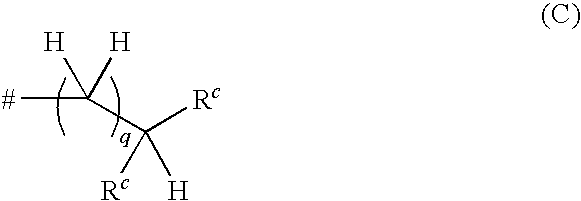
in which # is the site of attachment to the imide nitrogen atom of the rylenetetracarboximide, q is an integer of 0, 1, 2, 3, 4, 5 or 6, and Rc is C4-C30-alkyl, C4-C30-alkylthio or C4-C30-alkoxy.
in which q is 2, for example
3-ethylpropyl, 3-methylpropyl, 3-propylbutyl, 3-ethylbutyl, 3-methylbutyl, 3-butylpentyl, 3-propylpentyl, 3-ethylpentyl, 3-methylpentyl, 3-pentylhexyl, 3-butylhexyl, 3-propylhexyl, 3-ethylhexyl, 3-methylhexyl, 3-hexylheptyl, 3-pentylheptyl, 3-butylheptyl, 3-propylheptyl, 3-ethylheptyl, 3-methylheptyl, 3-heptyloctyl, 3-hexyloctyl, 3-pentyloctyl, 3-butyloctyl, 3-propyloctyl, 3-ethyloctyl, 3-methyloctyl, 3-octylnonyl, 3-heptylnonyl, 3-hexylnonyl, 3-pentylnonyl, 3-butylnonyl, 3-propylnonyl, 3-ethylnonyl, 3-methylnonyl, 3-nonyidecyl, 3-octyldecyl, 3-heptyldecyl, 3-hexyldecyl, 3-pentyldecyl, 3-butyldecyl, 3-propyldecyl, 3-ethyldecyl, 3-methyldecyl, 3-decylundecyl, 3-nonylundecyl, 3-octylundecyl, 3-heptylundecyl, 3-hexylundecyl, 3-pentylundecyl, 3-butylundecyl, 3-propylundecyl, 3-ethylundecyl, 3-methylundecyl, 3-undecyldodecyl, 3-decyldodecyl, 3-nonyldodecyl, 3-octyldodecyl, 3-heptyldodecyl, 3-hexyldodecyl, 3-pentyldodecyl, 3-butyldodecyl, 3-propyldodecyl, 3-ethyldodecyl, 3-methyldodecyl, 3-dodecyltridecyl, 3-undecyltridecyl, 3-decyltridecyl, 3-nonyltridecyl, 3-octyltridecyl, 3-heptyltridecyl, 3-hexyltridecyl, 3-pentyltridecyl, 3-butyltridecyl, 3-propyltridecyl, 3-ethyltridecyl, 3-methyltridecyl, 3-tridecyltetradecyl, 3-undecyltetradecyl, 3-decyltetradecyl, 3-nonyltetradecyl, 3-octyltetradecyl, 3-heptyltetradecyl, 3-hexyltetradecyl, 3-pentyltetradecyl, 3-butyltetradecyl, 3-propyltetradecyl, 3-ethyltetradecyl, 3-methyltetradecyl, 3-pentadecylhexadecyl, 3-tetradecylhexadecyl, 3-tridecylhexadecyl, 3-dodecylhexadecyl, 3-undecylhexadecyl, 3-decylhexadecyl, 3-nonyihexadecyl, 3-octylhexadecyl, 3-heptylhexadecyl, 3-hexylhexadecyl, 3-pentylhexadecyl, 3-butylhexadecyl, 3-propylhexadecyl, 3-ethylhexadecyl, 3-methylhexadecyl, 3-hexadecyloctadecyl, 3-pentadecyloctadecyl, 3-tetradecyloctadecyl, 3-tridecyloctadecyl, 3-dodecyloctadecyl, 3-undecyloctadecyl, 3-decyloctadecyl, 3-nonyloctadecyl, 3-octyloctadecyl, 3-heptyloctadecyl, 3-hexyloctadecyl, 3-pentyloctadecyl, 3-butyloctadecyl, 3-propyloctadecyl, 3-ethyloctadecyl, 3-methyloctadecyl, 3-nonadecyleicosanyl, 3-octadecyleicosanyl, 3-heptadecyleicosanyl, 3-hexadecyleicosanyl, 3-pentadecyleicosanyl, 3-tetradecyleicosanyl, 3-tridecyleicosanyl, 3-dodecyleicosanyl, 3-undecyleicosanyl, 3-decyleicosanyl, 3-nonyleicosanyl, 3-octyleicosanyl, 3-heptyleicosanyl, 3-hexyleicosanyl, 3-pentyleicosanyl, 3-butyleicosanyl, 3-propyleicosanyl, 3-ethyleicosanyl, 3-methyleicosanyl, 3-eicosanyldocosanyl, 3-nonadecyldocosanyl, 3-octadecyldocosanyl, 3-heptadecyldocosanyl, 3-hexadecyldocosanyl, 3-pentadecyldocosanyl, 3-tetradecyldocosanyl, 3-tridecyldocosanyl, 3-undecyldocosanyl, 3-decyldocosanyl, 3-nonyldocosanyl, 3-octyldocosanyl, 3-heptyldocosanyl, 3-hexyldocosanyl, 3-pentyldocosanyl, 3-butyldocosanyl, 3-propyldocosanyl, 3-ethyldocosanyl, 3-methyldocosanyl, 3-tricosanyltetracosanyl, 3-docosanyltetracosanyl, 3-nonadecyltetracosanyl, 3-octadecyltetracosanyl, 3-heptadecyltetracosanyl, 3-hexadecyltetracosanyl, 3-pentadecyltetracosanyl, 3-pentadecyltetracosanyl, 3-tetradecyltetracosanyl, 3-tridecyltetracosanyl, 3-dodecyltetracosanyl, 3-undecyltetracosanyl, 3-decyltetracosanyl, 3-nonyltetracosanyl, 3-octyltetracosanyl, 3-heptyltetracosanyl, 3-hexyltetracosanyl, 3-pentyltetracosanyl, 3-butyltetracosanyl, 3-propyltetracosanyl, 3-ethyltetracosanyl, 3-methyltetracosanyl, 3-heptacosanyloctacosanyl, 3-hexacosanyloctacosanyl, 3-pentacosanyloctacosanyl, 3-tetracosanyloctacosanyl, 3-tricosanyloctacosanyl, 3-docosanyloctacosanyl, 3-nonadecyloctacosanyl, 3-octadecyloctacosanyl, 3-heptadecyloctacosanyl, 3-hexadecyloctacosanyl, 3-hexadecyloctacosanyl, 3-pentadecyloctacosanyl, 3-tetradecyloctacosanyl, 3-tridecyloctacosanyl, 3-dodecyloctacosanyl, 3-undecyloctacosanyl, 3-decyloctacosanyl, 3-nonyloctacosanyl, 3-octyloctacosanyl, 3-heptyloctacosanyl, 3-hexyloctacosanyl, 3-pentyloctacosanyl, 3-butyloctacosanyl, 3-propyloctacosanyl, 3-ethyloctacosanyl, 3-methyloctacosanyl,
in which q is 3, such as
4-butylpentyl, 4-propylpentyl, 4-ethylpentyl, 4-methylpentyl, 4-pentylhexyl, 4-butylhexyl, 4-propylhexyl, 4-ethylhexyl, 4-methylhexyl, 4-hexylheptyl, 4-pentylheptyl, 4-butylheptyl, 4-propylheptyl, 4-ethylheptyl, 4-methylheptyl, 4-heptyloctyl, 4-hexyloctyl, 4-pentyloctyl, 4-butyloctyl, 4-propyloctyl, 4-ethyloctyl, 4-methyloctyl, 4-octylnonyl, 4-heptylnonyl, 4-hexylnonyl, 4-pentylnonyl, 4-butylnonyl, 4-propylnonyl, 4-ethylnonyl, 4-methylnonyl, 4-nonyldecyl, 4-octyldecyl, 4-heptyldecyl, 4-hexyldecyl, 4-pentyldecyl, 4-butyldecyl, 4-propyldecyl, 4-ethyldecyl, 4-methyldecyl, 4-decylundecyl, 4-nonylundecyl, 4-octylundecyl, 4-heptylundecyl, 4-hexylundecyl, 4-pentylundecyl, 4-butylundecyl, 4-propylundecyl, 4-ethylundecyl, 4-methylundecyl, 4-undecyldodecyl, 4-decyldodecyl, 4-nonyldodecyl, 4-octyldodecyl, 4-heptyldodecyl, 4-hexyldodecyl, 4-pentyldodecyl, 4-butyldodecyl, 4-propyldodecyl, 4-ethyldodecyl, 4-methyldodecyl, 4-dodecyltridecyl, 4-undecyltridecyl, 4-decyltridecyl, 4-nonyltridecyl, 4-octyltridecyl, 4-heptyltridecyl, 4-hexyltridecyl, 4-pentyltridecyl, 4-butyltridecyl, 4-propyltridecyl, 4-ethyltridecyl, 4-methyltridecyl, 4-tridecyltetradecyl, 4-undecyltetradecyl, 4-decyltetradecyl, 4-nonyltetradecyl, 4-octyltetradecyl, 4-heptyltetradecyl, 4-hexyltetradecyl, 4-pentyltetradecyl, 4-butyltetradecyl, 4-propyltetradecyl, 4-ethyltetradecyl, 4-methyltetradecyl, 4-pentadecylhexadecyl, 4-tetradecylhexadecyl, 4-tridecylhexadecyl, 4-dodecylhexadecyl, 4-undecylhexadecyl, 4-decylhexadecyl, 4-nonylhexadecyl, 4-octylhexadecyl, 4-heptylhexadecyl, 4-hexylhexadecyl, 4-pentylhexadecyl, 4-butylhexadecyl, 4-propylhexadecyl, 4-ethylhexadecyl, 4-methylhexadecyl, 4-hexadecyloctadecyl, 4-pentadecyloctadecyl, 4-tetradecyloctadecyl, 4-tridecyloctadecyl, 4-dodecyloctadecyl, 4-undecyloctadecyl, 4-decyloctadecyl, 4-nonyloctadecyl, 4-octyloctadecyl, 4-heptyloctadecyl, 4-hexyloctadecyl, 4-pentyloctadecyl, 4-butyloctadecyl, 4-propyloctadecyl, 4-ethyloctadecyl, 4-methyloctadecyl, 4-nonadecyleicosanyl, 4-octadecyleicosanyl, 4-heptadecyleicosanyl, 4-hexadecyleicosanyl, 4-pentadecyleicosanyl, 4-tetradecyleicosanyl, 4-tridecyleicosanyl, 4-dodecyleicosanyl, 4-undecyleicosanyl, 4-decyleicosanyl, 4-nonyleicosanyl, 4-octyleicosanyl, 4-heptyleicosanyl, 4-hexyleicosanyl, 4-pentyleicosanyl, 4-butyleicosanyl, 4-propyleicosanyl, 4-ethyleicosanyl, 4-methyleicosanyl, 4-eicosanyldocosanyl, 4-nonadecyldocosanyl, 4-octadecyldocosanyl, 4-heptadecyldocosanyl, 4-hexadecyldocosanyl, 4-pentadecyldocosanyl, 4-tetradecyldocosanyl, 4-tridecyldocosanyl, 4-undecyldocosanyl, 4-decyldocosanyl, 4-nonyldocosanyl, 4-octyldocosanyl, 4-heptyldocosanyl, 4-hexyldocosanyl, 4-pentyldocosanyl, 4-butyldocosanyl, 4-propyldocosanyl, 4-ethyldocosanyl, 4-methyldocosanyl, 4-tricosanyltetracosanyl, 4-docosanyltetracosanyl, 4-nonadecyltetracosanyl, 4-octadecyltetracosanyl, 4-heptadecyltetracosanyl, 4-hexadecyltetracosanyl, 4-pentadecyltetracosanyl, 4-pentadecyltetracosanyl, 4-tetradecyltetracosanyl, 4-tridecyltetracosanyl, 4-dodecyltetracosanyl, 4-undecyltetracosanyl, 4-decyltetracosanyl, 4-nonyltetracosanyl, 4-octyltetracosanyl, 4-heptyltetracosanyl, 4-hexyltetracosanyl, 4-pentyltetracosanyl, 4-butyltetracosanyl, 4-propyltetracosanyl, 4-ethyltetracosanyl, 4-methyltetracosanyl, 4-heptacosanyloctacosanyl, 4-hexacosanyloctacosanyl, 4-pentacosanyloctacosanyl, 4-tetracosanyloctacosanyl, 4-tricosanyloctacosanyl, 4-docosanyloctacosanyl, 4-nonadecyloctacosanyl, 4-octadecyloctacosanyl, 4-heptadecyloctacosanyl, 4-hexadecyloctacosanyl, 4-hexadecyloctacosanyl, 4-pentadecyloctacosanyl, 4-tetradecyloctacosanyl, 4-tridecyloctacosanyl, 4-dodecyloctacosanyl, 4-undecyloctacosanyl, 4-decyloctacosanyl, 4-nonyloctacosanyl, 4-octyloctacosanyl, 4-heptyloctacosanyl, 4-hexyloctacosanyl, 4-pentyloctacosanyl, 4-butyloctacosanyl, 4-propyloctacosanyl, 4-ethyloctacosanyl, 4-methyloctacosanyl,
in which q is 4, such as
5-pentylhexyl, 5-butylhexyl, 5-propylhexyl, 5-ethylhexyl, 5-methylhexyl, 5-hexylheptyl, 5-pentylheptyl, 5-butylheptyl, 5-propylheptyl, 5-ethylheptyl, 5-methylheptyl, 5-heptyloctyl, 5-hexyloctyl, 5-pentyloctyl, 5-butyloctyl, 5-propyloctyl, 5-ethyloctyl, 5-methyloctyl, 5-octylnonyl, 5-heptylnonyl, 5-hexylnonyl, 5-pentylnonyl, 5-butylnonyl, 5-propylnonyl, 5-ethylnonyl, 5-methylnonyl, 5-nonyldecyl, 5-octyldecyl, 5-heptyidecyl, 5-hexyldecyl, 5-pentyldecyl, 5-butyldecyl, 5-propyldecyl, 5-ethyldecyl, 5-methyldecyl, 5-decylundecyl, 5-nonylundecyl, 5-octylundecyl, 5-heptylundecyl, 5-hexylundecyl, 5-pentylundecyl, 5-butylundecyl, 5-propylundecyl, 5-ethylundecyl, 5-methylundecyl, 5-undecyldodecyl, 5-decyldodecyl, 5-nonyldodecyl, 5-octyldodecyl, 5-heptyidodecyl, 5-hexyldodecyl, 5-pentyldodecyl, 5-butyldodecyl, 5-propyldodecyl, 5-ethyldodecyl, 5-methyldodecyl, 5-dodecyltridecyl, 5-undecyltridecyl, 5-decyltridecyl, 5-nonyltridecyl, 5-octyltridecyl, 5-heptyltridecyl, 5-hexyltridecyl, 5-pentyltridecyl, 5-butyltridecyl, 5-propyltridecyl, 5-ethyltridecyl, 5-methyltridecyl, 5-tridecyltetradecyl, 5-undecyltetradecyl, 5-decyltetradecyl, 5-nonyltetradecyl, 5-octyltetradecyl, 5-heptyltetradecyl, 5-hexyltetradecyl, 5-pentyltetradecyl, 5-butyltetradecyl, 5-propyltetradecyl, 5-ethyltetradecyl, 5-methyltetradecyl, 5-pentadecylhexadecyl, 5-tetradecylhexadecyl, 5-tridecylhexadecyl, 5-dodecylhexadecyl, 5-undecylhexadecyl, 5-decylhexadecyl, 5-nonylhexadecyl, 5-octylhexadecyl, 5-heptylhexadecyl, 5-hexylhexadecyl, 5-pentylhexadecyl, 5-butylhexadecyl, 5-propylhexadecyl, 5-ethylhexadecyl, 5-methylhexadecyl, 5-hexadecyloctadecyl, 5-pentadecyloctadecyl, 5-tetradecyloctadecyl, 5-tridecyloctadecyl, 5-dodecyloctadecyl, 5-undecyloctadecyl, 5-decyloctadecyl, 5-nonyloctadecyl, 5-octyloctadecyl, 5-heptyloctadecyl, 5-hexyloctadecyl, 5-pentyloctadecyl, 5-butyloctadecyl, 5-propyloctadecyl, 5-ethyloctadecyl, 5-methyloctadecyl, 5-nonadecyleicosanyl, 5-octadecyleicosanyl, 5-heptadecyleicosanyl, 5-hexadecyleicosanyl, 5-pentadecyleicosanyl, 5-tetradecyleicosanyl, 5-tridecyleicosanyl, 5-dodecyleicosanyl, 5-undecyleicosanyl, 5-decyleicosanyl, 5-nonyleicosanyl, 5-octyleicosanyl, 5-heptyleicosanyl, 5-hexyleicosanyl, 5-pentyleicosanyl, 5-butyleicosanyl, 5-propyleicosanyl, 5-ethyleicosanyl, 5-methyleicosanyl, 5-eicosanyldocosanyl, 5-nonadecyldocosanyl, 5-octadecyldocosanyl, 5-heptadecyldocosanyl, 5-hexadecyldocosanyl, 5-pentadecyldocosanyl, 5-tetradecyldocosanyl, 5-tridecyldocosanyl, 5-undecyldocosanyl, 5-decyldocosanyl, 5-nonyldocosanyl, 5-octyldocosanyl, 5-heptyldocosanyl, 5-hexyldocosanyl, 5-pentyldocosanyl, 5-butyldocosanyl, 5-propyldocosanyl, 5-ethyldocosanyl, 5-methyldocosanyl, 5-tricosanyltetracosanyl, 5-docosanyltetracosanyl, 5-nonadecyltetracosanyl, 5-octadecyltetracosanyl, 5-heptadecyltetracosanyl, 5-hexadecyltetracosanyl, 5-pentadecyltetracosanyl, 5-pentadecyltetracosanyl, 5-tetradecyltetracosanyl, 5-tridecyltetracosanyl, 5-dodecyltetracosanyl, 5-undecyltetracosanyl, 5-decyltetracosanyl, 5-nonyltetracosanyl, 5-octyltetracosanyl, 5-heptyltetracosanyl, 5-hexyltetracosanyl, 5-pentyltetracosanyl, 5-butyltetracosanyl, 5-propyltetracosanyl, 5-ethyltetracosanyl, 5-methyltetracosanyl, 5-heptacosanyloctacosanyl, 5-hexacosanyloctacosanyl, 5-pentacosanyloctacosanyl, 5-tetracosanyloctacosanyl, 5-tricosanyloctacosanyl, 5-docosanyloctacosanyl, 5-nonadecyloctacosanyl, 5-octadecyloctacosanyl, 5-heptadecyloctacosanyl, 5-hexadecyloctacosanyl, 5-hexadecyloctacosanyl, 5-pentadecyloctacosanyl, 5-tetradecyloctacosanyl, 5-tridecyloctacosanyl, 5-dodecyloctacosanyl, 5-undecyloctacosanyl, 5-decyloctacosanyl, 5-nonyloctacosanyl, 5-octyloctacosanyl, 5-heptyloctacosanyl, 5-hexyloctacosanyl, 5-pentyloctacosanyl, 5-butyloctacosanyl, 5-propyloctacosanyl, 5-ethyloctacosanyl, 5-methyloctacosanyl
in which q is 5, for example
6-hexylheptyl, 6-pentylheptyl, 6-butylheptyl, 6-propylheptyl, 6-ethylheptyl, 6-methylheptyl, 6-heptyloctyl, 6-hexyloctyl, 6-pentyloctyl, 6-butyloctyl, 6-propyloctyl, 6-ethyloctyl, 6-methyloctyl, 6-octylnonyl, 6-heptylnonyl, 6-hexylnonyl, 6-pentylnonyl, 6-butylnonyl, 6-propylnonyl, 6-ethylnonyl, 6-methylnonyl, 6-nonyidecyl, 6-octyldecyl, 6-heptyldecyl, 6-hexyldecyl, 6-pentyldecyl, 6-butyldecyl, 6-propyldecyl, 6-ethyldecyl, 6-methyldecyl, 6-decylundecyl, 6-nonylundecyl, 6-octylundecyl, 6-heptylundecyl, 6-hexylundecyl, 6-pentylundecyl, 6-butylundecyl, 6-propylundecyl, 6-ethylundecyl, 6-methylundecyl, 6-undecyldodecyl, 6-decyldodecyl, 6-nonyidodecyl, 6-octyldodecyl, 6-heptyldodecyl, 6-hexyldodecyl, 6-pentyldodecyl, 6-butyldodecyl, 6-propyldodecyl, 6-ethyldodecyl, 6-methyldodecyl, 6-dodecyltridecyl, 6-undecyltridecyl, 6-decyltridecyl, 6-nonyltridecyl, 6-octyltridecyl, 6-heptyltridecyl, 6-hexyltridecyl, 6-pentyltridecyl, 6-butyltridecyl, 6-propyltridecyl, 6-ethyltridecyl, 6-methyltridecyl, 6-tridecyltetradecyl, 6-undecyltetradecyl, 6-decyltetradecyl, 6-nonyltetradecyl, 6-octyltetradecyl, 6-heptyltetradecyl, 6-hexyltetradecyl, 6-pentyltetradecyl, 6-butyltetradecyl, 6-propyltetradecyl, 6-ethyltetradecyl, 6-methyltetradecyl, 6-pentadecylhexadecyl, 6-tetradecylhexadecyl, 6-tridecylhexadecyl, 6-dodecylhexadecyl, 6-undecylhexadecyl, 6-decylhexadecyl, 6-nonylhexadecyl, 6-octylhexadecyl, 6-heptylhexadecyl, 6-hexylhexadecyl, 6-pentylhexadecyl, 6-butylhexadecyl, 6-propylhexadecyl, 6-ethylhexadecyl, 6-methylhexadecyl, 6-hexadecyloctadecyl, 6-pentadecyloctadecyl, 6-tetradecyloctadecyl, 6-tridecyloctadecyl, 6-dodecyloctadecyl, 6-undecyloctadecyl, 6-decyloctadecyl, 6-nonyloctadecyl, 6-octyloctadecyl, 6-heptyloctadecyl, 6-hexyloctadecyl, 6-pentyloctadecyl, 6-butyloctadecyl, 6-propyloctadecyl, 6-ethyloctadecyl, 6-methyloctadecyl, 6-nonadecyleicosanyl, 6-octadecyleicosanyl, 6-heptadecyleicosanyl, 6-hexadecyleicosanyl, 6-pentadecyleicosanyl, 6-tetradecyleicosanyl, 6-tridecyleicosanyl, 6-dodecyleicosanyl, 6-undecyleicosanyl, 6-decyleicosanyl, 6-nonyleicosanyl, 6-octyleicosanyl, 6-heptyleicosanyl, 6-hexyleicosanyl, 6-pentyleicosanyl, 6-butyleicosanyl, 6-propyleicosanyl, 6-ethyleicosanyl, 6-methyleicosanyl, 6-eicosanyldocosanyl, 6-nonadecyldocosanyl, 6-octadecyldocosanyl, 6-heptadecyldocosanyl, 6-hexadecyldocosanyl, 6-pentadecyldocosanyl, 6-tetradecyldocosanyl, 6-tridecyldocosanyl, 6-undecyldocosanyl, 6-decyldocosanyl, 6-nonyldocosanyl, 6-octyldocosanyl, 6-heptyldocosanyl, 6-hexyldocosanyl, 6-pentyldocosanyl, 6-butyldocosanyl, 6-propyldocosanyl, 6-ethyldocosanyl, 6-methyldocosanyl, 6-tricosanyltetracosanyl, 6-docosanyltetracosanyl, 6-nonadecyltetracosanyl, 6-octadecyltetracosanyl, 6-heptadecyltetracosanyl, 6-hexadecyltetracosanyl, 6-pentadecyltetracosanyl, 6-pentadecyltetracosanyl, 6-tetradecyltetracosanyl, 6-tridecyltetracosanyl, 6-dodecyltetracosanyl, 6-undecyltetracosanyl, 6-decyltetracosanyl, 6-nonyltetracosanyl, 6-octyltetracosanyl, 6-heptyltetracosanyl, 6-hexyltetracosanyl, 6-pentyltetracosanyl, 6-butyltetracosanyl, 6-propyltetracosanyl, 6-ethyltetracosanyl, 6-methyltetracosanyl, 6-heptacosanyloctacosanyl, 6-hexacosanyloctacosanyl, 6-pentacosanyloctacosanyl, 6-tetracosanyloctacosanyl, 6-tricosanyloctacosanyl, 6-docosanyloctacosanyl, 6-nonadecyloctacosanyl, 6-octadecyloctacosanyl, 6-heptadecyloctacosanyl, 6-hexadecyloctacosanyl, 6-hexadecyloctacosanyl, 6-pentadecyloctacosanyl, 6-tetradecyloctacosanyl, 6-tridecyloctacosanyl, 6-dodecyloctacosanyl, 6-undecyloctacosanyl, 6-decyloctacosanyl, 6-nonyloctacosanyl, 6-octyloctacosanyl, 6-heptyloctacosanyl, 6-hexyloctacosanyl, 6-pentyloctacosanyl, 6-butyloctacosanyl, 6-propyloctacosanyl, 6-ethyloctacosanyl, 6-methyloctacosanyl,
in which q is 6, for example
7-heptyloctyl, 7-hexyloctyl, 7-pentyloctyl, 7-butyloctyl, 7-propyloctyl, 7-ethyloctyl, 7-methyloctyl, 7-octylnonyl, 7-heptylnonyl, 7-hexylnonyl, 7-pentylnonyl, 7-butylnonyl, 7-propylnonyl, 7-ethylnonyl, 7-methylnonyl, 7-nonyldecyl, 7-octyldecyl, 7-heptyldecyl, 7-hexyldecyl, 7-pentyldecyl, 7-butyldecyl, 7-propyldecyl, 7-ethyldecyl, 7-methyldecyl, 7-decylundecyl, 7-nonylundecyl, 7-octylundecyl, 7-heptylundecyl, 7-hexylundecyl, 7-pentylundecyl, 7-butylundecyl, 7-propylundecyl, 7-ethylundecyl, 7-methylundecyl, 7-undecyldodecyl, 7-decyldodecyl, 7-nonyldodecyl, 7-octyldodecyl, 7-heptyldodecyl, 7-hexyldodecyl, 7-pentyldodecyl, 7-butyldodecyl, 7-propyldodecyl, 7-ethyldodecyl, 7-methyldodecyl, 7-dodecyltridecyl, 7-undecyltridecyl, 7-decyltridecyl, 7-nonyltridecyl, 7-octyltridecyl, 7-heptyltridecyl, 7-hexyltridecyl, 7-pentyltridecyl, 7-butyltridecyl, 7-propyltridecyl, 7-ethyltridecyl, 7-methyltridecyl, 7-tridecyltetradecyl, 7-undecyltetradecyl, 7-decyltetradecyl, 7-nonyltetradecyl, 7-octyltetradecyl, 7-heptyltetradecyl, 7-hexyltetradecyl, 7-pentyltetradecyl, 7-butyltetradecyl, 7-propyltetradecyl, 7-ethyltetradecyl, 7-methyltetradecyl, 7-pentadecylhexadecyl, 7-tetradecylhexadecyl, 7-tridecylhexadecyl, 7-dodecylhexadecyl, 7-undecylhexadecyl, 7-decylhexadecyl, 7-nonylhexadecyl, 7-octylhexadecyl, 7-heptylhexadecyl, 7-hexylhexadecyl, 7-pentylhexadecyl, 7-butylhexadecyl, 7-propylhexadecyl, 7-ethylhexadecyl, 7-methylhexadecyl, 7-hexadecyloctadecyl, 7-pentadecyloctadecyl, 7-tetradecyloctadecyl, 7-tridecyloctadecyl, 7-dodecyloctadecyl, 7-undecyloctadecyl, 7-decyloctadecyl, 7-nonyloctadecyl, 7-octyloctadecyl, 7-heptyloctadecyl, 7-hexyloctadecyl, 7-pentyloctadecyl, 7-butyloctadecyl, 7-propyloctadecyl, 7-ethyloctadecyl, 7-methyloctadecyl, 7-nonadecyleicosanyl, 7-octadecyleicosanyl, 7-heptadecyleicosanyl, 7-hexadecyleicosanyl, 7-pentadecyleicosanyl, 7-tetradecyleicosanyl, 7-tridecyleicosanyl, 7-dodecyleicosanyl, 7-undecyleicosanyl, 7-decyleicosanyl, 7-nonyleicosanyl, 7-octyleicosanyl, 7-heptyleicosanyl, 7-hexyleicosanyl, 7-pentyleicosanyl, 7-butyleicosanyl, 7-propyleicosanyl, 7-ethyleicosanyl, 7-methyleicosanyl, 7-eicosanyldocosanyl, 7-nonadecyldocosanyl, 7-octadecyldocosanyl, 7-heptadecyldocosanyl, 7-hexadecyldocosanyl, 7-pentadecyldocosanyl, 7-tetradecyldocosanyl, 7-tridecyldocosanyl, 7-undecyldocosanyl, 7-decyldocosanyl, 7-nonyidocosanyl, 7-octyidocosanyl, 7-heptyldocosanyl, 7-hexyldocosanyl, 7-pentyldocosanyl, 7-butyldocosanyl, 7-propyldocosanyl, 7-ethyldocosanyl, 7-methyldocosanyl, 7-tricosanyltetracosanyl, 7-docosanyltetracosanyl, 7-nonadecyltetracosanyl, 7-octadecyltetracosanyl, 7-heptadecyltetracosanyl, 7-hexadecyltetracosanyl, 7-pentadecyltetracosanyl, 7-pentadecyltetracosanyl, 7-tetradecyltetracosanyl, 7-tridecyltetracosanyl, 7-dodecyltetracosanyl, 7-undecyltetracosanyl, 7-decyltetracosanyl, 7-nonyltetracosanyl, 7-octyltetracosanyl, 7-heptyltetracosanyl, 7-hexyltetracosanyl, 7-pentyltetracosanyl, 7-butyltetracosanyl, 7-propyltetracosanyl, 7-ethyltetracosanyl, 7-methyltetracosanyl, 7-heptacosanyloctacosanyl, 7-hexacosanyloctacosanyl, 7-pentacosanyloctacosanyl, 7-tetracosanyloctacosanyl, 7-tricosanyloctacosanyl, 7-docosanyloctacosanyl, 7-nonadecyloctacosanyl, 7-octadecyloctacosanyl, 7-heptadecyloctacosanyl, 7-hexadecyloctacosanyl, 7-hexadecyloctacosanyl, 7-pentadecyloctacosanyl, 7-tetradecyloctacosanyl, 7-tridecyloctacosanyl, 7-dodecyloctacosanyl, 7-undecyloctacosanyl, 7-decyloctacosanyl, 7-nonyloctacosanyl, 7-octyloctacosanyl, 7-heptyloctacosanyl, 7-hexyloctacosanyl, 7-pentyloctacosanyl, 7-butyloctacosanyl, 7-propyloctacosanyl, 7-ethyloctacosanyl, 7-methyloctacosanyl.

in which * is the bonding site to the benzene ring and
Rii is defined as follows:
hydrogen;
C1-C8-alkyl whose carbon chain may be interrupted by one or more —O—, —S—, —NR1—, —CO— and/or —SO2— moieties and which may be mono- or polysubstituted by C1-C6-alkoxy and/or a 5- to 7-membered heterocyclic radical which is bonded via a nitrogen atom and may contain further heteroatoms and be aromatic;
C5-C8-cycloalkyl whose carbon skeleton may be interrupted by one or more —O—, —S—, —NR1—, —CO— and/or —SO2— moieties and which may be mono- or poly-C1-C6-alkyl-substituted,
where R1 is hydrogen or C1-C6-alkyl.

4-(1,1-dimethylpropyl)thiophenoxy, 4-(1,1-dimethylbutyl)thiophenoxy, 4-(1,1-dimethyl-pentyl)thiophenoxy, 4-(1,1,3,3-tetramethylbutyl)thiophenoxy, 4-(2-cyclopentyl-1,1-dimethylethyl)thiophenoxy, 4-(2-cyclohexyl-1,1-dimethylethyl)thiophenoxy, 4-(2-cyclo-heptyl-1,1-dimethylethyl)thiophenoxy and 4-[1,1-dimethyl-2-(4-morpholinyl)ethyl]thio-phenoxy.

- Z is —O— or —S—, preferably —O—;
- RIII are identical or different radicals:
- (i) C1-C18-alkyl whose carbon chain may be interrupted by one or more —O—, —S—, —NR1— and/or —CO— moieties and which may be mono- or polysubstituted by C1-C12-alkoxy, hydroxyl and/or halogen, where at most one of the R′″ radicals may have a tertiary carbon atom in the 1-position;
- (ii) C3-C8-cycloalkyl which may be mono- or polysubstituted by C1-C18-alkyl and/or C1-C12-alkoxy, where at most one of the R′″ radicals may have a tertiary carbon atom in the 1-position;
- (iii) aryl or hetaryl, each of which may be mono- or polysubstituted by C1-C18-alkyl, C1-C12-alkoxy, hydroxyl and/or halogen;
- (iv) a —U-aryl radical which may be mono- or polysubstituted by the above radicals specified as substituents for the aryl radicals (iii), where U is an —O—, —S— or —NR1— moiety;
- (v) C1-C12-alkoxy, hydroxyl, halogen or cyano;
- RIV are identical or different radicals:
- hydrogen;
- one of the (i), (ii), (iii), (iv) and (v) radicals mentioned for R″, preferably C4-C18-alkyl radicals which may comprise a tertiary carbon atom in the 1-position;
- R1 is hydrogen or C1-C6-alkyl.
2-methoxyethyl, 2-ethoxyethyl, 2-propoxyethyl, 2-isopropoxyethyl, 2-butoxyethyl, 2- and 3-methoxypropyl, 2- and 3-ethoxypropyl, 2- and 3-propoxypropyl, 2- and 3-butoxypropyl, 2- and 4-methoxybutyl, 2- and 4-ethoxybutyl, 2- and 4-propoxybutyl, 3,6-dioxaheptyl, 3,6-dioxaoctyl, 4,8-dioxanonyl, 3,7-dioxaoctyl, 3,7-dioxanonyl, 4,7-dioxaoctyl, 4,7-dioxanonyl, 2- and 4-butoxybutyl, 4,8-dioxadecyl, 3,6,9-trioxadecyl, 3,6,9-trioxaundecyl, 3,6,9-trioxadodecyl, 3,6,9,12-tetraoxamidecyl and 3,6,9,12-tetra-oxatetradecyl;
2-methylthioethyl, 2-ethylthioethyl, 2-propylthioethyl, 2-isopropylthioethyl, 2-butylthioethyl, 2- and 3-methylthiopropyl, 2- and 3-ethylthiopropyl, 2- and 3-propylthiopropyl, 2- and 3-butylthiopropyl, 2- and 4-methylthiobutyl, 2- and 4-ethyl-thiobutyl, 2- and 4-propylthiobutyl, 3,6-dithiaheptyl, 3,6-dithiaoctyl, 4,8-dithianonyl, 3,7-dithiaoctyl, 3,7-dithianonyl, 2- and 4-butylthiobutyl, 4,8-dithiadecyl, 3,6,9-trithiadecyl, 3,6,9-trithiaundecyl, 3,6,9-trithiadodecyl, 3,6,9,12-tetrathiamidecyl and 3,6,9,12-tetrathiatetradecyl;
2-monomethyl- and 2-monoethylaminoethyl, 2-dimethylaminoethyl, 2- and 3-dimethyl-aminopropyl, 3-monoisopropylaminopropyl, 2- and 4-monopropylaminobutyl, 2- and 4-dimethylaminobutyl, 6-methyl-3,6-diazaheptyl, 3,6-dimethyl-3,6-diazaheptyl, 3,6-diazaoctyl, 3,6-dimethyl-3,6-diazaoctyl, 9-methyl-3,6,9-triazadecyl, 3,6,9-trimethyl-3,6,9-triazadecyl, 3,6,9-triazaundecyl, 3,6,9-trimethyl-3,6,9-triazaundecyl, 12-methyl-3,6,9,12-tetraazamidecyl and 3,6,9,12-tetramethyl-3,6,9,12-tetraazamidecyl;
(1-ethylethylidene)aminoethylene, (1-ethylethylidene)aminopropylene, (1-ethylethylidene)aminobutylene, (1-ethylethylidene)aminodecylene and (1-ethylethylidene)aminododecylene;
propan-2-on-1-yl, butan-3-on-1-yl, butan-3-on-2-yl and 2-ethylpentan-3-on-1-yl;
2-methylsulfoxidoethyl, 2-ethylsulfoxidoethyl, 2-propylsulfoxidoethyl, 2-isopropylsulfoxidoethyl, 2-butylsulfoxidoethyl, 2- and 3-methylsulfoxidopropyl, 2- and 3-ethylsulfoxidopropyl, 2- and 3-propylsulfoxidopropyl, 2- and 3-butylsulfoxidopropyl, 2- and 4-methylsulfoxidobutyl, 2- and 4-ethylsulfoxidobutyl, 2- and 4-propylsulfoxidobutyl and 4-butylsulfoxidobutyl;
ethenyl, 1- and 2-propenyl, 1-, 2- and 3-butenyl, 1-, 2-, 3- and 4-pentenyl, 1-, 2-, 3-, 4- and 5-hexenyl, 1-, 2-, 3-, 4-, 5-, 6-, 7-, 8- and 9-decenyl, 1-, 2-, 3-, 4-, 5-, 6-, 7-, 8-, 9-, 10- and 11-dodecenyl and 1-, 2-, 3-, 4-, 5-, 6-, 7-, 8-, 9-, 10-, 11-, 12-, 13-, 14-, 15-, 16- and 17-octadecenyl;
methylamino, ethylamino, propylamino, isopropylamino, butylamino, isobutylamino, pentylamino, hexylamino, dimethylamino, methylethylamino, diethylamino, dipropyl-amino, diisopropylamino, dibutylamino, diisobutylamino, dipentylamino, dihexylamino, dicyclopentylamino, dicyclohexylamino, dicycloheptylamino, diphenylamino and dibenzylamino;
formylamino, acetylamino, propionylamino and benzoylamino;
carbamoyl, methylaminocarbonyl, ethylaminocarbonyl, propylaminocarbonyl, butylaminocarbonyl, pentylaminocarbonyl, hexylaminocarbonyl, heptylaminocarbonyl, octylaminocarbonyl, nonylaminocarbonyl, decylaminocarbonyl and phenylaminocarbonyl;
aminosulfonyl, N,N-dimethylaminosulfonyl, N,N-diethylaminosulfonyl, N-methyl-N-ethylaminosulfonyl, N-methyl-N-dodecylaminosulfonyl, N-dodecylaminosulfonyl, (N,N-dimethylamino)ethylaminosulfonyl, N,N-(propoxyethyl)dodecylaminosulfonyl, N,N-diphenylaminosulfonyl, N,N-(4-tert-butylphenyl)octadecylaminosulfonyl and N,N-bis(4-chlorophenyl)aminosulfonyl;
methoxycarbonyl, ethoxycarbonyl, propoxycarbonyl, isopropoxycarbonyl, hexoxycarbonyl, dodecyloxycarbonyl, octadecyloxycarbonyl, phenoxycarbonyl, (4-tert-butyl-phenoxy)carbonyl and (4-chlorophenoxy)carbonyl;
methoxysulfonyl, ethoxysulfonyl, propoxysulfonyl, isopropoxysulfonyl, butoxysulfonyl, isobutoxysulfonyl, tert-butoxysulfonyl, hexoxysulfonyl, dodecyloxysulfonyl, octadecyl-oxysulfonyl, phenoxysulfonyl, 1- and 2-naphthyloxysulfonyl, (4-tert-butylphenoxy)sulfonyl and (4-chlorophenoxy)sulfonyl;
chlorine, bromine and iodine;
phenylazo, 2-naphthylazo, 2-pyridylazo and 2-pyrimidylazo;
1-, 2-, 3-, 4-, 5-, 6- and 7-indolyl, 1-, 2-, 3-, 4-, 5-, 6- and 7-isoindolyl, 5-(4-methylisoindolyl), 5-(4-phenylisoindolyl), 1-, 2-, 4-, 6-, 7- and 8-(1,2,3,4-tetrahydroisoquinolinyl), 3-(5-phenyl)-(1,2,3,4-tetrahydroisoquinolinyl), 5-(3-dodecyl-(1,2,3,4-tetrahydro-isoquinolinyl), 1-, 2-, 3-, 4-, 5-, 6-, 7- and 8-(1,2,3,4-tetrahydroquinolinyl) and 2-, 3-, 4-, 5-, 6-, 7- and 8-chromanyl, 2-, 4- and 7-quinolinyl, 2-(4-phenylquinolinyl) and 2-(5-ethylquinolinyl);
2-, 3- and 4-methylphenyl, 2,4-, 3,5- and 2,6-dimethylphenyl, 2,4,6-trimethylphenyl, 2-, 3- and 4-ethylphenyl, 2,4-, 3,5- and 2,6-diethylphenyl, 2,4,6-triethylphenyl, 2-, 3- and 4-propylphenyl, 2,4-, 3,5- and 2,6-dipropylphenyl, 2,4,6-tripropylphenyl, 2-, 3- and 4-isopropylphenyl, 2,4-, 3,5- and 2,6-diisopropylphenyl, 2,4,6-triisopropylphenyl, 2-, 3- and 4-butylphenyl, 2,4-, 3,5- and 2,6-dibutylphenyl, 2,4,6-tributylphenyl, 2-, 3- and 4-isobutylphenyl, 2,4-, 3,5- and 2,6-diisobutylphenyl, 2,4,6-triisobutylphenyl, 2-, 3- and 4-sec-butylphenyl, 2,4-, 3,5- and 2,6-di-sec-butylphenyl and 2,4,6-tri-sec-butylphenyl; 2-, 3- and 4-methoxyphenyl, 2,4-, 3,5- and 2,6-dimethoxyphenyl, 2,4,6-trimethoxyphenyl, 2-, 3- and 4-ethoxyphenyl, 2,4-, 3,5- and 2,6-diethoxyphenyl, 2,4,6-triethoxyphenyl, 2-, 3- and 4-propoxyphenyl, 2,4-, 3,5- and 2,6-dipropoxyphenyl, 2-, 3- and 4-isopropoxyphenyl, 2,4- and 2,6-diisopropoxyphenyl and 2-, 3- and 4-butoxyphenyl; 2-, 3- and 4-chlorophenyl and 2,4-, 3,5- and 2,6-dichlorophenyl; 2-, 3- and 4-hydroxyphenyl and 2,4-, 3,5- and 2,6-dihydroxyphenyl; 2-, 3- and 4-cyanophenyl; 3- and 4-carboxyphenyl; 3- and 4-carboxamidophenyl, 3- and 4-N-methylcarboxamidophenyl and 3- and 4-N-ethylcarboxamidophenyl; 3- and 4-acetylaminophenyl, 3- and 4-propionylaminophenyl and 3- and 4-butyrylaminophenyl; 3- and 4-N-phenylaminophenyl, 3- and 4-N-(o-tolyl)aminophenyl, 3- and 4-N-(m-tolyl)aminophenyl and 3- and 4-(p-tolyl)aminophenyl; 3- and 4-(2-pyridyl)aminophenyl, 3- and 4-(3-pyridyl)aminophenyl, 3- and 4-(4-pyridyl)aminophenyl, 3- and 4-(2-pyrimidyl)aminophenyl and 4-(4-pyrimidyl)aminophenyl;
4-phenylazophenyl, 4-(1-naphthylazo)phenyl, 4-(2-naphthylazo)phenyl, 4-(4-naphthyl-azo)phenyl, 4-(2-pyridylazo)phenyl, 4-(3-pyridylazo)phenyl, 4-(4-pyridylazo)phenyl, 4-(2-pyrimidylazo)phenyl, 4-(4-pyrimidylazo)phenyl and 4-(5-pyrimidylazo)phenyl; phenoxy, phenylthio, 2-naphthoxy, 2-naphthylthio, 2-, 3- and 4-pyridyloxy, 2-, 3- and 4-pyridylthio, 2-, 4- and 5-pyrimidyloxy and 2-, 4- and 5-pyrimidylthio.

with 5,11-dibromotetracene (III) (step a)), first cyclodehydrogenation of the tetracene-5,11-bis(rylenedicarboximide) IV formed (step b)) and further cyclodehydrogenation of the bisrylene derivative V formed (step c)).
-
- an organic semiconductor disposed on the substrate;
- a gate structure for controlling the conductivity of the conductive channel; and
- conductive source and drain electrodes at the two ends of the channel,
the organic semiconductor consisting of at least one compound of the formula (I) or comprising a compound of the formula (I). In addition, the organic field-effect transistor generally comprises a dielectric.
-
- silanes, phosphonic acids, carboxylic acids, hydroxamic acids, such as alkyltrichlorosilanes, e.g. n-octadecyltrichlorosilane; compounds with trialkoxysilane groups, e.g. alkyltrialkoxysilanes such as n-octadecyltrimethoxy-silane, n-octadecyltriethoxysilane, n-octadecyltri(n-propyl)oxysilane, n-octadecyltri(isopropyl)oxysilane; trialkoxyaminoalkylsilanes such as triethoxyaminopropylsilane and N-[(3-triethoxysilyl)propyl]ethylenediamine; trialkoxyalkyl 3-glycidyl ether silanes such as triethoxypropyl 3-glycidyl ether silane; trialkoxyallylsilanes such as allyltrimethoxysilane; trialkoxy(isocyanato-alkyl)silanes; trialkoxysilyl(meth)acryloyloxyalkanes and trialkoxysilyl(meth)-acrylamidoalkanes such as 1-triethoxysilyl-3-acryloyloxypropane.
- amines, phosphines and sulfur-comprising compounds, especially thiols.


Claims (19)


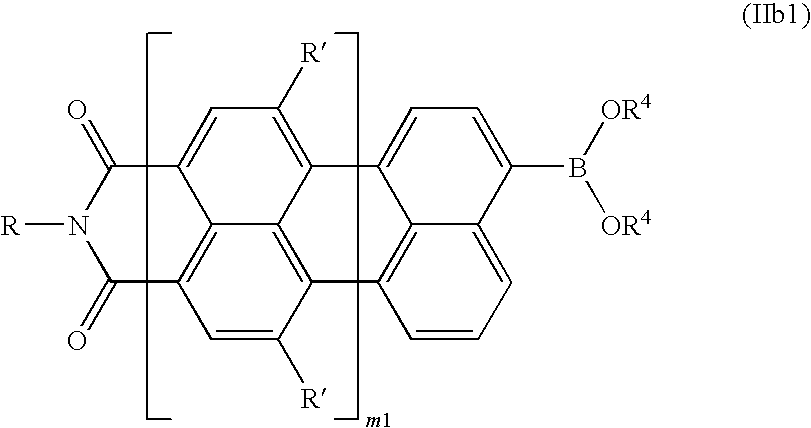


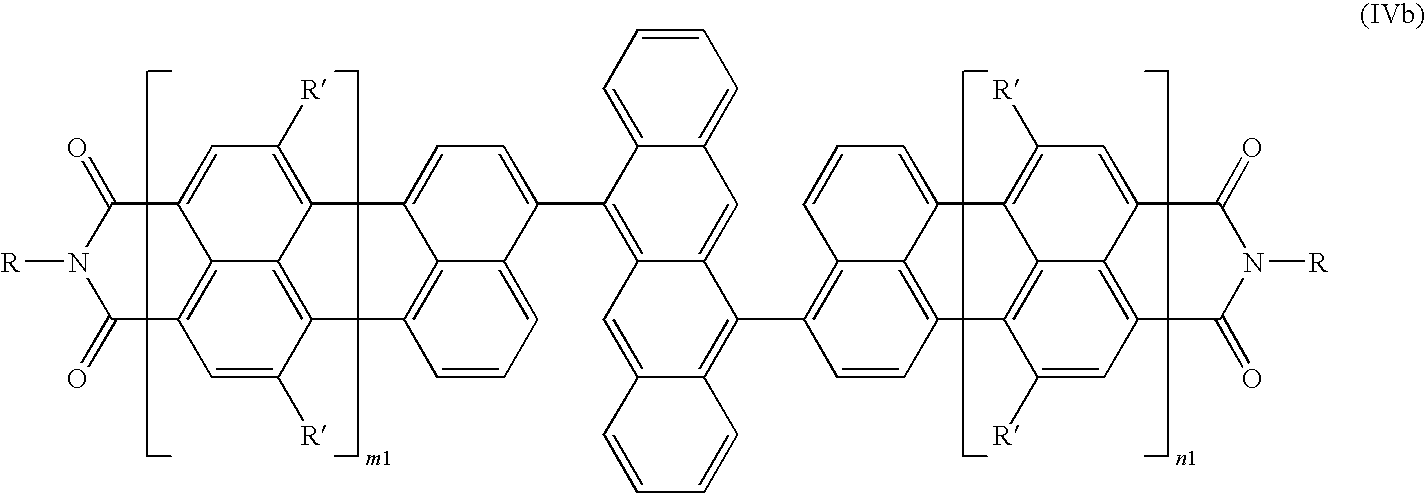


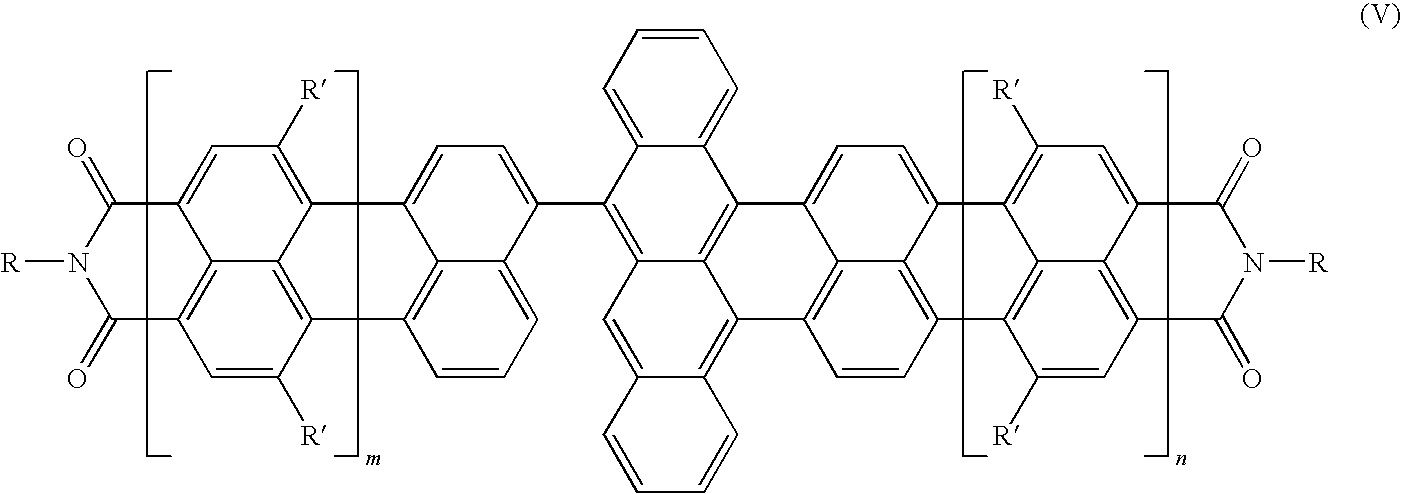
Applications Claiming Priority (4)
| Application Number | Priority Date | Filing Date | Title |
|---|---|---|---|
| EP06114685 | 2006-05-30 | ||
| EP06114685.8 | 2006-05-30 | ||
| EP06114685 | 2006-05-30 | ||
| PCT/EP2007/055194 WO2007138051A1 (en) | 2006-05-30 | 2007-05-29 | Dibenzorylenetetracarboximides as infrared absorbers |
Publications (2)
| Publication Number | Publication Date |
|---|---|
| US20100048904A1 US20100048904A1 (en) | 2010-02-25 |
| US8088922B2 true US8088922B2 (en) | 2012-01-03 |
Family
ID=38345177
Family Applications (1)
| Application Number | Title | Priority Date | Filing Date |
|---|---|---|---|
| US12/302,836 Expired - Fee Related US8088922B2 (en) | 2006-05-30 | 2007-05-29 | Dibenzorylenetetracarboximides as infrared absorbers |
Country Status (4)
| Country | Link |
|---|---|
| US (1) | US8088922B2 (en) |
| EP (1) | EP2029573B1 (en) |
| AT (1) | ATE530543T1 (en) |
| WO (1) | WO2007138051A1 (en) |
Families Citing this family (5)
| Publication number | Priority date | Publication date | Assignee | Title |
|---|---|---|---|---|
| WO2009037283A1 (en) * | 2007-09-18 | 2009-03-26 | Basf Se | Method for producing substrates coated with rylene tetracarbolic acid diimides |
| KR20100097662A (en) * | 2007-10-31 | 2010-09-03 | 바스프 에스이 | Use of halogenated phtalocyanines |
| EP2730554A4 (en) * | 2011-06-10 | 2015-04-15 | Univ Nagoya Nat Univ Corp | PROCESS FOR THE PRODUCTION OF ARYL GROUP-SUBSTITUTED POLYCYCLIC AROMATIC COMPOUND |
| EP2776519B1 (en) | 2011-11-10 | 2016-06-22 | Sicpa Holding Sa | Polymer-bonded polycyclic aromatic hydrocarbons having nitrogen containing substituents |
| JP2015513523A (en) * | 2012-02-10 | 2015-05-14 | インスティチュート・オブ・ケミストリー・チャイニーズ・アカデミー・オブ・サイエンシズ | Tetracenetetracarboxylic acid diimides and their preparation |
Citations (2)
| Publication number | Priority date | Publication date | Assignee | Title |
|---|---|---|---|---|
| WO2005102672A1 (en) | 2004-04-14 | 2005-11-03 | Basf Aktiengesellschaft | Method for welding together plastic parts with the aid of laser radiation |
| US20090236591A1 (en) | 2008-03-19 | 2009-09-24 | Basf Se | N,n'-bis(fluorophenylalkyl)-substituted perylene-3,4:9,10-tetracarboximides, and the preparation and use thereof |
-
2007
- 2007-05-29 US US12/302,836 patent/US8088922B2/en not_active Expired - Fee Related
- 2007-05-29 AT AT07729616T patent/ATE530543T1/en active
- 2007-05-29 EP EP07729616A patent/EP2029573B1/en not_active Not-in-force
- 2007-05-29 WO PCT/EP2007/055194 patent/WO2007138051A1/en not_active Ceased
Patent Citations (2)
| Publication number | Priority date | Publication date | Assignee | Title |
|---|---|---|---|---|
| WO2005102672A1 (en) | 2004-04-14 | 2005-11-03 | Basf Aktiengesellschaft | Method for welding together plastic parts with the aid of laser radiation |
| US20090236591A1 (en) | 2008-03-19 | 2009-09-24 | Basf Se | N,n'-bis(fluorophenylalkyl)-substituted perylene-3,4:9,10-tetracarboximides, and the preparation and use thereof |
Non-Patent Citations (9)
Also Published As
| Publication number | Publication date |
|---|---|
| EP2029573A1 (en) | 2009-03-04 |
| WO2007138051A1 (en) | 2007-12-06 |
| EP2029573B1 (en) | 2011-10-26 |
| US20100048904A1 (en) | 2010-02-25 |
| ATE530543T1 (en) | 2011-11-15 |
Similar Documents
| Publication | Publication Date | Title |
|---|---|---|
| US8674104B2 (en) | Halogen-containing perylenetetracarboxylic acid derivatives and the use thereof | |
| US10214525B2 (en) | Chlorinated napthalenetetracarboxylic acid derivatives, preparation thereof and use thereof in organic electronics | |
| EP2742112B1 (en) | Carbazolocarbazol-bis(dicarboximides) and their use as semiconductors | |
| US8350035B2 (en) | Fluorinated rylenetetracarboxylic acid derivatives and use thereof | |
| US20110042651A1 (en) | Liquid crystalline rylene tetracarboxylic acid derivatives and use thereof | |
| US8202994B2 (en) | Pentarylene- and hexarylenetetracarboximides and preparation thereof | |
| WO2010112452A1 (en) | Oligocondensed perylene bisimides | |
| US20150179954A1 (en) | Substituted terrylene and quaterrylene derivates and use as semiconductors thereof | |
| US20100048904A1 (en) | Dibenzorylenetetracarboximides as infrared absorbers | |
| JP6234602B2 (en) | Novel cyclazine and its use as a semiconductor | |
| WO2009000831A1 (en) | Bromine-substituted rylene tetracarboxylic acid derivatives, and the use thereof | |
| WO2008113753A1 (en) | Method for the production of rylene tetracarboxylic acid diimides the imide nitrogens of which carry hydrogen atoms and the use thereof |
Legal Events
| Date | Code | Title | Description |
|---|---|---|---|
| AS | Assignment |
Owner name: BASF AKTIENGESELLSCHAFT,GERMANY Free format text: ASSIGNMENT OF ASSIGNORS INTEREST;ASSIGNORS:KOENEMANN, MARTIN;BOEHM, ARNO;AVLASEVIC, YURI;AND OTHERS;REEL/FRAME:021925/0281 Effective date: 20070910 Owner name: MAX-PLANCK-GESELLSCHAFT ZUR FOERDERUNG DER WISSENS Free format text: ASSIGNMENT OF ASSIGNORS INTEREST;ASSIGNORS:KOENEMANN, MARTIN;BOEHM, ARNO;AVLASEVIC, YURI;AND OTHERS;REEL/FRAME:021925/0281 Effective date: 20070910 Owner name: BASF AKTIENGESELLSCHAFT, GERMANY Free format text: ASSIGNMENT OF ASSIGNORS INTEREST;ASSIGNORS:KOENEMANN, MARTIN;BOEHM, ARNO;AVLASEVIC, YURI;AND OTHERS;REEL/FRAME:021925/0281 Effective date: 20070910 |
|
| STCF | Information on status: patent grant |
Free format text: PATENTED CASE |
|
| FPAY | Fee payment |
Year of fee payment: 4 |
|
| FEPP | Fee payment procedure |
Free format text: MAINTENANCE FEE REMINDER MAILED (ORIGINAL EVENT CODE: REM.); ENTITY STATUS OF PATENT OWNER: LARGE ENTITY |
|
| LAPS | Lapse for failure to pay maintenance fees |
Free format text: PATENT EXPIRED FOR FAILURE TO PAY MAINTENANCE FEES (ORIGINAL EVENT CODE: EXP.); ENTITY STATUS OF PATENT OWNER: LARGE ENTITY |
|
| STCH | Information on status: patent discontinuation |
Free format text: PATENT EXPIRED DUE TO NONPAYMENT OF MAINTENANCE FEES UNDER 37 CFR 1.362 |
|
| FP | Lapsed due to failure to pay maintenance fee |
Effective date: 20200103 |