US8086237B2 - Efficient neighbor list creation for cellular networks - Google Patents
Efficient neighbor list creation for cellular networks Download PDFInfo
- Publication number
- US8086237B2 US8086237B2 US11/968,023 US96802307A US8086237B2 US 8086237 B2 US8086237 B2 US 8086237B2 US 96802307 A US96802307 A US 96802307A US 8086237 B2 US8086237 B2 US 8086237B2
- Authority
- US
- United States
- Prior art keywords
- neighbor
- pairs
- neighbor list
- list
- sectors
- Prior art date
- Legal status (The legal status is an assumption and is not a legal conclusion. Google has not performed a legal analysis and makes no representation as to the accuracy of the status listed.)
- Active, expires
Links
Images




Classifications
-
- H—ELECTRICITY
- H04—ELECTRIC COMMUNICATION TECHNIQUE
- H04W—WIRELESS COMMUNICATION NETWORKS
- H04W36/00—Hand-off or reselection arrangements
- H04W36/0005—Control or signalling for completing the hand-off
- H04W36/0083—Determination of parameters used for hand-off, e.g. generation or modification of neighbour cell lists
- H04W36/00835—Determination of neighbour cell lists
Definitions
- This patent disclosure relates generally to cellular telephony and, more particularly to a method and system for creating and optimizing neighbor lists to facilitate efficient handoffs in a cellular network.
- a cellular network is made up of a plurality of cellular towers or base stations, each of which serves a plurality of sectors, e.g., 3 separate 120 degree radial sectors per base station. As a particular mobile device moves from one location to another, it may close down contact with one sector and initiate contact with another sector, in such a way that the communications to and from the device are not disturbed. These sectors may or may not reside on a single base station.
- a hand-off The process of transferring the responsibility for communications from one sector to another is referred to in the art as a “hand-off.”
- the details of how to execute a hand-off are many and varied, however, for the purpose of this disclosure, it is notable that a hand-off is usually facilitated by a “neighbor list.”
- a neighbor list is a table that associates each sector with its neighbor sectors. Neighbor sectors often include adjacent sectors, but may also include sectors that are not physically adjacent to one another.
- a drive test is executed to create and verify neighbor lists.
- the drive test involves personnel of the cellular operator physically driving within an area and watching a signal strength monitor to identify which sectors are strong enough in a given location to receive a hand off from a weakening sector.
- the drive test typically results in the creation of a new neighbor list for a sector or in the modification of an existing list to add or remove neighbors. While generally effective, this method of constructing neighbor lists is labor intensive and raises issues of liability and legality. For example, if operator personnel are involved in an accident while drive testing, the operator may be liable. In addition, in certain locations, it may not be legal to operate a cellular device while driving.
- the disclosure describes, in one aspect, a system and method for creating a neighbor list for use in hand-off decisions in a cellular network.
- the process employs PSMM to derive potential neighbors.
- the process accounts for reciprocity and false positives to create reliable lists.
- FIG. 1 is a schematic diagram of a generalized cellular environment including a number of base stations within which embodiments of the invention may be implemented;
- FIG. 2 illustrates a neighbor list according to an embodiment of the invention
- FIG. 3 illustrates a modified neighbor list according to an embodiment of the invention
- FIG. 4 illustrates an example of the SWN.csv file contents according to an embodiment of the invention
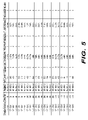
- FIG. 5 illustrates an aspect of the NeighborList.csv according to an embodiment of the invention
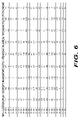
- FIG. 6 illustrates a further aspect of the NeighborList.csv according to an embodiment of the invention
- FIG. 7 illustrates a further aspect of the NeighborList.csv according to an embodiment of the invention.
- FIG. 8 illustrates a further aspect of the NeighborList.csv according to an embodiment of the invention.
- FIG. 9 illustrates a further aspect of the NeighborList.csv according to an embodiment of the invention.
- FIG. 10 is a flow chart illustrating a process of constructing a neighbor list according to an embodiment of the invention.
- FIG. 11 is a flow chart illustrating an alternative process of constructing a neighbor list according to an embodiment of the invention
- the schematic diagram of FIG. 1 illustrates a generalized cellular environment 100 .
- the generalized cellular environment 100 includes a number of base stations 101 - 105 .
- the sectors of adjacent base stations are partially adjacent, in that each base station has one sector that shares a border with that of one sector of an adjacent base station.
- base station 101 has sectors 106 - 108
- base station 102 has sectors 109 - 111
- base station 103 has sectors 112 - 114
- base station 104 has sectors 115 - 117
- base station 105 has sectors 118 - 120 .
- adjacent sector pairs include: [ 106 , 107 ], [ 107 , 108 ], [ 106 , 108 ], [ 109 , 110 ], [ 110 , 111 ], [ 109 , 111 ], [ 112 , 113 ], [ 113 , 114 ], [ 112 , 114 ], [ 115 , 116 ], [ 116 , 117 ], [ 115 , 117 ], [ 118 , 119 ], [ 119 , 120 ], and [ 118 , 120 ].
- adjacent sectors from adjacent base stations include [ 110 , 107 ], [ 115 , 108 ], [ 110 , 115 ], [ 117 , 119 ], [ 111 , 112 ], [ 111 , 118 ], and [ 118 , 114 ].
- nonadjacent sectors may be neighbors depending upon the relative signal strengths.
- adjacent sectors are not neighbors for all purposes in all cases.
- the nearby sectors to which a hand-off may occur are generally tracked via a neighbor list constructed via drive testing as discussed above, or constructed via the disclosed principles for improved and more efficient list creation.
- the chart of FIG. 2 illustrates a possible neighborlist 200 for sector 111 of FIG. 1 .
- the list 200 includes a sector field 201 and a neighbor field 202 .
- the neighbors of sector 111 include a number of the adjacent sectors, but not all adjacent sectors.
- the neighbors of sector 111 also include a number of nonadjacent sectors for the reasons discussed above.
- the communication may be dropped or disrupted when the signal strength from sector 111 drops below a minimum level. Therefore, it is important that the neighbor list for all sectors be current and accurate.
- PSMM data provided by individual mobile units is centrally collected and correlated to provide an accurate listing of viable neighbors for each sector.
- each mobile unit moves within the cellular system 100 , it monitors the signal strength that it observes from sectors that it can detect.
- a unit that is centrally located in sector 111 would detect a high signal strength from sector 111 , but may also detect substantial respective signal strengths from sector 118 and from sector 112 .
- This data is transmitted to the base station 102 and from there to a controller in an embodiment of the invention.
- the signal strength data is derived from the data contained in a standard Pilot Strength Measurement Message (PSMM) transmission.
- PSMM contains a pilot strength record for each sector from which the mobile device is receiving a signal of non-negligible strength.
- Each pilot strength record contains a number of fields, but of particular interest here is the PILOT_STRENGTH field.
- the PILOT_STRENGTH field can be used to compute the strength of a received pilot by measuring the ratio of the pilot energy to the total received spectral density (including noise and signal) at the current CDMA frequency.
- pilot strength may be reported in units of ⁇ 0.5 dB, however any other suitable measurement standard and increment may be used as desired.
- the PSMM transmission may indicate that a sector not listed in the neighbor list for the current sector nonetheless has an acceptable signal strength within the current sector.
- the controller modifies the neighbor list for the current sector to list the new sector as a neighbor for purposes of hand-off.
- the PSMM transmission may indicate that a sector listed in the neighbor list for the current sector nonetheless has an unacceptable signal strength within the current sector.
- the controller modifies the neighbor list for the current sector to delist the identified sector for purposes of hand-off
- the neighbor list 200 is modified to include sector 118 and to exclude sector 112 as shown in the modified neighbor list 300 of FIG. 3 .
- the PSMM analysis and neighbor list correction is performed by a Perl script, although any other language or programmatic representation, whether compiled code or script, may be used.
- the script operates on an NLTA SBS log in an embodiment of the invention to derive a provisional listing which is then processed to derive a final listing.
- the output of the script are seven separate files including: (1) SWN.csv containing the histograms of the delays for each particular search window size and the recommended SWN value based on a 98% percentile (the user may modiy this threshold); (2) NeighborList.csv containing the sorted neighbor lists and statistics for each sector-carrier in the network based on Occurences (HO matrix); (3) Recommended_NLIST.csv containing the recommended NLIST for each sector-carrier; (4) Recommended_ENLIST.csv containing the recommended ENLIST for each sector-carrier; (5) Warnings.txt (NEW) contains any warnings, e.g., list of sector-carriers with no PSMM data as reference sectors (These sectors can be present on other PSMMs but they never were reference sectors.
- NAW Warnings.txt
- METROBTSscript.txt contains all sector-carriers in the network assuming all of them as METROBTS with their corresponding NLIST and ENLIST for CACP; and (7) LOGICALBTSscript.txt contains all sector-carriers in the network assuming all of them as LOGICALBTS with their corresponding NLIST for CACP.
- the chart 400 of FIG. 4 illustrates an example of the SWN.csv.
- the Recommended_SWN is the recommended SWN value based on the 99% percentile threshold. (99% of delays fell under the recommended SW size).
- the SW 0 .SW 15 represents the number of occurrences a delay value falls into the particular search window size when the particular freq-site-sector combination was the reference. These data can be used to create histograms for more detailed analysis.
- the Total Count is the number of records considered for the particular freq-site-sector reference.
- FIGS. 5-9 illustrate the NeighborList.csv in an example, wherein the fields are defined as follows:
- Ocurrences the number of times a particular reference-neighbor combination was presented in a PSMM.
- Ocurrences % the percentage of occurrences.
- Recip_Occur the number of occurrences of the reciprocal direction
- Recip_Occur % the percentage of occurrences in the reciprocal direction
- Reciprocal_Directrans Reciprocal Direct Transitions.
- MAX_REF_EcIo the maximum value of Ec/Io of the reference sector
- AVG_REF_EcIo the average value of Ec/Io of the reference sector
- AVG_NEIGH_EcIo the average value of Ec/lo of the neighbor sector
- MAX_delta_ECIO maximum value for Ec/Io_reference ⁇ Ec/Io_neighbor
- AVG_delta_ECIO average value for Ec/Io_reference ⁇ Ec/Io_neighbor
- FALSE_FLAG when an adjacent false PN is detected, the particular pair is flagged in this column.
- AVG delay the average neighbor's delay in chips between the reference and neighbor sector
- MAX_delay the maximum neighbor's delay in chips between the reference and neighbor sector
- DT_MAX_REF_EcIo the maximum value of Ec/Io of the reference sector during Direct Transitions.
- DT_AVG_REF_EcIo the average value of Ec/Io of the reference sector during Direct Transitions.
- DT_MIN_REF_EcIo the minimun value of Ec/Io of the reference sector during Direct Transitions.
- DT_AVG_NEIGH_EcIo the average value of Ec/Io of the neighbor sector during Direct Transitions.
- OT_MAX_REF_EcIo the maximum value of Ec/Io of the reference sector during Other Transitions (Every other PSMM except direct transitions).
- OT_AVG_REF_EcIo the average value of Ec/Io of the reference sector during Other Transitions (Every other PSMM except direct transitions).
- OT_MIN_REF_EcIo the minimun value of Ec/Io of the reference sector during Other Transitions (Every other PSMM except direct transitions).
- OT_MAX_NEIGH_EcIo the maximum value of Ec/Io of the neighbor sector during Other Transitions (Every other PSMM except direct transitions).
- OT_AVG_NEIGH_EcIo the average value of Ec/Io of the neighbor sector during Other Transitions (Every other PSMM except direct transitions).
- OT_MIN_NEIGH_EcIo the minimun value of Ec/Io of the neighbor sector during Other Transitions (Every other PSMM except direct transitions);
- Neighbor_EcIo_DT this is an array of EcIo values (histogram) for the neighbor during Direct Transitions only. It is useful to investigate and qualify the importance of the direct transitions together with the DT and OT statistics.
- the Warnings.txt file contains warnings from the tool as discussed above.
- Example warnings include a list of sectors that do not have any PSMM as a reference sector. These sectors might be present in a PSMM but they never were reference sectors. Usually, these sectors are Pilot Beacons and they will not have a recommended neighbor list. In an embodiment of the invention, the script may assume that all these sectors are Pilot beacons and skip them.
- the Warnings.txt file may include a list of Co—PN neighbors with the reference sector. These are very rare events and might indicate Co—PN issues in the network.
- the Warnings.txt file may include a list of neighbors for the same reference sector that have duplicate PN. These events not necessarily mean a problem but a possible Co—PN issue. It is generated when multiples mobiles (usually in opposite areas with respect to the Reference sector) report the same PN (coming from different sites) in the PSMM.
- the METROBTSscript.txt file contains the recommended neighbor list.
- the file follows the format for a METROBTS cell type according to CACP and in an embodiment of the invention is completed with all the sites presented in the log files assuming all of them are METROBTS even if they are not.
- the user may delete entries that are Logical Sectors in the file to get the file ready to import.
- the LOGICALBTSscript.txt file contains the recommended neighbor list and follows the format for a LOGICALBTS cell type according to CACP and in an embodiment may be completed with all the sites presented in the log files assuming all of them are LOGICALBTS even if they are not. The user may then delete the entries that are real MetroCell Sectors in the file to get the file ready to import.
- the script or other process identifies Adjacent PN false detection.
- the BSC decodes it as a false PN with an opposite sign delay value.
- a neighbor list algorithm creates recommended neighbor list files and associated CACP files.
- a Settings.ini file include flags to enable a reciprocity check on the NLIST or ENLIST (CDMANLIST for NBSS14) independently. These flags will affect the NL size. Enabling reciprocity will typically result in a higher NL size than when the flag is not activated.
- the neighbor list algorithm first calculates the occurrences and percentage of occurrences for each reference-neighbor pair in the network and then sorts them in descending order based on occurrences, to generate a combined sorted list for the whole network and not for a particular sector-carrier.
- the algorithm then adds softer handoff sectors to each reference's NL and then goes through the sorted list building the neighbor lists of all sector-carriers in quasi-parallel fashion.
- This approach addresses a problem that could occur if the algorithm were to treat individual NL one at a time and include reciprocity check.
- the reciprocity check tends to fill out some reciprocal neighbors that might not be as important as other neighbors in the reciprocal's NL, and if the site reach the limit e.g., 20 neighbors, it is likely to omit important neighbors with high number of occurrences.
- the tool does the ranking automatically and solve this multiple interaction problem.
- FIG. 10 is a flow chart 1000 illustrating a process of constructing a neighbor list according to an embodiment of the invention, wherein a reciprocity check is employed.
- the process sorts all reference neighbor pairs in the network by number of occurrences in descending order. In an embodiment of the invention, the sorting is global rather than a sector-carrier based sort action. The process then adds softer hand-off sectors to each reference sector at stage 1002 .
- the process analyzes all pairs in the sorted list. In particular, at stage 1004 , the process determines for a given pair whether the percentage of occurrence exceeds a first threshold or whether the direct transition statistics (defined above, as “Direct Transitions”) exceeds a second threshold.
- stage 1005 the process determines whether the reference's NL and reciprocal NL have less than 20 neighbors (or any other chosen size). If it is determined that both lists have less than 20 neighbors, then the process flows to stage 1006 , and adds neighbors to the reference's NL and reciprocal NL in order of occurrence percentage. If either of stages 1003 or 1004 yields a negative determination, then the process flows instead to stage 1007 where it increments to the next pair in the list of stage 1002 .
- FIG. 11 is a flow chart 1100 illustrating a process of constructing a neighbor list according to an embodiment of the invention, wherein a reciprocity check is not employed.
- the process sorts all reference neighbor pairs in the network by number of occurrences in descending order. In an embodiment of the invention, the sorting is global rather than a sector-carrier based sort action. The process then adds softer hand-off sectors to each reference sector at stage 1102 .
- the process analyzes all pairs in the sorted list. In particular, at stage 1104 , the process determines for a given pair whether the percentage of occurrence exceeds a first threshold or whether the direct transition statistics (defined above, as “Direct Transitions”) exceeds a second threshold.
- stage 1105 the process determines whether the reference NL has less than 20 neighbors (or any other chosen size). If it is determined that the reference NL has less than 20 neighbors, then the process flows to stage 1106 , and adds neighbors to the reference NL in order of occurrence percentage. If either of stages 1103 or 1104 yields a negative determination, then the process flows instead to stage 1107 where it increments to the next pair in the list of stage 1102 .
Landscapes
- Engineering & Computer Science (AREA)
- Computer Networks & Wireless Communication (AREA)
- Signal Processing (AREA)
- Mobile Radio Communication Systems (AREA)
Abstract
Description
Claims (20)
Priority Applications (1)
| Application Number | Priority Date | Filing Date | Title |
|---|---|---|---|
| US11/968,023 US8086237B2 (en) | 2007-11-09 | 2007-12-31 | Efficient neighbor list creation for cellular networks |
Applications Claiming Priority (2)
| Application Number | Priority Date | Filing Date | Title |
|---|---|---|---|
| US98685207P | 2007-11-09 | 2007-11-09 | |
| US11/968,023 US8086237B2 (en) | 2007-11-09 | 2007-12-31 | Efficient neighbor list creation for cellular networks |
Publications (2)
| Publication Number | Publication Date |
|---|---|
| US20090124262A1 US20090124262A1 (en) | 2009-05-14 |
| US8086237B2 true US8086237B2 (en) | 2011-12-27 |
Family
ID=40624187
Family Applications (1)
| Application Number | Title | Priority Date | Filing Date |
|---|---|---|---|
| US11/968,023 Active 2030-10-28 US8086237B2 (en) | 2007-11-09 | 2007-12-31 | Efficient neighbor list creation for cellular networks |
Country Status (1)
| Country | Link |
|---|---|
| US (1) | US8086237B2 (en) |
Cited By (2)
| Publication number | Priority date | Publication date | Assignee | Title |
|---|---|---|---|---|
| US8792896B2 (en) * | 2012-10-09 | 2014-07-29 | Telefonaktiebolaget L M Ericsson (Publ) | Beamforming for increasing cell edge capacity in a heterogeneous network |
| US9264960B1 (en) | 2014-05-06 | 2016-02-16 | Sprint Spectrum L.P. | Systems and methods for determinng access node candidates for handover of wireless devices |
Families Citing this family (17)
| Publication number | Priority date | Publication date | Assignee | Title |
|---|---|---|---|---|
| US7623857B1 (en) * | 2005-10-21 | 2009-11-24 | At&T Intellectual Property I, L.P. | Intelligent pico-cell for transport of wireless device communications over wireline networks |
| US8326296B1 (en) | 2006-07-12 | 2012-12-04 | At&T Intellectual Property I, L.P. | Pico-cell extension for cellular network |
| US8718635B2 (en) * | 2008-04-22 | 2014-05-06 | Apple Inc. | Optimizing neighbor lists |
| US8626223B2 (en) | 2008-05-07 | 2014-01-07 | At&T Mobility Ii Llc | Femto cell signaling gating |
| US8126496B2 (en) * | 2008-05-07 | 2012-02-28 | At&T Mobility Ii Llc | Signaling-triggered power adjustment in a femto cell |
| US8719420B2 (en) | 2008-05-13 | 2014-05-06 | At&T Mobility Ii Llc | Administration of access lists for femtocell service |
| US8763082B2 (en) | 2008-05-13 | 2014-06-24 | At&T Mobility Ii Llc | Interactive client management of an access control list |
| US8504032B2 (en) | 2008-06-12 | 2013-08-06 | At&T Intellectual Property I, L.P. | Femtocell service registration, activation, and provisioning |
| US8510801B2 (en) | 2009-10-15 | 2013-08-13 | At&T Intellectual Property I, L.P. | Management of access to service in an access point |
| US8451784B2 (en) * | 2009-11-06 | 2013-05-28 | At&T Mobility Ii Llc | Virtual neighbor objects for managing idle mode mobility in a wireless network |
| US8548474B2 (en) * | 2011-01-07 | 2013-10-01 | Renesas Mobile Corporation | Method for automatic neighbor cell relation reporting in a mobile communication system |
| US8737375B2 (en) | 2012-07-25 | 2014-05-27 | At&T Mobility Ii Llc | Code planning for wireless communications |
| US8565771B1 (en) | 2012-08-23 | 2013-10-22 | At&T Mobility Ii Llc | Handover relation identification utilizing network events |
| US9288716B2 (en) | 2012-11-30 | 2016-03-15 | At&T Mobility Ii Llc | Resource management in a wireless communications network |
| US9232413B2 (en) * | 2013-05-02 | 2016-01-05 | United States Cellular Corporation | Maintaining high signal quality in mobile wireless networks using signal relative importance values |
| US10834608B1 (en) | 2019-07-16 | 2020-11-10 | At&T Intellectual Property I, L.P. | Facilitating model-driven automated cell allocation in fifth generation (5G) or other advanced networks |
| US11832294B2 (en) | 2021-12-02 | 2023-11-28 | At&T Intellectual Property I, L.P. | Facilitating assignment of root sequence indexes while minimizing network changes |
Citations (2)
| Publication number | Priority date | Publication date | Assignee | Title |
|---|---|---|---|---|
| US20040142699A1 (en) * | 2001-05-02 | 2004-07-22 | Jollota James M. | Method and system for indicating link quality among neighboring wireless base station |
| US7941148B2 (en) * | 2006-07-14 | 2011-05-10 | Carrier Iq, Inc. | Neighbor list generation in wireless networks |
-
2007
- 2007-12-31 US US11/968,023 patent/US8086237B2/en active Active
Patent Citations (2)
| Publication number | Priority date | Publication date | Assignee | Title |
|---|---|---|---|---|
| US20040142699A1 (en) * | 2001-05-02 | 2004-07-22 | Jollota James M. | Method and system for indicating link quality among neighboring wireless base station |
| US7941148B2 (en) * | 2006-07-14 | 2011-05-10 | Carrier Iq, Inc. | Neighbor list generation in wireless networks |
Cited By (2)
| Publication number | Priority date | Publication date | Assignee | Title |
|---|---|---|---|---|
| US8792896B2 (en) * | 2012-10-09 | 2014-07-29 | Telefonaktiebolaget L M Ericsson (Publ) | Beamforming for increasing cell edge capacity in a heterogeneous network |
| US9264960B1 (en) | 2014-05-06 | 2016-02-16 | Sprint Spectrum L.P. | Systems and methods for determinng access node candidates for handover of wireless devices |
Also Published As
| Publication number | Publication date |
|---|---|
| US20090124262A1 (en) | 2009-05-14 |
Similar Documents
| Publication | Publication Date | Title |
|---|---|---|
| US8086237B2 (en) | Efficient neighbor list creation for cellular networks | |
| EP1929668B1 (en) | Method and apparatus for optimizing neighbor list automatically in asynchronous wcdma network | |
| US20120244869A1 (en) | Network scaling for network energy savings | |
| EP2673994B1 (en) | Method and system of analyzing a plurality of cells of a cellular telecommunication network | |
| CN1168345C (en) | Method and apparatus for soft handoff in a wireless communication system | |
| CN109391513B (en) | Network perception intelligent early warning and improving method based on big data | |
| CN101222754A (en) | Downlink common channel measurement method, system, device and terminal | |
| CN101790173A (en) | Network coverage detection method and system | |
| CN108462966B (en) | A method and system for RRU positioning and identification based on 2G network high-speed rail community | |
| CN108702697A (en) | Target cell determination method, base station and management equipment | |
| US8054803B2 (en) | Method and apparatus for optimizing neighbor list automatically in synchronous CDMA network | |
| CN111866847B (en) | Mobile communication network data analysis method, equipment and computer storage medium | |
| CN102075902B (en) | Method and device for determining new neighbor cell of serving cell | |
| CN102761897A (en) | Method and system for realizing automatic neighbor cell relation measurement | |
| CN102595526B (en) | The processing method and base station controller of terminal Neighboring Cell List | |
| CN107567030A (en) | A kind of method and system investigated with evading pseudo-base station interference | |
| CN102685783B (en) | Method and device for searching network coverage dead zone in mobile communication network | |
| CN104113864A (en) | Self-optimizing method and device of network | |
| CN111328078A (en) | Method and device for positioning pseudo base station | |
| CN102572926A (en) | Method and device for reporting neighbor information | |
| CN100355307C (en) | Antenna adjustment method, system and network element | |
| CN1984471A (en) | Method and system for optimizing homogeneous-frequency adjacent-domain configuration | |
| CN110366218B (en) | Cell switching method and device | |
| CN101959169A (en) | Method and device for optimizing adjacent cells | |
| EP2611235B1 (en) | Method and device for discovering 2g neighbour cells at the edge of an area covered by a 3g cell |
Legal Events
| Date | Code | Title | Description |
|---|---|---|---|
| AS | Assignment |
Owner name: UNITED STATES CELLULAR CORPORATION, ILLINOIS Free format text: ASSIGNMENT OF ASSIGNORS INTEREST;ASSIGNORS:VELA, MARIO;SAXENA, NAROTHUM;IRIZARRY, MICHAEL;REEL/FRAME:020693/0446;SIGNING DATES FROM 20080115 TO 20080116 Owner name: UNITED STATES CELLULAR CORPORATION, ILLINOIS Free format text: ASSIGNMENT OF ASSIGNORS INTEREST;ASSIGNORS:VELA, MARIO;SAXENA, NAROTHUM;IRIZARRY, MICHAEL;SIGNING DATES FROM 20080115 TO 20080116;REEL/FRAME:020693/0446 |
|
| FEPP | Fee payment procedure |
Free format text: PAYOR NUMBER ASSIGNED (ORIGINAL EVENT CODE: ASPN); ENTITY STATUS OF PATENT OWNER: LARGE ENTITY |
|
| STCF | Information on status: patent grant |
Free format text: PATENTED CASE |
|
| CC | Certificate of correction | ||
| FPAY | Fee payment |
Year of fee payment: 4 |
|
| MAFP | Maintenance fee payment |
Free format text: PAYMENT OF MAINTENANCE FEE, 8TH YEAR, LARGE ENTITY (ORIGINAL EVENT CODE: M1552); ENTITY STATUS OF PATENT OWNER: LARGE ENTITY Year of fee payment: 8 |
|
| MAFP | Maintenance fee payment |
Free format text: PAYMENT OF MAINTENANCE FEE, 12TH YEAR, LARGE ENTITY (ORIGINAL EVENT CODE: M1553); ENTITY STATUS OF PATENT OWNER: LARGE ENTITY Year of fee payment: 12 |
|
| AS | Assignment |
Owner name: USCC WIRELESS HOLDINGS, LLC, ILLINOIS Free format text: ASSIGNMENT OF ASSIGNORS INTEREST;ASSIGNOR:UNITED STATES CELLULAR CORPORATION;REEL/FRAME:072315/0805 Effective date: 20250801 |
|
| AS | Assignment |
Owner name: ODYSSEY WEST, LLC, WASHINGTON Free format text: MERGER;ASSIGNOR:USCC WIRELESS HOLDINGS, LLC;REEL/FRAME:073362/0519 Effective date: 20250801 Owner name: T-MOBILE INNOVATIONS LLC, WASHINGTON Free format text: ASSIGNMENT OF ASSIGNORS INTEREST;ASSIGNOR:ODYSSEY WEST, LLC;REEL/FRAME:073365/0391 Effective date: 20250801 |