US8084472B2 - Fused pyrrolocarbazoles - Google Patents
Fused pyrrolocarbazoles Download PDFInfo
- Publication number
- US8084472B2 US8084472B2 US12/415,525 US41552509A US8084472B2 US 8084472 B2 US8084472 B2 US 8084472B2 US 41552509 A US41552509 A US 41552509A US 8084472 B2 US8084472 B2 US 8084472B2
- Authority
- US
- United States
- Prior art keywords
- optionally substituted
- groups
- heteroatom
- alkyl
- optional substituents
- Prior art date
- Legal status (The legal status is an assumption and is not a legal conclusion. Google has not performed a legal analysis and makes no representation as to the accuracy of the status listed.)
- Expired - Lifetime, expires
Links
- 0 [1*]N1C(C)(C)C2=C3CCCC3=C3C(=C2C1(C)C)C1=C(C=CC=C1)N3[2*].[3*]C.[4*]C.[5*]C.[6*]C Chemical compound [1*]N1C(C)(C)C2=C3CCCC3=C3C(=C2C1(C)C)C1=C(C=CC=C1)N3[2*].[3*]C.[4*]C.[5*]C.[6*]C 0.000 description 22
- IEMMBWWQXVXBEU-UHFFFAOYSA-N CC(=O)C1=CC=CO1 Chemical compound CC(=O)C1=CC=CO1 IEMMBWWQXVXBEU-UHFFFAOYSA-N 0.000 description 20
- FKDNPZHPGHSSGY-UHFFFAOYSA-N CC(C)OC1=NC=CC=N1 Chemical compound CC(C)OC1=NC=CC=N1 FKDNPZHPGHSSGY-UHFFFAOYSA-N 0.000 description 20
- WYJOVVXUZNRJQY-UHFFFAOYSA-N CC(=O)C1=CC=CS1 Chemical compound CC(=O)C1=CC=CS1 WYJOVVXUZNRJQY-UHFFFAOYSA-N 0.000 description 16
- ONQBOTKLCMXPOF-UHFFFAOYSA-N CCN1CCCC1 Chemical compound CCN1CCCC1 ONQBOTKLCMXPOF-UHFFFAOYSA-N 0.000 description 10
- YLZYSVYZMDJYOT-UHFFFAOYSA-N COC1=NC=CC=N1 Chemical compound COC1=NC=CC=N1 YLZYSVYZMDJYOT-UHFFFAOYSA-N 0.000 description 7
- LFJNVLDOQPOSOJ-UHFFFAOYSA-N COCCOCC(C)C Chemical compound COCCOCC(C)C LFJNVLDOQPOSOJ-UHFFFAOYSA-N 0.000 description 7
- GVVITKMOMFXUKN-UHFFFAOYSA-N CC(=O)C1=C(Cl)C=CS1 Chemical compound CC(=O)C1=C(Cl)C=CS1 GVVITKMOMFXUKN-UHFFFAOYSA-N 0.000 description 5
- OJKLTHIQRARJCE-UHFFFAOYSA-N COC1=NC2=C(C=CC=C2)S1 Chemical compound COC1=NC2=C(C=CC=C2)S1 OJKLTHIQRARJCE-UHFFFAOYSA-N 0.000 description 5
- ZUXPELAHJQSZTE-UHFFFAOYSA-N CC(=O)C1=C(Br)C=CS1 Chemical compound CC(=O)C1=C(Br)C=CS1 ZUXPELAHJQSZTE-UHFFFAOYSA-N 0.000 description 4
- NFZNHUNPIJPRMP-UHFFFAOYSA-N CC(=O)C1=CC(C)=CS1 Chemical compound CC(=O)C1=CC(C)=CS1 NFZNHUNPIJPRMP-UHFFFAOYSA-N 0.000 description 4
- HXTSOMZAFUTVCP-UHFFFAOYSA-N CC(C)OC1=CN=CC=N1 Chemical compound CC(C)OC1=CN=CC=N1 HXTSOMZAFUTVCP-UHFFFAOYSA-N 0.000 description 4
- GCCKHXWBNPBUOD-UHFFFAOYSA-N CC(=O)C1=COC=C1 Chemical compound CC(=O)C1=COC=C1 GCCKHXWBNPBUOD-UHFFFAOYSA-N 0.000 description 3
- JOUQNDGCVPKILM-UHFFFAOYSA-N CC(C)CN1C2=C(C=C(C(=O)C3=CC=CS3)C=C2)C2=C3C(=O)NC(=O)C3=C3C4=CN(C)N=C4CCC3=C21 Chemical compound CC(C)CN1C2=C(C=C(C(=O)C3=CC=CS3)C=C2)C2=C3C(=O)NC(=O)C3=C3C4=CN(C)N=C4CCC3=C21 JOUQNDGCVPKILM-UHFFFAOYSA-N 0.000 description 3
- OVPLZYJGTGDFNB-UHFFFAOYSA-N CC(C)OC(N)=O Chemical compound CC(C)OC(N)=O OVPLZYJGTGDFNB-UHFFFAOYSA-N 0.000 description 3
- VNXBKJFUJUWOCW-UHFFFAOYSA-N CC1CC1 Chemical compound CC1CC1 VNXBKJFUJUWOCW-UHFFFAOYSA-N 0.000 description 3
- JOYRKODLDBILNP-UHFFFAOYSA-N CCOC(N)=O Chemical compound CCOC(N)=O JOYRKODLDBILNP-UHFFFAOYSA-N 0.000 description 3
- DENPQNAWGQXKCU-UHFFFAOYSA-N NC(=O)C1=CC=CS1 Chemical compound NC(=O)C1=CC=CS1 DENPQNAWGQXKCU-UHFFFAOYSA-N 0.000 description 3
- VIMWHPZKQNUKOV-UHFFFAOYSA-N C.CN1C=C(C(C)(C)C)C(C(C)(C)C)=N1.CN1C=CC(C(C)(C)C)=C1C(C)(C)C Chemical compound C.CN1C=C(C(C)(C)C)C(C(C)(C)C)=N1.CN1C=CC(C(C)(C)C)=C1C(C)(C)C VIMWHPZKQNUKOV-UHFFFAOYSA-N 0.000 description 2
- YBJDKNXEWQSGEL-UHFFFAOYSA-N CC(=O)C1=C(C)C=CS1 Chemical compound CC(=O)C1=C(C)C=CS1 YBJDKNXEWQSGEL-UHFFFAOYSA-N 0.000 description 2
- BGQFYGHXTIBTMM-UHFFFAOYSA-N CC(=O)C1=C(Cl)C(S(C)(=O)=O)=CS1 Chemical compound CC(=O)C1=C(Cl)C(S(C)(=O)=O)=CS1 BGQFYGHXTIBTMM-UHFFFAOYSA-N 0.000 description 2
- RNIDWJDZNNVFDY-UHFFFAOYSA-N CC(=O)C1=CSC=C1 Chemical compound CC(=O)C1=CSC=C1 RNIDWJDZNNVFDY-UHFFFAOYSA-N 0.000 description 2
- FWMYIWIINMISHT-UHFFFAOYSA-N CC(C)CN1C2=C(C=C(OCC(=O)NCCCCCCN(C)C)C=C2)C2=C1C1=C(C3=CN(C)N=C3CC1)C1=C2CNC1=O Chemical compound CC(C)CN1C2=C(C=C(OCC(=O)NCCCCCCN(C)C)C=C2)C2=C1C1=C(C3=CN(C)N=C3CC1)C1=C2CNC1=O FWMYIWIINMISHT-UHFFFAOYSA-N 0.000 description 2
- RPXFBFKUADDXBW-UHFFFAOYSA-N CC(C)CN1C2=C(C=C(OCC(=O)NCCCN3CCN(C)CC3)C=C2)C2=C1C1=C(C3=CN(C)N=C3CC1)C1=C2CNC1=O Chemical compound CC(C)CN1C2=C(C=C(OCC(=O)NCCCN3CCN(C)CC3)C=C2)C2=C1C1=C(C3=CN(C)N=C3CC1)C1=C2CNC1=O RPXFBFKUADDXBW-UHFFFAOYSA-N 0.000 description 2
- BRUZQRBVNRKLJG-UHFFFAOYSA-N CC(C)COC(N)=O Chemical compound CC(C)COC(N)=O BRUZQRBVNRKLJG-UHFFFAOYSA-N 0.000 description 2
- DRAOBKGPVXVNLF-UHFFFAOYSA-N CC(C)COCC(C)C1=CC=CC=C1 Chemical compound CC(C)COCC(C)C1=CC=CC=C1 DRAOBKGPVXVNLF-UHFFFAOYSA-N 0.000 description 2
- UVQSHXNNOABQRD-UHFFFAOYSA-N CC(C)COCC1CC1 Chemical compound CC(C)COCC1CC1 UVQSHXNNOABQRD-UHFFFAOYSA-N 0.000 description 2
- OHSOBBGHOGCFBD-UHFFFAOYSA-N CC(C)COCC1CCCC1 Chemical compound CC(C)COCC1CCCC1 OHSOBBGHOGCFBD-UHFFFAOYSA-N 0.000 description 2
- NMYWADPGQWBKBH-UHFFFAOYSA-N CC(C)COCC1CCOC1 Chemical compound CC(C)COCC1CCOC1 NMYWADPGQWBKBH-UHFFFAOYSA-N 0.000 description 2
- XKVMRHJCLNHLDW-UHFFFAOYSA-N CC(C)COCCC1=CC=CS1 Chemical compound CC(C)COCCC1=CC=CS1 XKVMRHJCLNHLDW-UHFFFAOYSA-N 0.000 description 2
- GDOPTJXRTPNYNR-UHFFFAOYSA-N CC1CCCC1 Chemical compound CC1CCCC1 GDOPTJXRTPNYNR-UHFFFAOYSA-N 0.000 description 2
- GOVXKUCVZUROAN-UHFFFAOYSA-N CCC1=CNC2=CC=CC=C12 Chemical compound CCC1=CNC2=CC=CC=C12 GOVXKUCVZUROAN-UHFFFAOYSA-N 0.000 description 2
- NJQHZENQKNIRSY-UHFFFAOYSA-N CCC1=CNC=N1 Chemical compound CCC1=CNC=N1 NJQHZENQKNIRSY-UHFFFAOYSA-N 0.000 description 2
- OUKZCQQNMWXMNE-UHFFFAOYSA-N CCCCCCN1CCCC1 Chemical compound CCCCCCN1CCCC1 OUKZCQQNMWXMNE-UHFFFAOYSA-N 0.000 description 2
- YNTOKMNHRPSGFU-UHFFFAOYSA-N CCCOC(N)=O Chemical compound CCCOC(N)=O YNTOKMNHRPSGFU-UHFFFAOYSA-N 0.000 description 2
- WLKLKJBWHFYDQG-UHFFFAOYSA-N CCN1C2=CC=C(OCC(=O)N3CCN(C4=NC=CC=C4)CC3)C=C2C2=C1C1=C(C3=CN(C)N=C3CC1)C1=C2CNC1=O Chemical compound CCN1C2=CC=C(OCC(=O)N3CCN(C4=NC=CC=C4)CC3)C=C2C2=C1C1=C(C3=CN(C)N=C3CC1)C1=C2CNC1=O WLKLKJBWHFYDQG-UHFFFAOYSA-N 0.000 description 2
- BOPOCKVEEFUKPN-UHFFFAOYSA-N CCN1C2=CC=C(OCC(=O)NC3=CC=C(N(C)C)C=C3)C=C2C2=C1C1=C(C3=CN(C)N=C3CC1)C1=C2CNC1=O Chemical compound CCN1C2=CC=C(OCC(=O)NC3=CC=C(N(C)C)C=C3)C=C2C2=C1C1=C(C3=CN(C)N=C3CC1)C1=C2CNC1=O BOPOCKVEEFUKPN-UHFFFAOYSA-N 0.000 description 2
- WTTZSMADQZZDTJ-UHFFFAOYSA-N CCN1C=C2C(=N1)CCC1=C2C2=C(CNC2=O)C2=C1N(CCN1CCCC1)C1=CC=C(C(=O)C3=C(Br)C=CS3)C=C12 Chemical compound CCN1C=C2C(=N1)CCC1=C2C2=C(CNC2=O)C2=C1N(CCN1CCCC1)C1=CC=C(C(=O)C3=C(Br)C=CS3)C=C12 WTTZSMADQZZDTJ-UHFFFAOYSA-N 0.000 description 2
- BWIGPOKTTATUTP-UHFFFAOYSA-N CNC(=O)OCCBr Chemical compound CNC(=O)OCCBr BWIGPOKTTATUTP-UHFFFAOYSA-N 0.000 description 2
- WKSXRWSOSLGSTN-UHFFFAOYSA-N COC1=CN=CC=N1 Chemical compound COC1=CN=CC=N1 WKSXRWSOSLGSTN-UHFFFAOYSA-N 0.000 description 2
- ABWQLBWYPYHBHW-UHFFFAOYSA-N COC1=NC(O)=NC(OC)=N1 Chemical compound COC1=NC(O)=NC(OC)=N1 ABWQLBWYPYHBHW-UHFFFAOYSA-N 0.000 description 2
- NRBCYYCKOXRXRB-UHFFFAOYSA-N COC1=NC2=C(C=CC=C2)O1 Chemical compound COC1=NC2=C(C=CC=C2)O1 NRBCYYCKOXRXRB-UHFFFAOYSA-N 0.000 description 2
- QJIJECSQYKAVBF-UHFFFAOYSA-N COCC1OCCO1 Chemical compound COCC1OCCO1 QJIJECSQYKAVBF-UHFFFAOYSA-N 0.000 description 2
- TVFIYRKPCACCNL-UHFFFAOYSA-N NC(=O)C1=CC=CO1 Chemical compound NC(=O)C1=CC=CO1 TVFIYRKPCACCNL-UHFFFAOYSA-N 0.000 description 2
- VFQXVTODMYMSMJ-UHFFFAOYSA-N NC(=O)C1=CC=NC=C1 Chemical compound NC(=O)C1=CC=NC=C1 VFQXVTODMYMSMJ-UHFFFAOYSA-N 0.000 description 2
- DSIBSRXKQRYPJP-UHFFFAOYSA-N NC(=O)C1=CC=NO1 Chemical compound NC(=O)C1=CC=NO1 DSIBSRXKQRYPJP-UHFFFAOYSA-N 0.000 description 2
- NYCVCXMSZNOGDH-UHFFFAOYSA-N O=C(O)N1CCCC1 Chemical compound O=C(O)N1CCCC1 NYCVCXMSZNOGDH-UHFFFAOYSA-N 0.000 description 2
- MRFFNUWMOCRTQM-UHFFFAOYSA-N C#CCCOCC(C)C Chemical compound C#CCCOCC(C)C MRFFNUWMOCRTQM-UHFFFAOYSA-N 0.000 description 1
- ABAMAZQNEYSUPW-UHFFFAOYSA-N C1=CC=CC=C1.CC.CC Chemical compound C1=CC=CC=C1.CC.CC ABAMAZQNEYSUPW-UHFFFAOYSA-N 0.000 description 1
- QEWHEEPNRMOMLV-UHFFFAOYSA-N C=CCNC(=O)NCC(C)C Chemical compound C=CCNC(=O)NCC(C)C QEWHEEPNRMOMLV-UHFFFAOYSA-N 0.000 description 1
- ORMDKYSAOZFHLP-UHFFFAOYSA-N CC(=O)COC1=CC=C2C(=C1)C1=C(C3=C(C4=CN(C)N=C4CC3)C3=C1CNC3=O)N2CC(C)C Chemical compound CC(=O)COC1=CC=C2C(=C1)C1=C(C3=C(C4=CN(C)N=C4CC3)C3=C1CNC3=O)N2CC(C)C ORMDKYSAOZFHLP-UHFFFAOYSA-N 0.000 description 1
- UUNMPKZQWTYDAD-UHFFFAOYSA-N CC(C)(C)CC1(C)CCCC1 Chemical compound CC(C)(C)CC1(C)CCCC1 UUNMPKZQWTYDAD-UHFFFAOYSA-N 0.000 description 1
- NHXKHPOIUVGAFC-UHFFFAOYSA-N CC(C)CCOC1=NC2=C(C=CC=C2)S1 Chemical compound CC(C)CCOC1=NC2=C(C=CC=C2)S1 NHXKHPOIUVGAFC-UHFFFAOYSA-N 0.000 description 1
- MFBKHLZBNJWMSQ-UHFFFAOYSA-N CC(C)CN1C2=C(C=C(O)C=C2)C2=C1C1=C(C3=C(CC1)N(C)N=C3)C1=C2CNC1=O Chemical compound CC(C)CN1C2=C(C=C(O)C=C2)C2=C1C1=C(C3=C(CC1)N(C)N=C3)C1=C2CNC1=O MFBKHLZBNJWMSQ-UHFFFAOYSA-N 0.000 description 1
- XCZKXKGTBNUKQN-UHFFFAOYSA-N CC(C)CN1C2=C(C=C(OC3=NC=CC=N3)C=C2)C2=C3C(=O)NC(=O)C3=C3C4=CN(C)N=C4CCC3=C21 Chemical compound CC(C)CN1C2=C(C=C(OC3=NC=CC=N3)C=C2)C2=C3C(=O)NC(=O)C3=C3C4=CN(C)N=C4CCC3=C21 XCZKXKGTBNUKQN-UHFFFAOYSA-N 0.000 description 1
- GLFXIHDMHHZMBB-UHFFFAOYSA-N CC(C)CN1C2=C(C=C(OCC(=O)N(C)CCC3=CC=CC=N3)C=C2)C2=C1C1=C(C3=CN(C)N=C3CC1)C1=C2CNC1=O Chemical compound CC(C)CN1C2=C(C=C(OCC(=O)N(C)CCC3=CC=CC=N3)C=C2)C2=C1C1=C(C3=CN(C)N=C3CC1)C1=C2CNC1=O GLFXIHDMHHZMBB-UHFFFAOYSA-N 0.000 description 1
- POXFCXXSOCMHKP-UHFFFAOYSA-N CC(C)CN1C2=C(C=C(OCC(=O)N3CCOCC3)C=C2)C2=C3CNC(=O)C3=C3C4=CN(C)N=C4CCC3=C21 Chemical compound CC(C)CN1C2=C(C=C(OCC(=O)N3CCOCC3)C=C2)C2=C3CNC(=O)C3=C3C4=CN(C)N=C4CCC3=C21 POXFCXXSOCMHKP-UHFFFAOYSA-N 0.000 description 1
- CDLUUNUVQOZUBV-UHFFFAOYSA-N CC(C)CN1C2=C(C=C(OCC(=O)NCCC3=CC=CC=N3)C=C2)C2=C1C1=C(C3=CN(C)N=C3CC1)C1=C2CNC1=O Chemical compound CC(C)CN1C2=C(C=C(OCC(=O)NCCC3=CC=CC=N3)C=C2)C2=C1C1=C(C3=CN(C)N=C3CC1)C1=C2CNC1=O CDLUUNUVQOZUBV-UHFFFAOYSA-N 0.000 description 1
- MVARVLQRSJVZNE-UHFFFAOYSA-N CC(C)CN1C2=C(C=C(OCC(=O)NCCCCCN(C)C)C=C2)C2=C1C1=C(C3=CN(C)N=C3CC1)C1=C2CNC1=O Chemical compound CC(C)CN1C2=C(C=C(OCC(=O)NCCCCCN(C)C)C=C2)C2=C1C1=C(C3=CN(C)N=C3CC1)C1=C2CNC1=O MVARVLQRSJVZNE-UHFFFAOYSA-N 0.000 description 1
- WFWXFDZKIDSMMQ-UHFFFAOYSA-N CC(C)CN1C2=C(C=C(OCC(=O)NCCCCN(C)C)C=C2)C2=C1C1=C(C3=CN(C)N=C3CC1)C1=C2CNC1=O Chemical compound CC(C)CN1C2=C(C=C(OCC(=O)NCCCCN(C)C)C=C2)C2=C1C1=C(C3=CN(C)N=C3CC1)C1=C2CNC1=O WFWXFDZKIDSMMQ-UHFFFAOYSA-N 0.000 description 1
- YTXWREGWXOATBM-UHFFFAOYSA-N CC(C)CN1C2=C(C=C(OCC(=O)NCCCN3CCCC3)C=C2)C2=C1C1=C(C3=CN(C)N=C3CC1)C1=C2CNC1=O Chemical compound CC(C)CN1C2=C(C=C(OCC(=O)NCCCN3CCCC3)C=C2)C2=C1C1=C(C3=CN(C)N=C3CC1)C1=C2CNC1=O YTXWREGWXOATBM-UHFFFAOYSA-N 0.000 description 1
- BUEFYAKFFUYMOM-UHFFFAOYSA-N CC(C)CN1C2=C(C=CC=C2)C2=C1C1=C(C3=C(CC1)N(C)N=C3)C1=C2CNC1=O Chemical compound CC(C)CN1C2=C(C=CC=C2)C2=C1C1=C(C3=C(CC1)N(C)N=C3)C1=C2CNC1=O BUEFYAKFFUYMOM-UHFFFAOYSA-N 0.000 description 1
- CJGAQGBXRKAPFO-UHFFFAOYSA-N CC(C)CN1C2=CC=C(OCC(=O)N(C)C)C=C2C2=C1C1=C(C3=CN(C)N=C3CC1)C1=C2CNC1=O Chemical compound CC(C)CN1C2=CC=C(OCC(=O)N(C)C)C=C2C2=C1C1=C(C3=CN(C)N=C3CC1)C1=C2CNC1=O CJGAQGBXRKAPFO-UHFFFAOYSA-N 0.000 description 1
- XBAIVJZXXJFOHT-UHFFFAOYSA-N CC(C)CN1C2=CC=C(OCC(=O)N3CCN(C4=CC=CC=N4)CC3)C=C2C2=C1C1=C(C3=CN(C)N=C3CC1)C1=C2CNC1=O Chemical compound CC(C)CN1C2=CC=C(OCC(=O)N3CCN(C4=CC=CC=N4)CC3)C=C2C2=C1C1=C(C3=CN(C)N=C3CC1)C1=C2CNC1=O XBAIVJZXXJFOHT-UHFFFAOYSA-N 0.000 description 1
- OFYUUOCAIHIDSH-UHFFFAOYSA-N CC(C)CN1C2=CC=C(OCC(=O)NC3=CC=C(N(C)C)C=C3)C=C2C2=C1C1=C(C3=CN(C)N=C3CC1)C1=C2CNC1=O Chemical compound CC(C)CN1C2=CC=C(OCC(=O)NC3=CC=C(N(C)C)C=C3)C=C2C2=C1C1=C(C3=CN(C)N=C3CC1)C1=C2CNC1=O OFYUUOCAIHIDSH-UHFFFAOYSA-N 0.000 description 1
- PUMFXDOLRCZRKP-UHFFFAOYSA-N CC(C)CN1C2=CC=C(OCC(=O)O)C=C2C2=C1C1=C(C3=CN(C)N=C3CC1)C1=C2CNC1=O Chemical compound CC(C)CN1C2=CC=C(OCC(=O)O)C=C2C2=C1C1=C(C3=CN(C)N=C3CC1)C1=C2CNC1=O PUMFXDOLRCZRKP-UHFFFAOYSA-N 0.000 description 1
- QHRGIZYZSRBVFA-UHFFFAOYSA-N CC(C)COCC1CCC1 Chemical compound CC(C)COCC1CCC1 QHRGIZYZSRBVFA-UHFFFAOYSA-N 0.000 description 1
- ZETPXCHOLFJSGP-UHFFFAOYSA-N CC(C)COCC1CCCO1 Chemical compound CC(C)COCC1CCCO1 ZETPXCHOLFJSGP-UHFFFAOYSA-N 0.000 description 1
- WKYVYWIDVMRGHA-UHFFFAOYSA-N CC(C)COCCN1CCCC1=O Chemical compound CC(C)COCCN1CCCC1=O WKYVYWIDVMRGHA-UHFFFAOYSA-N 0.000 description 1
- DCVTTWREGOUMHA-UHFFFAOYSA-N CC(C)COCCOCC1=CC=CC=C1 Chemical compound CC(C)COCCOCC1=CC=CC=C1 DCVTTWREGOUMHA-UHFFFAOYSA-N 0.000 description 1
- YJTIFIMHZHDNQZ-UHFFFAOYSA-N CC(C)COCCOCCO Chemical compound CC(C)COCCOCCO YJTIFIMHZHDNQZ-UHFFFAOYSA-N 0.000 description 1
- WONVDJHVCYADKN-UHFFFAOYSA-N CC(C)CSCCN1CCCCC1 Chemical compound CC(C)CSCCN1CCCCC1 WONVDJHVCYADKN-UHFFFAOYSA-N 0.000 description 1
- BRHXGZZKXKMDMF-UHFFFAOYSA-N CC(C)CSCCN1CCOCC1 Chemical compound CC(C)CSCCN1CCOCC1 BRHXGZZKXKMDMF-UHFFFAOYSA-N 0.000 description 1
- PSCYOFJZGIAXOL-UHFFFAOYSA-N CC(C)CSCCO Chemical compound CC(C)CSCCO PSCYOFJZGIAXOL-UHFFFAOYSA-N 0.000 description 1
- NZBYZERDMSWBQI-UHFFFAOYSA-N CC(C)N1C2=CC=C(NC(=O)OCCN3CCOCC3)C=C2C2=C1C1=C(C3=CN(C)N=C3CC1)C1=C2CNC1=O Chemical compound CC(C)N1C2=CC=C(NC(=O)OCCN3CCOCC3)C=C2C2=C1C1=C(C3=CN(C)N=C3CC1)C1=C2CNC1=O NZBYZERDMSWBQI-UHFFFAOYSA-N 0.000 description 1
- BKMQRBAPQCAEDD-UHFFFAOYSA-N CC(C)N1C2=CC=C(OCC(=O)N(C)C)C=C2C2=C1C1=C(C3=CN(C)N=C3CC1)C1=C2CNC1=O Chemical compound CC(C)N1C2=CC=C(OCC(=O)N(C)C)C=C2C2=C1C1=C(C3=CN(C)N=C3CC1)C1=C2CNC1=O BKMQRBAPQCAEDD-UHFFFAOYSA-N 0.000 description 1
- RMZBHTXDLIVOOE-UHFFFAOYSA-N CC(C)OCCOCC1=CC=CC=C1 Chemical compound CC(C)OCCOCC1=CC=CC=C1 RMZBHTXDLIVOOE-UHFFFAOYSA-N 0.000 description 1
- XTTNMFDMGVISJR-UHFFFAOYSA-N CC1=C(C(=O)C2=CC=C3C(=C2)C2=C(C4=C(C5=CN(C)N=C5CC4)C4=C2CNC4=O)N3CCCN2CCN(C)CC2)SC=C1 Chemical compound CC1=C(C(=O)C2=CC=C3C(=C2)C2=C(C4=C(C5=CN(C)N=C5CC4)C4=C2CNC4=O)N3CCCN2CCN(C)CC2)SC=C1 XTTNMFDMGVISJR-UHFFFAOYSA-N 0.000 description 1
- XLGDDVMXOFEQKG-UHFFFAOYSA-N CC1=CC=CC(C)=C1NC(=O)COC1=CC2=C(C=C1)N(CC(C)C)C1=C3CCC4=NN(C)C=C4C3=C3C(=O)NCC3=C21 Chemical compound CC1=CC=CC(C)=C1NC(=O)COC1=CC2=C(C=C1)N(CC(C)C)C1=C3CCC4=NN(C)C=C4C3=C3C(=O)NCC3=C21 XLGDDVMXOFEQKG-UHFFFAOYSA-N 0.000 description 1
- LNAAKWQYIWZHTJ-UHFFFAOYSA-N CC1=CC=CC(C)=C1NC(=O)COC1=CC=C2C(=C1)C1=C(C3=C(C4=CN(C)N=C4CC3)C3=C1CNC3=O)N2C(C)C Chemical compound CC1=CC=CC(C)=C1NC(=O)COC1=CC=C2C(=C1)C1=C(C3=C(C4=CN(C)N=C4CC3)C3=C1CNC3=O)N2C(C)C LNAAKWQYIWZHTJ-UHFFFAOYSA-N 0.000 description 1
- GDRAPWYRPLXFQO-UHFFFAOYSA-N CC1=NC2=C(S1)C1=C3C(=O)NC(=O)C3=C3C4=C(C=CC(C(=O)C5=CC=CC=C5)=C4)NC3=C1CC2 Chemical compound CC1=NC2=C(S1)C1=C3C(=O)NC(=O)C3=C3C4=C(C=CC(C(=O)C5=CC=CC=C5)=C4)NC3=C1CC2 GDRAPWYRPLXFQO-UHFFFAOYSA-N 0.000 description 1
- GCAKJYSIIRRWMG-UHFFFAOYSA-N CC1=NC2=C(S1)C1=C3C(=O)NC(=O)C3=C3C4=C(C=CC(C(=O)C5=CC=CO5)=C4)NC3=C1CC2 Chemical compound CC1=NC2=C(S1)C1=C3C(=O)NC(=O)C3=C3C4=C(C=CC(C(=O)C5=CC=CO5)=C4)NC3=C1CC2 GCAKJYSIIRRWMG-UHFFFAOYSA-N 0.000 description 1
- LCQHEOZSPLTMCI-UHFFFAOYSA-N CC1=NC=CC=N1.[H]N1CC2=C3C4=C(C=CC(O)=C4)N(C(C)C)C3=C3CCC4=NN(C)C=C4C3=C2C1=O.[H]N1CC2=C3C4=C(C=CC(OC5=NC=CC=N5)=C4)N(C(C)C)C3=C3CCC4=NN(C)C=C4C3=C2C1=O Chemical compound CC1=NC=CC=N1.[H]N1CC2=C3C4=C(C=CC(O)=C4)N(C(C)C)C3=C3CCC4=NN(C)C=C4C3=C2C1=O.[H]N1CC2=C3C4=C(C=CC(OC5=NC=CC=N5)=C4)N(C(C)C)C3=C3CCC4=NN(C)C=C4C3=C2C1=O LCQHEOZSPLTMCI-UHFFFAOYSA-N 0.000 description 1
- MZVJSXOKFXUOJO-UHFFFAOYSA-N CC1CC1.CC1CC1 Chemical compound CC1CC1.CC1CC1 MZVJSXOKFXUOJO-UHFFFAOYSA-N 0.000 description 1
- NMMSERSXRZDKRM-UHFFFAOYSA-N CC1CCC([W])O1.CC1CCCC([W])O1 Chemical compound CC1CCC([W])O1.CC1CCCC([W])O1 NMMSERSXRZDKRM-UHFFFAOYSA-N 0.000 description 1
- GOOHAUXETOMSMM-UHFFFAOYSA-N CC1CO1 Chemical compound CC1CO1 GOOHAUXETOMSMM-UHFFFAOYSA-N 0.000 description 1
- RJTJVVYSTUQWNI-UHFFFAOYSA-N CCC1=CC2=CC=CC=C2C=C1 Chemical compound CCC1=CC2=CC=CC=C2C=C1 RJTJVVYSTUQWNI-UHFFFAOYSA-N 0.000 description 1
- HFLGBNBLMBSXEM-UHFFFAOYSA-N CCC1=CC=C(O)C(O)=C1 Chemical compound CCC1=CC=C(O)C(O)=C1 HFLGBNBLMBSXEM-UHFFFAOYSA-N 0.000 description 1
- ZMXIYERNXPIYFR-UHFFFAOYSA-N CCC1=CC=CC2=CC=CC=C21 Chemical compound CCC1=CC=CC2=CC=CC=C21 ZMXIYERNXPIYFR-UHFFFAOYSA-N 0.000 description 1
- HXKHENNSGSAVOV-UHFFFAOYSA-N CCN(C(=O)COC1=CC=C2C(=C1)C1=C(C3=C(C4=CN(C)N=C4CC3)C3=C1CNC3=O)N2CC)C1=NN=CS1 Chemical compound CCN(C(=O)COC1=CC=C2C(=C1)C1=C(C3=C(C4=CN(C)N=C4CC3)C3=C1CNC3=O)N2CC)C1=NN=CS1 HXKHENNSGSAVOV-UHFFFAOYSA-N 0.000 description 1
- HXHYMPVHESGKMG-UHFFFAOYSA-N CCN(CC)C(=O)COC1=CC=C2C(=C1)C1=C(C3=C(C4=CN(C)N=C4CC3)C3=C1CNC3=O)N2C(C)C Chemical compound CCN(CC)C(=O)COC1=CC=C2C(=C1)C1=C(C3=C(C4=CN(C)N=C4CC3)C3=C1CNC3=O)N2C(C)C HXHYMPVHESGKMG-UHFFFAOYSA-N 0.000 description 1
- NCPHWLIZXWBERI-UHFFFAOYSA-N CCN(CC)C(=O)COC1=CC=C2C(=C1)C1=C(C3=C(C4=CN(C)N=C4CC3)C3=C1CNC3=O)N2CC(C)C Chemical compound CCN(CC)C(=O)COC1=CC=C2C(=C1)C1=C(C3=C(C4=CN(C)N=C4CC3)C3=C1CNC3=O)N2CC(C)C NCPHWLIZXWBERI-UHFFFAOYSA-N 0.000 description 1
- VQFCHGGVGWYLQO-UHFFFAOYSA-N CCN(CC1=CC=NC=C1)C(=O)COC1=CC=C2C(=C1)C1=C(C3=C(C4=CN(C)N=C4CC3)C3=C1CNC3=O)N2CC Chemical compound CCN(CC1=CC=NC=C1)C(=O)COC1=CC=C2C(=C1)C1=C(C3=C(C4=CN(C)N=C4CC3)C3=C1CNC3=O)N2CC VQFCHGGVGWYLQO-UHFFFAOYSA-N 0.000 description 1
- QVTIONXXBJFLKD-UHFFFAOYSA-N CCN1C2=C(C=C(C(=O)C3=CC=CO3)C=C2)C2=C3C(=O)NC(=O)C3=C3C(=C21)CCC1=C3SC(C)=N1 Chemical compound CCN1C2=C(C=C(C(=O)C3=CC=CO3)C=C2)C2=C3C(=O)NC(=O)C3=C3C(=C21)CCC1=C3SC(C)=N1 QVTIONXXBJFLKD-UHFFFAOYSA-N 0.000 description 1
- WEGLLHDBIHBWQG-UHFFFAOYSA-N CCN1C2=C(C=C(OCC(=O)N(C)CCC3=CC=CC=N3)C=C2)C2=C1C1=C(C3=CN(C)N=C3CC1)C1=C2CNC1=O Chemical compound CCN1C2=C(C=C(OCC(=O)N(C)CCC3=CC=CC=N3)C=C2)C2=C1C1=C(C3=CN(C)N=C3CC1)C1=C2CNC1=O WEGLLHDBIHBWQG-UHFFFAOYSA-N 0.000 description 1
- JOMKWYQPOZVFTQ-UHFFFAOYSA-N CCN1C2=C(C=C(OCC(=O)NC3=CN=CC=C3)C=C2)C2=C1C1=C(C3=CN(C)N=C3CC1)C1=C2CNC1=O Chemical compound CCN1C2=C(C=C(OCC(=O)NC3=CN=CC=C3)C=C2)C2=C1C1=C(C3=CN(C)N=C3CC1)C1=C2CNC1=O JOMKWYQPOZVFTQ-UHFFFAOYSA-N 0.000 description 1
- XKTYJGYMJAQLIB-UHFFFAOYSA-N CCN1C2=C(C=C(OCC(=O)NCCC3=CC=CC=N3)C=C2)C2=C1C1=C(C3=CN(C)N=C3CC1)C1=C2CNC1=O Chemical compound CCN1C2=C(C=C(OCC(=O)NCCC3=CC=CC=N3)C=C2)C2=C1C1=C(C3=CN(C)N=C3CC1)C1=C2CNC1=O XKTYJGYMJAQLIB-UHFFFAOYSA-N 0.000 description 1
- YABAYWQWMGRELR-UHFFFAOYSA-N CCN1C2=C(C=C(OCC(=O)NCCCCCN(C)C)C=C2)C2=C1C1=C(C3=CN(C)N=C3CC1)C1=C2CNC1=O Chemical compound CCN1C2=C(C=C(OCC(=O)NCCCCCN(C)C)C=C2)C2=C1C1=C(C3=CN(C)N=C3CC1)C1=C2CNC1=O YABAYWQWMGRELR-UHFFFAOYSA-N 0.000 description 1
- CSNJKIIBDLWPFS-UHFFFAOYSA-N CCN1C2=C(C=C(OCC(=O)NCCCCN(C)C)C=C2)C2=C1C1=C(C3=CN(C)N=C3CC1)C1=C2CNC1=O Chemical compound CCN1C2=C(C=C(OCC(=O)NCCCCN(C)C)C=C2)C2=C1C1=C(C3=CN(C)N=C3CC1)C1=C2CNC1=O CSNJKIIBDLWPFS-UHFFFAOYSA-N 0.000 description 1
- YNBBWGFHRZOCDZ-UHFFFAOYSA-N CCN1C2=C(C=C(OCC(=O)NCCCN3CCCC3)C=C2)C2=C1C1=C(C3=CN(C)N=C3CC1)C1=C2CNC1=O Chemical compound CCN1C2=C(C=C(OCC(=O)NCCCN3CCCC3)C=C2)C2=C1C1=C(C3=CN(C)N=C3CC1)C1=C2CNC1=O YNBBWGFHRZOCDZ-UHFFFAOYSA-N 0.000 description 1
- NNPHERWWOGQLPR-UHFFFAOYSA-N CCN1C2=C(C=C(OCC(=O)NCCCN3CCN(C)CC3)C=C2)C2=C1C1=C(C3=CN(C)N=C3CC1)C1=C2CNC1=O Chemical compound CCN1C2=C(C=C(OCC(=O)NCCCN3CCN(C)CC3)C=C2)C2=C1C1=C(C3=CN(C)N=C3CC1)C1=C2CNC1=O NNPHERWWOGQLPR-UHFFFAOYSA-N 0.000 description 1
- FCHKMBKZOSEXGO-UHFFFAOYSA-N CCN1C2=C(C=C(OCC(=O)O)C=C2)C2=C1C1=C(C3=CN(C)N=C3CC1)C1=C2CNC1=O Chemical compound CCN1C2=C(C=C(OCC(=O)O)C=C2)C2=C1C1=C(C3=CN(C)N=C3CC1)C1=C2CNC1=O FCHKMBKZOSEXGO-UHFFFAOYSA-N 0.000 description 1
- WPSFZSWDWQEGAR-UHFFFAOYSA-N CCN1C2=CC=C(OCC(=O)N(C)CC3=NC=CC=C3)C=C2C2=C1C1=C(C3=CN(C)N=C3CC1)C1=C2CNC1=O Chemical compound CCN1C2=CC=C(OCC(=O)N(C)CC3=NC=CC=C3)C=C2C2=C1C1=C(C3=CN(C)N=C3CC1)C1=C2CNC1=O WPSFZSWDWQEGAR-UHFFFAOYSA-N 0.000 description 1
- LZQQUSMSKVTOCC-UHFFFAOYSA-N CCN1C2=CC=C(OCC(=O)N(C)NC)C=C2C2=C1C1=C(C3=CN(C)N=C3CC1)C1=C2CNC1=O Chemical compound CCN1C2=CC=C(OCC(=O)N(C)NC)C=C2C2=C1C1=C(C3=CN(C)N=C3CC1)C1=C2CNC1=O LZQQUSMSKVTOCC-UHFFFAOYSA-N 0.000 description 1
- ROFOYGJYTQRFTL-UHFFFAOYSA-N CCN1C2=CC=C(OCC(=O)N3CCN(C4=CC=CC(C)=N4)CC3)C=C2C2=C1C1=C(C3=CN(C)N=C3CC1)C1=C2CNC1=O Chemical compound CCN1C2=CC=C(OCC(=O)N3CCN(C4=CC=CC(C)=N4)CC3)C=C2C2=C1C1=C(C3=CN(C)N=C3CC1)C1=C2CNC1=O ROFOYGJYTQRFTL-UHFFFAOYSA-N 0.000 description 1
- PUTPHTRDZSHCQP-UHFFFAOYSA-N CCN1C2=CC=C(OCC(=O)N3CCN(C4=CC=CC=C4)CC3)C=C2C2=C1C1=C(C3=CN(C)N=C3CC1)C1=C2CNC1=O Chemical compound CCN1C2=CC=C(OCC(=O)N3CCN(C4=CC=CC=C4)CC3)C=C2C2=C1C1=C(C3=CN(C)N=C3CC1)C1=C2CNC1=O PUTPHTRDZSHCQP-UHFFFAOYSA-N 0.000 description 1
- NCELCARJJBIQEN-UHFFFAOYSA-N CCN1C2=CC=C(OCC(=O)N3CCN(C4=CC=NC=C4)CC3)C=C2C2=C1C1=C(C3=CN(C)N=C3CC1)C1=C2CNC1=O Chemical compound CCN1C2=CC=C(OCC(=O)N3CCN(C4=CC=NC=C4)CC3)C=C2C2=C1C1=C(C3=CN(C)N=C3CC1)C1=C2CNC1=O NCELCARJJBIQEN-UHFFFAOYSA-N 0.000 description 1
- ZIDXLQTVKULAKV-UHFFFAOYSA-N CCN1C2=CC=C(OCC(=O)N3CCN(C4=CN=CC=N4)CC3)C=C2C2=C1C1=C(C3=CN(C)N=C3CC1)C1=C2CNC1=O Chemical compound CCN1C2=CC=C(OCC(=O)N3CCN(C4=CN=CC=N4)CC3)C=C2C2=C1C1=C(C3=CN(C)N=C3CC1)C1=C2CNC1=O ZIDXLQTVKULAKV-UHFFFAOYSA-N 0.000 description 1
- KBOOQFUQCHHJHW-UHFFFAOYSA-N CCN1C2=CC=C(OCC(=O)N3CCN(C4=NC=CC=N4)CC3)C=C2C2=C1C1=C(C3=CN(C)N=C3CC1)C1=C2CNC1=O Chemical compound CCN1C2=CC=C(OCC(=O)N3CCN(C4=NC=CC=N4)CC3)C=C2C2=C1C1=C(C3=CN(C)N=C3CC1)C1=C2CNC1=O KBOOQFUQCHHJHW-UHFFFAOYSA-N 0.000 description 1
- DGDGWUDUZDQAEJ-UHFFFAOYSA-N CCN1C2=CC=C(OCC(=O)NC3=C(C)ON=C3C)C=C2C2=C1C1=C(C3=CN(C)N=C3CC1)C1=C2CNC1=O Chemical compound CCN1C2=CC=C(OCC(=O)NC3=C(C)ON=C3C)C=C2C2=C1C1=C(C3=CN(C)N=C3CC1)C1=C2CNC1=O DGDGWUDUZDQAEJ-UHFFFAOYSA-N 0.000 description 1
- VULAZARMDAOMHY-UHFFFAOYSA-N CCN1C2=CC=C(OCC(=O)NC3=CC=C(N4CCCCC4)C=C3)C=C2C2=C1C1=C(C3=CN(C)N=C3CC1)C1=C2CNC1=O Chemical compound CCN1C2=CC=C(OCC(=O)NC3=CC=C(N4CCCCC4)C=C3)C=C2C2=C1C1=C(C3=CN(C)N=C3CC1)C1=C2CNC1=O VULAZARMDAOMHY-UHFFFAOYSA-N 0.000 description 1
- NJCBOLWOHZEFKQ-UHFFFAOYSA-N CCN1C2=CC=C(OCC(=O)NC3=CN=C(OC)C=C3)C=C2C2=C1C1=C(C3=CN(C)N=C3CC1)C1=C2CNC1=O Chemical compound CCN1C2=CC=C(OCC(=O)NC3=CN=C(OC)C=C3)C=C2C2=C1C1=C(C3=CN(C)N=C3CC1)C1=C2CNC1=O NJCBOLWOHZEFKQ-UHFFFAOYSA-N 0.000 description 1
- QNBQAQOEYLGJAP-UHFFFAOYSA-N CCN1C2=CC=C(OCC(=O)NCC3=CC=C(N(C)C)C=C3)C=C2C2=C1C1=C(C3=CN(C)N=C3CC1)C1=C2CNC1=O Chemical compound CCN1C2=CC=C(OCC(=O)NCC3=CC=C(N(C)C)C=C3)C=C2C2=C1C1=C(C3=CN(C)N=C3CC1)C1=C2CNC1=O QNBQAQOEYLGJAP-UHFFFAOYSA-N 0.000 description 1
- YJGWFAMCSLRAEU-UHFFFAOYSA-N CCN1C2=CC=C(OCC(=O)NCC3=NC=CC=C3)C=C2C2=C1C1=C(C3=CN(C)N=C3CC1)C1=C2CNC1=O Chemical compound CCN1C2=CC=C(OCC(=O)NCC3=NC=CC=C3)C=C2C2=C1C1=C(C3=CN(C)N=C3CC1)C1=C2CNC1=O YJGWFAMCSLRAEU-UHFFFAOYSA-N 0.000 description 1
- WZNSXSQUBIMXPE-UHFFFAOYSA-N CCN1C=C2C(=N1)CCC1=C2C2=C(CNC2=O)C2=C1N(CCN1CCCC1)C1=CC=C(C(=O)C3=C(C)C=CS3)C=C12 Chemical compound CCN1C=C2C(=N1)CCC1=C2C2=C(CNC2=O)C2=C1N(CCN1CCCC1)C1=CC=C(C(=O)C3=C(C)C=CS3)C=C12 WZNSXSQUBIMXPE-UHFFFAOYSA-N 0.000 description 1
- YXWBHWBCAVVYIM-UHFFFAOYSA-N CCN1CCN(C(=O)COC2=CC3=C(C=C2)N(CC(C)C)C2=C3C3=C(C(=O)NC3)C3=C2CCC2=NN(C)C=C23)CC1 Chemical compound CCN1CCN(C(=O)COC2=CC3=C(C=C2)N(CC(C)C)C2=C3C3=C(C(=O)NC3)C3=C2CCC2=NN(C)C=C23)CC1 YXWBHWBCAVVYIM-UHFFFAOYSA-N 0.000 description 1
- HDFXOVAWKTZQNP-UHFFFAOYSA-N CCN1CCN(CCCCN2C3=CC=C(C(=O)C4=C(C)C=CS4)C=C3C3=C2C2=C(C4=CN(C)N=C4CC2)C2=C3CNC2=O)CC1 Chemical compound CCN1CCN(CCCCN2C3=CC=C(C(=O)C4=C(C)C=CS4)C=C3C3=C2C2=C(C4=CN(C)N=C4CC2)C2=C3CNC2=O)CC1 HDFXOVAWKTZQNP-UHFFFAOYSA-N 0.000 description 1
- CKKRXQGDNHDRFW-UHFFFAOYSA-N CCN1CCN(CCCCN2C3=CC=C(C(=O)C4=CC=CS4)C=C3C3=C2C2=C(C4=CN(C)N=C4CC2)C2=C3CNC2=O)CC1 Chemical compound CCN1CCN(CCCCN2C3=CC=C(C(=O)C4=CC=CS4)C=C3C3=C2C2=C(C4=CN(C)N=C4CC2)C2=C3CNC2=O)CC1 CKKRXQGDNHDRFW-UHFFFAOYSA-N 0.000 description 1
- KZFAKAUOIXLOMO-UHFFFAOYSA-N CCN1CCN(CCCN2C3=CC=C(C(=O)C4=C(C)C=CS4)C=C3C3=C2C2=C(C4=CN(C)N=C4CC2)C2=C3CNC2=O)CC1 Chemical compound CCN1CCN(CCCN2C3=CC=C(C(=O)C4=C(C)C=CS4)C=C3C3=C2C2=C(C4=CN(C)N=C4CC2)C2=C3CNC2=O)CC1 KZFAKAUOIXLOMO-UHFFFAOYSA-N 0.000 description 1
- NQIVXWJIBNFQLJ-UHFFFAOYSA-N CCN1CCN(CCCN2C3=CC=C(C(=O)C4=CC=CS4)C=C3C3=C2C2=C(C4=CN(C)N=C4CC2)C2=C3CNC2=O)CC1 Chemical compound CCN1CCN(CCCN2C3=CC=C(C(=O)C4=CC=CS4)C=C3C3=C2C2=C(C4=CN(C)N=C4CC2)C2=C3CNC2=O)CC1 NQIVXWJIBNFQLJ-UHFFFAOYSA-N 0.000 description 1
- AHPJFFOLNINEFK-UHFFFAOYSA-N CCNC(=O)OCC1=CC=CC=C1 Chemical compound CCNC(=O)OCC1=CC=CC=C1 AHPJFFOLNINEFK-UHFFFAOYSA-N 0.000 description 1
- FRVNWTQNKCVDCE-UHFFFAOYSA-N CCOC(=O)C1=C(C#N)C2=C(C3=C1C1=C(C=C(OC)C=C1)CC3)N(CC)C1=C2C=C(Br)C=C1 Chemical compound CCOC(=O)C1=C(C#N)C2=C(C3=C1C1=C(C=C(OC)C=C1)CC3)N(CC)C1=C2C=C(Br)C=C1 FRVNWTQNKCVDCE-UHFFFAOYSA-N 0.000 description 1
- YTXFYRARXNEOJH-UHFFFAOYSA-N CCOC(=O)CNC(=O)NCC(C)C Chemical compound CCOC(=O)CNC(=O)NCC(C)C YTXFYRARXNEOJH-UHFFFAOYSA-N 0.000 description 1
- YGXPVORKQWXRRH-UHFFFAOYSA-N CCOC(=O)COC1=CC2=C(C=C1)N(CC(C)C)C1=C2C2=C(C(=O)NC2)C2=C1CCC1=NN(C)C=C12 Chemical compound CCOC(=O)COC1=CC2=C(C=C1)N(CC(C)C)C1=C2C2=C(C(=O)NC2)C2=C1CCC1=NN(C)C=C12 YGXPVORKQWXRRH-UHFFFAOYSA-N 0.000 description 1
- CFEQLKHFXRSEGV-UHFFFAOYSA-N CCOC(=O)COC1=CC=C2C(=C1)C1=C(C3=C(C4=CN(C)N=C4CC3)C3=C1CNC3=O)N2CC Chemical compound CCOC(=O)COC1=CC=C2C(=C1)C1=C(C3=C(C4=CN(C)N=C4CC3)C3=C1CNC3=O)N2CC CFEQLKHFXRSEGV-UHFFFAOYSA-N 0.000 description 1
- CAQYAZNFWDDMIT-UHFFFAOYSA-N CCOCCOC Chemical compound CCOCCOC CAQYAZNFWDDMIT-UHFFFAOYSA-N 0.000 description 1
- TZAOGRUKYGKBIC-UHFFFAOYSA-N CN1C=C(C(C)(C)C)C(C(C)(C)C)=N1 Chemical compound CN1C=C(C(C)(C)C)C(C(C)(C)C)=N1 TZAOGRUKYGKBIC-UHFFFAOYSA-N 0.000 description 1
- VERSXSJJEKYVRG-UHFFFAOYSA-N CN1CCC(N(C)C(=O)O)CC1 Chemical compound CN1CCC(N(C)C(=O)O)CC1 VERSXSJJEKYVRG-UHFFFAOYSA-N 0.000 description 1
- RSHVSXWMBCAYRV-UHFFFAOYSA-N CN1CCN(CCCN2C3=CC=C(C(=O)C4=CC=CS4)C=C3C3=C2C2=C(C4=CN(C)N=C4CC2)C2=C3CNC2=O)CC1 Chemical compound CN1CCN(CCCN2C3=CC=C(C(=O)C4=CC=CS4)C=C3C3=C2C2=C(C4=CN(C)N=C4CC2)C2=C3CNC2=O)CC1 RSHVSXWMBCAYRV-UHFFFAOYSA-N 0.000 description 1
- JCKGAELRDBIQLP-YCWXTHJNSA-N CN1N=CC2=C1CCC(Br)=C2.CN1N=CC2=C1CCCC2=O.COB(OC)N1=CC2=CC=CC=C2N1C(=O)OC(C)(C)C.[C-]#[N+]/C=C\C(=O)OCC.[H]N1C2=C(C=CC=C2)C2=C([N+]#[C-])C(C(=O)OCC)=C3C4=C(CCC3=C21)N(C)N=C4.[H]N1C2=CC=CC=C2C=C1C1=CC2=C(CC1)N(C)N=C2.[H]N1CC2=C3C4=C(C=CC=C4)N([H])C3=C3CCC4=C(C=NN4C)C3=C2C1=O Chemical compound CN1N=CC2=C1CCC(Br)=C2.CN1N=CC2=C1CCCC2=O.COB(OC)N1=CC2=CC=CC=C2N1C(=O)OC(C)(C)C.[C-]#[N+]/C=C\C(=O)OCC.[H]N1C2=C(C=CC=C2)C2=C([N+]#[C-])C(C(=O)OCC)=C3C4=C(CCC3=C21)N(C)N=C4.[H]N1C2=CC=CC=C2C=C1C1=CC2=C(CC1)N(C)N=C2.[H]N1CC2=C3C4=C(C=CC=C4)N([H])C3=C3CCC4=C(C=NN4C)C3=C2C1=O JCKGAELRDBIQLP-YCWXTHJNSA-N 0.000 description 1
- NKDJIJPGIVVJCN-UHFFFAOYSA-N CNC(=O)OCC(C)C Chemical compound CNC(=O)OCC(C)C NKDJIJPGIVVJCN-UHFFFAOYSA-N 0.000 description 1
- JENDTQFPQUTSIV-UHFFFAOYSA-N CNC(=O)OCCC1=CC=CC=N1 Chemical compound CNC(=O)OCCC1=CC=CC=N1 JENDTQFPQUTSIV-UHFFFAOYSA-N 0.000 description 1
- QFAYNDIHWGJSRD-UHFFFAOYSA-N CNC(=O)OCCCl Chemical compound CNC(=O)OCCCl QFAYNDIHWGJSRD-UHFFFAOYSA-N 0.000 description 1
- LOUCVNZPDXQSJR-UHFFFAOYSA-N CNC(=O)OCCF Chemical compound CNC(=O)OCCF LOUCVNZPDXQSJR-UHFFFAOYSA-N 0.000 description 1
- CGJGGWBOSCMBFK-UHFFFAOYSA-N CNC(=O)OCCN1CCCC1 Chemical compound CNC(=O)OCCN1CCCC1 CGJGGWBOSCMBFK-UHFFFAOYSA-N 0.000 description 1
- LROGOSGUPNCMQZ-UHFFFAOYSA-N CNC(=O)OCCN1CCCCC1 Chemical compound CNC(=O)OCCN1CCCCC1 LROGOSGUPNCMQZ-UHFFFAOYSA-N 0.000 description 1
- UWHWNFVVODLFIQ-UHFFFAOYSA-N COC(=O)N1CCCC1 Chemical compound COC(=O)N1CCCC1 UWHWNFVVODLFIQ-UHFFFAOYSA-N 0.000 description 1
- KBCHWPYDGVRMBB-UHFFFAOYSA-N COC(=O)NC1CCCC1 Chemical compound COC(=O)NC1CCCC1 KBCHWPYDGVRMBB-UHFFFAOYSA-N 0.000 description 1
- BUIPKGZDEMXJLW-UHFFFAOYSA-N COC(=O)NC1CCCCC1 Chemical compound COC(=O)NC1CCCCC1 BUIPKGZDEMXJLW-UHFFFAOYSA-N 0.000 description 1
- UGMJPFMDRLHLGI-XQRVVYSFSA-N COC/C(=C/C(=O)OC)OC Chemical compound COC/C(=C/C(=O)OC)OC UGMJPFMDRLHLGI-XQRVVYSFSA-N 0.000 description 1
- QMLALHXGVBGFIC-UHFFFAOYSA-N COC1=CC2=C(C=C1)C1=C(CC2)C2=C(C3=C(C=CC=C3)N2CCO)C2=C1C(=O)NC2 Chemical compound COC1=CC2=C(C=C1)C1=C(CC2)C2=C(C3=C(C=CC=C3)N2CCO)C2=C1C(=O)NC2 QMLALHXGVBGFIC-UHFFFAOYSA-N 0.000 description 1
- IITGXVHFJWPLDW-UHFFFAOYSA-N COC1=CC=C(NC(=O)COC2=CC=C3C(=C2)C2=C(C4=C(C5=CN(C)N=C5CC4)C4=C2CNC4=O)N3CC(C)C)C=N1 Chemical compound COC1=CC=C(NC(=O)COC2=CC=C3C(=C2)C2=C(C4=C(C5=CN(C)N=C5CC4)C4=C2CNC4=O)N3CC(C)C)C=N1 IITGXVHFJWPLDW-UHFFFAOYSA-N 0.000 description 1
- DLSNTVMQVUYYRE-UHFFFAOYSA-N COCC(O)CN1CCOCC1 Chemical compound COCC(O)CN1CCOCC1 DLSNTVMQVUYYRE-UHFFFAOYSA-N 0.000 description 1
- QDTSINVSGKAPBV-UHFFFAOYSA-N COCC1=NC=CC=C1 Chemical compound COCC1=NC=CC=C1 QDTSINVSGKAPBV-UHFFFAOYSA-N 0.000 description 1
- XZUHEKNCBBQEBT-UHFFFAOYSA-N COCC1CC1 Chemical compound COCC1CC1 XZUHEKNCBBQEBT-UHFFFAOYSA-N 0.000 description 1
- LKMJVFRMDSNFRT-UHFFFAOYSA-N COCC1CO1 Chemical compound COCC1CO1 LKMJVFRMDSNFRT-UHFFFAOYSA-N 0.000 description 1
- DASOZMBOLNSPMT-UHFFFAOYSA-N COCCC1OCCCO1 Chemical compound COCCC1OCCCO1 DASOZMBOLNSPMT-UHFFFAOYSA-N 0.000 description 1
- DOWCNGMUVJEFNF-UHFFFAOYSA-N COCCCN1C(=N)C2=C(/C=C\C=C/2)C1=O Chemical compound COCCCN1C(=N)C2=C(/C=C\C=C/2)C1=O DOWCNGMUVJEFNF-UHFFFAOYSA-N 0.000 description 1
- XNWFRZJHXBZDAG-UHFFFAOYSA-N COCCO Chemical compound COCCO XNWFRZJHXBZDAG-UHFFFAOYSA-N 0.000 description 1
- XBSQOKFFZZKPFM-UHFFFAOYSA-N COCCOCC1=CC=CC=C1 Chemical compound COCCOCC1=CC=CC=C1 XBSQOKFFZZKPFM-UHFFFAOYSA-N 0.000 description 1
- PGXCOPCVLUFXOM-UHFFFAOYSA-N CON(C)C(=O)COC1=CC=C2C(=C1)C1=C(C3=C(C4=CN(C)N=C4CC3)C3=C1CNC3=O)N2C(C)C Chemical compound CON(C)C(=O)COC1=CC=C2C(=C1)C1=C(C3=C(C4=CN(C)N=C4CC3)C3=C1CNC3=O)N2C(C)C PGXCOPCVLUFXOM-UHFFFAOYSA-N 0.000 description 1
- RLHVVVIIYNWCPJ-UHFFFAOYSA-N CON(C)C(=O)COC1=CC=C2C(=C1)C1=C(C3=C(C4=CN(C)N=C4CC3)C3=C1CNC3=O)N2CC(C)C Chemical compound CON(C)C(=O)COC1=CC=C2C(=C1)C1=C(C3=C(C4=CN(C)N=C4CC3)C3=C1CNC3=O)N2CC(C)C RLHVVVIIYNWCPJ-UHFFFAOYSA-N 0.000 description 1
- GLTIOINHEZHEFG-UHFFFAOYSA-N CSCCOCC(C)C Chemical compound CSCCOCC(C)C GLTIOINHEZHEFG-UHFFFAOYSA-N 0.000 description 1
- DFPAKSUCGFBDDF-UHFFFAOYSA-N NC(=O)C1=CN=CC=C1 Chemical compound NC(=O)C1=CN=CC=C1 DFPAKSUCGFBDDF-UHFFFAOYSA-N 0.000 description 1
- LIJLYNWYKULUHA-UHFFFAOYSA-N NC(=O)OCCCl Chemical compound NC(=O)OCCCl LIJLYNWYKULUHA-UHFFFAOYSA-N 0.000 description 1
- QJXFPEZRXKBKJB-UHFFFAOYSA-N NC(=O)OCCF Chemical compound NC(=O)OCCF QJXFPEZRXKBKJB-UHFFFAOYSA-N 0.000 description 1
- CKKHCBFJJHNGOH-UHFFFAOYSA-N O=C1NCC2=C1C1=C(CCC3=C1C=CC(O)=C3)C1=C2C2=C(C=CC=C2)N1CCO Chemical compound O=C1NCC2=C1C1=C(CCC3=C1C=CC(O)=C3)C1=C2C2=C(C=CC=C2)N1CCO CKKHCBFJJHNGOH-UHFFFAOYSA-N 0.000 description 1
- MBCRRHVXTHWEJH-UHFFFAOYSA-N [H]N1C2=C(C=C(O)C=C2)C2=C1C1=C(C3=C(C=C(OC(C)C)C=C3)CC1)C1=C2CNC1=O Chemical compound [H]N1C2=C(C=C(O)C=C2)C2=C1C1=C(C3=C(C=C(OC(C)C)C=C3)CC1)C1=C2CNC1=O MBCRRHVXTHWEJH-UHFFFAOYSA-N 0.000 description 1
- LYYBIGYCJYRMAG-UHFFFAOYSA-N [H]N1C2=C(C=CC=C2)C2=C1C1=C(C3=C(C=C(O)C=C3)CC1)C1=C2CNC1=O Chemical compound [H]N1C2=C(C=CC=C2)C2=C1C1=C(C3=C(C=C(O)C=C3)CC1)C1=C2CNC1=O LYYBIGYCJYRMAG-UHFFFAOYSA-N 0.000 description 1
Classifications
-
- C—CHEMISTRY; METALLURGY
- C07—ORGANIC CHEMISTRY
- C07D—HETEROCYCLIC COMPOUNDS
- C07D487/00—Heterocyclic compounds containing nitrogen atoms as the only ring hetero atoms in the condensed system, not provided for by groups C07D451/00 - C07D477/00
- C07D487/12—Heterocyclic compounds containing nitrogen atoms as the only ring hetero atoms in the condensed system, not provided for by groups C07D451/00 - C07D477/00 in which the condensed system contains three hetero rings
- C07D487/14—Ortho-condensed systems
-
- A—HUMAN NECESSITIES
- A61—MEDICAL OR VETERINARY SCIENCE; HYGIENE
- A61K—PREPARATIONS FOR MEDICAL, DENTAL OR TOILETRY PURPOSES
- A61K31/00—Medicinal preparations containing organic active ingredients
- A61K31/33—Heterocyclic compounds
- A61K31/395—Heterocyclic compounds having nitrogen as a ring hetero atom, e.g. guanethidine or rifamycins
- A61K31/40—Heterocyclic compounds having nitrogen as a ring hetero atom, e.g. guanethidine or rifamycins having five-membered rings with one nitrogen as the only ring hetero atom, e.g. sulpiride, succinimide, tolmetin, buflomedil
- A61K31/403—Heterocyclic compounds having nitrogen as a ring hetero atom, e.g. guanethidine or rifamycins having five-membered rings with one nitrogen as the only ring hetero atom, e.g. sulpiride, succinimide, tolmetin, buflomedil condensed with carbocyclic rings, e.g. carbazole
-
- A—HUMAN NECESSITIES
- A61—MEDICAL OR VETERINARY SCIENCE; HYGIENE
- A61K—PREPARATIONS FOR MEDICAL, DENTAL OR TOILETRY PURPOSES
- A61K31/00—Medicinal preparations containing organic active ingredients
- A61K31/33—Heterocyclic compounds
- A61K31/395—Heterocyclic compounds having nitrogen as a ring hetero atom, e.g. guanethidine or rifamycins
- A61K31/40—Heterocyclic compounds having nitrogen as a ring hetero atom, e.g. guanethidine or rifamycins having five-membered rings with one nitrogen as the only ring hetero atom, e.g. sulpiride, succinimide, tolmetin, buflomedil
- A61K31/407—Heterocyclic compounds having nitrogen as a ring hetero atom, e.g. guanethidine or rifamycins having five-membered rings with one nitrogen as the only ring hetero atom, e.g. sulpiride, succinimide, tolmetin, buflomedil condensed with other heterocyclic ring systems, e.g. ketorolac, physostigmine
-
- A—HUMAN NECESSITIES
- A61—MEDICAL OR VETERINARY SCIENCE; HYGIENE
- A61P—SPECIFIC THERAPEUTIC ACTIVITY OF CHEMICAL COMPOUNDS OR MEDICINAL PREPARATIONS
- A61P11/00—Drugs for disorders of the respiratory system
-
- A—HUMAN NECESSITIES
- A61—MEDICAL OR VETERINARY SCIENCE; HYGIENE
- A61P—SPECIFIC THERAPEUTIC ACTIVITY OF CHEMICAL COMPOUNDS OR MEDICINAL PREPARATIONS
- A61P13/00—Drugs for disorders of the urinary system
- A61P13/08—Drugs for disorders of the urinary system of the prostate
-
- A—HUMAN NECESSITIES
- A61—MEDICAL OR VETERINARY SCIENCE; HYGIENE
- A61P—SPECIFIC THERAPEUTIC ACTIVITY OF CHEMICAL COMPOUNDS OR MEDICINAL PREPARATIONS
- A61P15/00—Drugs for genital or sexual disorders; Contraceptives
-
- A—HUMAN NECESSITIES
- A61—MEDICAL OR VETERINARY SCIENCE; HYGIENE
- A61P—SPECIFIC THERAPEUTIC ACTIVITY OF CHEMICAL COMPOUNDS OR MEDICINAL PREPARATIONS
- A61P17/00—Drugs for dermatological disorders
- A61P17/02—Drugs for dermatological disorders for treating wounds, ulcers, burns, scars, keloids, or the like
-
- A—HUMAN NECESSITIES
- A61—MEDICAL OR VETERINARY SCIENCE; HYGIENE
- A61P—SPECIFIC THERAPEUTIC ACTIVITY OF CHEMICAL COMPOUNDS OR MEDICINAL PREPARATIONS
- A61P17/00—Drugs for dermatological disorders
- A61P17/06—Antipsoriatics
-
- A—HUMAN NECESSITIES
- A61—MEDICAL OR VETERINARY SCIENCE; HYGIENE
- A61P—SPECIFIC THERAPEUTIC ACTIVITY OF CHEMICAL COMPOUNDS OR MEDICINAL PREPARATIONS
- A61P19/00—Drugs for skeletal disorders
- A61P19/02—Drugs for skeletal disorders for joint disorders, e.g. arthritis, arthrosis
-
- A—HUMAN NECESSITIES
- A61—MEDICAL OR VETERINARY SCIENCE; HYGIENE
- A61P—SPECIFIC THERAPEUTIC ACTIVITY OF CHEMICAL COMPOUNDS OR MEDICINAL PREPARATIONS
- A61P19/00—Drugs for skeletal disorders
- A61P19/08—Drugs for skeletal disorders for bone diseases, e.g. rachitism, Paget's disease
-
- A—HUMAN NECESSITIES
- A61—MEDICAL OR VETERINARY SCIENCE; HYGIENE
- A61P—SPECIFIC THERAPEUTIC ACTIVITY OF CHEMICAL COMPOUNDS OR MEDICINAL PREPARATIONS
- A61P25/00—Drugs for disorders of the nervous system
-
- A—HUMAN NECESSITIES
- A61—MEDICAL OR VETERINARY SCIENCE; HYGIENE
- A61P—SPECIFIC THERAPEUTIC ACTIVITY OF CHEMICAL COMPOUNDS OR MEDICINAL PREPARATIONS
- A61P25/00—Drugs for disorders of the nervous system
- A61P25/02—Drugs for disorders of the nervous system for peripheral neuropathies
-
- A—HUMAN NECESSITIES
- A61—MEDICAL OR VETERINARY SCIENCE; HYGIENE
- A61P—SPECIFIC THERAPEUTIC ACTIVITY OF CHEMICAL COMPOUNDS OR MEDICINAL PREPARATIONS
- A61P25/00—Drugs for disorders of the nervous system
- A61P25/08—Antiepileptics; Anticonvulsants
-
- A—HUMAN NECESSITIES
- A61—MEDICAL OR VETERINARY SCIENCE; HYGIENE
- A61P—SPECIFIC THERAPEUTIC ACTIVITY OF CHEMICAL COMPOUNDS OR MEDICINAL PREPARATIONS
- A61P25/00—Drugs for disorders of the nervous system
- A61P25/14—Drugs for disorders of the nervous system for treating abnormal movements, e.g. chorea, dyskinesia
-
- A—HUMAN NECESSITIES
- A61—MEDICAL OR VETERINARY SCIENCE; HYGIENE
- A61P—SPECIFIC THERAPEUTIC ACTIVITY OF CHEMICAL COMPOUNDS OR MEDICINAL PREPARATIONS
- A61P25/00—Drugs for disorders of the nervous system
- A61P25/14—Drugs for disorders of the nervous system for treating abnormal movements, e.g. chorea, dyskinesia
- A61P25/16—Anti-Parkinson drugs
-
- A—HUMAN NECESSITIES
- A61—MEDICAL OR VETERINARY SCIENCE; HYGIENE
- A61P—SPECIFIC THERAPEUTIC ACTIVITY OF CHEMICAL COMPOUNDS OR MEDICINAL PREPARATIONS
- A61P25/00—Drugs for disorders of the nervous system
- A61P25/28—Drugs for disorders of the nervous system for treating neurodegenerative disorders of the central nervous system, e.g. nootropic agents, cognition enhancers, drugs for treating Alzheimer's disease or other forms of dementia
-
- A—HUMAN NECESSITIES
- A61—MEDICAL OR VETERINARY SCIENCE; HYGIENE
- A61P—SPECIFIC THERAPEUTIC ACTIVITY OF CHEMICAL COMPOUNDS OR MEDICINAL PREPARATIONS
- A61P27/00—Drugs for disorders of the senses
- A61P27/02—Ophthalmic agents
-
- A—HUMAN NECESSITIES
- A61—MEDICAL OR VETERINARY SCIENCE; HYGIENE
- A61P—SPECIFIC THERAPEUTIC ACTIVITY OF CHEMICAL COMPOUNDS OR MEDICINAL PREPARATIONS
- A61P29/00—Non-central analgesic, antipyretic or antiinflammatory agents, e.g. antirheumatic agents; Non-steroidal antiinflammatory drugs [NSAID]
-
- A—HUMAN NECESSITIES
- A61—MEDICAL OR VETERINARY SCIENCE; HYGIENE
- A61P—SPECIFIC THERAPEUTIC ACTIVITY OF CHEMICAL COMPOUNDS OR MEDICINAL PREPARATIONS
- A61P3/00—Drugs for disorders of the metabolism
- A61P3/08—Drugs for disorders of the metabolism for glucose homeostasis
- A61P3/10—Drugs for disorders of the metabolism for glucose homeostasis for hyperglycaemia, e.g. antidiabetics
-
- A—HUMAN NECESSITIES
- A61—MEDICAL OR VETERINARY SCIENCE; HYGIENE
- A61P—SPECIFIC THERAPEUTIC ACTIVITY OF CHEMICAL COMPOUNDS OR MEDICINAL PREPARATIONS
- A61P35/00—Antineoplastic agents
-
- A—HUMAN NECESSITIES
- A61—MEDICAL OR VETERINARY SCIENCE; HYGIENE
- A61P—SPECIFIC THERAPEUTIC ACTIVITY OF CHEMICAL COMPOUNDS OR MEDICINAL PREPARATIONS
- A61P35/00—Antineoplastic agents
- A61P35/02—Antineoplastic agents specific for leukemia
-
- A—HUMAN NECESSITIES
- A61—MEDICAL OR VETERINARY SCIENCE; HYGIENE
- A61P—SPECIFIC THERAPEUTIC ACTIVITY OF CHEMICAL COMPOUNDS OR MEDICINAL PREPARATIONS
- A61P5/00—Drugs for disorders of the endocrine system
- A61P5/14—Drugs for disorders of the endocrine system of the thyroid hormones, e.g. T3, T4
-
- A—HUMAN NECESSITIES
- A61—MEDICAL OR VETERINARY SCIENCE; HYGIENE
- A61P—SPECIFIC THERAPEUTIC ACTIVITY OF CHEMICAL COMPOUNDS OR MEDICINAL PREPARATIONS
- A61P7/00—Drugs for disorders of the blood or the extracellular fluid
-
- A—HUMAN NECESSITIES
- A61—MEDICAL OR VETERINARY SCIENCE; HYGIENE
- A61P—SPECIFIC THERAPEUTIC ACTIVITY OF CHEMICAL COMPOUNDS OR MEDICINAL PREPARATIONS
- A61P9/00—Drugs for disorders of the cardiovascular system
-
- A—HUMAN NECESSITIES
- A61—MEDICAL OR VETERINARY SCIENCE; HYGIENE
- A61P—SPECIFIC THERAPEUTIC ACTIVITY OF CHEMICAL COMPOUNDS OR MEDICINAL PREPARATIONS
- A61P9/00—Drugs for disorders of the cardiovascular system
- A61P9/10—Drugs for disorders of the cardiovascular system for treating ischaemic or atherosclerotic diseases, e.g. antianginal drugs, coronary vasodilators, drugs for myocardial infarction, retinopathy, cerebrovascula insufficiency, renal arteriosclerosis
-
- C—CHEMISTRY; METALLURGY
- C07—ORGANIC CHEMISTRY
- C07D—HETEROCYCLIC COMPOUNDS
- C07D487/00—Heterocyclic compounds containing nitrogen atoms as the only ring hetero atoms in the condensed system, not provided for by groups C07D451/00 - C07D477/00
- C07D487/02—Heterocyclic compounds containing nitrogen atoms as the only ring hetero atoms in the condensed system, not provided for by groups C07D451/00 - C07D477/00 in which the condensed system contains two hetero rings
- C07D487/04—Ortho-condensed systems
-
- C—CHEMISTRY; METALLURGY
- C07—ORGANIC CHEMISTRY
- C07D—HETEROCYCLIC COMPOUNDS
- C07D513/00—Heterocyclic compounds containing in the condensed system at least one hetero ring having nitrogen and sulfur atoms as the only ring hetero atoms, not provided for in groups C07D463/00, C07D477/00 or C07D499/00 - C07D507/00
- C07D513/12—Heterocyclic compounds containing in the condensed system at least one hetero ring having nitrogen and sulfur atoms as the only ring hetero atoms, not provided for in groups C07D463/00, C07D477/00 or C07D499/00 - C07D507/00 in which the condensed system contains three hetero rings
- C07D513/14—Ortho-condensed systems
-
- C—CHEMISTRY; METALLURGY
- C09—DYES; PAINTS; POLISHES; NATURAL RESINS; ADHESIVES; COMPOSITIONS NOT OTHERWISE PROVIDED FOR; APPLICATIONS OF MATERIALS NOT OTHERWISE PROVIDED FOR
- C09B—ORGANIC DYES OR CLOSELY-RELATED COMPOUNDS FOR PRODUCING DYES, e.g. PIGMENTS; MORDANTS; LAKES
- C09B57/00—Other synthetic dyes of known constitution
-
- C—CHEMISTRY; METALLURGY
- C09—DYES; PAINTS; POLISHES; NATURAL RESINS; ADHESIVES; COMPOSITIONS NOT OTHERWISE PROVIDED FOR; APPLICATIONS OF MATERIALS NOT OTHERWISE PROVIDED FOR
- C09B—ORGANIC DYES OR CLOSELY-RELATED COMPOUNDS FOR PRODUCING DYES, e.g. PIGMENTS; MORDANTS; LAKES
- C09B57/00—Other synthetic dyes of known constitution
- C09B57/08—Naphthalimide dyes; Phthalimide dyes
Definitions
- the present invention in one aspect is directed to fused pyrrolocarbazole compounds of Formula I:
- fused pyrrolocarbazoles may useful for inhibition of c-met, c-kit, and mutated Flt-3 containing internal tandem duplications in the juxtamembrane domain. Because of these varied activities, the disclosed compounds find utility in a variety of settings, including research and therapeutic environments.
- the compounds of the present invention are useful for treating or preventing multiple myeloma and leukemias including, but not limited to, acute myelogenous leukemia, chronic myelogenous leukemia, acute lymphocytic leukemia, and chronic lymphocytic leukemia.
- R 1 is H or optionally substituted alkyl.
- R 2 is H, C( ⁇ O)R 2a , C( ⁇ O)NR 2c R 2d , SO 2 R 2b , CO 2 R 2b , optionally substituted alkyl, optionally substituted alkenyl, optionally substituted alkynyl, or optionally substituted cycloalkyl, and preferably H, optionally substituted alkyl, optionally substituted alkenyl, optionally substituted alkynyl, or optionally substituted cycloalkyl, and more preferably R 2 is H or optionally substituted alkyl.
- R 1 is H or optionally substituted alkyl
- alkenyl refers to a straight chain, or branched hydrocarbon chains of 2 to 8 carbon atoms having at least one carbon-carbon double bond.
- a designation “C 2 -C 8 alkenyl” refers to an alkenyl radical containing from 2 to 8 carbon atoms. Examples of alkenyl groups include ethenyl, propenyl, isopropenyl, 2,4-pentadienyl, etc.
- cycloalkyl refers to a saturated or partially saturated mono- or bicyclic alkyl ring system containing 3 to 10 carbon atoms.
- a designation such as “C 5 -C 7 cycloalkyl” refers to a cycloalkyl radical containing from 5 to 7 ring carbon atoms.
- Preferred cycloalkyl groups include those containing 5 or 6 ring carbon atoms. Examples of cycloalkyl groups include cyclopropyl, cyclobutyl, cyclopentyl, cyclohexyl, cyclohexenyl, cycloheptyl, cyclooctyl, etc.
- spirocycloalkyl refers to a cycloalkyl group bonded to a carbon chain or carbon ring moiety by a carbon atom common to the cycloalkyl group and the carbon chain or carbon ring moiety.
- a C 3 alkyl group substituted with an R group wherein the R group is spirocycloalkyl containing 5 carbon atoms refers to:
- aryl refers to a mono- or bicyclic hydrocarbon aromatic ring system having 6 to 12 ring carbon atoms. Examples include phenyl and naphthyl. Preferred aryl groups include phenyl or naphthyl groups. Included within the definition of “aryl” are fused ring systems, including, for example, ring systems in which an aromatic ring is fused to a cycloalkyl ring. Examples of such fused ring systems include, for example, indane and indene.
- heterocycle refers to a mono- di-, tri- or other multicyclic aliphatic ring system that includes at least one heteroatom such as O, N, or S.
- the nitrogen and sulfur heteroatoms may be optionally oxidized, and the nitrogen may be optionally substituted in non-aromatic rings.
- Heterocycles are intended to include heteroaryl and heterocycloalkyl groups.
- heterocyclic groups containing one or more nitrogen atoms include pyrrolidine, pyrroline, pyrazoline, piperidine, morpholine, thiomorpholine, N-methylpiperazine, indole, isoindole, imidazole, imidazoline, oxazoline, oxazole, triazole, thiazoline, thiazole, isothiazole, thiadiazole, triazine, isoxazole, oxindole, pyrazole, pyrazolone, pyrimidine, pyrazine, quinoline, iosquinoline, and tetrazole groups.
- heterocyclic groups formed containing one or more oxygen atoms include furan, tetrahydrofuran, pyran, benzofurans, isobenzofurans, and tetrahydropyran groups.
- Some heterocyclic groups containing one or more sulfur atoms include thiophene, thianaphthene, tetrahydrothiophene, tetrahydrothiapyran, and benzothiophenes.
- heterocycloalkyl refers to a cycloalkyl group in which one or more ring carbon atoms are replaced by at least one hetero atom such as —O—, —N—, or —S—, and includes ring systems which contain a saturated ring group bridged or fused to one or more aromatic groups.
- heterocycloalkyl groups containing both saturated and aromatic rings include phthalamide, phthalic anhydride, indoline, isoindoline, tetrahydroisoquinoline, chroman, isochroman, and chromene.
- heteroaryl refers to an aryl group containing 5 to 10 ring carbon atoms in which one or more ring carbon atoms are replaced by at least one hetero atom such as —O—, —N—, or —S—.
- heteroaryl groups of the present invention include pyridyl, pyrimidyl, purinyl, pyrrolyl, pyridazinyl, pyrazinyl, triazinyl, imidazolyl, triazolyl, tetrazolyl, indolyl, isoindolyl, quinolyl, isoquinolyl, qunioxalinyl, quinazolinyl, cinnolinyl, phthalazinyl, benzoimidazolyl, pyrazolyl, thiazolyl, thiadiazolyl, isothiazolyl, oxazolyl, isoxazolyl, naphthyridinyl, oxindolyl, and benzothiazolyl groups.
- arylalkyl refers to an alkyl group that is substituted with an aryl group.
- arylalkyl groups include, but are not limited to, benzyl, phenethyl, benzhydryl, diphenylmethyl, triphenylmethyl, diphenylethyl, naphthylmethyl, etc.
- arylalkoxy refers to an aryl-substituted alkoxy group, such as benzyloxy, diphenylmethoxy, triphenylmethoxy, phenylethoxy, diphenylethoxy, etc.
- the term “monosaccharide” refers to a simple sugar of the formula (CH 2 O) n .
- the monosaccharides can be straight-chain or ring systems, and can include a saccharose unit of the formula —CH(OH)—C( ⁇ O)—.
- monosaccharides include erythrose, threose, ribose, arabinose, xylose, lyxose, allose, altrose, glucose, mannose, gulose, idose, galactose, talose, erythulose, ribulose, xyulose, psicose, fructose, sorbose, tagatose, erythropentulose, threopentulose, glycerotetrulose, glucopyranose, fructofuranose, etc.
- amino acid refers to a group containing both an amino group and a carboxyl group.
- Embodiments of amino acids include ⁇ -amino, ⁇ -amino, ⁇ -amino acids.
- the ⁇ -amino acids have a general formula HOOC—CH (side chain)-NH 2 .
- the amino acids can be in their D, L or racemic configurations.
- Amino acids include naturally-occurring and non-naturally occurring moieties.
- the naturally-occurring amino acids include the standard 20 ⁇ -amino acids found in proteins, such as glycine, serine, tyrosine, proline, histidine, glutamine, etc.
- Naturally-occurring amino acids can also include non- ⁇ -amino acids (such as ⁇ -alanine, ⁇ -aminobutyric acid, homocysteine, etc.), rare amino acids (such as 4-hydroxyproline, 5-hydroxylysine, 3-methylhistidine, etc.) and non-protein amino acids (such as citrulline, ornithine, canavanine, etc.).
- Non-naturally occurring amino acids are well-known in the art, and include analogs of natural amino acids. See Lehninger, A. L. Biochemistry, 2 nd ed.; Worth Publishers: New York, 1975; 71-77, the disclosure of which is incorporated herein by reference.
- Non-naturally occurring amino acids also include ⁇ -amino acids wherein the side chains are replaced with synthetic derivatives.
- substituent groups for the compounds of the present invention include the residue of an amino acid after removal of the hydroxyl moiety of the carboxyl group thereof, i.e., groups of formula —C( ⁇ O)CH (side chain)-NH 2 .
- Representative side chains of naturally occurring and non-naturally occurring ⁇ -amino acids include are shown below in Table A.
- trk refers to the family of high affinity neurotrophin receptors presently comprising trk A, trk B, and trk C, and other membrane associated proteins to which a neurotrophin can bind.
- VEGFR refers to the family of high affinity vascular endothelial growth factor receptors presently comprising VEGFR1, VEGFR2, VEGFR3, and other membrane associated proteins to which a VEGF can bind.
- MLK refers to the family of high affinity mixed lineage kinases presently comprising MLK1, MLK2, MLK3, MLK4a & 13, DLK, LZK, ZAK ⁇ & ⁇ , and other serine/threonine kinases classified within this family.
- the terms “enhance” or “enhancing” when used to modify the terms “function” or “survival” means that the presence of a compound of the present invention has a positive effect on the function and/or survival of a trophic factor responsive cell compared with a cell in the absence of the compound.
- a compound of the present invention would evidence enhancement of survival of a cholinergic neuronal population at risk of dying (due to, e.g., injury, a disease condition, a degenerative condition or natural progression) when compared to a cholinergic neuronal population not presented with such a compound, if the treated population has a comparatively greater period of functionality than the non-treated population.
- a compound of the present invention would evidence enhancement of the function (e.g. neurite extension) of a sensory neuronal population when compared to a sensory neuronal population not presented with such a compound, if the neurite extension of the treated population is comparatively greater than the neurite extension of the non-treated population.
- the terms “inhibit” or “inhibition” refer to a specified response of a designated material (e.g., enzymatic activity) is comparatively decreased in the presence of a compound of the present invention.
- cancer or “cancerous” refer to any malignant proliferation of cells in a mammal.
- examples include prostate, benign prostate hyperplasia, ovarian, breast, brain, lung, pancreatic, colorectal, gastric, stomach, solid tumors, head and neck, neuroblastoma, renal cell carcinoma, lymphoma, leukemia, other recognized malignancies of the hematopoietic systems, and other recognized cancers.
- neuron As used herein the terms “neuron”, “cell of neuronal lineage” and “neuronal cell” refer to a heterogeneous population of neuronal types having singular or multiple transmitters and/or singular or multiple functions; preferably, these are cholinergic and sensory neurons.
- cholinergic neuron means neurons of the Central Nervous System (CNS) and Peripheral Nervous System (PNS) whose neurotransmitter is acetylcholine; exemplary are basal forebrain and spinal cord neurons.
- nerve neuron includes neurons responsive to environmental cues (e.g., temperature, movement) from, e.g., skin, muscle and joints; exemplary is a neuron from the DRG.
- trophic factor refers to a molecule that directly or indirectly affects the survival or function of a trophic factor responsive cell.
- exemplary trophic factors include Ciliary Neurotrophic Factor (CNTF), basic Fibroblast Growth Factor (bFGF), insulin and insulin-like growth factors (e.g., IGF-I, IGF-II, IGF-III), interferons, interleukins, cytokines, and the neurotrophins, including Nerve Growth Factor (NGF), Neurotrophin-3 (NT-3), Neurotrophin-4/5 (NT-4/5) and Brain Derived Neurotrophic Factor (BDNF).
- Ciliary Neurotrophic Factor CNTF
- bFGF basic Fibroblast Growth Factor
- IGF-I, IGF-II, IGF-III insulin-like growth factors
- interferons interleukins
- cytokines interferons
- the neurotrophins including Nerve Growth Factor (NGF), Neurotrophin-3 (NT-3), Neurotrophin-4
- trophic factor-responsive cell refers to a cell which includes a receptor to which a trophic factor can specifically bind; examples include neurons (e.g., cholinergic and sensory neurons) and non-neuronal cells (e.g., monocytes and neoplastic cells).
- neurons e.g., cholinergic and sensory neurons
- non-neuronal cells e.g., monocytes and neoplastic cells
- trophic factor activity and “trophic factor-induced activity”, refer to both endogenous and exogenous trophic factors, where “endogenous” refers to a trophic factor normally present and “exogenous” refers to a trophic factor added to a system.
- trophic factor induced activity includes activity induced by (1) endogenous trophic factors; (2) exogenous trophic factors; and (3) a combination of endogenous and exogenous trophic factors.
- the term “at risk of dying” in conjunction with a biological material refers to a state or condition which negatively impacts the biological material such that the material has an increased likelihood of dying due to such state or condition.
- a biological material e.g., a cell such as a neuron
- compounds disclosed herein can “rescue” or enhance the survival of motoneurons which are naturally at risk of dying in an in ovo model of programmed cell death.
- a neuron may be at risk of dying due to the natural aging process which occasions the death of a neuron, or due to an injury, such as a trauma to the head, which may be such that neurons and/or glia, for example, impacted by such trauma may be at risk of dying.
- a neuron may be at risk of dying due to a disease state or condition, as in the case of neurons at risk of dying as occasioned by the disease ALS.
- a compound of the claimed invention by enhancing the survival of a cell at risk of dying by use of a compound of the claimed invention is meant that such compound decreases or prevents the risk of the death of the cell.
- Contacting thus includes acts such as placing moieties together in a container (e.g., adding a compound as disclosed herein to a container comprising cells for in vitro studies) as well as administration of the compound to a target entity (e.g., injecting a compound as disclosed herein into a laboratory animal for in vivo testing, or into a human for therapy or treatment purposes).
- a target entity e.g., injecting a compound as disclosed herein into a laboratory animal for in vivo testing, or into a human for therapy or treatment purposes.
- a “therapeutically effective amount” refers to an amount of a compound of the present invention effective to prevent or treat the symptoms of a particular disorder.
- the term “subject” refers to a warm blooded animal such as a mammal, preferably a human, or a human child, which is afflicted with, or has the potential to be afflicted with one or more diseases and conditions described herein.
- the term “pharmaceutically acceptable” refers to those compounds, materials, compositions, and/or dosage forms which are, within the scope of sound medical judgment, suitable for contact with the tissues of human beings and animals without excessive toxicity, irritation, allergic response, or other problem complications commensurate with a reasonable benefit/risk ratio.
- pharmaceutically acceptable salts refer to derivatives of the disclosed compounds wherein the parent compound is modified by making acid or base salts thereof.
- examples of pharmaceutically acceptable salts include, but are not limited to, mineral or organic acid salts of basic residues such as amines; alkali or organic salts of acidic residues such as carboxylic acids; and the like.
- the pharmaceutically acceptable salts include the conventional non-toxic salts or the quaternary ammonium salts of the parent compound formed, for example, from non-toxic inorganic or organic acids.
- such conventional non-toxic salts include those derived from inorganic acids such as hydrochloric, hydrobromic, sulfuric, sulfamic, phosphoric, nitric and the like; and the salts prepared from organic acids such as acetic, propionic, succinic, glycolic, stearic, lactic, malic, tartaric, citric, ascorbic, pamoic, maleic, hydroxymaleic, phenylacetic, glutamic, benzoic, salicylic, sulfanilic, 2-acetoxybenzoic, fumaric, toluenesulfonic, methanesulfonic, ethane disulfonic, oxalic, isethionic, and the like.
- inorganic acids such as hydrochloric, hydrobromic, sulfuric, sulfamic, phosphoric, nitric and the like
- organic acids such as acetic, propionic, succinic, glycolic, stearic, lactic,
- the pharmaceutically acceptable salts of the present invention can be prepared from the parent compound which contains a basic or acidic moiety by conventional chemical methods.
- such salts can be prepared by reacting the free acid or base forms of these compounds with a stoichiometric amount of the appropriate base or acid in water or in an organic solvent, or in a mixture of the two.
- nonaqueous media like ether, ethyl acetate, ethanol, isopropanol, or acetonitrile are preferred. Lists of suitable salts are found in Remington's Pharmaceutical Sciences, 17th ed., Mack Publishing Company, Easton, Pa., 1985, p. 1418, the disclosure of which is hereby incorporated by reference.
- prodrug is intended to include any covalently bonded carriers which release the active parent compound as defined in the present invention in vivo when such prodrug is administered to a mammalian subject. Since prodrugs are known to enhance numerous desirable qualities of pharmaceuticals (e.g., solubility, bioavailability, manufacturing, etc.) the compounds of the present invention may be delivered in prodrug form. Thus, the present invention contemplates prodrugs of the claimed compounds, compositions containing the same, and methods of delivering the same. Prodrugs of a compound of the present invention may be prepared by modifying functional groups present in the compound in such a way that the modifications are cleaved, either in routine manipulation or in vivo, to the parent compound.
- prodrugs include, for example, compounds of the present invention wherein a hydroxy, amino, or carboxy group is bonded to any group that, when the prodrug is administered to a mammalian subject, cleaves to form a free hydroxyl, free amino, or carboxylic acid, respectively.
- Examples include, but are not limited to, acetate, formate and benzoate derivatives of alcohol and amine functional groups; and alkyl, carbocyclic, aryl, and alkylaryl esters such as methyl, ethyl, propyl, iso-propyl, butyl, isobutyl, sec-butyl, tert-butyl, cyclopropyl, phenyl, benzyl, and phenethyl esters, and the like.
- alkyl, carbocyclic, aryl, and alkylaryl esters such as methyl, ethyl, propyl, iso-propyl, butyl, isobutyl, sec-butyl, tert-butyl, cyclopropyl, phenyl, benzyl, and phenethyl esters, and the like.
- compounds of the present invention may exist in various stereoisomeric forms.
- the compounds of the present invention include their respective diastereomers or enantiomers.
- the compounds are normally prepared as racemates and can conveniently be used as such, but individual diastereomers or enantiomers can be isolated or synthesized by conventional techniques if so desired.
- Such racemates and individual diastereomers or enantiomers and mixtures thereof form part of the present invention.
- Stereoisomers can be prepared by stereospecific synthesis using enantiomerically pure or enantiomerically enriched starting materials.
- the specific stereoisomers of either starting materials or products can be resolved and recovered by techniques known in the art, such as resolution of racemic forms, normal, reverse-phase, and chiral chromatography, recrystallization, enzymatic resolution, or fractional recrystallization of addition salts formed by reagents used for that purpose.
- functional groups present on the compounds of the present invention may contain protecting groups.
- the amino acid side chain substituents of the compounds of the present invention can be substituted with protecting groups such as benzyloxycarbonyl or t-butoxycarbonyl groups.
- protecting groups are known per se as chemical functional groups that can be selectively appended to and removed from functionalities, such as hydroxyl groups and carboxyl groups. These groups are present in a chemical compound to render such functionality inert to chemical reaction conditions to which the compound is exposed. Any of a variety of protecting groups may be employed with the present invention.
- Preferred groups for protecting lactams include silyl groups such as t-butyldimethylsilyl (“TBDMS”), dimethoxybenzhydryl (“DMB”), acyl, benzyl, and methoxybenzyl groups.
- Preferred groups for protecting hydroxy groups include TBS, acyl, benzyl (“Bn”), benzyloxycarbonyl (“CBZ”), t-butyloxycarbonyl (“Boc”), and methoxymethyl.
- the NI-methylpyrazole derivatives in Table 3 were prepared from the 1-methyl ⁇ -ketone ( J. Chem. Res., 1986, 1401).
- the N2-methyl pyrazole intermediates were prepared according to procedures in J. Heterocyclic Chem. 1992, 19, 1355.
- Scheme 2 outlines the route to prepare carbamate-type derivatives, such as Examples 1-2, and 70-72.
- An alternate method to preparing N,N-di-substituted carbamates utilized a nitrophenyl carbonate intermediate which may be treated with various primary or secondary amines.
- urea, O-carbamate, and N-carbamate derivatives may be prepared from reaction of the appropriate amine or phenol intermediate with an isocyanate or chloroformate or from the appropriate nitrophenyl carbonate, nitrophenyl carbamate, or trichloromethylcarbonyl (see J. Org. Chem. 2003, 68, 3733-3735).
- Scheme 3 outlines a route to prepare heteroaryl ethers from the corresponding phenol using a base such as sodium hydride and a heteroaryl bromide or chloride.
- Scheme 4 shows a route for the preparation of N-carbamates (examples 50-69) or amides (examples 74-82) from the corresponding aniline intermediates 1-29.
- Amino intermediates 1-29 were prepared by alkylation of the appropriate cyano-esters with the appropriate alkyl iodide or bromide followed by nitration, and subsequent RaNi reduction to provide the amino-lactam. The desired compounds were readily prepared from the amine.
- Heteroaryl ketones may be prepared using standard Friedel-Crafts type acylation reactions.
- Tables 1-5 show activity in the targets described herein at concentrations ranging from 0.1 nM to 10 ⁇ M. These examples are given for illustration of the invention and are not intended to be limiting thereof.
- R 3 R 2 Q 13 H CH 2 CH 2 14 CH 2 CH 3 CH 2 CH 2 15 CH 3 CH 2 CH 2 16 CH 2 CH 2 17 H CH 2 CH 2 18 CH 2 CH 2 CH 2 CH 3 CH 2 CH 2 19 CH(CH 3 ) 2 CH 2 CH 2 20 CH 2 CH 2 21 CH 2 CH 2 22 CH 2 CH(CH 3 ) 2 CH 2 CH 2 23 CH 2 CH 3 CH 2 CH 2 24 CH 2 CH(CH 3 ) 2 CH 2 CH 2 25 CH 2 CH 3 CH 2 CH 2 26 H CH 2 CH 2 27 CH 2 CH 3 CH 2 CH 2 28 H CH 2 CH 2 29 CH 2 CH 2 CH 3 CH 2 CH 2 30 CH 2 CH(CH 3 ) 2 CH 2 CH 2 31 CH 2 CH(CH 3 ) 2 CH 2 CH 2 32 CH 2 CH ⁇ CH 2 CH 2 CH 2 33 CH 2 COOEt CH 2 CH 2 34 CH 2 COOH CH 2 CH 2 35 CH 2 CH(CH 3 ) 2 CH 2 CH 2 36 CH 2 CH(CH 3 ) 2 CH 2 CH 2 37 CH 2 CH(CH 3 ) 2 CH
- R 3 R 2 Q R 5 136 CH 2 CH 2 CH 2 OH CH 2 H 137 CH 2 CH 2 CH 2 OH CH 2 H 138 CH 2 CH 2 CH 2 OH CH 2 H 139 CH 2 CH 2 CH 2 OH CH 2 H 140 CH 2 CH 2 CH 2 OH CH 2 H 141 CH 2 CH 2 CH 2 OH CH 2 H 142 CH 2 CH 2 CH 2 OH CH 2 H 143 CH 2 CH 2 CH 2 OH CH 2 H 144 CH 2 CH 2 CH 2 OH CH 2 H 145 CH 2 CH 2 CH 2 OH CH 2 H 146 CH 2 CH 2 CH 2 OH CH 2 H 147 H CH 2 CH 2 OCH 3 148 CH 2 CH 2 OH CH 2 OCH 3 149 CH 2 CH 2 OH CH 2 CH 2 OCH 3 150 CH 2 CH 2 CH 2 OH CH 2 H 151 CH 2 CH 2 CH 2 OH CH 2 H 152 H CH 2 H 153 H CH 2 H 154 H CH 2 H 155 H CH 2 H 156 H CH 2 OCH 3 157 CH 2 H
- Example 1 (26%) MS m/e 510 (M+1); 1 H NMR (DMSO-d 6 ) ⁇ 11.60 (s, 1H), 8.33 (s, 1H), 8.16 (d, 1H), 7.63 (d, 1H), 7.53 (s, 1H), 7.51 (d, 1H), 7.18 (d, 1H), 6.86 (s, 1H), 6.77 (d, 1H), 4.77 (s, 2H), 4.68 (m, 1H), 3.87 (m, 1H), 2.98 (t, 2H), 2.83 (t, 2H), 1.85 (m, 2H), 1.69 (m, 2H), 1.52 (m, 4H), 1.31 (d, 6H).
- Example 4 The compound was prepared according to the procedure of Example 3 using phenol intermediate I-14 and 2-chlorobenzoxazole; 40 hr; preparative TLC (10% MeOH in CH 2 Cl 2 ); yield 28%; MS: 516 m/e (M+1) + .
- Example 5 The compound was prepared according to the procedure of Example 3 using intermediate I-14 and 2-chlorobenzothiazole; 40 hr; preparative TLC (10% MeOH in CH 2 Cl 2 ); yield 13%; MS: 531 m/e (M+1) + .
- Example 7 To a mixture of Example 3 (25.0 mg, 0.052 mmol) and cesium carbonate (81 mg, 5.0 eq) in 2.0 mL of CH 3 CN was added n-propyl bromide (47 ul, 10.0 eq.) under N 2 . After stirring at 90° C. for 14 hours, the mixture was diluted with CH 2 Cl 2 , filtered through celite and concentrated. Purification by preparative TLC with 95% of CH 2 Cl 2 /MeOH afforded the product (15.0 mg, 56%); MS: m/e 519 (M+1) + .
- Example 7 To a mixture of Example 3 (25.0 mg, 0.052 mmol) and cesium carbonate (81 mg, 5.0 eq) in 2.0 mL of CH 3 CN was added n-propyl bromide (47 ul, 10.0 eq.) under N 2 . After stirring at 90° C. for 14 hours, the mixture was diluted with CH 2 Cl 2 , filtered through celite
- Example 8 The compound was prepared using to the procedure of Example 3 using intermediate I-14 and 2-bromopyrazine; preparative TLC (10% MeOH in CH 2 Cl 2 ); MS 499 m/e (M+1) + .
- Example 8 The compound was prepared according to the procedure of Example 6 using Example 7 as starting material. MS m/e 519 (M+1). Synthesis of Phenol Intermediates I-18 and I-19. A mixture of AlCl 3 (800 mg, 6 mmol) in dichloroethane (8 mL) was stirred at 0° C. as EtSH (1.40 mL) was added and followed by intermediate I-41 (398 mg, 1 mmol). The reaction was stirred at 50° C. for 48 hr.
- Example 12 The compound was prepared according to the procedure of Example 10 using phenol intermediate I-18 and 2-chlorobenzoxazole; 36 hr; preparative TLC (10% MeOH in CH 2 Cl 2 ); yield 11%; MS: 502 m/e (M+1) + .
- Example 12 The compound was prepared according to the procedure of Example 10 using intermediate I-19 and 2-bromopyrimidine; 36 hr; preparative TLC (10% MeOH in CH 2 Cl 2 ); yield 25%; MS: 419 m/e (M+1) + .
- Example 13 Example 13
- Example 14 The compound was prepared according to the procedure for Example 3 using phenol intermediate I-22 and 2-bromopyrimidine; 30 hr; preparative TLC (10% MeOH in CH 2 Cl 2 ); yield 53%; MS: 423 m/e (M+1) + .
- Example 14 The compound was prepared according to the procedure for Example 6 using Example 13 and iodoethane; 14 hr; preparative TLC (10% MeOH in CH 2 Cl 2 ); yield 19%; MS: 451 m/e (M+1) + .
- Example 15 The compound was prepared according to the procedure for Example 3 using phenol intermediate I-22 and 2-bromopyrimidine; 30 hr; preparative TLC (10% MeOH in CH 2 Cl 2 ); yield 53%; MS: 423 m/e (M+1) + .
- Example 14 The compound was prepared according to the procedure for Example 6 using Example 13 and iodoethane; 14 hr; preparative TLC (10% MeOH in CH 2 Cl 2 ); yield 19%
- Example 16 The compound was prepared according to the procedure for Example 6 using Example 13 and iodomethane; 14 hr; preparative TLC (10% MeOH in CH 2 Cl 2 ); yield 28%; MS: 459 m/e (M+23) + .
- Example 16 The compound was prepared according to the procedure for Example 6 using Example 13 and cyclopentyl bromide; 14 hr; preparative TLC (10% MeOH in CH 2 Cl 2 ); yield 38%; MS: 513 m/e (M+23) + .
- Example 17 The compound was prepared according to the procedure for Example 6 using Example 13 and iodomethane; 14 hr; preparative TLC (10% MeOH in CH 2 Cl 2 ); yield 28%; MS: 459 m/e (M+23) + .
- Example 16 The compound was prepared according to the procedure for Example 6 using Example 13 and cyclopentyl bromide; 14 hr; preparative TLC (10% MeOH in CH 2 Cl 2 ); yield 38%;
- Example 18 The compound was prepared according to the procedure for Example 6 using Example 13 and butyl bromide; 14 hr; preparative TLC (10% MeOH in CH 2 Cl 2 ); yield 38%; MS: 479 m/e (M+1) + .
- Example 19 The compound was prepared according to the procedure for Example 10 using Example 13 and 2-propyl bromide; 60 hr; preparative TLC (10% MeOH in CH 2 Cl 2 ); yield 10%; MS: 465 m/e (M+1) + .
- Example 20 Example 20.
- Example 21 The compound was prepared according to the procedure for Example 6 using Example 13 and 2-cyclopropylmethyl bromide; 14 hr; preparative TLC (10% MeOH in CH 2 Cl 2 ); yield 5%; MS: 477 m/e (M+1) + .
- Example 21 The compound was prepared according to the procedure for Example 6 using Example 13 and 2-cyclopropylmethyl bromide; 14 hr; preparative TLC (10% MeOH in CH 2 Cl 2 ); MS: 507 m/e (M+1) + .
- Example 22 The compound was prepared according to the procedure for Example 6 using Example 13 and isobutyl bromide; preparative TLC (10% MeOH in CH 2 Cl 2 ); MS: 493 m/e (M+1) + .
- Example 23 The compound was prepared according to the procedure for Example 6 using Example 13 and isobutyl bromide; preparative TLC (10% MeOH in CH 2 Cl 2 ); MS: 493 m/e (M+1) + .
- Example 25 The compound was prepared according to the procedure for Example 6 using Example 17 and ethyl iodide; preparative TLC (10% MeOH in CH 2 Cl 2 ); MS: 451 m/e (M+1) + .
- Example 24 The compound was prepared according to the procedure for Example 6 using Example 13 and 1-bromo-3,5-dimethoxytriazine; preparative TLC (10% MeOH in CH 2 Cl 2 ); MS: 540 m/e (M+1) + .
- Example 25 The compound was prepared according to the procedure for Example 6 using Example 17 and ethyl iodide; preparative TLC (10% MeOH in CH 2 Cl 2 ); MS: 451 m/e (M+1) + .
- Example 24 The compound was prepared according to the procedure for Example 6 using Example 13 and 1-bromo-3,5-dimethoxytriazine; preparative TLC (10% MeOH in CH 2 Cl 2 ); MS: 540 m/e (M+1) + .
- Example 25
- Example 26 The compound was prepared by the method described for Example 25. MS m/e 438 (M+1). Example 27.
- MS m/e 467 (M+1).
- Examples 28-49 were prepared using the general method described for Example 27 using the appropriate N-alkyl intermediate I-23, and heteroaryl acid chloride with AlCl 3 or FeCl 3 as catalyst.
- Example 28. MS m/e 423 (M+1)
- Example 29. MS m/e 465 (M+1)
- Example 30. MS m/e 479 (M+1)
- MS m/e 495 (M+1)
- MS m/e 463 (M+1)
- Example 33 MS m/e 509 (M+1)
- Example 34 MS m/e 481 (M+1)
- Example 35 MS m/e 530 (M+1)
- MS m/e 476 (M+H).
- Example 55 MS m/e 492 (M+H).
- Example 56 MS m/e 458 (M+H).
- Example 57 MS m/e 500 (M+H).
- Example 58 MS m/e 486 (M+H).
- Example 59 MS m/e 486 (M+H).
- Example 60 MS m/e 472 (M+H).
- Example 61. MS m/e 472 (M+H).
- Example 62 MS m/e 536 (M+H).
- Example 63 MS m/e 490 (M+H).
- Example 64 MS m/e 506 (M+H).
- Example 65 MS m/e 550 (M+H).
- Example 66 Example 66.
- Example 68 To 25 mg (0.045 mmol) of the N-p-nitrophenyl intermediate was added 500 ⁇ l N-piperidinylethanol. The reaction was stirred at room temperature for approximately 5 hours, diluted with methylene chloride, washed with water/brine and dried over sodium sulfate. The crude product was purified by preparative TLC eluting with 8-10% MeOH/CH 2 Cl 2 . The pure product was collected, stirred with solvent, filtered, and concentrated. The sample was dried at 80° C. under high vacuum.
- Example 67 The compound was prepared by the method described for Example 68 using the N-p-nitrophenyl intermediate and N-pyrrolidinylethanol. MS m/e 527 (M+1).
- Example 69 The compound was prepared by the method described for Example 68 using the N-p-nitrophenyl intermediate and N-pyrrolidinylethanol. MS m/e 538 (M+1).
- Example 70 The compound was prepared by the method described for Example 68 using the N-p-nitrophenyl intermediate and N-pyrrolidinylethanol.
- Step 1 O-Nitrophenylcarbonate intermediate: A mixture of the phenol intermediate I-33-1 (192 mg, 0.525 mmol) and p-nitrophenyl carbonate (314 mg, 1.03 mmol) in DMF (4 mL) was heated to 100° C. for 20 h. Solvent was removed by rotary evaporation and the residue was extracted into CH 2 Cl 2 and washed with aqueous NaHCO 3 . The organic layer was dried over MgSO 4 , filtered, and evaporated. The resulting residue was purified by column chromatography (silica gel, 3% MeOH in CH 2 Cl 2 ) to afford the carbonate intermediate (156 mg, 56%).
- Step 2 A suspension of the carbonate intermediate (52 mg, 97 umol) in THF (2 mL) was treated with pyrrolidine (20 uL, 227 umol). The mixture was warmed to 40° C. for 2 h. Solvent was removed by rotary evaporation, and the residue was extracted into CH 2 Cl 2 and washed with dilute aqueous NaOH. The organic layer was dried over MgSO 4 , filtered, and evaporated. The resulting residue was purified by triturating with water (2 ⁇ 1 mL) and ether (2 ⁇ 1 mL).
- Example 74 To 20 mg (0.052 mmol) of the amine intermediate I-29-1 in 2 mL CH 2 Cl 2 /12.6 ⁇ l pyridine was added 28 mg (0.156 mmol, 3 eq.) nicotinoyl chloride. The reaction was heated to 49° C. for 1 hr, cooled to room temperature, concentrated, stirred with ether, and the solid was filtered off. The solid was taken up in CH 2 Cl 2 /MeOH and purified on preparative TLC eluting with 10% MeOH/CH 2 Cl 2 . The pure product was collected and dried at 80° C. under high vacuum.
- Example 83 The compound was prepared using the N-sec-butyl intermediate I-36 and 2-thiophene carbonyl chloride by the general procedure described for Example 25. MS m/e 495 (M+H).
- Example 84 The compound was prepared using the N-sec-butyl indazole intermediate I-36 and 2-furoyl chloride by the general procedure described for Example 25.
- Example 85 The compound was prepared using the intermediate I-39 by the general procedure described for Example 13. MS m/e 479 (M+H).
- General Procedure A for Examples 136-140 A solution of diol intermediate I in the appropriate alcohol (0.05 M) in a sealable glass reaction tube was added camphorsulfonic acid (1.1 equiv.). The reaction tube was flushed with nitrogen and sealed. The reaction mixture was heated to 80° C. for 2-26 h and monitored for loss of starting material by HPLC. Upon completion of the reaction the mixture was cooled to room temperature and poured into ether.
- Example 141 Light yellow solid (17% yield).
- Example 157 A stirred solution of Example 155 (370 mg, 0.93 mmol) in DMF (20 mL) was placed under vacuum and DMF (10 mL) was removed by distillation.
- Example 157 To a stirred solution of Example 157 (80 mg, 0.18 mmol) in THF (10 mL) was added super hydride (724 uL, 0.72 mmol) dropwise at 0° C. The reaction mixture was warmed to room temperature and stirred for 2 h. The reaction solvent was removed in vacuo and 1N HCl was added. The mixture was stirred, filtered, triturated with methanol and collected by filtration. The solid was purified by flash chromatography using hexane/ethyl acetate (3:1) to ethyl acetate (100%). Further purification of the solid involved crystallization from ethyl acetate/methanol followed by acetonitrile to give product (40 mg, 50% yield).
- Example 159 Using the general procedure for Example 158, a suspension of ester (1.45 g, 2.27 mmol) in methylene chloride (30 mL) was cooled to 0° C. and DIBAL-H (5.7 mL, 5.7 mmol) was added dropwise. The reaction mixture was warmed to room temperature for 2 h then quenched with methanol (20 mL). HCl (1N, 20 mL) was added and the reaction solvent removed in vacuo to give the product as a yellow solid (1.2 g, 78% yield).
- the reaction mixture was stirred at room temperature for 20 min. and acetaldehyde was added and the mixture was stirred for 18 h. Additional cesium carbonate and acetaldehyde was added and the mixture stirred for 3 h.
- the mixture was diluted with methylene chloride, washed with water and brine, and purified by flash chromatography on silica gel using ethyl acetate/methylene chloride (10%) to give product (45 mg, 43% yield).
- the product (45 mg) was dissolved in methylene chloride (4 mL) and ethanethiol followed by trifluoroacetic anhydride was added at 0° C.
- Example 162 This compound was prepared using the general procedure as Example 161 starting with 3-aminomethyl-N-ethanol intermediate XIII MS m/e 540 (m+1) + .
- Example 163. This compound was prepared from XII intermediate and ethyl isocyanato acetate. MS m/e 513 (m+1) + .
- Example 164. Phenol intermediate X CEP 7143 (15 mg, 0.037 mmol), bromoethylethylether (66 mg., 0.57 mmol) (added in 3 portions), acetone (7 mL) and ION sodium hydroxide (4 mL.) were stirred at room temperature for 7 hr.
- Example 165 A mixture of intermediate X (16.5 mg, 0.041 mmol) and cesium carbonate (88 mg, 1.1 eq) in 2.0 mL of CH 3 CN was added cyclopentyl bromide (8.0 ul, 2.0 eq.) under N 2 . After stirred at 70° C. for 24 hours, the mixture was diluted with CH 2 Cl 2 and filtered through celite and concentrated. Purification by preparation TLC plate with CH 2 Cl 2 /MeOH afforded the product. MS m/e 533 (M+1).
- Example 166 Prepared by hydrogenation of Example 1C in DMF using Pd(OH) 2 and a drop of HCl. MS m/e 443 (M+1) Example 1C.
- Method A A mixture of hydroxyl intermediate (0.2 mmol), potassium iodide (3.3 mg, 0.1 eq.), N-tetrabutylammonium bromide (0.1 eq), cesium hydroxide hydrate (3 eq) and 20 mg of 4 ⁇ sieves in 2.0 mL of CH 3 CN was added the appropriate alkyl bromide or iodide under N 2 . After the mixture was stirred at 50° C. for 14-72 hours, the reaction mixture was diluted with CH 3 CN and filtered through celite and concentrated. The residue was diluted with CH 2 Cl 2 and washed with water and dried over magnesium sulfate.
- Method B A mixture of hydroxy intermediate (0.2 mmol) and cesium carbonate (3 eq) in 2.0 mL of CH 3 CN was added the appropriate alkyl bromide or iodide under N 2 . After the mixture was stirred at 50-80° C. for 14-72 hours, the reaction mixture was diluted with CH 3 CN and filtered through celite and concentrated. The residue was diluted with CH 2 Cl 2 and washed with water and dried over magnesium sulfate. Purification by preparation TLC plate or crystallization with CH 2 Cl 2 /MeOH afforded the desired product.
- Method C A mixture of hydroxyl intermediate (0.1 mmol), sodium hydroxide (1.5 eq.) and N-tetrabutylammonium bromide (0.1 eq) in 0.5 mL of CH 2 Cl 2 and 0.5 mL of water was added the appropriate alkyl bromide under N 2 . After the mixture was stirred at room temperature for 14-72 hours, the reaction mixture was concentrated and the residue was washed with water and dried over magnesium sulfate. Purification by preparation TLC plate with CH 2 Cl 2 /MeOH or crystallization afforded the desired product. Example 167.
- Example 168 The product was obtained by first forming compound 1681 by Method A, using phenol XV and cyclopentyl bromide; 14 hr; prep. TLC (10% MeOH in CH 2 Cl 2 ); yield 10%; MS: m/e 453 m/z (M+1) + .
- a mixture of compound 168I 110 (5 mg, 0.01 mmol), 10% Pd(OH) 2 /C and 0.1 mL of conc. HCl in 1.0 mL of EtOH was hydrogenated under 42 psi H 2 on a Parr apparatus for 24 hours at room temperature. Filtration and concentration afforded 2.2 mg (27%) of the title compound.
- Example 169 Method C from phenol XV and epibromohydrin; 22 hour, preparative TLC (10% MeOH in CH 2 Cl 2 ); yield 30%; MS: m/e 463 m/z (M+Na) + .
- Example 170 Method C; phenol XV and 1-bromo-2-(2-methoxyethoxy)ethane, 14 hr; prep. TLC (10% MeOH in CH 2 Cl 2 ); yield 11%; MS: 509 m/z (M+Na) + .
- Method B phenol XV and 2-(2-bromoethyl)-1,3-dioxane, 14 hr reflux; prep. TLC (10% MeOH in CH 2 Cl 2 ); yield 54%; MS: 521 m/z (M+1) + .
- Method A phenol XV and 2-bromomethyl-1,3-dioxolane; 64 hr; prep.
- Example 174 Method B; phenol XV and N-(3-bromopropyl)phthalimide; 48 hr at 80° C.; prep. TLC (10% MeOH in CH 2 Cl 2 ); yield 17%; MS: m/e 494 m/z (M+Na) + .
- Example 175. Method B; phenol XV and ethyl 2-bromopropionate; 14 hr at 80° C.; prep. TLC (10% MeOH in CH 2 Cl 2 ); yield 9%; MS: m/e 507 m/z (M+Na) + .
- Example 176 Example 176.
- Method A phenol XV and methyl 4-chloro-3-methoxy-(E)-2-butenoate; 40 hr at 80° C.; prep. TLC (10% MeOH in CH 2 Cl 2 ); yield 21%; MS: m/e 535 m/z (M+Na) + .
- Example 188 was refluxed in ethanol and concentrated hydrochloric acid for 18 hr. The solution was made basic with sodium hydroxide to pH 10 and refluxed 4 hours. The solution was acidified to precipitate the product. MS m/e 485 (M+1); 1 H-NMR (DMSO-d 6 ) 12.00 (s, 1H), 7.91 (d, 1H), 7.82 (d, 1H), 7.65 (d, 1H), 7.45 (t, 1H), 7.24 (m, 2H), 6.85 (s, 1H), 6.76 (d, 2H), 4.96 (t, 1H), 4.75 (s, 2H), 4.61 (m, 2H), 3.98 (t, 1H), 3.77 (m, 2H), 2.73 (m, 2H), 2.23 (m, 4H), 1.71 (m, 8H).
- Example 190 The product was obtained from a reaction of Example 186 with ethanol and gaseous hydrogen chloride (45%) MS m/e 512 (M+1); 1 H-NMR (DMSO-d 6 ) 8.37 (s, 1H), 7.91 (d, 1H), 7.82 (d, 1H), 7.65 (d, 1H), 7.47 (t, 1H), 7.23 (m, 2H), 6.86 (s, 1H), 6.77 (d, 2H), 6.67 (s, 1H), 4.99 (t, 1H), 4.76 (s, 2H), 4.61 (m, 2H), 3.98 (t, 1H), 3.80 (m, 2H), 2.74 (m, 2H), 2.02 (t, 2H), 1.71 (m, 2H), 1.38 (m, 8H).
- Phenol intermediate XVII 25 mg, 79 ⁇ mole
- potassium carbonate 17 mg, 123 ⁇ mole
- ethyl bromoacetate 17 ⁇ L, 155 ⁇ mole
- HPLC analysis revealed the presence of two products. The two products were separated employing reverse phase C8 high performance liquid:chromatography (1:1 acetonitrile:water with 0.1% trifluoroacetic acid). The first product eluted was identified as the mono adduct Example 191B. 2 mg.
- Example 192 (10 mg, 24 ⁇ mol) in 10 mL dry tetrahydrofuran was treated with lithium borohydride (0.5 mL of a 2.0 M solution in tetrahydrofuran, 1.0 mmol) and heated at 40° C. for 72 h. 1 mL water was then added and the solution was concentrated. The crude solid was taken up into 1 mL DMF and concentrated onto 600 mg silica. The silica was applied to the top of a bed of silica and medium pressure liquid chromatography was effected eluting with 4% methanol:dichloromethane to afford 3.0 mg of a tan solid.
- the O-allyl intermediate was prepared using allyl bromide as described for Example 194: NMR (d 6 -DMSO): 11.8 (s, 1H), 9.27 (d, 1H), 8.48 (s, 1H), 7.98 (d, 1H), 7.60 (d, 1H), 7.45 (dd, 1H), 7.30 (s, 1H), 7.25 (m, 1H), 7.05 (dd, 1H), 6.10 (m, 1H), 5.4 (dd, 1H), 5.3 (dd, 1H), 4.95 (s, 2H), 4.7 (d, 2H), 4.18 (s, 2H). MS (ES+): 367 (M+1).
- Example 194 (63 mg, 153 ⁇ mol), dimethylamine (3 mL of a 40% solution in water), and ammonium chloride (100 mg) were combined in N,N-dimethylformamide and stirred at ambient temperature in a sealed tube for 5 d. The solution was concentrated onto 0.6 g silica and applied to a bed of silica. Medium pressure liquid chromatography employing a gradient from 5-10% methanol:dichloromethane afforded 60 mg of an orange solid.
- the compounds of the present invention are useful, inter alia, as therapeutic agents. Particularly, the compounds are useful for kinase inhibition, such as, for example, trk, VEGFR, PDGFR, PKC, MLK, DLK, Tie-2, FLT-3, and CDK1-6.
- kinase inhibition such as, for example, trk, VEGFR, PDGFR, PKC, MLK, DLK, Tie-2, FLT-3, and CDK1-6.
- Various compounds of the present invention show enhanced pharmaceutical properties over those disclosed in the art and improved pharmacokinetic properties in mammals.
- the compounds of the present invention show enhanced pharmaceutical properties over those disclosed in the art, including increased MLK and DLK dual inhibition activity, or increased VEGFR and Tie-2 dual inhibition activity, along with improved pharmacokinetic properties in mammals.
- the present invention provides a method for treating or preventing diseases and disorders, such as those disclosed herein, which comprises administering to a subject in need of such treatment or prevention a therapeutically effective amount of a compound of the present invention.
- the present invention provides a method for inhibiting trk kinase activity comprising providing a compound of the present invention in an amount sufficient to result in effective inhibition.
- inhibition of trk implies utility in, for example, diseases of the prostate such as prostate cancer and benign prostate hyperplasia, as well as for the treatment of inflammation, such as neurological inflammation and chronic arthritis inflammation.
- the trk kinase receptor is trk A.
- VEGF vascular endothelial growth factor
- VGTFR VEGF/VEGF receptor
- RTK Receptor tyrosine kinase inhibitors could have broad spectrum antitumor activity in patients with advanced pre-treated breast and colorectal carcinoma and Kaposi's sarcoma. Potentially these agents may play a role in the treatment of both early (adjuvant) and advanced cancer. The importance of angiogenesis for the progressive growth and viability of solid tumors is well established.
- VEGF vascular endothelial growth factor
- FGF fibroblast growth factor
- VEGF/VEGFR-2 pathway can promote the growth of leukemic blasts in an autocrine and paracrine manner. Therefore, neovascularization and angiogenic mediators/receptors may be promising targets for anti-angiogenic and anti-leukemic treatment strategies.
- the present invention provides a method for treating or preventing angiogenic disorders where VEGFR kinase activity contributes to pathological conditions, the method comprising providing a compound of the present invention in an amount sufficient to result in the vascular endothelial growth factor receptor being contacted with an effective inhibitory amount of the compound.
- Inhibition of VEGFR implies utility in, for example, angiogenic disorders such as cancer of solid tumors, endometriosis, macular degeneration, retinopathy, diabetic retinopathy, psoriasis, hemangioblastoma, as well as other ocular diseases and cancers.
- FLT3 a member of the receptor tyrosine kinase (RTK) class III, is preferentially expressed on the surface of a high proportion of acute myeloid leukemia (AML) and B-lineage acute lymphocytic leukemia (ALL) cells in addition to hematopoietic stem cells, brain, placenta and liver.
- AML acute myeloid leukemia
- ALL B-lineage acute lymphocytic leukemia
- An inhibitor compound of FLT3 tyrosine kinase have an application in treatment of leukemia.
- the present invention provides a method for treating disorders characterized by responsiveness to FLT3 inhibition, the method comprising providing a compound of the present invention in an amount sufficient to result in the inhibition of FLT3.
- Platelet-derived growth factor was one of the first polypeptide growth factors identified that signals through a cell surface tyrosine kinase receptor (PDGF-R) to stimulate various cellular functions including growth, proliferation, and differentiation. Since then, several related genes have been identified constituting a family of ligands (primarily PDGF A and B) and their cognate receptors (PDGF-R alpha and beta). To date, PDGF expression has been shown in a number of different solid tumors, from glioblastomas to prostate carcinomas. In these various tumor types, the biologic role of PDGF signaling can vary from autocrine stimulation of cancer cell growth to more subtle paracrine interactions involving adjacent stroma and even angiogenesis.
- PDGF-R cell surface tyrosine kinase receptor
- the present invention provides a method for treating or preventing disorders where PDGFR activity contributes to pathological conditions, the method comprising providing a compound of the present invention in an amount sufficient to result in the platelet derived growth factor receptor being contacted with an effective inhibitory amount of the compound.
- Inhibition of PDGFR implies utility in, for example, various forms of neoplasia, rheumatoid arthritis, chronic arthritis, pulmonary fibrosis, myelofibrosis, abnormal wound healing, diseases with cardiovascular end points, such as atherosclerosis, restenosis, post-angioplasty restenosis, and the like.
- the present invention provides a method for treating disorders characterized by the aberrant activity of trophic factor responsive cells, the method comprising providing a compound of the present invention in an amount sufficient to result in the trophic factor cell receptor being contacted with an effective activity inducing amount of the compound.
- the activity of the trophic factor responsive cells is ChAT activity.
- the present invention provides a method for treating disorders characterized by the aberrant activity of FGF responsive cells, the method comprising providing a compound of the present invention in an amount sufficient to result in the FGFR being contacted with an effective activity inducing amount of the compound.
- the compounds of the present invention can also have positive effects on the function and survival of trophic factor responsive cells by promoting the survival of neurons.
- the compound may preserve the survival of a cholinergic neuronal population at risk of dying (due to, e.g., injury, a disease condition, a degenerative condition or natural progression) when compared to a cholinergic neuronal population not presented with such compound, if the treated population has a comparatively greater period of functionality than the non-treated population.
- a variety of neurological disorders are characterized by neuronal cells which are dying, injured, functionally compromised, undergoing axonal degeneration, at risk of dying, etc.
- These neurodegenerative diseases and disorders include, but are not limited to, Alzheimer's disease; motor neuron disorders (e.g. amyotrophic lateral sclerosis); Parkinson's disease; cerebrovascular disorders (e.g., stroke, ischemia); Huntington's disease; AIDS dementia; epilepsy; multiple sclerosis; peripheral neuropathies including diabetic neuropathy and chemotherapy induced peripheral neuropathy, AID related peripheral neuropathy; disorders induced by excitatory amino acids; and disorders associated with concussive or penetrating injuries of the brain or spinal cord.
- motor neuron disorders e.g. amyotrophic lateral sclerosis
- Parkinson's disease cerebrovascular disorders (e.g., stroke, ischemia); Huntington's disease
- AIDS dementia epilepsy
- multiple sclerosis peripheral neuropathies including diabetic neuropathy and chemotherapy induced peripheral neuro
- the compounds of the present invention are useful for treating or preventing multiple myeloma and leukemias including, but not limited to, acute myelogenous leukemia, chronic myelogenous leukemia, acute lymphocytic leukemia, and chronic lymphocytic leukemia.
- the present compounds are also useful in the treatment of disorders associated with decreased ChAT activity or the death, injury to spinal cord motoneurons, and also have utility in, for example, diseases associated with apoptotic cell death of the central and peripheral nervous system, immune system and in inflammatory diseases.
- ChAT catalyzes the synthesis of the neurotransmitter acetylcholine, and it is considered an enzymatic marker for a functional cholinergic neuron.
- a functional neuron is also capable of survival. Neuron survival is assayed by quantification of the specific uptake and enzymatic conversion of a dye (e.g., calcein AM) by living neurons.
- a dye e.g., calcein AM
- the compounds described herein may also find utility in the treatment of disease states involving malignant cell proliferation, such as many cancers.
- the compounds of the present invention have important functional pharmacological activities which find utility in a variety of settings, including both research and therapeutic arenas.
- the activities of the compounds of the present invention can be generally described as follows:
- Inhibition of enzymatic activity can be determined using, for example, VEGFR inhibition (e.g., VEGFR2 inhibition), MLK inhibition (e.g., MLK1, MLK2 or MLK3 inhibition), PDGFR kinase inhibition, NGF-stimulated trk phosphorylation, PKC inhibition, or trk tyrosine kinase inhibition assays.
- VEGFR inhibition e.g., VEGFR2 inhibition
- MLK inhibition e.g., MLK1, MLK2 or MLK3 inhibition
- PDGFR kinase inhibition e.g., NGF-stimulated trk phosphorylation
- PKC inhibition e.g., trk tyrosine kinase inhibition assays.
- Effect on the function and/or survival of trophic factor responsive cells can be established using any of the following assays: (1) cultured spinal cord choline acetyltransferase (“ChAT”) assay; (2) cultured dorsal root ganglion (“DRG”) neurite extension assay; (3) cultured basal forebrain neuron (“BFN”) ChAT activity assay.
- Inhibition of inflammation-associated response can be established using an indoleamine 2,3-dioxygenase (“IDO”) mRNA assay.
- IDO indoleamine 2,3-dioxygenase
- Inhibition of cell growth associated with hyperproliferative states can be determined by measuring the growth of cell lines of interest, such as an AT2 line in the case of prostate cancer.
- Inhibition of developmentally programmed motoneuron death can be assessed in ovo using embryonic chick somatic motoneurons, which cells undergo naturally occurring death between embryonic days 6 and 10, and analyzing inhibition of such naturally occurring cell death as mediated by the compounds disclosed herein.
- the inhibition of enzymatic activity by the compounds of the present invention can be determined using, for example, the following assays:
- PDGFR Platelet Derived Growth Factor Receptor
- Selected compounds of the present invention were tested for their ability to inhibit the kinase activity of baculovirus-expressed human trkA cytoplasmic domain using an ELISA-based assay as previously described (Angeles et al., Anal. Biochem. 236: 49-55, 1996). Briefly, the 96-well microtiter plate was coated with substrate solution (recombinant human phospholipase C- ⁇ l/glutathione S-transferase fusion protein (Rotin et al., EMBO J., 11: 559-567, 1992).
- VEGF receptor human flk-1, KDR, VEGFR2
- VEGF receptor human flk-1, KDR, VEGFR2
- the kinase reaction mixture consisting of 50 mM Hepes, pH 7.4, 40 ⁇ M ATP, 10 mM MnCl 2 , 0.1% BSA, 2% DMSO, and various concentrations of inhibitor, was transferred to PLC- ⁇ /GST-coated plates.
- VEGFR kinase was added and the reaction was allowed to proceed for 15 min. at 37° C.
- Detection of phosphorylated product was accomplished by addition of anti-phosphotyrosine antibody (UBI).
- UBI anti-phosphotyrosine antibody
- a secondary enzyme-conjugated antibody was delivered to capture the antibody-phosphorylated PLC- ⁇ /GST complex.
- the activity of the bound enzyme was measured via an amplified detection system (Gibco-BRL). Inhibition data were analyzed using the sigmoidal dose-response (variable slope) equation in GraphPad Prism.
- each 50- ⁇ l assay mixture contained 20 mM Hepes, pH 7.0, 1 mM EGTA, 10 mM MgCl 2 , 1 mM DTT, 25 mM ⁇ -glycerophosphate, 60 ⁇ M ATP, 0.25 ⁇ Ci [ ⁇ - 32 P]ATP, 0.1% BSA, 500 ⁇ g/ml myelin basic protein (UBI #13-104), 2% DMSO, 1 ⁇ M of test compound, and 1 ⁇ g/ml of baculoviral GST-MLK1 KD .
- Each 30 ⁇ l assay contained 20 mM MOPS (pH 7.2), 15 mM MgCl 2 , 0.1 mM Na 3 VO 4 , 1 mM DTT, 5 mM EGTA, 25 mM ⁇ -glycerophosphate, 0.1% BSA, 100 ⁇ M ATP, and 2.5% DMSO. Reactions were started by the addition of 10 ng/ml GST-hDLK KD/LZ . For IC 50 determinations, a 10-point dose response curve was generated for each compound. Plates were incubated at 37° C. for 30 minutes, and the reactions stopped by the addition of 100 mM EDTA.
- the Tie2 activity was measured in 50- ⁇ l assay mixtures containing 50 mM HEPES (pH 7.2), 40 ⁇ M ATP, 10 mM MnCl 2 , 2.5% DMSO, 0.05% BSA, and 200 ng/ml His6-Tie2 CD .
- the assays were run as described above but in 96-well Costar High Binding plates (Cat # 3703) and with the volumes doubled. A 10-point dose response curve was generated for each compound. The kinase reaction was allowed to proceed at 37° C. for 20 minutes.
- N1-Eu anti-phosphotyrosine (PT66) antibody (Wallac #AD0041) was added at 1:2000 diluted in block buffer [3% BSA in TBS with 0.05% Tween-20 (TBST)]. After one-hour incubation at 37° C., 50 ⁇ l of enhancement solution (Wallac #1244-105) was added and the plate was gently agitated. The fluorescence of the resulting solution was then measured using the time-resolved fluorescence (TRF) mode in the Multilabel Reader (Victor2 Model # 1420-018 or Envision Model # 2100). Inhibition data were analyzed using ActivityBase and IC 50 curves were generated using XLFit. The cited references are as follows:
- the compounds of the present invention can be administered by any means that results in the contact of the active agent with the agent's site of action in the body of the subject.
- the compounds may be administered by any conventional means available for use in conjunction with pharmaceuticals, either as individual therapeutic agents or in combination with other therapeutic agents, such as, for example, analgesics.
- the compounds of the present invention are preferably administered in therapeutically effective amounts for the treatment of the diseases and disorders described herein to a subject in need thereof.
- a therapeutically effective amount can be readily determined by the attending diagnostician, as one skilled in the art, by the use of conventional techniques.
- the effective dose will vary depending upon a number of factors, including the type and extent of progression of the disease or disorder, the overall health status of the particular patient, the relative biological efficacy of the compound selected, the formulation of the active agent with appropriate excipients, and the route of administration.
- the compounds are administered at lower dosage levels, with a gradual increase until the desired effect is achieved.
- Typical dose ranges are from about 0.01 mg/kg to about 100 mg/kg of body weight per day, with a preferred dose from about 0.01 mg/kg to 10 mg/kg of body weight per day.
- a preferred daily dose for adult humans includes about 25, 50, 100 and 200 mg, and an equivalent dose in a human child.
- the compounds may be administered in one or more unit dose forms.
- the unit dose ranges from about 1 to about 500 mg administered one to four times a day, preferably from about 10 mg to about 300 mg, two times a day.
- an oral unit dose is one that is necessary to achieve a blood serum level of about 0.05 to 20 ⁇ g/ml in a subject, and preferably about 1 to 20 ⁇ g/ml.
- the compounds of the present invention may be formulated into pharmaceutical compositions by admixture with one or more pharmaceutically acceptable excipients.
- the excipients are selected on the basis of the chosen route of administration and standard pharmaceutical practice, as described, for example, in Remington: The Science and Practice of Pharmacy, 20 th ed.; Gennaro, A. R., Ed.; Lippincott Williams & Wilkins: Philadelphia, Pa., 2000.
- the compositions may be formulated to control and/or delay the release of the active agent(s), as in fast-dissolve, modified-release, or sustained-release formulations.
- Such controlled-release, or extended-release compositions may utilize, for example biocompatible, biodegradable lactide polymers, lactide/glycolide copolymers, polyoxyethylene-polyoxypropylene copolymers, or other solid or semisolid polymeric matrices known in the art.
- compositions can be prepared for administration by oral means; parenteral means, including intravenous, intramuscular, and subcutaneous routes; topical or transdermal means; transmucosal means, including rectal, vaginal, sublingual and buccal routes; ophthalmic means; or inhalation means.
- parenteral means including intravenous, intramuscular, and subcutaneous routes
- transmucosal means including rectal, vaginal, sublingual and buccal routes
- ophthalmic means or inhalation means.
- the compositions are prepared for oral administration, particularly in the form of tablets, capsules or syrups; for parenteral administration, particularly in the form of liquid solutions, suspensions or emulsions; for intranasal administration, particularly in the form of powders, nasal drops, or aerosols; or for topical administration, such as creams, ointments, solutions, suspensions aerosols, powders and the like.
- the tablets, pills, powders, capsules, troches and the like can contain one or more of the following: diluents or fillers such as starch, or cellulose; binders such as microcrystalline cellulose, gelatins, or polyvinylpyrrolidones; disintegrants such as starch or cellulose derivatives; lubricants such as talc or magnesium stearate; glidants such as colloidal silicon dioxide; sweetening agents such as sucrose or saccharin; or flavoring agents such as peppermint or cherry flavoring.
- Capsules may contain any of the afore listed excipients, and may additionally contain a semi-solid or liquid carrier, such as a polyethylene glycol.
- the solid oral dosage forms may have coatings of sugar, shellac, or enteric agents.
- Liquid preparations may be in the form of aqueous or oily suspensions, solutions, emulsions, syrups, elixirs, etc., or may be presented as a dry product for reconstitution with water or other suitable vehicle before use.
- Such liquid preparations may contain conventional additives such as surfactants, suspending agents, emulsifying agents, diluents, sweetening and flavoring agents, dyes and preservatives.
- compositions may also be administered parenterally.
- the pharmaceutical forms acceptable for injectable use include, for example, sterile aqueous solutions, or suspensions.
- Aqueous carriers include mixtures of alcohols and water, buffered media, and the like.
- Nonaqueous solvents include alcohols and glycols, such as ethanol, and polyethylene glycols; oils, such as vegetable oils; fatty acids and fatty acid esters, and the like.
- compositions can be added including surfactants; such as hydroxypropylcellulose; isotonic agents, such as sodium chloride; fluid and nutrient replenishers; electrolyte replenishers; agents which control the release of the active compounds, such as aluminum monostearate, and various co-polymers; antibacterial agents, such as chlorobutanol, or phenol; buffers, and the like.
- surfactants such as hydroxypropylcellulose; isotonic agents, such as sodium chloride; fluid and nutrient replenishers; electrolyte replenishers; agents which control the release of the active compounds, such as aluminum monostearate, and various co-polymers; antibacterial agents, such as chlorobutanol, or phenol; buffers, and the like.
- the parenteral preparations can be enclosed in ampules, disposable syringes or multiple dose vials.
- Other potentially useful parenteral delivery systems for the active compounds include ethylene-vinyl acetate copolymer particles, osmotic pumps
- formulations for inhalation which include such means as dry powder, aerosol, or drops. They may be aqueous solutions containing, for example, polyoxyethylene-9-lauryl ether, glycocholate and deoxycholate, or oily solutions for administration in the form of nasal drops, or as a gel to be applied intranasally.
- Formulations for topical use are in the form of an ointment, cream, or gel. Typically these forms include a carrier, such as petrolatum, lanolin, stearyl alcohol, polyethylene glycols, or their combinations, and either an emulsifying agent, such as sodium lauryl sulfate, or a gelling agent, such as tragacanth.
- Formulations suitable for transdermal administration can be presented as discrete patches, as in a reservoir or microreservoir system, adhesive diffusion-controlled system or a matrix dispersion-type system.
- Formulations for buccal administration include, for example lozenges or pastilles and may also include a flavored base, such as sucrose or acacia, and other excipients such as glycocholate.
- Formulations suitable for rectal administration are preferably presented as unit-dose suppositories, with a solid based carrier, such as cocoa butter, and may include a salicylate.
Landscapes
- Health & Medical Sciences (AREA)
- Chemical & Material Sciences (AREA)
- Organic Chemistry (AREA)
- Medicinal Chemistry (AREA)
- Veterinary Medicine (AREA)
- Public Health (AREA)
- General Health & Medical Sciences (AREA)
- Animal Behavior & Ethology (AREA)
- Life Sciences & Earth Sciences (AREA)
- Pharmacology & Pharmacy (AREA)
- Chemical Kinetics & Catalysis (AREA)
- Nuclear Medicine, Radiotherapy & Molecular Imaging (AREA)
- General Chemical & Material Sciences (AREA)
- Bioinformatics & Cheminformatics (AREA)
- Engineering & Computer Science (AREA)
- Biomedical Technology (AREA)
- Neurology (AREA)
- Neurosurgery (AREA)
- Diabetes (AREA)
- Hematology (AREA)
- Endocrinology (AREA)
- Physical Education & Sports Medicine (AREA)
- Rheumatology (AREA)
- Pain & Pain Management (AREA)
- Heart & Thoracic Surgery (AREA)
- Dermatology (AREA)
- Epidemiology (AREA)
- Cardiology (AREA)
- Urology & Nephrology (AREA)
- Psychology (AREA)
- Orthopedic Medicine & Surgery (AREA)
- Vascular Medicine (AREA)
- Psychiatry (AREA)
- Hospice & Palliative Care (AREA)
- Ophthalmology & Optometry (AREA)
- Emergency Medicine (AREA)
- Oncology (AREA)
- Obesity (AREA)
- Reproductive Health (AREA)
- Pulmonology (AREA)
Abstract
Description

and its stereoisomeric forms, mixtures of stereoisomeric forms, or pharmaceutically acceptable salt forms thereof, wherein the constituent members are defined infra.

wherein:
-
- ring A together with the carbon atoms to which it is attached, is selected from:
- (a) a phenylene ring in which from 1 to 3 carbon atoms may be replaced by nitrogen atoms; and
- (b) a 5-membered aromatic ring in which from 1 to 2 carbon atoms may be replaced by nitrogen atoms;
- A1 and A2 are independently selected from H, H; and a group wherein A1 and A2 together form a moiety selected from ═O;
- B1 and B2 are independently selected from H, H; and a group wherein B1 and B2 together form a moiety selected from ═O;
- provided that at least one of the pairs A1 and A2, or B1 and B2 forms ═O;
- R1 is H or optionally substituted alkyl, wherein said optional substituents are one to three R10 groups;
- R2 is selected from H, C(═O)R2a, C(═O)NR2cR2d, SO2R2b, CO2R2b, optionally substituted alkyl, optionally substituted alkenyl, optionally substituted alkynyl, optionally substituted cycloalkyl, and optionally substituted heterocycloalkyl, wherein said optional substituents are one to three R10 groups;
- R2a is selected from optionally substituted alkyl, optionally substituted aryl, OR2b, NR2cR2d, (CH2)pNR2cR2d, and O(CH2)pNR2cR2d, wherein said optional substituents are one to three R10 groups;
- R2b is selected from H and optionally substituted alkyl, wherein said optional substituents are one to three R10 groups;
- R2c and R2d are each independently selected from H and optionally substituted alkyl, or together with the nitrogen to which they are attached form an optionally substituted heterocycloalkyl, wherein said optional substituents are one to three R10 groups;
- at least one of R3, R4, R5, and R6 is selected from OR14; C(═O)R22; CH═NR26; NR11C(═O)R20; NR11C(═O)OR15; OC(═O)R20; OC(═O)NR11R20; O-(alkylene)-R24; Z1-(alkylene)-R23, wherein Z1 is selected from CO2, O2C, C(═O), NR11, NR11C(═O), and NR1C(═O)O; and (alkylene)-Z2-(alkylene)-R23, wherein Z2 is selected from O, S(O)y, C(═O)NR11, NR11C(═O), NR11C(═O)NR11, OC(═O)NR11, NR11C(═O)O;
- wherein said alkylene groups are optionally substituted with one to three R10 groups;
- the other R3, R4, R5, or R6 moieties can be selected independently from H, R10, optionally substituted alkyl, optionally substituted alkenyl, and optionally substituted alkynyl, wherein said optional substituents are one to three R10 groups;
- Q is selected from an optionally substituted C1-2 alkylene, wherein said optional substituents are one to three R10 groups;
- R10 is selected from alkyl, cycloalkyl, spirocycloalkyl, aryl, heteroaryl, heterocycloalkyl, arylalkoxy, F, Cl, Br, I, CN, CF3, NR27AR27B, NO2, OR25, OCF3, ═O, ═NR25═N—OR25, ═N—N(R25)2, OC(═O)R25, OC(═O)NHR11, O—Si(R16)4, O-tetrahydropyranyl, ethylene oxide, NR16C(═O)R25, NR16CO2R25, NR16C(═O)NR27AR27B, NHC(═NH)NH2, NR16S(O)2R25, S(O)yR25, CO2R25, C(═O)NR27AR27B, C(═O)R25, CH2OR25, (CH2)pOR25, CH═NNR27AR27B, CH═NOR25, CH═NR25, CH═NNHCH(N═NH)NH2, S(═O)2NR27AR27B, P(═O)(OR25)2, OR13, and a monosaccharide wherein each hydroxyl group of the monosaccharide is independently either unsubstituted or is replaced by H, alkyl, alkylcarbonyloxy, or alkoxy;
- R11 is selected from H and optionally substituted alkyl, wherein said optional substituents are one to three R10 groups;
- R12 is selected from optionally substituted alkyl, optionally substituted aryl, and optionally substituted heteroaryl, wherein said optional substituents are one to three R10 groups;
- R13 is the residue of an amino acid after the removal of the hydroxyl moeity from the carboxyl group thereof,
- R14 is optionally substituted heteroaryl, wherein said optional substituents is one to three R10 groups;
- R15 is optionally substituted alkyl, wherein said optional substituents is one to three R10 groups;
- R16 is H or alkyl;
- R17 is selected from optionally substituted alkyl, optionally substituted aryl, optionally substituted heteroaryl, optionally substituted cycloalkyl, and optionally substituted heterocycloalkyl, wherein said optional substituents are one to three R10 groups;
- R18 is selected from H, optionally substituted alkyl, optionally substituted aryl, optionally substituted heteroaryl, optionally substituted cycloalkyl, and optionally substituted heterocycloalkyl, wherein said optional substituents are one to three R10 groups;
- R19 is selected from optionally substituted cycloalkyl, optionally substituted heterocycloalkyl, and optionally substituted heteroaryl, wherein said optional substituents are one to three R10 groups;
- R20 is selected from optionally substituted aryl, optionally substituted heteroaryl, optionally substituted cycloalkyl, and optionally substituted heterocycloalkyl, wherein said optional substituents are one to three R10 groups;
- R21 is selected from H, optionally substituted alkyl, optionally substituted alkenyl, optionally substituted alkynyl, optionally substituted aryl, optionally substituted arylalkyl, optionally substituted heteroaryl, optionally substituted cycloalkyl, and optionally substituted heterocycloalkyl, wherein said optional substituents are one to three R10 groups;
- R22 is selected from optionally substituted aryl, and optionally substituted heteroaryl, wherein said optional substituents are one to three R10 groups;
- R23 is selected from optionally substituted alkenyl, optionally substituted alkynyl, optionally substituted aryl, optionally substituted heteroaryl, optionally substituted cycloalkyl, optionally substituted heterocycloalkyl, OR21, O(CH2)pOR21, (CH2)pOR21, SR18, SOR17, SO2R18, CN, N(R20)2, CHOH(CH2)pN(R11)2, C(═O)N(R18)2, NR18C(═O)R18, NR18C(═O)N(R18)2, C(═NR18)OR18, C(R12)═NOR18, NHOR21, NR18C(═NR18)N(R8)2, NHCN, CONR18OR18, CO2R18, OCOR17, OC(═O)N(R18)2, NR18C(═O)OR17, and C(═O)R18, wherein said optional substituents are one to three R10 groups;
- R24 is selected from optionally substituted alkenyl, optionally substituted aryl, optionally substituted heteroaryl, optionally substituted cycloalkyl, optionally substituted heterocycloalkyl, CN, OR21, O(CH2)pOR21, (CH2)pOR21, SR19, SOR17, SO2R18, N(R18)2, CHOH(CH2)pN(R11)2, NR18C(═O)R18, NR18C(═O)N(R18)2, C(═NR18)OR18, NHOR21, NR18C(═NR18)N(R18)2, NHCN, C(═O)N(R18)2, C(═O)NR27AR27B, C(═O)NR11R28, C(═O)NR18OR18, C(═O)NR11N(R11)2, C(═O)NR11(alkylene)NR27AR27B, CO2R18, OCOR17, OC(═O)N(R18)2, NR18C(═O)OR17, C(═O)NR11R18 and C(═O)R18, wherein said optional substituents are one to three R10 groups;
- R25 is H, alkyl, aryl, heteroaryl, cycloalkyl, or heterocycloalkyl;
- R26 is selected from optionally substituted cycloalkyl and optionally substituted heterocycloalkyl, wherein said optional substituents are one to three R10 groups;
- R27A and R27B are each independently selected from H and alkyl, or together with the nitrogen to which they are attached form an optionally substituted heterocycloalkyl, wherein said optional substituents are selected from alkyl, aryl and heteroaryl;
- R28 is optionally substituted arylalkyl, wherein said optional substituent is one to three R10 groups;
- p is independently selected from 1, 2, 3, and 4;
- y is independently selected from 0, 1 and 2; and
- a stereoisomer or a pharmaceutically acceptable salt form thereof.
- ring A together with the carbon atoms to which it is attached, is selected from:

wherein W is optionally substituted C1 alkyl, or NR27AR27B; then any of R3, R4, R5, and R6 cannot include OR14 or O-(alkylene)-R24.

Further aspects include those compounds wherein R1 is H or optionally substituted alkyl. Another aspect includes those compounds wherein R2 is H, C(═O)R2a, C(═O)NR2cR2d, SO2R2b, CO2R2b, optionally substituted alkyl, optionally substituted alkenyl, optionally substituted alkynyl, or optionally substituted cycloalkyl, and preferably H, optionally substituted alkyl, optionally substituted alkenyl, optionally substituted alkynyl, or optionally substituted cycloalkyl, and more preferably R2 is H or optionally substituted alkyl. Additional aspects include those compounds wherein groups A1A2 are H, H; and B1B2 together form ═O. In yet another aspect, the invention includes compounds wherein Q is selected from an optionally substituted C1-2 alkylene, or preferably Q is CH2, or CH2CH2. Further aspects include those compounds wherein R14 is benzoxazole, benzothiazole, pyrimidine, pyrazine or triazine; R22 is a 5-membered heteroaryl group; R20 is heterocycloalkyl or heteroaryl; R23 is heteroaryl or heterocycloalkyl; R24 is heteroaryl; and R26 is heterocycloalkyl. Additional aspects of the present invention include any combination of the above preferred substituents, such as, for example, a compound of Formula I with the preferred moieties of groups R1 and R2; or R1 and Q; or R1, R2; or Q; etc.

In one aspect, there are included compounds of Formula II wherein ring A is phenylene or pyrazolylene, preferably

Another aspect includes those compounds wherein R1 is H or optionally substituted alkyl. Further aspects include those compounds wherein R2 is H, C(═O)R2a, C(═O)NR2cR2d, SO2R2b, CO2R2b, optionally substituted alkyl, optionally substituted alkenyl, optionally substituted alkynyl, or optionally substituted cycloalkyl, and preferably H, optionally substituted alkyl, optionally substituted alkenyl, optionally substituted alkynyl, or optionally substituted cycloalkyl, and more preferably R2 is H or optionally substituted alkyl. Additional aspects include compounds wherein Q is selected from an optionally substituted C1-2 alkylene, or preferably Q is CH2 or CH2CH2. Additional aspects of the present invention include any combination of the above preferred substituents, such as, for example, a compound of Formula II with the preferred moieties of groups R1 and R2; or R1 and Q; or R1, R2; or Q; etc.

where preferrably ring A is phenylene or pyrazolylene, preferably

and R1 is H or optionally substituted alkyl; and Formula IV:

and Formula V:

and Formula VI:

-
- 1. OR14; particularly those wherein R14 is optionally substituted benzoxazole, optionally substituted benzothiazole, optionally substituted pyrimidine, optionally substituted pyrazine or optionally substituted triazine.
- 2. C(═O)R22; particularly those wherein R22 is an optionally substituted 5-membered heteroaryl group.
- 3. CH═NR26; particularly those wherein R26 is optionally substituted heterocycloalkyl.
- 4. NR11C(═O)R20; particularly those wherein R20 is optionally substituted heteroaryl.
- 5. NR11C(═O)OR15.
- 6. OC(═O)R20; particularly those wherein R20 is optionally substituted heterocycloalkyl.
- 7. OC(═O)NR11R20; particularly those wherein R20 is optionally substituted cycloalkyl or optionally substituted heterocycloalkyl.
- 8. O-(alkylene)-R24; particularly those wherein R24 is optionally substituted heterocycloalkyl
- 9. Z1-(alkylene)-R23, wherein Z1 is selected from CO2, O2C, C(═O), NR11, NR11C(═O), and NR11C(═O)O; particularly those wherein Z1 is C(═O) or NR11.
- 10. (alkylene)-Z2-(alkylene)-R23, wherein Z2 is selected from O, S(O)y, C(═O)NR11, NR11C(═O), NR11C(═O)NR11, OC(═O)NR11, NR11C(═O)O; particularly those wherein Z2 is O, C(═O)NR11, or NR11C(═O).


| TABLE A | ||
| H | ||
| CH3— | ||
| HO—CH2— | ||
| C6H5—CH2— | ||
| HO—C6H4—CH2— | ||
 |
||
 |
||
 |
||
 |
||
 |
||
| HS—CH2— | ||
| HO2C—CH(NH2)—CH2—S—S—CH2— | ||
| CH3—CH2— | ||
| CH3—S—CH2—CH2— | ||
| CH3—CH2—S—CH2—CH2— | ||
| HO—CH2—CH2— | ||
| C5H9— | ||
| C6H11— | ||
| C6H11—CH2— | ||
| CH3—CH(OH)— | ||
| HO2C—CH2—NHC(═O)—CH2— | ||
| HO2C—CH2— | ||
| HO2C—CH2—CH2— | ||
| NH2C(═O)—CH2— | ||
| NH2C(═O)—CH2—CH2— | ||
| (CH3)2—CH— | ||
| (CH3)2—CH—CH2— | ||
| CH3—CH2—CH2— | ||
| H2N—CH2—CH2—CH2— | ||
| H2N—C(═NH)—NH—CH2—CH2—CH2— | ||
| H2N—C(═O)—NH—CH2—CH2—CH2— | ||
| CH3—CH2—CH(CH3)— | ||
| CH3—CH2—CH2—CH2— | ||
| H2N—CH2—CH2—CH2—CH2— | ||
| TABLE B | |
| I-14 399 (M + 1) |
 |
| I-18 383 (M − 1) |
 |
| I-19 339 (M − 1) |
 |
| I-22 504 (M + 1) |
 |
| I-23 |
 |
| R | ||
| 357 (M + 1) | 23-1: | Ethyl |
| 371 (M + 1) | 23-2: | nPropyl |
| 385 (M + 1) | 23-3: | i-butyl |
| 369 (M + 1) | 23-4: | allyl |
| 426 (M + 1) | 23-5: | CH2CH2NC4H8 |
| 400 (M + 1) | 23-6: | CH2CH2NMe2 |
| 482 (M + 1) | 23-7: | (CH2)6NC4H8 |
| I-29 |
 |
| R | ||
| 386 (M + 1) | 29-1: | i-Propyl |
| 386 (M + 1) | 29-2: | nPropyl |
| 400 (M + 1) | 29-3: | i-Butyl |
| 400 (M + 1) | 29-4: | nButyl |
| I-33 |
 |
| R | ||
| 373 (M + 1) | 33-1: | Ethyl |
| 401 (M + 1) | 33-2: | i-Butyl |
| 387 (M + 1) | 33-3: | i-Propyl |
| 387 (M + 1) | 33-4: | Propyl |
| I-36 385 (M + 1) |
 |
| I-39 401 (M + 1) |
 |
| I-41 399 (M + 1) |
 |


| TABLE 1 |
 |
| Ex. | ||||
| No. | R3 | R2 | Q | R5 |
| 1 |
 |
H | CH2CH2 | OiPr |
| 2 |
 |
H | CH2CH2 | OiPr |
| 3 |
 |
H | CH2CH2 | OiPr |
| 4 |
 |
H | CH2CH2 | OiPr |
| 5 |
 |
H | CH2CH2 | OiPr |
| 6 |
 |
CH2CH2CH3 | CH2CH2 | OiPr |
| 7 |
 |
H | CH2CH2 | OiPr |
| 8 |
 |
CH2CH2CH3 | CH2CH2 | OiPr |
| 9 | H | CH2CH2OH | CH2CH2 |
 |
| 10 | H |
 |
CH2CH2 |
 |
| 11 | H | CH2CH2OH | CH2CH2 |
 |
| 12 | H | H | CH2CH2 |
 |
| TABLE 2 |
 |
| Ex. | |||
| No. | R3 | R2 | Q |
| 13 |
 |
H | CH2CH2 |
| 14 |
 |
CH2CH3 | CH2CH2 |
| 15 |
 |
CH3 | CH2CH2 |
| 16 |
 |
 |
CH2CH2 |
| 17 |
 |
H | CH2CH2 |
| 18 |
 |
CH2CH2CH2CH3 | CH2CH2 |
| 19 |
 |
CH(CH3)2 | CH2CH2 |
| 20 |
 |
 |
CH2CH2 |
| 21 |
 |
 |
CH2CH2 |
| 22 |
 |
CH2CH(CH3)2 | CH2CH2 |
| 23 |
 |
CH2CH3 | CH2CH2 |
| 24 |
 |
CH2CH(CH3)2 | CH2CH2 |
| 25 |
 |
CH2CH3 | CH2CH2 |
| 26 |
 |
H | CH2CH2 |
| 27 |
 |
CH2CH3 | CH2CH2 |
| 28 |
 |
H | CH2CH2 |
| 29 |
 |
CH2CH2CH3 | CH2CH2 |
| 30 |
 |
CH2CH(CH3)2 | CH2CH2 |
| 31 |
 |
CH2CH(CH3)2 | CH2CH2 |
| 32 |
 |
CH2CH═CH2 | CH2CH2 |
| 33 |
 |
CH2COOEt | CH2CH2 |
| 34 |
 |
CH2COOH | CH2CH2 |
| 35 |
 |
CH2CH(CH3)2 | CH2CH2 |
| 36 |
 |
CH2CH(CH3)2 | CH2CH2 |
| 37 |
 |
CH2CH(CH3)2 | CH2CH2 |
| 38 |
 |
CH2CH(CH3)2 | CH2CH2 |
| 39 |
 |
CH2CH2CH3 | CH2CH2 |
| 40 |
 |
CH(CH3)2 | CH2CH2 |
| 41 |
 |
CH2CH(CH3)2 | CH2CH2 |
| 42 |
 |
CH2CH2NMe2 | CH2CH2 |
| 43 |
 |
 |
CH2CH2 |
| 44 |
 |
 |
CH2CH2 |
| 45 |
 |
CH2CH(CH3)2 | CH2CH2 |
| 46 |
 |
 |
CH2CH2 |
| 47 |
 |
 |
CH2CH2 |
| 48 |
 |
 |
CH2CH2 |
| 49 |
 |
 |
CH2CH2 |
| 50 |
 |
CH2CH2CH3 | CH2CH2 |
| 51 |
 |
CH2CH2CH3 | CH2CH2 |
| 52 |
 |
CH2CH2CH3 | CH2CH2 |
| 53 |
 |
CH2CH2CH3 | CH2CH2 |
| 54 |
 |
CH2CH2CH3 | CH2CH2 |
| 55 |
 |
CH2CH2CH3 | CH2CH2 |
| 56 |
 |
CH(CH3)2 | CH2CH2 |
| 57 |
 |
CH2CH(CH3)2 | CH2CH2 |
| 58 |
 |
CH2CH(CH3)2 | CH2CH2 |
| 59 |
 |
CH2CH(CH3)2 | CH2CH2 |
| 60 |
 |
CH2CH(CH3)2 | CH2CH2 |
| 61 |
 |
CH(CH3)2 | CH2CH2 |
| 62 |
 |
CH2CH2CH3 | CH2CH2 |
| 63 |
 |
CH2CH(CH3)2 | CH2CH2 |
| 64 |
 |
CH2CH(CH3)2 | CH2CH2 |
| 65 |
 |
CH2CH(CH3)2 | CH2CH2 |
| 66 |
 |
CH(CH3)2 | CH2CH2 |
| 67 |
 |
CH(CH3)2 | CH2CH2 |
| 68 |
 |
CH(CH3)2 | CH2CH2 |
| 69 |
 |
CH(CH3)2 | CH2CH2 |
| 70 |
 |
CH2CH3 | CH2CH2 |
| 71 |
 |
CH2CH(CH3)2 | CH2CH2 |
| 72 |
 |
CH(CH3)2 | CH2CH2 |
| 73 |
 |
CH2CH(CH3)2 | CH2CH2 |
| 74 |
 |
CH(CH3)2 | CH2CH2 |
| 75 |
 |
CH2CH2CH3 | CH2CH2 |
| 76 |
 |
CH2CH2CH3 | CH2CH2 |
| 77 |
 |
CH(CH3)2 | CH2CH2 |
| 78 |
 |
CH(CH3)2 | CH2CH2 |
| 79 |
 |
CH2CH(CH3)2 | CH2CH2 |
| 80 |
 |
CH2CH(CH3)2 | CH2CH2 |
| 81 |
 |
CH2CH2CH3 | CH2CH2 |
| 82 |
 |
CH2CH(CH3)2 | CH2CH2 |
| TABLE 3 |
 |
| Ex. | ||||||
| No. | R3 | R2 | Q | |||
| 83 |
 |
CH2CH(CH3)2 | CH2CH2 | |||
| 84 |
 |
CH2CH(CH3)2 | CH2CH2 | |||
| 85 |
 |
CH2CH(CH3)2 | CH2CH2 | |||
| TABLE 4 | ||
| Example | MS m/e | |
| No. | Structure | (M + 1) |
| 86 |
 |
509 |
| 87 |
 |
511 |
| 88 |
 |
493 |
| 89 |
 |
454 |
| 90 |
 |
464 |
| 91 |
 |
482 |
| 92 |
 |
457 |
| 93 |
 |
486 |
| 94 |
 |
502 |
| 95 |
 |
514 |
| 96 |
 |
562 |
| 97 |
 |
528 |
| 98 |
 |
555 |
| 99 |
 |
487 |
| 100 |
 |
459 |
| 101 |
 |
500 |
| 102 |
 |
472 |
| 103 |
 |
488 |
| 104 |
 |
459 |
| 105 |
 |
548 |
| 106 |
 |
585 |
| 107 |
 |
430 |
| 108 |
 |
569 |
| 109 |
 |
541 |
| 110 |
 |
557 |
| 111 |
 |
529 |
| 112 |
 |
563 |
| 113 |
 |
577 |
| 114 |
 |
535 |
| 115 |
 |
549 |
| 116 |
 |
571 |
| 117 |
 |
598 |
| 118 |
 |
543 |
| 119 |
 |
570 |
| 120 |
 |
507 |
| 121 |
 |
525 |
| 122 |
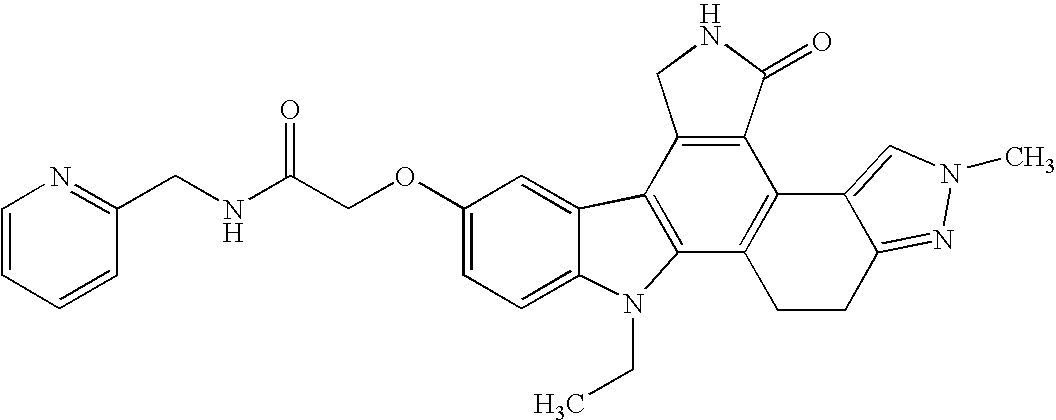 |
521 |
| 123 |
 |
535 |
| 124 |
 |
549 |
| 125 |
 |
576 |
| 126 |
 |
549 |
| 127 |
 |
537 |
| 128 |
 |
542 |
| 129 |
 |
573 |
| 130 |
 |
563 |
| 131 |
 |
589 |
| 132 |
 |
577 |
| 133 |
 |
565 |
| 134 |
 |
604 |
| 135 |
 |
577 |
| 200 |
 |
543 |
| 201 |
 |
575 |
| 202 |
 |
590 |
| 203 |
 |
576 |
| 204 |
 |
577 |
| 205 |
 |
607 |
| 206 |
 |
621 |
| 207 |
 |
593 |
| 208 |
 |
564 |
| 209 |
 |
607 |
| 210 |
 |
629 |
| 211 |
 |
579 |
| 212 |
 |
593 |
| TABLE 5 |
 |
| Eg. | R3 | R2 | Q | R5 |
| 136 |  | CH2CH2CH2OH | CH2 | H |
| 137 | 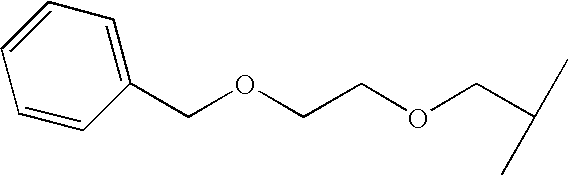 | CH2CH2CH2OH | CH2 | H |
| 138 |  | CH2CH2CH2OH | CH2 | H |
| 139 |  | CH2CH2CH2OH | CH2 | H |
| 140 |  | CH2CH2CH2OH | CH2 | H |
| 141 |  | CH2CH2CH2OH | CH2 | H |
| 142 |  | CH2CH2CH2OH | CH2 | H |
| 143 |  | CH2CH2CH2OH | CH2 | H |
| 144 |  | CH2CH2CH2OH | CH2 | H |
| 145 |  | CH2CH2CH2OH | CH2 | H |
| 146 |  | CH2CH2CH2OH | CH2 | H |
| 147 |  | H | CH2CH2 | OCH3 |
| 148 |  | CH2CH2OH | CH2 | OCH3 |
| 149 |  | CH2CH2OH | CH2CH2 | OCH3 |
| 150 |  | CH2CH2CH2OH | CH2 | H |
| 151 |  | CH2CH2CH2OH | CH2 | H |
| 152 |  | H | CH2 | H |
| 153 |  | H | CH2 | H |
| 154 |  | H | CH2 | H |
| 155 |  | H | CH2 | H |
| 156 |  | H | CH2 | OCH3 |
| 157 |  |  | CH2 | H |
| 158 |  | CH2CH(OH)— CH3 | CH2 | H |
| 159 |  | H | CH(OH) CH3 | H |
| 160 |  | CH2CH2OH | CH2CH2 | OCH3 |
| 161 |  | H | CH2CH2 | OiPr |
| 162 |  | CH2CH2OH | CH2CH2 | OCH3 |
| 163 |  | H | CH2CH2 | OCH3 |
| 164 |  | H | CH2CH2 | OiPr |
| 165 |  | H | CH2CH2 | OiPr |
| 166 |  | H | CH2CH2 | OiPr |
| 167 | H | CH2CH2OH | CH2CH2 |  |
| 168 | H | CH2CH2OH | CH2CH2 | O(CH2)2OH |
| 169 | H | CH2CH2OH | CH2CH2 |  |
| 170 | H | CH2CH2OH | CH2CH2 | O[(CH2)2O]2Me |
| 171 | H | CH2CH2OH | CH2CH2 |  |
| 172 | H | CH2CH2OH | CH2CH2 |  |
| 173 | H | CH2CH2OH | CH2CH2 |  |
| 174 | H | CH2CH2OH | CH2CH2 |  |
| 175 | H | CH2CH2OH | CH2CH2 | OCH(CH3)CO2Et |
| 176 | H | CH2CH2OH | CH2CH2 |  |
| 177 | H | CH2CH2OH | CH2CH2 | OCH2CO2tBu |
| 178 | H | H | CH2CH2 |  |
| 179 | H | CH2CH2OH | CH2CH2 | OCH2CO2Et |
| 180 | H | CH2CH2OH | CH2CH2 |  |
| 181 | H | CH2CH2OH | CH2CH2 | O(CH2)2OMe |
| 182 | H | CH2CH2OH | CH2CH2 | O(CH2)3CN |
| 183 | H | CH2CH2OH | CH2CH2 | O(CH2)5CN |
| 184 | H | CH2CH2OH | CH2CH2 | O(CH2)2OEt |
| 185 | H | CH2CH2OH | CH2CH2 | O(CH2)4CN |
| 186 | H | CH2CH2OH | CH2CH2 | O(CH2)6CN |
| 187 | H | CH2CH2OH | CH2CH2 | OCH2CN |
| 188 | H | CH2CH2OH | CH2CH2 | O(CH2)4C(═NH)OEt |
| 189 | H | CH2CH2OH | CH2CH2 | O(CH2)4CO2H |
| 190 | H | CH2CH2OH | CH2CH2 | O(CH2)6CONH2 |
| 191 | H | CH2CO2Et | CH2 | OCH2CO2Et |
| 192 | H | H | CH2 | OCH2CO2Et |
| 193 | H | H | CH2 | OCH2CN |
| 194 | H | H | CH2 | OCH2CH2OH |
| 195 | H | CH2CH2OH | CH2 | OCH2CH2OH |
| 196 | H | H | CH2 | OCH2CH(OH)CH2OH |
| 197 | H | H | CH2 | OCH2CONMe2 |
| 198 | H | H | CH2 | OCH2CH(OH)CH2NMe2 |
| 199 | H | H | CH2 |  |
General Procedure for Examples 1 and 2
Example 2. (36%) MS m/e 524 (M+1); 1H NMR (DMSO-d6) 11.59 (s, 1H), 8.33 (s, 1H), 8.16 (d, 1H), 7.63 (s, 1H), 7.52 (d, 1H), 7.17 (d, 1H), 6.86 (s, 1H), 6.78 (d, 1H), 4.77 9s, 2H), 4.68 m, 1H), 3.00 (t, 2H), 2.83 (t, 2H), 1.87 (m, 2H), 1.72 (m, 2H), 1.56 (d, 1H), 1.30 (d, 6H).
Example 3. A suspension of sodium hydride (2.44 mg, 1.22 eq.) in 0.5 mL of THF was stirred under N2 as phenol intermediate I-14 (20.6 mg, 0.05 mmol) in 2.0 mL of THF:DMF (1:1) was added dropwise. After 10 minutes of stirring, 2-bromopyrimidine (8.9 mg, 1.12 equivalents) in 0.5 mL of THF was added. The mixture was stirred at 60° C. for 14 hours. The mixture was cooled to room temperature, diluted with CH2Cl2/MeOH, filtered through celite and concentrated. Purification was achieved by preparative TLC with CH2Cl2/MeOH (9:1) to afford the product (4.0 mg, 17%) (MS: 477 m/e (M+H)+).
Example 4. The compound was prepared according to the procedure of Example 3 using phenol intermediate I-14 and 2-chlorobenzoxazole; 40 hr; preparative TLC (10% MeOH in CH2Cl2); yield 28%; MS: 516 m/e (M+1)+.
Example 5. The compound was prepared according to the procedure of Example 3 using intermediate I-14 and 2-chlorobenzothiazole; 40 hr; preparative TLC (10% MeOH in CH2Cl2); yield 13%; MS: 531 m/e (M+1)+.
Example 6. To a mixture of Example 3 (25.0 mg, 0.052 mmol) and cesium carbonate (81 mg, 5.0 eq) in 2.0 mL of CH3CN was added n-propyl bromide (47 ul, 10.0 eq.) under N2. After stirring at 90° C. for 14 hours, the mixture was diluted with CH2Cl2, filtered through celite and concentrated. Purification by preparative TLC with 95% of CH2Cl2/MeOH afforded the product (15.0 mg, 56%); MS: m/e 519 (M+1)+.
Example 7. The compound was prepared using to the procedure of Example 3 using intermediate I-14 and 2-bromopyrazine; preparative TLC (10% MeOH in CH2Cl2); MS 499 m/e (M+1)+.
Example 8. The compound was prepared according to the procedure of Example 6 using Example 7 as starting material. MS m/e 519 (M+1).
Synthesis of Phenol Intermediates I-18 and I-19.
A mixture of AlCl3 (800 mg, 6 mmol) in dichloroethane (8 mL) was stirred at 0° C. as EtSH (1.40 mL) was added and followed by intermediate I-41 (398 mg, 1 mmol). The reaction was stirred at 50° C. for 48 hr. To the reaction mixture was added 5 mL of 1N HCl and the mixture was stirred at rt for 0.5 hr. Filtration provided 240 mg (63%) of intermediate I-18 (MS: 385 m/e (M+1)+. By a similar method intermediate I-19 was prepared from the methoxy N—H derivative.
Examples 9 and 10. A suspension of sodium hydride (12.2 mg, 1.22 eq.) in 0.5 mL of THF was stirred under N2 as phenol intermediate I-18 (76.8 mg, 0.2 mmol) in 4.0 mL of THF:DMF (1:1) was added dropwise at room temperature. After 10 minutes stirring, 2-chloro-benzothiazole (38 mg, 1.12 eq.) in 0.5 mL of THF was added. The mixture was then stirred at 60° C. for 40 hours, diluted with CH2Cl2/MeOH, filtered through celite and concentrated. Purification by preparative TLC with (9:1) CH2Cl2/MeOH afforded the mono product Example 9 (6.0 mg, yield 6%) (MS: 517 m/e (M+H)+) and the dialkylated product Example 10 (60 mg, yield 46%) (MS: 651 m/e (M+H)+).
Example 11. The compound was prepared according to the procedure of Example 10 using phenol intermediate I-18 and 2-chlorobenzoxazole; 36 hr; preparative TLC (10% MeOH in CH2Cl2); yield 11%; MS: 502 m/e (M+1)+.
Example 12. The compound was prepared according to the procedure of Example 10 using intermediate I-19 and 2-bromopyrimidine; 36 hr; preparative TLC (10% MeOH in CH2Cl2); yield 25%; MS: 419 m/e (M+1)+.
Example 13. The compound was prepared according to the procedure for Example 3 using phenol intermediate I-22 and 2-bromopyrimidine; 30 hr; preparative TLC (10% MeOH in CH2Cl2); yield 53%; MS: 423 m/e (M+1)+.
Example 14. The compound was prepared according to the procedure for Example 6 using Example 13 and iodoethane; 14 hr; preparative TLC (10% MeOH in CH2Cl2); yield 19%; MS: 451 m/e (M+1)+.
Example 15. The compound was prepared according to the procedure for Example 6 using Example 13 and iodomethane; 14 hr; preparative TLC (10% MeOH in CH2Cl2); yield 28%; MS: 459 m/e (M+23)+.
Example 16. The compound was prepared according to the procedure for Example 6 using Example 13 and cyclopentyl bromide; 14 hr; preparative TLC (10% MeOH in CH2Cl2); yield 38%; MS: 513 m/e (M+23)+.
Example 17. A mixture of phenol intermediate I-22 (17.2 mg, 0.05 mmol), potassium t-butoxide (33.7 mg, 6 eq.) and t-butylammonium bromide (0.97 mg, 0.06 eq) was mixed and stirred for 5 minutes, then 1.0 mL of chloropyrazine was added, then stirred at room temperature for 5 minutes and at 90° C. for 1 hour. The mixture was cooled to room temperature, excess of the chloropyrazine was evaporated off and the resulting residue was diluted with CH2Cl2/MeOH. Purification by preparative TLC with (9:1) CH2Cl2/MeOH afforded the mono product (11.0 mg, yield 52%) MS: 423 m/e (M+1)+.
Example 18. The compound was prepared according to the procedure for Example 6 using Example 13 and butyl bromide; 14 hr; preparative TLC (10% MeOH in CH2Cl2); yield 38%; MS: 479 m/e (M+1)+.
Example 19. The compound was prepared according to the procedure for Example 10 using Example 13 and 2-propyl bromide; 60 hr; preparative TLC (10% MeOH in CH2Cl2); yield 10%; MS: 465 m/e (M+1)+.
Example 20. The compound was prepared according to the procedure for Example 6 using Example 13 and 2-cyclopropylmethyl bromide; 14 hr; preparative TLC (10% MeOH in CH2Cl2); yield 5%; MS: 477 m/e (M+1)+.
Example 21. The compound was prepared according to the procedure for Example 6 using Example 13 and 2-cyclopropylmethyl bromide; 14 hr; preparative TLC (10% MeOH in CH2Cl2); MS: 507 m/e (M+1)+.
Example 22. The compound was prepared according to the procedure for Example 6 using Example 13 and isobutyl bromide; preparative TLC (10% MeOH in CH2Cl2); MS: 493 m/e (M+1)+.
Example 23. The compound was prepared according to the procedure for Example 6 using Example 17 and ethyl iodide; preparative TLC (10% MeOH in CH2Cl2); MS: 451 m/e (M+1)+.
Example 24. The compound was prepared according to the procedure for Example 6 using Example 13 and 1-bromo-3,5-dimethoxytriazine; preparative TLC (10% MeOH in CH2Cl2); MS: 540 m/e (M+1)+.
Example 25. To 25 mg (0.07 mmol) of the N-ethyl intermediate I-23-1 in methylene chloride/nitromethane (3 mL/2 mL) was slowly added 2-furoyl chloride (69 μl, 0.7 mmol, 10 eq) followed by aluminum chloride (93 mg, 0.7 mmol, 10 eq). The reaction was stirred at room temperature overnight. The reaction mixture was concentrated, water and a few drops of 1N HCl were added to the residue and the mixture was extracted with methylene chloride. The combined organic extracts were dried with sodium sulfate, the drying agents removed by filtration, and the solvent was removed by evaporation. The crude mixture was dissolved in methanol/methylene chloride and purified by preparative TLC eluting with 10% methanol/methylene chloride. The desired band was collected, stirred with methylene chloride/methanol, filtered through a fritted funnel, and concentrated. The sample was dried at 80° C. under high vacuum overnight. MS m/e 451 (M+1).
Example 26. The compound was prepared by the method described for Example 25. MS m/e 438 (M+1).
Example 27. To the N-ethyl intermediate I-23-1 (25 mg, 0.07 mmol) in nitromethane (5 mL) was added 2-thiophene carbonyl chloride (75 μl 0.7 mmol, 10 eq) followed by addition of aluminum chloride (94 mg, 0.7 mmol, 10 eq) in small portions. The reaction mixture was stirred at room temperature overnight. The reaction was then concentrated, stirred with water and a few drops of 1 N HCl were added. The product was collected by filtration, dissolved in methylene chloride/methanol and purified by preparative TLC eluting with 10% methanol/methylene chloride. The desired band was collected, stirred with methylene chloride/methanol, filtered, and concentrated. The sample was dried at 80° C. under vacuum overnight. MS m/e 467 (M+1).
Examples 28-49 were prepared using the general method described for Example 27 using the appropriate N-alkyl intermediate I-23, and heteroaryl acid chloride with AlCl3 or FeCl3 as catalyst.
Example 28. MS m/e 423 (M+1)
Example 29. MS m/e 465 (M+1)
Example 30. MS m/e 479 (M+1)
Example 31. MS m/e 495 (M+1)
Example 32. MS m/e 463 (M+1)
Example 33. MS m/e 509 (M+1)
Example 34. MS m/e 481 (M+1)
Example 35. MS m/e 530 (M+1)
Example 36. MS m/e 495 (M+1)
Example 37. MS m/e 479 (M+1)
Example 38. MS m/e 574 (M+1)
Example 39. MS m/e 481 (M+1)
Example 40. MS m/e 481 (M+1)
Example 41. MS m/e 608 (M+1)
Example 42. MS m/e 588 (M+1)
Example 43. MS m/e 536 (M+1)
Example 44. MS m/e 520 (M+1)
Example 45. MS m/e 509 (M+1)
Example 46. MS m/e 592 (M+1)
Example 47. MS m/e 550 (M+1)
Example 48. MS m/e 550 (M+1)
Example 49. MS m/e 570 (M+1)
Example 50. To a stirred solution of 3-amino intermediate I-29-2 (25 mg, 0.0649 mmol) in CH2Cl2 (5 mL) was added isopropyl chloroformate (1.0 M in toluene, 125 μL, 0.125 mmol) and pyridine (20 μL, 0.247 mmol). After stirring 3 h at room temperature, the resulting precipitate was filtered and dried to give 28 mg (91%) of the desired product. 1H NMR (DMSO-d6) δ 9.51 (s, 1H), 8.85 (s, 1H), 8.36 (s, 1H), 8.08 (s, 1H), 7.61-7.49 (m, 2H), 4.98 (m, 1H), 4.68 (s, 2H), 4.51 (m, 2H), 3.86 (s, 3H), 3.45 (m, 2H), 2.83 (m, 2H), 1.80 (m, 2H), 1.29 (m, 6H), 0.89 (m, 3H); MS (m/e) 472 (M+1).
Example 51. MS m/e 458 (M+H).
Example 52. MS m/e 486 (M+H).
Example 53. MS m/e 472 (M+H).
Example 54. MS m/e 476 (M+H).
Example 55. MS m/e 492 (M+H).
Example 56. MS m/e 458 (M+H).
Example 57. MS m/e 500 (M+H).
Example 58. MS m/e 486 (M+H).
Example 59. MS m/e 486 (M+H).
Example 60. MS m/e 472 (M+H).
Example 61. MS m/e 472 (M+H).
Example 62. MS m/e 536 (M+H).
Example 63. MS m/e 490 (M+H).
Example 64. MS m/e 506 (M+H).
Example 65. MS m/e 550 (M+H).
Example 66. MS m/e 486 (M+H).
Example 68. To 25 mg (0.045 mmol) of the N-p-nitrophenyl intermediate was added 500 μl N-piperidinylethanol. The reaction was stirred at room temperature for approximately 5 hours, diluted with methylene chloride, washed with water/brine and dried over sodium sulfate. The crude product was purified by preparative TLC eluting with 8-10% MeOH/CH2Cl2. The pure product was collected, stirred with solvent, filtered, and concentrated. The sample was dried at 80° C. under high vacuum. 1H NMR (DMSO-d6) δ 9.80 (s, 1H), 8.77 (s, 1H), 8.36 (s, 1H), 8.10 (s, 1H), 7.72 (d, 1H), 7.50 (d, 1H), 5.20 (m, 1H), 4.78 (s, 2H), 4.19 (m, 2H), 3.86 (s, 3H), 2.78 (m, 2H), 2.41 (m, 4H), 1.59 (d, 6H), 1.40 (m, 10H). MS m/e541 (M+1).
Example 67. The compound was prepared by the method described for Example 68 using the N-p-nitrophenyl intermediate and N-pyrrolidinylethanol. MS m/e 527 (M+1).
Example 69. The compound was prepared by the method described for Example 68 using the N-p-nitrophenyl intermediate and N-pyrrolidinylethanol. MS m/e 538 (M+1).
Example 70.
Examples 75-82 were prepared by the method described for Example 74 using the appropriate amine intermediate I-29 and acid chloride.
Example 75. MS m/e 496 (M+H).
Example 76. MS m/e 480 (M+H).
Example 77. MS m/e 491 (M+H).
Example 78. MS m/e 491 (M+H).
Example 79. MS m/e 510 (M+H).
Example 80. MS m/e 494 (M+H).
Example 81. MS m/e 481 (M+H).
Example 82. MS m/e 495 (M+H).
Example 83. The compound was prepared using the N-sec-butyl intermediate I-36 and 2-thiophene carbonyl chloride by the general procedure described for Example 25. MS m/e 495 (M+H).
Example 84. The compound was prepared using the N-sec-butyl indazole intermediate I-36 and 2-furoyl chloride by the general procedure described for Example 25. MS m/e 479 (M+H).
Example 85. The compound was prepared using the intermediate I-39 by the general procedure described for Example 13. MS m/e 479 (M+H).
General Procedure A for Examples 136-140.
A solution of diol intermediate I in the appropriate alcohol (0.05 M) in a sealable glass reaction tube was added camphorsulfonic acid (1.1 equiv.). The reaction tube was flushed with nitrogen and sealed. The reaction mixture was heated to 80° C. for 2-26 h and monitored for loss of starting material by HPLC. Upon completion of the reaction the mixture was cooled to room temperature and poured into ether. The precipitate that formed was collected by filtration and purified by flash chromatography or preparative TLC on silica gel using ethyl acetate or a mixture ethyl acetate and hexane to yield the pure products. The following Examples were prepared.
Example 136. Tan solid (58% yield). 1H NMR (CDCl3, 300 MHz): δ 2.03 (m, 2H), 2.13 (m, 2H), 2.40 (m, 2H), 3.56 (m, 4H), 3.72 (m, 4H), 4.37 (s, 2H), 4.71 (s, 4H), 4.89 (s, 2H), 6.12 (s, 1H), 7.34-7.62 (6H, m), 7.99 (s, 1H), 9.53 (d, 1H); MS (ESI): m/e 510 (M+1)+;
Example 137. (71% yield). 1H NMR (CDCl3, 300 MHz): δ 1.97 (t, 2H), 3.61 (t, 2H), 3.79 (m, 4H), 4.14 (s, 2H), 4.41 (m, 4H), 4.62 (s, 2H), 4.76 (s, 2H), 6.10 (s, 1H), 7.28-7.57 (m, 11H), 7.68 (s, 1H), 9.47 (d, 1H); MS (ESI): m/e 533 (M+1)+; 555 (M+Na)+.
Example 138. (19% yield). 1H NMR (CDCl3, 300 MHz): δ 1.66 (m, 1H), 2.01-2.22 (m, 3H), 2.67 (m, 1H), 3.51 (m, 2H), 3.74 (m, 4H), 3.88 (m, 2H), 4.38 (s, 2H), 4.71 (s, 2H), 4.72 (m, 2H), 4.90 (s, 2H), 6.07 (s, 1H), 7.36 (t, 1H), 7.44-7.68 (m, 5H), 7.80 (s, 1H), 9.53 (d, 1H); MS (ESI): m/e 483 (M+1)+;
Example 139. (21.2 mg) 1H NMR (CDCl3, 300 MHz): δ 1.95 (m, 2H), 2.04 (s, 3H), 2.68 (t, 2H), 3.49 (m, 2H), 3.64 (t, 2H), 4.52 (s, 2H), 4.66 (s, 2H), 4.73 (m, 2H), 4.90 (s, 2H), 7.27-7.43 (m, 2H), 7.48 (d, 1H), 7.63 (d, 1H), 7.69 (d, 1H), 7.94 (s, 1H), 8.55 (s, 1H), 9.46 (d, 1H); MS (ESI): m/e 473 (M+1)+;
Example 140. off-white solid (25% yield). 1H NMR (CDCl3, 300 MHz): δ 1.93 (m, 2H), 3.22 (s, 3H), 3.46 (m, 4H), 3.58 (m, 2H), 4.49 (s, 2H), 4.64 (s, 2H), 4.70 (m, 2H), 4.78 (m, 1H), 4.87 (s, 2H), 7.23-7.43 (m, 2H), 7.47 (d, 1H), 7.62 (d, 1H), 7.70 (d, 1H), 7.89 (s, 1H), 8.54 (s, 1H), 9.46 (d, 1H);
General Procedure B Examples 141-144.
In a sealed reaction tube, a suspension of the diol intermediate I (1 equivalent) in either the appropriate alcohol or methylene chloride or chloroform containing the appropriate alcohol, at room temperature was added trifluoroacetic anhydride (1-2 equiv.) slowly. The tube was flushed with nitrogen and sealed tightly. The mixture was stirred at room temperature for 1-2 hours then heated to 80° C. for 2-60 h and monitored for disappearance of starting material by HPLC. Upon completion the reaction was allowed to cool to room temperature, concentrated and worked up by both triturating the residue with ether and collecting the resulting precipitate by filtration, or extraction of the product from the reaction mixture with a suitable organic solvent. The solid product was purified by triturating with ether or flash chromatography on silica gel using ethyl acetate or a mixture of ethyl acetate and hexane. The following Examples were prepared.
Example 141. Light yellow solid (17% yield). 1H NMR (DMSO-d6, 300 MHz): δ 1.93 (m, 2H), 3.45 (m, 6H), 3.58 (s, 4H), 4.53 (s, 2H), 4.56 (m, 1H), 4.65 (s, 2H), 4.74 (m, 3H), 4.91 (s, 2H), 7.33-7.39 (m, 2H), 7.48 (d, 1H), 7.63-7.71 (m, 2H), 7.92 (s, 1H), 8.55 (s, 1H), 9.47 (d, 1H); MS (ESI): m/e 487 (M+1)+, 509 (M+Na)+.
Example 142. Pale yellow solid (26% yield). 1H NMR (CDCl3, 300 MHz): δ 1.33 (d, 3H), 2.11 (m, 2H), 3.19 (m, 1H), 3.56-3.77 (m, 4H), 4.30 (s, 2H), 4.65 (m, 2H), 4.68 (s, 2H), 4.74 (s, 2H), 6.07 (s, 1H), 7.20-7.50 (m, 1H), 7.56 (d, 1H), 7.69 (s, 1H), 9.48 (d, 1H); MS (ESI): m/e 517 (M+1)+, 539 (M+Na)+.
Example 143. Orange residue (21% yield). 1H NMR (DMSO-d6, 300 MHz): δ 1.93 (m, 2H), 2.30 (m, 4H), 2.50 (m, 2H), 3.48 (m, 6H), 3.94 (s, 2H), 4.52 (s, 2H), 4.72 (m, 4H), 4.88 (s, 2H), 7.33-7.43 (m, 2H), 7.48 (d, 1H), 7.66 (m, 2H), 7.88 (s, 1H), 8.57 (s, 1H), 9.46 (d, 1H); MS (ESI): m/e 528 (M+1)+.
Example 144. Light orange solid (9% yield). 1H NMR (DMSO-d6, 300 MHz): δ 1.29 (m, 2H), 1.39 (m, 4H), 1.95 (m, 2H), 2.26 (m, 4H), 2.51 (m, 2H), 3.47 (m, 2H), 3.94 (s, 2H), 4.52 (s, 2H), 4.72 (m, 4H), 4.88 (s, 2H), 7.33-7.39 (m, 2H), 7.47 (d, 1H), 7.66 (m, 2H), 7.88 (s, 1H), 8.57 (s, 1H), 9.46 (d, 1H); MS (ESI): m/e 526 (M+1)+.
General procedure C for Examples 145-156:
To a well-stirred suspension of the CH2OH intermediates I, II, or III in 7 mL of methylene chloride were added sequentially trifluoroacetic anhydride (5 equivalents) and N-methyl morpholine (5 eq) at 5° C. and under argon atmosphere. The resulted suspension was stirred at room temperature for 3 hours and the low boiling solvents were removed under vacuum. A stirred solution of this tritrifluoroacetate intermediate in an appropriate alcohol was heated to 80° C. for 6-48 hours in an oil bath. Gradually, the heterogeneous reaction mixture became homogeneous. When no starting material was observed by HPLC the reaction mixture was worked up by removing the solvent in vacuo. The residues was purified by either triturating with water or ether or alternatively, flash chromatography or preparative plate chromatography on silica gel using ethyl acetate or an ethyl acetate/hexane mixture.
Example 145. (12.6 mg, 44% yield). 1H NMR (CDCl3, 300 MHz): δ 2.18 (m, 2H), 2.09 (m, 1H), 3.73 (m, 4H), 4.42 (s, 2H), 4.76 (s, 2H), 4.80 (m, 2H), 4.98 (s, 2H), 6.12 (s, 1H), 7.23 (m, 2H), 7.43 (m, 2H), 7.48 (m, 2H), 7.68 (m, 1H), 7.88 (s, 1H), 9.56 (d, 1H); MS (ESI): m/e 451 (M+1)+, 473 (M+Na)+.
Example 146. Light orange solid (35.3 mg, 74% yield). 1H NMR (DMSO-d6, 300 MHz): δ 1.23 (m, 2H), 1.50 (m, 4H), 1.67 (m, 2H), 1.93 (m, 2H), 2.13 (m, 1H), 3.35 (m, 2H), 3.48 (m, 2H), 4.52 (s, 2H), 4.62 (s, 2H), 4.72 (m, 2H), 4.89 (s, 2H), 7.33-7.39 (m, 2H), 7.47 (d, 1H), 7.62-7.70 (m, 2H), 7.90 (d, 1H), 8.53 (s, 1H), 9.47 (d, 1H); MS (ESI): m/e 481 (M+1)+.
Example 147. Pale yellow solid (31 mg, 54% yield). 1H NMR (DMSO-d6, 300 MHz): δ 0.05 (m, 2H), 0.49 (m, 2H), 1.06 (m, 1H), 2.79 (m, 2H), 3.82 (m, 5H), 4.65 (m, 4H), 4.79 (s, 2H), 4.97 (t, 1H), 6.80 (d, 1H), 6.89 (s, 1H), 7.46 (d, 1H), 7.65 (d, 1H), 7.87 (s, 1H), 7.89 (d, 1H), 8.36 (s, 1H); MS (ESI): m/e 483 (M+1)+.
Example 148. Pale orange solid (12.4 mg, 24% yield). 1H NMR (DMSO-d6, 300 MHz): δ 2.79 (m, 2H), 3.12 (t, 2H), 3.30 (m, 2H), 3.72 (t, 2H), 3.82 (m, 5H), 4.65 (m, 2H), 4.70 (s, 2H), 4.76 (s, 2H), 4.97 (t, 2H), 6.79 (d, 1H), 6.90 (s, 1H), 6.93 (s, 1H), 6.97 (d, 2H), 7.35 (s, 1H), 7.46 (d, 1H), 7.65 (d, 1H), 7.89 (d, 2H), 8.39 (s, 1H); MS (ESI): m/e 539 (M+1)+.
Example 149. Pale yellow solid (42.6 mg, 57% yield). 1H NMR (DMSO-d6, 300 MHz): δ 2.55 (m, 2H), 2.80 (t, 2H), 3.86 (m, 4H), 3.98 (s, 2H), 4.61 (s, 1H), 4.73 (t, 1H), 4.80 (s, 2H), 4.98 (t, 1H), 6.78 (d, 1H), 6.89 (s, 1H), 7.50 (d, 1H), 7.68 (d, 1H), 7.88 (s, 1H), 7.90 (d, 1H), 8.38 (s, 1H); MS (ESI): m/e 489 (M+1)+, 512 (M+Na)+.
Example 150. Yellow-tan solid (77% yield). 1H NMR (DMSO-d6, 300 MHz): δ 0.2 (m, 2H), 0.47 (m, 2H), 1.05 (m, 1H), 1.94 (m, 2H), 3.49 (m, 2H), 4.53 (s, 2H), 4.64 (s, 2H), 4.75 (m, 2H), 4.92 (s, 2H), 7.32-7.45 (m, 2H), 7.49 (d, 1H), 7.62-7.77 (m, 2H), 7.93 (s, 1H), 8.64 (s, 1H), 9.47 (d, 1H); MS (ESI): m/e 453 (M+1)+.
Example 151. Tan solid (32% yield). 1H NMR (DMSO-d6, 300 MHz): δ 1.97 (m, 4H), 3.51 (s, 2H), 3.73 (t, 2H), 4.56 (s, 2H), 4.71 (s, 2H), 4.77 (m, 2H), 4.91 (s, 2H), 6.98 (m, 2H), 7.35-7.43 (m, 3H), 7.52 (d, 1H), 7.70 (m, 2H), 7.96 (s, 1H), 8.60 (s, 1H), 9.51 (d, 1H); MS (ESI): m/e 509 (M+1)+.
Example 152. Yellow solid (69%). 1H NMR (DMSO-d6, 300 MHz): δ 1.62-2.00 (m, 8H), 2.54 (m, 1H), 3.38-3.50 (m, 4H), 4.51 (s, 2H), 4.61 (s, 2H), 4.72 (m, 2H), 4.89 (s, 2H), 7.3-7.41 (m, 2H), 7.46 (d, 1H), 7.62-7.70 (m, 2H), 7.89 (s, 1H), 8.53 (s, 1H), 9.47 (d, 1H); MS (ESI): m/e 467 (M+1)+.
Example 153. (80%) 1H NMR (DMSO-d6, 300 MHz): δ 1.55 (m, 3H), 3.4-3.8 (m, 6H), 4.14 (m, 2H), 4.66 (s, 2H), 4.91 (s, 2H), 7.29-7.73 (m, 5H), 7.98 (s, 1H), 8.55 (s, 1H), 9.39 (d, 1H), 11.94 (s, 1H).
Example 154. (150 mg, 89% yield). 1H NMR (DMSO-d6, 300 MHz): δ 1.80 (m, 4H), 3.58-3.78 (m, 4H), 4.02 (m, 1H), 4.18 (s, 2H), 4.69 (s, 2H), 4.93 (s, 2H), 7.34-7.49 (m, 2H), 7.56 (t, 2H), 7.70 (d, 1H), 7.94 (s, 1H), 8.53 (s, 1H), 9.39 (d, 1H), 11.92 (s, 1H).
Example 155. 1H NMR (DMSO-d6, 300 MHz): δ 3.24 (s, 3H), 3.47 (m, 2H), 3.58 (m, 2H), 4.13 (m, 2H), 4.62 (s, 2H), 4.89 (s, 2H), 7.30-7.42 (m, 3H), 7.56 (d, 1H), 7.64 (d, 1H), 7.91 (s, 1H), 8.51 (s, 1H), 9.35 (d, 1H), 11.89 (s, 1H); MS (ESI): m/e 421 (M+Na)+.
Example 156. (10%). MS m/e 429 (M+1); 1H-NMR 6 (DMSO-d6) 11.79 (s, 1H), 9.20 (d, 1H), 8.44 (s, 1H), 7.87 (s, 1H), 7.52 (d, 1H), 7.38 (d, 1H), 7.24 (s, 1H), 6.96 (d, 1H), 4.86 (s, 2H), 4.61 (s, 2H), 4.08 (s, 2H), 3.81 (s, 4H), 3.58 (d, 1H), 3.52 (d, 1H).
Example 157. A stirred solution of Example 155 (370 mg, 0.93 mmol) in DMF (20 mL) was placed under vacuum and DMF (10 mL) was removed by distillation. The mixture was cooled to room temperature and sodium hydride (45 mg, 0.93 mmol) was added and stirred for 30 min. Glycidol mesylate (170 mg, 1.1 mmol) was added and the reaction mixture heated to 60° C. After 18 h, the mixture was cooled to room temperature, filtered, and concentrated in vacuo. The solid was triturated with methanol, filtered, and purified by flash chromatography on silica gel using hexane/ethyl acetate (1:1) then methanol/ethyl acetate (10%) to give product (90 mg, 22% yield). MS (ESI): m/e 455 (M+1)+.
Example 158. To a stirred solution of Example 157 (80 mg, 0.18 mmol) in THF (10 mL) was added super hydride (724 uL, 0.72 mmol) dropwise at 0° C. The reaction mixture was warmed to room temperature and stirred for 2 h. The reaction solvent was removed in vacuo and 1N HCl was added. The mixture was stirred, filtered, triturated with methanol and collected by filtration. The solid was purified by flash chromatography using hexane/ethyl acetate (3:1) to ethyl acetate (100%). Further purification of the solid involved crystallization from ethyl acetate/methanol followed by acetonitrile to give product (40 mg, 50% yield). MS (ESI): m/e 457 (M+1)+.
Example 159. Using the general procedure for Example 158, a suspension of ester (1.45 g, 2.27 mmol) in methylene chloride (30 mL) was cooled to 0° C. and DIBAL-H (5.7 mL, 5.7 mmol) was added dropwise. The reaction mixture was warmed to room temperature for 2 h then quenched with methanol (20 mL). HCl (1N, 20 mL) was added and the reaction solvent removed in vacuo to give the product as a yellow solid (1.2 g, 78% yield). Alcohol (522 mg, 0.92 mmol), trifluoroacetic anhydride (130 uL), methoxyethanol (4 mL) and methylene chloride (6 mL) were combined and heated to 70° C. for 18 h. Additional trifluoroacetic anhydride (100 ul) was added and heated for 24 h. The reaction solvent was removed in vacuo and the solid triturated with methanol to give the product as a yellow solid (325 mg, 91% yield). A solution of the previous product (100 mg, 0.16 mmol) in methylene chloride (3 mL)/methanol (1 mL)/hexamethylphosphoramide (500 uL) was added cesium carbonate (212 mg, 0.65 mmol). The reaction mixture was stirred at room temperature for 20 min. and acetaldehyde was added and the mixture was stirred for 18 h. Additional cesium carbonate and acetaldehyde was added and the mixture stirred for 3 h. The mixture was diluted with methylene chloride, washed with water and brine, and purified by flash chromatography on silica gel using ethyl acetate/methylene chloride (10%) to give product (45 mg, 43% yield). The product (45 mg) was dissolved in methylene chloride (4 mL) and ethanethiol followed by trifluoroacetic anhydride was added at 0° C. After 1.5 h, the reaction solvent was removed in vacuo and the material purified by flash chromatography on silica gel using methanol/ethyl acetate (10%) to give product (11 mg, 37% yield). MS (ESI): m/e 443 (M+1)+.
Example 160. To the tritrifluoroacetate (27 mg) prepared using general method C was added 1 mL 2-methoxyethanol and the reaction was heated to 90° C. in a sealed tube for 2 hours. The reaction was concentrated, the product triturated with ether, collected and dried. 1HNMR (400 MHz, DMSO) δ 8.38 (1H, s), 7.89 (2H, d), 7.66 (1H, d), 7.47 (1H, d), 6.90 (1H, s), 6.81 (1H, d), 4.98 (2H, m), 4.79 (1H, s), 4.67 (3H, m), 3.96 (6H, m), 3.82 ((2H, m), 3.62 (2H, m), 3.50 (3H, m), 3.10 (2H, m), 2.79 (2H, m) MS m/e 487 (M+1)+
Example 161. To the amino methyl intermediate XII CEP7668 (30 mg, 0.066 mmol) in THF (1 mL) was added TEA (9 μl, 0.066 mmol), followed by benzyl chloroformate (9 μl, 0.066 mmol) and the reaction mixture was stirred at room temperature overnight. Additional TEA and benzyl chloroformate were added while heating to 50° C. The reaction was concentrated, dissolved in ethyl acetated, washed with sodium bicarbonate, brine and dried over magnesium sulfate. The drying agent was removed by filtration and the solvent evaporated. The product was purified by preparative TLC using 2% methanol/methylene chloride. The product was collected and dried at 80° C. overnight. MS m/e=590 (m+1)+.
Example 162. This compound was prepared using the general procedure as Example 161 starting with 3-aminomethyl-N-ethanol intermediate XIII MS m/e 540 (m+1)+.
Example 163. This compound was prepared from XII intermediate and ethyl isocyanato acetate. MS m/e 513 (m+1)+.
Example 164. Phenol intermediate X CEP 7143 (15 mg, 0.037 mmol), bromoethylethylether (66 mg., 0.57 mmol) (added in 3 portions), acetone (7 mL) and ION sodium hydroxide (4 mL.) were stirred at room temperature for 7 hr. The acetone was evaporated and the solution acidified to pH 3. The solid was collected, triturated with hexane and then extracted with methylene chloride. The extract was evaporated to give the product (0.004 g.) (23%) MS m/e 471 (M+1); 1H-NMR (DMSO-d6) 11.40 (s, 1H), 8.33 (s, 1H), 8.16 (d, 1H), 7.47 (d, 2H), 7.11 (d, 1H), 6.86 (s, 1H), 6.78 (d, 1H), 4.80 (s, 2H), 4.69 (m, 1H), 4.24 (m, 2H), 3.85 (m, 2H), 3.65 (t, 2H), 2.98 (t, 2H), 2.81 (t, 2H), 1.30 (d, 6H), 1.23 (t, 3H).
Example 165. A mixture of intermediate X (16.5 mg, 0.041 mmol) and cesium carbonate (88 mg, 1.1 eq) in 2.0 mL of CH3CN was added cyclopentyl bromide (8.0 ul, 2.0 eq.) under N2. After stirred at 70° C. for 24 hours, the mixture was diluted with CH2Cl2 and filtered through celite and concentrated. Purification by preparation TLC plate with CH2Cl2/MeOH afforded the product. MS m/e 533 (M+1).
Example 166. Prepared by hydrogenation of Example 1C in DMF using Pd(OH)2 and a drop of HCl. MS m/e 443 (M+1)
Example 1C. A suspension of sodium hydride (2.44 mg, 1.22 eq.) in 0.5 mL of THF was stirred under N2 as phenol intermediate X (3-hydroxy-10-isopropoxy-12,13-dihydro-6H,7H,14H-nephthyl(3,4-a)pyrrolo[3,3-a]pyrrolo[3,4-c]carbazole-7(7H)one) (20.6 mg, 0.05 mmol) in 2.0 mL of THF:DMF (1:1) was added dropwise. After 10 minutes of stirring, 2-bromopyrimidine (8.9 mg, 1.12 eq.) in 0.5 mL of THF was added. The mixture was stirred at 60° C. for 14 hours. Then, the mixture was cooled to room temperature, diluted with CH2Cl2/MeOH, filtered through celite and concentrated. Purification was achieved by preparation TLC plate with CH2Cl2/MeOH (9:1) to afford the product (4.0 mg, 17%) (MS: 477 m/z (M+H)+).
General Methods for Synthesis of Examples 167-191.
Method A: A mixture of hydroxyl intermediate (0.2 mmol), potassium iodide (3.3 mg, 0.1 eq.), N-tetrabutylammonium bromide (0.1 eq), cesium hydroxide hydrate (3 eq) and 20 mg of 4 Å sieves in 2.0 mL of CH3CN was added the appropriate alkyl bromide or iodide under N2. After the mixture was stirred at 50° C. for 14-72 hours, the reaction mixture was diluted with CH3CN and filtered through celite and concentrated. The residue was diluted with CH2Cl2 and washed with water and dried over magnesium sulfate. Purification by preparation TLC plate or crystallization with CH2Cl2/MeOH afforded the desired products.
Method B: A mixture of hydroxy intermediate (0.2 mmol) and cesium carbonate (3 eq) in 2.0 mL of CH3CN was added the appropriate alkyl bromide or iodide under N2. After the mixture was stirred at 50-80° C. for 14-72 hours, the reaction mixture was diluted with CH3CN and filtered through celite and concentrated. The residue was diluted with CH2Cl2 and washed with water and dried over magnesium sulfate. Purification by preparation TLC plate or crystallization with CH2Cl2/MeOH afforded the desired product.
Method C: A mixture of hydroxyl intermediate (0.1 mmol), sodium hydroxide (1.5 eq.) and N-tetrabutylammonium bromide (0.1 eq) in 0.5 mL of CH2Cl2 and 0.5 mL of water was added the appropriate alkyl bromide under N2. After the mixture was stirred at room temperature for 14-72 hours, the reaction mixture was concentrated and the residue was washed with water and dried over magnesium sulfate. Purification by preparation TLC plate with CH2Cl2/MeOH or crystallization afforded the desired product.
Example 167. A mixture of intermediate phenol XV (19.5 mg, 0.05 mmol), potassium carbonate (34.6 mg, 5 eq.) and potassium iodide (8.7 mg, 1.05 eq) in 1.5 mL of acetone and 0.25 mL of DMF was added the benzyl 2-bromoethyl ether (8.3 uL, 1.05 eq.) under N2. After the mixture was stirred at reflux for 24 hours, the reaction mixture was diluted with EtOAc and washed with water, saturated NaCl solution and dried over magnesium sulfate. Purification by preparation TLC plate with 5% of MeOH/CH2Cl2 afforded the desired product (10 mg, 39%). MS m/e 519 m/z (M+1)+.
Example 168. The product was obtained by first forming compound 1681 by Method A, using phenol XV and cyclopentyl bromide; 14 hr; prep. TLC (10% MeOH in CH2Cl2); yield 10%; MS: m/e 453 m/z (M+1)+. A mixture of compound 168I 110 (5 mg, 0.01 mmol), 10% Pd(OH)2/C and 0.1 mL of conc. HCl in 1.0 mL of EtOH was hydrogenated under 42 psi H2 on a Parr apparatus for 24 hours at room temperature. Filtration and concentration afforded 2.2 mg (27%) of the title compound. MS: m/e 451 m/z (M+1)+.
Example 169. Method C from phenol XV and epibromohydrin; 22 hour, preparative TLC (10% MeOH in CH2Cl2); yield 30%; MS: m/e 463 m/z (M+Na)+.
Example 170. Method C; phenol XV and 1-bromo-2-(2-methoxyethoxy)ethane, 14 hr; prep. TLC (10% MeOH in CH2Cl2); yield 11%; MS: 509 m/z (M+Na)+.
Example 171. Method B; phenol XV and 2-(2-bromoethyl)-1,3-dioxane, 14 hr reflux; prep. TLC (10% MeOH in CH2Cl2); yield 54%; MS: 521 m/z (M+1)+.
Example 172. Method A; phenol XV and (bromomethyl)cyclopropane, 14 hr; prep. TLC (10% MeOH in CH2Cl2); yield 17%; MS: m/e 439 m/z (M+1)+.
Example 173. Method A; phenol XV and 2-bromomethyl-1,3-dioxolane; 64 hr; prep. TLC (10% MeOH in CH2Cl2); yield 15%; MS: 471 m/z (M+1)+.
Example 174. Method B; phenol XV and N-(3-bromopropyl)phthalimide; 48 hr at 80° C.; prep. TLC (10% MeOH in CH2Cl2); yield 17%; MS: m/e 494 m/z (M+Na)+.
Example 175. Method B; phenol XV and ethyl 2-bromopropionate; 14 hr at 80° C.; prep. TLC (10% MeOH in CH2Cl2); yield 9%; MS: m/e 507 m/z (M+Na)+.
Example 176. Method A; phenol XV and methyl 4-chloro-3-methoxy-(E)-2-butenoate; 40 hr at 80° C.; prep. TLC (10% MeOH in CH2Cl2); yield 21%; MS: m/e 535 m/z (M+Na)+.
Example 177. Method A; phenol XV and 1-bromopinacolone; 14 hr at 60° C.; prep. TLC (10% MeOH in CH2Cl2); yield 29%; MS: m/e 505 m/z (M+Na)+.
Example 178. Method A; 20 hr at 50° C.; prep. TLC (10% MeOH in CH2Cl2); yield (5%); MS: 449 m/z (M+Na)+.
Example 179. Method B. (38%) MS m/e 471 (M+1); 1H-NMR (DMSO-d6) 8.37 (s, 1H), 7.90 (d, 1H), 7.83 (d, 1H), 7.64 (d, 1H), 7.46 (t, 1H), 7.25 (t, 1H), 6.86 (s, 1H), 6.75 (d 1H), 4.97 (t, 1H), 4.77 (d, 4H), 4.60 (t, 2H), 4.16 (m, 2H), 3.78 (m, 2H), 2.45 (s, 2H), 1.21 (t, 3H).
Example 180. Method B (19%) MS m/e 476 (M+1); 1H-NMR (DMSO-d6) 8.56 (s, 1H), 8.36 (s, 1H), 7.92 (d, 1H), 7.85 (m, 2H), 7.66 (d, 1H), 7.51 (d, 2H), 7.48 (t, 1H), 7.33 (m, 1H), 7.27 (t, 1H), 6.97 (s, 1H), 6.85 (d, 1H), 5.20 (s, 1H), 4.97 (m, 1H), 4.75 (s, 2H), 4.62 (m, 2H).
Example 181. Method B (43%) MS m/e 443 (M+1); 1H-NMR (DMSO-d6) 8.36 (s, 1H), 7.90 (d, 1 h), 7.83 (d, 1H), 7.64 (d, 1H), 7.45 (t, 1H), 7.24 (t, 1H), 6.87 (s, 1H), 6.77 (d, 1H), 4.97 (t, 1H), 4.75 (s, 2H), 4.61 (s, 2H), 4.11 (s, 2H), 3.77 (d, 2H), 3.65 (s, 2H), 2.73 (s, 2H).
Example 182. Method B (63%) M S m/e 452 (M+1); 1H-NMR (DMSO-d6) 8.36 (s, 1H), 7.90 (d, 1H), 7.83 (d, 1H), 7.65 (d, 1H), 7.46 (t, 1H), 7.24 (t, 1H), 6.88 (s, 1H), 6.78 (d, 1H), 4.96 (t, 1H), 4.75 (s, 2H), 4.60 (m, 2H), 4.07 (t, 2H), 3.78 (m, 2H), 2.74 (m, 2H), 2.64 (t, 2H), 2.02 (m, 2H).
Example 183. Method B (72%) M S m/e 480 (M+1); 1H-NMR (DMSO-d6) 8.35 (s, 1H), 7.91 (d, 1H), 7.82 (d, 1H), 7.64 (d, 1H), 6.85 (t, 1H), 6.76 (t, 1H), 4.96 (t, 1H), 4.75 (s, 2H), 4.60 (s, 2H), 4.00 (t, 2H), 3.77 (d, 2H), 2.73 (m, 2H), 1.73 (t, 3H), 1.52 (m, 8H),
Example 184. Method B (67%) MS m/e 456 (M+1); 1H-NMR (DMSO-d6) 8.35 (s, 1H), 7.91 (d, 1H), 7.83 (d, 1H), 7.64 (d, 1H), 7.46 (t, 1H), 7.24 (t, 1H), 6.87 (s, 1H), 6.75 (d, 1H), 4.96 (t, 1H), 4.75 (s, 2H), 4.60 (t, 2H), 4.10 (s, 2H), 3.78 (m, 2H), 3.70 (s, 2H), 3.00 (m, 2H), 2.70 (m, 2H), 1.11 (T, 3 h).
Example 185. Method B (88%) M S m/e 466 (M+1); 1H-NMR (DMSO-d6) 8.35 (s, 1H), 7.91 (d, 1H), 7.83 (d, 1H), 7.64 (d, 1H), 7.46 (t, 1H), 7.24 (t, 1H), 6.86 (s, 1H), 6.77 (d, 1H), 4.96 (t, 1H), 4.75 (s, 2H), 4.61 (m, 2H), 4.03 (t, 2H), 3.78 (m, 2H), 2.74 (m, 2H), 2.54), (t, 2H), 1.73 (m, 6H).
Example 186. Method B. MS m/e 516 (M+1); 1H-NMR (DMSO-d6) 8.35 (s, 1H), 7.90 (d, 1H), 7.81 (d, 1H), 7.64 (d, 1H), 7.46 (t, 1H), 7.24 (t, 1H), 6.85 (s, 1H), 6.76 (d, 1H), 4.96 (t, 1H), 4.75 (s, 2H), 4.60 (t, 2H), 3.99 (t, 2H), 3.78 (m, 2H), 2.74 (m, 2H), 1.71 (m, 2H), 1.56 (t, 4H), 1.42 (m, 6H).
Example 187. Method B. MS m/e 438 (M+1).
Example 188. This compound was formed from Example 185B, ethanol and gaseous hydrogen chloride (85%) MS m/e 512 (M+1); 1H-NMR (DMSO-d6) 8.35 (s, 1H), 7.91 (s, 1H), 7.83 (d, 1H), 7.65 (d, 1H), 7.46 (t, 1H), 7.26 (t, 1H), 6.85 (s, 1H), 6.76 (d, 1H), 4.75 (s, 1H), 4.61 (m, 2H), 4.35 (m, 2H), 4.00 (m, 2H), 3.79 (m, 2H), 2.73 (m, 2H), 2.66 (m, 2H), 1.77 (m, 6H), 1.33 (t, 3H).
Example 189. Example 188 was refluxed in ethanol and concentrated hydrochloric acid for 18 hr. The solution was made basic with sodium hydroxide to pH 10 and refluxed 4 hours. The solution was acidified to precipitate the product. MS m/e 485 (M+1); 1H-NMR (DMSO-d6) 12.00 (s, 1H), 7.91 (d, 1H), 7.82 (d, 1H), 7.65 (d, 1H), 7.45 (t, 1H), 7.24 (m, 2H), 6.85 (s, 1H), 6.76 (d, 2H), 4.96 (t, 1H), 4.75 (s, 2H), 4.61 (m, 2H), 3.98 (t, 1H), 3.77 (m, 2H), 2.73 (m, 2H), 2.23 (m, 4H), 1.71 (m, 8H).
Example 190. The product was obtained from a reaction of Example 186 with ethanol and gaseous hydrogen chloride (45%) MS m/e 512 (M+1); 1H-NMR (DMSO-d6) 8.37 (s, 1H), 7.91 (d, 1H), 7.82 (d, 1H), 7.65 (d, 1H), 7.47 (t, 1H), 7.23 (m, 2H), 6.86 (s, 1H), 6.77 (d, 2H), 6.67 (s, 1H), 4.99 (t, 1H), 4.76 (s, 2H), 4.61 (m, 2H), 3.98 (t, 1H), 3.80 (m, 2H), 2.74 (m, 2H), 2.02 (t, 2H), 1.71 (m, 2H), 1.38 (m, 8H).
Synthesis of intermediate phenol XVII CEP 5108: To aluminum trichloride (1.2 g, 9 mmol) in 12 mL anhydrous dichloroethane was added 2 mL ethanethiol followed by methoxy derivative CEP 3371 (500 mg, 1.47 mmol). The mixture was stirred at 50° C. for 48 h. The reaction was concentrated and stirred with 10 mL 1N hydrochloric acid for thirty minutes. The product was isolated by filtration and was dried in vacuo to afford 483 mg (quantitative) of a grey solid, the phenol. NMR (d6-DMSO): 11.8 (s, 1H), 9.53 (s, 1H), 9.2 (d, 1H), 8.45 (s, 1H), 7.95 (s, 1H), 7.6 (d, 1H), 7.45 (dd, 1H), 7.25 (dd, 1H), 7.08 (s, 1H), 6.8 (dd, 1H), 4.85 (s, 2H), 4.08 (s, 2H). MS (ES+): 327 (M+1).
Example 191 and Example 192. Phenol intermediate XVII (25 mg, 79 μmole), potassium carbonate (17 mg, 123 μmole), and ethyl bromoacetate (17 μL, 155 μmole) were combined in 10 mL dry acetone. A drop of N,N-dimethylformamide was and the mixture was heated at 50° C. for three days. HPLC analysis revealed the presence of two products. The two products were separated employing reverse phase C8 high performance liquid:chromatography (1:1 acetonitrile:water with 0.1% trifluoroacetic acid). The first product eluted was identified as the mono adduct Example 191B. 2 mg. NMR (d6-DMSO): 11.7 (s, 1H), 9.25 (d, 1H), 8.5 (s, 1H), 7.95 (d, 1H), 7.60 (d, 1H), 7.45 (dd, 1H), 7.25-7.3 (m, 2H), 7.0 (dd, 1H), 4.93 (s, 2H), 4.85 (s, 2H), 4.22 (q, 2H), 4.15 (s, 2H), 1.20 (t, 3H). MS (ES+): 435 (M+Na). Retention time: 13.03 min (gradient elution 10%-95% acetonitrile:water (0.1% trifluoroacetic acid) at 1.6 mL/min on a Zorbax RX-C8 4.6 by 150 mm column). The second product eluted was identified as the bis adduct Example 192B. NMR (d6-DMSO): 8.3 (d, 1H), 8.06 (s, 1H), 7.96 (d, 1H), 7.72 (d, 1H), 7.45 (dd, 1H), 7.27 (dd, 1H), 7.20 (br s, 1H), 6.95 (dd, 1H), 5.6 (s, 2H), 5.42 (s, 2H), 5.35 (s, 2H), 4.25 (s, 2H), 4.18 (q, 2H), 3.75 (q, 2H), 1.2 (m, 6H). 2 mg. MS (ES+): 521 (M+Na).
Example 193. Prepared by the method described for Example 192 from bromoacetonitrile NMR (d6-DMSO): 11.85 (s, 1H), 9.3 (d, 1H), 8.48 (s, 1H), 7.95 (d, 1H), 7.58 (d, 1H), 7.4 (m, 2H), 7.2 (dd, 1H), 7.1 (d, 1H), 5.2 (s, 2H), 4.85 (s, 2H), 4.18 (s, 2H). MS (ES+): 366 (M+1).
Example 194. Example 192 (10 mg, 24 μmol) in 10 mL dry tetrahydrofuran was treated with lithium borohydride (0.5 mL of a 2.0 M solution in tetrahydrofuran, 1.0 mmol) and heated at 40° C. for 72 h. 1 mL water was then added and the solution was concentrated. The crude solid was taken up into 1 mL DMF and concentrated onto 600 mg silica. The silica was applied to the top of a bed of silica and medium pressure liquid chromatography was effected eluting with 4% methanol:dichloromethane to afford 3.0 mg of a tan solid. NMR (d6-DMSO): 11.8 (s, 1H), 9.2 (d, 1H), 8.45 (s, 1H), 7.92 (d, 1H), 7.55 (d, 1H), 7.41 (dd, 1H), 7.25 (m, 2H), 6.95 (dd, 1H), 4.85 (s, 2H), 4.08 (s, 2H), 4.06 (m, 2H), 3.75 (m, 2H), 3.56 (t, 1H). MS (ES+): 371 (M+1).
Example 195. This compound was prepared by the method described for Example 194 from Example 193: NMR (d6-DMSO): 9.3 (d, 1H), 8.48 (s, 1H), 7.95 (d, 1H), 7.70 (d, 1H), 7.45 (dd, 1H), 7.28 (m, 1H), 7.22 (s, 1H), 6.95 (d, 1H), 4.9 (s, 2H), 4.7 (br s, 2H), 4.46 (s, 2H), 4.06 (br s, 2H), 3.80 (br s, 2H), 3.70 (br s, 2H), 3.52 (overlapping s, 2H). MS (ES+): 415 (M+1).
Example 196. The O-allyl intermediate was prepared using allyl bromide as described for Example 194: NMR (d6-DMSO): 11.8 (s, 1H), 9.27 (d, 1H), 8.48 (s, 1H), 7.98 (d, 1H), 7.60 (d, 1H), 7.45 (dd, 1H), 7.30 (s, 1H), 7.25 (m, 1H), 7.05 (dd, 1H), 6.10 (m, 1H), 5.4 (dd, 1H), 5.3 (dd, 1H), 4.95 (s, 2H), 4.7 (d, 2H), 4.18 (s, 2H). MS (ES+): 367 (M+1). Intermediate O-allyl (20 mg, 55 μmol), osmium tetroxide (0.1 mL of a 25 mg/mL solution in carbon tetrachloride), N-methylmorpholine-N-oxide (50 mg) were combined in 10 mL tetrahydrofuran to which was added 0.1 mL water. The mixture was stirred in the dark for 48 h. The mixture was concentrated onto 0.6 g silica and applied to a bed of silica. Medium pressure liquid chromatography eluting with 5% methanol:dichloromethane afforded 23 mg of a yellow solid. NMR (d6 DMSO): 11.8 (s, 1H), 9.23 (d, 1H), 8.43 (s, 1H), 7.92 (d, 1H), 7.55 (d, 1H), 7.40 (dd, 1H), 7.25 (s, 1H), 7.22 (m, 1H), 6.95 (d, 1H), 4.95 (d, 1H), 4.88 (s, 2H), 7.70 (dd, 1H), 4.10 (s, 2H), 4.05 (d, 1H), 3.7-3.95 (m, 4H). MS (ES+): 401 (M+1).
Example 197. Example 194 (63 mg, 153 μmol), dimethylamine (3 mL of a 40% solution in water), and ammonium chloride (100 mg) were combined in N,N-dimethylformamide and stirred at ambient temperature in a sealed tube for 5 d. The solution was concentrated onto 0.6 g silica and applied to a bed of silica. Medium pressure liquid chromatography employing a gradient from 5-10% methanol:dichloromethane afforded 60 mg of an orange solid. NMR (d6-DMSO): 11.80 (s, 1H), 9.20 (d, 1H), 8.45 (s, 1H), 7.95 (d, 1H), 7.55 (d, 1H), 7.40 (dd, 1H), 7.2-7.28 (m, 2H), 6.93 (d, 1H), 4.90 (s, 2H), 4.82 (s, 2H), 4.05 (s, 2H), 3.0 (s, 3H), 2.83 (s, 3H). MS (ES+): m/e 434 (M+Na).
Example 198. The epoxide (42 mg, 0.11 mmol), dimethylamine (3 mL of a 40% solution in water), and ammonium chloride (100 mg) were combined in 10 mL N,N-dimethylformamide and stirred in a sealed tube for 16 h. The mixture was concentrated onto 700 mg silica and applied to a bed of silica. Medium pressure liquid chromatography employing a gradient of 15-25% methanol:dichloromethane afforded approximately 5 mg of the polar desired. NMR (d6-DMSO): 12.1 (br s, 1H), 9.55 (d, 1H), 8.45-8.52 (m, 2H), 7.72 (d, 1H), 7.65 (dd, 1H), 7.35-7.5 (m, 2H), 7.15 (d, 1H), 5.75 (s, 2H), 5.18 (s, 2H), 4.15-4.35 (m, 4H), 2.70 (m, 1H), 2.55 (s, 6H), 2.50 (m, 1H). MS (ES+): m/e 428 (M+1).
Example 199. This compound was prepared by the same procedure as Example 198 using morpholine: MS (ES+): m/e 470 (M+1).
Utility
- 1. Angeles, T. S., Steffler, C., Bartlett, B. A., Hudkins, R. L., Stephens, R. M., Kaplan, D. R., and Dionne, C. A. (1996) Enzyme-linked immunosorbent assay for trkA tyrosine kinase activity. Anal. Biochem. 236, 49-55.
- 2. Rotin, D., Margolis, B., Mohammadi, M., Daly, R. J., Daum, G., Li, N., Fischer, E. H., Burgess, W. H., Ullrich, A., Schlessinger, J. (1992) SH2 domains prevent tyrosine dephosphorylation of the EGF receptor: identification of Tyr992 as the high-affinity binding site for SH2 domains of phospholipase C-γ. EMBO J. 11, 559-567.
Dosage and Formulation
Claims (16)


Priority Applications (1)
| Application Number | Priority Date | Filing Date | Title |
|---|---|---|---|
| US12/415,525 US8084472B2 (en) | 2003-12-23 | 2009-03-31 | Fused pyrrolocarbazoles |
Applications Claiming Priority (4)
| Application Number | Priority Date | Filing Date | Title |
|---|---|---|---|
| US53225203P | 2003-12-23 | 2003-12-23 | |
| US11/017,915 US7241779B2 (en) | 2003-12-23 | 2004-12-22 | Fused pyrrolocarbazoles |
| US11/744,030 US7514440B2 (en) | 2003-12-23 | 2007-05-03 | Fused pyrrolocarbazoles |
| US12/415,525 US8084472B2 (en) | 2003-12-23 | 2009-03-31 | Fused pyrrolocarbazoles |
Related Parent Applications (1)
| Application Number | Title | Priority Date | Filing Date |
|---|---|---|---|
| US11/744,030 Continuation US7514440B2 (en) | 2003-12-23 | 2007-05-03 | Fused pyrrolocarbazoles |
Publications (2)
| Publication Number | Publication Date |
|---|---|
| US20090186888A1 US20090186888A1 (en) | 2009-07-23 |
| US8084472B2 true US8084472B2 (en) | 2011-12-27 |
Family
ID=34680997
Family Applications (3)
| Application Number | Title | Priority Date | Filing Date |
|---|---|---|---|
| US11/017,915 Expired - Lifetime US7241779B2 (en) | 2003-12-23 | 2004-12-22 | Fused pyrrolocarbazoles |
| US11/744,030 Expired - Lifetime US7514440B2 (en) | 2003-12-23 | 2007-05-03 | Fused pyrrolocarbazoles |
| US12/415,525 Expired - Lifetime US8084472B2 (en) | 2003-12-23 | 2009-03-31 | Fused pyrrolocarbazoles |
Family Applications Before (2)
| Application Number | Title | Priority Date | Filing Date |
|---|---|---|---|
| US11/017,915 Expired - Lifetime US7241779B2 (en) | 2003-12-23 | 2004-12-22 | Fused pyrrolocarbazoles |
| US11/744,030 Expired - Lifetime US7514440B2 (en) | 2003-12-23 | 2007-05-03 | Fused pyrrolocarbazoles |
Country Status (21)
| Country | Link |
|---|---|
| US (3) | US7241779B2 (en) |
| EP (2) | EP1711499B1 (en) |
| JP (1) | JP5006047B2 (en) |
| KR (2) | KR101268704B1 (en) |
| CN (2) | CN105294702A (en) |
| AR (1) | AR048808A1 (en) |
| AT (1) | ATE433453T1 (en) |
| AU (1) | AU2004309397B2 (en) |
| BR (1) | BRPI0418120A (en) |
| CA (1) | CA2549628C (en) |
| DE (1) | DE602004021508D1 (en) |
| EA (1) | EA013182B1 (en) |
| ES (2) | ES2387596T3 (en) |
| IL (1) | IL176385A (en) |
| IS (1) | IS2775B (en) |
| MY (2) | MY149041A (en) |
| NO (2) | NO336892B1 (en) |
| NZ (1) | NZ586306A (en) |
| SG (1) | SG149042A1 (en) |
| TW (1) | TWI342309B (en) |
| WO (1) | WO2005063764A2 (en) |
Families Citing this family (20)
| Publication number | Priority date | Publication date | Assignee | Title |
|---|---|---|---|---|
| US20060276497A1 (en) * | 2000-05-09 | 2006-12-07 | Cephalon, Inc. | Novel multicyclic compounds and the use thereof |
| US7241779B2 (en) * | 2003-12-23 | 2007-07-10 | Cephalon, Inc. | Fused pyrrolocarbazoles |
| US7169802B2 (en) | 2003-12-23 | 2007-01-30 | Cephalon, Inc. | Fused pyrrolocarbazoles |
| US20060058250A1 (en) * | 2004-09-10 | 2006-03-16 | Cephalon, Inc. | Methods of treating proliferative skin diseases using carbazole derivatives |
| US8334058B2 (en) * | 2005-04-14 | 2012-12-18 | Merck Patent Gmbh | Compounds for organic electronic devices |
| US20060293378A1 (en) * | 2005-06-28 | 2006-12-28 | Mcintire Gregory | Method of lowering intraocular pressure |
| US9061009B2 (en) * | 2007-06-08 | 2015-06-23 | University Of Massachusetts | Mixed lineage kinases and metabolic disorders |
| TWI468417B (en) | 2007-11-30 | 2015-01-11 | Genentech Inc | Anti-vegf antibodies |
| EP2242367A4 (en) * | 2008-01-08 | 2012-07-04 | Univ Pennsylvania | REL INHIBITORS AND METHODS OF USE |
| EP2307456B1 (en) | 2008-06-27 | 2014-10-15 | Amgen Inc. | Ang-2 inhibition to treat multiple sclerosis |
| JP5851838B2 (en) | 2008-10-22 | 2016-02-03 | ジェネンテック, インコーポレイテッド | Regulation of axonal degeneration |
| AU2015202365B2 (en) * | 2008-10-22 | 2016-11-24 | Genentech, Inc. | Modulation of axon degeneration |
| CA2742790C (en) * | 2008-11-19 | 2018-02-13 | Cephalon, Inc. | Novel forms of an indazolo[5,4-a]pyrrolo [3,4-c] carbazole compound |
| EP3011970A3 (en) * | 2009-10-22 | 2016-06-08 | F. Hoffmann-La Roche AG | Modulation of axon degeneration |
| EP2697226B1 (en) * | 2011-04-13 | 2017-01-18 | Merck Patent GmbH | Compounds for electronic devices |
| WO2013041599A1 (en) * | 2011-09-21 | 2013-03-28 | Givaudan Sa | Pyridine derivates and their use as umami tastants |
| BR112015020063A2 (en) * | 2013-02-28 | 2017-08-29 | Genentech Inc | METHODS OF REDUCING KINASE STABILITY, REDUCING OR INHIBITING PHOSPHORYLATION, INHIBITING OR PREVENTING NEURONAL DEGENERATION, AND DETECTING PRO-APOPTOTIC DLK ACTIVITY |
| US9029565B1 (en) * | 2013-11-20 | 2015-05-12 | Transitions Optical, Inc. | Fused ring indeno compounds for preparation of photochromic compounds |
| EP3287461B1 (en) * | 2015-04-21 | 2020-03-18 | Jiangsu Hengrui Medicine Co., Ltd. | Imidazo isoindole derivative, preparation method therefor and medical use thereof |
| JP6501993B1 (en) | 2018-06-06 | 2019-04-17 | 三菱電機株式会社 | Process bus application protection system and intelligent electronic device |
Citations (15)
| Publication number | Priority date | Publication date | Assignee | Title |
|---|---|---|---|---|
| EP0545195A1 (en) | 1991-11-29 | 1993-06-09 | Banyu Pharmaceutical Co., Ltd. | Indolopyrrolocarbazole derivatives |
| US5475110A (en) | 1994-10-14 | 1995-12-12 | Cephalon, Inc. | Fused Pyrrolocarbazoles |
| WO1996011933A1 (en) | 1994-10-14 | 1996-04-25 | Cephalon, Inc. | Fused pyrrolocarbazoles |
| US5591855A (en) | 1994-10-14 | 1997-01-07 | Cephalon, Inc. | Fused pyrrolocarbazoles |
| US5594009A (en) | 1994-10-14 | 1997-01-14 | Cephalon, Inc. | Fused pyrrolocarbazoles |
| US5616724A (en) | 1996-02-21 | 1997-04-01 | Cephalon, Inc. | Fused pyrrolo[2,3-c]carbazole-6-ones |
| WO1998007433A1 (en) | 1996-08-22 | 1998-02-26 | Bristol-Myers Squibb Company | Cytotoxic amino sugar and related sugar derivatives of indolopyrrolocarbazoles |
| WO2000047583A1 (en) | 1999-02-12 | 2000-08-17 | Cephalon, Inc. | Cyclic substituted fused pyrrolocarbazoles and isoindolones |
| WO2002017914A2 (en) | 2000-08-25 | 2002-03-07 | Cephalon, Inc. | Fused pyrrolocarbazoles against inflammation |
| WO2002028861A2 (en) | 2000-09-29 | 2002-04-11 | Eli Lilly And Company | Methods and compounds for treating proliferative diseases |
| WO2002028874A2 (en) | 2000-10-06 | 2002-04-11 | Bristol-Myers Squibb Company | Tumor proliferation inhibitors |
| WO2002030942A2 (en) | 2000-10-06 | 2002-04-18 | Bristol-Myers Squibb Company | Anhydro sugar derivatives of indolocarbazoles |
| WO2002092065A2 (en) | 2001-05-16 | 2002-11-21 | Cephalon, Inc. | Novel methods for the treatment and prevention of pain using stress-activated protein kinase inhibitors |
| US20050137245A1 (en) | 2003-12-23 | 2005-06-23 | Hudkins Robert L. | Novel fused pyrrolocarbazoles |
| US20050143442A1 (en) | 2003-12-23 | 2005-06-30 | Hudkins Robert L. | Novel fused pyrrolocarbazoles |
Family Cites Families (4)
| Publication number | Priority date | Publication date | Assignee | Title |
|---|---|---|---|---|
| US6127401A (en) * | 1998-06-05 | 2000-10-03 | Cephalon, Inc. | Bridged indenopyrrolocarbazoles |
| US6200968B1 (en) * | 1998-08-06 | 2001-03-13 | Cephalon, Inc. | Particle-forming compositions containing fused pyrrolocarbazoles |
| US6558420B2 (en) | 2000-12-12 | 2003-05-06 | Bausch & Lomb Incorporated | Durable flexible attachment components for accommodating intraocular lens |
| WO2005045195A2 (en) | 2003-10-28 | 2005-05-19 | Daniel Warren | Method for preparing in-ground tunnel structures |
-
2004
- 2004-12-22 US US11/017,915 patent/US7241779B2/en not_active Expired - Lifetime
- 2004-12-23 CA CA2549628A patent/CA2549628C/en not_active Expired - Fee Related
- 2004-12-23 JP JP2006547325A patent/JP5006047B2/en not_active Expired - Lifetime
- 2004-12-23 NZ NZ586306A patent/NZ586306A/en not_active IP Right Cessation
- 2004-12-23 KR KR1020127011222A patent/KR101268704B1/en not_active Expired - Fee Related
- 2004-12-23 CN CN201510655573.2A patent/CN105294702A/en active Pending
- 2004-12-23 KR KR1020067014797A patent/KR20060126738A/en not_active Ceased
- 2004-12-23 EP EP04820922A patent/EP1711499B1/en not_active Expired - Lifetime
- 2004-12-23 DE DE602004021508T patent/DE602004021508D1/en not_active Expired - Lifetime
- 2004-12-23 WO PCT/US2004/043164 patent/WO2005063764A2/en not_active Ceased
- 2004-12-23 ES ES09075214T patent/ES2387596T3/en not_active Expired - Lifetime
- 2004-12-23 MY MYPI20085251A patent/MY149041A/en unknown
- 2004-12-23 AU AU2004309397A patent/AU2004309397B2/en not_active Ceased
- 2004-12-23 CN CN201510129906.8A patent/CN104788459A/en active Pending
- 2004-12-23 EP EP09075214A patent/EP2088150B1/en not_active Expired - Lifetime
- 2004-12-23 ES ES04820922T patent/ES2326225T3/en not_active Expired - Lifetime
- 2004-12-23 AT AT04820922T patent/ATE433453T1/en not_active IP Right Cessation
- 2004-12-23 BR BRPI0418120-4A patent/BRPI0418120A/en not_active Application Discontinuation
- 2004-12-23 MY MYPI20045330A patent/MY142713A/en unknown
- 2004-12-23 SG SG200809397-3A patent/SG149042A1/en unknown
- 2004-12-23 TW TW093140223A patent/TWI342309B/en not_active IP Right Cessation
- 2004-12-23 EA EA200601219A patent/EA013182B1/en not_active IP Right Cessation
- 2004-12-27 AR ARP040104891A patent/AR048808A1/en not_active Application Discontinuation
-
2006
- 2006-06-18 IL IL176385A patent/IL176385A/en active IP Right Grant
- 2006-06-22 IS IS8520A patent/IS2775B/en unknown
- 2006-07-10 NO NO20063193A patent/NO336892B1/en not_active IP Right Cessation
-
2007
- 2007-05-03 US US11/744,030 patent/US7514440B2/en not_active Expired - Lifetime
-
2009
- 2009-03-31 US US12/415,525 patent/US8084472B2/en not_active Expired - Lifetime
-
2015
- 2015-09-23 NO NO20151246A patent/NO338804B1/en not_active IP Right Cessation
Patent Citations (22)
| Publication number | Priority date | Publication date | Assignee | Title |
|---|---|---|---|---|
| EP0545195A1 (en) | 1991-11-29 | 1993-06-09 | Banyu Pharmaceutical Co., Ltd. | Indolopyrrolocarbazole derivatives |
| US5475110A (en) | 1994-10-14 | 1995-12-12 | Cephalon, Inc. | Fused Pyrrolocarbazoles |
| WO1996011933A1 (en) | 1994-10-14 | 1996-04-25 | Cephalon, Inc. | Fused pyrrolocarbazoles |
| US5591855A (en) | 1994-10-14 | 1997-01-07 | Cephalon, Inc. | Fused pyrrolocarbazoles |
| US5594009A (en) | 1994-10-14 | 1997-01-14 | Cephalon, Inc. | Fused pyrrolocarbazoles |
| US5705511A (en) | 1994-10-14 | 1998-01-06 | Cephalon, Inc. | Fused pyrrolocarbazoles |
| US5616724A (en) | 1996-02-21 | 1997-04-01 | Cephalon, Inc. | Fused pyrrolo[2,3-c]carbazole-6-ones |
| WO1998007433A1 (en) | 1996-08-22 | 1998-02-26 | Bristol-Myers Squibb Company | Cytotoxic amino sugar and related sugar derivatives of indolopyrrolocarbazoles |
| WO2000047583A1 (en) | 1999-02-12 | 2000-08-17 | Cephalon, Inc. | Cyclic substituted fused pyrrolocarbazoles and isoindolones |
| US6630500B2 (en) * | 2000-08-25 | 2003-10-07 | Cephalon, Inc. | Selected fused pyrrolocarbazoles |
| WO2002017914A2 (en) | 2000-08-25 | 2002-03-07 | Cephalon, Inc. | Fused pyrrolocarbazoles against inflammation |
| WO2002028861A2 (en) | 2000-09-29 | 2002-04-11 | Eli Lilly And Company | Methods and compounds for treating proliferative diseases |
| US20040048915A1 (en) | 2000-09-29 | 2004-03-11 | Engler Thomas Albert | Methods and compounds for treating proliferative diseases |
| WO2002030942A2 (en) | 2000-10-06 | 2002-04-18 | Bristol-Myers Squibb Company | Anhydro sugar derivatives of indolocarbazoles |
| WO2002030942A3 (en) | 2000-10-06 | 2002-10-03 | Bristol Myers Squibb Co | Anhydro sugar derivatives of indolocarbazoles |
| WO2002028874A3 (en) | 2000-10-06 | 2002-10-31 | Bristol Myers Squibb Co | Tumor proliferation inhibitors |
| WO2002028874A2 (en) | 2000-10-06 | 2002-04-11 | Bristol-Myers Squibb Company | Tumor proliferation inhibitors |
| WO2002092065A2 (en) | 2001-05-16 | 2002-11-21 | Cephalon, Inc. | Novel methods for the treatment and prevention of pain using stress-activated protein kinase inhibitors |
| US20050137245A1 (en) | 2003-12-23 | 2005-06-23 | Hudkins Robert L. | Novel fused pyrrolocarbazoles |
| US20050143442A1 (en) | 2003-12-23 | 2005-06-30 | Hudkins Robert L. | Novel fused pyrrolocarbazoles |
| US7241779B2 (en) * | 2003-12-23 | 2007-07-10 | Cephalon, Inc. | Fused pyrrolocarbazoles |
| US7671064B2 (en) * | 2003-12-23 | 2010-03-02 | Cephalon, Inc. | Fused pyrrolocarbazoles |
Non-Patent Citations (20)
Also Published As
Similar Documents
| Publication | Publication Date | Title |
|---|---|---|
| US8084472B2 (en) | Fused pyrrolocarbazoles | |
| US8044064B2 (en) | Fused pyrrolocarbazoles | |
| HK1096394B (en) | Fused pyrrolocarbazoles and methods for the preparation thereof | |
| HK1137439B (en) | Fused pyrrolocarbazoles and methods for the preparation thereof | |
| MXPA06007302A (en) | Fused pyrrolocarbazoles and methods for the preparation thereof | |
| HK1096096B (en) | Novel fused pyrrolocarbazoles |
Legal Events
| Date | Code | Title | Description |
|---|---|---|---|
| AS | Assignment |
Owner name: CEPHALON, INC., PENNSYLVANIA Free format text: ASSIGNMENT OF ASSIGNORS INTEREST;ASSIGNORS:HUDKINS, ROBERT L.;REDDY, DANDU R.;TAO, MING;AND OTHERS;SIGNING DATES FROM 20050118 TO 20050121;REEL/FRAME:026801/0649 |
|
| FEPP | Fee payment procedure |
Free format text: PAYOR NUMBER ASSIGNED (ORIGINAL EVENT CODE: ASPN); ENTITY STATUS OF PATENT OWNER: LARGE ENTITY |
|
| STCF | Information on status: patent grant |
Free format text: PATENTED CASE |
|
| FPAY | Fee payment |
Year of fee payment: 4 |
|
| MAFP | Maintenance fee payment |
Free format text: PAYMENT OF MAINTENANCE FEE, 8TH YEAR, LARGE ENTITY (ORIGINAL EVENT CODE: M1552); ENTITY STATUS OF PATENT OWNER: LARGE ENTITY Year of fee payment: 8 |
|
| MAFP | Maintenance fee payment |
Free format text: PAYMENT OF MAINTENANCE FEE, 12TH YEAR, LARGE ENTITY (ORIGINAL EVENT CODE: M1553); ENTITY STATUS OF PATENT OWNER: LARGE ENTITY Year of fee payment: 12 |