US8080569B2 - Imidazo[2,1-b]thiazoles and their use as pharmaceuticals - Google Patents
Imidazo[2,1-b]thiazoles and their use as pharmaceuticals Download PDFInfo
- Publication number
- US8080569B2 US8080569B2 US12/466,576 US46657609A US8080569B2 US 8080569 B2 US8080569 B2 US 8080569B2 US 46657609 A US46657609 A US 46657609A US 8080569 B2 US8080569 B2 US 8080569B2
- Authority
- US
- United States
- Prior art keywords
- phenyl
- methyl
- imidazo
- fluoro
- thiazole
- Prior art date
- Legal status (The legal status is an assumption and is not a legal conclusion. Google has not performed a legal analysis and makes no representation as to the accuracy of the status listed.)
- Expired - Fee Related
Links
- 0 CC.[1*]C1=C(C2=CC=CC=C2)N=C2SC([3*])=C([2*])N21 Chemical compound CC.[1*]C1=C(C2=CC=CC=C2)N=C2SC([3*])=C([2*])N21 0.000 description 11
- XMXHSYAPQFOJME-UHFFFAOYSA-N CCOC(=O)C1=C(C)N2C=C(C3=CC=C(C)C=C3)N=C2S1 Chemical compound CCOC(=O)C1=C(C)N2C=C(C3=CC=C(C)C=C3)N=C2S1 XMXHSYAPQFOJME-UHFFFAOYSA-N 0.000 description 2
- KHRMFYUTPCAVNX-UHFFFAOYSA-N CC1=C(C#N)SC2=NC(C3=CC=C(F)C=C3)=CN21 Chemical compound CC1=C(C#N)SC2=NC(C3=CC=C(F)C=C3)=CN21 KHRMFYUTPCAVNX-UHFFFAOYSA-N 0.000 description 1
- HBXQXZVXMDBUMN-UHFFFAOYSA-N CC1=C(C(=N)NO)SC2=NC(C3=CC=C(F)C=C3)=CN21 Chemical compound CC1=C(C(=N)NO)SC2=NC(C3=CC=C(F)C=C3)=CN21 HBXQXZVXMDBUMN-UHFFFAOYSA-N 0.000 description 1
- BXADLXPKSGGUEU-UHFFFAOYSA-N CC1=C(C(=O)N(C(C)C)C(C)C)SC2=NC(C3=CC=C(F)C=C3)=CN21 Chemical compound CC1=C(C(=O)N(C(C)C)C(C)C)SC2=NC(C3=CC=C(F)C=C3)=CN21 BXADLXPKSGGUEU-UHFFFAOYSA-N 0.000 description 1
- ODDHRHIVOUSLMR-UHFFFAOYSA-N CC1=C(C(=O)N(C)C)SC2=NC(C3=CC=C(F)C=C3)=CN21 Chemical compound CC1=C(C(=O)N(C)C)SC2=NC(C3=CC=C(F)C=C3)=CN21 ODDHRHIVOUSLMR-UHFFFAOYSA-N 0.000 description 1
- HJUYWCBWHDMXBR-UHFFFAOYSA-N CC1=C(C(=O)N(C)C2=CC=CC=C2)SC2=NC(C3=CC=C(F)C=C3)=CN21 Chemical compound CC1=C(C(=O)N(C)C2=CC=CC=C2)SC2=NC(C3=CC=C(F)C=C3)=CN21 HJUYWCBWHDMXBR-UHFFFAOYSA-N 0.000 description 1
- PLAPFDGVSUNDPH-UHFFFAOYSA-N CC1=C(C(=O)N2CCC2)SC2=NC(C3=CC=C(F)C=C3)=CN21 Chemical compound CC1=C(C(=O)N2CCC2)SC2=NC(C3=CC=C(F)C=C3)=CN21 PLAPFDGVSUNDPH-UHFFFAOYSA-N 0.000 description 1
- FQGOLVKIGDQORB-UHFFFAOYSA-N CC1=C(C(=O)N2CCCC2)SC2=NC(C3=CC=C(F)C=C3)=CN21 Chemical compound CC1=C(C(=O)N2CCCC2)SC2=NC(C3=CC=C(F)C=C3)=CN21 FQGOLVKIGDQORB-UHFFFAOYSA-N 0.000 description 1
- UMSZMYRNGUGQFZ-UHFFFAOYSA-N CC1=C(C(=O)N2CCCCC2)SC2=NC(C3=CC=C(F)C=C3)=CN21 Chemical compound CC1=C(C(=O)N2CCCCC2)SC2=NC(C3=CC=C(F)C=C3)=CN21 UMSZMYRNGUGQFZ-UHFFFAOYSA-N 0.000 description 1
- RJTJZXCQJROOSJ-UHFFFAOYSA-N CC1=C(C(=O)NC(C)(C)C)SC2=NC(C3=CC=C(F)C=C3)=CN21 Chemical compound CC1=C(C(=O)NC(C)(C)C)SC2=NC(C3=CC=C(F)C=C3)=CN21 RJTJZXCQJROOSJ-UHFFFAOYSA-N 0.000 description 1
- BGNPFCFCBPIBPV-UHFFFAOYSA-N CC1=C(C(=O)NC2=CC=CC=C2)SC2=NC(C3=CC=C(F)C=C3)=CN21 Chemical compound CC1=C(C(=O)NC2=CC=CC=C2)SC2=NC(C3=CC=C(F)C=C3)=CN21 BGNPFCFCBPIBPV-UHFFFAOYSA-N 0.000 description 1
- ILEMRCMZNOCVAB-UHFFFAOYSA-N CC1=C(C(=O)NC2=NC=CS2)SC2=NC(C3=CC=C(F)C=C3)=CN21 Chemical compound CC1=C(C(=O)NC2=NC=CS2)SC2=NC(C3=CC=C(F)C=C3)=CN21 ILEMRCMZNOCVAB-UHFFFAOYSA-N 0.000 description 1
- HVWJAHUVNFFMOJ-UHFFFAOYSA-N CC1=C(C(=O)NC2CC2)SC2=NC(C3=CC=C(F)C=C3)=CN21 Chemical compound CC1=C(C(=O)NC2CC2)SC2=NC(C3=CC=C(F)C=C3)=CN21 HVWJAHUVNFFMOJ-UHFFFAOYSA-N 0.000 description 1
- VAFLROSULMQXHL-UHFFFAOYSA-N CC1=C(C(=O)NCC2=NC=CS2)SC2=NC(C3=CC=C(F)C=C3)=CN21 Chemical compound CC1=C(C(=O)NCC2=NC=CS2)SC2=NC(C3=CC=C(F)C=C3)=CN21 VAFLROSULMQXHL-UHFFFAOYSA-N 0.000 description 1
- SMQPIXKMFXXTGG-UHFFFAOYSA-N CC1=C(C(=O)O)SC2=NC(C3=CC=C(F)C=C3)=CN21 Chemical compound CC1=C(C(=O)O)SC2=NC(C3=CC=C(F)C=C3)=CN21 SMQPIXKMFXXTGG-UHFFFAOYSA-N 0.000 description 1
- HYHISXROIUNRSC-UHFFFAOYSA-N CC1=C(C(N)=O)SC2=NC(C3=CC=C(F)C=C3)=CN21 Chemical compound CC1=C(C(N)=O)SC2=NC(C3=CC=C(F)C=C3)=CN21 HYHISXROIUNRSC-UHFFFAOYSA-N 0.000 description 1
- DTWLEPXEJKKYCV-UHFFFAOYSA-N CCN(CC)C(=O)C1=C(C)N2C=C(C3=CC=C(F)C=C3)N=C2S1 Chemical compound CCN(CC)C(=O)C1=C(C)N2C=C(C3=CC=C(F)C=C3)N=C2S1 DTWLEPXEJKKYCV-UHFFFAOYSA-N 0.000 description 1
- UGBBNCNTLDDMCU-UHFFFAOYSA-N CCOC(=O)C1=C(C)N2C=C(C3=CC(Cl)=CC=C3)N=C2S1 Chemical compound CCOC(=O)C1=C(C)N2C=C(C3=CC(Cl)=CC=C3)N=C2S1 UGBBNCNTLDDMCU-UHFFFAOYSA-N 0.000 description 1
- FISYLNMOJDBTSO-UHFFFAOYSA-N CCOC(=O)C1=C(C)N2C=C(C3=CC=C(F)C=C3)N=C2S1 Chemical compound CCOC(=O)C1=C(C)N2C=C(C3=CC=C(F)C=C3)N=C2S1 FISYLNMOJDBTSO-UHFFFAOYSA-N 0.000 description 1
- CMVIMJGRDIXPEJ-UHFFFAOYSA-N CCOC(=O)C1=C(C)N2C=C(C3=CC=C(N(CC)CC)C=C3)N=C2S1 Chemical compound CCOC(=O)C1=C(C)N2C=C(C3=CC=C(N(CC)CC)C=C3)N=C2S1 CMVIMJGRDIXPEJ-UHFFFAOYSA-N 0.000 description 1
- DZWPVLJSEZJBDG-UHFFFAOYSA-N CCOC(=O)C1=C(C)N2C=C(C3=CC=CC=C3)N=C2S1 Chemical compound CCOC(=O)C1=C(C)N2C=C(C3=CC=CC=C3)N=C2S1 DZWPVLJSEZJBDG-UHFFFAOYSA-N 0.000 description 1
- CHVFUSYHQNEBHV-UHFFFAOYSA-N FC1=CC=C(C2=CN3C=C(Br)SC3=N2)C=C1 Chemical compound FC1=CC=C(C2=CN3C=C(Br)SC3=N2)C=C1 CHVFUSYHQNEBHV-UHFFFAOYSA-N 0.000 description 1
- UUTZFVIIZJNLJH-UHFFFAOYSA-N O=C(O)C1=CN2C=C(C3=CC=C(F)C=C3)N=C2S1 Chemical compound O=C(O)C1=CN2C=C(C3=CC=C(F)C=C3)N=C2S1 UUTZFVIIZJNLJH-UHFFFAOYSA-N 0.000 description 1
Classifications
-
- C—CHEMISTRY; METALLURGY
- C07—ORGANIC CHEMISTRY
- C07D—HETEROCYCLIC COMPOUNDS
- C07D513/00—Heterocyclic compounds containing in the condensed system at least one hetero ring having nitrogen and sulfur atoms as the only ring hetero atoms, not provided for in groups C07D463/00, C07D477/00 or C07D499/00 - C07D507/00
- C07D513/02—Heterocyclic compounds containing in the condensed system at least one hetero ring having nitrogen and sulfur atoms as the only ring hetero atoms, not provided for in groups C07D463/00, C07D477/00 or C07D499/00 - C07D507/00 in which the condensed system contains two hetero rings
- C07D513/04—Ortho-condensed systems
-
- A—HUMAN NECESSITIES
- A61—MEDICAL OR VETERINARY SCIENCE; HYGIENE
- A61P—SPECIFIC THERAPEUTIC ACTIVITY OF CHEMICAL COMPOUNDS OR MEDICINAL PREPARATIONS
- A61P1/00—Drugs for disorders of the alimentary tract or the digestive system
- A61P1/16—Drugs for disorders of the alimentary tract or the digestive system for liver or gallbladder disorders, e.g. hepatoprotective agents, cholagogues, litholytics
-
- A—HUMAN NECESSITIES
- A61—MEDICAL OR VETERINARY SCIENCE; HYGIENE
- A61P—SPECIFIC THERAPEUTIC ACTIVITY OF CHEMICAL COMPOUNDS OR MEDICINAL PREPARATIONS
- A61P11/00—Drugs for disorders of the respiratory system
- A61P11/06—Antiasthmatics
-
- A—HUMAN NECESSITIES
- A61—MEDICAL OR VETERINARY SCIENCE; HYGIENE
- A61P—SPECIFIC THERAPEUTIC ACTIVITY OF CHEMICAL COMPOUNDS OR MEDICINAL PREPARATIONS
- A61P13/00—Drugs for disorders of the urinary system
- A61P13/12—Drugs for disorders of the urinary system of the kidneys
-
- A—HUMAN NECESSITIES
- A61—MEDICAL OR VETERINARY SCIENCE; HYGIENE
- A61P—SPECIFIC THERAPEUTIC ACTIVITY OF CHEMICAL COMPOUNDS OR MEDICINAL PREPARATIONS
- A61P15/00—Drugs for genital or sexual disorders; Contraceptives
- A61P15/10—Drugs for genital or sexual disorders; Contraceptives for impotence
-
- A—HUMAN NECESSITIES
- A61—MEDICAL OR VETERINARY SCIENCE; HYGIENE
- A61P—SPECIFIC THERAPEUTIC ACTIVITY OF CHEMICAL COMPOUNDS OR MEDICINAL PREPARATIONS
- A61P19/00—Drugs for skeletal disorders
- A61P19/08—Drugs for skeletal disorders for bone diseases, e.g. rachitism, Paget's disease
- A61P19/10—Drugs for skeletal disorders for bone diseases, e.g. rachitism, Paget's disease for osteoporosis
-
- A—HUMAN NECESSITIES
- A61—MEDICAL OR VETERINARY SCIENCE; HYGIENE
- A61P—SPECIFIC THERAPEUTIC ACTIVITY OF CHEMICAL COMPOUNDS OR MEDICINAL PREPARATIONS
- A61P25/00—Drugs for disorders of the nervous system
- A61P25/28—Drugs for disorders of the nervous system for treating neurodegenerative disorders of the central nervous system, e.g. nootropic agents, cognition enhancers, drugs for treating Alzheimer's disease or other forms of dementia
-
- A—HUMAN NECESSITIES
- A61—MEDICAL OR VETERINARY SCIENCE; HYGIENE
- A61P—SPECIFIC THERAPEUTIC ACTIVITY OF CHEMICAL COMPOUNDS OR MEDICINAL PREPARATIONS
- A61P27/00—Drugs for disorders of the senses
- A61P27/02—Ophthalmic agents
-
- A—HUMAN NECESSITIES
- A61—MEDICAL OR VETERINARY SCIENCE; HYGIENE
- A61P—SPECIFIC THERAPEUTIC ACTIVITY OF CHEMICAL COMPOUNDS OR MEDICINAL PREPARATIONS
- A61P3/00—Drugs for disorders of the metabolism
- A61P3/08—Drugs for disorders of the metabolism for glucose homeostasis
- A61P3/10—Drugs for disorders of the metabolism for glucose homeostasis for hyperglycaemia, e.g. antidiabetics
-
- A—HUMAN NECESSITIES
- A61—MEDICAL OR VETERINARY SCIENCE; HYGIENE
- A61P—SPECIFIC THERAPEUTIC ACTIVITY OF CHEMICAL COMPOUNDS OR MEDICINAL PREPARATIONS
- A61P43/00—Drugs for specific purposes, not provided for in groups A61P1/00-A61P41/00
-
- A—HUMAN NECESSITIES
- A61—MEDICAL OR VETERINARY SCIENCE; HYGIENE
- A61P—SPECIFIC THERAPEUTIC ACTIVITY OF CHEMICAL COMPOUNDS OR MEDICINAL PREPARATIONS
- A61P7/00—Drugs for disorders of the blood or the extracellular fluid
- A61P7/02—Antithrombotic agents; Anticoagulants; Platelet aggregation inhibitors
-
- A—HUMAN NECESSITIES
- A61—MEDICAL OR VETERINARY SCIENCE; HYGIENE
- A61P—SPECIFIC THERAPEUTIC ACTIVITY OF CHEMICAL COMPOUNDS OR MEDICINAL PREPARATIONS
- A61P9/00—Drugs for disorders of the cardiovascular system
- A61P9/04—Inotropic agents, i.e. stimulants of cardiac contraction; Drugs for heart failure
-
- A—HUMAN NECESSITIES
- A61—MEDICAL OR VETERINARY SCIENCE; HYGIENE
- A61P—SPECIFIC THERAPEUTIC ACTIVITY OF CHEMICAL COMPOUNDS OR MEDICINAL PREPARATIONS
- A61P9/00—Drugs for disorders of the cardiovascular system
- A61P9/06—Antiarrhythmics
-
- A—HUMAN NECESSITIES
- A61—MEDICAL OR VETERINARY SCIENCE; HYGIENE
- A61P—SPECIFIC THERAPEUTIC ACTIVITY OF CHEMICAL COMPOUNDS OR MEDICINAL PREPARATIONS
- A61P9/00—Drugs for disorders of the cardiovascular system
- A61P9/10—Drugs for disorders of the cardiovascular system for treating ischaemic or atherosclerotic diseases, e.g. antianginal drugs, coronary vasodilators, drugs for myocardial infarction, retinopathy, cerebrovascula insufficiency, renal arteriosclerosis
-
- A—HUMAN NECESSITIES
- A61—MEDICAL OR VETERINARY SCIENCE; HYGIENE
- A61P—SPECIFIC THERAPEUTIC ACTIVITY OF CHEMICAL COMPOUNDS OR MEDICINAL PREPARATIONS
- A61P9/00—Drugs for disorders of the cardiovascular system
- A61P9/12—Antihypertensives
Definitions
- the present invention relates to derivatives of imidazo[2,1-b]thiazoles of formula I,
- R, R1 to R3 and n have the meanings indicated below, which modulate the transcription of endothelial nitric oxide (NO) synthase and are valuable pharmacologically active compounds.
- the compounds of formula I upregulate the expression of the enzyme endothelial NO synthase and can be applied in conditions in which an increased expression of said enzyme or an increased NO level or the normalization of a decreased NO level is desired.
- the invention further relates to processes for the preparation of compounds of formula I, to pharmaceutical compositions comprising them, and to the use of compounds of formula I for the manufacture of a medicament for the stimulation of the expression of endothelial NO synthase or for the treatment of various diseases including cardiovascular disorders such as atherosclerosis, thrombosis, coronary artery disease, hypertension and cardiac insufficiency, for example.
- cardiovascular disorders such as atherosclerosis, thrombosis, coronary artery disease, hypertension and cardiac insufficiency, for example.
- Endothelial NO synthase belongs to a group of three isoenzymes which produce nitric oxide (nitrogen monoxide, NO) by oxidation of arginine. Endothelially released NO is of central importance in a number of key cardiovascular mechanisms. It has a vasodilating effect and inhibits the aggregation of platelets, the adhesion of leukocytes to the endothelium and the proliferation of intimal smooth muscle cells.
- Endothelial NO synthase is subject to physiological and pathophysiological regulation both at the transcriptional and at the post-transcriptional level.
- Enzyme already present in the endothelium may undergo calcium-dependent and calcium-independent activation through phosphorylation of specific amino acids, but also by direct interactions with specific proteins.
- Stimulators of this, usually transient, NO release are extracellular arginine, 17 ⁇ -estrogen and the mechanical stimulus exerted on the luminal surface of the endothelium by the blood flow (shear stress). The latter additionally leads to regulation of eNOS at the transcriptional level.
- Sessa et al. (Circ. Research 74 (1994), 349-353) were able to obtain a marked increase in eNOS by means of exercise training and the increase in shear stress associated therewith.
- eNOS promoter single point mutations in the 5′-flanking region of the eNOS gene
- eNOS promoter single point mutations in the 5′-flanking region of the eNOS gene
- a consequence of atherogenesis is the formation of plaques on the inside of the blood vessels, which may in turn lead, through a diminution in the shear stress, to a further decrease in endothelial NO release and a further deterioration in the pathology. Since endothelial NO is also a vasodilator, a decrease thereof frequently also leads to hypertension which may, as an independent risk factor, cause further organ damage.
- Certain amide derivatives which upregulate the expression of endothelial NO synthase in particular N-cycloalkyl amides in which the cycloalkyl ring is fused to a benzene ring or a heteroaromatic ring, have been described in WO 02/064146, WO 02/064545, WO 02/064546, WO 02/064565, WO 2004/014369, WO 2004/014372 and WO 2004/014842.
- Certain triaza- and tetraaza-anthracenedione derivatives which upregulate the expression of endothelial NO synthase have been described in WO 2004/094425.
- a subject of the present invention is the use of a compound of formula I
- R is chosen from halogen, (C 1 -C 6 )-alkyl which can be substituted by one or more fluorine atoms, (C 1 -C 3 )-alkoxy-(C 1 -C 3 )-alkyl, hydroxy, (C 1 -C 6 )-alkoxy which can be substituted by one or more fluorine atoms, (C 1 -C 6 )-alkylmercapto, amino, (C 1 -C 6 )-alkylamino, di-((C 1 -C 6 )-alkyl)amino, mono-(C 1 -C 6 )-alkylaminocarbonyl, di-(C 2 -C 6 )-alkylaminocarbonyl, (C 1 -C 6 )-alkoxycarbonyl, cyano, (C 1 -C 6 )-alkylsulfinyl, (C 1 -C 6 )-alkylsulfony
- R1 is chosen from hydrogen and (C 1 -C 6 )-alkyl
- R2 is chosen from hydrogen and (C 1 -C 6 )-alkyl
- R3 is chosen from Br, cyano, (C 1 -C 6 )-alkoxycarbonyl, —C( ⁇ NR4)-NHR5, COOH and —C( ⁇ O)—NR6R7;
- R4 is chosen from hydrogen, (C 1 -C 6 )-alkyl, (C 1 -C 6 )-alkylcarbonyl, (C 1 -C 6 )-alkoxycarbonyl, (C 1 -C 6 )-alkoxycarbonyl-oxy, (C 1 -C 18 )-alkylcarbonyl-oxy-(C 1 -C 6 )-alkoxycarbonyl, (C 6 -C 14 )-arylcarbonyl, (C 6 -C 14 )-aryloxycarbonyl, hydroxy, (C 1 -C 6 )-alkylcarbonyl-oxy, (C 6 -C 14 )-aryl-(C 1 -C 6 )-alkoxycarbonyl, (C 1 -C 6 )-alkylaminocarbonyl-oxy, di-((C 1 -C 6 )-alkyl)aminocarbonyl-oxy, (C 1 -C 6 )-alky
- R5 is chosen from hydrogen, cyano, hydroxy, (C 1 -C 6 )-alkoxy and (C 6 -C 14 )-aryl-(C 1 -C 6 )-alkoxy;
- R4 and R5 form together with the —N ⁇ C—NH— group which carries them a 4-membered to 7-membered, saturated or partially unsaturated heterocyclic ring which can be substituted by one or more identical or different substituents R1 and which, in addition to the nitrogen atoms being part of the —N ⁇ C—NH— group, can contain one or two further ring members chosen from ⁇ N—, —NR1-, —C( ⁇ O)—, —O—, —S—, —SO— and —SO 2 — which can be identical or different, with the proviso that two ring members from the series —O—, —S—, —SO—, —SO 2 — cannot be present in adjacent ring positions;
- R6 and R7 are independently chosen from hydrogen, (C 1 -C 6 )-alkyl, (C 3 -C 7 )-cycloalkyl, —(CH 2 ) o —(C 6 -C 14 )-aryl and —(CH 2 ) p -heteroaryl, wherein the aryl and heteroaryl residues can be substituted by one or more identical or different substituents chosen from halogen, (C 1 -C 6 )-alkyl, (C 1 -C 6 )-alkoxy and trifluoromethyl;
- R6 and R7 form together with the nitrogen atom which carries them a 4-membered to 7-membered, saturated, partially unsaturated or aromatic heterocyclic ring which can be substituted by one or more identical or different substituents R1 and which, in addition to the nitrogen atom connecting R6 and R7, can contain one or two further ring members chosen from ⁇ N—, —NR1-, —C( ⁇ O)—, —O—, —S—, —SO— and —SO 2 — which can be identical or different, with the proviso that two ring members from the series
- n is chosen from 0, 1, 2, 3, 4 and 5;
- o and p are independently chosen from 0, 1, 2, 3, 4 and 5;
- a medicament for the stimulation of the expression of endothelial NO synthase and for the treatment of a disease in which such a stimulation, or an increase in NO level, is desired for example a cardiovascular disorder such as atherosclerosis, coronary artery disease or cardiac insufficiency or any other disease mentioned above or below herein.
- An embodiment of the present invention relates to the use of a compound of formula I, in which
- R is chosen from halogen, (C 1 -C 6 )-alkyl and di-((C 1 -C 6 )-alkyl)amino;
- R1 is hydrogen
- R2 is chosen from hydrogen and (C 1 -C 6 )-alkyl
- R3 is chosen from Br, cyano, (C 1 -C 6 )-alkoxycarbonyl, —C( ⁇ NR4)-NHR5, COOH and —C( ⁇ O)—NR6R7;
- R4 is hydrogen
- R5 is hydroxy
- R6 is chosen from hydrogen and (C 1 -C 6 )-alkyl
- R7 is chosen from hydrogen, (C 1 -C 6 )-alkyl, (C 3 -C 7 )-cycloalkyl, phenyl and —(CH 2 ) p -thiazolyl;
- R6 and R7 form together with the nitrogen atom which carries them a 4-membered to 7-membered, saturated heterocyclic ring;
- n is chosen from 0 and 1;
- p is chosen from 0 and 1;
- a medicament for the stimulation of the expression of endothelial NO synthase and for the treatment of a disease in which such a stimulation, or an increase in NO level, is desired for example a cardiovascular disorder such as atherosclerosis, coronary artery disease or cardiac insufficiency or any other disease mentioned above or below herein.
- Another embodiment of the present invention relates to the use of a compound of formula I, in any of its stereoisomeric forms or a mixture of stereoisomeric forms in any ratio, or a physiologically acceptable salt thereof, for the manufacture of a medicament for the stimulation of the expression of endothelial NO synthase and for the treatment of a disease in which such a stimulation, or an increase in NO level, is desired, for example a cardiovascular disorder such as atherosclerosis, coronary artery disease or cardiac insufficiency or any other disease mentioned above or below herein, wherein the compound of formula I is chosen from:
- Another embodiment of the present invention relates to the use of a compound of formula I, in any of its stereoisomeric forms or a mixture of stereoisomeric forms in any ratio, or a physiologically acceptable salt thereof, for the manufacture of a medicament for the stimulation of the expression of endothelial NO synthase and for the treatment of a disease in which such a stimulation, or an increase in NO level, is desired, for example a cardiovascular disorder such as atherosclerosis, coronary artery disease or cardiac insufficiency or any other disease mentioned above or below herein, wherein the compound of formula I is a compound of formula Ia or formula Ib as defined below.
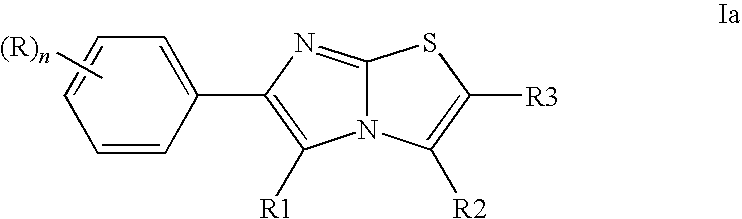
- Another subject of the present invention relates to a compound of formula Ia,
- R is chosen from halogen, (C 1 -C 6 )-alkyl which can be substituted by one or more fluorine atoms, (C 1 -C 3 )-alkoxy-(C 1 -C 3 )-alkyl, hydroxy, (C 1 -C 6 )-alkoxy which can be substituted by one or more fluorine atoms, (C 1 -C 6 )-alkylmercapto, amino, (C 1 -C 6 )-alkylamino, di-((C 1 -C 6 )-alkyl)amino, mono-(C 1 -C 6 )-alkylaminocarbonyl, di-(C 2 -C 6 )-alkylaminocarbonyl, (C 1 -C 6 )-alkoxycarbonyl, cyano, (C 1 -C 6 )-alkylsulfinyl, (C 1 -C 6 )-alkylsulfony
- R1 is chosen from hydrogen and (C 1 -C 6 )-alkyl
- R2 is chosen from hydrogen and (C 1 -C 6 )-alkyl
- R3 is chosen from Br, cyano, —C( ⁇ NR4)-NHR5 and —C( ⁇ O)—NR6R7;
- R4 is chosen from hydrogen, (C 1 -C 6 )-alkyl, (C 1 -C 6 )-alkylcarbonyl, (C 1 -C 6 )-alkoxycarbonyl, (C 1 -C 6 )-alkoxycarbonyl-oxy, (C 1 -C 18 )-alkylcarbonyl-oxy-(C 1 -C 6 )-alkoxycarbonyl, (C 6 -C 14 )-arylcarbonyl, (C 6 -C 14 )-aryloxycarbonyl, hydroxy, (C 1 -C 6 )-alkylcarbonyl-oxy, (C 6 -C 14 )-aryl-(C 1 -C 6 )-alkoxycarbonyl, (C 1 -C 6 )-alkylaminocarbonyl-oxy, di-((C 1 -C 6 )-alkyl)aminocarbonyl-oxy, (C 1 -C 6 )-alky
- R5 is chosen from hydrogen, cyano, hydroxy, (C 1 -C 6 )-alkoxy and (C 6 -C 14 )-aryl-(C 1 -C 6 )-alkoxy;
- R4 and R5 form together with the —N ⁇ C—NH— group which carries them a 4-membered to 7-membered, saturated or partially unsaturated heterocyclic ring which can be substituted by one or more identical or different substituent R1 and which, in addition to the nitrogen atoms being part of the —N ⁇ C—NH— group, can contain one or two further ring members chosen from ⁇ N—, —NR1-, —C( ⁇ O)—, —O—, —S—, —SO— and —SO 2 — which can be identical or different, with the proviso that two ring members from the series —O—, —S—, —SO—, —SO 2 — cannot be present in adjacent ring positions;
- R6 and R7 are independently chosen from hydrogen, (C 1 -C 6 )-alkyl, (C 3 -C 7 )-cycloalkyl, —(CH 2 ) o —(C 6 -C 14 )-aryl and —(CH 2 ) p -heteroaryl, wherein the aryl and heteroaryl residues can be substituted by one or more identical or different substituents chosen from halogen, (C 1 -C 6 )-alkyl, (C 1 -C 6 )-alkoxy and trifluoromethyl;
- R6 and R7 form together with the nitrogen atom which carries them a 4-membered to 7-membered, saturated, partially unsaturated or aromatic heterocyclic ring which can be substituted by one or more identical or different substituents R1 and which, in addition to the nitrogen atom connecting R6 and R7, can contain one or two further ring members chosen from ⁇ N—, —NR1-, —C( ⁇ O)—, —O—, —S—, —SO— and —SO 2 — which can be identical or different, with the proviso that two ring members from the series
- n is chosen from 0, 1, 2, 3, 4 and 5;
- o and p are independently chosen from 0, 1, 2, 3, 4 and 5;
- An embodiment of the present invention relates to a compound of formula Ia, in which
- R is chosen from halogen
- R1 is hydrogen
- R2 is chosen from (C 1 -C 6 )-alkyl
- R3 is chosen from Br, cyano, —C( ⁇ NR4)-NHR5 and —C( ⁇ O)—NR6R7;
- R4 is hydrogen
- R5 is hydroxy
- R6 is chosen from hydrogen and (C 1 -C 6 )-alkyl
- R7 is chosen from hydrogen, (C 1 -C 6 )-alkyl, (C 3 -C 7 )-cycloalkyl, phenyl and —(CH 2 ) p -thiazolyl;
- R6 and R7 form together with the nitrogen atom which carries them a 4-membered to 7-membered, saturated heterocyclic ring;
- n 1;
- p is chosen from 0 and 1;
- Another embodiment of the present invention relates to a compound of formula I, in any of its stereoisomeric forms or a mixture of stereoisomeric forms in any ratio, or a physiologically acceptable salt thereof, for use as a pharmaceutical, wherein the compound of formula I is chosen from:
- Another embodiment of the present invention relates to a compound of formula Ia, in any of its stereoisomeric forms or a mixture of stereoisomeric forms in any ratio, or a physiologically acceptable salt thereof, for use as a pharmaceutical, wherein the compound of formula Ia is a compound of formula Ib as defined below.
- Another subject of the present invention relates to a compound of formula Ib,
- R is chosen from halogen, (C 1 -C 6 )-alkyl which can be substituted by one or more fluorine atoms, (C 1 -C 3 )-alkoxy-(C 1 -C 3 )-alkyl, hydroxy, (C 1 -C 6 )-alkoxy which can be substituted by one or more fluorine atoms, (C 1 -C 6 )-alkylmercapto, amino, (C 1 -C 6 )-alkylamino, di-((C 1 -C 6 )-alkyl)amino, mono-(C 1 -C 6 )-alkylaminocarbonyl, di-(C 2 -C 6 )-alkylaminocarbonyl, (C 1 -C 6 )-alkoxycarbonyl, cyano, (C 1 -C 6 )-alkylsulfinyl, (C 1 -C 6 )-alkylsulfony
- R1 is chosen from hydrogen and (C 1 -C 6 )-alkyl
- R2 is chosen from hydrogen and (C 1 -C 6 )-alkyl
- R3 is chosen from Br, cyano and —C( ⁇ NR4)-NHR5;
- R4 is chosen from hydrogen, (C 1 -C 6 )-alkyl, (C 1 -C 6 )-alkylcarbonyl, (C 1 -C 6 )-alkoxycarbonyl, (C 1 -C 6 )-alkoxycarbonyl-oxy, (C 1 -C 18 )-alkylcarbonyl-oxy-(C 1 -C 6 )-alkoxycarbonyl, (C 6 -C 14 )-arylcarbonyl, (C 6 -C 14 )-aryloxycarbonyl, hydroxy, (C 1 -C 6 )-alkylcarbonyl-oxy, (C 6 -C 14 )-aryl-(C 1 -C 6 )-alkoxycarbonyl, (C 1 -C 6 )-alkylaminocarbonyl-oxy, di-((C 1 -C 6 )-alkyl)aminocarbonyl-oxy, (C 1 -C 6 )-alky
- R5 is chosen from hydrogen, cyano, hydroxy, (C 1 -C 6 )-alkoxy and (C 6 -C 14 )-aryl-(C 1 -C 6 )-alkoxy;
- R4 and R5 form together with the —N ⁇ C—NH— group which carries them a 4-membered to 7-membered, saturated or partially unsaturated heterocyclic ring which can be substituted by one or more identical or different substituents R1 and which, in addition to the nitrogen atoms being part of the —N ⁇ C—NH— group, can contain one or two further ring members chosen from ⁇ N—, —NR1-, —C( ⁇ O)—, —O—, —S—, —SO— and —SO 2 — which can be identical or different, with the proviso that two ring members from the series —O—, —S—, —SO—, —SO 2 — cannot be present in adjacent ring positions;
- n is chosen from 0, 1, 2, 3, 4 and 5;
- An embodiment of the present invention relates to a compound of formula Ib, in which
- R is chosen from halogen
- R1 is hydrogen
- R2 is chosen from (C 1 -C 6 )-alkyl
- R3 is chosen from Br, cyano and —C( ⁇ NR4)-NHR5;
- R4 is hydrogen
- R5 is hydroxy
- n 1;
- Another embodiment of the present invention relates to a compound of formula I, in any of its stereoisomeric forms or a mixture of stereoisomeric forms in any ratio, or a physiologically acceptable salt thereof, wherein the compound of formula I is chosen from:
- a dialkylamino group for example, the alkyl groups can be identical or different.
- the compounds of formula Ia encompass the compounds of formula Ib.
- the compounds of formula I encompass the compounds of formula Ib and of formula Ia.
- alkyl groups are methyl, ethyl, propyl, butyl, pentyl, hexyl, the n-isomers of these groups, isopropyl, isobutyl, isopentyl, sec-butyl, tert-butyl, neopentyl or 3,3-dimethylbutyl.
- a (C 1 -C 18 )-alkyl group is a (C 1 -C 6 )-alkyl group.
- Substituted alkyl groups can be substituted by one or more, for example one, two, three, four or five, identical or different substituents, for example F, which can be located in any desired positions.
- the preceding explanations regarding alkyl groups apply correspondingly to divalent alkyl groups, i.e. alkanediyl groups and alkylene groups, such as a methylene group.
- cycloalkyl groups are cyclopropyl, cyclobutyl, cyclopentyl, cyclohexyl and cycloheptyl.
- Substituted cycloalkyl groups can be substituted by one or more, for example one, two, three, four or five, identical or different substituents which can be located in any desired positions.
- Examples of (C 6 -C 14 )-aryl residues are phenyl and naphthyl. If a (C 6 -C 14 )-aryl residue, for example phenyl or naphthyl, which can be unsubstituted or substituted, is substituted by one or more substituents, in general it can carry one, two, three, four or five identical or different substituents, for example one or two substituents. The substituents can be located in any desired positions.
- (C 6 -C 14 )-aryl radicals in groups such as, for example, (C 6 -C 14 )-arylcarbonyl, (C 6 -C 14 )-aryloxycarbonyl or (C 6 -C 14 )-aryl-(C 1 -C 6 )-alkoxycarbonyl.
- the substituent can be located in the 2-position, the 3-position or the 4-position.
- the substituents can be located in 2,3-position, 2,4-position, 2,5-position, 2,6-position, 3,4-position or 3,5-position.
- the substituent in monosubstituted naphthalen-1-yl groups the substituent can be located in the 2-, 3-, 4-, 5-, 6-, 7- or 8-position, in monosubstituted naphthalen-2-yl groups the substituent can be located in the 1-, 3-, 4-, 5-, 6-, 7- or 8-position. In disubstituted naphthalenyl groups the substituents can likewise occur in any desired positions in the ring via which the naphthalenyl group is bonded, and/or in the other ring.
- Heteroaryl groups are preferably 5-membered or 6-membered monocyclic aromatic heterocyclic groups or 9-membered or 10-membered bicyclic aromatic heterocyclic groups, where the bicyclic groups contain a 6-membered ring fused to a 5-membered or two fused 6-membered rings.
- bicyclic heteroaryl groups one or both rings can be aromatic and one or both rings can contain hetero ring members.
- heteroaryl groups contain one, two or three, for example one or two, identical or different hetero ring members.
- the ring heteroatoms in heteroaryl groups are generally chosen from N, O and S wherein N includes ring nitrogen atoms which carry a hydrogen atom or any substituent as is the case in 5-membered aromatic heterocycles such as pyrrole, pyrazole or imidazole, for example.
- the hetero ring members in heteroaryl groups can be located in any desired positions provided that the resulting heterocyclic system is known in the art and is stable and suitable as a subgroup in a drug substance.
- the heterocyclic ring which can be formed by R4 and R5 together with the —N ⁇ C—NH— group which carries them can be 4-membered, 5-membered, 6-membered or 7-membered, and can be partially unsaturated or aromatic, in particular partially unsaturated, and contain, for example, one, two or three double bonds within the ring, provided the respective ring system is known in the art to be stable and suitable as a subgroup in a drug substance.
- the heterocyclic ring which can be formed by R4 and R5 together with the —N ⁇ C—NH— group which carries them can contain, in addition to the nitrogen atoms being part of the —N ⁇ C—NH— group, one or two further ring members chosen from ⁇ N—, —NR1-, —C( ⁇ O)—, —O—, —S—, —SO— and —SO 2 —, for example —C( ⁇ O)— and —O—, which can be identical or different, with the proviso that two ring members from the series —O—, —S—, —SO—, —SO 2 — cannot be present in adjacent ring positions and provided the respective ring system is known in the art to be stable and suitable as a subgroup in a drug substance.
- the heterocyclic ring which can be formed by R4 and R5 together with the —N ⁇ C—NH— group which carries them can be substituted by one or more identical or different substituents R1.
- residues of heterocyclic rings formed by R4 and R5 together with the —N ⁇ C—NH— group which carries them are the residues of imidazole, dihydro-imidazole, pyrimidine, dihydro-pyrimidine, tetrahydro-pyrimidine, diazepine, dihydro-diazepine, tetrahydro-diazepine, diazet-one, oxadiazole, dihydro-oxadiazole, oxadiazol-one, thiadiazole, dihydro-thiadiazole, thiadiazol-one, triazole, dihydro-triazole, dihydro-triazol-one, dihydro-dioxo-thiadiazole, dihydro-oxo-thi
- the heterocyclic ring which can be formed by R6 and R7 together with the nitrogen atom which carries them can be 4-membered, 5-membered, 6-membered or 7-membered, and can be saturated, partially unsaturated or aromatic, in particular saturated, and contain, for example, one, two or three double bonds within the ring, provided the respective ring system is known in the art to be stable and suitable as a subgroup in a drug substance.
- the heterocyclic ring which can be formed by R6 and R7 together with the nitrogen atom which carries them can contain, in addition to the nitrogen atom connecting R6 and R7, one or two further ring members chosen from ⁇ N—, —NR1-, —C( ⁇ O)—, —O—, —S—, —SO— and —SO 2 —, for example —C( ⁇ O)— and —O—, which can be identical or different, with the proviso that two ring members from the series —O—, —S—, —SO—, —SO 2 — cannot be present in adjacent ring positions and provided the respective ring system is known in the art to be stable and suitable as a subgroup in a drug substance.
- the heterocyclic ring which can be formed by R6 and R7 together with the nitrogen atom which carries them can be substituted by one or more identical or different substituents R1.
- residues of heterocyclic rings formed by R6 and R7 together with the nitrogen atom which carries them are the residues of azetidine, pyrrolidine, piperidine, azepane, dihydro-azete, azete, dihydro-pyrrole, pyrrole, tetrahydro-pyridine, dihydro-pyridine, pyridine, tetrahydro-azepine, dihydro-azepine, azepine, imidazoline, hexahydro-pyrimidine, piperazine, diazepane, dihydro-imidazole, tetrahydro-pyrimidine, tetrahydro-diazepine, imidazole, dihydro-pyrimidine, pyrimidine, tetrahydro
- Halogen is fluorine, chlorine, bromine or iodine, preferably fluorine, chlorine or bromine, more preferably fluorine or chlorine, for example fluorine.
- An oxo group when bonded to a carbon atom, replaces two hydrogen atoms on a carbon atom of the parent system.
- a CH 2 group is substituted by oxo, i.e. by a doubly bonded oxygen atom, it becomes a C( ⁇ O) group.
- an oxo group cannot occur as a substituent on a carbon atom in an aromatic ring.
- the present invention includes all stereoisomeric forms of the compounds of formula I, Ia or Ib and their salts.
- the compounds of formula I, Ia or Ib can be present in S configuration or substantially S configuration, or in R configuration or substantially R configuration, or as a mixture of the S isomer and the R isomer in any ratio.
- the invention includes all possible enantiomers and diastereomers and mixtures of two or more stereoisomers, for example mixtures of enantiomers and/or diastereomers, in all ratios.
- compounds according to the invention which can exist as enantiomers can be present in enantiomerically pure form, both as levorotatory and as dextrorotatory antipodes, and in the form of mixtures of the two enantiomers in all ratios including racemates.
- the invention includes both the E form and Z form, or the cis form and the trans form, as well as mixtures of these forms in all ratios.
- the preparation of individual stereoisomers can be carried out, for example, by separation of a mixture of isomers by customary methods, for example by chromatography or crystallization, by the use of stereochemically uniform starting materials in the synthesis, or by stereoselective synthesis.
- a derivatization can be carried out before a separation of stereoisomers.
- the separation of a mixture of stereoisomers can be carried out at the stage of the compound of formula I, Ia or Ib or at the stage of a starting material or an intermediate during the synthesis.
- the present invention also includes all tautomeric forms of the compounds of formulae I, Ia and Ib and their salts.
- the invention includes the tautomeric forms of the group —C( ⁇ NR4)-NHR5:
- a compound of formula I, Ia or Ib contains one or more acidic and/or basic groups, i.e. salt-forming groups
- the invention also comprises its corresponding physiologically or toxicologically acceptable salts, i.e. non-toxic salts, in particular its pharmaceutically acceptable salts.
- the compounds of formulae I, Ia and Ib which contain an acidic group can be present, and can be used according to the invention, for example, as alkali metal salts, alkaline earth metal salts or as ammonium salts.
- salts include sodium salts, potassium salts, calcium salts, magnesium salts, quaternary ammonium salts such as tetraalkylammonium salts, or acid addition salts with ammonia or organic amines such as, for example, ethylamine, ethanolamine, triethanolamine or amino acids.
- Compounds of formulae I, Ia and Ib which contain a basic group, i.e. a group which can be protonated, can be present, and can be used according to the invention, for example, in the form of their addition salts with inorganic or organic acids.
- acids examples include hydrogen chloride, hydrogen bromide, phosphoric acid, sulfuric acid, nitric acid, methanesulfonic acid, p-toluenesulfonic acid, naphthalenedisulfonic acids, oxalic acid, acetic acid, tartaric acid, lactic acid, salicylic acid, benzoic acid, formic acid, propionic acid, pivalic acid, diethylacetic acid, malonic acid, succinic acid, pimelic acid, fumaric acid, maleic acid, malic acid, sulfamic acid, phenylpropionic acid, gluconic acid, ascorbic acid, nicotinic acid, isonicotinic acid, citric acid, adipic acid, and other acids known to the person skilled in the art.
- the invention also includes, in addition to the salt forms mentioned, inner salts or betaines or zwitterions.
- the salts of the compounds of formulae I, Ia and Ib can be obtained by customary methods which are known to the person skilled in the art like, for example, by contacting the compound of formula I, Ia or Ib with an organic or inorganic acid or base in a solvent or diluent, or by anion exchange or cation exchange from another salt.
- the present invention also includes all salts of the compounds of formulae I, Ia and Ib which, owing to low physiological compatibility, are not directly suitable for use in pharmaceuticals but which can be used, for example, as intermediates for chemical reactions or for the preparation of physiologically acceptable salts.
- the present invention furthermore includes all solvates of compounds of formulae I, Ia and Ib, for example hydrates or adducts with alcohols, active metabolites of the compounds of formulae I, Ia and Ib, and also prodrugs and derivatives of the compounds of formulae I, Ia and Ib which in vitro may not necessarily exhibit pharmacological activity but which in vivo are converted into pharmacologically active compounds, for example esters or amides of carboxylic acid groups.
- R in the compounds of formulae I, Ia and Ib is chosen from halogen, (C 1 -C 6 )-alkyl which can be substituted by one or more fluorine atoms, (C 1 -C 6 )-alkoxy which can be substituted by one or more fluorine atoms, and di-((C 1 -C 6 )-alkyl)amino, which latter group can also be represented as di-(C 2 -C 12 )-alkylamino.
- R is preferably chosen from halogen, for example F and Cl, (C 1 -C 6 )-alkyl, for example methyl, and di-((C 1 -C 6 )-alkyl)amino, for example diethylamino.
- R is preferably chosen from halogen and can be F, for example. If the number n in a compound of formula I, Ia or Ib is 0 (zero), the phenyl group carrying the groups R carries five hydrogen atoms and thus is an unsubstituted phenyl group.
- the number n is different from 0 and the phenyl group thus is substituted by one or more groups R, all positions of the phenyl group which do not carry a group R, carry hydrogen atoms.
- the phenyl group carries four hydrogen atoms in addition to one group R.
- the compounds of formulae I, Ia and Ib can likewise be defined by including in the definition of the number n only denotations which are different from 0, and including in the definition of the group R the denotation hydrogen in addition to the denotations which are different from hydrogen.
- R1 in the compounds of formulae I, Ia and Ib is chosen from hydrogen and methyl, and preferably is hydrogen.
- R2 in the compounds of formulae I, Ia and Ib is chosen from hydrogen, methyl and ethyl, and preferably is chosen from hydrogen and methyl.
- a (C 1 -C 6 )-alkoxycarbonyl group representing R3 in the compounds of formula I is chosen from methoxycarbonyl and ethoxycarbonyl.
- R3 is preferably chosen from Br, cyano, —C( ⁇ NR4)-NHR5 and —C( ⁇ O)—NR6R7, more preferably from Br, cyano and —C( ⁇ NR4)-NHR5.
- in the compounds of formula Ia R3 is chosen from Br, cyano and —C( ⁇ NR4)-NHR5.
- in the compounds of formula Ia R3 is chosen from —C( ⁇ O)—NR6R7.
- in the compounds of formula Ib R3 is chosen from Br and cyano.
- in the compounds of formula Ib R3 is chosen from —C( ⁇ NR4)-NHR5.
- Ia and Ib R2 is defined as hydrogen when R3 is defined as Br.
- R2 is defined as hydrogen or methyl when R3 is defined as COOH.
- R2 is defined as methyl when R3 is defined as cyano, (C 1 -C 6 )-alkoxycarbonyl, —C( ⁇ NR4)-NHR5 or —C( ⁇ O)—NR6R7.
- R2 is defined as methyl when R3 is defined as cyano, —C( ⁇ NR4)-NHR5 or —C( ⁇ O)—NR6R7.
- R2 is defined as methyl when R3 is defined as cyano or —C( ⁇ NR4)-NHR5.
- Ia and Ib R4 is defined as hydrogen or (C 1 -C 6 )-alkyl and preferably is hydrogen.
- Ia and Ib R5 is defined as hydrogen or hydroxy and preferably is hydroxy.
- R4 and R5 in the compounds of formulae I, Ia and Ib form together with the —N ⁇ C—NH— group which carries them a 4-membered to 7-membered, for example a 5- or 6-membered, saturated or partially unsaturated heterocyclic ring which can be substituted by one or more identical or different substituents R1 and which, in addition to the nitrogen atoms being part of the —N ⁇ C—NH— group, can contain one or two further ring members chosen from ⁇ N—, —NR1-, —C( ⁇ O)—, —O—, —S—, —SO— and —SO 2 — which can be identical or different, with the proviso that two ring members from the series —O—, —S—, —SO—, —SO 2 — cannot be present in adjacent ring positions, and, for example, R4 and R5 in the compounds of formulae I, Ia and Ib form together with the —N ⁇ C—NH—
- R6 in the compounds of formulae I and Ia is chosen from hydrogen and (C 1 -C 6 )-alkyl and preferably is chosen from hydrogen, methyl, ethyl and isopropyl.
- R7 in the compounds of formulae I and Ia is chosen from hydrogen, (C 1 -C 6 )-alkyl, (C 3 -C 7 )-cycloalkyl, —(CH 2 ) o -aryl and —(CH 2 ) p -heteroaryl, wherein the aryl and heteroaryl residues can be substituted by one or more identical or different substituents chosen from halogen, (C 1 -C 6 )-alkyl, (C 1 -C 6 )-alkoxy and trifluoromethyl.
- R7 is defined as hydrogen, (C 1 -C 6 )-alkyl, for example methyl, ethyl, isopropyl or tert-butyl, (C 3 -C 7 )-cycloalkyl, for example cyclopropyl, phenyl or —(CH 2 ) p -thiazolyl, for example thiazolyl or thiazolylmethyl.
- R6 and R7 in the compounds of formulae I and Ia form together with the nitrogen atom which carries them a 4-membered to 7-membered, saturated, partially unsaturated or aromatic heterocyclic ring, which can be substituted by one or more identical or different substituents R1 and which, in addition to the nitrogen atom connecting R6 and R7, can contain one or two further ring members chosen from ⁇ N—, —NR1-, —C( ⁇ O)—, —O—, —S—, —SO— and —SO 2 — which can be identical or different, with the proviso that two ring members from the series —O—, —S—, —SO—, —SO 2 — cannot be present in adjacent ring positions, and, for example, R6 and R7 in the compounds of formulae I and Ia form together with the nitrogen atom which carries them a residue of a ring chosen from azetidine, pyrrolidine, piperidine, azepan
- R6 and R7 in the compounds of formulae I and Ia form together with the nitrogen atom which carries them a 4-membered to 7-membered, saturated, partially unsaturated or aromatic heterocyclic ring, in particular a saturated or partially unsaturated ring, and preferably R6 and R7 form together with the nitrogen atom which carries them a 4-membered to 7-membered, saturated heterocyclic ring, for example a residue of pyrrolidine, piperidine or azepane.
- n is chosen from 0, 1 and 2, preferably from 0 and 1. In another embodiment n is 1.
- the number o is chosen from 0 and 1 and preferably is 0.
- the number p is chosen from 0, 1 and 2 and preferably from 0 and 1.
- the compounds according to formulae I, Ia and Ib and their precursors can be prepared according to methods published in the literature or, respectively, to analogous methods.
- the compounds of formula I including the compounds of formulae Ia and Ib, can be prepared by reacting a compound of formula II with a compound of formula III.
- the variables R, R1, R2, R3 and n are defined as in the compounds of formula I and X is a leaving group such as halogen, in particular Br.
- an inert solvent which can be protic or a
- the reaction can be carried out under solvent-free conditions.
- the reaction can also be carried out in the presence of a Lewis acid or with microwave irradiation.
- the reaction of the compounds of formulae II and III can be carried out in a wide temperature range. Usually it is advantageous to perform the reaction at temperatures from about ⁇ 20° C. to about the boiling point of the solvent used, preferably at from about 0° C. to about 140° C., more preferably at about the boiling point of the solvent.
- the detailed conditions of a specific preparation including the solvent, the addition of a base, the temperature, the order of addition, the molar ratios and other parameters, are routinely chosen by the person skilled in the art in view of the characteristics of the starting compounds and the target compound.
- protecting groups amino-protecting groups, such as tert-butyloxycarbonyl and benzyloxycarbonyl, and protecting groups of carboxylic acid groups, which can be protected as esters such as tert-butyl esters, which can be deprotected by treatment with trifluoroacetic acid, or benzyl esters, which can be deprotected by catalytic hydrogenation, may be mentioned.
- a precursor group the nitro group may be mentioned which can be converted into an amino group by reduction, for example by catalytic hydrogenation.
- R3 is a carboxylic acid ester group.
- the ester group can be transferred to an amide groups by direct reaction with ammonia or an amine or indirectly via saponification of the ester group and reaction of the free carboxylic acid with ammonia or an amine.
- the primary amide obtained with ammonia can be dehydrated to get the corresponding nitrile.
- Numerous procedures are described in the literature to conduct such types of reactions, for example in D. S. Bose et al., Synthesis (1999), 64-65. Nitriles are easily converted by addition of nitrogen-containing compounds such as amines or hydroxylamines to adducts like amidines or hydroxy-amidines.
- the obtained compounds of formula I can be purified by customary purification procedures, for example by recrystallization or chromatography.
- the starting compounds of formulae II and III for the preparation of the compounds of formula I are commercially available or can be prepared according to or analogously to literature procedures.
- the compounds of formulae I, Ia and Ib are useful pharmacologically active, or pharmaceutically active, compounds which modulate the expression of endothelial NO synthase, and more specifically upregulate, or stimulate, the expression, or transcription, of endothelial NO synthase, and which can be employed as pharmaceuticals, or active ingredients of medicaments, for the treatment of various diseases.
- treatment is understood as comprising both therapy, including alleviation and cure, of diseases and disease symptoms and prevention and prophylaxis of diseases and disease symptoms, such as, for example, the prevention of the appearance of asthmatic disease symptoms or the prevention of myocardial infarction or of myocardial reinfarction in affected patients.
- the diseases or disease symptoms can be acute or chronic.
- the compounds of formulae I, Ia and Ib lower the cardiovascular risk of postmenopausal women or after intake of contraceptives.
- Compounds of formulae I, Ia and Ib can additionally be used in the treatment, including therapy and prevention, of diabetes and diabetes complications such as nephropathy or retinopathy, angiogenesis, bronchial asthma, chronic renal failure, cirrhosis of the liver, osteoporosis, restricted memory performance or a restricted ability to learn.
- Preferred indications are chronic heart failure, stable angina pectoris, coronary heart disease, hypertension, endothelial dysfunction, atherosclerosis and diabetes complications.
- the compounds of formulae I, Ia and Ib can be used in combination with other pharmacologically active compounds or pharmaceuticals, preferably with compounds which are able to enhance the effect of the compounds according to formulae I, Ia and Ib.
- examples of such other compounds include statins; ACE inhibitors; AT1 antagonists; argininase inhibitors; PDE V inhibitors; calcium antagonists; alpha blockers; beta blockers; metimazol and analogous compounds; arginine; tetrahydrobiopterin; vitamins, in particular vitamin C and vitamin B6; niacine.
- the compounds of formulae I, Ia and Ib and their physiologically acceptable salts, optionally in combination with other pharmacologically active compounds, can be administered to animals, preferably to mammals, and in particular to humans, as pharmaceuticals by themselves, in mixtures with one another, or in the form of pharmaceutical compositions.
- compositions of formulae Ia and Ib and their physiologically acceptable salts for use as pharmaceuticals, the use of the compounds of formulae I, Ia and Ib and their physiologically acceptable salts as modulating agents, and more specifically as stimulating agents or upregulating agents, of the expression or transcription of endothelial NO synthase, for example in conditions in which an increased expression of said enzyme or an increased NO level or the normalization of a decreased NO level in a patient is desired, and in particular their use in the treatment, including therapy and prevention, of the above-mentioned diseases or syndromes, as well as their use for the preparation or manufacture of medicaments for these purposes.
- compositions, or pharmaceutical preparations which comprise an effective dose of at least one compound of formula Ia or Ib and/or a physiologically acceptable salt thereof and a pharmaceutically acceptable carrier, i.e. one or more pharmaceutically acceptable carrier substances and/or additives.
- the pharmaceuticals according to the invention can be administered orally, for example in the form of pills, tablets, lacquered tablets, sugar-coated tablets, granules, hard and soft gelatin capsules, aqueous, alcoholic or oily solutions, syrups, emulsions or suspensions, or rectally, for example in the form of suppositories.
- Administration can also be carried out parenterally, for example subcutaneously, intramuscularly or intravenously, for example in the form of solutions for injection or infusion.
- Other suitable administration forms are, for example, percutaneous or topical administration, for example in the form of ointments, tinctures, sprays or transdermal therapeutic systems, or the inhalative administration in the form of nasal sprays or aerosol mixtures, or, for example, microcapsules, implants or rods.
- the preferred administration form depends, among others, on the disease to be treated and on its severity.
- the amount of a compound of formula I, Ia or Ib and/or its physiologically acceptable salts present in the pharmaceutical compositions normally ranges from about 0.2 to about 800 mg, preferably from about 0.5 to about 500 mg, in particular from about 1 to about 200 mg, per dose, but depending on the type of the pharmaceutical composition it may also be higher.
- the pharmaceutical compositions usually comprise from about 0.5 to about 90 percent by weight of the compounds of formula I or Ia or Ib and/or their physiologically acceptable salts.
- the production of the pharmaceutical compositions can be carried out in a manner known per se.
- one or more compounds of formula I or Ia or Ib and/or their physiologically acceptable salts together with one or more solid or liquid pharmaceutical carrier substances (or vehicles) and/or additives (or auxiliary substances) and, if a combination medicament is desired, other pharmacologically active compounds having therapeutic or prophylactic action are brought into a suitable administration form or dosage form which can then be used as a pharmaceutical in human or veterinary medicine.
- soft gelatin capsules and suppositories can comprise, for example, fats, waxes, semisolid and liquid polyols, natural or hardened oils, etc.
- Suitable carrier substances for the preparation of solutions, for example of solutions for injection, or of emulsions or syrups are, for example, water, physiologically sodium chloride solution, alcohols such as ethanol, glycerol, polyols, sucrose, invert sugar, glucose, mannitol, vegetable oils, etc.
- Suitable carriers for microcapsules, implants or rods are, for example, copolymers of glycolic acid and lactic acid.
- the pharmaceutical compositions can also contain additives such as, for example, fillers, disintegrants, binders, lubricants, wetting agents, stabilizers, emulsifiers, dispersants, preservatives, sweeteners, colorants, flavorings, aromatizers, thickeners, diluents, buffer substances, solvents, solubilizers, agents for achieving a depot effect, salts for altering the osmotic pressure, coating agents or antioxidants.
- additives such as, for example, fillers, disintegrants, binders, lubricants, wetting agents, stabilizers, emulsifiers, dispersants, preservatives, sweeteners, colorants, flavorings, aromatizers, thickeners, diluents, buffer substances, solvents, solubilizers, agents for achieving a depot effect, salts for altering the osmotic pressure, coating agents or antioxidants.
- the dosage of the compound of formula I, Ia or Ib to be administered and/or of a physiologically acceptable salt thereof depends on the individual case and, as is customary, has to be adapted to the individual circumstances to achieve an optimum effect. Thus, it depends on the nature and the severity of the disorder to be treated, and also on the sex, age, weight and individual responsiveness of the human or animal to be treated, on the efficacy and duration of action of the compounds used, on whether the use is for the therapy of a acute or chronic disease or prophylactic, or on whether other active compounds are administered in addition to compounds of formula I or Ia Ib.
- a daily dose from about 0.01 mg/kg to about 100 mg/kg, preferably from about 0.1 mg/kg to about 10 mg/kg, in particular from about 0.3 mg/kg to about 5 mg/kg (in each case mg per kg of bodyweight) is appropriate for administration to an adult weighing about 75 kg in order to obtain the desired results.
- the daily dose can be administered in a single dose or, in particular when larger amounts are administered, divided into several, for example two, three or four individual doses. In some cases, depending on the individual response, it may be necessary to deviate upwards or downwards from the given daily dose.
- the compounds of formulae I, Ia and Ib can also be used for other purposes than those indicated in the foregoing.
- Non-limiting examples include the use as diagnostics, for example the use in methods for determining the activity of endothelial NO synthase in biological samples, the use as biochemical tools and the use as intermediates for the preparation of further compounds, for example further pharmacologically active compounds.
- 6-(4-Fluoro-phenyl)-3-methyl-imidazo[2,1-b]thiazole-2-carboxylic acid amide (example 8, 190 mg, 0.69 mmol) was dissolved in 10 ml of dichloromethane. The solution was cooled to 0° C., triethylamine (191.8 ⁇ l, 1.38 mmol) was added and trifluoromethanesulfonic acid anhydride (214 mg, 0.76 mmol) was added dropwise.
- Activation of eNOS transcription was measured as described in detail by Li et al., “Activation of protein kinase C alpha and/or epsilon enhances transcription of the human endothelial nitric oxide synthase gene”, Mol. Pharmacol. 53 (1998), 630-637. Briefly, a 3.5 kB long fragment 5′ of the starting codon of the eNOS gene was cloned, sequenced and cloned in firefly luciferase expression plasmids to monitor activation of the eNOS promoter by reporter gene activity. A human endothelial cell line stable transfected and expressing this promoter-reporter construct was used for compound testing. Cells were incubated for 18 h with the compounds.
- TIR transcription induction ratio
- EC 50 values of less than about 50 ⁇ M exhibited EC 50 values of less than about 50 ⁇ M.
- Preferred compounds exhibited EC 50 values of from about 5 ⁇ M to about 0.5 ⁇ M. More preferred compounds, for example the compounds of examples 1, 2, 3, 10 and 22, exhibited EC 50 values of less than 0.5 ⁇ M.
- HUVEC human umbilical vein cord endothelial cells
- Confluent cells were incubated with compounds for 18 h and the effect on eNOS protein expression determined by a quantitative Western blotting procedure.
- HUVEC were lysed in ice-cold lysis buffer containing 10 mM Tris-HCl, pH 8.0, 1% SDS and protease inhibitors. The lysate was subjected to a standard denaturing polyacrylamide gel electrophoresis and blotted to nitrocellulose membranes.
- a standard rodent chow containing 4% of fat and 0.001% of cholesterol; in the following designated as placebo group
- a standard rodent chow+test compound 10 or 30 mg/kg/day p.o.
- Blood-pressure is determined in conscious mice using a computerized tail-cuff system (Visitech Systems, Apex, N.C.). After treatment of ApoE deficient mice and eNOS deficient mice with the test compounds the blood pressure is compared to the results obtained with a placebo treatment.
- mice After 3 day treatment of ApoE deficient mice with the respective compound (10 mg/kg/day pressed in chow), animals are anesthetized with an intraperitoneal injection of pentobarbital (60 mg/kg) followed by an intramuscular injection of xylazin (2 mg/kg) and a cuff is placed around the femoral artery as described in Moroi et al. (J Clin. Invest. 101 (1998), 1225-1232). Briefly, the left femoral artery is dissected.
- a non-occlusive 2.0 mm polyethylene cuff made of PE 50 tubing (inner diameter 0.56 mm, outer diameter 0.965 mm, Becton Dickinson, Mountain View, Calif.) is placed around the artery and tied in place with two 7-0 sutures.
- the right femoral artery is isolated from the surrounding tissues but a cuff is not placed.
- Treatment with the respective compound is continued for 14 days after surgery.
- Then the animals are sacrificed.
- the aorta are taken for determination of vascular eNOS expressions by quantitative western blotting. Both femoral arteries are harvested, fixed in formalin and embedded in paraffin.
- ApoE deficient mice are treated for 16 weeks with the respective compound pressed in chow and finally sacrificed. Aortas are removed from each mouse, fixed in formalin and embedded in paraffin. Plaque formation is measured via lipid lesions formation in the aortas (from aortic arch to diaphragm) and is analyzed by oil red O staining. For quantifying the effect of the respective compound on vascular eNOS expression the femoral arteries are used in this experiment. The results obtained in the compound group are compared to those obtained in the placebo group.
- a standard rodent chow containing 4% of fat and 0.001% of cholesterol
- a standard rodent chow+respective compound (30 mg/kg/day p.o.
- mice are anesthetized with sodium pentobarbitone (100 mg/kg i.p.), and the hearts are rapidly excised and placed into ice-cold perfusion buffer.
- the aorta is cannulated and connected to a perfusion apparatus (Hugo Sachs Electronics, Freiburg, Germany) which is started immediately at a constant perfusion pressure of 60 mm Hg.
- Hearts are perfused in a retrograde fashion with modified Krebs bicarbonate buffer, equilibrated with 95% O 2 and 5% CO 2 and maintained at 37.5° C.
- a beveled small tube (PE 50) is passed through a pulmonary vein into the left ventricle and pulled through the ventricular wall, anchored in the apex by a fluted end, and connected to a tip-micromanometer (Millar 1.4 French).
- the left atrium is cannulated through the same pulmonary vein and the heart switched to the working mode with a constant preload pressure of 10 mm Hg and an afterload pressure of 60 mm Hg.
- Aortic outflow and atrial inflow are continuously measured using ultrasonic flow probes (HSE/Transonic Systems Inc.). Coronary flow is calculated as the difference between atrial flow and aortic flow. All hemodynamic data are digitized at a sampling rate of 1000 Hz and recorded with a PC using specialized software (HEM, Notocord).
- Hearts are allowed to stabilize for 30 min. All functional hemodynamic data are measured during steady state, and during volume and pressure loading. Left ventricular function curves are constructed by varying pre-load pressure. For acquisition of preload curves, afterload is set at 60 mm Hg and preload is adjusted in 5 mm Hg steps over a range of 5 to 25 mm Hg. Hearts are allowed to stabilize at baseline conditions between pressure and volume loading.
Landscapes
- Health & Medical Sciences (AREA)
- Organic Chemistry (AREA)
- Chemical & Material Sciences (AREA)
- Bioinformatics & Cheminformatics (AREA)
- Engineering & Computer Science (AREA)
- Life Sciences & Earth Sciences (AREA)
- General Health & Medical Sciences (AREA)
- Chemical Kinetics & Catalysis (AREA)
- Veterinary Medicine (AREA)
- Nuclear Medicine, Radiotherapy & Molecular Imaging (AREA)
- Medicinal Chemistry (AREA)
- Public Health (AREA)
- Pharmacology & Pharmacy (AREA)
- General Chemical & Material Sciences (AREA)
- Animal Behavior & Ethology (AREA)
- Cardiology (AREA)
- Diabetes (AREA)
- Heart & Thoracic Surgery (AREA)
- Physical Education & Sports Medicine (AREA)
- Hematology (AREA)
- Orthopedic Medicine & Surgery (AREA)
- Hospice & Palliative Care (AREA)
- Biomedical Technology (AREA)
- Neurology (AREA)
- Neurosurgery (AREA)
- Pulmonology (AREA)
- Rheumatology (AREA)
- Urology & Nephrology (AREA)
- Endocrinology (AREA)
- Psychiatry (AREA)
- Gynecology & Obstetrics (AREA)
- Reproductive Health (AREA)
- Obesity (AREA)
- Emergency Medicine (AREA)
- Ophthalmology & Optometry (AREA)
- Vascular Medicine (AREA)
- Gastroenterology & Hepatology (AREA)
- Pharmaceuticals Containing Other Organic And Inorganic Compounds (AREA)
- Nitrogen And Oxygen Or Sulfur-Condensed Heterocyclic Ring Systems (AREA)
- Heterocyclic Carbon Compounds Containing A Hetero Ring Having Nitrogen And Oxygen As The Only Ring Hetero Atoms (AREA)
Abstract

in which R, R1 to R3 and n have the meanings indicated in the claims, which modulate the transcription of endothelial nitric oxide (NO) synthase and are valuable pharmacologically active compounds. Specifically, the compounds of formula I upregulate the expression of the enzyme endothelial NO synthase and can be applied in conditions in which an increased expression of said enzyme or an increased NO level or the normalization of a decreased NO level is desired. The invention further relates to processes for the preparation of compounds of formula I, to pharmaceutical compositions comprising them, and to the use of compounds of formula I for the manufacture of a medicament for the stimulation of the expression of endothelial NO synthase or for the treatment of various diseases including cardiovascular disorders such as atherosclerosis, thrombosis, coronary artery disease, hypertension and cardiac insufficiency, for example.
Description


- 6-(4-fluoro-phenyl)-3-methyl-imidazo[2,1-b]thiazole-2-carboxylic acid ethyl ester,
- 6-(3-chloro-phenyl)-3-methyl-imidazo[2,1-b]thiazole-2-carboxylic acid ethyl ester,
- 3-methyl-6-p-tolyl-imidazo[2,1-b]thiazole-2-carboxylic acid ethyl ester,
- 3-methyl-6-phenyl-imidazo[2,1-b]thiazole-2-carboxylic acid ethyl ester,
- 6-(4-diethylamino-phenyl)-3-methyl-imidazo[2,1-b]thiazole-2-carboxylic acid ethyl ester,
- 6-(4-fluoro-phenyl)-3-methyl-imidazo[2,1-b]thiazole-2-carboxylic acid methyl-phenyl-amide,
- 6-(4-fluoro-phenyl)-3-methyl-imidazo[2,1-b]thiazole-2-carboxylic acid,
- 6-(4-fluoro-phenyl)-3-methyl-imidazo[2,1-b]thiazole-2-carboxylic acid amide,
- 6-(4-fluoro-phenyl)-3-methyl-imidazo[2,1-b]thiazole-2-carboxylic acid dimethylamide,
- 6-(4-fluoro-phenyl)-3-methyl-imidazo[2,1-b]thiazole-2-carboxylic acid tert-butylamide,
- azetidin-1-yl-[6-(4-fluoro-phenyl)-3-methyl-imidazo[2,1-b]thiazol-2-yl]-methanone,
- [6-(4-fluoro-phenyl)-3-methyl-imidazo[2,1-b]thiazol-2-yl]-piperidin-1-yl-methanone,
- 6-(4-fluoro-phenyl)-3-methyl-imidazo[2,1-b]thiazole-2-carboxylic acid diethylamide,
- [6-(4-fluoro-phenyl)-3-methyl-imidazo[2,1-b]thiazol-2-yl]-pyrrolidin-1-yl-methanone,
- 6-(4-fluoro-phenyl)-3-methyl-imidazo[2,1-b]thiazole-2-carboxylic acid thiazol-2-ylamide,
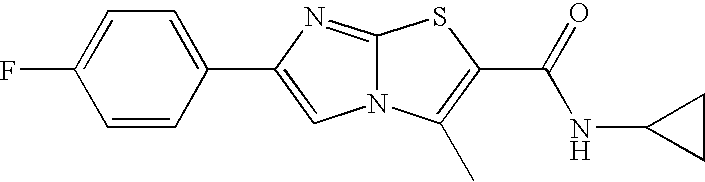
- 6-(4-fluoro-phenyl)-3-methyl-imidazo[2,1-b]thiazole-2-carboxylic acid cyclopropylamide,
- 6-(4-fluoro-phenyl)-3-methyl-imidazo[2,1-b]thiazole-2-carboxylic acid diisopropylamide,
- 6-(4-fluoro-phenyl)-3-methyl-imidazo[2,1-b]thiazole-2-carboxylic acid phenylamide,
- 6-(4-fluoro-phenyl)-3-methyl-imidazo[2,1-b]thiazole-2-carboxylic acid (thiazol-2-ylmethyl)-amide,
- 6-(4-fluoro-phenyl)-3-methyl-imidazo[2,1-b]thiazole-2-carbonitrile,
- 6-(4-fluoro-phenyl)-N-hydroxy-3-methyl-imidazo[2,1-b]thiazole-2-carboxamidine,
- 2-bromo-6-(4-fluoro-phenyl)-imidazo[2,1-b]thiazole, and
- 6-(4-fluoro-phenyl)-imidazo[2,1-b]thiazole-2-carboxylic acid.

- 6-(4-fluoro-phenyl)-3-methyl-imidazo[2,1-b]thiazole-2-carboxylic acid ethyl ester,
- 6-(3-chloro-phenyl)-3-methyl-imidazo[2,1-b]thiazole-2-carboxylic acid ethyl ester,
- 3-methyl-6-p-tolyl-imidazo[2,1-b]thiazole-2-carboxylic acid ethyl ester,
- 6-(4-diethylamino-phenyl)-3-methyl-imidazo[2,1-b]thiazole-2-carboxylic acid ethyl ester,
- 6-(4-fluoro-phenyl)-3-methyl-imidazo[2,1-b]thiazole-2-carboxylic acid methyl-phenyl-amide,
- 6-(4-fluoro-phenyl)-3-methyl-imidazo[2,1-b]thiazole-2-carboxylic acid,
- 6-(4-fluoro-phenyl)-3-methyl-imidazo[2,1-b]thiazole-2-carboxylic acid amide,
- 6-(4-fluoro-phenyl)-3-methyl-imidazo[2,1-b]thiazole-2-carboxylic acid dimethylamide,
- 6-(4-fluoro-phenyl)-3-methyl-imidazo[2,1-b]thiazole-2-carboxylic acid tert-butylamide,
- azetidin-1-yl-[6-(4-fluoro-phenyl)-3-methyl-imidazo[2,1-b]thiazol-2-yl]-methanone,
- [6-(4-fluoro-phenyl)-3-methyl-imidazo[2,1-b]thiazol-2-yl]-piperidin-1-yl-methanone,
- 6-(4-fluoro-phenyl)-3-methyl-imidazo[2,1-b]thiazole-2-carboxylic acid diethylamide,
- [6-(4-fluoro-phenyl)-3-methyl-imidazo[2,1-b]thiazol-2-yl]-pyrrolidin-1-yl-methanone,
- 6-(4-fluoro-phenyl)-3-methyl-imidazo[2,1-b]thiazole-2-carboxylic acid thiazol-2-ylamide,
- 6-(4-fluoro-phenyl)-3-methyl-imidazo[2,1-b]thiazole-2-carboxylic acid cyclopropylamide,
- 6-(4-fluoro-phenyl)-3-methyl-imidazo[2,1-b]thiazole-2-carboxylic acid diisopropylamide,
- 6-(4-fluoro-phenyl)-3-methyl-imidazo[2,1-b]thiazole-2-carboxylic acid phenylamide,
- 6-(4-fluoro-phenyl)-3-methyl-imidazo[2,1-b]thiazole-2-carboxylic acid (thiazol-2-ylmethyl)-amide,
- 6-(4-fluoro-phenyl)-3-methyl-imidazo[2,1-b]thiazole-2-carbonitrile,
- 6-(4-fluoro-phenyl)-N-hydroxy-3-methyl-imidazo[2,1-b]thiazole-2-carboxamidine,
- 2-bromo-6-(4-fluoro-phenyl)-imidazo[2,1-b]thiazole, and
- 6-(4-fluoro-phenyl)-imidazo[2,1-b]thiazole-2-carboxylic acid.

- 6-(4-fluoro-phenyl)-3-methyl-imidazo[2,1-b]thiazole-2-carboxylic acid ethyl ester,
- 6-(3-chloro-phenyl)-3-methyl-imidazo[2,1-b]thiazole-2-carboxylic acid ethyl ester,
- 3-methyl-6-p-tolyl-imidazo[2,1-b]thiazole-2-carboxylic acid ethyl ester,
- 6-(4-diethylamino-phenyl)-3-methyl-imidazo[2,1-b]thiazole-2-carboxylic acid ethyl ester,
- 6-(4-fluoro-phenyl)-3-methyl-imidazo[2,1-b]thiazole-2-carboxylic acid methyl-phenyl-amide,
- 6-(4-fluoro-phenyl)-3-methyl-imidazo[2,1-b]thiazole-2-carboxylic acid,
- 6-(4-fluoro-phenyl)-3-methyl-imidazo[2,1-b]thiazole-2-carboxylic acid amide,
- 6-(4-fluoro-phenyl)-3-methyl-imidazo[2,1-b]thiazole-2-carboxylic acid dimethylamide,
- azetidin-1-yl-[6-(4-fluoro-phenyl)-3-methyl-imidazo[2,1-b]thiazol-2-yl]-methanone,
- 6-(4-fluoro-phenyl)-3-methyl-imidazo[2,1-b]thiazole-2-carboxylic acid diethylamide,
- 6-(4-fluoro-phenyl)-3-methyl-imidazo[2,1-b]thiazole-2-carboxylic acid thiazol-2-ylamide,
- 6-(4-fluoro-phenyl)-3-methyl-imidazo[2,1-b]thiazole-2-carboxylic acid cyclopropylamide,
- 6-(4-fluoro-phenyl)-3-methyl-imidazo[2,1-b]thiazole-2-carboxylic acid diisopropylamide,
- 6-(4-fluoro-phenyl)-3-methyl-imidazo[2,1-b]thiazole-2-carboxylic acid (thiazol-2-ylmethyl)-amide,
- 6-(4-fluoro-phenyl)-3-methyl-imidazo[2,1-b]thiazole-2-carbonitrile,
- 6-(4-fluoro-phenyl)-N-hydroxy-3-methyl-imidazo[2,1-b]thiazole-2-carboxamidine,
- 2-bromo-6-(4-fluoro-phenyl)-imidazo[2,1-b]thiazole, and
- 6-(4-fluoro-phenyl)-imidazo[2,1-b]thiazole-2-carboxylic acid.


- DMF N,N-dimethylformamide
- HPLC high performance liquid chromatography
- RP reversed phase
- RT room temperature
- TFA trifluoroacetic acid
- THF tetrahydrofuran
- TOTU O-[(cyano(ethoxycarbonyl)methylene)amino]-1,1,3,3-tetramethyluronium tetrafluoroborate




Claims (12)


Applications Claiming Priority (4)
| Application Number | Priority Date | Filing Date | Title |
|---|---|---|---|
| EP06023790.6 | 2006-11-16 | ||
| EP06023790A EP1923062A1 (en) | 2006-11-16 | 2006-11-16 | Imidazo[2,1-b]thiazoles and their use as pharmaceuticals |
| EP06023790 | 2006-11-16 | ||
| PCT/EP2007/009539 WO2008058641A1 (en) | 2006-11-16 | 2007-11-03 | Imidazo[2, 1-b]thiazoles and their use as pharmaceuticals |
Related Parent Applications (1)
| Application Number | Title | Priority Date | Filing Date |
|---|---|---|---|
| PCT/EP2007/009539 Continuation WO2008058641A1 (en) | 2006-11-16 | 2007-11-03 | Imidazo[2, 1-b]thiazoles and their use as pharmaceuticals |
Publications (2)
| Publication Number | Publication Date |
|---|---|
| US20100004299A1 US20100004299A1 (en) | 2010-01-07 |
| US8080569B2 true US8080569B2 (en) | 2011-12-20 |
Family
ID=37875485
Family Applications (1)
| Application Number | Title | Priority Date | Filing Date |
|---|---|---|---|
| US12/466,576 Expired - Fee Related US8080569B2 (en) | 2006-11-16 | 2009-05-15 | Imidazo[2,1-b]thiazoles and their use as pharmaceuticals |
Country Status (6)
| Country | Link |
|---|---|
| US (1) | US8080569B2 (en) |
| EP (2) | EP1923062A1 (en) |
| JP (1) | JP5193217B2 (en) |
| AT (1) | ATE496621T1 (en) |
| DE (1) | DE602007012289D1 (en) |
| WO (1) | WO2008058641A1 (en) |
Families Citing this family (3)
| Publication number | Priority date | Publication date | Assignee | Title |
|---|---|---|---|---|
| EP2567959B1 (en) | 2011-09-12 | 2014-04-16 | Sanofi | 6-(4-hydroxy-phenyl)-3-styryl-1h-pyrazolo[3,4-b]pyridine-4-carboxylic acid amide derivatives as kinase inhibitors |
| WO2013049585A1 (en) * | 2011-09-30 | 2013-04-04 | Hengrui (Usa), Ltd. | Arylsubstituted thiazolotriazoles and thiazoloimidazoles |
| TR2022015229A2 (en) * | 2022-10-05 | 2024-04-22 | İü Bi̇li̇msel Araştirma Projeleri̇ Bi̇ri̇mi̇ | Hydrazinecarbotioamide and 1,2,4-triazole-3-thion derivative compounds bearing imidazo[2,1-b]thiazole ring and synthesis methods of these compounds. |
Citations (13)
| Publication number | Priority date | Publication date | Assignee | Title |
|---|---|---|---|---|
| WO1999047153A2 (en) | 1998-03-19 | 1999-09-23 | Brigham & Women's Hospital, Inc. | UPREGULATION OF TYPE III ENDOTHELIAL CELL NITRIC OXIDE SYNTHASE BY rho GTPase FUNCTION INHIBITORS |
| WO2000003746A2 (en) | 1998-07-14 | 2000-01-27 | The Brigham And Women's Hospital, Inc. | Upregulation of type iii endothelial cell nitric oxide synthase by agents that disrupt actin cytoskeletal organization |
| WO2002064146A1 (en) | 2001-02-13 | 2002-08-22 | Aventis Pharma Deutschland Gmbh | 4-fluoro-n-indan-2-yl benzamide and its use as pharmaceutical |
| WO2002064546A2 (en) | 2001-02-13 | 2002-08-22 | Aventis Pharma Deutschland Gmbh | Acylated 6,7,8,9-tetrahydro-5h-benzocycloheptenyl amines and their use as pharmaceutical |
| WO2002064565A1 (en) | 2001-02-13 | 2002-08-22 | Aventis Pharma Deutschland Gmbh | Acylated 1,2,3,4-tetrahydronaphthyl amines and their use as pharmaceutical |
| WO2002064545A1 (en) | 2001-02-13 | 2002-08-22 | Aventis Pharma Deutschland Gmbh | Acylated indanyl amines and their use as pharmaceuticals |
| WO2004014842A1 (en) | 2002-08-07 | 2004-02-19 | Aventis Pharma Deutschland Gmbh | Acylated arylcycloalkylamines and their use as pharmaceuticals |
| WO2004014372A1 (en) | 2002-08-07 | 2004-02-19 | Aventis Pharma Deutschland Gmbh | Acylated, heteroaryl-condensed cycloalkenylamines and their use as pharmaceuticals |
| WO2004014369A1 (en) | 2002-08-07 | 2004-02-19 | Aventis Pharma Deutschland Gmbh | Acylamino-substituted heteroaromatic compounds and their use as pharmaceuticals |
| WO2004094425A1 (en) | 2003-04-24 | 2004-11-04 | Sanofi-Aventis Deutschland Gmbh | Triaza- and tetraaza-anthracenedione derivatives, their preparation and their use as pharmaceuticals |
| WO2006008556A1 (en) | 2004-07-22 | 2006-01-26 | Istituto Di Ricerche Di Biologia Molecolare P. Angeletti Spa | Imidazole and thiazole derivatives as antiviral agents |
| WO2006085118A2 (en) | 2005-02-08 | 2006-08-17 | Prosidion Limited | Dihydroimidazothiazole derivatives |
| WO2007039146A1 (en) * | 2005-09-23 | 2007-04-12 | Smithkline Beecham Corporation | 4-carboxy pyrazole derivatives as anti-viral agents |
-
2006
- 2006-11-16 EP EP06023790A patent/EP1923062A1/en not_active Withdrawn
-
2007
- 2007-11-03 WO PCT/EP2007/009539 patent/WO2008058641A1/en not_active Ceased
- 2007-11-03 JP JP2009536629A patent/JP5193217B2/en not_active Expired - Fee Related
- 2007-11-03 DE DE602007012289T patent/DE602007012289D1/en active Active
- 2007-11-03 AT AT07819562T patent/ATE496621T1/en not_active IP Right Cessation
- 2007-11-03 EP EP07819562A patent/EP2086537B1/en not_active Not-in-force
-
2009
- 2009-05-15 US US12/466,576 patent/US8080569B2/en not_active Expired - Fee Related
Patent Citations (13)
| Publication number | Priority date | Publication date | Assignee | Title |
|---|---|---|---|---|
| WO1999047153A2 (en) | 1998-03-19 | 1999-09-23 | Brigham & Women's Hospital, Inc. | UPREGULATION OF TYPE III ENDOTHELIAL CELL NITRIC OXIDE SYNTHASE BY rho GTPase FUNCTION INHIBITORS |
| WO2000003746A2 (en) | 1998-07-14 | 2000-01-27 | The Brigham And Women's Hospital, Inc. | Upregulation of type iii endothelial cell nitric oxide synthase by agents that disrupt actin cytoskeletal organization |
| WO2002064146A1 (en) | 2001-02-13 | 2002-08-22 | Aventis Pharma Deutschland Gmbh | 4-fluoro-n-indan-2-yl benzamide and its use as pharmaceutical |
| WO2002064546A2 (en) | 2001-02-13 | 2002-08-22 | Aventis Pharma Deutschland Gmbh | Acylated 6,7,8,9-tetrahydro-5h-benzocycloheptenyl amines and their use as pharmaceutical |
| WO2002064565A1 (en) | 2001-02-13 | 2002-08-22 | Aventis Pharma Deutschland Gmbh | Acylated 1,2,3,4-tetrahydronaphthyl amines and their use as pharmaceutical |
| WO2002064545A1 (en) | 2001-02-13 | 2002-08-22 | Aventis Pharma Deutschland Gmbh | Acylated indanyl amines and their use as pharmaceuticals |
| WO2004014842A1 (en) | 2002-08-07 | 2004-02-19 | Aventis Pharma Deutschland Gmbh | Acylated arylcycloalkylamines and their use as pharmaceuticals |
| WO2004014372A1 (en) | 2002-08-07 | 2004-02-19 | Aventis Pharma Deutschland Gmbh | Acylated, heteroaryl-condensed cycloalkenylamines and their use as pharmaceuticals |
| WO2004014369A1 (en) | 2002-08-07 | 2004-02-19 | Aventis Pharma Deutschland Gmbh | Acylamino-substituted heteroaromatic compounds and their use as pharmaceuticals |
| WO2004094425A1 (en) | 2003-04-24 | 2004-11-04 | Sanofi-Aventis Deutschland Gmbh | Triaza- and tetraaza-anthracenedione derivatives, their preparation and their use as pharmaceuticals |
| WO2006008556A1 (en) | 2004-07-22 | 2006-01-26 | Istituto Di Ricerche Di Biologia Molecolare P. Angeletti Spa | Imidazole and thiazole derivatives as antiviral agents |
| WO2006085118A2 (en) | 2005-02-08 | 2006-08-17 | Prosidion Limited | Dihydroimidazothiazole derivatives |
| WO2007039146A1 (en) * | 2005-09-23 | 2007-04-12 | Smithkline Beecham Corporation | 4-carboxy pyrazole derivatives as anti-viral agents |
Non-Patent Citations (34)
| Title |
|---|
| Abe, N., et. al., Cycloaddition of Imidazo [2,1-b]Thiazoles and Thiazolo [3,2-a]-Benzimidazole With Dimethyl Acetylenedicarboxylate, Chemistry Letters, pp. 223-224, (1980). |
| Abe, N., et. al., Cycloaddition of Imidazo [2,1-b]Thiazoles and Thiazolo [3,2-a]—Benzimidazole With Dimethyl Acetylenedicarboxylate, Chemistry Letters, pp. 223-224, (1980). |
| Abe, N., et. al., Revised Structures, 1-Methylene-1H-[1,4]Thiazino[4,3-a]-Benzimidazole and 10-Methylene-10H-Imidazo [2,1-c] [1,4]-Benzothiazine Derivatives, For The Cycloadducts Accompanying Rearrangement From Imidazo [2,1-b]Benzothiazole and Thiazolo [3,2-a] Benzimidazole Derivatives With Propiolic Esters , J. Chem. Research (S), (1999), pp. 322-323. |
| Abe, N., et. al., Studies on Heteropentalenes. IV. Heteroannelations to Pyrrolo-[2,1-b]Benzothiazole and Pyrrolo [2,1-b]Thiazoles, Bull. Chem. Soc. Jpn., vol. 55, No. 1, pp. 200-203, (1982). |
| Abe, N., et. al.,, Studies on Heteropentalenes. II. Cycloaddition of Imidazo[2,1-b]Thiazoles, Thiazolo[3,2-a] Benzimidazole, and Imidazo[2,1-b]Benzothiazole With a Reactive Acetylenic Ester, Bull. Chem. Soc. Jpn., vol. 53, No. 11, pp. 3308-3312, (1980). |
| Andreani et al . European J. Med. Chem. 27(4), pp. 431-433 (1992). * |
| Andreani et al Anticancer Research 24(1), pp. 203-211 (2004). * |
| Andreani et al Collection of Czechoslovak Chemical Communications 65(2), pp. 267-279 (2000). * |
| Andreani et al European J. Med. Chem. 26(3), pp. 335-337 (1991). * |
| Andreani et al European Journal of Medicinal Chemistry, 36, pp. 743-746 (2001). * |
| Andreani et al J. Med. Chem. 39(14), pp. 2852-2855 (1996). * |
| Andreani et al J. Med. Chem. 48, pp. 3085-3089 (2005). * |
| Andreani et al. Collect. Czech. Chem. Commun. vol. 56(11A), pp. 2430-2435 (1991). * |
| Andreani et al. Journal of Medicinal Chemistry, 49(26), 7897-7901 (2006). * |
| Beilstein, 6-(4-Aminoo-Pheny1)-3-Methyl-Imidazo[2,1-b]Thiazole-2-Carboxylic Acid Ethyl Ester, Database Beilstein, Beilstein Registry No. 315789, (1952). |
| Beilstein, Ethyl 3-Methyl-6-Phenyllimidazo[2,1-b]Thiazole-2-Carboxylate Hydrobromide, Database Beilstein, Beilstein Registry No. 6255035, (1980). |
| Bjorklund, M. D., et. al.,, 3,3-Dinitrobutyl-1,2,4-Oxadiazoles (1) , J. Heterocyclic Chem., vol. 17, (1980), pp. 819-821. |
| Bose, D.S., et. al., A Practical Method for the Preparation of Nitriles from Primary Amides Under Non-Acidic Conditions, Synthesis 1999 (1) pp. 64-65. |
| Chemcats, Imidazo [2,1-b]Thiazole-2-Carboxamide, 6-(4-Fluorophenyl)-3-Methyl-N-Phenyl-, Interchim Intermediates, (2005), Accession No. 2005:1664247. |
| Chemcats, Imidazo [2,1-b]Thiazole-2-Carboxylic Acid, 6-(4-Fluorophenyl)-3-Methyl-, Ethyl Ester, Princeton Gold Collection I, (2007), Accession No. 2006:5170678. |
| Endres, M., et. al., Stroke Protection by 3-hydroxy-3-methylglutaryl (HMG)-CoA Reductase Inhibitors Mediated by Endothelial Nitric Oxide Synthase, Proc. Natl. Acad. Sci. USA, 1998, 95, 8880-8885. |
| Li, H., et. al.,, Activation of Protein Kinase Ca and/or e Enhances Transcription of the Human Endothelial Nitric Oxide Synthase Gene, Molecular Pharmacology, vol. 53, pp. 630-637, (1998). |
| Li, Z., et. al,, Discovery of Potent 3,5-Diphenyl-1,2,4-Oxadiazole Sphingosine-1-Phosphate-1 (S1P1) Receptor Antagonists With Execptional Selectivity Against 51P2 and S1P3, Journal of Medicinal Chemistry, vol. 48, No. 20, pp. 6169-6173, (2005). |
| Moroi, M., et. al., Interaction of Genetic Deficiency of Endothelial Nitric Oxide, Gender, and Pregnancy in Vascular Response to Injury in Mice, J. Clin. Invest., 1998 (101) 6, pp. 1225-1232. |
| Nakayama, M., et. al ., T-786--> C Mutation in the 5' -Flanking Region of the Endothelial Nitric Oxide Synthase Gene Is Associated With Coronary Spasm, Circulation, 1999 (99), pp. 2864-2870. |
| Nakayama, M., et. al ., T-786-→ C Mutation in the 5′ -Flanking Region of the Endothelial Nitric Oxide Synthase Gene Is Associated With Coronary Spasm, Circulation, 1999 (99), pp. 2864-2870. |
| Pyl, T., et. al., Zur Kenntnis Der Imidazo[2.1-b]Thiazole, Liebigs Ann. Chem. 643 (1961), 145-153. |
| Pyl, T., et. al.,, Amino-Imidaxo[2.1-b]Thiazole, Liebigs Ann. Chem., vol. 657, (1962), pp. 113-120. |
| Pyl, T., et. al.,, Nitrosierung Und Azokupplung Von 6-Phenyl-Imidazo[2.1-b]Thiazolen, Liebigs Ann. Chem., vol. 657, (1962), pp. 108-113. |
| Sayed, S. M., et. al.,, Synthesis of New Pyridazin-6-Ones, Pyridazin-6-Imines, 4-Pyridazinals, and Pyridines, Synthetic Communications, vol. 32, No. 3, pp. 481-495, (2002). |
| Sessa,W. C., et. al., Chronic Exercise in Dogs Increases Coronary Vascular Nitric Oxide Production and Endothelial Cell Nitric Oxide Synthase Gene Expression, Circ. Research, 1994, 74, 349-353. |
| Varenne, O., et. al., Percutaneous Gene Therapy Using Recombinant Adenoviruses Encoding Human Herpes Simplex Virus Thymidine Kinase, Human PAI-1, and Human NOS3 in Balloon-Injured Porcine Coronary Arteries, Hum. Gene Ther. 2000 (11), pp. 1329-1339. |
| Wagner, G., et. al.,, Synthese Von 3-[Amidinophenyl]-Alaninen Und 3-[Amidinophenyl]-Milchsauren1, Pharmazie, vol. 29, No. 1, (1974), pp. 12-15. |
| Werbel et al "Synthesis of Fused Imidizo-heterocyclic Systems", J. Heterocyclic Chemistry, 2(3), pp. 287-290 (1965). * |
Also Published As
| Publication number | Publication date |
|---|---|
| WO2008058641A1 (en) | 2008-05-22 |
| US20100004299A1 (en) | 2010-01-07 |
| EP2086537B1 (en) | 2011-01-26 |
| DE602007012289D1 (en) | 2011-03-10 |
| JP5193217B2 (en) | 2013-05-08 |
| ATE496621T1 (en) | 2011-02-15 |
| EP1923062A1 (en) | 2008-05-21 |
| JP2010510182A (en) | 2010-04-02 |
| EP2086537A1 (en) | 2009-08-12 |
Similar Documents
| Publication | Publication Date | Title |
|---|---|---|
| EP2129375B1 (en) | Imidazo[1,2-a]pyridines and their use as pharmaceuticals | |
| US8044050B2 (en) | Imidazo[1,2-a]azines and their use as pharmaceuticals | |
| AU2003250159B2 (en) | Acylated arylcycloalkylamines and their use as pharmaceuticals | |
| MXPA05000833A (en) | Acylated, heteroaryl-condensed cycloalkenylamines and their use as pharmaceuticals. | |
| MXPA05000697A (en) | Acylamino-substituted heteroaromatic compounds and their use as pharmaceuticals. | |
| PT1370530E (en) | Acylated 1,2,3,4-tetrahydronaphthyl amines and their use as pharmaceutical | |
| JP2008543959A (en) | Heteroaryl-substituted amides containing unsaturated or cyclic linker groups and their use as pharmaceuticals | |
| US8080569B2 (en) | Imidazo[2,1-b]thiazoles and their use as pharmaceuticals | |
| EP1942104A1 (en) | Heteroarylcyclopropanecarboxamides and their use as pharmaceuticals | |
| JP4603530B2 (en) | Triaza- and tetraaza-anthracenedione derivatives, processes for their preparation and their use as medicaments | |
| US8168665B2 (en) | Substituted 2-phenyl-benzimidazoles and their use as pharmaceuticals | |
| US20040248900A1 (en) | Triaza- and tetraaza-anthracenedione derivatives, their preparation and their use as pharmaceuticals |
Legal Events
| Date | Code | Title | Description |
|---|---|---|---|
| AS | Assignment |
Owner name: SANOFI-AVENTIS, FRANCE Free format text: ASSIGNMENT OF ASSIGNORS INTEREST;ASSIGNORS:ZOLLER, GERHARD;STROBEL, HARTMUT;WILL, DAVID WILLIAM;AND OTHERS;REEL/FRAME:023233/0330;SIGNING DATES FROM 20090721 TO 20090831 Owner name: SANOFI-AVENTIS, FRANCE Free format text: ASSIGNMENT OF ASSIGNORS INTEREST;ASSIGNORS:ZOLLER, GERHARD;STROBEL, HARTMUT;WILL, DAVID WILLIAM;AND OTHERS;SIGNING DATES FROM 20090721 TO 20090831;REEL/FRAME:023233/0330 |
|
| ZAAA | Notice of allowance and fees due |
Free format text: ORIGINAL CODE: NOA |
|
| ZAAB | Notice of allowance mailed |
Free format text: ORIGINAL CODE: MN/=. |
|
| STCF | Information on status: patent grant |
Free format text: PATENTED CASE |
|
| AS | Assignment |
Owner name: SANOFI, FRANCE Free format text: CHANGE OF NAME;ASSIGNOR:SANOFI-AVENTIS;REEL/FRAME:028413/0927 Effective date: 20110511 |
|
| FPAY | Fee payment |
Year of fee payment: 4 |
|
| MAFP | Maintenance fee payment |
Free format text: PAYMENT OF MAINTENANCE FEE, 8TH YEAR, LARGE ENTITY (ORIGINAL EVENT CODE: M1552); ENTITY STATUS OF PATENT OWNER: LARGE ENTITY Year of fee payment: 8 |
|
| FEPP | Fee payment procedure |
Free format text: MAINTENANCE FEE REMINDER MAILED (ORIGINAL EVENT CODE: REM.); ENTITY STATUS OF PATENT OWNER: LARGE ENTITY |
|
| LAPS | Lapse for failure to pay maintenance fees |
Free format text: PATENT EXPIRED FOR FAILURE TO PAY MAINTENANCE FEES (ORIGINAL EVENT CODE: EXP.); ENTITY STATUS OF PATENT OWNER: LARGE ENTITY |
|
| STCH | Information on status: patent discontinuation |
Free format text: PATENT EXPIRED DUE TO NONPAYMENT OF MAINTENANCE FEES UNDER 37 CFR 1.362 |
|
| FP | Lapsed due to failure to pay maintenance fee |
Effective date: 20231220 |