US8080546B2 - Pyrazolo-pyridinone derivatives and methods of use - Google Patents
Pyrazolo-pyridinone derivatives and methods of use Download PDFInfo
- Publication number
- US8080546B2 US8080546B2 US12/288,950 US28895008A US8080546B2 US 8080546 B2 US8080546 B2 US 8080546B2 US 28895008 A US28895008 A US 28895008A US 8080546 B2 US8080546 B2 US 8080546B2
- Authority
- US
- United States
- Prior art keywords
- alkyl
- substituents
- optionally substituted
- heteroatoms
- compound
- Prior art date
- Legal status (The legal status is an assumption and is not a legal conclusion. Google has not performed a legal analysis and makes no representation as to the accuracy of the status listed.)
- Active, expires
Links
- 0 [1*]N1N=C([2*])C2=C1N([3*])C(=O)C=C2CC1=CC=CC=C1 Chemical compound [1*]N1N=C([2*])C2=C1N([3*])C(=O)C=C2CC1=CC=CC=C1 0.000 description 18
- UOCHYPXKBQLBLA-UHFFFAOYSA-N CC1=CC=C(C(=O)NC2CC2)C=C1NC1=CC(=O)N(C)C2=C1C=NN2C1=CC(F)=CC=C1 Chemical compound CC1=CC=C(C(=O)NC2CC2)C=C1NC1=CC(=O)N(C)C2=C1C=NN2C1=CC(F)=CC=C1 UOCHYPXKBQLBLA-UHFFFAOYSA-N 0.000 description 2
- VUIHWGCKGSGVOM-LPZUBHGBSA-M CC(=O)OC(C)=O.CCO/C=C(/C#N)C(=O)OCC.CCOC(=O)C1=C(N(C(C)=O)C(C)=O)N(C2=CC=CC(F)=C2)N=C1.CCOC(=O)C1=C(N(C)C(C)=O)N(C2=CC=CC(F)=C2)N=C1.CCOC(=O)C1=C(N)N(C2=CC=CC(F)=C2)N=C1.CCOC(=O)C1=C(NC(C)=O)N(C2=CC=CC(F)=C2)N=C1.CN1C(=O)C=C(Cl)C2=C1N(C1=CC=CC(F)=C1)N=C2.CN1C(=O)C=C(O)C2=C1N(C1=CC=CC(F)=C1)N=C2.Cl.NNC1=CC=CC(F)=C1.O=P(Cl)(Cl)Cl.O[K] Chemical compound CC(=O)OC(C)=O.CCO/C=C(/C#N)C(=O)OCC.CCOC(=O)C1=C(N(C(C)=O)C(C)=O)N(C2=CC=CC(F)=C2)N=C1.CCOC(=O)C1=C(N(C)C(C)=O)N(C2=CC=CC(F)=C2)N=C1.CCOC(=O)C1=C(N)N(C2=CC=CC(F)=C2)N=C1.CCOC(=O)C1=C(NC(C)=O)N(C2=CC=CC(F)=C2)N=C1.CN1C(=O)C=C(Cl)C2=C1N(C1=CC=CC(F)=C1)N=C2.CN1C(=O)C=C(O)C2=C1N(C1=CC=CC(F)=C1)N=C2.Cl.NNC1=CC=CC(F)=C1.O=P(Cl)(Cl)Cl.O[K] VUIHWGCKGSGVOM-LPZUBHGBSA-M 0.000 description 1
- KGQJHYHEWJXEHN-UHFFFAOYSA-N CC1=CC(F)=CC=C1NC1=CC(=O)N(C)C2=C1C=NN2C1=C(F)C=CC=C1F Chemical compound CC1=CC(F)=CC=C1NC1=CC(=O)N(C)C2=C1C=NN2C1=C(F)C=CC=C1F KGQJHYHEWJXEHN-UHFFFAOYSA-N 0.000 description 1
- QYPQTMUBWFFUFT-UHFFFAOYSA-N CC1=CC=C(C(=O)NC2CC2)C=C1OC1=CC(=O)N(C)C2=C1C=NN2C1=CC(F)=CC=C1 Chemical compound CC1=CC=C(C(=O)NC2CC2)C=C1OC1=CC(=O)N(C)C2=C1C=NN2C1=CC(F)=CC=C1 QYPQTMUBWFFUFT-UHFFFAOYSA-N 0.000 description 1
Classifications
-
- C—CHEMISTRY; METALLURGY
- C07—ORGANIC CHEMISTRY
- C07D—HETEROCYCLIC COMPOUNDS
- C07D471/00—Heterocyclic compounds containing nitrogen atoms as the only ring hetero atoms in the condensed system, at least one ring being a six-membered ring with one nitrogen atom, not provided for by groups C07D451/00 - C07D463/00
- C07D471/02—Heterocyclic compounds containing nitrogen atoms as the only ring hetero atoms in the condensed system, at least one ring being a six-membered ring with one nitrogen atom, not provided for by groups C07D451/00 - C07D463/00 in which the condensed system contains two hetero rings
- C07D471/04—Ortho-condensed systems
Definitions
- the invention relates generally to the field of pharmaceutical agents and, more specifically, to pharmaceutically active compounds, pharmaceutical compositions and methods of use thereof, to treat various disorders, including TNF- ⁇ , IL- ⁇ , IL-6 and/or IL-8 mediated diseases and other maladies, such as inflammation and pain, via the regulation of the activity of the p38 mapkinase protein.
- Protein kinases represent a large family of enzymes, which catalyze the phosphorylation of target protein substrates.
- the phosphorylation is usually a transfer reaction of a phosphate group from ATP to the protein substrate.
- Common points of attachment for the phosphate group to the protein substrate include, for example, a tyrosine, serine or threonine residue.
- protein tyrosine kinases are enzymes, which catalyze the phosphorylation of specific tyrosine residues in cellular proteins.
- kinases in the protein kinase family include, without limitation, ab1, Akt, bcr-ab1, Blk, Brk, Btk, c-kit, c-Met, c-src, c-fms, CDK1, CDK2, CDK3, CDK4, CDK5, CDK6, CDK7, CDK8, CDK9, CDK10, cRaf1, CSF1R, CSK, EGFR, ErbB2, ErbB3, ErbB4, Erk, Fak, fes, FGFR1, FGFR2, FGFR3, FGFR4, FGFR5, Fgr, flt-1, Fps, Frk, Fyn, Hck, IGF-1R, INS-R, Jak, KDR, Lck, Lyn, MEK, p38, PDGFR, PIK, PKC, PYK2, ros, tie, tie2, TRK, Yes, and Zap70. Due to their activity in numerous cellular
- Protein kinases play a central role in the regulation and maintenance of a wide variety of cellular processes and cellular function. For example, kinase activity acts as molecular switches regulating inflammatory cytokine production via various pathways. Uncontrolled or excessive cytokine production has been observed in many disease states, and particularly in those related to inflammation.
- Interleukin-1 IL-1
- Tumor Necrosis Factor ⁇ TNF- ⁇
- IL-1 Interleukin-1
- TNF- ⁇ Tumor Necrosis Factor ⁇
- IL-1 and TNF- ⁇ are pro-inflammatory cytokines secreted by a variety of cells, including monocytes and macrophages, in response to many inflammatory stimuli (e.g., lipopolysaccharide—LPS) or external cellular stress (e.g., osmotic shock and peroxide).
- LPS lipopolysaccharide
- osmotic shock and peroxide e.g., osmotic shock and peroxide
- Elevated levels of TNF- ⁇ over basal levels have been implicated in mediating or exacerbating a number of disease states including rheumatoid arthritis; osteoarthritis; rheumatoid spondylitis; gouty arthritis; inflammatory bowel disease; adult respiratory distress syndrome (ARDS); psoriasis; Crohn's disease; allergic rhinitis; ulcerative colitis; anaphylaxis; contact dermatitis; asthma; muscle degeneration; cachexia; Reiter's syndrome; type II diabetes; bone resorption diseases; graft vs.
- HIV-1, HIV-2, HIV-3, cytomegalovirus (CMV), influenza, adenovirus, the herpes viruses (including HSV-1, HSV-2), and herpes zoster are also exacerbated by TNF- ⁇ .
- TNF- ⁇ has been reported to play a role in head trauma, stroke, and ischemia.
- TNF- ⁇ levels increased in the contused hemisphere (Shohami et al., J. Cereb. Blood Flow Metab. 14:615 (1994)).
- TNF- ⁇ mRNA of TNF- ⁇ increased in a rat model of ischemia wherein the middle cerebral artery was occluded.
- TNF- ⁇ has been reported to result in significant neutrophil accumulation in capillaries and adherence in small blood vessels.
- TNF- ⁇ promotes the infiltration of other cytokines (IL-1, IL-6) and also chemokines, which promote neutrophil infiltration into the infarct area (Feurstein, Stroke 25:1481 (1994)).
- TNF- ⁇ appears to play a role in promoting certain viral life cycles and disease states associated therewith.
- TNF- ⁇ secreted by monocytes induced elevated levels of HIV expression in a chronically infected T cell clone (Clouse et al., J. Immunol. 142:431 (1989)).
- Lahdevirta et al., (Am. J. Med. 85:289 (1988)) discussed the role of TNF- ⁇ in the HIV associated states of cachexia and muscle degradation.
- TNF- ⁇ is upstream in the cytokine cascade of inflammation.
- elevated levels of TNF- ⁇ may lead to elevated levels of other inflammatory and proinflammatory cytokines, such as IL-1, IL-6, and IL-8.
- Elevated levels of IL-1 over basal levels have been implicated in mediating or exacerbating a number of disease states including rheumatoid arthritis; osteoarthritis; rheumatoid spondylitis; gouty arthritis; inflammatory bowel disease; adult respiratory distress syndrome (ARDS); psoriasis; Crohn's disease; ulcerative colitis; anaphylaxis; muscle degeneration; cachexia; Reiter's syndrome; type II diabetes; bone resorption diseases; ischemia reperfusion injury; atherosclerosis; brain trauma; multiple sclerosis; sepsis; septic shock; and toxic shock syndrome.
- Viruses sensitive to TNF- ⁇ inhibition e.g., HIV-1, HIV-2, HIV-3, are also affected by IL-1.
- cytokines including IL-1, IL-6, and IL-8 and TNF- ⁇ , as a means of regulating inflammatory conditions and diseases related thereto.
- TNF- ⁇ has been reported to play a role in SAPHO, periodic fever, relapsing polychrondritis, multicentric reticulohistiocytosis, macrophage activation syndrome, Hyper IgD syndrome, familial Hibernian fever, Pyoderma gangrenosum, Cochleovestibular disorders, Cicatrical pemphigoid, Herniated intervertebral disc diseases, amyloidosis, CINCA syndrome, myelodisplastic syndrome, alcoholic hepatitis, and endometriosis.
- indications which have already been approved for an agent which modulates TNF- ⁇ levels in the plasma, and/or other pro-inflammatory cytokines include without limitation, inflammatory bowel disease (IBD), psoriatis arthritis, ankylosing spondylitis and juvenile RA.
- IBD inflammatory bowel disease
- psoriatis arthritis psoriatis arthritis
- ankylosing spondylitis juvenile RA.
- TNF- ⁇ and IL-1 appear to play a role in pancreatic ⁇ cell destruction and diabetes.
- Pancreatic ⁇ cells produce insulin which helps mediate blood glucose homeostasis. Deterioration of pancreatic ⁇ cells often accompanies type I diabetes. Pancreatic ⁇ cell functional abnormalities may occur in patients with type II diabetes. Type II diabetes is characterized by a functional resistance to insulin. Further, type II diabetes is also often accompanied by elevated levels of plasma glucagon and increased rates of hepatic glucose production.
- Glucagon is a regulatory hormone that attenuates liver gluconeogenesis inhibition by insulin. Glucagon receptors have been found in the liver, kidney and adipose tissue.
- glucagon antagonists are useful for attenuating plasma glucose levels (WO 97/16442, incorporated herein by reference in its entirety). By antagonizing the glucagon receptors, it is thought that insulin responsiveness in the liver will improve, thereby decreasing gluconeogenesis and lowering the rate of hepatic glucose production.
- IL-1 is a more potent inducer of stromelysin than is TNF- ⁇ (Firestein, Am. J. Pathol., 140:1309 (1992)). At sites of local injection, neutrophil, lymphocyte, and monocyte emigration has been observed.
- chemokines e.g., IL-8
- adhesion molecules e.g., IL-8
- IL-1 also appears to play a role in promoting certain viral life cycles.
- cytokine-induced increase of HIV expression in a chronically infected macrophage line has been associated with a concomitant and selective increase in IL-1 production (Folks et al., J. Immunol., 136:40 (1986)).
- Beutler et al. J. Immunol., 135:3969 (1985)
- Baracos et al. New Eng. J. Med., 308:553 (1983) discussed the role of IL-1 in muscle degeneration.
- IL-1 and TNF- ⁇ induce synoviocytes and chondrocytes to produce collagenase and neutral proteases, which leads to tissue destruction within the arthritic joints.
- CIA collagen-induced arthritis
- intra-articular administration of TNF-(either prior to or after the induction of CIA led to an accelerated onset of arthritis and a more severe course of the disease (Brahn et al., Lymphokine Cytokine Res. 11:253 (1992); and Cooper, Clin. Exp. Immunol., 898:244 (1992)).
- IL-8 has been implicated in exacerbating and/or causing many disease states in which massive neutrophil infiltration into sites of inflammation or injury (e.g., ischemia) is mediated by the chemotactic nature of IL-8, including, but not limited to, the following: asthma, inflammatory bowel disease, psoriasis, adult respiratory distress syndrome, cardiac and renal reperfusion injury, thrombosis and glomerulonephritis.
- IL-8 also has the ability to activate neutrophils. Thus, reduction in IL-8 levels may lead to diminished neutrophil infiltration.
- TNF- ⁇ Several approaches have been taken to block the effect of TNF- ⁇ .
- the present invention provides a new class of compounds useful in the prophylaxis and treatment of pro-inflammatory cytokine mediated disorders and disease.
- the compounds of the invention are useful for the prophylaxis and treatment of TNF- ⁇ , IL-1 ⁇ , IL-6 and/or IL-8 mediated diseases and other maladies, such as pain and diabetes.
- the invention provides pharmaceutical compositions comprising the compounds described herein, methods for the prophylaxis and treatment of TNF- ⁇ , IL-1 ⁇ , IL-6 and/or IL-8 mediated diseases using the compounds and compositions of the invention.
- a 1 , A 2 , A 3 , A 4 , A 5 , R 1 , R 2 and R 3 are as defined below.
- the invention also provides procedures for making compounds of Formula I, compounds of Formula II, and intermediates useful in such procedures.
- the compounds provided by the invention are capable of modulating the p38 kinase enzyme.
- the compounds of the invention may be used for therapeutic, prophylactic, acute and/or chronic treatment of p38 kinase mediated diseases, such as those described herein.
- the compounds are useful for the prophylaxis and treatment of diseases or conditions involving inflammation.
- compositions also commonly referred to as “medicaments”, comprising one or more of the compounds of the invention in combination with one or more pharmaceutically acceptable excipient(s).
- Such compositions may be useful to attenuate, alleviate, or treat p38 kinase-mediated disorders through inhibition of the activity of the p38 kinase enzyme.
- the invention provides compounds, including stereoisomers, tautomers, solvates, and pharmaceutically acceptable salts thereof, generally defined by Formula I:
- each of A 1 , A 2 , A 3 and A 4 is CR 6 or N, provided that no more than two of A 1 , A 2 , A 3 and A 4 is N;
- a 5 is N or CR 5 ;
- X is O, S or NR 4 ;
- R 1 is H, C 1-10 -alkyl, C 2-10 -alkenyl, C 2-10 -alkynyl or C 3-10 -cycloalkyl, each of the C 1-10 -alkyl, C 2-10 -alkenyl, C 2-10 -alkynyl, C 3-10 -cycloalkyl and C 4-10 -cycloalkenyl optionally comprising 1-4 heteroatoms selected from N, O and S and optionally substituted with one or more substituents of R 9 ,
- R 1 is a 3-8 membered monocyclic or 6-12 membered bicyclic ring system, said ring system formed of carbon atoms optionally including 1-3 heteroatoms if monocyclic or 1-6 heteroatoms if bicyclic, said heteroatoms selected from O, N, or S, wherein said ring system is optionally substituted independently with one or more substituents of R 9 ;
- each of R 2 and R 3 is H, halo, haloalkyl, NO 2 , CN, OR 7 , SR 7 , NR 7 R 7 , NR 7 R 8 , C(O)R 7 , C 1-10 -alkyl, C 2-10 -alkenyl, C 2-10 -alkynyl or C 3-10 -cycloalkyl, each of the C 1-10 -alkyl, C 2-10 -alkenyl, C 2-10 -alkynyl, C 3-10 -cycloalkyl and C 4-10 -cycloalkenyl optionally comprising 1-4 heteroatoms selected from N, O and S and optionally substituted with one or more substituents of R 9 ;
- R 4 is H or C 1-6 -alkyl optionally comprising 1-2 heteroatoms selected from N, O and S and optionally substituted with 1-5 substituents of R 9 ;
- R 5 is R 7 , NR 7 R 7 , NR 7 R 8 , OR 7 , SR 7 , OR 8 , SR 8 , C(O)R 7 , C(NCN)R 7 , C(O)R 8 , C(NCN)R 8 , C(O)C(O)R 7 , OC(O)R 7 , COOR 7 , C(O)C(O)R 8 , OC(O)R 8 , COOR 8 , C(O)NR 7 R 7 , C(O)NR 7 R 8 , OC(O)NR 7 R 8 , NR 7 C(O)R 7 , NR 7 C(O)R 8 , NR 7 C(O)NR 7 R 7 , NR 7 C(O)NR 7 R 8 , NR 7 (COOR 7 ), NR 7 (COOR 8 ), S(O) 2 R 7 , S(O) 2 R 8 , S(O) 2 NR 7 R 7 , S(
- each R 6 independently, is H, halo, haloalkyl, NO 2 , CN, OR 7 , NR 7 R 7 or C 1-10 -alkyl, the C 1-10 -alkyl optionally comprising 1-4 heteroatoms selected from N, O and S and optionally substituted with one or more substituents of R 9 ;
- each R 7 is H, C 1-10 -alkyl, C 2-10 -alkenyl, C 2-10 -alkynyl, C 3-10 -cycloalkyl or C 4-10 -cycloalkenyl, each of the C 1-10 -alkyl, C 2-10 -alkenyl, C 2-10 -alkynyl, C 3-10 -cycloalkyl and C 4-10 -cycloalkenyl optionally comprising 1-4 heteroatoms selected from N, and S and optionally substituted with one or more substituents of NR 8 R 9 , NR 9 R 9 , OR 8 , SR 8 , OR 9 , SR 9 , C(O)R 8 , OC(O)R 8 , COOR 8 , C(O)R 9 , OC(O)R 9 , COOR 9 , C(O)NR 8 R 9 , C(O)NR 9 R 9 , NR 9 C(O)R 8 , NR 9 C(
- R 8 is a partially or fully saturated or unsaturated 3-8 membered monocyclic, 6-12 membered bicyclic, or 7-14 membered tricyclic ring system, said ring system formed of carbon atoms optionally including 1-3 heteroatoms if monocyclic, 1-6 heteroatoms if bicyclic, or 1-9 heteroatoms if tricyclic, said heteroatoms selected from O, N, or S, and wherein each ring of said ring system is optionally substituted independently with 1-5 substituents of R 9 , oxo, NR 9 R 9 , OR 9 , SR 9 , C(O)R 9 , COOR 9 , C(O)NR 9 R 9 , NR 9 C(O)R 9 , NR 9 C(O)NR 9 R 9 , OC(O)NR 9 R 9 , S(O) 2 R 9 , S(O) 2 NR 9 R 9 , NR 9 S(O) 2 R 9 , or a partially or fully saturated or unsatur
- R 7 and R 8 taken together form a saturated or partially or fully unsaturated 5-6 membered monocyclic or 7-10 membered bicyclic ring of carbon atoms optionally including 1-3 heteroatoms selected from O, N, or S, and the ring optionally substituted independently with 1-5 substituents of R 9 ;
- R 9 is H, halo, haloalkyl, CN, OH, NO 2 , NH 2 , acetyl, oxo, C 1-10 -alkyl, C 2-10 -alkenyl, C 2-10 -alkynyl, C 3-10 -cycloalkyl, C 4-10 -cycloalkenyl, C 1-10 -alkylamino-, C 1-10 -dialkylamino-, C 1-10 -alkoxyl, C 1-10 -thioalkoxyl or a saturated or partially or fully unsaturated 5-8 membered monocyclic, 6-12 membered bicyclic, or 7-14 membered tricyclic ring system, said ring system formed of carbon atoms optionally including 1-3 heteroatoms if monocyclic, 1-6 heteroatoms if bicyclic, or 1-9 heteroatoms if tricyclic, said heteroatoms selected from O, N, or S, wherein each of the C 1-10 -alky
- the invention provides compounds, including stereoisomers, tautomers, solvates, and pharmaceutically acceptable salts thereof, generally defined by Formula I-A
- each of A 1 , A 2 , A 3 and A 4 is CR 6 or N, provided that no more than two of A 1 , A 2 , A 3 and A 4 is N;
- X is O, S or NR 4 ;
- R 1 is H, C 1-10 -alkyl, C 2-10 -alkenyl, C 2-10 -alkynyl or C 3-10 -cycloalkyl, each of the C 1-10 -alkyl, C 2-10 -alkenyl, C 2-10 -alkynyl, C 3-10 -cycloalkyl and C 4-10 -cycloalkenyl optionally comprising 1-4 heteroatoms selected from N, O and S and optionally substituted with one or more substituents of R 9 ,
- R 1 is a 3-8 membered monocyclic or 6-12 membered bicyclic ring system, said ring system formed of carbon atoms optionally including 1-3 heteroatoms if monocyclic or 1-6 heteroatoms if bicyclic, said heteroatoms selected from O, N, or S, wherein said ring system is optionally substituted independently with one or more substituents of R 9 ;
- each of R 2 and R 3 is H, halo, haloalkyl, NO 2 , CN, OR 7 , SR 7 , NR 7 R 7 , NR 7 R 8 , C(O)R 7 , C 1-10 -alkyl, C 2-10 -alkenyl, C 2-10 -alkynyl or C 3-10 -cycloalkyl, each of the C 1-10 -alkyl, C 2-10 -alkenyl, C 2-10 -allynyl, C 3-10 -cycloalkyl and C 4-10 -cycloalkenyl optionally comprising 1-4 heteroatoms selected from N, O and S and optionally substituted with one or more substituents of R 9 ;
- R 4 is H or C 1-6 -alkyl optionally comprising 1-2 heteroatoms selected from N, O and S and optionally substituted with 1-5 substituents of R 9 ;
- R 5 is R 7 , NR 7 R 7 , NR 7 R 8 , OR 7 , SR 7 , OR 8 , SR 8 , C(O)R 7 , C(NCN)R 7 , C(O)R 8 , C(NCN)R 8 , C(O)C(O)R 7 , OC(O)R 7 , COOR 7 , C(O)C(O)R 8 , OC(O)R 8 , COOR 8 , C(O)NR 7 R 7 , C(O)NR 7 R 8 , OC(O)NR 7 R 8 , NR 7 C(O)R 7 , NR 7 C(O)R 8 , NR 7 C(O)NR 7 R 7 , NR 7 C(O)NR 7 R 8 , NR 7 (COOR 7 ), NR 7 (COOR 8 ), S(O) 2 R 7 , S(O) 2 R 8 , S(O) 2 NR 7 R 7 , S(
- each R 6 independently, is H, halo, haloalkyl, NO 2 , CN, OR 7 , NR 7 R 7 or C 1-10 -alkyl, the C 1-10 -alkyl optionally comprising 1-4 heteroatoms selected from N, O and S and optionally substituted with one or more substituents of R 9 ;
- each R 7 is H, C 1-10 -alkyl, C 2-10 -alkenyl, C 2-10 -alkynyl, C 3-10 -cycloalkyl or C 4-10 -cycloalkenyl, each of the C 1-10 -alkyl, C 2-10 -alkenyl, C 2-10 -alkynyl, C 3-10 -cycloalkyl and C 4-10 -cycloalkenyl optionally comprising 1-4 heteroatoms selected from N, O and S and optionally substituted with one or more substituents of NR 8 R 9 , NR 9 R 9 , OR 8 , SR 8 , OR 9 , SR 9 , C(O)R 8 , OC(O)R 8 , COOR 8 , C(O)R 9 , OC(O)R 9 , COOR 9 , C(O)NR 8 R 9 , C(O)NR 9 R 9 , NR 9 C(O)R 8 , NR 9 C
- R 8 is a partially or fully saturated or unsaturated 3-8 membered monocyclic, 6-12 membered bicyclic, or 7-14 membered tricyclic ring system, said ring system formed of carbon atoms optionally including 1-3 heteroatoms if monocyclic, 1-6 heteroatoms if bicyclic, or 1-9 heteroatoms if tricyclic, said heteroatoms selected from O, N, or S, and wherein each ring of said ring system is optionally substituted independently with 1-5 substituents of R 9 , oxo, NR 9 R 9 , OR 9 , SR 9 , C(O)R 9 , COOR 9 , C(O)NR 9 R 9 , NR 9 C(O)R 9 , NR 9 C(O)NR 9 R 9 , OC(O)NR 9 R 9 , S(O) 2 R 9 , S(O) 2 NR 9 R 9 , NR 9 S(O) 2 R 9 , or a partially or fully saturated or unsatur
- R 7 and R 8 taken together form a saturated or partially or fully unsaturated 5-6 membered monocyclic or 7-10 membered bicyclic ring of carbon atoms optionally including 1-3 heteroatoms selected from O, N, or S, and the ring optionally substituted independently with 1-5 substituents of R 9 ;
- R 9 is H, halo, haloalkyl, CN, OH, NO 2 , NH 2 , acetyl, oxo, C 1-10 -alkyl, C 2-10 -alkenyl, C 2-10 -alkynyl, C 3-10 -cycloalkyl, C 4-10 -cycloalkenyl, C 1-10 -alkylamino-, C 1-10 -dialkylamino-, C 1-10 -alkoxyl, C 1-10 -thioalkoxyl or a saturated or partially or fully unsaturated 5-8 membered monocyclic, 6-12 membered bicyclic, or 7-14 membered tricyclic ring system, said ring system formed of carbon atoms optionally including 1-3 heteroatoms if monocyclic, 1-6 heteroatoms if bicyclic, or 1-9 heteroatoms if tricyclic, said heteroatoms selected from O, N, or S, wherein each of the C 1-10 -alky
- the compounds of Formula I include A 1 as CR 6 , in conjunction with any of the above or below embodiments.
- the compounds of Formula I include A 2 as CR 6 , in conjunction with any of the above or below embodiments.
- the compounds of Formula I include A 3 as CR 6 , in conjunction with any of the above or below embodiments.
- the compounds of Formula I include A 4 as CR 6 , in conjunction with any of the above or below embodiments.
- the compounds of Formula I include A 1 as N, in conjunction with any of the above or below embodiments.
- the compounds of Formula I include A 2 as N, in conjunction with any of the above or below embodiments.
- the compounds of Formula I include A 3 as N, in conjunction with any of the above or below embodiments.
- the compounds of Formula I include A 4 as N, in conjunction with any of the above or below embodiments.
- the compounds of Formula I include A 5 as CR 5 , in conjunction with any of the above or below embodiments.
- the compounds of Formula I include A 5 as N, in conjunction with any of the above or below embodiments.
- the compounds of Formula I include each of A 1 , A 2 , A 3 and A 4 , independently, as CR 6 , in conjunction with any of the above or below embodiments.
- the compounds of Formula I include three of A 1 , A 2 , A 3 and A 4 , independently, as CR 6 and the other one of A 1 , A 2 , A 3 and A 4 , independently, as N, in conjunction with any of the above or below embodiments.
- the compounds of Formula I include two of A 1 , A 2 , A 3 and A 4 , independently, as CR 6 and the other two of A 1 , A 2 , A 3 and A 4 , independently, as N, in conjunction with any of the above or below embodiments.
- the compounds of Formula I include two of A 1 , A 2 , A 3 and A 4 , independently, as CR 6 and the other two of A 1 , A 2 , A 3 and A 4 , independently, as CH, in conjunction with any of the above or below embodiments.
- the compounds of Formula I includes compounds wherein each of A 1 and A 2 , independently, is CR 6 and each of A 3 and A 4 , independently, is CH, in conjunction with any of the above or below embodiments.
- the compounds of Formula I includes compounds wherein each of A 1 and A 2 , independently, is CR 6 wherein each R 6 , independently, is H, F, Cl, Br, CF 3 , —OCF 3 , C 2 F 5 , —OC 2 F 5 , —O—C 1-6 -alkyl, —C 1-4 -alkyl-O—C 1-6 -alkyl, —S—C 1-6 -alkyl, —C 1-4 -alkyl-S—C 1-6 -alkyl, —NH—C 1-6 -alkyl, —N(C 1-6 -alkyl) 2 , —C 1-4 -alkyl-NH—C 1-6 -alkyl, —C 1-3 -alkyl-N(C 1-4 -alkyl) 2 , NO 2 , NH 2 , CN or C 1-10 -alkyl, and each of A 3 and A 4 , independently, is CH, in
- the compounds of Formula I include compounds wherein each R 6 , independently, is H, halo, haloalkyl, NO 2 , CN, OR 7 , NR 7 R 7 or C 1-10 -alkyl, the C 1-10 -alkyl optionally comprising 1-4 heteroatoms selected from N, O and S and optionally substituted with one or more substituents of R 9 , in conjunction with any of the above or below embodiments.
- Formula I includes compounds wherein each R 6 , independently, is H, F, Cl, Br, CF 3 , —OCF 3 , C 2 F 5 , —OC 2 F 5 , —O—C 1-6 -alkyl, —C 1-4 -alkyl-O—C 1-6 -alkyl, —S—C 1-6 -alkyl, —C 1-4 -alkyl-S—C 1-6 -alkyl, —NH—C 1-6 -alkyl, —N(C 1-6 -alkyl) 2 , —C 1-4 -alkyl-NH—C 1-6 -alkyl, —C 1-3 -alkyl-N(C 1-4 -alkyl) 2 , NO 2 , NH 2 , CN, C 1-10 -alkyl or the C 1-10 -alkyl optionally substituted with one or more substituents of R 9 ,
- the compounds of Formula I includes compounds wherein one of A 1 , A 2 , A 3 and A 4 , independently, is N and the remaining of A 1 , A 2 , A 3 and A 4 , independently, is CR 6 wherein each R 6 , independently, is H, F, Cl, Br, CF 3 , —OCF 3 , C 2 F 5 , —OC 2 F 5 , —O—C 1-6 -alkyl, —C 1-4 -alkyl-O—C 1-6 -alkyl, —S—C 1-6 -alkyl, —C 1-4 -alkyl-S—C 1-6 -alkyl, —NH—C 1-6 -alkyl, —N(C 1-6 -alkyl) 2 , —C 1-4 -alkyl-NH—C 1-6 -alkyl, —C 1-3 -alkyl-N(C 1-4 -alkyl) 2 , NO 2 , NH—C
- the compounds of Formula I includes compounds wherein each of A 1 , A 2 , A 3 and A 4 , independently, is CR 6 wherein each R 6 , independently, is H, F, Cl, Br, CF 3 , —OCF 3 , C 2 F 5 , —OC 2 F 5 , —O—C 1-6 -alkyl, —C 1-4 -alkyl-O—C 1-6 -alkyl, —S—C 1-6 -alkyl, —C 1-4 -alkyl-S—C 1-6 -alkyl, —NH—C 1-6 -alkyl, —N(C 1-6 -alkyl) 2 , —C 1-4 -alkyl-NH—C 1-6 -alkyl, —C 1-3 -alkyl-N(C 1-4 -alkyl) 2 , NO 2 , NH 2 , CN, C 1-10 -alkyl, the C 1-10 -alkyl, the
- the compounds of Formula I include A 1 , A 2 and A 3 , independently, as CR 6 and A 4 as CH, wherein each R 6 , independently, is H, F, Cl, Br, CF 3 , —OCF 3 , C 2 F 5 , —OC 2 F 5 , —O—C 1-6 -alkyl, —C 1-4 -alkyl-O—C 1-6 -alkyl, —S—C 1-6 -alkyl, —C 1-4 -alkyl-S—C 1-6 -alkyl, —NH—C 1-6 -alkyl, —N(C 1-6 -alkyl) 2 , —C 1-4 -alkyl-NH—C 1-6 -alkyl, —C 1-3 -alkyl-N(C 1-4 -alkyl) 2 , NO 2 , NH 2 , CN, C 1-10 -alkyl, in conjunction with any of the above or below embodiments
- the compounds of Formula I include compounds wherein
- R 1 is phenyl, naphthyl, pyridyl, pyrimidyl, triazinyl, quinolinyl, isoquinolinyl, quinazolinyl, isoquinazolinyl, thiophenyl, furyl, tetrahydrofuryl, pyrrolyl, tetrahydropyrrolyl, pyrazolyl, imidazolyl, triazolyl, tetrazolyl, thiazolyl, oxazolyl, oxazolinyl, isoxazolyl, isoxazolinyl, oxadiazolyl, isothiazolyl, indolyl, indolinyl, isoindolyl, benzofuranyl, dihydrobenzofuranyl, benzothiophenyl, benzisoxazolyl, benzopyrazolyl, benzothiazolyl, benzimidazolyl,
- R 2 is H, halo, haloalkyl or C 1-10 -alkyl
- R 3 is CN, C(O)R 7 , C 1-4 -alkylC(O)R 7 , methyl, ethyl, propyl, isopropyl, cyclopropyl, butyl, isobutyl, tert-butyl, pentyl, neopentyl or C 1-4 -alkyl-amino-C 1-4 -alkyl or C 1-10 -dialkylaminoC 1-4 -alkyl-;
- R 4 is H or C 1-10 -alkyl
- R 5 is NR 7 R 7 , NR 7 R 8 , C(O)NR 7 , R 7 , C(O)NR 7 R 8 , NR 7 C(O)R 7 , NR 7 C(O)R 8 , NR 7 C(O)NR 7 R 7 , NR 7 C(O)NR 7 R 8 , NR 7 (COOR 7 ), NR 7 (COOR 8 ), S(O) 2 R 7 , S(O) 2 R 8 , S(O) 2 NR 7 R 7 , S(O) 2 NR 7 R 8 , NR 7 S(O) 2 NR 7 R 8 , NR 7 S(O) 2 R 7 or NR 7 S(O) 2 R;
- each R 6 independently, is H, F, Cl, Br, CF 3 , —OCF 3 , C 2 F 5 , —OC 2 F 5 , —O—C 1-6 -alkyl, —C 1-4 -alkyl-O—C 1-6 -alkyl, —S—C 1-6 -alkyl, —C 1-4 -alkyl-S—C 1-6 -alkyl, —NH—C 1-6 -alkyl, —N(C 1-6 -alkyl) 2 , —C 1-4 -alkyl-NH—C 1-6 -alkyl, —C 1-3 -alkyl-N(C 1-4 -alkyl) 2 , NO 2 , NH 2 , CN or C 1-10 -alkyl, the C 1-10 -alkyl optionally substituted with one or more substituents of R 9 ;
- each R 7 is H, C 1-10 -alkyl or C 3-10 -cycloalkyl, wherein the C 1-10 -alkyl and C 3-10 -cycloalkyl optionally comprising 1-4 heteroatoms selected from N, O and S and optionally substituted with 1-5 substituents of R 9 ;
- R 8 is a ring selected from phenyl, naphthyl, pyridyl, pyrimidyl, triazinyl, quinolinyl, isoquinolinyl, quinazolinyl, isoquinazolinyl, thiophenyl, furyl, pyrrolyl, pyrazolyl, imidazolyl, triazolyl, thiazolyl, oxazolyl, isoxazolyl, isothiazolyl, indolyl, isoindolyl, benzofuranyl, benzothiophenyl, benzimidazolyl, benzoxazolyl, benzisoxazolyl, benzopyrazolyl, benzothiazolyl, tetrahydrofuranyl, pyrrolidinyl, oxazolinyl, isoxazolinyl, thiazolinyl, pyrazolinyl, morpholiny
- R 9 is H, halo, haloalkyl, CN, OH, NO 2 , NH 2 , acetyl, oxo, C 1-10 -alkyl, C 2-10 -alkenyl, C 2-10 -alkynyl, C 3-10 -cycloalkyl, C 4-10 -cycloalkenyl, C 1-10 -alkylamino-, C 1-10 -dialkylamino-, C 1-10 -alkoxyl, C 1-10 -thioalkoxyl or a saturated or partially or fully unsaturated 5-8 membered monocyclic, 6-12 membered bicyclic, or 7-14 membered tricyclic ring system, said ring system formed of carbon atoms optionally including 1-3 heteroatoms if monocyclic, 1-6 heteroatoms if bicyclic, or 1-9 heteroatoms if tricyclic, said heteroatoms selected from O, N, or S, wherein each of the C 1-10 -alky
- the invention provides compounds, including stereoisomers, tautomers, solvates, and pharmaceutically acceptable salts thereof, generally defined by Formula II:
- X is O, S or NR 4 ;
- R 1 is H, C 1-10 -alkyl, C 2-10 -alkenyl, C 2-10 -alkynyl or C 3-10 -cycloalkyl, each of the C 1-10 -alkyl, C 2-10 -alkenyl, C 2-10 -alkynyl, C 3-10 -cycloalkyl and C 4-10 -cycloalkenyl optionally comprising 1-4 heteroatoms selected from N, O and S and optionally substituted with one or more substituents of R 9 ,
- R 1 is a 3-8 membered monocyclic or 6-12 membered bicyclic ring system, said ring system formed of carbon atoms optionally including 1-3 heteroatoms if monocyclic or 1-6 heteroatoms if bicyclic, said heteroatoms selected from O, N, or S, wherein said ring system is optionally substituted independently with one or more substituents of R 9 ;
- R 2 is H, halo, haloalkyl or C 1-10 -alkyl
- R 3 is CN, C(O)R 7 , C 1-4 -alkylC(O)R 7 , methyl, ethyl, propyl, isopropyl, cyclopropyl, butyl, isobutyl, tert-butyl, pentyl, neopentyl or C 1-4 -alkyl-amino-C 1-4 -alkyl or C 1-10 -dialkylaminoC 1-4 -alkyl-;
- R 4 is H or C 1-10 -alkyl
- R 5 is R 7 , NR 7 R 7 , NR 7 R 8 , OR 7 , SR 7 , OR 8 , SR 8 , C(O)R 7 , C(O)R 8 , OC(O)R 7 , COOR 7 , OC(O)R 8 , COOR 8 , C(O)NR 7 R 7 , C(O)NR 7 R 8 , OC(O)NR 7 R 8 , NR 7 C(O)R 7 , NR 7 C(O)R 8 , NR 7 C(O)NR 7 R 7 , NR 7 C(O)NR 7 R 8 , NR 7 (COOR 7 ), NR 7 (COOR 8 ), S(O) 2 R 7 , S(O) 2 R 8 , S(O) 2 NR 7 R 7 , S(O) 2 NR 7 R 8 , NR 7 S(O) 2 NR 7 R 8 , NR 7 S(O) 2 R 7 or NR 7 S(O
- R 6a is halo, haloalkyl, —OC 1-6 -alkyl, —NHC 1-6 -alkyl or C 1-6 -alkyl;
- each R 6b independently, is H, halo, haloalkyl, OC 1-6 -alkyl, —NHC 6-6 -alkyl or C 1-6 -alkyl;
- each R 7 is H, C 1-10 -alkyl, C 2-10 -alkenyl, C 2-10 -alkynyl, C 3-10 -cycloalkyl or C 4-10 -cycloalkenyl, each of the C 1-10 -alkyl, C 2-10 -alkenyl, C 2-10 -alkynyl, C 3-10 -cycloalkyl and C 4-10 -cycloalkenyl optionally comprising 1-4 heteroatoms selected from N, O and S and optionally substituted with one or more substituents of NR 8 R 9 , NR 9 R 9 , OR 8 , SR 8 , OR 9 , SR 9 , C(O)R 8 , OC(O)R 8 , COOR 8 , C(O)R 9 , OC(O)R 9 , COOR 9 , C(O)NR 8 R 9 , C(O)NR 9 R 9 , NR 9 C(O)R 8 , NR 9 C
- R 8 is a partially or fully saturated or unsaturated 3-8 membered monocyclic, 6-12 membered bicyclic, or 7-14 membered tricyclic ring system, said ring system formed of carbon atoms optionally including 1-3 heteroatoms if monocyclic, 1-6 heteroatoms if bicyclic, or 1-9 heteroatoms if tricyclic, said heteroatoms selected from O, N, or S, and wherein each ring of said ring system is optionally substituted independently with 1-5 substituents of R 9 , oxo, NR 9 R 9 , OR 9 , SR 9 , C(O)R 9 , COOR 9 , C(O)NR 9 R 9 , NR 9 C(O)R 9 , NR 9 C(O)NR 9 R 9 , OC(O)NR 9 R 9 , S(O) 2 R 9 , S(O) 2 NR 9 R 9 , NR 9 S(O) 2 R 9 , or a partially or fully saturated or unsatur
- R 7 and R 8 taken together form a saturated or partially or fully unsaturated 5-6 membered monocyclic or 7-10 membered bicyclic ring of carbon atoms optionally including 1-3 heteroatoms selected from O, N, or S, and the ring optionally substituted independently with 1-5 substituents of R 9 ;
- R 9 is H, halo, haloalkyl, CN, OH, NO 2 , NH 2 , acetyl, oxo, C 1-10 -alkyl, C 2-10 -alkenyl, C 2-10 -alkynyl, C 3-10 -cycloalkyl, C 4-10 -cycloalkenyl, C 1-10 -alkylamino-, C 1-10 -dialkylamino-, C 1-10 -alkoxyl, C 1-10 -thioalkoxyl or a saturated or partially or fully unsaturated 5-8 membered monocyclic, 6-12 membered bicyclic, or 7-14 membered tricyclic ring system, said ring system formed of carbon atoms optionally including 1-3 heteroatoms if monocyclic, 1-6 heteroatoms if bicyclic, or 1-9 heteroatoms if tricyclic, said heteroatoms selected from O, N, or S, wherein each of the C 1-10 -alky
- n 0, 1 or 2.
- the compounds of Formulas II include compounds wherein R 6a is H, F, Cl, Br, CF 3 , —OCF 3 , C 2 F 5 , —OC 2 F 5 , —OH, —O—C 1-6 -alkyl, —C 1-4 -alkyl-O—C 1-6 -alkyl, —S—C 1-6 -alkyl, —C 1-4 -alkyl-S—C 1-6 -alkyl, —NH—C 1-6 -alkyl, —N(C 1-6 -alkyl) 2 , —C 1-4 -alkyl-NH—C 1-6 -alkyl, —C 1-3 -alkyl-N(C 1-4 -alkyl) 2 , NO 2 , NH 2 , CN or C 1-10 -alkyl, the C 1-10 -alkyl optionally substituted with one or more substituents of R 9 , in conjunction with any of the above
- the compounds of Formulas II include compounds wherein R 6a is H, F, Cl, Br, CF 3 , —OCF 3 , C 2 F 5 , —OC 2 F 5 , —OH, —O—C 1-6 -alkyl or C 1-6 -alkyl, the C 1-6 -alkyl optionally substituted with one or more substituents of R 9 , in conjunction with any of the above or below embodiments.
- the compounds of Formulas II include compounds wherein R 6a is H, F, Cl, Br, CF 3 , methyl, ethyl, —NH-methyl or —O-methyl, in conjunction with any of the above or below embodiments.
- the compounds of Formulas II include compounds wherein each R 6b , independently, is H, F, Cl, Br, CF 3 , —OCF 3 , C 2 F 5 , —OC 2 F 5 , —OH, —O—C 1-6 -alkyl, —C 1-4 -alkyl-O—C 1-6 -alkyl, —S—C 1-6 -alkyl, —C 1-4 -alkyl-S—C 1-6 -alkyl, —NH—C 1-6 -alkyl, —N(C 1-6 -alkyl) 2 , —C 1-4 -alkyl-NH—C 1-6 -alkyl, —C 1-3 -alkyl-N(C 1-4 -alkyl) 2 , NO 2 , NH 2 , CN or C 1-10 -alkyl, the C 1-10 -alkyl optionally substituted with one or more substituents of R 9 , in conjunction
- the compounds of Formulas I or II include compounds wherein R 1 is C 1-10 -alkyl, C 2-10 -alkenyl, C 2-10 -alkynyl or C 3-10 -cycloalkyl, each of the C 1-10 -alkyl, C 2-10 -alkenyl, C 2-10 -alkynyl, C 3-10 -cycloalkyl and C 4-10 -cycloalkenyl optionally comprising 1-4 heteroatoms selected from N, O and S and optionally substituted with one or more substituents of R 9 , in conjunction with any of the above or below embodiments.
- the compounds of Formulas I or II include compounds wherein R 1 is methyl, ethyl, propyl, isopropyl, cyclopropyl, n-butyl, isobutyl, t-butyl, cyclobutyl, n-pentyl, neopentyl, cyclopentyl, hexyl or cyclohexyl, each of which is optionally substituted with one or more substituents of R 9 , in conjunction with any of the above or below embodiments.
- the compounds of Formulas I or II include compounds wherein R 1 is a 3-8 membered monocyclic or 6-12 membered bicyclic ring system, said ring system formed of carbon atoms optionally including 1-3 heteroatoms if monocyclic or 1-6 heteroatoms if bicyclic, said heteroatoms selected from O, N, or S, wherein said ring system is optionally substituted independently with one or more substituents of R 9 , in conjunction with any of the above or below embodiments.
- Formulas I or II include compounds wherein R 1 is phenyl, naphthyl, pyridyl, pyrimidyl, triazinyl, quinolinyl, isoquinolinyl, quinazolinyl, isoquinazolinyl, thiophenyl, furyl, tetrahydrofuryl, pyrrolyl, tetrahydropyrrolyl, pyrazolyl, imidazolyl, triazolyl, tetrazolyl, thiazolyl, thiadiazolyl, isothiadiazolyl, oxazolyl, oxazolinyl, isoxazolyl, isoxazolinyl, oxadiazolyl, isothiazolyl, indolyl, indolinyl, isoindolyl, benzofuranyl, dihydrobenzofuranyl, benzothiophenyl, benziso
- Formulas I or II include compounds wherein R 1 is phenyl, pyridyl, pyrimidyl, triazinyl, thiophenyl, furyl, tetrahydrofuryl, pyrrolyl, tetrahydropyrrolyl, pyrazolyl, imidazolyl, triazolyl, tetrazolyl, thiazolyl, thiadiazolyl, isothiadiazolyl, oxazolyl, oxazolinyl, isoxazolyl, isoxazolinyl, oxadiazolyl, isothiazolyl, piperidinyl, pyranyl, cyclopropyl, cyclobutyl or cyclohexyl, each of which is optionally substituted independently with one or more substituents of R 9 , in conjunction with any of the above or below embodiments.
- Formulas I or II include compounds wherein R 1 is a 6-membered aromatic ring selected from phenyl, pyridyl, pyrimidyl, pyridazinyl or triazinyl, each of which is optionally substituted independently with one or more substituents of R 9 , in conjunction with any of the above or below embodiments.
- Formulas I or II include compounds wherein R 1 is phenyl, optionally substituted independently with one or more substituents of R 9 , in conjunction with any of the above or below embodiments.
- Formulas I or II include compounds wherein R 1 is thiophenyl, furyl, tetrahydrofuryl, pyrrolyl, tetrahydropyrrolyl, pyrazolyl, imidazolyl, triazolyl, tetrazolyl, thiazolyl, thiadiazolyl, isothiadiazolyl, oxazolyl, oxazolinyl, isoxazolyl, isoxazolinyl, oxadiazolyl, isothiazolyl, piperidinyl, pyranyl, cyclopropyl, cyclobutyl or cyclohexyl, each of which is optionally substituted independently with one or more substituents of R 9 , in conjunction with any of the above or below embodiments.
- Formulas I or II include compounds wherein R 1 is C 1-10 -alkyl substituted by a ring of phenyl, pyridyl, pyrimidyl, triazinyl, thiophenyl, furyl, tetrahydrofuryl, pyrrolyl, tetrahydropyrrolyl, pyrazolyl, imidazolyl, triazolyl, tetrazolyl, thiazolyl, oxazolyl, oxazolinyl, isoxazolyl, isoxazolinyl, oxadiazolyl, isothiazolyl, piperidinyl, pyranyl, cyclopropyl, cyclobutyl or cyclohexyl, each ring of which is optionally substituted independently with one or more substituents of R 9 , in conjunction with any of the above or below embodiments.
- the compounds of Formulas I or II include compounds wherein R 2 is H, halo, haloalkyl, NO 2 , CN, OR 7 , SR 7 , NR 7 R 7 , NR 7 R 8 , C(O)R 7 , C 1-10 -alkyl, C 2-10 -alkenyl, C 2-10 -alkynyl or C 3-10 -cycloalkyl, each of the C 1-10 -alkyl, C 2-10 -alkenyl, C 2-10 -alkynyl, C 3-10 -cycloalkyl and C 4-10 -cycloalkenyl optionally comprising 1-4 heteroatoms selected from N, O and S and optionally substituted with one or more substituents of R 9 , in conjunction with any of the above or below embodiments.
- the compounds of Formulas I or II include compounds wherein R 2 is H, halo, haloalkyl, NO 2 , CN, OR 7 , NR 7 R 7 or C 1-10 -alkyl, in conjunction with any of the above or below embodiments.
- the compounds of Formulas I or II include compounds wherein R 2 is H, halo, haloalkyl or C 1-10 -alkyl, in conjunction with any of the above or below embodiments.
- the compounds of Formulas I or II include compounds wherein R 3 is H, halo, haloalkyl, NO 2 , CN, OR 7 , SR 7 , NR 7 R 7 , NR 7 R 8 , C(O)R 7 , C 1-10 -alkyl, C 2-10 -alkenyl, C 2-10 -alkynyl or C 3-10 -cycloalkyl, each of the C 1-10 -alkyl, C 2-10 -alkenyl, C 2-10 -alkynyl, C 3-10 -cycloalkyl and C 4-10 -cycloalkenyl optionally comprising 1-4 heteroatoms selected from N, O and S and optionally substituted with one or more substituents of R 9 , in conjunction with any of the above or below embodiments.
- the compounds of Formulas I or II include compounds wherein R 3 is H, halo, haloalkyl, NO 2 , CN, OR 7 , NR 7 R 7 or C 1-10 -alkyl, in conjunction with any of the above or below embodiments.
- the compounds of Formulas I or II include compounds wherein R 3 is H, halo, haloalkyl or C 1-10 -alkyl, in conjunction with any of the above or below embodiments.
- the compounds of Formulas I or II include compounds wherein R 3 is CN, C(O)R 7 , C 1-4 -alkylC(O)R 7 , methyl, ethyl, propyl, isopropyl, cyclopropyl, butyl, isobutyl, tert-butyl, pentyl, neopentyl or C 1-4 -alkyl-amino-C 1-4 -alkyl- or C 1-10 -dialkylaminoC 1-4 -alkyl-, in conjunction with any of the above or below embodiments.
- the compounds of Formulas I or II include compounds wherein R 3 is CN, C(O)R 7 , C 1-4 -alkylC(O)R 7 or C 1-6 -alkyl optionally substituted with 1-3 substituents of R 9 , in conjunction with any of the above or below embodiments.
- the compounds of Formulas I or II include compounds wherein R 4 is H, CN, C(O)R 7 , C 1-10 -alkyl, C 2-10 -alkenyl or C 2-10 -alkynyl, each of the C 1-10 -alkyl, C 2-10 -alkenyl and C 2-10 -alkynyl optionally comprising 1-4 heteroatoms selected from N, O and S and optionally substituted with one or more substituents of R 9 , in conjunction with any of the above or below embodiments.
- the compounds of Formulas I or II include compounds wherein R 4 is H, C(O)R 7 , C 1-4 -alkylC(O)R 7 , methyl, ethyl, propyl, isopropyl, cyclopropyl, butyl, isobutyl, tert-butyl, pentyl, neopentyl or C 1-4 -alkyl-amino-C 1-4 -alkyl or C 1-10 -dialkylaminoC 1-4 -alkyl-, in conjunction with any of the above or below embodiments.
- the compounds of Formulas I or II include compounds wherein R 4 is H or C 1-4 -alkyl, in conjunction with any of the above or below embodiments.
- the compounds of Formulas I or II include compounds wherein R 4 is H, in conjunction with any of the above or below embodiments.
- Formulas I or II include compounds wherein
- R 2 is H, halo, haloalkyl, NO 2 , CN, OR 7 , NR 7 R 7 or C 1-10 -alkyl;
- R 3 is CN, C(O)R 7 , C 1-4 -alkylC(O)R 7 , methyl, ethyl, propyl, isopropyl, cyclopropyl, butyl, isobutyl, tert-butyl, pentyl, neopentyl or C 1-4 -alkyl-amino-C 1-4 -alkyl- or C 1-10 -dialkylaminoC 1-4 -alkyl-; and
- R 4 is H or C 1-10 -alkyl, in conjunction with any of the above or below embodiments.
- the compounds of Formulas I or II include compounds wherein R 5 is R 7 , NR 7 R 7 , NR 7 R 8 , OR 7 , SR 7 , OR 8 , SR 8 , C(O)R 7 , C(NCN)R 7 , C(O)R 8 , C(NCN)R 8 , C(O)C(O)R 7 , OC(O)R 7 , COOR 7 , C(O)C(O)R 8 , OC(O)R 8 , COOR 8 , C(O)NR 7 R 7 , C(O)NR 7 R 8 , OC(O)NR 7 R 8 , NR 7 C(O)R 8 , NR 7 C(O)R 8 , NR 7 C(O)NR 7 R 7 , NR 7 C(O)NR 7 R 8 , NR 7 (COOR 7 ), NR 7 (COOR 8 ), S(O) 2 R 7 , S(O) 2 R 8 , S(
- Formulas I or II include compounds wherein R 5 is NR 7 R 7 , NR 7 R 8 , C(O)R 7 , C(O)R 8 , C(O)NR 7 R 7 , C(O)NR 7 R 8 , NR 7 C(O)R 7 , NR 7 C(O)R 8 , NR 7 C(O)NR 7 R 7 , NR 7 C(O)NR 7 R 8 , NR 7 (COOR 7 ), NR 7 (COOR 8 ), S(O) 2 R 7 , S(O) 2 R 8 , S(O) 2 NR 7 R 7 , S(O) 2 NR 7 R 8 , NR 7 S(O) 2 NR 7 R 8 , NR 7 S(O) 2 R 7 or NR 7 S(O) 2 R 8 , in conjunction with any of the above or below embodiments.
- Formulas I or II include compounds wherein R 5 is C(O)NR 7 R 7 , C(O)NR 7 R 8 , NR 7 C(O)R 7 , NR 7 C(O)R 8 , NR 7 C(O)NR 7 R 7 , NR 7 C(O)NR 7 R 8 , S(O) 2 NR 7 R 7 , S(O) 2 NR 7 R 8 , NR 7 S(O) 2 R 7 or NR 7 S(O) 2 R 8 , in conjunction with any of the above or below embodiments.
- the compounds of Formulas I or II include compounds wherein R 5 is NR 7 R 7 , NR 7 R 8 , C(O)R 7 , C(O)R 8 , C(O)NR 7 R 8 , C(O)NR 7 R 8 , NR 7 C(O)R 7 , NR 7 C(O)R 8 , S(O) 2 R 7 , S(O) 2 R 8 , S(O) 2 NR 7 R 7 , S(O) 2 NR 7 R 8 , NR 7 S(O) 2 R 7 or NR 7 S(O) 2 R 8 , in conjunction with any of the above or below embodiments.
- the compounds of Formulas I or II include compounds wherein R 5 is C(O)NR 7 R 7 , C(O)NR 7 R 8 , NR 7 C(O)R 7 , NR 7 C(O)R 8 , S(O) 2 NR 7 R 7 , S(O) 2 NR 7 R 8 , NR 7 S(O) 2 R 7 or NR 7 S(O) 2 R 8 , in conjunction with any of the above or below embodiments.
- Formulas I or II in either of the four immediately preceeding embodiments include compounds wherein R 8 is a ring selected from phenyl, naphthyl, pyridyl, pyrimidyl, triazinyl, quinolinyl, isoquinolinyl, quinazolinyl, isoquinazolinyl, thiophenyl, furyl, pyrrolyl, pyrazolyl, imidazolyl, triazolyl, thiazolyl, thiadiazolyl, isothiadiazolyl, oxazolyl, isoxazolyl, isothiazolyl, indolyl, isoindolyl, benzofuranyl, benzothiophenyl, benzimidazolyl, benzoxazolyl, benzisoxazolyl, benzopyrazolyl, benzothiazolyl, tetrahydrofuranyl, pyrrolidinyl
- the compounds of Formulas I or II include compounds wherein each R 7 , independently, is H, C 1-10 -alkyl or C 3-10 -cycloalkyl, wherein the C 1-10 -alkyl and C 3-10 -cycloalkyl optionally substituted with 1-3 substituents of R 9 ;
- R 8 is a ring selected from phenyl, naphthyl, pyridyl, pyrimidyl, triazinyl, quinolinyl, isoquinolinyl, quinazolinyl, isoquinazolinyl, thiophenyl, furyl, pyrrolyl, pyrazolyl, imidazolyl, triazolyl, thiazolyl, thiadiazolyl, isothiadiazolyl, oxazolyl, isoxazolyl, isothiazolyl, indolyl, isoindolyl, benzofuranyl, benzothiophenyl, benzimidazolyl, benzoxazolyl, benzisoxazolyl, benzopyrazolyl, benzothiazolyl, tetrahydrofuranyl, pyrrolidinyl, oxazolinyl, isoxazolinyl, thiazolin
- n 0 or 1, in conjunction with any of the above or below embodiments.
- the invention provides compounds, including stereoisomers, tautomers, solvates, and pharmaceutically acceptable salts thereof, generally defined by Formula IIA:
- R 1 is H, C 1-10 -alkyl, C 2-10 -alkenyl, C 2-10 -alkynyl or C 3-10 -cycloalkyl, each of the C 1-10 -alkyl, C 2-10 -alkenyl, C 2-10 -alkynyl, C 3-10 -cycloalkyl and C 4-10 -cycloalkenyl optionally comprising 14 heteroatoms selected from N, O and S and optionally substituted with one or more substituents of R 9 ,
- R 1 is a 3-8 membered monocyclic or 6-12 membered bicyclic ring system, said ring system formed of carbon atoms optionally including 1-3 heteroatoms if monocyclic or 1-6 heteroatoms if bicyclic, said heteroatoms selected from O, N, or S, wherein said ring system is optionally substituted independently with one or more substituents of R 9 ;
- R 2 is H, halo, haloalkyl or C 1-10 -alkyl
- R 3 is CN, C(O)R 7 , C 1-4 -alkylC(O)R 7 , methyl, ethyl, propyl, isopropyl, cyclopropyl, butyl, isobutyl, tert-butyl, pentyl, neopentyl or C 1-4 -alkyl-amino-C 1-4 -alkyl or C 1-10 -dialkylaminoC 1-4 -alkyl-;
- R 4 is H or C 1-4 -alkyl
- R 5 is R 7 , NR 7 R 7 , NR 7 R 8 , OR 7 , SR 7 , OR 8 , SR 8 , C(O)R 7 , C(O)R 8 , OC(O)R 7 , COOR 7 , OC(O)R 8 , COOR 8 , C(O)NR 7 R 7 , C(O)NR 7 R 8 , OC(O)NR 7 R 8 , NR 7 C(O)R 7 , NR 7 C(O)R 8 , NR 7 C(O)NR 7 R 7 , NR 7 C(O)NR 7 R 8 , NR 7 (COOR 7 ), NR 7 (COOR 8 ), S(O) 2 R 7 , S(O) 2 R 8 , S(O) 2 NR 7 R 7 , S(O) 2 NR 7 R 8 , NR 7 S(O) 2 NR 7 R 8 , NR 7 S(O) 2 R 7 or NR 7 S(O
- R 6a is halo, haloalkyl, —OC 1-6 -alkyl, —NHC 1-6 -alkyl or C 1-6 -alkyl;
- each R 6b independently, is H, halo, haloalkyl, OC 1-6 -alkyl, —NHC 1-6 -alkyl or C 1-6 -alkyl;
- each R 7 is H, C 1-10 -alkyl, C 2-10 -alkenyl, C 2-10 -alkynyl, C 3-10 -cycloalkyl or C 4-10 -cycloalkenyl, each of the C 1-10 -alkyl, C 2-10 -alkenyl, C 2-10 -alkynyl, C 3-10 -cycloalkyl and C 4-10 -cycloalkenyl optionally comprising 1-4 heteroatoms selected from N, and S and optionally substituted with one or more substituents of NR 8 R 9 , NR 9 R 9 , OR 8 , SR 8 , OR 9 , SR 9 , C(O)R 8 , OC(O)R 8 , COOR 8 , C(O)R 9 , OC(O)R 9 , COOR 9 , C(O)NR 8 R 9 , C(O)NR 9 R 9 , NR 9 C(O)R 8 , NR 9 C(
- R 8 is a partially or fully saturated or unsaturated 5-8 membered monocyclic, 6-12 membered bicyclic, or 7-14 membered tricyclic ring system, said ring system formed of carbon atoms optionally including 1-3 heteroatoms if monocyclic, 1-6 heteroatoms if bicyclic, or 1-9 heteroatoms if tricyclic, said heteroatoms selected from O, N, or S, and wherein each ring of said ring system is optionally substituted independently with 1-5 substituents of R 9 , oxo, NR 9 R 9 , OR 9 , SR 9 , C(O)R 9 , COOR 9 , C(O)NR 9 R 9 , NR 9 C(O)R 9 , NR 9 C(O)NR 9 R 9 , OC(O)NR 9 R 9 , S(O) 2 R 9 , S(O) 2 NR 9 R 9 , NR 9 S(O) 2 R 9 , or a partially or fully saturated or unsatur
- R 7 and R 8 taken together form a saturated or partially or fully unsaturated 5-6 membered monocyclic or 7-10 membered bicyclic ring of carbon atoms optionally including 1-3 heteroatoms selected from O, N, or S, and the ring optionally substituted independently with 1-5 substituents of R 9 ;
- R 9 is H, halo, haloalkyl, CN, OH, NO 2 , NH 2 , acetyl, oxo, C 1-10 -alkyl, C 2-10 -alkenyl, C 2-10 -alkynyl, C 3-10 -cycloalkyl, C 4-10 -cycloalkenyl, C 1-10 -alkylamino-, C 1-10 -dialkylamino-, C 1-10 -alkoxyl, C 1-10 -thioalkoxyl or a saturated or partially or fully unsaturated 5-8 membered monocyclic, 6-12 membered bicyclic, or 7-14 membered tricyclic ring system, said ring system formed of carbon atoms optionally including 1-3 heteroatoms if monocyclic, 1-6 heteroatoms if bicyclic, or 1-9 heteroatoms if tricyclic, said heteroatoms selected from O, N, or S, wherein each of the C 1-10 -alky
- n 0, 1 or 2.
- the invention provides compounds, including stereoisomers, tautomers, solvates, and pharmaceutically acceptable salts thereof, generally defined by Formula IIB:
- R 1 , R 2 , R 3 , R 5 , R 6a , R 6b and n are as defined in the embodiment above.
- the compounds of Formulas I and II include each of the examples, and pharmaceutically acceptable salts and stereoisomers thereof, described hereinbelow.
- C ⁇ - ⁇ alkyl when used either alone or within other terms such as “haloalkyl” and “alkylamino”, embraces linear or branched radicals having ⁇ to ⁇ number of carbon atoms (such as C 1 -C 10 ). Examples of such radicals include methyl, ethyl, n-propyl, isopropyl, n-butyl, isobutyl, sec-butyl, tert-butyl, pentyl, isoamyl, hexyl and the like.
- alkylenyl embraces bridging divalent alkyl radicals such as methylenyl and ethylenyl.
- alkenyl when used alone or in combination, embraces linear or branched radicals having at least one carbon-carbon double bond in a moiety having between two and ten carbon atoms.
- alkenyl radicals include, without limitation, ethenyl, propenyl, allyl, propenyl, butenyl and 4-methylbutenyl.
- alkenyl and lower alkenyl embrace radicals having “cis” and “trans” orientations, or alternatively, “E” and “Z” orientations, as appreciated by those of ordinary skill in the art.
- alkynyl when used alone or in combination, denotes linear or branched radicals having at least one carbon-carbon triple bond and having two to ten carbon atoms. Examples of such radicals include, without limitation, ethynyl, propynyl (propargyl), butynyl, and the like.
- alkoxy or “alkoxyl”, when used alone or in combination, embraces linear or branched oxygen-containing radicals each having alkyl portions of one or more carbon atoms. Examples of such radicals include methoxy, ethoxy, propoxy, butoxy and tert-butoxy. Alkoxy radicals may be further substituted with one or more halo atoms, such as fluoro, chloro or bromo, to provide “haloalkoxy” radicals. Examples of such radicals include fluoromethoxy, chloromethoxy, trifluoromethoxy, trifluoroethoxy, fluoroethoxy and fluoropropoxy.
- aryl when used alone or in combination, means an aromatic carbocyclic moiety containing one, two or even three rings wherein such rings may be attached together in a fused manner. Every ring of an “aryl” ring system need not be aromatic, and the ring(s) fused to the aromatic ring may be partially or fully unsaturated and include one or more heteroatoms selected from nitrogen, oxygen and sulfur.
- aryl embraces aromatic radicals such as phenyl, naphthyl, indenyl, tetrahydronaphthyl, dihydrobenzafuranyl, anthracenyl, indanyl, benzodioxazinyl, and the like.
- aryl may be substituted, such as with 1 to 5 substituents including lower alkyl, hydroxyl, halo, haloalkyl, nitro, cyano, alkoxy and lower alkylamino, and the like. Phenyl substituted with —O—CH 2 —O— or —O—CH 2 —CH 2 —O— forms an aryl benzodioxolyl substituent.
- cycloalkyl also referred to herein as “carbocyclic”, when used alone or in combination, means a partially or fully saturated ring moiety containing one (“monocyclic”), two (“bicyclic”) or even three (“tricyclic”) rings wherein such rings may be attached together in a fused manner and formed from carbon atoms.
- saturated carbocyclic radicals include saturated 3 to 6-membered monocyclic groups such as cyclopropane, cyclobutane, cyclopentane and cyclohexane and partially saturated monocyclic groups such as cyclopentene, cyclohexene or cyclohexadiene.
- the partially saturated groups are also encompassed in the term “cycloalkenyl” as defined below.
- ring and “ring system” refer to a ring comprising the delineated number of atoms, the atoms being carbon or, where indicated, a heteroatom such as nitrogen, oxygen or sulfur. Where the number of atoms is not delineated, such as a “monocyclic ring system” or a “bicyclic ring system”, the numbers of atoms are 3-8 for a monocyclic and 6-12 for a bicyclic ring. The ring itself, as well as any substitutents thereon, may be attached at any atom that allows a stable compound to be formed.
- nonaromatic ring or ring system refers to the fact that at least one, but not necessarily all, rings in a bicyclic or tricyclic ring system is nonaromatic.
- each ring refers to the ring either as fully aromatic (fully unsaturated), partially aromatic (or partially saturated) or fully saturated (containing no double or triple bonds therein). If not specified as such, then it is contemplated that each ring (monocyclic) in a ring system (if bicyclic or tricyclic) may either be fully aromatic, partially aromatic or fully saturated, and optionally substituted with up to 5 substituents.
- cycloalkenyl when used alone or in combination, means a partially or fully saturated cycloalkyl containing one, two or even three rings in a structure having at least one carbon-carbon double bond in the structure.
- cycloalkenyl groups include C 3 -C 6 rings, such as compounds including, without limitation, cyclopropene, cyclobutene, cyclopentene and cyclohexene.
- the term also includes carbocyclic groups having two or more carbon-carbon double bonds such as “cycloalkyldienyl” compounds.
- cycloalkyldienyl groups include, without limitation, cyclopentadiene and cycloheptadiene.
- halo when used alone or in combination, means halogens such as fluorine, chlorine, bromine or iodine atoms.
- haloalkyl when used alone or in combination, embraces radicals wherein any one or more of the alkyl carbon atoms is substituted with halo as defined above.
- this term includes monohaloalkyl, dihaloalkyl and polyhaloalkyl radicals such as a perhaloalkyl.
- a monohaloalkyl radical for example, may have either an iodo, bromo, chloro or fluoro atom within the radical.
- Dihalo and polyhaloalkyl radicals may have two or more of the same halo atoms or a combination of different halo radicals.
- haloalkyl radicals include fluoromethyl, difluoromethyl, trifluoromethyl, chloromethyl, dichloromethyl, trichloromethyl, pentafluoroethyl, heptafluoropropyl, difluorochloromethyl, dichlorofluoromethyl, difluoroethyl, difluoropropyl, dichloroethyl and dichloropropyl.
- Perfluoroalkyl refers to alkyl radicals having all hydrogen atoms replaced with fluoro atoms. Examples include trifluoromethyl and pentafluoroethyl.
- heteroaryl means a fully unsaturated (aromatic) ring moiety formed from carbon atoms and having one or more heteroatoms selected from nitrogen, oxygen and sulfur.
- the ring moiety or ring system may contain one (“monocyclic”), two (“bicyclic”) or even three (“tricyclic”) rings wherein such rings are attached together in a fused manner. Every ring of a “heteroaryl” ring system need not be aromatic, and the ring(s) fused thereto (to the heteroaromatic ring) may be partially or fully saturated and optionally include one or more heteroatoms selected from nitrogen, oxygen and sulfur.
- heteroaryl does not include rings having ring members of —O—O—, —O—S— or —S—S—.
- heteroaryl radicals include unsaturated 5- to 6-membered heteromonocyclyl groups containing 1 to 4 nitrogen atoms, including for example, pyrrolyl, imidazolyl, pyrazolyl, 2-pyridyl, 3-pyridyl, 4-pyridyl, pyrimidyl, pyrazinyl, pyridazinyl, triazolyl [e.g., 4H-1,2,4-triazolyl, 1H-1,2,3-triazolyl, 2H-1,2,3-triazolyl] and tetrazole; unsaturated 7- to 10-membered heterobicyclyl groups containing 1 to 4 nitrogen atoms, including for example, quinolinyl, isoquinolinyl, quinazolinyl, isoquinazolinyl, aza-quinazolinyl, and the like; unsaturated 5- to 6-membered heteromonocyclic group containing an oxygen atom,
- heteroaryl also embraces bicyclic radicals wherein 5- or 6-membered heteroaryl radicals are fused/condensed with aryl radicals or unsaturated condensed carbocyclic or heterocyclic groups containing 1 to 5 nitrogen atoms, for example, indolyl, isoindolyl, indolizinyl, benzimidazolyl, quinolyl, isoquinolyl, indazolyl, benzotriazolyl, tetrazolopyridazinyl [e.g., tetrazolo[1,5-b]pyridazinyl]; unsaturated condensed heterocyclic group containing 1 to 2 oxygen atoms and 1 to 3 nitrogen atoms [e.g.
- heterocyclic radicals include five to ten membered fused or unfused radicals.
- heterocyclic when used alone or in combination, means a partially or fully saturated ring moiety containing one, two or even three rings wherein such rings may be attached together in a fused manner, formed from carbon atoms and including one or more heteroatoms selected from N, O or S.
- heterocyclic radicals include saturated 3 to 6-membered heteromonocyclic groups containing 1 to 4 nitrogen atoms [e.g. pyrrolidinyl, imidazolidinyl, piperidinyl, pyrrolinyl, piperazinyl]; saturated 3 to 6-membered heteromonocyclic group containing 1 to 2 oxygen atoms and 1 to 3 nitrogen atoms [e.g.
- morpholinyl saturated 3 to 6-membered heteromonocyclic group containing 1 to 2 sulfur atoms and 1 to 3 nitrogen atoms [e.g., thiazolidinyl].
- partially saturated heterocyclyl radicals include dihydrothienyl, dihydropyranyl, dihydrofuryl and dihydrothiazolyl.
- Examples of partially saturated and saturated heterocyclyl include, without limitation, pyrrolidinyl, imidazolidinyl, piperidinyl, pyrrolinyl, pyrazolidinyl, piperazinyl, morpholinyl, tetrahydropyranyl, thiazolidinyl, dihydrothienyl, 2,3-dihydro-benzo[1,4]dioxanyl, indolinyl, isoindolinyl, dihydrobenzothienyl, dihydrobenzofuryl, isochromanyl, chromanyl, 1,2-dihydroquinolyl, 1,2,3,4-tetrahydro-isoquinolyl, 1,2,3,4-tetrahydro-quinolyl, 2,3,4,4a,9,9a-hexahydro-1H-3-aza-fluorenyl, 5,6,7-trihydro-1,2,4-triazolo[3,4-a]isoquinolyl,
- alkylamino includes “N-alkylamino” where amino radicals are independently substituted with one alkyl radical.
- Preferred alkylamino radicals are “lower alkylamino” radicals having one to six carbon atoms. Even more preferred are lower alkylamino radicals having one to three carbon atoms. Examples of such lower alkylamino radicals include N-methylamino, and N-ethylamino, N-propylamino, N-isopropylamino and the like.
- dialkylamino includes “N,N-dialkylamino” where amino radicals are independently substituted with two alkyl radicals.
- Preferred alkylamino radicals are “lower alkylamino” radicals having one to six carbon atoms. Even more preferred are lower alkylamino radicals having one to three carbon atoms. Examples of such lower alkylamino radicals include N,N-dimethylamino, N,N-diethylamino, and the like.
- Form I includes any sub formulas, such as Formula II.
- Form II includes any sub formulas, such as Formulas IIA and IIB.
- a pharmaceutically-acceptable when used with reference to a compound of Formulas I or II is intended to refer to a form or component of the compound that has been acceptable by a regulatory agency for administration to a subject.
- a free base, a salt form, a solvate, a hydrate, a prodrug or derivative form of a compound of Formula I or of Formula II which has been approved for mammalian use, via oral ingestion or any other route of administration, by a governing body or regulatory agency, such as the Food and Drug Administration (FDA) of the United States, is pharmaceutically acceptable.
- FDA Food and Drug Administration
- Suitable salt forms include those alkali metal salts, generally used to form addition salts of free acids or free bases, which have been approved by a regulatory agency.
- salts may be formed from ionic associations, charge-charge interactions, covalent bonding, complexation, coordination, etc. The nature of the salt is not critical, provided that it is pharmaceutically acceptable.
- Suitable pharmaceutically acceptable acid addition salts of compounds of Formulas I and II may be prepared from an inorganic acid or from an organic acid.
- inorganic acids are hydrochloric (HCl), hydrobromic (HBr), hydroiodic (HI), hydrofluoric (HF), nitric (HNO 3 ), carbonic, sulfonic, sulfuric and phosphoric acid.
- Appropriate organic acids may be selected from aliphatic, cycloaliphatic, aromatic, arylaliphatic, heterocyclic, carboxylic and sulfonic classes of organic acids, examples of which include, without limitation, formic, acetic, adipic, butyric, propionic, succinic, glycolic, gluconic, lactic, malic, tartaric, citric, ascorbic, glucuronic, maleic, fumaric, pyruvic, aspartic, glutamic, benzoic, anthranilic, mesylic, 4-hydroxybenzoic, phenylacetic, mandelic, embonic (pamoic), methanesulfonic, ethanesulfonic, ethanedisulfonic, benzenesulfonic, pantothenic, 2-hydroxyethanesulfonic, toluenesulfonic, sulfanilic, cyclohexylaminosulfonic, camphoric
- Suitable pharmaceutically-acceptable base addition salts of compounds of Formulas I and II include metallic salts, such as salts made from aluminum, calcium, lithium, magnesium, potassium, sodium and zinc, or salts made from organic bases including, without limitation, primary, secondary and tertiary amines, substituted amines including cyclic amines, such as caffeine, arginine, diethylamine, N-ethyl piperidine, histidine, glucamine, isopropylamine, lysine, morpholine, N-ethyl morpholine, piperazine, piperidine, triethylamine, disopropylethylamine and trimethylamine. All of these salts may be prepared by conventional means from the corresponding compound of the invention by reacting, for example, the appropriate acid or base with the compound of Formulas I or II.
- the basic nitrogen-containing groups can be quaternized with such agents as lower alkyl halides, such as methyl, ethyl, propyl, and butyl chloride, bromides and iodides; dialkyl sulfates like dimethyl, diethyl, dibutyl, and diamyl sulfates, long chain halides such as decyl, lauryl, myristyl and stearyl chlorides, bromides and iodides, aralkyl halides like benzyl and phenethyl bromides, and others. Water or oil-soluble or dispersible products are thereby obtained.
- lower alkyl halides such as methyl, ethyl, propyl, and butyl chloride, bromides and iodides
- dialkyl sulfates like dimethyl, diethyl, dibutyl, and diamyl sulfates
- long chain halides such as de
- a phosphate salt of a compound of the invention may be made by combining the desired compound free base in a desired solvent, or combination of solvents, with phosphoric acid in a desired stoichiometric amount, at a desired temperature, typically under heat (depending upon the boiling point of the solvent).
- the salt can be precipitated upon cooling (slow or fast) and may crystallize (i.e., if crystalline in nature), as appreciated by those of ordinary skill in the art.
- hemi-, mono-, di, tri- and poly-salt forms of the compounds of the present invention are also contemplated herein.
- hemi-, mono-, di, tri- and poly-hydrated forms of the compounds, salts and derivatives thereof, are also contemplated herein.
- derivative is broadly construed herein, and intended to encompass any salt of a compound of this invention, any ester of a compound of this invention, or any other compound, which upon administration to a patient is capable of providing (directly or indirectly) a compound of this invention, or a metabolite or residue thereof, characterized by the ability to the ability to modulate a kinase enzyme.
- pharmaceutically-acceptable derivative denotes a derivative, which is pharmaceutically acceptable.
- prodrug denotes a compound which upon administration to a subject or patient is capable of providing (directly or indirectly) a compound of this invention.
- examples of prodrugs would include esterified or hydroxylated compounds where the ester or hydroxyl groups would cleave in vivo, such as in the gut, to produce a compound according to Formula I.
- a “pharmaceutically-acceptable prodrug” as used herein, denotes a prodrug, which is pharmaceutically acceptable.
- Pharmaceutically acceptable modifications to the compounds of Formulas I or II are readily appreciated by those of ordinary skill in the art.
- the compound(s) of Formulas I or II may be used to treat a subject by administering the compound(s) as a pharmaceutical composition.
- the compound(s) can be combined with one or more excipients, including carriers, diluents or adjuvants, to form a suitable composition, which is described in more detail herein.
- excipient denotes any pharmaceutically acceptable additive, carrier, adjuvant, or other suitable ingredient, other than the active pharmaceutical ingredient (API), which is typically included for formulation and/or administration purposes.
- treat refers to therapy, including without limitation, curative therapy, prophylactic therapy, and preventative therapy.
- Prophylactic treatment generally constitutes either preventing the onset of disorders altogether or delaying the onset of a pre-clinically evident stage of disorders in individuals.
- the phrase “effective amount” is intended to quantify the amount of each agent, which will achieve the goal of improvement in disorder severity and the frequency of incidence over treatment of each agent by itself, while avoiding adverse side effects typically associated with alternative therapies.
- the effective amount may be administered to the subject in a single dosage form or in multiple dosage forms.
- the term “effective dosage amount” is thus not limited to a single dosage form, such as a single tablet, but may be spread out over multiple tablets or other forms of the compound(s) of the invention.
- LG generally refer to groups that are displaceable by a nucleophile.
- Such leaving groups are known in the art. Examples of leaving groups include, but are not limited to, halides (e.g., I, Br, F, Cl), sulfonates (e.g., mesylate, tosylate), sulfides (e.g., SCH 3 ), N-hydroxsuccinimide, N-hydroxybenzotriazole, and the like.
- Nucleophiles are species that are capable of attacking a molecule at the point of attachment of the leaving group causing displacement of the leaving group. Nucleophiles are known in the art. Examples of nucleophilic groups include, but are not limited to, amines, thiols, alcohols, Grignard reagents, anionic species (e.g., alkoxides, amides, carbanions) and the like.
- the present invention further comprises procedures for the preparation of compounds of Formulas I and II.
- the compounds of Formulas I and II can be synthesized according to the procedures described in the following Schemes 1-3, wherein the substituents are as defined for Formulas I and II, above, except where further noted.
- the synthetic methods described below are merely exemplary, and the compounds of the invention may also be synthesized by alternate routes as appreciated by persons of ordinary skill in the art.
- Desirably-substituted chloro pyrazolo-pyridinones 6, may be made by the method generally described in Scheme 1.
- an amino pyrazolo-ethyl carboxylate 3 may be made from the reaction of an appropriate substituted hydrazine 1 (or it's HCl salt) with ethyl(ethoxymethylene) cyanoacetate 2 under suitable conditions, including known, conventional reaction conditions. Pyrazole 3 can then be reacted with excess acetic acid to acetylate the primary amine group of compound 3.
- the acetylated-amino-group can then be further functionalized, as desired, by deprotonation of the amine using a sufficiently strong base, such as NaH as shown, and reaction of the anion with a desired R 3 electrophilic species, such as an alkyl halide or acyl group (not shown), to afford intermediate 4.
- a sufficiently strong base such as NaH as shown
- R 3 electrophilic species such as an alkyl halide or acyl group (not shown)
- the methyl group of the acetyl function of compound 4 can be deprotonated using a sufficiently strong base, such as LDA, to effect ring closure and provide the corresponding hydroxyl pyrazolo-pyridinone intermediate 5.
- Intermediate 5 may be used directly to prepare compounds of Formulas I or II using methods described herein or conventional, known methods.
- the alcohol group of intermediate 5 may be converted to the corresponding chloride compound 6, using known methods, such as with POCl 3 , under suitable conditions.
- Compound 6 is a useful intermediate in the synthesis of compounds of the invention. Compound 6 is herein designated as “intermediate A.”
- Desirably-substituted pyrazolo-pyridinone compounds 8, 10 and 12 of Formulas I or II, may be made by methods A, B or C, each generally described in Scheme 2.
- Method A an amino-linked phenyl pyrazolo-pyridinone 8 may be made from the reaction of compound intermediate 6 with a desirably substituted aniline 7 under suitable palladium reaction conditions, such as those described in scheme 2 above. For the purposes of exemplary compounds disclosed herein, this method is designated as Method A.
- an ether-linked phenyl pyrazolo-pyridinone 10 may be made from the reaction of compound intermediate 6 with a desirably substituted phenol 9 under suitable palladium reaction conditions, such as those described in scheme 2 above.
- this method is designated as Method B.
- Method B may also be applied to prepare compounds of Formulas I and II wherein X is S.
- compound 10 may be prepared using intermediate compound 5 and displacing a chloro-phenyl moiety (not shown) using similar palladium conditions.
- an amino-linked phenyl pyrazolo-pyridinone 12 may be made from the reaction of compound intermediate 6 with a desirably substituted aniline 11 under suitable palladium reaction conditions, such as those described in scheme 2 above.
- this method is designated as Method C.
- the phenyl shown in compounds 7, 9 and 11 is designated as a B ring.
- Such B ring is not limited to a phenyl as shown, but includes all rings as defined in Formulas I and II.
- the B ring is substituted by a linker group R 5 .
- the R 5 linker group including an amino, a carboxyl, a sulfonyl, an amido or a urea linker, as defined herein in Formulas I and II, connect various substitutions, including R 7 non-cyclic moieties or R 7 and R 8 cyclic rings (generally designated and referred to in Scheme 3, and throughout the specification, as the “A” group or “A” ring) to the “B” ring.
- This linker may be attached by various coupling methods as described in Scheme 3.
- (R) n refers to n number of R 6 , R 7 and R 8 substitutions wherein n is an integer from 0-5;
- X refers generally to a “leaving group” (also referred to herein as “LG”) such as a halide (bromine, chlorine, iodine or fluorine), alkylsulfonate and other known groups (also see definitions herein);
- Nu ⁇ refers generally to a nucleophilic species such as a primary or secondary amine, an oxygen, a sulfur or a anionic carbon species—examples of nucleophiles include, without limitation, amines, hydroxides, alkoxides and the like;
- E + refers generally to an electrophilic species, such as the carbon atom of a carbonyl, which is susceptible to nucleophilic attack or readily eliminate
- the coupling of ring B to A can be brought about using various conventional methods to link ring B and A together.
- an amide or a sulfonamide linkage as shown in sub-schemes 2 and 4, and 7 and 9 where the Nu ⁇ is an amine, respectively, can be made utilizing an amine on either the B or A groups and an acid chloride or sulfonyl chloride on the other of either the B or A groups.
- the reaction proceeds generally in the presence of a suitable solvent and/or base.
- Suitable solvents include, without limitation, generally non-nucleophilic, anhydrous solvents such as toluene, CH 2 Cl 2 , THF, DMF, DMSO, N,N-dimethylacetamide and the like, including solvent combinations thereof.
- the solvent may range in polarity, as appreciated by those skilled in the art.
- Suitable bases include, for example, tertiary amine bases such as DIEA, TEA, carbonate bases such as Na 2 CO 3 , K 2 CO 3 , Cs 2 CO 3 , hydrides such as NaH, KH, borohydrides, cyanoborohydrides and the like, alkoxides such as NaOCH 3 , and the like.
- the base itself may also serve as a solvent.
- the reaction may optionally be run neat, i.e., without any base and/or solvent. These coupling reactions are generally fast and conversion occurs typically in ambient conditions. However, depending upon the particular substrate, such reactions may require heat, as appreciated by those skilled in
- carbamates as illustrated in sub-schemes 5 and 1 where Nu ⁇ is an amine anhydrides as illustrated in sub-scheme 1 where Nu ⁇ is an oxygen, reverse amides as generally illustrated in sub-scheme 8 where Nu ⁇ is an amine and E+ is an acid chloride, ureas as illustrated in sub-scheme 3, thioamides and thioureas where the respective carbonyl oxygen is a sulfur, thiocarbamates where the respective carbonyl oxygen and/or carbamate oxygen is a sulfur, and the like. While the above methods are so described, they are not exhaustive, and other methods for linking groups A and B together may be utilized as appreciated by those skilled in the art.
- sub-schemes 1-9 are illustrated as having the nucleophilic and electrophilic coupling groups, such as the amino group and acid chloride groups illustrated in sub-scheme 2, directly attached to the substrate, either the A group or B ring, in question, the invention is not so limited. It is contemplated herein that these nucleophilic and/or electrophilic coupling groups may be tethered from their respective ring.
- the amine group on the B ring, and/or the acid halide group on the A group or ring, as illustrated in sub-scheme 2 may be removed from direct attachment to the ring by a one or more atom spacer, such as by a methylene, ethylene spacer or the like.
- spacer may or may not affect the coupling reactions described above, and accordingly, such reaction conditions may need to be modified to effect the desired transformation.
- the coupling methods described in sub-schemes 1-9 are also applicable for coupling desired A groups or rings to desired pyrazolo-pyridinone-B ring intermediates, such as to substituted B ring carboxylic acids (Example 2) to synthesize desired compounds of Formulas I and II.
- desired pyrazolo-pyridinone-B ring intermediates such as to substituted B ring carboxylic acids (Example 2)
- a desirably substituted pyrazolo-pyridinone-benzoic acid maybe reacted with a desirably substituted primary or secondary amine, such as an NHR 7 R 7 or NHR 7 R 8 group in the presence of a suitable solvent and a known coupling reagent, such as TBTU, HATU, CDI or others, to prepare the desired A-B amide bond, and the final compound of Formulas I or II.
- L may be any linker generally defined by the R 5 groups in Formulas I and II, and particularly, it includes, without limitation, an amide, a urea, a thiourea, a thioamide, a carbamate, an anhydride, a sulfonamide and the like, allowing for spacer atoms either between ring B and L and/or between ring or group A and L, as described in Scheme 3 above.
- the mobile phase used a mixture of solvent A (H 2 O/0.1% HOAc) and solvent B (ACN/0.1% HOAc) with a 9 min time period for a gradient from 10% to 90% solvent B. The gradient was followed by a 0.5 min period to return to 10% solvent B and a 2.5 min 10% solvent B re-equilibration (flush) of the column.
- solvent A H 2 O/0.1% HOAc
- solvent B ACN/0.1% HOAc
- the mobile phase used was a mixture of solvent A (H 2 O/0.1% TFA) and solvent B (ACN/0.1% TFA) with a 10 min gradient from 5% to 100% solvent B. The gradient is followed by a 2 min return to 5% ACN.
- solvent A H 2 O/0.1% TFA
- solvent B ACN/0.1% TFA
- Step 1 Ethyl 5-amino-1-(3-fluorophenyl)-1H-pyrazole-4-carboxylate (Compound 10)
- Step 2 Ethyl 5-acetamido-1-(3-fluorophenyl)-1H-pyrazole-4-carboxylate (Compound II) A solution of ethyl 5-amino-1-(3-fluorophenyl)-1H-pyrazole-4-carboxylate (5.70 g, 22.9 mmol), acetic anhydride (7.77 mL, 82.3 mmol), TEA (9.54 mL, 68.6 mmol) and 4-(dimethylamino)pyridine (0.559 g, 4.57 mmol) in 1,2-DCE (10 mL) were refluxed overnight. The reaction mixture was cooled to RT and diluted with DCM.
- the brown oil obtained above was taken up in 20 mL of EtOH at RT and treated with solid potassium hydroxide (2.36 g, 42.0 mmol) pellets. After the reaction mixture was stirred at RT for 1 h, the volatiles were removed under reduced pressure. The resulting residue was treated with 40 mL of sat. NH 4 Cl, extracted with 2 ⁇ 150 mL EtOAc. The combined organic layers were washed with brine, dried over MgSO 4 , filtered and concentrated.
- Step 5 4-Chloro-1-(3-fluorophenyl)-7-methyl-1H-pyrazolo[3,4-b]pyridin-6(7H)-one
- Table 1 provided compound which exemplify Formulas I and II of the present invention.
- the compounds of examples 7-25 were made in accordance with exemplary methods A, B, and C which correspond to Examples 4, 5 and 6 above, respectively, and named according to the ACD naming convention, as associated with ISIS software.
- the mass spectral data is recorded M+H+, which is the positive ion as measured by an electrospray ionization method.
- Biological data for the exemplary compounds are provided in IC 50 (mM) ranges (range key provided below table) where available. For other compounds, actual date results are provided.
- protecting groups may be used. Particularly, if one or more functional groups, for example carboxy, hydroxy, amino, or mercapto groups, are or need to be protected in preparing the compounds of the invention, because they are not intended to take part in a specific reaction or chemical transformation, various known conventional protecting groups may be used. For example, protecting groups typically utilized in the synthesis of natural and synthetic compounds, including peptides, nucleic acids, derivatives thereof and sugars, having multiple reactive centers, chiral centers and other sites potentially susceptible to the reaction reagents and/or conditions, may be used.
- Salts of a compound of the invention having a salt-forming group may be prepared in a conventional manner or manner known to persons skilled in the art.
- acid addition salts of compounds of the invention may be obtained by treatment with an acid or with a suitable anion exchange reagent.
- a salt with two acid molecules for example a dihalogenide
- a salt with one acid molecule per compound for example a monohalogenide
- this may be done by heating to a melt, or for example by heating as a solid under a high vacuum at elevated temperature, for example from 50° C. to 170° C., one molecule of the acid being expelled per molecule of the compound.
- Acid salts can usually be converted to free-base compounds, e.g. by treating the salt with suitable basic agents, for example with alkali metal carbonates, alkali metal hydrogen carbonates, or alkali metal hydroxides, typically potassium carbonate or sodium hydroxide.
- suitable basic agents for example with alkali metal carbonates, alkali metal hydrogen carbonates, or alkali metal hydroxides, typically potassium carbonate or sodium hydroxide.
- the ability of the solvent to allow and/or influence the progress or rate of the reaction is generally dependant on the type and properties of the solvent(s), the reaction conditions including temperature, pressure, atmospheric conditions such as in an inert atmosphere under argon or nitrogen, and concentration, and of the reactants themselves.
- Suitable solvents for conducting reactions to synthesize compounds of the invention include, without limitation, water; esters, including lower alkyl-lower alkanoates, e.g., ethyl acetate; ethers including aliphatic ethers, e.g., Et 2 O and ethylene glycol dimethylether or cyclic ethers, e.g., THF; liquid aromatic hydrocarbons, including benzene, toluene and xylene; alcohols, including MeOH, EtOH, 1-propanol, IPOH, n- and t-butanol; nitriles including CH 3 CN; halogenated hydrocarbons, including CH 2 Cl 2 , CHCl 3 and CCl 4 ; acid amides including DMF; sulfoxides, including DMSO; bases, including heterocyclic nitrogen bases, e.g.
- carboxylic acids including lower alkanecarboxylic acids, e.g., AcOH
- inorganic acids including HCl, HBr, HF, H 2 SO 4 and the like
- carboxylic acid anhydrides including lower alkane acid anhydrides, e.g., acetic anhydride
- cyclic, linear, or branched hydrocarbons including cyclohexane, hexane, pentane, isopentane and the like, and mixtures of these solvents, such as purely organic solvent combinations, or water-containing solvent combinations e.g., aqueous solutions.
- solvents and solvent mixtures may also be used in “working-up” the reaction as well as in processing the reaction and/or isolating the reaction product(s), such as in chromatography.
- the invention further encompasses “intermediate” compounds, including structures produced from the synthetic procedures described, whether isolated or not, prior to obtaining the finally desired compound. Structures resulting from carrying out steps from a transient starting material, structures resulting from divergence from the described method(s) at any stage, and structures forming starting materials under the reaction conditions are all “intermediates” included in the invention. Further, structures produced by using starting materials in the form of a reactive derivative or salt, or produced by a compound obtainable by means of the process according to the invention and structures resulting from processing the compounds of the invention in situ are also within the scope of the invention.
- New starting materials and/or intermediates, as well as processes for the preparation thereof, are likewise the subject of this invention.
- such starting materials are used and reaction conditions so selected as to obtain the desired compound(s).
- Starting materials of the invention are either known, commercially available, or can be synthesized in analogy to or according to methods that are known in the art. Many starting materials may be prepared according to known processes and, in particular, can be prepared using processes described in the examples. In synthesizing starting materials, functional groups may be protected with suitable protecting groups when necessary. Protecting groups, their introduction and removal are described above.
- the steps may be performed in an order suitable to prepare the compound, including a procedure described herein or by an alternate order of steps described herein, and may be preceded, or followed, by additional protection/deprotection steps as necessary.
- the procedures may further use appropriate reaction conditions, including inert solvents, additional reagents, such as bases (e.g., LDA, DIEA, pyridine, K 2 CO 3 , and the like), catalysts, and salt forms of the above.
- bases e.g., LDA, DIEA, pyridine, K 2 CO 3 , and the like
- Purification methods include, for example, crystallization, chromatography (liquid and gas phase, and the like), extraction, distillation, trituration, reverse phase HPLC and the like. Reactions conditions such as temperature, duration, pressure, and atmosphere (inert gas, ambient) are known in the art and may be adjusted as appropriate for the reaction.
- Synthetic chemistry transformations and protecting group methodologies useful in synthesizing the inhibitor compounds described herein are known in the art and include, for example, those such as described in R. Larock, Comprehensive Organic Transformations, VCH Publishers (1989); T. W. Greene and P. G. M. Wuts, Protective Groups in Organic Synthesis, 3 rd edition, John Wiley and Sons (1999); L.
- the present invention provides a method of making a compound of Formula I or II, the method comprising the step of reacting a compound 7
- R 1 , R 2 and R 3 are as defined herein and LG is a halogen, with a
- X is an amine, thiol or alcohol and A 1 , A 2 , A 3 , A 4 and R 5 are as defined in Formulas I or II, to make a compound of Formula I or II.
- the present invention provides a method of making a compound of Formula I or II, the method comprising the step of reacting a compound 7a
- X is an amine, thiol or alcohol and R 5 , R 6a , R 6b and n are as defined in Formulas I or II, to make a compound of Formula I or II.
- Compounds of the present invention can possess, in general, one or more asymmetric carbon atoms and are thus capable of existing in the form of optical isomers including, without limitation, racemates and racemic mixtures, scalemic mixtures, single enantiomers, individual diastereomers and diastereomeric mixtures. All such isomeric forms of these compounds are expressly included in the present invention.
- the optical isomers can be obtained by resolution of the racemic mixtures according to conventional processes, e.g., by formation of diastereoisomeric salts, by treatment with an optically active acid or base.
- Examples of appropriate acids are tartaric, diacetyltartaric, dibenzoyltartaric, ditoluoyltartaric, and camphorsulfonic acid and then separation of the mixture of diastereoisomers by crystallization followed by liberation of the optically active bases from these salts.
- a different process for separation of optical isomers involves the use of a chiral chromatography column optimally chosen to maximize the separation of the enantiomers.
- Still another available method involves synthesis of covalent diastereoisomeric molecules by reacting compounds of the invention with an optically pure acid in an activated form or an optically pure isocyanate.
- the synthesized diastereoisomers can be separated by conventional means such as chromatography, distillation, crystallization or sublimation, and then hydrolyzed to deliver the enantiomerically pure compound.
- the optically active compounds of the invention can likewise be obtained by using optically active starting materials. These isomers may be in the form of a free acid, a free base, an ester or a salt.
- the compounds of this invention may also be represented in multiple tautomeric forms.
- the invention expressly includes all tautomeric forms of the compounds described herein.
- the compounds may also occur in cis- or trans- or E- or Z-double bond isomeric forms. All such isomeric forms of such compounds are expressly included in the present invention. All crystal forms of the compounds described herein are expressly included in the present invention.
- the present invention also includes isotopically-labelled compounds, which are identical to those recited herein, but for the fact that one or more atoms are replaced by an atom having an atomic mass or mass number different from the atomic mass or mass number usually found in nature.
- isotopes that can be incorporated into compounds of the invention include isotopes of hydrogen, carbon, nitrogen, oxygen, phosphorous, fluorine and chlorine, such as 2 H, 3 H, 13 C, 14 C, 15 N, 16 O, 17 O, 31 P, 32 P, 35 S, 18 F, and 36 Cl.
- isotopically-labelled compounds of the present invention for example those into which radioactive isotopes such as 3 H and 14 C are incorporated, are useful in drug and/or substrate tissue distribution assays. Tritiated, i.e., 3 H, and carbon-14, i.e., 14 C, isotopes are particularly preferred for their ease of preparation and detection.
- Isotopically labelled compounds of this invention can generally be prepared by substituting a readily available isotopically labelled reagent for a non-isotopically labelled reagent.
- Substituents on ring moieties may be attached to specific atoms, whereby they are intended to be fixed to that atom, or they may be drawn unattached to a specific atom, whereby they are intended to be attached at any available atom that is not already substituted by an atom other than H (hydrogen).
- R 6b moieties may be attached at any available carbon atom.
- the compounds of the invention may be modified by appending appropriate functionalities to enhance selective biological properties.
- modifications are known in the art and include those which increase biological penetration into a given biological compartment (e.g., blood, lymphatic system, central nervous system), increase oral availability, increase solubility to allow administration by injection, alter metabolism and alter rate of excretion.
- a compound of the invention may be modified to incorporate a hydrophobic group or “greasy” moiety in an attempt to enhance the passage of the compound through a hydrophobic membrane, such as a cell wall.
- pharmacological properties of the compounds of the invention vary with structural change, in general, activity possessed by compounds of Formulas I and II may be demonstrated both in vitro as well as in vivo. Particularly, the pharmacological properties of the compounds of this invention may be confirmed by a number of pharmacological in vitro assays. The following exemplified pharmacological assays have been carried out with the compounds according to the invention. Compounds of the invention were found to inhibit the activity of various kinase enzymes, including, without limitation, p38 receptor kinase at doses less than 25 ⁇ M.
- the following assays were used to characterize the ability of compounds of the invention to inhibit the production of TNF- ⁇ and interleukin cytokines, including IL-1, IL-1- ⁇ , Il-6 and IL-8.
- the second assay can be used to measure the inhibition of TNF- ⁇ and/or IL-1- ⁇ in mice after oral administration of the test compounds.
- the third assay a glucagon binding inhibition in vitro assay, can be used to characterize the ability of compounds of the invention to inhibit glucagon binding.
- the fourth assay a cyclooxygenase enzyme (COX-1 and COX-2) inhibition activity in vitro assay, can be used to characterize the ability of compounds of the invention to inhibit COX-1 and/or COX-2.
- COX-1 and COX-2 cyclooxygenase enzyme
- the compounds of the invention can be tested for their respective affinities for the p38 protein using a conventional p38 in-vitro enzyme activity assay.
- a P38-alpha HTRF assay may be used to measure the protein's in-vitro phosphorylation activity, and the data analyzed using time resolved fluorimetry techniques (FRET).
- FRET time resolved fluorimetry techniques
- a p38 HTRF assay is as follows.
- the kinase reaction buffer for p38 ⁇ , p38 ⁇ , p38 ⁇ and p38 ⁇ HTRF assays consists of 50 mM Tris-pH 7.5, 5 mM MgCl 2 , 0.1 mg/mL BSA, 100 ⁇ M Na 3 VO 4 and 0.5 mM DTT.
- the HTRF detection buffer contains 100 mM HEPES-pH 7.5, 100 mM NaCl, 0.1% BSA, 0.05% Tween-20, and 10 mM EDTA. Each compound was dissolved in 100% DMSO and serially diluted (3 fold, 10 point) in a polypropylene 96-well microtiter plate (drug plate). The final starting concentration of the compound in the p38 ⁇ and p38 ⁇ enzymatic assays was about 1 ⁇ M. The final starting concentration of each compound in the p38 ⁇ and p38 ⁇ enzymatic assays was about 10 ⁇ M.
- the p38 ⁇ , p38 ⁇ , p38 ⁇ and p38 ⁇ kinase reactions were carried out in a polypropylene 96-well black round bottom assay plate in total volume of 30 ⁇ L kinase reaction buffer.
- Appropriate concentration of purified and activated enzyme (recombinant human) was mixed with indicated concentration of ATP and 100 nM GST-ATF2-Avitag, in the presence or absence (HI control) of each compound. In the absence of enzyme, the background was measured as LO control.
- HI controls and LO controls contained only DMSO. The reaction was allowed to incubate for 1 hour at RT.
- the kinase reaction was terminated and phospho-ATF2 was revealed by addition of 30 ⁇ L of HTRF detection buffer supplemented with 0.1 nM Eu-anti-pTP and 4 nM SA-APC. After 60 minutes incubation at room temperature, the assay plate was read in a Discovery Plate Reader. The wells were excited with coherent 320 nm light and the ratio of delayed (50 ms post excitation) emissions at 620 nM (native europium fluorescence) and 665 nm (europium fluorescence transferred to allophycocyanin—an index of substrate phosphorylation) was determined (Park et al. 1999).
- % control (POC) (compound ⁇ average LO)/(average HI ⁇ average LO)*100.
- Ki inhibition constant of the inhibitor
- IC 50 compound concentration at the point of inflection C
- Km Michaelis constant for ATP as determined experimentally. All results were expressed as the mean ⁇ the standard error of the mean. Data acquisition and non-linear regression algorithms were performed using Activity Base v5.2 and XLfit software v4.1 respectively. Additional assay information may be obtained in Park Y W, Cummings R T, Wu L, et al.
- Test compounds were evaluated in vitro for the ability to inhibit the production of TNF by monocytes activated with bacterial lipopolysaccharide (LPS).
- Fresh residual source leukocytes (a byproduct of plateletpheresis) were obtained from a local blood bank, and peripheral blood mononuclear cells (PBMCs) were isolated by density gradient centrifugation on Ficol-Paque Plus (Pharmacia).
- PBMCs peripheral blood mononuclear cells
- PBMCs peripheral blood mononuclear cells
- Cells were plated into Falcon flat bottom, 96 well culture plates (200 ⁇ L/well) and cultured overnight at 37° C. and 6% CO 2 . Non-adherent cells were removed by washing with 200 ⁇ l/well of fresh medium. Wells containing adherent cells ( ⁇ 70% monocytes) were replenished with 100 ⁇ L of fresh medium.
- Test compounds were dissolved in DMZ. Compound stock solutions were prepared to an initial concentration of 10-50 ⁇ M. Stocks were diluted initially to 20-200 ⁇ M in complete media. Nine two-fold serial dilutions of each compound were then prepared in complete medium.
- Standards consisted of eleven 1.5-fold serial dilutions from a stock of 1 ng/mL recombinant human TNF (R&D Systems). Plates were incubated at room temperature for 1 h on orbital shaker (300 rpm), washed and replenished with 100 ⁇ L/well of 0.5 ⁇ g/mL goat anti-human TNF- ⁇ (R&D systems #AB-210-NA) biotinylated at a 4:1 ratio. Plates were incubated for 40 min, washed and replenished with 100 ⁇ L/well of alkaline phosphatase-conjugated streptavidin (Jackson ImmunoResearch #016-050-084) at 0.02 ⁇ g/mL. Plates were incubated 30 min, washed and replenished with 200 ⁇ L/well of 1 mg/mL of p-nitrophenyl phosphate. After 30 min, plates were read at 405 nm on a V max plate reader.
- Standard curve data were fit to a second order polynomial and unknown TNF- ⁇ concentrations determined from their OD by solving this equation for concentration. TNF concentrations were then plotted vs. test compound concentration using a second order polynomial. This equation was then used to calculate the concentration of test compounds causing a 50% reduction in TNF production.
- Compounds of the invention can also be shown to inhibit LPS-induced release of IL-1 ⁇ , IL-6 and/or IL-8 from monocytes by measuring concentrations of IL-1 ⁇ , IL-6 and/or IL-8 by methods well known to those skilled in the art.
- compounds of this invention can also be shown to inhibit LPS induced release of IL-1 ⁇ , IL-6 and/or IL-8 from monocytes by measuring concentrations of IL-1 ⁇ , IL-6 and/or IL-8 by methods well known to those skilled in the art.
- the compounds of the invention may lower elevated levels of TNF- ⁇ , IL-1, IL-6, and IL-8 levels. Reducing elevated levels of these inflammatory cytokines to basal levels or below is favorable in controlling, slowing progression, and alleviating many disease states. Data (IC 50 value ranges) for exemplary compounds of the present invention in this assay is provided in Table 1.
- THP1 cells are resuspended in fresh THP1 media (RPMI 1640, 10% heat-inactivated FBS, 1XPGS, 1XNEAA, plus 30 ⁇ M PME) at a concentration of 1E6/mL.
- fresh THP1 media RPMI 1640, 10% heat-inactivated FBS, 1XPGS, 1XNEAA, plus 30 ⁇ M PME
- concentration of 1E6/mL a concentration of 1E6/mL.
- One hundred microliters of cells per well are plated in a polystyrene 96-well tissue culture.
- One microgram per mL of bacterial LPS is prepared in THP1 media and is transferred to the wells.
- Test compounds are dissolved in 100% DMSO and are serially diluted 3-fold in a polypropylene 96-well microtiter plate (drug plate).
- HI control and LO control wells contain only DMSO.
- test compound from the drug plate followed by 10 ⁇ L of LPS are transferred to the cell plate.
- the treated cells are induced to synthesize and secrete TNF- ⁇ at 37° C. for 3 h.
- Forty microliters of conditioned media are transferred to a 96-well polypropylene plate containing 110 ⁇ L of ECL buffer (50 mM Tris-HCl pH 8.0, 100 mM NaCl, 0.05% Tween 20, 0.05% NaN 3 and 1% FBS) supplemented with 0.44 nM MAB610 monoclonal Ab (R&D Systems), 0.34 nM ruthenylated AF210NA polyclonal Ab (R&D Systems) and 44 ⁇ g/mL sheep anti-mouse M280 Dynabeads (Dynal).
- mice Male DBA/1LACJ mice are dosed with vehicle or test compounds in a vehicle (the vehicle consisting of 0.5% tragacanth in 0.03 N HCl) 30 min prior to lipopolysaccharide (2 mg/Kg, I.V.) injection.
- vehicle the vehicle consisting of 0.5% tragacanth in 0.03 N HCl
- lipopolysaccharide 2 mg/Kg, I.V.
- Compounds of the invention may be shown to have anti-inflammatory properties in animal models of inflammation, including carageenan paw edema, collagen induced arthritis and adjuvant arthritis, such as the carageenan paw edema model (C. A. Winter et al., Proc. Soc. Exp. Biol. Med., 111:544 (1962); K. F. Swingle, in R. A. Scherrer and M. W. Whitehouse, Eds., Anti-inflammatory Agents, Chemistry and Pharmacology, 13(I):33, Academic, New York (1974) and collagen induced arthritis (D. E. Trentham et al., J. Exp. Med., 146:857 (1977); J. S. Courtenay, Nature (New Biol.), 283:666 (1980)).
- the reagents can be prepared as follows: (a) prepare fresh 1M o-Phenanthroline (Aldrich) (198.2 mg/mL ethanol); (b) prepare fresh 0.5M DTT (Sigma); (c) Protease Inhibitor Mix (1000 ⁇ ): 5 mg leupeptin, 10 mg benzamidine, 40 mg bacitracin and 5 mg soybean trypsin inhibitor per mL DMSO and store aliquots at ⁇ 20° C.; (d) 250 ⁇ M human glucagon (Peninsula): solubilize 0.5 mg vial in 575 ⁇ l 0.1N acetic acid (1 ⁇ L yields 1 ⁇ M final concentration in assay for non-specific binding) and store in aliquots at ⁇ 20° C.; (e) Assay Buffer: 20 mM Tris (pH 7.8), 1 mM DTT and 3 mM o-phenanthroline; (f) Assay Buffer with 0.1% BSA (for
- Membrane preparations of CHO/hGLUR cells can be used in place of whole cells at the same assay volume. Final protein concentration of a membrane preparation is determined on a per batch basis.
- the determination of inhibition of glucagon binding can be carried out by measuring the reduction of I 125 -glucagon binding in the presence of compounds of Formula I.
- the reagents are combined as follows:
- compounds of the invention may also be shown to inhibit the binding of glucagon to glucagon receptors.
- THP-1 The human monocytic leukemia cell line, THP-1, differentiated by exposure to phorbol esters expresses only COX-1; the human osteosarcoma cell line 143B expresses predominantly COX-2.
- THP-1 cells are routinely cultured in RPMI complete media supplemented with 10% FBS and human osteosarcoma cells (HOSC) are cultured in minimal essential media supplemented with 10% fetal bovine serum (MEM-10% FBS); all cell incubations are at 37° C. in a humidified environment containing 5% CO 2 .
- THP-1 cells are grown to confluency, split 1:3 into RPMI containing 2% FBS and 10 mM phorbol 12-myristate 13-acetate (TPA), and incubated for 48 h on a shaker to prevent attachment.
- Cells are pelleted and resuspended in Hank's Buffered Saline (HBS) at a concentration of 2.5 ⁇ 10 6 cells/mL and plated in 96-well culture plates at a density of 5 ⁇ 10 5 cells/mL.
- Test compounds are diluted in HBS and added to the desired final concentration and the cells are incubated for an additional 4 hours.
- Arachidonic acid is added to a final concentration of 30 mM, the cells incubated for 20 minutes at 37° C., and enzyme activity determined as described below.
- subconfluent HOSC are trypsinized and resuspended at 3 ⁇ 10 6 cells/mL in MEM-FBS containing 1 ng human IL-1b/mL, plated in 96-well tissue culture plates at a density of 3 ⁇ 10 4 cells per well, incubated on a shaker for 1 hour to evenly distribute cells, followed by an additional 2 hour static incubation to allow attachment.
- the media is then replaced with MEM containing 2% FBS (MEM-2% FBS) and 1 ng human IL-1b/mL, and the cells incubated for 18-22 h.
- test compound diluted in HBS is added to achieve the desired concentration and the cells incubated for 4 h.
- the supernatants are removed and replaced with MEM containing 30 mM arachidonic acid, the cells incubated for 20 minutes at 37° C., and enzyme activity determined as described below.
- compounds of the invention are useful for, but not limited to, the prevention or treatment of inflammation, pro-inflammatory cytokines levels including, without limitation, TNF, IL-1, IL-2, IL-6 and/or IL-8, and disease associated therewith.
- the compounds of the invention have p38 Map kinase modulatory activity.
- a method of treating a disorder related to the activity of p38 enzyme in a subject comprising administering to the subject an effective dosage amount of a compound of a compound of Formulas I or II.
- the compounds of the invention would be useful in therapy as anti-inflammatory agents in treating inflammation, or to minimize deleterious effects of p38. Based on the ability to modulate pro-inflammatory cytokine production, the compounds of the invention are also useful in treatment and therapy of cytokine-mediated diseases.
- these compounds can be used for the treatment of rheumatoid arthritis, Pagets disease, osteoporosis, multiple myeloma, uveitis, acute or chronic myelogenous leukemia, pancreatic ⁇ cell destruction, osteoarthritis, rheumatoid spondylitis, gouty arthritis, inflammatory bowel disease, adult respiratory distress syndrome (ARDS), psoriasis, Crohn's disease, allergic rhinitis, ulcerative colitis, anaphylaxis, contact dermatitis, asthma, muscle degeneration, cachexia, Reiter's syndrome, type I diabetes, type II diabetes, bone resorption diseases, graft vs.
- ARDS adult respiratory distress syndrome
- psoriasis Crohn's disease
- allergic rhinitis ulcerative colitis
- anaphylaxis contact dermatitis, asthma, muscle degeneration, cachexia, Reiter's syndrome, type I diabetes, type II diabetes, bone
- CMV cytomegalovirus
- synovial inflammation for example, synovitis, including any of the particular forms of synovitis, in particular bursal synovitis and purulent synovitis, as far as it is not crystal-induced.
- synovial inflammation may for example, be consequential to or associated with disease, e.g. arthritis, e.g. osteoarthritis, rheumatoid arthritis or arthritis deformans.
- the present invention is further applicable to the systemic treatment of inflammation, e.g. inflammatory diseases or conditions, of the joints or locomotor apparatus in the region of the tendon insertions and tendon sheaths.
- Such inflammation may be, for example, consequential to or associated with disease or further (in a broader sense of the invention) with surgical intervention, including, in particular conditions such as insertion endopathy, myofasciale syndrome and tendomyosis.
- the present invention is further applicable to the treatment of inflammation, e.g. inflammatory disease or condition, of connective tissues including dermatomyositis and myositis.
- the compounds of the invention can also be used as active agents against such disease states as arthritis, atherosclerosis, psoriasis, hemangiomas, myocardial angiogenesis, coronary and cerebral collaterals, ischemic limb angiogenesis, wound healing, peptic ulcer Helicobacter related diseases, fractures, cat scratch fever, rubeosis, neovascular glaucoma and retinopathies such as those associated with diabetic retinopathy or macular degeneration.
- the compounds of the invention are also useful in the treatment of diabetic conditions such as diabetic retinopathy and microangiopathy.
- the compounds of the present invention are also useful for treating ankylosing spondylitis, inflammatory bowel disease, inflammatory pain, ulcerative colitis, asthma, chronic obstructive pulmonary disease, myelodysplastic syndrome, endotoxic shock, chronic hepatitis C or a combination thereof.
- the present invention also provides methods for the treatment of protein tyrosine kinase-associated disorders, comprising the step of administering to a subject in need thereof at least one compound of the Formula I or Formula II in an amount effective therefore.
- Other therapeutic agents such as those described below may be employed with the inventive compounds in the present methods.
- such other therapeutic agent(s) may be administered prior to, simultaneously with or following the administration of the compound(s) of the present invention.
- the present invention also provides for a method for treating the aforementioned disorders such as atopic dermatitis by administration of a therapeutically effective amount of a compound of the present invention, which is an inhibitor of protein tyrosine kinase, to a patient, whether or not in need of such treatment.
- the compounds are useful for decreasing the level of, or lowering plasma concentrations of, one or more of TNF- ⁇ , IL-1 ⁇ , IL-6 and IL-8 in a subject, generally a mammal and typically a human.
- the compounds are useful for treating a pain disorder in a subject, which is typically a human by administering to the subject an effective dosage amount of a compound according to Formulas I or II.
- the compounds are useful for treating diabetes in a subject, which is typically a human, by administering to the subject an effective dosage amount of a compound according to formulas I or II, to produce a glucagon antagonist effect.
- the compounds are useful for decreasing prostaglandin production in a subject, which is typically a human, by administering to the subject an effective dosage amount of a compound according to Formulas I or II.
- the compounds are useful for decreasing cyclooxygenase enzyme activity in a subject, which is typically a human, by administering to the subject an effective amount of a compound according to formulas I or II.
- the cyclooxygenase enzyme is COX-2.
- these compounds are useful for veterinary treatment of companion animals, exotic animals and farm animals, including mammals, rodents, and the like.
- animals including horses, dogs, and cats may be treated with compounds provided by the invention.
- Treatment of diseases and disorders herein is intended to also include therapeutic administration of a compound of the invention, or a pharmaceutical salt thereof, or a pharmaceutical composition of either to a subject (i.e., an animal, preferably a mammal, most preferably a human) which may be in need of preventative treatment, such as, for example, for pain, inflammation and the like.
- Treatment also encompasses prophylactic administration of a compound of the invention, or a pharmaceutical salt thereof, or a pharmaceutical composition of either to a subject (i.e., an animal, preferably a mammal, most preferably a human).
- the subject is initially diagnosed by a licensed physician and/or authorized medical practitioner, and a regimen for prophylactic and/or therapeutic treatment via administration of the compound(s) or compositions of the invention is suggested, recommended or prescribed.
- the amount of compound(s) which is/are administered and the dosage regimen for treating TNF- ⁇ , IL-1, IL-6, and IL-8 mediated diseases, cancer, and/or hyperglycemia with the compounds and/or compositions of this invention depends on a variety of factors, including the age, weight, sex and medical condition of the subject, the type of disease, the severity of the disease, the route and frequency of administration, and the particular compound employed. Thus, the dosage regimen may vary widely, but can be determined routinely using standard methods.
- a daily dose of about 0.01 to 500 mg/kg, advantageously between about 0.01 and about 50 mg/kg, more advantageously about 0.01 and about 30 mg/kg, even more advantageously between about 0.1 and about 10 mg/kg, and even more advantageously between about 0.25 and about 5 mg/kg body weight may be appropriate, and should be useful for all methods of use disclosed herein.
- the daily dose can be administered in one to four doses per day.
- a pharmaceutical composition comprising a compound of this invention in combination with a pharmaceutically acceptable excipient, which includes diluents, carriers, adjuvants and the like (collectively referred to herein as “excipient” materials) as described herein, and, if desired, other active ingredients.
- excipient includes diluents, carriers, adjuvants and the like (collectively referred to herein as “excipient” materials) as described herein, and, if desired, other active ingredients.
- a pharmaceutical composition of the invention may comprise an effective amount of a compound of the invention or an effective dosage amount of a compound of the invention.
- An effective dosage amount of a compound of the invention includes an amount less than, equal to or greater than an effective amount of the compound; for example, a pharmaceutical composition in which two or more unit dosages, such as in tablets, capsules and the like, are required to administer an effective amount of the compound, or alternatively, a multi-dose pharmaceutical composition, such as powders, liquids and the like, in which an effective amount of the compound is administered by administering a portion of the composition.
- a pharmaceutical composition in which two or more unit dosages, such as in tablets, capsules and the like, are required to administer an effective amount of the compound may be administered in less than an effective amount for one or more periods of time, for example to ascertain the effective dose for an individual subject, to desensitize an individual subject to potential side effects, to permit effective dosing readjustment or depletion of one or more other therapeutics administered to an individual subject, and/or the like.
- the compound(s) of the present invention may be administered by any suitable route, preferably in the form of a pharmaceutical composition adapted to such a route, and in a dose effective for the treatment intended.
- the compounds and compositions of the present invention may, for example, be administered orally, mucosally, topically, rectally, pulmonarily such as by inhalation spray, or parentally including intravascularly, intravenously, intraperitoneally, subcutaneously, intramuscularly intrasternally and infusion techniques, in dosage unit formulations containing conventional pharmaceutically acceptable carriers, adjuvants, and vehicles.
- the pharmaceutical composition may be in the form of, for example, a tablet, capsule, suspension or liquid.
- the pharmaceutical composition is preferably made in the form of a dosage unit containing a particular amount of the active ingredient.
- dosage units are tablets or capsules.
- these may contain an amount of active ingredient from about 1 to 2000 mg, advantageously from about 1 to 500 mg, and typically from about 5 to 150 mg.
- a suitable daily dose for a human or other mammal may vary widely depending on the condition of the patient and other factors, but, once again, can be determined using routine methods and practices.
- the active compounds of this invention are ordinarily combined with one or more “excipients” appropriate to the indicated route of administration.
- the compounds may be admixed with lactose, sucrose, starch powder, cellulose esters of alkanoic acids, cellulose alkyl esters, talc, stearic acid, magnesium stearate, magnesium oxide, sodium and calcium salts of phosphoric and sulfuric acids, gelatin, acacia gum, sodium alginate, polyvinylpyrrolidone, and/or polyvinyl alcohol, to form the final formulation.
- the active compound(s) and excipient(s) may be tableted or encapsulated by known and accepted methods for convenient administration.
- suitable formulations include, without limitation, pills, tablets, soft and hard-shell gel capsules, troches, orally-dissolvable forms and delayed or controlled-release formulations thereof.
- capsule or tablet formulations may contain one or more controlled-release agents, such as hydroxypropylmethyl cellulose, as a dispersion with the active compound(s).
- Topical preparation of compounds of this invention In the case of psoriasis and other skin conditions, it may be preferable to apply a topical preparation of compounds of this invention to the affected area two to four times a day.
- Formulations suitable for topical administration include liquid or semi-liquid preparations suitable for penetration through the skin (e.g., liniments, lotions, ointments, creams, pastes, suspensions and the like) and drops suitable for administration to the eye, ear, or nose.
- a suitable topical dose of active ingredient of a compound of the invention is 0.1 mg to 150 mg administered one to four, preferably one or two times daily.
- the active ingredient may comprise from 0.001% to 10% w/w, e.g., from 1% to 2% by weight of the formulation, although it may comprise as much as 10% w/w, but preferably not more than 5% w/w, and more preferably from 0.1% to 1% of the formulation.
- the active ingredients When formulated in an ointment, the active ingredients may be employed with either paraffinic or a water-miscible ointment base. Alternatively, the active ingredients may be formulated in a cream with an oil-in-water cream base. If desired, the aqueous phase of the cream base may include, for example at least 30% w/w of a polyhydric alcohol such as propylene glycol, butane-1,3-diol, mannitol, sorbitol, glycerol, polyethylene glycol and mixtures thereof.
- the topical formulation may desirably include a compound, which enhances absorption or penetration of the active ingredient through the skin or other affected areas. Examples of such dermal penetration enhancers include DMSO and related analogs.
- transdermal device Preferably transdermal administration will be accomplished using a patch either of the reservoir and porous membrane type or of a solid matrix variety.
- the active agent is delivered continuously from the reservoir or microcapsules through a membrane into the active agent permeable adhesive, which is in contact with the skin or mucosa of the recipient. If the active agent is absorbed through the skin, a controlled and predetermined flow of the active agent is administered to the recipient.
- the encapsulating agent may also function as the membrane.
- the oily phase of the emulsions of this invention may be constituted from known ingredients in a known manner. While the phase may comprise merely an emulsifier, it may comprise a mixture of at least one emulsifier with a fat or an oil or with both a fat and an oil. Preferably, a hydrophilic emulsifier is included together with a lipophilic emulsifier, which acts as a stabilizer. It is also preferred to include both an oil and a fat.
- Emulsifiers and emulsion stabilizers suitable for use in the formulation of the present invention include, for example, Tween 60, Span 80, cetostearyl alcohol, myristyl alcohol, glyceryl monostearate, sodium lauryl sulfate, glyceryl distearate alone or with a wax, or other materials well known in the art.
- the choice of suitable oils or fats for the formulation is based on achieving the desired cosmetic properties, since the solubility of the active compound in most oils likely to be used in pharmaceutical emulsion formulations is very low.
- the cream should preferably be a non-greasy, non-staining and washable product with suitable consistency to avoid leakage from tubes or other containers.
- Straight or branched chain, mono- or dibasic alkyl esters such as di-isoadipate, isocetyl stearate, propylene glycol diester of coconut fatty acids, isopropyl myristate, decyl oleate, isopropyl palmitate, butyl stearate, 2-ethylhexyl palmitate or a blend of branched chain esters may be used. These may be used alone or in combination depending on the properties required. Alternatively, high melting point lipids such as white soft paraffin and/or liquid paraffin or other mineral oils can be used.
- Formulations for parenteral administration may be in the form of aqueous or non-aqueous isotonic sterile injection solutions or suspensions. These solutions and suspensions may be prepared from sterile powders or granules using one or more of the carriers or diluents mentioned for use in the formulations for oral administration or by using other suitable dispersing or wetting agents and suspending agents.
- the compounds may be dissolved in water, polyethylene glycol, propylene glycol, ethanol, corn oil, cottonseed oil, peanut oil, sesame oil, benzyl alcohol, sodium chloride, tragacanth gum, and/or various buffers. Other excipients and modes of administration are well and widely known in the pharmaceutical art.
- the active ingredient may also be administered by injection as a composition with suitable carriers including saline, dextrose, or water, or with cyclodextrin (ie. Captisol), cosolvent solubilization (ie. propylene glycol) or micellar solubilization (ie. Tween 80).
- suitable carriers including saline, dextrose, or water, or with cyclodextrin (ie. Captisol), cosolvent solubilization (ie. propylene glycol) or micellar solubilization (ie. Tween 80).
- the sterile injectable preparation may also be a sterile injectable solution or suspension in a non-toxic parenterally acceptable diluent or solvent, for example as a solution in 1,3-butanediol.
- a non-toxic parenterally acceptable diluent or solvent for example as a solution in 1,3-butanediol.
- acceptable vehicles and solvents that may be employed are water, Ringer's solution, and isotonic sodium chloride solution.
- sterile, fixed oils are conventionally employed as a solvent or suspending medium.
- any bland fixed oil may be employed, including synthetic mono- or diglycerides.
- fatty acids such as oleic acid find use in the preparation of injectables.
- the active ingredient may also be administered by injection as a composition with suitable carriers including saline, dextrose, or water.
- suitable carriers including saline, dextrose, or water.
- the daily parenteral dosage regimen will be from about 0.1 to about 30 mg/kg of total body weight, preferably from about 0.1 to about 10 mg/kg, and more preferably from about 0.25 mg to 1 mg/kg.
- the pharmaceutical composition may be administered in the form of an aerosol or with an inhaler including dry powder aerosol.
- Suppositories for rectal administration of the drug can be prepared by mixing the drug with a suitable non-irritating excipient such as cocoa butter and polyethylene glycols that are solid at ordinary temperatures but liquid at the rectal temperature and will therefore melt in the rectum and release the drug.
- a suitable non-irritating excipient such as cocoa butter and polyethylene glycols that are solid at ordinary temperatures but liquid at the rectal temperature and will therefore melt in the rectum and release the drug.
- compositions may be subjected to conventional pharmaceutical operations such as sterilization and/or may contain conventional excipients, such as preservatives, stabilizers, wetting agents, emulsifiers, buffers etc. Tablets and pills can additionally be prepared with enteric coatings. Such compositions may also comprise excipients, such as wetting, sweetening, flavoring, and perfuming agents.
- a method of manufacturing a medicament comprising combining an amount of a compound according to Formulas I or II with a pharmaceutically acceptable excipient to manufacture the medicament.
- a method of manufacturing a medicament for the treatment of inflammation comprising combining an amount of a compound according to Formulas I or II with a pharmaceutically acceptable excipient to manufacture the medicament.
- the compounds of the invention can be dosed or administered as the sole active pharmaceutical agent, they can also be used in combination with one or more compounds of the invention or in conjunction with other agents.
- the therapeutic agents can be formulated as separate compositions that are administered simultaneously or sequentially at different times, or the therapeutic agents can be given as a single composition.
- co-therapy in defining use of a compound of the present invention and another pharmaceutical agent, is intended to embrace administration of each agent in a sequential manner in a regimen that will provide beneficial effects of the drug combination, and is intended as well to embrace co-administration of these agents in a substantially simultaneous manner, such as in a single capsule having a fixed ratio of these active agents or in multiple, separate capsules for each agent.
- the administration of compounds of the present invention may be in conjunction with additional therapies known to those skilled in the art in the prevention or treatment of TNF- ⁇ , IL-1, IL-6, and IL-8 mediated diseases, cancer, and/or hyperglycemia.
- Such combination products employ the compounds of this invention within the accepted dosage ranges.
- Compounds of Formulas I, II and III may also be administered sequentially with known anti-inflammatory agents when a combination formulation is inappropriate.
- the invention is not limited in the sequence of administration; compounds of the invention may be administered either prior to, simultaneous with or after administration of the known anti-inflammatory agent.
- the compounds of the invention may also be used in co-therapies with anti-neoplastic agents such as other kinase inhibitors, including CDK inhibitors, TNF inhibitors, metallomatrix proteases inhibitors (MMP), COX-2 inhibitors including celecoxib, rofecoxib, parecoxib, valdecoxib, and etoricoxib, NSAID's, SOD mimics or ⁇ v ⁇ 3 inhibitors.
- anti-neoplastic agents such as other kinase inhibitors, including CDK inhibitors, TNF inhibitors, metallomatrix proteases inhibitors (MMP), COX-2 inhibitors including celecoxib, rofecoxib, parecoxib, valdecoxib, and etoricoxib, NSAID's, SOD mimics or ⁇ v ⁇ 3 inhibitors.
Landscapes
- Chemical & Material Sciences (AREA)
- Organic Chemistry (AREA)
- Pharmaceuticals Containing Other Organic And Inorganic Compounds (AREA)
Abstract

wherein A1, A2, A3, A4, A5, R1, R2 and R3 are defined herein. The invention also comprises pharmaceutical compositions including one or more compounds of Formula I, uses of such compounds and compositions for treatment of inflammatory diseases including rheumatoid arthritis, psoriasis and other disorders, as well as intermediates and processes useful for the preparation of compounds of Formula I.
Description


wherein

each of A1, A2, A3 and A4, independently, is CR6 or N, provided that no more than two of A1, A2, A3 and A4 is N;

wherein X is O, S or NR4;

wherein R1 is H, C1-10-alkyl, C2-10-alkenyl, C2-10-alkynyl or C3-10-cycloalkyl, each of the C1-10-alkyl, C2-10-alkenyl, C2-10-alkynyl, C3-10-cycloalkyl and C4-10-cycloalkenyl optionally comprising 14 heteroatoms selected from N, O and S and optionally substituted with one or more substituents of R9,

wherein R1, R2, R3, R5, R6a, R6b and n are as defined in the embodiment above.
| ACN, MeCN | acetonitrile |
| BSA | bovine serum albumin |
| BOP | benzotriazol-1-yl-oxy hexafluorophosphate |
| CDI | carbonyldiimidazole |
| Cs2CO3 | cesium carbonate |
| CHCl3 | chloroform |
| CH2Cl2, DCM | dichloromethane, methylene chloride |
| DCC | dicyclohexylcarbodiimide |
| DIC | 1,3-diisopropylcarbodiimide |
| DIEA, (iPr)2NEt | diisopropylethylamine |
| DME | dimethoxyethane |
| DMF | dimethylformamide |
| DMAP | 4-dimethylaminopyridine |
| DMSO | dimethylsulfoxide |
| EDC | 1-(3-dimethylaminopropyl)-3-ethylcarbodiimide |
| Et2O | diethyl ether |
| EtOAc | ethyl acetate |
| G, gm | gram |
| h, hr | hour |
| H2 | hydrogen |
| H2O | water |
| HATU | O-(7-azabenzotriazol-1-yl)-N,N,N′,N′- |
| tetramethyluroniumhexafluorophosphate | |
| HBr | hydrobromic acid |
| HCl | hydrochloric acid |
| HOBt | 1-hydroxybenzotriazole hydrate |
| HOAc | acetic acid |
| HPLC | high pressure liquid chromatography |
| IPA, IpOH | isopropyl alcohol |
| K2CO3 | potassium carbonate |
| LG | leaving group |
| MgSO4 | magnesium sulfate |
| MS | mass spectrum |
| MeOH | methanol |
| N2 | nitrogen |
| NaCNBH3 | sodium cyanoborohydride |
| Na2CO3 | sodium carbonate |
| NaHCO3 | sodium bicarbonate |
| NaH | sodium hydride |
| NaOCH3 | sodium methoxide |
| NaOH | sodium hydroxide |
| Na2SO4 | sodium sulfate |
| NBS | N-bromosuccinimide |
| NH4Cl | ammonium chloride |
| NH4OH | ammonium hydroxide |
| NMP | N-methylpyrrolidinone |
| P(t-bu)3 | tri(tert-butyl)phosphine |
| PBS | phospate buffered saline |
| Pd/C | palladium on carbon |
| Pd(PPh3)4 | palladium(0)triphenylphosphine tetrakis |
| Pd(dppf)Cl2 | palladium(1,1-bisdiphenylphosphinoferrocene) |
| II chloride | |
| Pd(PhCN)2Cl2 | palladium di-cyanophenyl dichloride |
| Pd(OAc)2 | palladium acetate |
| Pd2(dba)3 | tris(dibenzylideneacetone) dipalladium |
| PyBop | benzotriazol-1-yl-oxy-tripyrrolidino-phosphonium |
| hexafluorophosphate | |
| RT | room temperature |
| TBTU | O-benzotriazol-1-yl-N,N,N′,N′-tetramethyluronium |
| tetrafluoroborate | |
| TEA, Et3N | triethylamine |
| TFA | trifluoroacetic acid |
| THF | tetrahydrofuran |
| UV | ultraviolet light |


(B) Using a 20×50 mm column at 20 mL/min. The mobile phase used was a mixture of solvent A (H2O/0.1% TFA) and solvent B (ACN/0.1% TFA) with a 10 min gradient from 5% to 100% solvent B. The gradient is followed by a 2 min return to 5% ACN.
Proton NMR Spectra:

Synthesis of Exemplary 3-Amino-benzamides (wherein R6a=F, Cl, Me and R7 and R8 are as defined in Formulas I and II herein)
The titled amides were prepared by a method analogous to that described on page 63 of published PCT patent application No. WO 2005042502.
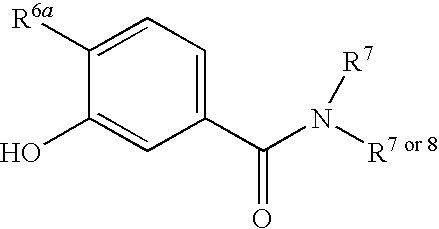
Synthesis of Exemplary 3-Hydroxy-benzamide (wherein R6a=F, Cl, Me and R7 and R8 are as defined in Formulas I and II herein)
The titled amides were prepared by a method analogous to that described on pages 29-30 of U.S. Patent Publication No. 2002137747.

Step 2: Ethyl 5-acetamido-1-(3-fluorophenyl)-1H-pyrazole-4-carboxylate (Compound II)
A solution of ethyl 5-amino-1-(3-fluorophenyl)-1H-pyrazole-4-carboxylate (5.70 g, 22.9 mmol), acetic anhydride (7.77 mL, 82.3 mmol), TEA (9.54 mL, 68.6 mmol) and 4-(dimethylamino)pyridine (0.559 g, 4.57 mmol) in 1,2-DCE (10 mL) were refluxed overnight. The reaction mixture was cooled to RT and diluted with DCM. The mixture was washed sequentially with water, 1 N NaOH and brine. The DCM solution was dried over MgSO4, filtered and concentrated to give ethyl 5-bisacetamido-1-(3-fluorophenyl)-1H-pyrazole-4-carboxylate as brown oil. MS (ESI, pos.ion) m/z: 334.0 (M+1). The crude material was used in the next step without further purification.


| TABLE 1 | ||||||
| THP1 | p38 enyme | LPS induced | ||||
| MS | cell based | HTRF assay | IL-1 cell based | |||
| Ex. No | Name | (M+H+) | Method | IC50 (nM) | IC50 (nM) | IC50 (nM) |
| 7 | N-cyclopropyl-3-((1-(2,4- | 454.1 | A | +++++ | +++++ | ++++ |
| difluorophenyl)-7-methyl-6- | ||||||
| oxo-6,7-dihydro-1H- | ||||||
| pyrazolo[3,4-b]pyridin-4- | ||||||
| yl)amino)-4-fluorobenzamide | ||||||
| 8 | 1-(2,5-difluorophenyl)-7- | 368.1 | C | +++ | + | ++ |
| methyl-4-((4-methyl-3- | ||||||
| pyridinyl)amino)-1,7- | ||||||
| dihydro-6H-pyrazolo[3,4- | ||||||
| b]pyridin-6-one | ||||||
| 9 | 1-(2,4-difluorophenyl)-4- | 389 | C | ++ | + | + |
| ((2,4-difluorophenyl)amino)- | ||||||
| 7-methyl-1,7-dihydro-6H- | ||||||
| pyrazolo[3,4-b]pyridin-6-one | ||||||
| 10 | 1-(2,6-difluorophenyl)-4-((4- | 370.3 | C | ++ | + | + |
| fluorophenyl)amino)-7- | ||||||
| methyl-1,7-dihydro-6H- | ||||||
| pyrazolo[3,4-b]pyridin-6-one | ||||||
| 11 | 4-chloro-N-cyclopropyl-3- | 470 | A | +++++ | +++++ | +++++ |
| ((1-(2,6-difluorophenyl)-7- | ||||||
| methyl-6-oxo-6,7-dihydro- | ||||||
| 1H-pyrazolo[3,4-b]pyridin-4- | ||||||
| yl)amino)benzamide | ||||||
| 12 | 4-chloro-N-cyclopropyl-3- | 470 | A | +++++ | +++++ | +++++ |
| ((1-(2,5-difluorophenyl)-7- | ||||||
| methyl-6-oxo-6,7-dihydro- | ||||||
| 1H-pyrazolo[3,4-b]pyridin-4- | ||||||
| yl)amino)benzamide | ||||||
| 13 | 4-chloro-N-cyclopropyl-3- | 470 | A | +++++ | +++++ | +++++ |
| ((1-(2,4-difluorophenyl)-7- | ||||||
| methyl-6-oxo-6,7-dihydro- | ||||||
| 1H-pyrazolo[3,4-b]pyridin-4- | ||||||
| yl)amino)benzamide | ||||||
| 6 | 1-(2,6-difluorophenyl)-4-((4- | 385.1 | C | |||
| fluoro-2-methylphenyl)amino)-7- | ||||||
| methyl-1,7-dihydro-6H- | ||||||
| pyrazolo[3,4-b]pyridin-6-one | ||||||
| 14 | N-cyclopropyl-3-((1-(2,4- | 450.1 | A | +++++ | +++++ | +++++ |
| difluorophenyl)-7-methyl-6- | ||||||
| oxo-6,7-dihydro-1H- | ||||||
| pyrazolo[3,4-b]pyridin-4- | ||||||
| yl)amino)-4-methylbenzamide | ||||||
| 15 | N-cyclopropyl-3-((1-(2,6- | 450.1 | A | +++++ | +++++ | +++++ |
| difluorophenyl)-7-methyl-6- | ||||||
| oxo-6,7-dihydro-1H- | ||||||
| pyrazolo[3,4-b]pyridin-4- | ||||||
| yl)amino)-4-methylbenzamide | ||||||
| 16 | N-cyclopropyl-3-((1-(2,6- | 451 | B | +++++ | +++++ | ++++ |
| difluorophenyl)-7-methyl-6- | ||||||
| oxo-6,7-dihydro-1H- | ||||||
| pyrazolo[3,4-b]pyridin-4- | ||||||
| yl)oxy)-4-methylbenzamide | ||||||
| 17 | 3-((1-(2,4-difluorophenyl)-7- | 411.1 | A | + | + | + |
| methyl-6-oxo-6,7-dihydro- | ||||||
| 1H-pyrazolo[3,4-b]pyridin-4- | ||||||
| yl)amino)-4-methylbenzoic acid | ||||||
| 18 | 3-((1-(2,4-difluorophenyl)-7- | 410.1 | A | +++++ | +++++ | +++++ |
| methyl-6-oxo-6,7-dihydro- | ||||||
| 1H-pyrazolo[3,4-b]pyridin-4- | ||||||
| yl)amino)-4-methylbenzamide | ||||||
| 19 | N-cyclopropyl-3-((1-(2,4- | 451.1 | B | +++++ | +++++ | ++++ |
| difluorophenyl)-7-methyl-6- | ||||||
| oxo-6,7-dihydro-1H- | ||||||
| pyrazolo[3,4-b]pyridin-4- | ||||||
| yl)oxy)-4-methylbenzamide | ||||||
| 20 | N-cyclopropyl-3-((1-(2,5- | 450.1 | A | +++++ | +++++ | +++++ |
| difluorophenyl)-7-methyl-6- | ||||||
| oxo-6,7-dihydro-1H- | ||||||
| pyrazolo[3,4-b]pyridin-4- | ||||||
| yl)amino)-4-methylbenzamide | ||||||
| 21 | 3-((1-(2,5-difluorophenyl)-7- | 410.1 | A | +++++ | +++++ | ++++ |
| methyl-6-oxo-6,7-dihydro- | ||||||
| 1H-pyrazolo[3,4-b]pyridin-4- | ||||||
| yl)amino)-4-methylbenzamide | ||||||
| 22 | N-cyclopropyl-3-((1-(2,5- | 451.1 | B | +++++ | +++++ | +++ |
| difluorophenyl)-7-methyl-6- | ||||||
| oxo-6,7-dihydro-1H- | ||||||
| pyrazolo[3,4-b]pyridin-4- | ||||||
| yl)oxy)-4-methylbenzamide | ||||||
| 4 | N-cyclopropyl-3-((1-(3- | 432 | A | +++++ | +++++ | +++++ |
| fluorophenyl)-7-methyl-6- | ||||||
| oxo-6,7-dihydro-1H- | ||||||
| pyrazolo[3,4-b]pyridin-4- | ||||||
| yl)amino)-4-methylbenzamide | ||||||
| 23 | N-cyclopropyl-3-((7-ethyl-1- | 446.1 | A | +++++ | +++++ | +++++ |
| (4-fluorophenyl)-6-oxo-6,7- | ||||||
| dihydro-1H-pyrazolo[3,4- | ||||||
| b]pyridin-4-yl)amino)-4- | ||||||
| methylbenzamide | ||||||
| 5 | N-cyclopropyl-3-((1-(3- | 433.1 | B | +++++ | +++++ | +++ |
| fluorophenyl)-7-methyl-6- | ||||||
| oxo-6,7-dihydro-1H- | ||||||
| pyrazolo[3,4-b]pyridin-4- | ||||||
| yl)oxy)-4-methylbenzamide | ||||||
| 24 | N-cyclopropyl-3-((7-ethyl-1- | 447.1 | B | +++++ | +++++ | ++++ |
| (4-fluorophenyl)-6-oxo-6,7- | ||||||
| dihydro-1H-pyrazolo[3,4- | ||||||
| b]pyridin-4-yl)oxy)-4- | ||||||
| methylbenzamide | ||||||
| 25 | N-tert-butyl-3-((1-(2,4- | 466 | A | ++++ | +++ | |
| difluorophenyl)-7-methyl-6- | ||||||
| oxo-6,7-dihydro-1H- | ||||||
| pyrazolo[3,4-b]pyridin-4- | ||||||
| yl)amino)-4-methylbenzamide | ||||||
| 26 | 4-chloro-N-cyclopropyl-3-((1- | 471.0 | B | 8.2 | 101 | |
| (2,5-difluorophenyl)-7-methyl- | ||||||
| 6-oxo-6,7-dihydro-1H- | ||||||
| pyrazolo[3,4-b]pyridin-4- | ||||||
| yl)oxy)benzamide | ||||||
| 27 | 4-chloro-N-cyclopropyl-3-((1- | 484.1 | A | 0.4 | 1.2 | 3.3 |
| (2,4-difluorophenyl)-7-ethyl-6- | ||||||
| oxo-6,7-dihydro-1H- | ||||||
| pyrazolo[3,4-b]pyridin-4- | ||||||
| yl)amino)benzamide | ||||||
| 28 | 4-chloro-N-cyclopropyl-3-((1- | 452.0 | A | 0.8 | 2.1 | 4.2 |
| (4-fluorophenyl)-7-methyl-6- | ||||||
| oxo-6,7-dihydro-1H- | ||||||
| pyrazolo[3,4-b]pyridin-4- | ||||||
| yl)amino)benzamide | ||||||
| 29 | 4-chloro-N-cyclopropyl-3-((7- | 466.1 | A | 1.4 | 1.7 | 3.6 |
| ethyl-1-(4-fluorophenyl)-6- | ||||||
| oxo-6,7-dihydro-1H- | ||||||
| pyrazolo[3,4-b]pyridin-4- | ||||||
| yl)amino)benzamide | ||||||
| 30 | 3-((1-(2,4-difluorophenyl)-7- | 440.1 | A | 0.6 | 1.6 | 3.8 |
| methyl-6-oxo-6,7-dihydro-1H- | ||||||
| pyrazolo[3,4-b]pyridin-4- | ||||||
| yl)amino)-N-methoxy-4- | ||||||
| methylbenzamide | ||||||
| Data Key: | ||||||
| “+” designates an IC50 value in the range beginning from 1.0 uM and ending at 5.0 uM; | ||||||
| “++” designates an IC50 value in the range beginning from 250 nM and ending at 0.999 uM; | ||||||
| “+++” designates an IC50 value in the range beginning from 100 nM and ending at 249 nM; | ||||||
| “++++” designates an IC50 value in the range beginning from 25 nM and ending at 99 nM; and | ||||||
| “+++++” designates an IC50 value of less than 25 nM. | ||||||
| TABLE 2 |
 |
| Ex. | R7 or | ||||
| No. | R1 | R3 | R6b | R5 | R8 |
| 35 | 3,5-difluoro-Ph | —CH2CH3— | H | —C(O)NH— | oxazolyl |
| 36 | morpholine | —CH3— | H | —C(O)NH— | methyl or cyclopropyl |
| 37 | piperazine | —CH2CH3— | H | —C(O)NH— | methyl or cyclopropyl |
| 38 | piperidine | —CH3— | H | —C(O)NH— | methyl or cyclopropyl |
| 39 | phenyl | —CH3— | F | —C(O)NH— | methyl or cyclopropyl |
| 40 | m-CH3-phenyl- | —CH2CH3— | Cl | —C(O)NH— | methyl or cyclopropyl |
| 41 | m-Cl-phenyl- | —CH2CH3— | OCH3 | —C(O)NH— | methyl or cyclopropyl |
| 42 | 3,5-difluoro-Ph | —CH2CH3— | H | —C(O)NH— | isoxazolyl |
| 43 | morpholine | —CH3— | H | —C(O)NH— | pyrazolyl |
| 44 | piperazine | —CH2CH3— | H | —C(O)NH— | imidazolyl |
| 45 | piperidine | —CH3— | H | —C(O)NH— | triazolyl |
| 46 | phenyl | —CH3— | F | —C(O)NH— | tetrazolyl |
| 47 | m-CH3-phenyl- | —CH2CH3— | Cl | —C(O)NH— | thioazolyl |
| 48 | 2-cl-phenyl | —CH2CH3— | OCH3 | —C(O)NH— | isothiazolyl |
| 49 | 2-CH3-phenyl | —CH2CH3— | H | —NHC(O)— | phenyl |
| 50 | 4-CH3-phenyl | —CH3— | H | —NHC(O)— | cyclopropyl |
| 51 | 4-cl-phenyl | —CH2CH3— | di-F | —NHC(O)— | ethyl |
| 52 | 3-cl-phenyl | —CH3— | di-Cl | —NHC(O)— | propyl |
| 53 | 3-CH3-phenyl | —CH3— | OCH3 | —NHC(O)— | butyl |
| 54 | 2-thiophene | —CH2CH3— | CF3 | —NHC(O)— | isopropryl |
| 55 | 3-thiophene | —CH3— | OCF3 | —NHC(O)— | isobutyl |
| 56 | 2-pyridine | —CH2CH3— | OH | —NHC(O)— | cyclopentyl |
| 57 | 1-morpholinyl | —(CH2)2CH3— | F | —C(O)NH— | ethyl |
| 58 | 1-piperazinyl | —CH3— | Cl | —C(O)NH— | ethyl |
| 59 | 1-piperidinyl | —CH2CH3— | OCH3 | —C(O)NH— | ethyl |
| 60 | 3,5-difluoro-Ph | —CH3— | F | —C(O)NH— | ethyl |
| 61 | 3-cl-phenyl | —CH2CH3— | Cl | —C(O)NH— | ethyl |
| 62 | 3-CH3-phenyl | —CH3— | OCH3 | —C(O)NH— | ethyl |
| 63 | 2-thiophene | —CH2CH3— | H | —C(O)NH— | ethyl |
| 64 | phenyl | —CH3— | —NHCH3 | —NH— | isoxazolyl |
| 65 | 3-amido-1-pyrrolidinyl | —CH3— | H | —NH— | pyrazolyl |
| 66 | 3-amido-1-piperidinyl | —CH2CH3— | H | —NH— | imidazolyl |
| 67 | 4-amido-1-piperidinyl | —CH3— | F | —NH— | triazolyl |
| 68 | 4N—CH3-1-piperizinyl | —CH2CH3— | Cl | —C(O)— | tetrazolyl |
| 69 | 2-cl-phenyl | —(CH2)2CH3— | OCH3 | —C(O)— | thioazolyl |
| 70 | 2-CH3-phenyl | —CH3— | F | —C(O)— | isothiazolyl |
| 71 | 4-CH3-phenyl | —CH2CH3— | Cl | —C(O)— | phenyl |
| 72 | 4-cl-phenyl | —CH2CH3— | OCH3 | —C(O)NH— | cyclopropyl |
| 73 | 3-cl-phenyl | —CH3— | F | —C(O)NH— | ethyl |
| 74 | 3-CH3-phenyl | —CH3— | —NHCH3 | —C(O)NH— | propyl |
| 75 | 2-thiophene | —CH2CH3— | H | —C(O)NH— | ethyl |
| 76 | 3-thiophene | —(CH2)2CH3— | H | —C(O)NH— | ethyl |
| 77 | 2-pyridine | —CH3— | F | —C(O)NH— | ethyl |
| 78 | 1-morpholinyl | —CH2CH3— | Cl | —C(O)NH— | cyclopropyl |
| 79 | 1-piperazinyl | —CH2CH3— | CN | —NHC(O)— | propyl |
| 80 | 1-piperidinyl | —CH3— | CF3 | —NHC(O)— | cyclopropyl |
| 81 | cyclohexyl-N— | —CH3— | OH | —NHC(O)— | cyclopropyl |
| 82 | morpholine-(CH2)2—N— | —CH2CH3— | —NHCH3 | —NHC(O)— | propyl |
| 83 | (CH3)2N—(CH2)2— | —(CH2)2CH3— | H | —NHC(O)— | propyl |
| 84 | (C2H5)2N—(CH2)2— | —CH3— | acetyl | —NHC(O)— | cyclopropyl |
| 85 | 3-OH-1-pyrrolidinyl | —CH2CH3— | H | —NHC(O)— | propyl |
| 86 | —CH2CH3— | —CH2CH3— | H | —NHC(O)— | propyl |
| 87 | —(CH2)2CH3— | —CH2CH3— | acetyl | —C(O)NH— | isoxazolyl |
| 88 | —CH3— | —(CH2)2CH3— | H | —C(O)NH— | pyrazolyl |
| 89 | 4N—CH3-1-piperizinyl | —CH3— | H | —C(O)NH— | imidazolyl |
| 90 | 2-cl-phenyl | —CH2CH3— | H | —C(O)NH— | triazolyl |
| 91 | 2-CH3-phenyl | —CH2CH3— | H | —C(O)NH— | tetrazolyl |
| 92 | 4-CH3-phenyl | —CH3— | CN | —C(O)NH— | thioazolyl |
| 93 | 4-cl-phenyl | —CH3— | H | —S(O)2NH— | isothiazolyl |
| 94 | 3-cl-phenyl | —CH2CH3— | H | —NH— | phenyl |
| 95 | 3-CH3-phenyl | —(CH2)2CH3— | H | —NH— | cyclopropyl |
| 96 | 2-thiophene | —CH3— | H | —NH— | ethyl |
| 97 | 3-thiophene | —CH2CH3— | H | —NH— | propyl |
| 98 | 2-pyridine | —CH2CH3— | H | —C(O)— | isoxazolyl |
| 99 | 4-F-phenyl | —CH3— | CH3 | —C(O)— | pyrazolyl |
| TABLE 3 |
 |
| Ex. | R7 or | ||||
| No. | R1 | R3 | R6b | R5 | R8 |
| 100 | 3-thiophene | —CH3— | H | —C(O)NH— | Methyl or cyclopropyl |
| 101 | 2-pyridine | —CH2CH3— | F | —C(O)NH— | Methyl or cyclopropyl |
| 102 | 1-morpholinyl | —CH3— | Cl | —C(O)NH— | Methyl or cyclopropyl |
| 103 | 1-piperazinyl | —CH2CH3— | Br | —NHC(O)— | Methyl or cyclopropyl |
| 104 | 1-piperidinyl | —(CH2)2CH3— | OH | —NHC(O)— | Methyl or cyclopropyl |
| 105 | cyclohexyl-N— | —CH3— | CN | —NHC(O)— | Methyl or cyclopropyl |
| 106 | morpholine-(CH2)2—N— | —CH2CH3— | H | —NHC(O)— | Methyl or cyclopropyl |
| 107 | (CH3)2N—(CH2)2— | —CH2CH3— | H | —NHC(O)— | Methyl or cyclopropyl |
| 108 | (C2H5)2N—(CH2)2— | —CH3— | H | —NHC(O)— | Methyl or cyclopropyl |
| 109 | 3-OH-1-pyrrolidinyl | —CH3— | H | —NHC(O)— | Methyl or cyclopropyl |
| 110 | —CH2CH3— | —CH2CH3— | H | —NHC(O)— | Methyl or cyclopropyl |
| 111 | —(CH2)2CH3— | —(CH2)2CH3— | H | —C(O)NH— | Methyl or cyclopropyl |
| 112 | —CH3— | —CH3— | H | —C(O)NH— | Methyl or cyclopropyl |
| 113 | 4N—CH3-1-piperizinyl | —CH2CH3— | H | —C(O)NH— | Methyl or cyclopropyl |
| 114 | 2-cl-phenyl | —CH2CH3— | H | —C(O)NH— | Methyl or cyclopropyl |
| 115 | 2-CH3-phenyl | —CH3— | H | —C(O)NH— | Methyl or cyclopropyl |
| 116 | 4-CH3-phenyl | —CH3— | H | —C(O)NH— | Methyl or cyclopropyl |
| 117 | 4-cl-phenyl | —CH2CH3— | H | —S(O)2NH— | Methyl or cyclopropyl |
| 118 | 3-cl-phenyl | —(CH2)2CH3— | H | —NH— | Methyl or cyclopropyl |
| 119 | 3-CH3-phenyl | —CH3— | H | —NH— | Methyl or cyclopropyl |
| 120 | 2-thiophene | —CH2CH3— | H | —NH— | Methyl or cyclopropyl |
| 121 | 3-thiophene | —CH2CH3— | H | —NH— | ethyl |
| 122 | 2-pyridine | —CH2CH3— | H | —C(O)— | ethyl |
| 123 | 4-F-phenyl | —(CH2)2CH3— | H | —C(O)— | ethyl |
| 124 | 3-thiophene | —CH3— | H | —C(O)— | ethyl |
| 125 | morpholine-(CH2)2— | —CH2CH3— | H | —NH— | ethyl |
| 126 | (CH3)2N—(CH2)2— | —CH2CH3— | H | —NH— | ethyl |
| 127 | (C2H5)2N—(CH2)2— | —CH3— | H | —NH— | cyclopropyl |
| 128 | 3-OH-1-pyrrolidinyl | —CH3— | H | —NH— | propyl |
| 129 | 3-amido-1-pyrrolidinyl | —CH2CH3— | H | —NH— | cyclopropyl |
| 130 | 3-amido-1-piperidinyl | —(CH2)2CH3— | H | —NH— | cyclopropyl |
| 131 | 4-amido-1-piperidinyl | —CH3— | H | —NH— | propyl |
| 132 | 4N—CH3-1-piperizinyl | —CH2CH3— | H | —NH— | propyl |
| 133 | 2-cl-phenyl | —CH2CH3— | H | —NH— | cyclopropyl |
| 134 | 2-CH3-phenyl | —CH3— | H | —NH— | propyl |
| 135 | 4-CH3-phenyl | —CH3— | H | —NH— | propyl |
| 136 | 4-cl-phenyl | —CH2CH3— | H | —NH— | isoxazolyl |
| 137 | 3-cl-phenyl | —CH3— | H | —NH— | pyrazolyl |
| 138 | 3-CH3-phenyl | —CH2CH3— | H | —NH— | imidazolyl |
| 139 | 2-thiophene | —(CH2)2CH3— | H | —NH— | triazolyl |
| 140 | 3-thiophene | —CH3— | H | —NH— | tetrazolyl |
| 141 | 2-pyridine | —CH2CH3— | H | —NH— | thioazolyl |
| 142 | 1-morpholinyl | —CH2CH3— | H | —NH— | isothiazolyl |
| 143 | 1-piperazinyl | —CH3— | H | —NH— | phenyl |
| 144 | 1-piperidinyl | —CH3— | H | —NH— | cyclopropyl |
| 145 | cyclohexyl- | —CH2CH3— | H | —NH— | ethyl |
| 146 | morpholine-(CH2)2— | —(CH2)2CH3— | H | —NH— | propyl |
| 147 | (CH3)2N—(CH2)2— | —CH3— | H | —C(O)NH— | isoxazolyl |
| 148 | (C2H5)2N—(CH2)2— | —CH2CH3— | H | —C(O)NH— | pyrazolyl |
| 149 | 3-OH-1-pyrrolidinyl | —CH2CH3— | H | —C(O)NH— | ethyl |
| 150 | 3-amido-1-pyrrolidinyl | —CH3— | H | —C(O)NH— | ethyl |
| 151 | 3-amido-1-piperidinyl | —CH3— | H | —NH— | cyclopropyl |
| 152 | 4-amido-1-piperidinyl | —CH2CH3— | H | —NH— | propyl |
| 153 | 4N—CH3-1-piperizinyl | —(CH2)2CH3— | H | —NH— | propyl |
| 154 | 2-cl-phenyl | —CH3— | H | —NH— | propyl |
| 155 | 2-CH3-phenyl | —CH2CH3— | H | —NH— | isopropyl |
| 156 | 4-CH3-phenyl | —CH2CH3— | H | —NH— | propyl |
| 157 | 4-cl-phenyl | —CH2CH3— | H | —NH— | propyl |
| 158 | 3-cl-phenyl | —(CH2)2CH3— | H | —NH— | isopropyl |
| 159 | 3-CH3-phenyl | —CH3— | H | —NH— | propyl |
| 160 | 2-thiophene | —CH2CH3— | H | —NH— | isopropyl |
| 161 | 3-thiophene | —CH2CH3— | H | —NH— | allyl |
| 162 | 2-pyridine | —CH3— | H | —NH— | propyl |
| 163 | 4-F-phenyl | —CH3— | CH3 | —NH— | cyclopropyl |


compound 8 having a general formula


| CHO/ | |||||
| Compound/ | 250 μM | hGLUR | |||
| Vehicle | Glucagon | 125I-Glucagon | Cells | ||
| Total Binding | —/5 μl | — | 25 μL | 100 μL |
| +Compound | 5 μl/— | — | 25 μL | 100 μL |
| Nonspecific | —/5 μl | 1 μl | 25 μL | 100 μL |
| Binding | ||||
The mixture is incubated for 60 min at 22° C. on a shaker at 275 rpm. The mixture is filtered over pre-soaked (0.5% polyethylimine (PEI)) GF/C filtermat using an Innotech Harvester or Tomtec Harvester with four washes of ice-cold 20 mM Tris buffer (pH 7.8). The radioactivity in the filters is determined by a gamma-scintillation counter.
Claims (15)


Priority Applications (1)
| Application Number | Priority Date | Filing Date | Title |
|---|---|---|---|
| US12/288,950 US8080546B2 (en) | 2007-10-26 | 2008-10-24 | Pyrazolo-pyridinone derivatives and methods of use |
Applications Claiming Priority (2)
| Application Number | Priority Date | Filing Date | Title |
|---|---|---|---|
| US51507P | 2007-10-26 | 2007-10-26 | |
| US12/288,950 US8080546B2 (en) | 2007-10-26 | 2008-10-24 | Pyrazolo-pyridinone derivatives and methods of use |
Publications (2)
| Publication Number | Publication Date |
|---|---|
| US20090137582A1 US20090137582A1 (en) | 2009-05-28 |
| US8080546B2 true US8080546B2 (en) | 2011-12-20 |
Family
ID=40297902
Family Applications (1)
| Application Number | Title | Priority Date | Filing Date |
|---|---|---|---|
| US12/288,950 Active 2030-01-27 US8080546B2 (en) | 2007-10-26 | 2008-10-24 | Pyrazolo-pyridinone derivatives and methods of use |
Country Status (2)
| Country | Link |
|---|---|
| US (1) | US8080546B2 (en) |
| WO (1) | WO2009055033A1 (en) |
Families Citing this family (2)
| Publication number | Priority date | Publication date | Assignee | Title |
|---|---|---|---|---|
| WO2011049722A1 (en) * | 2009-10-19 | 2011-04-28 | Merck Sharp & Dohme Corp. | PYRAZOLO [3,4-b] PYRIDIN-4-ONE KINASE INHIBITORS |
| US10531655B2 (en) | 2011-12-02 | 2020-01-14 | The Regents Of The University Of California | Reperfusion protection solution and uses thereof |
Citations (5)
| Publication number | Priority date | Publication date | Assignee | Title |
|---|---|---|---|---|
| WO2004056823A1 (en) | 2002-12-23 | 2004-07-08 | Glaxo Group Limited | PYRAZOLO[3,4-b]PYRIDINE COMPOUNDS, AND THEIR USE AS PHOSPHODIESTERASE INHIBITORS |
| WO2004076450A1 (en) | 2003-02-27 | 2004-09-10 | J. Uriach Y Compañia S.A. | Pyrazolopyridine derivates |
| WO2004099156A1 (en) | 2003-05-01 | 2004-11-18 | Bristol-Myers Squibb Company | Aryl-substituted pyrazole-amide compounds useful as kinase inhibitors |
| WO2005063766A2 (en) | 2003-12-23 | 2005-07-14 | Novartis Ag | Bicyclic heterocyclic p-38 kinase inhibitors |
| WO2007062805A1 (en) | 2005-11-30 | 2007-06-07 | Novartis Ag | 3-(SUBSTITUTED AMINO)-PYRAZOLO[3,4-d]PYRIMIDINES AS EPHB AND VEGFR2 KINASE INHIBITORS |
-
2008
- 2008-10-24 US US12/288,950 patent/US8080546B2/en active Active
- 2008-10-24 WO PCT/US2008/012120 patent/WO2009055033A1/en not_active Ceased
Patent Citations (5)
| Publication number | Priority date | Publication date | Assignee | Title |
|---|---|---|---|---|
| WO2004056823A1 (en) | 2002-12-23 | 2004-07-08 | Glaxo Group Limited | PYRAZOLO[3,4-b]PYRIDINE COMPOUNDS, AND THEIR USE AS PHOSPHODIESTERASE INHIBITORS |
| WO2004076450A1 (en) | 2003-02-27 | 2004-09-10 | J. Uriach Y Compañia S.A. | Pyrazolopyridine derivates |
| WO2004099156A1 (en) | 2003-05-01 | 2004-11-18 | Bristol-Myers Squibb Company | Aryl-substituted pyrazole-amide compounds useful as kinase inhibitors |
| WO2005063766A2 (en) | 2003-12-23 | 2005-07-14 | Novartis Ag | Bicyclic heterocyclic p-38 kinase inhibitors |
| WO2007062805A1 (en) | 2005-11-30 | 2007-06-07 | Novartis Ag | 3-(SUBSTITUTED AMINO)-PYRAZOLO[3,4-d]PYRIMIDINES AS EPHB AND VEGFR2 KINASE INHIBITORS |
Non-Patent Citations (1)
| Title |
|---|
| Org.Biomol.Chem.2005,3(12),2262-70. |
Also Published As
| Publication number | Publication date |
|---|---|
| WO2009055033A1 (en) | 2009-04-30 |
| US20090137582A1 (en) | 2009-05-28 |
Similar Documents
| Publication | Publication Date | Title |
|---|---|---|
| US7700593B2 (en) | Imidazo- and triazolo-pyridine compounds and methods of use thereof | |
| US8314131B2 (en) | Triazole fused heteroaryl compounds and methods of use thereof | |
| US7745449B2 (en) | Thieno-[2,3-d]pyrimidine and thieno-pyridazine compounds and methods of use | |
| US7935709B2 (en) | 2-quinazolinone compounds and methods of use | |
| US8435987B2 (en) | Pyrazolo-pyridinone and pyrazolo-pyrazinone compounds as P38 modulators and methods of use thereof | |
| EP1856058A2 (en) | Phthalazine, aza- and diaza-phthalazine compounds and methods of use | |
| WO2009078992A1 (en) | Linear tricyclic compounds as p38 kinase inhibitors | |
| US8772481B2 (en) | Aza- and diaza-phthalazine compounds as P38 map kinase modulators and methods of use thereof | |
| US8420649B2 (en) | Pyrido[3,2-d]pyridazine-2(1H)-one compounds as p38 modulators and methods of use thereof | |
| US8497269B2 (en) | Phthalazine compounds as p38 map kinase modulators and methods of use thereof | |
| US8367671B2 (en) | Pyrazolo[3.4-B]pyrazine compounds as p38 modulators and methods of use as anti-inflamatory agents | |
| US7846944B2 (en) | Pyrazolo-pyridinone compounds and methods of use thereof | |
| US8455495B2 (en) | Pyridazino-pyridinone compounds and methods of use | |
| US8101612B2 (en) | Phthalazine compounds and methods of use | |
| US8080546B2 (en) | Pyrazolo-pyridinone derivatives and methods of use |
Legal Events
| Date | Code | Title | Description |
|---|---|---|---|
| AS | Assignment |
Owner name: AMGEN INC., CALIFORNIA Free format text: ASSIGNMENT OF ASSIGNORS INTEREST;ASSIGNORS:PETTUS, LIPING H.;TASKER, ANDREW;WURZ, RYAN;AND OTHERS;REEL/FRAME:022183/0810;SIGNING DATES FROM 20090109 TO 20090126 Owner name: AMGEN INC., CALIFORNIA Free format text: ASSIGNMENT OF ASSIGNORS INTEREST;ASSIGNORS:PETTUS, LIPING H.;TASKER, ANDREW;WURZ, RYAN;AND OTHERS;SIGNING DATES FROM 20090109 TO 20090126;REEL/FRAME:022183/0810 |
|
| STCF | Information on status: patent grant |
Free format text: PATENTED CASE |
|
| FPAY | Fee payment |
Year of fee payment: 4 |
|
| MAFP | Maintenance fee payment |
Free format text: PAYMENT OF MAINTENANCE FEE, 8TH YEAR, LARGE ENTITY (ORIGINAL EVENT CODE: M1552); ENTITY STATUS OF PATENT OWNER: LARGE ENTITY Year of fee payment: 8 |
|
| MAFP | Maintenance fee payment |
Free format text: PAYMENT OF MAINTENANCE FEE, 12TH YEAR, LARGE ENTITY (ORIGINAL EVENT CODE: M1553); ENTITY STATUS OF PATENT OWNER: LARGE ENTITY Year of fee payment: 12 |