US8079734B2 - Lighting device - Google Patents

Lighting device Download PDF

Info

Publication number
US8079734B2
US8079734B2 US12/540,690 US54069009A US8079734B2 US 8079734 B2 US8079734 B2 US 8079734B2 US 54069009 A US54069009 A US 54069009A US 8079734 B2 US8079734 B2 US 8079734B2
Authority
US
United States
Prior art keywords
directing
prism element
directing prism
ring
shaped
Prior art date
Legal status (The legal status is an assumption and is not a legal conclusion. Google has not performed a legal analysis and makes no representation as to the accuracy of the status listed.)
Expired - Fee Related, expires
Application number
US12/540,690
Other versions
US20110038161A1 (en
Inventor
Sheng-Fa Hou
Current Assignee (The listed assignees may be inaccurate. Google has not performed a legal analysis and makes no representation or warranty as to the accuracy of the list.)
Lite On Technology Corp
Original Assignee
Lite On IT Corp
Priority date (The priority date is an assumption and is not a legal conclusion. Google has not performed a legal analysis and makes no representation as to the accuracy of the date listed.)
Filing date
Publication date
Application filed by Lite On IT Corp filed Critical Lite On IT Corp
Priority to US12/540,690 priority Critical patent/US8079734B2/en
Assigned to LITE-ON IT CORPORATION reassignment LITE-ON IT CORPORATION ASSIGNMENT OF ASSIGNORS INTEREST (SEE DOCUMENT FOR DETAILS). Assignors: HOU, SHENG-FA
Publication of US20110038161A1 publication Critical patent/US20110038161A1/en
Application granted granted Critical
Publication of US8079734B2 publication Critical patent/US8079734B2/en
Assigned to LITE-ON TECHNOLOGY CORPORATION reassignment LITE-ON TECHNOLOGY CORPORATION ASSIGNMENT OF ASSIGNORS INTEREST (SEE DOCUMENT FOR DETAILS). Assignors: LITE-ON IT CORP.
Expired - Fee Related legal-status Critical Current
Adjusted expiration legal-status Critical

Links

Images

Classifications

    • FMECHANICAL ENGINEERING; LIGHTING; HEATING; WEAPONS; BLASTING
    • F21LIGHTING
    • F21VFUNCTIONAL FEATURES OR DETAILS OF LIGHTING DEVICES OR SYSTEMS THEREOF; STRUCTURAL COMBINATIONS OF LIGHTING DEVICES WITH OTHER ARTICLES, NOT OTHERWISE PROVIDED FOR
    • F21V5/00Refractors for light sources
    • F21V5/02Refractors for light sources of prismatic shape
    • FMECHANICAL ENGINEERING; LIGHTING; HEATING; WEAPONS; BLASTING
    • F21LIGHTING
    • F21VFUNCTIONAL FEATURES OR DETAILS OF LIGHTING DEVICES OR SYSTEMS THEREOF; STRUCTURAL COMBINATIONS OF LIGHTING DEVICES WITH OTHER ARTICLES, NOT OTHERWISE PROVIDED FOR
    • F21V14/00Controlling the distribution of the light emitted by adjustment of elements
    • F21V14/06Controlling the distribution of the light emitted by adjustment of elements by movement of refractors

Definitions

  • the present invention relates to a lighting device, and more particularly to a lighting device for providing continuous illumination variation.
  • Lighting devices such as lamps or bulbs are designed to produce light from electricity. With rapid development of industrial techniques, these lighting devices become essential components in our daily lives because they can improve the living quality. In the early stage, lighting devices are used for simply providing a bright place. With diversified living attitudes, in addition to the illuminating purpose, proper lighting devices can enhance task performance or aesthetics. For complying with various demands, the lighting devices should be designed to have desired sizes or produce light with desired irradiation position, orientation, inclination or intensity.
  • FIG. 1 is a schematic diagram illustrating a first type lighting device for adjusting the orientation and inclination of incident light.
  • a lighting device is disclosed in for example U.S. Pat. No. 5,690,417, and the contents of which are hereby incorporated by reference.
  • the lighting device 10 principally comprises a light source group 11 .
  • the light source group 11 comprises a plurality of lamps. These lamps can be inclined at different angles so as to adjust the orientation and inclination of incident light. As a consequence, the light beams emitted by the lamps can be selectively directed to a workpiece 13 on a work table 12 .
  • This lighting device still has some drawbacks. For example, a great amount of light sources are required in this lighting device 10 .
  • the control system for this lighting device 10 is very complicated. In a case that the lamps are selectively turned on and turned off while changing orientation and inclination of incident light, discontinuous illumination will possibly occur.
  • FIG. 2 is a schematic diagram illustrating a second type lighting device for adjusting the orientation and inclination of incident light.
  • a lighting device is disclosed in for example U.S. Pat. Nos. 3,912,918, 5,070,434 and 6,461,024, and the contents of which are hereby incorporated by reference.
  • the orientation and inclination of incident light for the lighting device 30 are manually controlled.
  • a light source is mounted inside a casing 31 and a cone member 32 .
  • the casing 31 may be fixed or supported by a specified apparatus.
  • a shaft 34 is secured to a ball assembly 33 .
  • This lighting device 30 is applicable to cabin illumination systems or other small-scale illumination systems. The manual operation of such a lighting device is not convenient. In addition, it is labor-intensive to rotate the cone member and the ball assembly.
  • a lighting device in accordance with an aspect of the present invention, there is provided a lighting device.
  • the lighting device includes a light source, a first beam-directing prism element, a second beam-directing prism element and a transmission device.
  • the light source emits a light beam.
  • the first beam-directing prism element is arranged in a first direction, wherein different bending angles are resulted when the light beam passes through different regions of the first beam-directing prism element.
  • the second beam-directing prism element is arranged in a second direction and partially overlapped with the first beam-directing prism element, wherein different bending angles are resulted when the light beam passes through different regions of the second beam-directing prism element.
  • the transmission device is connected to the first beam-directing prism element and the second beam-directing prism element for driving movement of the first beam-directing prism element in the first direction and movement of the second beam-directing prism element in the second direction. Accordingly, the light beam emitted by the light source simultaneously passes through one of the regions of the first beam-directing prism element and one of the regions of the second beam-directing prism element.
  • a lighting device in accordance with another aspect of the present invention, there is provided a lighting device.
  • the lighting device includes a light source, a first ring-shaped beam-directing prism element, a second ring-shaped beam-directing prism element and a transmission device.
  • the light source emits a light beam.
  • the second ring-shaped-directing prism element is partially overlapped with the first ring-shaped-directing prism element.
  • different bending angles are resulted.
  • the transmission device is connected to the first ring-shaped-directing prism element and the second ring-shaped-directing prism element for driving rotation of the first ring-shaped-directing prism element and the second ring-shaped-directing prism element. Accordingly, the light beam emitted by the light source simultaneously passes through one of the regions of the first ring-shaped-directing prism element and one of the regions of the second ring-shaped-directing prism element.
  • FIG. 1 is a schematic diagram illustrating a first type lighting device for adjusting the orientation and inclination of incident light according to the prior art
  • FIG. 2 is a schematic diagram illustrating a second type lighting device for adjusting the orientation and inclination of incident light according to the prior art
  • FIG. 3A is a schematic perspective view illustrating an exemplary beam-directing prism element used in a lighting device of the present invention
  • FIG. 3B are schematic views illustrating several cross-sections taken from various positions
  • FIG. 3C are schematic views illustrating light beams diffracted by the beam-directing prism element of FIG. 3A at different prism angles;
  • FIG. 4A is a schematic perspective view illustrating a downward directing region, a flat region and an upward directing region of the beam-directing prism element
  • FIG. 4B is a schematic perspective view illustrating a rightward directing region, a flat region and a leftward directing region of the beam-directing prism element;
  • FIG. 5 is a plot diagram illustrating the performance of the beam-directing prism elements made of different materials
  • FIG. 6 is a schematic perspective view illustrating another exemplary beam-directing prism element used in a lighting device of the present invention.
  • FIG. 7 is a schematic perspective view illustrating a lighting device according to a first preferred embodiment of the present invention.
  • FIGS. 8A and 8B schematically illustrate two irradiation positions generated by the lighting device of the present invention.
  • FIG. 9 is a schematic perspective view illustrating a lighting device according to a second preferred embodiment of the present invention.
  • FIG. 3A is a schematic perspective view illustrating an exemplary beam-directing prism element of a lighting device according to the present invention.
  • the beam-directing prism element 100 is made of transparent material such as polymethylmethacrylate (PMMA) or polycarbonate (PC).
  • PMMA polymethylmethacrylate
  • PC polycarbonate
  • the beam-directing prism element 100 has a curved surface 102 with gradual slope variations.
  • the cross-section 104 taken from the line AA′ has a prism angle of 120°; the cross-section 106 taken from the line BB′ has a prism angle of 105°; the cross-section 108 taken from the line CC′ has a prism angle of 90°; the cross-section 110 taken from the line DD′ has a prism angle of 75°; and the cross-section 112 taken from the line EE′ has a prism angle of 60°.
  • FIG. 3C are schematic views illustrating light beams diffracted by the beam-directing prism element 100 of FIG. 3A at different prism angles.
  • the beam-directing prism element 100 is made of polymethylmethacrylate (PMMA). If the prism angle ⁇ is 120°, the beam refraction angle is ⁇ 18°, i.e. the light beam is downwardly bent by 18°. If the prism angle ⁇ is 105°, the beam refraction angle is ⁇ 7.5°, i.e. the light beam is downwardly bent by 7.5°. If the prism angle ⁇ is 90°, the beam refraction angle is 0°, i.e. the light beam is not bent.
  • PMMA polymethylmethacrylate
  • the prism angle ⁇ is 75°, the beam refraction angle is +7.5°, i.e. the light beam is upwardly bent by 7.5°. If the prism angle ⁇ is 60°, the beam refraction angle is +18°, i.e. the light beam is upwardly bent by 18°.
  • the beam-directing prism element 100 may be divided into a downward directing region, a flat region and an upward directing region if the prism angle ⁇ is greater than 90°, equal to 90° and smaller than 90°, respectively.
  • the beam-directing prism element is made of PC and the prism angle ⁇ is 105°, the light beam is bent by approximately ⁇ 10°, wherein the negative sign means that the light beam is bent downwardly.
  • the basic bending amount of the light beam can be changed by using different material of the beam-directing prism elements. It can be seen that the basic bending amount of the light beam by using the beam-directing prism elements made of PMMA is smaller than that by using the beam-directing prism elements made of PC.
  • the beam-directing prism element 100 has a curved surface 102 with gradual slope variations.
  • a further exemplary beam-directing prism element is illustrated in FIG. 6 .
  • the beam-directing prism element 130 has two curved surfaces with gradual slope variations. According to the two curved surfaces with gradual slope variations, the basic bending amount and direction of the light beam can be more variable.
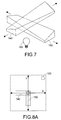
  • FIG. 7 is a schematic perspective view illustrating a lighting device according to a first preferred embodiment of the present invention.
  • the lighting device principally comprises a light source 160 , two beam-directing prism elements 140 and 150 in orthogonal arrangement, and a transmission device (not shown).
  • the transmission device is connected to these two beam-directing prism elements 140 and 150 .
  • the first beam-directing prism element 140 is horizontally moved and the second beam-directing prism element 150 is vertically moved.
  • the first beam-directing prism element 140 has a downward directing region, a flat region and an upward directing region.
  • the second beam-directing prism element 150 has a rightward directing region, a flat region and a leftward directing region.
  • the light source 160 can emit a light beam. After the lighting device is powered on, the light beam emitted by the light source is directed to the overlapping region of the first beam-directing prism element 140 and the second beam-directing prism element 150 . In other words, by changing the position of the overlapping region corresponding to the position of the first beam-directing prism element 140 and the position of the second beam-directing prism element 150 , the light beam emitted by the light source may pass through one of the downward directing region, the flat region and the upward directing region of the first beam-directing prism element 140 and one of the rightward directing region, the flat region and the leftward directing region of the second beam-directing prism element 150 .
  • the beam-directing prism elements 140 and 150 have gradual slope variations on their surfaces, the bending angles are varied when the light beam are incident on different regions.
  • the transmission device By controlling the transmission device to adjust relative locations of the first beam-directing prism element 140 and the second beam-directing prism element 150 , the light beam emitted by the light source 160 may pass through different regions of the prism elements 140 and 150 . Since the light beams emitted by the light source 160 are simultaneously diffracted by the prism elements 140 and 150 , the resultant irradiation positions are adjustable in the two-dimensional coordinate system.
  • FIGS. 8A and 8B schematically illustrate two irradiation positions generated by the lighting device of the present invention.
  • the horizontal axis is labeled X
  • the vertical axis is labeled Y.
  • the first beam-directing prism element 140 is arranged along the X-axis
  • the second beam-directing prism element 150 is arranged along the Y-axis.
  • the light source 160 is located at the origin of the X-Y coordinate and emits the light beam out of the paper. In a case that the light beam emitted by the light source 160 passes through the upward directing region of the first beam-directing prism element 140 and the rightward directing region of the second beam-directing prism element 150 , as shown in FIG.
  • the diffracted light beam is projected on an irradiation position 162 in the first quadrant.
  • the light beam emitted by the light source 160 passes through the downward directing region of the first beam-directing prism element 140 and the leftward directing region of the second beam-directing prism element 150 , as shown in FIG. 8B , therefore, the diffracted light beam is projected on an irradiation position 164 in the third quadrant. The rest will be deduced by analogy.
  • FIG. 9 is a schematic perspective view illustrating a lighting device according to a second preferred embodiment of the present invention.
  • the lighting device principally comprises a light source 260 , two partially overlapped ring-shaped beam-directing prism elements 240 and 250 , and a transmission device (not shown).
  • the transmission device is connected to these two ring-shaped beam-directing prism elements 240 and 250 .
  • the transmission device is controlled to drive rotation of the two ring-shaped beam-directing prism elements 240 and 250 .
  • the first ring-shaped beam-directing prism element 240 has a downward directing region, a flat region and an upward directing region.
  • the second ring-shaped beam-directing prism element 250 has a rightward directing region, a flat region and a leftward directing region.
  • the light source 260 can emit a light beam. After the lighting device is powered on, the light beam emitted by the light source is directed to the overlapping region of the first ring-shaped beam-directing prism element 240 and the second ring-shaped beam-directing prism element 250 .
  • the light beam emitted by the light source may pass through one of the downward directing region, the flat region and the upward directing region of the first ring-shape beam-directing prism element 240 and one of the rightward directing region, the flat region and the leftward directing region of the second ring-shaped beam-directing prism element 250 .
  • the ring-shaped beam-directing prism elements 240 and 250 have gradual slope variations on their surfaces, the bending angles are varied when the light beams are incident on different regions.
  • the transmission device By controlling the transmission device to continuously adjust relative locations of the ring-shaped beam-directing prism elements 240 and 250 , the light beam emitted by the light source may pass through different regions of the ring-shaped prism elements 240 and 250 . Since the light beams emitted by the light source are simultaneously diffracted by the ring-shaped prism elements 240 and 250 , the resultant irradiation positions are adjustable in the two-dimensional coordinate system.
  • the lighting device of the present invention is capable of adjusting the irradiation position by using specific ring-shaped prism elements to diffract the light beams.
  • the transmission device By controlling the transmission device to adjust relative locations of the beam-directing prism elements, the light beam emitted by the light source may be directed to a desired position. If the relative locations of the beam-directing prism elements are continuously adjusted, continuous illumination variations are rendered.

Landscapes

  • Engineering & Computer Science (AREA)
  • General Engineering & Computer Science (AREA)
  • Non-Portable Lighting Devices Or Systems Thereof (AREA)

Abstract

A lighting device includes a light source, first and second beam-directing prism elements, and a transmission device. The light source emits a light beam. The first beam-directing prism element is arranged in a first direction. The second beam-directing prism element is arranged in a second direction and partially overlapped with the first beam-directing prism element. When the light beam passes through different regions of the first and second beam-directing prism elements, different bending angles are resulted. The transmission device is connected to the first and second beam-directing prism elements for driving movement of the first beam-directing prism element in the first direction and movement of the second beam-directing prism element in the second direction. Accordingly, the light beam emitted by the light source simultaneously passes through one of the regions of the first beam-directing prism element and one of the regions of the second beam-directing prism element.

Description

FIELD OF THE INVENTION
The present invention relates to a lighting device, and more particularly to a lighting device for providing continuous illumination variation.
BACKGROUND OF THE INVENTION
Lighting devices such as lamps or bulbs are designed to produce light from electricity. With rapid development of industrial techniques, these lighting devices become essential components in our daily lives because they can improve the living quality. In the early stage, lighting devices are used for simply providing a bright place. With diversified living attitudes, in addition to the illuminating purpose, proper lighting devices can enhance task performance or aesthetics. For complying with various demands, the lighting devices should be designed to have desired sizes or produce light with desired irradiation position, orientation, inclination or intensity.
For example, especially for the large-scale stage designs or small-scale cabin illumination systems, it is very important to adjust the orientation and inclination of incident light. Conventionally, there are two types of mechanisms for adjusting the orientation and inclination of incident light. These three mechanisms are designed according to the configurations, light sources or light path switching structures.
FIG. 1 is a schematic diagram illustrating a first type lighting device for adjusting the orientation and inclination of incident light. Such a lighting device is disclosed in for example U.S. Pat. No. 5,690,417, and the contents of which are hereby incorporated by reference. As shown in FIG. 1, the lighting device 10 principally comprises a light source group 11. The light source group 11 comprises a plurality of lamps. These lamps can be inclined at different angles so as to adjust the orientation and inclination of incident light. As a consequence, the light beams emitted by the lamps can be selectively directed to a workpiece 13 on a work table 12. This lighting device, however, still has some drawbacks. For example, a great amount of light sources are required in this lighting device 10. In addition, the control system for this lighting device 10 is very complicated. In a case that the lamps are selectively turned on and turned off while changing orientation and inclination of incident light, discontinuous illumination will possibly occur.
FIG. 2 is a schematic diagram illustrating a second type lighting device for adjusting the orientation and inclination of incident light. Such a lighting device is disclosed in for example U.S. Pat. Nos. 3,912,918, 5,070,434 and 6,461,024, and the contents of which are hereby incorporated by reference. For reducing the overall volume and saving the fabricating cost, the orientation and inclination of incident light for the lighting device 30 are manually controlled. A light source is mounted inside a casing 31 and a cone member 32. The casing 31 may be fixed or supported by a specified apparatus. A shaft 34 is secured to a ball assembly 33. By rotating the ball assembly 33, the cone member 32 is adjusted to a desired position as shown in dotted line such that orientation and inclination of incident light are adjustable. This lighting device 30 is applicable to cabin illumination systems or other small-scale illumination systems. The manual operation of such a lighting device is not convenient. In addition, it is labor-intensive to rotate the cone member and the ball assembly.
Therefore, there is a need of providing an improved lighting device and a method of operating such a lighting device to obviate the drawbacks encountered from the prior art.
SUMMARY OF THE INVENTION
In accordance with an aspect of the present invention, there is provided a lighting device. The lighting device includes a light source, a first beam-directing prism element, a second beam-directing prism element and a transmission device. The light source emits a light beam. The first beam-directing prism element is arranged in a first direction, wherein different bending angles are resulted when the light beam passes through different regions of the first beam-directing prism element. The second beam-directing prism element is arranged in a second direction and partially overlapped with the first beam-directing prism element, wherein different bending angles are resulted when the light beam passes through different regions of the second beam-directing prism element. The transmission device is connected to the first beam-directing prism element and the second beam-directing prism element for driving movement of the first beam-directing prism element in the first direction and movement of the second beam-directing prism element in the second direction. Accordingly, the light beam emitted by the light source simultaneously passes through one of the regions of the first beam-directing prism element and one of the regions of the second beam-directing prism element.
In accordance with another aspect of the present invention, there is provided a lighting device. The lighting device includes a light source, a first ring-shaped beam-directing prism element, a second ring-shaped beam-directing prism element and a transmission device. The light source emits a light beam. When the light beam passes through different regions of the first ring-shaped-directing prism element, different bending angles are resulted. The second ring-shaped-directing prism element is partially overlapped with the first ring-shaped-directing prism element. When the light beam passes through different regions of the second ring-shaped-directing prism element, different bending angles are resulted. The transmission device is connected to the first ring-shaped-directing prism element and the second ring-shaped-directing prism element for driving rotation of the first ring-shaped-directing prism element and the second ring-shaped-directing prism element. Accordingly, the light beam emitted by the light source simultaneously passes through one of the regions of the first ring-shaped-directing prism element and one of the regions of the second ring-shaped-directing prism element.
BRIEF DESCRIPTION OF THE DRAWINGS
The above contents of the present invention will become more readily apparent to those ordinarily skilled in the art after reviewing the following detailed description and accompanying drawings, in which:
FIG. 1 is a schematic diagram illustrating a first type lighting device for adjusting the orientation and inclination of incident light according to the prior art;
FIG. 2 is a schematic diagram illustrating a second type lighting device for adjusting the orientation and inclination of incident light according to the prior art;
FIG. 3A is a schematic perspective view illustrating an exemplary beam-directing prism element used in a lighting device of the present invention;
FIG. 3B are schematic views illustrating several cross-sections taken from various positions
FIG. 3C are schematic views illustrating light beams diffracted by the beam-directing prism element of FIG. 3A at different prism angles;
FIG. 4A is a schematic perspective view illustrating a downward directing region, a flat region and an upward directing region of the beam-directing prism element;
FIG. 4B is a schematic perspective view illustrating a rightward directing region, a flat region and a leftward directing region of the beam-directing prism element;
FIG. 5 is a plot diagram illustrating the performance of the beam-directing prism elements made of different materials;
FIG. 6 is a schematic perspective view illustrating another exemplary beam-directing prism element used in a lighting device of the present invention;
FIG. 7 is a schematic perspective view illustrating a lighting device according to a first preferred embodiment of the present invention;
FIGS. 8A and 8B schematically illustrate two irradiation positions generated by the lighting device of the present invention; and
FIG. 9 is a schematic perspective view illustrating a lighting device according to a second preferred embodiment of the present invention.
DETAILED DESCRIPTION OF THE PREFERRED EMBODIMENT
The present invention will now be described more specifically with reference to the following embodiments. It is to be noted that the following descriptions of preferred embodiments of this invention are presented herein for purpose of illustration and description only. It is not intended to be exhaustive or to be limited to the precise form disclosed.
FIG. 3A is a schematic perspective view illustrating an exemplary beam-directing prism element of a lighting device according to the present invention. The beam-directing prism element 100 is made of transparent material such as polymethylmethacrylate (PMMA) or polycarbonate (PC). In accordance with a key feature of the present invention, the beam-directing prism element 100 has a curved surface 102 with gradual slope variations.
FIG. 3B are schematic views illustrating several cross-sections taken from various positions. These cross-sections are quadrilaterals. Each quadrilateral has an angle Φ at the left upper corner and an angle θ at the right upper corner, in which Φ+θ=180°. In this context, the angle Φ is defined as a prism angle. Since the curved surface 102 of the beam-directing prism element 100 has gradual slope variations, the angle Φ and the angle θ are gradually changed in different cross-sections. For example, the cross-section 104 taken from the line AA′ has a prism angle of 120°; the cross-section 106 taken from the line BB′ has a prism angle of 105°; the cross-section 108 taken from the line CC′ has a prism angle of 90°; the cross-section 110 taken from the line DD′ has a prism angle of 75°; and the cross-section 112 taken from the line EE′ has a prism angle of 60°.
FIG. 3C are schematic views illustrating light beams diffracted by the beam-directing prism element 100 of FIG. 3A at different prism angles. In this embodiment, the beam-directing prism element 100 is made of polymethylmethacrylate (PMMA). If the prism angle Φ is 120°, the beam refraction angle is −18°, i.e. the light beam is downwardly bent by 18°. If the prism angle Φ is 105°, the beam refraction angle is −7.5°, i.e. the light beam is downwardly bent by 7.5°. If the prism angle Φ is 90°, the beam refraction angle is 0°, i.e. the light beam is not bent. If the prism angle Φ is 75°, the beam refraction angle is +7.5°, i.e. the light beam is upwardly bent by 7.5°. If the prism angle Φ is 60°, the beam refraction angle is +18°, i.e. the light beam is upwardly bent by 18°.
As shown in FIG. 3C, it is found that the incident light beam is downwardly bent if the prism angle Φ is greater than 90°; the incident light beam is not bent if the prism angle Φ is equal to 90°; and the incident light beam is upwardly bent if the prism angle Φ is smaller than 90°. According to the relation between the prism angle Φ and the bending effect of the beam-directing prism element 100, the beam-directing prism element 100 may be divided into a downward directing region, a flat region and an upward directing region if the prism angle Φ is greater than 90°, equal to 90° and smaller than 90°, respectively. When the beam-directing prism element 100 is horizontally placed on a working plane, as shown in FIG. 4A, the beam-directing prism element 100 has a downward directing region 114 (Φ>90°), a flat region 116 (Φ=90°) and an upward directing region 118 (Φ<90°) from left to right. Similarly, when the beam-directing prism element 100 is vertically placed on a working plane, as shown in FIG. 4B, the beam-directing prism element 100 has a rightward directing region 120 (Φ>90°), a flat region 122 (Φ=90°) and a leftward directing region 124 (Φ<90°) from top to bottom.
FIG. 5 is a plot diagram illustrating the performance of the beam-directing prism elements made of PMMA (refractive index n=1.49) and PC (refractive index n=1.59) for the prism angle Φ in the range from 55° to 125°. For example, if the beam-directing prism element is made of PC and the prism angle Φ is 105°, the light beam is bent by approximately −10°, wherein the negative sign means that the light beam is bent downwardly. According to the plot diagram shown in FIG. 5, the basic bending amount of the light beam can be changed by using different material of the beam-directing prism elements. It can be seen that the basic bending amount of the light beam by using the beam-directing prism elements made of PMMA is smaller than that by using the beam-directing prism elements made of PC.
In the above embodiment, the beam-directing prism element 100 has a curved surface 102 with gradual slope variations. A further exemplary beam-directing prism element is illustrated in FIG. 6. The beam-directing prism element 130 has two curved surfaces with gradual slope variations. According to the two curved surfaces with gradual slope variations, the basic bending amount and direction of the light beam can be more variable.
FIG. 7 is a schematic perspective view illustrating a lighting device according to a first preferred embodiment of the present invention. The lighting device principally comprises a light source 160, two beam-directing prism elements 140 and 150 in orthogonal arrangement, and a transmission device (not shown). The transmission device is connected to these two beam-directing prism elements 140 and 150. By the transmission device, the first beam-directing prism element 140 is horizontally moved and the second beam-directing prism element 150 is vertically moved. The first beam-directing prism element 140 has a downward directing region, a flat region and an upward directing region. The second beam-directing prism element 150 has a rightward directing region, a flat region and a leftward directing region.
The light source 160 can emit a light beam. After the lighting device is powered on, the light beam emitted by the light source is directed to the overlapping region of the first beam-directing prism element 140 and the second beam-directing prism element 150. In other words, by changing the position of the overlapping region corresponding to the position of the first beam-directing prism element 140 and the position of the second beam-directing prism element 150, the light beam emitted by the light source may pass through one of the downward directing region, the flat region and the upward directing region of the first beam-directing prism element 140 and one of the rightward directing region, the flat region and the leftward directing region of the second beam-directing prism element 150.
Since the beam-directing prism elements 140 and 150 have gradual slope variations on their surfaces, the bending angles are varied when the light beam are incident on different regions. By controlling the transmission device to adjust relative locations of the first beam-directing prism element 140 and the second beam-directing prism element 150, the light beam emitted by the light source 160 may pass through different regions of the prism elements 140 and 150. Since the light beams emitted by the light source 160 are simultaneously diffracted by the prism elements 140 and 150, the resultant irradiation positions are adjustable in the two-dimensional coordinate system.
FIGS. 8A and 8B schematically illustrate two irradiation positions generated by the lighting device of the present invention. In the drawings, the horizontal axis is labeled X, and the vertical axis is labeled Y. The first beam-directing prism element 140 is arranged along the X-axis and the second beam-directing prism element 150 is arranged along the Y-axis. The light source 160 is located at the origin of the X-Y coordinate and emits the light beam out of the paper. In a case that the light beam emitted by the light source 160 passes through the upward directing region of the first beam-directing prism element 140 and the rightward directing region of the second beam-directing prism element 150, as shown in FIG. 8A, therefore, the diffracted light beam is projected on an irradiation position 162 in the first quadrant. In a case that the light beam emitted by the light source 160 passes through the downward directing region of the first beam-directing prism element 140 and the leftward directing region of the second beam-directing prism element 150, as shown in FIG. 8B, therefore, the diffracted light beam is projected on an irradiation position 164 in the third quadrant. The rest will be deduced by analogy.
FIG. 9 is a schematic perspective view illustrating a lighting device according to a second preferred embodiment of the present invention. The lighting device principally comprises a light source 260, two partially overlapped ring-shaped beam-directing prism elements 240 and 250, and a transmission device (not shown). The transmission device is connected to these two ring-shaped beam-directing prism elements 240 and 250. The transmission device is controlled to drive rotation of the two ring-shaped beam-directing prism elements 240 and 250. The first ring-shaped beam-directing prism element 240 has a downward directing region, a flat region and an upward directing region. The second ring-shaped beam-directing prism element 250 has a rightward directing region, a flat region and a leftward directing region.
The light source 260 can emit a light beam. After the lighting device is powered on, the light beam emitted by the light source is directed to the overlapping region of the first ring-shaped beam-directing prism element 240 and the second ring-shaped beam-directing prism element 250. In other words, by changing the position of the overlapping region corresponding to the position of the first ring-shaped beam-directing prism element 240 and the position of the second ring-shaped beam-directing prism element 250, the light beam emitted by the light source may pass through one of the downward directing region, the flat region and the upward directing region of the first ring-shape beam-directing prism element 240 and one of the rightward directing region, the flat region and the leftward directing region of the second ring-shaped beam-directing prism element 250.
Since the ring-shaped beam-directing prism elements 240 and 250 have gradual slope variations on their surfaces, the bending angles are varied when the light beams are incident on different regions. By controlling the transmission device to continuously adjust relative locations of the ring-shaped beam-directing prism elements 240 and 250, the light beam emitted by the light source may pass through different regions of the ring-shaped prism elements 240 and 250. Since the light beams emitted by the light source are simultaneously diffracted by the ring-shaped prism elements 240 and 250, the resultant irradiation positions are adjustable in the two-dimensional coordinate system.
From the above description, the lighting device of the present invention is capable of adjusting the irradiation position by using specific ring-shaped prism elements to diffract the light beams. By controlling the transmission device to adjust relative locations of the beam-directing prism elements, the light beam emitted by the light source may be directed to a desired position. If the relative locations of the beam-directing prism elements are continuously adjusted, continuous illumination variations are rendered.
While the invention has been described in terms of what is presently considered to be the most practical and preferred embodiments, it is to be understood that the invention needs not to be limited to the disclosed embodiment. On the contrary, it is intended to cover various modifications and similar arrangements included within the spirit and scope of the appended claims which are to be accorded with the broadest interpretation so as to encompass all such modifications and similar structures.

Claims (13)

1. A lighting device comprising:
a light source for emitting a light beam;
a first beam-directing prism element arranged in a first direction, wherein different bending angles are resulted when the light beam passes through different regions of the first beam-directing prism element; and
a second beam-directing prism element arranged in a second direction and partially overlapped with the first beam-directing prism element, wherein different bending angles are resulted when the light beam passes through different regions of the second beam-directing prism element;
wherein the first beam-directing prism element is movable in the first direction, and the second beam-directing prism element is movable in the second direction;
wherein the light beam emitted by the light source simultaneously passes through one of the regions of the first beam-directing prism element and one of the regions of the second beam-directing prism element.
2. The lighting device according to claim 1 wherein the first beam-directing prism element and the second beam-directing prism element are made of transparent material such as polymethylmethacrylate (PMMA) or polycarbonate (PC).
3. The lighting device according to claim 1 wherein each of the first beam-directing prism element and the second beam-directing prism element has a surface with gradual slope variations.
4. The lighting device according to claim 1 wherein each of the first beam-directing prism element and the second beam-directing prism element has two surfaces with gradual slope variations.
5. The lighting device according to claim 1 wherein the first beam-directing prism element and the second beam-directing prism element are orthogonal with each other, so that the resultant irradiation positions of the light beam are adjustable in the two-dimensional coordinate system.
6. The lighting device according to claim 1 wherein the first beam-directing prism element comprises a downward directing region, a flat region and an upward directing region.
7. The lighting device according to claim 1 wherein the second beam-directing prism element comprises a rightward directing region, a flat region and a leftward directing region.
8. A lighting device comprising:
a light source for emitting a light beam;
a first ring-shaped-directing prism element, wherein different bending angles are resulted when the light beam passes through different regions of the first ring-shaped-directing prism element; and
a second ring-shaped-directing prism element partially overlapped with the first ring-shaped-directing prism element, wherein different bending angles are resulted when the light beam passes through different regions of the second ring-shaped-directing prism element;
wherein the first ring-shaped-directing prism element and second ring-shaped-directing prism element are rotatable, and the light beam emitted by the light source simultaneously passes through one of the regions of the first ring-shaped-directing prism element and one of the regions of the second ring-shaped-directing prism element.
9. The lighting device according to claim 8 wherein the first ring-shaped-directing prism element and the second ring-shaped-directing prism element are made of transparent material such as polymethylmethacrylate (PMMA) or polycarbonate (PC).
10. The lighting device according to claim 8 wherein each of the first ring-shaped beam-directing prism element and the second ring-shaped beam-directing prism element has a surface with gradual slope variations.
11. The lighting device according to claim 8 wherein each of the first ring-shaped beam-directing prism element and the second ring-shaped beam-directing prism element has two surfaces with gradual slope variations.
12. The lighting device according to claim 8 wherein the first ring-shaped beam-directing prism element comprises a downward directing region, a flat region and an upward directing region.
13. The lighting device according to claim 8 wherein the second ring-shaped beam-directing prism element comprises a rightward directing region, a flat region and a leftward directing region.
US12/540,690 2009-08-13 2009-08-13 Lighting device Expired - Fee Related US8079734B2 (en)

Priority Applications (1)

Application Number Priority Date Filing Date Title
US12/540,690 US8079734B2 (en) 2009-08-13 2009-08-13 Lighting device

Applications Claiming Priority (1)

Application Number Priority Date Filing Date Title
US12/540,690 US8079734B2 (en) 2009-08-13 2009-08-13 Lighting device

Publications (2)

Publication Number Publication Date
US20110038161A1 US20110038161A1 (en) 2011-02-17
US8079734B2 true US8079734B2 (en) 2011-12-20

Family

ID=43588496

Family Applications (1)

Application Number Title Priority Date Filing Date
US12/540,690 Expired - Fee Related US8079734B2 (en) 2009-08-13 2009-08-13 Lighting device

Country Status (1)

Country Link
US (1) US8079734B2 (en)

Cited By (2)

* Cited by examiner, † Cited by third party
Publication number Priority date Publication date Assignee Title
US20160178154A1 (en) * 2013-08-08 2016-06-23 Georgiy Pavlovich Sapt Vehicle light
US10901227B2 (en) 2018-02-21 2021-01-26 American Sterilizer Company Refractive lens array assembly

Families Citing this family (1)

* Cited by examiner, † Cited by third party
Publication number Priority date Publication date Assignee Title
CN104712953A (en) * 2013-12-16 2015-06-17 天津华彩电子科技工程集团有限公司 Uniform linear projection lamp

Citations (5)

* Cited by examiner, † Cited by third party
Publication number Priority date Publication date Assignee Title
US5191485A (en) * 1991-09-19 1993-03-02 Infographix, Inc. Prism for image rotation
US20020085276A1 (en) * 2000-11-29 2002-07-04 Nikon Corporation Illumination optical apparatus and exposure apparatus provided with illumination optical apparatus
US7338187B2 (en) * 2002-06-21 2008-03-04 Wavien, Inc. Multiple lamp illumination system
US7354179B2 (en) * 2005-04-12 2008-04-08 Au Optronics Corp. Prism set and light emitting apparatus using the same
US7845834B2 (en) * 2007-11-13 2010-12-07 Lite-On It Corporation Lighting system with an adjustable illuminated area

Patent Citations (5)

* Cited by examiner, † Cited by third party
Publication number Priority date Publication date Assignee Title
US5191485A (en) * 1991-09-19 1993-03-02 Infographix, Inc. Prism for image rotation
US20020085276A1 (en) * 2000-11-29 2002-07-04 Nikon Corporation Illumination optical apparatus and exposure apparatus provided with illumination optical apparatus
US7338187B2 (en) * 2002-06-21 2008-03-04 Wavien, Inc. Multiple lamp illumination system
US7354179B2 (en) * 2005-04-12 2008-04-08 Au Optronics Corp. Prism set and light emitting apparatus using the same
US7845834B2 (en) * 2007-11-13 2010-12-07 Lite-On It Corporation Lighting system with an adjustable illuminated area

Cited By (4)

* Cited by examiner, † Cited by third party
Publication number Priority date Publication date Assignee Title
US20160178154A1 (en) * 2013-08-08 2016-06-23 Georgiy Pavlovich Sapt Vehicle light
US9933127B2 (en) * 2013-08-08 2018-04-03 Georgiy Pavlovich Sapt Vehicle light
US10901227B2 (en) 2018-02-21 2021-01-26 American Sterilizer Company Refractive lens array assembly
US11112616B2 (en) 2018-02-21 2021-09-07 American Sterilizer Company Refractive lens array assembly

Also Published As

Publication number Publication date
US20110038161A1 (en) 2011-02-17

Similar Documents

Publication Publication Date Title
US10393347B2 (en) Thin luminaire
JP5525595B2 (en) Lighting equipment that combines ambient light and work light
JP2008253744A (en) Operating light having adjustable light source generating light irradiation field with gaussian distribution
CN104365091B (en) Efficient spatially modulated illumination system
CN108884974B (en) Surface light source device, display device, and light flux controlling member
JP6091789B2 (en) Luminous flux control member, light emitting device, and illumination device
JP6310285B2 (en) Light emitting device, surface light source device, and display device
CN102818194A (en) LED (light emitting diode) operation shadowless lamp
US20100027085A1 (en) Adjustable Beam Portable Light
US20150070900A1 (en) Catadioptric spotlight
JP2015197624A (en) Luminous flux control member, light emitting device, surface light source device and display device
US20090122549A1 (en) Lighting Device and Operating Method Thereof
US8079734B2 (en) Lighting device
CA2938379A1 (en) Lens incorporated light module
CN104635377A (en) Light flux controlling member, light-emitting device, surface light source device and display apparatus
US7845834B2 (en) Lighting system with an adjustable illuminated area
CN104848098A (en) Pattern-adjustable LED light and shadow landscape lamp
JP5700159B1 (en) Lighting device
JP2018085251A (en) Illuminating device
JP2013182710A (en) Led unit, lighting unit and led lighting device
JP2017224495A (en) Reflective member, illumination device, surface light source device, display device, and electronic apparatus
JP2013182710A5 (en)
CN102840490A (en) Light emitting diode (LED) illuminating lamp with circular light spot changed to be ellipse light spot and optical designing method
CN105333369B (en) License plate lamp for motor vehicles and the motor vehicles comprising the license plate lamp
US8827491B2 (en) Lighting device

Legal Events

Date Code Title Description
AS Assignment

Owner name: LITE-ON IT CORPORATION, TAIWAN

Free format text: ASSIGNMENT OF ASSIGNORS INTEREST;ASSIGNOR:HOU, SHENG-FA;REEL/FRAME:023097/0184

Effective date: 20080409

STCF Information on status: patent grant

Free format text: PATENTED CASE

AS Assignment

Owner name: LITE-ON TECHNOLOGY CORPORATION, TAIWAN

Free format text: ASSIGNMENT OF ASSIGNORS INTEREST;ASSIGNOR:LITE-ON IT CORP.;REEL/FRAME:032892/0554

Effective date: 20140512

FPAY Fee payment

Year of fee payment: 4

FEPP Fee payment procedure

Free format text: MAINTENANCE FEE REMINDER MAILED (ORIGINAL EVENT CODE: REM.); ENTITY STATUS OF PATENT OWNER: LARGE ENTITY

LAPS Lapse for failure to pay maintenance fees

Free format text: PATENT EXPIRED FOR FAILURE TO PAY MAINTENANCE FEES (ORIGINAL EVENT CODE: EXP.); ENTITY STATUS OF PATENT OWNER: LARGE ENTITY

STCH Information on status: patent discontinuation

Free format text: PATENT EXPIRED DUE TO NONPAYMENT OF MAINTENANCE FEES UNDER 37 CFR 1.362

FP Lapsed due to failure to pay maintenance fee

Effective date: 20191220