US8074724B2 - Bit-run nominal seat protector and method of operating same - Google Patents

Bit-run nominal seat protector and method of operating same Download PDF

Info

Publication number
US8074724B2
US8074724B2 US12/413,054 US41305409A US8074724B2 US 8074724 B2 US8074724 B2 US 8074724B2 US 41305409 A US41305409 A US 41305409A US 8074724 B2 US8074724 B2 US 8074724B2
Authority
US
United States
Prior art keywords
wear bushing
running tool
wear
wellbore
nsp
Prior art date
Legal status (The legal status is an assumption and is not a legal conclusion. Google has not performed a legal analysis and makes no representation as to the accuracy of the status listed.)
Active, expires
Application number
US12/413,054
Other versions
US20100243271A1 (en
Inventor
Marc Minassian
Guilherme Eppinghaus
David L. Ford
Current Assignee (The listed assignees may be inaccurate. Google has not performed a legal analysis and makes no representation or warranty as to the accuracy of the list.)
Vetco Gray LLC
Original Assignee
Vetco Gray LLC
Priority date (The priority date is an assumption and is not a legal conclusion. Google has not performed a legal analysis and makes no representation as to the accuracy of the date listed.)
Filing date
Publication date
Application filed by Vetco Gray LLC filed Critical Vetco Gray LLC
Priority to US12/413,054 priority Critical patent/US8074724B2/en
Priority to SG201001766-3A priority patent/SG165251A1/en
Priority to MYPI2010001126A priority patent/MY151569A/en
Priority to EP10157124.8A priority patent/EP2239411B1/en
Priority to BRPI1000941-8A priority patent/BRPI1000941B1/en
Priority to AU2010201163A priority patent/AU2010201163B2/en
Publication of US20100243271A1 publication Critical patent/US20100243271A1/en
Assigned to VETCO GRAY, INC. reassignment VETCO GRAY, INC. ASSIGNMENT OF ASSIGNORS INTEREST (SEE DOCUMENT FOR DETAILS). Assignors: FORD, DAVID L., MINASSIAN, MARC, EPPINGHAUS, GUILHERME
Application granted granted Critical
Publication of US8074724B2 publication Critical patent/US8074724B2/en
Assigned to Vetco Gray, LLC reassignment Vetco Gray, LLC CHANGE OF NAME (SEE DOCUMENT FOR DETAILS). Assignors: VETCO GRAY INC.
Active legal-status Critical Current
Adjusted expiration legal-status Critical

Links

Images

Classifications

    • EFIXED CONSTRUCTIONS
    • E21EARTH OR ROCK DRILLING; MINING
    • E21BEARTH OR ROCK DRILLING; OBTAINING OIL, GAS, WATER, SOLUBLE OR MELTABLE MATERIALS OR A SLURRY OF MINERALS FROM WELLS
    • E21B17/00Drilling rods or pipes; Flexible drill strings; Kellies; Drill collars; Sucker rods; Cables; Casings; Tubings
    • E21B17/10Wear protectors; Centralising devices, e.g. stabilisers
    • E21B17/12Devices for placing or drawing out wear protectors
    • EFIXED CONSTRUCTIONS
    • E21EARTH OR ROCK DRILLING; MINING
    • E21BEARTH OR ROCK DRILLING; OBTAINING OIL, GAS, WATER, SOLUBLE OR MELTABLE MATERIALS OR A SLURRY OF MINERALS FROM WELLS
    • E21B17/00Drilling rods or pipes; Flexible drill strings; Kellies; Drill collars; Sucker rods; Cables; Casings; Tubings
    • E21B17/10Wear protectors; Centralising devices, e.g. stabilisers
    • E21B17/1007Wear protectors; Centralising devices, e.g. stabilisers for the internal surface of a pipe, e.g. wear bushings for underwater well-heads
    • EFIXED CONSTRUCTIONS
    • E21EARTH OR ROCK DRILLING; MINING
    • E21BEARTH OR ROCK DRILLING; OBTAINING OIL, GAS, WATER, SOLUBLE OR MELTABLE MATERIALS OR A SLURRY OF MINERALS FROM WELLS
    • E21B33/00Sealing or packing boreholes or wells
    • E21B33/02Surface sealing or packing
    • E21B33/03Well heads; Setting-up thereof
    • E21B33/068Well heads; Setting-up thereof having provision for introducing objects or fluids into, or removing objects from, wells

Definitions

  • the present invention relates in general to an improved wear bushing system, and in particular to an improved bit-run wear bushing and tool and method of operation.
  • a wear bushing or seat protector is used in drilling applications to protect the inner profiles of the various components in the wellhead.
  • wear bushings typically have been run or lowered down to the wellhead on a separate trip.
  • One type of bit run wear bushing is held to a tool via shear pins.
  • This bit run wear bushing has an internal ledge with a reduced inner diameter for retrieval.
  • the bit run wear bushing is not suitable to protect all of the seats inside a wellbore. Thus an improved bit run wear bushing would be desirable.
  • a running tool is attached to a drill string.
  • One or more seat protectors are attached to the running tool. When the drill string is lowered into the wellbore to perform drilling operations, the seat protectors detach from the running tool as the tool passes through the surface to be protected. The seat protectors remain in place during the drilling operation, and are then retrieved when the drill string is withdrawn from the wellbore.
  • FIG. 1 is a sectional view showing the inside of a wellbore prior to installing a wear bushing.
  • FIG. 2 is a sectional view showing the wellbore of FIG. 1 with a lower casing string installed, prior to installing a wear bushing.
  • FIG. 3 is a sectional view showing the wellbore of FIG. 1 with a lower and middle casing string installed, prior to installing a wear bushing.
  • FIG. 4 is a quarter sectional view of a set of seat protectors in the wellhead housing of FIG. 1 .
  • FIG. 5 is a quarter sectional detail view showing a set of seat protectors in the wellhead housing of FIG. 1 .
  • FIGS. 6A and 6B are quarter sectional views showing the smart latch device of the seat protectors of FIG. 4 .
  • FIG. 7 is a quarter sectional view of two of the seat protectors of FIG. 4 at the intermediate landing sub of FIG. 1 .
  • FIG. 8 is a quarter sectional view of one of the seat protectors of FIG. 4 at the lower landing sub of FIG. 1 .
  • FIG. 9 is a side view of the running tool of FIG. 4 .
  • FIG. 10 is a sectional view of the seat protectors of FIG. 4 installed in the wellbore of FIG. 1 .
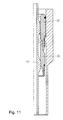
  • FIG. 11 is a quarter sectional view of an alternative configuration of the seat protectors of FIG. 4 .
  • a wellhead 10 is presented, and represented generally by reference numeral 10 .
  • the illustrated wellhead 10 has a tubular outer wellhead housing 12 with an inner bore.
  • a string of outer casing or conductor pipe 13 is attached to outer wellhead housing 10 .
  • the inner bore concentrically accepts an inner wellhead housing 14 that is supported by an inner wellhead housing support 16 on the outer wellhead housing 12 .
  • the inner wellhead housing support 16 is a shoulder on the outer wellhead housing 12 that slopes downward and inward, and mates with the inner wellhead housing 14 .
  • a section of casing 18 is suspended from the inner wellhead housing 14 of the wellhead 10 .
  • the upper casing 18 is a nominal 22′′ casing that may extend, for example, several thousand feet down to a first landing sub 20 .
  • a middle casing 22 extends downward to a second landing sub 24 .
  • a lower casing 26 extends downward from the second landing sub 24 .
  • a nominal seat protector is a type of wear bushing that may be inserted into a wellhead component to protect the bore of the wellhead component from damage as drill bits, drill pipe, etc., are passed back and forth though the bore of the wellhead component.
  • an NSP may be deployed within the inner wellhead housing 14 and landing subs 20 , 24 to protect bore surfaces of the inner wellhead housing and/or landing subs.
  • a first NSP 30 is illustrated with dashed lines within the inner wellhead housing 14 .
  • a second NSP 32 is provided to protect bore surfaces of the first landing sub 20 .
  • a third NSP 34 is presented in the illustrated embodiment to protect bore surfaces of the second landing sub 24 .
  • the minimum inner diameter of the landing shoulder in wellhead housing 14 is greater than the minimum inner diameter of middle landing sub 20 .
  • the minimum inner diameter of middle landing sub 20 is greater than the minimum inner diameter of lower landing sub 24 .
  • the outer diameter of first NSP 30 is greater than the outer diameter of second NSP 32 , which is greater than the outer diameter of third NSP 34 .
  • the NSPs are bit-run NSPs that are deployed by a running tool deployed as part of a drill string having a drill bit at the bottom (not shown in FIG. 1 ).
  • the running tool is used to install all three NSPs 30 , 32 , 34 on a single trip of the drill string into the well.
  • the NSPs 30 , 32 , 34 are attached to the running tool and sequentially released as the drill string is lowered down the wellbore.
  • the second NSP 32 and the third NSP 34 pass through the wellhead 12 .
  • the first NSP 30 engages the inner wellhead housing 14 and detaches from the second NSP 32 and the running tool, thereby remaining in the inner wellhead housing 14 .
  • the portions of the drill string above the inner wellhead housing 14 continue to descend through the center of the first NSP 30 .
  • the third NSP 34 passes through the first landing sub 20 .
  • the second NSP 32 engages the first landing sub 20 and detaches from the third NSP 34 and the running tool, remaining in place inside the first landing sub 20 .
  • the drill string continues to descend through the second NSP 32 .
  • the third NSP 34 engages the second landing sub 24 and detaches from the running tool, remaining in place to protect the second landing sub as the drill string continues to descend through the third NSP 34 .
  • the design and operation of the running tool and NSP bushings will be discussed in greater detail in FIGS. 4-11 .
  • the first NSP 30 is a 22′′ NSP
  • the second NSP 32 is a 16′′ NSP
  • the third NSP 34 is an 18′′ NSP.
  • the dimensions 22′′, 16′′, and 18′′ correspond to the nominal size in inches of the pipe which will eventually hang on the inner wellhead housing 14 and the landing subs, respectively.
  • NSPs having other diameters may be used.
  • Any number of NSPs may be deployed on a single trip, including, for example, two, three, four, or more.
  • the NSPs may be sized to fit on any size seat within the wellhead and may be used with any size pipe.
  • the lower landing sub 24 is a nominal 18′′ landing sub, which supports a nominal 18′′ lower casing hanger 40 .
  • a medium diameter casing 42 is suspended from the lower casing hanger 40 .
  • the medium diameter casing 42 may extend several thousand feet below the lower landing sub 24 .
  • the first NSP 30 may be used to protect the inner wellhead housing 14 and the second NSP 32 may be used to protect the first landing sub 20 after the casing hanger 40 is installed in the second landing sub 24 .
  • the operator has drilled deeper through casing 42 and retrieved the running tool and NSPs 32 and 34 .
  • the operator then installs a string of casing 46 attached to a middle casing hanger 44 .
  • the middle landing sub 20 supports a middle casing hanger 44 .
  • the middle landing sub 20 is a nominal 16′′ landing sub, which supports a nominal 16′′ middle casing hanger 44 .
  • a small diameter casing 46 is suspended from the from the middle casing hanger 44 .
  • the small diameter casing 46 is a nominal 16′′ casing.
  • the small diameter casing 46 may extend several thousand feet below the middle landing sub 20 , and extends through the lower landing sub 24 .
  • the first NSP 30 may be used to protect the inner wellhead housing 14 after the middle casing hanger 44 is installed in the middle landing sub 20 and the well is being drilled deeper. Subsequently, the operator retrieves the drill string and the first NSP 30 , then runs a final string of casing which is supported on wellhead housing 14 .
  • the bit run NSPs 30 , 32 , 34 are bushings that have a cylindrical shape rotated about an axis 50 with a bore through their centers.
  • the outer diameter (“OD”) of the first NSP 30 is smaller than the inner diameter (“ID”) of the wellhead housing 14 , with the exception of the wellhead housing 14 shoulder 76 which will be described in FIG. 5 .
  • the OD of the second NSP 32 is smaller than the wellhead housing 14 ID and the casing 18 , and thus it is also less than the OD of the top NSP 30 .
  • the OD of the third NSP 34 is smaller than the ID of the wellhead housing 14 and the intermediate landing sub 20 , and is also less than the OD of the intermediate NSP 32 .
  • the bit run NSP running tool 52 supports the NSPs 30 , 32 , 34 during installation and removal.
  • the running tool 52 has a support rib 54 that engages the bottom-most NSP 34 .
  • a shoulder 56 on the engagement rib 54 contacts a shoulder 58 on the third NSP 34 .
  • Each of the NSPs 30 , 32 , 34 has a shoulder to engage the engagement rib 54 .
  • any of the NSPs may be placed in the bottom-most position on the running tool 52 .
  • the running tool 52 also has a centralizer 60 .
  • the centralizer could be ribs 60 , which are a set of raised surfaces around the outside of the running tool 52 .
  • the outermost portion of the centralizer rib 60 contacts the ID of the intermediate 32 and upper 30 NSP rings.
  • the centralizer ribs 60 keep the intermediate 32 and upper 30 NSP rings centered on the running tool 52 during insertion and removal.
  • the ID of the first NSP 30 and second NSP 32 each has a running tool reference surface 62 .
  • This surface 62 may have the smallest diameter of any feature on the NSP 30 , 32 .
  • the centralizer rib 60 contacts the reference surface 62 to align the NSPs 30 , 32 on the running tool 52 .
  • the NSP may have a surface with a smaller ID than the reference surface such as, for example, a spline that extends inward beyond the diameter of the reference surface.
  • the top and bottom of the NSP may have chamfers forming a shoulder on the ID 66 , 68 , the OD 70 , 72 , or both.
  • the chamfers may help align the NSP into mating surfaces.
  • the inner chamfer surface 68 at the bottom of the first NSP 30 may help align the NSP with a lower NSP 32 or with the running tool 52 .
  • the lower support chamfer 74 on the NSP 30 may help align the running tool 52 in the first NSP 30 .
  • the support chamfer 74 could also support the first NSP 30 on a lower NSP, such as the second NSP 32 and third NSP 34 .
  • the outer chamfer surface 72 at the bottom of the first NSP 30 may help align the first NSP 30 with shoulder 76 , which can also function as a support rib, on the high pressure housing 14 during insertion and also facilitate smooth movement through the wellbore.
  • the outer chamfer surface 70 of the first NSP 30 may help guide the first NSP 30 through the wellbore during removal.
  • the upper support chamfer 78 on the second 32 and third 34 NSPs may be used to support another NSP.
  • the upper support chamfer 78 may contact the lower support chamfer 74 on an adjacent NSP.
  • the upper support chamfer 78 may also guide and align the third 34 or second NSP 32 when it is not mated with an NSP above it as it moves through the wellbore.
  • the running tool 52 supports the third NSP 34 on the bottom of the running tool.
  • the third NSP 34 supports the second NSP 32 , which in turn supports the first NSP 30 .
  • the three NSP rings may be attached to each other and loaded onto the running tool 52 on the drilling rig platform (not shown) and then lowered together on a single trip down into the wellbore.
  • each of the NSP rings 30 , 32 , 34 may be independently attached to the running tool rather than nesting with each other.
  • first NSP 30 has a retainer to prevent one NSP from disengaging the adjacent NSP, such as, for example, to prevent first NSP 30 from prematurely disengaging second NSP 32 .
  • the retainer could be, for example, a latch mechanism such as a lock ring 80 .
  • the lock ring 80 fits in a groove 89 on the first NSP 30 and in a corresponding groove 90 on second NSP 32 .
  • the lock ring 80 keeps the grooves aligned.
  • the lock ring 80 could be, for example, a split or snap ring.
  • One or more release pins 82 located behind the lock ring 80 prevent the lock ring 80 from disengaging the second NSP 32 . In its natural state, the lock ring 80 expands to release the adjacent NSP 32 .
  • the release pins 82 prevent the lock ring from expanding.
  • the NSP has a sliding sleeve 84 that contacts a shoulder 86 on the well head housing 14 or landing sub.
  • the sliding sleeve 84 blocks the release pins 82 from moving.
  • the well head housing 14 could be a landing sub.
  • the sliding sleeve 84 contacts the shoulder 86 , the sliding sleeve 84 is held stationary while the NSP 30 continues to move down in the wellbore.
  • the sliding sleeve 84 has a return spring 87 that normally holds the sliding sleeve 84 in the down position.
  • the return spring 87 is illustrated in the expanded position and sliding sleeve 84 in the down position on the second NSP 32 in FIG. 5 .
  • the first NSP 30 in FIG. 5 depicts the return spring 87 in its collapsed state and the sliding sleeve 84 in the up position.
  • the sliding sleeve 84 has a hole or notch 88 .
  • the notch 88 aligns with the release pin 82 , the release pin goes into the notch, allowing the lock ring 80 to disengage from the groove 90 in the adjacent NSP 34 .
  • the notch 88 is not aligned with the release pin 82 and thus the release pin does not allow the lock ring 80 to expand to its natural state.
  • the first 30 and second 32 NSPs have lock ring mechanisms.
  • the second NSP 32 and third NSP 34 have grooves 90 to receive a lock ring.
  • the OD of the first NSP 30 is greater than the ID of the shoulder 86 on the wellhead housing shoulder 76 .
  • the shoulder 86 supports the NSP 30 .
  • the OD of the second and third NSPs 32 , 34 is less than the ID of shoulder 86 , thus the second and third NSPs 32 , 34 may pass through the shoulder 86 .
  • a lockdown device may be used to provide resistance to removal of an NSP installed on a landing sub.
  • the lockdown device could be, for example, an o-ring 91 , a collet, or an elastomer ring on the exterior of the NSP.
  • the NSP may have a groove 92 or some other shape to hold the lockdown device in place.
  • the interior of the wellhead housing 14 and landing subs 20 , 24 may have a mating surface 93 that corresponds to the location of the lockdown device of an installed NSP 30 , 32 , 34 .
  • the mating surface 93 could be a groove, a smooth surface, or could be any other shape.
  • the mating surface 93 could be on the wellhead housing or landing sub, but could also be on any other surface within the wellbore upon which the NSP could be installed.
  • a smart latch device 94 may be used to prevent the sliding sleeve 84 from moving to the up position prematurely.
  • a smart latch 94 could be any device that locks the sliding sleeve 84 in place during movement, and unlocks only when the NSP 30 , 32 is at a proper location for release, such as at the well head housing 14 .
  • the smart latch 94 is a series of pins 96 around the circumference of the sliding sleeve 84 carried in a groove 99 ( FIG. 5 ).
  • the shoulder 76 on the wellhead housing 14 depresses the pins 96 by, for example, pressing against the pins 96 , which in turn compress an expandable ring 98 that is in contact with the pins.
  • the expandable ring 98 moves deeper into the groove 99 , and thus clear the sliding sleeve 84 , allowing the NSP 30 to move downward relative to the sliding sleeve 84 .
  • the expandable ring 98 could be, for example, a split ring.
  • the shoulder 76 ( FIG. 5 ) on the well head housing 14 is the only device inside the wellbore that is sized to release the smart latch 94 .
  • the smart latch 94 may be used on any NSP that has a sliding sleeve and may be located anywhere on the sliding sleeve.
  • the well head housing 14 pushes the first NSP 30 smart latch 98 in to unlock the sliding sleeve 84 .
  • shoulder 76 of wellhead housing 14 pushes against the sliding sleeve 84 , which allows the release pins 82 to move out, which disengages the locking ring 80 .
  • the first NSP 30 sits on the wellhead housing 14 and remains in place while the running tool 52 and the second and third NSPs 32 , 34 continue down the wellbore.
  • the second NSP 32 may have a smart latch mechanism on its sliding sleeve.
  • the running tool 52 continues to descend the wellbore until it reaches the next landing sub 20 .
  • the sliding sleeve 84 including the locking ring 80 and smart latch 94 , all operate in the same manner as the similar components on the top NSP 30 .
  • the second NSP 32 detaches from the third NSP 34 and remains in place to protect the first landing sub 20 .
  • the OD of the intermediate NSP 32 is greater than the ID of the support rib 102 .
  • the OD of the bottom NSP 34 is less than the OD of support rib 102 , and thus the bottom NSP 34 passes through the landing sub 20 .
  • the running tool 52 and the bottom NSP 34 continue to descend the wellbore until the third NSP 34 reaches the second landing sub 24 .
  • the support rib 104 engages the support surface 106 on the third NSP 34 and engages the third NSP 34 as the running tool 52 continues to descend below the landing sub 24 .
  • the third NSP 34 remains in place to protect the second landing sub 24 .
  • the OD of the third NSP 34 is greater than the ID of the shoulder 104 , thus the shoulder 104 engages the third NSP 34 as the running tool 52 passes through the second landing sub 24 .
  • the running tool 52 has threaded ends 110 that allow it to be installed as a section of the drill string (not shown).
  • the running tool 52 with multiple NSP rings 30 , 32 , 34 ( FIG. 4 ) attached, may be lowered into the wellbore when the drill bit is lowered into the wellbore for the purpose of drilling the well.
  • the centralizer ribs 60 that engage the NSP rings comprise blades that are spaced circumferentially about the body of running tool 52 .
  • the ribs 60 act as a centralizer to center the NSPs on the running tool 52 .
  • the bottom set of ribs 54 is sized to support the third NSP 34 ( FIG. 4 ).
  • the OD of the support ribs 54 is greater than the minimum ID of the NSPs 30 , 32 , 34 ( FIG. 4 ) and thus supports the NSPs vertically above it.
  • the ribs 60 , 54 may be in any location and shape suitable for engaging one or more NSPs.
  • the engagement surfaces on the NSPs may vary, and thus the configuration of the running tool 52 may vary accordingly.
  • the maximum outer diameter (“OD”) of the first NSP 30 is larger than the diameters of the second and third NSPs 32 , 34 .
  • the first NSP 30 is the first of the NSPs to be engaged, and it is engaged by shoulder 76 on well head housing 14 .
  • the well head housing shoulder 76 engages and supports the first NSP 30 .
  • the second and third NSPs 32 , 34 with their smaller diameters, pass through the top well head housing 14 without engaging it.
  • the second NSP 32 has the next largest OD, and engages the next landing sub 20 in the same manner the first NSP 30 engaged the first landing shoulder 76 .
  • the second NSP 32 has a maximum OD that is larger than the maximum OD of the third NSP 34 .
  • the second NSP 32 engages the shoulder 102 on the first landing sub 14 and detaches from the third NSP 34 .
  • the running tool 52 and third NSP 34 continue to descend the wellbore.
  • the third NSP 34 engages the second landing sub 24 .
  • the second landing sub 24 lifts the third NSP 34 off of the running tool 52 as the running tool 52 and the drill string continue down the wellbore.
  • the second landing sub 24 has a shoulder 104 that engages and supports the shoulder 106 of the third NSP 34 .
  • the NSP rings 30 , 32 , 34 are removed from the landing subs 24 , 20 , 14 .
  • the running tool 52 reaches the third NSP 34
  • the bottom NSP rests on the engagement rib 54 and the engagement rib supports the third NSP 34 as it lifts the NSP ring off of the second landing sub 24 .
  • the third NSP 34 reaches the second NSP 32
  • the top shoulder 78 on the third NSP 34 contacts the shoulder 74 on the second NSP 32 .
  • the sliding sleeve 84 is lifted off of the landing sub 20 .
  • the sliding sleeve return spring 86 is now able to push the sliding sleeve 84 down. This forces the release pins 96 and the lock ring 80 on the second NSP 32 to engage the lock ring receptacle groove 90 on the third NSP 34 .
  • the top shoulder 78 on the second NSP 32 contacts the shoulder 74 on the first NSP 30 .
  • the sliding sleeve 84 is lifted off of the shoulder 76 .
  • the sliding sleeve return spring 86 is now able to push the sliding sleeve 84 down. This forces the release pins 96 and the lock ring 80 on the first NSP 30 to engage the lock ring receptacle 90 on the second NSP 32 .
  • each size NSP ring may nest together with any of the other size NSP rings.
  • the third NSP 34 for example, can nest with the second NSP 32 .
  • the first NSP ring 30 can nest with the second NSP 32 and the second NSP 32 can directly engage the running tool 52 when the third NSP 34 is not present.
  • the third NSP ring 34 is sized to nest directly with the first NSP 30 without the use of second NSP 32 .
  • any of the NSP rings may engage the running tool 52 directly and thus be used without any of the other NSPs.
  • the weight of the NSP ring is sufficient to hold an installed NSP ring in place on the shoulder 76 of inner wellhead 14 housing and landing subs 20 , 24 , and thus anti-rotation devices are not necessary.
  • the bit run NSPs 30 , 32 , 34 are not required to rotate in place on the landing sub to lock or unlock the NSP in place.
  • Some embodiments may employ anti-rotation devices, such as, for example, a latching mechanism that could require, for example, rotation of the running tool to unlatch the NSP.
  • the inner diameter of one or more of the NSPs is too small for the drill bit to pass through the NSP.
  • the NSP is retrieved when the running tool passes up through it so that the drill bit can pass through the landing sub. All of the NSPs may be inserted when the drill string goes down into the wellbore, and all of the NSPs are retrieved when the drill string is withdrawn from the wellbore.
  • the running tool to insert and retrieve the NSP rings is part of the drill string, and thus the NSP ring insertion and removal operations are performed during the ordinary insertion and removal of the drill string and do not require additional time or additional trips down the wellbore.

Landscapes

  • Engineering & Computer Science (AREA)
  • Life Sciences & Earth Sciences (AREA)
  • Geology (AREA)
  • Mining & Mineral Resources (AREA)
  • Physics & Mathematics (AREA)
  • Environmental & Geological Engineering (AREA)
  • Fluid Mechanics (AREA)
  • General Life Sciences & Earth Sciences (AREA)
  • Geochemistry & Mineralogy (AREA)
  • Mechanical Engineering (AREA)
  • Earth Drilling (AREA)

Abstract

A drilling system employs a set of bushings that protect seats used for casing hangers. The system includes one or more seat protectors that attach to a running tool. The running tool is lowered down the wellbore with the seat protectors attached and deposits a bushing at each surface to be protected. The running tool may retrieve the bushings as the running tool is withdrawn from the wellbore.

Description

BACKGROUND OF THE INVENTION
1. Field of the Invention
The present invention relates in general to an improved wear bushing system, and in particular to an improved bit-run wear bushing and tool and method of operation.
2. Brief Description of Related Art
A wear bushing or seat protector is used in drilling applications to protect the inner profiles of the various components in the wellhead. In the prior art, wear bushings typically have been run or lowered down to the wellhead on a separate trip. One type of bit run wear bushing is held to a tool via shear pins. This bit run wear bushing has an internal ledge with a reduced inner diameter for retrieval. However, the bit run wear bushing is not suitable to protect all of the seats inside a wellbore. Thus an improved bit run wear bushing would be desirable.
SUMMARY OF THE INVENTION
Various embodiments of this invention provide a way to protect one or more surfaces inside a wellbore. In an exemplary embodiment, a running tool is attached to a drill string. One or more seat protectors are attached to the running tool. When the drill string is lowered into the wellbore to perform drilling operations, the seat protectors detach from the running tool as the tool passes through the surface to be protected. The seat protectors remain in place during the drilling operation, and are then retrieved when the drill string is withdrawn from the wellbore.
BRIEF DESCRIPTION OF THE DRAWINGS
So that the manner in which the features, advantages and objects of the invention, as well as others which will become apparent, are attained and can be understood in more detail, more particular description of the invention briefly summarized above may be had by reference to the embodiment thereof which is illustrated in the appended drawings, which drawings form a part of this specification. It is to be noted, however, that the drawings illustrate only a preferred embodiment of the invention and is therefore not to be considered limiting of its scope as the invention may admit to other equally effective embodiments.
FIG. 1 is a sectional view showing the inside of a wellbore prior to installing a wear bushing.
FIG. 2 is a sectional view showing the wellbore of FIG. 1 with a lower casing string installed, prior to installing a wear bushing.
FIG. 3 is a sectional view showing the wellbore of FIG. 1 with a lower and middle casing string installed, prior to installing a wear bushing.
FIG. 4 is a quarter sectional view of a set of seat protectors in the wellhead housing of FIG. 1.
FIG. 5 is a quarter sectional detail view showing a set of seat protectors in the wellhead housing of FIG. 1.
FIGS. 6A and 6B are quarter sectional views showing the smart latch device of the seat protectors of FIG. 4.
FIG. 7 is a quarter sectional view of two of the seat protectors of FIG. 4 at the intermediate landing sub of FIG. 1.
FIG. 8 is a quarter sectional view of one of the seat protectors of FIG. 4 at the lower landing sub of FIG. 1.
FIG. 9 is a side view of the running tool of FIG. 4.
FIG. 10 is a sectional view of the seat protectors of FIG. 4 installed in the wellbore of FIG. 1.
FIG. 11 is a quarter sectional view of an alternative configuration of the seat protectors of FIG. 4.
DETAILED DESCRIPTION OF THE PREFERRED EMBODIMENT
The present invention will now be described more fully hereinafter with reference to the accompanying drawings which illustrate embodiments of the invention. This invention may, however, be embodied in many different forms and should not be construed as limited to the illustrated embodiments set forth herein. Rather, these embodiments are provided so that this disclosure will be thorough and complete, and will fully convey the scope of the invention to those skilled in the art. Like numbers refer to like elements throughout, and the prime notation, if used, indicates similar elements in alternative embodiments.
Referring to FIG. 1, a wellhead 10 is presented, and represented generally by reference numeral 10. The illustrated wellhead 10 has a tubular outer wellhead housing 12 with an inner bore. A string of outer casing or conductor pipe 13 is attached to outer wellhead housing 10. The inner bore concentrically accepts an inner wellhead housing 14 that is supported by an inner wellhead housing support 16 on the outer wellhead housing 12. The inner wellhead housing support 16 is a shoulder on the outer wellhead housing 12 that slopes downward and inward, and mates with the inner wellhead housing 14.
A section of casing 18 is suspended from the inner wellhead housing 14 of the wellhead 10. In an exemplary embodiment, the upper casing 18 is a nominal 22″ casing that may extend, for example, several thousand feet down to a first landing sub 20. Below the middle landing sub 20, a middle casing 22 extends downward to a second landing sub 24. A lower casing 26 extends downward from the second landing sub 24.
A nominal seat protector (“NSP”) is a type of wear bushing that may be inserted into a wellhead component to protect the bore of the wellhead component from damage as drill bits, drill pipe, etc., are passed back and forth though the bore of the wellhead component. In the illustrated embodiment, an NSP may be deployed within the inner wellhead housing 14 and landing subs 20, 24 to protect bore surfaces of the inner wellhead housing and/or landing subs. A first NSP 30 is illustrated with dashed lines within the inner wellhead housing 14. In addition, a second NSP 32 is provided to protect bore surfaces of the first landing sub 20. Finally, a third NSP 34 is presented in the illustrated embodiment to protect bore surfaces of the second landing sub 24.
The minimum inner diameter of the landing shoulder in wellhead housing 14 is greater than the minimum inner diameter of middle landing sub 20. In addition, the minimum inner diameter of middle landing sub 20 is greater than the minimum inner diameter of lower landing sub 24. Similarly, the outer diameter of first NSP 30 is greater than the outer diameter of second NSP 32, which is greater than the outer diameter of third NSP 34.
In the illustrated embodiment, the NSPs are bit-run NSPs that are deployed by a running tool deployed as part of a drill string having a drill bit at the bottom (not shown in FIG. 1). The running tool is used to install all three NSPs 30, 32, 34 on a single trip of the drill string into the well. In the Illustrated embodiment, the NSPs 30, 32, 34 are attached to the running tool and sequentially released as the drill string is lowered down the wellbore.
As the drill string is lowered down through the inner wellhead housing 14, the second NSP 32 and the third NSP 34 pass through the wellhead 12. However, when the first NSP 30 reaches the inner wellhead housing 14, the first NSP 30 engages the inner wellhead housing 14 and detaches from the second NSP 32 and the running tool, thereby remaining in the inner wellhead housing 14. The portions of the drill string above the inner wellhead housing 14 continue to descend through the center of the first NSP 30.
When the running tool reaches the first landing sub 20, the third NSP 34 passes through the first landing sub 20. However, the second NSP 32 engages the first landing sub 20 and detaches from the third NSP 34 and the running tool, remaining in place inside the first landing sub 20. As above, the drill string continues to descend through the second NSP 32. Finally, when the running tool reaches the second landing sub 24, the third NSP 34 engages the second landing sub 24 and detaches from the running tool, remaining in place to protect the second landing sub as the drill string continues to descend through the third NSP 34. The design and operation of the running tool and NSP bushings will be discussed in greater detail in FIGS. 4-11.
As noted above, in the illustrated embodiment, three NSPs are deployed. In this embodiment, the first NSP 30 is a 22″ NSP, the second NSP 32 is a 16″ NSP, and the third NSP 34 is an 18″ NSP. The dimensions 22″, 16″, and 18″ correspond to the nominal size in inches of the pipe which will eventually hang on the inner wellhead housing 14 and the landing subs, respectively. However, NSPs having other diameters may be used. Any number of NSPs may be deployed on a single trip, including, for example, two, three, four, or more. The NSPs may be sized to fit on any size seat within the wellhead and may be used with any size pipe.
Referring generally to FIG. 2, in the exemplary embodiment, after drilling through the assembly of FIG. 1, all three NSPs 30, 32, 34 are retrieved. Then a string of casing 42 is installed with a casing hanger 40 landing on lower landing sub 24. After cementing casing 42, the operator re-runs the drill string and running tool and re-deploys an upper NSP 30 and a second NSP 32 in the wellhead 10. In an exemplary embodiment, the lower landing sub 24 is a nominal 18″ landing sub, which supports a nominal 18″ lower casing hanger 40. A medium diameter casing 42 is suspended from the lower casing hanger 40. The medium diameter casing 42 may extend several thousand feet below the lower landing sub 24. The first NSP 30 may be used to protect the inner wellhead housing 14 and the second NSP 32 may be used to protect the first landing sub 20 after the casing hanger 40 is installed in the second landing sub 24.
Referring to FIG. 3, in an exemplary embodiment, the operator has drilled deeper through casing 42 and retrieved the running tool and NSPs 32 and 34. The operator then installs a string of casing 46 attached to a middle casing hanger 44. After cementing, the operator runs the drill string down and re-deploys a first NSP 30 in the inner wellhead housing 14. In FIG. 3, the middle landing sub 20 supports a middle casing hanger 44. In an exemplary embodiment, the middle landing sub 20 is a nominal 16″ landing sub, which supports a nominal 16″ middle casing hanger 44. A small diameter casing 46 is suspended from the from the middle casing hanger 44. In an exemplary embodiment, the small diameter casing 46 is a nominal 16″ casing. The small diameter casing 46 may extend several thousand feet below the middle landing sub 20, and extends through the lower landing sub 24. The first NSP 30 may be used to protect the inner wellhead housing 14 after the middle casing hanger 44 is installed in the middle landing sub 20 and the well is being drilled deeper. Subsequently, the operator retrieves the drill string and the first NSP 30, then runs a final string of casing which is supported on wellhead housing 14.
Referring to FIG. 4, in the illustrated embodiment, the bit run NSPs 30, 32, 34 are bushings that have a cylindrical shape rotated about an axis 50 with a bore through their centers. The outer diameter (“OD”) of the first NSP 30 is smaller than the inner diameter (“ID”) of the wellhead housing 14, with the exception of the wellhead housing 14 shoulder 76 which will be described in FIG. 5. As noted above, the OD of the second NSP 32 is smaller than the wellhead housing 14 ID and the casing 18, and thus it is also less than the OD of the top NSP 30. The OD of the third NSP 34 is smaller than the ID of the wellhead housing 14 and the intermediate landing sub 20, and is also less than the OD of the intermediate NSP 32.
The bit run NSP running tool 52 supports the NSPs 30, 32, 34 during installation and removal. The running tool 52 has a support rib 54 that engages the bottom-most NSP 34. A shoulder 56 on the engagement rib 54 contacts a shoulder 58 on the third NSP 34. Each of the NSPs 30, 32, 34 has a shoulder to engage the engagement rib 54. Thus any of the NSPs may be placed in the bottom-most position on the running tool 52.
The running tool 52 also has a centralizer 60. The centralizer could be ribs 60, which are a set of raised surfaces around the outside of the running tool 52. The outermost portion of the centralizer rib 60 contacts the ID of the intermediate 32 and upper 30 NSP rings. The centralizer ribs 60 keep the intermediate 32 and upper 30 NSP rings centered on the running tool 52 during insertion and removal.
The ID of the first NSP 30 and second NSP 32 each has a running tool reference surface 62. This surface 62 may have the smallest diameter of any feature on the NSP 30, 32. The centralizer rib 60 contacts the reference surface 62 to align the NSPs 30, 32 on the running tool 52. In some embodiments, the NSP may have a surface with a smaller ID than the reference surface such as, for example, a spline that extends inward beyond the diameter of the reference surface.
The top and bottom of the NSP may have chamfers forming a shoulder on the ID 66, 68, the OD 70, 72, or both. The chamfers may help align the NSP into mating surfaces. The inner chamfer surface 68 at the bottom of the first NSP 30 may help align the NSP with a lower NSP 32 or with the running tool 52. Similarly, the lower support chamfer 74 on the NSP 30 may help align the running tool 52 in the first NSP 30. The support chamfer 74 could also support the first NSP 30 on a lower NSP, such as the second NSP 32 and third NSP 34.
The outer chamfer surface 72 at the bottom of the first NSP 30 may help align the first NSP 30 with shoulder 76, which can also function as a support rib, on the high pressure housing 14 during insertion and also facilitate smooth movement through the wellbore. The outer chamfer surface 70 of the first NSP 30 may help guide the first NSP 30 through the wellbore during removal.
The upper support chamfer 78 on the second 32 and third 34 NSPs may be used to support another NSP. The upper support chamfer 78 may contact the lower support chamfer 74 on an adjacent NSP. The upper support chamfer 78 may also guide and align the third 34 or second NSP 32 when it is not mated with an NSP above it as it moves through the wellbore.
In this view, the running tool 52 supports the third NSP 34 on the bottom of the running tool. The third NSP 34 supports the second NSP 32, which in turn supports the first NSP 30. The three NSP rings may be attached to each other and loaded onto the running tool 52 on the drilling rig platform (not shown) and then lowered together on a single trip down into the wellbore. In an alternative embodiment, each of the NSP rings 30, 32, 34 may be independently attached to the running tool rather than nesting with each other.
Referring to FIG. 5, in an exemplary embodiment, first NSP 30 has a retainer to prevent one NSP from disengaging the adjacent NSP, such as, for example, to prevent first NSP 30 from prematurely disengaging second NSP 32. The retainer could be, for example, a latch mechanism such as a lock ring 80. The lock ring 80 fits in a groove 89 on the first NSP 30 and in a corresponding groove 90 on second NSP 32. The lock ring 80 keeps the grooves aligned. The lock ring 80 could be, for example, a split or snap ring. One or more release pins 82 located behind the lock ring 80 prevent the lock ring 80 from disengaging the second NSP 32. In its natural state, the lock ring 80 expands to release the adjacent NSP 32. The release pins 82 prevent the lock ring from expanding.
The NSP has a sliding sleeve 84 that contacts a shoulder 86 on the well head housing 14 or landing sub. The sliding sleeve 84 blocks the release pins 82 from moving. Alternatively, the well head housing 14 could be a landing sub. When the sliding sleeve 84 contacts the shoulder 86, the sliding sleeve 84 is held stationary while the NSP 30 continues to move down in the wellbore. The sliding sleeve 84 has a return spring 87 that normally holds the sliding sleeve 84 in the down position. The return spring 87 is illustrated in the expanded position and sliding sleeve 84 in the down position on the second NSP 32 in FIG. 5. This is the position of the sliding sleeves 84 on the NSPs 30, 32 when the running tool 52 is moving the NSPs 30, 32 through the wellbore. The first NSP 30 in FIG. 5 depicts the return spring 87 in its collapsed state and the sliding sleeve 84 in the up position.
The sliding sleeve 84 has a hole or notch 88. When the notch 88 aligns with the release pin 82, the release pin goes into the notch, allowing the lock ring 80 to disengage from the groove 90 in the adjacent NSP 34. When the sliding sleeve 84 is in the down position, the notch 88 is not aligned with the release pin 82 and thus the release pin does not allow the lock ring 80 to expand to its natural state. The first 30 and second 32 NSPs have lock ring mechanisms. The second NSP 32 and third NSP 34 have grooves 90 to receive a lock ring.
The OD of the first NSP 30 is greater than the ID of the shoulder 86 on the wellhead housing shoulder 76. Thus the shoulder 86 supports the NSP 30. The OD of the second and third NSPs 32, 34 is less than the ID of shoulder 86, thus the second and third NSPs 32, 34 may pass through the shoulder 86.
Referring to FIG. 5, in an exemplary embodiment, a lockdown device may be used to provide resistance to removal of an NSP installed on a landing sub. The lockdown device could be, for example, an o-ring 91, a collet, or an elastomer ring on the exterior of the NSP. The NSP may have a groove 92 or some other shape to hold the lockdown device in place. The interior of the wellhead housing 14 and landing subs 20, 24 may have a mating surface 93 that corresponds to the location of the lockdown device of an installed NSP 30, 32, 34. The mating surface 93 could be a groove, a smooth surface, or could be any other shape. The mating surface 93 could be on the wellhead housing or landing sub, but could also be on any other surface within the wellbore upon which the NSP could be installed.
Referring to FIG. 6A and 6B, a smart latch device 94 may be used to prevent the sliding sleeve 84 from moving to the up position prematurely. A smart latch 94 could be any device that locks the sliding sleeve 84 in place during movement, and unlocks only when the NSP 30, 32 is at a proper location for release, such as at the well head housing 14. In an exemplary embodiment, the smart latch 94 is a series of pins 96 around the circumference of the sliding sleeve 84 carried in a groove 99 (FIG. 5). The shoulder 76 on the wellhead housing 14 depresses the pins 96 by, for example, pressing against the pins 96, which in turn compress an expandable ring 98 that is in contact with the pins. When the pins are pressed in, the expandable ring 98 moves deeper into the groove 99, and thus clear the sliding sleeve 84, allowing the NSP 30 to move downward relative to the sliding sleeve 84. The expandable ring 98 could be, for example, a split ring. In an exemplary embodiment, the shoulder 76 (FIG. 5) on the well head housing 14 is the only device inside the wellbore that is sized to release the smart latch 94. The smart latch 94 may be used on any NSP that has a sliding sleeve and may be located anywhere on the sliding sleeve.
The well head housing 14 (FIG. 6B) pushes the first NSP 30 smart latch 98 in to unlock the sliding sleeve 84. Referring to FIG. 5, shoulder 76 of wellhead housing 14 pushes against the sliding sleeve 84, which allows the release pins 82 to move out, which disengages the locking ring 80. The first NSP 30 sits on the wellhead housing 14 and remains in place while the running tool 52 and the second and third NSPs 32, 34 continue down the wellbore. Similarly, the second NSP 32 may have a smart latch mechanism on its sliding sleeve.
Referring to FIG. 7, after the first NSP 30 (not shown) is detached from the second NSP 32, the running tool 52 continues to descend the wellbore until it reaches the next landing sub 20. Upon contacting the support rib 102, the sliding sleeve 84, including the locking ring 80 and smart latch 94, all operate in the same manner as the similar components on the top NSP 30. The second NSP 32 detaches from the third NSP 34 and remains in place to protect the first landing sub 20.
The OD of the intermediate NSP 32 is greater than the ID of the support rib 102. Thus the support rib 102 engages the intermediate NSP 32 and holds it in place. The OD of the bottom NSP 34 is less than the OD of support rib 102, and thus the bottom NSP 34 passes through the landing sub 20.
Referring to FIG. 8, after the second NSP 32 (not shown) is detached from the bottom NSP 34, the running tool 52 and the bottom NSP 34 continue to descend the wellbore until the third NSP 34 reaches the second landing sub 24. The support rib 104 engages the support surface 106 on the third NSP 34 and engages the third NSP 34 as the running tool 52 continues to descend below the landing sub 24. The third NSP 34 remains in place to protect the second landing sub 24.
The OD of the third NSP 34 is greater than the ID of the shoulder 104, thus the shoulder 104 engages the third NSP 34 as the running tool 52 passes through the second landing sub 24.
Referring to FIG. 9, the running tool 52 has threaded ends 110 that allow it to be installed as a section of the drill string (not shown). The running tool 52, with multiple NSP rings 30, 32, 34 (FIG. 4) attached, may be lowered into the wellbore when the drill bit is lowered into the wellbore for the purpose of drilling the well. In an exemplary embodiment, the centralizer ribs 60 that engage the NSP rings (not shown) comprise blades that are spaced circumferentially about the body of running tool 52. The ribs 60 act as a centralizer to center the NSPs on the running tool 52. In an exemplary embodiment, the bottom set of ribs 54 is sized to support the third NSP 34 (FIG. 4). The OD of the support ribs 54 is greater than the minimum ID of the NSPs 30, 32, 34 (FIG. 4) and thus supports the NSPs vertically above it. The ribs 60, 54 may be in any location and shape suitable for engaging one or more NSPs. The engagement surfaces on the NSPs may vary, and thus the configuration of the running tool 52 may vary accordingly.
Referring to FIG. 10, the maximum outer diameter (“OD”) of the first NSP 30 is larger than the diameters of the second and third NSPs 32, 34. When the running tool 52 is lowered into the wellbore, the first NSP 30 is the first of the NSPs to be engaged, and it is engaged by shoulder 76 on well head housing 14. The well head housing shoulder 76 engages and supports the first NSP 30. The second and third NSPs 32, 34, with their smaller diameters, pass through the top well head housing 14 without engaging it.
The second NSP 32 has the next largest OD, and engages the next landing sub 20 in the same manner the first NSP 30 engaged the first landing shoulder 76. The second NSP 32 has a maximum OD that is larger than the maximum OD of the third NSP 34. The second NSP 32 engages the shoulder 102 on the first landing sub 14 and detaches from the third NSP 34. The running tool 52 and third NSP 34 continue to descend the wellbore.
The third NSP 34 engages the second landing sub 24. The second landing sub 24 lifts the third NSP 34 off of the running tool 52 as the running tool 52 and the drill string continue down the wellbore. The second landing sub 24 has a shoulder 104 that engages and supports the shoulder 106 of the third NSP 34.
Referring to FIG. 4, when the drill string is removed from the wellbore, the NSP rings 30, 32, 34 are removed from the landing subs 24, 20, 14. When the running tool 52 reaches the third NSP 34, the bottom NSP rests on the engagement rib 54 and the engagement rib supports the third NSP 34 as it lifts the NSP ring off of the second landing sub 24. When the third NSP 34 reaches the second NSP 32, the top shoulder 78 on the third NSP 34 contacts the shoulder 74 on the second NSP 32.
As the third NSP 34 lifts the second NSP ring 32 off of the first landing sub 20, the sliding sleeve 84 is lifted off of the landing sub 20. The sliding sleeve return spring 86 is now able to push the sliding sleeve 84 down. This forces the release pins 96 and the lock ring 80 on the second NSP 32 to engage the lock ring receptacle groove 90 on the third NSP 34.
When the second NSP 32 reaches the first NSP 30, the top shoulder 78 on the second NSP 32 contacts the shoulder 74 on the first NSP 30. As the second NSP 32 lifts the first NSP 30 off of shoulder 76 in well head housing 14, the sliding sleeve 84 is lifted off of the shoulder 76. The sliding sleeve return spring 86 is now able to push the sliding sleeve 84 down. This forces the release pins 96 and the lock ring 80 on the first NSP 30 to engage the lock ring receptacle 90 on the second NSP 32.
In an exemplary embodiment, each size NSP ring may nest together with any of the other size NSP rings. Referring to FIG. 4, the third NSP 34, for example, can nest with the second NSP 32. Referring to FIG. 11, if the third NSP ring 34 is not required in an application, the first NSP ring 30 can nest with the second NSP 32 and the second NSP 32 can directly engage the running tool 52 when the third NSP 34 is not present. Furthermore, the third NSP ring 34 is sized to nest directly with the first NSP 30 without the use of second NSP 32. In an exemplary embodiment, any of the NSP rings may engage the running tool 52 directly and thus be used without any of the other NSPs.
In an exemplary embodiment, the weight of the NSP ring is sufficient to hold an installed NSP ring in place on the shoulder 76 of inner wellhead 14 housing and landing subs 20, 24, and thus anti-rotation devices are not necessary. In some embodiments, the bit run NSPs 30, 32, 34 are not required to rotate in place on the landing sub to lock or unlock the NSP in place. Some embodiments may employ anti-rotation devices, such as, for example, a latching mechanism that could require, for example, rotation of the running tool to unlatch the NSP.
In an exemplary embodiment, the inner diameter of one or more of the NSPs is too small for the drill bit to pass through the NSP. In this case, the NSP is retrieved when the running tool passes up through it so that the drill bit can pass through the landing sub. All of the NSPs may be inserted when the drill string goes down into the wellbore, and all of the NSPs are retrieved when the drill string is withdrawn from the wellbore. The running tool to insert and retrieve the NSP rings is part of the drill string, and thus the NSP ring insertion and removal operations are performed during the ordinary insertion and removal of the drill string and do not require additional time or additional trips down the wellbore.
While the invention has been shown or described in only some of its forms, it should be apparent to those skilled in the art that it is not so limited, but is susceptible to various changes without departing from the scope of the invention.

Claims (22)

1. A well bore surface protection apparatus comprising:
a running tool having first and second ends for securing into a drill string; and
a first wear bushing and a second wear bushing, each wear bushing being releaseably disposed on the running tool in a run-in position, the first wear bushing being adapted to disengage the running tool upon landing on a first wellbore component, the second wear bushing remaining in engagement with the running tool and being adapted to pass completely through the first wellbore component as the running tool is lowered below the first wellbore component and disengage the running tool upon landing on a second wellbore component located below the first wellbore component and below the first wear bushing.
2. The assembly of claim 1, further comprising a releasable connection between the first wear bushing and the second wear bushing that releases the second wear bushing from the first wear bushing in response to a downward force applied to the second wear bushing after the first wear bushing lands on the first wellbore component.
3. The assembly of claim 2, wherein an upper portion of the second wear bushing is releasably connected to a lower portion of the first wear bushing while the running tool is in the run-in position.
4. The assembly of claim 1, wherein the running tool further comprises a first centralizer and wherein the first centralizer closely receives an inner diameter of the first wear bushing and a second centralizer that closely receives an inner diameter of the second wear bushing while in the run-in position.
5. The assembly of claim 1, wherein the second wear bushing has a lower end below a lower end of the first wear bushing while disposed on the running tool in the run-in position.
6. The assembly of claim 1, further comprising a releasable connection between the first wear bushing and the second wear bushing that releases the second wear bushing from the first wear bushing in response to a downward force applied to the second wear bushing after the first wear bushing lands on the first wellbore component, the release mechanism comprising a plurality of pins that shift from a first pin position to a second pin position in response to a downward force as applied to the first wear bushing after the first wear bushing lands on the first wellbore component, the first pin position causing the first wear bushing to remain secured to the second wear bushing and the second pin position causing the first wear bushing to release from the second wear bushing.
7. The assembly of claim 1, further comprising a releasable connection between the first wear bushing and the second wear bushing that releases the second wear bushing from the first wear bushing in response to a downward force applied to the second wear bushing after the first wear bushing lands on the first wellbore component and wherein the first wear bushing is located above the second wear bushing while in the run-in position.
8. A wellbore surface protection apparatus comprising:
a first wellbore component having a first landing shoulder and a second wellbore component having a second landing shoulder located below the landing shoulder of the first wellbore component, the first landing shoulder having a greater inner diameter than the second landing shoulder;
a running tool having an upward facing support shoulder;
a first wear bushing supported on the support shoulder of the running tool, the first wear bushing having a maximum outer diameter smaller than a smallest inner diameter of the first wellbore component and greater than the inner diameter of the second landing shoulder;
a second wear bushing supported on the first wear bushing, the second wear bushing having a greater maximum outer diameter than the inner diameter of the first landing shoulder; and
a latch mechanism that releasably latches the first and second wear bushings to each other while on the running tool and releases the second wear bushing from the first wear bushing when the second wear bushing lands on the first landing shoulder.
9. The apparatus of claim 8, wherein the latch mechanism comprises
an interlock having a first position and a second position,
wherein the first position prevents axial movement between the second wear bushing and the first wearing bushing;
the second position permits axial movement between the second wear bushing and the first wear bushing; and
an actuator that moves the interlock from the first position to the second position.
10. The apparatus of claim 9, further comprising a lock mechanism operably connected to the actuator, wherein the lock mechanism prevents the actuator from moving and wherein the lock mechanism is disengaged by contact with a surface in the wellbore having a predetermined diameter.
11. The apparatus of claim 8, wherein the latch mechanism comprises:
a first groove on the second wear bushing and a second groove on the first wear bushing,
a resilient lock ring with a first position and a second position, wherein
the first position occupies a portion of both the first groove and the second groove,
the second position does not occupy the first groove, and
an actuator that pushes the resilient lock ring from the first position to the second position upon contact with the first landing shoulder.
12. The apparatus of claim 8 further comprising
an alignment surface on the running tool; and
wherein the alignment surface maintains axial alignment of the first wear bushing on the running tool.
13. The apparatus of claim 8, further comprising
a sealing surface inside the wellbore; and
a pliable ring around the outer diameter of the wear bushing, wherein the outer diameter of the pliable ring is greater than the inner diameter of the sealing surface, and wherein the pliable ring is in contact with the sealing surface when the first wear bushing is seated on the landing sub.
14. The apparatus of claim 8, further comprising
a third landing shoulder,
a third wear bushing, supported on the second wear bushing, the third wear bushing having a greater maximum outer diameter than an inner diameter of the third landing shoulder; and
a latch mechanism that releasably latches the third wear bushing to the second wear bushing while on the running tool and releases the third wear bushing from the second wear bushing when the third wear bushing lands on the third landing shoulder.
15. A method for protecting a surface inside a wellbore comprising:
(a) attaching a first and a second wear bushing to a running tool;
(b) lowering the running tool on a drill string along with the first and second wear bushings into a wellbore;
(c) detaching the first wear bushing from the running tool at a first surface to be protected as the drill string is lowered; and
(d) continuing to lower the drill string with the second wear bushing still attached, and detaching the second wear bushing at a second surface to be protected.
16. The method of claim 15, further comprising, after detaching the first and second wear bushing, continuing to lower the drill string and rotating the drill string to perform drilling.
17. The method of claim 15, wherein
the first surface has a larger inner diameter than the second surface,
the first wear bushing has a larger outer diameter than the second wear bushing, and
the inner diameter of the first surface is such that the first wear bushing lands on the first surface while the second wear bushing passes through the first surface.
18. The method of claim 15, wherein step (a) further comprises locking the first and second wear bushing to each other with a locking mechanism.
19. The method of claim 18, wherein step (e) comprises releasing the locking mechanism in response to downward force after the first wear bushing lands on the upper surface.
20. The method of claim 15, wherein step (a) comprises: stacking the first and second wear bushings on an upward facing shoulder of the running tool.
21. A wellbore system, comprising:
an upper and a lower wellbore component, each having a bore therethrough, the lower wellbore component being located at a lower depth within a wellbore than the first wellbore component, and each wellbore component having a landing shoulder, the landing shoulder of the upper wellbore component having a larger inner diameter than an inner diameter of the landing shoulder of the lower wellbore component;
a running tool;
upper and lower wear bushings to protect each of the bore landing shoulders, wherein the wear bushings disposed on a running tool to be deployed sequentially from the running tool as the running tool is lowered through the upper and lower wellbore components to protect each of the bore surfaces of the plurality of wellbore components, and
wherein the upper wear bushing has a greater outer diameter than the lower wear bushing so that the lower wear bushing passes through the upper wellbore component as the upper wear bushing lands on the upper wellbore component.
22. A wellbore protection apparatus, comprising:
a first wear bushing, the first wear bushing comprising a ring adapted to be disposed within a bore of a wellbore component to protect the bore of the wellbore component from damage;
a second wear bushing in a nesting arrangement with the first wear bushing, and
a releasable connection between the first wear bushing and the second wear bushing that releases the second wear bushing from the first wear bushing in response to a downward force applied to the second wear bushing after the first wear bushing lands on a wellbore component.
US12/413,054 2009-03-27 2009-03-27 Bit-run nominal seat protector and method of operating same Active 2030-01-29 US8074724B2 (en)

Priority Applications (6)

Application Number Priority Date Filing Date Title
US12/413,054 US8074724B2 (en) 2009-03-27 2009-03-27 Bit-run nominal seat protector and method of operating same
SG201001766-3A SG165251A1 (en) 2009-03-27 2010-03-12 Bit-run nominal seat protector and method of operating same
MYPI2010001126A MY151569A (en) 2009-03-27 2010-03-15 Bit-run nominal seat protector and method of operating same
EP10157124.8A EP2239411B1 (en) 2009-03-27 2010-03-19 Bit-run nominal seat protector and method of operating same
BRPI1000941-8A BRPI1000941B1 (en) 2009-03-27 2010-03-24 WELL HOLE SURFACE ASSEMBLY AND METHOD TO PROTECT A SURFACE WITHIN A WELL HOLE
AU2010201163A AU2010201163B2 (en) 2009-03-27 2010-03-24 Bit-run nominal seat protector and method of operating same

Applications Claiming Priority (1)

Application Number Priority Date Filing Date Title
US12/413,054 US8074724B2 (en) 2009-03-27 2009-03-27 Bit-run nominal seat protector and method of operating same

Publications (2)

Publication Number Publication Date
US20100243271A1 US20100243271A1 (en) 2010-09-30
US8074724B2 true US8074724B2 (en) 2011-12-13

Family

ID=42110151

Family Applications (1)

Application Number Title Priority Date Filing Date
US12/413,054 Active 2030-01-29 US8074724B2 (en) 2009-03-27 2009-03-27 Bit-run nominal seat protector and method of operating same

Country Status (5)

Country Link
US (1) US8074724B2 (en)
EP (1) EP2239411B1 (en)
BR (1) BRPI1000941B1 (en)
MY (1) MY151569A (en)
SG (1) SG165251A1 (en)

Cited By (5)

* Cited by examiner, † Cited by third party
Publication number Priority date Publication date Assignee Title
US20130213661A1 (en) * 2010-10-07 2013-08-22 Dril-Quip, Inc. Wear bushing for locking to a wellhead
US20140034328A1 (en) * 2011-01-11 2014-02-06 Aker Subsea As Bore protector
US10018008B2 (en) 2014-08-06 2018-07-10 Weatherford Technology Holdings, Llc Composite fracture plug and associated methods
US12234697B2 (en) 2021-10-12 2025-02-25 Baker Hughes Oilfield Operations Llc Lock mechanism for bit run tool and replaceable blades
US12345100B1 (en) 2024-07-08 2025-07-01 Baker Hughes Energy Technology UK Limited Running tool cartridge system and method

Families Citing this family (4)

* Cited by examiner, † Cited by third party
Publication number Priority date Publication date Assignee Title
US8074724B2 (en) * 2009-03-27 2011-12-13 Vetco Gray Inc. Bit-run nominal seat protector and method of operating same
US8561705B2 (en) * 2011-04-13 2013-10-22 Vetvo Gray Inc. Lead impression wear bushing
US20150060048A1 (en) * 2013-08-28 2015-03-05 FESCO, Ltd. Wireline guide tool
CN109594947A (en) * 2018-11-08 2019-04-09 中国海洋石油集团有限公司 A kind of pit shaft protection continuation drilling rig

Citations (27)

* Cited by examiner, † Cited by third party
Publication number Priority date Publication date Assignee Title
US4077472A (en) * 1976-07-26 1978-03-07 Otis Engineering Corporation Well flow control system and method
US4340259A (en) * 1980-11-24 1982-07-20 Green James R Wear bushing
US4361353A (en) * 1980-08-26 1982-11-30 Sub-Surface Tools, Inc. Method and apparatus for retrieving wear bushings of various diameters
US4362210A (en) * 1980-12-04 1982-12-07 Green James R Friction hold wear bushing
US4634152A (en) * 1985-04-26 1987-01-06 Vetco Offshore Industries, Inc. Casing hanger running tool
US4674576A (en) * 1985-08-16 1987-06-23 Vetco Gray Inc. Casing hanger running tool
US4995458A (en) * 1989-11-09 1991-02-26 Cooper Industries, Inc. Wear bushing retrieval tool
US5025864A (en) * 1990-03-27 1991-06-25 Vetco Gray Inc. Casing hanger wear bushing
US5044438A (en) * 1990-03-16 1991-09-03 Young Joe A Wellhead bowl protector and retrieving tool
US5109923A (en) * 1991-04-11 1992-05-05 Koleilat Bashir M Wellhead bowl protector
US5199495A (en) * 1991-12-30 1993-04-06 Abb Vetco Gray Inc. Split wear bushing for a drilling rig
US5762136A (en) * 1996-12-02 1998-06-09 Vetco Gray Inc. Wear bushing lockdown and method of inserting
US5819851A (en) 1997-01-16 1998-10-13 Dallas; L. Murray Blowout preventer protector for use during high pressure oil/gas well stimulation
US5975211A (en) 1998-01-22 1999-11-02 Harris; Monty E. Wellhead bore isolation tool
US6302211B1 (en) * 1998-08-14 2001-10-16 Abb Vetco Gray Inc. Apparatus and method for remotely installing shoulder in subsea wellhead
US20020092656A1 (en) * 2000-03-28 2002-07-18 Ford David L. Wear bushing running and retrieval tools
US6516861B2 (en) 2000-11-29 2003-02-11 Cooper Cameron Corporation Method and apparatus for injecting a fluid into a well
US20030192704A1 (en) * 2000-11-21 2003-10-16 Ford David L. Run and retrieval wear bushing and tool
US20030205385A1 (en) 2002-02-19 2003-11-06 Duhn Rex E. Connections for wellhead equipment
US6749018B1 (en) * 2000-11-21 2004-06-15 Abb Vetco Gray Inc. Bit run and retrieval wear bushing and tool
US6810954B2 (en) 2000-01-27 2004-11-02 Kvaerner Oilfield Products, Inc. Production flow tree cap
US20050103503A1 (en) * 2003-09-22 2005-05-19 Williams Gregory D. Selectively retrievable wear bushing for subsea or surface applications
US7040412B2 (en) 2002-09-30 2006-05-09 Dril-Quip, Inc. Adjustable hanger system and method
US20060185841A1 (en) 2005-02-18 2006-08-24 Fmc Technologies, Inc. Fracturing isolation sleeve
US20060278438A1 (en) * 2005-05-24 2006-12-14 Marcio Laureano Drill cuttings re-injection system
US20100243271A1 (en) * 2009-03-27 2010-09-30 Vetco Gray Inc. Bit-run nominal seat protector and method of operating same
US20100282461A1 (en) * 2009-05-07 2010-11-11 Baker Hughes Incorporated Indicator and method

Family Cites Families (1)

* Cited by examiner, † Cited by third party
Publication number Priority date Publication date Assignee Title
US4886121A (en) * 1988-02-29 1989-12-12 Seaboard-Arval Corporation Universal flexbowl wellhead and well completion method

Patent Citations (31)

* Cited by examiner, † Cited by third party
Publication number Priority date Publication date Assignee Title
US4077472A (en) * 1976-07-26 1978-03-07 Otis Engineering Corporation Well flow control system and method
US4361353A (en) * 1980-08-26 1982-11-30 Sub-Surface Tools, Inc. Method and apparatus for retrieving wear bushings of various diameters
US4340259A (en) * 1980-11-24 1982-07-20 Green James R Wear bushing
US4362210A (en) * 1980-12-04 1982-12-07 Green James R Friction hold wear bushing
US4634152A (en) * 1985-04-26 1987-01-06 Vetco Offshore Industries, Inc. Casing hanger running tool
US4674576A (en) * 1985-08-16 1987-06-23 Vetco Gray Inc. Casing hanger running tool
US4995458A (en) * 1989-11-09 1991-02-26 Cooper Industries, Inc. Wear bushing retrieval tool
US5044438A (en) * 1990-03-16 1991-09-03 Young Joe A Wellhead bowl protector and retrieving tool
US5025864A (en) * 1990-03-27 1991-06-25 Vetco Gray Inc. Casing hanger wear bushing
US5109923A (en) * 1991-04-11 1992-05-05 Koleilat Bashir M Wellhead bowl protector
US5199495A (en) * 1991-12-30 1993-04-06 Abb Vetco Gray Inc. Split wear bushing for a drilling rig
US5762136A (en) * 1996-12-02 1998-06-09 Vetco Gray Inc. Wear bushing lockdown and method of inserting
US5819851A (en) 1997-01-16 1998-10-13 Dallas; L. Murray Blowout preventer protector for use during high pressure oil/gas well stimulation
US5975211A (en) 1998-01-22 1999-11-02 Harris; Monty E. Wellhead bore isolation tool
US6302211B1 (en) * 1998-08-14 2001-10-16 Abb Vetco Gray Inc. Apparatus and method for remotely installing shoulder in subsea wellhead
US6810954B2 (en) 2000-01-27 2004-11-02 Kvaerner Oilfield Products, Inc. Production flow tree cap
US6719044B2 (en) * 2000-03-28 2004-04-13 Abb Vetco Gray Inc. Wear bushing running and retrieval tools
US20020092656A1 (en) * 2000-03-28 2002-07-18 Ford David L. Wear bushing running and retrieval tools
US6945325B2 (en) * 2000-11-21 2005-09-20 Vetco Gray Inc. Run and retrieval wear bushing and tool
US6749018B1 (en) * 2000-11-21 2004-06-15 Abb Vetco Gray Inc. Bit run and retrieval wear bushing and tool
US20030192704A1 (en) * 2000-11-21 2003-10-16 Ford David L. Run and retrieval wear bushing and tool
US6516861B2 (en) 2000-11-29 2003-02-11 Cooper Cameron Corporation Method and apparatus for injecting a fluid into a well
US20030205385A1 (en) 2002-02-19 2003-11-06 Duhn Rex E. Connections for wellhead equipment
US7040412B2 (en) 2002-09-30 2006-05-09 Dril-Quip, Inc. Adjustable hanger system and method
US20050103503A1 (en) * 2003-09-22 2005-05-19 Williams Gregory D. Selectively retrievable wear bushing for subsea or surface applications
US7284616B2 (en) * 2003-09-22 2007-10-23 Dril-Quip, Inc. Selectively retrievable wear bushing for subsea or surface applications
US20060185841A1 (en) 2005-02-18 2006-08-24 Fmc Technologies, Inc. Fracturing isolation sleeve
US20060278438A1 (en) * 2005-05-24 2006-12-14 Marcio Laureano Drill cuttings re-injection system
US20100243271A1 (en) * 2009-03-27 2010-09-30 Vetco Gray Inc. Bit-run nominal seat protector and method of operating same
EP2239411A2 (en) * 2009-03-27 2010-10-13 Vetco Gray Inc. Bit-run nominal seat protector and method of operating same
US20100282461A1 (en) * 2009-05-07 2010-11-11 Baker Hughes Incorporated Indicator and method

Cited By (7)

* Cited by examiner, † Cited by third party
Publication number Priority date Publication date Assignee Title
US20130213661A1 (en) * 2010-10-07 2013-08-22 Dril-Quip, Inc. Wear bushing for locking to a wellhead
US9540888B2 (en) * 2010-10-07 2017-01-10 Dril-Quip, Inc. Wear bushing for locking to a wellhead
US20140034328A1 (en) * 2011-01-11 2014-02-06 Aker Subsea As Bore protector
US9206663B2 (en) * 2011-01-11 2015-12-08 Aker Subsea As Bore protector
US10018008B2 (en) 2014-08-06 2018-07-10 Weatherford Technology Holdings, Llc Composite fracture plug and associated methods
US12234697B2 (en) 2021-10-12 2025-02-25 Baker Hughes Oilfield Operations Llc Lock mechanism for bit run tool and replaceable blades
US12345100B1 (en) 2024-07-08 2025-07-01 Baker Hughes Energy Technology UK Limited Running tool cartridge system and method

Also Published As

Publication number Publication date
SG165251A1 (en) 2010-10-28
MY151569A (en) 2014-06-13
EP2239411B1 (en) 2014-06-11
AU2010201163A1 (en) 2010-10-14
BRPI1000941B1 (en) 2019-05-14
US20100243271A1 (en) 2010-09-30
EP2239411A2 (en) 2010-10-13
EP2239411A3 (en) 2012-12-19
BRPI1000941A2 (en) 2012-01-24

Similar Documents

Publication Publication Date Title
US8074724B2 (en) Bit-run nominal seat protector and method of operating same
US5163514A (en) Blowout preventer isolation test tool
US6719044B2 (en) Wear bushing running and retrieval tools
EP2284358B1 (en) Single trip, tension set, metal-to-metal sealing, internal lockdown tubing hanger
US20100126734A1 (en) Method and Apparatus for Retrieving and Installing a Drill Lock Assembly for Casing Drilling
US8640777B2 (en) Expandable anchoring mechanism
US5653289A (en) Adjustable jackup drilling system hanger
WO2017123480A1 (en) Hybrid two piece packoff assembly
US5069287A (en) Retrievable guide base for subsea well
CA2864129C (en) Latch assembly
US20180340386A1 (en) Running Tool for Use with Bearing Assembly
US12209466B2 (en) Biased lug cartridge, wear bushing with biased lug cartridge, and system and method using the same
EP3857018B1 (en) Running tool system for a hanger
EP3134606B1 (en) Retrievable cement bushing system and methodology
US10689920B1 (en) Wellhead internal latch ring apparatus, system and method
US11473374B2 (en) Deployment tool and deployment tool assembly
GB2573314A (en) Wear bushing and seal assembly retrieval tool
US3684016A (en) Method and apparatus for installing an insertable hanger shoulder ring in a wellhead
US20230399906A1 (en) Single Trip, Debris Tolerant Lock Mandrel With Equalizing Prong
WO2012028838A2 (en) Releasable connector assembly for tubing and tool deployment system
EP3904635B1 (en) Shifting tool resettable downhole
GB2485046A (en) Expandable anchoring mechanism for bridging hanger

Legal Events

Date Code Title Description
AS Assignment

Owner name: VETCO GRAY, INC., TEXAS

Free format text: ASSIGNMENT OF ASSIGNORS INTEREST;ASSIGNORS:MINASSIAN, MARC;EPPINGHAUS, GUILHERME;FORD, DAVID L.;SIGNING DATES FROM 20090320 TO 20090401;REEL/FRAME:025736/0744

STCF Information on status: patent grant

Free format text: PATENTED CASE

FPAY Fee payment

Year of fee payment: 4

MAFP Maintenance fee payment

Free format text: PAYMENT OF MAINTENANCE FEE, 8TH YEAR, LARGE ENTITY (ORIGINAL EVENT CODE: M1552); ENTITY STATUS OF PATENT OWNER: LARGE ENTITY

Year of fee payment: 8

MAFP Maintenance fee payment

Free format text: PAYMENT OF MAINTENANCE FEE, 12TH YEAR, LARGE ENTITY (ORIGINAL EVENT CODE: M1553); ENTITY STATUS OF PATENT OWNER: LARGE ENTITY

Year of fee payment: 12

AS Assignment

Owner name: VETCO GRAY, LLC, TEXAS

Free format text: CHANGE OF NAME;ASSIGNOR:VETCO GRAY INC.;REEL/FRAME:066259/0194

Effective date: 20170516