US8073809B2 - Graphical model for data validation - Google Patents
Graphical model for data validation Download PDFInfo
- Publication number
- US8073809B2 US8073809B2 US12/244,444 US24444408A US8073809B2 US 8073809 B2 US8073809 B2 US 8073809B2 US 24444408 A US24444408 A US 24444408A US 8073809 B2 US8073809 B2 US 8073809B2
- Authority
- US
- United States
- Prior art keywords
- source
- assigned
- categories
- category
- nodes
- Prior art date
- Legal status (The legal status is an assumption and is not a legal conclusion. Google has not performed a legal analysis and makes no representation as to the accuracy of the status listed.)
- Active, expires
Links
Images



Classifications
-
- G—PHYSICS
- G06—COMPUTING OR CALCULATING; COUNTING
- G06N—COMPUTING ARRANGEMENTS BASED ON SPECIFIC COMPUTATIONAL MODELS
- G06N20/00—Machine learning
Definitions
- a method and system of determining whether an element from a source has been properly assigned to a category by the source is disclosed.
- the method may be trained.
- the training may entail reviewing previous data from the source where the data includes an element and an assigned source category for the element.
- the source category for the current element may be mapped to a master category.
- the mapping may be reviewed to determine if each assigned source category is correct.
- the method may store whether the mapping was correct for each assigned source category and the training may be complete. Additional data may be received from the source and based on the training; a confidence level may be determined that a specific element in the data is correctly assigned to a master category given that the source assigned the data to one of the plurality of assigned source categories. If the confidence level meets a threshold, the element may be stored in the assigned master category and if the confidence level does not meet a threshold, the element may be stored for reassignment.
- FIG. 1 is an illustration of a computing device
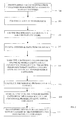
- FIG. 2 is an illustration of a method of determining whether an element from a source has been properly assigned to a category by the source;
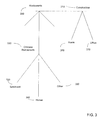
- FIG. 3 is an illustration of a tree with categories, parent nodes and children nodes.
- FIG. 4 is an illustration of source categories being assigned to master categories where the master categories have children categories.
- FIG. 1 illustrates an example of a suitable computing system environment 100 that may operate to display and provide the user interface described by this specification. It should be noted that the computing system environment 100 is only one example of a suitable computing environment and is not intended to suggest any limitation as to the scope of use or functionality of the method and apparatus of the claims. Neither should the computing environment 100 be interpreted as having any dependency or requirement relating to any one component or combination of components illustrated in the exemplary operating environment 100 .
- an exemplary system for implementing the blocks of the claimed method and apparatus includes a general purpose computing device in the form of a computer 110 .
- Components of computer 110 may include, but are not limited to, a processing unit 120 , a system memory 130 , and a system bus 121 that couples various system components including the system memory to the processing unit 120 .
- the computer 110 may operate in a networked environment using logical connections to one or more remote computers, such as a remote computer 180 , via a local area network (LAN) 171 and/or a wide area network (WAN) 173 via a modem 172 or other network interface 170 .
- a remote computer 180 may operate in a networked environment using logical connections to one or more remote computers, such as a remote computer 180 , via a local area network (LAN) 171 and/or a wide area network (WAN) 173 via a modem 172 or other network interface 170 .
- LAN local area network
- WAN wide area network
- Computer 110 typically includes a variety of computer readable media that may be any available media that may be accessed by computer 110 and includes both volatile and nonvolatile media, removable and non-removable media.
- the system memory 130 includes computer storage media in the form of volatile and/or nonvolatile memory such as read only memory (ROM) 131 and random access memory (RAM) 132 .
- ROM read only memory
- RAM random access memory
- the ROM may include a basic input/output system 133 (BIOS).
- BIOS basic input/output system
- RAM 132 typically contains data and/or program modules that include operating system 134 , application programs 135 , other program modules 136 , and program data 137 .
- the computer 110 may also include other removable/non-removable, volatile/nonvolatile computer storage media such as a hard disk drive 141 a magnetic disk drive 151 that reads from or writes to a magnetic disk 152 , and an optical disk drive 155 that reads from or writes to a optical disk 156 .
- the hard disk drive 141 , 151 , and 155 may interface with system bus 121 via interfaces 140 , 150 .
- a user may enter commands and information into the computer 110 through input devices such as a keyboard 162 and pointing device 161 , commonly referred to as a mouse, trackball or touch pad.
- Other input devices may include a microphone, joystick, game pad, satellite dish, scanner, or the like.
- These and other input devices are often connected to the processing unit 120 through a user input interface 160 that is coupled to the system bus, but may be connected by other interface and bus structures 132 , such as a parallel port, game port or a universal serial bus (USB).
- a monitor 191 or other type of display device may also be connected to the system bus 121 via an interface, such as a video interface 190 .
- computers may also include other peripheral output devices such as speakers 197 and printer 196 , which may be connected through an output peripheral interface 195 .
- FIG. 2 may illustrate a method of determining whether an element from a source has been properly assigned to a category by the source using a computer system, such as the computer system described in FIG. 1 .
- the method may be an inference method for modeling probabilities of correctness of element assignments to taxonomy of categories.
- the inference method uses training data consisting of raw category assignments (with possible errors) by multiple providers, together with manual assignments of Master Category 410 labels for each entity.
- the technique used to model the problem may be graphical modeling; the technique used to solve the model for the necessary probabilities may be the Sum-Product algorithm.
- the model may be flexible in that it can assume varying probability distribution complexity models; it is also extensible to include, for example, additional parameters from auxiliary fields in the large data set element.
- the method may take in data from a source where each element in the data may be classified into the Source's 400 405 own categorization taxonomy.
- Some sources provide data with excellent classifications that match a master classification index very closely.
- Other sources provide data that is classified in a more haphazard manner. As a result, such data cannot be trusted to be immediately filed in the master classification.
- the method may take in training data from a source, and match the elements and the given classification in the data to a master classification.
- the given classification may then be reviewed to see of the given classification is correct in view of the master classification. If the classification is correct, this may be stored.
- a probability density function is created for all the master categories and the assigned Source 400 405 categories. Then, using a sum total algorithm, the method determines a confidence level that the element has been properly assigned by the source given that it was assigned to a certain classification by the source.
- FIG. 3 there may be master categories for restaurants 300 , and construction 310 .
- restaurants 300 there may be Chinese restaurants 310 and under construction businesses 310 , there may be construction business-home 360 and construction business-office 370 .
- construction business-home 360 and construction business-office 370 .
- type of Chinese restaurants such as Szechwan 330 , Hunan 340 and Other 350 .
- the categories from the source may be mapped to categories in the master.
- the categories may be matched using traditional manners of matching characters or searching for categories known to be similar. Past experience may be used to guide the mapping.
- FIG. 4 may illustrate one sample mapping scenario.
- Source A 400 and Source B 405 may map the entries to master categories 410 . Both Source A and Source B may assign Chins 415 to the Chinese Restaurant 420 category.
- Source A 400 may assign Shoddy Construction 425 to Home Remodeling 430 while Source B 405 may assign Shoddy Construction 425 to Home Remodeling 430 and to Yutan 435 which may be a child of Chinese Restaurants 420 .
- the assignment of Shoddy Construction 425 to Yutan 435 by Source B may be in error.
- the graph in FIG. 4 may have nodes and nodes may be parents or children.
- the tree When assigning a category 410 to an element 415 425 435 , the tree may be traversed and the element 415 425 435 may be assigned to the lowest appropriate leaf on the tree. Traversal may be accomplished by examining down past a parent node to the children nodes to see if an appropriate category is located. In addition, if an element 415 425 435 is assigned to a child, the method may also traverse the graph and assign the element 415 425 435 to the parent. For example, in FIG. 4 , Li's 435 may be categorized as a Hunan Restaurant 440 , so the method may automatically assign Li's as also being a Chinese Restaurant 420 .
- a set of mappings of categories from Sources 400 405 to Master Categories 410 may be predetermined.
- the mapping may occur in any logical manner.
- a training data set of data may be constructed. For each training set sample, identical listings from Sources 400 and 405 may be conflated to represent a single business entity 415 425 using an application or matching by a human.
- a single sample of the training data may consist of the totality of source category assignments made to a single entity 415 425 by the Source Providers 400 405 , together with an assignment of the entity 415 425 to a master category or set of master categories 420 430 435 440 .
- the assignment of the entity to a master category is usually made by a human labeler.
- the training data may then be used to construct a joint probability model for all Source and Master Categories.
- the joint probability of a set of (discrete) random variables is a mathematical function which describes the probability that the set of random variables has a specific set of values.
- the joint probability model is first calculated using the training data from block 505 and then stored for use during entity classification.
- the probability of an entity's belonging to a Source Category depends only upon whether it belongs to the Master Category 410 to which it is mapped. If an entity belongs to a child Master Category 435 440 , it also belongs to the child's Parent Master Category 420 . If training data is sparse, the joint probability model may be regularized. The training portion of the process may be complete.
- additional data may be received from the Source 400 405 .
- entity processing when a new business listing is received for categorization into a Master Category 410 from multiple Sources 400 405 , the listings from each Source 400 405 are first resolved into a single entity, and the set of all assigned Source Categories is aggregated. For example, Source A 400 and Source B 405 may both submit Chins Chinese Restaurant 415 and Source A 400 and Source B 405 may be resolved into a single entity and then the set of all assigned Source Categories from Source A 400 and Source B 405 for Chins would be aggregated.
- the conditional probability of the listing belonging to each Master Category 410 is then calculated using the sum-product algorithm for graphical models.
- This algorithm functions by passing positive real vector valued messages across edges in a graphical model such as the model described previously. More precisely, in trees: a vertex sends a message to an adjacent vertex if (a) it has received messages from all of its other adjacent vertices and (b) hasn't already sent one. So in the first iteration, the algorithm sends messages from all leaf nodes to each of the lone vertices adjacent to those respective leaves and continues sending messages in this manner until all messages have been sent exactly once, hence explaining the term propagation. It may be proven that all messages will be sent (there are twice the number of edges of them).
- the marginal probability of a variable is determined where the marginal probability is the product of the incoming messages of all its adjacent vertices. This marginal probability may be viewed as a confidence level for the Master Category assignment of the elements 415 425 435 .
- the element 415 425 435 may be stored in the assigned master category.
- the element 415 425 435 may not be stored in the assigned master category.
- the element 415 425 435 may be stored in a separate location where it may be reviewed by a human for proper reassignment.
Landscapes
- Engineering & Computer Science (AREA)
- Theoretical Computer Science (AREA)
- Software Systems (AREA)
- Data Mining & Analysis (AREA)
- Evolutionary Computation (AREA)
- Medical Informatics (AREA)
- Computer Vision & Pattern Recognition (AREA)
- Physics & Mathematics (AREA)
- Computing Systems (AREA)
- General Engineering & Computer Science (AREA)
- General Physics & Mathematics (AREA)
- Mathematical Physics (AREA)
- Artificial Intelligence (AREA)
- Information Retrieval, Db Structures And Fs Structures Therefor (AREA)
Abstract
Description
Claims (18)
Priority Applications (1)
| Application Number | Priority Date | Filing Date | Title |
|---|---|---|---|
| US12/244,444 US8073809B2 (en) | 2008-10-02 | 2008-10-02 | Graphical model for data validation |
Applications Claiming Priority (1)
| Application Number | Priority Date | Filing Date | Title |
|---|---|---|---|
| US12/244,444 US8073809B2 (en) | 2008-10-02 | 2008-10-02 | Graphical model for data validation |
Publications (2)
| Publication Number | Publication Date |
|---|---|
| US20100088267A1 US20100088267A1 (en) | 2010-04-08 |
| US8073809B2 true US8073809B2 (en) | 2011-12-06 |
Family
ID=42076571
Family Applications (1)
| Application Number | Title | Priority Date | Filing Date |
|---|---|---|---|
| US12/244,444 Active 2030-08-09 US8073809B2 (en) | 2008-10-02 | 2008-10-02 | Graphical model for data validation |
Country Status (1)
| Country | Link |
|---|---|
| US (1) | US8073809B2 (en) |
Families Citing this family (1)
| Publication number | Priority date | Publication date | Assignee | Title |
|---|---|---|---|---|
| US20150142457A1 (en) * | 2013-11-20 | 2015-05-21 | Toshiba Medical Systems Corporation | Apparatus for, and method of, data validation |
Citations (7)
| Publication number | Priority date | Publication date | Assignee | Title |
|---|---|---|---|---|
| US6128587A (en) | 1997-01-14 | 2000-10-03 | The Regents Of The University Of California | Method and apparatus using Bayesian subfamily identification for sequence analysis |
| WO2000070481A1 (en) | 1999-05-14 | 2000-11-23 | Manna, Inc. | Intelligent computer system |
| WO2006065464A2 (en) | 2004-12-17 | 2006-06-22 | Motorola, Inc. | Method and apparatus for propagation in a graphical probabilistic model |
| US20070005341A1 (en) | 2005-06-30 | 2007-01-04 | Microsoft Corporation | Leveraging unlabeled data with a probabilistic graphical model |
| US7249034B2 (en) * | 2002-01-14 | 2007-07-24 | International Business Machines Corporation | System and method for publishing a person's affinities |
| US20080004096A1 (en) | 2006-06-02 | 2008-01-03 | Microsoft Corporation | Learning Belief Distributions for Game Moves |
| US20080059391A1 (en) | 2006-09-06 | 2008-03-06 | Siemens Medical Solutions Usa, Inc. | Learning Or Inferring Medical Concepts From Medical Transcripts |
-
2008
- 2008-10-02 US US12/244,444 patent/US8073809B2/en active Active
Patent Citations (7)
| Publication number | Priority date | Publication date | Assignee | Title |
|---|---|---|---|---|
| US6128587A (en) | 1997-01-14 | 2000-10-03 | The Regents Of The University Of California | Method and apparatus using Bayesian subfamily identification for sequence analysis |
| WO2000070481A1 (en) | 1999-05-14 | 2000-11-23 | Manna, Inc. | Intelligent computer system |
| US7249034B2 (en) * | 2002-01-14 | 2007-07-24 | International Business Machines Corporation | System and method for publishing a person's affinities |
| WO2006065464A2 (en) | 2004-12-17 | 2006-06-22 | Motorola, Inc. | Method and apparatus for propagation in a graphical probabilistic model |
| US20070005341A1 (en) | 2005-06-30 | 2007-01-04 | Microsoft Corporation | Leveraging unlabeled data with a probabilistic graphical model |
| US20080004096A1 (en) | 2006-06-02 | 2008-01-03 | Microsoft Corporation | Learning Belief Distributions for Game Moves |
| US20080059391A1 (en) | 2006-09-06 | 2008-03-06 | Siemens Medical Solutions Usa, Inc. | Learning Or Inferring Medical Concepts From Medical Transcripts |
Non-Patent Citations (6)
| Title |
|---|
| Bhattacharya et al., "A Latent Dirichlet Allocation Model for Entity Resolution," http://www.cs.umd.edu/˜getoor/Publications/cs-tr-4740.pdf. |
| Bhattacharya et al., "A Latent Dirichlet Allocation Model for Entity Resolution," http://www.cs.umd.edu/~getoor/Publications/cs-tr-4740.pdf. |
| Daume et al., "A Bayesian Model for Supervised Clustering with the Dirichlet Process Prior," Hal Daume III and Daniel Mareu, 2000, http://www.isi.edu/~marcu/papers/daume05dpscm.pdf. |
| Daume et al., "A Bayesian Model for Supervised Clustering with the Dirichlet Process Prior," Hal Daume III and Daniel Mareu, 2000, http://www.isi.edu/˜marcu/papers/daume05dpscm.pdf. |
| Luo et al., "Graphical Models for Diagnosis Knowledge Representation and Inference," http://ieeexplore.ieee.org/iel5/10700/33790/01609185.pdf?isnumber=33790&prod=CNF&arnumber=1609185&arSt=+483&ared=+489&arAuthor=Jianhui+Luo%3B+Haiying+Tu%3B+Pattipati%2C+K.%3B+Liu+Qiao%3B+Shunsuke+Chigusa. |
| Wang et al., "Mining Geographic Knowledge Using Location Aware Topic Model," http://delivery.acm.org/10.1145/1320000/1316967/p65-xie.pdf?key1=1316967&key2=4388605121&coll=&dl=&CFID=76400927&CFTOKEN=64541509. |
Also Published As
| Publication number | Publication date |
|---|---|
| US20100088267A1 (en) | 2010-04-08 |
Similar Documents
| Publication | Publication Date | Title |
|---|---|---|
| US9268766B2 (en) | Phrase-based data classification system | |
| Yakout et al. | Don't be scared: use scalable automatic repairing with maximal likelihood and bounded changes | |
| US11853908B2 (en) | Data-analysis-based, noisy labeled and unlabeled datapoint detection and rectification for machine-learning | |
| CN1457041B (en) | System for automatically annotating training data for natural language understanding system | |
| CN104714931B (en) | For selecting the method and system to represent tabular information | |
| US10169717B2 (en) | System and method for defining and using different levels of ground truth | |
| JP2024506519A (en) | Performance evaluation and enhancement of virtual dialogue system | |
| US20200082231A1 (en) | Automatic protocol discovery using text analytics | |
| CN117709435B (en) | Training method of large language model, code generation method, device and storage medium | |
| Razenshteyn | High-dimensional similarity search and sketching: algorithms and hardness | |
| US11960520B2 (en) | Hierarchical topic model with an interpretable topic hierarchy | |
| US20230267342A1 (en) | Iterative answer and supplemental information extraction for machine reading comprehension | |
| JP2023002475A (en) | Computer system, computer program and computer-implemented method (causal knowledge identification and extraction) | |
| CN110929532A (en) | Data processing method, device, equipment and storage medium | |
| Tauer et al. | The graph association problem: mathematical models and a Lagrangian heuristic | |
| CN109684394A (en) | Document creation method, device, equipment and storage medium | |
| CN121503437A (en) | A Method and System for Assisting in the Drafting of Patent Disclosures Based on Multi-Agent Collaboration | |
| US20150379112A1 (en) | Creating an on-line job function ontology | |
| CN120336386A (en) | Personalized recommendation method and device based on large language model and logical relationship mining | |
| US12346666B2 (en) | Translation review suitability assessment | |
| CN116109102A (en) | Resource Allocation Method and System Based on Genetic Algorithm | |
| CN116894093A (en) | Knowledge graph drives content generation | |
| US11227231B2 (en) | Computational efficiency in symbolic sequence analytics using random sequence embeddings | |
| Ait‐Yakoub et al. | Asymmetric composition of possibilistic operators in formal concept analysis: application to the extraction of attribute implications from incomplete contexts | |
| US20100088267A1 (en) | Graphical model for data validation |
Legal Events
| Date | Code | Title | Description |
|---|---|---|---|
| AS | Assignment |
Owner name: MICROSOFT CORPORATION,WASHINGTON Free format text: ASSIGNMENT OF ASSIGNORS INTEREST;ASSIGNORS:JOHNSTON, CAROLYN;GOMEZ, MANUEL JESUS REYES;REEL/FRAME:021627/0985 Effective date: 20081001 Owner name: MICROSOFT CORPORATION, WASHINGTON Free format text: ASSIGNMENT OF ASSIGNORS INTEREST;ASSIGNORS:JOHNSTON, CAROLYN;GOMEZ, MANUEL JESUS REYES;REEL/FRAME:021627/0985 Effective date: 20081001 |
|
| STCF | Information on status: patent grant |
Free format text: PATENTED CASE |
|
| AS | Assignment |
Owner name: MICROSOFT TECHNOLOGY LICENSING, LLC, WASHINGTON Free format text: ASSIGNMENT OF ASSIGNORS INTEREST;ASSIGNOR:MICROSOFT CORPORATION;REEL/FRAME:034564/0001 Effective date: 20141014 |
|
| FPAY | Fee payment |
Year of fee payment: 4 |
|
| MAFP | Maintenance fee payment |
Free format text: PAYMENT OF MAINTENANCE FEE, 8TH YEAR, LARGE ENTITY (ORIGINAL EVENT CODE: M1552); ENTITY STATUS OF PATENT OWNER: LARGE ENTITY Year of fee payment: 8 |
|
| MAFP | Maintenance fee payment |
Free format text: PAYMENT OF MAINTENANCE FEE, 12TH YEAR, LARGE ENTITY (ORIGINAL EVENT CODE: M1553); ENTITY STATUS OF PATENT OWNER: LARGE ENTITY Year of fee payment: 12 |