US8072391B2 - Antenna structure - Google Patents
Antenna structure Download PDFInfo
- Publication number
- US8072391B2 US8072391B2 US12/509,657 US50965709A US8072391B2 US 8072391 B2 US8072391 B2 US 8072391B2 US 50965709 A US50965709 A US 50965709A US 8072391 B2 US8072391 B2 US 8072391B2
- Authority
- US
- United States
- Prior art keywords
- antenna structure
- bendable piece
- flex
- antenna
- bendable
- Prior art date
- Legal status (The legal status is an assumption and is not a legal conclusion. Google has not performed a legal analysis and makes no representation as to the accuracy of the status listed.)
- Expired - Fee Related, expires
Links
Images



Classifications
-
- H—ELECTRICITY
- H01—ELECTRIC ELEMENTS
- H01Q—ANTENNAS, i.e. RADIO AERIALS
- H01Q9/00—Electrically-short antennas having dimensions not more than twice the operating wavelength and consisting of conductive active radiating elements
- H01Q9/04—Resonant antennas
- H01Q9/30—Resonant antennas with feed to end of elongated active element, e.g. unipole
-
- H—ELECTRICITY
- H01—ELECTRIC ELEMENTS
- H01Q—ANTENNAS, i.e. RADIO AERIALS
- H01Q1/00—Details of, or arrangements associated with, antennas
- H01Q1/40—Radiating elements coated with or embedded in protective material
-
- H—ELECTRICITY
- H01—ELECTRIC ELEMENTS
- H01Q—ANTENNAS, i.e. RADIO AERIALS
- H01Q1/00—Details of, or arrangements associated with, antennas
- H01Q1/42—Housings not intimately mechanically associated with radiating elements, e.g. radome
-
- H—ELECTRICITY
- H01—ELECTRIC ELEMENTS
- H01Q—ANTENNAS, i.e. RADIO AERIALS
- H01Q9/00—Electrically-short antennas having dimensions not more than twice the operating wavelength and consisting of conductive active radiating elements
- H01Q9/04—Resonant antennas
- H01Q9/16—Resonant antennas with feed intermediate between the extremities of the antenna, e.g. centre-fed dipole
Definitions
- the present invention relates to an antenna structure.
- the present invention relates to an exterior antenna structure which can be bent.
- Antenna is widely used for improving the signal emitting/receiving in wireless communication system.
- Antennas can be classified into two categories which include micro built-in antenna and exterior antenna.
- the advantages of the built-in antenna include smaller size of the antenna and protection of the antenna.
- the built-in antenna cannot be rotated to face a direction which is aligning the direction of the signals.
- the exterior antenna can be rotated to adjust its position and direction to obtain stable signals. Therefore, the exterior antenna is more used in the wireless communication system.
- the exterior antenna 11 ′ of the wireless router has an antenna pole 12 ′.
- the antenna pole 12 ′ has an antenna module (not shown) thereinside for emitting or receiving signals.
- the base of the antenna pole 12 ′ has a connection portion 120 ′.
- One end of the connection portion 120 ′ is connected to the antenna module and the other end of the connection portion 120 ′ is connected to the wireless router station.
- the antenna pole 12 ′ can be rotated on the connection portion 120 ′.
- the rotating shaft mechanism 13 ′ has a shaft 130 ′ and a base 131 ′. Therefore, the antenna pole 12 ′ also can be bent depending on the rotating shaft mechanism 13 ′ so that the exterior antenna 11 ′ can be adjusted in various positions and directions.
- the exterior antenna 11 ′ is used for radiating signal to define an internet signal coverage Personal computers and laptop computers in the connection area can receive the signals to connect to the network.
- the signal strength is usually shown in monitor so that users can know the signal strength.
- users can obtain the improved signals by adjusting the position and direction of the antenna. For example, user can rotate the antenna pole 12 ′ with the connection portion 120 ′ or bend the exterior antenna 11 ′ with the rotating shaft mechanism 13 ′ or the combination of above methods to improve the signal strength.
- the traditional antenna has following disadvantage.
- the bending of the exterior antenna 11 ′ by the shaft 130 ′ is a one-direction bending because of the rotating shaft mechanism 13 ′. It's necessary to rotate the antenna pole 12 ′ with the connection portion 120 ′ in advance and then the exterior antenna 11 ′ can be bent in another direction. Therefore, it costs more time and movements to adjust the position and the direction of the exterior antenna 11 ′.
- the traditional antenna has more components, such as shaft 130 ′ and a base 131 ′, and the components are manufactured and assembled together to achieve the adjustment of the antenna.
- the traditional antenna has more components, such as shaft 130 ′ and a base 131 ′, and the components are manufactured and assembled together to achieve the adjustment of the antenna.
- the inventor proposes the present invention to overcome the above problems based on his expert experience and deliberate research.
- One particular aspect of the present invention is to provide an antenna structure.
- the antenna structure can be bent in various directions without exterior devices.
- the antenna structure is applied for a communication system.
- the antenna structure has a signal emitting/receiving portion, a flex transmitting line disposed under the signal emitting/receiving portion and electrically connected to the signal emitting/receiving portion, and a connecting portion having a first end and a second end.
- the first end of the connecting portion is electrically connected to the flex transmitting line, and the second end of the connecting portion is connected to an assembling portion.
- the antenna structure further includes a bendable piece corresponding to the flex transmitting line.
- the bendable piece can be bent by a force to change positions, directions, or positions and directions of the signal emitting/receiving portion connected with the flex transmitting line.
- the bendable piece, the flex transmitting line and the signal emitting/receiving portion are covered by a sheath.
- the antenna structure is applied for a communication system.
- the wireless router system includes a wireless router station and the antenna structure of the present invention.
- the wireless router system can be applied for connecting with desktop computer or laptop computer so that the computers can connect to the internet.
- Users can know the signal quality shown on the displaying monitor so that user can adjust the position or angle of the antenna structure for obtaining better transmission signals.
- the wireless signal is not good, user can rotate the antenna structure or bend the antenna structure in various directions vertical to the axial direction of the antenna structure. Therefore, the position or the direction of the antenna structure can be adjusted for improving the signal quality so that user can connect internet more stable.
- At least one bendable piece is provided in the antenna structure for replacing the rotating shaft of the traditional antenna. Therefore, the problem that the rotating shaft only can be bent in one direction is solved. In other words, the antenna structure can be bent in various directions so as to improve the signal transmission.
- the components of the traditional antenna structure are simplified.
- the assembly of the antenna structure of the present invention is optimized so that the size and the volume of the antenna structure of the present invention are reduced.
- the bendable piece and the signal emitting/receiving portion are covered by the sheath so that the components are not exposed.
- the manufacturing process of the antenna structure is optimized. The bendable piece is provided into the mold and the antenna structure can be formed in one procedure so that the manufacturing processes are simplified and the manufacturing cost is reduced.
- the elastic force of the sheath is less than the deformation force of the bendable piece when the antenna structure is bent so that the bendable piece is fixed in a predetermined position and direction.
- the elastic force of the sheath is generated opposite to the deformation force of the bendable piece.
- the bendable piece can be fixed in a predetermined position and toward a predetermined direction without any exterior auxiliary tools so as to obtain stable signals.
- the sheath has a concave portion corresponding to the bendable piece so that user can bend the antenna structure.
- User can hold the concave portion so as to bend the bendable piece. Therefore, the concave portion performs as an operation space so that it's convenient for users to bend the antenna structure.
- the concave portion has anti-slide structure thereon, for example, a concave-convex continuous anti-slide pattern, for noticing the bending position for users. Furthermore, the anti-slide structure is used for preventing the hand of the user from sliding when the user is forcing on the bendable piece.
- One end of the bendable piece is connected to the first end or the second end of the connecting portion. Therefore, the bendable piece can not shift after many times of being bent because of the fixed end of the bendable piece.
- one end of the bendable piece can be welded on the connecting portion.
- the bendable piece can be a stainless steel line-material.
- the line-material has higher bendy capability than the pipe-material. Therefore, the bendable piece can be bent many times and the life time of the antenna structure is increasing.
- the elastic force of the sheath is less than the deformation force of the bendable piece when the antenna structure is bent so that the bendable piece is fixed in a predetermined position and direction.
- FIG. 1 is a schematic diagram of a traditional antenna.
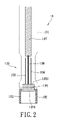
- FIG. 2 is a schematic diagram of the antenna structure of the present invention.
- FIG. 3 is a schematic diagram of the outer structure of the antenna structure of the present invention.
- the present invention provides an antenna structure 11 which can be applied to a communication system, such as a wireless router (not shown).
- the router is a networking device and can be used for applying for networking signals so that computers covered in the signals can have connectivity for internet.
- the wireless router can use for encoding the received signals and emitting the transformed internet signals so that the internet signal coverage is formed.
- the antenna structure 11 has an assembling portion 102 which can be used for fixing the antenna structure 11 on the router. Please refer to FIG. 2 ; the assembling portion 102 has screw threads so that the assembling portion 102 can be fixed on the router by a screwing manner.
- the antenna structure 11 has standard screw threads for connecting to the router, therefore the antenna structure 11 has capability for assembling on other networking devices without re-designing.
- the antenna structure 11 further has a connecting portion 105 .
- the second end 1051 of the connecting portion 105 is connected to the assembling portion 102 by a screwing manner.
- the first end 1052 of the connecting portion 105 is connected electrically to a flex transmitting line 108 and the flex transmitting line 108 is connected electrically to a signal emitting/receiving portion 107 , for example by a welding method.
- the signal emitting/receiving portion 107 is disposed on a PCB by a method which is well known in the industry.
- the antenna structure 11 further includes a bendable piece 106 which is disposed under the signal emitting/receiving portion 107 as shown in FIG. 2 , and the bendable piece 106 is disposed outside the flex transmitting line 108 .
- a sheath 101 is used for covering the bendable piece 106 , the flex transmitting line 108 , and the signal emitting/receiving portion 107 .
- the sheath 101 is connected with the assembling portion 102 so as to form an integral structure. When a force is used to press the sheath 101 on the bendable piece 106 , the antenna structure 11 can be bent repeatedly due to the material characteristics.
- the bendable piece 106 , the flex transmitting line 108 , and the signal emitting/receiving portion 107 are covered by the sheath 101 (as the dotted line in FIG. 2 ), so that the position and the direction of the signal emitting/receiving portion 107 are changed by bending the bendable piece 106 . Therefore, the signal covering area and zone are changed.
- One end of the bendable piece 106 is fixed on the first end 1052 of the connecting portion 105 , in other words, the other end of the bendable piece 106 is a free end. Therefore, the bendable piece 106 is free to be bent in the direction vertical to the axial direction. In other words, the movement of the bendable piece 106 is not limited in the direction vertical to the axial direction.
- one end of the bendable piece 106 can be connected to the second end 1051 of the connecting portion 105 .
- the end of the bendable piece 106 is welded on the second end 1051 so as to prevent the position of the bendable piece 106 from shifting. Therefore, the transmission quality of the antenna can be maintained.
- the sheath 101 can be made of soft materials, such as rubber material, plastics or elastic materials so that the sheath 101 can be easily bent repeatedly. Moreover, the sheath 101 has high reliability for being bent. In other words, the materials of the sheath 101 are not restricted but meeting the requirement of elasticity and protection of the interior components, such as signal emitting/receiving portion 107 . In an embodiment, the sheath 101 is formed by injection-molding method to cover the interior components. It is necessary to hold the position of the bendable piece 106 after bending the bendable piece 106 . The sheath 101 has an elastic force and the bendable piece 106 has a deformation force when the bendable piece 106 is forced on.
- the elastic force is less than the deformation force so that the bendable piece 106 is fixed in a predetermined position and direction.
- the bendable piece 106 can be bent and be hold in the bent state by no exterior tools or force to transmit signals with high quality.
- two bendable pieces 106 of metal are disposed respectively on two sides of the flex transmitting line 108 so as to balance the deformation force.
- a high frequency current is generated so as to transfer the electrical signals to networking signals.
- Personal computers or laptop computers can be used for receiving and transmitting signals to the network system. Users can know the signal strength by watching the indication displayed on the monitor. When the signal strength is weak or non-stable to lead the decreased transmission, user can adjust the position and direction of the antenna structure 11 .
- the antenna structure 11 can be repeatedly adjusted and then be held in a predetermined position and direction so that the improved transmission quality is provided.
- the sheath 101 is provided for covering the bendable piece 106 , signal emitting/receiving portion 107 and flex transmitting line 108 and the structure can be manufactured by a simplified method.
- the bendable piece 106 is provided inside the mold and the structure can be integrally formed.
- the traditional shaft can be omitted so as to decrease the manufacturing cost.
- the bendable piece 106 is manufactured by line-material of stainless steel.
- the line-material of stainless steel has longer life for being bent than the pipe-material. Therefore, the bendable piece 106 of line-material of stainless steel is used for improving the using life of the antenna structure 11 .
- the antenna structure 11 is also can be used for receiving signals, therefore the antenna structure 11 of the present invention can be connected with another communication apparatus for receiving signals. Depending on the signal direction, the antenna structure 11 is forced to adjust its position and direction so as to improve the receiving of the signals. In other words, the antenna structure 11 of the present invention can be used in wireless router and another communication device or apparatus.
- the bendable pieces 106 can be made of another metal line-material, such as copper and metal materials with bendy capability.
- the integral structure of the bendable pieces 106 is line-shaped and has ability of being bent. In other words, the bendable piece 106 is not restricted as a pure row material.
- the sheath 101 has a concave portion 120 corresponding to the bendable piece 106 .
- the concave portion 120 has a concave shape contrary to the periphery of another portion of the sheath 101 .
- the concave portion 120 has anti-slide structure thereon, for example, a concave-convex continuous anti-slide pattern 109 , for noticing the bending position for user.
- FIG. 1 Please refer to FIG.
- the bendable piece 106 is located on the base portion of the antenna structure 11 and is adjacent to the assembling portion 102 . Furthermore, the bendable piece 106 is covered by the sheath 101 and the concave portion 120 performs as an indication position so that user can bend the bendable piece 106 efficiently.
- the antenna structure 11 is a pole-shaped structure as well as the sheath 101 .
- the pole-shaped antenna structure 11 can be planar, cylindrical, oval-shaped, or combination of the above-mentioned shapes.
Landscapes
- Support Of Aerials (AREA)
Abstract
Description
Claims (10)
Applications Claiming Priority (3)
| Application Number | Priority Date | Filing Date | Title |
|---|---|---|---|
| CN200910038777 | 2009-04-16 | ||
| CN200910038777.6 | 2009-04-16 | ||
| CN200910038777.6A CN101533954B (en) | 2009-04-16 | 2009-04-16 | Antenna structure |
Publications (2)
| Publication Number | Publication Date |
|---|---|
| US20100265154A1 US20100265154A1 (en) | 2010-10-21 |
| US8072391B2 true US8072391B2 (en) | 2011-12-06 |
Family
ID=41104413
Family Applications (1)
| Application Number | Title | Priority Date | Filing Date |
|---|---|---|---|
| US12/509,657 Expired - Fee Related US8072391B2 (en) | 2009-04-16 | 2009-07-27 | Antenna structure |
Country Status (2)
| Country | Link |
|---|---|
| US (1) | US8072391B2 (en) |
| CN (1) | CN101533954B (en) |
Families Citing this family (8)
| Publication number | Priority date | Publication date | Assignee | Title |
|---|---|---|---|---|
| CN102767855B (en) * | 2012-07-18 | 2015-12-16 | 广东格兰仕微波炉电器制造有限公司 | The syndeton of micro-wave oven and semiconductor microwave generator and antenna |
| CN103488188A (en) * | 2013-09-10 | 2014-01-01 | 普联技术有限公司 | Wireless router and method of adjusting wireless router signal transmission |
| CN103618676A (en) * | 2013-12-09 | 2014-03-05 | 深圳市共进电子股份有限公司 | Wireless router |
| CN204516897U (en) * | 2015-03-18 | 2015-07-29 | 常州春水堂商贸有限公司 | A kind of antenna protecting equipment |
| CN115411504B (en) * | 2021-05-28 | 2025-06-27 | 华为技术有限公司 | Antenna, communication device, and electromagnetic wave radiation method |
| CN114827025B (en) * | 2022-04-21 | 2023-06-27 | 荣耀终端有限公司 | Router |
| CN116683928B (en) * | 2023-05-16 | 2026-05-05 | 成都欧珀通信科技有限公司 | Radio frequency systems and communication equipment |
| WO2025059688A1 (en) * | 2023-09-15 | 2025-03-20 | Gear Ties Llc D/B/A Xtrudex | Adjustable antenna apparatus and method thereof |
Citations (4)
| Publication number | Priority date | Publication date | Assignee | Title |
|---|---|---|---|---|
| US2546026A (en) * | 1947-04-15 | 1951-03-20 | Gen Electric | Flexible antenna mounting |
| US2558763A (en) * | 1946-02-21 | 1951-07-03 | Norman E Lee | Flexible member |
| US20100194664A1 (en) * | 2005-04-26 | 2010-08-05 | Blickle Guenter | Antenna rod having an interior sheathed rod with a winding |
| US20110004205A1 (en) * | 2008-10-21 | 2011-01-06 | Chu Chun Yiu | Methods and devices for delivering microwave energy |
Family Cites Families (6)
| Publication number | Priority date | Publication date | Assignee | Title |
|---|---|---|---|---|
| CN2638260Y (en) * | 2003-06-25 | 2004-09-01 | 富士康(昆山)电脑接插件有限公司 | External antenna |
| CN2793944Y (en) * | 2005-05-13 | 2006-07-05 | 熊猫电子集团有限公司 | Microantenna for wireless telecommunication net work card of computer |
| CN2893955Y (en) * | 2005-10-13 | 2007-04-25 | 纬创资通股份有限公司 | Connection structure between electronic device and external antenna |
| CN2932649Y (en) * | 2006-05-24 | 2007-08-08 | 垠旺精密股份有限公司 | antenna structure |
| CN200997436Y (en) * | 2006-12-12 | 2007-12-26 | 哗裕实业股份有限公司 | External antenna |
| CN101373857A (en) * | 2007-08-21 | 2009-02-25 | 聪泰科技开发股份有限公司 | digital antenna device |
-
2009
- 2009-04-16 CN CN200910038777.6A patent/CN101533954B/en not_active Expired - Fee Related
- 2009-07-27 US US12/509,657 patent/US8072391B2/en not_active Expired - Fee Related
Patent Citations (4)
| Publication number | Priority date | Publication date | Assignee | Title |
|---|---|---|---|---|
| US2558763A (en) * | 1946-02-21 | 1951-07-03 | Norman E Lee | Flexible member |
| US2546026A (en) * | 1947-04-15 | 1951-03-20 | Gen Electric | Flexible antenna mounting |
| US20100194664A1 (en) * | 2005-04-26 | 2010-08-05 | Blickle Guenter | Antenna rod having an interior sheathed rod with a winding |
| US20110004205A1 (en) * | 2008-10-21 | 2011-01-06 | Chu Chun Yiu | Methods and devices for delivering microwave energy |
Also Published As
| Publication number | Publication date |
|---|---|
| US20100265154A1 (en) | 2010-10-21 |
| CN101533954A (en) | 2009-09-16 |
| CN101533954B (en) | 2014-01-15 |
Similar Documents
| Publication | Publication Date | Title |
|---|---|---|
| US20100265154A1 (en) | Antenna structure | |
| KR100714599B1 (en) | Built-in antenna assembly of wireless communication terminal | |
| US20030083023A1 (en) | Antenna device of wireless phone | |
| US20100060526A1 (en) | Omnidirectional antenna | |
| CN202205932U (en) | coaxial spring connector | |
| EP3358672B1 (en) | Broadcast receiving apparatus | |
| JP2008160216A (en) | Electronics | |
| US20060284773A1 (en) | Antenna apparatus for portable terminal | |
| US20070059976A1 (en) | Flexible contact device for use with a battery | |
| US7825862B2 (en) | Antenna device with surface antenna pattern integrally coated casing of electronic device | |
| US7911399B2 (en) | Antenna assembly | |
| KR101333114B1 (en) | Wire type built-in antenna for portable terminal and manufacturing method of the same | |
| US7583228B2 (en) | Antenna, antenna combination, and portable electronic device having the antenna or antenna combination | |
| KR101123767B1 (en) | Protrusion structure for combining of internal antenna, internal antenna assembly comprising the structure, and method for manufacturing the same | |
| US7079087B2 (en) | Antenna joint connector | |
| US8773325B2 (en) | Antenna device | |
| US20100066632A1 (en) | Antenna apparatus | |
| KR101601599B1 (en) | Antenna for Wearable Device | |
| KR20150072714A (en) | MIMO Antenna for Human Body Communication | |
| US20150084828A1 (en) | Flexible Antenna | |
| CN101795156A (en) | Communication module and method for receiving signal using communication module | |
| US20140022141A1 (en) | Antenna | |
| US20120119956A1 (en) | Antenna Device | |
| CN223978089U (en) | Communication device and medical instrument | |
| KR20110030816A (en) | Intenna for Mobile Devices |
Legal Events
| Date | Code | Title | Description |
|---|---|---|---|
| AS | Assignment |
Owner name: LITE-ON TECHNOLOGY CORPORATION, TAIWAN Free format text: ASSIGNMENT OF ASSIGNORS INTEREST;ASSIGNORS:GUO, YAN-LIANG;CHEN, CHING-HUI;LIU, CHIA-YUAN;REEL/FRAME:023008/0721 Effective date: 20090724 Owner name: SILITEK ELECTRONIC (GUANGZHOU) CO., LTD., CHINA Free format text: ASSIGNMENT OF ASSIGNORS INTEREST;ASSIGNORS:GUO, YAN-LIANG;CHEN, CHING-HUI;LIU, CHIA-YUAN;REEL/FRAME:023008/0721 Effective date: 20090724 |
|
| AS | Assignment |
Owner name: LITE-ON ELECTRONICS (GUANGZHOU) LIMITED, CHINA Free format text: CHANGE OF NAME;ASSIGNOR:SILITEK ELECTRONIC (GUANGZHOU) CO., LTD.;REEL/FRAME:031579/0716 Effective date: 20120731 |
|
| REMI | Maintenance fee reminder mailed | ||
| LAPS | Lapse for failure to pay maintenance fees | ||
| STCH | Information on status: patent discontinuation |
Free format text: PATENT EXPIRED DUE TO NONPAYMENT OF MAINTENANCE FEES UNDER 37 CFR 1.362 |
|
| STCH | Information on status: patent discontinuation |
Free format text: PATENT EXPIRED DUE TO NONPAYMENT OF MAINTENANCE FEES UNDER 37 CFR 1.362 |
|
| FP | Lapsed due to failure to pay maintenance fee |
Effective date: 20151206 |