US8071031B1 - Device for in situ calibrated potentiometric pH measurements - Google Patents
Device for in situ calibrated potentiometric pH measurements Download PDFInfo
- Publication number
- US8071031B1 US8071031B1 US13/072,230 US201113072230A US8071031B1 US 8071031 B1 US8071031 B1 US 8071031B1 US 201113072230 A US201113072230 A US 201113072230A US 8071031 B1 US8071031 B1 US 8071031B1
- Authority
- US
- United States
- Prior art keywords
- potentiometric
- spectrophotometric
- measurement module
- measurements
- calibration
- Prior art date
- Legal status (The legal status is an assumption and is not a legal conclusion. Google has not performed a legal analysis and makes no representation as to the accuracy of the status listed.)
- Expired - Fee Related
Links
Images




Classifications
-
- G—PHYSICS
- G01—MEASURING; TESTING
- G01N—INVESTIGATING OR ANALYSING MATERIALS BY DETERMINING THEIR CHEMICAL OR PHYSICAL PROPERTIES
- G01N21/00—Investigating or analysing materials by the use of optical means, i.e. using sub-millimetre waves, infrared, visible or ultraviolet light
- G01N21/17—Systems in which incident light is modified in accordance with the properties of the material investigated
- G01N21/25—Colour; Spectral properties, i.e. comparison of effect of material on the light at two or more different wavelengths or wavelength bands
- G01N21/31—Investigating relative effect of material at wavelengths characteristic of specific elements or molecules, e.g. atomic absorption spectrometry
- G01N21/33—Investigating relative effect of material at wavelengths characteristic of specific elements or molecules, e.g. atomic absorption spectrometry using ultraviolet light
-
- G—PHYSICS
- G01—MEASURING; TESTING
- G01N—INVESTIGATING OR ANALYSING MATERIALS BY DETERMINING THEIR CHEMICAL OR PHYSICAL PROPERTIES
- G01N21/00—Investigating or analysing materials by the use of optical means, i.e. using sub-millimetre waves, infrared, visible or ultraviolet light
- G01N21/17—Systems in which incident light is modified in accordance with the properties of the material investigated
- G01N21/25—Colour; Spectral properties, i.e. comparison of effect of material on the light at two or more different wavelengths or wavelength bands
- G01N21/27—Colour; Spectral properties, i.e. comparison of effect of material on the light at two or more different wavelengths or wavelength bands using photo-electric detection ; circuits for computing concentration
- G01N21/274—Calibration, base line adjustment, drift correction
-
- G—PHYSICS
- G01—MEASURING; TESTING
- G01N—INVESTIGATING OR ANALYSING MATERIALS BY DETERMINING THEIR CHEMICAL OR PHYSICAL PROPERTIES
- G01N21/00—Investigating or analysing materials by the use of optical means, i.e. using sub-millimetre waves, infrared, visible or ultraviolet light
- G01N21/75—Systems in which material is subjected to a chemical reaction, the progress or the result of the reaction being investigated
- G01N21/77—Systems in which material is subjected to a chemical reaction, the progress or the result of the reaction being investigated by observing the effect on a chemical indicator
- G01N21/78—Systems in which material is subjected to a chemical reaction, the progress or the result of the reaction being investigated by observing the effect on a chemical indicator producing a change of colour
- G01N21/80—Indicating pH value
-
- G—PHYSICS
- G01—MEASURING; TESTING
- G01N—INVESTIGATING OR ANALYSING MATERIALS BY DETERMINING THEIR CHEMICAL OR PHYSICAL PROPERTIES
- G01N33/00—Investigating or analysing materials by specific methods not covered by groups G01N1/00 - G01N31/00
- G01N33/18—Water
- G01N33/182—Specific anions in water
-
- G—PHYSICS
- G01—MEASURING; TESTING
- G01N—INVESTIGATING OR ANALYSING MATERIALS BY DETERMINING THEIR CHEMICAL OR PHYSICAL PROPERTIES
- G01N21/00—Investigating or analysing materials by the use of optical means, i.e. using sub-millimetre waves, infrared, visible or ultraviolet light
- G01N21/17—Systems in which incident light is modified in accordance with the properties of the material investigated
- G01N21/25—Colour; Spectral properties, i.e. comparison of effect of material on the light at two or more different wavelengths or wavelength bands
- G01N21/31—Investigating relative effect of material at wavelengths characteristic of specific elements or molecules, e.g. atomic absorption spectrometry
- G01N21/314—Investigating relative effect of material at wavelengths characteristic of specific elements or molecules, e.g. atomic absorption spectrometry with comparison of measurements at specific and non-specific wavelengths
Definitions
- This invention relates to sensors for extended deployment in aquatic environments. More specifically, this invention relates to devices and associated methods for precise and accurate potentiometric pH measurements in situ over periods of extended deployment with occasional spectrophotometric calibrations.
- Solution pH is widely conceptualized as a master variable in the regulation of natural aqueous systems. It is a key feature in descriptive models of carbonate system chemistry, trace metal speciation and bioavailability, oxidation-reduction equilibria and kinetics, biologically induced carbon system transformations, and the aqueous interactions and transformations of minerals. Rising levels of atmospheric CO 2 are leading to ocean acidification. The response of seawater and freshwaters to acidification processes has created a need for autonomous global monitoring of ocean water and fresh water pH. The importance of pH in investigations of terrestrial and oceanic biogeochemistry has necessitated improvements in not only the quality of measurements (precision and accuracy), but also the spatial and temporal resolution of measurements in the field.
- Potentiometric devices are rarely used for in situ environmental pH measurements because in situ buffer calibrations are problematic.
- Spectrophotometric devices have been developed for in situ environmental measurements but the endurance and measurement frequency of spectrophotometric devices is relatively low due to high power requirements and the limited longevity of lamps. Achieving meaningful spatial and temporal measurements in the field mandates the introduction of robust measurement devices capable of accurate and precise measurements over extended timeframes.
- the present invention provides a device capable of precise and accurate potentiometric pH measurements in situ. Also provided are associated methods for in situ calibrated pH measurements.
- Embodiments of an in situ calibrated potentiometric device according to the invention couple potentiometric pH measurement systems to systems for calibrating the potentiometric pH measurement systems.
- the potentiometric system/aspect of the device employs one or more glass pH-sensitive electrodes connected to a potentiometer (i.e., a device capable of measuring electrical potentials [voltages]).
- a potentiometer i.e., a device capable of measuring electrical potentials [voltages]
- a key feature of the potentiometric system is that, rather than being calibrated conventionally with buffers, it can be calibrated with an in situ device that measures pH spectrophotometrically.
- Spectrophotometric pH measurements obtained via sulfonephthalein absorbance measurements are inherently calibrated and do not require the buffers necessary for the calibration of typical potentiometric devices.
- devices according to the invention allow for continuous potentiometric pH measurements with occasional spectrophotometric calibrations.
- the spectrophotometric calibration system/aspect of the device utilizes a spectrophotometer with associated pumps for combining a sulfonephthalein pH indicator with the aqueous medium whose pH is to be measured.
- a sulfonephthalein indicator and the aqueous medium e.g., seawater
- solution pH is calculated from (a) optical absorbance ratios at multiple wavelengths, (b) temperature, and (c) the salt concentration (e.g., salinity) of the solution.
- the potentiometric pH system (glass electrode plus volt meter) is calibrated without the use of buffers.
- the device will record potentiometric pH measurements for an extended period of time until the spectrophotometric device is autonomously activated for another calibration. In this manner precise and accurate pH measurements can be obtained continuously in the environment, and the low energy expenditure of the potentiometric device provides excellent endurance.
- the present invention provides a device for in situ calibrated potentiometric pH measurement.
- the device includes a potentiometric pH measurement module, a spectrophotometric pH measurement module and a calibration module.
- the calibration module is in communication with the potentiometric pH measurement module and the spectrophotometric pH measurement module.
- the calibration module receives pH calibration data from the potentiometric pH measurement module and the spectrophotometric pH measurement module and performs calibrations to the potentiometric pH measurement module using the received pH calibration data.
- the received pH calibration data utilizes one or more substantially contemporaneous pH measurements from the potentiometric pH measurement module and the spectrophotometric pH measurement module.
- a potentiometric pH measurement is performed at substantially simultaneously to a spectrophotometric pH measurement.
- the spectrophotometric pH measurement module can include a first reservoir containing a sulfonephthalein pH indicator, one or more pumps in communication with the first reservoir and an aqueous medium, a second reservoir to receive combined aqueous medium/pH indicator (combined mixture), and a spectrophotometer to measure the absorbance characteristics of the combined mixture.
- the one or more pumps combine a sulfonephthalein pH indicator with the aqueous medium.
- the calibration module can include systems for the autonomous activation of the calibration module.
- the calibration module can be autonomously activated upon a defined time interval or at an event trigger indicating the necessity for calibration of the potentiometer.
- the potentiometric pH measurement module can include one or more glass pH-sensitive electrodes connected to a potentiometer.
- the calibration module may be autonomously activated upon a defined time interval or at an event trigger indicating the necessity for calibration of the potentiometer.
- the device can include a housing containing the potentiometric pH measurement module, the spectrophotometric pH measurement module and the calibration module in communication.
- the housing can have one or more sample intake ports and one or more sample exhaust ports to allow the intake and exhaust of the samples.
- the housing can also be sealed to allow operation while partially or totally immersed in an aqueous medium.
- the present invention provides a device for autonomously-activated in situ calibrated potentiometric pH measurement.
- the device includes a potentiometric pH measurement module, a spectrophotometric pH measurement module, and an autonomously-activated calibration module.
- the autonomously-activated calibration module is in communication with the potentiometric pH measurement module and the spectrophotometric pH measurement module.
- the calibration module receives pH calibration data from the potentiometric pH measurement module and the spectrophotometric pH measurement module and performs calibrations to the potentiometric pH measurement module using the received pH calibration data.
- the autonomously-activated calibration module can be activated upon a defined time interval or at an event trigger indicating the necessity for calibration of the potentiometer.
- the spectrophotometric pH measurement module can include a first reservoir containing a sulfonephthalein pH indicator, one or more pumps in communication with the first reservoir and an aqueous medium a second reservoir to receive combined aqueous medium/pH indicator (combined mixture), and a spectrophotometer to measure the absorbance characteristics of the combined mixture.
- the one or more pumps combine a sulfonephthalein pH indicator with the aqueous medium.
- the present invention provides a method of performing in situ calibrated potentiometric pH measurements for extended periods of time.
- the method includes the steps of recording a plurality of potentiometric pH measurements using a potentiometric pH measurement device, activating a spectrophotometric calibration system, spectrophotometrically calibrating the potentiometric pH measurement device, and resetting the activator of the spectrophotometric calibration system to allow the potentiometric pH measurement device to return to recording potentiometric pH measurements.
- the spectrophotometric calibration system can be autonomously activated. The autonomous activation can occur upon a defined time interval or at an event trigger indicating the necessity for calibration.
- the step of spectrophotometrically calibrating the potentiometric pH measurement device includes the steps of sampling an aqueous medium, accessing data representative of the temperature and salt concentration of the sampled aqueous medium, combining a sulfonephthalein indicator and a first portion of the sampled aqueous medium, delivering the combined medium to an optical cell, obtaining an absorbance spectrum from the combined medium, calculating solution pH of the sampled aqueous medium utilizing the optical absorbance ratios at multiple wavelengths, the temperature, and the salt concentration, obtaining a potentiometric pH measurement of a second portion of the aqueous medium, calculating the deviation between the potentiometric pH measurement and the spectrophotometric pH measurement, and adjusting the potentiometric pH measurement device using the calculated deviation.
- the spectrophotometric pH measurement is considered accurate, while any deviation between the potentiometric pH measurement and the spectrophotometric pH measurement is due to discrepancies in the potentiometric pH measurement due to factors such as the inherent drift observed in this type of unit over time.
- the adjusting step calibrates the potentiometric pH measurement device.
- the step of obtaining a potentiometric pH measurement of a second portion of the aqueous medium is performed substantially contemporaneously with the step of obtaining an absorbance spectrum from the combined medium.
- the present invention provides a method of spectrophotometrically calibrating a potentiometric pH measurement device.
- the method includes the steps of obtaining one or more samples of an aqueous medium, accessing data representative of the temperature and salt concentration of the sampled aqueous medium, combining a sulfonephthalein indicator and a first portion of the sampled aqueous medium, delivering the combined medium to an optical cell, obtaining an absorbance spectrum from the combined medium and calculating solution pH of the sampled aqueous medium utilizing the optical absorbance ratios at multiple wavelengths, the temperature, and the salt concentration, obtaining a potentiometric pH measurement of a second portion of the aqueous medium, calculating the deviation between the potentiometric pH measurement and the spectrophotometric pH measurement, and adjusting the potentiometric pH measurement device using the calculated deviation.
- the adjusting step calibrates the potentiometric pH measurement device.
- the step of obtaining a potentiometric pH measurement of a second portion of the aqueous medium is performed substantially contemporaneously with the step of obtaining an absorbance spectrum from the combined medium.
- the method of spectrophotometrically calibrating the potentiometric pH measurement can be autonomously activated. Autonomous activation can occurs upon a defined time interval or at an event trigger indicating the necessity for calibration or under other conditions.
- the present invention provides a method of measuring the salinity of an aqueous solution, the method includes the steps of obtaining a sample of an aqueous medium, adding a metal ion species the aqueous medium to produce a sample solution, spectrophotometrically measuring the absorbance of light passing through the sample solution at a plurality of wavelengths, wherein the ultraviolet absorbance of light is a function of the complexation in the sample solution of the added metal ion species with carbonate ions of the sample and computing the salinity of the aqueous medium based upon the absorbance ratio of the sample solution at the plurality of wavelengths.
- the spectrophotometric absorbance measurements are obtained in the ultraviolet range.
- the metal ion can include Pb II and Cu II , yttrium, a lanthanide metal and an actinide metal.
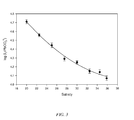
- FIG. 3 is a graph showing salinity dependence of PbCO 3 0 formation constant at 25° C.
- FIG. 4 a is a graph showing salinity dependence of 250 ⁇ pb and 250 ⁇ PbCO3 at 25° C.
- FIG. 4 b is a graph showing salinity dependence of 234 ⁇ Pb and 234 ⁇ PbCO3 at 25° C.
- FIG. 5 is a graph showing Pb(II) absorbance ratios of in acidified seawater at 250 and 234 nm: 250 A/ 234 A ( 250 ⁇ Pb / 234 ⁇ Pb ) as a function of salinity.
- FIG. 6 is a series of three graphs showing salinity dependence of e 1 ( 6 a ), e 2 ( 6 b ), and e 3 ( 6 c ) at 25° C.
- FIG. 7 a is a graph showing the best fit log ⁇ ( CO3 ⁇ 1 )/(e 2 ) ⁇ results using Eq. (20).
- FIG. 7 b is a graph showing the best fit e 1 results using Eq. (20).
- FIG. 8 is a graph showing residuals ([CO 3 2 ⁇ ] observed ⁇ [CO 3 2 ] predicted ) plotted as a function of ([CO 3 2 ⁇ ] observed for the least squares analyses using Eq. (20).
- FIG. 9 is an image of the device of the present invention.
- Potentiometric pH measurements can be performed with relatively simple equipment and procedures required. This simplicity makes potentiometry a good choice for field measurements as long as there are not stringent requirements for accuracy and precision. Under ideal conditions, potentiometric measurements that utilize glass hydrogen ion selective electrodes can provide measurement precisions on the order of 0.003 pH units. However, measurement accuracy can be problematic. Potentiometric measurements generally require regular buffer calibrations, and special care must be taken to address artifacts associated with both residual liquid junction potentials and variations in asymmetry potentials. Seiter and DeGrandpre evaluated performance of six electrodes under identical operational conditions.
- Electrode drift necessitates frequent calibrations, making autonomous operation somewhat problematic compared to spectrophotometric pH determinations.
- potentiometric devices are their low power consumption. This aspect would seem to make them well-suited for deployment over extended periods of time. Unfortunately, their use for such deployment is greatly limited by their inherent drift, making readings increasingly inaccurate and necessitating calibration for meaningful use.
- spectrophotometric pH measurement procedures have at least two important advantages that make them particularly desirable. Since spectrophotometric pH measurements can be determined via absorbance ratios, and the calibration of pH indicators is a laboratory exercise that establishes how each indicator's molecular properties vary with temperature, pressure and ionic strength, spectrophotometric pH measurements are inherently calibrated and can be termed “calibration free”. Subsequent to careful laboratory calibration, spectrophotometric pH measurements do not require the use of buffers.
- Spectrophotometric pH measurements have been increasingly utilized for measurements of pH in natural waters.
- Bellerby et al. developed a flow injection procedure for spectrophotometric measurement of seawater pH with a reported precision of 0.005 pH units and a sample frequency of 25 hr ⁇ 1 (Bellerby R. G. J.; Turner, D. R.; Millward, G. E.; Worsfold P. J. Analytica Chimica Acta 1995, 309, 259.).
- Submersible potentiometric sensors provide continuous unattended measurements of seawater pH for periods of six to twelve months with a measurement frequency up to 60 Hz. No calibrations are required on the part of the user. Both measurements and calibrations are performed in-situ. Measurement accuracy is on the order of 0.001 pH units. High measurement frequency, excellent endurance characteristics, and in situ calibration make this sensor system well suited to descriptions of acid-base equilibrium and kinetic phenomena on diurnal, seasonal and annual scales.
- the present invention provides a device 10 capable of precise and accurate potentiometric pH measurements in situ.
- Embodiments of a potentiometric device 20 according to the invention consist of one or more glass pH-sensitive electrodes 25 connected to a potentiometer 30 (e.g., a device capable of measuring electrical potentials [voltages]).
- a key feature of the device 10 is that, rather than being calibrated conventionally with buffers, it can be calibrated with an in situ device that measures pH spectrophotometrically. Spectrophotometric pH measurements obtained via sulfonephthalein absorbance measurements are inherently calibrated (do not require buffers). Thus, devices according to the invention allow for continuous potentiometric pH measurements with occasional spectrophotometric calibrations.
- the spectrophotometric calibration device 40 consists of a spectrophotometer 55 with associated pumps 50 for combining a sulfonephthalein pH indicator with the aqueous medium whose pH is to be measured. After a sulfonephthalein indicator and the aqueous medium (e.g., seawater) are combined in an optical cell 60 , light 65 is passed through the combined mixture, an absorbance spectrum is obtained and solution pH is calculated from (a) optical absorbance ratios at multiple wavelengths, (b) temperature, and (c) the salt concentration (e.g., salinity) of the solution. Through contemporaneous potentiometric measurements the potentiometric pH system 20 (glass electrode 25 plus volt meter 30 ) is calibrated without the use of buffers.
- a sulfonephthalein indicator and the aqueous medium e.g., seawater
- the device 10 will record potentiometric pH measurements for an extended period of time until the spectrophotometric device 40 is autonomously activated for another calibration. In this manner precise and accurate pH measurements can be obtained continuously in the environment, and the low energy expenditure of the potentiometric device provides excellent endurance.
- the present invention provides a device for in situ calibrated potentiometric pH measurement 10 .
- the device 10 includes a potentiometric pH measurement module 20 , a spectrophotometric pH measurement module 40 and a calibration module 80 .
- the calibration module 80 is in communication with the potentiometric pH measurement module 20 and the spectrophotometric pH measurement module 40 .
- the calibration module 80 receives pH calibration data from the potentiometric pH measurement module 20 and the spectrophotometric pH measurement module 40 and performs calibrations to the potentiometric pH measurement module 20 using the received pH calibration data.
- the received pH calibration data utilizes one or more substantially contemporaneous pH measurements from the potentiometric pH measurement module 20 and the spectrophotometric pH measurement module 40 .
- a potentiometric pH measurement is performed substantially simultaneously to a spectrophotometric pH measurement.
- the spectrophotometric pH measurement module 40 can include a first reservoir 45 containing a sulfonephthalein pH indicator, one or more pumps 50 in communication with the first reservoir 45 and an aqueous medium, a second reservoir 60 to receive combined aqueous medium/pH indicator (combined mixture), and a spectrophotometer 55 to measure the absorbance charactersitics of the combined mixture.
- the one or more pumps 50 combine a sulfonephthalein pH indicator with the aqueous medium.
- the calibration module 80 can include systems for the autonomous activation of the calibration module 80 .
- the calibration module 80 can be autonomously activated upon a defined time interval or at an event trigger indicating the necessity for calibration of the potentiometer.
- the potentiometric pH measurement module 20 can include one or more glass pH-sensitive electrodes 25 connected to a potentiometer 30 .
- the calibration module 80 may be autonomously activated upon a defined time interval or at an event trigger indicating the necessity for calibration of the potentiometer 30 .
- the device 10 can include a housing 85 containing the potentiometric pH measurement module 20 , the spectrophotometric pH measurement module 40 and the calibration module 80 in communication.
- the housing 85 can have one or more sample intake ports 90 and one or more sample exhaust ports 95 to allow the intake and exhaust of the samples.
- the housing 85 can also be sealed to allow operation while partially or totally immersed in an aqueous medium.
- the present invention provides a device for autonomously-activated in situ calibrated potentiometric pH measurement.
- the device includes a potentiometric pH measurement module 20 , a spectrophotometric pH measurement module 40 , and an autonomously-activated calibration module 80 .
- the autonomously-activated calibration module 80 is in communication with the potentiometric pH measurement module 20 and the spectrophotometric pH measurement module 40 .
- the calibration module 80 receives pH calibration data from the potentiometric pH measurement module 20 and the spectrophotometric pH measurement module 40 and performs calibrations to the potentiometric pH measurement module 20 using the received pH calibration data.
- the autonomously-activated calibration module 80 can be activated upon a defined time interval or at an event trigger indicating the necessity for calibration of the potentiometer 30 .
- the spectrophotometric pH measurement module 40 can include a first reservoir 45 containing a sulfonephthalein pH indicator, one or more pumps 50 in communication with the first reservoir 45 and an agueous medium, a second reservoir 60 to receive combined aciueous medium/pH indicator (combined mixture), and a spectrophotometer 55 to measure the absorbance charactersitics of the combined mixture.
- the one or more pumps 50 combine a sulfonephthalein pH indicator with the agueous medium.
- a conduit 100 may direct the combined agueous medium/pH indicator (combined mixture) to the potentiometric pH measurement module 20 .
- the spectrophotometric pH measurement module 40 may also include a third reservoir 70 containing an acid; a pump in communication with the third reservoir and the second reservoir which combines the acid and a portion of the combined agueous medium/pH indicator and directs the acidified combined agueous medium/pH indicator to the pH measuring devices via a conduit 100 .
- calibrations can be triggered by a variety of events or circumstances. For example, calibrations can be triggered based upon time intervals or other user-defined events. Alternatively, or in conjunction with such techniques, calibrations can be triggered based upon observations of potentiometric pH changes. For example, a sudden pH change outside of the typical deviations of pH recordings could trigger a calibration to ensure that the large recorded deviation was real.
- Potentiometric pH measurement devices consist of (a) a glass pH sensitive membrane and (b) a reference electrode.
- One of the main sources problems in a potentiometric pH measurement is clogging of what is called the ‘liquid junction’ of the reference cell. This is an event that could initiate drift. If the potentiometric system is initially calibrated, some slow drift may be acceptable because subsequent deviations between spectrophotometric and potentiometric measurements might be small. If deviations suddenly become large, the device could be told to select a different reference electrode (or a different glass electrode). Alternatively, or in conjunctions with the above procedures, the system could be directed to flush itself with a microbial inhibitor or to activate an ultrasonic device for cleaning.
- CO 2 fugacity measurements are essential to descriptions of CO 2 exchange at the air sea interface (DOE, 1994; McGillis and Wanninkhof, 2006; Millero, 2007), and carbonate ion concentrations are essential to evaluations of (a) the mineralization rates of marine calcifiers (Langdon and Atkinson, 2005) and (b) the dissolution rates of calcite and aragonite (CaCO 3(s) polymorphs) both on the seafloor and in the water column (Morse, 1978; Keir, 1980; Acker et al., 1987).
- spectrophotometric observations of sulfonephthalein acid/base equilibria are utilized for seawater pH measurements
- spectrophotometric observations of metal ion complexation can be used to quantify anion concentrations in seawater.
- Lead is especially well suited to such measurements because (a) PbCO 3 0 and a variety of Pb(II) chloride complexes have dissimilar absorbance spectra in the ultraviolet, and (b) species other than PbCO 3 0 and chloride complexes appear to be insignificant over a wide range of salinities in natural seawater.
- ⁇ A is the absorbance of Pb(II) at wavelength ⁇
- l is the pathlength
- [Pb] T is the total lead concentration
- ⁇ ⁇ PbCO3 is the molar absorbance of (PbCO 3 0 ) T at wavelength
- ⁇ ⁇ Pb is the molar absorbance of (Pb T ) at wavelength ⁇
- CO3 ⁇ 1 is the formation constant of PbCO 3 0 as defined in Eq.
- Eq. (3) can be used to describe the dependence of Pb(II) absorbance ( ⁇ A) on [CO 3 2 ⁇ ] T and determine an internally consistent set of values for ⁇ ⁇ Pb , ⁇ ⁇ PbCO3 and CO3 ⁇ 1 .
- Eq. (5) is identical to that which has been used for highly precise measurements of seawater pH from observations of sulfonephthalein absorbance in seawater (Robert Baldo et al, 1985; Byrne, 1987; Byrne and Breland, 1989; Clayton and Byrne, 1993).
- Eq. (5) can be used to determine carbonate ion concentrations via direct measurements of Pb(II) absorbance ratios, and characterizations of CO3 ⁇ 1 , e 1 , e 2 , and e 3 .
- Characterizations of log CO3 ⁇ 1 in this work were obtained using Eq. (3) and measurements of 250 A and [CO 3 2 ⁇ ] T in seawater samples at constant salinity and constant temperature. Along with characterizations of log CO3 ⁇ 1 , these measurements also produced paired characterizations of 250 ⁇ Pb and 250 ⁇ PbCO3 . Paired characterizations of 234 ⁇ Pb and 234 ⁇ PbCO3 were obtained from measurements of 234 A and [CO 3 2 ⁇ ] T using Eq. (3), and the log CO3 ⁇ 1 values determined at each salinity, as described above. Paired characterizations of 234 ⁇ Pb and 250 ⁇ Pb were obtained from ⁇ A observations at low pH ( FIG. 2 ).
- e 1 ( 250 ⁇ PbCO3 / 250 ⁇ Pb ) ⁇ ( 234 ⁇ Pb / 234 ⁇ PbCO3 ) ⁇ ( 250 ⁇ Pb / 234 ⁇ Pb )
- e 2 ( 234 ⁇ Pb / 234 ⁇ PbCO3 ) ⁇ ( 250 ⁇ Pb / 234 ⁇ Pb )
- e 3 ( 234 ⁇ Pb / 234 ⁇ PbCO3 ) (10)
- Seawater alkalinity was determined using a spectrophotometric procedure (Yao and Byrne, 1998) that is precise to better than 1 mmol/kg.
- Seawater (140.0 g) was added gravimetrically to an open top optical cell (10 cm pathlength) which, in turn, was positioned in the thermostatted cell holder.
- Sample pH was measured using an Orion Ross-type pH electrode (No. 800500) connected to an Orion pH meter (Model 720A) in the absolute millivolt mode. Nerstian behavior of the pH electrode was confirmed via titrations of 0.7 molar NaCl solutions with concentrated HCl.
- the electrode was calibrated on the total hydrogen ion concentration scale through measurements in natural seawater whose pH was determined by simultaneous spectrophotometric observations of thymol blue absorbance ratios (Zhang and Byrne, 1996).
- HCl additions were quantified gravimetrically. Pb(II) absorbance, alkalinity and pH were recorded for each titration point. Sample alkalinity was calculated by accounting for cumulative HCl additions to the initial seawater sample. Calculations of [CO 3 2 ⁇ ] T from alkalinity and pH utilized the total H + scale dissociation constants of Dickson and Millero (1987) that were derived from the data of Mehrbach et al. (1973). All such calculations were performed using the CO 2 system program of Pierrot et al. (2006).
- Eqs. (8) through (10) can be used to calculate e 1 , e 2 and e 3 at each salinity.
- the coefficients obtained in this manner are given in Table 4 and are depicted graphically in FIGS. 6 a ), ( 6 b ) and ( 6 c ).
- Eq. (5), Eq. (11), and Eqs. (17) through (19) permit direct measurements of [CO 3 2 ⁇ ] T from measurements of Pb(II) absorbance ratios in seawater at 25° C.
- FIG. 8 shows the residuals, ([CO 3 2 ⁇ ] T ) observed ⁇ ([CO 3 2 ] T ) predicted ), for each least squares analysis using Eq. (20). It should be noted that the residuals shown in FIG. 8 are derived from three independent sources.
- equation (22) and (23) characterizations of e 1 and e 3 /e 2 were obtained through fits involving equation (20) and did not involve the e 1 , e 2 and e 3 characterizations given in equations (17) through (19).
- Eq. (24) estimates of salinity is ⁇ 0.06 salinity units.
- Eq. (24) provides seawater salinity estimates that are precise to approximately 0.2% over the normal salinity range of seawater.
- salinity can be measured from absorbance ratio observations after Pb(II) is added to an acidic seawater solution.
- Other metals can be used to obtain sensitive salinity measurements over various ranges of salinity.
- the work reported herein was performed at 25° C. It follows that the salinity measurements could be performed at other temperatures after suitable laboratory calibrations. This would allow salinity measurements and/or carbonate measurements to be obtained without thermostatting. Such calibrations facilitate carbonate measurements in situ over a range of temperatures.
- the potentiometer measures the millivolts developed by a pH electrode vs a reference electrode.
- the solution measured consists of the aqueous medium plus a small amount of indicator.
- the pH of this mixture is assessed by both the spectrophotometer and the potentiometer.
- the “b” term in the above equation (Eq. 25) is an electrode slope that depends on temperature.
- the “a” term depends on a number of variables and can be determined via calibrations.
- the potentiometric system or the calibration system
- the pH value is determined spectrophotometrically
- the constant “a” is determined from the above equation.
- pH is again measured spectrophotometrically and the above equation can be used to solve for both slope “b” and intercept “a”.
- [CO 3 2 ⁇ ] T In the absence of direct spectrophotometric determinations of [CO 3 2 ⁇ ] T as described above, [CO 3 2 ⁇ ] T must be calculated from measurements of either total dissolved inorganic carbon or total alkalinity combined with either pH or CO 2 fugacity. While spectrophotometric pH measurements are rapid, with acquisition rates on the order of seconds, measurements of dissolved inorganic carbon, total alkalinity and CO 2 fugacity generally require several minutes (as a lower bound). Thus, the spectrophotometric procedures for measurements of carbonate ion concentrations described in this work, and those for spectrophotometric pH analysis (Liu, et al., 2006), are unique in their suitability for prompt in situ analysis.
Landscapes
- Physics & Mathematics (AREA)
- Chemical & Material Sciences (AREA)
- Life Sciences & Earth Sciences (AREA)
- Health & Medical Sciences (AREA)
- Pathology (AREA)
- Immunology (AREA)
- General Physics & Mathematics (AREA)
- Analytical Chemistry (AREA)
- Biochemistry (AREA)
- General Health & Medical Sciences (AREA)
- Engineering & Computer Science (AREA)
- Spectroscopy & Molecular Physics (AREA)
- Food Science & Technology (AREA)
- Medicinal Chemistry (AREA)
- Chemical Kinetics & Catalysis (AREA)
- Plasma & Fusion (AREA)
- Mathematical Physics (AREA)
- Theoretical Computer Science (AREA)
- Investigating Or Analysing Materials By Optical Means (AREA)
Abstract
Description
Pb2++CO3 2−

can be quantitatively described with an equilibrium constant of the following form:
where [PbT] represents the total concentration of Pb(II) species other than PbCO3 0 in seawater, principally Pb2+, PbCl+, PbCl2 0 and PbCl3 −, and minor amounts of PbSO4 0; [CO3 2]T is the sum concentration of free and ion paired carbonate (CO3 2−, NaCO3 −, MgCO3 0 and CaCO3 0); and [PbCO3 0]T represents the sum concentration of PbCO3 0 and potentially significant mixed ligand complexes such as PbCO3Cl−. The absorbance of Pb(II) in seawater can be described using the following equation (Byrne, 1981; Soli et al, 2008):
where λA is the absorbance of Pb(II) at wavelength λ, l is the pathlength, [Pb]T is the total lead concentration, λεPbCO3 is the molar absorbance of (PbCO3 0)T at wavelength λεPb is the molar absorbance of (PbT) at wavelength λ and CO3β1 is the formation constant of PbCO3 0 as defined in Eq. (2). Eq. (3) can be used to describe the dependence of Pb(II) absorbance (λA) on [CO3 2−]T and determine an internally consistent set of values for λεPb, λεPbCO3 and CO3β1.
where e1, e2, and e3 are Pb(II) molar absorbance ratios:
e 1=λ2εPbCO3/λ1εPbCO3 , e 2=λ2εPb/λ1εPbCO3 , e 3=λ1εPb/λ1εPbCO3 (6)
R= λ2 A/ λ1 A= λ2εPb/λ1εPb (7)
e 1=(250εPbCO3/250εPb)×(234εPb/234εPbCO3)×(250εPb/234εPb) (8)
e 2=(234εPb/234εPbCO3)×(250εPb/234εPb) (9)
e 3=(234εPb/234εPbCO3) (10)
log CO3β1=6.574−0.1235S+1.514×10⁻³ S 2 (11)
with a ±0.023 standard error of estimation. The 250εPb, and 250εPbCO3 values determined in this analysis exhibited a linear dependence on salinity:
250εPb=8.443×10⁵+7.258×10⁻⁴ S (12)
250εPbCO3=4.563×10⁵+2.252×10⁻⁴ S (13)
234εPb=3.837×10⁶+1.749×10³ S (14)
234εPbCO3=3.055×10⁵+2.028×10⁵ S−2.548×10³ S 2 (15)
| TABLE 1 |
| PbCO3 0 formation constant (CO3β1), 250εPb, and 250εPbCO3 |
| as function of salinity at 25° C. |
| 250εPb | 250εPbCO3 | ||||
| Salinity | log CO3β1 | (× 10−6 cm2 mol−1) | (× 10−6 cm2 mol−1) | ||
| 35.87 | 4.070 ± 0.030 | 3.445 ± 0.028 | 1.200 ± 0.028 | ||
| 34.50 | 4.140 ± 0.028 | 3.339 ± 0.035 | 1.297 ± 0.024 | ||
| 32.50 | 4.151 ± 0.026 | 3.176 ± 0.028 | 1.193 ± 0.025 | ||
| 30.00 | 4.249 ± 0.021 | 3.012 ± 0.021 | 1.167 ± 0.019 | ||
| 27.50 | 4.290 ± 0.024 | 2.900 ± 0.028 | 1.027 ± 0.019 | ||
| 25.00 | 4.443 ± 0.028 | 2.703 ± 0.032 | 1.024 ± 0.017 | ||
| 22.50 | 4.559 ± 0.018 | 2.455 ± 0.020 | 0.976 ± 0.008 | ||
| 20.00 | 4.711 ± 0.022 | 2.263 ± 0.021 | 0.899 ± 0.011 | ||
250εPb/234εPb=0.1931+2.062×10−2 S−3.852×10⁻⁵ S 2 (16)
e 1=0.3447−6.662×10⁻³ S+1.463×10⁻⁴ S 2 (17)
e 2=0.7749−1.122×10⁻² S+3.331×10⁻⁴ S 2 (18)
e 3=2.114−6.600×10⁻² S+9.036×10⁻⁴ S 2 (19)
| TABLE 2 |
| 234εPb and 234εPbCO3 as a function of salinity at 25° C. |
| Salinity | 234εPb (× 10−6 cm2 mol−1) | 234εPbCO3 (× 10−6 cm2 mol−1) | ||
| 35.87 | 3.904 ± 0.188 | 4.280 ± 0.029 | ||
| 34.50 | 3.881 ± 0.155 | 4.253 ± 0.035 | ||
| 32.50 | 3.859 ± 0.171 | 4.255 ± 0.008 | ||
| 30.00 | 3.872 ± 0.129 | 4.135 ± 0.007 | ||
| 27.50 | 3.959 ± 0.153 | 3.899 ± 0.012 | ||
| 25.00 | 3.939 ± 0.148 | 3.759 ± 0.016 | ||
| 22.50 | 3.848 ± 0.076 | 3.595 ± 0.029 | ||
| 20.00 | 3.832 ± 0.104 | 3.348 ± 0.047 | ||
| TABLE 3 |
| Absorbance of Pb(II) in acidified |
| seawater (pH = 3.73): |
| 250A/234A = 250εPb/234εPb |
| as function of salinity at 25° C. |
| Salinity | 250A/234A (250εPb/234εPb) | ||
| 20.00 | 0.5906 | ||
| 21.25 | 0.6135 | ||
| 22.50 | 0.6380 | ||
| 23.73 | 0.6593 | ||
| 25.00 | 0.6863 | ||
| 26.25 | 0.7069 | ||
| 27.50 | 0.7327 | ||
| 28.75 | 0.7526 | ||
| 30.00 | 0.7778 | ||
| 31.24 | 0.7987 | ||
| 32.50 | 0.8231 | ||
| 33.75 | 0.8448 | ||
| 34.50 | 0.8603 | ||
| 35.00 | 0.8688 | ||
| 35.61 | 0.8788 | ||
| 35.87 | 0.8830 | ||
| 35.87 | 0.8818 | ||
−log [CO3 2−]T=log {(CO3β1)/(e 2)}+log {(R−e 1)/(1−Re 3 /e 2)} (20)
log {(CO3β1)/(e 2)}=6.087−8.495×10⁻² S+9.360×10⁻⁴ (21)
e 1=0.2215−5.554×10⁻⁴ S+8.440×10⁻⁵ (22)
(e 3 /e 2)=3.061−8.730×10⁻² S+9.363×10⁻⁴ (23)
| TABLE 4 |
| e1 (250εPbCO3/234εPbCO3), |
| e2 (250εPb/234εPbCO3) and |
| e3 (234εPb/234εPbCO3) |
| as a function of salinity at 25° C. |
| Salinity | e1 | e2 | e3 | ||
| 35.87 | 0.2938 | 0.8009 | 0.9068 | ||
| 34.50 | 0.2890 | 0.7841 | 0.9131 | ||
| 32.50 | 0.2828 | 0.7619 | 0.9263 | ||
| 30.00 | 0.2766 | 0.7381 | 0.9498 | ||
| 27.50 | 0.2721 | 0.7182 | 0.9825 | ||
| 25.00 | 0.2694 | 0.7024 | 1.0262 | ||
| 22.50 | 0.2687 | 0.6908 | 1.0835 | ||
| 20.00 | 0.2701 | 0.6838 | 1.1588 | ||
| TABLE 5 |
| Best fit log{(CO3β1)/(e2)} and e1 results |
| obtained using Eq. (20). |
| The (e3/e2) values used in Eq. (20) are the reciprocals |
| of the 250A/234A values given in TABLE 3. |
| Salinity | log{(CO3β1)/(e2)} | e1 |
| 35.87 | 4.202 | 0.2957 |
| 34.50 | 4.304 | 0.3217 |
| 32.50 | 4.328 | 0.2909 |
| 30.00 | 4.426 | 0.2867 |
| 27.50 | 4.400 | 0.2582 |
| 25.00 | 4.542 | 0.2609 |
| 22.50 | 4.650 | 0.2538 |
| 20.00 | 4.773 | 0.2449 |
-
- Seawater obtained from Niskin bottles is transferred directly to 10 cm quartz cuvettes without exposure to the atmosphere (samples are not filtered).
- Samples in the quartz cuvettes (total volume ˜30 cm3) are thermostatted at 25° C.
- The thermostatted sample is directly used as a reference (baseline) solution (λA=0 at all wavelengths). Note, in this case, that absorbance contributions from UV active species such as nitrate are identical in the reference (baseline) measurement and in subsequent measurements wherein Pb(II) is added to the solution. As such, the absorbance contributions of such species (nitrate, organics etc.) are eliminated via baseline subtraction.
- A 1 mM stock solution of PbCl2 is added to the cuvette (˜0.22 cm3 addition) whereupon the Pb(II) concentration is approximately 7.5 μM.
- Absorbances are measured at 234, 250 and 350 nm, and the absorbance at λ=350 nm is used to correct for any small baseline changes induced by manipulation of the cuvette.
- Using the absorbance ratio obtained through this protocol (250A/234A), and the salinity dependent coefficients in equations 21-23,
equation 20 is used to calculate log [CO3 2−]T.
S=−8.76+45.15R+6.092R 2 (24)
pH=a+b·(millivolts) (25)
- Acker, J. G.; Byrne, R. H.; Ben-Yaakov S.; Feely, R. A.; Betzer, P. R., 1987. The effect of pressure on aragonite dissolution rates in seawater. Geochim et Cosmochim Acta, 51, 2171-2175.
- Broecker, W. S., Takahashi, T.; Simpson, H. J; Peng, T.-H., 1979. Fate of fossil fuel carbon dioxide and the global carbon budget. Science, 206, 409-418.
- Byrne, R. H., 1981. Inorganic lead complexation in natural seawater determined by UV spectroscopy. Nature, 290, 487-489.
- Byrne, R. H.; Miller W. L., 1985. Copper(II) carbonate complexation in seawater. Geochim et Cosmochim Acta, 49, 1837-1844.
- Byrne, R. H., 1987. Standardization of standard buffers by visible spectrometry. Anal. Chem. 59, 1479-1481.
- Byrne, R. H.; Breland, J. A., 1989. High precision multiwavelength pH determinations in seawater using cresol red. Deep-Sea Res. A. 36, 803-810.
- Byrne, R. H., 2002. Inorganic speciation of dissolved elements in seawater: the influence of pH on concentration ratios. Geochem. Trans. 3, 11-16.
- Byrne, R. H.; Young, R. W.; Miller, W. L., 1981. Lead chloride complexation using ultraviolet molar absorptivity characteristics. J. Sol. Chem. 4, 243-251.
- Cantrell, K. J.; Byrne R. H., 1987. Rare earth element complexation by carbonate and oxalate ions. Geochim et Cosmochim Acta, 51, 597-605.
- Clayton, T. D.; Byrne, R. H., 1993. Spectrophotometric seawater pH measurements: total hydrogen ion concentration scale calibration of m-cresol purple and at-sea results. Deep-Sea Res. A. 40, 2115-2129.
- Clayton, T. D.; Byrne, R. H.; Breland, J. A.; Feely, R. A.; Millero, F. J.; Campbell, D. M.; Murphy, P. R.; Lamb, M. F., 1995. The role of pH measurements in modern CO2-system characterization: precision and thermodynamic consistency. Deep Sea Res. 42, 411-429.
- Dickson, A G; Millero, F. J., 1987. A comparison of the equilibrium constants for the dissociation of carbonic acid in seawater media. Deep-Sea Res. 34, 1733-1743.
- DOE 1994. Handbook of Methods, Version 2, A. G. Dickson & C. Goyet, eds. ORNL/CDIAC-74.
- Feely, R. A.; Sabine, C. L.; Lee, K.; Berelson, W.; Kleypas, J.; Fabry, V. J.; Millero, F. J., 2004. Impact of anthropogenic CO2 on the CaCO3 system in the oceans. Science, 305, 362-366.
- Keir, R. S., 1980. The dissolution kinetics of biogenic calcium carbonates in seawater. Geochim Cosmochim Acta, 44, 241-252.
- Kleypas, J. A.; Feely, R. A.; Fabry, V. J., Langdon, C.; Sabine, C. L.; Robbins, L. L., 2006. Impacts of Acidification on Coral Reefs and Other Marine Calcifiers: A guide for future research. Report of a workshop held 18-20 Apr. 2005, St. Petersburg Fla., sponsored by NSF, NOAA and U.S. Geological Survey. 88 pp.
- Langdon, C.; Atkinson, M. J., 2005. Effect of elevated pCO2 on photosynthesis and calcification of corals and interactions with seasonal change in temperature/irradiance and nutrient enrichment. J. Geophys. Res. 110, C09S05, doi: 10.1029/2004JC002576.
- Lee, K.; Millero, F. J.; Byrne, R. H.; Feely, R. A.; Wanninkhof, R., 2000. The recommended dissociation constants for carbonic acid in seawater. Geophys. Res. Lett. 27, 229-232.
- Liu, X.; Wang, Z. A.; Byrne, R. H.; Kaltenbacher, E. A.; Bernstein, R. E., 2006. Spectrophotometric measurements of pH in-situ: laboratory and field evaluations of instrumental performance. Environ. Sci. Tech. 40, 5036-5044.
- McGillis, W. R.; Wanninkhof, R., 2006. Aqueous CO2 gradients for air-sea flux estimates. Mar. Chem. 98, 100-108.
- Mehrbach; Culberson, C. H.; Hawley, J. E.; Pytkowicz, R. M., 1973. Measurement of the apparent dissociation constants of carbonic acid in seawater at atmospheric pressure. Limnol. Oceanogr. 18, 897-907.
- Millero, F. J., 2007. The marine inorganic carbon cycle. Chem. Rev. 107, 308-341.
- Morse, J. W., 1978. Dissolution kinetics of calcium carbonate in sea water; VI, The near-equilibrium dissolution kinetics of calcium carbonate-rich deep sea sediments. Amer. J. Sci. 278, 344-355.
- Orr, J. C.; Fabry, V. J.; Aumont, O.; Bopp, L.; Doney, S. C.; Feely, R. A.; Gnanadesikan, A.; Gruber, N.; Ishida, A.; Joos, F.; Key, R. M.; Lindsay, K.; Maier-Reimer, E.; Matear, R.; Monfray, P.; Mouchet, A.; Najjar, R. G.; Plattner, G.-K; Rodgers, K. B.; Sabine, C. L.; Sarmiento, J. L.; Schlitzer, R.; Slater, R. D.; Totterdell, I. J.; Weirig, M.-F; Yamanaka, Y.; Yool, A., 2005. Anthropogenic ocean acidification over the twenty-first century and its impact on calcifying organisms. Nature, 437, 681-686.
- Pierrot, D.; Lewis, E.; Wallace, D. W. R. 2006. MS Excel Program Developed for CO2 System Calculations. ORNL/CDIAC-105. Carbon Dioxide Information Analysis Center, Oak Ridge National Laboratory, U.S. Department of Energy, Oak Ridge, Tenn.
- Robert-Baldo, G.; Morris, M. J.; Byrne, R. H., 1985. Spectrophotometric determination of seawater pH using phenol red. Anal. Chem. 57, 2564-2567.
- Royal Society, 2005. Ocean Acidification due to Increasing Atmospheric Carbon Dioxide. Policy Document 12/05, The Royal Society.
- Soli, A. L.; Stewart, Z. I.; Byrne, R. H., 2008. The influence of temperature on PbCO3 0 formation in seawater. Mar. Chem. 110, 1-6.
- Yao, W.; Byrne, R. H., 1998. Simplified seawater alkalinity analysis: use of linear array spectrometers. Deep-sea Res. 45, 1383-1392.
- Zhang, H.; Byrne, R. H., 1996. Spectrophotometric pH measurements of surface seawater at in-situ conditions: absorbance and protonation behavior of thymol blue. Mar. Chem. 52, 17-25.
Claims (14)
Priority Applications (1)
| Application Number | Priority Date | Filing Date | Title |
|---|---|---|---|
| US13/072,230 US8071031B1 (en) | 2007-04-27 | 2011-03-25 | Device for in situ calibrated potentiometric pH measurements |
Applications Claiming Priority (4)
| Application Number | Priority Date | Filing Date | Title |
|---|---|---|---|
| US91438407P | 2007-04-27 | 2007-04-27 | |
| US12/110,730 US7842507B1 (en) | 2007-04-27 | 2008-04-28 | Sensor for direct measurement of carbonate ions in seawater |
| US12/180,021 US7943391B1 (en) | 2007-04-27 | 2008-07-25 | Method of performing in situ calibrated potentiometric pH measurements |
| US13/072,230 US8071031B1 (en) | 2007-04-27 | 2011-03-25 | Device for in situ calibrated potentiometric pH measurements |
Related Parent Applications (1)
| Application Number | Title | Priority Date | Filing Date |
|---|---|---|---|
| US12/180,021 Division US7943391B1 (en) | 2007-04-27 | 2008-07-25 | Method of performing in situ calibrated potentiometric pH measurements |
Publications (1)
| Publication Number | Publication Date |
|---|---|
| US8071031B1 true US8071031B1 (en) | 2011-12-06 |
Family
ID=43981538
Family Applications (2)
| Application Number | Title | Priority Date | Filing Date |
|---|---|---|---|
| US12/180,021 Expired - Fee Related US7943391B1 (en) | 2007-04-27 | 2008-07-25 | Method of performing in situ calibrated potentiometric pH measurements |
| US13/072,230 Expired - Fee Related US8071031B1 (en) | 2007-04-27 | 2011-03-25 | Device for in situ calibrated potentiometric pH measurements |
Family Applications Before (1)
| Application Number | Title | Priority Date | Filing Date |
|---|---|---|---|
| US12/180,021 Expired - Fee Related US7943391B1 (en) | 2007-04-27 | 2008-07-25 | Method of performing in situ calibrated potentiometric pH measurements |
Country Status (1)
| Country | Link |
|---|---|
| US (2) | US7943391B1 (en) |
Cited By (2)
| Publication number | Priority date | Publication date | Assignee | Title |
|---|---|---|---|---|
| US20100070201A1 (en) * | 2008-09-12 | 2010-03-18 | Bell Ryan J | Method and apparatus for measuring multiple parameters in-situ of a sample collected from environmental systems |
| US10041923B1 (en) | 2017-04-12 | 2018-08-07 | Swift Engineering, Inc. | Spectrophotometric system for measuring water quality |
Families Citing this family (4)
| Publication number | Priority date | Publication date | Assignee | Title |
|---|---|---|---|---|
| FR3005742B1 (en) * | 2013-05-17 | 2015-05-29 | Scanzi Services Piscines | METHOD AND SYSTEM FOR REGULATING THE WATER TAC OF A BASIN |
| JP6830002B2 (en) * | 2016-02-15 | 2021-02-17 | 東京都 | Concentration measurement method, concentration measurement program, concentration measurement system, and concentration measurement device |
| CN113219024B (en) * | 2021-05-07 | 2023-07-25 | 安徽大学 | Method for quantitatively detecting sodium chlorate |
| CN119880013B (en) * | 2024-11-07 | 2025-11-21 | 青岛海洋科技中心 | On-site calibration method for marine biochemical sensors |
Citations (2)
| Publication number | Priority date | Publication date | Assignee | Title |
|---|---|---|---|---|
| US5001070A (en) | 1986-10-03 | 1991-03-19 | Kone Oy | Method for determining the total carbonate content of a fluid |
| US5694206A (en) * | 1996-03-01 | 1997-12-02 | Analytical Spectral Devices, Inc. | Spectrophotometric system using a pH/ISE meter for calibration |
-
2008
- 2008-07-25 US US12/180,021 patent/US7943391B1/en not_active Expired - Fee Related
-
2011
- 2011-03-25 US US13/072,230 patent/US8071031B1/en not_active Expired - Fee Related
Patent Citations (3)
| Publication number | Priority date | Publication date | Assignee | Title |
|---|---|---|---|---|
| US5001070A (en) | 1986-10-03 | 1991-03-19 | Kone Oy | Method for determining the total carbonate content of a fluid |
| EP0285628B1 (en) | 1986-10-03 | 1992-02-26 | Kone Oy | Method for determination of total carbonate content especially in biological fluids |
| US5694206A (en) * | 1996-03-01 | 1997-12-02 | Analytical Spectral Devices, Inc. | Spectrophotometric system using a pH/ISE meter for calibration |
Non-Patent Citations (36)
| Title |
|---|
| Acker et al., The Effect of Pressure on Aragonite Dissolution Rates in Seawater, Geochimica et Cosmochimica Acta, 1987, vol. 51, pp. 2171-2175. |
| Bellerby et al., Shipboard Flow Injection Determination of Sea Water pH with Spectrophotometric Detection, Analytica Chimica Acta, 1995, vol. 309, pp. 259-270. |
| Broecker et al., Fate of Fossil Fuel Carbon Dioxide and the Global Carbon Budget, Science, 1979, vol. 206, No. 4417, pp. 409-418. |
| Byrne et al., Copper(II) Carbonate Complexation in Seawater, Geochimica Et Cosmochimica Acta, 1985, vol. 49, No. 8, pp. 1837-1844. |
| Byrne et al., High Precision Multiwavelength pH Determinations in Seawater Using Cresol Red, Deep-Sea Research, 1989, vol. 36, No. 5, pp. 803-810. |
| Byrne et al., Lead Chloride Complexation Using Ultraviolet Molar Absorptivity Characteristics, Journal of Solution Chemistry, 1981, vol. 10, No. 4, pp. 243-251. |
| Byrne, Inorganic Lead Complexation in Natural Seawater Determined by UV Spectroscopy, Nature, 1981, vol. 290, pp. 487-489. |
| Byrne, Inorganic Speciation of Dissolved Elements in Seawater: the Influence of pH on Concentration Ratios, Geochemical Transactions, 2002, vol. 3, No. 2, pp. 11-16. |
| Byrne, Standardization of Standard Buffers by Visible Spectrometry, Analytical Chemistry, 1987, vol. 59, pp. 1479-1481. |
| Cantrell et al., Rare Earth Element Complexation by Carbonate and Oxalate Ions, Geochimica et Cosmochimica Acta, 1987, vol. 51, pp. 597-605. |
| Clayton et al., Spectrophotometric Seawater pH Measurements: Total Hydrogen Ion Concentration Scale Calibration of m-cresol Purple and At-Sea Results, Deep Sea Research I, 1993, vol. 40, No. 10, pp. 2115-2129. |
| Clayton et al., The Role of pH Measurements in Modern Oceanic CO2-System Characterizations: Precision and Thermodynamic Consistency, Deep Sea Research II, 1995, vol. 42, No. 2-3, pp. 411-429. |
| Daly et al., Chemical and Biological Sensors for Time-Series Research: Current Status and New Directions, Marine Technology Soc. Journal, 2004, vol. 38, No. 2, pp. 121-143. |
| Dickson et al., A Comparison of the Equilibrium Constants for the Dissociation of Carbonic Acid in Seawater Media, Deep-Sea Research, 1987, vol. 34, No. 10, pp. 1733-1743. |
| Feely et al., Impact of Anthropogenic CO2 on the CaCO3 System in the Oceans, Science, 2004, vol. 305, pp. 362-366. |
| Fung et al., Determination of Total Organic Carbon in Water by Thermal Combustion-Ion Chromatography, Anal. Chem., 1996, vol. 68, pp. 2186-2190. |
| Handbook of Methods for the Analysis of the Various Parameters of the Carbon Dioxide System in Sea Water, Version 2, DOE, 1994, A.G. Dickson & C. Goyet, eds., ORNL/CDIAC-74, Chapter 2. |
| Keir, The Dissolution Kinetics of Biogenic Calcium Carbonates in Seawater, Geochimica et Cosmochimica Acta, 1980, vol. 44, pp. 241-252. |
| Kleypas et al., Impacts of Ocean Acidification on Coral Reefs and Other Marine Calcifiers: A Guide for Future Research, Report of a Workshop held Apr. 18-20, 2005, St. Petersburg, Florida, Sponsored by NSF, NOAA and U.S. Geological Survey, pp. 1-88. |
| Langdon et al., Effect of Elevated pCO2 on Photosynthesis and Calcification of Corals and Interactions with Seasonal Change in Temperature/Irradiance and Nutrient Enrichment, Journal of Geophysical Research, 2005, vol. 110, pp. 1-16. |
| Lee et al., The Recommended Dissociation Constants for Carbonic Acid in Seawater, Geophysical Research Letters, 2000, vol. 27, No. 2, pp. 229-232. |
| Lewis et al., Program Developed for CO2 System Calculations, Carbon Dioxide Information Analysis Center, Oak Ridge National Laboratory, U.S. Department of Energy, Oak Ridge Tennessee, pp. 1-38. |
| Liu et al., Spectrophotometric Measurements of pH in-Situ: Laboratory and Field Evaluations of Instrumental Performance, Environ. Sci. Technol., 2006, vol. 40, pp. 5036-5044. |
| Martz et al., A Submersible Autonomous Sensor for Spectrophotometric pH Measurements of Natural Waters, Analytical Chemistry, 2003, vol. 75, No. 8, pp. 1844-1850. |
| McGillis et al., Aqueous CO2 Gradients for Air-Sea Flux Estimates, Marine Chemistry, 2006, vol. 98, pp. 100-108. |
| Mehrbach et al., Measurement of the Apparent Dissociation Constants of Carbonic Acid in Seawater at Atmospheric Pressure, Limnology and Oceanography, 1973, vol. 18, No. 6, pp. 897-907. |
| Millero, The Marine Inorganic Carbon Cycle, Chem. Rev., 2007, vol. 107, pp. 308-341. |
| Morse, Dissolution Kinetics of Calcium Carbonate in Sea Water: VI. The Near-Equilibrium Dissolution Kinetics of Calcium Carbonate-Rich Deep Sea Sediments, American Journal of Science, 1978, vol. 278, pp. 344-353. |
| Ocean Acidification Due to Increasing Atmospheric Carbon Dioxide, The Royal Society, 2005, The Clyvedon Press Ltd., Cardiff, UK, pp. 1-68. |
| Orr et al., Anthropogenic Ocean Acidification Over the Twenty-First Century and Its Impact on Calcifying Organisms, Nature, 2005, vol. 437, pp. 681-686. |
| Robert-Baldo et al., Spectrophotometric Determination of Seawater pH Using Phenol Red, Analytical Chemistry, 1985, vol. 57, pp. 2564-2567. |
| Seiter et al., Redundant Chemical Sensors for Calibration-Impossible Applications, Talanta, 2001, vol. 54, pp. 99-106. |
| Soli et al., The Influence of Temperature on PbC003 Formation in Seawater, Marine Chemistry, 2008, vol. 110, pp. 1-6. |
| Tapp et al., Apparatus for Continuous-Flow Underway Spectrophotometric Measurement of Surface Water pH, Marine Chemistry, 2000, vol. 72, pp. 193-202. |
| Yao et al., Simplified Seawater Alkalinity Analysis: Use of Linear Array Spectrometers, Deep-Sea Research I, 1998, vol. 45, pp. 1383-1392. |
| Zhang et al., Spectrophotometric pH Measurements of Surface Seawater at In-Situ Conditions: Absorbance and Protonation Behavior of Thymol Blue, Marine Chemistry, 1996, vol. 52, pp. 17-25. |
Cited By (6)
| Publication number | Priority date | Publication date | Assignee | Title |
|---|---|---|---|---|
| US20100070201A1 (en) * | 2008-09-12 | 2010-03-18 | Bell Ryan J | Method and apparatus for measuring multiple parameters in-situ of a sample collected from environmental systems |
| US8785207B2 (en) * | 2008-09-12 | 2014-07-22 | Sri International | Method and apparatus for measuring multiple parameters in-situ of a sample collected from environmental systems |
| US10041923B1 (en) | 2017-04-12 | 2018-08-07 | Swift Engineering, Inc. | Spectrophotometric system for measuring water quality |
| WO2018191082A1 (en) | 2017-04-12 | 2018-10-18 | Swift Engineering, Inc. | Spectrophotometric system for measuring water quality |
| JP2020516895A (en) * | 2017-04-12 | 2020-06-11 | スウィフト・エンジニアリング・インコーポレーテッド | Spectrophotometric system for water quality measurement |
| EP3610255A4 (en) * | 2017-04-12 | 2021-01-20 | Swift Engineering, Inc. | Spectrophotometric system for measuring water quality |
Also Published As
| Publication number | Publication date |
|---|---|
| US7943391B1 (en) | 2011-05-17 |
Similar Documents
| Publication | Publication Date | Title |
|---|---|---|
| Easley et al. | Spectrophotometric calibration of pH electrodes in seawater using purified m-cresol purple | |
| Byrne et al. | Procedures for measurement of carbonate ion concentrations in seawater by direct spectrophotometric observations of Pb (II) complexation | |
| Martz et al. | Testing the Honeywell Durafet® for seawater pH applications | |
| Byrne | Measuring ocean acidification: New technology for a new era of ocean chemistry | |
| Liu et al. | Spectrophotometric measurements of pH in-situ: laboratory and field evaluations of instrumental performance | |
| Carter et al. | An automated system for spectrophotometric seawater pH measurements | |
| Martz et al. | A submersible autonomous sensor for spectrophotometric pH measurements of natural waters | |
| Li et al. | Automated spectrophotometric analyzer for rapid single-point titration of seawater total alkalinity | |
| Spaulding et al. | Autonomous in situ measurements of seawater alkalinity | |
| Takeshita et al. | Characterization of an ion sensitive field effect transistor and chloride ion selective electrodes for pH measurements in seawater | |
| US7943391B1 (en) | Method of performing in situ calibrated potentiometric pH measurements | |
| DeGrandpre et al. | Considerations for the measurement of spectrophotometric pH for ocean acidification and other studies | |
| US8012760B1 (en) | Sensor for direct measurement of carbonate ions in seawater | |
| Patsavas et al. | Procedures for direct spectrophotometric determination of carbonate ion concentrations: Measurements in US Gulf of Mexico and East Coast waters | |
| Patsavas et al. | Physical–chemical characterization of purified cresol red for spectrophotometric pH measurements in seawater | |
| Wang et al. | High-frequency spectrophotometric measurements of total dissolved inorganic carbon in seawater | |
| Shangguan et al. | Autonomous in situ measurements of freshwater alkalinity | |
| Nakano et al. | Simultaneous vertical measurements of in situ pH and CO2 in the sea using spectrophotometric profilers | |
| Qiu et al. | High-precision in situ total alkalinity analyzer capable of month-long observations in seawaters | |
| Hudson-Heck et al. | Purification and physical–chemical characterization of Bromocresol purple for carbon system measurements in freshwaters, estuaries, and oceans | |
| Sayles et al. | An autonomous instrument for time series analysis of TCO2 from oceanographic moorings | |
| Reggiani et al. | FerryBox-assisted monitoring of mixed layer pH in the Norwegian Coastal Current | |
| Fontela et al. | Carbonate system species and pH | |
| Martz et al. | Determination of carbonate ion concentration and inner sphere carbonate ion pairs in seawater by ultraviolet spectrophotometric titration | |
| Briggs et al. | Observing Marine Inorganic Carbon |
Legal Events
| Date | Code | Title | Description |
|---|---|---|---|
| AS | Assignment |
Owner name: UNIVERSITY OF SOUTH FLORIDA, FLORIDA Free format text: ASSIGNMENT OF ASSIGNORS INTEREST;ASSIGNOR:BYRNE, ROBERT H.;REEL/FRAME:026052/0691 Effective date: 20080721 |
|
| AS | Assignment |
Owner name: NATIONAL SCIENCE FOUNDATION, VIRGINIA Free format text: CONFIRMATORY LICENSE;ASSIGNOR:UNIVERSITY OF SOUTH FLORIDA;REEL/FRAME:026511/0201 Effective date: 20110617 |
|
| STCF | Information on status: patent grant |
Free format text: PATENTED CASE |
|
| AS | Assignment |
Owner name: NATIONAL SCIENCE FOUNDATION, VIRGINIA Free format text: CONFIRMATORY LICENSE;ASSIGNOR:UNIVERSITY OF SOUTH FLORIDA;REEL/FRAME:028274/0437 Effective date: 20120119 |
|
| FEPP | Fee payment procedure |
Free format text: PATENT HOLDER CLAIMS MICRO ENTITY STATUS, ENTITY STATUS SET TO MICRO (ORIGINAL EVENT CODE: STOM); ENTITY STATUS OF PATENT OWNER: MICROENTITY |
|
| FPAY | Fee payment |
Year of fee payment: 4 |
|
| CC | Certificate of correction | ||
| MAFP | Maintenance fee payment |
Free format text: PAYMENT OF MAINTENANCE FEE, 8TH YEAR, MICRO ENTITY (ORIGINAL EVENT CODE: M3552); ENTITY STATUS OF PATENT OWNER: MICROENTITY Year of fee payment: 8 |
|
| FEPP | Fee payment procedure |
Free format text: MAINTENANCE FEE REMINDER MAILED (ORIGINAL EVENT CODE: REM.); ENTITY STATUS OF PATENT OWNER: MICROENTITY |
|
| LAPS | Lapse for failure to pay maintenance fees |
Free format text: PATENT EXPIRED FOR FAILURE TO PAY MAINTENANCE FEES (ORIGINAL EVENT CODE: EXP.); ENTITY STATUS OF PATENT OWNER: MICROENTITY |
|
| STCH | Information on status: patent discontinuation |
Free format text: PATENT EXPIRED DUE TO NONPAYMENT OF MAINTENANCE FEES UNDER 37 CFR 1.362 |
|
| FP | Lapsed due to failure to pay maintenance fee |
Effective date: 20231206 |